when I talk about the Maximal/Normalcy theory vs the Moderate[sometimes slips to Minimal]/Suppression theory, I am talking about specifically within the Church, as Jerry Brown articulates in the conclusion of the 2019 article.
we are talking about within the church, not just within Christendom.
What are the positions of the different entheogen scholars regarding the church, within the church, affirming vs denying mushrooms?
Affirm = Maximal/Normalcy = Cybermonk & Brown
Deny = Moderate[often slipping to Minimal]/Suppression = Ott McKenna Allegro
Hatsis alone says the Church neither affirmed nor denied mushrooms, because nobody ever used mushrooms; nobody ever thought about mushrooms; there were no mushrooms in Christendom; – and there were no Psilocybin mushrooms in England before 1975, as Andy lecture pretty much practically says, and Hatsis has written me that that that “the shape of liberty cap is anachronistic in Europe during Christian history” – whatever the fck that means ha ha 😅
Does this book say that within the church, the church affirmed mushrooms, or that the church within the church denied mushrooms – within the normal, ordinary mainstream, regular church; the kind of religion that counts.
did Church affirm or deny psilocybin🍄? what is your answer?
I’ll have to read the reviews and maybe I will remember if I have read this book. Brown praises this book as I think narrow historical evidence of altarpieces and Brown calls John Rush not historical Scholarship and Young John Rush describes himself as using some historical scholarship so I don’t know I think that Jerry Brown here is just parroting Hatsis’ bogus claims and posturing as if Hatsis has any credibility on this particular field of history, which he doesn’t because he’s so ignorant
We can pretty much bank on and be sure of Brown has flipped the bozo bit completely on Hatsis and no longer considered Hatsis as a relevant point of reference anymore.
(Depending on what I mean by point of reference ; that’s a separate subject I won’t get into, but it is often useful to refer to hatsas as a kind of negative point of reference; an example of how not to think or write or theorize.)
Hatsis very overestimates how well-read he is on mushrooms in Christianity, and overestimates his understanding and comprehension of what the questions are, and what Jerry Brown’s position is
Thomas Hatsis knows absolutely zero, perfectly purely unaware of my theory (analogical psychedelic eternalism, Maximal/Normalcy theory of msh in Greek & xy)
I don’t think he understands anything that I’ve ever written
hatsis just assumes that I am a carbon copy of the allegro broadener jan irvin just the same way that John Rush is kind of a carbon copy of Jan Irvin
And therefore Thomas Hatsis assumes that similarly, Jerry Brown must be a carbon copy of Jan Irvin,
and also Hatsis assumes and presupposes that my position must be the same thing as Jan Irvin.
Hatsis doesn’t bother reading my work and he doesn’t comprehend Jerry Brown, even though they’ve had debates together for it
as far as I’m concerned, I consider hatsis to have very low Comprehension
Hatsis has too low of comprehension to contribute to this field Of mushrooms in Christianity
just because he thinks…
he assumes he is an expert because he has studied Scopolamine, but then he opens his mouth and talks about mushrooms and reveals abysmal ignorance and extreme overconfidence,
Such as hatsis’ conflation of the word Mushroom & the word Amanita,
and his totally inarticulate mumbling about Psilocybe “liberty cap Shape is anachronistic” 😵
that is just gibberish, that is a sorry pathetic excuse for scholarship, what he has written to me about Psilocybe being anachronistic and that “anachronism: you guys have a big problem” (meaningless undefined inarticulate wording). Translation he has given this exactly 0 thought which is good news: he has no where to go from here but up.
he just falls on his face, so bad, total ignorance, complete lack of imagination, for a so-called fake “psychedelic witch”, poser.
and until he gains a broader more solid comprehension he’s going to produce Scholarship that’s more confusing than anything confused mess. he can’t even articulate his own position on these matters.
There is a big chance and high likelihood that Thomas Hatsis will develop his knowledge about mushrooms in Christianity from perfect zero which he has now to actually bringing something of substance, instead of his total abysmal ignorance and extreme narrowness of thinking, restricted to the mental cage defined by John Allegro, Which Jan irvin broadens and John rush perpetuates too much
The productive questions to ask to define presuppositions and positions are:
1) Are there millions of mushroom imagery in mainstream Christian art?
such as cathedrals and in the church inside of the church; I mean inside of the normal church: in Cathedral windows and in illuminated manuscripts and the word Eucharist equals exact synonym of the word Psilocybe and Mushrooms, in Texts
2) did the church affirm or deny Mushrooms
and this is a question that I need to develop and that all of us badly urgent-
this is what the number one question that we all need to analyze much more carefully than before
and browns conclusion of his book and article definitely the Article presents this question
in what way did the church affirm Mushrooms and in what way did the church also deny Mushrooms
in the 2019 article by Brown the psychedelic Gospels, Brown tries to distance himself in someway as being more critical than John rush and
I don’t like how Jerry Brown says positive things about Carl rock, the book the effluents of deity, which I know nothing about and I have not read and I am filled with suspicion that it is yet another book by the coral rock gang that emphasizes the absence of mushrooms from the church
but anyway the productive outcome of this my attempt to critique Brown and I tried to set up a spectrum of positions and it is not working very well because my spectrum of positions is not asking the right questions to divide and position the scholars in a useful meaningful way
so I need to abandon the spectrum idea that I began this posting where I tried to put John rush on top and Carl rock on the bottom and then I describe Brown is trying to get close to the bottom where Carl rock lives.
My analysis there was not very successful because there are presuppositions which are shared, and self-contradictions which are shared, by both John rush and Carl Ruck committee.
When you ask the correct two questions, we can see how the true groupings truly break out and Jerry Brown is trying to act like there’s a big difference between Carl rock versus John rush
but Ruck and Rush take the self-contradictory view did the church had mushrooms and did not have mushrooms, that the church asserted mushrooms and denied mushrooms at the same time
These positions are tricky to differentiate but and
sometimes those differentiations are false differences that are illusions of there being a difference, when there is not really a difference in position. and we can see how very much is shared among these different positions but we do need to work hard to find what bad Fallacy is shared among apparently similar positions and
it’s so hard to keep my point highlighted at the top of the page
I’m talking about how it’s bad it’s bad that Jerry Brown tries to be buddies with the stupid Carl Ruck gang who tries to deny the strong presence of a Mushrooms in Religion
and it’s bad that Jerry Brown tries to distance himself from the guys who speak the truth which is John Irving and John rush
the positioning of Jerry Brown is in error if he tries to put his position close to the bad Carl rock committee & the evil M. Hoffman
this is strange because you would think that coral rock strongly asserts the positive existence of mushrooms and Jerry Brown praises him and then the young Irvin John Rush second edition also asserts Mushroom so you would be puzzled why I place coral rock as a minimalist asserting the minimal Mushroom theory of Christianity and why I place Jan Irvin and John rush as advocating G Maximal Mushroom Theory of Religion
how can Carl rock and John Rush be at opposite ends of the spectrum?
both of them assert Mushrooms in Christianity don’t they?
and I am severely criticizing Jerry Brown for trying to place himself near the evil coral rock the minimal Theory
and I criticize Jerry Brown for trying to distance himself trying to distance himself from the John Rush Maximal Mushroom Theory of Christianity
and I say that Carl rock and Committee gang Hoffman are bad , because they advocate the false, mushroom-deleting Minimal/ Suppression theory.
Hatsis says that the church did not suppress mushrooms, And there are no mushrooms in the church and there are no mushrooms in Christianity
In sharp contrast, Hatsis’ opponent Carl Ruck says that the big bad church tried to suppress mushrooms, and so does John rush tell the same immature sob story self-defeating, as Carl Ruck and Jonathan Ott and Terence McKenna
My analysis here reveals points of agreement and points of disagreement all of.. therefore
we must define two questions, to to have a sword to cut the parties to these multiple positions
we need to ask them questions which will sort them into categories
are there 1 billion Mushrooms in Christian art yes or no
Hatsis says no, Ruck says yes but no, Brown & Rush & Cybermonk says yes,
did the church eliminate Mushrooms yes or no
brown says no, hatsis says no bc no msh, mck says totally, ott says totally i think it seems, irvin tries to emphasize yes (no but yes)
so we see a frequent recurrence of self-contradiction even among the Ardent Advocates Irvin Rush: even they very much push the self-contradiction, and so they are kind of close to Carl Ruck:
both John Rush and Carl Ruck , who I am attempting and failing to put them at opposite ends of the spectrum, because both of them adhere to the Minimal/Suppression paradigm/assumption/ presupposition.
vs Maximal/Normalcy dogma/ hypoth/ expl fwk/ paradigm/ theory/ presupposition
try another question leveraging one of my most successful ideas which I use these two words in my announcement of the Maximal an Entheogens Theory in 2002 I use the words normal normalcy Suppressed and Suppression as the driving paradigms
Which scholars adhere to the normalcy paradigm and which scholars adhere to the suppression paradigm and then look how Brown positions himself with relation to John Rush/Irvin versus with relation to Carl Ruck Committee
Letcher Hatsis vs Jan Rush vs Carl Hoffman vs Cyber Brown: battle of tangled different positions
as i joke “Letcher Hatsis “, so may I joke “Jan Rush”, and “Carl Hoffman”, because you cannot differentiate these two writers
if I show you a passage, there’s no way that you can tell whether the first guy or the second guy wrote the passage, because they use the identical arguments and presuppositions
Entheogen scholar CyberBrown
My writing on this topic field can’t be differentiated from Jerry Browns, because both of us agree on the presupposition forming our paradigm that 1) yes there are 1 billion Mushrooms in Christian church and 2) no the church did not suppress mushrooms; the church affirmed mushrooms
Did the church assert mushrooms or deny Mushrooms
Then
they all, crybabies, falsely say that the church simply suppressed and removed all mushrooms – which is just false and terrible, terrible falsehood, extremely harmful
The title of this webpage alludes to the title of a couple episodes ago of the Egodeath Mystery show
we’re talking about the struggle for different entheogen scholars to define their position in relation to the positions of others scholars
I have a single small little point motivating this webpage as I listen to my voice recording talking about the passage in the article by Brown 2019
the psychedelic Gospels in the Journal of Psychedelics studies, online became available September 2019 special Issue on History world religions Psychedelics
Brown bad talks irvin and rush the ardent advocates he tries to artificially distance himself and exaggerate the difference between himself versus the Ardent and Advocates to try to push his view down to the level of coral rock
and then he praises in the next paragraph he praises Carl rock
unfortunately I couldn’t be troubled to read rocks boring failure stupid frustrating disappointing book called the affluence Effluents of deity
I pretty much throw an Carl Ruck in the river
I will read probably read aloud the book reviews of the book the Effluents of Deity by Carl Ruck Committee
and I expect them to do the usual which they excel at and brown praises them and he tries to side with the man move up to them and approach them Dr. Brown tries to be buddies with the coral rock week feeble compromisers who he praises them as being good solid historical scholarship but my complaint about them is that they always strive to isolate and emphasize how isolated and how rare psycho
psychedelics are now deviant and abnormal they are and how even when they’re in the church they’re only in secret Suppressed which in a capacity role of secret suppressed
then I would read their book The Effluents of Deity with the forthcoming mentality which I’m going to present and develop the question of:
how can we say with Terence McKenna and Jonathan Ott that the big bad church completely eliminated all 100% stamped out mushrooms and they were against mushrooms
but I agree instead with Thomas Hatsis and Jerry Brown
that we can prove the story which turns McKenna tries to tell and the defeatist story which Jonathan Ott tries to tell must be extremely wrong and false even maliciously self-defeating way of deleting all of the mushrooms from our religion
it’s kind of evil claiming that our religion has no mushrooms
what a lie terrible lie, terrible Strategy awful lie
boo! boo!
McCanna caused terrible harm and Jonathan Ott, too; he should know better
he’s causing terrible, terrible harm by his defeatist negative negativity
deleting all the mushrooms from our art , when all the evidence shows the very opposite, as Dr. Brown points out
and as Carl Ruck committee half points out and half denies, self contradicts himself
the evidence shows that there was 1 billion zillion boatloads of mushrooms everywhere all throughout Christian art
so Ott & the crybaby Infantile immature self-defeating liar harmful person Terence McKenna, how can you claim – You can eliminate all mushrooms from our history, that you have successfully deleted all the Psilocybin and Amanita mushrooms from our Christian history, by falsely claiming that the big bad church institution has completely removed and completely suppressed mushrooms
and I agree with Hatsis on this particular point, did the church did not suppress mushrooms – except that we have to make that point in a careful, nuanced way
Hatsis wrongly says
1) the church did not suppress mushrooms
2) there are no mushrooms in the church
his point number two is extremely false obviously.
I agree with his point number one and so does Jerry Brown agrees with his point number one
this is the point of agreement between us ardent advocates- well that is the consistent if they were to be consistent, the Ardent Advocates (irvin, rush, egodeath.com) would agree with Thomas Hatsis that the church did not simply suppress mushrooms
but we need 1 million times more sophisticated accounting
in what way did the church affirm mushrooms and in what way did the church deny mushrooms
it is not cut and dry all or nothing, like the immature first generation of intelligent Scholars falsely tried to take an all or nothing approach
and Jonathan ott what’s your excuse
Jonathan Ott what is your excuse for your total ignorance about the tons and tons of mushrooms all packed throughout Christian Art?!
Jonathan’s book the angels dictionary and the farmer Cratic inquisition
and even the same immature sob story negative defeatism and self defeat is conducted by Jan Irvin in his book Astro theology and shamanism tries to sell the same lie that there’s no mushrooms in Christian Art at the same time as he tries to show that there is mushrooms in Christian art
that the big bad church eliminated all mushrooms, and the proof of that is these million mushrooms all throughout Christian art
Can you believe how gullible those stupid great great grandparents of ours are?
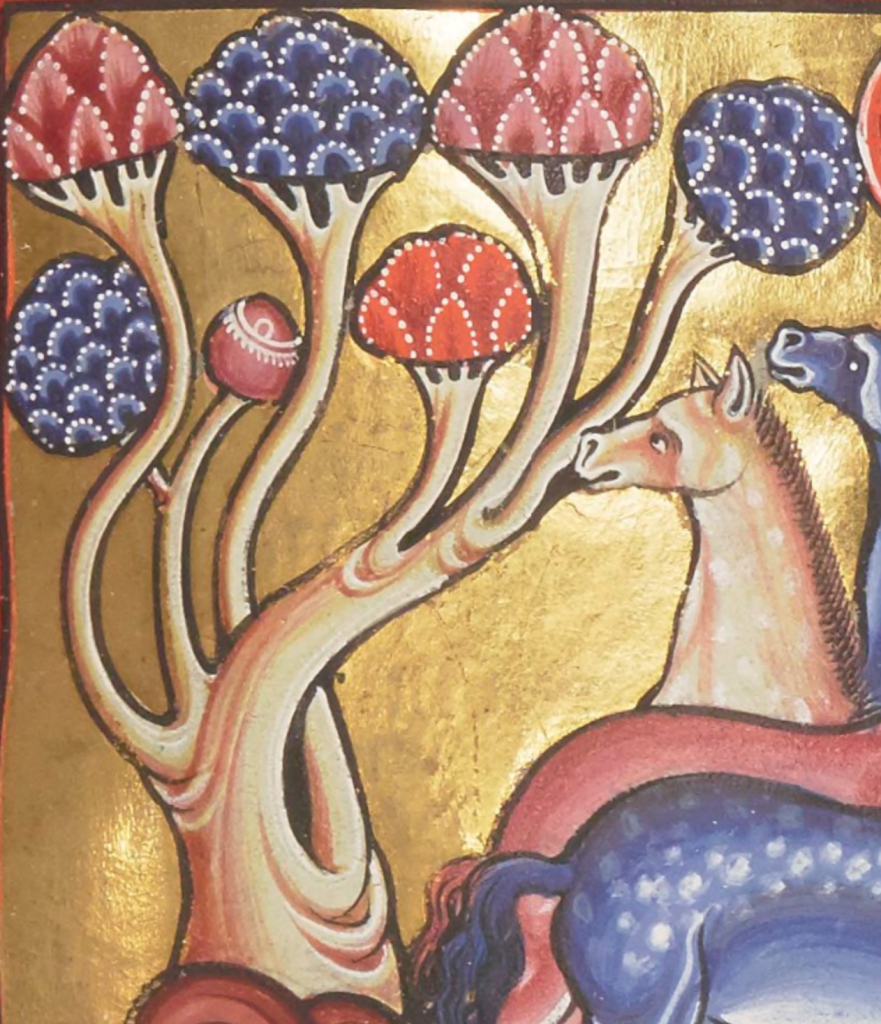
they were so superstitious about healing relics of the Saint that for over 1000 years they made pilgrimages to the Saint Walburga Abbey just because there’s a tapestry showing psychedelic 🍄mushrooms (which are unfortunately faded & disappointing anyway but that’s a side point)
like you know how there’s a dispensary with the big cannabis leaf on it and people travel to it
well this Abby has a big medical sign of the the cup of healing held by the scene with the snake approaching it drinking out of the upturned Amanita crater wine mixing bowl
and on the side of the building a big amanita upturned wine mixing bowl with the snake on the outside of this dispensary clinic
and can you believe the Christian ancestors of ours were so low IQ that we’ve inherited from them , that they actually thought that this healing vial thats shaped like an Amanita was worth traveling to the psychedelic healing clinic called Saint Walburga Abbey
can you actually imagine anyone being so gullible as to make a trip to a psychedelic healing clinic because of the relics of the Saint which has a healing oil in the Amanita shaped vial and Abby has a big sign mushroom and healing imagery of a snake
kind of like a cannabis leaf with a medical green plus medical icon on the side
and people actually were so stupid that they traveled they actually felt that was something that attracted to them attracted them to the Abbey
but anyway to change the subject
have you heard about Brian Muraresku and the book the immortality key?
we are trying hard to set up psychedelic healing clinics which we have now tamed the dragon which we call the shadow because we don’t understand it at all and we are very afraid of it
but anyway our clinics have now domesticated the threat so that there’s no more threat anymore, by giving you the psilocybin without actually giving you psilocybin , because that would be a threat to you so …
but they have lots of framed certificates certifying that they know how to avoid the encounter with the dragon / shadow and this is why they, the certified Muraresku clinicians, are scientific and much better than the hierophants of old
Two Trainwrecks Colliding: Browns’ Book & Article Treatment of the Vial
The closer you study the Browns’ passages about the tapestry 🍄 vial, the errors and bugs and creepy crawlies just keep on coming, like a big jackpot of fail ha ha ha ha
Cybermonk
I have to write again what I originally wrote 1 billion words ago at the top of this new webpage:
my original point here was that:
my thinking evolves every hour.
there is so much of a wealth of badness here that every hour (I’m going to have to start writing timestamps) that I keep revising and evolving and developing my analysis,
and I keep correcting the things that I said one hour ago I now realize are a little bit incorrect
and every hour I make more corrections of myself as the fail keeps rolling out
I definitely have to do at least one more readthrough of these passages by Browns book The Psychedelic Gospels and their Wasson Allegro article to put them side-by-side to memorize:
is it in the book or the article, where they say who wrote the caption, and how negative, and how positive is the book versus the article
in which place did they use which rhetorical move
do they try the same rhetorical moves and make the same mistakes or aim for the same objectives Both in the book and the article ?
compare and contrast the rhetorical moves and positioning and the description of their position with relation to the competing positions
Do both passages make the same mistakes, or make the same assertions, or attempt to make the same persuasions, or attempt to make the same misrepresentation?
for example, the article misrepresents as if they traveled to the tapestry, but the book is explicit that they did not travel to the tapestry.
so the book is superior in that respect, and more honest and explicit – but with that greater detail, they also expose their own mistake in the book.
although this mistake is still partly implicit, and not argued very explicitly, but it’s clear enough in the book that the reason that they did not go to the tapestry is because they decided (for whatever reason, mostly serrations) to categorize the tapestry as being “not entheogenic art”
and the reason they give happens to be that the serrations don’t match botanical specimens
even if that weren’t a huge screwup, even aside from that big screwup, it is intriguing how the Browns never actually say in the article – maybe because their good sense got the better of them – they never actually get around to saying in the article that they concluded that the tapestry in fact does not qualify as mushroom icon
and that they are giving an entirely negative verdict on this as Mushroom icon
they never actually say that in the article and yet they lead up to saying that; they tell you “we’re gonna give you a big bad news very bad news… unfortunately, what appears as if entheogen icons fades, upon closer inspection of my photograph i brought with me & held up to the window, yessiree, fades like a tapestry of failure“
And then they never tell you the punchline (in the article), that this tapestry, we concluded, fails to match mushroom botanical specimens so we conclude that this tapestry is not entheogenic art
👼🏻✋🖊 🚫🐂💩
I think that most likely an angel of God stayed their hand and prevented them from writing their insanity that’s in the book, that this tapestry fails to match botanical specimens and therefore this tapestry is not a 🍄 mushroom icon
maybe they got cold feet and they wimped out and wussed out and realized that there would be torches and pitchforks if they came out and said that same erroneous bullsht that they said in their book
“Rightly or wrongly, we are going to reject this tapestry as an Amanita muscaria.”
Photo Credit: Not Julie M. Brown
and so they leave the reader dangling and they merely say “we expect you to be very mad and disappointed because the saint holds a vial” and the reader is left scratching their head:
how are we supposed to be upset and draw a big negative conclusion and boo and say boo against Jan Irvin’s catalog of data images?
where is the bad news? I don’t see it
the argumentation that they put forth in the book is the combination of 1) definitely being a vial, combined with 2) the fact of having serrations which contradict the natural botanical specimens
in the book, the story that they tell is that they confirmed it is definitely is a vial and also that it definitely does not match botanical specimen and that is the reason why they called it (indirectly) they classified it on the next page as “not entheogenic art“.
but notice that they did not write in the caption in the book on the color plates for the customer in the bookstore to flip through, notice that they did not highlight in the caption “we proved that this definitely is a vial and it cannot also be a mushroom because this picture has serrations but botanical specimens have a smooth base.”
“so we have proved that this 🍄mushroom tapestry does not mean a mushroom” –
they did not say that in the caption of the printing in their book’s color plates
(switch gears here back to the article now, which is distinct from the book)
in the article they do not say that this has serrations and therefore “this is definitely not an 🍄 mushroom shape” & “this tapestry is not entheogenic art”
they remain silent on that point, and what they do say is true so far as they go
except they don’t explain why they did not travel to the tapestry , and
they do not explain that the photo that she brought with her probably is a fictionalized retelling of the Irvin holy mushroom book black-and-white version, and definitely I think was not the photo that they later obtained from the Abbey, I gather and
in article they sure don’t point out that they did not go to the Abbey
and that the reason they did not go to the Abbey was because they are presenting this tapestry as an example of being NOT mushrooms
they omit both the fact of not going to the Abbey, and omit the reason why they didn’t go to the Abbey, which is to say: they omit:
“this manifestly 🍄-imagery tapestry is a failure and is proved by us to not be 🍄 icon imagery”
I cannot prove that the 2019 article would agree or assert that “this is not a mushroom representation” (as book asserts)
the article does not say “this is not an Entheogenic icon” –
So then we are left very mystified: why are we supposed to consider this tapestry as a failure and a disappointment and all of Han Irvins images are just as big of a failure as this – but I don’t see how this is supposed to be a “failure”
I’m just left puzzled – until I read the book and then figure out the whole train wreck.
but the book (implicitly roundabout but clearly enough) does say (indirectly) “this tapestry is not an entheogen icon” –
The justification for that conclusion is not only that it is positively identified as a vial (which is a extremely clear-cut true conclusion) but also, in particular, the flat base-
but even more strongly than the flat base, the-death dealing blow that proves this is not a mushroom image is the serratikns – it really does come down to the serrations.
But by no means am I saying that the there’s only a single error here (serrations), because I think that there are about five distinct major errors in these two passages, different types of errors
I’m not sure, I have to think through the specific question:
can the serrations error of the Browns be considered the root cause of all of the other errors in their presentation & use of & employing of the tapestry?
maybe a case could be made for that.
conversely though, consider:
the Browns said they were able to make a field research decision about travel: they say that the blurry fourth generation image provided by Jan irvins book was actually sufficient for them to make to perceive botanical details enough so that they were able to make a travel decision – and that right there contradicts their assertion that blurry images are a dealbreaker and you have to travel.
Then what’s odd/ intriguing structurally, and here we get into kind of a master level of of my analysis, and masterful analysis on my part, is that:
the article then proceeds to omit the implicit conclusion that the object cannot represent a mushroom, and omits the factoid which was the basis for that false conclusion
and yet the article still treats the tapestry in as negative of a way, as if it is still a failed icon which was proved to not match Amanita, and they lead up to the tapestry making this degree of intensely negative sounds in their lead-up to the tapestry, but then in the paragraph which arrives at the tapestry topic, where you expect them to announce with great fanfare that:
this tapestry turns out to definitely not match Amanita!! 🤯😱😲😵 –
that’s not what they say, in the article, (only in the book).
I would expect the article to say the same 2- part statement as the book:
1) that for one thing, the object definitely is understood to represent a vial
2) the object cannot also mean a mushroom, because it has serrations, unlike a smooth base Amanita specimen.
instead, after all this negative build-up that they do in the “unfortunately” paragraph of the article, they announce with great fanfare what we are expecting to be a hugely negative assessment
but instead, the only thing they deliver in the tapestry paragraph of the article is the mild and uncontroverted statement that the saint holds a vial 😴
but they remain stunningly silent right where you expect them to say “therefore this image does not cannot mean also mushroom” [due to the standard-fare single-plant fallacy/ pretext lying baloney poppycock rubbish nonsense]
or , you expect them to argue, at that paragraph: “this object cannot also be mushroom, because the serratioms prove that it fails to match the smooth base of a 🍄 botanical specimen”
but in the article, they are totally silent on all of the negative options there, they actually do not say anything negative at all about the tapestry,
after all that negative “unfortunately … all of Irvins evidence fades” build-up, they do not have anything negative to say about the tapestry! no “vial fails to match botanical specimens” false assertion like in the book, no “tapestry is not entheogenic icon” false assertion like in the book.
it’s strange, what a strange dangling lack of follow-through, after all the negative build-up, they don’t actually make any negative assessment about the tapestry! 🤯
the article gives no reason at all in what sense this tapestry constitutes any kind of “unsatisfactory … fades” aspect of the Jan Irvin collection of mushroom imagery in art!
the article strangely expects us to read “oh no this is terrible what a terrible negative result, the fact that the saint holds a vial” 😭
and I say “I don’t get it – what are we supposed to think is negative about that?”
“A perfect example of how very, very disappointing and failed jan irvin’s evidence is, is this tapestry.
“This tapestry is very disappointing, and this is typical of how very disappointing all of Irvins art is, because it turns out, that the saint is holding a vial.”
and (forgetting about the book), my reaction to the article there is:
“I don’t get it – how is this supposed to be a bad thing? so this beautiful tapestry of amanita icon depicts the Amanita in the form of a vial held by a saint holding an Amanita styled vial instead of the usual metal; this time, the vial is styled as Amanita mushroom attributes, providing a great example – just like Jan Irvin promised – a great example of amanita Mushroom imagery in Christian Art. bravo 🎉👏
and you’re telling me that this is somehow a failure?
I simply am not following your point.
in what sense is this tapestry “unfortunately”, “faded” evidence, just because the saint is not literally holding a physical mushroom like Jan Irvin misstated?
so you’re telling me I’m supposed to treat this as an entirely disappointing, “unfortunate” and “faded” Evidence?
why are you trying to paint with such a jaundiced view?
I don’t see how irvin’s mistake means that this is now somehow “unfortunate”, “fades” , and as you say (in the book, indirectly) that “therefore” this is “not an Entheogenic icon”
you’re telling us that we are somehow supposed to be disappointed by this
and yet you seem awful happy in presenting this picture which we see as we flip through your article
and the article never says anything negative actually about the picture!
the article never says directly or indirectly… well it says very, very indirectly, the article asserts that this is not an entheogen icon, at least two layers of indirection, very indirectly the article says that:
“this 🍄 icon tapestry is not a 🍄 icon” 😑
“At first seems like good evidence for entheogenic art, turns out to fade “
they say that the tapestry as evidence has “faded”
that’s not even clear what the hell are even asserting!
what do you mean it “fades”?
The answer – you would hardly guess that’s – the answer is that they screwed up when they transfered their argumentation structure from the book to the article, they left behind their shocking negative conclusion in the book that the tapestry contradicts botanical specimens and so this tapestry does represent a vial but it cannot also represent a mushroom, because of the botanical mismatch, and so therefore:
This tapestry cannot be considered a 🍄 mushroom icon!!!
🚨 🧜♀️ 🚨
earlier…
as I autistically weave my way back-and-forth repeated cycles through my critiques, I am seeing that the Browns made a whole tangled mess of different kinds of errors:
structural errors
botanical identification errors
logical argumentation structure
errors of presentation sequence
Errors of misrepresenting their non-fieldwork as if it were fieldwork
misrepresenting Jan Irvin’s book as if it were “a photograph i brought with me” (I strongly suspect – sounds like fictionalized b.s. to me)
Just like how good esoteric art continues to pan out more and more
the more I look at it the more profundities are hidden in this art of the dancing man and roasting Salamander is incredibly deep and it keeps on paying off
similarly is the badness that comes forth from the Panofsky letters and from Wassons terrible writing about the Panofsky letters, and about the Browns short passages about this vial:
the closer you study the browns’ passages, the errors and bugs and creepy Crawley’s just keep on coming, like a big jackpot of fail ha ha ha ha
and it reminds me of Robert M Price the editor of the journal of higher Criticism:
when it came to commenting on allegro’s book, he went crazy and wrote all kinds of non-scholarly trainwreck
and the Browns are falling into that same pattern
The Browns’ thinking becomes completely garbled and their writing and their citations and everything becomes completely broken when they are confronted with the taboo problem of the reality of mushroom imagery in art
they make 18 different kinds of mistakes all tangled together
what are you talking about, “unfortunately … fades”??
you’re saying that because tapestry does not depict holding a literal mushroom like Jan Irvin misstates, that therefore we are to consider this tapestry as having “faded”, whatever the hell that supposed to mean, because the tapestry only means that the saint is holding a usual standard vial except this time the artist has cleverly decided to style the expected vial (obviously, plainly, self-evidently) as an Amanita mushroom
and we are supposed to take this as “faded” & “unfortunately”?
is that what you mean by “fades” and all of Jan Irvin’s art “unfortunately … fades”(??) in this kind of a way, so we are supposed to be disappointed
that has to be what you’re saying
but in the article you do not go so far as you did in the book where you said:
1) “this tapestry does not depict a mushroom” explicitly p153
2) and therefore “this tapestry is not a mushroom art icon” implicitly p154
3) and therefore we are canceling our field work trip to the Abbey to see the tapestry firsthand.
The article won’t give you the answer to this mystery/ question.
but the book gives you the answer to the question
the question is :
why didn’t the Browns go to the Abbey
well the Article won’t even tell you that they didn’t go to the Abbey ha ha so the Article can’t even raise that “why not” question
ha I don’t know where to start here ha ha
Two Trainwrecks Colliding
regardless of the trainwreck of the article versus the trainwreck of the book, the lying omission of the whole problem
they omit the whole problem from the article
but anyway the question I was going to ask is
why didn’t they go to the Abbey?
the answer is because they concluded based on the exact same piece of art which Jan Irvin provided them , and not based on seeing the tapestry, but using the same distorted blurry picture that Jan urban used, was evidently good enough for them to conclude firmly, without even having to bother seeing the tapestry firsthand, they were able to make a firm conclusion based on a clear enough black-and-white photo in jan irvins book which they misdescribe as “I brought a photograph with me”
strange to describe irvins black and white book as “a photograph”
” I held the photograph up to the light” – which is to say, Jan Irvin’s black-and-white blurry distorted Internet image that’s printed in his book – and even though it was a distorted fourth-generation copy of Jan Irvin’s distorted Internet image, we were still able to see enough detail to positively conclude negatively that this cannot mean mushroom, because the tapestry serration, unlike the smooth base of a natural Amanita.
We canceled our trip to see the tapestry because of the serrations in the tapestry blurry image, which we know does not match smooth base of 🍄 mushroom specimens.
the “unfortunately” lead-in paragraph of article says “unfortunately, evidence that at first looks like entheogen icon, turns out to fade, on closer inspection by Julie’s eyeballs, in person, 3” from the tapestry itself.
and our example of this intense letdown is the tapestry which Jan Irvin said is a literal mushroom, but we reveal that it is a vial (and as you can plainly see is self-evidently styled Amanita). Super disappointing, huh!
and it is left to the reader, we are expected to then come away saying, connecting the pieces together here, and we’re supposed to say “at first we thought this tapestry was a mushroom/entheogenic icon, but now we know that it is a vial styled as a mushroom, and “therefore” we are supposed to conclude that this is not a mushroom icon”.
Do the Browns expect the article reader to know that what is silently being asserted here is that :
“the vial fails to match botanical specimens, and therefore this is not a Mushroom icon”
Because remember, the article never states that.
only the book states that .
so how is the article reader supposed to know why they’re expected to be greatly disappointed to hear and disappointed in the quality of Jan Irvins and John rush’s collection of evidence.
article reader says “where is the problem here? where is the disappointment? I don’t get it”
because the Browns smartly – maybe the hand of God and the angel’s hand stayed their idiotic pen and wouldn’t let the Browns write such God-forsaken manifest pretextual malarkey as the devil had them write in their sorry book
👼🏻✋🖊 🚫🐂💩
Your logic coheres in the book: it’s based on a mistake about the serrations, but the logic argumentation structure at least in the book is coherent:
you can follow that if the object in the tapestry fails to match actual specimens, then it makes sense why they canceled the trip to go see the tapestry firsthand.
The article because they leave out their fallacious reasoning process based on botching a basic botanical fact
they never say in the article that they concluded it cannot match a botanical specimen and
they never give the reason why they concluded that the tapestry cannot does not match botanical specimens
so they leave you and they never say that they drew such a negative conclusion that they canceled the trip to see the tapestry
so they build up this tremendous disappointment and then they never deliver on that negative assessment
they never tell you the negative assessment… that was so… they Just leave you floating confused
they never deliver the punchline of why this is supposed to be a disappointing piece of art, in the article
so the article lacks the huge error, the false negative that the book has, but on the other hand, the article sets up this great big huge disappointment punch line – and then fails to ever deliver the punchline of “therefore this tapestry cannot mean mushroom” (because it fails to match the botanical specimens)
The Browns announce with great fanfare that they’re going to present this tapestry as a great example of very disappointing failed iconographic entheogen mushroom icon evidence
but then instead they simply say:
“the saint holds a vial” (which obviously, manifestly, plainly, self-evidently is 🍄mushroom-styled)
Which is to say (keeping in mind the principle of artist responsibility), the image which the artist consciously deliberately chooses and knowingly chooses to present is guaranteed to force the impression of 🍄mushroom on the viewer
so I don’t get it – where is the big huge disappointment?
in the article, the Browns never deliver the big punchline of, the great big disappointment regarding this tapestry
the article just leaves the reader puzzled, because they left out their huge gigantic botanical error thats in the book, but they also left out their book’s big negative conclusion of saying “therefore this cannot represent a mushroom” and “this tapestry therefore cannot be considered a 🍄mushroom icon“
The article reader is left scratching their head saying “I don’t get it – why am I supposed to be disappointed?
“how is this supposed to make Jan Irvin look bad?
“you said you found a way to make a Jan Irvin look really bad and really disappointing and really faded, but the only thing you did is to clarify that the 🍄mushroom icon tapestry has the Saint holding the usual vial, but now styled as a Amanita psychoactive mushroom.
“and you’re telling us we’re supposed to be deeply disappointed by this tapestry? I don’t get it”
… one million thoughts earlier…
but I am confused: I don’t see how you categorize this as “not a mushroom icon”: here we have a saint holding a healing vile which is styled self evidently as a mushroom, and you are telling us that “this is not a mushroom icon”
your negative messaging simply does not make any sense at all
it doesn’t cohere. your whole presentation of this tapestry does not cohere! all it does is confuse people
I don’t think this article could convince a single person that this tapestry is “not a mushroom icon”
and I find it difficult to believe that this article itself considers this tapestry to be “not a mushroom icon”
blurry 😠👎 reven tsurt na negoehtne ralohcs.
✋😏🤚
blurry, yet proved LEFT HEEL LIFTED = hokey pokey John Rush = dancing man = leg hangingblurry but sufficient to deduce/corrob {standing on right foot}
no color, yet this image was used for a huge top-three breakthrough of art interpretation – just like I’m totally guessing that:
the alleged “photograph” Julie allegedly brought with her and allegedly “held up to the window” , I’m guessing, I’m betting that it is the black-and-white version of the Holy Mushroom book by Jan irvin that she’s referring to, and that whatever it was was sufficient enough for her to perceive serrations on the🍄 base, and make a field work decision based on “holding up to the window” the so-called “photograph”
Jan irvin suspects that the Hofmann bicycle trip was a fabricated deliberate deceptive mythmaking , and the same thing with Gordon Wassons tale which he always tells again and again, the hazy origin story fabricated tale of “the honeymoon walk in the woods with his wife” regarding different attitudes about mushrooms – that even if the event sort of semi-happened, far more important than the actual event is this mythicized ritualistic retelling.
Julie’s fictionalized origin tale of her great reveal, her great realization “while doing field work” 😉, that this tapestry is actually not an entheogen icon, and all of Irvin’s database is bunk, “unfortunate … fades”
Well I have a semi-fictional mythicized retelling that I’m going to make into a ritual, it will be my constrant retelling of the tall tale when Julie Brown “brought a photograph with her” and “held it up to the window” 😏😉 – just like “really happened” in the Dan Brown novel.
what did Julie Brown see in the light of the window holding the photograph (a.k.a. Jan Irvin book) up to the window?
she saw serrations in the black & white Jan Irvin-provided, blurry Internet photograph copy, fourth-generation extra blurry, and she knew that she could make out those blurry serrations well enough to make a field work travel decision based on it , that real Amanita specimens have a smooth base, and therefore we could make a solid decision not to do field work, and cancel our trip to see the tapestry , which courtesy of the abbey emailed to us on the internet.
we realized the serrations “while on a field work trip” – you have a way of painting with words, painting fictional pictures
did I mention we were on a trip?
that’s right, we were on a trip doing fieldwork, in our hotel, behind our computer screen, doing fieldwork, looking directly at the tapestry photograph on our computer screen, firsthand with our own eyes, we were right there! 😅 🙃 😅
But then we canceled our trip as soon as we saw there’s those serrations in the tapestry, we knew there’s no way that this can be a mushroom icon, because real mushrooms have a smooth base
that’s why in our field work, we canceled our fieldwork, and did not do field work to go see the non-mushroom (bc serrated) base of the tapestry’s vial first hand
and the article never says “we concluded that this is not Entheogen art”
and the article never says “by using a fourth generation copy of a black-and-white printing of Jan Irvin’s book with blurry Internet pictures, we made such a very strong conclusion that this tapestry is not an entheogenic icon, that we didn’t even go to see the tapestry firsthand, and we canceled our trip to the Abbey”!
The really weird dangling affect the article has is it makes a great noisy super negative set up but then it never delivers the negative goods it never says we concluded that this tapestry is bogus bunk falls and definitely not a mushroom but only a vile and definitely not also a Mushroom because of the botanical features in the tapestry we concluded that this is not May I repeat not a Mushroom icon the article never says that and the leader the reader is left dangling and underwhelmed by the lack of negative conclusion that they expect that the Browns promised
you promised a gigantic big huge disappointing reveal, and then you never delivered the punchline!
why are we supposed to be disappointed by this faded Failed evidence of this tapestry?
you haven’t told us in what sense is this tapestry a failure
you never said (in the article) “we concluded that this tapestry cannot show a Mushroom icon”; “this tapestry is not a mushroom icon”
you never even said that
so why are you presenting this as a disappointment example of how disappointing the Jan Irvin catalog of evidence is?
… one million thoughts earlier ...
my recent, second, in-depth analysis of the two treatments by the browns of the Saint Walburga tapestry Amanita vile is interesting how it develops
you can see it develop on hour by hour basis, as I learn and memorize the paragraphs
What’s remarkable about the two Panofsky letters and the two brown passages are that they appear to be quite short, and yet it’s remarkable how much in-depth analysis and unraveling there is to be done before you can say that you really grasp the ins and outs of:
what did they assert
what did they not assert
what did they say assert explicitly
what exactly did they assert implicitly
how did their assertion-set change between the book to the article 3 years later?
just like I had to repeatedly re-read the pair of Panofsky Letters censored by Wassen which he let us see maybe 1/4 of them of their content
and then I learned to beware of treacherous mistranscription in Browns Article of Panofskys 2nd letter re ‘project’ (artwork) where Pan actually wrote ‘product’ (templates)
and a little striking thing listening to my mistakes in my earlier speaking about the vile you can hear me correct my mistakes an hour later
The passage is much clearer when you put the two terse passages side-by-side then it becomes obvious and explicit even
what caption?
how is it that the photograph that she brought with her has a caption?
who wrote this caption oh Jan Irvin
oh by photograph do you mean then his book?
did you photograph his book?
did you take a photo on your phone then hold that up to the window
did you have it
Did you have a photograph on stock paper in addition to having an Jan Irvin’s book??
what are you talking about, that you “brought a photograph with you”; could you be concrete and specific please
why does “the photograph” that you “held up to the window” have a caption written by Jan Irvin? 🤔 🤔
and so you have to put the two passages side-by-side to piece together the puzzle pieces
it is all the more necessary because the passages are so very short, maybe three paragraphs each, like Panofsky’s letters
the shortness is the challenge because it means it’s very tightly condensed, with 90% of the iceberg not visible.
deep critical analysis of short, vague, biased, manipulative, rhetorical-persuasion passages by Panofsky, Brown, Hatsis, and other untrustworthy entheogen scholars, is similar to interpreting visual mystical art , where the artist has to rely very heavily on unnatural depictions such as touching and size.
at the same time as you need to analyze the book separately from analyzing the positions in the article –
yet to determine who wrote the caption, and what they’re, what photograph they were talking about when she claims that she “brought a photograph with her”
when the truth probably this is likely most likely is a fictionalized repainting of she brought jan irvins book black-and-white with her I’m guessing, a good guess
and then she’s taking poetic license to paint a romantic romanticized fictionalized semi true docudrama account taking liberties when she brings her Cheap black-and-white version of Jan Irvin book the holy Mushroom, she writes instead “I brought a photograph with me , and I held the photograph up to the light”.
My first pass was, see the date on my WordPress webpage about hatsis book psychedelic mystery traditions, contains my first-pass critique of the vile of the tapestry
there are photographs of my 2006 Wasson book Soma for Plainc 🍄 article my hand written notes With highlighter circling and underlining every line and every word
this is what analysis of rhetoric requires, especially implicit, indirect, roundabout rhetoric which is designed to mislead and misrepresent
I’m kind of good at that analysis
I’m really good-
I’ve become-
I’ve developed some really very powerful word level microscopic reading techniques
I hereby define the psychedelic gospels theory v2 as hardcore, per the overenthusiastic ardent advocates, seeing that v1 died on the hill of the St. Walburga vial.
Cybermonk
May 17, 2022, a.m.
Brown needs to do full disclosure regarding all the omitted details from the book and from the article paragraphs regarding the tapestry.
when you claim that you “held the photo up to the light”, what photo are you talking about: the black-and-white cheapskate version of the gallery book courtesy of Jan Irvin?
pls confirm that “the photo” which you used to improve upon irvin’s interpretation, was the selfsame photo which irvin used & provided you with a copy of; an even poorer copy of his copy. Not the pic internetted to u by Abbey. And not seeing tap firsthand. so you demonstrate that it’s possible through superior interpretation or nuanced, to come up with a superior interpretation, through using an inferior copy of a copy of a photograph of the original art. opposite of field work. only AFTER your superior reading of Irvin’s b/w inferior version of his pic, did u LATER get the hi res pic internetted from the Abbey.
which u use to show beaut instance of 🍄 imagery to readers of ur bk plates & color popular article, as a positive instance of good successful amanita imagery in Christian art.
so this tapestry vial = a good entheogenic icon IF/WHEN contained in Browns publication, but = a failure & disappointment & a non entheogenic icon if /when contained in Irvin’s book.
when did you obtain that “photo”? is it a color photo or black-and-white photo?
when did you, and why did you obtain the photo from the Abbey?
if this art is “unfortunately”, negative, failed disappointing and faded Evidence, “not a mushroom, but instead is a vial” when it comes to Jan Irvin, then why did you go to the trouble to request a photo high-resolution color beautiful version from the Abbey, if it is negative, disappointing, failed evidence for msh imagery?
is this icon positive evidence, or not, for Mushroom imagery in Christian art?
pls State at your position explicitly, not implicitly.
Your book treats it as negative evidence but also kind of treats it as positive evidence too, in your gallery presentation, and same with the article.
whenever you discuss Jan Irvin , you emphasize the negative (rhet framing); but when you discuss your own theory, you emphasize implicitly the positive evidence of this tapestry, that it amounts to & serves as.
here is mushroom imagery, when we are promoting our theory
not, … irvin
Can we see your email communications with the Abbey?
if we do full disclosure, as u claim to do, I want to see your email to the Abbey, and I want to see the email reply from the Abbey with the attached photograph.
I want to see just how inconsistent, just how prevaricating, just how much you want to and try to abuse this Sacred art to have it both ways.
You frame it as “definitely manifestly is” and “definitely is not” mushroom Imagery, at the same time, in a brazenly self-contradictory way.
did you tell the Abbey that you wanted it them to internet you a hi res color pic because it shows a Mushroom?
Tell me , how high resolution is the color image which Jan Irvin has ?
do you have his color book, or his black and white book?
did you tell the abbey that the tapestry is a beautiful instance of mushroom imagery in Christian icons?
why exactly did you not travel to the Abbey?
why do you try to sell / frame / characterize this tapestry as negative evidence when you’re criticizing Jan Irvin, and yet you implicitly sell & frame this same tapestry as positive evidence for mushroom imagery, when it comes to promoting your own theory?
If this tapestry fails to depict mushroom imagery, then why do you include it in the color plate of your book right next to the big red 🍄 cap from the other church?
Browns’ position on the vial may have changed; their view appears to have developed to a more neutral take, from the 2016 book to the 2019 article.
The later article, by itself, doesn’t say or imply that the tapestry is not entheogenic art. Unlike the book.
The article doesnt say “good thing we didnt go there, lets go to entheogenic art instead”, as the book says.
Article only says tapestry depicts a vial, not holding a literal msh. and implicitly asserts it looks like 🍄. both are true.
The article should have explicitly stated their potential viable point, which is that our method gives a more precise, complete, and detailed and less crude interpretation than Jan Irvin crudely incorrectly, incompletely asserting that she holds a literal mushroom specimen.
It is not clear that the article is trying to make that valid point, which could have been a constructive useful point.
Article omits the book’s two false implied statements, 1) serrations dont match botanical specimens; 2) tapestry is not entheogenic art. p 153 & 154 respectively.
Both false assertions are implied, not explicit, in the book; neither assertion is articulated clearly and explicitly.
The article is all-around more silent: doesn’t say they didn’t go to tapestry; falsely misleadingly implies they travel to it, “On our trip, we realized it’s a vial” (😉 while looking at a photo) – that’s as true and as deceptive, constitutes lies of omission (& of positional framing) as much as Wasson writing the quarter-truth, “my printing of Panofsky’s letter”.
NEVER TRUST AN ENTHEOGEN SCHOLAR
Article doesnt state why they decided not to do field work on the tapestry. That omission is strange & misleading, given the structural placement of the picture “Courtesy of Walburga Abbey”. 😈
I’m a painter myself – of false and misleading pictures
Dear Abbey,
Thanks for the blurry photo, we sure enjoyed the visit – to our hotel & computer screen.
— the Browns
Non “Full Disclosure” section of article
Ironically, the article postures by having a “full disclosure” section, but they fail to list in their full disclosure section that they did not in fact travel to the Abbey.
Nor do they state there why they didn’t go to the tapestry in field work (p 153: bc flat base, bc being a vial means not also alluding to 🍄, bc serrations dont match botany specimens) and why they classified it in the book as not entheogenic art p154 – woulda been interesting.
May 16, 2022, p.m.
Ultimately, I find the Browns’ attitude about this piece of art baffling and self-contradicting.
browns should be putting more energy towards coordinating with the Ardent Advocates, instead of pretending to fight against them and pretending to have a big giant gap and conflict between the two, which is really an overstatement and confusing, as we see here, not very helpful
we should be resolving the minor little refinement of interpretation between the psychedelic Gospels theory versus the Ardent Advocates,
these are just internal fine points of detailed dispute within the same general Normalcy/Maximal entheogen theory position, except that admittedly John Rush has Amanita Madness extreme overemphasis.
we need to develop the idea more in a refined way, of rejecting the Suppression Assumption, as being too crude; we need some refinement.
The suppression assumption is very disproved by the boatloads of mushroom imagery within the church, completely disapproves Mckennas extreme overstatement and Jonathan Otts crybaby extreme exaggeration, trying to tell the false story
but his story collides – as Thomas Hatsis should agree – Jonathan Otts crybaby boo-hoo story completely collides against the fact of the boatloads of mushrooms jammed all throughout Christian Art – not to mention every occurrence of the word ‘Eucharist’ in texts.
Browns simultaneously parade the tapestry forth as a great awesome positive example of mushrooms in Christian art, while trying to also describe it as a failed dud example of non-entheogen art, just because it doesn’t depict a literal botanical mushroom, like Jan Irvin incorrectly asserted.
My God, Browns, if this tapestry is a failure and an example of non-entheogen art, then let’s have 1 million more duds like this from the Irvin/Rush collection.
you sure seem to love it yourself
what the hell is your message
I am just confused
I think the Browns want to have it both ways on this piece of art.
they want to simultaneously double-purpose this piece of art as a great positive proof of their theory that there’s tons of mushroom imagery all throughout Christian art, proving their psychedelic gospels theory, while simultaneously also while also trying to frame it as a failure and an example of how the collection of images contributed by Irving and rush are false disappointing misinterpretations,
“this image is a typical example of the disappointing false positives that the Ardent Advocates deliver”
but how can browns frame this as a false positive typical of the totally disappointing deliveries from Irvin and rush
in what sense is the tapestry a false positive and a great representative example of the disappointing kinds of failed evidence that the ardent advocates provide?
the Browns confusingly present it both as a success and failure at the same time
they tried to use the same piece of art to bolster their own theory, while simultaneously trying to use it to somehow depict the contributions from Irving as being a failure & false positives
the serrations are used by Browns to argue that it is not Amanita but “instead” is a vial.
what the hell is their position/ attitude on it?? it’s totally confusing.
Browns present it as an attractive example of amanita art, and everyone receives it as Amanita art, everyone points to it and says “good example of 🍄🖼 amanita art that the Ardent Advocates provided, what a pleasant article, what a pleasant book.”
“Nice Amanita tapestry you got there”,
And the browns say “why thank you , were glad you enjoyed our successful collection of amanita pictures including the tapestry”
they’re trying to play the tapestry art both ways!
when you’re trying to judge Jan Irvin, be sure to treat this tapestry as a dud negative failure and a great example of how disappointing irvins contributions are.
but when you’re trying to judge our contributions, & interpretations, you should instead think of this same tapestry as a great beautiful wonderful example of the amanita art, even at the same time as we mentioned something about serrations proving that this is not amanita, but we’re gonna accept all of your positive reading of it, in a completely self-contradictory way, so that it is and is not and is positive and is negative all at the same time (depending on whether we’re putting down Irvin at the time, or trumpeting our theory’s superiority at the time) – slip and slide!
and then we’ll conclude that our interpretation is better and clearer and has more coherence and integrity than Jan Irvin, those crazy confused Ardent Advocates, who can’t think clearly.
my God could you be more self-contradictory?
There should be more reconciling and less posturing /marketing of relatively trying to lower Irvin in order to raise and elevate the Browns.
Sure seems like this tapestry is being abused to try to make Irvin look exaggeratedly bad in order to try to make the Browns look relatively good.
The tapestry is being confusingly abused to exaggerate and overstate the difference between the Ardent Advocates’ Interpretation versus the Browns’ Interpretation – they’re not really that far apart, even if maybe Rush exaggerates Amanita.
in the book, p153, Julie claims that she has reached a negative identification due to the serrations, and yet she also acts as if this is a beautiful positive example of mushrooms in Christian art.
I don’t really understand if she’s saying that it looks like Amanita or that it does not look like Amanita.
The Browns are confusing me with mixed messages
they’re sending me a message that the tapestry does look like amanita, and that it does not look like amanita.
they say that it is a positive example, and that it is a negative example, and proves that Irvin is wrong in seeing mushrooms everywhere.
and yet at the same time Brown implicitly says that this picture looks like Amanita.
By the very act of including it in his popular article and book, and everyone likes it and he thanks everybody, and everybody’s happy with this great picture of the Amanita tapestry – he just seems confused and self-contradicting, trying to sell this tapestry as a success and failure at the same time, in self-contradictory ways.
The more I study your treatment of the tapestry, the less certain I am of what do you actually believe about it (according to your 2016 book and 2019 article)?
We should not exaggerate the difference between brown versus Irvin, but there’s some truth that Irvin overemphasizes Amanita.
But we would need to gather statements that Jan Irvin made about psilocybin.
at the level of book description, John rush second edition has full-on Amanita Madness; extreme overemphasis.
🍄😱
I have a sharp distant position; I distance myself from rushs position regarding placing Amanita as the center and boundary of your thought.
amanita should be moved out from the center and psilocybin should be the center instead.
as I read and critique each word of the Browns article regarding the tapestry and each word of the book, it is interesting what they never say , and how they want to sound negative – or more nuanced – than Irvin/Rush.
Browns are trying to sound negative, but they don’t actually “dismiss” the tapestry in a clear sense;
browns never denied that the vial image looks like or refers to Amanita in an allusive, styled way.
Yet browns definitely seem to assert that they have discovered that the tapestry does not constitute entheogenic art
this doesn’t make any sense
they need to define their terms: what are the qualities that they’re looking for?
why do they act like this is a bad, poor type of art that doesn’t count?
they act like the tapestry doesn’t count – I don’t understand why.
“Good thing we didn’t waste our time going to see this stupid failed time-wasting dud of a tapestry”
I don’t understand why browns consider vial to be not entheogenic art.
Sure, it’s not a literal physical mushroom object that she is depicted as holding, but still, isn’t this a good, successful find to add to the “mushrooms in Christian art” database??
are Browns saying that this is not Entheogen art?
they seem to say that, in the book, that because the art does not depict the Saint holding a physical Mushroom, therefore this tapestry does not constitute entheogenic art. 😑
that is a bad, failed interpretation.
or that’s a stupid definition.
how did the Browns justify this negativity and apparent rejection in some sense that they are vague about?
this tapestry is actually a poor example of the Browns Interpretation supposedly being far from from Jan irvins Interpretation
I’m not even sure that Jan Irvin really disagrees with Brown’s interpretation
how do we know whether Jan Irvin agrees with Brown’s interpretation?
irvin might say “well obviously that’s what I meant”
Jan Irvin might readily agree with the browns
it’s not even clear that the two positions are significantly held, firmly held, opposed positions that Jan Irvin holds to and that the Browns holds to.
did they ever have a two-way conversation between them to resolve the slight, rather overstated “difference of position/ interpretation”?
they only say that Irvin is wrong / off-base
everything that the Browns say about the tapestry is true, and yet they come away with the classifying it as “not entheogenic art”
but Browns don’t say what they mean when they say that the tapestry is “not entheogenic art”
they don’t say exactly why they chose not to travel to the tapestry
they don’t explicitly say what kind of a negative verdict they have
they don’t explain why they’re only interested in depictions of physical mushrooms
they don’t explain why they consider a mushroom-styled vial container to be “not a successful” piece of “entheogenic art”.
They never say in a single explicit statement that it is an amanita-styled vial, and they never deny that either.
they leave it very implicit why they chose not to view the tapestry. I’m not really sure exactly what they think they’re looking for during their travels
I wish Browns would say why they considered their other destination to be a successful piece of art, but they consider the tapestry to be an unsuccessful piece of art
they don’t say why they’re interested in the kinds of mushroom imagery that they’re looking for
Why exactly does the tapestry not meet the criteria they’re looking for?
they don’t say; it’s all kept implicit.
Why exactly do they think that the tapestry is a perfect addition to their book and article, and yet they didn’t bother to travel to see it?
Maybe because you could say both aspects are self evident:
1) any fool knows that the saint holds a vial, despite Julie making it sound like she had to do a sweat-inducing hard-core Internet research, but it’s really trivia.
OMFG JERRY ITS A VIAL 🤯🤯
🙄🤨
2) Anyone (other than that liar Wasson and that idiot Panofsky) would say that its self-evidently too obvious to even mention that it’s a “mushroom vial” in the same sense as a “mushroom tree”; that it plainly manifestly is mushroom-styled and so that aspect doesn’t need to be summarized by brown.
So there or you can sort of construct brown delivering both halves of the correct interpretation: obviously whatever it is , its styled to look like a mushroom, and as any cursory two seconds of research will show that the Saint holds a vial.
Therefore obviously the tapestry depicts the Saint holding the standard traditional vile , this time manifestly and obviously styled as a Amanita
QED
what’s the big deal?
it’s kind of self evident
what do you need a bat cave sign on it saying:
“the usual vial, this time styled as Amanita”?
that’s kind of self evident
but why exactly do they make noises like this is not a successful piece of art contributed by Jan Irving and John Rush?
Why do the Browns try to diminish and belittle this tapestry as not being entheogenic art?
what do they mean by saying or acting like this is not Entheogenic art ?
why did they act like this tapestry is a failure or a disappointment?
I don’t really get it
I am sure everybody loves this tapestry in the article and everyone feels that this tapestry is a success And a positive contribution to proving entheogenic art Christian art, proving that there is widespread mushroom imagery thruout Christian art.
this tapestry prove that.
so how did the Browns frame it as a negative finding? ” good thing we didn’t waste our time visiting this non-entheogen art , that we include because it shows Amanita and so is very popular in our article “
they contradict themselves.
why do browns include this attractive tapestry to help increase the Article viewership, and then they make noises to try to position this tapestry as somehow being a failure?
browns try to exude negative noises to make themselves look reasonable compared to that crazy person ardent advocate Jan Irvin with his literal concrete crude reading of “object X equals literal Mushroom”
HEY WALBURGA ABBEY, GLAD WE DIDN’T WASTE OUR TIME ON YOUR NON-ENTHEOGENIC ART AMANITA VIAL TAPESTRY 👎👎 – BROWNS
p.s. Thanks for the Amanita art picture of the Amanita vial, this will be very popular in our popular Amanita imagery art entheogen proof of mushrooms all throughout Christian art mushroom imagery article, what a beautiful terrific example proving that there’s mushrooms imagery all throughout Christian Art
Levels of self-contradiction not thought possible, ever since Allegro contradicts himself with the planecrawl Fresco “forgotten memory of a trace of the old tradition from the 1300 years long, forgotten tradition evidently still remembered”
why do they not go see this art, but they go see other art ? they don’t really say
browns don’t really say, but maybe the tapestry interpretation was too easy and to self evidently obvious that against Jan Irving that’s the Saint does not hold a literal Mushroom, but the saint holds a vile the styled as a mushroom.
so why bother traveling to the tapestry; there’s more interesting Interpretation challenges than that.
eg Let’s go photograph St Martin:
holding the branch in the left hand and cutting the branch with the right hand.
Decoded Interpretation/ Announcement; answer to Brown’s question:
Why the Branching Mushroom Tree Grows out of a Stone Tower
Photo Credit: Julie M. Brown; used by permission. Processing & sophisticated interpn: Cybermonk. non-branching msh grows out of stone tower, Brown asks why; I answered May 14-16 2022, bc {stone} = block universe experiencing of non-branching eternalism Dependent control, future control thoughts already exist, pre-created; rock block universe experiencing from psilocybin 🍄.
Processing & sophisticated interpn: Cybermonk. non-branching msh grows out of stone tower, Brown asks why; I answered May 14-16 2022, bc:
{stone} = block-universe experiencing of non-branching eternalism with dependent control, future control thoughts already exist, pre-created; rock block universe experiencing from psilocybin 🍄.
that set of St Martins frescos is a highly valuable, new, not self evident item of high significance that needs to be photographed and analyzed and requires bringing a lot more than just a cursory web search to determine “oh, the Saint always is understood as holding a vial, & this time, self-evidently styled as an Amanita”.😴
This tapestries a perfect example of the dud failed art that Irving and rush falsely put forth as depictions of mushrooms that totally are not depictions of mushrooms at all.
good thing we didn’t waste our time on this stupid piece of non-entheogen art, which will be a beautiful popular awesome addition to our Christian entheogens and mushroom imagery art article because of its great amanita mushroom imagery in Christian art.
that will be some field research that’s truly worth the trouble of traveling, to go get that valuable feel for that room with the multiple surrounding paintings frescoes, and see it ourselves, and see the room layout, and photograph it
although I do really wonder about the typo where Brown says that plural “knives” are cutting plural branches
I only see a single knife
are they being sloppy in their use of the plural instead of the singular?
I only see one knife cutting branches, not multiple knives
they seem to speak too casually there, “knives”.
Are they just strategically trying to use the tapestry as an opportunity to make some negative sounding noises, or more nuance, so that we can perceive Browns as being not dogmatic, according to the great judge of such things, Thomas Hatsis (the dogmatist’s dogmatist, who would literally rather die than ever admit, be forced to admit, that there is mushrooms in Christian art )
of course Hatsis is so confused by his Amanita Madness disease, that when he says “mushroom”, he pictures amanita emoji
👶🧙♂️💭🍄
And unfortunately Hatsis has a lot of company in that; such as, for example – let me think – real hard problem – 🤔🤔 Jan Irvin, John Rush, Carl rock, John allegro, etc. etc. etc 😵
browns mentioned that Jan Irvin asserted that the Saint literally holds a literal Mushroom (overly concrete thinking)
“the mushroom”
Browns correctly said that Jan Irvin is wrong; they correctly said that the saint holds a vial, not a literal Mushroom.
Browns failed to explicitly say , self evidently the vial is manifestly styled to look like an Amanita, and that’s the entire reason why the image is included in the book and article.
why exactly did the Browns choose not to view the tapestry?
I think they wanted to tell some negative story to depict themselves as more reasonable and critical than Irvin Rush Ardent Advocates.
in a way, Browns’ interpretation is better than Jan Irvin – except they never explicitly say that it looks like amanita
browns do act like it looks like amanita, so they reveal through their image-publishing actions that they affirm that it looks like an Amanita,
but browns just never say in a text statement that the saint is depicted holding a vial that is styled to look like an amanita
browns never explicitly put those pieces together in a statement
although Brown and Brown can defend that of course they asserted implicitly that it looks like amanita, by virtue of including it in their book and article
and browns literally explicitly said that it’s a vial
so browns provided both pieces of the correct interpretation
but browns never provide a single sentence that brings together both of the points of the correct interpretation statement.
browns are not articulate about their interpretation and why they acted like it was classified as a “not a piece of entheogenic art” just because it doesn’t depict holding a literal Mushroom.
browns say that they avoided traveling to the “wrong place” 🤯
I don’t understand why browns classify that as a “wrong” type of xn mushroom imagery art
if it’s a “wrong type of art “, “not entheogenic art”, then why do browns include it in the article and in the book???
browns’ motivation is that they want to make some negative-sounding sounds, and the rightly they want to correct Irvins overly literalistic interpretation.
I read John Rush’s second edition book description feb 2022, and he does hang out with a Irvin too much, he parrots the same phrases irvin does, he links to Ervins websites
John Rush uses the phrase “the holy Mushroom”
John Rush links to Jan Irvin’s website
John Rush has Amanita Madness
John Rush says “Mushrooms in Christian art”, conflated as the same thing as “🍄 in Christian Art”
where did Thomas Hatsis get his narrow minded conflation of the word Mushroom with the word Amanita ?
the answer is he got it from the Ardent Advocates John Rush and Jan irvin who both are suffering from Amanita Madness
whereas in contrast, Samorini and Brown and myself are relatively focused on psilocybin instead
and Thomas Hatsis’ head explodes and he has a data dump stack overflow when you try to get him to think about psilocybin in Christian history
the reason that Thomas Hatsis has amanita Madness is because he caught the disease from the ardent Advocates irvin rush, who I sharply disagree with and I chastise them and I distance myself from them together with the Browns
I stand firm with browns and SamMarini battling against the argent advocates
because Jan Irvin and John Rush are the source together with Carl Ruck: they all suffer from Amanita Madness, unlike brown and so
and so it seems the label “Ardent Advocates” are, specifically Ardent Advocates who go “too far” as far as, specifically, Amanita Madness
Ardent Amanita Advocates
and I am against those ardent advocates who err on the side of amanita and literal amanita, like Jan Irvin Wrongly says the tapestry depicts a literal Amanita, and the Browns tell him “you have Amanita Madness, just like Thomas Hatsis and just like John Rush”.
and a more sober view which the Psychedelics Gospels Theory offers, is to more precisely recognize that the tapestry shows a vial that we self evidently demonstrate that we believe that it looks like a amanita or else we wouldn’t have included it in the book and the article.
obviously we are asserting that it looks that the object she holds was intended to be styled to look like amanita, but it is understood that the saint holds a vial
and so the Browns have provided both of the correct halves of the interpretation, whereas irvin and Rush are too concrete & literal in their way of thinking about entheogen art and the way in which, or the sense in which, art refers to or depicts Mushrooms
the art does not depict “the Mushroom”; stop saying that! 😖
The Browns are chastising Jan Irving and John Rush because those ardent advocates assert in an immature concrete literal way that art depicts “the mushroom “and
Brown and I agree that that is an inadequate type of interpretation.
even if Irving and John rush give lip service to “experiencing”, too often, Irvin and Rush express themselves in oversimplistic terms such as “the holy mushroom” or “Jesus is a mushroom” or the phrase “the Mushroom”, and they overemphasize Amanita to a crazy extreme, and we (the psychedelic Psilocybin gospel) offer a superior, more sophisticated position not simply an “opposed” position
it is not that the ardent advocates say “yes” to the vial and we say “no”, but rather
Samorini and Brown and the ego death Theory which together are “the psychedelic Gospels theory” bring a nuance of interpretation, together with bringing the psilocybin mushrooms of liberty cap, Panaeolus , and Cubensis.
being overenthusiastic & ardent is not a matter of degree, or the quantity count of how many mushroom Imagery, But a matter of quality and nuance And completeness and adequacy of a completed Interpretation, rather than halting prematurely at the dumb crude zoom-out level of “object X equals Mushroom emoji Object”.
when you give a thumb up, how much sophistication and nuance do you have? what is the quality of your thumb angling?
do you simply brutely say “item X is a mushroom Object”?
Jan irvin is not wrong regarding the quantity count of mushroom imagery, but rather he’s wrong in overemphasizing Amanita at the expense of psilocybin
ditto for John Rush who holds the same views as a Jan Irvin used to hold
Brown does not give a “more negative” interpretation of the tapestry than Jan Irvin, but rather, gives a more sophisticated, closer to the truth interpretation of the tapestry: vial styled as Amanita.
/ may 16 pm
I hereby define the psychedelic gospels theory v2 as hardcore, per the overenthusiastic ardent advocates, seeing that v1 died on the hill of the St. Walburga vial.
Here’s a typical example – in fact this is the definitive typical example of how those overenthusiastic Ardent Advocates, we’re going to use this as our one and only, flagship banner example of just how mistaken those ardent advocates are.
This will be our only picture that we need to seal our case and prove our point; the only picture we need to include in our article section called “overenthusiastic Ardent Advocates”.
This highly Amanita-lookin picture will attract a lot of people to read our article, our popular article (and we just won’t mention the fact that we didn’t even look at this tapestry ourselves with our own eyes; we’ll just leave that part out, and only reveal that in the book, which people probably won’t notice that).
Never mind the fact that we didn’t actually travel to the site, and that’s the whole driving theme of our article about why we are superior scholars and more trustworthy judgment than those ardent advocates.
And even if someone does notice that we did not do field work and did not look directly at this art, it won’t be anybody of any importance in the field.
It’s pretty unlikely that anyone who’s on board with us would make a big huge stink out of this self-contradiction and abuse of this Christian art to prop up our illusion of there being a significant distance between our position versus that of Jan Irvin & John Rush.
Strategy: Sell out this distinctly Amanita-looking image, by leveraging the single-meaning fallacy/pretext (in conjunction with the tapestry’s failure to match Amanita’s well-known, bald-head-smooth base), to purchase the appearance of distancing ourselves from Irvin & Rush, so we can be seen to half-agree with Hatsis and half-agree with our colleague’s targeted enemy Irvin (& Rush).
We can include this high-draw, visually appealing, beautiful Amanita image in our article, and then quietly give a negative vote on it, without people realizing that we’re actually presenting this as an example of not having an Amanita in Christian Art (but the casual reader won’t notice that we are actually deleting this image from the evidence base, not presenting this as positive evidence).
it’s worth sacrificing this sacred mushroom art piece in order to purchase the support of the historian Hatsis and shield ourselves from his attack on Irvin, to purchase the impression of our being the “reasonable, third alternative”, as opposed to these two fighting extremist dogmatists.
Marketing strategy: By selling out this artwork that we can get from the Abbey, we can purchase the illusion that we are not dogmatists, but that our “psychedelic gospels theory[TM]” provides the “non-dogmatic, third-position alternative” 👍😉
We can even get the Abbey themselves to send us this picture over the Internet, so that, without even having to travel, we can use their sacred artwork to purchase the appearance of our giving a real “alternative” position, which strategically succeeds by discarding only a sacrificial portion of the sacred art! 😈👹
I’m sure the Abbey will be understanding of why we threw their stupid “non-mushroom” 😏 Amanita tapestry in the river, if we get found out.
We had no choice, 🤷♂️ we needed to strategically appease the anti-mushroom “psychedelic witch” and prove to him & onlookers that WE are the “non-dogmatic” alternative: the psychedelic gospels theory 👍🎉
🖼🍄✝️–>🗑
🧙♂️🙂
Who can take offense against our (quietly) negative judgment on this art, given what a beautiful Amanita depiction it adds to our popular and attractive article?
The following is our exhibit demonstrating just how weak & poor the alleged examples are that Jan Irvin and John Rush found, where they’re willing to say anything is a mushroom – even the picture below, they claim to be Amanita!
Can you believe that?!
So this picture is typical; this shows, this is a great, definitive example of how very weak the examples are that Jan Irvin and John Rush provide, because they take images like the below, that barely look anything like Amanita, and they don’t really match Amanita at all, not even close.
We can even kind of use this example as our flagship symbol of what our psychedelic gospels theory stands for;
the psychedelic gospels theory stands for rejecting art that’s as weak as this.
In the Ardent Advocates section of our article, we’ll use this picture as our very symbol for representing good negative judgment and the ability to give a solid thumbs down 🍄👎 where it is firmly warranted, such as this picture below, as our archetypal example of good negative judgment, used to easily explain away a solid 50% of the mushroom imagery in Christian art through sound, tried & true historical methods.
Thomas Hatsis (the exemplary medieval historian) would be proud of us, for so distancing ourselves from Irvin & Rush!
So it’s really bad news, the February 2022 second edition from John Rush, it’s really sad but Rush only provides such weak artwork instances as this, that really don’t look anything at all like Amanita.
Photo Credit: Not Julie M. Brown, from field work decision to not do field work, based on natural specimen comparison against scientific drawings: Conclusion: NO MATCH. ok, who’s on board with the psychedelic gospels theory v1.0?! line starts here. where is everybody??
Well at least you got approval from your colleague, the “psychedelic witch”! 🧙♂️👍
posting based on Egodeath Mystery Show episode 140b 2/3 through
brief update May 16 2022: Browns’ motivation for leveraging the tapestry was to try to fabricate distance between the psychedelic gospels theory vs Irvin [of Gnostic Media 2011 era] (per Hatsis targeting Irvin’s then project of broadening of Allegro).
But in fact Brown 2022 = John Rush 2nd edition February 2022 = the Maximal/Normalcy entheogen theory of religion.
Next coverage topic of the Egodeath theory:
In what exact way did the Church “affirm” & “deny” mushrooms?
The situation of theory positions/ positioning has changed a lot since April 26, 2019 when Brown submitted the article to the Journal of Psychedelic Studies special issue, which became available online September 2019.
uploaded my discussion Episode 141, final third, May 16, a terrific presentation of:
the Principle of Artist Responsibility
/ end of May 16 note
NEVER TRUST AN ENTHEOGEN SCHOLAR
Photo Credit: NOT the indefatigable Julie M. Brown, who couldn’t be troubled to travel the extra 6 miles to do field work to see this 🍄-lookin Christian art firsthand. “Courtesy of the Abbey of St. Walburga”
Egodeath Mystery Show ep140c defines the Principle of Artist Responsibility.
The Principle of Artist Responsibility
If the image forces an impression of mushrooms on the viewer, then the artist knew and chose to force the viewer to have a mushroom viewing experience and therefore the image means mushrooms and represents mushrooms.
Principle of interpreting mushroom imagery in Christian art:
If an artist would certainly acknowledge that their image gives the viewer the impression of a mushroom, then by definition, the art “means mushroom”, and the image “represents mushroom”.
This is the way of sense, Reason, sensibility, and sanity. To deny the above is insanity and madness and a pretextual bluffing & denial of the self-evidently obvious.
If an image in Christian art looks like mushrooms, then instantly, by definition & inherently, the image “means mushrooms” and “represents mushrooms”.
This is the viable definition of what it means for an image in Christian art to “mean mushrooms” and to “represent mushrooms”.
The only alternative is the insanity of claiming that the artist had no idea that the image that they created forces upon the viewer the impression of mushrooms – this is insanity & madness & sheer brazen manifest nonsense.
this is hilarious – I’m recording an episode of the Egodeath Mystery Show, reading the Section Called “Ardent Advocates”, Ardent enthusiasts, where Brown brags about deleting mushroom evidence and lectures us about the importance of fieldwork
and I expose Brown for deceiving the reader and misrepresenting their fieldwork in the article as contrasted with the book where they clarify that they actually in fact did not travel
i expose their foolish decision not to travel in person due to their own poor interpretation of data on the internet & photos taken by others
they decided not to do field work
i expose the bad, academic pressure conformity reason – they try to appear compromising- why they pick this tapestry in the section where they lecture about the superiority of their “sound, tried & true historical methodology, which easily explains away” false claims of mushrooms in Christian Art, just like Thomas Hatsis brags about
fck it, I am going to copy this photograph from Julie M Brown’s article without giving her credit, because in fact this photo was not taken by Julie M Brown; she was never there:
Photo Credit: NOT the indefatigable Julie M. Brown, who couldn’t be troubled to travel the extra 6 miles to do field work to see this 🍄-lookin Christian art firsthand. “Courtesy of the Abbey of St. Walburga”
Book quote from the psychedelic Gospels page 153:
“We would rent a car and drive to see a tapestry dedicated to Saint Walburga. Her relics exuded a miraculous healing oil which drew people to the Abbey. this white bulb [in a photo taken by someone else] is serrated all over with regular grooves. That’s not a mushroom she’s carrying, but a white vial with a red top, probably holding her healing oil. An Internet search turned up other photos of Saint Walburga holding mainly vials made of bronze or brass. You just saved us from traveling to the wrong place.”
The Browns posture & show how they, too, are good at dismissing Mushroom imagery in Christian art, on the strength of their excellent example of the tapestry.
Will you let us in your club now, the Moderate entheogen theory?
(which is the Minimal entheogen theory, which is the Suppression Assumption paradigm of entheogen scholarship, which assumes minimal presence of mushrooms in Christianity.)
the Browns use the tapestry as an example of why it’s so important to do field work and travel in person first hand to see a clear look at the imagery directly with your own eyes, unlike the blurry images used by Irvin & Rush, the screen-bound ardent advocates.
except there’s a whole set of massive problems with this
the problems go on and on
how can I even summarize
for one thing, they don’t actually say that the reason Jan Irvin asserted this is amanita is because of low resolution blurry images
and they do not say that the reason why they had a better interpretation of the tapestry is because they had a clearer image
The book, but not the article, reveals that they did not travel in person, yet the entire point of this article section is why, to do accurate Interpretation, it requires that you see the art firsthand.
Neither Brown nor I have seen this art firsthand, and I correctly interpret it based on my reading a printed book by Clark Heinrich (and possibly by my fieldwork looking at Amanita specimens)
My superior, correct, compound interpretation:
The tapestry depicts a vial that’s designed to look like Amanita; = to give the viewer the impression of 🍄
My superior, correct, compound interpretation was not due to firsthand viewing the tapestry, but to a more sound and less biased and prejudiced handling of the imagery than the Browns.
Even worse than the Browns’ horrible error regarding the serrations, is the Browns choosing to commit to the ridiculous, obviously false theory of art interpretation, that an image could not mean two things, which is purely a prejudiced approach, is a flimsy excuse fabricated and invented purely to out of prejudice appear to explain away the problem data that presents a problem for the deniers and the Salvation Salesmen
The Browns are participating in this flimsy pretextual excuse to dismiss and deny the obvious mushroom impression that this tapestry objectively forces upon the reader, and the artist damn well knew it, and it’s insulting for the Browns to deny that.
The foul motivation of the Browns for pushing this load of malarkey, this preposterous denial that mushroom imagery means mushrooms, is complicity in Prohibition, and virtue signaling to the evil enemy, saying “we’re willing to lie right & feed people pretexts along with you, to tell falsehoods, lies, and make up specious, obviously false argumentation, just to make ourselves look good in your corrupt eyes.”
We’ll push this obvious fallacy of the single-interpretation fallacy, in order to purchase the surface appearance of credibility and put on a great display of compromise & show that we’re willing to push corrupt reasoning, a flimsy excuse PRETEXT that we know is specious baloney, to deny and delete art evidence based on the single-meaning fallacy:
The tapestry looks like both a vial and a mushroom, and “therefore” it must represent only a vial, and cannot also represent 🍄
😑 😒 😏
wink wink – insincerely, brown and brown.
can we please join your club now?
a distinct problem is that the book says that because of the serrated base in the tapestry they decided to not do field work
The Browns decided not to do field work, in the case of the 🍄-lookin tapestry, based on their internet research, combined with the strength of their superior 🍄 imagery interpretation skills.
in the article versus the passage in the book – well you have to read both the passage & the book to piece together all of these face-plant huge errors that the Browns commit.
it’s quite embarrassing, so don’t draw any attention to this big much bigger fumble than I realized
No wonder Brown paid attention when I first wrote a webpage about Thomas Hatsis’s book psychedelic mystery traditions here at EgodeathTheory.wordpress.com and I contacted Brown about the serrated base, no wonder he paid so much attention because:
my god, there is about seven big problems with the Browns’ treatment & employing of this tapestry!
it’s very embarrassing, so don’t draw any attention to it
because of the [supposed] strength of their correction of Jan Irvin regarding this tapestry, they decided to not travel and they decided not to do field work but YET they decided to include this tapestry as their main exhibit, their only image, in the section where they battle against those people who see too many mushrooms in Christian Art, the Ardent Advocates, the “ardent enthusiasts”, who see too many mushrooms because they don’t do fieldwork to see art firsthand, unlike the Browns, who do fieldwork to help them accurately interpret & then rightly reject 🍄 identification in 🍄-looking Christian art.
this vial/tree does not mean a mushroom: 🍄
this does not mean a circle: ⭕️
there are several angles on this; there must be at least five major errors
one major error:
Uniquely and only in the case of identifying mushrooms in Christian art, scholars use a special fallacy that’s invented specifically regarding interpretation of mushrooms in Christian art, and the Browns fall – or willingly & complicitly cast themselves – into that pit headlong. 😵
Only in the case of identifying mushrooms in Christian art does anybody ever argue that “if item X in poetry or item X in art both looks like A and looks like B, then we must interpret the item as only meaning A but not also meaning B.”
Only in the case of mushrooms in Christian art – and psychedelics allusions in Rush lyrics – does anybody use this fallacious reasoning, this PRETEXT, this insincere travesty of poetry/art interpretation.
The single-meaning fallacy is only committed in the case of mushroom imagery in Christian art.
In no other topic would anybody buy into the single-meaning fallacy of poetry interpretation or art imagery interpretation.
together with Panofsky
Erwin Panofsky argues that mushroom trees look like trees and mushrooms, therefore they must only mean trees, and they must not also mean mushrooms.
and Brown shows how he can keep up with the liars, pretext pushers, and that he too can commit the same fallacy & put-on posturing pretext, in the case of the tapestry:
This is the single-meaning fallacy, which nobody would accept in any other subject other than trying to “easily explain away” mushroom imagery, specifically.
the item looks like a vial and looks like a Amanita, “therefore” the item means (only) vial and cannot also mean 🍄.
😑 😉
And Brown uses the serrated base argument (an argument not at all involving blurriness of images) to explain why they decided not to do field study and not to go look at the tapestry firsthand, YET because the tapestry is such a great example of the Internet Scholars working from too blurry images… – but oh wait, that’s not the reason Brown gives for you Jan Irvin’s misidentification of the tapestry.
Brown does not claim that Irvin’s misidentification of the tapestry was due to working off of a too-blurry Internet image and failing to do field work to look first hand.
The article intro brags about providing fieldwork evidence.
Julie M Brown photo credit, for example the tapestry – oh wait , the caption in the article reads “image courtesy of church people”
Church People, please provide us with the image, because we’re too lazy to travel the extra 6 miles to see your non-Amanita 🍄-looking vial held by the saint.
could you please send us a blurry picture over the Internet, because we’re too lazy to do fieldwork – signed Jerry and Julie M Brown
don’t worry, we’ll give you photo credit for your photograph that you’ll send us over the Internet.
we can’t be troubled to go to see first-hand your stupid tapestry that looks like amanita ourselves, but we’re going to use & abuse your artwork to “easily explain away, through sound tried & true historical criteria” mushrooms in Christian art, because that’s going to make us look good, and make us look compromising, and send a message of “look how compromising we are; we’re willing to delete Mushroom evidence from the database.
“please join our committee for the database to show how we do such a great awesome interpretation and you can count on us because we’re really good at deleting mushrooms from the online art database”
for example, let’s delete all images that have a serrated base, because that doesn’t match Amanita, which has a smooth base.
Unlike those Internet scholars, we are going to do fieldwork and travel all the way to our database catalog of online Internet database so that we can do a better job of interpreting than these slacker Internet scholars like Jan Irvin who never get away from behind the keyboard and screen.
for example, look at our fieldwork we did: during our fieldwork trip, we decided not to do field work, and not to go to the trouble of traveling the extra 6 miles to see the Amanita-lookin tapestry, but we’re gonna write a section in this article called “Wasson’s Paradox” criticizing him for failing to travel the extra 6 miles.
🙃 😅 🤡
NEVER TRUST AN ENTHEOGEN SCHOLAR
So Brown, you’re saying that your one and only exhibit to prove why the blurry Internet scholars are wrong, relies neither on blurriness nor on field research, and this one and only image in that section against the Ardent Advocates is not, in fact, a fieldwork photograph from Julie M Brown, because as explicitly stated in the book, and falsely deceitfully implied in the article Through evasive language “while we were on our trip we realized”-
this is deceitful, misleading language, and the context of formatting in the article is an attempt to deceive the Article reader, to rhetorically misrepresent, & mislead the reader, to persuade by lies of omission, just like that liar Wasson who censored the pair of Panofsky letters
Quote from the article – I’m reading it I am holding in my hand looking at the Browns 2019 article printout firsthand right now and I’m quoting:
“During our research trip to Germany we realized [while looking at a photo by someone else, who was there in person, unlike us] that Saint Wahlburga was not holding a mushroom but a vial containing healing ointment, as confirmed in numerous other artworks [which we saw via internet] and accounts of her life (Figure 18).”
underscore & [] added by Cybermonk
That is deliberately deceptive wording and rhetoric.
this photo was not taken by Julie M Brown from firsthand viewing the tapestry; fig 18 was provided by church people, and was probably emailed over the Internet, which exactly counters the specific message and framing which is the whole point & argument of this section.
Is the reader expected to critique this passage and defensively read it side-by-side with the clarification against the section in the book ??
what kind of a weird person would do that?
The only way you will not be misled by this misrepresentative wording is if you also put the book side-by-side with this passage of the article.
only some crazy theorist of in-depth obsessive kind of person who would make 20 podcasts and 15 webpages in-depth critiquing Panofsky letters, only that sort of a nutjob would be positioned to realize – ?! hold on here – compare the section against the book – they didn’t even travel to this tapestry to see it firsthand!
and yet that’s how they’re trying to foist off this picture that they didn’t even take, in this dishonest, deceptive, posturing, misleading article!! 😡
NEVER TRUST AN ENTHEOGEN SCHOLAR
the Browns did not in fact do any field work, in the case of the St Walburga tapestry, which they use as their one and only exhibit in their section “Ardent Advocates”, which exists entirely to make the point of having to view work in person and field research in order to make superior Correct Interpretations.
everything about the framing and positioning of this picture is deception, is deceptive and deliberate misleading the reader, and an abuse of this Christian art.
and Thomas Hatsis talks about that we entheogen scholars need to keep up our reputation and be credible, and talks about the importance of being credible
but here is Dr. Brown trying to mislead the article reader, which is what Gordon Wasson consciously and deliberately tries to do all the time, as my more in-depth critique of the pair of Panofsky letters exposes.
Brown tries to force the second letter to make Panofsky assert that planecrawled is Amanita.
If Brown celebrates my expose of Wasson, which goes many times deeper than Brown’s questionable interpretation of the letters, Brown had better be ready for my expose of Brown’s own deceitful writing & pretexts too 🤨
and exposing of Browns’ corrupted, specious, compromising pretexts to delete 🍄 from the Irvin/Rush database
what was that again about credibility that Hatsis said? – and Brown claims to have better credibility than Hatsis?
NEVER TRUST AN ENTHEOGEN SCHOLAR
and I guarantee for whatever reason: for one reason or another, I guarantee that if the Browns had followed their own hypocritical advice, if they had done fieldwork, I guarantee they would have concluded the poetic truth, that obviously if an item looks like a vial and a mushroom, obviously the item in art means a vial and it also means a mushroom.
they would have concluded that if they had done fieldwork which they are bragging about left and right, and they even use this image to give the false impression that they did field work
they strategically choose to misrepresent this image to give the poor article reader the false impression of having done fieldwork
for example, below the picture in the article, Brown continues to lecture the reader about the importance of doing field work – but the caption reads not “photo credit Julie M Brown”; the caption reads “image courtesy of church people”
– thx 4 emailing it over the internet so we can look at it on our computer screen without having to go to the trouble to travel the extra 6 miles in person to see your stupid mushroom-looking tapestry, and this will be great ammunition to show people how compromising we are and how ready we are to delete mushrooms from the art database
please be friends with me now, Dr. Secret Amanita committee
because in this section which lectures, the whole point in the section is to lecture people about the importance of not relying on blurry Internet images, and about the importance of doing field research
the article at the beginning brags about providing photographs from field research
in every way this image is used to argue why Brown’s method is superior to the mushroom Ardent Advocates approach
why did Brown decide to use the, to misrepresent this picture as the one and only exhibit for the superior merit of their fieldwork approach?
they decided to misrepresent this picture, where it came from
Because the picture is such a great example of Jan Irvin’s failed attempt to interpret this picture as a Mushroom –
just one little problem, the Browns use the single-meaning fallacy, combined with an incredibly bad error which is committed in the book but not spelled out in the article, but the entire reason why they decided not to do field work is because the tapestry has a serrated base; in contrast, Amanita specimens have a smooth base, as anyone can plainly see in these two children’s books:
observe with your own eyes the smooth base of the baby 🍄 and the mommy 🍄 in these two children’s book front covers:
scientific drawings of 🍄 showing the clear lack of any serrations on the base bulb. So if a tapestry shows serrations, this means you should not do fieldwork, because there’s no way that that tapestry could possibly mean or give anybody the impression of amanita, and the artist would be shocked, shocked! if you said that this image gave you, forced upon you objectively, the impression of 🍄 scientific drawings of 🍄 showing the clear lack of any serrations on the base bulb. So if a tapestry shows serrations, this means you should not do fieldwork, because there’s no way that that tapestry could possibly mean or give anybody the impression of amanita, and the artist would be shocked, shocked! if you said that this image gave you, forced upon you objectively, the impression of 🍄
scientific drawings of 🍄 showing the clear lack of any serrations on the base bulb. So if a tapestry shows serrations, this means you should not do fieldwork, because there’s no way that that tapestry could possibly mean or give anybody the impression of amanita, and the artist would be shocked, shocked! if you said that this image gave you, forced upon you objectively, the impression of 🍄
in fact this superior, savvy Brown interpretation of why this mushroom-looking image in no way means or represents mushrooms, is such a good example of why you must do field work, like we do, that we’re going to use this photograph, provided not by Julie M. Brown, but by the courtesy of church people who are there seeing the tapestry firsthand, as our one and only exhibit in our section where we lecture against the mushroom advocates who commit the fallacy of seeing mushrooms everywhere.
Using this tapestry, we’re going to prove the single-meaning theory of poetry (that is uniquely employed only in the case of mushrooms in Christian art) that if an item looks like one thing and also looks like a mushroom, it must not mean mushroom, and it must only mean that other thing 😑
😑
this is how the Browns, just like Thomas Hatsis, “easily explain away through sound, tried & true historical criteria” – and “fieldwork”; ie by not doing fieldwork to correct the mistake and misimpression of those who are “too enthusiastic” and see too many mushrooms in Christian Art –
like Jan Irvin who misinterpreted the tapestry because Jan Irvin failed to do field work because he never leaves his computer screen & goes to library, unlike the Browns
and Jan Irvin misinterpreted the tapestry because he had a blurry Internet version in contrast to the Browns went in person
so that Julie M brown’s first-hand photo of the tapestry …
photo credit: Not Julie M.Brown, Because she couldn’t be troubled to travel the extra 6 miles to do fieldwork.
Thank you church people for sending me this photo over the Internet so that I could look at it on my computer screen and misinterpret the clear serrations on the base in order to “easily explain away through sound tried and true historical Criteria” mushrooms in Christian art.
this will make a great exhibit for our section where we lecture against those Internet scholars who work off blurry pictures off the computer screen instead of doing fieldwork like we do.
thanks from Germany, just 6 miles away from your stupid non-mushroom mushroom-lookin tapestry! – the Browns
… The Browns travelled to the tapestry so that Julie M. Brown’s camera could be brought within a few feet of the tapestry and that their eyeballs would be there while standing slack-jawed and scratching their head, asking:
how am I going to pretend to fabricate a phony pretext to pretend that this image which forces you to think of amanita doesn’t mean amanita, and that the artist would be shocked to think that anybody would ever cross their mind of amanita when looking at this image?
how am I going to foist a load of baloney onto people to appear to easily explain away this mushroom-lookin imagery in Christian art?? 🤔 tough interpretation problem I’ve got here
just like Wasson standing slack-jawed scratching his head in front of the planecrawl fresco, so did the Browns go travel to the tapestry, so that they could become “expert field researchers” , unlike Jan Irvin, the blurry Internet scholar who never leaves his computer screen & travels to library, the Browns themselves as experts 😲 stood first hand slack-jawed scratching their head, eyeballs within 3 feet of the tapestry – in fact her eyeballs went 3 inches away from the tapestry!
👁🖼 🚫📷 🚫💻
and her camera went right up to that tapestry and she saw with her own eyeballs that that vial, because it looks like a vial and it looks like a mushroom, therefore it cannot mean mushroom, and must exclusively mean vial, and there’s no way that Jan Irvin could’ve realize this great truth of the single-meaning theory of poetry Interpretation, to “easily explain away through sound tried and true historical criteria” of eyeballs within 3 inches of tapestry, and that’s why some especially ignorant craftsman Jan Irvin laboring under the delusion made his blunder of misapprehension, because the image he had was too blurry –
– except that none of the above is what the Browns argue.
The Browns do not say that Irvin made his mistake in this case because of working with a blurry image instead of seeing the artwork firsthand.
the Browns do not say that they traveled – in fact, hidden away from the article readers, in their book, they say that they smartly did not travel, they did not do field work, but they instead leveraged photographs provided by other people who were there at the tapestry, and that they used pictures on the Internet to make the smart decision to not do field work.
the photo credit is not Julie M. Brown – PLEASE DON’T NOTICE THIS EXTREME, FUNDAMENTAL SELF-CONTRADICTION at “Courtesy of” in the caption of Figure 18.
The Browns are hypocrites and they picked the wrong example in five different ways
they major faceplanted and tried to deceive, misrepresent, omit, & foist to mislead readers of the article, to convey the misleading misimpression that they traveled to see the tapestry firsthand, when in fact the book says that because of the serrated base, they decided not to do field work
but nevertheless, they’re going to use this tapestry as an example of the importance of why you must do field work.
PHOTO CREDIT NOT JULIE M BROWN, BUT CHURCH PEOPLE
Julie M. Brown failed to do field work, because she failed to interpret Internet scholarship correctly, and the Internet scholars who never leave the computer screen or read Strange Fruit 1994 book did a way better job than the Browns did in interpreting this tapestry.
the Ardent Advocates didn’t strain and strive to fabricate a flimsy, transparently obvious pretext and try to push on us this pretext, that artists depict imagery that looks like mushrooms in their art, and they don’t realize it.
what an insult, get the hell out of here, “this mushroom-looking image does not mean a mushroom” – oh fcking bullsht, Browns!
get this prohibitionist bullsht pretext flimsy sorry excuse out of here!!
who side are you on?
what an obvious lie
nobody believes this
how can you insult us, trying to get us to swallow the same pretext phony flimsy excuses to explain away the self-evidently obvious – as if the artist had no idea that this image forces on viewers the impression of 🍄 – insultingly preposterous!
what exactly are you asking us to believe in your pretext malarkey, spell it out for us, own up explicitly to your load of horsesht you’re trying to foist on your readers:
you’re telling us you expect us to believe that the artist had no idea that this image forces on the viewer the impression of an Amanita.
get this complicit Prohibitionist bullshiite the hell out of here, Browns possessed by the lying devil!
Satan, I command you to leave the Browns, in the name of Jesus Christ.
Photo Credit: Cybermonk 10:10 a.m. 10/10/2010, who actually does field work, unlike Julie M Brown in the case of tapestry, bc if art means vial, it cannot also mean 🍄, yet who uses tapestry to lecture against mushroom enthusiasts why they ought to do field work like she does
Photo Credit: Cybermonk 10:10 a.m. 10/10/2010, who actually does field work
So no wonder now it is no wonder any longer why Brown was so attentive when I pointed out the huge blunder about the vial.
this is the Browns’ Paradox.
be sure to do firsthand field work, not like those internet-dependent Ardent Advocates! Photo Credit: Julie M. Brown’s article 😉
I was berating myself for waffling and sometimes I correctly said “the finished product” and sometimes I mis-said “the finished project”, in an episode of Egodeath Mystery Show, when reading from presumably a transcription of Panofsky’s’s second letter to Wasson.
Evidently it’s not my fault; it’s Brown’s fault:
there is an error of transcription: Brown on page 144 misquotes Panofsky’s second letter as saying “the finished project”.
I was scathingly mocking Panofsky based on that word ‘project’; I thought Panofsky was saying that the artist was so non-sentient of a broken-down human copy machine, that he didn’t know that he drew a mushroom until after the fresco painting *project* was finished.
product = the final form of the alleged distorted pine templates, Panofsky asserted & wrote, against Browns’ error of transcription.
I am now recording maybe a short casual Episode of Egodeath Mystery Show where I talk about Browns’ inadequate criticism: there is a lot worse, much worse content in the two letters, and Wasson’s terrible abuse of these letters and censorship and misrepresentation for the purpose of deceit and to avoid academic discussion and prevent it from occurring, but instead try to maliciously redirect the discussion, to become a argument from authority and name-calling and insults instead, because Wasson knew they would get their ass handed to them in an actual academic investigation.
Such a bona fide critical academic investigation would prove, against Brinckmann’s “little” 1906 book, that the mushrooms mean mushrooms.
I thought the word ‘project’ was present and that it referred to the finished painting at Plaincourault Chapel.
but at that time I’m sure I was reading browns’ misquote of Panofsky.
I tell you, this proves you’ve got to go back to the source! just like Irvin & I kept learning re Wasson vs Allegro.
back to the sources!
you’ve got to look at the photograph; you need to read from the photograph of the letters – I processed them to make them much sharper, for my own copies of them; clearer than the original photographs.
do not trust what Wasson claims Panofsky wrote!!
do not trust what Brown claims that Panofsky wrote, either!
also what my discovery shows again is that, besides my discovery of Brown’s error that changes the meaning of what Panofsky asserted, what his argument is, my discovery here proves once more that:
reading aloud is the best way to find errors in writing.
I heard Logos Media Irvin give less than faint praise to entheogens, but have not heard a full, adequate re-accounting & re-valuation of the entheogenic Eucharist.
Presumably Irvin believes ahistoricity.
Irvin changed his coverage field & some of his relevant values.
Compare James Kent’s revaluation of psychedelics. Book: PIT: Psychedelic Information Theory.
I treat the books Astrotheology & The Holy Mushroom as if representing Irvin’s 2022 views, but that’s hardly possible, given his flip against entheogen scholarship, or against the bulk of entheogen scholars.
I’ve always written critically, from above & outside the field of entheogen scholarship, as a repairman from outside the field.
My views are constant, explicit, articulate, elaborating over the years, developing more detail.
My repetitiveness (progressive spiral circling) over the period of 1997-2022, or longer, has advantages.
My values about myth and entheogens have stayed the same: my posts began as articulate, & were further articulated in the same, clear, specified direction.
So it’s easy to discuss the Egodeath theory over the decades.
My Phase 2 work (1998-2022) added Mytheme/analogy theory & History to my Phase 1 (1985-1997) Core theory (psychedelic eternalism with dependent control).
I always wonder how the Core theory should be somewhat re-shaped by the later analogy-mapping theory, for ease of mapping.
But I never seem to get around to revisiting the Core theory to revise it to make mapping to mythemes easier:
re-expressing the Core theory in terms of {branching vs non-branching}? Not sure what that revision involves.
The nature of my theory revision is to add connections, not to modify existing values or content/ connections.
Motive for creating this webpage: this is an errata, where in Egodeath Mystery Show Episode 138: In Defense of Myth, I do my frequent error of incorrectly reading aloud text! 😵 re: the myth that’s referred to in the name of the episode.
This dvd is a version of Irvin & Rutajit’s book Astrotheology & Shamanism. Named per Jonathan Ott’s good duo-book that includes The Angels’ Dictionary.
See excellent book review by Justin Case, got more upvotes than my earlier review 😡, quotable Suppression Assumption statements.
Justin Case wrote, summarizing Ott’s historical model:
“the rise of Christianity as the state religion of the Roman empire meant the downfall of Western civilization into the Dark Ages in which all effort was made to eradicate science, independent thought and any practice involving entheogens and knowledge thereof.
“Central to this plunge into ignorance was the deliberate substitution of the ages old entheogenic sacrament provided to seekers in the Eleusinian mystery rites – the sacrament that gave one an undeniably profound experience – with the innate Christian Eucharist that gave no experience but which required faith in order to have any meaning at all.”
The evidence shows that the above recounting is largely false.
Thomas Hatsis and I largely agree here.
We need to throw away the entheogen scholarship old, Moderate(Minimal)/ Suppression paradigm, as I’ve been calling for since 2002, and develop instead the Maximal/Normalcy, opposite paradigm & explanatory framework theory, the Maximal/Normalcy entheogen theory of religion.
Reject 👎 the Allegro/ Ruck/ & sometimes Hatsis, Moderate/ Suppression entheogen theory of religion.
I have been proving my rightness, the superiority of my framework over that pushed by the Dr. Rut Secret Amanita committee, constantly and strongly ever since then.
Good job defeating yourselves, loser idiot entheogen scholars!
Ott pushes hard, & directly – Ott defines & asserts, the Suppression Assumption that Christianity has no mushrooms, so the Supreme Court can say “The entheogen scholars confirm that our own religious history lacks any psychedelics, therefore Prohibition is justified.” 😵⚰️
GOOD JOB OTT, PUSHING THE FALSE, entheogen-denying, pseudo-history which is the main product of “entheogen scholarship” per the Moderate (read “Minimal“) entheogen theory of religion – the Suppression of Entheogens paradigm. 😖
The Normalcy of Entheogens paradigm (the Maximal entheogen theory of religion) is the case; is the truth; is the fact of the matter; and also is strategically powerful to repeal Prohibition of Psilocybin.
Idiots! Fools! Whose side are you on?!
Effectively, functionally, the entheogen scholars are working on the side of the Prohibitionists!!
Amanita is worthless, undesirable, low/insufficient efficacy, & legal – and Carl Ruck strenuously promotes this decoy, dead-end, phony substitute mushroom, the lowest-grade psychedelic, this weed, this false alternative.
Meanwhile, Psilocybin is effective, targeted to produce cognitive loosening & mythology experiencing – and illegal.
No coincidence.
Entheogen scholars strive to steer us down the disempowered, dead-end, suckers’, fools’ gold path of non-targeted Amanita, to steer us away from the psilocybin Truth, of history and metaphysics and mythology.
The Psilocybin truth about History:
Against the “entheogen scholars”, the truth is, Psilocybin was centrally influential throughout Christian history, and normal and predominant, and widely understood – against the story that the defeatists are striving to tell.
The entheogen scholars – nearly all of them – tell major, harmful falsehoods about the history of Christianity, that promote Prohibition of Psilocybin, by denying that Psilocybin was centrally, influentially present, as is manifestly clear from the description of the Eucharist and banqueting & Mystery Religion and mythology and religious art.
10:50 AM March 14, 2022 I noticed that the Psalter reader, his bench rests on the stable base of the column, and his right foot is down, implying he’s sitting on his right leg on the bench that’s on the stable column base.
Psilocybin directly puts the mind squarely into the realm of comprehending mythology as description of the transformational phenomenology of the loose cognitive experiential state.
The Worthless, Useless Dross Weed of Amanita; the Infantile, Non-Targeted, Kiddie Mushroom
In contrast, the more we hear about Amanita, the bigger of a worthless, useless question mark Amanita is; legal & good for nothing.
No wonder the bogus “entheogen scholars” are pushing and promoting always Amanita (never Psilocybin), led by Carl Amanita Promoter Ruck’s Dr. Secret Amanita committee with the evil M. Hoffman.
Reject their bunk, substitute product! 🚫🍄
The Atman Project is the effort to attain transcendence by means🍄 which prevent it.
in the recording at 50%, I wrongly said the word ‘Christian’ several times, when the word thats written is the word ‘Christmas’. At end of paragraph:
Unlike his colleagues, Allegro was not beholden to the Catholic Church and therefore was able to develop his theories and interpretations free from Catholic dogma.
The result was the radical claim that Jesus was a psychoactive mushroom.
In particular, Allegro argued that the mythology and symbolism surrounding the Christ figure all point to Amanita muscaria mushrooms,
the iconic red and white mushroom so common in Christmas symbolism and imagery.
Martin Ball
I criticize Martin Ball for using a comma at the end, to falsely attribute holding the Amanita Christmas myth to Allegro.
I doubt that Allegro asserted Amanita Christmas.
While reading aloud, I was thinking the word ‘Christmas’, and I thought that I had said the word ‘Christmas’ – but the word that I actually said was ‘Christian’, several times; hallucinated.
~~39:00 Wasson’s eventual exposure as a fraud and anti-academic obstructionist, pending interpretation of the covered-up pair of Panofsky articles and their argumentation and citation Panofsky tried to provide & 2 plates.
Wasson and Allegro on the Tree of Knowledge as Amanita
There proved to be a ton of valuable things I was wondering about, wishing to locate – quotations, dates, all kinds of stuff of value to me
it’s quite a wide ranging article
found about eight errors: typos, forgetting to say where I copied a quote from, and then
the greedy wish that, I came so close to realizing: given that there must have been citations presented, because never would an academic make such bold claims as Panofsky without providing citations to follow up to read more information.
The good news is that I accused Wasson of withholding details, and I said in parentheses “(assuming that there are any details to withhold)” re citations
But I did not mention the ellipses: I did not see the ellipses, and Asson snuck it past John Irving and me; he got us 😞
I had my guard down
I let my guard down regarding ellipses; I never noticed them
and now I always put a main attention on footnotes, and main attention goes on ellipses
What evil doings are going on behind those masking veil of dots?? 😱 under the cover of night and ellipses
but there is no excuse for my failure to include my summary list which I wrote last
the very last thing I wrote was my summary list at the top of the article, and I failed to summarize my eight paragraphs where I repeatedly bitterly complained all throughout the article, “Where’s the frickin damn citations??!!“
I absolutely neglected and should have made the first point that I should’ve made in the article was:
this whole message from Wasson is worthless; it is completely worthless empty argument from authority, because he has not provided us with any scholarly citations
what kind of a joke sick travesty of scholarship is this?!
what kind of a scholar would provide no citations?!
and as I wrote literally, Wasson withheld the details, and I didn’t realize how literally right I was, but I really do pretty much literally accuse him, in the article, of withholding citations, and I’m proud of having been that astute,
Though still there is no reason for my oversight; there is no justification for my oversight of failing and neglecting to list that as one of the top takeaway bullet points at the beginning of the article:
there are no citations provided from Panofsky by Wasson, and therefore everything that Wasson says is worthless garbage and a joke and a travesty of scholarship.
this is the opposite of scholarship that he’s providing to us, while Wasson withholds all details, as I wrote and accused him of, later in the article:
Why should we trust Wasson’s stated judgment (“what I have found is the unanimous view of those competent in Romanesque art”) and his unstated process of his finding of competence, especially when he declares that “those competent … Art historians of course do not read books about mushrooms”? Wasson refrains from giving us even a single shred of evidence, withholding the details (assuming there are any details to withhold) that led the art historians to their conclusion – or dogma or party line – that mushroom trees aren’t mushrooms. He delivers forth only the supposed conclusion, painting a scene as hazy, undefined, and unspecific as Saint Paul on the earthly life of Christ.
contra Hasis (the anti-mushroom “psychedelic witch”):
if pagans accused early Christians of all bad things, how come pagans didnt accuse Christians of using mushrooms?
The fact that pagans didnt accuse xns of msh isnt evidence that xns didnt use msh; it is in fact evidence that pagans venerated msh, which increases the likelihood xns used msh.
His pagans/early Christianity argument backfires. And gives credulity to pagans’ accusations. And contradicts his medieval era argument.
In fact, everyone used and venerated mushrooms, including pagans and Christians.
Psilocybin was the engine of the mystery religion banqueting tradition.
Thomas Hatsis asserts that in the early Christian era there was mushroom Prohibition, therefore we know Christians didn’t use mushrooms.
Thomas Hatsis asserts that in the medieval Christian era there was not mushroom Prohibition, therefore we know Christians didn’t use mushrooms.
(as if pagans’ accusations had any credibility) – 3 problems here w Hatsis’ argumentation.
he needs to reconcile his contradiction.
But not to take him seriously in detail of corrective epicycles he’s forced to invent to desperately try in vain to save his failed model (ie, his incoherent heap of assertions);
rather, we need to state the truth of the matter, the simple coherent truth: the Normalcy entheogen theory of mushrooms in Christianity, per Professor Jerry Brown.
we need to pursue like cyberdisciple’s webpages “against the assumption of suppression of psychedelics in pre-modernity” and his webpage about allegro assuming Suppression and taboo, and his webpage about Ruck pushing outdated 1880 anthropology fertility cult theory.
and we need to gather Cyberdisciple’s classification of outdated theories of myth, gathering all citations: what has Carl Ruck asserted about suppression of mushrooms in the 4 periods?
what have these writers written to assert Suppression of Mushrooms in 4 periods, 4 historical eras
4 eras:
1) Ancient Greek religion
2) Hellenistic Religion
3) early Christian
4) medieval Christian
in a limited sense which I have yet to identify, there is a single paradigm, which is the Allegro/Ruck/Hatsis paradigm of suppression assumption, which causes them all to be completely mistaken, in contrast with the Maximal Entheogen Theory or the Normalcy entheogen theory, against their shared same beliefs
Thomas Hatsis has the same beliefs on key points on key assumptions about mushroom Prohibition Suppression, Thomas Hatsis agrees with John Allegro.
Thomas Hatsis agrees with John allegro, who agrees with Carl Ruck’s uncritical unexamined presupposition: the assumption of the suppression of mushrooms in these historical eras.
But that is a complex partial truth; that needs quotation citations from each of these authors – and Robert Graves too.
what does Jerry Brown assert because
Jerry Brown is Maximal per the Normalcy entheogen theory, and he simply says “the way that Christians had religious experience was through Sacred Plants”.
THE CARL RUCK SCHOOL = THE MINIMAL ENTHEOGEN THEORY OF RELIGION
Egodeath Mystery Show episode 134b ~~50:00 – Clear articulation of why I created the the Maximal entheogen theory of religion in 2002.
Reading aloud (from bottom to top) my 6-page October 2002 posting at the Egodeath Yahoo Group proposing the Maximal/Normalcy entheogen theory of religion, against the Ruck school’s Moderate[~= actually, Minimal]/Suppression assumption.
2002 is before Valentine 2004, therefore post here both urls of the announcement: the egodeath.com copy & the Egodeath Yahoo Group wordpress archive.
every time I search early archives of Yahoo group prior to valentines day 2004, I’m reading the archived upstream copy of egodeath.com website.
I identified at that time what Carl rock failed to do : he failed to describe the extent of the normalcy and predominant influence of visionary plants at the origin and later in Greek and Christian religion
my view brings my core theory, analogical psychedelic eternalism , to perceive the evidence much more clearly than Carl Ruck school is able to do in their negative and underestimating limited ability for their theory to make the evidence visible and recognize mythology as describing the experiencing, and not just the physical form of the plants
See my amazon book review of Carl rocks book about “consciousness”, which articulates this limitation of the Ruck school.
It would be much better during 2002-2022 to contrast the maximal entheogen theory of religion vs the moderate/minimal entheogen theory of religion . The weird thing is that the Moderate entheogen Theory if I can convey I need to do this in a voice recording the Moderate entheogen Theory is Minimal when we say moderate you see it is the opposite of what it pretends to be if they say Moderate it Carl Ruck says he asserts a moderate theory he’s actually asserting a minimal Theory Moderate Theory pretends that it is different than a Minimal Theory but really it’s essentially not different than Minimal TheoryThe weird thing is that the Moderate entheogen Theory if I can convey I need to do this in a voice recording the Moderate entheogen Theory is Minimal when we say moderate you see it is the opposite of what it pretends to be if they say Moderate it Carl Ruck says he asserts a moderate theory he’s actually asserting a minimal Theory Moderate Theory pretends that it is different than a Minimal Theory but really it’s essentially not different than Minimal Theory
It is a myth that there is any difference between the Minimal Theory versus the Moderate Theory there’s no real difference between McCanna saying that the ancient period Had no mushrooms but only the archaic period Had mushrooms, vs Ruck’s view. t
he Ruck school says the presence of msh in greek & Christian religion is minimal. though present.
less confusing is Normalcy vs Suppression labels for these opposed positions.