Differentiate the Scholarly Research Field of “Mushrooms in Western Religion” vs. Specific Personalities and Their Particular Theories
Discuss the relation between:
the Allegro-Amanita universe, fixated/obsessed on by the Perpetual Allegro Orbiters.
the Egodeath theory, & its sub-sub theory of the maximal mushroom theory of Greek & Christian religion.
the scholarly field of investigation, mushrooms* in Greek & Christian religion. or
the scholarly field of investigation, Psilocybe in Greek & Christian religion.
Read “mushrooms” as “Psilocybe”. “Mushrooms” does NOT mean “Amanita”. Stop projecting YOUR confusion & conflations, wrecking the broad field. 99% of “mushrooms” means Psilocybe; only 1% of the word “Mushrooms” means the use of Amanita. When I write ‘mushrooms’, as a rule, I mean Psilocybe, NOT Amanita. There is only 1 top ideal entheogen, for my theory: Psilocybe. All others — including Amanita — are non-ideal. I almost am forced to name the field, just to solve this way-blocking problem — the scholarly field of Psilocybe in Greek & Christian religion. It’s my way of introducing a Split, a Divorce, in the field. You low-IQ guys, go right ahead, continue your pointless work in the Pop field of “Allegro-Amanita” studies. I DON’T CARE ABOUT YOUR RESEARCH IN WESTERN SCOPALAMINE, CANNABIS, AMANITA, OPIUM, ACACIA-RUE. I ONLY CARE ABOUT THE IDEAL ENTHEOGEN, PSILOCYBE. I DON’T CARE ABOUT ENTHEOGENS. I DON’T CARE ABOUT AMANITA. IDGAF ABOUT ALLEGRO, IRVIN, THEIR NEGATIVE ORBITERS, WASSON, OR RUCK’S WORK IN AMANITA.
I ONLY CARE ABOUT PSILOCYBE — bc it is ideal, and my Theory, the Egodeath theory, works best with the ideal simplifying case.
let the deviants/excpetions piggyback on my clearly articulated Theory — that’s THEIR problem, not mine.
I did well in framing my main article in terms of Salvia, but history values incomparably more, Psilocybe in Greek & Christian religion.
The Banquet tradition does not describe cannabis, opium, scopalamine, or Amanita; THE BANQUET TRADITION SPECIFICALLY DESCRIBES PSILOCYBIN DOSING AND EFFECTS.
The Amanita hypothesis does nothing but confuse and complicate — the Amanita hypothesis 100% confuses the Perpetual Allegro Orbiters.
So I’m announcing my commitment to the single-plant fallacy:
I hold, for simplicity of Theory, that:
The official entheogen of Greek and Christian religion is Psilocybe mushrooms. So that’s what I’m going to find and explain. The other plants are a waste of time, a distraction, a replacement, and are avoidance.
Not Amanita, not Cannabis, not Scopolamine, not Opium.
To put it another way:
The stupid people have stupidly chosen Allegro-Amanita as the dead-center of their scholarly universe, and above, the perimeter of their thinking, is likewise dictated circumscribed around Allegro-Amanita.
That is their little bubble that all of the Allegro-Amanita Orbiters are trapped eternally orbiting around, never able to escape the trap of their own hallucination; the Allegro monster has trapped and hypnotized them. They are slaves of Allegro-Amanita.
In contrast, I am specifying that THE CENTER OF ATTENTION IN SCHOLARSLY RESEARCH SHALL BE PSILOCYBE AND GREEK RELIGINO AND Christianity. THAT IS, yes, Hellenism beyond Hellenic religion, and yes, Christendom beyond the Christian religion. eg Gnostics, Mithras, Alexandria yes; but the CENTER is Greek, Christian, Psilocybe. Therefore it may be instrucmental to … if I have to choose between a broad vague lable for the field, wihich fails to keep focused and allows-in mind-rotting bullshit like equating ‘mushroom’ with ‘amanita’, then I am … if I have to pick a narrow vs vauge filed-li field-label, I am foruced to do so: picking narrow. BETTER TO ERR ON THE SIDE OF CORRECT SPECFIICITY AND LET THE EXCEPTIONS PIGGYBACK ON THE CENTRAL ITEM THAT’S TARGETED. SO: WHAT IS THE BROAD VAUGE FOCUS NAME OF FIELD, AND THE NARROW SPECIFIC IDELA CNETRAL FOCUS NAME OF FIELD?
NARROW: THE SCHOLARLY FIELD OF STUDY, “PSILOCYBE IN GREEK & Christian RELIGION“
The scholarly field of study, Psilocybe in Greek and Christian Religion
The scholarly field of study, Mushrooms in Hellenism and Christendom — true but leaves door open to conflation idiocy, like the irrelvant Amanita obsession.
AMANITA IS IRRELEVANT. SCOPOLAMINE IS IRRELEVANT.
FOR Christianity, GREEK MYTH *IS RELEVANT*; Hellenic & Hellenistic ARE relevant.
Other plants than Psilocybe, though, are NOT relevant (eg Amanita in Greek religion is irrelevant).
I’m not saying that Greek or Christian religion didn’t use things other than Psilocybe; I’m saying that other plants are objectively absolutely undesirable; non-ideal.
For best clearest theorizing, pick/focus on/ pursue/ study/ look for The Ideal Entheogen, which is Psilocybe.
Am I more interested in Hellenistic, or Christian religion use of Psilocybe/classical entheogens? Or World religious mythology? I find I’m centrally interested in the combination of Hellenistic aka “Ancient Mediterranean paganism” & Christendom eg including Western Esotericism.
hyperbolically speaking – From a Theory-construction point of view:
I do not value scholarship in World Religion or maximal the maximal entheogen theory of religion; I do not value the entheogen scholarship in Western religion, other than specifically, Psilocybe.
Hoffman and Ruck can produce all the books they want on Amanita, I don’t care and I don’t value them and those books are irrelevant and useless of no value to my Theory.
From a Theory-construction point of view, all of those plants are merely backdrop. I’m only interested in the mixed-wine, also bread — meaning, Psilocybe mixed-wine and Psilocybe bread, or raw eaten, or dried eaten (empty stomache w/ only msh, is most potent). anyway the common factor is, Psilocybe. I’m afraid the Allegro-Amanita-Orbiting bozos are going to force me to name the field “Psilocybe” instead of “Mushrooms”. I just can’t fuck around with their misrepresentation strawman bs any longer. It’s a special emergency siitutaion. In a sane world, I’d certainly name the field “mushroom” scholarship, not Psilocybe scholarship. But, to counter the idiocy that’s killing the field, in order to save the field, I may have no choice but to commit the singl-plant fallacy IN THEIR FACE. anyways it means ANY PSILOCYBIN/PSILOCIN MUSHROOM, so, hardly “single-plant” fallacy. And technically, many non-Psilocybe mushrooms have psilocybin or psilocin.
From a Theory-construction point of view, I only value and need and can put to use, Psilocybe.
the field of scholarly historical research called,
Psilocybe in Western religion;
Psilocybe in Greek & Christian religion — in this field, Amanita is literally reduced to decoration.
Psilocybe Is King, for Theory
Almost Forced to Write ‘Psilocybe’ Instead of ‘Mushrooms’, Because Allegro-Orbiters Always Misread ‘Mushroom’ as “Amanita”
To Name the Scholarly Field, I’m Almost Forced to Write ‘Psilocybe’ Instead of ‘Mushrooms’, Because the Reductionist Allegro-Orbiting Camp *Always* Misreads ‘Mushroom’ as “Amanita”
I WANT to write the word “Mushrooms” but that field-ruining troublemaker is going to STRAWMAN the word “Mushrooms” and mis-read it as “Amanita” because he is f*cking OBSESSED with Amanita.
He never misses an opportunity to specify “Amanita”, when any sane scholar is expecting him to say “Mushrooms”.
The infamous Allegro-orbiter, is almost forcing me to write a word I don’t want to write, “Psilocybe”.
It’s *NOT* that I’m that exclusively Psilocybe-only, but if I don’t narrowly specify and highlight “Psilocybe”, what will guaranteed happen, is that Letcher-Hatis will read my word “Mushroom” as “Amanita”, because that’s all he ever thinks about — he lets Allegro/Irvin set the outer boundaries of his thought-universe.
And he tries to force the entire field into his own strawman construction.
When someone asserts Psilocybe instead of Amanita, he accuses the person of “moving the goalpost”.
As if he can dictate the scope of the field for other people, and only permit the field to cover Amanita!
An ignorant outsider newbie interloper is trying to derail and mal-form the entire field to conform to HIS tiny mental world of slavish following the boundaries he imagines Allegro to have set.
For the Perpetual Allegro Orbiter, the word ‘mushroom’ IS the word ‘Amanita’; they are identical; they are exact synonyms.
The only way I can break his noxious programming, which is the worst problem harming the field right now, is to BLOCK his mental error, by going out of MY way (“always say Psilocybe instead of Mushroom”) to prevent him from going out of HIS way (“always say Amanita instead of Mushroom”).
also:
the Allegro-Amanita universe
the Egodeath theory
the maximal entheogen theory of religion
mushrooms in Greek & Christian art
the maximal psychedelic theory of religion and culture
the maximal entheogen theory of religion
mushrooms in Hellenistic & Christendom art
the maximal mushroom theory of Christianity
the maximal mushroom theory of Greek & Christian religion
I formulated and advocate the Mytheme theory; the “Analogical Psychedelic Pre-existence” theory of religious mythology.
Where the Theory of Mushrooms in Christianity Fits Within the Egodeath Theory
Possible problem: this section is worded in terms of particular theories, rather than scholarly fields/ topics of investigation/research/ scholarship.
The Egodeath theory includes: <- my solution in the field of the Cognitive Science of Religion; Transpersonal Psychology; Theory of Religion.
The Cybernetic theory of ego transcendence (1988-1997). <- my solution in the field of spiritual enlightenment; spiritual self-help, the Human Potential Movement; theory of religion; Cognitive Science of Religion; Transpersonal Psychology.
The Mytheme theory (1998-2006); which includes: <- my solution in the field of religious mythology and Esotericism.
The maximal entheogen theory of religion; which includes: <- my solution in the field of entheogen scholarship; entheogens in religious history.
The maximal theory of mushrooms in Greek & Christian religion; <- my solution in the field of entheogens in Western religion; which theory includes:
The maximal theory of mushrooms in Christian art. <- my solution in the field of mushrooms in Christianity.
The Mytheme/analogy theory of mushrooms in Christian texts. <- my solution in the field of mushrooms in Christianity.
Differentiate:
me
my theories
the fields my theories solve
Completely independently of whether the Perpetual Allegro Orbiters are right, completely independently of historical reality, there exists a field of investigation and theorizing, which particular people do some work in.
Even if the Perpetual Allegro Orbiters were right in their insanely sweeping, untenable, vague explaining-away of ALL mushrooms EVER in ALL Christian history, even if — per some muddle-headed idea of theirs, “there was no Holy Mushroom” (my IQ just dropped 50 points), there would still exist the scholarly field of investigation and publishing theories and research findings, called, “mushrooms in Western religion”.
I reject calling this field of scholarly research “Allegro” anything, or “Holy Mushroom” anything, or “Conspiracy” anything; those aren’t proper, scholarly, neutral names for delineating the field.
I reject putting the main emphasis on Christianity; I always package deal it, “Greek & Christian” (= Hellenism & Christendom).
Within that package deal, yes, Greek is distinct from Christian. But, the package deal comes first.
To get to the field of “mushrooms in Christian art”, you have to pass through and enter through, the field of “mushrooms in Greek & Christian art”.
Wishing Thomas Hatsis a Merry Christmas per the ancient tradition of the native Christmas shamans’ secret Amanita cult, exactly as in all of the Hellenistic Mystery Religions, including Christianity.
🎄🍄🦌🦌🦌🦌🛷🎅🎁
The official position of the Egodeath theory is that all Hellenistic Mystery Religions were based on Amanita. (joke) Here’s scholarly proof, using sound “scientific historiographical methodology(TM)”:
“They also drank wine at these Mithraeum communion banquets, and the wine was laced with Amanita muscaria mushrooms, which were intended to produce a kind of out-of-body experience.” Mithraism with Jason Reza Jorjani (2:20)
— Michael Hoffman, the theorist of ego death
Mithras = Dionysus = Persephone = Osiris = Jesus =
Bringing initiates the Ho-Ho-Holy Spirit!
Summary/Outline List of Hatsis’ Errors Regarding “No Mushrooms in Christian Art”
Extremely privileging texts over art, amounting to discounting art entirely and only respecting text evidence.
Extremely privileging literal depictions of mushrooms, over stylized depictions and depictions of effects.
Mistake: The result is, Hatsis baselessly exclusively respects only 1 out of 6 types of evidence, reducing the potential evidence-base to 1 out of 6= 17%; discarding 5 out of 6 = 83% of categories of evidence.
Categories of evidence include:
Literal descriptions in texts. <– evidence-type demanded by Hatsis.
Stylized descriptions in texts. <– evidence-type disregarded.
Descriptions of effects in texts. <– evidence-typedisregarded.
Literal depictions in art. <– evidence-typedisregarded.
Stylized depictions in art. <– evidence-typedisregarded.
Depictions of effects in art. <– evidence-type disregarded.
Mistake: Failing to recognize that a bestiary is religious (at least the Moral Bestiary genre, if not the Love Bestiary genre).
Brittle artificial separation of genres “religious vs. secular” (his video quote where he emphasizes “completely secular” implies he doesn’t understand the era’s consciousness.)
Remedy: Acknowledge that bestiary images of mushrooms are relevant to the field of scholarly investigation, and count as evidence, for the field of “mushrooms in Christian art”.
This mistake can be considered identical with the mistake “rejecting art depictions of mushrooms including Literal, Stylized, & Effects depictions”. Lack of poetic consciousness. Literalism. False assumption that if an item or aspect in text or art can be read as a literal referent, this means that that the item cannot be read as also referring to a mushroom. eg the tone-deaf, genre-misidentifying, fallacious, poetry-illiterate argument “If a mushroom tree can be read as an Italian pine, this means the mushroom tree definitely does not mean mushroom.”
Hatsis doesn’t know (as of November 2020) Mythemese; how to interpret myth-elements. In contrast, Brown shows aptitude and poetic consciousness, in Brown’s book’s decoding eg {skeleton} in the Plaincourault image.
Bestiary. (Like everyone else,) Hatsis failed to decode the Bestiary Salamander. Hatsis shows complete and total lack of Mytheme-consciousness; he is a complete literalist, and creates a malformed version of “scientific critical historiography methodology” that is reductionist, which means, bad and irrational; a failure and travesty of the REAL scientific method.
Of Course ‘Mushroom’ Means Deliberate Ingesting of Psychoactive Mushrooms to Have a Religious Experience
Why do the committed skeptics force me to stoop so low as to have to state the EXCRUCIATINGLY, PAINFULLY OBVIOUS?!
Why are you WASTING OUR TIME PRESENTING IDIOTIC ARGUMENTS?
Obligatory note for wanna-be, play-actor “retards” such as Letcher who practically brag about how dense, obtuse, and thick-headed they can manage to pretend to be:
When I say “mushroom”, OBVIOUSLY OF COURSE I mean a psychoactive (probably non-Amanita) mushroom, ingested deliberately, for the purpose of inducing the mystical religious altered state.
To deny this is utterly nonsensical and self-contradictory, like claiming that someone ingested blotter but without any intention to trip. IT WOULD MAKE NO SENSE.
“I took a rip off the oil rig, but without the intention to get high.” That “possible interpretation” makes no rational sense at all; it’s a gibberish, nonsensical position to defend.
On what possible basis can anyone possibly defend such an anti-mystical presupposition of the nature of religion?
There is simply NO REASONING with someone holding this ludicrous, nonsensical, pseudo-objection of Letcher.
Such a view cannot be taken seriously, and should be ignored — or look for a conflict of interest, that would make a person not argue in good faith, such as finding that Wasson is top PR propagandist for a major bank and met privately with the Pope.
GEE NO CONFLICT OF INTEREST OR ANYTHING FISHY AS HELL THERE; DOESN’T REDUCE WASSON’S CREDIBILITY AT ALL.
It’s a nonsensical argument, “Mushrooms in religious art do not represent psychoactive mushrooms deliberately ingested to induce a mystic religious experience.”
Why would ANYONE maintain such a senseless, irrational view?
What sort of foundational presuppositions would support such an anti-religious-experiencing, biased, anti-mystical view?
We have here a COLOSSAL, GENRE CATEGORY ERROR people are trying to foist off on the world.
It would be idiotic & senseless to have a mushroom in art that doesn’t refer to deliberate ingesting to have religious experience; anyone holding to such a position has deeply malformed background issues; biased presuppositions & assumptions; a twisted paradigm and conception of what religion is.
The comically stupid proposal of mushrooms in religious art that don’t refer to ingesting psychoactive mushrooms, is a frankly anti-mystical view of religion, which renders that person a hopeless “those on the outside” literalist, childhood-thinking, exoteric religionist.
The Danger and Costs of Hatsis Not Actually Using Scientific Historical Methodology
The Danger and Costs of Hatsis Failing to Actually Use Scientific Historical Methodology & Thereby Harming the Scholarly Research Field of “Psilocybe in mixed wine & mystery religion”; Dissuading from and Discouraging Proper, Much-Needed Research
The charge or question or suspicion or fear or worry about Hatsis’ planned 2022 book against mushrooms in Christian art:
The fear is NOT that proper, actual, correctly conducted scientific historical methodology will harm the field, of Psilocybe in mixed wine & mystery religion.
I already proved that ACTUAL scientific historical methodology DONE CORRECTLY confirms that there are tons of depictions intending psychoactive mushrooms for religious experiencing, in Christian art.
The danger/ risk/ fear/ accusation/ worry, is that Hatsis’ INEPT CLUMSY FAILURE to ACTUALLY use scientific historical method, will in some way harm or wreck the field, the field of Western entheogen scholarship, the subfield “Psilocybe in mixed wine & mystery religion“.
Hatsis’ complete wall of mistakes in his caption of Heracles lifting the lid to reveal the worldline snake in the cista mystica, is a huge red flag, that there is a real danger of Hatsis’ extreme overconfidence, which presents a real risk of gross misapplication of “scientific historiography” and misrepresentation of mushrooms in Greek & Christian art.
A Travesty of “Scientific Historiography”, in Western Esotericism & in Western Entheogen Scholarship
The Danger/ Risk/ Fear
The risk that Hatsis is being irresponsible, careless, and reckless; that for no proper reason, Hatsis is mis-handling the field, and will harm the field due to mis-handling and mis-using “critical rational scientific objective historiography methodology”; due to failure to properly, actually use “scientific historiographical methodology”. The best methodology in the world, mis-handled, produces garbage results: the “no mushrooms in Christianity” theory. If Reason & evidence conflicts with the product of your use of method, then your use of method must be mis-use.
The risk that Hatsis’ malformed methodology, and his mis-handling of scientific historical methodology, will dissuade and discourage much-needed research in and development of this field. Exhibit:
“In both of our books, the evidence of the presence of hallucinogenic mushrooms in Christian iconography becomes numerous, and it seems obvious that they are only a small part of those existing or that existed.
“Apart from the American school, some German authors, and a few Italian friends who have expressed interest in the topics covered in these volumes, in the academic field silence reigns supreme.” – Gilberto Camilla & Fulvio Gosso
Names of Fields and Subfields of Scholarship, Scholarly Investigation & Research
From broad to narrow.
entheogens in Western religious history
mushrooms in Western religious history
mushrooms in Greek & Christian history
mushrooms in Greek & Christian art
Psilocybe in Greek & Christian art
mushrooms in Christian history
Psilocybe in Christian history
mushrooms in Christian art
Psilocybe in Christian art
mushrooms in Greek history
Psilocybe in Greek history
mushrooms in Greek art
Psilocybe in Greek art
Topical Subfield Names
Instead of ‘history’, ‘religion’, or ‘art’, more topical terms (Mystery-Religion initiation, mixed-wine banqueting, esoteric Christianity):
Psilocybe in mystery-religion initiation & mixed-wine banqueting & esoteric Christianity
Psilocybe in Mystery-Religion initiation & mixed-wine banqueting
Psilocybe in mixed wine & mystery religion
Names of Positions/Theories within Various Fields
Names of My Theory and Sub-Theories
The hierarchy of fields should parallel the hierarchy of positions. Each field has 3 positions: min/mod/max.
the Egodeath theory
the Cybernetic theory
the Mytheme theory
the maximal entheogen theory of religion
the maximal mushroom theory of Greek & Christian religion
the maximal Psilocybe theory of Greek & Christian religion
the maximal mushroom theory of Greek & Christian art
the maximal Psilocybe theory of Greek & Christian art
the maximal entheogen theory of Christianity
the maximal mushroom theory of Christianity
the maximal mushroom theory of Christian art
the maximal Psilocybe theory of Christian art
the maximal Psilocybe theory of Christian art = amanita were shown, but psilocybe were used; the theory/position that “depictions of Amanita are mythemes referring to the use of Psilocybe to induce religious experiencing”.
The General Nesting Pattern
Greek & Christian
entheogen
mushroom
Psilocybe
to deliberately induce religious mystic-state experiencing
I had to add and specify “to deliberately induce religious mystic-state experiencing” to explicitly counter the lame, f*cking annoying, dense, & dimwitted eternal-naysayer arguments from the Church-Lady Gang Brinckmann-Panofsky-Wasson-Letcher-Hatsis:
Just because it’s a mushroom shape, doesn’t mean the artist intended mushrooms.
Just because the artist intended mushrooms, doesn’t mean the artist intended psychoactive mushrooms.
Just because the artist intended psychoactive mushrooms, doesn’t mean the artist intended ingesting psychoactive mushrooms.
Just because the artist intended ingesting psychoactive mushrooms, doesn’t mean the artist intended ingesting psychoactive mushrooms to induce religious experiencing.
Just because it’s a mushroom shape, doesn’t mean the artist intended mushrooms.
Just because the artist intended mushrooms, doesn’t mean the artist intended psychoactive mushrooms.
Just because the artist intended psychoactive mushrooms, doesn’t mean the artist intended ingesting psychoactive mushrooms.
Just because the artist intended ingesting psychoactive mushrooms, doesn’t mean the artist intended ingesting psychoactive mushrooms to induce religious experiencing.
That is the sheer RETARDATION and dense stupidity that Hatsis’ ham-fisted mis-use and mis-handling of the scientific critical historical methodology leads to.
What we end up with is not the impression of someone doing a good job of applying scientific critical historical methodology — what we end up with is the opposite: the impression of someone being bullheaded and unreasonably obstinate, and only pretending and posturing as if using methodology.
Their use of methodology is really just pretense and pretext, an agenda of deceit, in service of some a priori commitment to removing mushrooms from Christian history.
Maybe to play-act the part of the “sensationalist contrarian”, to sell books.
Something is majorly f*cked up with your alleged “scientific historiography methodology“, if a 7th grader produces more sound reasoning, instead of overthinking to the point of 50-IQ blockheaded thickness, putting on a show of how dense and dull-witted you can be if you just slather-on the alleged (ineptly mis-used) “scientific historical methodology” as thick as possible.
On what basis do you hold this background assumption that’s wrecking your intelligence, this assumption that Christians would avoid ingesting psychoactive (Psilocybe) mushrooms to induce religious experiencing?
WTF, is Letcher-Hatsis against religious experiencing?
Is Letcher-Hatsis against mushrooms?
Why this thick-headed, committed, eternal, relentless bias against the obvious? Is it a cheap strategy-move to act the fool, act the contrarian, to try to boost book-sales?
Why is Letcher-Hatsis digging-in his Church-Lady heels, to do anything possible to deny the manifestly undeniable?
He is throwing all the incoherent kettle-logic, any half-baked argument he can possibly come up with, throwing them splattered against the wall, to try to make something stick.
What the F is Letcher-Hatsis’ PROBLEM with Mushrooms in Christianity? Is Someone Paying Him to Deny the Undeniable? Something Is as Fishy as Wasson’s Repeated Censoring of Panofsky’s Book-Citation of Brinckmann.
I totally acknowledge Hatsis’ valuable valid work in correcting fallacies.
At this website, I’m focusing on Hatsis being CERTAINLY PROVABLY WRONG about his extremist, untenable position of NO mushrooms in Christian history. Why would anyone dogmatically adhere to that clearly losing position?
See my Gallery of mushrooms in Christian art.
See my Proof article showing that the only way to make any sense of the the Canterbury Psalter “mushroom tree/ hanging/ sword” image showing the Psalter reader, is, the mushroom tree MUST mean Psilocybe. And therefore all ~70 mushroom images in the Canterbury psalter must mean Psilocybe.
For the obtuse, obstinately dense Letcher — and Hatsis makes the same brain-dead, anti-mystical argument (todo: link to his article):
For any sane person to say “mushroom” or “Psilocybe”, in the context of fantastical religious-mythology art, is the same (OBVIOUSLY, YOU PRETEND-DIMWIT) as saying “mushroom shapes in Christian art mean deliberately ingesting psychoactive (especially psilocybin) mushrooms for the purpose of inducing the intense religious experiencing mystic altered state of loose cognitive association.
But you knew that already. Stop insulting everyone’s intelligence by making me state the excruciatingly obvious!
This arguing is a waste of time, arguing against committed skeptics who are just against mushrooms in Christianity, biased, a priori.
Who is paying them to pretend they don’t believe the glaringly obvious? Aside from the Pope paying Wasson the PR propagandist; that one, we know — what’s the excuse of Brinckmann-Panofsky-Letcher-Hatsis, for denying the manifestly plain, for holding to:
That mushroom you see is not a mushroom; it is anything else other than a mushroom — it doesn’t matter what, just so long as it’s anything but mushrooms.
Who Is Paying the Church-Lady Gang to Deny Mushrooms in Christian History No Matter What the Evidence that They Are Wrong?
We know that the Big Bank-PR head Wasson got payola from the Pope — what’s the excuse for the rest of the Church Lady Gang for being committed skeptics; perpetual incorrigible naysayers, who refuse to ever allow Psilocybe in Christian history, no matter what the evidence?
Names of Positions Which Hatsis Has Asserted
Hatsis has advocated the moderate entheogen theory of Christianity, by affirming Scopolamine and Cannabis eg in esoteric Christianity, but denying mushrooms (particularly, denying Amanita, and then denying Psilocybe, as an afterthought).
todo: check Hatsis’ book Psychedelic Mystery Traditions: check whether he asserts the [min|mod|max, entheogens|mushrooms, Psilocybe|Amanita] theory of Greek religion.
the moderate entheogen theory of Greek religion (if Hatsis denies mushrooms in Greek religion/art)
the moderate entheogen theory of Greek art (if Hatsis denies mushrooms in Greek art. If Hatsis affirms mushrooms in Greek art, he’s maximal here.)
the moderate mushroom theory of Greek religion
Re-balancing the Emphasis of Scholarly Coverage
Psilocybe is under-studied. Amanita is over-studied.
Term Usages
In my writings:
‘Psilocybe’ is shorthand for “non-Amanita psychoactive mushrooms”.
‘Christian’ is shorthand for “Christendom”, such as Christian moral-instruction bestiaries.
‘Greek’ is shorthand for “Hellenistic”.
‘Brown’ means Brown & Brown, the co-authors of the book The Psychedelic Gospels.
‘mushroom’ means psychoactive, probably non-Amanita, mushroom species, ingested deliberately for the purpose of inducing mystical religious altered state.
unless otherwise specified.
Wrap Up Work in the Field of “Allegro-Amanita”; Do Scholarship Instead in the Field of “Psilocybe in Christendom & Hellenism”
Why the Obsession on Irvin and Allegro? Why Force Them to Be Definitive of the Field?
In the popular mind, Allegro created the theory that Christianity used mushrooms. How they get that impression. Half-truth.
Did Robert Graves Propose Mushrooms in Christianity?
Allegro’s dust-jacket thesis was punchy, bold, explicit — not dancing-around the subject like Graves.
The competitive PR for Allegro’s book vs. Wasson’s book pushed the identification in the public’s mind, that Allegro = “Christianity used mushrooms”, especially with the Plaincourault diagram on the cover, exposing and highlighting the mushroom-centric nature of Christianity.
Allegro’s Position Statement About the Christian Mystery Religion, versus the Egodeath Theory’s Position Statement about Mystery Religions
Why the Popularity & Influence of Allegro’s Dust-Jacket Thesis
Irvin’s reissue uses the same original cover art: November 12, 2009 http://amzn.com/0982556276 As of Dec 18 2020: Best Sellers Rank: #24,205 in Books <– popular #2 in Comparative Religion <– high #9 in Fertility #11 in Worship Sacraments <– high
Much of Allegro’s dust-jacket thesis is sound.
People took note of this book, and continue to take note of it, because of:
The Plaincourault diagram cover art.
The largely sound dust-jacket thesis summary.
The 1970 popular serialization & intensive PR of both Wasson for SOMA & Allegro for Sacred Mushroom.
Allegro uses philology to support the dust-jacket thesis.
Allegro’s Thesis, from 1st-Edition Dust Jacket Flap
I formulated and advocate the Mytheme theory; the “Analogical Psychedelic Pre-existence” theory of religious mythology.
Where the Theory of Mushrooms in Christianity Fits Within the Egodeath Theory
The Egodeath theory includes:
The Cybernetic theory of ego transcendence (1988-1997).
The Mytheme theory (1998-2006); which includes:
The maximal entheogen theory of religion; which includes:
The maximal theory of mushrooms in Greek & Christian religion; which includes:
The maximal theory of mushrooms in Christian art.
The Mytheme/analogy theory of mushrooms in Christian texts.
Types of Evidence for Mushrooms in Christianity [& Greek/Hellenistic religion/myth]
Depictions of mushrooms (Psilocybe & Amanita) & the effects of Psilocybe, in Christian art.
Literal depictions of Cubensis, Liberty Caps, & Amanita in art.
Sylized depictions of Cubensis, Liberty Caps, & Amanita in art.
Descriptions of Psilocybe effects in art.
Mushrooms & their effects described by the analogy-based language of Mythemese in texts.
Literal descriptions of Cubensis, Liberty Caps, & Amanita in texts.
Sylized descriptions of Cubensis, Liberty Caps, & Amanita in texts.
Descriptions of Psilocybe effects in texts.
Hoffman’s Thesis Regarding Psilocybe-Based Mystery Religions; the Mytheme Theory; the “Analogical Psychedelic Pre-existence” Theory of Mythology – Including Mushrooms in Christian Art, & Mushrooms & Their Effects Described by the Analogy-based Language of Mythemese in Texts
Thesis of the Egodeath Theory Regarding Psilocybe-Based Mystery Religions, in Contrast to Allegro’s Thesis
Thesis of the Egodeath theory (the Mytheme theory portion) re: Mystery Religions
My writeup of these ideas has different spin/take/framing than Allegro’s dust-jacket thesis.
My Egodeath theory (the 2001-2006 Mytheme theory portion, not the 1988-1997 Cybernetic theory portion) holds that:
Position Statement
Religious mythology, including Bible stories, is analogies describing things that are observed and experienced in the altered state, typically/ definitively/ archetypally from Psilocybe mushrooms as the main point of reference for entheogenic experiencing.
Mystery Religions and the Symposium Banqueting tradition were primarily based on Psilocybe mixed-wine.
That conclusion is based on the effects of Psilocybe best matching the effects; the experiences and observations that are described in myth.
When other pharmaka were used (scopalamine, cannabis, amanita, opium) those lesser entheogens piggybacked on the real origin/source of the experiences.
To induce the mythic state of consciousness, Psilocybe is objectively preferable, targeted, efficient, focused, optimal.
Psilocybe is effective fresh or dried, mixed into bread or wine.
Sophisticated initiation systems including Mystery Religions were optimally based on Psilocybe.
See Samorini re: the combined hypothesis of mushrooms and ergot strains.
Western religious mythology is mushroom myths.
There was no single mushroom cult.
There were many brands of mushroom cultic Mystery Religions & the general banqueting tradition of Psilocybe mixed-wine.
The “best wine” meant Psilocybe mixed-wine, in broad, Hellenistic, Mediterranean Antiquity.
Taking Psilocybe makes the mind god-possessed; thinking in god-mode rather than egoic-mode.
‘Secret’ refers primarily to the the normally hidden, uncontrollable source of control-thoughts, which is revealed by the intense peak altered state.
Revealing the pre-existing worldline of control-thoughts kills egoic power-claims; the mind is brought to transcend ego.
Psilocybe causes transformation of the mental worldmodel from possibilism to eternalism, from {king steering in tree}, through {wine}, to {snake frozen in rock}.
The universal convention in writings, such as Church Fathers, was to write about mushrooms, by analogies rather than direct modern explicit wording.
Merely speaking the language of Greek or Latin is no use, and renders the scholar mytheme-illiterate.
You must speak the language of Mythemese, to read and recognize writings about mushrooms as the engine of Mystery Religions and initiation and the Psilocybe Mixed-Wine Banqueting Tradition.
Hellenistic-era Mystery Religions and mythology adapted old entheogenic mythologies, describing Jesus, Mithras, Dionysus, Demeter, Osiris, and Isis through Mytheme-Encoded analogy-based description.
The later Church endorsed a historical Jesus, to gather power based on the argument or pseudo-logic of “restricted chain of transmitted authority”, although authority actually comes from the mushroom experience.
Everyone, including Church Fathers, used and respected mushrooms and wrote about them, in the analogy-based language of Mythemes.
Every party accused every other party of demonic imitation sacred meal.
Everyone used mushrooms for their own, favored, non-demonic, authentic sacred meal.
Everyone wrote about their favored Psilocybin sacred meal, using the analogy-based language of Mythemes.
Laughable to Suggest this Psilocybe Is an Italian Pine or a Parasol of Victory
This article explains what happened after I put away my pen after the pair of 2006 articles (my main article + my Plaincourault article) on December 31, 2007:
“In October 2008, Jan Irvin published The Holy Mushroom: Evidence of Mushrooms in Judeo-Christianity which was the first book to present texts which supported Allegro’s theory.
For example, a 16th century Christian text called The Epistle to the Renegade Bishops explicitly mentions and discusses “the holy mushroom”.
Irvin provides dozens of Christian images to support Allegro’s ideas – images that weren’t available when The Sacred Mushroom and the Cross was originally published in 1970.
The front cover of Irvin’s book includes one of these images – some mushrooms can be seen.
Some say that in these kinds of images, it is not the Amanita mushroom that is shown, but the more common types of psychedelic mushrooms, such as the ones shown next to it.”
/ end of excperts from page
I’ve been in this field, of Western mushroom scholarship, for 21 years, since I read Strange Fruit in 1999, communicating and collaborating with the other scholars, and I don’t know what Hatsis has in mind by the strange phrase “The Holy Mushroom Theory”.
I don’t know what field he’s in, and what field he imagines he’s in, on this topic, but it’s not the Pro-level field of Western mushroom scholarship. It does seem to be the same field as Letcher imagines Letcher is in.
The “Debunk the Allegro Theory” field, as if there’s such a thing as “The Allegro Theory” outside the world of hazy popular imagining and “get those hit-counts up”, gee-whiz, Web articles.
Such articles kick around a few popular images, giving the impression that there’s a shortage.
Based on my own searching in printed materials, the known instances are merely the tip of the iceberg.
Further evidence of that: no one showed me that there are some 50 mushroom trees in a high-res Canterbury Psalter; the world ignored the question and left it up to me to finally bother putting together an inventory, for the first time, at the very late date of December 13, 2020.
WHY DID NO ONE BOTHER CAPTURING, CROPPING, AND UPLOADING THE FULL SET OF MUSHROOM TREES FROM CANTERBURY, UNTIL ME, NOW?
That’s the fault of people like Hatsis, and McKenna, and Wasson, and Graves, who say “Don’t look for Mushrooms in Christian art, the big bad Catholic Church suppressed them. Even if you found an example, it would prove there aren’t any examples; because, suppressed.”
Why has everyone been conned — by Hatsis, Terrence McFakea, and Pope Wasson, into putting up with this D-tier, fuzzy, overcropped, no-context image?
Why did the defeatist, eyes-closed, incurious world instead leave it to me in the very late date of November 17, 2020, to finally ask, WHAT DOES THIS SWORD AND ENTIRE IMAGE MEAN?
which I promptly was able to solve thanks to Bennett and then Irvin and then Hatsis who all failed to decode the bestiary salamander with so-called “dancing man”, but who at least brought me the salamander image, which I leveraged (largely decoded in 2015, & fully in 2020 just before re-finding the above problem/image) to solve the above, stripped-of-context image, and then starting November 17, 2020, I proceeded to, as fast as I could write-up my analysis, during the next week, successfully fully decode this entire image.
Context: while writing an article suggested by Jerry Brown, on defining Criteria of Proof for mushrooms in art, I again came upon the above severely cropped blurry image, started decoding it, and quickly that section ballooned and I had to break it out from the already too-long Criteria article.
Kinda like how my main 2006 article seemed to spawn my Plaincourault article at the same time.
The above crop is a great example proving my point that WE HAVE ONLY SEEN THE TIP OF THE ICEBERG.
On November 16, 2020, while finishing my article “Criteria of Proof”, I re-found this little thread and pulled on it (the above pic), and what came forth was not only the entire below picture, but a whale: that complete image and then my entire brand new collection page:
In fact there are so many mushrooms, I got tired of harvesting them exhaustively, and skipped a few. So it is not yet even a “complete” inventory!
Too many Assyrian Parasols of Victory to count — or, Italian Pines; makes no difference, so long as it’s ANYTHING BUT MUSHROOMS! Thanks to Church Lady Hatsis & Pope Panofsky-Wasson, for keeping us safe.
Do not look at that Brinckmann book, readers of SOMA, because there cannot be mushrooms in Christian art. (Pope’s orders.)
“All Mushroom Trees in Christian Art Represent Assyrian Parasols of Victory”
Even were we to grant that all “mushroom trees” in Christian art are Italian Pines — oops, I meant, Assyrian Parasols of Victory — that still leaves untouched, the question of mushrooms in Christian art that might not be dubbed “mushroom trees”, such as simply, literally depicted mushrooms.
Are these non-tree-mushrooms in Christian art, too, to be forced to represent something which they manifestly and plainly do not represent — Italian Parasols of Pine Victory aka “just make sh!t up, ‘rightly or wrongly’, and hide behind my credentials and hope no one notices“, aka “I’ve proudly accomplished explaining-away“, aka “ANYTHING BUT MUSHROOMS!“?
Pyschedelic[sic] Christianity : A Scholarly Debate on the Holy Mushroom Theory YouTube channel: Psychedelic Historian January 5, 2018. Hatsis vs. Brown 1:09:20 https://www.youtube.com/watch?v=0PXZGiX4Qnk&t=4160s “the Assyrian Parasol: this is what every supposed mushroom tree is based off of.”
Hatsis has a big problem here: he is countering the Pope’s position, asserted by Brinckmann, Panofky, & Wasson — that mushroom trees represent the Italian Pine.
Either:
All mushroom trees in Christian art represent Italian Pines (Brinckmann, Panofsky, Wasson); — OR –
All mushroom trees in Christian art represent the Assyrian Parasol of Victory. (Thomas Hatsis)
WHICH IS IT? WHICH EXPERT ARE WE TO BELIEVE?
instead of simply identifying mushrooms in Christian art as representing mushrooms. My super ultra radical position:
All mushrooms in Christian art represent mushrooms. (Michael Hoffman, Jerry Brown)
Specifically, all mushrooms in Christian art represent mushrooms, typically, Psilocybe and its effects. Amanita in Christian art represents Psilocybe types. The preferred entheogen for Christianity per art is Psilocybe mushrooms – not Amanita, not Scopolamine, not THC/Cannabis products, not Opium.
How to Recognize a Pop-Tier, Sub-scholarly Book: Count How Many Times It Says “Allegro”
A constructive book in the field of “mushrooms in Greek & Christian art” should have the word ‘Allegro’ one time only, and that instance should say:
John Allegro is irrelevant to the field of mushrooms in Greek & Christian art.
Two Tiers of Coverage – Hatsis Is Stuck in the Lower, Pop Tier
It is good that Hatsis is debunking the pop tier, but he needs to differentiate the two distinct tiers — pop, careless, non-scholarship; and careful, sound scholarship.
The field of “mushrooms in Christian art” is split into a Pop Sike Cult, inferior, outsiders’, gee-whiz, confused level (like the urban myth of Amanita Christmas); vs. a valid, scholarly, insiders level, which Hatsis mistakenly thinks he is in or would be in.
Hatsis could and should be within the valid, higher, real tier, the actual & proper field of “mushrooms in Christian art”.
The isolated field of the field of “mushrooms in Christian art” is hopeless; not effective enough.
You have to combine Ruck-type Greek art focus, with the popular wish today, for mushrooms in Christian art.
Better, Hatsis ought to be in the adequate broader field of “mushrooms in Hellenistic & Christendom art”; aka the field of “mushrooms in Greek & Christian art”.
Stop Using the Word ‘Allegro’ & ‘Amanita’; It Fabricates a Field & Position that Doesn’t Exist
Every time Hatsis (or Letcher) says ‘Allegro’, he’s spreading falsehood, confusion, and misrepresentation of the field, of Western mushroom scholarship.
The field as Letcher-Hatsis describes it, is completely and totally misrepresented.
It would be essentially better to refer to the field as “the Robert Graves interpretation”, or better yet, the “mycologists/Ramsbottom interpretation”, re: specifically Plaincourault. But I totally disagree that Plaincourault deserves any special place.
Stop falsely insisting on forcing Allegro and Plaincourault to be the center of discussion & debate.
Allegro is irrelevant, and Plaincourault is merely one of thousands of images of mushrooms in Christian art, and deserves no special place.
We have 100x as much visual evidence as we have uploaded to the Web.
People have failed to even try, to recognize and upload and tag the images; they’ve been conned into closing their eyes and not trying to look and recognize mushrooms all thorughout Christian art.
The easiest game in the world is to find printed images of mushrooms and photograph and upload and tag them.
We haven’t even gotten started gathering the evidence — images of mushrooms in the art of Christendom, and in Hellenistic art.
Brown’s good idea of the curated collection to debate. See my sets of articles:
Allegro in one edition of his book, randomly chose this image, which contradicts his theory that the 2nd generation of Christians forgot about mushrooms. No wonder Allegro dropped it.
STOP CALLING IT “THE ALLEGRO INTERPRETATION” – that is a SCHOLARLY MIS-ATTRIBUTION ERROR; this particular instance of mushrooms in Christian art is correctly attributed as the 1924 Rolfe-Ramsbottom-Brightman interpretation, which Allegro sloppily, temporarily took up — contradicting his own theory, and which he later rejected AS HATSIS HIMSELF ASSERTS so why does Hatsis persist in mis-attributing this psychoactive mushroom interpretation of this particular art image, to “Allegro”?
It’s NOT “the Allegro theory of mushrooms in Christian art” as Hatsis mis-frames the field; it’s “the Rolfe-Ramsbottom-Brightman interpretation of the Plaincourault tree“.
Which Rolfe mis-calls “the tree of life”; it would be, rather, “the tree of the knowledge of good and evil”.
Hatsis can’t even get THE NAME OF THE FIELD right. The correct name of the field is, “mushrooms in Christianity”, or “psychoactive mushrooms in Christian art”, or “psychoactive mushrooms in Greek & Christian art”, not “the Allegro theory”.
If you insist on attaching someone’s name — which isn’t really possible — a less-wrong name would be Rolfe-Ramsbottom-Brightman, but that would be wrong, because they only discuss Plaincourault.
We who are ACTUALLY IN this field, consider Plaincourault to have no special import, and I consider Amanita to represent Psilocybe; the visually striking Amanita was used by visual artists to represent Psilocybe mushrooms, such as Cubensis & Liberty Caps.
I represent the field. Not sure about Mark Hoffman or Carl Ruck, or Heinrich. They seem to take Amanita a little too literally.
Psilocybe is objectively more desirable than Amanita; Psilocybe is 100% focused in its classic entheogenic effects, eaten raw or dried, mixed into bread or wine.
There is no such thing as “the Allegro theory, that mushrooms are in Christian art” — that notion of such a theory coming from Allegro, is a pop invention which sometimes-sloppy historian Hatsis perpetuates, propagating pop confusions.
Allegro didn’t maintain or assert that mushrooms are in Christian art.
Allegro showed a single image, which contradicted his assertion of Christians forgetting the meaning after the primitive Christians; and Allegro removed the image from his book, as Hatsis himself points out.
You could hardly pick a worse representative than Allegro, to represent the position that mushrooms in Christian art represent mushrooms.
Stop mis-calling the position of “mushrooms in Christian art represent mushrooms“, “the Allegro theory”. Allegro didn’t hold that position, didn’t care about that question, and didn’t assert that position.
The pop mind wrongly attributes the position “mushrooms in Christian art represent mushrooms” to Allegro. One’s job as a historian is to correct the popular mind on that point — not to therefore monolithically blanket-dismiss the entire position of “mushrooms in Christian art represent mushrooms” just because the pop mind is projecting their (correct) wishes & expectations onto Allegro.
There are two tiers of theory or speculation:
The trashy, careless, Pop level, which Hatsis resides on; with Pope Wasson, Letcher, … which conflates Amanita with all psychoactives, and which conflates Allegro with the actual authors / mycologists/ & entheogen scholars.
We real mycologists or we real Western mushroom scholars, want nothing to do with Allegro, he is irrelevant to “Western mushroom scholarship” (the field of “identifying mushrooms in broadly Greek & Christian art“), and everything that everyone thinks they know about Allegro in the pop gossip web community, is wrong, projection & conflation.
Wasson is almost as bad/irrelevant as Allegro, re: mushrooms in “our” religious history. Wasson is 100% compromised, being the Pope’s banker.
Wasson demonstrated censorship of Brinkmann’s name/book citation in Wasson’s book SOMA, reproducing Panofsky’s letter, except replacing Panofsky’s citation of Brinckmann by ellipses.
Discourages People from Looking for Mushrooms in Christian Art
Ignore Hatsis here; go against him.
Stop listening to naysayers like McKenna who command us, “Do not look for mushrooms in normal Christianity.”
“You can’t fill five chapters with mushrooms in Christianity” — A false statement. Near 1:25:00 in Hatsis’ video Pyschedelic[sic] Christianity : A Scholarly Debate on the Holy Mushroom Theory.
Pyschedelic[sic] Christianity : A Scholarly Debate on the Holy Mushroom Theory YouTube channel: Psychedelic Historian January 5, 2018. Hatsis vs. Brown https://www.youtube.com/watch?v=0PXZGiX4Qnk&t=4060s (fine-tune timestamp)
“the Allegro camp” 1:26:00 – false; there is no such thing as “the Allegro camp”.
He says people commit the mono-plant fallacy. I have criticized this tendency like like in 2001 postings. See Egodeath.com for “mono-plant fallacy”.
I don’t know who Hatsis is accusing of singling-out Amanita as “the” single Christian entheogen. He needs to be specific. 1:26:00 in that video.
Psilocybe was the typical, preferred Christian entheogen, indicated sometimes as Amanita. That’s why there are so many mushroom shapes.
Vagueness About Which Writer Allegedly Asserts “The Allegro Interpretation”[sic]
It is impossible to evaluate Hatsis’ statements — they fall well short of scholarsly communication — because he is completely vague about who he means by “followers of Allegro”.
He is hallucinating, projecting, and mentally constructing, tilting at windmills, and hazily strawmanning — not presenting a scientifically testable and evaluable, meaningfully specified, scholarly position.
Explain This Mushroom Tree: Balancing on an Italian Pine, with God’s Sword Underneath? Only Makes Sense if Psilocybe
Explain This Mushroom Tree by This Artist Who Drew some 50 Mushroom Trees in Canterbury Psalter: Balancing Precariously on an Italian Pine, with God’s Sword Underneath? WHY?! It Only Makes Sense if Psilocybe; and Therefore All of His Mushrooms Mean Mushrooms
Why is the maiden apprehensive at the banquet table?
Why is the man being carried away from the banquet table by an angel?
Why are two men on mushrooms balancing on the mushroom tree, trying not to fall onto God’s sword?
Why is the class of 4 students being examined by the bearded instructor to the left?
Why is the psalter viewer in the center of the image, being threatened with blades and entreated for mercy and charity, and why breaking the bow?
Either this image has no meaning, or, it means peak Psilocybe effects: self-threatening in the peak mystic altered state, while transforming the mental model of possibilities branching, personal control power, and the source of control-thoughts.
Overgeneralization that Mushrooms are Shown as Trees
The first image in my 2006 article shows a 6″ tall, lone mushroom; shin height. No one would refer to this as a “mushroom tree”, instead, they IGNORE it. Is this a Parasol of Victory, or is it an Italian Pine? Which expert is correct?
275 “Legend of St. Eustace (first part, window at Chartres), p. 276 second part, 277 third part
The above is a portion of the window, shown below. Imagine the same detail and sharpness for the whole window.
The “Secular vs. Religious” Genre Mischaracterization: Bestiary Teaches Christian Morality
Hatsis’ brittle-minded dismissal of bestiaries as “secular”, I’m surprised “witch” Hatsis makes this basic mistake.
Is this newbie scholar really worth investing in? but we need more researchers.
I confirmed yesterday Dec 17 2020, that medieval bestiaries convey Christian morality.
So much for his argument that “mushrooms in bestiaries don’t count as Christian art”.
Hatsis botches the genre question, has a brittle notion of “this art or document is “wholly secular”.
Does Hatsis not know anything about Christendom and the pre-Modern mindset?
“Wholly secular” is largely a contradiction in terms, until the Late Modern era.
Pyschedelic[sic] Christianity : A Scholarly Debate on the Holy Mushroom Theory YouTube channel: Psychedelic Historian January 5, 2018. Hatsis vs. Brown around 1:08:25 https://www.youtube.com/watch?v=0PXZGiX4Qnk&t=4060s
Hatsis doesn’t know how to spell “Psychedelic Christianity” – not that typos are significant; but add it to the pile of signs & evidence that Hatsis is sloppy and not at all trustworthy on this topic. The video has too few views, b/c the title is misspelled.
This field actually is the carefully scope-defined field, of “mushrooms in broadly Greek & Christian art”. That is, mushrooms in Hellenistic art & Christendom art.
Above, I say ‘broadly, because Hatsis keeps making a brittle genre-identification error, trying to dismiss mushrooms in art by falsely claiming that “this art appears in a secular work” (eg a bestiary).
In “broadly Christian art or Christendom art”, I include Western Esotericism art.
Mischaracterizes the “Rolfe-Ramsbottom-Brightman vs. Wasson” Positions on the Plaincourault Image as “the Wasson/ Allegro Debate”
Referring to the difference of views re: Plaincourault, between Allegro vs. Wasson, as a “debate”. There was no debate. Wasson & Allegro lazily tossed a couple darts past each other.
Ramsbottom exposed Wasson writing privately to him, “Rightly or wrongly, we are going to dismiss…”
There was never any 2-way, engaged exchange discussing points, between Wasson & Allegro.
The communications were entirely abortive, with no engagement of the points.
There was a dispute or maybe debate (doubtful) between Wasson and someone else — that someone else was not firstly Allegro, but rather, Pope Wasson vs. the mycologists — Rolfe’s 1924 book, edited by Ramsbottom; and Brightman.
What Hatsis mis-calls “the Allegro theory, of mushrooms in Christian art”, is actually, in fact, “the 1924 Rolfe-Ramsbottom-Brightman interpretation of the Plaincourault tree“.
It is unambigous and safe to say that there were positions taken, about the Plaincourault tree. There was no real debate about that image.
Among Rolfe, Ramsbottom, Brightman; Brinckmann, Panofsky, Wasson; & Allegro, there was neither discussion, defined positions, nor debate, about the relevantly scoped questions:
To what extent mushrooms in Greek & Christian religion & culture?
To what extent mushrooms in Christianity?
To what extent was the Eucharist recognized as mushrooms?
Instead, all of them halted as if taboo, getting themselves completely stuck on A SINGLE ART INSTANCE. Why?
Because none of them are entheogen scholars.
Of Rolfe, Ramsbottom, Brightman; Brinckmann, Panofsky, Wasson; & Allegro, only Wasson took the mantle of an entheogen scholar, but with the Pope, as his banker, Wasson instead censored Brinckmann’s book, and like Terrence McFakea, and like Hatsis, Wasson says
DO NOT LOOK FOR MUSHROOMS IN CHRISTIAN ART.
THESE AREN’T THE SHROOMS YOU’RE LOOKING FOR.
There are no mushrooms in Christianity, because I, Pope’s banker, say so – in my completely evasive, mealy-mouth, roundabout way that could mean anything, by my universally confusing and vague statement “I said there was no … I was wrong”.
Robert Graves 1957-1973 may be the first to pose these properly framed questions.
Rolfe’s Book (1925)
R. T. Rolfe & F. W. Rolfe. The Romance of the Fungus World: An Account of Fungus Life in Its Numerous Guises, Both Real and Legendary. ISBN: 0486231054. 1925 (1974). Foreword by John Ramsbottom, 1924.
Ramsbottom’s Books (1949, 1953)
John Ramsbottom. A Handbook of the Larger British Fungi. ISBN: B0007JA6VC. 1949.
John Ramsbottom. Mushrooms & Toadstools: A Study of the Activities of Fungi. ISBN: B0007JALQC. 1953.
Wrongly Calling the “Mushrooms in Christian Art” Position “the Allegro Theory”
It is an outsider’s error, a non-scholar’s error, to refer to the position “mushrooms in Christian art represent mushrooms” as “the Allegro theory”.
This is a total misrepresentation of the field, the distinct questions or issues, the positions held, and the authors who hold those positions.
Allegro is purely dead weight and is wholly irrelevant. Allegro’s use of the Plaincourault contradicted his theory, maybe that’s why he retracted such reading (if Hatsis is to be believed on the latter point).
No Credibility in Coverage of Mushrooms in Greek Art
The caption on Herakles’ cista mystica image in Psychedelic Mystery Traditions – every word is mistaken. He misinterprets every aspect of this image. This reduces Hatsis’ credibility.
I expect my students — to qualify as peers working in this rightly-conceptualized field (unlike Letcher-Hatsis) — to be competently conversant in Greek & Christian religious mythology, or their view carries no credibility.
Not Even Wrong — Poorly Articulated Arguments and Position re: Eden Tree
The 1-2 page passage in Hatsis’ misrepresentatively titled book Psychedelic Mystery Traditions, on the Eden tree is not even wrong; it’s so vague and garbled, so inarticulately worded, it’s anyone’s guess what Hatsis’ position and argument is.
eg. his phrase “Such a view”. Such a what view? He needs to explicitly state what view he is critiquing.
This topic, Hatsis’ 1-2 pages of careless less-than-treatment of the Eden Tree interpretation, reminds me of Wasson’s mealy-mouthed, anti-clarity way of writing, mistaken by the gullible as “profound” and “artistically sophisticated”.
Such writing has snagged the field and prevented clear thinking and forward progress — no one understands what Wasson or Allegro were asserting; their own thinking is evidently a mass of confusion and unclarity.
I work hard to assert the most sophisticated ideas, in 140-character standalone statements that any random person, any 8th grader on the Web, can readily understand.
Hatsis Is Working-Out a Position Statement re: Secrecy, Suppression, Conspiracy
Ruck – perpetuates ‘secrecy’ framework, which is malformed.
McKenna — “do not look for mushrooms in art, because big bad Cath church suppressed them”. I don’t care whether mushrooms were “suppressed” or not; I only care neutrally,
To what extent mushrooms in Greek & Christian religion & culture?
To what extent mushrooms in Christianity?
To what extent was the Eucharist recognized as mushrooms?
The issue of “suppression or not?” is pretty irrelevant to my research project. Hatsis and Letcher try to malform the field and misrepresent it and hallucinatroily create a different field, by misrepresenting the field as “the Allegro theory” … “the Conspiracy to suppress from texts theory”.
As someone who is actually IN the field of “mushrooms in Hellenistic & Christendom art”, I reject and do not recognize; I reject as gross mischaracterization of the field of “mushrooms in Hellenistic & Christendom art” as “the Allegro theory”.
It’s a gross mischaracterization of the field of “mushrooms in Christian art” to mis-call it “the Allegro theory”.
I don’t believe in decoding analogical psychedelic eternalism in Greek materials alone, or Hellenistic materials alone, or Christian materials alone, or the art of Christendom alone.
We must decode & recognize analogical psychedelic eternalism by co-decoding Hellenistic & Christendom art & myth; “Greek and Christian” art & myth. Helleno-Christian art/myth, united. I do not advocate the field of the field of “mushrooms in Christian art” .
I advocate the field of “mushrooms in Greek & Christian art”; “mushrooms in Hellenistic & Christendom art”.
I actually advocate of the field of spotting analogical psychedelic eternalism in “mushrooms in Greek & Christian art”; “mushrooms in Hellenistic & Christendom art”. The narrow specific question Amanita in Christian religious art, is like a tenth of a percent of what I care about and assert.
The extremely particular question of Plaincourault is like one hundredth of one percent of what I care about and assert.
And I don’t consider Allegro at all as an appropriate actual representation of even that one particular point, that Plaincourault = Amanita.
That view is the Rolfe-Ramsbottom-Brightman interpretation of that one mushroom representation. Not “the Allegro interpretation of Plaincourault”.
Psychedelic Mystery Traditions book in one spot has botched, brief mis-coverage of mushrooms in Greek/Hellenistic materials, and a garbled, unclear, brief coverage of mushrooms in Christendom materials. I consider Greek/ Christian (Hellenistic & Christendom)
Accurate Names of the Field which Letcher-Hatsis Mis-calls “The Allegro Theory”
Most accurate: the field of “mushrooms in Hellenistic & Christendom art”
mushrooms in Western art the field of “mushrooms in Western art” mushrooms in Greek & Christian art the field of “mushrooms in Greek & Christian art” That’s “Greek” and “Christian” in the broadest sense; eg Hellenistic & Christendom: mushrooms in Hellenistic & Christendom art the field of “mushrooms in Hellenistic & Christendom art”
Candidates for Writer Names to Represent the Field
Michael Hoffman
I accurately represent the field.
Carl Ruck
Ruck covers Greek more than Christian. He would be no more than a fair representative for the field of “mushrooms in Hellenistic & Christendom art”.
Ruck greatly overemphasizes ‘secret’, which I completely bracket-off and ignore. I have little interest in what sense ‘secret’. Ruck treats ‘secret’ like its an entire explanatory framework.
I leave the question of ‘secret’ out of my entheogen scholarship.
In my theory of loose cognitive association, the personal control system initially doesn’t perceive the uncontrollable source of control-thoughts, but then perceives it, {lifting the lid off the snake-basket, seeing it, and thereby dying} in the mind.
The Apples of Apollo: Pagan and Christian Mysteries of the Eucharist Ruck, Staples, Heinrich http://amzn.com/089089924X Brown’s book The Psychedelic Gospels finally delivered, what this book promised but didn’t deliver.
Clark Heinrich
Heinrich covers Amanita, not Psilocybe, and only in Christendom art, not Hellenistic art. He would be a very poor representative for the field of “mushrooms in Hellenistic & Christendom art”.
McKenna
McFakea he asserts Psilocybe, not Amanita, but he falsely asserts no mushrooms in Christianity.
McKenna would be a completely poor representative for the field of “mushrooms in Hellenistic & Christendom art”.
Mark Hoffman
Mark Hoffman’s position is not clear.
Hoffman’s book with ‘Consciousness’ in the title doesn’t cover cognitive phenomenology or cognition.
Ruck/Heinrich/Staples book with Ruck, I thought was unclear what its point & position are.
Mark Hoffman, editor of Entheos journal and co-author with Ruck, is not an articulate enough representative for the field of “mushrooms in Hellenistic & Christendom art”.
Rolfe-Ramsbottom-Brightman
Rolfe-Ramsbottom-Brightman only discussed 1 image, Plaincourault. Not Greek art images. Not broadly Christian art. This 1924 group of mycologists would be a very poor representative for the scholarly field of “mushrooms in Hellenistic & Christendom art”.
Robert Graves
Graves wrote about mushrooms in Greek, not much in Christian much. To quantify, review his ~83 pages on entheogens he wrote 1957-1973. Graves would be a poor representative for the field of “mushrooms in Hellenistic & Christendom art”. Pope Wasson told Graves to stop covering the field, and Graves did stop.
Wasson
Waasson denied mushrooms in Christian art, didn’t cover Greek.
Pope Wasson would be a very poor representative for the field of “mushrooms in Hellenistic & Christendom art”.
Wasson is 100% compromised, as Pope’s Banker.
Wasson censored the 1906 Brinckmann book citation from Panofsky’s letter, copied but not copied, into Wasson’s book SOMA.
Allegro
Allegro covered not Greek art, and almost no Christian art; only 1 image, which he removed.
Allegro would be a very poor representative for the field of “mushrooms in Hellenistic & Christendom art”.
Acknowledgements
This research about Rolfe’s 1924 book was contributed by Jan Irvin for my 2006 article.
John M. Allegro. The Sacred Mushroom & the Cross. ISBN: 0340128755. 1970.
John M. Allegro, “The Sacred Mushroom”, letter to the editor in The Times Literary Supplement, September 11, 1970.
John M. Allegro. “The Sacred Mushroom and the Cross” (David York, introduction: “Christ and the Sacred Mushroom”), in the Sunday Mirror (London). Serialized February 15, 1970 no. 357 – April 26, 1970. Transcribed at Pharmacratic-inquisition.com.
James Arthur. Mushrooms and Mankind: The Impact of Mushrooms on Human Consciousness and Religion. ISBN: 1585091510. 2003.
Chris Bennett. Sex, Drugs, Violence and the Bible. ISBN: 1550567985. 2001.
Frank H. Brightman. The Oxford Book of Flowerless Plants: Ferns, Fungi, Mosses and Liverworts, Lichens, and Seaweeds. ISBN: B0007AKM3I. 1966.
Judith Anne Brown (Judy Allegro). John Marco Allegro: The Maverick of the Dead Sea Scrolls. ISBN: 0802828493. 2005.
José Celdrán & Carl Ruck. “Daturas for the Virgin”, in Entheos: The Journal of Psychedelic Spirituality, Vol. I, Issue 2. Entheomedia.org. Winter, 2002.
Earl Doherty. The Jesus Puzzle:Did Christianity Begin with a Mythical Christ? Challenging the Existence of an Historical Jesus. ISBN: 096892591X. 1999.
Robert Forte. “A Conversation with R. Gordon Wasson”, in Entheogens and the Future of Religion. ISBN: 1889725048. pp. 66-94. 2000.
Robert Forte. “A conversation with R. Gordon Wasson (1898-1986)”. ReVision: The Journal of Consciousness and Change: Psychedelics Revisited (topical issue) 10(4): 13-30. Spring 1988. CSP.org.
Robert Forte (Editor). Entheogens and the Future of Religion. ISBN: 1889725048. 2000.
Peter Furst. Hallucinogens and Culture. ISBN: 0883165171. 1976.
Manly Hall. The Secret Teachings of All Ages. ISBN: 1585422509. 1928.
Clark Heinrich. Strange Fruit: Alchemy and Religion: The Hidden Truth. (Alternate subtitle: Alchemy, Religion and Magical Foods: A Speculative History.) ISBN: 0747515484. 1994.
Clark Heinrich. Magic Mushrooms in Religion and Alchemy. (2nd ed. of Strange Fruit.) ISBN: 0892817720. 2002.
Mark Hoffman (editor). Entheos: The Journal of Psychedelic Spirituality. Entheomedia.org. 2001-2002.
Mark Hoffman, Carl Ruck, & Blaise Staples, “Conjuring Eden: Art and the Entheogenic Vision of Paradise”, in Entheos, Issue 1, 2001, pp. 13-50.
Michael Hoffman. “The Entheogen Theory of Religion and Ego Death”, in Salvia Divinorum, Issue 4, 2006. Egodeath.com.
Aldous Huxley. The Doors of Perception. ISBN: 0060595183. 1954.
Jan Irvin, Andrew Rutajit. Astrotheology and Shamanism: Unveiling the Law of Duality in Christianity and Other Religions. ISBN: 1585091073, Pharmacratic-Inquisition.com. 2006.
John H. Jacques. The Mushroom and the Bride: A Believer’s Examination and Refutation of J. M. Allegro’s Book ‘The Sacred Mushroom and the Cross’. ISBN: 0902791001. 1970.
William James. The Varieties of Religious Experience. ISBN: 0679600752. 1902.
John C. King. A Christian View of the Mushroom Myth. ISBN: 0340125977 . 1970.
Dan Merkur. The Mystery of Manna: The Psychedelic Sacrament of the Bible. ISBN: 0892817720. 2000.
Dan Merkur. The Psychedelic Sacrament: Manna, Meditation, and Mystical Experience. ISBN: 089281862X. 2001.
Jonathan Ott. Pharmacotheon: Entheogenic Drugs, Their Plant Sources and History. ISBN: 0961423498. 1993.
E. V. Pike & F. Cowan. “Mushroom Ritual versus Christianity”, in Practical Anthropology 6(4). 1959. pp. 145-150.
Robert M. Price. Review of Acharya S’s The Christ Conspiracy: The Greatest Story Ever Sold. Robertmprice.mindvendor.com.
John Ramsbottom. A Handbook of the Larger British Fungi. ISBN: B0007JA6VC. 1949.
John Ramsbottom. Mushrooms & Toadstools: A Study of the Activities of Fungi. ISBN: B0007JALQC. 1953.
Thomas J. Riedlinger (Editor). The Sacred Mushroom Seeker: Tributes to R. Gordon Wasson. ISBN: 0892813385. 1997.
R. T. Rolfe & F. W. Rolfe. The Romance of the Fungus World: An Account of Fungus Life in Its Numerous Guises, Both Real and Legendary. ISBN: 0486231054. 1925. Foreword by John Ramsbottom, 1924.
Carl A. P. Ruck, Blaise Staples, Clark Heinrich, & Mark Hoffman (for chapter 5). The Apples of Apollo: Pagan and Christian Mysteries of the Eucharist. ISBN: 089089924X. 2000.
Acharya S. The Christ Conspiracy: The Greatest Story Ever Sold. ISBN: 0932813747. 1999.
Eusebe Salverte. The Occult Sciences: The Philosophy of Magic, Prodigies, and Apparent Miracles. ISBN: B0008AC74O. 1846.
Giorgio Samorini, “The ‘Mushroom-Tree’ of Plaincourault”, Eleusis: Journal of Psychoactive Plants and Compounds, n. 8, 1997, pp. 29-37.
Giorgio Samorini, “The ‘Mushroom-Trees’ in Christian Art”, Eleusis: Journal of Psychoactive Plants and Compounds, n. 1, 1998, pp. 87-108.
Richard Evans Schultes & Albert Hofmann. Plants of the Gods: Their Sacred, Healing and Hallucinogenic Powers. ISBN: 0892814063. 1979.
Richard Evans Schultes, The Sacred Mushroom Seeker: Essays for R. Gordon Wasson. ISBN: 0892813385. 1990.
Edmund A. Wasson. Religion and Drink. ISBN: B000861CLM. 1914.
R. Gordon Wasson. “Seeking the Magic Mushroom”, in Life, May 13, 1957. Druglibrary.org
R. Gordon Wasson. Soma: Divine Mushroom of Immortality. ISBN: 0156838001. 1968.
R. Gordon Wasson. “Persephone’s Quest”. pp. 17-81 in R. Gordon Wasson, Stella Kramrisch, Jonathan Ott, & Carl Ruck: Persephone’s Quest: Entheogens and the Origins of Religion. ISBN: 0300052669. 1986.
R. Gordon Wasson. “Lecture to the Mycological Society of America” in The Psychedelic Reader. University Books: New York. ISBN: 0806514515. 1961.
R. Gordon Wasson, “The Sacred Mushroom”, letter to the editor in The Times Literary Supplement, August 21, 1970 and September 25, 1970.
R. Gordon Wasson. “The Divine Mushroom of Immortality” in Furst (Editor). Collection of papers written by Wasson at Harvard. 1972.
R. Gordon Wasson, Albert Hofmann, & Carl A. P. Ruck. The Road to Eleusis: Unveiling the Secret of the Mysteries. ISBN: 0151778728. 1978.
Valentina Pavlovna Wasson & R. Gordon Wasson, Mushrooms, Russia & History, 2 volumes. ISBN: B0006AUVXA. 1957.
Valentina Pavlovna Wasson. “I Ate the Sacred Mushroom”, in This Week magazine. May 19, 1957.
R. C. Zaehner. Mysticism Sacred and Profane. ISBN: B0007IL51S. 1957.
What Hatsis mis-calls “the Allegro theory, of mushrooms in Christian art”, is actually, in fact, “the 1924 Rolfe-Ramsbottom-Brightman interpretation of the Plaincourault tree“.
Reasons Why the Maximal Psilocybe Theory of Greek & Christian Mixed-Wine Banqueting Tradition
No one has looked for mushrooms in texts or art yet. The best lens is the Egodeath theory. Various types of evidence have been forthcoming.
It’s a necessary piece of the puzzle to make everything fit together.
Entheogen scholarship is only one of many fields I repair and incorporate together.
Mushrooms are a mainstay in Christianity & myth.
The meta-theory best incorporates the maximal mushroom theory, modelled on Psilocybe. I’m willing to sacrifice historical certainty, to construct a simple, clear-cut model, based on the relatively well-known and well-evidenced mushroom as the eucharist — not the speculative and counter-indicated cannabis.
Psilocybe is the most optimal entheogen to reproduce the depicted effects.
Were I initiator, Psilocybe is the most desirable to produce the sought effects.
All indicators are, Psilocybe is the normal reference Christian entheogen.
Not cannabis, scopolamine, opium, or ergot.
Text and art and myth indicates Psilocybe form & effects — not cannabis etc.
Psilocybe mushrooms are the most ergonomic, the most focused in their entheogenic effect.
Mushrooms were manifestly the preferred entheogen.
Mushrooms are the norm for Christian art.
Psilocybe = Cubensis; Liberty Caps; & Amanita representing Psilocybe.
Psilocybe is a primary entheogen.
Psilocybe is definitive of psychedelic effects.
Psilocybe is short-lasting; lends well to redosing.
Psilocybe is reliable.
Psilocybe is ergonomic.
Psilocybe is flexible. Eat raw, eat dried, mix into buns marked X which obv refers to celestial 23-degree cross of Heimarmene-transcendence; like Mithraism, be busted out of heimarmene-prison — at the cost of:
Your childhood kingthink.
The simple autonomous egoic locus of control.
The false, illusory egoic foundation and source of control.
A false-primary control source.
{evil king}
{usurper of throne of the true king}
Psilocybe is safe biologically; non-toxic.
Psilocybe gives classic entheogen effects.
Psilocybe is flexible for dosage mixing into bread or wine.
Psilocybe is depicted in countless Christian art works, and we’ve only seen the tip of the iceberg, in my Christian mushroom gallery, because people have been brainwashed into closing their eyes and not looking for mushrooms; clear-thinking people ought to open their eyes and be actively looking for mushrooms.
There is no shortage of evidence; it is easy to find and photograph and upload many more instances of mushtoomrs in Christian art.
We haven’t even gotten started rounding up Pope Wasson’s crews’ censored collection of the alleged “hundreds of instances” they’ve been censorting to withhold as Pope Wasson censored Brinckmann.
[todo: quote the Vatican-Puppet Art Expert Panofsky.
Pope Brinckmann
Pope Panofsky
Pope Wasson
Jester Letcher
Jester Hatsis
The Expert Popes of Proclamation and their Court Jesters agree:
For you people, there are no mushrooms in Christian art. — and that’s Ex Cathedra, dammit!
There is a glut of evidence; images of literal mushrooms, stylized msurhooms, and depictions of effects.
There is no cannabis depicted in Christian art, but tons of mushrooms.
Mushrooms are commonplace in Greek & Christian art.
Church Fathers write about the Eucharist in psychedelic ways, fitting the mind’s built-in, innate, psychedelics response; transformation caused by ingesting the flesh of the gods.
I only treat “mushrooms in Christian art” as one part of a much more widely scoped, entire explanatory framework, that includes:
The Egodeath theory, which has two parts:
The Cybernetic theory; the Cybernetic Theory of Ego Transcendence (psychedelic eternalism)
The Mytheme theory (the “analogical psychedelic eternalism (pre-existence)” theory of religious myth).
Decoding Rock lyrics as description of the intense mystic altered state.
The maximal entheogen theory of religion and culture.
The maximal mushroom theory of Christianity.
It is *not* the case that my views on mushrooms in Christian art is an isolated theory, that I arrived at in isolation.
I came to the field of entheogen scholarship and mythology in 1998, bringing to it, an already fully formed theory, Core theory, the Cybernetic theory, psychedelic eternalism; loose cognitive association binding.
How the mind changes and transcends egoic thinking, in the loosecog state.
I merely had to realize, see, and confirm, by reading World Mythology, and by playing “spot the entheogen”, that mythology confirms my core theory’s eternalism (eg snake = worldline, rock = block universe, king in tree = ego steering), and also that mythology corroborates the “loosecog” aspect of my core theory, that is, mushrooms are shown in myth.
I was NOT merely playing “spot the mushroom” as an isolated game/activity, like the emphasis in the field of entheogen scholarship.
I was as interested in finding correlation/corroboration for non-psychedelics aspects of my Core theory, in myth.
Not that surprisingly, my entire set of views (including the maximal mushroom theory of Christianity) had a clear match with:
The entire set of views depicted in world religious mythology (including Greek & Christian religious myth).
The whole integrated coherent set of views held by Freke & Gandy (Freke’s sprirituality book’s section on no-free-will); their book on Jesus’ ahistoricity; (Freke’s spriituality book’s section on entheogens).
Valentinian Gnostics as described by Ealine Pagels, extreacted/summarized by me around 2002.
I got that confirmation, including of mushrooms in normal mainstream Christianity, around 2002.
History of the Egodeath theory & specifically of the Mytheme theory, which includes the maximal mushroom theory of Christianity:
1988: I discovered the Core theory; the Cybernetic Theory of Ego Transcendence. I started trying to write an adequate, compelling, non-arbitrary, non-random article about the technical, scientific, modern, directly described Cybernetic Theory of Ego Transcendence.
1997: I published Core theory outline-spec, as a fallback, since it was hard to write a good, appropriate article about the Core theory; the Cybernetic Theory of Ego Transcendence.
1998: I started working on Mystery Religions & mythology.
1999: I read Clark Heinrich’s book Strange Fruit (1995). I read all the entheogen scholarship books.
Clark Heinrich, Carl Ruck, and Mark Hoffman connected mythology & mushrooms.
2001-2002: I posted announcements that mythology corroborates my Core theory (the Cybernetic theory; the Cybernetic Theory of Ego Transcendence). I posted announcements proposing & introducing the maximal entheogen theory of religion and culture.
2006: I finally wrote a proper (excellent, worthy, readable, appealing) article about the Cybernetic Theory of Ego Transcendence, as I had intended since discovering the Core theory in January 1988 — but, now, including the Mytheme theory:
Religious mythology is description-by-analogy of repeatedly taking psychedelics, producing transformation of the experiential mental worldmodel from literalist ordinary-state possibility-branching to analogical psychedelic pre-existence.
It’s as if, to accomplish my 1988 goal of writing an adequate, compelling, non-arbitrary, non-random article about the technical, scientific, modern, directly described Cybernetic Theory of Ego Transcendence, I had to add colorful, descriptive Mytheme decoding, per the Mytheme theory.
2010-2013: Further intensive work on decoding mythemes, including in Western Esotericism & Mystery-Religions; decoding “scenes” eg Tauroctony & Western Esotericism diagrammatic images.
Quadrants Diagram: {king steering in tree} -> {wine} -> {snake frozen in rock}
Branching, rock; quadrants for my book cover art diagram to express something like:
Upper left: egoic agent
Lower left: branching world in the ordinary state of consciousness.
Upper right: transcendent agent
Lower right: non-branching, monopossibility, block universe frozen rock world.
find “quadrant” in the Egodeath Yahoo Group digests. found it! easy!
My description of a 4-quadrant diagram, ~Feb. 2013 posting:
We change from a mental model of
[upper left:] Autonomy (King) steering in a
[lower left:] possibility-branching tree (Tree; bush; reinforced by motif of Antlers behind & plant-branch in front of Eve’s branching legs — a phallus in contrast is non-branching, snake-shaped; worldline-isomorphic.)
to a mental model of
[upper right] puppet/slave
caught motionlessly in
[lower right] a worldline-tube (of subjective experiences including control-intention thoughts) frozen into the changeless rock universe (Eternalism; Rock motif, snake/serpent/worm)
/ end of excerpt from post-breakthough post, December 2, 2013 posting
Psilocybe Is the Ideal Entheogen for the Banqueting Tradition
The words ‘Gnosticism’ and ‘Esotericism’ mean entheogen, especially Psilocybe, causing transformation from possibilism to eternalism from literalist ordinary-state possibilism to analogical psychedelic eternalism.
That transformation didn’t originate from Cannabis, Opium, Scopolamine, or Amanita; that primary original source of transformation from possibilism to eternalism came from skilled use of Psilocybin such as in cultivated banqueting parties with re-dose rounds of Psilocybe mixed-wine.
The main typifying archetypal correct original definition of ‘Gnosticism‘ and ‘Esotericism‘ and Mystery Religions, is the use of Psilocybe to cause transformation from possibilism to eternalism; from literalist ordinary-state possibilism to analogical psychedelic eternalism.
the branching-possibilities mental worldmodel of time and control
the frozen block universe pre-existing control thoughts, {snake frozen in rock} worldline; a puppet rail of pseudo freewill based the personal control system, steering so as to create the future from a range of possibilities. From {king steering in a tree}, to {snake-puppet frozen in rock}. Dionysus doll toys top I need a puppet mytheme dammit! The Little Doll Is You yeah, no where to run (Major-scale upbeat light-hearted uplifting music mood) inappropriate affect
lyrics here for Dionysian scholarly study Symposium with the horses bouncers for those rowdy academics at the Symposium Conference party but they were tied to the rock benches by snakes and when Herakles pulled them he could only… sigh don’t type, just quote my article.
ok I wrote about virgin maiden Kore turning into Queen Persephone Queen Ruler of the Underworld Married to Hades the King of the Underworld who abducts virgin maidens and transforms their thinking about the uncontrollable source of control-thoughts so they are no longer virgins but have gotten impregnated with the new replacement model of life, local agency exposed and tripped-up and disproved, by an overpowering message that is sent by the Creator of control-thoughts.
The uncontrollable source of control-thoughts made the virgin vanish in power and the mind transformed into the adult mental worldmodel, the Eternalism mental worldmodel of the mental worldmodel of time, self, possibility, and control — pre-existence of personal control-thoughts from possibility-branching to the pre-existing block universe.
winnow thresher and Queen of the Underworld, wife of King Hades
Key Questions for Any Entheogen Scholar, and My Answers
A key, differentiating set of questions to separate the esoteric men from the exoteric boys:
What was “Mixed-Wine”, “Holy Bread”, “Ambrosia”, “Nectar”, and “Kykeon”, Throughout the Ancient Banqueting Tradition (Greek & Christian)?
Psilocybe.
Did mystic-state religious experiences happen, in the history of religion?
yes
Were many of the mystic-state religious experiences induced by mushrooms (in terms of numbers and percentage)?
yes, large, 100%
All of the mystic-state religious experiences were induced by entheogens, typically Psilocybin mushrooms.
If they weren’t induced by mushrooms, then how did they come about?
n/a
All mystic-state religious experiences were induced by entheogens, typically Psilocybin mushrooms.
Are religious myths metaphorical descriptions of the mystic altered state?
yes
The primary referent of myth is:
things that are observed and experienced in the entheogen-induced, loose-cognitive, altered state;
particularly, centered around the climactic peak-state transformation of the mental worldmodel from possibilism to eternalism.
Evidence Type: Stylized Description, in Texts
I read just enough of the Church Fathers to confirm, as the Theory predicts, they talk about bread and wine entheogenically, in a way which is most ideally fulfilled by Psilocybe.
As the “History of Esotericism” portion of the Egodeath theory predicts.
Lyrics – Little Dolls (Bob Daisley)
Ozzy Osbourne – Selected lyrics for Dionysian scholarly study
He’ll show you no mercy Your image in his hands It’s useless to try Escaping his curses
Tortured and flaming You give birth to hell Living a nightmare It’s a pity You’ll pray for your death
No where to run Your fate is in his hands Your time has come You’ll live to his command I’m warning you The worst is yet to come The killer who Remains a mystery
I that believe in the stories of old Would never fight it Demons and curses that play on our soul Like something ignited
You never imagined such a fate could follow you You never thought it was true And when it’s your time I wonder how you’ll do Your kind of trouble’s Running deeper than the sea But whatcha gonna do about it? You broke the rule You’ve been a fool The little doll is you, yeah!
Wrything and screaming He’ll show you no mercy Your image in his hands It’s useless to try Escaping his curses
[9:16 p.m. December 17, 2020] Decoding, I have the feeling of something tugging on the line, I have a catch: ‘knucklebones’ = ‘jointed doll’ – of bones? then from there, read about …
I need to read more myths and myth references, such as following links in Wikipedia Greek Myth entries, which pays off richly.
My lookups always turn up interesting fruit full connections on something or other.
Golden Apples of Immortality in the Garden of the Hesperides Guarded by a Serpent-Dragon Monster of Looking
{golden apples guarded by the serpent dragon fire monster blasting too much light, too much perception, it breaks and bursts and flips the {childhood} {perishable} temporary mental worldmodel of mind into its adult configuration, resulting in {IMMORTALITY, becoming IMPERISHABLE};
changing from the DIE-ABLE state to the NON-DIE-ABLE state} including from literalism to analogical thinking; immortality meant esoteric mystic sense, not literal sense.
Recognized consciously as being embedded in the block universe, powerless to change, only able to manifest the future and worldline of now’s, early ones filled with mental images of possibilism, the mental world shaped as a king steering in a tree; transformation of the mental world model from model of agent-in-world, from a:
{king steering in a tree, wine transforms, snake frozen in rock}
In one tauroctony, or rather a banqueting scene, is shown a snake basket – helpful for solution!!
cista mystica; a lid-lifted snake-basket: the torch man brings a horn of wine to king sol at banquet with Mithras representative of god Lion outside the orbs of the cosmos in Emperium with God Creator,
About the apple like Eden, Hesperides garden apple fruit of the tree and snake is IMMORTALITY, live forever — MORE PROOF OF DECODING PARALLELS IS THE WAY TO GO… TWO BOTH Christian GREEK – ADD TO list of independent co-proving systems: break out “religious mythsm” into two sources of cross-proof/support:
Why don’t scholars treat these together? Why does a book either talk about Hesperides’ golden apple snake guarded, and the Eden alt config of same. Lest they eat of the golden apple and live forever it grants IMMORTALITY the golden apple (good match for choosing to depict Amanita rather than Cubensis or Liberty Caps, tho Eve has both. that is (obv Amanita strong candidate for artistic rep’n)
Greek myth; hellenistic, “pagan”, Ancient Mediterranean
Christian myth; Christendom
Historians need to take my lessons on the Mythemese language required to be fluent at .
Get better at reading texts by learning Mythemese, as Cyberdisciple demonstrates.
Religious mythology is description-by-analogy of repeatedly taking psychedelics, producing transformation of the experiential mental worldmodel from literalist ordinary-state possibility-branching to analogical psychedelic pre-existence.
Mythemes: Trapped in the Underworld for Eternity, Can’t Come Back
so if you can please understand you might not come back
You, the personal egoic control agent, are not supposed to come back as Kore the virgin maiden, but as Queen Persephone who has known God thorugh seeing his will inside her, making her childhood thinking die, disproved, as a passive reflection, a projected mask-image depicting a substantial locus-of-control, but the false king is mocked in his caught in the tree. [8:55 pm Dec 16 2020] check if they are mocking the king in the tree.
“King Hades imprisoned Persephone’s would-be suitors (and abductors) by fusing them to a magical bench and binding them to it with snakes while bringing them ‘mixed wine’.
It was possible for Heracles to free the divine hero Theseus, but Heracles had to leave king Pirithous behind, fused into the banqueting bench in Hades for eternity, because the whole world shook when Heracles pulled him.
This myth describes the dissociative-state sensation of physical embeddedness in the timeless block-universe, followed by abandoning the former pseudo-sovereign model of one’s personal control agency.” – mh2006
Going to abduct and marry Persephone, Queen of the Underworld, wife of Hades, King of the Underworld.
At banquet with King Hades on a magical rock bench, the snakes bring mixed wine Psilocybe wine.
Body is bound to the magical stone bench by snakes.
Hero Theseus was freed from the Heimarmene Trap, but the false king Pirithous had to be left in Hades for eternity, because when Heracles tried to pull king Pirithous, the whole world of rock shock, everyone fastened embedded in the rock world, all those types of false king egos.
“Pirithous was set to marry Hippodamia, their offspring being Polypoetes. The centaurs were guests at the party, but they got drunk and tried to abduct the women, including Hippodamia who was carried off by the intoxicated centaur Eurytion or Eurytus.
“The Lapiths won the ensuing battle, the Centauromachy, a favorite motif of Greek art.
___
“Pirithous and Theseus pledged to carry off daughters of Zeus; Theseus chose Helen of Sparta and together they kidnapped her when she was 13 years of age and decided to hold on to her until she was old enough to marry.
“Pirithous chose a more dangerousprize: Persephone herself. They … traveled to the underworld. When they stopped to rest, they found themselves unable to stand up from the rock as they saw the Furies appear before them.”
Mytheme: {rescue}
“Heracles freed Theseus from the stone, but the earth shook when he attempted to free Pirithous. He had committed too great a crime for wanting the wife of one of the great gods as his own bride. …
“The rescue of Theseus and Pirithous …in Attic comedy:
“Heracles attempted to free them from the rock to which they had been bound [by snakes, at banquet – this article is mystically weak, told by outsider] in the Underworld (for having tried to carry off Persephone). He succeeded in freeing only Theseus and left behind his buttocks attached to the rocks.”
attempted to free them from the rock to which they had been bound … succeeded in freeing only __, and left behind __, attached to the rocks.
“Due to this, Theseus came to be called hypolispos, meaning “with hinder parts rubbed smooth.”
“Pirithous was worshiped at Athens, along with Theseus, as a hero.”
3 Corroborating Domains: the Cybernetic Theory; Rock Lyrics; Religious Mythology
Acid-inspired Rock lyrics corroborate:
The Cybernetic Theory of Ego Transcendence (psychedelic eternalism).
The Mytheme theory (the “analogical psychedelic eternalism/pre-existence” theory of religious mythology).
The Entheogen Theory of Religious Mythology, including mushrooms in Christian art.
History of the Egodeath Theory
1985-1997 – Core theory; the Cybernetic theory
Heyday of lyrics decoding.
Relatively little myth-decoding activity.
~1986, started decoding “eaten scrolls” in Revelation.
~1987, read book Up from Eden by Wilber. Has a poor attempt to use mythology (no psychedelic eternalism).
~1995, read Gnosis magazine set, ~1995 (to the final issue around 1999).
1988-1994 – early decoding of lyrics
1998-2006-2013-2020 – Mytheme decoding in religious mythology
Shock Wave (Black Sabbath)
Key Words in Black Sabbath – Shock Wave Lyrics
for non-commercial use; scholarly analysis of mystic sh!t
can’t escape fate chosen rising in sky you’re going to die
Drink blood brew cheat this master You’re on your own going through
has taken over your mind you think you’re on your own Don’t believe you are the only one here Look around, you’re not alone — god controller phallus injecting control thoughts
Feel the forces from another world Ghostly shadows fill your mind power over you freeze, your life in time Look behind you
Somebody’s calling Someone is near there is nothing you can do
Ghostly shadows from the other world forces in your mind — god controller phallus injecting control thoughts Trapped between the worlds of life and death Frozen in the realms of time — eternalism Look behind you
You feel yourself falling, you’re at the end of the line Your body is crawling — crawling on floor to get low to avoid having the high view of the personal control system , to try to avoid seeing control-loss vortex running through your brain
Before I cracked the code, decoding religious mythology elements successfully (which gained traction around 2002), my warm-up exercise (which gained traction around 1991-1992) was to explain acid-rock lyrics that describe altered-state experiencing.
These are extremely relevant, highly descriptive poetic lyrics, which describe the peak experiencing of the altered state, by use of analogies. This is the song “No One at the Bridge”, lyrics by Neil Peart.
Lyrics are shown here for academic analysis and commentary.
“The sky ispitching violently [perceptual distortion in the altered state: visual undulation] Drawn by shrieking winds [the egoic control system doesn’t propel its thoughts, in the altered state; thoughts are driven forward by mystic {wind} without egoic control] Seaspray blurs my vision [perceptual distortion in the altered state: blurring of vision] The waves roll by so fast [perceptual distortion in the altered state: visual undulation] Save my ship of freedom [the experience of freewill-premised control power vanishes, but is desperately needed, as control increasingly seizes and is cancelled in the loss of the experience of having personal control; a “deus ex machina”, artificial transcendent rescue from outside the entire egoic control system and alien to it, is required] I’m lashed helpless to the mast [the altered-state experience of non-control; suspension of the familiar experience of wielding control-power; an allusion to the myth of Ulysses]
Remembering when first I held [when first discovered the altered state] The wheel in my own hands [the illusion of egoic control power, supported in the ordinary state but not in the altered state] I took the helm so eagerly [naively expected to be able to control the experience] And sailed for distant lands But now the sea’s too heavy And I just… I just don’t understand Why must my crew desert me? [vanishing of the accustomed experience & perspective of being a control agent wielding personal control power] When I need… I need a guiding hand… [the power of the egoic control hand vanishes]
Call out for direction And there’s no one there to steer [the egoic control agent illusion vanishes in the altered state] Shout out for salvation [a good time-tested idea; to rescue viable control and return control-stability, the mind has to learn to consciously place trust its own uncontrollable source of control thoughts, which was secretly always the case anyway] But there’s no one there to hear [not that God doesn’t respond to prayer; the meaning here is “there’s no egoic control agent here”] Cry out supplication [pleading, begging for control-stability earnestly & humbly] For the maelstrom is near [cybernetic control seizure and nullity, cancellation] Scream out desperation [continuing to rely on the premise or presumption of egoic control power, is futile and leads to increasing panic and seizure and instability until changing the mental worldmodel from Possibilism to Eternalism per Mystery Religion initiation]But no one cares to hear [not that there’s no God or rescuer; that would contradict all mystic tradition and experience; the emphasis here has to be on “no one”; no egoic control agent. The survival-protecting sense of caring and values and self-preservation is suspended and transcended, in the altered state]
— song No One at the Bridge, album Caress of Steel, Rush / Neil Peart, 1975
Right out the gate, it is immediately evident from the title alone, and from this author’s past work, following in the vein of Andy Letcher, that this book — in the name of debunking Allegro — just reifies and further entrenches the misguided idea that John Allegro is of central, definitive relevance to the field of Western mushroom scholarship; that is, the mushroom theory of Greek & Christian religion & art.
The audience for this book is not professional-level scholars in the field of mushrooms in Greek & Christian religion, but rather, is purely a popular audience.
This book does not engage with the actual field of leading-edge scholarship, but limits itself to a negative, debunking an ill-founded popular idea that somehow John Allegro created the idea of “mushrooms throughout Christian history”. Allegro neither held that idea, nor asserted that idea, of “mushrooms throughout Christian history”.
Who was the first person to assert mushrooms at the start of Christianity?
Who was the first person to assert mushrooms prominently throughout Christianity?
[Critique of McKenna’s curiosity-killing presupposition “the Big Bad Catholic Church totally stomped out entheogens”, Hatsis largely agrees with me here]
The popular misconception, which this book exclusively focuses on debunking, is that Sacred Mushroom & The Cross is an entheogen scholarship book (it’s not), that Allegro is an entheogen scholar (he’s isn’t), and that Allegro knows about entheogens (he doesn’t).
Allegro is self-contradictory about whether mushrooms were forgotten at the start of Christianity after the first generation of primitive Christians. [link to my “allegro partly self-contradictory” article]
Cyberdisciple’s Critique Showing Allegro’s Book Is Irrelevant to Entheogen Scholarship
Hatsis expended his research skills and time on the easy target, the less-important target — merely debunking the flimsy, ill-conceived pop misunderstanding of Allegro — the unread masses’ wishful projection onto Allegro — when he ought to at least acknowledge the need for someone to do the HARD WORK of actual positive, leading-edge research on processing the various types of evidence for mushrooms in Greek & Christian art.
The negative scholarship around Allegro is necessary (it could be a small % of a good book) but is not sufficient.
Hatsis has a long way to go, though, starting as he is, from no awareness of Greek mythemes. A good start would be reading Ruck’s books and the issues of Entheos journal. And the main article at Egodeath.com. And the Proof article, and the Criteria article at present site.
Debunking the popular view of Allegro is needed, is mandatory, is important. But it is not the whole of what’s needed.
A correct replacement theory is even more important.
Hatsis’ recent 2022 book wrongly acts as if the only thing needed in the field of Western mushroom scholarship, is to debunk pop misconceptions involving Allegro, and then the whole topic of Western mushroom scholarship supposedly would vanish.
The Great Conflation built into his mind is, mistakenly thinking that the entire broad field of Western mushroom scholarship has the same scope and focus as the particular narrow theory of spread of secret Amanita cult.
I add the words “spread of”, because Letcher seemed to particularly take issue with the alleged mechanism of spreading of the secretAmanita cult. I read Letcher’s book one time, when it came out — and I critiqued it (links below).
Shroom is essentially a reaction against the extreme mushroom theory of religion as extracted from Wasson/Allegro/McKenna (the “Mushroom Origin of Religion” Theory [MORT]). Shroom cannot perceive or address the entheogen theory of religion because Shroom is fully busy reacting against the isolated narrow mushroom theory of religion.
_____
Letcher’s view doesn’t engage with some clearly relevant alternative views; for example, per the maximal entheogen theory, entheogenic mushroom use was common (agrees with “the MORT”, disagrees with Letcher), and entheogenic mushroom use was not in the form of a single secret official cult (agrees with Letcher, disagrees with his particular chosen monolithic variant of “MORT”).
_____
The book amounts to a limited refutation of one subtype of the maximal theory, while among religion scholars, and faux-“hip” esotericism scholars (Gnosis mag) and even among many entheogen scholars, today’s predominantscholarly view is the minimal entheogen theory.
Among a pop audience (not widely read in entheogen scholarship), a kind of “maximal mushroom theory of religion” may indeed be predominant.
_____
The minimal entheogen theory uses the “divide, isolate, and diminish” strategy: it
separates into isolation each instance of possible historical or literary evidence
for psychoactive use, then
states that for each isolated instance, there’s not compelling evidence to support this instance being evidence of religious psychoactive use.
_____
A key, differentiating set of questions to ask Letcher (as representative of a certain anti-MORT paradigm):
· Did mystic-state religious experiences happen, in the history of religion?
· Were many of them induced by mushrooms (in terms of numbers and percentage)?
· If they weren’t induced by mushrooms, then how did they come about?
· Are religious myths metaphorical descriptions of the mystic altered state?
/ end of excerpt from my 2007 critique of Shroom
My Review of Hatsis’ Recent 2022 Book, Continued
What this book provides is merely negative; showing that the popular mind wrongly fantasizes what Allegro thought and wrote. This book is in error, in that it accomplishes that goal (showing that the pop conception of Allegro poorly describes his actual position & book), but then this book halts there and congratulates itself, “Job finished; job done; job well done.”
The field — on the lower, pop tier, — got headed down the wrong onramp. This book puts it in reverse, to back out from that wrong onramp.
But then, the car needs to get headed forward again, on the right onramp (the higher tier, the scholarly sound tier of theorizing plus historical evidence).
This book informs people that their use of Allegro is wrong, and that Allegro is not what the pop mind thinks he is. That is all merely prerequisites, to undo the wrong path that the Wasson-Allegro non-debate led us down.
This book ought to continue on forward in the right direction, to show:
Show how Allegro is dead weight interfering with constructive productive scholarship.
Show how to throw off this dead weight. eg replace one’s John Allegro framed portrait, by a Robert Graves framed portrait.
Show how to rightly conceptualize the role of mushrooms in Christianity, building on the sound direction which Graves figured out.
The only way to be able to proceed, is to co-decode Greek and Christian religion together. This has been proved repeatedly. Armed with the pair, Greek and Christian religion, you can solve any problem in decoding World Mythology. If armed only with mushrooms in Christianity — or if armed only with mushrooms in Greek religion, you can figure out neither Christianity, nor Greek, nor World religious mythology.
Hatsis Cancelled His Book “The Sacred Mushroom Conspiracy”
Early in this website (2016?) I wrote something naively expectantly hopeful and wrong, that Hatsis retracted his insane denial of mushrooms in Christianity.
Here is an equally venturesome conjecture. Hatsis lists his sites in the Description of these YouTube videos.
“Psanctum Psychedelia is a non-profit psychedelics research, educational, and harm reduction organization located in Portland, Oregon.
Since forming in 2018, Psanctum Psychedelia has hosted a variety of speakers knowledgeable in the latest, cutting-edge advances in psychedelic science, history, anthropology, and spirituality. We threw the Gaian Mind Psychedelic Conference in 2019, and host the Psanctum Open Mic every Monday.
Our mission is to respect the deep traditions of various peoples all over the world, while coupling those insights with the latest breakthroughs in psychedelic science and technologies.”
One of Hatsis’ articles argues: “If you assert that Christians used mushrooms, then you are DEFINITELY doing culturecide. If you assert that Christians did not use mushrooms, then you are definitely NOT doing culturecide.” This prejudice is what the (failed, esotericism-illiterate) Psychedelic Witch calls “respecting the traditions of peoples all over the world.”
“We value the wild, the weird, and the wonderful—and see viable connections between the scientific and the spiritual, the traditional and the innovative, and the magical and the measurable aspects of the psychedelic experience.
Please enjoy our videos and blog, and don’t forget to visit the Psanctum Psychedelic library!”
Thomas Hatsis is the author of “The Witches Ointment,” “Psychedelic Mystery Traditions,” “Microdosing Magic,” and the forthcoming books “LSD The Wonderchild” (summer, 2021) and “The Sacred Mushroom Conspiracy” (spring, 2022).
Go ahead Hatsis make it official, publish your official folly book, carved in stone.
The anti-mushroom “psychedelic witch”, self-contradiction incarnate, #1 follower of Allegro, “Allegro’s book is really great”.
Closer to the truth is: Allegro’s book is irrelevant for entheogen scholarship, except in some negative sense.
Differentiate Between the Field of Study, Personalities, and Theories
There’s a terrible conflation effort going on, to try to conflate and over-identify:
The field of “mushrooms in Christian history“.
Particular personalities (such as referring to the whole field and its questions as “the Allegro theory”).
Particular theories in the field (such as “the Holy Mushroom”).
The field, personalities, and particular theories, are conflated together, reductionistically, as if debunking Allegro, or debunking Irvin’s Holy Mushroom theory, is the same thing as “debunking the field of scholarship on mushrooms in Christian history”.
I always expect Hatsis to say “mushrooms”, and instead, he reaches for the bizarrely specific term “Amanita”.
I always expect Hatsis to discuss research in the field, and instead, he reaches for the bizarrely specific word “Allegro” or “the Holy Mushroom”.
Hatsis might be doing good work within a strange other alien field, the field of “Allegro-Amanita Studies“, but what is harmful, is that he then conflates that strange, less-important speciality field, Allegro-Amanita Studies, with the other field, that’s most important: the field of Western mushroom scholarship — identifying and interpreting Psilocybe references in Hellenistic & Christendom art & texts.
I would rather say “mushroom references”, but with all these people around who are HELL-BENT on conflating the whole field with their fantasized narrow “Allegro-Amanita Studies” field that they confabulated, I have to defensively pro-actively Shut Down that misreading, explicitly countersignalling by broadcasting “Psilocybe”, where they are intent on strawmanning as “Amanita”.
I’m not very anti-Amanita, but I have to sound like I am anti-Amanita, by aggressively pushing “Psilocybe”, exactly where the Allegro-orbiters would try to strawman-misrepresent the entire field reduced down to their little miniaturized thought-world of some imagined “Allegro-Amanita studies”.
Define the Field in Terms of the Topic, Not in Terms of Personalities and Their Particular Narrow Theories
The Entheogen Chrestomathy (passage excerpts) has excerpts from 4 Robert Graves’ books.
Graves is weak, understated; not forceful, punchy, outspoken, and explicit, re: mushrooms in Christianity.
Graves tiptoes around the outer periphery of the field of “Western mushroom scholarship”, under the watchful guidance of Pope Wasson.
Allegro’s 1st Edition dust jacket fold text is punchy, is largely spot-on, and that front cover has the diagrammatic (thus powerful) symbol of the Plaincourault mushroom tree.
Irvin’s reissue preserves that original powerful cover diagram art.
These Allegro-centered Irvin/ Letcher/ Hastsis books sell quite well and get high ratings from reviews. There is significant interest in the topic or scholarly research-field of mushrooms in Christian history.
Don’t allow Hatsis & the other followers of Allegro to name the field “The Holy Mushroom theory” – cringe! what is one signing-up for, employing that overly charged Irvinism? That makes the mistake of labelling an entire field, as one particular theory in the field.
I’d like more information about Wasson dissuading Graves from writing more, about Western mushroom scholarship.
“Western mushroom scholarship” is a subfield within the field of “entheogen scholarship”. Notice it’s not “the Allegro theory”, “The Holy Mushroom theory”, or other such personality-centric labels.
The field name “Western mushroom scholarship” integrates Greek & Christian; Hellenism & Christendom.
Heading
The field of Western mushroom scholarship should be topic-centered, not personality-centric.
Wasson, Allegro, Irvin, Letcher, & Hatsis all try to make the field of Western mushroom scholarship personality-centric; positively or negatively orbiting around Allegro.
Irvin, Letcher, & Hatsis all place Wasson & Allegro at the center of “the field” (as they conceptualize it) and thus they make Allegro (or “the Wasson/Allegro debate”[sic]) also set the outer boundaries that delimit and circumscribe the field, and everyone’s thought.
Regarding the field and questions of Western mushroom scholarship, everyone who orbits their thinking around Wasson, Allegro, or Irvin (whether positively or negatively) is pushing and re-entrenching The Allegro Paradigm, as if rejecting that paradigm they’ve defined and selected, is the same as rejecting the field of Western mushroom scholarship.
Heading
There is no one good to represent the field of Western mushroom scholarship. Brinckmann, Panofsky, Wasson, Letcher, Hatsis; Rolfe, Ramsbottom, Brightman, Graves, Allegro, Heinrich, Irvin, Ruck
— not one of them represents what the field is, and needs to be:
Psilocybe in Greek & Christian art & texts; Hellenism & Christendom.
What’s Not Acceptable
Equating pop articles about “Allegro’s theory shows that Amanita magic mushrooms are the real origin of Christianity”, with professional-level scholarship within the field.
Required Evidence Exhibits You Must Be Aware Of, to Earn a Voice/ the Podium/ a Platform/ the Mic
Like in the form of a Course Syllabus, this rulebook define the kind of field this needs to be. Professional credentials required; a bozo filter.
Gallery: What pictorial evidence you must be aware of, to have the right to be listened to.A standard body of images to discuss, like the “curated collection” idea. You must be aware of these 200 images, before there’s any reason why anyone in this field should pay any attention to you.
What the commitments are, who the point-of-reference authors are (and are not).
To counter this awful pattern of books like Letcher’s and then Hatsis’ recent book and his planned “Conspiracy” book which sounds like an awful book concept, an exercise in debunking Allegro and thereby reaffirming that Allegro is the be-all and end-off who is definitive of the entire subject.
CANCEL YOUR GOD-FORSAKEN BOOK, IT’S GOING TO BE HORRIBLE AND HARMFUL, AN EXERCISE IN REIFYING FOLLY. I AM ALREADY WRITING A SCATHING, PANNING, CONDEMNATORY BOOK REVIEW FOR THIS BOOK THAT WON’T EXIST FOR ANOTHER TWO YEARS, BASED PURELY ON ITS TITLE.
Prerequisites to contribute in this field
Read 3 of 4 issues of Mark Hoffman’s Entheos Journal.
Read some Ruck – ideally w/ my caveats in my review of his overview book mistitled as “Consciousness”.
Be aware of the long list of books about ahistoricity of religious founder figures. Don’t make statements about whether Jesus existed, if you aren’t even aware of these book titles — you’d just demonstrate your ignorance and lack of credibility. Any ignorant, unread fool can proclaim on the matter, while oblivious to the existence of these books. You have to earn your right to be listened to on this topic. Otherwise “you won’t be taken seriously” [define that phrase].
Who Speaks for this Field, and Who Doesn’t
Anyone who uses phrases such as “the Allegro theory” (equating & grossly mis-crediting Allegro with the topic of Western mushroom scholarship) has no credibility and is an outsider and cannot, does not, represent this field.
Anyone whose thinking places Amanita & Allegro in the center of this field is an imposter and should be treated as a rank member of the public, regardless of how much research they’ve done on other psychoactives history.
Wasson might be an authority on something — I don’t know what — but he has nothing to contribute, except confusion and ambiguous, evasive doubletalk, regarding mushrooms in Christianity.
Principles Guiding this Field
Relevance of World Religious Mythology
Relevance of Non-Mushroom Psychoactives
policy for % emphasis:
Samorini re: Strains of Ergot at Eleusis in Kykeon
Peripheral; out of scope; can be brought in but with uinderstanding they are outside the domain of explanation — like fantastical non-psychedelic mushrooms may figure into the art.
We hold that they did use cannabis products like Chris Bennett asserts; but, that’s not our focus. We are dedicated to Psilocybe and its specific effects and how those classic psychedelic effects are described by mythemes.
Assume that users (through the Early Modern era) had full control of dosage and redosing.
The great benefits of these simplifying, enabling, foundational assumptions outweigh the minor, incidental costs/inaccuracy.
Heading
John Allegro is irrelevant. The only articles this field needs about Allegro, are about how Allegro is irrelevant. Take down his portrait.
Take down the framed portrait of Pope Wasson.
For mushrooms in Greek & Christian religion, Wasson is irrelevant; is extremely compromised by his close relationship with the Pope; is purely harmful; and stole credit and limelight from Graves.
Robert Graves is the real brains behind the operation, when it comes to mushrooms in religion, including mushrooms in Greek religion.
The best starting point — put up his framed portrait — is Robert Graves.
Psychoactive Sacramentals: Essays on Entheogens and Religion Thomas Roberts (Editor), 2001 The CSP Entheogen Project Series, 3 by Stanislav Grof (Author), Huston Smith (Author), Albert Hofmann (Author), Charles T. Tart (Author), Alexander T. Shulgin (Author), Mike Young (Author), & 4 more http://amzn.com/1889725021
https://www.amazon.com.au/Entheogens-Myth-Human-Consciousness-Carl-ebook/dp/B00BSEQOPW “This book reviews the 20th Century history of the reception of the Entheogen theory of religion. Ruck shows how Wasson told Robert Graves to self-censor Graves’ 1950s discovery of mushrooms as the foundation of Greek myth and initiation religion. Ruck’s work, if extrapolated to the maximum, shows that religion comes strictly through visionary …” <– who wrote???
“The first draft of what would become my main article was written August 12, 1988. It begins:
“Here are compiled and resolved the principles of Special Knowledge, inspired by all the major fields which have studied it, but rigorously thought through and resolved logically. With sufficient study, the reader will find that Transcendent Knowledge resolves Egoic thinking in much the same way that Relativity resolved Newtonian physics.”
Title: “The Theory of Ego Transcendence”, on the typed-up article.
Article Drafts and Per-Semester Writing Binders 1986-1989
Pre-Mytheme-Decoding, Snake Frozen in Block Universe, ~1994
This was around 1994-1995 — amazingly, this was way long before I properly Decoded {snake} as worldline in block universe. You’d think I “decoded” that in 1995, but I was figuring it out more like 2002 (1995 seems decades away from 2002, because 1995, I still was purely working on spec’ing out the Core theory; the Cybernetic theory. Instead of the Mytheme theory, what I had in 1995 was Rock Lyrics decoding. I *was* reading Gnosis magazine issues, in 1995. Rock Lyrics & Gnosis mag in 1995 was laying a foundation for a later project, the Mytheme theory, which started 1998 in a different land/life-phase; got real traction on the Mytheme theory around 2002, mostly mature in 2006, fully mature in 2013. In 2020, I’m hard-pressed to do mytheme decoding better than in late 2013 to mid-2014.
Dried Amanita
See also gallery of Amanita photos.
Ink Brush Michael the Archangel
Michael Hoffman, ~1994
April 1987 – January 1988 Idea Development with P205 Pencil on Binder Filler Paper
wutgeez i’m sure my new phone can take crisper photos
Blank Book Like Used During the Initial Phase of Idea Development, October 1985-March 1987
Accurate 2010 reproduction of the form-factor of my Nov 1985-April 1987 blank books, but those would’ve been hastier, messier, no acronyms.
Idea Development Notes During Engineering Class, ~August 1986-March 1987
Spiritual self-help, no acronyms, dates it to apparently before mid-April 1987.
Engr/physics math w/ Transcendent Knowledge development notesI didn’t note date on photo; presumably these binder paper sheets are from 1987.~1994d/k what the hell’s with the murkiness. Need to re-photograph.1 month before the January 11, 1988 breakthrough. At this point, Nov/Dec 1987, I was figuring out that the book The Way of Zen was missing a solution to explain Satori: no-free-will.ListeningToMySelfGoMad.jpgTitlingTheArticle.jpg; formulating the title of my article as “The Theory of Ego Transcendence — Introduction to a New Conceptual System of Ego Transcendence”, October 17, 1988WritingsPerSemester.jpg. Thick binder sheets would be 1987. Computer printouts later.SeveralGarbageBagsOfWriting.jpg — 1987ReleaseEgo1986.jpg — 1986, conventional self-help style. Not yet April 1987 acronyms + mental construct processing [MCP] style.photo — Michael Hoffman, the theorist of ego death, 10/10/2010photo — Michael Hoffman, the theorist of ego death , ~ Oct 10 2010photo — Michael Hoffman, the theorist of ego death 10:10 a.m. 10/10/2010King Steering in a Tree — vindicated my theory, of King Pentheus “caught up in a tree” spying on Dionysus. compared to King Jesus “lifted up and hung from the tree”. Copied to: Alchemy Woodcuts, Western Esotericism Mytheme Images https://egodeaththeory.wordpress.com/2020/12/11/alchemy-woodcuts-western-esotericism-mytheme-images/ IMG_3122.JPG Copied to: Alchemy Woodcuts, Western Esotericism Mytheme Images https://egodeaththeory.wordpress.com/2020/12/11/alchemy-woodcuts-western-esotericism-mytheme-images/IMG_6520_CanterburyCath1180.PNG. Lot’s wife turned to pillar of salt, or equiv. Copied to: Images of Mushrooms in Christian Art https://egodeaththeory.wordpress.com/2020/12/13/images-of-mushrooms-in-christian-art/xti_9518c-elijah.jpg Copied to: Images of Mushrooms in Christian Art https://egodeaththeory.wordpress.com/2020/12/13/images-of-mushrooms-in-christian-art/
What the individuals must to do rectify the situation for the field:
Ruck must stop employing his malformed concept “secret”. Stop using the word ‘secret’, FFS!PLEASE STOP, for the love of God, and to save the field of mushroom scholarship!
Irvin must stop uncritically affirming Allegro monolithically. Do like I do: list the pros and cons of any writer; what aspects they get right, and what they get wrong.
Outside the field, everyone must stop treating “Allegro” as synonymous with mushroom scholarship, or the theory that Christianity involves mushrooms.
Letcher-Hatsis must stop thinking that the Pop-spreading of “Allegro says”; and Irvin’s uncritical wholesale affirmation of Allegro; and Ruck’s obsession/fixation on “secret”, define the productive potential field of mushroom scholarship.
Letcher-Hatsis must stop conflating a particular hypothesis with the entire field; stop covertly flipping back and forth between the extremely narrow, particular premise/hypothesis of “spreading via secret Amanita cult” vs. the completely broad, general question, “the extent of use of various psychoactive mushrooms in Western culture”.
The Distinct Questions to Differentiate and Specifically Address
Section copied from “Criteria” article:
Careless entheogen scholars slip and slide among vague, shifting position on exactly what they are denying and affirming; constantly, silently changing their mind about what subject they are centrally debating about:
The Secret Amanita Christian Cult theory?
How knowledge & tradition spread?
Which mushrooms?
Just Amanita?
All mushrooms (including Cubensis, Liberty Caps, & Amanita)?
Mushrooms in which aspect of Christianity:
Mushrooms in Christian art?
Mushrooms in Christian practice?
Mushrooms in Christian culture?
Mushrooms in Western culture, including Ancient Near East & Mediterranean Antiquity; Hellenistic Mystery Religions & Greek mythology?
Which genre?
Strictly explicitly religious art?
Broad esotericism art within Christendom?
Strictly Biblical, or equivalent Hellenistic content as well?
The Minimalist school (“there’s never mushrooms, there’s never evidence”) is vague about:
On what basis each of those questions is to be explained away.
Why their sometimes-chosen scope of question is the key issue to deal with and center all discussion around (silently, as it suits them from moment to moment).
Why some types of evidence and readings of that evidence count, but others are to be ignored and discounted: texts & art; literal depictions, stylized depictions, and depictions of effects.
Which form-family of mushrooms to discuss: Amanita? Cubensis? Liberty Caps? This most-basic, elementary level of differentiation and discussion is completely missing from the Minimalist explainers-away; these fervent, shallow, and inarticulate wavers-of-arms.
/ end of section copied from “Criteria” article
Letcher-Hatsis must stop writing unthinking phrases like “I find the idea totally ridiculous” – that’s the problem with Letcher-Hatsis’ approach to writing about the field’s questions, right there: *WHAT* idea; *WHICH* IDEA? You HAVE to be specific and articulate!Or else you are failing as a scholar, and even failing as a thinker.
It is *not* “the”, single, one, idea, which Letcher-Hatsis flips between identifying as “spread of secret Amanita cult”, and “use of mushrooms in Western culture”.
Like good scholars in the field of mushroom scholarship, I reject the hypothesis “spread of secret Amanita cult”, and I assert “significant use of mushrooms in Western culture.”
According to Letcher-Hatsis, no such compound position is possible, because they are one and the same question; in their Pop-shaped, overly Pop-guided thinking, “spread secret Amanita cult” is the same identical position as “mushrooms in Western culture”.
That’s why Letcher-Hatsis consistently — and PROVABLY — demonstrates ZERO SELF-AWARENESS about his continual flipping back-and-forth, silently conflating the (incorrect) “spread secret Amanita cult” position with the (correct) “mushrooms in Western culture” position.
In his sloppy, undifferentiated, Pop-guided, Pop-level thinking, — Letcher-Hatsis argues this way consistently — he assumes and takes it as granted, that if you reject the “spread secret Amanita cult” hypothesis, that’s the same thing as rejecting “mushrooms in Western culture”.
They think and reason that, because the idea of “spread secret Amanita cult” is totally ridiculous, that’s the same thing as the idea of “mushrooms in Western culture” being totally ridiculous.
According to the malformed assumption that’s latched onto (and promoted) by Letcher-Hatsis, if you assert mushrooms in Western culture, that necessarily means that you assert “spread of secret Amanita cult” — in his inchoate thinking, these two positions are the same identical position — that’s why Letcher-Hatsis never discusses or acknowledges the distinction between the two question-scopes (“spread secret Amanita cult”, vs. “mushrooms in Western Culture”).
Thus (as proof and evidence supporting my seemingly unbelievable assertions about his total lack of self-awareness of conflating the two extreme opposite-scoped questions) you have Hatsis within his video disproving Amanita, and then titling the video “I disproved mushrooms.”
The clear implication in this video is that he is unaware of Liberty Cap mushrooms, and he is only aware of Amanita!
Throughout the video, I was repeatedly startled because I expected him to say ‘mushrooms’ — but instead, out of the blue, for no clear reason, he instead reached all the way, going out of his way, for the specific word ‘Amanita’ — which is, of course, a different issue!
Issue 1: Does the image generally represent mushrooms (of any type)?
Issue 2: If so, which specific mushrooms: eg Liberty Caps; Cubensis; or Amanita?
Who the f*ck ever asserted, that the question of “Amanita” is the same question as “mushrooms” — other than bad, sloppy, Pop thinkers? — including Letcher-Hatsis.
Letcher-Hatisis is letting sloppy Pop-thinking guide, steer, shape, and constrain his would-be scholarly analysis.
Those are two opposite extreme scopes of “the” idea, but Letcher-Hatsis conflates the two totally differently scoped questions into this single monstrous construct of his own creation, “the” idea.
This way, Letcher-Hatisis can strawman-misrepresent the entire field of “Western mushroom scholarship”, and struttingly self-promote as if he has proved something significant and contributed something significant, when in fact, the only thing Letcher-Hatsis has contributed to the field of Western mushroom scholarship, is his own confused conflation of the narrow, incorrect hypothesis “spread secret Amanita cult”, and the broad, correct hypothesis, “significant mushrooms in Western culture”.
Photos of Fantastical Mushrooms, to Identify Fantastical Mushrooms in Christian Art
When mystics are looking for Cubensis and Liberty Caps, and the prized-for-looks Amanita, here is also what they find, and what they draw in illuminated manuscripts.
My productive period decoding {non-branching} mythemes around 2010-2011 was while walking paths in a seasonal mushroom patch 1-square-block natural preserve, looking at the branching paths, branching trees, and annually changing collection of mushrooms, and photographing them.
I photographed groups of hundreds of manna-balls; shaggies, orange plastic curls, hundreds of little spears — maybe 20 different types of fungi, in a 1-block forest patch.
A common art pattern is to start by drawing a Cubensis cluster mushroom tree, with branching added and some non-branching added, and then for each cap, for every cap, vary the filling-in of the cap, to represent a particular, fantastical looking mushroom type, or a fictitious fanatical mushroom type.


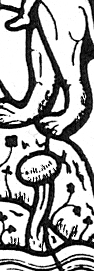
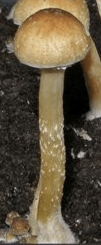
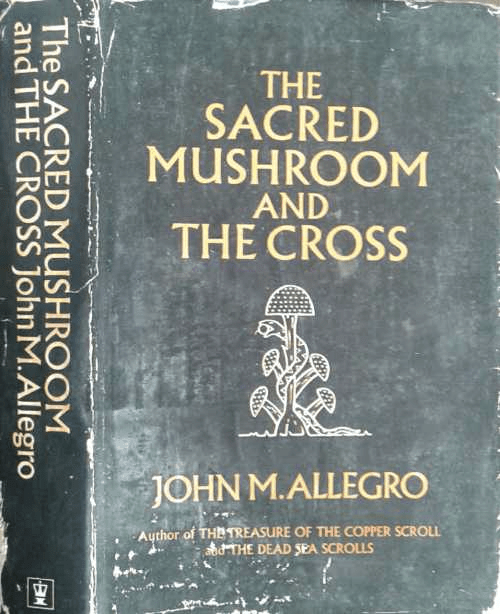
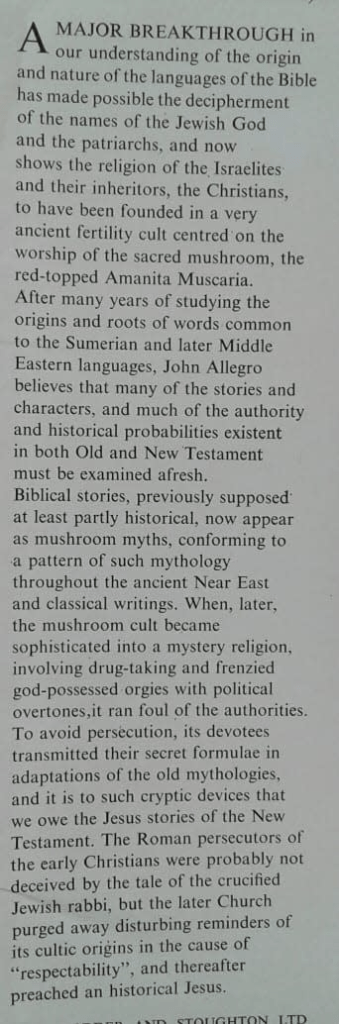
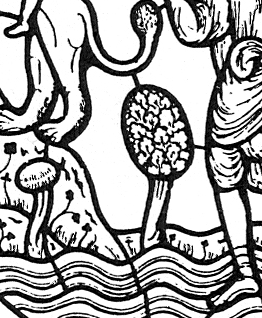
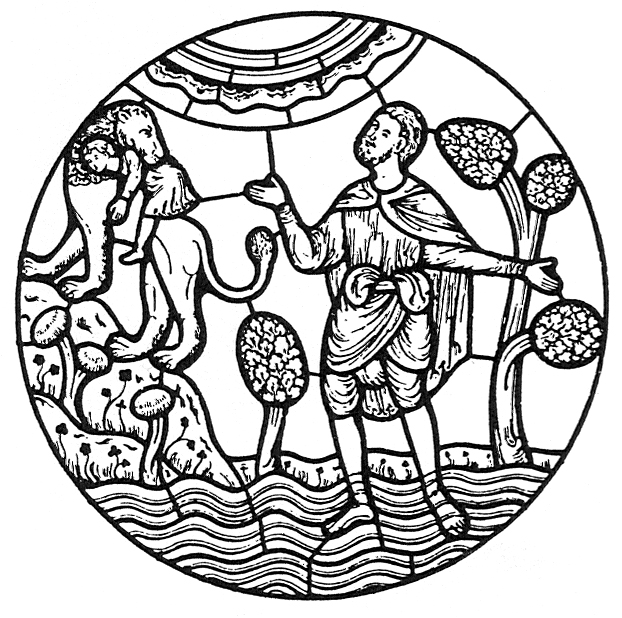

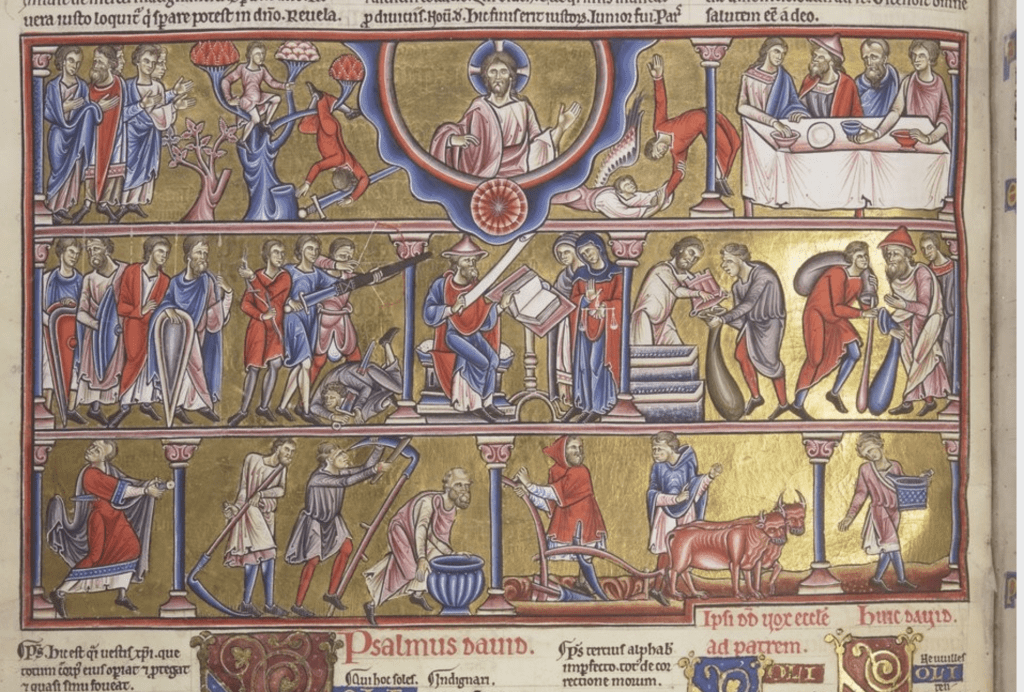
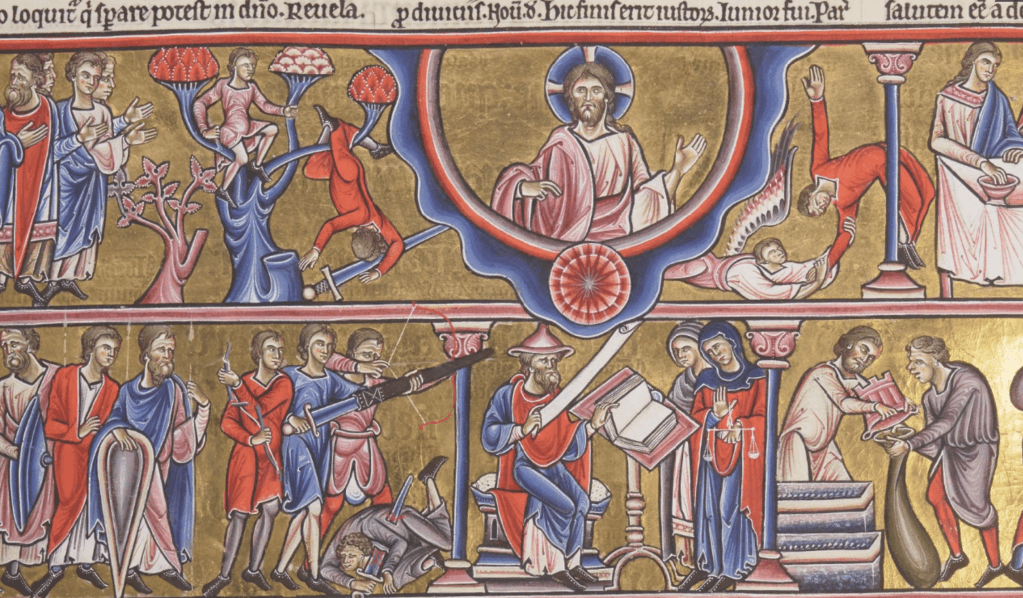

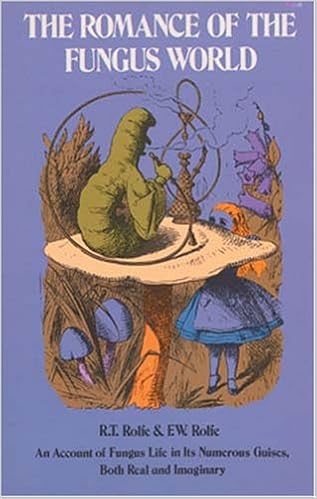


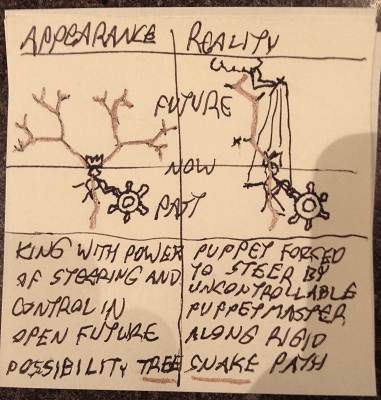

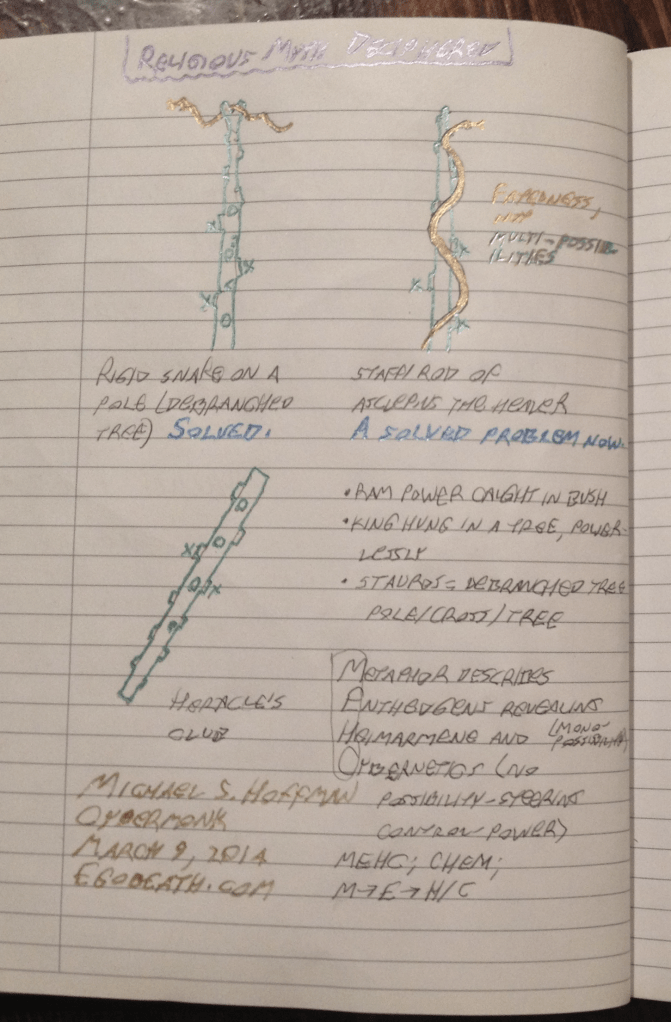
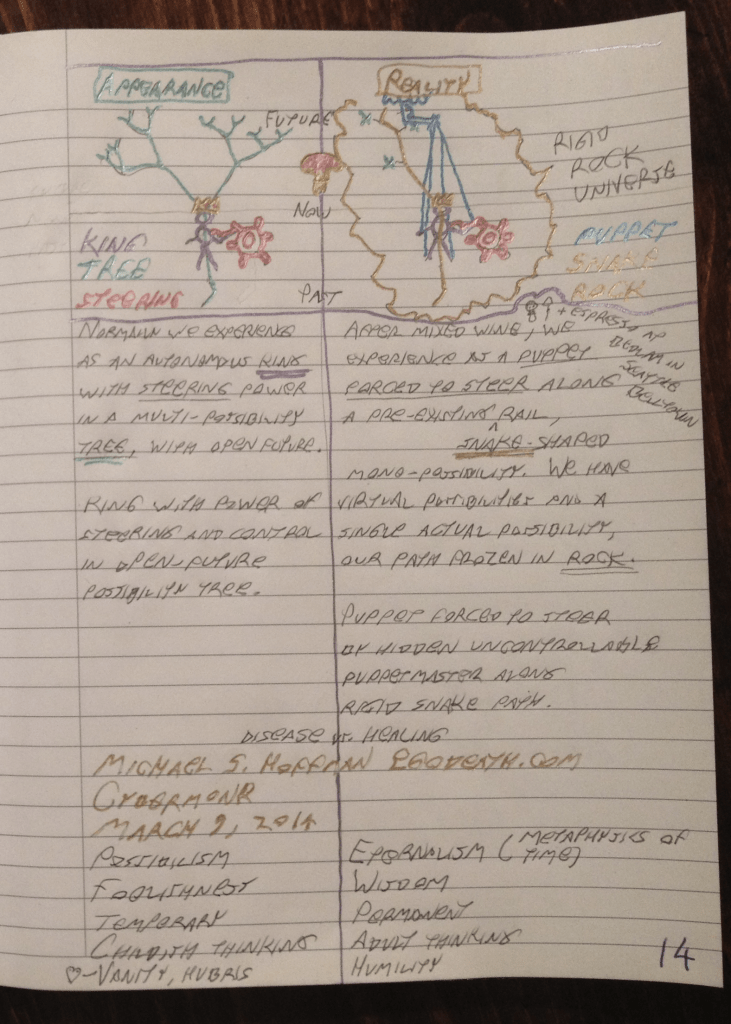
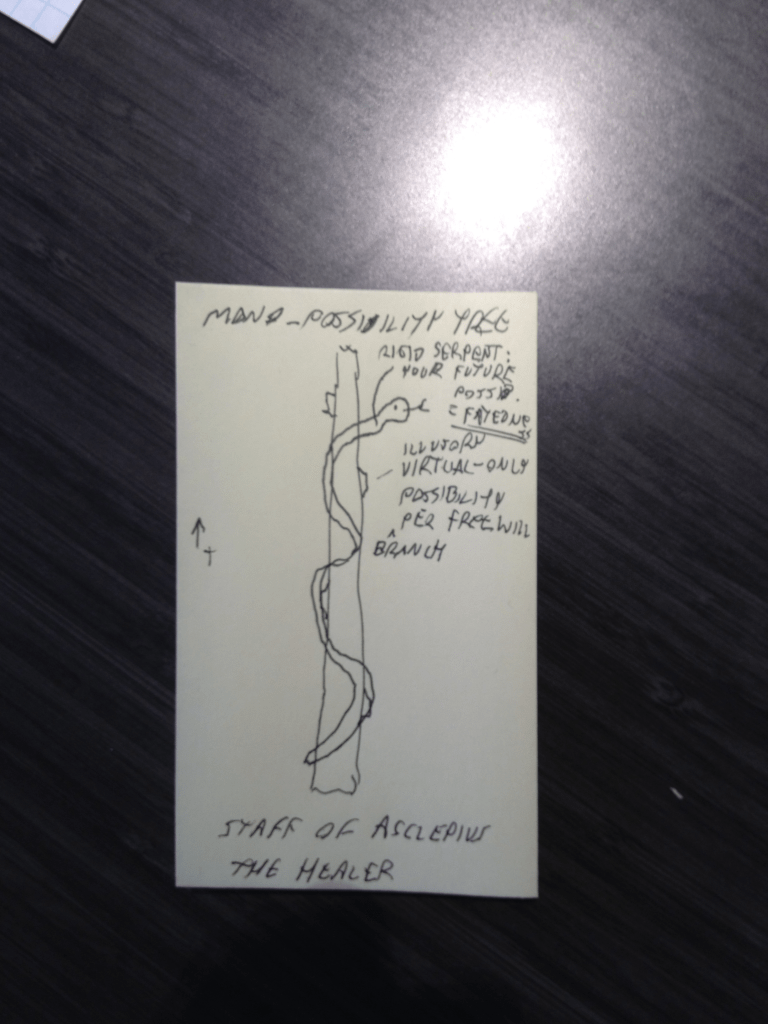
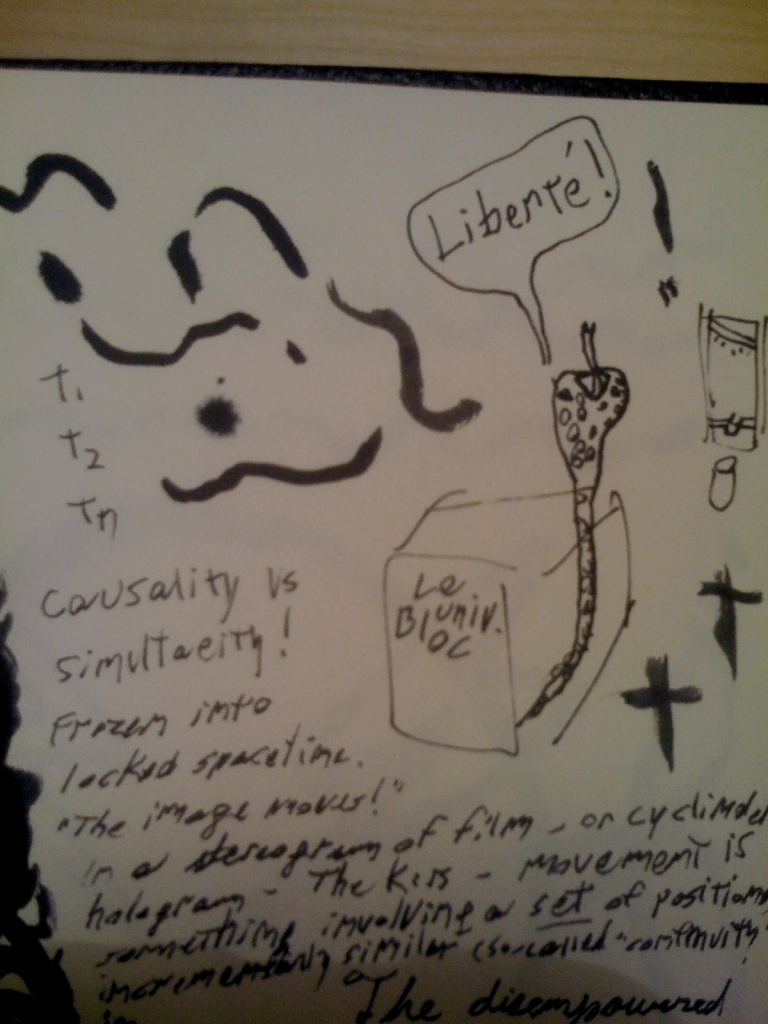
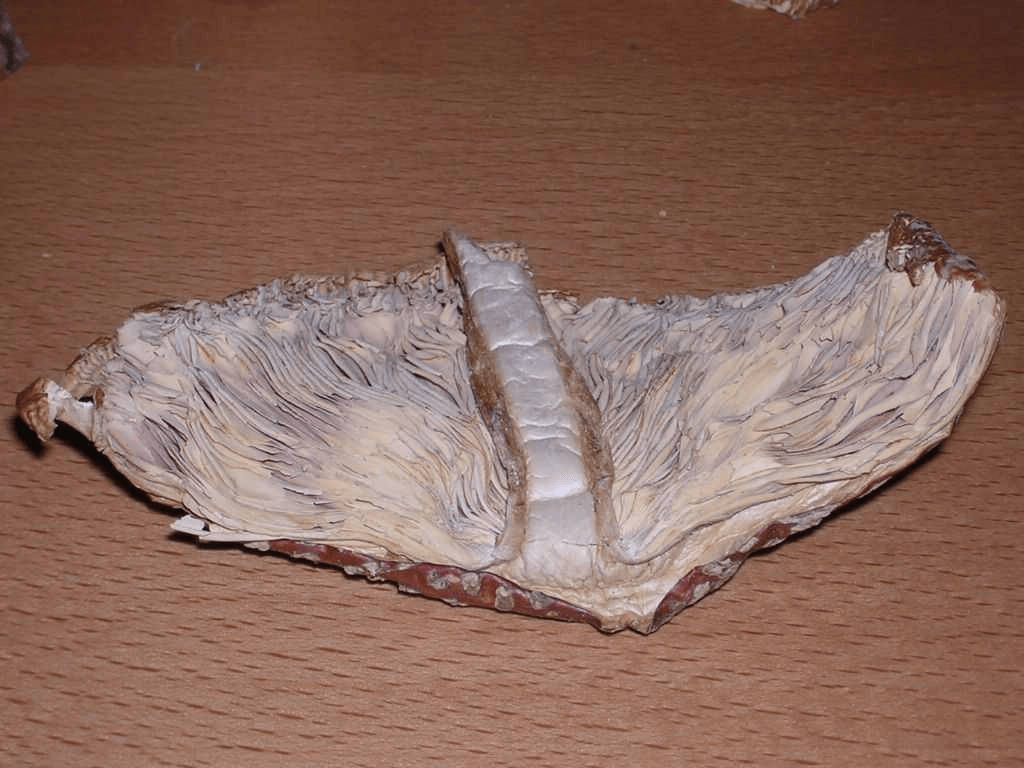
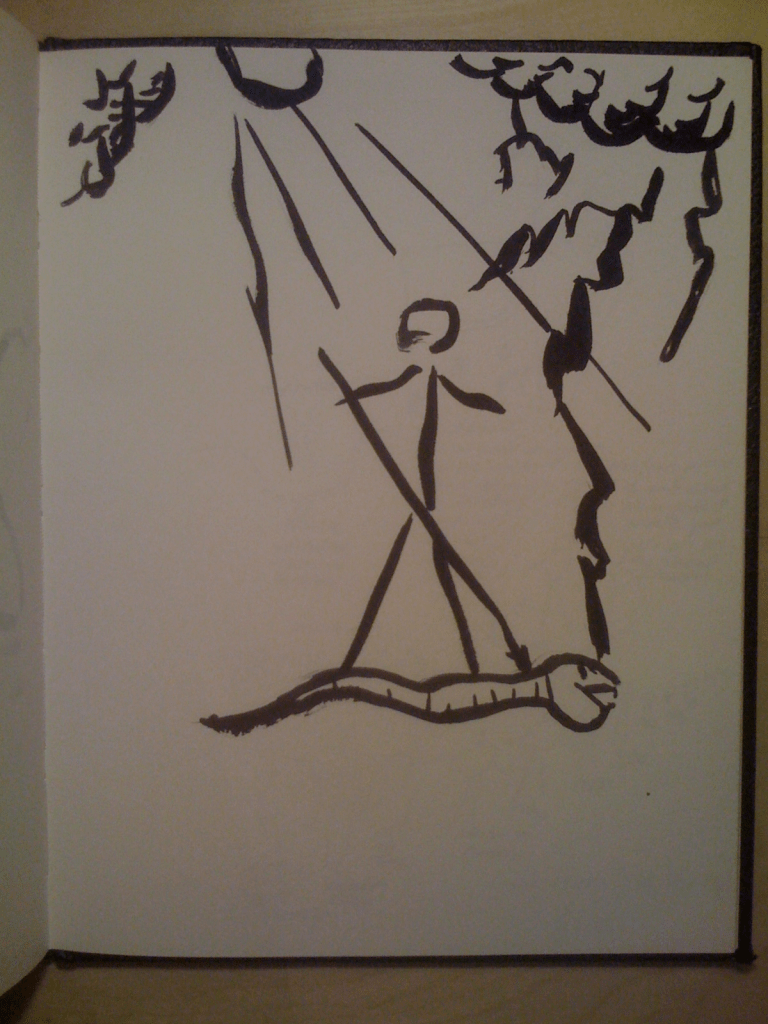






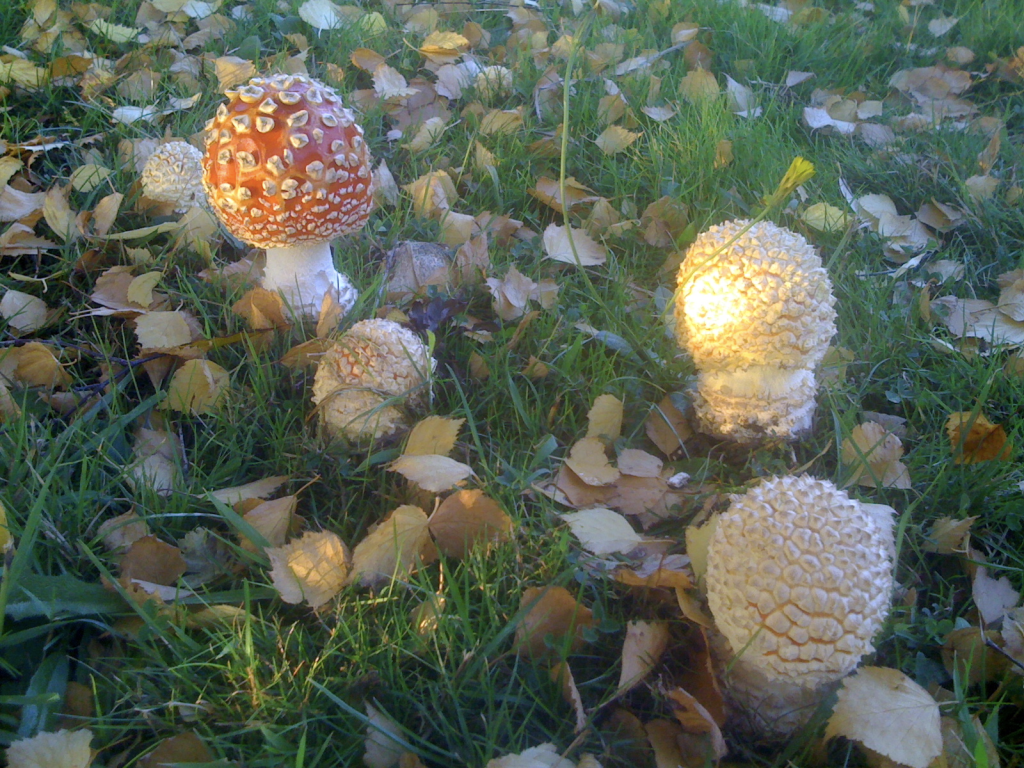

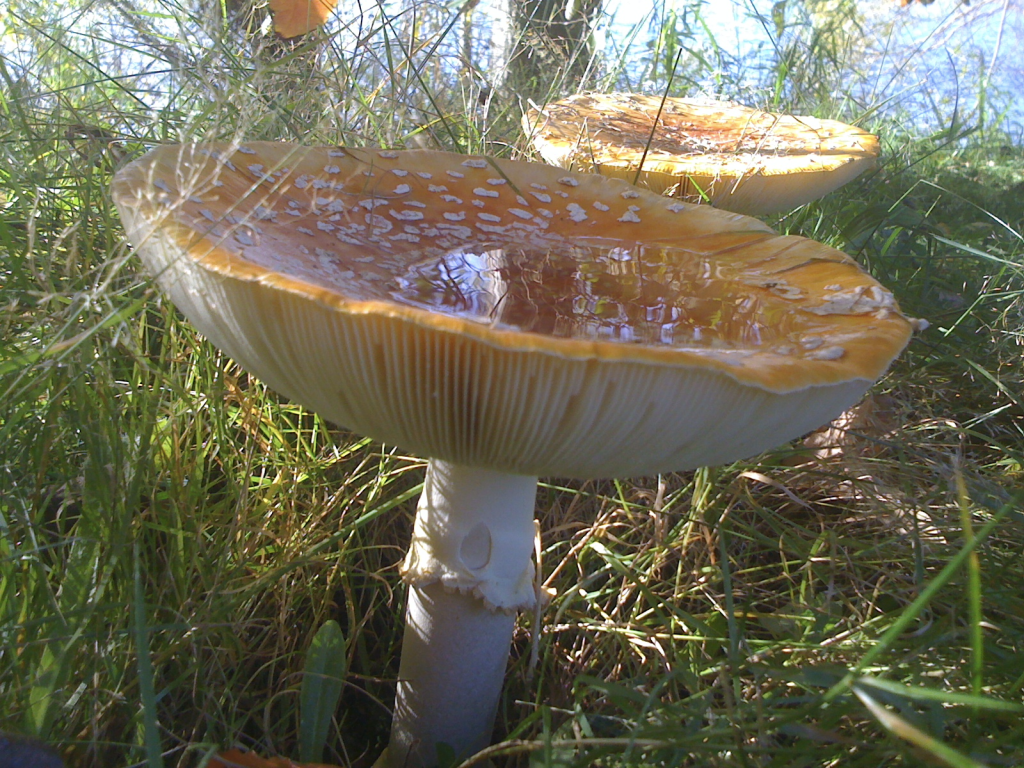
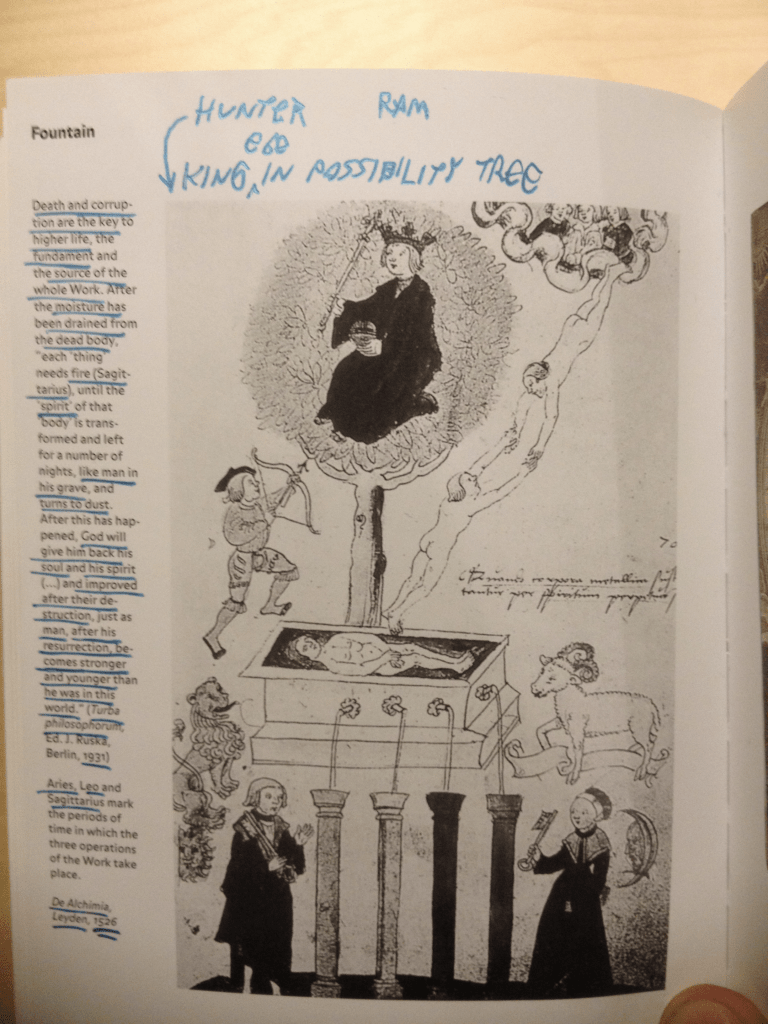
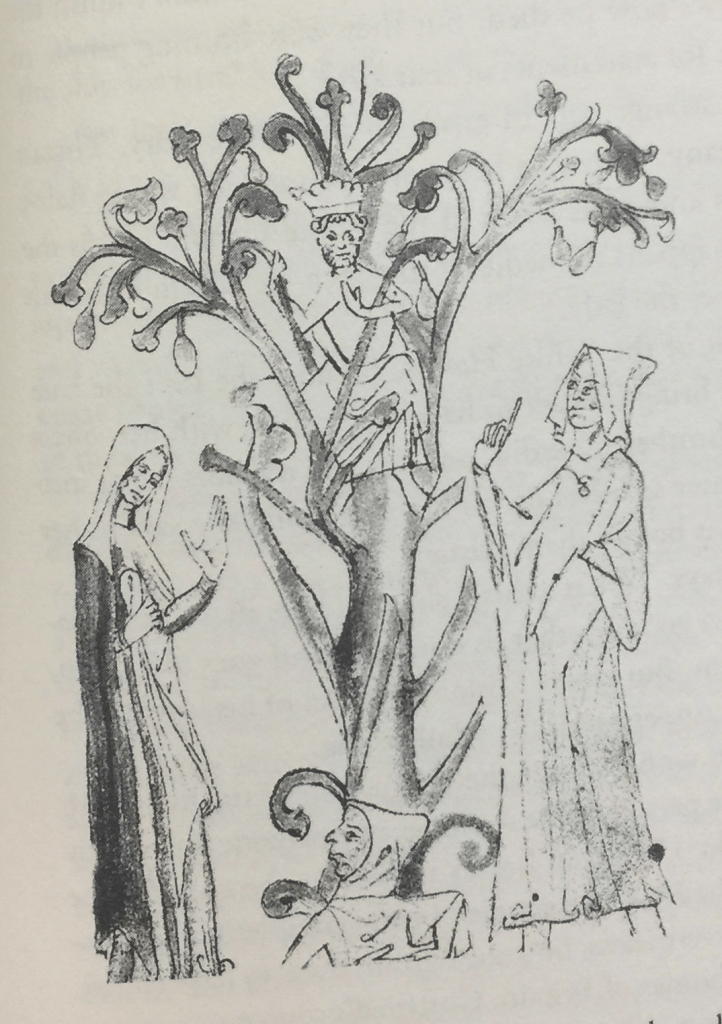
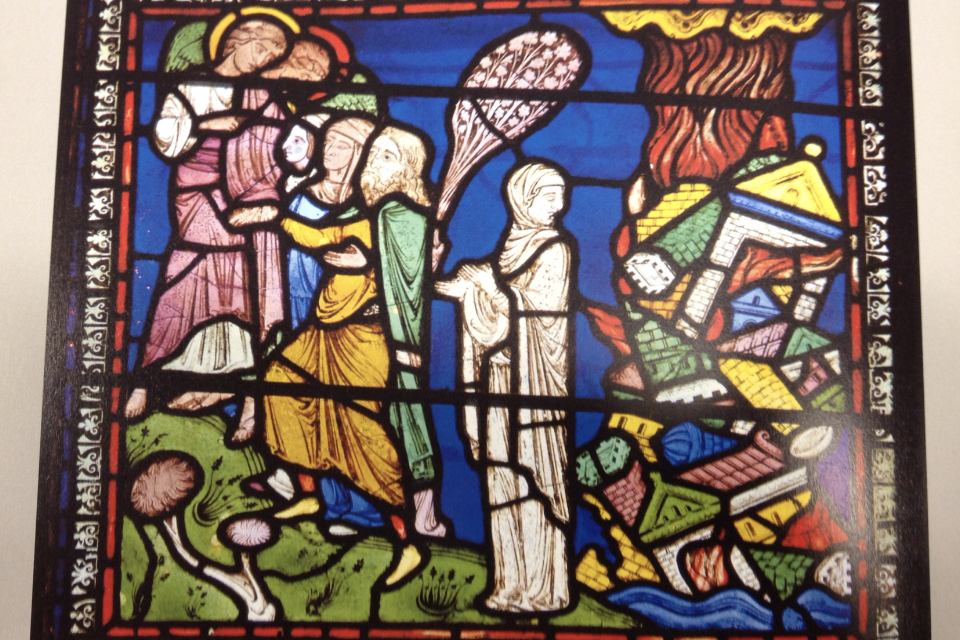
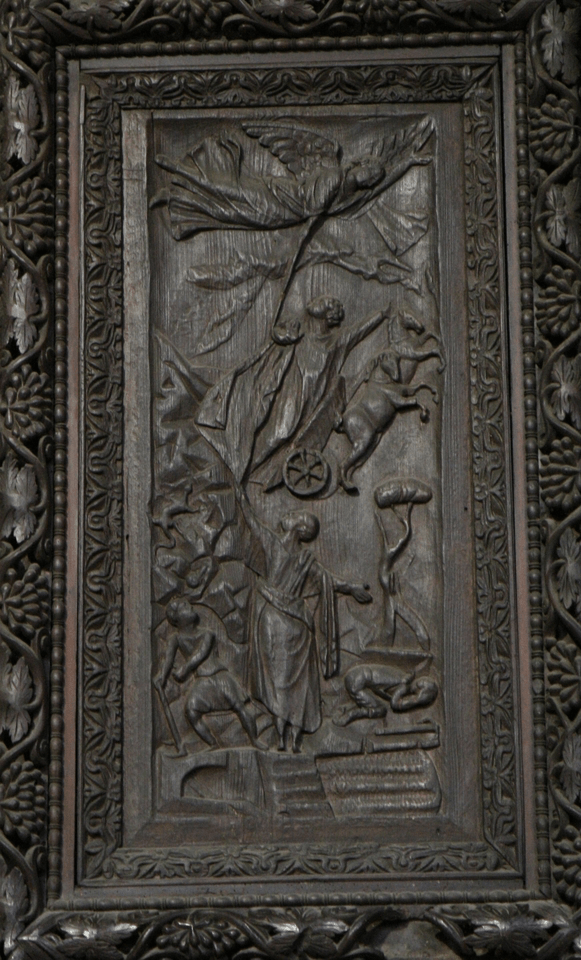
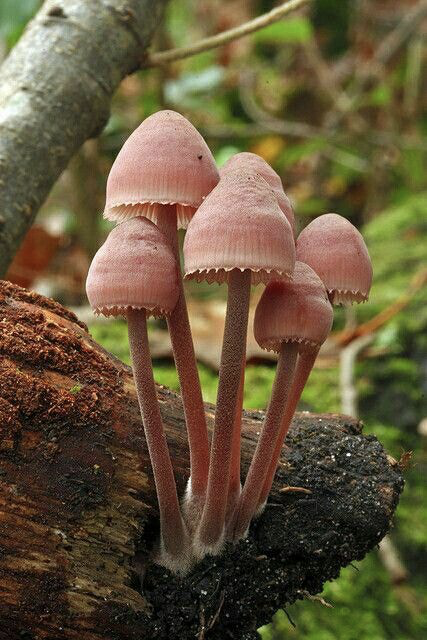


 The Egodeath theory