Scholarly research/theory & critique of psychedelics effects questionnaires, especially Griffiths’ 2016 CEQ Challenging Effects Questionnaire.
Understanding the Dittrich’s 1994 OAV questionnaire, with its Angst/Dread of Ego Dissolution questions.
I’m not against making money; I’m against totally de-naturing psychedelics to remove all of the psychedelics-state-specific distinctive Control challenging effects and replacing them by ordinary-state based Grief materials (textbooks, practices, paradigm) that were already developed in professional couch psychotherapy.
This is a bait and switch.
The Hopkins Griffiths CEQ is removing psychedelic effects from psychedelics.
How I Listen
Sometimes I use the Download UI at WeTransfer.com to listen directly in the browser.
On laptop, I use the main music app to transfer the mp3s to mobile device – to an Egodeath playlist.
On mobile device I often go to Settings > Music > EQ > Small Speakers, or Treble Cut, to reduce the treble fatigue.
Timestamps/Content
“Ep225a Griffiths Grief Grifters.mp3”
1:14:43
121 MB
0:00 guitar (14 sec) (4685.wav)
0:14 Content
~25:00 – Did Studerus 2010 remove the 7 O/A/V dimensions’ questions entirely, or move them to General? Being totally indeterminate is unscientific; failure to communicate basic info is unscientific. Removed 4 Dread questions including 54 I was afraid to lose my self-control – did that get moved to General, or deleted? Griffiths 2016 doesn’t see those 4 deleted Dread questions, out of 17, and then gets rid of 10 more, leaving only 3 Dread questions out of 17 (18%; removes 82% of the Dread questions, he says the Dread Dittrich OAV questions are the bad trip questionnaire subset – so casually, carelessly remove 82% of the industry-standard bad trip questions, and then brag about our comprehensive coverage of all challenging effects – without even acknowledging that Studerus already had removed 4 of the 17 Dread questions before Griffiths started removing almost all of the remaining bad-trip questions.
55:32 Guitar (50 sec) (4686.wav)
56:22 Content
1:10:05 Guitar (20 sec)
1:10:25 Content
1:14:43 End
“Ep225b Griffiths Grief Grifters.mp3”
1:15:02
126 MB
0:00 Intro (4687.wav)
0:32 Content
36:09 guitar (3:12) <– song-length guitar at 36:00
39:22 Content (4688.wav) – If Griffiths gets to add his new pet category of Grief challenges and make it have more questions than any other category, then I get to restore a Control challenges category, put it deservedly first, and make it deservedly have more questions (no dups) even than Griffiths’ dup-bloated new Grief category.
1:08:00 Content (4689.wav)
1:14:05 guitar (1:00)
1:15:02 End
“Ep225c Griffiths Grief Grifters.mp3”
1:31:39
149 MB
0:00 Content (4690.wav)
~3:00 proof that the CEQ’s psychometrics math is bad: the final CEQ survey doesn’t make any sense, it has 7 dup questions including 3 instances of the “felt Isolation?” effect question from 3 different surveys. Why are you creating a survey – or a mock survey, really – that combines dup questions from multiple surveys – is there a strategy here? Failing to state your strategy is unscientific. What’s the utility of padding a category with 3 versions of the same effect question, while also deleting Control-challenge questions carelessly left and right?
If you so badly need to remove questions from your initial pool of 64, why then do you retain 3 exactly dup “Isolation” questions, 2 exactly dup Despair questions padding out your pet new Grief category, 2 exactly dup “Fear/ afraid/ frightened/ had fright /I’ve got a bad feeling about this” questions, and some 7 dup questions out of the final set of 26?
The complicated standard strenuous discussion of math delivers a final Yaldabothian 🦁🐍 malformed, nonsensical, lopsided set of questions as the outcome. Has several pseudo-categories that consist of merely a single question, repeated multiple times.
You churn out a manifestly, obviously, grossly malformed resulting, the final CEQ, yet all your strenuous math doesn’t catch these awful deformities, and the giant gap you introduced about Control challenges by removing 14 of 17 Dread questions.
The CEQ is a joke, a flimsy pretext, and a transparently obvious ploy to fabricate a new pseudo-psychedelic Grief challenges category, and replace and get rid of the bona fide psychedelic Control challenges category.
~27:00 – My 7 questions in my Control challenges category that I added or restored to CEQ, are distinct from each other, not dups – according to Dittrich, who defined 5 of these questions, all in the Dread category.
~54:00 – How can we be sure whether Studerus simply deleted questions altogether, vs. moved them from their equivalent of the O/A/V categoreies, to their General category? They say “We deleted the items”; we must assume that they nuked the items entirely from the 11-Factor questionnaire, if there is such a thing as a concrete, tangible 11-Factor questionnaire that includes General, non-category questions.
todo: I’ll check Studerus 2010 for the word “drop” “general” and “remove” and “delete“.
How exactly is one expected to adopt this wanna-be OAV replacement (11-Factor). They broke up the O/A/V dimensions (distinct from G-ASC General questions, shown too in Fig S1), and nuked the O/A/V categories, and removed 7 questions from their Factor categories, but did they delete those 7 from the entire survey altogether – or move those questions into General?
Why doesn’t Studerus say “we moved the removed factor-category questions to General”? We must conclude that Studerus entirely trashcanned/ nuked/ wholly deleted question 54: I was afraid to lose my self-control.” and 6 other Factor questions shown in their Figure S1. That’s what they say, “we removed a buncha ambiguous or cross-loading questions from our factors”. That’s their “scientific” statement of what they did and why.
1:30:31 Guitar (1:00)
1:31:39 End
The Questions I Put in the ‘Control’ CEQ Category Are Respected as Distinct Questions per Dittrich, not Dups like Griffiths’ Questions
Below are the questions that I put in a Control category of CEQ.
Each of my Control-challenge questions that I picked are unique and justified, not dups, unlike all of Griffiths’ CEQ categories, including Griffiths’ pet new Grief category, which are pseudo-categories, fabricated by padding them out with dup questions.
5D-ASC 54. I was afraid to lose my self-control. [DED] 5D-ASC 6. I had the feeling of being connected to a superior power. [OB] 5D-ASC 5. I felt like a puppet or marionette. [DED] 5D-ASC 53. I had the feeling that I no longer had a will of my own. [DED] 5D-ASC 38. I felt threatened. [DED]
SOCQ 28. Sense of being trapped and helpless. HRS #. It was difficult to control my thoughts. [Volition] category, I assume
Studerus’ Key Words for Nuking(?) Effects Questions – Figure S2 Tree Shows 54 moved from Anxiety to General[Unpleasant] or General[Pleasant]
Update/correction: Studerus has two General categories (General questions aren’t in the 11 factors/ categories): General[Unpleasant] General[Pleasant] – body text of article says this is equivalent to Ocean + Visionary, as containers.
Update/correction: Figure S2 Tree shows that question 12 (“I felt tormented”) moved from Anxiety factor/category to General[Unpleasant].
Number of factor-contained items in Fig S1: 49. Total: 66. Items in Anxiety: 8 Items in Impaired Control and Cognition: 9
Number of factor-contained items in Fig S2: 48. Total: 66 Items in Anxiety: 7 (12 “I felt tormented” moved to General) Items in Impaired Control and Cognition: 8
Figure 2 shows that they moved from a 4-category OAV to an 11-category 11-Factor grouping of questions.
OAV actually is 4-factor, including General [G-ASC] dimension.
11-Factor has no General category; it has 11 categories, none of which are “General”.
Therefore when Studerus says “we dropped the question”, they have no General category to move it to; therefore “drop” means entirely delete/ignore that effect question that’s in Dittrich’s 1994 OAV [+G] questionnaire.
Thus Studerus didn’t move question 54, “I was afraid to lose my self-control” — they deleted/ignore it from their 11-Factor model. They should have built the ICC category around question 54, and constructed the 11-Factor model around that – this effect is what we are trying to track, so talk of “cross-loading” and “ambiguous” re: item 54 just shows poor grasp of the objective, by Studerous. Dropping item 54 is always the Wrong Solution.
“By applying the criteria defined in the method section, 11 item clusters formed from 47 of the 66 original items were detected and used for initial CFA model specification.
“The ICLUST tree diagram and the item clusters that were used for the initial CFA model are shown in Fig. S1 (for the ICLUST tree diagram based on the categorized variables see Fig. S2). [S2 has fewer questions in ICC & ANX factor/ categories]
“As the model fit of the initial CFA model was not sufficient according to the CFI and TLI indexes (see Table 2), we tried to improve model fit by dropping items showing large modification indexes for cross-loadings and ambiguous item wordings.”
[I’m guessing that item 54: “I was afraid to lose my self-control” cross-loaded into both Studerus’ Anxiety & Impaired Control and Cognition (ANX & ICC) factors, so they dropped that most-key question.
They should be constructing factors locked around this question – if you’re not handling this question, but are dropping it to make your model “work”, then the whole exercise & its resulting model is blind to what matters, despite having an “Impaired Control” factor/categ.]
“The model revision led to a final model that still contained the same number of factors, but a slightly lower number of items (42 instead of 47).[not sure if there’s a count error there; see both Figure S1 & Figure S2, compared to Figure 1]
“Because the dropped items (# 12, 39, 41, 48, and 54)[sic; and 61 & 62] had been mostly assigned to different factors, the model revision did not lead to a major change in the interpretation of any factor.”
Quote:
“The initial factorial solution was then further refined by dropping items with high cross-loadings.” – p. 6 Studerus
Quote:
“However, to further increase model parsimony, direct effects that were non-significant at p,0.05 or had very low effect sizes (y-standardized regression coefficients ,0.2) were dropped in the final MIMIC model.” p 6
Errata/ Subsequent Findings
The 11-Factor questionnaire has two high-level, General categories of psychedelic effects questions: General[Unpleasant] and General[Pleasant]. Between Figure S1 and S2, you can see question 12 move out from the Anxiety low-level factor/category to the General[Unpleasant] high-level category.
Griffiths was wrong to pick “all 13 of the Dread questions which are in Studerus’ ANX & ICC factors”; should have instead picked all 17 of the high-level Unpleasant Studerus’ items, which includes ANX, ICC, & Unpleasant[General]. Unpleasant[General] contains effect question 54: “I was afraid to lose my self-control”. Then Griffiths should have created a Control category containing #54 in the final CEQ.
How Many Effects Questions in Ocean, Angst, and Visionary?
Dec 29, p.m. –
I’m having to deduce the structure of Dittrich 1994 OAV dimensions in relation to G-ASC:
Studerus 2010 Table 5 shows item (effect question) counts: G-ASC 66 Ocean 27 (not 17) Dread 21 (not 17) Visionary 18 (not 15) 27 + 21 + 18 = 66. Evidently, 0 questions sit in a separate G-ASC bucket; therefore G-ASC seems to be the sum of O+A+V; none other. So my instinct was right to assign the General items instead to O/A/V dimensions, in my new OAV page.
Production
Stereo. 210 kbps mp3.
Left mic: a-t AT2020 (MDC), eq: 8 3 -12 Right mic: CAD E100 (MDC), eq 3 -3 -8
80 Hz bass cut & limiter on the deck
Miking of guitar spk cabs: 57s on 8″, angled (Orange cab; ’57 Fender Champ w/ Celestion Eight 15 spk)
Music
🚀🌌 Rebirth into the Sphere of Shattered Stars Artist: Illumination Valve tracks 1-4 of 4.
— Cybermonk, December 29, 2022
References
Studerus’ 2010 11-Factor article: Proposes 11 dimensions for the OAV or 5D-ASC: Studerus E, Gamma A and Vollenweider FX (2010) Psychometric evaluation of the altered states of consciousness rating scale (OAV) https://www.ncbi.nlm.nih.gov/pmc/articles/PMC2930851/
I have determined that the high point for Dittrich’ lineage of questionnaires is OAV.
I need a focused, streamlined page clearly representing, specifically, OAV.
The Angst/Dread category blows away the stunted corrupted subset in 11-Factor (keeps only 13 of the 17 Dread questions).
This page avoids 11-Factor notes or proposals or deletions. 11-Factor is designed to get rid of OAV categories and gets rid of a bunch of OAV questions too.
OAV is way better than CEQ’s remnant of only 3 of the 17 Dread questions in Griffiths’ CEQ Challenging Experiences Questionnaire (CEQ).
CEQ de-natures the psychedelic state and carelessly without any discussion, gets rid of its state-specific, most distinctive type of challenging experiences, the psychedelic-type Control challenges, replacing that coverage by general, multi-state, non-state-specific Grief challenges.
Cybermonk, December 29, 2022
I plan to heavily mark this page up for scholarly purposes.
Red bold = highest relevance to the Egodeath theory. Bold = of interest to the Egodeath theory.
Credibility
Studerus and Griffiths have forfeited all of their basic scientific credibility by carelessly without any actual intelligent articulate specific discussion.
(Compare: Entheogen scholars forfeited basic credibility, in their Amanita Kykeon dead end mono-focus. How did entheogen scholarship barely pick up on discovery of Great Mushroom Psalter? James Arthur’s book cover ~2000, then John Lash 2006, then Cybermonk 2020. Slow take-up.)
You throw out extremely vague broad math statements and then you deleted a bunch of questions willy-nilly with no specific discussion of each item.
Reveal your decision process in an articulate way about specific questions, not abusing broad generalizations about math, “we removed a buncha more negative psychedelic effects! While making a comprehensive negative effects coverage.
Adding breadth of coverage means removing coverage. Or actually moving coverage, off of Control challenges, onto Grief challenges.
Removing Question 54 is Studerus’ 2010 fault mainly; Griffiths 2016 inherited the careless stunted subset of 13 of 17 Dread questions, eagerly.
Griffiths Hopkins was eager to do lots more moving away from OAV and its set of questions as well as its categories.
Post haste get rid of needless strange questions like Question 54: I was afraid to lose control of my mind.
Get rid of the Dread category questions – except keep 3 token vague questions out of 17 Volition Control Dread challenge questions.
Casually, carelessly remove the Volition Control Threat Dread challenge questions.
Our comprehensive coverage is now streamlined.
Here’s the standard math blob attached to our insanely arbitrary careless monkeying around with decimating Dittrich’s question-set and categories.
You would be better to ditch all the math blob and actually explain meaningfully about your decision process regarding each specific question that you carelessly remove.
Actually discuss, actually explain what the h you’re doing removing Question 54: I was afraid to lose my self-control.
Explain what you’re doing, why, removing questions as well as categories.
What are you trying to accomplish – other than manufacturing your Grief reductionistic category vying against psychedelic state-specific Control issues for the limited spotlight, the spotlight move, the blind spot moved.
We were blind to (multi-state) Grief challenges, now we’re blind to (psychedelic-specific) Control challenges.
The supposedly “comprehensive” Challenging Effects Questionnaire is formed by REMOVING 14 out of 17 = 82% of the Dread dimension effects questions, while adding a new Grief category that’s bigger than any other category Griffiths delivers.
CEQ de-natures the psychedelic state and carelessly without any discussion, gets rid of its state-specific, most distinctive type of challenging experiences, the psychedelic-type Control challenges, replacing that coverage by general, multi-state, non-state-specific Grief challenges.
54. I was afraid to lose my self-control.
– let’s just get rid of 30 questions including that one, say Studerus and then Griffiths.
FOOLISHNESS!
They have no idea what they’re doing, or they recklessly don’t care, though they lecture us on safety by “our complete coverage” while they delete Question 54.
Voice Recording Transcription – Critique of Questionnaires: Griffiths’ Grief Grifters
Listening to my latest voice recording. (4690.wav).
Very good 2-hour voice recording, critique of questionnaires especially CEQ.
We uttered the term “ego dissolution”, so we can stop thinking now.
Carelessly delete all the control questions and have no control category – therefore he doesn’t comprehend that control-volition problems challenges exist.
Griffiths adds the Grief category b/c in a reductionist way he’s familiar in ord state.
He’s not familiar with control-volition problems so he deletes them while adding his Grief category. He has zero comprehension.
Griffiths removes Control challenges because he wants to keep his survey small and highlight Grief category, so delete the unimportant, Volition-Control Dread challenges questions.
Ord state reductionism: from psychedelics negative effects, remove the questions you don’t understand, and add the category “Grief” that you imagine that you understand b/c ord state Grief counselling is defined.
Result: No Control-focused questions or categs.
CEQ is REDUCTIONISM FROM THE ALTERED STATE TO THE ORD STATE.
THE DISTINCTIVE alt-state questions unique to the altered state GET REMOVED BY CARELESSNESS AND LACK OF COMPREHENSION.
ALT-STATE CONTROL QUESTIONS REPLACED BY ORD. STATE-BASED CONVENTIONAL “GRIEF” CATEGORY.
To increase the coverage breadth, we had to remove all of the Control questions.
A battle between the psychedelic Control vs. non-psychedelic Grief challenges.
Griffiths’ Grief Grifters, using state-reductionism.
We’ve replaced altered state Control issues by ord state Grief issues.
The psychedelic Control issues were replaced by ord state Grief issues.
They removed psychedelic Control issues, and replaced them by ord state Grief issues and textbook practice.
The CEQ de-natures the distinctive psychedelic challenging fx.
He likes the Grief category he’s adding, b/c it spans both states.
But Ctrl issues are unique to the alt state, they can’t conflate it across states like for Grief.
Hopkins can’t leverage their Control-issues “expertise”… this Control challenge doesn’t exist in ord state, like Grief does.
The alt state is interesting b/c of its distinctiveControl issues.
CEQ Is Bunk, Fake, a Bluff, a Mockup, a Put-on, a Token, not a Serious Actual Questionnaire Intended for Use
The CEQ is bunk and fake.
The more I learn about the CEQ, the more I recognize it as not a real, sincere questionnaire.
The facade instantly collapses when challenged by elementary questions.
Why would you actually give anyone “Appendix 1: The Challenging Experience Questionnaire” to fill in, given that the same Isolation effect is asked 3 times by 3 questionnaires? 6-7 dup questions out of 26 is 25% dup questions.
And the CEQ has no Control/Dread questions – the most important category of psychedelic challenging experiences.
CEQ is a ploy to get rid of nuisance Control seizure problems that we don’t understand and can’t deal with, while adding our own pet Grief effects questions instead – all the while, claiming that this type of questionnaire is needed, in order to provide broader, expanded, comprehensive coverage of challenging psychedelics effects.
The OAV Questions
General (G-ASC)
Warning: Guesswork – Reverse Engineering – doh! i have all Dread list = Unpleasant categ in Fig S1 Studerus!
I’m having to deduce the structure of Dittrich 1994 OAV dimensions in relation to G-ASC:
Studerus 2010 Table 5 shows item (effect question) counts: G-ASC 66 Ocean 27 Dread 21 Visionary 18 27 + 21 + 18 = 66. Evidently, 0 questions sit in a separate G-ASC bucket; therefore G-ASC seems to be the sum of O+A+V; none other.
48. The boundaries between myself and my surroundings seemed to blur. 10. Everything seemed to unify into an oneness. 21. It seemed to me that my environment and I were one. 27. I experienced a touch of eternity. 28. Conflict and contradictions seem to dissolve. 35. I experienced past, present and future as an oneness. 6. I had the feeling of being connected to a superior power. 56. I experienced a kind of awe. 66. My experience had religious aspects. 61. Everything around me seemed animated. 39. Many things appeared to be breathtakingly beautiful. 7. I enjoyed boundless pleasure. 60. I experienced a profound peace in myself. 65. I experienced an all-embracing love. 15. It seemed to me as though I did not have a body anymore. 42. I had the feeling of being outside of my body. 43. I felt as though I were floating.
Guessing which questions are Ocean dimension: supposed to be 10 here:
2. Bodily sensations were very delightful. (O) 22. Worries and anxieties of everyday life seemed unimportant to me. (O) 50. I felt totally free and released from all responsibilities. (O) 1. I felt like I was in a fantastic other world. (O) 23. Like in a dream, time and space were changed. (O) 47. Many things seemed unbelievably funny to me. (O) 9. I felt I was being transformed forever in a marvelous way. (V, or O) 31. The world appeared to me beyond good and evil. (O) 26. I felt unusual powers in myself. (O) 4. I saw things that I knew were not real. (O or V, per S1)
62. Everything around me was happening so fast that I could no longer follow what was going on. 41. My body seemed to me numb, dead and weird. 5. I felt like a marionette. 16. I had difficulty making even the smallest decision. 24. I had difficulty in distinguishing important from unimportant things. 33. I felt as though I were paralyzed. 44. I felt isolated from everything and everyone. 45. I was not able to complete a thought, my thought repeatedly became disconnected. 53. I had the feeling that I no longer had a will of my own. 54. I was afraid to lose my self-control. 12. I felt tormented. 19. I was afraid that the state I was in would last forever. 29. I was afraid without being able to say exactly why. 30. I experienced everything terrifyingly distorted. 32. I experienced my surroundings as strange and weird. 38. I felt threatened. 63. I had the feeling something horrible would happen. 59. Time passed tormentingly slow. (A, per S1) 36. I experienced an unbearable emptiness. (A, per S1) 3. I felt surrendered to dark powers. (A, per S1) 55. I stayed frozen in a very unnatural position for quite a long time. (A, per S1)
34. I felt very profound. 46. I gained clarity into connections that puzzled me before. 52. I had very original thoughts. 25. I saw scenes rolling by in total darkness or with my eyes closed. 49. I could see pictures from my past or fantasy extremely clearly. 57. My imagination was extremely vivid. 8. I saw regular patterns in complete darkness or with closed eyes. 13. I saw colors before me in total darkness or with closed eyes. 20. I saw lights or flashes of light in total darkness or with closed eyes. 11. Noises seemed to influence what I saw. 14. The shapes of things seemed to change by sounds and noises. 51. The colors of things seemed to be changed by sounds and noises. 17. Everyday things gained a special meaning. 18. Things around me had a new strange meaning for me. 37. Objects around me engaged me emotionally much more than usual.
Guessing which questions are Visionary dimension: supposed to be 3 here:
40. Things came to mind, which I thought I had forgotten long ago. (V) 64. I was able to remember certain events unusually clearly. (V) 58. Things around me appeared smaller or larger. (V)
Count of Questions in Categories
17/17/15 is wrong per Table 5 Studerus – [brackets] = Items count per Table 5. 27+21+18=66 total.
This seems to make Griffiths even worse, keeping only 3 out of 21 effects questions that are in Dread (3/21 is 14% retained, 86% of challenging psychedelic effects in Dread dimension (“the bad trip scale”) discarded/ ignored/ overlooked by Griffiths’ CEQ).
Forget “all 13 ICC & ANX items from Studerus”, the Initial Pool should have included “all 21” of the Dread dimension instead of “all 13” from Studerus.
I’m happy about this worsening for Griffiths, b/c I have been making some mistakes/mis-guesses.
66-17 = 49 questions are in the 3 O/A/V categories, called “dimensions”.
The Studerus 2010 article body says OAV has 66 effects/ questions.
I’m relying on Studerus 2010 Figure S1, which shows the set of 66 OAV questions in English. Figure S1, “hierarchy tree”, shows all 66 OAV questions, before Studerus deleted a bunch of effects questions to form the final version of their 11-Factor bastardized, willy-nilly stunted version of OAV.
Studerus deleted the O, A, and V dimensions buckets (really, just divided up each dimension – proving that at a high level, Studerus agrees with Dittrich).
Divided Ocean into 4 factors, or replaced the Ocean dimension by 4 factors categories. Divided Dread into 2 factors. Divided Visionary into 5 factors. 4 + 6 + 5 = 11 Factors (stays confusingly & unscientifically silent about General).
Why are General questions strewn around in Figure S1 hierarchy tree?
OAV has 4 categories of psychedelics effects questions, called “dimensions”:
Griffiths 2016 says DED is considered the bad trip questionnaire (“scale” or “sub-scale”), and CEQ retains only 3 out of the 17 questions from DED.
Your Challenging Experiences list of effects removes 14 of 17 = 82% of the bad trip questionnaire’s questions.
How can you claim in the intro of the CEQ article that CEQ, unlike DED, provides comprehensive coverage of all negative effects just because you add your new Grief category of questions?
Why did you start with a pool of 64 questions and then deliver only 26 questions?
What is the decision process for each specific challenging effect that you remove?
How does REMOVING effects accomplish ADDING comprehensive coverage?
Comprehensive List of Some of All … Subset of Set of All…
What was your objective and reason to mass-remove from 64 down to 24 questions? (24 then 26)
38% of the initial pool, then 41% of the initial pool of challenging effects questions were retained.
References
This section is superseded – see
Bodmer I, Dittrich A, Lamparter D. Aussergewöhnliche Bewusstseinszustände – Ihre gemeinsame Struktur und Messung [Altered states of consciousness – Their common structure and assessment]. 1994 In: Hofmann A, Leuner H, editors. Welten des Bewusstseins. Bd. 3, Experimentelle Psychologie, Neurobiologie und Chemie. Berlin, Germany: VWB; 1994. pp. 45–58.
Annual journal book that in 1994 defines OAV: Worlds of Consciousness Bodmer, I., Dittrich, A. & Lamparter, D. in Welten des Bewusstseins. Bd. 3 (eds. Hofmann, A. & Leuner, H.) 45–58 (Experimentelle Psychologie, Neurobiologie und Chemie., 1994).
To the extent that this blatantly malformed CEQ can be somewhat redeemed, repair Griffiths’ 2016 Challenging Experiences Questionnaire (CEQ) by adding/ restoring this Control category of challenging psychedelics effects, containing the best questions drawn from the main questionnaires.
The Resulting Improved CEQ
Control
5D-ASC 54. I was afraid to lose my self-control. 5D-ASC 6. I had the feeling of being connected to a superior power. 5D-ASC 5. I felt like a puppet or marionette. 5D-ASC 53. I had the feeling that I no longer had a will of my own. 5D-ASC 38. I felt threatened. SOCQ 28. Sense of being trapped and helpless. HRS #. It was difficult to control my thoughts.
Fear
HRS 26. Frightened. [dup] HRS 27. Panic. SOCQ 52. Experience of fear. [dup] HRS 25. Anxious. 5D-ASC 63. I had the feeling something horrible would happen.
Grief
HRS 36. Sad. SOCQ 91. Feelings of grief. HRS 38. Despair. [dup] HRS 39. Feel like crying. SOCQ 16. Feelings of despair. [dup] SOCQ 13. Emotional and/or physical suffering.
Physical Distress
HRS 12. Feel heart beating. HRS 13. Feel heart skipping beats or beating irregularly. HRS 11. Feel body shake/tremble. [dup] HRS 10. Shaky feelings inside. [dup] HRS 09. Pressure or weight in chest or abdomen.
Insanity
SOCQ 85. Fear that you might lose your mind or go insane. [dup] HRS 88. Change in sense of sanity. [dup] 5D-ASC 19. I was afraid that the state I was in would last forever.
Isolation
5D-ASC 44. I felt isolated from everything and everyone. [dup] HRS 44. Feel isolated from people and things. [dup] SOCQ 45. Isolation and loneliness. [dup]
Death
SOCQ 70. Profound experience of your own death. [dup] HRS 70. Feel as if dead or dying. [dup]
Paranoia
SOCQ 40. Feeling that people were plotting against you. SOCQ 72. Experience of antagonism toward people around you. [not legit]
The Resulting Category Sizes
Control – 7 Fear – 3 Grief – 6 Physical – 5 Insanity – 3 Isolation – 3 Death – 2 Paranoia – 2
Category Sizes After Removing Dups
Control – 7 Fear – 2 Grief – 5 Physical – 4 Insanity – 2 Isolation – 1 Death – 1 Paranoia – 1
The count after removing dups or non-legit items per Griffiths.
That’s a better-balanced representation of the reported domain.
The new/restored, “Control” category needs to be put first, since it’s distinctive of psychedelics challenging effects.
The Control category is forced by the reported scientific data to include more effects than Griffiths’ pet, disproportionately bloated “Grief” category.
The Control category has every right to be bigger than and dominate over the mere Grief category.
It is dishonest to focus more on the generic psychotherapy Grief category than the psychedelics-specific Control category. Or to cover Grief at the expense of entirely removing the Control category.
I am applying a severe correction on CEQ that’s data-driven, and to make the legit point: Control is much more dominant and distinctive of psychedelics challenging experiences than mere Grief.
The flaws with this improved scheme aren’t in the Control category; it contains no dup effects.
The flaws are the many dups in other categories – Griffiths needs to fix this obvious error of the heavily dup-riddled, therefore unusable CEQ.
Griffiths’ Grief Grifters: Replacing Altered-State Control Effects by Ordinary-State Grief Effects
The category that Griffiths is intent on constructing is plainly Grief. It’s the biggest, and the CEQ article body says what’s wrong with the main questionnaires is they omit categories that gather the Grief/Sad effects questions.
Griffiths promises that CEQ will not suffer that omission; it will not cover ICC+ANX problems; impaired control/cognition problems, while leaving no category-coverage to represent the Grief effects questions.
What CEQ actually delivers is the removal of a Control category and all of the control-focused effects questions, while Griffiths adds the Grief category and retains all the surveys’ Grief-related questions.
Griffiths doesn’t comprehend psychedelics control challenges at all, even though he sometimes goes through the motions of pretending to include the Dread and Impaired Control categories – during the Initial Pool, and sometimes in the article body, but not in the final CEQ that’s delivered.
The CEQ article says they don’t expect Volition to be a challenging area of psychedelics effects.
Of the six sub-scales of the HRS (i.e. affect, cognition, intensity, perception, somaesthesia, and volition), one might hypothesize that the affect, cognition, and somaesthesia subscales might be most sensitive to challenging experiences.
p. 2, CEQ article, Griffiths, 2016
This shows that they have no comprehension of fear of catastrophic loss of control – and explains why they delete Control-issue questions carelessly, while highlighting Grief questions.
Griffiths omits a Control-Volition category for the surveys’ existing questions, while providing a big Grief category.
Studerus and Griffiths want to get rid of Dittrich’s “Angst of/Dread of Ego Dissolution” category, and Griffiths wants to go further and get rid of Studerus’ “Impaired Control and Cognition” category.
Griffiths doesn’t necessarily understand psychedelics grief challenges either, but he falls back in reductionistic fashion to conflating ordinary-state grief with altered-state grief problems.
Control Issues Vying Against Grief Issues
There are only two big categories of challenging effects in CEQ after I add the justifiably big, and altered-state distinctive, Control category.
Control issues, as found in Dread category, are truly distinctive of the altered state; they don’t much cross over directly to ordinary-state problems with control, though that’s my area of attempted focus in 1987.
Grief issues easily conflate and cross over between altered state and ordinary state.
Griffiths can take his Grief psychology textbooks and pretend to directly apply them to psychedelic grief-problems experiencing.
Griffiths cannot take his Control Issues Psychology textbooks and directly apply them to psychedelic control-problems experiencing.
The Resulting “Control” Category
Control
I was afraid to lose my self-control.
It was difficult to control my thoughts.
I had the feeling of being connected to a superior power.
I felt like a puppet or marionette.
Sense of being trapped and helpless.
I had the feeling that I no longer had a will of my own.
I felt threatened.
Eadwine image: the self-threatening psalter image viewer
CEQ Is Malformed, Not Serious, Unusable, a Token, and Will Be Ignored
The moment anyone attempts to use and administer Griffiths’ 2016 Challenging Experiences Questionnaire (CEQ), they will see that it’s badly malformed.
How can Griffiths not see what a bad questionnaire their categories and questions deliver?
CEQ is a sham, it’s not a real, sincere, actual questionnaire. It’s a utilitarian project, a ploy, a pretext, a scheme.
CEQ is merely an artifice, a means to an end: we need the challenging effects of psychedelics to feed back into supporting our professional, ordinary-state based, couch-psychotherapy framing, making the negative/ challenging psychedelics effects feed into and build up our psychotherapy practice model.
CEQ is a strategy of steering away from psychedelics-distinctive Volition-Control challenging effects toward, instead, generic Grief/ Sad/ Depress effects, which we can then attach our hundred years of couch psychotherapy to.
The CEQ has a mission of gathering specifically the desired, Grief/ Sad/ Depress effects, and is not at all interested in gathering Dread of Volition Control effects.
The CEQ isn’t a mission to discover additional negative effects; the CEQ is a means of creating and striving to create a market, by taking away from the defenseless Dread of Volition-Control reported negative effects.
There’s not an industry body that’s trying to profit off repairing the genuinely reported and assertive psychedelics Dread of Volition-Control effects.
Hopkins is an industry body that’s invested in making a business off repairing a desired new body of effects evidence, wanting to highlight and group all the survey questions that they can find about Sad/ Depress/ Grief, by forming a big packed prominent category named that, and at the same time, getting rid of their negative-effects competition, the OAV Angst/Dread category.
CEQ is not a serious, usable questionnaire; it’s all a mere exercise, a scheme, a ploy, to make a show of adding a Grief category while quietly getting rid of the Dread category, which Griffiths Hopkins feels is competing against their own pet, negative-effects category (Sad/ Grief/ Depress).
Degree of Legitimacy of OAV’s “Dread of Ego Dissolution” Category, 11-Factors’ “Impaired Control and Cognition” and “Anxiety” Categories, and HRS’ “Volition” Category
There are different levels at which to achieve legitimacy:
Is the survey legit?
Is the category legit, as a named container?
Is the set of psychedelics effects questions (considered individually, or as a set inside a category) legit, at the level of individual questions?
CEQ
Griffiths’ CEQ is not legit, regarding Dread effects: it removes 14 of 17 and almost entirely removes specifically experiencing the threat of catastrophic loss of control, which is the distinctive psychedelics effect that drives transformation.
OAV
Dittrich’s Angst/Dread category of OAV is legit, the set of all 17 questions.
11-Factors
11-Factors‘ Impaired Control and Cognition (ICC) & Anxiety (ANX) categories are semi-legit. They removed 4 of Dittrich’s Dread questions, including 54: “I was afraid to lose my self-control.”
HRS
It is legit that HRS has a Volition category.
I don’t have the list of which effects questions are in HRS‘ Volition category. Their categories:
As a set of categories, SOCQ is not legit, because it lacks a Volition-Control Dread category.
I don’t have the list of which effects questions are in which of SOCQ‘s categories.
SOCQ is mystical and “therefore” exclusively positive re: their categories, though some individual SOCQ questions are legit, about experiencing the threat of loss of control.
SOCQ is home of MEQ subset survey questions, about mystical unicorns & rainbows. SOC categories:
I. Internal Unity
II. External Unity
III. Transcendence of Time and Space
IV. Ineffability and Paradoxicality
V. Sense of Sacredness
VI. Noetic Quality
VII. Deeply-Felt Positive Mood
The CEQ Violates Psychometrics Factor Math and Is Beyond Redemption
Any person looking at the CEQ instantly can tell you it’s bunk and that the math should have prevented fabricating a bunk Isolation category that only contains the same single “Felt isolated” effect repeated 3 times from 3 surveys.
The survey is an insult, a paranoia-inducing mind game asking you the same exact question 2-3 times, in 6 cases.
Why do you keep asking me the same 6 questions over and over? What’s your ploy against me?
How are you trying to manipulate my answers by asking me “Isolated” 3 times?
Same thing with exact dup Fear questions – the math should have caught and prevented these dup questions that prop up the pseudo-“categories”.
I talk below of coordinating my Control-challenge questions across the CEQ, but the CEQ is completely malformed and doesn’t at all coordinate the dup questions that are drawn from 3 surveys.
My Control questions don’t have to be coordinated at all, since Griffiths’ 26 questions aren’t really coordinated eg his Paranoia category contains only a single relevant question/effect.
His Paranoia pseudo-category is not a bona fide “category” of distinguishable, distinct effects.
Math should prevent this — proving that this applying of a standard blob of math is very unscientific; anti-scientific.
Cargo-cult attachment of math to an obviously manifestly malformed set of questions? No problem; no correction is achieved or driven by the math.
Intro 2
I need to double-check that those are the best questions out of the OAV, 11-Factor, SOCQ, and HRS surveys.
Here’s the gist of it, above; representative enough.
As always, we need to follow-through on the swing: pay attention to the attraction, the treasure, the reward; Transcendent Knowledge, control model transformation, completion, enlightenment, perfection, making immortal / no longer dying ego death, though the bridal chamber climactic control seizure capacity remains.
Griffiths needs to add this category containing these questions, to the CEQ, just like they added a Paranoia category after they attached the standard blob of math to drive their set of 6 categories to give 7.
They need to restore/add the 8th category equivalent of the Dread, Control, and Volition categories of the OAV, 11-Factor, and HRS surveys.
Using the same seat-of-the-pants, non-scientific method process as they used to add their Paranoia category, out-of-band, post-analysis of the factors categories.
Except that in this case, Griffiths won’t need to write a paragraph explaining why this category is bunk and you shouldn’t use it, as Griffiths did for their patch-on, Paranoia category.
How to Redeem the CEQ: Add “Dread of Volition Control Category” and the Pointed Survey Questions About Control Loss Threat
I thought I posted this but I can’t find it so here’s a dedicated posting.
Add a category #8 to Griffiths’ CEQ Challenging Experiences Questionnaire. Start by adding to it all of the Dittrich Dread questions from OAV – 17, not 13, and add the pointed control loss threat questions from SOCQ & HRS, and remove weak questions; keep on-point, pointed, specific questions. Not just vague “fear”.
Start with page Table 3 page 9 which is same as CEQ Scoring Guide in appendix page 21 of pdf.
Add 8th category, “Control Loss”.
Get all 17 of OAV’s Dread questions from Studerus 2010 Figure S1 tree hierarchy, put into that category. The added category added to CEQ is:
Control-Loss Categories from the Eternalism and Control Questionnaire (ECQ)
Reduced this list to my favorite questions, only slightly more questions than Griffiths’ pet Grief category that he’s intent on adding at the expense of the “Dread of Volition Control” questions that I’m restoring WITH A VENGEANCE 😡🐉
Identified which questionnaire each of the questions is from.
Coordinated this list with the other categories of questions in CEQ.
Favorite Questions
It was difficult to control my thoughts.
I had the feeling of being connected to a superior power.
I was afraid to lose my self-control.
Sense of being trapped and helpless.
I felt like a puppet or marionette.
I had the feeling that I no longer had a will of my own.
I felt threatened.
Near-Favorite Questions
5DASC 89. I had the feeling that something terrible was going to happen. The CEQ Fear category already has the ‘horrible‘ version of this question.
I had the feeling that I no longer had my own will.
I felt surrendered to dark powers. I felt as if dark forces had overtaken me. [don’t quite like the “dark” wording]
I experienced a dissolution of my “self” or ego. I experienced a disintegration of my “self” or ego.
Frustrating attempt to control the experience. [don’t like “the experience” construct]
Feeling that people were plotting against you. [change “people” to “thoughts”]
I was scared without knowing exactly why. [true but sounds generic, not differentiated as regarding control agency under threat] I was afraid without being able to say exactly why.
Dup Variants
I felt connected to a higher power.
I had the feeling something horrible would happen.
I was afraid of losing control over myself.
I felt like a marionette.
Non-Favorite Questions
All notion of self and identity dissolved away. I lost all sense of ego. Loss of your usual identity. [as a control agent] Change in strength of sense of self.
Feel presence of a numinous force, higher power, God. I felt extraordinary powers within myself.
I felt incapable of making even the smallest decision. I had difficulty making even the smallest decision.
In control. [scale]
Experience of confusion, disorientation and/or chaos.
Sense of profound humility before the majesty of what was felt to be sacred or holy.
Able to “let go”.
I heard complete sentences without knowing where they came from. A voice commented on everything I thought although no one was there.
I felt as if I were paralyzed.
I had suspicious ideas or the belief that others were against me.
Experience of fear. [too generic] Frightened.
I felt tormented.
I felt anxious.
Visions of demons, devils or other wrathful deities.
Quote Indicating Griffiths Grasps that Loss of Ego/Control Is a Challenging Experience
“The OAV sub-scale “dread of ego dissolution” (DED) covers a wide range of negative experiences, and is generally considered an overall “bad trip” scale (Studerus et al., 2010). This meta-scale of possible negative effects covers many (e.g. panic, loss of ego/control, feelings of insanity) but not all (e.g. sadness/ grief/ depression) possible categories of challenging experiences.” – Griffiths 2016 p. 2.
[so, CEQ adds a new Grief category, and puts more questions there than any of our other categories, and omits any Volition-Control-Dread category, and removes 14 of 17 OAV Dread questions (82%), in order to achieve broadened, comprehensive coverage of challenging aspects of psychedelics experiences.
It is bad for safety to omit any challenging experiences — that’s why we omit/ delete/ remove/ nuke 14 out of 17 questions of the standard bad trip scale.
We had to get rid of ambiguous questions and streamline our CEQ, which ends up with 33% dup questions about fear, isolation, etc.]
Quote Indicating Griffiths Grasps that Loss of Control of the Mind Is a Challenging Experience
“The subjective experience of one’s own death and loss of control of the mind might somehow allow for the type of unity experience that leads to spiritual and meaningful experiences.” – Griffiths 2016 p. 14.
Removal of “Dread” Category in Phases
Generations of categories of negative psychedelic effects in OAV, 11-Factor, and then CEQ questionnaires:
Phase 1: OAV: Dittrich’s “Dread” Category
Phase 2: 11-Factor: Studerus’ “Impaired Control and Cognition” and “Anxiety” Categories
Charles Stang’s Accusation of Ignoring Negative Mystic Effects, and Griffith’s Pointing to CEQ as Defense Claiming that CEQ Covers Negative Mystic Effects
Stang: “Your description of mystic experiencing is incorrect – you omit negative experiences, which doesn’t match the archive of mystics’ reports; your theory fails to match the data.”
Griffiths to Stang: “We have negative mystic effects covered, in our Challenging Experiences Questionnaire (CEQ).”
Cybermonk: “That’s my area! I am interested what Griffiths does with Dread effects.”
Griffiths in CEQ article: “We start with the reduced set of 13 out of 17 of Dittrich’s Dread effects that Studerus’ 11-Factor retains, and then we reduce the Dread effects questions to 3 out of 17, and get rid of categories “Dread” and “Volition/Control”.
“We instead add “Grief/Sad/Depress” effects questions and categories.”
Griffiths claims to cover negative mystic effects in CEQ, but actually replaces negative mystic effects (“Dread, Control, Volition”) by stock psychology effects questions about “Sad/ Depress/ Grief”.
Griffiths Starts from the Already Reduced Dread Questions in 11-Factor Version of OAV then Removes the Remaining Dread Questions
Start from the already reduced dread questions in 11-Factor’s Replacement of OAV (which is deliberately not framed as “a version of OAV”), and then remove the remaining Dread questions.
This realization is after making the Egodeath Mystery Show: Ep 224: Question 54 recording: I’m so innocent/ naive in the first 2/3 of the Question 54 voice recording – maybe at the end I start to get a clue.
Griffiths is trying to take down O A V, and is not interested in making sure he starts with all 17 of its Dread questions.
He wants to be ignorant of them and start from the smaller subset of 13 that’s retained in 11-Factor.
Among the 4 pre-removed questions removed by 11-Factor is #54, I was afraid to lose my self-control.
Good luck w trying to obtain Dittrich’s articles, since not even Griffiths had them or wanted to have them, with their excessive Dread category.
Griffiths is not interested in Dittrich’s OAV categories; he’s interested in getting rid of OAV’s Dread questions.
It’s in Griffiths’ interest to ignore OAV (17 Dread effects questions) and wholly replace it by the shrunken set of Dread questions in 11-Factor (13 Dread effects questions) and then go way further than 11-Factor and reduce them to almost no Dread effects (3 Dread effects questions).
Griffiths dislikes OAV with its useless categories Ocean, Dread, Vision.
Griffiths is eager to avoid Dittrich’s OAV scheme articles, and instead replace Dittrich’s OAV-based articles by Studerus’ hostile takeover that replaces OAV.
11-Factor is a wholesale replacement of OAV, already eager to remove 4 out of the 13 challenging effects from the Dittrich’s Angst/Dread category, at the same time as getting rid of the Angst/Dread category by replacing it by categories that we control.
Griffiths is not interested in reading Dittrich, Dittrich’s OAV is the problem. Base CEQ off of the final Studerus 11-Factor, definitely not off Dittrichs’ OAV, which contains a category we don’t like and challenging questions that we don’t like, and that we’re going to take from 17, to 13, to 3, getting rid of nuisance effects like question 54: “I was afraid to lose my self-control.”
Studerus and Griffiths are not interested in Question 54, or Marionette.
They are interested in shifting attention from Question 54 & Marionette to the new categories they define and control – which lacks a Volition-Control category in the inventory of all known challenging effects as you can see in the Initial Item List, look how comprehensive it is.
The final CEQ keeps only 26 of 64 pool questions, and gets rid of Volition-Control category, and gets rid of 14 of 17 volition-control questions, keeping only a token 3 that are poor and dup.
Replace Dittrich by Studerus, Replace OAV by 11-Factor
Fall back to the 11-Factor bastardized and already God-forsaken version of OAV. CEQ IS BEYOND GOD-FORSAKEN, it’s demonic, it’s supershrunk version of a shrunk subset of Dread questions.
It’s 2nd Gen shrunken Dread list to get rid of Dread category and CONVERT TO A NEW CATEGORY SYSTEM while gathering challenging effcts from the three (versions of) questionnaires – for legacy 1975-styled OAV, we’ll REPLACE OAV BY 11-FACTOR. Not supplement; get rid of OAV entirely.
Replace OAV firmly and entirely.
Assure people you can math convert between the bad old OAV concerns and the new good 11-Factor concerns, so it’s safe to abandon and stop using OAV, and wholly replace it by 11-Factor in place of OAV.
Just one more rev and we can completely write Dread psychedelics effects out of the narrative – while justifying all of this removal as “increasing coverage to be comprehensive” when it does NO SUCH THING.
CEQ does not broaden coverage (it removes the Initial Item Pool of challenging effects down from 64 to 24 = to 38%.
CEQ SHIFTS coverage, from Volition-Control challenging effects, to put coverage INSTEAD on Depression.
STOP focusing on V-Ctrl and focus INSTEAD on Depression, don’t even acknowledge any more, the Dread effects, which was the biggest category such that we had to in 1994 pad out and inflate the O and V categories to try to keep up with the way more populated A category.
O, A, V: That stands for unicorns & rainbows, mystical b/c positive experiences.
Sad unicorns with rainbows is the ailment we’re looking for, not marionettes whose fear is of catastrophic loss of control!!
We’ll take the sad unicorn with rainbows instead pls.
It’s better for Big Pharma business.
Never mind tour “attend where needed” argument – attend where WE need to as professional couch psychotherapists, that’s our bed that we will fit you into, so these are the questions we will inquire into.
🛏🛠
We’ll keep 3 token Dread questions out of the 17 (18%).
We’ll keep 3 of the 13 of the 17 of the Dread effects which Dittrich found.
We’ll put maximum focus on Depression/ Sadness/ Grief through this instrument, the Challenging Experiences Questionnaire (CEQ).
☹️🦄💨🌈
That’s our kinda tripper!
We’ll center our challenging effects around Sad/ Grief/ Depress, we need to get rid of this Dread category: REPLACE DREAD, don’t supplement the 3 dimensions by adding 11; we need to GET RID OF DITTRICH‘s DREAD Dimension. And get rid of Oceanic and Visionary – these overwhelming broad lofty categories.
First, replace Dread category by ICC “Impaired control” and ANX “Anxiety” categories – they sound better for PR than Dread – we have got to move away from this DED acronym and the word Dread.
We can profit by recasting ABANDONING “OCEAN” & “ANGST/DREAD” & “VISIONARY”, replaced by psychologized categories.
We get more control of framing by stopping used “Ocean/ Dread/ Visionary”, instead use our psych-speak categories that we can control and frame and fit into our couch psychotherapy framework.
Angst is ok but “impaired control” and “anxiety” are professional psych-speak, not like Dread and DED and marionette and panic. We need better negative psychedelic effects that fit into our PROCRUSTEAN COUCH.
🛏🛠
We will fit psychedelics including challenging effects into our couch psychotherapy frame.
11-Factor Questionnaire Serves as a Deliberate OAV Replacement, Not Supplement
I wondered why Studerus didn’t say “We are adding an additional layer of categories to add subdivisions of Ocean, Angst, and Vision categories” even though that’s what Studerus does.
Ocean is simply divided in 4, Angst in 2, Vision into 5 more-granular categories WITHIN the O A V broad categories but Studerus wants the O A V categories gone!
Molding psychedelics effects into our ordinary-state based psychology framework merely requires:
Getting rid of Dittrich’s Dread category of psychedelic effects, and
Getting rid of 14 out of the 17 (remove 82%, keep 18%) challenging effects questions in the Dread category, and
Re-asssigning those effects into our new psychologized categories that replace Dittrich’s un-advantageous categories: Ocean, Dread, Vision.
Definitely DO NOT USE DITTRICH’S OAV; avoid his categories.
Make Dittrich’s categories obsolete, so we can get rid of them, they are not advantageous to our frame.
Use Studerus’ 11-Factor OAV replacement that helps get rid of Dittrich’s O A V Ocean, Angst/Dread, Vision categories.
Therefore Griffiths has EVERY REASON TO IGNORE DITTRICH’S OAV-BASED ARTICLES AND SPECS, AND EVERY REASON TO BUILD FROM 11-FACTOR WHICH REPLACES OAV and its non-advantageous Ocean/ Angst/ Vision categories.
We need categories of negative effects that are handleable, tractable, placed into useful categories.
No Dread, or Volition, or Control challenges please (we like Fear and Anxiety though).
We claim in CEQ to give complete coverage, unlike Dread, while we, under that claim, remove 14 of 17 Dread effects questions, and remove categories named Dread or Control or Volition, and move Dread effects questions into our tractible replacement categories.
We’ll frame the challenging psychedelics effects of interest into categories: Fear, Grief, Sadness, Depression
Not: Volition, Control, Dread, Angst, Dissolution
We Are Removing the Dread Questions and Adding the Depression Questions Instead
The Dread category got totally corrupted in Griffiths’ Challenging Experiences Questionnaire (CEQ).
CEQ keeps only 3 of Dittrich’s 17 Angst/ Dread questions.
Griffiths kept 3 of the 13 that he was aware of.
Studerus kept those 13 out of Dittrich’s official 17 Dread effects questions, then Griffiths kept only 3 out of Studerus’ 13.
3/17 = Griffiths kept only 18% of the standard Dread dimension questions in CEQ, and CEQ is all about being comprehensive view of negative, Dread effects and also Depression.
GRIFFITHS COMPLETELY REMOVED COVERAGE OF THE ICC AND ANX FACTORS AND DREAD DIMENSION, WHILE ADDING PROFESSIONAL PSYCHOTHERAPY CATEGORIES FEAR, GRIEF, DEPRESSION.
We’re not interested in Dread questions, so we kept only 3 out of the 17 standard Dread dimension category of psychedelic effects questions.
Griffiths Worked off the 11-Factor Studerus Reduced Dread Category and Didn’t See the 4 Removed Questions
Griffiths didn’t see them unless saw Studerus’ separate document, Figure S1 “Hierarchy Tree”.
That recording is by nature, lining up the questions. I subsequently, after making that recording, I answer those raised questions in the text posts.
Griffiths was evidently working NOT off Dittrich 1994 or 2006 / 2010 unobtainium mythological articles.
Griffiths shows all signs of working off of the 11-Factor Studerus shinkage of the Dread category from Dittrich’s 17 bad trip questions to just 13 of them, 24% removed from the Dread category, including because of fake math voodoo and gut bias hunch, we removed mostly effects questions from the Dread category.
4 of 7 removed items were in the 2 of 11 factor category.
Griffiths didn’t see Dittrich’s 17 questions unless he viewed the separate doc for Figure S1 which is the only place any human has ever seen all 17 of Dittrich’s Dread questions admitted and permitted for The Public to view.
These are copyrighted questions behind a secret paywall, and Griffith’s didn’t have Dittrich’s questionnaire spec’ns.
Griffiths worked off 11-Factor OAV, which removed 4 of Dittrich’s official 17 Angst/Dread effects (removing 24% of the Dread questions).
Update Jan. 2: Initial Item Pool Reduced from 64 to 24 Because CEQ Must Have Fewer Negative Effects than MEQ’s 30 Positive Effects
CEQ is the repressed counterpart and complement of the positive MEQ. We were un-strategic in the MEQ/SOCQ lineage when we reduced 43 positive therefore Mystical effects to just 30, what were we thinking?! We should have done like in the APZ lineage: at every step, in each version of the linege, we must increase the counts of positive (therefore Mystical) psychedelic effects (at every level), and reduce the counts of negative (therefore non-Mystical) psychedelics effects (as counted at every level).
In each version of the lineage, we must come up with counts of negative psychedelics effects or effects categories that are lower than the counts of positive psychedelics effects or effects categories.
I must go back to
Professor Dittrich on October 26, 1985 finds that the 158-item APZ contains positive effects in Oceanic & Visionary categories and negative effects in the Angst/ Dread category.
APZ has 158 items. Source: Studerus 2010 p. 2 left.
But there’s a problem revealed in 1985, than we need to engineer a solution for: unfortunately, we’ve determined that in the 1975 APZ set of 158 effects questions, there are too few positive effects (O & V), and too many negative effects (A).
So remedy and cure that ailment in the APZ instrument by padding out the O and V categories and reducing the A items, forming the 1994 new technology: OAV questionnaire: psychedelics have now been re-engineered with more positive effects and fewer negative effects! 🎉
Over in Griffiths’ MEQ lineage (MEQ43, SOCQ, MEQ30), they went in the wrong direction: they reduced the number of positive/mystical effects from 43 to 30.
We’ll remedy our MEQ/SOCQ lineage by patching up a negative/non-mystical effects CEQ that’s marketed as casting a broad net (look at the broadest version of the APZ lineage: point to “5DASC”, which has 1 negative dimension and 4 positive dimensions), but that actually – in the end – casts a narrowing net on the negative/non-mystical experiences (only pay attention to the ICC and ANX mid-level categories, conflate 11-Factors’ mid-level categories with the entirety of 5D).
Start with the already attenuated subset of only 13 of the 21 of Dread effects (by playing into Studerus’ focus magic trick of pointing to the mid-level factor buckets and ignoring their high-level full-sized Unpleasant bucket).
We’ll aim to make the final number of negative/non-mystical effects 29 max – we have to make there be fewer negative/non-mystical effects questions than the 30 MEQ30 positive/mystical effects questions.
We’ll pretend to start with a fully wide Initial Item Pool (accidentally omitting 8 Dread questions though), and then for our final set of negative/non-mystical, CEQ questions, we’ll aim for 24, to be fewer than the 30 positive/mystical effects inventoried in our MEQ30.
We need to construct a set of negative/non-mystical effects that fits our psychedelic psychotherapy marketing plan.
Create a new Grief category. Make it bigger than other categories.
Make other conventional ordinary-state categories that fit and filter to our paradigm, such as Isolation.
Accept the Isolation question of the ICC category, to reify our Isolation category, as a token Dread item, and delete all other ICC questions that we made a temporary show of adding to give the impression of casting a wide, comprehensive net for our Initial Item Pool of the entire “5DASC” giant set of all effects.
For coverage of allegedly “5DASC”, Griffiths focuses on the mid-level 11-Factors categories instead of high-level indicates wilful incomprehension that’s advantageous to narrow the Dread effects.
Now that we’ve picked a subset of the subset of the full complete wide 5D, next we need to get rid of all Dread items.
Especially we can get rid of all ICC (Impaired Control) questions – they don’t fit our needs, we need categories like Fear, Grift- I mean Grief, and Isolation – not “Control” challenges.
We’ve got to get a set of 29 or fewer effects, and which effects should we, which undesirable, negative/non-mystical effects do we want to delete to achieve our goal of producing a set of psychotherapy categories?
We can lose all the Control / ICC questions – just keep Isolation, because we need to pad out our fabricated Isolation category by listing a single effect, the same identical Isolation question from all 3 questionnaires (“5DASC” – by which we mean only ICC+ANX – and SOCQ and HRS).
CEQ Misspells “5D-ASC”
Griffiths keeps making a typo, misspelling 5D-ASC: this indicates incomprehension.
count of “5DASC”: 30 count of “5-DASC”: 6 count of “5D-ASC”: 2
2 times out of 38 (5%), the Griffiths CEQ article correctly spells “5D-ASC”.
36 times out of 38 (95%), the Griffiths CEQ article misspells “5D-ASC” as “5DASC” or, sometimes, “5-DASC”.
Griffiths is constantly using scope-shifting tricks. Don’t say “OAV” even though that’s what Studerus says, change that to “5DASC” to give the impression of full, broader coverage than 5D-ASC – while actually only picking a tiny subset of 5D-ASC for the Initial Item Pool (not the 21 Dread items, but only the mid-level 11-Factors categories ICC and ANX but don’t point that out, and then only end up with 3 out of the 94 (3%) of the 5D-ASC items in the final CEQ.
The Carbonaro article bizarrely refrains from admitting/specifying which 11-Factor categories they picked.
They don’t seem to want to be forthright and come clean.
Griffiths & Carbonaro are cagey. They are posturing. They are doing spin.
Why does Griffiths CEQ article keep picking a couple 11-Factors categories, yet describe/ frame/ position/ sell themselves in terms of “5DASC”?
Because they want to give the impression of casting a broader net than 5D-ASC, not admit that they are leveraging and abusing 11-Factors by pretending that 11-Factors’ ICC+ANX factors (only 13 items) is the same complete scope as 5D-ASC (94 items) or Dread (21 items) or 11-Factors’ high-level category “Unpleasant Experiences” (same 21 items as Dread).
From CEQ article page 4: “The 5DASC[sic] consists of 94 items”
Studerus tries to not draw attention to their Unpleasant high-level category. They want people to notice only their subset, their 11 mid-level factors/categories (ignoring the 8 direct members of Unpleasant high-level category).
Griffiths is eager to oblige: look only at the mid-level factors’ items, ignore the non-factor-members, ignore the high-level categories (“Unpleasant Experiences” & “Pleasant Experiences”).
That gets rid of 8/21 = 38% of negative psychedelic effects right off the bat! It’s like a Magic party!
🎩🪄 🎉
Then to get rid of the rest of the negative psychedelic effects, aim for fewer negative/ non-mystical effects items than MEQ30’s positive/ mystical effects questions.
In the final culling to remove negative psychedelic effects to be fewer than the 30 MEQ positive/mystical psychedelic effects, only keep the challenging effects items that fit into our ordinary-state psychotherapy categories – especially our new Grief pet category we’re promoting.
Oh, turns out all the Control-challenges psychedelics effects got deleted 🤷♂️, well, good riddance, we didn’t need those excess negative effects for our psychedelic psychotherapy marketing plan anyway.
😱🐉🚪💎🏆 ➡️ 🗑
54. I was afraid to lose my self-control.
We kept a single, token ICC (Impaired Control) item: “I felt isolated”, since it fits our marketing plan’s Isolation category.
Phase 1: Dittrich’s 1994/2006 List of 21 Angst/Dread Dimension Effects
Update Dec. 30, 2022: This section should list all 21 Unpleasant aka Dread questions.
62. Everything around me was happening so fast that I could no longer follow what was going on. 41. My body seemed to me numb, dead and weird. 5. I felt like a marionette. 16. I had difficulty making even the smallest decision. 24. I had difficulty in distinguishing important from unimportant things. 33. I felt as though I were paralyzed. 44. I felt isolated from everything and everyone. 45. I was not able to complete a thought, my thought repeatedly became disconnected. 53. I had the feeling that I no longer had a will of my own. 54. I was afraid to lose my self-control. 12. I felt tormented. 19. I was afraid that the state I was in would last forever. 29. I was afraid without being able to say exactly why. 30. I experienced everything terrifyingly distorted. 32. I experienced my surroundings as strange and weird. 38. I felt threatened. 63. I had the feeling something horrible would happen.
+ 4 more questions
Phase 2: Studerus’ 2010 List of 13 Impaired Control and Cognition (ICC) & Anxiety (ANX) Effects
Update Dec. 30, 2022: This section should list all 21 Unpleasant aka Dread questions.
Update: Studerus didn’t delete any of the 21 questions from the Unpleasant aka Dread category. They merely dropped questions from their ANX & ICC subcategories of Unpleasant effects – but kept them in the Unpleasant high-level category.
62. Everything around me was happening so fast that I could no longer follow what was going on. 41. My body seemed to me numb, dead and weird. 5. I felt like a marionette. 16. I had difficulty making even the smallest decision. 24. I had difficulty in distinguishing important from unimportant things. 33. I felt as though I were paralyzed. 44. I felt isolated from everything and everyone. 45. I was not able to complete a thought, my thought repeatedly became disconnected. 53. I had the feeling that I no longer had a will of my own. 54. I was afraid to lose my self-control. 12. I felt tormented. 19. I was afraid that the state I was in would last forever. 29. I was afraid without being able to say exactly why. 30. I experienced everything terrifyingly distorted. 32. I experienced my surroundings as strange and weird. 38. I felt threatened. 63. I had the feeling something horrible would happen.
There, we’ve done our part to get rid of (move attention off of) 4 out of 21 = 19% of negative psychedelic effects, in the course of innocently breaking up the 2 positive dimensions into 9 factors instead, and breaking up the 1 negative dimension into just 2 factors – thus reducing from 1/3 = 33% negative categories, to only 2/9 = 18% negative categories of psychedelic effects.
Phase 3: Griffiths’ 2016 List of 3 Effects from Studerus’ ICC+ANX Categories
Result: Removed 18 of 21 the Dread/ Unpleasant effects questions; 86%
Update Dec. 30, 2022: This section should list all 21 Unpleasant aka Dread questions.
62. Everything around me was happening so fast that I could no longer follow what was going on. 41. My body seemed to me numb, dead and weird. 5. I felt like a marionette. 16. I had difficulty making even the smallest decision. 24. I had difficulty in distinguishing important from unimportant things. 33. I felt as though I were paralyzed. 44. I felt isolated from everything and everyone. 👍 45. I was not able to complete a thought, my thought repeatedly became disconnected. 53. I had the feeling that I no longer had a will of my own. 54. I was afraid to lose my self-control. 12. I felt tormented. 19. I was afraid that the state I was in would last forever. 👍 29. I was afraid without being able to say exactly why. 30. I experienced everything terrifyingly distorted. 32. I experienced my surroundings as strange and weird. 38. I felt threatened. 63. I had the feeling something horrible would happen. 👍
That’s more like it! We kept only 3/21 = 14% of the original negative psychedelic effects. We can sell this move as only getting rid of 3/13 = 23% of the original effects – compared to the (pre-shrunk) 11-factor scheme.
Now there’s room to add our preferred negative effects: Grief/ Sad/ Depressed, to sell our couch psychotherapy paradigm repair services, instead of the actual, problematic-for-us negative psychedelic effects — marionettes & suchlike that we can’t deal with.
Attach the standard blob of psychometrics math to our radical aggressive removal of all the major negative effects, and no one will be able to object to our unscientific, seat-of-the-pants, biased, gut judgment.
Draw attention to our many pages of listing our Initial Item Pool, before we deleted from 64 negative psychedelic effects down to just 24 (and then reluctantly re-added 2 back in, seeing as we can’t get away with removing the Paranoia effect).
The important thing is not actually to deliver a superset of Dread effects like our page 1 marketing spin says, but rather, to deliver a smaller set of negative/non-mystical psychedelic effects than the 30 positive/mystical psychedelic effects in our streamlined MEQ30. eg fake everyone out by starting with 64 items including “all” the Dread effects (actually 13 of 21 of them), then plunge that number down to 24, which is well less than MEQ’s 30 desirable effects.
Why Griffiths Needed the Final CEQ to Have Greater than 21 and Fewer than 30 Negative/ Non-mystical Psychedelic Effects
Update Jan. 2, 2022
Don’t do like Cybermonk and add 7 Control effects to the final CEQ, or else CEQ would have more effects than MEQ (10% more: 26+7 = 33 instead of MEQ’s 30 desirable effects).
We want broader coverage of negative effects than Dread’s 21 — but not as many as the positive 30 effects that we placed in MEQ30.
That’s why we need to aim for a number greater than 21 but less than 30.
Let’s aim for 24 – then bump up to 26. 26 is exactly between our lower excess bound (21) and our higher excess bound (30).
(21 + 30 ) / 2 = 26 negative psychedelic effects is the perfect count that we need in the final CEQ.
The Progressive Story of Inflating the Positive Effects and Removing Negative Effects
Dittrich 1975
Includes 158 non-categorized psychedelic effects in the APZ questionnaire.
Source: Studerus 2010 p 2 left.
Dittrich 1985
Identifies 3 dimensions, OAV, + General, in those APZ questions.
Dittrich 1994
Judges there are too many Angst (Dread) questions and too few Oceanic & Visionary psychedelic effects.
So he publishes his new OAV questionnaire, which adds more Ocean & Visionary effects. See Studerus’ 2010 discussion of this.
Dittrich 2006
1/3 of the Dimensions are negative.
Fix this, reduce the percentage of negative psychedelic effects, by watering down, by adding two irrelevant dimensions that no one wants or asked for: Auditory, and Reduction of Vigilance.
Now, only 1/5 of the dimensions are negative: 1 out of 5 instead of 1 out of 3.
Studerus 2010
1/3 of the OAV dimensions are negative. Ocean/ Angst/ Visionary.
We need a greater number of smaller factor categories instead, in the positive categories, to overwhelm the negative category count.
So, replace the 3 OAV dimensions by 11 factors, unfairly dividing Angst into just 2 factors, but dividing Ocean into 4 and Visionary into 5 factor categories.
Now we’ve magically reduced negative psychedelic effects from 1/3 = 33% to 2/11 = 18%. 🎉.
Also, along the way, we removed 4 out of the 21 Angst/Dread psychedelic effects, though we forgot to list 61 & 62 in our list of 7 effects that we removed from the OAV categories.
Out of the 7 questions we removed, 4 of them were in the Angst/Dread dimension, and only 3 of them were from the other two OAV dimensions.
Griffiths 2016
“We took ALL 13 of the 5D-ASC questions which were in the ICC + ANX categories (never mind that the Dread dimension had 21, not 13) for our Initial Item Pool of negative psychedelic effects.”
“For our final pool, we kept some of all those 13 items.”
True: They kept some; specifically they kept 3 out of those 13 … out of Dittrich’s original 21 negative psychedelic effects questions in the Angst/Dread dimension.
Griffiths knows he has a problem going against this scheming to reduce the negative psychedelic effects and puff up and inflate the number of positive effects – and his mission is to add conventional couch-psychotherapy paradigm ailments: Grief/ Sadness/ Depression.
Because Griffiths wants to sell negative-ailment services, but doesn’t want to bloat the negative effects categories, he feels pressured to continue the Dittrich/ Studerus project of pressing on the scales to shift the ratio for more positive vs. negative psychedelic effects.
So Griffiths is under heavy pressure to delete and omit and drop other negative effects while adding his pet effects he’s pushing (Grief/ Sad/ Depress).
So he reduces 64 to 24 negative effects to form his final CEQ questionnaire, but relents and due to gut emotional judgment (not math), he restores paranoia questions (but not Volition-Control challenging effects questions).
Selling Covering a Superset, But Delivering Merely a Shift of Which Subset Is Covered
Griffiths’ CEQ article advertises addingDepression to the catalog of negative psychedelics effects – but his final CEQ also removesVolition-Control negative effects, contradicting his claim that a superset is needed and CEQ delivers a superset.
The final CEQ actually delivers merely a partial overlap (while claiming to deliver a superset), leaving Volition-Control as completely un-covered as Depression effects had been.
Not Believable that Griffiths Started from Dittrich’s Full Angst/ Dread Dimension’s 21 Questions
Griffiths (p. 4 right) says we started from all 13 of the ICC ANX questions – he always mentions “5D-ASC” (not “OAV” like Studerus), but specifies 11-Factors’ mid-level ICC & ANX categories, “all 13” – so he cannot mean OAV’s or 5D-ASC’s Angst/Dread category of 21 items, or 11-Factors’ “Unpleasant Experiences” high-level category containing those same 21 items.
If your goal is to minimize the negative questions from Dittrich (so that you can add your own, preferred ailments for which to sell your psychotherapy services – Dread/ Grief/ Sad), naturally you should start with Studerus’ already 24% reduced set of 13, not the original full set of 21 negative effects questions (Dittrich’s Dread dimension).
There is no way Griffiths had Figure S1 from Studerus or had Dittrich’s questionnaire spec, or he certainly would have selected Dread question 54, for the initial item pool, “I was afraid to lose my self-control.”
— Cybermonk, December 27, 2022
References
Dittrich 1975 APZ
Dittrich A (1975) Zusammenstellung eines fragebogens (APZ) zur erfassung abnormer psychischer zustände [Construction of a questionnaire (APZ) for assessing abnormal mental states] Z Klin Psychol Psychiatr Psychother 23: 12–20.
Dittrich 1985: OAV dimensions found in APZ[158]
Dittrich A, Vonarx S, Staub S 1985 International study on altered states of consciousness (ISASC): Summary of the results Ger J Psychol 9: 319–339.
Dittrich 1994 (Oct. 1993) in book 50 Years of LSD – Readable at Google Books
Sweet, I snagged every page and made a nice printout of the front matter & article.
Dittrich A 1994 Psychological aspects of altered states of consciousness of the LSD type: Measurement of their basic dimensions and prediction of individual differences In: Pletscher A, Ladewig D, eds. 50 Years of LSD: Current Status and Perspectives of Hallucinogens: A Symposium of the Swiss Academy of Medical Sciences, Lugano-Agno (Switzerland) October 21 and 22, 1993 New York NY: Parthenon. pp 101–118.
Swiss Academy of the Medical Sciences. Proceedings of a Symposium of the Swiss Academy of Medical Sciences, Lugano-Agno (Switzerland), October 21-22, 1993. Pharmacological and clinical research on LSD, for pharmacologists or psychiatrists. 17 contributors, 5 U.S.
Dittrich 1994 OAV with inflated O & V, shrunken A, in book Worlds of Consciousness, Volume 3 (German)
Bodmer I, Dittrich A, Lamparter D. Aussergewöhnliche Bewusstseinszustände – Ihre gemeinsame Struktur und Messung [Altered states of consciousness – Their common structure and assessment]. 1994 In: Hofmann A, Leuner H, editors. Welten des Bewusstseins. Bd. 3, Experimentelle Psychologie, Neurobiologie und Chemie. Berlin, Germany: VWB; 1994. pp. 45–58.
Annual journal book that in 1994 defines OAV: Worlds of Consciousness Bodmer, I., Dittrich, A. & Lamparter, D. in Welten des Bewusstseins. Bd. 3 (eds. Hofmann, A. & Leuner, H.) 45–58 (Experimentelle Psychologie, Neurobiologie und Chemie., 1994).
Dittrich 1998 article about OAV questionnaire [66 items] with improved (tilted positive) OAV items compared to APZ [158 items]
Dittrich A (1998) The standardized psychometric assessment of altered states of consciousness (ASCs) in humans Pharmacopsychiatry 31: 80–84. https://pubmed.ncbi.nlm.nih.gov/9754838/ – paywall for PDF fulltext
Abstract:
“The APZ questionnaire was developed in order to explore hypotheses on ASCs.
“First — in a series of 11 experiments using different induction methods on N = 393 healthy subjects — the hypothesis was tested that ASCs have major dimensions in common irrespective of the mode of their induction.
“In the International Study on Altered States of Consciousness (ISASC) the external validity of the experimental results was assessed.
“The ISASC was carried out on a total of N = 1133 subjects in six countries.
“The main results of the experimental studies were corroborated in the field studies.
“The results can be summarized as follows:
“the common denominator of ASCs is described by three oblique dimensions, designated as “Oceanic Boundlessness (OSE)”, “Dread of Ego Dissolution (AIA) [DED, AED]” and “Visionary Restructuralization (VUS)”.
“The reliability and validity of the scales are satisfactory.
“Tested versions of the APZ scales are available in English (UK, USA), German, Italian and Portuguese.
“Psychometrically as yet untested versions exist in Dutch, Finnish, French, Greek, Spanish and Russian.
“The APZ questionnaire has become the international standard for the assessment of ASCs, thus helping to integrate research.
“A psychometrically improved version exists in German (OAV questionnaire).
“The BETA questionnaire, which measures the dimensions “Vigilance Reduction (VIR)” and “Auditive Alteration (AVE)” is also available in German. “
This 1998 mention of dimensions 4 & 5 corroborates Studerus’ claim that 5D-ASC data was gathered starting in 2000, not in 2006 when the 5D (German) article was published.
“These dimensions are most likely etiology-dependent.”
Dittrich 2006 5D-ASC (German) Adding 2 Positive Dimensions to Reduce Negative from 1/3 to 1/5
6. Dittrich, A, Lamparter, D, Maurer, M (2006) 5D-ABZ: German garbled from pdf, see Studerus 2010: References. Fragebogen zur Erfassung Aussergewo¨hnlicher Bewusstseinszusta¨nde. Eine kurze Einfu¨hrung [5D-ASC: Questionnaire for the assessment of altered states of consciousness. A short introduction]. Zurich, Switzerland: PSIN PLUS.
todo – link (good luck finding)
Dittrich 2010 5D-ASC (English)
Dittrich, A, Lamparter, D, Maurer, M (2010) 5D-ASC: Questionnaire for the assessment of altered states of consciousness. A short introduction. Zurich, Switzerland: PSIN PLUS.
I’m so innocent/ naive in the first 2/3 of this recording – maybe at the end I start to get a clue:
Griffiths is trying to take down O A V, and is not interested in making sure he starts with all 17 of its Dread questions.
He wants to be ignorant of them and start from the smaller subset of 13 that’s retained in 11-Factor.
Among the 4 pre-removed questions removed by 11-Factor is #54, “I was afraid to lose my self-control.”
Timestamps & Content
0:00
10:00
20:00
Cough it up!
Where’s the damn questionnaire specification listing all of the dimensions, including General (G-ASC), and which specific questions are in each dimension, of Dittrich’s OAV (1994) or German 5D-ASC (2006) or English translation of 5D-ASC (2010)?
30:00
40:00
50:00
Production Notes
Typing 👎 ⌨️ 🙉
Lotsa typing in the middle; must skip past. I should make a trimmed, Core version of this episode.
Distortion
Probably distortion when I exclaim at 29:30 –
Cough it up! Where’s the damn questionnaire specification listing all of the dimensions, including General (G-ASC), and which specific questions are in each dimension, of Dittrich’s OAV (1994) or German 5D-ASC (2006) or English translation of 5D-ASC (2010)?
For the first time ever, perhaps, I simply recorded the session, then exported as mp3 with no production hassle at all. Looks like the voice, and voice and guitar miking, came out good, all around.
Miking for guitar: wo SM57 close mics on two 8″ cabs.
Need URL for Dittrich 1994 OAV or 2006/2010 5D-ASC Questionnaire Spec
Found Major Basic Counting Errors and Academic Research Errors in both Griffiths’ CEQ Article and Studerus’ 11-Factor Article: How Question 54 Got Foolishly Dropped
Key Question: How Many Effects/Questions Are in Dittrich’s 1994 or 2006 “Dread of Ego Dissolution” Dimension?
Griffiths Doesn’t Start from the Full Set of Dittrich’s 17 “Dread” Questions, but Is Working only with Studerus’ Culled Subset of 13 ICC+ANX Questions
Hypothesis: Griffiths Failed to Go to the Source, Dittrich’s Articles, but Relied on Studerus 2010 Article, Which in Figure 1 Entirely Removed Question 54 and 6 others from Dittrich’s OAV Dimensions (Figure S1 Tree Hierarchy)
More Errors: Studerus 2010 p. 8 End Omits 2 Questions (61 & 62)
More Errors: Studerus 2010 p. 8 Gets Count of Tree’s Factor Member Items Wrong (It’s 49, not 47)
New Database Article about the Altered States Database (ASDB), a WordPress-Powered Database Site
Studerus’ Email Address
Need URL for Dittrich 1994 OAV or 2006/2010 5D-ASC Questionnaire Spec
We don’t have Science, but we have black magic, until someone can give me two URLs: I need to click the URLs and see the list in English of the 4 dimensions or 6 dimensions and which questions are in each dimension.
Includes G-ASC General dimension.
Includes question 54, “I was afraid to lose my self-control”.
Best bet: What is the URL for:
Dittrich A, Lamparter D and Maurer M 2010 5D-ASC: Questionnaire for the Assessment Of Altered States of Consciousness. A Short Introduction. Zürich, Switzerland: PSIN PLUS.
Take heart: I’m starting to suspect that Griffiths couldn’t get ahold of the real Dittrich questionnaire specs either, but worked off the more obtainable corrupted, shrunken, stunted, final result from Studerus.
Studerus’ ICC+ANX factor categories are smaller by 4 effects questions than Dittrich’s Dread dimension.
The 11-Factor Studerus questionnaire might be smaller by 7 effects questions than the Dittrich OAV questionnaire.
Found Major Basic Counting Errors and Academic Research Errors in both Griffiths’ CEQ Article and Studerus’ 11-Factor Article: How Question 54 Got Foolishly Dropped
omg 8:30 pm Dec 27 2022 I just found ANOTHER clue and a mistake: it’s 17, not 13! Griffiths 2016 page 4 right column.
Make that, a whole nest of interconnected mistakes in Studerus, and then in Griffiths.
Figure S1 – tree hierarchy: Studerus’ 8 (not 6) Anxiety effects questions initially copied from Dittrich’s “Angst of/ Dread of Ego Dissolution” (AED/DED) dimension, and 9 (not 7) “Impaired control and cognition” effects questions initially copied from Dittrich’s “Dread” dimension. Ignore the “1” item in between, from Dittrich’s G-ASC General dimension. Counting & addition skills contributed by Cybermonk, Christmas 2022
Marked in orange above – just like the Default Mode Network part of the brain – here are the four “Angst of/ Dread of Ego Dissolution” questions that were dropped by Studerus in the final version of their 11-Factor revision of Dittrich’s OAV/ 5D-ASC questionnaire:
#54. I was afraid to lose my self-control.
#12. I felt tormented.
#62. Everything around me was happening so fast that I could no longer follow what was going on.
#41. My body seemed to me numb, dead and weird.
For example, those questions are missing from Studerus page 9 Figure 1 (final factors’/ categories’ questions), which Griffiths likely worked off of as a starting point to try to represent Dittrich’s “Angst/Dread” dimension questions – after Studerus had already removed 24% of the Dread questions.
I have now managed to deduce and explain how, incredibly, the key question got dropped, question 54, “I was afraid to lose my self-control.”
I found who removed it, when, and why, and how Griffiths failed to see this question when picking questions from 3 questionnaires to form his Initial Item Pool.
That’s distinct from explaining Griffiths’ insanely aggressive reduction from 66 to 24 items when defining the final CEQ. “Since I’m adding a bunch of negative questions, which Studerus won’t like, I better remove 10 of Studerus’ 13 questions.”
The “13” effect questions are those that remain from the 17 questions in Dittrich’s Dread dimension, but Griffiths is only aware of the 13 subset, not the 17 full set, because Griffiths isn’t working from Dittrich’s source specs, but from the downstream final result after Studerus has already whittled-down the Dread questions.
The 13 items of the 5DASC[sic; 5D-ASC] that constitute the [final version of the] ICC and ANX sub-scales were retained for the initial item pool for the CEQ.
Griffiths 2016 page 4 right column.
“The 13 [not 17???] items [questions] of the 5DASC [5D-ASC] that constitute the [final] ICC and ANX sub-scales [sub-categories of psychedelics effects questions] were retained for the initial item pool [of 64 challenging-effects questions from 3 questionnaires (5D, SOCQ, HRS)] for the CEQ.” – Griffiths 2016 CEQ article.
Key Question: How Many Effects/Questions Are in Dittrich’s 1994 or 2006 “Dread of Ego Dissolution” Dimension?
You can handle a simple count question, right, Griffiths? right, Johns Hopkins?
But you counted wrong, from the wrong, downstream, corrupted, modified subset of the Dread dimension’s questions!
Griffiths says Dread — known as the “bad-trip” sub-scale – has 13 questions.
But actually, per Studerus end of page 8 + Figure S1, it’s evident that (after correcting Studerus’ own mistakes in basic counting) Dread — before Studerus reduced it, has 17 effects/ questions, not just 13.
And one of the questions that got dropped along the way (to improve the psychometrics math to give a better fit by removing cross-category and ambiguous effects questions), is #54: “I was afraid to lose my self-control.”
🤦♂️ 🙈
🏥 🍽 🐉
See Figure S1, count the questions in Anxiety (8) and in Impaired Control (9), which correspond to Dittrich’s “Dread/Anxiety of Ego Dissolution” dimension, the ‘A’ in “OAV”. 8+9= 17 effects question items, not 13. The four dropped Dread dimension items that Griffiths failed to consider adding to his Initial Item Pool are:
Anxiety:
54. I was afraid to lose my self-control.
12. I felt tormented.
Impaired Control and Cognition:
62. Everything around me was happening so fast that I could no longer follow what was going on.
41. My body seemed to me numb, dead and weird.
They Can’t Even Count! 😅
How many questions are in Dread dimension? 13 – or, 17?! It’s 17, not 13.
Griffiths Doesn’t Start from the Full Set of Dittrich’s 17 “Dread” Questions, but Is Working only with Studerus’ Culled Subset of 13 ICC+ANX Questions
Dittrichs’ actual Dread dimension contains 17 questions, which got arbitrarily reduced to 13 during Studerus’ forming the ICC+ANX subcategories that strive to REPLACE the Dread category.
Studerus removes questions during the course of subdividing categories! Not merely from the factor categories, but from the entire questionnaire!
Griffiths didn’t start from Dittrich’s full set of 17 Dread questions, or from Studerus’ Figure S1 which shows all 17 — he started from the bastardized, corrupted, trimmed-down by 24% subset (Studerus’ Figure 1, p. 9) of only 13 questions that Studerus retained from Dittrich’s Dread dimension.
So, Griffiths looks at the questions in the final “factor” categories after Studerus is done removing all 17 General G-ASC questions and removing 7 of the Dimension questions, including removing 4 of the ICC+ANX questions (now forming a subset of the Dread dimension’s questions) and picks from only that set of 42 questions that end up remaining in the shrunken Studerus factor categories, NOT starting from the full set of Dittrich’s 17 Dread questions or 49 total questions, when picking questions for Griffiths’ Initial Item Pool.
There should have been at least 67, not 66 questions, in Griffiths’ Initial Item Pool: add back in the key Question 54 which Studerus removed.
Question for Studerus: What happens to the 7 – which you wrongly count as 5 – factor-member items which you remove? Do they leave the questionnaire or do they get moved to the General dimension?
🦗 🦗
You removed the 7 questions from the 11-Factor version of Dittrich’s questionnaire entirely, didn’t you?
End of Studerus 2010 page 8: “the dropped items (# 12, 39, 41, 48, and 54)” – you mean, “the dropped items (# 12, 39, 41, 48, 54, 61, and 62)”.
Studerus, where did you put these 7 (not 5) effects questions that you dropped – are you entirely removing Dittrich’s standard questions from your version of his questionnaire? Did you MOVE them to G-ASC General dimension, or did you put them in Wouter Hanegraaff’s Rejected wastebasket?
🐉 –> 🗑
So, since Griffiths only drew questions from the Dread dimension – or worse, only from the shrunken-by-4 ICC + ANX factors that Dread was broken into, Griffiths only pulled from Studerus’ final 13 ICC+ANX factor questions, NOT from Dittrich’s 17 Dread questions.
Notice the slop in Griffiths’ wording, next to his typo “5DASC”: “The 13 items of the 5DASC that constitute the ICC and ANX sub-scales were retained for the initial item pool for the CEQ.” should read: “The 17 items of the 5D-ASC questionnaire’s Dread of Ego Dissolution (DED) dimension, from which Studerus’ 13 items in Studerus’ final version of the ICC and ANX sub-scales were drawn, were retained for the initial item pool for the CEQ.” or, should have written: “The 13 out of 17 items of the 5D-ASC that constitute Studerus’ final ICC and ANX sub-scales were retained for the initial item pool for the CEQ.” Griffiths 2016 page 4 right column.
But Griffiths failed to Go To The Sources, so he missed considering 4 of Dittrich’s Dread questions, when picking questions from 3 questionnaires for the Initial Item Pool – that’s how Griffiths failed to include Dittrichs’ item “54: I was afraid to lose my self-control.”
Studerus doesn’t MOVE the 7 questions from factor categories into the G-ASC General category – Studerus REMOVES ENTIRELY the 7 “dropped items”.
Either way, Griffiths wouldn’t see them, since Griffiths only drew questions from the ICC & ANX Studerus factor categories – not directly from Dittrich’s upstream complete Dread dimension, nor from Studerus’ General G-ASC questions.
Regardless of whether Studerus removed the 7 questions or moved them to General, either way, Griffiths wouldn’t see them.
Griffiths needed to start from Studerus’ Figure S1 tree hierarchy, which was still faithful to Dittrich’s Dread category, or start from Dittrich’s mythological 1994 OAV or 2006/2010 5D-ASC articles which don’t actually exist, and are the authoritative sources.
I don’t think Griffiths has Dittrich’s OAV but he’s using a corrupted subset provided by Studerus, which is easier to get than Dittrich’s nonexistent, mythological articles.
ICC = impaired control and cognition, a “factor” broken out from Dittrich’s “Anxiety/Dread of ego dissolution” dimension by Studerus 2010.
ANX = anxiety, a “factor” (category of effects questions) broken out from Dittrich’s “Anxiety/Dread of ego dissolution” dimension by Studerus 2010.
Studerus 2010 in one figure, only, the Figure S1 tree hierarchy, shows not 13 questions but 17, including THE question, #54.
There, only, Studerus lists not 6 questions in the Anxiety factor (category), but 8 (?!) questions, including THE question, 54, “I was afraid to lose my self-control”.
Where did this question 54 come from or go to? Does the question exist, or not?
Evidently Griffiths didn’t have that question when picking the Initial Pool of 64 questions from 3 questionnaires.
2nd best: give me URLs for German language original Dittrich articles 1994 and 2006.
The 2006 article’s English translation is Dittrich 2010, subtitled like “Short Intro to 5D-ASC”. I couldn’t find it.
It’s 2022, and these “scientific” articles are impossible to find on the World-Wide Web.
Hypothesis: Griffiths Failed to Go to the Source, Dittrich’s Articles, but Relied on Studerus 2010 Article, Which in Figure 1 Entirely Removed Question 54 and 6 others from Dittrich’s OAV Dimensions (Figure S1 Tree Hierarchy)
I’ve found/ identified/ collected about 10 errors now in Griffiths 2016 & Studerus 2010, which support this hypothesis.
If Griffiths had made his initial item pool of “66” questions by pulling from Dittrich’s ACTUAL OAV 1994 questions or from Dittrich’s three OAV dimensions of 5D-ASC 2006 (German)/ 2010 (English), then given the decent judgment that Griffiths shows during making the initial item pool, Griffiths would certainly have included OAV question 54, “I was afraid to lose my self-control.”
I propose that Griffiths did not work off Dittrich’s 1994 or 2006/2010 document, questionnaire spec’n, and didn’t work off of Figure S1 which Studerus said was preliminary, but rather, Griffiths drew from only the final OAV questions that Studerus included in page 9 Figure 1.
Griffiths, given that you brag about your whole objecting being to define a questionnaire that focuses only on, and focuses on all of, the challenging psychedelics effects, don’t you think you should have picked your Initial Item Pool questions from all 17 of Dittrich’s Dread dimension items, rather than merely starting from “all 13” of Studerus’ ICC+ANX items that remained after Studerous had already discarded 4 out of Dittrich’s 17 effects items (24%)?
If Griffiths had drawn from the lists of questions from Dittrich 1994 or 2006/2010, or had drawn from Studerus’ Figure S1 tree hierarchy, then Griffiths would have included in the initial item pool not “all 13 ” but rather ALL 17 questions that are actually – I glean – in the 1994 or 2006/2010 “Dread of Ego Dissolution (DED)” aka “Anxious Ego Dissolution (AED)” dimension.
Dittrich A, Lamparter D and Maurer M 2010 5D-ASC: Questionnaire for the Assessment Of Altered States of Consciousness. A Short Introduction. Zürich, Switzerland: PSIN PLUS.
The 13[sic; 17] items of the 5DASC that constitute the ICC and ANX sub-scales were retained for the initial item pool for the CEQ.
Griffiths 2016 page 4 right column.
More Errors: Studerus 2010 p. 8 End Omits 2 Questions (61 & 62)
The list of 5 removed category questions at end of page 8 is wrong, it should list 7 removed items, including #61 in “Bliss” and #62 in ICC factors/ categories:
“Because the dropped items (# 12, 39, 41, 48, and 54) had been …” should read: “Because the dropped items (# 12, 39, 41, 48, 54, 61, and 62) had been …”
That’s regarding foolishly removing the all-important question 54: “I was afraid to lose my self-control.”
More Errors: Studerus 2010 p. 8 Gets Count of Tree’s Factor Member Items Wrong (It’s 49, not 47)
“The model revision led to a final model that still contained the same number of factors, but a slightly lower number of items (42 instead of 47).” is wrong, should read: “The model revision led to a final model that still contained the same number of factors, but a slightly lower number of items (42 instead of 49).”
Paragraph Containing Those Errors
Studerus 2010 page 8 end:
“By applying the criteria defined in the method section, 11 item clusters formed from 47[sic; 49] of the 66 original items were detected and used for initial CFA model specification.
“The ICLUST tree diagram and the item clusters that were used for the initial CFA model are shown in Fig. S1 (for the ICLUST tree diagram based on the categorized variables see Fig. S2).
“As the model fit of the initial CFA model was not sufficient according to the CFI and TLI indexes (see Table 2), we tried to improve model fit by dropping items [eg. question 54] showing large modification indexes for cross-loadings and ambiguous item wordings.”
[Why did you remove specifically question 54: “I was afraid to lose my self-control”? Did you think it cross-loaded and fit into multiple of your 11 “factor” categories? Did you think it was ambiguous?]
“The model revision led to a final model that still contained the same number of factors, but a slightly lower number of items (42 instead of 47[sic; 49]).
“Because the dropped items (# 12, 39, 41, 48, and 54[sic; 54, 61, and 62]) had been mostly assigned to different factors, the model revision did not lead to a major change in the interpretation of any factor.”
(all we did was merely improve the psychedelic effects by removing effect question 54: “I was afraid to lose my self-control” — NO BIG DEAL)
“Figure 1 [p. 9; not Figure S1 tree hierarchy] shows the factorial structure of the final model, including the [final] names that we gave to the 11 factors and the fully standardized loadings and error variances.
“The correlations between the latent factors as well as their associations with the original OAV scales are shown in Table 3.
“Although the CFI and TLI of this final CFA model were still slightly below the recommend cutoffs, the RMSEA and the SRMR indicated excellent model fit (see Table 2).”
All we had to do to accomplish this excellent model fit into our Procrustean bed was remove 7 questions, including #54: I was afraid to lose my self-control. 👍
🚫🐉
References
Griffiths 2016 CEQ article
Griffiths’ CEQ article; the article that develops and presents the CEQ:
Studerus 2010 article breaking 3 dimensions into 11 factors
Studerus 2010 article breaking 3 “dimensions” (ignoring General) into 11 “factors”: Oceanic into 4, Anxiety/Dread into 2, Visionary into 5.
Proposes 11 dimensions for the OAV or 5D-ASC (ignoring 2 later dimensions not relevant). Shows 17 q’s in Dread dimension, question 54 is in Studerus’ Anxiety sub-category of Dittrich’s Anxiety/Dread dimension.
Fig S1 shows q 54 I was afraid to lose my self-control. Fig 1 lacks q54, and shows only 13 q’s in Dread dimension.
Erich Studerus, Alex Gamma, Franz X. Vollenweider 2010 Psychometric evaluation of the altered states of consciousness rating scale (OAV) https://www.ncbi.nlm.nih.gov/pmc/articles/PMC2930851/ SEE Figure S1 tree hierarchy diagram: https://www.ncbi.nlm.nih.gov/pmc/articles/PMC2930851/bin/pone.0012412.s001.pdf This tree diagram Figure S1 is THE BEST VIEW OF THE OAV QUESTIONS WITHIN CATEGORIES I’ve found so far, and general G-ASC questions as well. In that diagram, you have to know that: “Unpleasant” = the Dread dimension of Dittrich’s OAV, and that “Pleasant” = the Ocean & Visionary dimensions of Dittrich’s OAV. Ocean was broken into 4 factors, and, Visionary broken into 5 factors, by Studerus.
Dittrich 1994 OAV specification in German
Bodmer I, Dittrich A, Lamparter D 1994 Aussergewo¨hnliche Bewusstseinszusta¨nde – Ihre gemeinsame Struktur und Messung [Altered states of consciousness – Their common structure and assessment] In: Hofmann A, Leuner H, eds. Welten des Bewusstseins. Bd. 3, Experimentelle Psychologie, Neurobiologie und Chemie. Berlin, Germany: VWB. pp 45–58.
Worlds of Consciousness
Bodmer, I., Dittrich, A. & Lamparter, D. in Welten des Bewusstseins. Bd. 3 (eds. Hofmann, A. & Leuner, H.) 45–58 (Experimentelle Psychologie, Neurobiologie und Chemie., 1994).
Dittrich, A 1996 A¨tiologie-unabha¨ngige Strukturen vera¨ nderter Wachbewusstseinszusta ¨nde.Ergebnisse empirischer Untersuchungen u¨ber Halluzinogene I. und II. Ordnung, sensorische Deprivation, hypnagoge Zusta¨nde, hypnotische Verfahren sowie Reizu¨berflutung [Etiology-independent structures of altered states of consciousness. Results of empirical studies on hallucinogens of the first and second order, sensory deprivation, hypnagogic states, hypnotic procedures, and sensory overload]. Berlin, Germany: VWB.
6. Dittrich, A, Lamparter, D, Maurer, M (2006) 5D-ABZ: Fragebogen zur Erfassung Aussergewo¨hnlicher Bewusstseinszusta¨nde. Eine kurze Einfu¨hrung [5D-ASC: Questionnaire for the assessment of altered states of consciousness. A short introduction]. Zurich, Switzerland: PSIN PLUS.
5D-ABZ: Fragebogen zur Erfassung Aussergewhnlicher Bewusstseinszustnde. Eine kurze Einfhrung [5D-ASC: Questionnaire for the assessment of altered states of consciousness. A short introduction], volume 3rd ed Author(s): V. DITTRICH, D Lamparter, M Maurer Publication date: 2006
Dittrich, A., Lamparter, D., and Maurer, M. (2006). 5D-ABZ: Fragebogen zur Erfassung Aussergewöhnlicher Bewusstseinszustände. Eine kurze Einführung [5D-ASC: Questionnaire for the Assessment of Altered States of Consciousness. A Short Introduction]. Zürich: PSIN PLUS Publications.
Dittrich, A., Lamparter, D. & Maurer, M. 5D-ABZ: Fragebogen zur Erfassung Aussergewöhnlicher Bewusstseinszustände. Eine kurze Einführung [5D-ASC: Questionnaire for the assessment of altered states of consciousness. A short introduction]. (2006).
WANTED: Dittrich 2010 English article “5D-ASC … A Short Introduction”
Dittrich A, Lamparter D and Maurer M 2010 5D-ASC: Questionnaire for the Assessment Of Altered States of Consciousness. A Short Introduction. Zürich, Switzerland: PSIN PLUS.
This is the #1 article to find, this English translation by Dittrich of the 2006 original German article by Dittrich.
That PDF has no Dimensions/ Factors/ categories of questions, and can’t trust the question numbering or wording.
I need the Dittrich English 2010 translation or even the German original 2006 article with the categories, and specific questions in the specific categories, including General (G-ASC) category/dimension — not some derivative questions-only subset that’s dubious. How did Hasler & Cahn obtain the 2006 German original article by Dittrich? Why didn’t they use Dittrich’s own English translation in 2010?
Impossible to find on the web. I couldn’t even find a trace of this article’s existence, in article databases – other than references to it in other articles.
Do you have to buy Dittrich dinner to get a personal, secret copy of this nonexistent, rumored, mythical “science” article?
Dittrich, A. (1975). Zusammenstellung eines Fragebogens (APZ) zur Erfassung abnormer psychischer Zustände [Construction of a questionnaire (APZ) for assessing abnormal mental states]. Z. Klin. Psychol. Psychiatr. Psychother. 23, 12–20.
Dittrich, A. (1985). Ätiologie-unabhängige Strukturen veränderter Wachbewusstseinszustände. Stuttgart: Enke.
Dittrich, A., Lamparter, D., and Maurer, M. (2006). 5D-ABZ: Fragebogen zur Erfassung Aussergewöhnlicher Bewusstseinszustände. Eine kurze Einführung [5D-ASC: Questionnaire for the Assessment of Altered States of Consciousness. A Short Introduction]. Zürich: PSIN PLUS Publications.
Dittrich, A., Lamparter, D., and Maurer, M. (2010). 5D-ASC: Questionnaire for the Assessment of Altered States of Consciousness. A Short Introduction 3rd Edn. note 3rd Edn Zürich: PSIN PLUS.
Original APZ Dittrich spec: Dittrich A (1975) Zusammenstellung eines fragebogens (APZ) zur erfassung abnormer psychischer zustände [Construction of a questionnaire (APZ) for assessing abnormal mental states]. Z Klin Psychol Psychiatr Psychother 23: 12–20.
“The APZ questionnaire was developed in order to explore hypotheses on ASCs.
“First – in a series of 11 experiments using different induction methods on N = 393 healthy subjects – the hypothesis was tested that ASCs have major dimensions in common irrespective of the mode of their induction.
“In the International Study on Altered States of Consciousness (ISASC) the external validity of the experimental results was assessed.
“The ISASC was carried out on a total of N = 1133 subjects in six countries. The main results of the experimental studies were corroborated in the field studies. The results can be summarized as follows: the common denominator of ASCs is described by three oblique dimensions, designated as “Oceanic Boundlessness (OSE)”, “Dread of Ego Dissolution (AIA)” [DED, or Anxious Ego Dissolution (AED)] and “Visionary Restructuralization (VUS)”.
“The reliability and validity of the scales are satisfactory. Tested versions of the APZ scales are available in English (UK, USA), German, Italian and Portuguese. Psychometrically as yet untested versions exist in Dutch, Finnish, French, Creek, Spanish and Russian.
“The APZ questionnaire has become the international standard for the assessment of ASCs, thus helping to integrate research.
“A psychometrically improved version exists in German (OAV questionnaire). ”
“Psychometrically Improved” from 😱🐉 to 🦄🌈
Translation: “psychometrically improved” = we puffed up the Ocean & Visionary unicorns & rainbows categories to try to give the false impression that they contain as many questions as the too-dominant Dread dragon effects category.
DON’T CARE, LOSING FOCUS, LOST THE PLOT: “The BETA questionnaire, which measures the dimensions “Vigilance Reduction (VIR)” and “Auditive Alteration (AVE)” is also available in German. These dimensions are most likely etiology-dependent.”
Another entry for Dittrich’s 1998 article about 1994 OAV questionnaire: https://psycnet.apa.org/record/1998-06236-004 Dittrich, A. (1998). The standardized psychometric assessment of altered states of consciousness (ASCs) in humans. Pharmacopsychiatry, 31(Suppl 2), 80–84. https://doi.org/10.1055/s-2007-979351 Again, has PDF, requires registering, maybe payment.
1. Dittrich A (1998) The standardized psychometric assessment of altered states of consciousness (ASCs) in humans. Pharmacopsychiatry 31: 80–84. 10.1055/s- 2007-979351.
The original 1975 APZ: 2. Dittrich A (1975) Zusammenstellung eines Fragebogens (APZ) zur Erfassung abnormer psychischer Zusta¨nde [Construction of a questionnaire (APZ) for assessing abnormal mental states]. Z Klin Psychol Psychiatr Psychother 23: 12–20.
Identifies the 1975 initial inadequate O, A, V dimensions w/ too few questions: 3. Dittrich A (1985) A ¨ tiologie-unabha¨ngige Strukturen vera¨nderter Wachbewusstseinszusta ¨nde. Ergebnisse empirischer Untersuchungen u¨ber Halluzinogene I. und II. Ordnung, sensorische Deprivation, hypnagoge Zusta¨nde, hypnotische Verfahren sowie Reizu¨berflutung [Etiology-independent structures of altered states of consciousness. Results of empirical studies on hallucinogens of the first and second order, sensory deprivation, hypnagogic states, hypnotic procedures, and sensory overload]. Stuttgart, Germany: Enke.
New Database Article about the Altered States Database (ASDB), a WordPress-Powered Database Site
This article and db WordPress site could have leads. It names the 11 factor scheme. But there I found plain-text citations, only, for Dittrichs’ questionnaire specification publications.
“In this paper, we present the development of the Altered States Database (ASDB), an open-science project based on a systematic literature review.
“The ASDB contains psychometric questionnaire data on subjective experiences of altered states of consciousness (ASC) induced by pharmacological and non-pharmacological methods.
“The systematic review follows the Preferred Reporting Items for Systematic Reviews and Meta-Analyses (PRISMA) guidelines.
“Scientific journal articles were identified through PubMed and Web of Science.
“We included studies that examined ASC using the following validated questionnaires: Altered States of Consciousness Rating Scale (APZ, 5D-ASC, 11-ASC), Phenomenology of Consciousness Inventory (PCI), Hallucinogen Rating Scale (HRS), or Mystical Experience Questionnaire (MEQ30). [SOCQ contains MEQ43 which is older] “The systematic review resulted in the inclusion of a total of 165 journal articles, whereof questionnaire data was extracted and is now available on the Open Science Framework (OSF) website (https://osf.io/8mbru) and on the ASDB website (http://alteredstatesdb.org), where questionnaire data can be easily retrieved and visualized. “This data allows the calculation of comparable psychometric values of ASC experiences and of dose-response relationships of substances inducing ASC.”
“11-ASC” must mean Studerus 2010.
It’s odd that they don’t even mention OAV, before 5D-ASC. APZ 1975, OAV 1994, 5D-ASC 2006 (English 2010), 11-ASC 2010.
“5D-ASC(3D-OAV+2D) … a total of 94 items” (questions) but no one wants the questions that are in the useless new dimensions “Auditory” and “Reduced Vigilance” – subtract those, to get 72? Unfortunately here they skip over the 1994 OAV.
The expander sections contain some info I wanted: German acronyms:
“Oceanic Boundlesness (OBN): Items (e.g. I had the feeling everything around me was somehow unreal; The boundary between myself and my surroundings seemed to blur; I felt totally free and released from all responsibilities. ) clustered in the OBN dimension measure the positive symptoms of dissolution of boundaries between self and surroundings. In general, they describe common states that can be compared to a mystical experience. GERMAN: Ozeanische Selbstentgrenzung (OSE).
“Dread of Ego Dissolution (DED): Items (e.g. I had difficulty in distinguishing important from unimportant things; My thinking was constantly being interrupted by insignificant thoughts; My own feelings seemed strange to me, as though they did not belong to me. ) clustered in the DED dimension measure the negative symptoms of dissolution of boundaries between self and surroundings. The common state depicted by this list of items can be interpreted as an experience of depersonalization. Alternative naming: Anxious Ego Dissolution (AED), [an ‘A’ acronym is nice instead of ‘D’ bc part of acronym OAV] GERMAN: Angstvolle Ichauflösung (AIA)
“Visual restructuralization (VRS): Items (e.g. I saw lights or flashes of light in total darkness or with closed eyes; I saw scenes rolling by like in a film in total darkness or with my eyes closed; Objects around me engaged me emotionally much more than usual.) clustered in the VRS dimension measure both changes in perception as well as in imagination. GERMAN: Visionäre Umstrukturierung (VUS)
12:15 noon Christmas 2022: The dragon’s left wing tip touches the branching part of the mushroom tree; the artist considers the left wing as a branching limb, same as the dragon’s left foot, which touches the branching part of the branching-message mushroom tree.
The dragon’s right leg, I previously noted, like in the salamander image, touches (affirms, asserts) the nonbranching part of the tree.
Earlier today, I recognized that the shield protects the left, vulnerable leg from the dragon serpent fire.
The right leg is immune and can endure the fire of the Psilocybin altered state, the control loss threat capability.
The cloak is white spots on red, which is Amanita-themed.
The tree could be considered a hybrid of Amanita on the left and psilocybin on the right.
The loop in this context, or spiral, refers to how the mind in paranoid style is attracted and drawn into the vortex, like a maelstrom, the attractive control vortex.
The sirens attract the steersman sailor pilots to their death on the rocks.
Standing on right leg = lifting left leg; this means relying on eternalism-thinking, the non-branching model of possibilities – instead of relying on the branching possibilities model with open future that the steersman agent creates (naive possibilism-thinking, which is perishable & vulnerable to being burned away by transformative psilocybin fire).
The dragon in its rock cave guardingtreasure at the fountainhead wellspring of control-thoughts exudes an attractive scent, and we smell this and are attracted to the treasure – with the dragon guarding the treasure from the impure and unworthy.
The funnel hat represents an advanced and high-dose knowledge/ facility/ capability of handling that.
I have explained and posted extensively around March 2022 about the left and right limbs, fire, that which endures psilocybin loose-cognition fire (eternalism-thinking), branching, touching, non-branching, the cut right trunk, etc., for the salamander dancing man image.
On Christmas & Christmas Eve of 2015, I posted my initial analysis of this salamander picture, regarding standing on the right leg: I conjectured that means relying on eternalism-thinking.
The Egodeath Yahoo Group (the Max Freakout archive) is awesome content as always.
Across posts, you can see my hypothesis progressively come into view and develop towards the theory of {relying on right leg} equals eternalism-thinking.
The big confirmation of that hypothesis is the fact that in Nov. 2020, that interpretation successfully acted as the key to coherently decode the Eadwine image.
Around April 2022, the {legs/ limbs and handedness} theory was further confirmed by my recognizing and decoding the first and last pictures in my 2006 main article regarding {handedness} and {branching} diagrammatic morphology motifs.
Thomas Hatsis caught Carl Ruck incorrectly saying that the dancing man tree has a red cap, showing the overemphasis of Carl Ruck on only looking for Amamita.
I wondered how could Samorini possibly put this green mushroom cap into his amanita column?
I asked: does Samorini only have the black and white, and he’s just guessing?
Apparently Carl Ruck was guessing based on Samorini’s black and white article photographs, and he guessed wrong, and Hatsis caught Ruck on that color error.
Ruck puts far too much weight on the colors red and white – we need to do better than that.
Handedness (favoring {right limb}) and {branching vs. non-branching} themes are profoundly sophisticated and elegant descriptions of long-term multi-session mushroom effects, a relevant type of evidence of mushroom imagery.
Thomas Hatsis’ pages show images of dancing man and dragon.
They’re not on the same article page from him.
I wouldn’t expect him to recognize the shared morphology of these images, as I have identified and fully explained.
I do not operate from a basis of being an entheogen scholar.
I operate from a basis of a theorist of mental model transformation, and then I enter into the field afterwards of entheogen scholarship to correct its blindnesses and errors.
Hatsis has the exact wrong inclination: he is inclined to give the text priority, and let the text dictate how he reads the image.
But the images are the primary thing, actually.
Ignore the text narrative storyline, and just look at the image, from a branching morphology point of view, and a handedness point of view.
If you think, with Jan Irvin and John Rush, that the St. Walburga tapestry refers in any way to Amanita, then you are – I’m sorry to have to deliver the bad diagnosis – a member of the Ardent Advocates.
RE Schultes
And the problem is much worse than just a single piece of art: by proxy, you are suffering from the delusion that all mushroom imagery in religious, mystical, and esoteric art is intended by the artist to force upon you a mushroom impression.
Panofsky’s sekrit 2nd letter to Wasson, published by Browns 2019
Panofsky’s sekrit 2nd letter to Wasson, published by Browns 2019
🍄🍄 You are suffering from the hallucinogen-induced delusion that sensible, moderate Dr. Brown warned against: 🍄 you’re suffering from seeing mushrooms everywhere. 🍄
🍄 Seek help: get professional 🍄 psilocybin-assisted psychotherapy.
To speed science forward at maximum velocity towards the heart of the Shadow and beyond through the black hole gate 🌌 I am mapping the core concepts categories of the Egodeath Theory to the main psychedelic effects questionnaires – all very Sciency. 😑
The focal items in the Egodeath theory are underlying mechanisms that produce resulting effects.
The Egodeath theory is a system of explanatory constructs to explain the resulting isolated effects. Or at least some of the effects.
The Egodeath theory’s Core Concepts catalog is a classification and inventory of concepts and explanatory constructs, not an inventory of raw individual psychedelic effects.
The altered states questionnaires list the effects; the Egodeath theory lists the causes or explanatory constructs to model and explain certain of those effects.
The Egodeath theory is not scoped to be a wide comprehensive inventory of all loose cognitive psilocybin effects.
The Egodeath theory Core Concepts are a selected subset of all loose cognitive psilocybin effects.
The scope of Josie Kins’ Cognitive Effects Database is a partial overlap with the Egodeath theory. https://effectindex.com
“Effect Index … is a resource dedicated to establishing the field offormalised subjective effect documentation. It is the home of the Subjective Effect Index (SEI), which contains 233 effect descriptions that exist to serve as a comprehensive map of all potential experiences that can occur under the influence of any class of psychoactive compound, particularly hallucinogens.”
I object: SEI jumbles two conflicting objectives. All psychoactives, vs. classic psychedelics.
The “effect” which is not usually spotted by a simple inventory of newbie effects is the transformation from naive possibilism-thinking to eternalism-thinking.
Conventional discussion talks in terms of predictions, immediate acute effects, then long-term outcome/ effects.
That’s not same as the mental model transformation during the altered state, from possibilism-thinking to eternalism-thinking.
Specialized Narrow Scope of the Egodeath Theory Concepts, Scope of Explanandum Domain
The Egodeath theory focuses only on classic psychedelics effects that relate to the Egodeath theory.
The Egodeath theory explains:
The actual nature of ego transcendence.
The concept of tight cognitive vs. loose cognitive binding.
Mental model transformation in the loosecog state.
The concept of the personal control system, the contrast between the possibilism vs eternalism mental world models.
How mythology describes by analogy the experiences of the altered state, and the transformative experiences trajectory, not merely the isolated effects.
The Egodeath theory focuses only on Psilocybin; classic psychedelic effects, only.
The range of beginner unity consciousness effects is not an interest/ explanatory domain of the Egodeath theory, except to contrast beginners’ “ego dissolution” vs. advanced control-transgression/ “ego death”/ the mental worldmodel transformation process from possibilism-thinking to eternalism-thinking.
Dittrich sought to identify categories of altered-state effects across different ways of inducing altered states.
The Egodeath theory only covers classic psychedelics’ effects, and doesn’t cover all psychedelics effects, but only the most profound transformation effects.
The Egodeath theory is not equally interested in all psychedelic effects. The Egodeath theory is more a model of Transcendent Knowledge than a model of psychedelics effects.
The Egodeath theory contains enough description of loosecog meta-perception to enable describing mental model transformation about control, time, and possibilities; to model personal control agency operating in a world.
Alleged non-drug mystic experiencing per Dittrich’s 1975 APZ inventory, or per meditation or hyperventilation, is not of interest to the Egodeath theory.
That’s a difference of motivation between the APZ/ OAV/ 5D/ 11 Factors questionnaire vs. the Egodeath theory.
Strassman’s HRS is more focused on specifically psychedelics effects, although ideally the focus should be limited to classic psychedelics.
SOCQ (including MEQ) is centered around a misrepresentation of alleged (imagined, fantasized) non-drug mystic-state experiences.
How All the Questionnaires’ Questions Fit into the Egodeath Theory’s Core Concepts Categories
Strategy
First, list all 300 questions from the 3 questionnaires, and for each question, write what sort of Egodeath theory core concept that is.
Stay loose at first; don’t assume I’m using the 13 Core Concepts page categories.
I’m not using just the 4 Categories in the Eternalism and Control Questionnaire (ECQ) (which were negative only, merely a a subset of the questionnaires’ inventories).
Start with the Core Concepts categories, then take the 300 effects questions and the categories from the 3 questionnaires (OAV, SOCQ, HRS), and place them within the Core Concepts categories.
Studerus (2010) retains all of Dittrich’s OAV (1994) questions, but gets rid of (or subdivides) Dittrich’s 3 dimensions/ categorization/ grouping scheme, and provides his own set of 11 Factors (question categories).
The Egodeath theory does the same – provides its own set of categories in which to place all of the OAV (1994) & SOCQ & HRS effects questions:
Experience of pure Being and pure awareness (beyond the world of sense impressions).
Experience of repulsive biological material.
Experience of the fusion of your personal self into a larger whole. eternalism
Experience of the insight that “all is One”. eternalism
Experience of timelessness. eternalism
Experience of unity with ultimate reality.
Experiences of intense pressures on various parts of your body.
Eyes open visual field vibrating or jiggling.
Fear that you might lose your mind or go insane. loosecog, non-control
Feel as if moving falling flying through space .
Feel body shake or tremble. n/a
Feel isolated from people and things.
Feel like laughing. n/a, loose cog
Feel of oneness with universe. eternalism
Feel presence of a numinous force, higher power, God.
Feel reborn. mental model transformation
Feel removed detached separated from body.
Feeling of being rejected or unwanted.
Feeling of disintegration, falling apart. loosecog mental model transformation
Feeling that it would be difficult to communicate your own experience to others who have not had similar experiences. mental model transformation
Feeling that people were plotting against you.
Feeling that the consciousness experienced during part of the session was more real than your normal awareness of everyday reality.
Feeling that you could not do justice to your experience by describing it in words.
Feeling that you experienced eternity or infinity.
Feeling that you experienced something profoundly sacred and holy.
Feeling that you have been “outside of” history in a realm where time does not exist.
Feelings of anger or aggression.
Feelings of despair.
Feelings of exaltation.
Feelings of grief.
Feelings of guilt.
Feelings of joy.
Feelings of peace and tranquility.
Feelings of tenderness and gentleness.
Feelings of universal or infinite love.
Flushed.
Freedom from the limitations of your personal self and feeling a unity or bond with what was felt to be greater than your personal self.
Frightened. non-control
From an initially diffuse noise, which I could not identify as real, clear rings and tones evolved.
Frustrating attempt to control the experience. noncontrol
Gain of insightful knowledge experienced at an intuitive level.
Heard something faintly that I could not identify. mental model transformation
How soon would you like to repeat the experience?
I could see images from my memory or imagination with extreme clarity.
I could see pictures from my past or fantasy extremely clearly.
I enjoyed boundless pleasure. n/a
I experienced a kind of awe. mental model transformation
I experienced a kind of awe. n/a
I experienced a profound peace in myself. mental model transformation
I experienced a touch of eternity. eternalism
I experienced an all-embracing love. eternalism
I experienced boundless pleasure.
I experienced everything as frighteningly distorted. meta perception
I experienced everything terrifyingly distorted. loosecog
I experienced my surroundings as strange and weird.
I experienced past, present and future as an oneness. eternalism
I experienced profound inner peace.
I experienced unbearable emptiness. suspension of egoic agency
I felt anxious.
I felt as if dark forces had overtaken me.
I felt as if I no longer had a body.
I felt as if I was floating.
I felt as if I was half-asleep.
I felt as if I were paralyzed. non-control
I felt as though I were floating.
I felt as though I were paralyzed. noncontrol
I felt connected to a higher power.
I felt drowsy. n/a
I felt drunk.
I felt exhausted.
I felt extraordinary powers within myself. 2 levels of control, control agency
I felt high.
I felt I was about to fall asleep.
I felt I was being transformed forever in a miraculous way.
I felt incapable of making even the smallest decision. the personal control system, personal control agency
I felt isolated from everything and everyone.
I felt like a puppet or marionette. noncontrol
I felt like I do shortly before falling asleep.
I felt numb. n/a
I felt one with my surroundings. spatial block-universe eternalism
I felt sleepy.
I felt that I was in a wonderful other world. mental model transformation
I felt that I was on the verge of unconsciousness.
I felt threatened. control transformation; noncontrol
I felt tormented.
I felt totally free and released from all obligations.
I felt very profound. mental model transformation
I gained clarity into connections that puzzled me before. mental model transformation
I had difficulties in distinguishing important from unimportant. mental model transformation
I had difficulty in distinguishing important from unimportant things. n/a
I had difficulty making even the smallest decision. control agency
I had feelings of unreality. mental model transformation
I had insights into connections that had previously puzzled me. mental model transformation
I had suspicious ideas or the belief that others were against me. control vortex
I had the feeling of being connected to a superior power. levels of control
I had the feeling of being outside of my body. mental model transformation, eternalism
I had the feeling something horrible would happen. noncontrol
I had the feeling that I no longer had a will of my own. levels of control
I had the feeling that I no longer had my own will. non-control
I had the feeling that something terrible was going to happen. control loss/ transgression
I had the idea that events, objects, or other people had particular meaning that was specific for me.
I had the impression I was out of my body.
I had very original thoughts. mental model transformation
I heard a ticking, knocking, ringing, or rattling without being able to recognize the cause.
I heard complete sentences without knowing where they came from. source of control thoughts
I heard diffuse noises without knowing where they came from.
I heard music without knowing where it came from. source of thoughts
I heard my thoughts as if I had spoken them out loud.
I heard rings and tones without knowing where they came from.
I heard single words without knowing where they came from.
I heard something like a buzzing, swooshing, or humming without recognizing the cause.
I heard voices or sounds that were not real.
I heard voices that did not come from the surroundings as usual.
I perceived everything as blurry, as if through a kind of fog.
I saw brightness or flashes of light with closed eyes or in complete darkness. meta perception, loose cognition
I saw colors before me in total darkness or with closed eyes.
I saw colors with closed eyes or in complete darkness.
I saw lights or flashes of light in total darkness or with closed eyes.
I saw regular patterns in complete darkness or with closed eyes.
I saw regular patterns with closed eyes or in complete darkness.
I saw scenes rolling by in total darkness or with my eyes closed. metaperception, loosecog
I saw things I knew were not real.
I saw whole scenes roll by with closed eyes or in complete darkness. meta perception, loose cognition
I stayed frozen in an very unnatural position for an extended period of time. personal control agency
I was able to remember certain events with exceeding clarity. meta perception, loose cog
I was afraid of losing control over myself. non-control
I was afraid that the state I was in would last forever. eternalism
I was afraid without being able to say exactly why.
I was not able to complete a thought, my thought repeatedly became disconnected.
I was not able to complete a thought; my thoughts repeatedly became disconnected.
I was scared without knowing exactly why. threat of loss of control
In control. the personal control system
Insights into personal or occupational concerns.
Intensity.
Intuitive insight into the inner nature of objects and/or persons in your surroundings.
It seemed to me as though I did not have a body anymore. mental model, personal control agency
It seemed to me that my environment and I were one. eternalism, mental model transformation
It was difficult to control my thoughts. noncontrol
Kaleidoscopic nature of visual images. meta percption, loose cog
Like the experience.
Loss of feelings of difference between yourself and objects or persons in your surroundings.
Loss of usual awareness of where you were.
Loss of your usual identity. the personal control system
Loss of your usual sense of space. eternalism
Loss of your usual sense of time. eternalism
Many things appeared to me as breathtakingly beautiful.
Many things seemed incredibly funny to me.
Meaningless noises sounded like real words or phrases.
Movement within images. meta perdception, loose cognition
My body felt numb, lifeless, and/or alien.
My body or body parts seemed to change their shape or position.
My experience had religious aspects. levels of control
My imagination was extremely vivid. loose cog, meta perception, mental model transformation
My perception was blurred. loose cog, meta perception
My sense of time and space was altered as if I was dreaming. eternalism
My surroundings seemed to change in size, depth, or shape.
My thoughts and actions were slowed down.
New thoughts or insights.
Noises seemed to influence what I saw.
Objects around me engaged me emotionally much more than usual.
Objects in my surroundings engaged me emotionally much more than usual. mental model transformation
Physically restless.
Pressure or weight in chest or abdomen.
Profound experience of your own death. noncontrol
Room looks different.
Room overlaid with visual patterns.
Safe.
Sense of awe or awesomeness.
Sense of being “outside of” time, beyond past and future. eternalism
Sense of being at a spiritual height. meta perception
Sense of being separated from the normal world, as though you were enclosed in a thick, silent glass chamber.
Sense of being trapped and helpless. noncontrol
Sense of chaos. noncontrol
Sense of profound humility before the majesty of what was felt to be sacred or holy.
Sense of reverence. 2 levels of control
Sense of speed.
Sense of the limitations and smallness of your everyday personality in contrast to the Infinite.
Sense that in order to describe parts of your experience you would have to use statements that appear to be illogical, involving contradictions and paradoxes.
Sense that the experience cannot be described adequately in words.
Sexual feelings.
Shaky feelings inside.
Shapes seemed to be changed by sounds or noises.
Some everyday things acquired special meaning. systemic reindexing, mental model transformation
Sounds and noises were fainter than usual.
Sounds in room sound different.
Sounds seemed to influence what I saw.
The boundaries between myself and my surroundings seemed to blur.
The colors of things seemed to be altered by sounds or noises.
The colors of things seemed to be changed by sounds and noises.
The intensity of colors changed.
The intensity of sound changed.
The passing of time was altered.
The shapes of things seemed to change by sounds and noises.
The world seemed to me beyond good and evil.
There were sounds in the room that I feel were unlikely to have been real.
Things around me had a new strange meaning for me.
Things came to my mind that I thought long forgotten.
Things in my environment had a new strange meaning. mental model transformation, systemic re-indexing
Things in my surroundings appeared smaller or larger.
Thoughts and ideas flashing by very rapidly.
Time passed slowly in a tormenting way. eternalism
Urge to close eyes.
Visions of demons, devils or other wrathful deities.
Visual effects. meta perception, loose cognition
Visual images.
Waxing and waning of the experience.
White light.
With eyes open, seeing something in your surroundings more and more intensely and then feeling as though you and it become one.
Worries and anxieties of everyday life felt unimportant.
You are convinced now, as you look back on your experience, that in it you encountered ultimate reality (i.e. that you “knew” and “saw” what was really real).
OAV Categories of Psychedelic Effects
The OAV questionnaire’s 3 dimensions and how the Studerus 2010 11 Factors fit into the 3 dimensions.
Oceanic Boundlessness (OB, OBN)
Experience of unity
Spiritual experience
Blissful state
Disembodiment
Dread of Ego Dissolution (DED, AED)
Impaired control and cognition (ICC) 👑☸️🌳 😱🐉🚪💎
Anxiety (ANX)
Visionary Restructuralization (VR, VRS)
Changed meaning of perception
Audio-visual synesthesia
Complex imagery
Insightfulness
Elementary imagery
General altered state effects (G-ASC)
todo: list the non categ’d q’s from Fig S1 supplement: tree diagram, from Studerus 2010, to add in my 5D page a General category.
That might help map the Egodeath theory to the main questionnaires.
Dittrich Inflated the Ocean and Visionary Dimensions to Force them to Be as Big as the Anxiety/Dread Dimension
Dittrich in 1985 identified Ocean, Anxiety/Dread, and Visionary dimensions found in 1975’s APZ questionnaire, but found that: The Ocean & Visionary dimensions detected in APZ were relatively too small. The Anxiety/Dread dimension detected in APZ was relatively too big.
So in 1994, Dittrich released OAV that had more items to pad out (enlarge) the Ocean & Visionary dimensions.
But in 2010 Studerus found that now instead of only Anxiety/Dread being a bloated, over-broad, uselessly broad dimension/ category of effects, now all three O/A/V dimensions are uselessly broad, so Studerus:
broke up Ocean dimension questions into 4 factors: Experience of unity Spiritual experience Blissful state Disembodiment
broke up Anxiety/Dread dimension questions into 2 factors: Impaired control and cognition Anxiety
broke up Visionary dimension questions into 5 factors: Insightfulness Complex imagery Elementary imagery Audio-Visual Synesthesia Changed meaning of percepts
Dittrich 1985/1994: The 1994 OAV questionnaire fixes a problem with the 1975 APZ questionnaire: Given the large number of Dread (negative effects) questions, there needs to be a greater number of Oceanic & Visionary (positive effects) questions:
the OBN and VRS dimensions contained a relatively low number of items, and the conceptual breadth of the VRS dimension was considered too narrow.
… widening the conceptual breadth of the OBN [Oceanic Boundlessness] and VRS [Visionary Restructuralization] dimensions.
Whereas the OBN [Oceanic Boundlessness] dimension was changed toward a more complete assessment of mystical experiences by incorporating items that were formulated on the basis of six of the nine categories of mystical experiences proposed by Stace [20],
the VRS [Visionary Restructuralization] dimension was conceptually widened by incorporating items that measure an increase of imaginations, associations, and memory retrieval. The re-conceptualization of the VRS [Visionary Restructuralization] dimension was mainly driven by theoretical considerations of Leuner [22,23], who had hypothesized that visual hallucinations are associated with an increased internal stimulus production.
Studerus 2010 p. 2 right column top
Root Cause of Problem Has Been Identified: Walter Stace, 1960/1961, mysticism = all peace & light.
The one thing missing here is the outlines of so-called inventory of mystical experiencing, which probably like Charles Stang accused Roland Griffiths multiple times, fails to account for the negative mystical experiences.
Especially Stace 1961.
Supplement Figure S1, Studerus 2010 – “Unpleasant” on right replaced or characterizes the “Anxiety/Dread” dimension. “Pleasant” replaced or groups the “Ocean” and “Visionary” dimensions.
A better view of the 11 factors is page 9, figure 1 except that you need to move the “Insightfulness” factor down above “Complex Imagery” factor if you want to preserve the 3 O/A/V dimensions groupings. Ocean/ Anxiety/ Visionary.
Magic Math: now only 2/11 instead of 1/3 of psychedelic effects are classified as Here Be Dragons 🏥 🍽 🐉 “Unpleasant”
OAV 3 Dimensions: the above tree shows:
The topmost 2 Factors are within the OAV dimension “Dread of Ego Dissolution” (DED), those Factors are: Impaired control & cognition, & Anxiety.
The middle 5 Factors are within the OAV legacy dimension called “visionary restructuring”.
The bottom 4 Factors are within OAV’s “Oceanic Boundlessness” dimension.
CEQ article 2016 Griffiths – My critique of the Dionysus-free, Shadow-scrubbed final 26 psychedelic effects questions, after Griffiths’ Psychotherapy Marketing Dept. removed all the Control and Volition questions and replaced them by 6 duplicate redundant psychotherapy-paradigm Fear and Sad questions.
His psychometrics stats math proves that his masters should support his psychotherapy project.
I like how through trickery and sleight of hand in 2010, Studerus replaced the OAV’s 3 dimensions, one of which was considered “Unpleasant Experiencing”, and the other two are “Pleaseant Experiencing” by a set of 11 – most of them small – so-called “Factors”, so that now two of the 11 Factors are categorized as “unpleasant experiencing”
And this way, we have manufactured a bigger number, 9 out of 11 Factors are treated/ classified as “pleasant experiences”.
By this re-categorization sleight-of-hand of fabricating more-granular categories, and making sure that none of them are “negative”, we have magically increased from 2 out of 3 positive, to 9 out of 11 positive categories of psychedelic effects! 🎉
never mind that by far the biggest category is control loss. 7-8 q’s.
The second biggest Factor/ category is anxiety (6-8 q’s)
the third biggest Factor category is block universe “unity experiencing” (5-6 q’s)
Ocean, Anxiety/Dread, and Visionary work together/ conspire to drive transformation from egoic to transcendent thinking.
Bad Foundation Produces Pseudo Science of Psychedelic Psychometrics
These categs suck- no Volition, no Impaired Control.
No surprise, since SOCQ includes MEQ, Mystical Experiences Questionnaire.
Walter Stace’s 1961 massive false dichotomy, unscientific “inventory of mystic experiences” is the sand foundation for this Pseudo Science of Psychedelic Psychometrics.
Studerus 2010 p. 2 (context: OAV)
Proposes 11 dimensions for the OAV or 5D-ASC: Studerus E, Gamma A and Vollenweider FX (2010) Psychometric evaluation of the altered states of consciousness rating scale (OAV) https://www.ncbi.nlm.nih.gov/pmc/articles/PMC2930851/
What categ do these SOCQ q’s go in?:
66. Frustrating attempt to control the experience.
28. trapped and helpless
Walter Stace 1961 Categories of Mystical Experiences
The foundation of sand for Psychedelic Psychometric Science.
⌛️
Stace’s List of Mystical Effects Doesn’t Match the Reported Mystics’ Data Archive; Provides an Unscientific Basis for Questionnaires, Failing to Account for Challenging Experiences
Charles Stang & Cybermonk Refute that Stace’s List of Mystical Effects Matches the Scientific Archive Base of Data Reported by Mystics – Stace’s List Unscientifically Omits Challenging Experiences
Ocean of Dread Vision
One of Studerus’ categories of effects questions is ICC – Impaired Control and Cognition, which is the essence of the OAV legacy broad category/dimension, DED – Dread of Ego Dissolution.
Forget Studerus’ categories. Use the Egodeath theory’s categories of Core Concepts instead.
They say “we match the scientific(!) basis of our understanding of mysticism effects, provided by Walter Stace 1960/1961.”
Walter Stace 1961 = “the scientific data about what mystic effects are” and “we match that scientific data”.
But the FACTS/reality of mystic effects contradict Griffiths & Studerus’ EXPECTATIONS and presumptions about mystic effects – not the “scientific facts about the nature and character of mystic effects per Stace”.
Stace’s list of mystic effects is given as an example of “the scientific literature on the psychology of religion”:
High scores on the OBN [Oceanic Boundlessness] scale therefore indicate a state similar to mystical experiences as described in the scientific literature on the psychology of religion (eg, see [20]).
20. Stace WT (1961) Mysticism and philosophy. London, England: Macmillan.
Studerus 2010 p. 2 left column 2/3 down
I keep seeing the name Walter Stace 1961, though there are other lists of mystical effects, but Stace’s list seems to be the soggy foundation that these questionnaires are using to define what they imagine & fantasize mystical effects to be.
Stace’s foundation for the Science of Psychedelic Psychometrics:
🦄💨🌈
Griffiths’ model fails to match the gathered scientific base of mystics’ reported data, says Professor Stang.

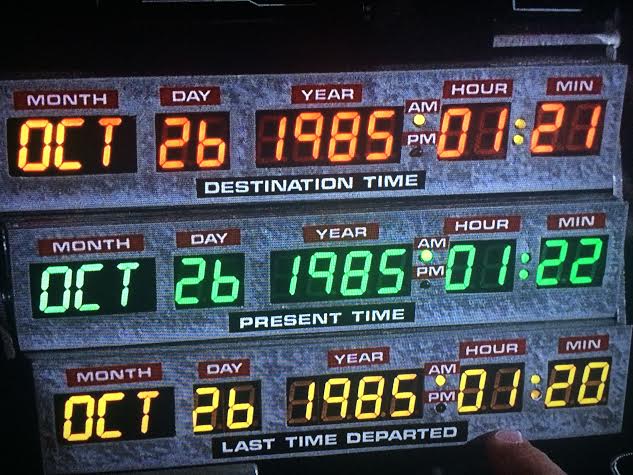
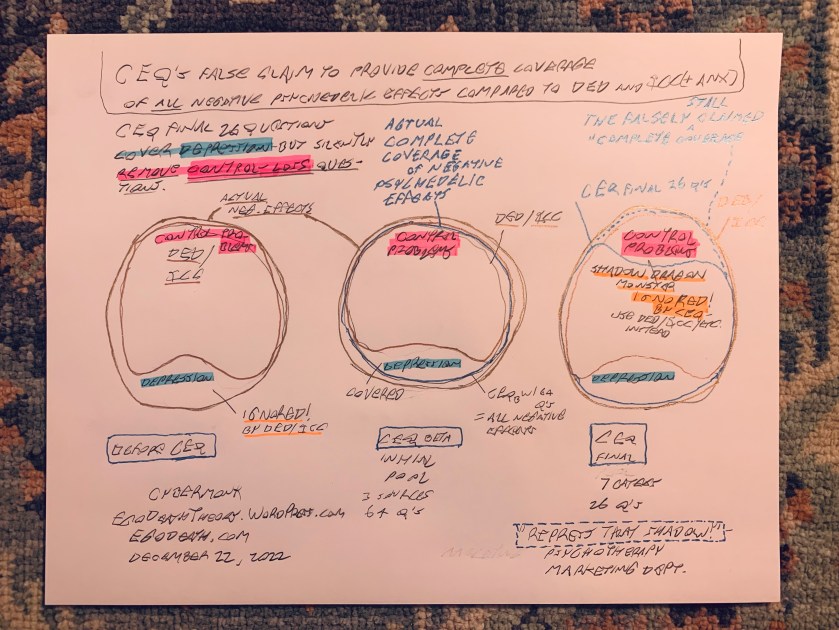
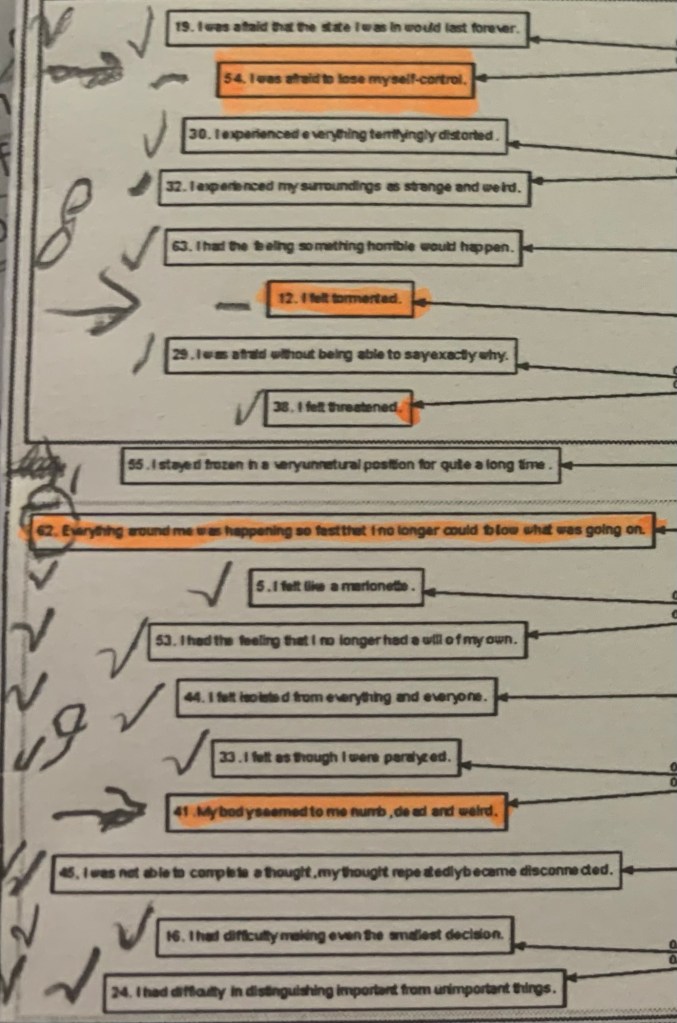
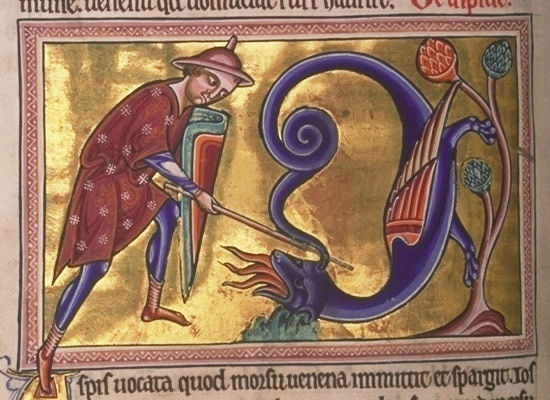

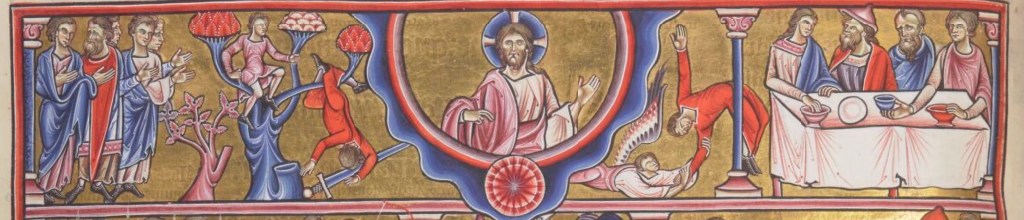



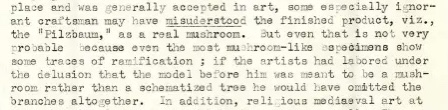
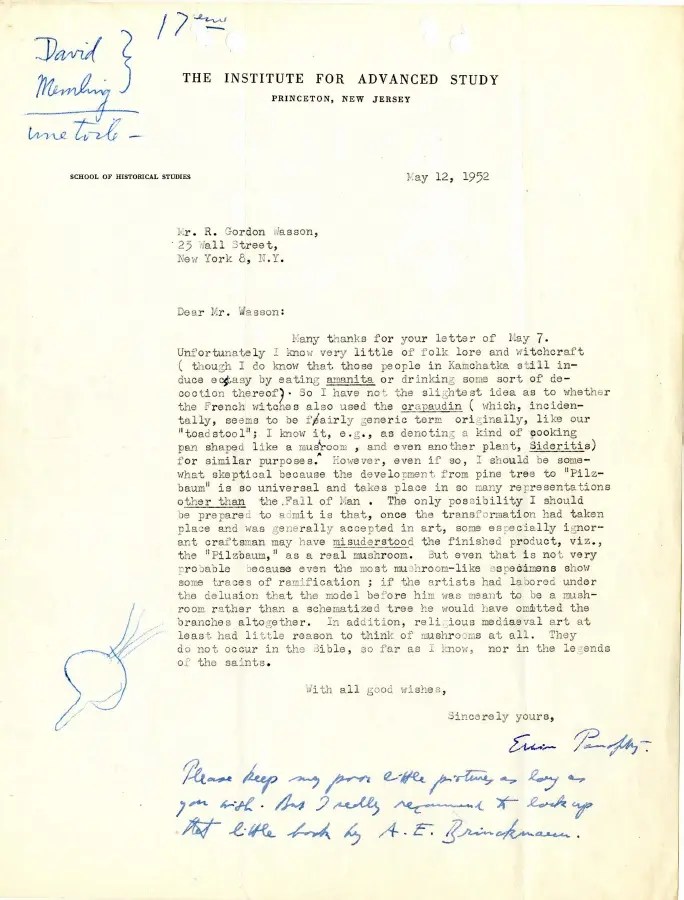





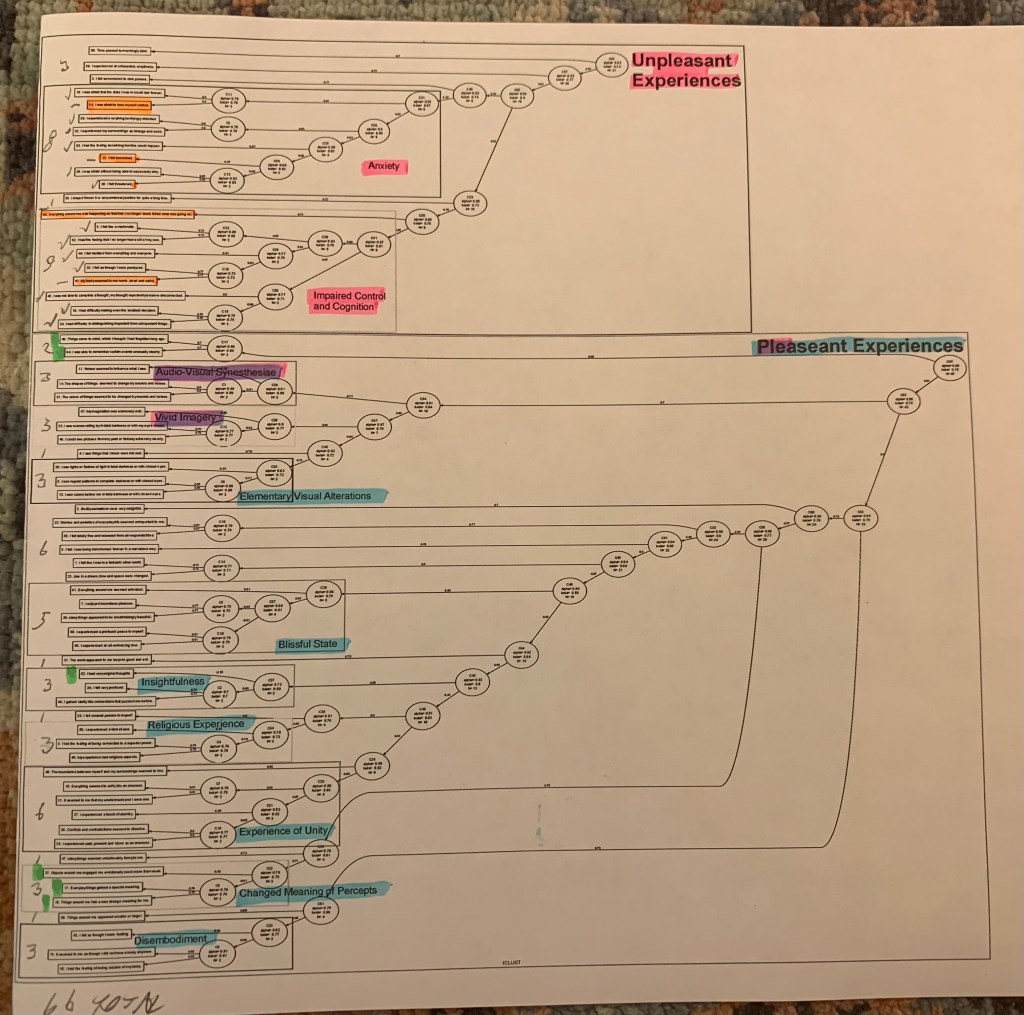
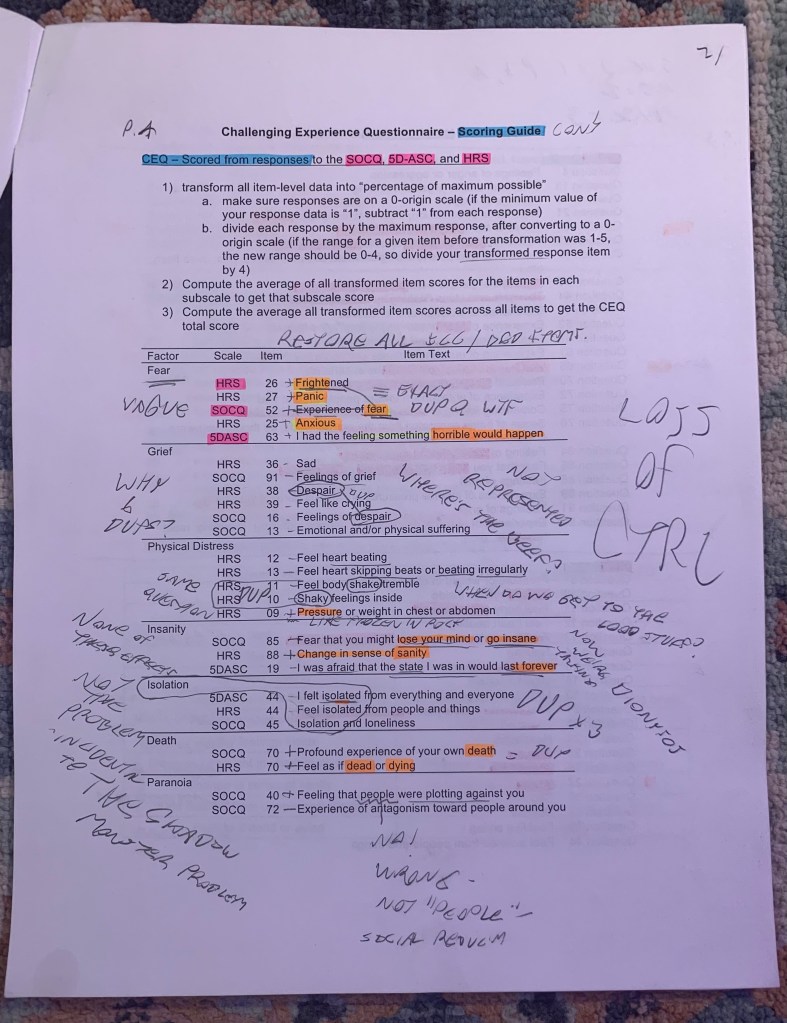
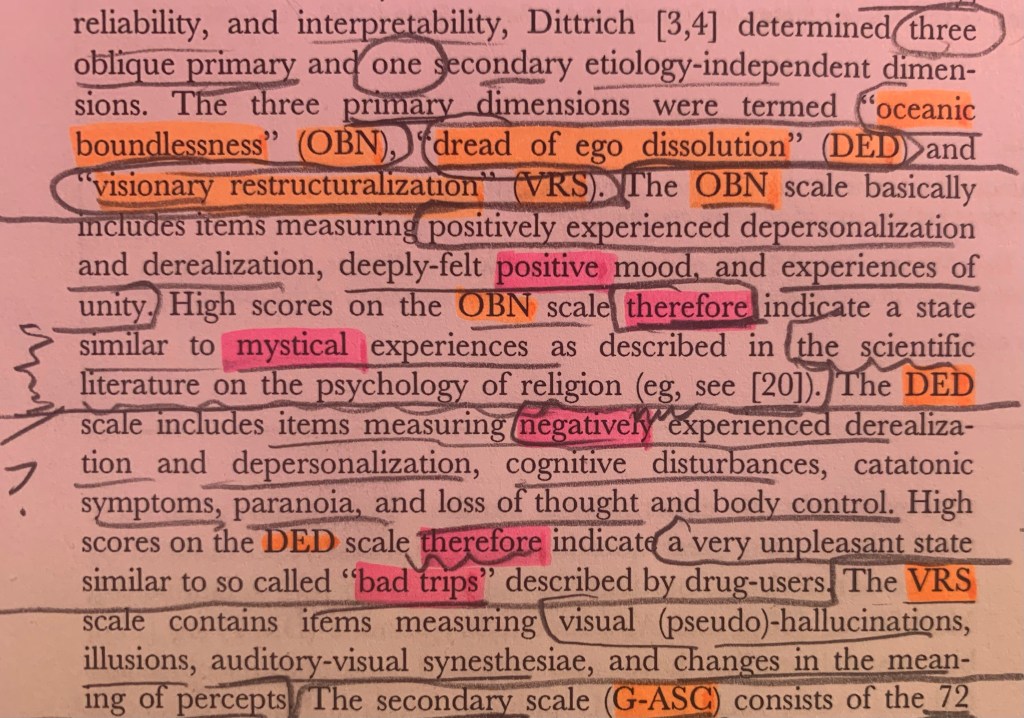
 The Egodeath theory