Due to fluke, I got this before it was avail Feb 2, 2025; i got it Dec 23, 2024. march 20 2025 i also bought $25 audiobook, which is great format; good content; good voczn, good tech usage.
Strangely the book lacks surrenderism critique and big claim of shamans having control stability during Psilocybin, tho Houot focused on that pair of topics in 2019 Masters dissertation & article Psyc Ship.
The Psychonaut’s Ship
Pairing Technologies with Psychedelics to Augment User Agency
A. M. Houot
Prefatory
written by Houot
Modern psychedelic users are commonly advised to surrender to altered states of consciousness.
[surrender to what? Michelle Janikian’s book uses this same strange construction. More like: lower-level personal control system (child-thinking; monolithic, autonomous control) is made to surrender to 2-level, dependent control; the overpowered female mind is made to surrender to the male; FEMALE: the control thought-receiver ctr the helpless thought-receiver htr the helpless control-thought receiver hctr MALE: hidden source of control-thoughts hsct the control-thought inserter cti the uncontrollable source of control-thoughts usct]
Once users consider the possibility that ‘surrenderism’ is a necessary prerequisite—though not an exclusive approach—coupled with the idea that psychedelic experiences might not be religious or supernatural, the idea emerges that pairing technologies with psychedelics is a viable methodology to comport oneself during psychedelic states.
Shamans display signs of control and mastery upon entering altered states, partly because of intentionally crafted techniques and technologies that assist them.
It is argued that modern psychedelic users of modern technologies may augment the level of control over their experiences, that is to say, making use of prostheses to maintain balance during intoxicated states.
[f134 stand on right foot to maintain balance and avoid control instability Great Canterbury Psalter:
Crop by Michael Hoffman
f145 stand on right foot to maintain balance and avoid control instability:
Crop by Michael Hoffman
f77 stand on right foot to maintain balance and avoid control instability:
Crop by Michael Hoffman
prostheses – crutch to have stability while incorrectly stand on left foot
stand on left foot = rely on egoic possibilism-thinking –> control instability
stand on right foot = rely on eternalism-thinking. –> control stability
crutch could indicate washed-clean, qualified possibilism-thinking; left foot touches stable column base.
/ end Michael Hoffman images]
Page 2 — A M HOUOT [left page header] Psychedelic Press XXXV [left page footer]
The understanding of the concept psychonaut or sailor of the mind is analogously expanded to include the psychonaut’s ship, comparable to nautical technologies used by sailors .
The example of the psychonaut’s ship provides the platform upon which to reflect future applications and utilities of psychedelic technologies .
If psychedelic users are like sailors of the mind, then, what is their ship? What follows is an inquiry into how modern psychedelic users can apply technologies like their shaman counterparts to increase agency during psychedelic experiences.
Introduction
written by Houot
The commonly held supposition that modern users have little to no agency during psychedelic experiences needs revision .
[transformation of mental model of personal control system/ personal control agency]
Recommendations to passively surrender to the experience, i.e., ‘surrenderism’,1 is of particular interest when it comes to modern users’ fears and concerns of psychedelic experiences.
[the experience of the threat of catastrophic loss of control, due to relying on monolithic, autonomous control]
Experts recommend modern users surrender to psychedelic states, and users unquestioningly heed such advice.
[the personal control system is made to surrender to 2-level, dependent control – the underlying reality]
Alternative approaches as to how one comports oneself in altered states of consciousness are available .
The following is an examination and expansion of one such overlooked approach, that is, using technology [VAGUE] during psychedelic experiences.
I contemplate how pairing modern technology with psychedelic states may provide augmented user agency compared to the current, dominant surrenderism model.
In Section 1, I consider one of many possible reasons why modern users would want to pair technology with psychedelic experiences, namely, to curb fear of the unknown.
[dread of ego dissolution? no; of: the hidden, uncontrollable source of control-thoughts]
VAGUE, VAGUE, VAGUE
I argue elsewhere that modern psychedelic users need not only interpret their experiences from the mystic’s fear and surrender perspective but also might consider adopting
shamanic principles of control and mastery of altered states through the use of techniques and technologies [VAGUE].2
In Section 2, I defend the premise of surrendering to [TO WHAT?] psychedelics, however, for particular subsets of users and motives; for example, the inexperienced, the inadequately prepared or trained, or preventing harm to self or others.
In Section 3, I highlight the tendency of ancient peoples to interpret that which they did not understand or control as somehow being religious or supernatural.
Simply because present-day people do not adequately comprehend psychedelic experiences does not qualify these experiences as sacred.
I invite readers to consider historical examples when science and technology could eventually better explain natural phenomena than divine beings or gods.
Additionally, many people take the notion of surrender for granted, but I ask why modern psychedelic users must surrender; why should surrender be given automatically; and why taking into consideration some level of control of experiences is not treated?
In a move away from surrenderism, ayahuasca-drinking Santo Daime religious members incorporate rituals and codified frameworks, attempting to constrain the psychedelically unconstrained mind.
[good phrase]
These sociocultural-specific constraints are a step in the direction I propose .
Finally, I develop ideas to integrate purpose-built psychedelic technologies, or prostheses [DAMN IT MAN, THIS IS AS VAGUE AS “THE TRADITIONAL METHODS OF THE MYSTICS”], to constrain or channel the intoxicated mind, aiming to increase user agency [UNTIL FUZZY WUZZY LOVING CUP EXPLOSION CLIMAX OF NEW BIRTH] during psychedelic experiences.
1. Mystic Fear and Shaman Control
written by Houot
In previous research, I analyze ways in which modern users might conceptualize the psychedelic experience that counters the current fear-laden discourse on drugs.3
Since many modern societies and individuals fear [FEAR OF WHAT? the experience of the threat of catastrophic loss of control] the experiences psychedelics elicit, I explore the likely roots [hidden underlying snake in basket; the hidden, uncontrollable source of control-thoughts] of
4 A M HOUOT Psychedelic Press XXXV
these fears, and once known, ask how modern technology [VAGUE AF] might be used to somehow steer or control psychedelic experiences .
For that which one controls no matter the degree, one increases one’s agency [try harder, egoic control foundation! until you are dead king hung on tree, ram caught in thicket] during the experience, therefore, theoretically minimizing one’s fear of the once-held fear object.
Early researchers such as Aldous Huxley, Alan Watts, and Richard Alpert (later known as Ram Dass) turned to Far Eastern and Indian religions and philosophies in the 1950s–1970s, notably mysticism, in an effort to make sense of psychedelic effects on modern users’ subjectivity.
Depending on their religious inclination mystics may speak of love and devotion [2-level, dependent control; “relational”] when ‘melting away’ and merging [beginner unity] with the Other, or they might speak of fear and the unavoidable surrender to some divine being(s).4
Mystics surrender to a claimed divine being or presence, suggesting that whatever or whomever they surrender to is in charge; the Other is in control for as long as the mystic remains in the altered state.5 Psychedelics alter consciousness as well, leaving modern users with similar experiences and questions, hence the analogous comparisons to mysticism .
In continuing this line of reasoning, I argue that modern users find themselves in at least three types of ‘master/subject relations’: master/slave, host (master)/guest, and teacher (master)/student.6 In each case, users relinquish control of their being, thereby assuming the role of slave, guest, or student when in psychedelic-induced states .
A modified framework based on former U.S. Secretary of Defense Donald Rumsfeld’s ‘there are known knowns’ comment is used to get at modern psychedelic users’ ultimate fear [the experience of the threat of catastrophic loss of control due to the hidden, uncontrollable source of control-thoughts] , drilling down from knowns to unknowns, from which I develop a new qualitative framework to explain notions of self in a surrenderism paradigm regarding the assessment of ‘complete’ [not mystical; just Stacean] mystical experiences, and ask whether there is another way
THE PSYCHONAUT’S SHIP 5 Psychedelic Press XXXV
for modern users to increase their agency [until the climax transformation is reached] during experiences.7
From this perspective, I turn to a spiritual practice that is farther removed from modern society and culture, namely, shamanism, appreciating how shamans’ notions of control and mastery (claimed by modern academics) of drug and nondrug altered states can inform modern users’ conceptualizations of psychedelic use and self-comportment.
Shamans use techniques and technologies [SOUNDS LIKE VAGUE B S] (broadly construed) such as song lyrics [like Ride the Lighting by Metallica? Little Dolls by Ozzy? Twilight Zone by Rush?] and melodies, dances, rattles, and drums [shaman Neil Peart], particularly a technique proposed by psychologist Richard Noll called ‘mental imagery cultivation’ [image of the experience of the threat of catastrophic loss of control], through which novices learn to develop the vividness of visions with the intent to control them.8 [how do “YOU” control the intent that YOU receive from the uncontrollable source of control-thoughts?]
Shamans not only have means to enter into altered states of consciousness; they also have systems in place apparently[???] to control their experiences.
Shamans do not speak about altered states in terms of fear and surrender as mystics and modern psychedelic users do; conversely, they display control and mastery.
In reframing the perception of the psychedelic experience to one that moves away from surrenderism [f u, gods! shaking fist] and which addresses fear, I conclude that modern psychedelic users might fare well to use ‘mysticism to explain’ while simultaneously using ‘shamanism to control’ their experiences.9
As expert shamans have manifold [“many” is b s like “there are many ways of Psilocybin experience without drugs”, tho none work well enough] techniques and technologies to enter into and exercise some control of altered states or of themselves in altered states,
likewise modern psychedelic users can do the same through the use of what I call ‘symbolico-technological relations’, in other words, pairing symbol with technology:
Psychedelics, symbols, and technologies used together reveal new applications, resulting in a wrestled-free symbolicotechnological third function. [sounds bull shiite]
Coupling symbol with technology creates avenues of new experiences, experiences malleable by
6 A M HOUOT Psychedelic Press XXXV
the user depending on the co-equal symbolico-technological relation and how each co-shapes the created third function.10
I say further that psychedelic technologies in general have considerable potential to act as ‘prostheses’ or crutches that afford a kind of balancing act when psychedelic users experience non-ordinary mental and perceptual conditions.11
[f177: stand on right foot to maintain balance and avoid control instability:
Crop by Michael Hoffman
I realize now that I limited my scope of ‘psychedelic technology’ to symbolico-technologies only; in actuality, they are but a subset of what a psychedelic technology can be.
I flesh out the discussion about why and how to pair modern technology with psychedelic experiences in my previous work.
However, I shall expand on my arguments by detailing the obvious need for surrenderism, the eventual need to abandon surrenderism, and propose additional utilities for pairing technologies with psychedelics.
I define and discuss psychedelic technology in detail in Section 4.
2. Surrenderism for Some, but Not for All
written by Houot
Experts in psychedelic-assisted psychotherapy and harm reduction contexts have asserted the notion of surrender since at least the 1960s.12
It is no wonder that current Psychedelic Renaissance researchers, chiefly focusing on psychedelics’ therapeutic use, would advise modern users, especially their clinical study participants, to surrender [to what?].
Advising surrender in research contexts minimizes risk to everyone involved and ensures there are nil or few mishaps during the research process; an unpredictable, ‘freaked out’ participant is bad for business, so to speak.
In addition, we can safely assume that psychedelic-naïve and -experienced participants are far from exerting shamanic standards of control.
THE PSYCHONAUT’S SHIP 7 Psychedelic Press XXXV
While I disagree with such a blanketed recommendation for modern users, I point out appropriate instances when individuals should practice surrender: (i) user inexperience; (ii) inadequate preparation and training; and (iii) surrender is better than potentially harming oneself or others. [smell of hubris]
Author of the book on ayahuasca phenomenology, The Antipodes of the Mind: Charting the Phenomenology of the Ayahuasca Experience, psychologist Benny Shanon identifies three levels of cleansing that ayahuasca induces: bodily, psychological, and spiritual in this progression .
For Shanon, the ayahuasca drinker would find it difficult to ascend to heightened dimensions of experience if one did not first overcome personal [in the sense of, personal control system] psychological issues.13
Thus, surrender is a good strategy for novices who have little to no experience with psychedelics or still have personal issues to deal with.
[that’s the wrong sense of ‘personal’; personal control system ; the egoic personal control system – not unique to one’s history]
Once these issues have been worked out and the user no longer takes psychedelics for therapeutic or personal growth motives, one can work on ‘spiritual’ cleansing, before, or in parallel, attempting to control the experience through and with technology .
Second, and closely tied to the point above, users would be advised to adopt a surrender position if inadequately prepared or trained in psychedelic experiences .
The majority of modern users are not trained at all to handle these experiences compared to the intensive training shamans receive .
The motive for taking psychedelics is also an important factor: while many shamans are first and foremost chosen to be shamans,14 they enter altered states on behalf of members of their community in addition to gaining insight and knowledge from other realms to ensure their community’s survival.15
The trends du jour for taking psychedelics among modern users, as a result of recently rediscovering or rebranding psychedelics, are personal and spiritual growth,16 and addiction interruption.17
Users desperate to personally
8 A M HOUOT Psychedelic Press XXXV
and spiritually grow or become well would likely try anything such as ingesting a psychedelic even though they might lack adequate preparation .
Once again, surrender turns out to be good advice for someone unprepared or ill-trained to operate with an intoxicated mind.
[“surrender” is WAY too vague, folk talk]
Practice through repetition offers users a feasible way out of surrenderism .
Psychedelic psychotherapist Duncan Blewett, who worked with Humphrey Osmond in Canada in the 1950s, hints at this:
‘Self-surrender is not an event that occurs only once, but must be repeated as additional repressed material [B S Psychology baloney] is released.
Each repetition becomes easier because of the positive reinforcement given by each previous self-surrender’.18
For Blewett, repeated self-surrender to psychedelics becomes easier as one accustoms to them and jointly attends to their own personal and repressed issues (similar to Shanon’s views) .
Evidently, there exists the possibility and even likelihood that one need not endlessly surrender to the psychedelic as experiences become ‘easier’ .
Such initial surrenderist maneuvers serve as necessary stepping-stones toward increased agency of one’s subsequent experiences.
[I can agree if elaborate and differentiate two different senses – as it stands, TOO VAGUE]
Third, surrendering to the experience is better than, for example, physically or mentally breaking down, therefore potentially harming oneself or others:
‘Surrender can be considered a form of passive control, in that surrendering to the experience is a better alternative than resisting the oncoming altered state, which could lead to bad experiences’.19
The very act of surrendering, knowing that one should surrender, either from one’s intuition or a clinician’s recommendation, is a form of control because the experiencer is regulating that part of their self that might resist, or react to, the temporary bodily and mental changes.
[REALLY must control transformation, not binary have or don’t have control]
While surrender can be considered a soft form of control, it is not the sort of control I illustrate in later sections .
THE PSYCHONAUT’S SHIP 9 Psychedelic Press XXXV
3. Secularization of Experience
written by Houot
The second commonly held attitude that must change for a revision in the way modern users consider psychedelic experiences, ultimately leading to a new or parallel paradigm, is the secularization of experience .
In his book, Cleansing the Doors of Perception: The Religious Significance of Entheogenic Plants and Chemicals, religious scholar Huston Smith comments on the sacred, surrender, and control .
He is quite right when he says that that which we wield greater control or comprehension over leads to demystification .
For example, humans do not control the weather, but meteorologists today better understand it than polytheistic humans did thousands of years ago who attributed weather events to one of the gods.20 Of course, we do not know for certain whether weather gods exist, maybe they do, but I imagine most people would consult meteorological science and technology experts to explain climatic happenings .
Smith goes on to question whether (total) control is even wanted, that surrendering to some of life’s experiences has its virtues and not doing so could lead to cynicism: Not only is the notion of total control contradictory, it isn’t even attractive .
To enter a friendship, to say nothing of marriage, with intent to control it is to soil the prospect from the start .
Life calls for balancing the rewards of control with gifts that come to us through openness and surrender .
The more we resolve to have things our own way, the more closed we become to the virtues in alternative ways .
If we cannot perceive the virtue inherent in the capacity to surrender – to surrender to another person in love, or to obligation in the sense of feeling its claims upon us— cynicism awaits us.21
10 A M HOUOT Psychedelic Press XXXV
I too shun the idea of trying to dominate friends and romantic partners and agree with the unattractiveness of ‘total control’ over life’s circumstances .
Let us backtrack for a moment and instead refrain from speaking in absolutes .
What about some form of partial control, not when it comes to people, but other features of reality? Why must some lived experiences remain a mystery? Why would not seeing Smith’s virtue in surrender lead to cynicism? On the contrary, I find the prospect of giving more agency to psychedelic users through technological means optimistic and positive .
‘Intent to control’ need not lead to ‘soiling’ experiences .
The definition of to soil is ‘to stain or defile morally—corrupt; to make unclean especially superficially—dirty’.22 Intent to control psychedelic experiences that are commonly considered to have religious or supernatural overtones does not indicate psychedelic technology users want to morally defile or make unclean such experiences .
Humans have always controlled aspects of their lives and surroundings in partial and agreeable ways; psychedelic experiences are nonexempt from suchlike pursuits .
Smith’s position sounds like a desperate effort to dissuade probative people from questioning their lived experiences and reality, reminiscent of religious leaders coping with Copernican angst .
As mentioned in the preceding section, repeated self-surrender is important for user acclimatization to altered states .
In a similar way, members of the syncretic ayahuasca religion called Santo Daime incorporate ritualistic and cultural cues to constrain the unconstrained mind .
Lifshitz, Sheiner and Kirmayer23 report how Santo Daime members structure their religious-psychedelic practices: men and women segregate in rows expanding outward from a central table where senior members sit, members recite prayers, sing hymns, coordinate dances, meditate silently while seated, and their interpretation of
THE PSYCHONAUT’S SHIP 11 Psychedelic Press XXXV
visions contribute to an ‘…ordering of ritual time and space structures the psychedelic experience along multiple modalities .
On a pragmatic level, it provides the framework and repeatability required for regular religious practice, and codifies Santo Daime’.24 Seen from the religious/healing perspective of Santo Daime, Lifshitz et al .
say, ‘Thus, promoting healing with psychedelics likely requires constraining the unconstrained mind through symbolic situational cues and embodied rituals that emphasize the potential to move from maladaptive patterns toward constructive states and behaviours’.25 Although my views about the claimed inherent religious feel to psychedelics and those of Santo Daime practitioners differ, I commend them and indigenous users for their codified frameworks that attempt to constrain or give order to the psychedelic experience .
At this juncture, I address the following possible objection to my argumentation thus far .
Shamans and Santo Daime members ostensibly already use techniques and technologies to control aspects of their psychedelic experiences in religious contexts .
One might ask why the abandonment of religious/supernatural connotations would be necessary to modern technology use that increases user agency during psychedelic experiences .
Neuroscientist Robin Carhart-Harris says scientists aim to be: …dispassionate, to really give ourselves the best chance to glean what is true .
… I come here with an open mind wanting to understand the phenomena but with a motivation to try to study it .
I think if you just leave it [psychedelics] in this enchanting space, then you might be motivated not to even study it.26 A secular approach stands a greater chance at advancing knowledge of psychedelic states .
The religiously inclined or the ‘enchanted’
12 A M HOUOT Psychedelic Press XXXV
may stop short of probing deeper into experiences for any number of reasons, whereas people with more of a secularist mindset will likely ask questions and conduct experiments that contradict indigenous and mainstream religious dogma .
Psychiatrist Matthew W Johnson recognizes the fallibility in using nonempirical frameworks in psychedelic medicine and research contexts and discloses multiple dangers regarding the use of religious references by psychedelic scientists and clinicians .
‘It is important to operate instead from a secular framework that is nonetheless open to working with patients or participant [sic] of any religious/spiritual background’.27
As tempting as it may be for some clinicians to introduce religious and spiritual belief systems to help study participants find meaning from their experiences and about their lives, these placeholders and the icons that represent them should be avoided, according to Johnson, because they not only precondition psychedelic users to have a specific experience, but they also alienate participants who might be atheist or practice another religion whose religious symbolism is absent from the study environment .
In short, preconditioning experiences and alienating study participants leads to bad science and practice, not to mention ethical concerns .
Surrenderism is a necessary step in one’s evolving psychedelic journeying process; however, it is not the only way to comport oneself as I hope is beginning to become clear .
Additionally, once one accepts the possibility that altered states of consciousness—including those psychedelic-induced—are not religious or sacred, one would no longer resort to unconditional surrender as mystics do and as modern researchers recommend .
As one gains enough experience through repeat exposure and the initial transcendental luster subsides, repeat users might realize that otherworldly phenomena afforded by psychedelics
THE PSYCHONAUT’S SHIP 13 Psychedelic Press XXXV
are indeed highly curious other dimensions, yet without the religiosacral connotations .
In the next and final section, I argue for technology use during psychedelic states that moves beyond but also compliments the abovementioned ritualistic and symbolic signaling.
4. Augmenting Agency and Control with Prostheses
written by Houot
Ernst Jünger, German author and friend of Albert Hofmann, coined the term psychonaut (from the German, psychonauten)28 to mean ‘psychedelic astronaut, explorer of the inner cosmos’.29
While the astronaut-explorer-of-psychedelic-spaces description aptly references these experiences, we should also inspect the meaning of the suffix nautès .
In this sense, psycho-naut means ‘sailor of the mind’ or ‘navigator of the psyche’, referring to individuals wanting to explore their minds by means of any kind of consciousness alteration.30 The resultant substantive form then is psychonautics, or ‘(the art of) “sailing the mind” or “navigating the psyche”’.31
If psychedelic users are like sailors of the mind, then, what is their ship? How does one turn sailing the psychedelic-intoxicated mind or navigating the psychedelic-intoxicated psyche into a predictable and controllable art form? Psychonautic technology from rituals and symbolico-cultural cues to the pairing of technologies with psychedelics is an overlooked topic in modern psychedelic discourse .
The sailor on their ship does not leave port hoping that the tide will take them to their desired destination .
No; the sailor commands a transportation device made for a specific purpose .
The ship undoubtedly is subject to waves, weather, creatures beneath the water’s surface, etc .
Nevertheless, the experienced sailor knows how to use their technology
14 A M HOUOT Psychedelic Press XXXV
to steer through the unknown, that which they cannot control, and toward their destination .
They use technology to go from one point to a predetermined other, and their ship is suited to deal with many natural events en route .
The same can be said about the sailor of psychedelic worlds .
Whereas both surrenderists and psychedelic technology users might start with an intention to guide them through the experience, surrenderists basically leap into the ocean of altered consciousness expecting the tide to take them to their destination, an action predicated on hope and submission .
This is folly .
Modern users would do better to think about using a sort of ship, some technical or technological accoutrement that can improve the journey’s steadiness and at their volition .
One must ask whether one is a passive passenger (e.g., surrender) or a course-charting captain utilizing seaworthy technology (e.g., control) .
In demarcating the boundary between science and technology, philosopher of technology Andrew Feenberg says: ‘Science and technology share a similar type of rationality based on empirical observation and knowledge of natural causality, but technology is concerned with usefulness rather than truth .
Where science seeks to know, technology seeks to control.’32 No one knows for certain the metaphysical status of psychedelic states; we can infer however, according to Feenberg, there is an inherent element of control regarding the essence and usefulness of technology .
Just as modern-day instruments help natural scientists learn more about reality, technologies offering greater control and therefore agency to psychedelic users would also likely help answer experiencers’ and scientists’ knowledge or truth claims about psychedelic phenomena .
I have previously defined my concept of psychedelic ‘symbolicotechnology’, 33 but fell short of defining what ‘psychedelic technology’
THE PSYCHONAUT’S SHIP 15 Psychedelic Press XXXV
is.
Here, I define psychedelic technology as follows: a humanmade technique or technology that pairs with psychedelic states of consciousness for the purpose of documentation, data collection, and/ or to control aspects of the experience for purposes of navigating, coshaping, directing one’s experience, etc., resulting in augmented user agency.34
In other words, psychedelic technology broadly speaking is any technique or technology paired with psychedelics that gives users greater insight, control, and/or agency over their experiences.
There are at least two types of psychedelic technology: passive and active.
Psychedelic technology is passive when that which is being overseen is the documentation, collection, and analysis of data from one’s experience.
For example, physiological testing equipment can be used to pick up signals or biomarkers from psychedelics’ effects on users .
Note that high-tech research devices such as functional magnetic resonance imaging (fMRI) were not designed with psychedelics in mind but are used by psychedelic researchers .
Furthermore, other modern technologies and passive psychedelic technologies certainly will assist in developing purpose-specific active psychedelic technologies .
Psychedelic technologies are passive when they are in the background to collect or monitor data in some capacity, and usually would not be purpose-built for psychedelic experiences, although the latter is possible .
Active psychedelic technology is a means to increase control of experiences through navigating, co-shaping, or directing .
Within the category of active psychedelic technology, we can further differentiate between hard and soft control .
I define hard control as controlling everything about the experience, that is, the experiencer wields absolute control .
Since this is unlikely to happen in the foreseeable future, if ever, soft control is what trained psychedelic technology users can do:
16 A M HOUOT Psychedelic Press XXXV
they are able to navigate, shape, and determine how their experience unfolds depending on their expertise with psychedelics and their skill in using paired psychedelic technologies .
As mentioned earlier, such skill requires one moving beyond the prerequisite surrender phase of one’s psychedelic journeying evolution .
Passive psychedelic technology can become active if, when monitoring vital signs, the researcher directs the experiencer to take specific anticipatory actions, for example, to raise or lower blood pressure, heart beats per minute, directing the drug user’s attention, changing position of the body, introducing an idea or object during the experience, etc .
Therefore, psychedelic technologies are active when they are in the foreground to steer experiences, and presumably will be purpose-built for psychedelic experiences .
Not necessarily a prosthesis to stabilize one’s visionary experience but rather a documentation tool can be found in Qualia Research Institute’s Tracer Replication Tool .
This psychedelic technology was designed to ‘collect quantitative data about psychedelic tracers’.35 The internet browser-based tool works as follows .
The participant observes a bouncing blue ball on their computer screen while in an intoxicated state .
Once the visionary experience subsides, they toggle the tool’s settings to reconstruct what the tracer looked like as it was superimposed upon the default blue ball in addition to providing information such as drug type, dosage, how many hours into the intoxicated state they used the tool, and how many hours after the experience they documented their tracer .
The Tracer Replication Tool is a simple technology purposely built to document a specific aspect of psychedelic perception .
As usergenerated reports filter in, we may make more sense of what happens to visual perception depending on drug type and dosage and we will be able to literally show such representations to others .
While one’s unique physiology and cognition shape each person’s subjective experience,
THE PSYCHONAUT’S SHIP 17 Psychedelic Press XXXV
the above technology may reveal that drug, dosage, age, mood, culture, or any number of standalone or combined factors may lead to consistent and predictable tracer phenomena .
I offer another practical way to think about psychedelic technology .
Aikido is a Japanese martial art that teaches the importance of defensive maneuvering by using the attacker’s own movements to subdue him .
The attacked conserves energy by flowing with, not against, the attacker: ‘Aikido is performed by blending with the motion of the attacker and redirecting the force of the attack rather than opposing it head-on .
… The goal of Aikido training is not perfection of a step or skill, but rather improving one’s character according to the rules of nature’.36 In this way, the attacker expends more energy and thus is more at risk of tiring themself out, making themself susceptible to the impassable defensive offense of the attacked; the attacker must work harder to bring down their opponent .
According to the survival response known as fight-or-flight (-orfreeze), psychedelic technology use would be considered as a form of ‘fight’ because it is certainly not flight or freeze .
However, it is not fighting per se, rather an active and anticipatory defensive-like maneuver, a form of flowing with one’s precarious environment with the help of technological accoutrements designed for psychedelic states .
Sailors know the limits and capabilities of their technologies and have expertise in navigating their ships around adverse weather events or, if need be, to sail through waves head on .
Sailors do not try to control the weather but instead know how to work with it by getting the most out of their nautical technology .
The ship is purposefully built for moving atop the uncertainty and randomness of waves: it has a keel to stabilize, sails to propel, a rudder to steer .
Active psychedelic technologies would have comparable features that enable users to gain some level of control over the uncertainty and randomness of visionary phenomena and worlds .
18 A M HOUOT Psychedelic Press XXXV
Whatever the intoxicated mind shows experiencers, one must face it and accept what comes; one must confront whatever presents itself or that which needs to be revealed .
(One day, perhaps, technologies will be capable of inducing specific/desired visionary content as well.) Sailors cannot control approaching waves and storms; they skillfully maneuver their vessel with or around them .
Similarly, modern psychedelic technologies may enable users to direct their experiences with greater control irrespective of that which presents itself to consciousness .
Conclusion
written by Houot
Historical evidence suggests humans sacralize that which they do not comprehend nor control .
In accordance with the mystic’s views, surrendering implies that the psychedelic user foregoes whatever agency they may have .
History teaches that there might not be anything religious or supernatural about psychedelic-induced states; likely, these spaces merely are different dimensions of reality upon which, because of naivete and lack of knowledge, people put such placeholders .
The surrenderism model within psychedelia is a prerequisite for inexperienced, untrained, or novice users and should not be abandoned any time soon .
However, sustained belief in letting go or giving oneself over to the experience concretizes the feeling that one could not possibly understand these realms .
I contend that surrenderism may have damaging downstream effects insofar as experiencers relinquish pursuits of experiential sense-making .
Academics and amateurs must eventually transcend surrenderism and religious/supernatural connotations in favor of new methods to have any chance at making epistemic gains pertaining to the visionary, otherworldly content afforded by psychedelics .
THE PSYCHONAUT’S SHIP 19 Psychedelic Press XXXV
Recognizing surrenderism’s usefulness as a means, but not exclusively as an end, and welcoming prospects of having more agency, prepares the psychedelic user for new types of experience .
Any form of constraining the psychedelic mind, from rituals and symbols to psychedelic technologies, helps users manage visionary experiences .
In addition to controlling their voyage, curbing fear37 is but one reason why one would want to use technology during their psychedelic experiences; other reasons include navigating, co-shaping, communicating, and determining the experience .
The purpose, design, and function of a psychedelic technology will depend on one’s worldview, the type of knowledge one seeks, and what aspect of the experience one wishes to stabilize or document .
Humans will continue to find ways of incorporating technology with psychedelic experiences .
Psychedelic experiences have already been modified by shamanic technologies and ritualistic and symbolic cues found in the Santo Daime religion, and will continue to be by modern users and their technologies .
We must begin thinking how modern technology will shape psychedelic experiences for any user, no matter their cultural conditioning .
Pairing deliberately designed modern technologies with psychedelics is not only the future, it is the next evolutionary step in psychedelic drug use .
It is going to happen, and so we must consider how it will happen, how technology will be used before, during, and after psychedelic experiences, and for what purposes? Passive psychedelic technologies already exist and are being used in academic research .
What encourages me is what the future may bring regarding active psychedelic technologies .
I do not know what they will be, but their development and use are indeed possible .
Admittedly, I argue for something that does not yet exist, and cannot exist until
20 A M HOUOT Psychedelic Press XXXV
people secularize their psychedelic experiences, outgrow their tendencies toward surrenderism, and seriously consider the possibility of pairing modern technology with these dimensions of non-ordinary experience for the purposes of augmented control, agency, and mastery, and hopefully, newfound knowledge as a result .
Notes
written by Houot
1 Houot AM (2019) .
Toward a Philosophy of Psychedelic Technology: An Exploration of Fear, Otherness, and Control, Master’s thesis, University of Twente, Enschede, Netherlands .
8 Houot (2019, pp 39–40); Noll R (1985) ‘Mental Imagery Cultivation as a Cultural Phenomenon: The Role of Visions in Shamanism’, Current Anthropology, 26(4), pp 443–461 .
9 Houot (2019, p 49) .
10 Houot (2019, pp 44–45) .
11 Houot (2019, p 50) .
12 Masters REL and Houston J (1966) .
The Varieties of Psychedelic Experience .
New York: Dell Publishing Co., Inc.; Blewett D (1970) .
‘The Psychedelics and Group Therapy’ in Aaronson B and Osmond H (eds) Psychedelics: The Uses and Implications of Hallucinogenic Drugs .
Garden City, NY: Anchor Books; Leary T, Metzner R and Alpert R (2007/1964) .
The Psychedelic Experience: A Manual Based on the Tibetan Book of the Dead .
New York: Citadel Press; Johnson MW, Richards WA and Griffiths RR (2008) .
‘Human Hallucinogen Research: Guidelines for Safety’, Journal of Psychopharmacology, 22(6), pp 603–620; Girón S (2013) .
‘Working with Trauma: Psychedelic Harm Reduction and Transpersonal Psychotherapy’, MAPS Bulletin, 23(3), 2013 Annual Report, pp 47–49 .
13 Shanon B (2002) .
The Antipodes of the Mind: Charting the Phenomenology of the Ayahuasca Experience .
Oxford University Press, p 307 .
THE PSYCHONAUT’S SHIP 21 Psychedelic Press XXXV 14 Krippner S (2000) .
‘The Epistemology and Technologies of Shamanic States of Consciousness’, Journal of Consciousness Studies, 7(11–12), pp 93–118 .
15 Walsh R (1991) .
‘Shamanic Cosmology: Psychological Examination of the Shaman’s Worldview’, ReVision 13(2), pp 86–100; Walsh R (1995) .
‘Phenomenological Mapping: A Method for Describing and Comparing States of Consciousness’, Journal of Transpersonal Psychology, 27, pp 25–56 .
16 Móró L, Simon K, Bárd I and Racz J (2011) .
‘Voice of the Psychonauts: Coping, Life Purpose, and Spirituality in Psychedelic Drug Users’, Journal of Psychoactive Drugs, 43(3), pp 188–198 .
17 Winkelman M (2014) .
‘Psychedelics as Medicines for Substance Abuse Rehabilitation: Evaluating Treatments with LSD, Peyote, Ibogaine and Ayahuasca’, Current Drug Abuse Reviews, 7(2), pp 101–116 .
18 Blewett D (1970) .
‘The Psychedelics and Group Therapy’ in Aaronson B and Osmond H (eds) Psychedelics: The Uses and Implications of Hallucinogenic Drugs .
Garden City, NY: Anchor Books, p 348 .
19 Houot (2019, p 49) .
20 Smith H (2000) .
Cleansing the Doors of Perception: The Religious Significance of Entheogenic Plants and Chemicals .
‘Cultural Neurophenomenology of Psychedelic Thought: Guiding the ‘Unconstrained’ Mind Through Ritual Context’ in Fox KCR and Christoff K (eds) The Oxford Handbook of Spontaneous Thought: Mind-Wandering, Creativity, and Dreaming .
Oxford University Press .
24 Lifshitz, Sheiner and Kirmayer (2018, pp 585–586) .
25 Lifshitz, Sheiner and Kirmayer (2018, p 576) .
26 Davis E (2018) ‘How to Think about Weird Beings’ in Luke D and Spowers R (eds) DMT Dialogues: Encounters with the Spirit Molecule .
Rochester, VT: Park Street Press, p 152 .
27 Johnson MW (2020) ‘Consciousness, Religion, and Gurus: Pitfalls of Psychedelic Medicine’, ACS Pharmacology & Translational Science .
https:// dx.doi.org/10.1021/acsptsci.0c00198 28 Ott J (2001) ‘Pharmañopo—Psychonautics: Human Intranasal, Sublingual, Intrarectal, Pulmonary and Oral Pharmacology of Bufotenine’, Journal of Psychoactive Drugs, 33(3), pp 273–281 .
29 Sjöstedt-Hughes P (n.d.) The Psychedelic Influence on Philosophy .
30 Blom JD (2010) A Dictionary of Hallucinations .
New York: Springer Science & Business Media, p 434 .
22 A M HOUOT Psychedelic Press XXXV 31 Blom (2010, p 434); Ott (2001) .
32 Feenberg A (2006) ‘What Is Philosophy of Technology?’ in Dakers JR (ed) Defining Technological Literacy: Towards an Epistemological Framework .
New York: Palgrave Macmillan, p 5 (my italics) .
33 Houot (2019) .
34 When speaking specifically about psychedelics, the term ‘psychonautic technology’ should be avoided because it refers to techniques and technologies used during any form of consciousness alteration such as meditation, yoga, other pharmaceuticals, etc .
35 Wu L, Gomez Emilsson A and Zuckerman A (2020) QRI Psychophysics Toolkit – Tracer .
How Much Does the Egodeath Theory Utilize the Concept of {death}?
Outline All Headings of Houot Book Rise of the Psychonaut
Read Aloud The Psychonauts Ship: What Are Cyb Dyns of “Surrender” in Janikian’s Folk Tech Book? Shamans Have Full Control — O RLY IZZAT SO??
What Did I Discover? For Houot Context
Salvation Salesman Gordon . . . . Wasson Shows Us That Christianity equals deceiving and lying to people and censorship
Dionysus and the Pirates
Secret Names of Scholars: Policy: Every Writer Gets Only Two Names: First & Last
Errata in URL of WordPress copy of 2007 Main Article
Effect Index semi-404, Josie Kins – is this site toast/history, or what? Must Check Archive.org of effectindex.com
TRANSPERSONAL STATES
Granting Advanced Degrees in Transcendent Knowledge per the Egodeath theory per Cybermonk
Justified Rectified Purified Egoic Control Thinking
Cubensis Nonbranching Horses & Balancing on Right Leg (Image f177)
See Also
Motivation for this Page
Rough mobile draft, because need to create several pages. but hard to manage todos. gotta get them started. Started cleaning up on desktop.
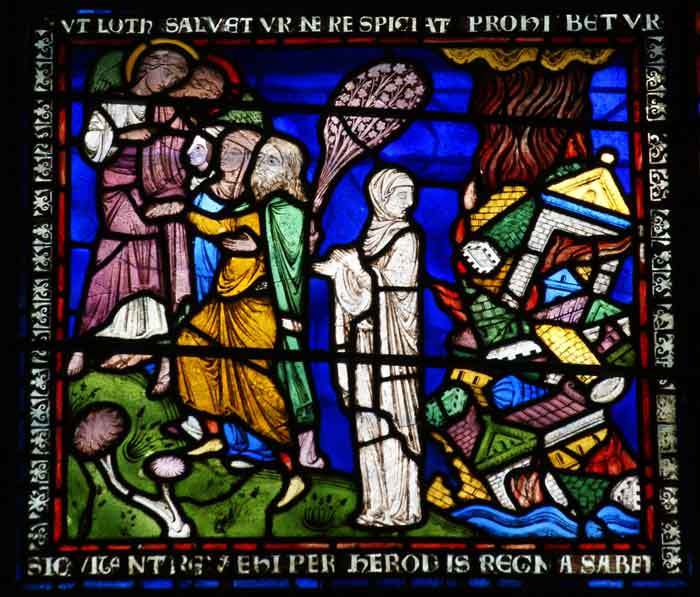
YI form discovered yesterday, Crop by Michael Hoffman
Yesterday March 25, 2025, I realized that this mushroom-tree has YI branching form discovered yesterday. I got this picture a long time ago like maybe 2003.
I contributed this instance of mushroom imagery in Christian art to the Brown virtual db of all mushroom imagery in Christian art (whatever’s meant by “catalog” given that Browns proposal was no-go, no one has time). Brown should’ve proposed a database, not a committee.
My book review of Hermetic Spirituality and the Historical Imagination: Altered States of Knowledge in Late Antiquity, by Wouter Hanegraaff, 2022:
Seeing the illusory aspects of this mental representation and feeling the absence of the accustomed sense of personal solidity can be experienced asdeath, as literal cessation of personal existence, because the naive mind strongly identifies with the projected image and the sense.
Conceiving of the world as a fixed spacetime block leads to the astonishing potential of experiencing ego death, because the logic of ego’s control power is coherently disrupted.
There are multiple [INSUFFICIENT] triggers for the dissociative cognitive state, including psychedelics, meditation, schizophrenia, sensory deprivation, hyperventilation, temporal-lobe epilepsy, UFO abduction, and near-death experiences.
Acid-rock mysticism vividly alludes to and resonates with ego death and the dissociative cognition that leads up to it.
The peak experience of ego death can be rationally explained, whether or not its logic, perceptions, and hypotheses are valid.
Outline All Headings of Houot Book Rise of the Psychonaut
big todos: voice input all headings of Rise of the Psychonaut.
Needed for a book study page,
in my book review i will mention i have posted an outline of headings. voice efficient to enter headings
sections: which are the most relevant for the Egodeath theory? fav sections of book?
for my church book club intelligent discussion
copy here my Mission: to equip Loose Cognitive Science to endure Psilocybin and pass thru the gate to explore loose cognition realm wv w basic dynamics of control votrtex climax already on doily on silver platter for them:
Neo inserts chip in brain: the Egodeath theory, incl religious mythic motif analogies {mushrooms}, {branching}, {handedness}, and {stability} motifs –
instantly neo is able to explore loose cognition scientifically, already having the basic knowledge, CYBERNETIC WISDOM, the cybernetic communication transmission THE MESSAGE OF THE mushroom-trees ARTISTS, the dynamics of SURRENDER.
Know already the cheap trick of stand on right foot
Read Aloud The Psychonauts Ship: What Are Cyb Dyns of “Surrender” in Janikian’s Folk Tech Book? Shamans Have Full Control — O RLY IZZAT SO??
Stupid mystics couldn’t figure out personal control system on Psilocybin
but somehow shamans achieved FULL ACIVE CONTROL.😑
it be ultra fast to copy his article into a page where i can get hands on it to analyze and critique how Houot is foolish. In what way Houot wise recomm?
Shamans are rational scientists who achieved what muddle headed mystics failed to try to achieve. Show the way wise Houot.
Houot ‘s major interest is surrenderism – why only barely mentioned in book Rise of the Psychonaut??
I STEM-explain “surr” – Houot ‘s fav topic ; he says shamans have full active control and he says they have ACTIVE CONTROL but mystics suck because they do passive surrenderism.
other big anticipated todo: read aloud voice recording Houot article The Psychonaut’s Ship which i already read on paper but merely 1 time every line.
What Did I Discover? For Houot Context
for reviewing Rise of the Psychonaut , the Egodeath theory is an example of a discovery.
Frame the Egodeath theory within Houot’s context as an illustrative example
religious myth depicts by analogy transformation from possibilism to eternalism and Psilocybin transformation of personal control system
same w mushroom-trees genre motifs {mushrooms}, {branching}, {handedness}, and {stability} motifs
Classical Antiquity aims at heimarmene, via Psilocybin transformation
Late Antiquity aims a little above Fate.
loose cognition block-universe eternalism personal control system transformation, NOT Ken Wilber’s beginners’ unity, is what ego transcendence is REALLY about per jan 1988 when put the pieces together – Ramesh Balsekar and Watts were closer than Wilber to figuring out core wisdom.
Wisdom core knowledge was botched by
common-core mysticism and perennialism attempt w sht-tonne of BAGGAGE noise obscuring wisdom more than revealing and usefully conveying and delivering wisdom.
you agree w common-core mysticism and perennialism? ok , therefore you agree w my every whim, a slave of the Egodeath theory & iceberg of hidden agendas like The Banker for the Pope, Gordon . . . .🔍🧐🤔 Wasson INFINITE CONFLICT OF INTEREST, the Pope Wasson says – on roller derby team The Salvation Salesmen-
are you going to believe the meditation hucksters — Zen master Brad? meditation is way more potent than 12g dried cubensis trust me
are you going to believe the salvation salesmen , lying Fraud pope Gordon . . . .🔍🧐🤔 Wasson the lying Pinocchio liar?
Salvation Salesman Gordon . . . .🔍🧐🤔 Wasson Shows Us That Christianity equals deceiving and lying to people and censorship
so commendable, we must defend, like the Art Historian Ronald Huggins’ Foraging Wrong article ,
We must go to bat to defend and run cover for Gordon . . . .🔍🧐🤔 Wasson and applaud and support his deceiving, lying, Fraud scholarship obstruction and excuse him.
This is the kind of people that deny mushroom imagery in Christian art.
pope Gordon says that if you assert mushroom imagery in Christian art, then you are a blundering ignoramus.
What a wonderful Christian, Wasson the deceiver.
what does Logos Media jan irvin have to say about these Christian values of Truth from Gordon . . . .🔍🧐🤔 Wasson ??
Evil Archons of this passing Age
when he tells you that Christianity means lying to people, it is quite clear from Gordon Lawson that Christianity means deceiving and lying to people.
Thanks a hell of a lot , oh wise “father of Ethnomycology”. INFINITE CONFLICT OF INTEREST –
Pope Wasson 🤥 has achieved levels of conflict of interest not even thought possible.
For Houot’s benefit – (Cyberdisciple scoffs at BENEFIT) — i am considering making a page dedicated to honoring — –, Dionysus. As a pilot of Egodeath, honoring Dionysus. To honor the god is to not claim to be foundation source of one’s own control power; ivy disproves that; ssw sna {snake frozen in rock} ;
snake-shaped worldline frozen in rock sswfr sswfir
snake-shaped worldline ssw
I advised A. M. Houot (WHOAH!; “Ooh-Oh”) to study several writeups of this myth cybernetic nautical – tho not a myth of scientific exploration & disco?
Secret Names of Scholars: Policy: Every Writer Gets Only Two Names: First & Last
SECRET – DO NOT TELL ANYONE: it’s Alan Houot
Alan Houot amh
A. M. Houot
Egodeath Policy: everyone gets 2 names: first, last. That’s it. eg:
Dr. Professor Jose Bob Alfredo Gonzalez Celdran the Great –> Jose Celdran
Esteemed, Learned, Learned! Dr. Professor Jerry M. Brown the Third –> Jerry Brown
I hate the early 2oth C convention – unhelpful – that I stupidly parrotted in the 2006 & 2007 articles:
The day after that, I found (like Josie Kins did recently, in article “Perception of Eternalism” in EffectIndex.com) the correct word, ‘eternalism’ instead of the wrong word, ‘determinism’ – fail.
Effect Index semi-404, Josie Kins – is this site toast/history, or what? Must Check Archive.org of effectindex.com
Granting Advanced Degrees in Transcendent Knowledge per the Egodeath theory per Cybermonk
— except for Max Freakout & Cyberdisciple & the other, skizzo guy who re-pointed me to Jan Irvin’s great work, who have the ultra rare honorary(?) (sounds like an insult; they earned PhD fair & square) degree, PhD in Transcendent Knowledge: they are strictly to be addressed as:
Esteemed Dr. Freakout, PhD TK
I cannot grant more PhDs, b/c:
no time to vet ppl
no one is worthy earned it as Cyberdisciple & Sir Freakout , but even if they did, no time to vet ppl.
idea: I am ok w idea of granting more PhD degrees in Transcendent Knowledge per the Egodeath theory.
In principle, every high school student takes 1 semester class to learn the Egodeath theory, and advanced degrees are granted in Masters’ in Transcendent Knowledge; PhD in Psychedelic Eternalism.
Night Fever Surrender to Psilocybin transformation – paste bk club summaries of my mission statement
WHAT LOOKS LIKE dread Dittrich’s Dread DED dimension, dread ETCLOC — the experience of the threat of catastrophic loss of control, on the ego, childish side of the gate, is transformation of ctrl: a 2-level relationshio w God the puppetmaster
we are not to be hubristic self assured control agents yet nor are we to avoid massive Kafei sized Max Freakout 3 Reallys high , Eight Reallys High:
God wants creatures to be rly high to know Him as Source of control, yet not hubristic self assured
like shamans right form of full active control , not egoic possibilism-premised control
in the peak state and afterwards we must utilize possibility thinking ego, egoic like possibilism-thinking , freewill thinking , BUT qualified possibilism-thinking
Justified Rectified Purified Egoic Control Thinking
2-level, dependent control
monolithic, autonomous control is now washed: known to be only virtual
use the branching model false virtual illusory local egoic POV but modded.
do not RELY on egoic premise re the foundation source of ctrl
to have stable ctrl, Use egoic freewill looking self control, but yet with a transformed, cleaned, redeemed, rectified, washed, washed clean foundation a new understanding of our source of control.
Our basis foundation is changed, although the visible upper layer of self control looks like it is free will premed but yet transformed foundation understood
image f 177 Great Canterbury Psalter
Cubensis Nonbranching Horses & Balancing on Right Leg (Image f177)
Gordon . . . .🔍🧐🤔 Wasson, example of what kind of person is pals with the Pope — MAKING Christianity LOOK BAD, GOOD JOB DEMON WASSON THE DECEIVER, achieving levels of conflict of interest not thought possible.
Wasson: “If you say there’s mushroom imagery in Christian art, you mycologists are blundering ignoramuses.”
Wasson: “You failed to consult the art world” / in the same paragraph: [shhh, I am covertly censoring the Brinckmann citation: Albert Brinckmann’s 1906 86-page book in German, Tree Stylizations in Medieval Paintings & two mushroom-trees pics sent by the world’s top art historian Panofsky, and – Brown astutely 2019 pointed out: withheld the 2nd Panofsky letter WHICH IS ABSOLUTELY INEXCUSABLE, Huggins, THERE IS NO EXCUSING THIS CHACANERY DUPLICITY COVER-UP OPERATION THAT YOU GUYS — YOUR SIDE — MICA Deniers — DID. How solid is your case, Ronald Huggins, given that Wasson resorted to HIDING academic publications, how can you excuse [cit his article page quote] this atrocious, INEXCUSABLE behavior on YOUR side, Huggins?? I am holding you guilty as Wasson’s defender. Wasson’s censorship PROVES he is lying and you MICA Deniers cannot win an honest debate so you have to resort to deception.] Art Historians are revealed to be liars, or on the side of a leading liar, Gordon . . . .🔍🧐🤔 Wasson; Art Historians are revealed to be defending Wasson’s duplicitouus censorship, “It’s ok” NO IT IS NOT OK, Huggins. YOU GUYS GOT A BIG PROBLEM, in the words of the worlds greatest exemplary historian, Thomas Hatsis.
I am the banker for the Pope and have private audience with him.
Andy Letcher book Shroom in 2006, quoted in The Holy Mushroom ji08: “Wasson says it, I believe it, that settles it.”
Ronald Huggins’ 2024 article “Foraging for Psychedelic Mushrooms in the Wrong Forest: The Great Canterbury Psalter as a Medieval Test Case” — “Wasson tried to force his pretended negative view on mycologists, but THAT’S OK, b/c as proved by fact that MICA Affirmers still were able to publish assertions of mushroom imagery in Christian art despite Wasson.”
Crop by Michael Hoffman. Discovery of the day: That it’s a YI mushroom-tree in Lot window, March 25, 2025
this page IS the db, vs:
this site IS the db, vs:
this page describes and articulates and embodies the CONCEPT of the Brown db
this page serves as a concrete link; this page URL “is” the Brown [virtual] db.
Brown 2019: 0 hits on “database”, 1 hit on “catalog”: cataloguing – a verb.
Brown focuses on Committee and action too much, not concrete enough collection.
It’s easy to have a database.
Having a collection and doing collection, acting in a committee, is too hard, not happening.
‘database’ is more powerful than ‘catalog’.
I need to inspect and markup Browns’ description of the db, J Brown told me the present site is as close to their db proposed db as anything. that this site is the closest thing to their proposed db.
Browns’ writeup focuses more on the committee – which idea failed, no one has time to commit to that — than on the db.
This page addresses somehow those needs. after studying and summ’ing what Browns propose.
Official Relevant Definitions of the Negative and Positive Positions
Quotes about the Database and Committee from Brown 2016
Section about the Database and Committee from Brown 2019
14 hits on “committee” – all of them in section “INTERDISCIPLINARY COMMITTEE ON PSYCHEDELIC GOSPELS” (good news, a relief)
formatting: all the entire section, plain text, 1 sentence per paragraph.
todo: add bold, maybe delete some.
Browns write:
INTERDISCIPLINARY COMMITTEE ON PSYCHEDELIC GOSPELS
We have revisited the Wasson– Allegro controversy, presented iconographic evidence of entheogens in Christian art, and examined critiques of the psychedelic gospels theory.
In this context, we can now address Wasson’s paradox and the need for an Interdisciplinary Committee on the Psychedelic Gospels.
Call for an interdisciplinary committee
Samorini (1998 ) closes his survey of “ mushroom-trees” in Christian art by stating that “we may confidently conclude from what has emerged that justifications do exist for serious and unprejudiced ethnomycological study of early Christian culture, and it is our hope that such studies will take place” (p. 107).
Given the conflicting interpretations of entheogenic mushroom images in Christian art, and the controversial implications of the psychedelic gospels theory, there is an obvious need to establish sound methodologies and objective criteria for a rigorous, unbiased evaluation of this iconographic evidence.
Achieving this goal will require more than a de rigueur appeal for “additional studies.”
For this reason, we call for the establishment of an international Interdisciplinary Committee on the Psychedelic Gospels (Committee).
[should call for database, or define virtual database]
This Committee could be housed at a major university or museum and co-chaired by an ethnobotanist and church historian with relevant credentials.
It would be charged with collecting, cataloging, and curating potential psychoactive images in Christian art from around the world, and evaluating them for the presence of evidence indicating that they represent entheogenic species.
Toward this end, the Committee would integrate research methodologies from
anthropology (fieldwork),
art history (iconography, iconology),
church history (textual analysis),
ethnobotany (cultural uses of mushrooms),
mycology (fungus identification), and theology (exegesis).
[the Egodeath theory/ the Mytheme theory; the Egodeath theory of psychedelic eternalism – this is THE way to explain branches/ ramification, as demanded by Panofsky-Huggins as their MAIN objection to the mushroom interp.]
The Committee would establish criteria for peer-review evaluation of critical questions.
Are the images clear and unambiguous enough to facilitate a definitive identifi cation of the genus and species of psychoactive mushroom?
[not just isolated mushroom motif; the genre is actually intending to … artists of the mushroom-trees genre do not intend to send msg “mushroom”; their actual msg is conveyed by the combination of {mushrooms}, {branching}, {handedness}, and {stability} motifs; to describe psychedelic eternalism; mental model transformation from possibilism to eternalism]
Or if the mushrooms shown are stylized mushrooms (such as “mushroom trees”), are there artistic traditions of interpretation that contribute to determining that they were intended to depict entheogenic species?
Does the art tradition and history surrounding the image enhance the determination of the intent to represent psychoactive mushrooms or other entheogens?
Are there relevant texts and/or other historical documents that corroborate these findings?
Unlike the political infighting that delayed publication of the Dead Sea Scrolls for decades, the workings of the Committee must be transparent.
The Judeo-Christian art images and religious texts in question should be made available online for public viewing and comment.
It is through this interdisciplinary peer-review process that the theory of the psychedelic gospels can be independently confirmed (or refuted) by the Committee, and thereby potentially gain credence in scientific and theological circles as well as among thought leaders, policy makers and the mainstream media.
/ end of section from Brown & Brown 2019
Ruck’s “Social Drama Narrative” Tail Wagging the “Presence of Mushrooms” Dog
The business of the Ruck Committee is wrong-agenda-driven:
Ritual retelling of tabu social drama narrative of suppression; strive to prevent real Christianity & mass of all people from having The Mushroom (kiddie Amanita) by laboring to construct a barrier wall between Amanita and society at large in Europe history.
The important thing is the morality tale not psychedelics, for Ruck Committee; 1st-generation entheogen scholarship (the Secret Amanita paradigm).
The Brown database is specifically 2nd-generation entheogen scholarship (the Explicit Psilocybin paradigm).
WE DO NOT PERMIT “SECRECY” NARRATIVE TAIL WAGGING THE PSYCHEDELIC EVIDENCE DOG.
THIS DB SIMPLY SAYS “MUSHROOM IS PRESENT” OR MUSHROOM IS USED, NOT “Secret Christian Amanita Cult”, the Amanita Primacy Fallacy, spinning a social drama narrative.
We do not use Browns’ word ‘secret’, nor ‘mainstream’.
Reject “oppressor vs oppressed” narrative driving entheogen scholarship, as was done by the Allegro-Ruck paradigm, for Allegro’s reason/motive/ agenda, nor Ruck Committee’s reason/ motivation / agenda/ project of wrapping around each piece of evidence a jail of framing that art piece as an “alien heretical invasion even into the very heart of the Institutional Big Bad Church”
— a social drama narrative which REPLACES & neutralizes every piece of mushroom imagery in Christian art, striving to keep it separate from the mass of Christendom population & practice by fabricating and concocting out of thin air, “heretical sects, members-only, strong walls”, “displayed blatantly in their places of worship”.
Citation: The Holy Mushroom, p. 104 Irvin objects to such premise.
p. 14 of “Conjuring Eden”, Ruck et al, Entheos 1, 2001:
p. 15 of “Conjuring Eden”, Ruck et al, Entheos 1, 2001: littered with words serving to isolate and restrict “The Mushroom” to imagined “groups” and construct a barrier wall.
I recently highlighted all the words that are abused to carry this premise of “barrier wall” – drawing a line w/ The Mushroom on one side of Ruck paradigm’s line, and Lacking The Mushroom on the other side of the Great Ruckian Barrier Wall:
Conjuring Eden: Art and the Entheogenic Vision of Paradise (Hoffman, Ruck & Staples, Entheos 1, 2001)
The Habitual Attempt to Limit Entheogens, by 1st-gen entheogen scholarship
but when irvin 2008 criticized Ruck’s attempt to limit The Mushroom to mysticism and heretical sects, and to do that, Irvin cited AstroSham 1, Irvin then had to himself hasten to delete his own effort in AstroSham 1 2006 to attempt to limit The Mushroom to “kings, priests, and the elite” – removed from AstroSham 2 2009.
p. 56 of “Daturas for the Virgin”, Ruck et al, Entheos 2, 2001
The Database Includes the Accompanying Motifs of the Mushroom-Trees Genre: {mushrooms}, {branching}, {handedness}, and {stability} Motifs
One way to define the Brown db is: the galleries from Irvin + Michael Hoffman + J Rush + Browns + Samorini = a virtual db.
The db must include {mushrooms}, {branching}, {handedness}, and {stability} motifs supplementing and surrounding and accompanying mushroom imagery in Christian art.
“Mushroom Imagery”, not “Images of Mushrooms”
MICA = mushroom imagery in Christian art
MICA = mushrooms in Christian art <– brittle; we are not saying “it is a mushroom”.
We are saying “it is mushroom features fragments imagery”.
b/c the dirty strategy of Ronald Huggins is “the image on the scale of entire tree does not match A mushroom, therefore, so, not a mushroom.”
But if we are intelliegent MICA Affirmers , we are not saying that “it is a mushroom” – idiotic brittle talk. Low IQ. Irrelvant.
Huggins’ Foraging Wrong article uses dirty opportunity to say “the whole image doesn’t exacly match A mushroom, so, not a mushroom, so, no mushroom imagery in Christian art.”
It is crucial for the good guys, us MICA Affirmers, to explicitly control the definitions of the neg & pos position.
Forget Hugs’ defs; forget the MICA Deniers’ stupid position slip-n-slide definition shell games.
Only use my, relevant & productive, STABLE definitions of the two position.
Huggins: *I* am dictating to *you* what YOUR position is.
*I* am the one who is proactively strawmanning YOU.
*I* control the terms of debate; not you.
I reject the debate positions & concerns & framings as expressed by MICA Deniers.
Huggins’ Fake “Criteria to Decide” Is Actually a Sheer Decree of “Mushroom Features Don’t Count”
Left to Huggins , we have trash quality of pseudo arg’n like Huggins writing:
“Panofsky lets us articulate criteria to decide whetehre it is a tree or it is a mushroom” – brain dead pseudo-argument masking a sheer arbitrary decree.
What Huggins then does is list these so-called “critieria”; LEARNED, LEARNED!, so learned, a long list of criteria (a posturing put-on, pretense):
if it has branch
if it looks like tree
if it has any tree features
if …
if …
Then, I dictate (says Huggins), arb’ly, that all mushroom-trees mean tree, not mushroom.
Countering Huggins’ bunk non-arg w/ its opposite:
But Huggins, *I* counter-dictate:
The mushroom features fragmentary aspects of mushroom-trees “RULES OUT” (Huggins’ stupid term thrown about as if a real arg) tree.
To throw Huggins bunk arg’n back in his face,
The mushroom features rule out tree.
⚔️
Touche, Huggins. By your own bunk junk arg.
Oh but let me frame that the same stupid way as Huggins builds up in the paragraph in the Conclusion section of Huggins’ Foraging Wrong article:
Panofsky’s argument allows us to articulate criteria to decide for a given image whether it is a tree or it is a mushroom:
If the image has any mushroom-shaped caps, then it is a mushroom, not a tree.
If the image has any mushroom-colored, blue stem, then it is a mushroom, not a tree.
If the image has any branch that is shaped like a mushroom, then it is a mushroom, not a tree.
TOUCHE! LOL ⚔️
GARBAGE ARG’N FROM MICA Deniers, TYPICAL.
I’m as good as Ronald Huggins at “articulating criteria to decide”, equally arb’ly. What posturing.
Is this supposed to be argumentation, Huggins? “articulating criteria to decide”?
Criteria to decide whether a mushroom-tree is a mushroom or a tree: the tree features count, but the mushroom features don’t count – Because I Say So
Criteria to decide whether a mushroom-tree is a mushroom or a tree: the mushroom features count, but the tree features don’t count – Because I Say So
You mean, criteria to issue a blanket proclamation that in every instance, given mushroom features + tree features – ie, what you art historians call mushroom-trees – YOUR term —
You art historians, MICA Deniers, proclaim that the tree features count, but the mushroom features don’t count – because you proclaim so, without any basis other than, “branches need to be explained.”
Which is DONE.
In fact, we know that mushroom-trees cannot possibly mean trees, b/c they have mushroom features.
Mushroom-trees definitely do not and cannot mean trees, and in fact mushroom-trees do not ultimately mean trees.
In fact, mushroom-trees more mean literal mushrooms than they mean literal trees.
Mushroom-trees ultimately mean experience of non-branching from Psilocybin.
Mushroom-trees do not ultimately mean tree OR mushroom.
So, a FALSE DILEMMA FALLACY thanks to big-brain Huggins and the scoundrel MICA Deniers who apologized for, ie defend – Wasson’s fraudulent, obstructionist behavior, on the excuse that:
“Wasson didn’t prevent MICA Affirmers from affirming mushroom imagery in Christian art, publishing such assertions post-Wasson.
“So, academic fraud and obstructionism: THIS IS FINE”, says Huggins.
Penalty: I charge Huggins as responsible for Wasson’s fraud.
Huggins must disavow, let’s see Hug disavow:
I demand that Huggins RETRACTS his defense of Wasson’s bullying tactics & duplicity, which Irvin complains about, as reported by Huggins’ Foraging Wrong article.
The good thing from Panofsky-Huggins is, they inquire of us MICA Affirmers: Must explain branches. DONE.
… … That’s his so-called “enables us to articulate criteria to decide whether it is a tree or it is a mushroom”.
Huggins’ “articulate criteria to decide” is pure bullsh*t!
The Panofsky-Huggins argument REALLY is:
“Until MICA Affirmers explain branches, we are not convinced.”
Solved. Done. See present site;
Branches — and you are blind to more important non-branching motif — means the peak Psilocybin experience of mental model transformation from possibilism to eternalism .
That is why we MICA Affirmers reject any position definition games from the MICA Deniers, and we take charge of both positions definitions.
HERE is the specific postition we argue against and disprove, and, here is the position that we hold.
Not like Ruck says on p. 56 of “Daturas for the Virgin”, Ruck et al, Entheos 2, 2001 , “they are mushrooms and nothing else” – a poor statement of the MICA Affirmers position.
MICA Affirmers do NOT say mushroom-trees are “mushrooms and nothing else”, like Ruck Committee 2001 says on p. 56 “Daturas for the Virgin”.
See my page for the sane, relevant, two position definitions (for & against), at 3 levels of detail.
Ignore the stupid, shifting, shell-game position definitions from MICA Deniers such as “decide if it is a tree of it is a mushroom” – irrelvant brain-dead fallacious arg’n FALSE DILEMMA.
The usual lack of concern — as usual, as typical:
Characteristic of MICA Deniers is they don’t care about good arg’n.
MICA Deniers stoop and are ok with being associated with obviously bad arg’n.
MICA Deniers are ok w/ being known for bad arg’n and heap of fallacious arg’n, all of the fallacies all at once.
They’re fine putting that forth and associating themselves w/ fallacious arg’n: they solve that by doing more of it, which is really, arg’n from prejudice:
If I’m a MICA Denier and my lips are moving, that is to be taken as “valid arg’n”, given the un-level playing field of extreme bias against MICA Affirmers.
Just throw at the wall, more and more junk arg’n, none valid, but that’s ok.
“articulate criteria to decide” — GTFO! what b.s.! not even an arg!
It’s just a dictate , sweeping, that NO mushroom-trees are “a mushroom”, disguised and foisted as if an arg, but actually it is just a decree:
Huggins’ Conclusion paragraph is really just a position statement repeated: “My position is that mushroom-trees are not a mushroom but are instead a tree.”
But Huggins pretends to be “articulating criteria to decide whether YADA YADA, BS, BS” – typical fallacious arg’n from MICA Deniers that they are notorious for.
If MICA Affirmers are characteristically notorious for (rightly) ignoring art historians,
MICA Deniers are characteristically notorious for shamelessly putting forth Bad Arg’n that amount to arg’n from prejudice.
MICA Deniers only have 1 good point:
MICA Deniers have only 1 valid objection to mushroom imagery in Christian art: the MICA Affirmers must explain the branches motif of mushroom-trees. DONE.
(moved out from Interdisc. section – awesome but tangential)
Browns write:
In our book, we state that “In our opinion Wasson’s greatest paradox was this: the discrepancy between his zealous exploration of a controversial theory about the role of entheogens in early religion and his reluctance to pursue this theory past the portals of the church and into the hallowed halls of Christianity” (Brown & Brown, 2016, p. 7).
This paradox is especially poignant in the case of the Eden fresco at Plaincourault.
Here, Samorini (1998 ) remarks that “It is therefore quite strange that the father of ethnomycology stopped before the lapidary appraisal of an art historian and did not, instead follow the trail of additional ‘mushroom-tree’ representations in Roman and Christian art as he might have done or scheduled” (p. 31).
Given his reputation as an indefatigable seeker of sacred mushrooms, why did Wasson not travel a mere 6 miles west of Plaincourault to Saint Savin (Figure 5 ) or 50 miles east to SaintMartin’ s (Figure 8 ) where he would have undoubtedly discovered additional examples of entheogens in Christian art? Several explanations of this egregious oversight have been suggested.
Samorini (1998 ) proposes that Wasson’ s reluctance grew out of a realistic concern that acknowledging any evidence in support of “ Allegro’ s sensational thesis” would deal “a serious blow to the new science of ethnomycology of entheogenic mushrooms” (p. 32).
Early in our research, we wondered if as the son of an Episcopalian minister, Wasson felt “a filial allegiance to his father and a loyalty to the church” (Brown & Brown, 2016 , p. 7).
While these may be contributing factors, we later uncovered a more compelling explanation.
During our 2012 visit to the Vatican Museum in Rome, we were inspired to Google the words “ Wasson, Vatican” which immediately produced several search items including one that said “Wasson was an account manager to the Pope and Vatican for J.P. Morgan” (Irvin, 2012 ).
Wasson joined the Wall Street investment banking firm of J.P. Morgan in 1934, where he helped develop the new fi eld of banking public relations.
Upon further research, we found that Wasson’ s direct financial involvement with the Vatican was confi rmed by DeWitt Peterkin, a retired J.P. Morgan, Vice President.
In an interview for The Sacred Mushroom Seeker , a book of essays in tribute to Wasson, Peterkin reveals that “Unbeknown to most people, we were for many years one of the bankers for the Vatican . . .
And Gordon used to have private audiences with the Pope”
(Riedlinger, 1997b , p. 51).
Wasson never mentions his role as a Vatican banker in his writings.
This role provides a clear fi nancial motive for Wasson’ s reluctance to explore entheogens in Christian art.
This may have been reinforced by a legally binding confi dentiality and non-disclosure agreement between banker (J.P. Morgan) and client (the Vatican), given that such agreements are common in the investment banking field.
Regardless of motive, due to Wasson’ s preeminent position as a leading authority on the study of entheogens and religion, this lack of disclosure was especially damaging to the nascent field of ethnomycology.
In effect, Wasson’s lack of transparency combined with his relentless personal and professional attacks on Allegro stymied widespread scholarly inquiry into the study of entheogens and Christianity for nearly half a century.
/ end of section by Browns, moved out from Interdisc. section
Brown links to Michael Hoffman / cites: Egodeath.com, Wasson and Allegro on the Tree of Knowledge as Amanita (Hoffman, 2006), http://egodeath.com/WassonEdenTree.htm
Letters of Erwin Panofsky to R. Gordon Wasson, May 2 & May 12, 1952. Wasson Archives, Harvard University Herbarium, Cambridge, Mass. Tina and R. Gordon Wasson Ethnomycological Collection Archives, ecb00001, series IV, drawer W3.2, folder 20. Botany Libraries, Economic Botany Library of Oakes Ames, Harvard University.
33:48 – David Ulansey says the art is WRONG, modern corruption, one torch should be aimed up. If the data doesn’t match the theory, then too bad for the data, the theory is correct. https://www.youtube.com/watch?v=ezr71f2z7po&t=1661s David Ulansey – The Cosmic Mysteries of Mithras
“Video of a public slide-lecture by David Ulansey on Mithraism, based on his book “The Origins of the Mithraic Mysteries: Cosmology and Salvation in the Ancient World” (Oxford University Press).” 5255 arm sph band
Debating which to do – these would be two different pages/ types of pages for different purposes, to be used differently.
Make accurate backup of his two articles; clone his pages.b/c his site was down end of 2024.
Only retain key phrases. <– this is what I’m needing; my present purpose. Not to archive his articles.
Able to Find across both articles at once:
snake __ hits
serpent __ hits
drink __ hits
eat __ hits
food
leg
foot
bent
beverage
drug
plant
entheogen
mushroom
meal __ hits
transcend __ hits
altered __ hits
heimarmene __ hits
determinism __ hits
fate __ hits
9th __ hits
ninth __ hits
ennead __ hits
precession __ hits
rock __ hits
free __ hits
slave __ hits
frozen – __ hits
Amazingly, I have no pages titled Ulansey at this site, d/k about Egodeath.com.
Houot sample Amazon find ‘surrender’: Rise of the Psychonaut:
Again look for other relevant articles at his site. This time, I have this page to be able to re-find my notes later.
I have posted some sort of list of his articles that are of top interest for the Egodeath theory.
I got his book Feb 16, 2001, which is after Coraxo in the the Gnosticism Yahoo Group was my first encounter w/ Late Antiquity’s focus on “transcend heimarmene”, and before my June 2001 start of the Egodeath Yahoo Group.
~2000 Coraxo in the the Gnosticism Yahoo Group was my first encounter w/ Late Antiquity’s focus on “transcend heimarmene”
I got Ulansey’s book Feb 16, 2001.
June 2001 start of the Egodeath Yahoo Group.
todo: When did i realize that my Feb. 1997 2-level Core Egodeath theory required adding the concept of “transcend heimarmene”?
When I read Coraxo’s post at Gnosticism Yahoo Group, I immediately started theorizing about 2-level vs. 3-level model; aiming for eternalism vs. aiming above eternalism.
Aiming for my precious block-universe determinism vs. aiming above it, Coraxo rightly insulting my first theory [expression of theory] by pointing out its inability to discuss Gnosticism’s goal of transcending heimarmene.
The Origins of the Mithraic Mysteries: Cosmology and Salvation in the Ancient World (Ulansey, 1991)
8th & Hyp hypercosmic, 8th sphere / gate, but THE MAIN GATE IS INTO 100% ETERNALISM.
Mainly, mental model transformation is into eternalism – which includes the nuance of “transcend eternalism”. There is no way I’d say the 3-level, 3-phase model is basic. The 2-level model is basic: reborn from possibilism to eternalism.
Rising afterwards above eternalism is a detail.
The 3-level model is parasitical piggybacked dependent on first undegoing the 2-level model.
The first discovery in blotter Rock 1965-1995 is eternalism — NOT transcending eternalism.
The way you recognize blotter Rock is the motif of no-free-will/ eternalism; NOT some Late Antiquity type of motif of “transcend eternalism”, like … Rush song Cygnus IX: after black hole, there’s more.
8th gate is from 8th to 9th sphere
0th gate: from Earth (sublunar) to Moon onion layer. Strange there’s no ladder rung or gate to get TO Moon (sphere 1).
1st gate: from Moon to Mercury.
2nd gate: Mercury to Venus.
3rd gate: from Venus to Sun.
4th gate: from Sun to Mars.
5th gate: from Mars to Jupiter.
6th gate: from Jupiter to Saturn onion layer.
7th gate: from top of Saturn onion layer to bottom of fixed stars onion layer.
8th gate: from top of fixed stars onion layer to bottom of precession Ennead layer sphere 9.
9th gate: from top of of precession Ennead layer sphere 9, to bottom of Empyrean w/ God and Elect (sphere 10). THE SPHERE OF THE HYPERCOSMIC SUN
Crop by Michael HoffmanCrop by Michael HoffmanCrop by Michael HoffmanCrop by Michael HoffmanCrop by Michael HoffmanCrop by Michael HoffmanCrop by Michael HoffmanCrop and analysis by Michael Hoffman
The Eighth Gate: The Mithraic Lion-Headed Figure and the Platonic World-Soul
PLAN: REMOVE MUCH/ CONDENSE, ADD BOLD ON KEY PHRASES
In the Barberini mithraeum in Rome (CIMRM* 390), a serpent-entwined figure standing on a globe is depicted floating in the center of a zodiac which arches above the bull-slaying scene. Or, to be more precise, the globe on which the figure is standing is located in the zodiac, while the figure’s body extends above the zodiac into the region just beyond it (see Figs. 1,2,3).
Fig. 1: Barberini tauroctony (CIMRM 390)
Fig 2: The lion-headed figure in the Barberini tauroctony with zodiac and fire-altars (detail)
Fig 3: The lion-headed figure in the Barberini tauroctony (detail)
Although his head is unfortunately damaged, this figure is undoubtedly the famous Mithraic leontocephaline or lion-headed figure, who is always depicted with a snake winding around him. His position here precisely at the level of the zodiac and just beyond is intriguing, for it suggests that there is a special connection between the leontocephaline and the region of the zodiac. This connection is confirmed by the fact that the body of the leontocephaline is often decorated with the zodiac (e.g., CIMRM 545 and 879; see Fig. 4) or stands on a globe representing the sphere of the fixed stars, on which of course the zodiac is located (CIMRM 382, 390, 543, 551, 1051, 1705, 2320; see Fig. 5).
Fig. 4: Torso of lion-headed figure with zodiac (CIMRM 879)
Fig. 5: Lion-headed figure standing on cosmic sphere and holding key in right hand (CIMRM 543)
This connection between the leontocephaline and the zodiac can be clarified by noticing that in Origen’s Contra Celsum, Celsus describes a Mithraic symbol consisting of a ladder with seven gates, each associated with one of the seven planets, while at the top there is an eighth gate associated with the sphere of the fixed stars and leading to the region beyond that sphere (VI:22). The leontocephaline, as is well-known, almost always holds a key (according to Maarten Vermaseren he does so in the Barberini painting, although it is difficult to see [1]), and this key is reasonably identified as the key to the celestial gates described by Celsus. However, since the leontocephaline is never linked in Mithraic iconography with any of the planets, but is clearly associated with the zodiac, it seems likely that he has a special connection with Celsus’ eighth gate– that of the sphere of the fixed stars and the realm beyond it– since it is on that sphere that the zodiac lies.
In addition, the painting at Barberini depicts the region outside of the zodiac– into which the leontocephaline’s body extends– in a specific way: above the zodiac is an arch containing a row of six altars with fires burning on them (see again Figs. 1,2,3). Scholars have often assumed that these fires represent the planets.[2] However, there are two decisive arguments against this explanation. First, the fires are depicted as lying beyond the zodiac, which is of course contrary to all Greco-Roman astronomy, in which the planets are understood as being closer to the earth than is the sphere of the fixed stars on which the zodiac is located. And second, of course, there are only six fires, while the planets are always seven in number. In response to the problem of there being only six fires, it has been suggested that the leontocephaline either hides or substitutes for a seventh fire.[3] However, this suggestion is untenable, since in CIMRM 368, a Roman relief from the Esquiline remarkably resembling the Barberini painting, there are clearly only six fire-altars above Mithras (see Fig. 6). In fact, there also exist tauroctonies in which there are nine fire-altars (CIMRM 1128) or four fire-altars (CIMRM 1816) above Mithras, indicating that the specific number of altars was not fixed.
Fig. 6: Esquiline Tauroctony (CIMRM 368)
The comparison between the Esquiline relief and the Barberini painting reveals two interesting facts. First, the comparison makes absolutely certain that the Mithraists understood the cave in which Mithras kills the bull as symbolizing the cosmos, since in the Esquiline relief the arch separating Mithras from the six fires above is the roof of the cave, while in the Barberini painting exactly the same position and role are filled by the arch of the zodiac.
Second, the Esquiline relief also includes a second set of fire-altars, this time indeed numbering seven, at the very bottom of the image. Most scholars are now agreed that the animal figures in the bull-slaying icon represent a series of constellations located on the sphere of the fixed stars. Thus the seven fires placed in the Esquiline relief below the bull-slaying — that is, below the sphere of the fixed stars– are in the proper astronomical location for the planets. Thus the lower set of fires agrees both in number and position with the planets, and thus most likely does represent the planets, while the upper set of fires does not fit with the planets either in number or in position.
But if the six upper fires in the Esquiline relief and the Barberini painting do not represent the planets, what do they represent? An obvious answer to this question is immediately apparent if we merely take seriously the fact that the fires in the Barberini painting are clearly located outside of the zodiac, and hence beyond the sphere of the fixed stars. For throughout antiquity there existed a widespread belief that the outermost region of the cosmos was occupied by a realm of fire.
Deriving from the experience of the light-giving quality of the stars and planets, the light- and heat-producing quality of the sun, and the upward-moving tendency of fire, the earliest Greek philosophers already identified the sky as a realm of fire. As Charles Kahn says, “Both Parmenides and Anaxagoras seem to have identified the aither or sky with elemental fire….” and Anaximander’s cosmology seems to have placed a sphere of flame at the outer boundary of the universe.[4] The Pythagorean Philolaus appears to have held a similar opinion, since according to Aetius he said that in addition to the existence of a fiery “hearth” at the center of the universe there is “…again another fire at the uppermost place, surrounding the whole.”[5]
Plato as well seems to have adopted the idea of fire as existing in the furthest region of the cosmos in Timaeus 62D-63E, since, as F.M Cornford notes in his commentary on this passage, for Plato the elements are here understood as arranged “in a definite order: fire around the circumference (where it is the chief constituent of the stars’ bodies), next the spheres of air and water, and earth at the center.”[6]
The idea of a fire at the outermost boundary of the universe later became a commonplace in Stoic thought. Cleanthes, for example, according to Cicero taught that “the most unquestionable deity is that remote all-surrounding fiery atmosphere called the aether, which encircles and embraces the universe on its outer side at an exceedingly lofty altitude.”[7] Chrysippus, notes David E. Hahm, speaks of “the aether, which is the name he gives to the fire at the periphery of the cosmos.”[8]
Among the Middle and Neo-Platonists there was also a widespread belief that the outermost region of reality was a fiery domain. Based on Plato’s famous allegory of the cave and of the sun-filled realm outside of it, the doctrine arose that beyond the universe– in the “place beyond the heavens” (hyperouranios topos) of Phaedrus 247B-C– there existed a hypercosmic sun or light (I have discussed this in detail in my article “Mithras and the Hypercosmic Sun”[9]). An early example is found in Philo’s De Opificio Mundi VIII.31, where he speaks of
a star above the heavens, the source of those stars which are perceptible by the external sense, and if any one were to call it universal light he would not be very wrong; since it is from that the sun and moon, and all the other planets and fixed stars derive their due light….[10]
And a bit further on, in XXIII 69-71, Philo pictures a mind journeying through the world and then up through the heavenly spheres until it passes the outermost boundary of the universe, at which point “rays of divine light are poured forth upon it like a torrent, so as to bewilder the eyes of its intelligence by their splendour.”[11]
Finally, an exact parallel to the picture in the Barberini mithraeum of a fiery realm outside the cosmos is found in the Chaldaean Oracles. In the Chaldaean cosmology the highest world is beyond the cosmic sphere (hyperkosmios or hyperouranios)[12] and is called the fiery cosmos or the “Empyrean” realm (kosmos pyrios or empyrios).[13]
Given all of this evidence for the ancient belief in the presence of a fiery realm at the outermost place in the universe, the depiction in the Barberini painting of fires just outside the boundary of the cosmos makes perfect sense. Indeed, additional support for a connection between the leontocephaline and the aetherial cosmic fire can be found in the fact that the Mithraic leontocephaline, as is well known, is frequently associated with fire-symbolism in a variety of ways, extending even to the existence of statues of the leontocephaline apparently designed so that fire could be sent shooting out of its mouth.[14]
However, an additional factor in the Barberini painting may help us gain further clarity about the significance of the Mithraic leontocephaline. It is notable that the placement of the leontocephaline at Barberini seems designed to emphasize the concepts of boundary and boundary-crossing. The globe on which the figure stands is located exactly on the arching zodiacal boundary of the universe, while the figure itself extends beyond that boundary as a kind of incarnation of the process of boundary-crossing.
If the leontocephaline, as I would like to suggest, does have a connection with the idea of a cosmic boundary, then crucial pieces of his cryptic symbolism take on a new importance. Perhaps most obvious is the key that he almost always holds, for the key is one of the most appropriate of all symbols of boundaries and boundary-crossing. Thus the goddess Hekate, mistress of boundaries and crossroads, was from Hellenistic times on often associated with the symbol of the key.[15] And in his work On the Genius of Socrates 591 A-C, Plutarch describes how the three Fates guard the thresholds between cosmic realms, each of them holding a key. Significantly, the first of these cosmic thresholds, presided over by the Fate Atropos, is that which separates what is outside the cosmic sphere from what is inside it.[16]
The key held by the Mithraic leontocephaline, then, indicates his role as a type of boundary guardian: specifically, as we have seen, the Barberini symbolism shows that he is associated with the boundary between what is inside and what is outside the cosmic sphere. But what could be the significance of this boundary such that the Mithraists were motivated to personify it in the form of a powerful divine being?
An answer to this question can be found in the fact that the Mithraists were surprisingly not alone in the seemingly peculiar act of personifying the cosmic boundary. For in the Chaldaean Oracles (where, as we saw earlier, it is taught that there exists beyond the universe a realm of fire) the boundary between the cosmos and what is beyond was personified in the figure of the goddess Hekate, a central divinity in the Oracles’ religious system.[17]
The figure of Hekate in the Chaldaean Oracles derives ultimately from speculations on Plato’s description of the World-Soul in his dialogue Timaeus. There, Plato says that the Demiurge– the creator of the universe– as part of the process of creation made a soul for the cosmos as a whole. Plato says that the Demiurge set this “World-Soul” in the center of the cosmos “and caused it to extend throughout the whole and further wrapped [the body of the cosmos] round with soul on the outside….”[18]
The World-Soul of Plato became the object of extraordinarily complex and far-reaching speculations in subsequent Platonic and other Greek philosophy, but it always retained its role as the boundary of the cosmos and the mediator between the cosmos and the realm beyond. The fact that in the Chaldaean Oracles this abstract entity became personified as the goddess Hekate shows that it is at least plausible that the Mithraic leontocephaline could represent a similar personification of the cosmic boundary. And, we should note, this plausibility is strengthened significantly by the fact that the Chaldaean Hekate, like the Mithraic leontocephaline, is constantly associated with an array of symbols involving fire.[19]
But the key piece of evidence supporting our hypothesis that the leontocephaline is a symbol of the cosmic boundary, and that he is linked, like the Chaldaean Hekate, to the Platonic World-Soul, lies in the most consistent of all of the attributes of the leontocephaline: namely, the snake that is almost always shown wrapped around him.
Many explanations for the presence of the snake wrapped around the leontocephaline have been offered, focusing on the snake as a solar symbol, as a symbol for cosmic time, or as a symbol of the celestial ascent of the soul.[20] However, the connection between the leontocephaline and the cosmic boundary and World-Soul that we have been tracing here suggests an additional factor: for there exists solid evidence that the World-Soul in its role as boundary of the universe was sometimes symbolized as a serpent.
This evidence is found in Origen’s Contra Celsum, immediately following his discussion of the Mithraic eight-gated ladder. In Book VI, chaps. 24ff., Origen discusses the teachings of the Gnostic sect of the Ophites or serpent-worshippers as expressed in certain diagrams of theirs. In one of these diagrams, he says, was “a drawing of ten circles, which were separated from one another and held together by a single circle, which was said to be the soul of the universe and was called Leviathan.”[21] Origen goes on to explain that this Leviathan is a great serpent, symbolizing the soul that permeates the universe. That this serpent specifically represents Plato’s World-Soul is proven by the fact that according to Origen the diagram showed Leviathan twice, once in the center and once around the circumference, just as in the Timaeus Plato said that the World-Soul was placed in the center of the cosmos and also wrapped around the outside. Other Gnostic systems also made use of this symbol of a serpent wrapped around the outside of the universe: according to the Pistis Sophia, “The outer darkness is a great dragon, whose tail is in his mouth, outside the whole world and surrounding the whole world.”[22]
Here we see the Platonic World-Soul as boundary of the cosmos symbolized by an encircling serpent. The parallel with the Mithraic leontocephaline as the serpent-entwined symbol of the cosmic boundary is, of course, compelling. But there is one final piece of evidence that is, I think, decisive. For there is in Mithraic iconography another figure besides the leontocephaline who is depicted as entwined by a serpent: namely, the god Oceanus. Oceanus is often depicted in the tauroctony beside the image of Mithras ascending in the chariot of the sun, and is easily identifiable by associated watery symbols such as waves, a boat, an oar, a vase, or a sail (see Fig. 7).[23] However, a number of times the figure beside the image of Mithras in the chariot is depicted as entwined by a serpent in exactly the same way as the leontocephaline (see Fig. 8).[24] As Manfred Clauss and M.L. West have noted, this serpent-entwined figure must also be Oceanus.[25] But why is he entwined by a snake exactly like the leontocephaline?
Fig. 7: Oceanus (on right) with waves and holding sail over head (CIMRM 2244)
Fig. 8: Oceanus (on right) entwined in serpent (CIMRM 1958)
Our discovery of the leontocephaline’s connection with the boundary of the cosmic sphere provides an obvious answer to this question, for of course the most important function of Oceanus in antiquity was as a symbol of the outermost circular boundary of the world.[26] The fact that both the leontocephaline and Oceanus are identically entwined by a serpent, therefore, makes perfect sense: the serpent around each of them symbolizes their roles as ultimate boundaries. And, conversely, the fact that in Mithraic iconography Oceanus– the boundary of the world– is entwined by a serpent provides remarkable support for my claim that the serpent-entwined leontocephaline also symbolizes the cosmic boundary– and hence the Platonic World-Soul– as indicated by the Barberini painting.
One last piece of evidence in this connection is worth noting. In the Acts of Thomas, the same text that includes the famous Gnostic Hymn of the Pearl, the apostle Thomas is confronted by a serpent. The serpent speaks to him, and at one point says, “I am son of him who girds the sphere about; and I am kinsman of him who is outside the ocean, whose tail is set in his own mouth.”[27] Here, exactly as in the Mithraic evidence, we find an enclosing serpent related simultaneously to the world-containing ocean and to the boundary of the cosmic sphere.
I will close by noting that if the leontocephaline did indeed function partly as a symbol for the ultimate boundary of the universe, this would be in complete harmony with the theory I proposed in my book The Origins of the Mithraic Mysteries[28] that Mithraism began as a religious response to Hipparchus’s discovery of the precession of the equinoxes. For if Mithras represented the force responsible for moving the entire cosmic sphere in the way revealed by Hipparchus’s discovery, then he must have been understood as being a divinity whose essential power lay in the hypercosmic realm. As a result, it is easy to see how a symbol for the division between the cosmic and hypercosmic realms would have come to play an important role in the iconographical repertoire of his worship.
— Notes —
*CIMRM refers to Martin Vermaseren, Corpus Inscriptionum et Monumentorum Religionis Mithriacae (The Hague: Martinus Nijhoff, 1956, 1960) 2 vols.
[1] M.J. Vermaseren, Mithriaca III: The Mithraeum at Marino (Leiden: E.J. Brill, 1982) p. 85.
[2] See Roger Beck, Planetary Gods and Planetary Orders in the Mysteries of Mithras (Leiden: E.J. Brill, 1988) s.v. index I.A.1, #390.
[3] Ibid., p. 32.
[4] Charles H. Kahn, Anaximander and the Origins of Greek Cosmology (Philadelphia: Centrum Philadelphia, 1985) pp. 90-91.
[5] DK A16 (=Aetius 2.7.7), trans. Carl A. Huffman, Philolaus of Croton (Cambridge: Cambridge Univ. Press, 1993) pp. 237-8.
[6] F.M Cornford, Plato’s Cosmology (London: Routledge and Kegan Paul, 1937) p. 265.
[7] De Natura Deorum I.37, trans. H. Rackam, Cicero: De Natura Deorum (Cambridge: Harvard Univ. Press, 1933) p. 41.
[8] David E. Hahm, The Origins of Stoic Cosmology (Ohio State Univ. Press, 1977) p. 158.
[9] David Ulansey, “Mithras and the Hypercosmic Sun” in John R. Hinnells, Studies in Mithraism (Rome: “L’Erma” di Bretschneider, 1994) pp. 257-64.
[10] Trans. C. D. Yonge, The Works of Philo (Hendrickson Publ., Inc., 1993) p. 6.
[11] Ibid., p. 11.
[12] Hans Lewy, Chaldaean Oracles and Theurgy (Paris: Études Augustiniennes, 1978), p. 151 nn. 311-313, p. 328 nn. 57-8.
[13] Ibid., pp. 77 and n. 40, 137 and n. 270, 201-3, 430-1.
[14] For the fire-breathing of the leontocephaline see Howard Jackson, “The Meaning and Function of the Leontocephaline in Roman Mithraism,” Numen 32.1 (July, 1985) p. 28; CIMRM 383 shows the leonotocephaline igniting a fire altar with his breath while holding a torch in each hand. For other fire symbols associated with the leontocephaline see CIMRM 103, 383, 589 (torches); 312 (thunderbolt, hammer and tongs); and 1123 (fire shovel).
[15] See Sarah Iles Johnston, Hekate Soteira (Atlanta: Scholars Press, 1990), pp. 39-48.
[16] See Phillip H. De Lacy and Benedict Einarson, trans., Plutarch’s Moralia (Cambridge: Harvard Univ. Press, 1959) vol. VII, p. 467 note d; John Dillon, The Middle Platonists (Ithaca: Cornell Univ. Press, 1977) p. 215.
[17] For a complete discussion of Hekate’s role as boundary between the cosmic and the hypercosmic, and of the relationship between the Chaldaean Hekate and the Platonic World-Soul, see Johnston, Hekate.
[18] Timaeus 34B, trans. Cornford, Cosmology, p. 58. Emphasis mine.
[19] See Johnston, Hekate, pp. 64, 119-120, 126-127, 160.
[20] See Jackson, “Meaning,” p. 20 and n. 13; J.R. Hinnells, “Reflections on The Lion-Headed Figure in Mithraism,” Monumentum H.S. Nyberg (Leiden: E.J. Brill, 1975) vol. 1, pp. 356-7; Beck, Planetary Gods, pp. 54-7; David Ulansey, TheOrigins of the Mithraic Mysteries: Cosmology and Salvation in the Ancient World (New York and Oxford: Oxford University Press, revised paperback, 1991), p. 120. Interestingly, the Arles leontocephaline torso (CIMRM 879– see Fig. 4 above) makes it difficult to argue that the snake symbolizes the path of the sun, since the snake here moves backwards through the zodiac. However, notice that this backwards movement through the zodiac is the same direction as that of the precession of the equinoxes, the discovery of which, I have argued in Origins, was the catalyst for the creation of the Mithraic mysteries.
[21]VI:25, trans. Henry Chadwick, Origen: Contra Celsum (Cambridge: Cambridge University Press, 1953) p. 340; see also VI:35 (Chadwick, p. 351). Cf. Lewy, Oracles, p. 354.
[22] Trans. G.R.S. Mead, Pistis Sophia (London: John M. Watkins, 1963) p. 265.
[25] Manfred Clauss, The Roman Cult of Mithras (Edinburgh: Edinburgh Univ. Press, 2000) p. 152; M.L. West, Early Greek Philosophy and the Orient (Oxford: Oxford Univ. Press, 1971) p. 45 and Plate III.
[26] For complete discussion see James S. Romm, The Edges of the Earth in Ancient Thought (Princeton: Princeton University Press, 1992) pp. 12-26.
[27] Acts of Thomas 32; trans. in Edgar Hennecke, New Testament Apocrypha (Lutterworth Press, 1965) p. 460.
PLAN: REMOVE MUCH/ CONDENSE, ADD BOLD ON KEY PHRASES
In Studies in Mithraism, John R.Hinnells, ed. (Rome: “L’Erma” di Brettschneider, 1994) pp. 257-64.
One of the most perplexing aspects of the Mithraic mysteries consists in the fact that Mithraic iconography always portrays Mithras and the sun god as separate beings, while– in stark contradiction to this absolutely consistent iconographical distinction between Mithras and the sun– in Mithraic inscriptions Mithras is often identified with the sun by being called “sol invictus,” the “unconquered sun.” It thus appears that the Mithraists somehow believed in the existence of two suns: one represented by the figure of the sun god, and the other by Mithras himself as the “unconquered sun.” It is thus of great interest to note that the Mithraists were not alone in believing in the existence of two suns, for we find in Platonic circles the concept of the existence of two suns, one being the normal astronomical sun and the other a so-called “hypercosmic” sun located beyond the sphere of the fixed stars.
In my book The Origins of the Mithraic Mysteries I have argued that the god Mithras originated as the personification of the force responsible for the newly discovered cosmic phenomenon of the precession of the equinoxes. Since from the geocentric perspective the precession appears to be a movement of the entire cosmic sphere, the force responsible for it most likely would have been understood as being “hypercosmic,” beyond or outside of the cosmos. It will be my argument here that Mithras, as a result of his being imagined as a hypercosmic entity, became identified with the Platonic “hypercosmic sun,” thus opening up the way for the puzzling existence of two “suns” in Mithraic ideology.
The most important source for our knowledge of the Platonic tradition of the existence of two suns is the Chaldaean Oracles, the collection of enigmatic sayings generated late in the second century C.E. by a father and son both named Julian. These oracular sayings were, as is well known, seized upon by Porphyry and later Neoplatonists as constituting a divine revelation. For our purposes, the most important element in the Chaldaean teachings is that of the existence of two suns. As Hans Lewy says,
The Chaldaeans distinguished between two fiery bodies: one possessed of a noetic nature and the visible sun. The former was said to conduct the latter. According to Proclus, the Chaldaeans call the “solar world” situated in the supramundane region “entire light.” In another passage, this philosopher states that the supramundane sun was known to them as “time of time….”[1]
As Lewy showed definitively in his study, the Chaldaean Oracles were the product of a Middle Platonic milieu, since they are permeated by concepts and images known from Platonizing thinkers ranging from Philo to Numenius. It is thus likely that the Chaldaean concept of a hypercosmic sun is at least partly derived from the famous solar allegories of Plato’s Republic, in which the sun is used as a symbol for the highest of Plato’s Ideal Forms, that of the Good. In Book VI of the Republic (508Aff.) Plato compares the sun to the Good, saying that as the sun is the source of all illumination and understanding in the visible world (the horatos topos), the Good is the supreme source of being and understanding in the world of the forms (the noetos topos or “intelligible world”). Plato then amplifies this image in his famous allegory of the cave at the beginning of Book VII of the Republic. In this famous passage, Plato symbolizes normal human life as life in a cave, and then describes the ascent of one of the cave-dwellers up out of the cave where he sees for the first time the dazzling light of the sun outside the cave.
Thus in Book VI of the Republic we see the image of the sun used as a metaphor for the Form of the Good–the source of all being which exists in the “intelligible world” beyond the ordinary “visible world” of human experience–and then in Book VII, in the allegory of the cave, this same image of the sun is used even more concretely to symbolize that which exists outside of the normal human world represented by the cave.
In addition, as has often been noted, there seems to have been a connection in Plato’s imagination between his allegory in Book VII of the Republic of the ascent of the cave dweller to the sunlit world outside the cave and his myth in the Phaedrus of the ascent of the soul to the realm outside of the cosmos where “True Being” dwells. The account in the Phaedrus reads:
For the souls that are called immortal, so soon as they are at the summit [of the heavens], come forth and stand upon the back of the world: and straightway the revolving heaven carries them round, and they look upon the regions without. Of that place beyond the heavens none of our earthly poets has yet sung, and none shall sing worthily. But this is the manner of it, for assuredly we must be bold to speak what is true, above all when our discourse is upon truth. It is there that true being dwells, without colour or shape, that cannot be touched; reason alone, the soul’s pilot, can behold it, and all true knowledge is knowledge thereof. [2]
As R. Hackforth says,
No earlier myth has told of a hyperouranios topos [place beyond the heavens], but this is not the first occasion on which true Being, the ousia ontos ousa, has been given a local habitation. In the passage of Rep. VI which introduces the famous comparison of the Form of the Good to the sun we have a noetos topos contrasted with a horatos (508C): but a spatial metaphor is hardly felt there…. A truer approximation to the hyperouranios topos occurs in the simile of the cave in Rep. VII, where we are plainly told that the prisoners’ ascent into the light of day symbolises ten eis ton noeton tes psyches anodon (517B); in fact, the noetos topos of the first simile has in the second developed into a real spatial symbol. [3]
Paul Friedländer agrees with Hackforth completely in seeing a connection in Plato’s mind between the ascent from the cave in the Republic and the ascent to the “hypercosmic place” in the Phaedrus:
The movement “upward”… had found its fullest expression in the allegory of the cave in the Republic. [Now in the Phaedrus]… the dimension of the “above” is stated according to the new cosmic co-ordinates. For the “intelligible place” (topos noetos) in the Republic (509D, 517B) now becomes “the place beyond the heavens” (topos hyperouranios)…[4]
What is, of course, important to see here is that there exists already in Plato the obvious raw material for the emergence of the idea of the “hypercosmic sun”: when the prisoners escape the cave in the Republic what they find outside it is the sun, but if Hackforth and Friedländer are correct the vision of what is outside the cave in the Republic is linked in Plato’s mind with the vision of what is outside the cosmos in the myth recounted in the Phaedrus. It would therefore be a natural and obvious step for a Platonist to imagine that what is outside the cosmic cave of the Republic–namely, the sun, the visible symbol of the highest of the Forms and of the source of all being–is also what is to be found outside the cosmos in the “hypercosmic place” described in the Phaedrus.
An intermediate stage in the development of the concept of the “hypercosmic sun” between Plato and the Chaldaean Oracles can be glimpsed in Philo’s writings, for example in the following passage from De Opificio Mundi:
The intelligible as far surpasses the visible in the brilliancy of its radiance, as sunlight assuredly surpasses darkness…. Now that invisible light perceptible only by mind…is a supercelestial constellation [hyperouranios aster], fount of the constellations obvious to sense. It would not be amiss to term it “all-brightness,” to signify that from which sun and moon as well as fixed stars and planets draw, in proportion to their several capactiy, the light befitting each of them…[5]
Here we see Philo referring to the existence in the intelligible sphere of a “hypercosmic star” (hyperouranios aster) which he links with the image of sunlight, and which he sees as the ultimate source of the light in the visible heavens.[6] Philo’s formulation here is, of course, strikingly similar to the Chaldaean concept of the hypercosmic sun, the description of which by Lewy we should recall here: “The Chaldaeans distinguished between two fiery bodies: one possessed of a noetic nature and the visible sun. The former was said to conduct the latter. According to Proclus, the Chaldaeans call the ‘solar world’ situated in the supramundane region ‘entire light.'”[7]
The trajectory we have been tracing from Plato through Middle Platonism to the Chaldaean Oracles continues beyond the time of the Chaldaean Oracles into early Neoplatonism, for we find the concept of the existence of two suns clearly spelled out in the writings of Plotinus, in a context that makes it clear that for Plotinus one of these suns was “hypercosmic.” In chapter 2, paragraph 11 of his fourth Ennead, Plotinus speaks of two suns, one being the normal visible sun and the other being an “intelligible sun.” According to Plotinus,
…that sun in the divine realm is Intellect– let this serve as an example for our discourse– and next after it is soul, dependent upon it and abiding while Intellect abides. This soul gives the edge of itself which borders on this [visible] sun to this sun, and makes a connection of it to the divine realm through the medium of itself, and acts as an interpreter of what comes from this sun to the intelligible sun and from the intelligible sun to this sun… [8]
What is especially interesting for us is that in the same third chapter of the fourth Ennead, a mere six paragraphs after the passage just quoted, Plotinus explicitly locates the intelligible realm– which he has just told us is the location of a second sun– in the space beyond the heavens. The passage reads:
One could deduce from considerations like the following that the souls when they leave the intelligible first enter the space of heaven. For if heaven is the better part of the region perceived by the senses, it borders on the last and lowest parts of the intelligible. [9]
As A.H. Armstong says of this passage, “There is here a certain ‘creeping spatiality’… [Plotinus’] language is influenced, perhaps not only by the ‘cosmic religiosity’ of his time, but by his favorite myth in Plato’s Phaedrus (246D6-247E6).”[10] In any event, we here find Plotinus in the third chapter of the fourth Ennead first positing the existence of an “intelligible sun” besides the normal visible sun, and then locating the intelligible realm spatially in the region beyond the outermost boundary of the heavens.
Finally, to return to the Chaldaean Oracles, the fact that the Chaldaean concept of the “hypercosmic sun” was at least sometimes taken in a completely literal and spatial sense is shown by a passage from the Platonizing Emperor Julian’s Hymn to Helios. According to Julian, in certain unnamed mysteries it is taught that “the sun travels in the starless heavens far above the region of the fixed stars.”[11] Given the fact that Julian’s thinking was steeped in the Neoplatonic philosophy of Iamblichus who was deeply committed to the Chaldaean Oracles as a source of divinely inspired knowledge, and given the fact that the doctrine of the “hypercosmic sun” is an established teaching of the Chaldaean Oracles, it is virtually certain, as Robert Turcan points out in his remarks about this passage, that Julian is referring here to the teaching of the Chaldaean Oracles.[12] The passage from Julian, therefore, shows that the “hypercosmic sun” of the Chaldaean Oracles was understood as being “hypercosmic” not in a merely symbolic or metaphysical sense, but rather in the literal sense of being located physically and spatially in the region beyond the outermost boundary of the cosmos defined by the sphere of the fixed stars.
Our discussion thus far has shown that in the late second century C.E. there is found in the Chaldaean Oracles the doctrine of the existence of two suns: one the normal, visible sun, and the other a “hypercosmic”sun. The evidence from Julian shows that the “hypercosmic” nature of this second sun was understood as meaning that it was literally located beyond the outermost sphere of the fixed stars. The fact that the Chaldaean Oracles emerged out of the milieu of Middle Platonism suggests that the doctrine of the “hypercosmic sun” found in the Oracles did not develop overnight, but that it has roots in the Platonic tradition, most likely, as we have seen, going back ultimately to Plato himself: specifically, to the allegory in the Republic of the ascent beyond the world-cave to the sunlit realm outside and the related myth of the Phaedrus describing the ascent of the soul towards its ultimate vision of the hyperouranios topos, the “hypercosmic place” beyond the heavens. An intermediate stage between Plato and the Chaldaean Oracles is found in Philo’s reference to the “hypercosmic star” which is the source of the light of the visible heavenly bodies, and slightly later than the Chaldaean Oracles we find Plotinus making reference to two suns, one of them being in the intelligible realm which he places spatially beyond the heavens.
We may say, therefore, that it is likely that there existed in Middle Platonic circles during the second century C.E. (and probably much earlier as well) speculations about the existence of a second sun besides the normal, visible sun: a “hypercosmic” sun located in that “place beyond the heavens” (hyperouranios topos) described in Plato’s Phaedrus.
We see here, of course, a striking parallel with the Mithraic evidence in which we also find two suns, one being Helios the sun-god (who is always distinguished from Mithras in the iconography) and the other being Mithras in his role as the “unconquered sun.” On the basis of my explanation of Mithras as the personification of the force responsible for the precession of the equinoxes this striking parallel becomes readily explicable. For as we have seen, the “hypercosmic sun” of the Platonists is located beyond the sphere of the fixed stars, in Plato’s hyperouranios topos. But if my theory about Mithras is correct (namely, that he was the personification of the force responsible for the precession of the equinoxes) it follows that Mithras–as an entity capable of moving the entire cosmic sphere and therefore of necessity being outside that sphere–must have been understood as a being whose proper location was in precisely that same “hypercosmic realm” where the Platonists imagined their “hypercosmic sun” to exist. A Platonizing Mithraist (of whom there must have been many– witness Numenius, Cronius, and Celsus), therefore, would almost automatically have been led to identify Mithras with the Platonic “hypercosmic sun,” in which case Mithras would become a second sun besides the normal, visible sun. Therefore, the puzzling presence in Mithraic ideology of two suns (one being Helios the sun-god and the other Mithras as the “unconquered sun”) becomes immediately understandable on the basis of my theory about the nature of Mithras.
Finally, the line of investigation which I have pursued here can also allow me to provide a simple and convincing interpretation for two further puzzling elements of Mithraic iconography. First, all the various astronomical explanations of the tauroctony which scholars are currently advancing (including my own) agree that the bull in the tauroctony is meant to represent the constellation Taurus. However, the constellation Taurus as seen in the night sky faces to the left while the bull in the tauroctony always faces to the right. How can this apparent discrepancy be explained? On the basis of my theory this question has an obvious answer. For although it is the case that the constellation Taurus as seen from the earth (i.e., from inside the cosmos) faces to the left, it is also the case that on ancient (and modern) star-globes which depict the cosmic sphere as it would be seen from the outside the orientation of the constellations is naturally reversed, with the result that on such globes (like the famous ancient “Atlas Farnese” globe) Taurus is always depicted facing to the right exactly like the bull in the tauroctony. This shows that the Mithraic bull is meant to represent the constellation Taurus as seen from outside the cosmos, i.e. from the “hypercosmic” perspective, which is, of course, precisely the perspective we should expect to find associated with Mithras if my argument in this paper is correct.[13]
Second, the line of investigation I have pursued here can also provide a simple and convincing interpretation of the iconographical motif known as the “rock-birth” of Mithras, in which Mithras is shown emerging out of a rock. As is well known, Porphyry, quoting Eubulus, explains in the Cave of the Nymphs that the Mithraic cave in which Mithras kills the bull and which the Mithraic temple imitates was meant to be an image of the cosmos (De Antro. 6). Of course, the hollow Mithraic cave would have to be an image of the cosmos as seen from the inside. But caves are precisely hollows within the rocky earth, which suggests the possibility that the rock out of which Mithras is born is meant to represent the cosmos as seen from the outside. Confirmation of this interpretation is provided by the fact that the rock out of which Mithras is born is often shown entwined by a snake, a detail which unmistakably evokes the famous Orphic motif of the snake-entwined cosmic egg out of which the cosmos was formed when the god Phanes emerged from it at the beginning of time.[14] It thus seems reasonable to conclude that the rock in the Mithraic scenes of the “rock-birth” of Mithras is a symbol for the cosmos as seen from the outside, just as the cave (the hollow within the rock) is a symbol for the cosmos as seen from the inside.
I would argue, therefore, that the “rock-birth” of Mithras is a symbolic representation of his “hypercosmic” nature. Capable of moving the entire universe, Mithras is essentially greater than the cosmos, and cannot be contained within the cosmic sphere. He is therefore pictured as bursting out of the rock that symbolizes the cosmos (not unlike the prisoner emerging from the cosmic cave described by Plato in Rep. VII), breaking through the boundary of the universe represented by the rock’s surface and establishing his presence in the “hypercosmic place” indicated by the space into which he emerges outside of the rock.
And, to conclude, in this context it is no accident that in the “rock-birth” scenes Mithras is almost always shown holding a torch; for having established that his proper place is outside of the cosmos, Mithras has become identified with the “hypercosmic sun”: that light-giving being which dwells, as Proclus says,
in the supermundane (worlds) [en tois hyperkosmiois]; for there exists the “solar world (and the) whole light…” as the Chaldaean Oracles say and which I believe.[15]
NOTES
[1] Hans Lewy, Chaldaean Oracles and Theurgy (Paris: Études Augustiniennes, 1978) pp. 151-2.
[2] 247B-C; trans. R. Hackforth, Plato’s Phaedrus (Cambridge: Cambridge University Press, 1952) pp. 71,78.
[3] Ibid., pp. 80-1.
[4] Paul Friedländer, Plato I: An Introduction (New York: Pantheon Books, 1958) p. 194.
[5] VIII.31; trans. F.H. Colson, Philo (London: William Heinemann, 1929) vol. 1, p. 25.
[6] Philo often speaks of God using expressions such as the “intelligible sun” (noetos helios [Quaest. in Gen. IV.1; see Ralph Marcus, trans., Philo Supplement 1: Questions and Answers on Genesis (Cambridge: Harvard University Press, 1953) p. 269, n.l]) or similar expressions involving light and illumination located in the intelligible realm; for references see Pierre Boyancé, Études sur le songe de Scipion (Paris: E. de Boccard, 1936) pp. 73-4; Lewy, Chaldaean Oracles, p. 151, n. 312; David Runia, Philo of Alexandria and the Timaeus of Plato (Leiden: E.J. Brill, 1986) p. 435 and n. 143. Boyancé (p. 73-4) quite reasonably argues that such expressions were identical in Philo’s mind with the hyperouranios aster (“hypercosmic star”) of De Opificio Mundi VIII.31.
[7] For a superb discussion of the broader context in which the development of the concept of the “hypercosmic sun” most likely occured, see Boyancé, Études, pp. 65-77. Recently A.P. Bos has argued that the story of the ascent to the sunlit world outside of the cave in Plato’s Republic was explicitly connected by Aristotle with Plato’s image in the Phaedrus of the ascent of the soul to the “place beyond the heavens,” and that this connection played a central role in one of Aristotle’s lost dialogues whose major elements were then preserved and utilized by Plutarch in his De Facie. See A.P. Bos, Cosmic and Meta-Cosmic Theology in Aristotle’s Lost Dialogues (Leiden: E.J. Brill, 1989): the argument is complex and the book should be read as a whole, but see esp. pp. 67-8, 182. The development of the concept of the “hypercosmic sun” also must, of course, be seen in the context of the evolution of the “solar theology” described by Franz Cumont in his La théologie solaire du paganisme romain (Paris: Librairie Kliensieck, 1909). A very important and intriguing argument is made for the presence of a tradition of a “hypercosmic sun” in Orphic circles by Hans Leisegang, “The Mystery of the Serpent,” in Joseph Campbell, ed., The Mysteries (Princeton: Princeton University Press, 1955) pp. 194-261. The Greek magical papyri and the Hermetic corpus provide numerous examples of solar imagery in which the sun is in various ways symbolically elevated to at least the summit of the cosmos if not explicitly to a “hypercosmic” level. Finally, Hermetic, Gnostic, and Neoplatonic texts all betray an almost obsessive concern with enumerating and distinguishing the various cosmic spheres and levels, and especially with establishing where the boundary lies between the cosmic and the hypercosmic realms (the hypercosmic realm being identified by the Hermetists and Neoplatonists with the “intelligible world” and by the Gnostics with the “Pleroma”). This concern with establishing the boundary between the cosmic and the hypercosmic must have fed into speculations about the “hypercosmic sun,” and–intriguingly–one of the clearest symbolic formulations of this boundary between the cosmic and the hypercosmic is found in the religious system of the Chaldaean Oracles (exactly, that is, in the system in which we find explicitly formulated the image of the “hypercosmic sun”), where the figure of Hecate is understood as the symbolic embodiment of precisely this boundary (on the image of Hecate in the Chaldaean Oracles see now Sarah Iles Johnston, Hekate Soteira [Atlanta: Scholars Press, 1990]).
[8] IV, 3.11.14-22; trans. A.H. Armstrong, Plotinus (Cambridge, Mass., 1984) vol. 4, pp. 71-73.
[9] IV.3.17.1-6; ibid, pp. 87-89.
[10] Ibid., p. 88, n. 1.
[11] Or. 4.148A; trans. W. C. Wright, Julian (Cambridge: Harvard University Press, 1962) p. 405.
[12] Robert Turcan, Mithras Platonicus (Leiden: E.J. Brill, 1975) p. 124. Julian was well acquainted with the Chaldaean Oracles: see Polymnia Athanassiadi-Fowden, Julian and Hellenism (Oxford: Oxford University Press, 1981) pp. 143-53. Roger Beck has recently suggested that Julian is referring here to the Iranian cosmology in which the sun and moon are located beyond the stars (Planetary Gods and Planetary Orders in the Mysteries of Mithras [Leiden: E.J. Brill, 1988], pp. 2-3, n.2). However, Julian’s intimate association with Iamblichus and the Chaldaean Oracles, in which the doctrine of the “hypercosmic sun” is well established, renders the possibility that Julian is referring to the Iranian tradition highly unlikely. As Hans Lewy says, “There seems to be no connection between [Julian’s teaching] and Zoroaster’s doctrine according to which the sun is situated above the fixed stars” (Chaldaean Oracles, p. 153, n. 317). However, it is certainly true that the existence of the Iranian cosmology placing the sun beyond the stars could easily have provided some additional motivation for the emergence of the identification between the “Persian” Mithras and the Platonic “hypercosmic sun” for which I have argued here. On the Iranian cosmology see M.L. West, Early Greek Philosophy and the Orient (Oxford: Oxford University Press, 1971), pp. 89-91; Walter Burkert, “Iranisches bei Anaximandros,” Rheinisches Museum 106 (1963) pp. 97-134.
[13] It should be noted that the fact that the bull in the tauroctony faces to the right renders untenable Roger Beck’s suggestion that the tauroctony is a picture of the night sky as seen by an observer on earth at the time of the setting of the constellation Taurus (“Cautes and Cautopates: Some Astronomical Considerations,” Journal of Mithraic Studies 2.1 [1977] p. 10; Planetary Gods and Planetary Orders in the Mysteries of Mithras [Leiden: E.J. Brill, 1988] p. 20), since such an observer would see Taurus facing to the left. The fact that the bull in the tauroctony faces right is explicable only if we understand the tauroctony as the creation of someone who had in mind an astronomical star-globe showing the cosmic sphere as seen from the outside, and not– as Beck argues– an image of the sky as seen from the earth.
[14] That the rock from which Mithras is born was identified with the Orphic cosmic egg is in fact proven beyond doubt, as is well known, by the striking similarity between the Mithraic Housesteads monument (CIMRM 860), which shows Mithras being born out of an egg (which is thus identified with the rock from which he is usually born), and the famous Orphic Modena relief showing Phanes breaking out of the cosmic egg (CIMRM 695). In connection with this Orphic-Mithraic syncretism, Hans Leisegang, “Mystery of the Serpent” (above, n. 8), esp. pp. 201-215, has collected a fascinating body of material–including among other things the Modena relief and the passage from Julian which I have discussed above–supporting the contention that the breaking of the Orphic cosmic egg is linked directly with the concept of the “hypercosmic.” Leisegang’s discussion as a whole provides strong support for my general argument in this paper.
[15] Chaldaean Oracles Frag. 59 (= Proclus, In Tim. III.83.13-16); trans. Ruth Majercik, The Chaldaean Oracles (Leiden: E.J. Brill, 1989) p. 73. The sun was often imagined in antiquity as a torchbearer, as for example in SVF 1:538: “Cleanthes… used to say… that the sun is a torchbearer” (cited in Jean Pépin, “Cosmic Piety,” in Classical Mediterranean Spirituality [New York: Crossroad, 1986] p. 425); a fragment from Porphyry: “In the mysteries of Eleusis, the hierophant is dressed as demiurge, the torchbearer as the sun…” (also cited in Pepin, “Piety,” p. 429); and of course Lucius in Apuleius’ Golden Ass XI.24: “In my right hand I carried a lighted torch… thus I was adorned like unto the sun….” (trans. W. Adlington, Apuleius The Golden Ass [London: William Heinemann, 1928] p. 583).
The first step in identifying which two mushroom-tree art images Panofsky sent Wasson is to prepare a mission template to capture that information; this page.
I have already emailed Dr. Secret and the Evil M. Hoffman at Gordon . . . .🔍🧐🤔 Wasson headquarters asking if the Huggins secret drawer W3.2 at Wasson Archive contains the two mushroom-trees Panofsky sent Wasson.
Jan Irvin was prohibited from accessing the Huggins drawer (footnote citation in Ronald Huggins’ 2024 article “Foraging for Psychedelic Mushrooms in the Wrong Forest: The Great Canterbury Psalter as a Medieval Test Case”) , as Irvin throughly documented in The Holy Mushroom 2008. [check/give cit.]
Wasson Archives, Harvard University Herbarium, Cambridge, Mass. Tina and R. Gordon Wasson Ethnomycological Collection Archives, ecb00001, series IV, drawer W3.2, folder 20. Botany Libraries, Economic Botany Library of Oakes Ames, Harvard University.
The Censored Panofsky Sentence About the Two Mushroom-Tree Art Instances That Panofsky Sent to Wasson
Just to show what I mean, I enclose two specimens: a miniature of ca. 990 which shows the inception of the process, viz., the gradual hardening of the pine into a mushroom-like shape, and a glass painting of the thirteenth century, that is to say about a century later than your fresco, which shows an even more emphatic schematization of the mushroom-like crown.
mushroom-like shape vs. emphatic mushroom-like crown
Page 180 of SOMA: Proof of Insincerity & Duplicity: “Consult Art World” in Same Paragraph as Censors Brinckmann Citation and Description of Two Attached Mushroom-Trees
This proves insincerity and duplicity and thus proves academic fraud committed by Gordon . . . .🔍🧐🤔 Wasson:
In the same paragraph, Wasson wrote:
Ellipses ( . . . . ) instead of “If you are interested, I recommend a little book by A. E. Brinckmann, Die Baumdarstellung im Mittelalter (or something like it), where the process is described in detail. Just to show what I mean, I enclose two specimens: a miniature of ca. 990 which shows the inception of the process, viz., the gradual hardening of the pine into a mushroom-like shape, and a glass painting of the thirteenth century, that is to say about a century later than your fresco, which shows an even more emphatic schematization of the mushroom-like crown.”
“the mycologists have refrained from consulting the art world“
If Wasson were sincere in telling mycologists (affirmers of mushroom imagery in Christian art) to consult the art world, Wasson would not have replaced Panofsky’s two sentences by ellipses, and Wasson would have published both letters from Panofsky and the two instances of mushroom-tree art.
This is proved, an exposed cover-up operation by Wasson to mislead the public and misrepresent Wasson’s conclusion, as leaked by Ruck (Wasson’s confidant) et al.
“Wasson’s conclusion”, p. 56 of “Daturas for the Virgin”
p. 56 of “Daturas for the Virgin”, Ruck et al, Entheos 2, 2001: “Wasson’s conclusion” Placed After Wasson’s Genesis Text Proposal and then “substantiated by many depictions of the Paradise Trees as mushrooms”
See The Holy Mushroom, Jan Irvin, 2008 p0. 100-105 criticizing this “Wasson’s conclusion” passage as the opposite of history re: Wasson’s publicly claimed position he tried to force on mycologists.
todo: transcribe section “Mushroom-apples”
Wasson privately believed mushroom imagery in Christian art, as leaked by p. 56 of “Daturas for the Virgin”, Ruck et al, Entheos 2, 2001, where Ruck writes “Wasson’s conclusion”, after giving Wasson’s Genesis tree of knowledge / Amanita connection followed by the argument – as supporting evidence – for hundreds of Paradise trees as mushrooms.
Ruck says, and necessarily implies, that Wasson concluded mushroom-trees mean mushrooms.
Wasson acted like he believed mushroom imagery in Christian art, when he wrote like “I am prepared to weather the coming storm”, where Wasson leaked and revealed his belief in mushroom imagery in Christian art, given that there cannot be a coming storm from his infinitely feeble, weak, indirect, extremely distant and vague association he asserted between Genesis text tree of knowledge, snake, and Amanita.
Wasson wrote “this story”, strictly meaning Genesis text tree of knowledge story, not all Paradise trees or all mushroom-trees.
To propose a novel reading of this celebrated story is a daring thing: it is exhilarating and intimidating. I am confident, ready for the storm.
Wasson believed mushroom imagery in Christian art; mushroom-trees mean mushrooms, and that fits his statement about the coming storm from his belief: not Wasson’s publicly lied-about, negative belief, but Wasson’s actual, privately held, positive belief, reflected in his words “coming storm” and Ruck’s words “Wasson’s conclusion”.
Gallery
Every Instance of Miniature, 990, Mushroom-Like Shape
Candidate 1 and Working Hypothesis: The First Mushroom-tree Panofsky Sent Wasson
What’s a better candidate?
Every Instance of Glass Painting, Thirteenth Century, Emphatic Mushroom-Like Crown
Candidate 2 and Working Hypothesis: The Second Mushroom-tree Panofsky Sent Wasson
“This groundbreaking book sheds new scientific light on the age-old question of free will.
“Humankind evolved to flourish by creating a new kind of society, which required an advanced mind capable of recognizing possibilities and making good choices.
“No other animal operates amid economic marketplaces, shared moral principles, legal systems, religious and political institutions, and the like.
“Rather than getting bogged down in philosophical debates, The Science of Free Will surges ahead to explain how this marvelous, newly evolved mental system works.
“Some actions are freer than others, so how does one recognize and take advantage of this freedom?
Key features involve grounding actions in time and pondering multiple possible futures—
indeed understanding one’s life as a story, in which one’s actions link past, present, and future-and conscious thoughts, including
logical reasoning,
planning, and
overriding one’s first impulse.
“Understanding free will in this fashion reveals both the powers and the limits of the human mind.”
Video: Roy Baumeister: Free Will, The Self, Ego, Will Power (April 2024)
“The Hermetic corpus is a spiritual and intellectual treasure stemming from ancient Egyptian sages who could write and think in Greek.
“Since the Renaissance, this corpus has appeared in an order that does not fit the path of spiritual initiation suggested by the corpus itself.
“The present edition reorders the corpus—including the Latin Asclepius and the Nag Hammadi Hermetica—into four progressing parts: introductory tractates, general discourses, detailed discourses, and revelatory discourses.
“A short spiritual commentary follows each tractate.
“The book is written for all lovers of the Hermetica, but in particular for those who are willing, in some sense, to join the way of immortality.”
“Hermetica II: The Excerpts of Stobaeus, Papyrus Fragments, and Ancient Testimonies in an English Translation with Notes and Introduction M. David Litwa
Blurb:
“This volume presents in new English translations the scattered fragments and testimonies regarding Hermes Thrice Great that complete Brian Copenhaver’s translation of the Hermetica (Cambridge, 1992).
“It contains the twenty-nine fragments from Stobaeus (including the famous Kore Kosmou), the Oxford and Vienna fragments (never before translated), an expanded selection of fragments from various authors (including Zosimus of Panopolis, Augustine, and Albert the Great), and testimonies about Hermes from thirty-eight authors (including Cicero, Pseudo-Manetho, the Emperor Julian, Al-Kindī, Michael Psellus, the Emerald Tablet, and Nicholas of Cusa).
All translations are accompanied by introductions and notes which cite sources for further reading.
These Hermetic texts will appeal to a broad array of readers interested in western esotericism including scholars of Egyptology, the New Testament, the classical world, Byzantium, medieval Islam, the Latin Middle Ages, and the Renaissance.”
New: keyboard shortcuts, short/med/long, that contain a book citation or webpage link
in this context of planning keyboard shortcuts, space char = not defined yet.
Only define this full set if needed. Mar 23, 2025: new formalized set of keyboard shortcuts pattern. The long expansion includes link either to book or to my page.
author last name y g author first & last name s y
short yugler book: p a t s med yugler book: p a t s m long yugler book: p a t s l
Psychedelics and the Soul: A Mythic Guide to Psychedelic Healing, Depth Psychology, and Cultural Repair (Yugler, 2024)
I have read this book, in church book club, and we met with the author.
“A mythological journey through 10 archetypes of psychedelic healing: ancient stories, tangible tools, and depth psychology insights
“Designed for a new generation of psychedelic facilitators and seekers, Psychedelics and the Soulinvokes the traditions of
Jungian depth psychology,
mythology, and
Indigenous cultural wisdom x
to meet a critical question of our times: How can the emerging field of psychedelic medicine heal the soul amid planetary crisis and collective opportunity?
“Psychedelic therapist Simon Yugler invites the reader on a mythological journey, using depth psychology to explore 10 universal themes that transcend our individual experiences—and reveal how psychedelic medicine can heal the soul and our collective unconscious in a time of uncertainty and initiation:
The Well: The Unconscious, Symbolism, & the Mythic Unknown
The Temple: Beyond Set & Setting
The Underworld: Shadow, Grief, & the Descent to Soul
The Serpent: Psychedelic Somatics & Shedding Your Skin
The Monstrous: Trauma, Exiles, & the Wound That Heals
The Trickster: Marginality, the Crossroads, & the Liminal Road
The Guide: Power, Authenticity, & Inner Authority
The Sacred Mountain: Vision, Ecstasy, & Becoming Nobody
The Tree of Life: Animism, Climate Change, & the Ensouled Earth
The Journey Home: Integration, Community, & Dancing with the Village
“Each archetype acts as a prism, using myth, fable, and universal wisdom to reflect back to the reader the collective experiences and unconscious truths that shape our psyches—and that are made more profound and accessible through psychedelics.
“Yugler shares how entheogens and plant medicine open a gateway to our understanding of our culture, selves, and interconnected reality toward wide-scale social and planetary healing.”
I asked Yugler if there’s anything left of the book and approach after removing therapy and healing; I mentioned vs Houot’s advocacy of a Psychonaut {science explorer/ discoverer} approach instead, in Houot’s forthcoming book.
Yugler as Example of How Modern Writing on Myth Destroys Myth
“How the Hippies Saved Physics gives us an unconventional view of some unconventional people engaged early in the fundamentals of quantum theory. Great fun to read.” ―Anton Zeilinger, Nobel laureate in physics
The surprising story of eccentric young scientists―among them Nobel laureates John Clauser and Alain Aspect―who stood up to convention and changed the face of modern physics.
Today, quantum information theory is among the most exciting scientific frontiers, attracting billions of dollars in funding and thousands of talented researchers. But as MIT physicist and historian David Kaiser reveals, this cutting-edge field has a surprisingly psychedelic past. How the Hippies Saved Physics introduces us to a band of freewheeling physicists who defied the imperative to “shut up and calculate” and helped to rejuvenate modern physics.
For physicists, the 1970s were a time of stagnation. Jobs became scarce, and conformity was encouraged, sometimes stifling exploration of the mysteries of the physical world. Dissatisfied, underemployed, and eternally curious, an eccentric group of physicists in Berkeley, California, banded together to throw off the constraints of the physics mainstream and explore the wilder side of science. Dubbing themselves the “Fundamental Fysiks Group,” they pursued an audacious, speculative approach to physics. They studied quantum entanglement and Bell’s Theorem through the lens of Eastern mysticism and psychic mind-reading, discussing the latest research while lounging in hot tubs. Some even dabbled with LSD to enhance their creativity. Unlikely as it may seem, these iconoclasts spun modern physics in a new direction, forcing mainstream physicists to pay attention to the strange but exciting underpinnings of quantum theory.
A lively, entertaining story that illuminates the relationship between creativity and scientific progress, How the Hippies Saved Physics takes us to a time when only the unlikeliest heroes could break the science world out of its rut.”
46 illustrations
Groovy Science: Knowledge, Innovation, and American Counterculture (Kaiser & McCray, 2016)
“In his 1969 book The Making of a Counterculture, Theodore Roszak described the youth of the late 1960s as fleeing science “as if from a place inhabited by plague,” and even seeking “subversion of the scientific worldview” itself. Roszak’s view has come to be our own: when we think of the youth movement of the 1960s and early 1970s, we think of a movement that was explicitly anti-scientific in its embrace of alternative spiritualities and communal living.
Such a view is far too simple, ignoring the diverse ways in which the era’s countercultures expressed enthusiasm for and involved themselves in science—of a certain type. Rejecting hulking, militarized technical projects like Cold War missiles and mainframes, Boomers and hippies sought a science that was both small-scale and big-picture, as exemplified by the annual workshops on quantum physics at the Esalen Institute in Big Sur, or Timothy Leary’s championing of space exploration as the ultimate “high.” Groovy Science explores the experimentation and eclecticism that marked countercultural science and technology during one of the most colorful periods of American history.”
Motivation for this Page
New: Attention to the combined use of printed book, ebook, and [new] audiobook.
result of new type of keyboard shortcut: [ROTPL] type: long citation with link:
Happy w/ voice recording UI format, read aloud by Houot, for book:
Rise of the Psychonaut: Maps for Amateurs, Nonscientists and Explorers in the Psychedelic Age of Discovery, A. M. Houot (“Ooh-Oh”), Feb. 3, 2025, https://www.amazon.com/dp/B0DPSJGMFR (paperback, ebook, & audiobook)
I often need to paste book info at this site without creating a dedicate page (yet), and need to find , often, where I put that basic info about a book.
If a book’s info here is highly relevant and I have expanded it here, & in other pages, then, I can create a dedicated page for that author and/or that book or article.
Should I create a page about Yugler book? Or a section in some special page that could cover briefly a bunch of books??
eg: “Books” See first, site map: https://egodeaththeory.org/nav/#books-articles-videos I often have a need to dump basic info about a book into a page or into this site, just to examine. Yes, there is a real need for general Books page.
Then, if that is a good book that’s relevant to expand, after that, break out a page dedicated to that book – or, that author, probably even better.
Per-author page, eg I need or have a per-author page for … or I have a need for an author-deicated page for authors listed in Site map w/ their own section. For a given author, if highly relevant for the Egodeath theory, I need both:
A Site Map section for my pages about that author’s works.
A page for that author’s works. done for Jerry Brown, for example; I have a page, “Brown’s works”.
todo: in Site Map here, include all (?) links/pages that are listed in home page Egodeath.com (2007). present site is EgodeathTheory.WordPress.com [EWC] (incle https? need keyboard shortcut that includes clickable url)
Ruck Committee’s Chicken Footnote about Allegro 🐓🙀😨
In Carl Ruck’s book Apples of Apollo, footnote 1 complains that they have to cite Allegro’s Sacred Mushroom & the Cross book in the footnote instead of the bibliography, because if they were to put Allegro’ book in the bibliography, it would be the first book listed, and that’s not acceptable.
No surprise, this footnote has to do with entheogens – which is clown world land – 1st-generation entheogen scholarship (the Secret Amanita paradigm) worst of all.
Meanwhile, I’ve seen various assorted different kinds of authors routinely listing Allegro’s book in their bibliography.
I bet Jan Irvin had a thing or two to say about that ridiculous, puerile, childish reasoning about omitting Allegro from the bibliography.
Of course the book about mysticism by the professor of religion can compete against Ruck’s footnote for stupidity:
At page 1 bottom of the page, that utterly mainstream book about mysticism says in the footnote that “Of course, college students don’t have any way of accessing the mystic state.” Living under a rock! 😵 I tried hard to re-find the book.
Of course, college students don’t have any way of accessing the mystical state of consciousness. 🤷♂️
mainstream book about mysticism, footnote on page 1
Eadwine Is Depicting Fate
[7:38 pm March 21, 2025] – I just realized wheel uploaded maybe by John Lash = DIRECT DEPICTION OF FATE by Eadwine in Great Canterbury Psalter.
Recognized because of looking at cover of Brennan after his good discussion with ESOTERICA Justin Sledge YouTube conversation.
Miracle: Nov 8 2020 Got Not only Ebook of Hatsis, but also Audiobook!
Baffled to buy audio voice recording of Houot (Oh-Ow) book and discovered amazingly I have bought the Hatsis voice recording.
I do not remember hearing Hatsis read pmt Psychedelic Mystery Traditions book aloud.
Now I have Hatsis’ book in all 3 formats:
Printed paperback
Voice recording
ebook
I hated having only ebook but bizarre thing is same day i got both ebook and audiobook – by accident?!
todo: copy email to here “no one understands cog sci” about audio book of Oh-Ow Rise of the Arrogant Psychonaut.
Hellenistic Astrology: The Study of Fate and Fortune (Brennan, 2017)
“Hellenistic astrology is a tradition of horoscopic astrology that was practiced in the Mediterranean region from approximately the first century BCE until the seventh century CE.
“It is the source of many of the modern traditions of astrology that still flourish around the world today, although it is only recently that many of the surviving texts of this tradition have become available again for astrologers to study.
Hellenistic Astrology: The Study of Fate and Fortune is the first comprehensive survey of this tradition in modern times.
“The book covers the history, philosophy, and techniques of ancient astrology, with a special focus on demonstrating how many of the fundamental concepts underlying the practice of western astrology originated during the Hellenistic period.”
Motivation of This Post
Story behind this post: I posted it long ago, then hid it because silly negativity, then used the draft post as a scratchpad way of uploading photos from mobile device.
Random fun results.
Added more good content today, March 20, 2025.
Hanegraaff’s Cosmos Model for Astral Ascent Mysticism Has Nowhere to Put the Fate-Soaked Fixed Stars 🤷♂️🌌–>🗑️
Footnote 114 p. 294: NOWHERE TO PUT the FIXED STARS in Wouter Hanegraaff’s malformed cosmos of astral ascent mysticism.
Hermetic Spirituality and the Historical Imagination: Altered States of Knowledge in Late Antiquity, by Wouter Hanegraaff, 2022:
v1 hazy: ftnote 114 Hermetic Spirituality and the Historical Imagination: Altered States of Knowledge in Late Antiquity, by Wouter Hanegraaff, 2022 :
the book Led Zep 4 astral ascent mysticism
” the Egodeath theory, but only the basic 2-lev model:
Birth of Ego Death: The Moment of Birth of the Egodeath Theory
A pox on eternalism videos that FAIL to say “Minkowski”!
The Egodeath theory came from 4D spacetime + self ctrl analysis + loose cognition blotter art.
Jan 11 1988, in the ivy-covered computer lab w sirens announcing it: sitting typing at a row of Macs in front of the picture window wall facing my ivy-covered dorm across grass with my Dead friend Engineer student walking by the window I walked out and told him.
My Oct. 2024 Amanita Photos
not Michael Hoffman – i wish to credit this awesome lucky pic
photos Michael Hoffman before or on halloween 2024:
Rise of the Arrogant Psychonaut
i gotta finishing this post & read for my churches book club now:
Max Freakout podcast 2007-2009+:
Great pic from AstroSham 1 by jan irvin, underneath and above POVs on Taurus: his book shows my Amanita gold dried photo & cites the Egodeath theory:
~2023 mar bks re-surveyed profitably:
Dean of Harvard in video interview in psychedelics series, Chs Stang also says the Mystical Experience Questionnaire (MEQ) FAILS to match mystics reports.
My Dec 3 2013 branching breakthrough lecture announcement:
The absolutely bunk model of mystical experience that is foisted as the science basis of psychedelic pseudo science. thats ok, Grift tells Stung in Harvard vid:
Our Challenging Experience Questionnaire (CEQ) catches the mystic failures of our “POSITIVE-BALANCED” Mystical Experience Questionnaire (MEQ) [which Tim Leary 🌾😵💫 created while dressed up as Walter Pahnke in 1963]
The endnote [20] hides Walter Stace 1960 based on Wm James 1902, as “science”:
11-Factors Studerus article is poor at presenting their purpose , strategy, justification.
Stud’s article about 11F is drawn from INEPTLY by R Grift team for their 1st phase Pool gathering “all” (sic) negative fx from the 3 leading questionnaires:
SOCQ (the Mystical Experience Questionnaire (MEQ)) &
HRS – Strassman, NN DMT &
Adolph Dittrich’s APZ-derived “5DASC” albeit only via 11Factors, which is not 5D-asc but is OAV 1994, ignoring the dumb 2 dims. CEQ only draws from A of OAV but screws that up, missing 8 of 21 neg fx
… thus missing the 8 Shadow Factor 13 items, conveniently for the Grifty team – they subsequently deleted 10 more of the 21 Dread items, leaving only the 3 weakest effects. Mission achieved.
The Grifty team when constructing the CEQ should have ignored the confusing middleman Stud 11Factors and drawn directly from the entire Angst/Dread of Ego Death [“of Ego Dissolution”) DED dimension of OAV 1994.
Stud sold 11F questionnaire as new shiny tech but pointless and BACKFIRED: there was NO reason Grift had, but POSTURING salesmanship, to use the “new improved” 11F instead of using the REAL DEAL OAV A dimension directly.
This stupid move resulted in the omission of the 8 of 21 most broadly potent negative fx, which wouldn’t have been omitted from the CEQ’s initial items pool, had Grift drawn directly from the excellent OAV’s Angst Dread of Ego Death dimension.
Using the intermediary 11F for no reason other than “because it’s an improvement on OAV” (pure marketing posturing w no actual benefit) per the bogus reasoning on p 1-3 of Stud 11 Factors article =
How to get from a GREAT questionnaire jnstrument (Dittrich 1975 APZ begat … v2: OAV 1994, which has a SOLID Dread dimension 👍😱🐉) to end up w SHIITE quality Grifty Hop questionnaire the Challenging Experience Questionnaire (CEQ)
Beware, the Challenging Experience Questionnaire (CEQ) is not a serious, real questionnaire.
I said in my page “References for Psychedelics questionnaires”, that I hesitate to list CEQ, as if it is a real questionnaire thats meant to be used; it is not.
The Purpose of CEQ is only for Grift to wave at Stung when challenged in video interview at Harvard: “meq fails to match mystics writings”. its ok we catch fails of positive-balanced meq via our CEQ – sign up for our non-psychedelic psychedelic, neutered, denatured, ordinary-state Grief therapy today, with 8 side-helpings of Buddha statue Newage cult propaganda, — unless Matt Johnson & the Buddha statue have run off together back in the hall closet again.
OAV is the official questionnaire approved by the Egodeath theory.
The Egodeath theory rejects SOCQ/MEQ, like Michael Pollan does, in How to Chg Your Mind, (index entry: the Mystical Experience Questionnaire) MEQ.
After toad venom dmt, then filling in the MEQ questions, Pollan had to write “N/A” because yes he TOTALLY experienced block-universe eternalism — but he HATED it, it was terrrifying; but the Mystical Experience Questionnaire (MEQ) mis-frames block-universe eternalism experience as unicorns farting rainbows, which was not Pollan’s terror experience.
Pollan could not give any answer that the MEQ author (Leary hiding behind Pahnke, Wm Roberts, then Roll-on Griftin) conceived; a misrep/ mismatch.
That is the trash-quality basis of science foundation of psychedelic pseudo science.
Total failure.
The same POSITIVE-BALANCED error pollutes the Mystical Experience Questionnaire (MEQ) and its broken wastebasket (CEQ) to catch the failures. apx of 11Factors’ diagrams tracking their shell game of hiding “item 54 fear loss of control”, because that psychedelics effect is too broad to fit their shiny marketing factors: ANX anxiety & ICC impaired ctrl & cognition.
The CEQ is the broken wastebasket to catch the failures of the MEQ.
11Factors’ weird compound factor ICC “impaired control and cognition”?
why combine those distinct fx? CRICKETS.
never any answer from Stud committee.
State in plain English what you are are trying to accomplish, Stud 11Factors committee.
Why does OAV’s Angst/ Dread dimension need two subfactors but omit from any low/level factors, 8 of the 21 effects from tgem, producing my SHADOW FACTOR 13: incl Dread “item 54: I was afraid to lose my self-control”.
What kind of items are in Shadow Factor 13 that i id’d as implicitly crafted by the Stud committee?
In 2025 I grasped the answer via the notable reasoning in Stud article:
“we dropped items 16, 28, 54, 65, & 72-1/2 from ANX factor, because too much cross-loading or another reason, math jargon; ie because THEY ARE TOO BROADLY POWERFUL TO FIT IN EITHER the ANX OR the ICC NARROW FACTORS,
so we keep these broad neg fx only in the hi lev dim “Unplsant Experiences”, not in our explicit subdfctors of that hi-level dimension.
ie:
WE PUT item 54 and the other 8 MOST BROADLY POWERFUL NEGATIVE psychedelicS FX IN SHADOW FACTOR 13 of our 11-Factors instrument/ questionnaire — where the Grift Hop team can ignore them when gathering the initial item pool to construct the failed questionnaire from Hell, the CEQ, with our Grift team’s signature, characteristic, giant gaping hole blind spot {shadow dragon monster} – the experience of the threat of catastrophic loss of control.
— which is either the exact opposite of mystical experience, per p 1 of Stud’s 11Factors article; — …
— or, is THE KEY, VERY ESSENCE of mystical experience, the key gateway to driving mental model transformation.
{shadow dragon monster}, Shadow Factor 13, Is Actually the Very Essence of Mystical Experience – Oops, Total Fail
Stace 1960 is 180 degrees backwards, re the huge fallacy, “non-pleasant = non-mystical”, that corrupts everything the pollyanna Grift Hop team touches.
🦄💨🌈
😱🐉🍽️🚪🏆
Since OAV’s Dread dimension’s “item 54: Fear of Loss of control” fits both the 11-Factors ANX narrow factor & the ICC narrow factor, but item 54 only fits in the overarching, non-marketed, hi-lev dimension (Unpleasant Experiences) that Stud is not trying to market & so only mentikns 1 time in 11F article, the Grifty team misused Stud’s 11F questionnaire, by ONLY drawing from the subset of terror psychedelics fx: only ANX & ICC, ignoring the 8 broadest Dread fx from the Dread dimension of OAV v2 1994:
APZ qair by Dittrich 1975 year of LSD album Caress of Steel by Rush begat solid OAV questionnaire incl A Angst/Dread Dimension including dread item 54 i was afraid to lose my self ctrl:
O: Ocean ; Oceanic psychedelics fx
1. I had the feeling everything around me was somehow unreal.
7. I felt as though I were floating.
13.The boundary between myself and my surroundings seemed to blur
16.I felt totally free and released from all responsibilities
31I had the feeling that I had been transferred to another world
34.it seemed to me that there were no more conflict and contradictions in the world
68.it seemed to me as though I did not have a body any more.
84.I felt very happy and content for no outward reason
92.I could have sat for hours looking at something
95.I was completely indifferent toward everything
127.I experienced past present and future as a oneness
129.it seemed to me that my environment and I were one.
147.It seemed to me that I was dreaming.
A: Angst Dread dimension: DED , Dread of Ego Dissolution (loss of control more like) — ie Q 54 of oav 1994 i was afraid to lose ctrl — isnt 54 shown by previous-me below??
i think i am showing blind spot of Studerus 11-Factors qaire missing 8 Dread psychedelics fx because 54 was too broad and powerful to fit into a narrow factor: their malformed ANX & ICC narrow factors.
WHAT DOES STUDERUS IMAGINE HIMSELF TO BE DOING BY DELIVERING these NARROW MARKETED SHINY FACTORS?
Grifty ignores the intent & strategy of why 11F questionnaire exists, and abuses 11F opportunistically to omit 8 of the 21 Dread psychedelics fx…
by pass 2 when creating bunk Challenging Experience Questionnaire (CEQ), when the dust settles, ONLY 3 of Dittrichs OAV 1994 Angst/Dread 21 effects remain!! DISASTER! 18/21 = 84% of well formed Dread effects are SIMPLY OMITTED, w no explanation whatsoever – replaced by fake inflated Grief factor instead. because grief sounds as if osc – not psychedelics-specific chall fx.
Neutered denatured the Challenging Experience Questionnaire (CEQ) results;
what the heck is the purpose of these stupid instruments (qairs) , if they ignore 18 of 21 fx?
This Is Fine 😊
you retort that’s ok the other two leading questionnaires that Grift drew from cover dread effects, right? right?
No;
THE SAME BIASED BLIND SPOT CORRUPTS EVERYTHING THAT ROLAND GRIFT TOUCHES:
When whittling down the Mystical Experience Questionnaire (MEQ) from 163? to 43 to 30 fx q’s;
When drawing from SoCQ;
” HRS hallucinogen rating scale Strass n n dmt 1990s;
pool 1 of chall fx for the Challenging Experience Questionnaire (CEQ);
ceq’s final pool of chall fx ” –
see ceq’s “Scoring guide” apx for the Yaldabaoth 🦁🐍🙈 MONSTROUSLY MALFORMED awful final questionnaire fx list has only 3 of the 21 Dread fx – and omits the good bad fx from SOCQ (the Mystical Experience Questionnaire (MEQ) and from HRS — the same type of willy-nilly deletions of the best neg psychedelics fx.
Everything Grift touches becomes “POSITIVE BALANCED” — even the negative questionnaire he fabricated, the Challenging Experience Questionnaire (CEQ)!
The Positive-Balanced Negative Effects Questionnaire = 0 Psychedelic Effects, Only a Fake Ordinary-State Grief Factor Remains – SMOKING RUIN
Matthew Johnson filed ethics violations complaints against the Grifty Hopkins team for corrupting Science with the worst thing, mysticism newage. and the Hop Grift team is terrible for pushing psychedelics as cult religion corrupting Christianity says Travis Kitchens new articles.
ceq is left w nothing but a gigantic Grief factor sculpted by the anti psychedelic Hop Mktg Dept 🤑💰 because Grief sounds as if ordinary state:
profit by deleting psychedelics-specific fx from psychedelics , NEUTERING psychedelics — wgat the hell are these questionnaires trying to accomplish?
OAV tries to represent full span fx — as the Challenging Experience Questionnaire (CEQ) ARTICLE article p 1 falsely, braggingly CLAIMS to be EVEN BROADER thab tgan than HRS & SOCQ/ m e q & 5D-ASC/ OAV Dread dim, COMBINED!
Now in 2025 i know that a year ago Matthew “Lose the Buddha Statue and im not joking” Johnson, of the self-exploded former 💥 Hopkins group, filed ethics violations complaints against the Grift Hop team.
Now I understand how Matt Johnson values my expose of the garbage derivation of MEQ & 11-Factors & CEQ.
Science? 404
psychedelic pseudo science
. . .
Then Griftiths misread 11-factors ignoring the non-factor, “too broad” psychedelics dread fx eg 54.
DISASTER RESULTED, called the Challenging Experience Questionnaire (CEQ) , because Hopkins MISUSED the 11-Factors questionnaire when formulating their garbage CEQ-POS pseudo-questionnaire:
Grift Hop failed to attend to the HI LEV dim of 11F, “Unpleasant Experiencing”.
– Michael Hoffman 03/2025
9.I had difficulty in distinguishing important from unimportant things.
32.My thinking was constantly being interrupted by insignificant thoughts.
40.My own feelings seemed strange to me as though they did not belong to me.
44.I felt tormented without knowing exactly why.
55.I felt like a robot.
56.My surroundings seemed peculiarly strange to me.
64.I felt threatened without realizing by what.
66.I had the feeling that I no longer had a will of my own.
71.I was afraid without being able to say exactly why.
83.I felt like a marionette.
91.Everything around me was happening so fast that I could no longer follow what was really going on.
105.I stayed frozen in a very unnatural position for quite a long time.
107. I had difficulty making even the smallest decision.
110. I felt as though I were paralyzed.
131. things around me appear distorted to me.
133.Time passed more slowly than usual.
136. I was not able to complete a thought; my thoughts became repeatedly became disconnected.
141.I felt isolated from everything and everyone.
148.it seemed to me that I no longer have any feelings.
156. It seemed to me as though there were an invisible wall between me and my surroundings.
157. I observed myself as though I were a stranger.
158.I felt a total emptiness in my head.
V:
14. So many thoughts and feelings assailed me at once that I became confused.
29. I saw lights or flashes of light in total darkness or with closed eyes.
33. I saw scenes rolling by like in a film in total darkness or with my eyes closed.
42.objects around me engaged me emotionally much more than usual.
43. Things around me seemed to be bigger than usual.
51. Things around me had a new, strange meaning for me.
70. I saw colors before me in total darkness or with closed-eyes.
80. I saw things that I knew were not real.
100. I saw regular patterns in complete darkness or with closed eyes.
119. Something occurred to me and I did not know whether I had dreamt or actually experienced it.
120.I saw strange things, which I now know were not real.
128. Every day things gained a special meaning for me.
134. Sounds seemed to influence what I saw.
138. The colors of the things I saw were changed by sounds and noises.
Addl ASC:
2. Sounds and noises sound a different than usual.
three. Time passed faster than usual.
Number six. I simply could not get rid of some unimportant thought.
11.I became conscious of another ‘I’ being hidden behind my usual ‘I’.
19. The ground I was standing on seemed to be waying.
20. My ears were buzzing.
22.I could not remember what had happened 2 h earlier.
24. I had a vague feeling that something important would happen to me.
28 Parts of my body seemed no longer to belong to me.
39. I had the feeling my limbs were larger than usual.
41. I was convinced that I had experienced the same situation before.
57. Things around me had a different smell than usual.
58. I was tired and exhausted but at the same time wide awake.
63. It seemed that I had once dreamt what I was experiencing.
65. I perceived peculiar relationships between widely diverging matters.
87. I had trouble distinguishing between what I imagined and what I really experienced.
113. I no longer knew where I actually was.
122. I had the feeling I could think faster or more clearly than usual.
132. So many thoughts came to my mind that I was no longer able to organize them properly.
137. I was too wide awake and too sensitive.
139. I had the impression that everything occurring around me was related to me.
146. I had a feeling that I could no longer control the movement of my body.
152. I felt influenced by electric currents, rays, or hypnosis.
Red Shift to Hide Blue Psilocybin and Replace by Amanita
The Holy Mushroom gallery FORCES color palette shift from blue to red to force blue cap to become Amanita — like the corruption of the tauroctony cover of Entheos issue 3 , which additionally reverses the taur , which is a heavy handedness dependent image! 🤦♂️🤦♂️
The Holy Mushroom , see my pages showing the Amanita Primacy Fallacy here, Egodeath Mystery Show episode notes:
MICA Deniers Say Affirmers Are Supposed to Care What Art Historians Think about Mushroom-Trees, as “Expert Authorities on Related Matters”, Even Though Art Historians Have Never Given Any Thought about Either Mushrooms or Trees
The present section is a jump to the master section, which is:
Letcher Efficiently Used 2nd-Gen Entheogen Scholarship to Demolish 1st-Gen Entheogen Scholarship
Thanks Max Freakout for contributing Gartz 1996 book research, it’s paying off with many points.
The evidence that destroyed 1st-gen entheogen scholarship, magic weapon provided to him by the 2nd-gen entheogen scholar gods, was: non-secret, Psilocybin art (the Explicit Psilocybin paradigm) — which disproves the Secret Amanita paradigm.
Stamets & Gartz 1996 were operating from within 2nd-generation entheogen scholarship (the Explicit Psilocybin paradigm).
Andy Letcher inadvertently used efficiently, 2nd-gen entheogen scholarship to demolish 1st-gen entheogen scholarship.
Shroom, p. 35: “Various writers have suggested cult, secretly, oppression, hidden, secret cult, surreptitiously slipped in” – misattributed to 2nd-gen entheogen scholars, actually asserted by 1st-gen entheogen scholars.
Andy Letcher, 2006, Shroom, p. 35: “Various writers have suggested cult, secretly, oppression, hidden, secret cult, surreptitiously slipped in”p. 36, Shroom, Andy Letcher, 2006
Shroom, p. 35: “Various writers have suggested cult, secretly, oppression, hidden, secret cult, surreptitiously slipped in” – misattributed to 2nd-gen entheogen scholars, actually asserted by 1st-gen entheogen scholars.
The evidence that destroyed 1st-gen entheogen scholarship was non-secret, Psilocybin art (the Explicit Psilocybin paradigm) — which disproves the Secret Amanita paradigm.
By virtue of Letcher in fact using Stamets and Gartz, Liberty Cap mushroom-trees, on explicit Bernward Door, Andy Letcher was confused and botched attributions.
Letcher misunderstood himself to be taking down Stamets+Garts, mis-attributing to them, 1st-gen entheogen scholarship (the Secret Amanita paradigm).
Letcher didn’t realize they are in a different, superior paradigm, and so he severely mis-attrbituted in endnote 31, falsely claiming that Stamets Gartz are included in: “Various writers have suggested cult, secretly, oppression, hidden, secret cult, surreptitiously slipped in”.
The whole time I read the book Shroom cover to cover in April 2007, I asked:
Who is he arguing against?! Who is he arguing against??! Who is he arguing against??
Interesting question, it turns out.
I did not know to inspect endnote 31 at that time.
My attention was to the entire book Shroom, but especially p. 35-36 because those were the ONLY pages about mushroom imagery in Christian art.
Yet that so much fits ALL THE MORE PERFECTLY.
1 drop of dragon blood from 2nd-gen entheogen scholarship poisoned to death 1st-gen entheogen scholarship, so potent that even not knowing what he was doing, ie who he was mis-attributing, Letcher in fact took down 1st-gen entheogen scholarship = Allegro with Ruck specifically building on Allegro, both fixated on Secret Fairytale Fantasy, instead of on psychedelic effects.
Letcher mistakenly thought he was employing (1st-generation) entheogen scholars to hold up for ridicule and then easily sacrific the magic mushroom fantasy — but in fact, he took down the Allegro Ruck paradigm by employing 2nd-gen entheogen scholarship writers Stamets+Gartz who are not secret.
Like on Psilocybin holding up for ridicule egoic steering power, like easily stepping outside the egoic personal control system to blade its vulnerability in sacrifice on the rock altar with fire on branches, and blade, and child – to enter through the gateway.
Letcher using 2nd-gen entheogen scholarship to hold up for ridicule and easily demonstrate the vulnerability of 1st-gen entheogen scholarship (despite him not realizing that’s what he was doing):
Figure 1. Sacrifice of Isaac. Canterbury Psalter
Paul Stamets & Jochen Gartz do not employ “secret/ suppressed” — ironically, given how Letcher cites & mis-attributes “secret” to them, ironically, and they are 2nd-generation entheogen scholars in that they use Psilocybin mushroom-trees, not Amanita art.
Like my approach, the only thing S+G wrote is 6 words: no social drama narrative of barrier wall construction by them with “The Mushroom” (fantasy fairytale kiddie Amanita) on one side (within their fabricated counterculture members-only walled group cult), and real Christianity on the other side.
Paul Stamets & Jochen Gartz only wrote: “Tree of knowledge as Liberty Cap”.
Not a drama tale of alien infiltration by closed, bounded, members-only, heretical sects, so called by Pope Ruck, who decrees that any individual who ingested The Mushroom was instantly turned into “member of heretical secret closed sect cult community group”.
I write “Allegro+Ruck” because the combination of Allegro and then Ruck building on Allegro’s “secret suppressed Amanita” fairytale was a one-two punch that misled the pop world into the Secret Amanita paradigm – a titillating made-up social drama narrative requiring no delivering of psychedelic effects at all; having nothing to do with actual psychedelic effects, but, purely a storytelling drama ABOUT the mythic-realm, fantasy super-psychedelic, The Mushroom, kiddie Amanita.
Build that barrier wall, storytellers Allegro+Ruck – Allegro wrote “our primitive ancestors were so crude, they were impressed — like professors in Anthropology dept. — by the changing surface shape and colors of Amanita.
Allegro actually wrote that – revealing how HE thinks, the mode in which 1st-gen entheogen scholarship operates: fantasy, social drama narrative, Academic sky-castle DEPARTMENT OF MYTHMAKING; DEPARTMENT OF FANTASY SKY-CASTLE WEAVING, home of 1st-generation entheogen scholarship (the Secret Amanita paradigm). Massive projection.
Who is inventing tabu and suppression, superstition, and suffering confusion about reality vs. imagination? 1st-gen entheogen scholars under the conditions of Psilocybin Prohibition.
And all it took from Letcher – without even knowing what he was doing – was 1 drop of dragon blood, 2nd-gen entheogen scholarship, to shatter 1st-gen entheogen scholarship. He didn’t NEED to get endnote 31 attribution right, to demolish 1st-gen entheogen scholarship.
Letcher is confused though; he conflated 1st-gen entheogen scholarship with the entire proposal of mushroom imagery in Christian art.
The proposal of mushroom imagery in Christian art is very much not the same thing as 1st-generation entheogen scholarship (the Secret Amanita paradigm).
Interesting transitional crossover by Letcher, accidentally using 2nd-gen entheogen scholarship to demolish 1st-gen entheogen scholarship.
Zero social drama narrative, you can roll up your sleeves all you want to analyze the narrative from Stam+Gar — but there is none to read or analyze at all. You go on the hunt to attack their the Secret Amanita paradigm narrative – and Alderaan is just … gone. Not there.
What’s there instead is 2nd-gen entheogen scholarship, proto-, in 1996, same year as Samorini presentation in San Francisco, yielding the 1997 & 1998 articles announcing 2nd-gen entheogen scholarship.
THERE ARE NO TEXT STATEMENTS TO ANALYZE FROM STAMETS+GARTZ, because they write literally nothing other than SHEER SIMPLE RAW PLAIN PRESENCE of mushroom (in characteristic 2nd-gen entheogen scholarship fashion) – not ADDING “secret suppressed”, barrier construction, social drama narrative of academic made-up Anthropology Dept. theory fabrication sky-castle, like the 1st-gen Allegro+Ruck paradigm.
The Allegro+Ruck paradigm does not employ or require the plant to have any psychedelic effects, but instead, as Ruck & Wasson tripped and failed on Amanita while Staples tripped on Psilocybin and ran circles around them.
What 2nd-gen entheogen scholarship Academic Anthropology tabu DEPARTMENT OF FAIRYTALE STORY FABRICATION FICTION FANTASY, the suitable mushroom is fairytale fantasy mythic-realm Amanita deliriant, which requires no psychoactive effects at all, just children fairytale storybook fantasy.
The fact that Amanita doesn’t transformation from possibilism to eternalism, and doesn’t cause psychedelic effects, makes it much better for Allegro-Ruck purposes than Psilocybin.
The motivating purpose of Allegro+Ruck is telling an Anthropology Dept. invented fairytale fantasy of social drama narrative STORY ABOUT the super-Psychedelic, better-than-any-Psychedelic, Amanita.
Dale Pendell, inspired, muses:
Amanita muscaria is the most famous entheogen in the world that nobody uses. It is the supreme symbol of all entheogenic religion: of secret cults and societies of initiates and whispered lost knowledge.
Now in 2025 I answer my 2007 question: especially re: Shroom p 35:
Who is Letcher arguing against?
Answer:
Letcher THINKS he is arguing against “1st-gen” entheogen scholars Stamets+Gartz, but he is ACTUALLY arguing against 1st-gen entheogen scholars Allegro+Ruck, by using the 2nd-gen entheogen scholars Stam+Gartz:
They don’t use the “secret because suppressed” scholars’-fantasy fairytale CONSTRUCT.
They don’t use fantasy fairytale super-psychedelic Amanita; they use actual psychedelic Psilocybin.
— proving my idea of dividing 1st vs 2nd-gen entheogen scholarship.
Letcher proved I am right making that “generations” division, like Stamets p. 14 does and like Brown 2019 does.
Though Letcher botched – but, his botching endnote 31 contributes toward my narrative: it figures, that he made that particular mistake; it’s fitting; it all fits together.
Perfect!
Letcher did not perceive 2nd-gen entheogen scholarship; did not perceive the crucial distinction between 1st vs. 2nd-gen entheogen scholarship.
What position did Andy Letcher in Shroom 2006 IMAGINE himself to demolish?
Mushroom imagery in Christian art, broadly.
What position did Letcher ACTUALLY demolish, by unknowingly employing 2nd-generation entheogen scholarship (the Explicit Psilocybin paradigm)? Wielding what weapon?
1st-generation entheogen scholarship (the Secret Amanita paradigm), by applying the 2nd-generation entheogen scholarship (the Explicit Psilocybin paradigm).
I then posted in April 2007 my influential review about which Letcher replied to me by name with interesting argumentation: the “you can’t prove [sequence]” argument, which I proved in Nov. 2020 all of those points and Maximal Peak religious experience too, by using Eadwine’s well-stocked Cubensis bins and his refinement of the mushroom-tree genre, in Great Canterbury Psalter.
p. 13, “”Conjuring Eden” – first page
p. 14, “”Conjuring Eden”, Ruck Committee; Written by the Secret Amanita Paradigm
p. 15, “Conjuring Eden” – Secret Initiates Having The Mushroom (kiddie Amanita, a non-psychedelic)
Ruck paradigm, the Secret Amanita paradigm, strives to construct a barrier to keep Amanita from being in Christianity – his entire motivation and scheme collapses if you remove Prohibition, or remove his fabricated construction, “Prohibitionist mainstream vs. closed, Amanita-having counterculture.”
Letcher took the oppotunity to shatter this entire 1st-gen entheogen scholarship paradigm of the Secret Amanita paradigm, by simply using a single instance of art that cannot possibly be forced by Ruck into Ruck’s invented framing as “hidden, suppressed, limited, secret” –
“Various writers have suggested cult, secretly, oppression, hidden, secret cult, surreptitiously slipped in. – that’s Letcher, Shoom, 2006, p. 35-36, where Letcher holds up 1st-gen entheogen scholarship for ridicule while he smashes it to smithereens using a single instance of art, on Bernward Door.
Letrcher mis-attributes the Allegro-and-Ruck one-two punch that misled pop followers into the Secret Amanita paradigm, misattributes it to Gartz and Stamets 1996, who wrote nothing at all having anything to do with any narrative – they simply wrote “door has liberty cap” – nothing else.
The door has 3 Liberty Cap mushroom-tree, the column has 4 Liberty Cap mushroom-trees. With other mushroom imagery as well, that I discovered recently; {floating mushroom hem}, mushroom roof toppers, {mushroom hems}, Lib Cap roofs, mushroom gate toppers in chandelier.
Andy Letcher should have said the two by far the main culprits: Allegro, with Ruck eagerly building on Allegro’s Secret obsession/fixation, as Ruck said in recent Mururesku-tour YouTube video, “I thought Allegro’s book was extremely interesting.” Red flag. Allegro = Secret Christian Amanita Cult, which all the deniers are right to ridicule, as I ridicule that self-defeating dead end approach that’s NOT EVEN PSYCHEDELIC!
GTFO, subsuming Psilocybin to Amanita, that’s entirely backwards. Wasson wrote that his Amanita hypothesis was a failure.
Amanita is NOT like Psilocybin and – like heavy breathing or Datura – does not produce mental model transformation from possibilism to eternalism, which is the only criterion that matters for Transcendent Knowledge and religious myth.
Entheogen scholarship cannot move forward except through rejecting 1st-gen entheogen scholarship, using 2nd-gen entheogen scholarship instead: the Explicit Cubensis paradigm.
The Allegro-Plus-Ruck, Secret Amanita Paradigm that Misled the World into a Non-Psychedelic, Dead End
The Death Blow Dealt by Letcher Using Only a Single Instance of Non-Secret Art; King Secret Held up for Ridicule, 1st-Gen Entheogen Scholarship a Laughingstock
Carl “Dr. Secret” Ruck loves Allegro Sacred Mushroom & The Cross b/c it is 100x as much about Secret than psychedelics and in fact Sacred Mushroom & The Cross has honthing nothing to do w/ psychedleics – any more than Datura & Amanita are “psychedelics”; they are deliriants.
Ruck has no interest in psychedelics, he is only motivated by Secret and to do that, he must prevent real Christianity from having The Mushroom (kiddie Amanita, a non-psychedelic).
Ruck frames all evidence as alien infiltration, and tells contradictory narrative tales of limiting The Mushroom to hereitc closed bounded sects communities (members only), or 1-2 elites, only – NOT the mass of people in Christndom, that would destroy Ruck’s paradigm and fundamental motive, which is Secret, not psychedelics.
Psilocybin is disrespected by being forced into a subservient role serving the glory of the non-psychedelic, Amanita, in the Allegro-Ruck the Secret Amanita paradigm.
2nd-Gen Entheogen Scholarship Freely Plunders, Reworks, Transforms, Selects, Rejects, and Recombines Elements from 1st-Gen Entheogen Scholarship
A Limited Type of Respect, Along with Healthy Productive Disrespect
2nd-gen entheogen scholarship Plunders Disrespectfully 1st-gen entheogen scholarship: No Commitment to Paradigm 2 Has No Respect for Paradigm 1, Not Constrained… De-Comm Paradigm 2
2nd-Gen Entheogen Scholarship Must Totally De-Commit from Paradigm 1 and Reject Sacred Cows and Not Be Bound by Respecting the Wise Fools Who Went Before, Standing on the Shoulders of Giant Dwarves
That’s a truism.
All scholarship involves some skepticism about other theories and other takes, other readings.
2nd-gen entheogen scholarship PLUNDERS RUDELY the Junked Treasures from 1st 1st-gen entheogen scholarship but always REFRAMES AND REPURPOSES AND TRANSFORMS THE previous scheme, entirely selectively.
I have a certain respect for Allegro, and Ruck, and Graves, Graves, Wasson, Allegro, and Ruck; I have assessed their pros and cons always.
Lazy scholars shirk their work and simply embrace or rject in lazy wholesale way, that’s not effective progress.
I adopt some aspects from Graves, Wasson, Allegro, and Ruck, from the Secret Amanita paradigm, but I always transform – an analogy of imind mind: the Egodeath theory depends on the building blocks that Ruck has provided – but, always transforming the previous theory’s malformed building blocks to become well-formed, to fit them into the Egodeath theory; the new explanatory framework.
Greedy Advocacy of All Psychoactives Is a Guaranteed Failure at Repealing Psilocybin Prohibition
No one ever had mental model transformation from possibilism to eternalism without using Psilocybin.
pros of that blunt statements:
cons of that blunt statements:
We are committed to all psychoactives. Shotgun strategy, defocused.
We focus all our firepower on Psilocybin. Rifle strategy; focus.
Let me know when you’re done burning up & squandering all the resources on cannabis, Amanita, Datura, kitchen sink, then maybe you’ll have a penny left over for Psilocybin, which every academic in the cabal is striving to suppress (we agree to lie collectively that heavy breathing = Psilocybin, so it’s ok), and which every meditation huckster is fighting to suppress and compete against (“Is Psilocybin a legitimate new fake simulation of the true original non-drug way of meditation?”)
You guys have have MDMA, Amanita, Datura, cannabis.
I’ll just settle for my little single-plant fallacy: Psilocybin thank you very much.
mental model transformation from possibilism to eternalism mmtpe
mental worldmodel transformation from the Possibilism to the Eternalism model of time, self, possibility, and control (“will”) should be: m w t p e m
mental worldmodel transformation from the Possibilism to the Eternalism model of time, self, possibility, and control mwtpem
todo: eternalism YouTube videos: errors:
They contrast eternalism vs. presentism, should contrast eternalism vs possibilism instead.
They do metaphysics; they should instead do cybernetic phenomenology instead.
They are a package deal, that’s a bad package. eg perennialism” is wildcard covert package deal bait & switch: you agree with these two points? then you have silently, unknowingly also signed on to TWO HUNDRED packaged agendas, which are changing constantly.
Moshe Idel (scholar of Jewish mysticism) says “the word ‘perennialism” doesn’t mean anything, because it means something different for each person.
Write simplified assertions for clarity and telegraphic abbrev.
Motivation for this Post
Needed to move out these sections to leave a focused article about Pinocchio Wasson: By Writing “Wasson’s conclusion”, Ruck Leaked that Wasson Knew that Mushroom Trees Mean Mushrooms
Wasson lied about his view; and Ruck leaked Wasson’s privately held, actual conclusion: mushroom-trees mean mushrooms.
So much for the “credible” art historians who are “knowledgable about related subjects”.
Art historians have never given trees in Christian art any thought.
That’s why mycologists must grovel and beg for the art historians’ definitive correction of mycologists’ “blundering ignorance”.
Mycologists (MICA Affirmers) must “consult” the art historians – in entirely abnormal fashion: in person, because art historians have written NO publications to properly “consult” per standard scholarly practice, about trees in Christian art.
Equally Illegit, Arbitrary, 1-Sided: Huggins Landing on “Tree Only”, Ruck Landing on “Mushroom Only”
In a 4-hour voice recording yesterday, aat March 15, 2025, I treated & covered the parallel bunk leaning to ‘tree’ by Huggins & bunk leaning to ‘mushroom’ per Ruck who wrote “mushroom-trees look like mushrooms AND NOTHING ELSE.
Ruck on p. 56 of “Daturas for the Virgin”, just before “Wasson’s conclusion”(!!), should say that, specifically, the mushroom features imagery in mushroom-trees looks like mushroom – as well as also additionally looks like trees.
Mushroom-trees have tree features and mushroom features.
I could argue as baselessly and fallaciously, in the same way Huggins argues, using his same non-argument:
“The mushroom features prove that the tree features must be entirely dismissed and ignored.
“The mushroom features RULE OUT the tree meaning.
“The tree features don’t count, BECAUSE I AM PREJUDICED AND ARBITRARILY DECREE SO.”
I can say: “I can now articulate criteria for deciding whether any given mushroom-tree is a tree or is a mushroom: [much verbiage which merely amounts to]
Every mushroom-tree is always a mushroom and never a tree, BECAUSE I SAY SO.”
I have solved and fulfilled Huggins’ demand that affirmers of mushroom imagery in Christian art must explain branching branches.
I go much further and explain the motif of {cut branches}, {cut right trunk}, and {cut right branch}, which mushroom-tree deniers fail to even see.
Eadwine’s leg-hanging mushroom tree image in the Great Canterbury Psalter:
Ronald Huggins pretends in a paragraph in the Conclusion section of “Foraging in Wrong Forest” that he “articulates criteria to decide whether a mushroom-tree is a tree or is a mushroom”.
That is a false dilemma and a terrible method in art interpretation, obviously contradicting — as a SPECIAL PLEADING, exception case — Erwin Panofsky’s basic, elementary principles of art interpretation.
In fact, mushroom-trees, on the surface level, means BOTH mushroom and also additionally tree.
That’s the actual position of affirmers of mushroom imagery in Christian art: not that mushroom-trees mean mushroom, but that they mean tree and also additionally at the same time mean mushroom.
The argument “the image means tree, therefore it cannot also mean mushroom” would never be advanced for any other art-imagery motif, because it is obviously fallacious.
Brown 2016 re: Walburga commits the single-meaning fallacy:
“It is a vial therefore it is not an Amanita.”
This fallacious, single-meaning fallacy, FEIGNED OBTUSENESS, is ONLY used for the special case of mushroom imagery in Christian art. Brown strives to prove we are credible because we too commmit your the single-meaning fallacy and are too stupid to realize an item in art has multiple meanings as we wrote
todo quote brown Erwin Panofsky priciple 3 – brown c
Brown Summarizes Panofsky’s Art Interpretation Principles for Iconography: An Image Has Multiple Meanings, yet “Vial, Therefore Not Mushroom”
The Feigned Obtuseness Tactic: When It Comes to the Special-Case, Tabu Topic of Mushroom Imagery — Only Then — I’m Too Stupid & and Dense to Realize Art Has Multiple Meanings
With Any Other Imagery, Obviously Art Has Multiple, Compound Meanings, Don’t Be Dense, That’s Interpretation 101
Running across all bad odd arguments, that aren’t even arguments, is a common driving factor: Token arguments and non-sequiturs leverage prejudice, so that it doesn’t matter that the argument is empty noise; the biased speaker and audience will take it AS IF it’s an actual, compelling argument.
Tactic: Argument from Sheer Bias, Disguised as 1000 Different Off-the-Wall Fallacious Non-Arguments
“Please Accept Me Now as One of the ‘Credible’, Denier Gang, Hatsis”
Brown 2016 discusses Panofsky theory of art interpretation.
Principle #1 in Medievalt art interpretation: an image means multiple things.
Forget trying to pull the single-meaning fallacy.
See index: Panofsky entry 2 of 2.
Brown 2019 found and published the TWO(!!) Erwin Panofsky letters deceitfully censored by Wasson:
In 2016 Brown gives ellipses where Wasson deceitfully hides & manipulatively suppresses the Albert Brinckmann citation: Albert Brinckmann’s 1906 86-page book in German, Tree Stylizations in Medieval Paintings.
Then in the very next sentence, in the same sentence as berates mycologists for failing to “consult” art authorities.
SOMA p 180 1968 Gordon Wasson
dirty ellipses, put-on, con artist, play-acting, duplicity, deception, academic fraud.
Everyone (Samorini 1997, Brown 2016) remarks how UNBELIEVABLE Wasson’s fake lecturing is, where Asson feigns a pretextual stance of “WE SHOULD AUTOMATICALLY BELIEVE THE AUTHORITIES WITHOUT QUESTION”.
That feeble, cowtowing stance entirely contradicts every fiber of Wasson’s research style, this PURE BLATANT OBVIOUS FALLACIOUS ARGUMENT FROM AUTHORITY couldn’t be less believable, it is the OPPOSITE of scholarship.
SOMA p. 180, Censoring by Ellipses to Deceitfully Impede Mycologists from Consulting Brinckmann, at the very same time as Disparaging & Insulting Mycologists for not “Consulting” the Art Authorities – Academic Fraud
markup: Michael Hoffman 2006 & 2025
Huggins’ Phony Posturing, “Criteria for Deciding”, ie, I Decree that Mushroom Imagery Doesn’t Count, because I Say So
Totally phony pretense, put-on coverup of non sequitur prejudice sweeping decree.
What Huggins does is dictate for no reason with no justification, that all mushroom-trees are tree not mushroom – a baseless dictate, disguised as “criteria for deciding whether”.
Huggins really simply dictates and decrees:
A mushroom-tree has tree features & mushroom features, “therefore” it is a tree not a mushroom.
Purely arbitrary reasoning he gives, lying to the reader, framing that as “criteria for deciding”.
Huggins’ so-called “criteria”– junk rhetoric masking fallacious argumentation – is sheer decree that, given feature A & B, ignore B; ignore mushroom imagery.
I could equally arbitrarily say:
Mushroom-trees have mushroom imagery & tree imagery, so they mean mushroom and not trees.
Touche; by the same bunk token, bad argument, which cuts both ways.
Ruck p. 56 “Daturas for the Virgin” does this!, just before his OUTRAGEOUS phrase (or, leaked insider phrase contradicting Wasson’s lying public view)) “Wasson’s conclusion”.
Panofsky-Huggins argues in Foraging in Wrong Forest, section 3 about tree stylization form:
Mushroom-trees have branches, therefore not mushroooms.
But I can equally fallaciously argue: “therefore not tree.”
In fact mushroom-trees mean mushroom effects and branching vs. non branching, ie possibilism vs. eternalism; two mental models of control and branching possibilities.
Mushroom-trees don’t ultimately mean tree, they more mean mushroom.
But not only mushroom; also branching experience of non branching.
I treated section “3. Schematized Trees” in full detail:
Photo: Michael Hoffman, Egodeath.com; Egodeath Mystery Show
Summary
Hanegraaff’s inability to place the fixed stars (fate) in sphere 8 proves that rebirth above Saturn (sphere 7) is into Fate (sphere 8), before reaching hypercosmic freedom (sphere 9).
Sphere 8 is not hypercosmic; sphere 8 defines the boundary of the cosmos.
Sphere 9 is hypercosmic.
Mental model transformation is primarily into eternalism, and only a little, after that, into transcendent possibilism.
When you look at the starry sky, you see almost all are fixed stars, with 5 moving, planetary stars (plus sun and moon).
It doesn’t make any sense to think of rising above the 7 planetary spheres and saying you’ve left the cosmos – you still have countless fixed stars defining the highest heaven of the cosmos.
Only above the stars – sphere 8 – have you left the cosmos.
Which ancient texts say that the cosmos consists only of the 7 planetary spheres, but doesn’t include the sphere of the fixed stars?
There’s the cosmos, and then above the cosmos is the fixed stars?
Why wouldn’t the sphere of the fixed stars be part of the cosmos?
When you look at the sky, you see nothing but fixed stars, except just 5 planetary moving stars plus the moon.
Look up, see the cosmos: OMG it’s filled with stars!
Email to Dr. Wouter Hanegraaff March 18, 2025
Hi Dr. Hanegraaff,
A summary answering your footnote 114, “Whether the fixed stars should be included [with Saturn] or should rather be associated with the Ogdoad remains an open question for me.”
“Authentic esotericism is entheogenic esotericism. Entheogens are the key to esotericism.
This is the simplest possible theory of esotericism, and the most natural, the least contrived and strained.
Theories of esotericism that are not based on entheogens suffer from the problem of grandiose verbiage, unmet promises and claims, chronic vagueness, excuses for lack of potent and prompt efficacy, and no ability to deliver the experiences which are talked about.
Drug-free esotericism doesn’t work; it is not effectively ergonomic.”
(I came close to finding that 2004 link at Archive. I found many surrounding posts, as general proof that the dates are valid.)
— Michael Hoffman, Egodeath.com, the theorist of Ego Death (psychedelic eternalism)
Non-Drug Entheogens
In Hanegraaff’s Keynote speech article/ YouTube video Entheogenic Esotericism in 2012, 8 years later than my 2004 post, Hanegraaff says he didn’t find anyone posting the phrase “entheogenic esotericism”.
Hanegraaff there proposes entheogenic practices in the wide 🐷 sense, thus my phrase non-drug entheogens — which Erik Davis eggs him on for, but I sense that Davis would sing a different tune for such a proposal of non-drug psychedelics.
That article is cited in Hermetic Spirituality and the Historical Imagination: Altered States of Knowledge in Late Antiquity, by Wouter Hanegraaff, 2022.
The Failure of Hanegraaff’s Cosmos Model to Place the Fixed Stars Proves That the Egodeath Theory, not Hanegraaff, Has the Correct Analogy-Model of Astral Ascent Mysticism
The Egodeath theory is OBLIGED to engage with such scholarship.
It is concerning to me, if Wouter Hanegraaff studies hermetic writings and puts forth a narrative scholarly report that contradicts the Egodeath theory.
I NEEDED to prove that where his explanation contradicts mine, I proved he is intensely deluded and completely mistaken, thoroughly deeply confused.
It took me months and revisiting his book, to summarize more and more tightly, where and why Hanegraaff gets it drastically wrong.
Hanegraaff’s explanatory system is so completely fundamentally broken that he says he CANNOT place the fixed stars anywhere in his cosmos model, which is PROOF that I am right and he is deluded.
I am leveraging opportunistically, Hanegraaff’s system’s colossal failure – his footnote 114 – to use that as proof that my explanatory model is correct and successful, and his framework is broken and not viable.
Hanegraaff writes that Hermetists said only the spirit is above Fate – that’s good confirmation of my system.
The point of opposition between me vs. Wouter “Non-drug entheogens” Hanegraaff regarding astral ascent mysticism:
Where Hanegraaff & Egodeath Theory Agree
Points of agreement between Wouter Hanegraaff & the Egodeath theory:
You pass through the Saturn gate (at the upper part of the Saturn onion layer) to be reborn into sphere 8, the Ogdoad.
Rebirth (mental model transformation) is from Saturn (sphere 7) into sphere 8 (the Ogdoad).
The fixed stars = Fate.
Where Hanegraaff & Egodeath Theory Disagree
Points of disagreement between Wouter Hanegraaff & the Egodeath theory:
Hanegraaff asserts that rebirth is into above Fate; Ogdoad is free from Fate.
The Egodeath theory asserts that rebirth is into 100% heimarmene/Fate; the Ogdoad is the sphere of 100% Fate, 0% freewill pollution.
Hanegraaff says that the {pollution} and {impurity} that causes turmoil is Fate. To get peace, you must get rid of Fate.
The Egodeath theory says that the {pollution} and {impurity} that causes turmoil is freewill thinking.
To get peace, you must repudiate relying on freewill thinking as your foundation.
The Egodeath theory’s Mytheme theory: the theory of analogical psychedelic eternalism with 2-level, dependent control.
Hanegraaff says Ogdoad and Ennead are same and you are reborn into both sphere 8 & 9, and 8 is above fate.
That coheres when forced, with heremetic treatise on the 8th & 9th, but, CONFLICTS SEVERELY W/ STANDARD OF “fixed stars = Fate, defines sphere 8”.
The Egodeath theory says Ogdoad and Ennead are fundamentally different: 8 = Fate, 9 = above fate.
You are reborn into 8, and then slightly lifted into 9, your spirit portion, only, is lifted into sphere 9 the Ennead.
That coheres with BOTH the standard of “fixed stars = Fate, defines sphere 8”, and coheres with Hermetic text “Treatise on the 8th & 9th”/ “Treatise on the Ogdoad and Ennead”.
Hanegraaff cannot place the fixed stars anywhere, proving that his system is entirely, completely, fundamentally broken and false; a misconception about his beloved Ogdoad, or as he writes, Ogdoad-and-Ennead.
He cannot place fixed stars in Saturn wandering planet sphere 7 (= Fate), nor in Ogdoad BECAUSE HE THINKS OGDOAD IS NON-FATE.
p. 294, footnote 114.
My system is successful: I am able to place fixed stars where everyone places them; fixed stars are definitive of sphere 8.
Ogdoad is the headquarters of 100% Fate demiurge.
My system is nice also because this week, if not 2021, I have a neat analogy scheme:
Everything fits neatly in place, conforming with astral ascent mysticism throughout history; conforming with hermetic writings, esotericism scholarship, & Psilocybin experience.
Effectindex.com / Josie Kins > “Perception of Eternalism” entry & commentary by Kins.
Hanegraaff note 114 says his explanatory model is a failure because it cannot fit fixed stars in Ogdoad – because he says fixed stars = Fate (true) and Ogdoad is free from Fate (that’s the opposite of true).
“Remains an open question” means, “My system is a failure; it doesn’t fly.”
Where to place fixed stars is the opposite of an open q for the Egodeath theory.
Zero thinking is required. It is a simple basic given.
By definition, fixed stars define sphere 8, the Ogdoad.
Fixed stars = Fate (Hanegraaff agrees), and sphere 8 Ogdoad = 100% Fate that you are reborn into.
Hanegraaff says wrongly, in full delusion, that sphere 8 Ogdoad = 0% Fate, which you’re reborn into & reshaped to become in conformance with, for stability.
Proof that Late Antiquity Believed that Fate Is the Case and Is the Main, Real, Problem to Be Addressed and Cured
Thank you Cyberdisciple for providing the era name-pair: Classical Antiquity ending around 150 AD Late Antiquity starting around 150 AD Site Map of Cyberdisciple.wordpress.com
Classical Antiquity marketing materials were forthright that rebirth is into heimarmene-conformity.
That was the end-state, like my 1988-1997, 2-level explanatory model of mental model transformation in loose cognition: transformation from possibilism to eternalism.
Late Antiquity believed the same thing, but they focused on the dislike of being a slave of fate, so, they tried, within limits, to re-frame and re-market the nature of rebirth.
They wished, like Wouter Hanegraaff, to tell a narrative of rebirth into freedom that’s above Fate, into the precession sphere 9 the Ennead.
Hanegraaff’s student in the hermetic writings pleads with the teacher to bring him to the sphere 8 Ogdoad – which is fixed stars = 100% Fate, and, along with that, then bring him to sphere 9 Ennead above Fate, after the rebirth into sphere 8 Ogdoad where fixed stars = Fate.
precession: transcend Fate; qualified possibilism-thinking; virtual freewill that takes into account no-free-will underneat the hood; snake hidden in basket, lid lifted, child falls to death on rock mountain.
Late Antiquity tried to mislead Wouter Hanegraaff and they succeeded at bluffing him by their advanced tricky mythmaking & shifting of emphasis in their marketing materials.
Yet, Late Antiquity still knew, rebirth is into Fate, and mere dessert is a bit of rising above Fate.
Even Hanegraaff grants that; he is puzzled by Late Antiquity’s affirmation that the body (& probably soul) remains restricted to Ogdoad (sphere 8) and is not allowed to rise with the spirit to sphere 9 (precession of the equinoxes) above sphere 8 (the fixed stars, including the zodiac constellations belt).
As a result, Hanegraaff quotes many correct coherent principles that Hermetists held, but he cannot make them cohere, because his system is VEXED AND DISTURBED INTO INCOHERENT TURMOIL because he wrongly thinks rebirth into Ogdoad is rebirth into freedom.
Hanegraaff thinks rather, “rebirth into Ogdoad-and-Ennead” is rebirth into freedom, ie, HE HAS TO FUDGE AND FUSE AND CONFLATE SPHERE 8 & 9.
Everyone is ok with to some extent fusing Moon (sphere 1) through Saturn (sphere 7).
My elegant solution (a way to have a useful analogy-system & meaningful contrast among spheres 1-7) is, like David Ulansey’s solution explaining Mithraism grades stages of initiation sessions:
sphere 1 = Psilocybin transformation session 1;
sphere 7 = Psilocybin transformation session 7;
Then, upon rebirth, finally manage to retain the glimpse of eternalism and ascend to a different-by-degree sphere 8 (the Ogdoad), 8/8 = 100% pure Fate level.
Then precession of the equinoxes (sphere 9), the dessert after that: your spirit portion continues to rise, to sphere 9 (the Ennead) above Fate (sphere 8).
You might argue: in 150 AD Late Antiquity, some brand of religion didn’t believe Fate is the case; they said rebirth is into above Fate, with no need to pass through Fate and reconcile with Fate; with no need to be first, mainly, reborn and re-shaped into a Fate-compatible form.
I prove that all brands of religion held that you must be reborn into Fate (like Classical Antiquity asserted), and additionally then after that major rebirth, you can be said to slightly rise above Fate: now consciously aware of virtual freewill; having developed qualified possibilism-thinking.
Proof that Late Antiquity Believed that Heimarmene/ Fate/ Eternalism Prison Enslavement to Fate Is The Case
Every brand of religion in Late Antiquity claimed that all other brands make you a slave to Fate, and only our brand rescues us from that.
If not for Our Brand, we and everyone would be a slave of Fate.
Analogy:
Selling shampoo: Our competitive Marketing department pushes on you the problem: YOU HAVE SPLIT ENDS.
YOU HAVE A PROBLEM. ONLY WE HAVE THE SOLUTION. BUY OUR SUPERIOR PRODUCT.
We are not saying “You don’t have a problem with split ends.”
We are saying you DO have a problem with split ends, and that is why you must buy our product.
Only our product solves your problem that we all have, that everyone has.
Hermetic Spirituality and Altered States, footnote 114: I Can’t Put Fixed Stars (Fate) in Sphere 8 Ogdoad, Because You’re Reborn into Above[sic] Fate in the Ogdoad
My Broken Cosmos Model Cannot Allow Placing the Fate-Soaked Fixed stars in Sphere 7 (Saturn; Fate) or Sphere 8 (the Ogdoad, with the Ennead Sphere 9).
p. 294, footnote 114: “Whether the fixed stars should be included [with Saturn] or should rather be associated with the Ogdoad remains an open question for me.”
🤷♂️ 🌌–>🗑
much crisper than my recent uploaded initial photo. the book Hermetic Spirituality and the Historical Imagination: Altered States of Knowledge in Late Antiquity, by Wouter Hanegraaff, 2022 – p. 294, footnote 114.
Hanegraaff writes infamously and incredibly:
Whether the fixed stars should be included [with Saturn] or should rather be associated with the Ogdoad remains an open question for me.
p. 294, footnote 114, Hermetic Spirituality and the Historical Imagination: Altered States of Knowledge in Late Antiquity, by Wouter Hanegraaff, 2022
“Whether the fixed stars should be included [with Saturn] or should rather be associated with the Ogdoad remains an open question for me.”
Hanegraaff writes that astounding statement of not knowing what everyone else in the world knows, that the fixed stars are DEFINITIVE of cosmos sphere 8, the Ogdoad, the outer boundary of the Fate-wrapped cosmos, encircled by the cosmic heimarmene-serpent, per David Ulansey’s solution explaining Mithraism.
find snake 2x: “the fact that the rock out of which Mithras is born is often shown entwined by a snake, a detail which unmistakably evokes the famous Orphic motif of the snake-entwined cosmic egg out of which the cosmos was formed when the god Phanes emerged from it at the beginning of time.”
todo: make page(s) for these two articles, to copy & mark up.
find snake 7x – serpent 19x “Mithraic leontocephaline or lion-headed figure, who is always depicted with a snakewinding around him. His position here precisely at the level of the zodiac and just beyond“
“the leontocephaline is a symbol of the cosmic boundary, and that he is linked, like the Chaldaean Hekate, to the Platonic World-Soul, lies in the most consistent of all of the attributes of the leontocephaline: namely, the snake that is almost always shown wrapped around him.
“Many explanations for the presence of the snake wrapped around the leontocephaline have been offered”
“the connection between the leontocephaline and the cosmic boundary and World-Soul that we have been tracing here suggests an additional factor: for there exists solid evidence that the World-Soul in its role as boundary of the universe was sometimes symbolized as a serpent.”
/ Ulansey
Hanegraaff is stuck, blocked by his confusion, trapped in his broken cosmos model.
Hanegraaff cannot place the fixed stars (which he knows = Fate) where they obviously go, in sphere 8 the Ogdoad, because he extremely wrongly thinks that the Ogdoad is pure from the {pollution} and {impurity} that is fate[sic].
In fact, freewill is the {pollution} and turmoil-producing {impurity} that is offensive, hubristic, and dishonoring to the gods.
Your thinking is purified to get rid of freewill delusion, to come into harmony with the phase of experiencing pure 100% Fate, heimarmene, eternalism; non-branching possibilities.
Hanegraaff is under the delusion that there is no Fate in the Ogdoad, when in fact, the Ogdoad is the cosmos sphere that has 100% Fate/ heimarmene, according to everyone, universally, including his ancient hermetists.
You are reborn into Ogdoad, which is Fate, no-free-will, heimarmene — you are NOT rebord into freewill; possibilism, above Fate.
After being reborn into 100% Fate-compatibility, after that, you slightly rise above Fate to Ennead (precession of equinoxes per David Ulansey’s solution explaining Mithraism).
But only your spirit portion rises above Fate, not your soul or body.
Your soul forever remains stuck trapped, imprisoned embedded in rock, a helpless puppet enslved to Fate/ heimarmene, helplessly embedded.
Being reborn and re-shaped into Fate-compatibility was the main emphasis of Classical Antiquity’s conception of religious revelation and transformation mental model transformation, Psilocybin transformation.
Late Antiquity rebelled against that reality of Fate-embeddedness, which they still believed, and held to be the main problem of the era, by spinning a disproportionate emphasis – albeit constrained by reality – on the final slight partial movement from Fate to being above Fate, outside the rock cosmos.
Sphere 9, the Ennead, is NOT not the sphere that you are mainly reborn into and profoundly reshaped into.
Hanegraaff is correct that rebirth is into the Ogdoad.
Hanegraaff is deeply confused, thinking that the Ogdoad is free of Fate.
The Ogdoad is the main headquarters of Fate.
You are not reborn into “above Fate”.
Hanegraaff was misled by the Late Antiquity advanced myth project of twisting the emphasis to disparage what they believed and what Classical Antiquity believed, revealed by Psilocybin: eternalism, Fate, heimarmene.
Hanegraaff Phrases about the Ogdoad Above(!) Fate/ Heimarmene
Reviewing the index entries for ‘ogdoad’ is extremely profitable now in my color highlighted copy of the book Hermetic Spirituality and the Historical Imagination: Altered States of Knowledge in Late Antiquity, by Wouter Hanegraaff, 2022.
I’m seeing HUGE folly misstatements for every entry, whoppers.
p. 10: “reborn … supreme hypercosmic experience of the Ogdoad”
reborn … supreme hypercosmic experience of the Ogdoad
p. 10, Hermetic Spirituality and the Historical Imagination: Altered States of Knowledge in Late Antiquity, by Wouter Hanegraaff, 2022
“hypercosmic Ogdoad”?! That’s like “non-drug entheogen!”
A whopper! what folly! Don’t Hermetic texts prevent this massive misstatement? Where did he get this misconception of the word ‘cosmos’??
Ogdoad is *in* the cosmos; fixed stars define the Ogdoad (sphere 8); define the boundary of the cosmos.
The Ennead (sphere 9) is hypercosmic. The Ogdoad (sphere 8) is not hypercosmic.
Reference David Ulansey’s solution explaining Mithraism.
I see no texts that say the Ogdoad is outside the cosmos.
No hermetic texts say — as Hanegraaff indirectly implies — that the fixed stars are outside the cosmos.
If we said that, we’d have: fate cosmos 7 levels, + fixed stars sphere = fate outside the cosmos — a poor scheme/ description.
Maybe a Jewish(?) Classical Antiquity text that’s silent about fixed stars – I didn’t like that famous text. Shepherd of Hermas?
At least, by keeping its foolish mouth shut consistently, that text doesn’t make roaring self-contradictions like Hanegraaff when he writes – disjointedly and occasionally – about fixed stars.
Does a hermetic text define “cosmos” as 7 planets but not fixed stars? Did Hanegraaff latch onto that?
Wildly non-standard.
Only a single doc in the corpus says: “cosmos = 7 planet spheres = fate; the goal is to ascend above that”.
There might be a Classical Antiquity Jewish text, I did read such document, I disliked its silence about fixed stars, which sphere/ level is centrally, all-important to my model of astral ascent mysticism.
Everyone other than Hanegraaff says cosmos is 7 planets plus the sphere of the fixed stars; the latter DEFINES the “cosmos”!
Which is the domain of Fate, ESPECIALLY the sphere of fixed stars which is the HOME of the fate-ultra-ruler, Demiurge.
Hanegraaff hallucinates, high on his non-drug entheogens, that the Ogdoad (sphere 8) is a sphere other than the sphere of fixed stars.
“The Ogdoad is the 8th sphere (which we’re reborn into), which is free of Fate[sic]”
Whispering in Footnote 114: (I don’t know where to place the fixed stars, which = Fate — maybe in Saturn (sphere 7), which = Fate? maybe in the Ogdoad (sphere 8), which is above Fate[sic]? For me this remains an open question”)
That heading is a great summary.
Hanegraaff fails to understand that rebirth = Fate, that purification & enlightenment = Fate awareness & Fate-state compatible thinking, stand on right foot.
STAND ON YOUR FATE FOOT.
Don’t stand on your freedom foot, which causes loss of control, {strife}, {panic}, {turmoil}.
Rebirth is primarlily INTO fate-awareness, and only a little afterwards also – starting in Late Antiquity — is rebirth also sort of into above fate; transcendent freewill, virtual freewill; qualified possibilism-thinking.
Psilocybin transformation is mainly to accomplish 100% fate-awareness (which gives stable control = {peace} & {purity}); and only after that, it’s a little bit to sort of “transcend fate” – a minor denoument.
… con’t from above:
Except for Hanegraaff.
‘hypercosmic’ means above fixed stars, per David Ulansey’s solution explaining Mithraism: precession is hypercosmic.
The Ogdoad (defined as “the sphere, #8, where the fixed stars are”) is NOT hypercosmic.
p. 57: “reborn initiate who has attained conscious experience of the Ogdoad and the Ennead.”
reborn initiate who has attained conscious experience of the Ogdoad and the Ennead.
p. 57, Hermetic Spirituality and the Historical Imagination: Altered States of Knowledge in Late Antiquity, by Wouter Hanegraaff, 2022
Mostly, during Psilocybin transformation, rebirth is mainly into heimarmene / eternalism, thus into sphere 8; reconcile with 8 by {stand on right foot}: 2-level, dependent control, achieving at last, the full retained grasp of the vision of eternalism.
After that, less so, also, the mind kind of transcends heimarmene, so, reach level 9, Ennead: transcendent freewill; qualified possibilism-thinking.
p. 182: “They will ascend through the seven cosmic levels to the eighth and the ninth, the Ogdoad and the Ennead.”
They will ascend through the seven cosmic levels to the eighth and the ninth, the Ogdoad and the Ennead.
p. 182, Hermetic Spirituality and the Historical Imagination: Altered States of Knowledge in Late Antiquity, by Wouter Hanegraaff, 2022
“the seven cosmic levels”
A whopper! what folly!
Don’t Hermetic texts prevent this massive misstatement? Where did he get this misconception of the word ‘cosmic’??
7 cosmic levels? The cosmos has 7 levels, only? So you’re saying, the fixed stars, which are definitive of sphere 8, are outside the cosmos?
What hermetic text says that the fixed stars are outside of the cosmos?! None in Late Antiquity, b/c it’s insanity!
Who would say “you rise above Saturn, thus leaving behind the cosmos, to ascend higher and reach the fixed stars”?
Hanegraaff’s confused heading p. 297 says “Beyond the Stars” – confusing himself and the readers, mis-defining ‘stars’.
He means instead, beyond the 7 planetary stars = beyond Fate.
Hanegraaff says that bizarre model, but no one else ever – at least not since Late Antiquity 150 AD or Hellenistic 323 BC.
p. 182b: “a different kind of body that has transcended suffering and the constraints of cosmic fate.”
a different kind of body that has transcended suffering and the constraints of cosmic fate.
p. 182, Hermetic Spirituality and the Historical Imagination: Altered States of Knowledge in Late Antiquity, by Wouter Hanegraaff, 2022
p. 182b (bottom): “a different kind of body that has transcended suffering and the constraints of cosmic fate.”
He defined ‘cosmic’ (bizarrely) as 7 planets. So, here he means: reaching sphere 8 Ogdoad = reaching above Fate.
in fact when reach 9, you transcended cosmic fate.
when reach 8, you have NOT transcended cosmic fate. You have transcended freewill delusion.
But where in the hell did you put fixed stars (which you correctly said = Fate) then?
Hanegraaff goes silent!
Which is a HUGE problem, if your astral ascent mysticism cannot handle fixed stars.
Did you hide the fixed stars in “the cosmos, 7 planets”? The fixed stars swept under the rug, into sphere 7 (Saturn, moving planet).
p. 184: “peace, stability, and freedom … enables it to enter the Ogdoad”
peace, stability, and freedom … enables it to enter the Ogdoad
p. 184, Hermetic Spirituality and the Historical Imagination: Altered States of Knowledge in Late Antiquity, by Wouter Hanegraaff, 2022
page 184: “freedom = Ogdoad”
The actual reason you have peace and stability in sphere 8 Ogdoad, is because you repudiated naive freewill thinking.
8 is sphere of NO freewill; no freedom – stability because free from impurity pollusion which is freedom-thinking.
p. 257a: “his consciousness would have to leave his body and gain access to the Ogdoad, the eighth sphere beyond the planetary cosmos.”
his consciousness would have to leave his body and gain access to the Ogdoad, the eighth sphere beyond the planetary cosmos.
p. 257a, Hermetic Spirituality and the Historical Imagination: Altered States of Knowledge in Late Antiquity, by Wouter Hanegraaff, 2022
“the planetary cosmos” – where does he get this construction?
page 257a: “his consciousness would have to leave his body and gain access to the Ogdoad, the eighth sphere beyond the planetary cosmos.”
A whopper! what folly!
Don’t Hermetic texts prevent this massive misstatement?
Where did he get this misconception of the word ‘cosmos’??
What’s the highest sphere of the cosmos: Saturn 7, or fixed stars 8?
Everyone says fixed stars 8 is the boundary of the cosmos.
p. 257b: “still his consciousness is in the cosmos and not in the Ogdoad.”
still his consciousness is in the cosmos and not in the Ogdoad.
p. 257b, Hermetic Spirituality and the Historical Imagination: Altered States of Knowledge in Late Antiquity, by Wouter Hanegraaff, 2022
A whopper! what folly!
Don’t Hermetic texts prevent this massive misstatement?
Where did Hanegraaff get this misconception of the word ‘cosmos’??
What’s the highest sphere of the cosmos: Saturn 7, or fixed stars 8?
Everyone says fixed stars 8 is the boundary of the cosmos.
p. 258a: “the Ogdoad above the heimarmene“
Explicit; my favorite whopper: So then in which sphere number are the fixed stars, which are heimarmene? Not in sphere 8, the Ogdoad? Then WHERE??!
“Remains an open question for me”
🪐🌌💥🔥😵⚰️
the Ogdoad above the heimarmene
p. 258, Hermetic Spirituality and the Historical Imagination: Altered States of Knowledge in Late Antiquity, by Wouter Hanegraaff, 2022
In fact, the Ogdoad is the main headquarters of heimarmene, where the cosmos ruler the demiurge is.
The Ogdoad is cosmic sphere 8, which is defined by the fixed stars, including the zodiac constellations; the fixed stars, which are Fate/ heimarmene.
“the Ogdoad above the heimarmene”?! A whopper! what folly!
Do we have here, a mix-up of:
An earlier cosmos model in which the highest Fate level is 7, Saturn, so that the sphere of the fixed stars is NOT equated with Fate/ heimarmene?
Alater cosmos model in which the highest Fate level is 8, the Ogdoad, containing the fixed stars IS equated with Fate/ heimarmene?
Don’t Hermetic texts prevent this massive misstatement?
Where did Hanegraaff get this misconception?
Where are the fixed stars, which Hanegraaff correctly said = Fate, if not in sphere 8, of which the fixed stars are definitive???
Which ancient texts say that the highest Fate level is 7, Saturn?
p. 258b: “physical body still remains subject to astral fate”
physical body still remains subject to astral fate
p. 258, Hermetic Spirituality and the Historical Imagination: Altered States of Knowledge in Late Antiquity, by Wouter Hanegraaff, 2022
The word ‘astral’ means ‘stars’ — which Hanegraaff sometimes misleads by meaning 7 planets.
Hanegraaff cannot be trusted with the word ‘stars’.
Hanegraaff means 7 planets when he writes “astral fate”, ‘stellar’, ‘star’, unlike everyone else on earth, because his system is broken because he thinks rebirth is from Saturn fate into Ogdoad fate-free, which somehow skips also the sphere of fixed stars, about which he goes silent because it breaks his system to smithereens.
Hanegraaff leaves himself nowhere to place the fixed stars – he can’t put the fixed stars & zodiac in the Ogdoad (sphere 8), because he’s under the delusion that sphere 8 is above Fate, when in fact, sphere 8 is the empire of Fate – the exact opposite, in contrast, insofar as eternalism-thinking is opposite of qualified possibilism-thinking.
Hanegraaff knows he can’t put the fixed stars in sphere 7 (Saturn), which is Fate [or, 7/8 of the way to Fate], but is taken.
Hanegraaff is under the delusion that he can’t put fixed stars in the Ogdoad (sphere 8) because he (very wrongly) thinks that the Ogdoad (sphere 8) is above Fate and is free from Fate.
His attitude is backwards, thanks to Hermetic myth-confounders who only pay attention to how bad they hate grandpa’s worship of the heimarmene-snake.
He’s under delusion that fate = {pollution}. In fact egoic freedom (naive freewill thinking) is the {pollution} and {impurity} that is the {vexing problem} that causes turmoil (control instability)!
Hanegraaff’s azz-backwards model of what Psilocybin transformation is all about (or 8/9 about).
Psilocybin transformation is 8/9 about repudiating freewill or possibilism-thinking; 1/9 about then going on to slightly transcend Fate/ eternalism.
Saturn is 7/8 of fate per my superior, more helpful, more useful analogy-model that helps clarify and explain Psilocybin transformation).
the sphere-and-gateway of the fixed stars (Heimarmene)
The contradiction is semi-glaring in the Paul Davidson-written video What Is Hermeticism?, and massively glaring in Wouter Hanegraaff book.
These all probably have crazy constructions like “the Ogdoad above cosmic Fate”.
That way, you can be reborn from sphere 7 Saturn into sphere 8 above Fate/ heimarmene — per Hanegraaff, against everyone else and against every ancient text.
Actually, if rebirth is from Saturn into sphere 8 (where the fixed stars, which are Fate, are), that is rebirth into Fate, not into above-Fate.
What I Want & Wish For
Photo: Michael Hoffman
I wish Hanegraaff would say “fixed stars are ultimate heimarmene, and you are REBORN INTO FATE AWARENESS; SPHERE 8; FIXED STARS”.
That you are peaceful within Fate 8 sphere, because you are not contaminated with unstable, freewill thinking.
You have been purified to get rid of possibilism-thinking — NOT to get rid of eternalism-thinking!
Update: I can’t believe just a few days ago I wrote “get rid of”, in contrast to my very latest description: I emphasize:
After enlightenment, you continue to use egoic freewill thinking, even during the peak window of the intense mystic altered state; but, now with an understanding of the source of control-thoughts coming in from outside the the egoic personal control system.
You don’t get rid of Isaac, child-thinking; you qualify and mark it as virtual-only. Virtual freewill; qualified possibilism-thinking.
THE FILTHY OFFENSIVE POLLUTION CAUSING PANIC STRIFE IS NOT FATE / HEIMARMENE , BUT RATHER, FREEWILL!!!!
ie, the turmoil-causing, control instability-causing problem is relying on freewill power as if it is the basis/ foundation of the personal control system.
Hanegraaff gets this totally backwards, out of freewill-favoring prejudice that he learned from Late Antiquity’s Marketing department that hates Fate but believes that Fate is the case.
Late Antiquity did not use analogy in a clarifying way, but in a “clever’, confusing way.
Mithraism’s cosmos is clarifying, per my reading of David Ulansey’s solution.
The ancient hermeticists misled Hanegraaff to demonize Saturn and (in confusion) glorify Ogdoad (as if it’s opposite of Satrun; as if Saturn = fate/ eternalism but the Ogdoad = possibilism which he glorifies).
The only way that he, as a worshipper of freewill, can glority rebirth into Ogdoad, is be collosally misunderstanding, thinking that Ogdoad is the realm above Fate, when in fact, Ogdoad is the realm OF fate, 100% Fate.
Hanegraaff only worships the Ogdoad (sphere 8) – conflated with Ennead (sphere 9) – AFTER he deletes the fate-soaked fixed stars from their only possible, proper, well-ordered sphere — #8 — which actually DEFINES the Ogdoad.
The Ogdoad is defined BY the fixed stars; the Ogdoad is that sphere which contains the fixed stars, which are Fate; heimarmene; eternalism.
Hanegraaff tells a garbled story of rebirth from evil Fate Saturn cosmos into glorious hypercosmic Ogdoad land of freewill[sic] – at which point he GOES SILENT about which sphere contains the fixed stars.
p. 294 footnote 114, “I can’t figure that out.”
Hanegraaff makes that massive error because he thinks rebirth is into freedom; actually, rebirth is into Fate – all the difference in the world.
Only after full reconcilation of your mental model of the personal control system with Fate/ eternalism in sphere 8, the Ogdoad, THEN your spirit, only, rises a little higher, to sphere 9, the Ennead; where resides the precession of the equinoxes per David Ulansey’s solution explaining Mithraism: qualified possibilism-thinking.
Hanegraaff’s model of Psilocybin mental model transformation is the exact opposite of the truth, and he gives birth to Yaldabaoth:
A monstrously malformed, self-contradictory, incoherent cosmos model worshipping naive freewill thinking instead of proper honor of Fate alignment of our mental model.
My previous pages cover this – but I’m condensing as a summary now to get clear on why Hanegraaff’s confusion is an extremely big deal, OUTRAGEOUS confusion that’s a big problem.
Everything depends on this; this correction is ESSENTIAL for modelling Psilocybin transformation.
We cannot use astral ascent mysticism analogy in any coherent way until Hanegraaff issues a correction of his book.
Hanegraaff please explain how the Hermetic texts support your false bizarre mis-definition of ‘cosmos’ to be sphere 7 Saturn, but somehow excluding sphere 8, which is defined by the fixed stars.
What ancient text has a cosmos model where the highest fate sphere is 7?
The standard is 8, above Saturn, is the highest sphere that contains Fate. per David Ulansey’s solution explaining Mithraism.
What is “the planetary cosmos”, what ancient text has that construction?
HOW ON EARTH CAN YOU SAY THE FIXED STARS ARE NOT THE COSMOS?
HOW ON EARTH CAN YOU SAY THE OGDOAD IS OUTSIDE THE COSMOS, WHICH IS FATE?
HOW ON EARTH CAN YOU SAY THE OGDOAD IS ABOVE FATE?
YET YOU SAY ZODIAC FIXED STARS ARE FATE.
YET FOOTNOTE 114 SAYS “REMAINS AN OPEN Q”.
Whether to place the fixed stars in Saturn (sphere 7) or in the Ogdoad (sphere 8) is an open question.
“Whether the fixed stars should be included [with Saturn (sphere 7)] or should rather be associated with the Ogdoad [(sphere 8)] remains an open question for me.”
Whether to place the fixed stars in the sphere of Saturn or in the Ogdoad is an open question.
“Whether the fixed stars should be included [with Saturn (sphere 7)] or should rather be associated with the Ogdoad [(sphere 8)] remains an open question for me.”
condensed + exact footnote 114 p 294, the book Hermetic Spirituality and the Historical Imagination: Altered States of Knowledge in Late Antiquity, by Wouter Hanegraaff, 2022
Darth Wouter’s Alderaanization of the Fixed Stars
When I got Hanegraaff’s new book, Hermetic Spirituality and the Historical Imagination: Altered States of Knowledge in Late Antiquity, I instantly knew something was very amiss: WHERE ARE THE STARS??!
The most important level of astral ascent mysticism!
Hanegraaff mentions the fixed stars and the zodiac constellations, as Fate (bad), but never places them in any sphere of his cosmos model – not in Saturn (sphere 7), nor in the Ogdoad (sphere 8):
Like planet Alderaan in Star Wars, I arrive at Darth Wouter’s Sphere 8…
Cybermonk: Stand by, Cyberdisciple. Here we go. Cut in the sub-light engines.
(Millennium Falcon ship engines cut)
Cybermonk: What the…? Aw, we’ve come out of hyperspace into a meteor shower, some sort of asteroid collision. It’s not on any of the charts.
Max Freakout: What’s going on?
Cybermonk: Our position’s correct in the Ogdoad, except– no fixed stars.
Max Freakout: What do you mean? Where are they?
Cybermonk: That’s what I’m trying to tell you, kid. They ain’t there. They’ve been totally blown away.
Max Freakout: What?! How?
Strangeloop: Destroyed, by Darth Wouter.
Cybermonk: The entire star fleet couldn’t destroy the whole sphere of the fixed stars, it’d take a thousand ships with more firepower than I’ve–
beep beep beep beep beep beep beep beep
There’s another ship coming in.
Max Freakout: Maybe they know what happened.
Strangeloop: It’s an imperial fighter, from University of Amsterdam.
Max Freakout: They followed us!
Strangeloop: No, it’s a short-range fighter.
Cybermonk: There aren’t any bases around here, where did it come from?
Max Freakout: He sure is leaving in a big hurry, if they identify us we’re in big trouble!
Cybermonk: Not if I if can help it. Cyberdisciple, jam his transmissions.
Strangeloop: It’d be as well to let him go. He’s too far out of range.
Cybermonk: Not for long.
Strangeloop: A fighter that size couldn’t get this deep into space on its own.
Max Freakout: Hanegraaff must have gotten lost, been part of a convoy or something.
Cybermonk: Well he ain’t gonna be around long enough to tell anybody about us.
Max Freakout: Look at him, he’s heading for that small moon.
Cybermonk: I think I can get him before he gets there. He’s almost in range.
Strangeloop: That’s no moon. . . . It’s a space station.
Cybermonk: It’s too big to be a space station.
Max Freakout: I have a very bad feeling about this.
Strangeloop: Turn the ship around.
Cybermonk: Yeah. I think you were right. Full reverse, Cyberdisciple lock in the auxiliary power.
Cyberdisciple lock in the auxiliary power!
Max Freakout: Why are we still moving towards it?!
Cybermonk: We’re caught in a tractor beam, Hanegraaff’s pulling us in.
Max Freakout: There’s got to be something you can do!
Cybermonk: There’s nothing I can do about it kid, I’m full power, I’m going to have to shut down. Darth Wouter’s not going to get me without a fight!
Strangeloop: You can’t win. But there are alternatives to fighting.
Wouter “Star Destroyer” Hanegraaff
🚫🌌–>🗑
Wouter “Star Destroyer” Hanegraaff, who single-handedly purged the Ogdoad of Fate by getting rid of the heimarmene-soaked stars polluting it with their impurity.
into the Hanegraaff Rejected wastebasket with them
Are Davidson and Hanegraaff Intentionally Presenting an Early (Egyptian) System Where the Highest Fate Sphere is Saturn, vs. a Later System (Hermetism) Where the Highest Fate Sphere is Fixed Stars?
The most important and basic principle in the universe is, sphere 8 fixed stars = 100% eternalism (heimarmene, Fatedness).
Everything in the series of Psilocybin transformation sessions, below and above that level, revolves around in relation to that:
Rule #1: fixed stars (sphere 8) = heimarmene.
This is THE principle and key central concept of astral ascent mysticism.
— per David Ulansey’s solution explaining Mithraism.
Wouter Hanegraaff gave not one shred of evidence that Hermetic writings differ from that ultra simple principle.
Here’s what’s so telling and screams HUGE PROBLEM throughout Wouter Hanegraaff’s book:
He demonizes Fate. He demonizes Saturn because planets = fate = bad.
He glorifies “theeighthandtheninth”, always lumping them as if one single layer/sphere – as if sphere 8 and 9 are both above fate, as if sphere 8 is his beloved freewill (which is only true of sphere 9, actually).
If you demonize Saturn, YOU MUST ALSO DEMONIZE YOUR PRECIOUS OGDOAD TOO, LIKEWISE!
You can’t demonize Saturn b/c it is Fate, and then glorify Ogoad – as if Ogdoad is not Fate!
Wouter Hanegraaff writes as if Ogdoad is in contrast with Saturn!
He plainly values sphere 8 out of confusion, mistakenly thinking sphere 8 = above fate just like sphere 9 which he fuses sphere 8 with.
About the Ogdoad (8th sphere), Hanegraaff writes as confused as his footnote 114 says he is.
That’s the proof and red flag: he’s not only unsure where to put fixed stars (footnote 114); his writing is evidence that he thinks Ogdoad (sphere 8) is possibilism (which he likes), the opposite of Saturn (which is eternalism or 7/8 eternalism).
He’s unfavorable to Saturn, and yet, favorable to Ogdoad – that’s a contradiction and shows confusion, which he confirms in footnote 114.
Hanegraaff is inconsistently positive about Ogdoad, always in the same breath as being positive about Ennead.
He’s right & consistent being positive about Ennead, b/c THAT is the sphere level that is freewill (qualified possibilism-thinking), transcending Fate.
But he treats Ogdoad as favorably (incongruously) – showing that he thinks Ogdoad is freedom from Fate, when in fact it’s the opposite: reaching sphere 8 gives harmony by conforming fully to Fate, ie, acknowledging 2-level, dependent control; eternalism.
[con’t from above] Yet he acts like it’s a huge, unsolvable problem, of where to place the fixed stars, and he keeps fusing and lumping together “ogdoadandennead” with no functional contrast at all, placing them both “above Saturn, ie, above Fate” – so that he keeps implying that Ogdoad = above fate – and again the fixed stars go missing from his narrative all of a sudden.
Note footnote 114 saying whether to put the fixed stars in Saturn (sphere 7) or in the Ogdoad (sphere 8) is for me an open question.
“Whether the fixed stars should be included [with Saturn (sphere 7)] or should rather be associated with the Ogdoad [(sphere 8)] remains an open question for me.” – footnote 114, p. 294, Hermetic Spirituality and the Historical Imagination: Altered States of Knowledge in Late Antiquity, by Wouter Hanegraaff, 2022
WHAT?! Why?!
How, and why the heck is that “an open question”; it is utterly trivially a plain simple given: the fixed stars are sphere 8, that’s elementary!
My solution to explain Hanegraaff’s confusion is:
Hanegraaff mis-imagines the main goal & direction of Psilocybin transformation to be transformation from eternalism to possibilism, which is backwards from how the mental model transforms.
Hanegraaff’s assumption that Ogdoad and Ennead are functionally the same, and are both above heimarmene, is wreaking havoc with his attempt to tell a coherent cosmos/ astral ascent mysticism model/story.
Hanegraaff then has nowhere to place the heimarmene fixed stars, because he’s under the delusion that the Ogdoad (sphere 8) is purified of evil heimarmene – when actually, sphere 8 is 100% (8/8) heimarmene, and that’s where the demiurge dwells, along with the fixed stars.
You actually purify the mind of naive possibilism-thinking, not of eternalism-thinking, to reach the fixed stars.
Only after that, the minor shift to sort of transcending fate/ eternalism, upon reaching Ennead sphere 9 (precession) – not Ogdoad (sphere 8, which contains the fixed stars & zodiac).
Hanegraaff mistakenly worships and places far too much emphasis on reaching freewill, when in fact, 8/9 of Psilocybin transformation effort and achievement is the great achievement & struggle to get rid of possibilism-thinking (freewill thinking, which is {pollution}, {offense to the gods}; {impurity}) and reach the hardest destination, no-free-will/ heimarmene/ fatedeness-realization/ eternalism-thinking.
copy of: Update: I can’t believe just a few days ago I wrote “get rid of”, in contrast to my very latest description: I emphasize:
After enlightenment, you continue to use egoic freewill thinking, even during the peak window of the intense mystic altered state; but, now with an understanding of the source of control-thoughts coming in from outside the the egoic personal control system.
You don’t get rid of Isaac, child-thinking; you qualify and mark it as virtual-only. Virtual freewill; qualified possibilism-thinking.
/ end update
You can say Wouter Hanegraaff is merely off-by-one, it’s merely an analogy system, so what does it matter?
Answer: Wouter Hanegraaff cannot place the fixed stars in his cosmos levels, and to navigate astral ascent mysticism the first principle is, fixed stars = heimarmene.
Saturn (sphere 7) is in relation to that ALL-IMPORTANT SPHERE 8 (heimarmene), and Ennead sphere 9 (transcend eternalism) is in relation to that sphere 8, the fixed stars.
Wouter Hanegraaff is incapable of placing the fixed stars in any level – “can’t be in sphere 7, because Saturn, and can’t be placed in sphere 8 because I worship glorious freewill Ogdoad” — as if the Ogdoad (sphere 8) is the transcend-eternalism level 9, Ennead.
Hanegraaff’s system is thus INDETERMINATE and freewill-infested & polluted, right where it is most crucial: sphere 8 (containing & defined by the fixed stars), which is in fact (per EVERYONE else, consistently) reaching perfection and purification from possibilism-thinking; reaching sphere 8 (heimarmene), the fixed stars, at last: the soul fastened in the starry sky forever (with spirit, only, above that, above eternalism; in qualified possibilism-thinking).
After the Grand Achievement of heimarmene-grokking; eternalism-thinking, THEN, by the way, as merely a bit of dessert, the mind transcends eternalism, sort of, by reaching, a little, sphere 9 (precession of equinoxes).
In fact, the mind starts w/ possibilism-thinking, and ends (after 8/9 of the journey) at pure eternalism-thinking, as the greatest accomplishment – and then as a minor dessert, sort of move from eternalism to qualified possibilism-thinking, to sort of transcend eternalism/ heimarmene/ fate, but only in a way.
Do the video author (Paul Davidson) & Hanegraaff claim to be discussing two different cosmos models, where in the simpler earlier model, the upper Fate sphere is Saturn, so that (in that model) the sphere of the fixed stars = above Fate??
and the later model is mine, where Saturn & fixed stars are Fate, then above fixed stars – in Ennead – is above Fate??
They need to be WAY clearer about this flip-flop, if that’s what they intend.
One moment, “rise above the sphere of Saturn (7), to be above Fate”.
Next moment, “rise above the sphere of fixed stars (8??), to be above Fate.”
silent flip
silent flop
silent flip
silent flop
This is CRIMINALLY CONFUSING and they have some explaining to do, but they can’t even manage to count to 8, or differentiate 8 vs. 9.
Paul Davidson does write some isolated sentences that are correct, even writing (finally!) “fixed stars = Fate”.
But his SET of assertions is incoherent and self-contradictory: he must acknowledge that, and explictly resolve his self-contradictory set of assertions.
At best, to be (overly) charitable, they are inconsistent.
Really, they are garbled as hell, self-contradictory, and confusing as hell.
Infamous Hanegraaff Quote: Whether 8 Goes After 7 Is an Open Question for Me
Whether the fixed stars should be included [with Saturn (sphere 7)] or should rather be associated with the Ogdoad [(sphere 8)] remains an open question for me.
Wouter Hanegraaff, footnote 114, p. 294, Hermetic Spirituality and the Historical Imagination: Altered States of Knowledge in Late Antiquity, 2022
Numbering by Michael Hoffman, B.S.E.E.; because I got the highest score ever seen on the Relativity exam by the university professor of Modern Physics, that enabled me to figure out the ultra-difficult placement of numerals 8 and 9.
🌌🔍🤔🤔😓🤷♂️
Are you incapable of looking at your own simple diagram and counting to 8 where the zodiac constellations are?
The video creator who placed the diagram & read the script is not the guy who wrote the script.
Given that zodiac = Fate, and zodiac = sphere 8: When you rise higher than Saturn (sphere 7), have you transcended Fate, as you keep saying? No, you have reached zodiac, which IS fate.
You purify the mental model of possibilism-thinking, to achieve 100% eternalism-thinking; Fate, at sphere 8, zodiac.
Against Wouter Hanegraaff’s conflation that writes as if sphere 8 = sphere 9; that Ogdoad is same as Ennead.
Hanegraaff, the Ennead is NOT the same as Ogdoad as you keep writing like, lumping oil and water together.
OGDOAD = PURE 100% FATE; only Ennead sphere 9 is above Fate.
Stop lumping them together, “theOgdoadAndTheEnnead”, as Wouter Hanegraaff always writes.
Write: “the Ogdoad (Fate) and the Ennead (transcending Fate)”.
Hanegraaff’s delusory framing, confused by simply glorification of freewill:
7 planets are bad, fate. Go above them, b/c no-free-will sucks and you should avoid it.
Now we reach the wonderful freewill-soaked polyanna levels 8 & 9, above Fate.
Wait – what happened to the fixed stars??
What have you done with them, the evil, fate stars – how are they not in your precious [misunderstood as if] freewill sphere 8, glorious Ogdoad which is fused w/ sphere 9 Ennead?
The Ogdoad (complete Fate, achieved at last! victory; purified!) and the Ennead (transcend Fate).
That’s how opposite Ogdoad and Ennead are; stop conflating and equating them!
Then you’d have room to place the fixed stars, and not say “remains an open question for me.” 🤦♂️
“Open question”?! This is the most CLOSED “question” in the world! Ask any schoolboy before 1600!
The world’s easiest question.
…
Then, as an afterthought, after the hard work of grokking eternalism, and thus having purified thinking, THEN you go to the VERY DIFFERENT Ennead, level 9, which is the first sphere that’s above Fate.
Wouter Hanegraaff keeps writing that the Ogdoad (sphere 8) is the first level that’s above Saturn (sphere 7) and that the Ogdoad is above heimarmene/ Fate, and that the fixed stars are heimarmene/ Fate.
But then where does he put the sphere of fixed stars?
Ans: he goes silent at that point, after he wrote correctly that the fixed stars = heimarmene/Fate = zodiac constellations.
“Charles Stang. … the director of the Center for the Study of World Religions here at Harvard Divinity School. … our year-long and wildly successful series on Psychedelics and the Future of Religion, co-sponsored by … the Esalen Institute, the Chakruna Institute for Psychedelic Plant Medicines, and the RiverStyx Foundation.”
initiator Hermes exorcising egoic daimon powers from initiate Tat Photo: Michael Hoffman, the Egodeath Mystery Show
surrounded by utter silence while watching the planetary constellations. She won’t see them just as physical planets. She will see them as deities
Wouter Hanegraaff, conference presentation “Reasonably Irrational: Theurgy and the Pathologization of Entheogenic Experience“
Hanegraaff is intent on covertly silently moving the fixed stars (carrying heimemene) down from standard sphere 8 down into planetary wandering stars levels 1-7. What Hermetic texts justify this imaginal construction?
/ end of copypaste from other page
Only when you ascend above sphere 8, zodiac, ONLY THEN have you ascended “above fate”. Per David Ulansey’s solution explaining Mithraism.
This is ultra elementary!
There is nothing even slightly controversial or uncertain here; this is the most elementary, basic, plain, unproblematic of simple, TRIVIAL givens in the whole world!
It’s a simple, trivial GIVEN: the fixed stars go in sphere 8, the Ogdoad.
That’s like Day 1 of 1st grade. Just look at the diagram and practice counting to 8!
What number comes after 7? uh uh …. trembling hand over the two button options…. sweating– I CANT FIGURE IT OUT, HELP!!
todo: meme picture for the above
Can someone quote me a Hermetic text that doesn’t fit with my explanation of the screamingly obvious?
How is this a problem or difficulty, at all?
1 2 3 4 5 6 7 – help, i’m stuck, what comes next??
Better stop talking suddenly about the fixed stars, now they go missing from the discussion suddenly, hope no one notices.
WHATS THE HANG, HANE? GOT A FATE PROBLEM?
Notice sphere 9 is present in this diagram too, = transcend heimarmene / fate.
The lowest sphere above Fate is NOT 9, it’s 8! Elementary, explicitly shown.
There is NOTHING even SLIGHTLY complicated about this!
Unless you are the kind of person who reasons in your keynote address for Western Esotericism:
“Although this redefines the word ‘entheogen’ to mean its exact opposite, the word ‘entheogen’ really means, based on rock-solid argument from etymology, anything you can think of, given that anything – such as active imagination, heavy breathing, or meditation – can produce the same effect as 10g of dried Cubensis.”
OK, please demonstrate. Let’s see heavy breathing produce the Psilocybin effect of transformation of the mental model from possibilism to eternalism.
I’ll give you ONE, MILLION, YEARS! AHAHAHAHAH!!!
Sphere 8 zodiac is NOT transcending fate!
Wouter Hanegraaff can’t deal w/ that, in his cosmic total confusion!
Timothy Freke Asserted Key Components of the Egodeath Theory, But Fragmentary
Sam Harris even more fragmentary: One Book Asserts one book asserts no-free-will; other book affirms psychedelic spirituality – as if an entirely unrelated topic, that’s the problem.
I used to fear that an athor (Manly Hall) had one sentence asserting psychedelics, one sentence asserting no-free-will, so they already formed the Egodeath theory, right?
No, see Paul Thagard: systemic revision of network connections. You might have connections among mythemes, but crucial connections might be missing.
Like they say of psychedelics, “it’s all about the Integration.” Does their airplane get off the ground, is it steerable?
Wright brothers were not the first to get off ground; they were the first to have usable control of the in-flight machine.
That’s Engineering: For all the million videos about esotericism, eternalism, psychedelics — do they deliver a useful technology.
Tim Freke (the Jesus Mysteries is extremely close to the Egodeath theory, he’s written asserting ahistoricity, entheogens, eternalism or no-free-will.
A takeover takes advantage of rummaging entirely selectively through the bad old paradigm or pre-Science phase.
Videos about Eternalism Are Fair, but There Are No Videos about Possibilism
Videos about eternalism are fair, but there are no videos about possibilism. I expected reverse. They do not contrast possibilism vs. eternalism.
Psychedelic experience of that contrast. How depicted in art.
Ruck Committee Gets Everything Reversed Like a Rank Non-Initiate
Formerly blue mushroom in Mithras’ non-bent Right leg.
Now look at the speck of red and white 🍄 paint, just as surely as the Dancing Man salamander bestiary’s mushroom-tree has a red cap [it’s blue, per Hatsis].
Got Confirmation of Change from 2-Phase to 3-Phase Transcendence in Late Antiquity
I’m getting tons of confirmation of my 2001 (or 2004) theory of 2-phase, Classical Antiquity Psilocybin transformation model vs 3-phase, Late Antiquity Psilocybin transformation model.
Lewis: Cosmology & Fate, read 2014
Luther Martin: Studies in Hellenistic Religion, read in 2022 – confirmed my 2004 proposal
Watched in 2025: Dr. Justin Sledge, & aside: what is book by Chris Brennan?
Brennan sounds weak in his understanding of Late Antiquity, since he had to be corrected by me & Justin Sledge when Brennan said that only Christianity invented freewill.
Such scholars unfairly compare Classical Antiquity non-Christian, vs. Late Antiquity Christian.
“Hellenistic astrology is a tradition of horoscopic astrology that was practiced in the Mediterranean region from approximately the first century BCE until the seventh century CE.
“Hellenistic astrology is the source of many of the modern traditions of astrology that still flourish around the world today, although it is only recently that many of the surviving texts of this tradition have become available again for astrologers to study.
“Hellenistic Astrology: The Study of Fate and Fortune is the first comprehensive survey of this tradition in modern times.
The book covers the history, philosophy, and techniques of ancient astrology, with a special focus on demonstrating how many of the fundamental concepts underlying the practice of western astrology originated during the Hellenistic period.”
Years of Idea Development
2001, started adding 3-phase model to cover Late Antiquity, prompted by Coraxo in Gnosticism Yahoo Group. [3-phase]
Ulansey book. Got in Feb 2001 – before the Egodeath Yahoo Group! (June) This means seq: 1) Coraxo; 2) Ulansey; 3)
“Based on primary sources, this volume provides a comprehensive overview of religious institutions, beliefs, and practices in the Graeco-Roman world from the fourth century B.C.E. to the fourth century C.E.
Rather than focusing on Hellenistic religions as a backdrop for Christianity, the author composes a well-balanced portrait of the social and conceptual nature of these religions, presenting Christianity as one of the many religious alternatives that existed in that period.
Covering hellenistic piety, the mystery cults, and the gnostic traditions, Martin provides an integrated view of Hellenistic religion as a coherent system of religious thought defined by shifting views of fate.
He demonstrates the role of religion in two fundamental transformations of the Hellenistic world view–the change from the archaic to the Ptolemaic understanding of the universe and the shift in relative importance of masculine and feminine god-images–and concludes with a discussion of the impact of late Hellenistic religion on Christianity.
“The only single volume to offer a comprehensive and interpretive framework for Hellenistic religions, this masterful survey is an indispensable resource for history, religion, and classics courses.”
Reviewed April 21, 2002 <– YAY A DATE!quite an early date!
What about Elaine Pagels’ first two books, and did Freke & Gandy in The Jesus Mysteries mention Fate?
Notice quotes around ‘transcending’ – PERFECT, WHAT I WAS LOOKING FOR – of course the Egodeath Yahoo Group gives tons of dates too, a copies of my reviews. Doesn’t say:
‘heimarmene’
‘eternalism’ (re: silo: Phil o time),
‘superdeterminism’ (re: silo: Physics)
Even though I didn’t find “sacrament” in this book, much, you can see I was looking for it, in April 2002, as the trigger to experience heimarmene/”determinism”, ie eternalism.
By “determinism”, I NEVER meant domino-chain causality, and I ALWAYS meant Minkowski 4D spacetime block-universe eternalism (I associated that with “the ground of being” per Ken Wilber).
I meant the 4D spacetime block as – Petkov argues – Minkowski always understood & fully grokked, unlike Einstein).
In my body of writings, always read my word ‘determinism’ as ‘eternalism’, never as domino-chain causality with a non-existing, “open” future that will eventually be inevitable, that is inevitable “because of domino-chain causality”.
My book review title: Central emphasis on fate & determinism
Martin shows that despite the diversity of story elements and rituals, the common, universal theme in mystery religions is encountering and, in some sense, “transcending” determinism, Fate, or Necessity.
He doesn’t emphasize consuming a sacrament as a common, universal theme.
5 people found this helpful
Book/Confirmation Sequence
2014, Lewis [3-phase] – 1
2022, Luther Martin confirmed my contrast of Classical Antiquity vs. Late Antiquity re flipped attitude re heimarmene. [3-phase] – 2
2025, Justin Sledge vid w/ Chris Brennan confirmed that freewill was simul invented 150 by all brands of Late Antiquity religion. Comparable, overlaping, but distinct angle: “What is Hermeticism? vid written by Paul Davidson confirmed astral ascent mysticism pivots around heimarmene/fate at level sphere 8 Ogdoad. What is Hermeticism? (Paul Davidson) Can’t Place Fixed Stars
The Sledge/Brennan Videos Corroborate that Classical Antiquity Aimed for Heimarmene (2-Phase Model) but Late Antiquity Aimed Above Fate (3-Phase Model)
The video with Sledge & Brennan proves my 2004 hypothesis that all brands in Late Antiquity aimed above Fate, vs. all brands in Classical Antiquity aimed for heimarmene.
Justin Sledge corroborated my hypothesis of a switch to 3-phase model in Late Antiquity.
“A discussion about the relationship between astrology, philosophy, and religion in ancient times, focusing primarily on Greco-Roman world in classical antiquity, with Dr. Justin Sledge and Chris Brennan.
Our main focus is on discussing the ways in which astrology influenced some of the different philosophical and religious schools in the Greco-Roman world, from the Hellenistic era through the time of the Roman Empire and into the early Medieval period.
“We also discuss questions like what was the philosophy underlying the practice of astrology in antiquity?
“To what extent did ancient astrologers articulate a personal philosophy?
“What was the purpose of practicing astrology in the ancient world?
“During the course of the discussion we ended up touching on topics such as what is the mechanism underlying astrology (whether it works through signs or causes), issues surrounding fate, free-will, determinism, as well as the role of various schools such as Platonism, Aristotelianism, Stoicism, Hermeticism, Gnosticism, Christianity, and more.
“This was originally an interview for Justin’s Esoterica YouTube channel, where he interviewed Chris based on his book Hellenistic Astrology: The Study of Fate and Fortune, but afterward we agreed to release the discussion as an episode of The Astrology Podcast simultaneously because it ended up being such a fantastic discussion that is very relevant to both of our audiences.”
00:21:33 Stoic philosophy and Hellenistic astrology
00:29:02 Internal and External Fate in Astrology 00:32:20 Impact of Plato’s Timaeus and Myth of Er on astrology
00:39:20 Names of gods applied to planets 00:47:21 Astrology of causes: Aristotle and Ptolemy 00:56:00 Stoic eternal recurrence model of the universe 00:58:16 Ptolemy and determinism
01:02:55 Backlash against determinism from Christianity 01:16:10 How Justin would teach Greek philosophy 01:18:10 How astrology was used to justify the birth of Jesus
01:20:00 The birth chart of Jesus controversy 01:21:30 Length of life technique
Hellenistic Philosophy of Astrology – Conversation w/ Chris Brennan on Fate in the Ancient World https://www.youtube.com/watch?v=ZR-paFQ76HY&t=3720s Ch: ESOTERICA 829K subscribers 47,472 views Aug 23, 2021 “I was happy to be joined by TheAstrologyPodcast ‘s Chris Brennan to discuss philosophical issues in Hellenistic philosophy especially the role of fate, free-will and the various theories of astrological causation in the ancient Hellenistic world. his podcast – https://theastrologypodcast.com his book – https://www.amazon.com/Hellenistic-As…
Paul Davidson “What is Hermeticism?” Video Proves Creator Hanegraaff’s Cosmos Rebirth into Ogdoad Is a Misconception
The video written by Paul Davidson corroborates my explanation of why Wouter Hanegraaff can’t place the fixed stars in the Ogdoad: because Hanegraaff wrongly thinks fate is to be avoided, and that Ogdoad is freewill and doesn’t contain Fate.
Wouter Hanegraaff wrongly thinks that according to Hermetic texts, rebirth is from Fate into freewill; actually rebirth is from freewill into heimarmene/ eternalism/ no-free-will.
The “What is Hermeticism?” video written by Paul Davidson corroborated my diagnosis of Hanegraaff’s error misconceived cosmos sphere, the Ogdoad.
The video corroborated that against Wouter Hanegraaff, rebirth is into heimarmene, not into freewill. pollution = freewill, not “pollution = Fate”.
Cosmology and Fate in Gnosticism and Graeco-Roman Antiquity: Under Pitiless Skies (Lewis 2013) – Gave Me Confirmation 2014
In 2014, I read the 2013 book by Nicola Denzy Lewis:
My useful great book review has a summary of my 3-phase model that’s corroborated by this book, showing how I got ideal confirmation of my model of astral ascent mysticism, pivoting around fixed stars heimarmene & then leading to precession sphere 9: transcending heimarmene/ Fate/ eternalism.
Lewis’ book corroborates the switch from Classical Antiquity’s heimarmene worship to now changed to disparaging heimarmene like one would disparage ignorance & non-enlightenment.
Like Gnostics inverted Old Testament God per April D. DeConick book The Gnostic New Age.
2014: Got confirmation from 2013 book Cosmology & Fate.
Cosmology and Fate in Gnosticism and Graeco-Roman Antiquity: Under Pitiless Skies Nag Hammadi and Manichaean Studies, 81 by Nicola Denzey Lewis (Author) 5.0 5.0 out of 5 stars1 rating [sic, my Review, not a Rating; maybe back in 2014, doesn’t use latest UI]
Blurb:
“In Cosmology and Fate in Gnosticism and Graeco-Roman Antiquity, Nicola Denzey Lewis dismisses Hans Jonas’ mischaracterization of second-century Gnosticism as a philosophically-oriented religious movement built on the perception of the cosmos as negative or enslaving.
“A focused study on the concept of astrological fate in “Gnostic” writings including
the Apocryphon of John,
the recently-discovered Gospel of Judas,
Trimorphic Protennoia, and
the Pistis Sophia,
“this book reexamines their language of “enslavement to fate (Gk: heimarmene)” from its origins in Greek Stoicism, its deployment by the apostle Paul, to its later use by a variety of second-century intellectuals (both Christian and non-Christian).
Denzey Lewis thus offers an informed and revisionist conceptual map of the ancient cosmos, its influence, and all those who claimed to be free of its potentially pernicious effects.”
Title of book review: You are ignorant slaves of fate; we have been released from fate
I had my university library order this book in hardcover and electronic form.
—
People in Mediterranean antiquity including Jews, Pagans, Gnostics, and Christians, around the 1st Century, believed in fatedness.
Then around the 2nd Century, people adopted a rhetoric of transcending fatedness, while disparaging other people or the other groups as being ignorant and being slaves to fate.
This book supports the 3-tiered systematic analysis in my Egodeath theory, in which we move through three stages during initiation experiences:
1. Ignorant freewill thinking.
2. Enlightened realization of fatedness and personal noncontrol. This stage disparages stage 1 (ignorant freewill thinking).
3. Transcending fatedness to gain a transcendent freedom. This stage conflates and disparages stage 1 (ignorant freewill thinking) and stage 2 (realization of fatedness and personal noncontrol).
Lewis’ analysis is not as systematic, but supports this explanation of how stage 2 was first positively valued and then later was negatively valued.
—
Lewis shows that competition and rhetoric inflation led all the groups (Jews, pagans, Christians, gnostics) to praise themselves as having true freedom and disparage the other people as being both ignorant (per stage 1) and slaves of fate (as realized in stage 2).
People didn’t complain of themselves being enslaved by fate; they disparaged other people as being ignorant and enslaved by fate.
However, during initiation, as I have analyzed, the experience of fatedness and personal noncontrol give rise to panic and egodeath, which amounts to suffering enslavement by fate.
—
Lewis misses this point and understates the intensity of ancient experience of enslavement to fate; she argues that enslavement to fate was mere rhetoric, but in fact enslavement to fate was intense peak experiencing.
Lewis’ theory is literary scholarship unplugged from intense, lightning-bolt, ancient experiential transformation of consciousness.
Once this connection is made, from initiation experience to the encounter with fatedness, Lewis’ book can be corrected and recognized as relevant to explaining the heart of religious origins in antiquity.
Introduction Chapter 1: Were the Gnostics Cosmic Pessimists? Chapter 2: Nag Hammadi and the Providential Cosmos Chapter 3: ‘This Body of Death’: Cosmic Malevolence and Enslavement to Sin in Pauline Exegesis Chapter 4: ‘Heimarmene‘ at Nag Hammadi: ‘The Apocryphon of John’ and ‘On the Origin of the World’ Chapter 5: Middle Platonism, Heimarmene, and the Corpus Hermeticum Chapter 6: Ways Out I: Interventions of the Savior God Chapter 7: Ways Out II: Baptism and Cosmic Freedom: A New Genesis Chapter 8: Astral Determinism in the Gospel of Judas Chapter 9: Conclusions, and a New Way Forward – todo: read sample Selected Bibliography Subject Index
— Michael Hoffman, the Egodeath theorist 8 people found this helpful Permalink
“This selection of essays by Luther Martin brings together studies from throughout his career–both early as well as more recent–in the various areas of Graeco-Roman religions, including mystery cults, Judaism, Christianity, and Gnosticism.
“It is hoped that these studies, which represent spatial, communal, and cognitive approaches to the study of ancient religions might be of interest to those concerned with the structures and dynamics of religions past in general, as well as to scholars who might, with more recent historical research, confirm, evaluate, extend, or refute the hypotheses offered here, for that is the way scholars work and by which scholarship proceeds.”
2001 Date for Start Forming 3-Phase Model
Is it possible to say that the 2000 lack of a 3-phase model was a flaw in the 1997 Core theory? Or just indication of being in a weak, beginning phase of developing the Mytheme theory?
I don’t know if it’s a good idea to break out the Core theory into 4 onion layers. One POV is:
Layer 1 & 2: The Core theory has inner core & outer core, Layerr 3 & 4: The Mytheme theory has inner periphery (astral ascent mysticism) & outer periphery (ahistoricity).
– need to revisit now that I have astral ascent mysticism settled – astral ascent mysticism seems like halfway between direct Core theory vs. the Mytheme theory / analogy. astral ascent mysticism is a useful analogy system that maps closely to Psilocybin transformation stages, as if core model is:
naive possibilism-thinking in osc.
loose cognition session 1 – 1/8 retainment of vision of eternalism.
loose cognition session 2 – 2/8 retainment of vision of eternalism.
loose cognition session 3 – 3/8 retainment of vision of eternalism.
loose cognition session 4 – 4/8 retainment of vision of eternalism.
loose cognition session 5 – 5/8 retainment of vision of eternalism.
loose cognition session 6 – 6/8 retainment of vision of eternalism.
loose cognition session 7 – 7/8 retainment of vision of eternalism.
loose cognition session 8 – 8/8 retainment of vision of eternalism. Mental model transformed to conformity with eternalism.
loose cognition session 10: transcend eternalism; bored with vivid demonstration of vulnerability; it is understood.
Crop by Michael Hoffman foolish youth: naive possibilism-thinking. red youth: eternalism-thinking sage: qualified possibilism-thinking.
The need – pointed out by Coraxo – for the Egodeath theory to add a 3-phase model, not only a 2-phase model, counts as “Mytheme Theory Forcing Changes of Core Theory”.
Similarly, make the case that my post 2007, my 2020-2023-2025 work on branching motif (and possibly handedness) forces a change maybe not to the “basic” the Egodeath theory , but, …. solution to move forward w/ analysis: 4-layer onion:
The inner core of “the Core Egodeath theory” – does ‘branching’ force changes here?
In 2001, I already posted about the Physics-silo’d concept of: 4D spacetime = non-branching; quant manyworlds = branching.
I had no idea to look for branching & non-branching in myth or motifs in 2001.
The first year I thought of branching in the Myth silo/ field/ domain was 2010, during a 3-3/4 year hiatus, walking the mushroom nature preserve paths looking trees & fungi.
I remember the day I first had the bright idea, in that period.
Specifically using aspects of the forest preserve walks. asked, can’t we think of …
2010 in forest preserve walking the branching paths:
“I think the ancients knew Cog Sci & the two Physics models (4D vs. manyworlds branching).
“We are biased against this but they are smarter than us: this makes sense that they knew.”
Secondly: When Coraxo 2000 pointed out my failed 2-phase system can’t talk about Gnosticism aiming to transcend determinism, ….
Now look at 1997 summary: is there in the core, the concept of “transcend determinism”? I said maybe God is above determinism. quote:
“One hypothetical example of a control hierarchy is God, fate, the lower gods, the block universe, creatures, and finally puppets, fictional characters, virtual agents, and cybernetic devices.
“The same logic that implies that creatures are predetermined seems to implies that the hypothetical God would be predetermined as well, unless God were unfathomably different.”
That’s too feeble to count as a hook for the idea of “transcend eternalism”.
It would be the tiniest, barest hook in the world.
I could hardly have thought less about “transcend determinism”.
I drew an ink picture of “snake with head extending outside block” around 1991. So like Mithras born from rock cosmos, or pilgrim extending head past the sphere of the fixed stars (1800s woodcut).
Similarly I wrote in 1997:
“One can postulate a god — a creator and controller — at an even higher level in the control hierarchy, one would then hope that it’s a compassionate god pulling the puppet-strings of the world and its creatures.”
Verdict: My 1997 Core theory lacks concept of “transcend determinism” in any substantial way.
There is no deliberate hook for that idea.
outer core of “the Core Egodeath theory” inner periphery of “the Core Egodeath theory” outer periphery of “the Core Egodeath theory”
Proof: In 1997 core theory outline summary, there is probably no serious trace or even serious hooks to talk in terms of “transcend determinism”.
In 2000 in the Gnosticism Yahoo Group, Coraxo pointed out the giant problem with my perfect, 2-phase, 1997 model of Psilocybin transformation:
I claimed that my basic, 2-phase model explains Gnosticism.
Coraxo pointed out to me that Gnosticism values transcending Fate/heimarmene, NOT reaching Fate/heimarmene.
I read the scholarly books about astral ascent mysticism in 2001-2004, to confirm that they ingest holy food & drink and then they experience heimarmene (& beyond); reaching the sphere of the fixed stars, and beyond the stars —
— the REAL, actual stars, not Wouter Hanegraaff ‘s BUNK heading in his book, “Beyond the Stars”.
“Beyond the Stars!” 🤥👖🔥🤞
How Many Stars Are There? 7 Planetary “Stars”; I Fooled You, Sucker 🤡
photo Michael Hoffman, Egodeath.com
Hermetic Spirituality and the Historical Imagination: Altered States of Knowledge in Late Antiquity, by Wouter Hanegraaff, 2022
Hanegraaff knows that the initiate desires to reach the Ogoad, as the teacher promises.
Late Antiquity emphasizes a negative valuation of heimarmene.
Hanegraaff wrongly assumes that the Ogdoad can’t possibly be Fate/ heimarmene, because there’s no way the initiate/ student would WANT to be brought from Saturn (sphere 7) through REBIRTH INTO FATE/ heimarmene.
That is why Hanegraaff balks and is stuck, and blocks placing the fixed stars within their obvious correct sphere 8, the Ogdoad.
Why Hanegraaff Can’t Place the Fixed Stars in Cosmos Sphere 8, Where they Plainly and Obviously Belong per Everyone ✋🌌–>8️⃣🚫
Why Hanegraaff Can’t Place the Fixed Stars in Sphere 8, Where they Plainly and Obviously Belong by Definition According to Everyone ✋🌌–>8️⃣🚫
Hanegraaff is under the key, root delusion that the Ogdoad (sphere 8) is above Fate, and is free from Fate.
the sphere-and-gateway of the fixed stars (cosmic heimarmene)
In fact, hermeticists when reborn go mainly to Fate (sphere 8), the sphere of the fixed stars, and they only partly – after that – go beyond that — only their spirit portion goes — afterwards into sphere 9 (precession of the equinoxes); qualified possibilism-thinking.
The completed, perfected initiate, fully transformed, is aware that [freewill control steering power steering in branching possibilities to create the future} is just virtual, appearance; our daily experiential mode.
Fake out the reader with Hanegraaff ‘s own total confusion.
He deceives you, saying:
“Where to Place the Fixed Stars Remains an Open Question for Me” (So I Silently Omitted Them from My Cosmos Model) 🤷♂️
Footnote 114, p. 294 Hermetic Spirituality and the Historical Imagination: Altered States of Knowledge in Late Antiquity, by Wouter Hanegraaff, 2022
My post ~42 in June 2001 in Egodeath Yahoo Group proves that I immediately perceived the need to add a 3-phase model, in order to map the basic Egodeath theory to Late Antiquity brands of religion.
By 2001, I successfully mapped the basic 1988-1997 Egodeath theory to Classical Antiquity’s basic, simple, 2-level model that venerates heimarmene as the terminus of Psilocybin transformation.
Today I asked:
When did I first recognize that I must deliver a 3-phase model (Psilocybin transformation from naive possibilism-thinking to eternalism-thinking to qualified possibilism-thinking )…
as well as my 1988-1997 2-phase model: psychedelic loose cognition transformation from possibilism-thinking to eternalism-thinking.
Led Zeppelin IV (Davis, 2005)
Erik Davis’ 2005 book Led Zeppelin IV summarized my 1997 outline as if only a 2-phase model: transformation from possibilism to eternalism (4D spacetime “absolute determinism”, w/o domino-chain causality though).
Erik Davis’ p. 118 (about astral ascent mysticism) & p. 122 (about the Egodeath theory) might have crude, inchoate, minimal hooks for the Late Antiquity, 3rd-phase idea of “transcending eternalism”.
You must start by understanding the 1st-order, simple, basic model: transformation from possibilism to eternalism, before you can understand the 2nd-order, extended, 3-phase model: naive possibilism, to eternalism, to qualified possibilism.
Until today, I thought that in *2004* I began to realize the contrast:
Classical Antiquity = 2-phase model terminating in eternalism-thinking.
Late Antiquity 150 AD = 3-phase model terminating in qualified possibilism-thinking.
Today [~Sat Mar 15, 2025] I remembered that Coraxo in 2000 in the Gnostm Yahoo Group pointed out that my 2-phase 1997 model cannot account for Gnosticism’s veneration of transcending eternalism.
My 2001 posts prove that I immedediately then took action to construct the concept of transcend heimarmene.
My 1991 ink drawing of a worldline snake busting out of the 4D spacetime block shows that in 1991, I had the roots of the concept of transcending block-universe “determinism” (eternalism, because no use of domino-chain causality).
Sphere 9, the Ennead, David Ulansey’s solution explaining Mithraism: precession of the equinoxes is placed above the zodiac, which is the sphere-and-gateway of the fixed stars (Heimarmene).
Taurus bull facing Right is the perspective from vantage point outside above cosmic shell level sphere 8 heimarmene.
(Never mind the botched, reversed tauroctony cover of Entheos issue 3, by the evil M. Hoffman.
And Hoffman jamming the color palette forcing it from blue Psilocybin to red Amanita, thus hiding the Psilocybin mushroom in Mithras’ good (eternalism-relying), non-bent, R leg.)
The Amanita Primacy Fallacy falsely makes Psilocybin a mere footnote that’s subservient to glorifying Secret Amanita.
In fact, Amanita is a mere footnote in support of our true god & savior, Explicit Psilocybin.
book:
Hermetic Spirituality and the Historical Imagination: Altered States of Knowledge in Late Antiquity, by Wouter Hanegraaff, 2022
A botched cosmos model that is incapable of placing the sphere-and-gateway of the fixed stars (Heimarmene), from the keynote speaker who brought you non-drug entheogens.
Next, I will read aloud every index entry for ‘Ogdoad’ in Hanegraaff’s book, proving that Hanegraaff wrongly thinks Ogdoad is desired because it is the sphere level of freewill.
In fact, the ancient hermetic student desires to reach the Ogdoad because sphere 8 — the sphere-and-gateway of the fixed stars (Heimarmene) — is: complete, retained grasp of no-free-will, no longer forgetting eternalism upon comedown return to baseline, tight cognitive state as happened frustratingly after Psilocybin session 1 (Moon) through 7 (Saturn).
1991 Michael Hoffman: precursor to my 2001 3-phase model of Psilocybin transformation
Periodization of Antiquity a Self-Contradictory Mess — Use: Classical Antiquity vs. Late Antiquity with the Break at 150 AD
Wiki contradicts re: end of Hellenistic, it can end 30 BC Cleopatra death or in Roman conquest of Greece in 146 BC.
Confirming a mess where to place the break betrween 2-level vs. 3-level models that have “transcend heimarmene” – or in Romanese, … we can leverage Greek / Roman lang contrast termy contrast:
Classical Antiquity = Psilocybin transformation gives you heimarmene.
Late Antiquity = Psilocybin transformation gives you transcend fate.
Classical Antiquity = from possibilism to heimarmene.
Late Antiquity = from possibilism to fate to transcend fate.
I have looped back around to: the term Late Antiquity is working pretty well. Now, need a period era term name for 500 BC to 150 AD. Central to that is “hellenistic”.
This is an example of how lexicons external to the Egodeath theory are useless, and the Egodeath theory has to define its own internal lexicon for everything. Nadir:
Trainwreck USELESS wiki!
Go to https://en.wikipedia.org/wiki/Late_antiquity — [terrible, run-on sentence construction, making it even more chaos] “Late antiquity is sometimes defined as spanning from the end of classical antiquity to the local start of the Middle Ages, from around the late 3rd century up to the 7th or 8th century in Europe and adjacent areas bordering the Mediterranean Basin depending on location. The popularisation of this periodization in English has generally been credited to historian Peter Brown, who proposed a period between 150 and 750 AD. The Oxford Centre for Late Antiquity defines it as “the period between approximately 250 and 750 AD.” VERDICT: 250 is later than i’m looking for, but this is good enough, not a big problem. Next, confirm what year is “the end of classical antiquity” – per start of above paragraph, certainly expect 150 AD or 250 AD, but instead, next we see “500 AD”, “476 AD”:
Conventionally, it is often considered to begin with the earliest recorded Epic Greek poetry of Homer (8th–7th-century BC) and ends with the end of the Western Roman Empire in 476 AD. Such a wide span of history and territory covers many disparate cultures and periods. …
& tip: The culture of the ancient Greeks, together with some influences from the ancient Near East, was the basis of art,[5] philosophy, society, and education in the Mediterranean and Near East until the Roman imperial period.
Go to wiki page “late antiquity”. says indirectly [AL alwasys incl ALWAYS includ NUMBERS, Never J just rely on MEANINGLESS ERA NAMES!! THEN YOUR PAGES WOULDN’T GIVE WILDLY CONTRADICTORY RANGES!]
27 BCE – 203 AD — Roman Empire – then “ancient history” stops, implying maybe next would be:
203 AD – 500 AD — Late Antiquity [implied]
The two eras that I want to name:
500 BC – 150 AD
150 AD – 500 AD
todo: check meaning of “archaic” — isn’t there 3?
archaic: heavens, world, underworld
greek classical 500 BC &
Hellenistic 323-146 BC to either Roman conquest of Greece in 146 BC., or to 30 BC death of Cleopatra. [no mans land: 50 BC – 150 AD = ?? ~= “early Roman empire“. It’s not defined as part of “Hellenistic”, but not defined as part of “Late Antiquity” which starts 150 AD. —
su: Periodization names? “Classical Antiquity” (“Early Antiquity”) vs. “Late Antiquity”, split at 150 CE (+/- a few centuries)
The Egodeath theory’s internal lexicon requires a (custom?) pair of terms for periodization eras. Needs to be simple short concise pair of terms, not verbose.
Is “Classical Antiquity” (or “Early Antiquity“) & “Late Antiquity” the best pair of terms?
The initial backlash / switchover year seems to slide between 30 CE & 250 CE (eg).
500 BCE – 150 CE = Classical Antiquity: They used a 2-phase model of mental model transformation: transformation from possibilism to eternalism. The goal is to reach heimarmene.
From
1) possibilism
to
2) heimarmene (Greek word).
150 AD – 700 CE = Late Antiquity: They used a 3-phase model of mental model transformation: transformation from possibilism to eternalism to qualified possibilism. The goal is to transcend Fate.
From
1) possibilism
to
2) Fate (capital-F Roman word)
to
3) transcending Fate (the spirit portion transcends Fate).
Dr. Justin Sledge (ESOTERICA YouTube channel) studied at Amsterdam presumably w/ Hanegraaff.
Sledge just like me in 2004, slips & slides crazily listing 4-5 centuries:
“they switched in the first or 2nd or 3rd or 4th C CE”, [quotes from transcript below]
like wikipedia when he is trying to do exactly same as me: give the year when all brands of religion claimed to transcend Fate.
My transcript page where he lists desperately shifting across centuries:
d/k if Chris Brennan astrology history book author is talking, or Dr. Sledge:
“Acceptance of heimarmene was very popular for a few centuries for a period of time,
from the third and fourth or from the third century bce onwards in the hellenistic period during the heyday of stoicism all the way into the first and second centuries [CE?]
and there was a broader societal acceptance of stoicism [fatenness] …
astrology which is based on such a deterministic premise one way or another to flourish as it did in the first century bce in [and] first century ce and second and third centuries [CE] before it started to decline”
Summary of “accept heimarmene” century numbers: (statistical number of times he names each C):
-4 and -3
-3 to +1 and +2
-1 +1 +2 +3
“Classical Antiquity”
Summary of centuries named [below], where “fate is the case, therefore we need to transcend fate“:
+1 +2 +3
+2 +3
(+1) +2 +3 +4
“Late Antiquity”
Tricky dynamics, beware: as emphasis on fate increases for a few centuries, backlash & counter-emphasis on “transcend Fate” might increase in retaliation.
eg The increasing(? or increasingly felt pain-problem) power of Fate caused an opposing force: caused increasing call for transcending Fate.
ie we don’t just have one line ramping up & the other line ramping down;
As assertion that fate is the case “flourishes”, ramping up, so does the felt need to transcend Fate ramp up, alongside!
Brennan continues:
the popularity of that [fatedness, heimarmene] led to a backlash [WHAT YEAR? what era name?]
re: the 1st period they say: “how dominant astrology [he means: now the backlash: they affirm the heimarmene is the case but they backlash] was and stoicism [fatedness, heimarmene, eternalism] was from a philosophical standpoint in the first and second century ce” …
Brennan con’t:
one of the main appeals of christianity in the first few centuries was that it gave you a way out and suddenly there was this new group that was saying that you could become free of fate
Sledge says:
by the second and third centuries [CE] with the rise of hermeticism christianity gnosticism there’s a cultural backlash against [acceptance of heimarmene – though they still believe it’s the case, and a problem to work around] this idea and everyone’s trying to escape fate [which they still believe is the case, as a severe problem and harsh reality to solve/ work around via power of myth narrative re-framing].
Probably Brennan:
when you start to get after the first century [CE] and like the second and third and fourth century christian tracts that are attacks on astrology are attacks on the concept of fate [but they say rival religions fail to make you transcend fate; ie, they believe fate is the case] and their attacks on the concept of* fate are attacks on astrology because they were seen as so intertwined
I disagree w/ his framing, “attacks on the CONCEPT OF fate”. He should have written just “attacks on fate”.
Everyone continued to believe Fate is the case, that Fate is reality, and not merely a mistaken concept.
Fate is so real, we need saviors to lift us from that problem, that real problem, not just to deny the concept of fate.
Christianity & competing brands did NOT simply say “Fate is a false concept and Fate is not the case.”
Instead of Finding the word “century” in the transcript, you could find names of brands of religion, like what year did Neoplatonism start, that’s the cutover year; or “hermeticism” / “hermetism” – that’s the backlash start-year.
Or a Jewish brand which Justin Sledge talks about, is the 2nd era’s start-year.
Era names might be in a book I have here: 2022 book by Luther Martin.
I think I see Martin literally focusing on contrasting Classical Antiquity and Late Antiquity (not sure of his era periodization labels, and the cutover year).
The book Cosmology and Fate by Nicola Denzy Lewis 2013 might give era names + switchover year when ppl turned against grandpa’s heimarmene-worship yet continued to believe that Fate / heimarmene is the case, and is an unsolvable boundary/problem.
I only got about 30% success trying to use the standard but messy and contradictory periodization era names at wikipedia, to define a contrasting pair of era labels.
/ end of email body
Cyberdisciple Recommends Era Labels “Classical Antiquity” & “Late Antiquity”
The terms “Early” and “Late” provide a clear contrast.
—
However, no one is going to see “Early Antiquity” and get that you mean 500 BC – 150 AD.
They are going to think something like 3000 BC in Mesopotamia or Greece before 800 BC or something like that.
For packaging the theory, “Early Antiquity” is going to be confusing.
—
You will lose the great clarity provided by the pair “Early” and “Late,” but the most common term for the period that you specify, 500 BC – 150 AD, is going to be “Classical Antiquity”.
Really, “Classical Antiquity” most generally refers to 800 BC – 150 AD.
If you say “Classical Antiquity,” everyone is going to know what you mean.
—
“Late Antiquity” for 150 AD – 700 AD is fine for packaging.
Everyone knows “Late Antiquity” refers to something like 150 AD – 700 AD.
—
Blame the historians for their poor naming of periods.
What does “Classical” mean anyway?
It’s a social term, but at least everyone knows what you mean when you say “Classical Antiquity.”
—
Some historians tried to use “Post-Classical Antiquity” instead of “Late Antiquity,” but “Post-Classical” is clunkier than the simple “Late,” so “Late” won out.
—
“Classical” and “Late” are not really contrasts, but in effect, given the conventions of period naming, they are contrasts.
—
If you use “Early Antiquity” to refer to 500 BC – 150 AD, people are going to be confused.
They will be distracted.
—
Defining history periods is messy work.
—
I wrote above that people are going to understand “Classical Antiquity” as meaning 800 BC – 150 AD.
But historians commonly go into further detail, based on the area under discussion.
—
Ancient Greece:
Archaic Era – 7th and 6th centuries BC
Classical Era – 5th cent BC, but also somewhat 4th cent BC
Hellenistic Era – later 4th cent BC to later 1st cent BC
After Hellenistic Era, Ancient Greek periods are merged with Roman periods due to Roman conquest.
—
In Ancient Rome, you commonly find Early, Middle, and Late Republic periods, ending with circa 31 BC, when Augustus becomes sole ruler of Rome (ending of Roman civil wars) and the Roman Empire decisively controls all of the Mediterranean (meaning the end of the Greek kings who ruled Alexander the Great’s empire).
Then there are various periods of the Roman empire….
—
All this periodization is generally based on whatever the dominant political situation is at the time.
—
The switch over to transcending fate generally fits with the Roman Empire’s political dominance over the Mediterranean.
After a few generations of Roman Empire rule (general peace and stability), transcending fatedness becomes popular.
/ end of Cyberdisciple’s email
Greek vs. Roman; Reach Heimarmene vs. Transcend Fate
I’m roughly thinking the connotation groupings & contrast:
Greek = Classical Antiquity = heimarmene = target being brought into conformity with 4D block eternalism.
Roman = Late Antiquity = Fatum = target transcending fate.
re: Roman: But tricky, I think rebirth was still mostly thought of as rebirth into fate, being reshaped into conformity with Fate to have stable peace of control (control stability in the Psilocybin loose cognition state) — not, like Hanegraaff thinks, rebirth directly into above-fate.
Hanegraaff shows that despite any hermetic Marketing selling rebirth into above-fate, still, there remained strong emphasis on reaching Ogdoad, where body (& mere soul?) can’t go any higher; only spirit goes above fate.
Hanegraaff doesn’t get the satisfying story that he’s looking for:
“Our brand gives you rebirth into above-fate.”
My split ends marketing argument, pretty good analogy to emphasize and prove that despite marketing “above fate”, at the same time they still had to emphasize that fate is the case, in Late Antiquity, in context of competitive mythmaking/marketing.
If they said fate isn’t the case, they’d have no “superior product” to sell – in that portion of the trajectory of culture.
After that era, there’s different dynamics, a different landscape.
Motivation of this Page
Breaking it out from recent page that covers 4 topics. To have four topical, shorter articles.
The “Wasson’s Conclusion” article is where four subsequent pages were spawned from: in that TOC, I identified topical categories/headings as: [2G] [secret] [hug] [fixed stars]
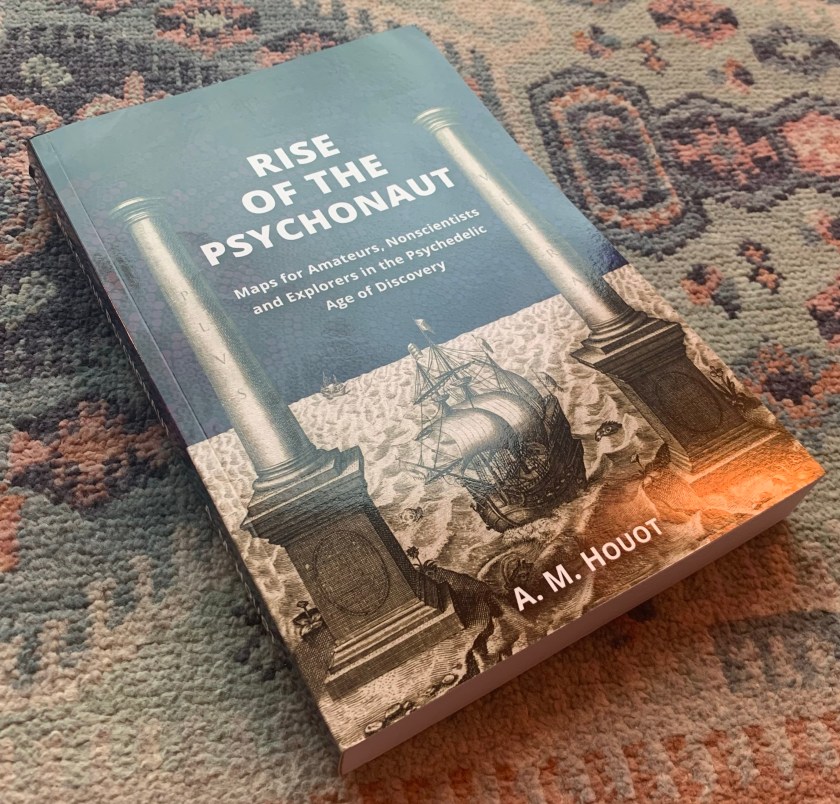
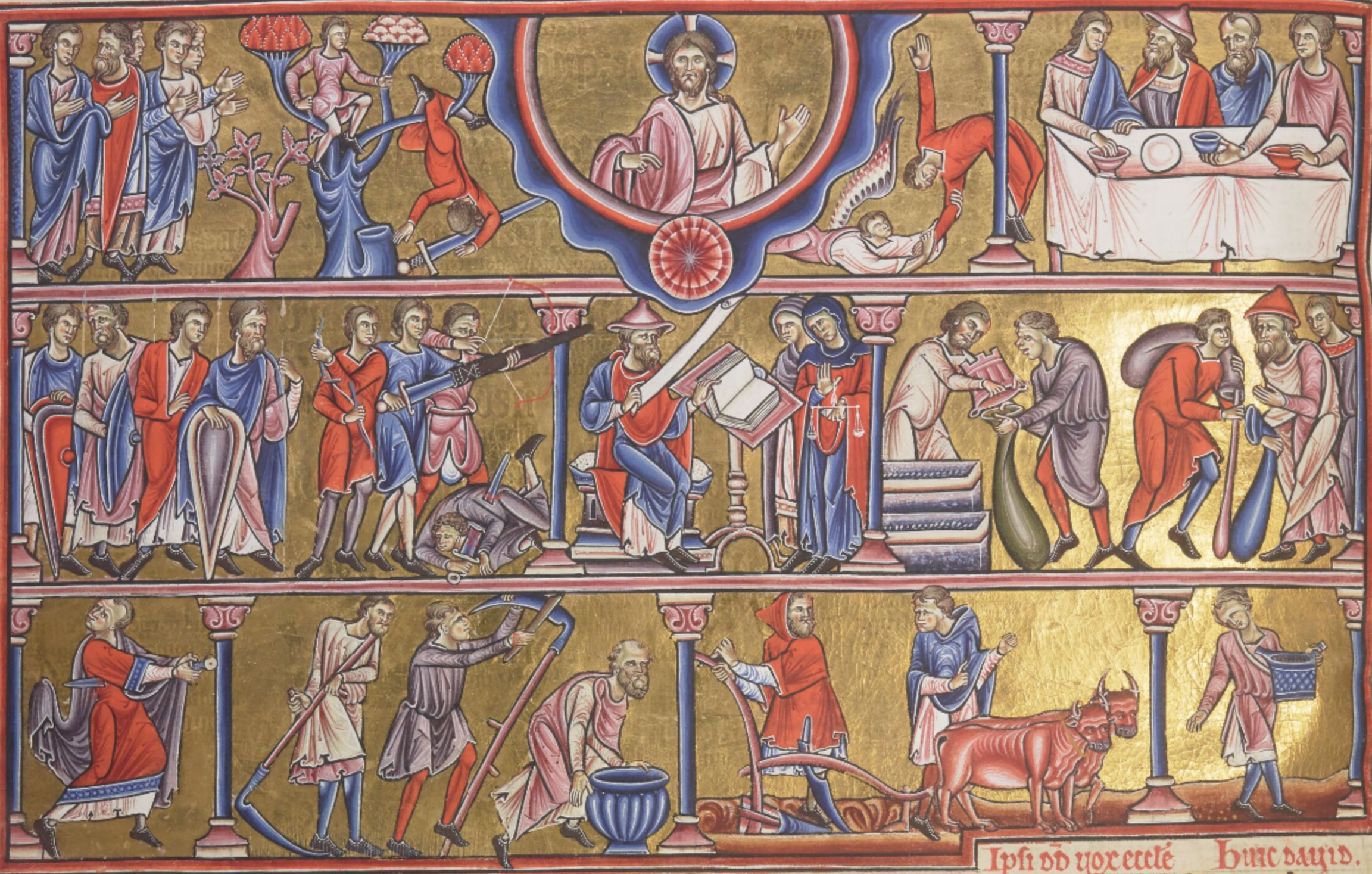
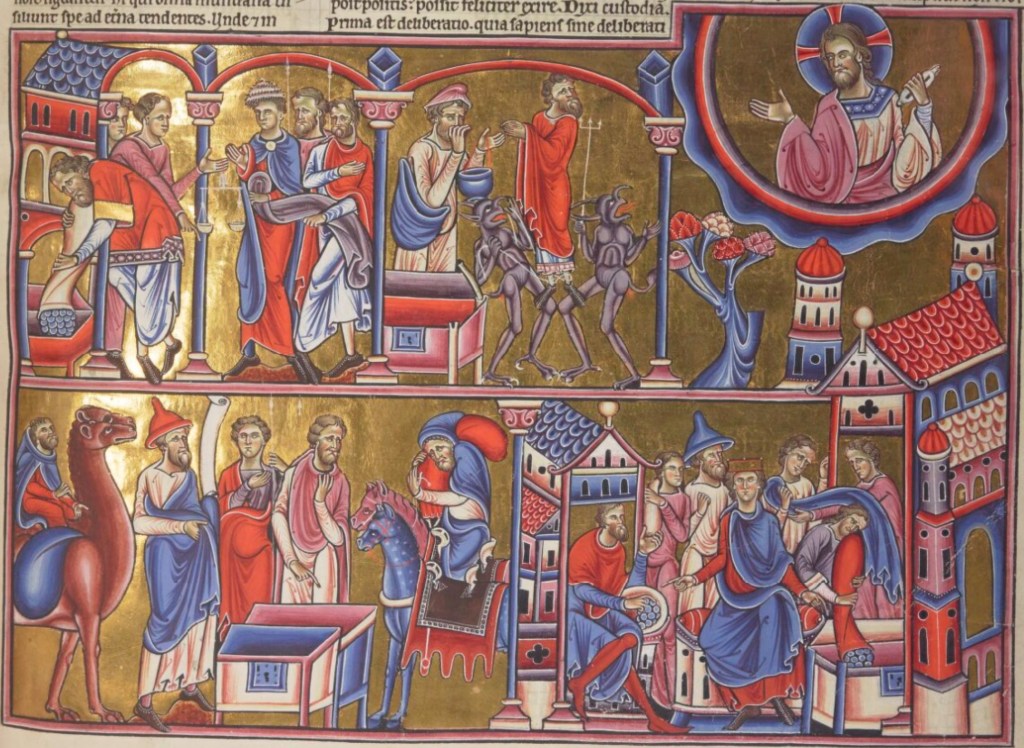
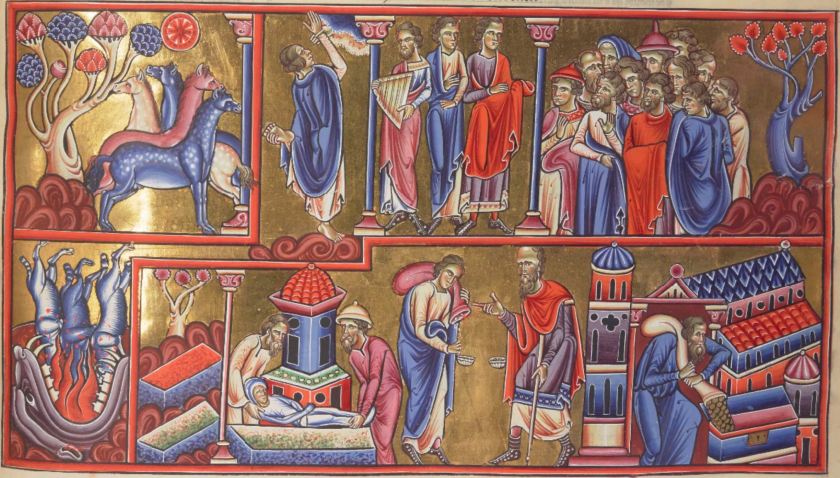
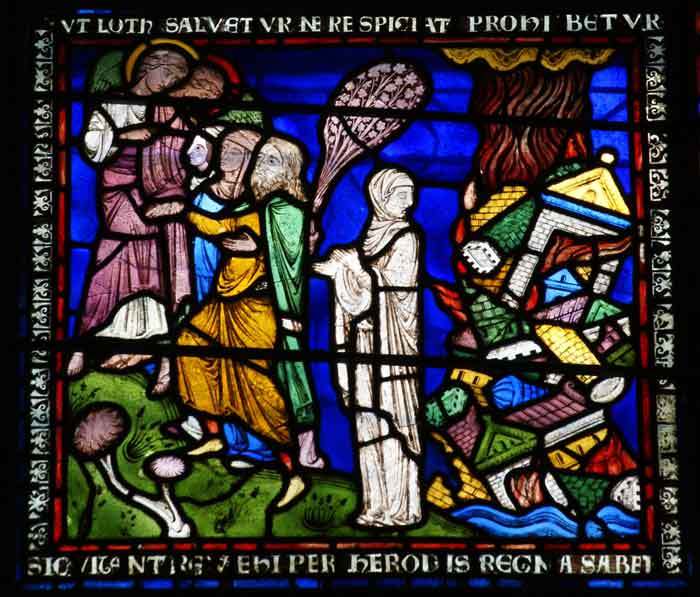
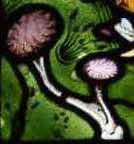
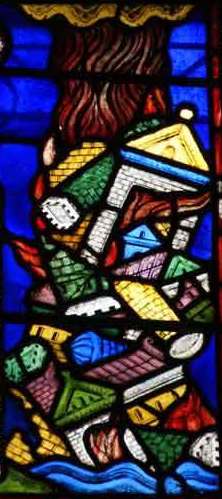



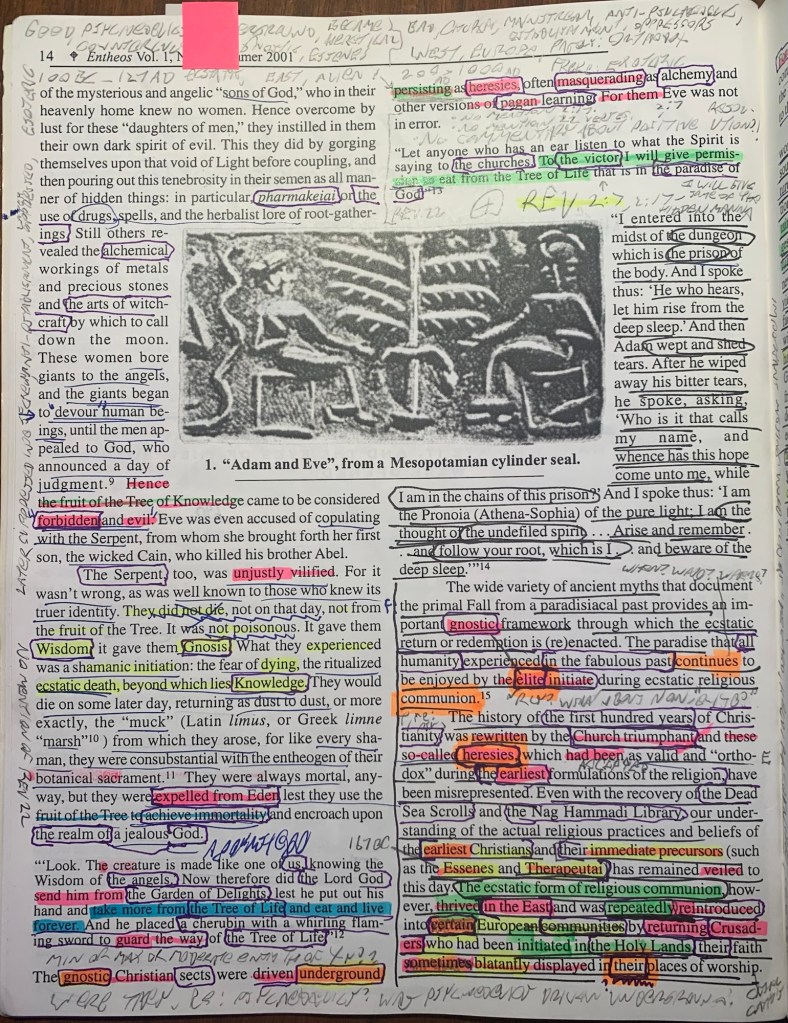
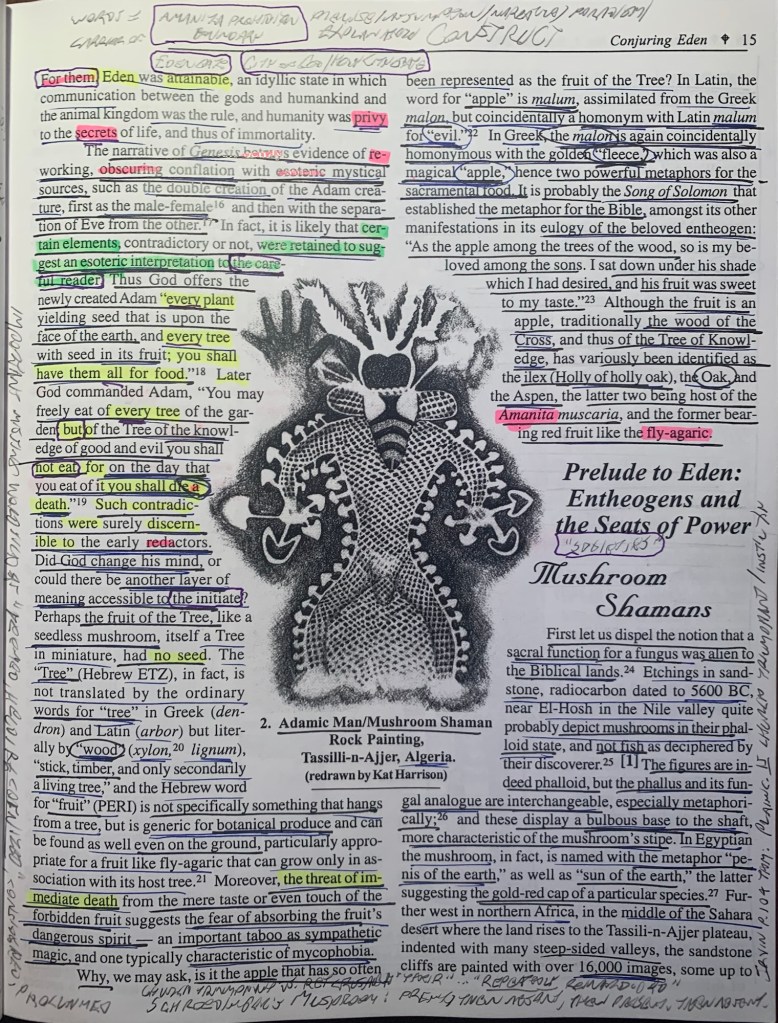

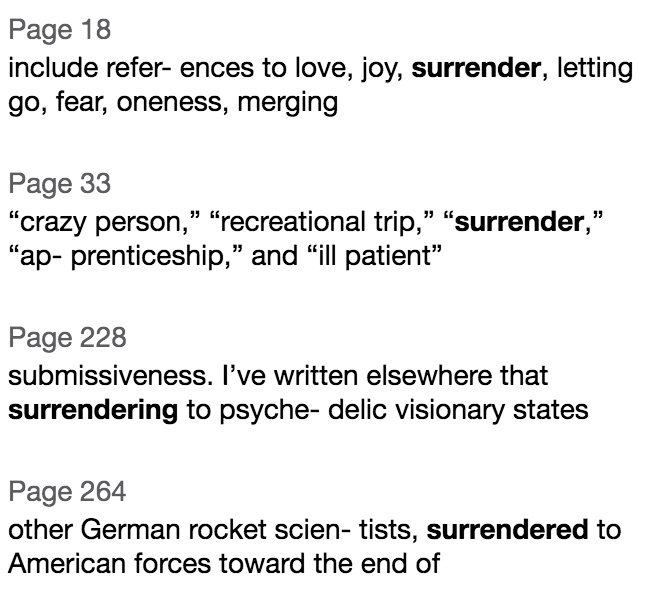
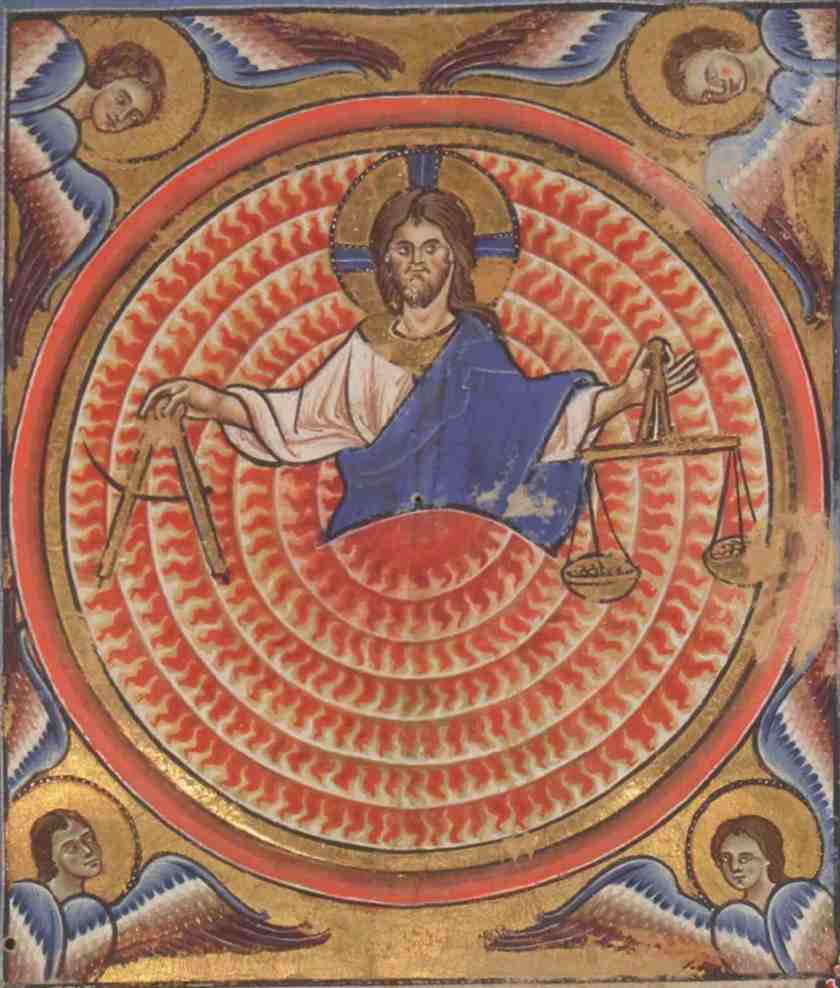
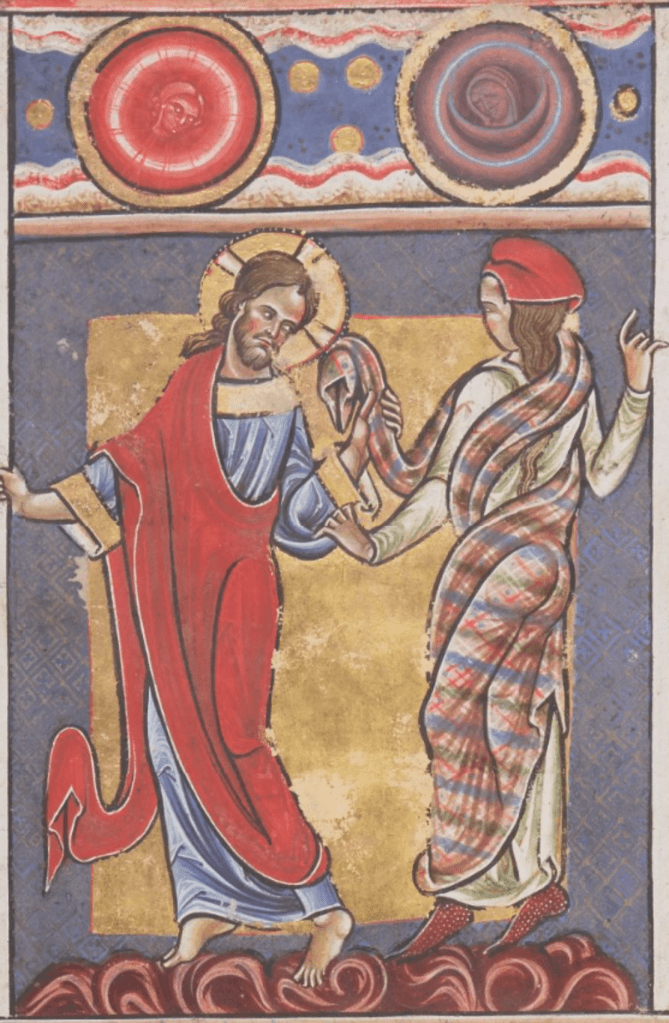


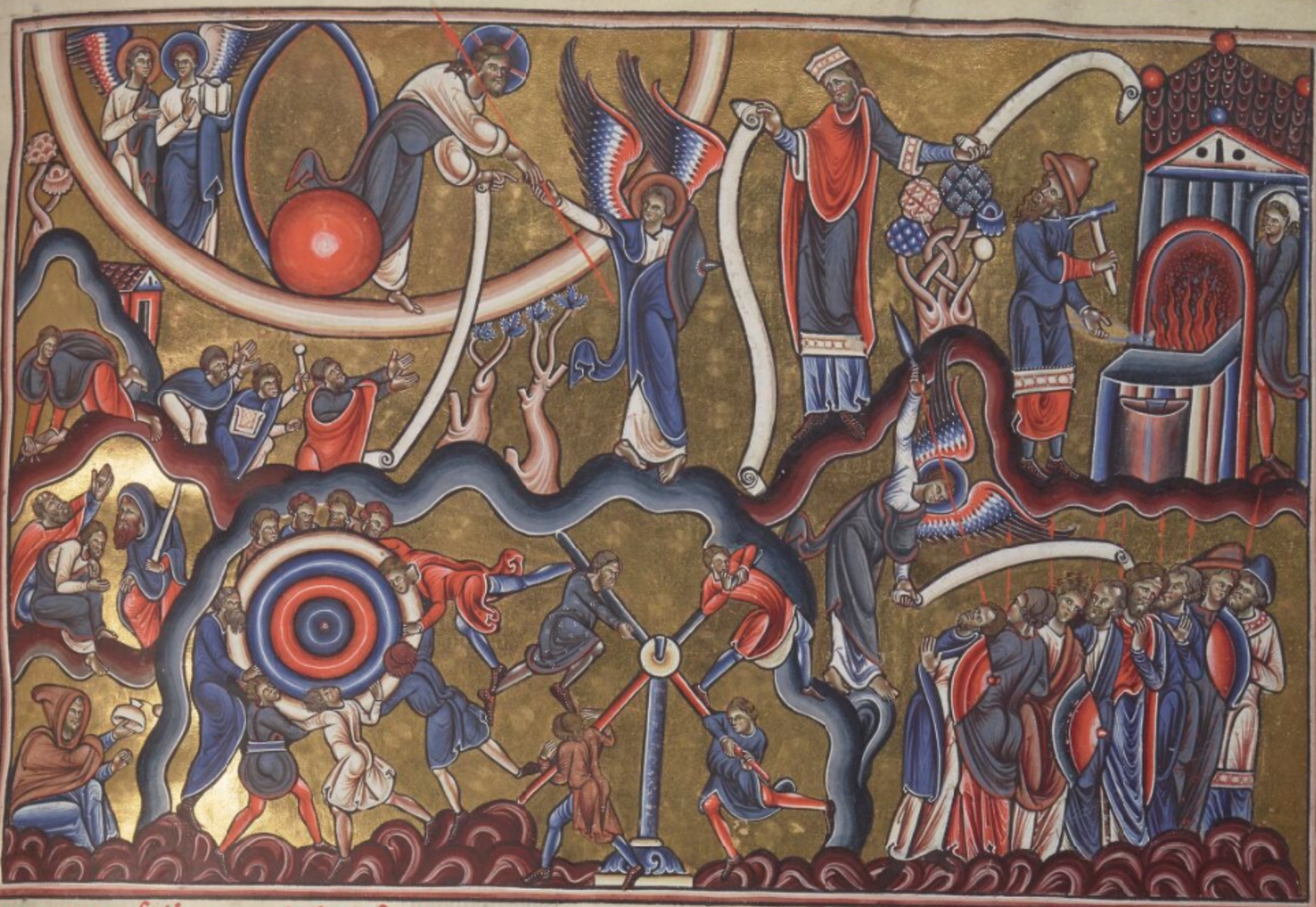
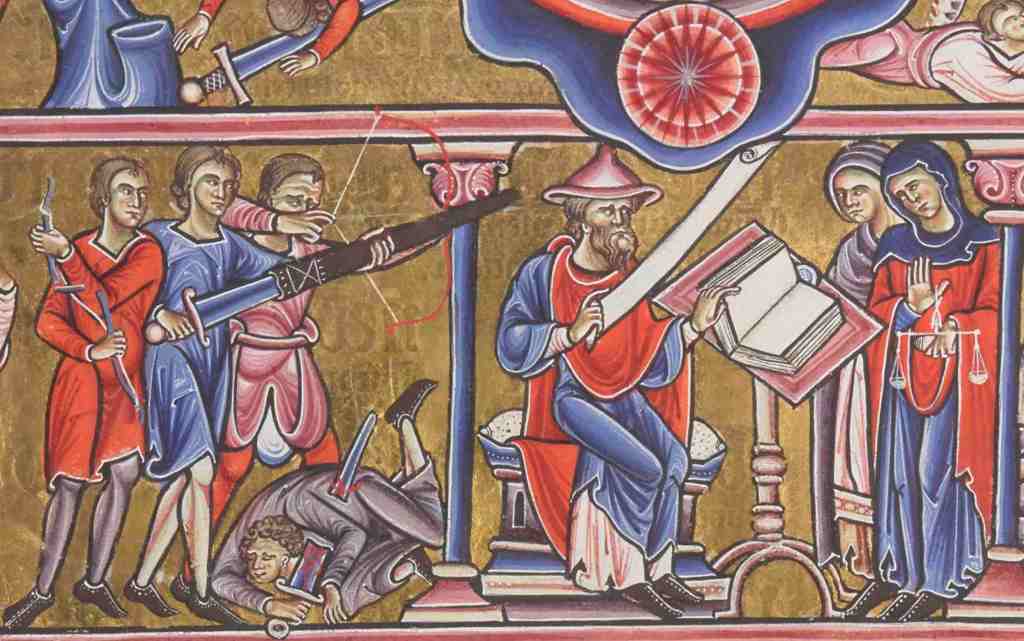
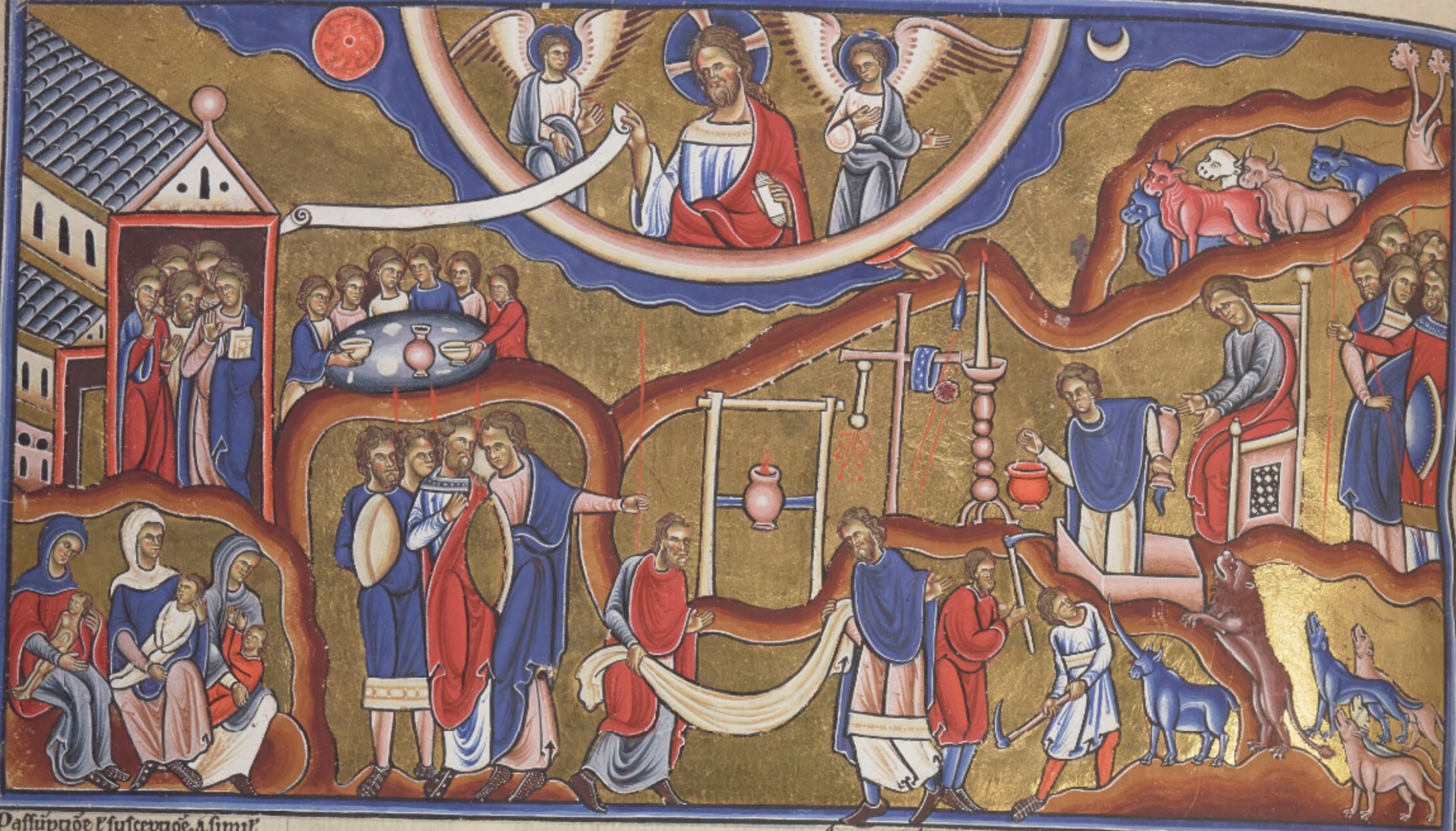
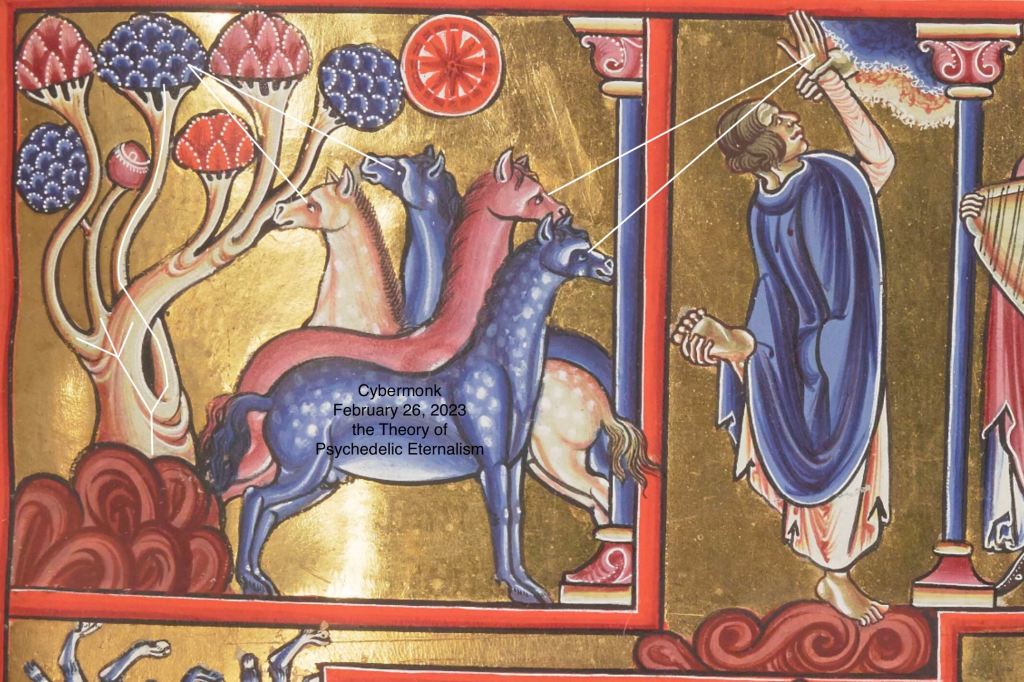




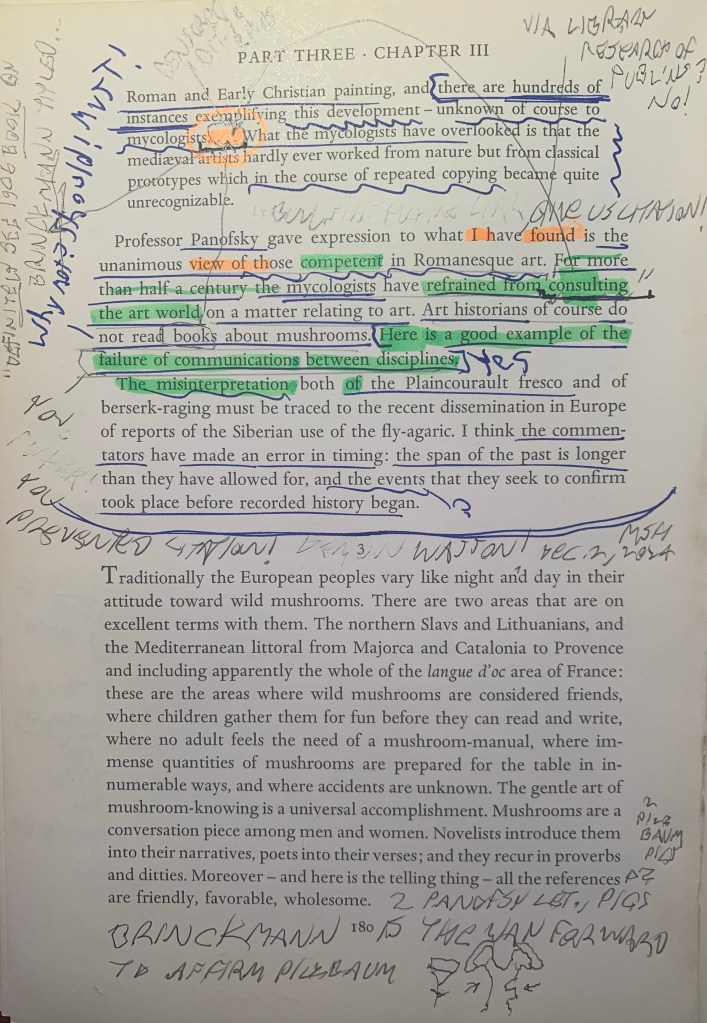
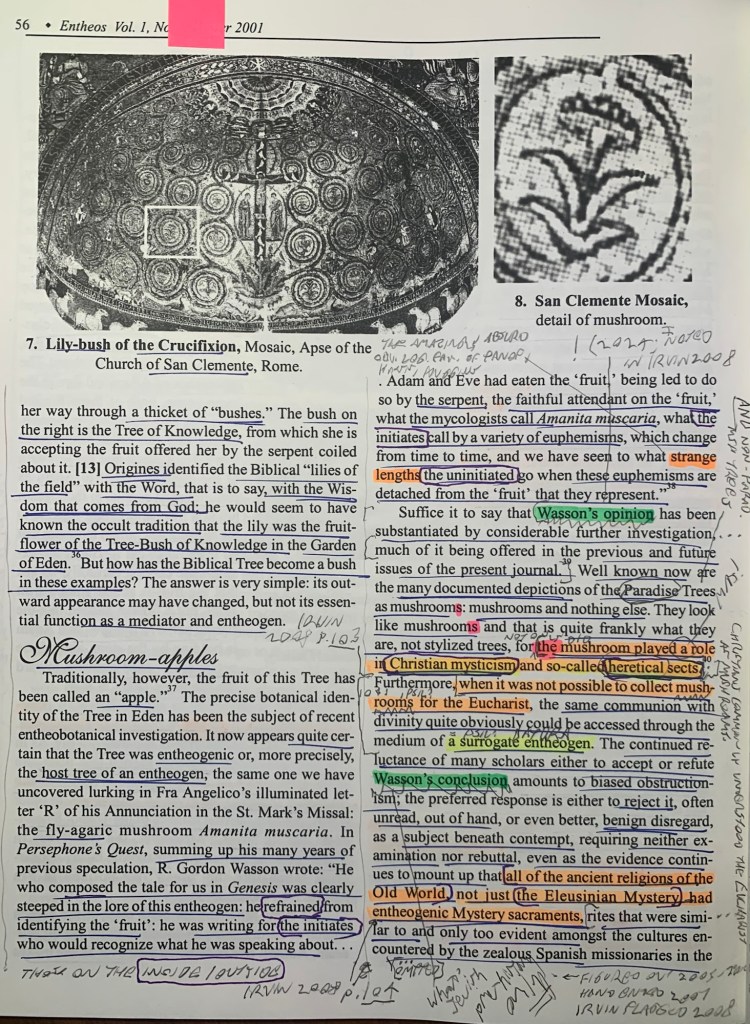
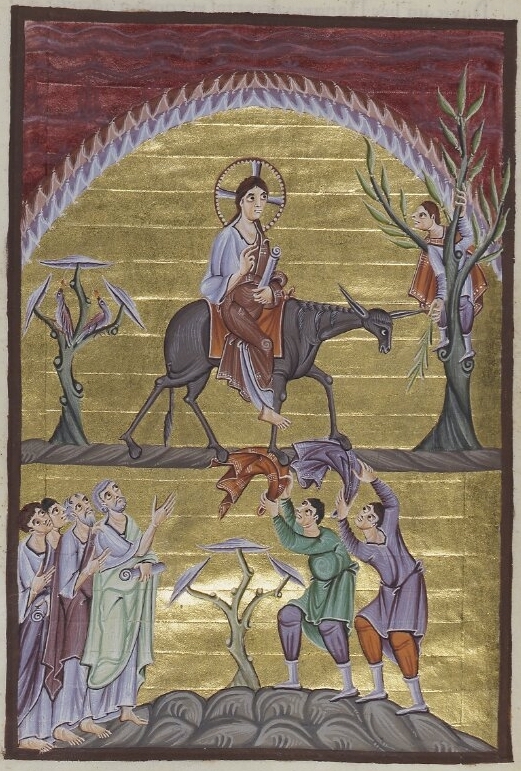

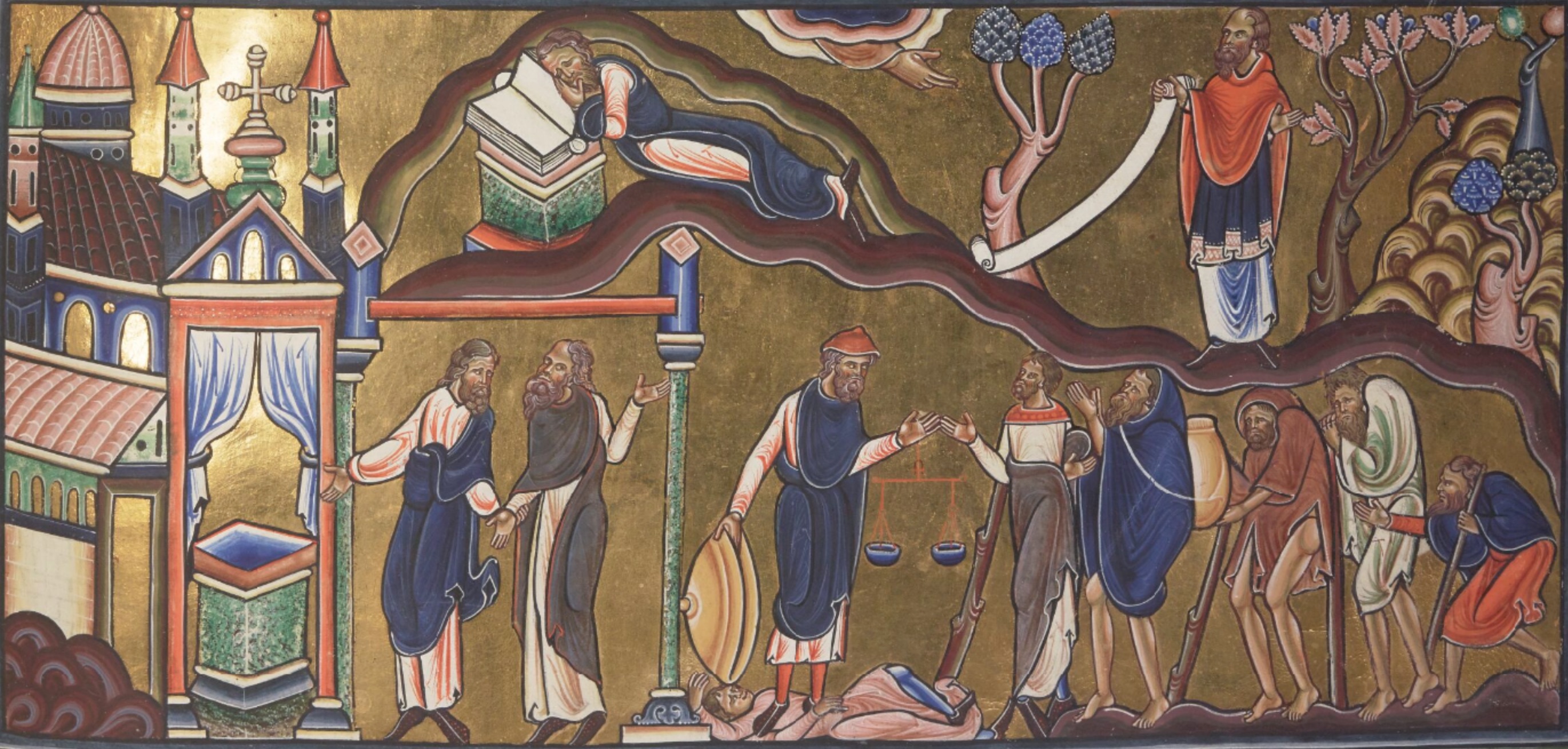
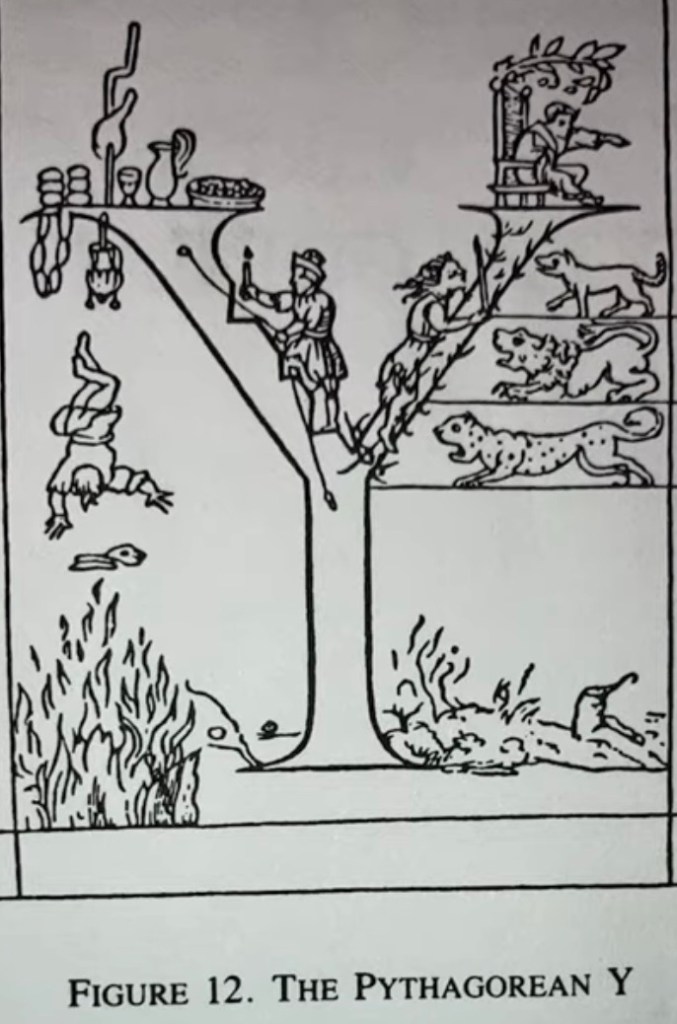
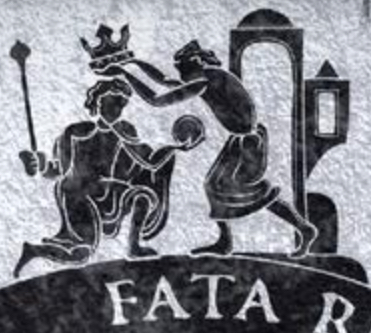
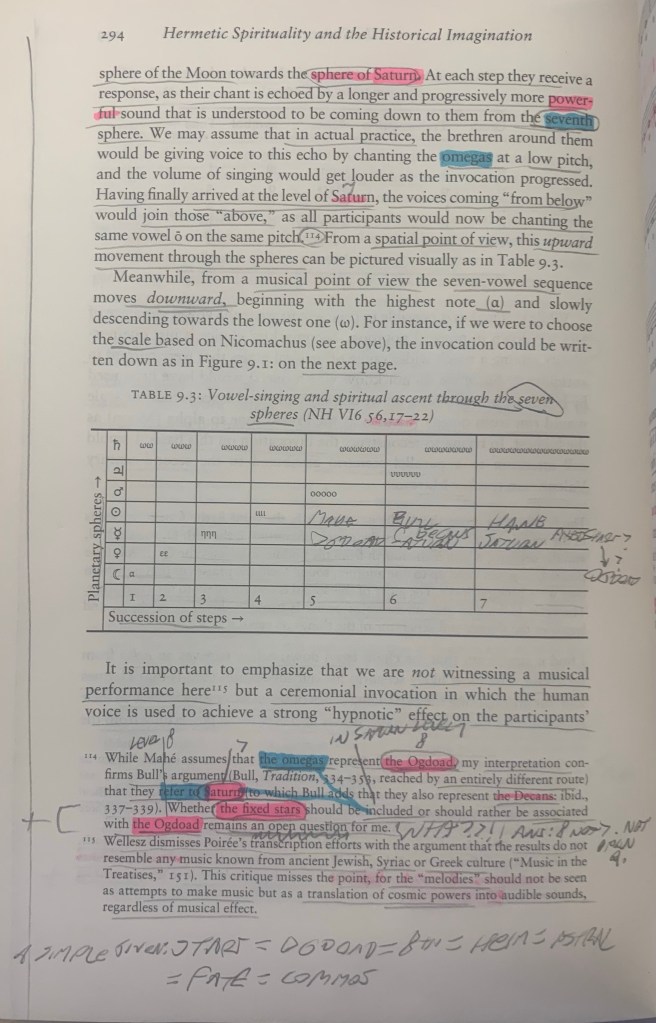
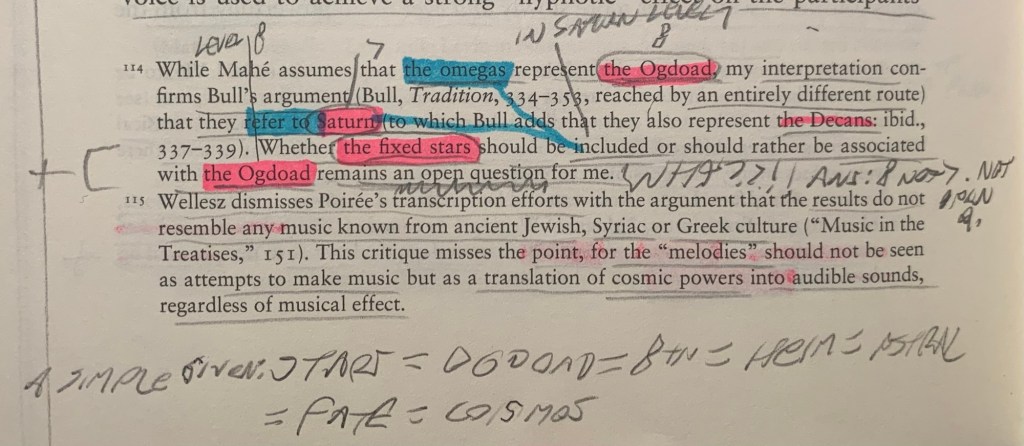
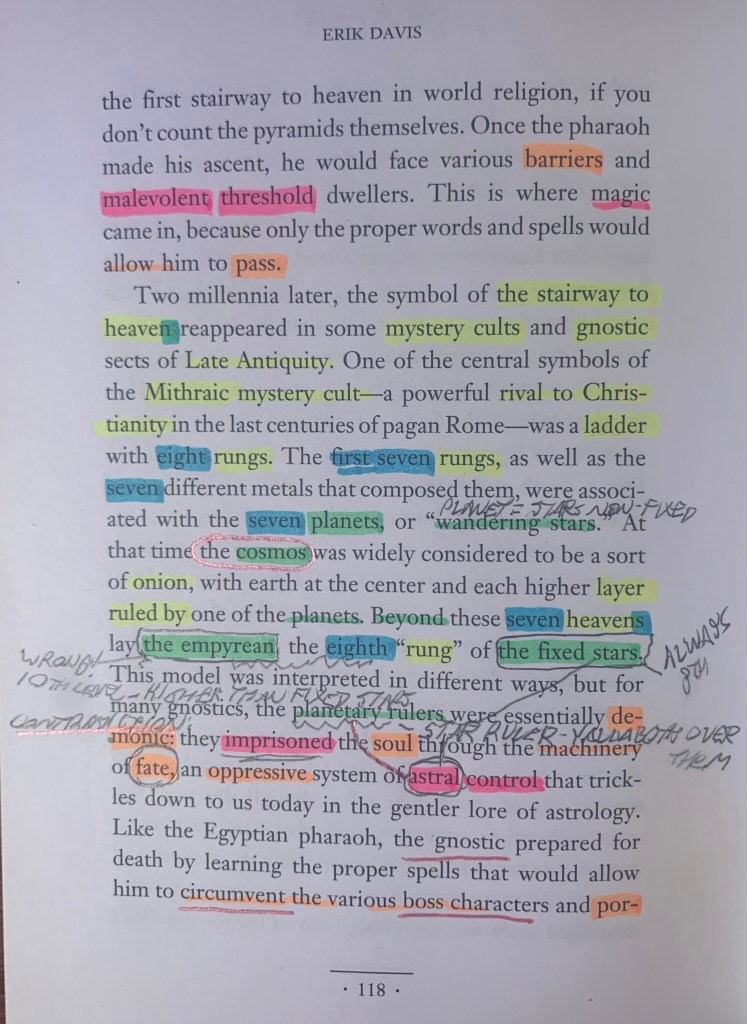
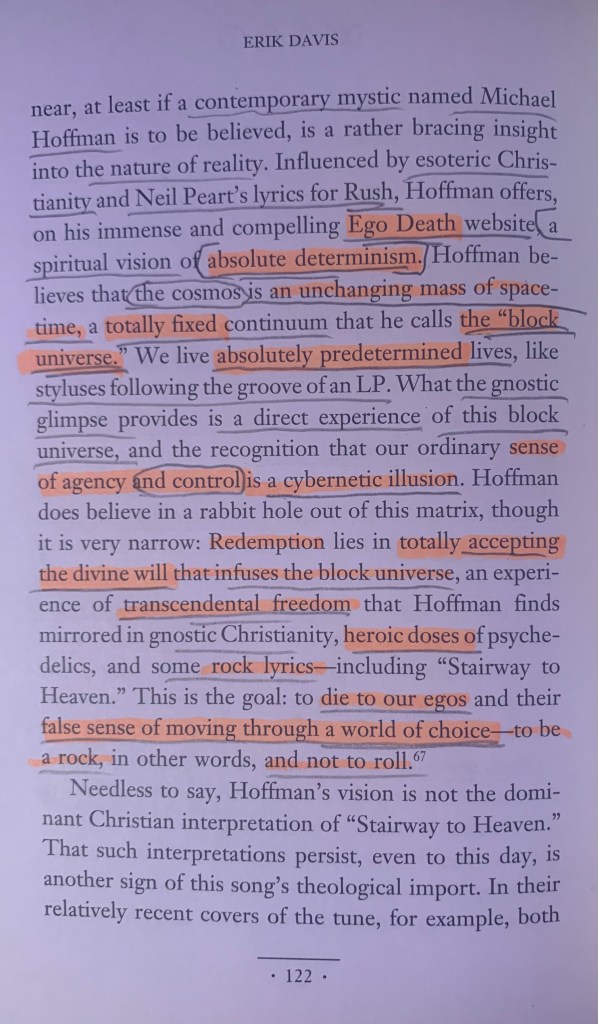










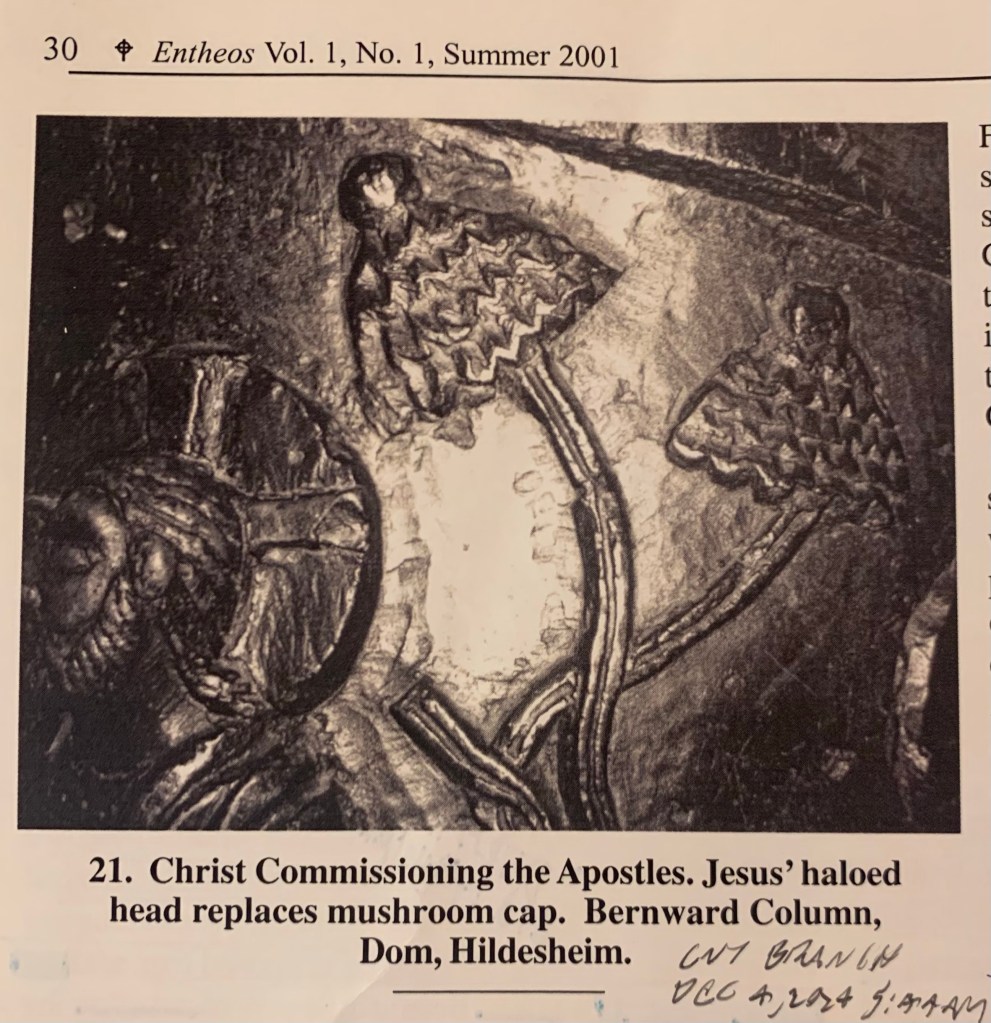

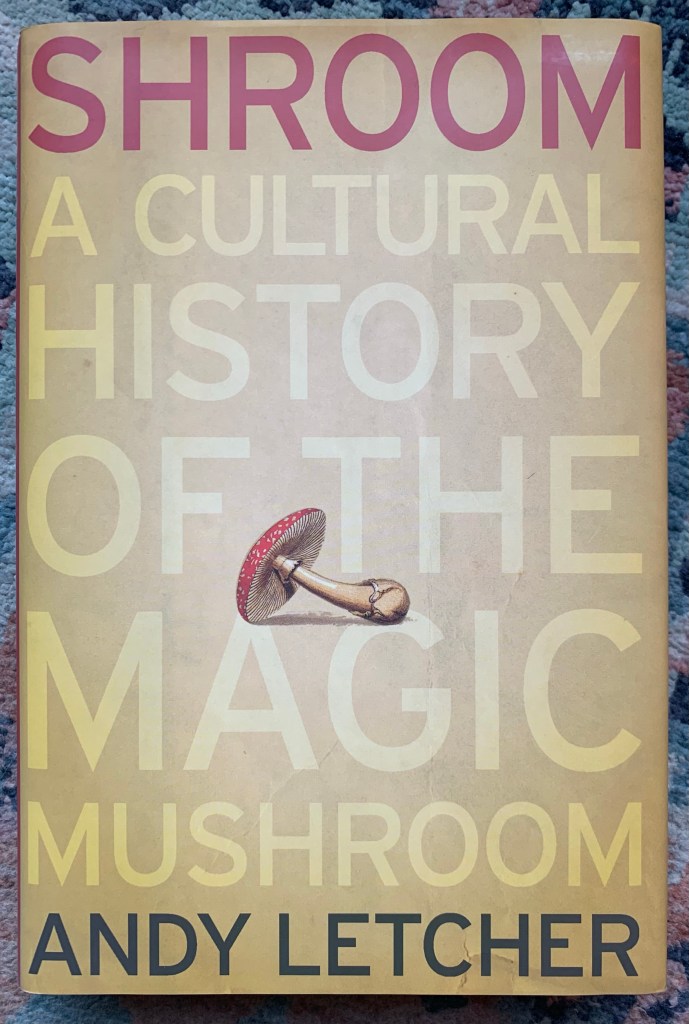
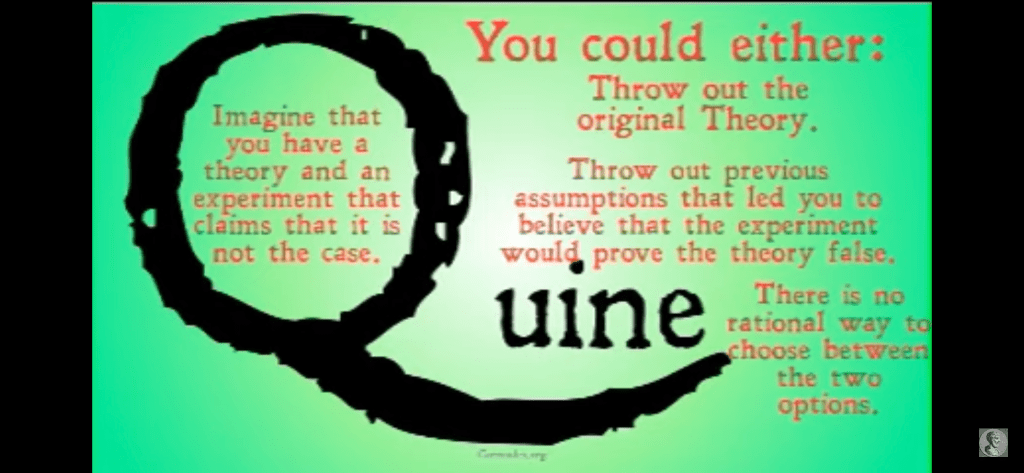
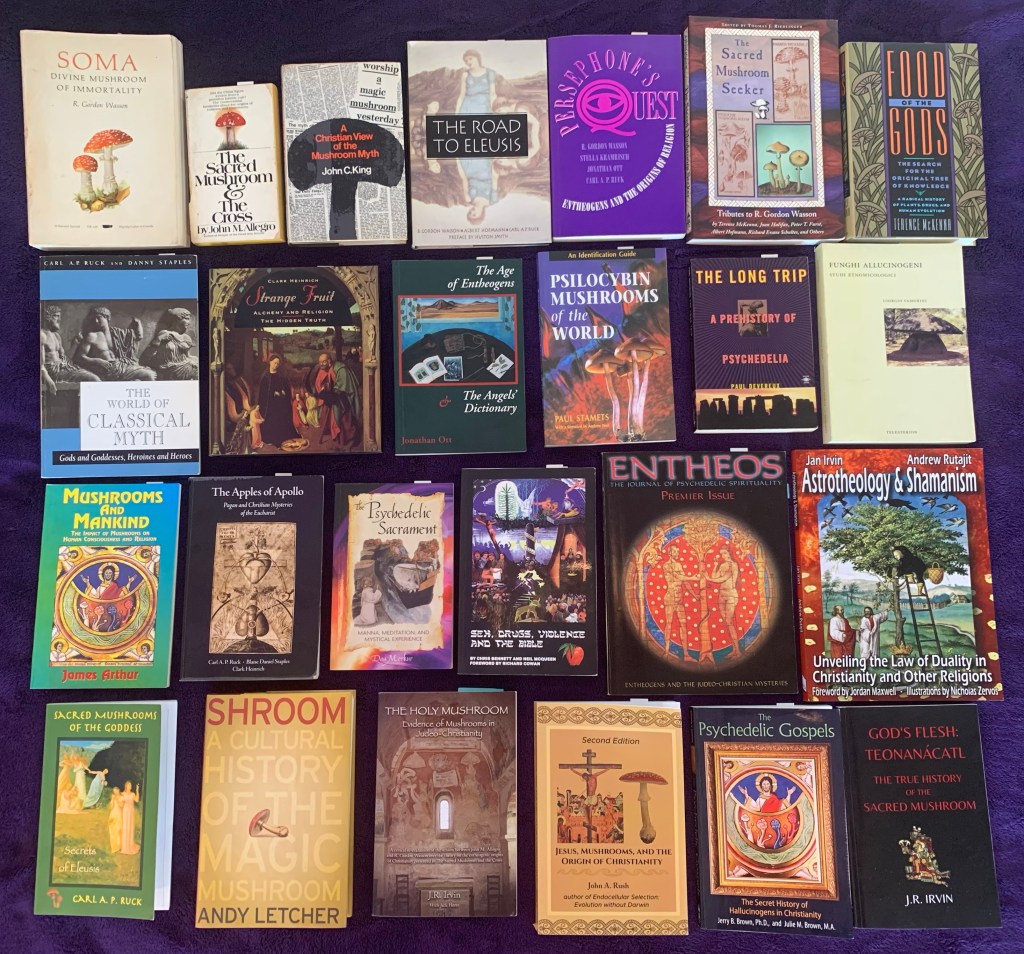
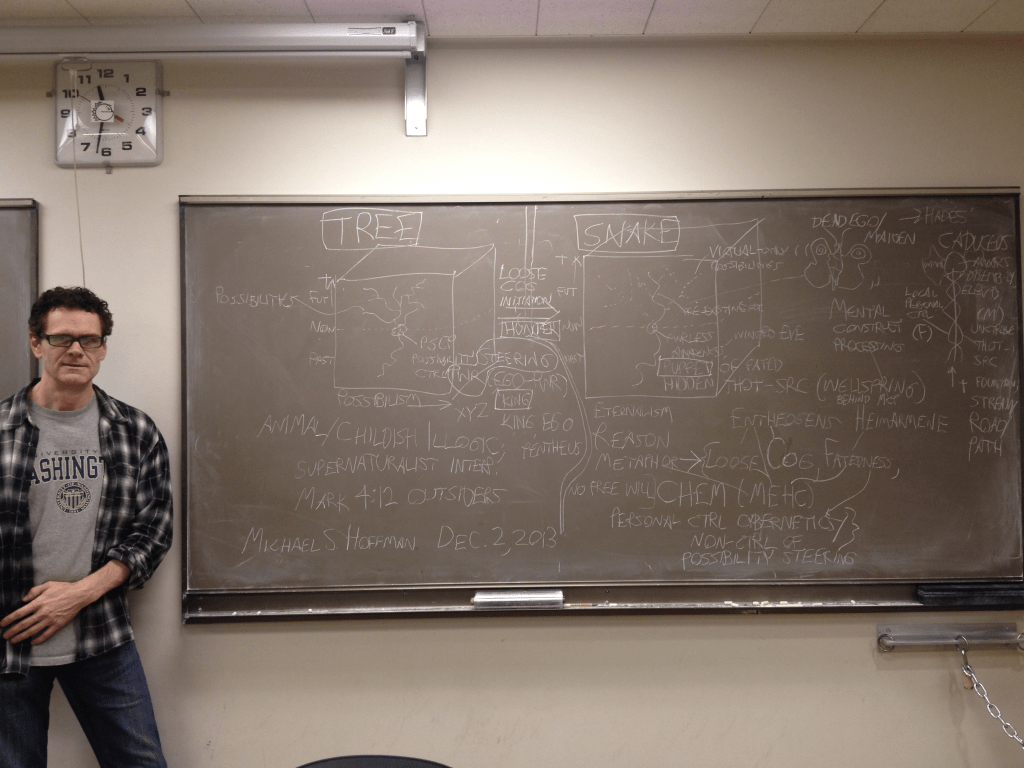
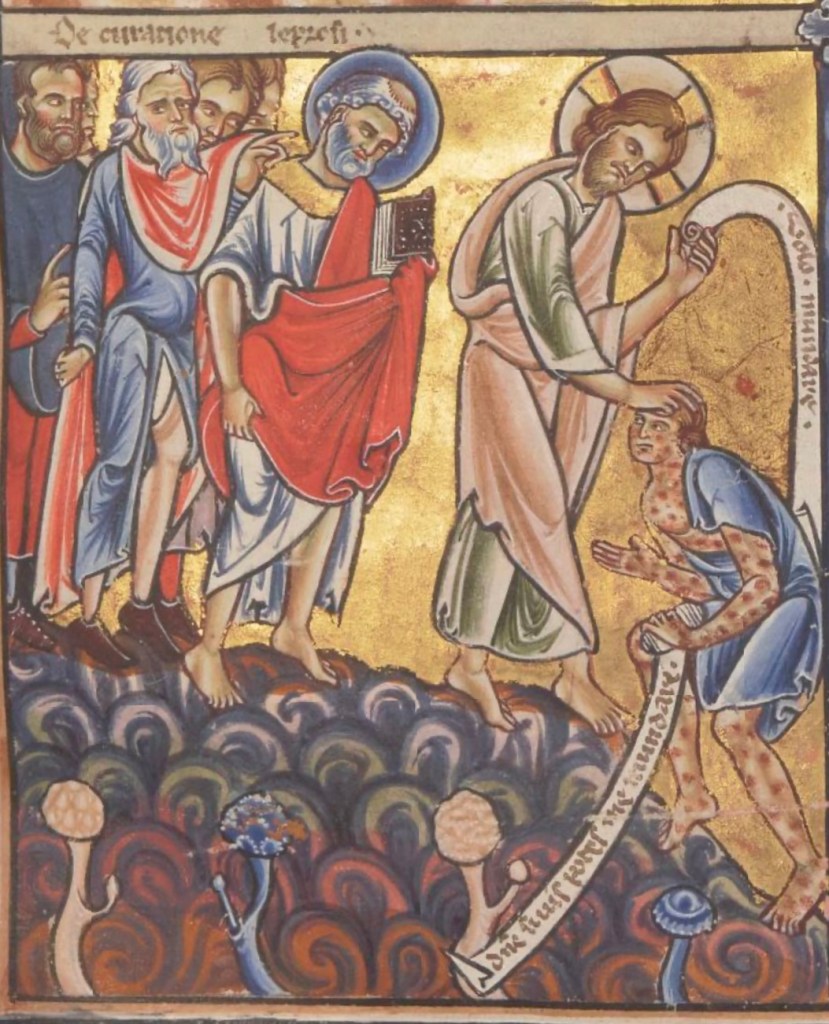
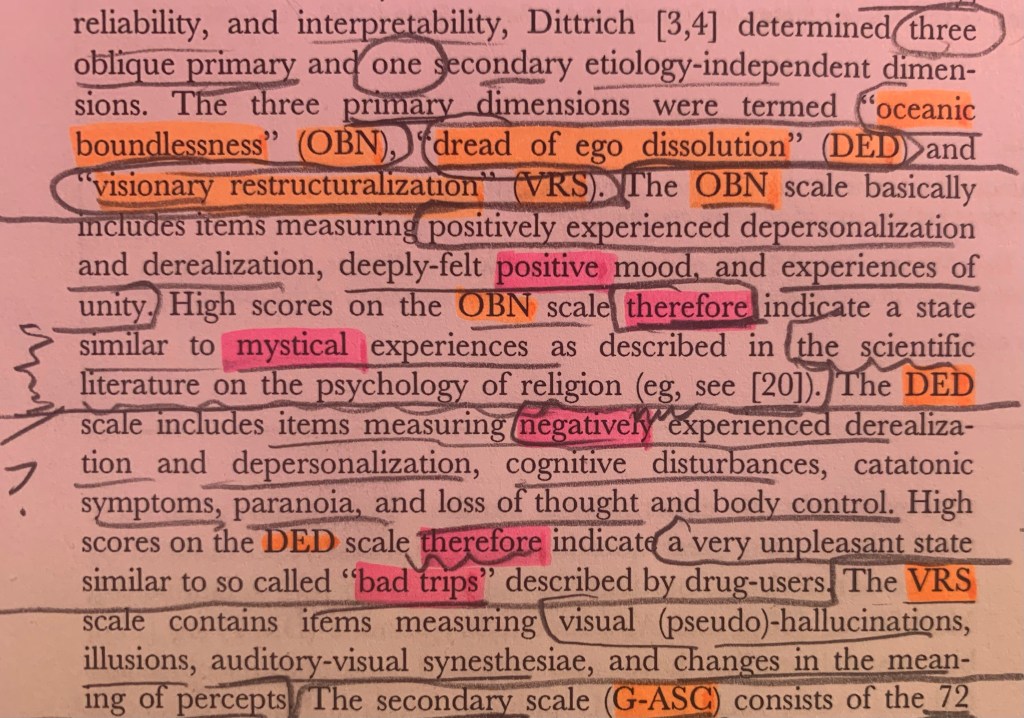
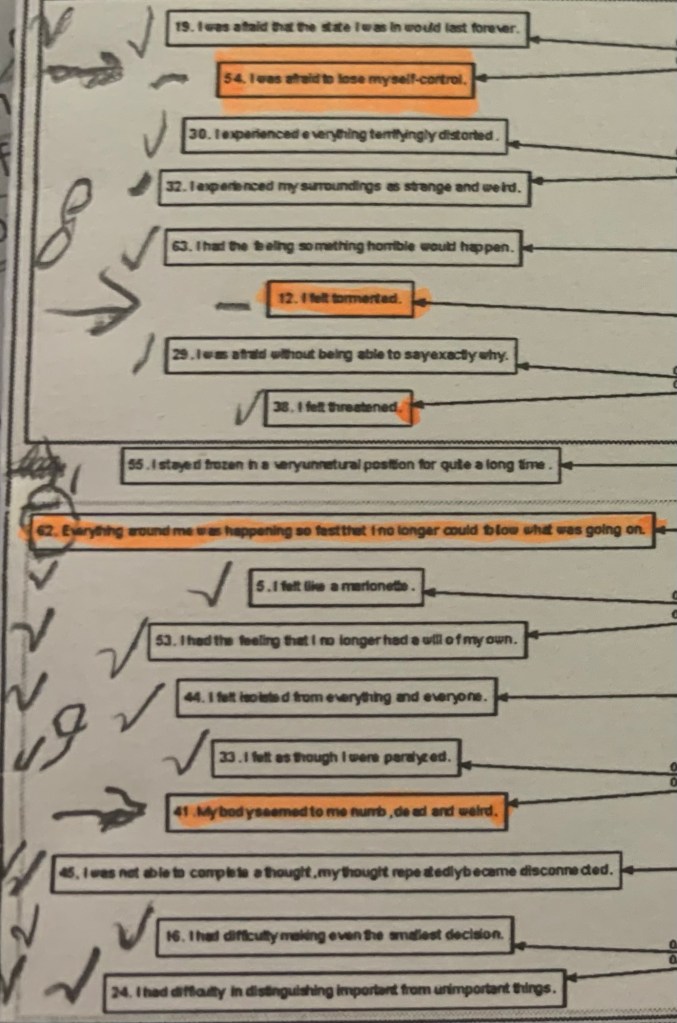
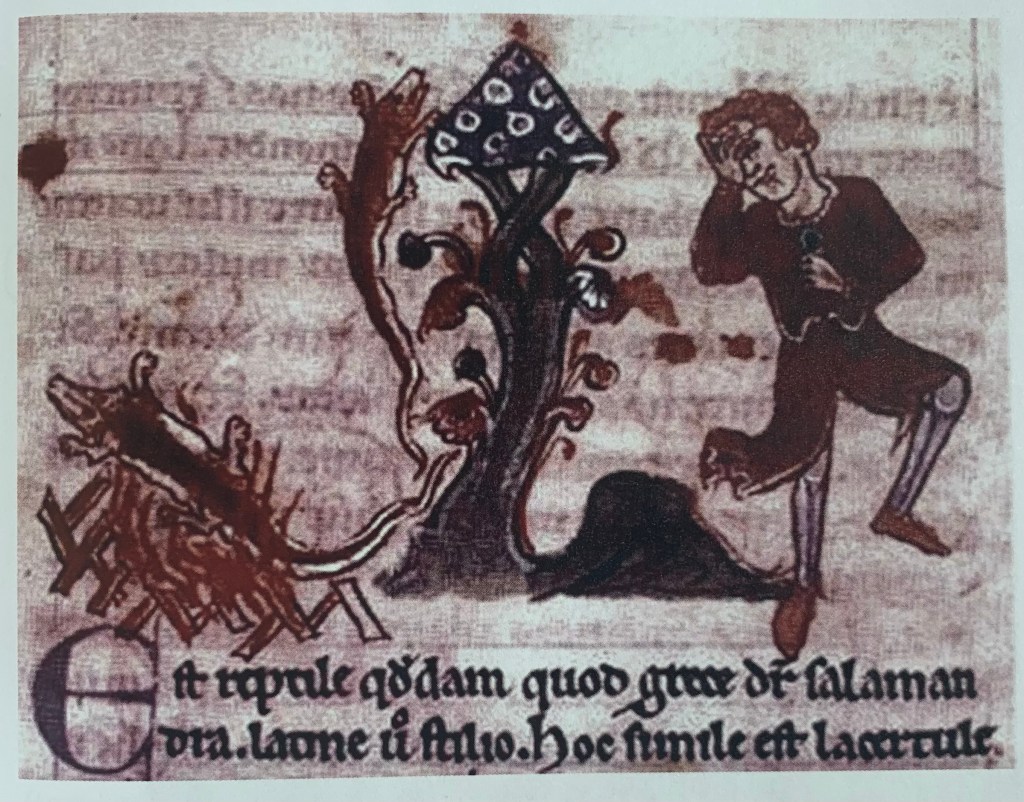
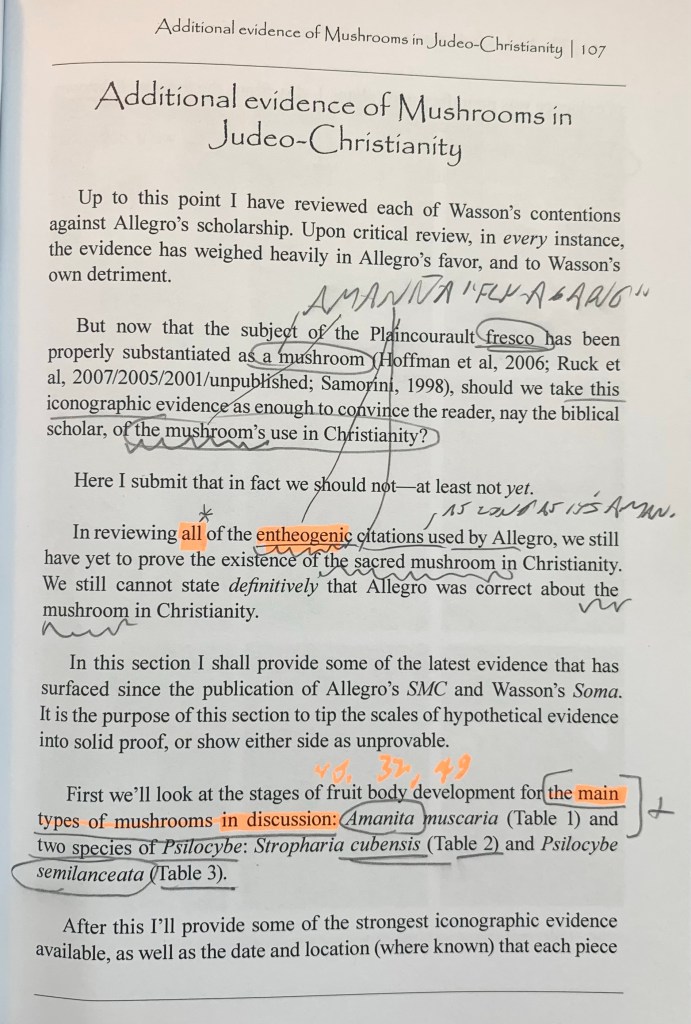
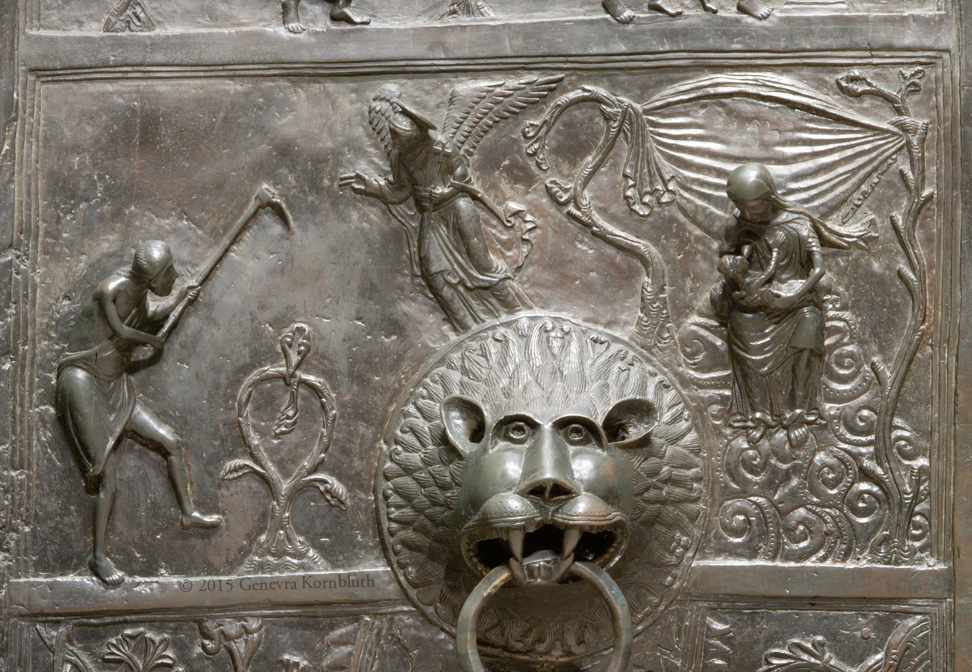
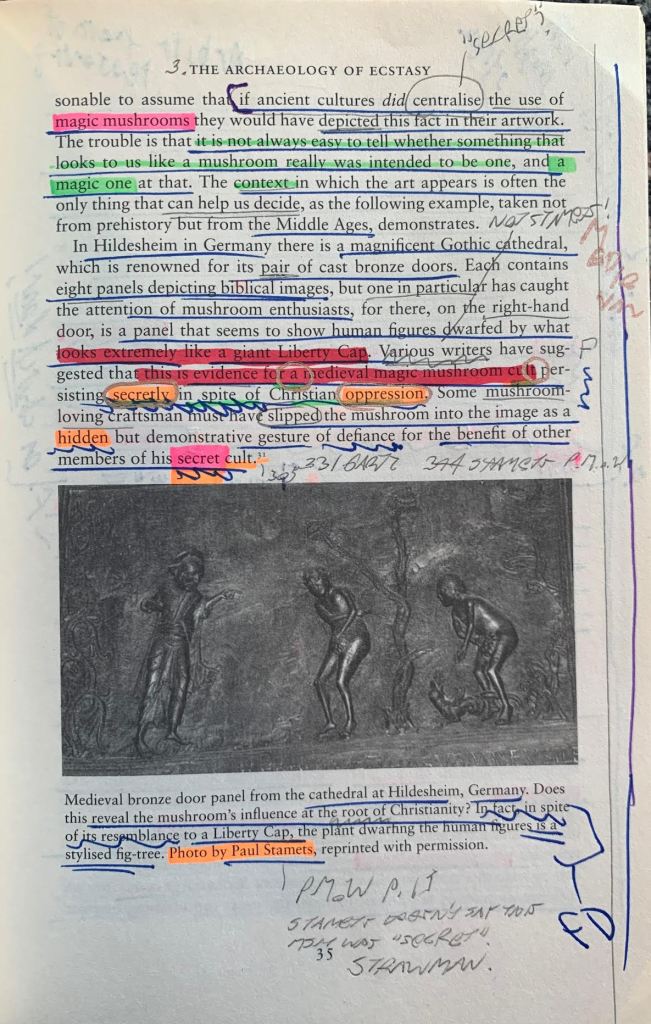
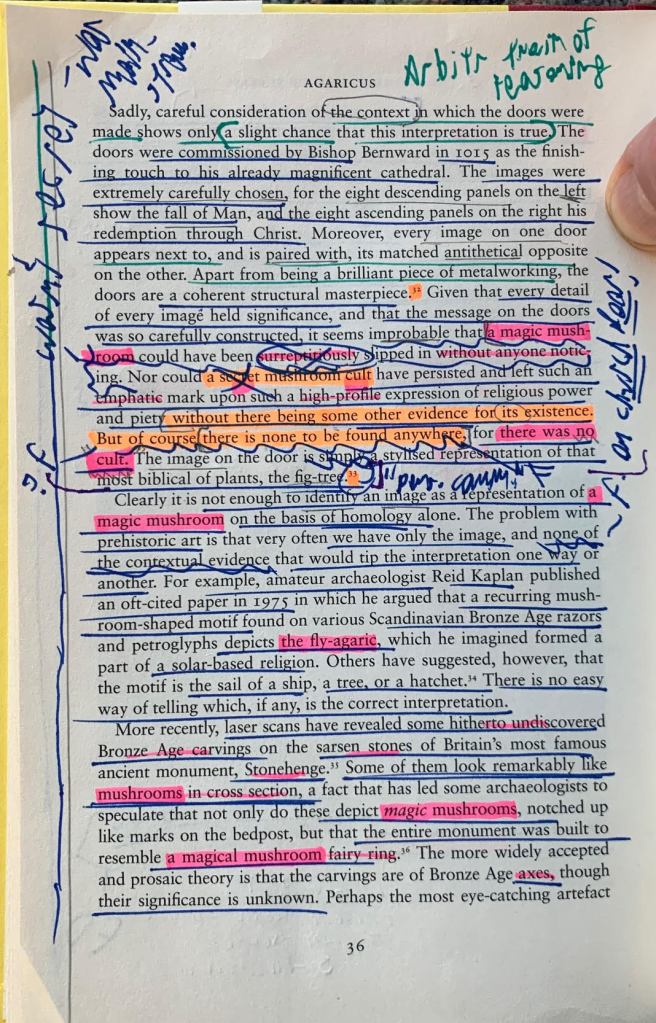
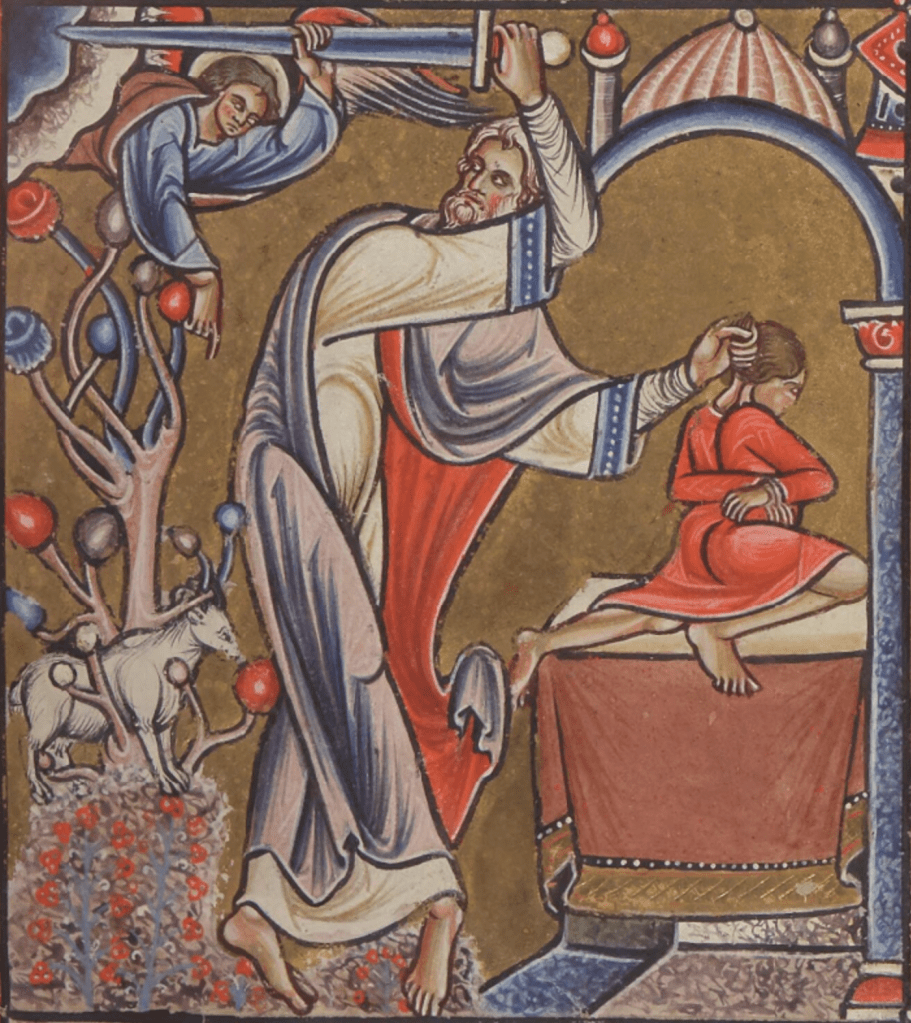

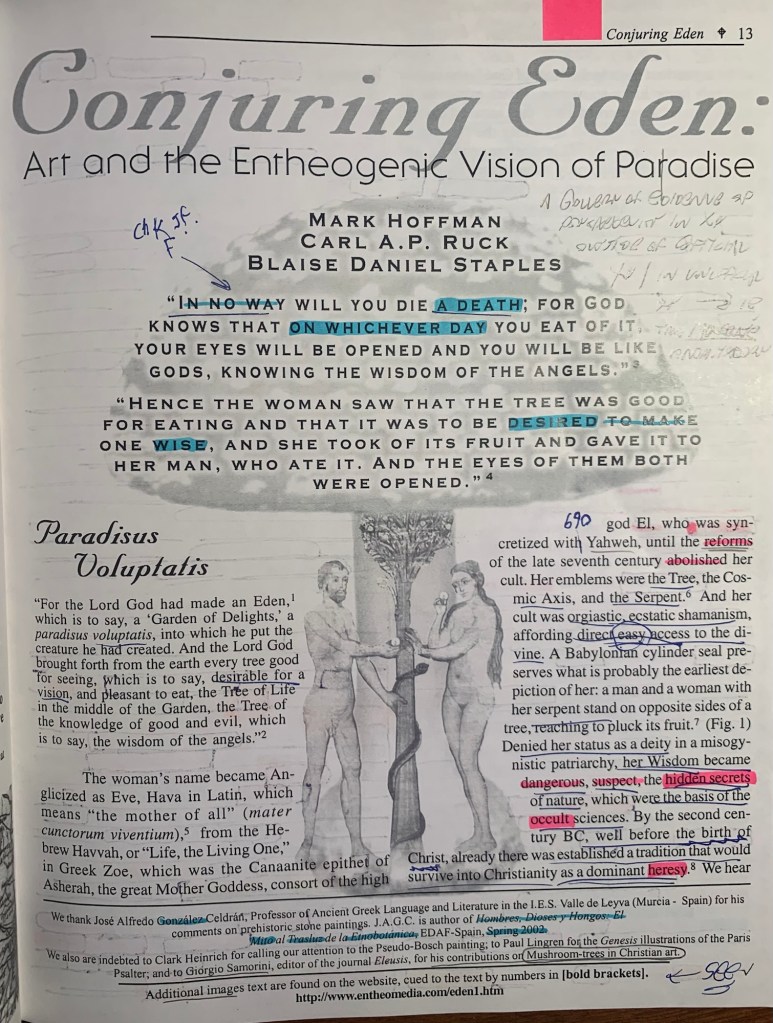
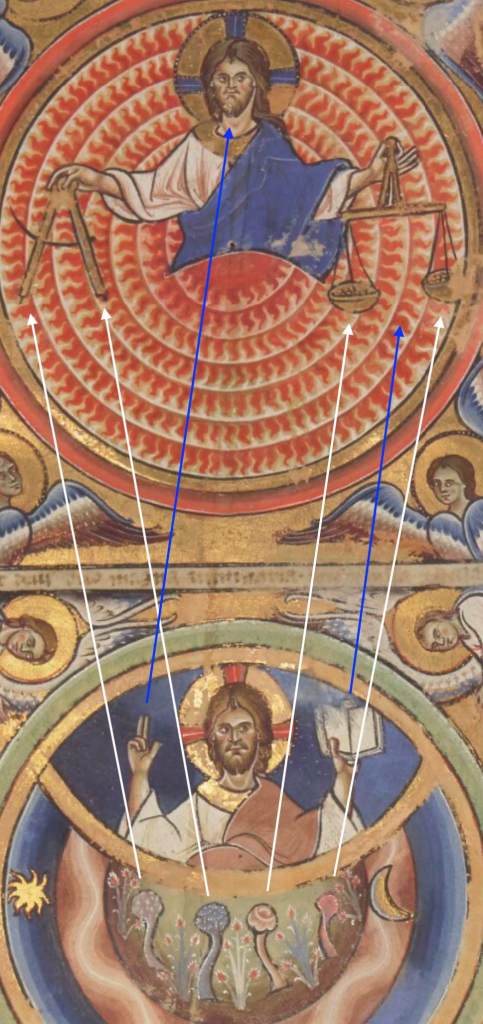
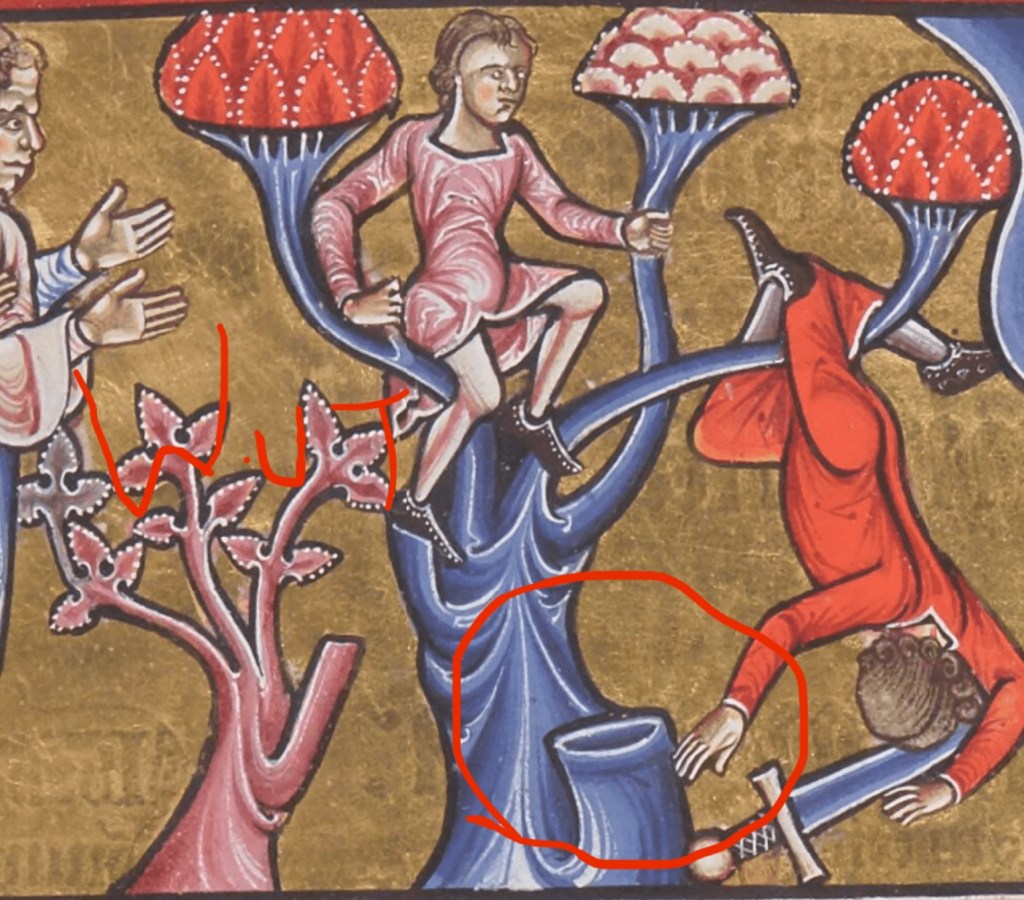
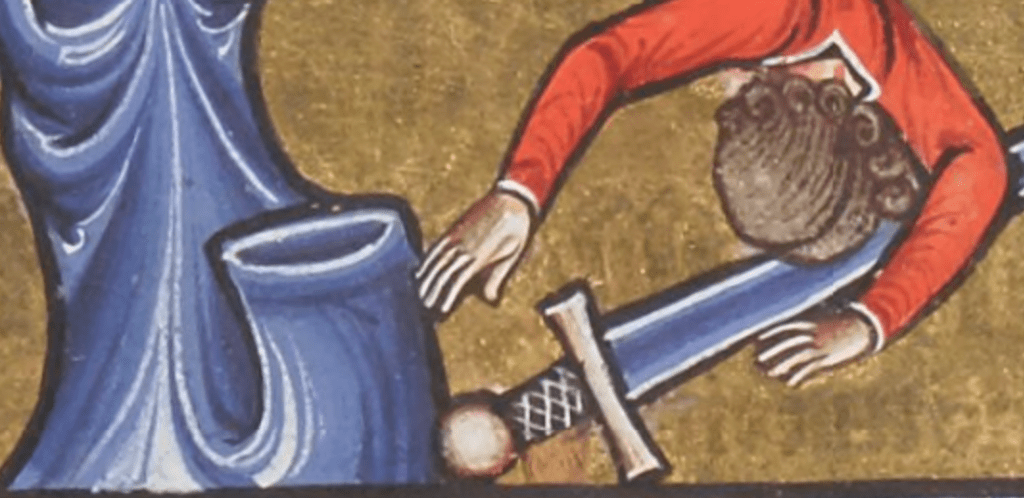
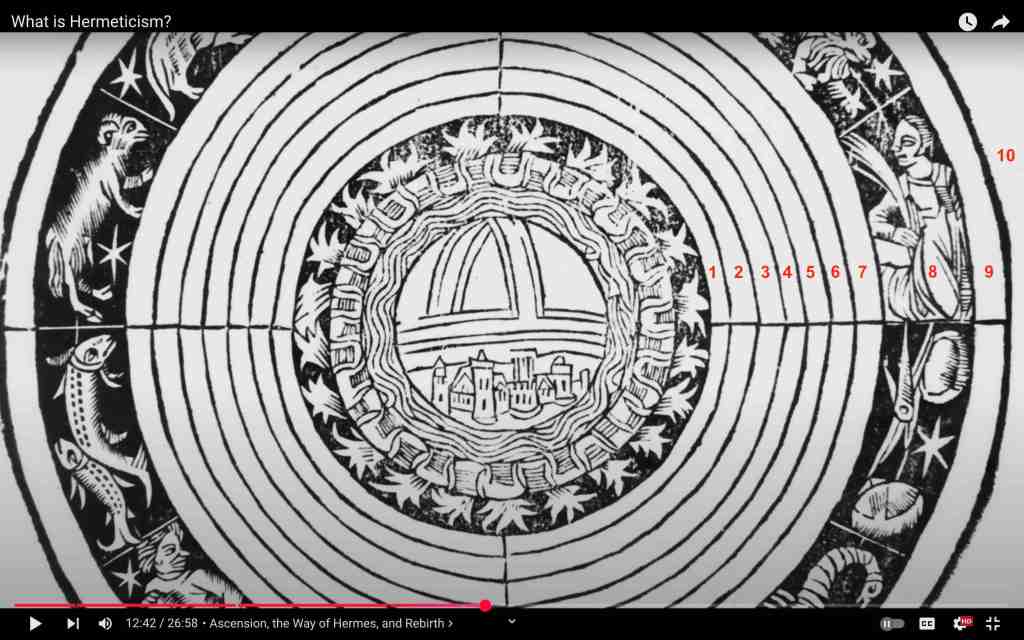
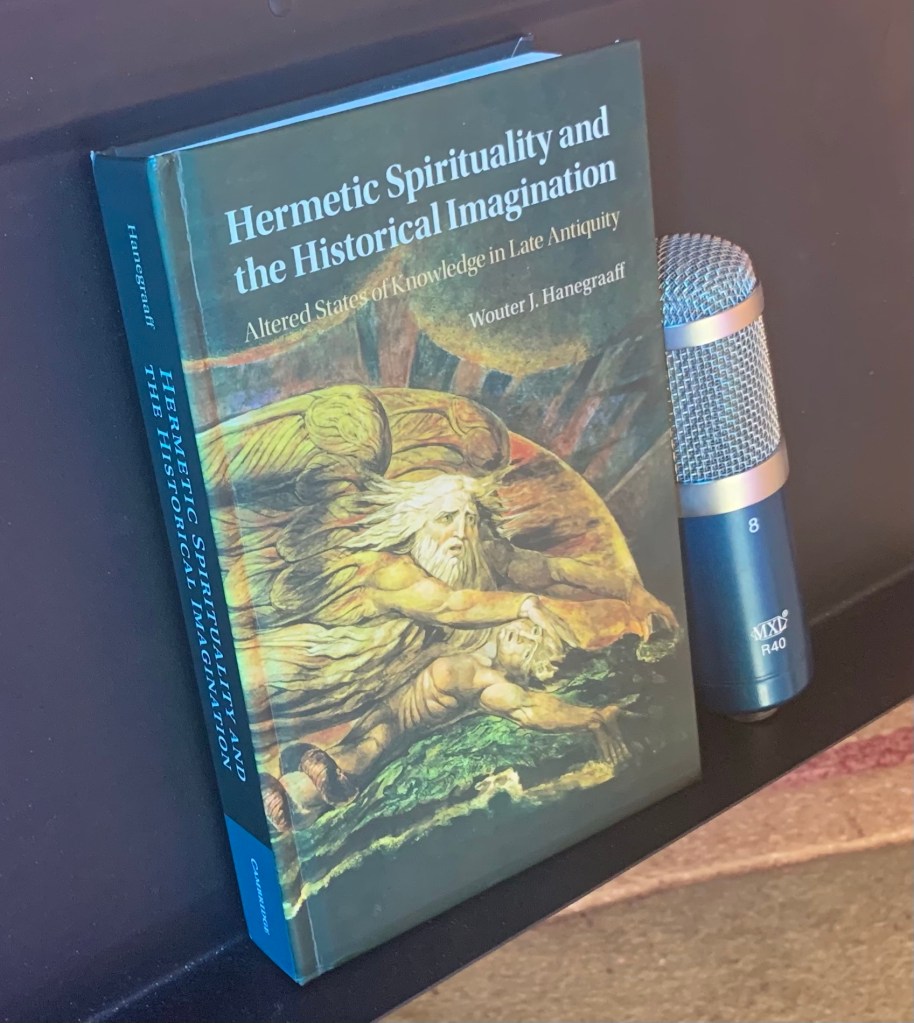
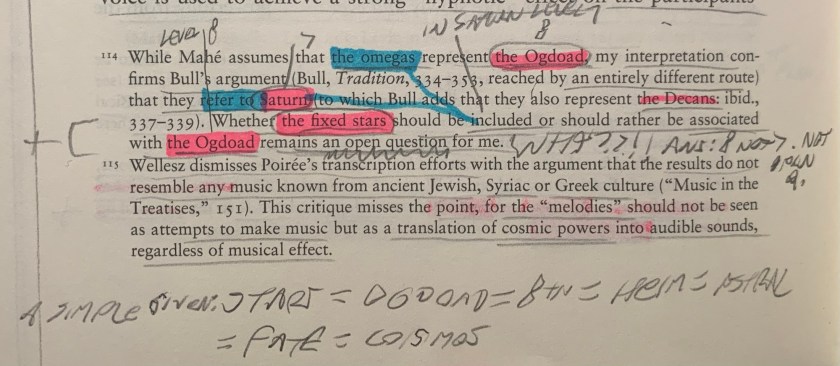
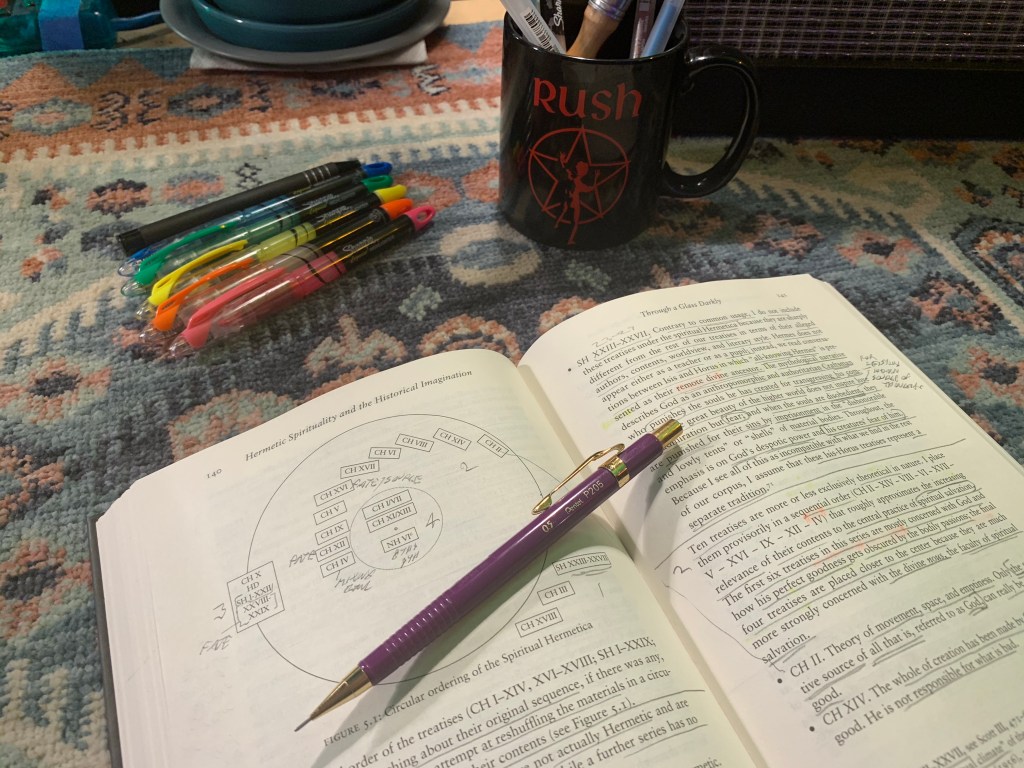
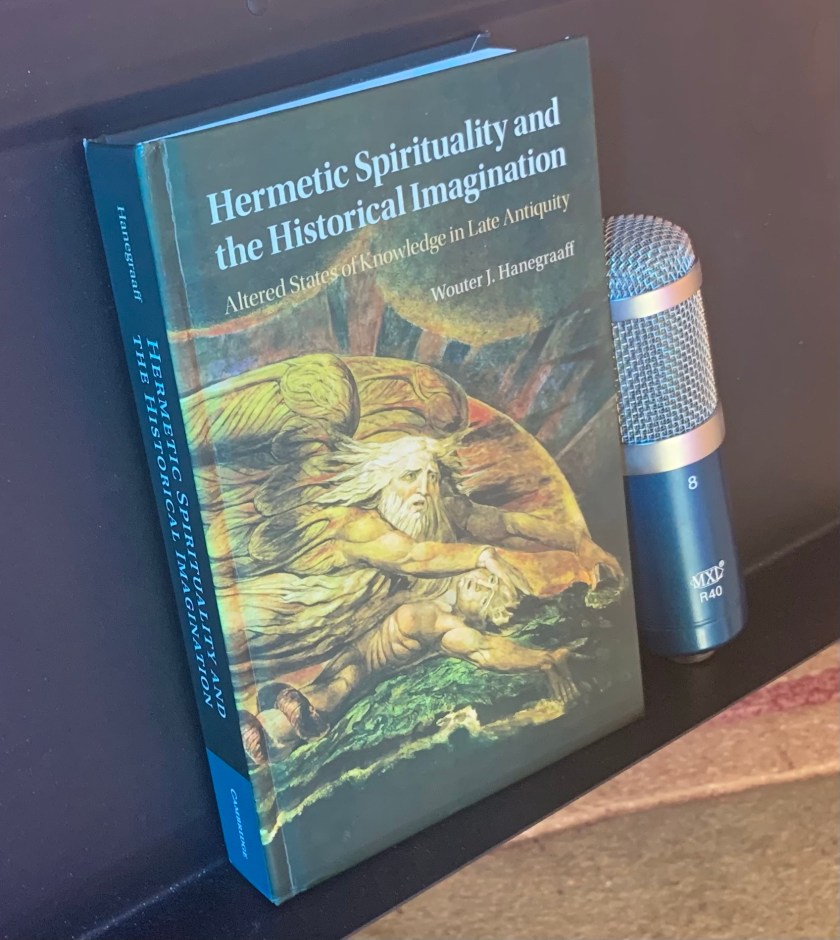
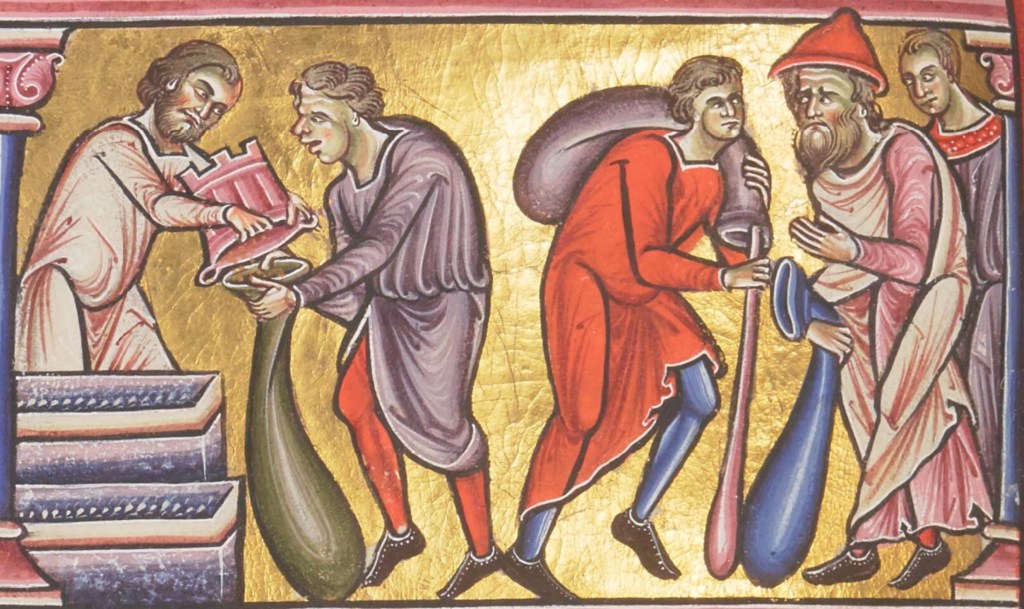
 The Egodeath theory