Michael Hoffman, March 2, 2025
Contents:
- My Initial Reaction
- Good Voice Recordings 6321, 6322, 6320
- “Hole in the Sky”: “the riddles that are built in my head” (Black Sabbath, 1975)
- Periodization and Ancients’ Flip of Attitude & Narrative about Experiencing No-Free-Will on Psilocybin
- Mapping of {branching} from Myth to Physics Was Added Later, in 2020
- The Necromancer, album: Caress of Steel (Rush)
- William James Rejected the “Closed Iron Block Universe View” (The Dilemma of Determinism, 1897)
- Coraxo Pointed Out in 2000: My Assertion of Block-Universe Determinism Does Not Match Gnosticism
- Must Fully Understand the 2-Level Model (Giving Eternalism) Before Can Understand the 3-Level Model (Giving Qualified Possibilism-Thinking)
- My Bold Hypothesis Since ~2005, Finally Confirmed as Official Historical Theory
- Late-Ancient Backlash Against Grandpa’s Eternalism-Worship
- Dr. Justin Sledge Corrects Chris Brennan, Using Same Wording as the Egodeath Theory
- Transcript
- Video: Hellenistic Philosophy of Astrology – Conversation w/ Chris Brennan on Fate in the Ancient World – Aug. 23, 2021
- Book: Hellenistic Astrology: The Study of Fate and Fortune (Brennan, 2017)
- Scholars to Inform of the 2- & 3-level Models (including Mithraism)
- See Also
- Cosmology and Fate in Gnosticism and Graeco-Roman Antiquity: Under Pitiless Skies (Lewis, 2013)
My Initial Reaction
Justin Sledge just confirmed my biggest History theory! (except he forgot to list Mithraism too.)
When Chris Brennan said the usual idea “Christianity invented freewill”, I retorted “so did Neoplatonism, Gnosticism, Mithraism, & Hermeticism”. Then I laughed loudly, because Sledge repeated my exact words!
Sledge described in detail the late antiquity trend (150 AD) as a backlash against no-free-will — using the exact same language that I developed, such as “backlash”.
Good Voice Recordings 6321, 6322, 6320
- VOX_TK_6321.wav – Mar 4 2025
but i f’d up stereo mike placement in long recording 6321.
I give my latest telling of Wasson’s fraud, I recall key stages in developing my narrative. incl 2006 the Plaincourault fresco article accusing Wasson of censoring citation, 2019 Brown publishing the censored Erwin Panofsky letters, and my sluggish reading Jan 2021 in start of Egodeath Mystery Show, of the Erwin Panofsky letters.
- When did I realize ellipses in SOMA were where the censored cite of Erich Brinckmann’s 1906 book Tree Stylizations in Medieval Paintings?
- Just the other day Nov 2024 i realized that in SAME PARAGRAPH where Wass smears and viciously attacks
- Irvin’s calling out Ruck for inverting history and writing p. 56 of the article “Daturas for the Virgin” in Entheos 2 2001 by Carl Ruck where Ruck super-offensively writes “Wasson’s conclusion” – how dare Ruck credit(!) Wasson w/ affirming mushroom-trees, when Wasson in fact persecuted and attacked everyone for decades for that (while doing academic fraud, deceit, duplicity, and censorship, phony play-acting con artist put-on act re: “you ignorant blundering mycologists should have “consulted” the art authorities” [via feeble, abnormal, improper “pers. comm.”] while replacing and hiding the one single extant citation, the flimsy old “little” Brinckmann book, by ellipses . . . . in the same paragraph in SOMA, to prevent bona fide proper consulting of the publications of art historians [which is what I most wished to do in 2006 but I was then mad at Wasson for withholding the certainly-provided citation(s) from big-talking Erwin Panofsky), Wasson in fact denying mushroom imagery in Christian art.
- But Irvin with forked tongue, falsely steals credit from Samorini and gives credit to Allegro for affirming Erwin Panofsky’s “hundreds of mushroom-trees”.
- Allegro never wrote anything about mushroom-trees; only re-produced the incoherent, disconnected, self-contradictory inclusion of the Plaincourault fresco in some printings of Sacred Mushroom & The Cross. Which was 0% innovative, as Cyberdisciple points out.
Certainly if any one person deserves credit for finally troubling themselves to follow Pan’s lead in SOMA 1968, it’s clearly Samorini 1996-1998, especially his famous article “Mushroom-Trees” in Christian Art (Samorini 1998).
You couldn’t ask for a clearer generation-defining break in paradigms:
1st-generation entheogen scholarship (the Secret Amanita paradigm)
2nd-generation entheogen scholarship (the Explicit Psilocybin paradigm) – citation: out of all the haze of entheogen scholarship publications, the given, star to steer by, is obviously Samorini 1998.
In 2006 when writing the Plaincourault fresco article, I started reading that article Samorini sent me, but it’s a poor formatting, hard to digest. Then 2001 “Conjuring Eden” article built on Samorini.
Then “Daturas for the Virgin” 2001 issue 2. Then Ruck left Samo’s productive direction, and reverted to the self-defeating Secret Amanita paradigm, and I declared in 2002 the maximal entheogen theory of religion, against the direction of Ruck Committee / 1st-generation entheogen scholarship (the Secret Amanita paradigm).
I declared – you could say – Samorini 1998 to mark the start of 2nd-generation entheogen scholarship (the Explicit Psilocybin paradigm) which I committed to and which entirely continue to pay off as it did in 1998 Samorini, and 2001 conj eden.
In 2001, with Apples of Apollo book, Ruck Committee abandoned the productive model of Samorini 1998 and continued in his unproductive 1st-generation direction, of falsely elevating Amanita over Psilocybin, and falsely elevating Secret over psychedelics, for which Andy Letcher 2006 took Ruck to the cleaners (like Hatsis destroyed Ruck’s 2009 screwup claiming Dancing Man salamander bestiary’s mushroom-tree has red cap).
2nd-generation entheogen scholarship (the Explicit Psilocybin paradigm) correctly elevates Psilocybin over Amanita, and elevates psychedelics (sheer plain use) over “secret”; over “cult, secretly, oppression, slipped into, hidden, secret cult, surreptitiously slipped in”.
2nd-generation entheogen scholarship (the Explicit Psilocybin paradigm) entirely abandons all such irrelevant, incoherent, & confusing social-realm drama narrative of “mainstream vs. counterculture”, and speaks instead in terms of hidden secret revealed in the mind; the secret mystery of the uncontrollable source of control-thoughts.
“Hole in the Sky”: “the riddles that are built in my head” (Black Sabbath, 1975)
Sabotage album
https://www.youtube.com/watch?v=5zFfh6FsDws
lyrics black sabbath “hole in the sky” 1975
I’m looking through a hole in the sky
I’m seeing nowhere through the eyes of a lie
I’m living in a room without any view
The synonyms of all the things that I’ve said
Are just the riddles that are built in my head
Hole in the sky, take me to heaven
Window in time, through it I fly
I’ve seen the stars disappear in the sun
The shooting’s easy if you’ve got the right gun
And even though I’m sitting waiting for Mars
I don’t believe there’s any future in cause
Source: LyricFind
Songwriters: Michael Butler / Ozzy Osbourne / Tony Iommi / William Ward
Hole in the Sky lyrics © Warner Chappell Music, Inc
Voice Rec con’t
Letcher’s single Liberty Cap mushroom-tree treatment in Bern door demolished the false model of 1st-generation entheogen scholarship (the Secret Amanita paradigm). In April 2007 I posted an influential critical review of Shroom, from the basis of 2nd-generation entheogen scholarship (the Explicit Psilocybin paradigm).
Letcher at his site responded to my review by my name, stating a chain of 4 “but you can’t prove” assertions — a challenge, so I proved all 4 “unprovable” points, and proved 1 more to boot: PEAK religious experiencing.
A comparable clear break point: “Late Antiquity” starts 150 AD, and that happens to be same year I said, and Dr. Justin Sledge generally agrees, that at that time, every brand of religion invented freewill, or equivalent transcending of heimarmene. As a result of their complete belief in eternalism.
In the voice recording, I fume against Allegro.
As detailed by Cyberdisciple, Allegro is 0% entheogen scholarship, yet, everyone 100% equates Allegro (Secret Christian Amanita Cult theory) w/ entheogen scholarship, so much so that Letcher 2006 realizes all he has to to is merely pull the rug out from entheogen scholarship by simply proving that 1 instance of mushroom imagery in Christian art is not secret – thus demolishing entheogen scholarship (ie, 1st-generation entheogen scholarship (the Secret Amanita paradigm).
I explain per Cyberdisciple, there is no innovation in Allegro’s presenting the the Plaincourault fresco , and in fact, the Plaincourault fresco DISPROVES Allegro’s flimsy tale of the “secret Amanita cult”. which is why, if Hatsis is to be believed, Allegro sometimes printed Sacred Mushroom & The Cross without that disconnected image. Allegro:
- Only the very first Christians had The Mushroom, and hid it. Everyone else later forgot The Mushroom and mistook the concealing code-names as literal founder figures.
- AND, also Allegro: The tradition of The Mushroom was still remembered in 1291*, as shown by the Plaincourault fresco.
[*Pl. Chapel actually 1184? per Samorini 1997 article about the Plaincourault fresco]
[*subtract 700 years from timeline per Chron’l Revisionism.]
I justified Late Antiquity rejecting venerating eternalism as the end-state, but shakey construction/ fabrication of a layer above that, qualified possibilism-thinking.
They so very very much fully entirely wholeheartedly believed in heimarmene, that HEIMARMENE WAS THE MAIN PROBLEM OF Late Antiquity.
In no way did they say “no-free-will isn’t the case”.
Late Antiquity said 100%, no-free-will is the case, to such a huge extent, that it is the #1 problem we must be saved from.
The reason Late Antiquity constructed a higher level of freewill, is BECAUSE they completely believed no-free-will is the case.
So Eric Davis’ 2005 summary of my simple 2-level model terminating TRAGICALLY — the tragedy of acid rock – remains correct and valuable, even though the later period, and my subsequent theory-construction after his book, went to to affirm eternalism, yet build higher than that scheme, adding a half-level higher. Only a half level, b/c:
- Our lower self is trapped in heimarmene; our spirit, only, is lifted by savior out from cosmic rock.
Other voice recording good: the one i posted within past day eg 6320.wav.
I also plan to read aloud Josie Kins’ “Experience of eternalism” entry for this planned episode of Egodeath Mystery Show.
Periodization and Ancients’ Flip of Attitude & Narrative about Experiencing No-Free-Will on Psilocybin
- https://en.wikipedia.org/wiki/Classical_Greece – 500 BC – 300 BC
- https://en.wikipedia.org/wiki/Hellenistic_period – 323 BC – 30 BC
- https://en.wikipedia.org/wiki/Late_antiquity – 150 AD – 750 AD
- https://en.wikipedia.org/wiki/Post-classical_history – 500 CE to 1500 CE = Middle Ages
For this purpose, I contrast “Early Antiquity” vs. “Late Antiquity”, divided at 150 AD. Early Antiquity includes Greek Antiquity & the Hellenistic era.
For the concerns of the Egodeath theory, I consider 500 BC-150 AD as a single era, the heimarmene-worship era: Psilocybin initiation reveals eternalism; Psilocybin (loose cognition) enlightenment is mental model transformation from possibilism to eternalism.
Late Antiquity disliked that revealed fact of heimarmene, so they constructed (by advanced-level reengineering of myth) a tricky, confusing inversion level on top of that transformation, to present a narrative of transcending heimarmene. Now we go from possibilism, to eternalism, to qualified possibilism, escaping from the heimarmene prison of the cosmos – according to their reworked narrative description of mental model transformation.
Because it’s a reworking of the basic simple model, only an explanatory framework as sophisticated as the Egodeath theory as of 2005 can keep straight how myth works coherently to describe by analogy, the mental model transformation sequence.
- Classical Greece = Greek Antiquity = 500 BC. Worship of heimarmene.
- Hellenistic era = 323 BC, Alexander the Great. Worship of heimarmene. Death of Alexander 323 BC & death of Cleopatra 30 BC.
- Late Antiquity = 150 AD: affirmation but negative valuation of heimarmene; promise to transcend fate. Fate is the case, but our brand of religion [Lewis: “unlike the others”] saves you from fatedness.
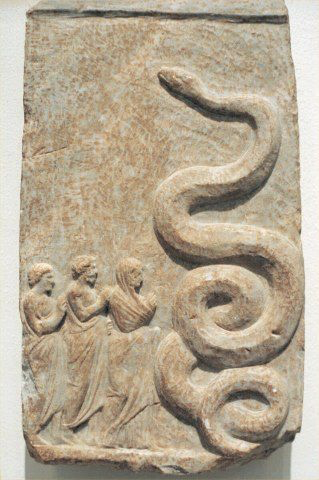
Snake on rock altar: typical of 500 BC-150 AD reverence of fatedness/ heimarmene. Religion reconciles you with fatedness.
After 150 AD, religion is re-thought, thought of as giving you transcendence of fatedness, by:
- Twisting and re-applying the conceptual language of transcendence (advanced-level, confusing mythmaking, that’s way over the head of eg Wouter Hanegraaff), an inversion of the previous narrative.
- Emphasizes the fact that after full initiation (“completion”), we are left with the same old egoic possibilism-thinking, merely modified (“purified”) at an underlying level.
Per the shifted narrative after 150 AD, after the series of {fire} purification transformation sessions in Psilocybin loose cognition, the mind ends up with a state that can be called “qualified possibilism-thinking”, which is eternalism-thinking (awareness of puppethood & enslavement frozen in the heimarmene prison), but just with added emphasis on qualified possibilism-thinking.
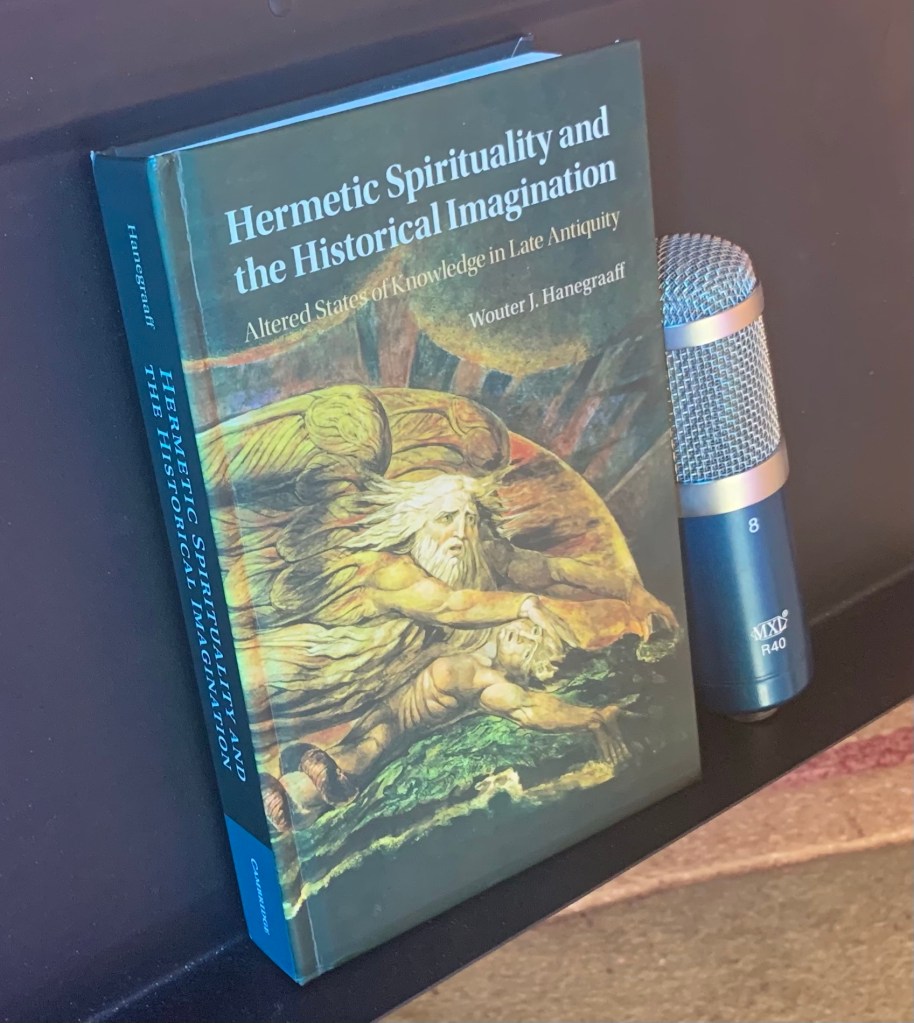
Per Wouter Hanegraaff’s book Hermetic Spirituality, the body remains embedded in fatedness; only the soul or spirit is raised out above the serpent-wrapped cosmos (heimarmene snake wrapping the sphere of the fixed stars, at its outer boundary).
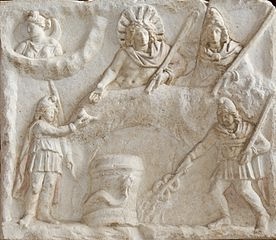
(Sledge doesn’t speak in terms of switching from a 2-level to 3-level model, or Psilocybin transformation to reveal and then incorporate eternalism.)
I wrote a book review of Cosmology & Fate (2013) in 2014, by Nicola Denzy Lewis, which well-confirmed, pretty thoroughly & directly, my theory that antiquity flipped against no-free-will.
Cosmology and Fate in Gnosticism and Graeco-Roman Antiquity: Under Pitiless Skies (Lewis, 2013) (below).
Then yesterday in the video interview of Sledge & Brennan, Sledge made my points exactly & directly, at length!
All brands of religion in 150 AD flipped their attitude & narrative against no-free-will (even while still affirming no-free-will).
This is a super solid, direct confirmation of my speculation since 2004. Adding to Lewis’ book, Luther Martin, & David Ulansey.
Brennan the professional astrologer stated a common half-truth: “Christianity invented freewill” – it was glorious & hilarious because I retorted “so did Mithraism, Neoplatonism, Hermeticism, & Gnosticism!” and then I laughed when Sledge repeated my words, setting Brennan straight (who then agreed).
Sledge omitted Mithraism, but included Jewish religion, which is covered in Lewis’ book.
Lewis and Sledge both give strong confirmation, from different angles, along with Martin & Ulansey.
Mapping of {branching} from Myth to Physics Was Added Later, in 2020
2005-2015, the Egodeath theory still lacked {branching} within myth interpretation; my core theory only had “branching” for contrasting the Minskowski spacetime block vs. manyworlds Quantum Physics.
In retrospect, it’s puzzling how around 2001 in the Egodeath Yahoo Group in 2001, I posted about “branching” to contrast Physics brands of mysticism, yet it took until 2013 (w/ precursors in 2010 in myth) to perceive the {branching} motif in pre-Modernity art that depicts Psilocybin effects.
It took 2001-2013 to make that connection; I experienced the Nov 2013 art interpretation revelation of “branching” as a huge confirmation of my theory of psychedelic eternalism.
Art is simpler and halts at expressing the 2-level model: art shows eternalism as the result of Psilocybin transformation. Art avoids the confusing complexity of Late Antiquity’s 3-level model that affirms heimarmene but aspires to transcend heimarmene.
Around 2010 during hiatus, I walked a forest branching path every day observing mushrooms, among branching trees, and wondered: (regarding in myth, not yet in art motifs) Ancient Greeks understood this same contrast between branching vs. non-branching, and ivy vine leaf series = mental constructs along snake-shaped worldline; ancient equivalent of basic ideas in Physics & Loose Cognitive Science.
By Sep. 2011 after hiatus, every November, I had the breakthrough realization of the central theme of {branching} in myth, a breakthrough that was repeated more deeply each year, with more connections per Paul Thagard.
- 2000: Coraxo in Gnosticism Yahoo Group argues that my 1997 veneration of block-universe determinism/ no-free-will is NOT in alignment w/ the ultimate transcendent aspirations of Gnosticism. This set up the problem for me, leading to eventually adding a 3-level model to my 2-level model.
- June 2001: Posted about branching QM vs. non-branching Minkowski spacetime in Physics. Two potential opposed versions of mysticism: Quantum Mysticism, after 19th-C four-dimensionalism mysticism (iron block universe).
- 2005: Erik Davis summarizes my 2-level model.
- ~2005: I formulate the 3-level model and assign it to Late Antiquity. [todo: find posts in the Egodeath Yahoo Group]
- 2010: Realized ancient Greeks understood contrast between branching vs. non-branching, and ivy vine leaf series = mental constructs along snake-shaped worldline
- Nov 2011: the branching antlers breakthrough.
- Nov 2012: the branching antlers breakthrough, deeper.
- Xmas 2015: the Dancing Man salamander bestiary’s mushroom-tree.
- Nov 2020: Leg-hanging mushroom tree image in Canterbury Psalter f134 row 1 L (uploaded by John Lash in 2008, per Archive).
- 2022& 2023: Recognized {cut right branch} in all my art images; branching-message mushroom trees & branching message vine-leaf trees.
William James Rejected the “Closed Iron Block Universe View” (The Dilemma of Determinism, 1897)
Finally Confirmed William James Wrote “the Closed Iron Block Universe View”
I SWEAR Wm James railed against “iron block universe”, but couldn’t confirm that, recently.
A Search appears to confirm that: https://www.google.com/search?q=%22iron+block+universe%22 – yay confirmed!
https://williamjamesstudies.org/wp-content/uploads/2018/05/William-James-Studies_SPRING-2018_VOLUME-14_NUMBER-1-SPRING-2018-pp1-204.pdf – the entire journal issue. Spring 2018. 2 articles by Bromhall.
https://philarchive.org/archive/BROAIU-2 – 30 pages, the Bromhall article only. 2013
Search web: “iron block view”:
https://www.google.com/search?q=%22iron+block+view%22
Web search: “william james” “iron block”:
https://www.google.com/search?q=%22william+james%22+%22iron+block%22 – see interesting results
A notable hit: https://www.informationphilosopher.com/solutions/philosophers/james/the_dilemma_of_determinism.html – “iron block” 1x
Search web: “iron block” eternalism:
https://www.google.com/search?q=%22iron+block%22+eternalism
to connect latest thinking (Cybermonk, Josie Kins Effect Index) with 1902-era Wm James. Article “Dilemma of Determinism” is
Search web: “William James” “Dilemma of Determinism”: (1897)
https://www.google.com/search?q=%22William+James%22+%22Dilemma+of+Determinism%22
Kyle Bromhall wrote:
“The clearest distinction James makes between the two is in “The Dilemma of Determinism,” where he [James] argues that the “fatalistic mood of mind” is one possible response to the particular form of determinism with which he takes issue;25 or seen in another way, fatalism is a subspecies of the problematic form of determinism.
“The form of determinism that leads to fatalism is the form that:”
[Wm James wrote]:
“professes that those parts of the universe already laid down absolutely appoint and decree what the other parts shall be.
“The future has no ambiguous possibilities hidden in its womb; the part we call the present is compatible with only one totality.
“Any other future complement than the one fixed from eternity is impossible.
“The whole is in each and every part, and welds it with the rest into an absolute unity, an iron block, in which there can be no equivocation or shadow of turning.26“
8 hits on “iron block” in that article: quotes:
- 59: an iron block, in which there can be no equivocation or shadow of turning
- 59: This passage gives us two features of the “iron block” view of the universe that James finds problematic.
- 60: James’s rejection of the iron block view has been noticed by James scholars; the very term is one of the rhetorical definitions about which Gale complains.
- 60: James’s hostility to the iron block view creates a tension in his thought.
- 60: Although James claims determinism precisely for the predictive ability that it affords, he rejects the iron block view, in part, due to its use of that predictive ability.
- 60: James believes that such an extrapolation will invariably lead to an iron block view of the universe, and as such, any claim to indeterminism is obviously false.
- 61: This suggests that despite laying out the iron block view in the manner previously described, James’s primary concern is not the claim that the universe progresses in a lawlike fashion, but rather that the progression of the universe is towards one necessary future state of affairs.
- 73: Here we see the same sort of argument as advanced by James: previous accounts of science (in this case, physics) had ignored the transformational effect of the act of observation*, and once that act is considered, the closed iron block universe presupposed by those previous accounts becomes untenable.
no-turning = non-branching = Balaam’s path along vine yard w/ no way to turn to the L or to the R, facing the angel of death.
*QUANTUM BULLSH!T! – it’s the act of physical measurement, not the act of mental “observation”.
Quantum Mysticism Is Stupid (Professor Dave)
There’s a special place in Hell for deceivers who shift from the word ‘measure’ to the word ‘observe’.
I’ve DONE the early 20th C experiments in university physics lab.
The results have NOTHING to do with mental observation; the Heisenberg Uncertainty Principle is purely because of physical measurement.
Mental observation has no more to do with this type of measurement than anything else that happens in the world.
We don’t say “observe the temperature”, we say “measure the temperature”.
It’s a scummy, dirty, manipulative, willfully lying move.
It’s a make that you know is illegitimate but you make it because you WANT to make it and you know your gullible readers will lap it up, deliberately, knowingly shunning and discarding all checks on legitimacy.
The entire Newage industry is based on this knowingly bunk move.
Everyone agrees to fudge this and make-believe that the word ‘measure’ is same as ‘observe’.
Everyone knows it’s wrong to LEAP from the word ‘measure’ to the word ‘observe’, but everyone has agreed to have poor moral character and make this move out of sheer egoic force:
“I have the power to lie and pretend ‘measure’ means ‘observe’, so I am going to play that dirty, fraudulent card, and no one can stop us from lying to each other, agreeing to lie.”
Professor Dave 100% confirmed my view here, in his vid against Quantum Mysticism:
Quantum Mysticism is Stupid (Deepak Chopra, Spirit Science, Actualized.org)
Ch: Professor Dave Explains
https://www.youtube.com/watch?v=aQTWor_2nu4&t=471s = 27:58
Coraxo Pointed Out in 2000: My Assertion of Block-Universe Determinism Does Not Match Gnosticism
Coraxo of Gnosticism Yahoo Group, Honorary Founding Member of the Egodeath Community
As always, the Egodeath Yahoo Group posts are overwhelmingly good.
In post #41, June 25, 2001, I wrote articulately and maturely about non-branching vs. branching in Physics.
https://egodeathyahoogroup.wordpress.com/2021/01/09/egodeath-yahoo-group-digest-1/#message41
I credit Coraxo, in the Gnosticism Yahoo Group, prior to starting the Egodeath Yahoo Group in 2001, for first pointing out the limitations in my 2-level model that terminates with affirming eternalism / heimarmene / no-free-will.
Limitations as far as mapping myth to my Core theory of psychedelic eternalism.
My theory cannot explain religious myth of 150 AD as long as my theory is only expressed in the basic 2-level model; I had to re-cast my theory (model) in terms of a 3-level model, IN ORDER TO explain religious myth after 150 AD (ie during Late Antiquity).
My model as formulated in 1997, through about 2004, was only able to explain religious myth before 150 AD; in the Classical Antiquity & Hellenistic era.
As I recall, Coraxo pointed out the contradiction of emphasis between my “enlightenment = block-universe determinism” model, vs. Gnosticism-era’s promise and aspiration to transcend heimarmene.
The Necromancer, album: Caress of Steel (Rush)
Rush lyrics, The Necromancer, album: Caress of Steel, lyrics by Neil Peart, who understands no-free-will & transcending it.
http://egodeath.com/MysticStateAllusionsRush.htm#_Toc64392159 —
“Lead them to the dungeons.
Spectres numb with fear,
they bow defeated. [defeat of ego power during ego death]
III. Return of the Prince
Enter the Champion. Prince By-Tor appears to battle for freedom from chains of long years. The spell has been broken…the Dark Lands are bright, the Wraith of the Necromancer soars away… in the night.
Stealthily attacking,
By-Tor slays his foe.
The men are free to run now
from labyrinths below.” [altered-state navigation of the labyrinth of strange loop of egoic control and ego-agency]
Must Fully Understand the 2-Level Model (Giving Eternalism) Before Can Understand the 3-Level Model (Giving Qualified Possibilism-Thinking)
Dr. Justin Sledge (3 yrs ago) just confirmed my biggest History theory/ “bold hypothesis”!
First, I developed my core theory model, mental transformation to eternalism, during loose cognition, written up between 1988-1997.
Then, around 2003, when mapping myth to my core theory, I first used the simple 2-level model, re: 500BC, when Greek myth says Psilocybin transforms mental worldmodel from possibilism-thinking to eternalism-thinking.
Then Erik Davis’ book about Led Zeppelin IV, in the chapter at climax of Stairway to Heaven, summarizes my Egodeath theory of 2005, as just the 2-level model at that point.
After that, it became clear to me that later, around 150 AD, antiquity switched to a hostile stance against no-free-will (heimarmene, fate), and they applied the established concepts of transcendence now to tell a reversed story, of transformation from no-free-will to freewill; from enslavement to fate, to emancipation from fate.
So I then had to formulate a 3-level model of mental model transformation, to map later antiquity (150 AD+) to my 1997 core theory.
Now we need to see my 1997 core theory in light of the 3-level model that came to me via religious myth. Probably my 1997 outline is a purely 2-level model, with no particular hooks for a 3-level model that points out that you are left with freewill-shaped experiencing, but with a modified foundation regarding the source of control-thoughts, and possibility-branching.
This is a GREAT example of how my later theorizing of interpreting religious myth (& art motifs) 1998-2025 has a significant impact on my expression of my 1988-1997 core theory, which is psychedelic eternalism.
My core theory is evolving to be cast as “psychedelic qualified possibilism”, per a 3-level model, in addition to the basic 2-level model of 1997.
Compare teaching the transistor response curve: first teach a rough, simple, basic 1st-order model; then teach students the more complex 2nd-order model. Or move from teaching Special Relativity and Minkowski spacetime, to teaching General Relativity.
Around 2004, I found later inversions (150 AD) of that narrative, talking about transcending no-free-will.
First (1998-2004), I had success mapping 500 BC eternalism-worship to my 1997 2-level core theory of mental model transformation. Then Erik Davis summarized my extreme, 2-level model.
Then around 2004, I encountered the 150 AD “transcend heimarmene” inversion-ideas, and I had to re-cast my core model in terms of 3 levels: freewill, to no-free-will, to qualified freewill.
I found that an adequate explanatory model to map the core Egodeath theory to both early and late antiquity, required flexibility to handle both 2- and 3-level models, around 2005, and summarized in my 2007 main article.
My Bold Hypothesis Since ~2005, Finally Confirmed as Official Historical Theory
Erik Davis’ book is evidence that as of Feb. 18, 2005, in religious myth interpretation (mapping myth to the 1997-summarized Egodeath theory), I had formulated the 2-level model, but had not yet seen the need to also formulate a 3-level model, extending the 2-level model.
todo: in the Egodeath Yahoo Group archive: find the date at which I realized the need to form a 3-level model, around 2004-2006.
Recently, I determined that Wouter Hanegraaff got tricked by the later phase, where Hermeticism puts emphasis on Transcendent Knowledge as taking you from eternalism to possibilism.
You cannot START with Late Antiquity, as Wouter Hanegraaff attempts, and fails so badly, his system cannot tolerate having the fixed stars, and so he omits that level!
I took me a year of critique of his new book to figure out how he screwed it up so cosmically bad.
You must start with the simple basic model from early Antiquity, and build on that by adding inversions of value, later.
When you skip the basic 2-level model, you have incomprehension of the complex, tricky, later-phase inversion of the earlier phase; the only possible understanding is per the Egodeath theory, you have to map, and differentiate, both the early, 2-level model, and the later, 3-level model.
To summarize the Egodeath theory, it is necessary – like my 2007 article – to start by explaining the simple basic 2-level model: transform mental model from possibilism to eternalism.
Glory to no-free-will, the eternalism prison, you awaken to Truth: you’re a helpless puppet, a snake-shaped worldline frozen in rock; the ruler turned to stone by seeing the attractive snake under the lifted lid. Exciting in 500 BC, tired by 150 AD, so they added another, inversion level.
Adding a 3rd level and redefining “Transcendent Knowledge” is justified & needed, because the egoic control system always is used, before, during, & after the altered state sessions that transform the mental model.
Transform from possibilism-thinking to eternalism-thinking, and then transform from eternalism-thinking to qualified possibilism-thinking.
Late-Ancient Backlash Against Grandpa’s Eternalism-Worship
Sledge forgot to list Mithraism too.
I graduated from hypothesis/ proposal (maybe since 2005) to confirmed theory.
By “Late Antiquity”, here i mean the same years Sledge says, around 150 AD. Not Alexander 325 bc.
Like Sledge, my hypothesis had to scramble to state the year (~150 AD) when the switchover happened — the year when antiquity switched from revering no-free-will as the psychedelic revelation, to one-upping that and claiming to repeat the transcendence move and go on FURTHUR to transcend the evil no-free-will prison that is unfortunately revealed by Psilocybin initiation.
Early Antiquity said psychedelic enlightenment makes you end up with eternalism. Aware of being a snake frozen in rock prison; no-free-will. They formed the 2-level model of mental model transformation: from possibilism-thinking to eternalism-thinking.
Late Antiquity backlash against Grandpa’s religion said: no, let’s describe the result beyond that: go on to next, transcend eternalism that’s revealed by Psilocybin. They formed the 3-level model of mental model transformation: naive possibilism-thinking; eternalism-thinking; qualified possibilism-thinking.
When the other guy Chris Brennan wrongly said the usual idea “Christianity invented freewill”, i retorted “so did Neoplatonism, Gnosticism, Mithraism, & Hermeticism”. then laughed, bc Justin corrected him & repeated my exact words!
Competitive Marketing drove all brands – justin sledge includes Jewish religion in the backlash– all of them HAD to promise transcending the fatedness prison.
new conjecture: Christians always disparage gnosticism for hating the world- this is off base. ALL Brands of religion glorified transcending heimarmene / fatedness.
Christianity’s promise of free will is functionally equivalent to Gnostm transcending cosmic heimarmene. it’s a rejection of Fate/ fatedness, either way.
that “distinction without a difference” reminds me of my sales & marketing shift of strategy – instead of selling eternalism that incorps possibilism-thinking , i sell possibilism (“you have egoic freewill power”) that includes eternalism-thinking.
Dr Sledge described the late antiquity trend as a backlash against no-free-will — using the exact same language that i developed.
Dr. Justin Sledge Corrects Chris Brennan, Using Same Wording as the Egodeath Theory
https://youtu.be/ZR-paFQ76HY?t=3720s = 1:02:00 is the setup of the question, Early Antiquity asserted no-free-will; but today we are libertarian instead.
Then at 1:06:25, Justin Sledge corrects Chris Brennan for saying “only Christianity asserted freewill (transcending fatedness)”, & Sledge repeats my wording (he forgot to mention Mithraism though):
https://youtu.be/ZR-paFQ76HY?t=3985s =1:06:25 – “and I think you see the same thing happening in other Christianity rivals, hermeticism … gnosticism as well, planets prison guards, escape, but also even in neopythagoreanism, and middel platm, and even in neoplaton: in sublunar, … theurgy, Iamblicus, one can at some level escape the power of fate”
Transcript
From YouTube video transcript, cleaned up by Michael Hoffman.
… using astrology to know your fate and know what you have to accept.
So I have this little like opening statement by in my book by Valens that is like one of his most famous philosophical digressions in his entire work from the middle of the second century and he says:
“Those who engage in the prediction of the future and the truth having acquired a soul that is free and not enslaved;
do not think highly of fortune and do not devote themselves to hope nor are they afraid of death but instead they live their lives undaunted by disturbance by training their souls to be confident and neither rejoice excessively in the case of good nor become depressed in the case of bad, but instead are content with whatever is present.
Those who do not desire the impossible are capable of bearing that which is preordained through their own self-mastery and being estranged from all pleasure or praise they become established as soldiers of fate.
So that’s the famous “soldiers of fate” passage that you’ll see like cited in a lot of historical and philosophical academic texts over the past few decades because it’s such a strikingly stoic sentiment that’s coming from an astrologer and where the explicit statement about the purpose of astrology is learning your fate so that you know what you have to accept.
But it’s it’s not necessarily done in a causal context but instead maybe in this more sign-based context where the astrology is acting like an omen of what will happen in your future uh from the moment of birth.
Do you find that, that, but
Do you find that that version of astrology proved popular through the middle ages, do you find that it’s popular now?
“When you talk to people interested in astrology the idea that that the task of astrology is basically sort of an adjunct to stoicism that
look you know i can’t change the fact you know what is the epicenter [name?] says right that:
“If you love a pot, don’t get too attached, because pots are meant to break; and if you love a wife don’t get too attached because wives are meant to die.”
And so the idea is if you understand the nature of a pot you understand nature of a wife well you’re not going to be upset when they do their nature;
and ditto if you understand the nature of fate when fate happens to you you’re not going to be terribly troubled by it because well that was the nature of what was going to happen
i don’t know
Do you find that those ideas resonate with people these days because it seems like we’re kind of liberty spiritual metaphysical libertarians; we like to believe that we’re free and nothing’s really going to hold us down and the idea that uh it’s that astrology is meant to aid in your achievement of apathea [acceptance of fatedness/ heimarmene] —
Do you find that that notion resonates at all these days?
Brennan:
No, and what’s funny about that is part of our western culture heritage over the past 2000 years and the reason for that the reason for that that that sentiment no longer appeals to us is i think
it was very popular for a few centuries for a period of time um from the third and fourth or from the third century bce onwards in the hellenistic period during the heyday of stoicism all the way into the first and second centuries and
that’s why you’ll see the astrologers repeating sentiments like this [accept fatedness] over and over again because there was a broader societal acceptance of stoicism [fatenness]; and notion that you the purpose of divination is to learn your future so that you know what to accept
but what’s funny is i think the widespread acceptance of that for several centuries which allowed astrology which is based on such a deterministic premise one way or another to flourish as it did in the first century bce in first century ce and second and third centuries before it started to decline
the popularity of that [fatedness, heimarmene] led to a backlash and part of that backlash was um came through like a little known like religious sect um which was the rise of christianity and
[Brennan, like others, wrongly singles out Christianity]
part of the rise of christianity this has been commented on and sort of debated amongst some philosophical and religious scholars over the past few decades or the past century
but the more and more i look into this and think about it the more i realize:
what was so appealing about christianity in the ancient world that we just simply cannot understand today is just how dominant astrology was and stoicism [fatedness, heimarmene, eternalism] was from a philosophical standpoint in the first and second century ce
and how for just a normal person who is not an enlightened stoic sage who’s just like ready to accept all events in the future even the most terrible ones with this steely stoic or cold stoic resolve in some sense for normal people who are not prepared for that to hear such negative things or any negative things coming up about your future that you have to accept due to fate
if there is any group that comes to you or comes about at that time that says you know what all you have to do is believe in or accept this one guy into your life and if you do that we will free you from heimarmene and you will no longer be subject to the planets and i i believe and i really think that that was actually one of the main appeals of christianity in the first few centuries was that um it gave you a way out and suddenly there was this new group that was saying that you could become free of fate and that
christians were no longer subject to fate or to the planets through their choice and through the act of their acceptance of of christ and things like that and that’s one of the reasons that led to it really taking off
[Sledge corrects Brennan using same language I’ve been using since ~2005, though omits Mithraism (search transcript for ‘mithra’)]
Sledge:
Yeah i think that’s i think that’s an excellent observation and i think you see the same thing actually happening in other christianity rivals um hermeticism medicine being another right where hermedicine puts a lot of emphasis on fate and says yeah but one can escape it through ritual purification and through spiritual purification that um the body might be bound to fate but the soul isn’t and so you one can escape
in a gnosticism as well um that you see this kind of idea that the planets are these evil prison guards almost and that that the soul can escape through and there’s lots of different mechanisms of escape and
gnosticism christian gnostic christianity being one but also even in neopythagoreanism and middle platonism and even in neoplatonism there are these ideas where
in the sublunar world there’s some degree of free will there’s chance free will and necessity and depending on the various kinds of things one does uh theurgical rights magical rites uh various kinds of purifications and the middle platonic and in the the neoplatonic world of theurgy and things like that Iamblicus and proclass les proclasses yamblicus really that one can at some level escape the power of fate through religious observance or through magical means and and things like that
so it’s interesting that at the time christianity was arising of course christianity became the dominant uh mode of this and eventually won out
but it seems like that backlash that cultural backlash against stoicism and against this hardcore determinism that you see that was sort of stoicism plus astrology and mutual harmony syncing up with one another
and even in stoicism they couldn’t you know posidonius and panittius went back and forth about whether or not astrology was uh was affecting things the way that that they they mutually disagreed about
it’s just interesting by the second and third centuries with the rise of hermeticism christianity gnosticism there’s a cultural backlash against this idea and everyone’s trying to escape fate
and i think that it’s interesting that you see the same thing happen not just in the hellenistic world but also for instance in the world of northern europe pagan northern europe where Wird right the concept of weird which is a fate like concept in the anglo-saxon world was clearly a very powerful idea in pre-christian pagan piety right
resignation to fate was a was a being a weird bith fool arad i think is what the uh wanderer says
and then these poems begin to change under the auspices of christianity where you say no wird is not actually all binding uh christ is all binding and i can escape wird through through christ
so it’s interesting that this may have played itself out not just in the hellenistic world but in other kinds of pagan milieus as well
and i wonder if in the neo pagan world fate is now playing a greater or lesser role
it’d be interesting to to talk to some neo-pagan folk and we can folk about the if if one of the reconstructed things is this heavy emphasis on fate or is fate still sort of sitting on the shelf because it’s kind of a bummer or whatever
i don’t know unless you’re really wealthy or something but i guess it’s going to get to you anyway no it doesn’t really matter how wealthy you are um and i yeah
i just find this interesting that that this this uh kickback uh with christianity and other forms of uh other forms of religiosity spirituality where fate is sort of something that they’re they have in their sights in astrology also something they’re going to have in their sights as well
and it’s not just the [ancient]academic skeptics who are taking on astrology, it’s also the neo-platonus it’s the christians it’s a hermeticist [AND MITHRAISM]
it’s it’s a it’s a wide range of people in this new religious uh milieu
do you see that playing itself out in other places
but yeah yeah that’s a really good point that it’s not just christianity it was reacting to it [fate] it was all of the differences a bunch of different philosophical and religious traditions that were reacting to the dominance of astrology at that point and to the overwhelming prevailing trend that astrology and fate were intertwined
and um so when you start to get after the first century and like the second and third and fourth century christian tracts that are attacks on astrology are attacks on the concept of fate and their attacks on the concept of fate are attacks on astrology because they were seen as so intertwined
but as a result of that you’re right it’s not just christianity but other schools like hermeticism and especially gnosticism or different gnostic schools that are talking about how to free yourself of fate and how to free yourself of the influence of the planets but also in the magical tradition there’s um you know magical fragments of one little passage of somebody who is um trying to get free of their fate and and has some sort of magical ritual where they’re explicitly asking to be freed of the influence of heimarmene
and freed of the fate that’s indicated by their birth chart in this really famous fragment that survives um then you have in like the neoplatonic tradition you have porphyry and yamblicus arguing about the idea that you can use astrology to identify your guardian spirit or guardian diamond and yamalakus criticizing porphyry and saying that how how absurd it is the notion that you can use astrology to identify your guardian’s spirit and then to ask your guardian spirit to free you of fate when the purpose of the guardian spirit in the first place is supposed to be to make you live out your fate and to somehow enforce that or enforce the decrees of the planets
so there’s this whole like rich philosophical and tradition and debates about different schools that are talking about how to get free of fate even as we talked about last month in the episode we did on jewish views on fate we have these discussions about whether either jewish peoples are exempt from fate as like an entire class of people due to their their beliefs or whether jewish people can become free of fate through certain acts of righteousness for example or whether the planets whether the stars or constellations the zodiacal signs have any control over um israel
what was that famous saying again yeah we have this famous uh right that there is no mazal in israel
right um uh low mazaba israel there’s no there’s no masal
uh and there’s you know like we talked about at length in that conversation right that and i think that’s part of this right because
those conversations are happening around this time, they’re happening exactly the same time
uh whereas we know that astrology you know there were jews writing technical astrological manuals a couple generations prior to that and then there’s this break in the talmud or at least the beginning of a debate in the talmud about whether maza bore on israel proper and could you escape fate through various kinds of things
and i think that conversation between yamblicus and and proclaim reamblocus and porphyry is really interesting because then
it introduces the idea that and this is a neoplatonic and again it has everything to do with the worldview these people accept
right where
whereas for the aristotelian worldview you have the prime mover and it’s just sort of it’s like a machine and you can’t do anything about it because that’s just you’re the cog in the machine and you you turn
whereas in the in the neoplatonic world yes the one is emanating out and eventually you’re there but also you have procession and
then recession and
the idea is you can sort of absorb some of this spiritual energy and by manipulating it in certain kinds of ways using theorgy or magic or other kinds of things you can kind of rebroadcast it up
and if you know your diamond diamon you might be able to focus that energy back up in a way that manipulates how it comes back down to you
and so there’s a sort of procession recession model that’s begins with platinus and you find it all the way down to the very all the way down to proclass and so
what’s interesting again is how one’s worldview affects how one views astrology affects how one views one’s interaction with fate because you might be able to do sacrifices to a you know burn incense and call down power into something to affect how your diamon works if you believe in a world where it’s coming down and going back up
but if you accept an israelite worldview well no the planets are either ruling over you or god ruling over you and you better be good because if you’re good maybe god will directly help you as opposed to the planets ruling over you
and so i think what’s for me so fascinating about this various uh these various ideas about what’s going on in astrology this time period are the various kinds of ways that people are dealing with fate either in the sense of having to accept it how to live with it how to alter it how to escape it
and how astrology at some level depending on how you structured your world allowed that or didn’t and how astrology no matter what worldview you accepted was the tool that you had to use
and i think that’s what’s interesting and i think this is the point you make in your your your really great book is it like
it doesn’t really matter what it doesn’t matter at some point what world view, this was the tool and the fact that that was a tool meant that in some level everyone had to deal with it and i find that whether you’re a stoic a jewish person a hermeticist [or Mithraist] , agnostic a neoplatinian whatever everyone had to to deal with this
what was taken to be a fundamental truth about reality [fatedness] and that is these celestial bodies are doing something, they matter and
it’s our task to figure out how they move why they move the way that they move and what that means for us
and i find that that’s that’s the unifying thing
and i find it’s really one could teach an entire class i’ve always made the joke that if i had my druthers
i would teach all of greek philosophy backwards i would start with the trinity like the the christian idea of the trinity as it’s found in the nicene creed and athanasius then i’d work my way back from that idea which is only possible using the entire apparatus of greek philosophy and
work my way all the way back through the history of greek philosophy starting with the trinity i think one could do the same thing with hollistic astrology you could take you could learn astrology and then learn greek the hellenistic greek world back through it and you would see all these different philosophical schools reflected in how they understood their relationship to the celestial bodies and and to fate more generally yeah definitely and what a greater context once you do start with that understanding it sheds on all of the different philosophical and religious state debates that are being had for centuries in the greco-roman world and it’s just hard
sometimes i think i think it’s hard for modern people because of um culturally in the west like what a dominant role those reactionary religions and philosophies have had on our culture in um really putting free will at the very center of our our western cultural understanding of the world and about our lives and about what’s important and and what’s valid in terms of choices and the fact that the idea that we can make free will choices being like a fundamental almost unspoken philosophical premise that was even heightened even more in like the modern times with ideas of humanism and things like that and how core that is to our western philosophy
to go back to a first century bce context where stoicism and astrologer [FATEDNESS] to the prevailing and dominant philosophical schools and to have just a world view where the acceptance of fate and the idea that everything is predetermined and that your future is indicated by your birth chart was just a given that was taken by taken for granted by so many people um even i mean it’s interesting even with the early the birth of christianity early on astrology was actually being used to justify that jesus was the messiah through stories like the star of bethlehem in the gospel of matthew and
the notion that there were these this group of foreign astrologers from mesopotamia who traveled to the birth of jesus by following some sort of celestial portent that indicated that the messiah had been born and therefore
that story has this sort of political context in that it’s it’s using astrology and saying that there was an astrological alignment that indicated that somebody really important was born at that time on that day and by implication therefore had a special birth chart in the same way that other politicians during that time period like some of the early roman emperors were like publishing their birth chart because they thought that it showed that they would accomplish great things and it justified their their reign
you sort of get a similar thing there in the gospel of matthew and it’s interesting how astrology initially is being used as something to justify uh the new religion justify christianity and then later becomes something that it’s explicitly pushing against or fighting against for theological reasons yeah and
it’s always interesting to me the double-edged sword of astrology because if it can if it can point out that your birth chart indicates you’re destined to great things it might be able to figure out when you’re going to die and it’s interesting that the meaning of
the roman emperors were really happy with uh with when the story was good and when they would cast you know charts about what might happen to them in a battle or when they might die they were like all right round them all up and
kick them all out right so they were more than happy to expel them all when the story wasn’t uh uh when the story wasn’t so good
and also it’s interesting ditto with the birth chart of jesus that that was one of the big capital crimes you see people being punished for in the middle ages astrologers trying to cast birth charts for jesus uh czecho descoli i think was one of these medieval people that attempted to do this and got in a great bit of trouble uh trying to sort out exactly when jesus was born through astrology because there was something about the idea that on the one hand of course they were the heavens aligned as a sign that something was very important right but if it’s the case that natal astrology is true and that jesus was born under a certain birth chart then he was destined to do what he did and that that that’s a mess that’s a theological mess because obviously god shouldn’t be destined to do stuff yeah
it’s a funny fundamental um incompatibility that’s burst built into western christianity which is
on the one hand this you know almost stoic belief that jesus was born with this auspicious astrological alignment that indicated he would that the son of god had just been born basically that the messiah had been born and and therefore justified that and what would happen and justified the new religion
but then on the other hand the especially growing later theological emphasis on free will as being a really important component of christianity that wasn’t just a minor thing but is actually one of the core components that made it really stand out from some of the other philosophical and religious schools of that time period
[NO! as you said, all brands marketed promise to transcend fate]
um yeah and you mentioned like the length of life that was one of the great preoccupations that the astrologers had and in many very early in many of their textbooks they had a specific technique that was outlined in one of the early foundational texts probably in the first century bce that was attributed to pedocyrus and this technique for determining the length of life was not just a preoccupation of the astrologers because they gave the rationale that you shouldn’t predict events like great events for somebody who will not live long enough to see them was like the classic rash now that ptolemy mentions and he alludes to or or i think attributes this the peta cyrus from the source text that he got this technique from and that most of the astrologers got this technique from but it’s interesting how that technique became sort of the bane of many of the emperors during that time period when the astrologers were running around predicting when different emperors would die and that was not something they were happy about and that was one of the biggest times when political backlash would happen against astrology and you would see it getting banned or see astrologers getting kicked out of rome was
when predictions like that were being made yeah yeah it’s fascinating again like it’s one of these things where same with magic uh many people in power happy to have magicians on their employ as long as there’s no suspicion at all they’re not using that that stuff against them and so it’s interesting that this is always a one is always a danger if you’re a court astrologer or a court uh a court magician that this can always cut against you in lots of ways yeah and and magic’s really important and there’s that’s something that’s very underexplored
it’s hard to explore because there’s not a lot that survives from the hellenistic tradition but there’s some sort of tie-in there with the egyptian tradition and some of the earlier egyptian practices as well as some of the mesopotamian practices which were propitiation rituals because in the older mesopotamian tradition from like let’s say the 7th century bce there were notions that the planets and the stars acted as heavenly writing indicating the will of the gods and things that they were expressing to humankind about the present or the future but they didn’t view that as it wasn’t within a deterministic or stoic context because they viewed some of those indications as being negotiable and that you could use certain rituals or sort of like magical practices in order to avert the things that were indicated, the decrees that were indicated by the stars
and we see some survival of that in the magical tradition in the hellenistic period and then especially in the medieval period through the use of things like talismans and amulets where you could um pick like an astrological moment that was auspicious uh when a certain planet was prominent in the sky and then create or consecrate like a talisman or or an object that would capture the the astrological or the magical astrological energies of that moment into an object that you could then carry around with you in order to sort of capture the energy of that moment and keep it with you in order to offset and influence your fate from that point forward so some of those magical traditions even in their survival into the medieval period through books like the pikatrix are an interesting again alternative legacy of trying to use astrology not to accept your fate but instead using that knowledge in order to free yourself from fate by learning how to manipulate um the the planetary energies or what have you yeah i mean of course the most famous example of that is it’s all kindies on the stellar rays where um you know omnistellar raves is often given the subtitle in the middle ages uh theory of magic because on the the first part of the stellar rays is his sort of neoplatonic vision of how the the stars radiate various kinds of causation and how one can use images to capture them i think of them like uh astral batteries where if there’s a certain conjunction with a certain kind of uh energy you can capture that energy and then deploy it later into doing things and you can amplify or de-amplify those energies using things like sacrifices and uh incense and things like that and al kindies on the stellar rays basically became one of the principal textbooks for what we consider astrological magic along with pika tricks into the the middle ages which was used uh and again this is also what’s also interesting is the survival of the idea that
the planets are living creatures but they’re entities that are alive we see that going back into the hellenistic period as well and because these entities are alive they can be manipulated
and the you see this idea developing in in the and the the traditions of astrological or astral necromancy where these intelligences these beings not only are they out there but by using various kinds of magical systems one can manipulate them and actually call them call their power down to do all kinds of various things
and this kind of astral necromancy was a very popular form of magic into the middle ages whether you have the commentaries of hortellanas and other kinds of people on these astrological textbooks which are very innocuous on their own they’re just astrological textbooks
but when what would end up happening is people like michael scott or hortillanis or czechoscoli would write these necromantic versions of them where not only are they describing how not only describing how the planets work but also describing what the planets are these living beings and how to manipulate them
and at that point you cross a line into criminality and you could be executed and many people were some people were executed for this kind of thing as well and we see
that idea of the planets being living beings going back i think even to plato and and his successors so it’s just interesting i think the what’s the right word the vicissitudes uh just think about fate again that astrology in the hellenistic world has has left us in the western world all these different tendrils all these different traditions all these different ways of relating to the celestial world
and it’s my experience and i wonder if it’s yours that those kinds of questions are only getting more popular that questions about astrology questions about our relationship to the celestial world at some level are are are actually only increasing in popularity uh over the course of the past 20 years both at the academic level thank you thank goodness but also at the practical level at the doing of astrology
and it seems like um this is kind of a period of renaissance for both the doing of astrology but also for the historical re-understanding of all of this stuff where
many of these texts are just now being published for the first time in in hundreds of years
do you is that your sense of it as well that
we’re living in a kind of astrological renaissance of a certain kind
yeah and um there’s been a huge resurgence of astrology recently in the past decade
[modern astrology sucks b/c oblivious to Psilocybin-revealed Heimarmene which was the CENTRAL concern -Michael Hoffman]
and also more broadly in the 20th century in that resurgence in the 60s and 70s as well as the broader which
i try to document a little of a resurgence of interest academic interest in astrology over the past century
and and the important role that’s played in our understanding by recovering some of these texts that survived in libraries and private collections and editing and printing them which you know
some of these many of these texts were just not accessible and scholars did not have the ability to read them until recently
and so that’s one of the reasons why academic interest in astrology has grown is just the availability of being able to study some of the original prime primary source texts
so that whole modern component is definitely something i’m interested in talking about
/ end of e-transcript
Video: Hellenistic Philosophy of Astrology – Conversation w/ Chris Brennan on Fate in the Ancient World – Aug. 23, 2021
https://www.youtube.com/watch?v=ZR-paFQ76HY&t=3720s — TheAstrologyPodcast – Chris Brennan. Discuss philosophical issues in Hellenistic philosophy especially the role of fate, free-will and the various theories of astrological causation in the ancient Hellenistic world.
his podcast – https://theastrologypodcast.com
Book: Hellenistic Astrology: The Study of Fate and Fortune (Brennan, 2017)
Book:
Hellenistic Astrology: The Study of Fate and Fortune
Chris Brennan, 2017
https://www.amazon.com/Hellenistic-Astrology-Study-Fate-Fortune/dp/0998588903
698 pages
Scholars to Inform of the 2- & 3-level Models (including Mithraism)
I wish to email these scholars, to add Mithraism:
- Justin Sledge
- Chris Brennan
- David Ulansey
- Michael A. Williams?
- Luther H Martin
- Erik Davis
See Also
todo: create Site Map section “Late Anty Backlash vs no-free-will “
etc; my heimarmene articles; fatedness; transcend no-free-will. probably find 2005 posts at the Egodeath Yahoo Group proposing this backlash & a switch from 2- to 3-level model. & my 2007 main article summarizes the proposal:
Article: “The Entheogen Theory of Religion and Ego Death”
Michael Hoffman, 2007
Section: Transcending Determinism Requires Two Jumps
https://egodeaththeory.org/the-entheogen-theory-of-religion-and-ego-death-2006-main-article/#Transcending-Determinism-Requires-Two-Jumps
Cosmology and Fate in Gnosticism and Graeco-Roman Antiquity: Under Pitiless Skies (Lewis, 2013)
My book review of Cosmology and Fate:
https://www.amazon.com/gp/customer-reviews/RO5N2HMBGSY1O?ref=pf_ov_at_pdctrvw_srp
Cosmology and Fate in Gnosticism and Graeco-Roman Antiquity: Under Pitiless Skies (Nag Hammadi and Manichaean Studies, 81)
Nicola Denzey Lewis, March 28, 2013
https://www.amazon.com/Cosmology-Fate-Gnosticism-Graeco-Roman-Antiquity/dp/9004245480/
Backup copy of my book review (also probably exists in the Egodeath Yahoo Group Max Freakout archive):
Michael Hoffman, 5.0 out of 5 stars
You are ignorant slaves of fate; we have been released from fate
Reviewed on November 12, 2014
I had my university library order this book in hardcover and electronic form.
People in Mediterranean antiquity including Jews, Pagans, Gnostics, and Christians, around the 1st Century, believed in fatedness. Then around the 2nd Century, people adopted a rhetoric of transcending fatedness, while disparaging other people or the other groups as being ignorant and being slaves to fate. This book supports the 3-tiered systematic analysis in my Egodeath theory, in which we move through three stages during initiation experiences:
1. Ignorant freewill thinking.
2. Enlightened realization of fatedness and personal noncontrol. This stage disparages stage 1 (ignorant freewill thinking).
3. Transcending fatedness to gain a transcendent freedom. This stage conflates and disparages stage 1 (ignorant freewill thinking) and stage 2 (realization of fatedness and personal noncontrol).
Lewis’ analysis is not as systematic, but supports this explanation of how stage 2 was first positively valued and then later was negatively valued.
Lewis shows that competition and rhetoric inflation led all the groups (Jews, pagans, Christians, gnostics) to praise themselves as having true freedom and disparage the other people as being both ignorant (per stage 1) and slaves of fate (as realized in stage 2). People didn’t complain of themselves being enslaved by fate; they disparaged other people as being ignorant and enslaved by fate. However, during initiation, as I have analyzed, the experience of fatedness and personal noncontrol give rise to panic and egodeath, which amounts to suffering enslavement by fate.
Lewis misses this point and understates the intensity of ancient experience of enslavement to fate; she argues that enslavement to fate was mere rhetoric, but in fact enslavement to fate was intense peak experiencing. Lewis’ theory is literary scholarship unplugged from intense, lightning-bolt, ancient experiential transformation of consciousness. Once this connection is made, from initiation experience to the encounter with fatedness, Lewis’ book can be corrected and recognized as relevant to explaining the heart of religious origins in antiquity.
Introduction
Chapter 1: Were the Gnostics Cosmic Pessimists?
Chapter 2: Nag Hammadi and the Providential Cosmos
Chapter 3: ‘This Body of Death’: Cosmic Malevolence and Enslavement to Sin in Pauline Exegesis
Chapter 4: ‘Heimarmene’ at Nag Hammadi: ‘The Apocryphon of John’ and ‘On the Origin of the World’
Chapter 5: Middle Platonism, Heimarmene, and the Corpus Hermeticum
Chapter 6: Ways Out I: Interventions of the Savior God
Chapter 7: Ways Out II: Baptism and Cosmic Freedom: A New Genesis
Chapter 8: Astral Determinism in the Gospel of Judas
Chapter 9: Conclusions, and a New Way Forward
Selected Bibliography
Subject Index
— Michael Hoffman, the Egodeath theorist
8 people found this helpful
/ end of my book review, backup copy
not sure if Wms is relevant: Williams, Michael. (1997). The Immovable Race: Gnostic Designation and the Theme of Stability in Late Antiquity. https://www.amazon.com/Immovable-Race-Designation-Stability-Antiquity/dp/9004075976/ Google Scholar: https://www.google.com/books/edition/The_Immovable_Race/RwrwgcHz1_MC


