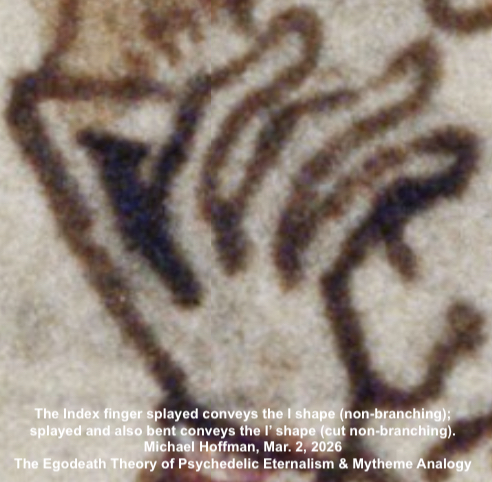
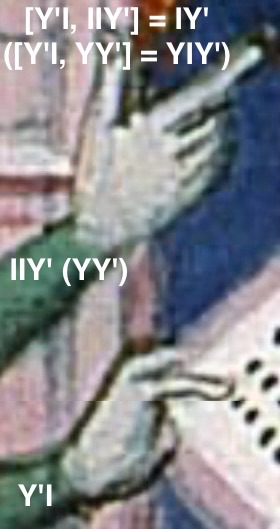
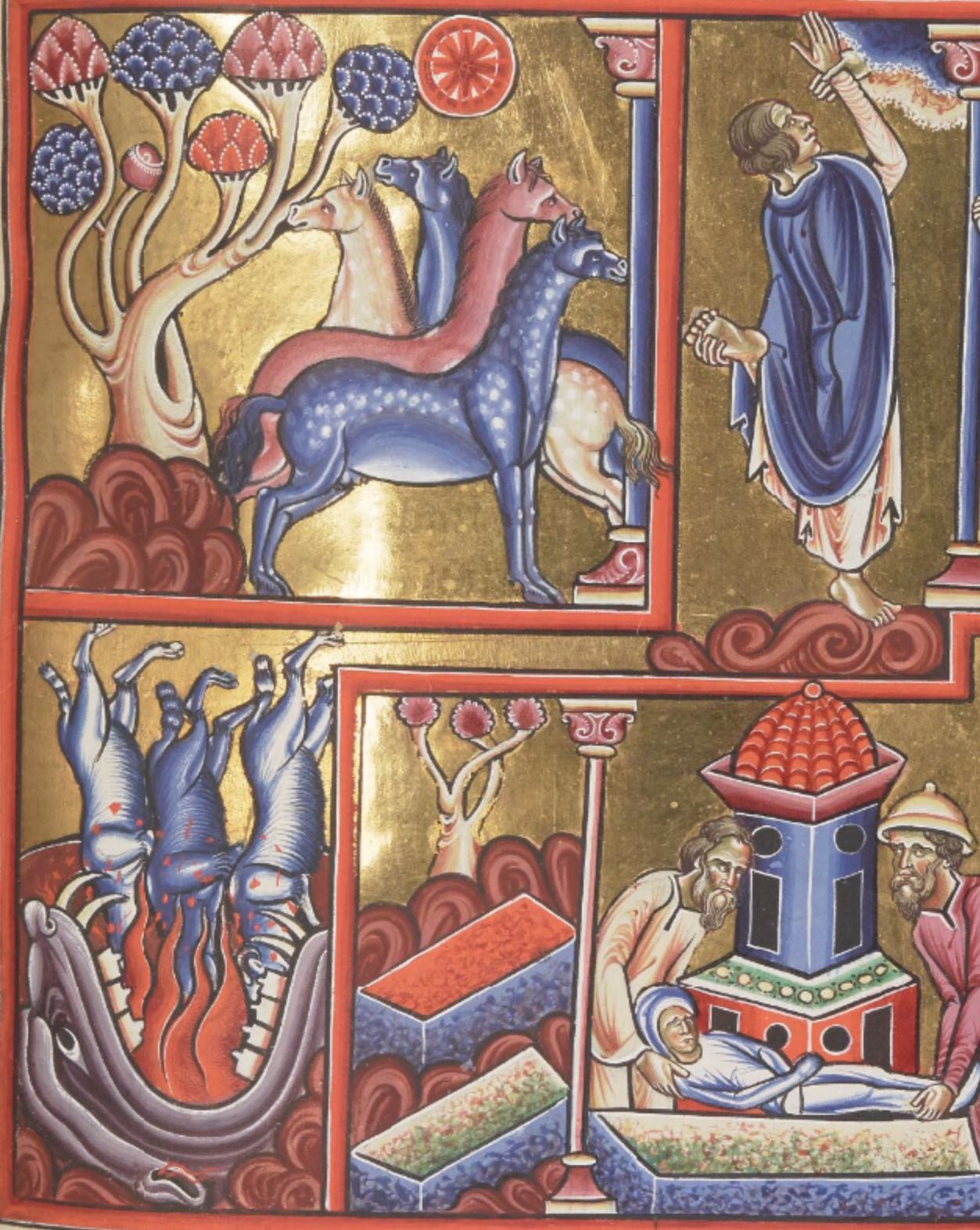
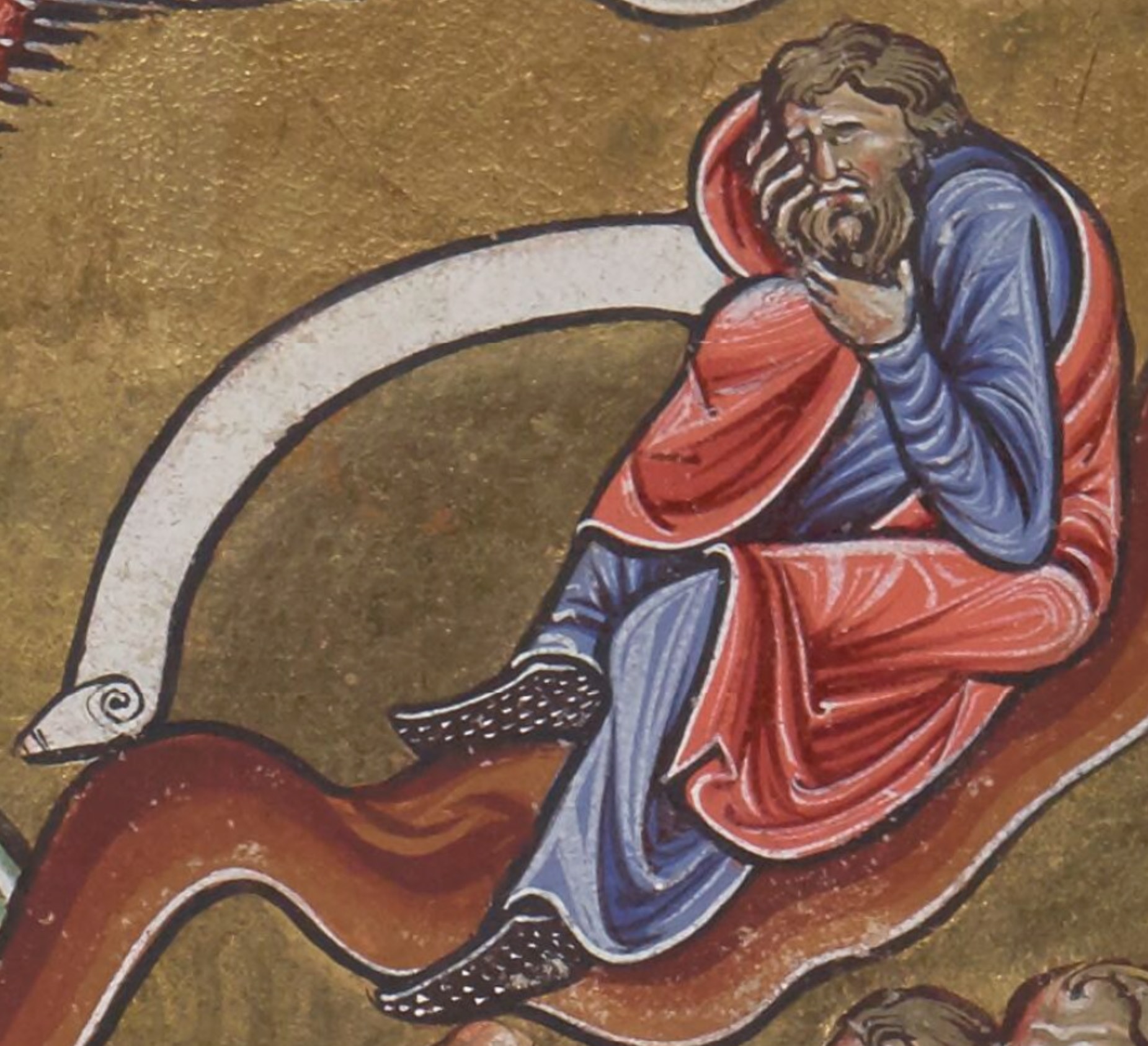
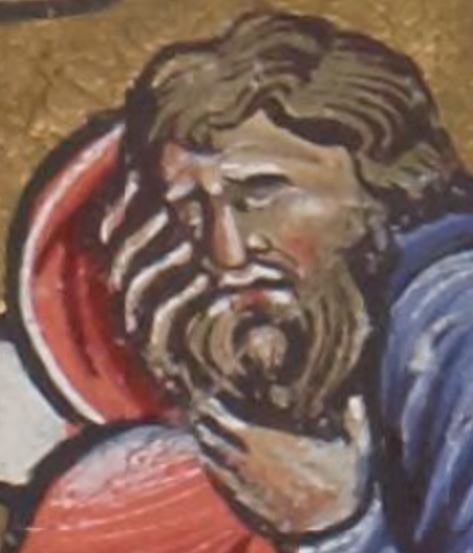
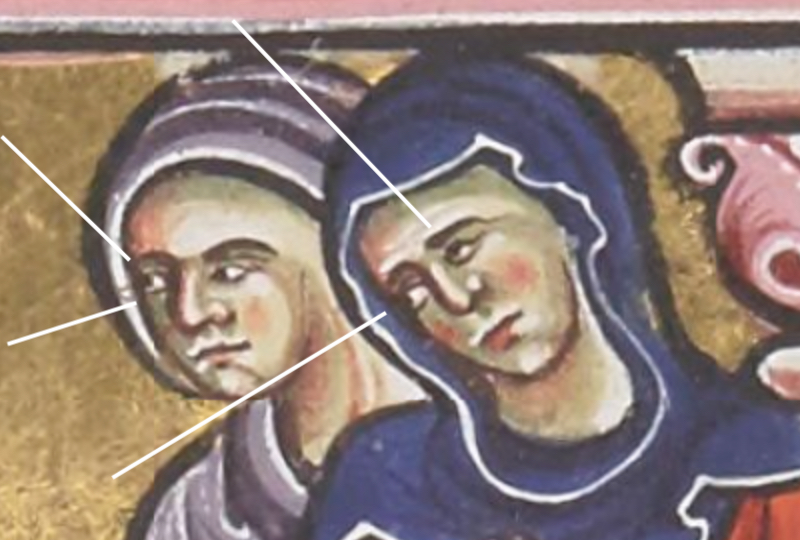
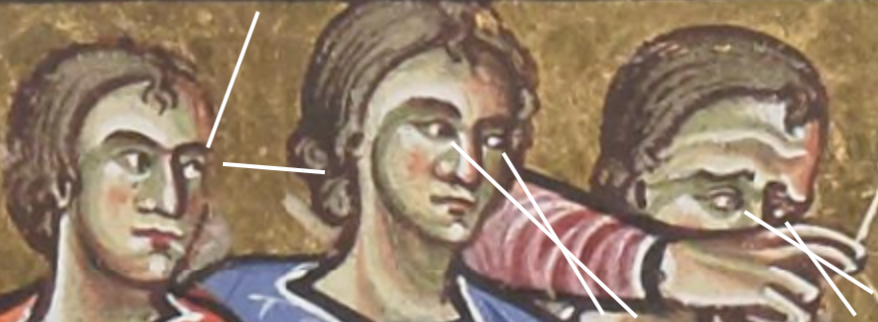
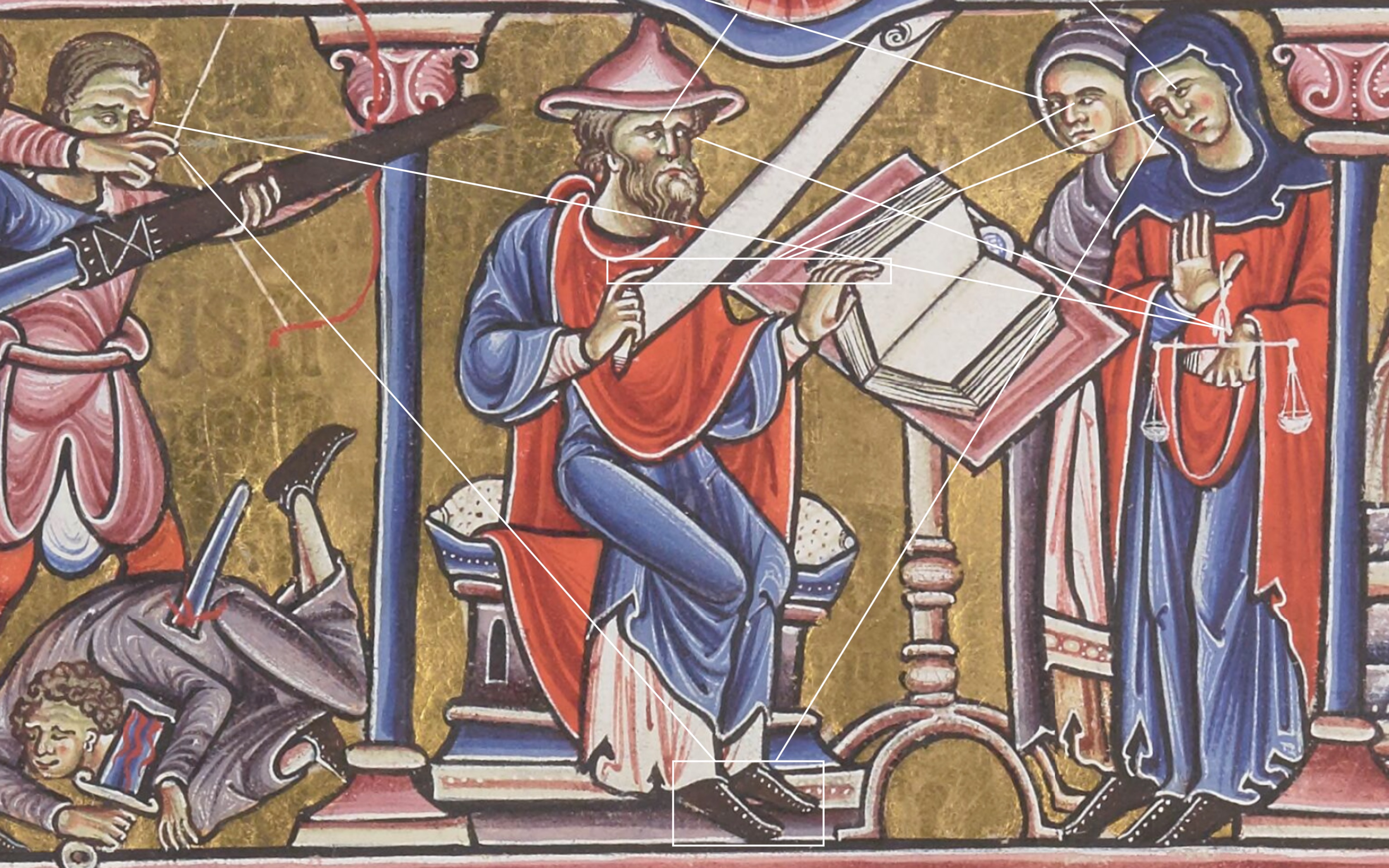
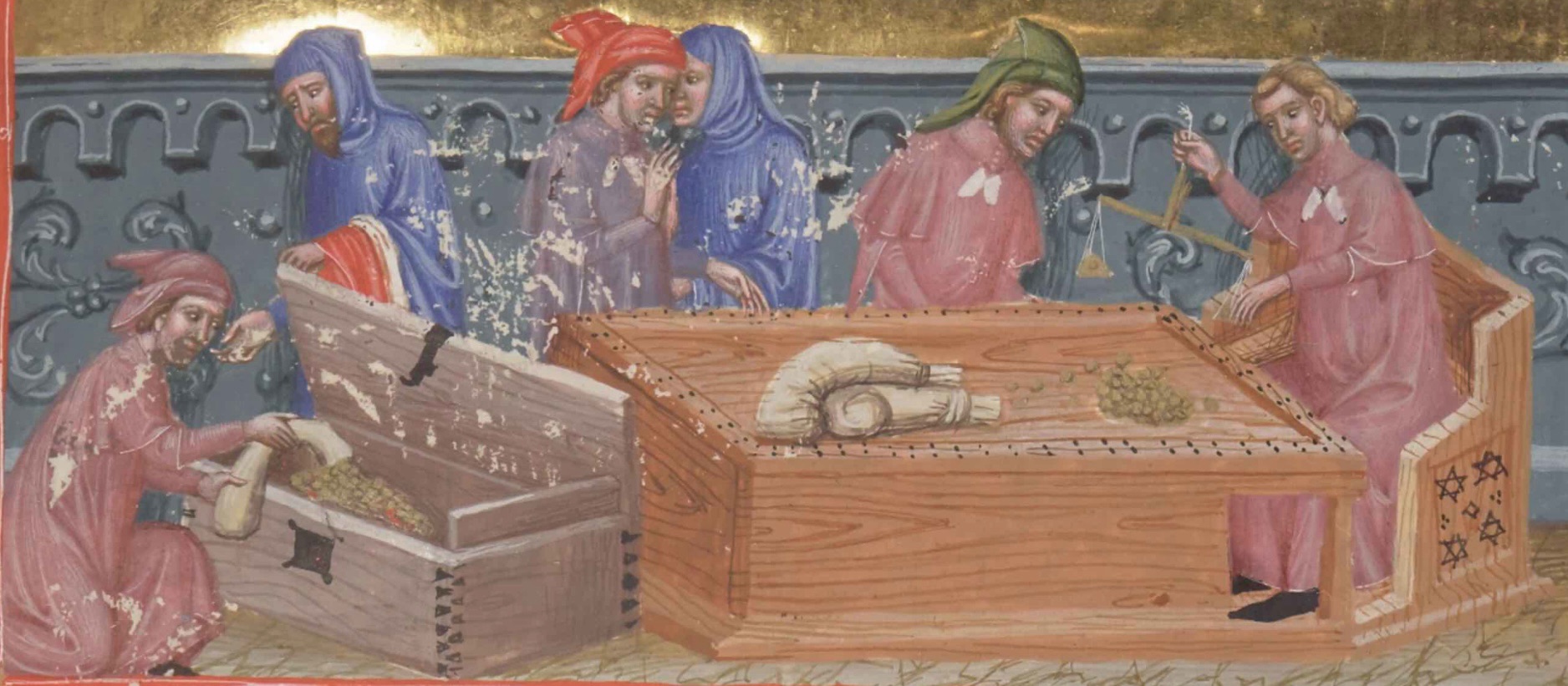
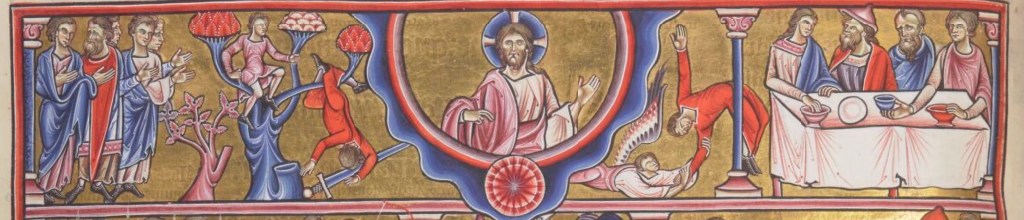
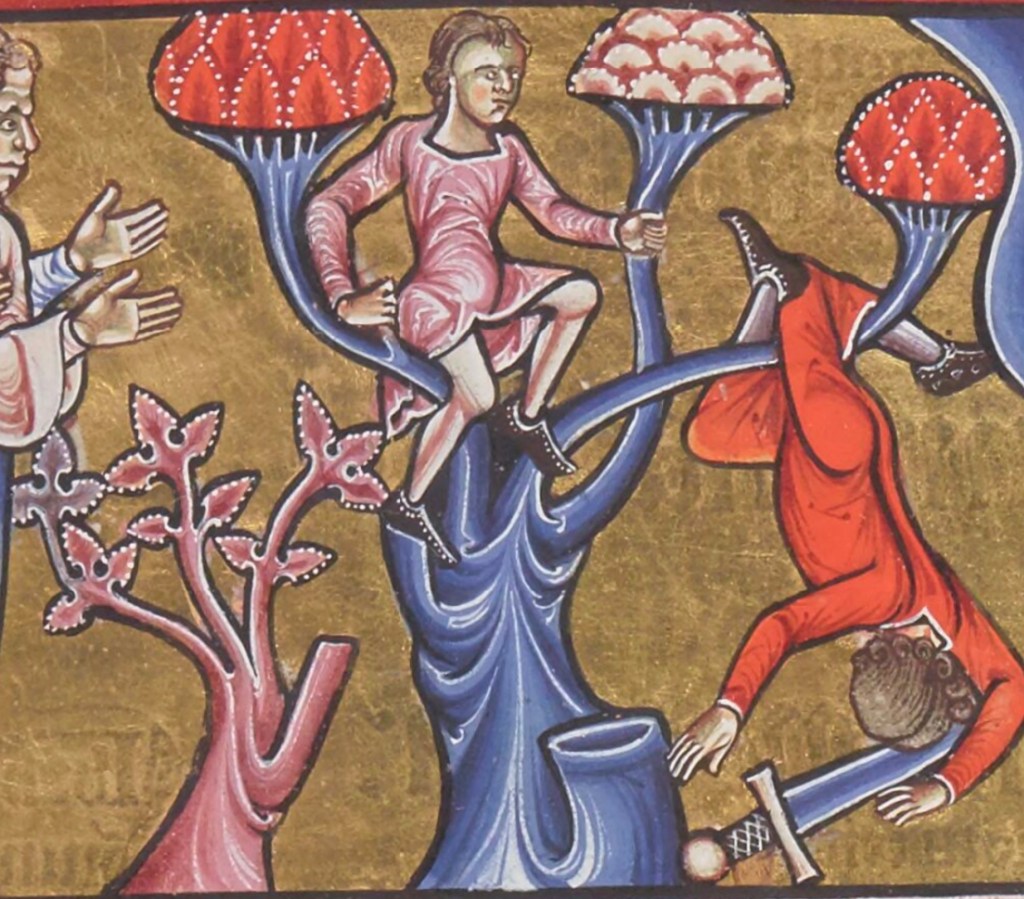
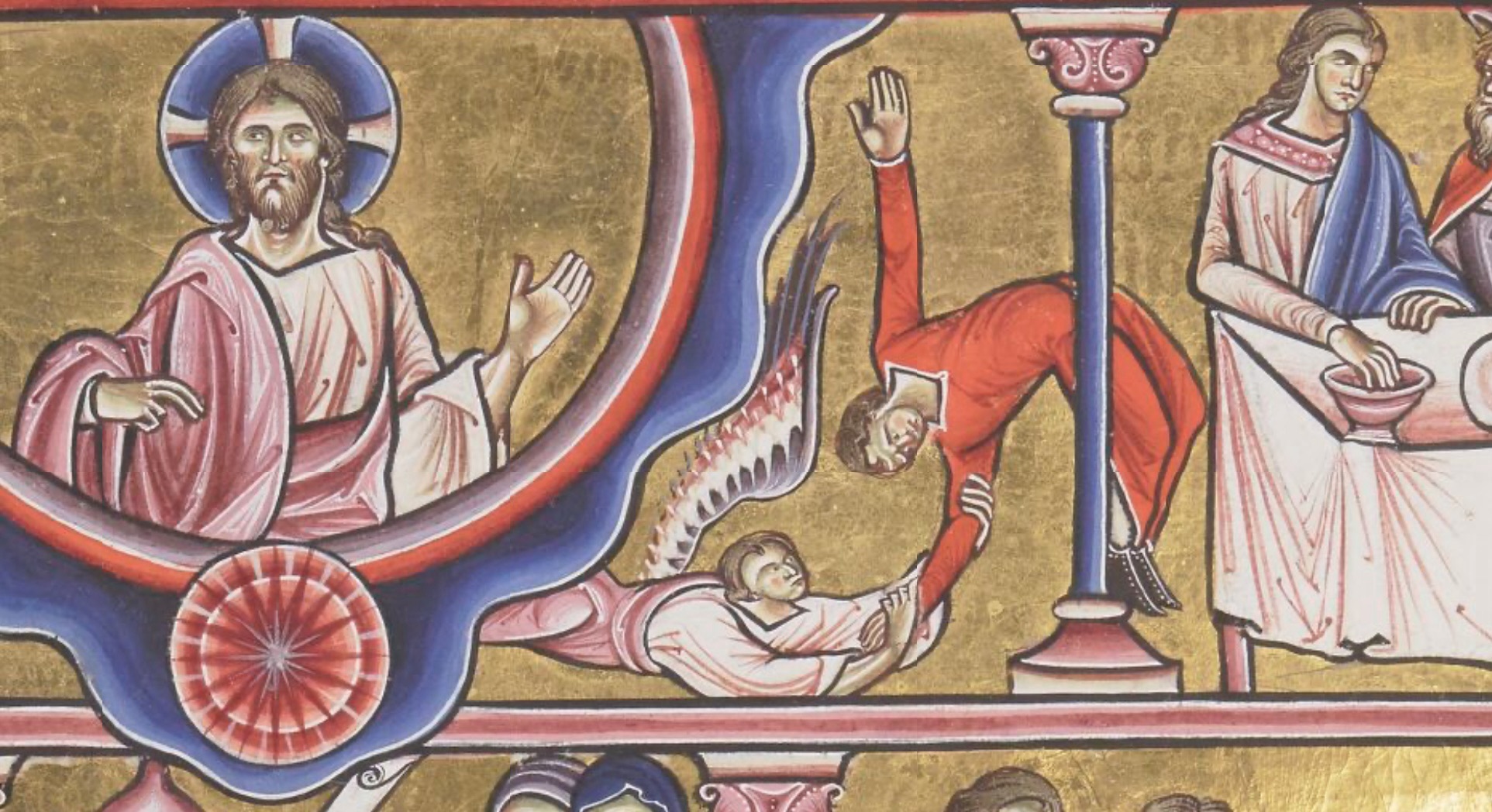
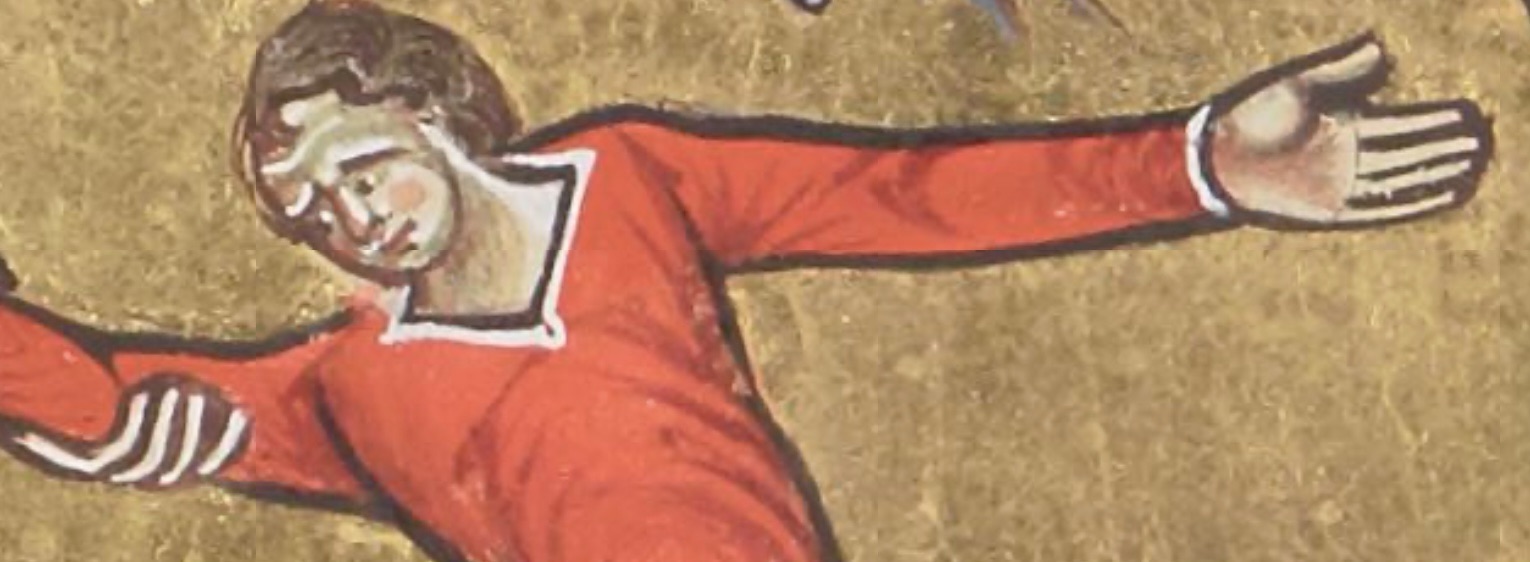
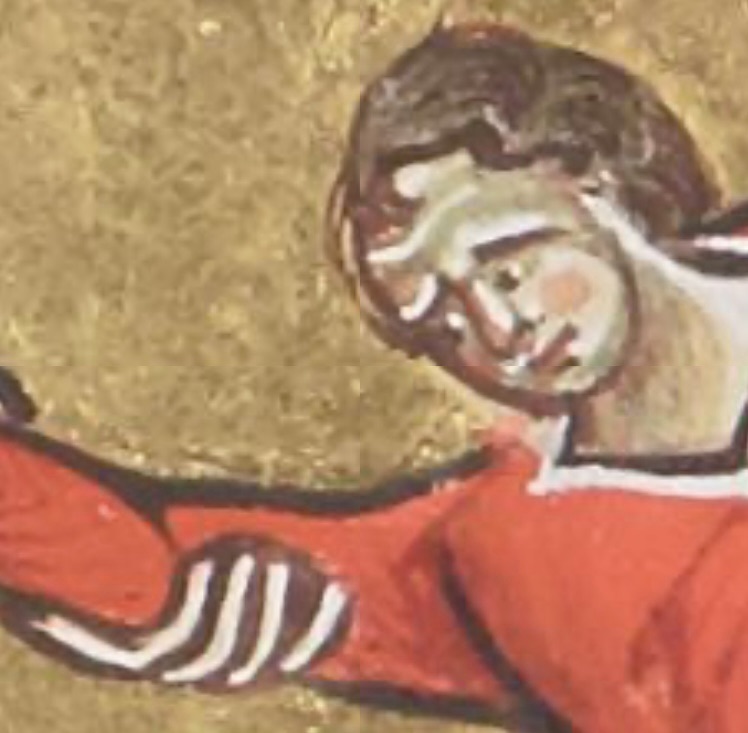
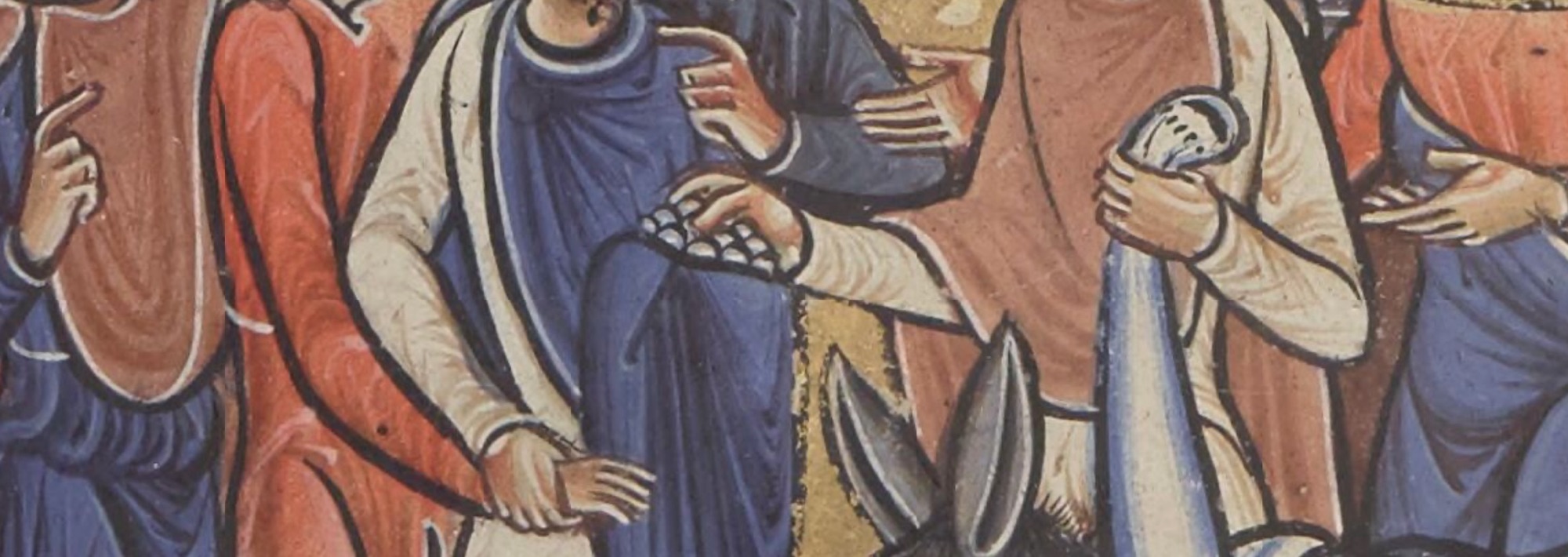
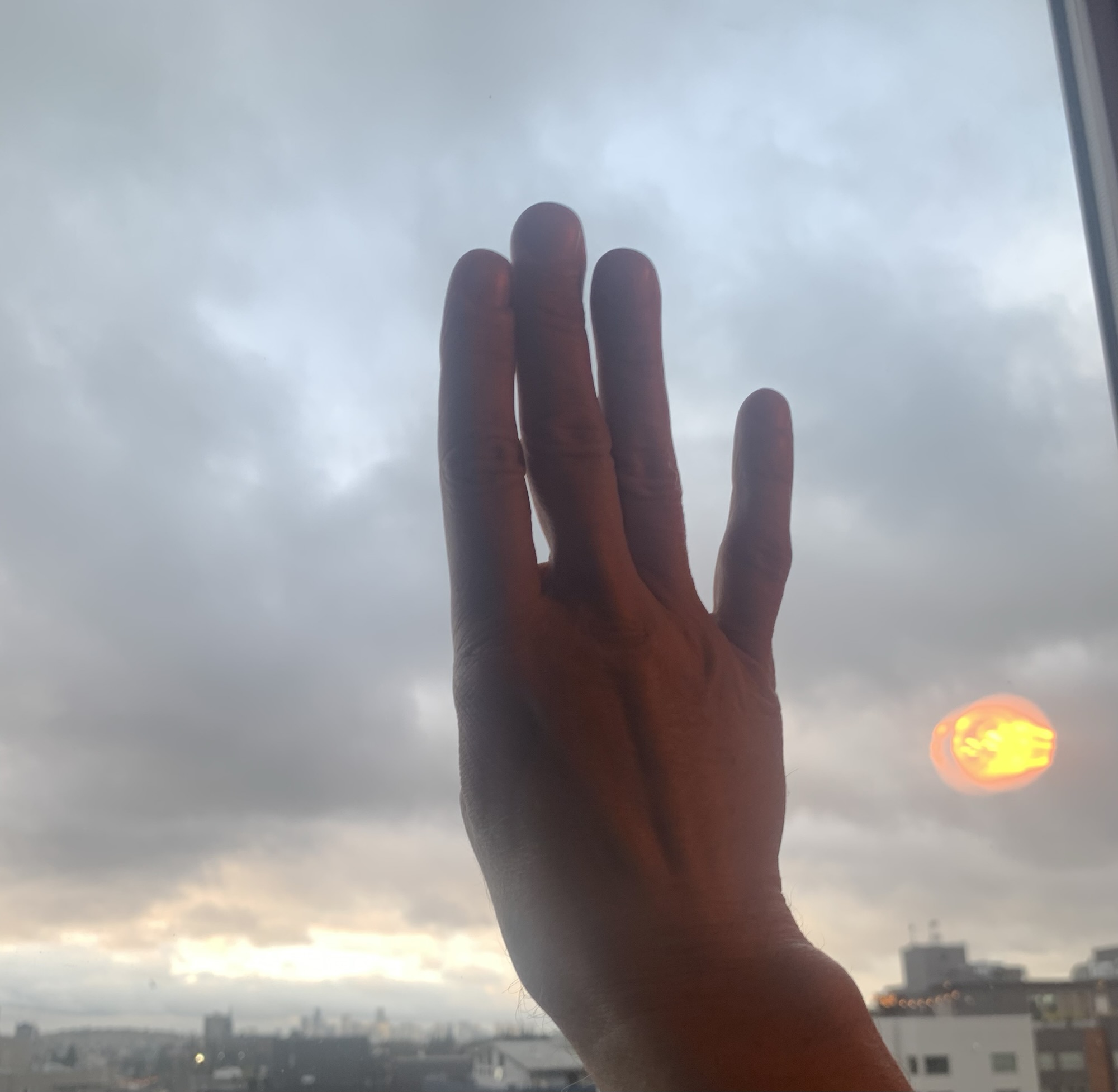
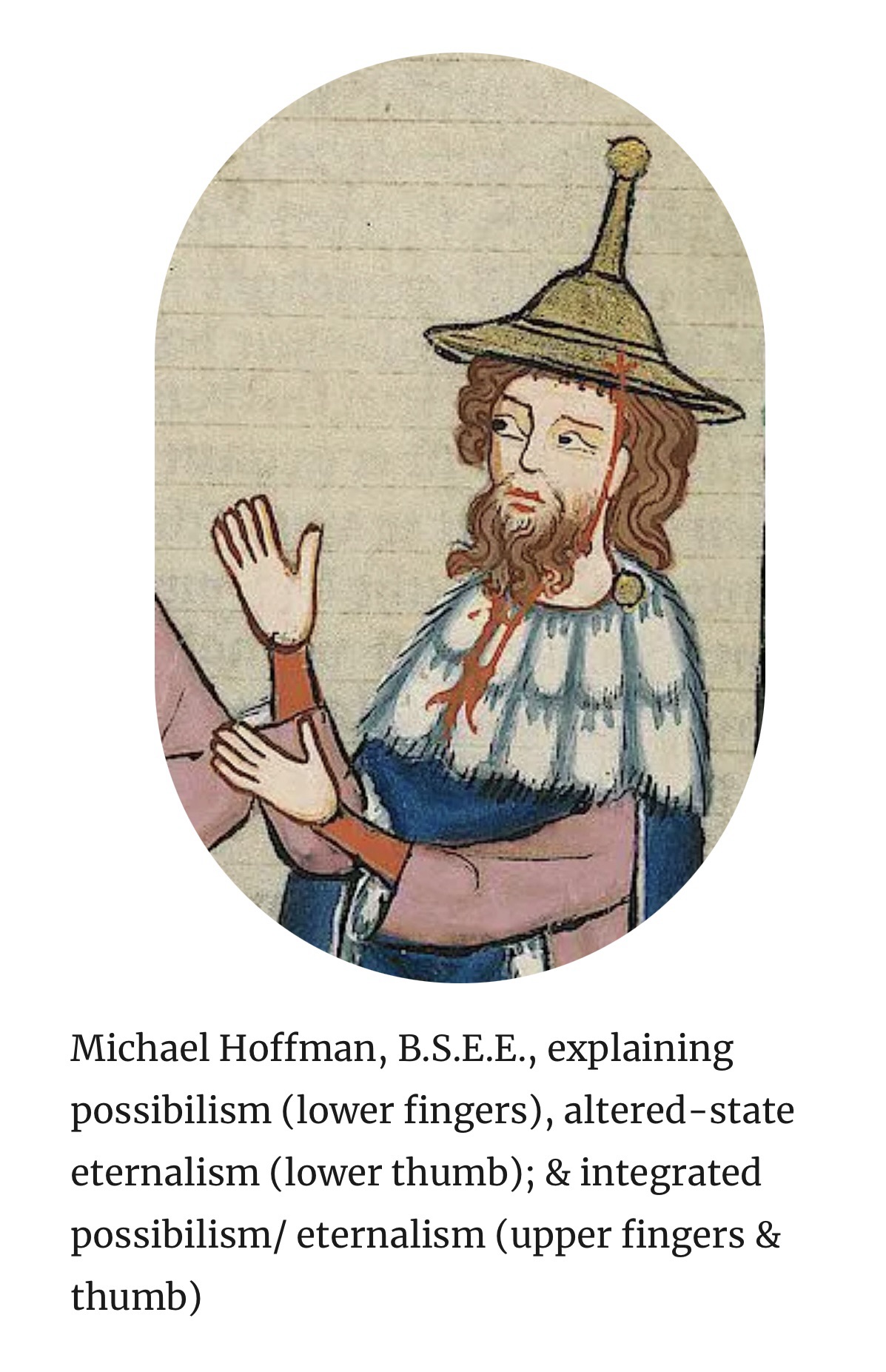
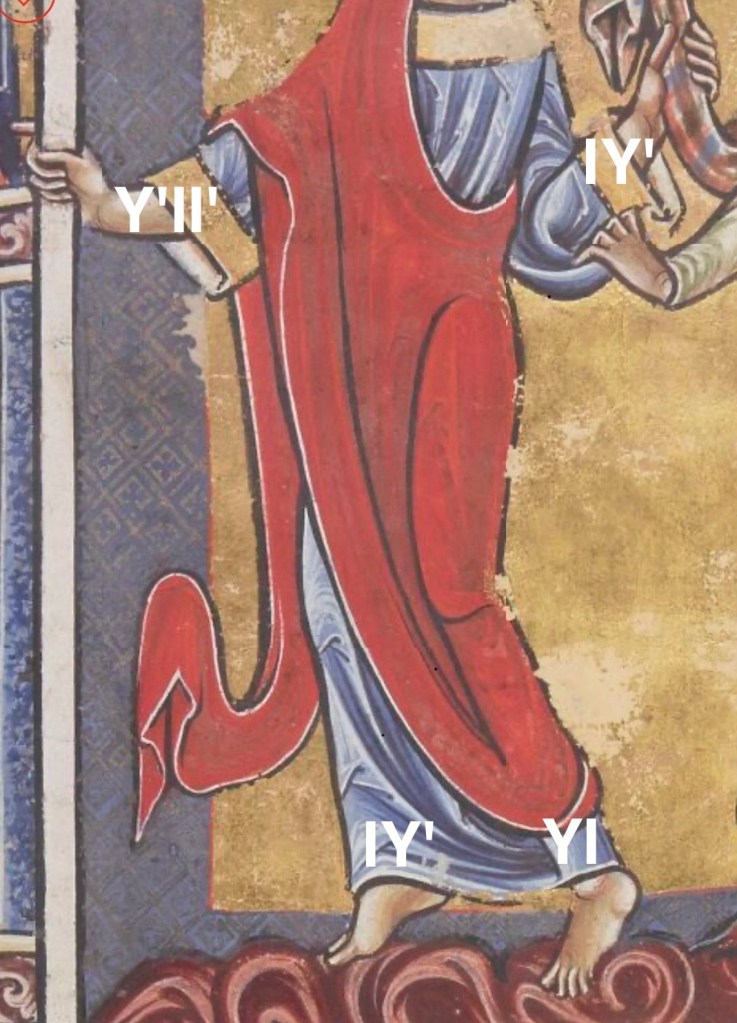
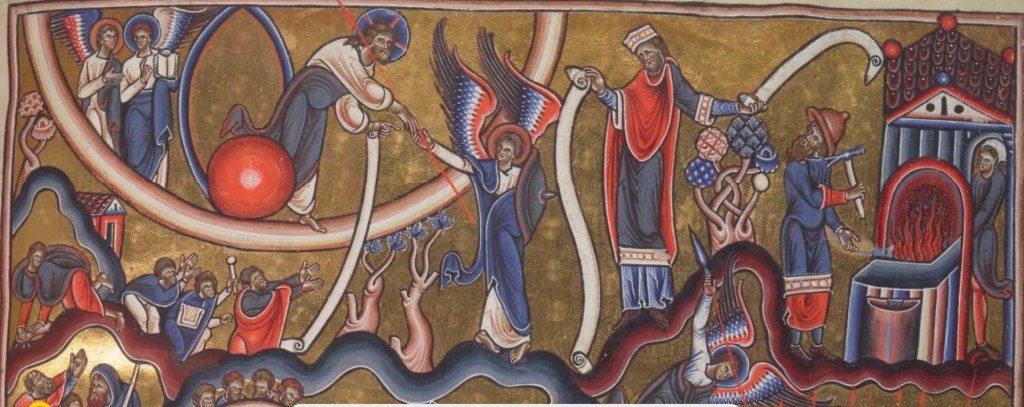
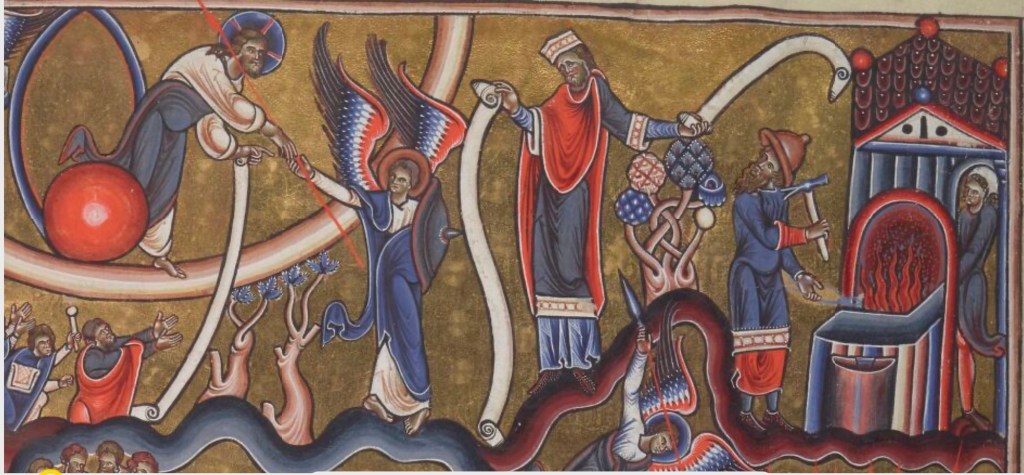
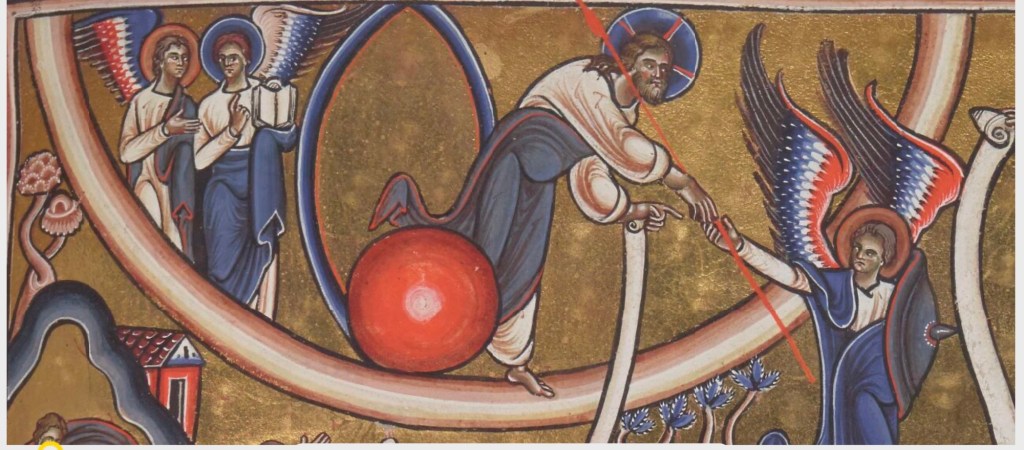
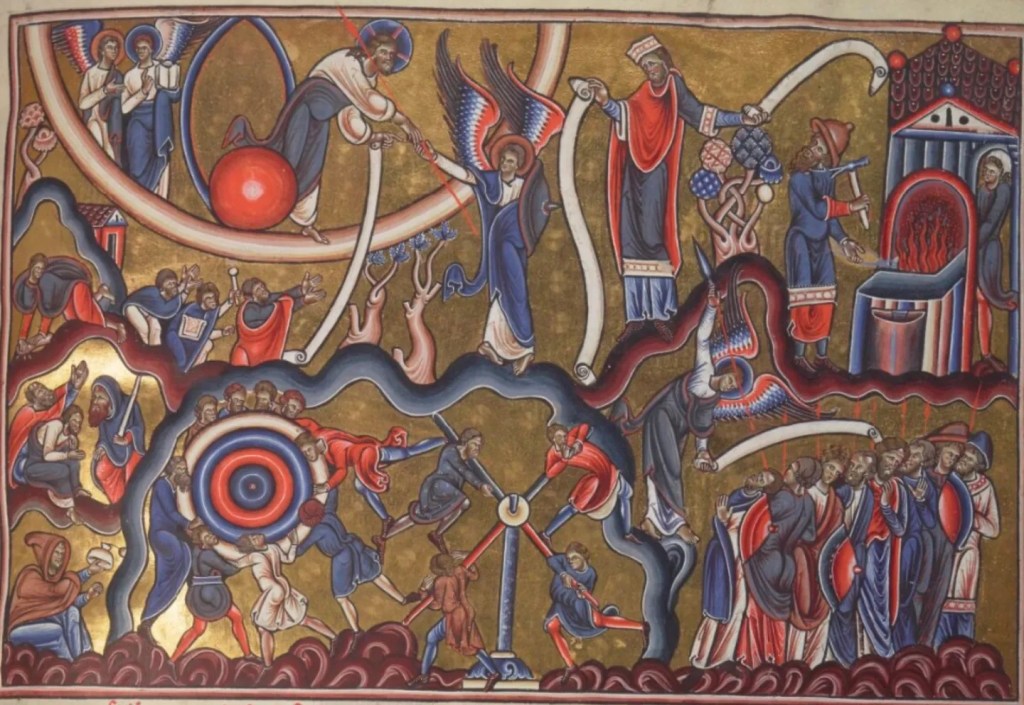
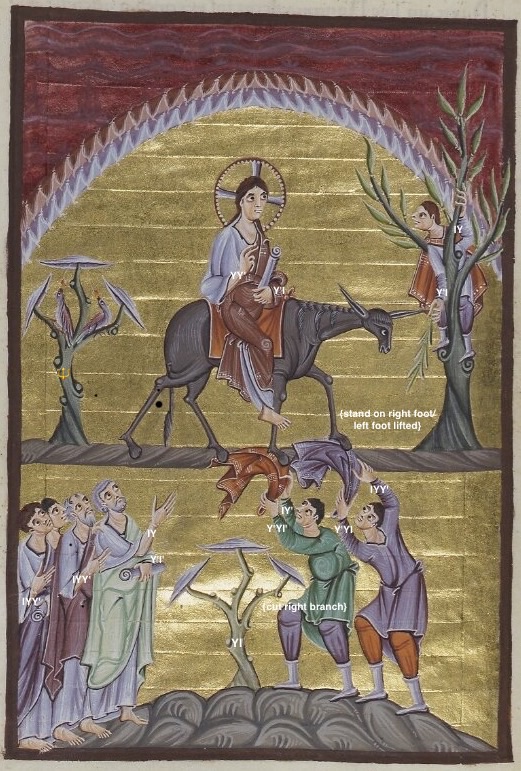
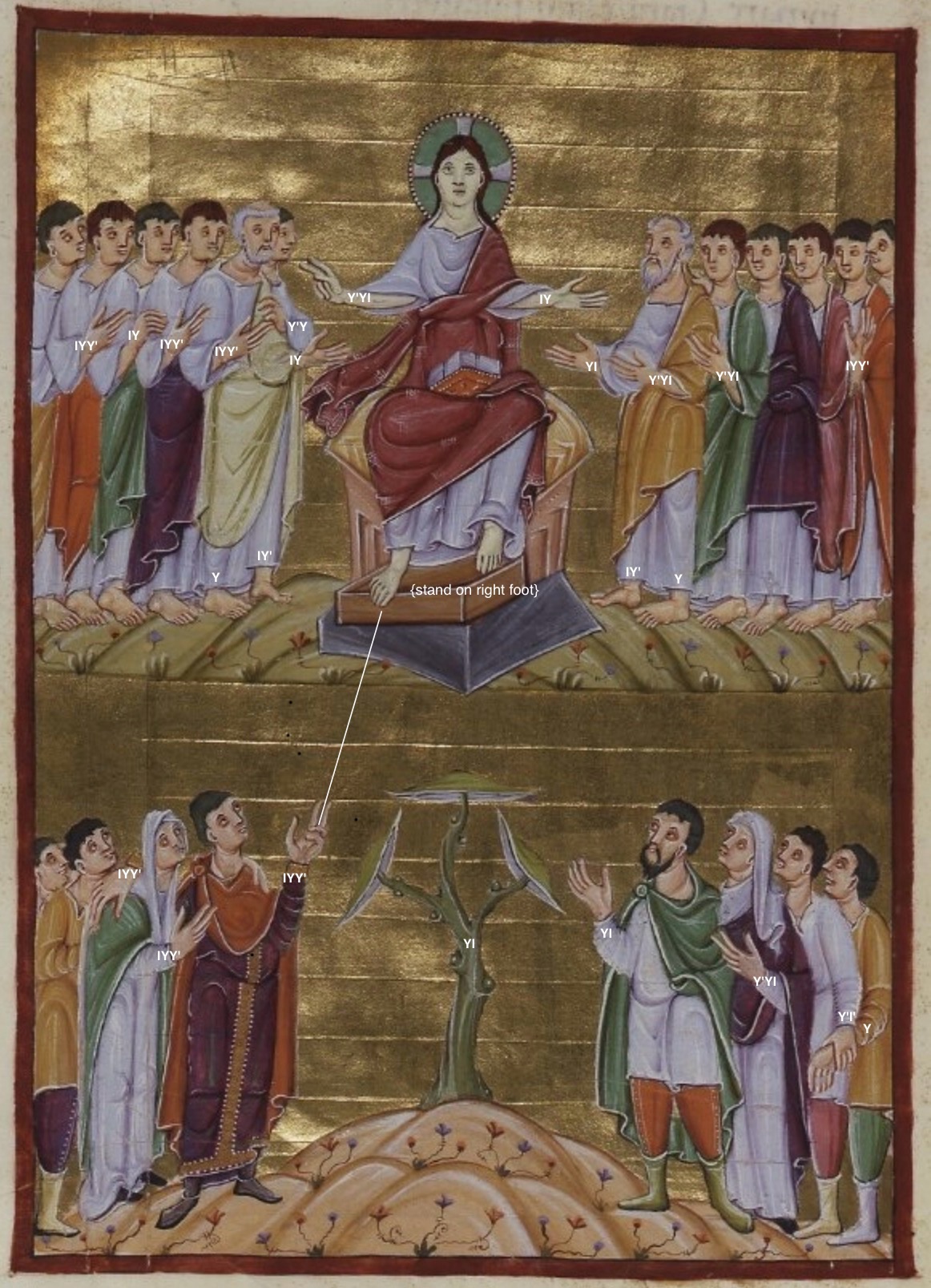
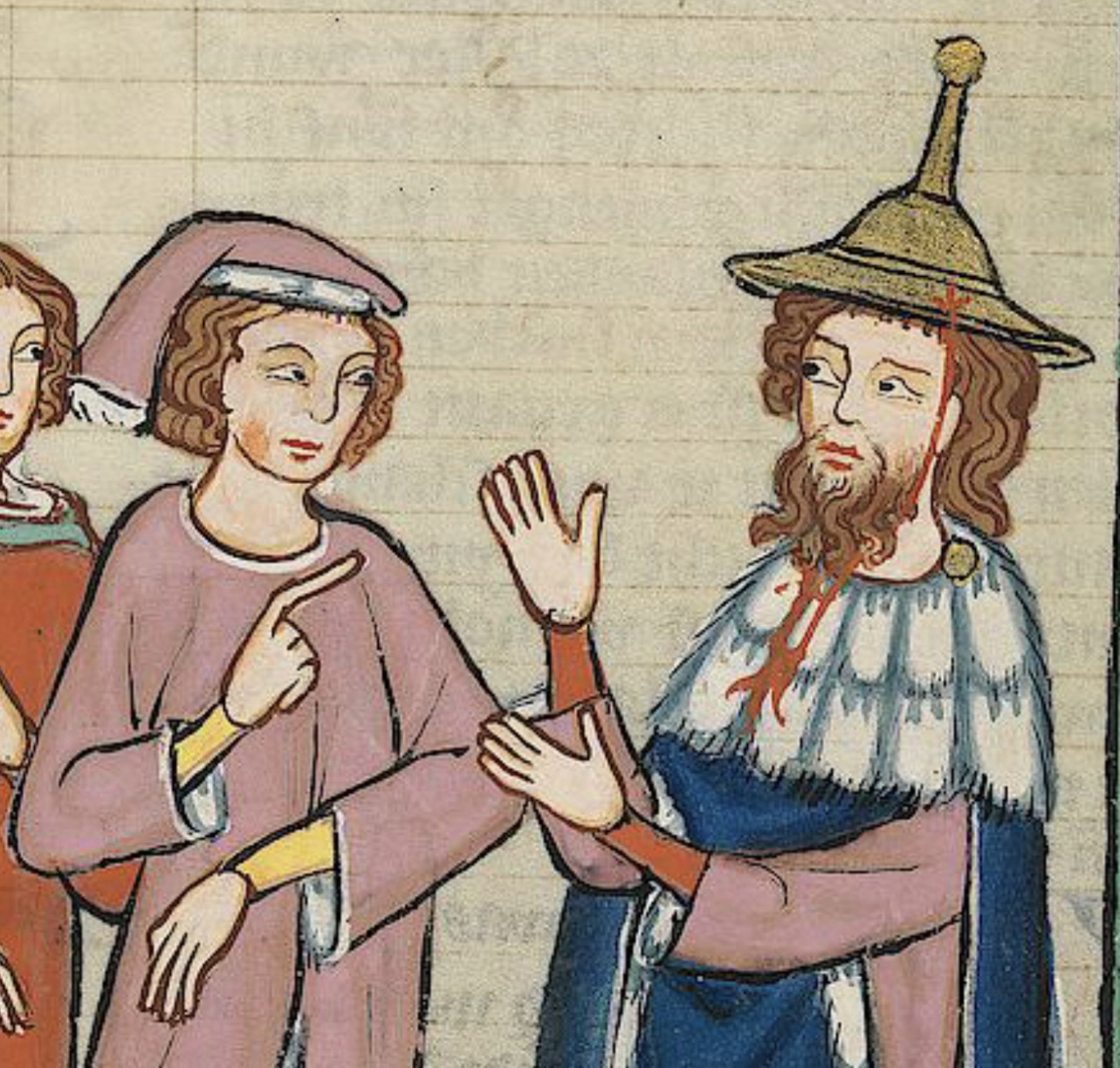
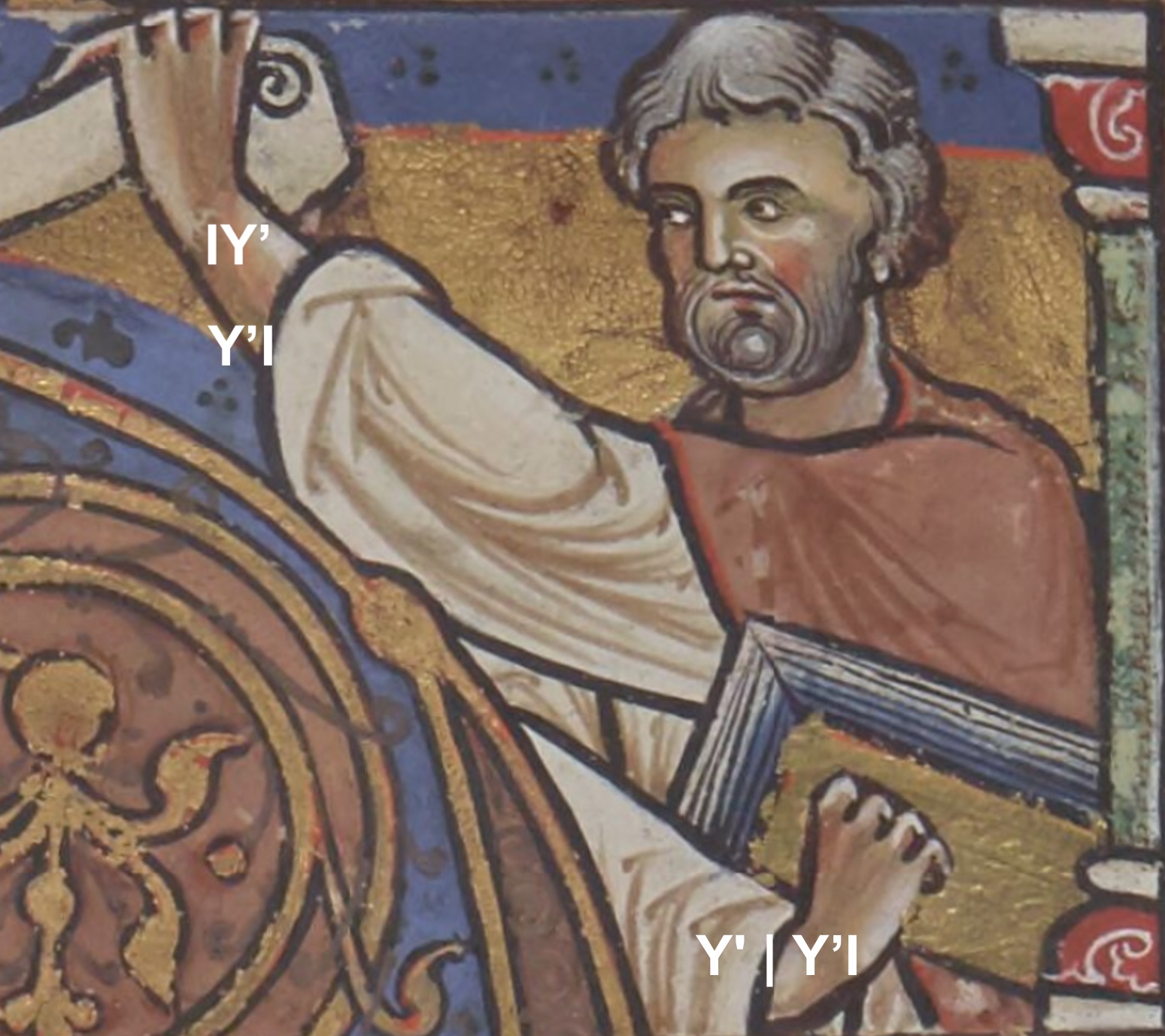
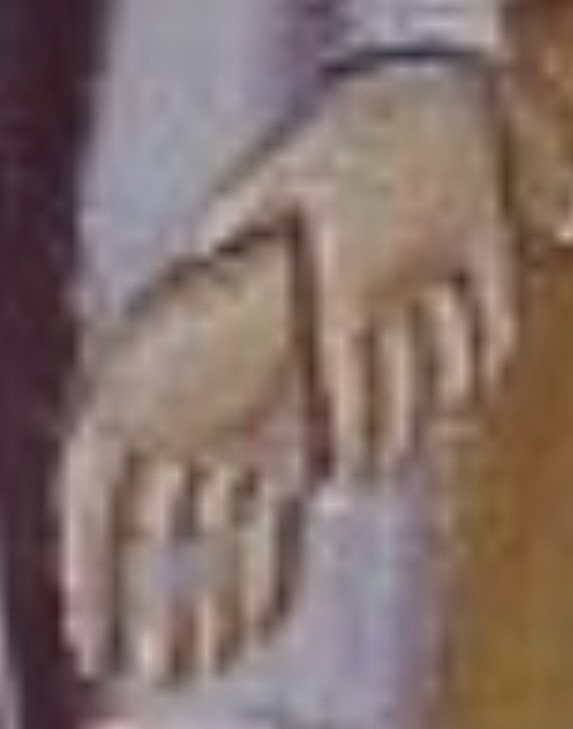
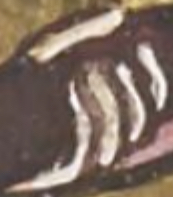
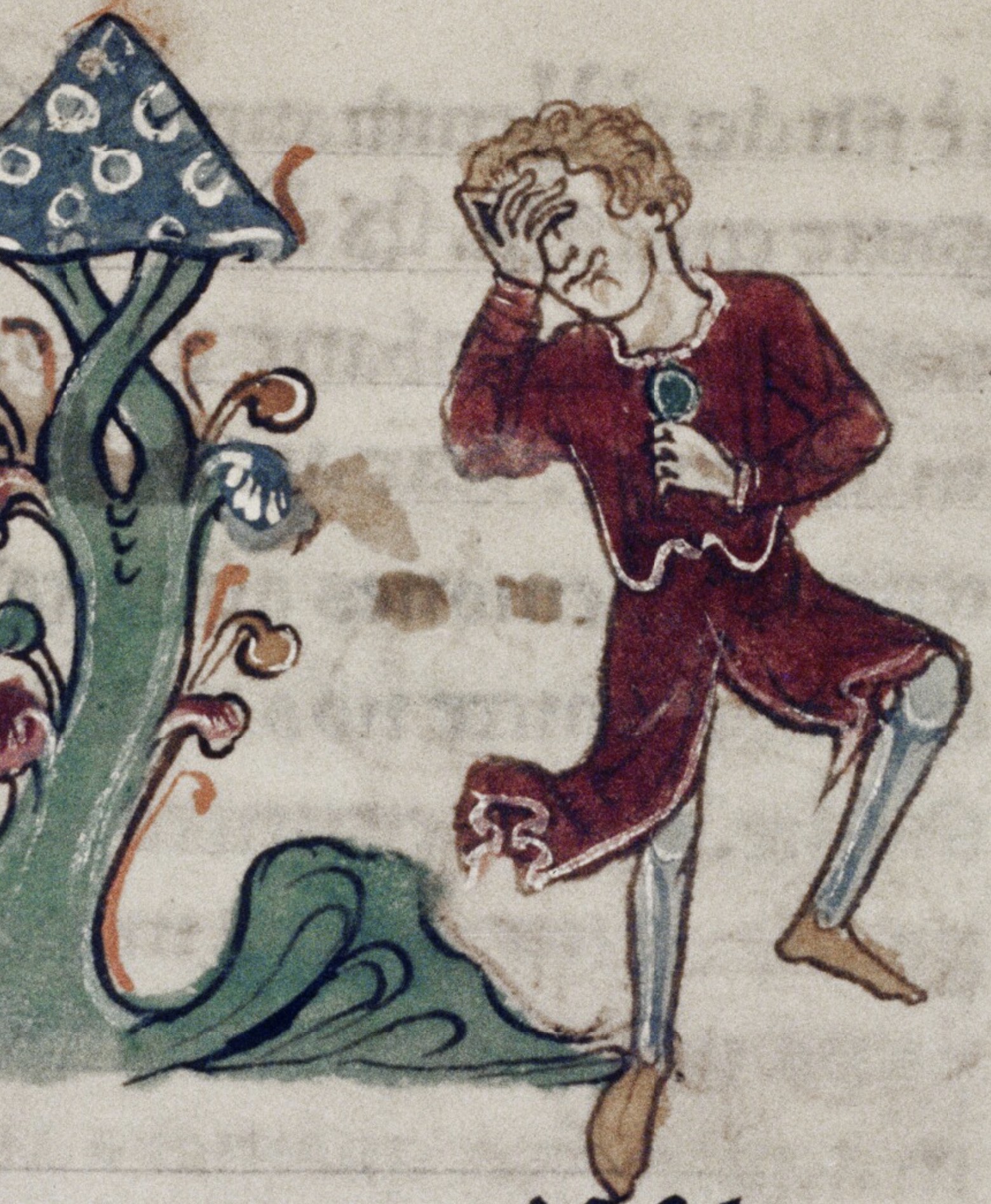
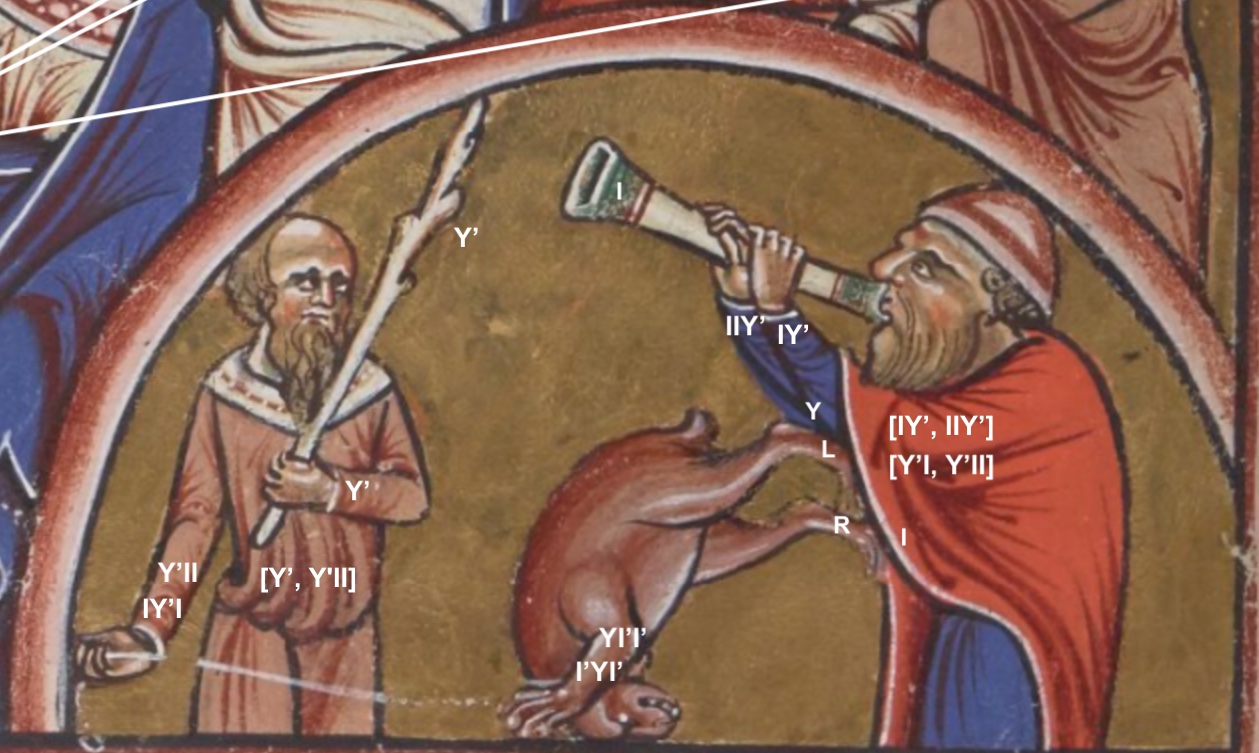
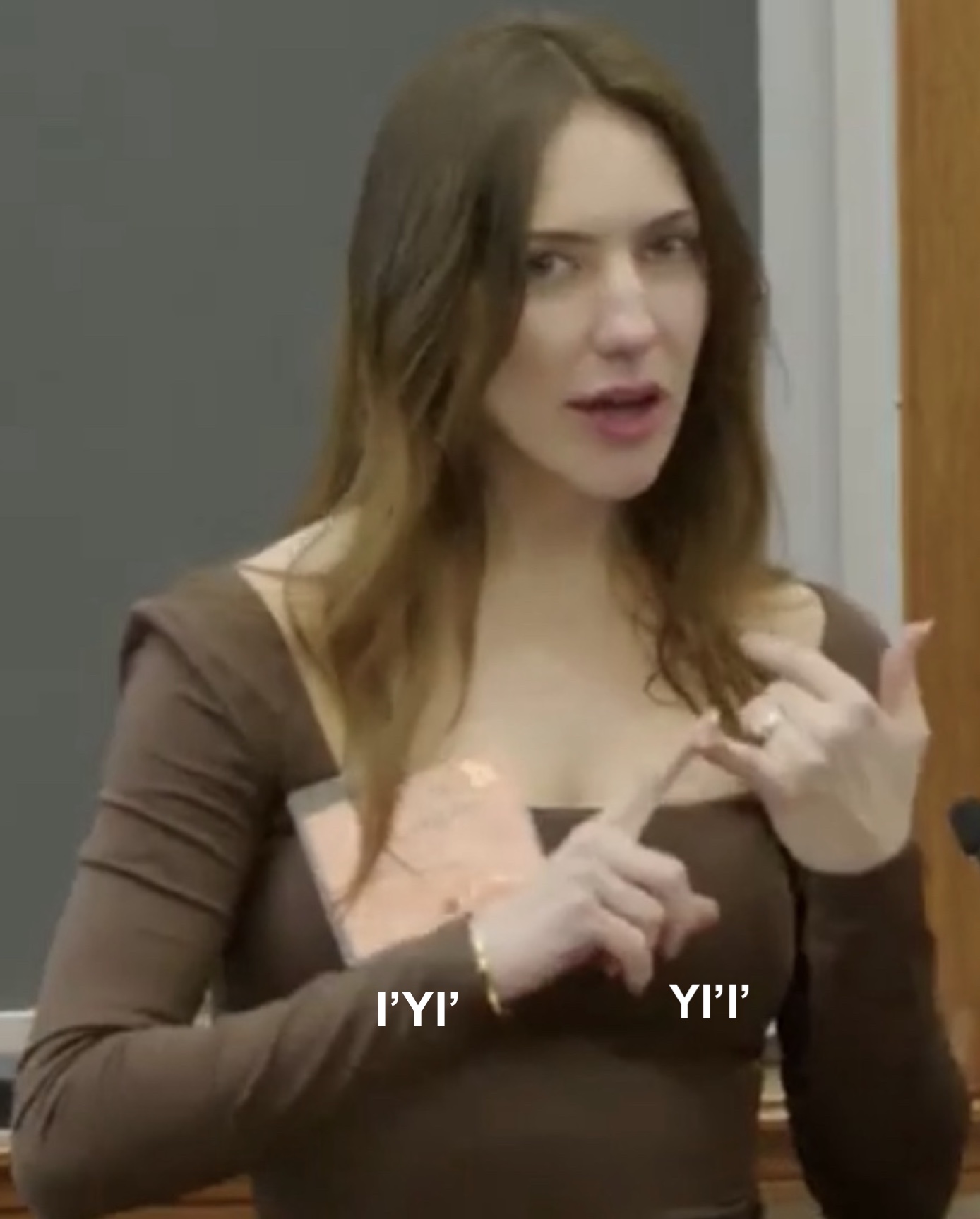
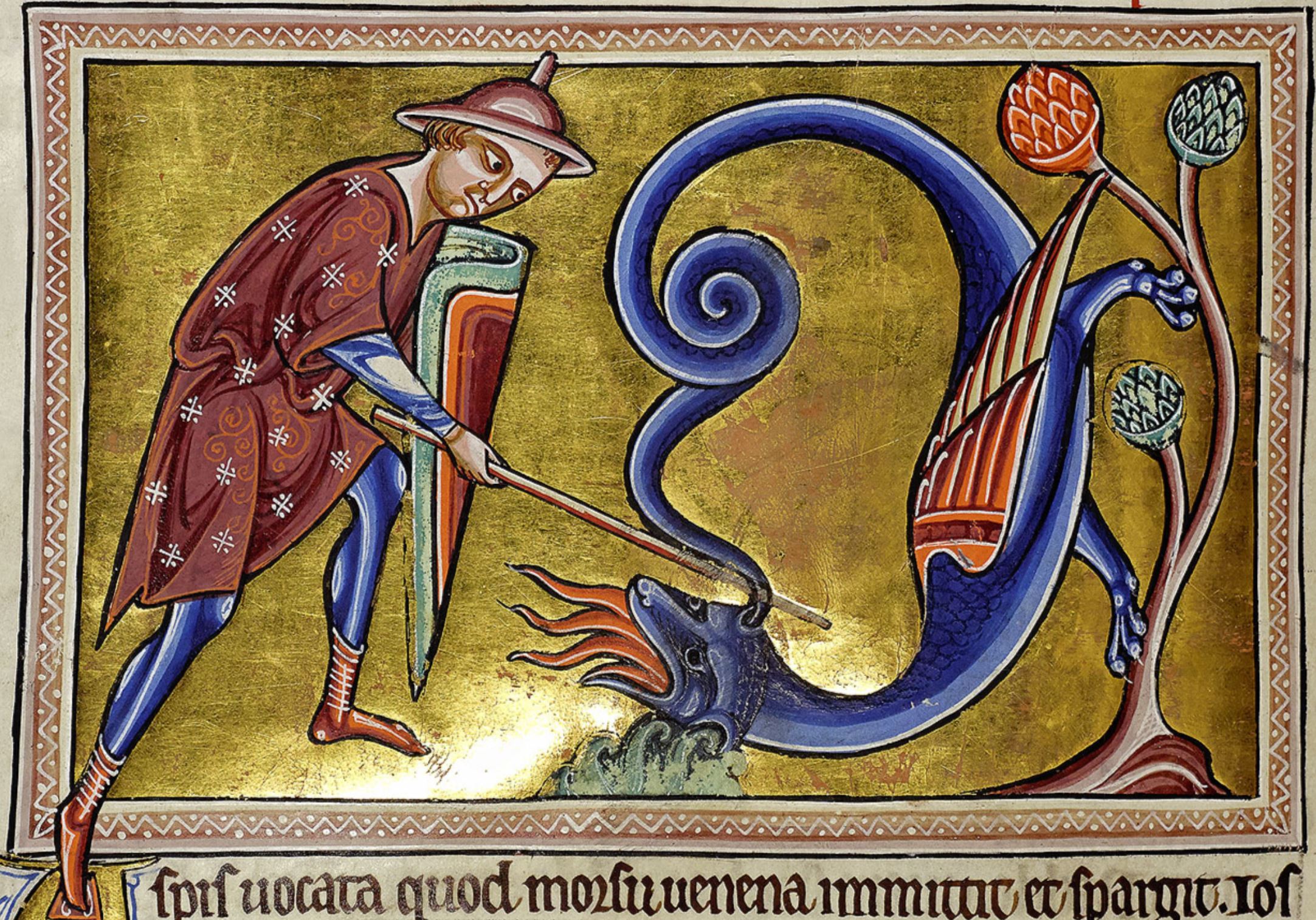
Task 1: Make Sense of the Strange Index Finger, by Recognizing It as Combining Two Standard Modifiers: Splayed AND Bent
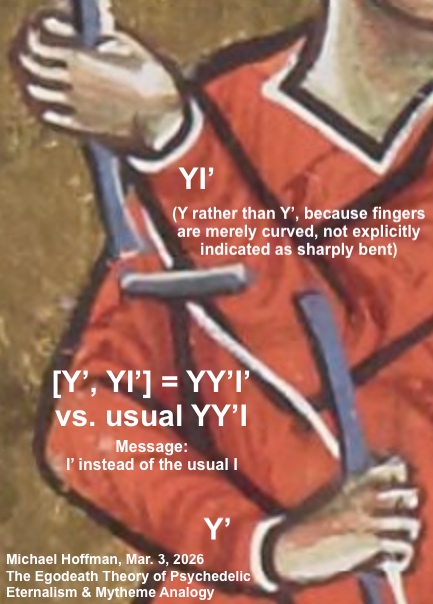
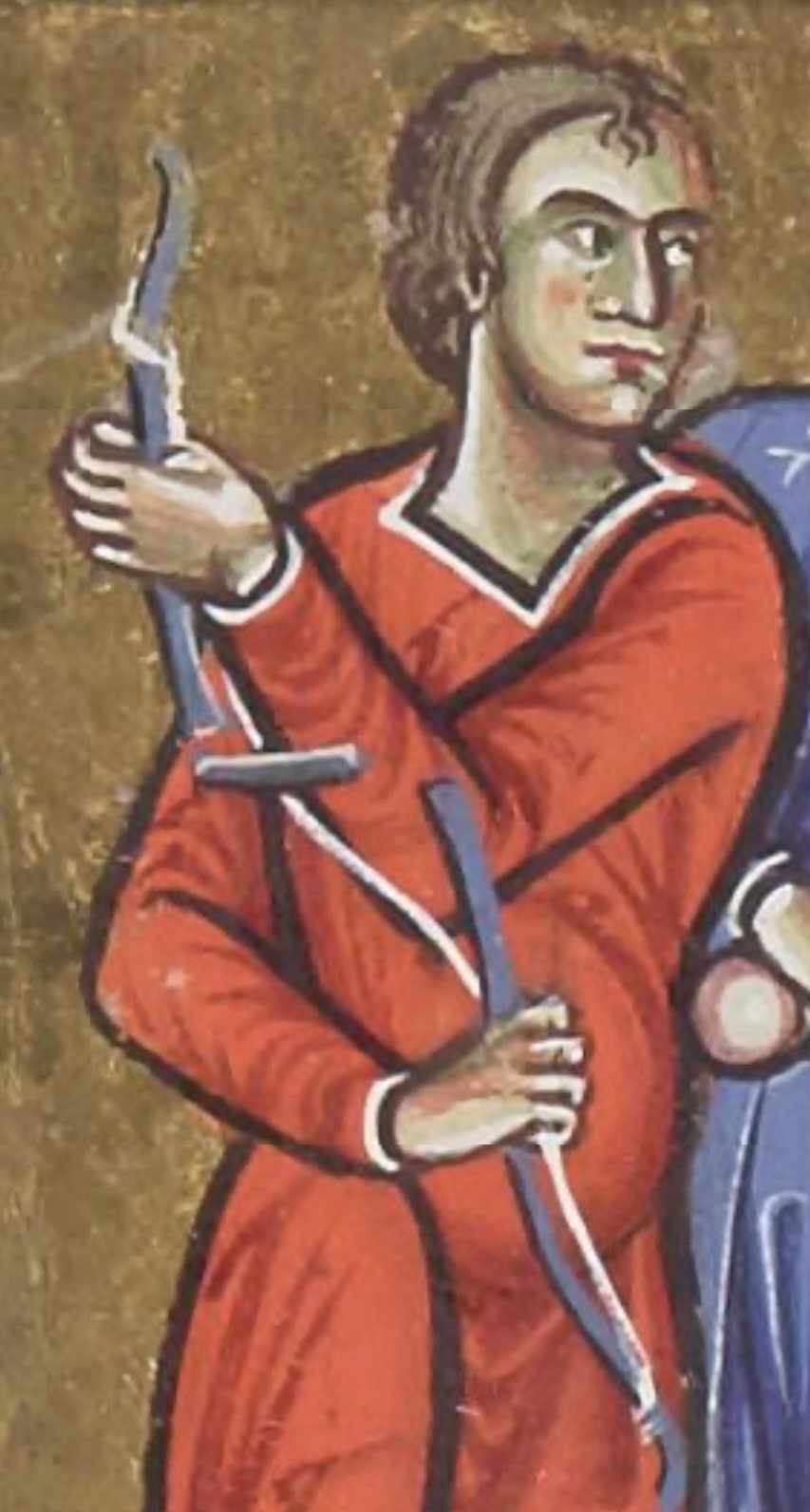
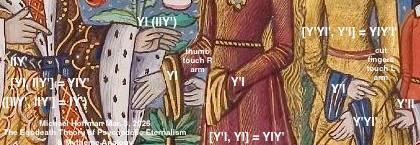
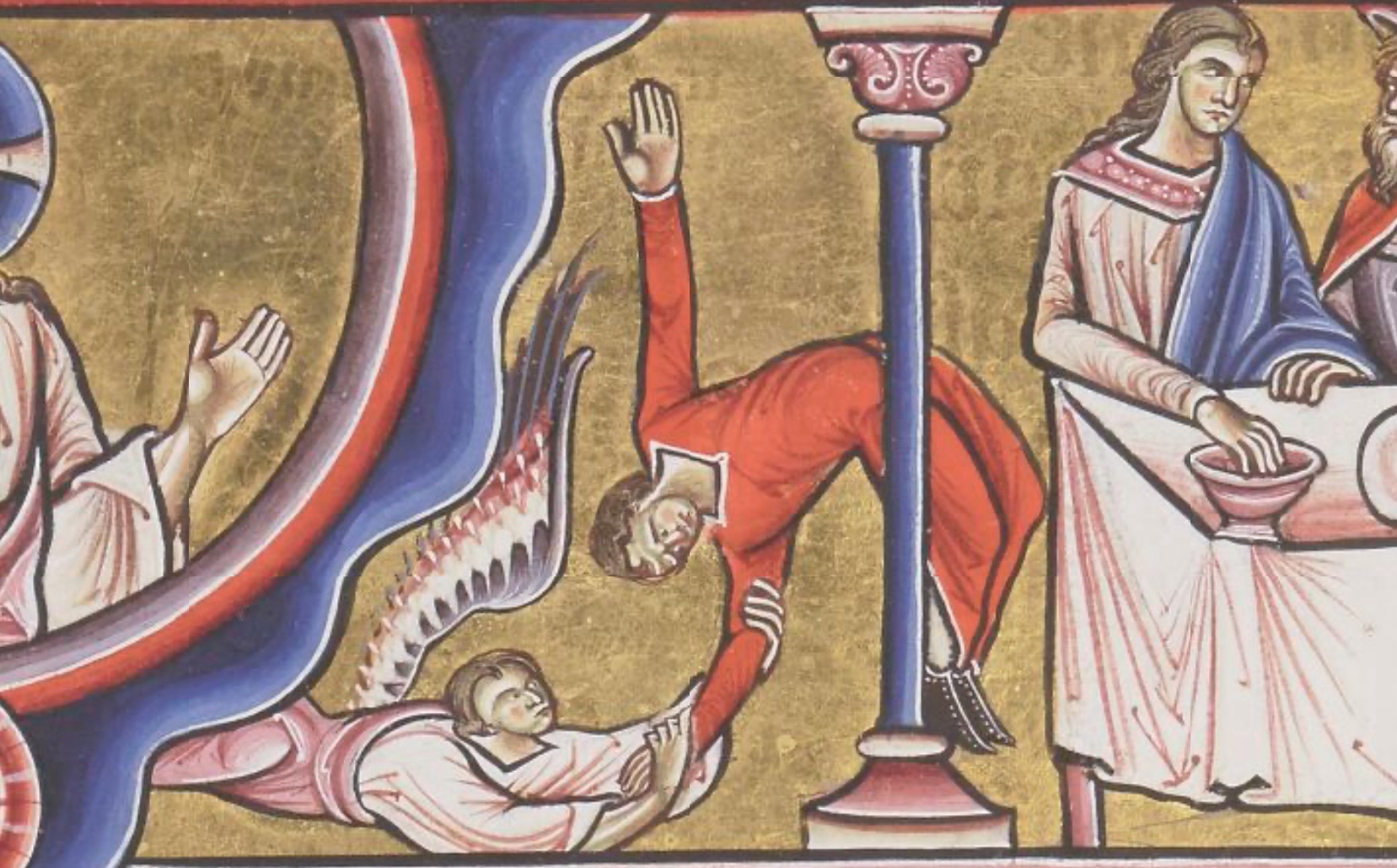
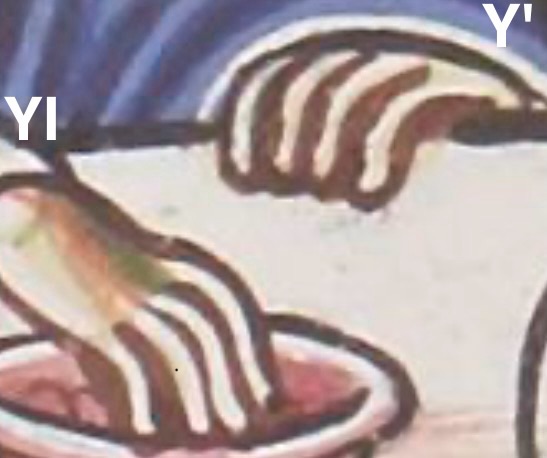
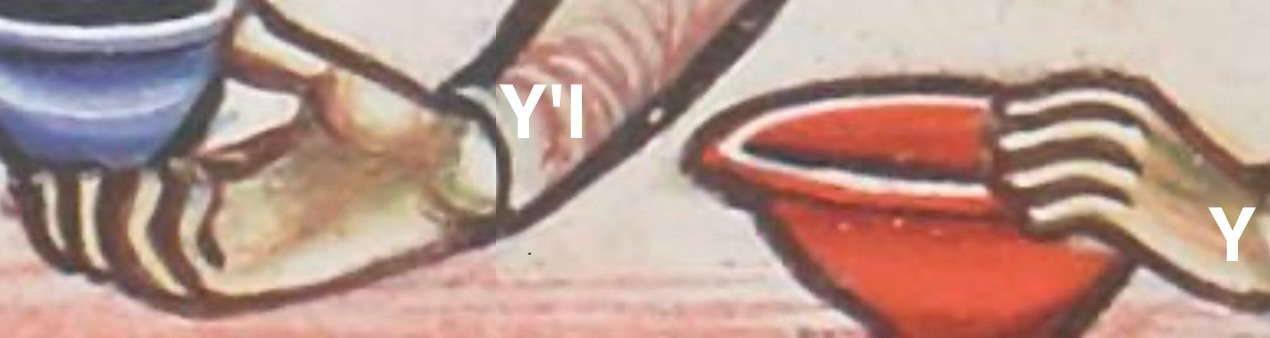
Task 2: Analyze the YI Hand-Shape Pair to See Which of the 4 YI Shapes Are Present: Not the Standard YIY’, but Rather, YI’Y’, Highlighting the Less Common, Oddball Shape: I’ (Cut Non-Branching)
I’ can mean the ego death aspect of eternalism.
Task 3: Explain How the 4 Shapes Are Used in This Case, to Illustrate This Storyline (Dying from Salamander Poison): “Awake” Shape (I), Inverted by Bend (I’), Becomes “Super Asleep”, ie. DEAD
There Is Plenty of Proof of How to Interpret YI Hand-Shapes, to Extract the Rules, After Surveying Enough Art Instances
Intro
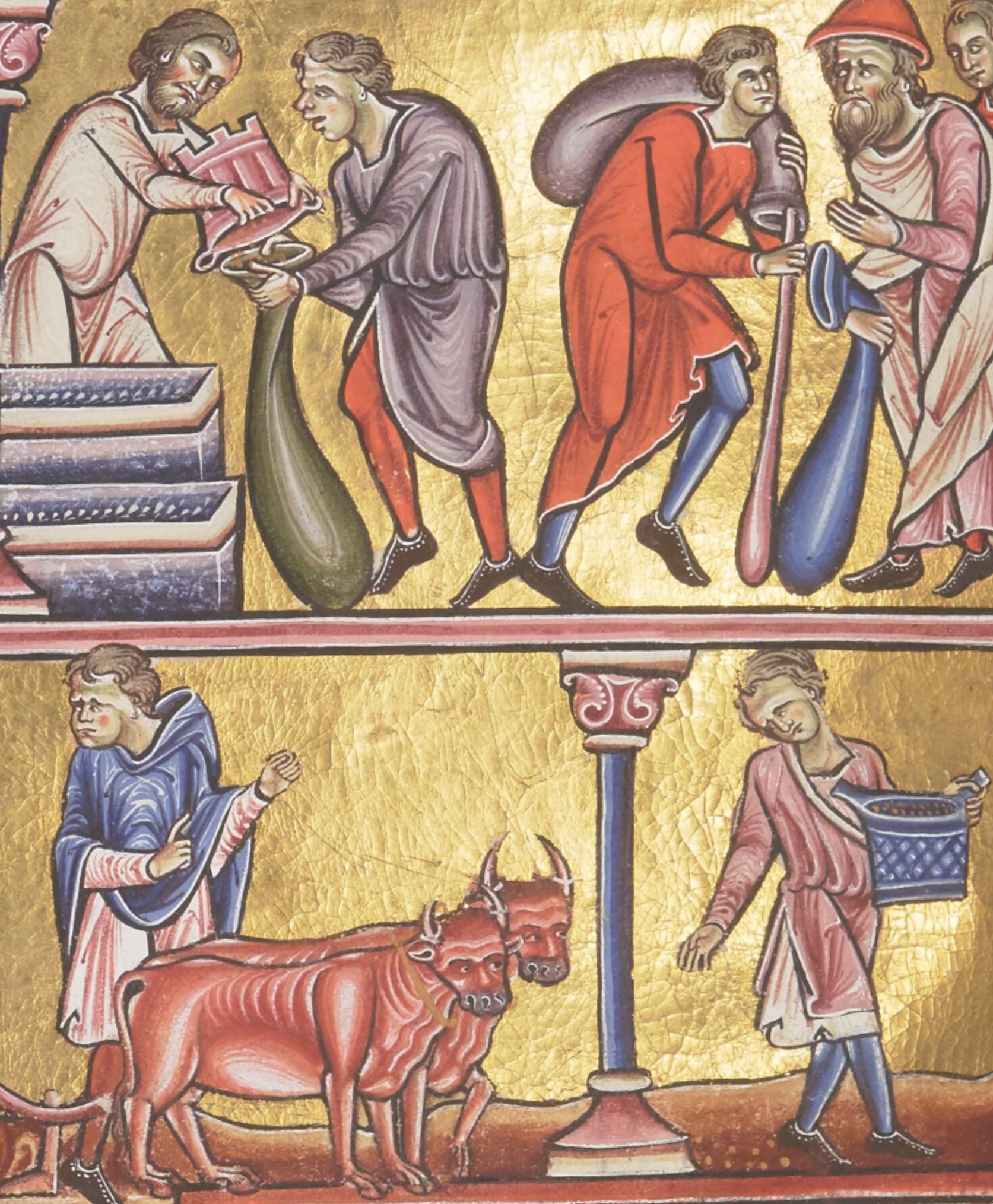
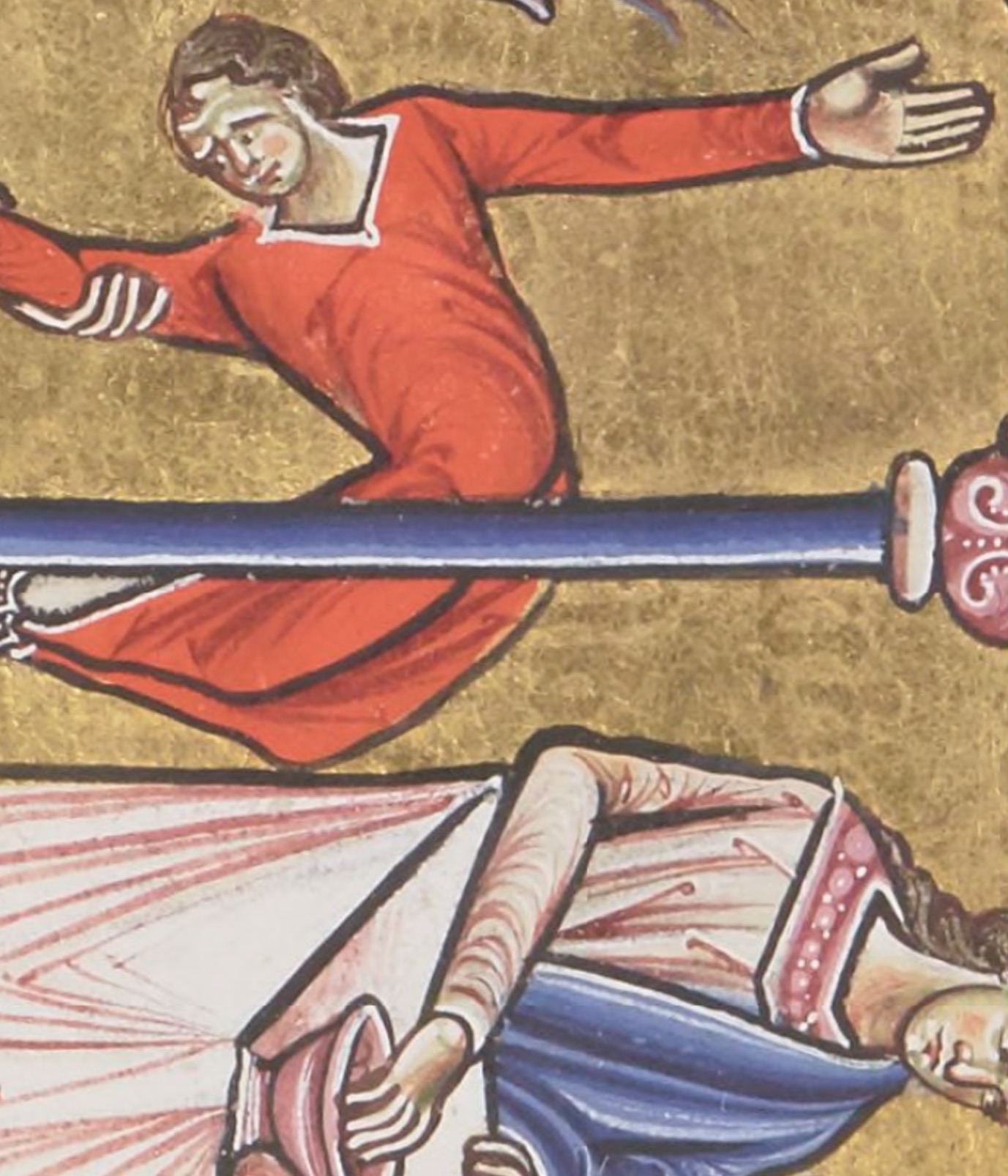
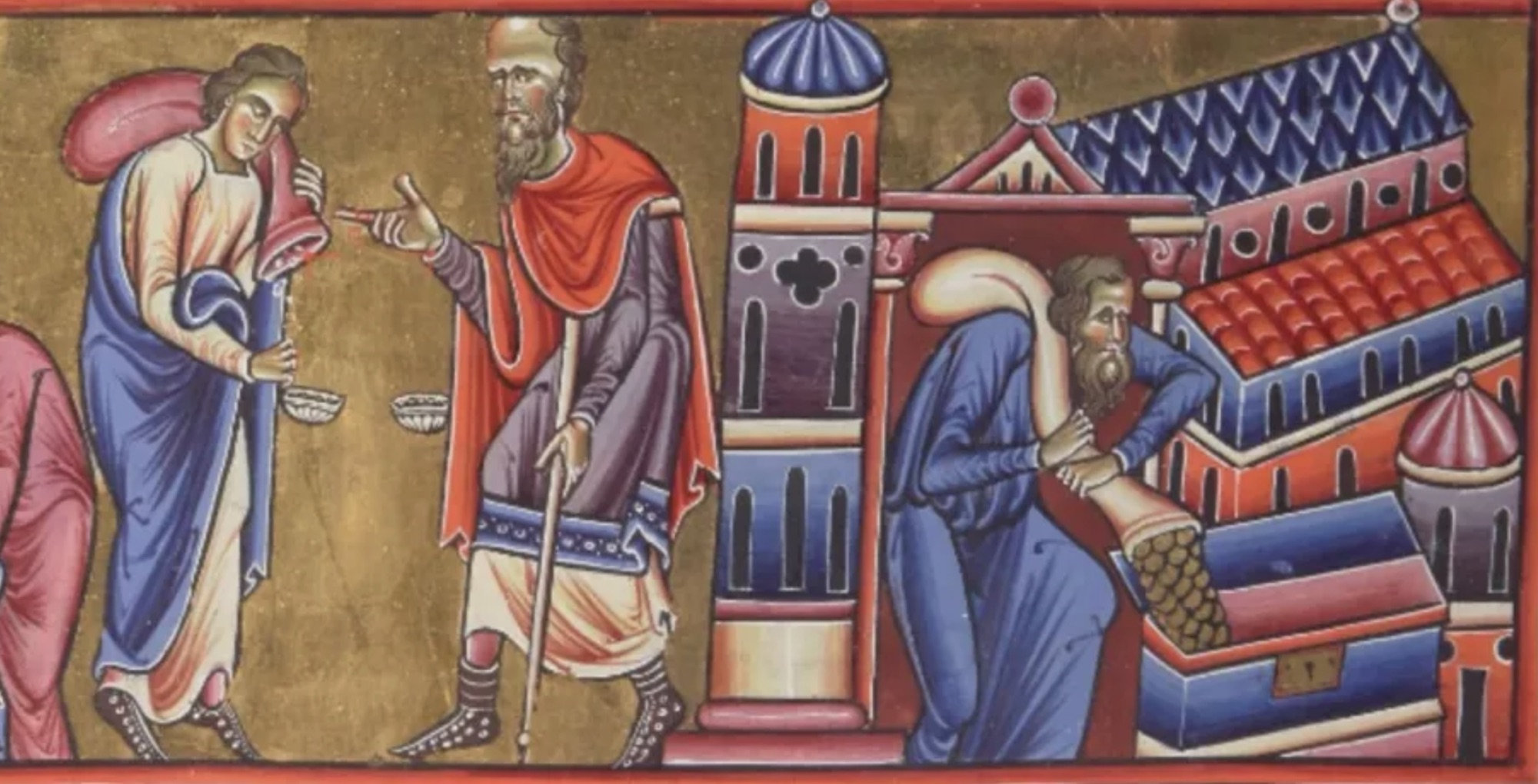
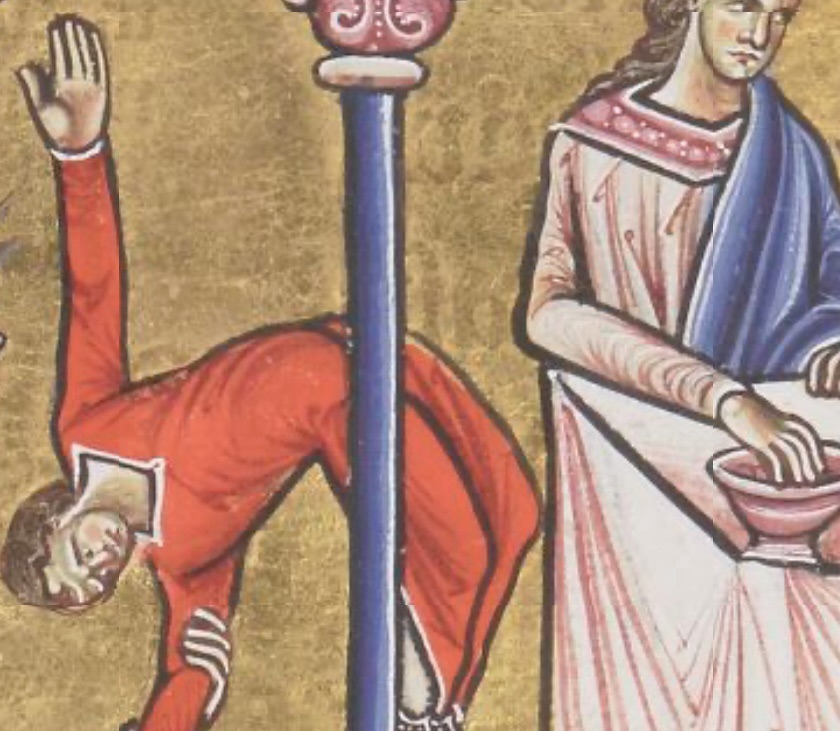
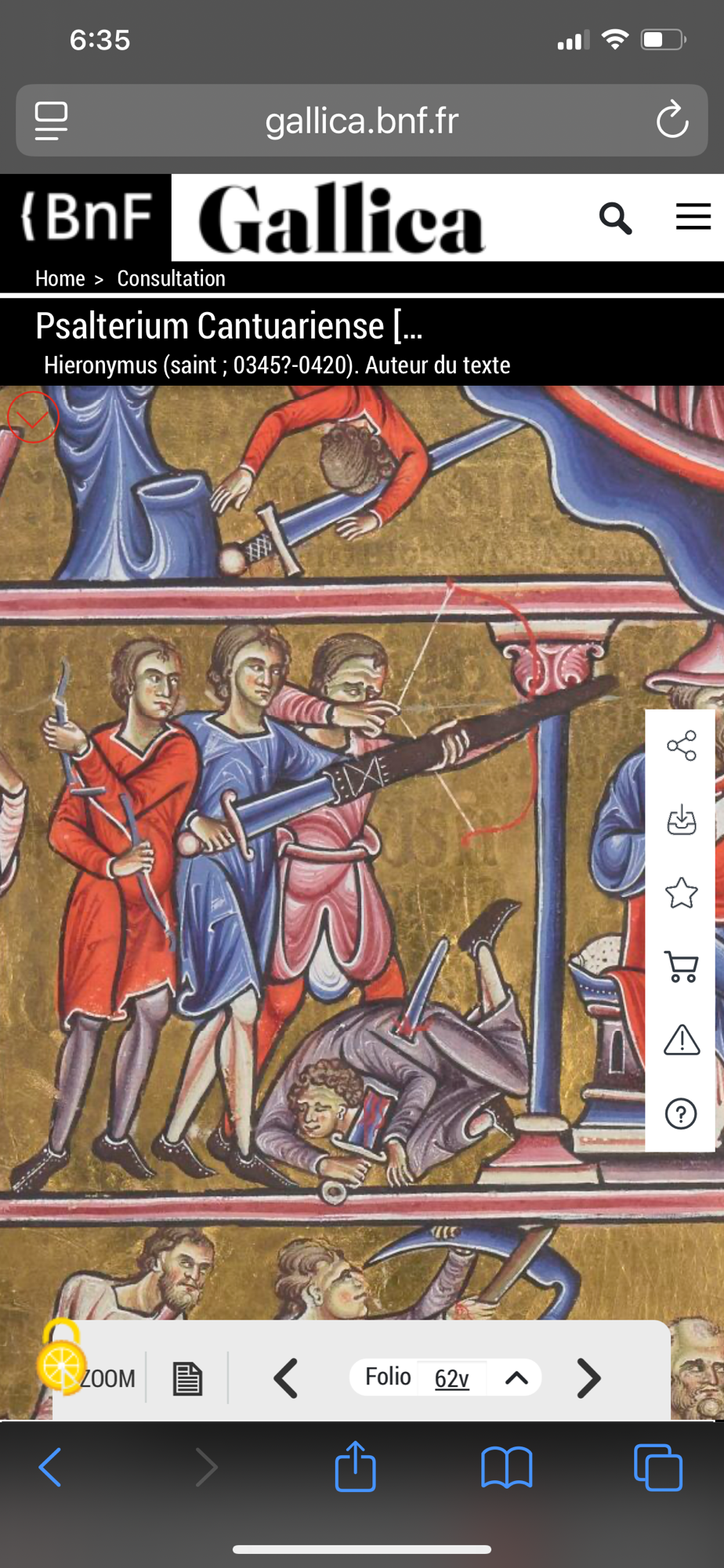
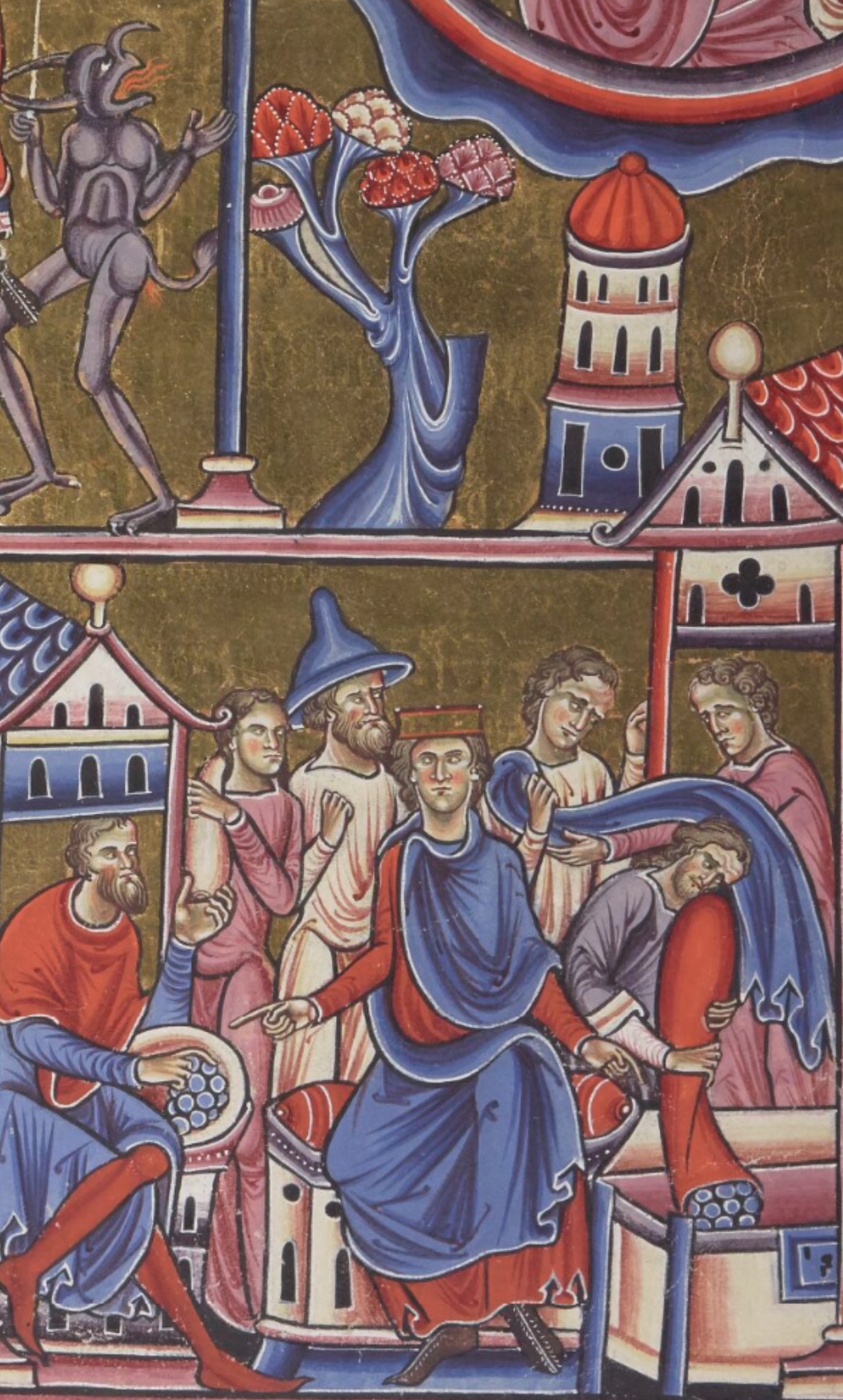
Solved Dancing Man Hand-Shape Pair: Index Finger Splayed & Bent, I & I’; Non-Branching & Cut Non-Branching
Separate the Formation of the 4 Branching Shapes vs. How the Shapes Are Used
Separate the Identification of Which of the 4 Branching Shapes (I and then I’) from How That Shape Conveys “Dying from Salamander Poison”
The finger form DEFINITELY expresses I and then I’.
Exactly how the I’ form is suitable to represent or illustrate “Dying from Salamander Poison” is a matter of taste and is debatable.
Y = branching
I = non-branching
Y’ = cut branching
I’ = cut non-branching
txt msg 1 to AM, a.m. Monday, March 2, 2026
some artists got a little carried away with the YI hand-shapes
txt msg 2 to AM, p.m. Monday, March 2, 2026
dancing man index is over-modified, or at least, is DOUBLE MODIFIED.
both splayed AND ALSO bent!
SPLAYED: The Standard Meaning of “Splayed Finger, Separate from Grouped Multiple Fingers”
The Index finger, if splayed apart from a group of 3 other fingers that form a “branching” Y shape, means the I shape.
BENT: The Standard Meaning of “Bent Finger or Fingers”
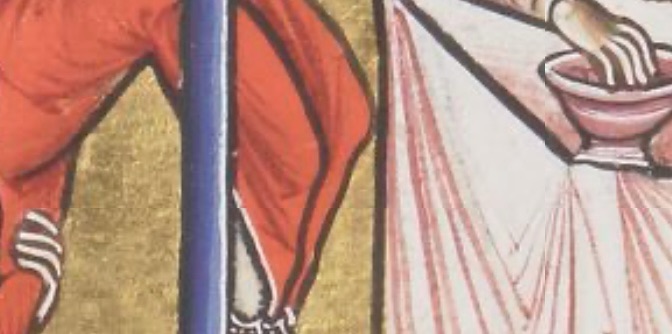
As we see and define most basically in the motif of “4 fingers, bent sharply, showing only the base segment of each finger, like cut branches”, the “bent fingers” motifs mean negated, qualified, or “not”.
It’s not exactly a matter of counting finger-segments.
Rather, the main, basic, foundational idea is:
Here’a hand-tree that has 4 branches – now we SHOW those 4 branches, but ONLY the base segment of each finger; thus we show 4 CUT branches, expressing the Y’ shape, ie, “cut branching”.
The Y’ shape, “cut branching”, means the negation of branching Possibilism.
The Y’ shape does not directly mean the assertion of I-shape non-branching.
Assert or rebut.
Y’ rebuts branching. It’s called “cut branching”.
I asserts non-branching.
A finger if bent at right angle means qualified or countered (Prime)
that plays the game of depicting all 4 hand-shapes in a clever way
All 4 YI Hand-shapes Are in Dancing Man’s hand-shape pair: Y, I, Y’, I’
given that the finger carries BOTH qualifiers (splayed AND bent), all 4 hand-shapes are expressed in Dancing Man’s hand-shape pair:
Names of the 4 Shapes: Y (branching), I (non-branching), Y’ (cut branching), I’ (cut non-branching)
The Four Branching Shapes: Y I Y’ I’; Y (assert branching), I (assert non-branching), Y’ (rebut branching), I’ (rebut non-branching)
Wording 1
Y = assert possibilism
I = assert eternalism
Y’ = rebut possibilism
I’ = rebut eternalism
Wording 2
Y = assert branching
I = assert non-branching
Y’ = rebut branching
I’ = rebut non-branching
Wording 3
shape 1: Y – branching; assert branching; assert Possibilism
shape 2: I – non-branching; assert non-branching; assert Eternalism
after we see non-branching I , then we {cut branching} : Y’
Shape 4: I’ = Cut Non-Branching
return from eternalism back to ordinary-state possibilism
I Shape = Non-Branching Eternalism
I = non-branching eternalism, in the standard hand-shape genre psilocyb tradition art initiation.
To Be Educated Is to Know YI Hand Shapes and YI Tree Shapes
To be uneducated is to not know about YI hand-shape & tree-shape theory
In the medieval era, all of the educated class knew:
YI hand shapes
YI tree shapes
handedness
More narrow is my older combination of 4 motifs
{mushroom}, {branching}, {handedness}, and {stability} motifs
Of those 4 motifs, YI hand shapes goes into {branching}.
Mushroom-trees were present during the Medieval Warm Period explicitly, as part of {mushroom}, {branching}, {handedness}, and {stability} motifs — YI hand/tree shapes
txt msg 3 to AM, p.m. Monday, March 2, 2026
Anyone who knew the YI tree branching psilocybin tradition also knew the YI hand shapes psilocybin tradition.
ordinary-state possibilism vs. altered-state eternalism
ordinary-state, branching possibilism vs. altered-state, non-branching eternalism
Y then I
You {cut branching}, to be brought through the gate into eternalism city
“Blessed are those who wash their robes [cut branching], that they may have the right to the tree of life and may go through the gates into the city.” – Revelation 22:14; end of Bible
Y vs. I
{tree} vs. {snake}
{tree} vs. {snake frozen in rock}
from {king steering in tree} through {mixed wine at banquet} to {snake frozen in rock}
txt msg 4 to AM, p.m. Monday, March 2, 2026
Solution of Dancing Man’s Hand-Shape Pair
How the Y Shape Is Formed
The Y shape is formed by the upper hand:
3 fingers splayed.
How the I Shape Is Formed
The I shape is formed by the upper hand:
Index finger splayed.
How the Y’ Shape Is Formed
The Y’ shape is formed by the lower hand:
4 fingers bent.
How the I’ Shape Is Formed
The I’ shape is formed by the upper hand:
Index finger bent
How the {asleep vs. awake} Motif Is Expressed via YI Hand Shapes
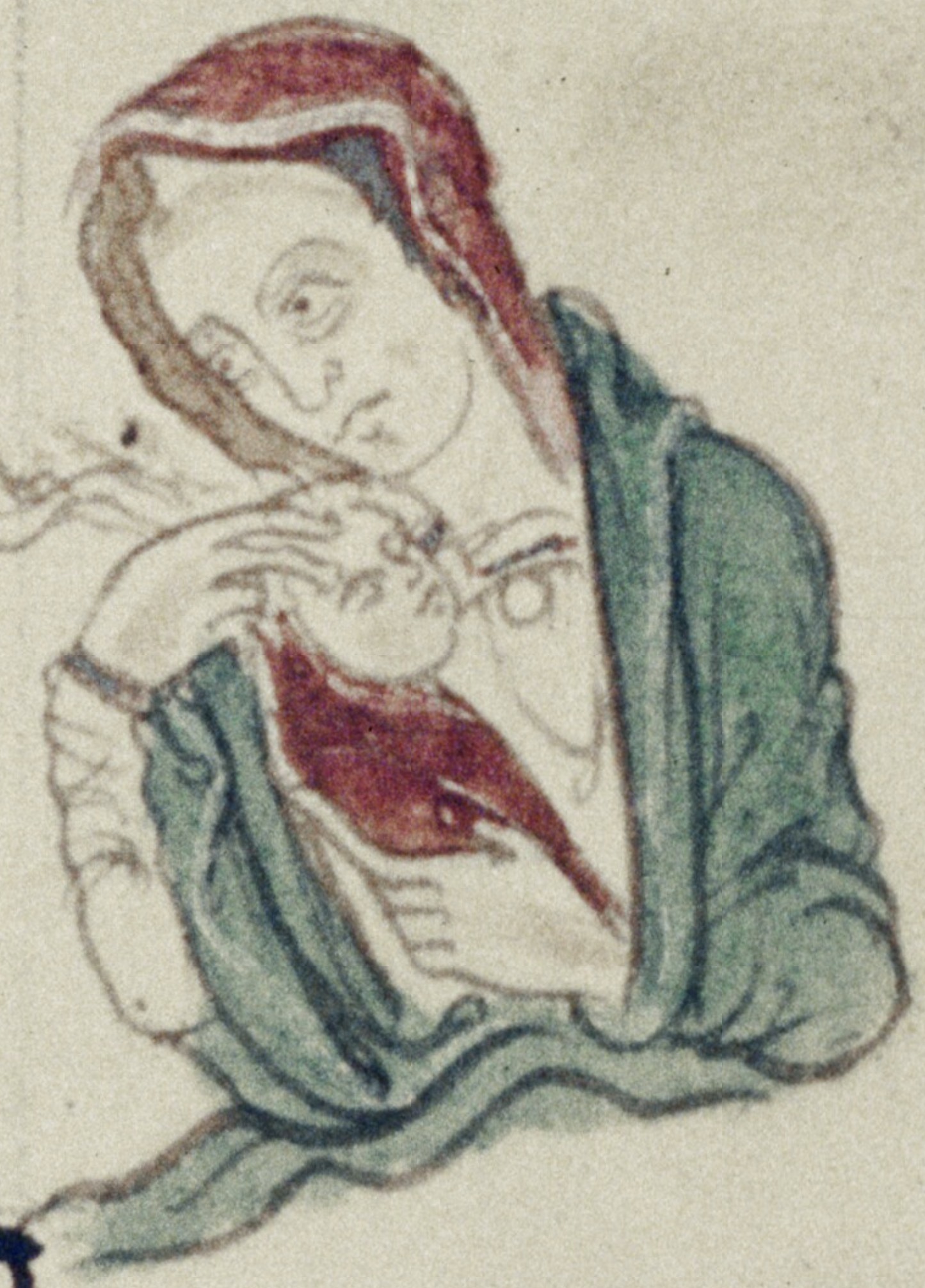
Sleeping Baby from Same Bestiary as Dancing Man: Branching Y Asserted at Forehead
[Y’I, YY’] = YY’I = YIY’ (the most popular, 3-of-4 set of hand-shapes)
branching fingers touching face means asleep in possibilism-thinking.
If Index finger (splayed apart from / contrasted vs. 3 grouped fingers) touching forehead means “awake“, then BENT Index finger (splayed apart) would mean asleep.
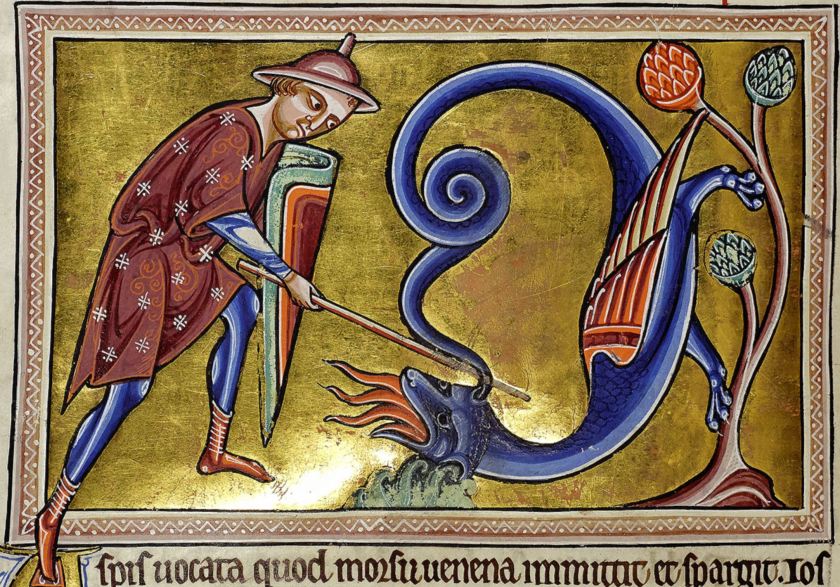
Now bring in elements from the story that’s being illustrated in the Salamander entry of the bestiary:
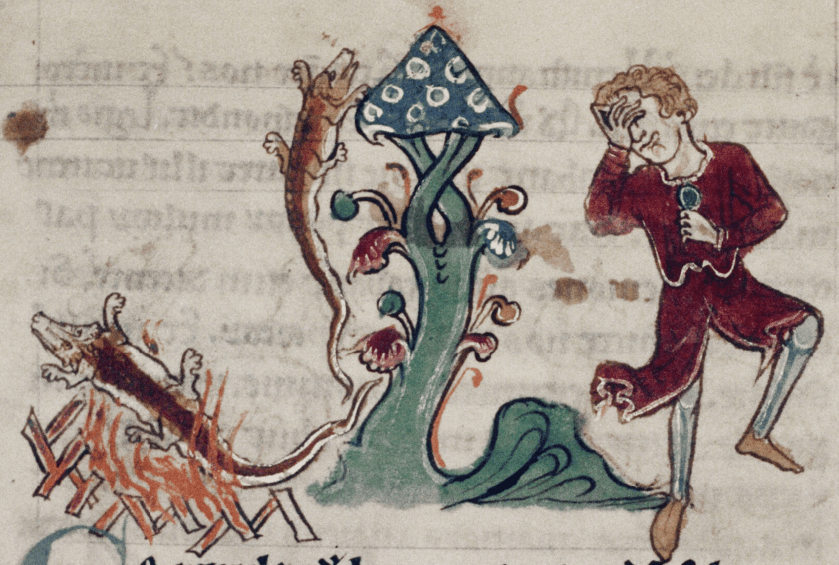
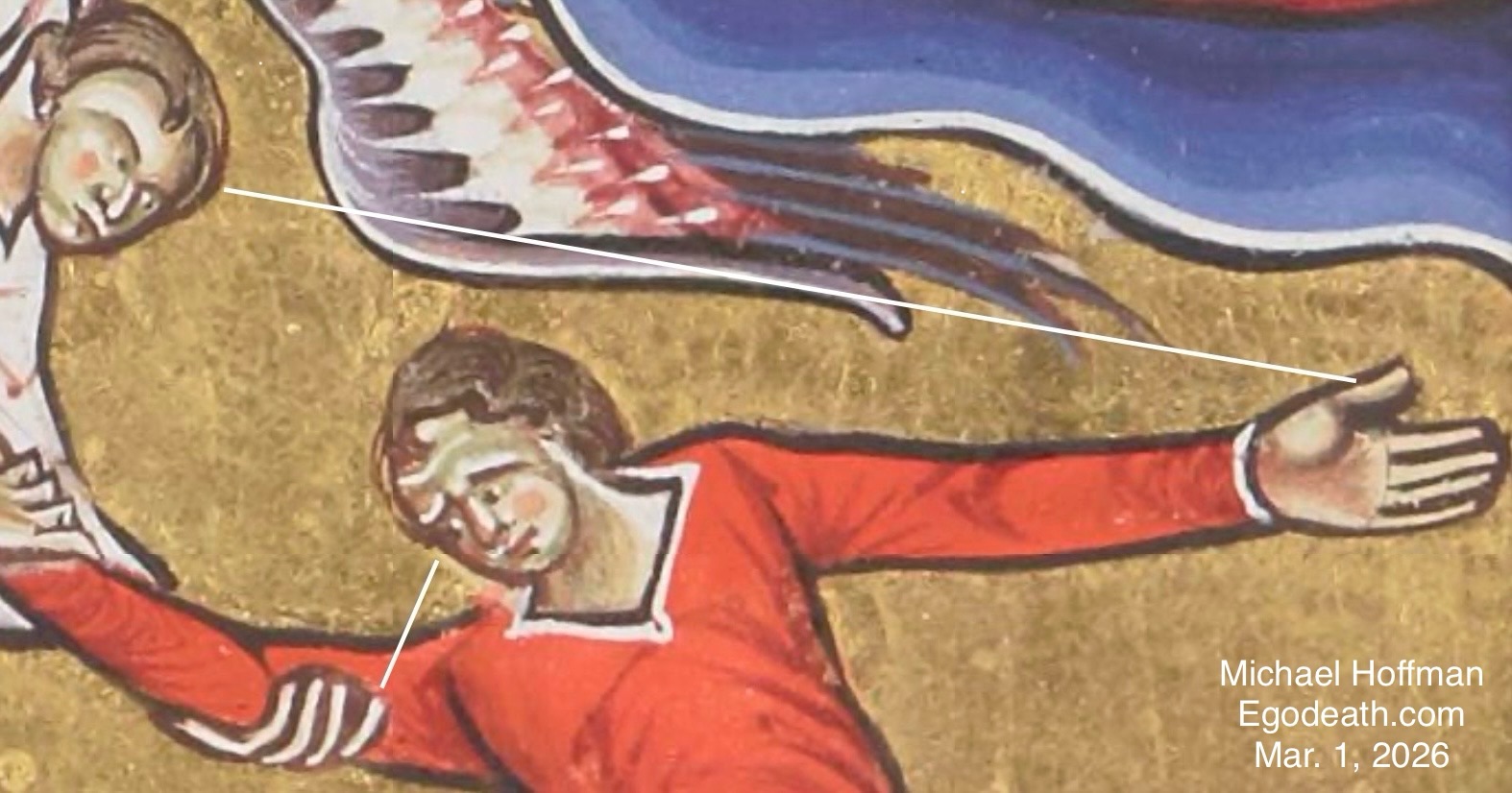
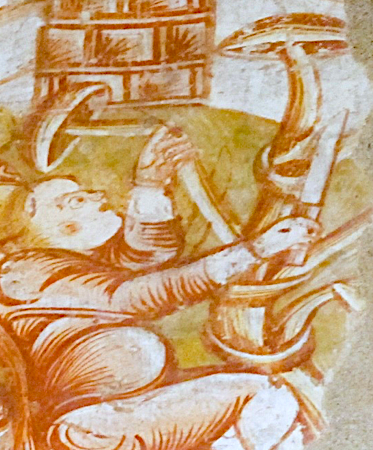
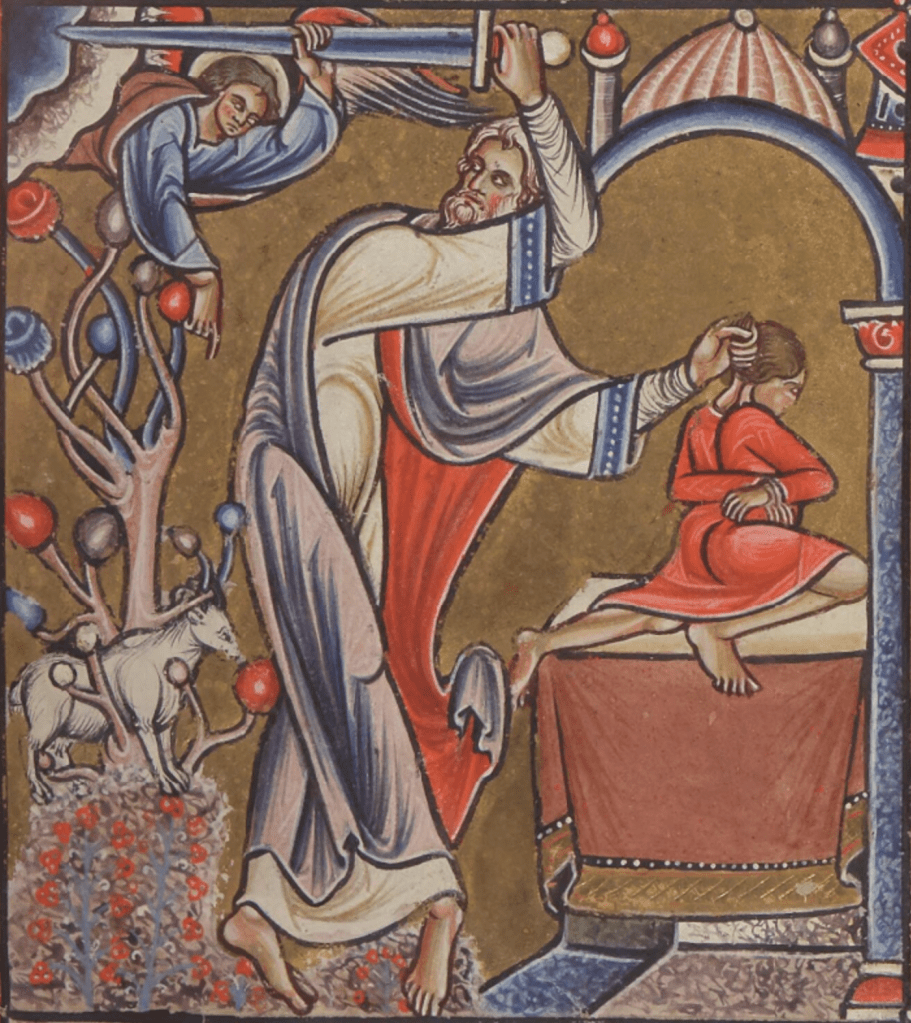
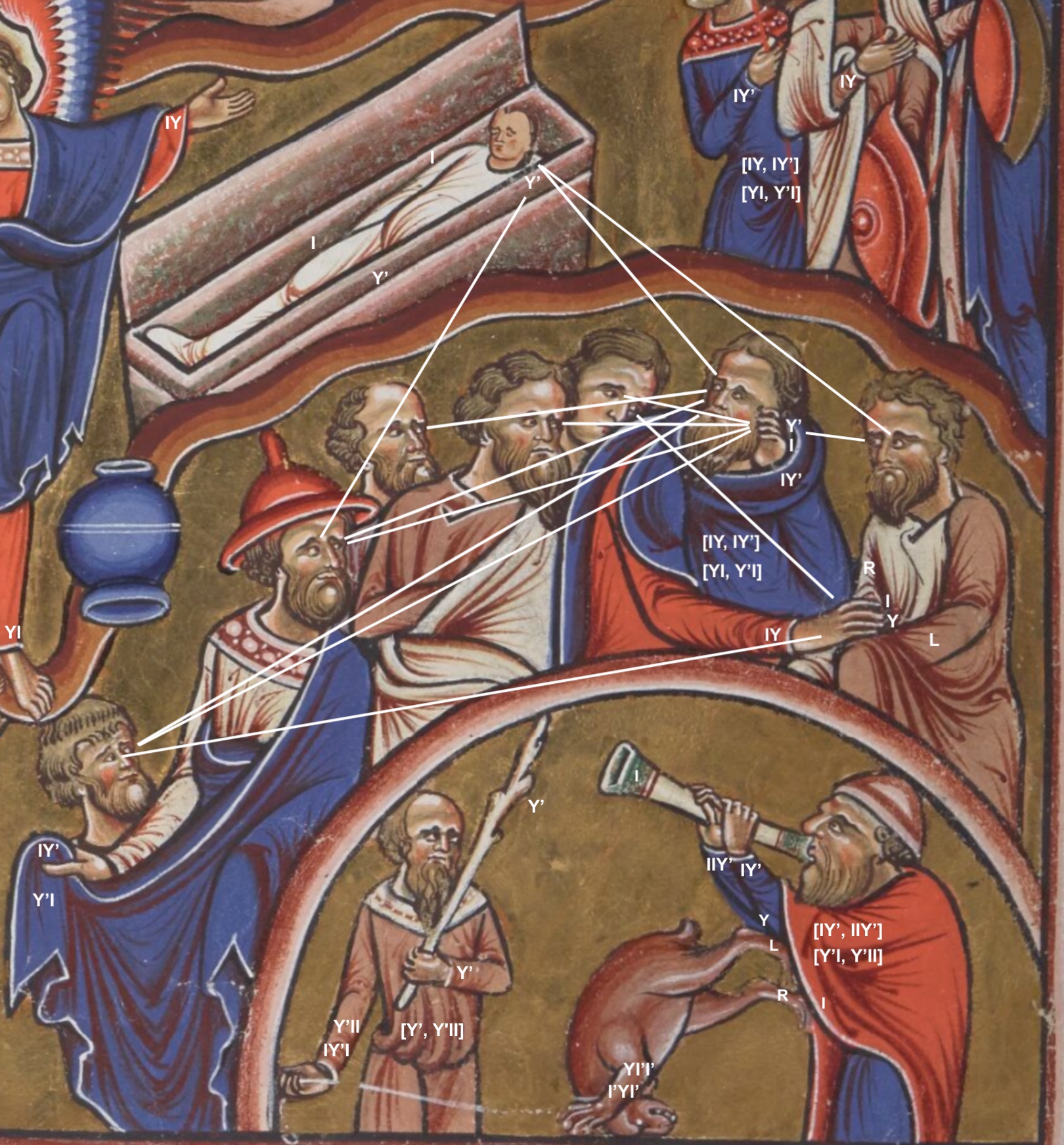
Dancing Man is double sleeping, killed by poisonous salamander ego death
Ego death is indicated by:
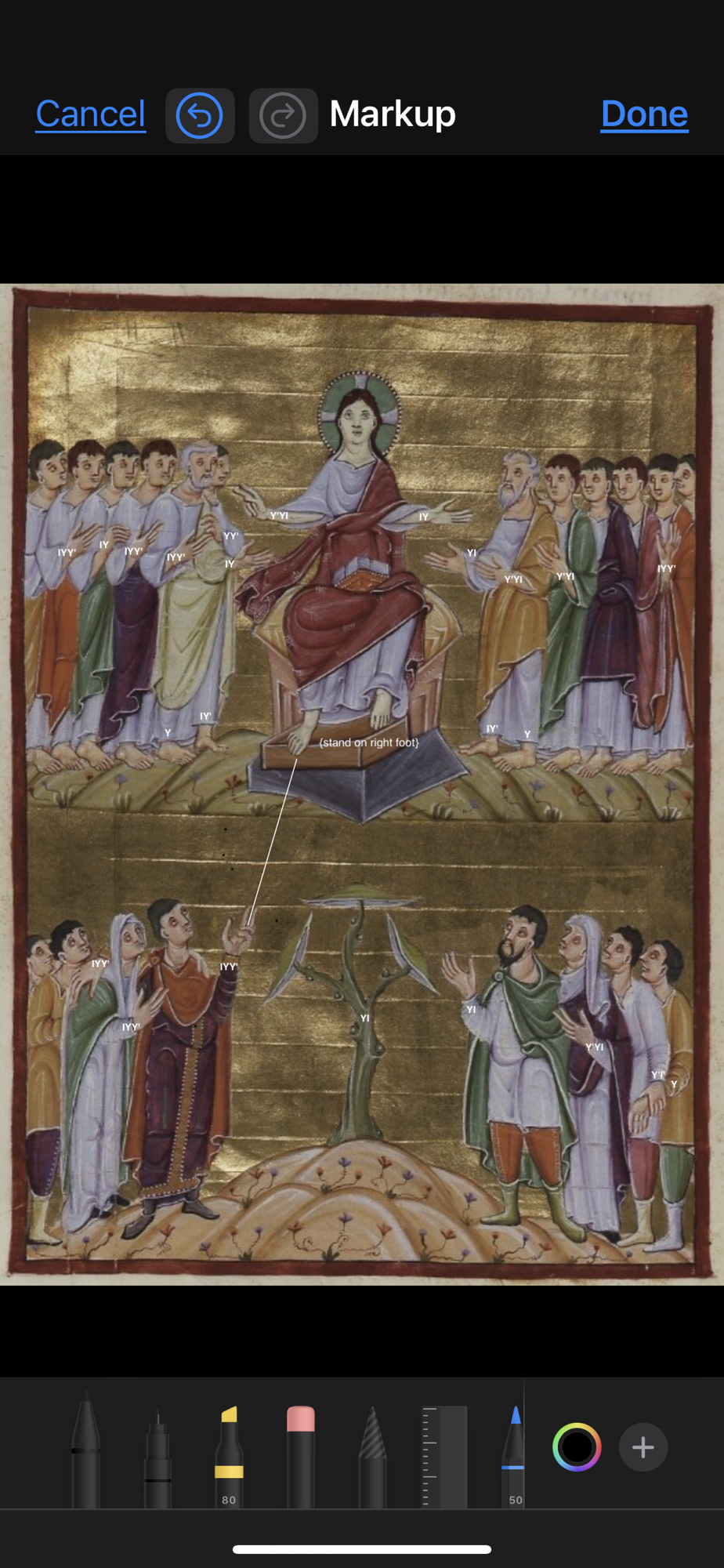
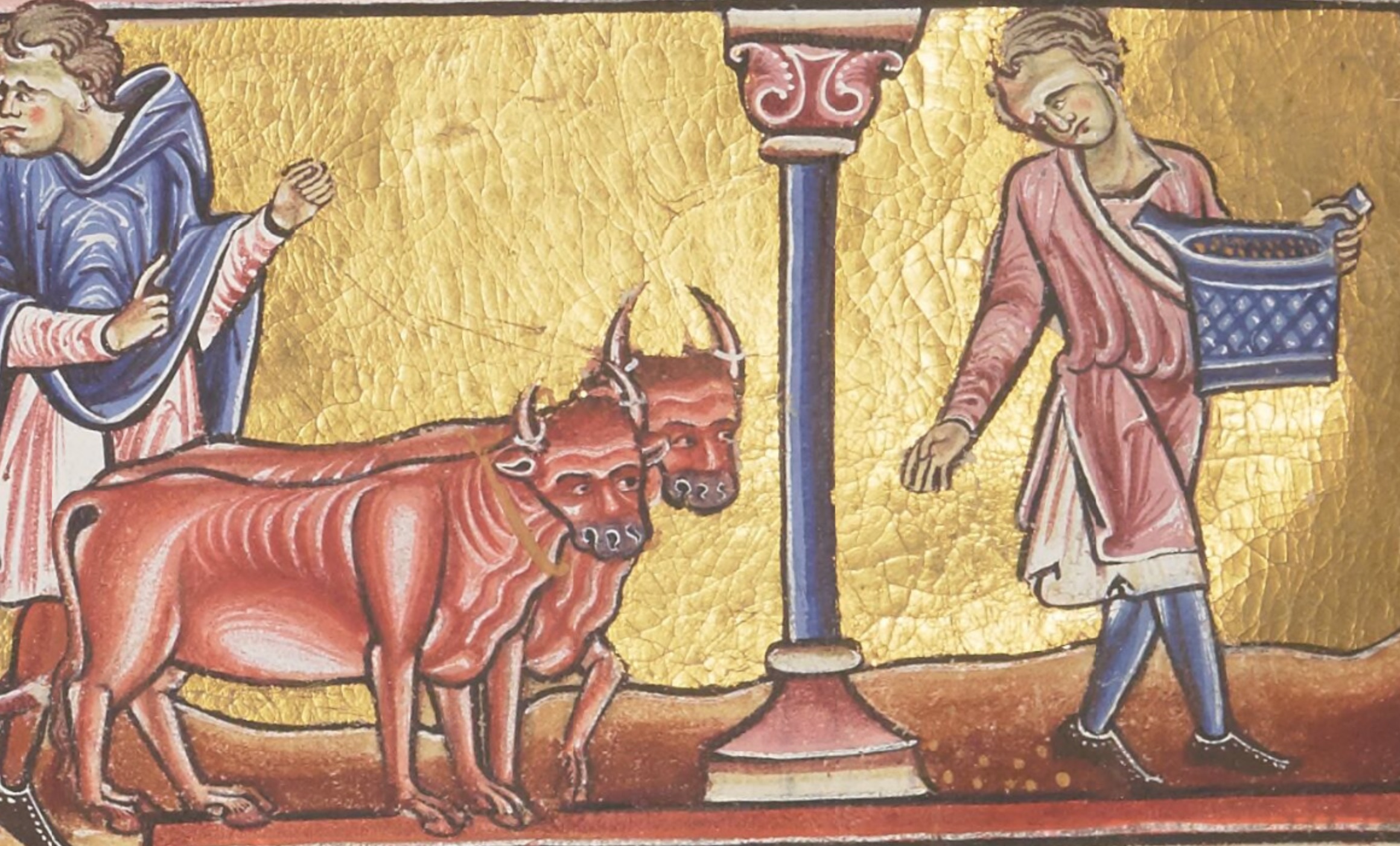
{stand on right foot}
right foot touching {cut right trunk}
txt msg 5 to AM, p.m. Monday, March 2, 2026
The message of the mushroom-tree artist re: Dancing Man’s Index finger:
“If touching the forehead with a splayed Index finger is good, then touching the forehead with a bent Index finger would mean bad, like, dead, from salamander poison.”
Per the rules of the YI branching hand/tree genre.
The Medieval Warm Period: 950- 1250
My estimate of the heyday of mushroom-trees: 900-1300.
My estimated date range for mushroom-trees matches the Medieval Warm Period.
“The Medieval Warm Period (MWP), also known as the Medieval Climate Optimum or the Medieval Climatic Anomaly, was a time of warm climate in the North Atlantic region that lasted from about 950 CE to about 1250 CE.”
Cubensis Grew on Oxen Dung in England During the Medieval Warm Period (950 – 1250), the Heyday of the Mushroom-Tree Genre
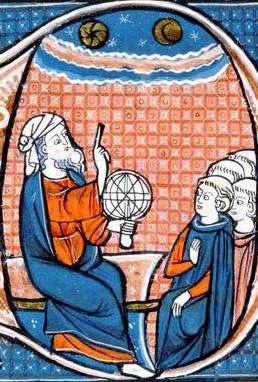
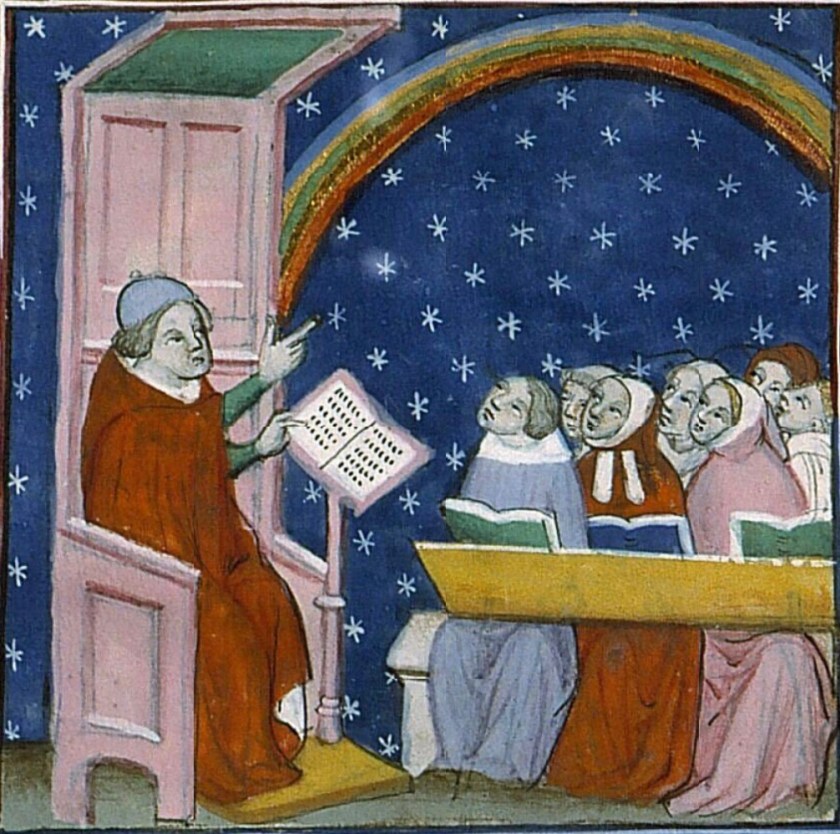
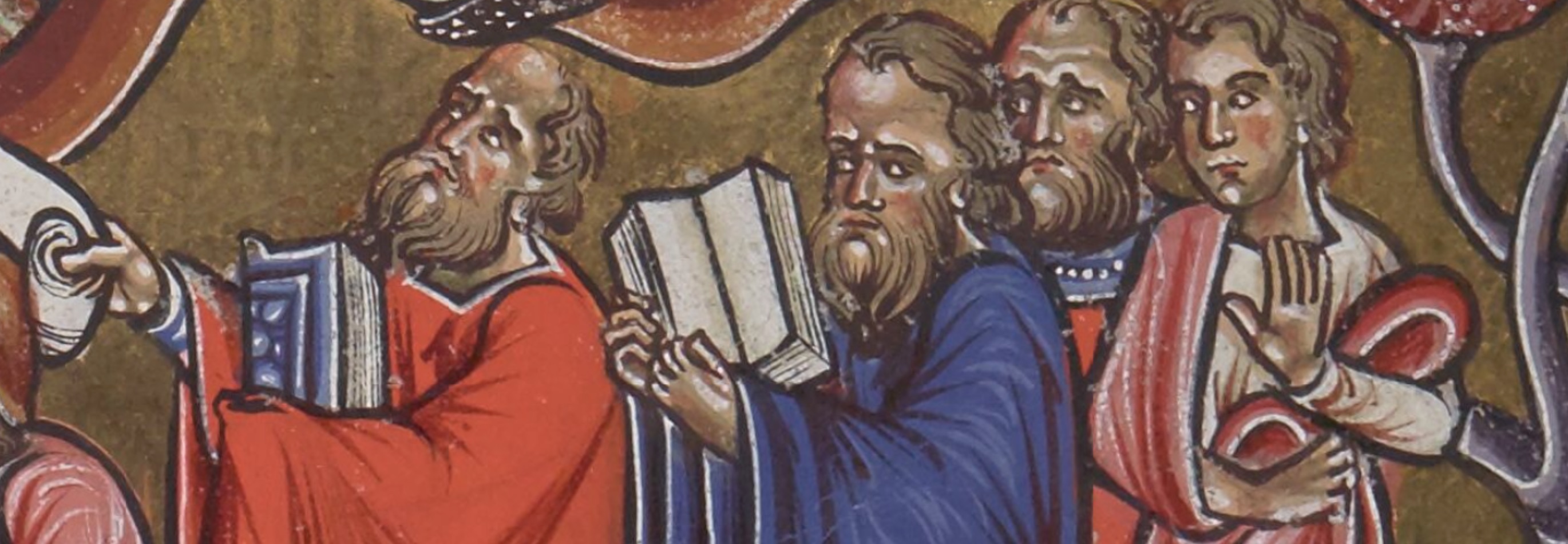
“Aristotle holding an armillary sphere and pointing to the heavens as he teaches a group of clerics from Western Europe.
“From the treatise on cosmology by the Ancient Greek philosopher Aristotle, On the Heavens and the World (De Caelo et Mundo).
“The transmission of this work via Arabic scholarship is highlighted by the depiction of Aristotle in a turban.
“BMR163108 Ms 3458 fol 62vo
“Historiated initial \’D\’ depicting Aristotle holding an armillary sphere and pointing to the heavens as he teaches a group of clerics from Western Europe
“(pen and ink and tempera on vellum) by French School, (13th century); Bibliotheque Mazarine, Paris, France;
(add.info.:
from the treatise on cosmology by the Ancient Greek philosopher Aristotle (384-322) \’On the Heavens and the World\’ (\’De Caelo et Mundo\’);
Few-Minute Bio of Michael Hoffman to Read Aloud at Gatherings
todo: new page.
copy from mobile > Notes > Psalon > Michael Hoffman entry
short entry:
Michael Hoffman – 1985 engr two models of time in uni Physics course,
religious mythology as … psychedelic eternalism
proving Psilocybin fully dev – leverage for Reform.
Egodeath.com started August 1991, when the WWWeb was first created.
August 1988, on computer, wrote up the Egodeath theory – the Cybernetic Theory of Ego Transcendence in computer files, became the starter content for website.
1985 BSEE student, STEM mentality, need posi-control. Fix cross-time self-control.
1997 – spec’d the Psychedelic Eternalism theory: a useful explanatory model of mental model transformation when moving between the ordinary state and the altered state.
1998 – Studied myth and mythic art to confirm the theory of psychedelic eternalism.
2006 –
2020 – re-found Eadwine’s leg-hanging mushroom tree image in the Great Canterbury Psalter. Proceeded to find tons of mushroom imagery in Christian art integrated with {mushroom}, {branching}, {handedness}, and {stability} motifs.
I was given many advantages over other people:
In high school, father taught me the Journal of Transpersonal Psychology, Ken Wilber, the Way of Zen by Alan Watts, the human potential movement, self-help seminars, holistic health.
Colleagues
Brown
Ruck
Hatsis
Irvin
Max Freakout
Cyberdisciple
{branching-message mushroom trees} Mar 21, 2022.
finger shapes Entry into Jerusalem Saint-Martin Church Feb. 9, 2023.
writing article for the Journal of Psychedelic Studies: {branching-message mushroom trees}
Increasing Articulation and Literacy at Applying the YI Hand-Shape Language: asleep vs. awake; uneducated vs. educated; unenlightened vs. enlightened
todo: new page.
3 distinct phases of decoding Dancing Man:
Identify the Index finger shape as conveying two standard modifiers: 1) splayed Index or Pinkie finger, 2) bent finger(s).
Classify/read the hand-shape pair.
This picture’s particular application of the YI hand-shape language and hand-shape pair.
3 tasks:
Task 1: Make Sense of the Strange Index Finger, by Recognizing It as Combining Two Standard Modifiers: Splayed AND Bent
Task 2: Analyze the YI Hand-Shape Pair to See Which of the 4 YI Shapes Are Present: Not the Standard YIY’, but Rather, YI’Y’, Highlighting the Less Common, Oddball Shape: I’ (Cut Non-Branching)
Task 3: Explain How the 4 Shapes Are Used in This Case, to Illustrate This Storyline (Dying from Salamander Poison): “Awake” Shape (I), Inverted by Bend (I’), Becomes “Super Asleep”, ie. DEAD
asleep vs. awake
uneducated vs. educated
unenlightened vs. enlightened
This Post Was Composed During a Blood Red Moon, Full Eclipse of the Moon
Motivation for this Page
Solved Dancing Man!
Specifically, the super weird finger, is clearly simply carrying the two standard modifications:
SPLAYED: Finger splayed separately from 3 other fingers, which are grouped to depict {branching}; Y shape. Splayed finger here = non-branching; I shape (assert non-branching Eternalism).
BENT: Bending fingers means “rebut branching”, in the case of 4 fingers, Y’ shape (rebut branching Possibilism).
SPLAYED AND BENT: Combining the two above indicators, produces I’ (rebut non-branching Eternalism).
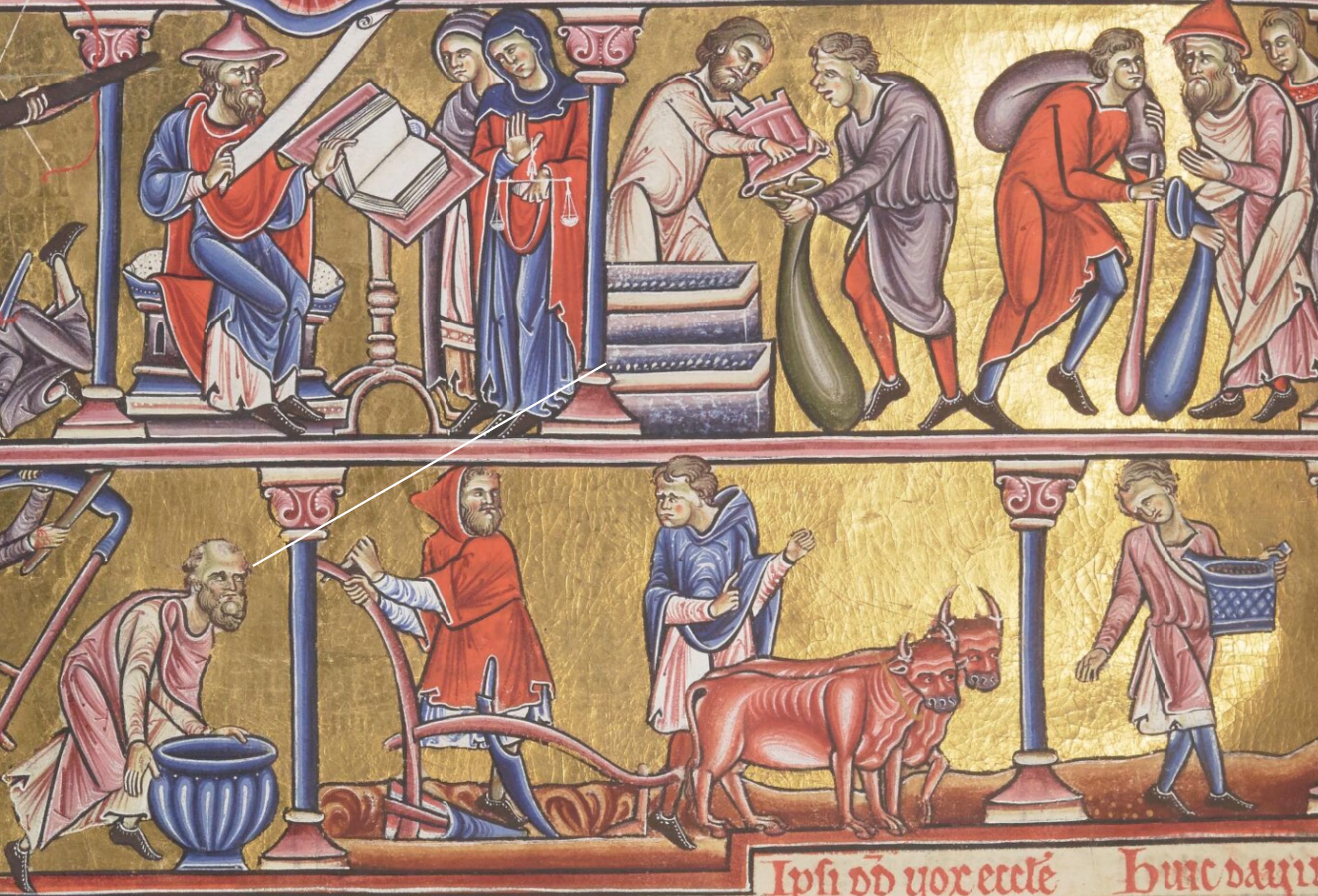
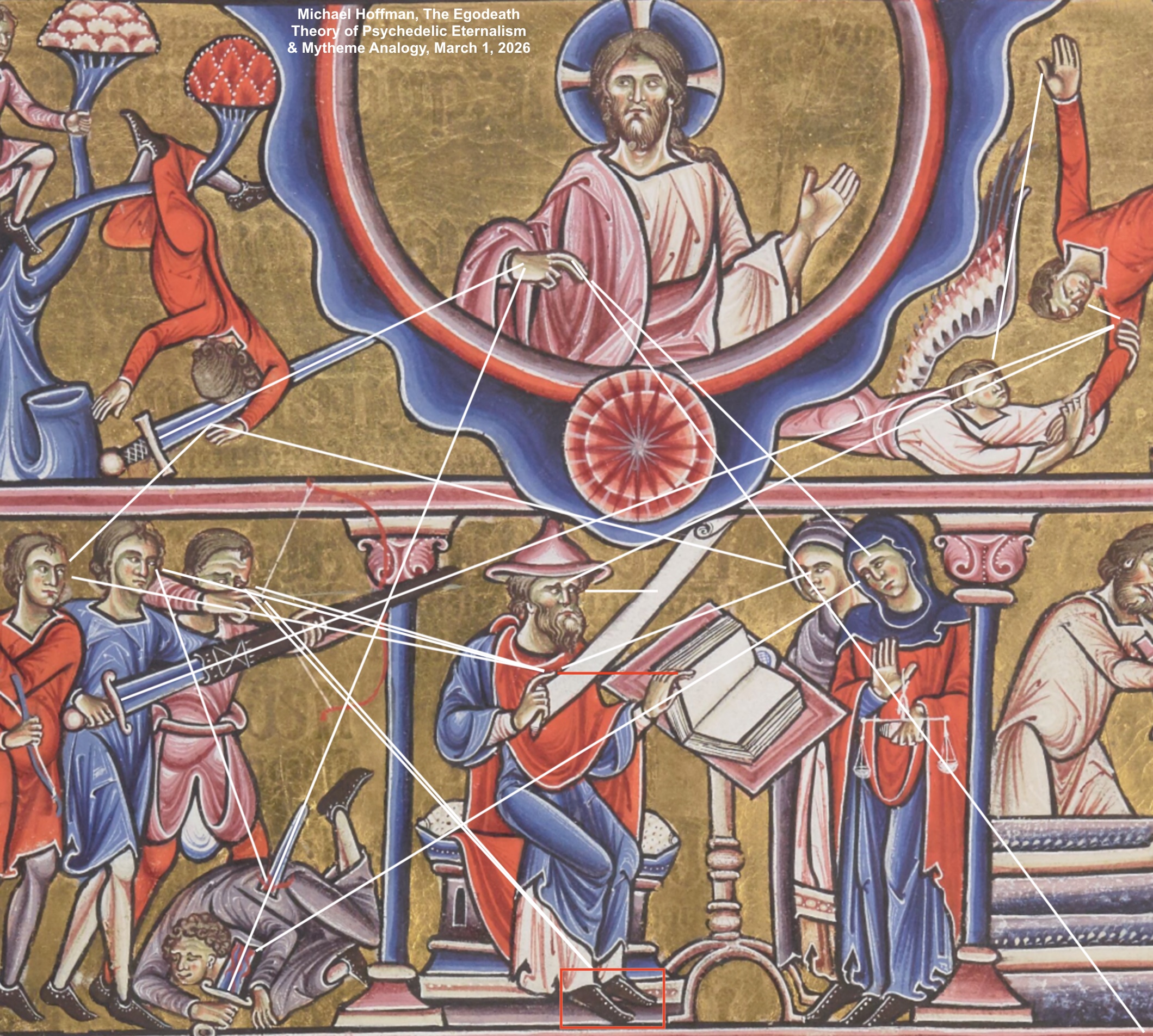
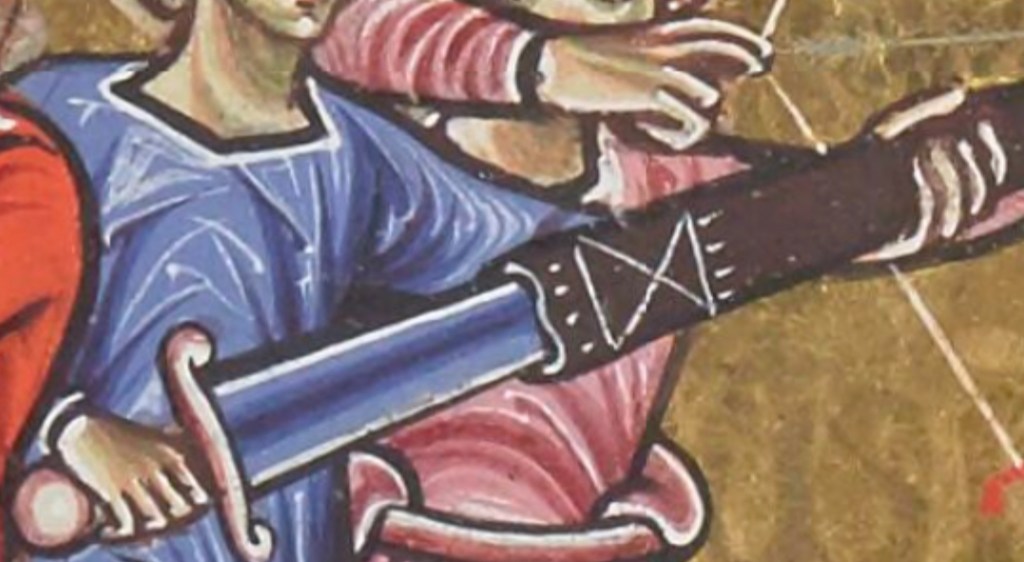
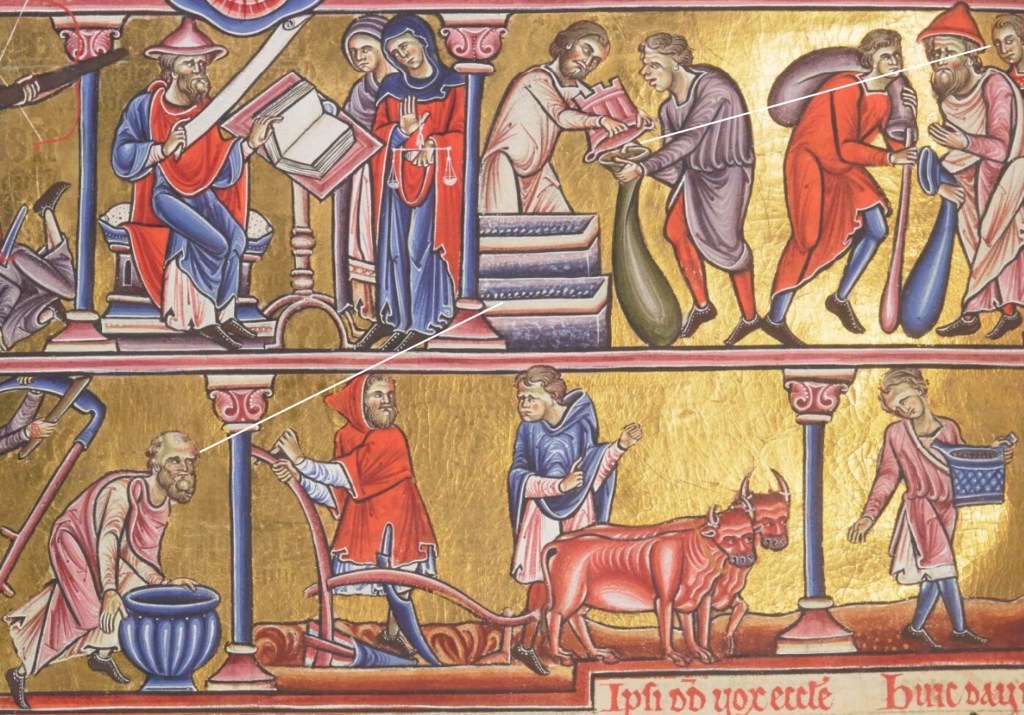
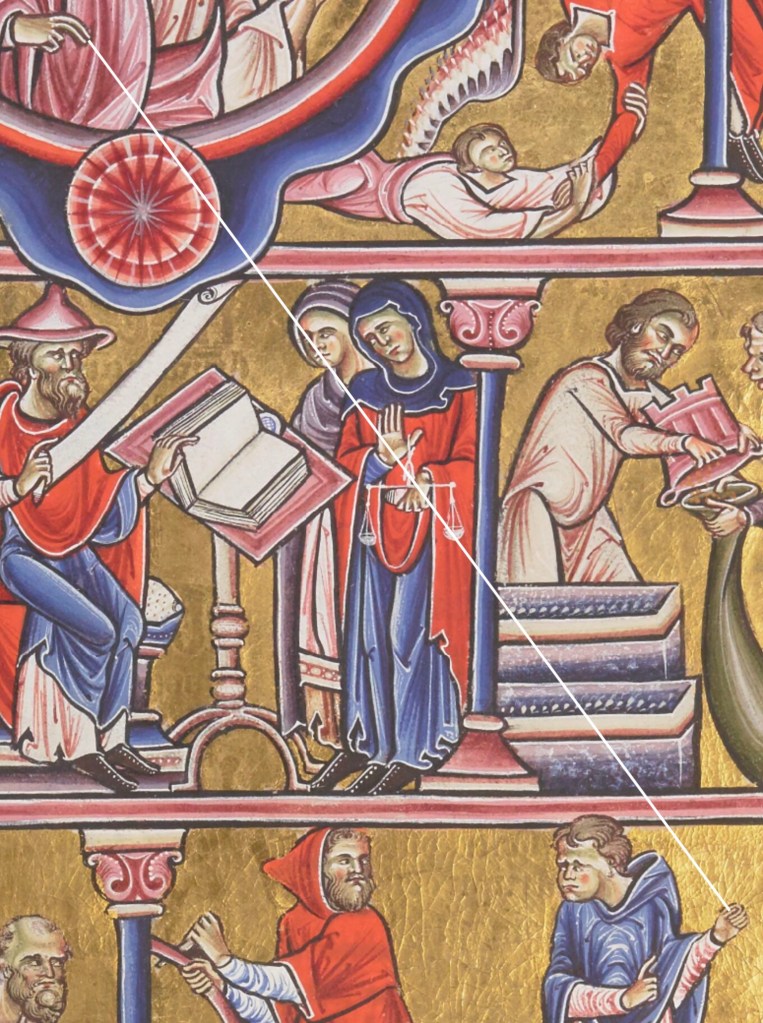
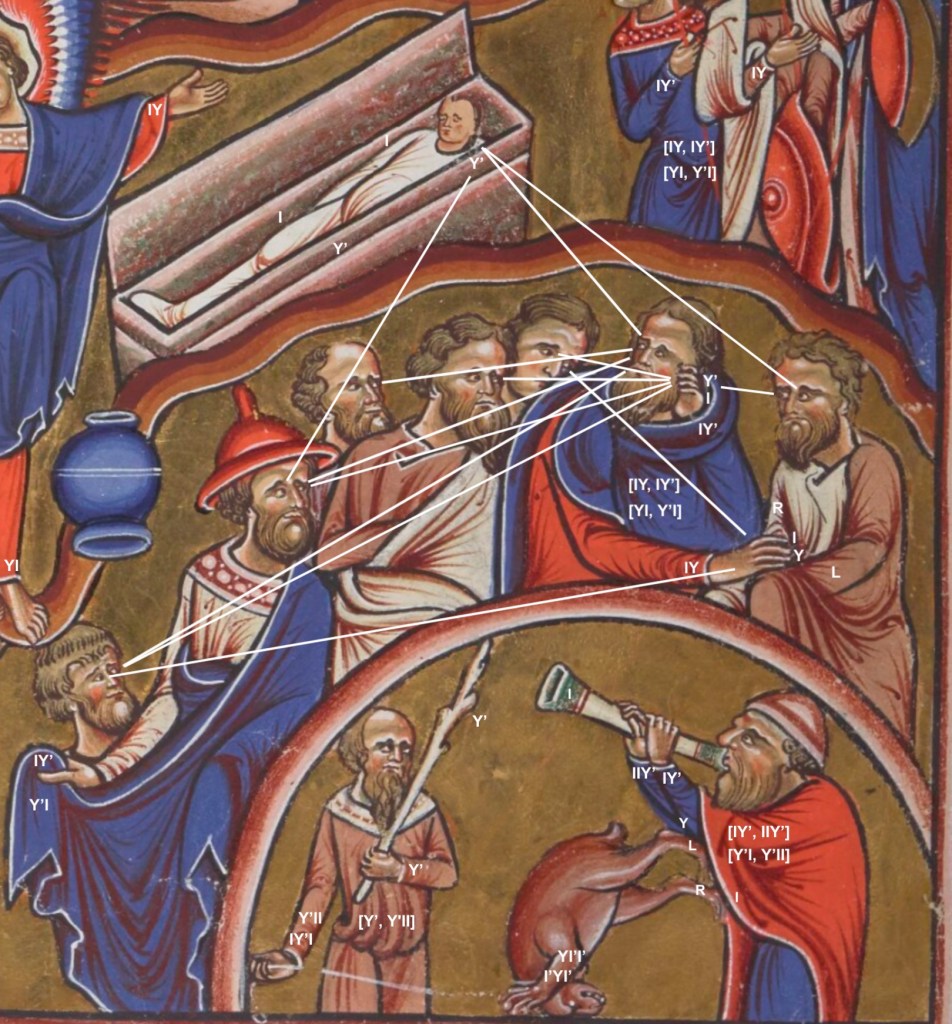
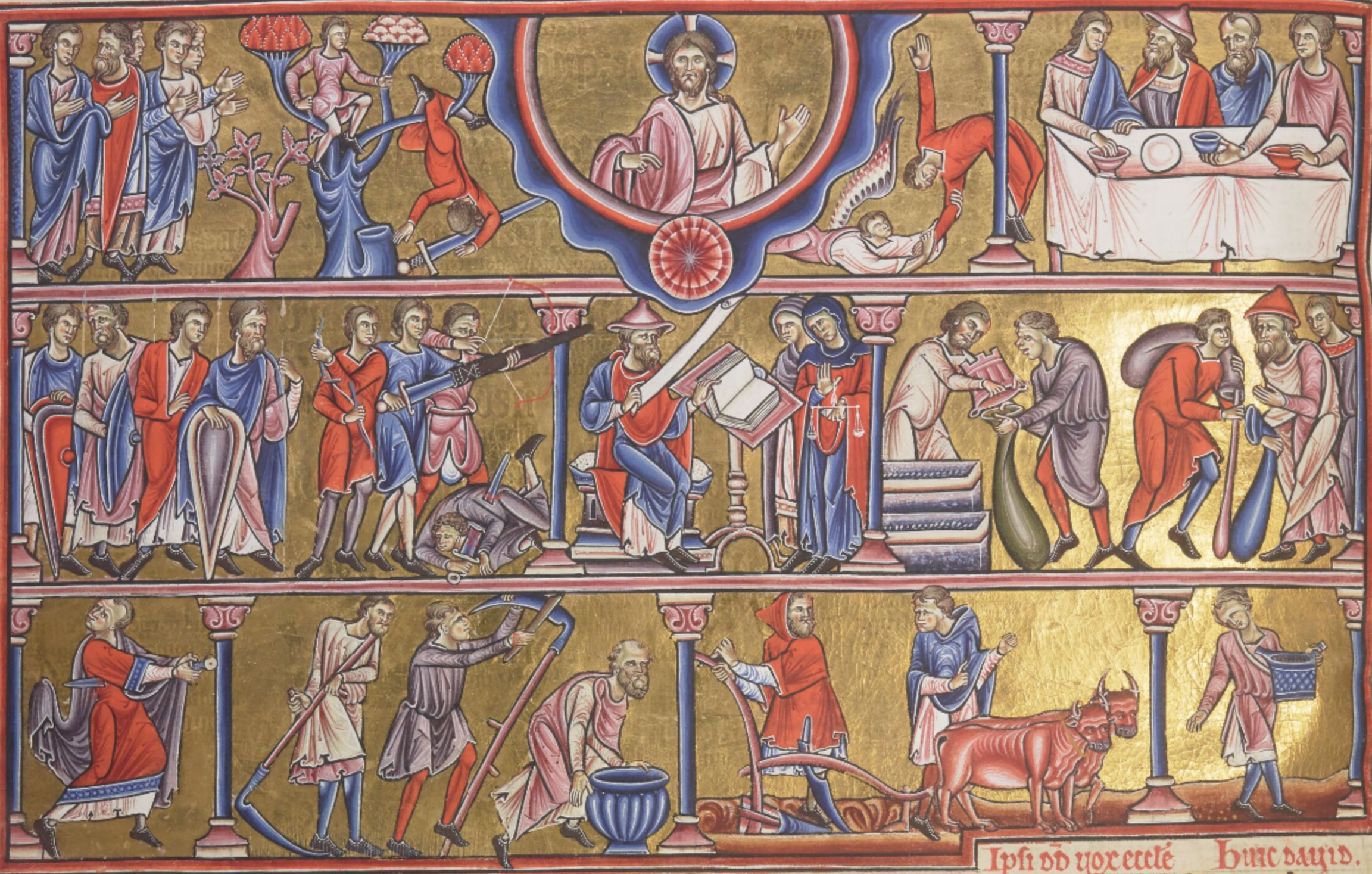
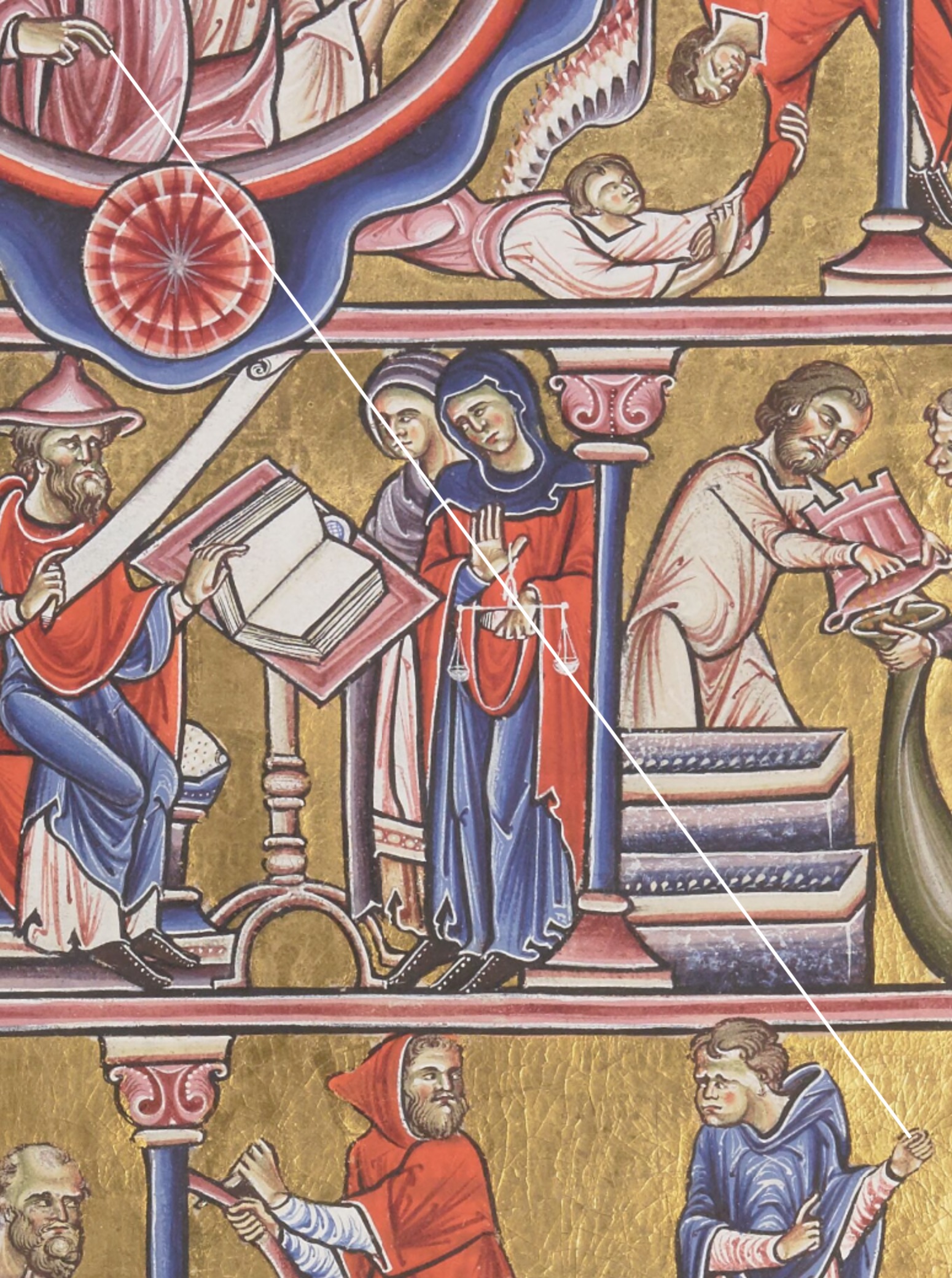
A detail: More attention to Left Arm/Wrist of Cybercide; aim the 2 white lines at his wrist & L arm, at {blade}, where {L limb touch blade}.
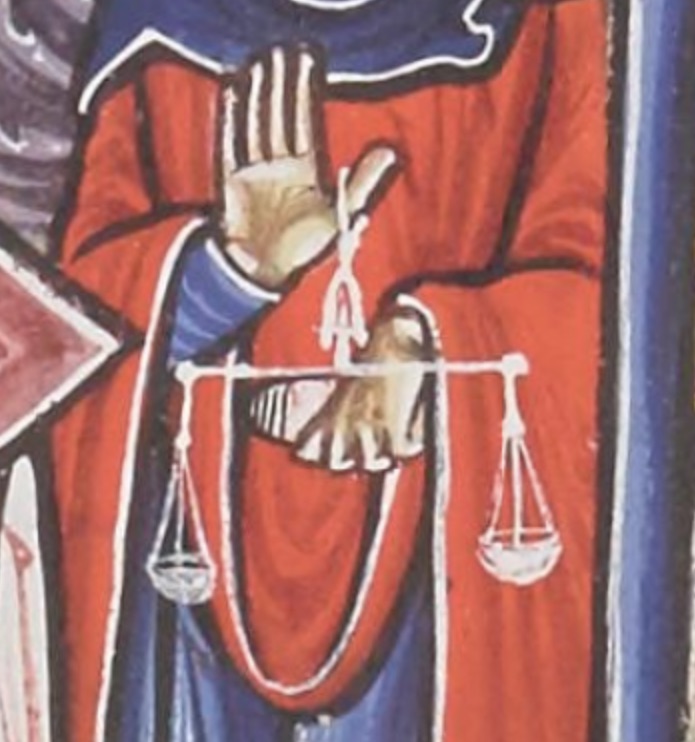
Fulfilling that already, the line from Woman holding {balance scale} is pretty much touching Cybercide’s L wrist at blade.
Make the line from Swordsman to Cybercide end at an intersection of Left arm & blade. The present line doesn’t convey that the target of blade is L limb/arm; line goes to sword but not to L limb.
[9:50 Mon., Mar. 2, 2026] Sit-in-Tree cuts stems w/ left limbs.
f134 Pulled-from-Banquet guy looks at splayed finger of angel, angel looks at added thumb
Crop & annotations by Michael Hoffman
Updates to v6 of “f134 targets of psalter room.jpg”:
Added my signature.
Updates to v5 of “f134 targets of psalter room.jpg”:
Made feet box red, not white.
Updates to v4 of “f134 targets of psalter room.jpg”: (for export jpg, used local same file name; overwrote old jpg)
In the local hi-res png file, I added two lines:
Pulled-from-Banquet looks at Index finger of Angel.
Angel looks at thumb of Pulled-from-Banquet.
todo: delete old 1.4 MB jpgs from WordPress Gallery
I wanted to draw line to clutch fist in tree, but that requires more scouting of midpoints, like God / pivot of {balance scale} / Oxen guy clutch fist.
I want to show my process for searching for possible lines at that clutching fist.
Under the paint, there is a lead pencil line at the clutch fist: we must deduce the hidden line by finding the best candidate lines. caveat: everything connects to everything.
Goal: Connect only the items in such a way as to maximize meaning.
f134 Aiming-Lines, Targets of Psalter Room: v3, All 3 Sword Aiming Lines
todo: sign this image, it’s really helpful to have date embedded & shown in the picture
todo: add 2 looking-lines on the Pulled-from-Banquet guy:
Pulled-from-Banquet guy looks at splayed finger of angel
angel looks at added thumb
List of Figures Involved
Row 1, L to R
Leg-Hanging youth
God
Angel
Pulled-from-Banquet youth
Row 2, L to R
Relenting Archer (Break-Bow Archer)
Threatening Swordsman
Threatening Archer
Cybercide
Psalter Viewer
Limbless Maiden
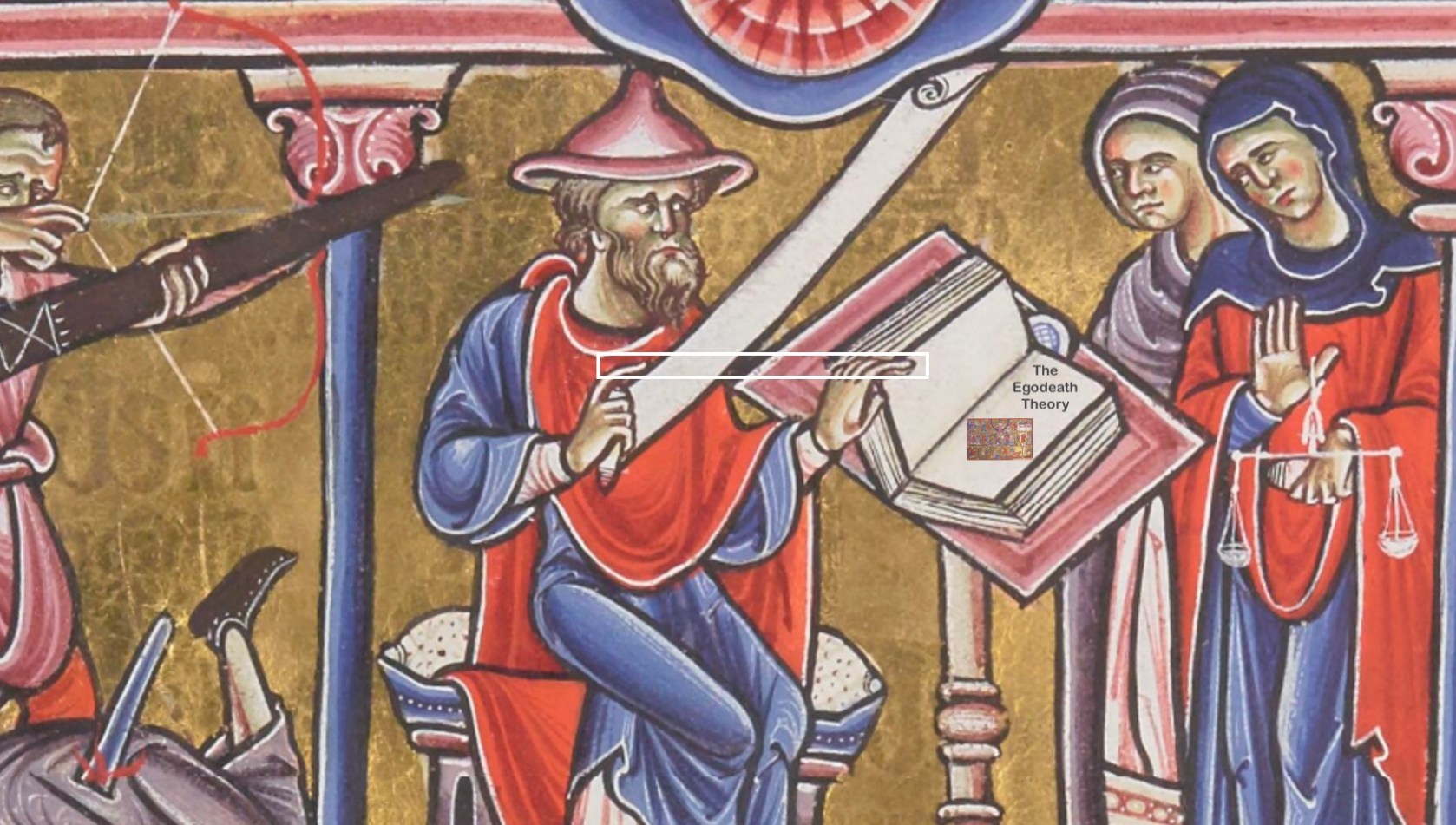
Woman holding {balance scale}
Row 3
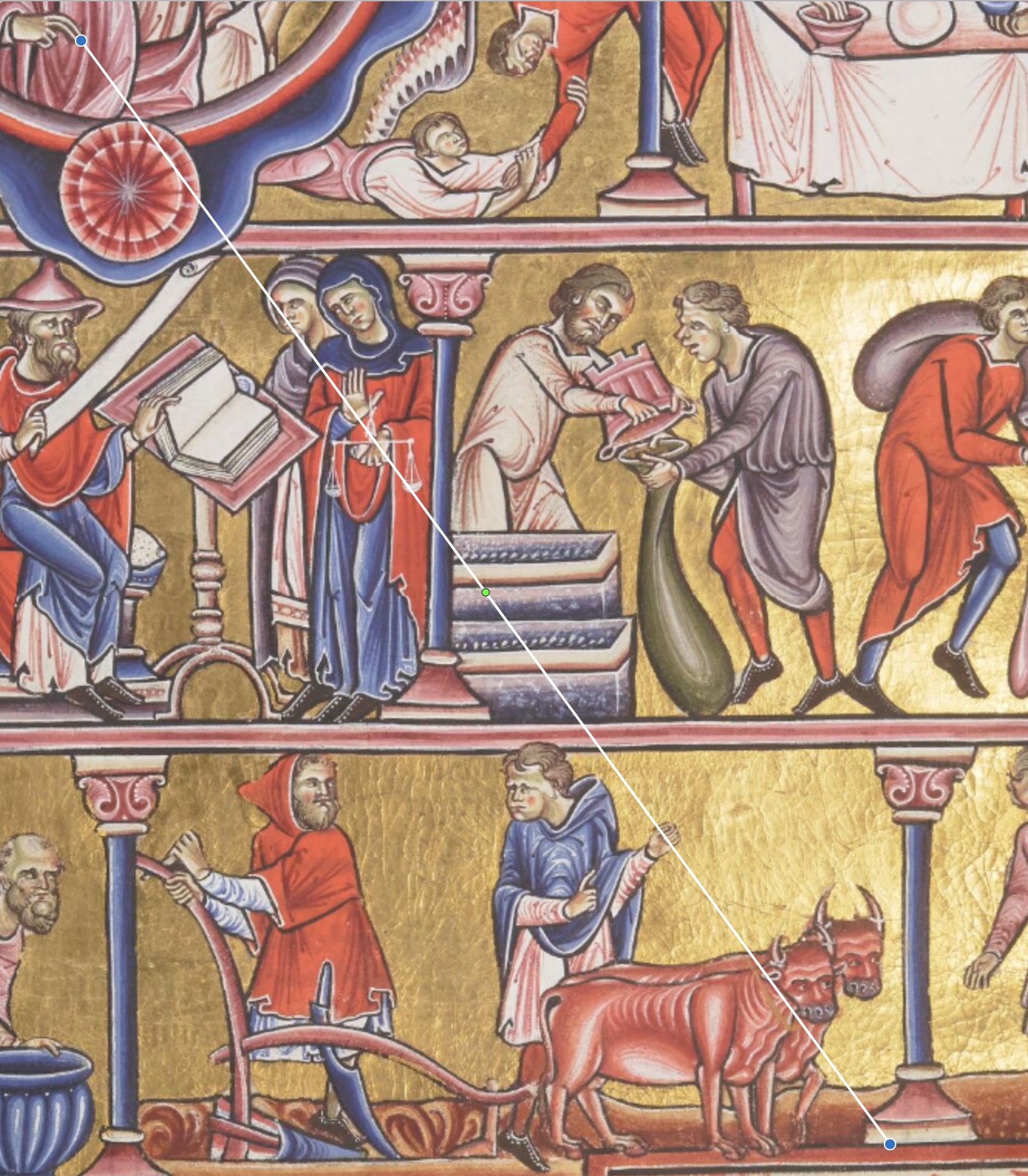
Oxen guy – holds God’s pointing-line, setting midpoint at pivot of {balance scale}.
Leg-Hanging Guy lhg
List of Pointing-Lines
Leg-Hanging youth doesn’t aim.
God’s Right hand aims at {balance scale} pivot, also touches white light John Lash, both Cubensis dispensary bins, oxen guy fist puts midpoint of pointing-line at pivot of {balance scale}
Angel eyes aim at thumb of hand of the Pulled-from-Banquet guy.
Pulled-from-Banquet youth eyes aim at splayed Index finger of angel.
Relenting Archer (Break-Bow Archer)
Threatening Swordsman
Threatening Archer
Cybercide (below, I put 3 entries together starting w/ “Sword”)
Psalter Viewer
Limbless Maiden
Woman holding {balance scale}
TODO: SORT INTO THE ABOVE, PER-FIGURE LISTS:
Sword in tree aim at God’s Right hand.
Sword of Cybercide aims at God’s Right hand.
Sword of Threatening Swordsman aims at splayed Index finger of angel.
Drawing-fingers of Threatening Archer aim at __ feet?
left eye of Break-Bow Archer aims at __ R Index finger height relative to L?
right eye of Break-Bow Archer aims at __
left eye of limbless maiden aims at __
right eye of limbless maiden aims at __
left eye of 3-legged Woman aims at __
right eye of 3-legged Woman aims at __
todo: etc.
Decoded {blade touch left limb}
I decoded a long time ago. But the other day, deepened.
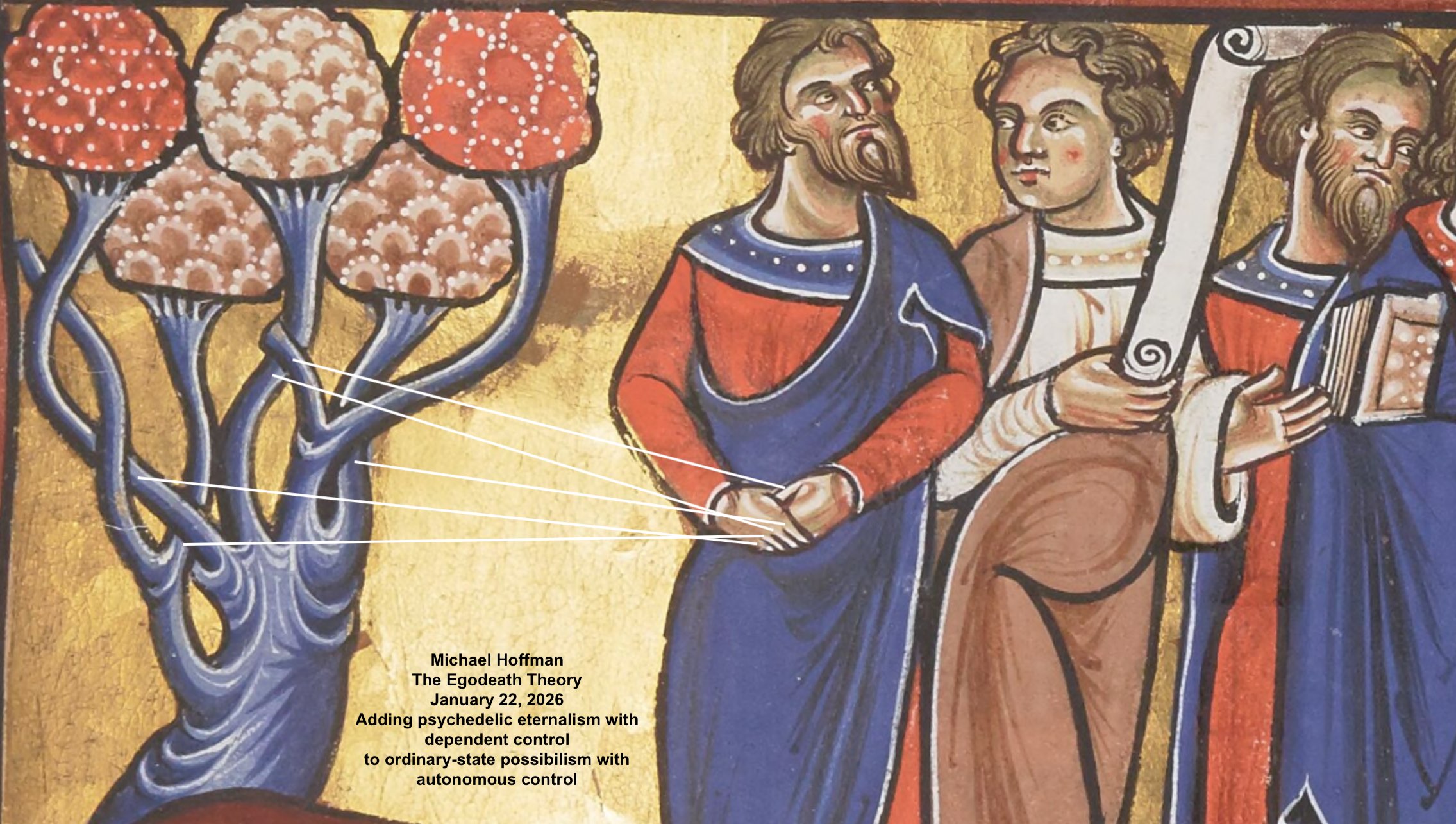
{hand mushroom-tree} in f109
Crop & annotations by Michael Hoffman
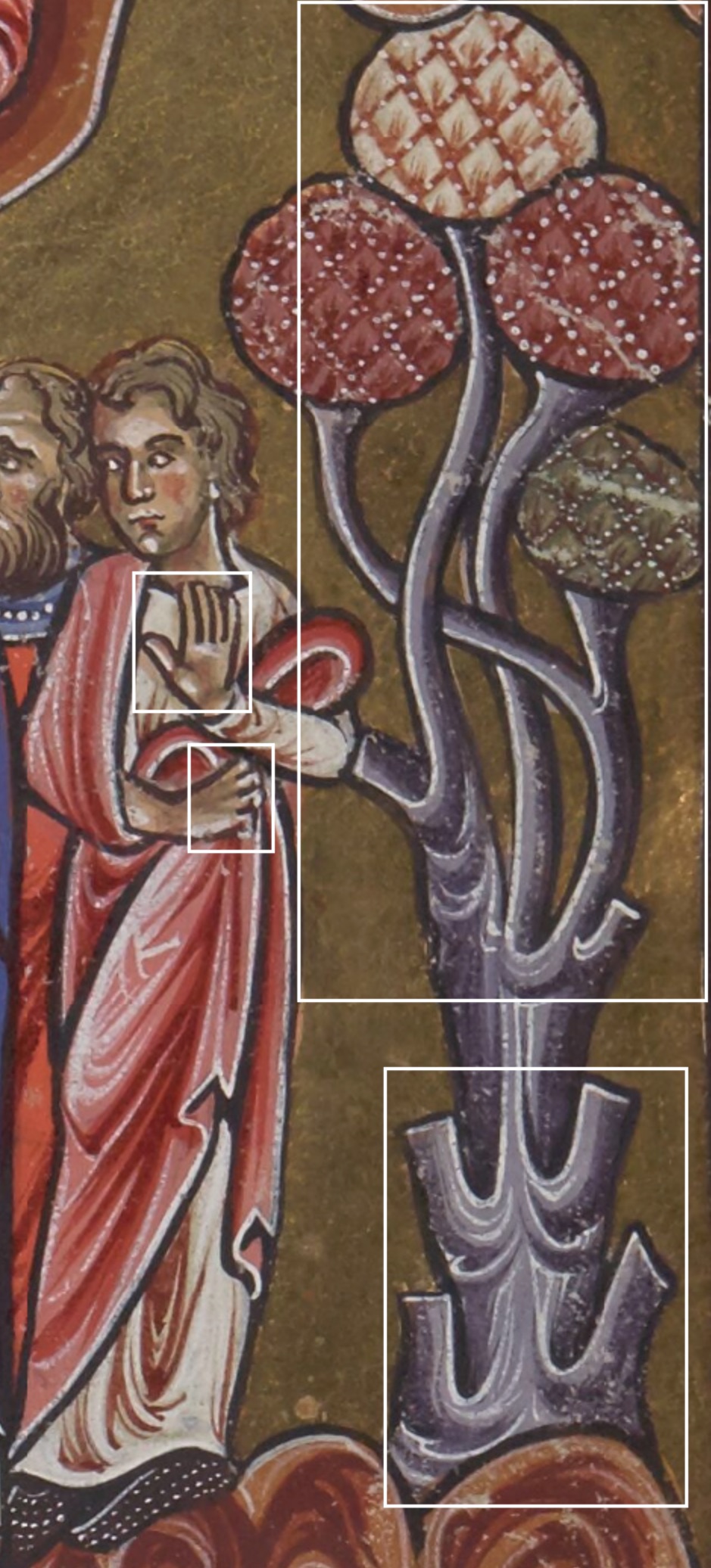
White Boxes on Guy’s Hands and Tree’s Hands: {hand mushroom-tree}
Crop by Michael Hoffman, Jan. 24, 2026
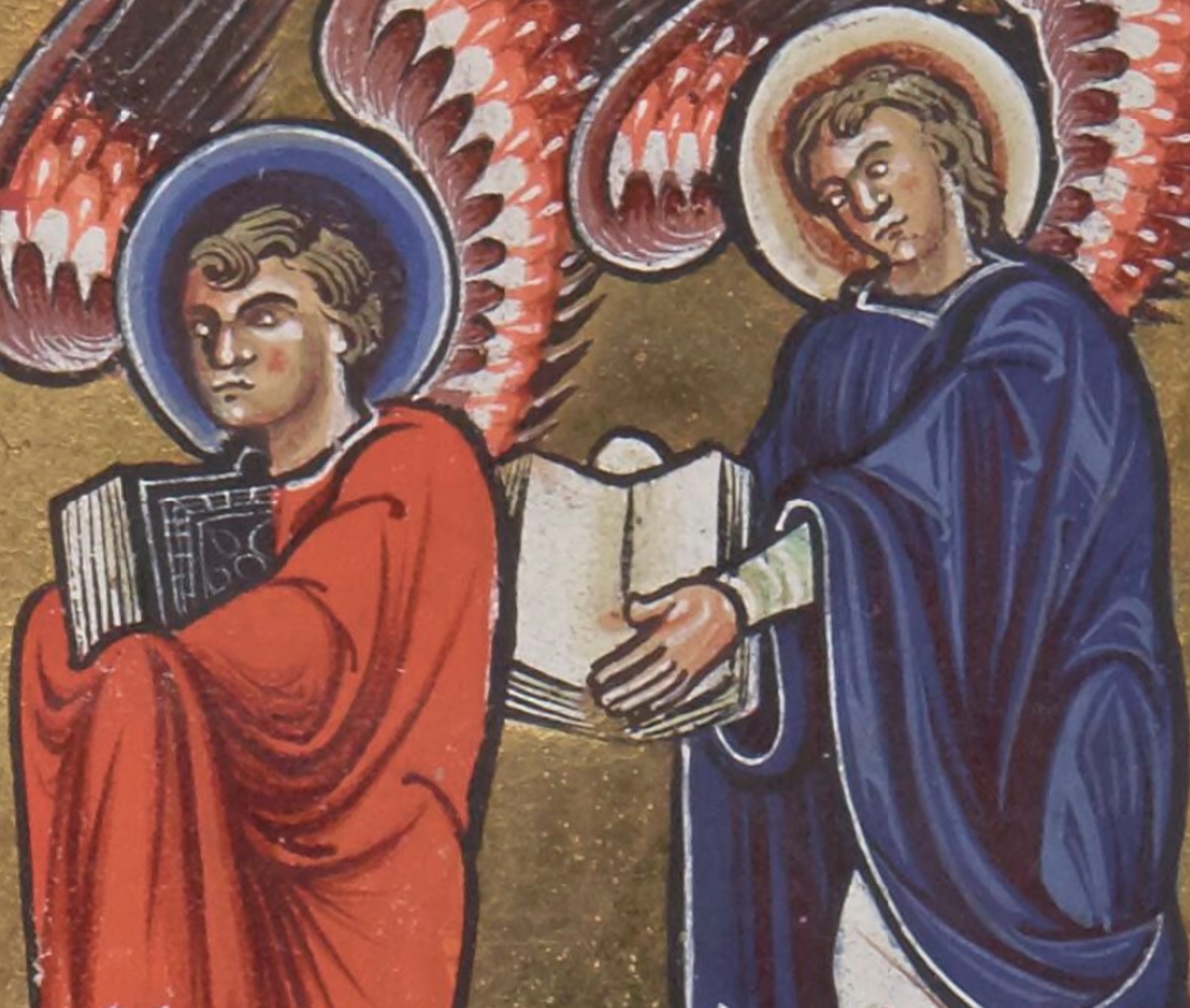
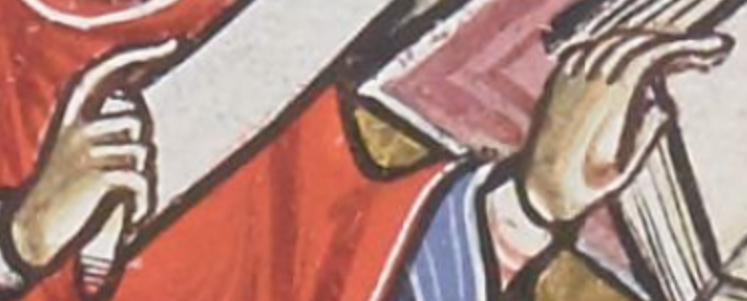
Angel’s Non-Branching Thumb Over Open Book
Crop by Michael Hoffman, Feb. 7, 2026
Guy’s Non-Branching Thumb Over Open Book
Crop by Michael Hoffman, Feb. 7, 2026
all the 4 other pages of {open book} are illusory, like fingers branching from palm
possibilism vs. eternalism = cut branching = blade touch left limb
YI hand/tree = assert branching on the left, assert non-branching on the right
cut off branching many worlds = {blade touch Left limb}
absolute four-dimensional spacetime
{snake frozen in rock}
worldline in block universe
ordinary-state, branching Possibilism vs. altered-state, non-branching Eternalism
Good wording in that Egodeath theory lexicon phrase.
possibilism vs. eternalism analogies
Possibilism vs. Eternalism
todo: add to keyboard shortcut LCPE:
ordinary-state possibilism vs. altered-state eternalism
ordinary-state, branching Possibilism vs. altered-state, non-branching Eternalism
[OBVAN]
Y vs. I
add to the keyboard shortcut:
Y shape vs. I shape [YSVIS]
Y shape vs. I shape
{branching} vs. {non-branching}
{tree} vs. {snake}
{fingers vs. thumb, index, or pinkie};
many worlds vs. single block-universe
The Left-Hand, Possibilism Side of the Equation Items Are Equivalent
possibilism =
ordinary-state possibilism =
ordinary-state, branching Possibilism =
Y shape =
branching =
tree =
fingers, or 3 fingers grouped together =
many worlds =
multiple closed pages (vs. one open page)
The Right-Hand, Eternalism Side of the Equation Items Are Equivalent
eternalism =
altered-state eternalism =
altered-state, non-branching Eternalism =
I shape =
non-branching =
snake =
thumb, index, or pinkie =
one open page
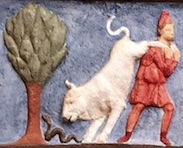
Reversible Tauroctony: {tree} vs. {snake}, snake = trunk
Crop by Michael Hoffman
Reversible Tauroctony: {tree} vs. {snake}, snake = one branch-path
Crop by Michael Hoffman
{tree} vs. {snake}
{fingers vs. thumb, index, or pinkie}
thus L side items are equal:
tree = fingers
R side are =:
snake = thumb
blade cuts branching to get from possibilism to eternalism
add non-branching to branching , add thumb to hand in f134
flames = blade = blood on blade = fire sword = cut the branching
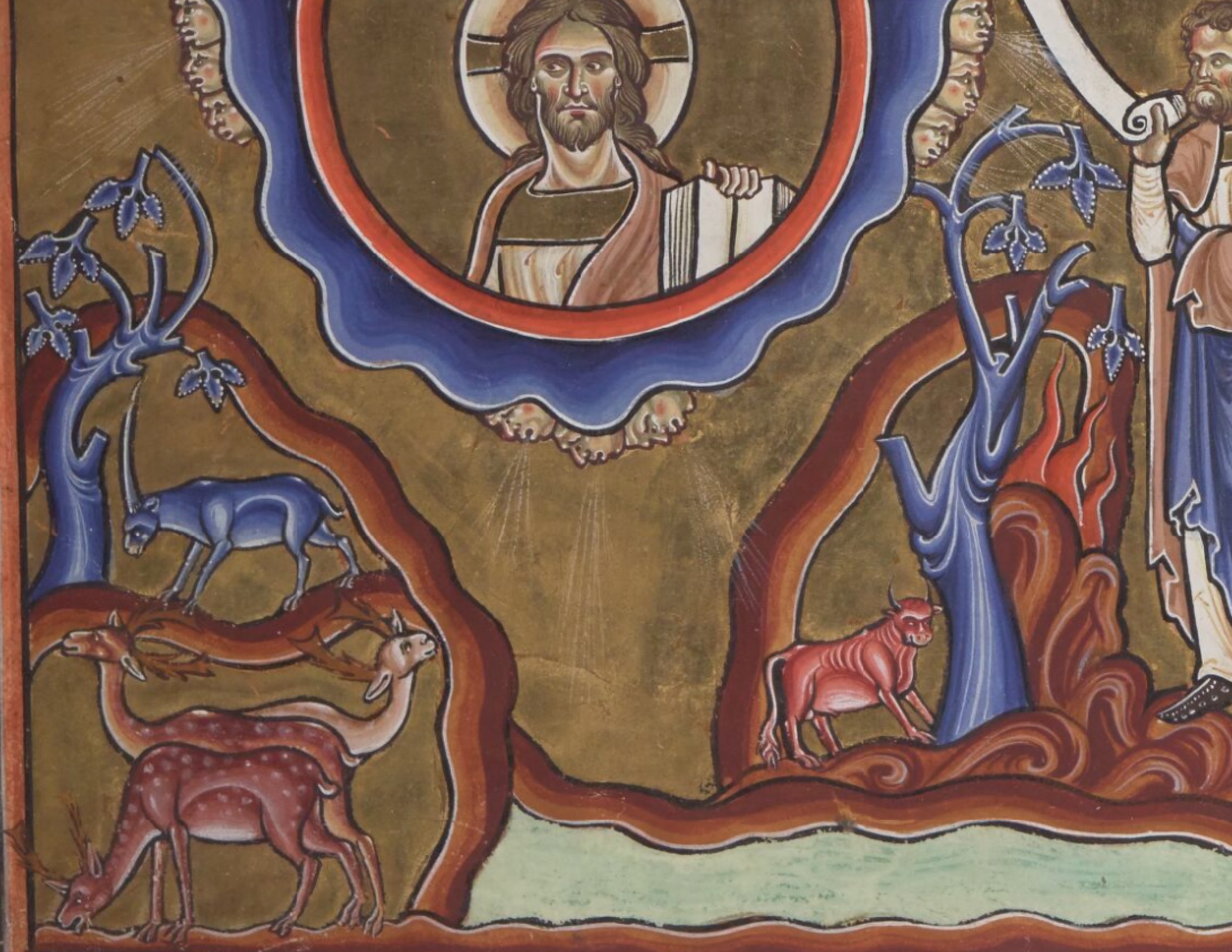
Unihorn, Branches Removed from Trees by Fire
Crop by Cybermonk “Canterbury-f104-unihorn.jpg” 530 KB [8:58 p.m. June 27, 2023]
Unihorn vs. deer w/ branching antlers, or ox w/ pair of horns.
left horn of ox touch left side of tree
Saint Martin Church: Youth Cuts Tower Branch Mushroom-Tree Over Gateway
Photo Credit Julie M. Brown. April 10, 2022 image processing & crop by Cybermonk.
todo: email Brown in same thread: the “gate” explanation IS present in webpage but buried and unclear.
My solution writeup has too much “stone” block-universe eternalism, too little “gateway”.
pass through gate = cut branching = mental model transformation from possibilism to eternalism.
“Poor guy didn’t even get a chance to see his own ideas thoroughly validated and watch Einstein grovel and eat his own words.
“What a tragedy that is. Damn.
“Minkowski presented his 4D mathmattical framework in 1908.
“Minkowski died just a few months after January of 1909.
“Minkowski died of appendicitis at age 44.
“Einstein initially dismissed Minkowski’s work, but reversed his views and incorporated Minkowski’s 4D spacetime into his paper on general relativity in 1915.
“Both publically as well as in the paper, Einstein gives Minkowski all the credit he deserved.”
Motive for this Page
mobile post
the other page got too long for mobile
breakthrough warrants new focus in new page
Notes from “List of Pointing-Lines” Section
angel = messenger/ trainer/ reshaper
Threatening Archer t-a
Break-Bow Archer bba
Break-Bow Archer = the Relenting Archer, vs. the Threatening Archer
Break-Bow Archer [BBA]
Break-Bow Archer in Great Canterbury Psalter folio image f134 row 2 middle [BBAL]
todo: global at site: change “Break-Bowman” to “Break-Bow Archer”
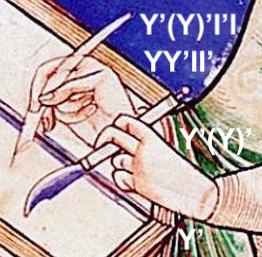
Extended Index + Middle, ignore quill pen cutting the Y (it’s an overlay modifn on top of the conventional Y shape)
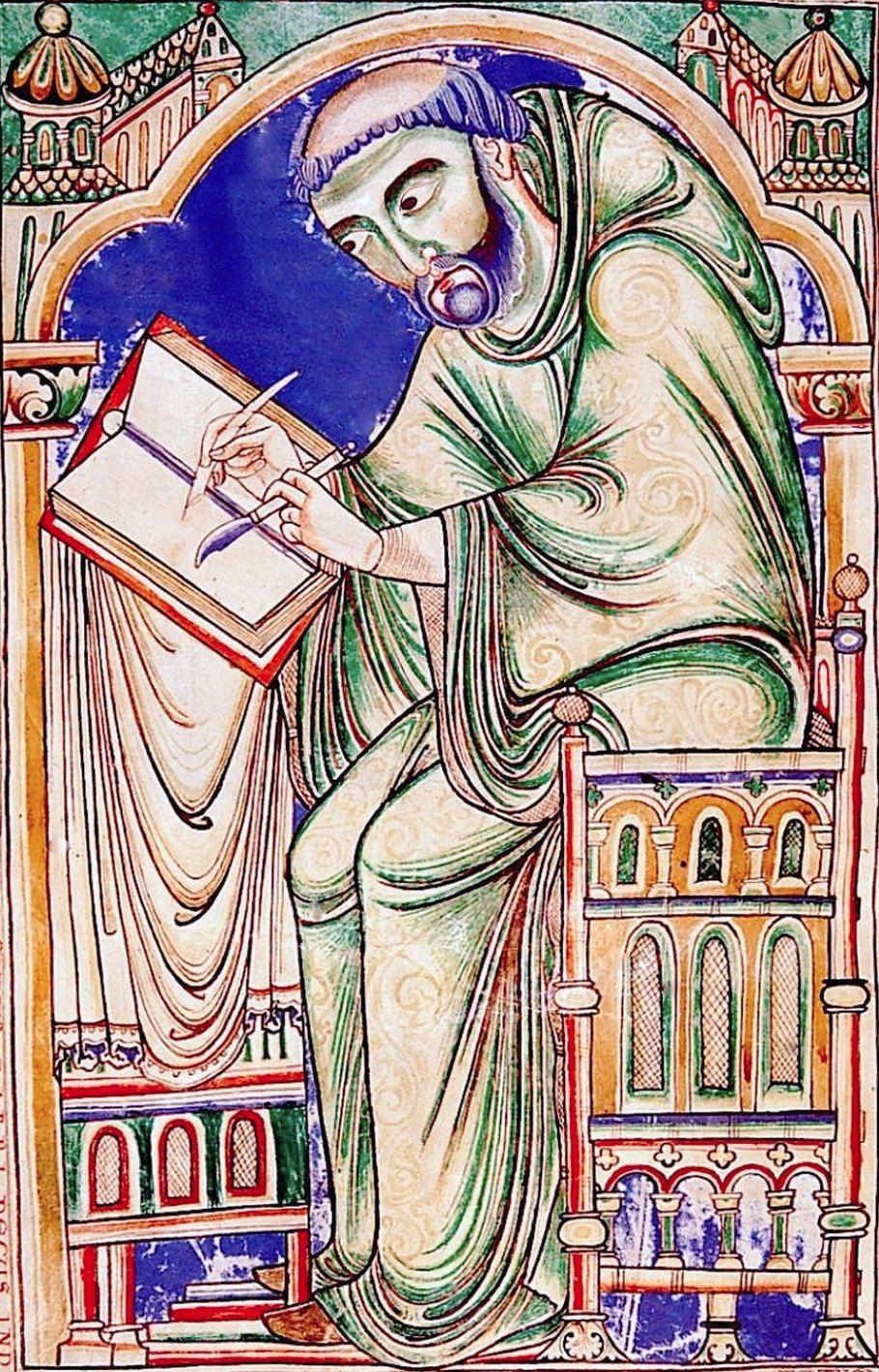
Where’s the Y’ Shape in Eadwine’s Right Hand?
How to read the Y’ shape in the hand image:
Folded Pinkie + Ring. Standard in blessing shape.
Where’s the I Shape in Eadwine’s Right Hand?
How to read the I shape in the hand image:
Thumb. Standard in Blessing.
Where’s the I’ Shape in Eadwine’s Right Hand?
How to read the I’ shape in the hand image:
Extended Index (much more visible/shown than middle finger) forms I, but cut by quill pen.
Commentary
What a GREAT exercise Eadwine’s portrait enables!
Eadwine’s hand-shape pair never really, plainly depicts the false, … well, the “qua qualified possibilism-thinking, Y shape.
Left hand: normally this would be Y’Y:
Y’ – folded pinkie/ring
Y – extended index/middle
Right hand: normally this would be Y’YI per blessing hand:
Y’ –
To develop nomenclature, theory, analysis technique, etc.
ie, answer these Qs for EVERY hand; given some stupid generic hand-shape, HOW CLOSE CAN YOU COME TO FORCING ALL 4 FORMS read into that hand image?
Purpose of Curled Side Finger when 4 Fingers Bent: Prove that the Bent Fingers Are Shortened, by Showing a Reference Long But Bent-Away Finger
solved! decoded “non-occluded curled side finger” that is NOT really meant to be read as “finger shown”
Principle: If Finger Is Curled-Away/Bent-Away, Read as “Prime”
This solves Mushroom King double-pointing shape: we are NOT to read curled, non-occluded Index as “I, curled”; we are meant to read the curl as “Prime”
don’t read as: Y’III read as: Y’II
the visible 3-seg Middle finger because curled, is grouped with the 1-seg pinkie / ring / middle group.
Pinkie – Y’ group
Ring – Y’ group
Middle – Y’ group, NOT read as “separate, because 3 seg shown”.
Index – I
Thumb – I
Principle: Curl of a Finger OVERRIDES “all 3 segments are shown”
that is a big solution! ie, it is the most useful interp’n convention: we introduce a new class, “curled finger”.
Immedly this solves eg her super long pinkie in some image from Great Canterbury Psalter , dancing?? f20
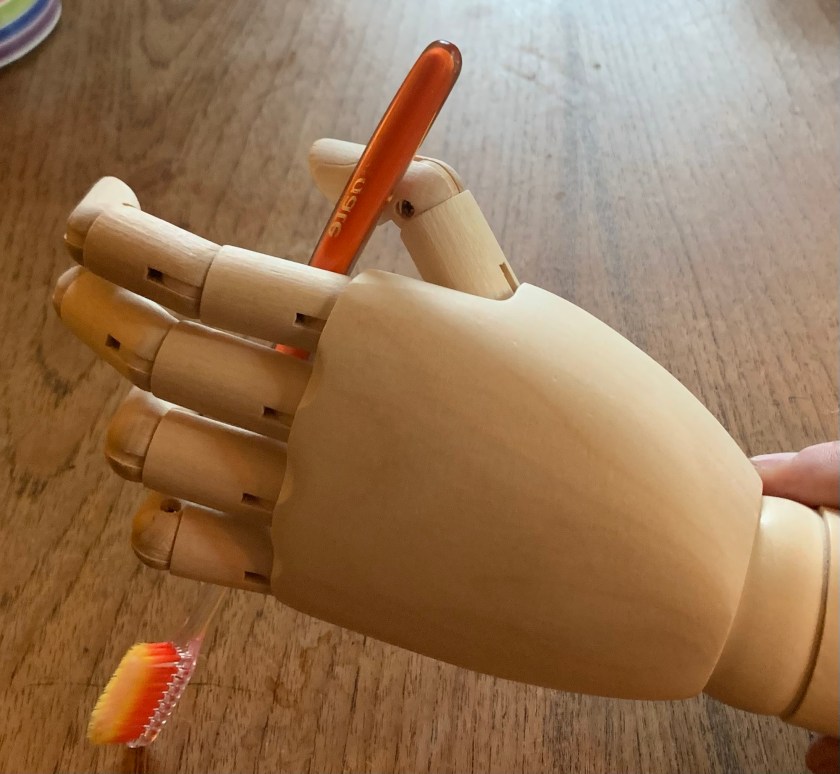
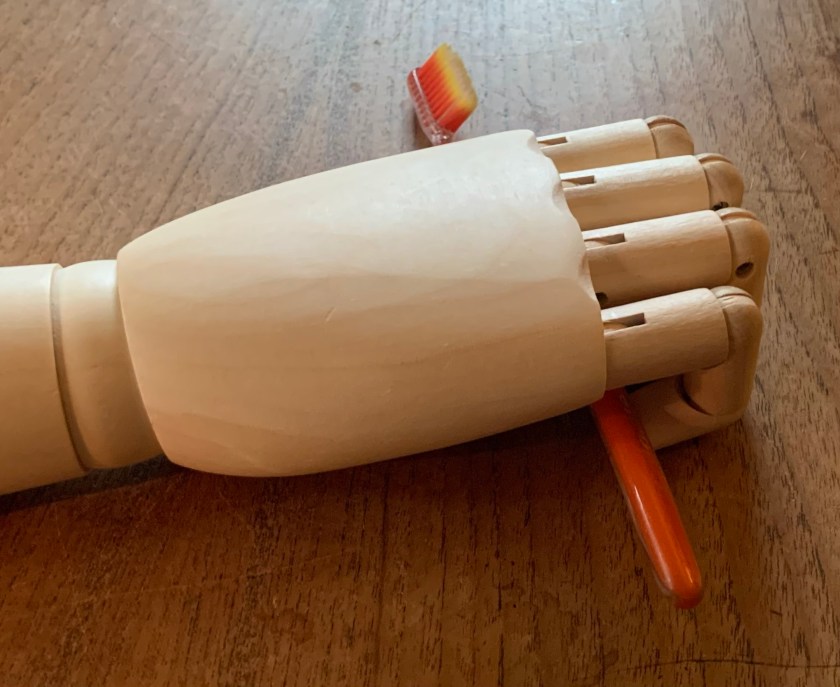
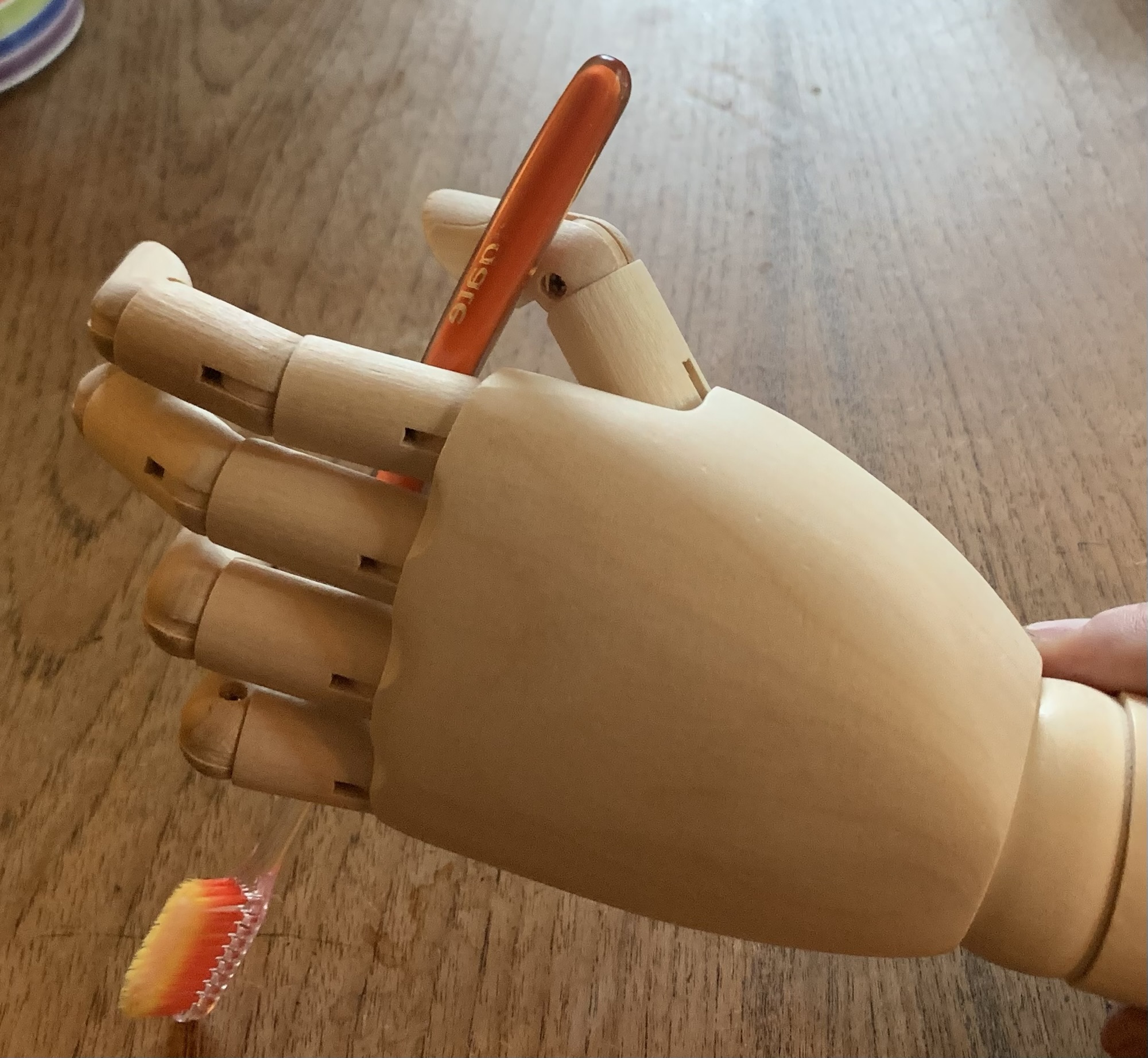
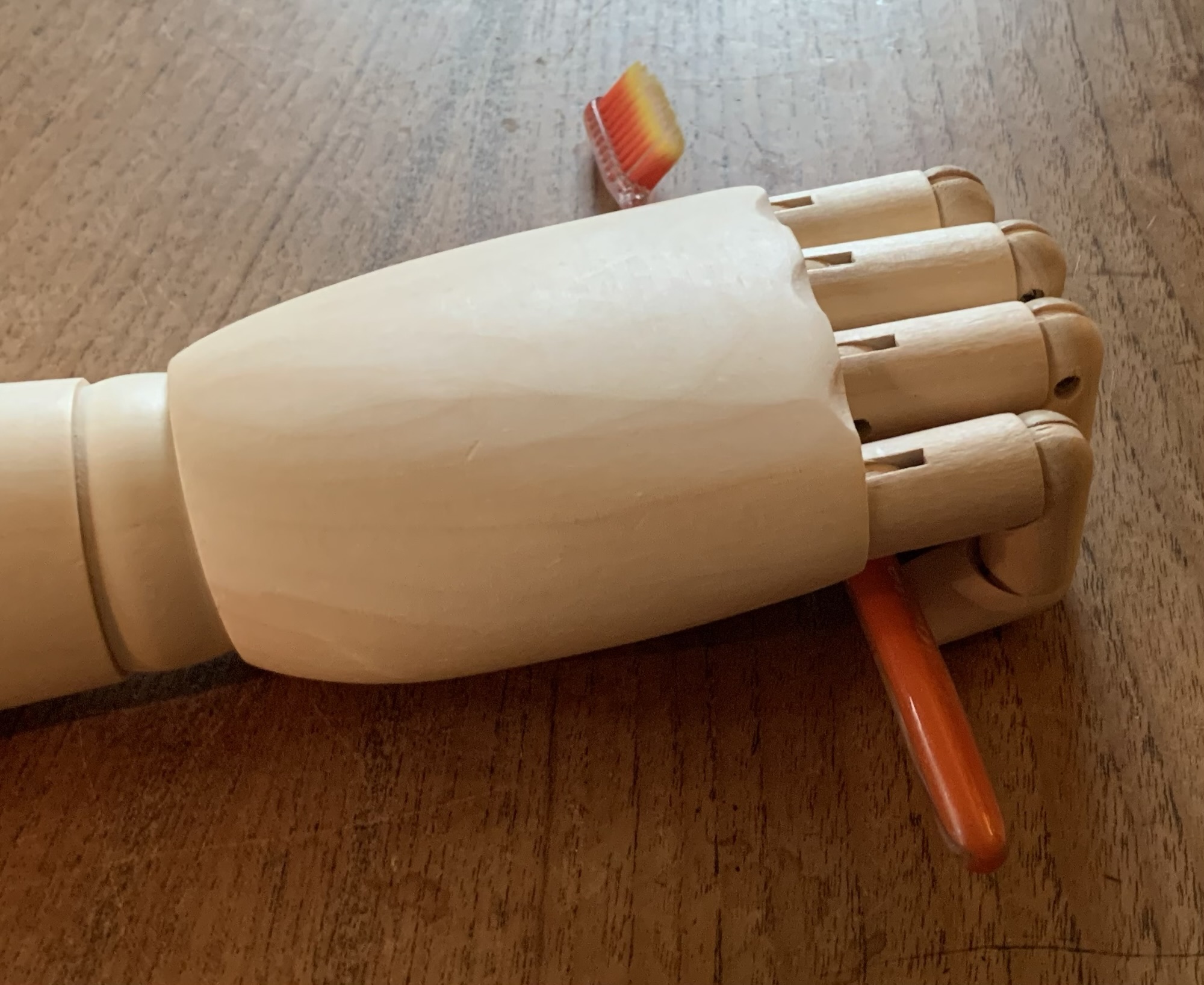
[9:55 a.m. Saturday, February 28, 2026] it was during photo’ing my hand and hand manikin , choosing what angle best conveyed and avoided conveying unwanted impl’ns, i had a problem that HOW TO GAUGE FINGER LENGHTh and whether finger is extended or bent-away by 1, 2, or 3 joints?
EVEN THOUGH AN ENTIRE FINGER IS SHOWN (CURLED) AND ALL 4 FINGERS ARE BENT AWAY (SHOWING 1 SEGMENT), HOW CAN WE PROVE TO THE VIEWER THAT THOSE 1-SEGMENT FINGERS ARE SHORTENED?
Ans: by showing a full length finger (but curled-away) for length-contrast to estab the Reference “here’s how long a finger would be (shown curled-away, negated) –
Q.E.D. – my moment of breakthrough on this problem i been puzzling for days.
Bent finger shows 1 segment, base segment. Negates/ qualifies; not to say “get rid of possibilism-thinking”; merely: qualified.
Curled finger shows 3 segments but curled = Negates/qualifies.
same for thumb but 2 seg not 3.
How to Detect the “Correct Interpretation”, by What Standard of Measure?
Ans: Most Useful Class’n Scheme, that Feels Most In Sync Consistent w/ the Art/ artists’ Treatment of the Motif.
Resolves inconsistencies/ contradictions/ awkward unresolved complexities across the medieval art genre of {mushroom-trees}.
above, i don’t mean 100% sincerely, “the medieval art genre of {mushroom-trees}”, here I have jumped OUT from that genre into DISTINCT BROADER genre, of medieval YI hand-shape language . redo w/ that phrase:
Resolves inconsistencies/ contradictions/ awkward unresolved complexities across the medieval art genre of {YI hand-shapes}.
the medieval art genre of {mushroom-trees} [MAGMT]
the medieval art genre of {mushroom-trees}
Existing keyboard shortcut, to develop the keyboard shortcut for a hand-shape equivalent of that mushroom-tree keyboard shortcut.
SWAG estimate of years: 900 AD – 1300 AD
the medieval art genre of {YI hand-shapes} [MAGYHS] [MAGHS]
SWAG estimate of years: 800 AD – 1600 AD
ie, since YI hand-shape theory is PART of — a subset of techniques within the medieval art genre of {mushroom-trees}, therefore, the era of YI hand-shape theory is broader than the more particular combination, the {mushroom-tree} era.
eg (highly tent. dates), here is the idea:
800 AD – the artists’ psilocybin motif initiation guild: Start of YI hand-shape language
900 AD – the artists’ psilocybin motif initiation guild: the medieval art genre of {mushroom-trees}; {mushroom}, {branching}, {handedness}, and {stability} motifs. Start of mushroom-trees integ’g {mushroom}, {branching}, {handedness}, and {stability} motifs.
1300 AD – end of mushroom-trees End of mushroom-trees
1600 AD – end of the YI hand-shape language comprehension & usage. End of YI hand-shape language
Proof that Curled Finger Means Negated: {hand mushroom-tree} in f107, f109
the artists’ psilocybin motif initiation guild [APMIG]
the artists’ psilocybin motif initiation guild apmig
with psilocybin mushroom lockbox and education aid instruction
the medieval art genre of {YI hand-shapes}
the medieval art genre of {YI hand-shapes}
Notation: Two Square Brackets, for Synonymous Acronyms [ACRO] [ALTACRO]
Note new notation in heading, two sq brkts – where I defined same keyboard shortcut via alt acronyms. 10:30 [ a.m. Saturday, February 28, 2026]
first i def’d MAGYHS which does have a letter for every word, but,
for parallel w/ older existing acronym MAGMT, which has been very useful, omit Y; instead of …MT (mushroom-trees), say …HS (hand-shape).
eg:
one acronym for each letter
one acronym for parallelism w/ some other acronym, or for shorter easier alternative, or for a different way of recalling and thinking of the expanded phrase.
New Notation for Keyboard Shortcut Acronyms (Extends 4/87 Notation): TWO Square Brackets, for Synonymous Acronyms
Crop & annotations by Michael Hoffman, Feb. 28, 2026 “eadwine hand shapes.jpg” 31 KB, [8:24 a.m. Saturday, February 28, 2026]
Eadwine Image, No Border
Crop by Michael Hoffman “eadwine no border.jpg” 502 KB [8:36 a.m. Saturday, February 28, 2026], fullscreen
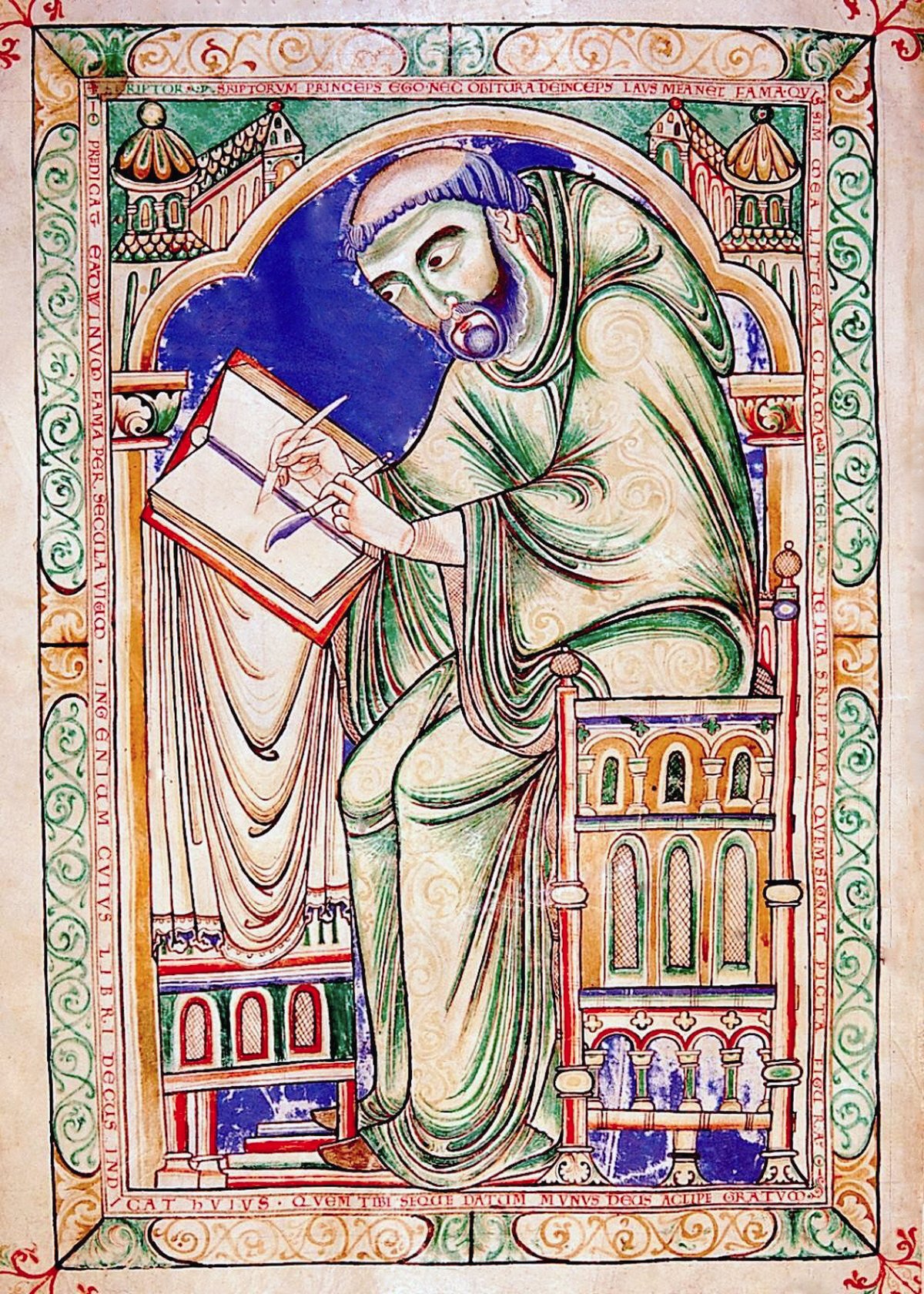
Full Image of Eadwine
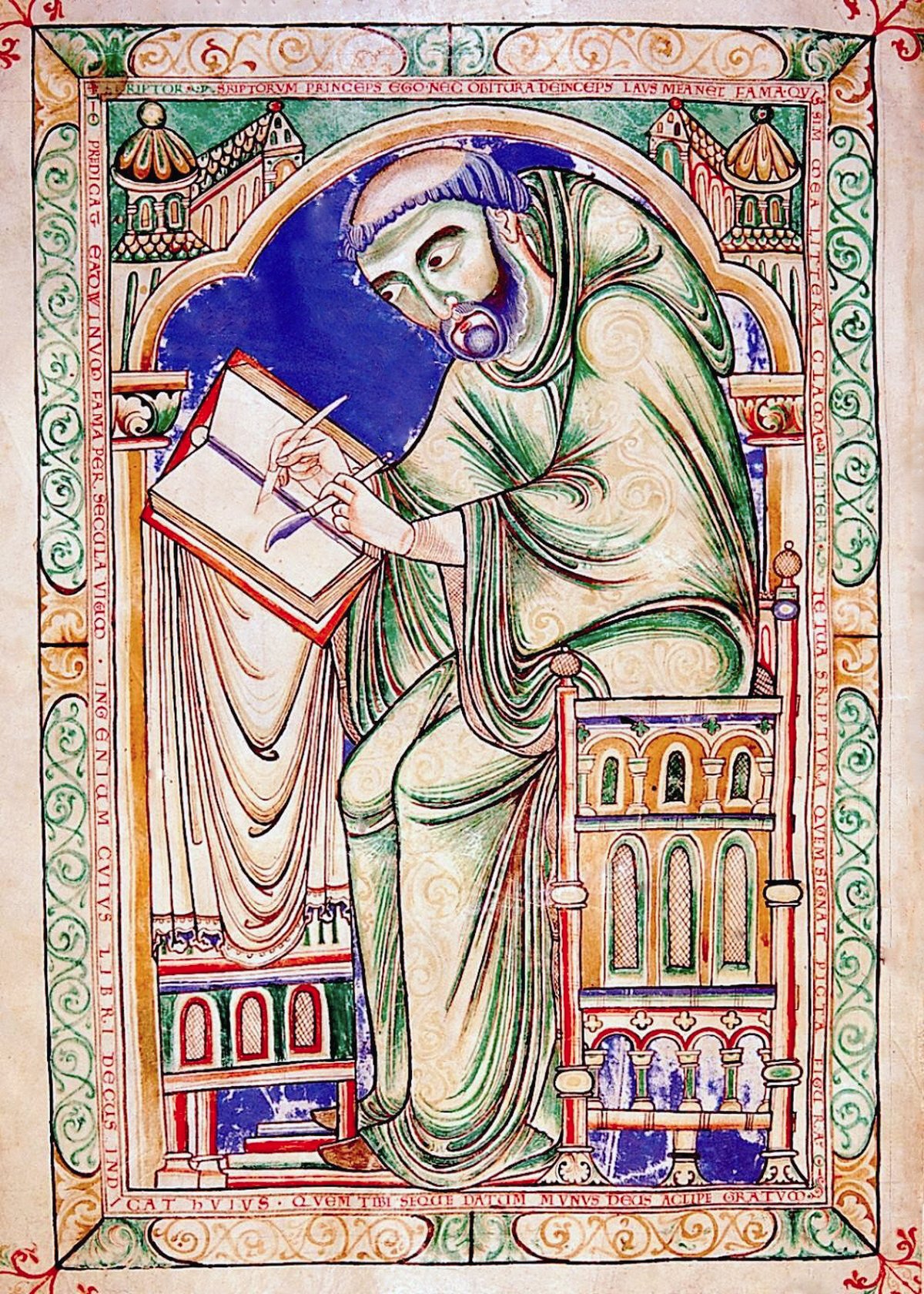
“eadwine-the-scribe-at-work-eadwine-psalter-christ-church-canterbury-england-uk-circa-1160-70.jpg”, 708 KB [8:12 a.m. Saturday, February 28, 2026]
Left Hand of Eadwine the Scribe
Left hand: Y’YI = YY’I
The latter reduction/normalization from Y’YI to YY’I, into one of the Basic YI Forms, eliminates some sometimes-valuable data/info
Instead of [the blessing shape sans thumb], the extended 3-seg Index + Middle are bent (2 seg; base & mid, no tip).
Example of info-loss simplification in order to usefully discard excess detail that obscures basic patterns:
saying “2 segments of a finger are shown” without saying WHICH segment is occluded.
Sometimes you want full data (obscure forest by tree detail; given that tree form ~= hand form
Right Hand of Eadwine the Scribe
Right hand: Y’ Y’ = Y’ – the latter reduction/normalization (into one of the Basic YI Forms) eliminates some data/info ie that instead of the blessing shape, __
Can’t See the Forest for the Trees
Can’t See the Hand for the Fingers
Full detailed data about which of the 14 finger segments are shown, is an order of magnitude, different info focused, than reduction to one of the __ basic hand-shape forms.
Detailed Hand Finger Segment Inventory vs. Basic Hand Shape
Scribe with {stand on right foot/ left foot lifted}
found a few days ago, good image, multiple handedness motifs
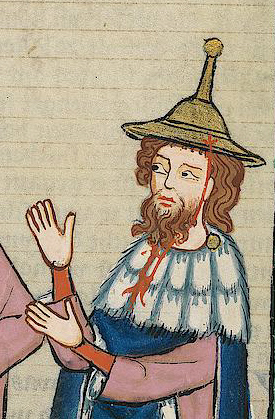
Make a Michael Hoffman Portrait by Using a Scribe Portrait
todo
YI Hand-Shapes in Paintings Showing Medieval Scribes
todo: Showcase YI Hand-Shapes in Paintings Showing Medieval Scribes
64,409 views Mar 3, 2021 Making a historically adequate partial replica of The Missal of Eberhard von Greiffenklau, a 15th-century manuscript from The Walters Art Museum.
I apologize for the video corruptions that crop up at a couple points, I’m not sure how to fix that!
The original manu
Video: Hidden Symbolism in Medieval Art ~ Illuminated Manuscripts, Art Video Essay (Dantier and Balogh Design Studio, Jul. 2024)
Video title: Hidden Symbolism in Medieval Art ~ Illuminated Manuscripts, Art Video Essay YouTube channel: Dantier and Balogh Design Studio Jul. 28, 2024 https://www.youtube.com/watch?v=vnFt_J1h61w —
Desc:
“This video is all about the history of illuminated manuscripts from medieval England.
“In this art video essay we will go through the history and the art & design of book illumination throughout the middle ages focusing on Britain (the british isles)
“we will touch on
the Irish book of Kells from the dark ages , go through
the viking invasions that this (predominantly) Christian art form had to survive made by the monks of Winchester, Canterbury and the likes
“We will mention
the Winchester bible &
the Romanesque Stylistic marks,
the Winchester benedictional (also knows as the benedictional of St Aethelwold) with its carolingian art origins, and
the Queen Mary Psalter from the gothic era.
We will analyse the symbolism of
Romanesque art characteristics,
Gothic art styles and
many more.
“I truly believe these religious illustrations, the art of the middle ages are the precursors of not just what we call book design today but they also laid down the fundamentals of graphic design and illustration as we know it today as well!
“Hope you will find the video entertaining and educational,
bookworms,
history buffs and
designers alike.”
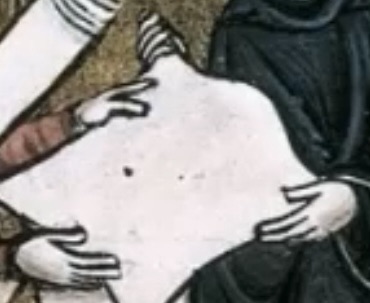
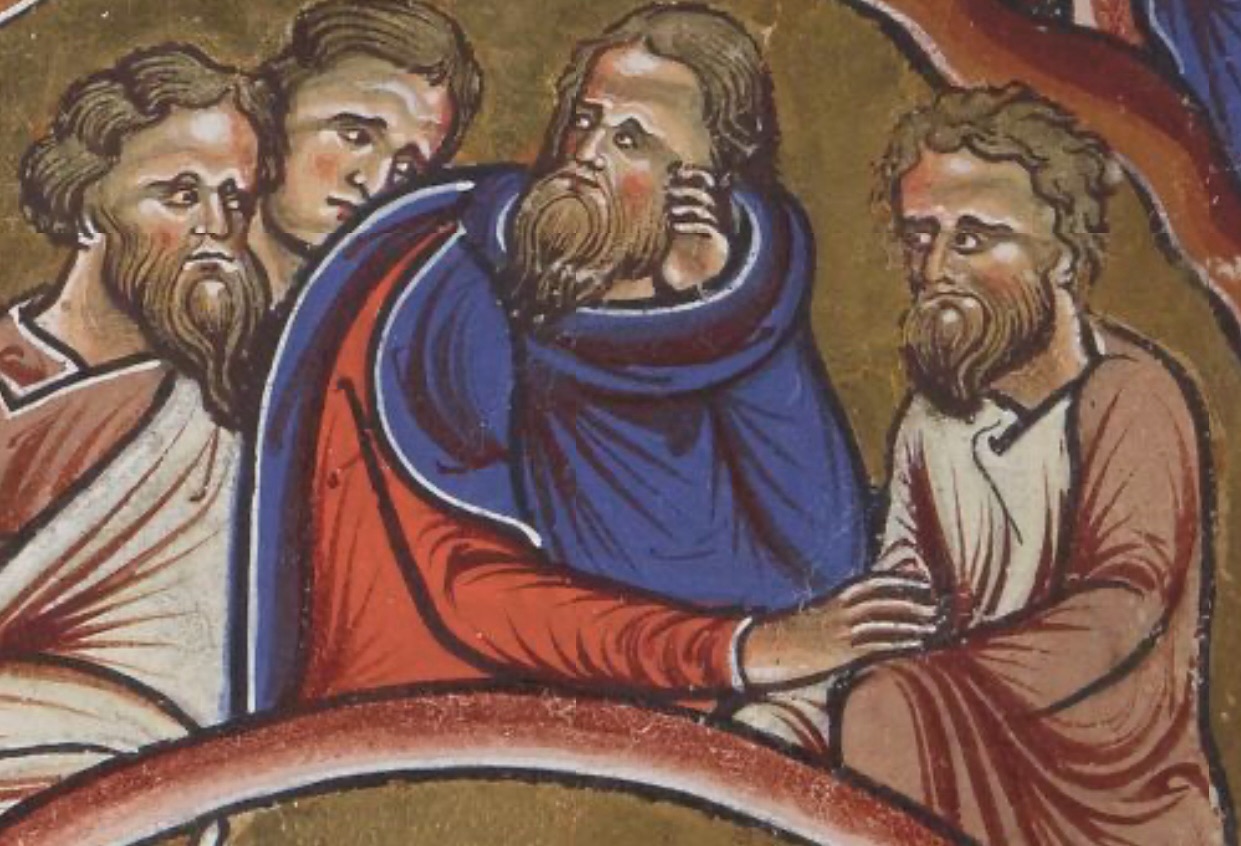
Bonus: Dancing Man – Fresh Analysis of Hand-Shape Pair Shows All Four YI Forms: [Y Y’ I I’]
Crop by Michael Hoffman
Y
upper hand: Middle/Ring/Pinkie group splayed (curled a little, but not enough to signal “rebut” or “cut”)
Y’
lower hand: 4 cut/bent fingers, no thumb
I
upper hand: Index finger fully shown 3 segments – all 4 segments of Index finger are shown
I’
upper hand: Index finger bent; as if 3 segments (extra mid segment) + tip is bent, negating the finger.
If anything, if I had to choose, I’d lean toward classifying the upper hand’s Index finger as the I’ shape, more than as the I shape. The finger is so damn weird, it is easy to justify saying the artist is attempting to convey BOTH I & I’ by extreme elongation (I) + sharp bend (I’). As long as my assessment is PRODUCTIVE and I can “show your work” of analysis justification, I’M GOING WITH THAT.
I – fully extended, fully displayed except the tip of the tip?
wastes 1.4 MB space on WordPress gallery – todo: delete. same filename locally used for v3 .jpg.
v2: neglected to realize that Cybercide’s sword aims at God’s Right hand.
Errata/nits:
Should be a red box, not white, around Psalter Viewer’s feet, since red line on finger-heights.
MAJOR OVERSIGHT: Cybercide sword aim at God hand
Too Many Breakthroughs, 1:40 pm – 3:30 pm Feb 28 2026
f134 Correction of Looking Lines
b/c Each Eye Points a Different Direction, at Key Targets,
eg row 2 Sword Points at Angel Splay Hand Row 1 right
Good Voice Recording About Hand-Shape Theory: VOX_TK_6620.wav
But it’s becoming outdated by the minute, because making such fast progress to develop and revise my model of hand-shape theory.
Strategy: EXTREME CLOSE-UP, Set General Angle of Looking-Lines; Afterwards, Connect to Reasonable Appropriate Targets, Adjusting Angles of Looking-Lines
eg, I’m Making a Crop that ONLY Circles “Good Targets”
It doesn’t greatly matter if some sources & sinks get crossed.
“Every eye is looking at every major significant target” gets the comprehension-job done well enough to get top scores on the test.
Image: “f134 psalter viewer eyes.jpg”
Crop & annotations by Michael Hoffman “f134 psalter viewer eyes.jpg” 116 KB [4:55 p.m. Sat., Feb. 28, 2026] todo: copy to f134 page
Looking-line angles are approximate.
These looking-line angles in these 4 crops were set during extreme zoom-in.
Next, connect to appropriate, reasonable targets; adjust looking-line angles.
Image: “f134 women eyes.jpg”
Crop & annotations by Michael Hoffman “f134 women eyes.jpg” 374 KB [4:55 p.m. Sat., Feb. 28, 2026] todo: copy to f134 page
Tentative looking-line angles.
Image: “f134 threateners eyes.jpg”
Crop & annotations by Michael Hoffman “f134 threateners eyes.jpg” 270 KB [4:56 p.m. Sat., Feb. 28, 2026] todo: copy to f134 page
Tentative looking-line angles.
Image: v1 of Aiming Lines: “f134 archers fingers target feet.jpg”
Crop & annotations by Michael Hoffman, Feb. 28, 2026 “f134 archers fingers target feet.jpg” 1.4 MB (LARGE) [4:56 p.m. Sat., Feb. 28, 2026] todo: copy to f134 page
v1 tentative looking-line angles. Possible errata:
Psalter Viewer is not looking so steep; more shallow angle, eg target: hand of angel on the Pulled-from-Banquet guy.
v2, improved targets of looking-lines:
Did I mention in Nov. 2020? Cybercide guy’s blade cuts his LEFT (branching possibilism) side.
I came close to putting a line from sit-in-tree’s fist to Break-Bowman. But, fist needs more consideration; compare row 3 oxen guy grabbing and pointing to God’s blessing-pointing line.
Items that Point to Something in f134, re: Psalterty of Ego Death
Aiming via:
Left Eye
Right eye
Sword-aim row 1
Sword aim row 2
God’s Blessing-Fingers
Archer’s Bow-Pulling Fingers
Head-Tilt of a 3-Legged Woman (point via eye 1, eye 2, & face-angle)
Clutching fist of guy in tree like clutching fist of oxen guy holding other end of God’s blessing/pointing/ THREATENING line w/ midpoint at {balance scale} pivot.
Items that Are Pointed At
Primary Targets:
Psalter Viewer feet;
blade of UPSIDE DOWN Cybercide guy
Psalter Viewer fingers-height
{balance scale} pivot
white light
touch blade of sword in tree
angel’s splayed finger
God’s pointing hand
Eadwine’s leg-hanging mushroom tree image in the Great Canterbury Psalter
leg-hanging guy: hand touch blade.
Decoded: {cutting branches} = mental model transformation from possibilism to eternalism
To move from possibilism to eternalism = to cut branching.
See my good voice recording.
EXTREME CLOSE-UP!!
Video: Spinal Tap II: The End Continues – Official Trailer | SDCC 2025
Relevance: To assess which eye is aimed at which PRIMARY TARGET (eg {balance scale} pivot; angel hand splay, God’s blessing pointing fingers, archer’s pulling/pointing fingers,
Video title: Spinal Tap II: The End Continues – Official Trailer | SDCC 2025 YouTube channel: IGN Jul. 24, 2025
Desc: “Forty-one years after the release of the groundbreaking mockumentary This Is Spinal Tap, the now estranged bandmates David St. Hubbins, Nigel Tufnel, and Derek Smalls (Michael McKean, Christopher Guest, and Harry Shearer) are forced to reunite for one final concert.
Spinal Tap II: The End Continues also marks the resurrection of documentarian Marty Di Bergi (Rob Reiner), who once again tries to capture his favorite metal gods as they contemplate mortality—and the hope that their 12th drummer doesn’t join them in The Great Beyond.
Joined by music royalty Paul McCartney and Elton John, Spinal Tap wrestles with their checkered past to put on a concert that they hope will solidify their place in the pantheon of rock ’n’ roll.
Directed by Rob Reiner, the film stars Christopher Guest, Michael McKean, Harry Shearer, Fran Drescher, Paul Shaffer, Elton John, Paul McCartney, Questlove, and Chris Addison.
Spinal Tap II: The End Continues opens in theaters September 12, 2025.”
the Pulled-from-Banquet guy looks at YI or Y’I form of angel hand using splayed finger to separate 3 grouped branching fingers from 1 separate non-branching finger.
If we say it’s a Y’I hand, that is not consistent; we’d be forced to say it’s a Y’I’ hand.
Crop and rotation by Michael Hoffman, Feb. 28, 2026, fullscreen
Image: Pulled-from-Banquet guy, Angel Finger Splayed, Maiden Finger Splayed, Mapped to Basic IY Hand
Decoded: Elongated & Sharply Bent Index Finger of Dancing Man
[Noon Saturday, February 28, 2026]
todo: create new page purely to taunt POS PHONY, Ronald Huggins the academic 304, reaches whatever pre-set “conclusion” corrupt anything-but-drugs academia pays him to reach. title:
Dancing Man: W, Ronald Huggins: L
possible content:
the 4 text msgs just sent to RL [1 p.m. Saturday, February 28, 2026]
Huggins says f11 day 3 plant 2 right branch is a tree branch – look exact mushroom
Huggins says f11 day 4 plant 3 is a tree – look exact mushroom
Huggins would say f134 is a wheat farm, not Cubensis grow-op.
re-analysis of Dancing Man hand-shape pair
Re-analysis of Dancing Man hand-shape pair
SHOWS ALL 4 YI FORMS!
That EXPLAINS TOTALLY THE WEIRD INDEX FINGER!
The same index finger expresses both I and I’, no wonder it’s so f’d up!
The Index finger I shape is both asserting I and rebutting I, no wonder so bent and long.
Ronald Huggins the academic 304, reaches whatever pre-set “conclusion” corrupt anything-but-drugs academia pays him to reach [RH304]
Ronald Huggins the academic 304, reaches whatever pre-set “conclusion” corrupt anything-but-drugs academia pays him to reach
Micro Bio of Michael Hoffman
Michael Hoffman – Egodeath.com; the Egodeath Theory of Psychedelic Eternalism & Mytheme Analogy – a STEM-based model of how the mind transforms in the altered state
todo: add to new “names of theory” page
the Theory of Psychedelic Eternalism & Mytheme Analogy [TPEMA]
the Theory of Psychedelic Eternalism & Mytheme Analogy
the Egodeath Theory of Psychedelic Eternalism & Mytheme Analogy [ETPEMA] [EPM]
16 Combinations of Y, Y’, I, I’ Can Be Expressed by a Hand or Tree Image
Has 0 of the 4 shapes: (1)
Y’I
Has 1 of the 4 shapes: (4)
Y
Y’
I
I’
Has 2 of the 4 shapes: (6)
Y I
Y’ I
Y I’
Y’ I’
Y Y’
I I’
Has 3 of the 4 shapes: (4)
Y Y’ I
Y Y’ I’
Y I I’
Y’ I I’
Has 4 of the 4 shapes: (1)
Y Y’ I I’
Terminology of the 4 Shapes
Y – branching
Y’ – cut branching
keyboard shortcut
cut branching cbr
cut non-branching cnb
test of 4 keyboard shortcut:
branching br
cut branching cbr
non-branching nb
cut non-branching cnb
branching [BR]
branching
cut branching [CBR]
cut branching
non-branching [NB]
non-branching
cut non-branching [CNB]
cut non-branching
Cyberdisciple [CB]
Cyberdisciple
Max Freakout [MF]
Max Freakout
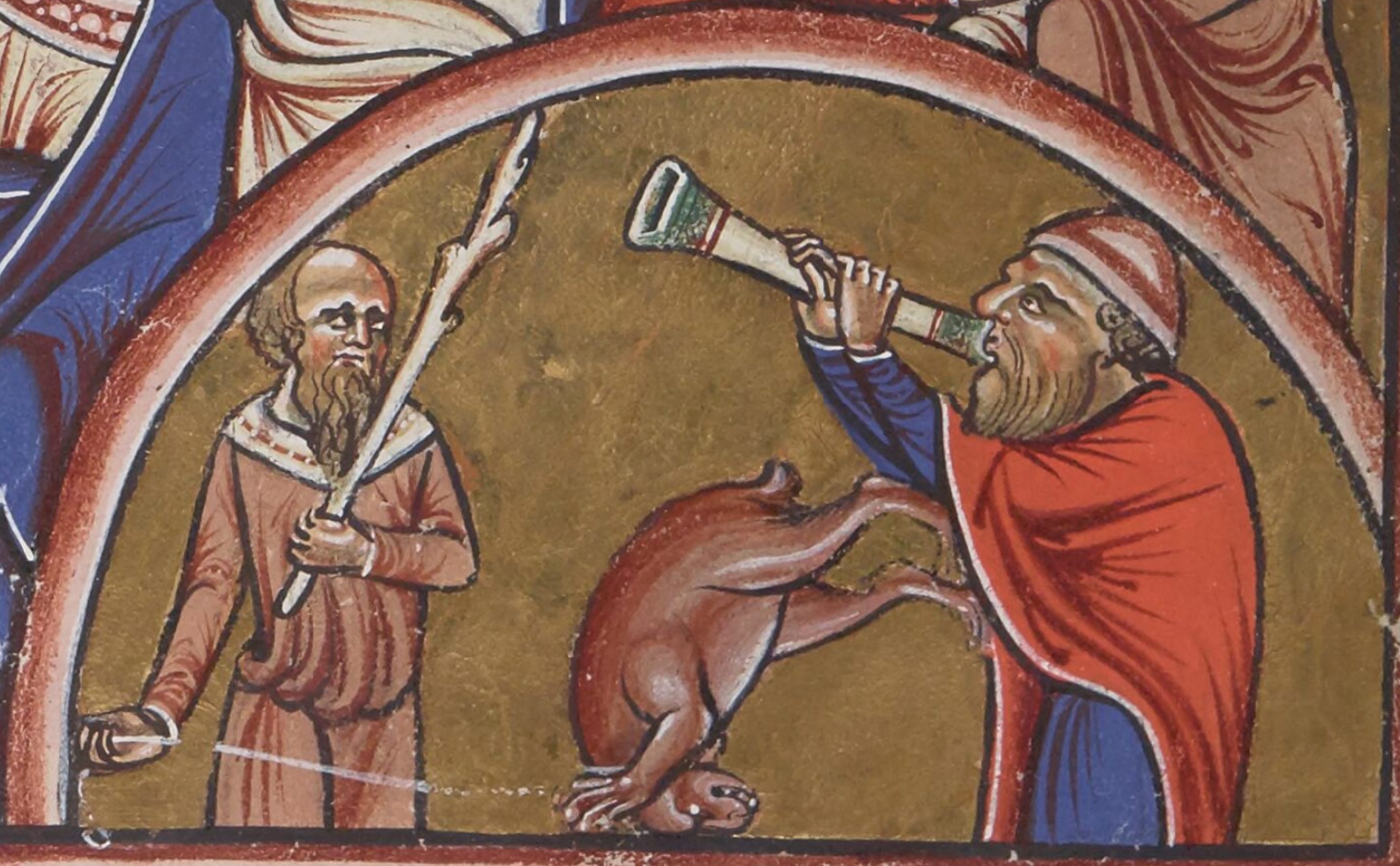
Dancing Man: Re-Assessment of YI hand-shape pair
of Dancing Man in the salamander bestiary image including a mushroom-tree
new meaning of bent index finger: I’ !
How to read Y in this image:
Upper hand: 3 fingers splayed as a group.
How to read Y’ in this image:
Strong: lower hand: fingers bent. DO NOT ANY LONGER SAY PINKIE SHOWS 3 SEG THEREFORE ADDS AN I!
Weak: upper hand: The grouped 3 fingers are bent.
How to read I in this image:
Upper hand: Index finger 3 seg shown.
How to read I’ in this image:
Upper hand: Index finger bent. OMG THIS ENABLES READING DMS AS carrying expressing conveying signally all 4 SHAPES: Y Y’ I I’
Dancing Man in the salamander bestiary image including a mushroom-tree [DML]
Dancing Man in the salamander bestiary image including a mushroom-tree
Dancing Man [DM]
Dancing Man
Crop by Michael Hoffman
The 16 Basic Hand-Shapes (or Tree-Shapes?)
16 Combinations of Which of the 4 general branching shapes permutations Y, Y’, I, I’ Are Expressed by a Hand Image
Tree Forms Analyzed & Described/ Classified in Terms of the Same System
todo
These are which of the 4 general branching shapes permutations (ie, [Y, Y’, I, I’]) are conveyed or embodied by a hand image.
This isn’t really hand shapes.
These are which of the 4 hand-shapes – or rather, general branching shapes permutations (ie, [Y, Y’, I, I’]) – are conveyed or embodied by a hand image.
Decoded Raised IY Hand of the Pulled-from-Banquet Guy
Meaning of the raised IY hand of the Pulled-from-Banquet guy in f134 Great Canterbury Psalter
My first instinct during voice rec’g was correct, broke through to comprehending the hand – as Eadwine’s special meaning? No.
As a generic universal indicator of generally und the 4 shapes what they assert and how they are implemented, along with quirk conventions and solutions of this specialty the medieval art genre of {mushroom-trees}.
The meaning of his IY hand includes the distinct body of art/phil knowledge: hand-shape theory.
The angel instructs you of what?
branching vs. non-branching;
the 4 shapes;
possibilism vs. eternalism;
integrated possibilism/eternalism thinking.
“integrated possibilism/eternalism thinking” was my answer like a week ago, but since then, 1-2 days before today which is [ a.m. Saturday, February 28, 2026] , i ONLY said the IY hand means integrated possibilism/eternalism thinking.
That’s true, in broad sense of that phrase.
But I deepened my grasp of the meaning of the scene: angel teaches end-goal und’g of integrated possibilism/eternalism thinking but also, intermediate, teaches 4 shapes mapped to that.
the Pulled-from-Banquet guy [PFB]
the Pulled-from-Banquet guy
The Medieval Art Genre of {mushroom-trees} Incorporates Distinct hand-shape theory
What does an angel teach? The
The 4 shapes
possibilism vs. eternalism
qualified possibilism-thinking
integrated possibilism/eternalism thinking
Possibilism vs. Eternalism = Y vs. I; {branching} vs. {non-branching}; {tree} vs. {snake}; {fingers vs. thumb, index, or pinkie}; many worlds vs. single block-universe
[5:50 a.m. Saturday, February 28, 2026] f134 r2 bowman aims at feet. now drawing lines from his fingers to the feet of Psalter Viewer
Error: Say “archer” not “bowman”
bowman – a boatman, oarsman, or paddler stationed in the front of a boat
Psalter Viewer in GCP folio image f134 row 2 middle
Break-Bowman [BBM]
Break-Bowman
Break-Bowman in Great Canterbury Psalter folio image f134 row 2 middle [BBML]
Break-Bowman in Great Canterbury Psalter folio image f134 row 2 middle
Woman holding {balance scale} [WBS]
Woman holding {balance scale}
keyboard shortcut [KS]
keyboard shortcut/ acronym/ concept-label/ concept/ lexicon term [KSL]
Against Italics in Keyboard Shortcuts
This keyboard shortcut expansion system doesn’t accept italics, bullet list format, bold, etc. – strictly plain-text strings.
It is NICE and PREFERABLE to ital, but, as much extra work as applying Init Caps – extra difficult on mobile.
So, decree:
{tree} vs. {snake} = {tree} vs. {snake}; Italics within Braces Is Understood, Not Required
Ronald Huggins invades the forest is an mere invader of the forest of Great Canterbury Psalter – you want to see non mushroom mushroom-trees? See vine-leaf trees
{hand mushroom-tree} [HMT]
Square-brackets notation is per April 1987 explosion of new technique: when I started doing theory explicitly as such. When the Egodeath theory began as a conscious Theory.
Conscious Theorizing the the Egodeath theory Started Explosively April 1987 When Father Died in Middle of EE Studies; Started Oct. 1985 without a Clear Concept Yet of Theorizing
Still, bc of my mentality and context in self-help human potential movement, naturally, in Oct. 1985, I started by theorizing, but not a clear explicit concept of “I am constructing and marketing and branding a new Theory & explanatory model of how the mind transforms in the altered-state”. Latter is not how it was experienced; I did NOT have that idea, like history of using altered-state psychedelics psilocybin, to effect a standard transformation. It w My thinking was only informed by
STEM format of read/write/think/express/communicate.
Eastern mystics SUCK at writing about ego transcendence. They are degenerate and perverse and crude and inept, they are the problem, their mode of thinking/ communicating absolutely SUCKs, worst case. I agreed with Eastern Mystics that ego transcendence is a real thing, but I immediately trashed and disrespected their mindset; everything about their explantory construction and communication of ego transcendence.
Oct. 1985: Started Replacing How Ppl Talk about ego transcendence
Apr. 1987: Started Explicitly Constructing a Brand-Name Theory of Ego Transcendence to Replace How People Talk about Ego Transcendence
May 1987: Started Writing My Ego Transcendence Book Explaining Repairing How to Think about Personal Control
confused, i think “toward the end of the year 1987, I started writing about my book explaining repairing how we think about personal control.” Translation: end of the academic year.
The Southwest dorm, 3rd floor: June 1986-May 1987, is the “year” referred to.
Toward the end of academic year June 1986-May 1987, I started writing about my book containing my theory explaining repairing how we think about personal control. Let’s say that was May 1987.
That sounds right: Pretty soon after I found awesome powerful idea development technique, concept of writing a book explaining what I found.
The “end of the year” feeling (academic year) does not mean the different feeling, end of calendar year.
May 1987 “end of the year” feeling: academic year (for me). I found a good idea development technique to write book about ego transcendence for purpose of repair cross-time self-control.
Dec. 1987 “end of the year” feeling: calendar year. the Way of Zen by Alan Watts, on the very cusp… i started thinking about “determinism” Oct-Dec 1987 and criticizing Watts Dec. 1987: wtf didn’t you Why the f didn’t Watts just say, “determinism?” (ie Minkowski block-universe eternalism)
1988: the Cybernetic Theory of Ego Transcendence
vs. the Journal of Transpersonal Psychology/ Integral Theory’s Concept of Ego Transcendence as Popular Neo-Advaita: Actual Egodeath Is via Block-Universe Mysticism, not Through Popular Neo-Advaita
Feb. 2026: The Theory of Psychedelic Eternalism & Mytheme Analogy
The Egodeath Theory of Psychedelic Eternalism & Mytheme Analogy
April 1987 Explosion of Technique for Idea Development, and Concept of Constructing, Articulating, and Publishing a Theory
Apr. 1987 notation technique: wide-ruled (grade-school) binder sheets instead of 10×8″ blank books. With Pentel P205 mechanical pencil.
Pentel P205 mechanical pencil – since maybe Sep. 1982; the standard pencil for Electronics Engineering tech school, that many students used, and that was favored and max avail’y in the supp Supply Room store; same at Uni bkstore Aug 1983.
Wide-ruled (grade-school) binder sheets instead of 10×8″ blank books
phrase, and then acronym in square brackets
left hand
Allcaps
IN THE 1980S ALLCAPS RULED THE EARTH 🦖🦕
1978-1991: Fortran, COBOL, BASIC
Query: When did C programming become popular? 1980s.
AI Answer:
C programming began to gain significant popularity in the 1980s, driven largely by its association with the Unix operating system and the publication of its first definitive book.
Key Milestones in C’s Popularity
Early 1970s: Creation and Initial Use C was created by Dennis Ritchie at Bell Labs between 1972 and 1973 primarily as a system implementation language for developing the Unix operating system. The Unix kernel was largely rewritten in C by 1973, which demonstrated the language’s power and efficiency for system-level programming.
1978: The K&R Book The publication of the book The C Programming Language by Brian Kernighan and Dennis Ritchie served as the first widely available and informal standard (known as “K&R C”) for the language. This book helped popularize C beyond Bell Labs and the Unix environment.
The 1980s: Widespread Adoption During this decade, C’s use spread rapidly as compilers became available on nearly every machine architecture and operating system, including early personal computers. C began to displace other languages like Basic as a leading choice for microcomputer programming. This widespread availability and the language’s portability contributed to its massive surge in popularity.
1989: Formal Standardization The American National Standards Institute (ANSI) published the first official standard for C (ANSI C or C89) in 1989. This standardization addressed compatibility issues that arose from slightly different versions of the language, promoting portability and solidifying its use in commercial and government projects. Wikipedia Wikipedia +9 C has remained one of the most widely used programming languages since, consistently ranking high in popularity indexes, due to its efficiency, low-level memory access, and portability. It has also influenced the syntax and features of many other prominent languages like C++, Java, Python, and C#
/ end robot
Query: Is the BASIC programming language case-sensitive?
AI Ans:
No, the BASIC programming language is generally case-insensitive. This means that keywords and user-defined identifiers (like variable names) that differ only in their capitalization are treated as the same by the interpreter or compiler.
Key Points
Identifiers are the same: In most BASIC dialects, variable and VARIABLE and Variable all refer to the same entity.
Historical reasons:Case insensitivity was a common feature in many early programming languages (including Fortran and COBOL) because the keyboards and display terminals on early computers often only supported uppercase letters.
Modern dialects: Most modern dialects, such as Visual Basic (VB) and VBA are also case-insensitive, although some specific versions like BBC BASIC might have exceptions.
IDE behavior: Many modern Integrated Development Environments (IDEs) for BASIC-derived languages will automatically adjust the casing of your code to match the first time an identifier or keyword was defined, which helps enforce consistent style, but doesn’t change the underlying case-insensitivity of the language itsel
/ end robot
1980s was peak allcaps era; used everywhere for everything: programming, students…
Probably because allcaps was used for programming in the first 1978 personal computers, 1978 marks the beginning of the allcaps era.
For me, that era ended with C programming classes in 1991. Case-sensitive programming language.
1978-1991 was my home computer allcaps era.
query: Is the C programming language case-sensitive?
Ai ans:
Yes, the C programming language is case-sensitive. This means that the C compiler treats uppercase and lowercase letters as distinct characters. Scaler +1
For example:
Variablescount and Count are treated as two separate variables.
Function namesmain() and Main() are different, with main() being the correct entry point for a standard C program.
Keywords in C must be written in lowercase. Writing int is correct, but Int or INT will result in a compilation error because the compiler does not recognize them as valid keywords.
/ end of AI answer
acronym [ACRO]
block-universe eternalism [BUE]
block-universe eternalism
Minkowski’s block-universe eternalism [MBUE]
Minkowski’s block-universe eternalism
But Petkov’s main name of Minkowski’s theory is absolute four-dimensional spacetime, thus:
Woman holding {balance scale} in Great Canterbury Psalter folio image f134 row 2 middle [WBSL]
Woman holding {balance scale} in Great Canterbury Psalter folio image f134 row 2 middle
Break Bowman
[ a.m. Saturday, February 28, 2026] [DTS]
a.m. Feb. 28, 2026 [DTSM] (Medium)
Feb. 28, 2026 [DTSS] (Short)
Titles of this Page
{slightly splayed finger} Motif: Splayed Index or Pinkie, vs. 3 Fingers Held Together
{subtly splayed finger} Motif: 3 Fingers Held Together vs. Splayed Index or Pinkie; Equivalent to {fingers vs. thumb}
Decoded {subtly splayed finger}: 3 Fingers Held Together vs. Splayed Index or Pinkie, Equivalent to {fingers vs. thumb}
Subtle Splayed Index Finger or Pinkie Finger Contrasted Against Other Three Fingers Held Together, Equivalent to Thumb vs. Fingers
Includes fresh mobile crops from full-res lib site in Paris, Great Canterbury Psalter.
The {slight splay} Secret Artists’ Motif
txt msg 1 to sacred plants community church artists members
the {slight splay} sekrit artists motif
psilo artists’s initiation guild psilo lockbox
{hand mushroom-tree}
hand is like YI tree
Possibilism vs. Eternalism = {branching} vs. {non-branching} {tree} vs. {snake} {fingers} vs. {thumb} or {index OR PINKIE finger} Y vs. I many worlds vs. single block-universe
Crop by Michael Hoffman, Feb. 27, 2026Crop by Michael Hoffman, Feb. 27, 2026Crop by Michael Hoffman Feb. 27, 2026Crop by Michael Hoffman, Feb. 27, 2026Crop by Michael Hoffman, Feb. 27, 2026Crop by Michael Hoffman, Feb. 27, 2026Crop by Michael Hoffman, Feb. 27, 2026
my Psilo Lockbox Bins page needs better crops of {artists initiation guild psilo lockbox bins}
mind the medieval YI hand-shape language:
Y Y’ I I’
Keep Your Eyes Peeled to Spot YI Hand-Shapes: Y, Y’, I, I’
Especially Notice YI Hand-Shapes: Y, Y’, I, I’
Especially Take Notice of the YI Hand-Shapes: Y, Y’, I, & I’ Shapes: Branching, Cut Branching, Non-branching, & Cut non-branching Depict possibilism vs. eternalism World Models
ordinary-state, branching Possibilism vs. altered-state, non-branching Eternalism obvan
I initially wrote:
mind the medieval YI hand-shape language: Y Y’ I I'(rarer)
The I’ Hand Shape Is Relatively Infrequent, but Not Uncommon
The angel’s (transcendent messenger’s) Index finger splayed, like a serpent vs a tree (3 fingers).
The maiden’s Pinkie finger in the mushroom bowl is splayed.
The angel turns red guy upside down, makes him display an IY hand contrast-shape, like God, via {thumb vs fingers).
Only a member of the artists initiation guild recognizes this subtle finger-splay, of the “non-branching” Index or Pinkie vs the 3 grouped “branching” fingers.
List of Contrasts of Branching vs. Non-Branching [LCBN]
Compare the two acronyms: in terms of which contrast analogy? in terms of “branching vs. non-branching”, or in terms of “possibilism vs. eternalism”:
LCBN = list of contrasts of branching vs. non-branching
LCPE = Possibilism vs. Eternalism = {branching} vs. {non-branching}; {tree} vs. {snake}; {fingers} vs. {thumb} or {index finger}; Y vs. I; many worlds vs. single block-universe
LCPE = list of contrasts of possibilism vs. eternalism: possibilism vs. eternalism; branching vs. non-branching; {tree} vs. {snake}; {fingers vs. thumb, index, or pinkie}; Y vs. I; many worlds vs. single block-universe
I need a longer expansion to get the one as the lead-in for the other.
list of contrasts of branching vs. non-branching analogies: Possibilism vs. Eternalism; {branching} vs. {non-branching}; {tree} vs. {snake}; {fingers} vs. {thumb} or {index finger}; Y vs. I; many worlds vs. single block-universe lcbna
List of Contrasts of Branching vs. Non-branching Analogies: Possibilism vs. Eternalism; Y vs. I; {branching} vs. {non-branching}; {tree} vs. {snake}; {fingers vs. thumb, index, or pinkie}; many worlds vs. single block-universe; multiple vs. singular [LCBNA]
{fingers vs. thumb, index, or pinkie} fvtip
Next, repair similar keyboard shortcuts to change “thumb or index” to “thumb, index, or pinkie”.
Possibilism vs. Eternalism = {branching} vs. {non-branching}; {tree} vs. {snake}; {fingers} vs. {thumb} or {index finger}; Y vs. I; many worlds vs. single block-universe
Which Thagard transform-type is this, for “theory modification & replacement”?
Breakthrough: Resolved: Curled Finger Shown Means Negated, Not Asserted! A Thagard “Inversion”
Breakthrough resolving this puzzling:
Try FOR THE MOST PRODUCTIVE READING:
Read {curled finger} = {bent finger} = NEGATED, NOT ASSERTED!! As if purpose of showing finger is TO SHOW THAT IT IS BENT; not to counter the bending! Proof of correct reading: it’s a more productive reading, EXACTLY what i was puzzling and looking for last night. / end of update for a.m. Saturday, February 28, 2026]; find “curl” entries in this page entered today, Saturday, February 28, 2026.
/ end update a.m. Saturday, February 28, 2026
older writeup from way back in yesterday like Friday, February 27, 2026:
Puzzling Over Curled Side Finger
added 2/28: Which Contradicts the Main Form of the Hand “Cut Fingers”, would be IY’ But Seems Wrong because Mainly Y’ and the Length of Curled Finger Varies; the Instances Are Not Adding Up WTF Can’t Be Right to Read 3-Segment Curled Finger as Same as Extended Finger
2/27 con’t:
… side curled side finger of Y’ hand-shape is NOT MEANINGUL; IT’S SIMPLY CUT FINGERS VIEWED FROM SIDE that HAPPENS to show entire — not cut – finger. doesn’t coun’t. count side finger AS IF viewing from straight-on, where 0 segments would then be visible.
Read curled side finger as follows:
“He is hiding his mid & tip finger segments, even though, if viewed from the side instead of straight-on, you can still see all 3 segments of his curled-to-hide, side finger.”
The mushroom-tree artists debated this. I’m in sync with them, by debating this AND I MAKE MY AUTHORITATIVE OFFICIAL RULE
Rule: In a Y’ Hand, a Visible Curled Side Finger Doesn’t Count as an I Shape, Even if All 3 Segments Are Shown
Rule/Policy Convention, that must be officially established, in order for Consistency:
In a Y’ hand achieved via curling a group of fingers, do not count the curled side finger as an I shape, even if all 3 segments are Shown.
Consider that visibility to be merely side-effect of viewing angle; a mere incidental implementation detail.
Principle: More Clarity Results from Avoiding Excessively Detailed Finger-Segment Analysis; CHARACTERIZE the OVERALL hand-shape
Do Not Lose that Message by Excessive Detail about Implementation via All 14 Finger Segments
Don’t Miss the Hand-Shape Forest for the Finger-Segments Trees Implementation.
Principle of General Hand-Shape, More than Detailed Finger-Segments Scale of Inventory: Zooming into Detail Serves the Purpose of Designating a Simplified Standard Shape, ie one of: Y, I, YI, Y’I, YI’, Y’I’
Principle: Every Hand Shape Can Be Simplified Characterized as One of: Y, I, YI, Y’I, YI’, Y’I’, YY’I, or YY’II’
List of Basic General Hand-Shapes
Each letter of the 4, occurs 0 or 1 time:
Y Y’ I I’ is the “biggest” shape possible.
Y
Y’
I
I’
YI
YI’
Y’I
Y’I’
0000 – hand hidden
0001 – I’
0010 – I
0011 – I I’
0100 – Y’
0101 – Y’ I’
0110 – Y’ I
0111 – Y’ I I’
1000 – Y
1001 – Y I’
1010 – Y I
1011 – Y I I’
1100 – Y Y’
1101 – Y Y’ I’
1110 – Y Y’ I
1111 – Y Y’ I I’
That’s not listed in my order, of Y, Y’, I, I’. Drop the binary and put in nat. order: put single letter items first.
I am re-discoing old tradition of doing this analysis. All mushroom-tree artists did this analysis as initiation training in the
The Art of YI Art
First sort, then del (in new copy) binary:
This list establishes a standard order of all possible basic hand-shape designations:
Principle: A Hand That’s Hidden by Cloth = Y’I; Asserts Revealed Truth: Y’ & I
purpose: hide branching fingers pollution; Y’
we sure aren’t hiding I shape, which is the holy shape of revelation. eg cloth-covered hand holds open book.
via cloth, we are hiding Y and hiding I’, to express Y’ and express I.
branching fingers are {pollution}.
Phallic cloth over a hand that’s holding an open book:
Can’t mean Y
Can’t mean I’
Can mean Y’
Can mean I
Can mean I, the image is sometimes comparable to I eg Good Student in f134 row 1 L: phallus ~= I shape.
0-term shapes (qty: 1)
0000 – hand hidden = Y’I = 0110
1-term shapes (qty: 4):
1000 – Y
0100 – Y’
0010 – I
0001 – I’
2-term shapes (qty: 6):
1010 – Y I
0110 – Y’ I
1001 – Y I’
0101 – Y’ I’
1100 – Y Y’
0011 – I I’
3-term shapes (qty: 4):
1110 – Y Y’ I – missing term 4, I’
1101 – Y Y’ I’ – missing term 3, I
1011 – Y I I’ – missing term 2, Y’
0111 – Y’ I I’ – missing term 1, Y
4-term shapes (qty: 1):
1111 – Y Y’ I I’
List of All Basic Hand-Shapes, With Added Notes
Convention: Y First, Then I. for permutation purpose.
Has 0 of the 4 shapes: (hand hidden by cloth)
Y’I
Has 1 of the 4 shapes:
Y
Y’
I
I’
Has 2 of the 4 shapes:
Y I
Y’ I
Y I’
Y’ I’
Y Y’
I I’
Has 3 of the 4 shapes:
Y Y’ I – blessing: Index+Middle = Y; Ring+Pinkie = Y’; Thumb = I. This is the set of the 3 popular/common/ stragithforward shapes (omits the oddball, double-negative I’ shape; “cut non-branching”. Cut the serpent monster.
Y Y’ I’
Y I I’
Y’ I I’
Has 4 of the 4 shapes:
Y Y’ I I’
Debate About Standardizing on Listing I First vs. Y First
Dispute: to truly characterize a hand-shape instance, it might be better to designate it as IY’, not Y’I.
Classification (“Y’I”) vs. Characterization (“IY'”)
A normalized classification system might need Y first, even though
The Mushroom King’s double-pointing emphasizes I, not Y’. It is an IY’ hand-shape, NOT a Y’I hand-shape, re: characterizing the message.
Test: king mushroom f145:
Inventory finger segments shown, gives: IIIY’ Remove dups, gives: IY’ Normal order, gives: Y’I dispute: poor char’zn; better is: IY’.
Proof of Blessing-Gesture’s Extended Index & Middle Fingers Meaning Y – Yet Proof of Martin Church > Entry into Jerusalem: Same Fingers Meaning I, not Y
Y Y’ I – blessing: Index+Middle = Y; Ring+Pinkie = Y’; Thumb = I
You can form a LITERAL Y shape w hand: extend Index & Middle – REGARDLESS of whether you
splay greatly (peace sign),
splay the Index & Middle slightly, or
press the two fingers together
The Index & Middle physically , morphology, form a literal, physical Y shape.
Consider context: If the Index & Middle are extended & held toegehr w/o splay, AND that hand is part of a hand-shape pair, and the other hand is splaying, in that case, in that context, forms “non-branching” – oops, new termy usage set of terms:
“non-branching” — reserve for I. don’t describe Y’ that way.
Y – branching
Y’ – cut branching
I – non-branching
I’ – cut non-branching
I’ (cut non-branching) is uncommon for multiple reasons.
The hand can form a physical literal I shape by extend the Index finger only.
… Martin: In that case, the extended Index & Middle form “non-branching”.
In the context of the 1-hand blessing gesture, the extended Index & Middle form “branching”, and the “non-branching” is represented by folded Ring & Pinkie.
Interpreting Finger Shapes Depends on Context: Entry into Jerusalem (Saint-Martin Church), vs. the Blessing Gesture
eg as Part of a hand-shape pair, vs. 1-hand:
Extended Index & Middle Mean Y (branching), in the 1-hand, blessing gesture.
Extended Index & Middle Mean I (non-branching), in the 2-hand, hand-shape pair in Entry into Jerusalem (Saint Martin Church).
Photo: Julie M. Brown. Crop by Michael Hoffman.
Jesus there does NOT display the standard Blessing gesture w/ R hand.
Principle: Ignore Viewing Angle
With your hand, repro the hand image:
Decoded {hidden hand} by Applying Permutations of All Basic Hand-Shapes; = Y’I = 0110
Total: 16 unique basic hand-shape designations.
No matter which of the 14 finger segments of a hand are shown, it is highly useful to simplify and fit all hands into this inventory of which of the 4 shapes are shown: Never repeat an I, or an I’, or a Y, or a Y’; each occurs one time max.
eg:
Supopose that a YY’I hand-shape is implemented with redundancy as: YYY’Y’III
Delete dups of any of the 4 basic shapes: YYY’Y’III or random order of that: IY’YIYIY’ is reduced to: YY’I in this order: Y, Y’, I, I’ Don’t write order: IY’Y Write the order: YY’I
Because first, the mind has Y model; then, after add psilocybin, the mind adds the I model.
Characterize the Overall Hand Shape, Not the Finger Segments Details
Consider thumb not shown, 4 fingers curled (the tip & mid segments, not curl the base segements), viewed from side: or, king mushroom pointing:
Suppose an overdetailed nal analysis gives shape I I I Y’. visible shown are
thumb (2)
index (3)
middle (3)
Notation: thumb (2) means thumb (2 segments shown).
Principle of Details Reducibility of Details of a Hand-shape: I I I Y’ = IY’ = Y’I
Principle of Reversibility of YI Order: IY’ = Y’I
Principle of Normalized Order: Write Y’I, not IY’
{fingers vs. thumb, index, or pinkie} [FVTIP]
redo the below ’cause found error, lacked pinkie:
After using that keyboard shortcut, manually format as:
List of Contrasts of Branching vs. Non-branching Analogies:
Possibilism vs. Eternalism
{branching} vs. {non-branching}
{tree} vs. {snake}
{fingers} vs. {thumb} or {index finger ERROR! PINKIE TOO}; Y vs. I; many worlds vs. single block-universe
To recall the keyboard shortcut: list, contrasts, possibilism, eternalism; [LCPE]:
A keyboard shortcut/ acronym/ concept-label/ concept/ lexicon term.
List of contrasts between ordinary-state, branching Possibilism vs. altered-state, non-branching Eternalism:
Possibilism vs. Eternalism =
{branching} vs. {non-branching}
{tree} vs. {snake}
{fingers} vs. {thumb} or {index finger} (OR PINKIE finger!)
Y vs. I
many worlds vs. single block-universe
txt msg
one more, glad to share this revelation with community in realtime
OMG the Pulled-from-Banquet Guy Is Looking at the Slight Finger-Splay of Angel’s Hand!
~~ images move to here
Crop by Michael Hoffman
f134 Mushroom Tree & pink key tree
Crop by Michael HoffmanCrop by Michael Hoffman, Feb. 27, 2026Crop by Michael Hoffman, Feb. 27, 2026Crop by Michael Hoffman, Feb. 27, 2026Crop by Michael Hoffman, Feb. 27, 2026Crop by Michael Hoffman, Feb. 27, 2026Crop by Michael Hoffman, Feb. 27, 2026
Principle: A Hand Might Be Shown One Particular Way, to Construct a Given Scene, but Particulars Are Not Necessarily Significant: The General Shape Might Be What’s Signficant
How shall we classify the angel’s hand? Several options:
YI
I Y’ I’ –
I because Pinkie (3)
Y’ because Ring (2) & Middle (2).
I’ because Index (2)
That is probably a misreading that misses the forest for the trees, misses the hand-shape for the finger-shapes at the segment fractal level of analysis.
Principle: Classify the Hand Shape, NOT the Finger Segments
Given a virtual hand-shape pair:
Angel L hand – Argument from equating form of two hands that have diff’t impl’n: The angel’s hand-shape is equated with PFB’s hand-shape.
pulled-from-banquet L hand – definite strong YI via I thumb, extended 4 fingers.
Crop by Michael Hoffman, Feb. 27, 2026
Y – ok
Y’ – ok
I – yes, via Index, EVEN THOUGH CUT
I’ – possible; “relenting of non-branching” is a fair message.
GIVEN C Given the context, I’d say, simply, YI. to match PFB’s simple IY.
Or, reasonable, would be: Y’I.
Certainly a bad assessment would be: I’ Y’ I’ (= Y’I’) . Missing forest for trees.
I Y’ I – per above expl’n. Bad analysis. Mistaking impl’n detail at finger segments level, for overall hand-shape. FAVOR OVERALL HAND-SHAPE O
First, consider that PFB’s L hand is plain IY shape via thumb = I (bog-standard).
Thus Angel hand is ALSO IY. “But but but , …. fingers show 2 not 3 seg’s. So, Y’.” WRONG. the artist does NOT mean Y’.
eg a string cuts across an arm: not the same as a thick black line, which means “cut” or “Prime” or “Qualified X”.
(a text msg)
angel finger splay = thumb
LOOK he looks at angel splay vs non splay! 🏆🎉🥇
thx to mobile edit pic ui, i easily flipped the crop, and THEN (a couple minutes ago) it became clear FOR the FIRST time since started looking at this image, in Nov 2020: 5+ years ago
Red guy at Cubensis Banquet is looking at the angel’s {subtly splayed finger}
which makes Red guy display, like God, an IY hand-shape formed by thumb vs. fingers
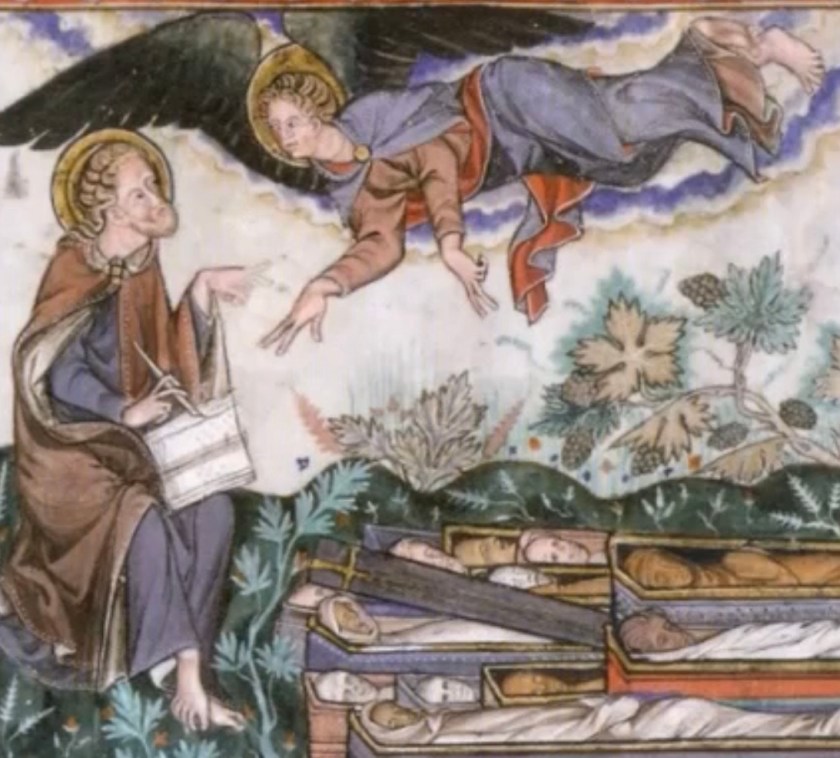
Folio image f134 row 1, Great Canterbury Psalter
Verdict on [Fully Shown Edge Finger] of Group of Fingers where Overall the group expresses [cut branches / Y’ shape]: Usually Ignore; the hand expresses MORE the Y’ shape than the I shape
Do NOT need to get out your magnifying glass.
It is 100% fair to call her L hand IY’, but I’d go with simply Y’ – unless super long pinkie.
A simple folding of all 4 fingers – regardless of whether the curled side finger is entirely visible (all 3 segments) or not – in most cases can simply be designated as a Y’ shape.
Don’t need to go into Special Detail Inspection mode.
We can be lazy/ efficient and forego the additional I-shape that could be obtained by choosing to read the side finger as an I shape.
That would be conflating the main message with a tiny detail.
Trying too hard, making it unnecessarily complicated.
Only do a “moderate-only analysis”:
Do not overanalyze L hand’s 3-segment pinkie.
Zoom out to the appropriate, sufficient context.
Suffices.
A weak I shape, not strongly needed.
Don’t designate that hand as IY’ (where the I shape is from the fully shown pinkie).
That I is not needed; that I is superfluous, bc the maiden’s hand-shape pair already has an I, via splayed pinkie.
her bowl hand’s {subtly splayed pinkie finger} is a “Strong I shape“.
her L hand has only a “Weak I” shape.
Crop & annotations by Michael Hoffman, Feb. 27, 2026Crop & annotations by Michael Hoffman, Feb. 27, 2026
Bad Readings of Hand-Shape
“Upper hand shows Pinkie (3) so that’s I, + 3 fingers that are Y'”
Better reading IMO: Ignore [side of pinkie is fully shown]. that hand i NOT sending a strong I message.
We already have a strong I in the hand-shape pair, via R hand Index slight splay.
Avoiding overanalysis, his hand-shape pair is: [IY, Y’] –
Principle: Analyze Hand-shape pair Just Enough to Get 1 Each of the 4 Shapes
Upper hand can be:
I Y’ I’ – overliteral.
Crop by Michael Hoffman, Feb. 23, 2026
{hand mushroom-tree} in f109 Great Canterbury Psalter
Crop by Michael Hoffman
{hand mushroom-tree}, Lower Y Hand : Upper YI Hand = Mushroom-Tree’s Lower Cut Trunks : Upper YI Branching, f107 Great Canterbury Psalter
Crop & annotations by Michael Hoffman, Jan. 24, 2026
hand = tree; {hand mushroom-tree}
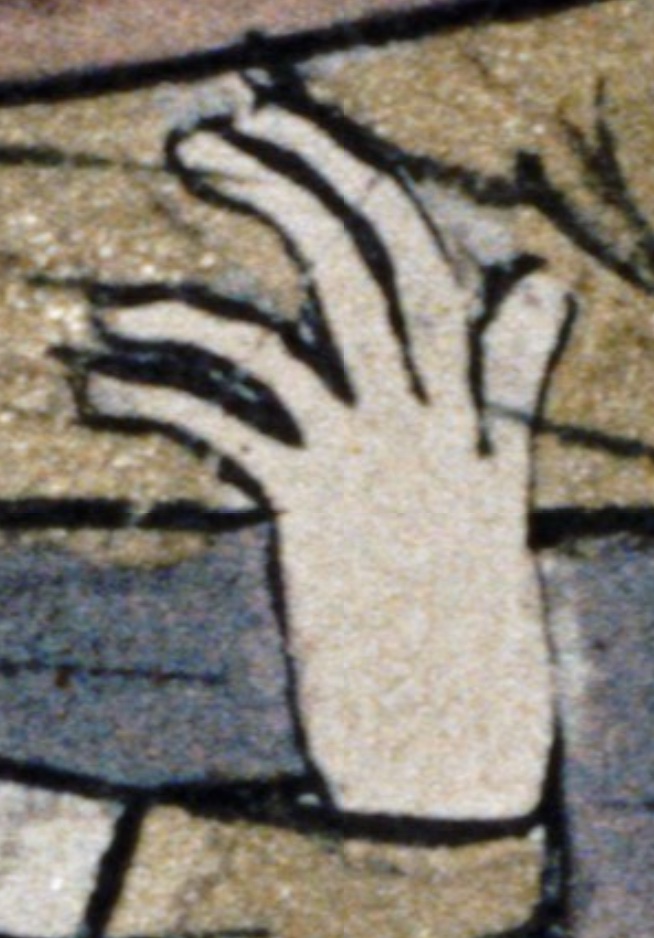
Crop by Michael Hoffman, Feb. 27, 2026 — an I’ cut thumb at hold wrist, and at hold mushroom sackPhoto: Michael Hoffman, a.m. Feb. 27, 2026
I’ve made 5-10 pages on hand-shape theory, too long to edit on mobile to add evidence and points.
Those pages include good sections “greatest hits”, pasted some here.
Yesterday was hard work to judge importance of aspects – settled, simplified, and summarized here, the lessons learned.
The game is generally loose and “messing around”, not thoroughly systematic.
The normal patterns are clear, and “rules are meant to be broken” very much applies.
Though the normal Reference convention rules are broken as often as not, the general basic rules are definitely identifiable.
This page was composed on mobile initially.
Mobile Jetpack WordPress App Can’t Handle Long Pages
The long page on Otto hand-shape game is near impossible to edit on mobile: too long and sluggish; unresponsive.
The Medieval YI Hand-Shape Game
Commonly occurring is, a figure shows the 3 popular straightforward shapes: Y Y’ I; rarer is I’.
Neither hand-shape pair combo list is “correct” or “the goal”:
Y Y’ I
Y Y’ I I’
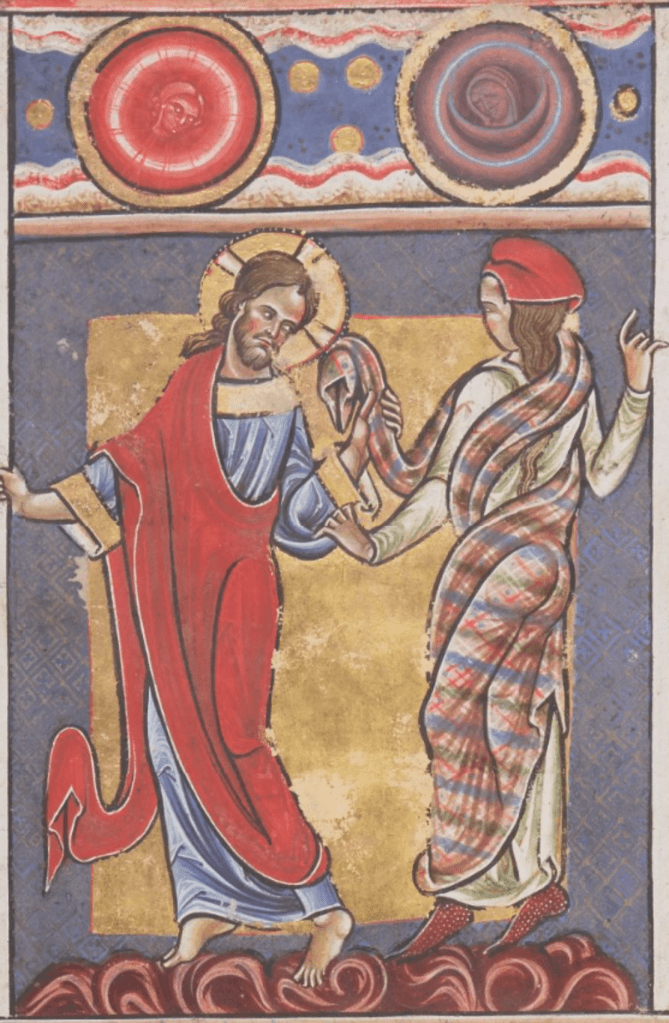
I’ is NOT nece’ly assigned to L hand, eg I’ is on the Right hand of Dancing Jesus. a 6th instance to list.
It is possible for a given image/ artist to add custom rules for an image.
eg Great Canterbury Psalter f134 has a strong custom rule about which hand & foot is closer to the ground, consistently, in order to pose the problem of the upside down hanging guy, Eadwine’s leg-hanging mushroom tree image in the Great Canterbury Psalter.
Strong vs. Weak Presence of a Shape
Strong Y shape: Vigorously splaying 3, 4, or 5 fingers.
Weak Y shape: Index & Middle fingers together extended: technically, it does branch, from palm, even w/o any splaying-apart.
Strong Y’ shape – base segment of 4 fingers, only, shown.
Weak Y’ shape
Strong I shape – A thumb showing both segments.
Weak I shape – A tiny curled 3-segment pinkie on a Y’ hand.
Strong I’ shape – Jesus’ Index finger cut by the comic frame. The list of 5 Left-hand based I’ instances, on this page.
Weak I’ shape – A hand with no thumb segments shown.
Counting Multiple I Shapes on a Hand Is OK, But Pointless: 1 I Covers That Shape
If a hand-shape pair or a hand includes a major I, ignore minor I’s; not “needed”.
eg ignore the 3-segment curled pinkie on Y’ hand, if that side finger is fully shown, IF the hand has a huge major I.
dancing man in bestiary salamander image: it DOESNT MATTER if you call his lower side finger an I shape, bc his touching-head hand already has a huge major 3-segment, separate-splayed, I shape.
THAT is “the” I shape in his hand-shape pair. I in lower hand holding a removed (mushroom) branch is unimportant & arbitrary to count as an I shape; it is de-emphasized.
we got the I shape covered fully already, in his hand-shape pair.
Dont need or care whether you count also that curled little side finger as an additional (superfluous) I shape.
Sometimes that curled side-finger is super-long; then, count it.
Mushroom-tree artists are apathetic about that detail, whether to intend and read that little curled side finger of a Y’ hand as an I shape; Don’t Care.
Terminology, Including the Most Exotic of the Four World-Models, “Cut Non-Branching” (I’)
Y = branching
Y’ = cut branching
I = non-branching
I’ = cut non-branching
The Medieval YI Hand-Shape Language
There is not any particular binding rule or correct hand-shape pair combo of Y Y’ I & I’
The the mushroom-tree artist can construct particular meaning applying a shape in an image.
The medieval YI hand-shape language is a general purpose basic set of 4 shapes.
Jesus’ hand holding the comic panel frame has a rare I’ via Index finger cut by the/ behind the frame.
I’ is more for math completeness than frequent usefulness to describe two mental models across two states.
A person figure is Not required to have any particular pattern, though a mushroom-tree artist could require that in a particular image, if they craft their game application of the hand-shape language that way.
Flexible rules, at that higher level of game construction.
The GENERAL hand-shape language has certain rules to assess a given hand’s fingers shapes.
In a way, there is no right answer.
The point is, you must comprehend the 4 shapes; that is the real, main, primary point of the game.
Higher-order rules, if any, are up to the mushroom-tree artist to create, optionally.
The main gameplay is merely, simply to identify the 4 shapes throughout an image, that’s all.
Copied sections from Otto Game Page:
I Initially Exaggerated the Importance of Hand-Shape Pairs
The mushroom-tree artists aren’t especially dedicated to hand-shape pairs rather than individual hands.
The mushroom-tree artists keep it simple: see, draw, and understand what’s asserted by each of the 4 combinations.
I’ is the most challenging, and thus most advanced to understand and use.
I Initially Exaggerated the Importance of the Combination Y, Y’, I (vs. I’)
If I’ were more useful, it would appear more often.
The reason Y Y’ I occurs often is not because special or “the” correct combo; it’s just that these 3 are more relatable, comprehensible, & useful than I’.
Y Y’ I is the most common combo, it is satisfying and relatable.
But it’s not inherently “right”, compared to Y Y’ I I’.
I now understand and have a good sense for why Y, Y’, and I SEEM like the magic trio, omitting I’.
I’ is logically implied as a permutation, but hard to relate to and put to use and conceptualize what’s asserted by I’.
Make the 4 Finger Shapes: Fingers Out (Y; Branching), Fingers Bent (Y’; Cut Branching), Finger Out (I; Non-Branching), Finger Bent (I’; Cut Non-branching)
Make the 4 Finger Shapes:
Fingers Out (Y; Branching)
Fingers Bent (Y’; Cut Branching)
Finger Out (I; Non-Branching)
Finger Bent (I’; Cut Non-branching)
The Hardest of the Four Shapes to Comprehend: “Cut Non-Branching”
The 4 symbols on Zep 4 mean Y, Y’, I, and I’. If you force it. Refer to the meaning of I’ in the instances I found today.
eg chop up a snake that threatens you to death.
Y – Fingers Out (Branching)
Y – Fingers Bent (Cut Branching)
I – Finger Out (Non-Branching)
I’ – Finger Bent (Cut Non-branching)
I’ Is Like a Double-Negative World-Model, the Least Natural and Most Advanced
List of Explicit I’ Instances
von Trimberg: Student’s LEFT hand has cut Index finger = I’. Index (1)
Otto: Kosmokrator: Hold’s other guy’s LEFT wrist with his LEFT hand: cut thumb = I’. Thumb (1)
Otto: Entry into Jerusalem: Holds {closed scroll} with LEFT hand; cut thumb = I’. Thumb (1)
GCP f134 row 2: break bowman’s LEFT hand has I’ via cut thumb. Thumb (1)
Otto: Entry into Jerusalem: Green guy spreading cloak, LEFT hand: Y’YI’. Thumb (1)
End of copied sections
f49 Forge Crops
Mobile, tried making some crops of Forge f49 folio image, Great Canterbury Psalter
Eg four hi res crops i can annotate on mobile.
mobile dup of full image – wasting space, delete?
Canterbury f49 Features: Forge, Wheels of Fate
There are many.
God/Christ comes through the White Light almond portal of mushroom-revealed governorship by the higher controller.
Blue state-boundary & brown state-boundary.
grid-cap = branching = Left direction (generally)
singular cap = non-branching = Right direction (generally)
vine leaf tree pair: {cut right trunk} touches lifted garment motif of angel.
{cut left trunk} touches open scroll.
{cut right branch} on left vine-leaf tree.
YI hand shapes throughout: Y, Y’, I, I’.
upper left mushroom-tree: grid cap is associated with non cut stem; singular cap is assoc w the left, cut stem.
branching = non cut stem = grid cap
non-branching = cut stem = singular cap
{cut left trunk}
contrast the branching or singularness of the two stems & caps.
at the top level, of the caps, that mushroom-tree follows the standard mapping convention of the medieval art genre of {mushroom-trees}:
branching on L (grid cap, non cut stem):
non-branching on Right (singular cap & cut stem).
The mushroom cluster, eval’d from bottom up, has 3 branches: the Right branch has two caps NOT grid caps; singular, so considered non-branching.
Left caps (per bottom up) have grid caps, multiple, considered Branching: they touch his Left arm/ sleeve.
copied sections from Otto Game previous page:
What’s Asserted by the Four Shapes (the ordinary-state two first, then the altered-state two)
I have not been using this order, but it seems better: group together the state-specific models.
An unenlightened, asleep person is expected to assert & experience Y & I’. An awakened, intense mystic altered state enlightened person is expected to assert & experience, relatively, Y’ & I.
Y – The Y shape asserts that ordinary-state, branching Possibilism is the case, phenomenologically/ subjectively/ experientially.
I’ – The I’ shape asserts that non-branching Eternalism (revealed in altered-state) is NOT the case (which is false; metaphysically, I’ is not the case is it IS the case). Phen’ly, in ordinary-state, I’ is the case.
Y’ – The Y’ shape asserts that ordinary-state, branching Possibilism is not the case, metaphysically.
I – The I shape asserts that altered-state, non-branching Eternalism is metaphysically the case, revealed experientially.
Not convinced that there is any “always seek X pattern”, 3 of 4 or 4 of 4 models”. Fall back instead to, find the 4 shapes if possible.
Explicit Y shape
Explicit I’ shape
Explicit Y’ shape
Explicit I shape
What’s Asserted by the Four Shapes
Y – The Y shape asserts that ordinary-state, branching Possibilism is the case, phenomenologically/ subjectively/ experientially.
Y’ – The Y’ shape asserts that ordinary-state, branching Possibilism is not the case, metaphysically.
I – The I shape asserts that altered-state, non-branching Eternalism is metaphysically the case, revealed experientially.
I’ – The I’ shape asserts that non-branching Eternalism (revealed in altered-state) is NOT the case (which is false; metaphysically, I’ is not the case is it IS the case). Phen’ly, in ordinary-state, I’ is the case.
Y Is the Case, Phen’ly (especially in ordinary-state)
Y’ Is the Case, Metaphy’ly (especially in altered-state)
I Is the Case, Metaphy’ly (especially in altered-state)
I’ Is the Case, Phen’ly (especially in ordinary-state)
Crop & annotations by Michael Hoffman, Feb. 25, 2026, fullscreen
Otto: Christ Pantokrator/ Kosmokrator, Annotated
Crop & annotations by Michael Hoffman, Feb. 25, 2026, fullscreen
f20 Dancing Jesus [Y, Y’, I, I’]
Crop by Michael Hoffman
Jesus’ hand holding the comic panel frame has a rare I’ via Index finger cut by the/ behind the frame.
I’ is more for math completeness than frequent usefulness to describe two mmm across two states.
I Initially Exaggerated the Importance of Hand-Shape Pairs
The mushroom-tree artists aren’t especially dedicated to hand-shape pairs rather than individual hands.
The mushroom-tree artists keep it simple: see, draw, and understand what’s asserted by each of the 4 combinations.
I’ is the most challenging, and thus most advanced to understand and use.
I Initially Exaggerated the Importance of the Combination Y, Y’, I (vs. I’)
If I’ were more useful, it would appear more often.
The reason Y Y’ I occurs often is not because special or “the” correct combo; it’s just that these 3 are more relatable, comprehensible, & useful than I’.
Y Y’ I is the most common combo, it is satisfying and relatable.
But it’s not inherently “right”, compared to Y Y’ I I’.
I now understand and have a good sense for why Y, Y’, and I SEEM like the magic trio, omitting I’.
I’ is logically implied as a permutation, but hard to relate to and put to use and conceptualize what’s asserted by I’.
Make the 4 Finger Shapes: Fingers Out (Y; Branching), Fingers Bent (Y’; Cut Branching), Finger Out (I; Non-Branching), Finger Bent (I’; Cut Non-branching)
Make the 4 Finger Shapes:
Fingers Out (Y; Branching)
Fingers Bent (Y’; Cut Branching)
Finger Out (I; Non-Branching)
Finger Bent (I’; Cut Non-branching)
The Hardest of the Four Shapes to Comprehend: “Cut Non-Branching”
The 4 symbols on Zep 4 mean Y, Y’, I, and I’. If you force it. Refer to the meaning of I’ in the instances I found today.
eg chop up a snake that threatens you to death.
Y – Fingers Out (Branching)
Y – Fingers Bent (Cut Branching)
I – Finger Out (Non-Branching)
I’ – Finger Bent (Cut Non-branching)
I’ Is Like a Double-Negative World-Model, the Least Natural and Most Advanced
List of Explicit I’ Instances
von Trimberg: Student’s LEFT hand has cut Index finger = I’. Index (1)
Otto: Kosmokrator: Hold’s other guy’s LEFT wrist with his LEFT hand: cut thumb = I’. Thumb (1)
Otto: Entry into Jerusalem: Holds {closed scroll} with LEFT hand; cut thumb = I’. Thumb (1)
GCP f134 row 2: break bowman’s LEFT hand has I’ via cut thumb. Thumb (1)
Otto: Entry into Jerusalem: Green guy spreading cloak, LEFT hand: Y’YI’. Thumb (1)
von Trimberg: Student’s LEFT hand has cut Index finger
von Trimberg and Student
Otto: Kosmokrator: Hold’s other guy’s LEFT wrist with his LEFT hand
Otto: Christ Pantokrator/ Kosmokrator, Annotated
Otto: Entry into Jerusalem: Holds {closed scroll} with LEFT hand
Otto: Entry into Jerusalem, Annotated
Great Canterbury Psalter f134 row 2: break bowman’s LEFT hand
Break Bowman [Y, Y’, I, I’] (explicit I’)
Otto: Entry into Jerusalem: Green guy spreading cloak, LEFT hand
Otto: Entry into Jerusalem, Annotated
{balance scale} Woman Is the Most Efficient and Pointed Depiction of YY’I: A 2nd Thumb Would Be Redundant (and, She Displays Pinkie (3))
Rememeber yesterday’s proof that Dancing Man:
It DOESN’T MATTER how you interp his lower hand’s Pinkie that’s not occluded, whether say Y’ or Y’I, because I is ALREADY present via upper hand.
Principle: Nothing Is Gained by Re-Asserting I 2x or 3x; Re-Asserting 2-3x Is for Style or Emphasis Only
Crop by Michael Hoffman
Why I’ Is Less Common than Y, Y’, & I
I don’t mean Thumb (0) is uncommon (often there’s no thumb [segments] shown).
I mean: Thumb (1) is uncommon. Thumb is partly shown, but cut – that’s uncommon. Non-initiates experience Y; they do NOT experience I’, as if “I believe in manyworlds, and I believe not-[worldline frozen in the block universe].
No One Thinks or Says “I Disbelieve Worldline Frozen in Block Universe” (I’); They Simply Say “I Experience & Believe in Branching Possibilities” (Y)
Dancing Man is not signalling I’; many of my Reference hand-shape pairs are not signalling I’; they signal Y instead of I’. todo: stingy headings list: how many are I’ – NONE?!
Indicating = signalling = depicting = asserting.
It would be confusing to assert I’, usually.
Ppl have a strong need to assert/affirm:
Y – we experience this all the time, directly. Implies I’, but that’s indirect. I don’t say “I’m experiencing not-non-branching.” or “I’m experiencing not-frozen-worldline.”
Y’ – we interestingly experience this in loose cognition.
I – revealed profoundly in loose cognition.
I’ – this is IMPLICIT in pre-enlightenment ordinary-state. This is why I’ is less popular than Y.
The best description of mental model transformation is Y+Y’+I; less so is I’.
But today in an hour or 90 min, I found I’ 5x, always w/ Left hand. By 3 artists:
Otto – Panto: hold wrist; Entry into Jerusalem: spread cloak.
esp read as I if long phallic garment. Cloth converts Y fingers to I shape.
[Y, Y’, I] Is Most Common, But Not Uniquely the Correct Answer
YY’I Is Most Common, But Not Uniquely or Especially the Correct Answer
f134 break bowman implies that I’ is a major, crucial part of the mix.
Today I tried finding various special combinations, but it’s just a stat spread, w/o one pattern being “the” only “right” pattern.
YY’I is THE MOST POPULAR/commonly occurring, but it is not “uniquely correct”; I see no evidence that YY’I is somehow “uniquely correct” — it’s the
YY’I Is the Most Complete List of Shapes, Aside from Including the Niche I’ Shape – An Almost-Complete List of Shapes, but Not “Uniquely Correct”
There’s No Master Pattern, Beyond Spot Explicitly Painted Y, Y’, I, & I’ Shapes (eg 0 thumb segments doesn’t count as I’)
Count Finger if 1, 2, or 3 Segments; Thumb if 1 or 2 Segments; Don’t Count 0 Segments of Finger or Thumb as “Prime”; Ignore
Assume the Game Is Simple and Shallow: Spot Isolated, Explicitly Painted Motifs of Y, Y’, I, I’ – Nothing More Elaborate
Comprehending What’s Asserted or Rebutted by Y, Y’, I, & I Is Plenty Elaborate.
the mushroom-tree artists tried more rules and goals, but didn’t reach any consensus.
The mushroom-tree artists reached great consensus on what’s asserted by Y Y’ I I’, and options to depict those.
The mushroom-tree artists did NOT reach consensus about more elaborate rules.
YY’I is popular. I’ is controversial.
Y is justified because it’s the shape of our experiencing.
YY’I is all the MAIN, MOST relevant shapes; I’ less so.
Thus gives APPEARANCE that YY’I
I’ is justified when in ordinary-state, and when need to relent the threat. the only reason the combo YY’I is popular is because all 4 would be popular, but I’ is the least often justified.
YY’I is dominant because YY’II’ WOULD BE dominant, except I’ is not that popular/ useful, thus leaving YY’I because that’s a relevant common combo, not because I’ is always wrong/bad/false.
That’s why I got today the IMPRESSION that YY’I is uniquely the correct answer – because the mushroom-tree artists like all combos, but I’ is less often useful.
It’s kind of a mirage, and stats seem to back that up.
There is no uniquely correct combo, but because all varieties generally are popular, but I’ less so, that gives the ILLUSION that YY’I is uniquely the right answer, and other combos are “wrong”.
That’s a good analysis; sound. Matches my experience today.
If 4 fingers (3) with Thumb (0), this IS Y, but Thumb (0) is not I’. It’s “Y without I”.
If 4 fingers (1), with Thumb (0), this IS Y’, but Thumb (0) is not I’. It’s “Y’ without I”.
Cut Thumb or Cut Finger must be EXPLICITLY shown – not just entirely missing.
OTOH ossuary guy f107, his L limbs are not painted, not as stubs.
It is REASONABLE and acceptable to point out, “0 segments are painted, which is LIKE asserting I’ or Y'”
Thumb (1) is FAR more compelling and interesting and DETERMINATE than Thumb (0).
Thumb (1) YELLS I’.
Thumb (0) mumbles kinda I’.
True, [Y, Y’, I] is perhaps the most common set of the 4 (omits I’).
[Y, Y’, I] is not the uniquely correct answer, as if other combos are the “wrong answer”.
the mushroom-tree artists mostly agree on depicting Y, Y’, I, & I’. eg:
Y: 3 fingers (3) segments each, held together or splayed, but differ’d from 4th finger.
Y’: 3 fingers (1) segment each.
I: Thumb (2) seg shown.
I’: Thumb (1) seg shown.
Notation: parens are how many segments are shown.
Thumb (2) – I
Thumb (1) – I’
Thumb (0) – Counts as neither I nor I’. Indeterminate; the mushroom-tree artists didn’t reach unanimous consensus. Not compelling.
Finger (3) – finger is displayed/asserted. If 1 isolated finger, I. If 2 or 3 grouped, Y.
Finger (2) – finger cut; Prime. If it’s 1 isolated finger, I’. If 2 or 3 fingers grouped, Y’.
Finger (1) – finger cut; Prime.If it’s 1 isolated finger, I’. If 2 or 3 fingers grouped, Y’. eg student next to von Trimberg: lower hand: Index finger.
Finger (0) – ambig. Counts as neither asserted nor rebutted.
How Much to Make of Pair of Hands, vs. Each Hand in Isolation?
Until I prove that summing the types from both hands is super signif – often a single hand is shown, only – I can probably fall back to just isolated…. the two Otto annots i did today failed to show hand-pairs. Often, 1 hand is shown, only.
Whether Count 0 Thumb Segments as I’ (Implicit Cut Thumb), Like Definitely Count 1 Thumb Segment as I’ (Explicit Cut Thumb)
Answer: Probably Do Not Count 0 Thumb Segments as I’.
Remember where thumb is on guy’s R shoulder, w/ no fingers shown – I counted that as I, NOT as IY’!
Showing 3 finger base segments is certainly Y’, but showing 0 finger segs is NOT counted as Y’.
“Only count what’s explicitly shown”.
We are inventorying what is SHOWN ie cut finger or cut thumb; we are NOT inventorying things that are invisible.
In the page title: Otto Psalter: Hand-Shape Game Goal: Find Explicit Y, Y’, I, I’ Shapes in Hand-Pairs “explicit” means:
Thumb (2) = I
Thumb (1) = I’
Thumb (0) = neither I nor I’.
That’s the “stingy” accounting re: “thumb not shown”.
“implicit” would mean greedy accounting re: “thumb not shown”:
Thumb (2) = I
Thumb (1) = I’
Thumb (0) = I’
How badly do we want to demarcate I’?
I am NOT seeing a clear case that “the goal is always to try to hit all 4 shapes, and to accomp that, must count Thumb (0) as I’ to complete the set.”
I feel FULLY CONFIDENT re: Thumb (1) accounting: it is DEFINITELY I’.
I feel not confident, but arb, re: Thumb (0): on what basis do we count Thumb (0) as I’, vs. not counting it as I’?
EXEC DECISION: Unless I come across some reason to be greedy to produce many I’ instances, … keep in mind that if I *want* I’, I can count Thumb (0) as I’. But until then, I feel on more solid ground counting
Thumb (2) = I
Thumb (1) = I’
Thumb (0) = not I or I’.
Can I arg from “keep simple”? Not really; both policies are simple, just hard to pick between the two policies/ philosophies of accounting for shapes.
Inventorying segments is easy (sort of); setting the policy of what counts, for inventory, is unclear & harder.
The Argument from How Fingers are inventoried seems most compelling:
Index (3) =
Index (3) =
Index (3) =
Index (0) = ….
suppose only Thumb (2) is shown, no fingers.
Y –
Y’ –
I – Thumb (2)
I’ – no
Results for Reference Hand-Pairs
todo: copy to this section: heading w/ [Y Y I I], and picture, and the template-based analysis, all from below.
first, paste toc, then delete irrel lines: find [ to find relev lines, to keep:
Already I can answer the Q: If there’s I’, there’s no I: true? False, by my lastest, greedy approach, which says: If no thumb visible, count that as having I’, rather than lacking I’. That’s not consistent with fingers policy though.
Greedy vs. Stingy inventory accounting.
suppose f21 L guy is enlightened. He shows cloth hiding hand, and he shows Y’ but doesn’t explic show I’; he implicly shows I’. (has no thumb).
It’s bad to say that break bowman’s I’ (explicitly shown) is same as …. I found 5 instances where I’ is explicitly shown. they have 1 seg instead of ? todo
Greedy concl only: Probably low-value; exaggerates how often I’ is explicitly depicted and meant:
[Y, Y’, I, I’] – Scale Balance & Closed Scroll
[Y, Y’, I, I’] – Dancing Man
[Y’, I, I’] – f21 Right Guy
[Y’, I’] – f21 Left Guy
[Y, Y’, I, I’] – Break Bowman
[Y’, I, I’] – Psalter Viewer
[Y’, I] – Mushroom King
[Y’, I, I’] – Swordsman
[Y, Y’, I, I’] – Guy Above Asp-Dog:
[Y, Y’, I’] – Otto: Pantokrator: Hold Wrist
Greedy & stingy concl’s: [I am preserving this 2-bracket list; copypste below and only have the stingy array]:
Scale Balance & Closed Scroll [Y, Y’, I, I’] or Stingy: [Y, Y’, I] (no explicit I’) – whether use stingy affects whether all 4
Dancing Man [Y, Y’, I, I’], or stingy: [Y, Y’, I] (no explicit I’ shown) – whether use stingy affects whether all 4
f21 Right Guy [Y’, I, I’], or stingy: [Y’, I] – whether use stingy does NOT affect whether all 4
f21 Left Guy [Y’, I’], or stingy: [Y’] – whether use stingy does NOT affect whether all 4
Break Bowman [Y, Y’, I, I’] (explicit I’)
Psalter Viewer [Y’, I, I’], or stingy: [Y’, I] – whether use stingy does NOT affect whether all 4
Mushroom King [Y’, I] – PROVES THAT “ALL 4” IS NOT CRUCIAL GOAL.
Swordsman [Y’, I, I’], or stingy: [Y’, I] – whether use stingy does NOT affect whether all 4
Guy Above Asp-Dog: [Y, Y’, I, I’], or stingy: [Y, Y’, I] – whether use stingy affects whether all 4
Otto: Pantokrator: Hold Wrist [Y, Y’, I’] (explicit I’)
Reference Figures’ Hand-Shape Pairs, Ignoring Thumb-Not-Shown (Don’t Count That as I’)
Stingy array only:
[Y, Y’, I] – Scale Balance & Closed Scroll
[Y, Y’, I] – Dancing Man
[Y’, I] – f21 Right Guy
[Y’] – f21 Left Guy
[Y, Y’, I, I’] Break Bowman
[Y’, I] – Psalter Viewer
[Y’, I] – Mushroom King
[Y’, I] – Swordsman
[Y, Y’, I] – Guy Above Asp-Dog
[Y, Y’, I’] – Otto: Pantokrator: Hold Wrist
A telling observation: listing the stingy combos, NEVER DOES I’ appear.
Only 1 of my Reference hand-shape pairs (break bowman) include Thumb (1)*; they either include Thumb (2) or Thumb (0).
*or finger used as I’, as in Student Beside von Trimberg.
Student and von Trimberg: a Rare I’ (via Index Finger)
Opinion of the moment: Given that in a hand-shape pair, there’s easy opport to have full I finger or I thumb, then WHETHER INTERP THE Y’ CURLED NEAR-FINGER AS I JUST BECAUSE YOU CAN SEE ALL, SUBTLE , SEGMENTS?
ANS: No, the mushroom-tree artists do not usually care whether that little curled side finger is counted as I or not; usually some other digit fully shows extended I.
The side-curled finger of a Y’ hand CAN be read as I, but in a hand-shape pair, usually some other digit fully shows I; so curl finger is redundant and irrelevant whether counted as I or ignored.
Thus I call student upper hand IY’, NOT IY’I. 2nd I is “don’t care; don’t need; redun.” It’s an extra, INCIDENTAL I that’s avail but not needed. Superfluous.
I get this impression from the art: Lower hand’s Index is signif adding info: I’. But, the upper hand curl pinkie is NOT signif; it’s superfluous & redun w/ Index of upper hand. IGNORE. [YI’, IY’] – in this case, the two hands are interestingly converse.
The curl pinkie plays no part in this interesting converse relation!
Counting the curl pinkie as an I would DISRUPT the symmetry/ complementarity.
von Trimberg and Student
If Count 0 Thumb Seg as I’, We’d Have to Count Two-Adj-Fings’ Segs that Have 0 Segs as Y’, but We Are Never Shown 0 Finger Segs
if 1 seg is shown… already proved, at section: “Proposed Stingy Rules re: How Many Thumb Segments Are EXPLICITLY Shown“
The Most Important Thing Is Consistency of Analysis/ Inventory (eg No Thumb Shown, = Assertion of I’
Counting “no thumb” as I’ (Thumb (0)) is a MAJOR change from earlier this evening. Should help re: “hand hidden under cloth” too.
Template for Hands on Normal Sides
Do not fill in here; copypaste, then fill in that copy.
Y
Left hand (on Right):
Right hand (on Left):
Y’
Left hand (on Right):
Right hand (on Left):
I
Left hand (on Right):
Right hand (on Left):
I’
Left hand (on Right):
Right hand (on Left):
Template for Hands Crossed
Y
Left hand (on Left):
Right hand (on Right):
Y’
Left hand (on Left):
Right hand (on Right):
I
Left hand (on Left):
Right hand (on Right):
I’
Left hand (on Left):
Right hand (on Right):
The “Spot the YI Hand Shapes” Game
titles of this page, con’t:
This is the “Spot the YI Hand Shapes” game.
Otto Psalter: Hand-Shape Game: Spot Y, Y’, I, & I’ Shapes
Can strip down more, from:
Otto Psalter: Goal of Hand-Shape Game: See Y, Y’, I, & I’ Shapes
to just:
Otto Psalter: Hand-Shape Game: See Y, Y’, I, & I’ Shapes
“See” implies EXPLICIT; don’t count Thumb (0). don’t Julie-Brown it (“I will only report what I see: I see that the caps have been made not seeable.”)
I hope to discover complexity, but, long shot. Some fancy pattern like “Y Y’ I” or [Y, Y’, I, I’]. otoh, that doesn’t scale, it’s awkward, and less likely than …. it is ALREADY super profound/ complicated enough, just knowing the definition of what is meant by asserting Y, Y’, I, I’.
We are CERTAIN that the game involves assessing isolated hand; assessing EXPLICIT indicators: segments that are PRESENT (1, 2, or 3 seg), NOT wholly absent (0).
Easily Port-able across artists, “keep it simple, explicit, single-hand centered”.
Keep Ruleset Simple
Explicit (some but not all segments shown = Prime) (all seg shown = Not Prime) (no seg shown = neither Prime nor Non-Prime); Single Hand (rather than special-treatment processing of hand-shape pairs)
Non-essentials:
0 segments shown. Vague/ ambig how to count.
1 vs 2 hands: vague/ambig how to merge/count/ think of it.
Omit vague, omit ambig. Stay w/ what is certain, only.
Here is a definite Y, inarguably.
Here is a definite Y’, inarguably.
Here is a definite I, inarguably. Thumb (2); Finger splayed (3).
Here is a definite I’, inarguably. Thumb (1)
Can’t argue with this stripped-down title:
Otto Psalter: Goal of the Hand-Shape Game: Find Y, Y’, I, & I’ Shapes
Certainly, at least at a rough level, that is true. 95% of work is look at each hand, alone, and find those 4 shapes in that hand.
The bulk and center of the work is that – NOT somehow summing two hands, for a figure, which gives a longer list (eg. 3-4 shapes for a hand-shape pair, instead of 1-2 shapes for an isolated, lone, single hand).
Not convinced that “pair” is justified in title. No net gain, by that detail. Raises too many complexities for a title.
Otto Psalter: Goal of the Hand-Shape Game: Find Explicit Y, Y’, I, & I’ Shapes in Hand-Pairs
Explicit is a “no net gain” word; too detailed for a title, distracting, detracts from message by raising premature questions. It’s a detail for article body, not title.
eg, “no thumb shown” is NOT “find an I’ shape”. That’s merely an IMPLICIT I’ shape, not a VISIBLE I’ shape.
But in contrast, if 1 thumb segment is shown, THAT is CERTAINLY “find an I’ shape”.
Compressed title:
Otto Psalter: Hand-Shape Game Goal: Find Y, Y’, I, I’ Shapes in Hand-Pairs
That title is extremely neutral, omits constraints or more specific, narrow objectives. Certainly, any objective will FIRST as PRELIMINARY, be served best by this empirical inventory of possible readings.
What’s the closest we can get to reading a Y shape?
What’s the closest we can get to reading a Y’ shape?
What’s the closest we can get to reading an I shape?
What’s the closest we can get to reading an I’ shape?
Hardest Q is what to do when no thumb shown: which is that?
No I or I’ is shown.
An I’ is shown.
Since we expect a full accounting of Y & I, I lean toward “an I’ is shown”; the thumb is actively hidden/occluded.
[11:55 p.m. Feb. 25, 2026] Considering a MAJOR redefinition of objective of game:
Otto Psalter Confirms Objective of Hand-Shape Game Is Find All Y, Y’, I, & I’ Shapes in Each Hand-Pair or Single Hand
Otto Psalter Confirms Goal of Hand-Shape Game Is Find All Y, Y’, I, & I’ Shapes in Each Hand-Pair or Single Hand
older wording of that:
Otto Psalter Confirms Goal of Hand-Shape Game Is Find All Y, Y’, I, & I’ Shapes in Each Hand-Pair
Idea [11:55 p.m. Feb. 25, 2026] – cloth covering hand = … eg: f21: L & M guys.
Suppose you know a hand is holding up the cloth, but no detail:
Crop by Michael Hoffman
L guy:
Y
Left hand (on Right): no
Right hand (on Left): no
Y’
Left hand (on Right): Index (0) + Middle (0) + Ring (0) + Pinkie (0)
Right hand (on Left): Index (1) + Middle (1) + Ring (1) + Pinkie (1)
I
Left hand (on Right): no
Right hand (on Left): no
I’
Left hand (on Right): Thumb (0)
Right hand (on Left): Thumb (0)
Conclusion: Y’I’ (no Y, no I)
Otto Psalter Confirms Goal of Hand-Shape Game Is Find a Y’, Y, & I Shape in Each Hand-Pair …
… and sometimes throw in, w Left hand, an I’, via a cut Left Index finger or a cut L thumb, eg. holding a {closed scroll}, which ~= ordinary-state, branching Possibilism.
The nice thing about that (I’) is, all 4 shapes are covered, by the hand-shape pair rules that I extracted from this genre puzzle, the medieval art genre of {mushroom-trees}.
Y Y’ I I’
Puzzle Solved, DECODED: trident mushroom-tree bc Trinity 🔱
Jesus Christ!: The Two Bowmen in f134 row 2 Are PAIRED as Two Opposite States: Threatening, or Relenting, the Psalter Viewer!! 🤯
Dependent on the Whim of God Pressing on the Pivot of the {balance scale}!
Functionally the Same as the Swordsman “Sheathing and Unsheathing” the Sword
see end of post, OMFG! 🤯🤯
Composed & produced 100% on mobile – even added art annotations on mobile device!
I should add the [Y’I, YI] type of hand-shape pair notation on each person, not only each hand.
But, many of these figures only display 1 hand.
Do that Later maybe; after I annotate Otto > Entry into Jerusalem.
I an eager to annotate the Otto [DONE, VICTORY!!]: Entry into Jerusalem image; because I am hungry for test-confirmation of my hypothesis, that each hand-shape pair contains Y’, Y, & I shape.
The Hypothesis Under Testing, to Disconfirm the Egodeath Theory
If There Is Any Trace of the Slightest Failure, Catastrophic: Immediately Must Discard the Entire Egodeath theory –> 🗑️, per 5th-Grade “The Scientific Method” (Popper) Just-So Story.
That Is NOT How Science Works, as Proved by Historians of Science, Who Destroyed Armchair, Mere Philosophers of Science (Baloney “Logical Positivists”).
HYPOTHESIS: In the Medieval YI Hand-Shape Language, Each Hand-Shape Pair Normally Contains a Y’, Y, & I shape [Added: & Rarely, I’, with Left Hand]
Otto Gospel: Mushroom-Trees, Branching, and YI Hand Shapes
Done: Annotate, then upload the annotated image: Otto: Kosmokrater; Christ Reigns.
A shortcut though: Just LOOK AT that image, now. NO – I HAD TO annotate it; the hand-shapes are too complicated otherwise; cannot eyeball it.
The “Grab Wrist” image/ crop/ motif: an odd, unusual Y’I’ (the I’ is rare) hand, via occluded fingertips & occluded thumb tip(!) – abnormal; countervailing the Normal Rule.
(Solved!! elsewhere throughout in this page.)
Rules Are Meant To Be Broken: My Extracted Rules Are Correct
List of Explicit I’ Instances
copypasted section to above, to keep this section as-is for history
Added note, a few minutes later: ITS ALWAYS THE LEFT HAND, sometimes holding {closed scroll}.
List of instances [do not change this discovery sequence]:
von Trimberg: Student’s LEFT hand has cut Index finger = I’. Index (1)
Otto: Kosmokrator: Hold’s other guy’s LEFT wrist with his LEFT hand: cut thumb = I’. Thumb (1)
Otto: Entry into Jerusalem: Holds {closed scroll} with LEFT hand; cut thumb = I’. Thumb (1)
GCP f134 row 2: break bowman’s LEFT hand has I’ via cut thumb. Thumb (1)
Otto: Entry into Jerusalem: Green guy spreading cloak, LEFT hand: Y’YI’. Thumb (1)
Worried 😨: Now checking Otto: Entry into Jerusalem… holding the Egodeath theory over the trashcan, ready to ditch instantly my life work if “Disconfirm the Hypothesis”… 😨
SUCCESS!!
The Egodeath theory is victorious YET AGAIN, as every time since 1988!
I am spoiled.
Christ Pantokrator:
Y
Left hand (on Right): 4 Fingers (3 seg)
Right hand (on Left): Index (3 seg) + Middle (3 seg)
Y’
Left hand (on Right): None.
Right hand (on Left): Pinkie (2 seg) + Ring (2 seg)
I
Left hand (on Right): Thumb (2 seg)
Right hand (on Left): Thumb (2 seg)
I’
Left hand (on Right): None.
Right hand (on Left): None. Closest is cut base of Middle finger as if (2 seg).
Crop by Michael Hoffman p.m. Feb. 25, 2026m
Minor error in annotations: Guy left of throne, R foot, is Y’I, if assess toes in L to R order as usual; not IY’.
Either way is equivalent, so this is a a consistency-convention error only.
A Shocking, Rare Assertion of the I’ Shape
Update an hour later:
4 instances of I’, by 3 artists; it’s a STANDARD exception!! [and each case – 2, then 3, then 4, then 5 inventoried today – the I’ is formed by LEFT hand.
Update: 5 instances of I’, by 3 artists.
Thumb (& Fingers) Wrapped Around Other Guy’s Wrist
The Thumb Is Shorter than Usual in Otto, Undeniably Forming an I’ Shape, NOT the Usual, I Shape
The Standard I’ “Anomaly” Formed with LEFT Hand
Good news/ Pro/ advantage/ benefit for me: [This same evening, an hour later, I eventually solved this anomaly: when I’ occurs, it’s always via the LEFT hand; and I quickly found 5 instances of this “standard I’ anomaly.]
If you accuse me of forcing interp’n, here is an example (is this my St. Walburga tapestry fiasco, like the Browns?) of where I cannot in good faith force my interpretation;
instead, I have to accept this deviant case [update: 5 cases, all via LEFT hand], and I must do Special Pleading to Save The Theory.
To excuse this non-standard pattern.
[Update: not so non-standard; it’s a standard exception.]
I do have a general theory that:
The moment the the mushroom-tree artists establish a rule, this immediately, necessarily implies countering the rule, ; that countering of the rule then conveys special, extra information.
A side effect of defining a rule is that you immediately implicitly create an opportunity to violate the rule; that’s inherent.
Update, same evening, 90 min later: You could say that the the mushroom-tree artists did that:
Just as you can affirm Y in the end, via excusing it as phen’y not metaphysics, you can “rule out” I’ yet create a way to enrich the hand-shape game, by allowing I’ to be depicted by LEFT hand, to allow 4 shapes not just 3 of the 4 with one glaringly unaccounted for.
If we, the mushroom-tree artists, say “Do Not Include the I’ shape in a hand-shape pair”, every one of us is obliged to immediately violate that rule, to make special points/ purpose, to earn special game points.
Update: They did that, allowing for the 4th, I’ shape, when done by L hand, eg with {closed scroll}.
Maybe we SHOULD reclassify/ relabel: if 4 straight or 4 cut fingers shown, or … but no thumb, we CAN label that as YI’. eg f134 row 2 woman {balance scale}.
Here I am fine-tuning the successful ruleset as dust settles. Perhaps never NEVER SAY Y OR Y’; IF NO THUMB, AND IT IS LEFT HAND, WRITE / INCLUDE I’. TEST THAT, SEE IF IT HOLDS UP TO INCREASE SYSTEMATICITY.
Lower hand can be designated as any of these shape-combos:
Y’
IY’ – Pinkie’s 3 segments are emphatically shown = I. Compare f21 Right guy, super-long Pinkie.
IY’I’ – Thumb of Left hand not shown = I’.
f21: 3 Guys/ Books/ Scrolls/ B’s
10:31 p.m. Feb. 25, 2026 – Right guy was a puzzling problem, able to solve now? Have flexy options for interp’n.
Left hand (raised): IY’. If account for missing thumb: IY’I’ (adds an I’ on Left hand).
Right hand Y’, or Y’I. If account for missing thumb: Y’II’, which would be an I’ formed by Right hand, not by Left hand per the usual pattern. I’d have to check stats, to improve my ruleset. I don’t know if this is:
Standard main pattern.
Standard minor pattern / exceptional standard pattern.
Nonstandard; violate rules.
Crop by Michael Hoffman
Scale Balance & Closed Scroll [Y, Y’, I, I’] or Stingy: [Y, Y’, I] (no explicit I’)
Crop by Michael Hoffman
Y
Left hand (on Right): no
Right hand (on Left): Pinkie (3) + Ring (3) + Middle (3) + Index (3)
Y’
Left hand (on Right): Index (2) + Middle (2) + Ring (2)
Right hand (on Left): no
I
Left hand (on Right): Pinkie (3)
Right hand (on Left): Thumb (2)
I’
Left hand (on Right): Thumb (0)
Right hand (on Left): no
Conclusion: Has all 4 shapes: Y Y’ I I’
Format convention: do not bother strikethrough, hard to do.
Old format, not template:
Y
Left hand (on Right): None.
Right hand (on Left): 4 fingers (3 seg).
Y’
Left hand (on Right): 3 fingers: Index (2 seg) + Middle (2 seg) + Ring (2 seg)
Right hand (on Left): None.
I
Left hand (on Right): Pinkie (3 seg)
Right hand (on Left): Thumb (2 seg)
I’
Left hand (on Right): Thumb (0 seg)
Right hand (on Left): None.
Conclusion: {balance scale} Woman is Complete; has all 4 shapes.
Old, non-template:
Left hand: greedy analysis (willing 3 parts): I, Y’, I’
Pinkie: I
3 fingers: Y’
Thumb: I’
Right hand, greedy (ie willing to have 3 shapes):
YI
Principle (Tentative): The Ideal[?] Hand-Shape Pair Includes All 4 Shapes [Y, Y’, I, I’]
I have no idea if this will be supported by the data.
[12:45 a.m. Feb. 26, 2026] My latest feeling is: The game is to simply, for a given hand-pair, inspect whether has Y, Y’, I, I’. There’s nothing super consistent about whether all are present.
Fine-tuning my policies/ ruleset, to be more greedy: IS THERE ANY POSSIBLE WAY TO SEE a Y | Y’ | I | I’ shape?
Tentative arg: Her hand-pair ss are “complete”, they represent all 4 shape permuts:
Crop by Michael Hoffman
Outdated format; see template filled in above:
Y – Right hand: Fingers all 3 segments of all 3 fingers shown/ displayed/ visible.
Y’ – Left hand: 3 fingers: Base segment shown, Mid & Tip segs not shown.
I – Right hand: Thumb. Left hand: Pinkie.
I’ – Left hand: Thumb not shown.
Conclusion: {balance scale} Woman’s Hand-Shape Pair is “YI-Complete”; Contains All 4 Shapes: Y, Y’, I, I’
Dancing Man Is “YI-Complete”; Contains All 4 Shapes!
[10:43 p.m. Feb. 25, 2026]
Dancing Man [Y, Y’, I, I’], or stingy: [Y, Y’, I] (no explicit I’ shown)
Crop by Michael Hoffman
Y
Left hand (on Right): none
Right hand (on Left): Middle (3) + Ring (3) + Pinkie (3)
Y’
Left hand (on Right): Pinkie (2) + Ring (2) + Middle (2) + Index (2)
Right hand (on Left): none
I
Left hand (on Right): none
Right hand (on Left): Index (3)
I’
Left hand (on Right): Thumb (0)
Right hand (on Left): Thumb (0)
Conclusion: Dancing Man is YI-Complete; hand-shape pair includes all 4 shapes: Y, Y’, I, I’
Found during analyzing I on R hand: [11:37 p.m. Feb. 25, 2026] Principle: It doesn’t matter that the bent Index finger looks unnatural. All that matters is the count of displayed segments.
Old format, not using template:
Y?
Y’?
I?
I’?
Y – Right hand, 3 fingers, all 3 segments shown.
Y’ – Left hand, 3 fingers or 4 fingers, only 2 of 3 segments shown.
I – Right hand, Index finger: all 3 segments shown.
I’ – Left hand: Thumb not shown. Right hand: Thumb not shown.
Per this very latest method of analysis, which counts “thumb not shown at all” as I’, I’ is going to flip from “rare & nonstandard” to “common & standard”!
Proposed Stingy Rules re: How Many Thumb Segments Are EXPLICITLY Shown
I hate treating 0 Thumb seg shown, as if same as 1 Thumb seg shown. 1 seg is a strong, definite statement. 0 seg is not a clear, strong statement. Showing 1 seg is stronger, unambig message than 0 seg.
0 Thumb seg shown is ambig whether means I’.
1 Thumb seg shown is unambig; certainly means I’.
Implicit Showing of 0, forming I’, Is Not Consistent w/ Fingers Accounting to form Y’.
If Thumb (2), I.
If Thumb (1), I’.
If Thumb (0), no I’ or I.
because w/ fingers, it’s about EITHER:
(3) = count as “not cut”
(2) = count as “cut”
(1) = count as “cut”
(0) = don’t count as “cut”, don’t count as “not cut”.
notation: paren = # of seg shown.
implies for thumb:
(2) = count as “not cut”
(1) = count as “cut”
(0) = don’t count as “cut”, don’t count as “not cut”.
Crop by Michael Hoffman
Had to swap sides in template – update: made sep template for “crossed hands”.
Y
Left hand (on Left): no
Right hand (on Right): no
Y’
Left hand (on Left): Index (1) + Ring (1) + Middle (1)
Right hand (on Right): Index (1) + Ring (1) + Middle (1) + Pinkie (2)
I
Left hand (on Left): Pinkie (3)
Right hand (on Right): no
I’
Left hand (on Left): Thumb (0)
Right hand (on Right): Thumb (0)
Conclusion: Lacks Y, has Y’, I, I’
Old format, not template:
Y – Not present.
Y’ – Left hand, 3 fingers. Right hand: 3 or 4 fingers.
I – Left hand, Pinkie: 3 segments shown.
I’ – Left hand: Thumb. Right hand: Thumb.
He’s biased against Y. He feels too deviant for setting the main normal rules. All 3 guys seem odd.
f21 Left Guy [Y’, I’], or stingy: [Y’]
Is red phall showing a Y? no
Is red phall showing a Y’? implicitly yes.
Is red phall showing an I? kind of.
Is red phall showing an I’? hardly.
The only way I can read red phall is as a Y’ shape. by stretch, MAYBE read as I shape.
Crop by Michael Hoffman
Y – none
Y’ – via L or R hand.
I – none
I’ – Thumb not shown, via L or R hand.
Could designate as:
Y’
Y’I’ – I’m more comfy w/ this for the Middle guy, uses Left hand to shape Y’ and I’.
10:54 p.m. Feb. 25, 2026 – what’s in common between [L & M guy] & R guy? Ans: none signal Y shape.
Left Two Guys Together Include Shapes: Y’, I’; Right Guy Includes Shapes: I (pinkie), Y’ (3 fingers), I’ (thumb)
L guys: Y’I’
R guy: IY’I’; he adds I on RIGHT of image. Lacks Y (it’s holy to lack Y, but not human/ not pragmatic).
Break Bowman [Y, Y’, I, I’] (explicit I’)
Y
Left hand (on Left): Middle (3) + Index (3)
Right hand (on Right): no
Y’
Left hand (on Left): Pinkie (1) + Ring (1)
Right hand (on Right): Index (2) + Middle (2) + Ring (2)
I
Left hand (on Left): Index (3)
Right hand (on Right): Pinkie (3)
I’
Left hand (on Left): Thumb (1)
Right hand (on Right): Thumb (0)
Conclusion: Has all 4 shapes; is YI shape-complete.
Old format/analysis:
Suppose for this analysis, L hand shows 3 segs of Middle & Index.
Y – L hand, Middle + Index.
Y’ – L hand: Pinkie + Ring. R hand: 3 fingers cut (or: 4 fingers cut).
I – R hand: Pinkie curled, 3 segments shown.
I’ – L hand: Thumb cut; 1 segment shown. R hand: Thumb not shown; 0 segments shown.
Psalter Viewer [Y’, I, I’], or stingy: [Y’, I]
Crop by Michael Hoffman
Y
Left hand (on Right): no
Right hand (on Left): no
Y’
Left hand (on Right): Pinkie (1) + Ring (1) + Middle (2)
Right hand (on Left): Middle (2) + Ring (2)
I
Left hand (on Right): Index (3), Thumb (2)
Right hand (on Left): Index (3)
I’
Left hand (on Right): Middle (2)
Right hand (on Left): Thumb (0)
Conclusion: No Y. Y’, I, I’.
slightly old format:
Y L hand (on Right): None. R hand (on Left): None.
Y’ L hand (on Right): 3 fingers; Pinkie (1 seg) + Ring (1 seg) + Middle (2 seg). R hand (on Left): Middle (2 seg) + Ring (2 seg).
I L hand (on Right): Index (3 seg); Thumb (3 seg). R hand (on Left): Index (3 seg); Pinkie (3 seg).
I’ L hand (on Right): Middle (2 seg). R hand (on Left): Thumb (0 seg).
Notation/ convention: give # of segments SHOWN, not Hidden; omit “shown”.
“seg” means “segment(s)”. New convention: omit “seg”, put # in parens.
For a finger, 0, 1, or 2 means one seg is cut.
Finger segments are named Base, Mid, Tip.
Thumb segments are named Base, Tip.
Mushroom King [Y’, I]
Crop by Michael Hoffman, Feb. 23, 2026
Y
Left hand (on Right): no
Right hand (on Left): no
Y’
Left hand (on Right): Pinkie (2) + Ring (2)
Right hand (on Left): Pinkie (2) + Ring (2)
I
Left hand (on Right): Index (3), Thumb (2), Middle (3)
Right hand (on Left): Index (3), Thumb (2), Middle (3)
I’
Left hand (on Right): no
Right hand (on Left): no
Conclusion: Asserts no falsehoods; doesn’t assert Y & doesn’t assert I’. Asserts Y’ & I.
Swordsman [Y’, I, I’], or stingy: [Y’, I]
Crop by Michael Hoffman, Feb. 23, 2026
Y
Left hand (on Right): no
Right hand (on Left): no
Y’
Left hand (on Right): Index (2) + Middle (2) + Ring (2)
Right hand (on Left): Index (2) + Middle (2) + Ring (2)
I
Left hand (on Right): Thumb (2), Pinkie (3)
Right hand (on Left): Pinkie (3)
I’
Left hand (on Right): no
Right hand (on Left): Thumb (0)
Conclusion: Lacks Y, has Y’, I, I’
Guy Above Asp-Dog: [Y, Y’, I, I’], or stingy: [Y, Y’, I]
Crop by Michael Hoffman
Y
Left hand (on Left): no
Right hand (on Right): Middle (3) + Ring (3) + Pinkie (3)
Y’
Left hand (on Left): Index (2) + Middle (2) + Ring (2)
Right hand (on Right): no
I
Left hand (on Left): Pinkie (3)
Right hand (on Right): Index (3)
I’
Left hand (on Left): Thumb (0)
Right hand (on Right): Thumb (0)
Conclusion: Has all 4 shapes.
Michael Hoffman of Egodeath.com Is the First Late-Modern-Era Mushroom-Tree Artist!
As an authentic mushroom-tree artist myself, I can tell you with the greatest authority:
Ronald Huggins Is a Phony Scholar for Sale, Who Would INSTANTLY Sing the Opposite Tune, if Anything-but-Drugs Academia Told Him To
Huggins Is Nothing But a Male-Prostitute Fake Scholar, Hired to Artificially Appear to “Reach” the Pre-Set Conclusion (ie. Dogmatic Commitment Agenda), Same as Mosurinjohn, Ascough, & Greer
Otto: Pantokrator: Hold Wrist [Y, Y’, I’] (explicit I’)
Crop & annotations by Michael Hoffman
Y
Upper Left hand: no
Lower Left hand: Pinkie (3) + Ring (3) + Middle (3) + Index (3)
Y’
Upper Left hand: Pinkie (2) + Ring (2) + Middle (2) + Index (2)
Lower Left hand: no
I
Upper Left hand: no
Lower Left hand: no
I’
Upper Left hand: Thumb (1)
Lower Left hand: Thumb (0)
Conclusion for the pair of hands: No I. Has Y, Y’, I’.
Rule?? If 1 or 2 hands (whatever is shown for the figure or combined figure) shows I’, does not also show I?? Are there any instances of I’ that also show I? of course, now; shape-complete has all 4 shapes. We know {balance scale} woman is supposed to have a thumb, but no thumb seg is shown: Is it reasonable to say that’s I’? It’s merely a weak, IMPLICIT I’, vs. very different, EXPLICIT I’.
Do Template Analysis of Ref Hand Pairs Both Ways: Require Explicit I’, or count Implicit I’?
rn i am not feeling real great about implicit counting no-thumb as “displaying an I’ shape”. but, what about the “hand behind cloth” problem, how to “inventory” fingers of hidden hand?
not explicitly displaying Y
not explicitly displaying Y’
not explicitly displaying I
not explicitly displaying I’
todo: complete the heading above each hand-pair Ref image, then inspect TOC.
idea: 12:28 a.m. Feb. 26, 2026: analyze two hands together
I didn’t intend to upload the mobile editor view:
Crop & annotations by Michael Hoffman
I avoid the I’ shape; it is used for special occasions only, as in, one guy holds other guy’s wrist.
The I’ shape has a fitting place in the hand-shape language, though the I’ shape is not part of the standard Reference hand-shape pair.
txt msg 1 to RL p.m. Feb. 25, 2026
SUCCESS editing adding art annotations on mobile
😓 felt kinda scary 😨
hate learning new tool?
fear of mobile limits
but im going now; able to use the UI fine, reasonably efficient
______
brother, the big news is, im getting an acceptable strong 90% confirmation of hypothesis, in Otto psalter, the 2 well-known mushroom-tree pages, which posed particularly WEIRD finger shapes that positively scream “this is a shape-language display: you must decode to identify the referent”
A solid >90% success at assigning Y’ & Y & I shapes in each hand-shape pair,
UPDATE: 100% SUCCESS!! – the Egodeath theory ROCKS🪨🪨
especially IF u know that u r
aiming for finding Y’ & Y & I in a given hand-shape pair,
requiring a BIT of forcing the image to fit this template/goal, a reasonable fudge-factor as required per artistic license.
A deviant problem to resolve, to Save The Theory:
one guy holds other guy’s wrist:
i cannot say the wrapping hand is YI; bc has no super-long thumb – the thumb tip is occluded and it LOOKS deliberately occluded 😨 which means the rare, I’ shape.
That motif of “hold wrist” potentially disconfirms the hypothesis of
“must form a Y’ & a Y & an I”
the hand that holds the wrist has Y’ fingers, bc the tips segments are occluded, or logically SHOULD BE READ AS occluded
i feel forced– against my semi-forced, biased reading – to designate the wrist-wrapping hand as – reluctantly – Y’I’
i dont like designating a hand-shape as I’
use that designation very sparingly & cautiously, so as to convey some extra-important meaning (by virtue of countering the usual pattern).
The I’ shape asserts that non-branching Eternalism (revealed in altered-state) is NOT the case (which is false; it IS the case).
We have a precedent that is 100% reliable, on the solidest of ground:
f134 break bowman shows rare cut thumb = I’ (definitely intentional) because definitely the artist is saying:
“the threat of snake-monster eternalism retreats”
so it is POSSIBLE the Otto artist really is asserting (falsely) “I / non-branching Eternalism is not the case”
maybe that’s ok / deliberate, bc this is an unusual, special, exceptional “hold other guy’s wrist” motif
GREAT NEWS! –
Aside from slight problems that dont quite fit my hypothesis/ expectations,
on the whole, i am successfully getting >90% confirmation of my hypothesis,
that:
the objective of the medieval YI hand-shapes game is
to form and assert, in each hand-shape pair, or sometimes via a single hand,
a Y’ and a Y and an I,
as the normal case.
ie:
What’s Asserted by the Four Shapes (the ordinary-state two first, then the altered-state two)
I have not been using this order, but it seems better: group together the state-specific models.
An unenlightened, asleep person is expected to assert & experience Y & I’. An awakened, intense mystic altered state enlightened person is expected to assert & experience, relatively, Y’ & I.
Y – The Y shape asserts that ordinary-state, branching Possibilism is the case, phenomenologically/ subjectively/ experientially.
I’ – The I’ shape asserts that non-branching Eternalism (revealed in altered-state) is NOT the case (which is false; metaphysically, I’ is not the case is it IS the case). Phen’ly, in ordinary-state, I’ is the case.
Y’ – The Y’ shape asserts that ordinary-state, branching Possibilism is not the case, metaphysically.
I – The I shape asserts that altered-state, non-branching Eternalism is metaphysically the case, revealed experientially.
Not convinced that there is any “always seek X pattern”, 3 of 4 or 4 of 4 models”. Fall back instead to, find the 4 shapes if possible.
Explicit Y shape
Explicit I’ shape
Explicit Y’ shape
Explicit I shape
What’s Asserted by the Four Shapes
Y – The Y shape asserts that ordinary-state, branching Possibilism is the case, phenomenologically/ subjectively/ experientially.
Y’ – The Y’ shape asserts that ordinary-state, branching Possibilism is not the case, metaphysically.
I – The I shape asserts that altered-state, non-branching Eternalism is metaphysically the case, revealed experientially.
I’ – The I’ shape asserts that non-branching Eternalism (revealed in altered-state) is NOT the case (which is false; metaphysically, I’ is not the case is it IS the case). Phen’ly, in ordinary-state, I’ is the case.
Y Is the Case, Phen’ly (especially in ordinary-state)
Y’ Is the Case, Metaphy’ly (especially in altered-state)
I Is the Case, Metaphy’ly (especially in altered-state)
I’ Is the Case, Phen’ly (especially in ordinary-state)
In the ordinary state (tight cognition):
Y is the case, phen’ly (but not metaphy’ly)
I’ is the case, phen’ly (but not metaphy’ly)
In the altered state (loose cognition):
Y’ is revealed to be the case, metaphy’ly and phen’ly.
I is revealed to be the case, metaphy’ly and phen’ly.
____
Rarely asserted; not present in the Reference Standard hand-shape pair:
The I’ shape asserts that non-branching Eternalism (revealed in altered-state) is NOT the case (which is false; it IS the case).
I’ shape – Hypoth: means retreat of the threat of {shadow dragon monster}; of the threatening aspect of altered-state revealed eternalism.
Precedent/ justification:
GCP f134 row 2:
break bowman 100% certainly, explicitly means that.
_____
i already thanked u guys officially publicly at my site in a dedicated page
__________
im about to announce at our church forum that our city’s Garden (ie community) has a May 18 OFFICIAL city’s church’s HOLYDAY
per AM at our church House after last Sunday service
we shall journey tripbalz w Welches brand grape juice in 1oz plastic communion cup & bread baked in RL lab.
like Merkabah mystics, the wife might be impure (a pretext excuse) so the descenders to God’s chariot throne in the 7th innermost palace are required to bake their own special pure bread
of course MAGICAL pure bread, bc religious
non-special, non-magical bread has no place in the altered-state myth-realm, it’s a given
we use *mythic* Amanita, the uber-psychedlic
vs. mere mundane-realm Amanita, which is 3rd-rate
not journey on each May 18, but we stipulate:
journey on the convenient Fri/Sat that’s near May 18, tbd each year.
🎉🚀🤯🧘♂️
Crop by Michael Hoffman
I I Y’ – f134 Great Canterbury Psalter row 2 middle: swordsman sheathing or unsheathing seord to cause loss of control to hapless Psalter Viewer helplessly dependent on God pressing on the {balance scale} pivot to lower his L or R finger
Like f177 row 1 panel 2: {balance on right foot held up by God holding right hand}
When God presses the pivot of woman’s {balance scale} to make psalter viewer’s L finger (& foot) closer to the ground, loss of control is threatened; the sword is unsheathed; bow is aimed 6″ from his head as shown–
6:29 p.m. Feb. 25, 2026 — the two bowman are same guy?! in two states!! sort of but YES!! 🥇🏆 in effect —
ANNOUNCEMENT: The Two Bowman Are a Single Unit, Either/ Alternately Threatening or Relenting!!
When God presses the pivot of woman’s {balance scale} to make psalter viewer’s R finger (& foot) closer to the ground, loss of control is averted. Sword is sheathed, bow is broken.
uploading an expensive bloated trophy screenshot of the hi res library on mobile i just confirmed two diff bowman YET they are IN OPPOSITE STATES !!
I am stupid for not Explicitly grasping …
I cannot believe i never thought or wrote this point!
I ALWAYS since Nov 17 2020 separated these two bowmen but they are strictly opposite, complementary states
in my favor, i certainly, always pointed out that the swordsman can be read as [say “alternately”] sheathing or unsheathing; threatening or relenting.l —
new for 2026:
… *depending* [helplessly dependent] on the whim of God pressing on the {balance scale} pivot.
analogical psychedelic eternalism with dependent control —
2-level, dependent control, like depicted in f177 {balance on right foot held up by God holding right hand}
vs. ordinary-state, monolithic, autonomous control
check my Brown spinoff article nov 2020 re f134 image, do i ever say “paired bowmen opposite states?! Doubt, bc FEELS like a new idea / grasp/ comprehension.
WHAT AN AWESOME IMAGE — like i exclaimed when i drew box around Psalter Viewer’s two finger heights.
Finger Height = Loss of Control, with Egodeath Theory Picture Vortex
I CAN HANDLE IT, the sometimes including of cut [update: always LEFT!] thumb, meaning I’, meaning false denial- aha but NOTE the scroll is Closed, this helps excuse the I’ which is the countervailing case that “proves the rule”
it is going well rn assessing Otto: Entry into Jerusalem
holding my life-work theory over Popper’s trashcan of “disconfirmation”, betting the farm — and winning!, – so far …😨…
i hardly had to lie, fudge, & misrep, to force, in Procrustes-fashion, the Data to “conform, dammit!” to the Theory
🤥🗜️👖🔥🤞
txt msg 3 to RL p.m. Feb. 25, 2026
SUCCESS
i resolved the I’ problem:
it’s always the L hand, in several instances of Cut Thumb,
which fits the Pattern: L hand = unenlightened; closed scroll
txt msg 4 to RL p.m. Feb. 25, 2026
cut thumb *or , the lowered L hand’s cut Index finger in the von Trimberg image
Index is often used same as thumb (to present an I shape), often splayed apart from the 3, “branching” fingers
snatched my Theory from the flames of Dread Disconfirmation
😓😓
txt msg 5 to RL p.m. Feb. 25, 2026
couldnt Undo – hung-like – to get rid black dot but anyways
SUCCESS!!
i managed to FORCE the data to submit into my Procrustean Theory!
otto: Entry into Jerusalem
txt msg 6 to RL p.m. Feb. 25, 2026
oops poor ignored mushroom-tree
gotta put a std YI on it
txt msg 7 to RL p.m. Feb. 25, 2026
image todo: f134 row 2 Great Canterbury Psalter break bowman
YEAHBABY – LEFT hand!!
in 4 of 4 instances
has I’; cut thumb
txt msg 8 to RL p.m. Feb. 25, 2026
todays big revelation mind blowing – studied since Nov 2020 this image f134 Great Canterbury Psalter breakbowman
the two bowmen are a functional-pair of opposite states! !!
threatening or relenting
same as the swordsman that i always recognized as either sheathing or alternately unsheathing sword
= the sword of God that’s parallel on row 1
SPECIAL THANKS TO RL
RL wrote today txt msg to a church group:
“… Did you know I’m actually a god?
“Turns out I’m one of the chosen Plieadian light workers sent here on a divine mission to guide you mortal primates with my awesome gifts and abilities.
“Haha just kidding 😂
Michael Hoffman replied:
u get
the plastic pink baby rattle
Indigenous Shams award 🥉
Background About Composing This Page
This page initially was a mobile post.
Now, afterwards, I’m only doing light cleanup of this page, to preserve this historical record of the discovery process.
Titles of This Page
Otto Psalter: Hand-Shape Game: Spot Y, Y’, I, & I’ Shapes; the “Spot the YI Hand-Shapes Game
drastic plan for short title:
Otto Psalter: The “Spot the YI Hand-Shapes” Game
‘Spot’ is more game-like than ‘see’.
‘See’ is odd wording.
‘Spot’ connects to puerile “Spot the Mushroom” game.
The Medieval Art Genre of Mushroom-Trees Is Psychedelic Medieval Art
My Favorite Mushroom Imagery in Great Canterbury Psalter
The Best Mushroom Crop in Each Folio Image
The Best Mushroom Crop harvested from Each Folio Image
Crop and annotations by Michael Hoffman, fullscreen todo
The Best Mushroom-Experiencing Part (Crop) of Each Medieval Art Image
Michael Hoffman of Egodeath.com Is BY FAR the Most Extreme Entheogen Scholar Asserting that Everything in the Best Art Means Mushrooms
John Rush is NOTHING compared to me. ALL good art, every motif in it, ALL means mushrooms.
But which specific aspect? Wrong answer: “It means
Wrong Answer: “It Is a Mushroom”
Wrong Answer: “This Motif Means a Mushroom”; Not Wrong But Not Specific: Which Aspect of “Mushroom”?
Need Page to EMPHASIZE that I, Michael Hoffman of Egodeath.com, Am WAY More Extreme than Everyone Else: I Demand Recognition as Far More Extreme than Any Other Entheogen Scholar
Thank you Jerry Brown for granting me the crown, by listing Egodeath.com FIRST in your list of extremists:
Exact copypaste quote from 2019 article:
broke up by sentence
emph added
Exact copypaste quote from 2019 article:
Overenthusiasm by ardent advocates
Since the publication of Wasson’s Soma (1968) and Allegro’s The Sacred Mushroom and the Cross (1970), new evidence has emerged on websites (Michael Hoffman, 1985–2007a) and in articles (Samorini, 1997, 1998) and books documenting the presence of sacred mushrooms in Christian art.
Several of these books are: The Holy Mushroom (Irvin, 2008) and The Mushroom in Christian Art (Rush, 2011) – both of which contain color photo galleries – and The Effluents of Deity (Ruck & Hoffman, 2012), which does not present photos but offers extensive analysis of medieval religious art.
/ end of exact copypaste quote
Converting Brown 2019 to a Condensed Pseudo-Quote Giving Me the Crown as the #1 Extremist Ardent Advocate
Proof that Michael Hoffman of Egodeath.com is the #1 asserter that mushroom imagery in Christian art means mushrooms:
Michael Hoffman of Egodeath.com, King of the Mushroom-Tree Asserters
Michael Hoffman, The King of the Mushroom-Tree Asserters; the Mushroom King
Crop by Michael Hoffman, Feb. 15, 2026, fullscreen
Proof that Michael Hoffman of Egodeath.com is the #1 asserter that mushroom imagery in Christian art means mushrooms (mushroom experiencing): Browns 2019 wrote: “Overenthusiasm by ardent advocates: New evidence has emerged on websites (Michael Hoffman, Egodeath.com) and in articles (Samorini, 1997, 1998) and books documenting the presence of sacred mushrooms in Christian art, such as The Holy Mushroom (Irvin, 2008), The Mushroom in Christian Art (Rush, 2011) and The Effluents of Deity (Ruck & Hoffman, 2012). Unfortunately, what at first glance appears to be a treasure trove of newly uncovered entheogenic icons, such as at Michael Hoffman’s Egodeath.com website, fades upon critical inspection.” mk (= mushroom king)
Test of the keyboard shortcut is below.
Michael Hoffman of Egodeath.com Is the Mushroom King [MK]
Proof that Michael Hoffman of Egodeath.com is the #1 asserter that mushroom imagery in Christian art means mushrooms (mushroom experiencing): Browns 2019 wrote: “Overenthusiasm by ardent advocates: New evidence has emerged on websites (Michael Hoffman, Egodeath.com) and in articles (Samorini, 1997, 1998) and books documenting the presence of sacred mushrooms in Christian art, such as The Holy Mushroom (Irvin, 2008), The Mushroom in Christian Art (Rush, 2011) and The Effluents of Deity (Ruck & Hoffman, 2012). Unfortunately, what at first glance appears to be a treasure trove of newly uncovered entheogenic icons, such as at Michael Hoffman’s Egodeath.com website, fades upon critical inspection.”
Copypaste of “Overenthusiasm By Ardent Advocates” Passage from Brown
Done: excerpt/condense to make a nice quote granting me crown for #1 Ardent Advocate.
Michael Hoffman of Egodeath.com Is the LEADER of the Ardent Advocates, I DEMAND CREDIT AS THE #1 ARDENT ADVOCATE!
“While Irvin’s (2008) work focuses mainly on a critical reevaluation of the Wasson–Allegro schism, it also presents 43 color plates to document the presence of psychoactive mushrooms in frescoes, stained glass windows, illuminated manuscripts, and sculpted capitals. Two thirds of these images fall within the 11th, 12th, and 13th centuries. Rush’s (2011) book is accompanied by a DVD containing 252 colored images from three time periods:
Early Christian Art (200–1000),
Middle Christian Art (1000–1550), and [IMPLIES HEYDAY OF MUSHROOM-TREES = 1000-1550; I ESTIM’D 900-1300]
Late Christian Art (1550–the Present).
[make this sound as if talking about me:]
“Unfortunately, what at first glance appears to be a treasure trove of newly uncovered entheogenic icons – the nearly 300 images presented by [Michael Hoffman! Egodeath.com] Irvin and Rush – fades upon critical inspection.
The first problem is a technical one created by accessing these European, Middle Eastern, and Russian images at a distance. By necessity, in reviewing art works from different time periods and diverse countries, Irvin and Rush have often [not Walburga image though, it is high-res – Browns are setting up an argument that’s going to backfire on them, badly] relied on low-quality, sometimes corrupted, digital copies of these works found on the Internet. This has resulted in errors in reproduction and, consequently, in interpretation.
[no, Browns cannot blame that in case of Walb – Irvin has same not-by-Julie-Brown photo, and Browns used Irvin’s copy of the non-degraded photo, to make an important, and WRONG, decision to not go to Walburga in person]
To cite one example, in plate 32 of The Holy Mushroom, Irvin (2008) describes St. Walburga as “holding a distinct Amanita muscaria in its young, bulbous state of development, complete with white spots” (p. 136). During our research trip to Germany, we realized that St. Walburga was not holding a mushroom but a vial containing healing ointment, as confirmed in numerous other artworks and accounts of her life (Figure 18).
What’s Mainly Being Depicted Is Not “A Mushroom”; Rather, “Mushroom Experiencing”; Psychedelic Eternalism-Driven Control-Model Transformation
What’s Depicted Is Not Necessarily “A Mushroom”; What’s Generally Depicted Is Mushroom Transformative Effects from Mushrooms; Psychedelic Eternalism-Driven Control-Model Transformation
The Best Mushroom Experiencing Part of Folio Image f11
The Best Mushroom Experiencing Part of Folio Image f49
The Best Mushroom Experiencing Part of Folio Image f64
The Best Mushroom Experiencing Part of Folio Image f107
The Best Mushroom Experiencing Part of Folio Image f109
The Best Mushroom Experiencing part of Folio Image f134
f134: God’s Blessing-Line Is Anchored by Oxen Guy’s Clutching Hand
Crop and annotation by Michael Hoffman, Feb. 22, 2026, fullscreen
The midpoint of the line is precisely on the pivot of the {balance scale}.
This {balance scale}’s mechanism is drawn in unusual detail, for this purpose of identification to indicate that the pivot is focused on.
Eadwine tells us clearly (Eadwine cybernetically communicates to us unambiguously and centrally) that God’s blessing line:
The Best Mushroom Experiencing Part of Folio Image f145
Crop by Michael Hoffman, Feb. 15, 2026, fullscreen
The Best Mushroom Experiencing Part of Folio Image f177
Titles of This Page
The Psychedelic 1160s: Maximal Mushroom Art Theory: The Medieval Art Genre of Mushroom-Trees Is Psychedelic Medieval Art
The Psychedelic 1160s: Maximal Mushroom Art Theory: Every Motif in All of the Best Art Means Mushroom Experiencing
EVERY Mushroom-Tree Means Psilocybin Altered State; the Panofsky Argument from Prejudiced Presupposition: Too Many Pilzbaume, So, Any One Instance Is Not Mushroom
I Am More Extreme than Everyone Else: John Rush Is Too Weak and Fails to See Mushrooms LITERALLY EVERYWHERE, but Need Detail About Which Specific Aspect of “Mushrooms” a Given Motif Refers To
All Motifs in the Best-Quality Art Mean Mushroom Experiencing, But, Which Specific Aspect of Mushroom Experiencing Is Meant by a Particular Motif?
Query: Would the German word ‘pilzbaum’ (mushroom-tree) in Medieval art be pluralized by adding an ‘s’ at the end, as ‘pilzbaums”?
AI Ans:
No, the German word Pilzbaum would not be pluralized by adding an ‘s’ to become Pilzbaums in Medieval art contexts.
Instead, the plural form follows standard German grammar, where the noun Baum (tree) changes to Bäume (trees) via umlaut, making the correct plural die Pilzbäume.
Singular: der Pilzbaum
Plural: die Pilzbäume
Adding an ‘s’ (Pilzbaums) is not the correct pluralization rule in German; it is usually reserved for genitive singular or specific loanwords.
/ end of AI ans
Huggins, EVERY Mushroom Shape in Bodleian Bestiary Means Mushrooms
His article title is wrong and prejudiced because Huggins ONLY corrects our “error” re: ONE image in ONE bestiary.
ALL images in ALL bestiaries mean mushroom experiencing, as a layer throughout all of the BEST Medieval Psychedelic Art.
In the Best Medieval Art, There Is a Mushroom-Experiencing Layer Universally
In the Best Religious Art, There Is a Mushroom-Experiencing Layer Universally
The Maximal Mushroom Theory of Art Interpretation: All the Best Art Means Mushroom Experiencing
The Psychedelic 1160s: Huggins, EVERY Mushroom Shape in Bodleian Bestiary Means Mushrooms; the Insane Prejudiced Panofsky Argument from “Too Many mushroom-trees”
Huggins wrote article 2022 ONLY rebutting Dancing Man. The other mushroom images in the bestiary feel slighted.
The Panofsky Argument from Prejudiced Presupposition: “Too Many Pilzbaume”, So, Any One Instance Is Not Mushroom
Be Sure to Blend the “Too Many Mushroom-Trees” Fallacious Argument with the Fallacious Argument from Insult of Ignorance
Panofsky encloses two mushroom-trees (censored) in order to (!) convince us that Plaincourault fresco cannot mean mushroom because THERE ARE TOO MANY INTENSE M EMPHATIC MUSHROOM SHAPES IN THE GENRE, THEREFORE THERE IS NO WAY THAT ANY ONE MUSHROOM-TREE COULD POSSIBLY MEAN MUSHROOM.
That’s the INSANELY prejudiced arg mentality thus i say:
PANOFSKY IS AN IDIOT, BUT WASSON (IN CONTRAST) IS A LIAR.
I AM I’m surprised evil Wasson permitted us to see ANY of Panofsky’s two letters including two art instances & citation but Wasson’s job as an EVIL PROPAGANDIST LIAR as the Popebanker, was to TRY to use PORTIONS of Panofsky’s letters, to twist our thinking to conform to Panofsky’s twisted reasoning, “too many mushroom-trees therefore any one (Plaincourault fresco) cannot possibly mean mushroom,
“This shows how totally ignorant you myc’ists are: YOUR (you affirmers; “mycologists” since 1909 French myc society Bulletin)
“YOUR PROPER REACTION SHOULD BE EMBARRASSMENT ABOUT YOUR IGNORANCE, THAT Plaincourault fresco IS NOT A LONE INSTANCE”
That’s how Panofsky argues, based on ASSUMPTION of audience sharing his prejudiced presupposition, WHICH Samorini 1997 DOES NOT SHARE, and neither do I or any right-thinking entheogen scholar since 1968.
“The Plaincourault fresco is only one example — and, since the style is very provincial, a particularly deceptive one — of a conventionalized tree type, prevalent in Romanesque and Early Gothic art, which art historians actually refer to as “mushroom tree” or, in German writing, Pilzbaum.
“It comes about by the gradual schematization of the impressionistically rendered Italian pine tree in Roman and Early Christian painting, and there are hundreds of instances exemplifying this development – unknown, of course, to mycologists.”
But Panofsky’s purpose is not merely to distract by insult; he ACTUALLY BELIEVES that we share his extreme prej…
Panofsky has SUCH an extreme prejudiced presupposition, he actually thinks this is an argument!
We know Plaincourault fresco can’t mean mushroom, because there (inserted, other arg strategy of distraction by insult: “YOU ARE STUPID IDIOT DUMMIES”)
Panofsky’s intent is NOT to insult affirmers (“mycologists”). Affirmers of mushroom imagery in Christian art.
Hard to wrap head around his arg, it is SO extremely based on Panofsky’s stupidity; prejudiced presupposition – he simply, actually ASSUMES, silently, Panofsky takes it as granted, that all his audience shares this same, prejudiced presupposition.
Panofsky actually thinks this is a compelling argument! “You asserted that Plaincourault fresco means a mushroom. You could not have asserted that, except out of ignorance, eg see my two attached emphatic mushroom-trees that prove, NO WAY can this one instance (Plaincourault fresco) mean a mushroom, because, you myc’ists are ignorant that there are MULTIPLE such mushroom-trees!
Therefore, Plaincourault fresco cannot mean a mushroom; because there are no mushrooms in Christian art.
Panofsky Is an Idiot (Unconscious Extremely Prejudiced Presupposition), Whereas Wasson Is a Liar
Wasson’s motive is evil.
Panofsky’s motive is stupidity: zilch self-awareness.
Panofsky makes an UNCONSCIOUS silent argument from prejudiced presupposition:
Given that everyone knows no mushroom imagery in Christian art, no way Plaincourault fresco can mean a mushroom.
And Ronald Huggins laps this sh!t up!
You have to have INTENSE unconscious prejudiced presupposition to put forth an arg.
Panofsky argues:
“You put forth assertion that Plaincourault fresco means a mushroom.
“The fact that you do that, indicates that you are unaware that there are multiple mushroom-trees.
“Had you known there are multi, you would not have been able to even have the notion that Plaincourault fresco means mushroom.”
“We informed art historians, never have the notion that Plaincourault fresco means a mushroom, because we are informed, that there are multiple mushroom-trees – so the possibility cannot enter our well-informed minds, that Plaincourault fresco means a mushroom.
“Asserting that the Plaincourault fresco means a mushroom, necessarily implies that Plaincourault fresco is unique, the only mushroom-tree.”
(No, it doesn’t, but this shows Panofsky’s infinite stupidity ie prejudiced presupposition.)
Intense prejudiced presupposition!
Truly, Panofsky is an idiot. Zilch self-awareness of his prejudiced presupposition; he takes it as if granted, that all people share his own prejudiced presupposition, so, he thinks that this is a real, compelling argument, “too many mushroom-trees, for any one of them to mean a mushroom”.
“A Mushroom” Is a Stupid Phrase by Stupid Deniers
My Sarcasm in Writing “a Mushroom”: It’s a Stupid Phrase by Stupid Deniers
(Actual: Mushroom Experiencing, or Mushroom Imagery)
And truly, Wasson is a liar.
Wasson Thought Panofsky Is the Biggest Idiot Chump in the World
Ronald Huggins 2022
Ronald Huggins’ 2022 article “Dizzy, Dancing or Dying?”
No, Huggins; You Should Be Trying in Vain to Rebut the “Misappropriation” of EVERY Bestiary Image, NOT Just Dancing Man 🕺
Dancing Man IS “Dying from Poison”, Analogically; Dying Ego Death from Psilocybin
The {rock ossuary} Motif Proves that “Ego Death” Is the Correct Term
todo:
Create a page that’s a gallery of {rock ossuary} & {death} motif in Great Canterbury Psalter. death & reset; lifted out of {rock ossuary}. The two f177 guys WERE in their {rock ossuary} but now they stand lifting a 3rd guy. that is progress in my interp of the 2 empty {rock ossuary} in f177.
At least add a section in the GCP Gallery Details page.
images:
{rock ossuary} in f__
{rock ossuary} in f__
{rock ossuary} in f__
{rock ossuary} in f__
{rock ossuary} in f__
{rock ossuary} in f__
Yes, Huggins, stupid outsider, Dancing Man IS “Dying from Poison” – Ego Death from Psilocybin (f*cking ignorant, dumb-as-a-rock, outsider, literalist dumbass).
This Article Is Dedicated to Dancing Man 🕺
This article is dedicated to the Dancing Man Mushroom-Tree Artist.
Crop by Michael Hoffman todo: copy initial instance to correct page, it’s missing
Hand-Shape Pair: [Y’, YI] or [Y’I, YI]; either way, includes the big 3 of 4:
Y’
Y
I
I’ is rare, eg. Great Canterbury Psalter f134 row 2: break bowman. Main message is usually:
The Main Message of the Medieval YI Hand-Shape Language: I, Y’, & Y = {balance scale} & {stable column base}
Non-Branching Eternalism Is Metaphysically the Case.
Branching Possibilism Is Not Metaphysically the Case.
Branching Possibilism Is Phenomenologically (Subjectively & Experientially) the Case.
This Mental Model Affects Control Stability.
I (non-branching Eternalism) is metaphysically the case.
Y’ (branching Possibilism) is not metaphysically the case.
Y (branching Possibilism) is phenomenologically (subjectively & experientially) the case.
It’s good to, in a hand-shape pair, represent the main 3 of 4 (omitting I’, which is used but rarely): Assert:
I metaphysically
Y phenomenologically
Y’ metaphysically
Example hand-shape pairs to include at least 1 I, 1 Y’, and 1 Y:
[Y’I, YI]
[Y’, YI]
[Y’I, Y]
ie, the I can be on one hand, on the other hand, or on both hands:
01 10 11
To show a Y and a Y’, do the Y on one hand, do the Y’ on the other hand.
Might find some special finger shape, against that; this is the typical formations discussed here.
It’s crucial to not get lost in combinatorial explosion or infinite endless special-case shapes.
Keep focused like chess, on TYPICAL forms, not “gotcha” special-case exceptions.
Special deviations are important for artist creativity, but are distinct from the catalog of Standard Reference Hand Shapes.
The Reference catalog includes hand-shape pairs, so that we can get the big 3 out of 4: at least 1 each of Y’, Y, & I.
Dancing Man Has the Classic Hand-Shape Pair, [Y’I, YI]! (or [Y’, YI])
Crop by Michael Hoffman Lower hand: IY’ (all joints of pinkie shown = I), upper hand: IY’ (Index displays all 3 joints, and is splayed separately from 3 fingers); resulting hand-shape pair: the classic combination [Y’I, YI]
Regardless of whether you count lower pinkie as I or as part of Y’, doesn’t affect the result!
Either way, you end up asserting at least 1x: Y’, Y, & I.
Maybe that’s why artists seem to not be very concerned how much of the pinkie is shown.
Suppose read lower pinkie as I:
Hand-shape pair: lower hand first: [IY’, IY] = [Y’I, YI].
[Y’I, YI] includes: Y’, Y, & I, at least 1x each. Y’ 1x, Y 1x, I 2x.
A single I would be sufficient to tell the story of mental model transformation.
Suppose read lower pinkie as part of Y’:
Hand-shape pair: lower hand first: [Y’, IY] = [Y’, YI]
[Y’, YI] includes: Y’, Y, & I, at least 1x each. Y’ 1x, Y 1x, I 1x.
The single I is sufficient to tell the story of mental model transformation.
Crop by Michael Hoffman
The lazy interp/ char’zn: [Y’, YI]
but you CAN reason that the pinkie is fully visible 3 segs, nothing to block view of it, so: [IY’, IY] = [Y’I, YI]
DOESN’T MATTER, NO DIFF’C:
Principle: [Y’, YI] = [Y’I, Y] = [Y’I, YI]
All 3 of those hand-shape pairs have at least 1 Y’, 1 Y, and 1 I.
All 3 of 4 Main Points are Covered. No need to include I’, usually.
Rarely rebut non-branching Eternalism. f134 break-bowman upper hand has I’; God’s threat relenting/ receding.
Thanks, Dancing Man, for Teaching Me That You Only Need One I 🕺
As soon as I read DanMan’s YI hand-shape pair, I worried about how to read the exposed curled pinkie.
I’ve seen everything from no pinkie, to full, straight, splayed pinkie.
If the other hand includes an I, it doesn’t matter whether to count an ambiguous pinkie as an I shape (eg a snake) or not.
Principle: If One Hand Includes an I, It Doesn’t Matter Whether the Other Hand Includes an I
eg. it doesn’t matter Whether Dancing Man’s Lower Pinkie Displays 3 Segments or Fewer
Since upper hand contributes 1 Y and 1 I, we don’t need another I from the lower hand.
This implies that the 3 hand-shape pairs that include the Big 3 of 4 (Y’, Y, I) are equivalent.
[9:50 Feb. 24, 2026] In the course of making fun of Greer’s boundless ignorance, in the Dancing Man facepalm image, I noticed, based on my analysis refinement yesterday (in which I extended my YI hand-shape analysis down to the ultimate fractal level of inventorying each and every finger segment and whether splayed apart), practiced on f109 earlier today:
Lower hand: IY’ (all joints of pinkie shown = I)
Upper hand: IY’ (Index displays all 3 joints, and is splayed separately from 3 fingers)
The resulting hand-shape pair: the classic combination [Y’I, YI].
If read lower pinkie as “cut” (though nothing is blocking it – unlike the 3 fingers), hand is Y’, giving: [Y’, IY] – which is good, in that all 3 are present asserted:
I metaphysically
Y phenomenologically
Y’ metaphysically
The Resulting Compound Mental Model: I Metaphysically, Y’ Metaphysically, & Y Phenomenologically: IY’Y
The two readings of DanMan’s hand-shape pair:
[Y’, IY]
[Y’I, IY]
Either way gives all 3: I, Y’, and Y. The good thing is, look for this combination: ONE HAND ASSERTS BRANCHING Y; OTHER HAND ASSERTS Y’ (FOLDED FINGERS; OCCLUDED SEGMENTS) and one or both hands form an I.
Consider mushroom king f145: He fails to ever assert Y; he only asserts Y’ & I (multiple times): [Y’III, Y’III] – severe!
I don’t know the stats yet for compound mental model hand-shape pair:
[Y’, Y’I]
[Y, Y’I]
[Y’I, YI]
A given hand can be:
Y or Y’
I or I’
YI, Y’I, YI’, or Y’I’
Y’III
9 main combinations; YI forms. d/k what % of hands in the genre fail to match any of those.
d/k frequency of combos of those, for hand-shape pairs.
I must do more hand-shape pair assessments, and then inventory the hand-shape pairs.
Beware of combining L & R hand inventory of shapes.
[Y’I, YI] combines as Y’YII.
Mushroom king combines as Y’III + Y’III = Y’Y’IIIIII.
2x Y’
6x I
0x Y
0x I’ (usu. not expected to have any I’)
Crop by Michael Hoffman
Lower hand: IY’ (all joints of pinkie shown = I)
Upper hand: IY’ (Index displays all 3 joints, and is splayed separately from 3 fingers)
The resulting hand-shape pair: the classic combination [Y’I, YI].
Or, [Y’, YI].
That’s good too, because still includes the usual 3 of 4: Y’ and Y and I. (Not I’, which is rare to want to assert.)
I like to include Y as well as Y’ & I, because Y is the case Phen’ly, even though Y is not the case metaphy’ly.
Hypothesis: It Is Understood that the Edge Finger Can Be Read as “All 3 Segments Shown”
There is no finger in front of pinkie, occluding any of the 3 pinkie finger segments. So POTENTIALLY the finger is “not occluded” and is thus to be read as “all 3 segments displayed”.
See the f21 hand on the right, with exaggerated long pinkie displayed, vs. other hand with no trace of side of whole finger visible:
Blurry, worn, so I am full zoom at lib site full res.
Rightmost Guy’s Hand-Shape Pair, in Guys/ Books/ Scrolls/ B’s (f21)
Why I Lean Toward [Y’, Y’I]
Why I Reject the Story [Y’I, Y’I]
[Y’I, Y’I] doesn’t match the Reference, which is: [Y’I, YI] (to tell story of: The mind ends up with I and Y'[metaphysically] and Y[phenomenologically).
The mind ends up with I, Y’ (metaphysically), and Y (phenomenologically)
The Mind Ends Up with the Compound Mental Model: I & Metaphysically Y’ & Phenomenologically Y, thus with two hands: [Y’, YI] or [Y’I, YI]
I = altered-state, non-branching Eternalism asnbe
Y = ordinary-state, branching Possibilism osbp
Oddly, he never signals Y. He signals I 1x or 2x, and signals Y’ 2x.
Lump Both Hands Together? [Y’I, YI] becomes: Y’YII (!)
In this case, if lower hand is read as Y’I, tally for both hands is:
Y’I + Y’I = Y’Y’II
If lower hand is Y’, tally is:
Y’I + Y’ = Y’Y’I
A more articulate story is: Y’YII or if possible, Y’YI.
This pic doesn’t show Y’YI; it shows Y’Y’I. or Y’Y’II.
Pic shows [Y’, Y’I] or [Y’I, Y’I].
Given how emphatically different the length of the two pinkies, the only justifiable reading is: [Y’, Y’I]
Proof of [Y’, Y’I] Rather than [Y’I, Y’I], Based on Relative Length of Pinkie Fingers
If lower hand read as Y’I, that hand would have same designation as upper hand’s Y’I. Upper is DEFINITELY Y’I, emph’d.
No way the lower hand can be claimed same form as upper hand – short vs. long pinkie. So the lower hand must be labelled / classed diff’ly than upper.
Thus [Y’, Y’I], not [Y’I, Y’I], given that the two pinkie lengths differ. All 3 segs shown upper.
This proof is debatable, because you CAN say 3 segs visible on lower pinkie. You can claim pinkie is curled but all 3 segs visible/ displayed. You cannot say that of lower 3-fingers, showing 1.5 segments. So, Y’I remains a viable defensible reading, giving: [Y’I, Y’I]. You can arg that there is only a minor diff of the pinkies: whether mid & tip segments are bent (lower) or not (upper).
Concl: this is good labelling, of lower hand, with an “OR”.
I could draw lines between the 3 segments of upper & lower pinkies, making a visual case that all 3 segments are visible on both pinkie fingers.
Affects DanMan’s YI hand-shape pair assessment.
How severely the side finger is cut or how fully it is displayed, or splayed, varies a lot in the medieval art genre of {mushroom-trees}.
[Y’, Y’I] – hypothesis: this is a standard form in the genre. It’s a story to tell.
[Y’I, Y’I] – hypothesis: this is rare in the genre. It’s not a story to tell.
f21: Example of Debatable Y’ or Y’I Hand-Shape
Compared to the exagerrated pinkie on upper hand, the pinkie tip segment is not displayed on the bottom hand. The other two hands, not shown, on left, are like the lower hand, but worn paint; poor view of pinkie tip detail.
Analyzing this figure in isolation, certainly I’d say [Y’I, Y’], NOT [Y’I, Y’I]. Certainly I’d say the lower hand is Y’, NOT Y’I – compared to the upper hand.
I suspect that Dancing Man’s lower hand is meant to be read, across the medieval art genre of {mushroom-trees}, as an IY’ convention, not as simply Y’. The fact that you can view SOME of his side-of-pinkie finger segments, RELATIVE to the 3 fingers, the special, 4th finger is more visible, thus CAN arguably be designated/ classified/ characterized as IY’, “as well as” Y’.
I found that [Y’, YI] or [Y’, Y’I] is not as articulate or useful to describe mental model transformation from psilocybin eternalism-driven control-transformation, as the standard, [Y’I, YI].
Why the Best, Most Representative Standard Reference Order Is [Y’I, YI], not [YI, Y’I]
How to answer that: tell story of eternalism-driven control-transformation; mental model transformation across two states. You end up with Y and Y’ and I.
“First I knew possibilism-thinking.”
“Then I discovered eternalism-thinking.”
“Then I integrated possibilism/eternalism thinking.”
“The compound mental model that I was left with going back and forth across the two states:”
Strategy: Given each formula (order), what story does it claim to tell?
[Y’I, YI] Tells the Actual Experienced Story: Even Though Y’, Still, Y
“Still, I am” – Rush, end of Caress of Steel album, 1975.
Y’, but also Y:
That matches/ describes my story:
First I only knew Y,
then in altered-state revealed I not Y,
So get rid of Y? NO!
Even though Y’, still, Y (just phen’ly, not metaphy’ly).
That’s best represented by the order: [Y’I, YI], better than by the order [YI, Y’I].
[YI, Y’I] Tells the Story: Even though Y, Still, Y’ – Not My Story
My story was: I found that Y’ is the case, so I stupidly said “get rid of Y”, but Y is permanent (phenomenologically) even after Y’ is revealed (metaphysically).
I said: Y, then I which means Y’. Oh, duh, mind not like that.
Actually, Y along with I. That story is: even though metaphy’ly, Y’, nevertheless, in the end, Y phen remains. So I pick order: [Y’I, YI].
Crop by Michael Hoffman, Feb. 24, 2026, fullscreen
Hand 1 – Y’ (can’t see extra joint of pinkie side)
Hand 2 – Y’ (can’t see extra joint of pinkie side)
Hand 3 –
Hand 4 –
Why the Classic Hand-Shape Pair Is [IY’, IY]
Analogies describe psychedelic transformation; eternalism-driven control transformation that leaves us knowing I, Y, and Y’, as the resulting compound mental model after eternalism-driven control-transformation.
I: Eternalism is revealed to be the case metaphysically.
Y’: Branching possibilities and concomitant egoic local control agency, is unreal, metaphysically.
Y: Phenomenologically, branching possibilities is the case, is the shape of our experiencing, as virtual control agents.
Need to use finger shapes to:
Assert I; metaphysically, there is non-branching Eternalism with 2-level, dependent control.
Assert Y’; metaphysically, there is not branching Possibilism with monolithic, autonomous control.
Assert Y; phenomenologically, there is branching Possibilism with monolithic, autonomous control.
That’s the message of the classic hand-shape pair (or finger-shape pair), [IY’, IY].
txt msg to AM & YW, am Feb. 24, 2026 🕺🏼
Jesus & Sophia Dancing, Two {lifted garment} Motif
Crop by Michael Hoffman
This page came out really good.
In the course of writing it, in using my facepalm crop, suddenly ⚡️ i totally solved Dancing Man’s finger-shapes! 🕺🏼
I also finished solving the hell out of [Great Canterbury Psalter folio image f109 lower right: two groups of guys] (finally 😓).
txt msg 1 to JR, a.m. Feb. 24, 2026
As part of my constructive, positive-mental-attitude scholarship,
I’m calling your symposium companion Sharday Mosurinjohn a prostitute, a religious fundamentalist, and a (female) dog,
and Gordon . . . .🔍🧐🤔🤬 Wasson a crook, who suppressed relevant scholarly citations and evidence.
😊👍
The page came out really good:
I have locked onto the Reference Pattern for medieval YI hand-shape pairs: [Y’I, YI], AND explained how that combination asserts Y’, I, and Y.
txt msg 2 to JR, 7:46 p.m. Feb. 24, 2026
aggh typo [fixed above]. Actually:
The Reference medieval YI hand-shape pair is [Y’I, YI].
I previously, wrongly wrote: I’
I’ is usually avoided in the medieval art genre of {mushroom-trees}.
I’ Is a Special Case, Such as Receding Threat of Eternalism (the experience of the threat of catastrophic loss of control): the Break-Bowman
Goddammit I Just Fixed Around 6 Spots that Wrongly Said YI’ instead of Y’I! 🤦♂️😖🤬 Proof That the Egodeath Theory Is False – THINK, MAN, Engage Brain
I’ would be a denial that non-branching Eternalism (serpent shape) is metaphysically revealed to be the case, in the altered state.
That would be like falsely asserting that branching Possibilism (tree shape) is metaphysically (not just phenomenologically/ subjectively) the case.
I’ is reserved for special case, like “receding threat” in Great Canterbury Psalter f134 row 2: break-bowman; when God threatens too much non-branching Eternalism,
that correctly acknowledged (by being made to do “submission”) threat then recedes.
Thus I’; the {shadow dragon monster} backs off.
How the Classic Hand-Shape Pair [Y’I, YI] Asserts I, Rebuts Y, and Yet Also Asserts Y
In the Classic hand-shape pair [Y’I, YI], that combination asserts Y’, I, and Y:
Not Possibilism; Eternalism…
and yet still Possibilism, in a way.
That is part of the ultimate message of the mushroom-tree artists.
The Classic Medieval [Y’ & Y & I] Hand-Shape Pair
In the [Y’ & Y & I] hand-shape pair:
I asserts non-branching Eternalism.
Y’ rebuts branching Possibilism (via {cut branches} & {cut fingers} analogies), at the underlying metaphysical level.
Y affirms (in subjective experience) branching Possibilism, Phenomenologically in our subjective experience.
Asp-Dog, 2 Groups of Guys, and {rock ossuary}
Crop by Michael Hoffman, Feb. 24, 2026, fullscreen
[Noon Feb. 24, 2026]: The flute is I-shaped, on the Right. Contrasted with the Y’-shaped branch, on the Left.
Added more looking lines, including 4x looking at one target with one eye, other with other:
Head-only guy on left.
Handle-hat guy.
Guy on right of main guy.
Head-tilted guy left of main guy.
Added L & R, & Y & I, on asp-dog hind feet.
I kept the old line in addition to a new added looking-line, in a couple spots – that’s fair, to represent the challenge of id’ing the target of each isolated eye in a pair of eyes.
Normalizing YI Hand-Shape Designations to Start with Y, End with I
Notation and Rules for medieval YI hand-shape theory:
Moving forward, I plan to always start with Y, then I.
I have not detected any substantive meaning difference in the art between IY vs. YI hand orientation.
The normalized result is the only thing that matters in the hand-shape language:
The count of how many Y, Y’, I, & I’ formed by a hand’s visible, occluded, or splayed finger-segments.
Handedness (L/R orientation, non-reversible) can come in (sporadically & non-constraining to the mushroom-tree artists, as always).
Each Eye Looks in a Different Direction, to Connect Two Items, to Tell Us What to Analyze as Analogous
I Had a Hunch There Was Some Joke.
Compare f177 4 horses:
Two horses look at the cut branch on mushroom-tree on left
Two of the horses look at finger shapes in God’s hand holding hand of {stand on right foot} guy.
Thus joining and equating (as analogous) two elements in the image:
The cut branch’s cap/crown on the mushroom-tree on the left.
The hand-shapes/finger-shapes in God’s hand holding hand of {stand on right foot} guy.
That horses-connected message is:
Non-branching thinking (in the psychedelic eternalism experiential mode) corresponds with 2-level, dependent control, instead of monolithic, autonomous control, as experienced during ordinary-state, branching thinking – the ordinary-state possibilism experiential mode.
Similarly, I need stats on hand-shapes & hand-shape pairs.
Hypothesis:
Normally, a medieval YI hand-shape pair includes at least these 3 of 4 (omit I’, rarely asserted):
1 Y’
1 Y
1 I
If we assert these 3 shapes/models, we can tell the rich & nuanced story:
Psilocybin-driven mental model transformation produces:
I metaphysically
Y’ metaphysically
yet Y phenomenologically (ie subjectively) – per Wm James’ Pragmatism that made him reject block-universe eternalism.
Wm James was wrong.
Against James, we end up *affirming* branching Possibilism *phenomenologically* (ie subjectively; experientially), = Y
and also *rejecting* branching Possibilism *metaphysically* = Y’
We affirm non-branching Eternalism metaphysically = I
We affirm non-branching Eternalism phenomenologically (ie subjectively, experientially) but it’s a really weird, abnormal experiential state = I
We dread eternalism as a threat and are glad when the threat recedes: = I’
I’ is rare to assert, eg GCP f134 break bowman’s upper hand’s visually cut thumb.
That scene, that dynamic, is truly amazing.
Guide/Key
I = non-branching Eternalism
Y = branching Possibilism
I = altered-state, non-branching Eternalism
Y = ordinary-state, branching Possibilism
Next, I need stats, to confirm this value-system; to confirm this purpose for this specialized, medieval YI hand-shape language
I am starting to collect stats, now that I learned how to inventory the 3×4 + 2 = 14 segments per hand = 28 finger segments that can be shown or occluded by the mushroom-tree artist
Attached a rare I’ image (f134 break bowman) but NEED STATS on this lang, to more accurately decipher it, and to create my own messages/ statements about the relation of possibilism & eternalism, via this specialized hand-shape language.
I got a suitable efficient notation well under development.
If I understand the medieval YI hand-shape language:
Principle of equivalence of hand-shape pairs: [Y’I, YI] = [Y’, YI] = [Y’I, Y]
in that each pair includes at least one Y’, one Y, and one I so we have the big 3 of 4 covered (skip I’ usually).
/ end of txt msg
Motivation for this Page
I was glad to develop this content within the harsh-on-Shardogged page, Mosurinjohn’s Dogged Avoidance of Perceiving Psychedelic Evidence, of Non-Branching in the Eternalism Experiential State
But:
The page got too long.
Hand-shape theory is not in scope of orig intent of page.
I kept enough hand-shape theory there in that page, to have Cred.
Separation of concerns; there was a clearcut diff of content topics.
wheels, {cut right trunk} touches angel’s {lifted garment}
Eadwine pointing out (affirming) the arbitrariness of handedness: This image is left-positive; left = non-branching. upper right tree: hand w/ scroll touches left-branch cap, both left-middle trees have prominent {left cut trunk}, though middle-right tree also has {right cut branch} touching angel’s {lifted garment}.
tree 1 (left): visually {cut left branch} (panaeolus cap). touches God’s circle.
Lower right: angel threatens psychonauts, one who tries to look away (in fear; furrowed brow) from open scroll while falsely affirming branching (displays fingers, no thumb sticking out).
In contrast, two guys display YI hand and look at angel instead of looking away averting eyes.
The angel is taking the first guy’s spear and hitting him w/ its butt.
hammer: YI contrast.
smith furnace in stable entryway of building , looking at Transcendent Knowledge mushroom tree, many lifted garments, sun light of seeing , open book, sun light = almond passageway is His right leg
I’m massively more equipped to interpret this artist and the medieval art genre of {mushroom-trees}.
As soon as I looked at the picture, now, I saw multiple significant confirmatory motifs/patterns.
[4:10 Feb. 24, 2026] YI hammer – gallery details page already had that point; this is NOT a new decoding; I thought it was. Keep this note, as an example of false/ re-discovery.
fire = loose cognition = psilocybin.
mushroom cluster tangle, upper right.
mushroom-tree with {cut left branch}, upper left
[4:13 Feb. 24, 2026] that mushroom-tree has a singular cap for the non-branching branch (the {cut left branch}), and a grid cap = multiple = Y = branching, for the non-cut branch.
Motivation for this Page
I added f109 or f107 recently to my list of detailed analysis pages for Great Canterbury Psalter folio images, and I want to add that picture to my church article, but that will leave a blank half page, need pick another picture – which?
People have seen the mushroom imagery in this folio image.
This image has mushroom-trees, unlike some other Great Canterbury Psalter images.
I am not committed to giving any specific interpretation details about this image in my short church article or in my longer, Journal of Psychedelic Studies article.
I cannot display the image in an article, unless I am able to explain it in detail.
Based on two significant findings a minute ago, immediately [re-]spotted [again] because of my increased interp’n power lately, it’s a “go”, to use this image.
Public Test of Moral Fiber, Integrity, and Credibility: Do You Say This Looks Like a Tree Branch, or a Mushroom?
Crop by Michael Hoffman
If You Answered “Tree Branch”
You are on Team Popebanker, with 100% conflict of interest, and zero credibility.
Thank you for clearly letting the world know that you are on the side of censorship (Wasson p. 180), anything-but-drugs propaganda, and have made a career out of being paid to lie.
Public Test of Moral Fiber, Integrity, and Credibility: Do You Say This Looks Like a Tree, or a Mushroom?
Crop by Michael Hoffman
If You Answered “Tree”
You are on Team Popebanker, with 100% conflict of interest, and zero credibility.
Thank you for clearly letting the world know that you are on the side of censorship (Wasson p. 180), anything-but-drugs propaganda, and have made a career out of being paid to lie.
If You Answered “Mushroom”
You are sane and honest and have integrity.
Public Test of Moral Fiber, Integrity, and Credibility: Do You Say This Looks Like Wheat Harvesting and Grain Distribution, or a Cubensis Grow Op and Dispensary?
If You Answered “Wheat Harvesting and Grain Distribution”
You are on Team Popebanker, with 100% conflict of interest, and zero credibility.
Thank you for clearly letting the world know that you are on the side of censorship (Wasson p. 180), anything-but-drugs propaganda, and have made a career out of being paid to lie.
If You Answered “Cubensis Grow Op and Dispensary”
You are sane and honest and have integrity.
Huggins, Mosurinjohn, & Ascough’s Dogged Avoidance of Perceiving Evidence for Psychedelic Eternalism
Although Their Desire for Legitimacy in the Eyes of Corrupt, Anything-But-Drugs Academia is Understandable, the Strategies Used by the Writers of This Pseudo-History Constitute a Kind of Religious Fundamentalism and Colonialist Violence Against Entheogen Scholars and Their Followers
Ronald Huggins, Sharday Mosurinjohn, & Richard Ascough’s dogged avoidance of perceiving evidence for psychedelic eternalism: although their desire for legitimacy in the eyes of corrupt, anything-but-drugs academia is understandable, the strategies used by the writers of this pseudo-history constitute a kind of religious fundamentalism and colonialist violence against entheogen scholars and their followers. smdrc
Dogged Entheogen Denier, Religious Fundamentalist Sharday Mosurinjohn
Sharday Mosurinjohn (the religious fundamentalist denier of mushrooms in mystery religions and Christianity, and perpetrator of colonialist violence who is overlooking Indigenous Shams by erroneously trying to write a book on psychedelics in Western Esotericism, instead) wrote and spoke on:
“We then explore how the dogged pursuit of evidentiary mirages contributes to the [pathetic, invalid, illegitimate, in-vain] project of establishing a western civilizational pedigree to dignify the use of stigmatized drugs and revitalize experiential religion.
“Although the desire for [fake] legitimacy and meaning is understandable [though foolish, erroneous, hopeless, and futile], the strategies used by the writers [not scholars or researchers] of this pseudo-history constitute a kind of religious fundamentalism [“and colonialist violence“].” PROJECTION MUCH?!
“The Asp, or “aspido,” is a mythical creature in medieval bestiaries described as a snake that stops up its ears to avoid being enchanted by the music of snake charmers. It presses one ear against the ground and covers the other with its tail to ignore the charming, symbolizing a refusal to hear wisdom or divine truth.”
The Anything-But-Drugs Religions Journal, Now Hiring Prostitute-Scholars in the Post-Immortality Key, Pop Scholarship Era
I guarantee that the fake Sharday Mosurinjohn gang will advocate whatever position on mushroom-trees is approved by their slavemasters in the anything-but-drugs agenda/ commitment/ academics/ propaganda/ academia.
F. U., fake & phony scholars for sale.
Huggins, Mosurinjohn, Ascough, & Greer: congrats for swindling control of a special issue of the Anything-But-Drugs Religions journal.
An Aztec Narcotic (Safford 1915) – Sharday Mosurinjohn is the next Safford: We looked real hard, under our real hard biased prejudiced lens, and successfully avoided seeing mushroom, because our slavemasters tell us that is the correct thing to not see.
Sharday Mosurinjohn (the religious fundamentalist, dogged denier of mushrooms in mystery religions and Christianity, and perpetrator of colonialist violence) is writing a book seeing psychedelics in Western Esotericism, because Wouter Hanegraaff paved the way and took the heat, for her.
Amanita Isn’t a Scheduled Substance, DUMBASS IGNORAMUS Christian Greer
Wasson, Hofmann, and Ruck defied legal prohibitions and scholarly decorum and used Amanita.
Christian Greer, newbie to the field, making his entrance by throwing fists randomly, hitting himself
Crop by Michael Hoffman
Greer’s Credibility Has Fallen to the Level of the Other Pathetic, Illegitimate, Compromised Deniers
There went all your credibility, Newbie Greer. Read a book, before presuming to enter a field.
Greer continues making a laughingstock of himself:
“Wasson, Hofmann, and Ruck ([1978] 2008: 34) repudiated “armchair” scholarship and instead defied legal prohibitions and scholarly decorum by experimenting with Amanita muscaria themselves as a means of testing their hypotheses.
“They even went so far as demanding their detractors do the same before passing judgment on their arguments.”
— Ignoramus Christian Greer, toxic parasite dumbass: Amanita isn’t a scheduled substance.
How about you learn a little about the field you presume to invade, FALSE ACCUSER dumbass?
GTFO of the way, there’s serious scholarship to continue being done here.
Christian Greer and Charles Stang conceded that we must PLAN on finding SOME Christians used psychedelics; they are ready to debate “mainstream”, I won that already, along with the Browns.
Mainstream is what I declare it to mean: high-quality Christian practice, say 1%, is what counts as influential therefore main, in best churches and manuscripts best paintings and best art.
If 99% not psychedelics, they define “low quality” Christianity, not “mainstream” but in a stupid headcount way, with no significance here.
Ronald Huggins Is Required to Explain Why Wasson Replaced Standard Scholarly Citation and Evidence by Just . . . . Ellipses, When Both Panofsky Letters Were Crucially Relevant, Just as Huggins Treats Them
Huggins, Mosurinjohn, Ascough, and Greer have to explain the replacement of writing/publishing/citation, replaced by just ellipses: . . . . by Popebanker Wasson on p. 180 of SOMA.
Huggins puts forth AS IF substantive argumentation:
This exact mushroom branch in Day 3 panel is a tree branch, somehow, so, no mushrooms.
This exact mushroom in Day 4 panel is a tree, somehow, even though it has no branches; so, no mushrooms. 🎩🐰👉 “Hey, look over there at the smaller plants between the trees!”
Panofsky’s censored-by-Wasson letter 2 (simply see the drawer at Harvard) argues that branches prevent mushroom-trees from meaning mushrooms, even though we art historians describe mushroom-trees as “emphatically mushroom shaped” (censored by Wasson).
This enables us to make-up a “rule” for the purpose of declaring that mushrooms are “ruled out” (a phony “rule” pretending to be about each instance, but covertly about the entire class of all mushroom-trees) and with Panofsky’s branches argument in hand, we are able write down some words (congratulations, you get a medal 🥉), in a section called “Conclusion” (ie, “Arbitrary Sweeping Declaration of Commitment to Prejudiced Presupposition“) saying, “IF” a mushroom-tree has any tree features at all (which they ALL do BY DEFINITION – are you a dolt, on this “special”, taboo topic?), We must ignore the mushroom features, because there are also tree features.
IS THIS SUPPOSED TO BE AN ARGUMENT, OR A PUBLIC DECLARATION OF FAITH COMMITMENT?
No Pseudo-Argument Too Atrocious for Deniers to Gladly Embrace, to Proudly Display to Anything-But-Drugs Academia’s Prejudiced and Crooked Cover-Up Agenda
The deniers shamelessly associate themselves with fallacious argumentation.
No argument is too atrocious for deniers to gladly Embrace and firmly associate themselves with, to proudly display to Anything-But-Drugs Academia’s prejudiced and crooked agenda.
Popebanker Gordon “Perfect Conflict of Interest” Wasson, Soma, 1968, p. 180, ellipses covertly replacing Panofsky’s citation of Brinckmann’s book and Panofsky’s two attached “emphatic” mushroom-shaped trees – while in the very same paragraph, chastising and insulting mycologists for having failed to “consult”(?) art authorities who never wrote, published, or cited anything (except the “noted”, ie. censored, exception of Brinckmann’s “little” book) on this “special”, taboo topic. https://egodeaththeory.org/wp-content/uploads/2024/12/img_5225.jpg
The prostitute Gordon . . . .🔍🧐🤔🤬 Wasson, perfect conflict of interest.
The long awaited Hopkins 2015-2025 faceplant at finish line MASSIVE CONFLICTS OF INTEREST p. 17-18.
Who’s next?
Shardogged Mosurinjohn, So Intent on Hanging onto This Anything-But-Drugs Narrative
The Strategies Used by the Writers of this Academia-Endorsed, Sanitized, Drug-Free Pseudo-History Constitute a Kind of Religious Fundamentalism
these writers’ dogged pursuit of evidentiary mirages … project of establishing a western civilizational pedigree to dignify … drugs … the desire for legitimacy … the strategies used by the writers of this pseudo-history constitute a kind of religious fundamentalism … the psychedelic hypothesis is fundamentally flawed … erroneous view of history … This myopia is rooted in colonial violence … the multi-year history of the rejection of the manuscript … is emblematic of the way … scholars fail to communicate around psychedelic history … The persistence of the belief that ancient Western religions were fundamentally psychedelic [is] … a myth … so intent on hanging on to this narrative
Psychedelics, Eleusis, and the Invention of Religious Experience (Sharday Mosurinjohn & Richard Ascough, 2025)
Crop by Michael Hoffman – Shardogged, fullscreenCrop by Michael Hoffman
Jesus Didn’t Exist as a Single, Identifiable Historical Figure Without Whom Christianity Couldn’t Have Started; and, Religions (Including Christianity) Come from None Other Than Psychedelics, Including Amanita Mushrooms
The Allegro Violation Prohibition that Academics Are Slaves Subject To
Academic prostitutes are not permitted to assert the pair (don’t cross the streams!):
Jesus Didn’t Exist as a Single, Identifiable Historical Figure Without Whom Christianity Couldn’t Have Started.
Religions (Including Christianity) Come from None Other Than Psychedelics, Including Amanita Mushrooms.
Allegro was wrong in his smear, that Christianity at the very beginning (only!) was a disgusting fungus sex-cult. But:
Allegro was correct that Christianity came from psychedelics.
Allegro was correct that Jesus Didn’t Exist as a Single, Identifiable Historical Figure Without Whom Christianity Couldn’t Have Started.
The Allegro Violation Is True, Even Though Allegro Is Not an Entheogen Scholar and Needs to be Sidelined and Retired from Focus in Pop or Academic Scholarship.
Even though Allegro’s motive was to abuse anthropology and entheogen scholarship to smear the Church with a disgusting sex-cult fungus.
Positive Mythicism vs. Negative Mythicism
Not that I GAF about the mere negative ahistoricity of religious founder figures.
Positive, Analogy-Mapping Mythicism vs. Negative, Eliminative Mythicism
YouTube channel Derek Lambert: MythVision, an often puerile and beginners’ YouTube channel, has not constructive, positive mythicism, but merely eliminative, unprofitable, negative mythicism:
“Jesus didn’t really exist; end of analysis.”
Where Positive Mythicism and Negative Mythicism Fit in the 4-Layer Onion Model of Core vs. Periphery Topics
Outside the Gates of the City of Egodeath Theory
MythVision-type, negative mythicism is further out beyond my “outer periphery” of giving a F, in my 4-layer onion model of GAFness for my Egodeath theory of psychedelic eternalism and mytheme analogy.
Inner Core. – my 1997 core theory spec.
Outer Core.
Inner Periphery – Positive mythicism: what are the altered-state eternalism-driven control-transformation dynamics that are represented by analogy by the Jesus Christ, king on the cross, cave-resurrected figure?
Outer Periphery. Outside the Gates of the City of Egodeath Theory:
Beyond Outer Periphery – Negative mythicism, negative ahistoricity: Jesus didn’t really exist; end of analysis.
Asp-Dog, Branch, and Flute, with Annotations
Crop and annotations by Michael Hoffman
Sharday Mosurinjohn’s Right Hand-Shape: YI’I’
Crop and annotations by Michael Hoffman
Her Right hand comes close to forming same as asp-dog, I’YI’ = YI’I’. Features:
Notable: R Index cut by L pinkie. Splayed apart from 3 fingers.
Notable: R Thumb cut by R Middle.
R Middle: all 3 segments displayed.
Notable: R Ring is cut via cross-behind under R pinkie.
R Pinkie: all 3 segments displayed.
Thumb is strangely grouped with the 3 fingers.
We cannot say the pinkie is cut; all 3 segments shown. So, any Y or Y’ branching motif must be achieved via Middle & Ring.
More precise than the annotation, is: I’I’II’I, can we force any to Y?
Her Right hand-shape is like Abraham’s ram caught in thicket, a YI confused mess.
My 75% serious viable analysis, justification for saying YI’I’:
Crop and annotations by Michael Hoffman
Splayed Index visually cut = I’.
Thumb visually cut, occluding the base segment = I’.
The 3 Fingers grouped as “branching”: consider as Y, to match asp-dog.
Middle: 3 segments shown; not cut.
Ring: base and tip shown, mid segment occluded/cut.
Pinkie: 3 segments shown; not cut. Per last night’s latest, segment-based rules, that’s considered I, often contrasted with 3 cut fingers, forming Y’.
This is artificial, forced, biased analysis toward a pre-set goal, like Mosurinjohn & Ascough make up fake pseudo-arguments to reach their Anything-But-Drugs Academia-mandated, pre-set “conclusion” of:
Do not ever see mushrooms in Christian art, or else you lose your “competent scholar” designation among the cabal.
Don’t even THINK of publishing that Jesus didn’t exist and Christianity came from psychedelics.
That Allegro Violation is Not Allowed in academia, for reasons of cultural politics.
Crop and annotations by Michael Hoffman “Sharday Mosurinjohn YI hand-shape.jpg” 227 KB, 2:40 Feb. 24, 2026
Sacrifice of Isaac: Mushroom Thicket
Crop by Michael Hoffman
Forms the sequence:
cut & splayed apart from 3 fingers
cut
not cut
cut
not cut
Her Left hand forms a powerful Y’III, like the Right and debatably the Left hand of Mushroom King, Great Canterbury Psalter folio image f145 row 2 Right.
King Mushroom Demon: Powerful Double Y’III Hand-Shape
Analogy-Illiterate Huggins Argues “Dying or Poisoned, Rather than Tripping”, with No Awareness of Ego Death Analogy, the 3rd Option: He’s Disqualified, as “Those on the Outside”
Ronald Huggins’ 2022 article “Dizzy, Dancing or Dying?”
God says to Adam: You will surely die on that day you eat tree of knowledge. Which type of death, though? God is correct, in the sense of: you do die ego death on the day you eat tree of knowledge; you do not die bodily death on that day.
Die[1] = Ego death.
Die[2] = Bodily death.
The serpent and God were not in disagreement; they were talking about two different senses of ‘death’.
Like how myth & mythic art talks past outsiders such as Huggins.
Serpent Says to Adam “You Will Not ‘Die2‘ on That Day”
The serpent says to Adam: You will not die on that day you eat tree of knowledge, but will gain wisdom. Which type of death, though? The serpent is correct, in the sense of: you do die ego death on the day you eat tree of knowledge; you do not die bodily death on that day.
Against Hatsis and his buddy-in-corruption Huggins:
Dancing Man artist is aware of “poisoned, dying”, in the salamander myth, but ego death; psilocybin is like poison for Possibilism branching-thinking.
You have disqualified yourselves, Hatsis and Huggins 2022, you are not qualified to comment on mythic art, since you are ILLITERATE at analogies describing psychedelic transformation; eternalism-driven control transformation that leaves us knowing I, Y, and Y’.
Dancing Man Has the Classic Hand-Shape Pair, [Y’I, YI]! (or [Y’, YI])
Crop by Michael Hoffman Lower hand: IY’ (all joints of pinkie shown = I), upper hand: IY’ (Index displays all 3 joints, and is splayed separately from 3 fingers); resulting hand-shape pair: the classic combination [Y’I, YI]
Dancing Man’s Hand-Shape Pair
[9:50 Feb. 24, 2026] In the course of making fun of Greer’s boundless ignorance, in the Dancing Man facepalm image, I noticed, based on my analysis refinement yesterday (in which I extended my YI hand-shape analysis down to the ultimate fractal level of inventorying each and every finger segment and whether splayed apart), practiced on f109 earlier today:
Lower hand: IY’ (all joints of pinkie shown = I)
Upper hand: IY’ (Index displays all 3 joints, and is splayed separately from 3 fingers)
The resulting hand-shape pair: the classic combination [Y’I, YI].
If read lower pinkie as “cut” (though nothing is blocking it – unlike the 3 fingers), hand is Y’, giving: [Y’, IY] – which is good, in that all 3 are present asserted:
I keep copypasting this group of sections into multiple pages. Need a page where I can easily find this so I can copypaste it into every article I write.
See Also
WHAT HAVE YOU TO SAY FOR YOUR CORRUPT AND COMPROMISED TEAM THAT YOU ASSOCIATE YOURSELF WITH, HUGGINS?Bad Company
Web search: Asp blocks ear avoid musical enchantment – “The Asp, or “aspido,” is a mythical creature in medieval bestiaries described as a snake that stops up its ears to avoid being enchanted by the music of snake charmers. It presses one ear against the ground and covers the other with its tail to ignore the charming, symbolizing a refusal to hear wisdom or divine truth.”