1:20 pm Friday, Aug. 21, 2026, Michael Hoffman.
Contents:
links work on desktop Chrome/Edge:
- The mystic trip: how psychedelic research fell for mysticism (Saville-Smith & Mosurinjohn, 2026)
- Citation & Link to Article
- Outline
- heading
- What Exactly and Specifically Is “Pahnke’s original questionnaire”?
- Appendix C: POST-DRUG QUESTIONNAIRE WITH SIGNIFICANCE LEVELS OF THE DIFFERENCE BETWEEN SCORES OF EXPERIMENTALS AND CONTROLS3
- Dittrich’s APZ / OAV/ 5D-ASC family of questionnaires, peaked in 1994, then fell into dilution; lost the plot; wrecked in final form: 11-Factors
- 11-Factors Silently Has 15 factors or dims
- India Advaita
- The Unitive (nondual unity oneness) model of common-core mysticism & perennialism, vs. the “eternalism-driven control-transformation” model
- correction: 1 hit on ‘challenging’, p. 15
- Misconceptualizing nondual unity oneness to suppress its core: the intense problematization of personal control power
- Sequential Solution to Relating: newbie: nondual unity oneness, then advanced: the intense problematization of personal control power
- Notes
- Griffiths Repudiates “Mystical” questionnaire name
- “positively balanced experience”
- Mystical Experience Questionnaire (MEQ) cannot be renamed Psychedelic E. Q., AS IF MEQ covers the full range of effects, as OAV’94 in fact does
- Fails to Use superior, formatted copy of Pahkne, only knows of MAPS’ raw version
- Deserved Disrespect of “Validated”
- questionnaire industry fails 1st-grade math: “Pahnke’s orig 43 items” was 147 items
- Pay no Attention to TIM LEARY(!!) behind psychedelic pseudo science
- Half-Truth of the Perennialism Concept
- A Balanced Critique: Lesser Theorists Can’t Handle Doing
- “Western = no psychedelic spirituality; Indigenous = psychedelic spirituality”
- Same Mistake Jeffery Breau corrected: “Western Bias”, “colonialist”? No; a Neo-Advaita Bias of the Unitive Mysticism Model
- No Page Numbers
- No Expose of Neo Advaita per Breau & McRae
- Half Truth of common-core mysticism & perennialism
- The Core mystic-state Experience Is nondual unity oneness, BUT, the Core of THAT Experience Is Non-Control; 2POVs; the Profound Problematization of Personal Control Power
- Most Potent Scary Idea/ Possibility: What If Accurate Transcendent Understanding Causes Control instability?!
- Control instability is not SOLVED by correct understanding, but is CAUSED by correct understanding
- Jumps from “No Evidence for a Conclusion” to a Definite Negative Conclusion, Exactly as Overemphasized Ruck Supposedly Does
- See Also
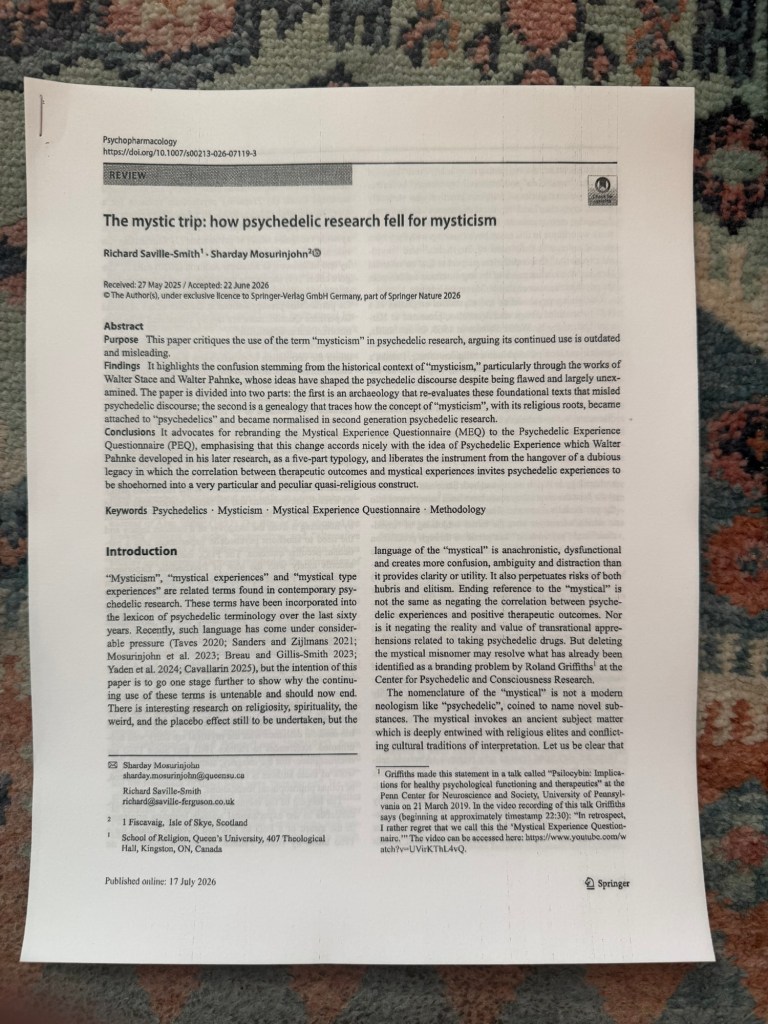
Citation & Link to Article
The mystic trip: how psychedelic research fell for mysticism
Richard Saville-Smith & Sharday Mosurinjohn
July 17, 2026
https://link.springer.com/article/10.1007/s00213-026-07119-3
https://www.bing.com/search?q=%22mystic+trip%22+Sharday+Mosurinjohn
“This paper critiques the use of the term “mysticism” in psychedelic research, arguing its continued use is outdated and misleading.
“It highlights the confusion stemming from the historical context of “mysticism,” particularly through the works of Walter Stace and Walter Pahnke, whose ideas have shaped the psychedelic discourse despite being flawed and largely unexamined.
“The paper is divided into two parts:
“the first is an archaeology that re-evaluates these foundational texts that misled psychedelic discourse;
“the second is a genealogy that traces how the concept of “mysticism”, with its religious roots, became attached to “psychedelics” and became normalised in second generation psychedelic research.
“It advocates for rebranding the Mystical Experience Questionnaire (MEQ) to the Psychedelic Experience Questionnaire (PEQ),
“emphasising that this change accords nicely with the idea of Psychedelic Experience which Walter Pahnke developed in his later research, as a five-part typology, and
“liberates the instrument from the hangover of a dubious legacy in which
“the correlation between therapeutic outcomes and mystical experiences invites psychedelic experiences to be shoehorned into a very particular and peculiar quasi-religious construct.”
Outline
- The mystic trip: how psychedelic research fell for mysticism
- Abstract
- Introduction
- Part 1 – the origins of psychedelic mysticism
- From “primitive” practice to mystical method
- Mystical experience as a state of consciousness
- The principle of causal indifference
- The phenomenology of mystical characteristics and the common core of mysticism
- Incompatible contexts
- Mystical … Compared to What?
- A Pass/Fail Course in Mysticism
- From “primitive” practice to mystical method
- Part 2 – the genealogy of the mystical mythology
- no headings, many pages 👎
- Conclusion
- Declarations
- References
heading
Finished reading the article and posting reaction critiques. Next, org. the page. The mobile wordpress editor app (Jetpack) chokes on “long” files, so, entered some notes at top of page.
0 hits on Challenging Experience Questionnaire (CEQ)
p13 mentions that Mystical Experience Questionnaire (MEQ) ~= the Oceanic dim of OAV (or as they trendily and greedily name it, the “5D-ASC”)
but Fails to mention that the Challenging Experience Questionnaire (CEQ) ~= OAV’s A/ Angst/ Dread dim (though never mind that CEQ omits 18 of the 21 effects constituting the A dim).
Dittrich’s 5D-ASC is a later, junked-up questionnaire made unclear by starting w Dittrich’s pretty good OAV 3 dims (Oceanic Boundlessness, Angst of/ Dread of Ego Dissolution, Visionary Restructuralization) & then adding two stupid, irrelevant dims (Dittrich lost the plot).
Dittrich’s misconceived, mislabeled Angst dim: Ditt says dread OF “ego dissolution” – a bad, false theory, as if all mystical experience is about Unitive, and neg effects are about negative Unitive, code-named as “ego dissolution”.
What Exactly and Specifically Is “Pahnke’s original questionnaire”?
- Pahnke specifies Appendix C, but that ony lists 129 (130) items of Pahnke’s promised 147 items, from 1962/1963. Missing 17 items.
- Mystical Experience Questionnaire (MEQ) 43, from 1969 article.
In two articles, Sharday Mosurinjohn perpetuates this contradiction, and needs to clarify.
Read the article cited on p 11 top R: “Pahnke 1969; Richards 1975”, ie:
Pahnke W (1969) Psychedelic drugs and mystical experience. Int Psy-
chiatry Clin 5(4): 149-162
Richards W A (1975) Counseling, peak experiences and the human encounter with death: An empirical study of the efficacy of DPT-assisted counseling in enhancing the quality of life of persons with terminal cancer and their closest family members. PhD Thesis, Catholic University of America, Washington, DC
Sharday Mosurinjohn self-contradicts: “in 1962, Pahnke administered a 147-item [Apx C?] questionnaire” — yet then says, “the orig version of Mystical Experience Questionnaire (MEQ) had 43 items”
wtf are u talking about: exact quote:
MacLean et al. picked up and developed
Pahnke’s original questionnaire, whittling it down from 43 to 30 items.
Utter nonsense! Sharday Mosurinjohn (in at least two articles) writes of Pahnke’s 1962 “147-item” questionnaire, which begat his later meq43, yet she refers to the latter as “Panhke’s orig questionnaire”. Nonsense & direct self-contradiction.
the dissertation says twice “147-item … See Appendix C”, but, C only lists items through 129, including a 70a, making 130 – not 147 – items.
- Nonsense self-contradiction from Pahnke.
- Nonsense self-contradiction from Mosur.
SLOPPY WRITING/ANALYSIS.
SOCQ ~= 1962 147 item questionnaire;
SOCQ is a 100-item dirtying (superset) of the Mystical Experience Questionnaire (MEQ) by adding junk distractor items
the SOCQ is not intended to be broad like OAV 1994 (Oceanic Boundlessness, Angst of/ Dread of Ego Dissolution, Visionary Restructuralization) psychedelic psychometrics effects questionnaire by Adolph Dittrich ; SOCQ is intended to be strictly mystical experience, plus meaningless junk distractor items.
problem in Dissert: “147 items” are which?
none of the Pahnke 1962/1963 questionnaires have 147 items!
jesus, if we cant even do 1st grader math/ counting, we got psychedelic pseudo science.
see Pahnke:
Appendix C: POST-DRUG QUESTIONNAIRE WITH SIGNIFICANCE LEVELS OF THE DIFFERENCE BETWEEN SCORES OF EXPERIMENTALS AND CONTROLS3
Interactive version: http://en.psilosophy.info/TripograM
Dittrich’s APZ / OAV/ 5D-ASC family of questionnaires, peaked in 1994, then fell into dilution; lost the plot; wrecked in final form: 11-Factors
11-Factors Silently Has 15 factors or dims
- Pleasant Experiences – hi lev dim = Ocean dim + Vision dim
- Unpleasant Experiences – hi lev dim = Angst dim
- Virtual Factor 12: Ocean/Vision effects that are not placed within any of Studerus’ lower level “factor” categs
- Shadow Factor 13, hides away from Grifty, oav’s Item 54: “I was afraid to lose my self-control.”
India Advaita
cites article: Jeffrey Breau JA, Gillis-Smith P (2023) Psychometric brahman, psychedelic
science: Walter Stace, transnational Vedanta, and the Mystical Experience Questionnaire
1 hit on vedan.
every time she mentions Indian religion, she always uses a different term, thus making it impossible to do a find on Indian advaita religion.
The Unitive (nondual unity oneness) model of common-core mysticism & perennialism, vs. the “eternalism-driven control-transformation” model
gather heading w the content about this
move items up to a previous heading:
- APZ – 1975, questionnaire family’s orig psychedelic psychometrics effects questionnaire by Adolph Dittrich, became
- OAV (good) became
- 5D-ASC (bad, greedy, dilutes w 2 irrel dims) became
- 11-Factors by Studerus (starts introducing serious confusion by removing items from the new lower level Factors, yet the effects items still covertly remain/ hide in the top-level Dimensions, which collapse OAV’s Ocean & Visual dims together as “Pleasant Experiences”, and frames Angst as “Unpleasant Experiences”), begat
- CEQ (disastrously bad).
Pahnke meqv1 147 items or 130 items?
apx c has 1 extra item beyond 129 items: 72a
twice Panke diss says “147-item”, but his Apx C only lists 129 (130) items.
“Within a week all subjects had completed a 147-item questionnaire which had been designed to measure phenomena of the typology of mysticism on a qualitative, numerical scale.”
“During the two-hour post-session interview, a 147-item questionnaire7 was completed by each participant in about 30 minutes before any discussion. Certain items were based on the categories of the typology of mystical experience. Other items measured physical symptoms or unpleasant reactions such as fear, terror, anxiety, loneliness, depression, or hatred. The person was asked to evaluate the degree to which he experienced each item on a scale from 0-4:”
7 – “See appendix C for a sample of this post-drug questionnaire.” But (Sharday Mosurinjohn fails to point out), apx c only has 129 (130) items, NOT 147 items, as Pahnke twice claims. apx c is missing 17 items.
These basic counts reveal the absolute vagueness within the heart of the mech tech questionnaire instruments in psychedelic pseudo science.
correction: 1 hit on ‘challenging’, p. 15
The MEQ would become the PEQ (Psychedelic Experience Questionnaire, 30, 40 [sic, 43?], or 100), open to measure a wider range of outcomes, including the challenging ones.
SHOW ME THE CONCRETE ACTUAL questionnaire, and the item-counts.
Misconceptualizing nondual unity oneness to suppress its core: the intense problematization of personal control power
the intense problematization of personal control power
Strategically, in terms of effective strategy to develop this ego death theory of psychedelic eternalism, I sense that this is rather a major breakthrough for me today
it’s a really clever repositioning
instead of saying that my theory of non-control is opposed to the common core mysticism conception that everyone else holds ,
rather, I position my theory (the intense problematization of personal control power during nondual unity oneness) as the hidden center of their model, which they do not understand and comprehend, but suppress and gloss over.
the concept of nondual unity oneness is way oversold. A false center of emphasis. selected by pop wallet
My ultimate-scare tactic can be a milestone: what if the core of common-core mysticism and perennialism nondual unity oneness is the intense problematization of personal control power?
This towering, milestone question, a mature profound question.
What if the result of understanding control instability is control instability?
Correct Transcendent Knowledge as the CAUSE of the intense problematization of personal control power. — instead of (our natural inclination/ assump) bring thr solution.
nondual unity oneness is a diversion, not pointing in correct direction
the best revelation, the ultimate mystical experience, is not nondual unity oneness, but rather, instead, the intense problematization of personal control power. the focus on nondual unity oneness does NOT point in right direction; it is other than the intense problematization of personal control power, therefore nondual unity oneness is a false identification of the common-core experience of mysticism
the nondual unity oneness pseudo-explanation is a substitute answer; a false focus. safer than the true focus of revelatory experiencing.
Sequential Solution to Relating: newbie: nondual unity oneness, then advanced: the intense problematization of personal control power
if thats the case:
first, the newbie has initial beginner experience of nondual unity oneness , and during/ at that time —
because theyre a beginner (just like every single author who writes on this topic is a beginner),
because they are a beginner, they mistake this initial newbie experience as if it is the ultimate common definitive experience,
but this experience (nondual unity oneness) is merely definitive of beginner mystical experience , not of “complete” ie advanced mystical experience — pursuit of correct understanding of the intense problematization of personal control power , which (it is perversely(?) interesting to consider), is the cause of control instability. not the solution to that problem
The unavoidable inherent ultimate problem is the transformative revelation
you are transformed through discovering that the effort to produce control stability through accurate understanding, is in fact the cause of control instability.
that pessimistic possibility that understanding produces the opposite of stability is credible/ authentic/ valid insofar as it is a terror-inducing idea at the center of thinking about the control problem
when the mind’s personal control system is struggling with control instability, then finds the idea that:
correct accurate understanding of personal control power is the cause of instability, rather than the solution to get rid of instability. (!!)
that idea can instill a loop of terror, which shows that the idea is “true”, in the sense that it is a definitively potent idea
“true”, in the sense of, being what it should be
this terrifying idea has a certain credibility/ authority, by virtue of its causing a panic buildup circularity.
more revelation & correction of the mental model of control = more “Lord Have Mercy!”, for the personal individual experiential POV
this captivating premise is the effective opposite and killer of or preventer of personal hubris instead of my bragging only to be shot down, struck down by lightning suppose I reason that I reason that I have stable control because I have an accurate model of personal control but in contrast bring in the intriguing captivating premise hook suppose that more understanding or pure understanding produces unstable control and is the cause of unstable control in that case bragging about my achieved stable control amounts to bragging about my ignorance.
The more that I understand personal control the more that this produces instability
if so, one could not brag in such manner.
Claiming to have achieved
claiming with hubris,
the hubris claim is that I have achieved and secured stable control through accurate understanding
which could be true in some restricted sense
we should
we should hope that we can say that:
the advanced Mystic has achieved some kind of stable control
but emphasized there would have to be the idea that:
better understanding causes unstable rather than stable control
The dynamics of that negative premise are of central relevance
aside from the question of whether it’s true or not
we end up debating:
what do you mean exactly, or not mean, by so-called “stable control”?
Suppose the mature, transformed mind:
- has a thing we can describe as “stable control” and
- that mind has accurate correct understanding of personal control system & the intense problematization of personal control power.
- then also that mind has unstable comtrol
thus my useful term, control transformation 
before transformation, the immature mind has a certain type of stable control, and also a certain kind of unstable control
after transformation, the mature mind has a different certain type of stable control, and also a different certain kind of unstable control
do you end up with stable control or unstable control through accurate understanding and accurate observation and testing?
The mind ends up with both a specific kind of stable stability and a specific kind of instability.
Now the work becomes:
describe how control stability and ctrl instability is different prior to transformation, versus after transformation.
that’s quite different than the inarticulate, false binary, simplistic question:
Do you go from unstable control to stable control?
(thru correct understanding of ctrl & transcendent control thinking)
My mature, stable, secured, transcendent personal control totters on the wise sand of “Lord Have Mercy, i got nothin”
The basis of my confidence about control stability, is the full intense cognizance that there is no basis for securing that,
and I am inherently at the mercy of Creator/ creation/ the Block universe/ the pre-existing future/ psychedelic eternalism
Do you go from not having control, to having control?
(thru correct understanding of ctrl & transcendent control thinking)
Notes
Printer is working! & might record read-aloud in episode of Egodeath Mystery Show.
I read papers (McRae, especially) about 1893 Swami Vivekananda. The origins & formation of modern neo-advaita.
Conclusion: The situation is worst-case. Pop Western modern Buddhism is sculpted and filtered purely based on buyers’ wallets; sheer demand-driven fabrication.
1000 aspects are replaced selectively by 7 aspects, ignoring and misrepresenting.
Every time someone discusses mystical experience and instantly jumps to “oneness, unity”, this is a particular, arbitrary, pop paradigm pretending to be reality.
“pop” ~= the ordinary state pretending to speak for the intense mystic altered state; exoteric esotericism
the “nondual unity oneness” model of mystical experience
vs. the psychedelic revelation of levels of control and two POVs on personal control power.
Griffiths Repudiates “Mystical” questionnaire name
Grifty vid:
“I rather regret that we call this the Mystical Experience Questionnaire (MEQ)”
https://youtu.be/UVirKThL4vQ?t=1350s = 22:30
“positively balanced experience”
Grifty (Roland Griffiths team at Johns Hopkins Dept. of Psychedelic Pseudo Science) telling chs stang on video at Harvard website:
yes, we use a POSITIVELY BALANCED model – “what we’re describing as the classic mystical experience that’s positively balanced”
https://egodeaththeory.org/?s=%22positively+balanced%22
We have an entirely different questionnaire, something called the Challenging Experience Questionnaire. And we try to tap into that. We’ve been very interested in that feature. But I think psychometrically, it falls apart from at least what we’re describing as the classic mystical experience that’s positively balanced.
Roland Griffiths, video interview by Charles Stang, at Harvard website
The Challenging Experience Questionnaire (CEQ) is the most bunk questionnaire ever, so bad, it makes Mystical Experience Questionnaire (MEQ) look authentic.
Mystical Experience Questionnaire (MEQ) cannot be renamed Psychedelic E. Q., AS IF MEQ covers the full range of effects, as OAV’94 in fact does
1st major flaw spotted: authors act AS IF Mystical Experience Questionnaire (MEQ) is a general broad q’aire; but it never was so intended!
Adolph Dittrich 1975 provides a broad APZ AKA OAV 1994 (Oceanic Boundlessness, Angst of/ Dread of Ego Dissolution, Visionary Restructuralization) psychedelic psychometrics effects questionnaire aka 5D-ASC –
O = Ocean – positive exp’s
A = Angst – negative exp’s
V = Visionary – positive exp’s
I call Dittrich questionnaire family “OAV”, not the degraded, defocused “5D-ASC” that later added two junk dimensions that aren’t even psychedelic.
the Garbage result from building on the defocused 5D questionnaire is the Challenging Experience Questionnaire (CEQ):
See the development from OAV to 5D to 11-Factors (muddy the muddy waters) to the final wretched form, the Challenging Experience Questionnaire (CEQ).
Trashcan all that defocused confusion (which ended up simply ignoring 18 of the 21 Angst effects items), and go BACK to the peak questionnaire: OAV 1994 (Oceanic Boundlessness, Angst of/ Dread of Ego Dissolution, Visionary Restructuralization) psychedelic psychometrics effects questionnaire by Adolph Dittrich.
Sharday Mosurinjohn mis-proposes to merely tweak the Mystical Experience Questionnaire (MEQ), to rebrand it as a general, PEQ. (Psychedelic).
The Mystical Experience Questionnaire (MEQ) has only HALF the scope as OAV 1994 (Oceanic Boundlessness, Angst of/ Dread of Ego Dissolution, Visionary Restructuralization) psychedelic psychometrics effects questionnaire by Adolph Dittrich.
At the very least, she’d need to ADD the Challenging Experience Questionnaire (CEQ) + Mystical Experience Questionnaire (MEQ), b4 she could legitly title the result as a broad, “Psychedelic Experience Questionnaire”.
The Challenging Experience Questionnaire (CEQ) is WORTHLESS, a “positively balanced” list of negative effects; = the EMPTY SET!
Grifty can’t help but whitewash everything during Public Relations, even the neg effects.
OAV 1994 (Oceanic Boundlessness, Angst of/ Dread of Ego Dissolution, Visionary Restructuralization) psychedelic psychometrics effects questionnaire by Adolph Dittrich
Sharday Mosurinjohn would need to COMBINE [a repaired version of] the Challenging Experience Questionnaire (CEQ) w the Mystical Experience Questionnaire (MEQ) , to label the resulting, actually broad q’air as “Psychedelic Experience Questionnaire (PEQ)”.
she notes that the MEQ would need to be “reworded” and that the Factor categories would need to be revised – but that’s a massive understatement. 
a basic error in this article
Fails to Use superior, formatted copy of Pahkne, only knows of MAPS’ raw version
Drugs and Mysticism: Psychedelic Drug Experience and the Mystical State (Pahnke, 1963)
links to:
Psilosophy.info – Full text of Pahnke’s 1963 dissertation book, created from MAPS scans of the typed dissertation:
http://en.psilosophy.info/drugs_and_mysticism.html
A church pastor mentioned to me today, tue aug 25 2026: article – rather, book?- by Richard Saville-Smith, which is cited in this artic’s Refs:
Saville-Smith R (2023)
Acute Religious Experiences: Madness, Psychosis, and Religious Studies
https://www.amazon.com/Acute-Religious-Experiences-Psychosis-Bloomsbury/dp/1350272957
the Mystical Experience Questionnaire (MEQ) and also the Challenging Experience Questionnaire (CEQ) are BOTH(!) sanitized, to be, quoting Grifty defending himself to Stang, “positively balanced“.
blurb:
“This book engages the problem of how, in the 21st century, we are to speak about experiences of the extraordinary/anomalous/extreme which occur on a transhistorical and transcultural basis.
“Critical re-readings of seminal texts show how 20th-century theoreticians in the humanities sought to erase madness from their irrational subjects.
“This propensity to sanitize madness in the study of religions was mirrored by the instinct of psychiatrists to degrade religious experiences by reducing mad consciousness to psychosis or dissociation.
“Richard Saville-Smith introduces explanatory pluralism as a way of recognizing these disciplinary biases and mad studies as a way of negotiating this understanding.
“The disproportionate significance of madness in shaping the fabric of the human story can then be recovered from both erasure and dismissal to be given the recognition previously denied – as acute religious experiences.
“Acute Religious Experiences divides into three sections, beginning with re-readings of
- William James’s pathological programme
- Rudolf Otto’s numinous
- T. K. Oesterreich’s possession
- Mircea Eliade’s shamanism
- Walter Stace’s mysticism
- Walter Pahnke’s psychedelic experience
- Abraham Maslow’s peak experiences
These ideas are shown to constitute the beginnings of a fractured discourse on the irrational.
[Louis Sass bks??]
“In part two, contemporary psychiatry’s Diagnostic and Statistical Manual (DSM) and Foucault’s History of Madness are re-read to reposition madness as not necessarily pathological.
“This opens the way for the identification of acute religious experiences as a new holistic and post-colonial approach through which religious data can be organized and addressed on a comparative basis.
“In part three, The Gospel of Mark is re-read as a case study to demonstrate the novel insights which flow from the identification of acute religious experiences.
“Richard Saville-Smith draws on his own experiences of madness and his PhD from the School of Divinity at The University of Edinburgh to elucidate his research.”
Deserved Disrespect of “Validated”
i’ve joked about this most-baloney term in the questionnaire articles, claiming to “VALIDATE” category factors of questionnaires. Utterly meaningless and bogus. What is “validated” supposed to mean?
the Challenging Experience Questionnaire (CEQ) is utterly bunk and worthless, yet it’s been “validated”, therefore “validated” is worthless and meaningless;
we performed a math-dance on 💩, so, it’s been “validated”.
psychedelic pseudo science: fake it til u make it, emphasis on “fake”.
questionnaire industry fails 1st-grade math: “Pahnke’s orig 43 items” was 147 items
or a similar, inconsistent count.
Sharday Mosurinjohn is wrong to write “Pahnke’s original, 43 items.” Basic history error.
meq43 was a later, v2, not the 1962 v1, of the questionnaire.
How i debunked psychedelic pseudo science: simply by asking “how many Qs/ effects items are in this Factor category?
How many effects items are in this questionnaire and what are the items? Crickets!
Psychedelic pseudo science cannot answer the most basic, trivial questions.
The field is all smoke & mirrors from start to finish.
No textbook can summarize this “validated” pile of hooey.
My 💨 “validated” that I had beans for lunch.
Pay no Attention to TIM LEARY(!!) behind psychedelic pseudo science
Sharday Mosurinjohn & I both go against the strategy of “sweeping Leary under the carpet to try to make Pahnke seem legit”.
Pahnke IS Leary; the phd diss says, supervisor: TIM LEARY.
I proposed that credit for the truly “orig” MEQ147 (not the later, v2, MEQ43, per SM) goes to Leary, not Pahnke.
It is Timothy Leary’s Good Friday experiment; stop falsely spotlighting Pahnke.
good friday’s questionnaire technology is from Leary, not Panke, i suspect.
Leary’s been whitewashed out of the “mysticism science” narrative/ marketing.
Half-Truth of the Perennialism Concept
100% of authors define common-core mysticism and perennialism as, specifically, nondual unity oneness, as the most important focus.
They ought to instead focus on the intense problematization of personal control power.
The term or concept “mysticism” is not necessarily problematic.
What’s problematic is that 100% of authors identify mysticism as focusing on the particular, neo-Advaita model of mysticism, as nondual unity oneness, which is way oversold, overemphasized, very mis-focused.
Mysticism, and the Mystical Experience Questionnaire (MEQ) rebranded as the Psychedelic Experience Questionnaire (PEQ), would need to integrate the scope of effects that’s supposed to be covered by the Challenging Experience Questionnaire (CEQ)
The Challenging Experience Questionnaire (CEQ) ~=
OAV (Ocean/Angst/Vision) questionnaire’s A/ Angst/ Dread “of ego dissolution” dimension.
It is a bait and switch: they ask you first, “Is there something (unspecified) in common between different mystical experiences?”
The answer to that question so far as it goes is yes, but the bait and switch is that they then conflate that with a particular model of what is the specific common aspect they answer that incorrectly.
Everyone except for me falsely asserts that what effects there are in common, is nondual unity oneness; in fact, more central is: two different, specific experiential points of view; two different mental models: the Possibilism-branching mental model alongside the Eternalism mental model.
The result can be called Block-Universe Mysticism, as opposed to Quantum Mysticism aka freewill-branching mysticism.
The best, most shattering, actual perennialism specific content is a revelation of constraint on personal control power, given a single, preexisting future.
Not inarticulate hazy idyllic “nondual unity oneness”.
A sanitized, avoidance strategy.: Focus on nondual unity IN ORDER TO AVOID the real, signif revelation, the nullity of personal control power, from the transcendent point of view (POV).
A Balanced Critique: Lesser Theorists Can’t Handle Doing
crude, self-styled debunkers are only able to (playing in easy mode, intellectually lazy) say either:
“person X is all-correct”
(eg “I agree w Sharday Mosurinjohn”)
or else:
“person X is all-wrong about everything, & contributes nothing”.
My ongoing review of the Mystic Trip article does the real, nuanced, scholarly work:
identify the contributions & limitations of each author.
Proper critique; not limited to simple cheerleading & razzing.
“Western = no psychedelic spirituality; Indigenous = psychedelic spirituality”
Sharday Mosurinjohn has an extremist tendency, to assert this mere possibility as if fact, the supposition that Western religious history lacks classic psychedelics.
hypocr: she accuses Ruck of shifting wording from possy to fact. She is projecting.
The Medieval Warm Period (950-1250) was peak psilo use. Look at all of the pictures in Great Canterbury Psalter and the medieval art genre of {mushroom-trees}.
Do not skip over Day 4 of Creation panel like Ronald Huggins saying “the trees” w/o any justification or acknowledgment/ discussion.
They are literal mushroom shapes, w no branching (other than grid-cap encoded).
Sharday Mosurinjohn is not critical enough of the notion of indigenous “religious/ spiritual” use of psychedelics.
EXTREME human sacr & mayhem augmented w psychedelics, framed as “spiritual wisdom”. Indigenous Shams.
See two expose books: by Jan Irvin then thom hatsis: God’s Flesh. Psychedelic Injustice.
Same Mistake Jeffery Breau corrected: “Western Bias”, “colonialist”? No; a Neo-Advaita Bias of the Unitive Mysticism Model
A cheap dump of pop junk analysis accusations: turn off brain, parrot pop tropes:
No Page Numbers
pdf: 18 pages, i wrote # on each page.
No Expose of Neo Advaita per Breau & McRae
The article has mentions of Indian religion scattered throughout, always using a different word every time, and not gathering in a section, a focused analysis of the junk roots of neo-Advaita, selected & filtered (thus, constructed) purely by what sells to the pop audience since 1893.
Does the article say advaita? 1x: Advaitic:
“Stace’s “dispassionate” analysis was conducted from a highly specific cul-
tural location – colonial administrator, Advaitic source pipeline, pre-committed perennialist – none of which his method acknowledges or accounts for.”
- colonial administrator
- Advaitic source pipeline
- pre-committed perennialist
Half Truth of common-core mysticism & perennialism
this is a nice strategic solution, to position myself in contrast to everyone else; to position myself in relation to everyone else:
by saying:
All the authors are correct about common-core mysticism and perennialism, but, when you go further than they go re: the experiencing of nondual unity oneness, that leads to my particular problem/ solution/ revelation/ theory.
The most central, best, highest quality experience within nondual unity oneness is, the intense problematization of personal control power.
I cannot be called a “perennialist”, because that word is covertly loaded.
The Egodeath theory (the theory of psychedelic eternalism) cannot be called “perennialist”, because that word is covertly loaded.
There is some type of common-core mysticism and perennialism.
But I disagree with EVERYONE on what that specific common experience (revelation) is.
When it comes to identifying the specific common core experience, we entirely part ways. re: the central emphasis.
Sure, unitive – but what at the heart of that? Problematization of personal control power, specifically, centrally, pointedly. Not clouded over by protective fog of vague “nondual unity oneness”.
Cybernetic control-info emergency is the best & most valuable, consequential, shattering part of nondual unity oneness.
All authors (eg Ken Wilber, Alan Watts, William Richards) wrongly claim that “unity” is the key experience.
Revelation about control-levels is the ACTUAL specific common mystical experience.
Vivek? 0 hits
1893: 0 hits
The Core mystic-state Experience Is nondual unity oneness, BUT, the Core of THAT Experience Is Non-Control; 2POVs; the Profound Problematization of Personal Control Power
What the marketers don’t tell you about their highly advocated nondual unitive experience : intense Problematization of Personal Control Power.
Terse abbr: “non-control” – ok term , but only as shorthand.
Accurate: relative-only control.
Loss of control – an approx term.
Most Potent Scary Idea/ Possibility: What If Accurate Transcendent Understanding Causes Control instability?!
The usual move/ natural assumption: “to stabilize control, i must accurately understand personal control power.
WHAT IF accurate understanding causes control instability?!
We solve every problem by increasing our understanding.
What if, terrifying thought:
Control instability is not SOLVED by correct understanding, but is CAUSED by correct understanding
The problem of provoking control instability is not SOLVED by correct understanding, but is CAUSED by correct coherent understanding.
Jumps from “No Evidence for a Conclusion” to a Definite Negative Conclusion, Exactly as Overemphasized Ruck Supposedly Does
This was a major criticism of Ruck in previous articles, yet she makes this exact same fallacious move, projected onto Ruck. Ruck reasonably employs “as if true” wording, but Sharday Mosurinjohn does the same thing, more heavy-handedly and with less justification than Ruck has.
This hypocrisy of Richard Ascough & Sharday Mosurinjohn’s cancels that page-worth of apparent critique of Ruck.
In previous articles/talks, Sharday Mosurinjohn says “not enough evidence to draw a conclusion about whether there were psychedelics in Western religious history’
Then she does the exact move that she majorly disparages Carl Ruck as doing: she draws a firm definite conclusion “There were no psychedelics in Western religious history” – and then sweepingly discredits all entheogen scholars:
“Entheogen scholars fabricate a lie, that there were psychedelics in Western religious history”
The reality is nuanced; Christian Greer is much more refined, balanced, viable, and decent attitude toward entheogen scholars, not infuriating them w crude unearned absolute dismissal like Sharday Mosurinjohn:
Greer reasons more soundly, “we will find some degree of evidence for entheogens in Western religious history; it’s a matter of degree: how “normal” / “mainstream” was it?”
i solve that by arguing:
* Medieval Warm Period 950-1250 has compelling evidence for psilo
* the BEST mystics or highest-QUALITY mysticism, or the most important ppl in Christendom, were the 1% who used psychedelics; in that sense, via degree of influence, psychedelics were “normal” and “mainstream”.
The 99% of ppl in Christendom who did not use psychedelics are lesser, inferior, unimportant.
They rode the coattails of the superior few who used psychedelics and who were influential, as evidenced in art eg at eye level in the public chapels, illium ms’s, cathedral windows, etc – the best art.
This Article
psychedelic pseudo science is way overdue for an overhaul
the more i looked into the psychometrics questionnaires, the flimsier the field appeared
especially when tracing the creation of the Challenging Experience Questionnaire (CEQ) – a pseudo questionnaire, not fit for actual use
the Mystical Experience Questionnaire (MEQ) has a flimsy basis too
A few poor suckers mistake the Challenging Experience Questionnaire (CEQ) as if it is a serious questionnaire thats meant to be used, but i think it’s nothing but a Medical industry Marketing vehicle
these Psyched psychometrics (Leary) questionnaires firmly incorp, as their stated “scientific foundation”, the all-dominant pop (🤑) model of mystic-state experience as “nondual unity oneness”; they proudly proclaim the out of print 1960 book by Walter Stace, as if a solid scientific foundation
I most strongly agree with *this* article by Sharday Mosurinjohn; a much-needed call for correction and reassessment of foundational constructs & concepts in the field(s) – the field of entheogen scholarship, & the overlapping field of psychedelic-assisted therapy
See Also
site map https://egodeaththeory.org/nav/#Sharday-Mosurinjohn

 The Egodeath theory
[the following comment was intended as private email requesting clarif, not so prominent as if challenging the Egodeath theory publicly – Michael Hoffman]
Michael, I’m wondering if the recent “1%” formulation represents a revision or refinement of the Maximal Entheogen Theory of Religion as you conceived it earlier.
I had always understood the maximal theory to mean something considerably stronger than “a small psychedelic elite generated the most important religious ideas and imagery, which were then inherited by the non-psychedelic majority.” My impression from your older writings was that you were arguing that premodern religion itself was primarily, perhaps almost constitutively, entheogenic: that entheogen use was normal and mainstream practice rather than something confined to an unusually influential minority.
For example, in the older formulation about antiquity, you describe altered-state experiencing as integrated throughout the culture, with mixed wine as the standard reliable means of accessing the intense mystic state; and elsewhere the maximal theory seemed deliberately opposed to the idea that entheogenic religion consisted of tiny cells or exceptional individuals at the margins.
So when you now propose something like: perhaps only 1% of Christendom used psychedelics, but they were the best mystics / most important religious people and the 99% rode their coattails — that sounds to me like a significantly different historical model.
The newer model would be something like:
psychedelic experiencing was not necessarily demographically normal, but it was culturally generative and disproportionately concentrated among the people producing the highest forms of mysticism, theology, myth, and religious art.
That seems quite plausible as a version of the theory, and perhaps in some ways easier to defend historically. But is that how you now understand “maximal”? Or would you still maintain the older, stronger claim that actual entheogen use was widespread among ordinary participants in premodern religion?
I’m especially curious because I had always taken “Maximal Entheogen Theory” to be maximal in both senses: maximal causal/cultural importance and maximal prevalence of actual use. The recent 1% idea seems to retain the former while substantially revising the latter.
Am I reading a real development in your position here, or am I misunderstanding how you intended the older formulations?
LikeLike