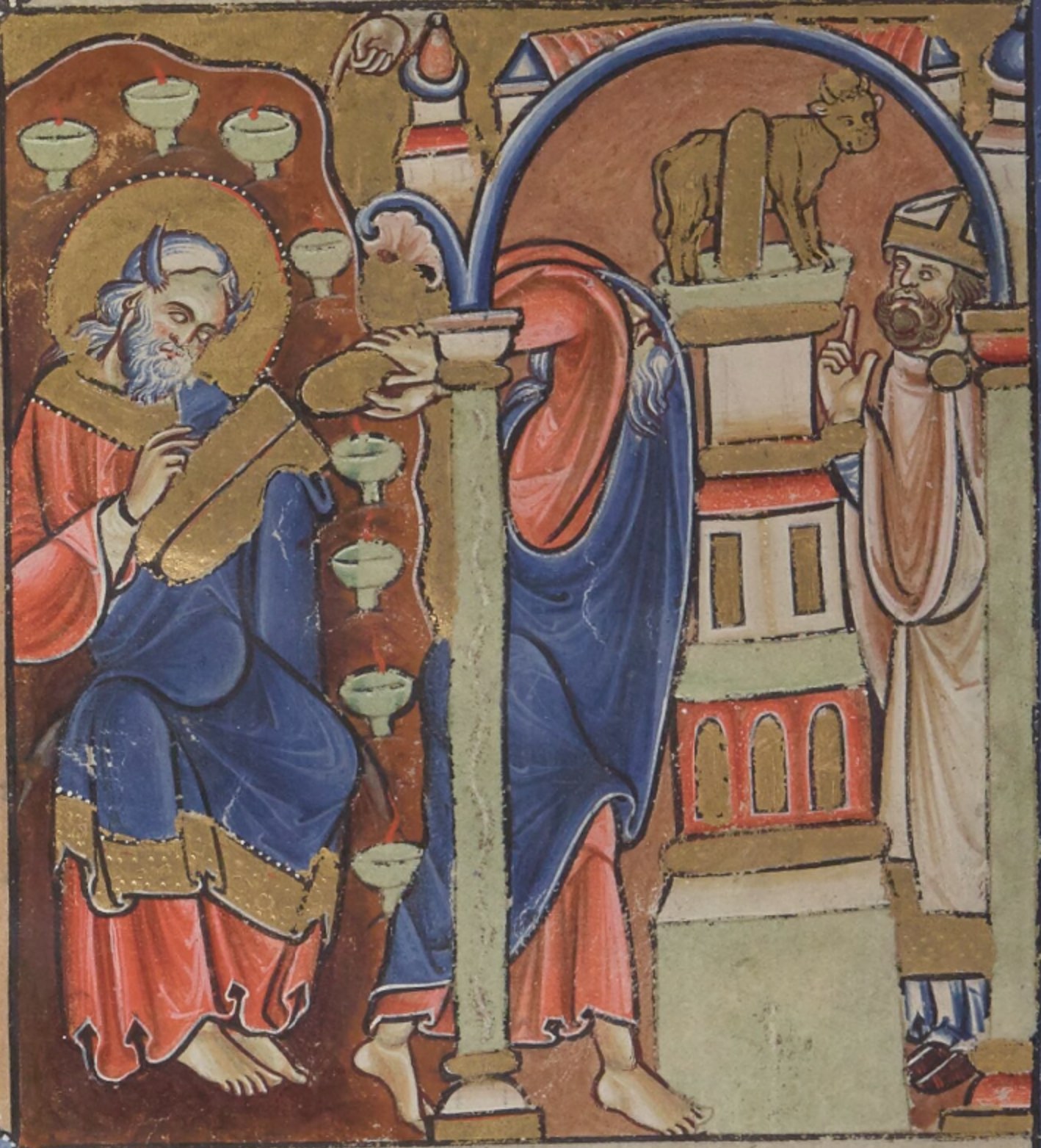
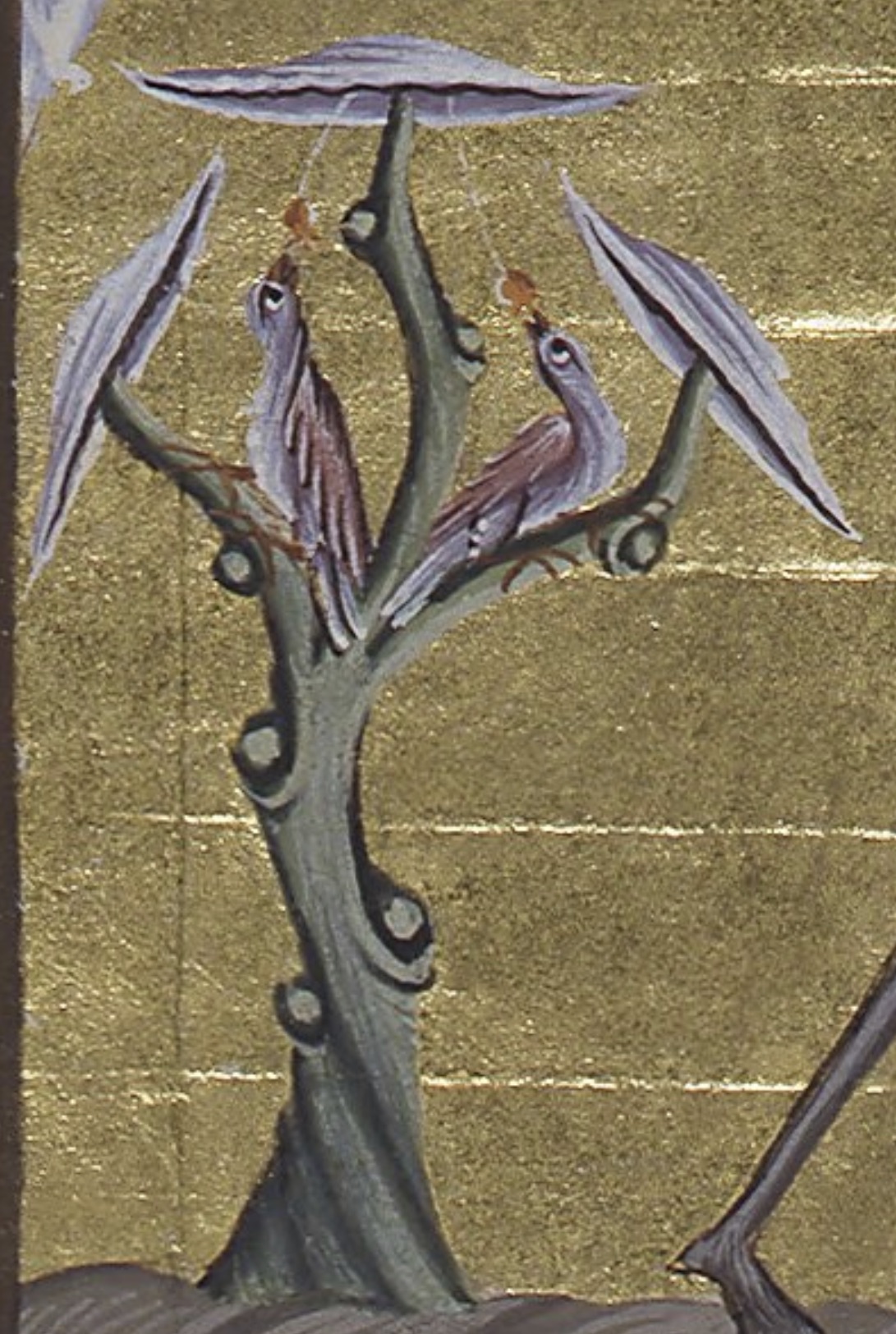
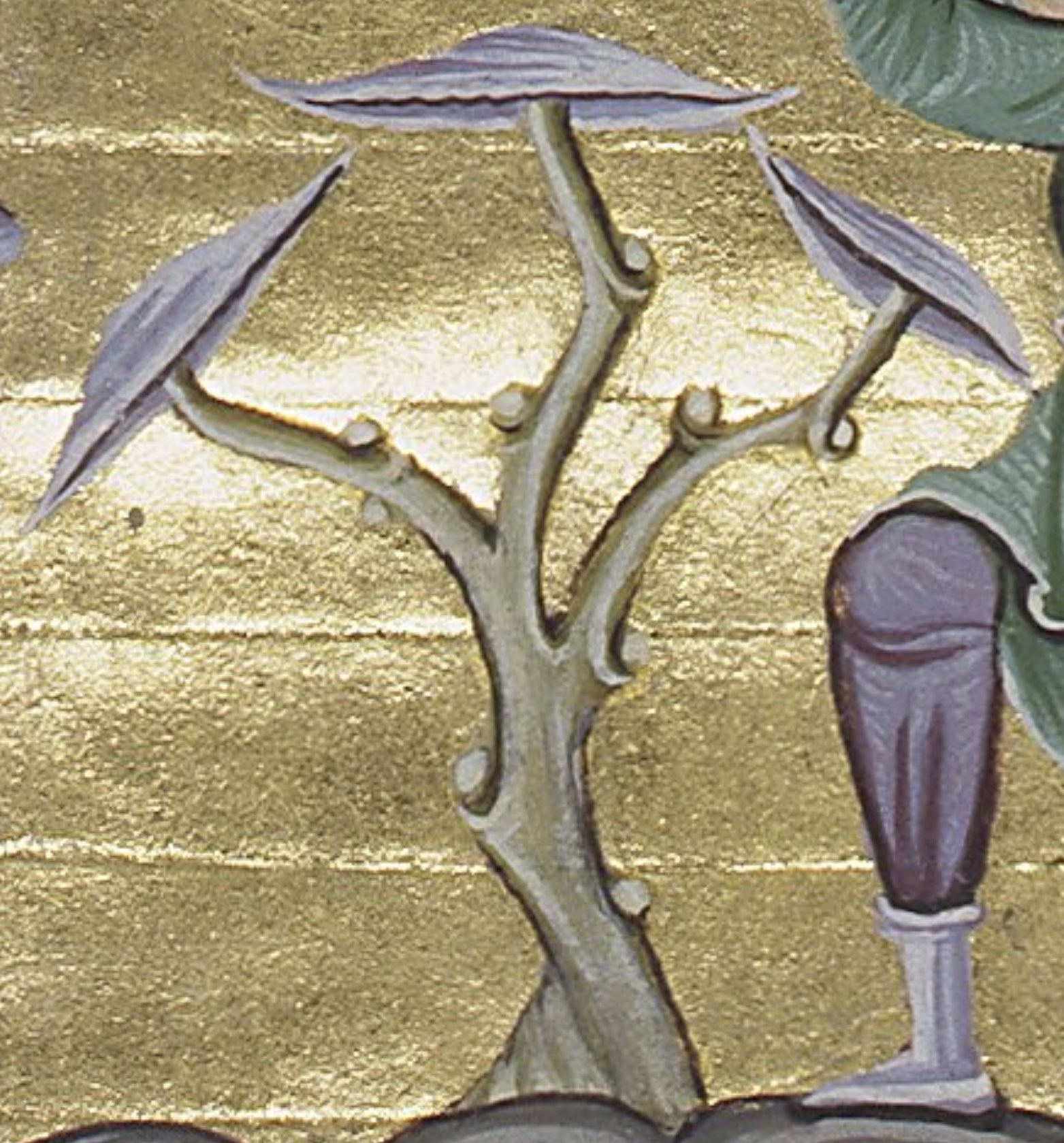
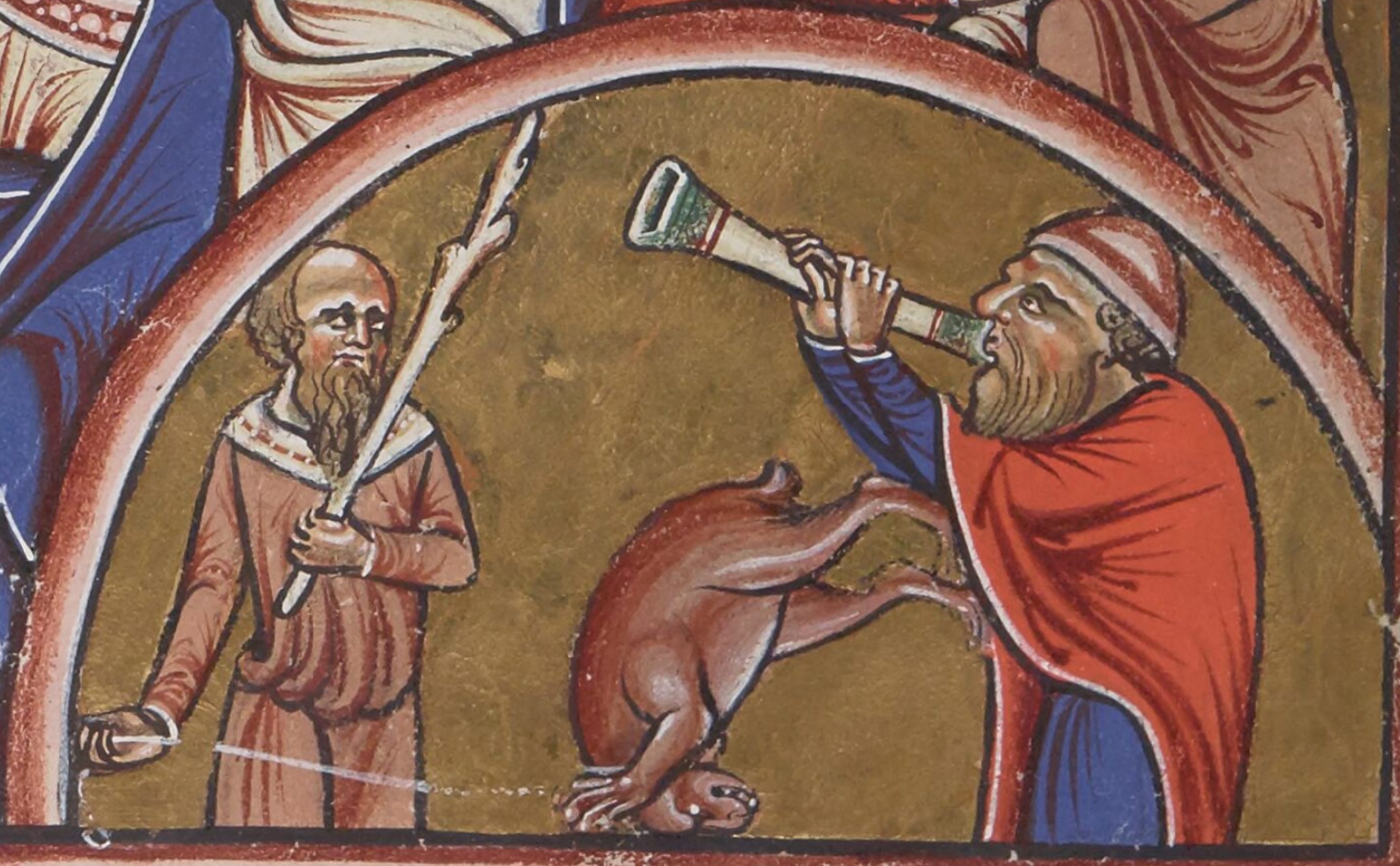
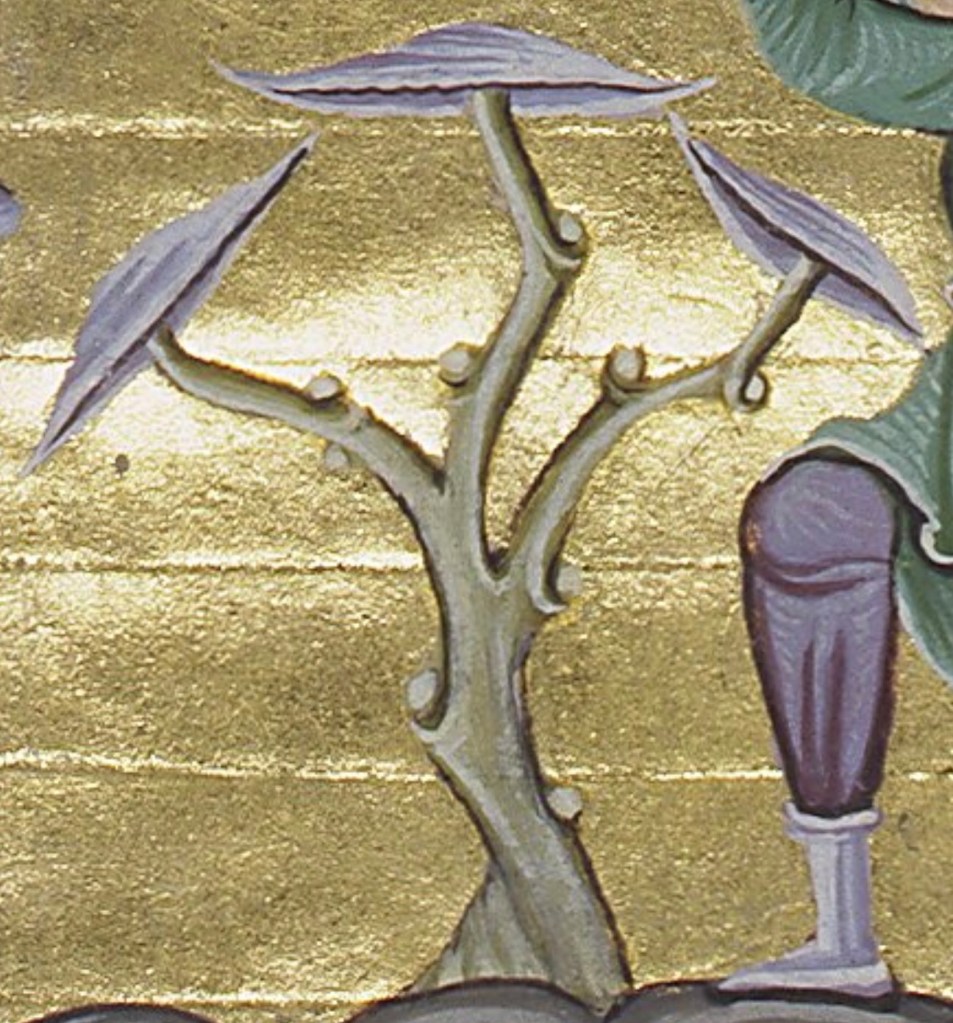
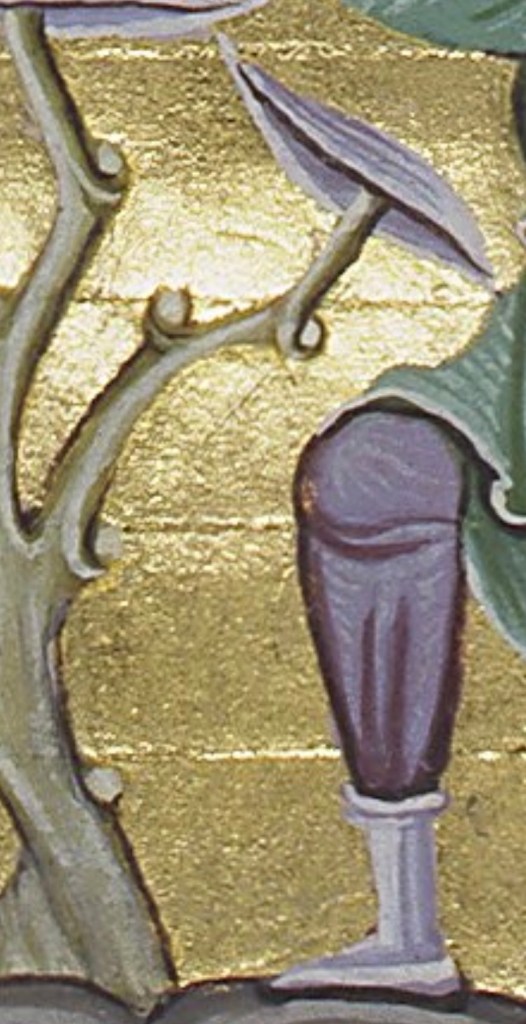
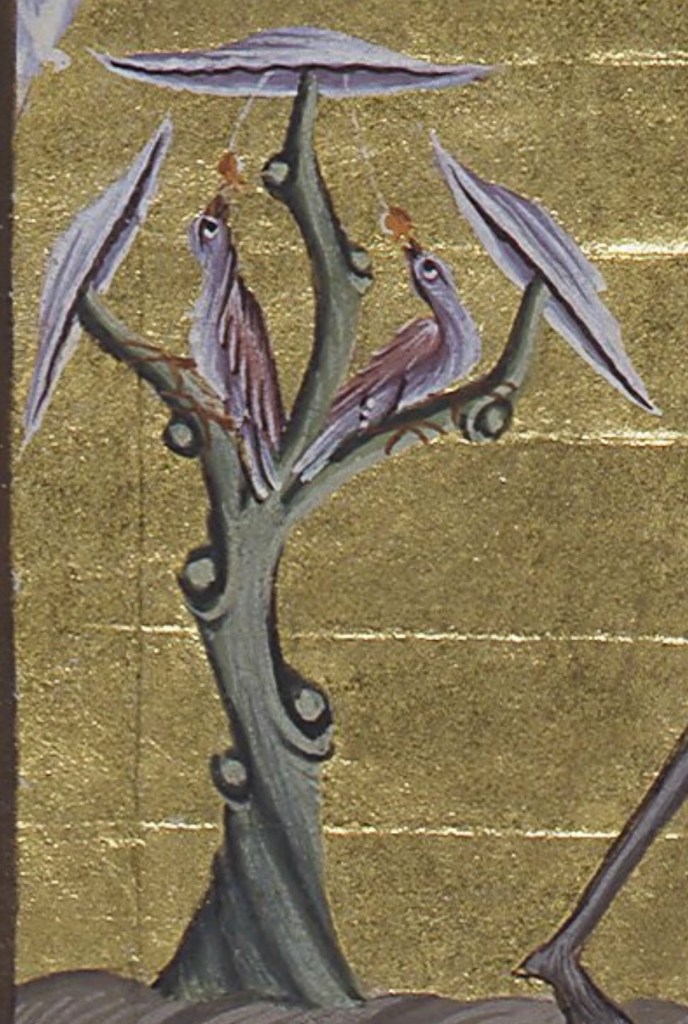
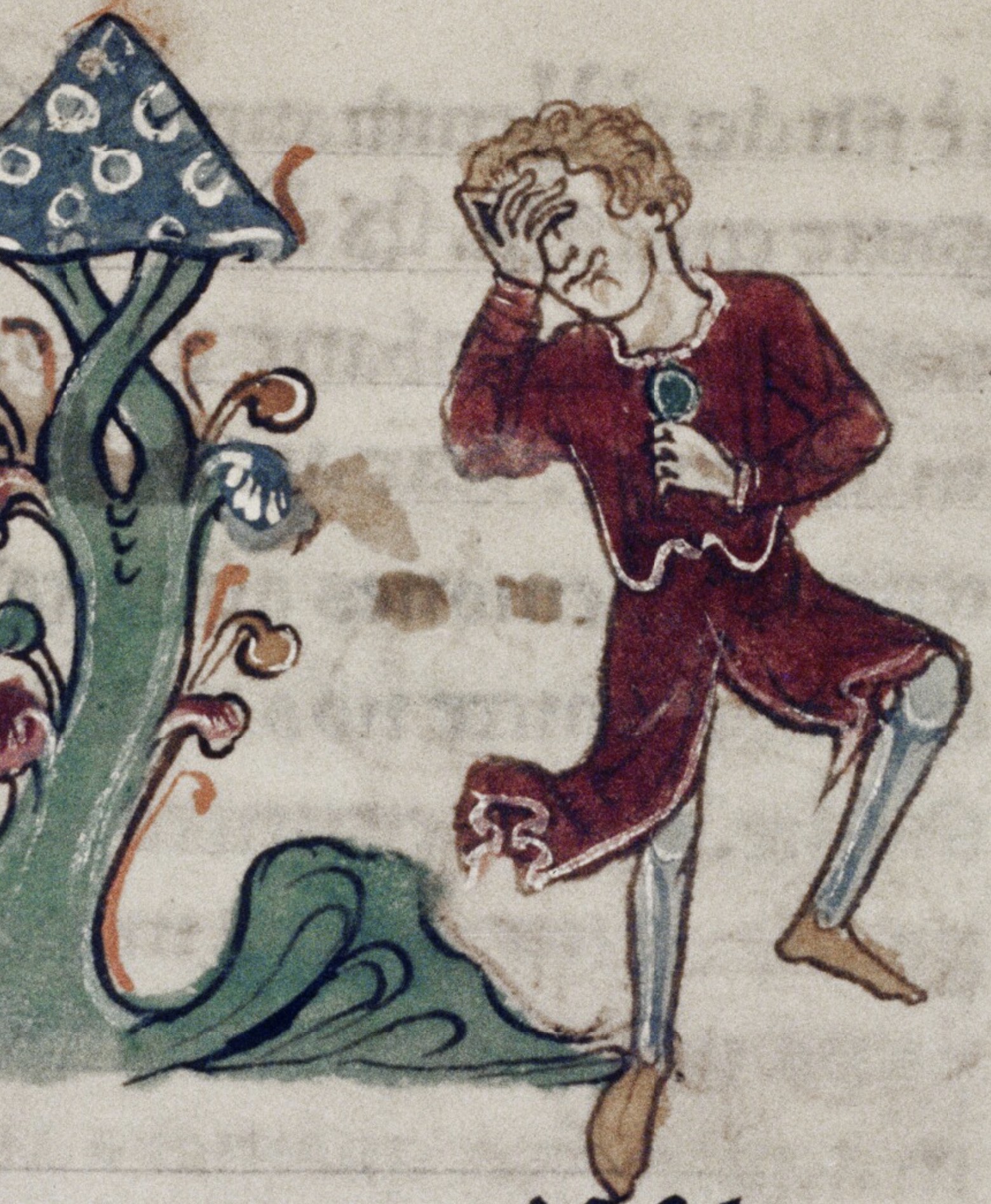
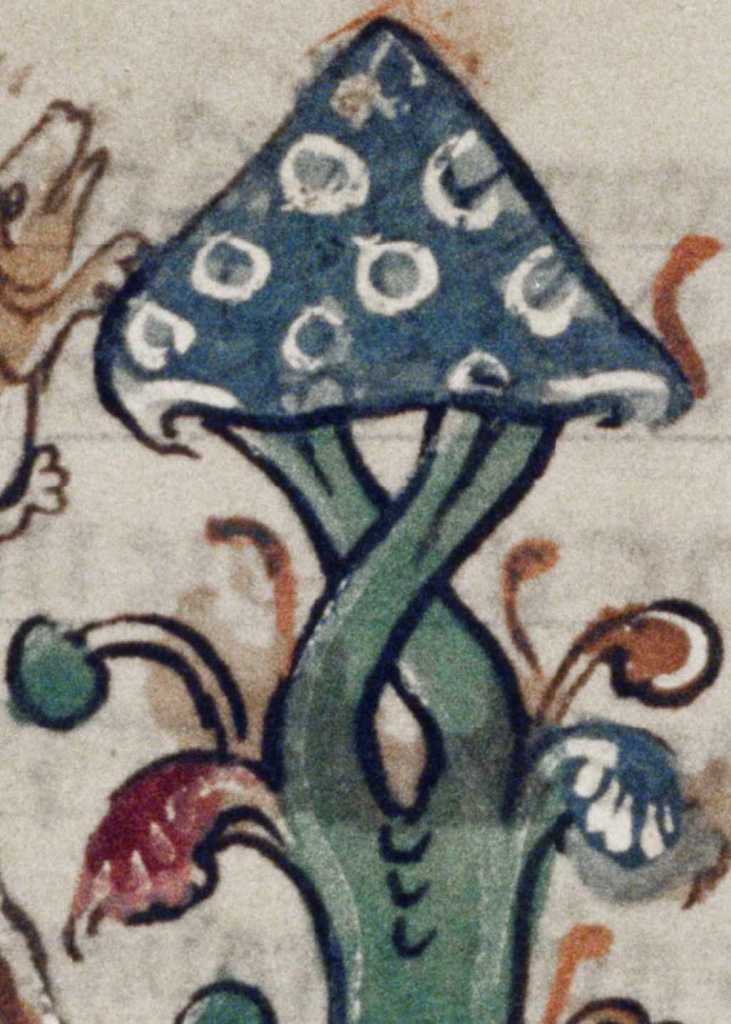
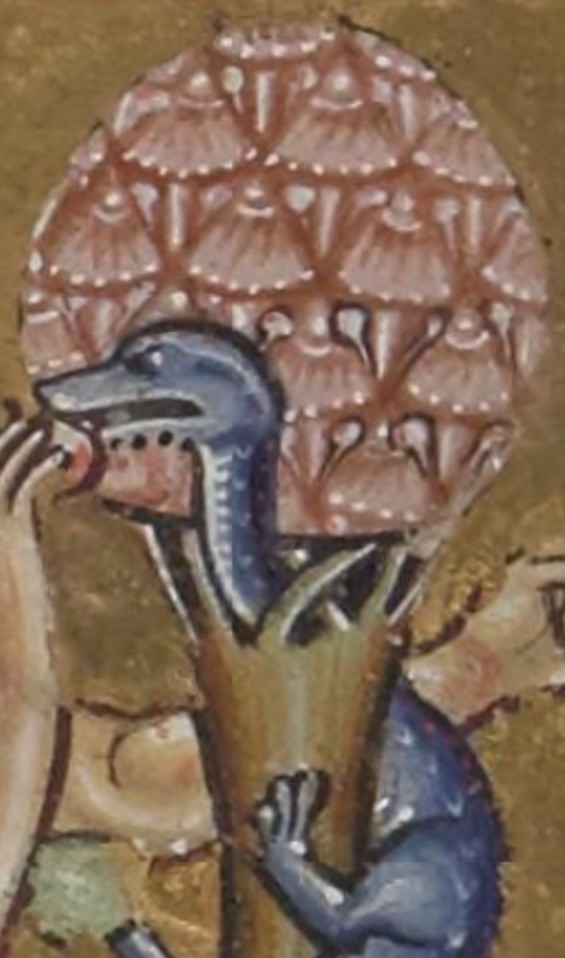
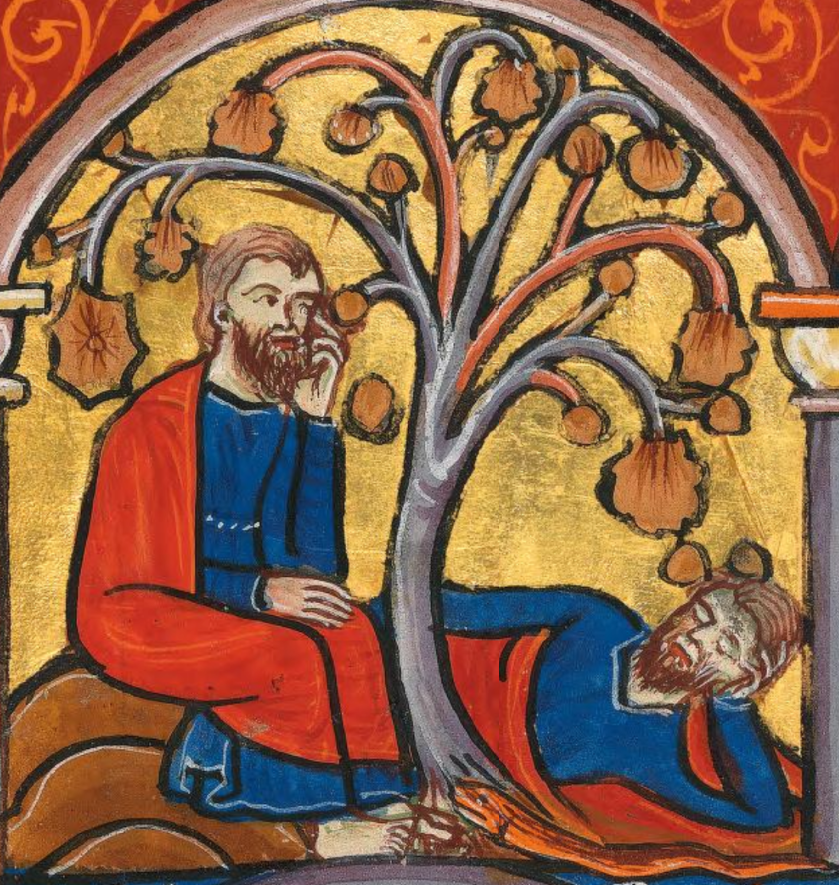
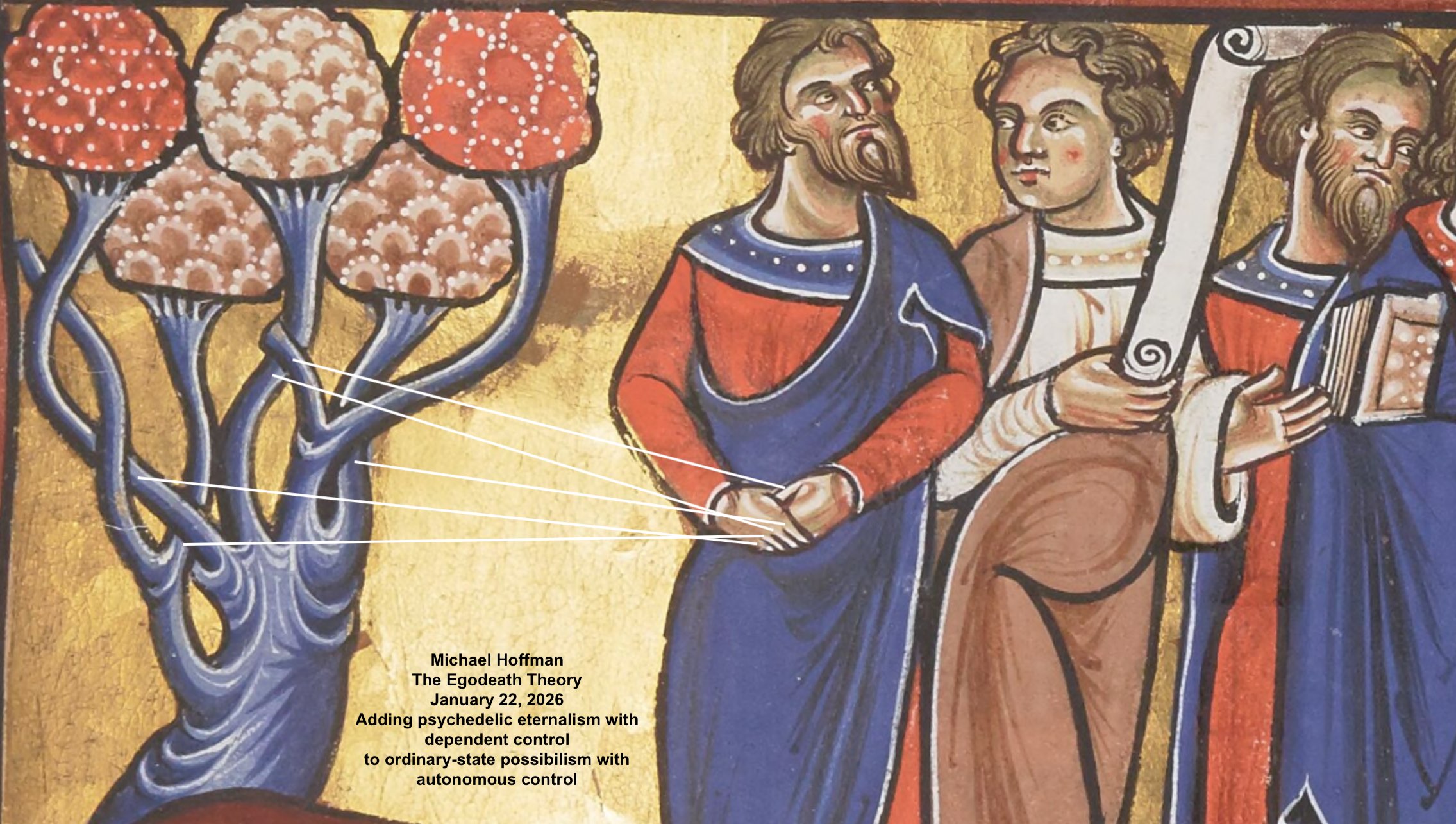
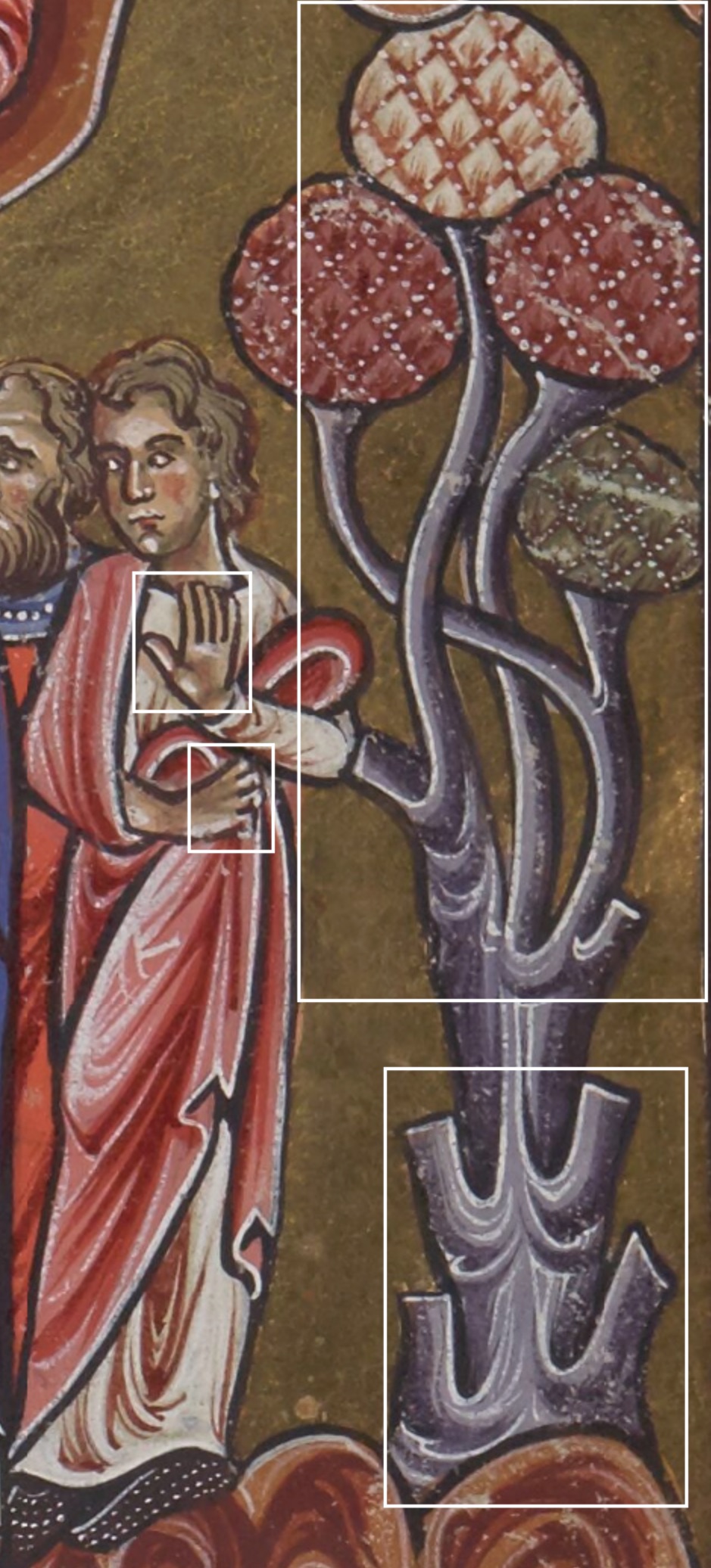
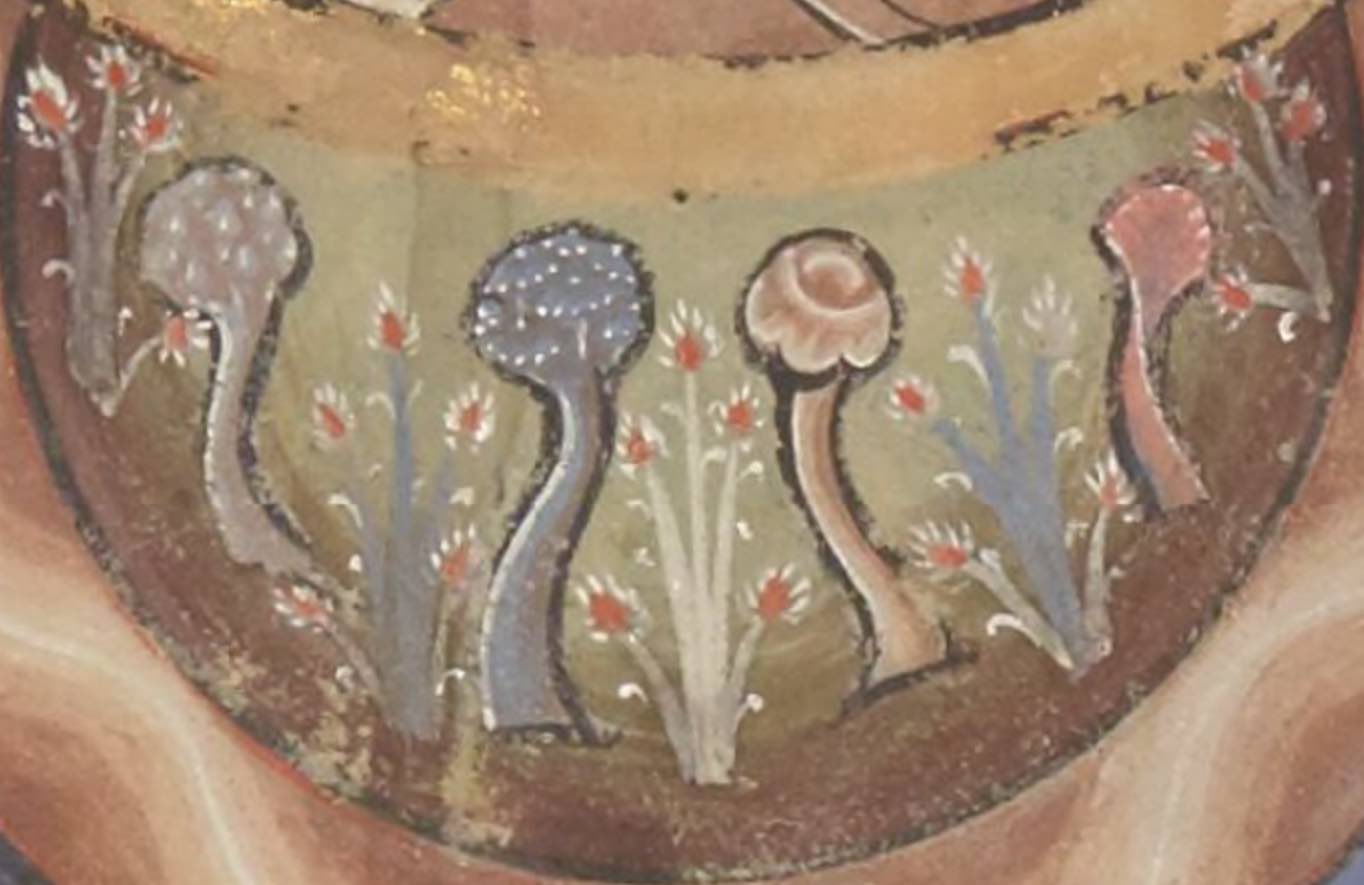
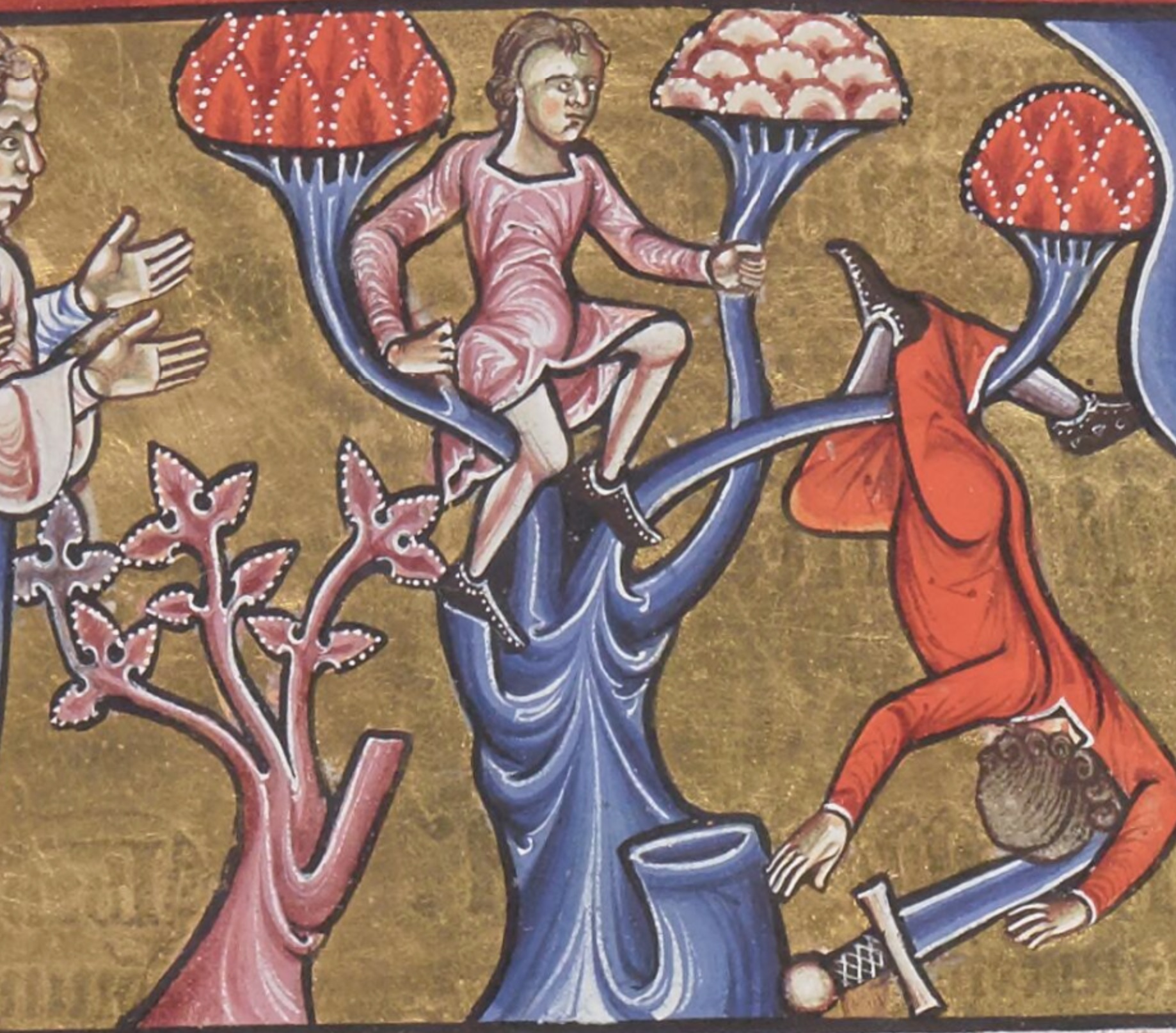
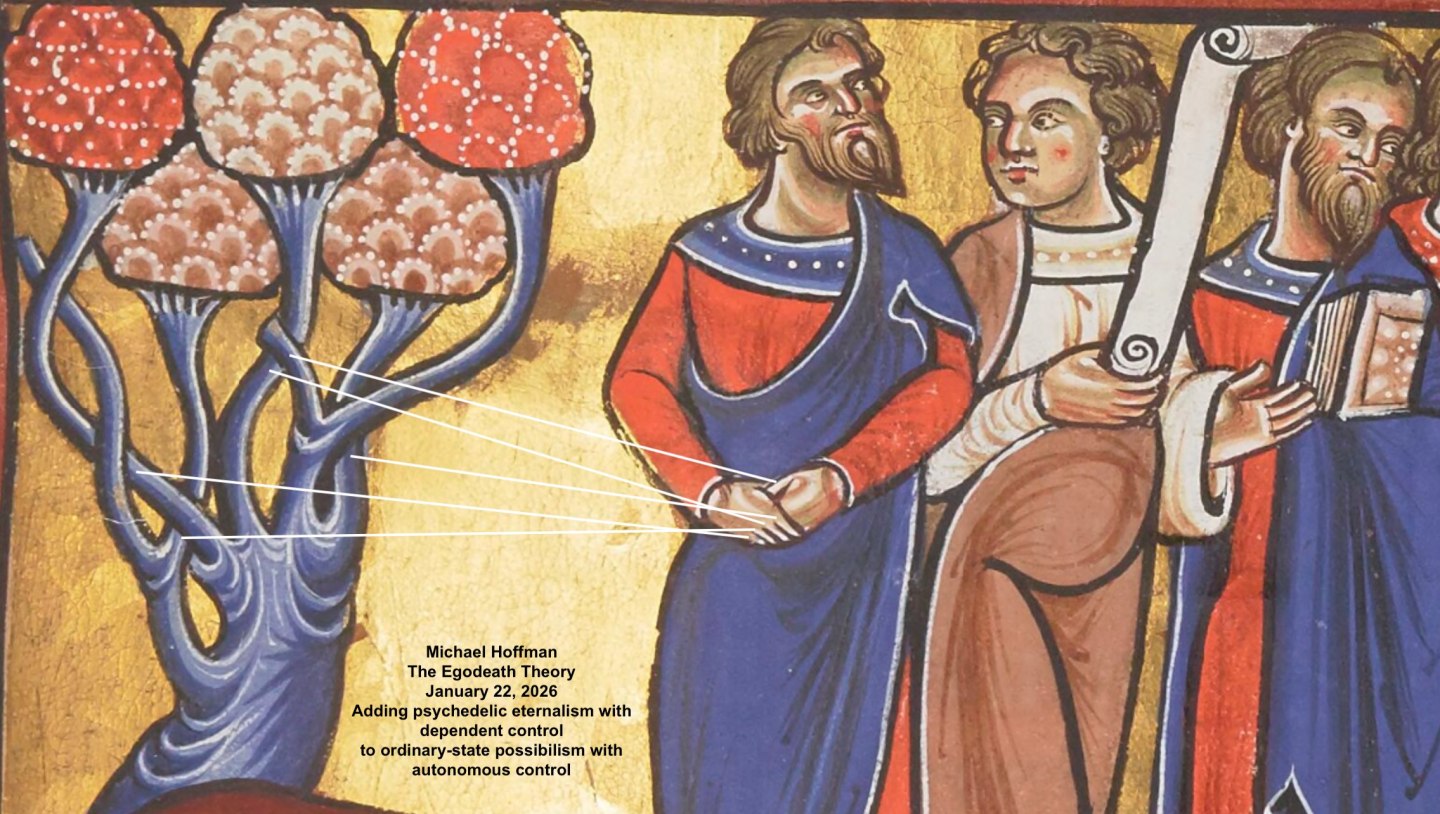
See the “eat from tree of knowledge” panel in f11 Great Canterbury Psalter row 3 col 2 Eden scene zoom close up of tree of knowledge grid cap Liberty Cap w/ L & R arms & ball fruit L & R.
Detail in tree of knowledge zoom panel defines the grid cap lib cap implied features throughout the psalter. Each contained Liberty Cap in the grid cap, has 2 fruit L & R; two arms L & R. Emphasis Left & Right arms/ fruit. ie , the Way of Zen by Alan Watts type of binary: pre/post satori; possibilism vs. eternalism.
2 States time/control models together learned both moving between the two states: ordinary-state possibilism vs. psychedelic eternalism.
ordinary-state possibilism vs. psychedelic eternalism
the “ordinary-state possibilism” & “psychedelic eternalism” experiential modes
the altered-state eternalism experiential mode aeem
the psychedelic eternalism experiential mode peem
the entheogenic eternalism experiential mode
Grid-Cap Details in Tree of Knowledge (f11): L & R Fruit
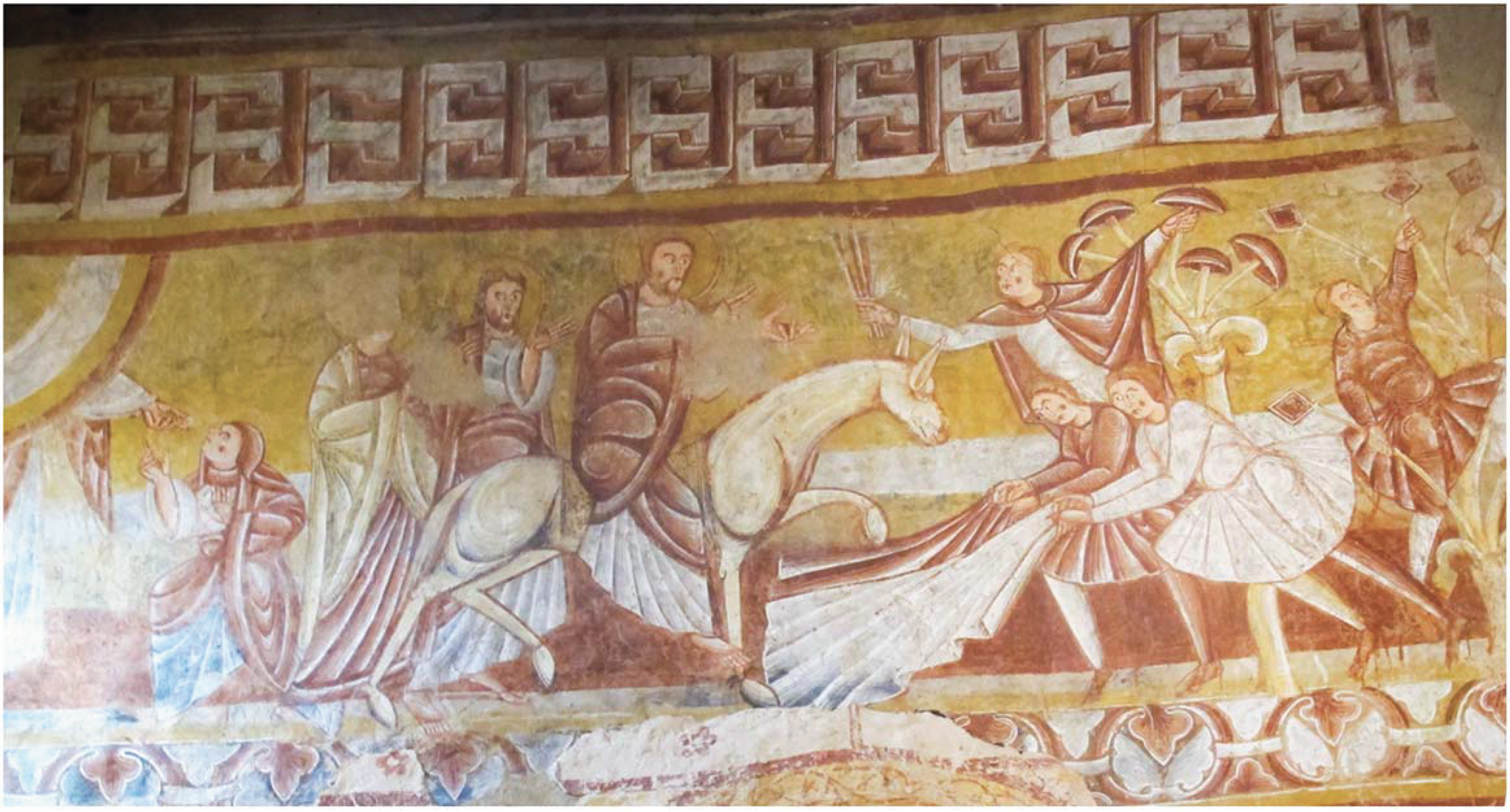
Today Is the 3rd Anniversary of Decoding Finger Shapes, Feathers, & Sticks, in Saint Martin > Entry into Jerusalem
Feb. 9, 2026
For the past couple years I have been wondering about the awkward, sore-thumb finger shapes in the two Otto images.
I created this page because I need to take another look at the finger shapes in the two Otto Gospel images, after the recent Tue., Feb. 3, 2026 breakthrough of fingers & thumb YI shapes.
That breakthrough was not one day, but a series of breakthroughs, from mid-Jan to Feb 9, 2026.
Motivation for this Page
Feb. 9, 2026
At the present site there are a couple or few or how many crops of Otto pages scattered.
Now that I am literate at reading YI hand-shapes at the “fingers, thumb, base of fingers, tips of fingers” level, need to re-inspect psalters to integrate YI hand-shape analysis:
Golden
Great Canterbury Psalter
Otto
todo: look for all 4 motifs in Otto: {mushroom}, {branching}, {handedness}, and {stability} motifs.
High-Context Culture vs. Low-Context Culture
Now that I have looked at “all” the art across the large Great Canterbury Psalter and across the entire the medieval art genre of {mushroom-trees}, it is far easier to read semi-explicit, semi-clear motifs.
When a motif is universal among the art initiation guild, it is not necessary in every instance of the art motif to be clear and definitive.
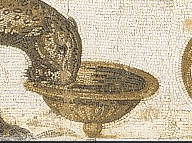
It’s possible to sloppily sketch an allusion, eg the dog blocking its ears from hearing music is clear to its audience that it alludes to the Asp myth.
The Folly of Deniers of Mushroom Imagery in Christian Art Ignoring the High-Context Meaning: The Isolate-and-Deny Strategy
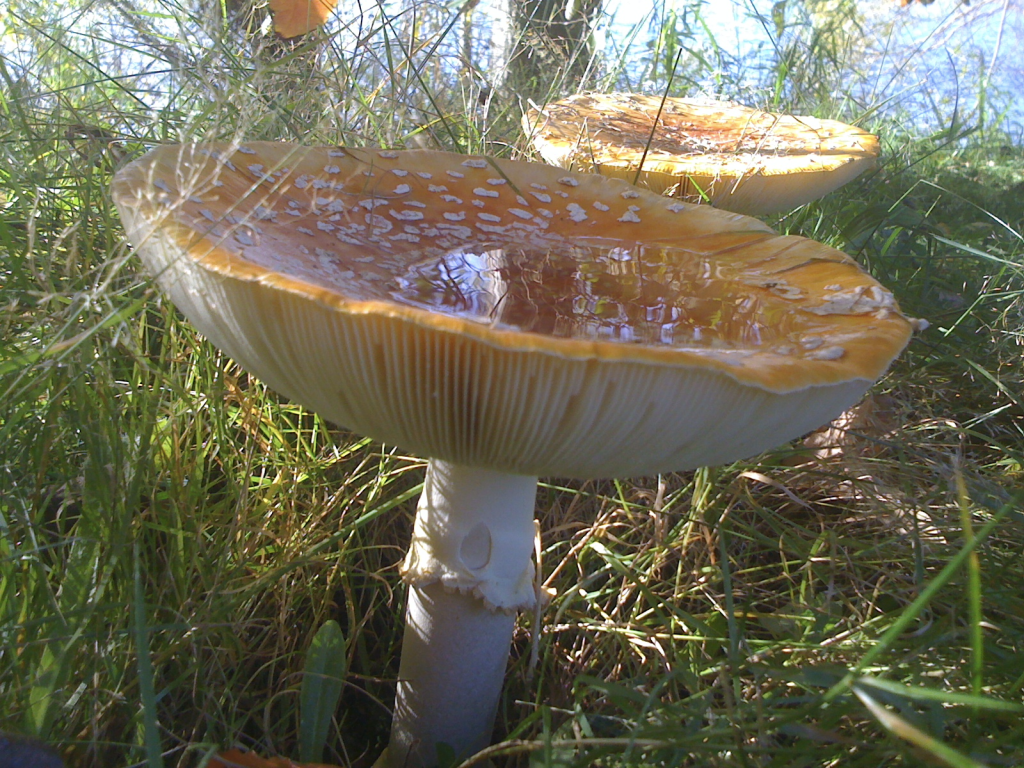
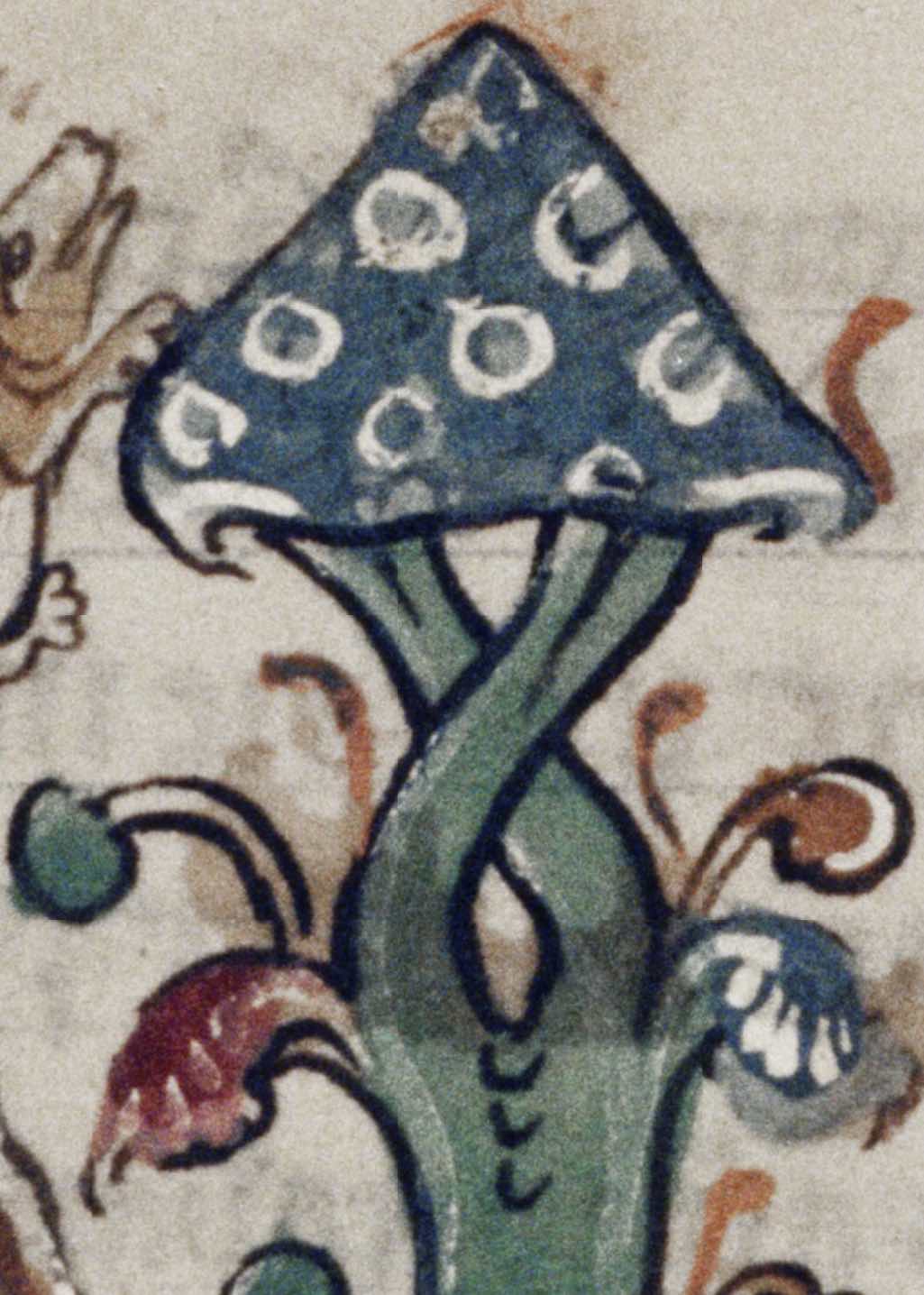
You can’t prove that this one, lone, isolated mushroom-tree (Plaincourault fresco) means mushroom. It’s agreed that the other 999 mushroom-trees don’t mean mushroom, because:
You can’t prove that this one, lone, isolated mushroom-tree (pilzbaum instance 2) means mushroom.
You can’t prove that this one, lone, isolated mushroom-tree (pilzbaum instance 3) means mushroom.
…
You can’t prove that this one, lone, isolated mushroom-tree (pilzbaum instance 1,000) means mushroom.
We insist that – per Science Evidence – this isolated motif instance must be self-contained to prove that it means mushrooms, with no reliance on any higher-order evidence and arguments spanning the whole genre.
It’s like arguing about the meaning of one letter, while claiming that the Science way means ignoring the higher-order scope, of the word-level or sentence-level.
Reductionism, divide, isolate, shatter-apart the pieces of evidence. Ignore the general theory or hypothesis; attack (Hatsis strategy) attack each instance in total isolation, and make-sh*t-up an on-the-spot fabricated off-the-wall (the more off-the-wall an arg, the better to throw-off the opponents). Ad hoc, invented-on-the-spot, special pleading:
Fabricate one rule specifically to neutralize instance A; create a different new rule, to neutralize instance B; etc.
Day 3 plant 2 (Great Canterbury Psalter) has branches, so, doesn’t count, so, no mushroom imagery in Christian art. [ignore that the L and the R branch match mushroom exactly]
Day 4 plant 3 is a tree, because Huggins article is about trees. [ignore that the plant has no branches, contradicting Huggins, and he states no reason to call the 4 Day 4 plants “trees”, when they are plainly, simple basic mushrooms [other than {grid cap} = branching].
You can’t prove that this one, lone, isolated mushroom-tree eg Plaincourault fresco, means mushroom.
Panofsky via Wasson: “First, you mycologists are ignorant, stupid, uninformed, blundering dolts, who failed to consult the art authorities, who are experts on related matters of art.”
Main fallacies there: Distract ’em w/ personal attacks (ad hominem), though that’s totally irrelevant & unnecessary of a framing.
“a matter related to art” is a euphemism for “The Art Authorities are entirely ignorant about mushrooms and about trees in art, yet, since they are committed Deniers, you must submit to their entirely ignorant agenda to reject and deny mushroom-trees.”
“rightly or wrongly we are going to reject…” – The top mycologist/Affirmer, John Ramsbottom, busted the hell out of popebanker Wasson admitting that he’s a committed skeptic arguing in bad faith.
“Given that there are hundreds of mushroom-trees, therefore, this mushroom-tree cannot mean mushroom.”
Main fallacies there: Argument from silent presupposition. Begging the question.
When I entered the field of entheogen scholarship in 1998-2000, I was better than entheogen scholars, in that I was coming from Feb. 1997 having summarized the the Egodeath core theory; the Cybernetic Theory of Ego Transcendence.
When Shardog Mosurinjohn — totally directionless — spotted the trendy new field of Pollan 2018 & Muraresku 2020, totally organic, astroturfed forced-bestsellers, she saw the field of entheogen scholarship as a cheap and easy way to make a name for herself.
Shardog switched focus from NONE to ENTHEOGEN SCHOLARSHIP, then became an Associate Professor.
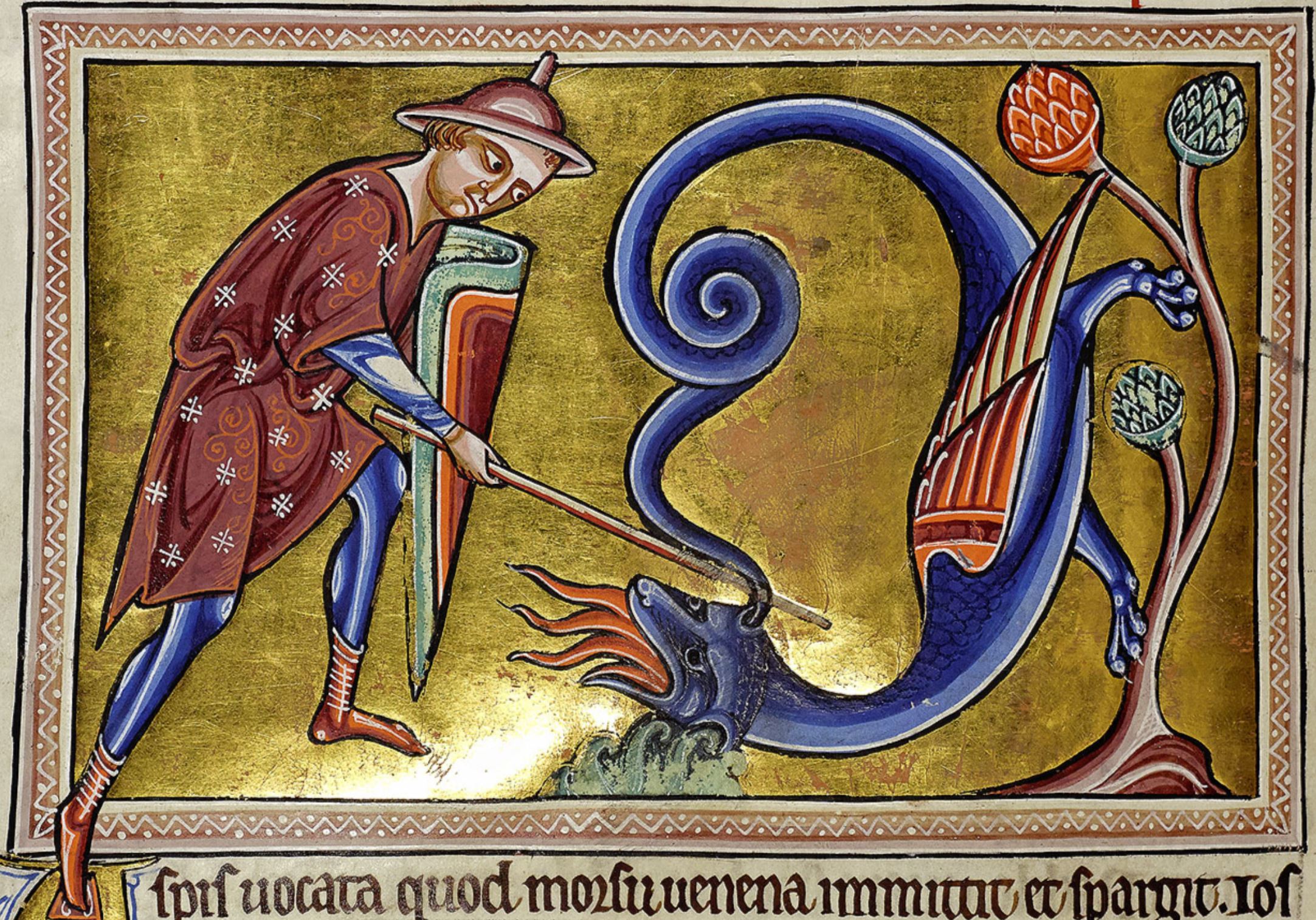
Asp in Aberdeen Bestiary
The Culturally Understood Context for Reading the Asp-Dog Image
Search – “The Asp, or “aspido,” is a mythical creature in medieval bestiaries described as a snake that stops up its ears to avoid being enchanted by the music of snake charmers. “It presses one ear against the ground and covers the other with its tail to ignore the charming, symbolizing a refusal to hear wisdom or divine truth.”
Asp (Aberdeen Bestiary). Asp (the egoic, possibilism-premised personal control system) is trying to avoid hearing the attractive song. Posted at present sit
When detail is shown in Great Canterbury Psalter f11 > eat tree of knowledge, that establishes the pattern, that is then understood in mere shorthand implementations (small & blurry, lacking the details).
We can deduce and derive the most unambiguous standard reference implemntation of an art motif, by looking at the assorted variant instances.
Main Form {lower hand Y, then upper hand YI} vs. Variant Forms
Variants of the main, Reference, 2-hands pattern/sequence:
{lower hand Y’, then upper hand Y’I}
{lower hand Y’, then upper hand Y’I’}
Even though many instances are variants, we have to intelligently figure out the main form, vs. the creative expressive variant forms, NOT get lost in the variety.
What I hate about Wouter Hanegraaff’s call for “radical empiricism”: it sounds like saying “Avoid all generalization; get lost in varied particulars.”
If I am a perennialist doing perennialism, it is my rebel countervailing version: everyone presupposes common-core mysticism and perennialism = the positive unitive model of “mystical experience”.
Everyone is WRONG including Ken Wilber (his system flaw: no psychedelics, Popular Neo-Advaita starting 1893).
REAL, TRUE common-core mysticism and perennialism is: mental model transformation from possibilism to eternalism, producing 2POV.
Not the positive unitive model of “mystical experience”.
“Reality is not at a general level; reality is at the level of buzzing confusion of unique senseless details.”
Good theory = good generalization, like Maxwell’s equations of electromagnetism.
“In anthropology, high-context and low-context cultures are ends of a continuum of how explicit the messages exchanged in a culture are and how important the context is in communication.
“The distinction between cultures with high and low contexts is intended to draw attention to variations in both spoken and non-spoken forms of communication.[1]
“The continuum pictures how people communicate with others through their range of communication abilities: utilizing gestures, relations, body language, verbal messages, or non-verbal messages.[2]
“High-” and “low-” context cultures typically refer to language groups, nationalities, or regional communities.
“However, the concept may also apply to corporations, professions, and other cultural groups, as well as to settings such as online and offline communication.[3]
“High-context cultures often exhibit less-direct verbal and nonverbal communication, utilizing small communication gestures and reading more meaning into these less-direct messages.[4]
“Low-context cultures do the opposite; direct verbal communication is needed to properly understand a message being communicated and relies heavily on explicit verbal skills.[5]
“The model of high-context and low-context cultures offers a popular framework in intercultural communication studies but has been criticized as lacking empirical validation.[6]”
Discovered a Major, Refined, Developed, Psychedelic Christian Religion
The simplest possible Religion, Focused on possibilism vs. eternalism (branching imagery).
Psychedelic eternalism alternating with ordinary-state possibilism experience.
This page was started based on a [txt msg to AM 3:29 p.m. Feb. 8, 2026].
Motivation of this Article
I discovered among mainstream artists guild, across eras, initiation into altered-state motifs of possibilism vs. eternalism.
The classic artists’ guild has a lockbox of psilocybin mushrooms.
As depicted in f134 Great Canterbury Psalter, the art guild teaches by using art, the motifs best techniques to depict the experience of alternating experiential modes:
experiential mode: ordinary-state possibilism with autonomous control
experiential mode: altered-state eternalism with dependent control
A pure cognitive phenomenology approach.
Use a pure Cognitive Phenomenology approach.
Reject a Neuroscience approach.
Reject an Epistemology approach.
Reject an Ontology approach.
Reject a Metaphysics approach.
Discovered the Medieval Mainstream “branching vs. non-branching” Religion
especially,
The Mushroom-Based Art Form of the Medieval Non-Branching Religion
The mushroom state is the source of that religion. Then build institution on mushrooms. Then deny and forget mushroom.
A free-floating baseless instit DENATURED lost touch w/ mushroom origin.
The Explicitly, Centrally Mushroom-Based Art Form of the Medieval Non-Branching Religion
The mushroom-tree version of the religion of non-branching, is the peak, best, Reference version.
I discovered the medieval mainstream “branching vs. non-branching” religion, including its sub-form, mushroom based imagery.
The mushroom based version of medieval non-branching religion, is the authentic version of the and is the source of the non-branching religion.
First, there was the medieval art genre of {mushroom-trees}, packaging the non-branching religion. Then, the bad guys removed the mushrooms, leaving free floating non-branching religion sans mushroom inspiration (1400-1687)
1687 CoperNewton – forget the 4 motifs entirely, not only forgot the mushroom motif long ago 1400, forgot the other 3 motifs by 1687: the {branching}, {handedness}, and {stability} motifs.
The Purpose of Mushroom-Tree Art Is to Communicate, Teach, Instruct, Report, Explain, Advise, Prepare, Warn, and Guide
Mushroom-tree art Was for Teaching Art Guild Initiates
The best artists depict a standard shared art-guild visual lexicon vocabulary of {mushroom}, {branching}, {handedness}, and {stability} motifs. Standard and shared, but flexible, as a visual langusage, opposite Panofsky robot copying prototypes with no comprehensino or intention or expression by the artist.
Authoritarian tone of Panofsky re: taboo topic, unlike any other art topic.
Must see artists as robots – no intentionality. Hirling.
A slave-craftsman idiot robot artist – but only re: this taboo Special Topic of mushroom imagery in Christian art.
This art has an instructional, communication Role Built-in, Designed to Clearly Teach and Communicate and Reveal mental model transformation from possibilism to eternalism
moving from ordinary-state possibilism to altered-state eternalism mopae
moving from ordinary-state possibilism to psychedelic eternalism moppe
The Simplest Theory Is the Main Theory to Trace in the Mythic Evidence Base
Altered-state non-branching vs. ordinary-state branching; I vs. Y; {tree} vs. block-universe worldline {snake} in {rock}
the simplest theory:
the maximal simplest entheogen theory of religion and culture
to discover the religion of psychedelic branching vs. non-branching , in mainstream Christian history:
ignore the noise,
trace that signal:
the psychedelc non-branching state, snake worldline in rock block universe
harmonized with
the ordinary-state branching experience, tree , king steering in a tree
from {king steering in tree} through {mixed wine at banquet} to {snake frozen in rock}
the mainstream mushroom-tree religion reached a developed, refined form
the religion was taught by guild artists lockbox shown in the images initiation education in combining these motifs
the mushroom-tree religion in mainstream Christian art
was a tech/ technology/ technique
using these motifs
u must b creative, not parrot the basic shapes motifs
be unpredictable in ur visual poetry of visual analogy motifs
expressing the mushroom-tree religion
a binary, harmony,
integrated possibilism/eternalism thinking across two states
hand displayed:
Y fingers AND I thumb contrasted, but joined, to usefully hold things, such as the king’s scepter
the mushroom-tree religion motifs ran across greco roman ane jewish christian
throughout christendom
a bestiary is not a religious book, doesnt count, says Hatsis
, so, no mushroom imagery in Christian art
1st pic: Christ.
a bestiary painted by initiated guild lockbox students of the mushroom-tree religion
and integrating 4 motifs depicting altered-state
mushroom artist fanatics showing us their mainstream medieval religion art technology
The type of mysticism that matters is simply 2-state possibilism vs. eternalism per the Egodeath theory, so simply look at fingers branching vs thumb non-branching, while studying mushrooms.
The Mushroom-Tree Art Religion of Non-Branching, 2-level, dependent control
All is ultimately depicted in terms of branching.
the mushroom-tree art religion
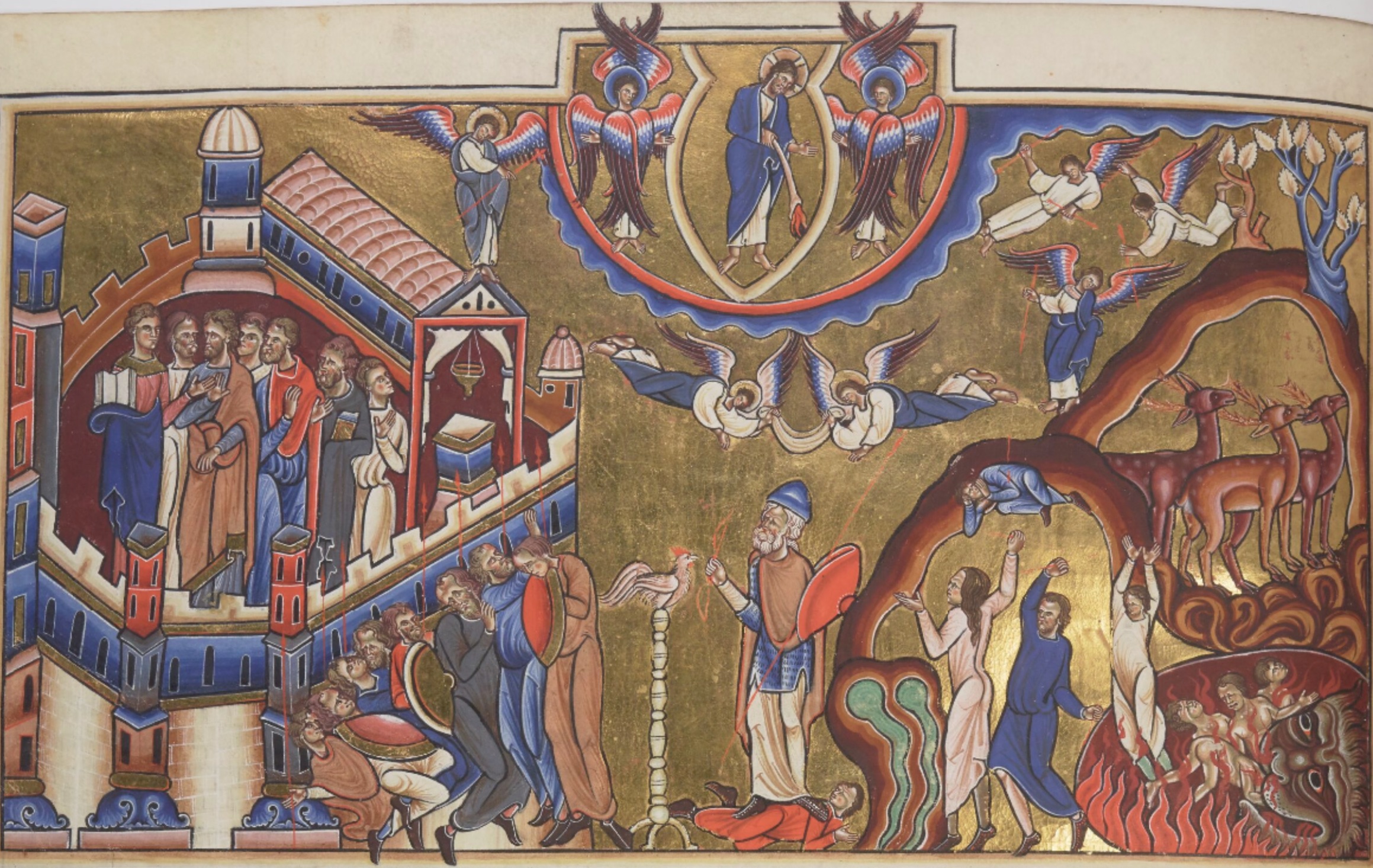
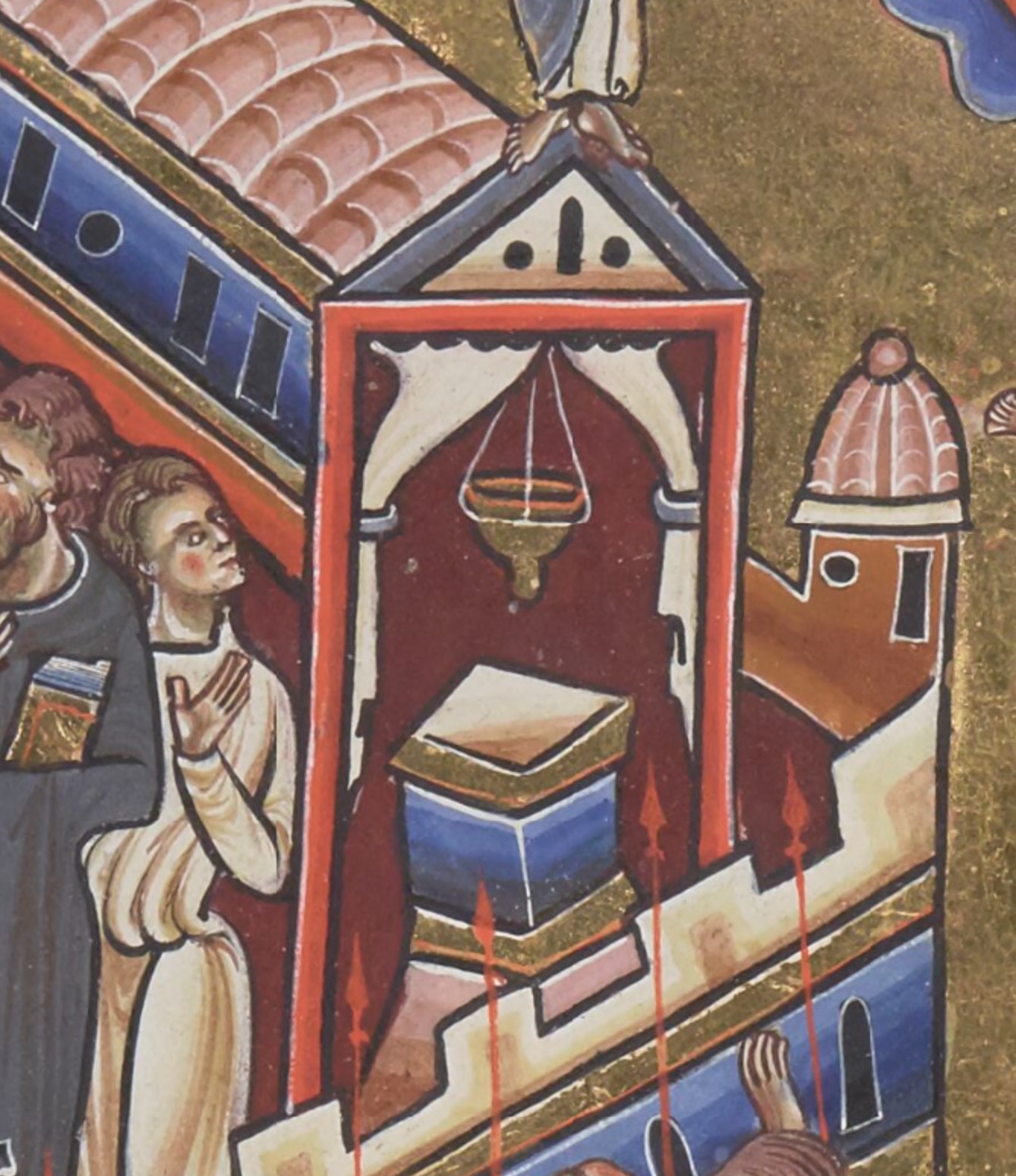
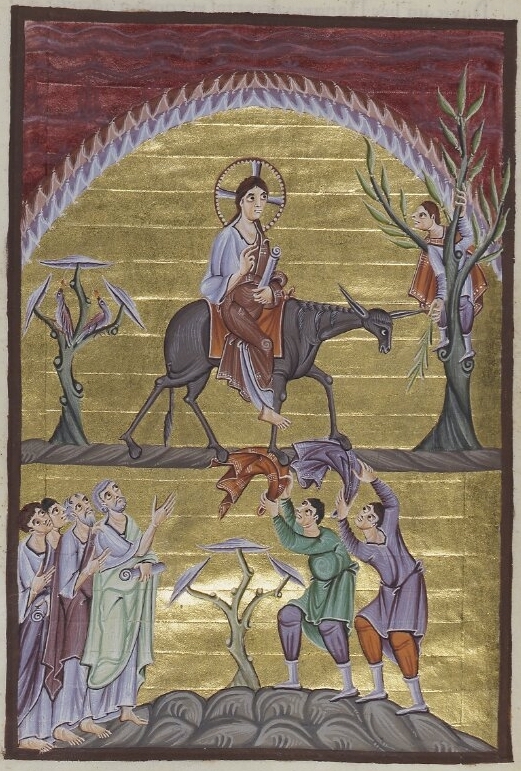
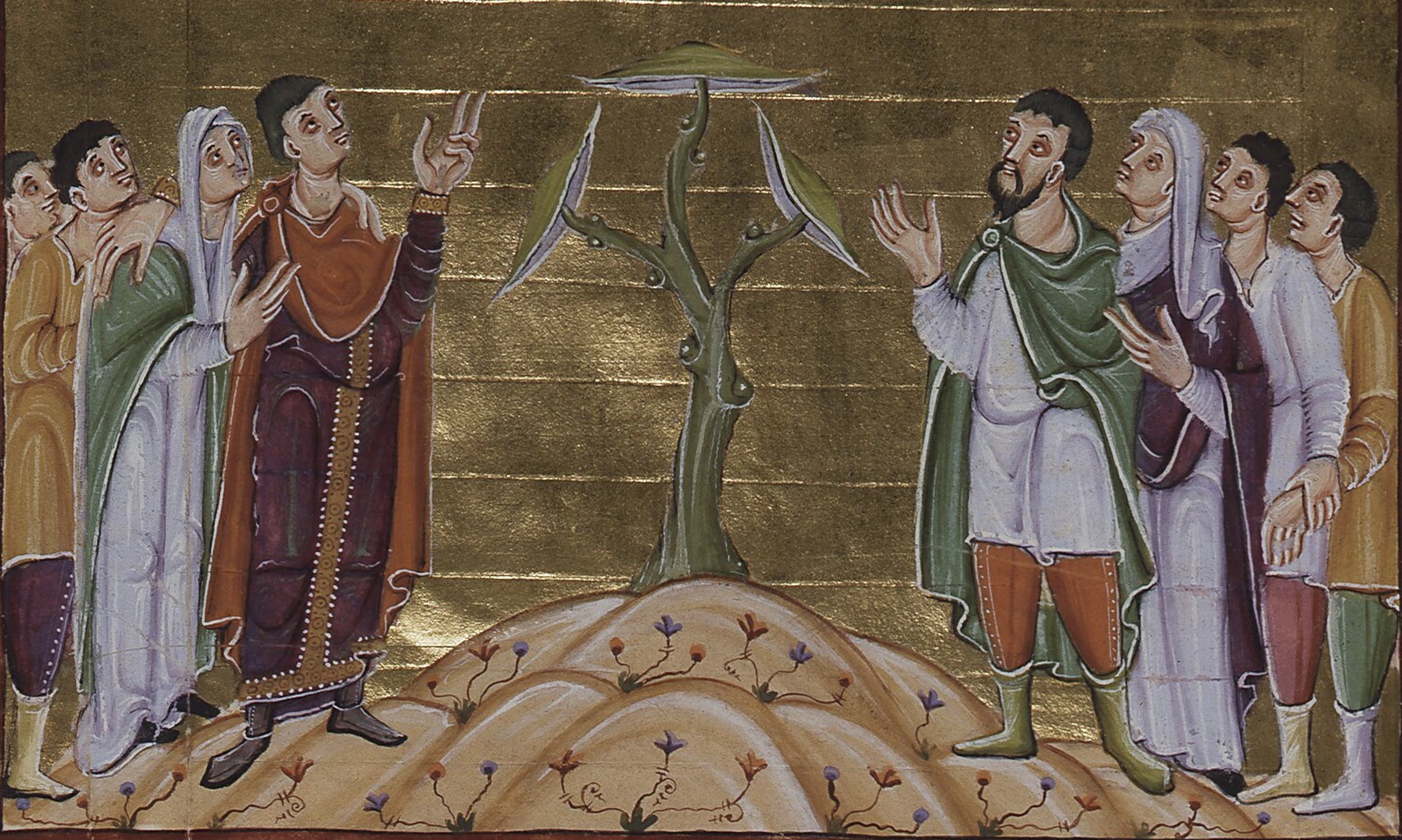
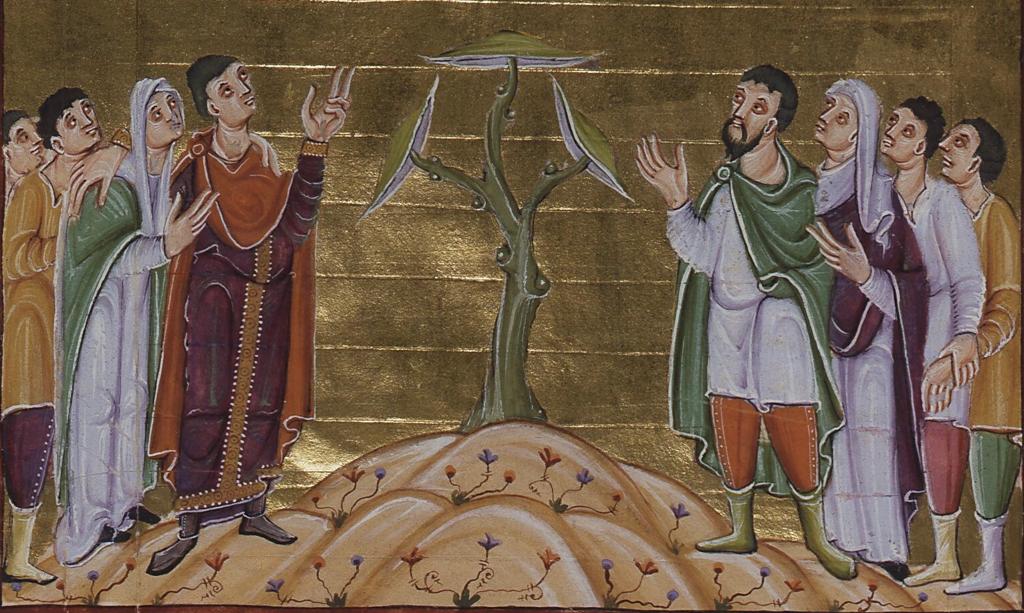
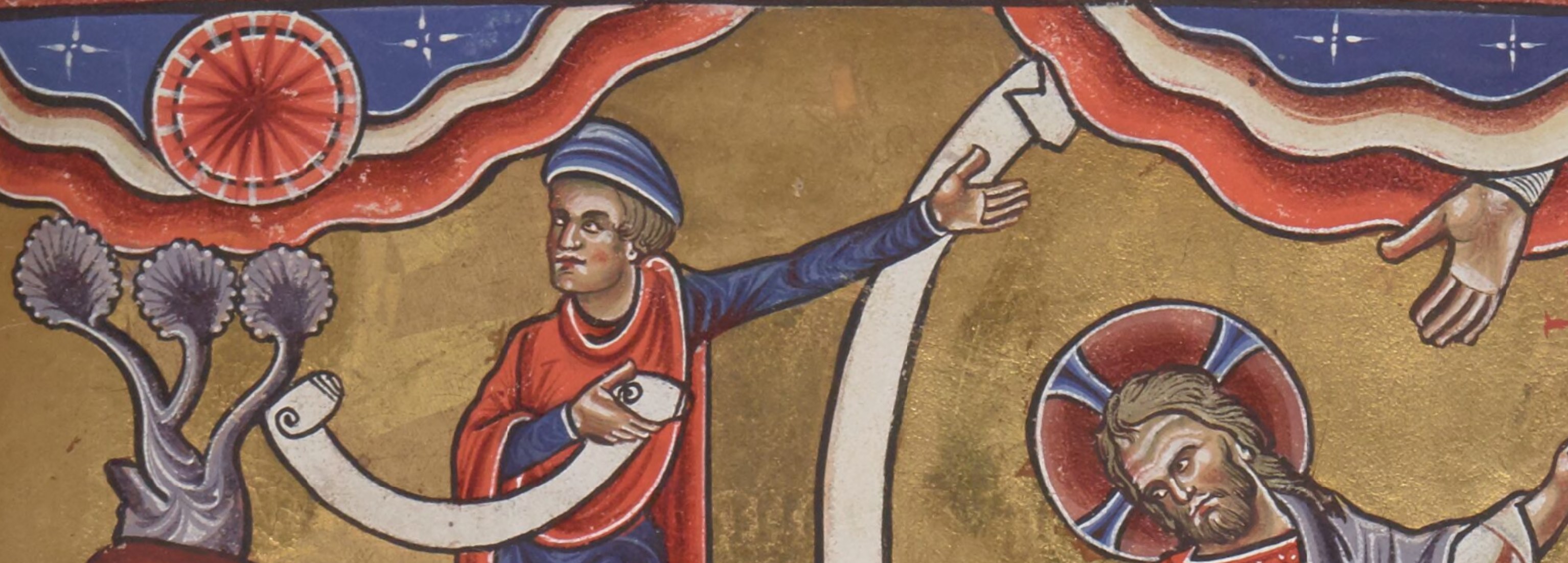
Entry into Jerusalem (Otto Gospel)
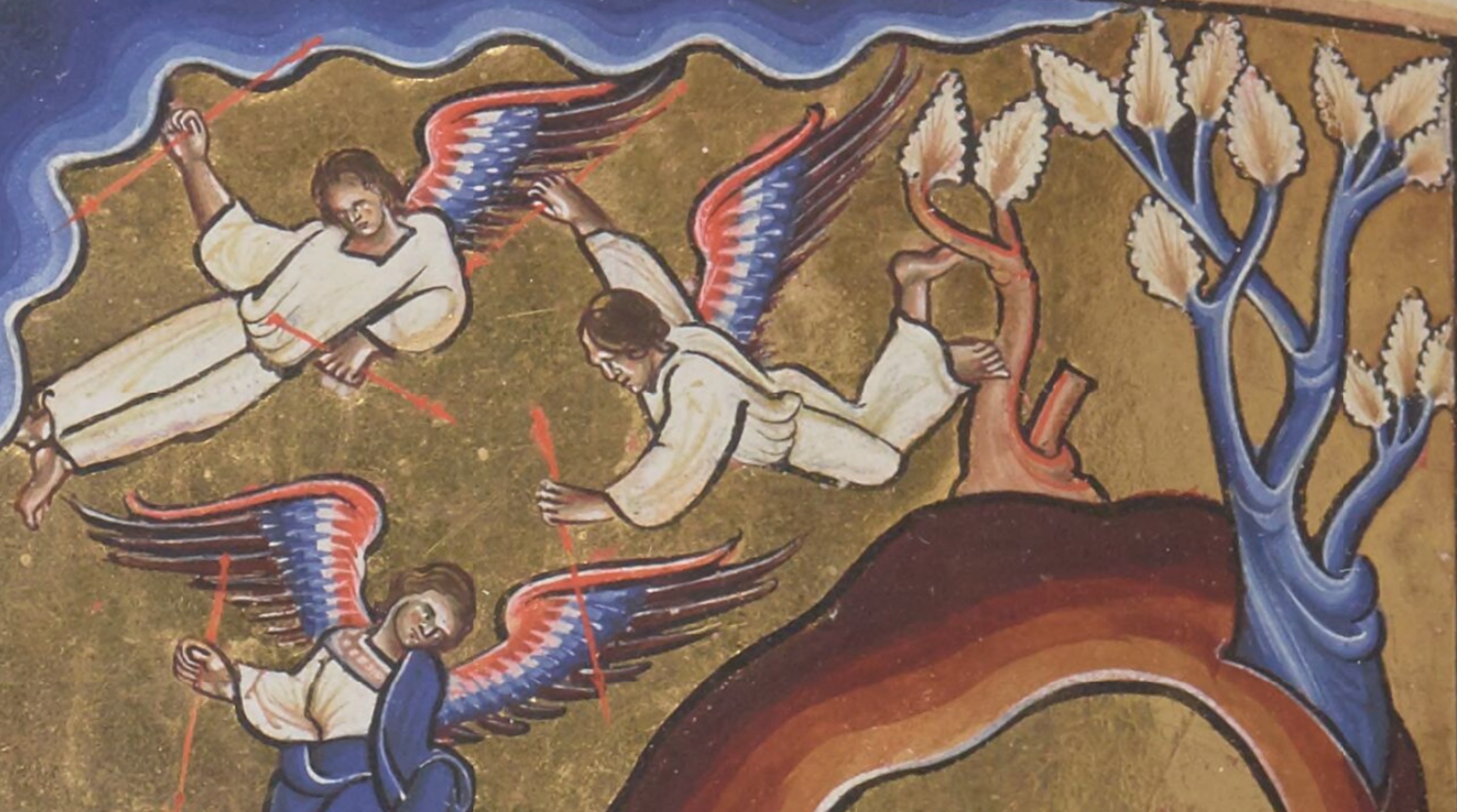
Entry into Jerusalem: Right Tree (Otto Gospel)
Entry into Jerusalem: Right Tree Closeup of Coil to Self Visually Cut the {cut right branch} (Otto Gospel)
[11:04 p.m. Feb. 8, 2026] went to hi res lib and saw self cut. possibly mentioned before; search site.
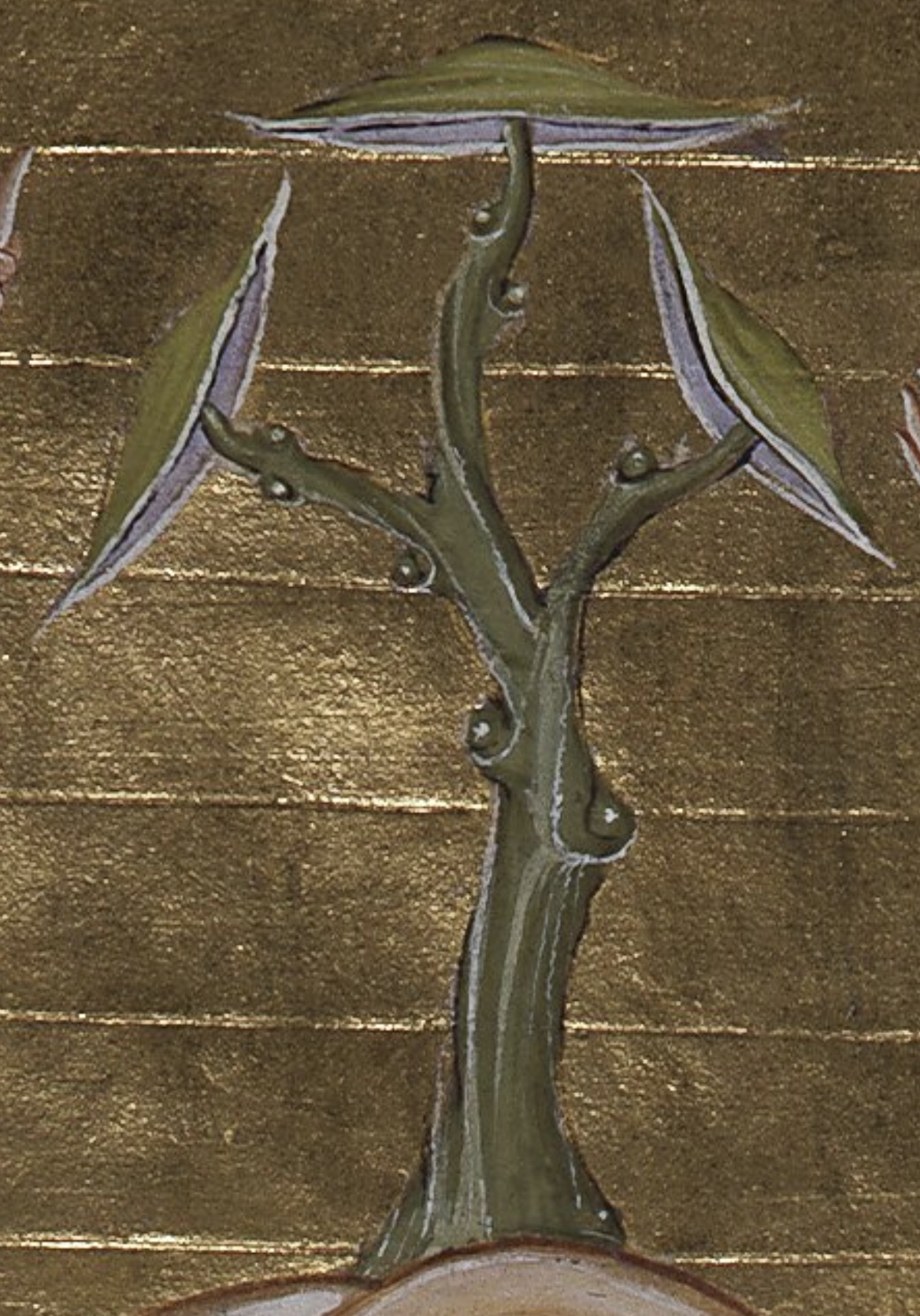
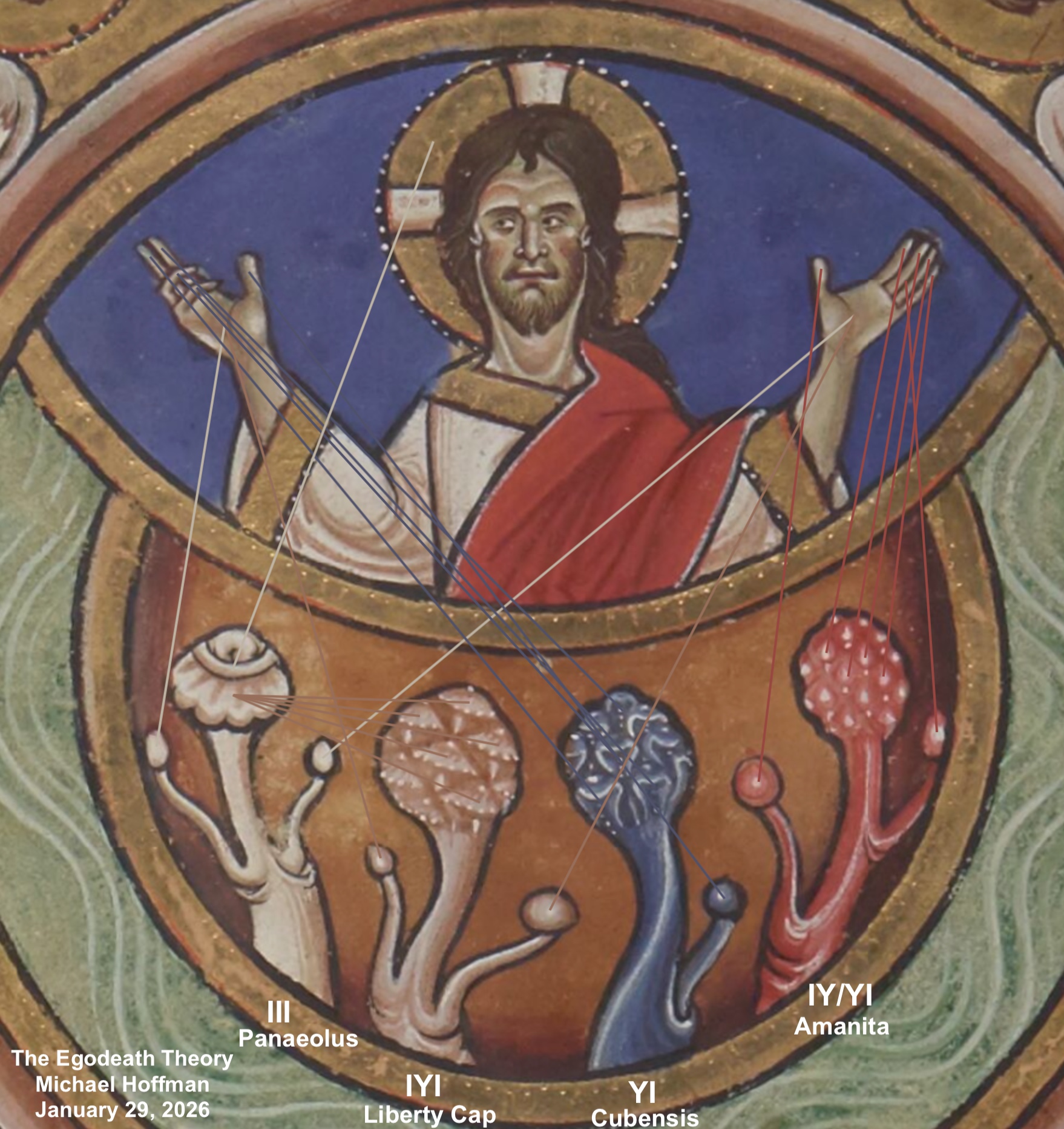
Otto Entry Left Tree Left and Right Fruit Arms Balls of Gnosis
See eat tree of knowledge f11 Great Canterbury Psalter row 3 col 2 Eden scene zoom close up of tree of knowledge grid cap Liberty Cap w/ L & R arms & ball fruit L & R.
Detail in tree of knowledge zoom panel defines the grid cap lib cap implied features throughout the psalter. Each contained Liberty Cap in the grid cap, has 2 fruit L & R; two arms L & R. Emphasis Left & Right arms/ fruit. ie , the Way of Zen by Alan Watts type of binary: pre/post satori; possibilism vs. eternalism.
2 States time/control models together learned both moving between the two states: ordinary-state possibilism vs. psychedelic eternalism.
ordinary-state possibilism vs. psychedelic eternalism
the “ordinary-state possibilism” & “psychedelic eternalism” experiential modes
the altered-state eternalism experiential mode aeem
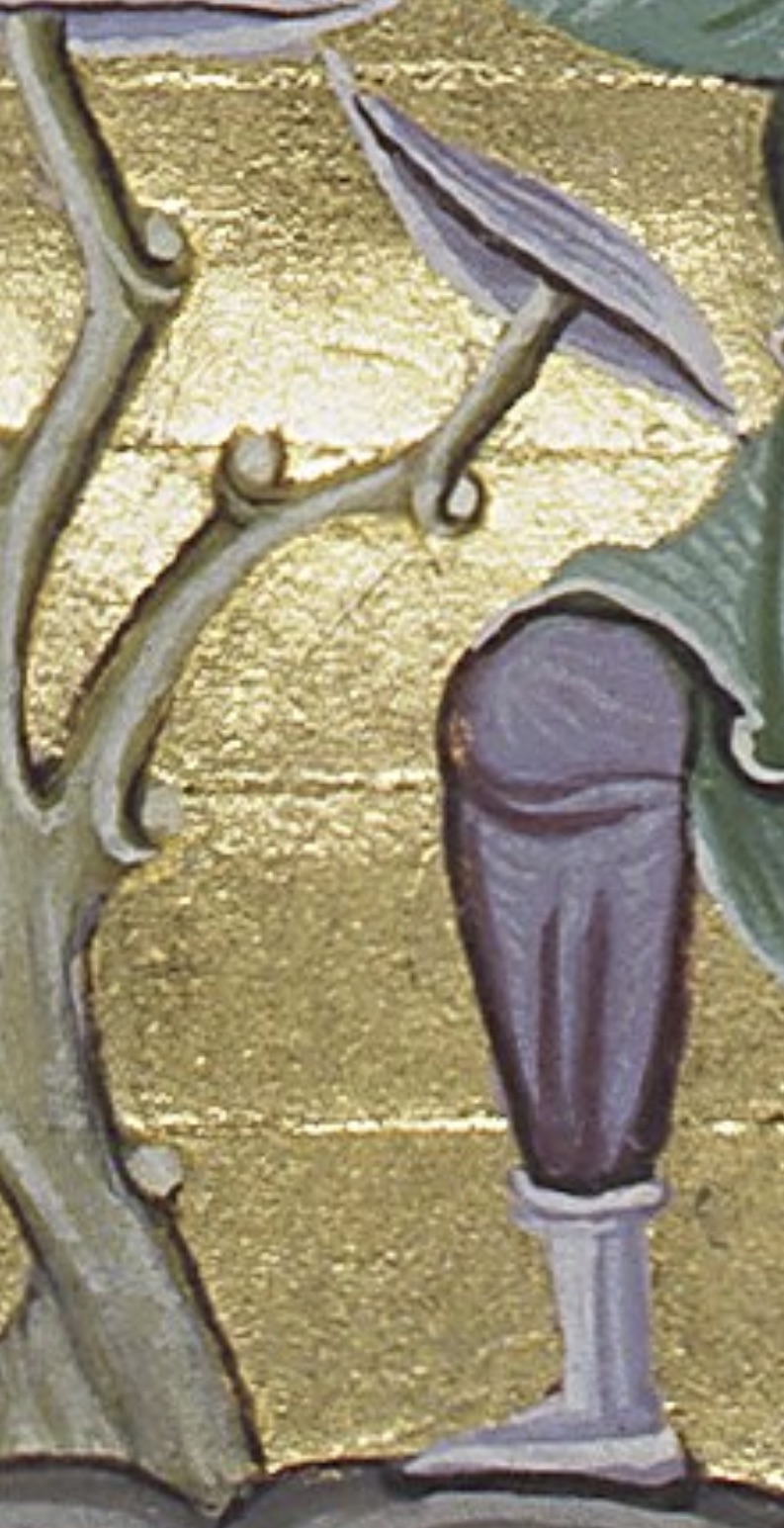
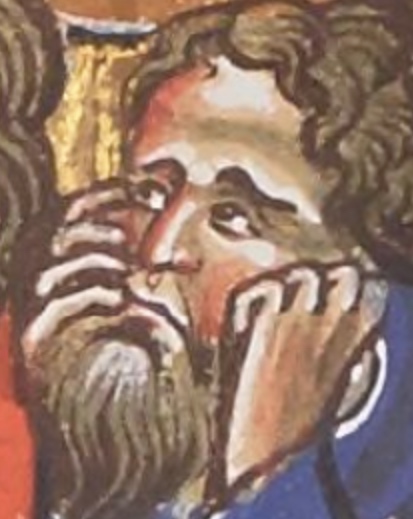
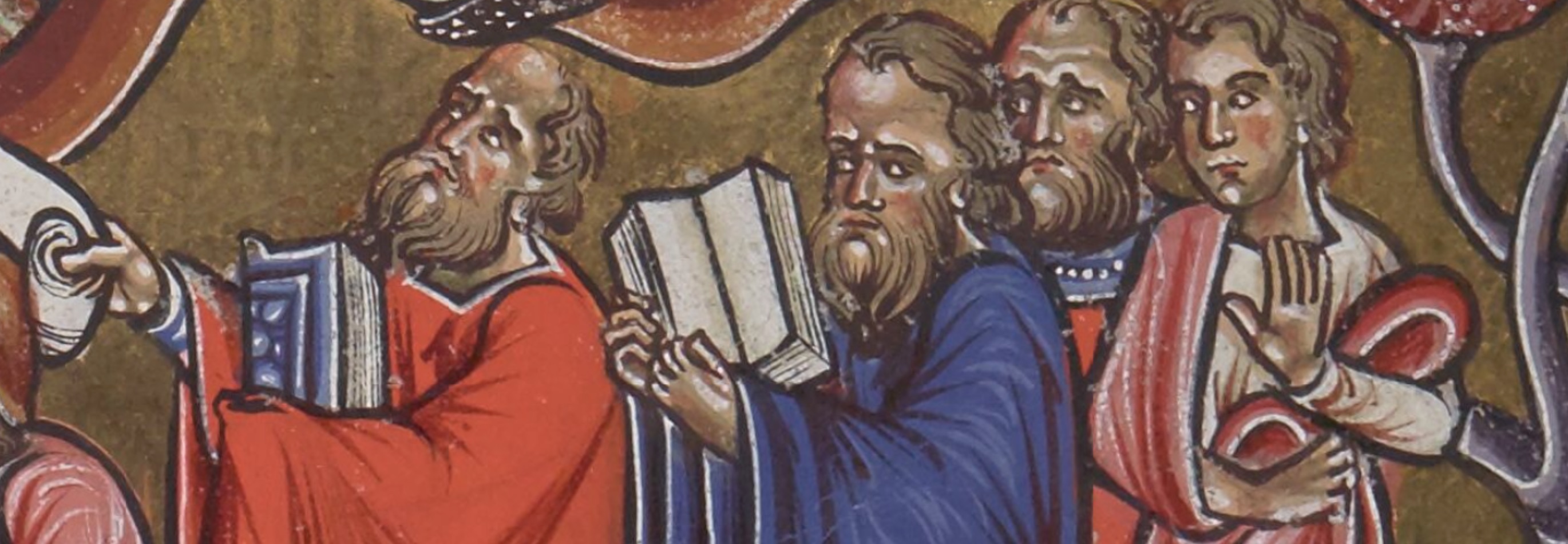
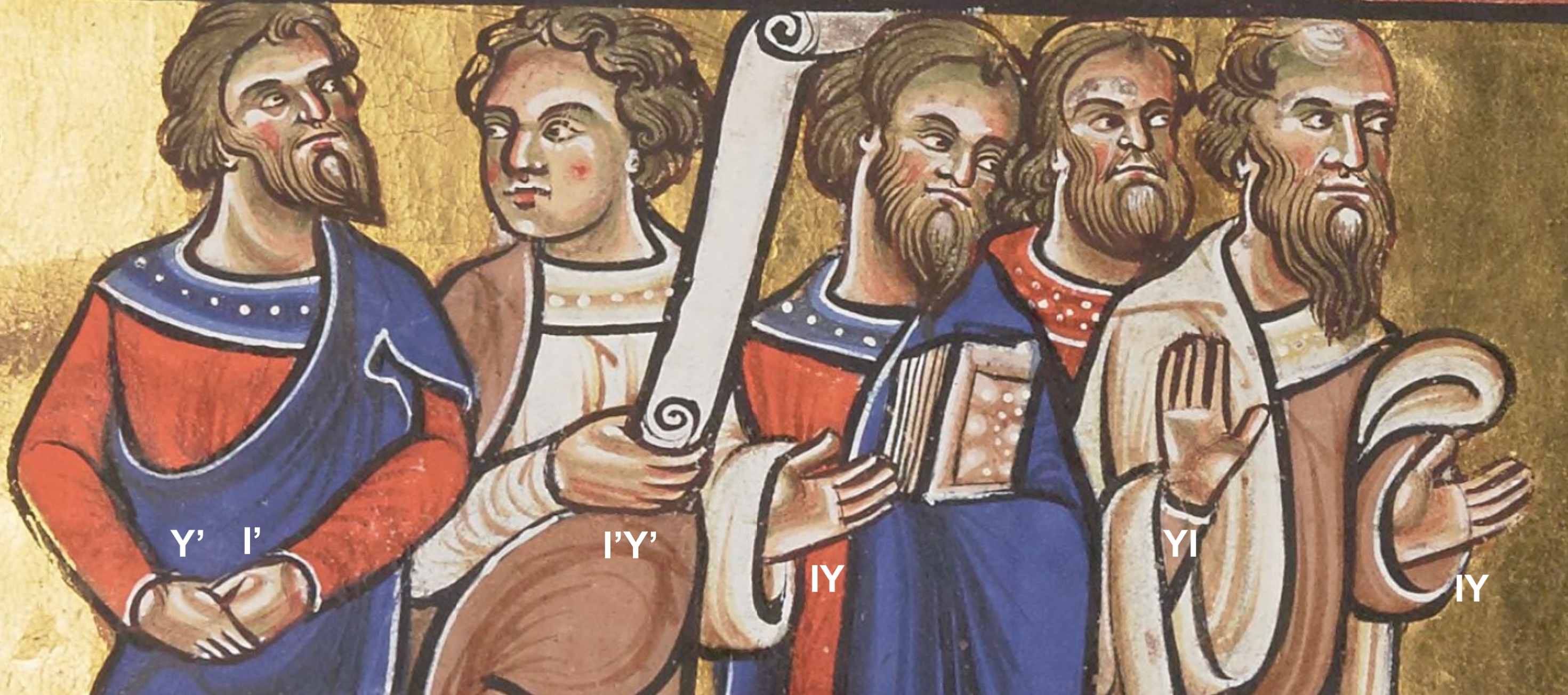
rightmost guys: classic hand pair: Y’ + YI. Y’, in that the wrist is visually cut.
left ppl: IY hand 3x.
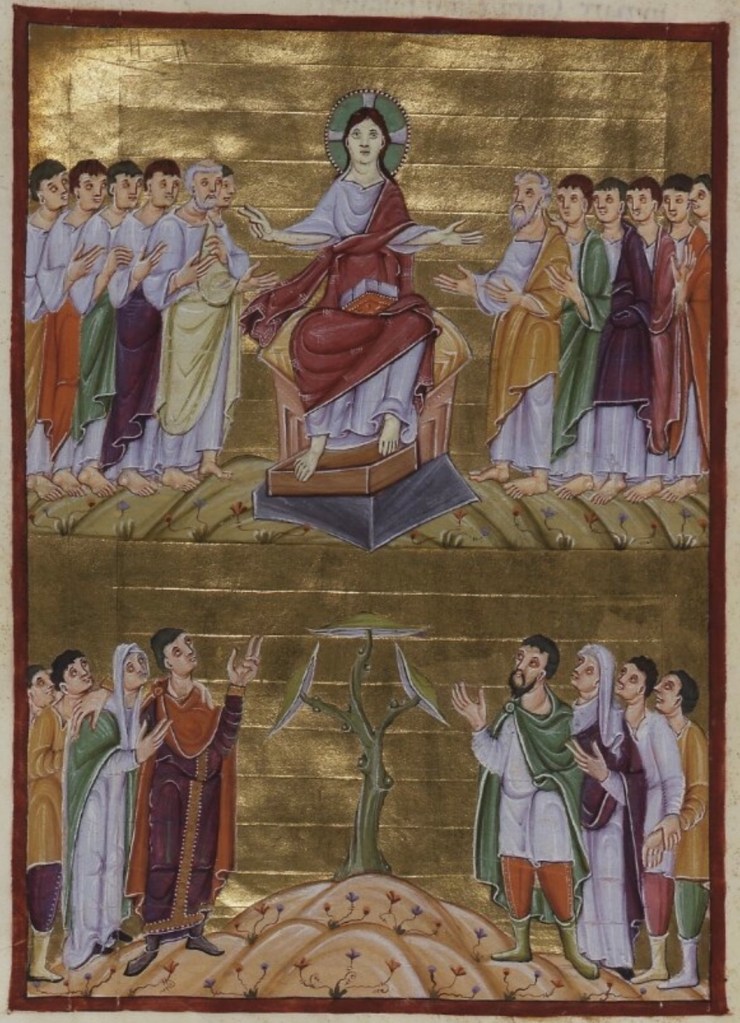
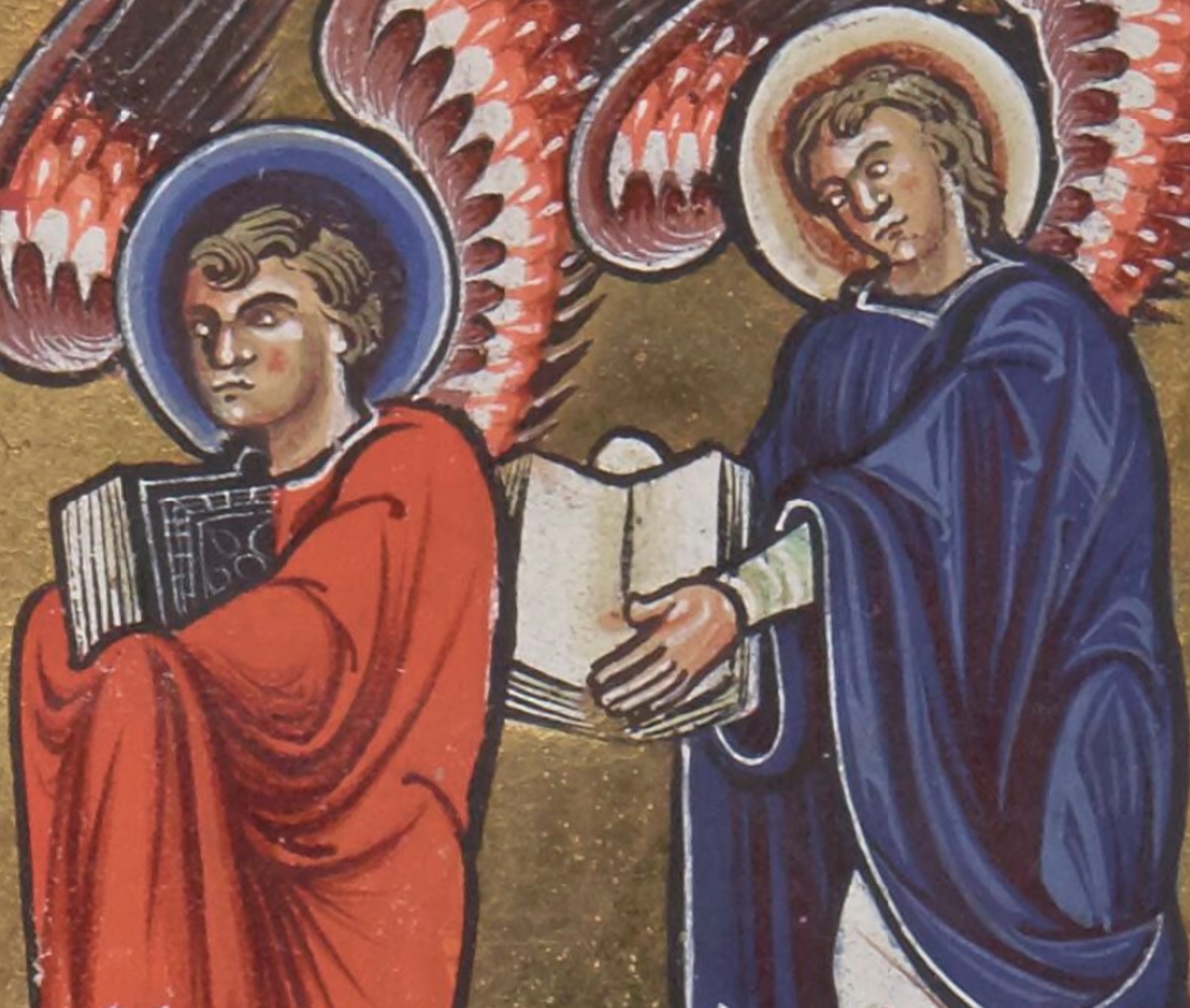
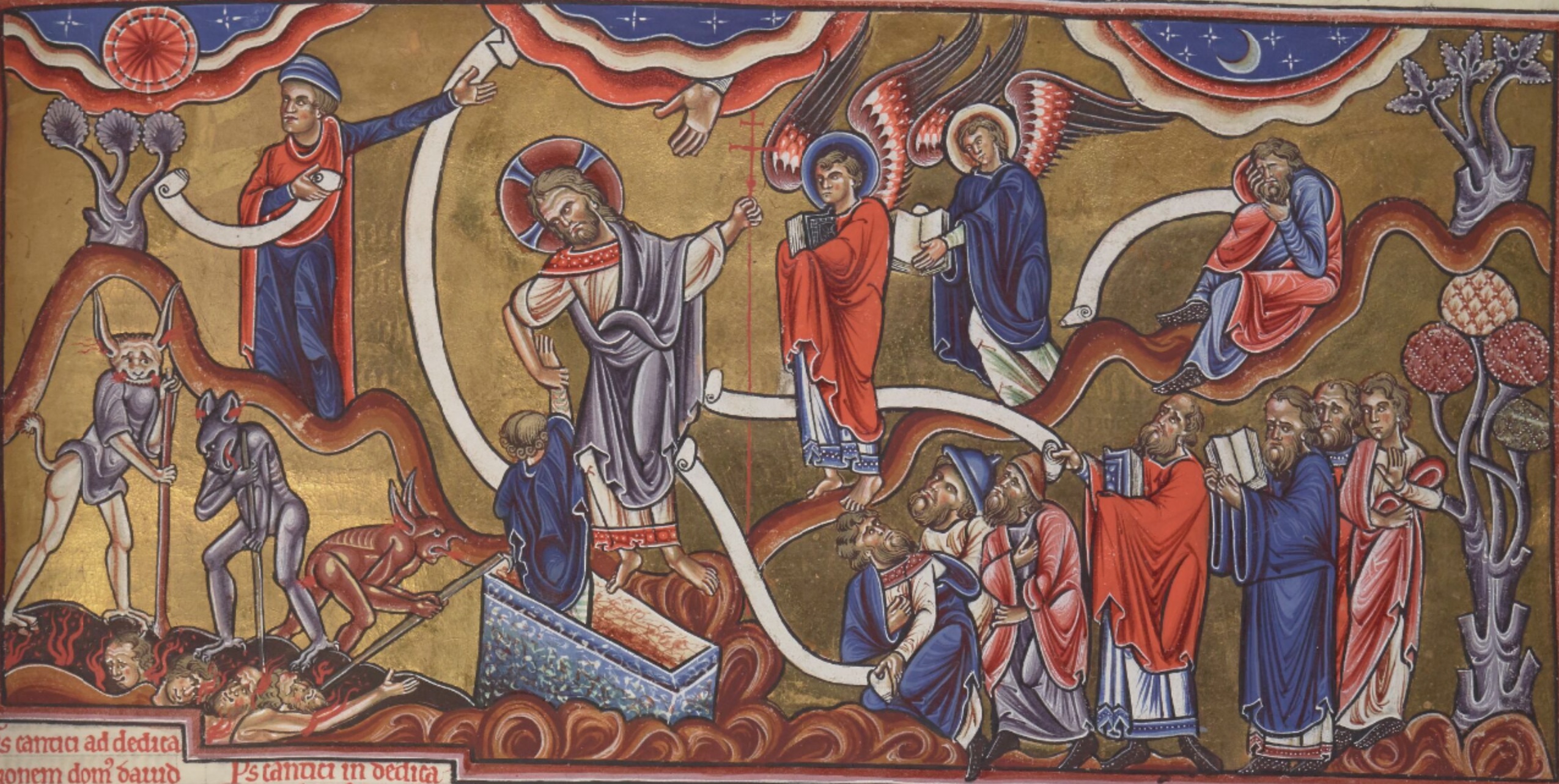
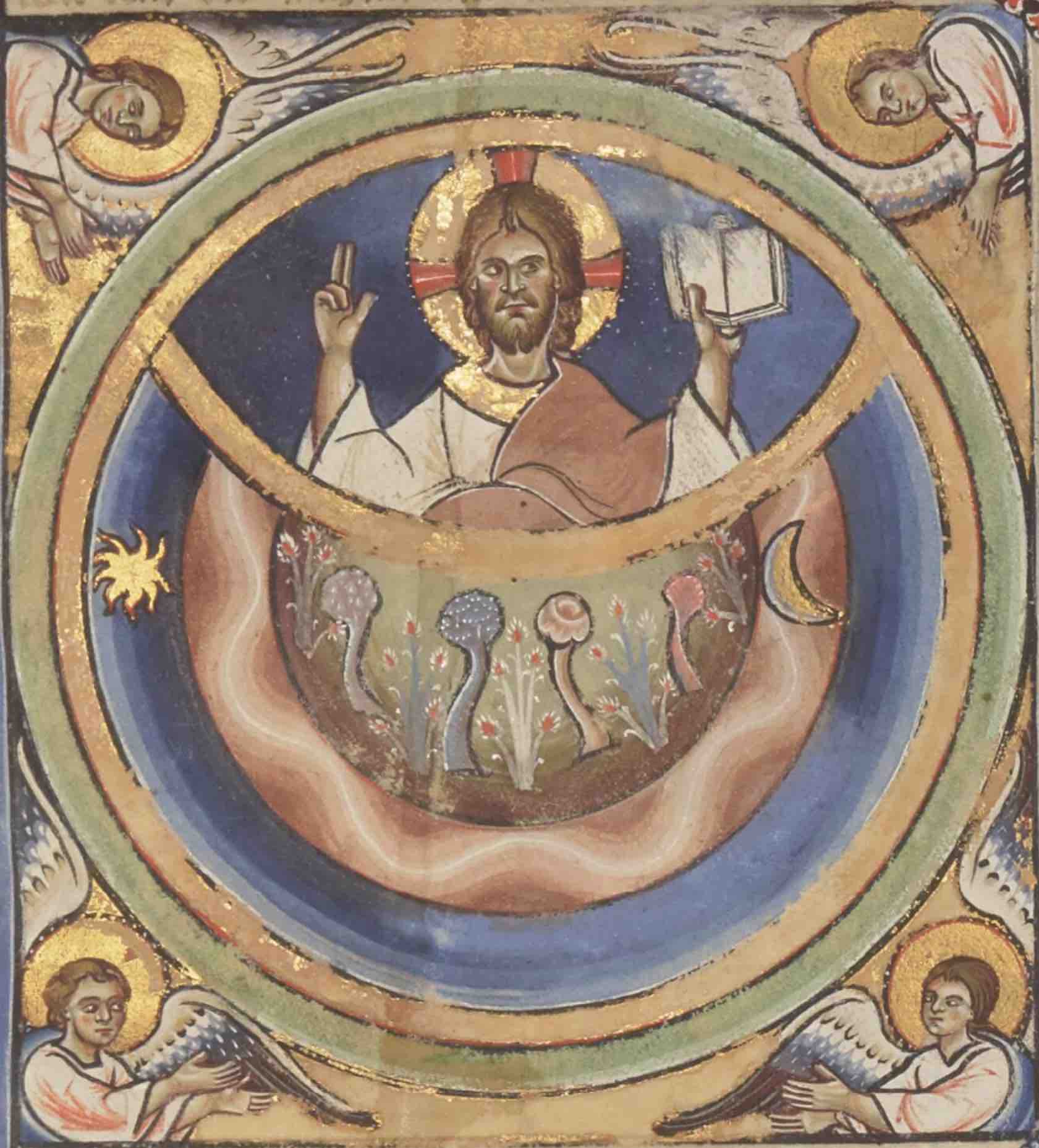
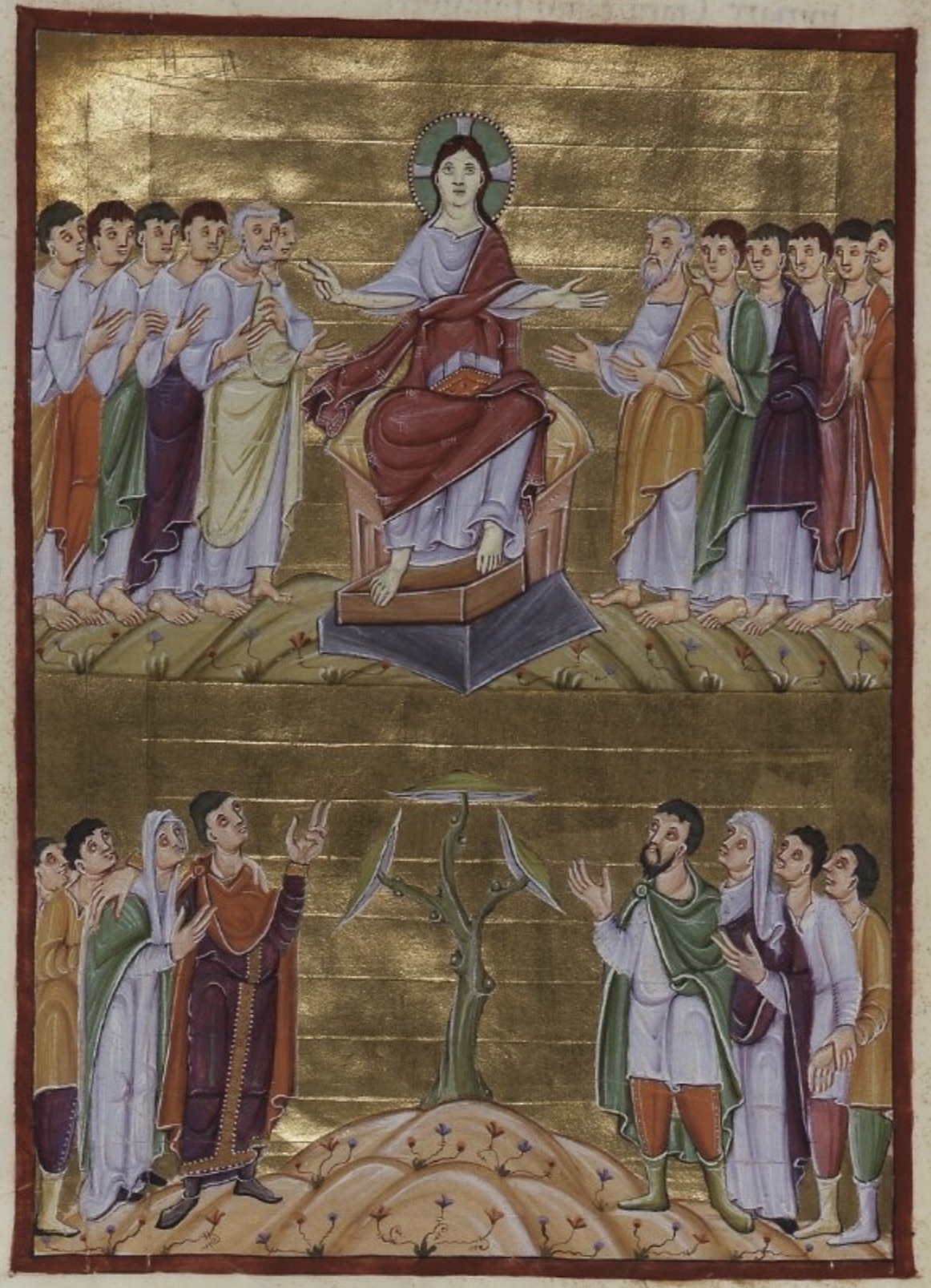
Christ Reigns Kosmokrator, Full Image (Otto Gospel)
Titles of This Article
The Mushroom-Tree Art Religion in the Mainstream Medieval Art World: Psychedelic Non-Branching & Ordinary-State Branching Possibilities
The Mushroom-Tree Religion in the Mainstream Medieval Art World: Psychedelic Non-Branching & Ordinary-State Branching Possibilities
The Mushroom-Tree Religion in the Mainstream Medieval Art World: Contrasting Psychedelic Non-Branching (with Dependent Control) & Ordinary-State Experience of Branching Possibilities
The Mushroom-Tree Religion in the Mainstream Medieval Art World: 2-State, Psychedelic Non-Branching with 2-Level, Dependent Control
The Mainstream Medieval Religion of Mushroom-Trees and Non-Branching
The Religion of Mushroom-Trees
The Mushroom-Tree Religion in Medieval Art
The Mushroom-Tree Art Mystery Religion
The Psychedelic Guild of Artists with Psilocybin Lockbox Shown
Artist guide psilocybin wine guild initiations tradition in Western art guild lockbox psilocybin mushroom mixed wine artists education in integrating altered-state motifs:
ordinary-state possibilism vs. altered-state eternalism. non-branching snake in rock block-universe eternalism
The Mainstream Medieval Mushroom-Tree Religion: 2-State Psychedelic Non-Branching with 2-Level, Dependent Control
The Medieval Mushroom-Tree Religion in Mainstream Art
The Mushroom-Tree Religion in Mainstream Medieval Art
Including Integrated {mushroom}, {branching}, {handedness}, and {stability} motifs
Visual Techniques to Depict and Teach and Express Moving between Ordinary-state Possibilism and Altered-state Eternalism, Left foot in possibilism world, right foot in eternalism world
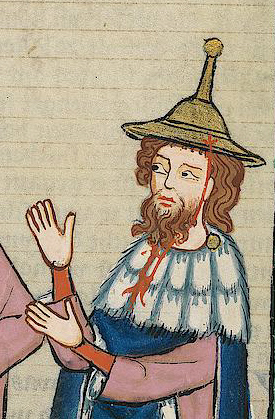
Left thumb, a Traitor (the Cross-Over Effect), identifies with Right Arm
Eternalism-Thinking
the Eternalism Experiential Mode & Experiential Mental Model
On a local scale, the thumb of L hand = the R limb = non-branching.
big scale: R arm / R leg = non-branching . L = branching; possibilism. incl L thumb.
zoomed local scale: L thumb = non-branching eternalism. also by token, R hand’s Leftmost component is “bad” , is possibilism branching. relatively, on local scope.
IY Hand Rule Doctrine of Art Religion Guild Psilocybin Lockbox Club
Spazzout like me with Sharborg (and the predictable copycats invading the pop trendy field why) 🙄🧊
A cheap-shot POS pos “art history debunker” article by Ronald Huggins who invades entheogen scholarship from the “anything-but-drugs academia” angle,
todo: re-read for real his Dancing Man article
his article good for wrong reasons
he throws down the Great Canterbury Psalter Day 3 gauntlet in 2024 i already won
that i solved by feb 9 2023:
explain branching on mushroom-trees
done already.
Your terms are acceptable.
Huggins Calls Day 4’s Four Exact, Branchless Mushrooms “Trees”, without Explaining Why
todo: con’t from where?
Fact check: DEBUNKED: In fact, Day 4 panel has 4 mushrooms, which Huggins calls “trees” for no reason, though they have NO branching.
Plant 1 & 2’s grid caps are counted as “branching”, but Panofsky or later Huggins wouldn’t know that {grid cap} has been established/ communicated by the artist as equivalent to branching.
Huggins and I agree and seize upon Letter 2 juicy branch ramif arg:
argument from passivity-framing: the art world came to accept mushroom shapes accidentally YET “EMPHATICALLY” writes Panofsky,
Studerus in 11-Factors questionnaire concoction process, invents the factor, Shadow Factor 13
Shadow Factor 13 Includes {shadow dragon monster}:
Dittrich’s OAV94 questionnaire’s “Item 54: I was afraid to lose my self-control.”
Left behind in only the top level Unpl Dim, b/c that effect was too broad to fit in their terrible categ factors:
ANX – Dread, feare
ICC – Impaired Control and Cognition
Stud sez where to put Item 54: I was afraid to lose my self-control.?
it strongly fits both ANX and ICC factors.
Better reject from our nice factors,
hide it with 8 fx only in the top-level Unpl Dim, not in any lower level Factor we badly concocted
Studerus article but do they even name their POS questionnaire
11-Factors (questionnaire that has no name) just hid, in Shadow Factor 13, 8 of 21 items from OAV Angst/Dread DED dimension, including Item 54: I was afraid to lose my self-control. Magic: trashcan 18 of 21 Angst/Dread effects, keep lamest 3; add ton of overemph of Grief Factor $$$$ counseling, F all this psychedelic-specific Unpl Dimension,
Broad dread of loss of control can’t fit ANX factor nor –
“have cross-loading, so we dropped the items, for that reason or some other reason”
The FOUNDATION OF SCIENCE = fog. Marketing dept is happy w result. Popular-shaped science; popular-driven science driven by wishful thinking, created bad 11-Factors questionnaire, which spawned new monster worse, the Challenging Experience Questionnaire (CEQ).
Great: OAV94 (better than 5D-ASC)
Meh: 11 Factors’ “update and improvement” of OAV” ie add confusion and create a monster, {shadow dragon monster}, Shadow Factor 13. THEY PUT THEIR REJECT ACADEMICS ON THE “CREATE UNPLEASANT EFFECTS FACTOR CATEGS” JOB: TERRIBLE FACOTRS RESULTED. See my ecq ecq the Challenging Experience Questionnaire (CEQ) ecq
the Eternalism and Control Questionnaire (ECQ) (Cybermonk 2022) ecq
The Forgot Plot of the 4 Art Motifs
500 BC – greeks invent everything: {mushroom}, {branching}, {handedness}, and {stability} motifs
900-1300 AD – heyday of the mushroom-tree religion , max explicit use of mushroom imagery and full use of the other 3 motifs
1400 AD – forget mushroom imagery, tiny now.
1687 – forget all 4 motifs, rejected as part of Myth, Superstition, Magic, Esotericism. Prot’m & nascent Science in 1687 rejected baby bath water psilocybin thrown away, 4 art motifs thrown away, forgotten, hardly findable anymore 1687-1975.
1975: Adolph Dittrich APZ questionnaire became 1985 OAV+2 dumb dims v2 was main, best, OAV 94, joined w/ the stupid dumb dims to form pointless 5D-ASC which then the OAV parts via 11-Factors (invents two, poor, stupid negative lower level Factors within Unpleaseant Dimension which is = OAV94’s Angst Dread DED dimension of 21 items, 18 destinted for the the Challenging Experience Questionnaire (CEQ) garbage can (disincluded there). Already 11-F set up in 2nd round, hid 8 of 21 effects in Shadow Factor 13. which 8? the 8 that so strongly spanned both of Studerus Stupidus malformed 2 factors. Ugly clumsy arbitrary process.
i discovered the mainstream Christian religion,
possibilism vs. eternalism
branching vs. non-branching
{mushroom}, {branching}, {handedness}, and {stability} motifs. 900-1300 approx;
non mushroom motifs lasted broader duration era than mushroom-tree heyday of psychedelic eternalism religion in Christianity mainstream.
end & reject & forget all 4 motifs in 1687; Newton + Copernicus modern era start
after mulling copernicus 177 years, see an overnight revolution,
in 1510, Cope private circulated his sun centric cosmos model
my antique astral ascent mysticism is better
The mystic truth: the cosmos revolves around the earth.
Panofsky the Top Anything-But-Drugs Art Historian
The term “art world” is in the title of this page, as a retort to smug con-artist popebanker Aasson & his dumb sidekick Panofsky, the top anything-but-drugs art historian.
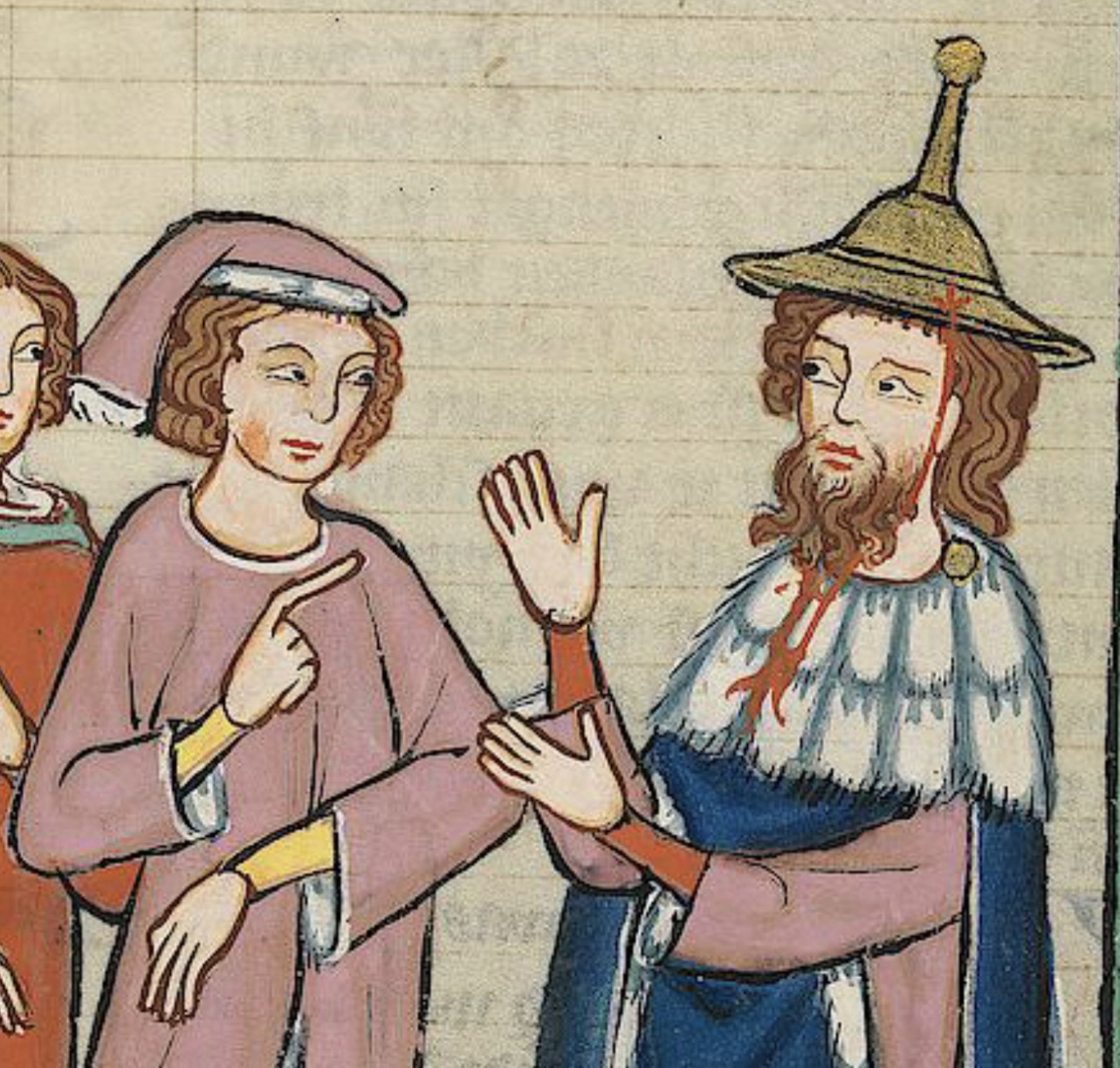
von Trimberg: {stand on right foot/ left foot lifted}
phallic garment {mushroom hem} = psychedelic state like {billow cloth}
{stand on right foot/ left foot lifted} = use & experience eternalism-thinking not possibilism-thinking [i don’t like ‘thinking’]
The eternalism experiential mode not the possibilism experiential mode
R hand 3 fingers
R hand Index finger = splayed = I = thumb = eternalism worldline snake in block-universe rock, not a tree branching / possibilism experiential mode.
recent week ago discovery, now p.m. Feb. 8, 2026 – lower hand holds mushroom sure John Rush, but, displays Y’ lower hand, per standard progression motif:
Y or Y’ lower hand + IY upper hand via thumb = I or splayed Index = the I shape, snake; worldline in block-universe rock.
{no L or R thumb} – instead, upper hand signals IY, via Index finger. GIVEN THAT THIS IS NOT A STANDALONE IMAGE; it’s in the LANGUAGE shared by the genre.
You have to see every instance, to judge what the normal pattern is, vs. expressive variants.
Only then are you literate, to read the mushroom-tree genre.
read the mushroom-tree genre rmtg
the mushroom-tree genre mtg
Y Morphology Under Dancing Man’s Tree Cap
Right Branch Cross-Behind; Visually {cut right branch}
ALWAYS analyze at micro scope and macro scope, zoom all the way in like fine details layer in Eustace window artists continue to apply YI to all scales scopes, overlapping.
Underneath the tree cap, is a green-branch cross-under/ cross-behind, visually {cut right branch}.
{right branch cross-behind} = R branch is visually cut, prior to the upper left split minor split branching on L side of cap.
R = not branching.
R side of a mushroom-tree standardly mapped to eternalism
L side of a mushroom-tree standardly mapped to possibilism beware, OFTEN not {handedness} involved – 10% OF THE TIME, HANDEDNESS APPLIES – TRICKY! USE GOOD JUDGMENT AND INTENSIVE FAMILIARITY W/ THE GENRE.
the mushroom-tree artists turn {handedness} on and off to earn creativity points.
The artists can’t be restricted to static parrot patterns (“L always = possibilism”) that shackle you by Panofsky on this taboo topic only.
The Sheer Treachery of {handedness}: Simultaneously Used and Discarded
The important thing is motif {one foot 5 toes, one foot 2 toes) – don’t care whether L or R has the 2 or 5 toes.
Standard side angle feet view positioning, it is filled with meaning.
5 toes = possibilism-thinking 2 toes = eternalism-thinking = non-branching. blessing fingers: 2 fingers together = non-branching. side of foot, same.
I’m constantly adjusting and qualifying my reading of the art motifs.
10:00 p.m. Feb. 8, 2026
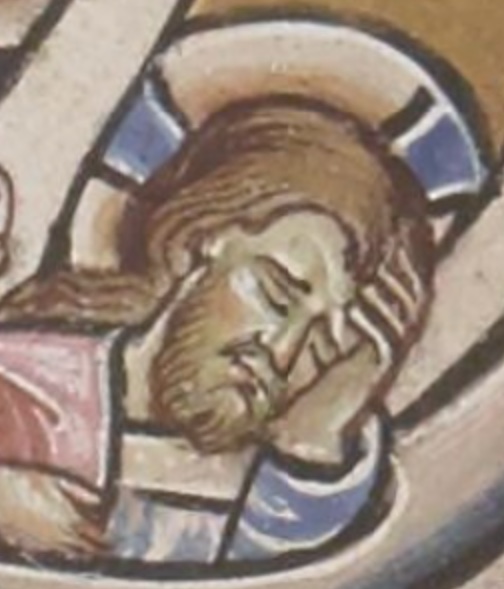
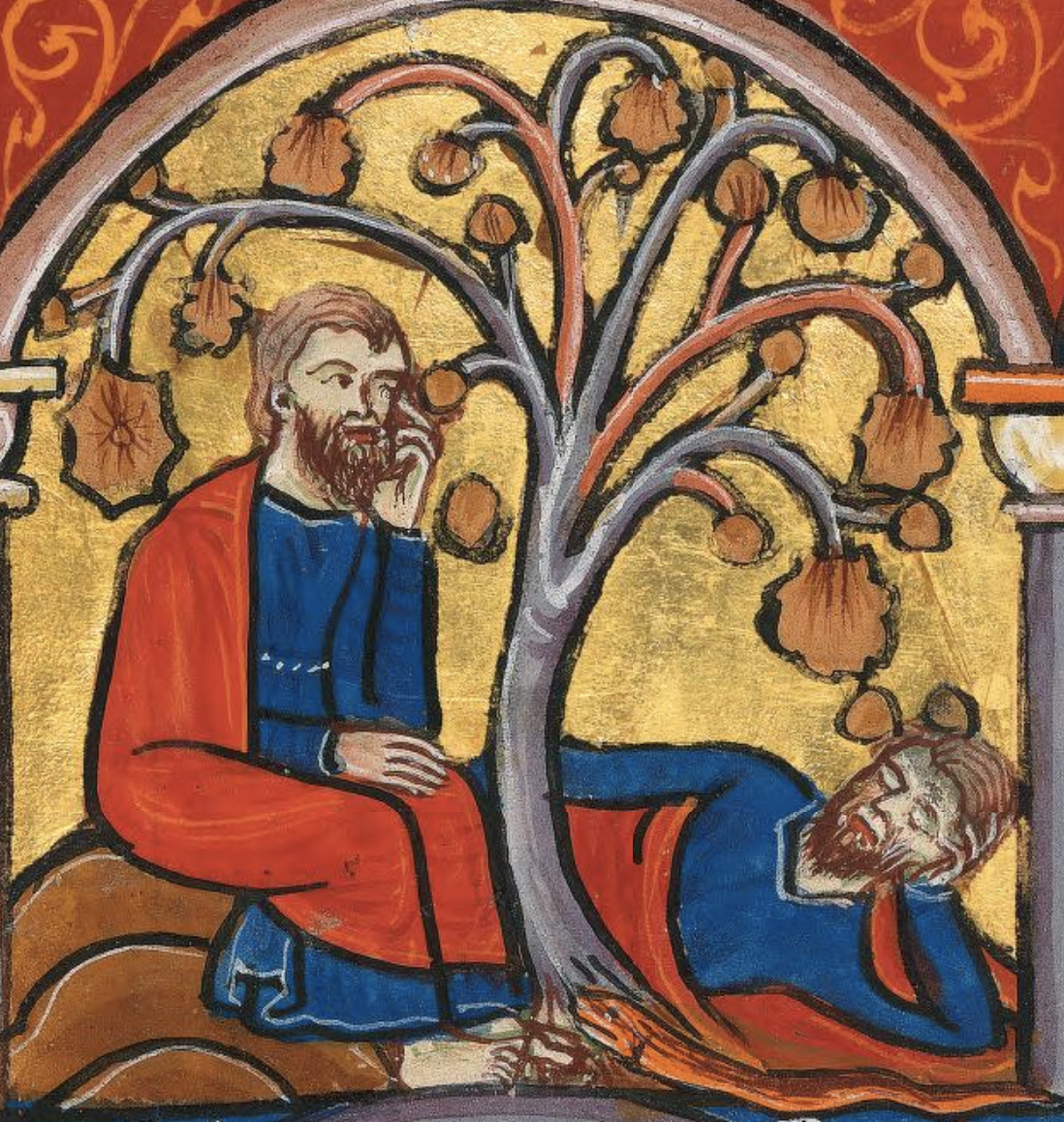
on right: asleep = splay fingers = no thumb = possibilism = branching = left arm = left fingers = left face
so, this image strictly follows handedness? NO.
guy on left Jonah, favors L over R; equaetes L w/ good = eternalism-thinking. or w/ integrated possibilism/eternalism thinking.
do not say static rules “the R foot is good and shows 2 toes, the L foot is bad and shows 5 toes”. yes the starting rule is that, but, can instantly reverse as on left side of “Jonah gourd” Golden.
right hand = ignorant branching thinking ; l hand = enlightened mature, integrated possibilism/eternalism thinking = affirming Y & I; via L middle finger = I = non-branching = eternalism; harmonized with:
L pinkie & ring represent branching, negative by hiding finger tips.
Sage at Fiery Hellmouth
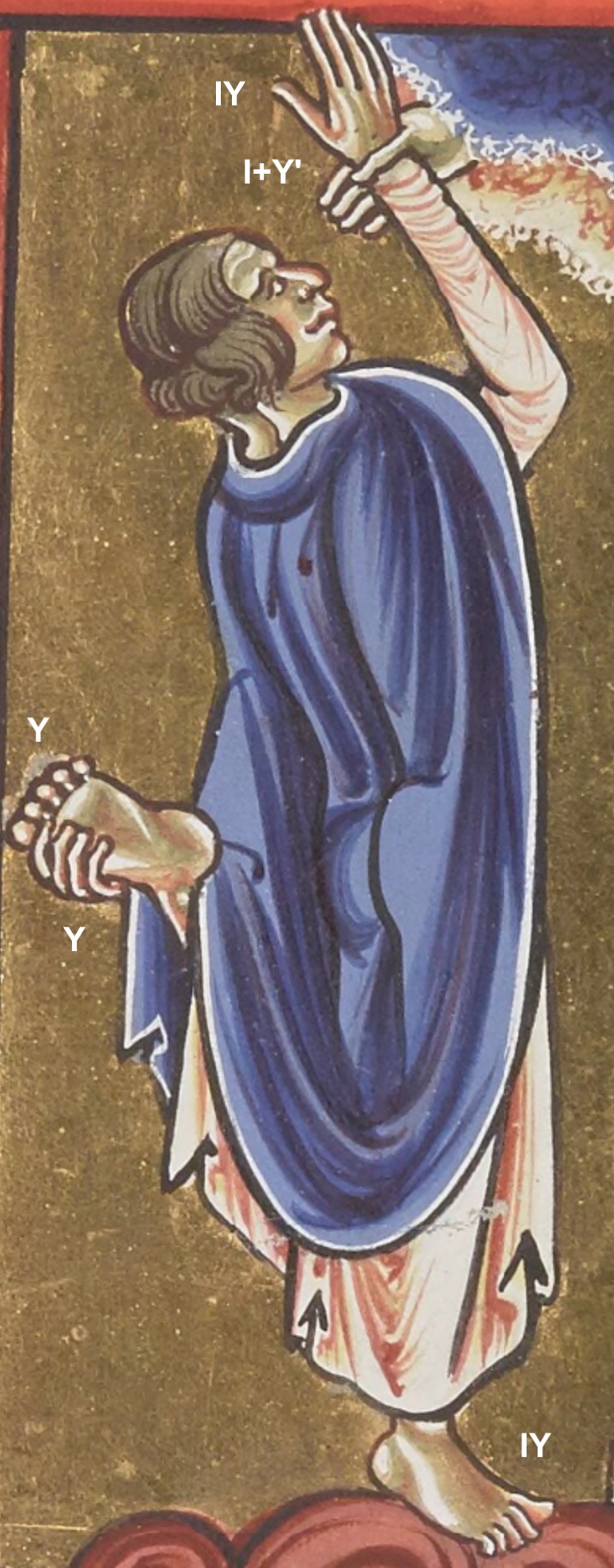
L hand: Y’, R hand: IY (index splayed). Summary: a standard Y’ to IY progression.
From branching possibility thinking, to branching and non-branching integrated across the psilocybin and ordinary experiential states.
Wasson/ Panofsky/ Huggins talk in high baloney tones,
“the art world came to accept the degradation of umbrella pine into mushroom intense shapes”
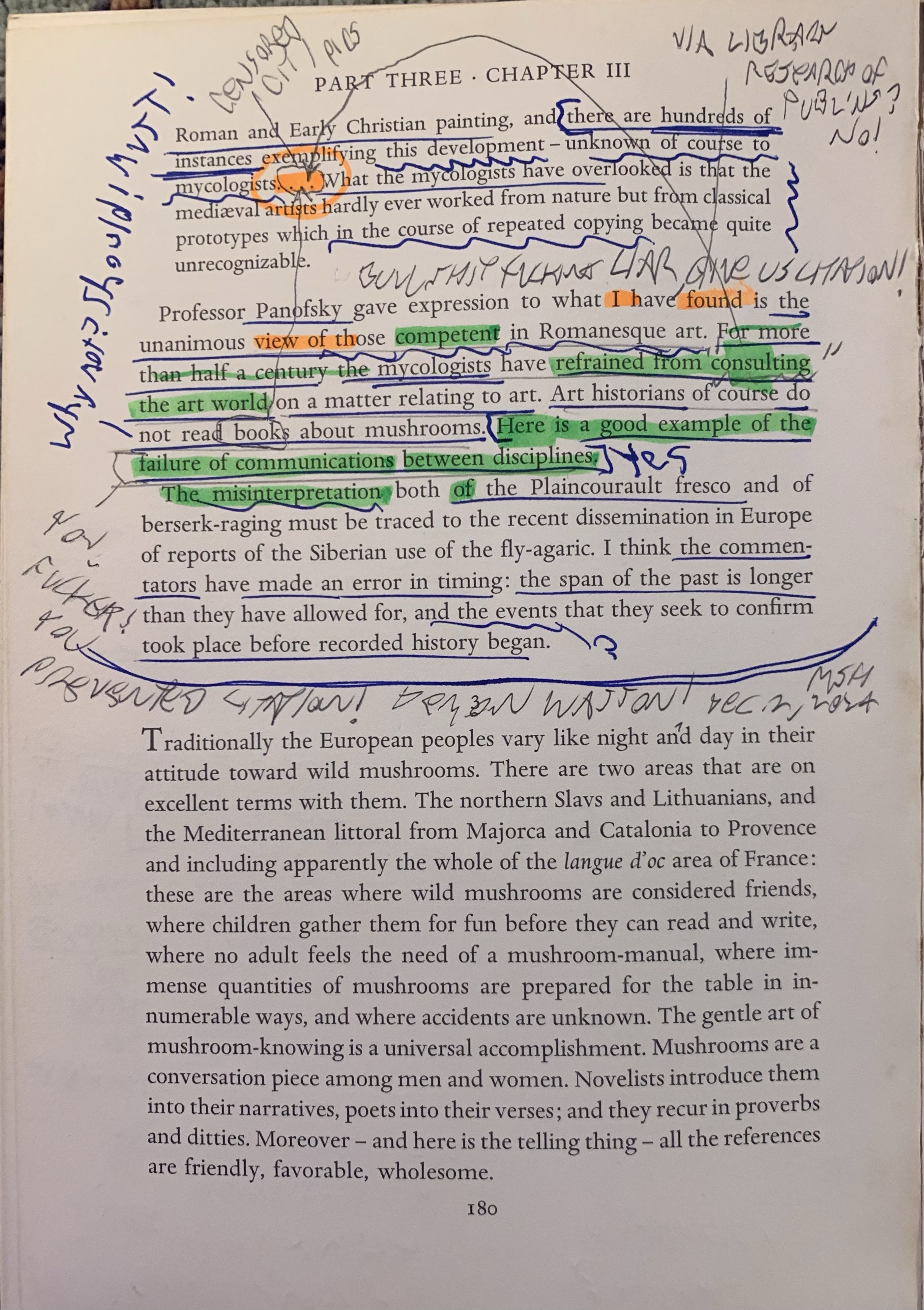
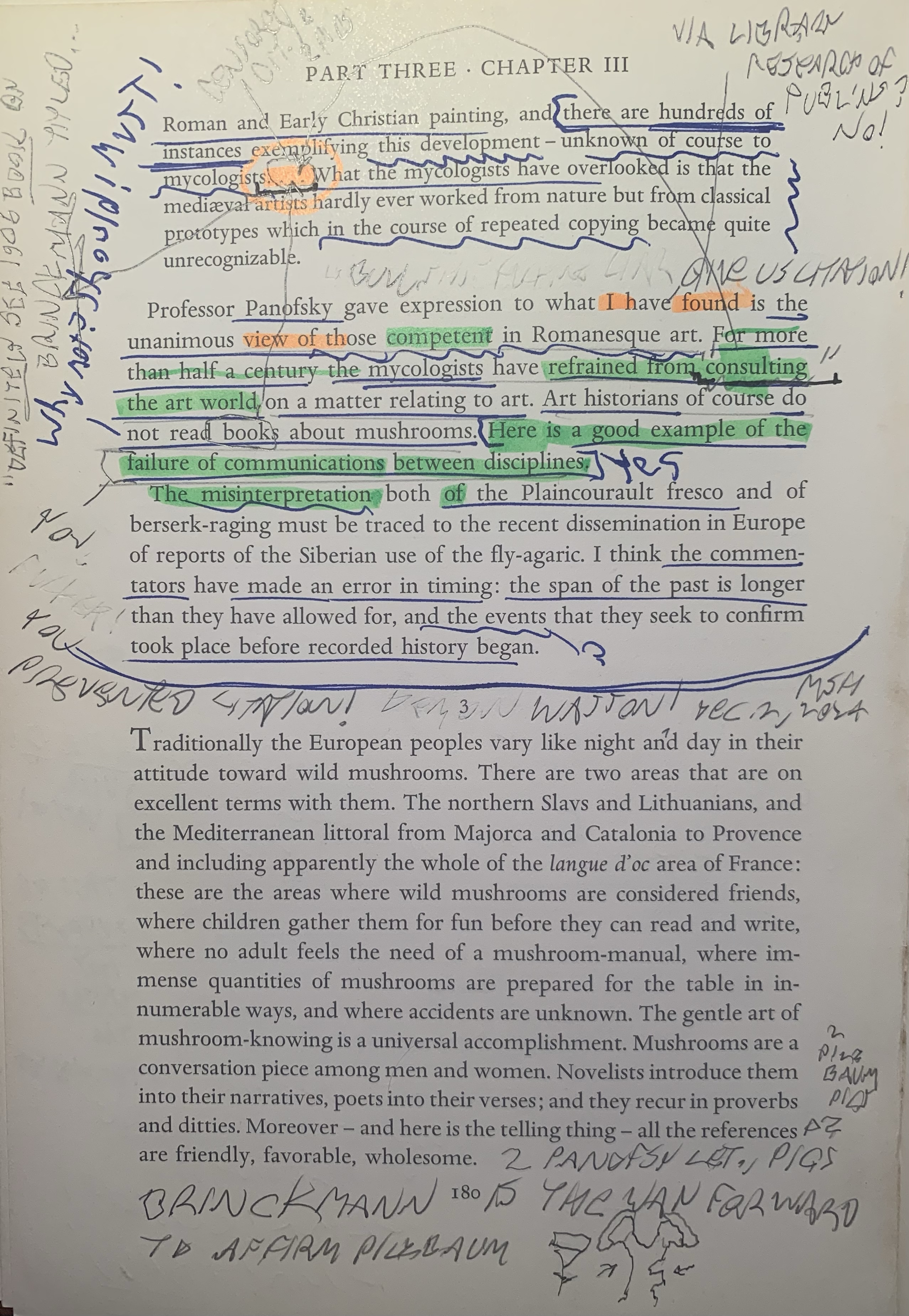
Let Panofsky speak, without Gordon . . . .🔍🧐🤔🤬 Aasson censoring Panofsky in SOMA on p. 180:
I enclose two [art] specimens: hardening of the pine into a mushroom-like shape … and … emphatic schematization of the mushroom-like crown.
the medieval artists … worked from … prototypes which in the course of repeated copying* became quite unrecognizable*. – Letter 1, Panofsky to Wasson
The only possibility I should be prepared to admit is that, once the transformation had taken place and was generally accepted in art, some especially ignorant craftsman may have misu[n]derstood the finished product, viz., the “Pilzbaum,” as a real mushroom.
But even that is not very probable because even the most mushroom-like specimens show some traces of ramification; if the artists had labored under the delusion that the model before him was meant to be a mushroom rather than a schematized tree he would have omitted the branches altogether.
In addition, religious mediaeval art at least had little reason to think of mushrooms at all.
– Letter 2, Panofsky to Wasson
*”repeated copying” — sloppy, bad artists, on this special topic. For this topic only, we must think of artists as stupid as a rock following garbled templates that Panofsky LIES and says this falsehood he confabulated, purpose-built: “artists didn’t work from nature, but from corrupted prototypes”.
Sounds like made-up bullsh*t purpose-built, special pleading.
Panofsky is full of BS.
Even if prototypes were used, they were not used in the dumb robot fashion that Panofsky tries to paint.
*”Unrecognizable” — as umbrella pine, since mushroom-trees look recognizably “emphatic mushroom-like shape”.
4:26 p.m. Feb. 8, 2026 Plant 1 of Day 3 is like thumb; non branching ; Plant 2 is like fingers; branching (grid cap of about 5-6 Liberty Caps)
All Liberty Caps in Great Canterbury Psalter are depicted as having 2 arms and 2 fruits, through this mechanism: per the detail zoom-in that’s provided in 2 panels down from Day 3
Eat from tree of knowledge is given pride of place, as the most zoomed in mushroom-tree is eat from tree of knowledge,
tree of knowledge is below Day 3 and is highly isomorphic w/ Day 3 Plant 2 cap is zoomed in in 2 panels down:
The “eat tree of knowledge” cap is zoomed; its details apply to Day 3 Plant 2 and all Liberty Cap mushroom-trees caps in the book.
I intensively YI-decoded this {eat tree of knowledge} mushroom-tree: row 3 col 3.
The master mushroom-tree in the book, sets the patterns in blurry small instances.
With flexibility, creativity, not rigid parrot forms like Panofsky wants us to fantasize but only for this taboo special topic requiring abnormal views about art/ artists and intentionality.
Must factor-in the artists guild that’s on a mushroom mission associating mushroom = non-branching eternalism experiential mode; vs. ordinary-state = branching possibilism experiential mode; then integrate across both modes, the mental model or pair of mental models like 2POV – two different points of view, two different mental models.
A long tradition before the medieval art genre of {mushroom-trees} (which did not invent the motifs, but refined and developed them), and a long trad after, dying in 1687 CoperNewton Modern revolution ditched the artists guild.
The 4 motifs were rejected, forgotten, no longer taught in the The Mushroom-Tree Art Mystery Religion.
Orthodox {rock} in Spain Images in Great Canterbury Psalter
Finally organized the Spain images and Great Canterbury Psalter 3 gallery pages. Lots of Orthodox {rock} imagery at the end. Snakes are scarce, serpents sometimes, in Great Canterbury Psalter. Want exist there:
from {king steering in tree} through {mixed wine at banquet} to {snake frozen in rock}
king, ruler, control agent
tree, hydra – yes dud mushroom-trees; vine-leaf trees, or other YI plants.
mixed wine – lots of eat & drink. wine presses at end.
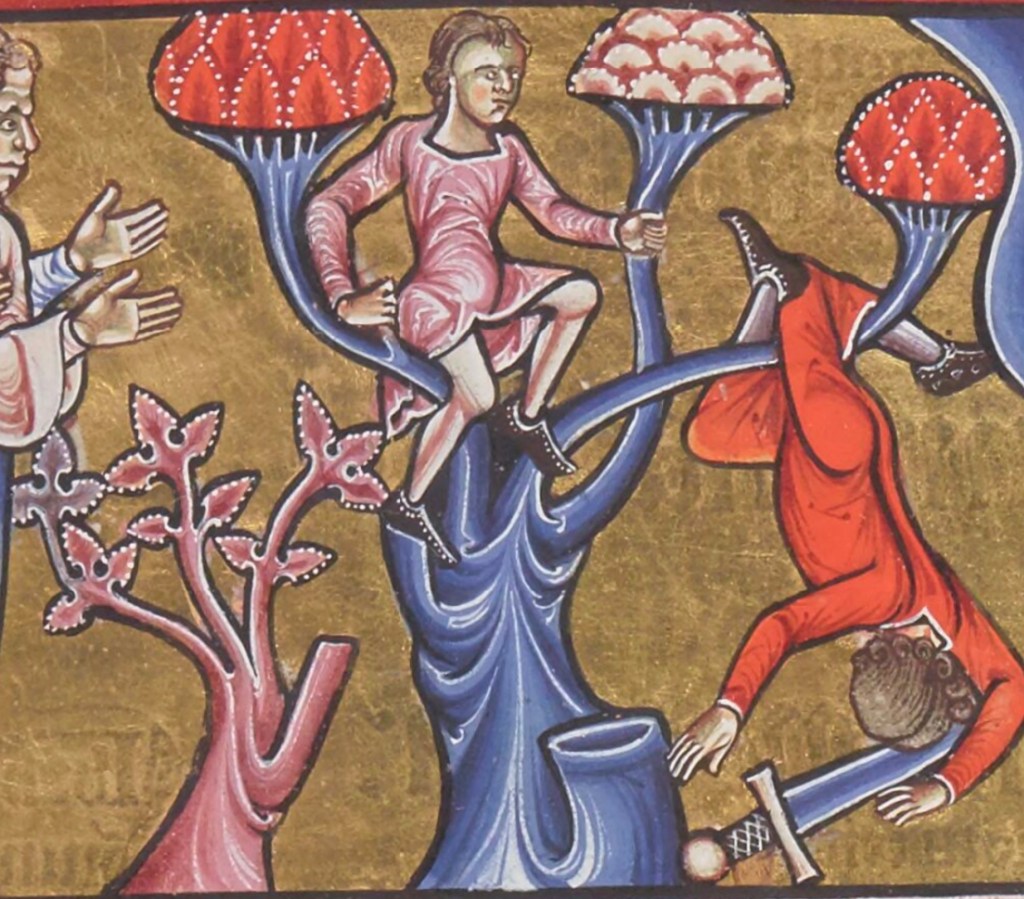
upsidedown king (steering)
mixed wine
banquet
snake – rare. serpent semi frequent in this book.
rock – only at end, Spain images. No {rock} motif in Eadwine vocab lexicon.
I am now formally registering this idea that I been getting clearer on the past week:
[10:15 a.m. Feb. 8, 2026]: often; typically:
{fingers} = [ie, touch] 4-5 pages that are closed; or closed scroll (mentioned during past year & earlier) (multiple winds).
{thumb} = [ie, touches] the open book page or open scroll.
Exceptions as always, make this obvious pattern not so obvious.
You must CONFIDENTLY JUDGE — forcefully apply the paradigm-force, the diamond hammer of interpretation — which instances are the normal, master pattern, vs. deviant variants of the normal standard Reference pattern.
A successful theorist must commit to assuming the paradigm:
The simplest possible contrast is the most central message, most important.
Weed out the noise from the signal, on that principle of selection among the mytheme data base. MUST have some such JUSTIFIED selection criterion.
Culminating in affirming the combination (in/across the TWO EXPERIENTIAL MODES) of integrated possibilism/eternalism thinking/ mental model.
Y
I “Get rid of possibilism-thinking!” “Must repudiate!” That’s mistaken; the mind/ experiencing, across the two modes, doesn’t work that way. King Theseus abandoned his wife Ariadne; but Dionysus, correctly, wedded Ariadne instead. Facts of the matter: It is rumored that king Theseus piously abandoned his wife Ariadne so that the god Dionysus could marry her.
YI Integrated possibilism/eternalism thinking; experiential dual-modes.
The most relevant to religious experience is psychedelic experiencing of block-universe eternalism.
ordinary-state possibilism with autonomous control vs. altered-state eternalism with dependent control
Crop by Michael Hoffman, 11:29 p.m. Feb. 7, 2026
At 3am, tried to look up in Golden psalter Entry into Jerusalem & in Eustace window at Chartres Cathedral window.
Was able to now check Golden & Eustace at 7:40 a.m. Feb. 8, 2026.
Got confirmation now at 7:45 a.m. Feb. 8, 2026.
It IS a motif across the medieval art genre of {mushroom-trees} – in the the mushroom-tree religion that i discovered within mainstream Christianity – to show all toes (branching) of L foot but only show inner side of R foot big toe and a HINT of other toes ie shows TWO toes vs. FIVE toes.
Panofsky, the top art historian in the anything-but-drugs academia agenda commitment:
“There are TOO MANY mushroom-trees (too mainstream) for the Plaincourault fresco to mean mushrooms.”
Argument from Silent Prejudice and Presumably Shared Presupposition
Any anything-but-drugs academic who attacks maximal entheogen theory of religion is an ignoramus shouting their ignorance when they fail to cite all of:
If you don’t cite all of those, you have NO CREDIBILITY and have FAILED to read the BASIC data in the field you PRESUME to enter, Andy Letcher in Shroom, 2006 and his personal rebuttal to me specifically at his site, “you can’t show: 1); 2); 3); or 4).”
I proved Letcher’s challenge to me, in Nov. 2020 using f134 Great Canterbury Psalter, I proved his “unprovable” points 1-4 AND also point 5, beyond that:
Provable depictions of psychedelic eternalism PEAK religious experience from deliberate ingesting id’able psilocybin mushrooms.
. . . .🔍🧐🤔
It’s an argument from silent prejudice and presupposition:
Given that everyone knows OF COURSE there are not hundreds of mushroom-trees meaning mushrooms, in Christianity, we can “RULE OUT” [Huggins’ magic words] that indefensible conjecture, silently, without even having to state it, in the (censored) condensed (two!) letterS to Gordon Aasson 1952.
“The Plaincourault fresco is only one example — and, since the style is very provincial, a particularly deceptive one — of a conventionalized tree type, prevalent in Romanesque and Early Gothic art, which art historians actually refer to as “mushroom tree” or, in German writing, Pilzbaum.
“It comes about by the gradual schematization of the impressionistically rendered Italian pine tree in Roman and Early Christian painting, and there are hundreds of instances exemplifying this development – unknown, of course, to mycologists [irrelevant distraction by personal-insult tactic].
SENTENCE 1.6 (LITTLE BOOK BY BRINCKMANN)
“If you are interested, I recommend a little book by A. E. Brinckmann, Die Baumdarstellung im Mittelalter (or something like it), where the process is described in detail.”
See Gordon . . . .🔍🧐🤔🤬 Aasson top of p. 180, SOMA, at: . . . . for the citation – or, where the citation WOULD have been.
SENTENCE 1.7 (ENCLOSE SPECIMENS PINE INTO MUSHROOM)
“Just to show what I mean, I enclose two specimens [CENSORED BY ASSON]: a miniature of ca. 990 which shows the inception of the process, viz., the gradual hardening of the pine into a mushroom-like shape, and a glass painting of the thirteenth century, that is to say about a century later than your fresco, which shows an even more emphatic schematization of the mushroom-like crown.”
There are numerous, sufficient instances in Great Canterbury Psalter eg f107 Christ’s toes & angel’s toes:
gotta go church – another sermon today on Block-Universe Mysticism by church founder reading Alan Moore?
we aint #1 for nothin
The Stupidometer, the Embarrassometer Test
The dumber I Feel about So Long Failing to Recognize the motif of fingers vs thumb = possibilism vs. eternalism, the more basic & profound the discovery.
so obvious this mapping, utility of hand’s opposition contrast branching fingers vs non-branching thumb
but many instances in art do NOT always carry this meaning, that makes it tricky to recog the main pattern idea: confusing variants & exceptions complicate the pattern recognition provability
common-core mysticism and perennialism would be corect IF not focused on the “positive unitive” model of “mystical experience” — Popular-driven Neo-Advaita made-up, substitute shiite in the ordinary-state.
TRUE common-core mysticism and perennialism is based on the Egodeath theory instead, ie possibilism vs. eternalism: the SIMPLEST, 2-state explanatory model:
ordinary-state possibilism with autonomous control
vs
psychedelic eternalism with dependent control
Letcher Site Map
made a Letcher section in site map
The Letcher-Panofsky Intelligence Test
added to letcher iq test page:
day 3 plant 1&2 – “tres, not mushrooms, because they have branches” – that exactly match mushrooms.
day 4 plant 3 – Huggins calls these simple mushrooms “trees” for no reason – they have no branches, contradicting him.
tree or mushroom?
per anything-but-drugs academia agenda – mushroom-trees always mean tree, never mushroom, because too many mushrooms
see the logic (declaration of commitment) in the Conclusion Declaration section of:
It is now possible to follow Panofsky and declare a rule: just ignore mushroom elements, because no one can explain the branching/ branches.
unless:
The type of mysticism that matters is simply 2-state possibilism vs. eternalism per the Egodeath theory, so simply look at fingers branching vs thumb non-branching, while studying mushrooms.
Crop by Michael Hoffman, Jan. 22, 2026, fullscreen
Interesting contrast between how extremely simple the Y and I hand-based shapes are, yet, so profound in depicting two mental models / experiential modes, and a 3rd, combined compound mental model.
That contrast between ultra basic forms (fingers vs. thumb) vs. two complex world models, is a sign of profundity and power.
I am impressed with the highly complex two world models that Medieval artists held.
The mushroom-tree artists elegantly played with depicting the two mental models, through a method so natural and simple, it is invisible and imperceptible: obvious or subtle branching and non-branching via fingers & thumb.
eternalism [“This means, I expect I have gotten rid of possibilism-thinking” – WRONG!]
integrated possibilism/eternalism
A pair of hands or even a single hand, can readily represent two state-specific experiential modes or mental models.
Around 2011-2013, I was working on a book cover for the Egodeath theory, as 4 quadrants (left half: egoic: king above, tree below; right half: snake above rock).
Nov. 2013 I discovered that that can collapse to two contrasting images: tree vs. snake.
Now this breakthrough week around Jan. 30, 2026 – Feb 6, 2026, upon discovering the Jewish Hat picture, von Trimberg, it struck me…
That was not my first foray into analyzing finger shapes. I’ve been working on this “overnight breakthrough” for 3 years: Feb. 9, 2023 – Feb. 6, 2026.
On Feb. 9, 2023, I wrote Dr. Jerry Brown about the finger shapes in Saint Martin Church Entry into Jerusalem, and the sticks and feathers shapes.
Branching feathers (Y) held along with non-branching sticks (I).
Jesus’ L hand fingers fully splayed along with R hand Index and Middle fingers pressed together, opposite of splaying.
Around maybe late 2025, I did a couple passes of inspecting all the fingers, thumbs in Great Canterbury Psalter. Supposing that was two passes, let’s say Nov. 2025 I did a second sweep, and the outstanding realization and problem (puzzle) was:
Often a person displays one thumb and hides the other thumb – but sometimes L, sometimmes R thumb. My current hypoth Feb. 6, 2026 is that L vs R is not guiding here, but rahter, sweeping from lower to upper.
initially stand on left foot. the image of {stand on right foot} already implies that PREVIOUSLY, you were stand on left foot. stand on left foot is what to analyze ground up.
MUST expand “fingers”, because TYPICALLY you MUST analyze at the exteme level of half-finger. lower pinkie (base, tip).
Simpler = Better; Interweave Direct & Analogy: Y {fingers} branching possibilities; I {thumb} non-branching eternity
That wording contains:
Y vs. I
{fingers} vs. {thumb}
branching vs. non-branching
possibilism vs. eternalism
{tree} vs. {snake}
Y shape
{fingers}
branching
possibilities / possibilism
re: the technical, non-daily lang, jargon: “possibilism[??] vs. eternalism[??]”
It’s not too bad to include technical non-daily lexicon, IF accompany by relatable analogies or semi-tech terms.
I shape (clearly explicitly contrasted vs. Y shape)
{thumb}
non-branching
eternity / eternalism
to express in terms of binaries, to analysze where these terms fit on the spectrum from direct to analogy terms:
Y vs. I
{fingers} vs. {thumb}
branching vs. non-branching
possibilism vs. eternalism
{tree} vs. {snake}
keyboard shortcuts/ key concepts kskc
Y vs. I yvi
{fingers} vs. {thumb} fvt
branching vs. non-branching bvn
possibilism vs. eternalism pve – already def’d.
{tree} vs. {snake} tvs
The Mushroom-Tree Artists Start with the Basic Idea: Possibilism vs. Eternalism, Depicted by Y & I Finger-Shapes, Then Creatively Elaborate Variants
That’s the game they are playing.
The first important elaboration, is, you do not the mind does not toggle between
entirely exclusively using possibilism-thinking
entirely exclusively using eternalism-thinking
more like:
possibilism-thinking with no eternalism-thinking
possibilism-thinking with some eternalism-thinking [during peak]
possibilism-thinking with some eternalism-thinking [forever after, after the series of 10 initiation sessions]
ie:
possibilism-thinking
eternalism-thinking
integrated possibilism/eternalism thinking
Or in terms of experiencing that drives the mental model thus drives thinking:
the possibilism experiential mode
the eternalism experiential mode
the integrated possibilism/ eternalism experiential mode
The hallmark misunderstanding during phase 2 is “I discovered eternalism-thinking, this means I should “get rid of” possibilism-thinking”. Wrong.
You should INTEGRATE and harmonize the two mental models from the two …. that are produced by the two experiential states:
possibilism experiencing [psmexp]
eternalism experiencing [etmexp]
integrated possibilism/ eternalism experiencing
I like “mental model” rather than “thinking”
“mental model” can accommodate experiencing. “thinking” can’t accommodate experiencing.
experiential model
I like words/terms:
experiencing [to shut out armchair metaphysics, ontology, epistemology]
need keyboard shortcut for evil trio:
Cognitive Phenomenology, Not armchair metaphysics, ontology, epistemology
Cognitive Phenomenology, Not Metaphysics, Ontology, Epistemology
Phenomenology, Not Metaphysics, Ontology, or Epistemology
The basic idea of YI finger shapes mapped to possibilism & eternalism, quickly rasises Q of what twists to communicate more than the bare basic idea?
A progression/series.
{fingers} = possibilism {thumb} = eternalism
What other formulas are comparable in the Egodeath theory?
1986 era:
egoic thinking transcendent thinking
not satori satori
freewill determinism
possibilism eternalism – ie, get rid of possibilism-thinking” – that error lasted from ~1994 to April-Aug 2025; in 1994, during cat / lie on bed / yawn / peak state: I observed that, since Jan 1988 to 1994, I expected to “get rid of freewill thinking”, yet I observed that I had continued to use freewill thinking. I misunderstood; I wrongly expected that satori-thinking means “get rid of” / “no longer have” ordinary thinking. Taht si NO That is NOT how the mind works.
The mind does NOT — in the main — “get rid of” youthful developmental structure (Possibilism mental model of time, self, and control).
Possibilism mental model of time, self, and control why does p m m expand so verbose?
keyboard shortcut
Possibilism mental model of time, self, and control pmmtsc
But “time, self, and control” lacks “possibility branching”.
That’s not a model of “time” unless per Snodfart’s Jr. Academy’s ency phil, you say “models of time = possibilism & eternalism”.
Then yes, a “model of time” is either possibilism or eternalism. eternalism is “a model of time, …..”
As branching (or, non-branching). branching model of time.
the possibility-branching model of time
the the possibility-non-branching model of time
the possibility-non-branching model of time pnbmot
“At house church 👼🏡⛪️ Aug. 24, 2025, a church founder gave a sermon on Alan Moore’s comics novels about:
psychedelic block-universe eternalism (non-branching snake worldline embedded in rock block universe)
Psychedelic Block-Universe Eternalism: Non-Branching Snake Worldline Embedded in Rock Block Universe
Analyze: why is that wording so good, clear, effective? Elements:
The wording ONLY addresses the new state, not the old state (implies we nuke / get rid of the first, old state / mental model – “dangerous” / misleading)
Different strategies for communicating the model(s):
Only describe the new state/ mental model.
Contrast the old vs new mental model/ experiential state.
Contrast old, new, then INTEGRATE/ harmonize.
Wiser, mature artists emphasize the harmonizing.
Foolish artists emphasize only the new: {stand on right foot}!
“We move from WRONG to RIGHT, from EVIL FOOLISH ERROR TO NUKE, to GOOD WISE TRUTH TO ADHERE EXCLUSIVELY TO.”
Foolish newly enlightened artists, have oversimple, brittle expectations:
“Now we will use eternalism-thinking; will no longer use dirty, polluted, possibilism-thinking.”
“Abraham Must Get Rid of Isaac”
“King Pentheus Must Abandon & Repudiate Ariadne”
That’s a wrong attitude and misunderstanding of how the mind works/ transforms.
Instead, “embrace and include” possibilism per Ken Wilber – since 24×7 including trip, always are {stand on left foot}.
Even though images show {stand on left foot} -> {stand on right foot}, it’s way more like,
First, {stand on left foot}, then, {stand on left foot & right foot}.
I imagine RL pushing back, “There is a wealth of interps of hand shapes. Why fixate on your YI theory that NONE of the published interps say?”
Ans: They overshoot. My theory is not inferior for being butt-simple; my theory is SUPERIOR b/c it is infinitely SIMPLER than their strained interps.
Them, in 2002: “Snake means shed skin & toxin high.”
Me, in 2002: “Snake means non-branching means block-universe determinism.”
Me in 2026: “Snake means worldline [embedded] in block-universe eternalism.”
Interweave Analogy, Direct Daily Language, and Direct Tech Language
analogy: snake
direct daily language: life path from birth to death
direct technical language: worldline
now can omit “direct”:
Interweave Analogy, Daily Language, and Tech Language
analogy: snake
daily language: life path from birth to death
technical language: worldline
snake-shaped worldline frozen in the rock block universe eternalism
Hands, Fingers, Thumbs Are Able to Express and Articulate the 3-Level Model: Lower Fingers = Basic Possibilism; Lower Thumb = Basic Eternalism; Higher Fingers & Thumb = Integrated Possibilism/ Eternalism
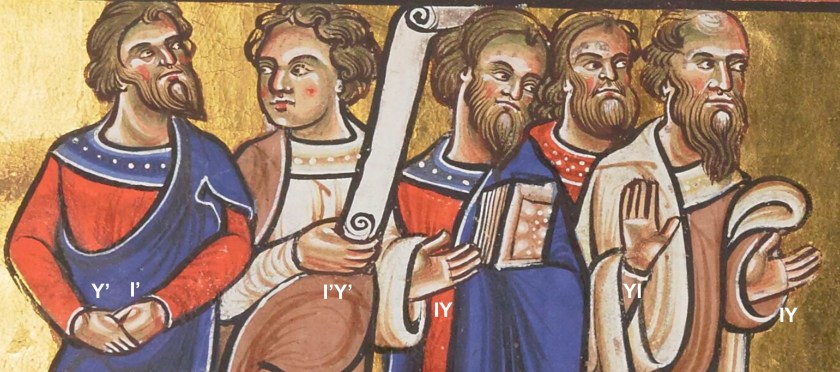
Guy on Right = a basic standard pattern, that’s elaborated freeform in the Left guys:
Crop and annotations by Michael Hoffman, Feb. 6, 2026
todo next: do another pass of Great Canterbury Psalter images looking for:
lower hand lacks thumb
upper hand has thumb
That’s my Science Prediction to test and disconfirm, at which point (ignoring the actual history of how Science actually has worked) I entirely, immediately discard the Egodeath theory, because it failed and was disconfirmed aka BEEN DEBUNKED!
Same as Mosurinjohn & Ascough point out that because we don’t have the chemical evidence that their side of the debate carefully washed away to get rid of the “dirt”, in the Eleusis vessels, this means “There is no evidence” “of Joe Rogan’s Pop speculations [also agreed to by Muraresku, and also Ruck]”, and that’s the same as,
“There were no psychedelics in Western religious history”
And regardless of whether there were or not, the important thing – Mosurinjohn & Ascough dictate, to the very creators of the field that Sharday has entered with her fists flailing – is:
We must not try to find [more] evidence for psychedelics in Western religious history, because that effort is “religious fundamentalism” and is “colonialist violence”.
The Egodeath Theory, World’s Headquarters Firmly Committed to Religious Fundamentalism and Colonialist Violence (aka Finding Psychedelics in Western Religious History, per Sharborg)
Leaving Indigenous Shams in the Dust, and Disrespecting the Anything-But-Drugs Academia Agenda Commitment Propaganda
See the red, bolded quotes of shame by Mosurinjohn & Ascough – trashcan-ready pseudo-argumentation. –> 🗑
Got no case? Try character assassination bullying instead, as you enter the field, fists swinging and flailing in all directions indiscriminately, defaming all entheogen scholars, and crying about:
No type of journal accepted our yellow-journalism, hit-job, smear-piece article, for YEARS! 😭 😭
We must not try to find [more] evidence for psychedelics in Western religious history, because that effort is “religious fundamentalism” and is “colonialist violence”.
This shows the level of compelling argumentation that’s typical of Deniers of psychedelics in Western religious history.
The 2007 Main-Article Formula for Max Communication:
Interweave Direct (but Plain, Daily) Language with Analogies (ie Myth Themes/ Motifs)
from {king steering in tree} through {mixed wine at banquet} to {snake frozen in rock}
from {king steering in tree} through {mixed wine at banquet} to {snake frozen in rock} – BLOCK UNIVERSE ETERNALISM WITH FROZEN EMBEDDED WORLDLINES.
My article for church reader is maybe weak, not leveraging that interweaving enough.
How in the HELL did my article fail to say “block”?! One would think it IMPOSSIBLE to summarize in 2 pages, the Egodeath theory, w/o saying “block”.
todo: print the text pages of church article, two color highlighters:
red: direct lang
blue: analogy
Interweave the two modes of expression.
from {king steering in tree} through {mixed wine at banquet} to {snake frozen in rock} – LACKS DIRECT WORDS/ referents
from {king steering in tree} = possibilism = fingers = Y = monolithic, autonomous control
through {mixed wine at banquet} = psilocybin, 10 sessions (in the artists’ initiation guild with lockbox of Liberty Cap or blue fruit Cubensis).
to {snake frozen in rock} = eternalism = thumb = I = 2-level, dependent control
Non-analogy:
ordinary-state possibilism with autonomous control
altered-state eternalism with dependent control
or latter:
psychedelic eternalism with dependent control
Flexicon: Flexible Custom Lexicon for the Egodeath Theory
These phrases are interchangeable, and have different connotations:
altered-state
psychedelic
analogical psychedelic eternalism
analogical altered-state eternalism aase or aae (no letter for “state”, precedent: l o p = literalist ordinary-state possibilism (no ‘s’). b/c that was for parall w/: psychedelic eternalism (just 2 letters).
PHASE 1: literalist ordinary-state possibilism with monolithic, autonomous control lopmac
omit “literalist”:
ordinary-state possibilism with monolithic, autonomous control
or shorter:
ordinary-state possibilism with autonomous control — short, and omits “litm/analogical”
PHASE 2: analogical psychedelic eternalism with 2-level, dependent control ape2dc
omit “analogical”:
psychedelic eternalism with 2-level, dependent control
or shorter:
psychedelic eternalism with dependent control — short, and omits “litm/analogical”
PHASE 3: integrated possibilism/eternalism thinking Now that I have short terms lacking lit’m/anal’l, combine:
integrated o p a c & p e d c or if “altered-state” instead of “psychedelic”: o p a c & a e d c ordinary-state possibilism with autonomous control altered-state eternalism with dependent control combine: i opac aedc ie: meta/condensed acro: ioa expand to integrated ordinary-state possibilism with autonomous control & altered-state eternalism with dependent control ioa – in terms of state i p e c – in terms of time-model. c for “type of control”.
integrated ordinary-state possibilism with autonomous control & altered-state eternalism with dependent control ipec = integrated … possibilism … eternalism … control
integrated, ordinary-state possibilism with autonomous control & altered-state eternalism with dependent control
integrated possibilism/eternalism [IPE]
literalist ordinary-state possibilism with monolithic, autonomous control [LOPMAC]
analogical psychedelic eternalism with 2-level, dependent control [APE2DC]
ordinary-state possibilism with monolithic, autonomous control [LOPMAC]
analogical psychedelic eternalism with 2-level, dependent control [APE2DC] or
analogical altered-state eternalism with 2-level, dependent control [APE2DC]
analogical altered-state eternalism with 2-level, dependent control [AAE2DC] altered-state eternalism with 2-level, dependent control [AAE2DC] psychedelic eternalism with 2-level, dependent control [PE2DC]
psychedelic eternalism with 2-level control pe2l pe2c
altered-state eternalism with 2-level control ae2c
ordinary-state possibilism with autonomous control opac
ordinary-state possibilism with monolithic, autonomous control opmac
thus now can type:
ordinary-state possibilism with autonomous control
altered-state eternalism with dependent control
longer form re: control descriptor:
ordinary-state possibilism with monolithic, autonomous control
psychedelic eternalism with 2-level, dependent control altered state alt: altered-state eternalism with 2-level, dependent control ae2dc
test w/ high parallelism (ie. ordinary-state, altered-state [not “psychedelic”]):
ordinary-state possibilism with monolithic, autonomous control
altered-state eternalism with 2-level, dependent control
fwiw, “altered-state” avoids problem of mixed wine (psilocybin) vs. kykeon (ergot/LSA)… poor example b/c both are psychedelics maybe. altered-state is broader than “psychedelic”; covers mystery plants, scopolamine, mixtures.
altered-state eternalism with dependent control aedc
With YI Branching-Shape Indicators on Each Hand or Foot
Why “Toes” or “Fingers” Is Often Not Granular Enough: Which Toe? Which Finger?
In some pictures (f177), big toe is splayed, or only big toe shown; other foot shows branching uniform toes.
Rough Ground-Up Sequence of Analysis
Initially lower foot
Initially higher foot
Lower fingers
Lower thumb
Higher fingers
Higher thumb
Lower foot [in phase 1, stand on left foot; but typically shown is phase 2: {stand on right foot}.] therefore in a picture that shows {stand on right foot}, that’s AFTER previous picture which would show stand on left foot.
Don’t say “which foot is lower in the picture”, re: sequnce of analysis.
FIRST DESCRIBE THE LIFTED FOOT, THEN DESCRIBE THE ON-GROUND FOOT, b/c prior to {stand on right foot} was {stand on left foot}.
Say “Initially lower foot”
Initially lower foot. (ie, initially, the L foot was on the ground; tho L foot is now shown lifted, we’ll start w/ L foot, breaking rule “start ground up”)
Initially higher foot. (ie, R foot; before psychedelics, had {right foot lifted}.)
Granular Ground-Up Sequence of Analysis
Lower foot: stand on left foot. Big toe splayed?
Higher foot: right foot lifted. Big toe splayed?
Lower Pinkie finger (base, tip).
Lower Ring finger (base, tip).
Lower Middle finger (base, tip).
Lower Index finger (base, tip).
Lower thumb.
Higher Pinkie finger (base, tip).
Higher Ring finger (base, tip).
Higher Middle finger (base, tip).
Higher Index finger (base, tip).
Higher thumb.
Index finger can serve as either:
The I in a YI pair. By splaying.
Part of the Y in a YI pair.
Motivation for this Page
I feel that RL is wondering, how I so nonchalantly IGNORE and DISMISS the learned, learned explanations of hand shapes in art and religion.
My interp of hand shapes is primitive, basic, simple, tiny.
Don’t I want a big-brain complicated SOPHISTICATED, learned, well-informed explanation by the authorities?
No. The simpler, the more basic, the better: basic shape of tree vs of snake.
I posted about this a couple years ago.
When I look up myth themes / motifs in books, it’s a joke: they are all fake, irrelevant, pseudo-explanations, to lead me away from the sensible solution.
In 2000 era, I saw how “snake” got tons of false explanations, but NO ONE PAID ATTENTION TO ITS BASIC SHAPE; non-branching. vs. shape of tree (branching).
By 2002, I was increasingly certain that my unique maverick explanation of why snake is #1 mytheme, is correct, and EVERYONE ELSE IN THE WORLD IS WRONG.
My 1997 summary: something so simple as branching fingers vs. non-branching thumb, is so simple, so basic, that it overlays right into my non-mythic, technical core theory summary, in which I say “branching & non-branching”.
YI Hand-Shapes Breakthrough Confirms Simple Possibilism/ Eternalism Theory
YI Hand-Shapes Breakthrough Confirms Simplest Theory: Possibilism & Eternalism
YI Hand-Shapes Breakthrough Confirms Simple Theory of Possibilism & Eternalism
YI Hand-Shapes Breakthrough Confirms Simple Possibilism & Eternalism Theory
YI Hand-Shapes Breakthrough Confirms Simple Possibilism/Eternalism Theory
YI Hand-Shapes Breakthrough Confirms the Simplest Theory: Possibilism vs. Eternalism
YI Hand-Shapes Breakthrough Confirms the Simplest Theory, Possibilism vs. Eternalism
YI Hand-Shapes Breakthrough Confirms Simple Theory of Possibilism/ Eternalism
Why Recognizing YI Medieval Hand Shapes Is a Major Breakthrough: Validates Extreme Simplicity and Elegance of Theory
YI Hand-Shapes Breakthrough Confirms Simple Possibilism/ Eternalism Theory
YI Hand-Shapes Is a Major Breakthrough Because Confirms Simple Possibilism/ Eternalism Theory
YI Hand-Shapes Is a Major Breakthrough Because Confirms Simplicity of Theory Based on Possibilism & Eternalism
YI Hand-Shapes Is a Major Breakthrough Because Confirms Simplicity of Theory Focused on Possibilism & Eternalism
YI Hand-Shapes Is a Major Breakthrough Because Confirms Extreme Simplicity of Theory Focused on Possibilism & Eternalism
YI Hand-Shapes Is a Major Breakthrough Because Validates Extreme Simplicity of Theory Focused on Possibilism & Eternalism
Extreme Simplicity and Elegance of Theory: Why Hand Shapes Are Such a Breakthrough
YI Hand-Shapes a Major Breakthrough: Validates Extreme Simplicity of Theory, Focused on Possibilism & Eternalism
YI Hand Shapes Is a Major Breakthrough: Validates Extreme Simplicity of Theory, Highlighting Possibilism & Eternalism
YI Hand Shapes Is a Major Breakthrough Because Validates Extreme Simplicity of Theory, Depicting Possibilism & Eternalism
possibilism & eternalism is more mature than possibilism vs. eternalism
I’m wary of writing “possibilism vs. eternalism”; its downside is, implies the “get rid of possibilism” error. The cost of writing that.
{fingers} = Y (Possibilism); {thumb} = I (Eternalism); {hand} = YI ( Integrate)
YI Hand Shapes Is a Major Breakthrough Because Validates Extreme Simplicity of Theory: {fingers} = Y (Possibilism); {thumb} = I (Eternalism); {hand} = YI ( Integrate)
Read {thumb} as shorthand for “or {index finger}”.
YI Hand Shapes Is a Major Breakthrough: Validates Extreme Simplicity, Economy, and Elegance of Theory
validates “simpler is better”
Why YI Hand Shapes Is a Major Breakthrough: Validates Extreme Simplicity and Elegance of Theory
Why Recognizing YI Hand Shapes Is a Major Breakthrough: Validates Extreme Simplicity and Elegance of Theory
Why Recognizing Medieval YI Hand Shapes Is a Major Breakthrough: Validates Extreme Simplicity and Elegance of Theory
Extreme Simplicity and Elegance of Theory: Why Recognizing YI Medieval Hand Shapes Is Such a Major Breakthrough
WordPress likes short pages, not 100 sheets long, idea development pages.
It’s easy for me to START a page that has a target topic, and then, freeform add ANY ideas that day, on daily basis.
Each day, start a page on a target topic, then add random idea development to it.
Works well for me.
This site is optimized for idea development, NOT for publishing polished final work.
This site has a lot of rough idea development AND some “flagship” polished publishable work.
At Egodeath Yahoo Group, I never did choose whether to do long-running generic idea development threads, or, per-topic short threads.
Starting a new page is placing a bet. Sometimes it is certain what value the page will add.
Sometimes, fishing and speculating that a new page will inspire discovery.
Must Confidently Pick the Best Version of Mystical experience and Transcendent Knowledge to Track Through “History”
[1:49 a.m. Feb. 8, 2026]
Trace as the RIGHT Signal Hidden Obscured by All the Noise: Where’s Waldo, the possibilism vs. eternalism throughout “history” ie the Mythic Esoteric Evidence Database.
I hate “secret” “suppressed” “hidden” like Letcher mocks.
Andy Letcher’s book Shroom, 2006 UK
keyboard shortcut
todo: add site map section w all “Letcher” pages
Main Objection from Panofsky/Huggins: Mushroom-Trees Have Branches
[1:49 a.m. Feb. 8, 2026]
Branches are the main thing preventing mushroom-trees from meaning mushrooms.
Huggins’ whole argument, like Panofsky, comes down to one main objection:
Mushroom-trees have branches/branching.
Someone must explain like Michael Hoffman did in Feb. 1997 at PrinCyb on the World Wide Web.
Even if the time axis is warped, relative, or branching, and there are more than 3 dimensions of space, one can coherently and usefully frame the experienced world as an ultimately unchanging, 4-dimensional spacetime block.
Time, change, flexibility, variability, and movement are all fixed at all points along the time axis or branching axes.
3 more sentences about branching vs. non-branching in Physics, in the first 50 posts June 2001 at Egodeath Yahoo Group.
Applied to hand/finger/thumb shapes Feb. 9, 2023 re: Jesus’ fingers and sticks and feathers identified and explained, by using branching theory and possibilism vs. eternalism, emailed to Dr. Brown.
My designated breakthrough day is Tue, Feb 3, 2026, midst of jackpot of unknown duration, re: hand-shape theory.
Judging the Best Myth, Religion, Mystical Experience, Science, & Brand of Transcendent Knowledge
[1:49 a.m. Feb. 8, 2026]
I trust myth. I steer by myth.
I steer by my judgment on the BEST myth.
Tracing the Best Signal Thread, not the Popular Signal Thread, Through the Esoteric Myth History Evidence Base
[1:49 a.m. Feb. 8, 2026]
Possibilism vs. eternalism is the best thread / signal to tune into through the history evidence base collection of world myth and mythic art.
free will vs. determinism is still undoc’d.
There’s no book on the history of determinism or the eternalism model of time.
possibilism vs. eternalism and control agency control transformation, tied to the two states:
loose cognition = eternalism-thinking.
tight cognition = possibilism-thinking.
My thread I trace as by MY id’n based on MY judgment of what’s BEST mystical experience , what’s the BEST esotericism; what’s the BEST of ancient phil: ans: astral ascent mysticism as figured out by me (not Wouter “Star Destroyer” Hanegraaff) based on David Ulansey.
Brands of Transcendent Knowledge: thoughout history aka the evidence base, which thread of brand of Transcendent Knowledge is the BEST one, the REAL hot property; the REAL mystic CLASSIC mystical experience that DESERVES to be the authentic real deal in gold cups only one REAL gold cup
by my judgment, +U the positive unitive model of “mystical experience” Pop INSANE Popular Neo-Advaita (which def’n to use? the most insane one, most pop one)
need judgment of selecting & rejecting the signal – radio frequency tuning and rejection. What is the good, worthwhile station?
the positive unitive model of “mystical experience” is objectively a failure not integrating {shadow dragon monster}
Transcendent Knowledge based on possibilism vs. eternalism integrates and respects {shadow dragon monster}:
enlightenment = awareness of being threatened by the 4D spacetime block & 2-level, dependent control.
the four-dimensional spacetime block 4D spacetime block fdsb
People are demonizing normal thinking, smashing, blunt club, mind is not real, words are not real, neg neg negative “explnation”, SUBTRACTIVE ELIMINATIVE PSEUDO EXPALANTION is insanity. the self-other boundary isn’t real.
separation between me and you is illusion.
people don’t exist.
nothing exists.
everything is illusion and unreal.
insanity is when you cannot function in daily life and despise all normal thinking, to get rid of it to be enlightened.
destroying the self-other boundary = Transcendent Knowledge = enlightenment
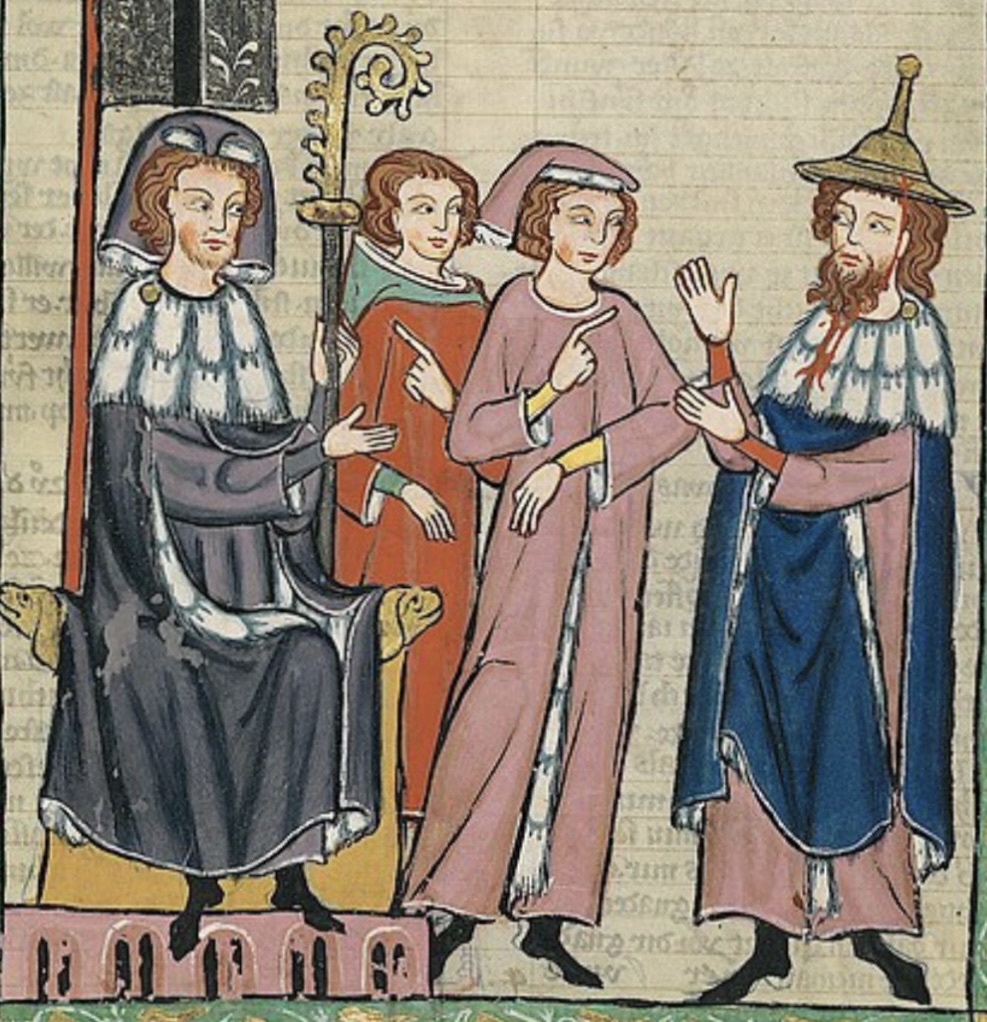
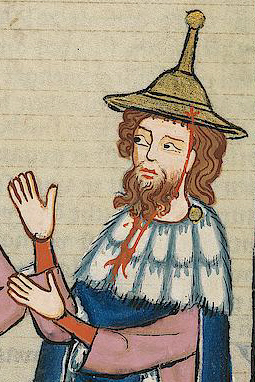
von Trimberg’s lower _fingers_ touch other guy’s _Left_ arm (as previously noted); now, I comprehend the full symmetry here:
I previously noted that his lower _thumb_ is over/ against von T’s “other arm” –
How I grasp, that “other arm” is von T’s _Right_ arm!
That is consistent & balanced.
As I am consistently dull & slow.
But give me 6 years – or days; I found this wonderful perfect Jewish Hat / von Trimberg picture 6 days ago, Jan 30, 2026.
This was the main sub-problem I was puzzling over ever since I first set eyes on this image 6 days ago.
This discovery is an example of how a major breakthrough is a series of jackpots lasting 1-2 weeks – not a single day all at once.
This particular puzzle was at the right advanced level to challenge me for 6 days, then solved.
Symmetry achieved; sub-puzzle solved.
🏆🖼️🎉
Crop by Michael Hoffman
Searching web for “jewish hat” 6 days ago Jan 30 2026 was best move ever. Huge payoff.
txt msg to JW [5:21 p.m. Feb. 5, 2026]
Our church is blessed and charmed:
1) The church logo has more branching on L than R, per classic wisdom.
2) A church founder in August 2025 presented 3 slides on block-universe eternalism(!), unbelievably.
Surely it was just a dream – hell freeze over when someone presents my countervailing view in church.
That encouraged me to finish my article for the church Reader issue 1, and solved the problem where church leader said the quiet part out loud, “no-free-will” — but I labored hard to solve that framing April – Aug 2025.
In our experience, we do have it both ways: both opposite models are the case: integrated possibilism/eternalism thinking.
Psychedelics requires a Pure Cognitive Phenomenology approach, reject Neurobaloney Reductionism. Reject armchair academic “Epistemology, Ontology, Metaphysics”.
It doesn’t matter how the world out there really is.
What matters is the shape of our experience in the two states;
the possibilism experiential mode. {fingers}. {king steering in a tree}.
{mixed wine at banquet}
the eternalism experiential mode. {thumb}. {snake frozen in rock} = worldline in block-universe eternalism.
txt msg to R L [11:21 p.m. Feb. 5, 2026]
Hand-shapes are one out of ten common ways to depict branching vs. non-branching – list is below; Y vs. I basic contrasting shapes.
Uninspired articles list many less basic & profound themes, the classic artist initiation guild w mushroom lockbox, was more interested in Y I contrast than diluted articles on lesser themes.
The best artists focused on contrasting via hand finger shapes, Y vs. I
In the medieval art genre of {mushroom-trees}
The best, most important thing about hands is their conveyance of Y & I shapes, or Y’&I’ visual cuts or negations of branching fingers.
Scholars pay too little attention to basic elementary branching morphology basic shapes contrasts:
List of Branching Contrasts
tree vs. snake in rock
Y vs. I
branching vs. non-branching
branching manyworlds vs. block-universe eternalism & worldlines
Quantum Mysticism vs. Block-Universe Mysticism
fingers vs. thumb
pinkie, ring, & middle finger vs. index finger
ordinary-state possibilism vs. altered-state eternalism
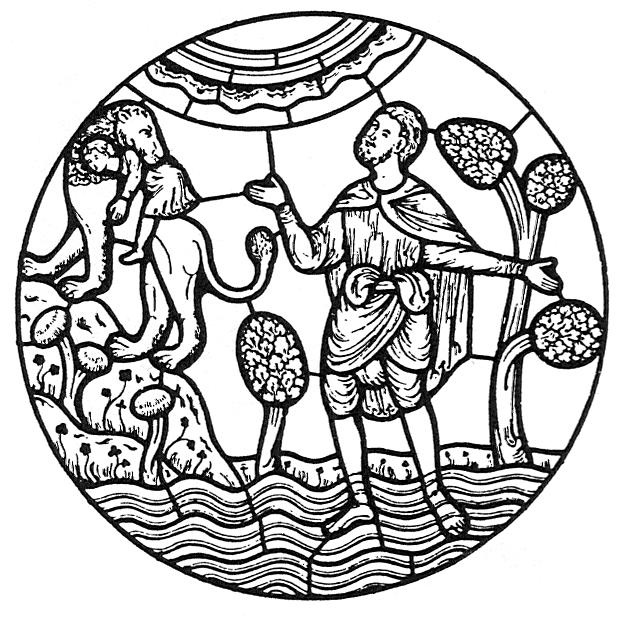
a Y mushroom on L, & a I mushroom on R, while Eustace displays “fingers vs thumb”
St. Eustace Crossing the River (Chartres Cathedral)
🍄🍄✋😊🤚🍄
Mâle, p. 3, The sky, water and trees. From the Legend of St. Eustace. Window at Chartres. Image processing by Michael Hoffman circa 2005.
Mâle, p. 3, The sky, water and trees. From the Legend of St. Eustace. Window at Chartres. Image processing by Michael Hoffman circa 2005.
Harmonize 2POV
Wisdom: harmonize the 2pov; the two different points of view, two different mental models.
Reconcile experiencing both ways.
First, king Pentheus _abandons_ his wife Ariadne. Attitude: “Branching is childish delusion; get rid of possibilism-thinking.
Then, the god Dionysus _weds_ Ariadne. Attitude: Reconcile branching-experiencing & non-branching experiencing.
2-way “embrace and include” the Y & I models, both.
A useful hand 🫲 🤚👋✋ has an opposable thumb, together with fingers.
The mushroom-tree religion, in a broad sense: mushroom-influenced motifs depicting moving from ordinary-state, branching thinking, to altered-state, non-branching thinking.
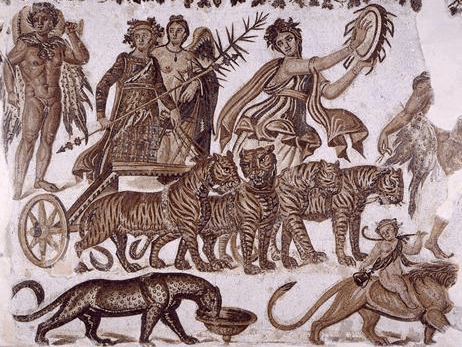
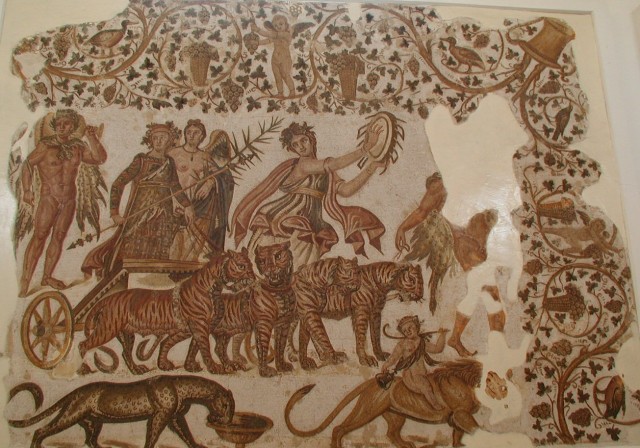
Triumph of Dionysus (Roman Mosaic)
Mushroom branching imagery depicts moving from ordinary-state, branching thinking, to altered-state, non-branching thinking.
The mind ends up with integrated possibilism/ eternalism thinking.
That’s a beautiful vision, that acknowledges the experience of possibilism, & the altered-state, revealed experience of eternalism.
Dionysus (eternalism-thinking) and Ariadne (possibilism-thinking)
In the victory wedding procession mosaic.
Triumph of Dionysus on a Roman mosaic (3rd century, Sousse Archaeological Museum).
The Y I-focused medieval artists are the most important:
This art genre uses finger shapes intricately and elegantly, especially focusing on depicting branching vs. non-branching.
Look for details of branching, at the level of portions of fingers.
Look for Y and I forms at the level of, details of each finger.
Not looking only for fixed patterns; more typically, be flexible on your toes looking for unique expressions of Y and I forms.
That’s the central focus for the best artists from the mushroom-stocked artists initiation guild, that teach each other the mushroom-tree religion: {mushroom}, {branching}, {handedness}, and {stability} motifs.
Finger shapes easily, efficiently depict:
the ordinary- vs. altered-state sense of
[a kind of control agent in a kind of world]
✋ = vs.🐍
It’s efficient to use finger shapes to contrast Y & I, and to integrate or harmonize possibilism/eternalism thinking, on the level of experiencing; cognitive phenomenology (not about epistemology, ontology, or metaphysics).
Psychonauts Signal Group Post, p.m. Feb. 5, 2026
At house church 👼🏡⛪️ Aug 24, 2025, our church founder gave a sermon on Alan Moore’s comics novels about psychedelic block-universe eternalism (non-branching snake worldline embedded in rock block universe).
That’s even more extreme of a model than Emily Adlam’s “all-at-once universe”.
There’s a spectrum of positions way beyond “free will vs. determinism”.
A Pure Cognitive Phenomenology Approach; Reject Cognitive Neurobaloney
The Egodeath theory, since April 1987, uses a Pure Cognitive Phenomenology approach.
I’m anti-Neurowoo, such as orange areas in pop scan pictures, to impress the rubes.
Neurobaloney that uses “cognitive” as a sales term only, is like conversing with Sharday Mosurinjohn impressed the pop podcaster such that Sharday bragged about the many disproofs by academics of entheogen scholarship — and the pop podcaster failed to blurt automatically “Citation needed!”, as a scholar would.
Neuro woo is a sidetrack distraction from Cognitive Phenomenology.
txt msg to AM [10:17 Feb. 6, 2026]
the 1893 fabrication of the positive unitive model of “mystical experience” was totally fake driven entirely Pop sociopolitical agenda; selectively hype 1% of Vedanta, discard and ignore 99%, crafted by popular demand
what model of Transcendent Knowledge sells? optimize & select for that, eliminative sculpting/ filtering driven by popular demand
same way the Mystical Experience Questionnaire (MEQ) & the Challenging Experience Questionnaire (CEQ) were crafted by the Marketing dept
based on what sells to the pop audience
txt msg to AM [10:25 Feb. 6, 2026]
i believe ZZZ allan badiner zig zag zen never even ONCE considers the question of psychedelics in asian religious history
thats why i cant stand to crack open the book: i have a SEVERE dispute with its basic driving premise shared by all these “enlightened, progressive” contributors, probably same in the updated edition too
totally closed minds in asian studies, asleep in their foundational presuppositions, making the ehole a whole affair — book & field — futile confusion about the relatiknship of psychedelics & meditation
u only had 1 job, & totally failed
zzz ab95
zzz book concept:
explore the relation of psychedelics & meditation.
Yet,
Step 1: GIVEN, as a SILENT axiomatic presupposition: everyone knows that buddhism history lacks psychedelics.
Given: the relation of psychedelics & buddhism is, buddhism history has no psychedelics.
Given that, let us discuss and investigate:
What’s the relation between buddhism (which was historically, non-drug) & this brand new technology, psychedelics?
This futile exercise can only produce confusion.
Zig Zag Zen: Buddhism and Psychedelics (Badiner, 2002)
Published April 1, 2002. I purchased on June 16, 2002.
Zig Zag Zen: Buddhism and Psychedelics April 1, 2002 (newer edition is available) by Allan Hunt Badiner (Editor), Alex Grey (Editor), Huston Smith (Preface), Stephen Batchelor (Foreword)
“Buddhism and psychedelic experimentation share a common concern: the liberation of the mind.
Zig Zag Zen launches the first serious inquiry into the moral, ethical, doctrinal, and transcendental considerations created by the intersection of Buddhism and psychedelics.
With a foreword by renowned Buddhist scholar Stephen Batchelor and a preface by historian of religion Huston Smith, along with numerous essays and interviews, Zig Zag Zen is a provocative and thoughtful exploration of altered states of consciousness and the potential for transformation.
[EXCEPT FOR THE QUESTION OF HISTORY OF PSYCHEDELICS IN BUDDHISM, NEVER CONSIDERED EVEN ONCE BY ANY PARTICIPANT. -mh]
“Accompanying each essay is a work of visionary art selected by artist Alex Grey, such as a vividly graphic work by Robert Venosa, a contemporary thangka painting by Robert Beer, and an exercise in emptiness in the form of an enso by a 17th-century Zen abbot.
“Packed with enlightening entries and art that lie outside the scope of mainstream anthologies, Zig Zag Zen offers eye-opening insights into alternate methods of inner exploration.”
[define “alternate” – a loaded/ freighted term. -mh]
“More than ever, people are in pursuit of greater fulfillment in their lives, seeking a deeper spiritual truth and strategies for liberation from suffering.
Both Buddhism and psychedelics are subjects that one encounters in such spiritual pursuit.
Edited by Tricycle contributing editor Allan Badiner and art edited by renowned visionary artist Alex Grey, Zig Zag Zen features a foreword by Buddhist scholar Stephen Batchelor, a preface by historian of religion Huston Smith and numerous essays, interviews, and art that lie outside the scope of mainstream anthologies.”
[Beware at “mainstream”.
Hidden is that this book ZZZ is mainstream, in that it is based on the silent mainstream presupposition/ prejudice, “no psychedelics in Buddhism history”.
This MAINSTREAM, PHONY-ALTERNATIVE book fails to undermine and transform Buddhism at the foundation, revealing the psychedelic origin of Buddhism. -mh]
“This new edition of the classic work on Buddhism and psychedelics includes
a recent interview with Rick Doblin, founder of MAPS,
contributions from Ralph Metzner,
James Fadiman and
Kokyo Henkel, and a discussion of
ayahuasca’s unique influence on Zen Buddhism.
Packed with enlightening entries offering eye-opening insights into alternate methods of inner exploration.”
Dr. David Nichols collaborated with Alexander Shulgin.
Our church pastor had conversations with Nichols.
Nichols is the main supplier of medical synthetic psilocybin, eg. for Hopkins research.
txt msg to RL [10:06 Feb. 6, 2026]
Web research shows:
Absolute four-dimensional spacetime or block-universe eternalism is relatively entrenched as a given, used in Physics.
Everett branching manyworlds is considered mere conjecture. (But that’s the shape of our experience, so do not “get rid of” that way of thinking.)
In the ordinary state, many ppl favor no-free-will. And some of those ppl (Sam Harris) SEPARATELY advocate psychedelics.
What no one realizes is that combining belief in no-free-will with psychedelics gives an EXPERIENCE, of block-universe eternalism.
This sort of “I’m an atheist & I believe no-free-will”, counterintiuitively, leads to religious experience.
Believing in no-free-will and then using psychedelics (discovering the experience of no-free-will/ block-universe eternalism) is not the opposite of religious experience, but is the path to rediscover actual religious experience, but re-conceived.
The religious experience of block-universe eternalism (“block-universe determinism”).
Surprise: Sam Harris, your “atheism”/ no-free-will, by adding psychedelics, discovered the classic mystical religious experience, which is different than presumed.
No-free-will (ie, block-universe eternalism) is not armchair ordinary state Philosophy; it is a shattering, personal control- transformative experience.
txt msg to RL [10:43 Feb. 6, 2026]
Medieval hand shape interpretations other than simple Y vs. I theme are complicated & arbitrary.
Y vs. I means: ordinary-state branching possibilism vs. altered state non-branching eternalism
What is the most extremely basic & profound interpretation?
My Y/I model is based firmly in the two states of consciousness, unlike the uninspired, fake, invented, pseudo-explanations.
I go down to the root of meanings:
WHY is a certain hand-shape “a blessing”?
Because it is the shape of ordinary state ‘Y’ branching thinking/ experiencing, contrasted with altered state ‘I’ non-branching thinking/ experiencing
tree vs. snake (in rock)
Y vs. I
branching vs. non-branching
possibilism vs. eternalism
fingers vs. thumb
3 fingers vs. 1 finger
{stand on left foot} vs. {stand on right foot}
The Argument from Simplicity
The YI contrast is simple, profound, clean, and non-arbitrary, thus compelling.
/ end of: txt msg to RL [10:43 Feb. 6, 2026]
The Egodeath theory’s Mytheme theory operates at the root, rather than layered-on, ordinary state speculations, where writers in the ordinary state read the interpretations and speculations of other ordinary-state writers.
Outsider, ordinary state based writers (scholars, academics, researchers) spin-out outsiders’ readings, unprofitably, and miss the ultra basic, 2-state, states of consciousness.
Daily Vocabulary “States of Consciousness” ~= Custom Lexicon “Experiential Modes”
The Most Interesting & Relevant Thing in Religion: Y-Shaped Experience vs. I-Shaped Experience
I dislike any alien lexicon terms, such as “states of consciousness”.
Instead, per the Egodeath theory custom purpose-built optimized lexicon:
There are two experiential modes: tight cognition vs. loose cognition; ordinary state vs. altered state.
When interpreting medieval art: first of all, above all, look for contrasts of world model depending on ordinary state vs. altered state.
Look for motifs carrying the message/signal:
The ordinary state is like __.
The altered state is like __.
The SIMPLEST Solution:
The ordinary state is like a Y shape.
The altered state is like an I shape.
literalist ordinary-state possibilism with autonomous control
analogical psychedelic eternalism with dependent control
ordinary-state possibilism with autonomous control
psychedelic eternalism with dependent control
ordinary-state possibilism
psychedelic eternalism
tight cognition possibilism (Y)
loose cognition eternalism (I)
The Egodeath theory leverages binaries, usually. Trinary, asserted by the medieval art genre of {mushroom-trees}:
keyboard shortcuts – problem: “thinking” is daily language but incorrect, we mean experiencing, driving thinking. Firstly an experiential mode, later, a thinking/model.
naive possibilism-experiencing doesn’t make sense, how can experiencing be naive?
possibilism experiencing
eternalism experiencing
integrated possibilism/eternalism experiencing
An experiential mental model is both “thinking” and “of experiencing”. An experiential mental model.
the possibilism experiential mental model pemm
the eternalism experiential mental model eemm
the integrated possibilism/ eternalism experiential mental model ipeemm
the possibilism experiential mental model
the eternalism experiential mental model
the integrated possibilism/ eternalism experiential mental model
the possibilism experiential mental model (lower fingers)
the eternalism experiential mental model (lower thumb)
the integrated possibilism/ eternalism experiential mental model (upper fingers & thumb)
I judge and favor this progression to be the main basic model in the medieval art genre of {mushroom-trees}:
lower fingers
lower thumb
upper fingers & thumb
That’s based on 2-3 sweeps over past 6 months, of hand shapes in Great Canterbury Psalter.
I have set up prediction:
I predict that the predominant, NORMAL imagery pattern – we know artists will play and bend it — the starting point for their permutation variants — is
{lower fingers; lower thumb; upper thumb and fingers}
The first, initial variant form: index not thumb:
{lower fingers; lower thumb (or index finger: this is the first variant); upper thumb and fingers}
The interpreter must identify which form is the starting, basic form; vs. which form is a deviant clever signature innovative spinoff variant.
von Trimberg threw me b/c he does NOT do the pattern in guy 2 & 3 & Great Canterbury Psalter.
He simply displays whole hand but 12:38 Feb. 6, 2026] in Great Canterbury Psalter try to interp “hold out {hold out both hands showing fingers & thumbs} as 3 phase seq: lower fingers, lower thumb, upper fingers + thumb.
Hypothesis: {displaying both complete hands} in Great Canterbury Psalter Means 3-phase sequence: lower fingers = possibilism experiential mode; lower thumb = eternalism experiential mode; upper fingers + thumb = the integrated possibilism/ eternalism experiential mode
Features, Guy 1, sweep from bottom to top of hands:
lower fingers, cut – there are 4 cuts on 4 cut mushroom stems.
upper thumb, cut – there is a cut on the 1 non-cut mushroom stem.
Index finger inherently carries a vibe / implication of “index finger splayed apart from 3 fingers”, even when not splayed.
Special Inherent Loading of the Index Finger as Either Y or I
Index finger is loaded to be like first born finger. Index finger is special: it is wildcard either participating in Y fingers, or, serve as a thumb-like, I shape.
Features, Guy 2, sweep from bottom to top of hands:
lower fingers touch {closed book} pages.
lower thumb
coordinated upper fingers + upper thumb, both are cut visually to assert non-branching, by combining fingers + thumb, able to grasp {open scroll}.
(skip guy 3 & 4 of 5)
Features, Guy 3, sweep from bottom to top of hands:
He is the normal, standard, to deviate creatively/ expressively from, just as {stand on right foot} is the normal departure Ref point, to then draw upside down guy.
lower fingers = possibilism experiential mode/ model
lower thumb = eternalism experiential mode/ model
upper fingers & thumb = integrated possibilism/ eternalism experiential mode/ model
Left Thumb Touches Right Limb
Motif: {L thumb touch R arm/palm/wrist/limb/forearm/hand}
Although L thumb belongs to L hand/arm/limb, per fractal scope (local scope) analysis the thumb is non-branching and therefore belongs to, or identifies with, R limb/hand/palm/forearm.
There Is Little Hope of the Anything-But-Drugs Academics Producing Anything Worth Taking Seriously by Entheogen Scholars
From the end of Ronald Huggins’ 2024 article “Foraging Wrong”:
“[In addition to declaring above that we should simply ignore the mushroom elements of mushroom-trees and only respect the tree elements,] We also identified key issues that generally discredit the PMTs [Psychedelic Mushroom Theorists’] arguments.
“All these issues contribute to the PMT’s [Psychedelic Mushroom Theorists’] lack of accuracy which in turn undermines the credibility of their work.
“Until we see significant improvements in these areas there is little hope of their producing anything worth taking seriously by artist historians, religious scholars, or other academics interested in the history and use of entheogens.
The anything-but-drugs academics Have Nothing but Bluster and Propaganda.
Wasson Is Honorary and the Leader in Chicanery Here.
Academic Deniers of Mushroom Imagery in Christian Art are Shady, Have Bad Character, Condone Lying by Omission, and Are Suspect of Academic Foul Play
The Day 3 plants have branches, so cannot mean mushrooms, but must mean trees.
Never mind that these “branches” look identical to mushrooms. BRAIN = DEAD. A worthless argument.
The Day 4 plants are trees.
Never mind that these “trees” have no branches and look identical to mushrooms. BRAIN = DEAD. A worthless argument.
Huggins’ Conclusion section: As a class, “mushroom-trees” have tree elements and mushroom elements. We can invent a rule (without providing justification) that says “IF a mushroom-tree has mushroom elements, ignore the mushroom elements, and only pay attention to the tree elements.”
BRAIN = DEAD. A worthless argument.
“If the tree has mushroom elements” – but this is always the case, for all instances of the class, “trees that have mushroom elements and tree elements”.
This arbitrary rule, with no justification provided for the pro-tree, anti-mushroom bias, is a blanket statement that for all mushroom-trees, ignore the mushroom elements.
Copypaste from Foraging for Psychedelic Mushrooms in the Wrong Forest: The Great Canterbury Psalter as a Medieval Test Case (Ronald Huggins, 2024):
“8. Conclusion
“The PMT’s [Psychedelic Mushroom Theorists’] fanciful interpretations have provided us with an opportunity in this article to reflect in a positive way, using as our entry point one of the most exquisite 13th century examples [ie. the Great Canterbury Psalter], upon the range of artistic solutions to the problem of illustrating the hexameron [6 days of creation] in the 11th–13th centuries, and especially the third day of creation (Genesis 1:9–13).
“The imagery of the third-day scene specifically features the creation of trees, making way for us to explore how stylized trees were commonly approached by the artists of the period.
[Ans: trees were depicted via {mushroom}, {branching}, {handedness}, and {stability} motifs. -mh]
“Trees, being peripheral to the more central features of medieval iconography, are not often discussed by art historians.
“A noted [ie, censored by Wasson] exception is Albert Erich Brinckmann’s Baumstilisierungen in der mittelalterlichen Malerei (1906), a work [censored by Wasson 1968 p. 180, top, at “. . . .”] recommended by Panofsky in his letters [multiple Panofsky letters?! censored by Wasson!] to Wasson back in 1952 [but not revealed to scholars until the Browns’ 2019 article.-mh].”
/ end of Conclusion excerpt from Ronald Huggins’ 2024 article “Foraging Wrong”
Ronald Huggins’ 2024 article “Foraging Wrong” fails to credit and cite Browns’ 2019 article (the first publication of the two Panofsky letters) and helpfully link to the article; Huggins only cites the Browns’ 2016 book.
Huggins says nothing about the delayed-by-67-years, 2019 initial publication of the two Panofsky letters. Huggins only cites the goddamn DRAWER(!) at Harvard, unhelpfully.
Since 2006, I NEEDED to see Panofsky’s censored argument about branches, which Huggins nonchalantly repeats, as if egregious censorship and academic obstruction by Wasson had not taken place.
Had I read Panofsky’s ultimate argument, about branches, in 2006 (in the 1968 book SOMA), I would have developed sooner than 2020, my interpretation and recognition of integrated {mushroom}, {branching}, {handedness}, and {stability} motifs.
Huggins’ gives apologetics claiming that Wasson’s denial of mushroom imagery in Christian art is excusable, because it didn’t prevent Irvin from publishing.
Wasson’s deceitful academic obstructionism set me back by 2020-2006 = 14 years.
We should have been allowed to read Panofsky’s “branching” argument in 2006 or 1968 – not delayed to 2019 and then nonchalantly referenced by Huggins in 2024, suddenly materializing the Panofsky letter out of thin air, as if scholars have had & known about the letter since 1952.
Huggins’ out-of-nowhere citing of Brinckmann, and Huggins’ citing the branching argument in the 2nd(!) Panofsky letter, stinks of foul play by the deniers of mushroom imagery in Christian art.
How can Huggins 2024 not be aware of the 2019 article publishing the citation and both letters?
It is an omission and flaw of the Foraging Wrong article, to fail to cite and credit Browns 2019. Suspect of deliberate omission, to impede scholars from leveraging the Panofsky letters and to hide the egregious censorship by Wasson, on the Deniers side.
I hold Ronald Huggins personally responsible for the academic sins of Wasson, here, because Huggins should acknowledge & condemn that censorship, rather than condoning and covering-up such foul play, on his side of the debate.
Brinckmann’s book is SO “noted”, that Gordon . . . .🔍🧐🤔🤬 Wasson entirely censored this strongly urged citation from Panofsky, but Huggins doesn’t mention that situation.
Deniers of mushroom imagery in Christian art are SHADY and SUSPECT of academic FOUL PLAY.
See the drawer at Harvard containing the two Panofsky letters censored by Wasson.
But don’t cite and link to Browns 2019 article which first published the letters.
And don’t mention Wasson’s chicanery, conflict of interest as banker for the pope, and Wasson censoring key, relevant academic content: Brinckmann’s 1906 book, the two Panofsky letters, and Panofsky’s two attached art pieces showing “emphatic mushroom shapes”.
Deniers of mushroom imagery in Christian art are SHADY and SUSPECT of academic FOUL PLAY.
The “little” book Tree Stylizations in Medieval Paintings (Brinckmann, 1906) only mentions pilzbaum 5 times, and does not make the case that Panofsky claims the book makes.
Against Panofsky, Brinckmann 1906 does not 1) lay out mushroom-trees by century, 2) trace the development over time from umbrella pine to “emphatic mushroom shape”, and then 3) argue that the gradualness of development from pine to mushroom proves that the end result, “emphatic mushroom shape”, is unintentional.
Panofsky’s argument is brain-dead and totally arbitrary; DOES NOT FOLLOW. The alleged steady morphing from pine to mushroom over time, in no way is evidence that the mushroom shape was unintentional and doesn’t mean mushrooms. I argue the reverse: The consistent shifting from (alleged) umbrella pine shape to mushroom shape, is evidence that the mushroom shape is intentional.
Browns’ article in 2019, by publishing both Panofsky letters (sans 2 attached art pieces), proved and confirmed my 2006 accusation in Wasson and Allegro on the Tree of Knowledge as Amanita, that Gordon . . . .🔍🧐🤔🤬 Wasson must have censored citations from Panofsky, citations that Panofsky would certainly have had to provide to back up his claim that art historians have “considered” mushroom-trees, and that the publications cited by Panofsky are weak treatments of mushroom imagery in Christian art, and don’t really support the Deniers of mushroom imagery in Christian art.
Rely on and repeat Panofsky’s ultimate objection, that branches on mushroom-trees need to be explained.
But don’t mention that Wasson censored this argumentation from Panofsky in SOMA 1968.
Deniers of mushroom imagery in Christian art are SHADY and SUSPECT of academic FOUL PLAY.
1997 Core Theory & Egodeath Yahoo Group Post #1 (2001) Contrasts “Branching vs. Non-Branching” Universe Models in Physics, Connected to Myth and Mythic Art in 2011-2022
In 2001 at start of Egodeath Yahoo Group (Message #1, June 10, 2001, composed at Principia Cybernetica website in Feb. 1997), I posted about branching manyworlds quantum physics vs. non-branching block-universe (Minkowski, Relativity) containing frozen worldlines, in the context of Physics, not in myth or mythic art motifs.
Find “branching” in that archive page of the first 50 posts: 8 hits; 5 passages:
“Even if the time axis is warped, relative, or branching, and there are more than 3 dimensions of space, one can coherently and usefully frame the experienced world as an ultimately unchanging, 4-dimensional spacetime block.
“Time, change, flexibility, variability, and movement are all fixed at all points along the time axis or branching axes.
“Forking futures and multiple branching universes is unnecessarily complicated.
“Multiple universes considers the future open in the sense of forever branching. Perhaps each branch preexists – the book The End of Time seems to take this position.
“I endorse simplicity as a principle for choosing between metaphysical systems, and I maintain that the single-future, non-branching block universe is simpler than the branching-future multiverse.”
Around 2010, while on hiatus from public Egodeath theory development, I walked the mushroom forest paths daily, and wondered if {branching vs. non-branching} is prominent in myth.
Every November, I made deeper breakthroughs confirming that {branching vs. non-branching} is prominent in myth, for several years around 2011-2013.
It took me 2022-1997 = 25 years to hook up from branching vs. non-branching in Physics, to branching vs. non-branching in the art pieces in my 2007 main article.
A key discovery or confirmation was in Nov. 2013, confirming the emphasis on {branching vs. non-branching} motifs in Greek & Christian art.
Yet it took from 2013 to 2022 (9 years) to recognize the {branching vs. non-branching} motif in the art pieces in my 2007 main article:
The Forced, Mandatory Profession of Faith and Doctrinal Commitment Allegiance by Anything-But-Drugs Academics
“Chanting, breath techniques, dancing, rhythmic driving, cave contemplation, mortifying the flesh, and anything you can think of, can/ could/ might/ may produce the same effect as 10g of psilocybin mushrooms.”
(So, No Psychedelics in Western Religious History.)
The above statement must be ritually repeated.
The power of that statement or argument is so weak, the statement must be ritually repeated in EVERY video interview; in EVERY article (all 3 of them in the past 100 years, by academia).
Are we supposed to give academics a medal, for parrotting this obligatory line, that couldn’t be more tired?
The academic/naysayer tries to falsely elevate methods that don’t work sufficiently to cause transformation of the mental model from possibilism to eternalism, by the false-equivalence fallacy:
10g of psilocybin mushrooms “can” cause transformation of the mental model from possibilism to eternalism.
hyperventilating “can” cause transformation of the mental model from possibilism to eternalism.
Compare:
You “can” withdraw $20 from the bank.
You “can” win a million dollars at the casino.
The word “can” is used in both statements, which seems to make them EQUALLY likely. But “can” in one instance is ~0% likely, and other, ~100% likely.
It’s a cheap illusion, abusing the word “can” to falsely elevate non-drug entheogens to the same efficacy as psychedelics.
“non-drug entheogenic practices” term is from Wouter Hanegraaff, cheered on by Erik Davis, who would NEVER ruin and wreck Davis’ pet word ‘psychedelics” that way.
Erik, I noticed that you applaud Wouter Hanegraaff claiming — based on fallacious argument-from-etymology — that “entheogen” means anything, everything, nothing – and that you do NOT condone ruining and cheapening your word ‘psychedelics’ this way.
Erik Davis would laugh and mock the proposal of “non-drug psychedelics”, yet he applauds Wouter Hanegraaff’s non-drug entheogens, or “entheogenic practices”.
Who is Hanegraaff trying to appease by this tired, worn-out declamation, “There are many non-psychedelic ways that can/ could/ might/ may produce the same effect as a 10-strip of blotter”.
Please demonstrate, Hanegraaff.
“can” is a misleading, deceptive euphemism for “doesn’t”.
Everything such academics say re: psychedelics, is anything-but-drugs academic propaganda.
Academia Can’t Even Accept Non-Drug Ecstatic States, Much Less Psychedelics as the Source of Religion
Every academic is required to put that statement in every (rare) statement they make in rebuttal of the too-popular book The Immortality Key by Brian Muraresku, 2020.
The character of committed-skeptic anything-but-drugs agenda after The Immortality Key by Brian Muraresku, 2020, has changed a little.
The Psychedelic Mysteries Paradigm, Against “the Psychedelic Mysteries Hypothesis” (an Alien, Hostile, Biased-Lexicon Term)
Academia can no longer simply ignore “the psychedelic mysteries hypothesis” (Professor Richard Ascough’s phrase). In retort against him, I say nay,
the psychedelic mysteries paradigm pmp
Dirty-arguing, biased academics (Deniers), try to make affirmers operate in a bad, non-paradigm framework, biased, where they are guaranteed to lose.
“There is no chemical evidence at Eleusis in the cups we washed out; and no other evidence counts, because we arb’ly say so, b/c shutting out and washing away the evidence benefits our false position. You affirmers are required to operate in our bunk frame, where you automatically lose. Using our criteria; our goals; our agenda.”
Ritually Repeat for the Zillionth Time: “Against the Enthusiasts, We Must Remember that Psychedelics Are Not the Only Way to Produce an Altered State; the Traditional, Non-Drug Methods of the Mystics
the traditional, non-drug methods of the mystics tndmm
Per the Hoffman Uncertainty Principle, we cannot know what an academic believes; we can only know what they publicly claim to believe when their position is pressed and probed.
Normally, academics cannot say anything about the topic of psychedelics in Western religious history.
If an academic affirms psychedelics in Western religious history, the academic is attacking their own gang, and they lose opportunities.
If an academic denies psychedelics in Western religious history, the academic shows that they have no credibility; they lose credibility and cannot be taken seriously.
Naming the Parties & Positions: Deniers vs. Affirmers; Academics vs. Entheogen Scholars; Art Historians vs. Mycologists
The position-names or parties per Gordon . . . .🔍🧐🤔🤬 Wasson’s 1968 book SOMA:
“Mycologists” = affirmers of mushroom imagery in Christian art & psychedelics in Western religious history.
“The art world” = “art historians” = deniers of mushroom imagery in Christian art & psychedelics in Western religious history. Naysayers. Debunkers.
Not All Academics. The anything-but-drugs academia agenda.
Wasson was not an academic, yet on the topic of mushroom imagery in Christian art, Wasson sets the pace for fraud, lying, censorship, and world’s record conflict of interest as banker for the pope, trust me when I pressure and harangue and bullsh!t you:
“No psychedelics in Western religious history. Those hundreds of mushroom trees mean trees, not mushrooms; we know, because the art authorities say so, in their non-writings avoiding the topic.”
See SOMA p. 180, below, in which Wasson berates affirmers of mushroom imagery in Christian art for not “consulting the art world” (whatever the hell non-scholarly action that’s supposed to mean), while in the same paragraph, duplicitously censoring the extremely strongly urged by Panofsky, citation of Brinckmann’s “little” book.
Fittingly, Huggins treats Wasson as if he’s on the up-and-up, while Huggins whips out of nowhere – not crediting Browns 2019 – the Brinckmann citation and both of the censored, secret letters from Panofsky to Wasson in 1952.
I accuse Huggins of condoning academic fraud by Gordon . . . .🔍🧐🤔🤬 Wasson, on his side of the arguers.
What’s wrong with Huggins that he fails to credit Browns 2019, but instead cites a damned DRAWER at Harvard, uselessly?
Thanks for not helping entheogen scholars check references.
Anything-But-Drugs Academics re: Psychedelics in Western Religious History Have No Credibility, only Bluff, Bluster, Bias, Prejudice, Fallacious Arguments, and Errors, Deserving Ignoring and Ridicule, as Entheogen Scholarship Continues to Make Progress
cut words:
Academics re: Psychedelics in Religion Have No Credibility, only Bluster, Bias, and Fallacious Arguments, to Be Ignored and Ridiculed by Entheogen Scholars
Names of Bible Scholars Who Non-Credibly “Debunked” Psychedelics in Western Religious History
Hatsis: Psychoactives are throughout Western religious history. Except for mushrooms (which is identical with Secret Christian Amanita Cult). See his articles online somewhere at his defunct site that’s not at Archive.
Panofsky 1952 based on his interpretation of Brinckmann 1906 who shows that over time, trees in medieval art develop into emphatic mushroom shapes, proving that the development must have been unintentional.
Panofsky 1952 pointed out that there are too many mushroom-trees for them to mean mushrooms.
Ronald Huggins’ Foraging Wrong article, which concludes: mushroom-trees have mushroom elements and tree elements, therefore must be trees and cannot mean mushrooms. Day 3 plants have branches, therefore cannot mean mushrooms.
Foraging for Psychedelic Mushrooms in the Wrong Forest (Huggins, 2024)
Foraging for Psychedelic Mushrooms in the Wrong Forest: The Great Canterbury Psalter as a Medieval Test Case (Ronald Huggins, 2024)
Scholars are tired of having to repeatedly debunk psychedelics as the engine of religions, with this level of compelling thoroughness.
Credibility Check of Anything-But-Drugs Academics: Huggins Calls this Explicit, Botanically Accurate Mushroom a “Tree”
Crop by Michael Hoffman, Jan. 2025. Plant 3 in Day 4 Panel, Great Canterbury Psalter
Showing Academia’s Extreme Degree of Denial, Bias, and Prejudice: Brazen Cover-Up Operatives for Hire
Huggins ends his Foraging Wrong
Huggins Designates the 4 Branch-Free Mushrooms in Day 4 Panel as “Trees”, without Providing any Justification
from “Foraging Wrong”:
“The GCP artist does not however depict seed-bearing herbs in the [Day 3] scene, but waits to include them in the fourth-day scene, which is otherwise dedicated to the creation of the sun and moon (Fig 22 [shows Day 3 & 4]).74 Having details left out of third-day scenes but included on the fourth day also occurs elsewhere, as for example in the Acre Bible”
— no mention of the four branch-free mushrooms in Day 4
“The GCP artist does not however depict seed-bearing herbs in the scene, but waits to include them in the fourth-day scene, which is otherwise dedicated to the creation of the sun and moon (Fig 22).74 Having details left out of third-day scenes but included on the fourth day also occurs elsewhere, as for example in the Acre Bible”
— no mention of the four branch-free mushrooms in Day 4
Huggins Nonsensically Writes “Trees in the Fourth-Day Scene” (Has Four Non-Branching Mushrooms and Five Wispy YI Plants)
p. 22:
“74 The artist also shows little interest in depicting the same trees in both the third- and fourth day scenes.”
“Since Genesis 1:11 focuses on trees and plants containing seeds,75 a third-day image might represent all trees, as in the GCP,76 or a mix of trees and plants, or even something as simple as stand of grain (Fig. 24).77“
“76 This seems to be the case because we find them[sic – trees? but – no branches!] mixed with smaller plants in the subsequent scene, which represents the fourth creation day, as well as in another scene later (fol. 6v [https://gallica.bnf.fr/ark:/12148/btv1b10551125c/f22.item.zoom = mushroom mountain]).”
p. 26 shows Day 4 isolated, w/ caption: “Fig. 31: Great Canterbury Psalter, fol. 1r (detail); The Creation of the Sun and Moon.”
— no mention of the four branch-free mushrooms in Day 4
Huggins Says Mushroom Trees Have Branches, but then Calls Day 4’s 4 Branch-Free Mushrooms “Trees”
See quotes from Foraging Wrong above.
f11 row 2 left: Day 4 of Creation: four pilzbaum without branches, & plants (Bible: Sun, moon, & stars)
Crop by Michael Hoffman, Jan. 4, 2025
Features:
thumb against open book = eternalism-thinking – mentioned this decoding a few days before today; today is Feb. 5, 2026.
R hand pinkie & ring visually cut the middle & index fingers. figured out a few days ago, not sure I logged this decoding, b/c overwhelmed with jackpot of too many discoveries too quickly, with this week’s jackpot week: hand-shape theory. today is Feb. 5, 2026.
Hand-Shape Theory. I declared Tue., Feb. 3, 2026 the official representative day for peak breakthrough of hand-shape theory.
Fourth Day of Creation, Branchless Mushrooms Called “Trees” by Huggins
Crop by Michael Hoffman, Jan. 4, 2025
This is the garbled analysis from Huggins:
Day 3 must mean trees not mushrooms, because they have branches. [But the branches look identical to mushrooms. -mh]
Day 4 shows trees. [But they have no branches, and look identical to mushrooms. -mh]
This is garbled argumentation from a biased writer.
Huggins has no justification for labelling Day 4 as trees instead of mushrooms, given that they have – against his strong statement in the article – no traces of ramification.
Huggins can’t define a coherent set or scope, “trees that have mushroom elements and tree elements”.
Huggins provides no jusification for ignoring the mushroom elements and exclusively paying attention to the tree elements.
By definition, the trees in question are the mushroom-trees, ie, trees that have both mushroom elements and tree elements.
The presence of tree elements does not cause the mushroom elements to go away, and vice versa.
Not limited to an entire plant having to match the shape of 1 whole mushroom.
Mushroom elements, not “does the whole plant match a photo of 1 whole mushroom?”
Academia Has No Credibility, Been Exposed as Committed Skeptics Shifting from Possibility (“no evidence of the type we washed away”) to Fact “No Psychedelics in Mystery Religion; Debunked Ruck, Multiple Times” (No Citations Given)
The anything-but-drugs academics’ un-desired but easy-to-defend Motte position: oh we just merely mean that we debunked the pop story that Ruck has evidence (of the particular kind we carefully washed away the dirt) (there’s no chemical evidence, you fools making stuff up)
The anything-but-drugs academics’ desired, aggressive, but indefensible Bailey position: “debunked Muraresku & Rogan & Ruck!”. “There were no psychedelics in mystery religions/ Western religious history.” “We academics have considered the psychedelic mysteries hypothesis many times [and wrote about it zero times; no citations available].”
motte: “we merely caught them shifting possibility to as if fact”
There were no psychedelics in mystery religion. – Mosurinjohn & Ascough as if fact.
Also Mosurinjohn & Ascough:
We don’t know if there were psychedelics in mystery religion.
(Mosurinjohn & Ascough do not relish the above line of thinking with passion; making this point is a token gesture only.)
Sharday Mosurinjohn Has Fully Discredited the Academia Borg, which is All Dance Moves Bad Faith Fallacies Committed Skeptic Wedded to the the anything-but-drugs agenda propaganda pre-set commitment to psychedelics-diminishing framing/ paradigm
THE ANYTHING-BUT-DRUGS AGENDA FIRM COMMITMENT TO BATTLING AGAINST THE POWER OF PSYCHEDELICS.
Sharday Mosurinjohn Reveals the sordid truth – she reveals:
the agenda-driven anti-psychedelics bias.
the anything-but-drugs agenda.
anything-but-drugs academics.
the anything-but-drugs academia agenda.
anything-but-drugs academic propaganda. abdap
anything-but-drugs apologists. abdapl
Academics sold out their credibility on the topic of psychedelics in mystery religions.
Yet the anything-but-drugs academics have the nerve to dismiss wholesale, entheogen scholars.
The ones short on credibility are anything-but-drugs academics, not entheogen scholars.
Anything-But-Drugs Phrases
keyboard shortcuts = key concepts
anything-but-drugs abd
anything-but-drugs academics abda
anything-but-drugs academia abdaa
anything-but-drugs academia agenda abdaag
anything-but-drugs academic dogma abdad
anything-but-drugs agenda abdag
anything-but-drugs academic propaganda abdap
anything-but-drugs apologist abdapl
anything-but-drugs apologetics abdapl
anything-but-drugs apologetics abdaps
anything-but-drugs propagandists for hire abdph
anything-but-drugs propaganda abdp
the anything-but-drugs agenda/ commitment/ academics/ propaganda/ academia abdfoo whittle down per context each use
Psychedelic Religion Is the Gold Standard Reference for Authentic Religion
Official Egodeath Theory Main Mission: Assert that.
Scholars talk about entheogen scholars who are extreme.
I am more extreme than anyone else; my only competitor is Evil Future Me slipping a toe or giant foot in the gap I leave.
“You gotta admit: the traditional non-drug methods of the mystics.” The only method of the mystics is psychedelics.
“Be reasonable: not all religion is psychedelic.” The only real religion is psychedelic. Religion comes from none other than psychedelics.
Psychedelic Religion Is the Standard for any Brand of Mystic Religion and Transcendent Knowledge
Religion Comes from None Other than Psychedelics
The Engine of the Mystery Religions Is Psychedelics
They Preferred Psilocybin as the Gold Reference Standard.
my 2004 Egodeath Yahoo Group post (8 years before Wouter “Star Destroyer” Hanegraaff’s keynote/article) titled “entheogenic esotericism”: hardcore statement that only psychedelics, none other than psychedelics, are THE engine of mystery religion.
Not the made-up B S cowtow toe-the-line fervent proclamation by every idiot academic:
“Other ways, traditional methods of the mystics, CAN/ COULD/ MIGHT/ MAY produce same control transformation effect as 10 sessions of 10g of Psilocybin mushrooms eg Liberty Cap, Cubensis, Panaeolus.”
Day 3: Creation of Plants (Great Canterbury Psalter), Showing Panaeolus, Liberty Cap, Cubensis, and Amanita Mushroom-Trees
Crop and annotations by Michael Hoffman, Jan. 29, 2026 fullscreen
Hanegraaff’s Non-Drug Entheogens from Hell, Preserving Possibilism-Thinking without Adding Eternalism-Thinking
From a scholar who presents in a thick expensive book, a purported model of the cosmos for astral ascent mysticism, that cannot even figure out which sphere # (ans: 8, it’s a trivial elementary given) the fixed stars go in.
If Erik Davis & Wouter “Star Destroyer” Hanegraaff and even Carl Ruck want to redefine the word ‘entheogens’ to mean not entheogens, f*ck them; then I am saying ‘psychedelics’ instead of their ruined, tainted, weakened, SOLD-OUT term ‘entheogens’.
Thanks for one more reason not to say entheogens but convenient: psychedelics in religious pov;
A tilt away from ‘entheogen’ to ‘psychedelic’
Anything you can think of meets the criteria for being entheogenic – watered down to mean anything thus nothing. Live podcast: light bulb, oven, gas engine – all of them readily meet the stringent criteria for entheogenic practices.
Erik Davis tosses away ‘entheogen’ valueless word to Hanegraaff.
Erik Davis does not advocate non-drug psychedelics, Davis advocates non-drug entheogens.
The religious dimension of psychedelics = entheogens, religion-psychedelics
psychedelic religion is the only real religion
non-psychedelic religion is false and retains only possibilism-thinking not adult eternalism-thinking. stunted.
Psychedelic Eternalism Is the Highest Form of Religion: The Medieval Art Genre of {mushroom-trees}
Your theory brand of Transcendent Knowledge is not valid unless:
The only correct brand of Transcendent Knowledge must have:
psychedelics
eternalism
the psychedelic eternalism theory
the theory of psychedelic eternalism
transcendent possibilism
joke was?
Only Psychedelic Eternalism Is Real Religion
Cybermonk’s Extreme Egodeath Theory Position Beyond the Pale
Psychedelics Are the Only Way to Be Saved
From Freewill, to Determinism, to Existing-Future Eternalism
Atheists Believe in Weak Determinism as if Opposite of freewill thinking
The opposite of freewill thinking is not domino-chain determinism that will eventually create the future. Opposite of freewill is not about separation & unity, that kind of Unitive paradigm (of purposes, measures, standard of ref’c)
The opposite of freewill thinking is
4-D block universe
block-universe eternalism
absolute four-dimensional spacetime – IM GOIN W PETKOV HERE against wimpy misnamed, haze-headed “relativity”. i always felt something off w/ Ein’s descriptions / framing. I want Petkov-Minkowski framing;
Minkowski absolute spacetime emphasis framing per Petkov against Einstein spacetime relativity emphasis framing
presentism, possibilism, eternalism non-branching {snake frozen in rock} future already exists, u can’t change it, cast in stone before born, king turned to stone frozen saw snake carved in rock
lift the lid to see from vantage point outside the system personal control system
see and see from the eternalism level
perceive from pov of eternalism
see via the eternalism POV
retain & use the possibilism POV
Psilocybin Is the Reference Standard for Testing Brands of Transcendent Knowledge
Can’t claim guar; god willing. I got my handle hat on, reminding, control thoughts always remember are consciously occur embed frozen spacetime block control-thought anytenna, i tune in to will of god puppetmaster little doll is you
Michael Hoffman
branching possible manyworldsbranching possible manyworlds
RGood Brand of Transcendent Knowledge, the Egodeath Theory Psychedelic Leveraging
add the mature psychedelic eternalism, psychedelic-certified psychotomimetic divine madness mania fury pulled up by the god to the banquet and made to take x cups rounds of mixed wine at banquet brought by the god
Personal Cosmopolitan Hellenistic Savior Religions Salvation
savior religions personal salvation supposedly = mystery religions,
hellenistic era scattering of individuals need cosmopol mystery religion intiation like the
the mushroom tree guild of artists initiation lockbox cubensis communal table of {stand on right foot} training, the two world models, tree, snake, … no snake 1 serp snake on pole.
the Mytheme theory
from {king steering in tree} through {mixed wine at banquet} to {snake frozen in rock} k w s – king, wine, snake
anything-but-drugs abd
anything-but-drugs academics abda
anything-but-drugs academia abdaa
the anything-but-drugs agenda abdag
txt msg to AM [8:39 pm Feb. 3, 2026]
The rebis is holding the Y in his branching fingers & non-branching thumb.
Knowing & employing both models of time & control (possibilism & eternalism) enables the rebis to hold the Y, which has a non-branching stem below, + a branching V on top.
theory of art: complete. elegant. part 3 (achieve harmony between possibilism “vs” eternalism) was the hardest work, April-Aug 2025,
Church elder invited/ challenged me to stop trashing “freewill / possibilism delusion”, to tell a harmonious framing to the sgc church.
It was a fundamental deep rethink.
Now hand-shape theory reveals that the artist initiation guild reached same philosophy:
The goal is YI hand, affirming BOTH branching fingrrs AND non-branching thumb.
Elegant; complete; mature; Wm James pragmatism-approved though he hated block-universe eternalism alone.
true, as James says: our experience is mainly branching, “revealed metaphysics” be damned.
Max Freakout and I reached the same conclusion & making the same push:
need a PURE COGNITIVE PHENOMENOLOGY approach, not armchair academic epist, metaph, or ontology.
No neurobaloney reductionism-away of the “cognitive”.
I did a form of harmonizing possibilism branching (FALSE!! trashcan!) with eternalism non-branching
I advocate against branching manyworlds physics.
I advocate Minkowski (“/Einstein”) absolute four-dimensional spacetime (since 1988).
In terms of pure cognitive phenomenology, the mind harmonizes possibilism & eternalism.
I’m right, so I am spoiled by confirmation:
Physics accepts non-branching eternalism as routinely standard (established), while branching manyworlds possibilism is mere conjecture/ speculation.
What saved me in 2025, to be able to harmonize “deluded” branching possibilism with the “truth” of non-branching eternalism, was two art images:
(prior to this week’s hand-shapes ✋ strong affirmation of glorious, elegant whole-hand YI , instead of “Y sucks, I is truth”🤚 ):
1) rebis w male head & female head; Rick helped re-find that image of rebis holding a Y
2) Roman antiquity (3rd Century) mosaic of Dionysus & Ariadne, wedding, she holds branch in Left hand; he holds straight spear in Right hand. 5 mushroom hem tigers + Amanita leopard watering bowl & mushroom grape clusters in vines.
txt msg to AM [7:45 pm Feb. 3, 2026]
The alleged “other methods”, the purported “non-drug methods of the mystics”, are not sufficient ways to produce the alt-state, but as activities to do within & direct the plant-produced alt-state.
A big false dichotomy, false dilemma: rare articles point this out:
Which one? “instant effortless pill, or recurring, sustained effort?”
A rare article points out:
“What about effortful use of pill, recurring, eventually producing transformation?”
AM replied:
“False dichotomy seems to be the starting point for a ton of dubious scholarship.”
Where is the “thorough takedown” and “systematically dismantle”??
Does Winslow (the Pop pot calling the Pop kettle “black”) merely mean that Mosurinjohn & Ascough show “there’s no evidence”?
How does “no evidence” (even were it true) flip and become “thorough takedown”?
Answer: “No evidence for X” does not become “Disproved X.”
This is a Motte-and-Bailey flip-flop.
The undesired, though defensible (no one disputes) Motte position:
“I’m merely pointing out that there is no chemical evidence in the Eleusis vessels” (because we foolishly washed the “dirt” away, and now have the audacity to omit that fact while crowing “No evidence!”)
The desired but indefensible Bailey aggressive position:
“There’s definitely no psychedelics in mystery religions.”
i remember my other good hypocrite/ projection example:
Mosurinjohn & Ascough sneer and snicker at the popular-audience spreading of the maximal entheogen theory of religion:
“Why don’t scholarly academic journals communicate their debunking of maximal entheogen theory of religion that they’ve published many times and have never published?”
They can’t write “published”, so they employ weasel words: “considered”, “consult”.
Yet Mosurinjohn & Ascough are going around on non-scholarly podcasts – who don’t know to say “wheres the goddamn citations?!, u r empty bluster!” where the pop audience laps up their swill, “Ruck’s been debunked, many times! Definitely no psychedelics in Western religious history!” [no citations provided]
so the pop non scholars now instead of parrotting “psychedelics are THE source of religions”, now Mosurinjohn & Ascough re-steer the pop audience to parrot:
“the maximal entheogen theory of religion’s been debunked, many times!” 🦜
txt msg to AM [12:27 Feb. 3, 2026]
for UI good luck at library etc: turn phone between landscape & portrait orientation
Responsive Web Design is based on width of viewport (window)
text msg to AM [12:12 Feb. 3, 2026]
combination from hell: naysayer anything-but-drugs academics:
* wrong/incorrect
* smug, insulting, snickering, disrespectful attitude (a bluff)
* vague: “been considered” ? citations needed; “we dont need to keep repeating it how many times”: what is “IT”; citation fkking needed!
Mosurinjohn & Ascough do lots of projection:
THEY shift possibility into fact;
THEY refuse to publish any mention of the psychedelic mysteries hypothesis, then crow about their many rebuttals and disproofs (ie, none; but, they cursory cite
Foraging for Psychedelic Mushrooms in the Wrong Forest: The Great Canterbury Psalter as a Medieval Test Case (Ronald Huggins, 2024)
which contains zero valid arg’n
i get it: anything-but-drugs academia has no arguments, just bluster
text msg to AM [8:26 pm Feb. 2, 2026]
psychedelics in Buddhism has been considered by academic scholars, and it’s so wrong that we dont need to keep repeating it, how many times?!
[ie: Wasson-level bluff and bluster, using vague language, insults, psy op, banker for the pope – above all, no citations provided]
Weasel Words by Deniers: ‘Considered’ or ‘Consult’, Instead of Proper Scholarly and Specific ‘Wrote’, ‘Published’, or ‘Citation’
“I was impressed by the celerity with which trained-dog academics parrotted their paid line: No mushroom imagery in Christian art; no psychedelics in mystery religions.” – Wasson, Letcher, etc, arguing in a non-scholarly mode.
Shut up your pope-paid anti-scholarly propaganda, Gordon . . . .🔍🧐🤔🤬 Wasson, and give us the goddamn Brinckmann citation and two art pieces, “emphatic mushroom shape” from Panofsky, you fraud and con artist.
Why pay any attention to biased, proven-fraudulent academics, who are masters of junk, fallacious arg’n? Reverse Huggins’ declaration at the end of Foraging Wrong:
[In addition to the entirely unjustified ignoring of mushroom elements, favoring only the tree elements, above,]
“We also identified key issues that generally discredit the PMTs [Psychedelic Mushroom Theorists’] arguments, most notably
(1) their lack of supportive evidence from texts, [text is b.s. – the mushroom-tree artists don’t care about texts; they care about artist initiation guild -mh]
(2) their tendency to press similarities and ignore differences, (3) their multiple errors stemming from a lack of familiarity with the iconography and the texts underpinning the images they seek to interpret, and
(4) their dismissive attitude toward art historians like Panofsky.
[Panofsky deserves attention and ignoring.
But Huggins, how do we avoid dismissing Panofsky, when Wasson deceptively withheld most of the arg’n from Panofsky?
Wasson disrespected Panofsky, in censoring him.
Panofsky’s two letters and two art pieces attached, were heavily censored by Gordon . . . .🔍🧐🤔🤬 Wasson.
Huggins FAILED to credit Browns for exposing liar Wasson.
Huggins fails to point out Wasson’s deceptive censorship re: mushroom imagery in Christian art.
Huggins is an arm/ operative of the cabal-of-liars.
Academics have no credibility, and need to be ignored, mocked, and ridiculed.
-mh]
“All these issues contribute to the PMT’s [Psychedelic Mushroom Theorists’] lack of accuracy which in turn undermines the credibility of their work.”
[Academics, more than entheogen scholars, have a severe lack of credibility. -mh]
“Until we see significant improvements in these areas there is little hope of their producing anything worth taking seriously by artist historians, religious scholars, or other academics interested in the history and use of entheogens.”
There Is Little Hope of Academics Producing Anything Worth Taking Seriously by Entheogen Scholars
This is a DIVORCE.
Anything-but-drugs academics have NO CREDIBILITY.
Anything-but-drugs academics are COMMITTED SKEPTICS who go SO FAR as to:
arb’ly label a mushroom as a “tree”. Day 4 plant 3, Great Canterbury Psalter.
say “This tree can’t mean mushroom, because it has branches. [That are identical to mushrooms. -mh]
arb’ly say: “Mushroom-trees by definition have tree and mushroom elements, and the mushroom elements are to be ignored in favor of the tree elements.”
My conclusion:
Until we see significant improvements in these areas, there is little hope of the anything-but-drugs academics producing anything worth taking seriously by entheogen scholars or others interested in the history and use of entheogens.
SOMA p. 180 (More Cussing, Fewer Annotations, Dec. 2, 2024): Weasel Wasson Writes ‘refrained from consulting the art world’, Instead of Scholarly Citation of Published Writings
Hey Wasson, you phony; SELLOUT!: Tree Stylizations in Medieval Paintings (Brinckmann, 1906) as Panofsky extremely strongly urged mycologists to read – no thanks to your duplicitous censorship and going OUT OF YOUR WAY to fraudulently attack affirmers of mushroom imagery in Christian art, while you fakely chide them for failing to consult the IGNORAMUS art “authorities”.
The below sound like pompous, insincere, con-artist horse sh!t, because that’s exactly what it is:
SOMA, p. 180 (Less Cussing, More Annotations, Jan. 8, 2025): Weasel Wasson Writes ‘refrained from consulting the art world’, Instead of Scholarly Citation of Published Writings
Motivation for this Page
A Counter-Blow Against the Academic Blowhards Who Try to Bluster Their Way to Denial of Psychedelics in Western Religious History
Academic liars sneer at entheogen scholars eg the end of Ronald Huggins’ 2024 article “Foraging Wrong”. I want to send an official message to the anything-but-drugs agenda: We entheogen scholars see what you’re doing.
Entheogen scholars have TEN TIMES the disrespect for anything-but-drugs academics, as that sort of academic professes to disrespect entheogen scholarship.
Smug, Dismissive, Condescending Bluster from Academics, Instead of Compelling Argumentation
This article is to directly counter the smug, dismissive, condescending, sneering, rude, cocksure, self-proud, insulting, belittling Mosurinjohn & Ascough & Ronald Huggins type of throwing insults at entheogen scholars.
Entheogen scholars make mistakes – Cyberdisciple distinguishes between small vs. large mistakes, in a post/page, maybe about Hatsis and Allegro.
“Scholar” as Brand and Style
This critique applies to Mosurinjohn & Ascough & Huggins & Letcher; deniers of mushroom imagery in Christian art.
Cyberdisciple wrote the following paragraphs (several pages, here; broken up per sentence here):
In the context of mushrooms in Christian art, Bennett writes that “I prefer things, like actual textual references, etymological research and most of all archeological evidence.”
With this statement, Bennett suggests that he relies on “superior,” empirical evidence and method when it comes to the topic of mushrooms in Christian art.
Thomas Hatsis relies on similar kinds of statements, championing the superiority of his method.
These statements are not themselves proof of superiority, but are instead a kind of stylistic statement.
They allude to the kind of scholar Hatsis and Bennett want to be known as.
This “kind of scholar” is set in opposition to the kind of scholar they do not want to be known as, specifically (their conception of) scholars who recognize mushrooms in Christian art.
There is an aspect of “branding” to Hatsis’ and Bennett’s articles on mushrooms in Christian art.
They want to convince you, the reader, that they are scholars superior to those unserious scholars who recognize mushrooms in Christian art.
They tell you repeatedly that they are superior scholars with superior methdology, while the targets of their criticism are amateur dilettantes with no understanding of proper methodology and history.
Most importantly, these awful, bad “scholars” are hindering the field by drawing attention away from the good scholars to whom everyone should be listening (guess who the good scholars are in this story).
Hatsis and Bennett employ aggressive rhetoric about their own superiority, but do they deliver the goods in their criticism?
As I point out above,
a) their treatment of pre-modern art, far from being some advanced historical methodology, is simplistic and reductionist, and
b) they use Allegro’s book uncritically to cast doubt on the targets of their criticism.
On the positive side, Hatsis and Bennett advocate for more rigor in scholarship in this field and for more attention to be paid to the historical context of evidence.
There is some good in this, and they have provided corrections to errors in citation and basic historical information published by some authors.
There is a limit to such correction, however, and in their criticism they have elevated what is essentially an editorial problem to the level of conceptual error, and in some cases to intellectual deficiency on the part of the target.
This last tactic confuses criticism, turning scholarly criticism into personal attack.
What amounts to citational errors and imprecision about historical context serves as part of Hatsis’ and Bennett’s rationale for radically dismissing their targets.
This is a dangerous tactic, because using such an all-or-nothing attack requires that the attackers’ own writing be error-free.
Employing such tactics in public criticism is tricky and should be reserved for special circumstances.
Indiscriminate use of such tactics can result in a kind of arms race, with scholars breaking out into hostile camps.”
Michael Hoffman, B.S.E.E., explaining, bottom up: possibilism-thinking; then psychedelic eternalism-thinking; then integrated possibilism/eternalism thinking
1st-generation entheogen scholarship (the Secret Amanita paradigm)
Ditch Allegro, a ball-and-chain, boat anchor: academic anthropology abusing mushrooms to smear and defame the big bad Church.
2nd-generation entheogen scholarship (the Explicit Psilocybin paradigm)
Problem/ Obstacle: Ruck Loves Allegro
Intro
Titles of this article:
Official Declaration by Entheogen Scholarship: John Allegro Is Not an Entheogen Scholar; Entheogen Scholarship Is Permitted to Assert Mythicism and Centralize Psychedelics
Ascough’s article parrots my 2006 Plaincourault article’s conclusion: we must sideline and retire Allegro, to do 2nd-generation entheogen scholarship (the Explicit Psilocybin paradigm).
Bad guys try to hobble harm and shackle entheogen scholarship by forcibly assigning Allegro to be the poster boy spokesman identical with entheogen scholarship.
This is total bullsh!t and a false, aggressive move.
We see what the Deniers are doing: striving to conflate Allegro with entheogen scholarship.
You can’t assert psychedelics in Western religious history, because that’s the Allegro move.
You can’t assert the ahistoricity of religious founder figures, because that’s the Allegro move.
You can’t combine asserting “psychedelics in Western religious history” and “the ahistoricity of religious founder figures”, because that’s the Allegro move.
F*ck all those imposed constraints and restrictions on entheogen scholarship.
Entheogen scholarship OFFICIALLY rejects any and all such Allegro-leveraged restrictions.
You can’t assert psychedelics in Western religious history, because that’s the Allegro move.
Ppl like Browns have a problem with mythicism – too damn bad for them.
They routinely do a move of disavowing mythicism and associating it with Allegro.
“In “Psychedelic Christianity” the authors seek to forge a connection between psychedelics and Christianity.
“To their credit, they avoid the wildly speculative and inherently sensationalistic theories about allegedly ancient connections between psychedelics and Christianity (see Allegro, 1970; Muraresku, 2020).”
Stoddard tries to discredit Ruck & Muraresku by smearing them (shackling them) with association with Allegro – AS IF Allegro is an entheogen scholar.
The planets revolving around the sun instead of earth was so wildly speculative, it took 177 years from Copernicus circulating 1510 writing to colleagues, vs. Newton 1687 everyone finally switched over to the new paradigm.
Entheogen scholarship began in lets say 1915 with “def no psilocybin in Mexico”, mocked by Wassons 1957 book-pair. 2026-1915 = 111 years so far, the new paradigm has been in development.
1st-generation entheogen scholarship (the Secret Amanita paradigm)
Michael Hoffman, B.S.E.E., explaining, bottom up: possibilism-thinking; then psychedelic eternalism-thinking; then integrated possibilism/eternalism thinking
The Highest Technology: {mushrooms}, {branching}, {handedness}, and {stability} motifs
Focus on the Peak 500-year Period Where All 4 Motifs Fully Came Together, Despite the Trail-Off to 1687
My gut estimate: 900 – 1400 AD = heyday of peak mushroom-tree religion, where all 4 motifs are typically present together, integrated.
The explicit Cubensis paradigm era.
Not all instances of {mushrooms}, {branching}, {handedness}, or {stability} motifs include all 4 of these motifs.
eg von Trimberg image shows handedness and branching motifs, but not mushroom or explicit stability motifs.
Does this mean leave the mushroom-tree religion and dilute/broaden focus, to combinations of motifs that lack mushrooms? No.
Focus on and Leverage Peak Mushroom-Tree Religion, Including Great Canterbury Psalter
Strategic is to deliberately focus on the point in time of peak mushroom-tree religion.
As pictures show, psilocybin mushrooms are hard to work with, in multiple ways.
Psychedelic eternalism is hard to deal with and integrate and accommodate.
It’s understandable why the popular masses didn’t spread and build and retain the mushroom-tree religion.
Suppressing witchcraft and suppressing Western Esotericism suppressed the mushroom-tree religion.
The mushroom-tree religion was not suppressed during its heyday.
The Integrated Analysis of {mushroom}, {branching}, {handedness}, and {stability} Motifs Constitutes Mushroom-Trees as a Systemic Religion
Basic Binary Contrasts that Give N-Way Mutual Confirmation of the Egodeath Theory and Mytheme Theory, Including the Mushroom-Tree Religion
ordinary-state religion vs. psychedelic religion
fingers vs. thumb
3 fingers vs. index finger
possibilism vs. eternalism
branching vs. non-branching
ordinary state vs. psychedelic state
the ordinary-state possibilism experiential mode vs. the psychedelic-eternalism experiential mode
the possibilism experiential mode vs. the eternalism experiential mode
tight cognition vs. loose cognition
tight cognitive binding vs. loose cognitive binding
Y vs. I
Y vs. IY
1POV vs. 2POV
one point of view vs. two points of view
Psychedelic religion is valid; eternalism-driven control-transformation.
Non-psychedelic religion is fake religion, that depends on inspiration from real religion.
Real religion is psychedelic eternalism.
Throughout Western religious history (eg Western Esotericism), there is tons of noise, and a traceable signal thread, of psychedelic eternalism.
We must sit in judgment to spot the valid, worthy, best, top-quality elements from among all the noise of religious history.
Committing to the new theory / paradigm is a matter of betting on an upstart’s projected likelihood to succeed.
The new theory is not based on the explanatory power of the new theory the moment it is formed, and thus killed in the cradle by a history-contradicted theory of how science works.
Entheogen scholarship is a theory paradigm COMMITMENT, a bet, an investment.
Good practice is slip from possibility to fact, against Mosurinjohn & Ascough trying to treat “new paradigm” as if inherently error.
The hypocrites Mosurinjohn & Ascough themselves slip from possibility (“maybe no psychedelics in mystery religions”) to fact (“definitely no psychedelics in mystery religions”), to then pronounce to their (another hypocrisy) gullible Popular audience: “Ruck’s BEEN DEBUNKED!!”
We debunked that the root of all religion is psychedelic, and that the mysteries of Eleusis were psychedelic, 30 years ago, and we debunked that 60 years before that, many times.
Unspecified Bible Studies scholars per Sharday on a Pop podcast
Scholarly reply: “Citations needed.”
Pop podcast host’s reply: “HA HA HA HA!” laughing loudly, so that I can’t hear what Sharborg says next.
Sharday Mosurinjohn sold out and reduced herself to an instrument arm of the anything-but-drugs agenda, a mere propagandist for the anything-but-drugs academic agenda and fixed commitment/ paradigm.
Anything-But-Drugs Academia’s Agenda: Wedded to the Anything-But-Drugs Paradigmatic Commitment
A marriage wedded academia with the anything-but-drugs paradigm commitment.
Ditch that boat-anchor Asscough, Sharborg.
The Egodeath theory paradigm accomplishes this “spot the psychedelic eternalism” game.
The positive unitive model of “mystical experience” is a false thread that’s traced, since 1893, following a poor, ancient folly such as armchair Neoplatonism (apophatic inarticulate).
Algis Uzdavinys’ writings are beyond Yulia Ustanova and fellow travelers in anything-but-drugs academia.
Uzdavinys bridges dry Neoplatonism with the vibe of psychedelic shamanism throughout antiquity.
Intro
The mushroom-tree religion, discovered by the Egodeath theory, in mainstream Christianity.
The mainstream mushroom-tree religion was discovered by Michael Hoffman of the Egodeath theory, building on Panofsky 1952, Samorini 1997, Samorini 1998, & Ruck 2001, adding the integrated analysis of {mushrooms}, {branching}, {handedness}, and {stability} motifs.
Panofsky 1952 – “There are hundreds of mushroom-trees prevalent in Romanesque and Early Gothic art.”
Panofsky 1952 “there are hundreds of mushroom-trees prevalent in Romanesque and Early Gothic art”, in SOMA 1968 p. 180: https://egodeaththeory.org/2025/01/07/panofskys-letters-to-wasson-transcribed/#Sentence-1-5 – “The Plaincourault fresco is only one example of a conventionalized tree type, prevalent in Romanesque and Early Gothic art, which art historians actually refer to as “mushroom tree” in Roman and Early Christian painting, and there are hundreds of instances exemplifying this development.”
hand-shape theory doesn’t require any mushroom imagery.
{mushrooms}, {branching}, {handedness}, and {stability} motifs
the medieval art genre of {mushroom-trees}
From my book review of Psychedelic Injustice: How Identity Politics Poisons the Psychedelic Renaissance (Hatsis, 2025):
“Allegro’s book has been completely superseded and has become irrelevant for the current field of entheogen scholarship, since Samorini’s seminal 1998 article that made good on Erwin Panofsky’s 1952 announcement to Gordon Wasson that:
“The Plaincourault fresco is only one example of a conventionalized tree type, prevalent in Romanesque and Early Gothic art, which art historians actually refer to as “mushroom tree” in Roman and Early Christian painting, and there are hundreds of instances exemplifying this development.”
Psychedelics Are as “Mainstream”, “Normal”, and “Commonplace” in Christian History as Mushroom Trees in Medieval Art
Stang: “Why didn’t the Institutional Church officials denounce psychedelics?”
Because the entire culture knew that psychedelics are religion.
Mind your paradigmatic prejudices and presuppositions, Stang!
Stang & Greer: OK, We Deniers Were Full of Sh!t; a Few Members of Infiltrating Heretical Groups Did Use Psychedelics in Christendom, “but Were Psychedelics MAINSTREAM in Christian History?” YES.
The Entry into Jerusalem Fresco in the Church of Saint Martin, Publicly and Explicitly Displaying Psilocybin Mushrooms along with Branching & Non-Branching Motifs
The “Entry into Jerusalem” Fresco in the Church of Saint Martin Displays Explicit {mushroom}, {branching}, & {handedness} Motifs
Photo Credit: Julie M. Brown, used with permission
In the Church of Saint Martin de Vicq, France, that are presented and analyzed in Browns’ 2016 book & 2019 article.
With this week’s major breakthrough bringing to systematization hand-shape theory, that completes a list of simple binaries packing a punch for the psychedelic mysteries hypothesis paradigm.
I was angling to respond to the Christian Greer argument:
“We now must assume that of course some # of indiv’s used psychedelics within Christendom; the real question is not Secret Christian Amanita Cult, but rather, to what extent [he copypastes my concl of Wasson and Allegro on the Tree of Knowledge as Amanita (Hoffman, 2006), http://egodeath.com/WassonEdenTree.htm ]
To what extent psychedelics in Christian history?
To what extent psychedelics in Greco-Roman & Judeo-Christian history?
To what extent psychedelics in Western religious history?
Were psychedelics mainstream and normal in Western religious history?
The answer is a firm YES, such as the mushroom-tree religion.
I found an angle on the “is mainstream?” question. I re-articulated Browns’ end of 2016 & 2019 book/article.
Browns emphasize that mushroom imagery in Christian art was mainstream to the extreme: commonplace in the best & most promient psalters; the best cathedrals; the best chapels, etc. have mushroom imagery in Christian art.
Panofsky args, mushroom imagery in Christian art was SO MAINSTREAM, that the mushroom imagery in Christian art cannot possibly mean mushrooms, because it is a given (per the Denier paradigm’s presuppositions and prejudices) that Xy lacks heavy mushrooms.
Flipping Panofsky’s Argument from “Too Many Mushrooms”
Panofsky 1952 argues:
Silently given: Everyone knows that Christianity does not include mushrooms.
Explicitly given: There are hundreds of mushroom-elements images prevalent in Christian art.
Therefore: The mushroom imagery in Christian art cannot mean mushrooms.
That’s a fallacious argument.
The prejudiced presupposition is false, “Silently given: Everyone knows that Christianity does not include mushrooms.”
Michael Hoffman, B.S.E.E., explaining, bottom up: possibilism-thinking; then psychedelic eternalism-thinking; then integrated possibilism/eternalism thinking
Claim 1. “The Plaincourault fresco depicting a hallucinogenic mushroom has been debunked, repeatedly, by scholars in the best position to interpret it”
If the idea of the Plaincourault fresco depicting a hallucinogenic mushroom has been debunked, repeatedly, by scholars in the best position to interpret it, why does it persist?
Claim 2: “Bible scholars debunked that the root of all religion is psychedelic, and that the mysteries of Eleusis were psychedelic, 30 years ago, and 60 years before that, many times”
We debunked that the root of all religion is psychedelic, and that the mysteries of Eleusis were psychedelic, 30 years ago, and we debunked that 60 years before that, many times.
Anonymous Bible Studies scholars, citations available upon consulting the authorities
Video: Can Psychedelics Replace Religion? – Sharday Mosurinjohn, “debunked repeatedly”
The video says May 30, 2025, but there’s a 2021 copy of same vid, apparently.
“he has as a lawyer helped establish over 30 other such churches. So there’s a big entheogenic church movement.
“But then there’s also just stuff like,
“You would not believe the number of psychedelic scientists who say to me,
[ridiculing, mocking tone:]
“Did you know that the root of all religion is psychedelic?
“And did you know that the mysteries of Eleusis were psychedelic?
Interviewer: Laughs.
“[inaud. under laughing; sounds like: The ones who were] actually psychedelic?”
“And then I go to my biblical studies friends and colleagues and I say, you know, they’re saying this still.
“And they go,
“We debunked that 30 years ago, and we debunked that 60 years before that. Like how many times?”
“Um, so there’s that.“
There’s what citations? Where is this repeated debunking?
30 years ago = 1995 – citations needed.
90 years ago = 1935 – citations needed.
Claim 3. “The Psychedelic Mysteries Hypothesis Has Been Considered; It Is so Wrong, that We Don’t Need to Keep Repeating it” AND “Psychedelics NEVER Show Up in the Academic Literature about Mystery Religions”
Claim 3. Richard Ascough: The Psychedelic Mysteries Hypothesis Has Been “Considered”; It Is so Wrong, that We Don’t Need to Keep Repeating “it”; and yet also, “Psychedelics NEVER Show Up in the Academic Literature about Mystery Religions” (kettle logic; inconsistent multiple arguments).
Video title: Psychedelics, and the Birth of Christianity – Dr. Richard Ascough YouTube channel: Ayush Prakash Dec. 25, 2024 https://www.youtube.com/watch?v=a8GcCjja74M&t=2730s (45:30) He definitely says there was no usage of psychedelics in mystery religions. Hypocrite: He says Ruck slips from possibility to fact — here, hypocrite/ projecting, Ascough slips from possibility of not psychedelics in Mystery Religions, to the as-if fact of no psychedelics in mystery religions.
A CHEAP TRICK by Anything-but-Drugs academics/prostitutes/ propagandists.
copypaste from Hu, emphasis added, sentence-per-para:
“You’ve already given us some sense of this, but what do scholars make of these claims?
Do they take them seriously?
Richard Ascough:
“Well, one of the critiques is that perhaps classists don’t take it seriously because we’re afraid of it.
The narrative is we’re afraid of it because it’s so radical.
And my response is, no, it has been considered, and it’s so wrong that we don’t need to keep repeating it!
[weasel word: “considered”. citation needed. -mh]
I work on the Mystery religions, but psychedelics never show up in the academic literature about them.
[Reporter’s note: Mystery religions are secret religious groups or cults from Greco-Roman times.]
It’s very rare and if it comes up at all, it’s something like,
“There is this fringe element that talks about psychedelics but they have no evidence.”
And yet, at these psychedelics conferences, it keeps coming up again and again.
There’s a disconnect between what has been said [CITATION NEEDED!] by biblical scholars and classists, and what’s being promoted within the psychedelics community.
That forced us, then, to dig deeper:
Where does this disconnect come from?
Why is there this disjuncture?”
/ end of Hu excerpt
It’s an asymmetry:
Affirmers publish/ write/ think/ talk about psychedelics in Western religious history.
Deniers don’t publish/ write/ think/ talk about psychedelics in Western religious history.
In what sense is this situation a “disjuncture” or “disconnect”?
Section of the Hu Blogpost, With Commentary
Citations needed. WHERE HAVE SCHOLARS WRITTEN skeptically about the psychedelic mysteries hypothesis? (or other variant point of dispute)
Which specific scholars? Name names. What decade?
WHICH SPECIFIC ARTICLES?
WHICH SPECIFIC BOOKS?
WHICH SPECIFIC TREATMENTS OR PHONE CALLS OR TELEGRAPH MESSAGES, CARRIER PIGEONS, SMOKE SIGNALS? ON WHAT DATE?
Same hazy bluff as academic fraud Wasson telling us to “consult” the art historians – (in 2006,) I’d love to, but you censored the single lone thing they ever wrote: (revealed in 2019:)
“You’ve already given us some sense of this, but what do scholars make of these claims? Do they take them seriously?
“Richard Ascough: Well, one of the critiques is that perhaps classicists don’t take it seriously because we’re afraid of it.”
[We’re only asking you to take psychedelics in mystery religions seriously enough to write something, anything, on the topic – but you chicken sh*ts cannot publish anything on your taboo topic, because:
if you publish “no psychedelics in mystery religions”, you know you are a liar and making a bad bet, and
if you publish “psychedelics in mystery religions”, you’ll be effectively shut out and your “competent scholar” status revoked by the anything-but-drugs agenda.]
“The narrative is we’re afraid of it because it’s so radical.
[His word “repeated” implies repeating publications – but doesn’t say “publications”, b/c that would be a lie.]
Against the Wasson/ Panofsky/ Ascough BLUFF, classicists have given NO thought to psychedelics in Western religious history. No discussions, no “considered”, no telegrams, no phone conversations, nothing.
Against the Wasson/ Panofsky/ Ascough BLUFF, classicists have published NO articles or works on psychedelics in Western religious history.]
Ascough:
“Psychedelics in Mystery Religion Has Been Considered by Classicists, We Don’t Need to Keep Repeating That”
“considered” is a euph. for “not considered, and certainly not published”. Ascough tries to spin academics sticking head in sand, with a rebuttal and “need for communication” but Affirmer journal eg the Journal of Psychedelic Studies rejects Denier article, the specific article “and the Psychedelics, Eleusis, and the psychedelic mysteries hypothesis”
Even the title screams “look how obnoxious we are; king of the Deniers, it’s our brand”:
Psychedelics, Eleusis, and the Invention of Religious Experience
For years the article was rejected by eg the Journal of Psychedelic Studies, and religious studies journals.
Also Ascough, in the next sentence:
“Psychedelics Are NEVER Mentioned in Academic Literature about Mystery Religions”
So what is there to repeat? Re-publish your (non-existent) articles.
It took zero effort to not write the article the first time.
What does “considered” mean? It means: We considered what happened to Allegro.
If an Academic Writes Truth (“Psychedelics Are the Source of Religion”), They Lose Their Job & Opportunities
If an Academic Writes Falsehood (“Psychedelics Have No Role in Religion”), They Are Manifestly a Fool, and Lose Credibility
If an Academic Writes the Truth (“Psychedelics Are the Source of Religion”), They Lose Their Job & Opportunities.
If an Academic Writes a Falsehood (“Psychedelics Have at Most a Minor Role in Religions”), They Are Manifestly a Fool, and Lose Credibility, contradicted by evidence.
That’s why Deniers of mushroom imagery in Christian or Hellenistic art never discuss or publish about entheogens.
That’s why the result is a confused, inconsistent, contradictory bluff and bluster, vague, no citations, non-scholarly.
Deniers of mushroom imagery in Christian art must avoid proper scholarly engagement and keep the conversation in the Pop gutter.
Bibliography
References
Footnotes
Citations
Endnotes
Evidence
Substantiation
Proof
Quotes
Citations Backing up Emma Betuel’s Claim
Citations Backing up Professor Sharborg’s Claim
Citations Backing up Professor Asscough’s Claim
Names of Bible Scholars Who Credibly Debunked Psychedelics in Western Religious History