
Michael Hoffman, August 27, 2025, for Sacred Garden Community Church Reader, Issue 1
To find mushroom imagery in Christian art, instead of looking only for mushrooms, look for the combination of mushroom, branching, handedness, and stability motifs, which together describe the experience of psychedelic eternalism with 2-level, dependent control.
The medieval art genre of mushroom-trees depicts the peak religious experience of timeless eternalism (where the future feels pre-existing and set in stone), shown as non-branching of possibilities. Experiencing eternalism is similar to nondual unity oneness with suspension of the self/other boundary, but with the central focus instead on personal control steering in the world.
Art historians have doubted that mushroom-trees depict mushrooms, because they have branching:
Even the most mushroom-like specimens show some traces of ramification; if the artist had labored under the delusion that the model before him was meant to be a mushroom rather than a schematized tree, he would have omitted the branches altogether.
Panofsky, 1952, in Brown, Entheogens in Christian art: Wasson, Allegro, and the Psychedelic Gospels, Journal of Psychedelic Studies, 2019.
The branching component of mushroom-trees is successfully explained by identifying the actual message of the mushroom-tree genre. The message of the mushroom-tree artists is neither “tree” nor “mushroom”, but rather, is about the transformation of personal control during advanced psilocybin experiencing:
To have stable, viable control on psilocybin, switch from branching to non-branching. Don’t rely on branching-possibility (open future) thinking with autonomous personal control. Instead, rely on non-branching thinking (with a pre-existing, closed future) and 2-level, dependent control.
This interpretation uses the 2nd-generation, explicit psilocybin paradigm in entheogen scholarship (based on Samorini’s “Mushroom-Trees” in Christian Art, 1998). That replaces the 1st-generation, secret Amanita paradigm (based on Allegro’s The Sacred Mushroom and the Cross, 1970). This interpretation also uses my control- and eternalism-centered theory of ego transcendence (at Principia Cybernetica in 1997), and my theory of myth and art motifs as analogies describing advanced psilocybin experiencing (at Egodeath.com in 2007).
The end result of mental model transformation caused by psilocybin is having two different mental models of spacetime and personal control available: integrated possibilism- and eternalism-thinking.
The initial, egoic, possibilism-thinking is not abandoned or destroyed, but rather, is qualified and not overly relied upon. The mind is reconfigured to rely on transcendent, eternalism-thinking, without possibility branching, when needed for control stability.
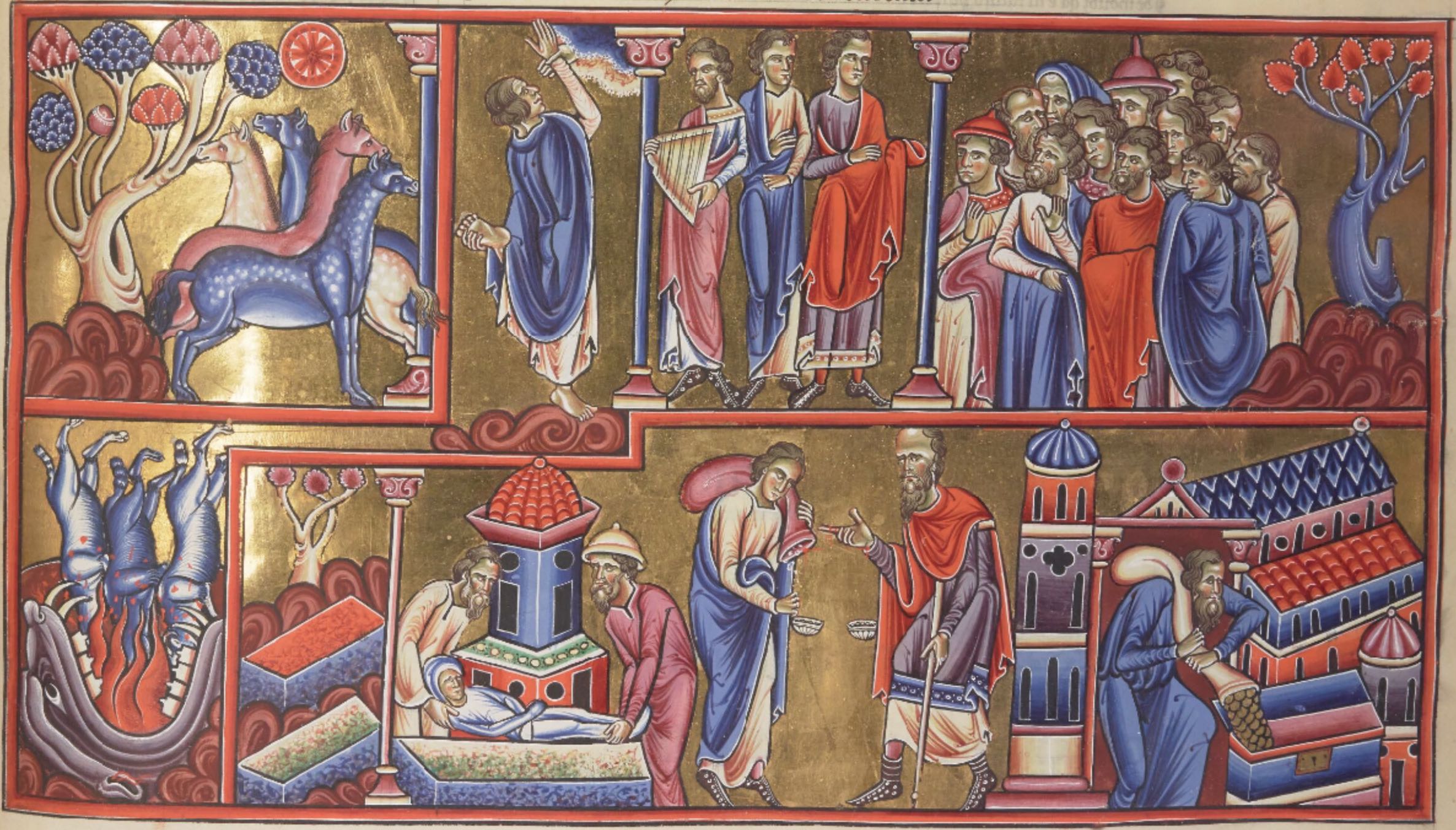
Examples of Mushroom-Related Motifs in the Great Canterbury Psalter
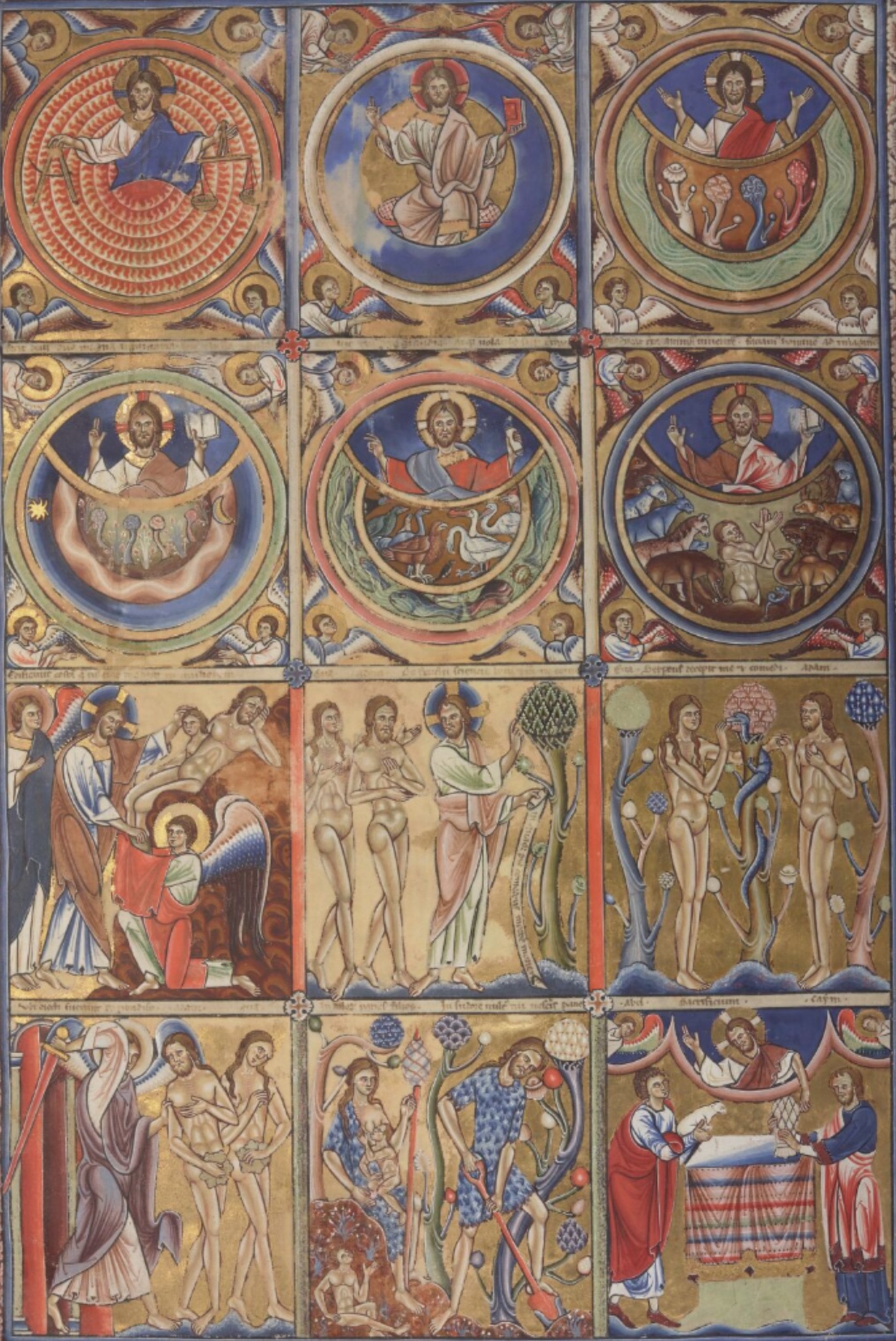
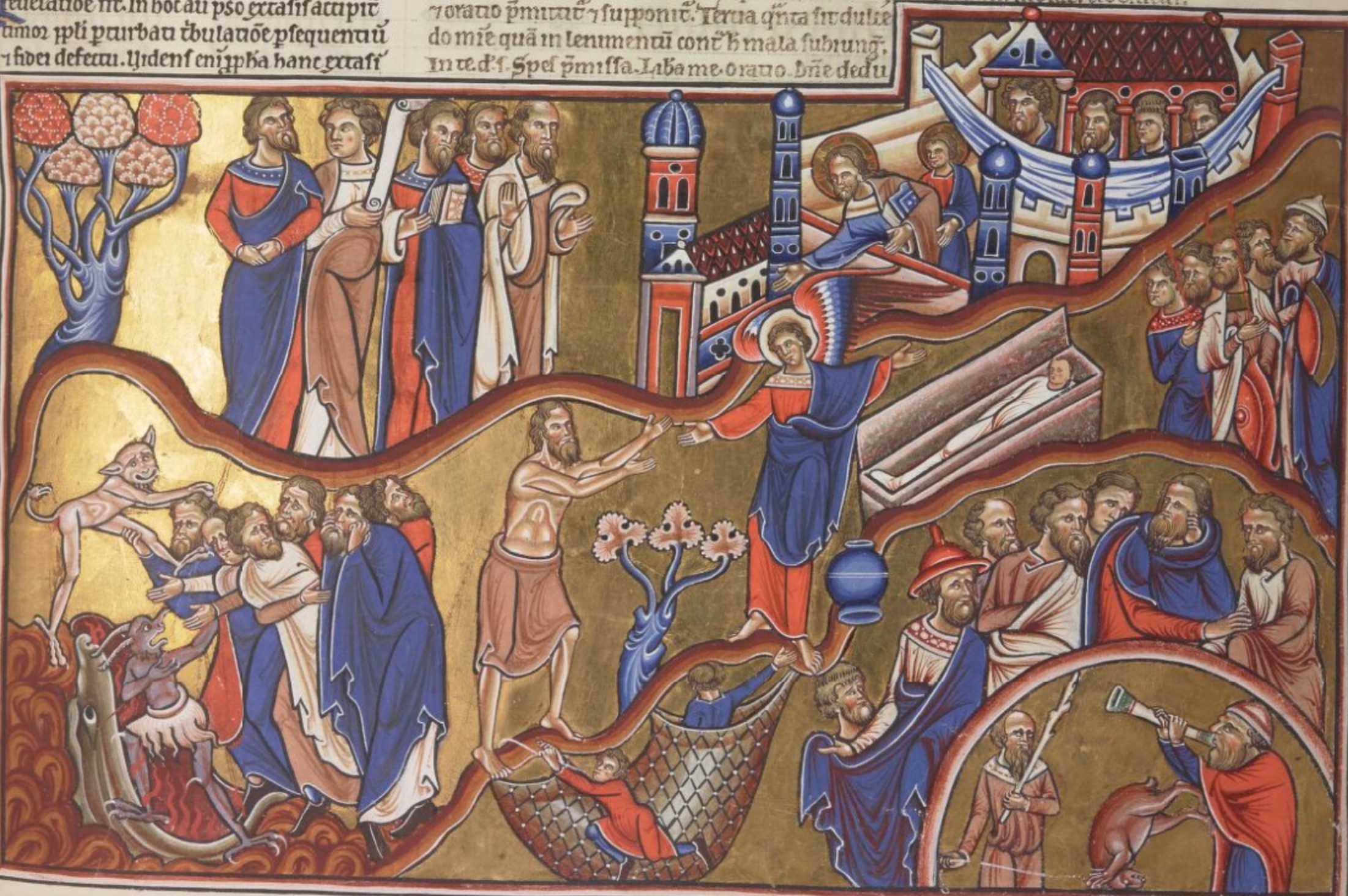
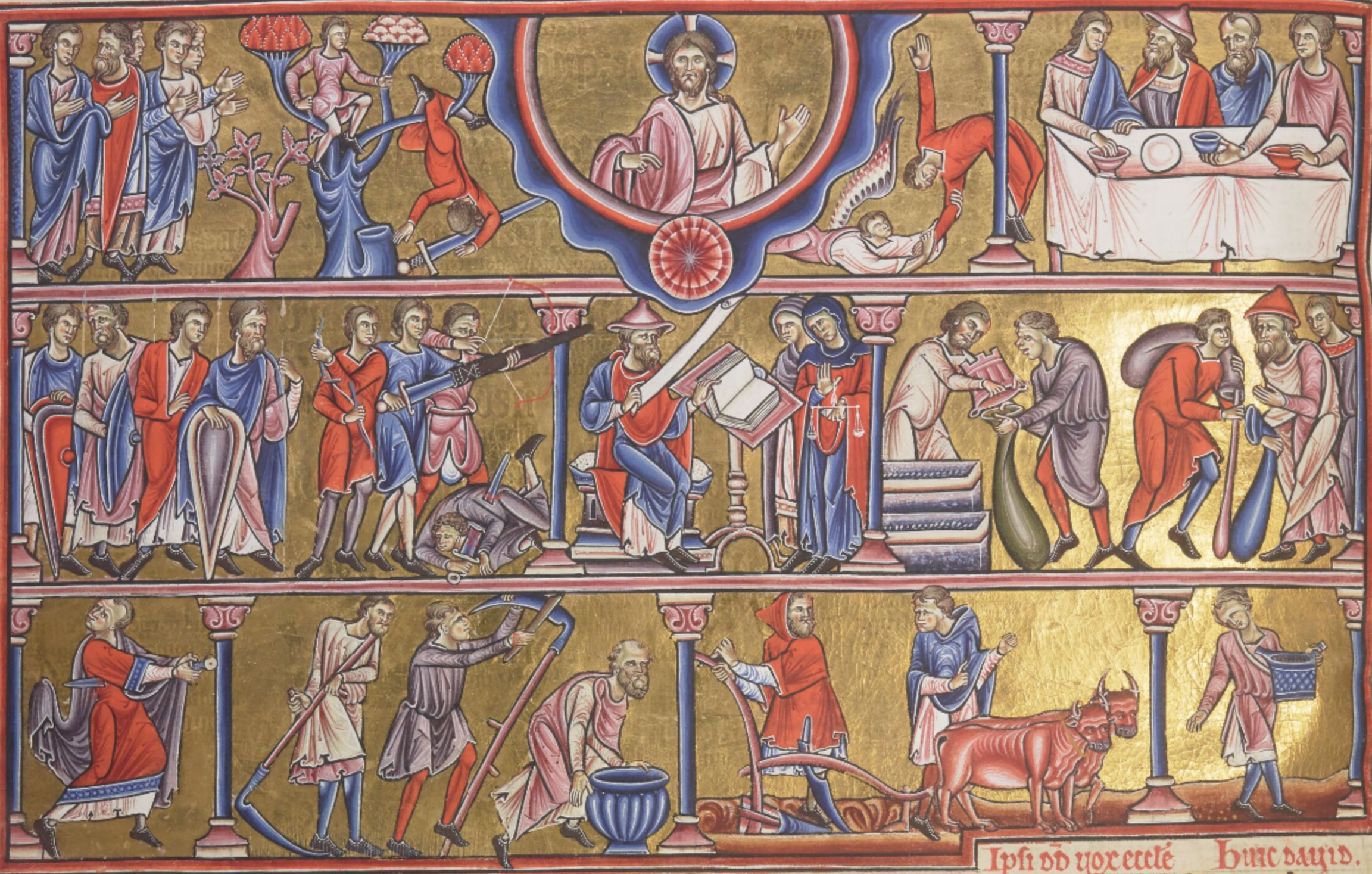
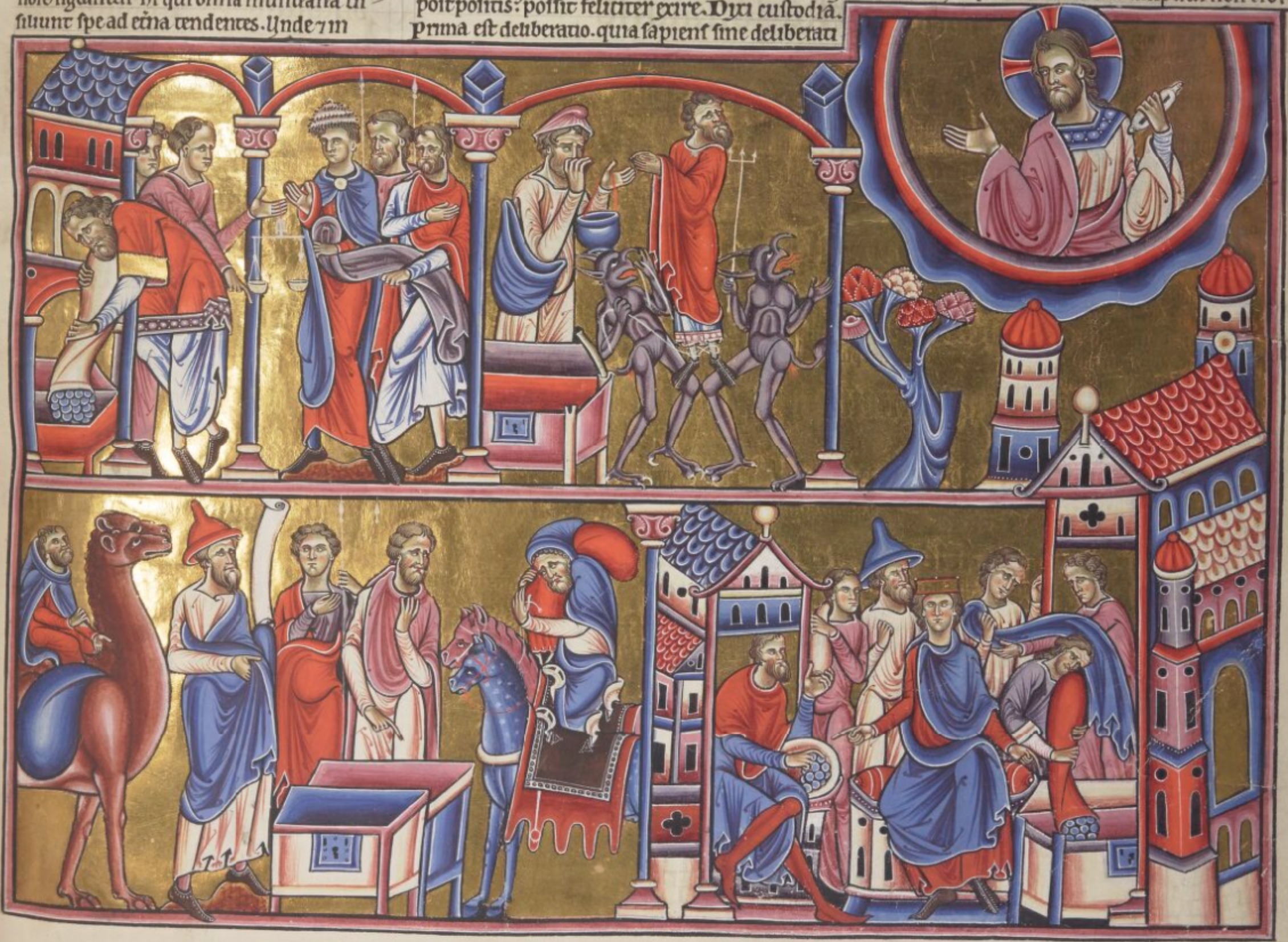
The Great Canterbury Psalter is typical of the medieval art genre of mushroom-trees, integrating mushroom, branching, handedness, and stability motifs, showing that European religious history includes the advanced use of psilocybin mushrooms and the peak psychedelic state.
Mushroom motifs: freely combined elements of Panaeolus, Liberty Cap, Cubensis, and Amanita, along with tree elements; mushroom-tree with left and right limbs or fruit; locking storage bin; bright sun disk of fire and light; mushroom roof topper; mushroom-cap roof; phallic lifted garment; mushroom hem; sack of mushrooms; blue trunk and branch; blue fruit; soil behind hooved animals; two sets of eyes, for the two experiential states, mental models, and vantage points of awareness; open or closed scroll or book.
Branching motifs: branch; cut branch; cut right trunk; cut right branch; visually cut right branch; cut left limb; YI branching form; more branching on left than right; thumb vs. fingers; YI hand shape; plain mushroom cap vs. grid of multiple mushroom-trees within the cap.
Handedness motifs: weight on left vs. right foot, or leg; left foot lifted.
Left limb mapped to branching, possibilism-thinking; literalist ordinary-state possibilism with monolithic, autonomous control; unstable control during psilocybin; blade touching left limb; holding branch in left hand.
Right limb mapped to non-branching, eternalism-thinking; analogical psychedelic eternalism with 2-level, dependent control; stable control during psilocybin; touching cut branch with right limb; right hand lower than left.
Stability motifs: balance scale weighing mushrooms; balancing on right leg, or on toes; stable column base; stable tower; stable building; corpse in rock ossuary; smooth or furrowed brow; vulnerable to lion; battle; averted threat; tormenting demons; angels harassing and threatening death; fire; blade; flaming sword; pass through threatening, guarded gate or entryway; clean washed cloth giving protection.
Gallery
Image crops by Michael Hoffman, from the Great Canterbury Psalter; Canterbury, England, 1200 A.D.; art director Eadwine. Folio 1r; 50r; 62v; 68r; 84r. See also Egodeaththeory.org, Egodeath.com.
See Also
- Outtakes: Recognizing Mushroom Imagery in Medieval Art
- Site Map > Mushrooms in Art (Flagship Articles)
https://egodeaththeory.org/nav/#flagship-Mushrooms-Greek-Christian-Art
todo: add ‘block’, ‘block-universe eternalism’, like 3 slides Pastor S presented related to Alan Moore.


Thank you for this work Michael. Truly amazing how this study shows for us the interconnection of the human experience with the earthly consciousness. YES!!!
LikeLiked by 1 person