Contents:
- Article: Hidden and Rejected Knowledge: Frithjof Schuon, Perennialism and the Philosophia Perennis (Tim Earney)
- My Critique and Review of Earney’s Article
- My Email Questions to Hanegraaff
Article: Hidden and Rejected Knowledge: Frithjof Schuon, Perennialism and the Philosophia Perennis (Tim Earney)
Hidden and Rejected Knowledge: Frithjof Schuon, Perennialism and the Philosophia Perennis
Tim Earney
2014
10K words; ~22 pages
https://www.academia.edu/8518930/Hidden_and_Rejected_Knowledge_Frithjof_Schuon_Perennialism_and_the_Philosophia_Perennis
My Critique and Review of Earney’s Article
Tim Earney’s article is a rejoinder to Hanegraaff’s hobbyhorse, of disparaging and rejecting the study of Perennialism, or at least rejecting Perennialism as an academic method in the study of the history of esotericism. Hanegraaff is forever trying to engineer a distinction between his scientific study of Western Esotericism, vs. those bad, religious-experiencing-based “religionists” such as Eranos and Schuon.
The main error throughout the history of the debate and still ruining this article, is the misrepresentation and false dichotomy, of “Greek rational philosophy/ Reason, sense perception” vs. “Christian spiritual faith, revelation”, both groupings which seem blind to intense mystic-state experiencing, including rationality and model-revision within such experiential state. The article contains the idea of mystic experiencing, but the debates are mainly expressed in off-base terms of “reason vs. faith”, as unhelpfully as possible.
Hanegraaff intensively works to divide the approach to the study of esotericism into two exclusive camps, rejecting, ignoring, and discouraging study of the Eranos-type popular scholars of esotericism.
It is ironic, this article points out: Hanegraaff tries to get academia to re-embrace “rejected knowledge”, and yet, Hanegraaff spills half his ink trying to discredit and reject the “religionist” approach and their writings, as non-scientific, non-academic.
______________
The Egodeath theory is a new, modern, scientific, explicit, fully successful explanatory model of archaic wisdom and the intense mystic altered state, which the ancients had ready access to, on-tap, in mixed wine mushroom wine.
The Egodeath theory is a superior New Theory; a modern, far more effective description and explanation of the same experiential knowledge as greatest antiquity, knowledge which was previously only presented by a relatively ineffective Old Theory.
The intensity of myth indicates that Mystery Religion was experientially effective, but there was no real explanatory framework to solve the mystery of Mystery Religion, until the Egodeath theory around 1988, 2006, and 2013.
1988: My first drafts of the Egodeath Core theory, the Cybernetic Theory of Ego Transcendence. Myth was only present as hooks for future development. Published in 12-point summary form in 1997 as a pair of comments at the Principia Cybernetica website.
2006: My main summary article at the Egodeath site, including religious mythology. Slightly reworded in 2007 to enable reading aloud.
2013: My discovery of the ultra-condensed archaic expression of wisdom:
tree vs. snake = Possibilism vs. Eternalism
______________
There are fallacies and false dichotomies, presuppositions:
“The intense mystic altered state is irrational.”
“Science is opposed to religion.”
“Science cannot study or observe religious experiential phenomena.”
“There’s no reproducibility of religious altered state experiential phenomena.”
“Religious experiencing is private, and in no way publically demonstrable or shareable.”
First I developed the Egodeath Core theory, without any religious mythology, during 1985-1997. Then, distinctly, after that, during 1998-2014 and beyond, I extended the Egodeath theory both to explain religious mythology, and to corroborate the Egodeath theory by the reports within religious mythology.
The two halves of the Egodeath theory (Core vs. Myth) co-support each other, corroborating each other. The fact that myth can be explained by the Egodeath Core theory, is evidence in support of the Egodeath theory. The fact that religious mythology agrees with the Egodeath theory, confirms both myth and the Egodeath theory.
The Egodeath theory does not depend on myth, and did not come from myth, but came from a modern Engineering and Science mindset, the original basis from which the Egodeath theory subsequently went on to explain myth and be justified by myth.
The original motivation and concern of developing the Egodeath theory (1985-1988) was not to explain myth, but to gain coherent personal control over time, drawing selectively from writings about metaphysical enlightenment, as well as Cognitive Science. For example, Alan Watts: The Way of Zen; Ken Wilber’s early books; and Marvin Minsky: The Society of Mind.
I drew from such material about metaphysical enlightenment when initially forming the Egodeath theory (October 1985-December 1987), but with an attitude of modern disdain about the efficacy and precision of expression in the extant books and articles. These were the Old Theory to be superseded and retired as a failed theory, or rather a jumbled less-than-theory, that failed to provide the expected understanding of coherent personal control across time.
In April 1987, I wiped the notebooks clean and created a fresh start, back to basics, and created a distinctive recognizable new basis with concepts (and “trademark” acronyms) such as Loose Cognitive Association Matrixes.
The Egodeath theory is a modern, scientific, explicit, systematic, summarizable explanatory theory. For example:
tree vs. snake = Possibilism vs. Eternalism
Religious mythology describes psychedelics causing loose cognitive association, transforming the experiential mental model from the branching, autonomous to the non-branching, dependent model of time and control.
_______________
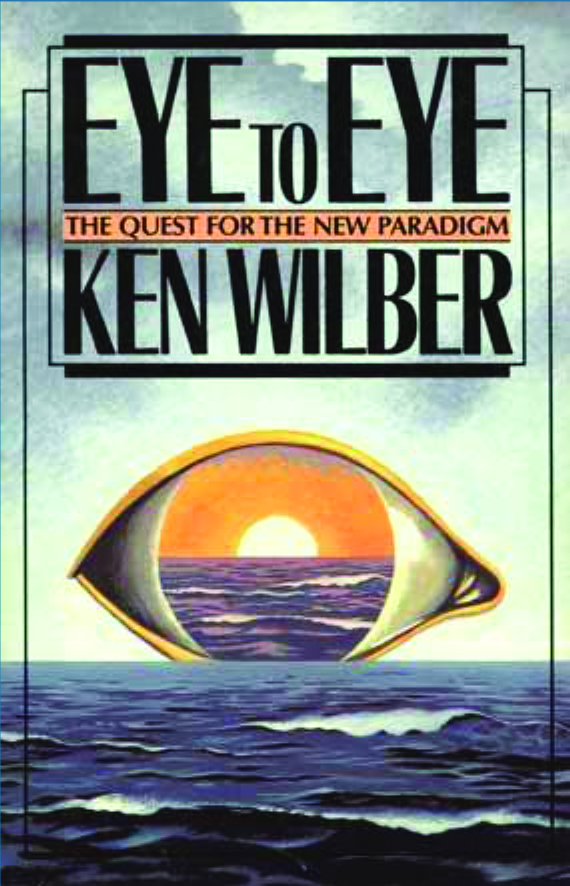
Ken Wilber’s first two essays in the book Eye to Eye (1983) disprove the false dichotomy, the incorrect notion that “observation” only applies to material science. I read this book around 1988. In the 2001 3rd Edition Preface, Wilber writes (condensed), in two fully quotable paragraphs:
“The first essay, “Eye to Eye” is still one of my favorite essays; the points it makes are more crucial than ever, since the orthodox mind, still embedded in scientific materialism, is deft to higher or deeper truths.”
“The essay “The Problem of Proof” presents a full-spectrum empiricism: sensory, mental, and spiritual experience, all of which are equally experiential and can be validated, with evidence that is open to confirmation or rejection by the community.”
Eye to Eye: The Quest for the New Paradigm
Ken Wilber
3rd Ed. (with new Preface)
https://amzn.com/157062741X
My Email Questions to Hanegraaff
From my email to Hanegraaff:
Clarifying what Religionism is, given that you want to make Religion (including scholarly research of the history of Esotericism) relevant, appealing, and front and center in the Humanities
I’ve found it difficult to understand what you mean by ‘Religionism’, after reading many pages about it.
My own approach was first not esoteric, but an Engineering, Science, Cognitive Science approach.
Only after I formed my core theory of ego transcendence in the altered state, did I investigate Esotericism and religious mythology.
I know a lot now about ego death and Esotericism, yet, I’m not entirely sure of your distinction between a good scientific empirical approach to studying the history of Esotericism, vs. a Religionist approach.
Are you forbidding students and other scholars of the history of Esotericism from having religious experiencing, or being fully interested in first-hand, intense, transformative, esoteric religious experiencing?
That doesn’t sound like a way to appeal to students, at all, which you are trying to do, to frame Religion as the centrally important topic in the Humanities.
How can an Empiricist (rather than Religionist) approach to Esotericism historical scholarship, possibly help and contribute to, the personal, first-hand, esoteric, higher-than-exoteric, intense religious experiencing of students?
Youths and maidens desire and are innately drawn to intense Mystery Religion initiation; the classic, full-on, self-transcendence experience.
It sounds like that desire, that draw, is thwarted, if Religionism is to be avoided like the plague, when doing historical scholarship, using the scientific, objective, Empirical approach.
How can a student be motivated to study Esotericism, how can that be at all appealing, if the rule is, all Religionism must be totally avoided?
It sounds like a contradiction.
You are trying hard to promote Esotericism study, and yet you seem to assert that Religionism (whatever that means), must not be allowed or permitted, as a factor that motivates and spurs-on students in their eagerness (as you want them to have) to do research and scholarship in the history of Esotericism.
You are trying to advocate Western Esotericism and Religion studies as the most important and central topic of all, yet I don’t think you have written a simple, clear explanation of the difference between the Empirical vs. Religionist approaches, that is appealing, for a popular audience.
I’d expect a popular audience to reject a boring, sterile, reductionist, too-straight-laced, experience-forbidding approach, called “the Empiricist approach to the study of Esotericism & Religion.”
It sounds dull and inhumanly narrow; reductionist — it appears that all the excitement and motivating appeal is in the forbidden approach, Religionism.
I’d expect students to be much more attracted to what you disparage and reject, and demonize, as “the Religionist method” (read: the cool, fun, interesting, forbidden approach — don’t let Professor Hanegraaff catch you; you could get kicked out of the programme! Be sure to keep it on the down-low — Professor No-Fun is strictly anti-initiation!
The subject of Empirical vs. Religionist method in scholarship of the history of Esotericism is crucial for you, so maybe you’ve written a popular introductory article on it, in the style of the book:
Hermes Explains: Thirty Questions about Western Esotericism
Marco Pasi (Editor), Peter Forshaw (Editor), Wouter Hanegraaff (Editor)
http://amzn.com/9463720200
July 2, 2019
One article of yours that I read recently, seemed like it had an incidental definition of ‘religionism’ that finally clarified what you mean. I think your idea is probably simple enough, but is expressed unclearly.
(I’m trying to recall which article, has a surprisingly clear, succinct summary of Empirical vs. Religionist methods, though that wasn’t a focus of the article.)
Maybe I’ll check:
“For an early programmatic statement on empirical versus religionist and reductionist method in relation to esotericism, see Wouter J. Hanegraaff, “Empirical Method in the Study of Esotericism,” Method & Theory in the Study of Religion 7, no. 2 (1995): 99–129.

 The Egodeath theory