Michael Hoffman, November 5, 2020
Contents:
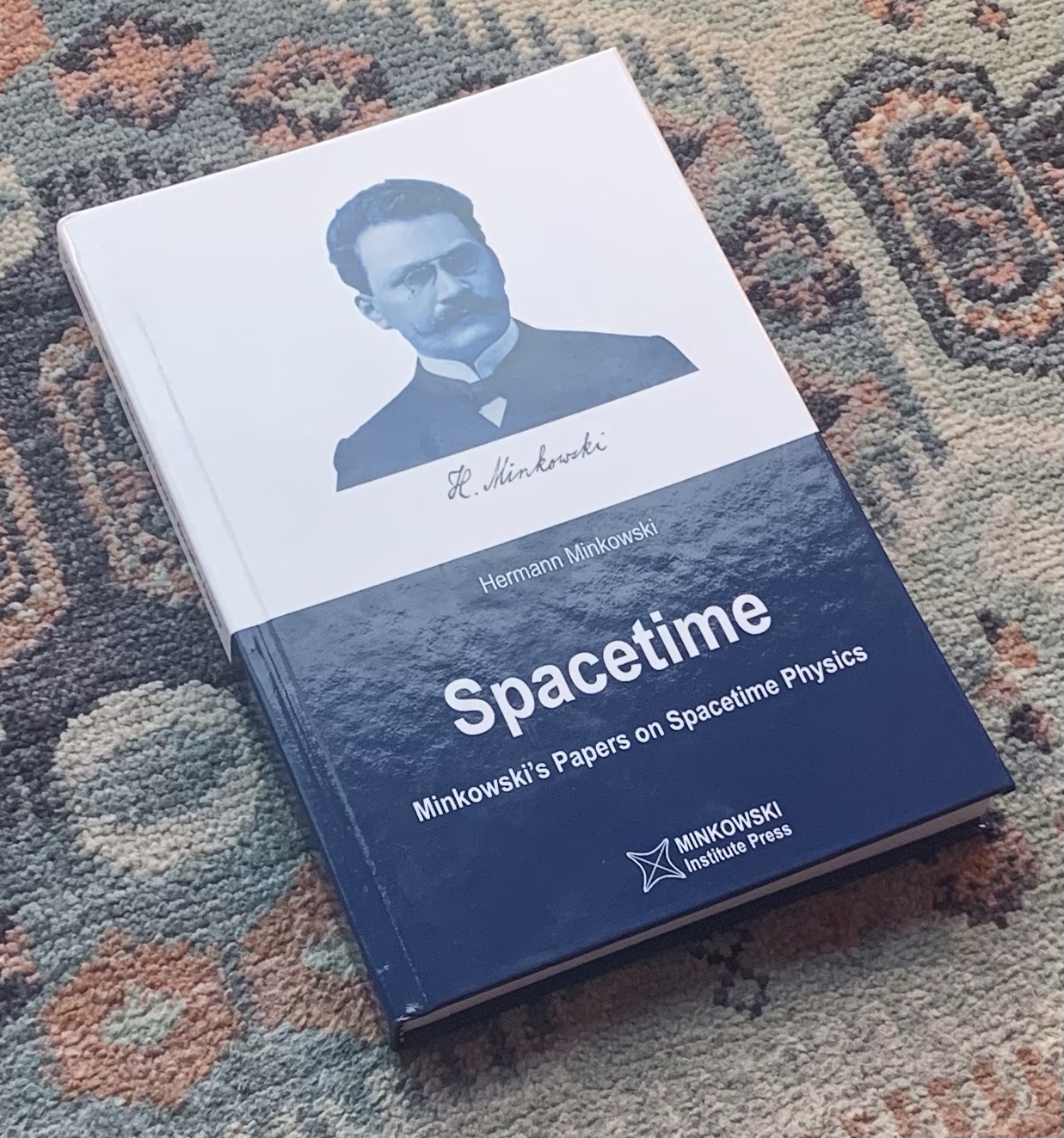
- Spacetime: Minkowski’s Papers on Spacetime Physics (Petkov, 2021)
- Block Universe Began September 21, 1908: Space and Time
- The Block Universe and Worldlines in Terms of the Egodeath Theory
- Petkov’s Book Gathering Minkowski’s Papers
- Improvements in the Book Title
- About Vesselin Petkov
- Search Web: Petkov
- Petkov Website
- The Egodeath Theory Is the Brand of Transcendent Knowledge That’s Associated with Minkowski
- Book Review by Michael Hoffman
- Title of Theory with Euphemism: The Egodeath Theory of Altered-State Eternalism & Mytheme Analogy
- Quantum Mechanics: Historical Contingency and the Copenhagen Hegemony (Cushing, 1994)
- Philosophical Concepts in Physics: The Historical Relation between Philosophy and Scientific Theories (Cushing, 1998)
- Email to Petkov Mar. 10, 2026
- Standard Error in Philosophy of Time
- See also [in email]
- Copy of book review posted a few minutes ago [in email]
- See Also
Spacetime: Minkowski’s Papers on Spacetime Physics (Petkov, 2021)
Spacetime: Minkowski’s Papers on Spacetime Physics
Vesselin Petkov, 2021
https://www.amazon.com/Spacetime-Minkowskis-Papers-Physics/dp/1989970435/ —
Hardcover – November 3, 2021
by Hermann Minkowski (Author), Vesselin Petkov (Editor)
Blurb:
“Not only the general public, but even students of physics appear to believe that the physics concept of spacetime was introduced by Einstein.
“This is both unfortunate and unfair.
“It was Hermann Minkowski (Einstein’s mathematics professor) who announced the new four-dimensional (spacetime) view of the world in 1908, which he deduced from experimental physics by decoding the profound message hidden in the failed experiments designed to discover absolute motion.
“Minkowski realized that the images coming from our senses, which seem to represent an evolving three-dimensional world, are only glimpses of a higher four-dimensional reality that is not divided into past, present, and future since space and all moments of time form an inseparable entity (spacetime).
“Einstein’s initial reaction to Minkowski’s view of spacetime and the associated with it four-dimensional physics (also introduced by Minkowski) was not quite favorable: “Since the mathematicians have invaded the relativity theory, I do not understand it myself any more.“
“However, later Einstein adopted not only Minkowski’s spacetime physics (which was crucial for Einstein’s revolutionary theory of gravity as curvature of spacetime), but also Minkowski’s world view as evident from Einstein’s letter of condolences to the widow of his longtime friend Besso:
“Now Besso has departed from this strange world a little ahead of me.
“That means nothing. People like us, who believe in physics, know that the distinction between past, present and future is only a stubbornly persistent illusion.”
/ end letter re: Besso
Besso left this world on 15 March 1955; Einstein followed him on 18 April 1955.
“This volume contains Hermann Minkowski’s four works, which laid the foundations of spacetime physics.
“In some sense it can be regarded as a second expanded edition of the first book published by the Minkowski Institute Press – H. Minkowski, Space and Time: Minkowski’s papers on relativity (Minkowski Institute Press, Montreal 2012) – which included Minkowski’s three papers published by him.
“Now, in addition to those papers, this volume also contains Minkowski’s fourth paper assembled and published by Minkowski’s student Max Born in 1910 “A Derivation of the Fundamental Equations for the Electromagnetic Processes in Moving Bodies from the Standpoint of the Theory of Electrons”.”
/ end of blurb
Block Universe Began September 21, 1908: Space and Time
Hermann Minkowski formally defined the block universe, as a mathematical framework and computational mechanism, on September 21, 1908, in his article Space and Time, which he presented in a lecture that day.
The Block Universe and Worldlines in Terms of the Egodeath Theory
The 4D-spacetime block universe is rock-like, containing frozen embedded worm- or snake-shaped worldlines. The block universe contains all time and change, so the block universe is frozen and does not itself change.
A worldline is your linear stream of subjective mental content, including your personal control-thoughts, spread across time from the past into a single, pre-existing future.
The future is single, pre-existing, and non-branching, even though in the ordinary state of consciousness, it feels like we are steering through a tree of branching possibilities.
Your pre-existing, non-changing worldline is like a dark vein that runs through a white marble slab. The vein in the marble slab may “change” in a certain sense — it might “become” wider at one spot than another — yet the vein overall doesn’t change.
Per the Egodeath theory, in the mystic altered state from visionary plants, the mind has the capacity to experience the frozen block universe, along with experiencing a kind of non-control. There’s always control, but the mind experiences control differently, in the mystic altered state.
Religious mythology describes, using analogy, ingesting visionary plants and then experiencing the block universe and non-control.
Experiencing the block universe and the accompanying type of non-control causes transformation of the mental model of time and control, described by key analogies such as {wine, king, tree, death, snake, dragon, treasure, rock, sacrifice, and rebirth}.
Key mythological analogies that describe the block universe experience and concept are: {snake} = worldline, and {rock} = block universe, as contrasted with the ordinary-state experience of being like a {king} {steering} in a {tree}.
Petkov’s Book Gathering Minkowski’s Papers
Space and Time: Minkowski’s Papers on Relativity (2012), Vesselin Petkov (Ed.)
Use “Look inside” and read the first section of the Introduction: “The not-fully-appreciated Minkowski”. The main reason for publishing this book is “to correct an injustice”: to rightly reduce credit to Einstein and increase credit to Minkowski.
Spacetime: Minkowski’s Papers on Spacetime Physics (March 2020 2nd Ed.)
Has “Look inside” with Kindle (ebook) layout. This edition places the Space and Time article first, to highlight it, before Minkowski’s earlier Relativity and Moving Bodies papers. This edition adds a 4th, posthumous, Derivation article.
Improvements in the Book Title
o The 1st Ed. used the term “Relativity”, but for Minkowski’s block universe concept, the more relevant term is “Spacetime Physics”. Counter-argument: Minkowski’s first article is Relativity.
o The 1st Ed. used the phrase “Space and Time”, as separate words, but the whole idea of Minkowski was to conjoin space and time as four calculation-equivalent dimensions, so Petkov changed it to “Spacetime”. Counter-argument: the title of the lecture and paper is Space and Time.
Both of these changes to the title may be motivated by striving to correct the balancing of credit attribution, by reducing the focus on Einstein and increasing the focus on Minkowski’s contributions.
About Vesselin Petkov
https://www.amazon.com/stores/author/B001JOTN4A/about —
About the author
“Vesselin Petkov with his wife Svetla Petkova during the excursion to Cape Kaliakra with colleagues after the Third Minkowski Meeting in the famous Black Sea resort Albena (near Varna), Bulgaria (11-14 September 2023).
“He received a graduate degree in physics from Sofia University, a doctorate in philosophy (on Minkowski spacetime) from the Institute for Philosophical Research of the Bulgarian Academy of Sciences, and a doctorate in theoretical physics from Concordia University in Montreal.
“He taught at Sofia University and Concordia University, and held a research position at the Physics Department of the Johannes Kepler University of Linz, Austria, before settling in Montreal in 1990.
“He is one of the founding members of the Minkowski Institute, whose most distinct feature is the employment and development of a research strategy based on the successful methods behind the greatest discoveries in physics. In this sense, the Minkowski Institute is without a counterpart in the world.”
Search Web: Petkov
Web search: Vesselin Petkov:
https://www.google.com/search?q=%22Vesselin+Petkov%22
Petkov Website
Vesslin Petkov
Institute for Foundational Studies
“Hermann Minkowski”
(Minkowski Institute)
Montreal, Quebec, Canada
https://minkowskiinstitute.com
mail
vpetkov — minkowskiinstitute.com
vpetkov — vesselinpetkov.com
The Egodeath Theory Is the Brand of Transcendent Knowledge That’s Associated with Minkowski
The Egodeath Theory (the Theory of Psychedelic Eternalism) is the Official Brand of Transcendent Knowledge (Block-Universe Mysticism) Associated with Minkowski Absolute Four-Dimensional Spacetime
Book Review by Michael Hoffman
got posted for Paperback not Hardcover; doesn’t say “confirmed purchase” – might re-post review from hardcover page
5 of 5 stars
by Michael Hoffman
Title of review:
4D spacetime block-universe eternalism, inspired the Egodeath theory
Reviewed March 10, 2026
https://www.amazon.com/gp/customer-reviews/R170UR2NOF8R1N/ —
Spacetime: Minkowski’s Papers on Spacetime Physics, edited by Vesselin Petkov, 2021, has a great Preface & Introduction chapter by Petkov, worth the hardcover price. Even if you delay engaging the details of the 4 papers, it takes some time to read the Preface and Intro chapters, and they are worth getting the book for.
I probably should’ve immediately gotten the original, 2012 edition instead of waiting, but anyway, I’m glad I ended up with the expanded, 2nd edition, which changes the title from “Relativity” to “Spacetime”. The title of the 1st edition was “Space and Time: Minkowski’s Papers on Relativity”. I shouldn’t have waited so long to get this book. It’s a great, interesting book, more than meeting my hopes.
Amazingly, these 3 (and now 4) papers were not available in English, or in German, or the translations lacked the important statements from Minkowski about Einstein.
Minkowski had a more profound, “mind blown” comprehension of the ramifications of absolute four-dimensional spacetime (block-universe eternalism) than Einstein. This is emancipating for me now at the end of my theory’s development, as it was in Jan. 1988, at my beginning. We do not need to be limited to Einstein’s view of “Relativity”, but we can broaden out to the more profound, Minkowski view of “absolute four-dimensional spacetime” (block-universe eternalism).
I studied the topics of the four math papers, in a university Modern Physics course, in 1988 when I discovered 4D spacetime block-universe mysticism. In January 1988, Minkowski (not Einstein), inspired my theory, the Cybernetic Theory of Ego Transcendence, now named in 2026 the Egodeath Theory of Altered-State Eternalism & Mytheme Analogy.
I noticed that in Physics, there’s been a consistent skew of emphasis away from Minkowski’s block-universe eternalism, toward Bohr, Everett manyworlds branching, and the most woo interpretations of Quantum Physics. My rejoinder to Quantum Mysticism is, instead, the road not taken: Block-Universe Mysticism, which per Petkov I should probably specify as Minkowski Block-Universe Mysticism.
In the university course in Modern Physics, first we studied Minkowski’s block-universe eternalism, absolute four-dimensional spacetime. That was inspiring. Then we studied Einstein’s relativity. That was ok. Then we studied Quantum Physics: I hated the values driving which of the interpretations we used; “the particle has no position until the observer measures it” – an unnecessary, radical notion, per James T. Cushing’s books, such as Quantum Mechanics: Historical Contingency and the Copenhagen Hegemony.
I felt something was “off” about Einstein’s presentation of “Relativity”. I would probably relate more to Minkowski’s view and approach, “absolute four-dimensional spacetime”, which comes closer to considering a certain nullity of personal control that’s implied by block-universe eternalism. Petkov confirms that Minkowski had a more profound understanding of absolute four-dimensional spacetime (block-universe eternalism) than Einstein.
— Michael Hoffman, the Egodeath Theory of Altered-State Eternalism & Mytheme Analogy, based on Minkowski’s 4D spacetime block universe
Title of Theory with Euphemism: The Egodeath Theory of Altered-State Eternalism & Mytheme Analogy
- the Egodeath Theory of Psychedelic Eternalism & Mytheme Analogy
- the Egodeath Theory of Altered-State Eternalism & Mytheme Analogy
- the Egodeath theory of altered-state eternalism
Motivation for euphemism: I want to post my latest theory-name in my Amazon review, but don’t really want “psychedelic” within a Physics book review.
todo: add to recent “titles of theory” page.
For parallelism in the the Egodeath theory lexicon, recently I sometimes used the term “altered-state” (vs. ordinary-state) instead of the term “psychedelic” – not to avoid ‘psychedelic’, but to parallel “ordinary-state”, and to put emph not on particulars of the psychedelic state in particular, but rather, when I want the point to be:
- In the ordinary state, the experiential mode is possibilism.
- In the altered state, the experiential mode is eternalism.
Were I to say instead:
- In the psychedelic state, the experiential mode is eternalism.
That makes a different set of points, distracting from the above, general point.
Quantum Mechanics: Historical Contingency and the Copenhagen Hegemony (Cushing, 1994)
Quantum Mechanics: Historical Contingency and the Copenhagen Hegemony
James T. Cushing, 1994
Science and Its Conceptual Foundations (40 books in series)
https://www.amazon.com/Quantum-Mechanics-Historical-Contingency-Foundations/dp/0226132048/ —
Blurb:
“Why does one theory “succeed” while another, possibly clearer interpretation, fails?
“By exploring two observationally equivalent yet conceptually incompatible views of quantum mechanics, James T. Cushing shows how historical contingency can be crucial to determining a theory’s construction and its position among competing views.
“Since the late 1920s, the theory formulated by Niels Bohr and his colleagues at Copenhagen has been the dominant interpretation of quantum mechanics.
“Yet an alternative interpretation, rooted in the work of Louis de Broglie in the early 1920s and reformulated and extended by David Bohm in the 1950s, equally well explains the observational data.
“Through a detailed historical and sociological study of the physicists who developed different theories of quantum mechanics, the debates within and between opposing camps, and the receptions given to each theory, Cushing shows that despite the preeminence of the Copenhagen view, the Bohm interpretation cannot be ignored.
“Cushing contends that the Copenhagen interpretation became widely accepted not because it is a better explanation of subatomic phenomena than is Bohm’s, but because it happened to appear first.
“Focusing on the philosophical, social, and cultural forces that shaped one of the most important developments in modern physics, this provocative book examines the role that timing can play in the establishment of theory and explanation.”
Philosophical Concepts in Physics: The Historical Relation between Philosophy and Scientific Theories (Cushing, 1998)
Philosophical Concepts in Physics: The Historical Relation between Philosophy and Scientific Theories
James T. Cushing, 1998
https://www.amazon.com/Philosophical-Concepts-Physics-Historical-Philosophy/dp/052157823X/ —
Blurb:
“This book examines a selection of philosophical issues in the context of specific episodes in the development of physical theories and presents scientific advances within their historical and philosophical contexts.
“Philosophical considerations have played an essential and ineliminable role in the actual practice of science.
“The book begins with some necessary introduction to the history of ancient and early modern science, but emphasizes the two great watersheds of twentieth-century physics: relativity and quantum mechanics.
“At times the term “construction” may seem more appropriate than “discovery” for the way theories have developed and, especially in later chapters, the discussion focuses on the influence of historical, philosophical and even social factors on the form and content of scientific theories.”
Email to Petkov Mar. 10, 2026
Hi Vesselin Petkov,
Am I the first and only theory of mystical experience that’s based on Minkowski’s absolute four-dimensional spacetime / block-universe eternalism? In Jan. 1988
The original, 1988 name of my theory: The Cybernetic Theory of Ego Transcendence – vs. the Popular Neo-Advaita theory per Ken Wilber, the Journal of Transpersonal Psychology, etc.
Block-Universe Mysticism (per James & Minkowski) is vs. the overly popular, Quantum Mysticism https://en.wikipedia.org/wiki/Quantum_mysticism which I associate with branching (bad) rather than Minkowski non-branching (good).
The Egodeath Theory of Psychedelic Eternalism & Mytheme Analogy is the official brand of Transcendent Knowledge that’s based on Minkowski. In 1200, everyone so loved Minkowski’s spacetime, they used the shape of the hand to contrast two models of time, possibility, and control:
Possibilism vs. Eternalism =
- Y vs. I
- {branching} vs. {non-branching}
- {tree} vs. {snake}
- fingers vs. thumb, index, or pinkie
- many worlds vs. single block-universe
Standard Error in Philosophy of Time
They wrongly contrast:
Presentism vs. Eternalism;
they should instead, per timeless tradition, contrast
Possibilism vs. Eternalism.
Stanford Ency. Phil. comes THIS CLOSE to drawing a tree vs. a snake in their 3 diagrams.
I have my 1988 textbook for Modern Physics, at University.
I could double-check, but as I experienced, Minkowski was credited fully and accurately, not misrepresented in the course.
There was no doubt that we were studying the Minkowski math framework – not some “Einstein framework”.
See also [in email]
Site Map > Block Universe Eternalism
https://egodeaththeory.org/nav/#The-Block-Universe —
- Announcement: The “Timeless Block Universe” Theory, with Frozen, Pre-Existing Worldlines of Control-Thoughts
- Possibilism vs. Eternalism: Two Models of Time and Control
- Minkowski’s Block Universe: Spacetime: Minkowski’s Papers on Spacetime Physics (Petkov, 2021)
- Announcement: The No-Free-Will Theory of Puppethood Revealed by Psychedelics
- The “All At Once” Universe Shatters Our View of Time (Emily Adlam) – 2025/04/12
- Psychedelic 4D-Spacetime Block-Universe Mysticism – 2025/04/11
- The Dilemma of Determinism (James, 1897) Is Against Eternalism, Not Causal-Chain Determinism – 2025/04/10
Copy of book review posted a few minutes ago [in email]
I finally posted a book review at Amazon! Will appear in a couple days.
Spacetime: Minkowski’s Papers on Spacetime Physics
Vesselin Petkov, 2021
https://www.amazon.com/Spacetime-Minkowskis-Papers-Physics/dp/1989970435/
See section in present page: Book Review by Michael Hoffman
…
— Michael Hoffman, the Egodeath Theory of Altered-State Eternalism & Mytheme Analogy, based on Minkowski’s 4D spacetime block universe
See Also
“Perception of Eternalism” Page at Effect Index (Josie Kins)
https://egodeaththeory.org/2026/01/25/perception-of-eternalism-page-at-effect-index-josie-kins/
History of Developing the Egodeath Theory / Dates of Incorporating the Block Universe into the Egodeath Core Theory
https://egodeaththeory.wordpress.com/2020/11/12/history-of-developing-the-egodeath-theory/
Possibilism vs. Eternalism: Two Models of Time and Control
https://egodeaththeory.wordpress.com/2020/11/12/possibilism-vs-eternalism-2-models-of-time-and-control/
Diagrams.

 The Egodeath theory