Contents:
- Luther Protested Against For-profit Suppression of Mushrooms (= Entire “Analogical Psychedelic Eternalism” view/ framework/ paradigm/ revealed worldmodel) and Substituting for It Bunk, Literalist, Mushroom-Suppressing, “Literalist Ordinary-state Possibilism” – Luther Was Not Just Arguing About Mushrooms (or Freewill btw)
Luther’s “Greeks”/Gnostic/Esoteric Camp Protested for the Entire View/ Worldmodel {Mushrooms/Analogical Psychedelic Eternalism}, against the Entire View/ Worldmodel {Mushroom-Suppression/ Literalist Ordinary-state Possibilism}
- Blowing the Lid off the Huge Cover-up of the “Mushroom Mystic-State Analogies” Nature of Christianity:
“Gnostic” or”Esoteric Christianity” Means Mushroom Christianity
- Books About Mushroom Christians (“Gnostic/Esoteric” Christians)
- The Johannine Gospel in Gnostic Exegesis (1973)
- The Gnostic Paul: Gnostic Exegesis of the Pauline Letters (1975)
- The Gnostic Gospels (1979)
My set of views matches the mushroom Christians in the 3 books above. - The Age of Entheogens [, The Pharmacratic Inquisition, and The Entheogenic Reformation] & the Angels’ Dictionary (1995)
- The Jesus Mysteries: How the Pagan Mysteries of Osiris-Dionysus Were Rewritten as the Gospel of Jesus Christ (1999)
- Jesus from Outer Space: What the Earliest Christians Really Believed about Christ (2020)
- The “Analogical Psychedelic Eternalism” theory of mythemes
A proper descriptive, useful label for the mytheme-decoding component of the Egodeath theory
- Labels for Components of the Egodeath Theory
the Cybernetic Theory of Ego Transcendence
the Analogical Psychedelic Eternalism theory of mytheme-decoding
the maximal mushroom theory of Christianity
the maximal mushroom theory of Christian art
the maximal mushroom theory of Greek and Christian art
the maximal entheogen theory of religion
the “mixed-wine mushroom wine” theory
Helleno-Christianity
- No One at the Bridge – Fresh Explanation of Song Lyrics
These are extremely relevant, highly descriptive poetic lyrics, which describe the peak experiencing of the altered state, by use of analogies. This is the song “No One at the Bridge” by Rush, lyrics by Neil Peart.
- mytheme decoded: {caduceus}
I finally decoded {caduceus}!! Figured out how to think about it, relate it to other mythemes, & explain it.
- How I Decoded the Bestiary Salamander Image
A “math logic proof”-style of walking the reader through the mytheme-decoding process.
- mytheme: {maiden, kore, Kore, Persephone}
I discovered that Persephone’s other name is “The Maiden”!! SCORE
- Thankful for Hatsis & Muraresku
Ways in which Hatsis and Muraresku helpfully contribute to entheogen scholarship.
- Mytheme {lamb} Decoded, Like Harmless {dove, Holy Spirit}
Big unexpected breakthrough! Isaac’s powerful {ram} vs. Jesus as gentle {lamb}, like {dove} vs. {eagle}; completing {dove} decoding too!
- The Story of My Moment of Conversion, Rescue, & Purification from Sin
The story of my moment of mystic-state conversion/ salvation/ regeneration/ redemption/ purification/ completion/ sacrificial purging of sin; then baptism in the blood of the [gentle, harmless!] lamb afterwards.
- The Requisite Non-violence of Successful Mental Transformation Implies the Ahistoricity of Jesus
The “harmlessness” idea behind the mythemes {lamb} and {dove} implies the ahistoricity of Jesus (in his function as redeemer in the mystic altered state), instead of pointless & ineffectual violence against a bodily historical Jesus.- The Problem of the Pointless, Excess, Physical Bodily Death of Jesus, Leading to Ahistoricity as the Resolution of the Problem: Saved by Receiving the Vision of Christ Crucified in the Heavens
- Helleno-Christianity
Forming a label of my religion, which combines Greek “Paganism” (Mystery Religion & religious mythology decoding) with Christianity (an esoteric version of Barton/Stone Restorationism).
- A Week of Manically Possessed Religious-Mythology Breakthroughs and Accidental Fasting
I was manically possessed and driven by inspiration in the ordinary state, and accidentally fasted for a week during breakthrough decoding of the entire Canterbury “mushroom/ hanging/ sword” image, which extremely confirmed my Analogical Psychedelic Eternalism theory of religious mythology and the maximal mushroom theory of Christian art.
- The Cover-up of Mushrooms in Christianity & Buddhism (together with Analogical Psychedelic Eternalism); the “Mass & Meditation” Substitution Industry
The malformed “secret mushroom cult” notion serves to mask the actual situation, that there’s been a cover-up of normal mushroom use in Christianity. Priests are huckster who suppress mushrooms and sell snake oil [the Meditation industry & the fake-Eucharist Mass industry] for personal profit. Ott’s Entheogenic Reformation.
- Bad Mushroom Scholarship
Several fulmination screeds against the sorry, worst-case state of what passes for mushroom scholarship.- Against Garbage, Politicized Scholarship Polluting the Field and Driving It Backwards
- My Clean Comment About Bad Mushroom Scholarship, Posted on Cyberdisciple’s Article Listing My Recent Articles
Brief summary of Psalter {nonbranching}, then good civilized polished reply re: be nice to “scholars” trampling the field. - Against Minimalist Mushroom Scholars
Written in the middle of 1st pass of reply to comment at Cyberdisciple’s site.
- Clarifying the Explanation of {branching vs. non-branching}, as in the Entire Canterbury “Mushroom/ Hanging/ Sword” Image
Here I work out a good, clear way of explaining {branching vs. non-branching}, as in the entire Canterbury “mushroom/ hanging/ sword” image.
- Chronology Revisionism: All Ancient Christian Texts Were Written in “1500 A.D.” in Competing Monastic Forgery-Mills
Blow open your mind & theory-possibilities with Edwin Johnson’s Chronology Revisionism.
/ end of section “Contents”
Top of this Page = Messy Construction Zone; Realtime Idea Development
Skip around in this page.
Scholars skim & skip massive quantities of material by skipping around and only sometimes reading top-to-bottom.
Non-scholars tend to always read top-to-bottom and not aggressively skim & skip around, and they leave as soon as they hit a bump; a typo, or an unclear point, or an uninteresting point.
THERE’S LOTS OF EXTREMELY INTERESTING SH*IT WAY DOWN BELOW in my pages.
Note re: Messiness at top of this file — maximum slop, by nature, is going to be at top of this file bc I’m showing realtime idea dev’mt; it is the cutting edge leading edge, so IS A CONSTRUCTION ZONE. TOP OF THIS FILE, INCOMING SPECULATION IDEAS, MIGHT ALL BE BULLSH*T
But usually I turn out to be mostly right; able to integrate incoming ideas so as to produce a strong explanatory power theory w/ greater expl’y power.
The material down below the top of this page has had more time to clean up typo’s & formatting & organization.
/ end of section “Top of this Page = Messy Construction Zone; Realtime Idea Development”
_________________________
Entheogen Scholars Are Converging on Perceiving a Medieval “Ye War on Druggs” – What Kind of Cover-up Was It?
Chris Bennett
Aaron Leich
Wouter Hanegraaff expose of psychedelics in New Age, and in Western Esotericism
Michael Hoffman – Clear Evidence of a Conflict Between the Mushroom Mystics and the Catholic Mass Snake-oil Profiteers Luther Railed Against
Incoming Idea Development Here
Email to Chris Bennett
Hi Chris,
I see you have some scholarly debate articles — I haven’t read them yet.
https://www.cannabisculture.com/content/author/chris-bennett/
I’d be pretty interested in how the debate is conducted; debate and evidence-methods. You can see my “Defining “Compelling Evidence” & “Criteria of Proof”” article, below.
My recent articles assert that there was very heavy, hardly hidden, mainstream use of Psilocybe in Greek & Christian religion, and that there’s been a cover-up — there are many Psilocybe in Christian and Greek art (literal depictions, stylized depictions, & depictions of their highest experiential effects).
In the past few days, I’ve begun to suspect there’s always been a major standoff between two parties in Christianity: mushroom vs. inert Eucharist.
None of this “secret cult” notion though, please; scholars need to stop centrally thinking in terms of “secret cult”.
There was a mainstream ongoing battle between two camps (neither one could be rightly characterized as a “secret cult”): normalized mushroom use in Christianity, versus a substitute fake Eucharist that does nothing — to sell people snake oil (the Mass & Meditation scam).
I wrote some new articles, with almost nothing to do with Amanita — though I finally gathered my wits, engaged my facilities, and positively identified Amanita in a “Dionysus Triumph” mosaic. In my “Criteria” article.
I consider Amanita an “Honorary Psilocybe” — it was shown in Christian and Greek art more for its striking form, than for actually ingesting it.
I’m also open to Scopolamine plants in Christianity, eg Lily = Datura, and Mandrake, but again I think they were considered a cheap/widely available fallback for the desirable, classic entheogen, Psilocybe.
I think in art, Amanita really represents the classic, ergonomic mushroom, Psilocybe.
I decoded an image, “bestiary salamander roasting/ branching mushroom tree/ so-called ‘dancing man'” — did you assess that image? Hatsis may have mentioned that Irvin got the “bestiary salamander roasting” image from your book. I cover that image in my “Criteria” article, below.
I was going to notify you of my articles — now I see you’ve been in the critique/debate mode, so you might be even more interested in the scholarly dispute I’ve been engaged in, against those who claim things like “No evidence for mushrooms in Christian art” (or, in Greek art). They claim that, by ignoring 5 out of 6 types of evidence.
Proof that the Canterbury Psalter’s Leg-Hanging Mushroom Tree Is Psilocybe
https://egodeaththeory.wordpress.com/2020/11/19/proof-that-the-canterbury-psalters-leg-hanging-mushroom-tree-is-psilocybe/
Defining “Compelling Evidence” & “Criteria of Proof” for Mushrooms in Christian Art
https://egodeaththeory.wordpress.com/2020/11/13/compelling-evidence-criteria-of-proof-for-greek-bible-mushrooms/
Scholars’ Failure to Debate Mushrooms in Christian Art
https://egodeaththeory.wordpress.com/2020/11/20/scholars-failure-to-debate-mushrooms-in-christian-art/
Psychedelic Mystery Traditions (Hatsis)
https://egodeaththeory.wordpress.com/2020/10/31/psychedelic-mystery-traditions-hatsis/
Hope you enjoy these new articles. There are lots of interesting images you can flip through quickly.
Cheers, and Happy Thanksgiving!
— Michael Hoffman
/ end of section “Email to Chris Bennett”
Expanded Section for Outline of Evidence-Types, in Criteria Article
…
Thus there are six types of evidence which the scholar must take into account:
[text|art] x [literal|stylized|effects] =
1. Literal depictions of mushrooms (in art & in texts)
2. Stylized depictions of mushrooms (in art & in texts)
3. Depictions of mushroom effects (in art & in texts)
If the would-be “scientific, historical scholar”, allegedly using “sound historical criteria”, only considers literal descriptions or depictions of mushrooms, in texts, and fails or refuses to look through the lens of the other five of the six types of potential evidence, they are blinding themselves to five of the six, 5/6 = 83% of the types of potential evidence for mushrooms in Christian materials, and then claiming “there is practically no evidence for psychoactive mushrooms in Christianity.”
Such an out-of-hand dismissal of 5 out of the 6 types of potential evidence for mushrooms in Christian art is not, as falsely claimed, “proper, scientific, historical scholarship” or “sound historical criteria”, but is a travesty of it.
We must consider all six types of evidence, not just one arbitrarily chosen type of evidence.
This article proves that in Christian art, there is ample evidence of mushrooms; evidence of all three types: literal, stylized, and effects.
There is definite evidence even for the ultimate peak effects of mushrooms in Christian art: the experiential mushroom effects, of transforming the mental worldmodel from Possibilism to Eternalism, through suspension and cancellation of the illusion of autonomous personal control power that operates by wielding steering-power within a tree of open, branching possibilities.
The three levels of evidence for mushrooms in Christianity (literal, stylized, & effects), that are potentially found in art and in texts, are described below.
/ end of section “Expanded Section for Outline of Evidence-Types, in Criteria Article”
Per Pagels, Paul/Heracleon/Valentinians held that:
o “Greeks” = Mushroom “Gnostic” Esoteric {Analogical Psychedelic Eternalism}
o “Jews” = Fake-Eucharist “Orthodox” Exoteric {Literalist Ordinary-state Possibilism}
This is the next R&D question.
What the New Testament presents to us as:
Paul railing against the Jews in 30 A.D.
is actually a late, forged proxy for; that’s actually debating about:
Luther’s protest-camp railing against the for-profit institutional Catholic Church in 1525 A.D. with their fake-Eucharist Mass replacing the actual Eucharist, which is mushrooms (and the resulting conversion from Literalist Ordinary-state Possibilism to Analogical Psychedelic Eternalism)
I think it’s re: the epistles of Paul? & Gospel of John? & 4 gospels?
In the “Pauline” epistles, none of which were written by a Mr. Historical Paul:
“Greeks ” means:
Helleno-Christianity mushroom esoteric gnostics;
Analogical Psychedelic Eternalism;
ahistoricity of Jesus
“Jews” means ersatz Eurcharist/Mass,
Literalist Ordinary-state Possibilism,
selling & pushing magical-thinking onto the masses, that somehow by magic, violence & literal sacrifice, on the Cross and every day in the mass the they claim that the crucifixion-literal-violence is done, to clear a little bit of your freewill-premised moral sin, to get to heaven instead of literal hell after you bodily literally die.
- The Johannine Gospel in Gnostic Exegesis (1973)
- The Gnostic Paul: Gnostic Exegesis of the Pauline Letters (1975)
- The Gnostic Gospels (1979)
My complete coherent set of views matches the mushroom Christians/ higher Christians/ gnostics/ esoterics, in the 3 books above.
The very first thing I listed at the top of the comparison table, is “Greeks” vs. “Jews”.
http://www.egodeath.com/pagelsgnosticpaul.htm —
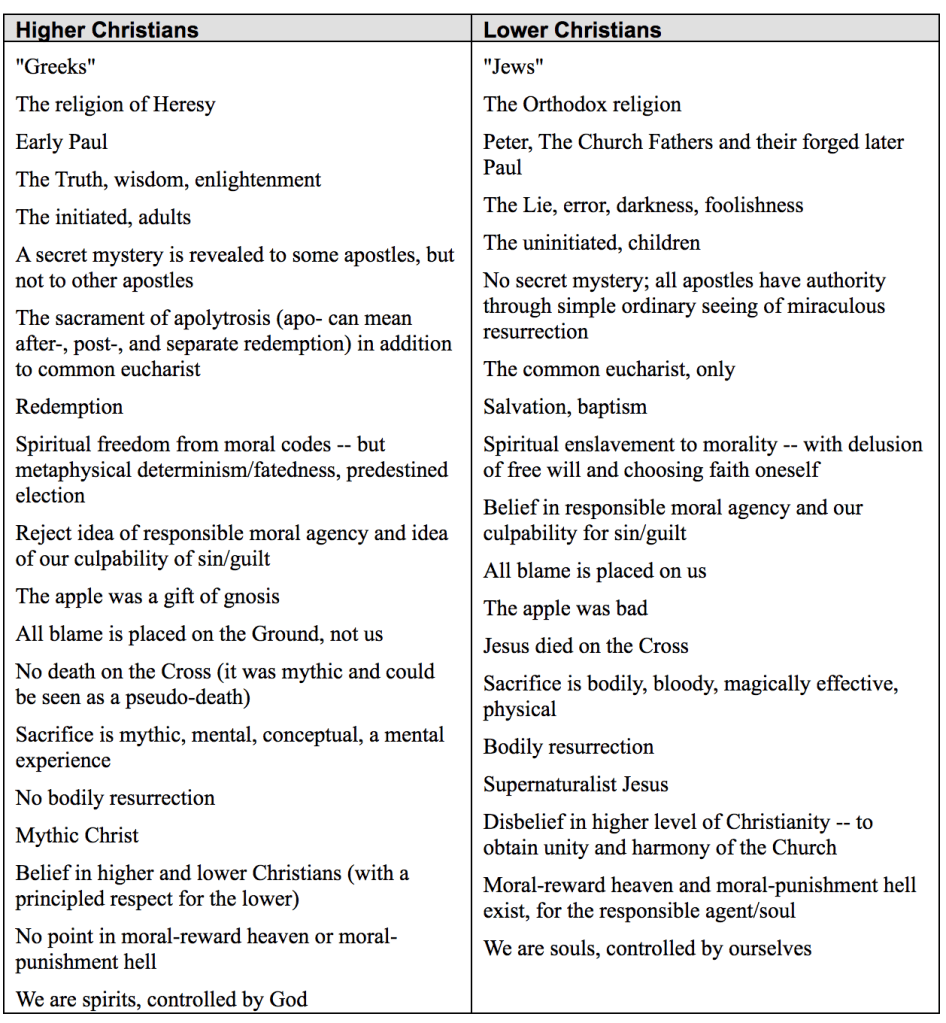
Probably add on the left: early & late-period “Augustine” (Luther’s camp of forgers?)
Probably add on the right: middle-period “Augustine”. (The anti-Luther, pro-Pope camp of forgers?)
The “Church Fathers'” writings are all fake; a late, recent forgery, written in the style of 1525, Edwin Johnson says.
The “late, mid, & early-period” writings by “Augustine” are all fake – two parties making “Augustine” (and “Paul”, etc.) spout 2 opposing views. I guess he probably didn’t even exist; just an empty fictional writer-character.
Unknown by me at the moment:
Does “Augustine” evidence any awareness of the earthly life of Jesus?
Paul has not heard of Mr. Historical Jesus and his earthly storyline.
(Don’t give me that “brother” b.s., insulting my intelligence; obviously we’re all brothers, such FLIMSY arguments!)
Not sure, but I felt like Johnson suspects that the story of Jesus’ earthly life was invented in 1450, and no one before that shows any awareness of such a lifestory of Mr. Historical Jesus; we back-project such assumed familiarity, onto the “ancient” writers (who aren’t actually ancient, but are recent).
Per Edwin Johnson:
YOU MUST INTERROGATE THESE PURPORTEDLY “ANCIENT WRITERS” AND DEMAND OF THEM:
HAVE YOU HEARD OF THE EARTHLY STORYLINE OF MR. HISTORICAL JESUS?
HAVE YOU A COPY OF THE GOSPELS/ STORIES?
OR, IS SUCH AWARENESS STRANGELY ABSENT FROM YOUR WRITINGS, WHICH ARE ALL THEOLOGICAL AIRY-FAIRY VISIONS IN THE HEAVENS?
Does Richard Carrier cover this, in his brand new book Jesus from Outer Space? I have Earl Doherty’s 2nd Ed & 1st.
Pages / Resources at Egodeath.com
See also below, my book reviews of Pagels: 1) Johannine Gospel, 2) The Gnostic Paul.
Study Version of Edwin Johnson’s “The Pauline Epistles – Re-Studied and Explained”, 1894 — Reformatted copy for increased comprehensibility by Michael Hoffman Oct. 8, 2003. Proposes that the years 700-1400 didn’t exist, and that Christianity, the “early” Christian texts, Paul, the Gospels, the Church Fathers, the Dark Ages, and the Middle Ages were literary inventions fabricated in competing monasteries around 1500.
Edwin Johnson, A Radical Advocate of Chronology Criticism — Uwe Topper on Edwin Johnson
The webpage has clean formatting of the messy copy/pasted links below:
He passed away, I think — copy his articles/webpages while you can:
Detering, Hermann (1995): The falsified Paulus. The Urchristentum in the twilight (s. l.)
html (German) pdf (German) (English version not found. Possibly similar: http://www.radikalkritik.de/content.htm)
Gabowitsch, Eugen (2001): Did the Mongols come from the west to Russia? (Efodon synesis No. 4/2001, Hohenpeissenberg)
Johnson, Edwin (1887): ANTIQUA MATER, A Study OF Christian Origins (Truebner A. CO, London)
http://www.radikalkritik.de/antiqua_mater.htm
(1894): “The Pauline Epistles” (Watt and CO, London)
http://www.radikalkritik.de/pauline_epistles.htm
/ resources
“Augustine” 1 is made to argue for no-free-will;
“Augustine” 2 is made to argue for freewill
Tall-tale about “the writings of Augustinian” (fake!)
The two camps of battling forgers in the monastery forgery-mills gave us this preposterous situation:
early-period Augustine believed no-free-will
middle-period Augustine believed freewill
late-period Augustine believed no-free-will
(find ‘augustine’ & ‘macarthur’ below)
/ end of section “Per Pagels, Paul/Heracleon/Valentinians held that:
o “Greeks” = Mushroom “Gnostic” Esoteric {Analogical Psychedelic Eternalism}
o “Jews” = Fake-Eucharist “Orthodox” Exoteric {Literalist Ordinary-state Possibilism}”
Real Protestants Hold to Mushroom (Esoteric, Gnostic) Analogical Psychedelic Eternalism
[9:13 a.m. November 27, 2020]
… AND FROM NOW ON , I WILL OPENLY CONDEMN FAKE PROTESTANTISM that pushes this institutional “Catholic Church (TM, (R), (C))” fake Christianity, like most so-called “Protestant” FAKE churches that sell magical thinking in place of mystical ASC actual mental pis spiritual salvation and regeneration.
I like the Valentinians’s “{two races} of Christians” idea of how to combine oil and water in one allied universal church-congregation, or totally equivalently, their “{three races} of Christians” view. “Races” here is an analogy, a mytheme, not literal.
{the mushroom-given, Analogical Psychedelic Eternalism “race“} – including the Heavy Metal poets; Diary of a Madman, Ride the Lightning, Caress of Steel, 2112, Neil Peart — but with their no-free-will/monopossibility revelation “taken to completion” per the Egodeath theory, forming a fully developed “‘complete’ explanatory framework” in a Paul Thagard Conceptual Revolutions book’s sense.
{the “fake Mass & meditation”, Literalist Ordinary-state Possibilism “race“}
Framework : Luther was railing against the institutional Catholic Church’s for-profit suppression of mushrooms (= the *entire* “Analogical Psychedelic Eternalism”, *not* just mushrooms (nor just freewill, btw)) and Luther was condemning the fake churches’ substituting for mushrooms, the fake Eucharist; bunk, Literalist, Mushroom-Suppressing, “Ordinary-state Possibilism” – Luther was *not* just arguing against the evil suppression of mushrooms, as everyone assumes (or the little accompanying topic of freewill, btw).
Luther’s camp was arguing against not only suppression of mushrooms, but the entire accompanying worldmodel that is produced by the lack of mushrooms: Literalist Ordinary-state Possibilism.
Luther’s camp was arguing against the entire framework, Literalist Ordinary-state Possibilism, which is produced by the lack of mushroom.
It is ironic/fitting, that literalist Catholics are always railing against “those evil, Protestant gnostics” — own it. Protestant gnostics = mushroom-revealed Analogical Psychedelic Eternalism, against the lie of Mr. Hiostircal Jesus, against the institutional Catholic lie that the Protestant Joh MacArthur still repeats [todo: link my WordPress MacArthur page of his video sermon], that:
“There is no “Transcendent Knowledge”, no “hidden wisdom”, no “esoteric gnosis”.”
— John MacArthur the Catholic “Protestant”
John MacArthur – Strange Fire, Transcendent Knowledge
https://egodeaththeory.wordpress.com/2020/11/11/john-macarthur-strange-fire-transcendent-knowledge/
Luther’s camp, aka the “gnostics”, aka the “esoteric Christians”, wanted Christianity to be centered around the entire set, of mushrooms along with the resulting thing they produce, which is Analogical Psychedelic Eternalism.
Note re: Historical records/trace of my idea development sequence:
I’m going to flip the emphasis — this section began as sketchy, uncertain, poorly founded idea of “Chronology Revisionism” and inside it, the idea developed and came out of it, the more solidly based, strong, good idea, to expand the good idea:
“priests suppressed mushrooms”,
broadening that idea to:
“priests suppressed mushrooms including the entire Analogical Psychedelic Eternalism”.
Chronology Revisionism: All Ancient Christian Texts Were Written in “1500 A.D.” in Competing Monastic Forgery-Mills
Chronology Revisionism: All Ancient Church Fathers Texts & Pauline Epistles (Which Are Unaware of the Life Story of Mr. Historical Jesus on Earth, Invented ~1450-1525) Were Written in “1500 A.D.” in Competing Monastic Forgery-Mills
Blow open your mind & theory-possibilities with Edwin Johnson’s Chronology Revisionism.
A new emphasis that came out from working within the topic/section orig’ly titled “Chronology Revisionism: All Ancient Texts Were Written in “1500 A.D.” in Competing Monastic Forgery-Mills”:
Need major section at top of this Idea Dev page, titled “Luther Protested Against For-Profit Suppression of Mushrooms (= Analogical Psychedelic Eternalism) and Substituting for It, Bunk, Literalist, Mushroom-Suppressing, Ordinary-state Possibilism”
Chronology Revisionism: Protestant Monks Wrote the New Testament in 1525 (which was 825 Sun-Orbits After 1 A.D.)
eg the Church Father writings , Johson says they read like they were written in Luthers day. so I try to group two opposite camps like Pagels’ first 1 or 2 books:
Luther , gnostics, esoterics, mushrooms, Analogical Psychedelic Eternalism, no-free-will/monopossibility , “the Greeks” per pagels 1st or second book, “the authentic Pauline epistles” (Johnson laughs at”authentic”) Luther wrote Paul’s “authentic” epistles? something along those lines
The Catholics who were against Luther; Orthodox[in pagels sense], the exoterics, fake eucharist, Literalist Ordinary-state Possibilism , freewill moralism, “the Jews” per pagels early book(s) on John gospel or book on Paulines, they wrote the “fake, pseudonymous Pauline epistles” of the New Testament; those anti-Luther forgery factories in 1525 represent their views by the Peter character in the New Testament, which they wrote (the so-called fake epistles, as if any were real, as if Paul were a real character.).
[Johnson says] the writings of “Paul” in the New Testament were written in the year we call “1525”, by Luther’s camp, who [Hoffman says] used mushrooms and held Analogical Psychedelic Eternalism incl the ahistoricity of Jesus [per Pagels], and battled against the authors of teh “fake” espitles, who asserted (for financial profit) Literalist Ordinary-state Possibilism.
Doesn’t Luthers early camp of forgers know about Mr. Historical Jesus, if they wrote the all-fake Church Fathers writings? MacArthur, John, says in his video lecture against Cath’m(TM) [not lowercase c catholic church]: the writings of the Chruch Fathers are useless to settle theological disputes, because you can find support for anything and everything in them. Johnson says that’s because the writings of the Church Fathers were ALL forged, in 1525, by the gnostic (mushroom) Luther-camp of monks, battling against the mushroom-suppressing, profit-driven, anti-Luther camp of forgers.
Setting aside all that chronology speculation, a solid takeaway is: expand my idea that “priests suppress mushrooms in order to sell fake religion, snake oil [the Meditation industry & the fake-Eucharist Mass industry], for profit” — chjange taht expand that to:
NOT ONLY [7:50 a.m. November 27, 2020] WAS MUSHROOMS SUPPRESSED BY PRIEST HUCKSTERS FOR PROFIT, ALSO Analogical Psychedelic Eternalism WAS SUPPRESSED — THE ENTIRE PARADIGM THAT IS FUSED PACKAGED TOGERH WITH MUSHROOMS.
PRIESTS SELL SNAKE OIL [the Meditation industry & the fake-Eucharist Mass industry] OF Literalist Ordinary-state Possibilism AND THE SUPPRESS MUSHROOMS TOGETHER WITH SUPPRESSING Analogical Psychedelic Eternalism.
Priests suppress mushrooms in order to sell fake religion, snake oil [the Meditation industry & the fake-Eucharist Mass industry], for profit; selling fake Eucharist & Literalist Ordinary-state Possibilism, which requires suppressing mushrooms & Analogical Psychedelic Eternalism.
_____
tracing my steps to the above positition-definition breakthrough: I’m typing paragraphs out-of-order in this section, I must write about that, an official explanation of the tension between laving a historical record of my thoughts sequence, vs, I have to jump all around in this “Idea Development page 2” webpage in order to develop ideas. solution: need a template keyboard shortcut macro to expand “dts” to: [25:00 a.m. November 32, 2020] <– todo
The solution is lots and lots of timestamps in this Idea Devmt file.
the below was written a few minutes before the above, leading to the above breakthrough of perspective expanding “huckster priests suppressed mushrooms” to “suppressed Analogical Psychedelic Eternalism to sell snake oil [the Meditation industry & the fake-Eucharist Mass industry] of Literalist Ordinary-state Possibilism”. the Protestant reformation literally was Ott’s Entheogenic Reformation; Luther wanted ppl to know about mushrooms and Analogical Psychedelic Eternalism, against the priests who were selling for profit snake oil [the Meditation industry & the fake-Eucharist Mass industry] of non-mushrooms, fake eucharist, Literalist Ordinary-state Possibilism , with clearing of sin by magical thinking requiring blood literal sacrifice – which John MacArthur condemns wonderfully resoundingly, “Catholics” (Literalist Ordinary-state Possibilism snake oil [the Meditation industry & the fake-Eucharist Mass industry] salesmen).
“Catholics say that Jesus’ sacrifice on the cross isn’t enough; they re-sacrifice (literally, in their minds/ in their for-profit sales literature scam) Christ in every Mass.” The Mass of the evil Church Institution which mushroom-advocate Luther condemned, uses fake, non-mushroom eucharist that has no power to save.
my proposal that “Augustine” writings were writteen by two warring camps that’s why he waffles like Johnson notes about Paul, do you beliefeve the unbelieveable official story :
The early-period Augustine early believed no-free-will
The middle-period Augustine believed in freewill
The late-period Augustine believed no-free-will
BS!!! poppycock & rubbish nonsense! it’s all forgery by Luther and his opponenents
Johnson says the earthly life of Mr. Historical Jesus is unknown to the church fathers, that tale was made up in the year we call “1525” (825 sun-orbits after 1 AD) — or Johnson says something along those lines, something like that. He exclaims there was no Bible until so, so, so late!
Johnson mocks the phrase “not yet, not yet, still not yet???!!! at such extremely late dates, what in the living F?!” — see my articles at [link todo] egodeath.com re: Johnson, Edwin.
he’s like HOW THE F CAN YOU BE SAYING IN 1450, 1500, “THERE STILL NOT YET WAS A BIBLE”? (todo: Quote Johnson, what’s he talking about, that is so ludicrous and breaks the narrative and strains credulity past the breaking point?) about English texts of Bible in 1500?
In effect, something like: the allegedly “ancient” Gnostic “Valentinus” is actually the nom de plume of Martin Luther. https://en.wikipedia.org/wiki/Valentinus_(Gnostic)
My Intuition Has Proved to Be Better than Others’, and I keep sensing that the New Testament was written in 1525 per Edwin Johnson.
All “ancient” religious writings are forgeries written in 1500 in monastic forgery-mills.
History is rubbish; fiction; tales.
Protestant Monks Wrote the New Testament in 1525? I feel and sense that this would be a profitable assumption-framework, helping keep an open mind.
I’ve been open to this, agnostic about chronology, since like 2005. What we know, we don’t actually know.
Our timeline calendar (chronology) rests on a foundation of mush, likely to be jumbled, hard to unravel the reality.
I believe that history prior to the printing press is a mushy pile of complete uncertainty. History is fiction.
Per Edwin Johnson, I don’t know how many times the sun travelled around the earth between Julius Caesar and the printing press. 1500 times? He thinks 800 times; the timeline’s been artificially stretched by 700 years, between 1 A.D. and 1500 A.D.
Johnson suspects that Martin Luther, a “Valentinian Gnostic” in Pagels’ sense (ie Luther was a follower of my Egodeath theory), wrote “Paul’s authentic epistles” in 825 A.D. (which we call “1525 A.D.”), and the Catholic Church corporation wrote the “pseudonymous Pauline epistles” in rebuttal.
Pagels’ book The Gnostic Gospels posits the battling teams as:
“Gnostic vs. Orthodox” Christians.
Freke & Gandy label those teams as:
“Esoteric vs. Exoteric” Christians.
Luther’s “Greeks”/Gnostic/Esoteric Camp Protested for the Entire View {Mushrooms/Analogical Psychedelic Eternalism}, against the Entire View {Mushroom-Suppression/ Literalist Ordinary-state Possibilism}
Luther protested not only about freewill, but about mushrooms and about the whole entire group of ideas , the raft of ideas that mushrooms bring, such as the ahistoricity of Jesus; his was not only Ott’s “Entheogenic Reformation”, not only did Luther argue for no-free-will/monopossibility; he argued against the whole entire framework/view (the “Gnostic” side of the 2 opposed sets of ideas as I extracted in 2002 from Pagels’ first two books, on
Pagels’ book 1) the Gospel of John as “gnostic” writing (= mushrooms & their “Analogical Psychedelic Eternalism” that they bring); as esoteric Christianity.
Pagels’ book 2) Paul as a gnostic (‘gnostic’ actually means “mushrooms and Analogical Psychedelic Eternalism”).
/ end of section “Luther’s “Greeks”/Gnostic/Esoteric Camp Protested for the Entire View {Mushrooms/Analogical Psychedelic Eternalism}, against the Entire View {Mushroom-Suppression/ Literalist Ordinary-state Possibilism}”
Blowing the Lid off the Huge Cover-up of the “Mushroom Mystic-State Analogies” Nature of Christianity:
“Gnostic” or “Esoteric Christianity” Means Mushroom Christianity
Where outsider scholars speak of so-called “gnostic Christians” and “esoteric Christians”, the Egodeath theory (or, the maximal entheogen theory of religion) instead speaks directly in terms of mushroom Christians.
[I moved the apolytrosis 1 page of definitions from here into “Idea Development page 3”. Probably researched on November 26, 2020; Thanksgiving Day.]
I’m mad at how good my Egodeath.com (to 2007) writings are. The bar is too high for MH2020 to kick azz over MH2007-and-earlier. I GOTTA UP MY GAME! I USED TO BRAG THAT NO ONE COULD OUT-RAD ME, THAT I WOULD DEFINE A POSITION SO ALREADY MAXXED OUT, THAT THER… THAT… I wrote that:
“I would rather be wrong, than allow the possibility for anyone to take a more radical position than me.”
You have to stick to your guns and double-down on the Diamond Hammer of Interpretation, even though some people will more doubt the Egodeath theory because of one of the 10 radical postulates that tear to pieces everything in the world that we think we know for a fact, the foundation of our reality, undermining our exoteric world of illusions and presuppositions.
Ahistoricity isn’t a make-or-break postulate which could disprove the Cybernetic Theory of Ego Transcendence or the Egodeath theory. It’s not in the Core; it’s in the Periphery.
The ahistoricity of religious founder figures is relevant to the Core theory, and is highly productive to consider, in order to develop the Egodeath theory, of Transcendent Knowledge, and Analogical Psychedelic Eternalism.
___
continuing from above:
But that MH2007 f’d up, because I now MH2020 am able to out-radical that feeble, hesitating, half-baked, lukewarm, TIMID AND HALTING MH of 2007.
The Egodeath.com site (2007) is dense and half-blind.
Why in the hell didn’t I have the good sense to simply EQUATE Gnostic Christians and Esoteric Christians as, simply, Psychedelic Christians?
Page at Egodeath.com: Entheogens
Section of page: Great entheogen divide in scholarship
http://www.egodeath.com/Entheogens.htm#_Toc64388187
Especially notice the mapping:
RADICAL ENTHEOGEN SCHOLARS =
GNOSTIC = ESOTERIC = PSYCHEDELIC = MUSHROOM Christianity
Maximal entheogen theorists = gnostic esoteric mushroom Christianity
The maximal entheogen theory of religion says gnostic Christians and esoteric Christians are mushroom Christians.
That’s still backwards.
The maximal entheogen theory of religion focuses on mushroom Christians, which other scholars refer to as “gnostic Christians” and “esoteric Christians”.
Where outsider scholars speak of so-called “gnostic Christians” and “esoteric Christians”, the Egodeath theory (or, the maximal entheogen theory of religion) instead speaks in terms of mushroom Christians.
I’m thankful for being driven to blow the lid off the cover-up of mushrooms in Christianity.
Characterizing my “November Breakthrough” (not an easy case to make); how to convert my subjective manic FEELING of breakthrough, plus my long list of major mytheme decodings, plus my work btfo’ing the mushroom naysayers, how to wrap that up defensibly as “a breakthrough”? Gut says it is; but my skeptical mind says:
“Breakthrough? Thats’ big talk, buddy. “Breakthrough” is cheap talk. Breakthrough? Oh yeah? what is it, you’ve been shining brilliantly for decades, what makes you think this earns such honor? It’s just the same transcendent junk on Repeat. Yawn. Congrats, for treading in place.”
I discovered a ton of evidence, by forming the right perspective and attitude, so that I discovered in a manic week of blasting away the confusions and biases and presuppositions, many revolving around totally non-scholarly, politicized fights over punching-bag Allegro,
Christianity was really all about using mushrooms to enter the intense altered state, and transform your mind regarding the real nature of self-control, without causing self-harm in the altered state.
There was an entire initiation routine in the Mystery Religions very much including Christianity, of how to use mushrooms to enter the intense mystic altered state, and get full satisfactory permanent transformation of your thinking about how personal control works across time, without harming yourself.
The Christian Mystery Religion was and is a technology and technique to allow people to see God’s truth and yet live; to see God and know God, and yet go-on to live, without reverting to deluded illusion-based thinking about control, without suffering any harm or panic and seizure and destruction, only destroying one thing: illusion and being in contradiction of God’s truth, the truth about the uncontrollable source of control-thoughts.
Everyone in the field of mushroom scholarship regarding “our” religions, has been scared away by the ghost of Allegro, by the politicized fighting over the idea of mushrooms in Christian art.
I showed that Allegro is not that important and he was motivated by wanting to discredit Christianity but he was basically correct, that Christianity is indeed based on mushrooms.
There wasn’t a “secret cult” but there has been a huge cover-up of the actual, mystic altered state nature of Christianity.
Priests took this religion, that firmly comes from mushroom experiencing, and they suppressed that truth, they suppressed mushrooms, in order to sell people a bunk substitute instead.
I had to write a second article or three, (or four) to stop scholars from being trapped in the refusal to look for mushrooms with an open mind.
- https://egodeaththeory.wordpress.com/2020/10/31/psychedelic-mystery-traditions-hatsis/
- https://egodeaththeory.wordpress.com/2020/11/19/proof-that-the-canterbury-psalters-leg-hanging-mushroom-tree-is-psilocybe/
- https://egodeaththeory.wordpress.com/2020/11/13/compelling-evidence-criteria-of-proof-for-greek-bible-mushrooms/
- https://egodeaththeory.wordpress.com/2020/11/20/scholars-failure-to-debate-mushrooms-in-christian-art/
Scholars and the field are biased and politicized as hell, and when you propose or assert “mushrooms are the central focus of Christianity, which is analogies that describe ego death in the altered state and how to have complete full ego death without harming yourself,” scholars have a politicized, closed-minded, knee-jerk response: “Allegro’s been discredited!”
Mushrooms are the central focus of Christianity, which is analogies that describe ego death in the altered state and how to have complete full ego death without harming yourself.
I had to shove aside their bias by force, and insist ALLEGRO WAS ANTI-Christianity BUT HE WAS ESSENTIALLY RIGHT, EVEN MUCH MORE SO THAN ALLEGRO HIMSELF COULD HAVE IMAGINED.
Plaincourault is merely the tiniest tip of the huge iceberg, I’m thankful that God made me persevere and reveal a SH*T-TONNE OF MUSHROOMS, right in the very heart of Christianity.
Mushrooms are found IN SPADES, all thoughout Christian art. Brown reported incredible, utter blindness & ignorance of mushrooms by scholars, recently! An art expert [todo: quote Brown’s article] said: “I don’t know what that shape could be.” [todo: facepalm image here]
Not in texts explicitly; that proves nothing; there was a CONFLICT OF INTEREST, and texts were a poor vehicle due to needing copying by hand, and censorship, but art images reveal the truth, together with the high-level analogies in texts, describing the ultimate peak effects of mushrooms, without out doubt.
Hatsis demansd that evidence be restricted to 1 orf the 6 types: literal, in text. Not inart, not stylized, not descirption of fx. 6 am nov 27 2020
6 types of evidence — ıADD TO “CRITERIA” ARITCLE TOP:
text | art/visual
x
literal | stylized | effects <– NICE! 1-word summaries, very useful shorthand.
There are 6 types of evidence for mushrooms in Christian art:
[text|art] x [literal|stylized|effects]
Literal depictions of mushrooms in art
Literal depictions of mushrooms in texts
Stylized depictions of mushrooms in art
Stylized depictions of mushrooms in texts
Depictions of mushroom effects in art
Depictions of mushroom effects in texts
NICE!
Hatsis’s camp (the minimalists) rejects 5/6 of the types of evidence, then claims that “Proper historical scholarship shows there s no evidence for mushrooms in Christian art.” He’s 83% blind!
Hatsis is omitting 83% of the evidence, then claiming there’s no evidence.
The ideas of the gentle {lamb} and the gentle, harmless {dove of the Holy Spirit} are all about describing by analogy how to not harm yourself when purging sin, mental self-contradiction about control, in the mushroom altered state.
There’s been a massive cover-up of this sensible fact, this reality that totally makes sense. Entheogenic Reformation is needed! (Ott).
Jupiter or Zeus’ {eagle} was presented as threatening and overpowering; in contrast, {lamb/dove} helps everyone avoid self-harm during full purging of sin, mental impurity and self-contradiction about control, in the intense mystic state from mushrooms.
I had to forcefully slide aside — despite everyone’s fixation on “Allegro’s been discredited”, slide aside the huge cover-up and bias, preconceptions and senseless baseless presumptions, just slide-aside the entire cover-up and the whole fixation of Allegro, to reveal that — although he sought to and was motivated by trying to discredit Christianity —
o Allegro was right about the mushroom origin, basis, and ongoing (not that he was good enough of a theorist to think it through and make a coherent position statement)
o I believe and can defend as correct, against-physical-harm, and well-fitting within a proper, developed, coherent theory of mystic experiencing:
Allegro was also right about the ahistoricity of Jesus — and, I add: the ahistoricity of Paul, and of various other religious founder figures; there’s a gigantic category error on what kind of writings are religious texts.
Bad people tried to push psychedelics on people to give them a poisoned version of “spirituality” and “entheogenic religion” designed to harm them, as Irvin blew the lid off that motivation.
The Secret History of Magic Mushrooms
Jan Irvin
https://logosmedia.com/SecretHistoryMagicMushroomsProject
But God has the last laugh, given that –even if the pushers of entheogenic spiritual enlightenment believed they were harming and delivering illegitimate garbage, it happens they inadvertently spread the flesh of Christ the redeemer, healer of sin.
Quote bible’s gnostic verse:
7 But we speak the wisdom of God in a mystery, even the hidden wisdom, which God ordained before the world unto our glory:
8 Which none of the princes of this world knew: for had they known it, they would not have crucified the Lord of glory.
1 Corinthians 2
https://www.biblegateway.com/passage/?search=1+cor+2&version=KJV
1 Corinthians 2 (KJV):
2 And I, brethren, when I came to you, came not with excellency of speech or of wisdom, declaring unto you the testimony of God.
2 For I determined not to know any thing among you, save Jesus Christ, and him crucified.
3 And I was with you in weakness, and in fear, and in much trembling.
4 And my speech and my preaching was not with enticing words of man’s wisdom, but in demonstration of the Spirit and of power:
5 That your faith should not stand in the wisdom of men, but in the power of God.
6 Howbeit we speak wisdom among them that are perfect: yet not the wisdom of this world, nor of the princes of this world, that come to nought:
7 But we speak the wisdom of God in a mystery, even the hidden wisdom, which God ordained before the world unto our glory:
8 Which none of the princes of this world knew: for had they known it, they would not have crucified the Lord of glory.
9 But as it is written, Eye hath not seen, nor ear heard, neither have entered into the heart of man, the things which God hath prepared for them that love him.
10 But God hath revealed them unto us by his Spirit: for the Spirit searcheth all things, yea, the deep things of God.
11 For what man knoweth the things of a man, save the spirit of man which is in him? even so the things of God knoweth no man, but the Spirit of God.
12 Now we have received, not the spirit of the world, but the spirit which is of God; that we might know the things that are freely given to us of God.
13 Which things also we speak, not in the words which man’s wisdom teacheth, but which the Holy Ghost teacheth; comparing spiritual things with spiritual.
14 But the natural man receiveth not the things of the Spirit of God: for they are foolishness unto him: neither can he know them, because they are spiritually discerned.
15 But he that is spiritual judgeth all things, yet he himself is judged of no man.
16 For who hath known the mind of the Lord, that he may instruct him? but we have the mind of Christ.
Books About Mushroom Christians (“Gnostic/Esoteric” Christians)
The Johannine Gospel in Gnostic Exegesis (1973)
The Johannine Gospel in Gnostic Exegesis
Elaine Pagels
1973
Heracleon’s Commentary on John
Society of Biblical Literature Monograph Series
http://amzn.com/1555403344
My review at Amazon:
https://www.amazon.com/gp/customer-reviews/RY2KUAP5C0RTJ/ref=cm_cr_dp_d_rvw_ttl?ie=UTF8&ASIN=1555403344 — holy sh*t its long – it’s probably at Egodeath.com too and more readable there.
Damn, MH2013(?) is making MH2020 look lazy and dumb: Has page #s so you know I’m not just making things up, projecting my wishes onto Pagels/ Heraclitus.
Review of “The Johannine Gospel in Gnostic Exegesis”
Michael Hoffman
5.0 out of 5 stars
The elect vs. moralists, sacrament of apolytrosis (redemption)
Reviewed on January 19, 2013 <– not 2002?
This reprint of Pagels’ 1973 book based on her dissertation …
I provide a summary here, assisted by decades of original work on my theory of religious experiencing and metaphor. The Jesus Mysteries: Was the “Original Jesus” a Pagan God? is a readable preparation for Pagels’ early books. Pagels’ book shows that Valentinians presented the following 2-level system. See my comparable contrast summary in my review of Pagels’ book The Gnostic Paul: Gnostic Exegesis of the Pauline Letters .
Higher Christians (‘pneumatic’; spiritual): … [first bullet of each pair]
Lower Christians (‘psychic’; mental): … [second bullet of each pair]
o Don’t rely on the historicity of the Bible (page 12). What matters is the mystic-state meaning and metaphorical analogies. Deny the uniqueness of the Christian revelation (page 15).
o Believe in the uniqueness of the Christian revelation, emphasizing the literalness of its occurrence of historical events.
Pagels discusses ahistoricity, or the unimportance or irrelevance of Jesus’ literal historical life and crucifixion, on pages 12-16, 44, 46, and 118.
o Received the higher Eucharist; they are given grace through receiving the sacrament of apolytrosis (which I point out is entheogenic-equivalent, like the “sacraments of Phrygia and Eleusis” mentioned on page 15).
o Only have baptism by water, associated with forgiving sins but in such a way that free-will moral thinking is still implied (various pages in Pagels). They only eat literal ordinary bread and drink literal ordinary wine.
Pagels discusses the Eucharist, wine, feast, banquet, eating, drinking, sacrament of apolytrosis, bridechamber, marriage wedding banquet, and other entheogen-equivalent topics, on page 15 (sacrament of Eleusis), 62-65, 76-82, 92-96, and 115. See my review of Gnostic Visions: Uncovering the Greatest Secret of the Ancient World and Flights of the Soul: Visions, Heavenly Journeys, and Peak Experiences in the Biblical World .
o Are masters of metaphor interpretation, describing experiential insights received through the sacrament of apolytrosis (redemption). Are able to interpret all brands of mystic writing (page 15).
o Are literalists. They depend on a historical reading of events in the Bible, assuming that those events literally happened. This prevents them from understanding spiritually (which I explain explicitly: they don’t understand the entheogen Eucharist and its revelation of no-free-will).
o Think in terms of this higher vs. lower understanding, making this distinction.
o Don’t believe in or understand higher Christianity and metaphor reading in terms of spiritual experience.
o Redemption and heaven is now, for the elect.
o Redemption and heaven is in the future, in the age to come.
o Receive redemption, purely by God’s grace (matching Reformed theology, my theory points out). Though veiled as “election” and explained indirectly through symbolism, these Christians basically are brought to believe the supposedly “pagan” idea of no-free-will, upon discovering that they are among the elect and receive their redemption though grace — though they initially and originally think, mistakenly, using the lower way of thinking.
o The lower Christian reaches, if they are morally good, Salvation (still reifies the free-will moral premise). These can earn salvation through works. Receive a lower salvation, a forgiveness of sins, while that forgiveness still reifies free-will moral thinking; ‘ethics’ per Pagels. They believe in free-will moral agency. They conceptualize religion in terms of freewill ethics and moral conduct as the way to earn salvation.
____
Pagels discusses determinism, election theology, grace, works, and moral ethics on pages 49, 57, 72, 82-83, 98-113, and 120-122 especially (that is the end and climax of the book). Pagels explains how Valentinians enabled treating both higher and lower Christians both as authentic Christians.
Valentinians are interesting Christian Gnostics because they define an ‘asymmetric theology’ (a term from my theory) that enables treating both higher and lower Christians both as authentic Christians.
Pagels’ doesn’t point out (but my theory does) that Augustinian theology has this same asymmetry: those who are not saved, are condemned by their own freewill-type moral guilt; the elect are chosen for redemption by God in a no-free-will type of framework.
_____
Mainstream writer Origin accuses Gnostics of asserting a fatalistic determinism theology of salvation like the pagans (page 49).
How can Pagels not mention Reformed theology here, as my theory covers?
Pagels writes “To counter the fatalism of pagan religion and philosophy, mainstream Christians stress freewill ability against fatalism, and dismiss this election theology as determinism, if not arrogance.
Plotinus also criticizes the Valentinians for not discussing ethics, the soul, purifying the soul, and right conduct.” (page 122)
She characterizes ‘the soul’ as being a factor that’s part of free-will ethics in lower Christianity, in Valentinian Gnosticism.
_____
Per Pagels, Valentinians as a concession to the mainstream Church that was trying to maximize its member count, Valentinians didn’t demonize freewillist Christians as “not real Christians”, but rather, included them as lower Christians, who could be saved after death, in the future time to come.
But per Pagels, page 112, Gnostics tend and want to posit 2 races:
o The race of the elect.
o The race of perdition.
_____
But Valentinians wanted to define an inclusive framework, so they posited 3 races, as a concession to the mainstream church:
o The race of the elect. (I point out these are those destined to believe in no-free-will, amply supportable by quotes in this book, though per the end of the book, that “pagan determinism” was veiled.)
o The race of the freewillists, who seek a freewill morality type of salvation, that the higher Christians should humor them about and theologically affirm per Valentinian theology)
o The race of those who are predestined definitely for perdition. Pagels says little (page 104) about this group and why Valentinian theology even had this grouping.
_____
Pagels (page 104) points out that the Gnostic Heracleon doesn’t use the term “free will”, but discusses “their only choice is whether to obey the will of the Father or the will of the devil”.
Heracleon’s scheme of characterizing psychic (lower) Christians is essentially thinking in the mode of freewill moral agency.
Heracleon’s Valentinianism is a veiled no-free-will theology that sort of reifies a freewillish moral salvation system, for lower Christians.
Heracleon’s 2-level theology tries to keep freewillist moralists on board as legitimate but lower members of the same inclusive church.
_____
The mainstream church tried to maximize its member count and that the Valentinian broad-church Gnostics also held that goal.
Regarding the Social Gospel: I point out that Gnostics are accused of being anti-world, and that recently, salvation-focused Protestants are accused of “Protestant Gnosticism”, meaning that these Protestants demonize the world and seek only to individually escape from it, supposedly like Gnostics sought.
But this book about Valentinian Gnosticism doesn’t support that “anti-world” accusation made against Gnostics at all; rather, this book shows Valentinian Gnosticism was concerned with accepting both higher and lower Christianity into the mainstream church.
_____
This book doesn’t discuss the social gospel (flat egalitarian society) as the New Testament Christianity’s driving goal, by either the mainstream church, nor by Valentinian broad-church Gnostics, nor by supposed elitist, supposed anti-world Gnostics.
The book does mention Gnostic cautions against elitism and arrogance on the part of higher Christians — I point out that the same caution is found in Reformed Theology.
_____
The grand finale of Pagels’ book shows why it’s taboo, silently forbidden, to bring together the topics of no-free-will and Reformed theology (as my theory does): to openly admit that Christian theology asserts no-free-will would be to admit an equivalence of Christianity with paganism, and shuts out the freewillist majority of people, or threatens to eliminate the beloved, popular, and lucrative church-friendly idea of human freedom.
_____
Her grand finale of the book, the Synthesis section, inspires me to define the church as being “universal” in the sense of using a veiled combining of two incompatible theologies: no-free-will as higher theology, together with a provisional freewill theology for the lower mass of Christians.
Pagel’s Synthesis section is the summary of the book, and describes the Valentinian “complexity of their doctrine”.
She describes how Valentinian theology veiled its determinism (election theology) aspect, “to express their apprehension of election in mythical and symbolic terms … imagistic and symbolic.” (page 122; the last sentence of the book). ‘Election’ means being fated for redemption.
_____
Election theology was used by the Gnostic Heracleon and the mainstream Origen to obscure and deny the “pagan” fatalism and determinism, by relabelling the terms to enable indirectly asserting fatedness and by avoiding discussing fatedness in general but instead restricting the topic to election and using roundabout wording.
_____
Pagels’ grand finale section is titled Anti-gnostic polemics: the development of a theory of “free will”. She explains how two incompatible theologies — elite determinism and popular freewillism — were combined into an oil-and-water or two-level hybrid system, “valid on different levels”, in an effort to maximize the size of the church.
It’s great that Pagels’ dissertation essentially points this out, though her presentation is ineffective at communicating this big revelation, which aptly describes theology in general: an exercise in combining distinct systems of elite no-free-will theology (veiled, occluded, evasive, obscurantist, or in-denial) and popular free-will moralism.
_____
After reading her conclusion, I describe all religion as deliberately veiled no-free-will, disguised as freewill moralism promises of rewards, of salvation, per the scheme of both Valentinianism and the mainstream writers such as Origen, as revealed by Elaine Pagels.
— Michael Hoffman
/ end of section “The Johannine Gospel in Gnostic Exegesis”
The Gnostic Paul: Gnostic Exegesis of the Pauline Letters
http://www.egodeath.com/pagelsgnosticpaul.htm
Profound summary by me.
Damn it, it’s such a good analysis, it makes me feel like I have made zero progress since writing my 2002 book review.
My November 2020 breakthrough [todo: characterize] completely confirms these forgotten things I wrote in 2002.
My latest perspective-insight totally confirms what the gnostic version of the Paul character asserts according to Pagels.
The Gnostic Paul: Gnostic Exegesis of the Pauline Letters
Elaine Pagels
1975
http://amzn.com/1563380390
Here’s my 2002 review at Amazon — same as egodeath.com page.
WHAT PAGELS AND MH2002 ARE MISSING IS:
THE CONFIDENT CERTAINTY THAT:
THE ‘ESOTERIC/GNOSTICS’ SIDE OF HER “ESOTERIC/GNOSTICS VS. EXOTERIC/ORTHODOX” COMPARISON WAS *POWERED BY MUSHROOMS*.
https://www.amazon.com/gp/customer-reviews/R2D7ZEG0WAOQZN/ref=cm_cr_getr_d_rvw_ttl?ie=UTF8&ASIN=1563380390
Copied from Amazon, probably same as egodeath site but without the nice side-by-side contrast-table:
5.0 out of 5 stars
Contributes toward 2-level model of Christianity
Reviewed by Michael Hoffman, January 14, 2002 —
I’m surprised this book does not summarize the distinctions it constantly makes between the two main conceptions of Christianity according to the Valentinians’ reading of Paul.
_____
This book has a lot to offer for the Christ-myth theory.
The book explains the Valentinian gnostic reading of Paul’s early epistles.
“Jews” means literalists, the uninitiated, lower Christians.
“Greeks” means spiritualists, the initiated, higher Christians.
Paul encouraged the higher Christians to feel united or married with the lower Christians.
_____
The book would greatly benefit from a 2-column listing of the ideas the Valentinians associated with the higher and lower Christians.
As a philosopher and theorist of ego death who is looking for a rational reading of the Christian scriptures, I agree with everything that falls into the group of ideas the Valentinians associated with higher Christians, and I disagree with all the ideas that fall into the group of ideas the Valentinians associated with lower Christians.
_____
The two sets of doctrines — the book The Gnostic Paul divides the religious ideas as follows, from the Valentinian reading of Paul’s early writings:
HIGHER, ESOTERIC CHRISTIANITY
“Greeks“
The religion of Heresy
Early Paul
The Truth, wisdom, enlightenment
The initiated, adults
A secret mystery is revealed to some apostles, but not to other apostles
The sacrament of apolytrosis [<– *MUSHROOMS* ROUTINELY USED — THE GASOLINE PROPELLING THE WHOLE DAMN CAR!! – MH2020 far more confident than MH2002] (apo- can mean after-, post-, and separate redemption) in addition to common eucharist
Redemption
Spiritual freedom from moral codes — but metaphysical determinism/fatedness, predestined election
Reject idea of responsible moral agency and idea of our culpability of sin/guilt
The apple was a gift of gnosis
All blame is placed on the Ground, not us
No death on the Cross (it was mythic and could be seen as a pseudo-death)
Sacrifice is mythic, mental, conceptual, a mental experience
No bodily resurrection
Mythic Christ
Belief in higher and lower Christians (with a principled respect for the lower)
No point in moral-reward heaven or moral-punishment hell
We are spirits, controlled by God
LOWER, EXOTERIC CHRISTIANITY
“Jews”
The Orthodox religion
Peter, The Church Fathers and their forged later Paul
The Lie, error, darkness, foolishness
The uninitiated, children
No secret mystery; all apostles have authority through simple ordinary seeing of miraculous resurrection
The common eucharist, only
Salvation, baptism
Spiritual enslavement to morality — with delusion of free will and choosing faith oneself
Belief in responsible moral agency and our culpability for sin/guilt
All blame is placed on us
The apple was bad
Jesus died on the Cross
Sacrifice is bodily, bloody, magically effective, physical <–
Bodily resurrection
Supernaturalist Jesus
Disbelief in higher level of Christianity — to obtain unity and harmony of the Church
Moral-reward heaven and moral-punishment hell exist, for the responsible agent/soul
We are souls, controlled by ourselves
Each point I listed above should have page references to Pagel’s book to prove that the ideas break out this way in her book.
_____
An important reason why Christ-myth scholars should read this book is that Pagels shows how to read the scriptures in a 2-valued ambiguous way, where the meaning deliberately toggles between two distinct readings.
It’s not just that Paul was misinterpreted; Pagel’s treatment seems to indicate that Paul deliberately wrote in an encoded, ambiguous way that flips between the two conceptual systems.
If people were confused, it is because Paul meant for them to be confused and carefully chose his words so that they could support both readings: literal and spiritual. The epistles were written as encoded mysteries and should be read as such.
_____
The most remarkable thing presented repeatedly in this book is the idea that the Pauline writings intentionally withheld the higher view from the uninitiated.
[I’m skeptical about the way I worded it there. Am I or is Pagels mischaracterizing?]
Pagels never ventures to explain why.
Perhaps the Valentinians wanted to protect and preserve the delusion of the ego just as we protect children.
This problem extends beyond the Christian mystery-religion; the Greek mystery religions forbade, by punishment of death, publically revealing the things shown in the mysteries.
There were political reasons to veil a deterministic belief system, because cosmic determinism has been used to justify an oppressive status quo (“I was meant, fated, and divinely ordained by Necessity to dominate you”) rather than democracy.
So the Pauline writings were deliberately written in a way that would be read in a supernatural, Literalist way but could be read as a non-supernatural, mystery-religion, mystic allegory.
/ review by MH at Amazon
/ end of section “The Gnostic Paul: Gnostic Exegesis of the Pauline Letters”
The Gnostic Gospels
The Gnostic Gospels
Elaine Pagels
http://amzn.com/0679724532
1979
The Age of Entheogens [, The Pharmacratic Inquisition, and The Entheogenic Reformation] & the Angels’ Dictionary (1995)
I might have to check Egodeath.com and Amazon both, for comments written by me. I guess most of my Amazon reviews are still at Amazon.
Book:
The Age of Entheogens & the Angels’ Dictionary
Jonathan Ott
1995
http://amzn.com/0961423471
My review:
https://www.amazon.com/gp/customer-reviews/R22RVGR2PFJN69/ref=cm_cr_dp_d_rvw_ttl?ie=UTF8&ASIN=0961423471 —
Michael Hoffman
5.0 out of 5 stars One of the best on the entheogenic origin of religions
Reviewed on March 23, 2002
A solid 5 stars. 2 excellent short books in 1:
“Mini-book 1:
The Age of Entheogens, The Pharmacratic Inquisition, and The Entheogenic Reformation
Describes that the ancients used psychoactives all the time, then the power establishment suppressed them, but now entheogens are becoming available again.
“Mini-book 2:
The Angels’ Dictionary
A dictionary of entheogen religion terminology.
“This book is widely available new; simply search. Highly recommended. Ott is one of the very few writers, even one of very few entheogenists, who have their head … on right about psychoactives, in this twisted world. He tells it straight about the motives behind the prohibition-for-profit gravy train. See my Amazon info area for more information.
11 people found this helpful
/ review of Ott
Web search on the term “Entheogenic Reformation“, which isn’t the title of the book:
https://www.bing.com/search?q=%22jonathan+ott%22+%22entheogenic+reformation%22
“The Age of Entheogens [book] is a radical reexamination of the history of western civilization, exploring the brutal suppression of ecstatic, experiential religions by the 1600-year-old Pharmacratic Inquisition, [misleading – per the Maximal theory, there was heavy normal use of mushrooms within the heart of Christianity -mh] leading up to the contemporary Entheogenic Reformation, or frank replacement with genuine entheogens of the placebo sacraments at the hollow center of today’s purely symb…”
JONATHAN OTT: ENTHEOGENIC REFORMATION 1/8
https://www.youtube.com/watch?v=jR-jXiIX3Es
/ end of section “The Age of Entheogens [, The Pharmacratic Inquisition, and The Entheogenic Reformation] & the Angels’ Dictionary (1995)”
The Jesus Mysteries: How the Pagan Mysteries of Osiris-Dionysus Were Rewritten as the Gospel of Jesus Christ (1999)
Book:
The Jesus Mysteries: How the Pagan Mysteries of Osiris-Dionysus Were Rewritten as the Gospel of Jesus Christ
1999
later, vague title:
The Jesus Mysteries: Was the Original Jesus a Pagan God?
Timothy Freke & Peter Gandy
http://amzn.com/0609807986
Editions & subtitles – at Egodeath.com
/ end of section “The Jesus Mysteries: How the Pagan Mysteries of Osiris-Dionysus Were Rewritten as the Gospel of Jesus Christ (1999)”
Jesus from Outer Space: What the Earliest Christians Really Believed about Christ (2020)
Book:
Jesus from Outer Space: What the Earliest Christians Really Believed about Christ
Richard Carrier
http://amzn.com/1634311949
October 20, 2020
/ end of section “Jesus from Outer Space: What the Earliest Christians Really Believed about Christ (2020)”
The “Analogical Psychedelic Eternalism” theory of mythemes
A proper descriptive, useful label for the mytheme-decoding component of the Egodeath theory.
I badly need a slick name for my decoding-theory! I mean my interpretive theory that items in religious mythology are decoded by mapping them to Analogical Psychedelic Eternalism. The Analogical Psychedelic Eternalism theory of mythemes in religious mythology.
the “Analogical Psychedelic Eternalism” theory of mythemes
That’s a pretty good label for this component of the Egodeath theory.
/ end of section “The “Analogical Psychedelic Eternalism” theory of mythemes”
Labels for Components of the Egodeath Theory
the Cybernetic Theory of Ego Transcendence
the Analogical Psychedelic Eternalism theory of mytheme-decoding
the maximal mushroom theory of Christianity
the maximal mushroom theory of Christian art
the maximal mushroom theory of Greek and Christian art
the maximal entheogen theory of religion
Helleno-Christianity
the “mixed-wine mushroom wine” theory
Favorite Labels for Components of the Egodeath Theory
the maximal mushroom theory of Christianity
the maximal mushroom theory of Greek religion
the maximal mushroom theory of Greek and Christian religion
the maximal mushroom theory of Hellenistic religion
the maximal mushroom theory of Helleno-Christianity
the maximal entheogen theory of religion
the Analogical Psychedelic Eternalism theory of mytheme-decoding
the Analogical Psychedelic Eternalism theory of religious mythology
Comments on the Above Preferred Labels/Terms
To go fully big in scope, only then, switch to the technical, offputting, obscurantist term ‘entheogen’, which makes the Theory sound like it’s complicated and obscure.
Consider/debate/analyze, for normal main usage:
the maximal mushroom theory of religion (? consider its merits over:)
the maximal entheogen theory of religion (seems justified; if you’re going to go so broad as to say “all religion”, it is consistent to say “entheogens” instead of just “mushrooms”.
The “favorite labels” defined here are the primary-use labels for most general-purpose coverage/discussion: notice the strategic simplicity-first, simple clarity first, principle of “point to the center, not edge”.
Normally, most of the time, unless there is a topical special reason to focus on special cases, point to the center/normal main case, not greedily “the edge, with broadest possible scope”.
Also: whenever possible, use common English words, not neologisms (‘entheogen’).
‘Helleno-Christianity‘ means Hellenistic religion, Christianity, and Gnosticism. Includes Egypt, and equivalent ideas in Ancient Near East eg ancient Persia. BUT, centered around, as paradigmatic, Greek religion and early Christianity before Mr. Historical Jesus arrived.
Just because I specify the *center* (that is: ‘mushrooms’, ‘Greek’, ‘Christian’, ‘Helleno-‘) does NOT mean that the scope is restricted to that!
Do not (normally, usually) use the broadest possible terms; instead, use strategy of simplicity leveraging pointing to the very center.
Focus on the center, not the edge!
Examples of the problem-introducing, problem-freighted “edge” would be: “all entheogens” – oh now we have to debate Scopalamine, Oopium as “visionary”, cannabis, NO END OF CONFUSION AT THE EDGE-CASES.
The ahistoricity hypothesis is not required; it is peripheral, but I’m honest and clear what I’m thinking.
Don’t say ‘entheogen’ unless there’s a specific compelling reason to draw attention to exceptions; special-cases (Lily Datura Scopalamine; Acacia/Rue DMT) — don’t be greedy in scope of coverage; prefer *SIMPLICITY* to BROADNESS.
Simplicity of expression is more important than completeness of scope.
The word ‘mushroom’ is a MILLION times clearer (ie incomparably clearer) to a general audience than the offputting term that no one has ever heard of, “complicated alien term ‘entheogen'”.
The term ‘entheogen’ complicates the Theory. ‘psychedelic(s)’ has its own raft of problems, connotations, ambiguity of :
‘psychedelic’ is an adjective;
‘psychedelics’ is a noun.
The term ‘mushroom’ is wonderful b/c it is both a noun and an adjective, nice; eg: the mushroom theory
With the term ‘entheogen’ (variants), you have to decide between “Entheogenic” (adj) vs “entheogen” (acts as adj & noun). ‘mushroom’ is great grammatically, zero problems, SO CLEAR!
___
I like the above two labels/phrases a lot, for most general-purpose usage and ease of typing, and utter maximum simplicity of expression. Unpretentious, uncomplicated, and if you are obsessed with Acacia/Rue, you are free to piggyback onto the MAIN idea, which is Mushrooms. Fixated on Amanita? The above labels can handle that; as a variant nuance detail to support the basic main idea/label, ‘mushroom’.
The following are NOT the main labels, but are very useful secondary variant forms for topical writings that focus on art:
the maximal mushroom theory of Christian art
the maximal mushroom theory of Greek art
They above are easiest to type, very forceful, use plain common words, no Shift key, no extra quotation marks, no italics key-combinations. KEEP – IT – SIMPLE. Make the Theory LOOK AS DIRT-SIMPLE AS POSSIBLE.
I like that phrase / label a lot – both the Christianity and the “Greek religion” versions, above.
In general-purpose usage, I like ‘mushroom‘ more than ‘entheogen‘, which signals a bad message connotation:
“THIS THEORY IS COMPLICATED AND OBSCURE”.
Do not need to italicise, quote, or capitalize! eg:
Have you heard of the maximal mushroom theory of Christianity by Cybermonk?
I like that phrase (& non italic, non upppecase, non-quotation marks) a lot. easy to type, very forceful, plain common words.
Not good idea:
the mushroom theory of Christianity <– lose the term ‘maximal’? can; therefore, should? Maybe. ‘maximal’ helps press the point, it earns its keystrokes/character-count.
the maximal mushroom theory of Greek & Christian religion
lowercase is easier to type than
the Maximal Mushroom Theory of Greek & Christian Religion
the maximal mushroom theory of Greek & Christian religion
See, even if you settle on the words, there’s still variants of casing! and italics! Capitalize “the”?????
There’s no end of quibbles! Or, of options/variants that one should use on an as-needed basis.
BE FLEXIBLE AND EXPRESSIVE AND DIRT-SIMPLE while still being able to handle variants, exceptions, nuanced distinctions.
200-character limit for a general audience with no context.
SPEAK SIMPLE PLAIN ENGLISH.
KISS — KEEP IT SIMPLE, STUPID, regarding terminology, labels, names of the Egodeath theory and components of it.
DON’T MAKE IT COMPLICATED AND OBSCURE.
8TH-GRADER HALLWAY CONVERSATION.
140-character posts for a random general audience CAN AND SHOULD BE CLEAR.
Keep it as simple and basic, as main-line-of-reasoning, as possible. No one knows what ‘entheogen’ means, what ‘Possibilism’ means, or Eternalism. So flip back and forth; mix it up.
Today I am going to work out whether to italicize “the”. I must create a WordPress article for that. Be sure to include a Table of Contents, Acknowledgements, peer review, and Bibliography.
Labels of Parts of the Egodeath Theory
re: labels of parts of The Theory (not completely resolved; I should attempt to tighten phrase-usage definitions – later, not now).
the Cybernetic Theory of Ego Transcendence (named 1988 therefore = the Core theory)
Analogical Psychedelic Eternalism
the maximal mushroom theory of Christianity <– my focus this past week, proving this theory. ‘mushroom’ means Psilocybin eg Cubensis & Liberty Cap. Amanita represents Psilocybe; Amanita is an honorary Psilocybe.
“Amanita is an honorary Psilocybe” is not quite the same as per the Entheos journal article Lily Datura; that “Any psychoactive represents all entheogens“.
Any psychoactive represents all entheogens.
Amanita is an honorary Psilocybe.
I will stick with elegant term ‘mushroom’, forget about the confusing details of Amanita vs. Psilocybe, or Cubensis vs. Liberty Cap, etc.
Added Cutting, Sarcastic, Burn, Call-them-out “Italian Pine Tree” Paragraph
Added the following CUTTING sarcastic Brinckmann paragraph to the “Criteria Proof” article:
High-Resolution Complete Canterbury Psalter
https://gallica.bnf.fr/ark:/12148/btv1b10551125c/f11.item
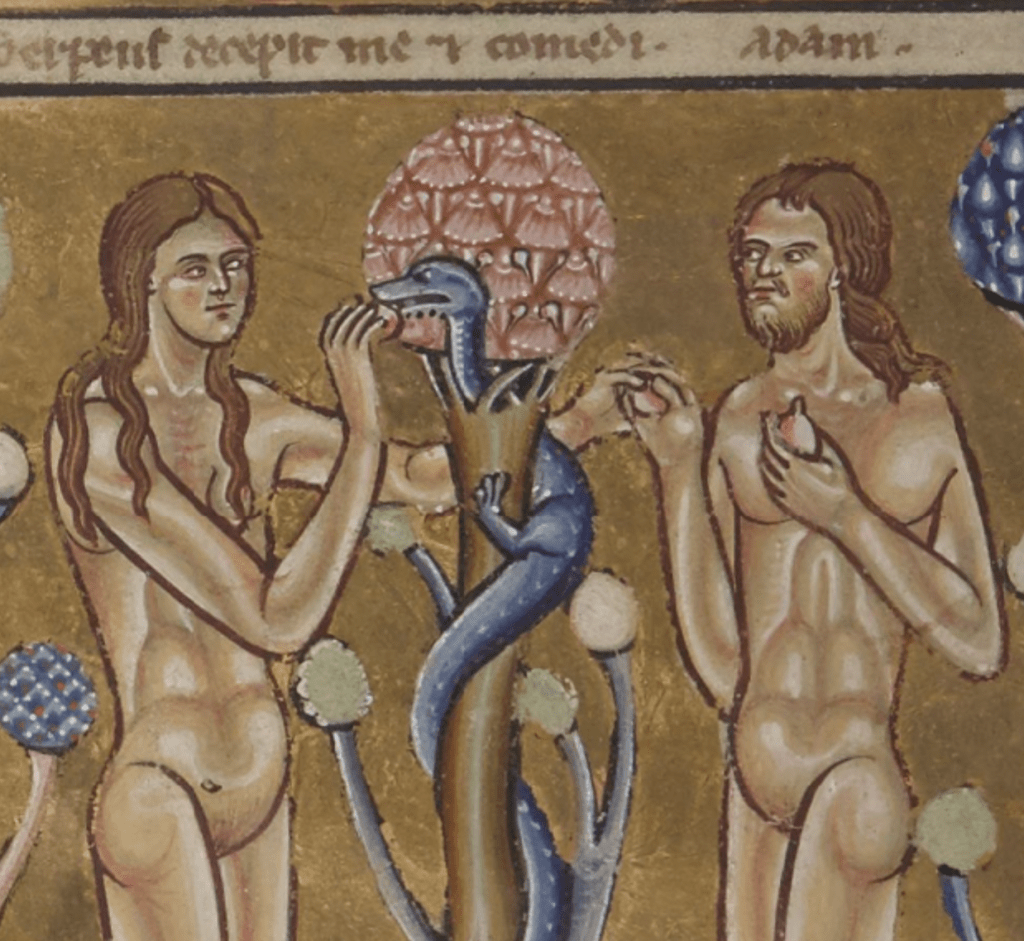
There are Liberty Cap mushrooms in the cap of the mushroom tree, depicted literally; this is an example of “Literal Depictions of the Physical Form of the Mushroom”.
https://www.bing.com/images/search?q=liberty+cap+mushroom
Or maybe that mushroom-tree is a depiction of an Italian Pine tree, as art historian Brinckmann explained in his 1906 book. You see, unbeknownst to mycologists, medieval artists worked off of templates, which got screwy over the years, as the top art historian Panofsky explained in a letter to Pope-banker Wasson.
_____
The weirdest thing about writing: the more words and qualifiers you add, the more confusion you bring in.
KEEP IT SIMPLE, STUPID. (KISS) when possible, unless there’s a special reason/context. Cyb seems to choose well, in saying the broad obscure term ‘entheogen’ in the intro/summary of the Maximal position, for the Muraresku quasi-academic context.
Use these two great labels:
The Maximal Mushroom Theory of Christianity
The Maximal Mushroom Theory of Greek and Christian Religion
The Maximal Mushroom Theory of Mystery Religions
etc., arb. variants.
the Core theory (1985-1997)
vs.
(the Myth & History portion of the Egodeath theory) 1998-2013-2020
the Egodeath theory
https://cyberdisciple.wordpress.com/2020/11/24/correcting-key-points-in-muraresku-the-immortality-key/ — Cyb’s formulation/characterization of part of the Egodeath theory: the maximal entheogen theory of Religion (well not exactly; that’s a theory about history) —
“drugs routinely trigger the loose cognition state, enabling the transition from the possibilism model of time and control to the eternalism model, and that religious art depicts this via analogy.”
Longer context at start of Cyberdisciple’s post: Note his labels for the theory or portions of the Theory: ‘mushroom’ is a good variant, also ‘entheogen’ as he uses, is great. BUT I want to more emphasize Mushroom, than Entheogen, re: Christianity. the Maximal Entheogen Theory of religion –> more emphasis now moving fwd, I’ll say when possible:
the Maximal Mushroom Theory of Christianity
the maximal mushroom theory of Christianity
the maximal mushroom theory of Hellenistic religion
the Maximal Mushroom Theory of Hellenistic Religion
‘Hellenistic Religion’ includes primitive Christianity, which is the Hellenized version of the Old Testament religion. Good book by Luther Martin.
re: the importance of SIMPLIFIED THEORY-DESCRIPTION/LABELLING:
KEY POINT: ALL YOU NEED TO KNOW IS, PSILOCYBE MUSHROOMS; “MUSHROOMS”. You don’t NEED nuance about acacia/rue dmt, Lily Datura, diff’c between Amanita vs. Psilocybe, etc.
I use a “minimal sufficient explanation” strategy. ie: “Mushrooms”. No need to use WORDS THAT NO ONE UNDERSTANDS:
WTF IS ‘ENTHEOGEN’???? It obscures, it does not help. That’s one argument, anyways. Give it (simplification to ‘mushrooms’) a shot.
In the end, I’m flexible; sometimes ‘psychedelics’, mushrooms, entheogens. Terms ‘Possibilism’ and ‘Eternalism’ have big pros & big cons.
There is no 1 correct label for a thing, for the entirety or for part of a multipart explanatory framework.
Cyb’s Intro to New Post; Labels of the Theory
Cyb writes:
“This post is for correcting the main claims in Muraresku’s The Immortality Key about drugs in Western religious history. All the confusions in the book on this topic can be resolved by adopting the Maximal Entheogen Theory of religion. The book creates a muddled mess by employing a Moderate Entheogen Theory of religion when speculating about religious history and a Minimal Entheogen Theory of religion when evaluating evidence.
“By Maximal, I mean: drugs have been used commonly throughout the world and throughout culture. The question typical of the Maximal approach is “to what extent were drugs used in x religion?”
“Authors in the Maximal camp are inherently aligned with the Egodeath Theory’s formulation that drugs routinely trigger the loose cognition state, enabling the transition from the possibilism model of time and control to the eternalism model, and that religious art depicts this via analogy.
“The Egodeath Theory points out drugs in religious art and text, but more importantly decodes the religious art and text. [“as x y z”, I think is needed here.]”
/ end of section “Labels for Components of the Egodeath Theory”
No One at the Bridge – Fresh Explanation of Song Lyrics
These are extremely relevant, highly descriptive poetic lyrics, which describe the peak experiencing of the altered state, by use of analogies. This is the song “No One at the Bridge” by Rush, lyrics by Neil Peart.
[10:14 a.m. Thanksgiving Day, November 26, 2020]
I added this section to the About page, which I’m building-out.
https://egodeaththeory.wordpress.com/about/
Lyrics are shown here for academic analysis and commentary.
“The sky is pitching violently [perceptual distortion in the altered state: visual undulation]
Drawn by shrieking winds [the egoic control system doesn’t propel its thoughts, in the altered state; thoughts are driven forward by mystic {wind} without egoic control]
Seaspray blurs my vision [perceptual distortion in the altered state: blurring of vision]
The waves roll by so fast [perceptual distortion in the altered state: visual undulation]
Save my ship of freedom [the experience of freewill-premised control power vanishes, but is desperately needed, as control increasingly seizes and is cancelled in the loss of the experience of having personal control; a “deus ex machina”, artificial transcendent rescue from outside the entire egoic control system and alien to it, is required]
I’m lashed helpless to the mast [the altered-state experience of non-control; suspension of the familiar experience of wielding control-power; an allusion to the myth of Ulysses]
Remembering when first I held [when first discovered the altered state]
The wheel in my own hands [the illusion of egoic control power, supported in the ordinary state but not in the altered state]
I took the helm so eagerly [naively expected to be able to control the experience]
And sailed for distant lands
But now the sea’s too heavy
And I just… I just don’t understand
Why must my crew desert me? [vanishing of the accustomed experience & perspective of being a control agent wielding personal control power]
When I need… I need a guiding hand… [the power of the egoic control hand vanishes]
Call out for direction
And there’s no one there to steer [the egoic control agent illusion vanishes in the altered state]
Shout out for salvation [a good time-tested idea; to rescue viable control and return control-stability, the mind has to learn to consciously place trust its own uncontrollable source of control thoughts, which was secretly always the case anyway]
But there’s no one there to hear [not that God doesn’t respond to prayer; the meaning here is “there’s no egoic control agent here”]
Cry out supplication [pleading, begging for control-stability earnestly & humbly]
For the maelstrom is near [cybernetic control seizure and nullity, cancellation]
Scream out desperation [continuing to rely on the premise or presumption of egoic control power, is futile and leads to increasing panic and seizure and instability until changing the mental worldmodel from Possibilism to Eternalism per Mystery Religion initiation]But no one cares to hear [not that there’s no God or rescuer; that would contradict all mystic tradition and experience; the emphasis here has to be on “no one”; no egoic control agent. The survival-protecting sense of caring and values and self-preservation is suspended and transcended, in the altered state]
— song No One at the Bridge, album Caress of Steel, Rush / Neil Peart, 1975
My Version 1 analysis, at the Egodeath site:
http://www.egodeath.com/rushlyrics.htm#xtocid22921
At Egodeath.com, I need to rewrite my comments that read like “there is no God to save me”, which contradicts all mystic and Mystery Religion.
When I commented on those lines at some point in 1997-2007, I helplessly felt I disagreed with those lyric lines, instead of doing a better, stronger-handed interpretation.
Today above, I wrote a better interpretation of the apparently disagreeable lyric lines.
At Egodeath.com, I need to rewrite my comments that read like “there is no God to save me”, which contradicts all mystic and Mystery Religion.
When I commented on those lines at some point in 1997-2007, I helplessly felt I disagreed with those lyric lines, instead of doing a better, stronger-handed interpretation.
Today above, I wrote a better interpretation of the apparently disagreeable lyric lines.
I focused today on interpreting the seemingly incorrect lyric lines as “there is no ego-as-god”, instead of assuming they had to be interpreted as asserting “there is no transcendent god outside the egoic control system, to provide and restore control-stability.”
/ end of section “No One at the Bridge – Fresh Explanation of Song Lyrics”
{helm, helmsman}, Dionysus, King Odysseus/Ulysses Tied to Mast
Ship Helm images:
https://www.bing.com/images/search?q=ship+helm
https://images.fineartamerica.com/images-medium-large-5/ships-helm-clifford-beck.jpg —

https://press.rebus.community/mythologyunbound/chapter/dionysusbacchus
“While at sea, the crew tried to tie him up, but the bonds fell away of their own accord. At this point the helmsman recognized that this was no ordinary boy and tried to prevent any harm coming to Dionysus, but the captain [vs. the helmsman] ignored the helmsman’s warning and told the sailors to hold on to the boy. Suddenly, wine began to flow all over the ship; vines began to grow from the sails and ivy began to twine around the mast. Then Dionysus turned into a lion and a bear appeared on the deck. The lion seized the captain and began to tear him apart, and the sailors jumped into the sea, turning into dolphins [rescuers]. Dionysus, now back in human form [a youth], prevented the helmsman from following his comrades into the sea and told him that his aid would be rewarded and no harm would come to him.”
mytheme decoded: {captain vs. helmsman}:
Hypothesis [quickly elevated to “postulate” or “principle” or successful “mytheme mapping” (ie to the direct real referent of how the mind works in the ASC)]:
{captain} = false, illusory aspect of personal control system
{helmsman} = redeemable portion of personal control system
{King} Odysseus/Ulysses {tied helplessly} (cybernetic power embedded in spacetime block as a worldline) to the mast, lest he be attracted to the siren song altered-state attractor that leads toward cybernetic control-seizure death on the {rocks} (block universe):
https://upload.wikimedia.org/wikipedia/commons/1/16/Mosa%C3%AFque_d%27Ulysse_et_les_sir%C3%A8nes.jpg —

_____
/ end of section “{helm, helmsman}, Dionysus, King Odysseus/Ulysses Tied to Mast”
mytheme decoded: {caduceus}
I finally decoded {caduceus}!! Figured out how to think about it, relate it to other mythemes, & explain it.
Meta-Theory:
In terms of Paul Thagard’s Conceptual Revolutions meta-theory:
I succeeded at connecting-in an explanatory datum case (the mytheme {caduceus}), into the new explanatory framework (Analogical Psychedelic Eternalism)
mytheme: {caduceus}, early & late forms: Y configuration; Y symbol (non-branching bottom vs. branching top); a form of snake vs tree, contrasting 2 parallel lines vs a single line, is “the message from the gods” that “heals”/cures.
For the first time, I lost a little data at WordPress. Not much I think, but I lost this:
MY HANDS HURT FROM SLAMMING OUT BREAKTHROUGHS ALL WEEK
Gotta keep an eye on that “Update” button state. Continue to hit Save after every sentence.
It’s hard to keep my typing linear from top-to-bottom in a section — so I lose the history of which paragraph I wrote first.
Who cares, I decoded it amidst the below text — I came up w/ the hypothesis while briefly glancing at the “Hatsis Roasts Himself” article; all the below is just
testing that hypothesis,
trying to find the pictures,
comparing the newer form,
writing out the argument,
raising doubts, and
resolving those doubts by further “experimenting” and
analysis/ theory development:
can the theory’s interpretation approach handle the odd shapes?
What is a generalize form of the theory; what are all possible shapes to express
Some of the text writeup is just articulating the claim of discovery; what does it mean to “represent Possibilism vs Eternalism” as a “message” that “cures”?
Y or
a snake on a tree or
a snake on a debranched pole; or
a debranched tree trunk (of rock) with snake around it; or
a debranched tree trunk (of rock) with with a lizard running up it, etc.
snake body with human torso w/ arms
a salamander-serpent next to a Y-branching mushroom tree
etc
Compare the early Hermes’ caduceus to a snake on a pole.
[12:01 a.m. November 26, 2020]
Equivalent to Moses’ rigid serpent on a pole (de-branched tree) to heal fatal snake-bite.
I almost need a screen recorder. The below “I GOT IT” line looks sedate and calm but it was more excited wording originally.
Then I became doubtful, made my wording less boldly certain of breakthrough, then I realize my original insight held up to critique.
My instinct was, as soon as I saw the word ‘caduceus’ in his article, I knew that {the message that heals} has to be — I don’t care what shape it is — the Theory dictates that “message from on high” has to be some equivalent of “snake vs tree”, something about branching, something equivalent to the staff of Aesclepius, rod “, and Moses’ healing serpent on a pole.
Many mythemes are inherently “a message from on high” eg {king fastened helplessly to cross/tree}, or {serpentine dragon monster guarding treasure}.
My original announcement was like the following, which idea instantly appeared in my mind as soon as I glanced at Hatsis article and saw the word ‘caduceus’ — the solution-perspective immediately hit, and I hastened here to write:
The original version of my breakthrough announcement:
OK I GOT IT [12:15 a.m. November 26, 2020] I solved the original caduceus!
The boring rewritten sedate version of the breakthrough announcement after I hesitated and became critical in a minute of doubt:
OK I GOT IT [12:15 a.m. November 26, 2020] I believe I have decoded the original caduceus.
I hesitated because of the “U on top of O” shape, but, they ARE agreed to be snakes — so, it IS a non-branching pole topped with a branching pair of snakes, even if they appear fused to form a U-topped O shape.
This means that that TWO snakes in the modern caduceus still MEANS branching, and the pole in the middle continues to mean non-branching.
Ball and wings means the altered state looking at the revealed non-branching.
It looks like a circle on a pole and a U on top of the circle, but if we think of it as a branching pair of snakes, that crosses over each other fused together at top of the circle for stability, then it’s essentially a Y branching configuration formed with branching snakes — an example of ironic unnatural branching, like
legs on a snake, or
wise men showing no arms, or
a snake with multiple heads, or
a human head on a snake body (no limbs) or…
Similarly, for modern caduceus, note the non-branching central pole, and two snakes, forming a branching-like V shape around the pole. Not that different than snake winding up a tree or debranched tree/pole.
The forms can become unrecognizably distorted like the botched staff of Aesclepius (aka rod of Aesclepius) on ambulances, that has lost all traces/hints of {debranched tree}.
Moses’ snake / staff.
Here is the most profound message from the Gods:
|
omg nonbranching! hope that didn’t blow your mind too much. To reiterate:
Y
That’s like the entire Book of Revelation, right there.
Y = mental model transformation from Possibilism to Eternalism.
Check on this: when art shows an entire torso of human coming forth from snake… ok this is a new point/observation/connection:
The man or Eve often has two arms, same topography as early original caduceus: nonbranching snake body, then two arms coming forth (branching).
___
I searched so hard for the woodcut of the andro-gyne holding the Y shape — profound and utterly obscure to people who don’t know it’s all about branching vs non-branching.
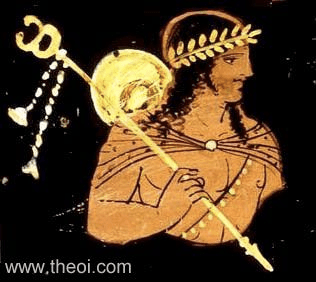
mytheme: {caduceus}, early & late forms: Y configuration; Y symbol (non-branching bottom vs. branching top); a form of snake vs tree, contrasting 2 parallel lines vs a single line, is “the message from the gods” that “heals”/cures.
Reading the article Hatsis Roasting Hatsis, he mentioned caduceus, that gave me a thought — his articles are so inspiring, for all the wrong reasons – and I may have added some mytheme decoding connections.
Generally and abstractly, {the message from the angel on high} is, “Eternalism, not Possibilism” or something to do with that, like “but do not harm the child-thinking and violate your control harmfully”.
The revelatory message that Eternalism, not Possibilism is the case, can be expressed by top-10 mythemes including branching vs. non-branching.
Moses’ rigid bronze serpent on a de-branched tree pole, is a transcendent message from on high in the altered state: looking at it, comprehending it, cures snake-bite; knowing Eternalism-thinking makes the mind compatible with the altered state instead of {dying}, seizing, panicking, loss of control.
/ end of section “mytheme decoded: {caduceus}”
How I Decoded the Bestiary Salamander Image
A “math logic proof”-style of walking the reader through the mytheme-decoding process. It got shoved way down – see section “Summary of Decoding the Bestiary Salamander Image“, below.
I kinda should add this “how I decoded the image” recounting, into the too-long “Criteria” article (linked below). Done, and copied the added section below the following post, down below.
I posted at https://cyberdisciple.wordpress.com/2020/11/17/moving-on-from-muraresku-the-immortality-key/ —
Hatsis Roasting Hatsis: Critical Historical Inquiry vs. Pseudointellectualism
wtf does “Historical Inquiry” mean? Seems like a hollow, empty phrase.
[All the “big-brained historical scholarship” in the universe is worthless pretentious dross if, in the end, it fails to recognize a mushroom in mythological art as a psychoactive mushroom and fails to decode a message of “Possibilism vs. Eternalism” as such. -mh]
Link is at bottom of this comment.
He’s an expert on the topic of Pseudointellectualism. See article for details.
I’m glad his messed-up article brought my attention to the bestiary salamander (around 2015 I think).[sic, 2017]
My right/left leg speculation on that image, paid off, in decoding Canterbury.
I feel slightly embarrassed that I didn’t attack the picture with the Diamond Hammer of Interpretation hard enough to crack the whole puzzle, back then.
How I solved the stuff to the left of the “dancing[sic] man”, a week ago: fire, means ASC — that’s been known by me more or less clearly for … long time.
I failed to notice in 2015[sic, 2017], the salamander’s tail is serpentine; a salamander-serpent.
I failed to think of, until a week ago, that there is only 1 salamander: it’s a “before vs. after” photo.
After put salamander-serpent in ASC fire, it then goes “next to” the branching, so you have then, next to each other, therefore, CONTRASTED:
salamander-SERPENT VERSUS BRANCHING mushroom TREE.
Which means: contrast Eternalism vs. Possibilism.
How best describe {right hand on forehead}?
“Oh my God, I just realized that my thinking was Possibilism, but reality is Eternalism! I just understood Possibilism vs Eternalism!”
My 2015[sic, 2017] decoding got about 50% of that — couldn’t I have done better; I was well-armed, fluent at mytheme-decoding by 2015[sic, 2017].
But experience shows, it takes time to unravel the message.
It took me a full week to grasp the “class of students” including “3 levels of students”, in the class session in upper right of Canterbury!
This decoding process makes me feel dull-witted — after I have the answer in front of me.
Find ‘salamander’:
https://egodeaththeory.wordpress.com/2020/11/13/compelling-evidence-criteria-of-proof-for-greek-bible-mushrooms/
I did lots of improvement on your scheme section, with nice, highly usable short-form at top of TOC:
Section 3: A Spectrum of Criteria of Proof, for Identifying Mushrooms in Art or Texts
- Literal depictions of mushrooms
- Stylized depictions of mushrooms
- Depictions of mushroom effects
https://egodeaththeory.wordpress.com/2020/10/31/psychedelic-mystery-traditions-hatsis/
Has links to his articles at bottom, including:
Roasting Jan Irvin: Critical Historical Inquiry vs. Pseudointellectualism
Tom Hatsis
November 2017 [?? not 2015? we were posting about his writings in 2015/2016… maybe his old site was marked 2015?]
https://psychedelichistorian.com/roasting-jan-irvin
/ end of my comment at Cyberdisciple’s site.
The image at issue:
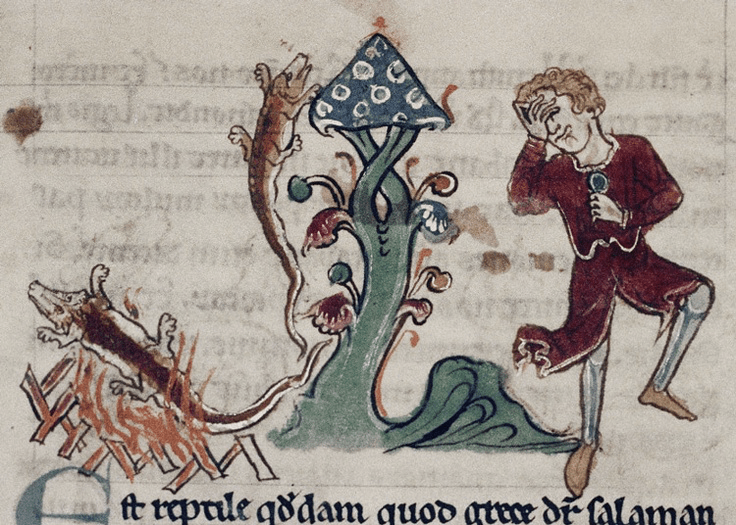
I decoded this image, just before I found the blurry image of the Canterbury mushroom tree with no context at all, so I was able to import this same decoding to quickly decode that Canterbury mushroom tree in a series of easy steps.
I had to sharpen my skills at decoding and explaining {blades}, because the Canterbury mushroom tree is packaged together with {God’s sword}, as well as {left vs. right hand/arm/foot/leg}.
The bestiary image has {fire} (altered state; loosecog); in contrast, the Canterbury image has {sword} (cybernetic death/seizure/cancellation).
Why bother showing {fire}, since the mushroom is already shown? It’s a bestiary, of a salamander, and there’s a traditional motif of roasting salamanders.
I added the below section to my Criteria article (it had a good writeup already, but I like the new format shown below, also).
Summary of Decoding the Bestiary Salamander Image
When you put the salamander-{serpent} in the {flames} (the altered state from mushrooms), it then goes “next to” the branching tree — so you then have, placed next to each other, therefore contrasted:
salamander-{serpent} versus {branching} mushroom {tree}
You could omit or ignore the now non-essential (that is, non-mytheme) “carrier” aspects or features (salamander, mushroom), leaving:
{serpent} versus {branching tree}
We know from my November 2013 formula:
{tree} vs. {snake} = Possibilism vs. Eternalism
In this image, the order is the opposite:
{snake} vs. {tree} = Eternalism vs. Possibilism
therefore:
salamander-{serpent} versus {branching} mushroom {tree} means Eternalism vs. Possibilism.
How best decode {right hand on forehead}?
His {left hand} is floating in thin air like his {left foot}, not giving any stability; his {right hand} is stably planted on his head, like his {right foot} is solidly and stably on the ground.
It is increasingly clear that in Greek & Christian myth, {right} = Eternalism. Therefore:
{right hand on forehead} = “Oh my God, I just realized that my mental worldmodel was Possibilism-thinking, but reality is Eternalism! I just understood & recognized Possibilism vs. Eternalism!”
Q.E.D.
/ end of section “How I Decoded the Bestiary Salamander Image”
mytheme: {maiden, kore, Kore, Persephone}
Mytheme decoded/connected/corroborated; A MAJOR SUDDEN THEORY-CONFIRMATION DISCOVERY EVENT:
I was delighted to unexpectedly connect {Persephone} to my existing {maiden} decoding by discovering that her other name is {the maiden}: {maiden, kore, Persephone} = initiate who still has Naive-Possibilism-thinking.
Persephone’s other name is “The Maiden”!! SCORE
[8:59 p.m. November 25, 2020]
Ah sh*t!! I just noticed the Persephone wiki statement, “Kore” – THE MAIDEN! Total confirmation of the Egodeath theory again! See my usage of the technical term ‘maiden’ in my Canterbury article. (I’m writing notes down below instead now.)
Mytheme decoding: {after death, turn right to remember, left to forget}
Not entirely new, but more mental connections than before: Filling-in the New Theory with more detail; more interconnections.
{after death, turn right to remember, left to forget}: In the ASC (loose cognitive binding association state; loosecog), it’s hard to remember the ego death perspective, of Eternalism-thinking.
The mind tends to forget that experiential perspective, the first 10 times/glimpses, until the mind finally constructs Eternalism-model permanently.
{Looking left} means, the mind returns to childhood-suited Possibilism-thinking and forgets the Eternalism-experiential perspective that was briefly grasped in the ASC.
{Looking right} (after ego {death} in ASC) means remembering the Eternalism-thinking experiential perspective, finally being able to hang onto it upon returning to the OSC (tightcog; tight cognition; tight mental construct binding; the tight cognitive binding state).
Persephone & Demeter = Possibilism-thinking & Eternalism-thinking
{Persephone when alive} = Naive-Possibilism-thinking
{Persephone after abduction/death} = Qualified-Possibilism-thinking
{Demeter} = Eternalism-thinking
From the section I added to my Canterbury Proof article today:
“The mind is made to demonstrate its inability to control itself, in order to eliminate Possibilism-thinking, and receive its mature form of mental worldmodel: Eternalism-thinking together with Qualified-Possibilism-thinking.”
= Demeter & her now-in-Hades daughter, Persephone.
Persephone still exists, but now in the underworld of illusions.
Wiki: https://en.wikipedia.org/wiki/Persephone —
Insertion later in the day, [8:59 p.m. November 25, 2020]
Persephone’s other name is “The Maiden”!! SCORE
Ah sh*t!! I just noticed the Persephone wiki statement, “Kore” – THE MAIDEN! Total confirmation of the Egodeath theory again!
See my usage of the technical term ‘maiden’ in my Canterbury article.
{Youth} = {maiden} = initiate still thinking in terms of Naive-Possibilism.
Oddly, I didn’t format “maiden” as a mytheme in that article, did I?? Just plain text? I marked like 1 out of 18, youth & maiden 😦 At least I got 1.
This Greek incoming content, combining with the Christian Canterbury content, increases the status of the word ‘youth’ and ‘maiden’, promoting them to full-on mytheme.
Funny how that works; quantity drives up (promotes upward) quality (ie “nature of”, or “categorization” of; repetition changes a 1-off idea into a recurring mytheme).
Like when you see “left/right” once, vs. 3 times in both Christian and Greek art, then it is promoted in my Theory into a full-on official mytheme.
Damn, but I didn’t totally fail: ONE time out of 19, I had the good sense to format “maiden” as {maiden}. 18/19 fail. I’m not a total failure. Fixed; formatted them all.
What about “youth”? Did I have the sense to mark it as an official mytheme, in the Canterbury article? I had at least 1. Fixed; formatted them all.
“In Greek mythology, Persephone , also called Kore (/ˈkɔːriː/ KOR-ee; Greek: Κόρη; “the maiden“), is the daughter of Zeus and Demeter. She became the queen [a ruler; a cybernetic center of control-agency] of the underworld through her abduction [rapture, invasion, overpowering, passive helpless receiver of control-thoughts] by Hades, the god of the underworld [where my 1995 self went to when finally purged, the completed initiate weeps for one’s beloved lost child taken away to the underworld of illusory beings — still with me as now merely Qualified-Possibilism-thinking, self-model]. The myth of her abduction represents her function as the personification of vegetation, which shoots forth in spring and withdraws into the earth after harvest; hence, she is also associated with spring as well as the fertility of vegetation.”
/ end of section “mytheme: {maiden, kore, Kore, Persephone}”
Entheogen Scholars Are Currently Reading the Present Weblog & Linked Pages
http://wassonwest.com
WASSON WEST —
Home of the Wasson-Ruck Entheogenic Research Institute and Archives
http://wassonwest.com/our-team
Officers:
Dr. Carl A. P. Ruck
Mark Hoffman:
o http://entheomedia.net
o Entheos: The Journal of Psychedelic Spirituality
Brian Muraresku
Advisory board: the whole crew
/ end of section “Entheogen Scholars Are Currently Reading the Present Weblog & Linked Pages”
Thankful for Hatsis & Muraresku
Ways in which Hatsis and Muraresku helpfully contribute to entheogen scholarship.
Cyberdisciple’s weblog posting:
Correcting Key Points in Muraresku, The Immortality Key
https://cyberdisciple.wordpress.com/2020/11/24/correcting-key-points-in-muraresku-the-immortality-key/
My comment posted there:
I’m thankful for any parts of Hatsis’ and Muraresku’s writings that are valuable and true and move the field forward, and popularize the field, and cause readers to think of ideas.
_____
Hatsis is a strong advocate of sound scholarship.
Hatsis’ article that discussed the much bandied-about bestiary salamander image caused me to think of the mytheme decoding {left vs. right} = Possibilism vs. Eternalism.
Hatsis’ article brought the bestiary salamander image to my attention — a good mytheme-decoding exercise as a warm-up to solve the puzzle of reading the entire Canterbury mushroom/hanging/sword image.
The bestiary salamander image may have been analyzed by Chris Bennett, then Irvin, then Hatsis, then me.
Hatsis’ article mentioned the caduceus, and when I glanced at that word, I immediately knew that the caduceus, as a {message from the gods that heals} must be some depiction of “Possibilism vs. Eternalism”; I merely had to form a compelling specification of in what way the old and new caduceus express “Possibilism vs. Eternalism”.
[10:05 p.m. Thanksgiving Day, November 26, 2020]
Added in this Notes file:
In what way is the following symbol-shape isomorphic with “Possibilism vs. Eternalism?” |
In what way is the following symbol-shape isomorphic with “Possibilism vs. Eternalism?” Y
_____
Muraresku’s book is popularizing the field.
I’m thankful that Cyberdisciple read and analyzed Muraresku’s book from the perspective of the Egodeath theory.
Cyberdisciple’s weblog postings about the book The Immortality Key by Muraresku:
https://cyberdisciple.wordpress.com/?s=Muraresku
/ end of section “Thankful for Hatsis & Muraresku”
Mytheme {lamb} Decoded, Like Harmless {dove, Holy Spirit}
Big unexpected breakthrough! Isaac’s powerful {ram} vs. Jesus as gentle {lamb}, like {dove} vs. {eagle}; completing {dove} decoding too!
Central Mytheme {lamb} Decoded Unexpectedly!
{lamb} = {dove} of Holy Spirit (H.S. = ‘frenzy, mania’) =
“Lay not thine hand upon the lad, neither do thou any thing unto him” =
Non-harmful climax; made to do no harm during complete purge of egoic self-control delusion
Section added to Canterbury Proof article:
Gentle {lamb}, {dove} and {Holy Spirit}, Contrasted with {ram}, {eagle}, and {frenzy} or {mania}
Contrasted with {lamb} and {dove}, the mythemes {ram} and {eagle} have connotations of harm, such as {burning the ram on the altar}, during or after the climactic, final full demonstration of nullity, vulnerability, and cancellation of self-control power.
The mind is made to demonstrate its inability to control itself, in order to eliminate Possibilism-thinking, and receive its mature form of mental worldmodel: Eternalism-thinking together with Qualified-Possibilism-thinking.
In this transformation struggle, or {wrestling with an angel}, the mind is made to purify and purge itself of {sin}, {impurity}, and {pollution}; this way, the mind is finally rid of self-contradiction about self-control.
Compare the violent connotations or tone of Zeus’ {eagle} who abducts the {youth} Ganymede by force, along with {frenzy} and {mania} (the altered state); versus the {power of the Holy Spirit} (the intense, cybernetically overpowering altered state) figured as a gentle, peaceful, harmless {dove}.
Compare the powerful {ram} of Isaac, versus the gentle, non-harm-toned analogy of Jesus as {lamb}.
Together, the mythemes {Holy Spirit} as a {dove} instead of Zeus’ {eagle}, and Isaac’s {ram} now figured as a gentle {lamb}, emphasize the angelic thought that saves the completed mystic from harm, “do not harm the child”, while the mind is finally purged of the remnants of Naive-Possibilism-thinking.
[12:48 p.m. November 25, 2020]
Central Mytheme “lamb” Decoded Unexpectedly!
{lamb} = {dove} of Holy Spirit (= ‘frenzy, mania’) =
“Lay not thine hand upon the lad, neither do thou any thing unto him” =
Made to do no harm during complete purge of egoic self-control delusion
Got it! Key breakthrough mytheme decoding: Jesus as the “Lamb” instead of Ram; why? Answer:
Isaac’s powerful ram caught helplessly in the thicket
vs.
The gentle, harmless, Do Not Harm LAMB. Relenting, Backing off the self-testing attack of the mind’s control-system against itself. The gentle lamb breaks his bow (Canterbury climax image), uses charitable mercy and good judgement that enables continued, healthy life yet also full demonstration of truth about non-control, of personal control in relation to the uncontrollable source of control-thoughts.
Same pattern as — here it comes, another decoding-connection to the above breakthrough, as fallout — I’ve written for a long time, the “Dove” of Christianity (Holy Spirit is gentle) as opposed to the Eagle, implying violence, of Zeus.
{dove} = {lamb} = Dunamis/power of the {Holy Spirit} = gentle harmless merciful power of overcoming personal control delusion
ALL THIS “WUSSY PEACEFULNESS” theme in Christian mythic language is not about mundane conduct of life in the OSC; IT IS ABOUT ONE NOT HARMING ONE’S OWN SELF DURING TRANSCENDED-AND-CANCELLED SELF-CONTROL in the climactic peak state of the final purging of childhood Possibilism-thinking.
Genesis 22:8-18; Genesis 22:12-13 (KJV) —
12 And he said, Lay not thine hand upon the lad, neither do thou any thing unto him: for now I know that thou fearest God, seeing thou hast not withheld thy son, thine only son from me.
13 And Abraham lifted up his eyes, and looked, and behold behind him a ram caught in a thicket by his horns: and Abraham went and took the ram, and offered him up for a burnt offering in the stead of his son.
How I just now stumbled onto this unexpected back-of-mind decoding outstanding unsolved problem:
In my fancy grand titling of my previous section about my Salvation experience moment, I wanted to write:
“Saved by Christ Crucified, by the Blood of the Ram”
but I went — “wait — Jesus is never called “ram”; he’s called “lamb”, darn, that won’t work– WAIT!! OMG… LAMB, NOT RAM… LAMB IS *GENTLE*, AS I’VE BEEN WRITING ARTICLE-LENGTH IDEA-DEVELOPMENT ABOUT MOST-RECENTLY!
Find ‘burn’ in https://egodeaththeory.wordpress.com/2020/11/17/realtime-discovery-log/ for much writing against any harm; expressing my strongly pacifist values & philosophy/belief; I spell out and explain my belief and values and theory, that:
Any physical harm as part of the climactic Proof Demonstration of Fully Knowing Cybernetic Truth would probably indicate the failure to mentally ideally and fully transcend egoic thinking.
I had also been bothered today and recently, that the Proof article lacked any mention of Jesus — Jesus the lamb — today at this breakthrough moment, that idea was in the queue, waiting to combine with these other connections. So I added dove/eagle, lamb/ram, and Holy Spirit/mania-frenzy, into the climactic center of the article, near the image of Isaac’s mushroom-horned ram caught in a mushroom-thicket.
[4:18 p.m. November 25, 2020]: I found in my pre-breakthrough writeup of central salvation paragraph, look: I wrote (apparently around [10:48 a.m. November 25, 2020]): “Christ the ram“!
That led up the to breakthrough, you can see I was trying to connect Isaac’s “do not harm the boy” ram, to Jesus and “blood of the lamb”:
So you can see my trajectory leading up to the breakthrough making of the connection that we don’t say “Jesus the ram” or “Christ the ram” or “saved by the blood of the ram”, BECAUSE WE WANT TO INSTEAD TAKE THE OPPORTUNITY TO EMPHASIZE NON-SELF-HARM during finalizing purging of sin and washing the mind’s garment white and clean; gentle during the final full, complete, permanent, and higher-thinking-satisfying disproof of egoic self-control power:
“At that moment I had a vision of the crucifixion with bloody king fastened to the cross and I was completed in regeneration and saved by a vision of Christ the ram fulfilling my non-control seizure, in peak meditation, which by default I thought in terms of, but —”
(emphasis added at [4:21 p.m. November 25, 2020])
The sequence in this page is a little out-of order, non-linear; I need to add timestamps more often, near each group of paragraphs.
/ end of section “Mytheme {lamb} Decoded, Like Harmless {dove, Holy Spirit}”
The Story of My Moment of Conversion, Rescue, & Purification from Sin
The story of my moment of mystic-state conversion/ salvation/ regeneration/ redemption/ purification/ completion/ sacrificial purging of sin; then baptism in the blood of the [gentle, harmless!] lamb afterwards.
[10:48 a.m. November 25, 2020]
The story of the moment of my salvation through a vision of Christ Crucified while in the Holy Spirit.
My brand of religion is esoteric restorationist Helleno-Christianity.
I was saved in Christ, about 1995 just before my baptism, same meditation session I think as the guitar buzz/feedback cassette recording at Egodeath.com, when I relaxed profoundly deeply lying on the bed with a sense of profound mind-body relaxation, relaxing (in Ken Wilber’s sense) the egoic thinking structure.
And then — THE CAT YAWNED, dionysus present — and then in profoundly mentally relaxed state lying on the bed, I sensed/perceived SAW A VULNERABILITY OF CONTROL —
I then got up, thought about mental control vulnerability in the meditation state, I saw my continued thinking (at that late time way after my January 1988 block-universe ego death breakthrough and my subsequent 1988 theory-documenting.
(~1995-1988 = After 7 years of Core theory development, my thinking was still tainted, polluted with freewill-premised Possibilism-thinking.)
I at that moment was made to sacrifice/ see through/ repudiate childhood-thinking finally; I was made to mentally repudiate the remaining pollution of freewill egoic thinking that I embarassingly (after 7 years of Core theory development) saw that I STILL had egoic thinking polluting my thinking.
At that moment I had a vision of the crucifixion with bloody king fastened to the cross and I was completed in regeneration and saved by a vision of Christ the ram fulfilling my non-control seizure, in peak meditation, which by default I thought in terms of, but, I was saved by a vision — not somehow by the literal actuality of harm done to a man.
By 1998, I felt puzzled about Jesus’ motives for crucifying himself.
I wanted Jesus to confirm my the Cybernetic Theory of Ego Transcendence, and I saw no reason why he, being as rational as me, would deliberately get himself physically harmed.
/ end of section “The Story of My Moment of Conversion, Rescue, & Purification from Sin”
The Requisite Non-violence of Successful Mental Transformation Implies the Ahistoricity of Jesus
The big event of my salvation through a vision of Christ Crucified while in the Holy Spirit left me with the problem of what function Jesus’ bodily physical death served.
In 1998-1999, I was trying to identify how Jesus preached and corroborated my certainly true the Cybernetic Theory of Ego Transcendence.
Then I read Heinrich, who mentioned Allegro re: Amanita (which I pursued Allegro for, to find out more), but Heinrich failed to say Allegro asserted ahistoricity, then I didn’t find Allegro’s book but I found a priest’s book amusedly reacting to Allegro’s book.
It was in that priest’s book that I discovered the hypothesis of ahistoricity, which solved my problem of what purpose Jesus’ allowing bodily harm to himself accomplished, given that my salvation I received from Christ Crucified violently, was an *idea*, for which actual violence served literally no function or purrose and even contradicted the mechanism by which I was rescued during my mental transformation, transfiguration.
_____
My brand of religion is esoteric restorationist Helleno-Christianity.
_____
The “harmlessness” idea behind the mythemes {lamb} and {dove} implies the ahistoricity of Jesus (in his function as redeemer in the mystic altered state), instead of pointless & ineffectual violence against a bodily historical Jesus.
For the Jesus Christ figure to serve as a mystic rescuer and savior from self harm-also-full-completer-of-healing, physical bodily harm done to him is useful purely as an idea, not as a literal actuality.
A “demonstration” of an idea, has no need to be anything other than an image, an idea.
Were Jesus actually harmed, which would require his historicity, that would directly contradict the whole key theme of “gentle, harmless, do not harm the child-thinking
The “Abrahamic” angelic idea that saves and rescues, received by the mind from on high (from the uncontrollable source of control-thoughts) is the idea or mytheme {do not harm the child}, which means:
Do not harm oneself during doing-away-with and firmly, permanently disproving child-thinking by making the control-system cancel itself, to secure mental integrity, coherent viable thinking about personal control and time.
Literal violence done to a Mr. Historical Jesus would be pointless, futile, and irrelevant, would accomplish nothing, is magical thinking that irrrationally tries in vain to substitute for actual mental transformation, and would have no power to save (rescue and regenerate the mind regarding the personal control system).
If someone defends Mr. Historical Jesus ( the historicity of Jesus) — wanting Jesus to exist and be literally harmed on the cross — indicates magical thinking, belief in “salvation through physical violence”; indicates the person doesn’t believe in non-violence per “dove” and “lamb” and “do not harm the child”.
The Historicity premise contradicts the religion of the “lamb” (Christ) and “dove” (Holy Spirit; peak altered state, overpowering frenzy, mania, loose cognition).
Similar to my previous ~200x realization that “dove” is like Zeus’ eagle, but (for no reason clear to me at the time) “more wussy and gentle, just because that’s the Christian style”. “Our brand is better b/c gentle.”
I had no idea (or too little grasp) that “gentle dove” meant, the ASC context, of: non-harm to self during purging delusion of egoic control.
NOW I ADD PROFOUND UNDERSTANDING (increased explanatory power by adding new reconnections among theory-components) OF THE DOVE AS “GENTLE” EQUIVALENT OF ZEUS’ EAGLE:
DOVE MEANS DO NO SELF-HARM TO PURGE AND COMPLETE MENTAL TRANSFORMATION/DEMONSTRATION OF NON-CONTROL IN RELATION TO HIGHER UNCONTROLLABLE CONTROLLER TO PROVE FULL RATIONALITY AND KICK-OUT, PURGE, REMAINING EGOIC DELUSION/ HABITUAL EGOIC Possibilism-THINKING.
Praise the Lord! I understand the mystic peak-state meaning of “Dove” and “Lamb” vs. “Ram” of Isaac! Lamb and Ram in Jesus and Isaac story co-strengthen each other; the two analogies contrast in a way to shine meaning on each other and co-strengthen each other!
Lamb means also, non-violent crucifixion in the heavens, not harming a Mr. Historical Jesus, which would accomplish nothing.
Thus the {lamb/dove} (non-violent) contrast against {ram/eagle} (violent), increases my theory-connection weighting of my belief in ahistoricity.
By 1998, I felt puzzled about Jesus’ motives for crucifying himself. I wanted Jesus to confirm my the Cybernetic Theory of Ego Transcendence, and I saw no reason why he, being as rational as me, would deliberately get himself physically harmed.
In 1999, thanks to Heinrich’s book Strange Fruit (1995), I heard about Allegro’s work on Amanita, which led me to the rebuttal book by a priest against Allegro, and led me quickly to discover — unlike Heinrich, who didn’t understand that Allegro = ahistoricity of Jesus — Heinrich said that Allegro said Mr History Jesus used mushrooms, a huge error on Heinrich’s part.
Heinrich not Allegro, taught me about the Amanita solution to Rev’n scroll eating.
Allegro was valuable to me because his good picture of the Plaincourault Amanita mushroom tree, and because Allegro taught me about the ahistoricity thesis — well actually, the priest’s reply book against Allegro [citation] is how I learned of ahistoricity.
Later I obtained Allegro’s book.
That’s the end of value I got from Allegro.
Soon in that same library I read book about ahistoricity of Peter or Paul [citation possible?].
1995-1999, I thought in terms of, but was puzzled by — couldn’t logically reconcile – Mr Historical Jesus; his physical existence was contradictory and served no purpose.
It was a problem outstanding to be solved, not supporting the Egodeath theory as I was looking to fit-in how Jesus’ life and meessage confirmed the Cybernetic Theory of Ego Transcendence.
contradiction I resolved, how I was saved by the crucifixion of Jesus but there was no role for his physical crucifixion, there was no identifiable purpose or function for that extra, excess, hypothesis dangling.
Jesus getting himself physically literally killed on the cross served no function, compared to the salvific vision that Christ Crucified gave me salvation and rescue, curing and purification purging of egoic control thinking in ~1995.
So, from my conversion about 1995, followed quickly by baptism in Restorationist Barton/Stone congregation Church of Christ, to about 1999, I was trying to — especially in 1998/1999 — I found the solution to my theoretical problem that:
MENTAL CONVERSION IS MENTAL, NOT PHYSICAL VIOLENCE, which would serve no function, is magical thinking if anything, and would probably prevent mental conversion, because would be an ineffectual substitute for mental conversion.
I discovered ahistoricity roundabout, by reading Heinrich’s garbled Amanita/ahistoricity lead (Heinrich saw Allegro’s Amanita interest, failed to grasp Allegro’s ahistoricity; so I didn’t know about ahistoricity from reading Strange Fruit in 1999), then the priest’s book which I should get or see at my university library again.
I can look up in their card catalog.
The first time I ever heard of ahistoricity was that priest’s book, his rebuttal to Allegro (in an upbeat, humored tone).
That solved my cognitive dissonance problem of the “dangling useless excess bodily physical purpose of Jesus getting himself literally crucified”.
I want Carrier’s book Jesus from Outer Space — ie beyond the Ptolemaic spheres, Christ the ram savior, given to us for our salvation, from HEAVEN EMPYRIUM – DWELLING PLACE OF GOD AND OF ALL THE ELECT.
In 1999 I read Strange Fruit (1995), heard of Allegro’s interest in Amanita, so Heinrich identified a big question: which psychoactive is the {scrolls} eaten in the Book of Revelation? (KJV, in 1987-1987 I was trying to figure out the which psychedelic (didn’t know term ‘entheogen’), identity).
So in 1999 I looked up Allegro or his book in my university library, (I hadn’t heard of ahistoricity). They didn’t have it, they had the priest’s rebuttal book, which I looked at then.
/ end of section “The Requisite Non-violence of Successful Mental Transformation Implies the Ahistoricity of Jesus”
Helleno-Christianity
Forming a label of my religion, which combines Greek “Paganism” (Mystery Religion & religious mythology decoding) with Christianity (an esoteric version of Barton/Stone Restorationism).
Hellenistic Religions: An Introduction
Luther Martin
https://www.amazon.com/Hellenistic-Religions-Introduction-Luther-Martin/dp/019504391X
1987 (a good year leading up to Jan 1988 the great block-universe loose-cognition ego transcendence breakthrough)
Heimarmene etc.
Look into the following new 2018 book: Looks extremely relevant, must-have, Has Look Inside.
Studies in Hellenistic Religions
https://www.amazon.com/Studies-Hellenistic-Religions-Luther-Martin/dp/149828308X
February 26, 2018 — “This selection of essays by Luther Martin brings together studies from throughout his career–both early as well as more recent–in the various areas of Graeco-Roman religions, including mystery cults, Judaism, Christianity, and Gnosticism.
“It is hoped that these studies, which represent spatial, communal, and cognitive approaches to the study of ancient religions might be of interest to those concerned with the structures and dynamics of religions past in general, as well as to scholars who might, with more recent historical research, confirm, evaluate, extend, or refute the hypotheses offered here, for that is the way scholars work and by which scholarship proceeds.”
Nice cover art of Ptolemaic spheres cosmology.
I learned/confirmed ‘heimarmene’ = no-free-will, around 2005(?), in his book Hellenistic Religion, which was a much-wanted corroboration of Hellenism matching & mapping to the Egodeath theory.
The Egodeath theory has gone from success-to-success, this way; always ratcheting in 1 direction: more confirmation; more confirmation; yet more, always more confirmation.
I never get “less confirmation”; the evidence pretty much always has corroborated the Theory, as my reading /checking on Western esotericism & religion in Antiquity proceeded.
I feel like I posted about that book in 2018.
Richard Carrier needs better artwork for his new book Jesus from Outer Space, looking like Ptolemaic cosmology — missed opportunity.
Mushrooms caused Helleno-Christianity.
By ‘Helleno-‘, I mean Hellenistic, not Hellenic.
By ‘Helleno-Christianity’, I mean broad Hellenistic religion plus primitive Christianity, including Old Testament mythemes.
Hellenisto-Christianity — doesn’t work, but it’s what I mean.
The term ‘Hellenic is too narrow; restricted to specifically Greek/Greece.
‘Pagano-Christianity’ can piggyback on that main line of argument.
The exceptions, the details, must not be allowed to confuse the Main Theory Model.
Acacia-Rue & Amanita and Lily Datura Scopalamine Mandrake can readily piggyback on that main line of Simple & Strong, Guiding, Theory Construction.
Helleno-Christianity, con’t
I advocate Helleno-Christianity, and don’t object if people say ‘Pagano-Christianity’.
In 1998 I was given a great book, my first book on ancient Greek/Hellenistic Religion. [cite would be nice]
I was saved and rescued and redeemed in a vision of Christ on the cross in 1995 (don’t have exact date) without knowing anything yet about Greek religious myth. (1998 was working on: how does Jesus’ gospel that he taught/advocated/ asserted, confirm the Cybernetic Theory of Ego Transcendence?)
3 years after I was saved in Christ’s cross (like Isaac’s ram that got itself powerlessly trapped in a thicket, which I decoded late – check Egodeath Yahoo Group posts for ‘isaac’, ‘ram’ for date stamp), I got pointed to decoding Greek religious mythology & Hellenistic Mystery Religion. Only a day or two ago, I got full confirmation of my tentative hypoth, about the bush — thciket actualy, — being equivalent to the tree that the king is caught up into (Pentheus/Jesus).
Pentheus’ tree = Jesus’ cross = ram’s thicket, confirmed 1 of 2 days ago, first hypothesized maybe 2003(?).
The term “Pagano-Christianity” doesn’t work, for two reasons:
o I didn’t and don’t know enough about N Euro Pagism, tho mother interested in Irish and I snagged a book on that when dealing w/ her possessions.
o The term Pagan is too overloaded. Northern? Mediterranean? Many problems.
The term “Helleno-” is perfect for describing my konwledge, my intersest, my sure-footed, the Hellenistic nature of primitive Christianity. Christianity was Old Testament filtered through Hellenism. What would happen if Hellenistic thinking processed the Old Testament? You end up w/ Christianity.
There are nothing but problems with Pagano-, and nothing but benefits of Helleno-.
Pagano-Christianity doesn’t work at all, it’s nothing but problems.
The only thing wrong with the term Helleno-Christianity is that is leaves a question mark around Northern European religion, which I know no more about than Buddhism; all World Religion describes the human mind’s experience in the ASC from entheogens.
N Euro Paganism supports the Cybernetic Theory of Ego Transcendence the same way as Buddhism does, or rainforest Shamanism. I can’t speak for N Pagism, except to say, the Egodeath theory explains its mystic experiencing and mythemes — eg king on tree w/ snake.
I could right now practice Hellenistic religion paganism, but in contrast, I know nothing about practicing Northern European Paganism even though I mostly come from broad entirety of Europe incl far north but less of the southern, ironically, but that’s how it went.
Use Mainly the Term ‘Helleno-Christianity’, Sometimes ‘Pagano-Christianity’
N Pagans didn’t so much document their religion.
I’ll use ‘Pagano-Christianity’ w/o objection, but speak sure-footed about in terms of ‘Helleno-Christianity’. Equivalent.
In University, studied Southern … ie Mediterranean culture. In 7th/8th grade I drew a giant map of ancient Med Trade Routes. I learned a tiny bit of Greek, Roman, then European — school didn’t teach N Paganism; I am blank there.
I know exactly what I mean by Helleno-Christianity. There’s nothing but blur and uncertainty about the term Pagano-Christianity; it does nothing but raise questions.
I can readily answer any question about Helleno-Christianity, I feel. It is essentially a specific, defined term, definable with the knowledge at hand.
The term ‘Helleno-Christianity’ totally allows N Euro Pag’m to come onboard, w/o the huge confusions of the term ‘Pagano-Christianity’. NO SOLUTION IS PERFECT — THIS IS WHAT I GOT, IN FACT.
I HAVE NO CHOICE BUT TO GO W IT, COMMIT TO IT.
Pagano- is simply , I can’t do it. Labels are hard to formulate, as you know I never was able to find the 1 perfect name of the Egodeath theory. Must have variable multiple labels.
What I bring is not Pagano-Christianity; I don’t know what that means and how to unravel the confusion of questions it produces.
I know what Helleno-Christianity means, and it doesn’t produce hard questions. I can readily deal w/ the questions and defining it and justifying it.
I love Hellenistic Mystery Religion and myth, I know it, I relate to it. I’m from N Euro but its paganism is unknown to me, I cannot authentically represent it; in contrast, I perfectly represent Hellenistic religion, sure-footed, natural, native for my thinking.
/ end of section “Helleno-Christianity”
A Week of Manically Possessed Religious-Mythology Breakthroughs and Accidental Fasting
I was manically possessed and driven by inspiration in the ordinary state, and accidentally fasted for a week during breakthrough decoding of the entire Canterbury “mushroom/ hanging/ sword” image, which extremely confirmed my Analogical Psychedelic Eternalism theory of religious mythology and the maximal mushroom theory of Christian art.
[8:48 a.m. November 25, 2020]
I was possessed by the spirit, in the OSC, the past week driven to inspired decoding of the Canterbury leg-hanging mushroom tree entire image. I didn’t eat, except 1 meal finally at the end of the day, for like 5 days, I was way way too busy writing and writing and decoding. Forgot to drink any coffee though addicted.
Slamming out typing and decoding as fast as I can type, for past week, accidentally fasting — no time for stop and eat, busy typing out breakthrough ideas.
My explanation here is extremely simple and very easy to spin-out the theory that results from this extremely useful hypothesis, useful b/c simple. Nuance doesn’t help, here. Acacia/Rue DMT is a distraction, but generally is COMPATIBLE. <– I like that idea of, “the nuanced exceptions are COMPATIBLE with the main line of the POWERFULLY DIRT-SIMPLE BASIC MAIN LINE OF THEORY.
Stated in a simplified and that much more powerful version/ statement/ formulation. Leverage the simplicity, stay focused on the Primary Case. Don’t put edge-case exceptions in the middle of the core, in the center.
The center of the Theory , max
I push esp:
[10:17 a.m. November 25, 2020]
THE MAXIMAL MUSHROOM THEORY OF BUDDHISM & CHRISTIANITY.
Non-entheogenic Buddhism is fake and fraudulent, a substitute.
Non-entheogenic (eg non-mushroom) Christianity is fake and fraudulent, a substitute. It has no Eucharist; it has a substitute for the real Eucharist, WHCIH DOES NOT SAVE AND REGENERATE.
This right now is Jonathan Ott’s The Entheogenic Reformation, upon my discovery and proof that the Canterbury Psalter is emphatically, mainline mushroom Christianity.
There’s been a cover-up, the usual pattern of fake priests suppressing mushrooms.
Exceptions (Datura, Amanita, eaten Cannabis, even Opium) don’t disprove that theory; they corroborate it as additional variants elaborating and supporting the main-line theory/ model/ summary.
/ end of section “A Week of Manically Possessed Religious-Mythology Breakthroughs and Accidental Fasting”
The Cover-up of Mushrooms in Christianity & Buddhism (together with Analogical Psychedelic Eternalism); the “Mass & Meditation” Substitution Industry
The Cover-up of Mushrooms in Christianity and in Buddhism (together with Analogical Psychedelic Eternalism); selling snake-oil: the Meditation industry & the fake-Eucharist Mass industry; selling Literalist Ordinary-state Possibilism in place of it, for profit
The malformed “secret mushroom cult” notion serves to mask the actual situation, that there’s been a cover-up of normal mushroom use [together with the Analogical Psychedelic Eternalism which mushrooms produce] in Christianity. Priests are huckster who suppress mushrooms and sell snake oil [Meditation & fake Eucharist, together with Literalist Ordinary-state Possibilism] for personal profit. Ott’s Entheogenic Reformation.
[5:00 p.m. November 25, 2020]
“secret entheogen cult” — false.
mushroom cover-up in Christianity and Buddhism — true.
This is the REAL version of “secret cult”; a cover-up of a normal, mainstream use of mushrooms (not a cover-up of a secret cult usage of entheogens).
earlier in day, wrote:
Mushroom Cover-up by Professional Priests in Buddhism, Same as in Christianity
There has been a cover-up of mushrooms in Christianity; that’s clear, from the Canterbury Psalter. Same shiite as the meditation hucksters; here’s the pattern:
Mushrooms created Buddhism, then professional monks suppressed mushrooms and sold people ineffectual snake-oil instead.
Mushrooms created Christianity, then professional priests suppressed mushrooms and sold people ineffectual snake-oil instead.
Protestantism was a complaint about that, in some way.
/ end of section “The Cover-up of Mushrooms in Christianity and in Buddhism”
Bad Mushroom Scholarship
Several fulmination screeds against the sorry, worst-case state of what passes for mushroom scholarship.
[10:00 p.m. November 24, 2020]
It is actually required, to “police” the field (of mushrooms in Greek & Christian art) and call people on their B.S. attempts to derail and abuse the field for their own gain, and mis-characterize the field, such as by dredging up Allegro and using him in a highly distorting way, with grossly lopsided coverage that has no connection with actual state-of-play in the field.
To write a Pop Psych book, it’s too hard to figure out where the state of play is in the field; it’s easier to declare that the game that’s being played is “follow Allegro”; then declare yourself victorious over this strawman target, this false picture of what the field is currently about.
Just re-print a few mushroom-in-art examples; simply deny they are mushrooms; show the complete lack of evidence for your– I mean, Allegro’s– Secret Amanita Cult theory; done. A popular bestselling formula. You get to be the heroic vanquisher of the Allegro Secret Amanita Cult — again.
I don’t know what exactly these “hot new rising scholars” think they’re doing, but it’s manifestly not leading-edge scholarship, informed by the built-up Body of Knowledge to date.
They’re outsiders from nowhere, completely ignorant of what’s going on in the actual field, crowning themselves winner, on a field where there’s no game being played.
L & Pseudo-S are the biggest “followers of Allegro” of all, now that Irvin’s left the field. They are “negative orbiters of Allegro”. Who’s next?
The only reason I wrote about Allegro in 2006 and 2020 is because those who dismiss mushrooms make Allegro their driving reference-point, and I’m forced to clear that obstacle.
Frankly, I think — against Irvin circa 2010 — Allegro is wholly irrelevant to the topic of mushrooms in Greek and Christian art.
I couldn’t care less about the whole idea of “Secret Amanita Cult”; it’s a baseless idea not worth considering. It’s a bizarre framing of the concerns of the field. It shouldn’t be a touchpoint.
Maybe with Irvin out of the picture, we can finally let Allegro rest in peace. I gave him his due, showed where he was right, and wrong, on selected topics.
Allegro didn’t contribute much, for my field as I see it.
People keep coming along, new people, who frame all their thinking in relation to Allegro, bizarrely.
Thanks to this little weird industry of “vanquish Allegro’s Secret Amanita Cult theory”: go to the man on the street, say “mushrooms in Christian art” and he is liable to say “the Allegro theory”. ffs.
Something smells “off” with this situation, designed to be perpetually used to prevent scholars from looking into the field of mushrooms in Christian art.
The “no Secret Amanita Cult” industry has to keep resurrecting Allegro, in order to re-kill him — and the field of mushrooms in Christian art, along with him.
Some sorceror has made the ghost of Allegro stand guard over the field of mushrooms in Christian art, to prevent anyone from entering into it.
Right now some publisher is prepping a book by another “up and coming new star young and edgy scholar, who has a new book out about Shrooms, proving that Allegro’s camp is wrong, about Secret Amanita Cult!” Allegro’s camp? What the hell are you talking about? Weirdly out of touch.
Negative-orbiting Allegro is a fkking indu$try.
All on board the 1970 anti-Allegro train! It’s tricked-out w/ infinite-loop 8-track tape deck! Publishers are looking for fresh new talent! Hot topic! Bestseller placement deals!
/ end of start of major section “Bad Mushroom Scholarship”. Subsections are below.
Against Garbage, Politicized Scholarship Polluting the Field and Driving It Backwards
[8:40 p.m. November 24, 2020]
Cyb does a great job of policing and correcting the field, examining motives and intent and exposing corrupting biases that shovel garbage-pails of falsehood and distortion onto the field, for personal gain, thus polluting and setting back the very field that they pretend to be advancing.
New, corrective content from Cyb:
https://cyberdisciple.wordpress.com/2020/11/24/correcting-key-points-in-muraresku-the-immortality-key/
I pasted his article at bottom below. To read my comments, find: -mh]
I meant this earlier, negative critique; a good example of a much-needed scholarly expose, directly related to that constructive correction of the field which cyb just posted:
https://cyberdisciple.wordpress.com/2020/11/17/moving-on-from-muraresku-the-immortality-key/
Important point:
SCHOLARS MUST USE HERMENEUTICS OF SUSPICION AND ACCURATELY SPOT ANY DISTORTING COVERT SCHEMING SLY MOTIVATIONS AND WARPED MOTIVES, ULTERIOR AGENDAS. That’s mandatory: people would ideally state their FULL DISCLOSURE OF their CONFLICTS OF INTEREST.
eg Wasson kept secret, in effect, that he’s buddies with the Pope — we HAVE TO take that into account when Wasson prints Panofsky’s letter “no mushrooms in Christian art” — and Wasson *CENSORS* BRINCKMANN’S NAME AND BOOK RECOMMENDATION FROM PANOFSKY’S LETTER, IN SOMA.
“The Pope and I command you, DO NOT LOOK BEHIND THAT BRINCKMANN CURTAIN! NOTHING TO SEE HERE! THE MUSHROOMS THAT YOU SEE, YOU ARE NOT SEEING! — IN FACT, DON’T EVEN LOOK!
“AS FAR AS YOU KNOW, THE “ART HISTORIANS” HAVE SETTLED THIS, and you do not need to worry your little head over this matter. I have written some highly turgid and ambiguous sentences on how this matter has been finalized, so that settles it.” — Wasson, in SOMA.
—
This is such NAIVE advice, that WILL continue to lead to failure in the field of “mushrooms in Greek & Christian art”:
“Don’t assume people have conflicts of interest and polluted motives that cause them to distort and hold back the field out of self-serving interest.”
It is bad advice; or has to be weighed rightly and followed with great defensive caution.
We’re not “assuming”; WE KNOW FOR A FACT THAT PEOPLE ARE ABUSING AND TWISTING THE FIELD, blocking it forcefully. eg Brown’s article, below, has to waste time unravelling someone else’s garbled distortion of scholars’ positions, and Pope Wasson had an extreme, worst-case conflict of interest in this field, as Irvin and Brown rightly emphasize.
Calling people on their self-serving LIES that BLOCK progresss in the field, is TOTALLY RELEVANT and mandatory!!!!
It’s a fundamental inherent part of scholarly work. Good scholars do this mop-up and policing work all the time, to “check” each other’s bad intent.
YOU MUST TAKE OUT THE GARBAGE THAT IS POLLUTING THE FIELD.
You cannot accomplish anything unless you are SAVVY and know the CORRUPTING BIASES of what you read, it is “f@ke news”.
Don’t be a sucker, easily manipulated by those who TRY to TWIST the field and COVER-UP — for real, in fact — mushrooms in “our” religious history.
Wasson had a MAJOR, MAJOR CONFLICT OF INTEREST! Pope-level!
BROWN AGREES WITH ME!
IRVIN AGREES WITH ME! This is absolutely unacceptable! The field HAS TO CORRECT THIS BULLSH*T, TO MOVE FORWARD!
Wasson LIED about Christianity not having mushrooms, because it would put his buddy the Pope out of business.
People ARE lying, in fact! You are a failure of a scholar, you have no chance of finding the truth, or convincing the field of what the truth is, if you gullibly believe these insincere writers such as WASSON – Boo!!!
Liar Wasson — but, understand, Allegro too is guilty of smearing / discrediting Christianity by framing mushrooms in a defamatory, embarrassment-motivated way.
I AM SICK OF MUSHROOMS BEING A RUGBY BALL KICKED AROUND BY WARRING PSEUDO-SCHOLARS [re: this topic]; IT’S A POLITICIZED FIGHT, NOT SCHOLARSHIP, and for 68 F*CKING YEARS this Allegro-centered non-scholarly fighting has been ruining and polluting and dragging backward the field of mushroom scholarship.
L & Pseudo-S keep insisting on abusing Allegro as the star that they force the entire field to steer by, and Brown is rightly incensed at being shoved into the smear-Allegro garbage-can which Pseudo-S has constructed, against all truth.
This is garbage fighting, not scholarship; the opposite of scholarship. Brown and I are FAR from steering by the star of Allegro, and it is malicious and self-serving, harming the field, for Pseudo-S to falsely persist in Allegro-izing the entire field, just b/c it’s so easy — they think.
Are you a poor scholar, ignorant of the field (of mushrooms in Greek & Christian art), but want — I literally saw Robert Price do this to Acharya, and I got him to fully retract the 8th-grade-level, mistake-riddled BS he wrote abusing Allegro — want to make yourself APPEAR superior? And you only have to read 1 or 2 books? Here’s an illegit cheap shot — it ruins the field, but who cares? f*ck the field! — simply cast the entire field into a mold that YOU created, and “Allegro’ize” the entire field! L did it, Pseudo-S did it.
Article:
Entheogens in Christian art: Wasson, Allegro, and the Psychedelic Gospels
Jerry Brown & Julie Brown
https://akjournals.com/view/journals/2054/3/2/article-p142.xml – SEE HIS REBUTTAL OF PSEUDO-SCHOLAR S CALLING EVERYONE DISCIPLES OF ALLEGRO find ‘ALLEGRAE’
Journal of Psychedelic Studies
Volume/Issue: Volume 3: Issue 2
Pages 142–163
June 1, 2019; online pub. date: September 9, 2019
// Excerpts from Brown article:
Pseudo-S [on this topic] writes:
Here is where the discipuli Allegrae and I part company. While they believe that the key Christian psychedelic mystery traditions rest in the forbidden fruit that Eve and Adam ate in the Garden, I hold a different opinion. There isn’t a shred of evidence to suggest that medieval artists secretly signified entheogens as the fruit by depicting the Amanita muscaria into art. (pp. 113–114)
Brown rebuts that, writing:
Let us analyze one by one the oversights and oversimplifications found in this passage.
First, Hatsis (2018) sets up a bogus straw man by classifying all researchers who support the “holy mushroom theory” as “discipuli Allegrae,” which he defines as “a general term I use to refer to those who agree with the theories of John Marco Allegro, whose book The Sacred Mushrooms and the Cross (1970) argued that Christianity evolved out of a magic mushroom-eating sex cult” (p. 108).Since footnote 4 (first paragraph of the above quote) cites The Psychedelic Gospels, Hatsis obviously considers us to be “discipuli Allegrea.” This is false since we state unequivocally in The Psychedelic Gospels that:
…our theory differs from Allegro’s in three fundamental ways. First, [Brown continues]
/ excerpts from Brown article
Dirty scholar A w/ conflict of interest, Allegro, battling against dirty scholar B, Wasson — a sh*tshow, dragging back the whole field, and you tell ME to “be nice”?
That won’t work. You HAVE to identiyfy sleaze scholarship as such!!
A scholar would be inept, ineffectual, and incompetent if they didn’t push back against the opportunists’ attack on the field; it would be hard to clear such obstacles, to move the field forward.
My Clean Comment About Bad Mushroom Scholarship, Posted on Cyberdisciple’s Article Listing My Recent Articles
My Clean Comment About Bad Mushroom Scholarship, Posted on Cyberdisciple’s Article “Recent articles on: Criteria & Proof of Mushrooms in Christian Art. Branching Mushrooms. Confirmation and Reproducibility. Canterbury Psalter”
Brief summary of Psalter {nonbranching}, then good civilized polished reply re: be nice to “scholars” trampling the field.
[7:02 p.m. November 24, 2020]
I posted the comment at the weblog posting:
Recent articles on: Criteria & Proof of Mushrooms in Christian Art. Branching Mushrooms. Confirmation and Reproducibility. Canterbury Psalter
https://cyberdisciple.wordpress.com/2020/11/18/recent-articles-on-criteria-proof-of-mushrooms-in-christian-art-branching-mushrooms-confirmation-and-reproducibility-canterbury-psalter/
I’m interested in what Cyberdisciple thinks about Strategy to counter the presumptions and confusions that fill and distort the books that have been coming out lately.
Confusions that spread and propagate and reproduce, holding the field back while in some ways moving the field forward.
_____________
this little section is about branching – it’s probably a copy from of the full work-up section, maybe in different paragraph order:
My “finished” article is probably much clearer and more appealing & inspiring, than my decoding-process while building-up that article — unless you’re really into the decoding-process itself, which I have to be interested in.
Here’s a succinct summary of the Message of the entire Canterbury “hanging-from-mushroom” image:
The mytheme {branching tree} means (by analogy) branching possibilities, which implies the *entire* Possibilism worldmodel, which is unstable and non-viable in the altered state.
The mytheme {de-branched tree} means (by analogy) monopossibility, which implies the *entire* Eternalism worldmodel, which is stable and viable in the altered state.
‘worldmodel’ here means, the mental worldmodel of time, possibility, and personal control.
_________
I try to be both tough in pushing back against the field’s strong, forceful assertions, and constructive in stating what is the case, and helping people to see clearly.
As I see it, some advice above is:
Write positively about what is the case; don’t write against the confused people; don’t write against the entire confused field.
That advice from someone worked well, for my 2006 main article.
_________
You always have to sort the wheat from the chaff, in any author’s writing — that’s the nature of advancing scholarship in any field.
We must be realistic in judging the reliability of any author on a given topic, just as I made 2 or 3 missteps while decoding the Canterbury image, and had to go back and re-word my initial characterization.
Scholars need to tell other scholars warning them that a given author is not reliable on a certain topic.
I am telling all scholars that everything they think they know about mushrooms in Greek and Christian art is the opposite of the case.
There is a ton of evidence of all 3 types of evidence for mushrooms in Christian art, and it is *not* hard to find, and it is compelling and highly coherent.
1. Literal depictions of mushrooms
2. Stylized depictions of mushrooms
3. Depictions of mushroom effects
My message has to counter the publications of vociferous scholars who loudly, strongly proclaim that they have demolished the case for mushrooms in Christian art.
It is not easy for me to shake off the mental confusions that permeate the field, for me to wake up and be able to see — against everyone else — the (now) plain, obvious evidence yelling out to us:
Greeks & Christians used mushrooms, routinely and normally, and their mythology describes how they thought of the resulting effects and how to survive those effects by changing their thinking to accommodate the effects.
If only we can shake off confused presumptions, that try to entrench and re-assert themselves, we can at last SEE CLEARLY, that Greek & Christian initiation was mushroom initiation following a clear readily discernible pattern, seeing clearly that they moved from Possibilism to Eternalism in the mushroom state.
That is the solution to the Mystery — it is that simple, and finally we can see that simple solution to the Mystery of Mystery Religion and religious mythology; we can at last clearly read, with this very simple KEY, religious mythology.
To get to that treasure, that key, we have to battle the dragon of entrenched presumptions that forcefully and assertively cloud the mind of the entire field.
_________
The Great Key, The Master Solution to the Mystery Puzzle:
Greek & Christian religious mythology is a description of mushroom initiation that converts thinking from Possibilism to Eternalism.
It is near-impossible to think that thought, when the entire field is firmly biased against it — I had to work so hard to shake off their confusion, to formulate around 2001, the Maximal Entheogen Theory of Religion.
Carl Ruck published a pull-quote of my boldly against-the-field assertion that “’Mixed wine’ was mushroom wine.” A forbidden thought in the field.
_____
Or how about the cajones, the sort of “counter-aggressiveness” that it required, for me to assert, against *everyone else*:
“Meditation is bunk, and is proven to not work, and is pushed by hucksters, who are thieves who steal credit from entheogens, wrongly steering people away from them because they actually work; they try to damn entheogens with faint praise.”
Can I move the field forward, with me pushing against literally everyone else, while being Nice?
Jesus had no shortage of harsh words for the Pharisees of his day.
Scholars should all be nice.
That’s not very helpful in battling the entrenched, strong, mentally censorious biases that cast a mind-clouding spell on everyone in the field.
/ comment posted to Cyb site re: Bad Mushroom Scholarship
Against Minimalist Mushroom Scholars
Written in the middle of 1st pass of reply to comment at Cyb’s.
Not Posted in Reply to W at Cyb site. This was written in the midst of a copy of W’s post which I was point-by-point replying to.
[2:00 p.m. November 24, 2020]
I’m operating on Defense, not Offense, against uneducated, under-informed, muddle-headed, self-confused, pseudo-scholars who think they know enough about the state of the field, that they can write a book — but they don’t.
They are ignorant of the evidence, the arguments, what the state of play is.
They go on the attack, a mean-spirited personal attack, against their betters, as Pseudo-S attacked Irvin, and lost as far as I’m concerned, but Pseudo-S went on to publish through Park Street Press 2 books, and he cleaned up his website and changed the domain name to look not 100% unprofessional.
I don’t know what Irvin thought about the poorly reasoned, aggressive, and underinformed attack-and-discredit articles, whether Irvin wanted to do a rebuttal of S, or ignore him.
Around that time 2015, Irvin was doing remarkable expose of the whole field as badly motivated, w/ nefarious ulterior motives – fact.
Don’t criticize me for accusing others of what’s been exposed as fact: some have ulterior motives that seek to corrupt the pop field.
I pretty much ended up ignoring Brinckmann/ Panofsky/ Wasson/ Letcher/ S, because they are SO confused, and pope-buddy Wasson has a total conflict of interest making him want to cover-up mushrooms, and Pseudo-S may be trying to “sell” Mandrake instead of mushrooms in Christianity so he acts like he has a conflict of interest distorting his thinking. “Don’t buy Brown; buy me. Mandrake is the answer, not mushrooms.”
His thinking is so distorted, he’s confusing other people in the field — and he’s writing against other people as if his arguments have merit, when they have none, on the topic of mushrooms in Greek and Christian art; his belief is the opposite of the truth, but he is hopelessly confused due to fixation and obsession on Irvin (L probably fell into that same mistake) who is the most Allegro-follower there is; in fact, the only person who could rightly be called an “Allegro follower” is Irvin circa 2010.
S doesn’t even have a sensible grasp of the concept of “esoteric art within Christendom; look at his HOPELESSLY CONFUSED CATEGORY ERROR of “bestiary vs. religious art”.
His own confusion and category errors, combined with HIS — not mine, HIS — bad mean attitude personally attacking Irvin — are a hindrance to the field. And you say *I* should be nice? Tell that to them instead. I’m f*cking rainbows and unicorns compared to their attitudes.
There is GOOD REASON to see Pseudo-S as a mean problem; the usual toxic combination of being dead-wrong, and mean, and totally self-confident.
It is a real problem, that is difficult to see how to proceed. The Establishment eggs-on horrible writers who can’t think their way out of a paper bag, and encourages them to publish their mental knots of confusion, while attacking for example Brown as a “follower of Allegro” — TOTAL STRAWMAN!
Brown is NOT a “follower of Allegro”. There is only 1 person in the entire world that can generally be seen as a “follower of Allegro”, and that is Irvin of circa 2010, who has now flipped his values against entheogenic gnosticism and left the field.
What’s happening is, Pseudo-S has very poor, inadequate understatnding of the field (like everyone else except for ~10 scholars (Ruck, M Hoffman, M Hoffman, Salvini, Ott, Ratsch…), and his lack of knowledge, combined with extreme overconfidence totally overestimating his knowledge of the field, comgbined with a vulgar personality, leads him to hallucinate and grossly misread, MISREAD THE FIELD, MISREAD SCHOLARS’ POSITION, MISREAD THE STATE OF PLAY, OVERESTIMATE HIS KNOWLEDGE OF THE FIELD, MISTAKE HIS KNOWLEDGE ON ONE TOPIC, FOR KNOWLEDGE OF ALL TOPICS when in fact he is TOTALLY IGNORANT of Greek & Christian art that’s relevant to mushrooms.
He thinks that because he read ONE single book, by Irvin, that now he’s an expert on the whole state of play in teh field re: mushrooms in Christian art.
He wrongly thinks, and acts on his error, thinks he can lump together as “Allegro followers” every single mushroom theorist. He lacks all nuance and ability to differentiate one scholar’s position from another’s.
Until he gets a civil attitude and an accurate reading of the field, he must be rebuffed. He is a problem. Not me. I’m pushing the field forward despite his effort, his HALLUCINATION that he’s trying to push on others, to cloud THEIR thinking too, — all these comments apply to Letcher as well.
My god, decoding Mystery Religion Mythemes is hard enough, without mytheme-illiterate people who know nothing about it, publishing attack-and-discredit articles, and publishing books, that work to confuse others and discourage people from investigating – they weork hard to get other people to have the same, muddled thinking, and make it look like there’s NO evidence for mushrooms in Christian art, when in fact, there are TONS of mushrooms — just look at the Psalter!!! Shortage of mushrooms?
That’s the opposite of the situation; we have a PLETHORA of mushrooms all over the art.
But what in the hell spell has been cast, that prevents scholars from seeing , that makes them dismiss and ridicule any attempt to read mushrooms as mushrooms? how to get the sleeping, confused minds to wake up, when they work hard to spread their sleep, their confused thinking, through their articles and books, to propagate their confused blindness, to steer everyone away from looking and seeing the countless plain-as-day mushrooms all throughout Christian and Greek art?
It’s looking like it might as well be, in effect, a cover-up attempt.
It’s like an “interpretation frameworks war”. With one side, highly confused, so much so, they are incapable of stating what their position exactly is, in a consistent way.
The Canterbury Psalter is DRENCHED with mushrooms, all over the place! Who is casting a spell to spread their own blindness, onto the whole field?
They pull the same confused, mean, false moves, with total overestimation of their grasp of the state of play in the field. Have you watched the debate of S vs Brown?
Have you seen Brown’s castigating S for strawmanning Brown’s position, ludicrously smearing brown as a “follower of Allegro”?
S has no idea what he’s talking about, and yet LOUDLY (yet vaguely) TRUMPETS his alleged demolition “the mushroom theory”, whatever the hell he thinks that theory is supposed to mean — he shifts his meaning constantly. -mh
/ end of section “Against Minimalist Mushroom Scholars”
/ end of major section “Bad Mushroom Scholarship”
Clarifying the Explanation of {branching vs. non-branching}, as in the Entire Canterbury “Mushroom/ Hanging/ Sword” Image
Here I work out a good, clear way of explaining {branching vs. non-branching}, as in the entire Canterbury “mushroom/ hanging/ sword” image.
Clarifying Possibilism vs. Eternalism descriptions, at length
In the entire Canterbury “hanging-from-mushroom” image,
The mytheme {branching tree} means (by analogy) branching possibilities, which implies the entire Possibilism worldmodel, which is unstable and non-viable in the altered state.
The mytheme {de-branched tree)} means (by analogy) monopossibility, which implies the entire Eternalism worldmodel, which is stable and viable in the altered state.
My “finished” article is probably much clearer and more appealing, than my decoding-process while building-up that article.
_________
familiar 2013 formula:
{tree vs. snake} = Possibilism vs Eternalism
The Image’s less familiar way of the same point, using non-mythemes formula:
branching vs nonbranching = Possibilism vs Eternalism
or, its main point is:
branching = unstable = Possibilism
non-branching = stable = Eternalism
stability there means, of personal self-control in the loosecog state; in the altered state from mushrooms.
Is branching …
the word ‘branching’ means both a mytheme and a direct statement/label:
{branching tree} refers to branching possibilities
Summary/takeaway point:
Note:
Shorthand definition:
When I say:
model
or better:
worldmodel
that is shorthand for:
mental worldmodel of time, possibility, and control
‘model’ = mental worldmodel of time, possibility, and control
‘worldmodel’ = mental worldmodel of time, possibility, and control
Way of saying it #1:
branching stands-in for the entire worldmodel, Possibilism.
non-branching stands-in for the entire worldmodel, Eternalism.
Way of saying it #2:
[Whether you think in terms of branching or non-branching] indicates
[your entire giant mental worldmodel]:
Way of saying it #3:
branching –> *POSSIBILISM*
non-branching –> *ETERNALISM*
Way of saying it #4: (very clear, and read-aloudable):
Direct English statements:
If you think in terms of branching possibilities, that indicates that your entire mental worldmodel of control, possibility, and time is Possibilism.
If you think in terms of non-branching possibilities, (also known as monopossibility), that indicates that your entire mental worldmodel of control, possibility, and time is Eternalism.
even though
branching is only 1 of a whole set of attributes of Possibilism,
and
non-branching is only 1 of a whole set of attributes of Eternalism.
Using analogy-equation syntax:
branching: non-branching :: Possibilism: Eternalism
True, but we want to specify that branching has a specific relationship, even more than “branching is a subset of Possibilism”. We want to indicate that
IF YOU BELIEVE “BRANCHING” (REGARDING THE LITTLE TOPIC OF POSSIBILITY), THEN YOU BELIEVE THE ENTIRE WORLDMODEL “Possibilism”.
IF YOU BELIEVE “NON-BRANCHING” (REGARDING THE LITTLE TOPIC OF POSSIBILITY), THEN YOU BELIEVE THE ENTIRE WORLDMODEL “Eternalism”.
This communicates the exact point well:
The tiny little system attribute
[Whether you think in terms of branching or non-branching] indicates
[your entire giant mental worldmodel]:
branching –> *POSSIBILISM*
non-branching –> *ETERNALISM*
the little view on little topic “bran
A possible notation, meaning “a small attribute stands-in for a big entire system”; X “indicates” entire Y, or
“holding X, indicates that you hold entire worldmodel Y”:
branching –> Possibilism
non-branching –> Eternalism
Given these copied blobs: …
Possibilism = the branching-tree universe containing autonomous steersmen steering with freewill-power control in trees
Eternalism = the non-branching block universe containing puppet-steersmen steering with no freewill-power non-control in worldlines
____________
Possibilism =
the branching-tree universe containing
autonomous steersmen steering
with freewill-power control
in trees
Eternalism =
the non-branching block universe containing
puppet-steersmen steering
with no freewill-power non-control
in worldlines
… we can use the –> notation to say, little x attribute-position is an indicator of Big System Y:
the branching-tree universe –> Possibilism
autonomous steersman steering–> Possibilism
freewill-power control–> Possibilism
trees–> Possibilism
the non-branching block universe –> Eternalism
puppet-steersman steering–> Eternalism
with no freewill-power non-control–> Eternalism
worldlines –> Eternalism
we have seen similar notation/formulations/expressions, in my 2013 breakthrough formula / formulation:
{tree vs. snake} = Possibilism vs. Eternalism
it’s like a syllogism:
X:Y = a:b
or
X:Y :: a:b
even though X might be 100x bigger than a.
{tree} is to {snake} as Possibilism is to Eternalism
or math ratio
tree/snake = Possibilism/Eternalism
or SAT analogy notation:
{tree}: {snake} :: Possibilism: Eternalism
That includes the basic idea I’m presently focusing on, that a little small attribute indicates the presence of a whole entire total worldview/ way of thinking.
Eternalism is an experiential mode, more than a “philosophy” set of propositions
I haven’t expressed enough, that it is an EXPERINTIAL MODE, not just a “way of thinking” — it is a whole mode of experiencing/feeling/thinking/perceiving.
When Sam Harris writes asserting no-free-will, most of the time he is thinking of “no-free-will” as a set of propositions held in the OSC.
But that’s a bit improper; the Native Worldmodel of the OSC is definitely Possibilism; that’s why after regerenation climax, you still think 99% in terms of Possibilism and only remind yourself 1% that metapysically, Eternalism is the case.
After gaining gnosis/ Transcendent Knowledge, you end up with 99% Qualitified-Possibilism-thinking, and 1% Eternalism-thinking.
Whenever a mind is in OSC, its thinking is 100% or 99% Possibilism.
% of the time the mind is in Possibilism vs. Eternalism thinking
before Transcendent Knowledge:
100% Naive-Possibilism; all the time
During peak ASC climax, the mind has:
100% Eternalism
When the mind returns to mundane daily OSC, it ends up with:
99% of the time: Qualified-Possibilism;
1% of the time: Eternalism-thinking.
________________________
in the Canter Image:
expressed as division or ratio-equation:
branching/non-branching = Possibilism/Eternalism
SAT analogy-question format:
branching: non-branching :: Possibilism: Eternalism
that’s a weak statement; it fails to say that
“branching is a component of the entire Possibilism system; and
non-branching is a single component of Eternalism, that’s a giveaway telltale indicator that your entire worldmodel is Eternalism”.
Not expressive enough.
tree: snake :: Possibilism :: Eternalism
using non-mytheme direct expression, that formula becomes:
{tree vs. snake} = Possibilism vs. Eternalism
analogy formula syntax:
tree: snake :: Possibilism :: Eternalism
not expressive enough, per above comment.
“branching” or “non-branching” is just 1 aspect of two giant opposite worldmodels (Possibilism & Eternalism).
Your view regarding
the little particular topic of branching
(whether you affirm it, or deny it), is a “marker” that indicates
which of the two giant buckets you subscribe to
(Possibilism, or Eternalism). so, matching “little scope” to “big scope”:
branching stands-in for the entire model, Possibilism.
non-branching stands-in for the entire model, Eternalism.
your view regarding branching, is a small indicator, that reveals your entire worldmodel.
Possibilism = the branching-tree universe containing autonomous steersmen steering with freewill-power control in trees
Eternalism = the non-branching block universe containing puppet-steersmen steering with no freewill-power non-control in worldlines
Canter Image is a bit different than my usual analysis, b/c it so totally uses 1 little topic — branching — as the primary indicator to point to one or the other of two giant different worldmodels (Possibilism or Eternalism).
Canter Image = … i need a better label for the whole cartoon-page than “the entire image which contains the leg-hanging mushroom tree”. It’s more like…. “the cybernetic mushroom initiation Image” or
“the non-branching/blades mushroom tree [whole entire complete] image“; not obsessed/fixated on ONLY the mushroom tree in it, but how the whole image functions. damn, would be easier to paste the damn thing: THIS::::::
darn, I don’t have good phrases to refer to these 4 images:
it is difficult & awkward to write about these things w/o good phrases:
the distinctive scope-keywords to label the 4 zoom-levels on the image are:
o the mushroom tree
o the top row
o the entire image
o the page
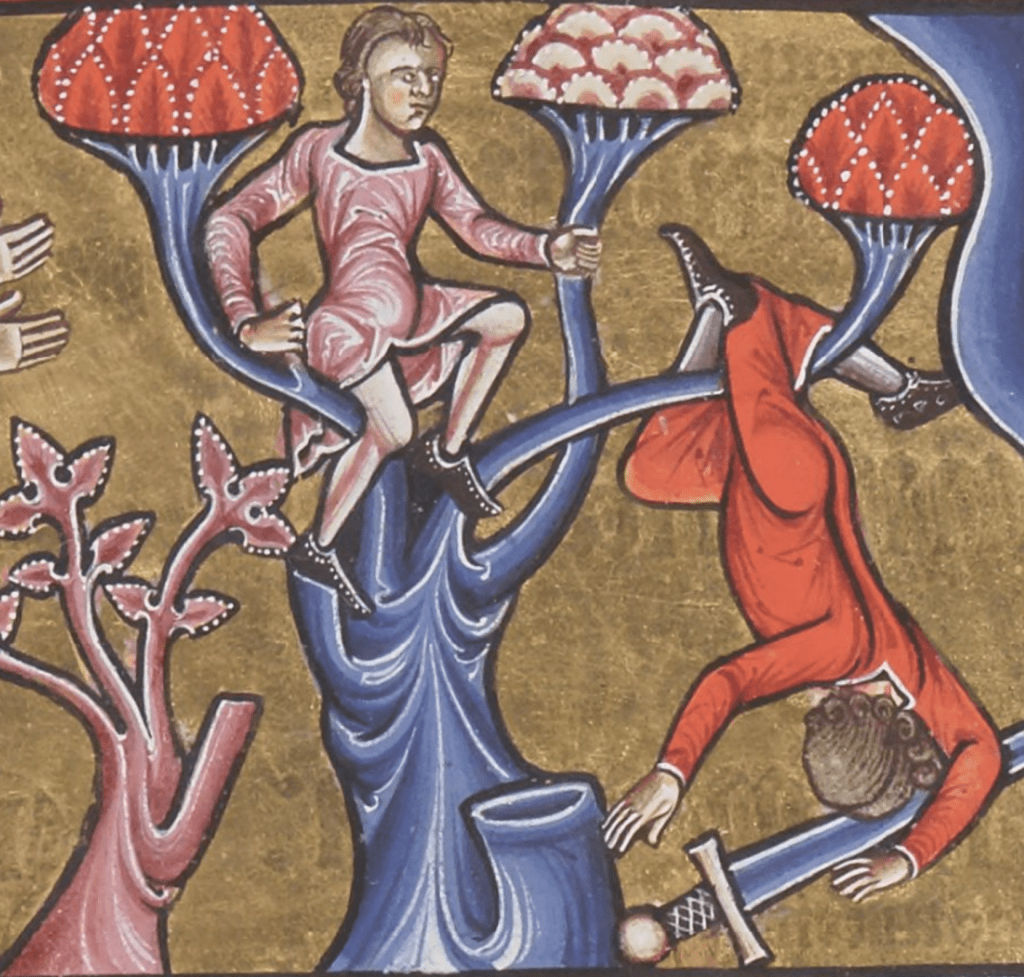
the “mushroom tree with sword and hanging with right-limb” image
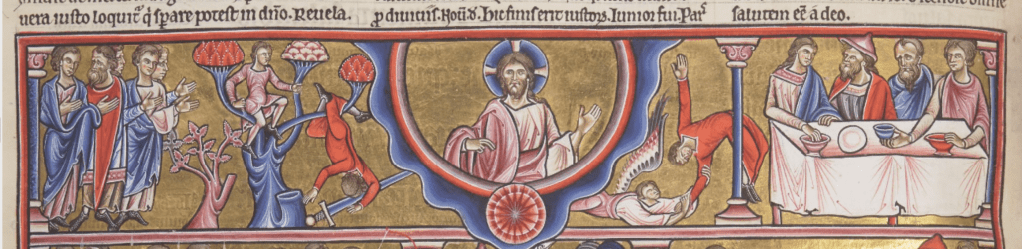
the “mushroom initiation top row” image
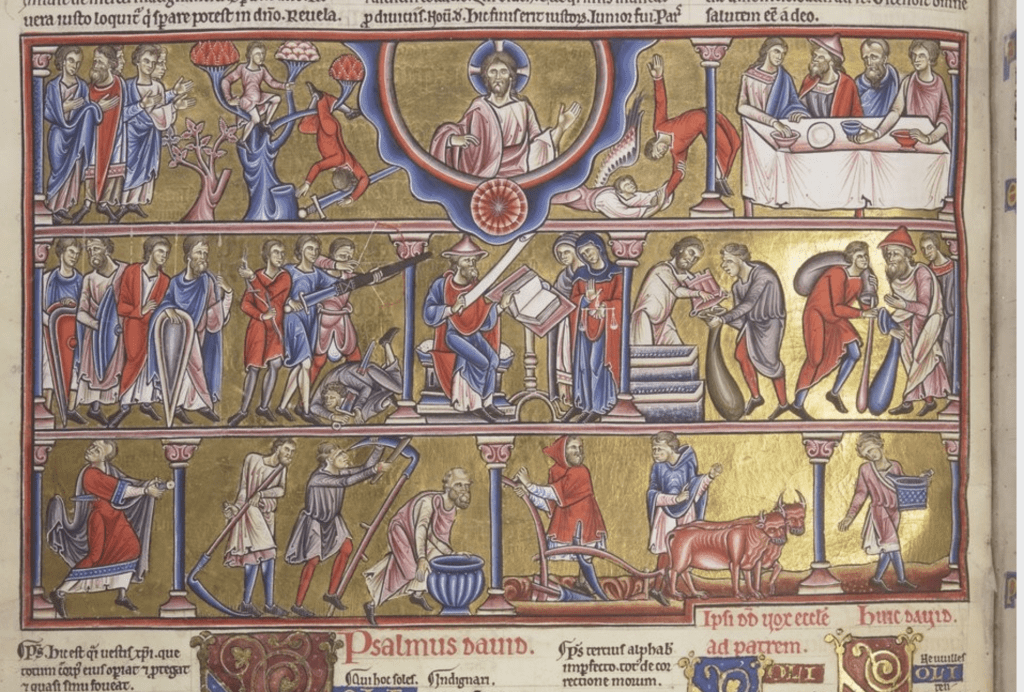
the “__ entire cartoon ” image
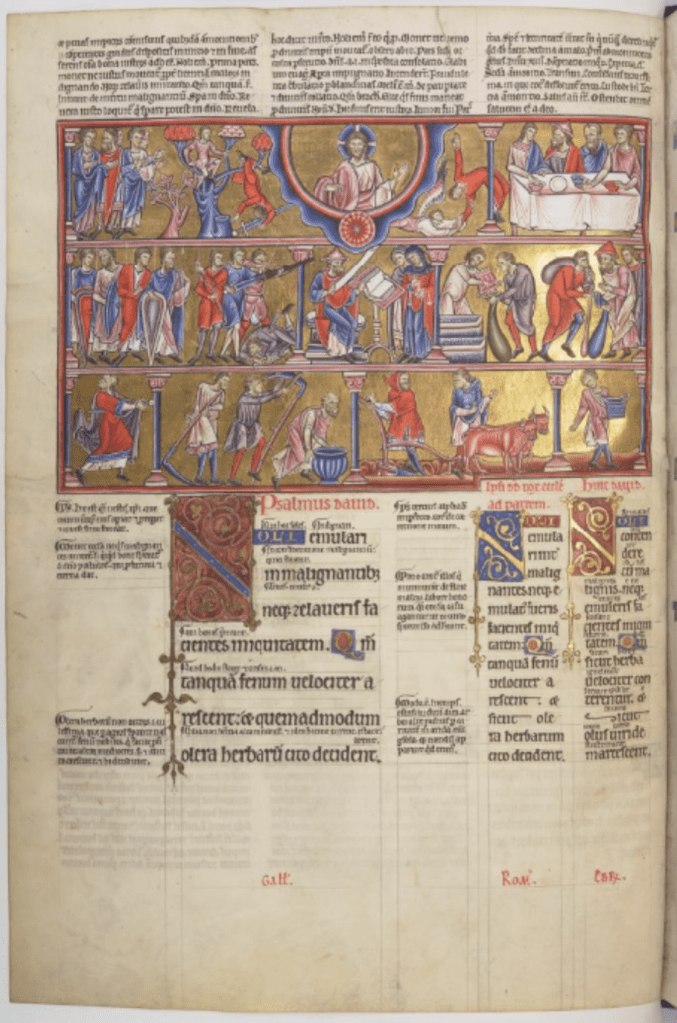
the entire page
/ end of one of the sections in major section “Clarifying the Explanation of {branching vs. non-branching}, as in the Entire Canterbury “Mushroom/ Hanging/ Sword” Image”
1st Pass of Prepping Reply to W’s Post at Cyb’s Article –
Long work-up to create short summary about branching, within in my “Bad Scholarship” comment
[2:10 p.m. November 24, 2020]
Prepping reply for Cyb weblog comments thread:
[outcome: I didn’t use the below writeups. See above, same URL, for final fresh-written reply; it’s solid.]
“I couldn’t quite figure out why
the Canterbury Psalter isomorphism was so non-inspiring and quite difficult to comprehend as per the Egodeath Theory, until explained.” /W
[outcome: I posted this good summary, after *much* work, above, to best state concisely as follows:
Here’s a succinct summary of the Message of the entire Canterbury “hanging-from-mushroom” image:
_____
The mytheme {branching tree} means (by analogy) branching possibilities, which implies the *entire* Possibilism worldmodel, which is unstable and non-viable in the altered state.
The mytheme {de-branched tree} means (by analogy) monopossibility, which implies the *entire* Eternalism worldmodel, which is stable and viable in the altered state.
_____
‘worldmodel’ here means, the mental worldmodel of time, possibility, and personal control.
or: “personal control power”; I should say ‘power’ more often.
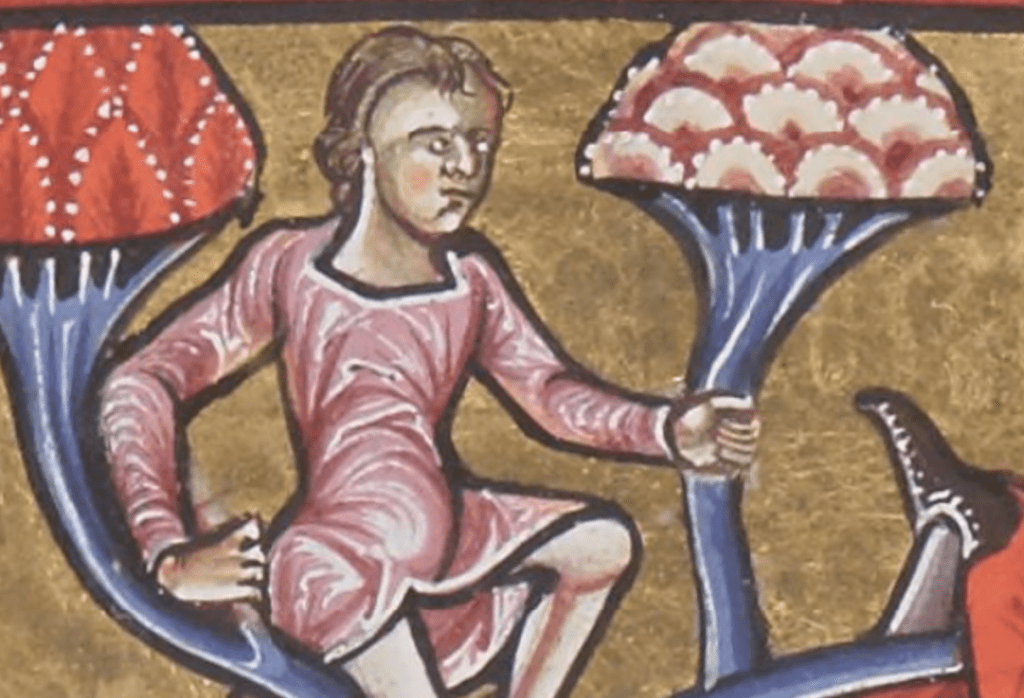
A pulse of dying power in a clenching plastic fist
https://genius.com/Rush-the-body-electric-lyrics
]
Image very, very heavily uses {blade} and the complex mytheme equation:
o {branching vs. non-branching} = {left limb vs. right limb}
Image tries to convey entire Egodeath theory / Transcendent Knowledge by only:
blade
branching vs non-branching
emphasizing:
if you depend on “branching”-thinking, in the ASC, you get the blade of death (cyber-seizure, non-viable, chaos, destruction, bad, out of control in worst way).
If you construct another basis in your mind, Eternalism ({non-branching, {rock} block univ; snake), and rely on it instead of illusory Possibilism-power : you avoid the {blade/death/ non-viable/} seizure/chaos.
That is 90% of the message of the image. (doesn’t use {rock} or {snake}; instead, to carry that weight of “block univ” & “worldline”, Image depends very heavily on instead, {non-branching}.
Image is over-pressing , over-burdening the {non-branching} idea to carry the weight of rock block universe and embedded serpent worldline.
I suspect that’s the “jump” that’s difficult for me and for you, in jumping from the Egodeath theory to this Image: you must “unpack” or “overload” {non-branching} to force it to ALSO mean block universe rock AND worldline {serpent}. The problem is, {non-branching} goes hand-in-hand with the rest:
System 1 = all of the following: {king sterring in branching tree}, instability in ASC.
System 2 = all of the following: {serpent embedded in rock} non-branching (block universe & worldline).
The difficulty of relating to the Canter Image even though you and I understand the Egodeath theory, may be my fault for not defining , in the past, that the “block universe” idea goes with “non-branching”.
Important Expansion of the Titles of the 2 Worldmodels of Control, Possibility, and Time:
Possibilism = one entire broad set of attributes/views;
Eternalism = the other entire broad set of attributes/views;
the topic of BRANCHING is only 1 of those various traits that contrast the two mental worldmodels. YOU CAN USE ANY 1 OF THE DIFFERENCES (eg branching vs nonbranching) THAT SET APART THE TWO MODELS, TO REPRESENT THE ENTIRE WORLDMODEL or worldmodel-pair or -contrast.
The Canterbury image strictly focuses on two differences between the two giant worldmodels, or just one difference: BRANCHING.
How you believe about the one little topic of Branching, = which of the two giant worldmodesl (that contain much more than just the Branching issue/view) you hold. It’s like saying,
“If you tell me how you feel about wearing a mask all the time, I can tell you your entire political view.”
The way you feel about wearing a mask all the time, is an indicator of your entire way of thinking, your entire worldmodel that you inhabit.
If you tell me 1 little thing — how you think about possibility branching: is it real or not? — then I can tell whether you believe in
the entire giant Possibilism worldmodel or
the entire giant Eternalism worldmodel.
[I liked this construction and copied it to above, to break out in –> type of expression for each component; each component of one of the two models implies that entire giant model:]
Possibilism = the branching-tree universe containing autonomous steersmen steering with freewill-power control in trees
Eternalism = the non-branching block universe containing puppet-steersmen steering with no freewill-power non-control in worldlines
____________
Possibilism =
the branching-tree universe containing
autonomous steersmen steering
with freewill-power control
in trees
Eternalism =
the non-branching block universe containing
puppet-steersmen steering
with no freewill-power non-control
in worldlines
If you try to bring Possibilism-thinking into the ASC, it “breaks”, panics, seizes, goes unstable, non-viable, it perishes. The Image doesn’t talk of “Possibilism” or “Eternalism”; it only latches onto 1 aspect of those 2 models: only the “branching vs non-branching” aspect.
All sorts of things fit together, into these 2 giant Master Buckets:
the Possibilism giant bucket, and
the Eternalism giant bucket.
one contrasting thing, a difference between what’s in those giant buckets, is: branching vs. non-branching.; or, in brief:
BRANCHING (& how it differs between the 2 buckets, which are Possibilism & Eternalism.) Do you want to focus on CONTROL; “(egoic) control vs non-control”, equating the different in control, between the 2 systems, with the entire difference between Possibilism vs Eternalism giant buckets/worldmodels? Do you instead want to latch onto the topic of the difference in model of TIME?
Good News: very very simple: THERE ARE ONLY 2, VERY OPPOSITE WORLDMODELS.
Bad News: inside each model, is an entire universe of aspects, which contrast between the 2 systems.
Possibilism = this big set of distinctive attributes:
branching (that’s just 1 of the distinctive characteristic aspects of the giant Possibilism worldmodel) =
autonomous king (that’s another one of the distinctive characteristic aspect of the giant Possibilism worldmodel) =
Eternalism = this big set of opposite distinctive attributes:
non-branching = (that’s just 1 of the distinctive characteristic aspects of the giant Eternalism worldmodel) =
/ important groups of concepts, required for seeing the Canter Image as broadly covering all of the two models, Possibilism vs Eternalism.
_____________
You followed my decoding during the construction project, that’s both easy & hard, following my confusions along the way to clarity. In a way, my article / formatting/ TOC is much easier to follow now that it’s “done”.
It’s like tagging along with a Science researcher/experimenter at the leading edge — he’s not working on – or able to — stop and most clearly explain each step by step step in the Hypothesis formation stage; he has to go very fast, and when he makes a breakthrough he has to stop and try to make Log entries of how he got there, reconstructing his steps.
The nice clean textbook presentation of his experiment results make it look easy, when the proofs are laid out all nice. Like my “finished” article is now. I did a lot at the end, yesterday/today, to put the appealing marketing onramp at the top of the Proof Canterbury Mushroom Tree Leg Hanging article. -mh
“And then I realized that [I had trouble following the in-progress Canterbury decoding b/c] it’s because it isn’t foundational. ” – W
The Image is challenging b/c no Snake, no Block Universe — they restrict themselves to only 3 mythemes:
o mushroom,
o {blade} – very heavy use.
o {branching vs. non-branching} = {left limb vs. right limb} – very heavy use.
Not used in Image:
o {king, serpent, rock…}
Concise version of Cyb’s 3 tiers of evidence to look for mushrooms:
1. Literal depictions of mushrooms
2. Stylized depictions of mushrooms
3. Depictions of mushroom effects
– mh
/ clarif of a subection about branching Canter decoding
_____
W wrote:
“And that came to me last night from the following sentence in a common prayer:
‘Thy kingdom come, thy will be done, on Earth as it is in Heaven.’
“Bible metaphor, isomorphism, is foundational
“Heaven/Earth
“A common denominator.”
“Ego transformation from Possibilism into Eternalism
using {feet pointing, direction of hands, hanging from tree, wrinkles in clothing}, are more in-between Heaven and Earth [compare Cyb’s middle categ] and do not have a common and strong denominator, except for when there is the use of branching and non branching, trees and snakes, etc..
“Which makes it all harder to grasp.
“In the ordinary world we know it’s common for right-side brain to be more intuitive, left more analytical.
“But we don’ t grow up learning a meaning for pointing left
and right as related to ‘heaven.’ That has been made new (at least for myself) as metaphor through the Egodeath Theory.
“Now, maybe there has to be a required level of intelligence to grasp the entire Theory, and if so then the Theory automatically becomes limited and exclusive.” – W
In the Class Session scene, 1 out of 4 students passes the exam. -mh
W: “Or maybe the Theory requires being sowed and reaped umpteen times, and if so, then the Theory becomes dependent on time and repetition.”
You know that’s how it goes: rewrite 20 times, to work-out a clear way of talking about these very difficult topics. -mh
W: “I just don’t know how else to describe this other than to say that the sense of a foundational common denominator for possibilism into eternalism is missing in parts (at least for myself) and might just be a factor for people in understanding the Theory.
“Bible metaphor is easy for the mind to grasp. It uses Earth as foundation.
“Last night I was able to come up with a good metaphor (for myself) regarding the difference between childish egoic possibilism and qualified egoic possibilism.
“I simply call them immature ego/mind of possibilism and mature ego/mind of possibilism.
“The immature ego/mind of possibilism is a ‘bud’, not yet open to the ‘sun’
“The mature ego/mind of possibilism is a flower, fully open to the ‘sun’ and which bares nectar for the ‘ascent of the butterfly’.
“Thy kingdom come, thy will be done, on Earth as it is in Heaven”
________________
W’s paragraphs, con’t – a different post by W:
mix of “Bad Scholars” & “Branching”?
“There is a separation of life throughout the history of writings about spiritual attainments, whether in new age spirituality, religion, or in the history of entheogenic mind transformation.
“These occur commonly within the written and historical references to life, such as being pure or impure, insider or outsider, esoteric or exoteric etc.
“Whether the words that appear to separate life are used metaphorically or not, the written word does not decide that.
“The minds of the readers do.
“And although it is important to distinguish differences in the world, the rise of critiquing, which can border on attacking integrity, is either an unwanted side effect or it becomes intentional.
“And it makes me wonder what type of world is being created from the advancement of the mind.”
“I hope that love and respect, acceptance and compassion will never get pushed aside for the want of achievements, myself included.” – W
Tell that to the bullies who abuse the field for their own self-serving gain, holding back the field.
“There is never a thought of the people as to whether they are this or that.”
“They are ordinary people just like myself. I love the world that I live in, and it’s not always just good times…there are hard times too.” – W
Yeah well you’re not battling at the front lines pushing the field ahead despite the naysayers who are — in effect — through their muddled, self-confused thinking, trying to hold it back.
You’re not in the fray of the “interpretation framework wars”.
Your advice is good valid advice like a friend advised me about my 2006 main article; they said: Don’t write against others; positively write what is the case.
I am the field, shaking itself awake, shaking off the muddled-thinking, shaking off and zapping the delusion that clouds the mind of the field.
“That’s when I hold on tight to ‘the string.’
“I wish for all of you a peaceful Thanksgiving and a wonderful Christmas, if those are holidays that you celebrate.
“Never forget your heart. ” / W
/ branching sections are above
My Comments on Cyberdisciple’s Article “Correcting Key Points in Muraresku, The Immortality Key” – Part 1, November 24, 2020
[9:30 p.m. November 24, 2020]
Cyb’s new article is copied here, for my interactive reading-by-editing.
Cyb’s New Article, for my interactive reading-by-editing speculates about drugs in Greek and Christian religious history using a Moderate approach.
He speculates that drug use was reserved for elites and monopolized by powerful families and kept secret by mystery cults. Some occasional instances of drug use can be found outside of such groups, but they are always secret and related to those groups. Against these groups, the cults of first Dionysus and then of Jesus sought to spread drugs to more people, but they were suppressed by the Roman Empire and the Catholic Church. The cult of Dionysus and early Christianity were threatening because they distributed drugs.
[what?! is this a fantasy novel? the “make sh*t up” school of scholarship?-mh]
“Muraresku’s is a relatively broad, but still firmly Moderate approach. He cannot imagine widespread drug use across all culture, including the mainstream, even as he keeps citing evidence that suggests knowledge of drugs was widespread and not limited to secretive elites or suppressed groups. His Moderate approach to speculation is typically shaky. Moderate approaches always totter toward the Maximal Theory, or seem to when viewed through the superior lens of the Maximal Theory.
In conflict with his Moderate speculation, Muraresku uses a Minimal approach when it comes to evaluating evidence for drugs. Again and again he concludes that we cannot really be sure about drugs in Greek and Christian religion, becuase we don’t have “hard evidence.” His criterion for good evidence is extremely restricted: only a residue from a cup from a religious site that shows evidence of a psychedelic when analyzed in a chemical lab will count for Muraresku. Everything else is merely suggestive, but not enough to conclude.
–
Summaries of sections of the book and corrections of key claims.
Part 1 is dedicted to Eleusis.
Chapters 2-5 (pp. 37-105) are on the topic of drugs in the Eleusinian Mysteries of Demeter and Persephone. Muraresku discusses Wasson …
[i totally slammed Wasson in email to Ruck today. forget wasson. he’s a — evasive writer, too; can’t form a clear position statement to save his life. he’s harmed the field, badly, unlike Graves. Wasson is the –. He abused scholarship as a tool to conceal, not to reveal. Irvin has comparable cynicism about Wasson and his covert motives.-mh]
… , Hofmann, and Ruck’s The Road to Eleusis and laments that chemical analysis is possible of surviving cups found at the site, because they were cleaned after excavation, at a time before chemical analysis was performed in archaeology. Without that chemical analysis, Muraresku cannot decide whether or not drugs used at Eleusis.
Were drugs used at Eleusis? Yes. It was not a secret, and Wasson erred in presenting it as a secret to be revealed in The Road to Eleusis. The secret to be revealed at Eleusis is that of the switch from possibilism to eternalism in the loose cognition state induced by drugs. We do not need a chemical analysis to conclude that drugs were used at Eleusis. A convincing case can be made using evidence from visual art and text. Eleusis was also not unique in ancient Greece in its use of drugs in religion; it would be strange if drugs were not involved.
Muraresku is wrong to start his investigation with Eleusis and with The Road To Eleusis. It is distorting to focus so much attention on Eleusis
[Eleusis, Eleusis, Eleusis… and Allegro, Allegro, Allegro — L E T – I T – G O !!! reductionistic MONO-MANIA. Eject your infinite-loop 8-track tape and join the 21st C discussion! -mh]
at the expense of the rest of ancient Greece. Eleusis did not have the cultural standing that Muraresku attributes to it, as some sort of spiritual center of ancient Greece or the Roman Empire. He can only tell that story through ignoring all the other temples, cults, and stories.
[that ol’ move. same pattern: Put all focus on Allegro, make Allegro the star that you force the entire field to steer by. Easier than real scholarship, reading all those books and doing broad research -mh]
As I’ve written earlier, The Road to Eleusis is not the place to start with the topic of drugs in Greek religion. If he wanted to start with the beginning of the 20th century’s investigation into drugs in Greek religion, he should have started with Robert Graves. Better still would have been to start after surveying all the books produced since then [1957] on the topic. Best would have been to learn eternalism and the Maximal Entheogen Theory via the Egodeath Theory
Framing the question as “were drugs used at this one specific site?” (i.e. considered in isolation from other sites) is a sign of a Moderate Entheogen Theory. The Maximal Theory would never ask such a question in that way.
[true; alien to my thinking; my framework can’t present that question, loaded with the requisite background assumptions -mh]
–
Chapter 6 is on the topic of drugs in prehistory in the Mediterranean, specifically at Göblekli Tepe.
Were drugs used in prehistory and the ‘origins of religion’? Certainly; the Maximal Entheogen Theory of religion has no problem asserting that.
It would make sense, then, for drugs to have been used in connection with a religious ceremony at Göblekli Tepe… if indeed it was the site of religious ceremonies; nobody knows for sure. Nearly everything about the site is speculative.
Muraresku is wrong, however, to speculate about a continuity of transmission along cultural and genetic groups from Göblekli Tepe to Eleusis. Such a continuity is unprovable and implausible, and weakens his book.
Regardless, the case for drug use in religion does not need such a continuity.
[how does the mind work, in the altered state? that’s the driving common factor. My theory is a theory of how the human mind, every human mind at every time & place, works in the altered state, indep of where/when. -mh]
Looking for such a continuity is a sign that an investigator is using a Moderate Entheogen Theory of religion. The Maximal Theory does not need to map out tenuous connections between places and times of drug use in order to prove drug use.
–
Chapter 7 and the Epilogue to Part One are on drugs at an archaeological site in Spain. Muraresku seems to have his ‘hard evidence’ here: ergot was found on the chemical residue of a cup found at a site and on the teeth of a human jaw bone found at the same site. This ‘hard evidence’ is however thrown into doubt in the Epilogue to Part One. Muraresku reports that another scientist warns that the results are uncertain because the original samples analyzed cannot be found, and so cannot be tested again. So much for the criterion of ‘hard evidence’ via archaeochemistry.
Were drugs used across the Mediterranean and across culture? Certainly; the Maximal Theory has no problem. The evidence from the site in Spain is just another bit of data for the Maximal Theory, not of any particular importance.
For Muraresku’s speculation, however, it becomes a grandly important sign that the mysteries of Eleusis were being spread in secret
[#1 word signalling the self-contradictory Moderate theory: ‘SECRET'(re: the fact of drug use) -mh]
and that particular Greeks who founded the colony were especially spiritually sophisticated and took this special spiritual sophistication with them also to their colonies in Southern Italy.
However, there’s no clear, good evidence that the site in Spain was a cult site. Muraresku follows the archaeologists who excavated the site in this interpretation. But archaeologists frequently resort to saying that a site had a ritual purpose when they have no idea what the site was for. It’s a well-known joke in the field, and spoofed in books and articles.
Motel of the Mysteries — 1979
https://www.sfu.ca/~palys/Miner-1956-BodyRitualAmongTheNacirema.pdf
daily modern life as alien ritual
“Furthermore, if it was indeed a cult site to Demeter, this is not an indication that it was a version of the mysteries at Eleusis or in any way connected to Eleusis. Muraresku literalizes the Eleusinian myth that Triptolemus spread knoweldge of grain around the world
[i’m increasingly doubtful that grain means grain; in Mythemeland, everything mainly means the mind in the ASC. {grain} = some aspect of the altered state; the only question is, WHICH aspect/WHICH analogy-referent; WHICH isomorphism? “grain” is like X in the ASC; isomorphic, in that, Y-aspect -mh]
and thinks that the Demeter cult at Eleusis was some sort of proselytizing cult.
[? Evangelicalism meets Antiquity?? -mh]
Why Muraresku thinks that the Greek from Phocaea who founded the colony Emporion near the farm site in Spain and also founded the city of Elea/Velia in southern Italy were especially spiritually sophisticated is beyond me. Presumably this would mean that they are sophisticated in way that other Greeks were not, but Muraresku cannot bring forward anything particularly special. Embossing Persephone on their coins and producing the philosopher Parmenides at Elea/Velia do not especially set apart the Phocaeans and their colonies from other ancient Greeks.
The Minimal approach to evidence and the Moderate approach to speculation traps
[GOOD WORD, the field is caught in a trap, a dead-end snare to “violently” bust out of. “get caught in ticking traps” -mh]
Muraresku into over-estimating the importance of the site in Spain discussed in these chapters. He wants it to be a slam-dunk evidence that proves the kykeon …
[I side with Graves: ditch the complicated speculation about alien lost strains of ergot that used to work.
FROM NOW ON, ALL MY SPECULATION ASSUMES relig myth = PSILOCYBIN, with tiny footnote of Scopalamine as “if i have no other option” fallback cheap substitute that just makes you wish for real deal.
Because we KNOW the effects are 100% reliable, 100% classic entheogenic.
No Speculation Required.
trip reports of Scopalamine gave zero impression of classic enth effects, fwiw.
the Real Deal = Psilocybin.
others are side-curiosities/ poor 3rd-rate alternatives to fall back on reluctantly.
Psilo is universally considered top-shelf “the good stuff”, The Standard of Excellence.
better than 12-16-hour kinds, too: shorter duration = more control of the session-intensity curve.
reconstruct exact ancient mixed-wine usage technique of “rounds” of redosing, like at banquet; their perfected application technique is optimized. -mh]
… at Eleusis hypothesis of The Road to Eleusis right, but it is too marginal and dubious to accomplish even that limited task. The Maximal Theory does not need to rely on such special pleading.
–
Part 2 focuses on Dionysus and Christianity.
Chapter 8 is on drugged wine in ancient Greece and Dionysus. This topic is not new, and Muraresku’s narrative of looking at broken vase paintings in a museum focuses on weak evidence. He ends up presenting an uncompelling case of [on/for] a topic of great importance.
Chapter 9 focuses on establishing Dionysus in ancient Galilee, in order to justify linking Mr. Historical Jesus to Dionysus and drugged wine.
Chapter 10 focuses on drugs in the ancient Near East, including Egypt and the Canaanites. He claims that the drugs were exclusively for the elites, such as pharaohs and Canaanite elites. He then makes the cult of Dionsyus and Christianity about providing drugs to more people, non-elites.
[the make-sh*t-up school of scholarship? -mh]
He then claims this was the reason that the cult of Dionysus and Christianity were
[allegedly – Believe All Martyr-pron Tales -mh]
oppressed.
Why he is so confident that drugs were restricted to the elites, when he has just argued that wine was widely drugged, I cannot say.
[Moderate = self-contradiction -mh]
I would ask Muraresku: what evidence is there for the suppression of drugs in antiquity? As he knows, drug use was not exclusive to the cult of Dionysus and Christianity, and was found all over the Mediterranean. On what basis, then, does he think that the cult of Dionysus and Christianity were suppressed because of drugs?
Muraresku’s Moderate approach teeters and totters.
[that’s a sign, indicator, hallmark, characteristic trait of Moderate -mh]
–
I’ll add summaries and critiques of the remaining chapters. Reading the book is slow going because I want to throw the book across the room after every other sentence.
/ end of section “My Comments on Cyberdisciple’s Article “Correcting Key Points in Muraresku, The Immortality Key”” — part 1. His added part 2, Dec 2 2020, is below.
My Comments on Cyberdisciple’s Article “Correcting Key Points in Muraresku, The Immortality Key” – Part 2, December 2, 2020
Cyberdisciple added the following sections at the bottom of page:
Correcting Key Points in Muraresku, The Immortality Key
https://cyberdisciple.wordpress.com/2020/11/24/correcting-key-points-in-muraresku-the-immortality-key/ —
[His sections are copied below, for my commenting. -mh]
________
Chapter 11 finalizes the first sequence of part 2, consisting of Chapters 8-11, on the similarities between Dionysus and Jesus and on the Eucharist as psychedelics.
[That sounds like the original title of Freke & Gandy’s book:
The Jesus Mysteries: How the Pagan Mysteries of Osiris-Dionysus Were Rewritten as the Gospel of Jesus Christ
Timothy Freke & Peter Gandy, 1999
http://amzn.com/0722536763
-mh]
It is not particularly new
[The above popular book is from 21 years ago, and we’ve been discussing it at the JesusMysteries Yahoo Group for 21 years, sometimes with the authors, and many heavy research scholars and book authors – the whole gang of them. The subject of ahistoricity, including Dionysus parallels, has gone quite mainstream, some years ago. -mh]
or groundbreaking to point out that a source for the Jesus figure is Dionsyus, though Muraresku acts as though he is contemplating some new breakthrough.
More importantly, it is misleading to focus so exclusively on Dionysus as the source of the Jesus figure.
The Jesus figure was derived from many sources, not only Dionysus.
[I’ve been yelling that on the world-wide web for decades. Scholars persist in the ridiculous industry of grand pronouncements of the same old preposterous 1-dimensional approach; let’s name the damn thing:
the “Single Source for the Jesus Figure” fallacy
-mh]
“Jesus figure” is my addition, since Muraresku is committed to Mr. Historical Jesus.
Muraresku invents the idea that the early Christians needed a psychedelic Eucharist, to appeal to Greeks.
[AS IF Israelites and primitive proto-Christians DIDN’T have what EVERYONE ELSE EVERYWHERE had, the mushroom (or equivalent) engine that powered the whole damn thing, Mystery Religion initiation, UBIQUITOUSLY throughout ALL of Antiquity, ALL of Hellenistic religion. -mh]
Lurking behind this idea is the implication that a mystery cult could have had some other sort of sacrament, some non-psychedelic sacrament.
[agghhhh KILL ME
fortunately i have an image handy b/c need it so often:

Can you imagine what a complete failure and laughingstock, totally uncompetitive, a “Mystery Religion with no psychoactive sacrament” would have been, in the Hellenistic era?
Such an ersatz, non-Mystery Religion “Mystery Religion” would have been the laughingstock and embarrassment of the entire Mediterranean.
The very notion is a complete contradiction in terms, like an automobile with no engine; a brand of mysticism with no mystic experiencing.
It would have been a complete, instant flop; a total non-starter, seen as pure, utter folly — a direct contradiction in terms. -mh]
We see Muraresku’s Moderate approach stumbling here.
Per the Maximal approach, there was no such thing as a non-psychedelic mystery meal.
—
Even apart from the contrast between Moderate and Maximal approaches, the idea fails on its own in the context of Muraresku’s book.
Why would it matter to the Greeks if the Christian sacred meal were psychedelic, if they already had psychedelic sacraments at Eleusis, around the Mediterranean in cults in farmhouses, and in Dionysiac initiations?
[Psychedelic initiation was as secret as awareness of the snake-shaped worldline hiding veiled in the mind, visible to anyone in the altered state, shown in all the art, literally paraded before everyone’s eyes, in the snake-basket in the (“sacred”, needless to say) parades. -mh]
A psychedelic Eucharist wouldn’t make Christianity especially appealing or noteworthy to Greeks.
What about a psychedelic sacrament would make Christianity distinctive?
—
In the heavily psychedelic and heavily mystery cult-oriented Mediterranean, Christianity’s distinctive appeal lay primarily in its counter-empire stance.
Muraresku, knowingly or not, has some awareness of this.
He makes the cult of Dionysus and early Christianity deviant and in danger of suppression from the Roman Empire.
However, he exaggerates the degree to which either was suppressed and misfires when he names the cause of suppression.
With no evidence or basis, he fantasizes that the Roman authority suppressed the cults because they used psychedelics.
[PRESENTISM FALLACY MUCH? -mh]
Because of this fear of Roman SWAT teams, the Greeks would have found it appealing for Christianity to have a psychedelic sacrament, you see.
—
Far from being hostile to psychedelics and mystery initiation, the Roman imperial hierarchy in fact incorporated the use of psychedelics and mystery initiation to support and prop up the socio-political arrangement.
To the extent that mystery cults and other religions threatened that socio-political arrangement, to that extent were they interfered with by the Roman power.
Most mystery cults and religions adapted to the hierarchy and became subordinate to it.
—
It is true that the Roman historian Livy (64/59 BC – AD 12/17) and an inscription of a decree of the Roman Senate indicate that the Roman Senate in 186 BC regulated and suppressed a particular manifestation of the cult of Bacchus/Dionysus in Italy.
—
Muraresku wants that one instance of regulation/suppression to mean that Bacchus/Dionysus was a threatened cult everywhere in every instance.
This is not the case.
Bacchus/Dionysus was not some taboo and suppressed god for the Romans.
Before the importation of the mystery cult of Dionysus/Bacchus into Italy, the Romans/Italians had their own equivalent, Liber (or Pater Liber).
Over time Liber and Bacchus/Dionysus became identified with each other.
In whatever manifestation, Liber/Bacchus/Dionysus was always a standard member of the pantheon in Greece and Rome.
His worship was completely normal and regularly incorporated into the culture of ancient Greece, ancient Italy, and the Roman Empire, from the bottom of the social order to the top.
—
As I’ve pointed out in other posts, a source as obvious, banal, and entry-level as Wikipedia shows the inaccuracy of Muraresku’s story:
Article: Dionysus
Subsection: Worship and festivals in Rome
https://en.wikipedia.org/wiki/Dionysus#Worship_and_festivals_in_Rome
—
There is indeed a history of back-and-forth relations between the Roman authority and the worship of Dionsyus/Bacchus/Liber concerning the activities of worshippers.
But this does not amount to a blanket threat of suppression of the altered state in the way Muraresku implies.
The altered state via psychedelics was common and easy to come by in the ancient Mediterranean.
[ G E T – I T – I N – Y O U R – H E A D S, – S T U P I D – D E N S E – M O D E R A T E – E N T H E O G E N – S C H O L A R S !
GET MAXIMAL
-mh]
The uneasy relations of a particular brand of cult with the Roman authority did not affect the widespread and common altered state experiencing via psychedelics.
—
In turn, early Christianity stood out not for its psychedelic sacrament, but because it stylized itself as a direct counter to the Roman hierarchy and applied itself to the set-up of an alternative society.
It is another mark against Muraresku’s ‘scholarship’ that in a book on Christian origins he makes no mention of the many books on counter-empire themes in early Christianity.
The psychedelic sacrament was nothing special, and
it would have been unusual (impossible) not to have one.
—
Secondarily, the reason for Muraresku’s selective focus on Eleusis, Dionysus, and early Christianity becomes clearer in Chapter 11.
He has been so selective because he wants to tie the preparation and administering of psychedelic beverages to women.
He fantasizes that women had exclusive knowledge of psychedelics.
[as followers of the Egodeath theory know, I posted a severe criticism maybe in 2002, of the absurd and presentism-speculation-based idea, in some entheogen scholarship book, that only masters, but not slaves, knew about mixed wine mushroom wine. -mh]
—
He wants his book to participate in an intra-Catholic or intra-Christian debate about the legitimacy of women priests.
This is why he ignores all other mystery cults and the widespread use of psychedelics throughout Mediterranean culture.
Ignoring it allows him to tell his fantasy story that women held the special knowledge of psychedelics until they were suppressed by ‘the patriarchy.’
[oh fkking NO COMMENT -mh] 🗑️
—
He is committed to the Moderate approach because of cultural commitments, not because of a commitment to historical accuracy or plausibility.
[STOP HOLDING ENTHEOGEN SCHOLARSHIP HOSTAGE TO IRRELEVANT, POLITICIZED FACTORS!
TRY to do entheogen scholarhip based on strict critical historiography, but I guess that’s too much to ask. -mh]
Eleusis and Dionysus appear to be easy targets because the cult mythology at Elusis focuses on female goddesses and because Dionysus had his maenads.
[Maenads are initiate dudes, for all we know. Ruck and everyone is an uncritical literalist here, making uncritical presumptions, committing a category error, a genre error; a fallacy: shall we dub it —
the “literalistic reading of Hellenistic Mythemese” fallacy
-mh]
Early Christianity appears to be an easy target because evidence can be arranged to show its popularity among women.
Yet Muraresku has not produced any evidence that women alone knew of and administered psychedelics.
It’s implausible. Why would only women know how to mix psychedelics into wine?
Can Muraresku prove what is implied by his story, that men did not know how to mix psychedelics into wine?
[uh, I’M OUT, if we’re abandoning all sense –
I don’t have time for this sub-sub-critical scholarship,
Just go ahead, use psychedelics to project anything and everything your culture-addled mind wants to, on ancient entheogens abused as your modern-day, mid-20th C Rorschach ink blotter image.
I thought we were doing scholarship, not “fantastic-tales storytime”. Preposterous! -mh]
—
It’s a story he wants to be true, so he’ll distort everything to make it so.
—
Muraresku on the topic of women is an example of his literalizing of religious myth.
‘Female’ in analogical mythemes refers to:
“{female}: the mind’s vulnerable thought-receiver, normally {veiled}, unable to resist the uncontrollable source of thoughts. When that source-situation becomes visible, perceptible in the ASC, the female {maiden} is consciously overpowered and {abducted} to the {underworld}.”
—
https://egodeaththeory.wordpress.com/2020/11/15/mytheme-list/#fterms (scroll down to find).
[hyperinked above -mh]
—
The presence of females in the religious imagery of the cult tells us nothing about the historical reality of the cult’s practice.
[Mithraic initiation included the soldiers dressing as a {bride}, per their inner female helpless thought-receiver, following the Herme-Aphrodite Andro-Gyne, Mithras, who injects control-thoughts unstoppably, just as Mithras inserts the blade into the vunerable side of the bull, cancelling out its most-powerful, shoulder muscle; cancelling the egoic personal control-system’s power. -mh]
—

 The Egodeath theory