Contents:
- The Johannine Gospel in Gnostic Exegesis: Heracleon’s Commentary on John
- The Gnostic Paul: Gnostic Exegesis of the Pauline Letters
- The Gnostic Gospels
- The Jesus Mysteries: How the Pagan Mysteries of Osiris-Dionysus Were Rewritten as the Gospel of Jesus Christ
- The Jesus Puzzle: Did Christianity Begin with a Mythical Christ? Challenging the Existence of an Historical Jesus
- Jesus: Neither God Nor Man – The Case for a Mythical Jesus
- Jesus from Outer Space: What the Earliest Christians Really Believed about Christ
The Johannine Gospel in Gnostic Exegesis: Heracleon’s Commentary on John
The Johannine Gospel in Gnostic Exegesis: Heracleon’s Commentary on John
Elaine Pagels, 1973
http://amzn.com/1555403344
Society of Biblical Literature Monograph Series
My review at Amazon:
https://www.amazon.com/gp/customer-reviews/RY2KUAP5C0RTJ/ref=cm_cr_dp_d_rvw_ttl?ie=UTF8&ASIN=1555403344
My history of writing about this book:
- My 2004 Egodeath Yahoo Group posting; my early non-Amazon commentary on the book. Prior to Valentine’s Day 2004, therefore it’s copied to Egodeath.com.
- My 2013 posting of my 2013 official review of the book at Amazon (I likely posted the review to the Egodeath Yahoo Group, and then to Amazon).
Egodeath.com Sections about “Johannine Gospel in Gnostic Exegesis” (& book “The Gnostic Paul”)
My discussion of her book at Egodeath.com (copied to Egodeath.com from the Egodeath Yahoo Group postings in January 2004, shortly prior to the cutoff of copying to Egodeath.com, which is Valentines’ Day 2004).
https://www.google.com/search?q=The+Johannine+Gospel+in+Gnostic+Exegesis&sitesearch=egodeath.com&btnG=Search
The two page-subsections – seems different than the Amazon review:
Page title: (lacks dates of my writing; found the January 2004 dates from the Digest of the Egodeath Yahoo Group):
Determinism in Gnosticism
Subsection headings:
Pagels: Johannine Gospel in Gnostic Exegesis: key = determinism
Determinism in Valentinian Gnosticism: Pneumatic vs. psychic Christians = freewillists vs. determinists
http://www.egodeath.com/DeterminismGnosticism.htm#_Toc64388076
No date shown there, but it must be 2004-01-15.
My 2004 Posting “Pagels: Johannine Gospel in Gnostic Exegesis: key = det’m”
Subject:
Pagels: Johannine Gospel in Gnostic Exegesis: key = det’m” in Egodeath Yahoo Group
2004-01-15
https://egodeaththeory.wordpress.com/2020/12/29/egodeath-yahoo-group-digest-58/#message2961
That posting thread = the Egodeath.com page subsections:
https://egodeaththeory.wordpress.com/2020/12/29/egodeath-yahoo-group-digest-58/#message2961
=
http://www.egodeath.com/DeterminismGnosticism.htm#_Toc64388076
All Egodeath Yahoo Group posts before Valentine’s Day 2004 are at Egodeath.com, without dates.
“Solution Key:
‘Pneumatic’ = timeless determinist
‘Psychic’ = freewillist religionist; freewillist moralist lower Christian”
2014 Egodeath Yahoo Group posting about “the 2 races” (in the mystic analogy sense), same thread:
Thread Subject:
Pagels: Johannine Gospel in Gnostic Exegesis: key = det’m” in Egodeath Yahoo Group
2014-12-24 (10 years after start)
https://egodeaththeory.wordpress.com/2020/12/21/egodeath-yahoo-group-digest-127/#message6507
My 2013 Amazon Review of “The Johannine Gospel in Gnostic Exegesis”
My review of “Johannine Gospel in Gnostic Exegesis” at Amazon:
https://www.amazon.com/gp/customer-reviews/RY2KUAP5C0RTJ/ref=cm_cr_dp_d_rvw_ttl?ie=UTF8&ASIN=1555403344 — long –
Has page #s so you know I’m not just making things up, projecting my wishes onto Pagels/ Heraclitus.
My Jan. 2013 Egodeath Yahoo Group posting of that review:
Re: Pagels: Johannine Gospel in Gnostic Exegesis: key = det’m
2013-01-20
https://egodeaththeory.wordpress.com/2020/12/13/egodeath-yahoo-group-digest-124/#message6299
Michael Hoffman
5.0 out of 5 stars
The elect vs. moralists, sacrament of apolytrosis (redemption)
Reviewed on January 19, 2013
This reprint of Pagels’ 1973 book based on her dissertation …
I provide a summary here, assisted by decades of original work on my theory of religious experiencing and metaphor. The Jesus Mysteries: Was the “Original Jesus” a Pagan God? is a readable preparation for Pagels’ early books. Pagels’ book shows that Valentinians presented the following 2-level system. See my comparable contrast summary in my review of Pagels’ book The Gnostic Paul: Gnostic Exegesis of the Pauline Letters.
2021 – I inserted the below, valuable heading to link to:
1-for-1 Contrast of Higher vs. Lower Christians’ Consistent Sets of Positions (= Eso vs. Exo) from Pagels’ Book Johannine Gospel in Gnostic Exegesis
Higher Christians (‘pneumatic’; spiritual): … [first bullet of each pair]
Lower Christians (‘psychic’; mental): … [second bullet of each pair]
o Don’t rely on the historicity of the Bible (page 12). What matters is the mystic-state meaning and metaphorical analogies. Deny the uniqueness of the Christian revelation (page 15).
o Believe in the uniqueness of the Christian revelation, emphasizing the literalness of its occurrence of historical events.
Pagels discusses ahistoricity, or the unimportance or irrelevance of Jesus’ literal historical life and crucifixion, on pages 12-16, 44, 46, and 118.
o Received the higher Eucharist; they are given grace through receiving the sacrament of apolytrosis (which I point out is entheogenic-equivalent, like the “sacraments of Phrygia and Eleusis” mentioned on page 15).
o Only have baptism by water, associated with forgiving sins but in such a way that free-will moral thinking is still implied (various pages in Pagels). They only eat literal ordinary bread and drink literal ordinary wine.
Pagels discusses the Eucharist, wine, feast, banquet, eating, drinking, sacrament of apolytrosis, bridechamber, marriage wedding banquet, and other entheogen-equivalent topics, on page 15 (sacrament of Eleusis), 62-65, 76-82, 92-96, and 115. See my review of Gnostic Visions: Uncovering the Greatest Secret of the Ancient World and Flights of the Soul: Visions, Heavenly Journeys, and Peak Experiences in the Biblical World .
o Are masters of metaphor interpretation, describing experiential insights received through the sacrament of apolytrosis (redemption). Are able to interpret all brands of mystic writing (page 15).
o Are literalists. They depend on a historical reading of events in the Bible, assuming that those events literally happened. This prevents them from understanding spiritually (which I explain explicitly: they don’t understand the entheogen Eucharist and its revelation of no-free-will).
o Think in terms of this higher vs. lower understanding, making this distinction.
o Don’t believe in or understand higher Christianity and metaphor reading in terms of spiritual experience.
o Redemption and heaven is now, for the elect.
o Redemption and heaven is in the future, in the age to come.
o Receive redemption, purely by God’s grace (matching Reformed theology, my theory points out). Though veiled as “election” and explained indirectly through symbolism, these Christians basically are brought to believe the supposedly “pagan” idea of no-free-will, upon discovering that they are among the elect and receive their redemption though grace — though they initially and originally think, mistakenly, using the lower way of thinking.
o The lower Christian reaches, if they are morally good, Salvation (still reifies the free-will moral premise). These can earn salvation through works. Receive a lower salvation, a forgiveness of sins, while that forgiveness still reifies free-will moral thinking; ‘ethics’ per Pagels. They believe in free-will moral agency. They conceptualize religion in terms of freewill ethics and moral conduct as the way to earn salvation.
____
Pagels discusses determinism, election theology, grace, works, and moral ethics on pages 49, 57, 72, 82-83, 98-113, and 120-122 especially (that is the end and climax of the book). Pagels explains how Valentinians enabled treating both higher and lower Christians both as authentic Christians.
Valentinians are interesting Christian Gnostics because they define an ‘asymmetric theology’ (a term from my theory) that enables treating both higher and lower Christians both as authentic Christians.
Pagels’ doesn’t point out (but my theory does) that Augustinian theology has this same asymmetry: those who are not saved, are condemned by their own freewill-type moral guilt; the elect are chosen for redemption by God in a no-free-will type of framework.
_____
Mainstream writer Origin accuses Gnostics of asserting a fatalistic determinism theology of salvation like the pagans (page 49).
How can Pagels not mention Reformed theology here, as my theory covers?
Pagels writes “To counter the fatalism of pagan religion and philosophy, mainstream Christians stress freewill ability against fatalism, and dismiss this election theology as determinism, if not arrogance.
Plotinus also criticizes the Valentinians for not discussing ethics, the soul, purifying the soul, and right conduct.” (page 122)
She characterizes ‘the soul’ as being a factor that’s part of free-will ethics in lower Christianity, in Valentinian Gnosticism.
_____
Per Pagels, Valentinians as a concession to the mainstream Church that was trying to maximize its member count, Valentinians didn’t demonize freewillist Christians as “not real Christians”, but rather, included them as lower Christians, who could be saved after death, in the future time to come.
But per Pagels, page 112, Gnostics tend and want to posit 2 races:
o The race of the elect.
o The race of perdition.
_____
But Valentinians wanted to define an inclusive framework, so they posited 3 races, as a concession to the mainstream church:
o The race of the elect. (I point out these are those destined to believe in no-free-will, amply supportable by quotes in this book, though per the end of the book, that “pagan determinism” was veiled.)
o The race of the freewillists, who seek a freewill morality type of salvation, that the higher Christians should humor them about and theologically affirm per Valentinian theology)
o The race of those who are predestined definitely for perdition. Pagels says little (page 104) about this group and why Valentinian theology even had this grouping.
_____
Pagels (page 104) points out that the Gnostic Heracleon doesn’t use the term “free will”, but discusses “their only choice is whether to obey the will of the Father or the will of the devil”.
Heracleon’s scheme of characterizing psychic (lower) Christians is essentially thinking in the mode of freewill moral agency.
Heracleon’s Valentinianism is a veiled no-free-will theology that sort of reifies a freewillish moral salvation system, for lower Christians.
Heracleon’s 2-level theology tries to keep freewillist moralists on board as legitimate but lower members of the same inclusive church.
_____
The mainstream church tried to maximize its member count and that the Valentinian broad-church Gnostics also held that goal.
Regarding the Social Gospel: I point out that Gnostics are accused of being anti-world, and that recently, salvation-focused Protestants are accused of “Protestant Gnosticism”, meaning that these Protestants demonize the world and seek only to individually escape from it, supposedly like Gnostics sought.
But this book about Valentinian Gnosticism doesn’t support that “anti-world” accusation made against Gnostics at all; rather, this book shows Valentinian Gnosticism was concerned with accepting both higher and lower Christianity into the mainstream church.
_____
This book doesn’t discuss the social gospel (flat egalitarian society) as the New Testament Christianity’s driving goal, by either the mainstream church, nor by Valentinian broad-church Gnostics, nor by supposed elitist, supposed anti-world Gnostics.
The book does mention Gnostic cautions against elitism and arrogance on the part of higher Christians — I point out that the same caution is found in Reformed Theology.
_____
The grand finale of Pagels’ book shows why it’s taboo, silently forbidden, to bring together the topics of no-free-will and Reformed theology (as my theory does): to openly admit that Christian theology asserts no-free-will would be to admit an equivalence of Christianity with paganism, and shuts out the freewillist majority of people, or threatens to eliminate the beloved, popular, and lucrative church-friendly idea of human freedom.
_____
Her grand finale of the book, the Synthesis section, inspires me to define the church as being “universal” in the sense of using a veiled combining of two incompatible theologies: no-free-will as higher theology, together with a provisional freewill theology for the lower mass of Christians.
Pagel’s Synthesis section is the summary of the book, and describes the Valentinian “complexity of their doctrine”.
She describes how Valentinian theology veiled its determinism (election theology) aspect, “to express their apprehension of election in mythical and symbolic terms … imagistic and symbolic.” (page 122; the last sentence of the book). ‘Election’ means being fated for redemption.
_____
Election theology was used by the Gnostic Heracleon and the mainstream Origen to obscure and deny the “pagan” fatalism and determinism, by relabelling the terms to enable indirectly asserting fatedness and by avoiding discussing fatedness in general but instead restricting the topic to election and using roundabout wording.
_____
Pagels’ grand finale section is titled Anti-gnostic polemics: the development of a theory of “free will”. She explains how two incompatible theologies — elite determinism and popular freewillism — were combined into an oil-and-water or two-level hybrid system, “valid on different levels”, in an effort to maximize the size of the church.
It’s great that Pagels’ dissertation essentially points this out, though her presentation is ineffective at communicating this big revelation, which aptly describes theology in general: an exercise in combining distinct systems of elite no-free-will theology (veiled, occluded, evasive, obscurantist, or in-denial) and popular free-will moralism.
_____
After reading her conclusion, I describe all religion as deliberately veiled no-free-will, disguised as freewill moralism promises of rewards, of salvation, per the scheme of both Valentinianism and the mainstream writers such as Origen, as revealed by Elaine Pagels.
— Michael Hoffman
/ end of section “The Johannine Gospel in Gnostic Exegesis”
The Gnostic Paul: Gnostic Exegesis of the Pauline Letters
The Gnostic Paul: Gnostic Exegesis of the Pauline Letters
Elaine Pagels, 1975
http://amzn.com/1563380390
WHAT PAGELS AND MH2002 ARE MISSING IS THE CONFIDENT CERTAINTY THAT THE ‘ESOTERIC/GNOSTICS’ SIDE OF HER “ESOTERIC/GNOSTICS VS. EXOTERIC/ORTHODOX” COMPARISON WAS *POWERED BY MUSHROOMS*.
My 2002 table for The Gnostic Paul confirms that every one of my varied ideas coheres into a set, that is traditional and shared across 2002 A.D. & ~100 A.D.
From http://www.egodeath.com/pagelsgnosticpaul.htm —
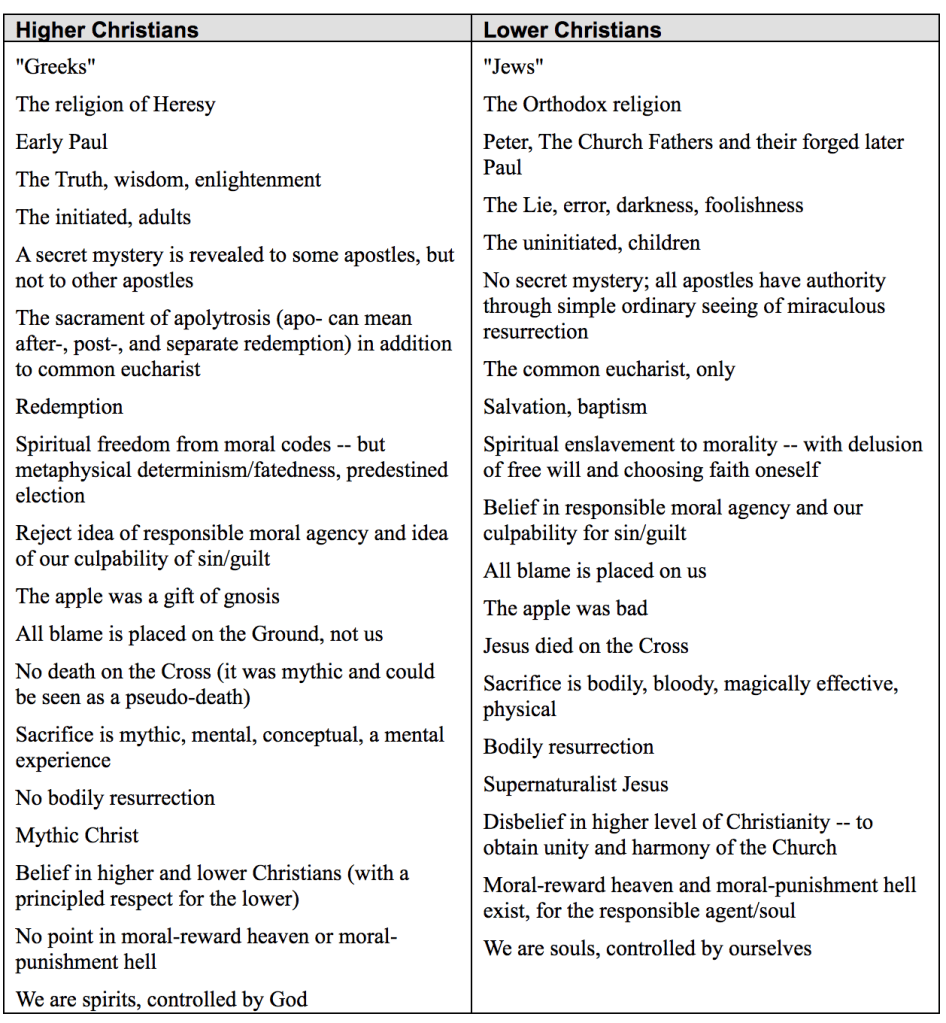
Another copy of the table capture is at “Idea Development page 2”:
https://egodeaththeory.wordpress.com/2020/11/24/idea-development-page-2/#ppphvh — with some recent comments.
I could identify page numbers for each point above, to prove that the sets of ideas align into two opposed sets according to Pagels, not just according to my own set of views.
1-for-1 Contrast of ‘Gnostic’ vs. ‘Orthodox’ Consistent Sets of Positions (= Eso vs. Exo) from Pagels’ Book The Gnostic Paul
For the first time, on Jan 12, 2021, I broke this out in the roughly side-by-side table into a nice consecutive-pairing format, like I did in 2013 for Pagel’s first book.
HIGHER, ESOTERIC CHRISTIANITY
LOWER, EXOTERIC CHRISTIANITY
“Greeks”
“Jews”
The religion of Heresy
The Orthodox religion
Early Paul
Peter, The Church Fathers and their forged later Paul
The Truth, wisdom, enlightenment
The Lie, error, darkness, foolishness
The initiated, adults
The uninitiated, children
A secret mystery is revealed to some apostles, but not to other apostles
No secret mystery; all apostles have authority through simple ordinary seeing of miraculous resurrection
The sacrament of apolytrosis (apo- can mean after-, post-, and separate redemption) in addition to common eucharist [mytheme: {release}]
The common eucharist, only
Redemption (Caruana’s glossary entry)
Salvation, baptism (can search Caruana’s 3 gloss pgs)
Spiritual freedom from moral codes — but metaphysical determinism/ fatedness, predestined election
Spiritual enslavement to morality — with delusion of free will and choosing faith oneself
Reject idea of responsible moral agency and idea of our culpability of sin/guilt
Belief in responsible moral agency and our culpability for sin/guilt
The apple was a gift of gnosis
The apple was bad
All blame is placed on the Ground, not us
All blame is placed on us
No death on the Cross (it was mythic and could be seen as a pseudo-death)
Jesus died on the Cross
Sacrifice is mythic, mental, conceptual, a mental experience
Sacrifice is bodily, bloody, magically effective, physical
No bodily resurrection
Bodily resurrection
Mythic Christ
Supernaturalist Jesus
Belief in higher and lower Christians (with a principled respect for the lower)
Disbelief in higher level of Christianity — to obtain unity and harmony of the Church
No point in moral-reward heaven or moral-punishment hell
Moral-reward heaven and moral-punishment hell exist, for the responsible agent/soul
We are spirits, controlled by God
We are souls, controlled by ourselves
Well-Formatted Review of “The Gnostic Paul” at Egodeath.com
Page title:
The Gnostic Paul; heresy, secrecy, Christ myth, entheogens, fatedness
http://www.egodeath.com/pagelsgnosticpaul.htm
Good summary.
Amazon Formatting of My Review of “The Gnostic Paul”
The Gnostic Paul: Gnostic Exegesis of the Pauline Letters
Elaine Pagels
1975
http://amzn.com/1563380390
Here’s my 2002 review at Amazon — same as egodeath.com page.
https://www.amazon.com/gp/customer-reviews/R2D7ZEG0WAOQZN/ref=cm_cr_getr_d_rvw_ttl?ie=UTF8&ASIN=1563380390
Copied from Amazon, probably same as egodeath site but without the nice side-by-side contrast-table:
5.0 out of 5 stars
Contributes toward 2-level model of Christianity
Reviewed by Michael Hoffman, January 14, 2002 —
Probably prefer instead, this page’s formatting:
http://www.egodeath.com/pagelsgnosticpaul.htm
Good summary.
I’m surprised this book does not summarize the distinctions it constantly makes between the two main conceptions of Christianity according to the Valentinians’ reading of Paul.
_____
This book has a lot to offer for the Christ-myth theory.
The book explains the Valentinian gnostic reading of Paul’s early epistles.
“Jews” means literalists, the uninitiated, lower Christians.
“Greeks” means spiritualists, the initiated, higher Christians.
Paul encouraged the higher Christians to feel united or married with the lower Christians.
_____
The book would greatly benefit from a 2-column listing of the ideas the Valentinians associated with the higher and lower Christians.
As a philosopher and theorist of ego death who is looking for a rational reading of the Christian scriptures, I agree with everything that falls into the group of ideas the Valentinians associated with higher Christians, and I disagree with all the ideas that fall into the group of ideas the Valentinians associated with lower Christians.
_____
The two sets of doctrines — the book The Gnostic Paul divides the religious ideas as follows, from the Valentinian reading of Paul’s early writings:
HIGHER, ESOTERIC CHRISTIANITY
“Greeks“
The religion of Heresy
Early Paul
The Truth, wisdom, enlightenment
The initiated, adults
A secret mystery is revealed to some apostles, but not to other apostles
The sacrament of apolytrosis [<– *MUSHROOMS* ROUTINELY USED — THE GASOLINE PROPELLING THE WHOLE DAMN CAR!! – MH2020 far more confident than MH2002] (apo- can mean after-, post-, and separate redemption) in addition to common eucharist
Redemption
Spiritual freedom from moral codes — but metaphysical determinism/fatedness, predestined election
Reject idea of responsible moral agency and idea of our culpability of sin/guilt
The apple was a gift of gnosis
All blame is placed on the Ground, not us
No death on the Cross (it was mythic and could be seen as a pseudo-death)
Sacrifice is mythic, mental, conceptual, a mental experience
No bodily resurrection
Mythic Christ
Belief in higher and lower Christians (with a principled respect for the lower)
No point in moral-reward heaven or moral-punishment hell
We are spirits, controlled by God
LOWER, EXOTERIC CHRISTIANITY
“Jews”
The Orthodox religion
Peter, The Church Fathers and their forged later Paul
The Lie, error, darkness, foolishness
The uninitiated, children
No secret mystery; all apostles have authority through simple ordinary seeing of miraculous resurrection
The common eucharist, only
Salvation, baptism
Spiritual enslavement to morality — with delusion of free will and choosing faith oneself
Belief in responsible moral agency and our culpability for sin/guilt
All blame is placed on us
The apple was bad
Jesus died on the Cross
Sacrifice is bodily, bloody, magically effective, physical <–
Bodily resurrection
Supernaturalist Jesus
Disbelief in higher level of Christianity — to obtain unity and harmony of the Church
Moral-reward heaven and moral-punishment hell exist, for the responsible agent/soul
We are souls, controlled by ourselves
Each point I listed above should have page references to Pagel’s book to prove that the ideas break out this way in her book.
_____
An important reason why Christ-myth scholars should read this book is that Pagels shows how to read the scriptures in a 2-valued ambiguous way, where the meaning deliberately toggles between two distinct readings.
It’s not just that Paul was misinterpreted; Pagel’s treatment seems to indicate that Paul deliberately wrote in an encoded, ambiguous way that flips between the two conceptual systems.
If people were confused, it is because Paul meant for them to be confused and carefully chose his words so that they could support both readings: literal and spiritual. The epistles were written as encoded mysteries and should be read as such.
_____
The most remarkable thing presented repeatedly in this book is the idea that the Pauline writings intentionally withheld the higher view from the uninitiated.
[I’m skeptical about the way I worded it there. Am I or is Pagels mischaracterizing?]
Pagels never ventures to explain why.
Perhaps the Valentinians wanted to protect and preserve the delusion of the ego just as we protect children.
This problem extends beyond the Christian mystery-religion; the Greek mystery religions forbade, by punishment of death, publically revealing the things shown in the mysteries.
There were political reasons to veil a deterministic belief system, because cosmic determinism has been used to justify an oppressive status quo (“I was meant, fated, and divinely ordained by Necessity to dominate you”) rather than democracy.
So the Pauline writings were deliberately written in a way that would be read in a supernatural, Literalist way but could be read as a non-supernatural, mystery-religion, mystic allegory.
/ review by MH at Amazon
/ end of section “The Gnostic Paul: Gnostic Exegesis of the Pauline Letters”
The Gnostic Gospels
The Gnostic Gospels
Elaine Pagels, 1979
http://amzn.com/0679724532
I don’t think I’ve summarized/reviewed this important, popular book. I’ve read it a couple times, and The Jesus Mysteries is based largely off it, but I think I should write a review/summary.
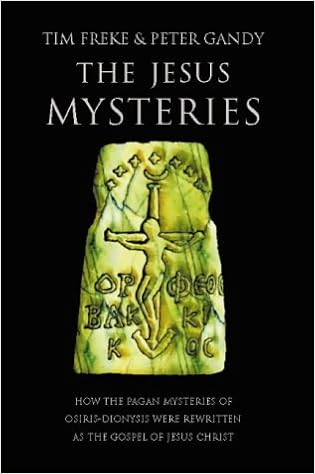
The Jesus Mysteries: How the Pagan Mysteries of Osiris-Dionysus Were Rewritten as the Gospel of Jesus Christ
The Jesus Mysteries: How the Pagan Mysteries of Osiris-Dionysus Were Rewritten as the Gospel of Jesus Christ
1999
2001 title:
The Jesus Mysteries: Was the Original Jesus a Pagan God?
Timothy Freke & Peter Gandy
http://amzn.com/0609807986
Editions & subtitles – at Egodeath.com
1999 edition:
http://amzn.com/0722536763
The Jesus Puzzle: Did Christianity Begin with a Mythical Christ? Challenging the Existence of an Historical Jesus
The Jesus Puzzle: Did Christianity Begin with a Mythical Christ? Challenging the Existence of an Historical Jesus
Earl Doherty, 2005, 390 pages
http://amzn.com/096892591X
Jesus: Neither God Nor Man – The Case for a Mythical Jesus
Jesus: Neither God Nor Man – The Case for a Mythical Jesus
Earl Doherty, 2009, 814 pages
http://amzn.com/B00772ZH8Y
Not sure, but I think of these “originally a mystical spiritual Jesus” books as precursor to Carrier’s thick, and now thin popular, book (below).
Jesus from Outer Space: What the Earliest Christians Really Believed about Christ
Jesus from Outer Space: What the Earliest Christians Really Believed about Christ
Richard Carrier
http://amzn.com/1634311949
October 20, 2020
Looks similar to Earl Doherty’s book on the subject, The Jesus Puzzle.
Inferior art on front cover, an unworthy depiction of Ptolemaic cosmology – I hope his text is more inspired.
It should be highly readable and an efficient summary of his thick research books.

 The Egodeath theory