Contents:
- KEYS FOR INTERPRETATION OF GREEK MYTHS – long page containing the below 1-5 sections in more detail than in the top-of-page Intro section
- 1. Letter Symbolism Deciphering, Symbolic Letter-to-Word Puzzle (Like Graves’ MUKE (‘mushroom’) derivation from Kykeon Recipe Ingredients)
- From Section “THE STRUCTURE OF GENEALOGICAL TREES”, lower on same page “KEYS FOR INTERPRETATION OF GREEK MYTHS”
Criticism of the Interpretation Approach of GreekMyths-Interpretation.com
greekmyths-interpretation.com is essentially
a GEMATRIA/deciphering theory,
some Chronology-deciphering theory
and a
“the Greek mythic pantheon figures are all arranged into a sequence of initiation stages” interpretation theory,
and
an Aurobindo/Jung pop spirituality overlay, obscuring:
the Mushroom-Eternalism payload of Greek myth & Mystery Religion
MY complicated, overly sophisticated obscuring-overlay
is WAY better than
HIS complicated, overly sophisticated obscuring-overlay.
I think I’m already done w/ this site. I am now pasting the top of his very long page “KEYS FOR INTERPRETATION OF GREEK MYTHS” below, to mark it up.
50% gems, 50% rubbish and turgid bloated wording.
This is like a Jung/Aurobindo OVERLAY on top of Greek myth, thus obscuring the mushroom experiencing of the great transformation from possibilism to eternalism experience.
More of the same as below — like a Nasr book: highly inflated lofty prose, but never delivers the goods.
There’s no grain, under the husk of Ultimate Profundity.
Such writing has some good values, but is ultimately empty of any payload.
WHERE’S THE BEEF?
WHERE’S THE TRANSFORMATION-SUBSTANCE?
POP THAT VERBAL BALLOON OF OVERINFLATED, WINDY LANGUAGE.
Ramesh Balsekar actually summarizes his position, not just an ungrounded abstraction like the emptiest of statements:
Greek Myth and Mystery Religion is an initiation path to the highest wisdom EXCEPT it is hereby DAMNED TO HELL by me by my writing, quote:
“the map established by the Greek initiates does not extend till the end of the path which they glimpsed – the point in which matter becomes divine – because they did not yet know how to progress across the last stages. This is why the last Labours of Heracles, the most magnificent of the seekers of truth, took place in mythical regions.”
Let me fix your full-of-sh*t misstatement:
The map established by GreekMyths-Interpretation.com does not extend till the end of the path which he glimpsed – the point at which the initiate becomes divine – because GreekMyths-Interpretation.com does not know how to progress across
the stages of mushroom initiation to Completion,
to successfully obtain wisdom/gnosis, which is:
transforming the mental worldmodel
from possibilism-thinking to eternalism-thinking.
Lofty initiation wisdom of the Ancients was super High Profundity. It was so high, a girl (the god-boy’s virgin maiden sister) may look down, lose her balance, and fall from the Higher Level of the Golden Ram (given by the cloud goddess Nephele), back down to the Lower Level.
https://egodeaththeory.wordpress.com/2020/12/06/idea-development-page-5/#The-Golden-Fleece-50-Pages-of-Interrupted-Stories-within-Stories-for-a-5-line-Search-Hit-Paragraph
Athamas, the {KING} of Thessaly {MARRIED} {cloud goddess} Nephele. Athamas & Nephele had {two children},
a {boy} named Phrixus and < SURVIVES FLIGHT
a {girl} named Helle.”
q: if the ram “belonged to Zeus”, how did king Athamas’ wife, cloud goddess Thessaly, dispatch the ram to rescue the boy & girl Phrixus & Helle?
The Higher Level = aboveground world = transcendent thinking = eternalism-thinking
The Lower Level = underworld = egoic thinking = possibilism-thinking
The following book tells you all about how profound and lofty their guarded secret knowledge was, to protect wisdom, guarded, from the unworthy.
This book weighs 4 pounds, like the Dictionary of Gnosticism Falsely So Called.
4 pounds of FLUFF and bloated, inflated, hypperbolic prose.
The more sophisticated of a Jung/Aurobindo/Campbell overlay you impose, the less you can see the “mushroom possibilism eternalism” content, which my Diamond Hammer of Interpretation forces the Greek Myths to mean.
Below, he writes this scathing accusation:
“the map established by the Greek initiates does not extend till the end of the path which they glimpsed … becomes divine … they did not yet know how to progress across the last stages.”
KNOW-NOTHING WINDBAG POSEUR! IT AMOUNTS TO A SMEAR SITE BY A COMPETING RELIGION. FAKE SITE.
Not written at this site: “Greek myth & Mystery Religion was mushrooms transforming thinking from possibilism to eternalism.“
The site has no summarizable point, or else the site would lead by simply stating the point. It merely says like a tautology, “Greek Myth expresses the highest knowledge of initiates.” Little more than a truism. Yes, it’s correct… so far as it goes. Like Graves & Ruck saying “its a mushroom!!!” not wrong, but, … it is missing what can and must be summarized:
mushroom transformation from possibilism to eternalism <– 100% spot-on; correct. Yes, needs unpacking, but way more on-point than:
Greek Myth & Mystery Religion
is
a vehicle for Transcendent Knowledge
That’s 50% correct, at best. That’s much less to-the-point than:
Greek Myth & Mystery Religion
is
mushroom transformation from possibilism to eternalism
That’s spot-on, puts the final point first. That is precisely the programme and agenda of the Mytheme theory portion of Egodeath theory
Home Page of Site
http://greekmyths-interpretation.com
Intro Chapter “INTRODUCTION TO THE INTERPRETATION OF GREEK MYTHS”
https://www.greekmyths-interpretation.com/en/interpretation-greek-myths-introduction/ — A copy to whittle down and highlight:
Sri Aurobindo <– ok so this is the obscuring overlay we’ll be using
This work, the decoding of Greek myths, … intuition has opened ways leading to a wider understanding, progressing through a spiral approach which obliges one to return repeatedly to previous hypotheses.
this work brings forward the main structure and meaning of the most important myths.
The decoding method given in the first chapter[????]
vague as f&ck! could you be any more vague? Why doesn’t he give page title & link? Mabye means
Guide to the chapters; this is the master page constituting the book:
Greek myths interpretation
https://www.greekmyths-interpretation.com/en/greek-myths-interpretation/
“Introduction” chapter, which I copied to present page:
INTRODUCTION TO THE INTERPRETATION OF GREEK MYTHS
https://www.greekmyths-interpretation.com/en/interpretation-greek-myths-introduction/
Probably what he means by “The decoding method given in the first chapter”, which is the second chapter:
KEYS FOR INTERPRETATION OF GREEK MYTHS
https://www.greekmyths-interpretation.com/en/interpretation-greek-myths-keys/
the interpretation rests on decoding the symbolism of proper names.
the decoding of these proper names are given in an annex at the end of this work.[this work???]
the different variables and lines of genealogical descent were introduced to remove ambiguity, cut out disagreement between the different schools of initiation, enrich the knowledge of the path, or to ward off a progressive loss of meaning. Often, the most significant variable, and the only one that has been retained, is the one that is most coherent with the corresponding stage on the spiritual path.
The lists of characters which describe a totality of “conditions” necessary for certain spiritual experiences, have been particularly abridged.
This first volume[????] provides the necessary bases for the decoding process. The following volumes[????] set out theoretical teachings and descriptions of experiences which mark the path, in accordance with to the two great directions discussed later: a progression through the mind and the path of purification/liberation.
the knowledge hidden in the myths was rapidly lost, probably already partly so at the time of the great tragedians. Although sometimes the only surviving sources, the texts of Aeschylus and Euripides are to be considered with precaution for primitive myths were often distorted. To substantiate their dramaturgy these authors not only lowered the stakes of the great myths to the level of our human understanding but also added variations that have little relation to the deeper meaning of these stories. For the sake of play, out of a need for secrecy or to give their theatrical works the value of moral edification, certain stories would be presented as the opposite of what the initiates were supposed to understand through them.
Aeschylus for instance glorified the defenders of Thebes because it was a criminal offence to turn against one’s own city. But the seeker must understand that it is the attackers who are in the right, for the myth is about the purification of the energy centres in the body.”
this website sounds rubbish; off-base; wrong spiritual explanation layered over myth, obscuring it -mh
“It would probably be more fitting to use a word such as “traveller” or “aspirant” instead of “seeker”, as this is not so much a mental quest as an aspiration of the entire being for another way of being, for another kind of humanity. In this study however we have kept the term established by tradition
The texts of historians or mythographers must likewise pass under the scrutiny of intuition and experience. The Library of Apollodorus, dated from the 1st or 2nd century AD, generally remains the most complete and reliable source for numerous myths.
Let us also note that of the two great forerunners, Hesiod was the more theoretical and Homer the more pragmatic. Attributed to Hesiod, the Catalogue of Women is a collection of fragments to which we have given major importance. It is an epic poem dating from the VII th century BC, also known as Ehoiai.
This study barely takes Latin mythology into account. At its beginnings in fact, the Roman world rejected the occult forms of the sacred, and it was only later, in view of establishing the divine rights of emperors, that they took on the mythological traditions of conquered territories, in particular those of Greece.
Virgil is among the most celebrated of Latin poets. He associated the Aeneid with Greek mythology in a way that suggests that he was hardly aware of its general meaning.
By the symbolic precision of the accounts in his Metamorphoses, which contains Greek myths almost exclusively, Ovid appears to have been even better [than Virgil] initiated into their meaning.
Two contemporary works which have provided us with valuable assistance should also be noted: that of
Timothy Gantz
Early Greek Myths
and for the different genealogical lineages that of
Carlos Parada
Genealogical Guide to Greek Mythology
With regard to the spelling of proper names, this work uses the version that seems the most appropriate: either the form made known by the Latin or French tragedians (for instance Ulysses, whose exact name is Odysseus in Homer’s text, or Pollux, initially known as Poludeukes), or the name in English form, or the transliterated form. The last two are closest to the Greek form, which facilitates an interpretation based on character structure.
Finally, it must be noted that in this work the word “god” is reserved for the mythological gods, that is to say forces that work on the development of human consciousness.
Whichever name is given to the Absolute, and for the sake of avoiding the inevitable associations that come with the word God, it seems preferable to use other terms such as Reality, Real, One, Divine, Truth and Supreme.
This Absolute must in fact not be associated with the God of religions, for it cannot be limited to a single truth or to a God outside his own creation that is a concept stemming from an omnipresent duality.
In this work, the word Absolute refers to a state of being, a perfection that humanity has tended towards throughout the ages. The idea is brought forward that
each can touch upon the Supreme Consciousness of Truth, which we must learn to know and to become. When asked the question “What is the Divine”, Mother replied, while pointing out that there could be a hundred different answers:
“The Divine can be lived, but not defined.
The Divine is an absolute of perfection, eternal source of all that exists, whom we grow progressively conscious of, while being Him from all eternity.” Mother’s Agenda Vol 8, 24 May 1967
INTRODUCTION
In this world, many feel suffocated or unable to feel anything “real” and therefore aspire deep within themselves for a powerful change. More numerous still are those who feel that humanity is in a dead-end, and, suffering, vaguely perceive that the solution can no longer be external.
Conscious of their powerlessness and disengaged from all political, philosophical or religious “isms “, leaving behind humanitarian and revolutionary temptations, and sometimes destroyed in body and soul, some leave external paths to undertake the inner adventure.
They then go in search of a guide or a path to gain understanding and attempt to transform themselves, so as to attain an ideal that they have constructed. In accordance with his nature and the “synchronicities” of life, each tends towards one path or another, often wandering a long time before “recognizing” his own through some mysterious adequacy.
Nevertheless, one who no longer wishes to be limited by a partial vision resulting from a particular experience, who aspires to a wider and higher synthesis, will find himself faced with innumerable religions, with the wisdom of the East and the West, with false or true gurus and the genuine or sham “awakened”, “enlightened” or “liberated” ones. Each of them proposes a path or else claims that none exists. Some follow the path of “forces”, while others avoid them at all costs. Some only swear by the rising of the “Kundalini”, while others caution against it. Some reject the mind, while others demand its full maturity. Many paths herald salvation only at the heights of the spirit world, beyond this world or after death, while other increasingly numerous teachings aspire for an in-depth human transformation reoriented towards the body, to the point of envisioning a mutation of “cellular consciousness” as the only possibility for the survival of humanity.
The seeker must soon acknowledge that if all true enlightened individuals approach the same Reality, often through similar experiences, then each in his own way and according to his own type is bound to express and transmits a teaching that is true to himself.
He must understand that a variety of paths is necessary, even though many still have to evolve to once and for all abandon all pretension of holding the sole “truth”. It seems obvious that each one must ultimately follow his own path of evolution.
The seeker must also be aware that the specific experience of Reality lived and transmitted by a master is quickly distorted and codified by his disciples and so loses the breath that animates it and rapidly becomes dead knowledge, or, if it is imprisoned in the shackles of religious dogma rather than being alive and always fluctuating as it was meant to be, it becomes a truth emptied of its substance.
Recognising as a common denominator that these paths aim solely at accelerating or perfecting the evolutionary movement – whether it is for personal, collective or divine ends as high as they may be – we can ask ourselves whether it is possible to conceive of a vast synthesis and to find the common orientations which would shed light on the paths of those who aspire for “something else”. This may shed light on the wider path of humanity as well.
Following the initiates of ancient Egypt and the Rishis of the Vedic period, the masters of wisdom of ancient Greece undertook this task. Rather than creating an inventory of spiritual paths and teachings, which would have been an impossible challenge even in antiquity, theirs was to be a vision of the human adventure identifying the major stages of its evolution and marking the obstacles which punctuate its progress.
This work therefore seeks to demonstrate that Greek mythology is, in its essence, an attempt to achieve such a synthesis.
For a variety of reasons which we will examine later, the initiates of ancient times were obliged to encrypt their knowledge in the form of mythology so that it would be accessible only to initiates who possessed the appropriate keys to understanding them. This study would have no foundation if it did not begin by making explicit the keys to understanding that will be used in this interpretation.
In the case of the early Greek poets, this synthesis was not the result of intellectual speculation but rather the fruit of experience. Amongst the early Greek poets, Homer is of course the figure of greatest stature. Till the present day and to the best of our knowledge, only Sri Aurobindo carried out a similar synthesis, which goes so far as to give access to new evolutionary possibilities. This study will consequently be constructed on the works of these two giants of spirituality.
Such an attempt requires complete pragmatism and, at first, a distancing from particular individual experiences and beliefs of any kind.
If there is an evolutionary process, and all so called “spiritual” undertaking is inscribed in it, then it is necessary to plunge into its archives, to open up past scenarios and present stages and to integrate the experiences of those who followed its movement so as to open up the paths to the future.
There are two ways that are especially helpful in bringing to light the guiding directions of past and present evolution: on the one hand the observation of animal nature and the development of man from infancy to adulthood and on the other hand an inner investigation of the layers of consciousness.
From this synthesis, the Greek “initiates” established three major movements:
– Man’s own evolution, succeeding animal evolution and retaining memories of it, and following a mental progression of an “intelligence” which combines logic and intuition in seven major stages represented by the Pleiades. Humanity as a whole operates on the first three levels, with only a few rare individuals operating on the fourth level.
– A slow process of purification from the mixing and impurities resulting from past evolution, and a liberation from evolutionary supports which are no longer necessary for future stages of evolution.
– The growth of an “inner being”, in this study referred to as the “psychic being”, according to the Greek term Ψυχη (Psyche), which is represented by Leto and her children Apollo and Artemis, “called to be greater gods than the children of Zeus and Hera.”
Any spiritual path, which is ultimately only a will to accelerate the movement of nature, should therefore strive to:
- – Develop the mind until its logical component finds its appropriate place and becomes a perfect instrument of execution, at the service of a Truth perceived by intuition.
- – Purify and “liberate” from fear, ego, desire, attachment, etc., until the realisation of a perfect identification with Reality. This includes a liberation from all systems needed to attain the goal and from any preconceived idea about the path, other than that of being perfectly oneself in Truth.
- – To achieve a shift of governance from the lower nature and the ego to the inner being united with the Divine.
These movements can be followed independently of each other. They result in a spiral evolution based on a double movement of ascension and integration, and the necessity of realising in the vital and the body what has been established in the mind. This spiralling movement thus leads one to live anew the same kinds of experiences, but at different levels of consciousness.
At any time, and at any level of progression in the mind, the independence of these progressions allows one to proceed to an “unveiling” of the essential nature in order to regain a certain level of Reality. This is an unveiling for which there seems to be no other path than a complete engagement with everything that life offers at each moment, in accordance to one’s own nature, and sustained by an inner fire.
The process of ascension and integration makes necessary and permits an increasingly deep diving into the human and animal evolutionary memories, from the human ego to the formation of the animal self and even further back towards the basic forms of life. We are in fact still strongly imprinted by this and have retained many of its mostly unconscious workings, which combine with those of higher planes and thereby disrupt them.
Nevertheless, if the path of union with the worlds of the Spirit had since long been marked out, the ancient seekers must have come up against what seemed to them insurmountable barriers in the process of transformation of evolutionary memories.
These initiates however proclaimed the existence of a Reality in which all beings are united beyond appearances, in the context of which persists the illusion of separation [{mask}] that hides from man his true nature and binds him to his ego. They also affirm that man has the possibility of contacting this “Divine” Reality in its personal or impersonal forms, and of uniting with Him. Through this he could also realize a union with all creatures, with nature and with the universe. This is the meaning of the Sanskrit word Yoga, which signifies “union”. The term “Yoga” was later used to also designate recommended methods for reaching this state.
This union was for a long time considered to be the ultimate goal of all forms of Yoga, because the transformation of human nature into a perfect instrument of the Truth seemed to be an impossible task.
In fact, the legacy of thousands of years of evolution opposes this. The union can be realized on the mental or vital plane, but the initiates came up against the stumbling block [loss of control] of the most archaic corporeal nature, subject to the so-called “laws of nature” and presenting an insurmountable obstacle to transformation. The mind can be made silent, the vital calmed to a certain degree and the root of desire removed, but primitive reactions and bodily habits obstinately refuse to change, along with their attendant woes of suffering, hardship, illnesses and death. A union with the Absolute was fulfilled in the Spirit, but in the lower planes, the rebelliousness of nature prevailed. Man remained riveted to his animal nature without real hope of transformation. Also, many systems resulted in a rejection of earthly life and its activities; paradise was exiled from the earth to mythical sites in the world of the Spirit. Or else the concept of materialism was seen as a sufficient justification for existence, which is the case for many today.
But the wise men of ancient Greece refused to consider this defeat as insurmountable and this schism as the only possible outcome; they argued against an earthly existence that had as its sole goal an escape from itself or an unrestrained enjoyment. This “reorientation” of spirituality was a terrible battle in their times, probably carried out as much on the individual inner plane as well as externally amongst the different schools of initiation; we will see how the account of the Trojan War depicts episodes as bloody as the difficulties they represented were reputed to be insurmountable.
This opening was nevertheless of short duration, probably because humanity was not yet ready. Christianity imposed on the West the idea of a paradise outside the earth, which believers had to merit by leading a life of work and suffering and by redeeming themselves in a fallen world. As is stated in Mother’s Agenda (Volume 8 p.179) suffering “was a necessity to emerge more consciously from inertia (…) It’s very clear in animals, it has become very clear already: suffering was the means to make them emerge from inertia”. Furthermore, as stated in p167-168: “Christianity deifies suffering to make it the instrument of the earth’s salvation. (…) the action of this religion on earth has been to “deify suffering” because men NEEDED to understand – not only to understand but to feel and adhere to the raison d’être (the universal raison d’être) of suffering on earth as a means of evolution. We might, basically, say that they sanctified suffering so it may be recognized as a means indispensable to the evolution of the earth. So now, that action has been exploited to the full and more, and ought to be gone beyond, and that’s why it must be left behind in order to find something else.”
As in the ancient Greek teachings, spirituality and human evolution are considered to be inseparable in this work. Therefore there is no distinction between “spiritual” or “sacred” things and others that are not. Evolution should lead us neither towards an escape into the Spirit, nor towards a materialistic denial which rejects all forms of a higher Reality and would inexorably lead to the glorification of the ego.
It is therefore high time that in its material arrogance western civilisation comes to understand that the Greek civilisation from which it developed had, in contrast to our own, preserved a high degree of spirituality.
This spirituality which permeated all of life was hidden in the heart of the culture and veiled by mythology, the significance of which was concealed in the external world. Its meaning was only revealed to a few sincere seekers at specific sites: the “Mystery Schools”, the teachings of which were associated with particular gods of the Greek pantheon. The most well known are those of Eleusis and Samothrace.
Nobody knows precisely what was taking place in these schools before they progressively declined in the VIth century BC, what teachings were being handed down or what rites were being practiced there. (The process of decline and the progressive loss of the sacred in ancient Greece was described by Julian Jaynes in his book The Origin of Consciousness in the Breakdown of the Bicameral Mind.)
For the initiates and candidates for initiation were held to absolute secrecy (the word “mystery” comes from the Greek verb μυω, “to keep the eyes shut or the mouth closed”). In the words of one of them, in the account given by Apollonius of Rhodes in the Quest of the Golden Fleece: “in the evening by the injunctions of Orpheus they touched at the island of Electra, daughter of Atlas, in order that by gentle initiation they might learn the rites that may not be uttered, and so with greater safety sail over the chilling sea. Of these I will make no further mention; but I bid farewell to the island itself and the indwelling deities, to whom belong those mysteries, which it is not lawful for me to sing. ” (Apollonius of Rhode, Argonautica, Book 1 verse 910, trans. R.C. Seaton)
The teachings were divided into “lesser” and “greater” Mysteries.
The Lesser Mysteries which conferred the title “Myst” (one who is initiated into the mysteries), seem to have been related to the myth of Demeter, the goddess of domesticated nature, and to
her daughter Kore, who became Persephone at the time of her union with Hades
[that confirms what i thought -mh]
and had to remain for part of the year in the abode of her husband in the nether world.
The Greater Mysteries seemed to have been founded more on the myths of Dionysus and Orpheus, who, according to the most well known legend, strove to bring back his beloved wife from the realm of Hades.
“wife stuck in Hades” = virgin maiden egoic possibilism-thinking, no longer accessible to eternalism-thinking
Everybody agrees that these Mysteries probably referred to a spiritual teaching which included a test of confrontation with death, and that rites of purification held a central place.
But nobody knows how the candidates for the second initiation, the Mysts, [sic, mystes?] progressed through different stages to attain Illumination (Elampsis Ελλαμψις), the final consecration that conferred the title of “Epopte”
[“one who has seen” the snake worldline and the god-phallus inside the mind, worldline of thought-injector]
, a degree of contemplation [i.e. trip balls] at the highest level of initiation. The only information at our disposal about the content of these initiations is to be found in mythology.
We shall see that these are a fabulous reenactment of the synthesis mentioned earlier and of the teachings that accompanied it. Constructed with mathematical rigor and precision, the myths constitute an extraordinary mnemotechnical tool which marked out important points of reference through which spiritual masters of ancient Greece would guide their disciples.
Different versions of the same myth sometimes contain elements that seem at first contradictory. There are several reasons for this. In the first place, this was to perhaps question the method of transmission: those who recorded these myths were not all initiates, but often historians or mythologists. In the second place it appears to have been necessary for some, over the course of time, to eliminate ambiguities and thus to make clear the nature of the events or the personality traits of the characters by adding other lines of descent or other histories. This is most often the case. Lastly, the significance of the myths became less and less well understood over time, which provided an opportunity for numerous errors to slip in.
For almost three thousand years, all these texts kept their secret so well protected that only a few centuries after Homer, numerous authors could already completely misunderstand their meaning. Today, most people see mythology only as the result of an imaginary collective construction developed from a primitive unconscious common to all peoples.
This law of silence, the transgression of which was severely punished, [true? false?] was applied not only to the Mysteries but also to the myths; Aeschylus nearly lost his life for this reason, having been accused of revealing in some of his tragedies which have since disappeared details about divine genealogy that only initiates were to know. But far beyond the external threat, it is a spontaneous and sacred fear of the Divine which naturally kept the secret. [seems correct -mh]
Only that which would strictly contribute to maintaining the public religion was to be divulged. And in fact religion referred to mythology but did not explain it. It relied on images of the forces of nature sufficiently close to daily reality so that understanding the myths was not an absolute necessity. This progressive disconnection between the founding myths and the practice of faith can be observed in almost all religions. This is because for the latter, it matters less to understand that to believe and to adore, and the images were sufficiently filled with emotion to satisfy the greatest majority. In contrast however, the seeker of Truth cannot be satisfied with dead truths. He wants at all costs to understand and obtain the answers to his urgent questions as well as to his aspiration for another way of being in the world.
This practice of secrecy was not limited to the Greeks but was common to the people of this time. For instance, the teachings contained in the Vedic texts, the Egyptian myths and the first Biblical texts were protected in this way.
Before approaching the keys for decoding the myths, attention should be given to several general questions.
– First, what credit can be given to the present interpretation when Greek mythology has already been the subject of in-depth analysis by a great number of highly qualified experts?
If mythology expresses a veiled spiritual content, it is likely that those who do not possess deep spiritual knowledge, based at least in part on their own experience, have no chance of discovering the deeper meaning of the myths or of going beyond the apparent inconsistencies of the different versions.
And those who held this knowledge were either not interested in mythology or did not wish to reveal what they had understood, probably for the same reasons as those who had initially chosen to veil the meaning of the myths.
How can mythology be understood simply as an amalgam of tales and legends destined only for the moral education of the people? Why then such sophistication in their internal structures?
Let us imagine societies of a thousand years ago. Knowledge was most often transmitted orally. Outside the priestly class, rare were those who knew how to read or write. Alphabets were still sacred in nature. That is to say that letters expressed energies, principles and cosmic and divine laws. It is not so long ago that the first hieroglyphs engraved in stone served to underline the sacred and eternal sense that they carried.
[rock = block universe/worldlines/non-control]
Only a few hundred years later, towards the end of the 8th century BC, Homer bequeathed us the Iliad and the Odyssey.
Without much doubt we can suppose that
the priests and Greek initiates, who after the Egyptians became the custodians of the oral knowledge accumulated over centuries or even thousands of years, were most preoccupied with safeguarding what was most valuable in their eyes. And is it not the synthesis of the most advanced knowledge concerning man and his destiny that is most important to a people, rather than a few children’s stories emerging from a supposed collective imagination?
If we dared claim that the men at the origin of these brilliant civilisations were but ignorant beings with rough and uncultivated minds, we would have to explain by what evolutionary mystery these people we able to generate, only a few decades later, systems of philosophy that many of our contemporaries still have difficulty comprehending. The appearance of writing does not coincide with the beginnings of intelligence and human consciousness, far from it.
Using the keys for interpretation put forward in this work, the reader will be able to progressively penetrate into the significance of these accounts, both in their overall structure and in their smallest details, and grasp the purpose of the different versions despite their apparent contradictions. Little by little, the principal structures, around which more than two thousand characters revolve, will become more organised and animated.
These myths also served to support the religious and moral education of the people. But well beyond that, as a synthesis of spiritual knowledge they were one of the primary teaching tools at the disposal of the masters of knowledge who would progressively reveal the significance of the myths to their disciples by means of the Mysteries.
Since that time, Mystery Schools have disappeared and genuine masters are rare. We have descended a little more deeply into the night which, according to Genesis, is desirable for acquiring discernment.
But on the other hand we are also nearer to the dawn, before which night is at its darkest.
In our times it is often difficult to find a path and to persevere on it, especially as every form of spiritual search has become liable to suspicion and the true value of things has been reversed without our always being aware of it. Seekers lack points of reference, straying into numerous dead-ends and knocking on many a door that leads only into emptiness.
What we will discover behind these myths is a roadless map, but in which we will be able to situate the great variety of spiritual teachings. We will also discover certain milestones, traps, dead-ends and necessary preparatory steps for the journey, for the spiritual path is a conquest in which the risks of losing one’s way are numerous and the dangers real.
As each must follow his own way, the paths of evolution are innumerable but the major stages universal, as are those of the growth of a human being from the time of conception: standing, walking, speaking, becoming autonomous, etc. Nevertheless, the map established by the Greek initiates does not extend till the end of the path which they glimpsed – the point in which matter becomes divine – because they did not yet know how to progress across the last stages. This is why the last Labours of Heracles, the most magnificent of the seekers of truth, took place in mythical regions.
In order to elucidate the significance of certain passages, some indications originating from the experience and understanding of the author have been added to the interpretation.
The reader should also keep in mind the following warnings while progressing through this study:
“Do not believe anything merely because it was written by some ancient sage, do not believe anything on the authority of masters or priests, but rather believe what agrees with your own experience and after an in-depth study satisfies your reason and leads you in the direction of your good. This you can accept as true and shape your life around. ” (attributed to Siddhartha Gautama, the Buddha)
“Truth is a pathless land...” From a talk by Krishnamurti on the 3rd of August 1929 at Ommem. Krishnamurti: The Years of Awakening, by Mary Luytens, Shambhala Publications 1997.
“If thou wouldst not be the fool of Opinion, first see wherein thy thought is true, then study wherein its opposite and contradiction is true; last, discover the cause of these differences and the key of God’s harmony. “ Sri Aurobindo. Thoughts and Aphorisms. Aphorism 122.
” …nobody has the Truth, nobody knows the right action, nobody knows the right way. The only way is to stumble on and to falter on and to knock oneself and even fall and go on and on. Everything is false from top to bottom, down from the Upanishads to the daily newspapers, everything can be twisted and is twisted, nothing is sure, nothing is black or white, there is no certitude—the only thing unchallengeable is this burning need in our hearts. ” Satprem. Notebooks of an Apocalypse. Volume 4.
– The second general question is that of encryption. Why was the highest of knowledge concealed in the guise of stories, while in the eyes of a man of the 21st century, these texts do not appear to hold any secret of a nature that could put people or entire civilisations in danger?
There are many reasons for this, being known that the practice of secrecy in the domain of spiritual research is a universal tendency, more or less pronounced depending on the period.
Here are two possibilities:
The first is that spiritual research reaches beyond commonly held ideas, beliefs and dogmas, and often comes up against misunderstanding or even general hostility.
It is their credibility of religious leaders, the foundation of their authority, which is threatened by genuine research. This is confirmed by History.
This reason was sufficient to justify a retreat from the world for many seekers of Truth, or for monks who wished to go unnoticed “donning the clothing of their country ” as is one of the rules imposed on apprentice alchemists.
The second reason is the risk that some would misuse the knowledge and powers acquired on the spiritual path, or worse, that they may choose this path solely for that purpose. This was a real risk in ancient times as these “powers” were much more easily accessible than they are today. The term “powers”, unlike what we think of today as “paranormal faculties”, is to be understood as the capacity of governing the psyche of other human beings or of consciously relating with other planes of existence for one’s own ends.
This kind of knowledge is still called for in the context, for instance, of certain African or other shamanic rituals. But the process of individuation [JUNG-STINK OVERLAY] which humanity has undergone with increasing intensity over the past several thousand years has rendered these powers difficult to access, although they have not been entirely eliminated. For they presuppose a capacity for identification which has been gradually lost, to the point of becoming almost impossible to acquire today.
KEYS FOR INTERPRETATION OF GREEK MYTHS
Below is a paste of the top/intro section of his very long page, to mark it up:
KEYS FOR INTERPRETATION OF GREEK MYTHS
https://www.greekmyths-interpretation.com/en/interpretation-greek-myths-keys/
greekmyths-interpretation.com is essentially a GEMATRIA interpretation theory.
_________________
To proceed with the interpretation of Greek myths – keys for decryption essentially include
- the symbol letters
- the elementary symbols
- the family trees
- the chronology of the myths.
To fully understand this web page, it is recommended to
follow the progression given in the tab Greek myths interpretation.
This progression follows the spiritual journey.
The method to navigate in the site is given in the Home tab.
Introduction
The progression of mythological tales follows that of human evolution.
[STRAINS OF KEN WILBER – UP FROM EDEN BOOK]
Just as the stages of learning in childhood – walking, talking, social interaction, etc. – are a summary of universal stages of growth,
Mythology retraces human evolution from its origins and anticipates
its future development from its present stage of intellectual domination.
It is built on
the results of experiences
rather than around
a system of beliefs.
It teaches us the necessary preliminary steps for progressing towards each new stage of evolution.
Although
initiates were unanimous in their understanding of the initial stages of the path,
this was not always the case for the more advanced stages.
For instance, the
Trojan War not only illustrates an inner struggle
, but probably also a fierce
controversy among the supporters of different paths of initiation.
Through a number of symbols,
Mythology is the expression of the synthesis of thousands of
years of individual experiences
, and
the presentation of the knowledge gained,
in the form of epics.
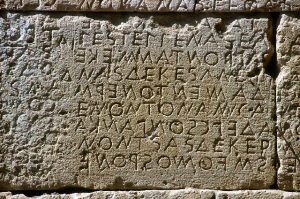
Boustrophedon inscription – Code of Gortyn – © Agon S. Buchholz
The keys for decoding can be classified in several more or less complex categories.
1. Letter Symbolism Deciphering, Symbolic Letter-to-Word Puzzle (Like Graves’ MUKE (‘mushroom’) derivation from Kykeon Recipe Ingredients)
*The first category utilises
the symbolic content of the letters of the alphabet
, which in turn form proper names, the meaning of which stems partly from the order of their constituent characters. Most often
the names of gods, heroes, characters, places, etc. are constructed by an association of significant letters and words from common, everyday language to create a symbolic word puzzle.
There is every reason to believe that this method of encryption had already been used by the Egyptians.
When referring to Egyptian signs, the Greeks called them “Ta hiera grammata”, the sacred letters, or “Ta hiera glyphica”, an expression meaning “the engraved sacred (letters)” or “hieroglyphs”.
Why “sacred” if it was not that they manifested, in their lines, a symbolic content revealing sacred knowledge?
The Egyptians themselves referred to them as “the writing of divine words”.
2. Basic Symbols Deciphering (Images, Numbers)
*The second category is linked to
the meaning conveyed by
basic symbols (images, numbers, etc.)
, often with multiple meanings that try to follow as closely as possible
the “dictionaries of symbols“. [??]
However, caution is advised when using information given in these works, as
the Greeks sometimes took up ancient meanings entirely unknown to us.
For instance they borrowed from the Vedas the image of
the cow as a symbol of the “light of Truth”
rather than meaning “Mother Earth” or “abundance”
, as indicated in dictionaries. And so,
The herds of the Sun, Helios, are “parts of Truth” perceived by the seeker through experiences such as illuminations, revelations or inspirations.
🐄💩🍄
This category also includes numbers as basic symbols.
3. Genealogy Deciphering
*The third category consists of
a structure belonging to Greek mythology
, at least in its wider sense, for its seed was already present in
the mythology of Egypt and the Middle East: the genealogical trees.
These provide symbols with multiple ramifications, allowing
a play of a number of ideas such as spiritual progression, theory and practice,
the succession of levels of consciousness,
the history of spirituality,
stages of the path
and
the necessary conditions to engage with them.
Knowledge of two or three hundred characters (among the two or three thousand listed) helps to easily find one’s bearings within the spiritual progression.
A detailed study of genealogical trees giving the fundamental structure of myths will begin in the next chapter. At this point, we will only discuss how they are to be used.
4. Chronology Deciphering
*The fourth category includes
the chronology of the tales,
in themselves
a coherent assembly of the basic symbols containing
teachings or allegorical descriptions of experiences.
Once the stage of
interpreting simple symbols and the contents of a particular myth
is over, the difficulty is to
place [read: FORCE] the story within the frame of spiritual development.
The answer is most often given in the myths themselves,
by an indication of a certain number of generations or years “before” or “after” certain points of reference, such as the Trojan War or the Quest for the Golden Fleece.
It can also be given by the age of the characters – Theseus, for instance, was said to be over fifty years of age at the time of the abduction of Helen, while she was still nubile –
or by the journey of peoples or heroes through real or imaginary lands.
Other more specific indications, such as distant kinship or “visits “,
helps bring more precision to the chronology.
5. Caduceus Deciphering
*The fifth and last category is related to a single symbol, graphically simple but very complex in its interpretation:
the Caduceus of Hermes.
It includes very extensive esoteric knowledge
[so what is the alleged “very extensive esoteric knowledge?
the mushroom-revealed injector-worldline of control-thoughts
MUSHROOMS REVEALING THE WORLDLINE CONTROL-THOUGHT SOURCE, CAUSING TRANSFORMATION FROM POSSIBILISM-THINKING TO ETERNALISM-THINKING
Correct answer:
caduceus = esoteric knowledge = Transcendent Knowledge =
the mushroom-revealed injector-worldline of control-thoughts, causing
transformation from possibilism-thinking to eternalism-thinking.
]
[summed here: the message of Hermes cadeusis = Y = tree vs snake = branching snake = branching vs nonbranching = possibilism-thinking vs eternalism-thinking, mushroom-revealed. -mh]
[turgid, inflated, ungrounded writing hides the lack of substance]
about the planes of consciousness
[“the planes of consciousness” has to actually refer to: the lower level vs. the higher level; the god abducts the virgin maiden from lower to higher level, sacrificing her along the way because of the transition;
To flip from possibilism-thinking to eternalism-thinking IS to sacrifice the child, which includes
{Sacrificing the childhood virgin maiden} includes the REAL “initiation sequence”:
Mytheme: {virgin maiden struggles to resist}: the Great “Seeing, Resisting, then Complying” “Female” Pattern of the Mind in the Mushroom State
1. the Seeing of the control-thoughts injector-worldline
2. the Resistance/Wrestling against that {phallus-snake} (the mind’s inner thought-injector, spread along its worldline across time)
3. the Compliance of the mind, submitting to the underlying power of the control-thoughts injector-worldline.
When the naive egoic thinking {virgin maiden struggles to resist}
new power-tools for idea development —
1. Define a mytheme- [acro]/keyboard shortcut: a
mytheme keyboard shortcut [mks]
test: mytheme keyboard shortcut mytheme keyboard shortcut – passed.
{virgin maiden struggles to resist} [{vmsr] —
test: {{virgin maiden struggles to resist} fail, test slower:
{{virgin maiden struggles to resist} fail
{virgin maiden struggles to resist} – finding: issue w/ open-brace in acro/ keyboard shortcut. plsu, fails to italicize. not impressed at this technique for rapid idea development.
2. Add a mytheme entry in the Key Mythemes catalog, for
{virgin maiden struggles to resist}
done:
https://egodeaththeory.wordpress.com/2020/11/15/mytheme-list/#virgin-maiden-struggles-to-resist
the god’s control-thoughts injector-worldline, turmoil, chaos, and defeat; cybernetic control-cancellation/loss-of-control.
When wisened maiden submits to the inner control-thoughts injector-worldline, she dies, is sacrificed, and the mind spiritually is ascended pulled up lifted up to The Higher Level, ABANDONING THE MAIDEN DOWN IN THE LOWER LEVEL.
control-thoughts injector-worldline [ctiw]
the compliance of the mind, upon more seeing of
the uncovered, mushroom-revealed injector-worldline of control-thoughts.
mushroom-revealed injector-worldline of control-thoughts
[mriwct]
mushrooms reveal the control-thoughts injector-worldline as the true source of control-thoughts
[mriwsct]
transformation of the mental worldmodel from possibilism-thinking to eternalism-thinking [tmwptet]
mushrooms reveal the control-thoughts injector-worldline as the true source of control-thoughts
causing
transformation of the mental worldmodel from possibilism-thinking to eternalism-thinking
passed.
]
and their interactions, the circulation of energy, etc. It is better known under its dynamic form, in which it is represented as
two snakes wrapped around a staff
[
the better, original form of the caduceus: Y; a pole w/ U on O.
Britannica: “Originally the caduceus was a rod or olive branch ending in two shoots and decorated [probably TIED/fastened/knotted -mh] with garlands [= loop crown of a wreath of flowers and leaves, worn on the head or hung as a decoration] or ribbons. “ribbon = a long, narrow strip of fabric, used for tying something or for decoration.” [the initiate is tied fastened to the physical world” = frozen tied secured into the block universe in altered state.-mh] [ribbon = snake = person’s worldline -mh] Later the garlands were interpreted as two snakes entwined in opposite directions with their heads facing; and a pair of wings, in token of Hermes’ speed, was attached to the staff above the snakes.”
The original form is that of two (thus branching) snakes on the end of a tree-trunk/pole, therfore it’s a Y morpologolical form, w/ the 2 branches crossing over each other.
-mh]
, and is transcribed in static form in the Hebrew tradition of Kabbalah by the symbol of the ” Tree of Life ” (see diagrams in the appendices). Explanations about this symbol appear at the end of the third volume.
An in-depth study is only
imperative for those wishing to decipher
ancient texts, myths or genesis stories amongst others.
Besides these main categories, several specific keys are applicable only to a small number of myths, and are therefore not subject to a detailed analysis in this chapter. For instance, the way
heroes belong to different planes of consciousness,
or
the functioning of the mind in accordance with cycles of alternating separative [Persephone winnow/thresh away husk; Saturn scythe-away child]and fusional tendencies,
which manifested through the intellect and intuition.
We will study these in the relevant myths.
Greek mythology also refers to practices, such as the recitation of mantras, or to the performance of certain dances, of which the details are not known to us. They were most probably a necessary part of the oral teaching from master to disciple which could not be transcribed into writing.
From Section “THE STRUCTURE OF GENEALOGICAL TREES” of Page “KEYS FOR INTERPRETATION OF GREEK MYTHS”
Many heroes are thus the fruits of unions between Zeus and mortal women:
Heracles (borne by Alcmene),
Perseus (by Danae),
Aeacus (by Aegina),
Minos (by Europa),
Epaphus (by Io),
Argos (by Niobe) and
Dionysus (by Semele).
All these unions reflect an important awareness and a contact with the higher planes of consciousness at a specific point in a yogic progression.
[
Regarding “progression of initiation“in Greek Myth & Mystery Religion:
WordPress page:
Theory of Mythemes: Decodings, Mappings, Referents, & Breakthroughs
Subsection:
Instantaneous vs. Gradual Transformation — Two Models in Myth
https://egodeaththeory.wordpress.com/2020/11/15/theory-of-mythemes/#Instantaneous-vs-Gradual-Transformation-Two-Models-in-Myth
]
🗑️ Garbage Theorizing, Exhibit A: “The Subconscious”. What next, “The Shadow”??
Less conscious evolutionary processes are expressed by
the unions of Poseidon, the god that rules over the subconscious:
a few examples are
Agenor and Belus (borne by Libya), and
Pelias and Neleus (borne by Tyro).
Tracing back over a lineage therefore makes it possible to
situate a character in the individual spiritual development
and within human evolution more generally.
For certain heroes, several different ancestries are given depending on the author. There is nothing contradictory in this; rather it shows that a particular work can be done or a particular experience can be met on different paths.
It is said that the ancient masters were involved in endless debates about the genealogical trees, as it was important to be able to situate in relation to one another the major phases of the spiritual journey, the various yoga and necessities of purification, the realisations and experiences, and to understand the conditions required for overcoming a particular stage or the reasons for the difficulties.”

 The Egodeath theory