Contents:
- Warmup Reading Prep
- Summary of the Main Article
- Miscellaneous Sentences
- The Romance of the Fungus World
- The Virtual Ego and the Illusory Aspect of its Control Power
- Panofsky’s Letter Censored by Wasson
- Salverte – Occult Sciences, 1846
- Isis Unveiled, Blavatsky, 1877
Warmup Reading Prep
separate each word, pronounce every letter of every word
The whole point and purpose of this warmup reading is to continue enunciating and properly vocalizing in this same way (casual standard voice) through the rest of the show.
After I finish reading this passage, I will continue to vocalize in this same way (casual standard voice) for the rest of the show.
- exaggerate the bass, treble, and pitch swing
- pitch swing within the lower half of the spectrum
- repeat statement, keeping it within the lower half of the spectrum
- vary speed from fast to medium
- neutral standard reference tone; no accent, no hyper-enunciation
- separate each word
- pronounce every letter of every word
Summary of the Main Article
The Entheogen Theory of Religion and Ego Death – Summary
The Entheogen Theory of Religion and Ego Death explains what is revealed in religious revelation and in enlightenment, including the nature of personal control agency.
The essence and origin of religion is the use of visionary plants to routinely trigger the intense mystic altered state, producing loose binding of cognitive associations. This loose cognitive binding then produces an experience of being controlled by frozen block-universe determinism with a single, pre-existing, ever-existing future.
Experiencing this model of control and time initially destabilizes self-control power, and amounts to the death of the self that was conceived of as an autonomous control-agent. Self-control stability is restored upon transforming one’s mental model to take into account the dependence of personal control on a hidden, separate thought-source, such as Necessity or a divine level that transcends Necessity.
Myth describes this mystic-state experiential insight and transformation. Religious initiation teaches and causes this transformation of the self considered as a control-agent, through a series of visionary-plant sessions, interspersed with study of perennial philosophy. Most modern-era religion has been a distortion of this standard initiation system, reducing these concepts to a weak interpretation that is based in the ordinary state of consciousness.
Miscellaneous Sentences
How the Egodeath Mystery Show was started:
My followers are taking something that is the epitome of simple and clear, and then they’re applying their big-brain analysis to it; and quickly, by the time they touch it, they leave it a smoking complicated ruin and wreck, that’s all complicated and broken, and the opposite of what it is.
It is impressive and admirable, the consistent dedication to falsehood which the Exoteric paradigm has.
The Romance of the Fungus World
1924 Rolfe book https://archive.org/details/romanceoffungusw00rolf
Example link: https://archive.org/details/romanceoffungusw00rolf/page/282/mode/2up?q=plaincourault

Book:
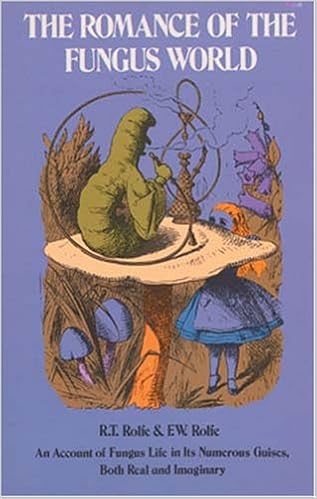
The Romance of the Fungus World: An Account of Fungus Life in Its Numerous Guises, Both Real and Legendary
Rolfe (1925)
R. T. Rolfe & F. W. Rolfe. The Romance of the Fungus World: An Account of Fungus Life in Its Numerous Guises, Both Real and Legendary. ISBN: 0486231054. 1925 (1974). Foreword by John Ramsbottom, 1924 <- same year as Manly Hall’s book Secret Teachings of All Ages.
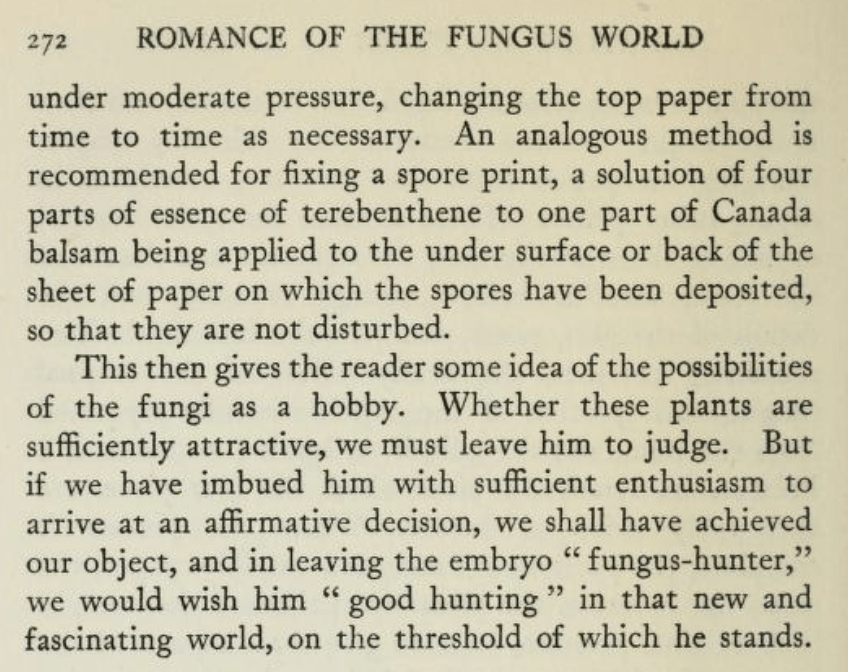
Transcription copied on Dec. 31, 2024 from http://egodeath.com/WassonEdenTree.htm#_Toc135889187 —
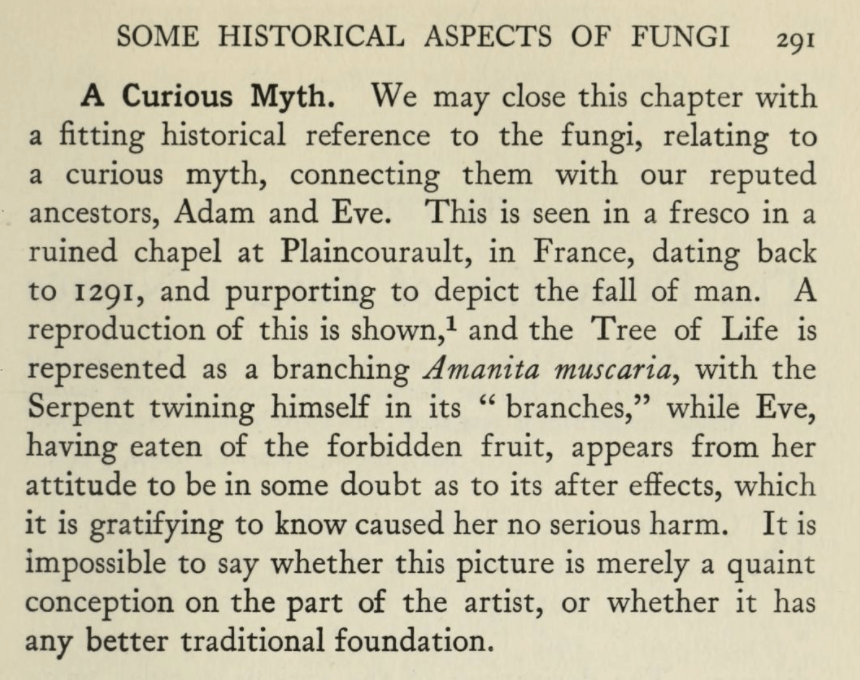
“A Curious Myth.
“We may close this chapter with a fitting historical reference to the fungi, relating to a curious myth, connecting them with our reputed ancestors, Adam and Eve.
This is seen in a fresco in a ruined chapel at Plaincourault, in France, dating back to 1291, and purporting to depict the fall of man.
A reproduction of this is shown,1 and the Tree of Life* is represented as a branching Amanita muscaria, with the Serpent twining himself in its “branches,” while Eve, having eaten of the forbidden fruit, appears from her attitude to be in some doubt as to its after effects, which it is gratifying to know caused her no serious harm.
It is impossible to say whether this picture is merely a quaint conception on the part of the artist, or whether it has any better traditional foundation.”
– Rolfe, Romance of the Fungus World, 1925, p. 291, chapter “Some Historical Aspects of Fungi”
1. (1911) Bull. Soc. Mycologique de France, xxvii., p. 31.
“It is impossible to say whether this picture is merely a quaint conception on the part of the artist, or whether it has any better traditional foundation.”
Given mushrooms in Christian art eg pilzbaum, interpreted as psychedelic eternalism including integrated motifs of {mushrooms}, {branching}, {handedness}, and {stability} motifs, against Rolfe:
It is possible to say that this picture is not merely a quaint conception on the part of the artist, but has a traditional foundation.
My 2006 Wasson article is quite good, not just for this passage. The one gap is that I made it only 99% of the way toward realizing that Wasson’s ellipses(!) in Panofsky’s letter (of two!) MUST be a deleted citation that I was wanting. I did accuse Wasson of seeming to withhold citations, but should have specified: at the ellipses.
*I pointed out in 2006: “The tree would actually be the tree of the knowledge of good and evil, not the tree of life.” I recently (late 2024) saw that someone eg. Ruck wrote that all the trees are interchangeable.
I am glad Dec. 31, 2024 that my 2006 article says:
“The final sentence seems to be asserting that it is unknown whether this portrayal of the Amanita mushrooms in a chapel indicates that Amanita mushrooms were used by those Christians, and that it is unknown whether there is a tradition of portraying Amanita in Christian art.
The Virtual Ego and the Illusory Aspect of its Control Power
The ego exists, but in a way that is more limited and complex than is usually felt. The Enlightenment conceived of the ego as an autonomous self-steering entity, rather than as a slave or puppet of gods or Fate. The cognitive structures of the semi-illusory ego must be preserved even while discovering that its thoughts and actions originate from the underlying plane, rather than originating from the ego. The ego exists virtually, or in certain limited aspects, the naive concept of ego is distorted, accepting the projected ego image as being as real as the egoic cognitive structures.
The ego-entity exists as a real set of patterns and dynamics, but the ego is not as solid, continuous, or powerful as it seems. The ego is both a set of real patterns, but also a projected, constructed image. In a way, the perceived ego exists, and in a way, it does not. The mind usually projects and constructs a fairly solid and simple image of oneself. Seeing the illusory aspects of this mental representation and feeling the absence of the accustomed sense of personal solidity can be experienced as death, as literal cessation of personal existence, because the naive mind strongly identifies with the projected image and the sense. Mental processing is structured with the conscious ego-representation as the center of control and experiencing. This representation of the ego is a dynamic set of mental constructs. This deceivingly tangible representation of the self or ego is only a part of the ego.
In a dissociative cognitive state, the usual cognitive structures constituting the ego cease, and the projection of the ego image also ceases. Oneself still exists in many ways, such as a body, a brain, a mind, possessions, and a personal past. One genuine aspect of oneself has temporarily ceased to firmly exist: the egoic cognitive processing, which is largely but not entirely suspended. The projection of the self-image is also partly suspended. Insofar as the mind confuses the projected self-image with that part of the self which is genuine, that projected self never existed, other than a perceptual illusion, and so could not cease to exist. If the ego is defined strictly as the natural assumption that the mentally projected self-representation is literally oneself, then it can be said that “the ego is only an illusion”. But such a narrowed definition of “ego” raises the question of what to call the real cognitive structures that reliably project that illusion. The ego is more than just an illusion. It’s a large, complex, and dynamic set of mental processes, of which the deceivingly tangible mental representation is only one part.
The will exerts control power, but this power is virtual rather than literal. There is some control-power, but the normal perception of this power is distorted. The sense of having control power is taken too literally and too simply. Ego structures are refined after enlightenment, not eliminated. Physics cannot provide a legitimate dwelling place for the ego entity, because the ego is largely illusory. Delusion or enlightenment are collective: first there is a uniform interegoic control field, deluded about control agency, then the rational, cybernetics explanation of enlightenment is discovered and communicated. There is a shocking feeling of helplessness upon realizing the insubstantiality of the cross-time ego.
Panofsky’s Letter Censored by Wasson
“The plant in this fresco has nothing whatever to do with mushrooms, and the similarity with Amanita muscaria is purely fortuitous. The Plaincourault fresco is only one example – and, since the style is provincial, a particularly deceptive one – of a conventionalized tree type, prevalent in Romanesque and early Gothic art, which art historians actually refer to as a ‘mushroom tree’ or in German, Pilzbaum. It comes about by the gradual schematization of the impressionistically rendered Italian pine tree in Roman and early Christian painting, and there are hundreds of instances exemplifying this development – unknown of course to mycologists. … What the mycologists have overlooked is that the medieval artists hardly ever worked from nature but from classical prototypes which in the course of repeated copying became quite unrecognizable.”
– Erwin Panofsky in a 1952 letter to Wasson excerpted in Soma, pp. 179-180
Note the ellipses, where Wasson omitted Panofsky’s recommendation of Brinckmann’s book; Wasson’s book SOMA shows only ellipses here, and Brinckmann’s name doesn’t appear in SOMA.
For clarity, I here break out the restored text as a separate paragraph:
“The plant in this fresco has nothing whatever to do with mushrooms, and the similarity with Amanita muscaria is purely fortuitous. The Plaincourault fresco is only one example – and, since the style is provincial, a particularly deceptive one – of a conventionalized tree type, prevalent in Romanesque and early Gothic art, which art historians actually refer to as a ‘mushroom tree’ or in German, Pilzbaum. It comes about by the gradual schematization of the impressionistically rendered Italian pine tree in Roman and early Christian painting, and there are hundreds of instances exemplifying this development – unknown of course to mycologists.
If you are interested, I recommend a little book by A. E. Brinckmann, Die Baumdarstellung im Mittelalter (or something like it), where the process is described in detail. Just to show what I mean, I enclose two specimens: a miniature of ca. 990 which shows the inception of the process, viz., the gradual hardening of the pine into a mushroom-like shape, and a glass painting of the thirteenth century, that is to say about a century later than your fresco, which shows an even more emphatic schematization of the mushroom-like crown.
What the mycologists have overlooked is that the medieval artists hardly ever worked from nature but from classical prototypes which in the course of repeated copying became quite unrecognizable.”
– Transcribed from the photograph of Panofsky’s letter in Figure 2 (in Brown’s article): Letter of Erwin Panofsky to R. Gordon Wasson, May 2, 1952. Wasson Archives, Harvard University Herbarium, Cambridge, Mass. Page 145.
Salverte – Occult Sciences, 1846
The aspirants to initiation, and those who came to request prophetic dreams of the Gods, were prepared by a fast, after which they partook of meals expressly prepared; and also of mysterious drinks, such as the Ciceion in the mysteries of the Eleusinia. Different drugs were easily mixed up with the drinks, according to the state of mind into which it was necessary to throw the recipient, and the nature of the visions he was desirous of procuring.
– Salverte, Occult Sciences, 1846, quoted in Hall, Secret Teachings, 1928, pp. 353-354.
Isis Unveiled, Blavatsky, 1877
Plants also have like mystical properties in a most wonderful degree, and the secret of the herbs of dreams and enchantments are only lost to European science, and useless to say, too, are unknown to it, except in a few marked instances, such as opium and hashish. Yet, the psychical effects of even these few upon the human system are regarded as evidences of a temporary mental disorder. The women of Thessaly and Epirus, the female hierophants of the rites of Sabazius, did not carry their secrets away with the downfall of their sanctuaries. They are still preserved, and those who are aware of the nature of Soma know the properties of other plants as well.
– Blavatsky, Isis Unveiled, 1877, quoted in Hall, Secret Teachings, 1928, p. 353
Motivation of This Page
- Remove from flow of live broadcast instructions/steps for the Egodeath Mystery Show.

 The Egodeath theory