Contents:
- Voice-Improvement Report
- Voice & Mic Agenda Items to Work on During the Show
- Review of Vocalization
- Slurring
- The Block List
- Types of Fluff in Speech & in Voice Recordings
- Peak Fluff – Hall of Shame
- Defining the Character of Casual Standard Voice
- Revoicing
- Mic Technique
- Resources
Voice-Improvement Report
How’s it coming for the following aspects of vocal technique?
LISTEN FOR GOING OFF-VOICE. SET GUARDS (SUGGESTER, LISTENER).
WATCH OUT FOR / GOING OFF-VOICE
- Get rid of the lecturing tone of voice; intonation; the lecturing/reprimanding intonation.
- uncramping; the vocal tract cramping problem
- Incidental commenting is the worst problem scenario.
- Low Pitch is top challenge.
- Pitch Grounding technique is working great.
- Need to use the “force pitch down”technique all the time.
- fun tone: start analyzing.
- “throat-clearing at mic” violations – step it up. todo: move to Mic Tech page.
- hook up Mute pedal.
- smoothness, pacing, speed: affects revoicing & reading aloud. read sentence paced, then paraphrase same pace.
- mindfulness: Noise Gate technique.
- slurring; lazy tongue
- read-aloud alternating with off-the-cuff: new technique idea: reversing the voices.
- matching: new idea, promising.
- reversing: n/a
- the block list: working surprisingly well, and now, it’s a literal list in the casual standard voice page
- casual wording: full speed, rapid progress.
Voice & Mic Agenda Items to Work on During the Show
- Analyze demonization of “announcer voice”. Amateurs strawman broadcasters. Everyone (know-nothings) is intent on parodying it, trying to frame it in the worst light. Result: suppressing body of knowledge of how to speak properly. Define “casual standard voice” as synonym of announcer voice skills. Mockery out of jealousy. mood tone, pitch, smoothness, word choice: broad.
- p0: Speak with lower pitch. eg bad high pitch ep 61 54:53 “I need a very concrete rolling agenda,that…”
- p1: analyze fun vs. serious tone.
- todo: Do this entire episode using the pitch grounding technique, including while doing idea development.
- p1: in ep 62, alternate among the Pitch Grounding technique, Force Down, casual standard voice.
- p1: Use the “Pitch Grounding” technique to revoice from high serious formal to low fun casual.
- done: Critique the previous episode.
- p2: 30% done: Search the web for voice technique, for speech.
- done: Search the web for mic technique, for speech. Watch mic tech vids until don’t learn any more.
- done: electronically repitch-down the playback while live.
- p5: Make a compilation from my voice recordings: The many voices of Cybermonk.
Review of Vocalization
Casual Standard Voice
- no distinctive mark/ accent / voice/ emphasis/ drawl
- neutral/interested
- standard reference vocalizing
- low pitch with a neutral-positive tone
- low pitch with a smile
- speak with a smile
- No particular character or inflection of feeling
- No odd resonance
- No character or attitude skew
- Generic Reference speech, standard voice
- Straight-up standard pronunciation
- Neutral medium pace as midpoint
- Not lax, not edgy (neutral non-emphasis)
- Neither soft tone, nor aggressive
- Neutral in tone
- Functional and plain
- Regular matter-of-fact speech
- No attitude or tone skew
Repeat Phrase
- Alway repeat phrase, in casual standard voice.
- record speaking off the cuff, then playback and critique, during show. use repeat phrase.
- the only thing to remember is “repeat phrase”.
- read-aloud throughout the show with the “repeat phrase” technique demonstration.
- speak off the cuff throughout the show with the “repeat phrase” technique demonstration.
- repeat each phrase during read-aloud & during off-the-cuff speaking
- repeat botched statement correctly
- While speaking off-the-cuff or reading-aloud, repeat words at various scales:
- syllable
- word
- phrase
- sentence
- paragraph
- section
Breathing
- Practice breathing.
- Forcibly define phrases in written sentences. [link to biz-spkg page that corrobs]
- Between phrases, 1 inhale.
- Between sentences, 2 inhales.
- Between paragraphs, 3 inhales.
- Breathe away from mic. When handheld, park mic at stomach cloth.
Varying, Dynamic
- vary pitch
- vary speed
- vary volume
- vary enunciation
- vary affectation intonation
Volume
- don’t mumble
- low volume = more bass in voice = more leakage during quiet casual standard voice
Transcending the Voice
- mindfulness when speaking off-the-cuff
- controlled vocalizing
- standard voice = transcendent voice
- all you need to remember to t’d voice is “repeat phrase“
Read-Aloud Techniques
- breathing, pacing
- turn any text into standard vocalization
- double-reading; reading-aloud each phrase twice
- 1.5x = paraphrase/ best phrases
- don’t read footnote numbers
- don’t read author citations
- read each heading twice
- read each phrase twice
- read a complete paragraph, before commenting – issue/cost: forget important point
- separate the reading of a paragraph from the commenting on a paragraph – “
- contiguous unbroken long stretches of reading
- commentary at end of paragraph
Vocal Apparatus
- Back top of throat.
- Lower chest
- Tip of tongue
- Open the back of mouth chambers and top of throat.
- Exercises.
- Push pitch down, consistently, continuously.
- Exercises.
Pitch
- force pitch downward hard, and vary the pitch between low and medium.
- wording, for item 2 in feb10a: “pitch downward, and vary the pitch from high to low“
Pronunciation & Enunciation
- consistently hype the letters: c d s t w x z
- never slur; always pronounce the ‘s’
- tip of tongue exercises (c d h j k s v w x z) “q e q r”
- separate each word, pronounce every letter of every word
Speed
- vary the speed from slow to fast (fast & smooth)
- separate each word, pronounce every letter of every word
Conversation Technique
- start a statement, then finish it
- don’t interrupt myself
- skip straight to the point
- talk about “we, us, community, conversation”
- think of key words, then construct statement around them
- what are the 5 key words you need to say?
- speak simply, with only first-order detail
- stay on a topic, without jumping among topics
- use segments to stay on-topic and separate the topics
/ end of “Review of Vocalization” section
Slurring Examples
- Play the discarded quiet/night takes that revealed lazy tongue slurring.
- Look up that date. before “Egodeath Show 2021-02-06b Caress of Steel.mp3″ which is:
- Filename: 210206_1914.wav, stereo, 2.15 GB
- Filename: 210206_1915.wav, stereo, 861.2 MB
- Maybe after:
- Raw filename: 210205_1879.wav
- Almost certainly after:
- Source file: green/white 64 GB SD card: “/Volumes/TK Audio/Music/TK/DR-05 TK Voice starting 2021-01-26/210204_2218.wav“
The Block List
- boy
- quite
- now
- silence – Pause
- typing – Pause/Mute
- throat clearing – Pause/Mute/park
- stuttering
- um
- ok
- so
- the bottom line is
- all right
- let’s see
- therefore
- thus
- basically
- to put it another way
- thats’ a good way to put it
- my voice is going out [instead, Pause and recover]
- I think
- it’s like
- My goodness, (at start of 2021-02-06c Caress of Steel, or end of 06b)
- To summarize the point,
- I’m going to cut straight to the point here and just summarize as follows:
- well
- uh
- you know
- like
- so
- cannot
- i will
- can not
- must’nt -> ?
Types of Fluff in Speech & in Voice Recordings
Types of fluff that I delete during micro editing of voice wavs; don’t say these fluff expressions or utterances, in the first place.
Peak Fluff – Hall of Shame
Verbose, needless lead-ins: “Just shut up and state your point”.
Recent fail (March 9, 2021): “To summarize the point, ” -> shut up and state the summary. It was a more verbose, self-defeating stupid lead-in than that; such as:
“I’m going to cut straight to the point here and just summarize as follows: the cat sat on the mat.” –> STFU and skip to the summary point.
Voice Character: Good & Bad
- Bad: uncontrolled sloppiness
- Good: controlled sloppiness
- Bad: overcontrolled, hyper-enunciation
- Bad: gentle, lush, soft, drawl
- Good: neutral
- Bad: harsh, abrasive, brittle, stern
- Bad: serious
- Good: fun
- Bad: sloppy comical
Defining the Character of Casual Standard Voice
Standard Reference Speaking and Tone
- General-purpose, not any particular application.
- Casual, not formal.
Control of speaking voice is like transcendent, cultivated personality.
Varying pitch med-to-low is the goal. For my ideal “dream voice” that I’d *love* to have. Just a *great* neutral, natural sounding voice.
includes Quiet Version of Casual standard voice.
formal standard voice vs casual standard voice
- casual standard voice vs. formal standard voice.
- particular applications (not the core body of knowledge):
- voice actor
- voiceover artist
- radio DJ
- announcer
- broadcaster
- ear training virtue of listening to these voice recordings / shows
- particular applications (not the core body of knowledge):
- voice physical exercises, singing during using standard voice
- tip of tongue exercises (c d h j k s v w x z) “q e q r”
- upper top back throat chamber physical stretching/exercises
- bottom chest bass spectrum physical stretching/exercises
- ear training / guard function is working well; leverage it even more fully. take a constant critical stance assessing/listening to my voice character.
- church groups singing (small or choir or online virtual choir).
- BENEFITS/ INTERESTING APPEAL FOR ME = tech/miking, analysis, communication, fixes inadvertent voice characters that I’ve been projecting.
- transcendent cultivated casual standard voice is distinct from any specific application; general purpose body of knowledge.
- transcendent, cultivated
- various *applications* of standard voice
- a general-purpose core body of knowledge.
- General-Purpose Quiet Casual Standard Voice
- tip of tongue exercises (c d h j k s v w x z) “q e q r”
- HAND TENSION AS ANALOGY FOR EXERCISING THE VOICE APPARATUS
Revoicing
Approaches to Revoicing
- Revoice using .wav in audio app w/ Pause, multiple plays, multiple re-saying, alternating.
- Revoice by transcribing to text.
- Revoice using “realtime non-pause playback” revoicing.
- Revoice from wild voice of high serious formal to cultivated voice of low fun casual multiple times.
- Revoice realtime (headphones + mic, without Pause/rewind), and return to
- Revoice by alternating playback & revoicing (w/ Pause & rewind).
- Revoice the Egodeath Mystery Show episode 17d using the quiet version of casual standard voice.
- quiet talking is difficult; it’s going to sound over-gentle.
- I expected it to be difficult to get started defining “quiet casual standard voice”. The farther-out mic placement helped reduce the booming quiet-talking bass/proximity effect.
- There might be some problem spots in 17d with soft flowery over-gentle – is that due to quiet voice?
- Maybe do a revoicing-recording to comment-on that episode.
- Hyper-pronunciation – seems like I can correct this pretty quickly.
- Added to “casual standard voice” page: talking with lozenge, mouth noises.
- Talking with lozenge wrecked my speech. The rest of the episode sounds ok, from a quick 3rd re-listen – do the revoicing technique to look for better tone-character, if possible.
Define: the revoicing technique:
- the non-realtime version of the revoicing technique:78
- play a recording of my voice, while recording my voice/mic, mixed with the playback. pause playback, or loop it; analyze. say the phrase in a different tone/character (quiet casual standard voice, or daytime casual standard voice).
- the realtime version of the revoicing technique:
- speak a phrase, then repeat the phrase in a different tone/character.
- the realtime-recording version of the revoicing technique:
- play a recording of my voice, while recording my voice/mic, not mixed with the playback. Use both decks on record, a computer to play. The mic deck will contain the excellent realtime revoicing, only. The mixer deck will contain a mix of the orig and the revoice. Possibly use pause playback, or loop it; analyze. say the phrase in a different tone/character (quiet casual standard voice, or daytime casual standard voice).
There are 3 versions of casual standard voice:
- low pitch
- high pitch when low isn’t available
- quiet
Mic Technique
Possible topics:
- Mic Technique
- Limiter
- Expander
- Re-miking
- Looping
- Layering
- Making Test Clips
- Parking the Mic (handheld)
- Positioning – End- vs. Side-Address
- Pausing
- Deleting Fluff in Voice Recordings
- Wav Editing Potentials
- Breathing
- Live-Swapping Mics
- Live-Swapping Tape Decks
- Polar Patterns
- EQ Tradeoffs
- Mastering
- Varying, Dynamic
- Read-Aloud Techniques
Mic Technique
Headphone Monitoring
- use earbuds to avoid bass swamp earmuff effect. and to minimize monitoring volume.
- ride the mic gain (feb 10a)
- when adjust mic stand
- move back from the mic, slightly, to inhale, or mouth noises
- prevent mouth noises at mic
- close lips
- no lozenge
- ride the music gain
- fade-up guitar leads (feb 11)
- Mic revised position research: finding: 4.5″, 30 degrees.
- To dynamically ride the mic pocket, formed a mental model of THE FACTORS FOR “WORKING THE MIC POCKET”: not a static positioning, but dynamic:the amateur just follows static rules.
- the pro plays and works and dances with angle/ distance/ leaving/ returning to the pocket. Works the pocket and angle dynamically; has a refined dynamic mental model. moving around/ in/ out of the pocket.
- Factors to play dynamically, to ride the mic pocket:plosive direction: need experience with plosives; push the edge, know exactly what’s going on.
- Dynamic, variable angle 30-0 degrees, leaving and returning constantly to the sweet spot/ angle on-axis more or less, riding.
- mouth noises
- inhaling silently away from (out of) sweet spot
- prox effect
- room reverb
- speaking toward the mic
- clearing field of view
- aimed at upper lip
- 4.5″ dist (cardioid)
- Do micro-editing of .wav files in audio editor, with full critique & punitive/ corrective laborious repairing-work.
- Delete all fluff words & add them to the Block List, eg “Now I’m going to move … ” –> “I’m moving…”
Define fun tone.
Explore my pitch/singing range.
Vocal Report: Reverse voicing of read-aloud vs. commentary.
Variable Mic Polar Patterns
🎙
maybe move this section to Mic page and link to it
My most interesting mic demo, a few episodes ago (probably 02-24a; find “Continuously variable polar pattern”) – I might clip that demo passage, or make a new demo: hold the large-diaphragm condenser mic in hand and rotate it and demonstrate rejection angle at which the voice is cancelled out, muted.
More interesting than
rejection angle per polar pattern, is (on-axis)
frequency response per polar pattern,
including the continuously variable, in-between positions.

Each Polar Response diagram has multiple plots on left and multiple different plots on the right.
Each plot shows level (volume, dB) at each angle, for a given frequency, to depict the rejection pattern/shape at that frequency.
The manual has more details; I’m doing pure artwork analysis here.
White *appears* to be the most variable, so is probably treble.
I speculate:
Left diagram: Figure 8 polar pattern
… Left Red plot = 20 Hz
… Left Blue plot = 200 Hz (numbers are just placeholders)
… Left White plot =2k Hz
… Right Red plot = 5 kHz
… Right Blue plot = 10 kHz
… Right White plot = 20 kHz
Middle diagram: Cardioid(??) polar pattern
… Left Red plot = 20 Hz
… Left Blue plot = __ Hz
… Left White plot = __ Hz
… Right Red plot = __ Hz
… Right Blue plot = __ Hz
… Right White plot = 20 kHz
Right diagram: Wide/Extended Cardioid(??) polar pattern
… Left Red plot = 20 Hz
… Left Blue plot = __ Hz
… Left White plot = __ Hz
… Right Red plot = __ Hz
… Right Blue plot = __ Hz
… Right White plot = 20 kHz
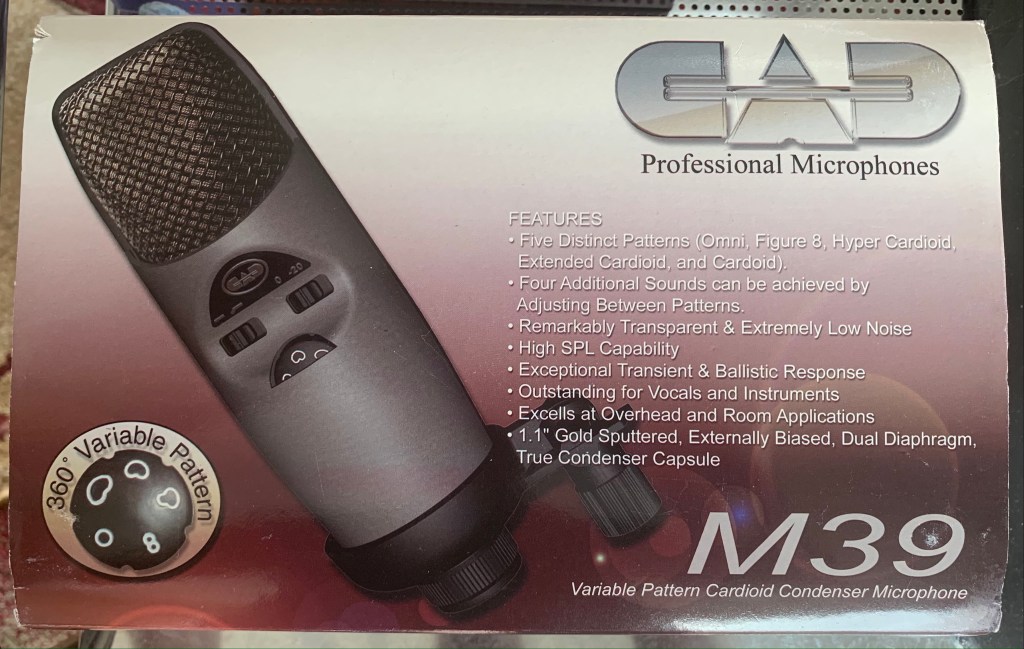
Omnidirectional;
Wide/Extended Cardioid;
Cardioid;
Supercardioid;
Figure 8.
In-between those 5 positions for the 5 named polar patterns, the Marketing copy reads “Four Additional Sounds” (unnamed; hic sunt dracones 🐉 😱 🤷♂️ ).
In order as I spin the Polar Pattern dial:
- Omni: Slight rejection at 90°. No rejection at 0° back.
- Wide/Extended Cardioid: No rejection at 90°. Strong rejection at 0° back.
- Cardioid: Moderate rejection at 90°. Strong rejection at 0° back.
- Supercardioid: Strong rejection at 45° back. No rejection at 0° back.
- Figure 8: Strong rejection at 90° (side). No rejection at 0° back.
The most exciting mic polar pattern seems to be Wide/Extended Cardioid, because it’s variable in-between the desirable properties of Omni (bright & wet) & Cardioid (dark & dry).
The pure Omnidirectional polar pattern has hiss, buzz, sibilance, mouth noises, & environment noises — a raw & too-exposed sound.
The biggest takeaway re: continuously variable polar pattern dial may be: Use the left half of the range (from Omni, to Wide Cardioid, to Cardioid) as a tilt eq. Omni = too bright, Cardioid = too dark.
Somewhere around the middle (Wide Cardioid), might be just right, to not need any eq. Or, to need least-eq.
So: try bypassing EQ, and instead using the Wide Cardioid region of the Polar Pattern dial, as a tilt EQ; imagine this pot labelled as a “Tone control”.
- Say:
- Omni = 1,
- Wide Cardioid = 5,
- Cardioid = 10.
- Then expect the sweet spot to be “5”.
- Then demonstrate “Tone control positions” 3 vs 5 vs 7. As the manual describes it, there are 4 positions in-between the 5 marked polar patterns.
- Could label Supercardioid as 10. Then expect sweet spot to be called “3” ie Wide Cardioid (instead of “5”).
“Eq”, or “Equalization”, is shorthand for “equalize the level of bass, midrange, & treble; across the audio frequency spectrum.”
The 9 patterns alluded to by the manufacturer (somewhat arbitrarily), in dial-order:
- Omnidirectional – too bright
- The Mystery Pattern with No Name #1 – may be slightly too bright
- Wide/Extended Cardioid – may be just right
- The Mystery Pattern with No Name #2 – may be slightly too dark
- Cardioid – too dark
- The Mystery Pattern with No Name #3
- Supercardioid – super dark (& dry)
- The Mystery Pattern with No Name #4 – here be dragons 🐉 😱 🤷♂️ <- to explore, especially. Given that Supercardioid = too dark, and Figure 8 = too bright (if like Omni); therefore, this in-between polar pattern region should work like a tilt eq.
- Figure 8 <- to explore. = Omni’s sound; too bright/hiss?
Resources
https://en.wikipedia.org/wiki/Voice-over

 The Egodeath theory