Easter, April 17, 2022
This is a mobile-edited weblog page, parallel with the computer-edited existing page. A sync bug causes data loss, so “don’t cross the streams”; don’t cross-edit between devices, unless i figure out how to force sync.
This page is to note time & date when I interpret art and revise theory connections a la Conceptual Revolutions book by Paul Thagard.
4:00 am April 13, 2022 I perceived huge aspect of Salamander tree: cut right trunk branch.
during recording the Egodeath Mystery Show maybe yesterday, I announced in voice recording the minute time and date of realizing and looking at the image:
while recording the show, I looked at the salamander image and realized like a day earlier that the path the right paw is touching the cap of the mushroom tree, and especially, now, also noticed that the tail is touching the trunk of the mushroom tree, which I had failed to notice before.
tail: it is a very artificial and subtle touching that the artist is indicating to signal a meaning to us.
A correction, not regarding my discoveries, but of my statements about who published what when:
I just realized yesterday I had been saying Samorini treated the salamander and then Chris Bennett, and that’s backwards.
Samorini’s 1998 article about mushroom trees says Bennett in a 1995 essay published the salamander msh tree image
but I do have a question: did Bennett know that it is green and blue, not red and white? or did Bennett only have a black-and-white picture? and same with Samorini
Samorini asserts, he uses this as an example of an Amanita Mushroom tree – but does he realize that this is green and blue , that he is proposing that a green and blue mushroom be placed in the amanita column ??
if he has now presumably seen the color version of the image does Sam Marini still claim that this mushroom tree is a Amanita, given that it is blue and green?
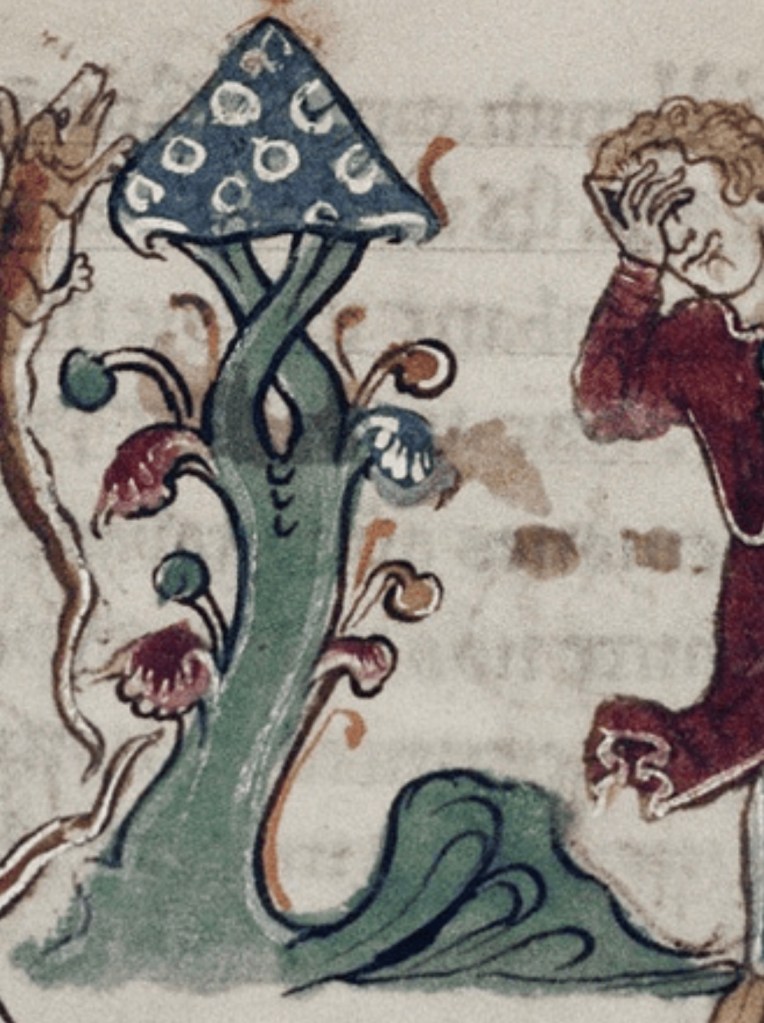
Samorini: “It’s a match! The above image is positively identified as an instance of an Amanita mushroom tree!”
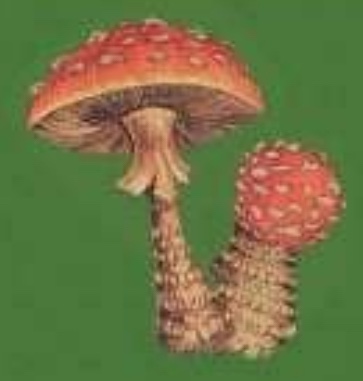
Who can blame Hatsis for saying “This is ridiculous! This Amanita Madness is making the field of entheogen scholarship look like a mockery.”
my interpretation is more mature and sophisticated and subtle and with more detail
the mushroom artists make a distinction between – as we see in Canterbury, officially and formally depicted which formally established on page 1 of Canterbury, the artist says “let us begin by defining 4 distinct shapes or types of psychoactive Mushrooms:
God created 4 plants: liberty caps, Cubensis , panaeolus , and Amanita and then throughout the 75 mushroom plants of the great Canterbury Psalter, Eadwine combines these distinctive features
and he also combines those with a fifth category, which is the vine leaf tree, which is itself a combination of grapevine leaf and ivy Vineleaf.
Using this more sophisticated and nuanced approach that’s less crude, we ask:
Which features of this roasting salamander mushroom tree match Amanita?
which features match liberty cap?
which features match panaeolus?
which features match Cubensis?
which features match grape vine leaf or ivy vine leaf?

 The Egodeath theory