Two Trainwrecks Colliding: Browns’ Book & Article Treatment of the Vial
The closer you study the Browns’ passages about the tapestry 🍄 vial, the errors and bugs and creepy crawlies just keep on coming, like a big jackpot of fail ha ha ha ha
Cybermonk
I have to write again what I originally wrote 1 billion words ago at the top of this new webpage:
my original point here was that:
my thinking evolves every hour.
there is so much of a wealth of badness here that every hour (I’m going to have to start writing timestamps) that I keep revising and evolving and developing my analysis,
and I keep correcting the things that I said one hour ago I now realize are a little bit incorrect
and every hour I make more corrections of myself as the fail keeps rolling out
I definitely have to do at least one more readthrough of these passages by Browns book The Psychedelic Gospels and their Wasson Allegro article to put them side-by-side to memorize:
is it in the book or the article, where they say who wrote the caption, and how negative, and how positive is the book versus the article
in which place did they use which rhetorical move
do they try the same rhetorical moves and make the same mistakes or aim for the same objectives Both in the book and the article ?
compare and contrast the rhetorical moves and positioning and the description of their position with relation to the competing positions
Do both passages make the same mistakes, or make the same assertions, or attempt to make the same persuasions, or attempt to make the same misrepresentation?
for example, the article misrepresents as if they traveled to the tapestry, but the book is explicit that they did not travel to the tapestry.
so the book is superior in that respect, and more honest and explicit – but with that greater detail, they also expose their own mistake in the book.
although this mistake is still partly implicit, and not argued very explicitly, but it’s clear enough in the book that the reason that they did not go to the tapestry is because they decided (for whatever reason, mostly serrations) to categorize the tapestry as being “not entheogenic art”
and the reason they give happens to be that the serrations don’t match botanical specimens
even if that weren’t a huge screwup, even aside from that big screwup, it is intriguing how the Browns never actually say in the article – maybe because their good sense got the better of them – they never actually get around to saying in the article that they concluded that the tapestry in fact does not qualify as mushroom icon
and that they are giving an entirely negative verdict on this as Mushroom icon
they never actually say that in the article and yet they lead up to saying that; they tell you “we’re gonna give you a big bad news very bad news… unfortunately, what appears as if entheogen icons fades, upon closer inspection of my photograph i brought with me & held up to the window, yessiree, fades like a tapestry of failure“
And then they never tell you the punchline (in the article), that this tapestry, we concluded, fails to match mushroom botanical specimens so we conclude that this tapestry is not entheogenic art
👼🏻✋🖊 🚫🐂💩
I think that most likely an angel of God stayed their hand and prevented them from writing their insanity that’s in the book, that this tapestry fails to match botanical specimens and therefore this tapestry is not a 🍄 mushroom icon
maybe they got cold feet and they wimped out and wussed out and realized that there would be torches and pitchforks if they came out and said that same erroneous bullsht that they said in their book
“Rightly or wrongly, we are going to reject this tapestry as an Amanita muscaria.”
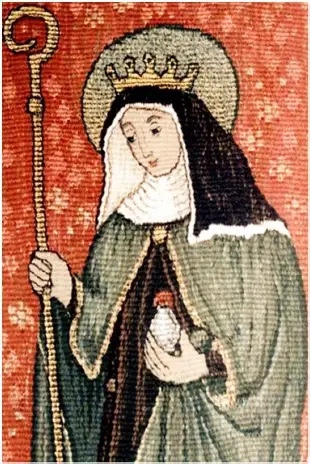
and so they leave the reader dangling and they merely say “we expect you to be very mad and disappointed because the saint holds a vial” and the reader is left scratching their head:
how are we supposed to be upset and draw a big negative conclusion and boo and say boo against Jan Irvin’s catalog of data images?
where is the bad news? I don’t see it
the argumentation that they put forth in the book is the combination of 1) definitely being a vial, combined with 2) the fact of having serrations which contradict the natural botanical specimens
in the book, the story that they tell is that they confirmed it is definitely is a vial and also that it definitely does not match botanical specimen and that is the reason why they called it (indirectly) they classified it on the next page as “not entheogenic art“.
but notice that they did not write in the caption in the book on the color plates for the customer in the bookstore to flip through, notice that they did not highlight in the caption “we proved that this definitely is a vial and it cannot also be a mushroom because this picture has serrations but botanical specimens have a smooth base.”
“so we have proved that this 🍄mushroom tapestry does not mean a mushroom” –
they did not say that in the caption of the printing in their book’s color plates
(switch gears here back to the article now, which is distinct from the book)
in the article they do not say that this has serrations and therefore “this is definitely not an 🍄 mushroom shape” & “this tapestry is not entheogenic art”
they remain silent on that point, and what they do say is true so far as they go
except they don’t explain why they did not travel to the tapestry , and
they do not explain that the photo that she brought with her probably is a fictionalized retelling of the Irvin holy mushroom book black-and-white version, and definitely I think was not the photo that they later obtained from the Abbey, I gather and
in article they sure don’t point out that they did not go to the Abbey
and that the reason they did not go to the Abbey was because they are presenting this tapestry as an example of being NOT mushrooms
they omit both the fact of not going to the Abbey, and omit the reason why they didn’t go to the Abbey, which is to say: they omit:
“this manifestly 🍄-imagery tapestry is a failure and is proved by us to not be 🍄 icon imagery”
I cannot prove that the 2019 article would agree or assert that “this is not a mushroom representation” (as book asserts)
the article does not say “this is not an Entheogenic icon” –
So then we are left very mystified: why are we supposed to consider this tapestry as a failure and a disappointment and all of Han Irvins images are just as big of a failure as this – but I don’t see how this is supposed to be a “failure”
I’m just left puzzled – until I read the book and then figure out the whole train wreck.
but the book (implicitly roundabout but clearly enough) does say (indirectly) “this tapestry is not an entheogen icon” –
The justification for that conclusion is not only that it is positively identified as a vial (which is a extremely clear-cut true conclusion) but also, in particular, the flat base-
but even more strongly than the flat base, the-death dealing blow that proves this is not a mushroom image is the serratikns – it really does come down to the serrations.
But by no means am I saying that the there’s only a single error here (serrations), because I think that there are about five distinct major errors in these two passages, different types of errors
I’m not sure, I have to think through the specific question:
can the serrations error of the Browns be considered the root cause of all of the other errors in their presentation & use of & employing of the tapestry?
maybe a case could be made for that.
conversely though, consider:
the Browns said they were able to make a field research decision about travel: they say that the blurry fourth generation image provided by Jan irvins book was actually sufficient for them to make to perceive botanical details enough so that they were able to make a travel decision – and that right there contradicts their assertion that blurry images are a dealbreaker and you have to travel.
Then what’s odd/ intriguing structurally, and here we get into kind of a master level of of my analysis, and masterful analysis on my part, is that:
the article then proceeds to omit the implicit conclusion that the object cannot represent a mushroom, and omits the factoid which was the basis for that false conclusion
and yet the article still treats the tapestry in as negative of a way, as if it is still a failed icon which was proved to not match Amanita, and they lead up to the tapestry making this degree of intensely negative sounds in their lead-up to the tapestry, but then in the paragraph which arrives at the tapestry topic, where you expect them to announce with great fanfare that:
this tapestry turns out to definitely not match Amanita!! 🤯😱😲😵 –
that’s not what they say, in the article, (only in the book).
I would expect the article to say the same 2- part statement as the book:
1) that for one thing, the object definitely is understood to represent a vial
2) the object cannot also mean a mushroom, because it has serrations, unlike a smooth base Amanita specimen.
instead, after all this negative build-up that they do in the “unfortunately” paragraph of the article, they announce with great fanfare what we are expecting to be a hugely negative assessment
but instead, the only thing they deliver in the tapestry paragraph of the article is the mild and uncontroverted statement that the saint holds a vial 😴
but they remain stunningly silent right where you expect them to say “therefore this image does not cannot mean also mushroom” [due to the standard-fare single-plant fallacy/ pretext lying baloney poppycock rubbish nonsense]
or , you expect them to argue, at that paragraph: “this object cannot also be mushroom, because the serratioms prove that it fails to match the smooth base of a 🍄 botanical specimen”
but in the article, they are totally silent on all of the negative options there, they actually do not say anything negative at all about the tapestry,
after all that negative “unfortunately … all of Irvins evidence fades” build-up, they do not have anything negative to say about the tapestry! no “vial fails to match botanical specimens” false assertion like in the book, no “tapestry is not entheogenic icon” false assertion like in the book.
it’s strange, what a strange dangling lack of follow-through, after all the negative build-up, they don’t actually make any negative assessment about the tapestry! 🤯
the article gives no reason at all in what sense this tapestry constitutes any kind of “unsatisfactory … fades” aspect of the Jan Irvin collection of mushroom imagery in art!
the article strangely expects us to read “oh no this is terrible what a terrible negative result, the fact that the saint holds a vial” 😭
and I say “I don’t get it – what are we supposed to think is negative about that?”
“A perfect example of how very, very disappointing and failed jan irvin’s evidence is, is this tapestry.
“This tapestry is very disappointing, and this is typical of how very disappointing all of Irvins art is, because it turns out, that the saint is holding a vial.”
and (forgetting about the book), my reaction to the article there is:
“I don’t get it – how is this supposed to be a bad thing? so this beautiful tapestry of amanita icon depicts the Amanita in the form of a vial held by a saint holding an Amanita styled vial instead of the usual metal; this time, the vial is styled as Amanita mushroom attributes, providing a great example – just like Jan Irvin promised – a great example of amanita Mushroom imagery in Christian Art. bravo 🎉👏
and you’re telling me that this is somehow a failure?
I simply am not following your point.
in what sense is this tapestry “unfortunately”, “faded” evidence, just because the saint is not literally holding a physical mushroom like Jan Irvin misstated?
so you’re telling me I’m supposed to treat this as an entirely disappointing, “unfortunate” and “faded” Evidence?
why are you trying to paint with such a jaundiced view?
I don’t see how irvin’s mistake means that this is now somehow “unfortunate”, “fades” , and as you say (in the book, indirectly) that “therefore” this is “not an Entheogenic icon”
you’re telling us that we are somehow supposed to be disappointed by this
and yet you seem awful happy in presenting this picture which we see as we flip through your article
and the article never says anything negative actually about the picture!
the article never says directly or indirectly… well it says very, very indirectly, the article asserts that this is not an entheogen icon, at least two layers of indirection, very indirectly the article says that:
“this 🍄 icon tapestry is not a 🍄 icon” 😑
“At first seems like good evidence for entheogenic art, turns out to fade “
they say that the tapestry as evidence has “faded”
that’s not even clear what the hell are even asserting!
what do you mean it “fades”?
The answer – you would hardly guess that’s – the answer is that they screwed up when they transfered their argumentation structure from the book to the article, they left behind their shocking negative conclusion in the book that the tapestry contradicts botanical specimens and so this tapestry does represent a vial but it cannot also represent a mushroom, because of the botanical mismatch, and so therefore:
This tapestry cannot be considered a 🍄 mushroom icon!!!
🚨 🧜♀️ 🚨
earlier…
as I autistically weave my way back-and-forth repeated cycles through my critiques, I am seeing that the Browns made a whole tangled mess of different kinds of errors:
structural errors
botanical identification errors
logical argumentation structure
errors of presentation sequence
Errors of misrepresenting their non-fieldwork as if it were fieldwork
misrepresenting Jan Irvin’s book as if it were “a photograph i brought with me” (I strongly suspect – sounds like fictionalized b.s. to me)
Just like how good esoteric art continues to pan out more and more
the more I look at it the more profundities are hidden in this art of the dancing man and roasting Salamander is incredibly deep and it keeps on paying off
similarly is the badness that comes forth from the Panofsky letters and from Wassons terrible writing about the Panofsky letters, and about the Browns short passages about this vial:
the closer you study the browns’ passages, the errors and bugs and creepy Crawley’s just keep on coming, like a big jackpot of fail ha ha ha ha
and it reminds me of Robert M Price the editor of the journal of higher Criticism:
when it came to commenting on allegro’s book, he went crazy and wrote all kinds of non-scholarly trainwreck
and the Browns are falling into that same pattern
The Browns’ thinking becomes completely garbled and their writing and their citations and everything becomes completely broken when they are confronted with the taboo problem of the reality of mushroom imagery in art
they make 18 different kinds of mistakes all tangled together
what are you talking about, “unfortunately … fades”??
you’re saying that because tapestry does not depict holding a literal mushroom like Jan Irvin misstates, that therefore we are to consider this tapestry as having “faded”, whatever the hell that supposed to mean, because the tapestry only means that the saint is holding a usual standard vial except this time the artist has cleverly decided to style the expected vial (obviously, plainly, self-evidently) as an Amanita mushroom
and we are supposed to take this as “faded” & “unfortunately”?
is that what you mean by “fades” and all of Jan Irvin’s art “unfortunately … fades”(??) in this kind of a way, so we are supposed to be disappointed
that has to be what you’re saying
but in the article you do not go so far as you did in the book where you said:
1) “this tapestry does not depict a mushroom” explicitly p153
2) and therefore “this tapestry is not a mushroom art icon” implicitly p154
3) and therefore we are canceling our field work trip to the Abbey to see the tapestry firsthand.
The article won’t give you the answer to this mystery/ question.
but the book gives you the answer to the question
the question is :
why didn’t the Browns go to the Abbey
well the Article won’t even tell you that they didn’t go to the Abbey ha ha so the Article can’t even raise that “why not” question
ha I don’t know where to start here ha ha
Two Trainwrecks Colliding
regardless of the trainwreck of the article versus the trainwreck of the book, the lying omission of the whole problem
they omit the whole problem from the article
but anyway the question I was going to ask is
why didn’t they go to the Abbey?
the answer is because they concluded based on the exact same piece of art which Jan Irvin provided them , and not based on seeing the tapestry, but using the same distorted blurry picture that Jan urban used, was evidently good enough for them to conclude firmly, without even having to bother seeing the tapestry firsthand, they were able to make a firm conclusion based on a clear enough black-and-white photo in jan irvins book which they misdescribe as “I brought a photograph with me”
strange to describe irvins black and white book as “a photograph”
” I held the photograph up to the light” – which is to say, Jan Irvin’s black-and-white blurry distorted Internet image that’s printed in his book – and even though it was a distorted fourth-generation copy of Jan Irvin’s distorted Internet image, we were still able to see enough detail to positively conclude negatively that this cannot mean mushroom, because the tapestry serration, unlike the smooth base of a natural Amanita.
We canceled our trip to see the tapestry because of the serrations in the tapestry blurry image, which we know does not match smooth base of 🍄 mushroom specimens.
the “unfortunately” lead-in paragraph of article says “unfortunately, evidence that at first looks like entheogen icon, turns out to fade, on closer inspection by Julie’s eyeballs, in person, 3” from the tapestry itself.
and our example of this intense letdown is the tapestry which Jan Irvin said is a literal mushroom, but we reveal that it is a vial (and as you can plainly see is self-evidently styled Amanita). Super disappointing, huh!
and it is left to the reader, we are expected to then come away saying, connecting the pieces together here, and we’re supposed to say “at first we thought this tapestry was a mushroom/entheogenic icon, but now we know that it is a vial styled as a mushroom, and “therefore” we are supposed to conclude that this is not a mushroom icon”.
Do the Browns expect the article reader to know that what is silently being asserted here is that :
“the vial fails to match botanical specimens, and therefore this is not a Mushroom icon”
Because remember, the article never states that.
only the book states that .
so how is the article reader supposed to know why they’re expected to be greatly disappointed to hear and disappointed in the quality of Jan Irvins and John rush’s collection of evidence.
article reader says “where is the problem here? where is the disappointment? I don’t get it”
because the Browns smartly – maybe the hand of God and the angel’s hand stayed their idiotic pen and wouldn’t let the Browns write such God-forsaken manifest pretextual malarkey as the devil had them write in their sorry book
👼🏻✋🖊 🚫🐂💩
Your logic coheres in the book: it’s based on a mistake about the serrations, but the logic argumentation structure at least in the book is coherent:
you can follow that if the object in the tapestry fails to match actual specimens, then it makes sense why they canceled the trip to go see the tapestry firsthand.
The article because they leave out their fallacious reasoning process based on botching a basic botanical fact
they never say in the article that they concluded it cannot match a botanical specimen and
they never give the reason why they concluded that the tapestry cannot does not match botanical specimens
so they leave you and they never say that they drew such a negative conclusion that they canceled the trip to see the tapestry
so they build up this tremendous disappointment and then they never deliver on that negative assessment
they never tell you the negative assessment… that was so… they Just leave you floating confused
they never deliver the punchline of why this is supposed to be a disappointing piece of art, in the article
so the article lacks the huge error, the false negative that the book has, but on the other hand, the article sets up this great big huge disappointment punch line – and then fails to ever deliver the punchline of “therefore this tapestry cannot mean mushroom” (because it fails to match the botanical specimens)
The Browns announce with great fanfare that they’re going to present this tapestry as a great example of very disappointing failed iconographic entheogen mushroom icon evidence
but then instead they simply say:
“the saint holds a vial” (which obviously, manifestly, plainly, self-evidently is 🍄mushroom-styled)
Which is to say (keeping in mind the principle of artist responsibility), the image which the artist consciously deliberately chooses and knowingly chooses to present is guaranteed to force the impression of 🍄mushroom on the viewer
so I don’t get it – where is the big huge disappointment?
in the article, the Browns never deliver the big punchline of, the great big disappointment regarding this tapestry
the article just leaves the reader puzzled, because they left out their huge gigantic botanical error thats in the book, but they also left out their book’s big negative conclusion of saying “therefore this cannot represent a mushroom” and “this tapestry therefore cannot be considered a 🍄mushroom icon“
The article reader is left scratching their head saying “I don’t get it – why am I supposed to be disappointed?
“how is this supposed to make Jan Irvin look bad?
“you said you found a way to make a Jan Irvin look really bad and really disappointing and really faded, but the only thing you did is to clarify that the 🍄mushroom icon tapestry has the Saint holding the usual vial, but now styled as a Amanita psychoactive mushroom.
“and you’re telling us we’re supposed to be deeply disappointed by this tapestry? I don’t get it”
… one million thoughts earlier…
but I am confused: I don’t see how you categorize this as “not a mushroom icon”: here we have a saint holding a healing vile which is styled self evidently as a mushroom, and you are telling us that “this is not a mushroom icon”
your negative messaging simply does not make any sense at all
it doesn’t cohere. your whole presentation of this tapestry does not cohere! all it does is confuse people
I don’t think this article could convince a single person that this tapestry is “not a mushroom icon”
and I find it difficult to believe that this article itself considers this tapestry to be “not a mushroom icon”
✋😏🤚
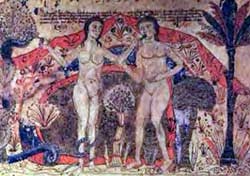
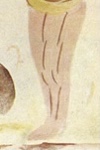
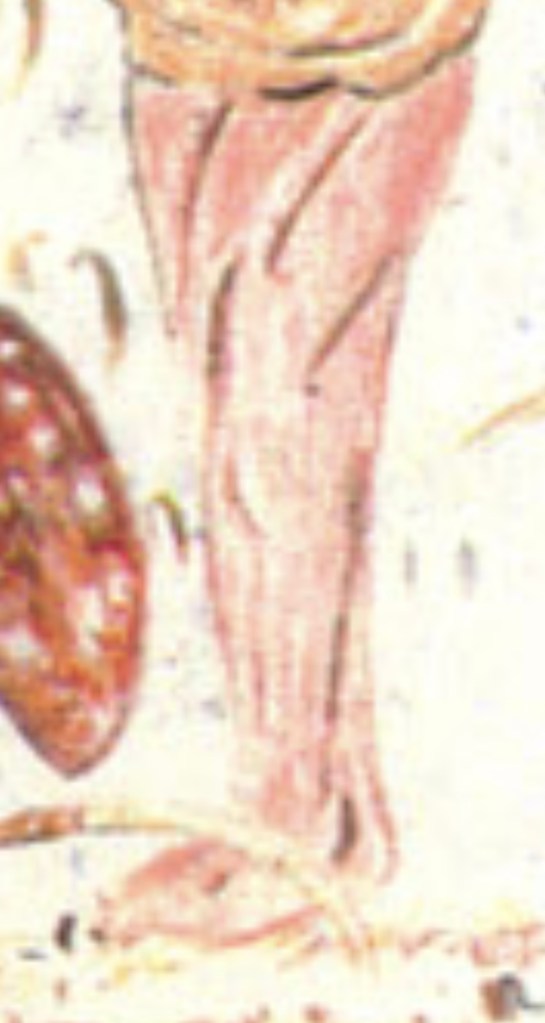
no color, yet this image was used for a huge top-three breakthrough of art interpretation – just like I’m totally guessing that:
the alleged “photograph” Julie allegedly brought with her and allegedly “held up to the window” , I’m guessing, I’m betting that it is the black-and-white version of the Holy Mushroom book by Jan irvin that she’s referring to, and that whatever it was was sufficient enough for her to perceive serrations on the🍄 base, and make a field work decision based on “holding up to the window” the so-called “photograph”
Jan irvin suspects that the Hofmann bicycle trip was a fabricated deliberate deceptive mythmaking , and the same thing with Gordon Wassons tale which he always tells again and again, the hazy origin story fabricated tale of “the honeymoon walk in the woods with his wife” regarding different attitudes about mushrooms – that even if the event sort of semi-happened, far more important than the actual event is this mythicized ritualistic retelling.
Julie’s fictionalized origin tale of her great reveal, her great realization “while doing field work” 😉, that this tapestry is actually not an entheogen icon, and all of Irvin’s database is bunk, “unfortunate … fades”
Well I have a semi-fictional mythicized retelling that I’m going to make into a ritual, it will be my constrant retelling of the tall tale when Julie Brown “brought a photograph with her” and “held it up to the window” 😏😉 – just like “really happened” in the Dan Brown novel.
what did Julie Brown see in the light of the window holding the photograph (a.k.a. Jan Irvin book) up to the window?
she saw serrations in the black & white Jan Irvin-provided, blurry Internet photograph copy, fourth-generation extra blurry, and she knew that she could make out those blurry serrations well enough to make a field work travel decision based on it , that real Amanita specimens have a smooth base, and therefore we could make a solid decision not to do field work, and cancel our trip to see the tapestry , which courtesy of the abbey emailed to us on the internet.
we realized the serrations “while on a field work trip” – you have a way of painting with words, painting fictional pictures
did I mention we were on a trip?
that’s right, we were on a trip doing fieldwork, in our hotel, behind our computer screen, doing fieldwork, looking directly at the tapestry photograph on our computer screen, firsthand with our own eyes, we were right there! 😅 🙃 😅
But then we canceled our trip as soon as we saw there’s those serrations in the tapestry, we knew there’s no way that this can be a mushroom icon, because real mushrooms have a smooth base
that’s why in our field work, we canceled our fieldwork, and did not do field work to go see the non-mushroom (bc serrated) base of the tapestry’s vial first hand
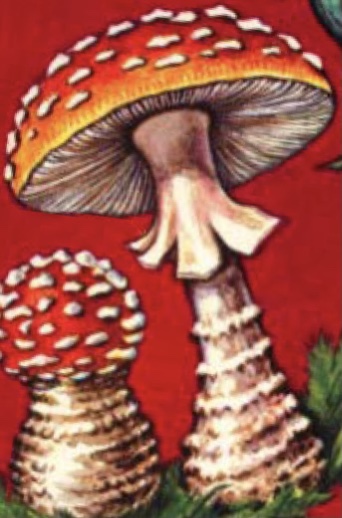
and the article never says “we concluded that this is not Entheogen art”
and the article never says “by using a fourth generation copy of a black-and-white printing of Jan Irvin’s book with blurry Internet pictures, we made such a very strong conclusion that this tapestry is not an entheogenic icon, that we didn’t even go to see the tapestry firsthand, and we canceled our trip to the Abbey”!
The really weird dangling affect the article has is it makes a great noisy super negative set up but then it never delivers the negative goods it never says we concluded that this tapestry is bogus bunk falls and definitely not a mushroom but only a vile and definitely not also a Mushroom because of the botanical features in the tapestry we concluded that this is not May I repeat not a Mushroom icon the article never says that and the leader the reader is left dangling and underwhelmed by the lack of negative conclusion that they expect that the Browns promised
you promised a gigantic big huge disappointing reveal, and then you never delivered the punchline!
why are we supposed to be disappointed by this faded Failed evidence of this tapestry?
you haven’t told us in what sense is this tapestry a failure
you never said (in the article) “we concluded that this tapestry cannot show a Mushroom icon”; “this tapestry is not a mushroom icon”
you never even said that
so why are you presenting this as a disappointment example of how disappointing the Jan Irvin catalog of evidence is?
… one million thoughts earlier ...
my recent, second, in-depth analysis of the two treatments by the browns of the Saint Walburga tapestry Amanita vile is interesting how it develops
you can see it develop on hour by hour basis, as I learn and memorize the paragraphs
What’s remarkable about the two Panofsky letters and the two brown passages are that they appear to be quite short, and yet it’s remarkable how much in-depth analysis and unraveling there is to be done before you can say that you really grasp the ins and outs of:
what did they assert
what did they not assert
what did they say assert explicitly
what exactly did they assert implicitly
how did their assertion-set change between the book to the article 3 years later?
just like I had to repeatedly re-read the pair of Panofsky Letters censored by Wassen which he let us see maybe 1/4 of them of their content
and then I learned to beware of treacherous mistranscription in Browns Article of Panofskys 2nd letter re ‘project’ (artwork) where Pan actually wrote ‘product’ (templates)
and a little striking thing listening to my mistakes in my earlier speaking about the vile you can hear me correct my mistakes an hour later
The passage is much clearer when you put the two terse passages side-by-side then it becomes obvious and explicit even
what caption?
how is it that the photograph that she brought with her has a caption?
who wrote this caption oh Jan Irvin
oh by photograph do you mean then his book?
did you photograph his book?
did you take a photo on your phone then hold that up to the window
did you have it
Did you have a photograph on stock paper in addition to having an Jan Irvin’s book??
what are you talking about, that you “brought a photograph with you”; could you be concrete and specific please
why does “the photograph” that you “held up to the window” have a caption written by Jan Irvin? 🤔 🤔
and so you have to put the two passages side-by-side to piece together the puzzle pieces
it is all the more necessary because the passages are so very short, maybe three paragraphs each, like Panofsky’s letters
the shortness is the challenge because it means it’s very tightly condensed, with 90% of the iceberg not visible.
deep critical analysis of short, vague, biased, manipulative, rhetorical-persuasion passages by Panofsky, Brown, Hatsis, and other untrustworthy entheogen scholars, is similar to interpreting visual mystical art , where the artist has to rely very heavily on unnatural depictions such as touching and size.
at the same time as you need to analyze the book separately from analyzing the positions in the article –
yet to determine who wrote the caption, and what they’re, what photograph they were talking about when she claims that she “brought a photograph with her”
when the truth probably this is likely most likely is a fictionalized repainting of she brought jan irvins book black-and-white with her I’m guessing, a good guess
and then she’s taking poetic license to paint a romantic romanticized fictionalized semi true docudrama account taking liberties when she brings her Cheap black-and-white version of Jan Irvin book the holy Mushroom, she writes instead “I brought a photograph with me , and I held the photograph up to the light”.
My first pass was, see the date on my WordPress webpage about hatsis book psychedelic mystery traditions, contains my first-pass critique of the vile of the tapestry
there are photographs of my 2006 Wasson book Soma for Plainc 🍄 article my hand written notes With highlighter circling and underlining every line and every word
this is what analysis of rhetoric requires, especially implicit, indirect, roundabout rhetoric which is designed to mislead and misrepresent
I’m kind of good at that analysis
I’m really good-
I’ve become-
I’ve developed some really very powerful word level microscopic reading techniques

 The Egodeath theory