I don’t use Samorini’s category-labels “Plaincourault type” and “St. Sauvin type”.
Say “Psilocybin Mushroom Trees”, not “Mushroom Trees of the St. Sauvin Type” per Samorini, and also differentiate YO vs. YOO branching morphology.
Amanita vs. Psilocybin Is Minor, Branching Morphology Is Major
It would be possible and worthwhile to define Samorini’s Fig. 20 table as 4-columns instead of 2 columns.
Samorini’s two columns conflate (overly group together & fuse) two distinct points of interest: branching morphology, and Amanita vs. Psilocybin. Imagine art examples:
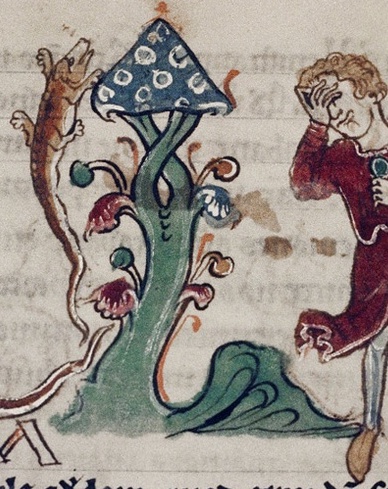
Here’s a Psilocybin mushroom tree that has multiple branches holding up a single main cap (YO). And some small caps each with a single stem. That would go in Samorini’s left column, which he calls “Plaincourault type”:
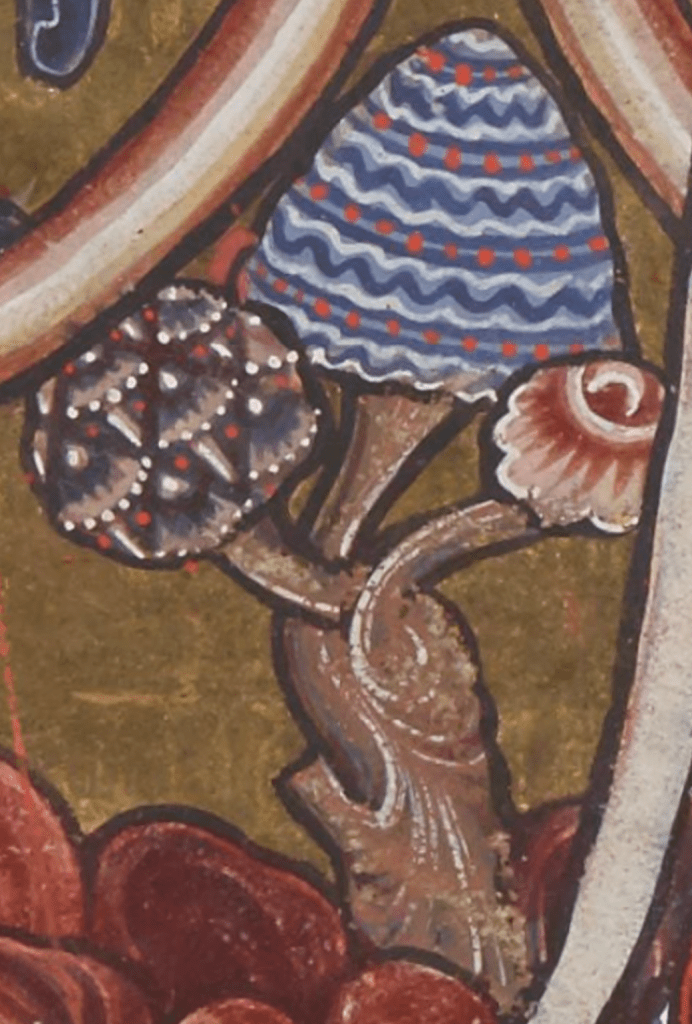
Here’s a Psilocybin mushroom tree that has a single branch holding up each cap (YOO). That would go in Samorini’s right column, which he calls “St. Sauvin type:
Here’s an Amanita mushroom tree that has multiple branches holding up a single main cap (YO). And some small caps each with a single stem. That would go in Samorini’s left column, which he calls “Plaincourault type”:

Here’s an Amanita mushroom tree that has a single branch holding up each cap (YOO). That would go in Samorini’s right column, which he calls “St. Sauvin type”.
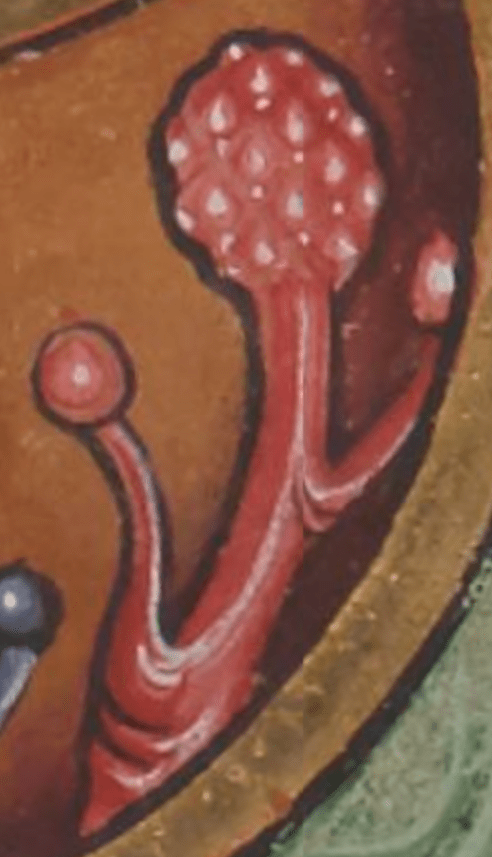
“St. Sauvin type” is obscure instead of direct
Samorini’s Plaincourault-overemphasizing naming-pattern, “Saint Sauvin-type mushroom trees”, is not so much about Amanita vs. Psilocybin, nor the 4 traits he lists, but how many branches/stems hold up a cap or main cap.
That’s Samorini’s unhelpful, obscurantist code-speak, for which he ought to speak plainly and directly, as “psilocybin mushroom trees”.
url https://egodeaththeory.wordpress.com/mushroom-trees-in-christian-art-samorini/#Figure-20
actually in fact the main distinction between his left column and his right column is not anything to do with Amanita versus Psilocybin, or Plaincourault versus Saint Sauvin.
In terms of Morphology of branching-message mushroom trees, in fact in the fig. 20 table:
right column = multiple caps that each have one stem. Type YOO.
left column = a single cap that has multiple stems branching under it. Type YO for main cap, plus smaller YOO.
Regardless of whether amanita versus psilocybin.
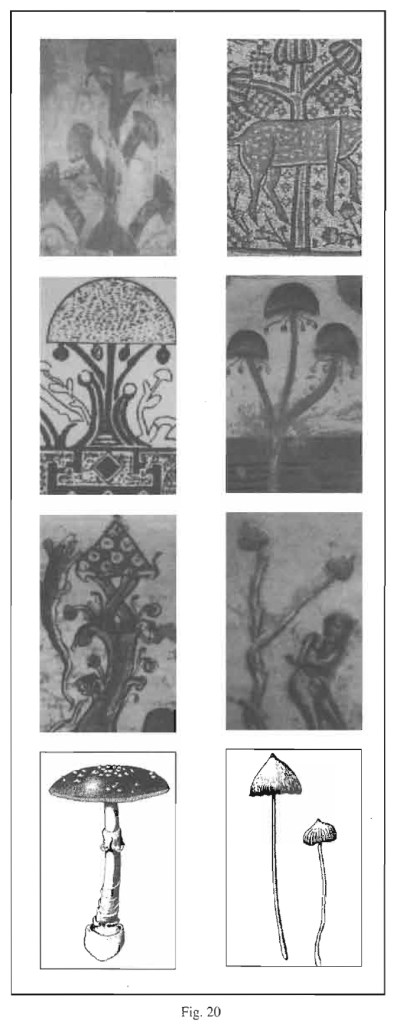
The fourth row is an error; the important distinction here is not between Amanita versus Psilocybin; it is between type YO {a single main cap, supported by multiple branches, with optional small stems/caps}, versus type YOO {multiple caps, supported by one branch each}.
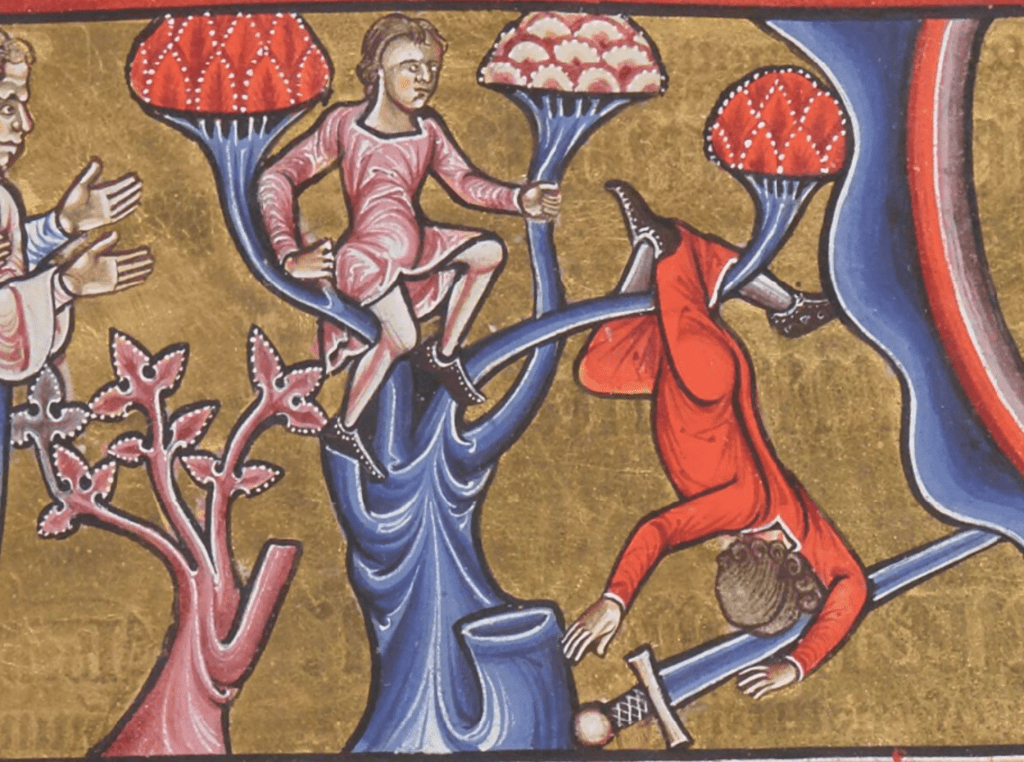
The “dancing man” mushroom tree (row 3 left) cannot fit well into the Amanita column, because:
- the cap is green with white donuts with blue centers (not white spots on red background).
- the trunk stem is blue (not white).
- the cap shape is semi-lance shaped, ie triangle (not a dome).
The dancing man mushroom tree better matches the diagonal cell: row 4 right, psilocybe semilanceata; liberty cap.
See my inventory of morphology in the Great Mushroom Psalter:
url https://egodeaththeory.wordpress.com/2022/03/13/the-75-mushroom-trees-of-the-canterbury-psalter/
The 75 mushroom plants from Eadwine – are they all column 2 Saint Sauvin type, or are any of them column 1 Plaincourault type?
Tree 68 is the closest Easwine comes to having two stems support 1 cap. https://egodeaththeory.wordpress.com/2022/03/13/the-75-mushroom-trees-of-the-canterbury-psalter/#68
This branching-message mushroom tree has it all, for branching morphology: multiple caps, multiple branches holding up each cap, & cut off branches, including {cut right trunk}.
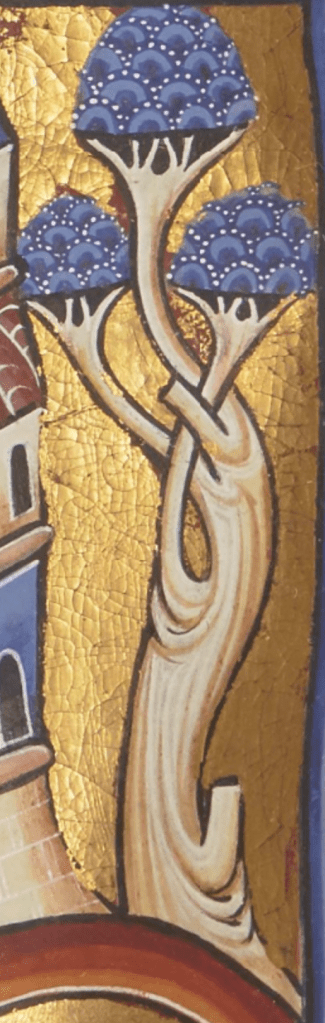
Defining Type YO vs. YOO Morphology of Branching-message mushroom trees
Finding: Dec. 17, 2022: Eadwine’s branching-message mushroom trees are of Samorini’s “St. Sauvin type”, which is type YOO, not type YO.
They happen to be almost all of them Psilocybin – maybe two of them or three have Amanita attributes – but I am looking at the major morphology that truly divides Samorini’s two columns.
The important difference between column one and column two is one trunk branching to two stems supporting a single cap, vs. on trunk branching to two stems, each supporting one cap.
Branch the trunk into two stems: then the question is, will the tree have a single cap (Y O), or will it have multiple caps (Y O O)?
Multiple branches under one cap is not emphasized as the morphology in the main Eadwine tree, but you could imagine if it had two or three branches supporting each cap:

 The Egodeath theory