Contents:
Intro
Roland Griffiths’ 2008 article “Human Hallucinogen Research: Guidelines for Safety” has relatively “fair” coverage of the threat of loss of control and its minor solution to stave off control seizure.
The article lacks the major solution to “the shadow problem”, which is, to gain Transcendent Knowledge, which the Egodeath theory provides.
The goal is not merely negative, “avoid non-control”; the goal is to positively and pointedly transcend personal control and be transformed so as to become immune to the shadow dragon battle problem, and become able to ride the dragon or touch the blade of death while having a new form of control stability.
The “Guidelines for Safety” article has a relatively “fair” degree of coverage of control-related challenges, compared to the whitewashed, sanitized Challenging Experiences Questionnaire (CEQ).
Which is to merely say that the Guidelines article contains the folk-level, sub-scientific advice, like “surrender to the loss of control”.
See also:
No Mention of Loss of Control in Scientific Literature Review from Oregon Psilocybin Board
https://egodeaththeory.wordpress.com/2022/12/18/no-mention-of-loss-of-control-in-scientific-literature-review-from-oregon-psilocybin-board/
Standard Hazy Trip Advice on Surrender to the Shadow, Trust, Submit, and Let Go of Control
https://egodeaththeory.wordpress.com/2022/12/07/standard-hazy-trip-advice-on-surrender-to-shadow-trust-submit-and-let-go-of-control/
The Challenging Experience Questionnaire (CEQ): Characterization of challenging experiences with psilocybin mushrooms – Omits Category “Threat of Loss of Control”!
https://egodeaththeory.wordpress.com/2022/12/16/the-challenging-experience-questionnaire-ceq-characterization-of-challenging-experiences-with-psilocybin-mushrooms-omits-category-threat-of-loss-of-control/
The CEQ article has weak coverage of control-loss problems and solutions, though it lists good control-loss questions from previous questionnaires – before silently, covertly deleting those questions from the CEQ, providing no scientific justification for doing so; no discussion at all of doing so; no discussion of the control-related questions as such.
The CEQ article has no discussion at all of the control-related questions, which it omits from the CEQ – despite showing glimmerings of awareness of control-related challenges in the article “Human Hallucinogen Research: Guidelines for Safety”, and some in the CEQ article.
Status:
I have marked up all remaining hardcopy passages that I want to add to this post, though all points are probably here already.
Scare Quoting Conventions 😱 😵 😇
My excerpts here are accurate quotes, except inaccurate by lifting phrases and words out of context (eg via ellipses & omitting qualifiers), per the paranoid dissociative-state word-isolation technique.
Because that is the actual realistic safety situation in the altered state.
We have to think, here, in that “hypervigilant paranoia vortex trap” manner, to grasp the type and nature of the danger – and attraction to the scent of treasure, perceiving that there is a highly desirable higher reordering of the mental model, past the dragon gate.
Trying to read in an alarming, control-vortex attraction provoking way.
Citation/Link
Human Hallucinogen Research: Guidelines for Safety
Johnson M, Richards W, Griffiths R.
2008
Journal of Psychopharmacology, 22, 603-620.
22(6):603-20. doi: 10.1177/0269881108093587.
Epub 2008 Jul 1. PMID: 18593734; PMCID: PMC3056407.
https://www.ncbi.nlm.nih.gov/pmc/articles/PMC3056407/
Article: “Human Hallucinogen Research: Guidelines for Safety”
Below are key excerpts, with my commentary per the Egodeath theory.
– Cybermonk, December 18, 2022
Section: Abstract
Page 1:
“Risks… and safeguards for minimizing these risks.”
“unique psychological risks. The most likely risk is overwhelming distress … (“bad trip”), which could lead to potentially dangerous behavior”
Strangely, Griffiths did not explicitly gather the bits of good advice which are buried in the body of the article:
surrender; submit; accept; ask the threatening dragon monster what lesson it is teaching
The solutions to teach people should be the first thing to mention in the Abstract takeaway.
“Safeguards against these risks include… careful volunteer preparation”
“adverse reactions are rare when research is conducted along these guidelines.”
“Incautious research may jeopardize participant safety and future research.”
“carefully conducted research may inform the treatment of … disorders, and may lead to advances in basic science.”

Possibilism-thinking bedevils the control system, until that immature, undeveloped, disordered, animal-like thinking is replaced by eternalism-thinking.
The Abstract does not summarize what does so-called “carefully conducted research” amounts to; that is, the rough, sub-scientific folk-wisdom advice instruction of “surrender and submit and accept the lack of control, and approach the shadow monster and ask it what it is teaching you”.
Only if we switch from this rough, dirty, folk expression, to the Egodeath theory’s proper, well-articulated, well-formed and mapped-out explanation, only then do we have a proper level of safety, and the ability to do research with success.
Section: Introduction
“spiritual significance”
“disorders”
“ayahuasca protected under the Religious Freedom Restoration Act”
“ayahuasca use within this church setting may receive increased scientific investigation”
“The purpose of this paper is to provide guidance in the safe administration of high doses of hallucinogens.”
“the likelihood of potential adverse effects will be related to dose.”
The concept of “avoid adverse effects” is lopsided, or vague at best. It’s said without comprehending the goal and nature of the game.
That framing omits the goal of passage through such effects to pin the serpent, to win the prize, to complete mental transformation.

We actually need to manage the negative testing demonstration of control limits, to successfully drive transferring control-reliance from possibilism-thinking ({left leg}) to eternalism-thinking ({right leg}).
“First, so that the historical context in which current human hallucinogen studies are conducted will be clear, we will briefly discuss the history of sacramental hallucinogen use by indigenous cultures, and the history of human hallucinogen research before it became dormant in the 1970s.”
This is very biased, with gigantic blind spots. Can’t you at least mention Eleusis? Short-sighted, no sense of world use, no sense of long history. “History” = indigenous + 20th Century, only, according to this tiny narrowing view.
Griffiths writes in 2008 as if the field of entheogen scholarship, the history of Western religious history of psychedelics, didn’t exist.
Why not at mention Graves 1957 through Ruck 2008, who showed that Western religious history used entheogens?
“it [psychedelics research] became dormant in the 1970s“
False; that narrative/framing is biased in favor of Big Pharma.
Psychedelics research did not become “dormant” from 1970 to 1992; research was underground and active.
Similar to my 1985-1997 development of the Core Egodeath theory; the Cybernetic Theory of Ego Transcendence.
The point in this section is that previous research was done without regard to safety, so it was halted, and so we need to put safety first, so research won’t be halted (ie driven underground) again.
“researchers should appreciate the precarious position of current human hallucinogen research, and recognize that very high safety standards will help to ensure that human research continues into the decades to come.”

precarious position

precarious self-threatening psalter image viewer
“we will provide a detailed description of the unique risks of hallucinogen administration.”
The unique risk is the mind is attracted to control-transcendence.
“We will then present the proposed guidelines for conducting high-dose hallucinogen research”
The unique guideline for safety (and successful transformation) is to learn to rely on eternalism-thinking instead of possibilism-thinking. In crude, hardly adequate folk-psychology terms: “surrender and trust”.
That type of guidance is limited to “safety”; it gives only an unproductive dead end, because not placed in the context of “how to safely pass through the gate to completion of mental transformation”.
Such “safety guidelines” amounts to merely how to avoid the transformation process.
/ end of Introduction section
Section: Relevant History
Section: Relevant History: Use by indigenous cultures
This section falsely reduces the history of entheogen use to exclusively indigenous use, and otherwise, “history” shortsightedly exclusively means 20th Century, only.
Biased, ignorant, severely and harmfully self-defeating, counterproductive, misrepresentative, bunk framing. This narrative writes-out almost all of our history of use, even while saying psychedelics were used forever.
Read this section as “historical use of psychedelics”.
Read ‘indigenous’ as ‘ancient and medieval’ use of psychedelics – aim for a greedy, Maximal long history of psychedelics use in all religions, all eras, all regions.
This 2008 article reads like it was written in 1970, as if the entheogen scholarship field didn’t exist, for Western religious history.
“Hallucinogens have been used by indigenous cultures for millennia.”
What about by non-indigenous cultures? Where’s the section covering that?
“without exception, such cultures view hallucinogenic plants and fungi as being of divine origin.”
“rites of passage“
The goal is pass through the gate, by transforming, not merely to avoid challenging experiences.
You can’t really talk about safety until you recognize the objective and nature of the danger and goal. Safety during what process, toward what transformation? Safety while trying to accomplish what?
Directionless “safety” is pretty irrelevant and unproductive.
This is what “safety” looks like from the wrong side of the transformation gateway, from a beginner culture’s point of view.
The whole field of play is obscured, not visible, to the Griffiths perspective – aiming for abstract safety but with no real grasp of context and purpose; that’s all unknown.
“incorporate a high degree of structure and guidance into their ayahuasca use, which may minimize adverse reactions“
“indigenous cultures should not be regarded as absolute role models in the clinical use of hallucinogens … human sacrifice, … sacramental headhunting, ayahuasca may be used by the shaman in that society for malevolent intent (i.e., bewitching)”
“some of the safeguards developed for clinical hallucinogen research and expressed in the guidelines presented herein are similar to important aspects of hallucinogen use by indigenous cultures. These common themes are structured use (… ritual …), restrictions on use including the need for guidance, and appreciation of … powerful psychological effects (expressed as reverence … these commonalities are more than coincidence. The unique pharmacology of classical hallucinogens may have shaped convergent practices across independent cultures.”
“the guidelines expressed herein for human clinical research with hallucinogens … developed in reaction to these same aspects of hallucinogen pharmacology.”
“the unique effects and safety concerns for hallucinogens … related to their ability to [produce] spiritual experiences.”
Did Irvin’s “secret history of magic mushrooms” cite Novak? Novak SJ. LSD before Leary: Sidney Cohen’s critique of 1950s psychedelic drug research. Isis 1997;88:87–110
“Novak (1997) hypothesized that Western intellectuals in the mid 1950’s such as Aldous Huxley and Gerald Heard merely redefined the subjective effects resulting from hallucinogen administration as a spiritual experience, thereby popularizing such an association in western culture. … [but the facts that] indigenous cultures that ingest classical hallucinogens almost invariably do so under sacramental contexts … under supportive conditions hallucinogens occasion mystical-type experiences with high frequency, suggests that the association of hallucinogens with spiritual experience relates to the pharmacology of these agents rather than being based entirely on cultural suggestion.”
Against Jan Irvin’s “suggestogens” claim.
Section: Early clinical research
“more preparation and interpersonal support … found fewer adverse psychological reactions, such as panic reactions and paranoid episodes“
This “preparation” is: teach relying on eternalism-thinking instead of possibilism-thinking.
“symptoms of psychosis“
“the psychosis observed in schizophrenia“
“findings that have supported hallucinogens as a model of at least certain aspects of acute psychosis“
Are we all crazy yet?!
Ozzy Osbourne, live concert, expressing the standard normal expectation that Rock concertgoers are tripping.
“recreational hallucinogen use, … advocacy of hallucinogen use by youth further undermined an objective scientific approach to studying these compounds.”
The psychedelic rite of passage is specifically for {youths} and {maidens}, meaning for untransformed, undeveloped, untransformed, immature, perishable, still animal-like minds.
Don’t label others’ use as simply, solely recreational – or, redefine to broaden the term to overlap with other uses.
Jan Irvin objects to that as self-contradictory scheming, the narrative of why psychedelics were prohibited, because of youth recreational use, supposedly.
Major Section: Unique risks
“Hallucinogen administration in humans results in a unique profile of effects and potential adverse reactions that need to be appropriately addressed in order to maximize safety.”
“Different risks are associated … address those particular risks.”
“its own unique risk profile.”
“the primary safety concerns with hallucinogens are largely psychological“
Psychedelics produce the threat of loss of control, to gain Transcendent Knowledge and become able to have stable control in the altered state.
Before a session, one must learn to rely on {right leg} rather than {left leg}.
Learn about relying on eternalism-thinking (right leg; non-branching), as opposed to possibilism-thinking (left leg; branching).
Section: Toxicity
“tremors”
“blurred vision”
Seaspray blurs my vision
Rush/Peart, No One at the Bridge
The waves roll by so fast
Save my ship of freedom
I’m lashed helpless to the mast
No mention of heart palpitations (uneven heartbeat, slow then fast) toward the end of high-dose session, as heard at the end of Rush song Cygnus X1.
Prediction: with Psilocybin legal, and in Schedule35 product’s capsule’d form of Golden Teacher strain of cubensis, along with using redosing technique to sustain the peak level, people will have the same palpitations as ergot.
Section: Abuse and dependence
Section: Acute psychological distress
“pose other psychological risks. The most likely risk … is … a “bad trip” … characterized by anxiety, fear/panic, … and/or paranoia. Distressing effects … sensory … frightening … disturbing hyperawareness of … processes … metaphysical … troubling thoughts or feelings about ultimate evil forces.”
“emotional experience is often intensified … when under the influence of … uncontrolled situations any of these effects may potentially escalate to dangerous behavior. … fear and paranoid delusions … erratic … dangerous behavior, … hazardous … take seriously such risks and take steps to avoid their occurrence.”
Section: Prolonged psychosis
“when used under the proper guidelines, … an important tool for … research”
“observations suggest … psychological material may be activated … such material, if not properly worked through and psychologically integrated, may lead to psychological difficulties … lasting beyond the session.”
Section: Lasting perceptual abnormalities
Major Section: Guidelines for safety
“The guidelines that follow are intended to support the safe administration of high doses … while minimizing … adverse reactions.”
“The present paper … providing a … detailed discussion of safety concerns.”
“The present guidelines … for high-dose hallucinogen research.”
“the proposed criteria are substantially more extensive … because these domains … require even greater attention for hallucinogens than for other classes of psychoactive drugs.”
“Although particular aspects of the proposed guidelines may be debatable, it is hoped that this paper will encourage such discussion while conveying the general themes and major domains of concern in … research. The proposed guidelines may serve as a helpful starting point for investigators planning to conduct … research.”
Section: Selection of volunteers
🤔 🤷♂️
Pregnant women or those not practicing effective means of birth control are excluded.
“Guidelines for Safety”, p. 9
{pregnant woman harassed by dragon}, {gave birth}
Section: Study personnel
personnel = guides and helpers
“For studies that are intended to maximize the potential for mystical-type experience …, an additional valuable monitor characteristic may be her or his ability to interact with and relate to the participant concerning spiritual issues.”
“even more compelling given the powerful influence … providing additional attention … beyond what is customary”
Section: Physical environment
“ensuring safety … acute psychological distress“
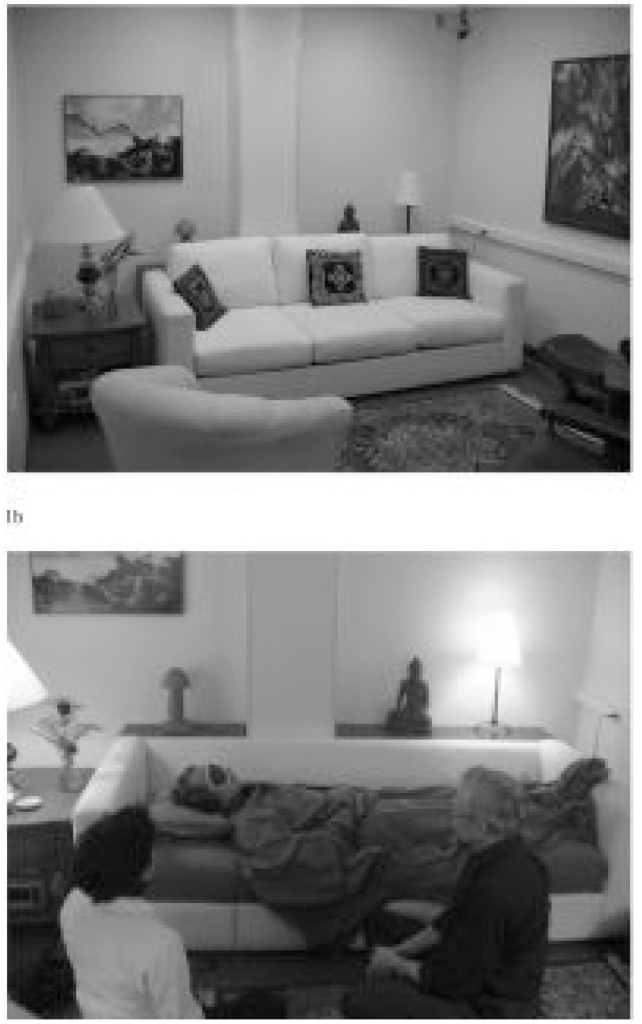
“The Johns Hopkins hallucinogen research projects use a living room-like setting (see Figure 1). The furniture is comfortable and is atypical for a research laboratory or medical office setting.”
Includes Buddha statue – did they use theurgy to draw down a demonic god into it? See bottom of this webpage.
Section: Preparation of volunteers
volunteer = client, initiate, voyager, psychonaut
“volunteer [client, voyager] preparation … must include a thorough review … in plain language … the range of experiences … changes in perception, sense of time and space, and emotion (… anxiety, fear, panic, and paranoia).”
“difficult to describe to a naïve volunteer; … additional time may be necessary to fully discuss these … effects”
“the approximate timecourse of the drug”
[intensity curve; teach redosing curve plots: trapezoid or dual mountain]
“its status as … experimental”
“risk of adverse effects … (such as depression), psychotic disorders, and anxiety disorders. … psychoses”
“developed a trusting relationship”
[with the higher controller, since you don’t control the source of your control thoughts]

“develop rapport and trust, … minimize … fear or anxiety reactions”
“discussions of … the volunteer’s philosophical and/or spiritual beliefs.”
Trust-building topics
Example rapport-building topics recommended by Cybermonk:
Do you control the source of your control thoughts?
🤔 👑 ☸️ 🌳
Do you know the Egodeath theory?

Have you read Godel, Escher, Bach?
If God is omnipotent, how is a creature morally responsible?
Can the clay object to the potter’s inconsistency; how do you reconcile the book of Romans?
Can a puppetmaster hold the puppet morally responsible?
What did Paul (assuming he really existed) mean by “When I was a child, I thought as a child”?
Can quantum manyworlds be reconciled with block-universe Relativity, such as through non-local hidden variables?
Can the sun-centered cosmos model express rebirth through the Saturn gate into the heimarmene-controlled sphere of the fixed stars, equivalent to astral ascent mysticism?
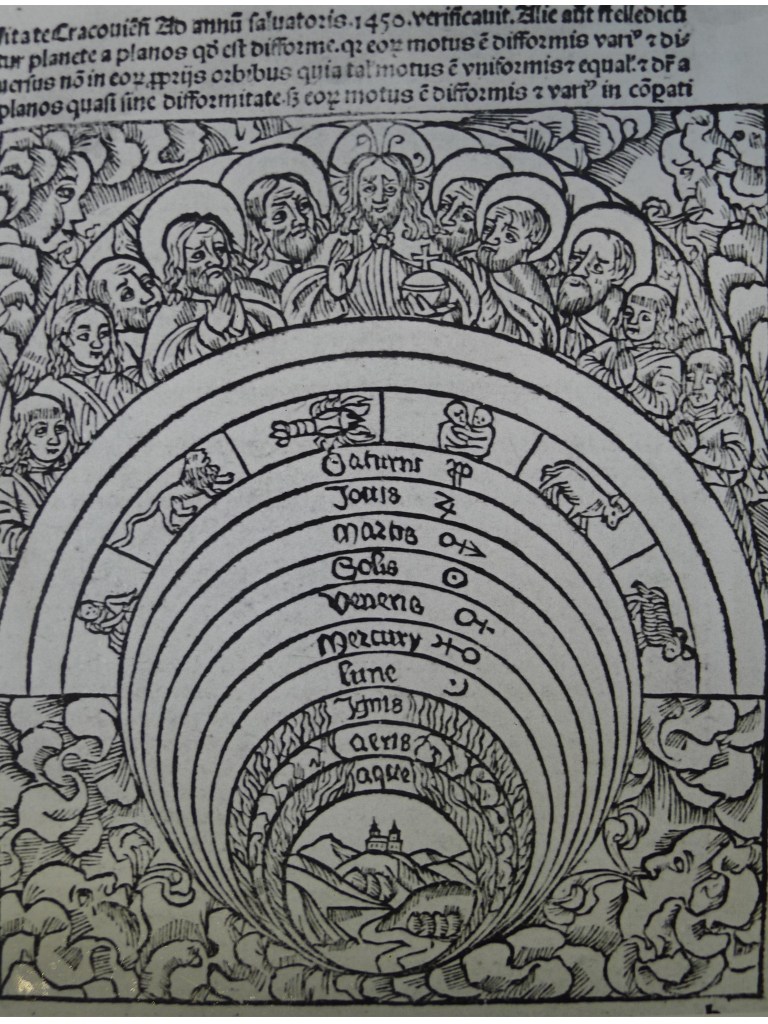
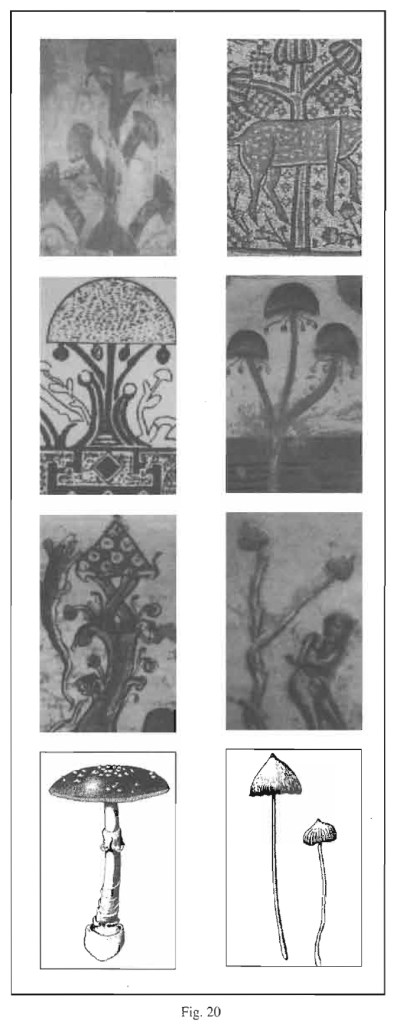
Did Giorgio Samorini place the Dancing Man mushroom tree in the wrong column in his Figure 20?
Which psychoactives are represented in Eadwine’s “Creator of plants” image?




Do discussions of the volunteer’s philosophical and/or spiritual beliefs build trust, to reduce paranoia?
Page 14:
“this discussion helps establish … trust. … reducing … paranoia (e.g., feeling that the monitors are trying to control his or her mind, or have deceived the volunteers about the nature of the study)”
“continue without the volunteers’ volitional control.”
[add p. 14-15 phrases here]
“related … material may “emerge” … intense thoughts, feelings, and visions related to … personal … world-view.”
“the scientific questions under investigation … the nature of the experiment … the scenario should be thoroughly discussed”
“run through a preliminary research session“
“The preparation of the volunteer should involve a detailed discussion of the possible range of experiences that may be encountered”
“The major categories of potential psychological experiences during hallucinogen action should be discussed with the participant.”
“The range of subjective experience under hallucinogens can be remarkably broad.”
Page 15:
“perceptual changes”
“alterations of emotions”
“changes in the sense of time and space. … time and/or space … experienced as infinite or nonexistent.”
“highly symbolic experiences (e.g., involving religious symbols, animals, etc.), and experiences … of a mystical or spiritual nature.”
“observing internal and external events”
“a profound change in one’s sense of self, merging into the surrounding environment or the entire universe.”
“a complete loss of subjective self-identity, … “ego loss” or “ego death”.”
Loss of the sense of control agency is part of “loss of self-identity” and “a radical change in sense of self”.
The loss of the sense of being a control agent is “difficult thoughts and feelings”.
“a detailed discussion concerning the range of … effects will enhance safety … the primary concern must be … safety.”
“The volunteers should be given guidance on how to handle difficult hallucinogen experiences. … frightening … internal imagery, difficult thoughts and feelings … or anxiety related to a radical change in sense of self (e.g., temporary loss of self-identity), the volunteer is encouraged to mentally surrender to the experience, trusting that his or her usual state of consciousness will return when the drug effects resolve.”
The true “appropriate guidance on how to handle” is {stand on your right leg, not your left leg}. Rely on eternalism-thinking, not possibilism-thinking – to not merely stabilize control, but also to complete the game: to obtain Transcendent Knowledge; gnosis, completion of initiation & developmental transformation.
“For example, if the participant experiences disturbing internal imagery of a demon or monster, … approach the figure and interact with it (… asking the figure why it has appeared), rather than attempt to flee from the disturbing imagery.”
“The participant should be alerted that the best way to deal with all such situations is to surrender to the experience, allowing oneself to dissolve, melt, or explode.”
“balancing … prepare the volunteer for the potentially powerful psychological effects … with the scientific concern not to bias the volunteer with respect to the dependent variables. … increase suggestibility”
The Egodeath theory actually articulately explains this dynamic per the Science and STEM manner of modeling and communication and teaching.
The Egodeath theory enables not merely avoiding control loss (negative), but rather, optimally completing the game and gaining the treasure.
Page 16:
“Adverse psychological reactions … minimized”
“be vigilant … psychological distress”
“suggestibility … of greatest concern as a confound when investigating the phenomenology … mystical-type experiences … of a spiritual variety … of interesting or valuable effects that might occur.”
“We have not encouraged participants to read … accounts of hallucinogenic effects as part of their preparation because this may introduce compelling … expectations.”
What do you do when your control-thoughts are perceived as being externally compelled and forced upon you? What do you do then? {stand on your right leg}.
“research … proceeded safely by delivering … preparatory information to participants … during pre-session meetings with monitors.”
What specifically is this “preparatory information”: is it no better than rough folk wisdom of “surrender, submit, and accept the lack of control; and approach the threatening monster asking it “What is the lesson you are teaching?”
Sub-scientific folk knowledge is barely adequate, vague, and thus is still needlessly dangerous and ineffective at bringing Transcendent Knowledge; adult completed development.
Incomprehension of eternalism-thinking staves off control instability, merely accomplishes safety at the moment, in the short term, but that’s all that it accomplishes.
Mere avoidance of control-seizure climax is a huge missed opportunity, and it is a tendency toward regressing and not progressing in mental development; just delivers frustration, from a longer-term point of view.
Inadequate, unscientific folk “surrender” guidance is not really helpful to complete the transformation, but merely holds transformation at bay, with unresolved risks and dangers remaining, both for the participants and risky for the ability to continue further scientific research in high-dose exploration.
“Researchers will need to design studies such that the maximum amount of preparation is provided for safety reasons while not confounding the particular hypotheses being studied.”
By definition, “maximum preparation, for safety” means teaching the initiate to rely on eternalism-thinking rather than possibilism-thinking.
Maximum preparation specifically means learning the Egodeath theory, per the Lesser Mysteries, and per Row 1 Left of the Eadwine image:

Eadwine’s image of Cubensis initiation into non-branching for control stability, fully explained by Cybermonk in November 2020. https://egodeaththeory.wordpress.com/2020/11/24/strict-requirements-for-teachers-initiation-guides-and-students-prior-to-initiation/
Before the altered state session, teach candidates to {rely on right leg, not left leg}.
/ end of section “Prep of volunteers”
Section: Conduct of Sessions
Page 17:
“Although many hallucinogen users maintain reasonable control, … panic“
Page 18:
“participants should be reminded to surrender to the experience.”
Section: Post-session procedures
“ensure psychological stability”
See {stability} themes in Eadwine’s image; right foot touching column base.
Section: Concluding remarks
Page 20:
“it is critical to implement appropriate and conservative safeguards.
“With such safeguards this class of compounds can be studied safely”
“Careless research that lacks attention to the unique risk profile of hallucinogens may … endanger the safety and well-being … also jeopardize future research with these scientifically fascinating compounds.”
“carefully conducted research that respects hallucinogens’ unique and often powerful psychological effects may … inform … disorders, as well as lead to significant advances in our understanding of perception, cognition, … psychology of religion, and … consciousness.”
“Respecting” these so-called “substance-appropriate safeguards” and their “unique risk profile” specifically means {standing on your right leg} (relying on eternalism-thinking), as the article vaguely, inadequately, and uncomprehendingly refers to when they use terms and advice that they don’t really understand, such as “surrender, submit, accept”.
Section: Acknowledgments
Section: References
Ott: Pharmacotheon
W Richards article: “Entheogens in the study of mystical and archetypal experiences”. https://www.amazon.com/gp/aw/d/9004126201/ Research in the Social Scientific Study of Religion, Volume 13, pp 143-155.
W Richards later book: Sacred Knowledge: https://www.amazon.com/Sacred-Knowledge-Psychedelics-Religious-Experiences/dp/0231174063/
I purchased Sacred Knowledge on Oct. 29, 2015, though it wasn’t published until Dec. 8, 2015. It shipped to me on Dec. 8, 2015. I likely reviewed it; search the Egodeath Yahoo Group.
W Richards: Entheogens in the study of religious experiences: current status. 2005
Figure 1
Figure 1: The living room-like session room used in Johns Hopkins, just before it was eaten by the dragon.
🦵🐉🚪🦵💎🐍🪨🌳🍄😇👑🏆
Relying on left leg, can’t pass through the dragon-guarded no-free-will gate.
Rely on right leg to get treasure, snake worldline frozen in block universe rock.
Purified, now able go in and out through garden gate to eat fruit of immortality from tree of life.
– Cybermonk, December 19, 2022
omg the room has an infernal buddha statue! lol See post:
Meditation Is Bunk – It Is Pushed Solely to Eliminate Psychedelics
https://egodeaththeory.wordpress.com/2022/12/17/meditation-is-bunk-and-is-pushed-solely-to-eliminate-psychedelics/
/ End of 2008 article “Guidelines for Safety” by Griffiths.

 The Egodeath theory