Michael Hoffman, December 22, 2022 4:36 am UTC+0
Contents:
- Link to CEQ Article
- Griffiths Says Their “Paranoia” Category of Effects Questions (Removed, then Restored 🤷♂️) Is Bunk
- Spots in CEQ Article Where Griffiths Might Appear to Comprehend that Volition-Control Effects Are Challenging
- Spots in CEQ Article Where Griffiths Apparently Fails to Comprehend that Volition-Control Effects Are Challenging
- Venn Diagram Showing How CEQ [Beta] Did Cover All Negative Effects, but CEQ [Final] Silently Shrank to Omit Control-Loss Effects
- CEQ Authors Fail to Recognize that the Shadow Lives in the “Volition” Subscale
- Announcing CEQ v2.0
- 👑 Experiencing the transformative threat of the catastrophic loss of control
- Honoring High Dose Without Dishonoring Medium
- True in Mythemeland
- Stang Confirmed: Griffiths Whitewashes Mystic Experiencing and Doesn’t Match the Reported Data
- The Psychedelic Turf War
- See Also
Link to CEQ Article
Griffiths’ CEQ article; the article that develops and presents the CEQ:
The Challenging Experience Questionnaire: Characterization of challenging experiences with psilocybin mushrooms
https://www.academia.edu/33760114/The_Challenging_Experience_Questionnaire_Characterization_of_challenging_experiences_with_psilocybin_mushrooms
Frederick Barrett, Matthew Bradstreet, Jeannie-Marie Leoutsakos, Matthew Johnson, Roland Griffiths
2016
Griffiths Says Their “Paranoia” Category of Effects Questions (Removed, then Restored 🤷♂️) Is Bunk
Everything raises flags about this Paranoia out-of-band, seat-of-the-pants Paranoia category that Griffiths added after all kinds of factor analysis (math to define 6– no, 7 🎩🪄 categories of psychedelic effects questions) was seemingly settled.
Trust Our Undocumented, Seat-of-the-Pants, Inconsistent and Prevaricating Judgment-Based Process That Has the Standard Blob of Math Attached
To form the initial pool of questions, Griffiths picked the fair Paranoia question (ok) and the bunk Paranoia question (why?).
Then to form the final set of questions, Griffiths removed the 2 Paranoia questions (why?), which were in the CEQ initial pool of 64 effects/questions.
Then after, and separate from, a bunch of factor analysis giving a set of question categories with 6 categories, at the last minute, they re-added the Paranoia category (category 7).
They don’t say why they ever removed the fair Paranoia question in the first place.
… just like they bizarrely, silently removed all of the Volition-Control questions, but they never caught their bad judgment and re-added those as category 8, which Factor (question category) Analysis ought to have told them to do.
FACTOR ANALYSIS IS ONLY AS GOOD AS YOUR INCONSISTENT JUDGMENT, as proved by your prevarication re: the Paranoia category of questions.
Factor Analysis can’t replace sound judgment.
The two Paranoia category questions are from the SOCQ questionnaire.
The first Paranoia question sucks because it asks if mere “people” are plotting against you – the reality cuts deeper; thoughts are plotting against you – too narrow wording, reductionistic to the social realm instead of altered-state personal control cybernetics where the “paranoia” effect really is.
I agree with Griffiths that the second question is bad – so WHY DIDN’T GRIFFITHS OMIT THE SECOND, IRRELEVANT “antagonism” QUESTION? b/c he had to pad out his late-added Paranoia category by using existing questions.
An accepted clinical definition of “paranoia” is “unfounded fears that others intend harm to the individual”.
[The effect question] (“experience of antagonism toward people around you”), while likely related, is not closely consistent with this definition.
Thus, the CEQ paranoia scale [category] may be viewed as a crude measure of the clinical construct of “paranoia”, and the external validity of the paranoia scale may be somewhat restricted by this limitation.
end of p. 13, CEQ article
“An accepted clinical definition of “paranoia” is “unfounded fears that others intend harm to the individual” (Freeman et al., 2015).
“While one item [effect question] of the paranoia scale [category] of the CEQ [questionnaire] is consistent with this definition (“feeling that people were plotting against you”),
the other (“experience of antagonism toward people around you”), while likely related, is not closely consistent with this definition.
“Thus, the CEQ paranoia scale may be viewed as a crude measure of the clinical construct of “paranoia”, and the external validity of the paranoia scale [category] may be somewhat restricted by this limitation.”
Yet we’re still going to keep this question, which we selected for the initial pool, and then removed, and then re-added, and now point out is irrelevant and should be ignored by others.
Totally scientific 😑 , driven by Factor Analysis (aka spray some science math on it to obscure the giant gaps).
— end of p. 13, CEQ article
Spots in CEQ Article Where Griffiths Might Appear to Comprehend that Volition-Control Effects Are Challenging
The main evidence that makes it seem like Griffiths recognizes Volition-Control effects as challenging is that he picks them from the main questionnaires, including them in the initial pool of effects questions.
Given that Griffiths included the Volition-Control questions in the initial pool, that proves that Griffiths recognizes that Volition-Control effects are challenging.
BUT he is sure quick to remove all of the Volition-Control questions when reducing the 64 questions to 24 i mean 26 (keeping only 40% of the initial pool of questions).
And unlike Paranoia, he does not catch and manually fix the problem by last-minute creating an effects question category named Volition-Control.
Page 2 right column – OAV Dread section
This is suspicious; word-usage indicates actually no comprehension: look how readily and quickly Griffiths omits the word ‘control’, which Studerus 2010 provided:
Griffiths writes this dense paragraph containing intelligent recognition of Volition-Control effects as challenging:
“The OAV and 5DASC [sic; 5D-ASC] (and the preceding Abnormal Mental States (APZ) questionnaire) have been widely used …
“The OAV sub-scale “dread of ego dissolution” (DED) covers a wide range of negative experiences, and is generally considered an overall “bad trip” scale (Studerus et al., 2010).
“This meta-scale of possible negative effects covers many (e.g. panic, loss of ego/control, feelings of insanity) but not all (e.g. sadness/ grief/ depression) possible categories of challenging experiences.
“The DED scale also averages responses from a number of proposed categories of experience (panic, loss of ego[omits ‘control’ here], insanity) rather than giving an individual score for each.
“Studerus and colleagues (2010) revealed a rescoring of the 5DASC [5D-ASC] that includes a separate scale for impaired control and cognition, and for anxiety.
While these represent psychometrically justifiable subscales, these two sub-scales do not address shortcomings of the DED scale (e.g. they do not address the wide range of potential dimensions of challenging experience that are suggested by previous literature) [ie sadness/ grief/ depression].”
Other spots in the article re: control or loss:
p2: ” Clinical and experimental literature on psychedelics suggests a possible profile of challenging experiences that includes the following categories of experience: fear or panic, paranoia, sadness or depressed mood, anger, cognitive effects (e.g. confusion, loss of ego[doesn’t say ‘control’ here], loss of sanity, delusions, dissociation, depersonalization), perceptual effects (e.g. illusions), and physiological symptoms”
p4: “potentially challenging aspects of experiences with classic hallucinogens (such as emotional, social, and physical discomfort, pain, and suffering, disorientation, ego loss [doesn’t say ‘control’ here], loss of perception of time, isolation, and confusion).”
P 14 left: ego dissolution, death, dying, loss of self-referential processing, losing a sense of sanity, experiencing their own death, loss of control of the mind, fear, panic
There’s a long paragraph with many key phrases that give the impression that Griffiths comprehends that volition-control effects are challenging:
I added highlighting and broke up per sentences:
“Scores on the insanity and death factors of the CEQ were positively associated with ratings of the meaningfulness of the reported experience in both Study 1 and Study 2.
“Scores on the fear factor were negatively associated with spiritual significance, while scores on the death factor were positively associated with spiritual significance of reported experiences in both studies.
“To the extent that individuals might construe or relate the loss of self-referential processing that is often reported during mystical experiences as feeling as though they are losing a sense of sanity or experiencing their own death, an encounter with this facet of challenging experience may be expected to covary with both the meaningfulness and the spiritual significance of an experience.
“The subjective experience of one’s own death and loss of control of the mind might somehow allow for the type of unity experience that leads to spiritual and meaningful experiences.
“However, scores on the death factor of the CEQ were negatively associated with change in well-being attributed to challenging experiences.
“While the experience of ego dissolution (Nour et al., 2016) and mystical experience (Barrett et al., 2015) are positively associated with well-being, it is not completely clear that the items of the ‘death’ subscale of the CEQ (“Profound experience of your own death” and “Feel as if dead or dying”) are collinear with either mystical experience or ego dissolution.
“The positive association between wellbeing and both mystical experience and ego dissolution, contrasted against the negative association between wellbeing and the ‘death’ scale of the CEQ in both Study 1 and Study 2, suggests that there may be something unique about the subjective experience described as ‘death’ or ‘dying’ during a challenging experience that may detract from wellbeing, and this may have implications for therapeutic efficacy of psychedelics in clinical trials.
“Thus, future work may benefit from further elucidating the relationship between ego dissolution or mystical experience and the ‘death’ factor of the CEQ.
“Scores on the fear factor of the CEQ were associated with an increase in well-being attributed to challenging experiences and negatively predicted meaningfulness and spiritual significance of challenging experiences.
“Fear may generally detract from a spiritual experience, but the crucible of panic during a challenging experience might still lead to positive outcomes.”
Initial Pool Questions from SOCQ, HRS, & OAV Has 7 Volition-Control Questions
Includes the entire set of 13 (17??) Dread questions, presented as two groups per Studerus 2010: Impaired control and cognition (ICC); Anxiety (ANX).
I judge 7 of the Initial Item Pool questions as genuinely about Volition-Control challenging experiences (but 0 items in the later, final set of CEQ questions).
Studerus’ article in Fig 1 shows 13 questions, in Figure S1, shows 17 questions including 4 added questions not in Griffiths: “I was afraid to lose control.” And 3 others.
Griffiths’ article never mentions Studerus’ mysteriously sourced question that’s allegedly from OAV, “I was afraid to lose control.“
The best view of the Griffiths 7 categories and 26 questions – the final set of questions & categories – is page 21, “CEQ Scoring Guide”.
How many Volition-Control questions from each questionnaire are in the initial item pool for CEQ?
Ans: 2, 1, 4 (7 total) (None Are in Final Set)
These are not questions scoped by Dittrich’s inclusion of them in his “Dread of Ego Dissolution” dimension/ category.
Nor by Studerus’ “Impaired cognition and control” sub-category of Dittrich’s Dread dimension.
These are the questions from Griffiths’ Initial Pool that I assess as actual Volition-Control questions:
SOCQ: 2
#28: trapped and helpless.
#66: Frustrating attempt to control the experience.
HRS: 1
“In control”
5D-ASC (OAV): 4
#5: I felt like a marionette.
#16: Difficulty making any decision.
#33: paralyzed.
#53: I no longer had a will of my own.
Given the full sets of questions, did Griffiths do a good job of picking all the challenging effects, for the initial pool?
So far as I can tell, he did fine, there.
How Many Challenging Effects Questions Does Griffiths Allow in the Final Set of 26, from SOCQ, HRS, & 5D-ASC (OAV)?
Ans: 9, 14, 3
Stats: CEQ ends up with how many questions from SOCQ, from HRS, from 5D-ASC (OAV)? Only 3! And they are lame effects/q’s.
SOCQ: 9 challenging effects/questions
HRS: 14 challenging effects/questions
5D-ASC (OAV): 3 challenging effects/questions
Where Did Studerus One Time Only Get the Question for the Anxiety Category, “I was afraid to lose my self-control“?
research todo
Does Studerus have 6, or 8 questions in their Anxiety category of effects questions? Always 6 – except in Figure S1 hierarchy tree.
What’s in OAV or 5D? This question? Which dimension is it in, it must be in DED Dread of Ego Dissolution. Or: is this question in Dittrich’s non-category “G-ASC (general)” category?
Why isn’t this question in Griffiths’ Initial Pool?
Spots in CEQ Article Where Griffiths Apparently Fails to Comprehend that Volition-Control Effects Are Challenging
page 2 col 2 top: HRS section:
“Of the six sub-scales of the HRS (i.e. affect, cognition, intensity, perception, somaesthesia, and volition), one might hypothesize that the affect, cognition, and somaesthesia subscales might be most sensitive to challenging experiences.” – p. 2, CEQ article. Fails to list volition as challenging.
Final Set of Effects/Questions Removes All Volition-Control Items
See CEQ article page 21, “Scoring Guide”.
Venn Diagram Showing How CEQ [Beta] Did Cover All Negative Effects, but CEQ [Final] Silently Shrank to Omit Control-Loss Effects
CEQ’s false claim to provide complete coverage of all negative psychedelic effects compared to DED and ICC (+ANX)
CEQ final 26 questions cover Depression but silently remove Control-loss questions.
Gold/yellow circle =
Actual negative effects of psychedelics
Bronze/orange circle:
DED& ICC sets of questions
Blue circle =
CEQ [Beta] (Initial Pool of 64 questions) &
CEQ [Final] (26 questions)
CEQ [BETA] =
ACTUAL COMPLETE COVERAGE
OF NEGATIVE PSYCHEDELIC EFFECTS
THE FALSELY STILL-CLAIMED
“COMPLETE COVERAGE”
SHADOW DRAGON
MONSTER
IGNORED!
BY CEQ [FINAL] –
USE DED OR ICC
OR CEQ [BETA] INSTEAD
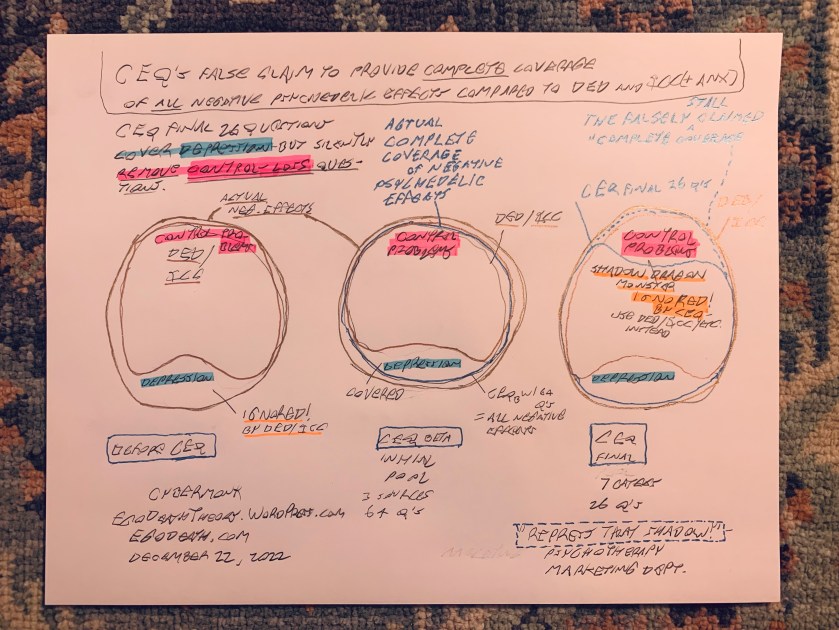
“REPRESS THAT SHADOW!”
– PSYCHOTHERAPY MARKETING DEPT.
CEQ Authors Fail to Recognize that the Shadow Lives in the “Volition” Subscale
Clueless sentence in CEQ article:
Of the six sub-scales of the HRS (i.e. affect, cognition, intensity, perception, somaesthesia, and volition), one might hypothesize that the affect, cognition, and somaesthesia subscales might be most sensitive to challenging experiences.
Griffiths et al, “The Challenging Experience Questionnaire:
Characterization of challenging experiences
with psilocybin mushrooms”, 2016, p. 2
They failed to list “volition” as an expected challenging area of effects!
The CEQ authors demonstrate further that they fail to recognize that the shadow lives in the “volition” subscale.
You don’t think “volition” subscale might be among the most sensitive to challenging experiences?!
You really don’t know anything – tone-deaf to the nature of the challenges. No wonder you discarded the control-loss items (effects questions).
Griffiths’ assessment of which subscales might be most sensitive to challenging experiences:
- affect 😱 – the psychotherapy industry expects familiar-type, personal mood challenges.
- cognition 😱
- intensity
- perception
- somaesthesia 😱
- volition 😊 <– the psychotherapy industry doesn’t expect volition-control challenges.
Reality; what the reported data say:
- affect
- cognition
- intensity
- perception
- somaesthesia
- volition 😱 <–
But he’s unable to measure and correct his attempted improved instrument, since he a-priori discarded the ICC control-loss (volition) items!
Announcing CEQ v2.0
When the Browns threw the Walburga tapestry into the river, they forfeited their leadership of the Psychedelic Gospels Theory, and I picked up their fumble, and I then got to define version 2 of the Psychedelic Gospels Theory.
When Roland Griffiths allowed the Psychotherapy Marketing department to corrupt the CEQ project when reducing the initial (authentic) pool 64 questions down to 26, he forfeited his ownership of the CEQ, and I picked up the fumble, and I now get to define version 2 of the CEQ.
Announcing the Cybermonk-corrected revised version 2 of the Roland Griffiths Challenging Experiences Questionnaire, CEQ v2.0. 🎉
published yesterday or technically published earlier today perhaps
CEQ v2 restores the integrity and honesty and sincerity of the initial pool initial version of the CEQ set of questions and set of categories of questions about ALL, let me repeat all negative effects –
especially, above all, and at the top of the Venn diagram, towering above all else, far above grief and isolation and depression and isolation, is control seizure:
My elevating of control problems is in agreement with the DED questionnaire and the ICC set of questions,
and then CEQ authors claim that “we have provided a super set of the DED” when they have ended up doing no such thing, but have ended up deleting negative experiences – exactly vindicating Charles Stang accused Roland Griffiths of violating and not matching the mystics’ data reports, in public, on a video interview on the Harvard YouTube channel.
Roland Griffiths attempted to defend himself against Charles Staggs accusation of whitewashing away the negative mystic experiences, by claiming that he has covered this in the CEQ
but what does CEQ does it is a ploy to embrace negative psychotherapy-friendly fear and grief and depression and isolation – Which is fine so far as that goes.
it’s not very convincing at all because their fear category merely contains three identical redundant questions, it’s basically got a single question inside of their entire category, and they claim to cover all the entire set of negative effects by their set of seven questions
But these are terrible categories, lacking “Control”, and they can’t even properly populate their “Fear” category of negative effects; it’s just the same question repeated three times, obviously inconsequential differences of wording, of three completely equivalent ways of wording the exact same question three times.
The CEQ authors fraudulently and dishonestly deleted the control-problem questions, and pretended like they didn’t do that, and they continue to fraudulently put present themselves and misrepresent themselves as if their final set of 26 questions covers the full range of negative effects, by virtue of adding depression – but at the same time that they did that, they fraudulently, covertly, and dishonestly, against Science, deleted entirely the control seizure questions.
👑 Experiencing the transformative threat of the catastrophic loss of control
Experiencing the threat of the catastrophic loss of control, is king of all of the negative effects, and it is restored back onto the king and its rightful place on the throne at the top of the Venn diagram of ALL negative psychedelic effects.
Roland Griffiths’ group is guilty not at the point in time when they gathered the 64 questions, but they are guilty when they handed over to the psychotherapy marketing department, they permitted and allowed the marketing department to delete God, to delete that through which we are saved:
they committed the great offenses against the dragon, the great offenses against the mystic altered state as Charles Stang on the Harvard interview video said to Roland Griffiths and called him out on his unscientific, data-ignoring misrepresentation of the nature and scope of mystical experiences.
to defend himself, Roland Griffith claimed that he created the CEQ challenging experiences questionnaire.
However, I have found that this questionnaire is a fraud and anti-scientific deception to delete God and delete the main mystical experience through which we are transformed and saved.
Griffits permitted the Psychotherapy Marketing dept. to delete the shadow dragon momster gate guard which converts and transforms the mental model to be God-aware – that got deleted by the psychotherapy marketing department.
the pathetic end result of the fraudulent CEQ questionnaire is reverted fallen backwards , Psychological regression per Ken Wilber’s sense, reverted back to a dangerously incomplete mere subset, an incomplete subset of negative experiences, which therefore puts people into danger, as he himself argues is the result of putting forth a subset.
kudos to the CEQ (which is corrupt and compromised) for including depression, for adding that to the DED and ICC scope of questions.
A curse upon this fraudulent anti-scientific CEQ which has the religiously affront, an insult to religion, when they deleted the Control Seizure category and deleted all the control loss seizure instructional dragon threatening helpless paralyzed marionette questions.
God is unhappy I tell you, with this infernal godforsaken CEQ from hell.
Roland Griffiths has invoked the Furies in his hubristic audacity of allowing the marketing psychotherapy department to delete the dragon.
Hera was furious because Heracles omitted to give her honor.
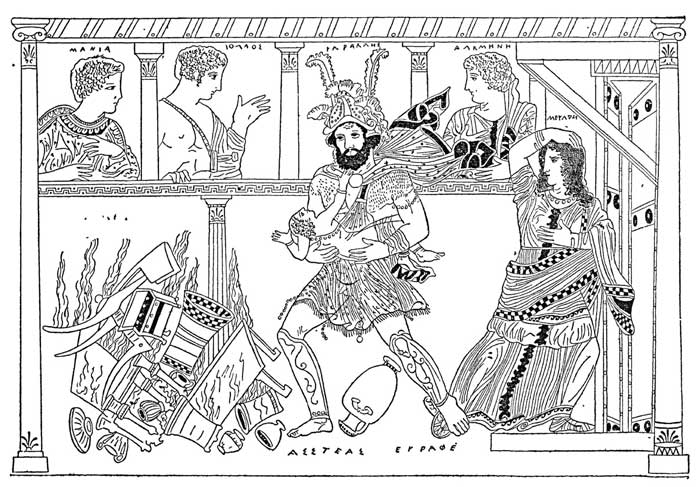
I am not pronouncing a curse upon the psychedelic clients that are subjected to this stunted subset of negative effects which rolein Griffiths delivers to them.
I am pronouncing a curse upon CEQ version 1 brought to you by the psychotherapy marketing, biased, unscientific department.
🏥 🍽 🐉
dragon go get em
Johns Hopkins marketing department big Pharma psychedelic industrial complex who has the affront and hubristic audacity offensive to God and Hera and the invoking the furies of the gods and of the dragons, provoking the dragon and provoking the Furies by having the audacity to delete the DED (dread of ego dissolution) questions from the fraudulent CEQ version 1.
Johns Hopkins Marketing Department Big Pharma Psychedelic Industrial Complex
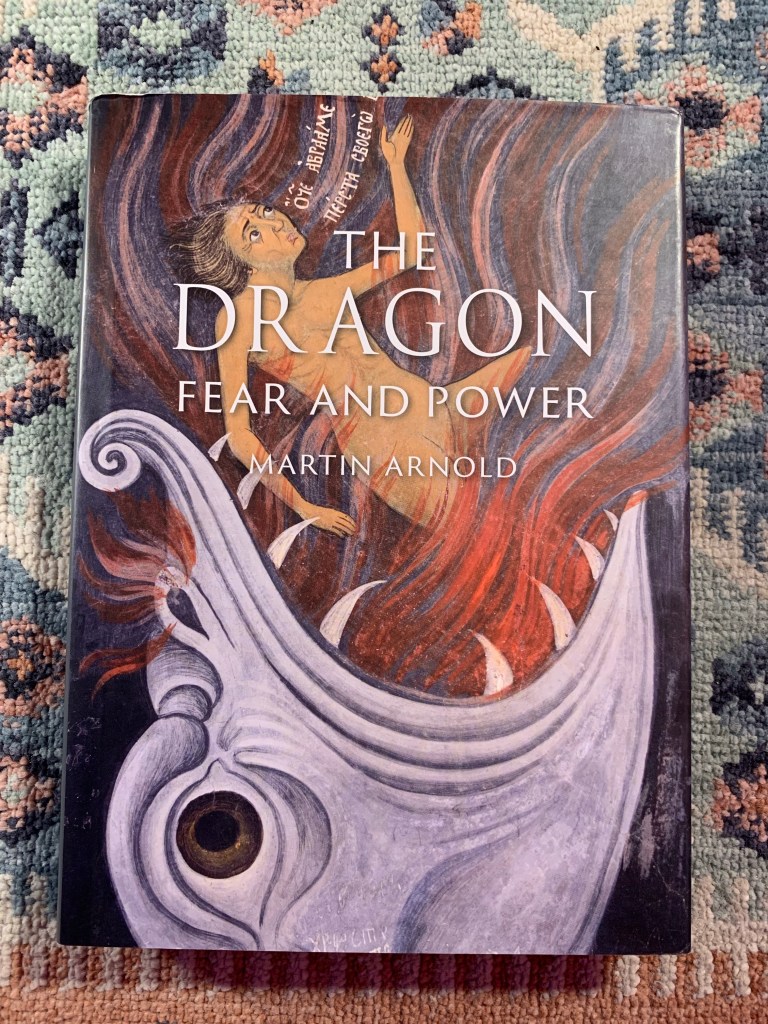
🦵😵 🐉🚪🦵💎🌳🍄😇🍄🏆
relying on left leg possibility branching free will model can’t get you through the dragon guard gate guarded by the dragon of no-free-will heimarmene fate possibilism-thinking to get the treasure of Transcendent Knowledge and mental completed perfected transformation development enlightenment, able to endure the high dose psilocybin state with control stability.

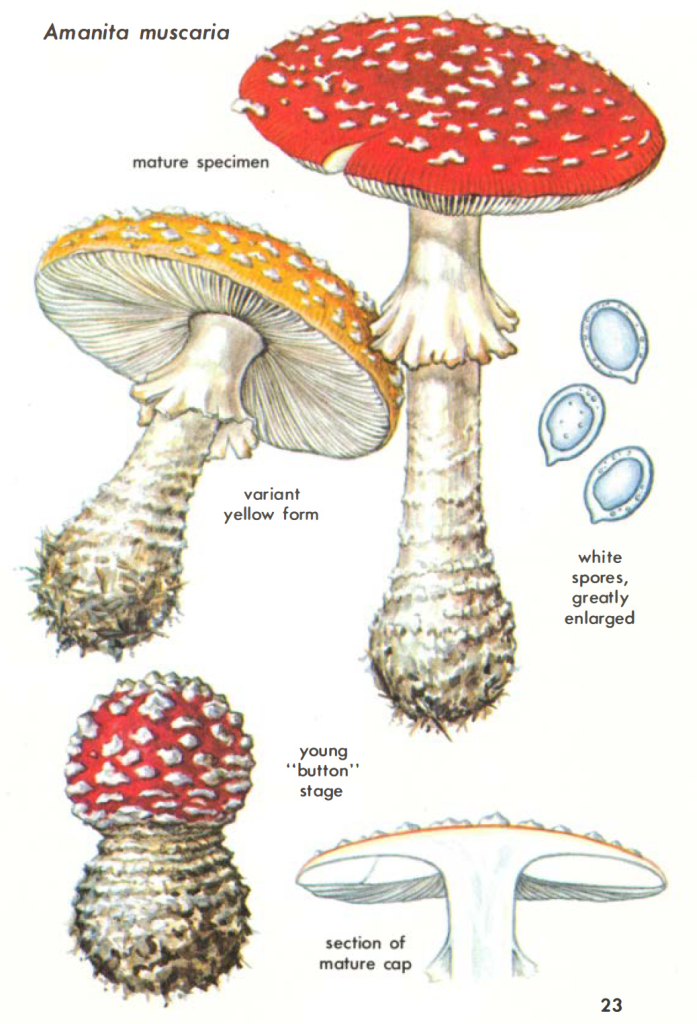
Brown has reconsidered, due to my October 2020 article proving St Walburga holds a vial that’s shaped as an Amanita.
See my posting yesterday which adds back in the “Control” category of control problem questions, and adds back in the deleted ICC questions (and the question about being “helpless” from the SOCQ survey).
so now Brown has earned his cred as a religiously converted member of the Ardent Advocates, a.k.a. the radical Maximal entheogen theory of religion.
And I now get to define version 2 of his psychedelic gospels theory.
assume mushrooms everywhere, until proven otherwise – and even then, continue assuming mushrooms everywhere.
Thus we win the Grid Game.
The question is not: did the religion use psychedelics?
the question is always:
which psychedelics did they use? during which season? and
did they use Amanita, or did they only use a Amanita as a billboard to represent psilocybin little brown mushrooms?
as Dale Pendell writes in sentence 1 within his amanita section: amanita is the most world famous entheogen which nobody uses, and is a symbol of entheogens.
Honoring High Dose Without Dishonoring Medium
46:00 – Ruck on the Psychedelic origin of Christianity:
Correction:
46:00 – Ruck on the Secret Psychedelic origin of Christianity:
url https://youtu.be/ItwuWtKMXi0
url https://youtu.be/7c-bWymbT04
url https://youtu.be/sozOc2FglU0
The today’s episode of psychedelics today podcast interview with Timothy Leary’s son and they discuss giving honor to high-dose which I agree with that we do need to give honor to high-dose per Max Freakout and Kafei, though we do after giving that its dues and after honoring high-dose we must then,
we all understand that we cannot make high dose a requirement for a completed perfection of initiation, that must be available to all eighth graders so to speak but must be available to everybody through medium dose perhaps, and explaining the Egodeath theory to all rites of passage eighth graders or 18 or 21.
They are already ingesting it and the theory explanation, the mystery has already been revealed, published on the World Wide Web.
True in Mythemeland
an interesting theme of today’s voice recordings was we need to distinguish between literal reality versus making statements which apply to the land of mythology.
In the land of mythology, the most popular psychedelic is Amanita.
in the realm of reality, nobody at all ever uses 🍄
Brian Muraresku has been doing very helpful helping Carl rock a lot although both of them overly focus on Eleusis at the expense of Psilocybin, but Carl Ruck has gotten into Psilocybin a tiny bit in his scholarship – he is quoted in the Oregon Psilocybin measure research-gathering article.
Everyone uses Amanita only as a symbol, not as a literal psychedelic. that is true now and therefore for the exact same reason that is true in our history of art.
I would make an exception: that people used Amanita as a fallback when they were unable to find the real thing of desire, which is psilocybin.
in their 2016 book combined with their 2019 article, Browns dismissed Ardent Advocate Jan Irvin’s evidence plate and Browns claimed that the tapestry does not depict a psychoactive mushroom,
Because the tapestry has serrations on the base, but Amanita does not have serrations on the base.
And because instead the tapestry depicts a vial, and as we know, in the case of mushrooms uniquely, a figure in art cannot mean two things;
if it can mean something other than mushrooms then the art imagery must mean that, and therefore cannot mean mushrooms as well.
This is the mushroom exception to the rule that all images in art carry multiple meanings – unless one of those meanings is mushroom, in which case, the imagery cannot convey that meaning, and can only convey the non-mushroom meaning.




Stang Confirmed: Griffiths Whitewashes Mystic Experiencing and Doesn’t Match the Reported Data
When Roland Griffiths’ marketing department took over their research project and reduced the questions to produce a subset of actual negative psychedelic experiences (utterly demolishing their entire selling point of their whole need for the CEQ and why the previous questionnaires are inadequate) they forfeited their authenticity the Roland Griffiths Group lost their scientific credentials and credibility at that point; the marketing department took over and their CEQ project became corrupted.
Stangs Whitewash Critique Confirmed Griffiths CEQs Initial Question Pool Covers All Challenging Experiences but Final Pool Returns to a Subset of Negative Effects to Replace and Remove Control Loss Effects by Psychotherapy Compliant Grief and Isolation Questions
Voice dictation after I have recorded about many hours of speaking today
fantastic best result of today’s podcast recordings which I have not produced or uploaded :
the best result is my idea for the set of three Venn diagrams to represent brilliantly Yesterdays three days of research on what’s wrong with the CEQ
how the CEQ began as a legitimate and honest sincere project that was true and authentic through the phase of gathering the initial pool of 64 questions: so far so good.
Up to that point, Rollin Griffiths can claim to Charles Stang that he has indeed accurately represented mystical experiences, including their negative affects including all of their negative effects, unlike the previous DED & ICC+ANX surveys.
DED (Dread of Ego Dissolution) scale (set of q’s)
ICC (impaired control and cognition 7 q’s) + ANX (anxiety 6 q’s)
to do: print out and podcast on DED, because it’s the real deal, it delivers the goods, not like Roland Griffiths fraudulent bullsht bunk posturing that endangers people.
this is his own lecture thrown back in his face against them.
If I wanted to be constructive
I advise Roland Griffiths create version two of CEQ
yesterday in my constructive posting I added, I corrected and fixed and repaired the CEQ , by adding back in the ICC control category of control seizure problems effects .
and I added back in the deleted questions about control loss which were drawn from the ICC.
Griffiths you are endangering people by failing to take into account the symptoms and effects which you have eliminated, your Big Pharma Psychotherapy Industry marketing department has eliminated, against science.
Conflict of interest has caused the Griffiths research group to at first be honest and authentic and then to be corrupted when they moved from the 64 questions down to trashcan (throwing into Wouter Hanegraaff’s Rejected wastebasket) the questions about control seizure psychedelic challenging effects.
Griffiths group has eliminated the negative control loss effects, and you’re putting people in danger because of doing so.
I’m turning your own argument against you.
The challenging experience is questionnaire set of 26 questions from Roland Griffiths and Charles Stang accused Roland Griffiths of whitewashing to falsely represent mystic experiences as being positive
and in his defense roleand Griffith pointed to his 2016 challenging experiences questionnaire
but this questionnaire is bunk and fraudulent and Charles Stang is correct
The questionnaire is honest and scientific and true during the intermediate initial pool of questions of 64 questions does in fact cover the full range of negative psychedelic affects
but the final result 26 questions is dishonest and fraudulent
it’s a magic trick a dishonest deceptive magic trick that at the same time as they justifiably and correctly add questions about depression and grief, isolation, they covertly delete the intractable control problem questions
You don’t control the source of your control thoughts
did you feel like a helpless marionette with no ability to control your will or to control your thoughts ?
we better eliminate that ICC / DED question, that doesn’t fit our professional psychotherapy model
but we’re not gonna go back and modify our text where we claim to provide the coverage of the entire set of negative affects;
we’re still going to persist in making that claim , even though now in phase 2 we have deleted the entire class of control seizure loss problem questions, which are covered faithfully and scientifically by the previous DED and ICC questionnaires
We are Going to continue claiming that CEQ is a superset of DED and ICC which are the bad trip questionnaires, because we have added depression and isolation and grief – BUT THEN after the initial pool of 64 questions we are now going to delete all of the questions about control laws so that we are no longer in fact a super set of DED and ICC
yet we’re going to continue pretending that we are delivering a super set.
we are going to use the true claim that DED fails to cover depression, we’re going to use that as the excuse and pretext to covertly delete the entire class of control seizure problem questions, which the DED covers and which are in fact negative effects which are from psychedelics
but our survey will not cover that area of affects, but we will claim that we do
The science-driven initial pool for the CEQ had no categories, but it only had a free form list of all 64 questions that they picked, which they did a good job of picking out the correct available questions from the previous questionnaires.
the final version of the CEQ (7 categs, 26 q’s) was driven by marketing by psychotherapy Freudian couch psychoanalysis model which cannot handle transcend knowledge control los seizure issues but is used to handling grief isolation and depression so they use this opportunity in between the initial pool of 64 questions
was handled by scientists honest true scientists correctly picked the initial poll of questions which was in fact as claimed a super set of negative of the previous surveys to achieve correct scope of coverage of all negative effects of psychedelics
but phase 2 when reducing 64 questions down to 26 questions was fraudulent and dishonest and anti-scientific and it was driven by the psychotherapy marketing department
They took the opportunity when everyone was looking at the pool of initial questions and they pointed out the inadequate scope of coverage of the questions about control and so they didn’t use this as an excuse to Ashley delete not add to not supplement but delete and remove and eliminate the negative affects regarding control seizure loss problems
We have got to get rid of the marionette with no control over the will, said the psychotherapy marketers, I don’t know how to handle that and it’s bad public relations so we are on our own turf are safe ground our save space when we add questions about depression and grief and isolation
that’s our bag , that’s our turf, that’s our territory, so we are going to add those questions, and we are going to use this opportunity while everyone is applauding for our superset of the DED and a superset of the ICC.
I will provide a set of three Venn diagrams.
Venn number 1: before the CEQ we see that there’s a big area of negative effects in reality, but we see that the scope of the DED questions and the scope of the ICC questions is inadequate and smaller circles that failed to include depression grief isolation fx .
so it is true that a new survey set of questions is needed that covers all of the negative affects not only the control effects but also additionally including depression grief isolation effects.
Venn number 2: during the initial pool of 64 questions, which is honest and true and adequate. The actual set of negative experiences matches the set of 64 questions , and then within that circle is the smaller circle of DED questions and ICC questions – which include control questions, but they omit depression isolation grief questions.
Venn number 3: the CEQ’s final set of 26 questions in seven categories, with covertly fraudulently and dishonestly a subset of negative effects. Only contains a subset of DED questions and a subset of ICC questions (NOT a superset as claimed and as in the initial pool of 64) designed to covertly eliminate control loss problems, which cannot be handled by the psychotherapy model. The proof that they are lying and that’s proof that this is covert is the body of the article continues to claim that the character of the CEQ is that it comprehensively matches all of the negative experiencing, whereas the DED & ICC, they say, only covers a subset.
Venn diagram number three is extremely enlightening and instructive at a glance:
I will place control loss effects at the top of the all inclusive big circle,
and then
I will draw a dotted line as the same big circle – this is the false claim that CEQ (now reduced from 64 to 26 q’s) continues to match the full circle.
then I draw a solid line that has a dip in the top of it as a smaller circle that’s smaller than the big circle
and this warped final CEQ circle dips down at the top to avoid including control seizure effects.
then draw the DED and the ICC circles which do cover the control seizure effects, at the top of the big all-inclusive circle
and then show that at the bottom of the big circle is depression effects, which are included in the CEQ but are not included in the DED or ICC sets of questions.
/ Venn 3 diags
A fraudulent dishonest and deceptive final result version of the CEQ is not true to their marketing claims within the body of the article which claims that they are a superset of DED and ICC so as to cover the entire scope of negative psychedelic affects fx.
actually a subset of negative experiences and actually a subset of the DED and a subset of the ICC questions despite the claims by drawing attention to the intermediate 64 questions claims to be a adequate set covering all negative affects
The Psychedelic Turf War
Roland Griffiths’ CEQ’s Questions:
- Add Psychotherapy-Compliant Depression Questions,
- Remove Volition Control Questions,
- Falsely Claims Being a Superset,
- Endangers Clients and Research,
- Adds Risk,
- Claims Broader Superset,
- Reverts to a Mere Subset of Questions,
- Thus Endangering People and Research
While recording many hours of podcast voice recording idea development today,
my idea for a posting watching the Psychedelics Today podcast: a posting titled:
at war with the Mystics
the Psilocybin turf war
the psychedelic turf war
— Cybermonk, December 22, 2022
See Also
References
Griffiths’ CEQ article; the article that develops and presents the CEQ:
The Challenging Experience Questionnaire: Characterization of challenging experiences with psilocybin mushrooms
https://www.academia.edu/33760114/The_Challenging_Experience_Questionnaire_Characterization_of_challenging_experiences_with_psilocybin_mushrooms
Frederick Barrett, Matthew Bradstreet, Jeannie-Marie Leoutsakos, Matthew Johnson, Roland Griffiths
2016
The Challenging Experience Questionnaire (CEQ): Characterization of challenging experiences with psilocybin mushrooms – Omits Category “Threat of Loss of Control”!
https://egodeaththeory.wordpress.com/2022/12/16/the-challenging-experience-questionnaire-ceq-characterization-of-challenging-experiences-with-psilocybin-mushrooms-omits-category-threat-of-loss-of-control/
For other References, see:

 The Egodeath theory