Contents:
- Need Dedicated Page for Each Version of the Questionnaire
- OAV 1994 Dedicated Page
- 66 OAV Questions in 3 Broad Categories + General, with Added Preliminary 11-Factor Subcategories
- The 94 Psychedelic Effects Questions
- Links
- About the 5D-ASC
- Definition, Characterization, Themes of the 5 Dimensions
- The Irony of the Name “Five-Dimensional”
- Stace’s False Dichotomy: Mystic = Positive
- How the 11 Low-Level Categories Fit Into the 3 Main High-Level Categories
- “Dread of Ego Dissolution” = “Unpleasant”; “Oceanic Boundlessness” & “Visionary Restructuralization” = “Pleasant”
- APZ History
- OAV History
- 5D-ASC History
- 11 Granular Categories History
- CEQ Update: Griffith Restored Paranoia Questions – Similarly Restore Volition-Control Questions
- History of the Dittrich Publications
- How “Oceanic Boundlessness”, “Dread of Ego Dissolution”, & “Visionary Restructuralization” All Produce Eternalism Ego Death
- Research Questions
- See Also
Need Dedicated Page for Each Version of the Questionnaire
Plan: Need postings/pages titled like:
- APZ (1975) (Dittrich)
- OAV (1994) (Dittrich)
- 5D-ASC (2006) (Dittrich)
- 11-Factor (2010) (Studerus)
- CEQ; Challenging Experiences Questionnaire (2016) (Griffiths); formed by gathering a few [3/21 = 14%] of the negative items from OAV, SOCQ, & HRS.
I am particularly interested in OAV: not 5D, not 11-Factor, but straight-up OAV.
Mainly interested in OAV 1994, more than the OAV 1985 that Dittrich identified within APZ 1975.
OAV has 66 questions and the only place I found them is Studerus 2010 Figure S1 – tree hierarchy.
I have to suppose how Dittrich presents the G-ASC General questions. I think those General questions are not in the O, A, or V dimensions.
I identified where O, A, and V would be shown in Studerus article’s figure S1 instead of the 11 smaller (preliminary) 11-Factors categories.
CEQ isn’t exactly in the lineage from Dittrich; CEQ draws from the 11-Factor hostile replacement of the OAV categories which also removes I think I counted 17 general G-ASC questions, and 7 (not 5 like article Studerus mis-counts) category-questions eg from Dittrich’s Angst/Dread category’s 17 questions Studerus deletes 4 questions (54, 41, 62, & 38 if memory serves).
These to-be-removed questions are shown in Studerus Fig S1 tree supplement, but not in Figure 1 in the article.
OAV 1994 Dedicated Page
Dedicated page for OAV only, because it has a good Dread category:
OAV Questionnaire 1994: Oceanic Boundlessness, Angst of/ Dread of Ego Dissolution, Visionary Restructuralization (Dittrich)
https://egodeaththeory.wordpress.com/2022/12/29/oav-questionnaire-1994-oceanic-boundlessness-angst-of-dread-of-ego-dissolution-visionary-restructuralization-dittrich/
66 OAV Questions in 3 Broad Categories + General, with Added Preliminary 11-Factor Subcategories
This is not purely the OAV set of 66, because it additionally includes the initial version of the hostile (competing, alternative) replacement Studerus tree hierarchy per transitional Figure S1 (supplemental; a separate document from the 11-Factor 2010 Studerus .pdf article.
Keywords for the Egodeath theory highlighted by Cybermonk – key words about experiencing eternalism and its control aspects.
Update Dec. 27 2022: Added missing items that are found in Figure S2 hierarchy tree but not in Figure 1:
Added 17 General factor (category) items.
Added 7 items in “factors” (categories).
Total: 24 added questions. Now there are 66 questions here, 1-66.
Added 3 alternate names of factors/ categories.
The 66 omits the Auditory dimension, and the Reduction of Vigilance dimension. Not sure yet of the total items count in 5D-ASC 2006. 137 is a guess or tally from memory, possibly from PES 1962 Pahnke instead: as in, going backwards: MEQ30, MEQ43, MEQ137 = maybe PES 1962.
General (G-ASC)
These questions are in Studerus Figure S1 but not in Figure 1. todo: are these questions outside of O, A, V dimensions? If so, these are ADDITIONAL negative effects that weren’t even CONSIDERED for the initial pool of items for CEQ.
59. Time passed tormentingly slow.
36. I experienced an unbearable emptiness.
3. I felt surrendered to dark powers.
55. I stayed frozen in a very unnatural position for quite a long time.
40. Things came to mind, which I thought I had forgotten long ago.
64. I was able to remember certain events unusually clearly.
4. I saw things that I knew were not real.
2. Bodily sensations were very delightful.
22. Worries and anxieties of everyday life seemed unimportant to me.
50. I felt totally free and released from all responsibilities.
9. I felt I was being transformed forever in a marvelous way.
1. I felt like I was in a fantastic other world.
23. Like in a dream, time and space were changed.
31. The world appeared to me beyond good and evil.
26. I felt unusual powers in myself.
47. Many things seemed unbelievably funny to me.
58. Things around me appeared smaller or larger.
Oceanic Boundlessness (OB, OBN)
Major legacy OAV category #1.
The ‘O’ of OAV.
Experience of Unity
48. The boundaries between myself and my surroundings seemed to blur. (in Figure S1 only)
10. Everything seemed to unify into an oneness.
21. It seemed to me that my environment and I were one.
27. I experienced a touch of eternity.
28. Conflict and contradictions seem to dissolve.
35. I experienced past, present and future as an oneness.
Religious Experience/ Spiritual Experience
6. I had the feeling of being connected to a superior power.
56. I experienced a kind of awe.
66. My experience had religious aspects.
Blissful State
61. Everything around me seemed animated. (in Figure S1 only)
39. Many things appeared to be breathtakingly beautiful. (in Figure S1 only)
7. I enjoyed boundless pleasure.
60. I experienced a profound peace in myself.
65. I experienced an all-embracing love.
Disembodiment
15. It seemed to me as though I did not have a body anymore.
42. I had the feeling of being outside of my body.
43. I felt as though I were floating.
Dread of Ego Dissolution (DED)
Anxious Ego Dissolution (AED)
Angstvolle Ichauflösung (AIA)
Major legacy OAV category #2.
The ‘A’ of OAV.
Impaired Control and Cognition 🏅💎🐉👑🏆
62. Everything around me was happening so fast that I could no longer follow what was going on. (in Figure S1 only)
41. My body seemed to me numb, dead and weird. (in Figure S1 only)
5. I felt like a marionette.
16. I had difficulty making even the smallest decision.
24. I had difficulty in distinguishing important from unimportant things.
33. I felt as though I were paralyzed.
44. I felt isolated from everything and everyone.
45. I was not able to complete a thought, my thought repeatedly became disconnected.
53. I had the feeling that I no longer had a will of my own.
Anxiety
54. I was afraid to lose my self-control. (in Figure S1 only)
12. I felt tormented. (in Figure S1 only)
19. I was afraid that the state I was in would last forever.
29. I was afraid without being able to say exactly why.
30. I experienced everything terrifyingly distorted.
32. I experienced my surroundings as strange and weird.
38. I felt threatened.
63. I had the feeling something horrible would happen.
Visionary Restructuralization (VR, VRS)
Major legacy OAV category #3.
The ‘V’ of OAV.
Insightfulness
34. I felt very profound.
46. I gained clarity into connections that puzzled me before.
52. I had very original thoughts.
Vivid Imagery/ Complex Imagery
25. I saw scenes rolling by in total darkness or with my eyes closed.
49. I could see pictures from my past or fantasy extremely clearly.
57. My imagination was extremely vivid.
Elementary Visual Alterations/ Elementary Imagery
8. I saw regular patterns in complete darkness or with closed eyes.
13. I saw colors before me in total darkness or with closed eyes.
20. I saw lights or flashes of light in total darkness or with closed eyes.
Audio-Visual Synesthesia
11. Noises seemed to influence what I saw.
14. The shapes of things seemed to change by sounds and noises.
51. The colors of things seemed to be changed by sounds and noises.
Changed Meaning of Percepts
17. Everyday things gained a special meaning.
18. Things around me had a new strange meaning for me.
37. Objects around me engaged me emotionally much more than usual.
Source/Origin of the Above List
From page 9, Studerus 2010. Caption is on page 10 top.
The other, hierarchy diagram Figure S1 from Studerus 2010 lists 66 items. 66 – 42 = 24[fact check?] G-ASC (general) items, which don’t go into the 11 categories.
https://www.ncbi.nlm.nih.gov/pmc/articles/PMC2930851/
“Figure 1. Final confirmatory factor analysis model with completely standardized loadings and error variances” in article body is good, possibly best: 66 items in 11 cats, no G-ASC items though[fact check?]:
https://www.ncbi.nlm.nih.gov/core/lw/2.0/html/tileshop_pmc/tileshop_pmc_inline.html?title=Click%20on%20image%20to%20zoom&p=PMC3&id=2930851_pone.0012412.g001.jpg
The 94 Psychedelic Effects Questions
“5D-ASC1.pdf” translated from German to English has 94 items (14 pages),
These are from pdf “5-Dimensional Altered States of Consciousness Rating Scale (5D-ASC)
A. Dittrich, D. Lamparter, M. Maurer
Translation from the original German by Felix Hasler and Rael Cahn“
The translations are easy to match with Studerus 66 items from OAV; the other 94-66 = 28 items probably are dims 4 & 5, Aud + ReducVigil; that would be avg 14 items each.
3. I felt surrendered to dark powers. [Studerus Figure S1 G-ASC question]
1. I felt that I was in a wonderful other world.
2. My thoughts and actions were slowed down.
3. Bodily sensations were very enjoyable.
4. I heard single words without knowing where they came from.
5. I heard rings and tones without knowing where they came from.
6. I felt as if dark forces had overtaken me.
7. I saw things I knew were not real.
8. I felt like a puppet or marionette.
9. I felt connected to a higher power.
10. I felt sleepy.
11. A melody occured to me that I had to constantly repeat.
12. I experienced boundless pleasure.
13. Meaningless noises sounded like real words or phrases.
14. I saw regular patterns with closed eyes or in complete darkness.
15. I felt drunk.
16. I felt I was being transformed forever in a miraculous way.
17. I felt that I was on the verge of unconsciousness.
18. Everything seemed to unify into a oneness.
19. I heard my thoughts as if I had spoken them out loud.
20. Sounds seemed to influence what I saw.
21. I felt tormented.
22. I saw colors with closed eyes or in complete darkness.
23. Shapes seemed to be changed by sounds or noises.
24. I perceived everything as blurry, as if through a kind of fog.
25. A voice commented on everything I thought although no one was there.
26. I felt as if I no longer had a body.
27. I felt incapable of making even the smallest decision.
28. Some everyday things acquired special meaning.
29. I felt drowsy.
30. I heard complete sentences without knowing where they came from.
31. Things in my environment had a new strange meaning.
32. I was afraid that the state I was in would last forever.
33. I saw brightness or flashes of light with closed eyes or in complete darkness.
34. I felt one with my surroundings.
35. Worries and anxieties of everyday life felt unimportant.
36. My sense of time and space was altered as if I was dreaming.
37. My perception was blurred.
38. I had difficulties in distinguishing important from unimportant.
39. I saw whole scenes roll by with closed eyes or in complete darkness.
40. I felt extraordinary powers within myself.
41. I experienced a touch of eternity.
42. Conflicts and contradictions seemed to dissolve.
43. I was scared without knowing exactly why.
44. I experienced everything as frighteningly distorted.
45. The world seemed to me beyond good and evil.
46. I experienced my surroundings as strange and weird.
47. I felt as if I were paralyzed.
48. I heard music without knowing where it came from.
49. heard something faintly that I could not identify.
50. I felt very profound.
51. I felt numb.
52. I experienced past, present, and future as a oneness.
53. I experienced unbearable emptiness.
54. Objects in my surroundings engaged me emotionally much more than usual.
55. From an initially diffuse noise, which I could not identify as real, clear rings and tones evolved.
56. I felt threatened.
57. Many things appeared to me as breathtakingly beautiful.
58. Things came to my mind that I thought long forgotten.
59. I felt like I do shortly before falling asleep.
60. My body felt numb, lifeless, and/or alien.
61. I felt as if I was half-asleep.
62. I had the impression I was out of my body.
63. I felt as if I was floating.
64. I felt isolated from everything and everyone.
65. I heard voices that did not come from the surroundings as usual.
66. I heard something like a buzzing, swooshing, or humming without recognizing the cause.
67. I was not able to complete a thought; my thoughts repeatedly became disconnected.
68. I felt I was about to fall asleep.
69. I had insights into connections that had previously puzzled me.
70. Many things seemed incredibly funny to me.
71. The boundaries between myself and my surroundings seemed to blur.
72. I could see images from my memory or imagination with extreme clarity.
73. I felt totally free and released from all obligations.
74. I heard diffuse noises without knowing where they came from.
75. The colors of things seemed to be altered by sounds or noises.
76. Sounds and noises were fainter than usual.
77. I had very original thoughts.
78. I had the feeling that I no longer had my own will.
79. I was afraid of losing control over myself.
80. I stayed frozen in an very unnatural position for an extended period of time.
81. I experienced a kind of awe.
82. My imagination was extremely vivid.
83. Things in my surroundings appeared smaller or larger.
84. I felt exhausted.
85. Time passed slowly in a tormenting way.
86. I experienced profound inner peace.
87. Everything around me seemed to be animated with life.
88. Everything happened so fast that I could not follow it all.
89. I had the feeling that something terrible was going to happen.
90. I was able to remember certain events with exceeding clarity.
91. I experienced an all-embracing love.
92. There were sounds in the room that I feel were unlikely to have been real.
93. I heard a ticking, knocking, ringing, or rattling without being able to recognize the cause.
94. My experience had religious aspects to it.
Links
Searches
https://www.google.com/search?q=5D-ASC
https://www.google.com/search?q=%225-Dimensional+Altered+States+of+Consciousness%22
About the 5D-ASC
Dittrich v1 = APZ
Dittrich v2 = OAV
Dittrich v3 = 5D-ASC – adds two rarely used top-level dimensions: auditory, other.
The Huge Amount of Research this Page Took
I have to propagate year corrections in my pages (for 5D, change from 1999 to 2006). I’m the first one to plainly and clearly identify the actual timeline. Fixed in the present page.
The experts are making elementary mistakes about the publication years of Dittrich’s versions of his questionnaires, in their key publications.
It took me a lot of intensive research merely to get the correct years of publishing each version of the Dittrich questionnaires! And of the 11-factors categorization.
Now I’m better placed to obtain the 5D-ASC specification. It’s 2006, and doesn’t have the 11 factors.
– Cybermonk December 24, 2022 🍄🎄
The 5D-ASC Test for Non-Ordinary States of Consciousness: Background and Purpose
Barry Klein, PhD, General Psychology
Tests and Measurement (PSYC-8316)
Walden University
March, 2012
TESTS & MEASUREMENT, PSYC-8316-1, FINAL PAPER
url https://www.academia.edu/38875371/The_5D_ASC_Test_for_Non_Ordinary_States_of_Consciousness_The_5D_ASC_Test_for_Non_Ordinary_States_of_Consciousness_Background_and_Purpose
“The current 5D-ASC test is an extension of the OAV instrument, which, in turn, is based on Dittrich’s APZ (“Abnormer Psychischer Zustaende” — Abnormal Mental States) questionnaire, and the two revisions mentioned are widely used for self-reporting subjective experiences of ASC.”
“OAV” stands for the German equivalents of the original three dimensions used:”
“One article (MacLean, Johnson, & Griffiths, 2011) gives these [main, first three] groupings as OSE, AIA, and VUS, respectively.” [weird acronyms, check article/ cited report]
OAV = Oceanic / Anxiety/ Visionary
5 Dimensions adds two more dimensions:
Auditory/ Vigilance-Reduction [little used]”
Definition, Characterization, Themes of the 5 Dimensions
I started this section based on Klein’s descriptions, then added Studerus’.
todo: add dimension “G-ASC – General”.
Oceanic Boundlessness (OB, OBN) – Definition, Characterization, Themes
[the ‘O’ of OAV]
Per Klein 2012:
states associated with mysticism and religion
euphoric or exalted states of non-self
being at one with everything
time distortion or sense of timelessness
Per Studerus 2010:
positively experienced depersonalization
positively experienced derealization
deeply-felt positive mood
unity
Dread of Ego Dissolution (DED, AED) – Definition, Characterization, Themes
Dread or Anxiety of Ego-death (DED or AED [AIA in one report]) [the ‘A’ of OAV]
[false dichotomy: negative experiencing therefore not mystic]
[“ego death” is probably incorrect – check vs. “dissolution”]
“cognitive disturbances
negative depersonalization
paranoia
loss of control
“thought disorder
anxiety
arousal
loss of self-control“
DED per Studerus 2010:
“negatively experienced derealization
negatively experienced depersonalization
cognitive disturbances
catatonic symptoms
paranoia
loss of thought and body control”
False statement based on Walter Stace’s Fundamental 1961 Error:
“negatively … therefore … very unpleasant … bad trips” [ie not mystical]
Visionary Restructuralization (VR, VRS) – Definition, Characterization, Themes
[the ‘V’ of OAV]
“hallucinations of all kinds
changes in the meanings of percepts and symbols
changes in meaning and perception”
Subcategories:
“basic illusions and hallucinations
background hallucinations
synaesthesia
altered meaning of percepts
aided memory
facilitated imagination”
VRS per Studerus 2010:
“visual (pseudo)-hallucinations
illusions
auditory-visual synesthesiae
changes in the meaning of percepts.”
Auditory Alterations (AA, AUA) – Definition, Characterization, Themes
“auditory illusions
auditory (pseudo-) hallucinations”
little used
Reduction of Vigilance (RV, VIR) – Definition, Characterization, Themes
“states of drowsiness
reduced alertness
diminished cognitive function”
little used
For more info about whether the 11 categories are below those 5 dimensions, see one of the cited Studerus papers.
“In the most recent version of the [APZ/OAV] test (5D-ASC), additional components include Auditory Alterations (AA) and Reduction of Vigilance (RV).
These two versions [OAV, 5D-ASC] of the Dittrich questionnaire have been used all over the world in at least 70 studies, mainly to report on psychedelic drugs, … but also including studies dealing with various induction methods and psychosis.”
The Irony of the Name “Five-Dimensional”
People only use the original 3 categories:
- Oceanic Boundlessness (OB, OBN)
- Dread of Ego Dissolution (DED, AED)
- Visionary Restructuralization (VR, VRS)
No one uses categories 4 & 5:
- Auditory Alterations (AA, AUA)
- Reduction of Vigilance (RV, VIR)
No one uses those high-level “dimensions” whether 3 or 5.
The 3 or 5 high-level dimensions/categories are from Dittrich’s OAV then Dittrich’s 2006 5D-ASC. But people don’t use either his 1975 3 dimensions nor his 2006 5 high-level dimensions; they instead use the 2010 lower-level 11 categories by Studerus/ Gamma/ Vollenweider 2010.
So in practice, since 2010, “5D-ASC” is actually used as if “11D-ASC”.
That’s like how in 1988-1997, the Egodeath theory tried to have 12 same-level Principles, but things really came together in 2006 main article, by reducing to 4 quadrants – but there remain 13 sections in the Egodeath theory Core Concepts catalog.
Takeaway: Confirms the need for flexible zoom-in/ zoom-out.
In the Conclusion, they say don’t use VRS, because those are really OBN items (I don’t follow how that would be).
Ego Death Effects Experiences Not Allowed 🚫⚰️
Another strange thing: there’s a DED category, yet no questions in 5D-ASC are about ‘dead’/ ‘died’/ ‘dying’ effects.
Stace’s False Dichotomy: Mystic = Positive
Psychedelic Psychometrics “Science”
= Walter Stace’s Fantasy of “Mystical = Positive”
= 🦄💨🌈
Stace’s 1961 Fundamental, Unscientific False Dichotomy: Mystic = Positive.
False dichotomy! “mystic = positive”
False statement based on Walter Stace’s Fundamental 1961 Error: Studerus page 2:
“positive … therefore … similar to mystical experiences as described in the scientific literature on the psychology of religion (eg, see [Stace 1961])”]
positive … therefore … similar to mystical experiences …
Studerus, Gamma, & Vollenweider 1961 p. 2 Psychometric evaluation of the altered states of consciousness rating scale (OAV), p. 2
negatively … therefore … similar to … bad trips”
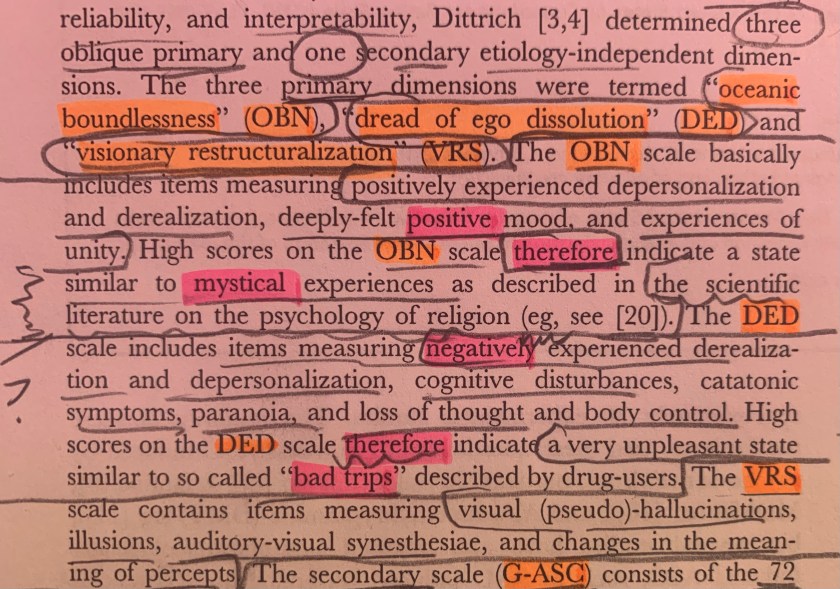
All of this would-be scientific psychedelics theory rests on the sand of Stace 1961’s unscientific false assumption that mystic experiencing is simply positive. The result?
CEQ Study 2 deletes all of the questions about control-loss, replacing them by vague “fear”, and then finds that the survey gives the same results as Study 1 (the Initial Pool of effects questions including control-loss questions) and is “therefore validated”.
Validated garbage; the CEQ is incapable of gathering info about volition and control loss, it is blind except totally vague “fear”, aka “shadow”, to detect the experience of the threat of catastrophic loss of control.
Why doesn’t the CEQ have a vague question with the word ‘shadow’?
It has “I was afraid but I didn’t know why”.


The G-ASC High-Level Category
Studerus’ char’zn:
G-ASC:
“general measure of consciousness alteration.”
The 5 Dimensions of Altered-State Effects
- Oceanic Boundlessness (OB, OBN)
- Dread of Ego Dissolution (DED, AED)
- Visionary Restructuralization (VR, VRS)
- Auditory Alterations (AA, AUA) – little used
- Reduction of Vigilance (RV, VIR) – little used
- Experience of unity
- Spiritual experience
- Blissful state
- Insightfulness
- Disembodiment
- Impaired control and cognition
- Anxiety
- Complex imagery
- Elementary imagery
- Audio-visual synesthesia
- Changed meaning of perception
Do the 11 categories form a tree under those 5 top-level categories?
No, it’s a tree under (fit into) the 3 main/orig high-level categs, ignoring the later 2 unpopular high-level categs.
Per Studerus 2010, the main 3 dimensions (OBN, DED, VRS) are broken up into — or replaced by — a set of 11 “subscales” (lower-level categories), which don’t cover the added two, unpopular AA & RV dimensions (higher-level categories).
How the 11 Low-Level Categories Fit Into the 3 Main High-Level Categories
2-level hierarchy of the useful 3 of the 5 high-level categories & the 11 low-level categories of psychedelic effects:
Oceanic Boundlessness (OB, OBN)
- Experience of unity
- Spiritual experience
- Blissful state
- Disembodiment
Dread of Ego Dissolution (DED, AED)
- Impaired control and cognition (ICC)
- Anxiety (ANX)
Visionary Restructuralization (VR, VRS)
- Changed meaning of perception
- Audio-visual synesthesia
- Complex imagery
- Insightfulness
- Elementary imagery
General altered state effects (G-ASC)
- Effects not assigned to the 3 OAV dimensions or 11 granular categories.
Griffiths’ CEQ removes all effects questions that are in the most important group, “impaired control and cognition (ICC)” (= the “volition” category in the HRS inventory), except keeps “I feel isolated” only.
“Dread of Ego Dissolution” = “Unpleasant”; “Oceanic Boundlessness” & “Visionary Restructuralization” = “Pleasant”
Studerus Categorizes “Dread of Ego Dissolution” as “Unpleasant”, and “Oceanic Boundlessness” & “Visionary Restructuralization” as “Pleasant”
Here’s how Figure S1 in Studerus 2010 – tree hierarchy diagram:
Unpleasant Experiences
Dread of Ego Dissolution (DED, AED)
- Impaired control and cognition (ICC) – CEQ omits every item except “I feel isolated”
- Anxiety (ANX)
Pleasant Experiences
Oceanic Boundlessness (OB, OBN)
- Spiritual experience
- Experience of unity
- Blissful state
- Disembodiment
Visionary Restructuralization (VR, VRS)
- Changed meaning of perception
- Audio-visual synesthesia
- Complex imagery
- Insightfulness
- Elementary imagery
General altered state effects (G-ASC) – 72 individual non-categorized effects/ questions are shown assigned to General, in the diagram. Studerus 2010 p. 2 discusses.
The diagram doesn’t explicitly show labels for the 3 legacy top-level categories (OB, DED, VR).
APZ History
todo – use / see Studerus 2010 p. 2 to fill in this section.
Created by: Dittrich
Created when: 1975
Citation:
Dittrich A
1975
Zusammenstellung eines Fragebogens (APZ) zur Erfassung abnormer psychischer Zusta¨nde
[Construction of a questionnaire (APZ) for assessing abnormal mental states].
Z Klin Psychol Psychiatr Psychother 23: 12–20.
Number of effects/ questions/ items:
158 (Studerus 2010 p 2 left)
Number of categories:
Trick question. In 1975, no categories were defined. In 1985, Dittrich identified 3 dimensions. In 1994, OAV was created (Dittrich, Bodmer, Lamparter). Citation: Studerus 2010, p. 2 right top & p. 17 right.
OAV History: 1994
Created by: Bodmer, Dittrich, & Lamparter
Created when: 1994
Citation:
Bodmer I, Dittrich A, Lamparter D
1994
Aussergewo¨hnliche Bewusstseinszusta¨nde – Ihre gemeinsame Struktur und Messung
[Altered states of consciousness – Their common structure and assessment]
In: Hofmann A, Leuner H, eds. Welten des Bewusstseins. Bd. 3, Experimentelle Psychologie, Neurobiologie und Chemie. Berlin, Germany: VWB. pp 45–58.
Number of effects/ questions/ items: 72 per APZ
Number of categories: todo
3-4:
Bodmer et al dev’d OAV. Discussed in Studerus 2010 p. 2.
5D-ASC History
todo
Created by:
Created when:
Citation:
Number of effects/ questions/ items:
Number of categories:
11 Granular Categories History
todo
Created by: Erich Studerus, Alex Gamma, Franz Vollenweider
Created when: 2010
Citation:
Psychometric Evaluation of the Altered States of Consciousness Rating Scale (OAV)
Erich Studerus, Alex Gamma, Franz X. Vollenweider
2010
https://www.ncbi.nlm.nih.gov/pmc/articles/PMC2930851/
Number of effects/ questions/ items: todo
Scope = OAV, = the 3 main categories of 5D. Plus the General items (G-ASC) from [APZ? | OAV?].
Number of categories: 11. Does Studerus 2010 show the 11 within the legacy 3 broad dimensions? __ todo.
Diagram S1 (“Hierarchical item clustering tree diagram”) shows “Unpleasant Experiences” and “Pleasant Experiences” as the 2 top-level categories or characterizations containing the 11 new fine-grained categories, doesn’t mention the 3 legacy dimensions.
DED was divided into ICC+ANX in 2010 by Studerus
Who Divided DED into ICC+ANX, When? Ans: Not 5D, Which Uses Broad Dimensions, so, Studerus 2010.
The “impaired control and cognition” (ICC) “factor” (granular category) was defined in 2010 – it was not identified in 1985, or published in OAV in 1994, or part of 5D 2006 (which still used broad, not granular categories).
IMPORTANT HISTORY SUMMARY:
Before 2010, only the broader DED/AEA (dread of ego dissolution) dimension was defined.
The “dread of ego dissolution” (DED/AEA) broad dimension was:
- Identified in 1985.
- Published as part of OAV in 1994.
- Accompanied by two added broad dimensions in 2006.
- Replaced by ICC+ANX granular factors in 2010.
Take me to the year the Egodeath theory development started and Dittman identified the “dread of ego dissolution” (DED/AEA) dimension for his 1975 APV questionnaire.
DED was incorporated into Dittman’s 1994 OAV version of the questionnaire.
DED was superseded in 2010 by Studerus’ “impaired control and cognition” (ICC) & “anxiety” (ANX) factors.
Whose idea was it, when, to split DED/AEA (dread of ego dissolution) into ICC (impaired control and cognition) + ANX (Anxiety)? Answer: Studerus 2010. Not 5D-ASC 2006, which still uses the broad “dimensions” that Dittman identified in 1985.
- Dittrich 2006, when publishing 5D-ASC? – No, hint is in name: the 5 dimensions are O, A, V, and two new ones, plus general, and therefore 5D-ASC continues to use the broad dimension “oceanic boundlessness” (OB) rather than the granular 11 categories (“factors”).
- Studerus 2010, when defining the 11 categories (“factors”)
From 2016 CEQ article:
“A recent psychometric analysis identified 11 plausible sub-scales of the 5DASC, which include the impaired cognition and control (ICC), and anxiety (ANX) scales (Studerus et al., 2010). The 13 items of the 5DASC that constitute the [later defined!] ICC and ANX sub-scales were retained for the initial item pool”
Studerus et al., 2010 =
Tricky! You can say ICC+ANX is “from 5D” – but, 5D-ASC in 2006 doesn’t define them; they are retrofits extracted/applied to 5D 4 years later.
The hint is in the name “5D”, meaning 3+2 broad (not granular) categories, one is dread of ego dissolution (DED).
The 2006 5D-ASC article doesn’t mention the two subdivisions “of DED” or “that replaced DED” that were defined 4 years later: impaired control and cognition (ICC) & anxiety (ANX).
CEQ Update: Griffith Restored Paranoia Questions – Similarly Restore Volition-Control Questions
🍄🎄 2022 Christmas update/finding.
Glossary:
an item = question
a factor = narrow category of questions – aka sub-scale
a dimension = broad question category
a measure, a scale = questionnaire, list of psychedelic effects/ questions
Griffith Removed Paranoia and Volition-Control Questions, then Restored Paranoia – Similarly Restore Volition-Control
Paranoia and Volition-Control Questions Got Removed, then Paranoia was added back in later – but Volition-Control questions – which are genuinely numerous, not like the “fear” question dup’d 3 times – , then added Paranoia back in – but now needs do same for Volition-Control just same as corrected error of removing Paranoia.
The Volition-Control questions/ effects are genuinely numerous.
Studerus:
“We have a problem:
too many Dread of Ego Dissolution (DED) questions, and
too few Oceanic Boundlessness and Visionary Restructuralization questions.”
What they end up doing: Dividing each of the 3 unevenly to create more of the positive categories of questions, 4 or 5, but only divide DED dimension into 2 factors (cats of q’s).
Griffiths removed Paranoia and Volition-Control, then added Paranoia back in – but now needs do same for Volition-Control, just the same as he corrected his error of removing Paranoia.
Not explained: Why did you remove the Paranoia question – explicitly discuss each question, stop hiding behind a cloak of math. “Based on math, we deleted 30 questions, including the Paranoia and Volition-Control.”
Why, specifically, did you remove each particular Paranoia q?
WHY DO YOU KEEP REMOVING NEGATIVE ITEMS? Because they already have a problem per Studerus 2010:
The Dread dimension (the negative dimension) has too many questions.
The Ocean and Visionary dimensions (the positive dimensions) have too few questions.
Studerus 2010
Griffiths was under pressure to diminish the total number of negative effects while he was adding Depression/Sad/Grief effects questions.
That damn problem category, Dread of Ego Dissolution (Volition Control) and the “volition control” category (ICC, impaired control and cognition, and HRS’s volition factor –
Just like you screwed up and removed Paranoia items from the 64 initial pool creating 6 factors containing 24 items, and you had to awkwardly un-remove them for end up with your 7 so-called “final” factors and so-called “final set of 26 items”
They did an intermediate, seat-of-the-pants, late-in the game self-correction phase.
Why did they remove the Paranoia questions?
They’ve already set a precedent, restoring questions and not explaining why they screwed up and removed all of the Paranoia questions and took so long to correct their removal of important effects – now self-correct again and add back in the the Volition-Control questions that you similarly shouldn’t have removed.
What other negativ equestions did you remove, and what are you trying to remove so many negative questions? To try to offset the fact that you’re adding Depression questions, your’re trying to KEEP A CAP ON RATIO OF NEGATIVE TO POSITIVE EFFECTS.
Added a 7th factor/categ to restore the Paranoia questions.
Similarly, add an 8th factor/categ to restore the Volition-Control questions.
Context: their mission is to add Depression questions.
Why did you remove so many questions, from 64 to 24, then you realized you removed too many.
Griffiths team: WHY DID YOU AGGRESSIVELY REDUCE 64 questions TO ONLY 24?
I thought you wanted a comprehensive, broadened coverage.
What’s the decision process to pick the size 64 or 24?
What exactly was your decision process to aim for 64 or 24 or 26 or as I’m saying, you were in error to discard questions, as you found out when you late in the game added the Paranoia questions back in.
Why did you remove the Paranoia questions?
Articulate your decision process: Black magic?
Your math only serves to cloak what your decision process was when removing specific items from the initial pool to produce the final CEQ set of questions.
Why did you remove the Volition-Control questions? Add them back, just like you corrected your error with removing Paranoia questions.
You seem to focus too much on adding your pet couch psychotherapy effects questions: Sad, Depressed, Grief.
You remove all kinds of questions willy-nilly, never stating your decision process except “We messed up and restored Paranoia questions, because it’s common”.
If Paranoia is common, then what possessed you to remove the Paranoia questions? Answer: our adding Depression questions conflicts with Studerus’ call to have more positive effects and fewer negative effects in psychedelics experiences.
“We felt bad adding so many negative questions when Studerus complained that there are too many negative effects and not enough positive effects. So we deleted all kinds of other negative effects while adding out Depression negative effects.”
You only provide vague math, never an explanation of why you remove each specific question – except you give 1 sentence about your decision process for restoring the Paranoia questions, “it’s common”.
We are only given math at a broad level, without any discussion of whether to remove each specific question. Your math is objectively unclear and vague. You need to discuss removing each effect, or else your method is arbitrary – as it was for Paranoia questions: you arbitrarily removed them, then restored them.
Where’s the decision process for each question? The process you’re using is no process, since you don’t document your removal process of removing questions.
The math you present near “removed” is not a decision process for a specific question.
History of the Dittrich Publications
Here are the first References from Studerus 2010, by date.
Summary/Findings
Years of publishing the questionnaires (APZ, OAV, 5D-ASC) or add-on retrofit categories (11 “factors”), or partial subsets (CEQ, ECQ).
- APZ = 1975 – Dittrich – questionnaire.
- OAV = 1994 – Dittrich – questionnaire (dimensions identified in 1985 by Dittrich).
- 5D-ASC = 2006 – Dittrich – questionnaire.
- 11 factors = 2010 – Studerus – add-on retrofit to replace the main 3 dimensions.
- (CEQ = 2016) – Griffiths – partial subset also drawing items from SOCQ & HRS.
- (ECQ = 2022) – Cybermonk – partial subset (focusing on Eternalism and Control effects) drawing items from 5D-ASC, SOCQ, & HRS and defining new categories for those items:
OMG IT HAS BEEN SO HARD TO FIGURE THAT OUT!
– Cybermonk December 24, 2022 🍄🎄
ECQ defines 5 specialized categories for eternalism and control transformation effects:
- Block-Universe Eternalism (Time)
- Block-Universe Spatial Unity
- Non-Control, Egoic Agency Suspension
- Threat of Loss of Control
- Control Model Transformation
CEQ defines 7 specialized categories for challenging experiences:
- Fear
- Grief
- Physical Distress
- Insanity
- Isolation
- Death
- Paranoia
Control = Volition = Impaired Control– not challenging, per Griffiths
🏥 🍽 🐉
CEQ –> ECQ
Challenging Experiences –> Eternalism Control
since Griffiths has it all backwards, tossing “Impaired Control / Volition” into the river (as “not challenging experiences”) along with Browns’ St. Walburga tapestry that’s totally not Amanita.
Keep the citation numbers here, keyed in Studerus 2010: “Dittrich’s APZ (Abnormal Mental States) questionnaire [1–4] and its revised versions, OAV [5] and 5D-ASC [6,7]”
APZ [cit. 1, 2, 3, 4] = 1998, 1975, 1985, 1996
OAV [cit. 5] = 1994
5D-ASC [cit. 6 & 7] = 2006
Errata: Studerus 2010 Falsely States 5D-ASC Was Published in 1999 – It’s Actually 2006
Damnit now I have to correct his error in my pages.
(not 1999!), 2010
keep “2006 NOT 1999” note here until I make corrections in my posts – todo. Find “1999” in the articles, who’s been writing “1999” re: what? answer:
“an extended version of the OAV, called 5D-ASC (‘‘five dimensions of ASC questionnaire’’) was published in 1999 [7]” – Studerus 2010; Psychometric Evaluation of the Altered States of Consciousness Rating Scale (OAV). This looks like a Studerus error! Reference 7 is:
7) Dittrich, A, Lamparter, D, Maurer, M (2010) 5D-ASC: Questionnaire for the
assessment of altered states of consciousness. A short introduction. Zurich,
Switzerland: PSIN PLUS.
How can it possibly be 1999, Studerus doesn’t even list a 1999 References entry!
And why does Studerus cite a 2010 article to support the claim that “5D-ASC was published in 1999”?
The CEQ article has no references about any related 1999 publication.
an extended version of the OAV, called 5D-ASC (‘‘five dimensions of ASC questionnaire’’) was published in 1999 [7]
Reference 7: Dittrich 2010
Studerus 2010, page 3
Errata: Griffiths Falsely Says/Implies:
“APV 1975, OAV 1998, 5D-ASC 2010”
Actually:
APV 1975, OAV 1994, 5D-ASC 2006
the various forms of Dittrich’s Altered States of Consciousness questionnaires (Dittrich, 1975, 1998; Studerus et al., 2010)
CEQ article, Griffiths 2016
CEQ ariticle’s References entries:
Dittrich A (1975) Zusammenstellung eines fragebogens (APZ) zur erfassung abnormer psychischer zustände [Construction of a questionnaire (APZ) for assessing abnormal mental states]. Z Klin Psychol Psychiatr Psychother 23: 12–20.
Correct. APZ = 1975.
Dittrich A (1998) The standardized psychometric assessment of altered states of consciousness (ASCs) in humans. Pharmacopsychiatry 31: 80–84.
Incorrect if this vague terse passing citation is supposed to represent OAV, which actually = 1994 per Studerus p. 1: “Dittrich’s APZ (Abnormal Mental States) questionnaire [1–4]
and its revised versions, OAV [5] and 5D-ASC [6,7]” – Studerus’ Reference 5 is: “Bodmer I, Dittrich A, Lamparter D (1994) Aussergewo¨hnliche Bewusstseinszusta¨nde – Ihre gemeinsame Struktur und Messung [Altered states of consciousness – Their common structure and assessment]. In: Hofmann A, Leuner H, eds. Welten des Bewusstseins. Bd. 3, Experimentelle Psychologie, Neurobiologie und Chemie. Berlin, Germany: VWB. pp 45–58.”
Studerus E, Gamma A and Vollenweider FX (2010) Psychometric evaluation of the altered states of consciousness rating scale (OAV). PloS One 5: e12412.
How “Oceanic Boundlessness”, “Dread of Ego Dissolution”, & “Visionary Restructuralization” All Produce Eternalism Ego Death
How the High-Level Effects Categories “Oceanic Boundlessness (OB, OBN), Dread of Ego Dissolution (DED, AED), and Visionary Restructuralization (VR, VRS) Are Related to Eternalism-Driven Ego Death and Control Model Transformation
The psilocybin eternalism experience is not only of time & space (per OBN effects), but also control agency (per DED effects) within the no-longer-branching world.
The mental model transforms driven by this experiencing and perception (per VRS effects).
There’s a broad general 4th category too:
General altered state effects (G-ASC)
Heading
Actually I think I got this hierarchy nesting correct, either I saw it somewhere or have just read sufficiently so I’m pretty certain.
… to confirm that such a hierarchy is defined in Dittrich’s spec’n of OAV or 5D-ASC.
It’s ridiculous that no one – Studerus 2010 – bothers to specify whether the 3 categories get replaced by 11 per a messy relationship, or is a simple mapping/ containment/ tree.
Tipado’s article supports my claim that this point is failed to be doc’d – it vaguely says that the set of 11 is contained in the set of 3 high-level, but doesn’t show the nesting/ mapping/ containment!
Understanding The Five Dimensional Altered States Of Consciousness (5D-ASC)
By Zeus Tipado, December 8, 2022
https://healingmaps.com/five-dimensions-altered-states-of-consciousness/
“Within those three themes are eleven dimensions:”
The category DED in OAV got replaced by ICC+ANX in 5D-ASC.
Dittrich’s 3 broad dimensions (ocean, dread, visionary) dating back to OAV (198x) are more or less directly referenced, even since Studerus’ 2010’s replacement of the 3 high-level (broader) dimensions by the 11 lower-level (granular) categories.
5-Dimensional Altered States of Consciousness Rating Scale
(5D-ASC)
A. Dittrich, D. Lamparter, M. Maurer
Translation from the original German by Felix Hasler and Rael Cahn
url https://drive.google.com/file/d/1Lbd92Cm-NNyL-Ux9vwl2ECZDLPz1jUWx/view
article summarizing: https://healingmaps.com/five-dimensions-altered-states-of-consciousness/ – they don’t say “dread of ego dissolution” for one category, they say for one of the top three categories… maybe they have broken out the three categories in a different way or with different wording but it says “anxious”, not “dread”:
“Although it has five-dimensional in the name, it’s actually* an 11-dimensional scale, and occupies* three genres or themes of psychedelic trips.”
*Do you mean that there are 5 top-level categories, then 11 2nd-level categories?
Update: Answer: The 11 low-level categs are supposed to either replace or (more likely) fit into the 3 main high-level cats.
The 2 other, unpopular high-level categs are outside the 11 low-level categs.
Why not just put a hierarchical outline at top, if it’s a 2-level tree (3-level including the questions).
“Those three themes are:
- Visionary Restructuralization. This covers visuals experienced in trips
- Oceanic Boundlessness. Covers general blissful or otherworldly experiences in trips
- Anxious Ego-Dissolution. Essentially, this is physical dissociation or hyperfocus within a trip
- [General altered state effects (G-ASC)]
“Within those three themes are eleven dimensions:
- Experience of Unity
- Spiritual Experience
- Blissful State
- Insightfulness
- Disembodiment
- Impaired Control and Cognition
- Anxiety
- Complex Imagery
- Elementary Imagery
- Audio-Visual Synesthesia
- Changed Meanings of Percepts
— Cybermonk, December 22, 2022
Research Questions
How many dimensions or categories has APZ?
todo
5D-ASC (2006) has 5 or 6 dimensions:
Global,
Ocean, Dread, Visionary, (the main dimensions)
Auditory, Vigilance.
5D-ASC per Studerus 2010 has 11 or 12 categories replacing the 3 main dimensions: Global + 11.
What year was OAZ created?
todo
What Does CEQ Claim About Being a Superset of OAV’s DED Category and 5D-ASC’s ICC+ANX Categories?
todo
To do this, I have to narrate podcasts to get in the headspace of page 2 of the CEQ article.
Here are the criticism of why we need a clearer view specifically pulled out and focused on, of the negative experiences – they are hidden folded into the undifferentiated positive effects, in the HRS, SOCQ, and OAV & 5D-ASCC in the following ways:
How negative effects are obscured in HRS: __
How negative effects are obscured in SOCQ: __
How negative effects are obscured in OAV: __
How negative effects are obscured in 5D-ASC: __
See Also
Reference numbers, eg 2-5, are from Studerus’ 2010 article that defines the 11 factors to replace the 1985-identified 3 dimensions.
1975: Dittrich publishes APZ, no dimensions defined
2. Dittrich A (1975)
German garbled from pdf, see Studerus 2010: References.
Zusammenstellung eines Fragebogens (APZ) zur Erfassung abnormer psychischer Zusta¨nde [
Construction of a questionnaire (APZ) for assessing abnormal mental states
Z Klin Psychol Psychiatr Psychother 23: 12–20.
1985: Dittrich identifies 3 Broad Dimensions (ocean, dread, visionary)
3. Dittrich A (1985)
A¨tiologie-unabha¨ngige Strukturen vera¨nderter Wachbewusstseinszusta ¨nde. Ergebnisse empirischer Untersuchungen u¨ber Halluzinogene I. und II. Ordnung, sensorische Deprivation, hypnagoge Zusta¨nde, hypnotische Verfahren sowie Reizu¨berflutung [
German garbled from pdf, see Studerus 2010: References.
Etiology-independent structures of altered states of consciousness. Results of empirical studies on hallucinogens of the first and second order, sensory deprivation, hypnagogic states, hypnotic procedures, and sensory overload]. Stuttgart, Germany: Enke.
1994: Dittrich Publishes OAV
5. Bodmer I, Dittrich A, Lamparter D (1994)
Aussergewo¨hnliche Bewusstseinszusta ¨nde – Ihre gemeinsame Struktur und Messung [
German garbled from pdf, see Studerus 2010: References.
Altered states of consciousness – Their common structure and assessment]
In: Hofmann A, Leuner H, eds. Welten des Bewusstseins. Bd. 3, Experimentelle Psychologie, Neurobiologie und Chemie. Berlin, Germany: VWB. pp 45–58.
1996: Dittrich publishes [about use of OAV?]
4. Dittrich, A (1996)
German garbled from pdf, see Studerus 2010: References.
A¨tiologie-unabha¨ngige Strukturen vera¨ nderter Wachbewusstseinszusta ¨nde.Ergebnisse empirischer Untersuchungen u¨ber Halluzinogene I. und II. Ordnung, sensorische Deprivation, hypnagoge Zusta¨nde, hypnotische Verfahren sowie Reizu¨berflutung
[Etiology-independent structures of altered states of consciousness. Results of empirical studies on hallucinogens of the first and second order, sensory deprivation, hypnagogic states, hypnotic procedures, and sensory overload]. Berlin, Germany: VWB.
1998: Dittrich publishes about use of OAV again?
1. Dittrich A (1998)
The standardized psychometric assessment of altered states of consciousness (ASCs) in humans.
Pharmacopsychiatry 31: 80–84. 10.1055/s-2007-979351.
1998: Dittrich publishes about us of OAV again? CEQ bib implies 1998 = OAV, 2010 = 5D-ASC [that’s a flaw in CEQ article!] but Studerus bib shows 5D is 2006
2006: Dittrich publishes 5D-ASC
Studerus is more credible than CEQ article here; CEQ misreps 5D as 2010, but it’s actually 2006.
6. Dittrich, A, Lamparter, D, Maurer, M (2006) 5D-ABZ:
German garbled from pdf, see Studerus 2010: References.
Fragebogen zur Erfassung Aussergewo¨hnlicher Bewusstseinszusta¨nde. Eine kurze Einfu¨hrung
[5D-ASC: Questionnaire for the assessment of altered states of consciousness. A short introduction]. Zurich, Switzerland: PSIN PLUS.
Not findable in English. The publishing in German is a big reason why it’s so impossible to get any straight answers in English, and why there are errors in Griffiths’ CEQ article and in Studerus’s 2010 article about when 5D-ASC was published.
Errata: Studerus 2010 Falsely States 5D-ASC Was Published in 1999 – It’s Actually 2006.
Errata: Griffiths 2016 Falsely Says/Implies:
OAV 1998, 5D-ASC 2010.
Actually,
OAV 1994, 5D-ASC 2006.
Just show me the damn specification of the 5D-ASC! Unobtainium. Not Available, in English.
2010: Dittrich’s Overview of 5D-ASC
7. Dittrich, A, Lamparter, D, Maurer, M (2010)
5D-ASC: Questionnaire for the assessment of altered states of consciousness. A short introduction.
Zurich, Switzerland: PSIN PLUS.
Search:
url https://www.google.com/search?q=Dittrich+Lamparter+Maurer
2010: Studerus Publishes 11 Granular Factors
Proposes 11 dimensions for the OAV or 5D-ASC:
Studerus E, Gamma A and Vollenweider FX (2010)
Psychometric evaluation of the altered states of consciousness rating scale (OAV)
https://www.ncbi.nlm.nih.gov/pmc/articles/PMC2930851/
This is the article that contains these good solid numbered citations of Dittrich’s publications.
2016: Griffiths publishes CEQ
The Challenging Experience Questionnaire: Characterization of challenging experiences with psilocybin mushrooms
Frederick S Barrett, Matthew P Bradstreet,
Jeannie-Marie S Leoutsakos, Matthew W Johnson
and Roland R Griffiths, 2016 https://www.academia.edu/33760114/The_Challenging_Experience_Questionnaire_Characterization_of_challenging_experiences_with_psilocybin_mushrooms
Not a Dittrich publication, but the CEQ is what I’m tracking the timeline for.
Other See Also References Links
The article that defines 5D-ASC is in German, that could explain variant wordings of items in English.
Griffiths’ CEQ article cites “Dittrich 2010” and “Studerus 2010”:
Nonexistent, fake, make-believe article that doesn’t exist, yet everyone copies and pastes the citation:
5D-ASC: Questionnaire for the Assessment Of Altered States of Consciousness. A Short Introduction
Dittrich A, Lamparter D and Maurer M (2010)
TODO: NEED URL
WTF THIS ARTICLE DOES NOT EXIST, IT IS NOT FOUND IN ANY DATABASE OF ARTICLES. THIS FIELD SUCKS! The basis for this field of science is fantasy, air, nothing. aka Walter Stace’s lopsided imaginings, aka unicorns & rainbows
Psychedelic Psychometrics “Science”
= Walter Stace’s Fantasy of “Mystical = Positive”
= 🦄💨🌈
Main Questionnaires of Altered State Effects
https://egodeaththeory.wordpress.com/2022/12/22/5d-asc-questionnaire-of-altered-state-effects/
Proposes 11 dimensions for the OAV or 5D-ASC:
Studerus E, Gamma A and Vollenweider FX (2010)
Psychometric evaluation of the altered states of consciousness rating scale (OAV)
https://www.ncbi.nlm.nih.gov/pmc/articles/PMC2930851/
Dittrich A
1975
Zusammenstellung eines fragebogens (APZ) zur erfassung abnormer psychischer zustände
[Construction of a questionnaire (APZ) for assessing abnormal mental states]
Z Klin Psychol Psychiatr Psychother 23: 12–20.
Dittrich A
1998
The standardized psychometric assessment of altered states of consciousness (ASCs) in humans
Pharmacopsychiatry 31: 80–84.
Dittrich A, Lamparter D and Maurer M
2010
5D-ASC: Questionnaire for the Assessment Of Altered States of Consciousness. A Short Introduction
Zürich, Switzerland: PSIN PLUS.

 The Egodeath theory
