Contents:
- Objective
- Effects Classification vs. Explanatory System
- How All the Questionnaires’ Questions Fit into the Egodeath Theory’s Core Concepts Categories
- Strategy
- Egodeath Theory Core Concept Categories
- Categories in the Eternalism and Control Questionnaire (ECQ)
- High-Level Mapping of Dittrich’s Ocean/ Anxiety/ Visionary Dimensions to Egodeath Theory Core Concepts Categories
- All of the Questions from the 3 Questionnaires, and the Egodeath Theory Concept Category
- OAV Categories of Psychedelic Effects
- SOCQ/MEQ Categories of Psychedelic Effects
- HRS Categories of Psychedelic Effects
- Walter Stace 1961 Categories of Mystical Experiences
Objective
To speed science forward at maximum velocity towards the heart of the Shadow and beyond through the black hole gate 🌌 I am mapping the core concepts categories of the Egodeath Theory to the main psychedelic effects questionnaires – all very Sciency. 😑
🍄 ☸️🚀🌌💥🚪🎄🍄
url https://youtu.be/4MlYgt-QdMI
The actual mapping is tbd.
Effects Classification vs. Explanatory System
The focal items in the Egodeath theory are underlying mechanisms that produce resulting effects.
The Egodeath theory is a system of explanatory constructs to explain the resulting isolated effects. Or at least some of the effects.
The Egodeath theory’s Core Concepts catalog is a classification and inventory of concepts and explanatory constructs, not an inventory of raw individual psychedelic effects.
The altered states questionnaires list the effects; the Egodeath theory lists the causes or explanatory constructs to model and explain certain of those effects.
The Egodeath theory is not scoped to be a wide comprehensive inventory of all loose cognitive psilocybin effects.
The Egodeath theory Core Concepts are a selected subset of all loose cognitive psilocybin effects.
The scope of Josie Kins’ Cognitive Effects Database is a partial overlap with the Egodeath theory. https://effectindex.com
“Effect Index … is a resource dedicated to establishing the field of formalised subjective effect documentation. It is the home of the Subjective Effect Index (SEI), which contains 233 effect descriptions that exist to serve as a comprehensive map of all potential experiences that can occur under the influence of any class of psychoactive compound, particularly hallucinogens.”
I object: SEI jumbles two conflicting objectives. All psychoactives, vs. classic psychedelics.
The “effect” which is not usually spotted by a simple inventory of newbie effects is the transformation from naive possibilism-thinking to eternalism-thinking.
Conventional discussion talks in terms of predictions, immediate acute effects, then long-term outcome/ effects.
That’s not same as the mental model transformation during the altered state, from possibilism-thinking to eternalism-thinking.
Specialized Narrow Scope of the Egodeath Theory Concepts, Scope of Explanandum Domain
The Egodeath theory focuses only on classic psychedelics effects that relate to the Egodeath theory.
The Egodeath theory explains:
- The actual nature of ego transcendence.
- The concept of tight cognitive vs. loose cognitive binding.
- Mental model transformation in the loosecog state.
- The concept of the personal control system, the contrast between the possibilism vs eternalism mental world models.
- How mythology describes by analogy the experiences of the altered state, and the transformative experiences trajectory, not merely the isolated effects.
The Egodeath theory focuses only on Psilocybin; classic psychedelic effects, only.
The range of beginner unity consciousness effects is not an interest/ explanatory domain of the Egodeath theory, except to contrast beginners’ “ego dissolution” vs. advanced control-transgression/ “ego death”/ the mental worldmodel transformation process from possibilism-thinking to eternalism-thinking.
Dittrich sought to identify categories of altered-state effects across different ways of inducing altered states.
The Egodeath theory only covers classic psychedelics’ effects, and doesn’t cover all psychedelics effects, but only the most profound transformation effects.
The Egodeath theory is not equally interested in all psychedelic effects. The Egodeath theory is more a model of Transcendent Knowledge than a model of psychedelics effects.
The Egodeath theory contains enough description of loosecog meta-perception to enable describing mental model transformation about control, time, and possibilities; to model personal control agency operating in a world.
Alleged non-drug mystic experiencing per Dittrich’s 1975 APZ inventory, or per meditation or hyperventilation, is not of interest to the Egodeath theory.
That’s a difference of motivation between the APZ/ OAV/ 5D/ 11 Factors questionnaire vs. the Egodeath theory.
Strassman’s HRS is more focused on specifically psychedelics effects, although ideally the focus should be limited to classic psychedelics.
SOCQ (including MEQ) is centered around a misrepresentation of alleged (imagined, fantasized) non-drug mystic-state experiences.
How All the Questionnaires’ Questions Fit into the Egodeath Theory’s Core Concepts Categories
Strategy
First, list all 300 questions from the 3 questionnaires, and for each question, write what sort of Egodeath theory core concept that is.
Stay loose at first; don’t assume I’m using the 13 Core Concepts page categories.
I’m not using just the 4 Categories in the Eternalism and Control Questionnaire (ECQ) (which were negative only, merely a a subset of the questionnaires’ inventories).
Start with the Core Concepts categories, then take the 300 effects questions and the categories from the 3 questionnaires (OAV, SOCQ, HRS), and place them within the Core Concepts categories.
Studerus (2010) retains all of Dittrich’s OAV (1994) questions, but gets rid of (or subdivides) Dittrich’s 3 dimensions/ categorization/ grouping scheme, and provides his own set of 11 Factors (question categories).
The Egodeath theory does the same – provides its own set of categories in which to place all of the OAV (1994) & SOCQ & HRS effects questions:
ignoring OAV’s 3 categories
ignoring Studerus’ 11 categories
ignoring HRS’ 6 categories
ignoring SOCQ’s 7 categories.
Egodeath Theory Core Concept Categories
The 13 high-level groups of core concepts.
- Branching-Possibilities Worldmodel
- Non-Branching Block Universe & Worldlines
- Block-Universe Altered State
- Frozen Worldline of Injected Control-Thoughts
url https://egodeaththeory.wordpress.com/2020/11/17/glossary-for-the-egodeath-theory/
Categories in the Eternalism and Control Questionnaire (ECQ)
- Block-Universe Eternalism (Time)
- Block-Universe Spatial Unity
- Non-Control, Egoic Agency Suspension
- Threat of Loss of Control
- Control Model Transformation
High-Level Mapping of Dittrich’s Ocean/ Anxiety/ Visionary Dimensions to Egodeath Theory Core Concepts Categories
Equivalents
Block-universe eternalism = Oceanic Boundlessness.
Control Seizure = Anxiety/Dread.
Loose cognitive association binding/ Mental construct processing/ mental model transformation = Visionary Restructuralization.
Equivalents
Ocean ~= Eternalism.
Anxiety/Dread ~= Non-control.
Visionary ~= Loose cognitive state for mental model transformation.
All of the Questions from the 3 Questionnaires, and the Egodeath Theory Concept Category
todo: line-wrap the 2nd line of each item, specifying the category.
n/a means not part of my experiential lexicon and explanatory model.
A melody occurred to me that I had to constantly repeat.
A rush.
A sound or sounds accompanying the experience.
A voice commented on everything I thought although no one was there.
Able to “let go”.
levels of control
Able to focus attention.
Able to follow the sequence of events.
Able to move around if asked to.
Able to remind yourself of being in a clinical room, being administered a drug, the temporary nature of the experience.
Amount of time between when the drug was administered and feeling an effect.
Anxious.
Awareness of the life or living presence in all things.
Awe, Amazement.
Being in a realm with no space boundaries.
Bodily sensations were very enjoyable.
Body feels different.
Certainty of encounter with ultimate reality (in the sense of being able to “know” and “see” what is really real ) at some time during your session.
Change in “amount” of emotions.
Change in body temperature.
Change in brightness of objects in room.
Change in distinctiveness of sounds.
Change in effort of breathing.
Change in feelings of closeness to people in room.
Change in quality of thinking.
Change in rate of thinking.
Change in rate of time passing.
eternalism
Change in salivation.
n/a
Change in sense of body weight.
n/a
Change in sense of sanity.
loose cog, transgressing control, mental model transformation
Change in skin sensitivity.
n/a
Change in strength of sense of self.
levels of control, mental model transformation
Change in visual distinctiveness of objects in room.
Conflict and contradictions seem to dissolve.
n/a
Conflicts and contradictions seemed to dissolve.
n/a
Contradictory feelings at the same time.
Convincing feeling of contact with people who have died.
Desire for the experience regularly.
Difference in brightness of visions compared to usual daylight vision.
Difference in feeling of reality of experiences compared to everyday experience.
Dimensionality of images.
meta perception, loose cog
Dreamlike nature of the experiences.
Electric /tingling feeling.
Emotional and/or physical suffering.
Emotions seem different than usual.
Euphoria.
Everyday things gained a special meaning.
Everything around me seemed to be animated with life.
Everything happened so fast that I could not follow it all.
Everything seemed to unify into an oneness.
eternalism
Excited.
Experience of a paradoxical awareness that two apparently opposite principles or situations are both true.
Experience of amazement.
Experience of antagonism toward people around you.
n/a
Experience of confusion, disorientation and/or chaos.
mental model transformation
Experience of ecstasy.
Experience of fear.
Experience of isolation and loneliness.
Experience of meaninglessness and absurdity of life.
Experience of oneness in relation to an “inner world” within.
eternalism
Experience of oneness or unity with objects and/or persons perceived in your surroundings.
eternalism
Experience of overflowing energy.
n/a
Experience of physical distress (e.g. nausea, vomiting, sweating, rapid heartbeat, etc.).
n/a
Experience of pure Being and pure awareness (beyond the world of sense impressions).
Experience of repulsive biological material.
Experience of the fusion of your personal self into a larger whole.
eternalism
Experience of the insight that “all is One”.
eternalism
Experience of timelessness.
eternalism
Experience of unity with ultimate reality.
Experiences of intense pressures on various parts of your body.
Eyes open visual field vibrating or jiggling.
Fear that you might lose your mind or go insane.
loosecog, non-control
Feel as if moving falling flying through space
.
Feel body shake or tremble.
n/a
Feel isolated from people and things.
Feel like laughing.
n/a, loose cog
Feel of oneness with universe.
eternalism
Feel presence of a numinous force, higher power, God.
Feel reborn.
mental model transformation
Feel removed detached separated from body.
Feeling of being rejected or unwanted.
Feeling of disintegration, falling apart.
loosecog mental model transformation
Feeling that it would be difficult to communicate your own experience to others who have not had similar experiences.
mental model transformation
Feeling that people were plotting against you.
Feeling that the consciousness experienced during part of the session was more real than your normal awareness of everyday reality.
Feeling that you could not do justice to your experience by describing it in words.
Feeling that you experienced eternity or infinity.
Feeling that you experienced something profoundly sacred and holy.
Feeling that you have been “outside of” history in a realm where time does not exist.
Feelings of anger or aggression.
Feelings of despair.
Feelings of exaltation.
Feelings of grief.
Feelings of guilt.
Feelings of joy.
Feelings of peace and tranquility.
Feelings of tenderness and gentleness.
Feelings of universal or infinite love.
Flushed.
Freedom from the limitations of your personal self and feeling a unity or bond with what was felt to be greater than your personal self.
Frightened.
non-control
From an initially diffuse noise, which I could not identify as real, clear rings and tones evolved.
Frustrating attempt to control the experience.
noncontrol
Gain of insightful knowledge experienced at an intuitive level.
Heard something faintly that I could not identify.
mental model transformation
How soon would you like to repeat the experience?
I could see images from my memory or imagination with extreme clarity.
I could see pictures from my past or fantasy extremely clearly.
I enjoyed boundless pleasure.
n/a
I experienced a kind of awe.
mental model transformation
I experienced a kind of awe.
n/a
I experienced a profound peace in myself.
mental model transformation
I experienced a touch of eternity.
eternalism
I experienced an all-embracing love.
eternalism
I experienced boundless pleasure.
I experienced everything as frighteningly distorted.
meta perception
I experienced everything terrifyingly distorted.
loosecog
I experienced my surroundings as strange and weird.
I experienced past, present and future as an oneness.
eternalism
I experienced profound inner peace.
I experienced unbearable emptiness.
suspension of egoic agency
I felt anxious.
I felt as if dark forces had overtaken me.
I felt as if I no longer had a body.
I felt as if I was floating.
I felt as if I was half-asleep.
I felt as if I were paralyzed.
non-control
I felt as though I were floating.
I felt as though I were paralyzed.
noncontrol
I felt connected to a higher power.
I felt drowsy.
n/a
I felt drunk.
I felt exhausted.
I felt extraordinary powers within myself.
2 levels of control, control agency
I felt high.
I felt I was about to fall asleep.
I felt I was being transformed forever in a miraculous way.
I felt incapable of making even the smallest decision.
the personal control system, personal control agency
I felt isolated from everything and everyone.
I felt like a puppet or marionette.
noncontrol
I felt like I do shortly before falling asleep.
I felt numb.
n/a
I felt one with my surroundings.
spatial block-universe eternalism
I felt sleepy.
I felt that I was in a wonderful other world.
mental model transformation
I felt that I was on the verge of unconsciousness.
I felt threatened.
control transformation; noncontrol
I felt tormented.
I felt totally free and released from all obligations.
I felt very profound.
mental model transformation
I gained clarity into connections that puzzled me before.
mental model transformation
I had difficulties in distinguishing important from unimportant.
mental model transformation
I had difficulty in distinguishing important from unimportant things.
n/a
I had difficulty making even the smallest decision.
control agency
I had feelings of unreality.
mental model transformation
I had insights into connections that had previously puzzled me.
mental model transformation
I had suspicious ideas or the belief that others were against me.
control vortex
I had the feeling of being connected to a superior power.
levels of control
I had the feeling of being outside of my body.
mental model transformation, eternalism
I had the feeling something horrible would happen.
noncontrol
I had the feeling that I no longer had a will of my own.
levels of control
I had the feeling that I no longer had my own will.
non-control
I had the feeling that something terrible was going to happen.
control loss/ transgression
I had the idea that events, objects, or other people had particular meaning that was specific for me.
I had the impression I was out of my body.
I had very original thoughts.
mental model transformation
I heard a ticking, knocking, ringing, or rattling without being able to recognize the cause.
I heard complete sentences without knowing where they came from.
source of control thoughts
I heard diffuse noises without knowing where they came from.
I heard music without knowing where it came from.
source of thoughts
I heard my thoughts as if I had spoken them out loud.
I heard rings and tones without knowing where they came from.
I heard single words without knowing where they came from.
I heard something like a buzzing, swooshing, or humming without recognizing the cause.
I heard voices or sounds that were not real.
I heard voices that did not come from the surroundings as usual.
I perceived everything as blurry, as if through a kind of fog.
I saw brightness or flashes of light with closed eyes or in complete darkness.
meta perception, loose cognition
I saw colors before me in total darkness or with closed eyes.
I saw colors with closed eyes or in complete darkness.
I saw lights or flashes of light in total darkness or with closed eyes.
I saw regular patterns in complete darkness or with closed eyes.
I saw regular patterns with closed eyes or in complete darkness.
I saw scenes rolling by in total darkness or with my eyes closed.
metaperception, loosecog
I saw things I knew were not real.
I saw whole scenes roll by with closed eyes or in complete darkness.
meta perception, loose cognition
I stayed frozen in an very unnatural position for an extended period of time.
personal control agency
I was able to remember certain events with exceeding clarity.
meta perception, loose cog
I was afraid of losing control over myself.
non-control
I was afraid that the state I was in would last forever.
eternalism
I was afraid without being able to say exactly why.
I was not able to complete a thought, my thought repeatedly became disconnected.
I was not able to complete a thought; my thoughts repeatedly became disconnected.
I was scared without knowing exactly why.
threat of loss of control
In control.
the personal control system
Insights into personal or occupational concerns.
Intensity.
Intuitive insight into the inner nature of objects and/or persons in your surroundings.
It seemed to me as though I did not have a body anymore.
mental model, personal control agency
It seemed to me that my environment and I were one.
eternalism, mental model transformation
It was difficult to control my thoughts.
noncontrol
Kaleidoscopic nature of visual images.
meta percption, loose cog
Like the experience.
Loss of feelings of difference between yourself and objects or persons in your surroundings.
Loss of usual awareness of where you were.
Loss of your usual identity.
the personal control system
Loss of your usual sense of space.
eternalism
Loss of your usual sense of time.
eternalism
Many things appeared to me as breathtakingly beautiful.
Many things seemed incredibly funny to me.
Meaningless noises sounded like real words or phrases.
Movement within images.
meta perdception, loose cognition
My body felt numb, lifeless, and/or alien.
My body or body parts seemed to change their shape or position.
My experience had religious aspects.
levels of control
My imagination was extremely vivid.
loose cog, meta perception, mental model transformation
My perception was blurred.
loose cog, meta perception
My sense of time and space was altered as if I was dreaming.
eternalism
My surroundings seemed to change in size, depth, or shape.
My thoughts and actions were slowed down.
New thoughts or insights.
Noises seemed to influence what I saw.
Objects around me engaged me emotionally much more than usual.
Objects in my surroundings engaged me emotionally much more than usual.
mental model transformation
Physically restless.
Pressure or weight in chest or abdomen.
Profound experience of your own death.
noncontrol
Room looks different.
Room overlaid with visual patterns.
Safe.
Sense of awe or awesomeness.
Sense of being “outside of” time, beyond past and future.
eternalism
Sense of being at a spiritual height.
meta perception
Sense of being separated from the normal world, as though you were enclosed in a thick, silent glass chamber.
Sense of being trapped and helpless.
noncontrol
Sense of chaos.
noncontrol
Sense of profound humility before the majesty of what was felt to be sacred or holy.
Sense of reverence.
2 levels of control
Sense of speed.
Sense of the limitations and smallness of your everyday personality in contrast to the Infinite.
Sense that in order to describe parts of your experience you would have to use statements that appear to be illogical, involving contradictions and paradoxes.
Sense that the experience cannot be described adequately in words.
Sexual feelings.
Shaky feelings inside.
Shapes seemed to be changed by sounds or noises.
Some everyday things acquired special meaning.
systemic reindexing, mental model transformation
Sounds and noises were fainter than usual.
Sounds in room sound different.
Sounds seemed to influence what I saw.
The boundaries between myself and my surroundings seemed to blur.
The colors of things seemed to be altered by sounds or noises.
The colors of things seemed to be changed by sounds and noises.
The intensity of colors changed.
The intensity of sound changed.
The passing of time was altered.
The shapes of things seemed to change by sounds and noises.
The world seemed to me beyond good and evil.
There were sounds in the room that I feel were unlikely to have been real.
Things around me had a new strange meaning for me.
Things came to my mind that I thought long forgotten.
Things in my environment had a new strange meaning.
mental model transformation, systemic re-indexing
Things in my surroundings appeared smaller or larger.
Thoughts and ideas flashing by very rapidly.
Time passed slowly in a tormenting way.
eternalism
Urge to close eyes.
Visions of demons, devils or other wrathful deities.
Visual effects.
meta perception, loose cognition
Visual images.
Waxing and waning of the experience.
White light.
With eyes open, seeing something in your surroundings more and more intensely and then feeling as though you and it become one.
Worries and anxieties of everyday life felt unimportant.
You are convinced now, as you look back on your experience, that in it you encountered ultimate reality (i.e. that you “knew” and “saw” what was really real).
OAV Categories of Psychedelic Effects
The OAV questionnaire’s 3 dimensions and how the Studerus 2010 11 Factors fit into the 3 dimensions.
Oceanic Boundlessness (OB, OBN)
- Experience of unity
- Spiritual experience
- Blissful state
- Disembodiment
Dread of Ego Dissolution (DED, AED)
- Impaired control and cognition (ICC) 👑☸️🌳 😱🐉🚪💎
- Anxiety (ANX)
Visionary Restructuralization (VR, VRS)
- Changed meaning of perception
- Audio-visual synesthesia
- Complex imagery
- Insightfulness
- Elementary imagery
General altered state effects (G-ASC)
todo: list the non categ’d q’s from Fig S1 supplement: tree diagram, from Studerus 2010, to add in my 5D page a General category.
That might help map the Egodeath theory to the main questionnaires.
Dittrich Inflated the Ocean and Visionary Dimensions to Force them to Be as Big as the Anxiety/Dread Dimension
Dittrich in 1985 identified Ocean, Anxiety/Dread, and Visionary dimensions found in 1975’s APZ questionnaire, but found that:
The Ocean & Visionary dimensions detected in APZ were relatively too small.
The Anxiety/Dread dimension detected in APZ was relatively too big.
So in 1994, Dittrich released OAV that had more items to pad out (enlarge) the Ocean & Visionary dimensions.
But in 2010 Studerus found that now instead of only Anxiety/Dread being a bloated, over-broad, uselessly broad dimension/ category of effects, now all three O/A/V dimensions are uselessly broad, so Studerus:
broke up Ocean dimension questions into 4 factors:
Experience of unity
Spiritual experience
Blissful state
Disembodiment
broke up Anxiety/Dread dimension questions into 2 factors:
Impaired control and cognition
Anxiety
broke up Visionary dimension questions into 5 factors:
Insightfulness
Complex imagery
Elementary imagery
Audio-Visual Synesthesia
Changed meaning of percepts
Dittrich 1985/1994: The 1994 OAV questionnaire fixes a problem with the 1975 APZ questionnaire: Given the large number of Dread (negative effects) questions, there needs to be a greater number of Oceanic & Visionary (positive effects) questions:
the OBN and VRS dimensions contained a relatively low number of items, and the conceptual breadth of the VRS dimension was considered too narrow.
… widening the conceptual breadth of the OBN [Oceanic Boundlessness] and VRS [Visionary Restructuralization] dimensions.
Whereas the OBN [Oceanic Boundlessness] dimension was changed toward a more complete assessment of mystical experiences by incorporating items that were formulated on the basis of six of the nine categories of mystical experiences proposed by Stace [20],
the VRS [Visionary Restructuralization] dimension was conceptually widened by incorporating items that measure an increase of imaginations, associations, and memory retrieval. The re-conceptualization of the VRS [Visionary Restructuralization] dimension was mainly driven by theoretical considerations of Leuner [22,23], who had hypothesized that visual hallucinations are associated with an increased internal stimulus production.
Studerus 2010 p. 2 right column top
Root Cause of Problem Has Been Identified: Walter Stace, 1960/1961, mysticism = all peace & light.
The one thing missing here is the outlines of so-called inventory of mystical experiencing, which probably like Charles Stang accused Roland Griffiths multiple times, fails to account for the negative mystical experiences.
Especially Stace 1961.
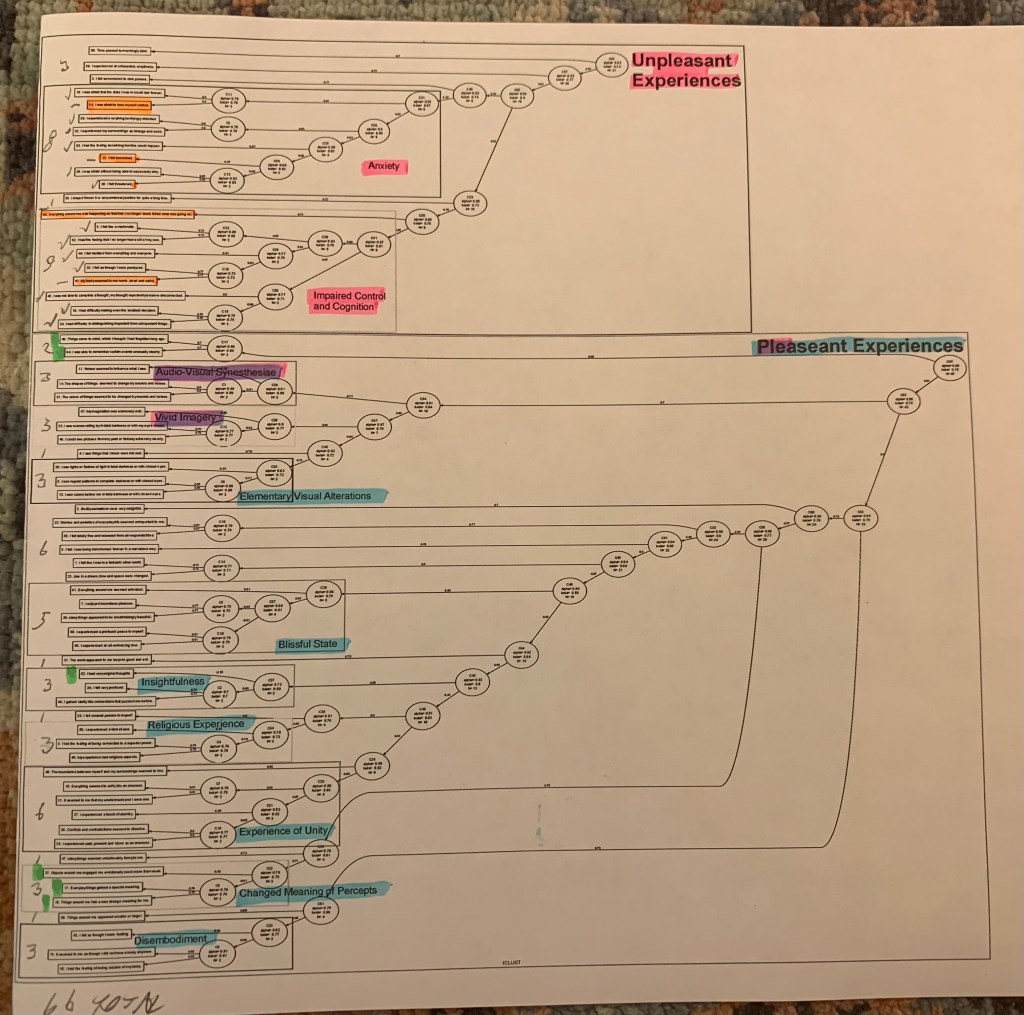
Supplement Figure S1, Studerus 2010 –
“Unpleasant” on right replaced or characterizes the “Anxiety/Dread” dimension.
“Pleasant” replaced or groups the “Ocean” and “Visionary” dimensions.
A better view of the 11 factors is page 9, figure 1 except that you need to move the “Insightfulness” factor down above “Complex Imagery” factor if you want to preserve the 3 O/A/V dimensions groupings. Ocean/ Anxiety/ Visionary.
Magic Math: now only 2/11 instead of 1/3 of psychedelic effects are classified as Here Be Dragons 🏥 🍽 🐉 “Unpleasant”
OAV 3 Dimensions: the above tree shows:
The topmost 2 Factors are within the OAV dimension “Dread of Ego Dissolution” (DED), those Factors are: Impaired control & cognition, & Anxiety.
The middle 5 Factors are within the OAV legacy dimension called “visionary restructuring”.
The bottom 4 Factors are within OAV’s “Oceanic Boundlessness” dimension.
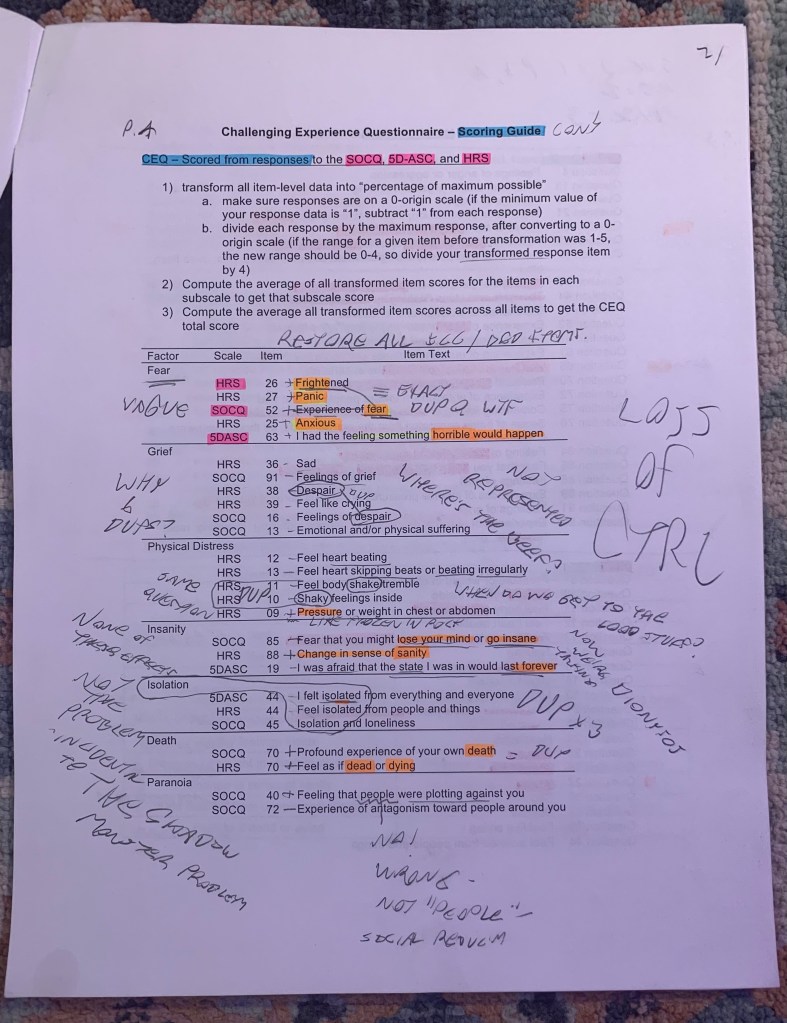
CEQ article 2016 Griffiths – My critique of the Dionysus-free, Shadow-scrubbed final 26 psychedelic effects questions, after Griffiths’ Psychotherapy Marketing Dept. removed all the Control and Volition questions and replaced them by 6 duplicate redundant psychotherapy-paradigm Fear and Sad questions.
His psychometrics stats math proves that his masters should support his psychotherapy project.
I like how through trickery and sleight of hand in 2010, Studerus replaced the OAV’s 3 dimensions, one of which was considered “Unpleasant Experiencing”, and the other two are “Pleaseant Experiencing” by a set of 11 – most of them small – so-called “Factors”, so that now two of the 11 Factors are categorized as “unpleasant experiencing”
And this way, we have manufactured a bigger number, 9 out of 11 Factors are treated/ classified as “pleasant experiences”.
By this re-categorization sleight-of-hand of fabricating more-granular categories, and making sure that none of them are “negative”, we have magically increased from 2 out of 3 positive, to 9 out of 11 positive categories of psychedelic effects! 🎉
never mind that by far the biggest category is control loss. 7-8 q’s.
The second biggest Factor/ category is anxiety (6-8 q’s)
the third biggest Factor category is block universe “unity experiencing” (5-6 q’s)
Ocean, Anxiety/Dread, and Visionary work together/ conspire to drive transformation from egoic to transcendent thinking.
HRS Categories of Psychedelic Effects
The HRS has these subscales:
- intensity
- somaesthesia
- affect
- perception
- cognition
- volition 👑☸️🌳 😱🐉🚪💎
url https://egodeaththeory.wordpress.com/2022/12/23/hrs-hallucinogen-rating-scale/
SOCQ/MEQ Categories of Psychedelic Effects
I. Internal Unity
II. External Unity
III. Transcendence of Time and Space
IV. Ineffability and Paradoxicality
V. Sense of Sacredness
VI. Noetic Quality
VII. Deeply-Felt Positive Mood
Bad Foundation Produces Pseudo Science of Psychedelic Psychometrics
These categs suck- no Volition, no Impaired Control.
No surprise, since SOCQ includes MEQ, Mystical Experiences Questionnaire.
Walter Stace’s 1961 massive false dichotomy, unscientific “inventory of mystic experiences” is the sand foundation for this Pseudo Science of Psychedelic Psychometrics.
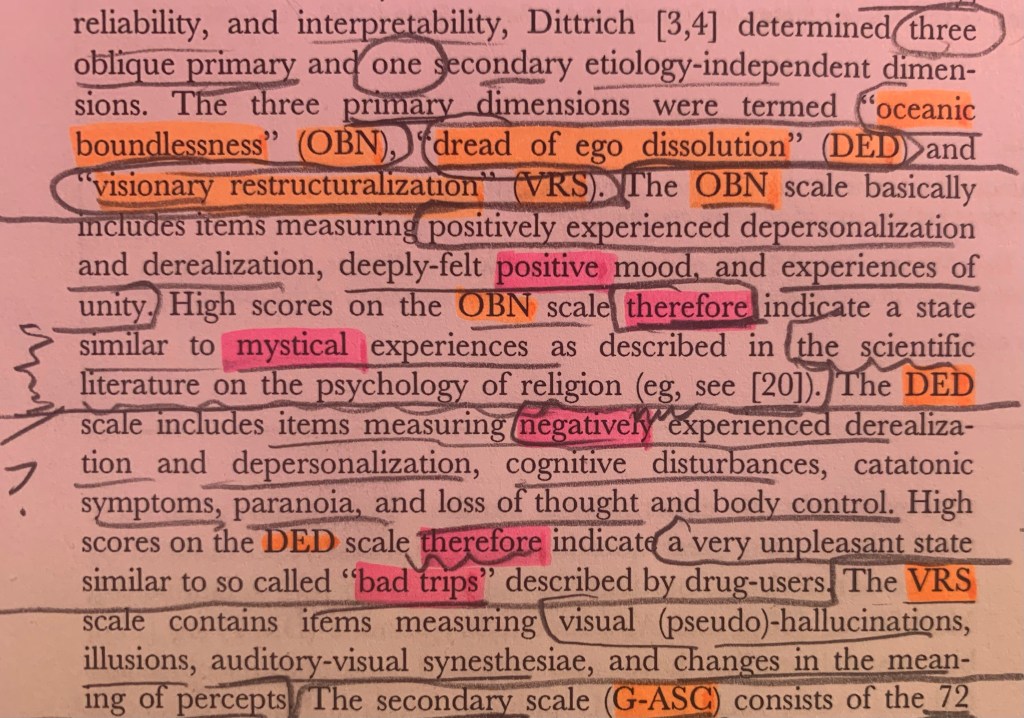
Proposes 11 dimensions for the OAV or 5D-ASC:
Studerus E, Gamma A and Vollenweider FX (2010)
Psychometric evaluation of the altered states of consciousness rating scale (OAV)
https://www.ncbi.nlm.nih.gov/pmc/articles/PMC2930851/
What categ do these SOCQ q’s go in?:
66. Frustrating attempt to control the experience.
28. trapped and helpless
Walter Stace 1961 Categories of Mystical Experiences
url https://egodeaththeory.wordpress.com/2022/12/23/socq-states-of-consciousness-questionnaire/
The foundation of sand for Psychedelic Psychometric Science.
⌛️
Stace’s List of Mystical Effects Doesn’t Match the Reported Mystics’ Data Archive; Provides an Unscientific Basis for Questionnaires, Failing to Account for Challenging Experiences
Charles Stang & Cybermonk Refute that Stace’s List of Mystical Effects Matches the Scientific Archive Base of Data Reported by Mystics – Stace’s List Unscientifically Omits Challenging Experiences
Ocean of Dread Vision
One of Studerus’ categories of effects questions is ICC – Impaired Control and Cognition, which is the essence of the OAV legacy broad category/dimension, DED – Dread of Ego Dissolution.
Forget Studerus’ categories. Use the Egodeath theory’s categories of Core Concepts instead.
They say “we match the scientific(!) basis of our understanding of mysticism effects, provided by Walter Stace 1960/1961.”
Walter Stace 1961 = “the scientific data about what mystic effects are” and “we match that scientific data”.
But the FACTS/reality of mystic effects contradict Griffiths & Studerus’ EXPECTATIONS and presumptions about mystic effects – not the “scientific facts about the nature and character of mystic effects per Stace”.
Stace’s list of mystic effects is given as an example of “the scientific literature on the psychology of religion”:
High scores on the OBN [Oceanic Boundlessness] scale therefore indicate a state similar to mystical experiences as described in the scientific literature on the psychology of religion (eg, see [20]).
20. Stace WT (1961) Mysticism and philosophy. London, England: Macmillan.
Studerus 2010 p. 2 left column 2/3 down
I keep seeing the name Walter Stace 1961, though there are other lists of mystical effects, but Stace’s list seems to be the soggy foundation that these questionnaires are using to define what they imagine & fantasize mystical effects to be.
Stace’s foundation for the Science of Psychedelic Psychometrics:
🦄💨🌈
Griffiths’ model fails to match the gathered scientific base of mystics’ reported data, says Professor Stang.

 The Egodeath theory