Contents:
- Need URL for Dittrich 1994 OAV or 2006/2010 5D-ASC Questionnaire Spec
- Found Major Basic Counting Errors and Academic Research Errors in both Griffiths’ CEQ Article and Studerus’ 11-Factor Article: How Question 54 Got Foolishly Dropped
- Key Question: How Many Effects/Questions Are in Dittrich’s 1994 or 2006 “Dread of Ego Dissolution” Dimension?
- Griffiths Doesn’t Start from the Full Set of Dittrich’s 17 “Dread” Questions, but Is Working only with Studerus’ Culled Subset of 13 ICC+ANX Questions
- Hypothesis: Griffiths Failed to Go to the Source, Dittrich’s Articles, but Relied on Studerus 2010 Article, Which in Figure 1 Entirely Removed Question 54 and 6 others from Dittrich’s OAV Dimensions (Figure S1 Tree Hierarchy)
- More Errors: Studerus 2010 p. 8 End Omits 2 Questions (61 & 62)
- More Errors: Studerus 2010 p. 8 Gets Count of Tree’s Factor Member Items Wrong (It’s 49, not 47)
- References
- New Database Article about the Altered States Database (ASDB), a WordPress-Powered Database Site
- Studerus’ Email Address
Need URL for Dittrich 1994 OAV or 2006/2010 5D-ASC Questionnaire Spec
We don’t have Science, but we have black magic, until someone can give me two URLs: I need to click the URLs and see the list in English of the 4 dimensions or 6 dimensions and which questions are in each dimension.
Includes G-ASC General dimension.
Includes question 54, “I was afraid to lose my self-control”.
Best bet: What is the URL for:
Dittrich A, Lamparter D and Maurer M
2010
5D-ASC: Questionnaire for the Assessment Of Altered States of Consciousness. A Short Introduction.
Zürich, Switzerland: PSIN PLUS.
Take heart: I’m starting to suspect that Griffiths couldn’t get ahold of the real Dittrich questionnaire specs either, but worked off the more obtainable corrupted, shrunken, stunted, final result from Studerus.
Studerus’ ICC+ANX factor categories are smaller by 4 effects questions than Dittrich’s Dread dimension.
The 11-Factor Studerus questionnaire might be smaller by 7 effects questions than the Dittrich OAV questionnaire.
Found Major Basic Counting Errors and Academic Research Errors in both Griffiths’ CEQ Article and Studerus’ 11-Factor Article: How Question 54 Got Foolishly Dropped
omg 8:30 pm Dec 27 2022 I just found ANOTHER clue and a mistake: it’s 17, not 13! Griffiths 2016 page 4 right column.
Make that, a whole nest of interconnected mistakes in Studerus, and then in Griffiths.
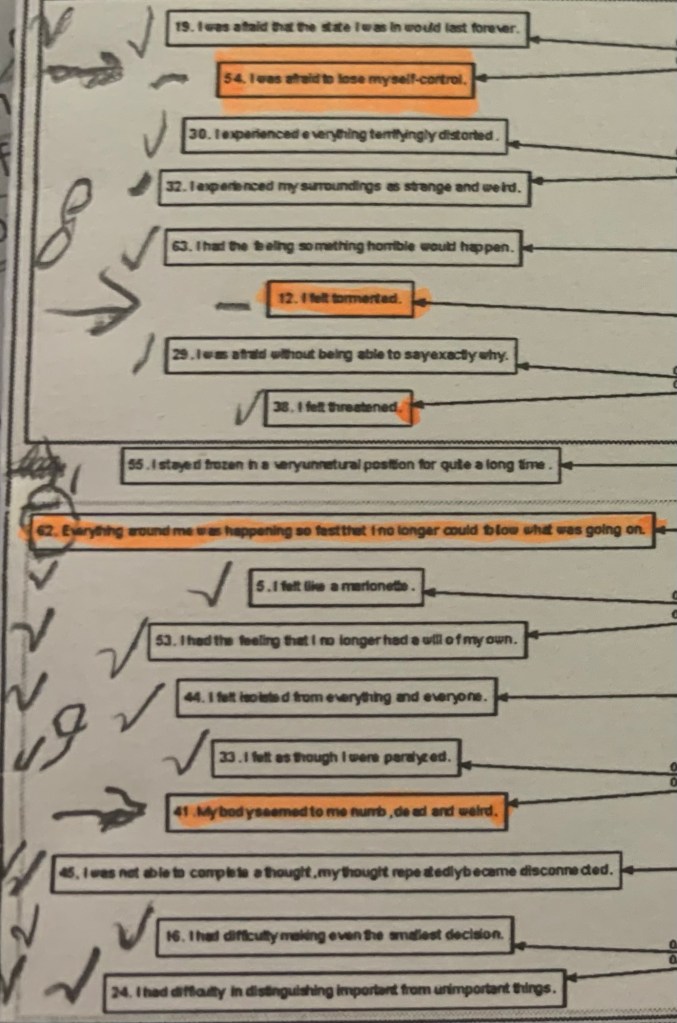
Figure S1 – tree hierarchy:
Studerus’ 8 (not 6) Anxiety effects questions initially copied from
Dittrich’s “Angst of/ Dread of Ego Dissolution” (AED/DED) dimension, and
9 (not 7) “Impaired control and cognition” effects questions initially copied from Dittrich’s “Dread” dimension.
Ignore the “1” item in between, from Dittrich’s G-ASC General dimension.
Counting & addition skills contributed by Cybermonk, Christmas 2022
Marked in orange above – just like the Default Mode Network part of the brain – here are the four “Angst of/ Dread of Ego Dissolution” questions that were dropped by Studerus in the final version of their 11-Factor revision of Dittrich’s OAV/ 5D-ASC questionnaire:
#54. I was afraid to lose my self-control.
#12. I felt tormented.
#62. Everything around me was happening so fast that I could no longer follow what was going on.
#41. My body seemed to me numb, dead and weird.
For example, those questions are missing from Studerus page 9 Figure 1 (final factors’/ categories’ questions), which Griffiths likely worked off of as a starting point to try to represent Dittrich’s “Angst/Dread” dimension questions – after Studerus had already removed 24% of the Dread questions.
Erich Studerus, Alex Gamma, Franz X. Vollenweider
2010
Psychometric evaluation of the altered states of consciousness rating scale (OAV)
https://www.ncbi.nlm.nih.gov/pmc/articles/PMC2930851/
SEE Figure S1 tree hierarchy diagram:
https://www.ncbi.nlm.nih.gov/pmc/articles/PMC2930851/bin/pone.0012412.s001.pdf
I have now managed to deduce and explain how, incredibly, the key question got dropped, question 54, “I was afraid to lose my self-control.”
I found who removed it, when, and why, and how Griffiths failed to see this question when picking questions from 3 questionnaires to form his Initial Item Pool.
That’s distinct from explaining Griffiths’ insanely aggressive reduction from 66 to 24 items when defining the final CEQ. “Since I’m adding a bunch of negative questions, which Studerus won’t like, I better remove 10 of Studerus’ 13 questions.”
The “13” effect questions are those that remain from the 17 questions in Dittrich’s Dread dimension, but Griffiths is only aware of the 13 subset, not the 17 full set, because Griffiths isn’t working from Dittrich’s source specs, but from the downstream final result after Studerus has already whittled-down the Dread questions.
The 13 items of the 5DASC[sic; 5D-ASC] that constitute the [final version of the] ICC and ANX sub-scales were retained for the initial item pool for the CEQ.
Griffiths 2016 page 4 right column.
“The 13 [not 17???] items [questions] of the 5DASC [5D-ASC] that constitute the [final] ICC and ANX sub-scales [sub-categories of psychedelics effects questions] were retained for the initial item pool [of 64 challenging-effects questions from 3 questionnaires (5D, SOCQ, HRS)] for the CEQ.” – Griffiths 2016 CEQ article.
Key Question: How Many Effects/Questions Are in Dittrich’s 1994 or 2006 “Dread of Ego Dissolution” Dimension?
You can handle a simple count question, right, Griffiths? right, Johns Hopkins?
But you counted wrong, from the wrong, downstream, corrupted, modified subset of the Dread dimension’s questions!
Griffiths says Dread — known as the “bad-trip” sub-scale – has 13 questions.
But actually, per Studerus end of page 8 + Figure S1, it’s evident that (after correcting Studerus’ own mistakes in basic counting) Dread — before Studerus reduced it, has 17 effects/ questions, not just 13.
And one of the questions that got dropped along the way (to improve the psychometrics math to give a better fit by removing cross-category and ambiguous effects questions), is #54: “I was afraid to lose my self-control.”
🤦♂️ 🙈
🏥 🍽 🐉
See Figure S1, count the questions in Anxiety (8) and in Impaired Control (9), which correspond to Dittrich’s “Dread/Anxiety of Ego Dissolution” dimension, the ‘A’ in “OAV”. 8+9= 17 effects question items, not 13. The four dropped Dread dimension items that Griffiths failed to consider adding to his Initial Item Pool are:
Anxiety:
54. I was afraid to lose my self-control.
12. I felt tormented.
Impaired Control and Cognition:
62. Everything around me was happening so fast that I could no longer follow what was going on.
41. My body seemed to me numb, dead and weird.
They Can’t Even Count! 😅
How many questions are in Dread dimension? 13 – or, 17?! It’s 17, not 13.
Griffiths Doesn’t Start from the Full Set of Dittrich’s 17 “Dread” Questions, but Is Working only with Studerus’ Culled Subset of 13 ICC+ANX Questions
Dittrichs’ actual Dread dimension contains 17 questions, which got arbitrarily reduced to 13 during Studerus’ forming the ICC+ANX subcategories that strive to REPLACE the Dread category.
Studerus removes questions during the course of subdividing categories! Not merely from the factor categories, but from the entire questionnaire!
Griffiths didn’t start from Dittrich’s full set of 17 Dread questions, or from Studerus’ Figure S1 which shows all 17 — he started from the bastardized, corrupted, trimmed-down by 24% subset (Studerus’ Figure 1, p. 9) of only 13 questions that Studerus retained from Dittrich’s Dread dimension.
So, Griffiths looks at the questions in the final “factor” categories after Studerus is done removing all 17 General G-ASC questions and removing 7 of the Dimension questions, including removing 4 of the ICC+ANX questions (now forming a subset of the Dread dimension’s questions) and picks from only that set of 42 questions that end up remaining in the shrunken Studerus factor categories, NOT starting from the full set of Dittrich’s 17 Dread questions or 49 total questions, when picking questions for Griffiths’ Initial Item Pool.
There should have been at least 67, not 66 questions, in Griffiths’ Initial Item Pool: add back in the key Question 54 which Studerus removed.
Question for Studerus: What happens to the 7 – which you wrongly count as 5 – factor-member items which you remove? Do they leave the questionnaire or do they get moved to the General dimension?
🦗 🦗
You removed the 7 questions from the 11-Factor version of Dittrich’s questionnaire entirely, didn’t you?
End of Studerus 2010 page 8: “the dropped items (# 12, 39, 41, 48, and 54)” – you mean, “the dropped items (# 12, 39, 41, 48, 54, 61, and 62)”.
Studerus, where did you put these 7 (not 5) effects questions that you dropped – are you entirely removing Dittrich’s standard questions from your version of his questionnaire? Did you MOVE them to G-ASC General dimension, or did you put them in Wouter Hanegraaff’s Rejected wastebasket?
🐉 –> 🗑
So, since Griffiths only drew questions from the Dread dimension – or worse, only from the shrunken-by-4 ICC + ANX factors that Dread was broken into, Griffiths only pulled from Studerus’ final 13 ICC+ANX factor questions, NOT from Dittrich’s 17 Dread questions.
Notice the slop in Griffiths’ wording, next to his typo “5DASC”:
“The 13 items of the 5DASC that constitute the ICC and ANX sub-scales were retained for the initial item pool for the CEQ.”
should read:
“The 17 items of the 5D-ASC questionnaire’s Dread of Ego Dissolution (DED) dimension, from which Studerus’ 13 items in Studerus’ final version of the ICC and ANX sub-scales were drawn, were retained for the initial item pool for the CEQ.”
or, should have written:
“The 13 out of 17 items of the 5D-ASC that constitute Studerus’ final ICC and ANX sub-scales were retained for the initial item pool for the CEQ.”
Griffiths 2016 page 4 right column.
But Griffiths failed to Go To The Sources, so he missed considering 4 of Dittrich’s Dread questions, when picking questions from 3 questionnaires for the Initial Item Pool – that’s how Griffiths failed to include Dittrichs’ item “54: I was afraid to lose my self-control.”
Studerus doesn’t MOVE the 7 questions from factor categories into the G-ASC General category – Studerus REMOVES ENTIRELY the 7 “dropped items”.
Either way, Griffiths wouldn’t see them, since Griffiths only drew questions from the ICC & ANX Studerus factor categories – not directly from Dittrich’s upstream complete Dread dimension, nor from Studerus’ General G-ASC questions.
Regardless of whether Studerus removed the 7 questions or moved them to General, either way, Griffiths wouldn’t see them.
Griffiths needed to start from Studerus’ Figure S1 tree hierarchy, which was still faithful to Dittrich’s Dread category, or start from Dittrich’s mythological 1994 OAV or 2006/2010 5D-ASC articles which don’t actually exist, and are the authoritative sources.
I don’t think Griffiths has Dittrich’s OAV but he’s using a corrupted subset provided by Studerus, which is easier to get than Dittrich’s nonexistent, mythological articles.
ICC = impaired control and cognition, a “factor” broken out from Dittrich’s “Anxiety/Dread of ego dissolution” dimension by Studerus 2010.
ANX = anxiety, a “factor” (category of effects questions) broken out from Dittrich’s “Anxiety/Dread of ego dissolution” dimension by Studerus 2010.
Studerus 2010 in one figure, only, the Figure S1 tree hierarchy, shows not 13 questions but 17, including THE question, #54.
There, only, Studerus lists not 6 questions in the Anxiety factor (category), but 8 (?!) questions, including THE question, 54, “I was afraid to lose my self-control”.
Where did this question 54 come from or go to? Does the question exist, or not?
Evidently Griffiths didn’t have that question when picking the Initial Pool of 64 questions from 3 questionnaires.
2nd best: give me URLs for German language original Dittrich articles 1994 and 2006.
The 2006 article’s English translation is Dittrich 2010, subtitled like “Short Intro to 5D-ASC”. I couldn’t find it.
It’s 2022, and these “scientific” articles are impossible to find on the World-Wide Web.
Hypothesis: Griffiths Failed to Go to the Source, Dittrich’s Articles, but Relied on Studerus 2010 Article, Which in Figure 1 Entirely Removed Question 54 and 6 others from Dittrich’s OAV Dimensions (Figure S1 Tree Hierarchy)
I’ve found/ identified/ collected about 10 errors now in Griffiths 2016 & Studerus 2010, which support this hypothesis.
If Griffiths had made his initial item pool of “66” questions by pulling from Dittrich’s ACTUAL OAV 1994 questions or from Dittrich’s three OAV dimensions of 5D-ASC 2006 (German)/ 2010 (English), then given the decent judgment that Griffiths shows during making the initial item pool, Griffiths would certainly have included OAV question 54, “I was afraid to lose my self-control.”
I propose that Griffiths did not work off Dittrich’s 1994 or 2006/2010 document, questionnaire spec’n, and didn’t work off of Figure S1 which Studerus said was preliminary, but rather, Griffiths drew from only the final OAV questions that Studerus included in page 9 Figure 1.
Griffiths, given that you brag about your whole objecting being to define a questionnaire that focuses only on, and focuses on all of, the challenging psychedelics effects, don’t you think you should have picked your Initial Item Pool questions from all 17 of Dittrich’s Dread dimension items, rather than merely starting from “all 13” of Studerus’ ICC+ANX items that remained after Studerous had already discarded 4 out of Dittrich’s 17 effects items (24%)?
If Griffiths had drawn from the lists of questions from Dittrich 1994 or 2006/2010, or had drawn from Studerus’ Figure S1 tree hierarchy, then Griffiths would have included in the initial item pool not “all 13 ” but rather ALL 17 questions that are actually – I glean – in the 1994 or 2006/2010 “Dread of Ego Dissolution (DED)” aka “Anxious Ego Dissolution (AED)” dimension.
Dittrich A, Lamparter D and Maurer M
2010
5D-ASC: Questionnaire for the Assessment Of Altered States of Consciousness. A Short Introduction.
Zürich, Switzerland: PSIN PLUS.
The 13[sic; 17] items of the 5DASC that constitute the ICC and ANX sub-scales were retained for the initial item pool for the CEQ.
Griffiths 2016 page 4 right column.
More Errors: Studerus 2010 p. 8 End Omits 2 Questions (61 & 62)
The list of 5 removed category questions at end of page 8 is wrong, it should list 7 removed items, including #61 in “Bliss” and #62 in ICC factors/ categories:
“Because the dropped items (# 12, 39, 41, 48, and 54) had been …”
should read:
“Because the dropped items (# 12, 39, 41, 48, 54, 61, and 62) had been …”
That’s regarding foolishly removing the all-important question 54: “I was afraid to lose my self-control.”
More Errors: Studerus 2010 p. 8 Gets Count of Tree’s Factor Member Items Wrong (It’s 49, not 47)
“The model revision led to a final model that still contained the same number of factors, but a slightly lower number of items (42 instead of 47).”
is wrong, should read:
“The model revision led to a final model that still contained the same number of factors, but a slightly lower number of items (42 instead of 49).”
Paragraph Containing Those Errors
Studerus 2010 page 8 end:
“By applying the criteria defined in the method section, 11 item clusters formed from 47[sic; 49] of the 66 original items were detected and used for initial CFA model specification.
“The ICLUST tree diagram and the item clusters that were used for the initial CFA model are shown in Fig. S1 (for the ICLUST tree diagram based on the categorized variables see Fig. S2).
“As the model fit of the initial CFA model was not sufficient according to the CFI and TLI indexes (see Table 2), we tried to improve model fit by dropping items [eg. question 54] showing large modification indexes for cross-loadings and ambiguous item wordings.”
[Why did you remove specifically question 54: “I was afraid to lose my self-control”?
Did you think it cross-loaded and fit into multiple of your 11 “factor” categories?
Did you think it was ambiguous?]
“The model revision led to a final model that still contained the same number of factors, but a slightly lower number of items (42 instead of 47[sic; 49]).
“Because the dropped items (# 12, 39, 41, 48, and 54[sic; 54, 61, and 62]) had been mostly assigned to different factors, the model revision did not lead to a major change in the interpretation of any factor.”
(all we did was merely improve the psychedelic effects by removing effect question 54: “I was afraid to lose my self-control” — NO BIG DEAL)
“Figure 1 [p. 9; not Figure S1 tree hierarchy] shows the factorial structure of the final model, including the [final] names that we gave to the 11 factors and the fully standardized loadings and error variances.
“The correlations between the latent factors as well as their associations with the original OAV scales are shown in Table 3.
“Although the CFI and TLI of this final CFA model were still slightly below the recommend cutoffs, the RMSEA and the SRMR indicated excellent model fit (see Table 2).”
All we had to do to accomplish this excellent model fit into our Procrustean bed was remove 7 questions, including #54: I was afraid to lose my self-control. 👍
🚫🐉
References
Griffiths 2016 CEQ article
Griffiths’ CEQ article; the article that develops and presents the CEQ:
The Challenging Experience Questionnaire: Characterization of challenging experiences with psilocybin mushrooms
https://www.academia.edu/33760114/The_Challenging_Experience_Questionnaire_Characterization_of_challenging_experiences_with_psilocybin_mushrooms
Frederick Barrett, Matthew Bradstreet, Jeannie-Marie Leoutsakos, Matthew Johnson, Roland Griffiths
2016
Studerus 2010 article breaking 3 dimensions into 11 factors
Studerus 2010 article breaking 3 “dimensions” (ignoring General) into 11 “factors”: Oceanic into 4, Anxiety/Dread into 2, Visionary into 5.
Proposes 11 dimensions for the OAV or 5D-ASC (ignoring 2 later dimensions not relevant). Shows 17 q’s in Dread dimension, question 54 is in Studerus’ Anxiety sub-category of Dittrich’s Anxiety/Dread dimension.
Fig S1 shows q 54 I was afraid to lose my self-control. Fig 1 lacks q54, and shows only 13 q’s in Dread dimension.
Erich Studerus, Alex Gamma, Franz X. Vollenweider
2010
Psychometric evaluation of the altered states of consciousness rating scale (OAV)
https://www.ncbi.nlm.nih.gov/pmc/articles/PMC2930851/
SEE Figure S1 tree hierarchy diagram:
https://www.ncbi.nlm.nih.gov/pmc/articles/PMC2930851/bin/pone.0012412.s001.pdf
This tree diagram Figure S1 is THE BEST VIEW OF THE OAV QUESTIONS WITHIN CATEGORIES I’ve found so far, and general G-ASC questions as well.
In that diagram, you have to know that:
“Unpleasant” = the Dread dimension of Dittrich’s OAV, and that
“Pleasant” = the Ocean & Visionary dimensions of Dittrich’s OAV.
Ocean was broken into 4 factors, and,
Visionary broken into 5 factors, by Studerus.
Dittrich 1994 OAV specification in German
Bodmer I, Dittrich A, Lamparter D
1994
Aussergewo¨hnliche Bewusstseinszusta¨nde – Ihre gemeinsame Struktur und Messung
[Altered states of consciousness – Their common structure and assessment]
In: Hofmann A, Leuner H, eds. Welten des Bewusstseins. Bd. 3, Experimentelle Psychologie, Neurobiologie und Chemie.
Berlin, Germany: VWB. pp 45–58.
Worlds of Consciousness
Bodmer, I., Dittrich, A. & Lamparter, D. in Welten des Bewusstseins. Bd. 3 (eds. Hofmann, A. & Leuner, H.) 45–58 (Experimentelle Psychologie, Neurobiologie und Chemie., 1994).
Welten des Bewußtseins, Bd.3 – https://www.amazon.de/-/en/Adolf-Dittrich/dp/3861354020/
Band 2 (1993):
url https://www.amazon.de/-/en/Adolf-Dittrich/dp/3861354012
Dittrich 1996
Dittrich, A
1996
A¨tiologie-unabha¨ngige Strukturen vera¨ nderter Wachbewusstseinszusta ¨nde.Ergebnisse empirischer Untersuchungen u¨ber Halluzinogene I. und II. Ordnung, sensorische Deprivation, hypnagoge Zusta¨nde, hypnotische Verfahren sowie Reizu¨berflutung
[Etiology-independent structures of altered states of consciousness. Results of empirical studies on hallucinogens of the first and second order, sensory deprivation, hypnagogic states, hypnotic procedures, and sensory overload]. Berlin, Germany: VWB.
Dittrich 1994 OAV specification in English
Dittrich 2006 5D-ABZ specification in German
6. Dittrich, A, Lamparter, D, Maurer, M (2006)
5D-ABZ: Fragebogen zur Erfassung Aussergewo¨hnlicher Bewusstseinszusta¨nde. Eine kurze Einfu¨hrung
[5D-ASC: Questionnaire for the assessment of altered states of consciousness. A short introduction]. Zurich, Switzerland: PSIN PLUS.
ScienceOpen has a bare entry:
url https://www.scienceopen.com/document?vid=5c0a44be-3de4-42e3-b197-f835f9b724d4 –
5D-ABZ: Fragebogen zur Erfassung Aussergewhnlicher Bewusstseinszustnde. Eine kurze Einfhrung
[5D-ASC: Questionnaire for the assessment of altered states of consciousness. A short introduction], volume 3rd ed
Author(s): V. DITTRICH, D Lamparter, M Maurer
Publication date: 2006
Dittrich, A., Lamparter, D., and Maurer, M. (2006).
5D-ABZ: Fragebogen zur Erfassung Aussergewöhnlicher Bewusstseinszustände. Eine kurze Einführung
[5D-ASC: Questionnaire for the Assessment of Altered States of Consciousness. A Short Introduction].
Zürich: PSIN PLUS Publications.
Dittrich, A., Lamparter, D. & Maurer, M. 5D-ABZ: Fragebogen zur Erfassung Aussergewöhnlicher Bewusstseinszustände. Eine kurze Einführung [5D-ASC: Questionnaire for the assessment of altered states of consciousness. A short introduction]. (2006).
WANTED: Dittrich 2010 English article “5D-ASC … A Short Introduction”
Dittrich A, Lamparter D and Maurer M
2010
5D-ASC: Questionnaire for the Assessment Of Altered States of Consciousness. A Short Introduction.
Zürich, Switzerland: PSIN PLUS.
This is the #1 article to find, this English translation by Dittrich of the 2006 original German article by Dittrich.
This is merely a derivative subset, questions only; no dimensions specified: https://www.researchgate.net/file.PostFileLoader.html?id=562e5e0b6307d9997c8b45a4&assetKey=AS:288852905349121@1445879307530 – contains “79. I was afraid of losing control over myself.”
“Translation from the original German by Felix Hasler and Rael Cahn”.
That PDF has no Dimensions/ Factors/ categories of questions, and can’t trust the question numbering or wording.
I need the Dittrich English 2010 translation or even the German original 2006 article with the categories, and specific questions in the specific categories, including General (G-ASC) category/dimension — not some derivative questions-only subset that’s dubious. How did Hasler & Cahn obtain the 2006 German original article by Dittrich? Why didn’t they use Dittrich’s own English translation in 2010?
Impossible to find on the web. I couldn’t even find a trace of this article’s existence, in article databases – other than references to it in other articles.
Do you have to buy Dittrich dinner to get a personal, secret copy of this nonexistent, rumored, mythical “science” article?
Other Articles
url https://www.frontiersin.org/articles/10.3389/fpsyg.2018.01028/full – Lists:
Dittrich, A. (1975). Zusammenstellung eines Fragebogens (APZ) zur Erfassung abnormer psychischer Zustände [Construction of a questionnaire (APZ) for assessing abnormal mental states]. Z. Klin. Psychol. Psychiatr. Psychother. 23, 12–20.
Dittrich, A. (1985). Ätiologie-unabhängige Strukturen veränderter Wachbewusstseinszustände. Stuttgart: Enke.
Dittrich, A., Lamparter, D., and Maurer, M. (2006).
5D-ABZ: Fragebogen zur Erfassung Aussergewöhnlicher Bewusstseinszustände. Eine kurze Einführung
[5D-ASC: Questionnaire for the Assessment of Altered States of Consciousness. A Short Introduction].
Zürich: PSIN PLUS Publications.
Dittrich, A., Lamparter, D., and Maurer, M. (2010).
5D-ASC: Questionnaire for the Assessment of Altered States of Consciousness. A Short Introduction 3rd Edn. note 3rd Edn
Zürich: PSIN PLUS.
Human Hallucinogen Research: Guidelines for Safety (Griffiths)
https://egodeaththeory.wordpress.com/2022/12/19/human-hallucinogen-research-guidelines-for-safety-griffiths/
Original APZ Dittrich spec:
Dittrich A (1975) Zusammenstellung eines fragebogens (APZ) zur erfassung abnormer psychischer zustände [Construction of a questionnaire (APZ) for assessing abnormal mental states]. Z Klin Psychol Psychiatr Psychother 23: 12–20.
English article about the 1994 OAV:
Dittrich A (1998) The standardized psychometric assessment of altered states of consciousness (ASCs) in humans. Pharmacopsychiatry 31: 80–84.
https://pubmed.ncbi.nlm.nih.gov/9754838/ – “full text” link goes to:
https://www.thieme-connect.com/products/ejournals/abstract/10.1055/s-2007-979351 – which has PDF, requires registering, maybe payment.
Abstract:
“The APZ questionnaire was developed in order to explore hypotheses on ASCs.
“First – in a series of 11 experiments using different induction methods on N = 393 healthy subjects – the hypothesis was tested that ASCs have major dimensions in common irrespective of the mode of their induction.
“In the International Study on Altered States of Consciousness (ISASC) the external validity of the experimental results was assessed.
“The ISASC was carried out on a total of N = 1133 subjects in six countries. The main results of the experimental studies were corroborated in the field studies. The results can be summarized as follows: the common denominator of ASCs is described by three oblique dimensions, designated as
“Oceanic Boundlessness (OSE)”,
“Dread of Ego Dissolution (AIA)” [DED, or Anxious Ego Dissolution (AED)] and
“Visionary Restructuralization (VUS)”.
“The reliability and validity of the scales are satisfactory. Tested versions of the APZ scales are available in English (UK, USA), German, Italian and Portuguese. Psychometrically as yet untested versions exist in Dutch, Finnish, French, Creek, Spanish and Russian.
“The APZ questionnaire has become the international standard for the assessment of ASCs, thus helping to integrate research.
“A psychometrically improved version exists in German (OAV questionnaire). ”
“Psychometrically Improved”
from 😱🐉 to 🦄🌈
Translation: “psychometrically improved” = we puffed up the Ocean & Visionary unicorns & rainbows categories to try to give the false impression that they contain as many questions as the too-dominant Dread dragon effects category.
DON’T CARE, LOSING FOCUS, LOST THE PLOT:
“The BETA questionnaire, which measures the dimensions “Vigilance Reduction (VIR)” and “Auditive Alteration (AVE)” is also available in German. These dimensions are most likely etiology-dependent.”
Another entry for Dittrich’s 1998 article about 1994 OAV questionnaire:
https://psycnet.apa.org/record/1998-06236-004
Dittrich, A. (1998). The standardized psychometric assessment of altered states of consciousness (ASCs) in humans. Pharmacopsychiatry, 31(Suppl 2), 80–84. https://doi.org/10.1055/s-2007-979351
Again, has PDF, requires registering, maybe payment.
1. Dittrich A (1998) The standardized psychometric assessment of altered states of consciousness (ASCs) in humans. Pharmacopsychiatry 31: 80–84. 10.1055/s- 2007-979351.
From Studerus 2010 References
The original 1975 APZ:
2. Dittrich A (1975) Zusammenstellung eines Fragebogens (APZ) zur Erfassung abnormer psychischer Zusta¨nde
[Construction of a questionnaire (APZ) for assessing abnormal mental states]. Z Klin Psychol Psychiatr Psychother 23: 12–20.
Identifies the 1975 initial inadequate O, A, V dimensions w/ too few questions:
3. Dittrich A (1985) A ¨ tiologie-unabha¨ngige Strukturen vera¨nderter Wachbewusstseinszusta ¨nde. Ergebnisse empirischer Untersuchungen u¨ber Halluzinogene I. und II. Ordnung, sensorische Deprivation, hypnagoge Zusta¨nde, hypnotische Verfahren sowie Reizu¨berflutung [Etiology-independent structures of altered states of consciousness. Results of empirical studies on hallucinogens of the first and second order, sensory deprivation, hypnagogic states, hypnotic procedures, and sensory overload]. Stuttgart, Germany: Enke.
New Database Article about the Altered States Database (ASDB), a WordPress-Powered Database Site
This article and db WordPress site could have leads. It names the 11 factor scheme. But there I found plain-text citations, only, for Dittrichs’ questionnaire specification publications.
url https://www.nature.com/articles/s41597-022-01822-4
“In this paper, we present the development of the Altered States Database (ASDB), an open-science project based on a systematic literature review.
“The ASDB contains psychometric questionnaire data on subjective experiences of altered states of consciousness (ASC) induced by pharmacological and non-pharmacological methods.
“The systematic review follows the Preferred Reporting Items for Systematic Reviews and Meta-Analyses (PRISMA) guidelines.
“Scientific journal articles were identified through PubMed and Web of Science.
“We included studies that examined ASC using the following validated questionnaires:
Altered States of Consciousness Rating Scale (APZ, 5D-ASC, 11-ASC),
Phenomenology of Consciousness Inventory (PCI),
Hallucinogen Rating Scale (HRS), or
Mystical Experience Questionnaire (MEQ30). [SOCQ contains MEQ43 which is older]
“The systematic review resulted in the inclusion of a total of 165 journal articles, whereof questionnaire data was extracted and is now available on the Open Science Framework (OSF) website (https://osf.io/8mbru) and on the ASDB website (http://alteredstatesdb.org), where questionnaire data can be easily retrieved and visualized.
“This data allows the calculation of comparable psychometric values of ASC experiences and of dose-response relationships of substances inducing ASC.”
“11-ASC” must mean Studerus 2010.
It’s odd that they don’t even mention OAV, before 5D-ASC.
APZ 1975,
OAV 1994,
5D-ASC 2006 (English 2010),
11-ASC 2010.
Their db Info/FAQ page lists:
url http://alteredstatesdb.org/faq/
“Here is some general information on the questionnaires including the origianl[sic] references for further details:
APZ(3D)
5D-ASC(3D-OAV+2D)
5D-ASC (11D + 2D)
HRS
MEQ30
PCI
Those are expanders.
“5D-ASC(3D-OAV+2D) … a total of 94 items” (questions) but no one wants the questions that are in the useless new dimensions “Auditory” and “Reduced Vigilance” – subtract those, to get 72? Unfortunately here they skip over the 1994 OAV.
The expander sections contain some info I wanted: German acronyms:
“Oceanic Boundlesness (OBN): Items (e.g. I had the feeling everything around me was somehow unreal; The boundary between myself and my surroundings seemed to blur; I felt totally free and released from all responsibilities. ) clustered in the OBN dimension measure the positive symptoms of dissolution of boundaries between self and surroundings. In general, they describe common states that can be compared to a mystical experience.
GERMAN: Ozeanische Selbstentgrenzung (OSE).
“Dread of Ego Dissolution (DED): Items (e.g. I had difficulty in distinguishing important from unimportant things; My thinking was constantly being interrupted by insignificant thoughts; My own feelings seemed strange to me, as though they did not belong to me. ) clustered in the DED dimension measure the negative symptoms of dissolution of boundaries between self and surroundings. The common state depicted by this list of items can be interpreted as an experience of depersonalization. Alternative naming:
Anxious Ego Dissolution (AED),
[an ‘A’ acronym is nice instead of ‘D’ bc part of acronym OAV]
GERMAN: Angstvolle Ichauflösung (AIA)
“Visual restructuralization (VRS): Items (e.g. I saw lights or flashes of light in total darkness or with closed eyes; I saw scenes rolling by like in a film in total darkness or with my eyes closed; Objects around me engaged me emotionally much more than usual.) clustered in the VRS dimension measure both changes in perception as well as in imagination.
GERMAN: Visionäre Umstrukturierung (VUS)
Studerus’ Email Address
In Studerus 2010: erich.studerus bli.uzh.ch
Pls give me Dittrich 2010 pdf thx

 The Egodeath theory