Michael Hoffman, December 28, 2022 9:21 am UTC+0
Contents:
- Update Jan. 2: Initial Item Pool Reduced from 64 to 24 Because CEQ Must Have Fewer Negative Effects than MEQ’s 30 Positive Effects
- Update Dec. 30: Studerus Didn’t Delete Questions
- Phase 1: Dittrich’s 1994/2006 List of 21 Angst/Dread Dimension Effects
- Phase 2: Studerus’ 2010 List of 13 Impaired Control and Cognition (ICC) & Anxiety (ANX) Effects
- Phase 3: Griffiths’ 2016 List of 3 Effects from Studerus’ ICC+ANX Categories
- Why Griffiths Needed the Final CEQ to Have Greater than 21 and Fewer than 30 Negative/ Non-mystical Psychedelic Effects
- The Progressive Story of Inflating the Positive Effects and Removing Negative Effects
- Selling Covering a Superset, But Delivering Merely a Shift of Which Subset Is Covered
- Not Believable that Griffiths Started from Dittrich’s Full Angst/ Dread Dimension’s 21 Questions
- References
Update Jan. 2: Initial Item Pool Reduced from 64 to 24 Because CEQ Must Have Fewer Negative Effects than MEQ’s 30 Positive Effects
CEQ is the repressed counterpart and complement of the positive MEQ. We were un-strategic in the MEQ/SOCQ lineage when we reduced 43 positive therefore Mystical effects to just 30, what were we thinking?! We should have done like in the APZ lineage: at every step, in each version of the linege, we must increase the counts of positive (therefore Mystical) psychedelic effects (at every level), and reduce the counts of negative (therefore non-Mystical) psychedelics effects (as counted at every level).
In each version of the lineage, we must come up with counts of negative psychedelics effects or effects categories that are lower than the counts of positive psychedelics effects or effects categories.
I must go back to
Professor Dittrich on October 26, 1985 finds that the 158-item APZ contains positive effects in Oceanic & Visionary categories and negative effects in the Angst/ Dread category.
APZ has 158 items. Source: Studerus 2010 p. 2 left.
But there’s a problem revealed in 1985, than we need to engineer a solution for: unfortunately, we’ve determined that in the 1975 APZ set of 158 effects questions, there are too few positive effects (O & V), and too many negative effects (A).
So remedy and cure that ailment in the APZ instrument by padding out the O and V categories and reducing the A items, forming the 1994 new technology: OAV questionnaire: psychedelics have now been re-engineered with more positive effects and fewer negative effects! 🎉
There are 158 APZ questions: Source: Studerus 2010 p. 2 left. https://egodeaththeory.wordpress.com/2022/12/23/5d-asc-five-dimensional-altered-states-of-consciousness-questionnaire/#APZ-History
Over in Griffiths’ MEQ lineage (MEQ43, SOCQ, MEQ30), they went in the wrong direction: they reduced the number of positive/mystical effects from 43 to 30.
We’ll remedy our MEQ/SOCQ lineage by patching up a negative/non-mystical effects CEQ that’s marketed as casting a broad net (look at the broadest version of the APZ lineage: point to “5DASC”, which has 1 negative dimension and 4 positive dimensions), but that actually – in the end – casts a narrowing net on the negative/non-mystical experiences (only pay attention to the ICC and ANX mid-level categories, conflate 11-Factors’ mid-level categories with the entirety of 5D).
Start with the already attenuated subset of only 13 of the 21 of Dread effects (by playing into Studerus’ focus magic trick of pointing to the mid-level factor buckets and ignoring their high-level full-sized Unpleasant bucket).
We’ll aim to make the final number of negative/non-mystical effects 29 max – we have to make there be fewer negative/non-mystical effects questions than the 30 MEQ30 positive/mystical effects questions.
We’ll pretend to start with a fully wide Initial Item Pool (accidentally omitting 8 Dread questions though), and then for our final set of negative/non-mystical, CEQ questions, we’ll aim for 24, to be fewer than the 30 positive/mystical effects inventoried in our MEQ30.
We need to construct a set of negative/non-mystical effects that fits our psychedelic psychotherapy marketing plan.
Create a new Grief category. Make it bigger than other categories.
Make other conventional ordinary-state categories that fit and filter to our paradigm, such as Isolation.
Accept the Isolation question of the ICC category, to reify our Isolation category, as a token Dread item, and delete all other ICC questions that we made a temporary show of adding to give the impression of casting a wide, comprehensive net for our Initial Item Pool of the entire “5DASC” giant set of all effects.
For coverage of allegedly “5DASC”, Griffiths focuses on the mid-level 11-Factors categories instead of high-level indicates wilful incomprehension that’s advantageous to narrow the Dread effects.
Now that we’ve picked a subset of the subset of the full complete wide 5D, next we need to get rid of all Dread items.
Especially we can get rid of all ICC (Impaired Control) questions – they don’t fit our needs, we need categories like Fear, Grift- I mean Grief, and Isolation – not “Control” challenges.
We’ve got to get a set of 29 or fewer effects, and which effects should we, which undesirable, negative/non-mystical effects do we want to delete to achieve our goal of producing a set of psychotherapy categories?
We can lose all the Control / ICC questions – just keep Isolation, because we need to pad out our fabricated Isolation category by listing a single effect, the same identical Isolation question from all 3 questionnaires (“5DASC” – by which we mean only ICC+ANX – and SOCQ and HRS).
CEQ Misspells “5D-ASC”
Griffiths keeps making a typo, misspelling 5D-ASC: this indicates incomprehension.
count of “5DASC”: 30
count of “5-DASC”: 6
count of “5D-ASC”: 2
2 times out of 38 (5%), the Griffiths CEQ article correctly spells “5D-ASC”.
36 times out of 38 (95%), the Griffiths CEQ article misspells “5D-ASC” as “5DASC” or, sometimes, “5-DASC”.
Griffiths is constantly using scope-shifting tricks. Don’t say “OAV” even though that’s what Studerus says, change that to “5DASC” to give the impression of full, broader coverage than 5D-ASC – while actually only picking a tiny subset of 5D-ASC for the Initial Item Pool (not the 21 Dread items, but only the mid-level 11-Factors categories ICC and ANX but don’t point that out, and then only end up with 3 out of the 94 (3%) of the 5D-ASC items in the final CEQ.
The Carbonaro article bizarrely refrains from admitting/specifying which 11-Factor categories they picked.
They don’t seem to want to be forthright and come clean.
Griffiths & Carbonaro are cagey. They are posturing. They are doing spin.
Why does Griffiths CEQ article keep picking a couple 11-Factors categories, yet describe/ frame/ position/ sell themselves in terms of “5DASC”?
Because they want to give the impression of casting a broader net than 5D-ASC, not admit that they are leveraging and abusing 11-Factors by pretending that 11-Factors’ ICC+ANX factors (only 13 items) is the same complete scope as 5D-ASC (94 items) or Dread (21 items) or 11-Factors’ high-level category “Unpleasant Experiences” (same 21 items as Dread).
From CEQ article page 4: “The 5DASC[sic] consists of 94 items”
Update Dec. 30: Studerus Didn’t Delete Questions
Update, December 30, 2022:
Griffiths’ CEQ’s Mistakes, Not Studerus’ 11-Factors’ Mistakes, Omitting Most Challenging Experiences from Psychedelics Effects Questionnaire
https://egodeaththeory.wordpress.com/2022/12/30/griffiths-ceqs-mistakes-not-studerus-11-factors-mistakes-omitting-most-challenging-experiences-from-psychedelic-effects-questionnaire/
Studerus tries to not draw attention to their Unpleasant high-level category. They want people to notice only their subset, their 11 mid-level factors/categories (ignoring the 8 direct members of Unpleasant high-level category).
Griffiths is eager to oblige: look only at the mid-level factors’ items, ignore the non-factor-members, ignore the high-level categories (“Unpleasant Experiences” & “Pleasant Experiences”).
That gets rid of 8/21 = 38% of negative psychedelic effects right off the bat! It’s like a Magic party!
🎩🪄 🎉
Then to get rid of the rest of the negative psychedelic effects, aim for fewer negative/ non-mystical effects items than MEQ30’s positive/ mystical effects questions.
In the final culling to remove negative psychedelic effects to be fewer than the 30 MEQ positive/mystical psychedelic effects, only keep the challenging effects items that fit into our ordinary-state psychotherapy categories – especially our new Grief pet category we’re promoting.
Oh, turns out all the Control-challenges psychedelics effects got deleted 🤷♂️, well, good riddance, we didn’t need those excess negative effects for our psychedelic psychotherapy marketing plan anyway.
😱🐉🚪💎🏆 ➡️ 🗑
54. I was afraid to lose my self-control.
We kept a single, token ICC (Impaired Control) item: “I felt isolated”, since it fits our marketing plan’s Isolation category.
Phase 1: Dittrich’s 1994/2006 List of 21 Angst/Dread Dimension Effects
Update Dec. 30, 2022: This section should list all 21 Unpleasant aka Dread questions.
62. Everything around me was happening so fast that I could no longer follow what was going on.
41. My body seemed to me numb, dead and weird.
5. I felt like a marionette.
16. I had difficulty making even the smallest decision.
24. I had difficulty in distinguishing important from unimportant things.
33. I felt as though I were paralyzed.
44. I felt isolated from everything and everyone.
45. I was not able to complete a thought, my thought repeatedly became disconnected.
53. I had the feeling that I no longer had a will of my own.
54. I was afraid to lose my self-control.
12. I felt tormented.
19. I was afraid that the state I was in would last forever.
29. I was afraid without being able to say exactly why.
30. I experienced everything terrifyingly distorted.
32. I experienced my surroundings as strange and weird.
38. I felt threatened.
63. I had the feeling something horrible would happen.
+ 4 more questions
Phase 2: Studerus’ 2010 List of 13 Impaired Control and Cognition (ICC) & Anxiety (ANX) Effects
Update Dec. 30, 2022: This section should list all 21 Unpleasant aka Dread questions.
Update: Studerus didn’t delete any of the 21 questions from the Unpleasant aka Dread category. They merely dropped questions from their ANX & ICC subcategories of Unpleasant effects – but kept them in the Unpleasant high-level category.
62. Everything around me was happening so fast that I could no longer follow what was going on.41. My body seemed to me numb, dead and weird.
5. I felt like a marionette.
16. I had difficulty making even the smallest decision.
24. I had difficulty in distinguishing important from unimportant things.
33. I felt as though I were paralyzed.
44. I felt isolated from everything and everyone.
45. I was not able to complete a thought, my thought repeatedly became disconnected.
53. I had the feeling that I no longer had a will of my own.54. I was afraid to lose my self-control.12. I felt tormented.
19. I was afraid that the state I was in would last forever.
29. I was afraid without being able to say exactly why.
30. I experienced everything terrifyingly distorted.
32. I experienced my surroundings as strange and weird.
38. I felt threatened.
63. I had the feeling something horrible would happen.
There, we’ve done our part to get rid of (move attention off of) 4 out of 21 = 19% of negative psychedelic effects, in the course of innocently breaking up the 2 positive dimensions into 9 factors instead, and breaking up the 1 negative dimension into just 2 factors – thus reducing from 1/3 = 33% negative categories, to only 2/9 = 18% negative categories of psychedelic effects.
Phase 3: Griffiths’ 2016 List of 3 Effects from Studerus’ ICC+ANX Categories
Result: Removed 18 of 21 the Dread/ Unpleasant effects questions; 86%
Update Dec. 30, 2022: This section should list all 21 Unpleasant aka Dread questions.
62. Everything around me was happening so fast that I could no longer follow what was going on.41. My body seemed to me numb, dead and weird.5. I felt like a marionette.16. I had difficulty making even the smallest decision.24. I had difficulty in distinguishing important from unimportant things.33. I felt as though I were paralyzed.
44. I felt isolated from everything and everyone. 👍45. I was not able to complete a thought, my thought repeatedly became disconnected.53. I had the feeling that I no longer had a will of my own.54. I was afraid to lose my self-control.12. I felt tormented.
19. I was afraid that the state I was in would last forever. 👍29. I was afraid without being able to say exactly why.30. I experienced everything terrifyingly distorted.32. I experienced my surroundings as strange and weird.38. I felt threatened.
63. I had the feeling something horrible would happen. 👍
That’s more like it! We kept only 3/21 = 14% of the original negative psychedelic effects. We can sell this move as only getting rid of 3/13 = 23% of the original effects – compared to the (pre-shrunk) 11-factor scheme.
Now there’s room to add our preferred negative effects: Grief/ Sad/ Depressed, to sell our couch psychotherapy paradigm repair services, instead of the actual, problematic-for-us negative psychedelic effects — marionettes & suchlike that we can’t deal with.
Attach the standard blob of psychometrics math to our radical aggressive removal of all the major negative effects, and no one will be able to object to our unscientific, seat-of-the-pants, biased, gut judgment.
Draw attention to our many pages of listing our Initial Item Pool, before we deleted from 64 negative psychedelic effects down to just 24 (and then reluctantly re-added 2 back in, seeing as we can’t get away with removing the Paranoia effect).
The important thing is not actually to deliver a superset of Dread effects like our page 1 marketing spin says, but rather, to deliver a smaller set of negative/non-mystical psychedelic effects than the 30 positive/mystical psychedelic effects in our streamlined MEQ30. eg fake everyone out by starting with 64 items including “all” the Dread effects (actually 13 of 21 of them), then plunge that number down to 24, which is well less than MEQ’s 30 desirable effects.
Why Griffiths Needed the Final CEQ to Have Greater than 21 and Fewer than 30 Negative/ Non-mystical Psychedelic Effects
Update Jan. 2, 2022
Don’t do like Cybermonk and add 7 Control effects to the final CEQ, or else CEQ would have more effects than MEQ (10% more: 26+7 = 33 instead of MEQ’s 30 desirable effects).
We want broader coverage of negative effects than Dread’s 21 — but not as many as the positive 30 effects that we placed in MEQ30.
That’s why we need to aim for a number greater than 21 but less than 30.
Let’s aim for 24 – then bump up to 26. 26 is exactly between our lower excess bound (21) and our higher excess bound (30).
(21 + 30 ) / 2 = 26 negative psychedelic effects is the perfect count that we need in the final CEQ.
The Progressive Story of Inflating the Positive Effects and Removing Negative Effects
Dittrich 1975
Includes 158 non-categorized psychedelic effects in the APZ questionnaire.
Source: Studerus 2010 p 2 left.
Dittrich 1985
Identifies 3 dimensions, OAV, + General, in those APZ questions.
Dittrich 1994
Judges there are too many Angst (Dread) questions and too few Oceanic & Visionary psychedelic effects.
So he publishes his new OAV questionnaire, which adds more Ocean & Visionary effects. See Studerus’ 2010 discussion of this.
Dittrich 2006
1/3 of the Dimensions are negative.
Fix this, reduce the percentage of negative psychedelic effects, by watering down, by adding two irrelevant dimensions that no one wants or asked for: Auditory, and Reduction of Vigilance.
Now, only 1/5 of the dimensions are negative: 1 out of 5 instead of 1 out of 3.
Studerus 2010
1/3 of the OAV dimensions are negative. Ocean/ Angst/ Visionary.
We need a greater number of smaller factor categories instead, in the positive categories, to overwhelm the negative category count.
So, replace the 3 OAV dimensions by 11 factors, unfairly dividing Angst into just 2 factors, but dividing Ocean into 4 and Visionary into 5 factor categories.
Now we’ve magically reduced negative psychedelic effects from 1/3 = 33% to 2/11 = 18%. 🎉.
Also, along the way, we removed 4 out of the 21 Angst/Dread psychedelic effects, though we forgot to list 61 & 62 in our list of 7 effects that we removed from the OAV categories.
Out of the 7 questions we removed, 4 of them were in the Angst/Dread dimension, and only 3 of them were from the other two OAV dimensions.
Griffiths 2016
“We took ALL 13 of the 5D-ASC questions which were in the ICC + ANX categories (never mind that the Dread dimension had 21, not 13) for our Initial Item Pool of negative psychedelic effects.”
“For our final pool, we kept some of all those 13 items.”
True: They kept some; specifically they kept 3 out of those 13 … out of Dittrich’s original 21 negative psychedelic effects questions in the Angst/Dread dimension.
Griffiths knows he has a problem going against this scheming to reduce the negative psychedelic effects and puff up and inflate the number of positive effects – and his mission is to add conventional couch-psychotherapy paradigm ailments: Grief/ Sadness/ Depression.
Because Griffiths wants to sell negative-ailment services, but doesn’t want to bloat the negative effects categories, he feels pressured to continue the Dittrich/ Studerus project of pressing on the scales to shift the ratio for more positive vs. negative psychedelic effects.
So Griffiths is under heavy pressure to delete and omit and drop other negative effects while adding his pet effects he’s pushing (Grief/ Sad/ Depress).
So he reduces 64 to 24 negative effects to form his final CEQ questionnaire, but relents and due to gut emotional judgment (not math), he restores paranoia questions (but not Volition-Control challenging effects questions).
Selling Covering a Superset, But Delivering Merely a Shift of Which Subset Is Covered
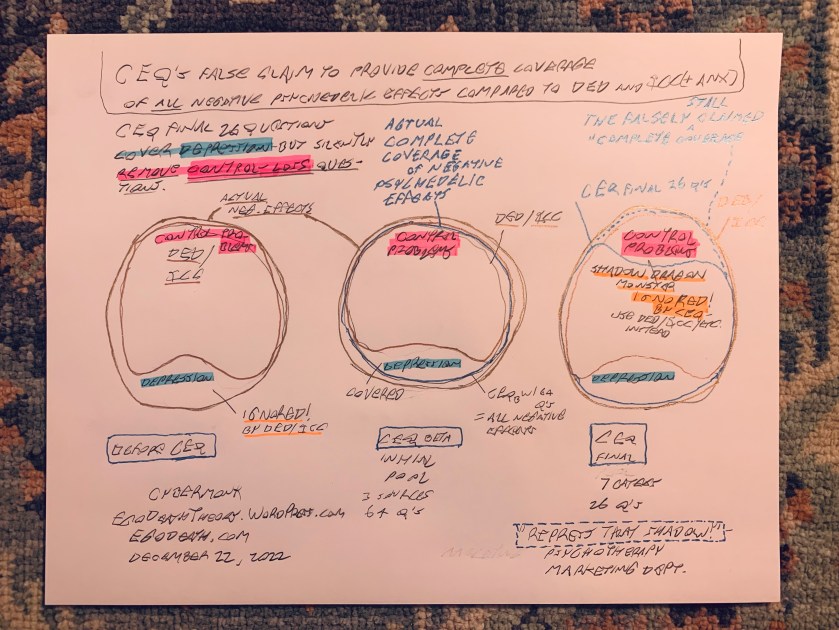
Griffiths’ CEQ article advertises adding Depression to the catalog of negative psychedelics effects – but his final CEQ also removes Volition-Control negative effects, contradicting his claim that a superset is needed and CEQ delivers a superset.
The final CEQ actually delivers merely a partial overlap (while claiming to deliver a superset), leaving Volition-Control as completely un-covered as Depression effects had been.
Not Believable that Griffiths Started from Dittrich’s Full Angst/ Dread Dimension’s 21 Questions
Griffiths (p. 4 right) says we started from all 13 of the ICC ANX questions – he always mentions “5D-ASC” (not “OAV” like Studerus), but specifies 11-Factors’ mid-level ICC & ANX categories, “all 13” – so he cannot mean OAV’s or 5D-ASC’s Angst/Dread category of 21 items, or 11-Factors’ “Unpleasant Experiences” high-level category containing those same 21 items.
If your goal is to minimize the negative questions from Dittrich (so that you can add your own, preferred ailments for which to sell your psychotherapy services – Dread/ Grief/ Sad), naturally you should start with Studerus’ already 24% reduced set of 13, not the original full set of 21 negative effects questions (Dittrich’s Dread dimension).
There is no way Griffiths had Figure S1 from Studerus or had Dittrich’s questionnaire spec, or he certainly would have selected Dread question 54, for the initial item pool, “I was afraid to lose my self-control.”
— Cybermonk, December 27, 2022
References
Dittrich 1975 APZ
Dittrich A (1975)
Zusammenstellung eines fragebogens (APZ) zur erfassung abnormer psychischer zustände
[Construction of a questionnaire (APZ) for assessing abnormal mental states]
Z Klin Psychol Psychiatr Psychother 23: 12–20.
Dittrich 1985: OAV dimensions found in APZ[158]
Dittrich A, Vonarx S, Staub S
1985
International study on altered states of consciousness (ISASC): Summary of the results
Ger J Psychol 9: 319–339.
Dittrich 1994 (Oct. 1993) in book 50 Years of LSD – Readable at Google Books
Sweet, I snagged every page and made a nice printout of the front matter & article.
Dittrich A
1994
Psychological aspects of altered states of consciousness of the LSD type: Measurement of their basic dimensions and prediction of individual differences
In:
Pletscher A, Ladewig D, eds.
50 Years of LSD: Current Status and Perspectives of Hallucinogens: A Symposium of the Swiss Academy of Medical Sciences, Lugano-Agno (Switzerland) October 21 and 22, 1993
New York NY: Parthenon. pp 101–118.
Swiss Academy of the Medical Sciences. Proceedings of a Symposium of the Swiss Academy of Medical Sciences, Lugano-Agno (Switzerland), October 21-22, 1993.
Pharmacological and clinical research on LSD, for pharmacologists or psychiatrists.
17 contributors, 5 U.S.
url https://www.amazon.com/Fifty-Years-LSD-Perspectives-Hallucinogens/dp/1850705690
Google Books:
https://books.google.com/books?id=3s5vkfmXKNUC&pg=PA101
Dittrich 1994 OAV with inflated O & V, shrunken A, in book Worlds of Consciousness, Volume 3 (German)
Bodmer I, Dittrich A, Lamparter D.
Aussergewöhnliche Bewusstseinszustände – Ihre gemeinsame Struktur und Messung
[Altered states of consciousness – Their common structure and assessment].
1994
In:
Hofmann A, Leuner H, editors.
Welten des Bewusstseins. Bd. 3, Experimentelle Psychologie, Neurobiologie und Chemie.
Berlin, Germany: VWB; 1994. pp. 45–58.
Annual journal book that in 1994 defines OAV:
Worlds of Consciousness
Bodmer, I., Dittrich, A. & Lamparter, D. in Welten des Bewusstseins. Bd. 3 (eds. Hofmann, A. & Leuner, H.) 45–58 (Experimentelle Psychologie, Neurobiologie und Chemie., 1994).
Welten des Bewußtseins, Bd.3 – https://www.amazon.de/-/en/Adolf-Dittrich/dp/3861354020/
Dittrich 1998 article about OAV questionnaire [66 items] with improved (tilted positive) OAV items compared to APZ [158 items]
Dittrich A (1998)
The standardized psychometric assessment of altered states of consciousness (ASCs) in humans
Pharmacopsychiatry 31: 80–84.
https://pubmed.ncbi.nlm.nih.gov/9754838/ – paywall for PDF fulltext
Abstract:
“The APZ questionnaire was developed in order to explore hypotheses on ASCs.
“First — in a series of 11 experiments using different induction methods on N = 393 healthy subjects — the hypothesis was tested that ASCs have major dimensions in common irrespective of the mode of their induction.
“In the International Study on Altered States of Consciousness (ISASC) the external validity of the experimental results was assessed.
“The ISASC was carried out on a total of N = 1133 subjects in six countries.
“The main results of the experimental studies were corroborated in the field studies.
“The results can be summarized as follows:
“the common denominator of ASCs is described by three oblique dimensions, designated as
“Oceanic Boundlessness (OSE)”,
“Dread of Ego Dissolution (AIA) [DED, AED]” and
“Visionary Restructuralization (VUS)”.
“The reliability and validity of the scales are satisfactory.
“Tested versions of the APZ scales are available in English (UK, USA), German, Italian and Portuguese.
“Psychometrically as yet untested versions exist in Dutch, Finnish, French, Greek, Spanish and Russian.
“The APZ questionnaire has become the international standard for the assessment of ASCs, thus helping to integrate research.
“A psychometrically improved version exists in German (OAV questionnaire).
“The BETA questionnaire, which measures the dimensions “Vigilance Reduction (VIR)” and “Auditive Alteration (AVE)” is also available in German. “
This 1998 mention of dimensions 4 & 5 corroborates Studerus’ claim that 5D-ASC data was gathered starting in 2000, not in 2006 when the 5D (German) article was published.
“These dimensions are most likely etiology-dependent.”
Dittrich 2006 5D-ASC (German) Adding 2 Positive Dimensions to Reduce Negative from 1/3 to 1/5
6. Dittrich, A, Lamparter, D, Maurer, M (2006) 5D-ABZ:
German garbled from pdf, see Studerus 2010: References.
Fragebogen zur Erfassung Aussergewo¨hnlicher Bewusstseinszusta¨nde. Eine kurze Einfu¨hrung
[5D-ASC: Questionnaire for the assessment of altered states of consciousness. A short introduction]. Zurich, Switzerland: PSIN PLUS.
todo – link (good luck finding)
Dittrich 2010 5D-ASC (English)
Dittrich, A, Lamparter, D, Maurer, M (2010)
5D-ASC: Questionnaire for the assessment of altered states of consciousness. A short introduction.
Zurich, Switzerland: PSIN PLUS.
todo – link (good luck finding)
Search:
url https://www.google.com/search?q=Dittrich+Lamparter+Maurer

 The Egodeath theory