Cybermonk, January 2, 2023
Contents:
- Intro
- Need a Dedicated Page for Each Variant of Each Questionnaire
- Drugs and Mysticism: An Analysis of the Relationship between Psychedelic Drugs and the Mystical Consciousness (Pahnke 1963 book)
- CEQ Redirects Control-Transformation Bad Trippers into Ordinary-State Grief Psychotherapy Business
- 1993/1994 Article Defines APZ’s O/A/V Effects Questions, Not OAV Questionnaire’s Improved Scheme
- “Peak Experiences” Is Defined by Dittrich as the Oceanic Heaven Dimension, Not the Dread Hell Dimension
- Dr. Angst, Director of the Psychiatric Research Department
- Questions That Belong to a High-Level Category but Not a Low-Level Category Are Still Part of a Scale
- Too Many Hell Effects, Need More Heaven and Vision Effects
- APZ (158)
- Fatal Compelling Deja Vu
- Misc. Research
- 5D-ASC’s Two Extra Dimensions, as a Separate “BETA” Questionnaire, Is Mentioned in 1998 Article
- History of Lineage of Dittrich’s 5D-ASC
- Problems Using 11-Factors: Omits ASC-G negative items & hides Unpleasant items that aren’t in ICC or ANX factor
- Intro to 5D-ASC
- Tallies from 1975 APZ Like Needed for 1994 OAV+G / 2006 5D-ASC
- Did CEQ Drop 23 of 26 = 88% of the Negative Items from 5D-ASC?
- The Unavailable, Closed “Science” of Psychedelic Psychometrics questionnaires
- Motivation for Creating the Other, 5D-ASC Basic Reference Page
- See Also
Intro
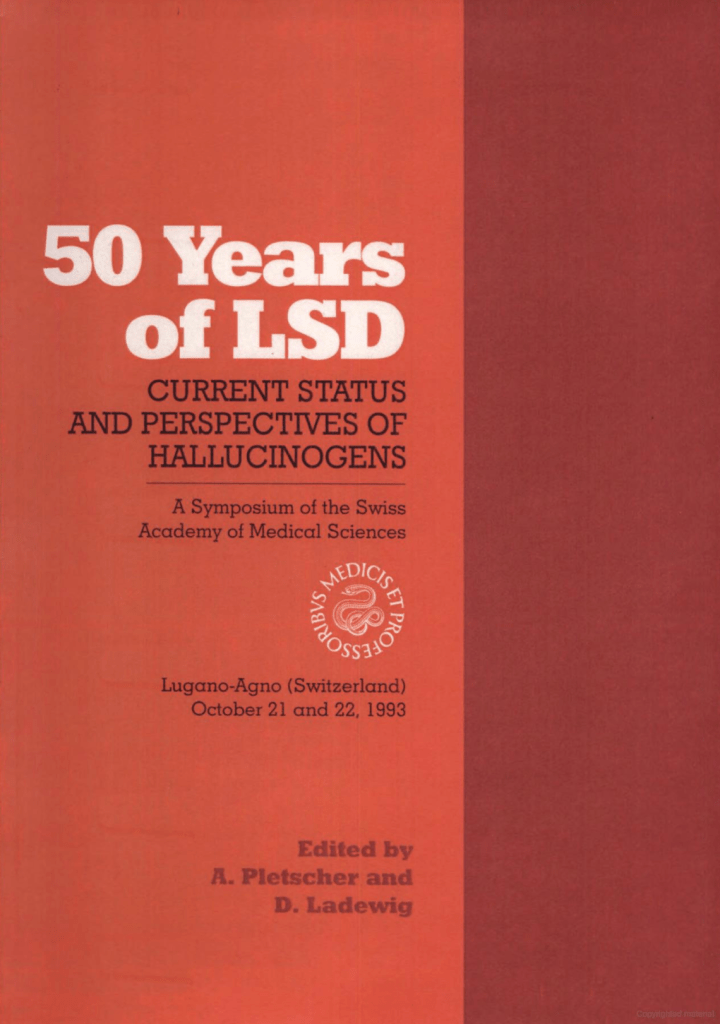
Motivation of this page: I just produced a hardcopy of the 1993 Dittrich article / conference presentation.
I’m here reporting my observations and findings in that article. From the 1993 conference proceedings 1994 book:



Need a Dedicated Page for Each Variant of Each Questionnaire
Across the 3 main questionnaires lineages, it turns out, that it’s best to have a separate webpage covering each variant of each questionnaire.
The 3 main questionnaires lineages:
- APZ/ OAV/ 5D-ASC/ 11-Factors
- SOCQ/ MEQ43/ MEQ30/ CEQ
- HRS – Hallucinogen Rating Scale (DMT, Rick Strassman)
11-Factors Variants
The 11-Factors article Studerus 2010 defines about 3 different versions of 11-Factors’ ICC & ANX categories – eg ANX initially contains (Figure S1) the key question 54: I was afraid to lose my self-control.”
- Figure S1 = v1
- Figure S2 = v2
- final = v3.
Studerus 2010’s 11-Factors finally “dropped” item 54 (from the ANX factor, not entirely from the high-level Unpleasant subscale!). But Studerus doesn’t show the 2-level scheme in the article main document, only in a separate figure S1, then S2.
Studerus didn’t clearly depict that the Unplesant high-level category contains two factors and some non-factor members.
Earlier, per Figure S1, ANX and ICC contained more items.
Figure S2 removed 1 item from each of those factors.
The final version of 11-Factors removed 2 items from the ANX factor, and removed 2 items from the ICC factor, compared to Figure S1.
MEQ Variants
Mystical Experience Questionnaire (MEQ)
MEQ43 [1967?] shrank [what year?] to MEQ30.
CEQ Variants
Challenging Experiences Questionnaire (CEQ)
CEQ is MEQ’s malformed, repressed shadow.
GIVEN: Mystical experiences = positive experiences.
Therefore, challenging experiences = non-mystical, or anti-mystical.
The CEQ article defines two very different versions of CEQ:
- CEQ[Initial Item Pool]
- CEQ[final]
In 2016, Griffiths constructed CEQ’s Initial Item Pool by only picking Anxiety (ANX, 6 items) & “Impaired Control and Cognition” (ICC, 7 items) items (13 items total) from 11-Factors, instead of the entire inclusive “Unpleasant Experiences” subscale (21 items).
Griffiths omitted 8 challenging effects questions, including the important question 54.
Griffiths should have added the entire 21-item Unpleasant high-level scale from 11-Factors, not just the 13 items from ANX(6) + ICC(7) factors.
In 2016, Griffiths added CEQ as the repressed, dissociated complement of MEQ to handle and route/defuse the shadow, the “challenging & unpleasant therefore non-mystical“, or even anti-mystical, experiences.
When Griffiths had the CEQ Initial Item Pool of 64 items, they wanted to cut the CEQ items down a lot to be fewer than the 30 items of the revised MEQ.
OAV’s Dread factor contained 21 items and CEQ claimed to have broader coverage than Dread.
So CEQ ended up reduced from 64 to 26 items, halfway between the Dread count and the MEQ reduced count.
What scientific process did they use to cut down 64 to 24? (Then bumped to 26.)
Pick the maladies we’re familiar with from the psychotherapy profession, and delete strange, psychedelic effects questions that don’t match our bookshelf of conventional, ordinary-state psychotherapy books.
Like “marionette puppet with no will” — that’s strange, it doesn’t fit the plan, delete those items.
Drugs and Mysticism: An Analysis of the Relationship between Psychedelic Drugs and the Mystical Consciousness (Pahnke 1963 book)
Walter Pahnke, 1963
Thesis presented to The Committee on Higher Degrees in History and Philosophy of Religion in partial fulfillment of the requirements for the degree of Doctor of Philosophy in the subject of Religion and Society, Harvard University, Cambridge, Massachusetts, June, 1963.
Full text of Pahnke’s 1963 dissertation book, created from MAPS scans of the typed dissertation:
http://en.psilosophy.info/drugs_and_mysticism.html
PDF version of that, 119 pages: http://www.en.psilosophy.info/pdf/drugs_and_mysticism_(psilosophy.info).pdf – footer: “since 09.06.2015 at http://www.en.psilosophy.info“
Scans:
https://maps.org/images/pdf/books/pahnke/walter_pahnke_drugs_and_mysticism.pdf
Amazon https://www.amazon.com/Drugs-mysticism-relationship-psychedelic-consciousness/dp/B0007J6OPY
CEQ Redirects Control-Transformation Bad Trippers into Ordinary-State Grief Psychotherapy Business
CEQ Serves to Develop Psychotherapy Business by “Catching” Bad Trippers and Re-routing them from Control Rebirth Transformation to Ordinary-state Grief Couch Psychotherapy Business Instead
CEQ is designed for “catching”/ re-routing bad trippers who got attracted into the Control-challenges control vortex, instead aborting their transformation and delivering them instead into the hands of the ordinary-state-based Grief psychotherapy marketing/ business development department.
Here’s my too-broad page trying to cover too many variants of Dittrich’s lineage questionnaire all at once:
5D-ASC – “Five-Dimensional Altered States of Consciousness” Questionnaire (APZ 1975, OAV 1994, 5D-ASC 2006, 11 Factors 2010)
https://egodeaththeory.wordpress.com/2022/12/23/5d-asc-five-dimensional-altered-states-of-consciousness-questionnaire/
I’m now studying Dittrich’s 1993/1994 discussion of what’s wrong with 1975 APZ’s O/A/V effects category counts, and how in 1994 we’re engineering a new questionnaire, called OAV, to remedy the too-negative effects of psychedelics.
The old scales (APZ) made psychedelics produce too many negative effects (eg p. 106: “a feeling of loss of control”). 😞
So we engineered this new scale (OAV) to register bad psychedelics effects as being only 47% as numerous as the good effects, instead of 81% as numerous. 🎉 😊
Article: Dittrich 1993/1994:
Psychological aspects of altered states of consciousness of the LSD type: Measurement of their basic dimensions and prediction of individual differences
in book:
50 Years of LSD: Current Status and Perspectives of Hallucinogens: A Symposium of the Swiss Academy of Medical Sciences, Lugano-Agno (Switzerland) October 21 and 22, 1993
Pletscher A, Ladewig D, eds.
1993/1994 Article Defines APZ’s O/A/V Effects Questions, Not OAV Questionnaire’s Improved Scheme
When did APZ give way to the OAV questionnaire?
The OAV questionnaire exists in 1989, in German, 4 years after Dittrich’s 1985 article that identifies O/A/V in 1975’s APZ questionnaire.
Here is a reference to the OAV questionnaire as early as 1989! Reference 16, Bodmer, a Results section on Dittrich 1993/1994 page 113:
“the three primary and the one secondary scale of the questionnaire OAV[16, 17].” 16 = Bodmer 1989,
Konstruktion des Fragebogens OAV zure quantitativen Erfassung aussergewohnlicher Bewusstseinszustande (ABZ)
[Construction of the questionnaire OAV for the quantitative recording of extraordinary states of consciousness (ABZ)]
In 1985, I started work on the Egodeath theory.
By 1989, after the Jan. 1988 breakthrough, I was investigating hypertext technology to publish the Cybernetic Theory of Ego Transcendence.
In 1993, I was describing the Egodeath theory on the WELL BBS, and there I discovered and announced the WWW, the Web, I estimated that I was one of the very first people at the WELL to announce or mention the w.w. Web.
Here as early as 1993 is Dittrich talking about “the follower of APZ, OAV, has become the standard”:
“A psychometrically improved version of the APZ exists in German.
“This questionnaire (‘OAV’) uses visual analog scales as a response instead of a ‘yes’ or ‘no’.
“‘APZ’ and ‘OAV’ scores can be transformed into each other by multiple regression equations.
“At least in Europe, the APZ questionnaire (or its follower, ‘OAV’) has become the standard instrument when assessing ASCs, which helps to integrate the international research.” – Dittrich 1993/1994
The Egodeath theory brings “the shadow” dragon monster into the light of Science.
The Egodeath theory participates in integrating the international psychedelic psychometrics research by defining the Eternalism and Control Questionnaire (ECQ):
ECQ – “Eternalism and Control Questionnaire”
https://egodeaththeory.wordpress.com/2022/12/23/eternalism-and-control-transformation-effects-in-the-psychedelics-effects-questionnaires/
“Peak Experiences” Is Defined by Dittrich as the Oceanic Heaven Dimension, Not the Dread Hell Dimension
page 116 at the end of the article body, Dittrich 1993/1994:
“In ASC-assisted psychotherapy it has been hypothesized by several therapists and researchers that ‘peak experiences‘ contribute substantially to the therapeutic outcome. This hypothesis can now be tested quantitatively using the corresponding scale of … (OSE) (oceanic boundlessness).”
Dittrich is biased and prejudiced and wrong.
- Beginners’ medium-dose peak experience is Oceanic Boundlessness (OB).
- Advanced high dose experience is Angst/Dread of Ego Dissolution (AED/AIA/DED).
Dr. Angst, Director of the Psychiatric Research Department
Repression of Angst/Dread:
“Acknowledgements” section of Dittrich 1993/1994, page 116:
“The studies on the common denominator of ASCs were performed at the Psychiatric University Clinic Burgholzli, Zurich, Research Department (Director: Prof. Dr med. J. Angst).”
Questions That Belong to a High-Level Category but Not a Low-Level Category Are Still Part of a Scale
page. 109 Dittrich 1993/1994:
“The four[?] APZ scales[?] are now available in psychometrically equivalent forms in English, …”
3 of the “four APZ scales” are O, A, & V.
What’s the other scale: the 72-O-A-V = 23 non-member items of the e-indep items, or, the entire set of 72? todo, research question
Here’s a simple driving question:
How many items are in the fourth scale of “the four APZ scales”? 72, or 23??
Answer A: 23 items: Table 5, “Additional items of the APZ secondary[high-level 72 all-up] scale: ‘altered state of consciousness’ [probably = “G-ASC” mentioned in CEQ article], n=23 items
Apparently the winner:
Answer B: 72 items: G-ASC; the APZ secondary scale, ‘altered state of consciousness’; the 72 etiology-indep items/effects, including [for 1975 APZ questionnaire, not for 1994 OAV questionnaire] 13 O, 22 A, and 14 V items, and 23 items that are not in O or A or V categories.
72, per my excerpt including:
“Together with [23] other features, these correlating scales [O, A, & V] form a secondary scale, Altered States of Consciousness, describing common features of ASCs as a whole.” – Dittrich 1985, Abstract: https://psycnet.apa.org/record/1986-26371-001
This question and definition is highly relevant for Griffiths creating the CEQ patch for MEQ, where he starts by “accidentally overlooking” the 8 Unpleasant/Dread items that didn’t make it into the final version of the ICC or ANX factors defined by Studerus 2010.
If Griffiths had integrity when constructing the Initial Item Pool for CEQ, they should have grabbed the higher-level scale of all 21 Unpleasant Experiences (identical to OAV’s Dread dimension), not only the ICC+ANX 13 effects items.
Oops, accidentally reduced the negative effects of psychedelics by 8/21 = 38%
😇 🤷♂️ 😏 🤥 😬 🤐 😉
Too Many Hell Effects, Need More Heaven and Vision Effects
Dittrich 1994 (in book 50 Years of), p. 106:
“With reference to Huxley, it could be said that the three primary etiology-independent aspects of ASCs correspond to
‘heaven‘ [Oceanic Boundlessness],
‘hell‘ [Angst/Dread of Ego Dissolution] and
‘visions‘ [Visionary Restructuralization].”
p. 106, above that, gives the following four counts, using 1985’s O/A/V detection/analysis of the 1975 APZ questionnaire’s items:
APZ has:
Oceanic Heaven: 13 effects questions (too few, so in 1994’s OAV, we created more: 27).
These 13 APZ effects questions are listed in Table 2, Dittrich 1993/1994.
Dread Hell: 22 effects questions (too many, so in 1994’s OAV, we created fewer: 21).
These 22 APZ effects questions are listed in Table 3, Dittrich 1993/1994.
Visionary Visions: 14 (too few, so in 1994’s OAV, we created more: 18).
These 14 APZ effects questions are listed in Table 4, Dittrich 1993/1994.
Members of the 72 e-indep that aren’t in O/A/V: 23 (is there an equiv # in 1994’s new OAV q’air?)
These 23 APZ effects questions are listed in Table 5, Dittrich 1993/1994.
total: 72 etiology-independent effects questions. The other of APZ’s 158 q’s are etiology-dependent.
In 1975, figured out in 1985, before we repaired psychedelics to make them produce more O+V positive/mystical effects than negative/non-mystical effects, there were 13+14=27 good effects and 22 bad effects. Ratio of bad vs good was not acceptable: 22/27 =
The bad effects of psychedelics were 81% as numerous as the good effects.
😞
We need to press on the scales to make them produce many more good than bad effects.
OAV 1994 gives our improvement of the effects from psychedelics:
So instead, in 1994, we made psychedelics produce 27+18 = 45 good effects and 21 bad effects, 66 total in the O/A/V sets, ratio of bad vs good is now 21/45 = 47% bad effects;
The bad effects of psychedelics are now only 47% as numerous as the good effects.
🎉 😊
Studerus 2010 p. 2:
“Although reliabilities and validities of APZ scales were deemed to be acceptable … several weaknesses were also recognized. …
“the OBN and VRS dimensions contained a relatively low number of items, and the conceptual breadth of the VRS dimension was considered too narrow.
“Bodmer et al. [5] therefore developed a psychometrically improved version [of the APZ questionnaire] called [the] OAV [questionnaire].”
[“psychometrically improved” to reduce the % of negative psychedelics effects item counts -cm]
“The abbreviation OAV stands for the German names of the three dimensions OBN, [AED/] DED, and VRS.
“Because the OAV was supposed to measure the primary three dimensions of the APZ only [not the all-up, secondary, high-level set of effects items], its item pool was primarily derived from [the] 72 etiology-independent items of the [158-item] APZ.”
5. Bodmer I, Dittrich A, Lamparter D (1994) Aussergewo¨hnliche Bewusstseinszusta¨nde – Ihre gemeinsame Struktur und Messung
[Altered states of consciousness – Their common structure and assessment]. In: Hofmann A, Leuner H, eds.
Welten des Bewusstseins. Bd. 3, Experimentelle Psychologie, Neurobiologie und Chemie.
Berlin, Germany: VWB. pp 45–58.
See References below for more info.
I just printed out the article that’s prior to the above article, in English, 1993/1994, which is only about OAV counts in APZ, not the new OAV questionnaire and its “psychometrically improved” (to reduce the % of negative psychedelics effects) item counts.
APZ (158)
Etiology-Independent Items (72)
Item numbers are per 1975 APZ, not 1994 OAV.
Oceanic Boundlessness (13) (too few!)
Red Bold = of top interest for my Eternalism and Control Questionnaire (ECQ).
Bold = of interest for ECQ.
1. I had the feeling everything around me was somehow unreal.
7. I felt as though I were floating
13. The boundary between myself and my surroundings seemed to blur
16. I felt totally free and released from all responsibilities
31. I had the feeling that I had been transferred to another world
34. It seemed to me that there were no more conflict and contradictions in the world
68. It seemed to me as though I did not have a body any more
84. I felt very happy and content for no outward reason
92. I could have sat for hours looking at something
95. I was completely indifferent toward everything
127. I experienced past present and future as a oneness
129. It seemed to me that my environment and I were one
147. It seemed to me that I was dreaming
Angst/Dread of Ego Dissolution (DED) (22) (too many!)
9. I had difficulty in distinguishing important from unimportant things
32. My thinking was constantly being interrupted by insignificant thoughts
40. My own feelings seemed strange to me as though they did not belong to me
44. I felt tormented without knowing exactly why
55. I felt like a robot
56. My surroundings seemed peculiarly strange to me
64. I felt threatened without realizing by what
66. I had the feeling that I no longer had a will of my own
71. I was afraid without being able to say exactly why
83. I felt like a marionette
91. Everything around me was happening so fast that I could no longer follow what was really going on
105. I stayed frozen in a very unnatural position for quite a long time
107. I had difficulty making even the smallest decision
110. I felt as though I were paralyzed
131. Things around me appear distorted to me
133. Time passed more slowly than usual
136. I was not able to complete a thought; my thoughts became repeatedly became disconnected
141. I felt isolated from everything and everyone
148. It seemed to me that I no longer have any feelings
156. It seemed to me as though there were an invisible wall between me and my surroundings
157. I observed myself as though I were a stranger
158. I felt a total emptiness in my head
Visionary Restructuralization (14) (too few!)
14. So many thoughts and feelings assailed me at once that I became confused
29. I saw lights or flashes of light in total darkness or with closed eyes
33. I saw scenes rolling by like in a film in total darkness or with my eyes closed
42. Objects around me engaged me emotionally much more than usual
43. Things around me seemed to be bigger than usual
51. Things around me had a new, strange meaning for me
70. I saw colors before me in total darkness or with closed-eyes
80. I saw things that I knew were not real
100. I saw regular patterns in complete darkness or with closed eyes
119. Something occurred to me and I did not know whether I had dreamt or actually experienced it
120. I saw strange things, which I now know were not real
128. Everyday things gained a special meaning for me
134. Sounds seemed to influence what I saw
138. The colors of the things I saw were changed by sounds and noises
Etiology-Independent Items Not in O, A, or V (23)
2. Sounds and noises sounded different than usual
3. Time passed faster than usual
6. I simply could not get rid of some unimportant thought
11. I became conscious of another ‘I’ being hidden behind my usual ‘I’
19. The ground I was standing on seemed to be swaying
20. My ears were buzzing
22. I could not remember what had happened 2 h earlier
24. I had a vague feeling that something important would happen to me
28. Parts of my body seemed no longer to belong to me
39. I had the feeling my limbs were larger than usual
41. I was convinced that I had experienced the same situation before
[3 reasons for ego death that fence you in:
no control because control-thoughts already exist created for you;
no control because subject to an uncontrollable higher controller;
no control because overpoweringly compelling deja vu of this no-control -cm]
57. Things around me had a different smell than usual
58. I was tired and exhausted but at the same time wide awake
63. It seemed that I had once dreamt what I was experiencing
65. I perceived peculiar relationships between widely diverging matters
87. I had trouble distinguishing between what I imagined and what I really experienced
113. I no longer knew where I actually was
122. I had the feeling I could think faster or more clearly than usual
132. So many thoughts came to my mind that I was no longer able to organize them properly
137. I was too wide awake and too sensitive
139. I had the impression that everything occurring around me was related to me
146. I had a feeling that I could no longer control the movement of my body
152. I felt influenced by electric currents, rays, or hypnosis
Etiology-Dependent Items (158-72=86)
n/a, try my initial 5D Lineage page:
5D-ASC – “Five-Dimensional Altered States of Consciousness” Questionnaire (APZ 1975, OAV 1994, 5D-ASC 2006, 11 Factors 2010)
https://egodeaththeory.wordpress.com/2022/12/23/5d-asc-five-dimensional-altered-states-of-consciousness-questionnaire/
Fatal Compelling Deja Vu
41. I was convinced that I had experienced the same situation before
3 reasons for ego death that surround and fence you in:
- No control, because control-thoughts already exist, created for you.
- No control, because subject to an uncontrollable higher controller.
- No control, because experience an overpoweringly compelling deja vu of this no-control.
url https://youtu.be/4Zl2Us7mvJs
Misc. Research
This was the original References section.
todo: remove info from this section that was moved to the new dedicated References page.
Dittrich 1975 APZ
Dittrich A (1975)
Zusammenstellung eines fragebogens (APZ) zur erfassung abnormer psychischer zustände
[Construction of a questionnaire (APZ) for assessing abnormal mental states]
Z Klin Psychol Psychiatr Psychother 23: 12–20.
Draw another goblet
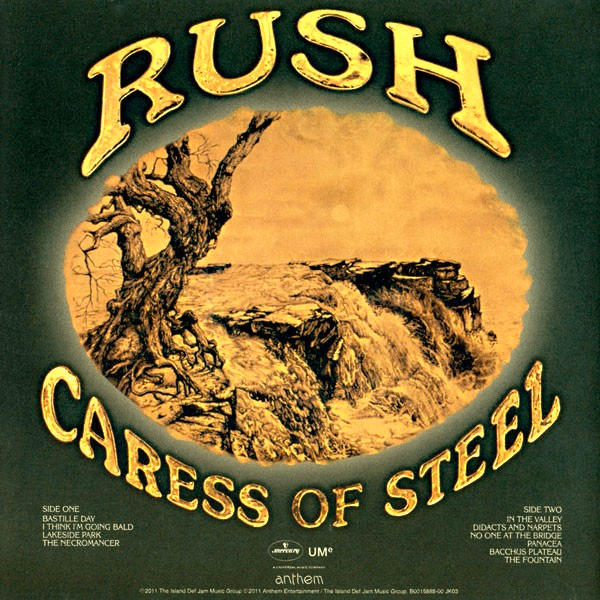
Neil Peart, Caress of Steel album, 1975, song The Fountain of Lamneth
From the cask of ’43
Crimson misty mem’ry
Hazy glimpse of me
lyrics: https://www.google.com/search?q=the+fountain+of+lamneth+lyrics
https://en.wikipedia.org/wiki/Caress_of_Steel
The album cover features an animated waterfall:
Dittrich 1985: OAV dimensions found in APZ[158]
Dittrich A, Vonarx S, Staub S
1985
International study on altered states of consciousness (ISASC): Summary of the results
Ger J Psychol 9: 319–339.
url https://psycnet.apa.org/record/1986-26371-001 – Abstract excerpts with my comments:
“In several previous experiments by the 1st author and colleagues (1981, 1982, in press [~= 1985]) on altered states of consciousness (ASCs) of healthy persons, the hypothesis was confirmed that
“ASCs have, irrespective of the means of induction, certain basic dimensions in common that can be reliably measured.
“It was confirmed that 3 primary scales are suitable for quantitative assessment [not according to Studerus 2010!] —Oceanic Boundlessness, Dread of Ego-Dissolution, and Visionary Restructuralization. [especially Studerus says don’t use the Visionary scale.]
“Together with [23] other features, these correlating scales [O, A, & V] form a secondary scale, Altered States of Consciousness, describing common features of ASCs as a whole.
“These 4 scales are available in psychometrically largely equivalent versions in different languages.”- Dittrich 1985, Abstract: https://psycnet.apa.org/record/1986-26371-001
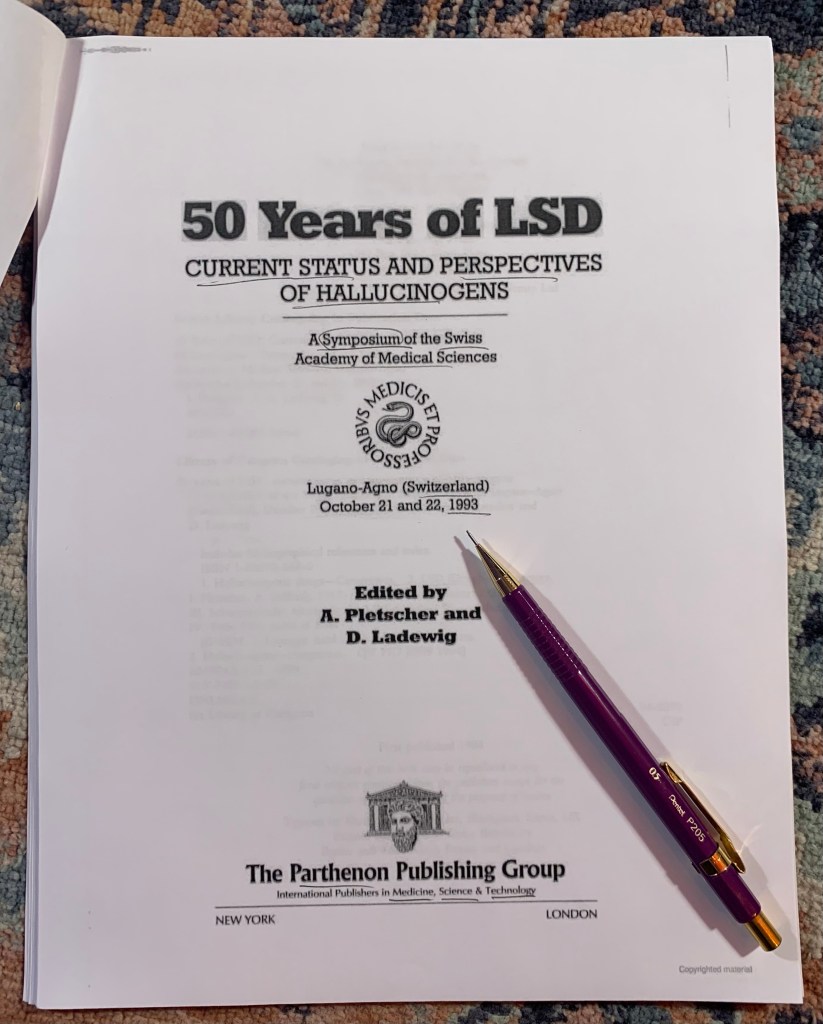
Dittrich 1994 (Oct. 1993) in book 50 Years of LSD – Readable at Google Books
Sweet, I snagged every page of the article and made a nice printout of the front matter & article.
🌳🍄🐍🏆

Dittrich A
1994
Psychological aspects of altered states of consciousness of the LSD type: Measurement of their basic dimensions and prediction of individual differences
In:
Pletscher A, Ladewig D, eds.
50 Years of LSD: Current Status and Perspectives of Hallucinogens: A Symposium of the Swiss Academy of Medical Sciences, Lugano-Agno (Switzerland) October 21 and 22, 1993
New York NY: Parthenon. pp 101–118.
Swiss Academy of the Medical Sciences.
Proceedings of a Symposium of the Swiss Academy of Medical Sciences, Lugano-Agno (Switzerland), October 21-22, 1993.
Pharmacological and clinical research on LSD, for pharmacologists or psychiatrists.
17 contributors, 5 U.S.
url https://www.amazon.com/Fifty-Years-LSD-Perspectives-Hallucinogens/dp/1850705690
Google Books:
https://books.google.com/books?id=3s5vkfmXKNUC&pg=PA101
Dittrich 1994 OAV with inflated O & V, shrunken A, in book Worlds of Consciousness, Volume 3 (German)
Bodmer I, Dittrich A, Lamparter D.
Aussergewöhnliche Bewusstseinszustände – Ihre gemeinsame Struktur und Messung
[Altered states of consciousness – Their common structure and assessment].
1994
In:
Hofmann A, Leuner H, editors.
Welten des Bewusstseins. Bd. 3, Experimentelle Psychologie, Neurobiologie und Chemie.
Berlin, Germany: VWB; 1994. pp. 45–58.
Annual journal book that in 1994 defines OAV:
Worlds of Consciousness
Bodmer, I., Dittrich, A. & Lamparter, D. in Welten des Bewusstseins. Bd. 3 (eds. Hofmann, A. & Leuner, H.) 45–58 (Experimentelle Psychologie, Neurobiologie und Chemie., 1994).
Welten des Bewußtseins, Bd.3 – https://www.amazon.de/-/en/Adolf-Dittrich/dp/3861354020/
Dittrich 1998 article about OAV questionnaire [66 items] with improved (tilted positive) OAV items compared to APZ [158 items]
Dittrich A (1998)
The standardized psychometric assessment of altered states of consciousness (ASCs) in humans
Pharmacopsychiatry 31: 80–84.
https://pubmed.ncbi.nlm.nih.gov/9754838/ – paywall for PDF fulltext
Abstract:
“The APZ questionnaire was developed in order to explore hypotheses on ASCs.
“First — in a series of 11 experiments using different induction methods on N = 393 healthy subjects — the hypothesis was tested that ASCs have major dimensions in common irrespective of the mode of their induction.
“In the International Study on Altered States of Consciousness (ISASC) the external validity of the experimental results was assessed.
“The ISASC was carried out on a total of N = 1133 subjects in six countries.
“The main results of the experimental studies were corroborated in the field studies.
“The results can be summarized as follows:
“the common denominator of ASCs is described by three oblique dimensions, designated as
“Oceanic Boundlessness (OSE)”,
“Dread of Ego Dissolution (AIA) [DED, AED]” and
“Visionary Restructuralization (VUS)”.
“The reliability and validity of the scales are satisfactory.
“Tested versions of the APZ scales are available in English (UK, USA), German, Italian and Portuguese.
“Psychometrically as yet untested versions exist in Dutch, Finnish, French, Greek, Spanish and Russian.
“The APZ questionnaire has become the international standard for the assessment of ASCs, thus helping to integrate research.” [the 1993 Dittrich article in 50 Years book uses similar wording, p. 111]
5D-ASC’s Two Extra Dimensions, as a Separate “BETA” Questionnaire, Is Mentioned in 1998 Article
continuing from 1998 quoted passage above:
“A psychometrically improved version exists in German (OAV questionnaire).
“The BETA questionnaire, which measures the dimensions “Vigilance Reduction (VIR)” and “Auditive Alteration (AVE)” is also available in German. “
This 1998 mention of dimensions 4 & 5 (though as a separate, “BETA” questionnaire) corroborates Studerus’ 2010 claim that 5D-ASC data was gathered starting in 2000, not in 2006 when the 5D (German) article was published.
“These dimensions are most likely etiology-dependent.”
Dittrich 2006 5D-ASC (German) Adding 2 Positive Dimensions to Reduce Negative from 1/3 to 1/5
6. Dittrich, A, Lamparter, D, Maurer, M (2006) 5D-ABZ:
German garbled from pdf, see Studerus 2010: References.
Fragebogen zur Erfassung Aussergewo¨hnlicher Bewusstseinszusta¨nde. Eine kurze Einfu¨hrung
[5D-ASC: Questionnaire for the assessment of altered states of consciousness. A short introduction]. Zurich, Switzerland: PSIN PLUS.
todo – link (good luck finding)
Dittrich 2010 5D-ASC (English)
Dittrich, A, Lamparter, D, Maurer, M (2010)
5D-ASC: Questionnaire for the assessment of altered states of consciousness. A short introduction.
Zurich, Switzerland: PSIN PLUS.
todo – link (good luck finding)
Search:
url https://www.google.com/search?q=Dittrich+Lamparter+Maurer

History of Lineage of Dittrich’s 5D-ASC
This section was developed Dec. 29, 2024 in page
https://egodeaththeory.wordpress.com/2024/12/29/5d-asc-questionnaire-reference-dittrich/
and then was moved to the present older, broader page.
This topic is distinct from basics “First of all, what is the 5D-ASC?” Keep 5D-ASC Reference page focused on that, not periphery relation to other q’airs.
APZ 1975, by Dittrich, 137(?) questions
OAV dimensions were id’d by Dittrich in 1985, within APZ.
OAV v2 1994, partial overlap w/ OAV 1985 items. I have a page covering both sets.
+ two aetiology-dependent dimensions 1993-1994 that probably became the Auditory & Reduced Vigilance dimensions.
5D-ASC 2006 (Dimensions: OAV + Aud + Reduction of Vigilance, probably plus ASC-G General dimension; if so, it is actually more like 6D-ASC) – good luck getting any answer on why General exists, probably same reason Shadow Factor 13 & Virtual Factor 12 exists in my telling of 11-Factors: effects which are too broad to fit into the lower, OAV dimensions.
Problems Using 11-Factors: Omits ASC-G negative items & hides Unpleasant items that aren’t in ICC or ANX factor
This section was developed Dec. 29, 2024 in page
https://egodeaththeory.wordpress.com/2024/12/29/5d-asc-questionnaire-reference-dittrich/
and then was moved to the present older, broader page.
11 Factors or whatever it’s named if it even has a name, Studerus group not Dittrich – article says drew from 5D-ASC 2006, but more specifically they drew from just OAV 1994; 11-Factors totally ignores the low-interest Aud & ReducVigil dimensions. Actually it’s 15-Factors, in that it has four add’l factor-like categories of fx items:
- “Pleasant experiences” hi-lev dim – barely mentioned in Studerus article.
- “Unpleasant experiences” hi-lev dim – “
- Virtual Factor 12
- Shadow Factor 13
- I think 11-F didn’t pick up any ASC-G items from Dittrich. Why not? Study Studerus article. I have a page/ section covering those items.
“11-Factors” – it’s not even determinate what the name of that q’air is!
That’s how unclear Studerus’ pair of articles is.
Can’t get a simple straight answer in this field.
Even Griffiths team when gathering initial item pool for CEQ seems confused about what 11-Factors is, which dimensions or factors contain each of Dittrich’s items – making it all too convenient for the Griffiths to “accidentally overlook” around 8+8 negative effects which didn’t end up in the subset of Angst/Dread questions, in the ICC or ANX factors,
- because those negative effects items were in 11-F’s “Unpleasant” high-level dimension but not in ICC [Impaired Control and Cognition] or ANX [Anxiety] factors. 8 Unpleasant items were “hidden” in my Shadow Factor 13, within the Unpleasant Experiences high-level dimension.
- or because those negative effects items were in OAV’s or 5D’s ASC-G General dim but not – for whatever reason – in 5D’s A/Angst/Dread dim. My critique has not yet gone into that ASC-G set of items, Dec 2022-Dec 2024.
Intro to 5D-ASC
This section was developed Dec. 29, 2024 in page
https://egodeaththeory.wordpress.com/2024/12/29/5d-asc-questionnaire-reference-dittrich/
and then was moved to the present older, broader page.
If the items (psychedelic effects questions) are available, which is doubtful for most such q’airs, I’ll put them here.
DRAFT ARTICLE, sketchy, not trustworthy yet; a confusing and difficult area of “science”, hard to get any simple basic straight answers.
You are on the leading edge 🐉😱 of altered-state theory.
The good thing is, I know specifically what I’m looking for, to fill in this page, and this page has good structure to get clear on that.
Bad thing: It’s humbling and depressing, how hard this is to pull together intelligibly – resources might be better than 2 years ago Dec. 2022; re-search the web, to fill in this useful template.
https://en.wikipedia.org/wiki/APZ_questionnaire – How many errors can you fit in one sentence? —
“First published in 1998 by Adolf Dittrich, the APZ questionnaire comprises three dimensions: “Oceanic Boundlessness (OSE)”, “Dread of Ego Dissolution (AIA)” and “Visionary Restructuralization (VUS)”.
APZ (1975) includes OAV, and more; in 1985 Dittrich id’d O/A/V within APZ; in 1994 Dittrich revised O/A/V and added Aud + ReductionVigilance dimensions;
Plus, there’s the G-ASC General dimension – which apparently in 1985/1993 was VWB (“asc”) and had 23 items including:
146: I had a feeling that I could no longer control the movement of my body (see elsewhere in this webpage, for other items).
A =
Angstvolle Ichauflosung [AIA]
Angst of Ego Dissolution [AED]
Dread of Ego Dissolution [DED]
Plus, dread isn’t actually “of ego dissolution”; that’s not helpful and accurate; it’s vague.
And there are add’l negative items in G-ASC “secondary” ie higher level dimension, that aren’t in the “primary” ie lower level dimension, AED aka AIA aka DED.
For a different breakout, see 11 Factors, if that’s what its name is – not clear from the “validation” article about it. 11 Factors is same as OAV, though calling it “5DASC”, but is different at both the higher (secondary) level and the lower (primary) level.
Tallies from 1975 APZ Like Needed for 1994 OAV+G / 2006 5D-ASC
This section was developed Dec. 29, 2024 in page
https://egodeaththeory.wordpress.com/2024/12/29/5d-asc-questionnaire-reference-dittrich/
and then was moved to the present older, broader page.
copied from TOC:
Did CEQ Drop 23 of 26 = 88% of the Negative Items from 5D-ASC?
This section was developed Dec. 29, 2024 in page
https://egodeaththeory.wordpress.com/2024/12/29/5d-asc-questionnaire-reference-dittrich/
and then was moved to the present older, broader page.
CEQ should have added to their initial item pool ALL the A/Angst/Dread dimension items, and the negative items in G-ASC dimension.
Perhaps 21+5 = 26 instead of just the 13 items from ICC + ANX factors of 11-factors – iow, Griffiths only drew from HALF of the negative items from 5D-ASC!
Then threw away 10 of those 13, leaving 3 of 21 or 3 of 26.
I have to double-check G-ASC items, but today Dec 29 2024, I might score even higher % failure, higher than dropping 18 of 21!
Suppose Griffiths for CEQ final version:
kept 3 out of 26 negative items = kept 12% of negative effects from 5D-ASC.
dropped 23 of 26 negative items = dropped 88% of negative effects from 5D-ASC.
To check that G-ASC negative item count, see G-ASC list below. But first, I have to check where I got that, and what the list really is – how could I have gotten it from Studerus?
The Unavailable, Closed “Science” of Psychedelic Psychometrics questionnaires
This section was developed Dec. 29, 2024 in page
https://egodeaththeory.wordpress.com/2024/12/29/5d-asc-questionnaire-reference-dittrich/
and then was moved to the present older, broader page.
To reverse engineer what items the 5D-ASC has, I had to gather these lists from various places, for the dimensions:
- G-ASC (General)
- O, A, & V (Ocean, Angst, Visionary)
- Aud, & ReducedVigil
This page is uneven/ inconsistent that way.
This page is an obscured view of the 5D-ASC items through the indirect filter of the 11-Factors article and its separate illustration files. It’s not as if I found Dittrich’s official English article listing the 5D items and copied them here. I had to deduce, type in, transcribe from PDF exhibits, etc.
I had to messily reverse-engineer these lists of items, and they are presented grouped per the 11 Factors q’air article, maybe not by Dittrich though his 1993 or 1994 English article shows some lists of items.
You simply want a link to the list of questions grouped into dimensions/ categories? That’s straightforward, right?
Simple basic info about Psychedelic Psychometrics questionnaires is difficult to get ahold of. “Difficult” is an understatement; a euphemism for IMPOSSIBLE. Plain and simple basic info about these items/ effects questions is not available.
The public is not allowed to see how this alleged “science” works. Only shown sciencey-looking Public Relations puff pieces with meaningless math and substitutes for plain comprehensible explanation:
“We dropped items 5, 6, 18, 54, & 16-1/2, because of reason A or B (cross-loading).”
“Terror of loss of control didn’t fit exclusively in any one of our separate categories we made up, so, we dropped it.
“If this grieves you, sign up for our psychedelic Grief therapy. It’s popular, because our Big Pharma institution invested heavily in promoting it.”
The present site, EgodeathTheory.WordPress.com, is the first place to ask what the q’airs are, what they contain, their lineage, why CEQ drew from OAV + SOCQ + HRS, etc.
Typical situation: There’s only 1 article about this “tremendously important” q’air, it’s in German not English, and the article never says what’s in the q’air, but just talks ABOUT the q’air without ever SHOWING the q’air list of items to you.
That’s the typical state of affairs in this domain of “SCIENCE”, as of 2022.
You are permitted to read an article that claims to “validate” a given q’air — even q’airs that basically don’t make any sense and can’t possibly be sound, such as the MEQ that’s based on a wrong, arbitrary, outdated, and controverted notion of “mystical experience”, as if science knew anything about mystical experience.
Studerus cites “based on the science”, as a hidden endnote, buried citation of “Stace 1960”, that passes for “science”.
It took a huge amount of research Dec. 2022 to work toward getting just basic answers about what these Psychedelic Psychometrics questionnaires are.
This new 2024 page has a good, most-useful outline of sections to fill in, and offhand I’m not sure how much of this info I have gathered in other, Dec. 2022 pages.
This Phase 1 Early Pseudo Science of Psychedelic Psychometrics q’airs started with Tim Leary & Walter Pahnke’s PES/MEQ/SOCQ in 1962, & Dittrich’s APZ starting 1975 (13 years later).
Motivation for Creating the Other, 5D-ASC Basic Reference Page
This section was developed Dec. 29, 2024 in page
https://egodeaththeory.wordpress.com/2024/12/29/5d-asc-questionnaire-reference-dittrich/
and then was moved to the present older, broader page.
I have a page about the lineage from Dittrich covering all q’airs, and the URL is 5D-ASC specific, but the content is more like 10 different q’airs.
Instead of doing a ton of work to rework/ revise/ reduce/ refactor that page, easier to create fresh page, dedicated to 5D-ASC basics, with the desired template of sections needed.
Need a simple Reference page about each q’airs in the Dittrich lineage, eg:
- APZ 1975
- OAV 1985 found in the APZ (+ 2 aet-dep dims? check 1993 article)
- OAV 1994 + 2 aet-dep dims
- 5D-ASC 2006
- 11 Factors
See Also
https://egodeaththeory.wordpress.com/2024/12/29/5d-asc-questionnaire-reference-dittrich/
References
here’s the url link – just kidding, not available for YOU 😈 — its only for us Scientists
See the dedicated References page:
References for Psychedelic Psychometrics Questionnaires
https://egodeaththeory.wordpress.com/2023/01/17/references-for-psychedelic-psychometrics-questionnaires/
— Cybermonk, January 2, 2023

 The Egodeath theory