Michael Hoffman, Jan. 22, 2023
The present page is my initial notes.
Full-text copy of dissertation for markup: https://egodeaththeory.org/2025/09/17/toward-a-philosophy-of-psychedelic-technology-an-exploration-of-fear-otherness-and-control-houot-2019-2/
Contents:
- Master of Science in Philosophy of Science, Technology and Society
- Intro
- Houot’s Website, Amhouot.com
- Citation
- Rise of the Psychonaut (Houot 2024)
- Abstract
- Introduction Section of Dissertation
- What Houot Gets Wrong
* Half of the Publication Dates in the Body Are Grossly Incorrect (Freud 1999)
* Publication Dates off by 2 Years or 70 Years - What Houot Gets Right
- Original Draft of Present Page
* Didn’t I Post About this Before?
* Houot’s Griffiths References I didn’t need to use - Phenomenology for Psychedelic Researchers: A Review of Current Methods & Practices (Houot 2012)
- Academia.edu keyword “psychedelics”
- References
- See Also
Master of Science in Philosophy of Science, Technology and Society
A thesis submitted to the Faculty of Behavioural, Management and Social Sciences
of the University of Twente in partial fulfillment of the requirements for the degree of
Master of Science
MSc Philosophy of Science, Technology and Society
First supervisor/examiner: Dr. Michael Nagenborg
Second reader/examiner: Prof. Dr. Lissa Roberts
Intro
This dissertation is a strategic call to Copy Shamans Who “Never Have a Negative Experience” and “Who Have Full Control Over Psychedelics Experience”.
Houot’s Website, Amhouot.com
Citation
Toward a Philosophy of Psychedelic Technology: An Exploration of Fear, Otherness, and Control
A. M. Houot, 2019
https://www.academia.edu/38583547/Toward_a_Philosophy_of_Psychedelic_Technology_An_Exploration_of_Fear_Otherness_and_Control
Rise of the Psychonaut (Houot 2024)
I moved this content to a new, later, dedicated page:
Rise of the Psychonaut Houot 2025
Abstract
“The central question guiding this study is: In what ways can modern users conceptualize the psychedelic experience that counters the current fear-laden discourse on drugs?
“Misconceptions and falsehoods conflate current ways of considering drugs in general and psychedelics in particular.
“Fears of psychedelics serve as the framework to apply philosophies of mind and technology to the reexamination and amendment of psychedelic concepts and terms. Governmental and religious institutional actors fear psychedelic users will:
- harm one’s self and others because psychedelics are still falsely believed to have analogous properties to mental illness;
- the incommunicability of seemingly non-rational states cause disjunction between shared sociocultural knowledge; and
- psychedelics are arguably similar to mystical experiences, thus mainstream religion fears individuals’ direct access to divine realms, which could upend their hierarchical and spiritually monopolistic power structures.
“Next, modern researchers commonly advise users to “surrender” to psychedelic experiences, a term likely adopted from mysticism.
“Since surrender implies a master role is at play, a discussion on master-subject relations emerge when confronting the “psychedelic Other,” i.e. the spatial context, experiential content, and originating from within or without users’ minds.
“To better understand users’ fears, an analysis of known and unknown fears provide context to the ultimate psychedelic fear, that of a conscious and intelligent unknown presence.” … you forgot: … which has the power to control your thoughts and intentions.
“Against these fears of psychedelic Others, a new conception of (altered) states of self develops that considers the current debate in cognitive neuroscience and philosophy.
“Narrative and minimal selves are co-present during psychedelic experiences depending on dosage and intoxication levels, and a new qualitative framework is proffered to understand these implications.
“Finally, it is suggested that modern psychedelic users need not abandon the prototypical mystic to conceptualize their experiences, but instead might consider another prototypical figure, the shaman.”
“Rather than dealing in surrender and fear like mystics and modern users, drug-taking shamans control and master their experiences through the joint use of symbolism, techniques, and technologies.
“A change in prototype also has epistemological significance, that is, from perennialist to constructivist approaches when considering psychedelically subjective knowledge.
“In view of built narratives regarding self and knowledge, i.e. narrative self and epistemological constructivism, analysis shows how shamans use symbols with technologies to control their experiences and the idea of symbolico-technological relations is proposed.
“The above philosophical insights have prescriptive consequences that provide new opportunities for modern society and users to conceptualize psychedelic experiences, to control them, and as a result, to reduce fear.”
/ end of Houot Abstract
Introduction Section of Dissertation
From Houot’s Introduction:
“The abovementioned practices intrigue, and, benefit many people in need; yet, the opposite side of the psychedelic coin is hardly discussed in great detail, that of the negative experience or “bad trip,” the fear people experience.
“In a recent psilocybin study at John Hopkins University, nearly 40% [39%]
of hallucinogen-naïve participants reported “extreme ratings of fear, fear of insanity, or feeling
trapped at some time during the session” with 44% reporting delusional or paranoid thinking
(Griffiths et al, 2011, 656). ” – “39%” confirmed [despite the “30%” in CEQ article for same high-dose amount 0.429 mg/kg = 30mg/70kg as written in 2011 article “Psilocybin occasioned mystical-type”!]
“I want to know more about the why and what people are fearful of.“
Psilocybin occasioned mystical-type experiences:immediate and persisting dose-related effects
Griffiths 2011
https://www.academia.edu/16410218/Psilocybin_occasioned_mystical_type_experiences_immediate_and_persisting_dose_related_effects
(Also here’s the time course plot I was looking to find again! Gentle mound shape. I too noticed in another Griffiths article, – and posted about it at this site – the dose-dependent effect. Higher dose -> 40% panic-terror trips.)
Griffiths there writes:
“Psilocybin-induced fear/anxiety or delusions [section heading]
“Although volunteers were carefully screened and psychologically prepared, and close interpersonal support was provided during sessions, on questionnaires completed at the end of the session, 39% of participants (seven of 18) had extreme ratings of fear, fear of insanity, or feeling trapped at some time during the session.
“Such episodes occurred in [whopping] six of seven of these participants after the 30 mg/70 kg [high] dose and in [measly] one of seven after the 20 mg/70 kg dose [medium dose?].
“Monitor ratings of peak anxiety/fear during the session showed dose-rated
increases, with each dose producing a significantly higher rating than the lower doses (Table 1).
“After 30 mg/70 kg, monitor ratings of anxiety/fear across the session showed varying time courses of onset and duration, with peak effects of anxiety/fear being rated as early as 60 min in some participants, but as late as 180 or 240 min in others (see Fig. 2 for illustrative data).”
What Houot Gets Wrong
Houot incorrectly states that the ultimate fear is of unknown entities. That completely misses the point.
The ultimate fear is of the threat of catastrophic loss of control of the mind, including because of an uncontrollable higher controller, that’s the creator of your near-future personal control thoughts.
Dates are all wrong in the body of the text – very amateurish and confusing and unhelpful and a pain, you have to keep checking the actual dates in the Bibliography and even then some dates of publication are wrong.
The rough, folk-psychology description, {surrender}, ultimately means transformation from possibilism-thinking; from mental worldmodel transformation from possibilism to eternalism.

Start relying on right leg instead of left leg; move off left onto right.
Surrender and jettison reliance on habitual possibilism-thinking as the basis for seemingly powerful agency steering in apparent branching possibilities.

Jettisoning Jonah
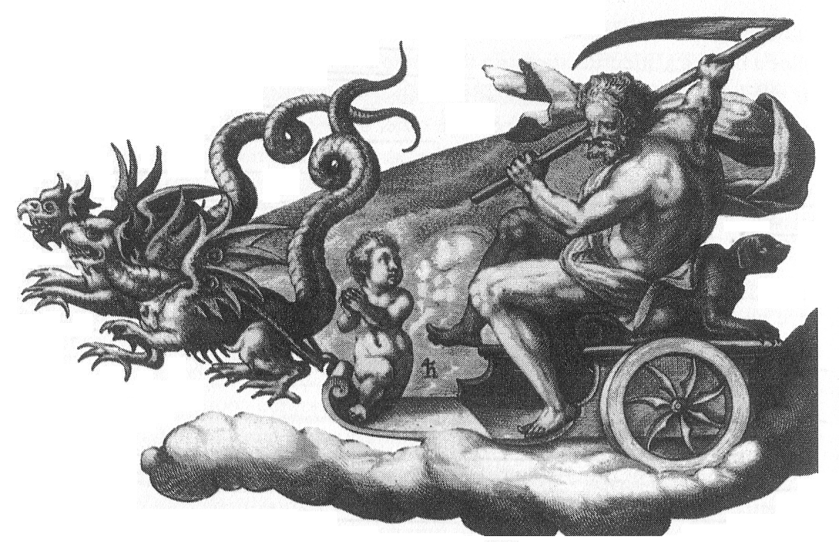

Withhold not the child-thinking, yet harm not the lad: surrender is equivalent to sacrifice.
Surrender = formally repudiate reliance on naive possibilism-thinking; affirm and rely on eternalism-thinking instead, in the peak advanced mystic altered state.
Half of the Publication Dates in the Body Are Grossly Incorrect (Freud 1999)
Are you not aware that Freud was long dead by 1999?
The blame must be the advisors: Why did they let this amateurish mistake remain?
The most awkward thing about this dissertation is the incorrect publication years in the body of the text.
It drives me up the wall and is highly unhelpful and confusing, that Houot quotes the book that Huxley wrote in 1999.
You can’t trust any dates in the body of the text, and have to check the Bibliography to get the real dates.
Publication Dates off by 2 Years or 70 Years
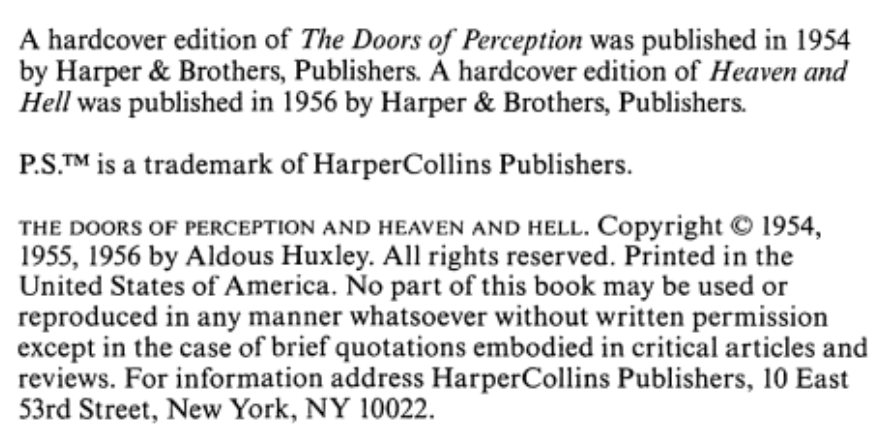
There are 9 years – not 6! – between The Perennial Philosophy and The Doors of Perception: Published 1954 vs. 1954.
I’ve seen articles by someone like Griffiths stating Perennial Philosophy was published 1957, and Doors of Perception 1953.
Where are they getting these wrong dates?
That’s only 6 years apart.
Explanation of Doors “1953”: May 1953 is the date of ingesting mescaline.
Houot misstates “Huxley 1947” for Perennial Philosophy, when the official copyright page reads 1944 & 1945.
Where are people copying this wrong date from? What book the other day says “Perennial Philosophy 1947” and “Doors of Perception 1953”?
The correct publication date for The Perennial Philosophy is 1945 according to:
https://en.wikipedia.org/wiki/The_Perennial_Philosophy
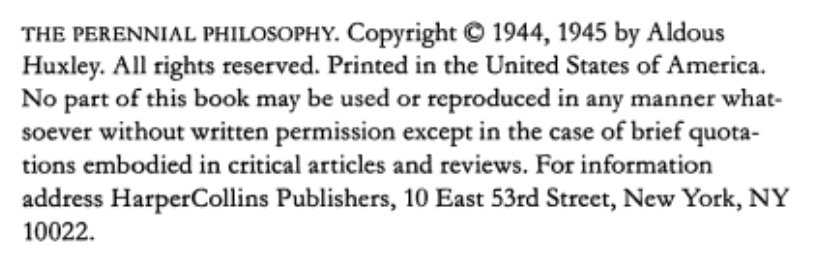
The correct date for The Doors of Perception is 1954.
https://en.wikipedia.org/wiki/The_Doors_of_Perception
The correct date for Heaven and Hell is 1956.
https://en.wikipedia.org/wiki/Heaven_and_Hell_(essay)
What Houot Gets Right
todo
Original Draft of Present Page
This content was originally drafted in page section:
Page title:
Moving Past Mysticism: Theory of Psychedelic Eternalism Provides Scientific Basis, Superseding “Mysticism, Meditation, & Psychotherapy” Framework
Section heading:
Toward a Philosophy of Psychedelic Technology: An Exploration of Fear, Otherness, and Control (Houot 2019)
https://egodeaththeory.wordpress.com/2023/01/15/the-theory-of-psychedelic-eternalism-provides-a-scientific-explanatory-basis-for-mystic-state-experiencing/#Houot
Didn’t I Post About this Before?
I have printed this out, Jan 16 2023. 65 pages.
I must have spoken about this on Egodeath Mystery Show, I swear I posted something mocking this dissertation’s reasoning:
“Just become shamans instead of mystics, b/c shamans never have issues”.
I’m certain I wrote something, but finding my rare word ‘shaman’ didn’t turn up my previous mention of this article.
Houot’s Griffiths References I didn’t need to use
[figuratively speaking; joking b/c almost same year]
Griffiths’ reply to my 2007 main article which started the Psychedelic Renaissance:
Griffiths, R. R., Richards, W. A., McCann, U., & Jesse, R. (2006). Psilocybin can occasion mystical-type experiences having substantial and sustained personal meaning and spiritual significance. Psychopharmacology, 187(3), 268-283.
Griffiths, R. R., Richards, W. A., Johnson, M. W., McCann, U. D., & Jesse, R. (2008). Mystical-type experiences occasioned by psilocybin mediate the attribution of personal meaning and spiritual significance 14 months later. Journal of Psychopharmacology, 22(6), 621-632.
Here’s the “39% of newbie high-dose are panic frenzy madness trips” article Houot cited:
Griffiths, R. R., Johnson, M. W., Richards, W. A., Richards, B. D., McCann, U., & Jesse, R. (2011). Psilocybin occasioned mystical-type experiences: immediate and persisting dose-related effects. Psychopharmacology, 218(4), 649-665.
https://www.academia.edu/16410218/Psilocybin_occasioned_mystical_type_experiences_immediate_and_persisting_dose_related_effects
Griffiths, R. R. (2018). Personal email communication on October 24-25, 2018. Griffiths confirms that it’s arbitrary, Walter Stace’s assertion/ assessment that “60% fulfillment of these mystical effects constitutes a complete mystical experience”.
Phenomenology for Psychedelic Researchers: A Review of Current Methods & Practices (Houot 2012)
A. M. Houot
2021, Journal of Consciousness Exploration & Research
18 Pages
KEYWORDS: Psychedelics
Academia.edu keyword “psychedelics”
https://www.academia.edu/Documents/in/Psychedelics
Cognitive NeuroContradiction: “Neurophenomenology”
Neurophenomenology? Agghhh
Phenomenology (Research Methodology),
Abstract:
“Intellectuals qualified to investigate consciousness – namely, philosophers, especially phenomenologists – generally fall silent when it comes to chemically altered states.”
HEARTILY AGREE!
“This paper familiarizes philosophers how phenomenology is currently being used or might be applied to investigate psychedelic-induced states, and primarily to inform psychedelic researchers of any field what available methods exist that can add greater subjective and phenomenological nuance to their research goals.
“Discussed methods range from first-person phenomenological reduction to various naturalized and applied phenomenology.
“Special attention is devoted to the neurophenomenology method for its ability to reveal new insights between quantitative and qualitative data, particularly regarding neurophysiological mechanisms related to first-person experiences.
“A chief aim for phenomenologists is to get as close as possible to the lived experience to discover its structures of consciousness; for this reason, phenomenology broadly speaking is a favorable attitude or method to advance understanding of visionary experiences.”
References
References for Psychedelic Psychometrics Questionnaires
https://egodeaththeory.wordpress.com/2023/01/17/references-for-psychedelic-psychometrics-questionnaires/
See Also
Rise of the Psychonaut Houot 2025

 The Egodeath theory