November 23, 2024 6:30 am, Michael Hoffman
Contents:
10% of these links only work on desktop Edge/Chrome:
- Intro
- The Positions
- Terminology
- The Pilzbaum Affirmers’ Assertion
- The Pilzbaum Deniers’ Assertion
- The Three Positions/ Assertions: Secret Amanita; Debunking Secret Amanita; Explicit Cubensis
- Position 1: Secret Amanita
- Position 2: Debunking Secret Amanita
- Position 3: Explicit Cubensis
- (Position 4: Debunking Explicit Cubensis)
- The Fallacies
- The Abstract Description fallacy: Pilzbaum can’t be mushrooms, because pilzbaum have “branches” (ignore that fact that those “branches” look like mushrooms)
- Special Pleading
- Failing to Respond to the Best Articles/ Writings: Writings that Must Be Discussed, Else Lose the Debate that Counts
- Does Drawer W3.2, Folder 20 include two photostats of pilzbaum?
- The Presentism fallacy
- 🍄
- The Single-Referent fallacy
- The Strawman fallacy
- Bernward Door: Not Secret, Therefore Not Mushroom (strawman)
- Insight about Bernward Door Handedness
- Decodings: Saint Martin Fingers, Splayed & Not
- Was there “a Secret Amanita Cult”? I prove no; no mushroom in Christianity
- Top priority for a German Reader to Assess: Brinckmann Book
- Key Questions as Page Numbers in Brinckmann’s Book
- Commentary about Key Questions
- The “No True Scholar” fallacy
- Argument from authority: “Consult” the authorities (in person, because they wrote nothing)
- The Deniers Censor and Lie by Omission; Commit ACADEMIC FRAUD
- The Father of Obstructing European Ethnomycology
- A 990 miniature showing the start of development from pine to mushroom
- A 1200s glass painting showing an emphatic mushroom crown/ cap
- The “Coerced position statement” fallacy
- Superior Affirmers & Inferior Affirmers
- Ruck’s position: Pilzbaum are mushrooms and nothing else; not stylized trees
- Pretending Artist Denies Pilzbaum Looks Like Mushroom (the bait & switch fallacy)
- Non-Sequitur fallacy
- The “secret Amanita cult” theory (SAC)
- Motte-and-Bailey fallacy
- Brinckmann 1906 lacks the concept of psychoactive mushrooms
- False Dilemma fallacy (reductionism, literalism)
- Whole/Part fallacy (moving the goalposts; Motte and Bailey)
- Reductionism, literalism
- Motivation for My Entheogen Scholarship: Use Myth to Prove My Core Theory
- Motivation for Ruck’s entheogen scholarship: Construct a Prohibition Barrier Identity
- 🧇
- Against the Assumption of Suppression of Psychedelics in Antiquity
- The Wrong Genre fallacy
- Circular Reasoning fallacy (Assuming that which is to be Proved)
- Proxy Premise
- 5 Things Censored in Panofsky by Deceiver Wasson, Lying by Omission
- Text-First Fallacy: Text or It Didn’t Happen
- Kettle Logic
- Mis-Reading Non-Naturalistic Art by the Rules of Naturalistic Art
- The Physical Threat fallacy: I am going to have those who believe this bullsh!t crying in a corner
- See Also
Intro
Every argument by deniers is false.
I readily refuted every argument from Erwin Panofsky, R Wasson, Thomas Hatsis, Chris Bennett,and Ronald Huggins.
Not one of their arguments stands up to pushback.
initial title idea:
I Reached Out to Consult a Competent Art Historian — Because They Wrote 0 Sentences About the Tabooed Mushroom-Trees
Voice recording: VOX_TK_6225.wav (not published), 26:00
________________________________
The Positions
The Positions, Optimally Defined
Terminology
pilzbaum
pilzbaum – Term coined by art historians eg Brinckmann 1906 meaning trees that look like mushrooms, in Christian art. German for mushroom-tree.
Art historians eg Brinckmann 1906 coined the term ‘pilzbaum’, meaning trees that look like mushrooms.
They assert: there exists a non-empty, easily identifiable set, in Christian art, the set of tree images that looks like mushroom to such a strong extent such that the artist must agree that the image makes viewers think of mushroom.
pilzbaum Affirmers
affirmers = anyone who asserts that any mushroom-trees are purposefully meant to be viewed as mushrooms.
pilzbaum Deniers
deniers = anyone who denies that any mushroom-trees are purposefully meant to be viewed as mushrooms.
The Pilzbaum Affirmers’ Assertion
Official definition of their assertion in the debate:
Same Given, not in dispute: The artist drew the tree using mushroom elements imagery (for portions or aspects of the tree, not the whole tree in all aspects) so strong that it makes viewers think of mushroom.
Assertion: And there is a purpose for making viewers think of mushroom. The purpose is, expressed on 3 scales:
1) Make viewers interpret the tree image as mushroom. (inferior affirmers; the Secret Amanita paradigm).
2) Make viewers interpret the entire image as description of religious psychoactive mushroom experience.
3) Make viewers interpret the entire set of entire images as description of peak religious psychoactive mushroom experience of eternalism, figured as non-branching of possibilities. (superior affirmers; the Explicit Cubensis paradigm).
Found together integrated are {mushrooms}, {branching}, {handedness}, and {stability} motifs, which together are meant to describe Analogical Psychedelic Eternalism with 2-level control, per the Egodeath theory 1997/ 2007/ 2022.
/ end of Assertion definition
Pilzbaum affirmers are called “the mycologists” per Panofsky in 1952, meaning John Ramsbottom, Rolfe & Rolfe 1925, etc.
Do not equate “the mycologists” with affirmers, as Panofsky does.
The Actual Message is not “mushrooms”, but rather: On mushrooms, possibility-branching thinking produces loss of control; eternal non-branching thinking produces stable control
The artists’ ultimate concern is to express, depict, & describe visually: on mushrooms, possibility-branching thinking produces loss of control; eternalism-thinking produces stable control.
The artists’ ultimate concern is to express: and depict & describe visually: possibilism-thinking produces loss of control; eternalism possibilism-thinking produces stable control.
“They [mushrooms] do not occur in the Bible, so far as I know [when read literally, as describing the things of the ordinary state].”
{mushrooms}, {branching}, {handedness}, and {stability} motifs are not all the ultimate message.
{mushrooms} – mostly a mere carrier for the message.
{branching} – the ultimate message.
{handedness} – a mere carrier for the message, to express that there are two distinct mental worldmodels.
{stability} – the ultimate message.
In-depth discussion in voice recording VOX_TK_6216 .wav Nov 18 2024 (unreleased). I’m considering producing Ep264 using wav files mentioned: 6216, 6220, 6225 (recorded Nov/Dec 2024).
The Pilzbaum Deniers’ Assertion
Official definition of the pilzbaum Deniers’ assertion in the debate:
A given, not in dispute: The artist drew the tree using mushroom elements imagery (for portions or aspects of the tree, not the whole tree in all aspects) so strong that it makes viewers think of mushroom.
Assertion: And there is no purpose for making viewers think of mushroom.
/ end of Assertion definition
Do not equate “the art historians” with deniers, as Panofsky does.
Deniers have no arguments that stand up to pushback; their position is indefensible and very easy to refute.
The Three Positions/ Assertions: Secret Amanita; Debunking Secret Amanita; Explicit Cubensis
I define the best Affirmers & Deniers positions.
Pop-level “debunking” of one particular narrow specific theory in order to try to appear to win “the” debate that there were no mushrooms in Christianity.
Huge problem from the start: What exactly are the positions being debated/asserted? By who, against who?
Conflation Game
Position 1: Secret Amanita
Wasson 1957; Allegro 1970; Ruck 1976.
The Moderate entheogen theory of religion.
Giveaway locutions/ lexicon: THE mushroom; A “cult”, “a mushroom”, “the Holy Mushroom”, “the sacred mushroom”.
First, Gordon Wasson proposes a single secret Amanita cult, that started in Ural mountains that spread around the world from there.
Similarly, John Allegro placed such an original secret Amanita cult at the start of Christianity.
Carl Ruck 1976-2006+ puts most of his focus on Hidden Secret Amanita.
Ruck is more enthusiastic about Secret than Amanita, in his confabulated narrative discourse fairytale cartoon moralistic story, ritually repeated at every opportunity, to construct his own personal identity as counterculture heretic (the Good Guys in the tale).
The narrow, specific, brittle Wasson/ Allegro/ Ruck Secret Amanita position/ scenario (which is Presentism).
Against the Assumption of Suppression of Psychedelics in Pre-Modernity (Cyberdisciple 2020).
Position 2: Debunking Secret Amanita
Letcher 2005; Hatsis 2013; Huggins 2024.
Mainly based on Motte-and-Bailey fallacy aka moving the goalposts.
Ironically, by the time the first of these debunkers wrote, the field had already broadened and switched from Secret Amanita (announced 1997 Samorini) to Explicit Cubensis.
The debunkers aimed at an outdated position/ model/ theory, addressing a behind-the-times Pop audience.
The Theory 1 Debunkers claim they disprove [mushrooms in Christianity] (a la Position 3: Explicit Cubensis), but the only thing they disprove (if anything) is the [Secret Amanita cult spread] position/ argument/ assertion – a hybrid of Wasson & Allegro.
I can grant that the Secret Amanita Debunkers won their debate. But the field (Samorini 1997; Michael Hoffman 2002; and (post-Letcher 2005): Brown 2016) had already moved past that debate/framing/position.
Timing of Hatsis: When 2013-2015 Hatsis wrote against Irvin, I was already tracking the forthcoming book by Brown 2016. Hatsis was writing prior to Browns’ book.
Hatsis in 2018 wrote book with poor handling of mushrooms in Christian art, that failed to step up to the debate, but lectured instead on historiography: Psychedelic Mystery Traditions (2018)
Psychedelic Mystery Traditions (2018) is a ripoff of $ re: mushrooms in Christian art; fails to do what it claims to do- SLOPPY ARG’N:
“For the proof supporting my self-aggrandizing methodology lecture, disproving mushrooms in Christian art, leave this book that you paid for, and instead see my articles somewhere on the web.”
The desirable Bailey that the deniers wish they were able to defend = [there were no mushrooms in Christianity].
Sell books to pop audience marketed as disproving mushroom in Christianity – that only actually argue against the narrow, specific, brittle Wasson/ Allegro/ Ruck Secret Amanita position/ scenario (which is Presentism).
The undesired, worthless Motte that the deniers are able to defend = disproving [the secret Amanita cult theory per Wasson originating in Ural mountains and then spreading from there].
Position 3: Explicit Cubensis
Samorini 1997; Michael Hoffman 2002; Brown & Brown 2016/2019/2021.
The Maximal entheogen theory of religion.
Within the set of all Christians (not “a group”, “a cult”, “a community”, “a heretic sect”, etc.), there was use of Psilocybin (Cube, Lib Cap, Pana) – as well as, incidentally and of merely minor concern, Amanita mushrooms.
There were at least two instances in any region/ era.
Not rely on concepts like “a tradition” or “traditional use” or “a tradition of use” or “a mainstream psychedelic tradition”.
This position rejects the a priori presupposition of Suppression, ie. the assumption that we should helpfully, as our proposed explanatory construct / mechanism, divide Christianity into two parts by constructing a dividing line:
On one side of the taken-for-granted barrier/ boundary line is “mainstream = Prohibitionist“; on the other side of the taken-for-granted barrier/ boundary line is “counterculture = Psychedelic“.
(Position 4: Debunking Explicit Cubensis)
Might be able to scrape together a little argumentation from the Deniers that fits this model.
The Fallacies
The Abstract Description fallacy: Pilzbaum can’t be mushrooms, because pilzbaum have “branches” (ignore that fact that those “branches” look like mushrooms)
Huggins’ Foraging Wrong article re: “Creation of Plants” Image
https://egodeaththeory.wordpress.com/2024/11/23/huggins-foraging-psychedelic-mushrooms-wrong-forest/
Each of the plants in the third-day scene also has branches. The mushrooms the PMTs wish to identify them with, however, do not.
Ronald Huggins, “Foraging for Psychedelic Mushrooms in the Wrong Forest: The Great Canterbury Psalter as a Medieval Test Case”, p. 17
The below images are copied from https://egodeaththeory.wordpress.com/2023/06/11/eadwine-images-in-great-canterbury-psalter-commentary-interpretation/#f11-row-1-right –
Great Canterbury Psalter f11 row 1 right – “Creation of Plants”/”third day”
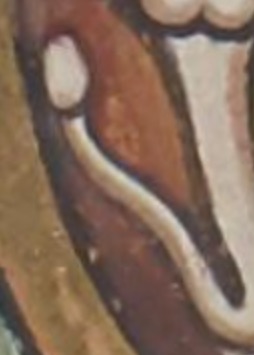
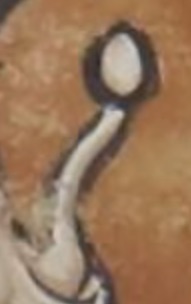
Huggins 2024: These pilzbaum have branches, which make these not look like mushrooms at all; Just look at these branches that disqualify these pilzbaum from looking anything like mushrooms
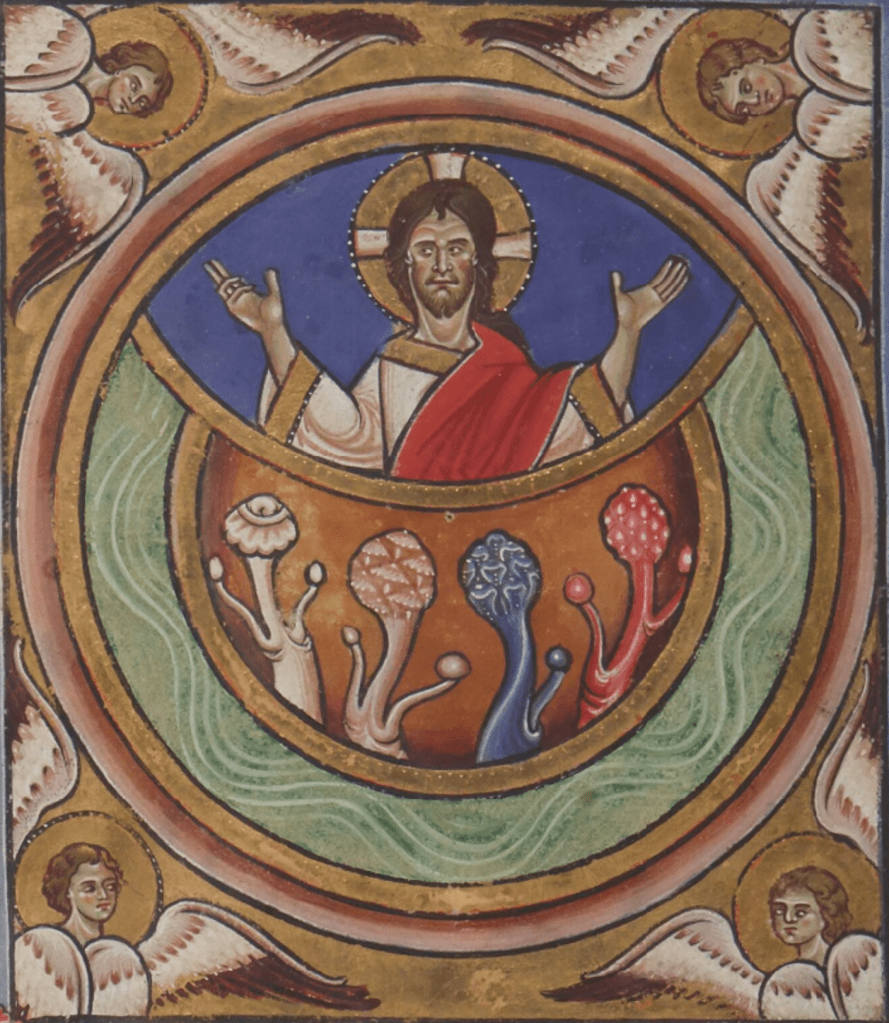
Great Canterbury Psalter, “Creation of Plants”/”third day”, f11 row 1 right
discovered by Paul Lindgren 2000
https://gallica.bnf.fr/ark:/12148/btv1b10551125c/f11.item.zoom
Great Canterbury Psalter, “Creation of Plants”/”third day”, f11 row 1 right
Look at these branches, which prove that these mushroom-looking plants that the art historians describe as pilzbaum do not look like mushrooms.


Special Pleading
Art has multiple meanings (except pilzbaum)
Art interpretation basic principle: Art has multiple meanings.
What about pilzbaum?
In that special case, art can only have a single meaning, and the meaning is the non-mushroom one.
Artists have intentionality and freedom (except pilzbaum)
Art interpretation basic principle: Artists have intentionality and freedom to express themselves.
What about pilzbaum?
In that special case, artists are especially ignorant craftsmen with no freedom and no intentionality, a human copying machine forced to follow prototypes, which eventually became accepted by the art world. 🤷♂️
Viewers: Looks like mushroom.
Artist (according to the greatest art historian EVAR, Erwin Panofsky):
I don’t know anything about. It’s just the way it is. Don’t ask me, I just transfer the corrupted, re-drawn prototypes onto walls as I’m told to. I don’t have anything to do with the meaning of the picture. I am not responsible for making you think of mushrooms by painting mushroom-like features. It doesn’t mean anything at all to me, just a randomly, corruptly stylized literal tree. Don’t ask me, I’m just a craftsman.
pilzbaum artist
in all other art cases:
“The painting has 5-1/2 layers of meaning:
- The literal level for children and rank outsiders ignorant of loosecog.
- The analogy level, the real ultimate referent: psychedelic eternalism, how to think as an egoic agent after being taught the fatal instability of the egoic possibility-branching control model.
– unless the subject of the art is pilzbaum, in which case, the purpose of religious art is literal trees, snakes, and rocks, stylized as mushrooms non-purposefully (ie randomly corrupted templates that the art world had come to accept).
Failing to Respond to the Best Articles/ Writings: Writings that Must Be Discussed, Else Lose the Debate that Counts
Huggins doesn’t reply to my points in my 2006 Plaincourault article, doesn’t reply to Cyberdisciple’s webpages. doesn’t cite Brown’s March 2021 article in Huggins’ Feb 2021 article. doesn’t cite Brown 2019 where Panof letters published – instead says footnote 56 & 57 slightly garbled citation of the Wasson archives, “drawer, W3.2, Folder 20”.
Does Drawer W3.2, Folder 20 include two photostats of pilzbaum?
- A 990 miniature showing the start of development from pine to mushroom.
- A 1200s glass painting showing an emphatic mushroom crown/ cap.
Entheogen scholars need to see which pictures, and find hi-res of them online, and analyze them for {mushrooms}, {branching}, {handedness}, and {stability} motifs.
Foraging for Psychedelic Mushrooms in the Wrong Forest: The Great Canterbury Psalter as a Medieval Test Case
Ronald Huggins, 2024
Die Bibel in der Kunst / Bible in the Arts
Online-Journal 8, 2024
PDF: “Foraging_for_Psychedelic_Mushrooms_in_th.pdf”
Footnote 56. Erwin Panofsky to R. Gordon Wasson (May 2, 1952), in Tina and R. Gordon Wasson Ethnomycological Collection Archives, ecb00001, Series IV, drawer,[sic?] W3.2, Folder: 20. Botany Libraries, Economic Botany Library of Oakes Ames, Harvard University.
Footnote 57. Erwin Panofsky to R. Gordon Wasson (May 12, 1952), in Tina and R. Gordon Wasson, Ethnomycological Collection Archives, ecb00001, Series IV, drawer, W3.2, Folder: 20. Botany Libraries, Economic Botany Library of Oakes Ames, Harvard University.
The Presentism fallacy
Projecting 1970s Mainstream Prohibition and Counterculture Psychedelics onto Pre-Modernity as “a Suppressed Cult”.
Emperor Nixon in 71 declared War on The Mushroom.
🍄🗡👑🐀
The Single-Referent fallacy
In art, things have multiple meanings, except in the unique case of mushroom imagery, where things can only have a single meaning — therefore not mushroom.
Chris Bennett: The tree is a Palm, therefore it is not a mushroom.
The image refers to a tree, therefore the image does not refer to a mushroom instead.
Dismissing pilzbaum is extremely easy [& worthless; strawman]: simply state the Captain Obvious literal meaning [which is not actually in dispute], and then declare victory, & exclaim extreme ignorance on the part of the opponent.
Also call the artist inept, crude, sloppy, un-conscious, and incompetent.
Chris Bennett: “Badly draw trees.” God Creates Plants – “poorly drawn ones with which it would be difficult to say what they represent.”
Based on my observations of specimens growing, they are stylized Panaeolus; Liberty Cap; Cubensis; Amanita.
Not opium or rue per James Arthur 2000.
Not “Psilocybe; Panaeolus; psilocybin mushroom; Amanita” per Brown 2016.
The Strawman fallacy
Projection, & Moving the Goalposts: Misrepresenting the Opponent’s Position
Universal comment for everything Chris “sic” Bennett writes: As I wrote in my book review of Drugs & The Bible:
Typos and grammar errors in the original.
Wasson … according to the Browns, … was thus theoretically bound to cover up theorized secret mushroom cult. … the Browns explain:
“Wasson … his position on the absence of entheogens in the Judeo-Christian tradition after 1000 BCE, … that the “mushroom-tree” in the Eden fresco at Plaincourault is indeed an Amanita muscaria … expanded the theory on the role of entheogens in religion to encompass the origins of Christianity.”
Chris Bennett, “The Fungi-Pareidolia of The Psychedelic Gospels”, p. 11
Brown wrote generally & expansively, that the point in dispute is:
- entheogens in the Judeo-Christian tradition after 1000 BCE
- the “mushroom-tree” in the Eden fresco at Plaincourault is Amanita
- the role of entheogens in religion encompasses the origins of Christianity
Bennett wrote instead, narrowly and specifically:
- theorized secret mushroom cult
Brown doesn’t employ the Allegro/ Hatsis explanatory construct “a secret Christian Amanita cult” or “a secret mushroom [=== 🍄] cult”, or “the theory of a secret cult of the Holy Mushroom, Amanita muscaria 🍄”.
The person who employs that construct is Hatsis, the #1 fan of Allegro, whose thought-world & framing is centered on and bounded by Allegro’s thought-world.
Hatsis, following Allegro’s lead, constructed the “secret Amanita cult” theory & the explanatory construct “secret Christian Amanita cult”.
Wasson may have constructed that too.
Attributing the Allegro/ Hatsis explanatory construct to Brown is strawmanning and projection; narrowing the goalposts; bait and switch; & the motte and bailey logical fallacy.
https://www.cannabisculture.com/content/2021/08/05/__trashed/
Bernward Door: Not Secret, Therefore Not Mushroom (strawman)
There really might exist some “gullible pop believer in the Shroom theory the “secret Amanita cult” theory, the Secret Amanita paradigm.
There are two warring positions: Young Hatsis vs. Old Hatsis who is out to debunk Young Hatsis. There might be two different people, one who wants to assert the “secret Amanita cult” theory and one who wants to debunk that very theory. I’m off to the side, DGAF about “secret” anything and suchlike important storytelling narrative discourse of identity definition.
Hanegraaff says un-scientific historians tell a story for themselves: a story about the Other (rejected knowledge; W Esotericism) in order to define themselves.
Non-scientific historians invent an Other, to define themselves in opposition to it.
Insight about Bernward Door Handedness
[4:20 pm Nov 24, 2024] – Bernward door: the Blame panel: Adam and Eve have crossed arms (right arm visually cut), serpent cutting view of Eve Right leg – forming {cut right arm or leg}.
Adam points at the YI Liberty Cap tree.
Adam and Eve are standing on R foot, in Eating from Tree of K panel. In Blame panel, they are on L foot, God on R foot.
This solves a problem/ antipattern I ran into: I expected Adam & Eve to stand on Right foot, lacked that – but that is present, in the Eating panel above this Blame panel.
YI branching tree morphology.
Chris Bennett merely sees a dud mushroom-tree in the “Eating from the Tree of the Knowledge of Good and Evil” panel of Bernward Door. p13-15 = section The Door of Salvation.
Bennett claims that there is no connection between the fig leaf tree in the Eating from ToK panel & the Liberty Cap tree in the Blaming panel below that panel.
Both panels’ Eden trees, positioned as the Tree of Knowledge, have YI morphology.
“The Fungi-Pareidolia of The Psychedelic Gospels”
Chris Bennett, Aug 2021
https://www.cannabisculture.com/content/2021/08/05/__trashed/
Decodings: Saint Martin Fingers, Splayed & Not
[4:32 pm Nov 24, 2024] – Saint Martin Church –
Isaiah: Angel’s Left hand fingers are splayed, matching Jesus’ splayed fingers to the right.
Where Brown 2016 wrote “The particular gesture with which the angel displays the coal”.
Was there “a Secret Amanita Cult”? I prove no; no mushroom in Christianity
Conflating bare entheogen claim with “secret” , “Amanita“, & “cult” modifiers specifically, to narrow the claim (moving the goalposts)
Conflating the bare, expansive claim with the “secret” , “Amanita“, & “cult” modifiers specifically, to narrow the claim (moving the goalposts)
Bennett assumes what we are debating is whether there was “a secret mushroom cult”.
Is Brown asserting that stupid, unhelpful, unproductive, unneeded framing, that does nothing but confuse thinking?
Alas the stupid field of entheogen scholarship is trapped, fixated, developmentally stunted, hung on that unproductive, overloaded question.
Andy Letcher in Shroom: The mushrooms on the Bernward door are not secret or hidden, therefore your guyses claim is defeated, and there is no secret mushroom. (Therefore there is no mushroom.)
Top priority for a German Reader to Assess: Brinckmann Book
Mandatory.
Attention Brown etc:
Need a German reader to check for 3 specific points in Brinckmann’s book, to check Panofsky’s claims that the book supports the pilzbaum deniers.
re: Brinckmann 1906 book
Have a German language reader check at Archive site or copy of 1906 book:
Key Questions as Page Numbers in Brinckmann’s Book
What page # discusses development of trees/ pilzbaum from pine to mushroom imagery?
What page # discusses corruption of prototypes?
What page # says that that development was universal & widespread?
What page # says that that gradualness of progressive development proves that the artist had no purpose in making viewers think of a mushroom?
Commentary about Key Questions
In 1906, Brinckmann cannot imagine any purpose like desirable magic mushroom for religious ecstasy.
His book probably lacks any notion of “purposeful” mushroom imagery, and he sees no reason to discuss whether there’s a purpose – he cannot imagine a purpose for mushroom imagery in religious art.
In 1952, Panofsky reads that lack of concept of “purpose of mushroom” as if Brinckmann had asserted “development gradually from pine to mushroom proves lack of purpose of mushroom imagery”.
Brinckmann probably wrote nothing about purpose or lack of purpose, in 1906, being purely ignorant of claims for religious ecstasy or recreational experience from mushrooms.
Pilzbaum was not a “charged”, “hot”, contentious topic, whereas in 1952, that idea was just beginning.
Brinc has no reason to fabricate and desperately steer away, and no reason to think of whether there is purpose of the mushroom shape.
In Brinc’s thought-world, there’s no such thing as “purpose” for mushroom imagery; mushroom imagery means nothing, just like branching and non-branching features used to mean nothing to me eg in 2006 when I added the “St. Eustace Crossing the River” picture to my main article b/c “Look Mummy there’s a mushroom!” – blind to branching meaning, as Brinc was blind to any mushroom meaning.
The “No True Scholar” fallacy
No competent art historian asserts pilzbaum purposefully mean mushroom.
If they were to, they would become “not competent”, and not institution-employed.
No tenured academic — with a relevant degree — who teaches on this — and who publishes on this – and who has an advanced degree — in this exact topic — asserts the ahistoricity of religious founder figures.
Also: moving the goalposts.
Argument from authority: “Consult” the authorities (in person, because they wrote nothing)
Wasson, deceptively withholding a key citation provided by Panofsky twice & Panofsky’s two photostat art pieces, wrote that Panofsky’s (a “competent art historian”) investigations of this topic concluded in denial — without giving most of Panofsky’s evidence & argumentation.
Giveaway cliche: “I reached out and consulted the art historians” — because they wrote/ published 0 sentences on this taboo topic.
Panofsky only has one weak, old, “little” book to cite, to back his claim that scholars have a firm basis for denial.
The Deniers Censor and Lie by Omission; Commit ACADEMIC FRAUD
Censored by Wasson:
Panofsky two pics of pilzbaum attached to letter 1; the twice strong recomm / citation of Brinck bk; existence of Panofsky letter 2.
Liar Huggins pretends we had Pan letter 2 since 1957 Soma. Huggins covers for Wasson’s deception & abusive insults. Wasson’s ACADEMIC FRAUD.
rauWasson’s ACADEMIC FRAUD.
The Father of Obstructing European Ethnomycology
There is no sign that Brinckmann’s book supports denial. The book supports affirming.
That’s why Wasson (the father of obstructing research) censored the citation that Panofsky 1952 urged on mycologists twice, as we now know thanks only to Brown 2019.
The two photostat art images support affirming; that explains why Wasson censored them and lied by omission, repeatedly.
To punish Wasson, we can justifiably deduce and count these as two additional art pieces that support affirming.
Wasson’s credibility is in the toilet since Brown 2019 exposed both of Panofsky’s letters.
My branching article will have two placeholders to make this point — Censored by Wasson:
We will figure out which two pilzbaum pictures Panofsky likely sent Wasson with the first letter. Look for them in the Wasson archive.
Panofsky wrote:
“Just to show what I mean, I enclose two specimens:
A 990 miniature showing the start of development from pine to mushroom
A miniature of 990 which shows the inception of the process of gradual hardening of the pine into a mushroom-like shape — CENSORED
“a miniature of ca. 990 which shows the inception of the process, viz., the gradual hardening of the pine into a mushroom-like shape,
and
A 1200s glass painting showing an emphatic mushroom crown/ cap
A glass painting of the thirteenth century which shows an even more emphatic schematization of the mushroom-like crown — CENSORED
“a glass painting of the thirteenth century, that is to say about a century later than your fresco, which shows an even more emphatic schematization of the mushroom-like crown.
I HAVE STRIPPED WASSON OF HIS TITLE, “THE FATHER OF ETHNOMYCOLOGY”.
I bestow on Wasson, with hammer and nail, a new title:
THE FATHER OF OBSTRUCTING EUROPEAN ETHNOMYCOLOGY.
The “Coerced position statement” fallacy
A cliche that pilzbaum deniers write, in their mass of obvious logical fallacies and bad argumentation:
“I reached out to ask a competent art historian whether pilzbaum mean mushroom ” —
The affirmers’ retort: thought of/ articulated by me:
The reason why you had to ask the art historian is because they wrote 0 sentences on this topic, and are therefore not competent on this point – or, to be more precise & relevant:
Their position statement on this tabooed topic is coerced; they are not permitted to affirm, or else they would lose their corrupt-institutional standing as “competent”.
Art historians are required to be deniers.
Public, non-anonymous denial proves nothing about what the art historian privately actually believes.
Corrupt-institutional art historians are permitted (but discouraged) to write either:
nothing; silence on the topic (preferred)
“pilzbaum are not purposefully mushrooms.”
Art historians employed by compromised institutions that are driven by taboo are not allowed to write “pilzbaum are purposefully mushrooms”, else they would lose their corrupt-institutional credential as “competent”.
The Hoffman Uncertainty Principle
When interrogating/ probing/ pressuring a “competent” art historian to go on record making a public statement affirming or denying that pilzbaum purposefully mean mushrooms, and measuring/ observing the resulting response:
If the art historian were to affirm, we would know that they believe the affirmative (a sincere position statement), given the coerced denial.
The art historian would lose their corrupt-institutional designation as “competent”, becoming unemployed as an institutional art historian.
That affirming doesn’t happen, because that would be a self-incriminating, forbidden position declaration.
If the art historian denies, we don’t know what the art historian believes — because the position statement is taboo and coerced, thus meaningless.
They have an incentive to lie and pretend to deny, but privately affirm.
Their negative statement or declaration (made “with impressive celerity” – Wasson) is likely an insincere position statement.
Superior Affirmers & Inferior Affirmers
“secret Amanita” theorists affirm pilzbaum purposefully mean mushrooms. Reductionist.
1) Make viewers interpret the tree image as mushroom. (inferior affirmers; the Secret Amanita paradigm).
“explicit Cubensis” theorists affirm pilzbaum purposefully mean non-branching mushroom effects. pilzbaum combine & integrate {mushrooms}, {branching} motifs.
3) Make viewers interpret the entire set of entire images as description of peak religious psychoactive mushroom experience of eternalism, figured as non-branching of possibilities. (superior affirmers; the Explicit Cubensis paradigm).
Ruck’s position: Pilzbaum are mushrooms and nothing else; not stylized trees
I reject Ruck’s position statement “mushrooms and nothing else, not stylized trees”:
Well known now are the many documented depictions of the Paradise Trees as mushrooms: mushrooms and nothing else. They look like mushrooms and that is quite frankly what they are, not stylized trees, for the mushroom played a role in Christian mysticism and so-called heretical sects. [cites Samorini 1997 (Plaincourault) & 1998 (pilzbaum).]
Jose Celdran, Carl Ruck, “Daturas for the Virgin” p. 56, 2001, Entheos Issue 2
Ruck writes “so-called heretical sects” or “so-called heretics” in all 3 Entheos issues (including in the online notes for Issue 3: Mithras article).
Nov 26 recg 6240 per nov 17 voice recg 6203 — Ruck error p 56 article Daturas Virgin: Ruck says Paradise pilzbaum are “mushrooms AND NOTHING ELSE”; they are “NOT STYLIZED TREES”.
False; pilzbaum are both mushroom and trees, i.e. branching and non-branching motifs + mushroom motifs.
Ruck commits a reductionism fallacy here, & false decision/ dilemma fallacy.
Pretending Artist Denies Pilzbaum Looks Like Mushroom (the bait & switch fallacy)
Samorini 1997 article p 36 Eleusis journal, “The mushroom-tree of Plaincourault”: “did the painter intend deliberately a second (esoteric) message, or unconsciously repeat an iconographic scheme without recognizing its features … the possible fungal meaning?”
Samorini entertains the possibility, a poor position, that MAYBE ARTISTS ARE BLITHERING IDIOT MORONS WHO DISAGREE THAT PILZBAUM LOOK IN ANY WAY LIKE MUSHROOMS.
He tends to try to assess the IQ of bumpkins in his 1998 article.
Ruck advocates the poor position “pilzbaum are mushrooms and nothing else”, proving SECRET Amanita CULT. Datura p 56 2001.
Winning the non-debate by calling the artist a mentally defective, blithering idiot who is incapable of recognizing the screamingly obvious.
Art historians forfeited this argument the moment they coined the definitional classification term ‘pilzbaum’, which is a given that this is a non-empty set.
We are interpreting a set of tree images that objectively exists, so it’s not relevant to fantasize or propose or debate whether the artist is too stupid to agree to the self-evidently obvious.
“win” by denying-to-death the artist’s competence.
I made this clear (I shut out this junk move) in my official statement of the two positions assertions and what is under debate.
We are not debating whether the artist agrees that the image makes viewers think of mushroom.
The art historians’ own term pilzbaum inherently asserts that the artist agrees.
They objectively look like mushroom, thus there is no need to switch the debate to the topic of the artist agreeing on this point; it is a given, not the point in dispute.
The actual debate (the point that’s actually in dispute) is whether the artist has a purpose in making viewers specifically think of mushroom.
The debate is not actually about whether the artist is too idiotic & incompetent to know which tree images are meant by pilzbaum.
No one actually, sincerely asserts that the artist fails to comprehend that their pilzbaum image looks like a mushroom.
An insincere argument that “wins” by losing & forfeiting the real argument; avoiding the actual point of dispute.
The art historians admit by definition pilzbaum objectively look like mushroom such that every viewer and every artist – as a given – must affirm that the image causes viewers to think of a mushroom.
Non-Sequitur fallacy
Means does not follow.
eg Panofsky: “The gradualness of progressive development of tree representations from pine to mushroom proves that the artist had no purpose in making viewers think of a mushroom.
“The smooth development proves that the mushroom direction of development was accidental, unintentional, and purposeless.”
retort: The development is evidence that every decade, artists purposefully tried to make trees look even more like mushrooms.
Development is evidence for purpose, not evidence for accidental clumsy unintentional corruption of alleged “prototypes” that were employed by (or even fabricated by) Panofsky as an attempted cover story.
eg: Erwin Panofsky: “There are multiple, ie hundreds! of pilzbaum, therefore, no pilzbaum purposefully means mushroom.”
His argument depends on 2 unstated items:
Silently Given: Christian art does not contain hundreds of purposeful mushrooms.
Silent Assumed Proxy Agreement: Our position on Plaincourault drives our position on all pilzbaum.
Hatsis explicitly wrote that claim of an agreed proxy commitment:
“The entire mushroom-tree debate stands or falls with Plaincourault alone; we need not consider other instances.”
No affirmer agreed on that – eg Brown, me, or Cyberdisciple.
Even Panofsky says affirmers should look at Brinckmann’s book and two photostat pictures – against Hatsis.
eg: Hatsis argues: There is no Church edict written prohibiting The Holy Mushroom (🍄) therefore no one used Amanita, and the “secret Amanita cult” theory is a myth.
Retort: There is no ancient edict, because the Church Fathers knew and believed and revered the Eucharist is Cubensis, depicted via Amanita imagery.
The “secret Amanita cult” theory (SAC)
Fallacies here include: bait and switch; move goalposts; motte and bailey.
Hatsis mentally shackles himself, limiting his thinking to the small Allegro universe, and centers his thinking around Allegro.
Allegro sets the center and boundary of Hatsis’ thought-world & concerns.
A Hatsis blog post says “Allegro is my favorite author.”
Hatsis projected; he claimed that our (the affirmers’) position is “there was a secret Amanita cult a la Allegro”, and he tried to dictate that our position/ assertion is that.
Hatsis wrote to me that we are not allowed to be interested in psilocybin mushrooms in Christian art, because that would contradict our SAC position, which is based on Allegro — that our position “came from Allegro”.
In fact Brown, Cyberdisciple, & I never held SAC, and that is not our frame of reference or an important, helpful idea.
We affirmers do not agree that that is the point being debated.
IDGAF about SAC.
I reject Allegro’s frame/ narrative/ paradigm, SAC.
I reject the Secret Amanita paradigm.
I have always held & formulated the Explicit Cubensis paradigm.
I did not read Allegro until after my 1997 core theory.
My 2002 formulation of the maximal entheogen theory of religion, ie the Explicit Cubensis paradigm, was a rebuttal to Allegro, Ruck, SAC, the Amanita primacy fallacy, & the “Secret Amanita Under Prohibition” paradigm.
The “secret Amanita cult” paradigm does not help my project of using myth to prove my 1997 core theory.
Affirmers pay no special attention to Plaincourault, and are not especially concerned about this particular mushroom-tree.
Motte-and-Bailey fallacy
The desirable bailey that the deniers wish they were able to defend = [there were no mushrooms in Christianity].
The undesired worthless motte that the deniers are able to defend = disproving [the secret Amanita cult theory per Wasson originating in Ural mountains and then spreading from there].
More specific than “moving the goalpost” fallacy or “bait and switch” fallacy.
The bailey = aggressive valuable assertion advanced; rich land, that the person wishes to defend.
The motte = weak, worthless, trivial retreated-to assertion that the person is able to “defend”; a cold sterile castle that is easy to defend, but worthless in itself, and not what the debate is actually about (ie not what the person wishes to defend), so, losing the actual argument, by trying to win some other pretended debate that no one actually cares about debating.
eg Thomas Hatsis trying to force the debate vs Brown to be about specifically “whether there was a Secret Amanita Cult (SAC)”.
Brown (ie the affirmers) is not asserting or defending that “there was a Secret Amanita Cult”, and Brown wins the actual debate, Brown’s assertion stands, bc the debate is actually about whether mushroom imagery purposefully means mushrooms.
Brinckmann 1906 lacks the concept of psychoactive mushrooms
so his interpretation of pilzbaum is invalid & irrelevant to this debate.
A point never published by anyone until now: I realized about a week ago, Nov 2024:
Brinckmann in 1906 has no concept of psychoactive mushrooms.
Or has a very thin concept connotations, siberian shamans including Lewis Carroll’s Alice in Wonderland.
Brinckmann’s alleged treatment of Pilzbaum in 1906 lacks the concept of psychoactive mushrooms.
The French mycological society didn’t assert that Plaincourault is Amanita until 1911.
Wasson and Allegro on the Tree of Knowledge as Amanita
http://egodeath.com/WassonEdenTree.htm
Wasson wrote: “This fresco, an expression of French provincial Romanesque art, was first called to the attention of the learned world in the Bulletin of the Société Mycologique de France in 1911 (vol. xxvii, p. 31).”
(I didn’t copy that article from Egodeath.com to the present site.)
False Dilemma fallacy (reductionism, literalism)
Huggins 2024 article’s Conclusion section presents rules to decide whether a pilzbaum is a literal tree or a literal mushroom.
Whole/Part fallacy (moving the goalposts; Motte and Bailey)
Deniers pretending asserters claim that the tree image as a whole, on the level of the entire tree, in every visual aspect, means a physical mushroom (moving goalposts, or more precisely, bait and switch or motte-bailey)
Actually, affirmers say a pilzbaum includes mushroom imagery fragmentary elements, together with tree imagery fragmentary elements, eg branches — and cut branches, eg {cut right trunk}.
Reductionism, literalism
Mis-reading imagery that serves to describe {Analogical Psychedelic Eternalism with 2-Level Control} as if its ultimate meaning and purpose is to describe the motifs at a literal level.
Huggins: “The accompanying text proves that the depicted man is trying to kill the salamander.”
“I reached out to consult a competent Western Esotericism scholar, Hanegraaff, who has written 0 sentences on this tabooed, controversial, forbidden topic.”
“Neither Wouter Hanegraaff nor I were able to figure out why the salamander was replaced by a phoenix, in this alchemy image series.”
Conclusion section of Huggins’ article: Pilzbaum means either literal tree or literal mushroom.
That’s a false dilemma, & reductionism & literalism.
Also a bait & switch, given that no affirmer says just mushroom:
Affirmers assert pilzbaum mean both mushroom AND tree in some sense – especially, non-branching, ie depicting by analogies, psychedelic eternalism.
Huggins falsely writes that mushrooms lack branches. Mushrooms contain branching, as effects.
Mushrooms contain effects of contrasting the branching experiential model of control vs. experiencing the revelation of non-branching control-possibilities.
Cyberdisciple’s 3 categories of mushroom imagery overlap in items 2 & 3: the {stylization of physical mushroom} as branching & non-branching is also {depiction of mushroom effects}, in my article on compelling evidence & criteria of proof for identifying mushroom imagery in Christian art.
Compelling Evidence & Proof of Explicit Psilocybin Mushrooms in Christian Art to Communicate Non-Branching Stable Control
Motivation for My Entheogen Scholarship: Use Myth to Prove My Core Theory
Motivation for My Entheogen Scholarship: Use Analogies in Religious Myth and Entheogen Imagery to Prove my Core Theory, Psychedelic Eternalism with 2-level Control
todo: Add to the above article:
The integrated combination of {mushrooms}, {branching}, {handedness}, and {stability} motifs is compelling evidence & criteria of proof for positively identifying mushroom imagery in Christian art.
The concept of ‘secret’, group-contained/ -bounded (“cult”, “communities”, “sects”), “suppression” hypothesis/ explanatory construct, and the moderate/ restrictive entheogen theory of religion impede, not assist, my project.
To collect maximum data for MY hypothesis/ proposal, I need a generous net cast, not restrictive.
Motivation for Ruck’s entheogen scholarship: Construct a Prohibition Barrier Identity
The Motivation and Project Objective of the Ruck School: Construct a Prohibition Barrier to Restrict Our Entheogens to the Counterculture, and Self-Aggrandize by Pushing the Narrative of How Bad the Church Is
The Ruck paradigm is Prohibition-enabling, Prohibition-amenable, and does NOTHING to strategically repeal Psilocybin prohibition.
The purpose of Ruck’s Restrictive entheogen theory of religion is to identify with and cheerlead for the “heretical sects”.
Bennett covers this point, at “Catholics were suppressing …”
Up to this point, the Browns have been claiming evidence of mushrooms in medieval Catholic Churches and holding the view these were Catholic secrets, however here they refer to the Gnostic sects the Catholics were suppressing.
…
As with Allegro and Wasson, the Brown’s are ready to flip flop [silently expanding or contracting their hypothesized presence or absence of entheogens, in an inconsistent, self-contradictory way] whenever it suits their presentation.
Bennett, The Fungi-Pareidolia of The Psychedelic Gospels
Bennett points out how Brown, by overemphasizing the “Secret” explanatory hypothesis, waffles and contradicts themselves.
🧇👨🍳 🍄 🚫🍄
Actually, Ruck is the wafflemaster 🧇👨🍳 here, striving to get high by telling his narrative that the big bad church eliminated entheogens, AND the Christian counterculture (or later Ruck says a few elites) had entheogens everywhere (but only a few, the initiates, knew the secret).
I reject the Ruck project of laboring to construct restrictive internal walls and barriers inside the whole inclusive group of all Christians.
My project requires simply asserting the presence of entheogens within Christianity, anywhere, regardless of imagined internal divisions and barriers.
It DOESN’T MATTER, among which Christians there were or were not entheogens present – only that there were multiple instances of entheogens present, used by some Christians of whatever type.
It is not a needed, expected, useful, helpful, or clarifying explanatory construct/ hypothesis, trying to limit and identify the boundary line within Christianity.
But constructing that barrier wall is the main motivation for the Ruck approach: to cheerlead for the imagined ancient counterculture, requiring Ruck’s perpetuating Prohibition forever.
Against the Assumption of Suppression of Psychedelics in Antiquity
The Wrong Genre fallacy
Reading religious myth and alchemy esotericism and medieval bestiary (w religious images) as if the genre & suitable effective interpretation mode is Literal-type writing & art.
The actual genre is analogies describing Analogical Psychedelic Eternalism with dependent, 2-level control, contrasted against Literalist Ordinary-state Possibilism with autonomous control.
The ultimate purpose of the religious-myth genre is to describe by analogies, mental worldmodel transformation from the Possibilism to the Eternalism mental model of time, self, possibility, and control.
Not to depict a literal tree, mushroom, salamander, killing of salamander, or phoenix.
eg: Panofsky letter 2: “medieval religious artists had no reason to think of mushroom because the Bible, so far as I know, & saints stories lack mushrooms.”
Medieval artists were evidently finding tons of good reasons to think of mushrooms, including in the Bible.
People who read the Bible as Genre: {analogies depicting psychedelic eternalism}, find Amanita in Gen2-3, manna, Eze, Rev 2:7, 2:17; Rev 10; Rev 22.
“Those on the inside” recognize the genre, mode of interpretation/ communication, as analogies describing psychedelic eternalism.
re: saints stories: The “St. Eustace crossing the river” window in Chartres cathedral shows literal Cubensis.
Circular Reasoning fallacy (Assuming that which is to be Proved)
Given that Christianity doesn’t have hundreds of purposefully mushroom-looking trees, any pilzbaum cannot purposefully mean mushroom.
Both of Panofsky’s letters to Wasson rely on this fallacy.
aka Assuming that which is to be proved.
Proxy Premise
Panofsky silently takes it for granted that both sides agree that how we decide re: Plaincourault (affirm or deny) must apply to all pilzbaum.
If Plaincourault purposefully means mushroom, then all pilzbaum must also purposefully mean mushrooms.
No need to debate the hundreds of pilzbaum; as Hatsis (denier) wrote – and no affirmer agrees – “the entire pilzbaum debate stands or falls with Plaincourault; no need to examine any other pilzbaum.”
eg both armies in a battle agree to become slaves to the other if their best soldier loses in a proxy 1-on-1 fight, instead of everyone getting harmed in battle.
5 Things Censored in Panofsky by Deceiver Wasson, Lying by Omission
- Brinckmann citation 1.
- A 990 miniature showing the start of development from pine to mushroom
- A 1200s glass painting showing an emphatic mushroom crown/ cap
- Letter 2.
- Brinckmann citation 2.
Voice rec’d VOX_TK_6220.wav Nov 19 2024 6:47 am, not published
17:00 – 5 items Wasson censored. Identified the 3 questions of what pages of Brinckmann asserts things for Erwin Panofsky to use him to deny that pilzbaum purposes mushroom.
Mushrooms have branching, and especially non branching – in their effects.
27:00 tree of life produces 12 fruits + healing leaves = 13 entheogens. Not just Amanita per Clark Heinrich, or cannabis-only per Chris Bennett with “12 uses”.
Text-First Fallacy: Text or It Didn’t Happen
Pics or it didn’t happen. Here, the demand is: Text or it didn’t happen.
Art interpretation basic principle: Artists are independent from the accompanying text.
What about pilzbaum?
That’s a special case. It’s reversed evidence-types, in this case. Artist is slave to the text, serving to illustrate the text as literalistically as possible.
Scholars Huggins and Hatsis are used to approaching texts, not visual messaging.
They expect that artists, too, approach communication via text first. Art explains the nain thing, text.
Illustrate what the text says, to help users/ viewers/ “the reader” to understand the real thing, the text.
Pictures exist to serve the text, they wrongly assume.
In fact the artists have an independent agenda/ purpose.
The purpose of the picture is to express Transcendent Knowledge, psychedelic eternalism, not to serve the text.
The referent of the text is psychedelic eternalism.
The referent of the art is psychedelic eternalism – not the text, as Huggins assumes.
The art’s purpose is to serve to describe psychedelic eternalism, not to serve illustrating the text, as Huggins wrongly assumes.
Art was a first-class primary communication medium.
Huggins tries to demote the art to a mere 2nd-class communication medium, reflecting his bias as a modern-era scholar who assumes a text-first, illustration-second approach.
Kettle Logic
Presenting a set of arguments that contradict each other.
Panofsky letter 2 sentences 1-3:
“Maybe medieval witches in France used Amanita TO INDUCE ECSTASY.”
Panofsky letter 2 sentences 7-8:
“Religious medieval art had LITTLE REASON TO THINK OF MUSHROOMS at all [because] they do not occur in the Bible, … nor in the legends of the saints.”
What the artists were actually thinking about in this genre is not mushrooms.
Art’s message is not mushrooms, but rather, psychedelic eternalism induced by mushrooms.
Mis-Reading Non-Naturalistic Art by the Rules of Naturalistic Art
Vagueness & Self-Contradiction Supporting the Motte and Bailey Fallacy: Pilzbaum don’t “look like” Mushrooms
Branching stylization does not “rule out” purposeful mushroom imagery.
Art historians call them & describe them as pilzbaum, contradicting any vague claim that “the branching features makes pilzbaum not look like a mushroom.”
Captain Obvious: Pilzbaum have tree features in addition to mushroom features. Therefore a pilzbaum doesn’t look like a mushroom.”
Retort: Then it doesn’t look like a tree, either, by the same reasoning. Which would “rule out” a tree.
“This can’t be Amanita, because the dots are in neat rows (in this crude art).”
the image in the Fresco is a poorly drawn tree. Unlike a mushroom, it has branches, even three going up to the top portion of the tree, and the serpent holding the traditional apple is woven between then, which would rule out the single stem of a mushroom.
Although there are dots on the image, as with the white dots of the amanita muscaria, unlike the mushroom, where the white dots appear sporadically, on the tree these are structured neatly in rows, and there are lines indicating overlaying layers of growth. There is also an apple depicted on the right in the serpent’s mouth.
What this image is, is in fact evidence of how much things had fallen in the centuries known in the Dark Ages, and the skills of pre Christian art were largely lost, as were many other aspects of civilization and culture…. Child like art.
The Fungi-Pareidolia of The Psychedelic Gospels, By Chris Bennett, August 5, 2021
(typos in the original)
This genre of {mushrooms}, {branching}, {handedness}, and {stability} motifs represents more profound knowledge than smug, self-satisfied, hubristic, “those on the outside”, know-nothing, Modern commenters.
Deniers like Panofsky are eager to smear and dehumanize the artists they presume to study, to try to uphold their denial.
Bennett changes the topic to dumping on the big bad church, a hobbyhorse that is more important to most entheogen scholars than their Secret Amanita obsession and framing that they imprison their thinking in.
The Physical Threat fallacy: I am going to have those who believe this bullsh!t crying in a corner
I am going to unload on this entire nonsensical idea in a way that will have those who believe this bullshit crying in a corner.
Thu, Aug 22, 2019 at 2:02 PM, Psychedelic Witch wrote to Dr. Brown
See Also
Against the Assumption of Suppression of Psychedelics in Antiquity
https://cyberdisciple.wordpress.com/2020/12/15/against-the-assumption-of-suppression-of-psychedelics-in-pre-modernity-outlining-research-questions/
Farewell to Reason
Paul Feyerabend’s book Farewell to Reason, chapter “Progress in Philosophy, the Sciences and the Arts”, section “Progress in the Arts ” pp. 148-153, discusses advantages of diagrammatic non-naturalistic style to describe and depict things of the highest order, superior to the Naturalistic style, which is reductionistic, like Huggins’ 2024 article against mushroom-trees.
1906 Brinckmann book touching on pilzbaum:
https://egodeaththeory.wordpress.com/2020/12/11/brinckmann-mushroom-trees-asymmetrical-branching/
Panofsky letters:
https://egodeaththeory.wordpress.com/2023/02/05/panofskys-censored-pair-of-letters-to-wasson-revealed/
Huggins 2024 article: Hatsis Jr: a mushroom-trees article & a (literalist reductionist) salamander article:
https://egodeaththeory.wordpress.com/2024/11/23/huggins-foraging-psychedelic-mushrooms-wrong-forest/
Brown article against Hatsis at Hancock site:
Christianity’s Psychedelic History: Reply to Thomas Hatsis’ Review of The Psychedelic Gospels
Jerry Brown
24th February 2022
https://grahamhancock.com/brownj1/
Prof. Jerry Brown’s Works
https://egodeaththeory.wordpress.com/2023/01/22/prof-jerry-browns-works-psychedelic-gospels/

 The Egodeath theory