Michael Hoffman, November 23, 2024
Contents:
links work on desktop Edge/Chrome:
- Citation & Link: Foraging for Psychedelic Mushrooms in the Wrong Forest (Huggins, 2024)
- Huggins Bets Everything on the Branches in Day 3 of Creation, Loses Everything
- Liberty Cap Tree in Day 3 (Creation of Trees and Fruit) Connects with Tree of Knowledge Below It
- Disproving Huggins’ Arguments by Starting from the Finished Successful Decoding
- Grok Fruit (L & R) in place of L & R branches, in Great Canterbury Psalter
- The L & R Fruit Is the Message of Knowledge of Good and Bad, Stable and Unstable Control on Psilocybin
- The L & R Fruit (Comprehension) of the Tree of the Knowledge of L Evil Branching and R Good Non-Branching
- 3 in f11 row 2 left (Day 4): Panaeolus pointing at left pan of balance scale
- Outline: The 8 Sections of the Article and What Topics in Each
- Bare TOC [don’t change]
- Sections for Commentary, & List of Topics per Section
- ARTICLE SECTIONS OUTLINE
- Abstract [section in “Foraging Wrong”]
- 1. Introduction [section in “Foraging Wrong”]
- Spirituality Without Psychedelics Is Bunk
- Past-Me, a Limp-Wristed Compromiser Sellout, Screwed Up, Wussed-Out, and Allowed a Gap for Aggressive Present Me to Slip in and Be More Extreme – Don’t Allow That
- 2. Trusted sources?[section in “Foraging Wrong”]
- 3. The Great Canterbury Psalter: Jesus blessing a bowl of mushrooms? [section in “Foraging Wrong”]
- 4. Fleshing out the problem from the perspective of iconography [section in “Foraging Wrong”]
- 3. Schematized Trees [section in “Foraging Wrong”] (2nd “3.”)
- 5. Moving forward [section in “Foraging Wrong”]
- Freedom facilitated by structure [section in “Foraging Wrong”]
- Multiplying interpretive errors [section in “Foraging Wrong”]
- Conclusion [section in “Foraging Wrong”]
- END OF ARTICLE SECTIONS OUTLINE
- How to Fail at Arbitrary Argumentation that Can Readily Be Countered by the Exact Opposite Argumentation
- Huggins’ “Foraging Wrong” Article
- HIDDEN BY VILLAIN WASSON, REVEALED BY HERO BROWN
- 🖼️
- Voice Recording VOX_TK_6226.wav
- Huggins = “those on the outside”
- Heinrich in Rev 22:
- 🥾
- I Own the Cubensis Single-Plant Fallacy, I Settled for #1
- Cubensis Eliteness
- Cubensis is the best western esotericism engine, not popular (because it works), but the loftiest: psychedelic eternalism
- Innocuous to the steersman ego
- Fatal to the steersman ego
- The Cubensis eternalism transformation effect
- 🍄
- Critique of Huggins at Cyberdisciple Site Equivalent to Letcher and Hatsis
- See Also
Citation & Link: Foraging for Psychedelic Mushrooms in the Wrong Forest (Huggins, 2024)
“Foraging for Psychedelic Mushrooms in the Wrong Forest: The Great Canterbury Psalter as a Medieval Test Case”
Ronald Huggins, 33 pages, in Bible in the Arts, #8, 2024.
https://www.academia.edu/118659519/Foraging_for_Psychedelic_Mushrooms_in_the_Wrong_Forest_The_Great_Canterbury_Psalter_as_a_Medieval_Test_Case
Ronald Huggins, aka Hatsis Jr. – spokesman for those on the outside
Huggins Bets Everything on the Branches in Day 3 of Creation, Loses Everything
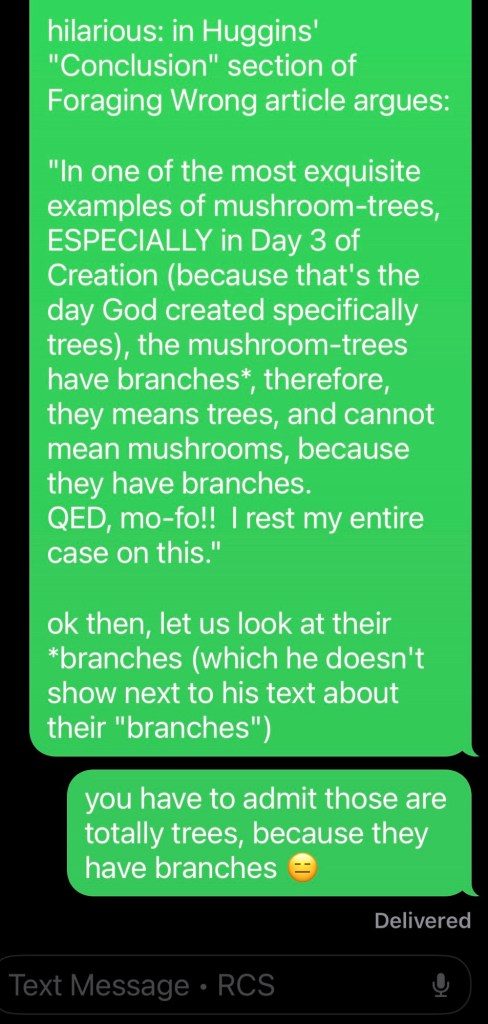
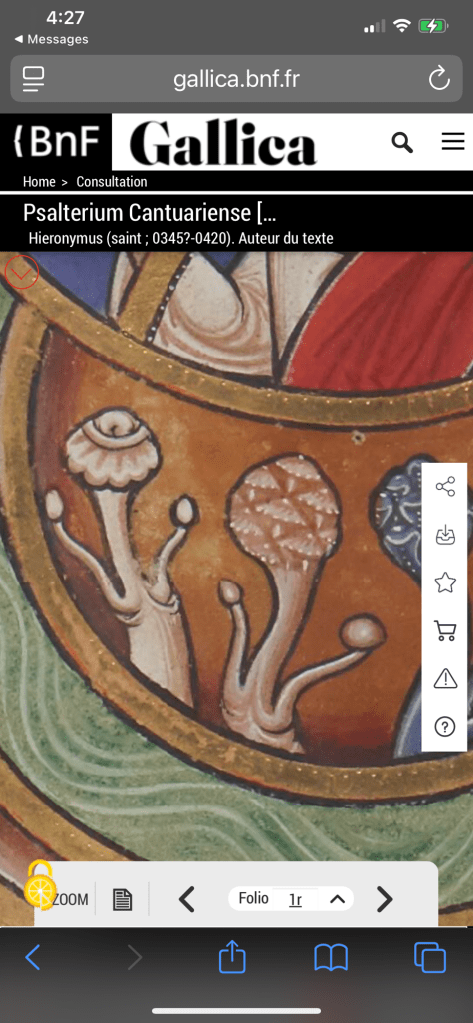
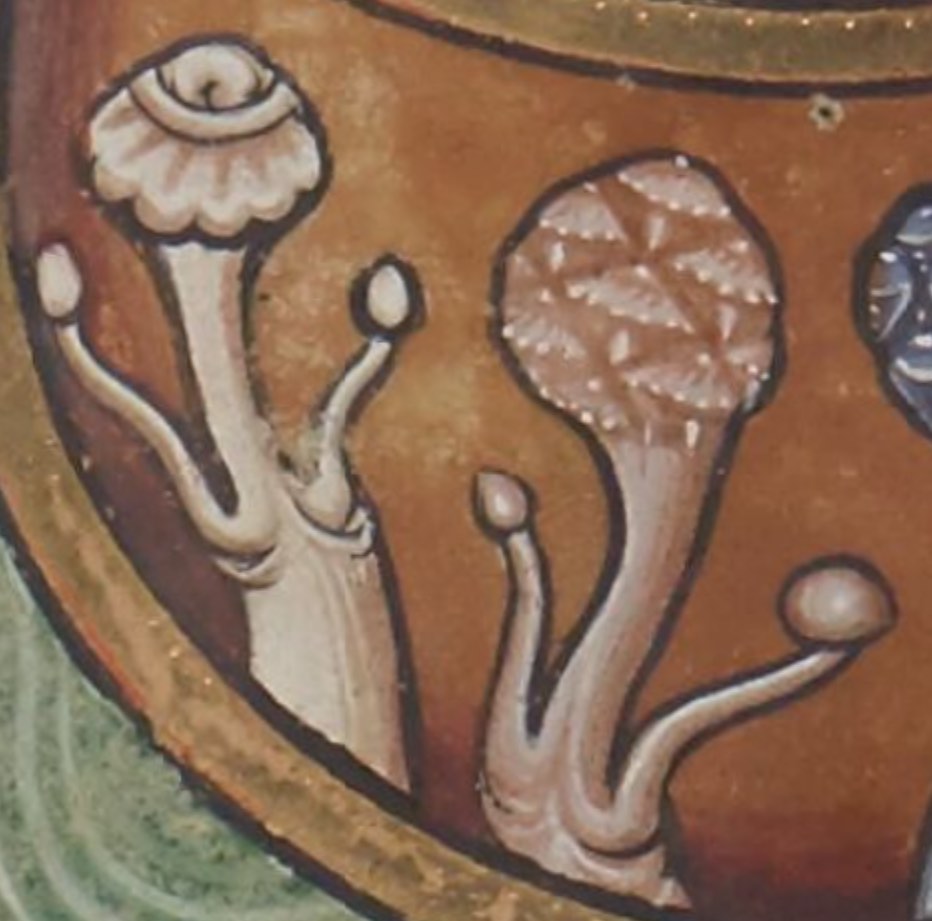
[4:20 p.m. August 22, 2025] Mobile phone screenshots. First, turgid paragraph is summarized in chat post. I just caught (secured) the big fish been hunting.
Last night (i think I was recording) voice recording — analogy created:
It’s one thing to have a fish on your line in the water; but it’s quite another thing to have the fish actually secured in a bucket on your boat.
context last night of that analogy:
dates timeline research, hazy question, When did I “figure out” branching – printout 7-9 of my church short article, dates years: candidates:
- 2xxx – figured out x.
- 2xxx – figured out x.
- 2xxx – figured out x.
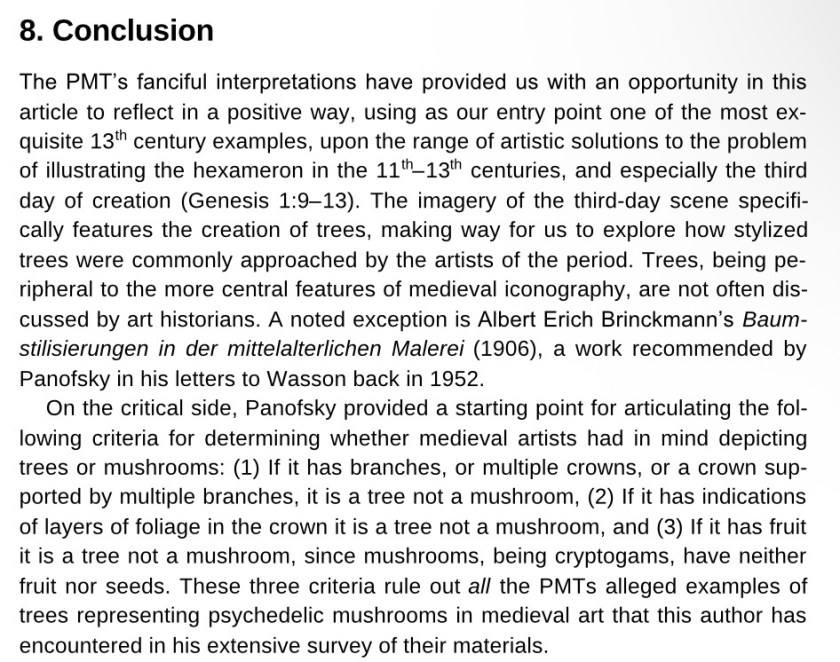
The PMT’s fanciful interpretations have provided us with an opportunity in this article to reflect in a positive way, using as our entry point one of the most exquisite 13th century examples, upon the range of artistic solutions to the problem of illustrating the hexameron in the 11th–13th centuries, and especially the third day of creation (Genesis 1:9–13).
The imagery of the third-day scene specifically features the creation of trees, making way for us to explore how stylized trees were commonly approached by the artists of the period.
Trees, being peripheral to the more central features of medieval iconography, are not often discussed by art historians.
A noted [sic.; opposite: censored, Wasson, SOMA, p. 180] exception is Albert Erich Brinckmann’s Baumstilisierungen in der mittelalterlichen Malerei (1906), a work recommended by Panofsky in his letters [with an 🚨‘s’?!!🚨 one letter entirely censored by Wasson, the other heavily censored; both letters strongly recommending Brinc., & both citations of Brinc. censored by Wasson] to Wasson back in 1952.
HUGGINS, WHAT DO YOU THINK THE WORD “NOTED” MEANS, GIVEN THAT THESE WERE CENSORED TO HELL BY WASSON THE ACADEMIC FRAUD, IN THE SAME PARAGRAPH P 180 SOMA IN WHICH HE INSULTS AND CHIDES MYCOLOSITTS (AFFIRMERS OF mushroom imagery in Christian art) FOR FAILING TO “CONSULT” – WHATEVER THAT’S SUPPOSED TO MEAN — THE ART AUTHORITIES? phone ’em up because per Huggins & Wasson, the authories never thought about trees or mushrooms, and are expert on “related topics”.
Duplicitous lying rhetoric written by the Devil himself. For Wasson, “consult” means censor. For Huggins, “branches” means mushrooms (one mushroom coming from left base of main mushroom stem; one right).
Liberty Cap Tree in Day 3 (Creation of Trees and Fruit) Connects with Tree of Knowledge Below It
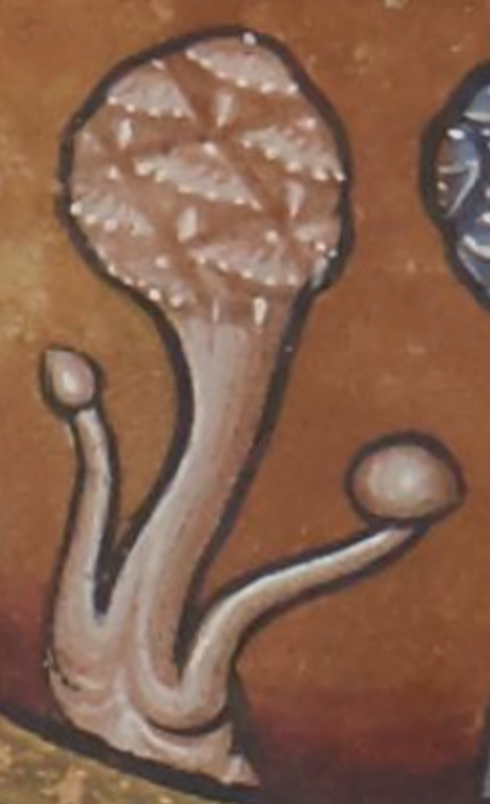
Features:
Day 3 tree 2 (Liberty Cap):
- Has L/R branches/fruit on big scale.
- Lacks L/R branches/fruit on small scale.
The corresponding Tree of Knowledge below it:
- Has L/R branches/fruit on small scale.
7 p.m. August 22, 2025
~7:00 p.m. August 22, 2025 realized that these “hands” as I previously thought, are to be read as fruit, given my library of all Liberty Cap caps; some have L/R fruit, or else L/R branches:
https://egodeaththeory.org/2022/03/16/liberty-caps-and-panaeolus-caps-in-the-canterbury-psalter/#Liberty-Caps
The various Liberty Cap caps have, on each tree in cap grid:
- L/R branches & fruit – tree of knowledge f11 Row 3 right.
- L/R branches, no fruit
- L/R fruit, no branches – red disks
The richest instance — tree of knowledge — sets the detail pattern
at 8:24 p.m. August 22, 2025 at the big scale, day 3 Liberty Cap sets the pattern so you clearly see L/R branch and fruit.
At small scale, tree of knowledge sets the pattern: each Liberty Cap tree within each grid-cap, is to be read as having the detail that the tree of knowledge has: L/R branch & L/R fruit.
At big scale, Day 3 (creation of trees & fruit)
You can’t reason, in orderly way, from Huggins confusion, — working from his garbled args — to reach truth.
Disproving Huggins’ Arguments by Starting from the Successful Decoding
It’s impracticable to try to start from Huggins’ mess, confusion & garble, and then proceed from there to the solution.
Rather, follow Hoffman’s independent analysis to find the solution, then after done decoding and established Eadwine’s solution, go back afterwards to the Hugs trainwreck and explain how he got it so f’d up and mangled in a knot of futility.
You (efficiently/ viably) must start with truth (elegant, coherent) – which only I am capable of decoding to give the intended Eadwine’s intended system – and when you locked onto that elegant system, then, you can explain where Huggins goes wrong at every turn.
Grok Fruit (L & R) in place of L & R branches, in Great Canterbury Psalter
The L & R Fruit Is the Message of Knowledge of Good and Bad, Stable and Unstable Control on Psilocybin
integrated possibilism/eternalism thinking
The fruit in f11 is the comprehension of the two models.
L vs R branch; L = branching and R = non-branching – that is the fruit; then show a fruit on L and a fruit on R. 5:59 p.m. August 22, 2025] chills, just a coincidence from suddnly noticing the AC: i am thinking [highly] of f11 tree of knowledge zoom on their eyes and hands and looking-lines and msiles of smiles of confirmation
Her L hand fruit held = branching . HER R HAND FRUIT HELD AT THE SNAKE; = WORLDLINE FROZEN IN ROCK BRINGS YOU THE SACRAMENT.
As already decoded, they look at the L and R fruit.
In the topmost mushroom, what do they look at?
the topmost = most special mushroom in the grid.
Huggins’ arg WOULD say that, of these inner trees with arms/fruit, or, each L / R branch “holds” or “has” a fruit. each L branch “holds” a fruit, each R branch “holds” a fruit. Each inner mushroom-tree has a L branch-and-fruit, and a R branch-and-fruit.
map L branch/fruit to branching
map R branch/fruit to non-branching
grasping the contrast between the branching vs non-branching model of control and possibility = holding a fruit in L hand and in your R hand.
isomorphic:
each inner tree holds a fruit in L branch & R
each inner tree holds a fruit in L branch & R
possibility
pssy
The Teaching Tree of Knowledge Detailed in Great Canterbury Psalter Under Day 3: Creation of Trees.
Gen 1
https://www.biblegateway.com/passage/?search=Genesis%201&version=NIV
Days of creation:
[Day 0: heavens earth]
- light, light vs. dark; day/night
- water vs. sky
- land vs. water. seed-fruit–trees fruit herbs veg’n
- stars, days & years; celestial calendar, sun (light), moon (light), stars,
- water creatures, birds,
- land animals, man. food: man & animals [water sky land] may eat seed plants/ tree/fruit.
missed, day 3 6:33 p.m. August 22, 2025 – yes day 3 plant 1 & 2 are boring, but, they SERVE TO ESTABLISH LEFT VS RIGHT, L BRANCH VS R BR, AND L FRUIT VS R FRUIT. Looping around.
Plant 1 & 2: they carry the focus on L vs R (not “fruit” yet) wait YES they are FRUIT BECAUSE IT’S DAY 3: CREATION OF FRUIT TREES. 6:36 p.m. August 22, 2025 — thus the L stem-ball and the R stem-ball are = fruit, as held below two rows below in Row R tree of knowledge — Eve holds L fruit in L armhand, R in right. L & R branches = L & R fruits = L & R arms = comprehension of [branching vs. non-br] = hold fruit in both hands = the L fruit growing on the L branch & the R on R. 6:38 p.m. August 22, 2025
The L & R Fruit (Comprehension) of the Tree of the Knowledge of L Evil Branching and R Good Non-Branching
L, Evil, unstable control, branching , possibilism
R, Good, stable control, non-branching, eternalism
To hold both fruit in both hands =
comprehend stable non-branching model & unstable branching model.
Summary for Day 3 vs. Day 4 per Gen 1: per art images to track in this image:
Day 3: fruit, trees
Day 4: sun, moon, stars

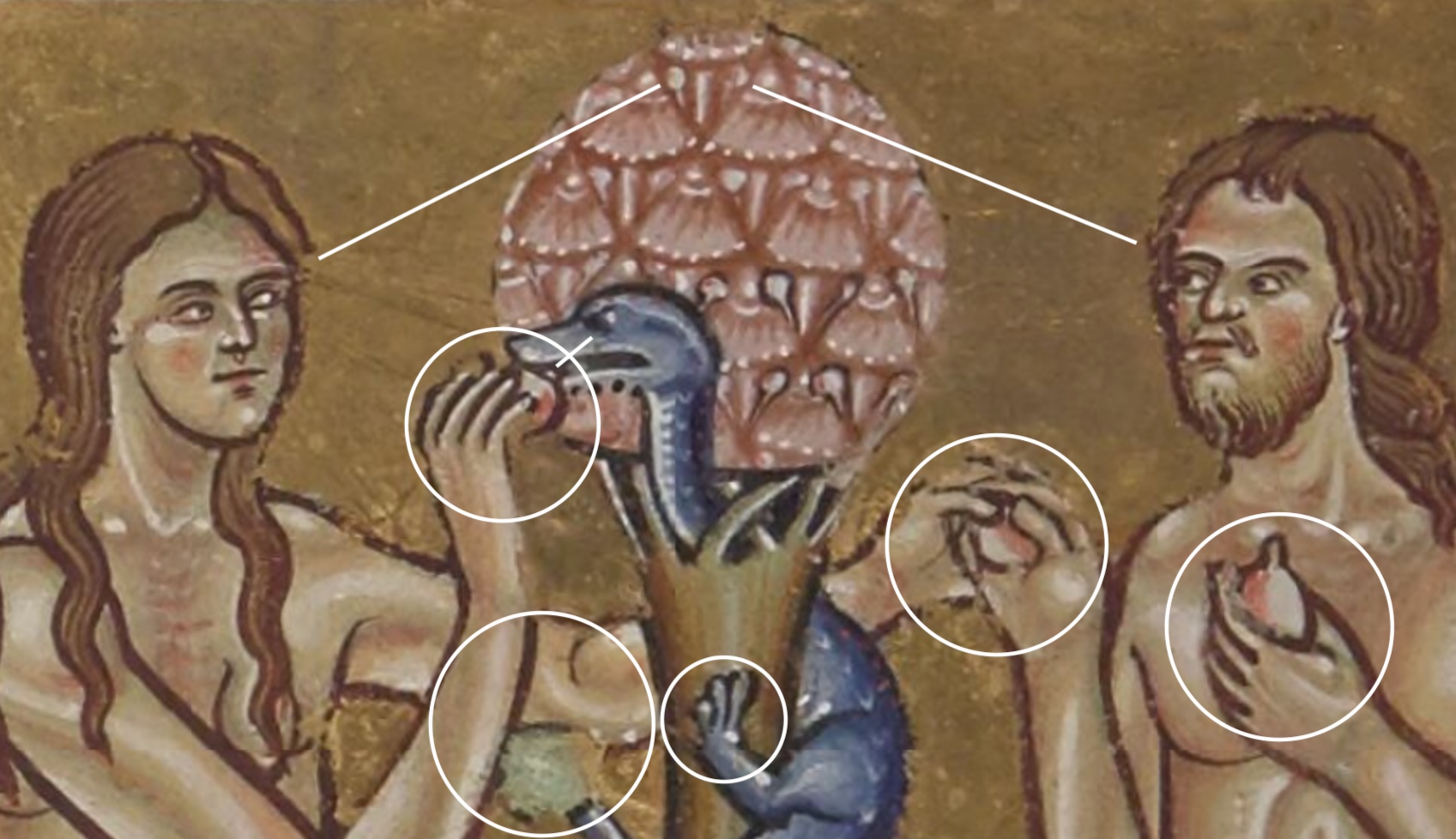
“f11 tree of knowledge looking lines.jpg” 362 KB, Jan. 30, 2025
https://gallica.bnf.fr/ark:/12148/btv1b10551125c/f11.item.zoom#
Also, “fruit therefore tree” – no. tree of knowledge grid and many others have exactly two fruit, in place of the two “branches” a left and right fruit instead of left 5:51 pm a.m. August 22, 2025] L & R branches.
3 in f11 row 2 left (Day 4): Panaeolus pointing at left pan of balance scale
https://egodeaththeory.org/2025/01/07/panofskys-letters-to-wasson-transcribed/#Sentence-2-6 – Panofsky (censored by Wasson) wrote in 1952:
“But even that is not very probable because even the most mushroom-like specimens show some traces of ramification; if the artists had labored under the delusion that the model before him was meant to be a mushroom rather than a schematized tree he would have omitted the branches altogether.”
No trace of ramification (branches), so fails to meet Panofsky’s definition of pilzbaum, so, DOESN’T COUNT:

Proof that Day 1 Creation of Light Scale Balance Bowls Contain Mushrooms
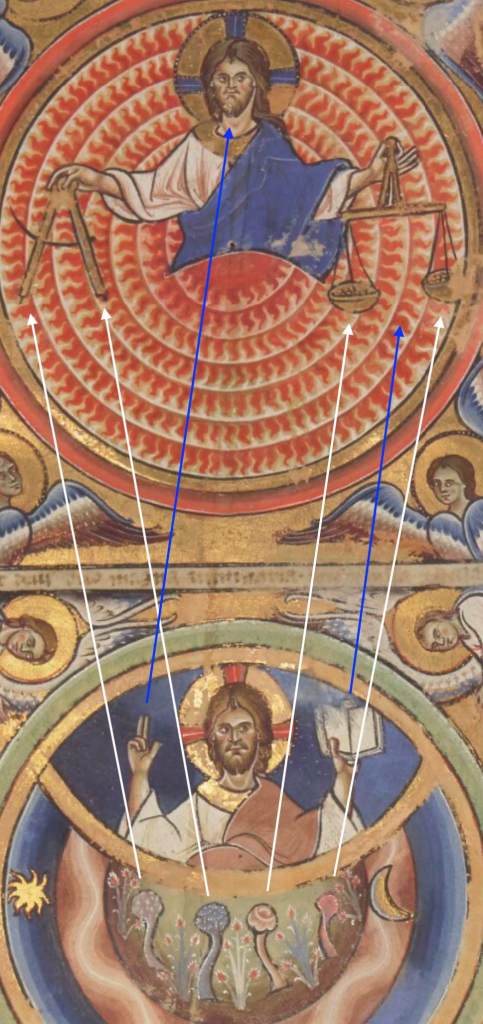
Funniest point:
Each of the plants in the third-day scene also has branches. The mushrooms the PMTs wish to identify them with, however, do not.
Ronald Huggins, “Foraging for Psychedelic Mushrooms in the Wrong Forest: The Great Canterbury Psalter as a Medieval Test Case”, p. 17
Has branches — that look like mushrooms.
Day 3, Plant 2: Right Branch

The branches that look like mushrooms make this tree not look like mushrooms.
Artists classify this as a tree that looks like mushrooms.
Wasson: “For convenience in discussion” – WHAT A LAUGH, AS IF ART HISTORIANS EVER DICUSS… WHERE IS THIS ALLEGED “DISCUSSION”? THERE
Who are these artists who are discussing pilzbaum and where are they discussing pilzbaum?
Mushrooms don’t have anything that looks like a tangle of branches under the tree crown.
Outline: The 8 Sections of the Article and What Topics in Each
Bare TOC [don’t change]
Foraging for Psychedelic Mushrooms in the Wrong Forest: The Great Canterbury Psalter as a Medieval Test Case
Abstract
1. Introduction
2. Trusted sources?
3. The Great Canterbury Psalter: Jesus blessing a bowl of mushrooms?
4. Fleshing out the problem from the perspective of iconography
3. Schematized Trees (2nd “3.”)
5. Moving forward
6. Freedom facilitated by structure
7. Multiplying interpretive errors
8. Conclusion
Bibliography
List of Figures
Imprint
Sections for Commentary, & List of Topics per Section
Quotes from Huggins’ “Foraging Wrong” article here are condensed by Michael Hoffman.
See that article for exact quotes, to see just how confused, blundering, misinterpreting, and implausible the “reasoning” from Letcher Hatsis Huggins – a gallery of obvious logical fallacies, but more strikingly, these scribblers are notable for their astronishingly bizarre instances of obvious logical fallacies.
Deniers of mushroom imagery in Christian art are of poor, low moral character, having to resort to censorship, argument from authority, false attributions, deception, name-calling, insults, threatening, strawmanning (even dictating the opponent’s position), moving the goalposts, and other commonplace logical fallacies, invention such as MAKING SHIT UP such as “parasols of victory”, to give the most flimsy possible token excuses to wave aside each isolated piece of evidence, while lacking any theory to make their kettle logic cohere.
The sour song of the Committed Skeptic:
- If mushroom imagery is hidden, DOESN’T COUNT.
- If mushroom imagery is explicit, DOESN’T COUNT.
- If mushroom imagery has branches, DOESN’T COUNT.
- If mushroom imagery lacks branches, DOESN’T COUNT.
- If the evidence is in art, DOESN’T COUNT.
- Here’s another claimed instance of mushroom imagery in Christian art, but [fill in random token ad-hoc made-up on-the-spot excuse], so, DOESN’T COUNT.
- If [any case], DOESN’T COUNT.
ARTICLE SECTIONS OUTLINE
Abstract [section in “Foraging Wrong”]
“Some scholars and popular writers claim images of mushrooms hidden [NO, FALSE! LIAR! not necessarily “hidden” – I caught Letcher LYING about this meta-claim ] – in (mostly) medieval Christian art.
Psychedelic therapy and spirituality has focused on doing more credible work than 1960s.
The interpretations of these writers seeping unchallenged into mainstream scholarship.”
The ignorant, blundering errors and fallacious argumentation of the deniers of mushroom imagery in Christian art — committed skeptics — has,
Unfortunately, the misinterpretations of these misguided and tone-deaf writers who deny mushroom imagery in Christian art has been seeping unchallenged into mainstream scholarship.
Huggins continues:
“The present article singles out the scene of the third day of creation in the 12th century Great Canterbury Psalter as an occasion to analyse and counter these claims.
“This article surveys the iconography of the third creation day in European illuminated manuscripts.”
“On the 3rd day, God created trees (Genesis 1:11). entheogen scholars identify trees as mushrooms.
“This article describes medieval stylized trees.”
Entheogen scholars know 100% thoroughly well thanks to what little the censor Wasson let leak through as leads from Panofsky in 1968:
Art historians describe medieval trees as “look like mushrooms”, and there are “hundreds of instances” per Panofsky.
1. Introduction [section in “Foraging Wrong”]
- “Try to be more credible than before, to have success in today’s 2024 Psychedliec Movement. We need more credible schoalrship.”
Entheogen scholars are wrong when they try to look for “mushrooms” in art; they ought to be looking for {mushrooms}, {branching}, {handedness}, and {stability} motifs.
Looking for flexibly re-combinable elements of mushroom imagery in Christian art; typically not on the scope of whole entire literal mushroom physical shape.
Huggins uses an arbitrary scope of “whole tree”; if “whole tree” doesn’t match “whole mushroom specimen”, he says this mushroom-trees “doesn’t look like mushrooms” — even though art historians say that these DO “look like mushrooms” when art historians use their own term that they coined, “mushroom-trees”; pilzbaum.
On June 7, 2023, I announced my proposal based on indirect evidence, that Day 1’s balance scale contains Cubensis.
On Jan. 13, 2025, I announced that that hypothesis was proved based on direct evidence.
On a narrow reading, the left pan contains Panaeolus; right Amanita; on a broad reading, the two pans contain Psilocybin from Liberty Cap, Cubensis, and Panaeolus, with Amanita serving as a symbol of Psilocybin.
“June 19–23, 2023, the Denver Convention Center hosted Psychedelic
Science 2023, with some 13,000 in attendance, touted as the “largest
psychedelic conference in history.”8
“Discussion of the relation of spirituality to psychedelics also occurred at the American Academy of Religion’s November 2022 annual meeting in Denver that featured papers on the subject in the units:
- New Religious Movements
- Contemplative Studies
- Cognitive Science of Religion”
Cognitive Neuroscience of Religion is worthless junk: it takes the most boring form of shallow, exoteric, ordinary-state religion, and covers it in the most boring way possible. REJECT.
The field needs to try again, with a 10-strip of blotter this time, for Christ’s sake.
Spirituality Without Psychedelics Is Bunk
Per the maximal entheogen theory of religion, I firmly reject all noises of compromise like claiming that pigs can/ could/ might/ may fly.
Pigs can fly, but pigs DON’T fly, so this is a totally worthless, empty, tin “can”.
I am destroying 1997 Past Me, for writing in outline, various ways to access loose cognitive association binding.
The only “various ways” are the 300 species of Psilocybin mushrooms.
Past-Me, a Limp-Wristed Compromiser Sellout, Screwed Up, Wussed-Out, and Allowed a Gap for Aggressive Present Me to Slip in and Be More Extreme – Don’t Allow That
NO ADVOCATE MORE ARDENT Than Cybermonk
Non-drug make-believe “spirituality” or “meditation” or “mysticism” is phony, purely an avoidance strategy to avoid the only means (ie, Golden Teacher) by which we are transformed from possibilism to eternalism.
Huggins continues:
“The 2023 annual meeting of the Academy saw the introduction of a new Drugs and Religion unit chaired by scholars from Stanford and Emory University.”
2. Trusted sources?
[section in “Foraging Wrong”]
3. The Great Canterbury Psalter: Jesus blessing a bowl of mushrooms? [section in “Foraging Wrong”]
4. Fleshing out the problem from the perspective of iconography
[section in “Foraging Wrong”]
3. Schematized Trees
[section in “Foraging Wrong”] (2nd “3.”)
Error: supposed to be 5., and increase subseq. numbering
I did a complete in-depth analysis, see Jan 31 – Feb 1 2025, idea development 24: https://egodeaththeory.org/2025/01/29/idea-development-24/#3-Schematized-Trees
5. Moving forward
[section in “Foraging Wrong”]
Freedom facilitated by structure
[section in “Foraging Wrong”]
Remember, the rules of non-realism art interpretation have a special-case exception for pilzbaum or other mushroom imagery in Christian art.
In the special case of mushroom imagery in Christian art, artists have no freedom, no intentionality, are helpless slaves of the “prototypes”, have no initiative, send no message.
Non-realism art is to be judged by standards of realism art – in this special-case topic, only.
An image in art can only have a single meaning, and that is the non-mushroom meaning (in this special case, only, of mushroom imagery in Christian art).
The special pleading fallacy.
Multiplying interpretive errors [section in “Foraging Wrong”]
Conclusion [section in “Foraging Wrong”]
END OF ARTICLE SECTIONS OUTLINE
How to Fail at Arbitrary Argumentation that Can Readily Be Countered by the Exact Opposite Argumentation
PMTs = psychedelic mushroom theorists; pilzbaum affirmers; affirmers of mushrooms in Christian art.
Each of the plants in the third-day scene has branches — branches that look like actual mushrooms.
The actual mushrooms that the PMTs wish to identify these pilzbaum with do not have branches, but they look like the branches that this image has.
Coherently, intelligently using this image to prove purposeful mushroom imagery:
The branches in this image look like the actual mushrooms that pilzbaum affirmers wish to identify these pilzbaum images with.
HEY HUGGINS I HAVE A QUESTION FOR YOU:
YOU MENTION “Each of the plants in the third-day scene also has branches” AS AN ARGUMENT WHY PILZBAUM DON’T LOOK LIKE MUSHROOMS.
PRAY TELL, WHAT DO THOSE BRANCHES LOOK LIKE?
[ANSWER: MUSHROOMS]
“f11-row1-right-msh2-right-branch.jpg” 24 KB, from .png 7:54 PM Dec 20, 2024
https://gallica.bnf.fr/ark:/12148/btv1b10551125c/f11.item.zoom#
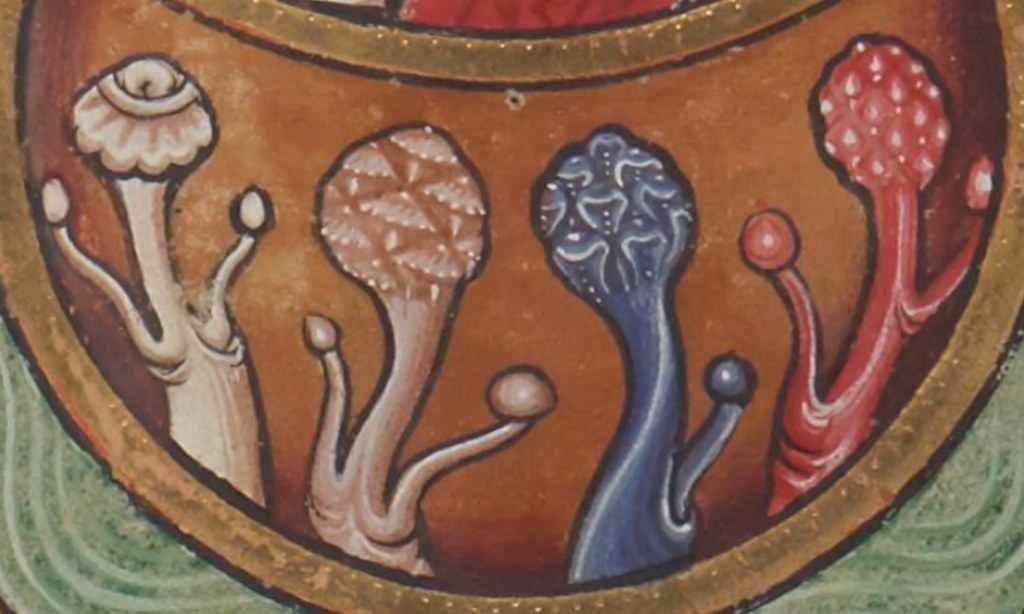
“f11-row1-right-the-4-plants.jpg” 204 KB
from local file “f11-row1-right-the-4-plants.png” 6:34 PM 2024/12/20
https://gallica.bnf.fr/ark:/12148/btv1b10551125c/f11.item.zoom#
For the full set of 7 branch pictures, though just a brief argument:
https://egodeaththeory.wordpress.com/2023/06/11/eadwine-images-in-great-canterbury-psalter-commentary-interpretation/#f11-row-1-right
Huggins’ “Foraging Wrong” Article
Foraging for Psychedelic Mushrooms in the Wrong Forest: The Great Canterbury Psalter as a Medieval Test Case – Ronald Huggins, 2024, aka Hatsis Jr.
An important good/bad article.
Huggins covers the right, relevant scholars & materials, state of the non-debate.
pilzbaum are either a tree or a mushroom, and cannot be a mushroom, bc per Panofsky’s argument based on {branching} motif features (while failing to perceive non-branching, eg {cut right trunk/ branch}).
In fact, the artists were messaging “psychedelic eternalism”, via branching mushroom imagery, to make viewers interpret the entire image (& genre, & religious myth overall) as analogies describing the psychedelic-state experience of non-branching, and showing how to re-train personal control by affirming non-branching ie eternalism.
That is WHY, the PURPOSE, artists depicted both mushroom imagery components and/ along with/ integrated with branching – and, non-branching, eg cut right trunk, meaningless to Panofsky/ Hatsis / Huggins, the reductionist literalists, “those on the outside”, tone deaf to meaning and the altered-state referent.
These deniers have no argument, just a wall of painfully (puzzlingly) obvious logical fallacies. What are they thinking/ assuming but not saying?
See Brown revealing Hatsis’ confusion, at Graham Hancock site.
The Deniers put forth half-expressed arguments that aren’t designed to endure any pushback; their argumenrs fall over with the slightest breeze of pushback, in a 2-way actual debate.
Why do the deniers not care at all about making good arguments?
It is exhausting, trying to decipher their muddled confusion underlying their garbled half-argumentation.
They start by assuming that which is to be proved, and then proceed to pile every logical fallacy on that soggy foundation, all downhill from there.
HIDDEN BY VILLAIN WASSON, REVEALED BY HERO BROWN
It is annoying how Huggins pretends we have had Panofsky’s 2nd 1952 letter, with the branching argument that Huggins copypastes, since the book Soma in 1968.
We only have the letter and its branches argument thanks to Brown in 2019.
No thanks to obstructionist Wasson, who tried to hide & censor Panofsky’s leads to discourage people from looking into mushroom trees.
Wasson knew Brinckmann’s 1906 book did nothing to help Panofsky’s denial, and sipported mushroom tree asserters instead.
So Wasson censored both recommendations of Brinkmann’s book, and kept secret that Panofsky included two pictures of mushroom trees.
Panofsky letters:
Brinckmann book:
https://egodeaththeory.wordpress.com/2020/12/11/brinckmann-mushroom-trees-asymmetrical-branching/
Dizzy, Dancing or Dying? The Misappropriation of MS. Bodl. 602, fol. 27v, as ‘Evidence’ for Psychedelic Mushrooms in Christian Art
“The text under the picture proves that THE MAN IS TRYING TO KILL THE SALAMANDER.
“Wouter Hanegraaff and I discussed this, and we can’t figure out why the salamander is replaced by a phoenix. No idea. We got nothin.”
🖼️🔍🧐🤔🤷♂️❓
Huggins’ theory of art interpretation:
The accompanying text, read literally, dictates what the artist meant.
Voice Recording VOX_TK_6226.wav
.wav file not published as of Dec 21 2024.
40:00 Eadwine is the ultimate psychonaut. Highly committed to Cubensis. He delicts the Cubensis lecturer. Avoidance factor: optimized to get you to stare at loss of control.
45:00 nice discuss Panofsky letter 2
leg hanging mushroom tree,
handedness 55:00.
0:00 Devil plot harlot amanita the scarlet harlot – Scarlet the Harlot, Agent Devil, the devil spread this junk Amanita everywhere, thus low-grade , deliriant Amanita. main effect: makes you sweat. pseudo fake entheogens like mdma, dud The tree(s) of life has 12 fruits, every month, not just 1. if it had one fruit, tgat ought to be cubensis, is most relevant, the real, high inspired source. THE TRUE KING OF entheogens – not Amanita, the pretty poser
16:00– double letter game;, either the solution hard, or a simple trick , once u know solution: branching vs non-br peak pinnacle god level enlightenment: br v non-br . solves this genre which here literally is a teaching puzzle, an elaborate detailed explanation. Eadwine ismost advanced devmt of the genre.
21:00 Amanita trap, Devil low grade substitute, slread all over by the Devil to give opl the lowesr poss grade of esoteric enl ightmt masked in confusion and fog barely visible awareness of Transcendent Knowledge almost expressed by accident, slchemy so extremely overgrown that it carries Transcendent Knowledge analogies but they are not visible … signal noise, have to know the crucial main theme.
{mushrooms}, {branching}, {handedness}, and {stability} motifs
the common lang of the time, Dark Ages knew about branching.
weight on l vs r foot. to refer to two models of control in world.
“His weight is on which foot?”
25:00 texts were rare. pictures were commonly read.
Huggins = “those on the outside”
Huggins is the voice of “those on the outside”
Why make the accompanying text drive art interpretation in this era where art>text. As Huggins reading texts out of genre, wrong intero fwk: litist reductionism applied to mis interp pic, spewing tge “those on the outside” view.
takeaway: 30:11 — look for {mushrooms}, {branching}, {handedness}, and {stability} motifs
a narrow genre, most important – mushroom trees.
36:00 Heinrich deletes Psilocybin mushrooms 🗑️ by misreading REV 22 tree of life as producing 1 fruit: amanita only, not Cubensis.
Heinrich in Rev 22: 🥾🍄🟫
The Tree of Life produces 12 fruits every month, not just 1.
Cubensis is king, for actual ego death, not Amanita.
🥾🍄
I Own the Cubensis Single-Plant Fallacy, I Settled for #1
I own the psilocybin-containing mushrooms single-plant fallacy.
300 species
Saying the word “Cubensis” to include liberty cap & panaeolus: a Cubensis-first framework, precedent: Amanita.
Cubensis Eliteness
Cubensis-first
Cubensis is the best western esotericism engine, not popular (because it works), but the loftiest: psychedelic eternalism
we across history are a minority, favoring cubes the real deal, not ac substitute thats ego-compatible/ innocuous 🍄
we are the best/ highest/ on-point
Innocuous to the steersman ego 🍄
Fatal to the steersman ego 🍄🟫
The Cubensis eternalism transformation effect
Amanita is a false idol placed by the Devil who spread Amanita everywhere, as a decoy to keep you from knowledge of God.
🍄 🚫🤔
Amanita has always been popular, because it doesnt die/ fail ; it doesn’t pointedly cause ego death.
Amanita is popular BECAUSE it DOESN’T produce ego death.
Cubensis was unpopular in psychedelics history bc it works to target the interesting thought-source vulnerability, achilles heel, ego’s kryptonite.
Why does superman avoid specifically krootonite?
psil is the one thing that effectively kills/ targets/ aims straight for the egoic agency thought-source, an uncontrollable fountain given.
Ego death is Cubensis’ central effect; no other entheogen so focused. the evidence i have in Great Canterbury Psalter happens to be cube and awesome; it is successful bc based on specifically Cube.
Cube good enough for Eadwine, good enough to keep using cube as the main point of reference for the mytheme theory; Analogical Psychedelic Eternalism with 2-level control
Cube is highly studied, psil & cube; the most relevant psil, Cube. synonymous; Cube is representative of relatively irrelevant lib cap. cube popular, lib cap not
Cubensis-driven entheogen scholarship: The most productive, relevant, and rewarding approach
Critique of Huggins at Cyberdisciple Site Equivalent to Letcher and Hatsis
I’m posting as a comment at Cyberdisciple site, Dec. 21, 2024, 2:41 pm:
https://cyberdisciple.wordpress.com/2022/02/25/mushrooms-in-christian-art-discussed-by-tom-hatsis-and-jerry-brown-at-graham-hancocks-site/#comment-2686
A copy is pasted below.
Cyberdisciple Site Turns 16.5
https://cyberdisciple.wordpress.com/2008/06/22/beginnings/
Comment about page “Book: The Witches’ Ointment”, at page “Mushrooms in Christian art discussed by Tom Hatsis and Jerry Brown at Graham Hancock’s site”
I wanted to put the following Comment on the older page
https://cyberdisciple.wordpress.com/2015/10/07/book-the-witches-ointment/, but there’s no Comment field there anymore. So I’m commenting at page Mushrooms in Christian art discussed by Tom Hatsis and Jerry Brown at Graham Hancock’s site
Andy Letcher, Thomas Hatsis, and Ronald Huggins write with the same voice and tone and argumentation style: the pilzbaum denial voice.
https://egodeaththeory.wordpress.com/2024/11/23/huggins-foraging-psychedelic-mushrooms-wrong-forest/
Panofsky 1952 is comparable.
Brinckmann 1906 is a different case; he lacked the concept of “taboo psychoactive mushrooms as asserted by Allegro” – maybe in a limited sense, Brinckmann 1906 can be considered pilzbaum Denier, but he didn’t really have that concept and context.
That research has yet to be done: see if and where Brinckmann gives the evidence and argumentation that Panofsky claims is in that 1906 book.
Based on my study so far, I assume Brinckmann’s book support the pilzbaum Affirmers, not the pilzbaum Deniers.
Same with Panofsky’s two pilzbaum pictures that were attached to the first letter to Wasson.
At his “Witches Ointment” page, Cyberdisciple identified the question of whether Letcher and Hatsis are the same position as pilzbaum Deniers:
“Hatsis … website includes … debunking of … mushrooms in Christian religious iconography.
“The debunking seems to be in the style of Andy Letcher’s Shroom, which debunks the Wasson-Allegro-McKenna mushroom theory of the origins of religion.
“Letcher’s debunking was poorly theorized and limited (see: http://egodeath.com/ViewsOnEntheogensInReligiousHistory.htm#_Toc164518582 and http://www.egodeath.com/ShroomLetcher.htm), and
“I intend to see whether Hatsis shares those limitations and can be grouped with Letcher or should be considered an independent position.“
Add Ronald Huggins, who wrote the “Dizzy” article in 2022, about Salamander bestiary aka Dancing Man, and wrote the “Foraging Wrong” article about Great Canterbury Psalter images in 2024.
Letcher, Hatsis, and Huggins write with the same voice and tone and argumentation style: the pilzbaum Denier voice.
Challenge: differentiate Letcher vs. Hatsis vs. Huggins.
Huggins also acts as copy machine copy/pasting Panofsky’s argument from branches, from Panofsky’s 2nd letter, which we only had since 2019.
How to engage bad-attitude scholars
Cyberdisciple advises to stay focused on ideas and avoid argument from ad hominem; character-based argumentation based on “that scholar has poor character”:
I want Huggins to say where and how he found the two 1957 Panofsky letters and the Brinckmann citation, given that Wasson since 1968 censored them.
Huggins’ usage of these documents smells sleazy and dishonorable.
Huggins’ article contributes in the usual half-baked way for pilzbaum Deniers:
“Pilzbaum can’t be mushrooms, because pilzbaum have branches” — which look like mushrooms.
Huggins acts ignorant (“I had no idea I’m the only one who is aware of Panosky’s two letters and his Brinckmann citation”).
Either Huggins is unbelievably ignorant of the sordid state of the literature until Brown 2019, or, Huggins is dishonorably participating in a cover-up of Wasson’s egregious censorship and self-contradiction.
Wasson in SOMA says to “consult”, while in the very same breath, actively censoring and suppressing the Brinckmann citation – thereby dishonestly, covertly switching the meaning of “consult” away from “consult academics’ publications” to “consult academics personally”.
The Huggins articles about mushrooms in Christian art serve largely as a literature review.
The overwhelmingly notable thing about Huggins’ “Foraging Wrong” article, totally overshadowing any content and argumentation, is Huggins’ extremely strange usage of Brinckmann’s book 1906, and of Panofsky’s second article.
Huggins acts like there is nothing amiss here.
Huggins acts as if he is covering-up for Wasson’s censorship of the deniers’ lone, “little”, scholarly publication.
Huggins cites Browns’ book 2016, but omits Brown 2019 article that presents and reveals the two Panofsky letters.
Huggins cites the Panofsky letters in a footnote, but not in his Bibliography.
Huggins mentions Brinckmann’s book and chastises the reader in his Conclusion section:
“Trees, being peripheral to the more central features of medieval iconography, are not often discussed by art historians. A noted exception is Albert Erich Brinckmann’s Baumstilisierungen in der mittelalterlichen Malerei (1906), a work recommended by Panofsky in his letters to Wasson back in 1952.”
Huggins provides the usual poor quality argumentation, as bizarre, convoluted, strained, and malformed, as is standard for pilzbaum Deniers:
“Panofsky [2nd 1952 letter than Wasson censored] provided a starting point … for determining … trees or mushrooms: (1) If it has branches, or … it is a tree not a mushroom [false dilemma fallacy], (2) If it has indications of layers of foliage … it is a tree not a mushroom, and (3) If it has fruit it is a tree not a mushroom …
“These three criteria rule out all the … alleged examples of trees representing psychedelic mushrooms in medieval art that this author [Huggins] has encountered in his extensive survey of their materials.”
“Extensive”, except omits my 2006 Plainc. article, and doesn’t cite Brown 2019.
Huggins fails to point out the hugest factor, that entheogen scholars weren’t given this Brinckmann citation until Brown exposed Wasson’s academic deception in 2019 by publishing both Panofsky letters.
Strangely, adding suspicion, the Bibliography of Huggins’ “Foraging Wrong” article omits Brinckmann (as well as Panofsky’s letters), and only mentions him in the article body.
The giant elephant in the room is that Wasson censored some five things, including:
The Brinckmann citation, in the same SOMA 1968 paragraph that Wasson insulted mycologists/ pilzbaum affirmers and berated them for failing to “consult”(??) art historians – while just 6 lines above, censoring the double-strong citation of Brinckmann provided by Panofsky to Wasson 1952 and shown only in highly censored form by Wasson in SOMA 1968.
See Also
Dizzy, Dancing or Dying? The Misappropriation of MS. Bodl. 602, fol. 27v, as ‘Evidence’ for Psychedelic Mushrooms in Christian Art (Huggins, 2022)
Dizzy, Dancing, or Dying? (Huggins 2022)
Academic citation/link:
“Dizzy, Dancing or Dying? The Misappropriation of MS. Bodl. 602, fol. 27v, as “Evidence” for Psychedelic Mushrooms in Christian Art”
Ronald Huggins, 2022, 25 pages, FRAGMENTS Journal 1.1 (2022): 1-25
https://www.academia.edu/74021123/_Dizzy_Dancing_or_Dying_The_Misappropriation_of_MS_Bodl_602_fol_27v_as_Evidence_for_Psychedelic_Mushrooms_in_Christian_Art_

 The Egodeath theory
They can’t help it. They don’t have symbolic vision.
LikeLike