Michael Hoffman, 7:11 pm Feb. 15, 2025
Contents:
- Intro/ Motivation for this page
- Affirming Freewill Thinking, in a Way
- Spacetime: Minkowski’s Papers on Spacetime Physics (Minkowski, 1908)
- The Illusion of Will, Self, and Time: William James’s Reluctant Guide to Enlightenment (Bricklin, 2016)
- Rush Quote and Obstinate Contrary Assertions by Egocentric Individuals
- Lexicon: Parallel Phrases:
monolithic, autonomous control
2-level, dependent control - See Also
Intro/ Motivation for this page
Marketing/Selling the Egodeath Theory (Psychedelic Eternalism) as a Type of Compatibilism, not Determinism or No-free-will/ Monopossibility Prison
By this manipulative rebranding that came from the bowels of the Marketing department instead of Engineering, now I can brag that my sophisticated, compatibilism theory (the Egodeath theory; psychedelic eternalism) is way better than crude advocates of mere eternalism.
Unlike James per Bricklin’s book, the Egodeath theory manages to affirm BOTH practical experience AND the Nitrous Revelation of eternalism.
Normally I identify as no-free-will/monopossibility , and reject “compatibilism’ as confusion and a contradiction in terms.
Not only is no-free-will/monopossibility a hard sell, it’s contradicted by experience, or by the form / shape of our experience.
Affirming Freewill Thinking, in a Way
Interesting, winning possibilities for a kind of “compatibilism” (eternalism + using, but not “relying on”, possibilism-thinking). Latter part = “qualified possibilism-thinking”.
One might profitably ask: “What kind of compatibilism does the Egodeath theory assert?”
It’s as if we move from Possibilism (egoic thinking) to Possibilism — with Eternalism also added, so that even if – in practice – we end up with seemingly 100% possibilism all the time, nevertheless that qualified possibilism-thinking is profoundly qualified and different, fundamentally not the same foundation as naive possibilism-thinking.
A subtle, pre/trans fallacy; a significant, major (even though subtle) distinction between the type of autonomous freewill thinking that we start with, vs. the adult-type virtual, qualified freewill thinking that we end up with.
I’d be a liar misleading people, were I to just say “The Egodeath theory repairs your freewill thinking, to make it work successfully”; “Adopt the Egodeath theory, because it gives you freewill thinking.”
But is seems maybe the truth comes surprisingly close to that or looking like that.
This is good, solves a problem:
If the Egodeath theory = rejecting freewill thinking and committing to eternalism (no-free-will) instead, many people will reject the Egodeath theory.
And that rigid conceptualization of the Egodeath theory clashes with the actual experience – like when I criticize a scholar (or criticize myself), that wrongly implies possibilism-thinking/ freewill thinking.
Inconsistent! Giving more attention to affirming freewill thinking (but in a qualified way) resolves that inconsistency.
My Marketing department can instead sell the tune, “You want the Egodeath theory, because it gives you a simple, great kind of Compatbilism.”
Have cake & eat it too.
Why be enlightened? Birds celebrate you? Liberated from labor? No. More subtle.
In a way, practically, the Egodeath theory (psychedelic eternalism) gives you freewill thinking like always — like we instinctively desire — yet also affirms and gives access to, and usably provides as a tool – eternalism-thinking; no-free-will/monopossibility.
The Egodeath theory teaches you to USE freewill thinking but not RELY on freewill thinking during the mystic altered state.
Rely on eternalism-thinking instead – even while, in either state, “using” freewill thinking; “harm not the child” b/c you use child-thinking all the time, before & after & during enlightenment transformation.
We learn to – you could say — “use” freewill thinking and yet at the same time, when in the peak window of intense mystic altered state, we learn to “rely” on eternalism-thinking and repudiate (relying on as a foundation) freewill thinking.
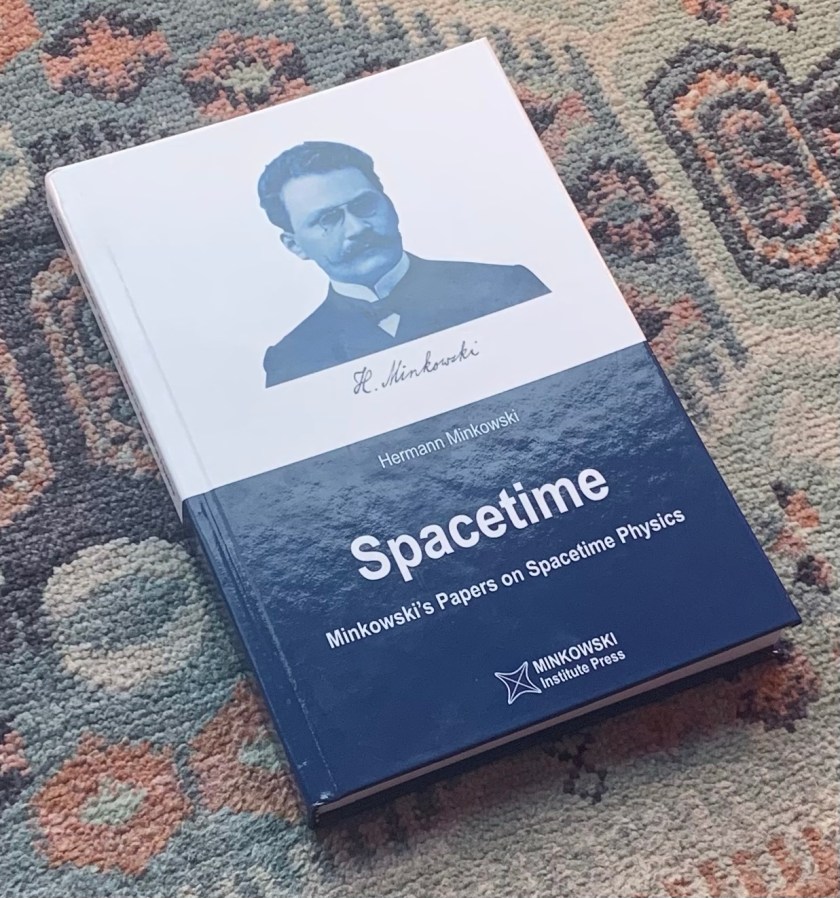
Spacetime: Minkowski’s Papers on Spacetime Physics (Minkowski, 1908)
image: my book Minkowski, photo today
https://www.amazon.com/dp/1989970435
The Illusion of Will, Self, and Time: William James’s Reluctant Guide to Enlightenment (Bricklin, 2016)
The Illusion of Will, Self, and Time: William James’s Reluctant Guide to Enlightenment
Jonathan Bricklin, Jan. 2016
https://www.amazon.com/dp/143845628X
image: my book:
Aligned with the Egodeath theory.
Purchased before it was available; preordered.
Part of: SUNY series in Transpersonal and Humanistic Psychology (43 books)
blurb:
“William James’s work suggests a world without will, self, or time.
“How research supports this perspective.
“A Seminary Co-op Notable Book of 2016
“William James is often considered a scientist compromised by his advocacy of mysticism and parapsychology.
“Jonathan Bricklin argues James can also be viewed as a mystic compromised by his commitment to common sense. [ie our experience is always in the form of the egoic personal control system]
“James wanted to believe in will, self, and time [egoic, possibilism-thinking], but his deepest insights [WHILE TRIPPING HIGH ON NITROUS!!] suggested otherwise.
“Is consciousness already there waiting to be uncovered [preexisting control thoughts per eternalism; snake-in-rock revealed in alt-state] and is it a veridical revelation of reality?” James asked shortly before his death in 1910.
“A century after his death, research from neuroscience, physics, psychology, and parapsychology is making the case, both theoretically and experimentally, that answers James’s question in the affirmative.
“By separating what James passionately wanted to believe [freewill thinking; branching possibilities with monolithic, autonomous control], based on common sense, from what his insights and researches led him to believe [iron block universe], Bricklin shows how James himself laid the groundwork for this more challenging view of existence.
“The non-reality of [free] will, [autonomous] self [control], and [branching-possibility] time is consistent with James’s psychology of volition, his epistemology of self, and his belief that Newtonian, objective, even-flowing time [domino-chain determinism] does not exist.
/ end of blurb
Rush Quote and Obstinate Contrary Assertions by Egocentric Individuals
Sung:
If you chose not to decide, you still have made a choice
Jacket lyrics:
If you chose not to decide, you still haven’t made a choice
Jacket lyrics:
If you choose not to decide, you cannot have made a choice.
Transcendent Knowledge Podcast, Episode 28 – Basics of Core Egodeath Theory
https://egodeaththeory.org/2021/04/08/transcendent-knowledge-podcast-episode-28/ —
Max Freakout:
There’s a line in one of the songs by Rush which Michael Hoffman has talked about where he says, “Even if I decide not to decide, I’ve still decided; I’ve still made a choice.”
Max Freakout:
You can’t escape from being a decision maker, in the ordinary state of consciousness, because no matter what you do, you could be said to be choosing to do that thing, as opposed to doing something else. An absolutely basic configuration of the self is decision making.
Michael Hoffman:
“Future pre-decided; opinions are provided, in the mass-production zone”, which is pretty much the whole world.
Cyberdisciple:
That’s a very funny line, in that the singer sings one line, “If you choose not to decide, you still have made a choice”, but the original lyric sheet printed “If you choose not to decide, you cannot have made a choice.”
So there’s a strange confusion between the song and the original lyric sheet. That was even addressed by the lyricist at one point, who said that “Well those are the words I wrote” or something, “I can’t control what was printed.”
Michael Hoffman:
In a newsletter, Peart said:
“That’s a funny question. I’ve had a few lately from people who are so sure that what they hear is correct, that they disbelieve what I’ve put in the lyric sheets! Imagine!
People have quoted me whole verses of what they hear, as opposed to what’s printed, sure that they are right and the cover (me) is wrong.
Scary stuff, these egocentric individuals.
I assure you, other than perhaps dropping an “and” or a “but,” we take great care to make the lyric sheets accurate.”Neil Peart, Rush Backstage Club newsletter, December 1985
That’s copied from Egodeath.com > Rush Lyrics Alluding to Mystic Dissociative Phenomena > Freewill.
A later version of the printed lyrics is different. The first printing needs fact check. https://www.reddit.com/r/rush/comments/aubfzy/hidden_message_or_change_of_heart_in_the_lyrics/
https://en.wikipedia.org/wiki/Neil_Peart – “His parents bought him a drum kit for his fourteenth birthday and he began taking lessons from Don George at the Peninsula Conservatory of Music. His stage debut took place that year at the school’s Christmas pageant in St. Johns Anglican Church Hall in Port Dalhousie. His next appearance was at Lakeport High School with his first group, The Eternal Triangle. This performance contained an original number titled Ergot Forever. At this show he performed his first solo.”
A lot of this double-speaking and mumbling and saying one thing while claiming to have said something else, goes back to Prohibition, affecting song lyrics vs. official lyrics.
Cyberdisciple:
It’s a funny moment that speaks to Rush’s interest in in double meanings and the whole topic of being a control agent.
I think more recent lyric sheets only printed what the singer sings, but the original lyric sheets don’t have that; they have a different version. For such a crucial line, they have a different wording of it that seems to point to the opposite.
“Not to derail us into Rush trivia; this is not a Rush trivia podcast, even though I know plenty of trivia about them.”
/ end of unmodified copypaste from Rush trivia podcast
Lexicon: Parallel Phrases:
monolithic, autonomous control
2-level, dependent control
Lexicon: Can elaborate to be parallel, via 2 terms in both models:
- monolithic, autonomous control
- 2-level, dependent control
4-part terms:
- literalist ordinary-state possibilism with monolithic, autonomous control
- analogical psychedelic eternalism with 2-level, dependent control
but those latter sound as if they are 6-part. 4-part (as just 4 words – very hard to achieve) would be like:
literalist sober possibilism autonomy
vs.
analogical psychedelic eternalism dependency
See Also
Valentinian Freewill Compatibilism
no links; dead end; cosmic boundary; heimarmene fate-ruled serpent; do not pass; do not transcend no-free-will/ monopossibility/ fatedness


https://web.archive.org/web/20240619205320/http://www.mysterium.com/hypercosmic.html

 The Egodeath theory