Michael Hoffman Feb. 17, 2025
Contents:
- Summary: The Meaning of YO or Trident Branches Holding Up the Crown of a Mushroom-Tree
- Intro/Motivation for this Page: Explain Branching in Mushroom-Trees, Examine Huggins’ Arguments
- Entheogen scholars attempt classification of branching forms: Giorgio Samorini, Ronald Huggins
- Samorini’s attempted classification
- “Mushroom-tree features” include deer & snake; cut branch; handedness; balance, fruit, 4 fruits, 4 limbs, cross-behind; {cut right trunk}, heel of foot, etc.
- Multi-scope analysis of a branching message tree is essential – Classifying Whole Trees Based on Branches Under Crown is Not Key Relevance – Must Use More Granular Feature-Analysis than Samorini & Huggins Crude First Attempts at Classification Schemes to Produce Comprehension
- The “Whole-Tree Form-Assessment” Fallacy
- The Mytheme theory = the psychedelic-eternalism mytheme theory = the psychedelic eternalism theory of mythemes & art motifs
- Huggins’ attempted classification: Crown Held Up by Divided Trunk vs. by Tangle of Branches
- 6320 good voice recording on this topic of arg from prej + Letcher defeats not mushroom imagery in Christian art, but, defeats instead, 1st-generation entheogen scholarship (the Secret Amanita paradigm)
Contents about my Solution:
- Solution: The Meaning of YO or Trident Branches Holding Up the Crown of a Mushroom-Tree
- “Schematized Trees” per Huggins = mushroom-tree branching form
- YO or Trident-O Branching Form of Some mushroom-trees eg the Plaincourault fresco
- Map Left Branch to the Possibilism Mental model, Map Right Branch to the Eternalism Mental Model
- Hypercosmic Fire Arch on Cover of Brinc Book
- An In-Scope Relevant Interpretation of 3 trident branches of the Plaincourault fresco
- Solved Huggins’ Trident Branches Question
- Connecting 3-Phase & YO or Trident-O branching
- YO Branches
- The Purpose of YO or Trident-O Branching Form of Mushroom-Trees
Contents for “Foraging” article “Section 3: Schematized Trees”:
- Entire Section “3. Schematized Trees” from Huggins: Foraging Wrong Article, 2024, pages 17-19
- Magic Dirty Use of “completely formulaic” is a Strategy of hitting every angle, relying on them all being soaked with Prejudice: “Formulaic/ multiple/ mainstream, therefore not mushroom”
- “Completely Formulaic” Is the “Argument from Prejudice” Fallacy, relying on gullible audience’s unconscious prejudice
- Non-Sequitur-Fest Gallery: <Any Fact You Can Think of>”, therefore, not mushroom”
- 3. Schematized Trees (entire section from “Foraging Wrong”)
- Two Forms of Branches Under Crown/Cap of Mushroom-Trees
- Non Sequitur: Variations in Branching Form, “Therefore”, Not Purposeful Mushroom Imagery
- Browns’ Misrepresentation: “Numerous red, blue, orange, and tan stylized mushrooms (like the ones shown here in Day 3) are found in the first 100 pages” of the Psalter
- Branching Form of Dancing Man Mushroom
- Branching Form Tree of Knowledge Under Cap, GC Psalter: Y X Y (cut right branch)
- Huggins argues: Artists only have seen flat-top Amanita (absurdly), not a veil, like branches (I may have been misreading Huggins here)
- ah god Brown, not starting from Right with Amanita again still aggghhh
- Normal humans — and MICA Deniers — would say “tan, orange, blue, and red”; L to R – not R to L
- Browns’ Misrepresentative Claim “Rebutted” by Huggins’ Non-Sequitur Fallacy
- Huggins: “Brown claims rigid consistency, but actually there’s variations. Therefore, not mushrooms.”
- Gullible reader: Against Browns’ claim, there are variants (which Huggins 100% PROVES by details) therefore, not intentional mushroom imagery
- Huggins: “Some mushroom-trees have much more branching than actual mushrooms, therefore, none of them mean mushrooms”
- h3: Combining Features of Ama, Cub, & Lib (& Tree)
- End of Huggins Page/Passage, Above
Contents for 2 forms of branching:
- row 3 right: Eat from Tree of Knowledge
- Foraging in Wrong Forest: 3. Schematized Trees – Full Egodeath Treatment
- Huggins’ 2 Forms of Branches Under Crown
- Date of Concept “branching-message mushroom trees”: March 21, 2022 (branching is feature not whimsy)
- I Have Huggins’ Foraging Wrong article under my belt, no longer frustrated, and Agree with His Exposes of Poor Reasoning by MICA Affirmers
- Plaincourault Fresco with Trident-O & 4 Limbs
- Great Canterbury Psalter f11 row 3 Mid & Right
- f11 row 3 middle and right
- Why Day 3 Plant 2 is particularly/ especially important in MICA debate
- Huggfest: Engaging Weird Arguments from Huggins Foraging Wrong
- Huggins: “Multiple Variant Branching Forms Under a Given Type of Crown Proves Not Purposeful Mushroom Imagery”
- Huggins: “Mushroom Veil Doesn’t Look Like Tree Branches Under Crown, Except Too Briefly for Such Crude Artists”
- Rainbow Amanitas with Gills & Veil = Branches
- Adam & Eve Looking at L & R Arms of Liberty Cap mushroom-tree in cap of tree of knowledge, while holding fruit in L & R hands
- Dancing Man’s Mushroom-tree: YX Branching Form Under Cap
- The Sacred Joke Mushroom: One example alone should suffice to silence the art historians: dancing man mushroom has a red cap with white spots 🤫🍄🙌😍
Contents about Huggin’s Conclusion section “Criteria for Deciding”:
- Huggin’s Conclusion Section Paragraph “Criteria for Deciding Whether a Tree or a Mushroom: … Always Tree, Never Mushroom”
- Key Paragraph of Conclusion Section of Huggins’ Foraging Wrong Article Articulates Arbitrary, Biased Criteria
- A concerted effort to commit every logical fallacy at once, and invent some new ones as well
- Huggins’ Conclusion through Mouthpiece Panofsky: In a Mushroom-Tree, the Tree Features Rule Out the Mushroom Features Meaning Mushroom
- Huggins’ Brain-Dead “Conclusion” Section Is Not an Argument, but Sheer Assertion of Arbitrary, Biased “Criteria” with No Justification
- Huggins’ “Criteria for Deciding” Is a Tautology & Fake Put-On: “If” a Mushroom-Tree Has any Tree Features? The “If” Is Nonsensical, Because by Definition, All Mushroom-Trees Have Tree Features
- Huggins’ Uses Panofsky to Conclude: “Branches; So, Not Mushroom”
- If a Mushroom-tree has mushroom features, that proves it is a mushroom – Cybermonk (and there’s hundreds of instances, so I’m right)
- If a Mushroom-tree has tree features, that proves it is a tree – Panofsky Huggins
- A mushroom-tree has tree features and mushroom features, therefore, it’s a tree, not a mushroom
- A mushroom-tree has tree features and mushroom features, therefore, it’s a mushroom, not a tree
- Keyboard shortcuts for Samorini & Huggins Names
Contents for 2nd-generation entheogen scholarship:
- 2nd-Generation Entheogen Scholarship
- Branches of mushroom-trees was a problem, answered by the Egodeath Theory & 2nd-generation entheogen scholarship
- 2nd-Gen Entheogen Scholarship Integrates Psychedelic Eternalism, not 1st Gen Shallow Game of “Spot the Secret Mushroom”
- MICA Deniers Conflate Entire Field of Entheogen Scholarship with merely 1st-Generation Entheogen Scholars (the Secret Amanita paradigm)
Summary: The Meaning of YO or Trident Branches Holding Up the Crown of a Mushroom-Tree
A tree in art has L & R sides. Two sides. There are two mental models of control and possibilities.
Map:
{L foot/ L branch} =
possibilism-thinking (branching possibilities),
with monolithic, autonomous control.
Unstable during loose cognition.
{R foot/ R branch} =
eternalism-thinking (non-branching possibilities),
with 2-level, dependent control.
Eternalism-thinking is stable during Psilocybin-induced loose cognition.
Get through gate immortality fruit tree.
I have died yet I live, virtual vs. actual source of control thoughts, & possibilities steering, recognized consciously even though always continue to rely on the egoic developmental phase-adjusted / phase-transformed VERSION OF EGOIC CHILD THINKING.
We now have childthinking v2 = adult thinking, MATURE EGOIC THINKING.
Intro/Motivation for this Page: Explain Branching in Mushroom-Trees, Examine Huggins’ Arguments
Ronald Huggins’ 2024 article “Foraging for Psychedelic Mushrooms in the Wrong Forest: The Great Canterbury Psalter as a Medieval Test Case”: Section 3: Schematized Trees.
Section 3: Schematized Trees is about branching forms in mushroom-trees.
He heavily uses Panofsky; he channels Panofsky and treats him ludicrously in the Conclusion section, the w the weak point of the article, the “because Panosfky would say so” fallacy.
Original titles of this page
- Y Branches Under Mushroom-Tree Cap, Two Legs for Psychedelic Virtual Freewill
- Trident or Y Branches Under Mushroom-Tree Cap, 3-Phase Beats 2-Phase Model
Ronald Huggins asks MICA Affirmers: Explain both types of branching in mushroom-trees holding up the cap:
- YO or trident-O: two or three beams holding up the crown.
- A tangle of branches.
I see mushroom-trees as a free-form combining of tree features and mushroom features. It would be biased to read the combination as simply tree or simply mushroom.
The Egodeath theory, including the mytheme theory, provides the perfect, correct interpretation: what is being communicated is not simply tree or simply mushroom, but rather, peak altered state experience of branching vs. non-branching effects of Psilocybin.
Panofsky as mouthpiece for Huggins in the Conclusion section of Foraging in Wrong Forest offers a false dilemma; both options are wrong.
All of the “criteria” that are “articulated” by Hug using Erwin Panofsky as a “starting point”, are wrong and clueless.
If the mushroom-tree has any tree features — which IT ALWAYS DOES BY DEFINITION — then (by this “articulation of criteria”, which means nothing but “LET ME EXPRESS MY PREJUDICED, IGNORANT, BIASED READING, USING Erwin Panofsky AS MY MOUTHPIECE”, every mushroom-tree is always “a tree” and never “a mushroom”.
Pilzbaum artists do not mean “tree”, and they do not mean “mushroom”, so both of Panofsky-Huggins’ bunk options are bunk.
A mushroom-tree means psychedelic eternalism; transformation of the mental model of control from possibilism (branching) to eternalism (non-branching).
Entheogen scholars attempt classification of branching forms: Giorgio Samorini, Ronald Huggins
[Mar. 1, 2025]
Giorgio Samorini 1998 2-col table – based around our sacred Plaincourault fresco, and Ronald Huggins 2024 likewise.
Everyone treats the most important mushroom-tree as the Plaincourault fresco, the master mushroom-tree. It is rare: Amanita-styled.
The Plaincourault fresco has trident form, of an unusual, atypical type: 3 beams arms holding up the crown.
Against these classification attempts, both which are bifold, I approach branching form with a different emphasis: contrasting branching vs. non-branching, and contrasting L vs. R., mapped to L foot and R foot, so we have classic motif Entry into Jeru youth in tree, weight on straight R leg on a cut branch, L leg bent and resting on a branching point; similar w/ hands mapping.
The important thing is not to divide mushroom-trees into two types, based on how the crown is held up.
The important thing is to see emphasis of branching vs. non-branching, and connect that with the related motifs: {mushrooms}, {branching}, {handedness}, and {stability} motifs.
In the Egodeath theory, in the mytheme theory, the project is not to divide mushroom-trees into two classes. Instead of constructing that type of classifcation scheme – what form of branching is under the crown of a mushroom-tree — what the Egodeath theory does is, and what the artists are doing is, free-form creative elements of mushrooms and trees, mixed with handedness, … yes these freeform creative unique combinations happen to include YO or trident-O or X cross-behind or tangle of branches. But classifying WHOLE TREES is a little misguided. Discuss the branching form, without starting with whole-tree classification into two types.
Samorini’s attempted classification
[Mar. 1, 2025]
https://egodeaththeory.org/mushroom-trees-in-christian-art-samorini/#Figure-20 [2020/12/20]
Samorini wrote:
“Thus, we have discovered a precise typological differentiation among mushroom-trees in Christian art which corresponds with the variation in naturally occurring psychoactive mushrooms (cf. Fig. 20).”
Samorini makes this dubious & irrelevant claim:
- Mushroom-trees that match the branching form of the Plaincourault fresco are amanita. Amanita-styled mushroom-trees have branching like the Plaincourault fresco.
- Mushroom-trees that match the branching form of Saint Martin fresco are Psilocybin/ Liberty Cap. Liberty Cap-styled mushroom-trees have branching like the Saint Martin’s fresco.
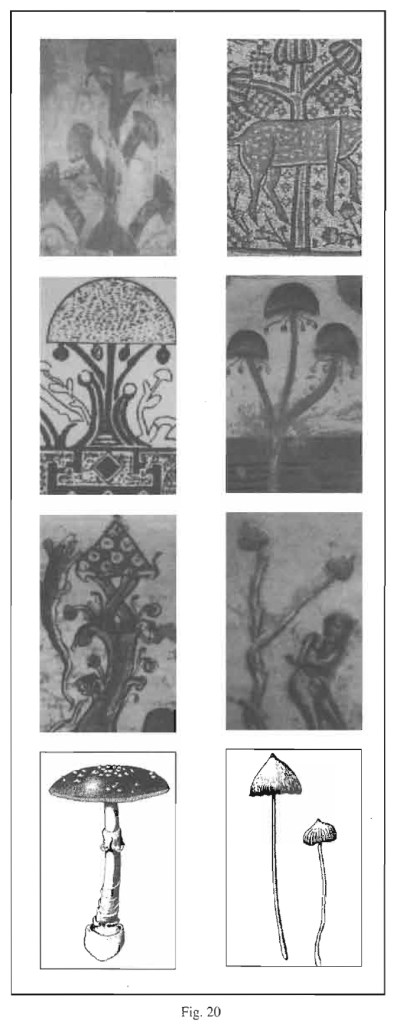
Column 1: Amanita Mushroom Trees
Column 2: Psilocybin Mushroom Trees
“Mushroom-tree features” include deer & snake; cut branch; handedness; balance, fruit, 4 fruits, 4 limbs, cross-behind; {cut right trunk}, heel of foot, etc.
[Mar. 1, 2025]
To broaden analysis of branching motifs, include {deer branching antlers} vs non-branching {snake}. Why is snake & deer often w/ a mushroom-tree or tree of knowledge? b/c branching & non-branching motifs.
Samorini is wrong: just b/c salamander mushroom-tree has spots, doesn’t make the entire whole tree Amanita — it has liberty its crown is shaped triangle Liberty Cap.
Rather, the tree freely combines Amanita features/ elements, tree features/ elements, and Liberty Cap features/ elements. Basic mistake – which I made even some time a year into my breakthrough decoding of branching form —
I made the mistake of stopping as soon as I id’d a single feature of the tree on the overall form of whole tree.
I initially failed to do fractal scope-change to examine and analyze PORTIONS of a given tree eg this mature form analysis of 2023/03/18.
I remember exactly when/ circumstances; which tree images: see my posts where i realized that; specifically, see my post about Formal Form Mathematical Analysis:
YI Tree Branching Morphology: Formal Theory of Fractal YI Scope of Analysis of Branching-Message Mushroom Trees
https://egodeaththeory.org/2023/03/19/yi-tree-branching-morphology-formal-theory-of-fractal-yi-scope-of-analysis-of-branching-message-mushroom-trees/
That’s almost exactly a year after March 21, 2022 first writing “branching-message mushroom trees”.
It took 1 full year (Mar. 2022 – Mar. 2023), to evolve my analysis from “branching-message mushroom trees” limited to the scope of entire whole-tree — a fallacy committed by Samorini & Huggins — to the far more detailed and elaborated & flexible & sophisticated “fractal scope” analysis & handling individual features, & free-form creative combination of features/elements, not just on the level of an entire whole mushroom-tree image.
eg f134 row 1 L: Eadwine’s leg-hanging mushroom tree image in the Great Canterbury Psalter: bottom level of tree is YI form, upper level of tree is trident-I form — for both the pink key tree & for the mushroom-tree that it touches. THESE are the details of branching-form analysis that are ESSENTIAL – NOT classifying entire whole mushroom-trees by how the trunk splits to hold up the crown, which is the analysis/ class’n scheme attempted by Samorini & Huggins.
egs my moment of realization — shifting from whole-tree to partial-scope tree analyssis, may have been Eustace river (likely), and then f177 row 1 R: a dud mushroom-tree — a branching-message leaf tree.
THIS WAS A HUGE ESSENTIAL BREAKTHROUGH GRASP of branching form , not only for branching-message mushroom trees , but broadly for branching-message mushroom trees in general.
“branching-message trees” – I wrote that phrase a few days after writing the main phrase in email, “branching-message mushroom trees”.
“branching-message tree”
branching message tree — yes, a keyboard shortcut already exists, proving that this is not the first time i wrote “branching message tree” branching message tree — hyphen or not, used in past??
search present site for:
“branching message tree” https://egodeaththeory.org/?s=%22branching+message+tree%22
“branching-message tree” https://egodeaththeory.org/?s=%22branching-message+tree%22
“branching-message vine-leaf tree” https://egodeaththeory.org/?s=%22branching-message+vine-leaf+tree%22 – 0 hits, therefore, 10:00 am Mar 1 2025 is 1st time I wrote that exact string/phrase. It is a good phrase/ concept-label. check out closely similar article title:
https://egodeaththeory.org/2020/12/20/vine-leaf-trees-depicting-non-branching/
Here’s an important milestone article / title/ concept; I think 2023/03/19 (or March 18 p.m.) is when I figured out the MAJOR, crucial concept the artists used, “fractal scope” or partial scope analysis:
YI Tree Branching Morphology: Formal Theory of Fractal YI Scope of Analysis of Branching-Message Mushroom Trees
https://egodeaththeory.org/2023/03/19/yi-tree-branching-morphology-formal-theory-of-fractal-yi-scope-of-analysis-of-branching-message-mushroom-trees/ – “because of while decoding Canterbury f177 Row 1 tree L & tree R, then applied to f134 pink key tree, yesterday March 18 2023 … BEGAN TO REALIZE that tree 4 in Eustace is a self-contained YI in addition to considering it — like ~March 2022, as the “Y” when considered within the tree pair trees 3+4.”
This art genre is mushroom imagery in Christian art, of which the main image is mushroom-trees., which turn out to be not only mbbt branching-message mushroom trees, but requires multi-scope analysis of a branching message tree.
Multi-scope analysis of a branching message tree is essential – Classifying Whole Trees Based on Branches Under Crown is Not Key Relevance – Must Use More Granular Feature-Analysis than Samorini & Huggins Crude First Attempts at Classification Schemes to Produce Comprehension
[Mar. 1, 2025]
Samorini & Huggins class’n schemes based on branching forms are crude and not successful.
The psychedelic eternalism theory of mythemes & art motifs uses a more granular, fragmentary-features, partial-scope, multi-scope analysis per March 18, 2023 article announcement: https://egodeaththeory.org/2023/03/19/yi-tree-branching-morphology-formal-theory-of-fractal-yi-scope-of-analysis-of-branching-message-mushroom-trees/
Prior to that date, I was making a mistake somewhat like the misguided class’n systesms of Samorini & Huggins: I was only examining a mushroom-tree on the scope of the WHOLE TREE. Mistake! You must consider individual elements/ features/ branching form WITHIN the whole tree; this is THE WHOLE-TREE FORM-ASSESSMENT FALLACY.
The “Whole-Tree Form-Assessment” Fallacy
[Mar. 1, 2025]
The “Whole-Tree Form-Assessment” Fallacy – eg the Dancing Man salamander bestiary’s mushroom-tree has triangle Liberty Liberty Cap w/ Amanita spots – does the tree mean a Liberty Cap or a tree or an Amanita mushroom? Wrong Q; false dilemma; category error
Multi-scope analysis of a branching message tree is essential – Classifying mushroom-trees in Our Blessed Sacred the Plaincourault fresco vs. Lesser, Psilocybin mushroom-trees” (Samorini), or classifying per Huggins , is NOT important; Huggins & Samorini are barking up the wrong tree
That page shows that the “fractal/local/ multi-scope” breakthrough – which is ESSENTIAL for understanding artists’ intent in this genre (mushroom imagery in Christian art which ~= mushroom-trees) – included considering the Dancing Man salamander bestiary’s mushroom-tree: usual suspects of mushroom-trees:
My “local scope branching message tree branching form analysis” used initially all of:
- f177 row 1 L
- f177 row 1 R
- the Dancing Man salamander bestiary’s mushroom-tree
- Eustace crossing the river
ecr - Eadwine’s leg-hanging mushroom tree image in the Great Canterbury Psalter – f134 row 1 L
the Dancing Man salamander bestiary’s mushroom-tree
dm
(Bodelian library)
i even have entire page w that title!
https://egodeaththeory.org/2022/04/04/branching-message-trees/
shortly after March 21 2022’s 1st writing of “branching-message mushroom trees”
did i wrote:
branching-message leaf tree
branching-message vine-leaf tree – i like better than just “leaf”
branching-message leaf trees
bmlt
9:55 am Mar 1 2025
In headshop art, cubensis has spots.
A cubensis image with spots is not a cubensis mushroom; it’s mythic-realm Magic Mushroom creative free-form combining FEATURES.
The main problem w/ Samorini’s fig 20 table classif’n is RIGIDITY. Grouping features in too-big of units of scope, grouping two many indep variable features together not flexible enough to reflect actual mushroom-trees
What’s actually important in branching form: {cut right trunk} gives stability {scales / tower / balancing/ column}, = put weight on R foot not L toe/ heel/ foot/ leg/ hip, not L. Keep centrally using L thinking, but don’t rely on egoic control thinking as the autonomous ultimate source and foundation of control thoughts.
Always riding the horse, seen from above and behind now, a different perspective above egoic control thinking.
Look up and back, child dies, foundation switched to the uncontrollable source of control-thoughts, the revealed male function snake-shaped injection of control thoughts frozen in spacetime.
the Mytheme theory = the psychedelic-eternalism mytheme theory = the psychedelic eternalism theory of mythemes & art motifs
[Mar. 1, 2025]
The Egodeath theory’s Mytheme theory
Concept-label for Egodeath theory’s Mytheme theory: the theory of interpretation of mythemes and art motifs as analogies for psychedelic eternalism – key words: psychedelic eternalism, mythemes, art motifs, —
short form:
the Mytheme theory
mt
med form:
the psychedelic-eternalism mytheme theory
pemt
long form:
the psychedelic eternalism theory of mythemes & art motifs
petmam
Huggins’ attempted classification: Crown Held Up by Divided Trunk vs. by Tangle of Branches
[Mar. 1, 2025]
- Branches type 1 under cap: Divide trunk or add branches to sides of trunk
- Branches type 2 under cap: Flare top of trunk forming tangle of multiple branches just under the crown
What about type 3: crown held up by single trunk? (Part of Samorini’s attempted class, “Saint Martin” type.) Doesn’t Huggins discuss & include that type?
The attempted analyses of branching elements and forms by Samorini & Huggins are a start; but, the destiation has to be:
- Free-form creative combination of features of trees & mushrooms.
- {mushrooms}, {branching}, {handedness}, and {stability} motifs.
By “creative”, I mean that it’s impossible to construct general class’n systems as Samorini & Huggins attempt, bc that’s not what the artists are trying to do.
The artists are trying to break any such rigid schemes & demonstrate unique new combinations of features of trees & mushrooms – including {deer antlers}, {snake}, {4 limbs}, {cut right branch}, {balance on R leg}, and other such general variants/ instantiations of the set of motifs.
The real message of the artists, must ultimately lead to analysis of images in terms of small portional features/ elements/ local sub-scopes, sub-elements, ultimately leading to: {mushrooms}, {branching}, {handedness}, and {stability} motifs.
A huge part of Huggins MICA Denial arg’n is undermined by my disproof of arg’g only on the scope of entire whole tree “is it a tree or is it a mushroom”. I couch the analysis instead in terms of FREE-FORM CREATIVE COMBINATION OF ELEMENTS/ FEATURES OF TREES + ELEMENTS/ FEATURES OF MUSHROOMS.
It’s a scope-of-analysis error by Huggins as MICA Denier, & by Samorini as MICA Affirmer. I made a very comparable scope error between March 21, 2022 & March 18, 2023, when I had the concept of branching-message mushroom trees, but still lacked the concept of fractal-scope analysis & — pershaps a recent 2025 concept or late 2024? — my emp….
You can date my emphasis on “free-form creative combining of tree feautres/elements + mushroom features/elements” to when I read Foraging in Wrong Forest & noticed his fallacy of arg’g on basic of basis of entire whole tree image to construct his false dilemma:
“By starting with Panofsky’s sentence about branching, we can articulate criteria to decide if it is a tree or a mushroom.”
[that point shifts to the other topic, of the paragraph about “criteria” in Foraging in Wrong Forest > Concl section]
Solution: The Meaning of YO or Trident Branches Holding Up the Crown of a Mushroom-Tree
todo: make heading use wording from Huggins, “entheogen scholars need to explain the branches”
todo: quote Panofsky-Huggins re: “entheogen scholars need to explain the branches”
“Schematized Trees” per Huggins = mushroom-tree branching form
branching, non-branching, & branching form is part of the Mytheme theory.
Fork holding up cap of one type of mushroom-tree: YO (dancing man) or trident-O (the Plaincourault fresco).
YO or Trident-O Branching Form of Some mushroom-trees eg the Plaincourault fresco
YO or trident-O branching: Map two mental models of personal control to the left and right limbs or arms.
Mushroom-trees that have two sides, two arms.
In Great Canterbury Psalter f11 row 3 Right, the tree of knowledge has a cap that has a grid cap in which each Liberty Cap mushroom-tree has two arms.
The trident branches of the Plaincourault fresco map to 3-phase: two mental models + the final combined mental model (the middle branch/trunk under the cap).
The MAIN idea BOTH(!) in day 3 plant 2 AND in the Plaincourault fresco, is left and right arm – whether a left mushroom arm and a R mushroom arm; or, a L beam & a R beam.
And maybe a middle trunk, = final balanced view/ the personal control system.
Map Left Branch to the Possibilism Mental model, Map Right Branch to the Eternalism Mental Model
The L & R mushroom-arm, OR, the L & R beam holding up cap in the Plaincourault fresco, map to L = possibilism, R = eternalism, and finally, end up w/ both possibilism and eternalism; possibilism that’s qualified by eternalism.
Hypercosmic Fire Arch on Cover of Brinc Book
fire arch in the picture that is on cover of Erich Brinckmann’s 1906 book Tree Stylizations in Medieval Paintings.
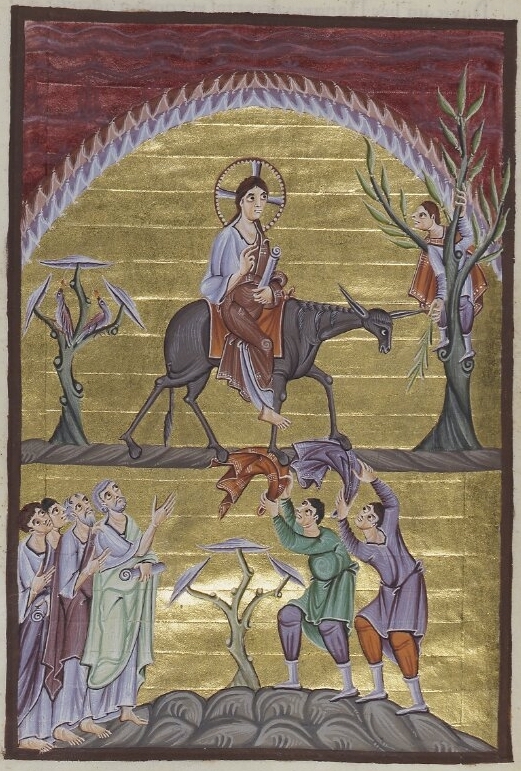
Branching form of mushroom-trees:
Not YO.
Not trident-O.
Simple trident or YI. Bottom: YI mushroom-tree.
An In-Scope Relevant Interpretation of 3 trident branches of the Plaincourault fresco
The middle, vertical branch/trunk means balanced (combining possibilism-thinking & eternalism-thinking), like discussed in my emails of Feb. 17 am, 2025:
Compare which-foot-down in panels around “eat from tree of knowledge” panel by Eadwine & Bernward.
A 3-phase interpretation answers Ronald Huggins’ 2024 article “Foraging for Psychedelic Mushrooms in the Wrong Forest: The Great Canterbury Psalter as a Medieval Test Case”.
Solved Huggins’ Trident Branches Question
I solved Huggins’ question about why Y or trident branches holding up cap of the Plaincourault fresco — because L arm & R arm and – per today, ‘balance’, “middle arm”.
Ronald Huggins’ 2024 article “Foraging for Psychedelic Mushrooms in the Wrong Forest: The Great Canterbury Psalter as a Medieval Test Case”
I solved the trident question from Ronald Huggins’ 2024 article “Foraging for Psychedelic Mushrooms in the Wrong Forest: The Great Canterbury Psalter as a Medieval Test Case”.
Regarding YO or trident-O branching form; 2 or 3 branches holding up crown of mushroom-tree.
- L branch maps to possibilism-thinking.
- R branch maps to eternalism-thinking.
- Middle branch (in the case of trident-O form) maps to qualified possibilism-thinking; eternalism-thinking integrated with possibilism-thinking.
Connecting 3-Phase & YO or Trident-O branching
There are 2 or — arguably — 3 mental models, or phases; = 2-3 arms / branches holding up the cap of that type of tree, YO tree.
Mental model 1: possibilism ; naive possibilism-thinking
2: simple basic eternalism-thinking.
3. nuanced balance of a kind of possibilism-thinking + a kind of eternalism-thinking.
Map those to the 3 branches holding up the the Plaincourault fresco cap.
That gives a really great, solid, “flexible” answer to Huggins, who says entheogen scholars have no explanation for that kind of branches or a tangle of branches under a cap/crown.
Huggins seems a much more solid, serious writer than Letcher/Hatsis, even though I was fuming and venting to my friend in frustration against MICA Deniers.
- March 21, 2022 – emailed Brown & Cyberdisciple, replying to Brown emailing me the 2019-formatted Marcia Kupfer quote about youths cutting trees, writing the phrase “branching-message mushroom trees” for the first time.
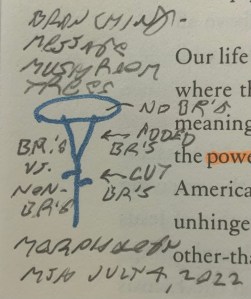
- July 4, 2022 – I drew a diagram in a book in blue metal ink, a YO tree, with branching features and non-branching zones indicated – in contrast to other branching forms.
YO Branches
Given that it makes sense to draw mushroom as tree w/ tracnh 1 cap and tangle of branches (Huggins type 1 (2?)) under the cap b/c gills & veil look like branches, why would you (Hug type 2 (1?)) draw the branches as Y or trident like the Plaincourault fresco?
Is YO-form mushroom-tree arb stylization? NO.
it is to give like Day 3 plants, a L & R arm; a L & R feature; a L & R branch, to leverage the binary “L one vs R one”, then to map in order to map that binary to the binary “two feet”; two legs: L & R.
Ans: to focus on concept of “L vs R” ie there are two different things, mappable to two different sides/directions. just like we have two feet, we have two mental models , map and assign L & R.
“up vs down”:
down = hell,
up = heaven.
down= bad,
heaven = good.
L = bad = hell = struggle;
R = good = resolution = Transcendent Knowledge = stable control = {pass through gate} ; {pass through guarded gate}
The Purpose of YO or Trident-O Branching Form of Mushroom-Trees
Planned post as announcement of
breakthrough
explanation/ solution to Huggins’ Question
Planned post:
Announcement of a breakthrough answer to Huggins’ Q:
Why Y or Trident branches in the Plaincourault fresco mushroom-tree?
Entire Section “3. Schematized Trees” from Huggins: Foraging Wrong Article, 2024, pages 17-19
Passage by Huggins About Two Forms of Branches Under Crown/Cap of Mushroom-Trees
Consecutive relevant posts:
- Ordinary-State, Literalist, Reductionist Misreading of Esoteric Art: The Perspective of Those on the Outside
- Deniers’ Logical Fallacies in the Pilzbaum (Mushroom Trees) Debate
- Foraging for Psychedelic Mushrooms in the Wrong Forest (Huggins 2024)
My conventions of formatting:
- No quote marks.
- Some footnotes, inline.
- Some Biblio entries for footnotes.
- Some inline pictures (my own crops).
- Each sentence as a separate paragraph.
- His paragraphs = — separators.
- My emphasis added.
Huggins wrote the following.
The article has two sections numbered as “3.”, this is the 2nd section 3.
Magic Dirty Use of “completely formulaic” is a Strategy of hitting every angle, relying on them all being soaked with Prejudice: “Formulaic/ multiple/ mainstream, therefore not mushroom”
“Completely Formulaic” Is the “Argument from Prejudice” Fallacy, relying on gullible audience’s unconscious prejudice
In fact, the formula for mushroom-trees is to combine elements of tree & mushroom, per {mushrooms}, {branching}, {handedness}, and {stability} motifs.
I can do a lot by critiquing what’s going on with the WAY Huggins uses the word ‘formulaic’.
It’s like Erwin Panofsky’s garbage arg’n “there are other trees like the Plaincourault fresco, so, not mushroom.”
DOES NOT FOLLOW, but what Erwin Panofsky-Huggins is attempting in dirty arg’n – leveraging fallacies – is he is trying to take advantage of the fact that all arg’n is biased & prejudiced against mushroom.
Every possible, wildly varied & off-the-wall bizarre vector of arg’n & angle that the MICA Deniers can throw at the problem, is presented AS IF it follows, that multiplicity of mushroom-trees means not mushroom, and that formulaic means not mushroom.
Non-Sequitur-Fest Gallery: <Any Fact You Can Think of>”, therefore, not mushroom”
Tree of knowledge involves theology – therefore not mushroom.
There are multiple instances – therefore not mushroom.
It’s not hidden – therefore not mushroom.
It’s completely formulaic – therefore not mushroom.
It has tree & mushroom features – therefore not mushroom.
There are 38 instances of feature X in Great Canterbury Psalter – therefore not mushroom.
The correct genre of Bodl. is bestiary – therefore not mushroom.
All such “arguments from a fact employed as a bluff” are total non sequiturs, but used nevertheless b/c a dirty strategy of bias, that relies on bias to appear (to an imaged, hoped-for gullible, suitably biased audience) to constitute compelling arg’n.
“Does not follow” yet SEEMS convincing sheerly due to being saturated / freighted with biased.
‘formulaic’ is a LOADED TERM that carries anti-mushroom prejudice. In fact, the formula, is psychedelic eternalism; {mushrooms}, {branching}, {handedness}, and {stability} motifs.
Huggins tries to leverage the prejudiced assumption that “formulaic” automatically means “not mushroom” – DOES NOT FOLLOW.
Same w/ loaded words like “mainstream” – where is is taken for granted that mainstream = not mushroom.
The Letcher arg: “This Bernward Door Liberty Cap mushroom-tree is not secret, therefore, it’s not a mushroom.”
He leverages the prejudiced assumption that mushroom imagery in Christian art is secret, hidden, suppressed, to pretend to disprove mushroom imagery in Christian art — which only persuades a suitable prejudiced audience.
The arg’n (such as the dirty, BIASED RHETORIC “completely formulaic”) actually carries no weight, and only relies entirely on uncritical prejudice shared by author & reader.
The wording “completely formulaic” is used in a bias-driven way, to construct dirty, fallacious arg’n.
The obvious response from a critical reader is:
What’s the nature of this “completely formulaic” “stylization”, IS IT PURPOSEFUL MUSHROOM IMAGERY?
Huggins and MICA Deniers pretend: The fact that this art is mainstream, and formulaic, and multiple instances, is proof that it’s not purposeful mushroom imagery.
Non sequitur. DOES NOT FOLLOW – but can appear & seem to constitute “arg’n”, for a suitably prejudiced audience.
3. Schematized Trees (entire section from “Foraging Wrong”)
Here is Huggins’ entire section, formatted per the above conventions.
The trees throughout the earlier illuminations of the GCP are completely formulaic and produced in a manner reflective of that.
The artist draws simple parallel lines for the trunks and branches and tops them off with circles or ovals of various sizes.
We can see unembellished examples of underlying drawings for such trees in the unfinished Douce Apocalypse (1250–1275) (Fig. 16).
Fig. 16: Douce Apocalypse, Bodleian Library, Ms. Douce 180, fol. 48v (detail).
—
After drawing the basic shapes, the artist adds the patterns they want to feature for each crown.
In our example from the Douce Apocalypse this would consist of leaves in an oval; in many of the crowns in the GCP, it involved an initial stage of cross hatching the circle or oval that was to become the foliage crown.
This is what was done in three of the trees in the third-day scene.
The artist then elaborated the squares created by the cross hatching by adding further details, such as dots, tree / parasol shapes, etc.
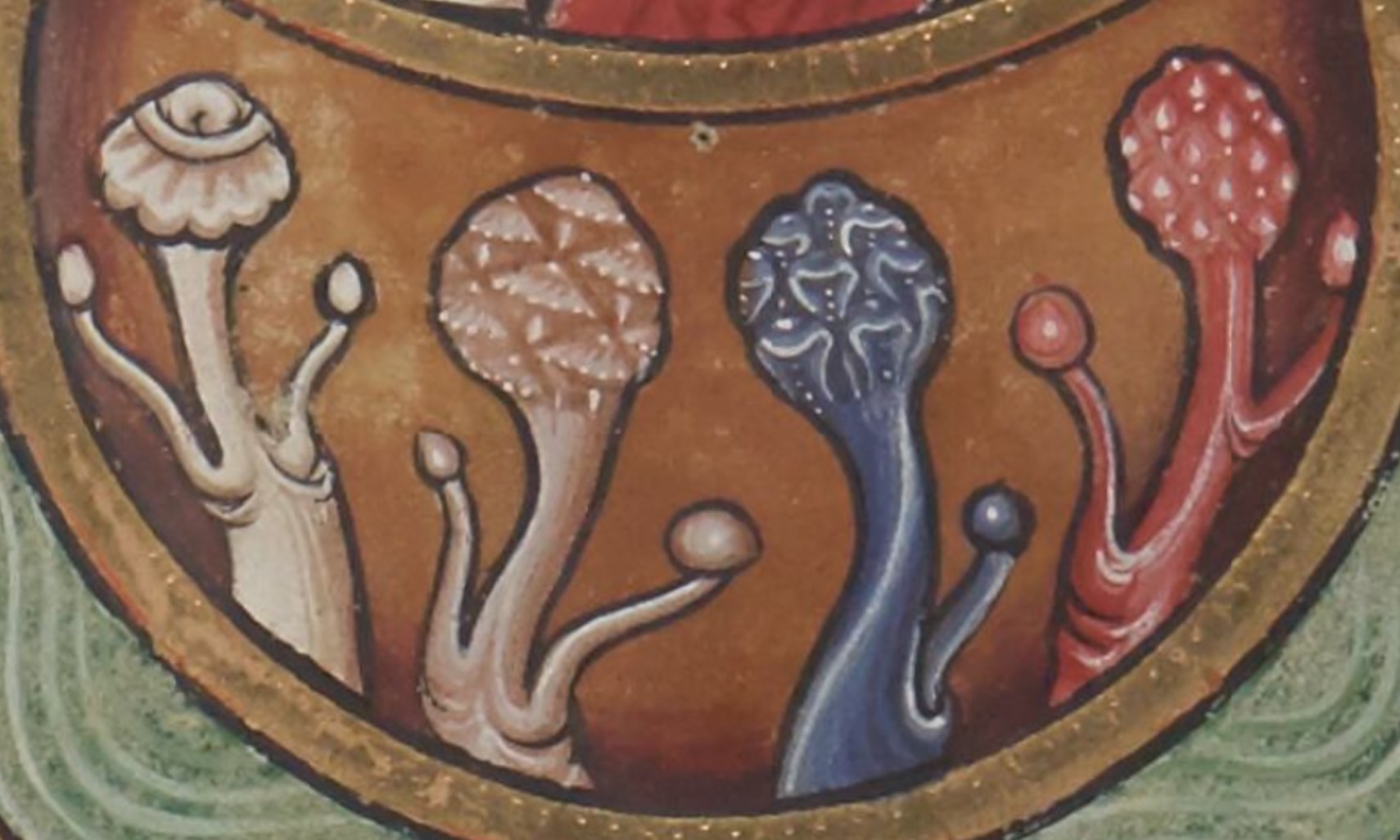
Third Day: Four Plants

Eat from Tree of Knowledge
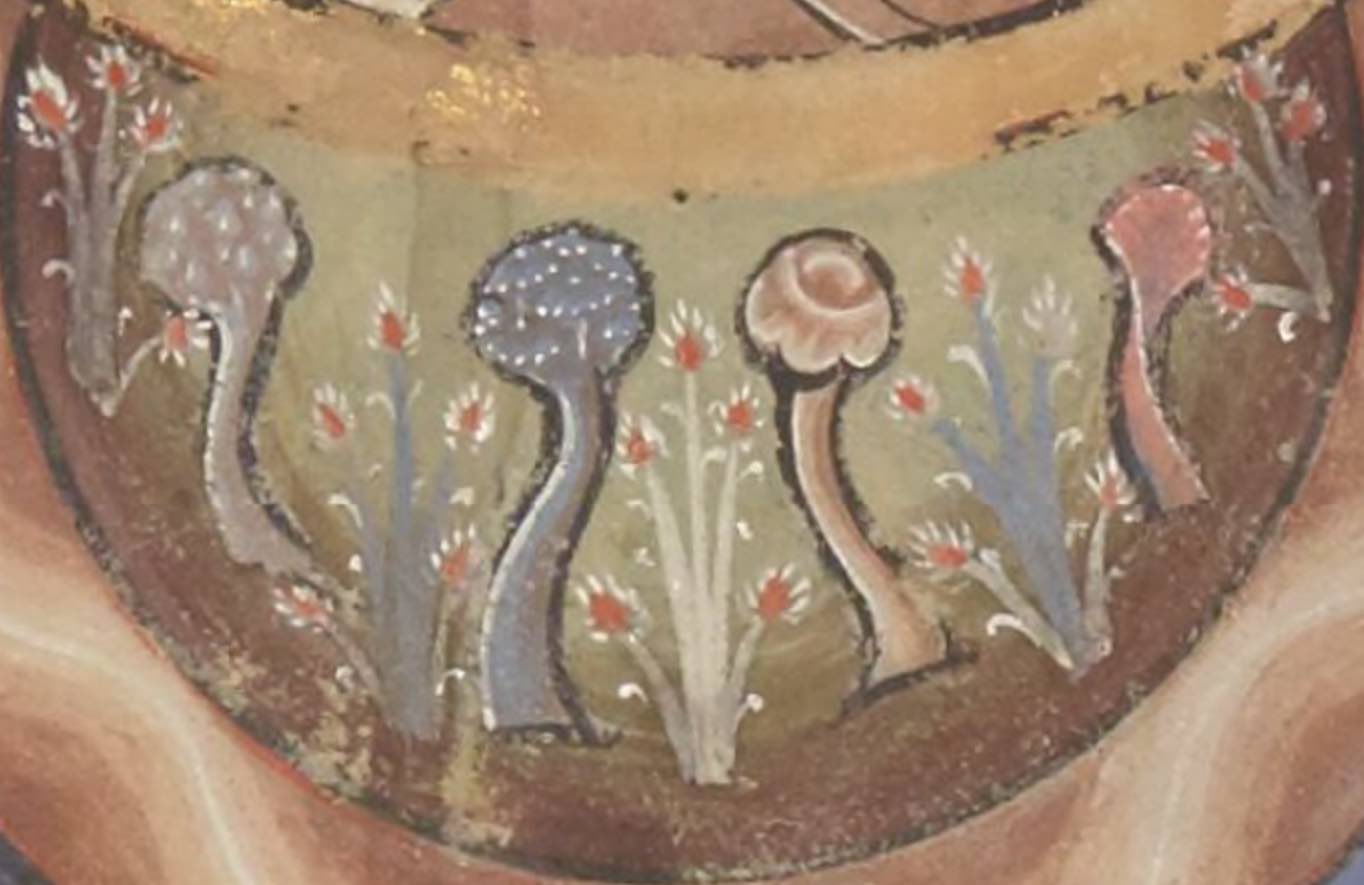
Fourth Day: 4 Plants
The same was done throughout the GCP with no attempt at consistently linking a particular pattern with a particular color or form of plant or tree.
—
The inclusion of ramifications (branches) is accomplished in two ways.
The first is to divide the trunk or add branches to its sides.
The other is to flare out the upper end of the trunk to make room for a small tangle of multiple branches at the top just under the crown.
Again, the Douce Apocalypse provides examples of this latter type at the stage of the initial drawing (Fig. 17).
The GCP [Great Canterbury Psalter] uses both approaches, the latter, for example, in its depiction of the tree of the knowledge of good and evil (Fig. 18).
The presence of both kinds of branches under crowns of the same sort as appear in the third-day scene would seem to rule out any intentionality on the part of the artist(s) to depict mushrooms.
—
In another context, PMT [psychedelic mushroom theorist] Giorgio Samorini attempts to sidestep the problem of multiple branches supporting a single cap by suggesting that
Samorini wrote:
“these ramifications might represent the membrane enveloping mushrooms of the family of the Amanitaceae at the early stages of development.
“This membrane then breaks when the cap broadens out and separates from the stalk,”68
Footnote 68: Samorini, “Mushroom Trees,” 89, and New Data, 268. The same argument was put forward already by Émile Boudier, in Marchand / Boudier, La fresque de Plaincourault (Indre), 32.
Bibliography:
Samorini, G., “Mushroom Trees” in Christian Art, Eleusis n.s. 1 (1998), 87–108
My page: “Mushroom-Trees” in Christian Art (Samorini 1998)
Samorini, G., New Data from the Ethnomycology of Psychoactive Mushrooms, International Journal of Medicinal Mushrooms 3/2–3 (2001), 257–278
https://www.google.com/search?q=%22New+Data+from+the+Ethnomycology+of+Psychoactive+Mushrooms%22
Marchand, M. / Boudier, M., La fresque de Plaincourault (Indre), Bulletin trimestriel de la Société mycologique de France 27/1 (Jan. 1, 1911), 31– 32
Huggins continues:
This leaves behind on the stipe a remnant called a veil.
—
However, Samorini anachronistically projects a greater interest in botanical accuracy than is justified for artists of our period.
The idea that they would go beyond depicting a mature Amanita muscaria to capture its appearance during a brief stage [split veil] in its development is far-fetched.
Furthermore, while the membrane Samorini refers to is a feature of Amanitaceae (including Amanita muscaria), it is not a feature of several other varieties of psychedelic mushrooms the PMTs want to identify as trees.
Samorini’s suggestion also begs the question of images that he and other PMTs identify as psychedelic mushrooms whose crowns are supported by multiple branches but lack a central stalk or stipe, a crucial morphological feature of many psychedelic mushrooms.69
69 See, e.g., the tree poisoned by a salamander in MS Bodl.602, fol. 27a (Samorini, “Mushroom Trees,” 100, fig. 17, New Data, 275, fig. 19, and Funghi, 192, fig. 79).
Huggins doesn’t cite:
Dizzy, Dancing or Dying? The Misappropriation of MS. Bodl. 602, fol. 27v, as ‘Evidence’ for Psychedelic Mushrooms in Christian Art (Huggins 2022)
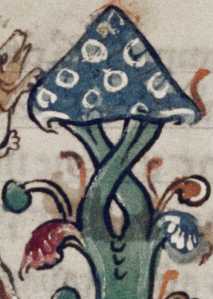
from bottom: Y
Finally, even if we were to credit Samorini’s argument in relation to a tree with only two or three branches, it takes us nowhere near explaining the great tangle of branches we find on the GCP’s tree of nests.

—
Given the persistent issue of ramifications (branches), the PMTs cause is not advanced when the Browns assert that
“Numerous red, blue, orange, and tan stylized mushrooms dot the first hundred pages” of the GCP.70
Footnote 70: Brown / Brown, Psychedelic Gospels, p. 137.
Day 3, Great Canterbury Psalter
Of the more than one hundred trees in the GCP’s earlier illuminations, only eleven appear without branches, and for the most part these use the same crown patterns as those with branches.
Seventeen of the trees have a tangle of multiple branches just under the crown.
The Browns’ appeal to other trees in the GCP actually undercuts their claims about the third-day scene, where they seek to identify the species of the various alleged psychedelic mushrooms based upon the combination of the pattern and color of each plant.
The bigger picture provided by the use of color and pattern in the rest of the earlier GCP illuminations indicates that the combination of pattern and color on crowns is not fixed and implies no specific reference to any particular species of plant or tree.
This is especially clear in cases where different mixes of color and pattern appear together on the crowns of single trees (Fig. 19).
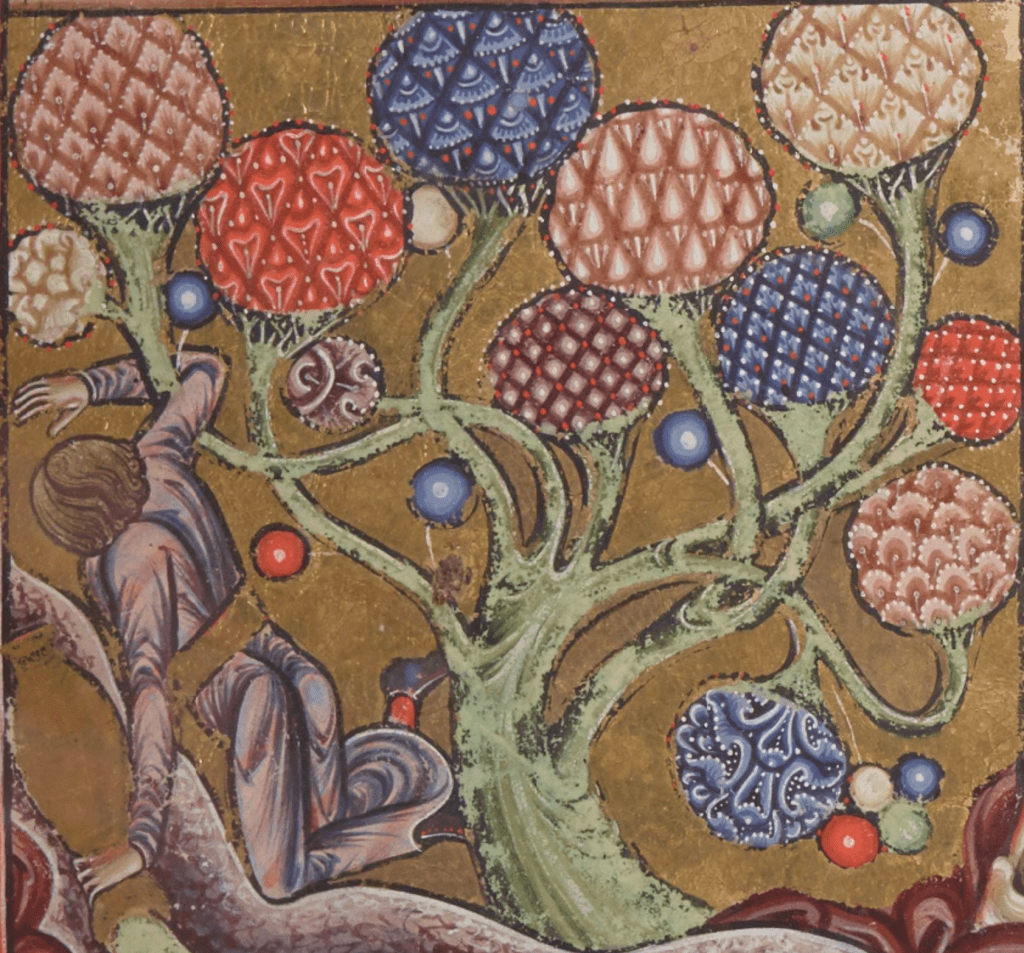
/ end of section “3: Schematized Trees” from Huggins Foraging Wrong
Two Forms of Branches Under Crown/Cap of Mushroom-Trees
Start of long passage, most of the 2nd “section 3”.
Below is included all sentences from Hug’s Section 3[b] except the 1st two paragraphs (which are shown in the plain copy above).
Huggins wrote:
“The inclusion of ramifications (branches) is accomplished in two ways.”
Huggins is going to argue: In the mushroom-trees of Great Canterbury Psalter, there are these multiple types of branches/branching, under a given type of crown, therefore, not purposeful mushrooms imagery.
Here are the poorly defined 3 types, that he says are 2 types:
- Type 1a: Trunk splits into branches, with each crown held up by a simple single stem.
- Type 1b: Trunk has branches branching off of it.
- Type 2: Top of trunk under a single crown has tangle of branches immediately under crown.
Branches type 1 under cap: Divide trunk or add branches to sides of trunk
“The first is to divide the trunk or add branches to its sides.”
Branches type 2 under cap: Flare top of trunk forming tangle of multiple branches just under the crown
“The other is to flare out the upper end of the trunk to make room for a small tangle of multiple branches at the top just under the crown.
“Again, the Douce Apocalypse provides examples of this latter type at the stage of the initial drawing (Fig. 17).
“The GCP [Great Canterbury Psalter] uses both approaches, the latter, for example, in its depiction of the tree of the knowledge of good and evil (Fig. 18).”
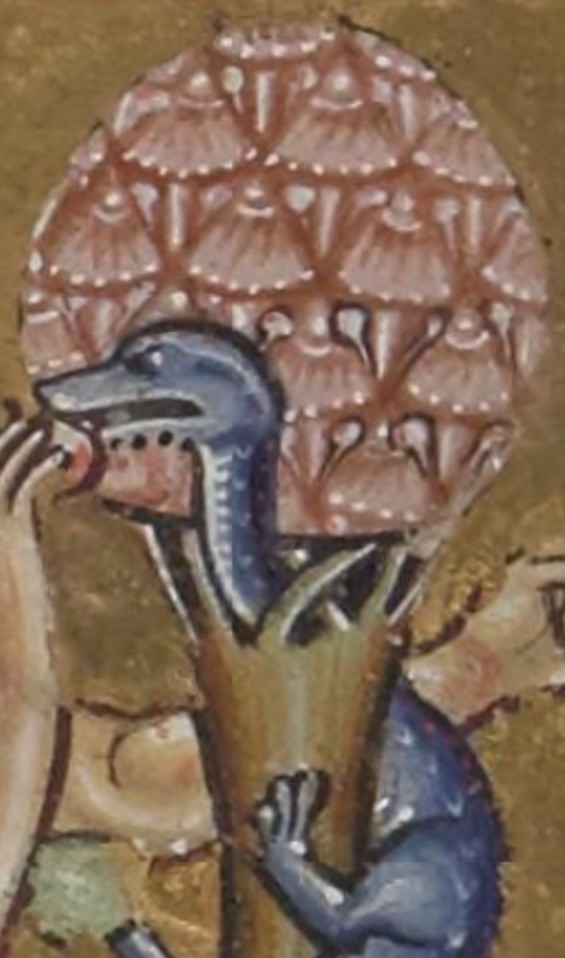
Non Sequitur: Variations in Branching Form, “Therefore”, Not Purposeful Mushroom Imagery
“The presence of both kinds of branches under crowns of the same sort as appear in the third-day scene* would seem to rule out any intentionality on the part of the artist(s) to depict mushrooms.”
FALLACY: THE “WHOLE ENTIRE TREE IMAGE MUST MATCH 1 WHOLE ENTIRE MUSHROOM”.
His phrase “both kinds of branches under crowns” means what two types?
Type 1a & 1b: divide trunk or add branches to sides of trunk
Type 2: flare top of trunk forming tangle of multiple branches just under the crown
No sensible affirmer of mushroom imagery in Christian art ever claimed that the mushroom-tree at the level of the entire whole tree matches a single whole entire mushroom.
Browns’ phrase doesn’t work – it falls prey to that fallacious argumentation/ opportunistic misinterpretation:
Bad expansion of ‘MICA’: “mushrooms in Christian art”
Good expansion of ‘MICA’: “mushroom imagery in Christian art”
Mushroom-tree w/ type 1b branches.
Hug argues that the same type of crown is supported by varying different types of branching, therefore, none of this can possibly be purposeful mushroom imagery.
Because the mushroom-trees are not rigidly consistent, as Brown asserts (I grant Brown plaus. deniability here:
Brown BARELY implies or argues that the four Day 3 mushroom-trees are rigidly, as entire whole plants, occur throughout Great Canterbury Psalter.
Brown is wrong and poor here, sloppy, misrepresentative of the Psalter.
Huggins takes Browns’ brief bad wording/ little sentence, that the Day 3 plants occur throughout … that red and blue and tan and orange mushrooms occur throughout Great Canterbury Psalter.
Browns’ Misrepresentation: “Numerous red, blue, orange, and tan stylized mushrooms [like the ones shown in Day 3] are found in the first 100 pages” of the Psalter
4x Penalty for Brown & Brown 2016 & 2019, re: their false, misrepresentative statement:
“Numerous red, blue, orange, and tan stylized mushrooms are found in the first 100 pages” of GCP. Context: discussing Day 3 image’s four plants, which are – insanely R to L – red, blue, orange, and tan.
Brown is wrong: there are NOT “red red and blue and tan and orange mushrooms occur throughout Great Canterbury Psalter”.
Huggins is talking specifically about branches form IMMEDIATELY UNDER CROWN; ie, how the crown is held up.
There are cases of trunk dividing, but not immediately under the crown, except where it it like his type 2 form:
“flare top of trunk forming tangle of multiple branches just under the crown“.
This is the only way Eadwine uses, to hold up a given crown.
Huggins might mean nests tree – but that trunk-dividing is NOT the branches form that’s immediately under a single crown. Incoherent thinking/ writing here.
Huggins’ ELASTIC tricky 1st type: Huggins says “A or B”.
A mushroom-tree w/ type 2 branches under cap:
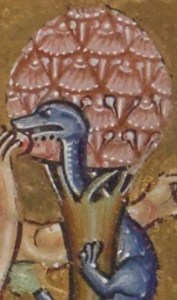
Branching form: Y X Y (visually cut right branch)
Huggins you are so full of sh!t! You have not “RULED OUT” jack sh!t! Pompous.
What a crazy argument!
Deniers of mushroom imagery in Christian art do not just use ORDINARY obvious logical fallacies; they use astoundingly absurd instances of obvious logical fallacies.
Huggins argues: The artist combines tree features & mushroom features in flexible varying ways, SO, NOT MUSHROOMS.
How is that conclusion supposed to follow? The argument doesn’t make any sense.
Crowns, throughout the Psalter, of the same sort as these 4 crowns, have both types of branches under their crowns:
Branches type 1) Divide trunk or add branches to sides of trunk.
Branches type 2) Flare upper trunk, tangle of 3+ branches.
Day 3, Great Canterbury Psalter
Huggins continues:
“In another context, PMT [psychedelic mushroom theorist] Giorgio Samorini attempts to sidestep the problem of multiple branches supporting a single cap by suggesting that
Samorini wrote:
“these ramifications might represent the membrane enveloping mushrooms of the family of the Amanitaceae at the early stages of development.
This membrane then breaks when the cap broadens out and separates from the stalk,”68
Footnote 68: Samorini, “Mushroom Trees,” 89, and New Data, 268. The same argument was put forward already by Émile Boudier, in Marchand / Boudier, La fresque de Plaincourault (Indre), 32.
Bibliography:
Samorini, G., “Mushroom Trees” in Christian Art, Eleusis n.s. 1 (1998), 87–108
My page: “Mushroom-Trees” in Christian Art (Samorini 1998)
Samorini, G., New Data from the Ethnomycology of Psychoactive Mushrooms, International Journal of Medicinal Mushrooms 3/2–3 (2001), 257–278
https://www.google.com/search?q=%22New+Data+from+the+Ethnomycology+of+Psychoactive+Mushrooms%22
Marchand, M. / Boudier, M., La fresque de Plaincourault (Indre), Bulletin trimestriel de la Société mycologique de France 27/1 (Jan. 1, 1911), 31– 32
Huggins continues below.
from bottom: Y
Branching form: Y; X / -\ (right cross-behind); YYO
Cut Right Trunk in Salamander Bestiary Image (Dancing Man, Roasting Salamander in Bodleian)
Branching Form of Dancing Man Mushroom
From top to bottom of crop:
Δ = Lib Cap cap. donuts not grid of Lib Caps which could = branching.
YY = immed below cap/crown.
X / -\ = right cross-behind; = visually cut right branch aimed at R paw.
Y IIII = 4 side branches/mushrooms.
I = main stem.
YI = cut right branch, not shown here (right foot touches the cut right trunk).
+ mushroom = {holding removed branch} in his L hand.
Branching form: Y X Y (visually cut right branch)
Branching Form Tree of Knowledge Under Cap, GC Psalter: Y X Y (cut right branch)
Specifically Y / -\ Y; middle has right cross-behind.
[8:01 pm Jan. 31, 2025] Under cap, branching form:
I I X I I
or, better:
Y X Y
End of Samorini quote.
Huggins continues:
“This leaves behind on the stipe a remnant called a veil.”
[sic; the term is “veil remnant” – Hug loses credibility re: term’y here.
GARBLED AND CONFUSING ARGUMENT, what is Hug thinking of?
hard to follow his confusion, what exactly is he arguing?]
“However, Samorini anachronistically projects a greater interest in botanical accuracy than is justified for artists of our period.
“The idea that they would go beyond depicting a mature Amanita muscaria to capture its appearance during a brief stage [split veil] in its development is far-fetched.”
Huggins argues: Artists only have seen flat-top Amanita (absurdly), not a veil, like branches [I may have been misreading Huggins here]
Huggins tries to fabricate and imagine 2-3 lifecycle forms.
I have to read and talk aloud in voice recording his hard-to-follow argument.
Huggins reveals he doesn’t know what he’s talking about in several ways:
- The ideal mature ideal form of Amanita is upturned Grail, not flat cap.
Per Heinrich 1995 book Strange Fruit, and Entheos 1, which Huggins cites. - In real-world experience, you do not see a single Amanita in isolation; you find several nearby in various lifecycle stages + random mutation of form.
- You look at all types of fungi, borrowing features.
Huggins continues:
“Furthermore, while the membrane Samorini refers to is a feature of Amanitaceae (including Amanita muscaria), it is not a feature of several other varieties of psychedelic mushrooms the PMTs want to identify as trees.
“Samorini’s suggestion also begs the question of images that he and other PMTs identify as psychedelic mushrooms whose crowns are supported by multiple branches but lack a central stalk or stipe, a crucial morphological feature of many psychedelic mushrooms.69
“69 See, e.g., the tree poisoned by a salamander in MS Bodl.602, fol. 27a (Samorini, “Mushroom Trees,” 100, fig. 17, New Data, 275, fig. 19, and Funghi, 192, fig. 79).
Huggins doesn’t cite:
Dizzy, Dancing or Dying? The Misappropriation of MS. Bodl. 602, fol. 27v, as ‘Evidence’ for Psychedelic Mushrooms in Christian Art (Huggins 2022)
from bottom: Y
Huggins continues:
“Finally, even if we were to credit Samorini’s argument in relation to a tree with only two or three branches, it takes us nowhere near explaining the great tangle of branches we find on the GCP’s tree of nests.”
ah god Brown, not starting from Right with Amanita again still aggghhh
Normal humans — and MICA Deniers — would say “tan, orange, blue, and red”; L to R – not R to L [keep w/ YO]
STOP WORSHIPPING SECRET AMANITA, BROWN; the Amanita Primacy Fallacy.
Browns’ Misrepresentative Claim “Rebutted” by Huggins’ Non-Sequitur Fallacy
Huggins continues:
“Given the persistent issue of ramifications (branches), the PMTs cause is not advanced when the Browns assert that
“Numerous red, blue, orange, and tan stylized mushrooms dot the first hundred pages” of the GCP.70
Footnote 70: Brown / Brown, Psychedelic Gospels, p. 137.
Also, I add: Brown article 2019: exact copypaste, emph added:
“Numerous red, blue, orange, and tan stylized mushrooms are found in the first 100 pages, including this picture (Figure 14) showing God as the Creator of Plants, or more specifically as Creator of Sacred Plants.”
Day 3, Great Canterbury Psalter
[Figure 14 is Day 3: Creation of Plants: 4 plants.]
As Huggins points out, Brown describes something very different than what’s in Great Canterbury Psalter. But Hug’s rebuttal seems odd — well it is essentially:
Brown claims rigid consistency adhering to the Day 3 forms, but in fact, there are many variants and combinations of features. “Therefore,” the Psalter’s mushroom-trees can’t be purposeful mushroom imagery.
Huggins: “Brown claims rigid consistency, but actually there’s variations. Therefore, not mushrooms.” [~YO]
There’s a false assertion by Brown, followed by a non sequitur “rebuttal” from Huggins.
As if Browns’ misrepresentative, rigid claim justifies Huggins’ non-sequitur argument.
Brown claims rigid consistency. But actually there’s variations. “Therefore,” not mushrooms.
Huggins continues:
“Of the more than one hundred [mushroom?] trees in the GCP’s earlier illuminations, only eleven appear without branches, and for the most part these use the same crown patterns as those with branches.”
todo: how many of the 75 mushroom-trees … is he counting leaf trees? How does he get “more than one hundred trees”? He’s vague and wrong. To count more than 100 trees, you would HAVE to count non mushroom-trees; vine-leaf trees, which do not have a “crown”.
But this count is unimportant for his arg.
His arg is that a given crown type is used with variant branching throughout the Psalter. “So,” cannot be purposeful mushrooms. (Does not follow.)
How many mushroom-trees in Great Canterbury Psalter have no branches? 15 not 11. Some grey area, which is why Huggins MUST give folio #s list. Citation needed.
“Seventeen of the trees have a tangle of multiple branches just under the crown.”
This is impossible to confirm this number. Vague as f. But not important to his lame, non-sequitur arg.
LOOK AT THE MANY MANY VARIANTS UNDER SAME CROWN TYPE! SO MANY!! THEREFORE, CAN’T BE PURPOSEFUL MUSHROOMS, WHICH ARE THEREFORE RULED OUT.
QUANTITY DOES NOT FIX A NON-SEQUITUR FALLACY. He is channelling Panofsky, who argues:
[Pan’s presupppositions required for his abbreviated argument to be specified:
1) Plaincourault fresco is a proxy for interpreting all instances of mushroom-trees.
The silent proxy fallacy. No big deal, but this fallacy becomes a big deal when add the next presupposition:
2) Christian art does not have hundreds of instances of mushroom imagery. The circular reasoning fallacy; assuming that which is to be proved.
The Plaincourault fresco can’t mean mushroom, because there are hundreds of mushroom-trees like Plaincourault:
https://egodeaththeory.org/2025/01/07/panofskys-letters-to-wasson-transcribed/#Sentence-1-5 — Panofsky wrote:
“It comes about by the gradual schematization of the impressionistically rendered Italian pine tree in Roman and Early Christian painting, and there are hundreds of instances exemplifying this development – unknown, of course, to mycologists.”
https://egodeaththeory.org/2025/01/07/panofskys-letters-to-wasson-transcribed/#Sentence-2-4 — Panofsky wrote:
“However, even if so, I should be somewhat skeptical because the development from pine tree to “Pilzbaum” is so universal and takes place in so many representations other than the Fall of Man.”
Gullible reader: Against Browns’ claim, there are variants (which Huggins 100% PROVES by details) therefore, not intentional mushroom imagery
… as if the important debate is whether there are variants of features — when in fact, the actual, important debate is whether the mushroom-like imagery purposefully means mushrooms. Regardless of whether that imagery is rigidly consistent copies of Day 3’s four plants, or contains many variants of such imagery features.
Tangled here is key fallacy from Huggins: pretending that our analysis must be of the whole entire plant image vs. whole entire botanical specimen.
todo: count how many [mushroom?] trees in Great Canterbury Psalter have — but Hug’s reason is illegitimate for emphasizing the variations of feature combinations – FALSE BLUFF AND BLUSTER, INVENTORYING MANY BRANCHING VARIATIONS, UNDER COLORS OF CAPS COMPARED TO DAY 3, AS IF ALL THESE DETAILS ADD UP TO A REAL ARGUMENT — THEY DO NOT.
Gullible reader: “Wow look at all these details he’s giving, in comparison to Browns’ simplistic statement “red, blue, orange, & tan mushrooms are throughout the Psalter” – so Hug must be right: against Browns’ claim, there are variants, therefore, not intentional mushroom imagery.
There are variants, therefore, that “RULES OUT” intentional mushroom imagery.
He’s using “proof”-type words, with no substantive argument conveyed by them. Non sequitur. Does Not Follow.
Ultimately, Hug argues: Some mushroom-trees are complex, looking less like mushrooms than Day 4.
Huggins: “Some mushroom-trees have much more branching than actual mushrooms, therefore, none of them mean mushrooms” [~YO]
Hug argues: Some mushroom-trees look much more branching than actual mushrooms, therefore, none of them mean mushrooms.
Huggins continues:
“The Browns’ appeal to other trees in the GCP actually undercuts their claims about the third-day scene, where they seek to identify the species of the various alleged psychedelic mushrooms based upon the combination of the pattern and color of each plant.”
Huggins is setting up to make a fallacious argument as if the whole entire tree image must match the whole entire botanical mushroom, both in Day 3 and throughout the Psalter.
What does Huggins think the two debate positions are?
Those are lousy debate positions, badly defined.
State the two debate positions in terms of variably recombinable features of trees & mushrooms.
Huggins is debating against an UNIMPORTANT MISREPRESENTATION by Brown, and showing that’s a misrep, and then claiming “therefore, not mushrooms”.
Brown is wrong on this particular characterization (“Numerous red, blue, orange, and tan stylized mushrooms [like those in Day 3] are found in the first 100 pages”), but Brown’s overall position is correct: mushroom imagery in the Psalter purposefully means mushrooms.
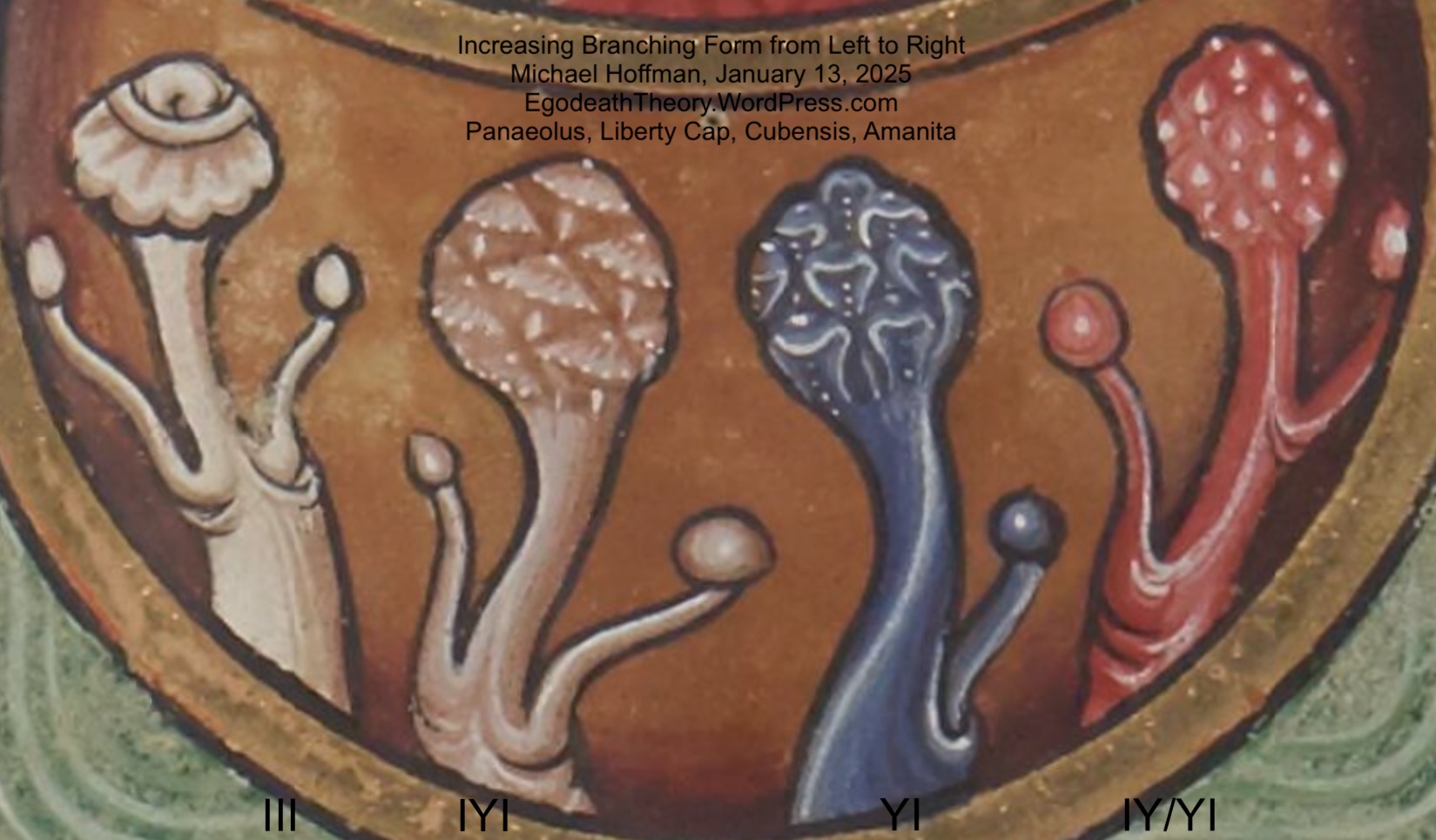
DAY 3 SHOWS A FOUR-TYPE CLASSIFICATION INTO PAN, LIB, CUB, AMA. MUSHROOM-TREES THROUGHOUT PSALTER RECOMBINE SUCH ELEMENTS IN VARIOUS WAYS.
Huggins feigns being too stupid to think of this OBVIOUS solution.
Brown was poor argument, pretending that these Day 3 mushrooms AS A WHOLE are repeated throughout Psalter — that’s wrong wording that Brown repeats 4 times (Brown & Brown, 2016 & 2019).
Huggins leaps on that, rebutting with: Day 3’s four mushrooms — red, blue, orange, tan — are NOT repeated throughout the Psalter, “THEREFORE,” NOT MUSHROOMS.
(Does Not Follow.)
Brown is grossly misrepresentative, but Huggins’ rebuttal’s conclusion is a non-sequitur.
Huggins continues:
“The bigger picture provided by the use of color and pattern in the rest of the earlier GCP illuminations indicates that the combination of pattern and color on crowns is not fixed and implies no specific reference to any particular species of plant or tree.”
The crowns in the Psalter mean variable combinations of features from the 4 classes depicted in Day 3: Panaeolus, Liberty Cap, Cubensis, Amanita.
Huggins continues:
“This is especially clear in cases where different mixes of color and pattern appear together on the crowns of single trees (Fig. 19).”
/ end of Huggins passage from Foraging Wrong
Day 3’s 4 plants mean respectively Panaeolus, Liberty Cap, Cubensis, Amanita — and features of these 4 plants are recombined throughout the Psalter, against Brown’s mischaracterization.
The fact that the features are freely recombined does not change the fact that Day 3 defines excellent, useful, sensible, experience-based, practical, NON-ARBITRARY classification that matches my own experience observing and photographing mushrooms.
See red (=Ama) liberty caps in cap w/ blue (= cubensis) stem:
Combining Features of Ama, Cub, & Lib (& Tree)
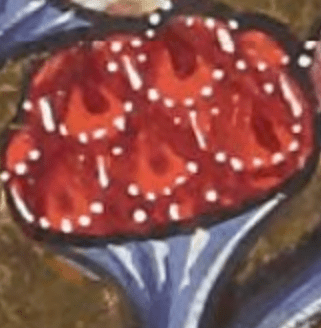
imagery: Ama, Lib, Cub
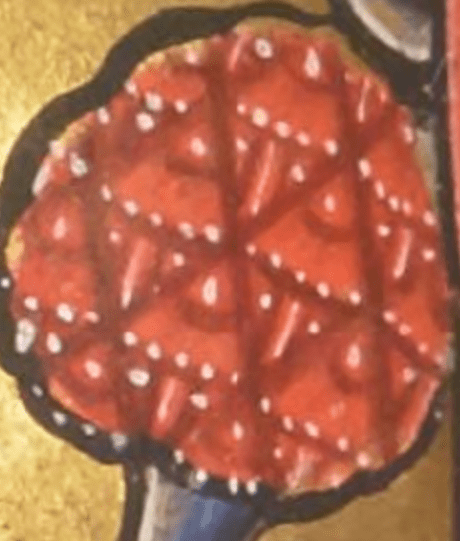

End of Huggins Page/Passage, Above
row 3 right: Eat from Tree of Knowledge
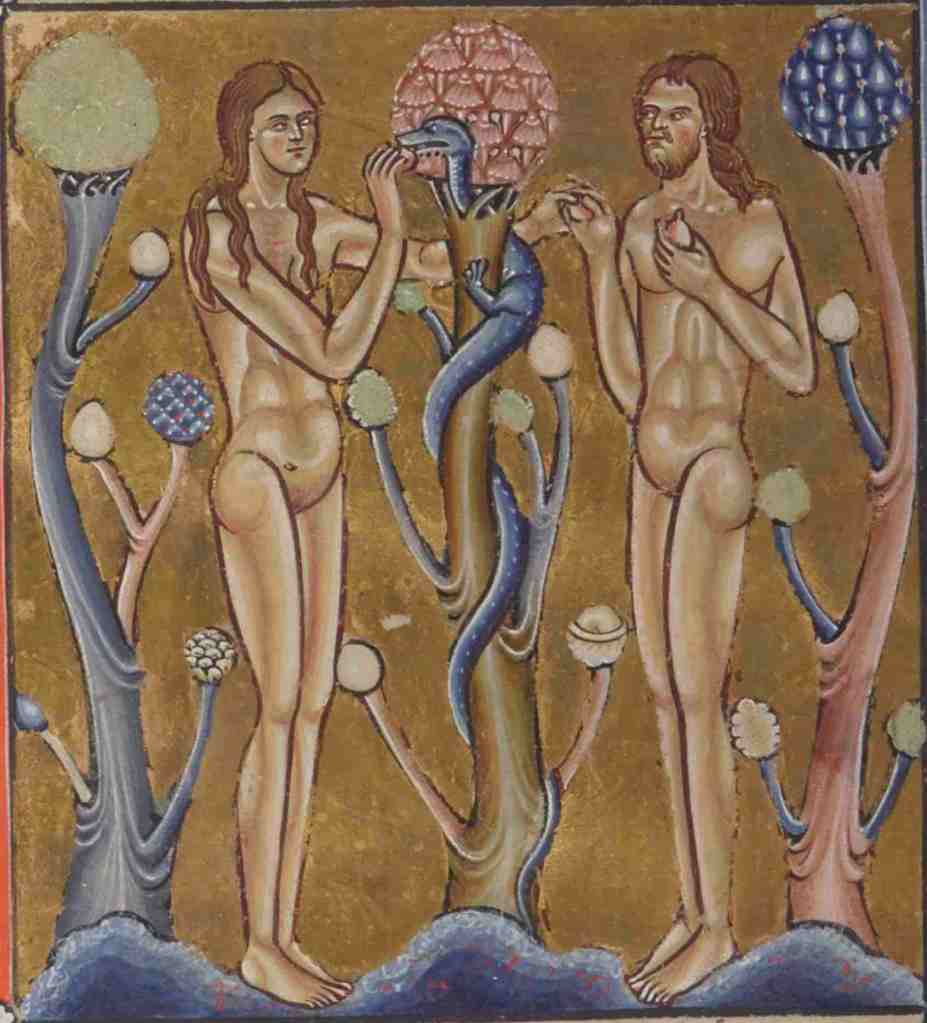
10:48 pm feb 17 2025: 3 branches touch Eve’s L side; 3 Adam’s L side.
Top branch touches not only Eve’s L elbow, also her R forearm.
Middle branch touches not only Eve’s L side, also her R elbow.
Foraging in Wrong Forest: 3. Schematized Trees – Full Egodeath Treatment
This page includes entire text of Section 3: 3. Schematized Trees below, deep engage mode. Full commentary, entire text of Section 3, with pictures.
Huggins’ 2 Forms of Branches Under Crown
re: Hug’s question about branching under crown (2 forms) & Concl para:
The present article is not focused on the “tangle of branches” form that Huggins asks about; clearly that can be gills + veil.
Huggins’ twofold question about branching forms holding up the crown of a mushroom-tree implies it’s harder to explain why Y or trident branches – a different type of branches-under-the-cap.
It was necessary to include a critique of Brown who falsely says Great Canterbury Psalter > Day 3’s four mushrooms — wholesale — are found throughout Great Canterbury Psalter.
I had to include that in this article, even though it’s a distinct topic, so that I could keep together the entire Section 3 from Huggins’ Foraging Wrong article.
I know about Huggins’ distinction between tangle of branches vs. Y or trident holding up cap of the Plaincourault fresco, b/c below — from a few days ago –is a great in-depth copy (very nice, highly valuable) of his entire section 3: Branches, from Huggins’ Foraging Wrong article.
Date of Concept “branching-message mushroom trees”: March 21, 2022 (branching is feature not whimsy)
March 21, 2022: emailed Brown & Cyberdisciple, replying to Brown sending me the 2019-formatted Marcia Kupfer quote. I used branching-message mushroom trees for first time.
My blue metal drawing in book of YO mushroom-tree: July 4, 2022.
Memorize Brown date: March 21, 2022, re: Marcia Kupfer re: Saint Martin’s Entry Jeru: tower, youth cut branches.
The day when I realized that the branching aspects of branching-message mushroom trees is a feature — even the payload & main message — not a bug/ whimsy that’s purposeless decoration.
- March 21, 2022: In email thread Subject line “Parasol Panaeolus Graves”, I wrote “branching-message mushroom trees” for first time, in an excellently suitable context.
- July 4 2022 – drew blue metallic in book, by Pollan or John Lash? — a YO tree indicating branching form.
- September 4, 2022 – Not sure if this is a false UI misleading date from Gmail UI. Might mean nothing.
I Have Huggins’ Foraging Wrong article under my belt, no longer frustrated, and Agree with His Exposes of Poor Reasoning by MICA Affirmers
I feel no longer frustrated and mad about Ronald Huggins’ 2024 article Huggins’ Foraging Wrong article.
The Egodeath theory answers Huggins’ Question: The Y or trident question from Ronald Huggins’ 2024 article “Foraging for Psychedelic Mushrooms in the Wrong Forest: The Great Canterbury Psalter as a Medieval Test Case”.
Plaincourault Fresco with Trident-O & 4 Limbs

feb 17 2025 occurred me today, not totally new: her weight is on both feet and is on R foot. Compare f11 Great Canterbury Psalter row 3 R, eve’s R ft is slightly lower than L but are together, in contrast -pointedly – to row 3 Middle “do not eat” which has weight on right foot / stand right foot – {right foot down}.
Great Canterbury Psalter f11 row 3 Mid & Right [2 forms / gallery]
f11 row 3 middle and right
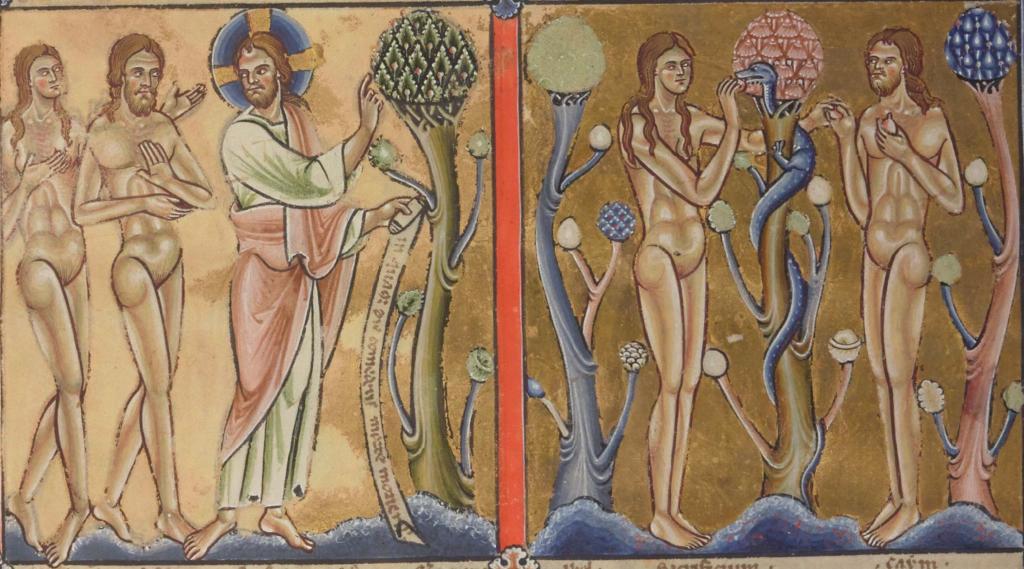
Branching Form Analysis (selected aspects)
[10:30 pm feb 17 2025] God’s tree has 4 arms/legs – classic pattern.
Next, on the right, Adam’s tree has 3 arms on L of tree, 1 on R.
Finally, Eve’s tree is similar, almost mirrored. Eve’s tree has 3 arms on R, 1 on L. On the R, the middle branch is Y, not I; more precisely, it is IY; ie, its R branch has grid cap which = branching = Y.
Below the action-packed grid cap of tree of knowledge, I’m not seeing noteworthy branching pattrens in the arms of the trunk – the side-mushrooms.
I could inventory its branching form, but I’m not seeing known standard patterns like 2 arms + 2 legs.
Biggest thing I see now, signif, about lower arms of tree of knowledge:
3 mushrooms touch Eve, 0 touch Adam.
That is a signal; we are being asked to interpret it or notice it, at least.
Tree of knowledge by artists always snubs Adam & favors Eve, so this imbalance/ bias is nothing new to me.
It is also manifestly signif that Eve has hands in the key positions L and R of the tree, Adam does not.
In depictions of tree of knowledge, Eve is the active figure; Adam merely accompanies Eve in the eating. EVE takes and EVE gives to Adam.
Theologian Thomsas Hatsis can explain to us the theology, that Eve – more than Adam, is source of original sin – a Q to look into.
Hatsis explains in PMR book, why, due to theology of Original Sin & Fall of Man, so, not mushroom. b/c theology.
Covered elsewhere recently:
- Branching form immediately under the 4 tree crowns.
- Inventory of which foot down, which hand lower.
That analysis likely ended up moved into this article. else see idea development 24, or 23, or articles w/ date less than the present URL.
Why Day 3 Plant 2 is particularly/ especially important in MICA debate
image: Day 3 plant 2: has L & R arm (sub image: 2 rows below: tree of knowledge ‘s cap w/ grid of Liberty Cap mushroom-trees wach each of which has L & R arm implying every grid cap has L & R arms.
image: Brinck book diagrams showing Y or trident supporting 1 or more mushroom-trees crowns [7:30 am Feb. 16, 2025] I am using the desirability of highlighting concept of “L vs R” to bridge branching-forms from YO trees or trident-O tress to other forms of mushroom-trees eg Great Canterbury Psalter day 3’s 4 trees.
List of images to paste here:
todo: make gallery containing copy of all images that are in this page
- the Plaincourault fresco
- Day 3 in Great Canterbury Psalter
- tree of knowledge in Great Canterbury Psalter
- diagrams from Erich Brinckmann’s 1906 book Tree Stylizations in Medieval Paintings
- tangle of branches: which Great Canterbury Psalter picture does Hug use in Ronald Huggins’ 2024 article “Foraging Wrong”?
image: the Plaincourault fresco (trident branching + 4 arms/legs mushrooms branches
Huggfest: Engaging Weird Arguments from Huggins Foraging Wrong
Huggins: “Multiple Variant Branching Forms Under a Given Type of Crown Proves Not Purposeful Mushroom Imagery”
Huggins: “Mushroom Veil Doesn’t Look Like Tree Branches Under Crown, Except Too Briefly for Such Crude Artists”
It takes several tries reading the entire page to see — same as Panofsky — what the context is, to figure out what Hug argues and does not argue.
Involves 10 different points for 5 different arguments, resolving which image he’s talking about or thinking of.
https://egodeaththeory.org/2022/03/13/the-75-mushroom-trees-of-the-canterbury-psalter/#27 —
Idiotic brittle argument.
No decent entheogen scholarship ever claimed that every mushroom-tree — at the level of the entire whole tree — matches an entire whole mushroom specimen.
Huggins is no good at defining the two relvant debate positions: the proper profitable sensible position for affirmers of mushroom imagery in Christian art assert that mushroom-trees have mushroom imagery features, piecemeal; flexible combinations of features: tree features + mushroom features.
Not stupidly dumbly crudely “the tree looks like a mushroom.”
This is my in my articles for publication, *I* do the defining of the two debate positions:
Deniers’ Logical Fallacies in the Pilzbaum (Mushroom Trees) Debate
Then Huggins is SILENT about the perfect mushroom in Day 4, w/o branch arms or grid cap. That tree, as an entire whole, looks like a mushroom, as an entire whole.
That is not the usual claim by properly articulate affirmers of mushroom imagery in Christian art.
Rainbow Amanitas with Gills & Veil = Branches
Huggins is focusing on two forms of branches under crown/cap: one form is YO form of mushroom-trees: no central stalk; cap held up by a Y split branch, like Dancing Man mushroom.

“Q-Crew gills veil branches.jpg” 241 KB 8:57 pm Jan. 31, 2025
Gills & veil = branches — rebutting Huggins’ rebuttal of Samorini’s “veil = branches” argument.
Huggins argues “only a professional expert modern scientific scientist is privvy to the detailed knowledge [quoteable, todo] of veil looking momentarily like branch. UNREAL, NOT REALITY BASED:
Hug knows nothing about the ACTUAL EXPERIENCE of looking at mushrooms – he is wrongly speculating / imagining/ arguing.
In practice, anyone who likes mushrooms sees groups of many kind of mushrooms in many states SIMULTANEOUSLY.
I am a photographer of hundreds of mushrooms/fungi. eg last halloween, 100 photos of 20 species in 1 hour.
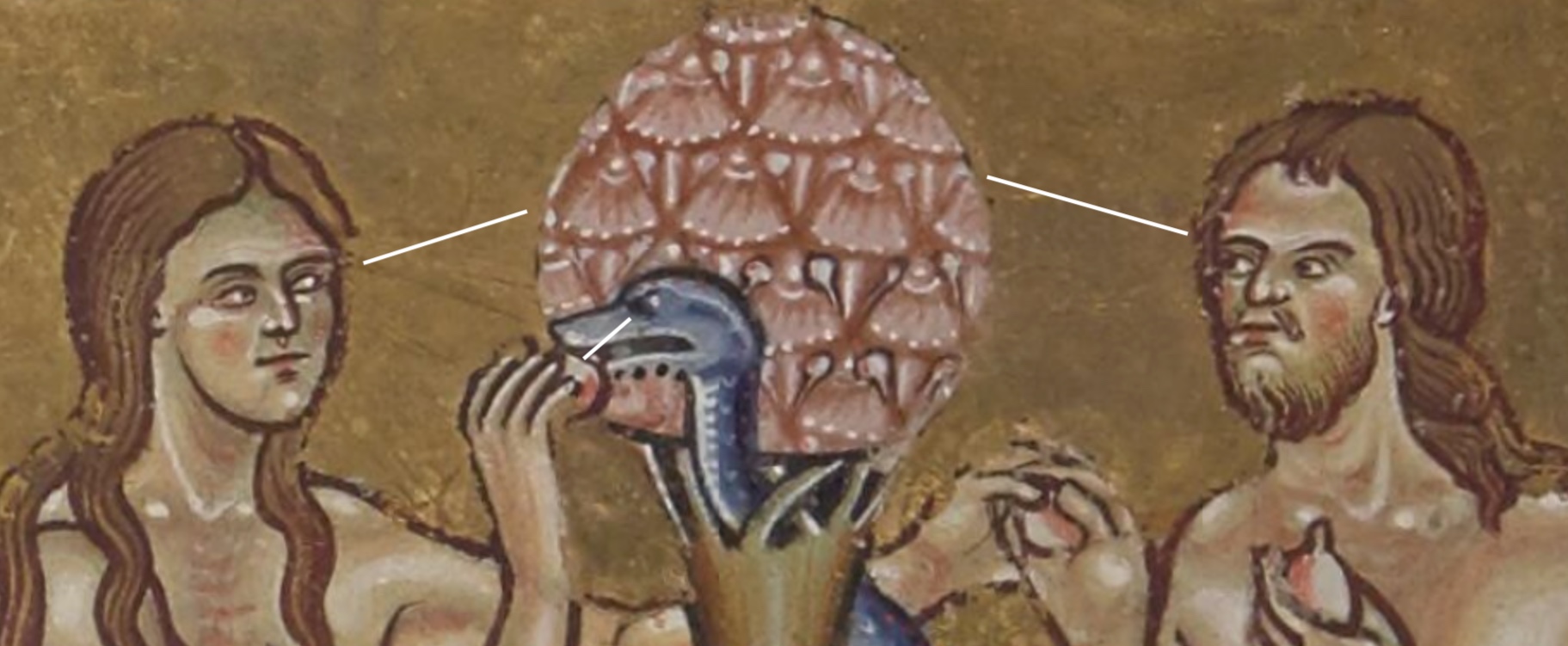
Adam & Eve Looking at L & R Arms of Liberty Cap mushroom-tree in cap of tree of knowledge, while holding fruit in L & R hands
v1:
v2:
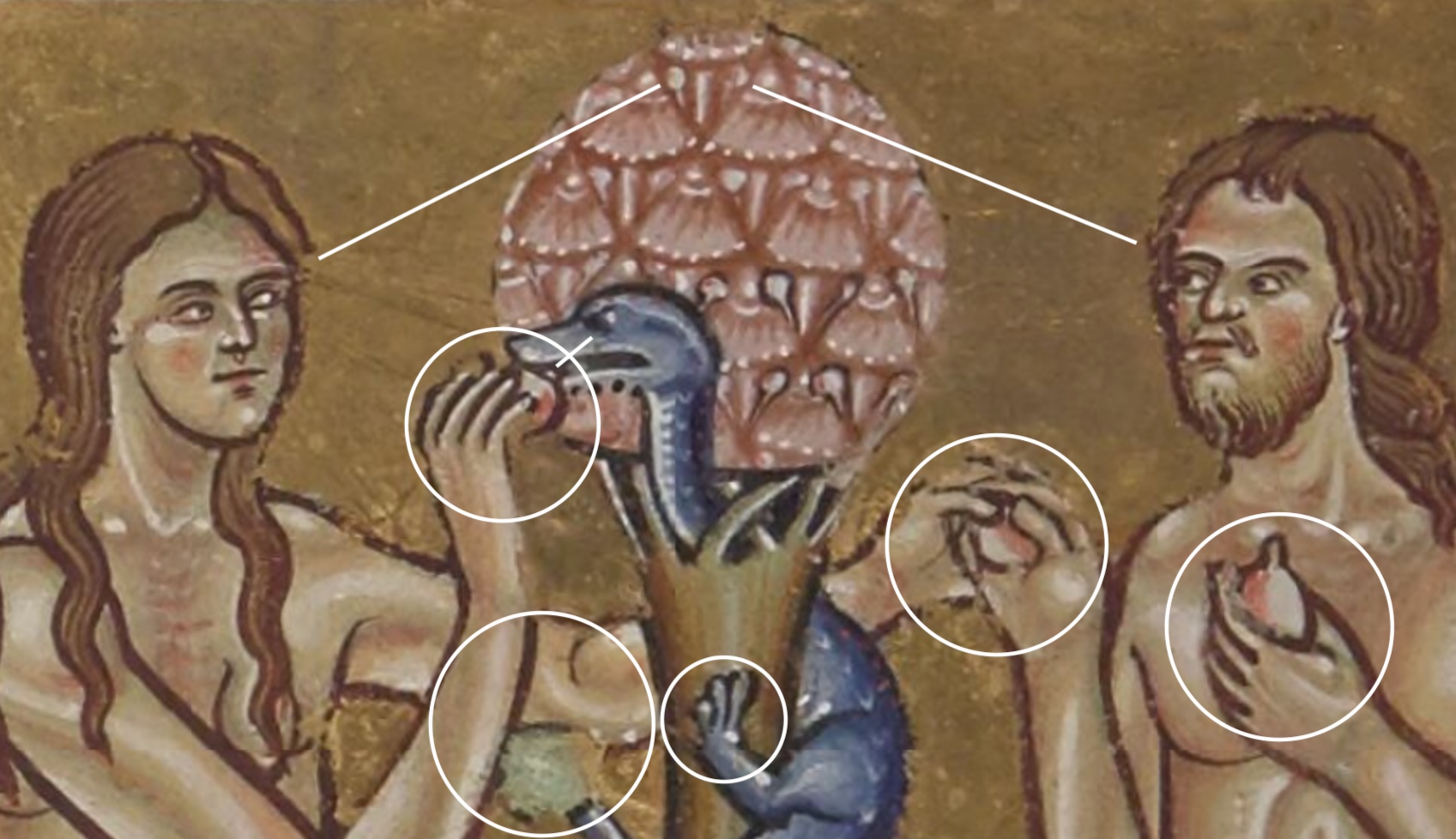
[5:19 pm Jan. 30, 2025] Compare the positions of Eve’s hands to the upper Liberty Cap within the tree of knowledge’s cap, the two arms and hands of the Lib Cap mini tree.
Thus, in all mushroom-trees in the Psalter, the “fruit” of knowledge = knowledge of left arm vs right arm.
Day 3 plant 2: prominent “Left and Right” indicators: Psil mushrooms gives knowledge of L vs R; branching vs. nonbranching:
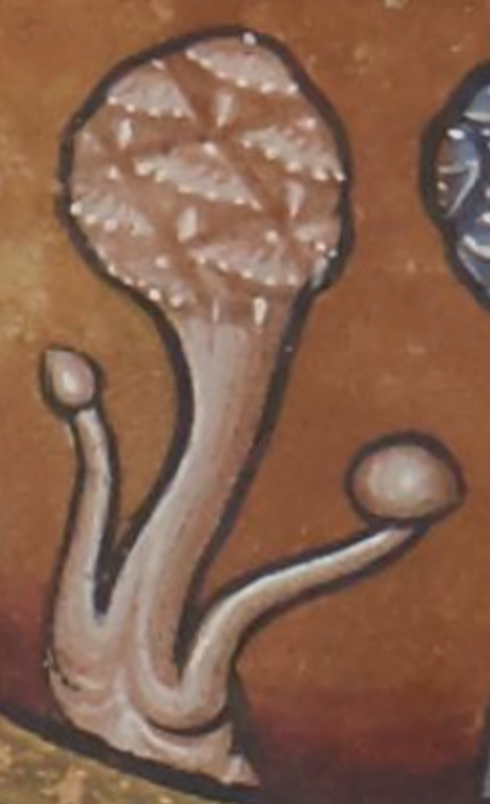
L & R fruit = L & R arm/hand = knowledge of branching vs. non-branching.
The fruit is not (just) entheogen; the ultimate fruit is knowledge of non-branching; ability to endure psychedelic eternalism and use egoic thinking — the egoic control system — in a transcendent way; per qualified possibilism-thinking.
Not ending with non-control, but with 2-level control.
Features:
- Eve holds fruit in both hands, L & R.
- Adam holds fruit in both hands, L & R.
- Serpent has L limb, not R limb.
- Serpent neck cut visually same as R branch under cap crossing behind L branch.
- they look at [L & R arms], or L vs R arms, on topmost Lib cap, while holding fruit of knowledge in L & R hands.
The fruit of the tree of the knowledge of L vs R
L vs. R
evil vs. good
branching vs. non-branching
unstable vs. stable control
The R branches tend to fade out on most Lib Cap mushroom-trees within the cap of tree of knowledge.
Branching is disappearing in the altered state.
Like Marty McFly.
In 1955, Marty in photograph was vanishing, fading out – like these R branches within the upper part of the cap of tree of knowledge.
I started the Egodeath theory devmt Oct 26, 1985, Back to the Future Day.

Dancing Man’s Mushroom-tree: YX Branching Form Under Cap
[11:19 pm Jan. 29, 2025]
Y then X: moving from bottom up:
YI, Y, X, cap
YI: cut right trunk
Y: stem branches into V
X: cut right branch via right cross-behind
cap – grid of spots, but considered non-branching.
right paw touches non-branching cap, cut right branch points to right paw
the bestiary salamander image with X-branching (X branching) mushroom tree has
cut right branch via cross-behind – same as 3 trees in Great Canterbury Psalter > tree of knowledge f11 3 all 3 trees
The Sacred Joke Mushroom: One example alone should suffice to silence the art historians: dancing man mushroom has a red cap with white spots 🤫🍄🙌😍
One example alone should suffice to silence the art historians: a typical mushroom-tree is shown beside the dancing man. The mushroom has a red cap spotted white, and similar mushrooms branch from its stipe-like trunk.
Ruck, condensed, 2009, Fungus Redivivus, in The Sacred Mushroom and the Cross
Huggin’s Conclusion Section Paragraph “Criteria for Deciding Whether a Tree or a Mushroom: … Always Tree, Never Mushroom”
I’m focusing on just this one paragraph in the Conclusion section of Foraging in Wrong Forest.
Key Paragraph of Conclusion Section of Huggins’ Foraging Wrong Article Articulates Arbitrary, Biased Criteria
A concerted effort to commit every logical fallacy at once, and invent some new ones as well
“On the critical side, Panofsky provided a starting point for articulating the following criteria for determining whether medieval artists had in mind depicting trees or mushrooms:
(1) If it has branches, or multiple crowns, or a crown supported by multiple branches, it is a tree not a mushroom,

A tree, not a mushroom, because it has branches.

Here’s a branch of the plant, proving that the plant is not a mushroom.
(2) If it has indications of layers of foliage in the crown it is a tree not a mushroom, and
(3) If it has fruit it is a tree not a mushroom, since mushrooms, being cryptogams, have neither fruit nor seeds.
Has fruit, therefore this mushroom-tree with grid of 2-branch Liberty Cap mushroom-trees in the crown doesn’t look like mushrooms.
“These three criteria rule out all the PMTs alleged examples of trees representing psychedelic mushrooms in medieval art that this author has encountered in his extensive survey of their materials.”
/ end of key para
PHONY, PRETENTIOUS POSTURING – TYPICAL OF THE WASSON CAMP.
They have nothing but stance, posturing, bluffing, play-acting, con artistry, a put-on – no substantive argumentation, but they cover by aggressive insults, being a jerk about it.
eg the argument from telling mycologist “You are blundering due to your ignorance.” MICA Deniers are Wassholes in their arg’n style: aggressive, insulting, baseless, foolish yet pompous, eager to call people ignorant, directly.
That’s not argument from “ignorance of the opponent”, but ARGUMENT BY INSULTING THE OTHERS AS IGNORAMUSES.
Which doesn’t even work, because as soon as you “inform” the others, your argument becomes worthless.
Ramsbottom got the better of Wasson, publishing Wasson’s committed skepticism.
Insulting, pretentious bullsht; in this Conclusion paragraph, Huggins puts forth nothing but a sheer assertion, pretending to be 3 distinct, sophisticated “criteria”, to cover that this is merely arg from authority + false dilemma + false certainty + foisting arbitrary “articulated criteria” as if there’s any valid argumentation.
The only thing valid in this manner of argumentation is that Erwin Panofsky Huggins is correct, that entheogen scholars need to explain the meaning of the tree features in terms of mushrooms.
What do mushrooms have to do with trees that emphasize branching (and non-branching) features? That’s the most-key question, which Huggins contributes, but his “Conclusion” section – that “articulate criteria” paragraph and its pompous as fck “
Please name a single mushroom-tree that fails any of these 3 “if” “criteria”. This is idiocy, pretending to not know that the entire class of images under discussion, by definition, has such tree features. This is an over-verbose, game-playing, pretentious, declaration, pretending to be an argument with complexity.
He’s simply ASSERTING that all mushroom-trees mean tree, not mushroom, and dressing it up with a dash of arg from authority, a splash of false dilemma, and a bit of every other fallacy all at once.
These so-called “criteria” and “if” constructions is nothing but fake complexity, trying to hide that it’s really just a sheer assertion.
This 3-part “Conclusion” paragraph is a bluff; Huggins’ has got nothing but sheer assertion that the entire class has purposeless mushroom features.
These 3 “criteria” are duplicates, redundant with each other, and worse: redundant with the entire class of images under discussion. They all reduce to: “If a mushroom-tree has any tree features”, which is a nonsensical, superfluous “if”, forming a tautology that’s true for the entire category by definition, with no point to repeat here the word “if”.
Conclusion of Foraging in Wrong Forest: Arb. Arg. –
Hug uses Erwin Panofsky as Hug’s own voice; Hug makes Erwin Panofsky say “branch therefore not The Mushroom”
arg from “Panofsky’s two letters would give these rules that rule out mushrooms”
Hug merely mentions Brincm book, as the one and only writing ever on trees, “noted” – ie censored – citation of Brinc
the lone exception to historians’ total ignorance ever ignoring merely peripheral trees
Panofsky’s censored letters & Erich Brinckmann’s 1906 book Tree Stylizations in Medieval Paintings are mentioned in:
9:20 pm feb 17 2025: this page content needs organization. It is really good, complete, excellent content.
I moved all of the relevant sections about this topic, into the present page from idea development page 24.
https://egodeaththeory.org/2025/01/29/idea-development-24/
Huggins’ Conclusion through Mouthpiece Panofsky: In a Mushroom-Tree, the Tree Features Rule Out the Mushroom Features Meaning Mushroom
The term ‘pilzbaum’, mushroom-trees, was coined and used by art historians, though they never used the term, insofar as they never talked or wrote about trees or mushroom-trees.
The term pilzbaum occurs 5 times in Erich Brinckmann’s 1906 book Tree Stylizations in Medieval Paintings, per full-text search.
1906 is before the concept of psychoactive mushrooms was widespread in the modern era; I doubt Brinckmann has that concept.
Per Huggins:
If a mushroom-tree has mushroom features and tree features, the tree features rule out meaning mushroom.
Per Cybermonk:
If a mushroom-tree has mushroom features and tree features, the mushroom features rule out meaning tree.
ie it is arbitrary to the extreme, to say that if a thing has two kinds of features, we are to ignore one kind of feature, and equate the thing with the other kind of feature.
There are at least three problems or logical fallacies in Huggins’ Conclusion section’s paragraph about “articulating criteria”:
- False dilemma. He says the two options for intent are tree or mushroom. That’s false; the intent is the branching model of possibility and control, revealed by Psilocybin – tree and mushroom are both wrong, limited, literalist, not the artists’ message.
- If we accept the choices, mushroom is closer to the real intent than tree.
- The “if” and “criteria” are NONSENSICAL. He says “if” the mushroom-trees have branches or have any tree features at all — but as a class, by definition, mushroom-trees are anything that has both tree features and mushroom features, so the “if” criteria are a hollow ploy, a put-on; pointless, sheerly superfluous nonsense, fake pseudo-criteria.
- Argument from authority: Mentioning Erwin Panofsky, in an empty way: Erwin Panofsky can be used as start of a sheer baseless assertion.
https://egodeaththeory.org/2025/01/07/panofskys-letters-to-wasson-transcribed/#Sentence-2-6 – “But even that is not very probable because even the most mushroom-like specimens show some traces of ramification; if the artists had labored under the delusion that the model before him was meant to be a mushroom rather than a schematized tree he would have omitted the branches altogether.” False dichotomy from Panofsky, carried forward by Huggins.
Huggins’ Brain-Dead “Conclusion” Section Is Not an Argument, but Sheer Assertion of Arbitrary, Biased “Criteria” with No Justification
All Mushroom-Trees Mean Tree, not Mushroom (Because Panofsky).
All Mushroom-Trees Mean Mushroom, not Tree (Because Cybermonk).
Hug’s Conclusion is nothing but a baseless arbitrary tautology or sheer assertion:
“Mushroom-trees have tree features and mushroom features, and they mean tree, not mushroom.”
Tree Stylizations – Brinckmann
Schematized Trees – Huggins
mushroom-tree branching form – Hoffman
“Panofsky provided a starting point for articulating the following criteria for determining whether medieval artists had in mind depicting trees or mushrooms” [his “critiria” = assertion that:
“All mushroom-trees always mean tree, not mushroom, because they have tree features.”
I could equally proclaim:
“All mushroom-trees always mean mushroom, not tree, because they have mushroom features.”
The mushroom features RULE OUT tree.
WARNING, RETARDED USE OF “IF”, FOR A CLASS FOR WHICH BY DEF’N IT’S TRUE:
Panofsky provides a starting point to articulate these criteria:
“If” a mushroom-tree has mushroom features and tree features, the tree features rule out meaning mushroom.
Cybermonk provides a starting point to articulate these criteria:
“If” a mushroom-tree has mushroom features and tree features, the mushroom features rule out meaning tree.
Huggins’ “Criteria for Deciding” Is a Tautology & Fake Put-On: “If” a Mushroom-Tree Has any Tree Features? The “If” Is Nonsensical, Because by Definition, All Mushroom-Trees Have Tree Features
It’s bad how Huggins cripples his conversation, the conversation — just like Erwin Panofsky! – by trying to strategically avoid writing “mushroom-tree”.
- mushroom-tree – 1 hit in Foraging in Wrong Forest – as always, not used by Hug, but citing Giorgio Samorini.
- mushroom tree – 6 hits, all of them a typo and mis-citation by Huggins of Giorgio Samorini, who writes “mushroom-tree” with hyphen.
- pilzbaum – 0 hits!
Why this foul strategy that stinks, from Hug? B/c were he to use the term mushroom-tree, he ADMIT that by def, they are images that combine tree features & mushroom features, which is true, and essential, and he cannot win that true and fair argument.
To fakely appear to win, Hug is forced to pretend art historians don’t call them (the one time they ever wrote about them) “mushroom-trees”.
The moment Hug admits this class has tree features and mushroom features, he loses his false binary and fraudulent deceptive textual wording, “the trees have “BRANCHES” so they are tree — ALL OF THEM ALWAYS — not mushroom – – never mind that what he DECEPTIVELY writes as “branch” looks like mushroom in many cases.
By definition, all mushroom-trees combine tree features/imagery & mushroom features/imagery.
We cannot bury head in sand pretending like they don’t have mushroom features and only have tree features, as Hug does in his bunk & biased & arb Conclusion paragraph where uses Erwin Panofsky as mouthpiece for BAD ARG’N that can’t hold up for a moment – is this even argumentation, or just sheer ASSERTION lyingly dressed up as if arg’n/ “criteria for deciding”?
“I start w/ Pan to articulate criteria for deciding” – bullsh!t!
Huggins merely articulates a single, shallow, literalist, incorrect, uncomprehending, reductionist, biased, prejudiced, ignorant ASSERTION – posturing as if it is “three criteria for deciding”.
Huggins’ Panofsky-abusing Conclusion paragraph is not argumentation; it is sheer assertion, with a dash of arg from auth, and a lot of false dilemma, pretending to be argumentation.
Hug is not presenting criteria for deciding “whether it is a tree or it is a mushroom) (brain-dead false dichotomy), he is simply DECLARING that every instance of mushroom-trees is always simply tree, never at all mushroom.
This is not “criteria for deciding”!
Just b/c 1st-generation entheogen scholarship (the Secret Amanita paradigm) is brain-dead and easily rebutted by a single instance by Letcher, does not mean 2nd-generation entheogen scholarship (the Explicit Psilocybin paradigm) can be so insulted by dismissing them along w/ 1st Gen.
I hate and reject 1st Gen, a fixation blocking progress.
The only way to get to 2nd Gen is by adding the Egodeath theory; psychedelic eternalism, which explains how the branching is a bigger purpose & message than mushroom – for experience that is ONLY sufficiently induced by psychedelics, not by falsely alleged confabulation, “traditional methods of the mystics”.
“The traditional methods of the mystics” are – if not psychedelics based – far too weak to produce mental worldmodel transformation from the Possibilism to the Eternalism mental model of time, self, possibility, and control.
By definition, all mushroom-trees have tree features (along w/ mushroom features), so Huggins’ Conclusion paragraph is merely a sheer assertion that all (when we simply merge his 3 criteria into “tree features”) mushroom-trees mean simply literal tree, instead of simply a literal mushroom (Ruck-type physical form, the physical body of the mushroom & its lifecycle shapes).
Hug presents 3 phony “if” pseudo-criteria, for bluffing decoration and empty postureing, to hide that this is a sheer unadulterated bias and blanket pronouncement.
ON WHAT BASIS – OTHER THAN WRITING ‘PANOFSKY’ — DOES HUGGINS CLAIM THAT THE COMBINATION OF TREE AND MUSHROOM FEATURES MEANS TREE NOT MUSHROOM?
What’s the justification for that bias — the name “Erwin Panofsky”? “Because Erwin Panofsky says so?” That’s arg from authority.
Art hist. call them mushroomtrees; pilzbaum in German.
If a mushroomtree has any tree features, Huggins says that Erwin Panofsky says it’s a tree, not a mushroom. Huggins “articulates these criteria”; ie, states a biased, prejudiced, lopsided, arbitrary, non-sequitur.
The tree features of a mushroomtree cancel out the mushroom features. According to these criteria pulled out of thin air like Panofsky’s letters & Brinc cit. Erich Brinckmann’s 1906 book Tree Stylizations in Medieval Paintings.
I say:
The mushroom features of a mushroomtree cancel out the tree features; rules out tree. On what basis do I argue that?
On what basis does Panofsky-Huggins argue the opposite?
Huggins “articulates criteria” – are we supposed to take that to be an argument?
I articulate criteria: Any mushroom-tree that has mushroom features and tree features [a stupid pseudo-qualification since they all have both by definition], the …
Huggins’ Uses Panofsky to Conclude: “Branches; So, Not Mushroom”
Branches rules out mushrooms. Panofsky says so, in my Conclusion section.
Here is the Egodeath treatment of Huggins’ Conclusion section, the key paragraph.
SETP STEP ASIDE WHILE HUG THROWS FORTH HIS CRITERIA = STYLIZED MUSHROOM;
IF MUSHROOM STYLIZED LIKE TREE FEATURES, NOT MUSHROOM – TREE, ONLY ,
ART CAN ONLY DRAW TREE FEATURES OR DRAW MUSHROOM FEATURES: WHICH ONE IS IT?
HAS MUSHROOM FEATURES AND THEREFORE ITS A MUSHROOM NOT A TREE.
If a Mushroom-tree has mushroom features, that proves it is a mushroom – Cybermonk (and there’s hundreds of instances, so I’m right)
If a Mushroom-tree has tree features, that proves it is a tree – Panofsky Huggins
Huggins Articulates Criteria – aka, makes a blanket assertion about all mushroom-trees. It’s not even a logical fallacy, except the “assertion as if arg’n” fallacy, aka assuming that which is to be proved (in a simple form).
A mushroom-tree has tree features and mushroom features, therefore, it’s a tree, not a mushroom
[Mar. 1, 2025]
– the brilliance of Huggins’ “arg’n”. Arb’y, biased, prejudiced, lacking any justif to lean to tree instead of lean to mushroom. Huggins, why not instead “conclude” the 3 crit – which are in fact only a single crit –
Those criteria reduce to: a mushroom-tree has tree features and mushroom features, therefore, it is a tree, not a mushroom.
A mushroom-tree has tree features and mushroom features, therefore, it’s a mushroom, not a tree
[Mar. 1, 2025]
That garbage argn or rahter, sheer assertion is Huggins’ conclusion, dressed up as if it is multiple “criteria to decide”.
“Conclusion: By abusing Panofsky’s censored letter 2 pulled out of thin air, we can articulate criteria to decide if it is a tree or a mushroom.” — CRUDE ANALYSIS!!
Along the way, we need something LIKE the class’n systems that are attempted by Samorini & Huggins, but, … something LIKE branching form analysis of mushroom-trees, but must include:
- must include vine-leaf trees.
- must consider individual features and sub-scope of entire whole tree.
- must realize mushroom-trees are a creative free-form combination of FEATURES:
- tree features,
- Amanita features,
- Liberty Cap features,
- cubensis features,
- Panaeolus features;
- eg spots;
- triangle cap,
- cut branch;
- branches,
- visual cross-behind cut branch;
- {cut right trunk};
- {cut right branch},
- lower level of tree vs branching form of upper level of tree
- lower level of tree vs branching form of upper level of tree: Mr. Salamander teaches that: and my July 4 2022 blue metal ink diagram in book shows that: trunk = non-branching; mushroom arms = branching; YX supporting crown is branching; crown (despite multiple donut spots) is considered here as non-branching.
lesson: cannot generalize “crown is always a branching zone | is always a non-branching zone” – IT DEPENDS, BASED ON THE INDIVIUAL CROWN!
Cannot say “Left side of tree always = branching = bad”.
Cannot say “The crown of a mushroom-tree is always considered a branching zone”.
Cannot say “The crown of a mushroom-tree is always considered a non-branching zone”.
Proof: Great Canterbury Psalter f11 row 1 R = Day 3 = 4 plants: III, IYI, YI, IY/YI; plant 1 has non grid cap = non-branching, but Plant 2 has grid cap of Liberty Caps, so ITS crown is considered branching.
That principle is reinforced & double-communicated/ doubly indicated, reinforced, by Day 4: its two L mushroom-trees have grid of Liberty Caps, and point to the A compass, which is like Y branching, so THOSE crowns are considered branching.
In Day 4, the two R mushroom-trees have non-grid cap, and point to balance scale = balance is achieved by repudiating branching, ie balance = non-branching, corresponding with the non-grid crowns of the two R mushroom-trees.
Day 4 isn’t mushroom-trees; and Huggins passes over this point in silence, magically deceiveing the reader by drawing attn instead to sudden change of topic: the small plants around the 4 mushrooms are like in the later folio Mushroom Mount where 5 proper mushroom-trees (w/ branches) have small plants between them.
[Mar. 1, 2025]
In Plant 2’s crown, each Liberty Cap mushroom-tree within its crown grid is implied by the tree of knowledge 2 rows below it to each have L & R arms/branches.
The rule always holds, except for the 50% of the time when the rule is broken.
vine-leaf trees
vlt
branching-message vine-leaf trees
bmvlt
Keyboard shortcuts for Samorini & Huggins Names
[Mar. 1, 2025]
Giorgio Samorini
gs
Ronald Huggins
rh
Huggins
hugs
Samorini
samo
2nd-Generation Entheogen Scholarship
Branches of mushroom-trees was a problem, answered by the Egodeath Theory & 2nd-generation entheogen scholarship
I am running with the claim, granted to me in Brown 2019, I’m part of a new generation of entheogen scholars: I make & define 2nd-generation entheogen scholarship as:
- the Explicit Psilocybin paradigm, rejecting the Secret Amanita paradigm.
- Inherently incorporates and integrates the Egodeath theory.
2nd-Gen Entheogen Scholarship Integrates Psychedelic Eternalism, not 1st Gen Shallow Game of “Spot the Secret Mushroom”
Check if Brown 2016 book discusses 1st & 2nd generations of entheogen scholarship.
Branches of mushroom-trees was a problem unanswered by 1st-generation entheogen scholarship (the Secret Amanita paradigm); answered by the Egodeath theory in 2nd-generation entheogen scholarship (the Explicit Psilocybin paradigm)
I will gladly take on the alleged problem that mushroom-trees have branches, in fact I’d say that the mushroom-trees have EMPHASIZED branches – but also emphatic cut branches, including the major motif {cut right trunk}.
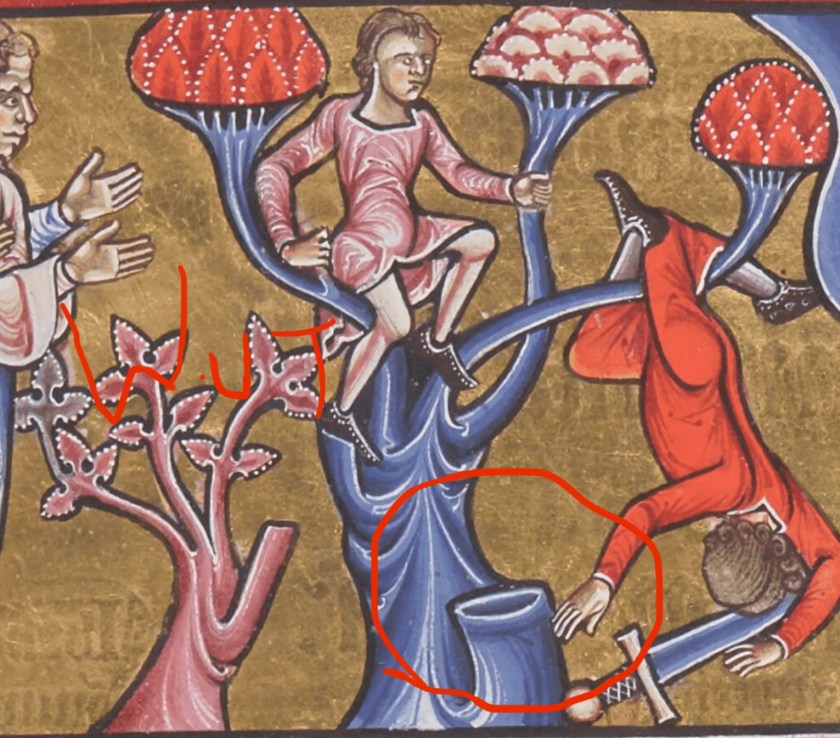
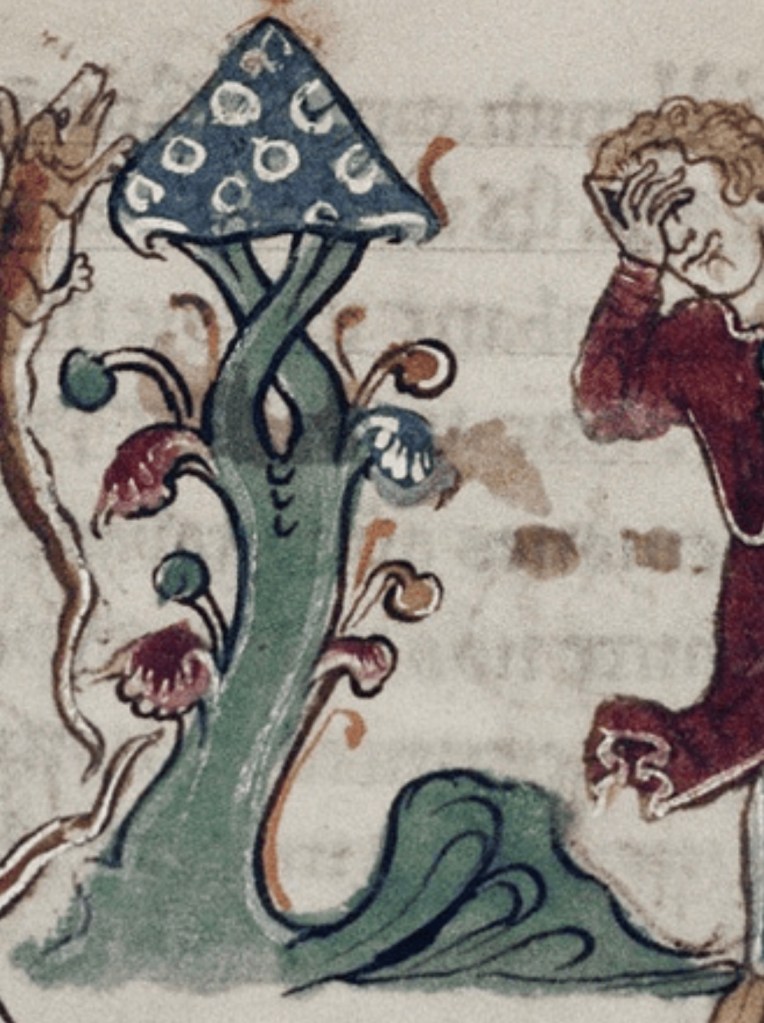
Crop by Michael Hoffman. April 13, 2022 (day of discovery of Cut Right Trunk)
MICA Deniers Conflate Entire Field of Entheogen Scholarship with merely 1st-Generation Entheogen Scholars (the Secret Amanita paradigm)
Better than Brown, Huggins – who has aptitude, unlike Letcher & Hatsis – Huggins asks better questions than Letcher or Hatsis. In fact, Huggins is great because he asks questions.
Letcher doesn’t ask questions; he just demolishes the crappy 1st-generation entheogen scholarship (the Secret Amanita paradigm) and then falsely acts as if he disproved mushroom imagery in Christian art.
Hatsis doesn’t ask questions, he just insults Irvin and projects his Allegro-fanboi gullibility on the entire field (reducing the field), and especially does so b/c Irvin literally carries forward the Hatsis childhood belief in Allegro – so Hatsis assumes that:
- Given that Hatsis began as Allegro fanboi, and
- Given that Irvin 2008 still is Allegro fanboi,
- therefore, Brown & Cybermonk and entire field of entheogen scholarship must be Allegro fanboi –
A partial truth, like Letcher equated entire field with the the Secret Amanita paradigm. Yes, true, 1st-generation entheogen scholarship indeed WAS bunk; the Secret Amanita paradigm.
The error of Letcher & Hatsis, and somewhat of Huggins, is that they conflate entheogen scholarship with specifically merely 1st-generation entheogen scholarship (the Secret Amanita paradigm).
See Also
https://egodeaththeory.org/2025/02/16/egodeath-theory-as-compatibilism-instead-of-no-free-will/
copy from idea development pages eg 23/24, or link to there
3-Phase Model Beats 2-Phase Model

 The Egodeath theory