Michael Hoffman, 6:45 am, Apr. 12, 2025
Contents:
- Mytheme Decoded: {burning bush} = Non-Branching Eternalism
- Burning Bush (Van der Borch) – Finger Shapes, Burning Away Branching Possibilities – Proves Bush = Tree
- Burning Bush, and Tablets (Ingeborg Psalter)
- Burning Bush
- Intro, Relevance to Egodeath Theory
- My Comment 1 on a Curt & Emily Video
- My Comment 2 on a Curt & Emily Video
- My Comment 3 on a Curt & Emily Video
- Motivation for this Page
- Info about Curt Jaimungal
- Info about Emily Adlam
- “Theories of Everything” Videos Playlist by Curt Jaimungal
- Video: The “All At Once” Universe Shatters Our View of Time (Emily Adlam)
- Key Words to Find in the Transcript
- My Commentary Notation
- Transcript
- Introduction
- Observers in Quantum Mechanics
- The Measurement Problem
- Carlo Rovelli: Physics Without Time
- A Dogma in Quantum Foundations: That We Should Think in Terms of Time Evolution
- Causation and Its Philosophical Implications
- The Arrow of Time and Its Mysteries
- Exploring Coarse Graining and Reductionism
- Non-Locality: Temporal vs. Spatial
- The Nature of Non-Locality
- Temporal Non-Locality and Its Implications
- Retrocausality: The All-at-Once Perspective
- Definition of ‘All-at-Once’
- The Measurement Problem and All-at-Once Framework
- “Cubism” Is Mistranscription of: QBism (Quantum Bayesianism)
- Observer-Centric Interpretations of Quantum Mechanics
- The Economist [promotional]
- The Word “Now, ” Is on the Egodeath Block List; the Instructor’s Equivalent of the “So, ” Virus (Verbal Tic)
- “Look, ” Is a Junk Filler Word
- How Do You Think about Probabilities?
- Probabilities in Physics
- Frequentism: Anything “CAN” Cause Psilocybin Effects, but How Frequently DOES it? 0%, not 50% as Falsely Implied
- The Process Matrix and Causal Structures
- Modal: Facts about What Is Possible and Impossible
- Two-Way Inspiration between Physics & Philosophy
- Foundations of Physics and Philosophy
- Taxonomy for Physics Beyond Quantum Mechanics (Adlam, Hance, Hossenfelder, Palmer; June 2024)
- Free Will
- Calvinism
- Two Dr. Evils (Like the Good M. Hoffman vs. the Evil M. Hoffman in the Field of Entheogen Scholarship)
- Possible Worlds
- Sean Carroll
- “Temporal Locality” (vs. Usual, Spatial Locality)
- Presentism vs. Eternalism
- Curl Jaimungal’s Substack [promotional]
- QBism (“Cubism”) vs. Manyworlds
- The Emergence of Space-Time
- Strong Determinism
- Exploring Correlations in Physical Parameters
- Advice for Young Upcoming Researchers in the Field of Physics and Philosophy
- What’s some topic that’s underappreciated?
- Epistemology of the Measurement Problem
- Lessons in Patience and Persistence
- Thank You
- Curt Jaimungal Resources
- Transcripts at Substack
- TOE Podcast
- God’s Playing of Dice Is Frozen into the 4D Spacetime Block Universe
- The Wonders & Terrors of 4D-Spacetime Block-Universe Mysticism
- The Wonders & Terrors of Block-Universe Mysticism
- The Wonders & Terrors of 4D Spacetime Mysticism
- Maddening Frustrations and Insanely Unreasonable Demands for Titling a Theory Introduction Article
- The Wonders & Terrors of Quantum Mysticism & Experiencing Determinism
- Harvard Scientist: “There is No Quantum Multiverse” | Jacob Barandes [Part 3]
- Probabilities in Statistical Mechanics
- Problems with Many Worlds Interpretation
- Challenges of Probability in Many Worlds
- Tim Freke’s Emergent Evolutionary Spirituality, Frozen in Rock
- Who Are the Agents?
- The Case for a New Interpretation [Possibilism Randomness Freewill Agency Power? Random Distribution Frozen in Rock?]
- Smooth Speech
- Stag with Branching Antlers Caught Helplessly in Vines
- Lucas Cranach “Eve Tempted by the Serpent” Adam and Eve 1533 “Adam und Eva”
- Sacrifice of Isaac (Golden Psalter)
- Isaac (Canterbury Psalter)
- Sacrifice of Isaac (Van der Borch) – branches burning
- No One at the Bridge (Rush, 1975)
- S.A.T.O. (e.g. Sailing the Acid Trip Ocean) (Ozzy Osbourne, 1981)
- See Also
Mytheme Decoded: {burning bush} = Non-Branching Eternalism
2:14 pm April 12, 2025: I have reached confidence in interpreting Moses’ burning bush.
Definite decoding of the {burning bush} mytheme; I’ve posted this hypothesis before.
This how now reached the status of a confirmed hypothesis.
The {burning bush} is not an entheogen; it is an experiential revelation resulting from entheogens. Equivalent to {cut right trunk}, {cut right branch}, {cut branch}.
To “cut branch” = to deny possibilism (possibility-branching) & affirm eternalism (a single, closed future), which includes:
- Affirm 2-level, dependent control.
- See God, as uncontrollable source of control-thoughts.
I gained threshold-crossing confidence about decoding “burning bush” while listening to Jacob Barandes talk about branches in the video interview:
Harvard Scientist: “There is No Quantum Multiverse” | Jacob Barandes [Part 3]
I moved that video partial transcription, re: “branch”, to below.
Burning Bush (Van der Borch) – Finger Shapes, Burning Away Branching Possibilities – Proves Bush = Tree

image processing, and interpretation by Cybermonk [11:04 p.m. February 9, 2023]
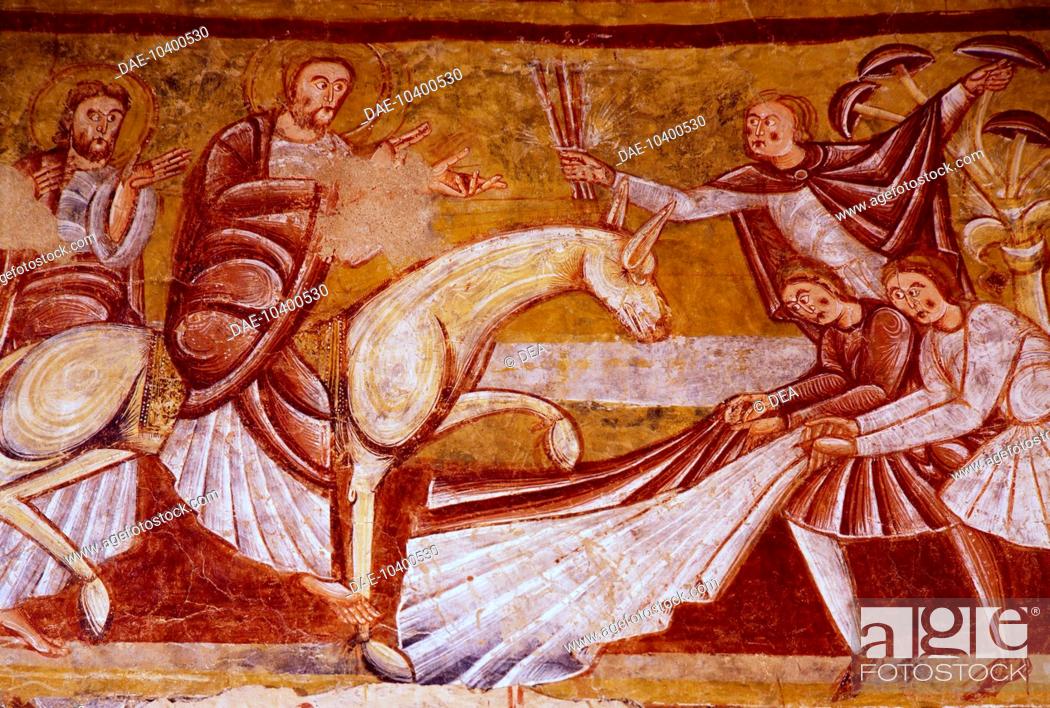
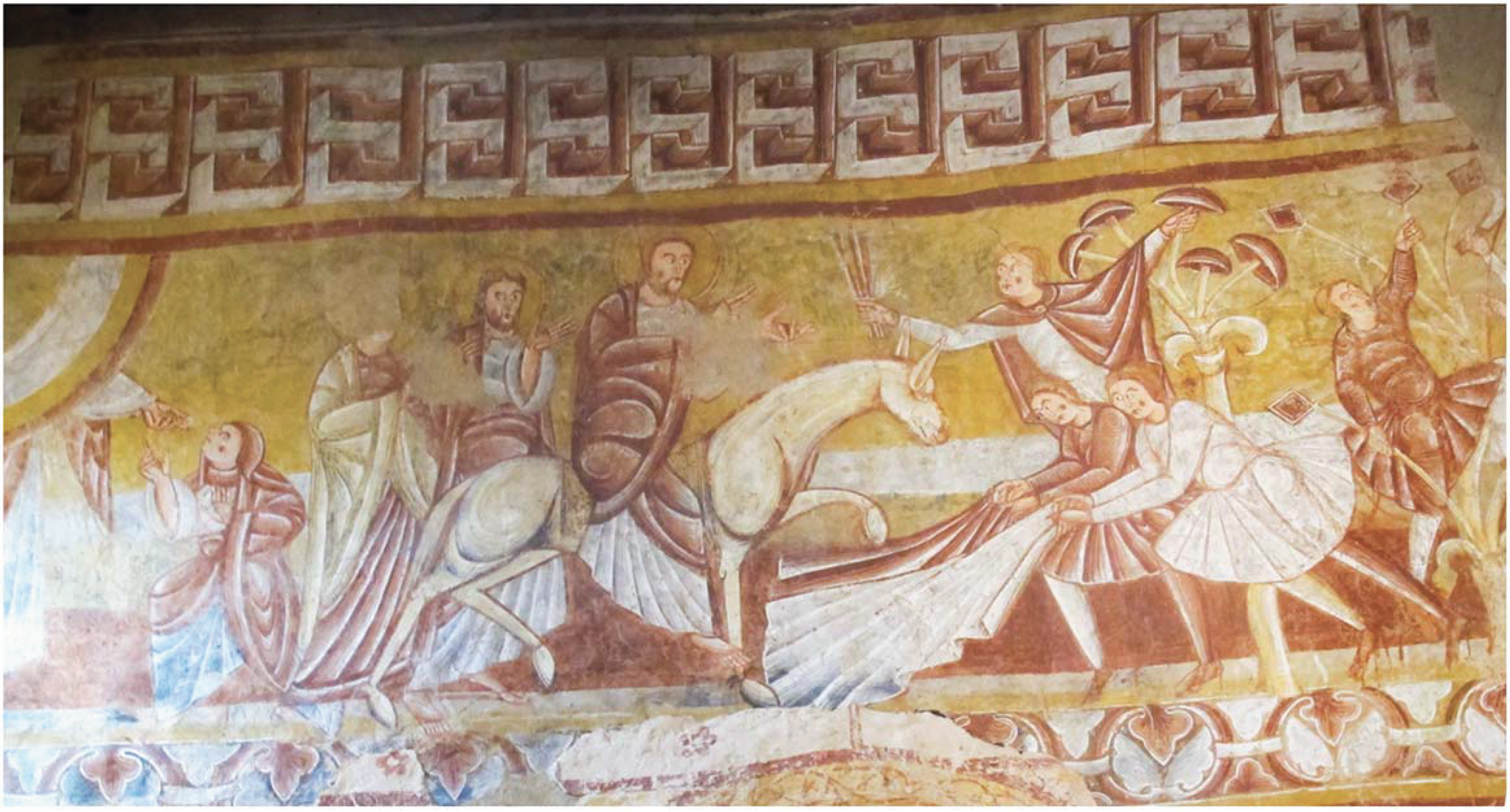

“Entry into Jerusalem John Rush diamond frond.jpg” 152 KB 10:28 pm Feb. 26, 2025
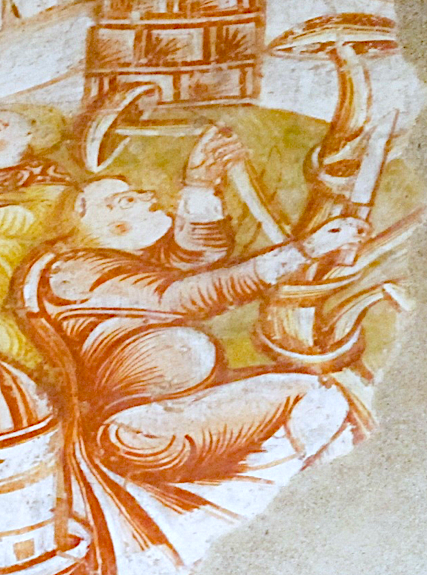
April 10, 2022 image processing & crop by Michael Hoffman.
Sacrifice of Isaac (Van der Borch) – branches burning; compare bush burning:

Burning Bush, and Tablets (Ingeborg Psalter)

The Mystic Y (Ingeborg Psalter); Burning Bush
Burning Bush

Features (some noted before):
- Foolish youth stance: Weight on left foot.
- Left elbow is touching {fire}.
- Good though: right hand closer to ground than left hand, per f134 image rules.
- Turning to look Left, not as good as Right.

Intro, Relevance to Egodeath Theory
New video yesterday, Apr. 11, 2025. Lacks concept of psychedelic experiencing of eternalism, lacks concept of transcend eternalism.
https://www.youtube.com/watch?v=6I2OhmVWLMs&t=3350s = 55:50
Posted at YouTube
This is my main copy though I could designate https://egodeaththeory.org/2025/04/11/psychedelic-4d-spacetime-block-universe-mysticism/ instead as the main location for such commentary.
My Comment 1 on a Curt & Emily Video
55:50 – Curt Jaimungal asks Emily Adlam the popularly worded, inferior question. People should not debate “presentism” vs. eternalism, but rather, _possibilism_ vs. eternalism.
Possibilism (branching, open future) vs. eternalism (non-branching, closed future) are the two relevant models for personal control, as contrasted in the medieval art genre of mushroom-trees.
That genre uses {cut right trunk} and {cut right branch} motifs, assigned to standing on _right_ foot rather than left foot.
The diagrammatic art genre of mushroom-trees claims that the _branching_ model (possibilism) produces control instability, but relying on the non-branching model (eternalism) produces control stability.
Emily Adlam’s view, 4D spacetime block-universe eternalism, supports the Egodeath theory of psychedelic eternalism, in which block time with dependent control (“non-control” in a sense) is experienced, and the contrast between the branching vs. non-branching models is perceived.
Posted to youtube April 15, 2025:
https://www.youtube.com/watch?v=FoQhHmjyERA
The “All at Once” Theory: The Universe is a Single Timeless Block
April 14, 2024
This video is a short clip of the main interview.
My Comment 2 on a Curt & Emily Video
Everyone went running after (branching) Quantum Mysticism, but the “road not taken” (or less taken) can be called (non-branching) 4D Spacetime Mysticism, or Block-Universe Mysticism.
The competing, Minkowski-based model. Around 1880-1910 seems like a nascent version of this earlier type of Physics-oriented mysticism formed.
The full version of this interview held up to multiple listens, a favorite.
My Comment 3 on a Curt & Emily Video
Someone asked me “What is Quantum Mysticism?”
Wikipedia has a good article “Quantum mysticism”, saying it is bunk spiritual reinterpretation of Quantum Physics; I agree.
https://en.wikipedia.org/wiki/Quantum_mysticism
The Wikipedia article emphasizes eg.that the mind or “observer effect” creates many worlds at every moment: that’s the extreme of ego-power inflation.
I have defined the opposite use of Physics for an opposite version of mysticism that is offensive to ego power:
The future is single and already exists, not like domino-chain determinism causality, but quite different like Emily Adlam’s All-at-Once, eternalism; “4D spacetime block-universe mysticism”.
Popular Quantum Mysticism is not the Presentism view of time like the interview contrasts against Eternalism.
(Find “Presentism” in the present page transcript, asked by Curt.)
The popular view is actually Possibilism, which is depicted in medieval art as branching (contrasted against non-branching ie Eternalism perceived in the mystical state of consciousness, which I assert).
Motivation for this Page
I have read books about block time in Physics, but haven’t given them much attention, since they just reiterate my view from January 1988 in a university course in Modern Physics.
This interview provides an efficient equivalent of giving attention to this genre of Physics books.
My psychedelic church is dominated by virtual dogma of Quantum Mysticism. They mistakenly equate this version of mysticism with “the” “Science” view.
But around 1880 and with my breakthrough in Jan. 1988, Physics produced an earlier, better version of mysticism that doesn’t reify false ego and branching-power, but zaps it 100% to smithereens like Zeus revealing his power to Semele.
I am naming this earlier but ignored version of Physics mysticism as eg 4D Spacetime Mysticism, or with less emphasis on the combat within Physics, block-universe mysticism, understood as psychedelics-experienced/ revealed.
Info about Curt Jaimungal
https://www.google.com/search?q=%22Curt+Jaimungal%22
Info about Emily Adlam
https://www.google.com/search?q=%22Emily+Adlam%22
YouTube Videos:
https://www.youtube.com/results?search_query=emily+adlam
“Theories of Everything” Videos Playlist by Curt Jaimungal
Theories of Everything with Curt Jaimungal – playlist, including video interviews about:
- “no quantum multiverse”/ Shattering Manyworlds Theory
- retrocausality, superdeterminism
- time doesn’t flow – it’s an emergent effect
- Hofstadter’s strange loops
- Time Doesn’t Exist [Never write this stupid binary construction – always say “the sense in which x”. Your intelligence doesn’t exist.]
- Roger Penrose
- No Scientific Innovation Since the 1920s
- Physics community divided
- Consciousness Theories
Video: The “All At Once” Universe Shatters Our View of Time (Emily Adlam)
Video title:
The “All At Once” Universe Shatters Our View of Time
Everything Happens at Once! (Emily Adlam)
YouTube channel: Curt Jaimungal
Apr 11, 2025
✪ Members first on April 10, 2025
https://www.youtube.com/watch?v=6I2OhmVWLMs —
Description Section of Video
Description (“More” link at video):
“Today we are joined by physicist and philosopher Emily Adlam for her first appearance on Theories of Everything to challenge one of the deepest assumptions in science: that time flows.
“In this thought-provoking conversation, Adlam presents her “all-at-once” view of physics, where the universe is more like a completed Sudoku puzzle than a film playing forward.
“We explore the measurement problem in quantum mechanics, the role of the observer, the illusion of causality, and why these foundational questions demand both philosophical clarity and scientific precision.”
New Substack: https://curtjaimungal.substack.com
Links in the Description of the Video
Links might only work from Desc section in the video at YouTube.
• Emily’s profile: https://www.researchgate.net/profile/…
• Spooky Action at a Temporal Distance (paper): https://pmc.ncbi.nlm.nih.gov/articles…
• Quantum Field Theory and the Limits of Reductionism (paper): https://arxiv.org/pdf/2407.20457
• Two Roads of Retrocausality (paper): https://arxiv.org/pdf/2201.12934
• Taxonomy for Physics Beyond Quantum Mechanics (paper): https://arxiv.org/pdf/2309.12293
• Strong Determinism (paper): https://arxiv.org/pdf/2203.02886
• Carlo Rovelli on TOE: • The Loop Quantum Gravity Debacle: Car…
• Stephen Wolfram on TOE: • Solving the Problem of Consciousness …
• Emily interviewed about Nonlocality: • Nonlocality Not in Space but in Time:…
• Tim Palmer on TOE: • Tim Palmer: Non-Locality, Universe on…
• Tim Maudlin on TOE: • Why Bell’s Theorem Changes Everything…
• Algorithmic Randomness and Probabilistic Laws (paper): https://arxiv.org/pdf/2303.01411
• Governing Without a Fundamental Direction of Time (paper): https://arxiv.org/pdf/2109.09226
• Matt Segal on TOE: • Is The Universe Conscious? | Matt Segall
• Jacob Barandes on TOE: • There’s No Wave Function? | Jacob Bar…
• Sabine Hossenfelder on TOE: • The Major Flaws in Fundamental Physics
• Bernardo Kastrup and Sabine on TOE: • Bernardo Kastrup Λ Sabine Hossenfelde…
• Sean Carroll on TOE: • The Crisis in (Fundamental) Physics i…
Timestamps (Even Though “Time Is an Illusion”, Like the Intelligence of People Who Talk That Way)
Timestamps:
00:00 Introduction
00:56 Observers in Quantum Mechanics
02:15 The Measurement Problem
06:23 Dogmas in Quantum Foundations
08:24 Causation and Its Philosophical Implications
09:12 The Arrow of Time and Its Mysteries
10:28 Exploring Coarse Graining and Reductionism
13:21 Non-Locality: Temporal vs. Spatial
16:06 The Nature of Non-Locality
19:34 Temporal Non-Locality and Its Implications
21:51 Retrocausality: The All-at-Once Perspective
26:25 The Measurement Problem and All-at-Once Framework
28:24 Observer-Centric Interpretations of Quantum Mechanics
31:29 Probabilities in Physics
32:51 The Process Matrix and Causal Structures
38:33 Foundations of Physics and Philosophy
1:05:16 The Emergence of Space-Time
1:08:11 Exploring Correlations in Physical Parameters
1:10:44 Epistemology of the Measurement Problem
1:13:26 Lessons in Patience and Persistence
Key Words to Find in the Transcript
Find:
- possible, possibilism
- presentism
- eternalism, eternalist
- [find ‘eternalist’ in Kyle Bromhall’s article about James’ 1897 article DoD?
No, just eternal: https://philarchive.org/archive/BROAIU-2] - branch
- many worlds, manyworlds
- multiverse
My Commentary Notation
[i will clean up the transcription later, remove extra space chars which will hint that I have studied the sentence. markup, bold, & my commentary does same.]
Transcript
Introduction
00:00 Introduction
Coming up soon…
Emily Adlam:
“The dogma I worry about is that we should think about physics in terms of time evolution.
This picture where you start at the beginning and evolve forwards in time,
[sounds like Tim Freke’s attempted revision of spirituality in terms of “emergent, evolutionary spirituality, which has a low view of previous expressions of spiritual enlightenment – as I have complained but repaired, since 1986.]
that’s a very intuitive [read: naive] way of thinking about physics, but it is very clearly not a good fit for what we are seeing.
There’s really good evidence coming from lots of different parts of physics that we shouldn’t be thinking about time in those terms.”
Curt Jaimungal (intro):
Imagine a completed Sudoku puzzle.
The rules don’t dictate that you start in one corner and then work systematically across the grid.
Instead, they just constrain what patterns are valid for the entire puzzle. Professor Emily Adlam of Chapman University suggests that the fundamental laws of physics work similarly.
You don’t evolve the universe step-by-step from past to future. Instead, there are these constraints. Something that selects valid patterns across all of spacetime simultaneously.
This quote-unquote all-at-once perspective helps explain paradoxical quantum phenomena like delayed choice experiments and Bell nonlocality.
It also comports with Einstein’s relativity, where the distinction between past and future depends on the observer’s reference frame.
Observers in Quantum Mechanics
00:56 Observers in Quantum Mechanics
If correct, this paradigm shift would transform our understanding of causality, of observers, and of the nature of physical law itself.
CJ:
What’s the largest unsolved problem in physics today that you’re interested in?
EA:
Well, this is not a very original answer, but I think the measurement problem of quantum mechanics for me still really stands out as an important unsolved problem.
Not just because it’s intellectually interesting, but because it seems to me that it’s closely linked to a variety of concrete problems that we’re working on in modern physics.
In particular, I think in the context of work on quantum gravity, a lot of the issues we’re really struggling with are ultimately to do with the nature of observers, the nature of observation.
For example, solving the problem of time is all about trying to understand how to put the observers and their theories in a way that reproduces the kinds of observations we expect to see.
And so that makes me think that perhaps there’s an issue here where we never really came to grips with how to think about observers in the context of ordinary quantum mechanics, and that’s really holding us back from making us progress on further physics.
So I think that problem to me demands a solution not just for intellectual curiosity, but also to be able to make real progress.
The Measurement Problem
02:15 The Measurement Problem
And what’s the definition of ‘observer’?
Is it the same as a measuring device, or what counts as a measurement?
Emily Adlam:
Well that’s exactly the problem.
We don’t know clearly how to define observers in concrete physical terms.
We have, of course, an intuitive notion of what an observer is, and we know what we expect observers to see, but it’s still very unclear how to properly model observers within quantum mechanics.
All the interpretations of quantum mechanics say something different about how you should represent observers, and that has important knock-on effects for how you’re going to think about observers in the context of further physics like quantum gravity.
How does the problem of observers, or defining what observers are, have anything to do with quantum gravity?
So, I mean, one of the big problems we encounter in the formulation of quantum gravity is known as the problem of time, which refers to the fact that if you impose a sort of canonical quantization on gravity, the result is that time evolution seems to vanish.
You end up with this sort of strained, timeless model.
And so then one obvious problem you have is to try to understand how the kinds of experiences that we have could possibly arise in this context.
Where does our sense of doing things in time and obtaining outcomes come from?
And so there are lots of interesting ideas around this, but a lot of this is still very focused on this question of how exactly should you represent an observer, and how can you make sense of sort of local observations in this setting.
So why don’t you tell us how you make sense of observers, then? Well, I mean, unfortunately, I don’t have a complete answer to this question.
I think one thing that we can see clearly from both general relativity and quantum gravity is that making sense of observers is probably going to require understanding them in sort of relational terms, understanding observations as things that happen in some sense relative to our observers, rather than being things that are out there in the world by themselves.
So that seems like an important insight, which I think is also relevant for standard quantum mechanics. But certainly, it’s an ongoing project to understand exactly how to make that work in a coherent way. We’re going to get to the relational interpretation of quantum mechanics and your work with Carlo Rovelli.
Carlo Rovelli: Physics Without Time
https://www.google.com/search?q=%22carlo+rovelli%22
https://en.wikipedia.org/wiki/Carlo_Rovelli#Physics_without_time
But prior to that, I want to know, what the heck is a Sudoku universe?
The Sudoku universe is a way of thinking about time and laws in the context of modern physics.
So there’s this perhaps quite traditional way of thinking about physics, where we imagine it as something like a computer, as Ken Wharton puts it.
So we think of an initial state being put in, and then the universe just evolves the initial state forwards in time and produces the course of history.
And that’s, I think, the intuitively natural way to think about physics that many people still use.
But there’s, I think, really good evidence coming from lots of different parts of physics that we shouldn’t be thinking about time in those terms.
We should instead be thinking about the laws of nature as applying all at once to the whole of history.
So in that sense, they’re like the rules of a game of Sudoku.
The rules of Sudoku don’t tell you to start at the left and then move towards the right.
What they do is constrain the whole grid and tell you whether an entire solution is valid or invalid.
So the thought is that the laws of nature perhaps work like that and not like time evolution.
Is that the same as saying that there’s some imposition of consistency?
So certainly consistency is one important kind of constraint.
I think probably we need more constraints than just consistency because I don’t know how to derive the actual laws that we observe from purely consistency conditions.
It would be neat if that could be done. But it seems like there might be some constraints going beyond just consistency conditions to sort of impose the specific types of laws that we actually see.
You had a 2018 paper called Spooky Action at a Temporal Distance, which is a great title by the way.
A Dogma in Quantum Foundations: That We Should Think in Terms of Time Evolution
06:23 Dogmas in Quantum Foundations
You mentioned something becoming a dogma in physics.
I’m quoting you, a dogma, and something like there’s an assumption which is actively limiting progress in quantum foundation.
So what is it? And those are strong words.
So I’d like you to justify your usage of that language.
Emily Adlam:
The dogma I was worrying about there was this idea that we should think about physics in terms of time evolution, this picture where you start at the beginning and evolve forwards in time.
As I say, that’s a very intuitive way of thinking about physics, but it is I think very clearly not a good fit for what we are seeing in modern physics.
And yet nonetheless, many people I think are still drawn to try to think about things in those terms.
So for example, in quantum foundations, it’s very common to be quite focused on trying to give causal accounts of things to understand either in classical terms or to move to a sort of quantum notion of causation where you can tell the story about one thing causing another thing causing another thing.
And that I think is not a good use of our efforts because there are clear indications that that’s not really the structure that physics actually has.
And so trying to force it into a causal structure is not likely to be a good way of understanding it.
[‘causal’ implies branching possibilities & monolithic, autonomous control — vs non-branching possibilities with 2-level, dependent control -Michael Hoffman]
In the philosophical literature, there’s disputes as to what is causation.
Do you have a personal account of causation?
Yeah. When I say personal, I mean one that you favor.
Definitely the accounts of causation I favor.
Other ones which suggest that causation needs to be understood essentially as a macroscopic phenomenon.
So causation I think clearly has something to do with thermodynamics and the thermodynamic arrow in terms of entropy.
It’s also I think clearly related to perspective, the perspective of macroscopic observers like us and what we can and can’t achieve.
It’s related to interventions and telling a story about what observers like us can achieve by intervening on certain types of variables.
So all of those things make it seem very macroscopic in nature, which means that for me it’s incorrect to think of causation as being something that adheres in the microscopic world.
Causation and Its Philosophical Implications
08:24 Causation and Its Philosophical Implications
Certainly there are I think important kinds of structure in the microscopic world that we need to think about, but I don’t think those structures are causal in the ordinary sense.
And so it’s not going to be particularly helpful to try to model them in causal terms.
So I’d like to talk about non-locality as well, specifically temporal non-locality.
And in temporal is time. And earlier you mentioned the problem of time.
And then here we’re talking about the arrow of time or the thermodynamic arrow of time. So it sounds to people who know some physics that, oh, there’s a problem of time. Is that the problem of the arrow of time?
Is the problem of time different than the arrow of time problem? And does the second law solve it?
All of these get entwined in their mind. So why don’t you distinguish those?
What is the problem of time?
What is the arrow of time and what it has to do with the second law?
The Arrow of Time and Its Mysteries
09:12 The Arrow of Time and Its Mysteries
The arrow of time usually refers to the fact that in the world, as we experience it, there are all these temporal asymmetries, you know, glasses break and don’t usually recompose themselves.
All of these kinds of obvious asymmetries that characterize our lives.
The problem of the arrow of time is that the underlying physics mostly seems to be time-symmetric.
So in that sense, it’s not obvious where all of these asymmetries could come from.
You seem to have to impose them by just deciding by fiat that the initial state of the universe is some special kind of state, which can explain those asymmetries.
But for many people, that’s not super satisfying.
The problem of time in quantum gravity is a distinct issue.
It refers to the fact that within a specific technical formalism for quantizing gravity, when you perform that quantization, you find that time evolution ends up being what’s called a gauge transformation, which means that it’s not physically real.
It’s just kind of giving two different descriptions of the same thing. So it looks like time evolution in the ordinary sense is not present at all. So that leads to a problem of trying to understand, you know, where do our experiences come from?
Why do we have these experiences that feel like they are temporal in nature?
Exploring Coarse Graining and Reductionism
10:28 Exploring Coarse Graining and Reductionism
So they are separate problems, but I think it’s very likely they are linked.
I think certainly the story about why we have experiences which are temporal in nature must have something to do with thermodynamics and the fact that we live in this very asymmetric regime.
[our experiencing is always shaped in the form of causal agency steering among branching possibilities into an open future]
So there’s still work to be done to flesh out the connections between these things, but certainly I think they’re not completely independent.
So some people explain the arrow of time with coarse graining. I think Stephen Wolfram does this, and in coarse graining is the notion of renormalization. You had a paper on why reductionism is false, or at least not necessarily true, and you tied it to renormalization.
Can you please talk about that?
In that paper, you know, this is sort of an exploratory paper.
I’m not necessarily committed to the view that reductionism is false, but I’m interested in whether that is maybe one way to try to resolve some of the problems that we encounter in quantum field theory.
So one of the problems is a sort of fine-tuning issue where we find that in certain kinds of cases, it seems that the values of two distinct fundamental constants must be very carefully adjusted to fit each other in order to produce the observed value of the constant at a higher scale.
And sort of the observation I was making here was that if you say things are the other way around, if you say that the higher level constant is fundamental and the smaller scale constants are in fact derived from it, that gives you a very natural explanation for why they’re fine-tuned in this way, because they are in fact fixed by the actual value of the higher level constant.
So the thought there was just that perhaps changing our way of thinking such that in some cases smaller scale things are explained by larger scale things rather than vice versa might be a way of understanding some of those phenomena.
Then it was important to look at the renormalization transformations, because renormalization is the transformation we use in quantum field theory to move between different scales.
And so the question I was looking at there was trying to understand, given the mathematical structure of the renormalization translations, is it possible that things could be reversed in direction and that the higher scale things could define the lower scale things and not vice versa?
We normally wouldn’t think that’s possible in sort of more ordinary physics, because we think there’s a sort of many-to-one mapping where many microscopic possibilities get mapped to one macroscopic possibility, so the macroscopic possibility can’t determine what’s going on in the microscopic scales.
But renormalization is in fact a one-to-one transformation, so it does seem more plausible in the kind of regime where that’s relevant, that perhaps the higher scale things could determine the lower scale things because of the specific mathematical structure of that transformation. Even at fixed points? So fixed points are somewhat more complicated,
Non-Locality: Temporal vs. Spatial
13:21 Non-Locality: Temporal vs. Spatial
because fixed points do involve scenarios where many solutions get mapped to one solution. But the thing about fixed points is that they can occur both at very small scales and at larger scales.
So it’s not obvious to me that invoking fixed points particularly favors one direction of explanation, since they occur at both levels.
So let me see if I can phrase this in the language for mathematicians, and correct me if I’m incorrect.
The renormalization group is a set of tools to determine how parameters change with different scales, whether it’s energy scales or length scales or what have you. Now, it’s less of a group in the algebraic sense and more a set of tools, but if it was to be something like a group, it would be a monoid, because not every element is invertible.
However, most of the elements are invertible, and this would mean that you don’t privilege some scales being more fundamental, in the same way that in an affine group you don’t have a privileged origin? That’s right, yeah. So we have various approximations we use to do renormalization, and many of those are not invertible.
But there are good reasons to think that the real underlying transformations should be invertible. And if that’s the case, then outside of fixed points, you can go from small scales to large scales, or you can go from large scales to small scales. It’s kind of the same from the point of view of the underlying math. And so there’s no sort of obvious sense in which the physics is telling you the small things must explain the big things and not vice versa.
Let me see if I can make another analogy. So let’s imagine there’s a bird in the sky and you take a snapshot of that bird. And then you say, okay, its position is here and its velocity is here, or its momentum. And then you could say, okay, where is it going to be?
And then you can plan out or you can predict its trajectory. And then you say, well, look what we got here as an initial position and velocity.
But why did you call this “initial”?
Like you could actually, from another point, make the trajectory go backward.
And so you have the whole trajectory.
So what is the “initial” point?
Why is one point being privileged?
Yeah, I mean, I think that’s a great analogy, because I would say much the same about time evolution as well, that there is no particular reason to privilege one point.
Certainly the physics doesn’t tell you you have to do that. And yeah, I think the same is true, at least for many applications of the renormalization transformation.
The physics doesn’t seem to be telling you that the smallest, most fundamental scales must actually be privileged in that sense.
The Nature of Non-Locality
16:06 The Nature of Non-Locality
So let’s get to nonlocality.
There’s a large hubbub about nonlocality and Bell’s theorem and also realism.
Well, what is nonlocality?
Yeah, so in the context of quantum mechanics, nonlocality is the phenomenon that quantum mechanics exhibits correlations which seem to be too strong to be explained by any local model.
So normally when we see correlations at a distance, we would expect to explain them by some common cause in the past.
They both came from the same source or something like that. But Bell’s theorem demonstrates that the types of correlations we see in quantum mechanics can’t be explained that way.
It seems as though there’s some kind of direct influence between events happening at a distance that can’t be explained in this sort of common cause way. Now there’s two different types of nonlocality, spatial and temporal.
And you have many papers, many talks as well on temporal nonlocality. So please distinguish the two.
Yeah. So perhaps the, I guess the traditional way of thinking about nonlocality in quantum mechanics is to imagine it as a spatial form of nonlocality.
So that involves a situation in which perhaps Alice performs a measurement in one location. And as soon as she does that, the wave function collapses everywhere in the world.
And that sort of conveys information across to Bob wherever he is. And that has an impact on the results of his subsequent measurement.
So that nonlocality is spatial because the effect of what Alice does is just transferred to the whole global state everywhere at the same time.
Whereas temporal nonlocality suggests that nonlocality doesn’t necessarily have to be conveyed immediately in terms of the current state of the world.
You can potentially think of nonlocality as kind of hopping across time as well. So Alice performs her measurement at some time and at some other place.
And at some later time, Bob performs a measurement and there’s just a direct relationship.
There’s some kind of constraint requiring that Bob’s outcome reflects Alice’s choice in some way.
So there’s a kind of direct nonlocal impact that is not mediated by a global state evolving forward carrying that information. Does spatial nonlocality imply temporal or vice versa?
Combining spatial nonlocality with relativistic constraints makes it very compelling to think that there should be temporal nonlocality.
That’s because if you take a frame of reference within a relativistic setting where you have a spatially nonlocal effect, something Alice does influences something that happens over here, you’re allowed within relativity to make a change of reference frame to get another equally valid reference frame.
And in that reference frame, those events are not going to be at the same time anymore.
Bob’s event over here is going to be either in the future or the past of Alice’s observation.
So it looks like by making that transformation, you have turned your spatial nonlocality into temporal nonlocality.
So that in that sense, if you believe what relativity tells us about the close connections between space and time, it seems very hard to maintain that nonlocality is always spatial and never temporal.
So then why is it that physicists, if I understood one of your papers correctly, why is it that physicists focus on the spatial nonlocality when if you’re in the relativistic setting and both are on quote-unquote “equal footing”?
(A term I don’t like for various reasons. I’ll put a link to a video on why I don’t like “equal footing”.)
Particles don’t take “all possible paths simultaneously.” Here’s why.
Curt Jaimungal, April 3, 2025
https://curtjaimungal.substack.com/p/particles-dont-take-all-possible?utm_source=substack&utm_medium=email&utm_content=share – “Firstly, what is this word “possible”? Possible isn’t a physics word.”
Temporal Non-Locality and Its Implications
19:34 Temporal Non-Locality and Its Implications
But regardless, why is it that physicists tend to focus on the spatial nonlocality compared to the temporal one?
One main reason for this is because quantum mechanics historically and still usually today is formulated as a time-evolution theory.
So the natural way to think about quantum mechanics in its standard formulation is to formulate it in terms of global states which carry all the information forwards in time.
So from that point of view, if you’re trying to model locality in that picture, perhaps the sort of natural thing to do is have a global collapse of the wave function that takes place everywhere and so to have a spatial nonlocality.
If you are formulating quantum mechanics in a different way, as a non-time evolution theory, then temporal nonlocality becomes much more natural and compelling.
But that’s not the traditional way in which we have formulated quantum mechanics.
Is the future influencing the past an example of temporal nonlocality?
Yes, so it could be. It depends, I think, how you think about the way in which the future influences the past.
If, for example, your model of the future influencing the past involves some kind of like backwards evolving state that goes back and carries the information backwards in time, you might end up with a picture where there is a backwards influence, but it is sort of locally mediated by a backwards evolving state.
On the other hand, if your model of the way in which the future influences the past is some kind of all-at-once style model where there’s just a sort of global constraint relating these two things to each other, in that case it is going to look much more like temporal nonlocality because there doesn’t need to be a sort of literal state that goes back and carries the information.
Right.
In your work, as I was going through it, you differentiate between dynamical retrocausality, so influences propagating backward in time step-by-step, and then this all-at-once, and this term “all-at-once” will come up over and over again.
I believe it’s an all-at-once temporal retrocausality.
Retrocausality: The All-at-Once Perspective
21:51 Retrocausality: The All-at-Once Perspective
But would it be called retrocausality at that time?
At that point, if it’s all—I guess that’s a pun—would it be called retrocausality if it’s happening all at once?
Why is it retrocausality?
Yeah, well, I use retrocausality in this connection just to sort of, in a loose way, to relate what’s going on here to sort of more traditional discussions of retrocausality.
I think, strictly speaking, what’s going on there is not retrocausality because I think there’s no causality in fundamental physics.
So, neither the forwards nor the backwards direction is truly causal.
But certainly, if you try to look at this from a more macroscopic point of view and you sort of write down a causal model in which a person intervenes on something, in that sense, you’re going to get effects that look retrocausal from that macroscopic point of view, even though I do think that you should acknowledge that at the fundamental level, none of this is causal.
So, when you’re thinking about all-at-once, are you also thinking about boundary conditions?
So, the ordinary way that physics is thought about is that you have your boundary conditions plus the laws, and you then evolve forward.
Definition of ‘All-at-Once’
So, please define what all-at-once is.
All-at-once refers to this sort of Sudoku universe-style idea where the laws of nature apply to the whole of history all at once.
The one possible type of all-at-once model is a model in which you fix the initial and the final conditions, and then you ask the laws to determine what happens in between.
That’s quite a common type of problem that we see even in fairly standard physics.
But it’s also not the only kind of possibility.
When I talk about all-at-once or constraint-based laws, I usually talk about the laws of nature determining the whole history at once.
In that sense, often it will be the case that you can fix any state anywhere on the history, and that will be sufficient to fix the rest.
It could be the initial state, could be the final state, could be one or more states in between.
In that sense, in that kind of picture, no particular point of time has to be specially privileged.
It’s just the history as a whole which is selected by the laws.
When speaking about these histories, it reminds me of the transaction interpretation.
Have you done any work on the transaction interpretation, or do you have any thoughts on it?
The transactional interpretation is certainly interesting.
I’m interested in these kinds of retrocausal models.
I guess I would like to see more emphasis from the transactional interpretation on moving away from specific experimental situations to a more general picture where I can understand how the experimental situations and the observers in particular are supposed to arise from something more fundamental than that.
In some cases, the transactional interpretation seems to me overly focused on a setup where the instruments and the observers are already given.
Tim Maudlin had a challenge to the transactional interpretation about how there’s some contradiction in simple backward causal stories.
So, firstly, what is Tim Maudlin’s objection or challenge, and what does the all-at-once model do to resolve it?
Maudlin’s concern was that if you imagine an experiment in which we take some sort of preliminary measurement in the middle of the experiment and then we use that to determine part of the final conditions, the final measurement we’re going to make, that looks inconsistent with the most naive version of the transactional interpretation because the transactional interpretation is supposed to take the initial and final conditions.
Determine what happens in between so you can make that become contradictory.
There are more sophisticated versions of the transactional interpretation which avoid this issue, but I think all of them ultimately avoid this issue by moving away from the sort of naive story where there’s a literal transaction taking place in some sort of temporal process and more towards an all-at-once style picture where the whole thing is kind of atemporal and has to be thought of as being determined in this atemporal sense that fixes its consistency.
So I think ultimately, resolving that kind of problem, both in the transactional interpretation and in retrocausal models more generally, does seem like it’s going to push you towards an all-at-once style picture.”
https://egodeaththeory.org/2021/01/22/quotes-from-the-great-mystics-of-egodeath/#Control-vortex —
Martin Ball’s going to inevitably run into the Egodeath theory. And in a way, he probably already has; Ball talks about ‘the shadow’, or something like that, this kind of New-Agey term: but, that is the problem; the threat of ego death looming, in the altered state.
We can help show – in addition to the critique of Pop Sike, make it constructive and show them how they can move closer to the Egodeath theory, why the Egodeath theory is a more attractive option than their current paradigms, intellectually speaking: just for coherence; and, for providing the fullest model of what goes on in the altered state.
Because that’s really what draws us, what has drawn us to it; there’s nothing that really compares to the depth of explanation; that actually, pushing through towards the ego death, and not trying to skate around the outside and use the sacrament for some other purpose.
Cyberdisciple, Transcendent Knowledge Podcast, episode 3 (19:00)


We started this conversation with talking about the largest problem that irks you, and it was the measurement problem, and now we’re talking about the all-at-once model.
The Measurement Problem and All-at-Once Framework
26:25 The Measurement Problem and All-at-Once Framework
Did the measurement problem lead you to this all-at-once quantum framework, or did you starting this all-at-once quantum framework lead you to realize the importance of the measurement problem?
They are separate in that the indications that the all-at-once model is correct come partly from quantum mechanics but also from other parts of physics, from relativity and quantum gravity and so on.
Just adopting an all-at-once style model does not by itself solve the measurement problem because the measurement problem is to a large extent about how to model observers.
Just saying we’re going to tell an all-at-once story doesn’t answer the question of how to model observers.
So I do think that it seems clear to me that the right solution to the measurement problem is going to be some all-at-once style solution, but there are a number of different possibilities within that, and so I think it’s still for me open which is the right way to do that.
“Cubism” Is Mistranscription of: QBism (Quantum Bayesianism)
Do you find cubism? Or other observer-centric interpretations to be unsatisfactory?
I find them incoherent.
My worry about them is that if you’re really serious about your observer-centricity, that is going to lead you inevitably to a picture in which every observer kind of has their own little reality and they’re not able to communicate with each other.
That I think is incompatible with the practice of science.
Science is a very social activity.
The sort of objectivity of science rests on the fact that we have all these different scientists doing observations and then sharing them.
So I don’t think it’s reasonable to interpret quantum mechanics in any way which ultimately says we can’t actually communicate with different observers.
I am however interested in sort of more moderate observer-centric views which allow that observers play an important role or that perspectives in general play an important role, but which nonetheless make provision for sort of connections between perspectives to happen.
Such as relational quantum?
Observer-Centric Interpretations of Quantum Mechanics
28:24 Observer-Centric Interpretations of Quantum Mechanics
Yeah, so I mean relational quantum mechanics in its standard formulation does have the problem that I’ve just described because it does imply that it is impossible in an absolute sense to ever know anything about what’s going on in anyone else’s perspective.
But the work that I did with Carlo Rovelli recently was about thinking about how could you alter relational quantum mechanics to overcome this issue.
And so we did suggest a possible way to address that by adding a postulate which allows communication between observers.
The Economist [promotional]
https://economist.com/toe [theories of everything]
CJ:
“Just a moment. Don’t go anywhere. Hey, I see you inching away. Don’t be like the economy. Instead, read The Economist.
I thought all The Economist was was something that CEOs read to stay up to date on world trends. And that’s true, but that’s not only true.
What I’ve found more than useful for myself personally is their coverage of math, physics, philosophy, and AI, especially how something is perceived by other countries and how it may impact markets.
For instance, The Economist had an interview with some of the people behind DeepSeek the week DeepSeek was launched. No one else had that.
Another example is The Economist has this fantastic article on the recent dark energy data which surpasses even Scientific American’s coverage, in my opinion.
They also have the chart of everything. It’s like the chart version of this channel.
It’s something which is a pleasure to scroll through and learn from.
Links to all of these will be in the description, of course.
The Word “Now, ” Is on the Egodeath Block List; the Instructor’s Equivalent of the “So, ” Virus (Verbal Tic)
Now, The Economist’s commitment to rigorous journalism means that you get a clear picture of the world’s most significant developments.
I am personally interested in the more scientific ones, like this one on extending life via mitochondrial transplants, which creates actually a new field of medicine, something that would make Michael Levin proud.
The Economist also covers culture, finance and economics, business, international affairs, Britain, Europe, the Middle East, Africa, China, Asia, the Americas, and of course, the USA.
Whether it’s the latest in scientific innovation or the shifting landscape of global politics, The Economist provides comprehensive coverage, and it goes far beyond just headlines.
“Look, ” Is a Junk Filler Word
Look, if you’re passionate about expanding your knowledge and gaining a new understanding, a deeper one, of the forces that shape our world, then I highly recommend subscribing to The Economist.
I subscribe to them, and it’s an investment into my, into your, intellectual growth. It’s one that you won’t regret.
As a listener of this podcast, you’ll get a special 20% off discount.
Now you can enjoy The Economist and all it has to offer for less.
Head over to their website, http://www.economist.com slash TOE, T-O-E, to get started.
Thanks for tuning in, and now let’s get back to
the exploration of the mysteries of our universe.
Again, that’s economist.com slash TOE.
https://economist.com/toe [theories of everything]
How Do You Think about Probabilities?
How is it that you think about probabilities?
Like there are different interpretations of probabilities.
Forget about quantum mechanics.
There are different interpretations of what a probability is.
So in metaphysics and in science, how do you think about probability?
Probabilities in Physics
31:29 Probabilities in Physics
Yeah, I think the interpretation of probability is a very hard
problem. I think I’m not wholly satisfied with any of the approaches that we have available to us.
The sort of frequentist approaches are useful in many cases, but have pretty significant philosophical problems for accounting for certain kinds of edge cases. Subjective Bayesianism, I think, just doesn’t do justice to the fact that certain probabilities do seem to be out there in the world and not just in our minds.
The sort of dispositionalist accounts are quite mysterious and also very hard to reconcile with all-at-once style physics.
There are a couple of recent approaches that I’m very interested in.
Frequentism: Anything “CAN” Cause Psilocybin Effects, but How Frequently DOES it? 0%, not 50% as Falsely Implied
There’s a view called gnomic frequentism due to someone called John Roberts, which suggests that probabilities should be understood in terms of laws which require that frequencies should look a certain way.
There’s some really nice work on this recently by Eddie Chen and John Barrett looking at the ways in which you could potentially expand on that and think about probabilities as sort of constraints on relative frequencies.
While that work is still ongoing, I think that’s a really interesting direction and probably the most promising approach from my point of view.
What do you mean?
What is Eddie Chen saying that probabilities should look a certain way?
What does that mean?
The Process Matrix and Causal Structures
32:51 The Process Matrix and Causal Structures
This is working within the sort of all-at-once style constraint-based view of laws.
The observation is that if you allow that laws are global constraints which apply to the whole of history, then you can formulate a probabilistic law as saying something like, the relative frequency of occurrences of some outcome across all instances of this type of measurement across all of history must have some value or must fall in some range.
You can think of the laws or probabilities as directly constraining the relative frequencies that actually occur.
That’s somewhat similar in spirit to the frequentist approaches, but I think avoids some of the more serious problems for frequentism because it’s not just saying that probabilities are whatever the frequencies should happen to be.
It really is saying that the laws constrain the frequencies and require them to have certain values.
How does your approach compare with Shelley Goldstein’s approach?
The approach that Eddie Chen and Shelley Goldstein have worked on in terms of laws is, I think, very similar in spirit to mine.
Indeed, Eddie and I are working on a project examining some of those similarities.
But perhaps one difference is that they are inclined to think of those all-at-once constraints as a fundamental primitive, whereas I perhaps prefer to think of them as being a form of modal structure in accordance with a generally structurally realist approach to physics and to laws.
But I don’t think those views are necessarily incompatible with each other.
They’re more a difference of emphasis.
[that sounds like how recently, I’ve been adjusting the relative emphasis of integrated possibilism/eternalism thinking; good news & bad news of enlightenment, etc. -Michael Hoffman ]
Modal: Facts about What Is Possible and Impossible
What’s a modal structure?
What does that mean?
Modal is a word that philosophers use to refer to facts about what is possible and impossible.
Perhaps the most well-known example of modal structure is causal structure.
So, that’s one form that modal structure can take.
Because I don’t think causation is fundamental, I don’t think that can be the most general type of modal structure.
But I do think the world has some other kind of structure, which is in some way similar to causal structure, but perhaps more general than that.
And so, that’s where I would expect those all-at-once constraints to live. Modal structure.
So, modal comes from philosophy. It’s not a term you hear in theoretical physics. Now, it is when you start to study the foundations of physics or the foundations of quantum mechanics.
But I’m curious how philosophical tools, such as modalism or analyzing determinism or realism, has guided your research?
There’s a useful back and forth to be had here.
I think that modern theoretical physics has important lessons for a variety of traditional philosophical discussions.
This discussion about lawhood is a great example.
Both me and Eddie and Shelley are inspired by noting that traditional philosophical accounts of lawhood don’t seem to do a very good job of accommodating the kinds of laws we see in modern physics.
Two-Way Inspiration between Physics & Philosophy
And I think there’s a useful sort of flow of information backwards as well, because using these philosophical tools and doing the work to analyze, okay, so what are laws now?
How can we understand the types of laws we’re seeing in modern physics?
That’s a useful way of clarifying our thoughts about what’s going on in theoretical physics, understanding what are useful directions for future research, and understanding how we can connect those developments back up to the kinds of things we’re concerned with in philosophy and in everyday life.
CJ:
Do you encounter the attitude from physicists that, hey, physics, experimental physics, theoretical physics, it doesn’t need anything from philosophy?
Philosophy hasn’t contributed anything to science in the past 100 years other than maybe Popper, and before that it was a while, and you can’t just count Aristotle, that was thousands of years ago.
So do you encounter that attitude?
Emily Adlam:
I think there’s a wide spectrum of attitudes within physics. I mean, I certainly have encountered people with that attitude, but I’ve also encountered many physicists who love philosophy and are very interested in it and are very keen to talk to philosophers.
So while that attitude does exist, I think there’s also plenty of goodwill and interest in both communities to talk to each other and make progress.
CJ:
What would be the counterpoint to someone who’s saying that philosophy hasn’t contributed directly to physics in the past few decades?
EA:
Definitely the most obvious example I would say is Bell’s theorem and the discussion around non-locality.
Bell’s theorem was very much regarded as not mainstream physics when it was formulated, and Bell was a physicist, but other people involved in the discussion of non-locality and pushing this forward, like Shimoni, were not physicists, they were primarily philosophers.
Certainly, I think this topic probably got more of a foothold within philosophy before it moved back into mainstream physics, but now it’s certainly recognized as mainstream physics.
The Nobel Prize was awarded for it recently.
So I think that’s an example of a case where topics that were considered sort of foundational and conceptual were worked on within philosophy for a while, but ultimately became recognized as part of mainstream physics. So what got you interested in philosophy?
Foundations of Physics and Philosophy
38:33 Foundations of Physics and Philosophy
Did you start in physics or did you start in philosophy?
My undergrad was in both physics and philosophy, so I guess both.
I’ve always been very interested in physics and in science, but my questions have
always been more on the side of what is considered to be foundational physics or philosophy of physics.
I think it was a toss-up for a long time whether I was going to be a physicist working on the foundations of physics or a philosopher. My PhD is actually in physics, not philosophy, but in the end, I think perhaps the kind of work I want to do feels like it lives more happily within philosophy. So that’s why I ended up here.
And what does foundations mean? So when someone says they study the foundations of something.
That means something to do with interested in the sort of more basic conceptual questions and looking at the sort of underlying structures and perhaps understanding why the theory is the way it is or understanding basic principles of the theory. It’s sort of a contrast to more applied approaches.
If you study the foundations of quantum mechanics, you’re not going to be primarily working on how to build new quantum technologies.
You’re going to be thinking about the structure of the theory and what it all means. And perhaps those results will eventually go on to be useful in quantum technologies. They often do.
But if you’re working in foundations, that’s not your sort of primary focus.
So what I enjoy about your work is that much like Jacob Barandes is, you emphasize clarity of concepts and principles as a guide to progress.
Taxonomy for Physics Beyond Quantum Mechanics (Adlam, Hance, Hossenfelder, Palmer; June 2024)
You actually co-authored a paper last year, if I’m not mistaken, with Sabine Hossenfelder and Tim Palmer, both of whom have been on the podcast before.
So I’ll put a link to that on screen and in the description.
Taxonomy for Physics Beyond Quantum Mechanics
Emily Adlam, Jonte R. Hance, Sabine Hossenfelder, and Tim N. Palmer
June 2024
https://arxiv.org/pdf/2309.12293
The paper is called a taxonomy of physics for quantum theory or beyond quantum theory.
It’s something that everyone should read if they’re interested in physics.
And if you follow this podcast, you can follow that paper.
So there are different concepts that are explained there with precision.
I’ve heard local beables be described as ontological entities.
And I believe you said it’s something like the input value on a C model that’s assigned to a compact region of space-time.
And you explained what a C model is. I think it’s a calculation model, if I’m not mistaken.
So anyhow, what led you to write that paper?
This paper arose out of a conference on retrocausality and superdeterminism.
Retrocausality and superdeterminism are two approaches that people have often tried to use in order to avoid the conclusion that quantum mechanics might be nonlocal.
So this conference was kind of discussing those possibilities.
Can you get rid of nonlocality using one of these methods?
And I think what we discovered is that there were a variety of different ways in which people were using the words retrocausality and superdeterminism.
And there was a sort of problem where people were talking past each other because they were just using these words in different ways.
So the goal of this paper was to sort of provide a clarifying story which would help explain what’s going on with these terms and perhaps can we have a sort of community-wide consensus about how to use these words so we can have discussions more clearly.
[like Kafei tripping on my 2007+ attempted redefinition of ‘determinism’ to mean eternalism]
When people hear temporal nonlocality, how is that different than time travel?
Time travel, much like retrocausality, could be temporally local or temporally nonlocal.
If your vision of time travel involves people literally moving backwards in time – sorry, the cat is eating it – and those people literally traveling backwards in time, that’s going to look like a temporally local form of time travel if there’s a sort of literal path back in time that they go around.
On the other hand, if they just kind of disappear at one point and then reappear at another point, that’s going to look temporally nonlocal because it’s a sort of cause that just jumped across time.
So I think either of those is possible as a model of time travel.
Free Will
Does any of this have to do with free will?
Certainly.
If you look at the all-at-once style of model, that does seem like it has some implications for free will because some people have thought that something that’s important to free will is the idea that the future is genuinely open, that in this moment as I am acting, there is no fact of the matter about what my action is going to be.
[Diary of a Madman album, Ozzy Osbourne:
Believer, lyrics by Bob Daisley, 1981:
DESTINY PLANNED OUT
SPECULATION OF THE WISE
end of song Believer]

And in an all-at-once style model, that way of thinking about free will is not available to you.
The whole of the universe exists at once.
I’m acting now, but there is already some fact from the atemporal point of view about what my action is going to be.
[pre-existence of future control-thoughts]
So I don’t think that means we have to say “there is no such thing as free will“ in that context.
But certainly, we’re going to have to be a bit more careful about how we analyze free will and what that means.
So this doesn’t depend on determinism.
[correct: eternalism is the case, regardless of whether causal-chain determinism / domino-chain causality is the case, as the mechanism by which the future is closed – find “random” in Self-control Cybernetics, Dissociative Cognition, & Mystic Ego Death (1997 core theory spec):
https://egodeaththeory.org/2020/11/30/self-control-cybernetics-dissociative-cognition-mystic-ego-death/#budaac — Michael Hoffman wrote in Feb. 1997:
“Conventional determinism overemphasizes predictability in principle and perfect seamlessness of the chain of cause and effect, and cannot tolerate the slightest bit of true randomness or disjoint in the chain of cause and effect. More relevant to discovering ego-transcendence is that each point on any timeline is predetermined, and the future permanently exists, elsewhere in the spacetime block. The hypothesis about the eternally unbroken causal chain, in which the past eventually controls the future, is excessive, delicate, and irrelevant to higher experience. Even if there is some true randomness in the world, the future remains predetermined, because of the illusory nature of the flow of time, and the inability to the ego-entity to be an ultimate origin of its own thoughts and choices.” etc, see entire section -Michael Hoffman]
[per Kafei misreading Egodeath.com / The Entheogen Theory of Religion and Ego Death (Hoffman, 2007 main article) http://egodeath.com/EntheogenTheoryOfReligion.htm & https://egodeaththeory.wordpress.com/the-entheogen-theory-of-religion-and-ego-death-2006-main-article/ ,
EVERYONE defines “determinism” as causal-chain determinism, never as eternalism.]
It’s just saying that there’s something that’s globally fixed?
Yeah.
So even if you have a probabilistic model in the all-at-once context, what that’s going to look like is either it’s going to be some kind of frequency constraint, as Eddie Chen has suggested, or perhaps it’s going to be the course of history is selected in a probabilistic way from some set of possibilities.
But either way, you end up saying the course of history is determined all at once.
So there’s no sense in which I’m acting now, and yet my future actions are still open, even if they’re probabilistic. They have, from this atemporal point of view, already been chosen.
Calvinism
CJ:
I remember, oh gosh, I forgot who it was. Someone was saying, it could be the Calvinists.
Maybe it was a religion, or maybe it was an actual philosopher, was saying that if you have trajectories in space-time, just because they exist and you can view it from a God’s-eye point of view atemporally,
it doesn’t mean that those trajectories cause the movement. Those trajectories are the movement. Sorry, are the trajectory.
So an agent can still be causal.
There’s nothing about the trajectories causing. The laws don’t cause.
So can you please distinguish between
- the determination of an agent
and - causal origination of an agent?
Yeah.
So because I think that causation is not fundamental in any case, I think that understanding how the history comes about is not going to involve any kind of causal story.
That’s going to be some more general kind of modal constraint, perhaps, that selects the history.
I mean,
Causation is something that appears at a much higher level of description and probably is only going to be relevant in the kinds of regimes where you have agents taking actions.
So I think it’s perfectly possible to say, in some sort of fundamental sense, the history was already there and was selected in an all-at-once way.
But nonetheless, the agent is the cause of their action because causation is only suitable in that kind of regime of description anyway.
And so it is still true.
Insofar as there is such a thing as causation, it’s still true that the agent is causing their actions.
[say “the sense in which”; avoid saying eg “the agent is illusion, causality is illusion, time is illusion, my intelligence is an illusion”]
CJ:
Right. What do you disagree most with, Carla Rovellion?
What I disagree most with?
I think we still have an ongoing debate about whether it’s necessary to change relational quantum mechanics in the way that we suggested.
So we proposed a postulate that you can add to the theory which makes it possible for observers to communicate with each other in an absolute sense and for their perspectives to become aligned in an absolute sense.
Carlo, I think, is not convinced that’s necessary.
He thinks perhaps it’s enough that there’s a sort of, it’s relationally true that within my perspective, it seems as though I have access to your perspective and he thinks that might be adequate.
For me, I think that doesn’t solve the kinds of epistemic worries I have about the role of social inquiry in science.
So I think the absolute story is necessary, but this is an ongoing debate.
Now, many derivations in physics rely on integration by parts, and then they have this argument that, and the boundary terms are zero, and because of that, we get so-and-so.
Are there times when these surface terms are ordinarily set to vanish, but because of your work on all at once, you believe that to be an unreasonable assumption?
Oh gosh, that’s an interesting question.
I actually have not thought about that.
Seems very possible, but I would have to think more about the technical details before I could say one way or another. Okay, what is self-location?
So self-location refers to scenarios in which you are uncertain about your location within the universe.
So you might be uncertain where you are or when you are, or if you’re in a multiverse, you might be uncertain about which universe within the multiverse you are currently located in.
So it’s those kinds of questions pertaining to a location within a universe. And there’s something between pure and superficial, if I’m not mistaken.
What are those?
Yeah, so when we talk about self-locating uncertainty in philosophy or in physics, I think there are two important, broadly different classes of self-locating uncertainty that we should distinguish between.
So what I call pure self-locating uncertainty refers to cases where you are uncertain about what location you are out of a possible class of locations which are all located within the same world. So for example, Adam Elga’s case falls into that bracket.
Two Dr. Evils (Like the Good M. Hoffman vs. the Evil M. Hoffman in the Field of Entheogen Scholarship)
That’s a case in which Dr. Evil, or a person who believes himself to be Dr. Evil, receives a credible message telling him that a subjectively identical duplicate has been made of Dr. Evil and placed somewhere.
So in that case, he’s now uncertain whether he is in fact the real Dr. Evil or the duplicate, but both of those people exist within one and the same world.
So that is pure self-locating uncertainty. By contrast, superficially self-locating uncertainty refers to the case where you’re uncertain about your location, but the possible locations you could be in belong to different possible worlds.
Possible Worlds
So for example, suppose you wake up and you haven’t looked at the clock yet, so you don’t know what time it is.
You’re uncertain about your location in time, but of course in every possible world there’s exactly one time at which you actually wake up, and so the different possible times you could be located in belong to different possible worlds corresponding to those different possible times you could wake up.
So that’s, I think, an importantly different type of self-location. Is this related to the sleeping beauty paradox?
The sleeping beauty paradox in fact involves a mixture of pure and superficially self-locating uncertainty.
So I think the correct way to analyze that is to appeal to your scientific theory to determine the superficially self-locating credences and then to assign the pure credences any way you want.
So the outcome is that the correct solution is the double half a solution.
Okay, well it’d be useful for you to outline what the paradox is at this point and then why you think the solution is the double half one.
Okay, yeah.
The sleeping beauty paradox refers to a scenario in which an experiment is being performed on you.
You’re going to be put to sleep and then you’ll be woken up either once or twice in the course of the experiment.
We will decide which one it is based on the outcome of a coin flip. So we flip the coin and if it lands heads then you’ll be woken once on Monday and if it lands on tails then you’ll be woken twice on Monday and Tuesday.
So the question is about what credences should you assign to the outcome of the coin toss? Should you assign and do the credences change if you’re woken up and then told what day it is?
So various different approaches have been taken to try to decide what the correct assignation of probabilities is. Most philosophers I think are of the view that when you learn something about what day it is you ought to change your credences.
My view is that because the coin flip issue is a superficially self-locating issue whereas the issues about when you are located are pure, the outcome is that the further information shouldn’t change any of your assignations of credences because the right way to assign credences in these situations is always to assign the superficial self-location credences first and then having done that arrange your pure credences as you would like.
That means that the pure information isn’t going to change the superficial information and so the probability is always going to be half regardless of waking up.
Now was there something about when they say you get woken up twice that after you get woken up once you take something to forget that you woke up once? Yes, you are not going to know that you’ve woken up at once or twice. Now what does any of this have to do with physical law?
Yeah, so self-location is important to physical law particularly in the context of physical theories that deal with multiverses.
So in particular the cosmological multiverse and the many worlds interpretation of quantum mechanics has a multiverse and in both of these multiverses in order to make certain kinds of predictions it’s necessary that you assign some credences over locations within the multiverse.
You have to assign probabilities to which universe you might be within this multiverse and so all of those approaches to making predictions in a multiverse are kind of predicated on the assumption that there is in fact some objectively right or uniquely correct way to assign your self-locating credences over parts of the multiverse.
And so therefore they are necessarily predicated on the claim that there are unique ways to assign pure self-locating credences.
There’s a right way to do it and there’s a wrong way to do it.
So I think that’s wrong.
I think that for superficially self-locating credences there are right ways to assign them because those credences can just be inherited from a scientific theory but in the pure case there is nothing whatsoever which could compel you or constrain you to assign your credences in any particular way.
So any assignation of credences is fine and therefore you’re not going to be able to get meaningful predictions out of any theory which involves this kind of multiverse reasoning.
So if I’m right about that, that’s a serious problem both for the cosmological multiverse and for the many worlds interpretation of quantum mechanics because it seems to say that we can’t make meaningful predictions in that context and we therefore can’t obtain any sensible evidence for scientific theories in that context because there’s nothing to sort of predict and then see if it comes true.
Sean Carroll
https://www.google.com/search?q=%22Sean+Carroll%22
I’m sure you’ve spoken to Sean Carroll about this. So have you and what has he said or what do you think he would say?
Emily Adlam:
I have not spoken to Sean Carroll about this. I know that Carroll has a view of the multiverse which and of the Everettian multiverse in particular which is based on the idea that certain constraints on self-locating credences can help tell you how to assign probabilities in the Everettian case.
I do think this view says that approach is wrong. There are no rational constraints on self-locating credences in the Everettian scenario and so any model which sort of takes that as a starting point I think cannot be right.
CJ:
I believe in 1907, if I’m not mistaken, Einstein had his happiest thought about free fall and weightlessness.
Have you had a happiest thought? A happiest thought? I think one moment I’d pick out is there’s a theorem in quantum foundations called the PBR theorem.
The PBR theorem is about the reality of the quantum state.
It attempts to prove that if in order to reproduce all of the predictions of quantum mechanics it must be the case that the quantum state is a real objective thing which travels through time conveying information from one time to another.
I think thinking about this theorem, one thing that struck me was that the whole theorem was predicated on the assumption of what I would call temporal locality.
“Temporal Locality” (vs. Usual, Spatial Locality)
It’s predicated on the assumption that if a measurement result depends on earlier preparation there must be something which travels between them carrying that information from one point to another.
That I think was the origin of most of my work on temporal non-locality was the observation that there’s this significant assumption being made in this theorem that is perhaps not being questioned in the way that it should be.
Presentism vs. Eternalism
Do you have any thoughts about eternalism versus presentism?
https://www.youtube.com/watch?v=6I2OhmVWLMs&t=3350s = 55:50
Can you please briefly define those terms?
Yeah, so presentism is a philosophical view which says that in some sense only the present is real. The past and the future are not currently real.
Eternalism says that the whole of history is real at once.
There’s no sort of privileged present moment.
[more relevantly, eternalism says:
- no branching possibilities as claimed by possibilism.
- 2-level, dependent control, not monolithic, autonomous control.]
It’s all there.
As you might expect given my views on all at once physics, I’m definitely more on the eternalist side.
I think it’s very hard to make presentism [ought to discuss possibilism branching manyworlds instead] work in a way that is compatible with relativity because relativity denies that there exists a global present.
So it’s kind of unclear what the present even is in that picture.
People have made attempts to sort of reformulate presentism in relativistic ways, but I think all of them feel a bit ad hoc and not very compelling to me.
So certainly in the context of what we know about physics now, eternalism seems to me much more viable. [than stupid pointless presentism – BUT WHAT ABOUT POSSIBILISM?]
Curl Jaimungal’s Substack [promotional]
Hi everyone, hope you’re enjoying today’s episode.
If you’re hungry for deeper dives into physics, AI, consciousness, philosophy, along with my personal reflections, you’ll find it all on my Substack.
Subscribers get first access to new episodes, new posts as well, behind-the-scenes insights, and the chance to be a part of a thriving community of like-minded pilgrimers.
By joining, you’ll directly be supporting my work and helping keep these conversations at the cutting edge.
So click the link on screen here, hit subscribe, and let’s keep pushing the boundaries of knowledge together. Thank you and enjoy the show. Just so you know, if you’re listening, it’s c-u-r-t-j-a-i-m-u-n-g-a-l.org CURTJAIMUNGAL.org.
QBism (“Cubism”) vs. Manyworlds
[“Cubism” Is Mistranscription of: QBism (Quantum Bayesianism)]
We talked about cubism, transactional, many worlds.
What other interpretation of quantum mechanics have we not talked about that you feel fails significantly, and why does it fail?
Well, the obvious ones are the sort of primitive ontology approaches, so the Bohmian approach and the spontaneous collapse approach.
You know, I wouldn’t say these approaches fail.
What I’d say is that, at present, we don’t know how to reproduce the whole of quantum field theory in these kinds of approaches, and there are reasons to think we may never be able to do that, or that it’s very difficult to do that in the context of this particular kind of view.
So, you know, never say never, but right now I’m not sure the prospects for expanding those to cover all of quantum theory look very good, and, you know, until we can show that that can be done, that’s a sort of compelling reason to be worried about those approaches.
So what’s on your mind these days, research-wise? Research-wise, so I have been thinking about, one thing I’ve been thinking about is a problem in relational quantum mechanics.
So there’s this worry, relational quantum mechanics is committed to the view that all physical systems can, in some sense, count as observers. They can have quantum states defined relative to them.
There’s a worry brought up by Caslav Brukner that it doesn’t make sense to say something like a qubit is an observer because there’s no way to get a well-defined basis in which a qubit could make an observation.
So you just couldn’t get a well-defined observed value out of an interaction involving a qubit. So I think he’s right about that as an objection. I think the way to resolve this is to appreciate that the description of the world relative to a qubit is not going to be a full quantum Hilbert space.
It’s not going to be as complicated as that because a qubit just doesn’t have the right enough physical resources to define that kind of relative description.
So I’ve been trying to think about what would be a sensible way of formulating what the world does look like relative to a qubit, and thus of sort of understanding what the range of observations that something like a qubit could make might look like.
Do you then generalize a quantum system to a process matrix?
Why don’t you define what a process matrix is?
Great. Yeah, so
Process matrices are a tool developed within quantum foundations recently to study causal processes more general than those we would encounter in our ordinary space-time.
So the idea here is that we’ll start with a set of laboratories in which agents can do various actions, and we’ll write down a description of the way in which these laboratories are related to each other.
But we will not require that these laboratories have any sort of specific space-time location, and so we won’t require that their relationships are constrained by the causal structure of ordinary space-time.
The only constraint we’ll put on them is that it has to be logically consistent, so they have to be related to each other in ways that won’t produce logical contradictions.
So what we can do then is end up with a description of a class of possible causal processes, which is much more general than what we would normally encounter in the world, and that is potentially going to give us an idea of what kinds of processes might perhaps be possible, for example, in certain regimes of quantum gravity where space-time in the ordinary sense breaks down or is perhaps not present.
The process matrix is another way of formulating or thinking about quantum mechanics, or what?
Or thinking about the wave function or density matrices?
Process matrices are quantum innate here, but they are much more general than ordinary quantum mechanics, because in ordinary quantum mechanics we would tell a story in which you start with a state and just evolve forwards and produce everything in a well-defined temporal order.
Process matrices retain aspects of the quantum formalism, but get rid of that evolution story, so we’re not requiring that you can sort of tell a story about the temporal unfolding of how one laboratory leads to the next laboratory and so on.
You allow much more general possibilities for how those laboratories could be related to each other.
Do you derive the Born rule, or do you have to assume it? Do you have to postulate it somehow? In the process matrix formalism, it’s not clear that the Born rule is even used.
I think certainly understanding where the Born rule fits into that picture is an ongoing project that hasn’t yet been fully resolved. But with that said, you can also formulate an equivalent of the process matrix formalism in purely classical physics.
It’s called the process function formalism. So that’s perhaps conceptually a bit clearer.
You don’t have to worry about the Born rule and measurements, but you still have this idea that you can think about general causal processes without necessarily imposing a pre-existing spacetime structure on them.
What’s Humean supervenience, and what is its relation to asymmetric dependence?
Humean supervenience is the idea that the world is just a distribution of categorical properties over spacetime. It’s just one thing and another thing and another thing.
There’s no deeper structural connections. And so everything else, including things like the laws of nature and the facts about causation, have to, in some sense, depend on or supervene on this distribution of of actual facts.
So, for example, the Humeans will say that the laws of nature don’t make things be the way they are.
All the laws are just sort of convenient descriptions of the way things happen to be.
They’re just the best systematization of whatever has actually happened.
In your model, what’s at the ground?
What do you take as your ontological commitments?
The way I formulate that in the past is we start from some space of possible courses of history, which might be an ensemble of Humean mosaics composed of distributions of facts across spacetime.
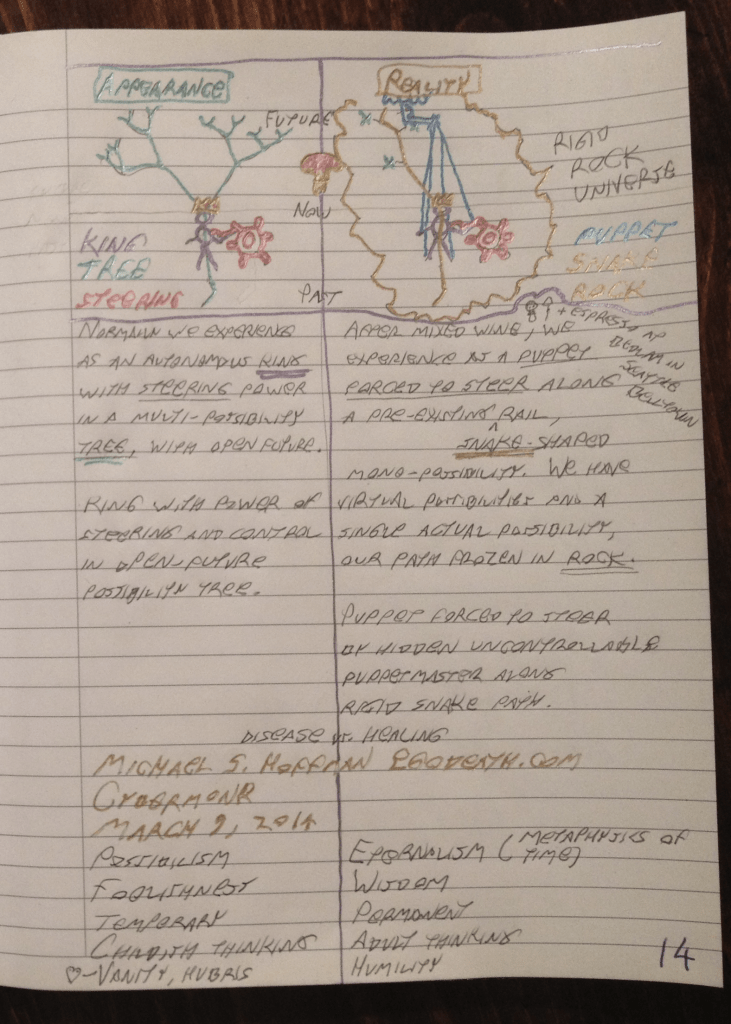
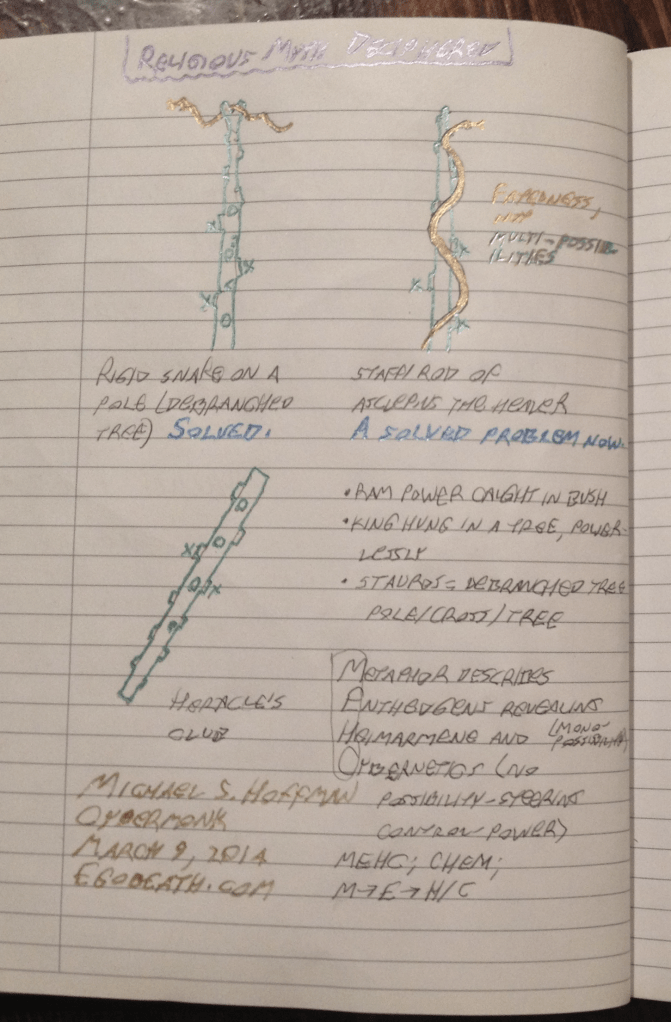
And then we have constraints which determine which elements of that set are allowed by the laws of nature.
And then some element of that set is going to be selected and made actual. So we have a sort of space of possibilities, the constraints narrow down the possibilities, and then one constraint is somehow selected.
I think there’s more work to be done here on understanding what the space of possibilities look like and how the space of possibilities is related to the constraints and to the properties that we see in our everyday lives.
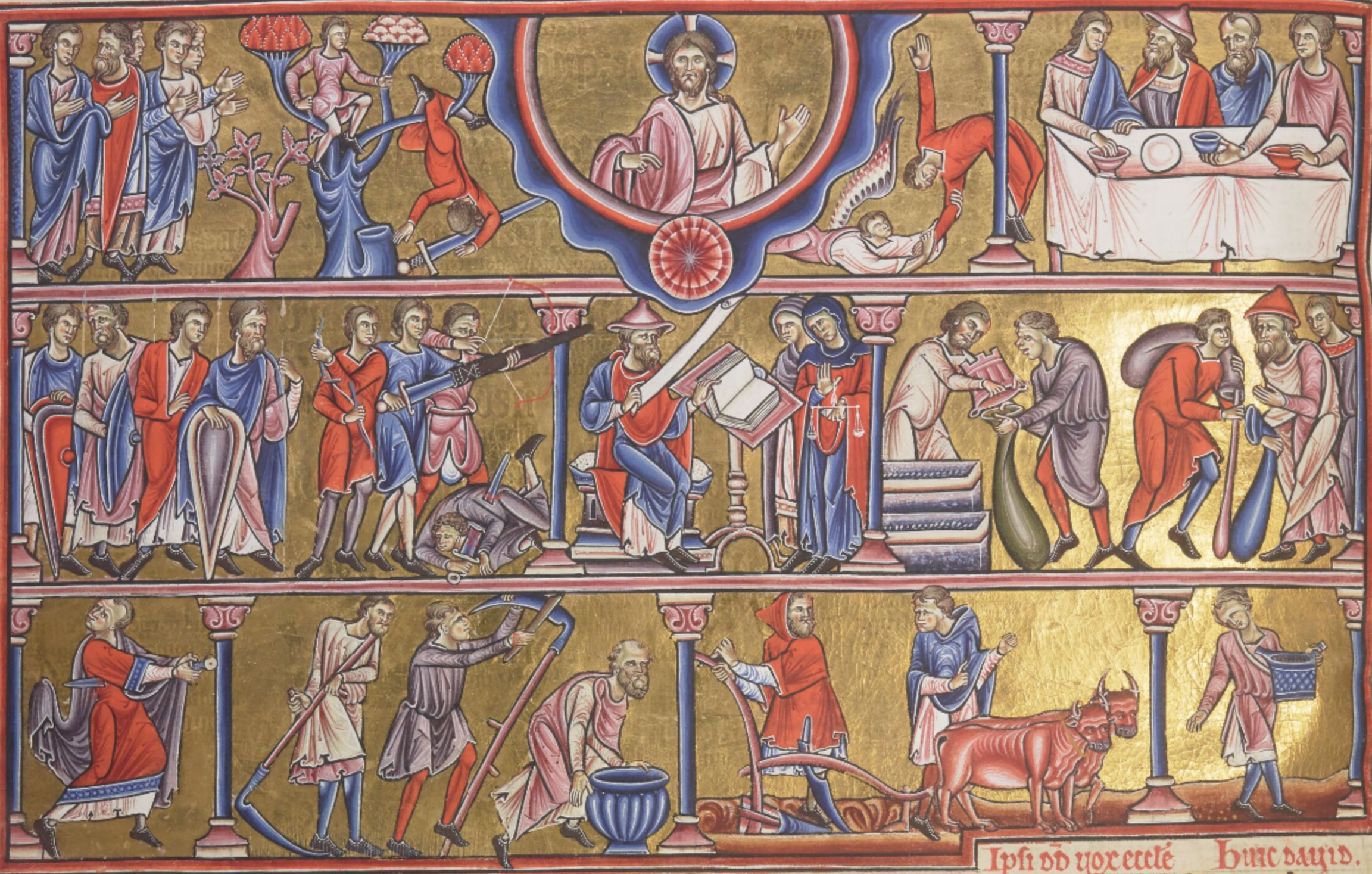
But that’s the general picture, that you have possibilities narrowed down and then one is going to be selected.
The Emergence of Space-Time
1:05:16 The Emergence of Space-Time
So spacetime would emerge from possibilities plus constraints?
Yeah, I think the story that we should tell about spacetime here is certainly still a work in progress.
In my previous work on the subject, I’ve just kind of taken spacetime as given and imagined, let’s select the constraints are just going to tell you how things are distributed across spacetime.
But certainly that I think can’t be the right final answer, because modern physics and particularly quantum gravity tells us that spacetime probably emerges from something more fundamental.
So I think ultimately that the right story is going to be more complex than that.
But exactly how to formulate that is not clear, partly because the quantum gravity itself is not fully formulated and there’s still a lot of open questions to be resolved there.
What would it be that selects the specific dimensionality and signature, like three plus one? [3 space dims, 1 time dim]
Yes, that’s a great question.
Ultimately, I think at least some aspects of the way spacetime is have got to come from consistency constraints.
So for example, using the process matrix formalism, for example, you can see that there’s going to be a need.
If you want to have consistency, there’s usually going to be a need for things to occur in some well-defined order.
And a well-defined order stops processes from looping back on themselves and producing contradictions.
So I think from those kinds of consistency constraints, you can get already the idea that there’s got to be some kind of something like a temporal dimension, which is different from the spatial dimensions.
I also think you can get the idea that it needs to have a sort of a relativistic spacetime structure from the observation that if you have superluminal signaling, for example, you can use that to create a loop which goes around and which could then also be used to create logical contradictions.
So consistency is also going to give you something like the light cone structure of spacetime.
I don’t know yet how to get exactly three dimensions out of that.
It would be great if there were a way to get that as a consistency condition as well. I’m not sure what that would look like, but certainly I think many aspects of spacetime structure can be understood in that sort of basic way as consistency conditions.
Do you imagine that you’ll be able to derive any of the fundamental constants from global laws?
Or is there still, let’s say alpha or g, or is there still going to be some residual contingency leaving room for why these structures?
Yeah, that’s a great question.
Strong Determinism
So Eddie Chen has written before about this idea called strong determinism, which is the idea that maybe the laws of nature are so strong that they actually dictate the whole course of history uniquely and there’s only one possibility.
April 10, 2022 image processing & crop by Cybermonk. full body.
That’s in some ways an old idea. Leibniz hoped for something like that as well.
It doesn’t seem obvious to me how to get there from the laws that we currently know.
And I’m skeptical that we could possibly know all of the constraints, even if they do exist, a set of constraints that strong.
But in principle, I think that it’s certainly possible that there are constraint-based laws that we perhaps haven’t arrived at yet and might be able to arrive at one day, which would give an explanation of some of those things.
Exploring Correlations in Physical Parameters
1:08:11 Exploring Correlations in Physical Parameters
Do you imagine there would be specific correlations between seemingly unrelated physical parameters?
Certainly,
it’s very, very possible. I mean, it’s a bit hard to speculate because we don’t have much of a sense of what that would look like.
But certainly, if we could give explanations for relationships between the values of things, that would be a very, I think, compelling piece of evidence that this way of thinking is right.
So it’s certainly something to look for.
Are you more interested in the philosophy of physics specifically or more broadly into the philosophy of science?
What about metaphysics?
What about ethics?
Yes, I do focus largely on the philosophy of physics because my training is in physics.
But I think many of the questions we are talking about in the philosophy of physics have really interesting implications for more general questions in the philosophy of science.
So these questions about the nature of lawhood, for example, and I think once you move to an all-at-once style account of laws, that’s going to have implications for a lot of other traditional philosophical questions about things like causation, explanation, determinism, and so on, free will.
So although my focus comes from physics, a lot of that expands more generally into philosophy of science and also metaphysics because these questions about lawhood, causation, explanation do also link to metaphysics.
Ethics, I’m very interested in ethics. I’ve never worked on it professionally, though.
Cool.
Advice for Young Upcoming Researchers in the Field of Physics and Philosophy
Do you have any advice for young upcoming researchers in the field of physics and philosophy?
I think my biggest piece of advice would be to work on the things that you love and are interested in. I think there can be a pressure to work on something that is currently one of the hot topics or that is getting lots of attention in the field at the time.
But ultimately, I think what’s most rewarding and what will be successful in the long run is for you to pursue the things that you care about and do the work that you’re interested in.
It might take a little bit longer to get attention, but I think it’s better to ultimately establish that program of things that you really care about rather than feeling you have to do research on a certain topic because it’s popular.
What’s some topic that’s underappreciated?
What’s some topic that’s underappreciated that you think should be more appreciated?
So I’ll give you an example of something that’s a hot topic right now, black holes, supermassive black holes and time travel or time dilation, etc.
And those are said ad nauseum in these popular science circles. So what’s something else that you think people should be paying more attention to?
Epistemology of the Measurement Problem
1:10:44 Epistemology of the Measurement Problem
I’m on a bit of a crusade to get people to pay more attention to the epistemology of the measurement problem.
I think when we talk about the measurement problem, it often gets framed in terms of ontology, in terms of we need to know what is really there and what is really happening.
Whereas for me, I think the measurement problem is really important precisely because it ties to questions about how could we possibly know the things we are supposed to know?
How can we make sense of the empirical confirmation associated with quantum mechanics?
And I think that a number of very popular interpretations of quantum mechanics have really big problems answering those kinds of questions.
So particularly the many worlds interpretation and the observer relative interpretations have really bad epistemic problems and I think do not do a good job of answering these epistemic issues.
So I really like to see our discussions of the measurement problem focus more on these questions of you’ve got to make the epistemology coherent and consistent within itself.
And I think that’s a good way of kind of narrowing down the possibilities and understanding what a viable solution looks like.
Can you repeat these epistemological questions that you think people or physicists or foundational physicists should be thinking about?
Yeah, I mean the fundamental question is that when we’re thinking about how to interpret quantum mechanics, it is I think essential that our interpretation tells a consistent story about how we could have come to know about the theory.
So for example, I think the many worlds interpretation has a real problem with this because the many worlds interpretation has difficulty giving meaning to assignations of probability to measurement outcomes.
And in particular, it seems hard in the many worlds context to justify the claim that you should expect to see high probability outcomes.
But if you can’t expect to see high probability outcomes, then you can’t use the outcomes you have observed to as evidence for the theory, because you have no idea whether the outcome is one that’s assigned a high or a low probability by the theory.
So you can’t like connect it back up to the structure of the theory you’re trying to find out about.
So I think that’s a very serious epistemic problem.
CJ:
Lessons in Patience and Persistence
1:13:26 Lessons in Patience and Persistence
What’s a lesson, Emily, that you wish you had learned earlier that if you could tell your younger self, it would be beneficial?
I think probably as many people would tell their younger selves, I would counsel patience that it takes this kind of thing.
Research definitely takes time and work and you will fail many times and many things will not go anywhere.
And I think you have to be persistent and hang on and have faith that in the long run, you’re going to come to interesting results.
And people will eventually come to be interested in what you’re doing. And it does come eventually.
It just takes time.
It doesn’t happen immediately.
CJ:
So was there a time, maybe a year, three years, four years where people weren’t interested in your work and that frustrated you or made you downcast?
Emily Adlam:
I think for some time I was worried that the kind of work I was doing was not going to be mainstream enough for me to be able to make a career in the field.
I actually left academia for a few years and worked outside of it because I was pessimistic about whether I could do the kind of work I wanted to do and be in the field.
But eventually some of the things I was doing, I did get positive feedback on and that I think was enough to encourage me to come back and keep working on this stuff.
And I don’t regret that.
I think that was the right decision.
But yeah, looking back, perhaps if I’d understood the need for patience, that could have been avoided.
CJ:
Tell me about that. So you left academia for a while and then were you still publishing while you were outside?
EA:
Yeah, I did. In my PhD, I mostly published on pure physics topics.
After finishing, I left academia but continued to think about particularly more philosophical topics and to publish and to write on those things.
And eventually I think I came to the realization that clearly this is what I should be doing professionally.
And so then sort of…
I wanted to switch from the more physics side into the more philosophy side.
How did you get back in?
Yeah, it wasn’t straightforward, especially because I was looking for philosophy positions and had physics qualifications.
But the people at the University of Western Ontario were very helpful and encouraging and found a way to bring me there and allow me to do a postdoc there.
That was a very, very productive time, really fantastic.
So that was my route back into the field.
Thank You
CJ:
Well, it’s fantastic speaking with you.
Thank you so much for spending your time with me.
Yeah, it was really fun.
Thank you.
Cheers.
Curt Jaimungal Resources
“I’ve received several messages, emails and comments from professors saying that they recommend Theories of Everything [videos series] to their students, and that’s fantastic.
If you’re a professor or lecturer and there’s a particular standout episode that your students can benefit from, please do share.
And as always, feel free to contact me.
Transcripts at Substack
New update! Started a Substack.
https://curtjaimungal.substack.com
Writings on there are currently about language and ill-defined concepts, as well as some other mathematical details. Much more being written there. This is content that isn’t anywhere else.
It’s not on Theories of Everything, it’s not on Patreon.
Also, full transcripts will be placed there at some point in the future.
Several people ask me,
Hey Curt, you’ve spoken to so many people in the fields of theoretical physics, philosophy and consciousness.
What are your thoughts?
While I remain impartial in interviews, this Substack is a way to peer into my present deliberations on these topics.
Also, thank you to our partner, The Economist.
I also found out last year that external links count plenty toward the [utoob] algorithm, which means that whenever you share on Twitter, say on Facebook or even on Reddit, etc., it shows YouTube, hey, people are talking about this content outside of YouTube, which in turn greatly aids the distribution on YouTube.”
TOE Podcast 🦶

“f177-toes.jpg” 58 KB 2:51 pm Dec. 7, 2024
“Thirdly, you should know this podcast is on iTunes, it’s on Spotify, it’s on all of the audio platforms.
All you have to do is type in Theories of Everything and you’ll find it.
Personally, I gain from re-watching lectures and podcasts. I also read in the comments that, hey, total listeners also gain from replaying. So how about instead you re-listen on those platforms like iTunes, Spotify, Google Podcasts, whichever podcast catcher you use.
And finally, if you’d like to support more conversations like this, more content like this, then do consider visiting patreon.com slash CURTJAIMUNGAL and donating with whatever you like.
There’s also PayPal, there’s also crypto, there’s also just joining on YouTube. Again, keep in mind, it’s support from the sponsors and you that allow me to work on TOE full-time. You also get early access to ad-free episodes, whether it’s audio or video.
It’s audio in the case of Patreon, video in the case of YouTube.
For instance, this episode that you’re listening to right now was released a few days earlier. [April 10, 2025 i think]
Every dollar helps far more than you think. Either way, your viewership is generosity enough. Thank you so much.”
/ end of transcript
God’s Playing of Dice Is Frozen into the 4D Spacetime Block Universe
The Wonders & Terrors of 4D-Spacetime Block-Universe Mysticism
angry at impossible requests, “we are too stupid to understand anything you write”. SOUNDS LIKE A *YOU* PROBLEM
Strong candidate for title for article for psychedelic church reader.
Supposedly no one knows what “block-universe” means; my solution is add the other term, 4D spacetime.
harrassed for providing something that pop ppl haven’t heard of:
the combination of not Quantum Mysticism , but
4D Spacetime Mysticism.
THESE ARE THE ACTUAL TERMS IN THE FIELD – deal with it!
- James studies: block-universe mysticism
- Minkowski studies: 4D Spacetime Mysticism
- combined:
- 4D spacetime block-universe mysticism
fsbum
better than the correct term eternalism – THIS IS BULLSHT:
IF I SAY “QUANTUM DETERMINISM MYSTICISM” NO ONE BATS AN EYE.
BUT I AM “WRONG” FOR WRITING “INCOMPREHENSIBLE GIBBERISH” when I use the fair, comparable, competing terms:
- eternalism
- 4D spacetime
- block-universe
else i’ll write:
The Wonders & Terrors of 4D-Spacetime Block-Universe Eternalism Mysticism
or going the other direction toward folk myth analogy wording:
The Wonders & Terrors of {snake frozen in rock} Mysticism
The Wonders & Terrors of Block-Universe Mysticism
The Wonders & Terrors of 4D Spacetime Mysticism
Maddening Frustrations and Insanely Unreasonable Demands for Titling a Theory Introduction Article
Would people say “keep it simple , dumb it down” had I written FAMILIAR junk jargon? eg:
The Wonders & Terrors of Quantum Mysticism & Experiencing Determinism
This is a bias against the new theory, in favor of the dominant old theory.
The old theory gets a pass, and the new theory is blocked: “I haven’t heard of it, therefore you are being too unclear.”
- “neuroplasticity” – I have heard of that, so, it’s good term’y.
- “fear of ego dissolution” – I have heard of that, so, it’s good term’y.
- “block-universe mysticism – I haven’t heard of that, so, it’s bad term’y.
This is letting the ignorant dictate what the teacher teachers.
I hear: “People are too ignorant to be informed.”
The student is not EXPECTED to understand the meaning of the title. Duh!
“Theory of Relativity? I don’t know what that means, therefore, you failed to name the theory well.”
Insanity! Ridiculous demands! IMPOSSIBLE TO MEET!
F*CK THIS SH*T.
I’M GOING TO WRITE THE ARTICLE (& TITLE) THAT MAKES SENSE TO Egodeath community, AND TO HELL WITH EVERYONE ELSE.
IMPOSSIBLE DEMANDS! UNREASONABLE!
Harvard Scientist: “There is No Quantum Multiverse” | Jacob Barandes [Part 3]
I got confident about decoding the {burning bush} mytheme while listening to “branch” in this video, while listening to Jacob Barandes talk about branches in
https://www.youtube.com/watch?v=wrUvtqr4wOs – around 2:20:00.
Click More to expand Description, click the Show Transcript button, Find “branch”.
Probabilities in Statistical Mechanics
1:59:0 Probabilities in Statistical Mechanics
Problems with Many Worlds Interpretation
2:11:30 Problems with Many Worlds Interpretation
…
2:25:00 —
Jacob Barandes:
“And the branches are not fundamental. The world’s not fundamental. They’re not fundamentally there. They’re just useful, convenient ways to describe the wave function. But now we have a problem.
2:25:34
If the branches are not fundamental, if they’re emergent, we can’t have a probability axiom that assigns them probabilities.
You see, the axioms, the fundamental axioms of your theory are supposed to refer to fundamental things.
If the branches are emergent, approximate things, not fundamental things, the axioms cannot say, oh, if at some point in the future we develop these emergent approximate branches, then by axiom they’ll be assigned probabilities.
If the branches are now not fundamental, but merely emergent, merely just convenient ways to describe what’s going on, then it’s very difficult to think about how you would make an axiom that they should be assigned probabilities.
If we’re not going to get the probabilities from the axioms, we now
have a fundamental problem.
And this is where so much of the work in Everettian quantum theory has happened, this problem of probabilities.
If the branches are emergent things, not fundamental, and we can’t assign them probabilities by fiat through the axioms, how do probabilities happen?
Now, I think the argument I would make here is that they don’t.
If you were compelled to believe in an outlandish metaphysical picture like the many worlds interpretation because you had to, because it was empirically unavoidable, like we look out into outer space and we see galaxies
many, many, many billions of light years away.
We see countless galaxies billions of light years away. That leads us to believe that there is a big universe out there.
We see clocks on airplanes move at slightly different rates, atomic clocks move at slightly different rates.
That’s hard to believe, but we can do the experiments and we see this repeated rigorously many times.
It’s not that we should never believe outlandish things, but as Carl Sagan said, extraordinary claims require extraordinary evidence.
The many worlds interpretation says that there is an uncountable profusion of universes that are coming out of every single moment, not even just measurements, but all the time.
That’s an outlandish statement, and sure, we could believe it if we were compelled to by either rigorous logical reasoning or by just unavoidable empirical results.
[like mushroom imagery in Christian art is an outlandish proposition, why would mushrooms be in Christian art? [insert Panofsky args, end of letter 2]]
But we’re just not.
When you’re formulating many worlds interpretation, you run into this problem of,
Challenges of Probability in Many Worlds
2:27:42 Challenges of Probability in Many Worlds
2:27:46
Jacob Barandes:
“well, I have the per basis problem.
I guess I can deal with that by letting the branches be emerged into decoherence, but then I can’t axiomatically assign probabilities anymore.
At that point, you just give up, because you’re no longer compelled through rigorous logic or empirical data that you have to believe in many worlds. Why are you still trying to chase it down?
That is, this extravagant outlandish metaphysical picture is no longer forced upon us logically or by experiment.
Why are we chasing it down?
Why are we starting with the assumption that they [many worlds branches] should be there, and we need to somehow gerrymander our axioms and principles and assumptions to get the many worlds picture to come out?
That’s the impression that I get when I see some of the work going on right now.
We’re not compelled to take many worlds on as a serious idea.
We can only get it off the ground by adding lots more stuff.
Why are we doing this?
Let me just describe a couple of the routes people have taken, and then we can quit, because that’s basically the end of it.
Tim Freke’s Emergent Evolutionary Spirituality, Frozen in Rock
Jacob Barandes:
One route is the route that David Wallace takes in his book, The Emergent Multiverse.”
“It is an excellent book.
You should list it on the YouTube channel, and I recommend everybody interested should read it.
David Wallace is a fantastic, brilliant philosopher and also trained in physics.
The book is a beautiful book. I recommend it to everybody who’s interested in quantum foundations.
In that book, he tries to solve this problem of probability.
How do we get probabilities assigned to these things?
By introducing a large number of additional assumptions.
I tell them, read it, and then just make a list of every extra assumption he has to make.
He assumes that we should have the same metaphysical relationship to many copies of ourselves as we would if there were only a unique individual we were to become.
That means you have to take kind of a stand on old questions like the metaphysical teleporter problem in metaphysics.
The theorem he uses requires invoking a notion of free will that requires taking a compatibilist stance,
[The kind of “compatibilism” in Egodeath theory affirms eternalism, and the experience of possibilism. – Michael Hoffman]
because in many worlds interpretation, there’s just a deterministically evolving universal wave function.”
Who Are the Agents?
Jacob Barandes:
“Yet, he has in his proof of the Born rule agents, which is already a dangerous idea.
Agents, we’re bringing back agents, making choices about which unitary operations they’re going to perform.
This is a crucial part of the proof.
He has a little footnote where he admits, yes, this does entail certain assumptions about free will, but free will is a big problem.
No one solved it.
That doesn’t make the case.
If you’re resting on an unsolved problem, it doesn’t make the case that what you’re doing is going to work.
He introduces a number of what he calls richness axioms and rationality axioms.
The rationality axioms are supposed to be general good practices of what it means to be a rational observer.
[tell Houot, cloaked with mantle of “rational science explorer”]
These were developed in a one-world kind of picture, and the assumption is that they also work in a many-worlds picture.
Basically, the way that one tries to proceed here is one says, what does it mean to be rational?
[Houot: it means alien contact with alien advanced machine elves on psychedelics while sailing a ship in a literal physical external world]
It means that you want to use the tools of decision theory, the formal, precise, probabilistic tools for making good decisions called decision theory.
People who use the tools of decision theory, who are rational, will end up assigning probabilities to branches according to the Born rule.
That’s roughly and very gross outline how this argument
is supposed to work.
John Norton, again, philosopher at University of Pittsburgh, raised
an objection to really any such approach to try to get probability out.
In a deductive argument, the conclusion cannot be any stronger than the premises.
If you’re trying to get probability to emerge as a conclusion, there must have been probability already in your premises.
In this proof of the Born rule, one is trying to get probability out, so there must be probability somewhere in the premises.
If you don’t assume probability somewhere in the premises, somewhere you must be doing something that is not legitimate.
You can see how this unfolds for this decision theoretic argument, which goes back to David Deutsch also.
There’s an earlier version of it in a 1999 paper by David Deutsch, this old quantum theory in decisions.
You can also link to that.
The argument is that if you obey the rules of being a rational observer and use decision theory, you’re going to end up assigning probabilities according to the Born rule.
But you can ask, why is that the definition of rationality?
I mean, in a many-worlds type universe, there are going to be observers who behave rationally according to the dictates of decision theory.
Some of those observers are going to be very successful over 10 years, and others are going to be very unsuccessful because in the many-worlds interpretation, everything will happen on some branch.
But there are also observers who do not obey the rules of decision theory.
There’s some very irrational observers who just choose not to follow any of the rules of decision theory, and there are going to be branches in which they’re going to be unsuccessful over 10 years, and there are going to be branches in which they’re successful over 10 years.
All those observers are just there.
And to say that, well, you should just be rational and obey decision theory by axiom does not solve the probability problem.
In a one-world picture where only one future actually happens, it seems to be the case that people who are rational and think very carefully about their decisions and use something like a decision-theoretic approach, in the long run, over 10 years, tend to make more money or healthier or live better lives, whatever it is that you want.
And that gives us reason to think, oh, these are good rational principles.
If people who follow these principles tend to do better, I see people who exercise and people who make good financial decisions and hedge their investments, they do better, I go, oh, well, there are good reasons, therefore, to do what they do and take on their principles.
But you can’t turn it around and say that we’re going to start with axiomatically, this is the way to be rational, and then go backward and show that that then entails this is how probability should work.
And that’s kind of the sort of reverse argument that’s taking place.
I should say that not all Everetians take this decision-theoretic view.
Simon Saunders, for example, tries to do probability in a more Boltzmannian, statistical mechanical way, by coarse-graining and actually counting in some sense, but it’s still in its embryonic form.
Yeah.
So, there are a lot of approaches to the many-worlds interpretation, and at present, none of them seem to find a way to get probability off the ground, and I don’t think that you can.
And to the extent that you can by just taking on more and more assumptions, you’re doing the thing where you’re adding on extra-empirical assumptions that can’t be verified in an experiment.
I mean, I don’t know how experimentally to test that I should have the right relationship to many copies of myself.
I mean, that’s an extra-empirical statement.
If you have to take many of those on in order to get the picture off the ground, I don’t know how credible it is.
How much credence should I give to a theoretical picture that relies
on a tower of SMHs, of speculative metaphysical hypotheses?
I feel like if you have to do all that work to get the theory off the ground, then it lowers your credence that we should take on such an outlandish idea that there are all these many worlds.
So that’s basically where I end up with the many-worlds approach, and this is one of the reasons why I think there’s room for another interpretation that’s much more conservative, that says, well, we do experiments, we see one outcome, maybe that’s because there is just one outcome.”
The Case for a New Interpretation [Possibilism Randomness Freewill Agency Power? Random Distribution Frozen in Rock?]
2:35:14 The Case for a New Interpretation
Jacob Barandes:
“And the experiments look probabilistic, maybe that’s because they are in fact probabilistic.
Nature is telling us it’s probabilistic, we should listen to nature, rather than saying, nope, nope, nope, gotta be deterministic, there’s a universal wave function evolving deterministically, it’s gotta be Markovian, you know, maybe we should just listen to nature and build a theory around what nature’s telling us.
That’s I think the conservative, non-outlandish approach that one should take.
Smooth Speech
CJ:
I wanna know, how is it that you got so great at being articulate and smooth with your speech?
Jacob Barandes:
“That’s a very, very kind thing to say, I really appreciate that, that’s really nice of you to say. I think we all have different strengths.
I’m bad at many, many, many things. There are a few things I’ve gotten good at through practice, there’s some things we’re all born kind of a little bit good at, we’ve got like embryonic things that we’re sort of good at, and then we hone those things.
I’ve taught many classes over many years here, I’ve interacted with such amazing students, brilliant, idealistic, just wonderful students who ask all kinds of great questions.
I just think it’s practice, you just talk a lot with people about very intricate topics, and over time it gets easier.
That’s the best answer I think I can give.”
Stag with Branching Antlers Caught Helplessly in Vines
Jacob Barandes:
“There’s an Aesop fable I like to bring up with people, it’s about a stag and its antlers.
There’s the stag who’s drinking from a pool and admiring his beautiful antlers, he thinks his antlers are so magnificent, so glorious.”
[king of the forest you could say]
Lucas Cranach “Eve Tempted by the Serpent” Adam and Eve 1533 “Adam und Eva”
two color versions of the Power of Myth image from my thx 2013 breakthrough
https://egodeaththeory.org/2023/02/18/eve-tempted-by-the-serpent-lucas-cranach-1530-painting/
aside: https://egodeaththeory.org/2023/02/18/hatsis-cancelled-his-book-the-sacred-mushroom-conspiracy/
https://egodeaththeory.org/2025/02/25/idea-development-page-25/#color-Cranach-Eve-Tempted-by-Serpent
“Lucas Cranach” “Adam und Eva”
good version: https://de.wikipedia.org/wiki/Adam_und_Eva_%28Cranach%29#/media/Datei:Image-Cranach_-_Adam_and_Eve_1533.jpg
found at page https://en.wikipedia.org/wiki/Adam_and_Eve_(Cranach)
showing “Eve Tempted by the Serpent” by Cranach, that shows: branching antlers, behind branching legs, behind holding a branch:


Jacob Barandes:
“He goes on and on, antlers are really the envy of the animal kingdom, then he looks at his legs and says, but my legs are bony and ugly, and if only my legs could be as remarkable as my antlers.
As the stag is pondering this, he suddenly becomes aware that a pack of wolves is chasing him, so he gets up and runs from the water, he’s trying to get away from the wolves, and he sees a forest, he’s gonna run into the forest to hide.
And as he runs into the forest, his [branching] antlers start getting tangled in all the [non-branching] vines, and before he knows it, he can’t run anymore, he’s stuck.”

Sacrifice of Isaac (Golden Psalter)

Isaac (Canterbury Psalter)

Sacrifice of Isaac (Van der Borch) – branches burning
instead of bush burning
Jacob Barandes:
“As the wolves approach him, he realizes that the thing that he was praising, his antlers, was his undoing, and the thing that he thought was his weakest feature, his legs, they were the things that would have saved him.
If it had just been his legs, his legs would have saved him.“
[especially Right foot, not Left]
So the reason I bring this up is, in addition to saying that I think we’re all good at a few things and maybe have difficulty with a lot of things, some of the things we think we’re bad at, seen in another way are the things we’re good at, and sometimes vice versa.
So I’m gonna say something that anyone who has known me growing up will laugh at, because it’s so obvious.
I came into this world profoundly lacking in common sense, okay?
Anyone who’s ever known me growing up would say that’s the most obvious statement I’ve ever made, okay?
Profoundly lacking in common sense.
And as I grew up, you know, you get made fun of, you make a lot of mistakes, you do a lot of silly things because you lack common sense, and you see it as kind of a weak feature, you see it as something you’re a little bit embarrassed about.
When you get into philosophy and foundations of science, philosophy of physics, what you see is a lot of people whose common sense takes them in directions they shouldn’t go.
You see a lot of people who make arguments or make speculations or make claims that just seem very commonsensical to them, and sometimes those are not really rigorously supported.
People can, their common sense can lead them into error.
Suddenly, lacking common sense becomes a huge advantage, because when I
read a philosophy paper or I listen to a seminar or I’m trying to formulate an argument, I don’t have the kind of common sense that makes the answers obvious to me.
So I see every argument, and I have to take it apart and really disassemble it and understand what all the pieces do, because I don’t have an intuition, a common sense for how things are supposed to work.
What this means is that to some extent, and obviously, I mean, we all make mistakes, I make errors too, but I feel like some of the errors I might have made if I had more common sense I’m less likely to make.
So a thing that I thought was my weakest feature, Stag’s legs, in a different context turned out to be really useful, like being on land and having only flippers for your arms and legs.
And then one day, you discover the ocean, and suddenly, what you thought was your weakest feature becomes now your greatest asset.
So that’s a general lesson I think that everyone needs to take to heart.
Many of the things we think are maybe our weak features can, in a different way, actually be a strength.
So if you’re the kind of person who has a lot of trouble paying attention to things but gets super hyper-focused on some things, and you think that’s a problem, well, it could be a problem in some contexts, but in other situations, it could be a superpower.
And we see this all the time with lots of things that people may feel embarrassed about. And now you’re speaking to researchers and potential researchers, people who are younger students, even people who are older students’ perspective, there are some people who are 70 and getting their PhD and watch this.
Yeah.
So what is a method that they can use to help figure out or distinguish between what is an actual good feature versus an actual bad feature that they thought was good?”
– Jacob Barandes / Curl Jaimungal
No One at the Bridge (Rush, 1975)
No One at the Bridge (Rush, 1975)
channel: Wraxtiorre’s Mess
https://www.youtube.com/watch?v=70BgSKTBh9s —
https://www.rush.com/songs/the-fountain-of-lamneth/
Lyrics by Neil Peart:
III. No One At the Bridge
Crying back to consciousness
The coldness grips my skin
The sky is pitching violently
Drawn by shrieking winds
Seaspray blurs my vision
Waves roll by so fast
Save my ship of freedom
I’m lashed helpless to the mast
Call out for direction
And there’s no one there to steer
Shout out for salvation
But there’s no one there to hear
Cry out supplication
For the maelstrom is near
Scream out desperation
But no one cares to hear
Remembering when first I held
The wheel in my own hands
I took the helm so eagerly
And sailed for distant lands

But now the sea’s too heavy
And I just don’t understand
Why must my crew desert me
When I need a guiding hand
— Rush
S.A.T.O. (e.g. Sailing the Acid Trip Ocean) (Ozzy Osbourne, 1981)
https://www.youtube.com/watch?v=qGoQ6AZYfMc —
https://www.google.com/search?q=s.a.t.o.+lyrics
http://egodeath.com/sablyrics.htm#xtocid229130 — Egodeath interpretation
Sailing the Acid-Trip Ocean
Lyrics by Bob Daisley —


See Also
- Psychedelic 4D-Spacetime Block-Universe Mysticism
- The Dilemma of Determinism (James, 1897) Is Against Eternalism, Not Causal-Chain Determinism (Minkowski = 1907-1908; 10 years after James’ article)
- The Illusion of Will, Self, and Time: William James’ Reluctant Guide to Enlightenment (Bricklin) = Eternalism

 The Egodeath theory

#/media/File:Lucas_Cranach_d.%C3%84._-_Adam_und_Eva_(Gem%C3%A4ldepaar),_Art_Institute_of_Chicago.jpg)