Michael Hoffman, page started 8:28 am, Sunday, August 17, 2025
Contents:
links work on desktop Edge/Chrome:
- Psychedelic Injustice: How Identity Politics Poisons the Psychedelic Renaissance (Thomas Hatsis, June 16, 2025)
- My Review of Thomas Hatsis’ book Psychedelic Injustice: How Identity Politics Poisons the Psychedelic Renaissance
- Book Review Draft
- Chacruna Is Correct and Hatsis Is Wrong, re: mushroom imagery in Christian art
- Per Hatsis, no sacred mushroom conspiracy, but full-fledged entheogen history including Psilocybin, in Europe
- Disentangling 3 Different Positions in Dispute
- The False Use of “So-Called” to Present One’s Own Assertion While Pretending It’s from Someone Else (straw man cover tactic)
- Hatsis Tilting at His Own “Sacred Mushroom Conspiracy” Windmill
- No Index; Misused Words on Every Page; Gap in Clarity and Citations while Fulminating about Stunning Naivete – by the Model Psychedelic Historian/ Scholar
- What His Book Will Be But Ought to Be
- Blustering About “His” Scholarly “Turf”, while Providing No Scholarly Content, Just an Alleged Summary of the Wrong Position, and Vaguely Claiming that Unidentified Authorities Don’t “Buy It”
- Chacruna 1, Hatsis 0
- Hatsis re: Bennett
- Hatsis’ Annoying Perpetuation/ Reification of the ‘Racism’ Framing
- Motivation for this Page
- Subheadings in Each Chapter
- The Two Main Contradictions in the Book
- See Also
todo
todo: copy or move the remaining Hatsis sections from idea development page 30:
https://egodeaththeory.org/2025/06/11/idea-development-page-30/ – Find Hatsis; copy all “hatsis” sections to present page
status: copied latest sections from idea development page 30, many more to copy to here
current feeling: I recomm this important, needed book. eg to Travis Kitchens. I feel that entheogen scholarship can skip Hatsis book on L in 50s
The Wonder Child. https://www.amazon.com/LSD-Wonder-Child-Psychedelic-Research/dp/1644112566/
Psychedelic Injustice: How Identity Politics Poisons the Psychedelic Renaissance (Thomas Hatsis, June 16, 2025)
Psychedelic Injustice: How Identity Politics Poisons the Psychedelic Renaissance
https://www.amazon.com/dp/1634312783 —
June 13 2025: I pre-ordered Hatsis’ book due June 16, 2025.
Composed & posted review at 11:49 p.m. August 19, 2025.
My Review of Thomas Hatsis’ book Psychedelic Injustice: How Identity Politics Poisons the Psychedelic Renaissance
https://www.amazon.com/gp/customer-reviews/R2SAVVNCJPM16A/
Michael Hoffman
⭐️ ⭐️ ⭐️ ⭐️ ⭐️ 5 of 5 stars
A Timely, Needed Corrective in the Field of Entheogen Scholarship
August 20, 2025
Thomas Hatsis’ book Psychedelic Injustice: How Identity Politics Poisons the Psychedelic Renaissance is highly readable. This topic is timely, difficult, and important. I appreciate this helpful collection of research and corrective pushback.
Much needed; others aren’t providing this research and corrective pushback (except Irvin’s book God’s Flesh regarding the “lofty Indigenous spiritual tradition of psychedelics” claim).
Debunks the “Indigenous own psychedelics” propaganda, and establishes that Europe has a fully developed psychedelics history, including psilocybin.
Uses footnotes, not endnotes that are designed to be impossible to find.
Some Cons:
Hatsis continues to use center-left language, at the same time as rebutting far-left language (despite claiming to be moderate). Instead of using the word ‘racism’ (along with ‘bigotry’ and ‘prejudiced’), he should say who invented that term, when, and why; and analyze related concepts such as ‘in-group preference’.
Hatsis claims that European history includes the fully developed use of psychedelics, such as psilocybin, yet claims that there’s no mushroom imagery in Christian art (and conflates the latter with his outdated, 1970 idea that he calls “the sacred mushroom conspiracy theory”).
Until Hatsis catches up to the entheogen scholarship field that he writes is “my turf” (p. 259), the pushers of the “Indigenous own psychedelics” propaganda win, and Europeans must grovellingly beg for permission from Indigenous to use psychedelics, which the Indigenous fully own, because Hatsis claims there’s no mushroom imagery in Christian art, and thus forfeits that growing base of evidence, such as Eadwine’s images in the Great Canterbury Psalter.
Hatsis conflates John Allegro’s obsolete, 1970 “secret Amanita” paradigm — unfortunately, that is indeed Hatsis’ turf — with the up-to-date, non-secret, psilocybin-dominant topic of mushroom imagery in Christian art; catch up with Giorgio Samorini’s seminal 1998 article, “Mushroom-Trees” in Christian Art. Hatsis should help popular readers move from Allegro’s inferior, narrow, 55 years out-of-date model, to Samorini’s superior, broad model.
Hatsis doesn’t cite Jan Irvin’s book God’s Flesh, 2022, which already exposed the “Indigenous own psychedelics” propaganda, even though Hatsis and Irvin worked together around 2010.
Hatsis makes strong, aggressive claims about being expert regarding mushroom imagery in Christian art (pp. 259-260), yet provides no scholarly content there: no citations, no writer names, no quotes. Hatsis’ chronic bad habit, including in his 2018 book Psychedelic Mystery Traditions, is to only provide amateurish statements bragging about how great his historiographical methodology is, in place of actually delivering scholarship; that is, sound arguments that stand up to critique; citations; quotes; and writer names.
Without providing any Bibliography entry, footnote citation, or quote, Hatsis fulminates against Osiris Romero, editor at Chacruna Institute, for allegedly endorsing a theory of mushroom imagery in Christian art. But Hatsis neglects to specify whether Romero endorsed the up-to-date, broad, general theory of mushroom imagery in Christian art, or just Allegro’s 1970, narrow, superseded theory of a secret Christian Amanita cult, which Hatsis is fixated on and forcefully projects onto everyone else, per his September 2, 2015 blog post, “Reading Allegro Again”:
“I am again struck by the brilliance, clever writing, and sheer magnitude of the subject, which Allegro so eloquently displays. I believed every word, every aspect of the theory. The Sacred Mushroom is one of my favorite books. Top 10, easily.”
Allegro’s book has been completely superseded and has become irrelevant for the current field of entheogen scholarship, since Samorini’s seminal 1998 article that made good on Erwin Panofsky’s 1952 announcement to Gordon Wasson that:
“The Plaincourault fresco is only one example of a conventionalized tree type, prevalent in Romanesque and Early Gothic art, which art historians actually refer to as “mushroom tree” in Roman and Early Christian painting, and there are hundreds of instances exemplifying this development.”
For Hatsis to claim that Europe’s history has a fully developed use of psychedelics including psilocybin, he needs to include, not omit (as part of his outdated Allegro fixation), the medieval art genre of mushroom-trees and the related body of mushroom imagery.
No Index.
I recommend Hatsis’ Psychedelic Injustice book for entheogen scholars and followers of psychedelic science and the Psychedelic Renaissance[TM]. This book is timely, as the field is undergoing needed internal correction. Due to the difficult nature of this area, a strong 5 of 5 stars; commendable scholarly and analytical work; a major contribution to the field.
— Michael Hoffman, the theorist of ego death, and myth & art as analogies describing transformative psychedelic experience
Book Review Draft
[9:30 p.m. August 19, 2025]
goal/design:
- 5 stars
- extremely short as possible
- form: Pros & Cons.
Says “so-called the sacred mushroom conspiracy theory”, doesn’t say who calls the theory that: answer: Hatsis is literally the only one calling the theory of mushroom imagery in Christian art, far too narrowly and outdated way back in 1970, by that name: it’s the title of Hatsis’ own over-narrow book draft, but the world certainly doesn’t need a book scoped to Hatsis’ outdated rebuttal of a 1970 Allegro-specific theory; his book needs to instead be far broader and up-to-date with Samorini 1998: 2nd-generation entheogen scholarship (the Explicit Psilocybin paradigm); ie, the general entire broad theory of mushroom imagery in Christian art – nothing “secret” or “suppressed” about it, as Letcher already proved in 2006 book Shroom by considering Bernward Door. Stop reducing the overall theory to a narrow straw man of Hatsis’ own construction based on very outdated Allegro 1970.
Claims that the narrow Allegro Secret Christian Amanita Cult is same thing as the general entheogen theory of religion/ mushroom imagery in Christian art – proving that this is not, as he claims, “my turf”. Very outmoded 1970-era 1st-generation entheogen scholarship (the Secret Amanita paradigm); needs to catch up to Samorini 1998 2nd-generation entheogen scholarship (the Explicit Psilocybin paradigm).
Fails to deliver any scholarship. what a scholoar ). Hatsis is badly behind the state of the field, and needs to reset and broaden to consider the entire broad topic of general, mushroom imagery in Christian art.
Current vs. the sacred mushroom conspiracy theory
Secret/superessed Christian Amanita Cult / the Secret Amanita paradigm , his term
, while claiming this is “my turf” (and giving no evidence that it’s his turf: no citations, quotes, or writer names — delivers no scholarship.
Hatsis’ expose of the “Indigenous own psychedelics” propaganda partly repeats Irvin’s expose 3 years earlier. Hatsis worked closely with Jan Irvin around 2010 and is presumably aware of Jan Irvin’s work.
Claims to be “my turf” and a good historian, yet fails to give any writer names, quotes, or citations to back up his strong claims re:
He writes: p. 260: “the so-called the sacred mushroom conspiracy theory” but gives no writer names, citations, or quotes, which a proper scholar would do.
the sacred mushroom conspiracy theory
smct
https://egodeaththeory.org/2020/12/16/book-review-the-sacred-mushroom-conspiracy-hatsis/
+1.5 stars for tough subject matter research
-1 star for bullshit about Secret Christian Amanita Cult – not the focus of the book but relevant, contradiction: EUROPE HAS RICH PSYCHEDELIC HISTORY INCLUDING Psilocybin YET “NO mushroom imagery in Christian art” = “DEBUNKED Secret Christian Amanita Cult” (conflates like a mo-fo).
-1.5 stars for leftist way of writing and arguing; contradition: “I am rejecting far left narrative/writing” — “so here is center-left Progressive narrative/writing instead.”
I am not criticizing that he is left; I am criticizing that he’s contradicting himself.
If he convinces the reader to dislike the far left narrative and way of talking, then the reader will dislike Hatsis’ own moderate left way of writing too – his use of ‘racism’ without (from what I have read so far) –> todo: what Hatsis shoulld do in hypothetical 2nd ed. HATSIS SHOULD DROP THE LEFT LANG , SHOULD
- ANALYZE WHO INVENTED TERM ‘RACISM’ WHEN/ WHY AND
- ANALYZE IN-GROUP PREF
- ANALYSE FREEDOM OF ASSOCIATION
- STOP USING LEFT LANG THAT CLASHES WITH RIGHT THINKING – HE THINKS HE IS MODERATE, HE’S ACTUALLY MODERATE-LEFT IN WRITING/THINKING STYLE.
total: 5 stars
Chacruna Is Correct and Hatsis Is Wrong, re: mushroom imagery in Christian art
We do not know wheteher Romero at Chacruna p. 260 “endorsed” which theory:
- Secret Christian Amanita Cult
existing keyboard shortcut :
Secret Christian Amanita Cult
scac
need keyboard shortcut for hats’ stram man term:
the sacred mushroom conspiracy theory
smct
Whic theory
Which theory does Romero (in “stunning naivete”) “endorse”?
- [narrow:] the sacred mushroom conspiracy theory
- [broad:] mushroom imagery in Christian art
Christian = Christendom; almost need keyboard shortcut:
mushroom imagery in Christendom art, to include bestiary (OTOH, that besti. opens w/ religious art, disproving Hats’ claim that a bestiary is “secular. So, no mushroom.”
Issue in a review: How much to discuss Hatsis work outside this book?
- his deleted 5-6 articles (“my turf”, he claims, w/ no citation or clarif.)
- his other books – 2018 book & Oint, & 1950s L)
- his planned book The Sacred Mushroom Conspiracy
- his livestream interviews, panels, videos,
- his article against Brown at Hancock site
- pers. comm.
Per Hatsis, no sacred mushroom conspiracy, but full-fledged entheogen history including Psilocybin, in Europe
2nd-generation entheogen scholarship (the Explicit Psilocybin paradigm) fits and fulfills both of Hatsis’ assertions.
There was no secret Christian Amanita cult that originated in the Ural mountains and then spread from there around the world, and is the origin of all religions.
There was a fully developed entheogen history including Psilocybin, in Europe.
Now Hatsis is trying to insist, in order to push back against extreme Indigenous dogma, that there was a fully developed entheogen history including Psilocybin, in Europe – except for in Christian art, and you have “stunning naïveté” if you think there’s mushroom imagery in Christian art.
But there was a fully developed entheogen history including Psilocybin, in Europe — against pushers of dogmatic Indigenous narrative.
But certainly not in Christian art! OMG how could you be so ignorant of the authorities!
“If you say there are mushroom imagery in Christian art, you are asserting the sacred mushroom conspiracy theory, which has been debunked by countless authorities.”
Errors in the above paragraph’s argumentation:
- They are two different theories: mushroom imagery in Christian art (per Samorini, Michael Hoffman, or Brown); vs. the sacred mushroom conspiracy theory (whether defined or fabricated by Wasson, Allegro, Ruck, Letcher, Hatsis, or Pop Cult reception).
- Neither theory was addressed by any authorities; there are no citations available, and those authorities don’t even think about trees and mushrooms.
- Per Gordon Wasson (SOMA p. 180), art historians don’t think about mushrooms.
- Per Ronald Huggins (Foraging Wrong, 2024), art historians don’t think about tree images. Yet we are to bow in submission to “No legitimate, reputable authority buys it”, per Hatsis, else we have “stunning naïveté”.
Hatsis carries himself with the pride of one who has published a sound, scholarly book debunking mushrooms in Christian history. But he hasn’t; no one has.
And, Hatsis’ new book is concerned to emphasize, against Indigenous dogma, that Europe has a fully developed entheogen history including Psilocybin, Amanita, scopolamine, opium, and cannabis.
But you’re ignorant if you think there is mushroom imagery in Christian art — which is the same thing as the sacred mushroom conspiracy theory.
WHAT EXACTLY ARE YOU ARGUING AGAINST, AND WHO; AND WHAT ARE YOU NOW ASSERTING WAS the presence of Psilocybin in Europe?
Slip-n-slide, motte-and-bailey, he wants it both ways.
Disentangling 3 Different Positions in Dispute
- Narrow: Whether there was a sacred mushroom conspiracy. Allegro, Ruck, & Irvin 2006 say Yes. I, Irvin 2008, & Hatsis say No.
- Broad: Whether there is mushroom imagery in Christian art. Hatsis says No. I say Yes.
- Broad: Whether there was fully developed entheogen use in Europe, including Psilocybin, Amanita, scopalamine, opium, & cannabis. Hatsis 2018 says No. I & Hatsis 2025 say Yes. (Hatsis: “Except, no mushrooms in Christian art”.)
Available attack vector against Hatsis’ book: GIVEN no mushroom imagery in Christian art, THIS DISPROVES HATSIS’ BOOK WHICH CLAIMS fully developed entheogen use in Europe. Therefore, against Hatsis, INDIGENOUS OWN Psilocybin, AND EUROPE LACKS Psilocybin.
Hatsis, if you want to push back against Indigenous dogma and say Europe has fully developed Psilocybin use, then you strategically must affirm mushroom imagery in Christian art, even though no Secret Christian Amanita Cult.
YOU MUST DETACH & DIFFERENTIATE “sacred mushroom conspiracy” vs. mushroom imagery in Christian art.
Stop conflating the two different theories – narrow & broad.
Leave your 1970 endless 8-track tape loop behind, and switch to 2nd-generation entheogen scholarship (the Explicit Psilocybin paradigm).
Hatsis explicitly conflates on p 260:
- Whether there was a sacred mushroom conspiracy; Secret Christian Amanita Cult.
- Whether there is mushroom imagery in Christian art.
He says No to both.
As if the only possible way for there to be mushroom imagery in Christian art is if there was a sacred mushroom conspiracy; Secret Christian Amanita Cult.
Yet his book emphasizes vehemently that there was fully developed entheogen use in Europe, including Psilocybin, Amanita, scopalamine, opium, & cannabis.
Non-secret Psilocybin – or Amanita – is a way for there to be mushroom imagery in Christian art.
Deniers of mushroom imagery in Christian art all sound the same, pushing bogus propaganda and logical fallacies.
Hatsis sounds just like Wasson’s propaganda and jarring inconsistency.
Most people are literally unable to believe Wasson’s contradiction, and they say he changed his view – because he can’t be so wildly inconsistent.
In the propaganda communications of Agent Wasson with “the public”, Wasson did pretend to be wildly contradictory and incoherent that way.
Wasson’s propaganda was kettle-logic and contradictory – even if, as people want, his actually held views were consistent.
OBVIOUSLY mushroom-trees mean mushroom; Plaincourault fresco means Amanita.
It would be idiotic to deny the close resemblance, on the features/ elements level (not on the scale of the entire mushroom-tree image, as the pretend-dolt Ronald Huggins argues).
The obvious contradiction that we are expected to accept is an insult to intelligence, like the president saying “Elect me because we must release the crucial documents” and then saying “The documents never existed; and you are stupid if you thought they did; and the documents are unimportant and completely low-priority.”
- With Hatsis’ planned book The Sacred Mushroom Conspiracy in mind, in Psychedelic Injustice, he dirty-nukes, scorched-earth, the ultra-specific theory that he calls “the sacred mushroom conspiracy theory” (sounding as if he removed psychoactive mushrooms from Europe history).
- Yet in Psychedelic Injustice, he strongly asserts that Europe has a full-fledged entheogen history including Psilocybin, Amanita, opium, scopolamine, and cannabis.
re: Broad theory:
Turtle Hatsis in 2020 announced his forthcoming 2022 book The Sacred Mushroom Conspiracy that would disprove mushrooms in Euro history.
But Hatsis’ 2025 book Psychedelic Injustice asserts (against over-pushing of Indigenous), mushrooms in Euro history:
“French doctor Jean de Nynauld (c. 1550-c. 1650) demonstrates that by the Renaissance era, magicians and witches were well-acquainted with psychedelic mushrooms. He even differentiates between the famous, red-topped white spotted Amanita muscaria (or “sleepy mushroom”) and the psilocybe (or “maddening mushroom”).”
— p. 99, Thomas Hatsis, Psychedelic Injustice
re: Narrow theory:
re: 259-260 “my turf … the so-called sacred mushroom conspiracy theory”:
Trusty ol’ Hatsis, provides blustery assertions, instead of any scholarly substantiation of specificity.
I guess we can look forward to his thorough book after all, The Sacred Mushroom Conspiracy.
With quotes, and citations, and names of writers who assert specific variant theories, and names of writers who rebut specific theories. Because none of that is in this page (259-260).
Better title: The Sacred Mushroom Conspiracy Straw Man
Hatsis thinks that since he self-identifies as a model psychedelic historian with impressive, sound historiographical methodology, and presents this specific theory as “my turf”, he can just bluster and name-call and argue from authority, without backing anything up with any names, citations, or quotes.
The False Use of “So-Called” to Present One’s Own Assertion While Pretending It’s from Someone Else (straw man cover tactic)
When Ruck and Hatsis do this, they never specify who is calling the thing – that’s a giveaway that the author himself is covertly the one putting forth the assertion.
We are to believe that the thing put forth is a so-called thing, yet without any person doing the calling (except the person rebutting the position).
That’s a sign of a straw man argument, and is poor, vague scholarship lacking citations, author names, and quotes.
It’s all hazy assertion, thus the opposite of scholarship.
WHO EXACTLY ARE YOU REBUTTING?
Alas that question hovers over the field; all too typical – of Ruck, Letcher, & Hatsis.
Citations, where it’s not specified who is being rebutted:
- Ruck 2001 & 2002: In Entheos 1, 2, & 3, Ruck’s article (or Notes) contains the “so-called” construction used without saying who has called the thing that.
- Letcher 2006:p. 35, giving endnote 31: “Various writers have suggested cult, secretly, oppression, hidden, secret cult, surreptitiously slipped in”. (Falsely citing Stamets & Gartz, who wrote nothing about secret or not.)
- Hatsis 2025 p. 260: “so-called sacred mushroom conspiracy theory”. Who calls it that? Answer: Literally only HATSIS HIMSELF, in the title of his non-existent, planned book, The Sacred Mushroom Conspiracy Theory.
No one but Hatsis ever said “the sacred mushroom conspiracy theory”.
That theory-specifier is Hatsis’ construction, his straw man, and he should own it, not disown & distance it from himself by the preface “so-called”.
Ruck & Hatsis use that deceptive turn of phrase and thereby fail to produce sound scholarship, instead painting a hazy, impressionistic story without names, citations, or quotes.
My “Sacred Mushroom Conspiracy Theory” Straw Man (Hatsis, Forthcoming)
Both Ruck (in Entheos 1, 2, & 3) and Hatsis employ and mis-use the phrase “so-called”, in order to present THEIR OWN assertion, and pretend that someone else (unnamed) made the assertion.
Pope Ruck, you write “so-called heretical mushroom”, but the only one I see calling mushrooms “heretical” is YOU!
Hatsis, you write “so-called sacred mushroom conspiracy theory”, but the only one I see presenting this specific theory is YOU!
Hatsis Tilting at His Own “Sacred Mushroom Conspiracy” Windmill
p. 259 & 260, Psychedelic Injustice, Thomas Hatsis, 2025:
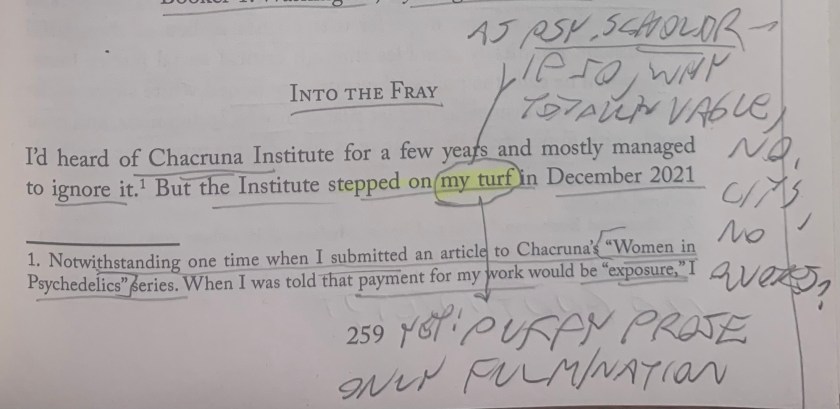
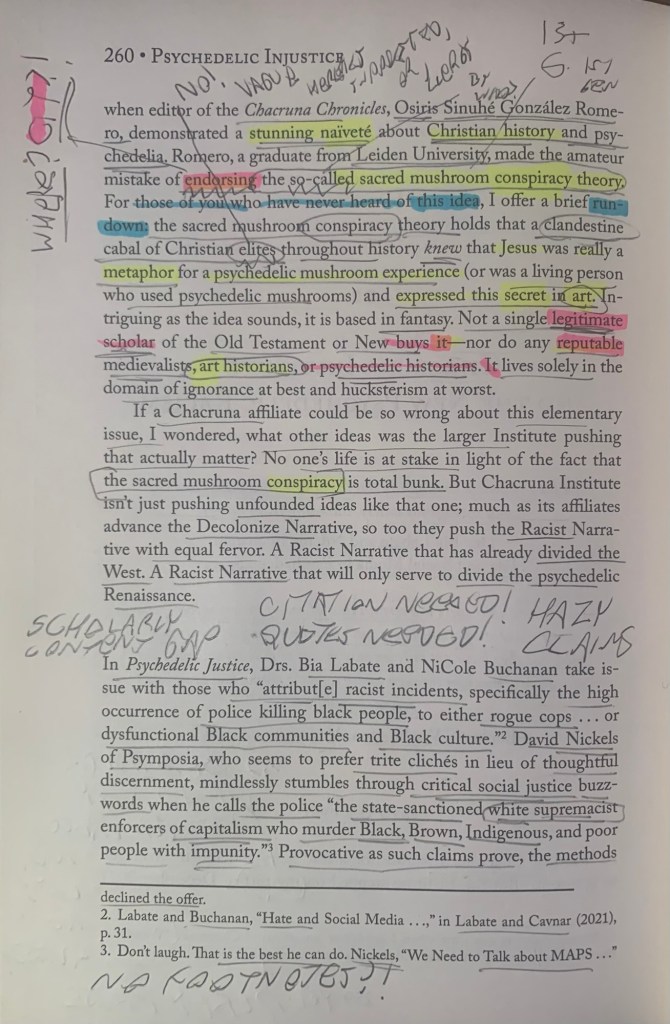
Hand notes p. 259:
- As psychedelic scholar — if so, why totally vague; no citations; no quotes?
- my turf –> if so, why totally vague; no citations; no quotes?
- my turf –> Yet: puffy prose; only fulmination
Hand notes p. 260:
- Romero endorsing –> Where? Citation?!
- clandestine cabal of elites –> No! Vague
- suppressed heretics? or, clergy?
- so-called –> by who?
- so-called sacred mushroom conspiracy theory –> 1st-gen enth. scholarship
- Scholarly content gap
- Citation needed!
- Quotes needed!
- Hazy claims
- No footnotes?!
- “No legitimate, reputable scholar” = arg. from authority
- 1st-generation entheogen scholarship (the Secret Amanita paradigm) = sh!tty vague scholarship; met by:
- Debunkers of 1st-gen entheogen scholarship = sh!tty job of debunking.
Clear that all away, both of those Affirmers & Deniers, for: - 2nd-generation entheogen scholarship (the Explicit Psilocybin paradigm)
Wasson’s hallmark insult: “blundering, unaware, ignorant”
Hatsis’ insult: “stunning naïveté”
Deniers (of mushroom imagery in Christian art) all write in a similar mode, pulling the same moves and style of arg’n. With a grand crescendo of, argument from authority.
“No credible, competent, legitimate, reputable, scholar …”
Don’t just give me a list of names of authorities; give me a list of substantive arguments. He gives neither.
Hatsis can’t be bothered even with that, though.
No citations given.
No names given.
No scholarly content is given, as far as clarifying or substantiating Hatsis’ blustery claims.
I am not criticizing attempted summarization; rather, vagueness, and lack of backing up anything to enable scholarly checking of his claims.
A scholar must summarize, which Hatsis does; but a scholar must also specify and cite the theory in dispute, and the writings which critique that theory.
Otherwise, shut up about “my turf” as a “psychedelic scholar/ psychedelic historian”, and stop fulminating:
“OMG that person is SO DUMB, what stunning naïveté! This theory that I attribute to them and that I present has been so debunked, not one authority buys it!”
Hatsis thus leaves it wide open for a straw man presentation, by providing no specifics, no way to check anything, EVERYTHING is to be taken on trust, including what position Romero “endorsed”.
Hatsis must be credible, because he lectures about “no credible scholar”, and this is his turf (we know because he says so) as a psychedelic historian (we know because he self-identifies as that orientation).
Hatsis makes one good distinction to acknowledge that there are actually multiple variant theories to be presented and critiqued with quotes and citations:
- Jesus = metaphor for mushroom
- Jesus = user of mushroom
which Heinrich in Strange Fruit horribly botched, saying that Allegro said that Jesus was leader of a mushroom cult.
Hey Hatsis, when you write that “the” theory is EITHER Jesus = metaphor for mushroom OR Jesus = user of mushroom —
which writers assert which theory?
which writers rebut those two different theories?
Are there other variant theories, as well, such as not secret/suppressed?
Do you mean Psilocybin, or Amanita?
Who asserts Psilocybin, who asserts Amanita?
No Index; Misused Words on Every Page; Gap in Clarity and Citations while Fulminating about Stunning Naivete – by the Model Psychedelic Historian/ Scholar
Remember, now: there is no Index in this excellent model work of psychedelic scholarship, which has two typos, ie misused words and garbled grammar (or stop-in-your-tracks, strange wording flow), on every page.
Specifically because of those type of typos (ie wrong word-choice; misused words), his book reads like a somewhat amateur production, by someone who mistakenly THINKS they don’t need a professional editor.
What His Book Will Be But Ought to Be
Hatsis’ The Sacred Mushroom Conspiracy Theory book is going to be an exercise in motte-and-bailey fallacy; making broad claims, and yet treating only narrow elements.
That book ought to be a neutral, broad treatment of all variants of the broad theory, and all evidence, and steel-man the Affirmers; a two-way, interactive engagement with all the arguments and theories, not just a one-way firehose of off-the-wall, bizarre vectors of arg’n.
He should not only narrowly consider his imagined, specific, stupidest-version-he-can-think-of theory, designed to be easy to debunk, and then claim he has given a critical presentation of 2025 entheogen scholarship re: Psilocybin & Amanita in Christian / European history.
Blustering About “His” Scholarly “Turf”, while Providing No Scholarly Content, Just an Alleged Summary of the Wrong Position, and Vaguely Claiming that Unidentified Authorities Don’t “Buy It”
If it is “his turf”, why does he provide ZERO citations of his writings on this topic? He can’t cite his 2018 book, because that only contains a page that CLAIMS he has treated the topic, and hazily says to look at his website (not a citation), and that site is gone. We can fairly say: Bullshit, this is NOT your turf. In what way is this your turf?
I can (strategically) charge Hatsis:
“You have never written anything on this topic, so how do you claim that it is ‘my turf’ as a psychedelic scholar/historian?”
Which writers make the claim, asserting Secret Christian Amanita Cult in the way you describe? Bluster, not scholarship.
Which writers have rebutted that specific claim? Bluster, not scholarship. Yet “this is my turf, as a great-methodology, psychedelic scholar and psychedelic historian.”
Yet no specifics, no writers on either side are named, Romero’s “endorsement” is totally hazy.
Hatsis’ strong claims are only matched by the weakness of his presentation. Excited bluster has completely replaced scholarship, here.
I have no idea what Romero actually “endorsed”. We have to take it on Hatsis’ word:
- Trust Hatsis that Romero “endorsed” the specific theory Hatsis specifies.
- Trust Hatsis that writers assert the specific theory Hatsis specifies.
- Trust Hatsis that there are no variant theories to consider; that every writer is unanimously asserting this specific theory, “secret cabal of elites”.
- Trust Hatsis that writers have rebutted that theory.
- Trust Hatsis that this is his turf as a psychedelic scholar & psychedelic historian.
“my turf”? Hatsis thinks he knows entheogen scholarship about mushrooms in Euro history, b/c he wrote a set of articles on it, and wrote a tiny bit about it in his overpriced book Psychedelic Mystery Traditions 2018 which says “I debunked this, b/c I have a professional method; see my articles somewhere on the web.”
Hatsis ought to have covered this centrally relevant topic in detail in that 2018 book, not punted and bragged while not even providing real citations.
“my turf”? You mean the articles you rightly deleted full of junk args mixed with art that contradicts them?
Hatsis resorts to name-calling, and fails to mention any other variants theories that are a non-secret narrative.
As if the broad theory (mushrooms in Christian history) is identical to the particular specific theory that he himself presents, while never saying which writers put forth that specific, narrow, specifically “secrecy” theory.
There is some defense for Hatsis: he is depicting the gist of general 1st-generation entheogen scholarship (the Secret Amanita paradigm).
A spectacularly poor presentation, for a supposed psychedelic historian who claims that – as a scholar – this is “his turf”.
Suddenly the footnotes go missing, and I have no idea what he means by “Romero endorsed.” How? Where? Citation needed!
Don’t fulminate, and claim it as your turf, while proving ZERO scholarly substantation that writers put forth that theory, and that that theory has been rebutted.
You provide NO evidence, or details, about either what the claim is, or how it was refuted, or why you say this is “my turf” – what does that mean?
This book badly needs an editor, especially here.
“My turf” = throw all quality control out the window, abandon all scholarship, it is not needed.
Chacruna 1, Hatsis 0
Hatsis conflates the dominant Allegro/Ruck pop narrative – 1st-generation entheogen scholarship (the Secret Amanita paradigm) — with the general idea that there’s lots of mushroom use in Euro history as supported by the 2nd-generation entheogen scholarship (the Explicit Psilocybin paradigm)
p. 259 bottom, especially top of p. 260. “Chacruna … Institute stepped on my turf in December 2021 when … Romero … stunning naivete about Christian history and psychedelia. amateur mistake of endorsing the so-called [by who?!] sacred mushroom conspiracy theory. … that a clandestine
Who writes “clandestine”, “cabal”, “group/ cult/ sect” of Christian elites?
Such a view is found in later Ruck and in AstroSham 1 start of Conclusion section.
“total bunk” he writes; is all he writes, w/ no proof or clarity at all.
Hatsis forfeits all credibility on this page, re: topic of mushrooms in Christian history.
Sheer bluster, NO content, only assertions, NOTHING to back it up but his CLAIM that “no competent authority agrees” – literal explict arg from authority.
“throughout history” – really? which 1st-gen entheogen scholars say this happened “thorughout history”? Your fav author Allegro said not elites, only the first-gen Christians, not elites, not thorughout history. WHO ARE YOU ARGUMEING AGAINST, AND DO THEY ACTUALLY ASSERT WHAT YOU CLAIM THAT THEY ASSERT?
1ST-GEN ENTHEOGEN SCHOLARSHIP 1st-gen entheogen scholars — to generliaze their paradigm – 1st-generation entheogen scholarship (the Secret Amanita paradigm).
Each writer might put forth a variant, even Ruck puts forth multiple incoherent contradictory variants of restriction and secrecy, without Ruck acknowledging and trying to reconcile his standing contradiction about which types of people had or lacked The Mushroom (kiddie Amanita).
Hatsis fails to give any clarity re: Romero “endorsing” – where and when and in what form?
VAGUE AS F. CITATION FKKING NEEDED, HATSIS!
HATSIS PRESENTS A TRAVESTY OF SCHOLARLY WRITING, WHILE BRAGGING ABOUT HIS SUPERIOR SCHOLARSHIP AND how going on fervently about how stupid and sloppy other writers are. How about a quote to prove that Romero said that specific version of the suppression Christian mushroom theory by “cabal of elites”.
Which entheogen scholar asserted “cabal of elites”? Hatsis is totally vague, totally unscholarly here.
If you are going to say “my turf” and write a page, you need to properly give actual scholarship!
“I’m a psychedelic historian, and this topic is my turf. And, I don’t clarify where Romero “endorsed”, and what exactly – with quote or citation so I can check — Romero specifically endorsed. “cabal of elites?” Hatsis says IN CASE YOU DON’T KONW THE THEORY, HERE IS SUMMARY: CABAL OF ELITES.
Bullshit. You need to PROVE that that is the theory, that has spread around.
If pop cult and many entheogens writers put forth what you say is:
“so-called sacred mushroom conspiracy theory”
Who calls it “sacred mushroom conspiracy theory”? THE ONLY ONE CALLING IT THAT IS YOU, HATSIS. Citation needed! Quotes needed!
If you are going to treat the topic, as a “psychedelic historian”, than damn it, step up to the plate and give proper treatment! Not vauge venting and bad writing, sub-scholarly.
His quality of scholarship is so erratic! Giant gaps/ lapses. Un-steady, inconsistent.
Hatsis is untrustworthy here, even while he points out Chacruna’s untrustworthiness.
His 2018 book is nothing but bragging along with vague arm-waving, re: the history of Psilocybin & Amanita mushrooms in Christianity.
His 2025 book is nothing but bragging along with vague arm-waving, re: the history of Psilocybin & Amanita mushrooms in Christianity.
Every time we need Hatsis to carefully provide quotations, citations, and treatment of the topic, instead, we get nothing but braggadocio and lecturing about his great methodology – instead of great methodology. This time, he doesn’t even bother backing up w/ perfectuperfunctory pseduo-citation “see the Web for my proof”. He only gives arg from authority:
“I self-identify as psychedelic historian, and this topic of mushrooms in Christian history is my turf.”
Where’s the actual citations, quotes, scholarship, arg’n? His site is dead, he killed his aritcles, abandoned them, not available, so how the hell can Hatsis claim that the topic of mushroom in Christian history is “my turf”?
What do you mean, this topic is “my turf” – that claim is not a citation, or quote, or scholarship!
MINUS TWO STARS OF FIVE – TRAVESTY OF SCHOLARSHIP!
He gives arg from authority: “No scholar endorses this sacred mushroom conspiracy theory.” Empty claim.
Where did Hatsis get the phrase “sacred mushroom conspiracy theory”? He says:
so-called sacred mushroom conspiracy theory.
Which entheogen scholars “call” the theory by that descriptor? Which writers is he arguing against – my same cry as against Letcher: WHO ARE YOU ARGUING AGAINST, SPECIFICALLY?
WHICH THEORY ARE YOU REBUTTING, SPECIFICALLY, PUT FORTH BY EXACTLY WHO??!
100% TOTALLY ABSTRACT, OPPOSITE OF SCHOLARSIHIP.
Bragging about your superior scholarship (while providing no scholarship at all) is the exact opposite of having superior scholarship; it is the essence of INFERIOR scholarship, or total lack — anti-scholarship.
todo: see Romero article, what does he ACTUALLY claim AND WHY DOESN’T BIG-TALKING HATSIS PROVIDE QUOTE?
but there are TWO contradictory narratives from Ruck or from 1st-gen entheogen scholarship: suppressed groups; or elites.
- The mushroom (picture kiddie amanita) was restricted to suppressed heretical groups/ sects/ cults/ mystics in monasteries. [= “group” = closed barrier wall] Ruck #1.
- The mushroom (picture kiddie amanita) was restricted to a few elites: clergy. Ruck #2.
- The mushroom (picture kiddie amanita) was restricted to kings and priests, who kept the secret from the masses. Rutajit/Irvin AstroSham 1.
Hatsis doesn’t even do a good job of summarizing the bad, wrong theory that should have died by 1998 Samorini article when 2nd-gen entheogen scholarship started.
He only says “elites”, but should also say “contradictorily, or, suppressed heretical sects/ groups/ communities”.
1st-gen entheogen scholarship is so garbled, debunkers of it can’t even correctly summarize it.
Is its focus and foundation “secrecy/ suppression”? or “elites”?
Only the oppressor elites used The Mushroom?
Only the suppressed heretical groups/ cults/ sects used The Mushroom?
What the hell IS their story?
Hatsis re: Bennett
Hatsis in Preface wrote about fallout w Bennett.
https://www.amazon.com/dp/1634312783
Find Chris: page 8-9 at end of Preface.
re: Rittenhouse fake news
MAPS employs Bia Labate of Chacruna. Someone claimed that Chacruna is a woke scam org that says “Invite us to “hold space” at your conferences and pay us a lot of money or we’ll call you ‘racist’.”
Hatsis’ book has a longer passage about Rittenhouse – you might be able to read sample at Amazon by Find: Rittenhouse.
… the syllabus by Roger Green, which I already printed out yesterday, and Green’s earlier article looks good, so I’m about to put aside Hatsis book.
I’m not disappointed by Hatsis book, I’m not impressed either. It’s ok, and half-baked.
Alas we must engage with this important (dominant) topic.
Hatsis’ Annoying Perpetuation/ Reification of the ‘Racism’ Framing
I initially recoiled at Hatsis’ continued living within the “racist” frame at the same time as critiquing it.
Like a Christian podcast host Pastor Joel Webbon said yesterday, we are PAST “The dems are the real racists” but Hatsis is retrograde that way, stuck back in the frame that ppl are lately leaving:
vid title:
America First, The ADL, & Live Q&A
channel: Right Response Ministries
Streamed live 23 hours ago (Aug. 15, 2025)
https://www.youtube.com/watch?v=4hmII40lhIw&t=1020s (17:00) —
https://rightresponseministries.com – “Pastor Joel Webbon is the President and Founder of Right Response Ministries and the Senior Pastor of Covenant Bible Church, located on the North Side of Austin, Texas. “
I don’t think Hatsis wrote or thought at all about the following 3 counter-topics, so that’s a blow against his book. If Hatsis he wants to treat the weaponization of ‘racism’, he HAS to analyze:
* in-group preference
* the origin of the fake and bunk, word ‘racism’, that was weaponized from day 1! Not “been weaponized lately”! Who invented the fake term and why? The answer should prevent Hatsis from employing the word.
* freedom of association
You cannot critique the ‘racism’ concept without analyzing those topics.
I haven’t read every page of his book, but, a shallow critique, thus the book is too limited, it’s just a start.
Motivation for this Page
Not because I want more visibility of this book or my critique.
Page is needed for selfish practical reason: I might post a book review and need better place to gather thoughts than bloated scattered distracted idea development page.
I wrote a ton on the book in idea development page 30, have read 50% of the pages, and now that I developed strong stomach for the performatic contradiction
he rails against extreme left rhet by employing moderate-left rhet and fails to give proper background on the terms he perpetuates, advocates, & shoves at us ‘racis’, ‘neo-Nz’, etc – where did these terms that he employs for his purpose, come from? when? who? why? what about analyzing related terms ‘racis’, ‘neo-naz’, in-group pref; freedom of assoc?)
THE MORE THAT YOU LIKE HIS REBUTTAL OF EXTREME LEFT RHET, THE MORE YOU MUST DISLIKE (FEEL DISGUSTED BY) HIS EMPLOYING OF MODERATE-LEFT RHET.
He whips-up the reader to feel disgusted by extreme-left rhet, while at same time, he pushes on the reader that same, moderate-left rhet. Visceral expereicen of cog dissonance / self-contradiction.
“I say, extreme left rhet is terrible & disgusting because xyz.
And, I say a lot of loaded, dirty, left-type assertion of that same type of wording/ rhet.” Once I got past that
same problem as Houot Rise of the Psychonaut — you cannot read Houot’s book, because of massive barrier hurdle that you get stuck at: p. 10 says if you use psychedelics for any of a thousand reasons, do not read this book, you’re too stupid.
You cannot read Hatsis book, b/c if you find extreme left rhet disgusting, then you also find Hatsis’ use of moderate-left rhet disgusting. That is the hurdle to get over.
I got over that hurdle (the fact that the book is filled with advocating leftist rhet.)
Am enjoying the rest of book for what it is, it is readable – tho it needs professional. editor. And has no Index.
Thankful for this work – but, CANNOT BE CALLED MODEL SCHOLARSHIP, B/C HAS NO INDEX, AND HAS TONS OF MIS-USED WORD-CHOICE (aka typos; grammar errors).
Middling Popular work. Much of the structure and content is good — but, no way this is a Pro-level book; it’s a – hate to say – hackneyed pop-level book. No, I am not demanding higher page count; or double the work.
+1 star for using footnotes, not endnotes that are crafted to be impossilbe to find as is standard – this book is better than crappy Professional schoalr books that use endnotes. Endnotes are a giveaway that the book tries to be for Pop audience. Scholarly books use footnotes, not endnotes.
Subheadings in Each Chapter
Nice to do: extract the subheadings from each chapter.
The Two Main Contradictions in the Book
- A main contradiction: Claims Europe has independent Psilocybin history, yet denies mushroom imagery in Christian art.
- A main contradiction: Rebuts extreme left rhetoric, by employing moderate left rhetoric.
Both contradictions are a cluster of contradictions needing analytical expansion.
more detailed than above:
conflates broad neutral [mushroom imagery in Christian* art] w/ narrow Alllegro outdated Secret Christian Amanita Cult
Read “Christian” here as Christendom; European incl England, so as to include bestiary images. And jewish elements. eg scope = Hatsis wants to claim that Europe has full Psilocybin history, indep of Indigenous.
Europe has better use of Psilocybin than Indig: Europe history has actual spiritual / religious/ mystical use of Psilocybin, while Ind merely has lesser uses, per expose by Irvin & Hatsis.
keyboard shortcuts:
Thomas Hatsis
t-h
Hatsis
hats
Calls himself “moderate” – actually he is center-left. A center-left-rhetoric correction of extreme-left rhetoric, so, that type of contradiction:
If extreme left rhet is bad and digusting, then so is center-left rhet bad & disgusting and un-lovable.
If the reader is convinced by the author to find extreme-left rhet unpleasant, then by the same token, the author makes the reader find the author’s own moderate-left rhet unpleasant.
Gathers in one spot, “my turf” as exemplary field-leading psychedelic historian, “stunning naivete”, and “so-called sacred mushroom cuult theory” — yet, in this spot, provides no scholarship except for a characterizing summary of the field according to him, with no names of writers; no citations; no quotes; so, no way to check his claims. A problem because he brings togetehr two incompat things:
- Say this topic (mushroom imagery in Christian art) is “my turf” as self-proclaimed exemplary psychedelic historian, stunning naivety (strong name-calling), “so-called” (projection tactic), “sacred mushroom conspiracy thoeory”.
- Only provides a characterizing summary, with no way to check any of his claims. 2018 book does same: bragging, in place of checkable actual scholarship.
Cons:
Fails to credit his close collegeue Jan Irvin recent relevant (tho narrower) book, God’s Flesh.
Are we to believe that Hatsis is unaware of this highly relevant book by his battle-girlfriend, Jan Irvin?
Seems like plagiarism (at worst) (withholding credit to forebears in the field), failure to know the most relevant work in the field (at best, to be generous).
Before I read Hatsis’ claim that Indigenous psychedelic spiririuality is actually a fabbrication overlay hiding savagery cannibalism, murder, human sacrifice, tribal endless warfare from Hatsis, I first read the same claim, in detail, from Jan Irvin’s recent book God’s Flesh, which is specifically focused on Psilocybin. Psilocybin in Europe is a KEY, crown jewel, that we must fight about.
If Europe has little Psilocybin history, then the extreme leftists are correct: Westerners must bow and scrape and beg permission from any self-styled “shaman” to use Psilocybin, which is owned exclusively by Indigenous.
If Europe has strong, fully developed, independent history of Psilocybin religious / spirritual / mystical use, then Westerners can ignore Indigenous and are fully independent in traditional use of Psilocybin.
Tangential/ irrelevant: “Secret Christian Amanita Cult”
Pros:
+1 star for covering this difficult topic.
-1.5 stars for botched non-scholarly (yet bragging of scholarly) treatment of mushroom imagery in Christian art, wrongly framed & outdated, & Allegro-fixated, Secret Christian Amanita Cult. But these two theories are very different/ distcint and must be critiqued separately:
- Critique the Allegro Secret Christian Amanita Cult.
- Critique mushroom imagery in Christian art.
whether [mushroom imagery in Christendom art] !=
whether [Secret Christian Amanita Cult].
“Christian” means actually Christendom, eg Hatsis says bestiary is not religious, yet the bestiary opens w/ picture of Christ, and is made by same artists that produce ill. ms. / religious miniattures.
See Also
Jan Irvin – God’s Flesh (where did i post about this? some podcast episode pages). search this site: “God’s Flesh”.
site map: Hatsis webpages

 The Egodeath theory