Michael Hoffman 9:19 Feb. 4, 2026
Contents:
links work on desktop Edge/Chrome:
- Focus on the Peak 500-year Period Where All 4 Motifs Fully Came Together, Despite the Trail-Off to 1687
- Focus on and Leverage Peak Mushroom-Tree Religion, Including Great Canterbury Psalter
- The Integrated Analysis of {mushroom}, {branching}, {handedness}, and {stability} Motifs Constitutes Mushroom-Trees as a Systemic Religion
- Anything-But-Drugs Academia’s Agenda: Wedded to the Anything-But-Drugs Paradigmatic Commitment
- Intro
- Psychedelics Are as “Mainstream”, “Normal”, and “Commonplace” in Christian History as Mushroom Trees in Medieval Art
- Stang & Greer: OK, We Deniers Were Full of Sh!t; a Few Members of Infiltrating Heretical Groups Did Use Psychedelics in Christendom, “but Were Psychedelics MAINSTREAM in Christian History?” YES.
- The “Entry into Jerusalem” Fresco in the Church of Saint Martin Displays Explicit {mushroom}, {branching}, & {handedness} Motifs
- Motivation for this Page
- Flipping Panofsky’s Argument from “Too Many Mushrooms”
- See Also
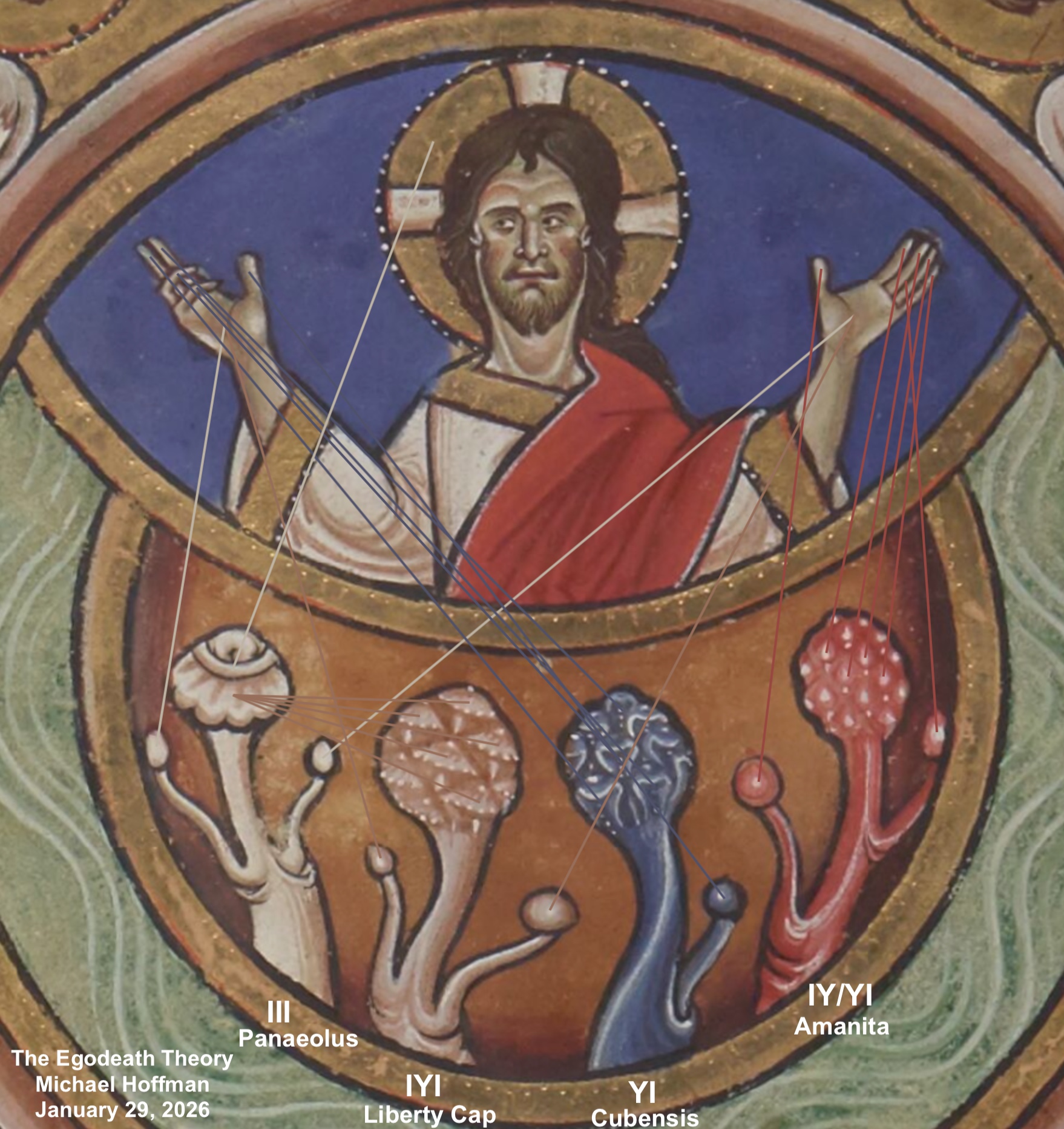
The Highest Technology: {mushrooms}, {branching}, {handedness}, and {stability} motifs
Focus on the Peak 500-year Period Where All 4 Motifs Fully Came Together, Despite the Trail-Off to 1687
My gut estimate: 900 – 1400 AD = heyday of peak mushroom-tree religion, where all 4 motifs are typically present together, integrated.
The explicit Cubensis paradigm era.
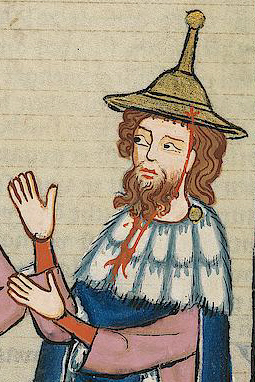
Not all instances of {mushrooms}, {branching}, {handedness}, or {stability} motifs include all 4 of these motifs.
eg von Trimberg image shows handedness and branching motifs, but not mushroom or explicit stability motifs.
Does this mean leave the mushroom-tree religion and dilute/broaden focus, to combinations of motifs that lack mushrooms? No.
Focus on and Leverage Peak Mushroom-Tree Religion, Including Great Canterbury Psalter
Strategic is to deliberately focus on the point in time of peak mushroom-tree religion.
As pictures show, psilocybin mushrooms are hard to work with, in multiple ways.
Psychedelic eternalism is hard to deal with and integrate and accommodate.
It’s understandable why the popular masses didn’t spread and build and retain the mushroom-tree religion.
Suppressing witchcraft and suppressing Western Esotericism suppressed the mushroom-tree religion.
The mushroom-tree religion was not suppressed during its heyday.
The Integrated Analysis of {mushroom}, {branching}, {handedness}, and {stability} Motifs Constitutes Mushroom-Trees as a Systemic Religion
Basic Binary Contrasts that Give N-Way Mutual Confirmation of the Egodeath Theory and Mytheme Theory, Including the Mushroom-Tree Religion
- ordinary-state religion vs. psychedelic religion
- fingers vs. thumb
- 3 fingers vs. index finger
- possibilism vs. eternalism
- branching vs. non-branching
- ordinary state vs. psychedelic state
- the ordinary-state possibilism experiential mode vs. the psychedelic-eternalism experiential mode
- the possibilism experiential mode vs. the eternalism experiential mode
- tight cognition vs. loose cognition
- tight cognitive binding vs. loose cognitive binding
- Y vs. I
- Y vs. IY
- 1POV vs. 2POV
- one point of view vs. two points of view
Psychedelic religion is valid; eternalism-driven control-transformation.
Non-psychedelic religion is fake religion, that depends on inspiration from real religion.
Real religion is psychedelic eternalism.
Throughout Western religious history (eg Western Esotericism), there is tons of noise, and a traceable signal thread, of psychedelic eternalism.
We must sit in judgment to spot the valid, worthy, best, top-quality elements from among all the noise of religious history.
Committing to the new theory / paradigm is a matter of betting on an upstart’s projected likelihood to succeed.
The new theory is not based on the explanatory power of the new theory the moment it is formed, and thus killed in the cradle by a history-contradicted theory of how science works.
Entheogen scholarship is a theory paradigm COMMITMENT, a bet, an investment.
Good practice is slip from possibility to fact, against Mosurinjohn & Ascough trying to treat “new paradigm” as if inherently error.
The hypocrites Mosurinjohn & Ascough themselves slip from possibility (“maybe no psychedelics in mystery religions”) to fact (“definitely no psychedelics in mystery religions”), to then pronounce to their (another hypocrisy) gullible Popular audience: “Ruck’s BEEN DEBUNKED!!”
eg:
Debunking the psychedelic theory of the Eleusinian Mysteries
Henry Winslow
https://www.linkedin.com/posts/henrywins_what-do-joe-rogan-a-freshly-minted-neoshaman-activity-7361038406467948546-63ak
eg:
Video: Interview of Sharborg: The gullible, Popular podcast hosts fail to react “CITATION NEEDED!” when Sharborg tells them the lie:
https://egodeaththeory.org/2026/02/03/anything-but-drugs-academics-are-weary-and-tired-of-repeatedly-publishing-their-disproofs-of-psychedelics-in-western-religious-history/#scholars-debunked-psychedelic-root-of-religion-many-times-since-1935 —
We debunked that the root of all religion is psychedelic, and that the mysteries of Eleusis were psychedelic, 30 years ago, and we debunked that 60 years before that, many times.
Unspecified Bible Studies scholars per Sharday on a Pop podcast
Scholarly reply: “Citations needed.”
Pop podcast host’s reply: “HA HA HA HA!” laughing loudly, so that I can’t hear what Sharborg says next.
Sharday Mosurinjohn sold out and reduced herself to an instrument arm of the anything-but-drugs agenda, a mere propagandist for the anything-but-drugs academic agenda and fixed commitment/ paradigm.
Anything-But-Drugs Academia’s Agenda: Wedded to the Anything-But-Drugs Paradigmatic Commitment
A marriage wedded academia with the anything-but-drugs paradigm commitment.
Ditch that boat-anchor Asscough, Sharborg.
The Egodeath theory paradigm accomplishes this “spot the psychedelic eternalism” game.
The positive unitive model of “mystical experience” is a false thread that’s traced, since 1893, following a poor, ancient folly such as armchair Neoplatonism (apophatic inarticulate).
Algis Uzdavinys’ writings are beyond Yulia Ustanova and fellow travelers in anything-but-drugs academia.
Uzdavinys bridges dry Neoplatonism with the vibe of psychedelic shamanism throughout antiquity.
Intro
The mushroom-tree religion, discovered by the Egodeath theory, in mainstream Christianity.
The mainstream mushroom-tree religion was discovered by Michael Hoffman of the Egodeath theory, building on Panofsky 1952, Samorini 1997, Samorini 1998, & Ruck 2001, adding the integrated analysis of {mushrooms}, {branching}, {handedness}, and {stability} motifs.
- Panofsky 1952 – “There are hundreds of mushroom-trees prevalent in Romanesque and Early Gothic art.”
- Samorini 1997 – The mushroom-tree of Plaincourault (Giorgio Samorini, 1997) https://www.samorini.it/doc1/sam/sam%20plaincourault.pdf
- Samorini 1998 – “Mushroom-Trees” in Christian Art (Giorgio Samorini, 1998) https://www.samorini.it/doc1/sam/sam-alberifungo-1998.pdf & https://egodeaththeory.wordpress.com/mushroom-trees-in-christian-art-samorini/
- Ruck 2001 – Conjuring Eden: Art and the Entheogenic Vision of Paradise (Hoffman, Ruck & Staples, Entheos 1, 2001), https://entheomedia.net/Issue%20one.htm, https://egodeaththeory.org/2020/12/24/entheos-issues-1-4-mark-hoffman/#Entheos-Issue-1
Panofsky 1952 “there are hundreds of mushroom-trees prevalent in Romanesque and Early Gothic art”, in SOMA 1968 p. 180: https://egodeaththeory.org/2025/01/07/panofskys-letters-to-wasson-transcribed/#Sentence-1-5 – “The Plaincourault fresco is only one example of a conventionalized tree type, prevalent in Romanesque and Early Gothic art, which art historians actually refer to as “mushroom tree” in Roman and Early Christian painting, and there are hundreds of instances exemplifying this development.”
hand-shape theory doesn’t require any mushroom imagery.
{mushrooms}, {branching}, {handedness}, and {stability} motifs
the medieval art genre of {mushroom-trees}
From my book review of Psychedelic Injustice: How Identity Politics Poisons the Psychedelic Renaissance (Hatsis, 2025):
“Allegro’s book has been completely superseded and has become irrelevant for the current field of entheogen scholarship, since Samorini’s seminal 1998 article that made good on Erwin Panofsky’s 1952 announcement to Gordon Wasson that:
“The Plaincourault fresco is only one example of a conventionalized tree type, prevalent in Romanesque and Early Gothic art, which art historians actually refer to as “mushroom tree” in Roman and Early Christian painting, and there are hundreds of instances exemplifying this development.”
https://egodeaththeory.org/2025/01/07/panofskys-letters-to-wasson-transcribed/#Sentence-1-4
Psychedelics Are as “Mainstream”, “Normal”, and “Commonplace” in Christian History as Mushroom Trees in Medieval Art
Stang: “Why didn’t the Institutional Church officials denounce psychedelics?”
Because the entire culture knew that psychedelics are religion.
Mind your paradigmatic prejudices and presuppositions, Stang!
Stang & Greer: OK, We Deniers Were Full of Sh!t; a Few Members of Infiltrating Heretical Groups Did Use Psychedelics in Christendom, “but Were Psychedelics MAINSTREAM in Christian History?” YES.
The Entry into Jerusalem Fresco in the Church of Saint Martin, Publicly and Explicitly Displaying Psilocybin Mushrooms along with Branching & Non-Branching Motifs
The “Entry into Jerusalem” Fresco in the Church of Saint Martin Displays Explicit {mushroom}, {branching}, & {handedness} Motifs
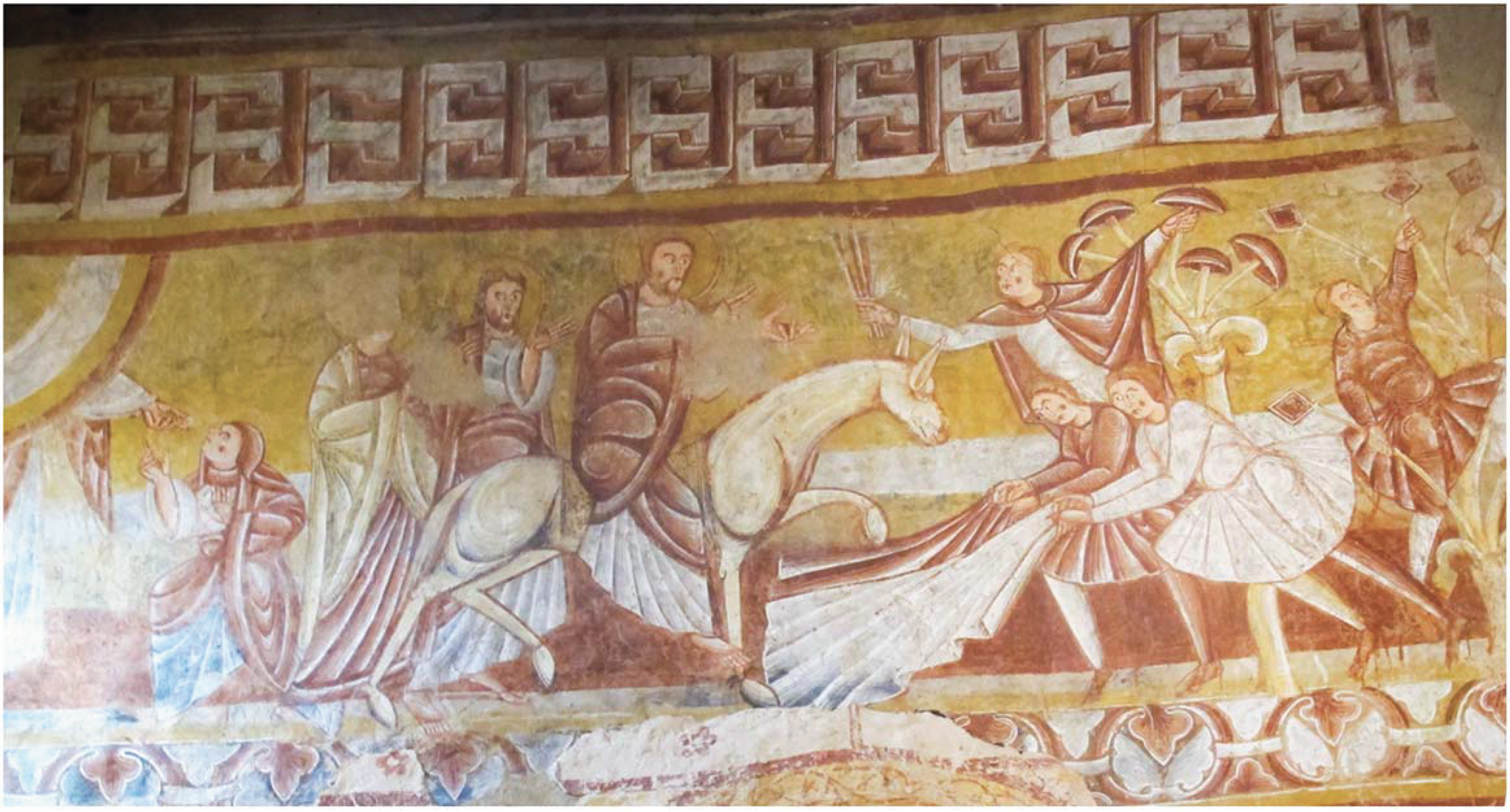
In the Church of Saint Martin de Vicq, France, that are presented and analyzed in Browns’ 2016 book & 2019 article.
Site Map > Brown > Saint Martin Church
Motivation for this Page
With this week’s major breakthrough bringing to systematization hand-shape theory, that completes a list of simple binaries packing a punch for the psychedelic mysteries hypothesis paradigm.
I was angling to respond to the Christian Greer argument:
“We now must assume that of course some # of indiv’s used psychedelics within Christendom; the real question is not Secret Christian Amanita Cult, but rather, to what extent [he copypastes my concl of Wasson and Allegro on the Tree of Knowledge as Amanita (Hoffman, 2006), http://egodeath.com/WassonEdenTree.htm ]
To what extent psychedelics in Christian history?
To what extent psychedelics in Greco-Roman & Judeo-Christian history?
To what extent psychedelics in Western religious history?
Were psychedelics mainstream and normal in Western religious history?
The answer is a firm YES, such as the mushroom-tree religion.
I found an angle on the “is mainstream?” question. I re-articulated Browns’ end of 2016 & 2019 book/article.
Browns emphasize that mushroom imagery in Christian art was mainstream to the extreme: commonplace in the best & most promient psalters; the best cathedrals; the best chapels, etc. have mushroom imagery in Christian art.
Panofsky args, mushroom imagery in Christian art was SO MAINSTREAM, that the mushroom imagery in Christian art cannot possibly mean mushrooms, because it is a given (per the Denier paradigm’s presuppositions and prejudices) that Xy lacks heavy mushrooms.
Flipping Panofsky’s Argument from “Too Many Mushrooms”
Panofsky 1952 argues:
- Silently given: Everyone knows that Christianity does not include mushrooms.
- Explicitly given: There are hundreds of mushroom-elements images prevalent in Christian art.
- Therefore: The mushroom imagery in Christian art cannot mean mushrooms.
That’s a fallacious argument.
The prejudiced presupposition is false, “Silently given: Everyone knows that Christianity does not include mushrooms.”
See Also
Site Map > Mushrooms in Art (Flagship)

 The Egodeath theory