Michael Hoffman 7:00 p.m. Feb. 11, 2026

Contents:
links work on desktop Edge/Chrome:
- List of Topics within the Mytheme Theory
- Phenomenology: The Pure Cognitive Phenomenology Approach to Psychedelics
- List of Branching vs. Non-Branching Contrasts
- Decoded {blessing} Hand Shape (Index & Middle Extended, Ring & Pinkie Folded)
- A Podcast about Transcendent Knowledge
- Beware: The Mis-Loaded Word ‘Mysticism’ Means “Positive Unitive” Experience, Exclusively
- The CEQ is the Broken Wastebasket for the Failures of the MEQ
- Keyboard Shortcuts for the OAV 1994 Questionnaire by Dittrich, Derived from His 1975 APZ Questionnaire
- The Mysticism Wars
- Preparing for Podcasts in 2007
- Outline of Topics for the Pure Cognitive Phenomenology Approach
- Rejecting “Cognitive Neuroscience”, as Eliminative Reductionism
- The “Positive Unitive” Model of “Mystical Experience” vs. the “Control Transformation” Model
- Analogy: Analogies in Myth & Mythic Art Describe Mental Model Transformation from Possibilism to Eternalism
- Hold Hands at Bell Tower: YI Hand Shapes (Manesse Codex)
- YI Branching-Form Theory; YI Hand-Shape Theory & YI Tree-Shape Theory
- 5 Fingers Instead of 4
- Outline of Topics for the Phase 2, Analogy Mytheme Theory
- Sections of the Key Mythemes Catalog
- Outline of Topics in the Episode on the Phase 1, Cybernetic Core Theory, Within the Egodeath Theory of Psychedelic Eternalism
- Searched for Recent Copy of List of Topics Defining the Phase 1, Cybernetic Core theory
- Article: Branching-message mushroom trees: Psychedelic eternalism depicted in medieval art as mushrooms, branching, handedness, and stability (Journal of Psychedelic Studies)
- STEM: The Egodeath Theory Is the Paradigmatic STEM/ Science Explorer/Discoverer Approach to Psychedelics
- ABD Newbies
- Travis Kitchens, Psychedelic Science Journalism
- Motivation for this Page
- See Also
List of Topics within the Mytheme Theory
- rock lyrics
- ahistoricity
- entheogen history
- mytheme decoding
- YI Tree and Hand Shape Theory; YI hand shapes
- astral ascent mysticism
- visual art analogies, motifs, into their direct referents
- Model-Based Science: science uses analogies; a model is like an analogy
- in Science/STEM communications, the role of analogies
- Bad use of myth and analogies, never resolves to the direct referent
- Analogy (used in Science) vs. Metaphor (used in Literature)
- Saturn gate, threaten the child
- {mushroom}, {branching}, {handedness}, and {stability} motifs = {branching-message mushroom trees}, achieves: recognizing and explaining the theology of the mushroom-tree religion, a mainstream (at least among artists) religion within Christianity Christian. c’y c’n Christianity Christian
- The Egodeath Core Concepts catalog & the Key Mythemes catalog
- Usefulness of the Key Mythemes catalog
- Entheogen, Altered State, {Holy Spirit}, {fire}
- Awareness, Perceiving, {seeing}
- Control Agency, {king}
- Thought Injector, Thought-Receiver; {phallus}, {cup}, {wound}
- Instability, Stability, {seizure}
- Maturing, {family} Relationships
- Mortal/Immortal Relations, {sacrifice}
- Possibility Branching, {tree}
- Block Universe, {rock}
- Worldline, Non-branching, {snake}
- Search, {hunt}; Bring Back, {treasure}, {prize}
- Ascent
- Gate
- Transformation
- Escape, Release, Rescue
y} Relationships
Mortal/Immortal Relations, {sacrifice}
Possibility Branching, {tree}
Block Universe, {rock}
Worldline, Non-branching, {snake}
Search, {hunt}; Bring Back, {treasure}, {prize}
Ascent
Gate
Transformation
Escape, Release, Rescue
Phenomenology: The Pure Cognitive Phenomenology Approach to Psychedelics
List of Branching vs. Non-Branching Contrasts
A gem. Gotta know this.
- possibilism vs. eternalism (the “ordinary-state possibilism” experiential mental model, vs. the “altered-state eternalism” experiential mental model)
That’s the referent, figured as these analogies, in mythic art & in myth: - Y vs. I
- tree vs. snake
- branching vs. non-branching
- fingers vs. thumb
- index finger vs. 3 fingers
- grid cap vs. plain cap (Great Canterbury Psalter convention)
- manyworlds vs. block, in Physics
Decoded {blessing} Hand Shape (Index & Middle Extended, Ring & Pinkie Folded)
todo: move to hand-shape theory page
10:38 p.m. Feb. 11, 2026 – “blessing” hand shape:
- worked on since Mar. 21, 2022 (if not earlier).
- been working on this decoding during past few weeks, during the Great 2026 Hand-Fest breakthrough week(s).
- Came down to the question/test:
- Try assigning {branching} to Index & Middle, and assigning {non-branching} to Ring & Pinkie.
- Try assigning {branching} to Ring & Pinkie, and assigning {non-branching} to Index & Middle.
- Which is the more natural, easy assignment? Martin is special-case w/ TWO hands, remember. Can’t use same logic for a SEQUENCE of two hands, or for a PAIR of hands, as for a SINGLE, ISOLATED hand.
If back of hand facing the viewer:
- no thumb. only have to account for pair of folded fingers & pair of non-folded fingers.
If palm of hand facing the viewer:
- folded fingers = Y’ = non-branching.
- straight fingers (index & middle) = Y = branching. In the standard form, held slightly apart.
- Exception (eg the 2-hands exception): If the extended Index and Middle finger are pressed tightly together, and no other fingers are shown, or if other hand emphatically splayed (Y), the Index & Middle held extended together can mean non-branching, eg Saint Martin Church > Entry into Jerusalem > Jesus’ finger-shapes.
- thumb = I, especially if full thumb is displayed, w/o visual cuts.
- if thumb is visual-cut, I’. eg hold shovel w/ fingertips toward viewer. usu comes w/ Y’ in that case, rarely form a YI’.
Watch out for fingers or thumb visually cutting other fingers. That can change Y to Y’.
A Podcast about Transcendent Knowledge
Prepare to discuss in panel of 4 ppl, Transcendent Knowledge: Primarily:
- Define the “pure cognitive phenomenology approach”.
- Reject ordinary-state based Epistemology.
- Reject ordinary-state based Ontology.
- Reject ordinary-state based Metaphysics.
- … like presented by lame outsiders Chris Letheby and crew, who are so Phil Dept Armchair, that not even blotter can unseat them.
- Outline and summarize the Mytheme theory.
- Newbies in the field of Psychedelic Studies:
- Sharday Mosurinjohn
- Richard Ascough
- Christian Greer
- Ronald Huggins
Beware: The Mis-Loaded Word ‘Mysticism’ Means “Positive Unitive” Experience, Exclusively
Warning about everything written about “mysticism” since 1893:
Read the word ‘mysticism’ as, narrowly and in an eliminative way:
the positive unitive model of “mystical experience”.
Hindu Indian Swami Vivekananda – why the F are we paying any attention to this recent, alien, bad… see book How the Swans Came to the Lake, inspired the McRae article exposing the 1893 sausage-making.
Where our model of “mystical experience” came from; when it was fabricated and constructed by creating a new Academia Dept.
The phony, fake, Pop-driven invention of “Buddhism” as an Academic Dept. field.
The CEQ is the Broken Wastebasket for the Failures of the MEQ
Any experience that fails to match “positive unitive” is considered junk to be ignored, rejected, and discarded.
Or, dump the failed experience into the the Challenging Experience Questionnaire (CEQ), where, if the experience doesn’t match ordinary-state Grief therapy, the experience is considered junk to be ignored, rejected, and discarded.
… as were discarded, by Roland Griffiths’ team at Johns Hopkins Dept. of Psychedelic Pseudo Science, 18 of 21 = 86% of the “Angst/Dread/DED” effects from OAV 1994.
Keyboard Shortcuts for the OAV 1994 Questionnaire by Dittrich, Derived from His 1975 APZ Questionnaire
OAV 1994 (Oceanic/Angst/Visionary, Dittrich 1994 questionnaire)
oavs
OAV 1994 (Oceanic Boundlessness, Angst of/ Dread of Ego Dissolution, Visionary Restructuralization) psychedelic psychometrics effects questionnaire by Adolph Dittrich
oav
OAV 1994 (Oceanic Boundlessness, Angst of/ Dread of Ego Dissolution, Visionary Restructuralization) psychedelic psychometrics effects questionnaire by Adolph Dittrich, https://egodeaththeory.wordpress.com/2022/12/29/oav-questionnaire-1994-oceanic-boundlessness-angst-of-dread-of-ego-dissolution-visionary-restructuralization-dittrich/
oavl
References: OAV 1994:
https://egodeaththeory.org/2023/01/17/references-for-psychedelic-psychometrics-questionnaires/#OAV-1994-Dittrich-1994-German
The Mysticism Wars
Search web for: “Mysticism Wars”
https://www.google.com/search?q=%22Mysticism+Wars%22
Ai summary:
The “Mysticism Wars” refer to an ongoing, high-stakes debate within contemporary psychedelic science regarding the use of mystical concepts to explain, measure, and validate the therapeutic effects of psychedelic experiences.
Key aspects of this debate, often discussed by [the Armchair Phil Dept, despite blotter] philosophers and scientists like Chris Letheby, Jaipreet Mattu, and Eric Hochstein, include:
- The Core Conflict: The “war” is fought between researchers who believe “mystical-type” experiences (e.g., feelings of unity, sacredness, noetic quality) are central to the therapeutic benefits of substances like psilocybin, and those who argue that such language is unscientific, outdated, or potentially harmful to the legitimacy of the field.
- The Pro-Mystical View: Supporters argue that mystical concepts are useful, valid, and that there is no good reason to abandon them, as they have consistently correlated with positive clinical outcomes.
- The Anti-Mystical View: Critics often include neuroscientists or cognitive scientists who find these frameworks underdeveloped, preferring more traditional, mechanistic, or computational, neurological explanations.
- Proposed Resolution: Letheby, Mattu, and Hochstein argue that the “war” is often based on misunderstandings and that the two sides can be reconciled by better defining terms and separating the scientific study of these experiences from the personal metaphysical beliefs of the researchers.
- Context: This debate takes place within the broader context of the “psychedelic renaissance,” where researchers are trying to define the mechanisms behind treatments for depression, addiction, and end-of-life distress.
This, and related topics, are discussed in works such as How to End the Mysticism Wars in Psychedelic Science (2024/2025).
/ end of ai summary
Chapter/Article:
How to End the Mysticism Wars in Psychedelic Science
Oct. 15, 2024
Springer Nature Linkhttps://link.springer.com › chapter
Abstract (condensed by Michael Hoffman):
“Chris Letheby, Jaipreet Mattu, and Eric Hochstein try to put an end to the “mysticism wars,” by which they mean the battle between psychedelic researchers who hold that:
“Mystical concepts ought to be employed in attempts to describe and understand psychedelic experiences
“and those who do not hold this.
“Letheby, Mattu, and Hochstein side with the former, and do so on the grounds that there are no good reasons to abandon mystical concepts in psychedelic science, and plenty of good reasons to keep them.
“Critiques of the pro-mystical-concepts view can be solved via clarifying concepts and recognizing distinctions.
“Mystical concepts may one day be superseded in the science of psychedelics.
“This should not occur on the basis of a misplaced conceptual critique: the present-day critique of the pro-mystical-concepts view.”
n, add link at top.
My great resource page:
Moving Past Mysticism in Psychedelic Science (Article Debate Series
Preparing for Podcasts in 2007
From Egodeath.com home page, July 16, 2007:
Interview with Max Freakout at Psychonautica — Aug. 10, 2007. List of Psychonautica podcasts — listen to episodes such as 11-17, covering the Egodeath theory.
Discussion of questions in preparation for my interview on the Psychonautica podcast. August 1, 2007.
Part 1 Part 2 Part 3 Part 4
Max’s questions:
- How did I first begin to formulate the Egodeath theory?
- How important are the various domains for the Egodeath theory? Is the Theory a form of Eastern, Western, or Shamanistic religion?
- Is the issue of freewill of central importance to ego death?
- How did I get the idea that the issue of freewill is of such central importance to ego death?
- Explain the ordinary understanding of autonomous control which the ego-death experience proves to be illusory.
- What does the ‘transcendence of no freewill’ mean and involve?
- Explain the concept of block-universe determinism and time as a spacelike dimension.
- How does Egodeath theory relate to the shamanic ability to heal?
- Does saying that drug-free meditation is ‘bunk’ mean that there is no value to the practice of meditating?
- Explain the idea that ‘drug-policy reform’ is conceptually brainwashed.
- What should pro-justice activists focus their efforts on doing, to be most effective?
- What are the vulnerabilities of the Wasson-Allegro-McKenna theories of the origin of religion?
- What is my take on McKenna’s idea of the ‘stoned ape’?
- What is the relevance of the ahistoricity of Jesus to the Egodeath theory?
- How do I envision the future for the development of the Egodeath theory?
- What is the relationship between the disappearance of the separate-self sense, the experience of nonduality, the intense mystic altered state, meditation, and the problematization of personal control-power in light of the part/whole (self/Ground) relationship in the dissociative cognitive state?
Discussion of various questions — Oct. 6, 2007.
Questions covered:
- Why bother spreading the truth about the nature of religion and religious origins?
- How does the Establishment treatment of topics shut-out coverage of entheogens in religious history?
- What is the way forward so that the mainstream culture integrates the maximal entheogen theory of religion?
- What evidence and arguments are there that the original Christians used drugs?
- Discuss the assertion “There’s no need to assume drugs in primitive Christianity.”
- To what extent were drugs used in the history of Christian practice?
- Is New Testament Christianity more important than purely mystical Christianity, because of including a political vector on the mystical insights?
- Are John Pilch, Jonanda Groenewald, Marcus Borg, John Ashton, and Stevan Davies on the right track? Can they be converted from their standard academic “alien social-psychology” theory of “alternate states of consciousness” to the simpler drug-use theory?
- How was Wasson (or Allegro) great? How did he limit or cripple the field?
- What will be retained of Wasson (or Allegro)? What will be rejected?
- Why bother setting the record straight on the errors of Wasson and the merit of some of Allegro’s ideas?
Outline of Topics for the Pure Cognitive Phenomenology Approach
Psychedelic Cognitive Phenomenology
Loose Cognitive Phenomenology
Psychedelic pseudo science doesn’t use a a pure cognitive phenomenology approach; uses typical Cog Neuroreductionism. bunk lexicon loaded with confused terms and framing.
Rejecting “Cognitive Neuroscience”, as Eliminative Reductionism
The bunk, marketing term “cognitive neuroscience” actually means, Immediately Discard & ignore the cognitive phenomenology dimension
Eliminate that and reduce it to Phrenology, orange-colored areas of the brain, that either corresponds to:
- mystical experience (ie, the positive unitive model of “mystical experience”)
Or, a failure of that, ie, - “ego dissolution”, “dread of ego dissolution”, & separation, & negative experience of Unitive suspension of the mind’s construction of the experience of the self/other boundary.
Misguided Pop-driven, Popular Neo-Advaita holds:
Suspension of the mind’s construction of the experience of the self/other boundary, is the essence of Transcendent Knowledge.
When you successfully destroy the mind, and get rid of and eliminate the experience of the self/other boundary, you then have received the fullness of Transcendent Knowledge.
Ken Wilber calls for a balanced, fleshed-out understanding of Advaita, against Pop insanity of lopsided extremist takes, on Advaita/ nondual.
Ken Wilber’s system is built around this same poor, low-quality, Pop junk model, the positive unitive model of “mystical experience”.
The “Positive Unitive” Model of “Mystical Experience” vs. the “Control Transformation” Model
The “Positive Unitive” Model of “Mystical Experience” (from Westernized, modern, Swami Vivekananda & Pop Crowds in 1893).
vs.
The “Control Transformation” Model (from the Egodeath Theory).
Eternalism-driven control-transformation.
The result of eternalism-driven control-transformation:
The psychedelic-matured mind has two mental models:
(qualified) ordinary-state possibilism, &
altered-state eternalism, functionally or practically harmonized; integrated.
integrated possibilism/eternalism thinking.
I don’t like the word “thinking”; I picked that word b/c it is daily 8th grade lang/ vocab.
more like:
the integrated possibilism/eternalism mental model
ipemm
The integrated possibilism/eternalism mental model is depicted in medieval art by (variants of) the YI hand shape.
Analogy: Analogies in Myth & Mythic Art Describe Mental Model Transformation from Possibilism to Eternalism
Hold Hands at Bell Tower: YI Hand Shapes (Manesse Codex)

todo: copy to Manesse page
YI Branching-Form Theory; YI Hand-Shape Theory & YI Tree-Shape Theory
YI tree-shape theory
ytst
YI hand-shape theory
yhst
- YI Tree Branching Morphology: Formal Theory of Fractal YI Scope of Analysis of Branching-Message Mushroom Trees
- Medieval Hand-Shapes Theory
- Y = branching = the “ordinary-state possibilism” experiential mental model.
ospemm - I = non-branching = the “altered-state eternalism” experiential mental model.
aseemm
Upper hand: IY (= the integrated possibilism/eternalism mental model)
Lower hand: Y’I (= qualified possibilism-thinking, + eternalism-thinking)
Lacking I would be problematic.
Having I’ would be semi problematic, but not too bad if Y’I’. eg hold shovel w/ fingertips at viewer.
Principle: Don’t want Y to dominate over I, or negate I (non-branching).
Hand-shape theory: Valid end-states:
- YI – most typically displayed; the boring default regular vanilla version.
- Y’I – common, to say: qualified possibilism-thinking + eternalism-thinking.
- YI’ – rare; countervailing.
- Y’I’ – eg. hand holding a shovel, fingertips facing viewer.
5 Fingers Instead of 4
The 5-finger woman’s hand is an error, or a joke, or blurry like the John Lash low-res crop of f134 row 1 Left: the balancing-in-tree guy w/ fist apparently “pointing” in mushroom-tree.
Does she really make a peace sign w/ two fingers?
Is half her pinkie actually shown, on left, or supposed to be painted yellow for hair tuft?
Fill her apparent pinkie segment w/ yellow to get rid of it, to have 4 fingers not 5.
A YI hand shape w/ 5 fingers is a potential dealbreaker.

Outline of Topics for the Phase 2, Analogy Mytheme Theory
the Phase 1, Cybernetic Core theory
p1cct
the Phase 2, Analogy Mytheme theory
p2amt
the Cybernetic Core theory
cct
‘Core’ is a wasted word.
Nothing central would be lost of omitted.
This wordcount — compet against the Analogy Mytheme theory — could be a describptive word instead of describing the
“core” is meaningful only when next to “mythem” + konwledge o…
Connotations of “Core” are unclear. Why important? What other, competing words could go in that semi-wasted slot? Naming is everything.
Core is totally non-descriptive of
WTF IS THE CONTENT OF THE CORE, DUMBAZZ!
syn of “core” theory:
the theory of psychedelic cybernetic eternalism; analogical psychedelic eternalism with 2-level, dependent control
the cybernetic eternalism theory
the Cybernetic eternalism theory
the Cybernetic Eternalism theory
cet
the Cybernetic Eternalism theory
the Egodeath theory is the Cybernetic Eternalism theory – from cybernetic’ & ‘eternalism’ you can if add mushroom , reconstruct entire theory would take 1 more word
literalist ordinary-state possibilism
analogical psychedelic eternalism
literalist ordinary-state possibilism with autonomous control
analogical psychedelic eternalism with dependent control
literalist ordinary-state possibilism with monolithic, autonomous control
analogical psychedelic eternalism with 2-level, dependent control – no word “cybernetic”
a name of a theory not same as deciding descriptor words (4; analogical psychedelic eternalism… vri virtly 4; 4 terms.
analogical psychedelic eternalism – 3 terms, descriptors
Egodeath.com – the theory in 2 words: EGO + DEATH
PSYCHEDELIC ETERNALISM
EGO DEATH
CYBERNETIC ETERNALISM
PSYCHEDELIC PCE pce
psychedelic cybernetic eternalism
but “cybernetic” abstract
not abstract:
ac a-c au monolithic control-agent
mca
mental construct
mc
mental construct processing
mcp
psychedelic eternalism
if “eternalism” includes (which it doesn’t in Armchair Phil Dept that invented/ fabricated Popular Neo-Advaita & “Buddhism” in 1893. so beyond redemp, these airchair warriors can’t even receive inspiration through blotter (Chris Letheby: be Phil Student, have Dumb Metaphy ideas,
pataphysical
brand name != descriptive technical name
Saying that the core theory is the “core” theory is useful only when in contrast to the IDEA of the 4-layer onion:
- inner core
- outer core
- inner periphery
- outer periphery
outer periphery: eg the Indigenous Shams (a front for the Anything-But-Drugs Academics derby team)
inner core:
- there are 2 mental models, 2 states, 2 experiential modes: the ordinary-state experiential mode, altered-state experiential mode.
- altered-state eternalism (non-branching, I, snake, thumb, simple)
- , ordinary-state possibilism (branching, Y, tree, fingers, compound)
- the ordinary-state experiential mode
” NOTHING CENTRAL IS LOST … COULD BE DDESCRIPTIVE INSTEAD.
cct
the Analogy Mytheme theory
amt
the Analogy Mytheme theory within the Egodeath theory
amte
the Phase 1, Cybernetic Core theory, within the Egodeath theory of psychedelic eternalism
the Phase 2, Analogy Mytheme theory, within the Egodeath theory of psychedelic eternalism
Sections of the Key Mythemes Catalog
- Entheogen, Altered State, {Holy Spirit}, {fire}
- Awareness, Perceiving, {seeing}
- Control Agency, {king}
- Thought Injector, Thought-Receiver; {phallus}, {cup}, {wound}
- Instability, Stability, {seizure}
- Maturing, {family} Relationships
- Mortal/Immortal Relations, {sacrifice}
- Possibility Branching, {tree}
- Block Universe, {rock}
- Worldline, Non-branching, {snake}
- Search, {hunt}; Bring Back, {treasure}, {prize}
- Ascent
- Gate
- Transformation
- Escape, Release, Rescue
Outline of Topics in the Episode on the Phase 1, Cybernetic Core Theory, Within the Egodeath Theory of Psychedelic Eternalism
- Mental modelling
- The egoic and transcendent mental worldmodels
- States of consciousness, ordinary and altered
- Stages of psychospiritual development
- Tight and loose cognitive association binding, dissociation
- Mental representations and their referents
- Metaperception, explicit representationalism
- Conceptions of person-hood
- Cybernetic homunculus, control agency
- Time as the 4th spatial dimension, time-slices and timelessness
- Popular attitudes and misperceptions about ego death
- Cybernetic instability, control-death
- Fatedness and its transcendence
- The will to exist in Schopenhauer’s philosophy
- Postulating higher control, humble prayer
- Helpless dependence on higher control, Schleiermacher’s theology
- Struggling to control the future, panic-attack freakout
- Physical metabolism and thought-processes
Searched for Recent Copy of List of Topics Defining the Phase 1, Cybernetic Core theory
Done: copypaste my recent extraction of the list. Strategy:
- Go to my section about the video:
https://egodeaththeory.org/2020/11/07/transcendent-knowledge-podcast-episodes/#Episode-28 - Copy a string from the list of topics:
“States of consciousness, ordinary and altered” - Search this site. Found the section that contains my recent copy of the list:
https://egodeaththeory.org/2026/02/10/names-of-the-phase-1-cybernetic-core-theory-the-phase-2-analogy-mytheme-theory-within-the-egodeath-theory/#transcendent-knowledge-podcast-about-the-phase-1-cybernetic-core-theory-within-the-egodeath-theory-of-psychedelic-eternalism
Article: Branching-message mushroom trees: Psychedelic eternalism depicted in medieval art as mushrooms, branching, handedness, and stability (Journal of Psychedelic Studies)
Prepare article for {branching-message mushroom trees} for the Journal of Transpersonal Psychology
STEM: The Egodeath Theory Is the Paradigmatic STEM/ Science Explorer/Discoverer Approach to Psychedelics
Alan Houot’s book calls for a Science Explorer Discoverer approach to psychedelics, rather than only a Spirituality or Therapy Healing approach to psychedelics.
Rise of the Psychonaut: Maps for Amateurs, Nonscientists and Explorers in the Psychedelic Age of Discovery (Houot, 2025) https://egodeaththeory.org/2024/12/24/rise-of-the-psychonaut-houot-2025/ & https://www.amazon.com/dp/B0DPSJGMFR
Four met to discuss the Egodeath theory:
Egodeath Mystery Show, episode: Ep264b No Such Episode 🤷♂️.
I’ve Read & Listened to Alan Houot’s Dissertation, Articles, and Book, 3 Times in Detail
Does Alan Houot know anything about the Egodeath theory? the Egodeath theory is not a NRM.
New Religious Movements (NRMs)
The term New Religious Movements (NRMs)” is an alien lexicon; not allowed in the Egodeath theory lexicon.
The Egodeath theory must pay the price: must map between the Egodeath theory’s lexicon & the common, low-quality, mis-loaded lexicon of those on the outside.
Search web:
https://www.google.com/search?q=%22new+religious+movements+(NRM)%22
New Religious Movements (NRMs)
nrms
New Religious Movement (NRM)
nrm
AI summary:
New Religious Movements (NRMs) are, according to Encyclopedia Britannica, a wide range of:
New, often non-mainstream religious or spiritual groups that have emerged globally, particularly since the mid-20th century.
Frequently referred to as “cults” or “sects” in popular discourse, NRMs are typically characterized by
- charismatic, often authoritarian leadership, [= Cybermonk]
- eclectic doctrines, [= we must use YI hand shapes & hang from Right knee in a mushroom-tree]
- and countercultural, innovative responses to modern life. [= theorize, against Deniers of mushroom imagery in Christian art; against both sides in the Mysticism Wars]
Examples include Scientology, Wicca, the Baha’i Faith, and Falun Gong.
Key Characteristics and Context
- Definition & Origin: NRMs are religious groups with modern origins, usually peripheral to a society’s dominant religious culture.
- Structure: They are often tightly organized, though they can vary from loose, decentralized movements to structured, communal ones.
- Leadership: Often founded by a single, charismatic leader considered to possess extraordinary, divine, or unique insights.
- Beliefs: They are often eclectic, blending elements from diverse traditions, and may be syncretic.
- Social Context: Many NRMs emerge as reactions to rapid change, globalization, or secularization.
Controversy and Sociology
- Labeling: While academics prefer “NRM” to avoid bias, these groups are often viewed with suspicion or labeled as “cults” by mainstream society, note researchers from Brill Reference Works.
- Social Impact: Some critics argue that certain NRMs use, for instance, high-pressure techniques for, say, controlling members.
- Evolution: Some NRMs are short-lived, while others, like Scientology, may gain enough stability to last, suggest flashcards on Quizlet.
Examples of NRMs
- Scientology: A major 20th-century movement.
- Falun Gong: A spiritual movement founded in 1992.
- Wicca: A contemporary pagan movement.
- The Family International (Children of God): Known for changing mainstream views on gender.
- Hare Krishna (ISKCON): A prominent Gaudiya Vaishnava new religious movement.
Research into NRMs often focuses on why they form, why they attract members, and their, perhaps, often complex relationship with the, maybe, wider community, according to the University of Pennsylvania.
/end of AI summary
ABD Newbies
anything-but-drugs
the anything-but-drugs agenda/ commitment/ academics/ propaganda/ academia
Newbies in the field of Psychedelic Studies:
- Sharday Mosurinjohn
- Richard Ascough
- Christian Greer
- Ronald Huggins
Ronald Huggins
I am able to formulate a rule: 1+1=3.
Ronald Huggins, using Panofsky, is able to formulate a Rule, to “Rule Out” mushroom-trees:
Any mushroom-trees that have mushroom features (which is to covertly say (hope no one notices), ALL mushroom-trees, by definition), we are to IGNORE the mushroom features, because mushrooms don’t have branches.
Either the inept, intention-free artists (broken human copy-machines) were attempting and failing to depict “A TREE” or “A MUSHROOM”, those are the two options we are debating.
Mushroom-trees have branches, such as Great Canterbury Psalter, f11: Day 4’s four trees [which have NO branches], therefore, they can’t mean A MUSHROOM, and must mean A TREE.
These mushroom-trees have branches, and therefore, they cannot mean A MUSHROOM, and must mean A TREE:
Day 4: Four Simple Mushrooms that Have No Branches
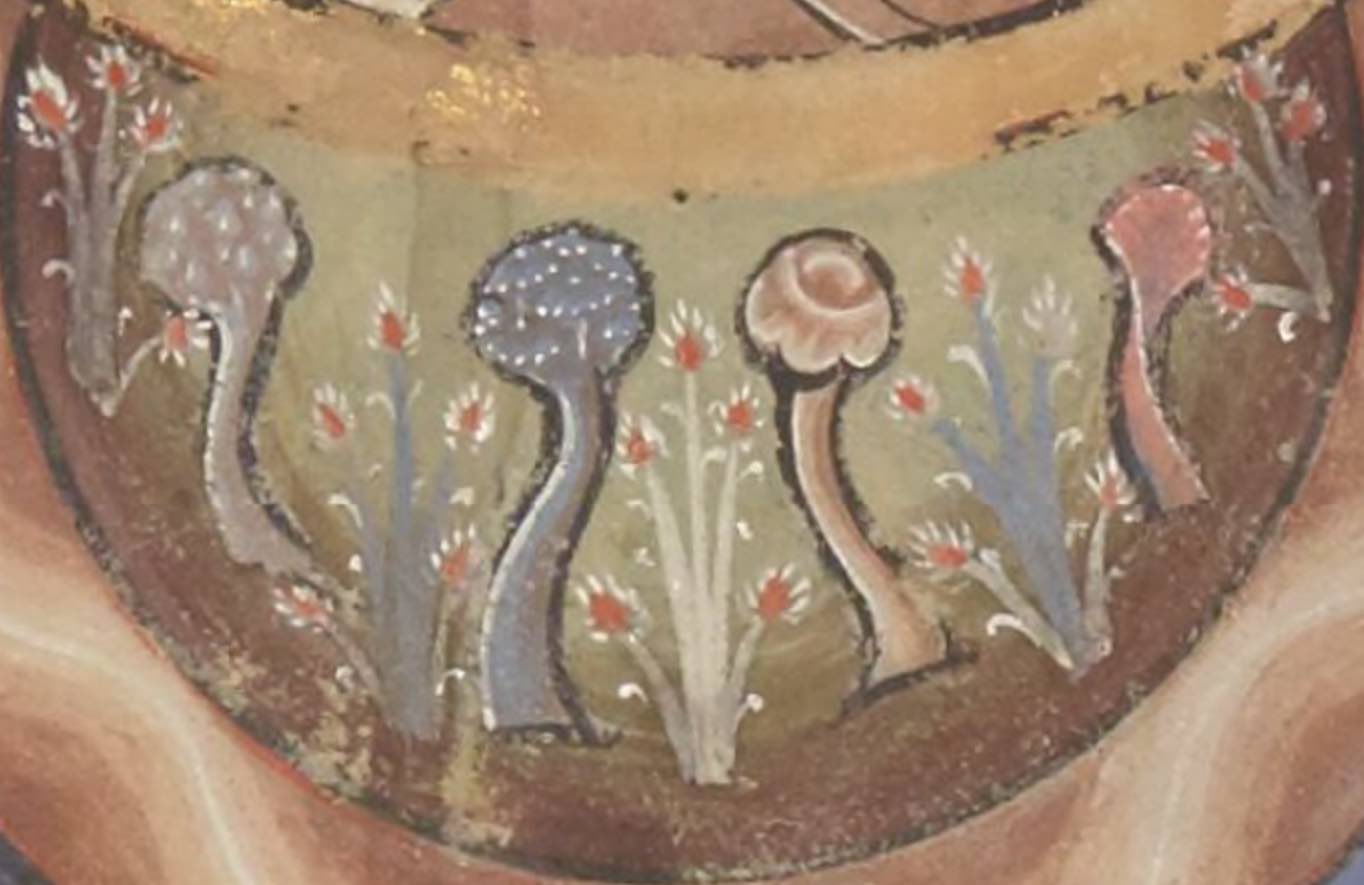
Crop by Michael Hoffman.
- Liberty Cap (with grid cap of Liberty Caps)
- Cubensis (with grid cap of Liberty Caps)
- Panaeolus
- Amanita
Ignorant Newbie Invaders of Psychedelic Studies Expecting an Easy-Mode Win
Joe Rogan’s already BEEN DEBUNKED, so this should be a piece of cake, to reveal the foolishness of Muraresku, Ruck, Allegro, and entheogen scholarship re: psychedelics in Eleusis and Christian origins.
Newbie hostile toxic parasitical self-serving invaders of the field of Psychedelic Studies, are looking for and expecting and counting on an Easy-Mode, apparent victory against entheogen scholarship chumps, such as Muraresku & Ruck, to pad-out their cv.
Newbie hostile invaders of the field, unread and cheap, post-Pollan 2018; post-Muraresku 2020, Deniers of mushroom imagery in Christian art.
Letcher-Hatsis wasn’t enough lameness heaping bizarrely off-the-wall, ad-hoc, trash-quality fallacious arg’s on the field.
Letcher’s botched endnote 31 falsely attributes the (bad, toxic, harmful) “Various writers have suggested cult, secretly, oppression, hidden, secret cult, surreptitiously slipped in” paradigm.
Letcher: Shroom (2006) falsely attributed 1st-generation entheogen scholarship (the Secret Amanita paradigm) to Stamets 1996 & Gartz 1996, who are essentially 2nd-generation entheogen scholars (the Explicit Psilocybin paradigm).
psychedelic cognitive phenomenology
pcp
a pure cognitive phenomenology approach
pcpa
Summarize the Mytheme theory
It makes sense for me to handle outlining & summarizing the Mytheme theory.
I would love to see how Max Freakout + Cyberdisciple would outline and summarize the Mytheme theory.
Citation Keyboard Shortcuts for Pollan 2018
How to Change Your Mind (Pollan 2018)
mp18s
How to Change Your Mind: What the New Science of Psychedelics Teaches Us About Consciousness, Dying, Addiction, Depression, and Transcendence (Michael Pollan, 2018)
mp18
How to Change Your Mind: What the New Science of Psychedelics Teaches Us About Consciousness, Dying, Addiction, Depression, and Transcendence, Michael Pollan, May 2018, https://www.amazon.com/Change-Your-Mind-Consciousness-Transcendence/dp/1594204225/
mp18l
Awesome Acronyms (Keyboard Shortcuts) for Citations
Half the fun of keyboard shortcuts is accidentally triggering expansion of a random core concept of the Egodeath theory:
covert neo-Advaita
cna
the mushroom-tree artists
mta
Not “Michael the Archangel”, per 1986-1998? fixed:
Michael the Archangel
mtaa
Travis Kitchens, Psychedelic Science Journalism
Travis Kitchens’ Journalism on Psychedelic Pseudo Science to Create a New Religion Based on Hindu Indian Swami Vivekananda Westernized Narrow Particular School of Academic Armchair “Philosophy of Religion” Dept. Newly Invented, Artificially Driven by Popular Demand
Prepare for convo w/ Kitchens per emails.
Kit is not a debunker.
Kitchens is an authentic journalist, recording the goings-on in the fields of:
- psychedelic (pseudo) science
- the positive unitive model of “mystical experience”
- pop reception of The Immortality Key by Brian Muraresku
- pop reception of How to Change Your Mind (Pollan 2018)
- Review emails to see what topics.
- Busy reading Mosurinjohn, Ascough, Greer, & Huggins; the positive unitive model of “mystical experience”; my articles-reading stack.
Motivation for this Page
I have scattered todo notes in email; in idea development pages, etc.
Having a WordPress page to focus on prepping for podcast shows, works well for me.
See Also
Page title:
Names of Component Theories of Egodeath Theory
Section title:
the Mytheme theory
https://egodeaththeory.org/2021/01/08/names-of-component-theories-of-egodeath-theory/#the-Mytheme-theory – lists:
- rock lyrics
- ahistoricity
- entheogen history
- mytheme decoding
- YI Tree and Hand Shape Theory
Site Map > Podcast
https://egodeaththeory.wordpress.com/nav/#podcast

 The Egodeath theory