Michael Hoffman 9:30 p.m. Feb. 24, 2026
Contents:
most links work cross-platform:
- Favor Hand-Shape Pairs That Include Y’, Y, and I
- Dancing Man Has the Classic Hand-Shape Pair, [Y’I, YI]! (or [Y’, YI])
- Principle: [Y’, YI] = [Y’I, Y] = [Y’I, YI]
- Thanks, Dancing Man, for Teaching Me That You Only Need One I
- Principle: If One Hand Includes an I, It Doesn’t Matter Whether the Other Hand Includes an I
- Principle: Equivalence of Hand-Shape Pairs [Y’, YI], [Y’I, Y], & [Y’I, YI]
- Dancing Man’s Hand-Shape Pair
- The Resulting Compound Mental Model: I Metaphysically, Y’ Metaphysically, & Y Phenomenologically: IY’Y
- Hypothesis: It Is Understood that the Edge Finger Can Be Read as “All 3 Segments Shown”
- The mind ends up with I, Y’ (metaphysically), and Y (phenomenologically)
- The Mind Ends Up with the Compound Mental Model: I & Metaphysically Y’ & Phenomenologically Y, thus with two hands: [Y’, YI] or [Y’I, YI]
- Lump Both Hands Together? [Y’I, YI] becomes: Y’YII (!)
- Proof of [Y’, Y’I] Rather than [Y’I, Y’I], Based on Relative Length of Pinkie Fingers
- Why the Best, Most Representative Standard Reference Order Is [Y’I, YI], not [YI, Y’I]
- [Y’I, YI] Tells the Actual Experienced Story: Even Though Y’, Still, Y
- [YI, Y’I] Tells the Story: Even though Y, Still, Y’ – Not My Story
- Why the Classic Hand-Shape Pair Is [IY’, IY]
- txt msg to AM & YW, am Feb. 24, 2026
- txt msg 1 to JR, a.m. Feb. 24, 2026
- txt msg 2 to JR, 7:46 p.m. Feb. 24, 2026
- I’ Is a Special Case, Such as Receding Threat of Eternalism (the experience of the threat of catastrophic loss of control): the Break-Bowman
- How the Classic Hand-Shape Pair [Y’I, YI] Asserts I, Rebuts Y, and Yet Also Asserts Y
- The Classic Medieval [Y’ & Y & I] Hand-Shape Pair
- Asp-Dog, 2 Groups of Guys, and {rock ossuary}
- Normalizing YI Hand-Shape Designations to Start with Y, End with I
- Each Eye Looks in a Different Direction, to Connect Two Items, to Tell Us What to Analyze as Analogous
- txt msg to RL p.m. Feb. 24, 2026
- Guide/Key
- Motivation for this Page
- See Also
Favor Hand-Shape Pairs That Include Y’, Y, and I
It’s good to, in a hand-shape pair, represent the main 3 of 4 (omitting I’, which is used but rarely): Assert:
- I metaphysically
- Y phenomenologically
- Y’ metaphysically
Example hand-shape pairs to include at least 1 I, 1 Y’, and 1 Y:
- [Y’I, YI]
- [Y’, YI]
- [Y’I, Y]
ie, the I can be on one hand, on the other hand, or on both hands:
01
10
11
To show a Y and a Y’, do the Y on one hand, do the Y’ on the other hand.
Might find some special finger shape, against that; this is the typical formations discussed here.
It’s crucial to not get lost in combinatorial explosion or infinite endless special-case shapes.
Keep focused like chess, on TYPICAL forms, not “gotcha” special-case exceptions.
Special deviations are important for artist creativity, but are distinct from the catalog of Standard Reference Hand Shapes.
The Reference catalog includes hand-shape pairs, so that we can get the big 3 out of 4: at least 1 each of Y’, Y, & I.
Dancing Man Has the Classic Hand-Shape Pair, [Y’I, YI]! (or [Y’, YI])
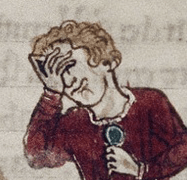
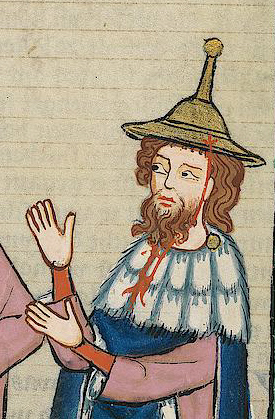
Lower hand: IY’ (all joints of pinkie shown = I), upper hand: IY’ (Index displays all 3 joints, and is splayed separately from 3 fingers); resulting hand-shape pair: the classic combination [Y’I, YI]
Regardless of whether you count lower pinkie as I or as part of Y’, doesn’t affect the result!
Either way, you end up asserting at least 1x: Y’, Y, & I.
Maybe that’s why artists seem to not be very concerned how much of the pinkie is shown.
Suppose read lower pinkie as I:
Hand-shape pair: lower hand first: [IY’, IY] = [Y’I, YI].
[Y’I, YI] includes: Y’, Y, & I, at least 1x each. Y’ 1x, Y 1x, I 2x.
A single I would be sufficient to tell the story of mental model transformation.
Suppose read lower pinkie as part of Y’:
Hand-shape pair: lower hand first: [Y’, IY] = [Y’, YI]
[Y’, YI] includes: Y’, Y, & I, at least 1x each. Y’ 1x, Y 1x, I 1x.
The single I is sufficient to tell the story of mental model transformation.
The lazy interp/ char’zn: [Y’, YI]
but you CAN reason that the pinkie is fully visible 3 segs, nothing to block view of it, so: [IY’, IY] = [Y’I, YI]
DOESN’T MATTER, NO DIFF’C:
Principle: [Y’, YI] = [Y’I, Y] = [Y’I, YI]
All 3 of those hand-shape pairs have at least 1 Y’, 1 Y, and 1 I.
All 3 of 4 Main Points are Covered. No need to include I’, usually.
Rarely rebut non-branching Eternalism. f134 break-bowman upper hand has I’; God’s threat relenting/ receding.
Thanks, Dancing Man, for Teaching Me That You Only Need One I 🕺
As soon as I read DanMan’s YI hand-shape pair, I worried about how to read the exposed curled pinkie.
I’ve seen everything from no pinkie, to full, straight, splayed pinkie.
If the other hand includes an I, it doesn’t matter whether to count an ambiguous pinkie as an I shape (eg a snake) or not.
Principle: If One Hand Includes an I, It Doesn’t Matter Whether the Other Hand Includes an I
eg. it doesn’t matter Whether Dancing Man’s Lower Pinkie Displays 3 Segments or Fewer
Since upper hand contributes 1 Y and 1 I, we don’t need another I from the lower hand.
This implies that the 3 hand-shape pairs that include the Big 3 of 4 (Y’, Y, I) are equivalent.
Principle: Equivalence of Hand-Shape Pairs [Y’, YI], [Y’I, Y], & [Y’I, YI]
[10:10 p.m. Feb. 24, 2026]
Dancing Man’s Hand-Shape Pair
[9:50 Feb. 24, 2026] In the course of making fun of Greer’s boundless ignorance, in the Dancing Man facepalm image, I noticed, based on my analysis refinement yesterday (in which I extended my YI hand-shape analysis down to the ultimate fractal level of inventorying each and every finger segment and whether splayed apart), practiced on f109 earlier today:
- Lower hand: IY’ (all joints of pinkie shown = I)
- Upper hand: IY’ (Index displays all 3 joints, and is splayed separately from 3 fingers)
- The resulting hand-shape pair: the classic combination [Y’I, YI].
If read lower pinkie as “cut” (though nothing is blocking it – unlike the 3 fingers), hand is Y’, giving: [Y’, IY] – which is good, in that all 3 are present asserted:
- I metaphysically
- Y phenomenologically
- Y’ metaphysically
The Resulting Compound Mental Model: I Metaphysically, Y’ Metaphysically, & Y Phenomenologically: IY’Y
The two readings of DanMan’s hand-shape pair:
- [Y’, IY]
- [Y’I, IY]
Either way gives all 3: I, Y’, and Y. The good thing is, look for this combination:
ONE HAND ASSERTS BRANCHING Y;
OTHER HAND ASSERTS Y’ (FOLDED FINGERS; OCCLUDED SEGMENTS)
and one or both hands form an I.
Consider mushroom king f145:
He fails to ever assert Y; he only asserts Y’ & I (multiple times):
[Y’III, Y’III] – severe!
I don’t know the stats yet for compound mental model hand-shape pair:
- [Y’, Y’I]
- [Y, Y’I]
- [Y’I, YI]
A given hand can be:
- Y or Y’
- I or I’
- YI, Y’I, YI’, or Y’I’
- Y’III
9 main combinations; YI forms. d/k what % of hands in the genre fail to match any of those.
d/k frequency of combos of those, for hand-shape pairs.
I must do more hand-shape pair assessments, and then inventory the hand-shape pairs.
Beware of combining L & R hand inventory of shapes.
[Y’I, YI] combines as Y’YII.
Mushroom king combines as Y’III + Y’III = Y’Y’IIIIII.
- 2x Y’
- 6x I
- 0x Y
- 0x I’ (usu. not expected to have any I’)
Lower hand: IY’ (all joints of pinkie shown = I)
Upper hand: IY’ (Index displays all 3 joints, and is splayed separately from 3 fingers)
The resulting hand-shape pair: the classic combination [Y’I, YI].
Or, [Y’, YI].
That’s good too, because still includes the usual 3 of 4: Y’ and Y and I. (Not I’, which is rare to want to assert.)
I like to include Y as well as Y’ & I, because Y is the case Phen’ly, even though Y is not the case metaphy’ly.
Hypothesis: It Is Understood that the Edge Finger Can Be Read as “All 3 Segments Shown”
There is no finger in front of pinkie, occluding any of the 3 pinkie finger segments. So POTENTIALLY the finger is “not occluded” and is thus to be read as “all 3 segments displayed”.
See the f21 hand on the right, with exaggerated long pinkie displayed, vs. other hand with no trace of side of whole finger visible:
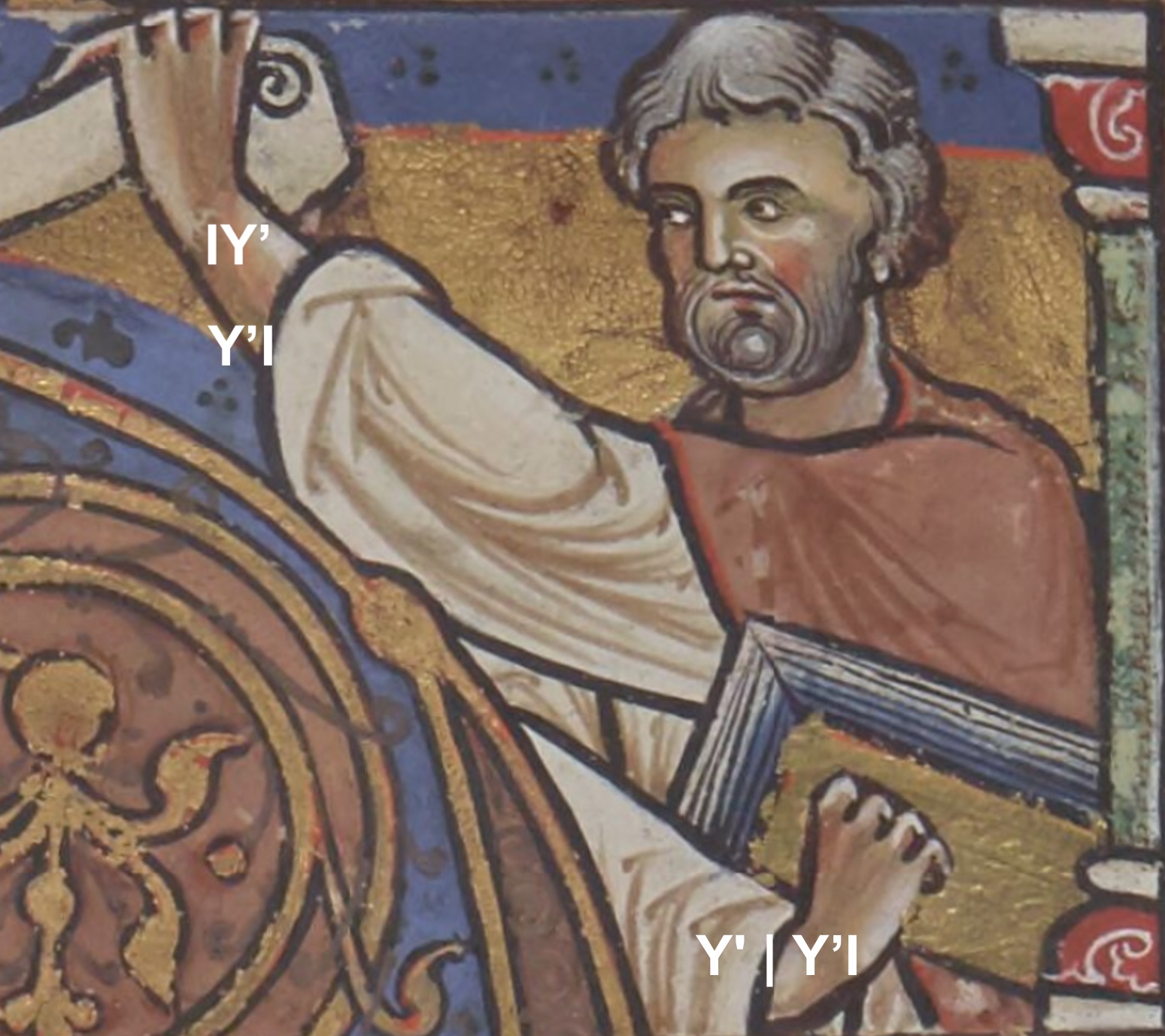
Guys/ Books/ Scrolls/ B’s (f21)

Blurry, worn, so I am full zoom at lib site full res.
Rightmost Guy’s Hand-Shape Pair, in Guys/ Books/ Scrolls/ B’s (f21)
Why I Lean Toward [Y’, Y’I]
Why I Reject the Story [Y’I, Y’I]
[Y’I, Y’I] doesn’t match the Reference, which is: [Y’I, YI] (to tell story of: The mind ends up with I and Y'[metaphysically] and Y[phenomenologically).
The mind ends up with I, Y’ (metaphysically), and Y (phenomenologically)
The Mind Ends Up with the Compound Mental Model: I & Metaphysically Y’ & Phenomenologically Y, thus with two hands: [Y’, YI] or [Y’I, YI]
I = altered-state, non-branching Eternalism
asnbe
Y = ordinary-state, branching Possibilism
osbp
Oddly, he never signals Y. He signals I 1x or 2x, and signals Y’ 2x.
Lump Both Hands Together? [Y’I, YI] becomes: Y’YII (!)
In this case, if lower hand is read as Y’I, tally for both hands is:
Y’I + Y’I = Y’Y’II
If lower hand is Y’, tally is:
Y’I + Y’ = Y’Y’I
A more articulate story is: Y’YII or if possible, Y’YI.
This pic doesn’t show Y’YI; it shows Y’Y’I. or Y’Y’II.
Pic shows [Y’, Y’I] or [Y’I, Y’I].
Given how emphatically different the length of the two pinkies, the only justifiable reading is: [Y’, Y’I]
Proof of [Y’, Y’I] Rather than [Y’I, Y’I], Based on Relative Length of Pinkie Fingers
If lower hand read as Y’I, that hand would have same designation as upper hand’s Y’I. Upper is DEFINITELY Y’I, emph’d.
No way the lower hand can be claimed same form as upper hand – short vs. long pinkie. So the lower hand must be labelled / classed diff’ly than upper.
Thus [Y’, Y’I], not [Y’I, Y’I], given that the two pinkie lengths differ. All 3 segs shown upper.
This proof is debatable, because you CAN say 3 segs visible on lower pinkie. You can claim pinkie is curled but all 3 segs visible/ displayed. You cannot say that of lower 3-fingers, showing 1.5 segments. So, Y’I remains a viable defensible reading, giving: [Y’I, Y’I]. You can arg that there is only a minor diff of the pinkies: whether mid & tip segments are bent (lower) or not (upper).
Concl: this is good labelling, of lower hand, with an “OR”.
I could draw lines between the 3 segments of upper & lower pinkies, making a visual case that all 3 segments are visible on both pinkie fingers.
Affects DanMan’s YI hand-shape pair assessment.
How severely the side finger is cut or how fully it is displayed, or splayed, varies a lot in the medieval art genre of {mushroom-trees}.
So, the “or” labelling is useful and needed.
https://gallica.bnf.fr/ark:/12148/btv1b10551125c/f21.item.zoom, fullscreen
todo: copy to f21 / all images gallery “Details” page
Developing idea…
Avoid: [Y’I, Y’I]
Seek: [Y’I, YI]
f21 Right, gives options under debate:
- [Y’, Y’I] – hypothesis: this is a standard form in the genre. It’s a story to tell.
- [Y’I, Y’I] – hypothesis: this is rare in the genre. It’s not a story to tell.
f21: Example of Debatable Y’ or Y’I Hand-Shape
Compared to the exagerrated pinkie on upper hand, the pinkie tip segment is not displayed on the bottom hand. The other two hands, not shown, on left, are like the lower hand, but worn paint; poor view of pinkie tip detail.
Analyzing this figure in isolation, certainly I’d say [Y’I, Y’], NOT [Y’I, Y’I]. Certainly I’d say the lower hand is Y’, NOT Y’I – compared to the upper hand.
I suspect that Dancing Man’s lower hand is meant to be read, across the medieval art genre of {mushroom-trees}, as an IY’ convention, not as simply Y’. The fact that you can view SOME of his side-of-pinkie finger segments, RELATIVE to the 3 fingers, the special, 4th finger is more visible, thus CAN arguably be designated/ classified/ characterized as IY’, “as well as” Y’.
I found that [Y’, YI] or [Y’, Y’I] is not as articulate or useful to describe mental model transformation from psilocybin eternalism-driven control-transformation, as the standard, [Y’I, YI].
Why the Best, Most Representative Standard Reference Order Is [Y’I, YI], not [YI, Y’I]
How to answer that: tell story of eternalism-driven control-transformation; mental model transformation across two states. You end up with Y and Y’ and I.
- “First I knew possibilism-thinking.”
- “Then I discovered eternalism-thinking.”
- “Then I integrated possibilism/eternalism thinking.”
- “The compound mental model that I was left with going back and forth across the two states:”
Strategy: Given each formula (order), what story does it claim to tell?
[Y’I, YI] Tells the Actual Experienced Story: Even Though Y’, Still, Y
“Still, I am” – Rush, end of Caress of Steel album, 1975.
Y’, but also Y:
That matches/ describes my story:
First I only knew Y,
then in altered-state revealed I not Y,
So get rid of Y? NO!
Even though Y’, still, Y (just phen’ly, not metaphy’ly).
That’s best represented by the order: [Y’I, YI], better than by the order [YI, Y’I].
[YI, Y’I] Tells the Story: Even though Y, Still, Y’ – Not My Story
My story was: I found that Y’ is the case, so I stupidly said “get rid of Y”, but Y is permanent (phenomenologically) even after Y’ is revealed (metaphysically).
I said: Y, then I which means Y’. Oh, duh, mind not like that.
Actually, Y along with I. That story is: even though metaphy’ly, Y’, nevertheless, in the end, Y phen remains. So I pick order: [Y’I, YI].
- Hand 1 – Y’ (can’t see extra joint of pinkie side)
- Hand 2 – Y’ (can’t see extra joint of pinkie side)
- Hand 3 –
- Hand 4 –
Why the Classic Hand-Shape Pair Is [IY’, IY]
Analogies describe psychedelic transformation; eternalism-driven control transformation that leaves us knowing I, Y, and Y’, as the resulting compound mental model after eternalism-driven control-transformation.
- I: Eternalism is revealed to be the case metaphysically.
- Y’: Branching possibilities and concomitant egoic local control agency, is unreal, metaphysically.
- Y: Phenomenologically, branching possibilities is the case, is the shape of our experiencing, as virtual control agents.
Need to use finger shapes to:
- Assert I; metaphysically, there is non-branching Eternalism with 2-level, dependent control.
- Assert Y’; metaphysically, there is not branching Possibilism with monolithic, autonomous control.
- Assert Y; phenomenologically, there is branching Possibilism with monolithic, autonomous control.
That’s the message of the classic hand-shape pair (or finger-shape pair), [IY’, IY].
txt msg to AM & YW, am Feb. 24, 2026 🕺🏼
Jesus & Sophia Dancing, Two {lifted garment} Motif
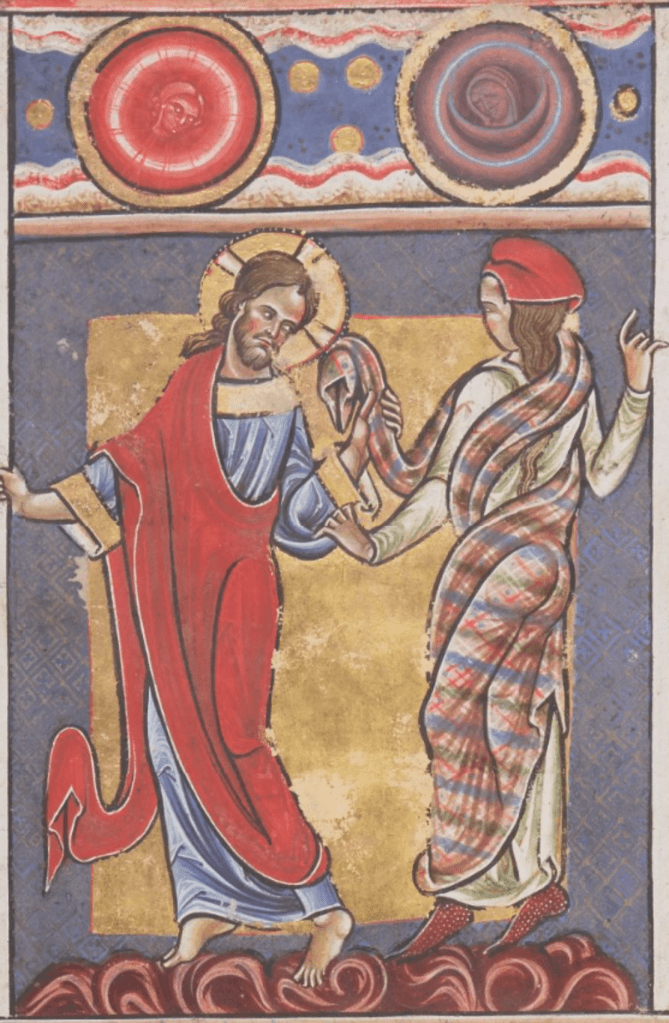
This page came out really good.
In the course of writing it, in using my facepalm crop, suddenly ⚡️ i totally solved Dancing Man’s finger-shapes! 🕺🏼
I also finished solving the hell out of [Great Canterbury Psalter folio image f109 lower right: two groups of guys] (finally 😓).
txt msg 1 to JR, a.m. Feb. 24, 2026
As part of my constructive, positive-mental-attitude scholarship,
I’m calling your symposium companion Sharday Mosurinjohn a prostitute, a religious fundamentalist, and a (female) dog,
and Gordon . . . .🔍🧐🤔🤬 Wasson a crook, who suppressed relevant scholarly citations and evidence.
😊👍
The page came out really good:
I have locked onto the Reference Pattern for medieval YI hand-shape pairs:
[Y’I, YI], AND explained how that combination asserts Y’, I, and Y.
txt msg 2 to JR, 7:46 p.m. Feb. 24, 2026
aggh typo [fixed above]. Actually:
The Reference medieval YI hand-shape pair is [Y’I, YI].
I previously, wrongly wrote: I’
I’ is usually avoided in the medieval art genre of {mushroom-trees}.
I’ Is a Special Case, Such as Receding Threat of Eternalism (the experience of the threat of catastrophic loss of control): the Break-Bowman
Goddammit I Just Fixed Around 6 Spots that Wrongly Said YI’ instead of Y’I! 🤦♂️😖🤬 Proof That the Egodeath Theory Is False – THINK, MAN, Engage Brain
I’ would be a denial that non-branching Eternalism (serpent shape) is metaphysically revealed to be the case, in the altered state.
That would be like falsely asserting that branching Possibilism (tree shape) is metaphysically (not just phenomenologically/ subjectively) the case.
I’ is reserved for special case, like “receding threat” in Great Canterbury Psalter f134 row 2: break-bowman; when God threatens too much non-branching Eternalism,
that correctly acknowledged (by being made to do “submission”) threat then recedes.
Thus I’; the {shadow dragon monster} backs off.
How the Classic Hand-Shape Pair [Y’I, YI] Asserts I, Rebuts Y, and Yet Also Asserts Y
In the Classic hand-shape pair [Y’I, YI], that combination asserts Y’, I, and Y:
- Not Possibilism; Eternalism…
- and yet still Possibilism, in a way.
That is part of the ultimate message of the mushroom-tree artists.
The Classic Medieval [Y’ & Y & I] Hand-Shape Pair
In the [Y’ & Y & I] hand-shape pair:
- I asserts non-branching Eternalism.
- Y’ rebuts branching Possibilism (via {cut branches} & {cut fingers} analogies), at the underlying metaphysical level.
- Y affirms (in subjective experience) branching Possibilism, Phenomenologically in our subjective experience.
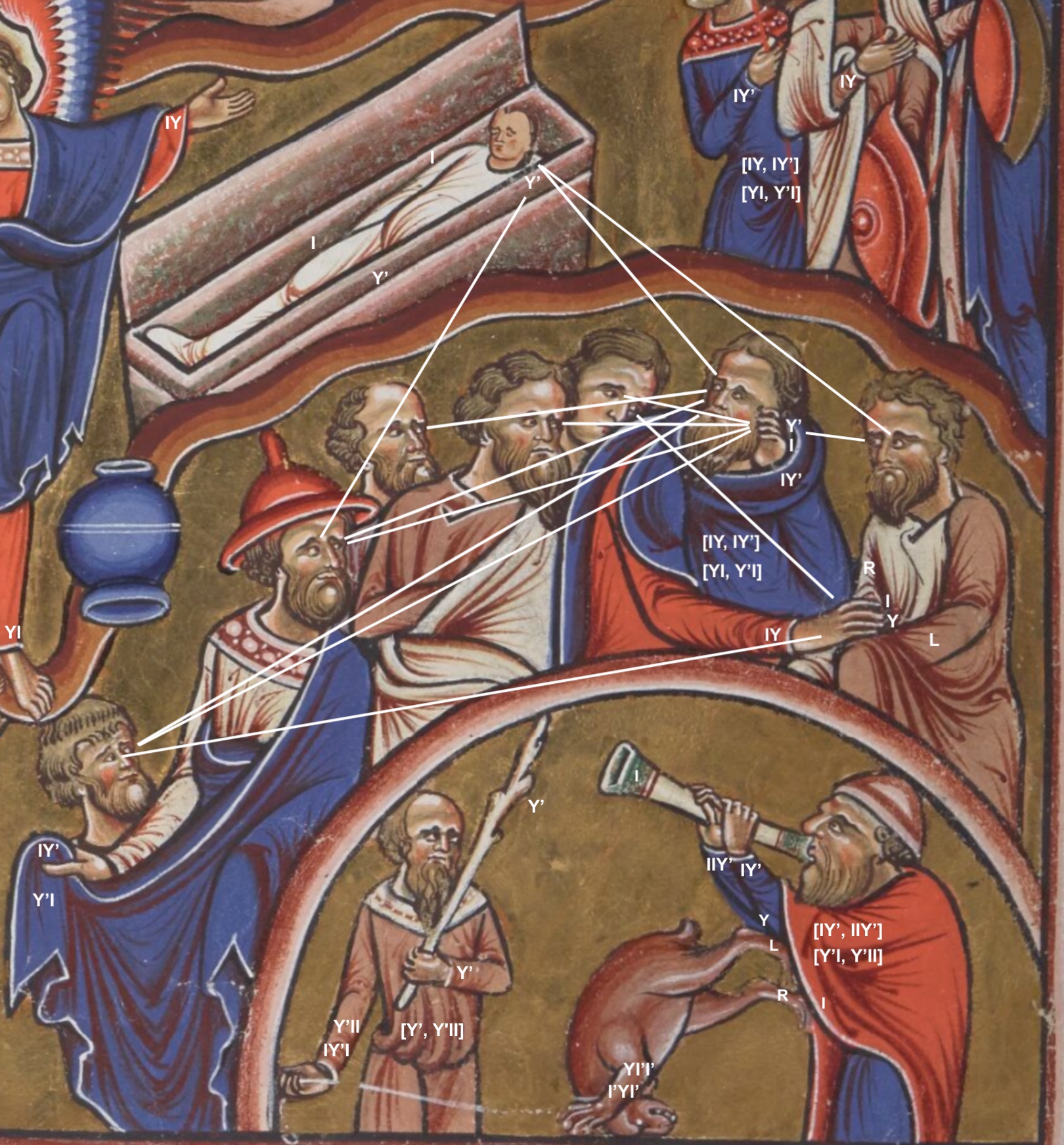
Asp-Dog, 2 Groups of Guys, and {rock ossuary}
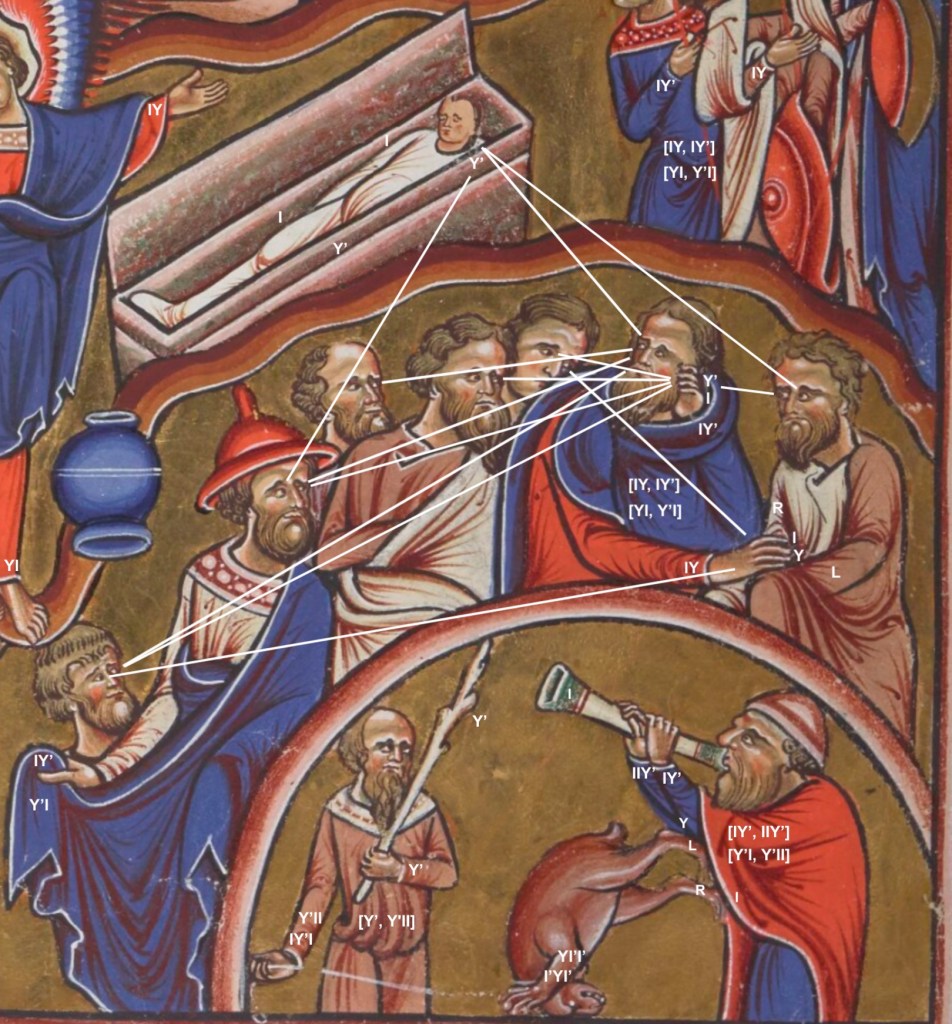
[Noon Feb. 24, 2026]: The flute is I-shaped, on the Right.
Contrasted with the Y’-shaped branch, on the Left.
- Added more looking lines, including 4x looking at one target with one eye, other with other:
- Head-only guy on left.
- Handle-hat guy.
- Guy on right of main guy.
- Head-tilted guy left of main guy.
- Added L & R, & Y & I, on asp-dog hind feet.
I kept the old line in addition to a new added looking-line, in a couple spots – that’s fair, to represent the challenge of id’ing the target of each isolated eye in a pair of eyes.
Normalizing YI Hand-Shape Designations to Start with Y, End with I
Notation and Rules for medieval YI hand-shape theory:
Moving forward, I plan to always start with Y, then I.
I have not detected any substantive meaning difference in the art between IY vs. YI hand orientation.
The normalized result is the only thing that matters in the hand-shape language:
The count of how many Y, Y’, I, & I’ formed by a hand’s visible, occluded, or splayed finger-segments.
Handedness (L/R orientation, non-reversible) can come in (sporadically & non-constraining to the mushroom-tree artists, as always).
Each Eye Looks in a Different Direction, to Connect Two Items, to Tell Us What to Analyze as Analogous
I Had a Hunch There Was Some Joke.
Compare f177 4 horses:
- Two horses look at the cut branch on mushroom-tree on left
- Two of the horses look at finger shapes in God’s hand holding hand of {stand on right foot} guy.
Thus joining and equating (as analogous) two elements in the image:
- The cut branch’s cap/crown on the mushroom-tree on the left.
- The hand-shapes/finger-shapes in God’s hand holding hand of {stand on right foot} guy.
That horses-connected message is:
Non-branching thinking (in the psychedelic eternalism experiential mode) corresponds with 2-level, dependent control,
instead of monolithic, autonomous control, as experienced during ordinary-state, branching thinking – the ordinary-state possibilism experiential mode.
txt msg to RL p.m. Feb. 24, 2026
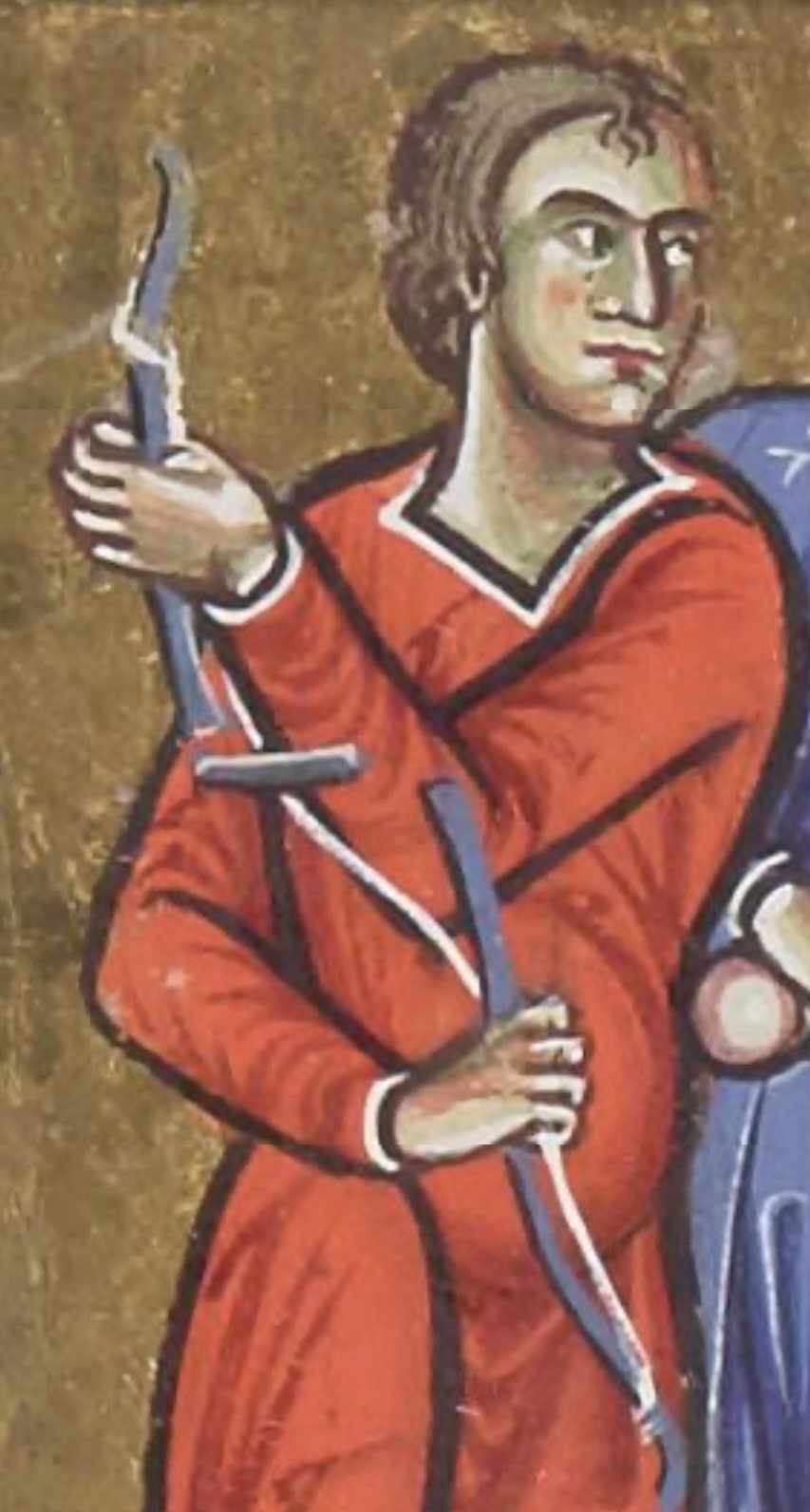
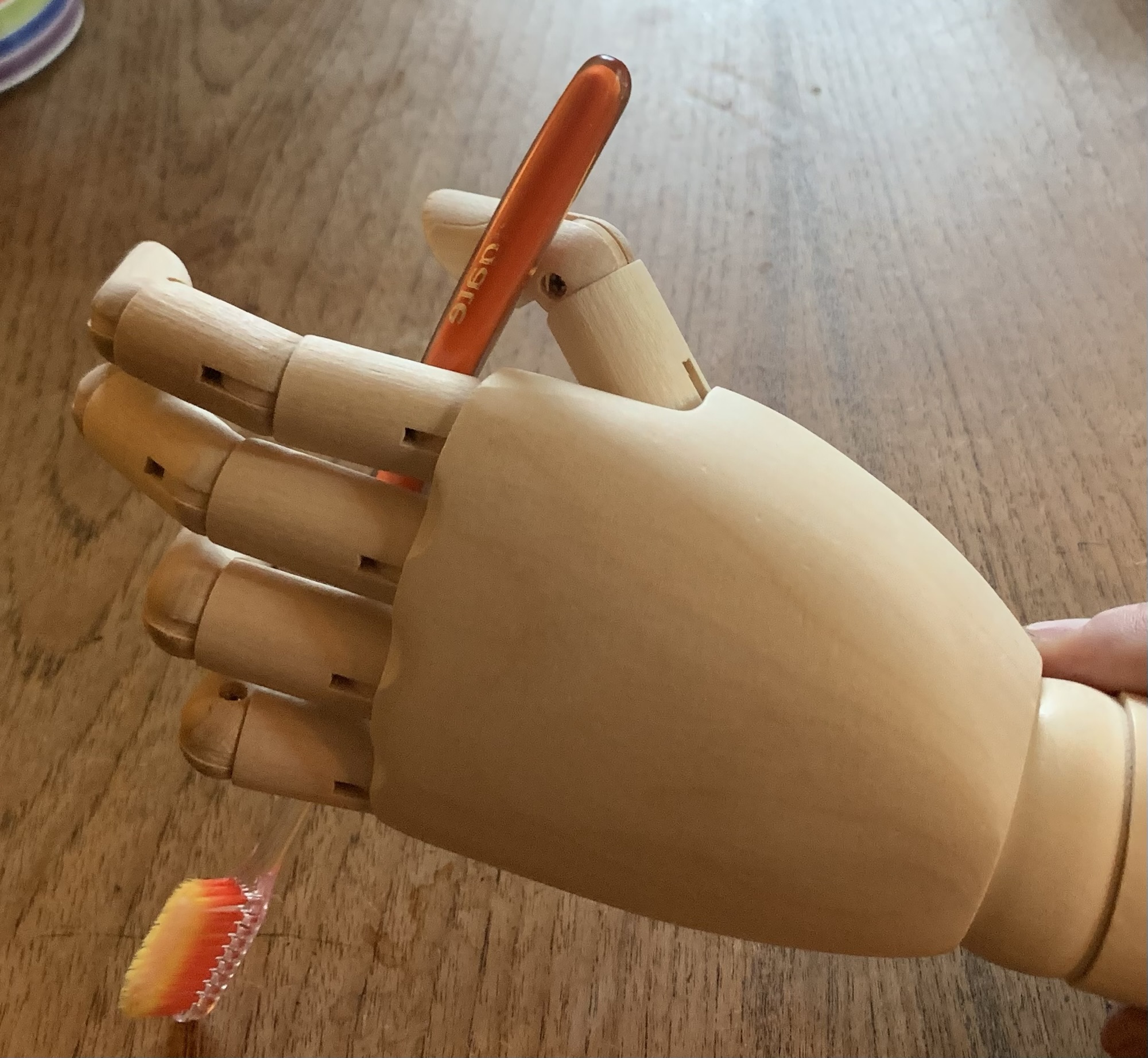
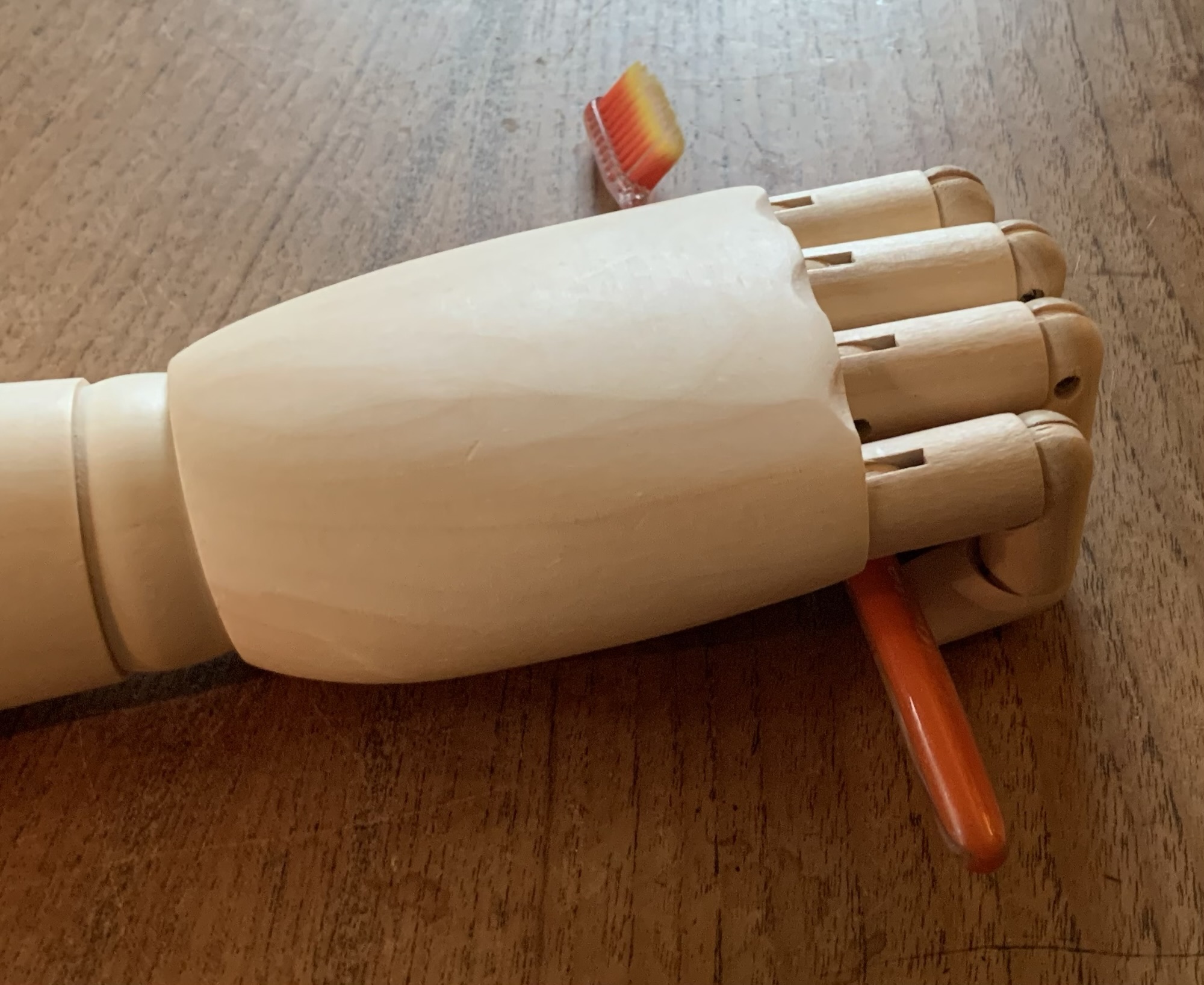
RL sent URL:
https://www.scientificamerican.com/article/stone-age-art-may-reveal-40-000-year-old-precursor-to-writing/
February 23, 2026
“Ancient art could hold clues to the origins of written language – Thousands of markings on objects made around 40,000 years ago may have been more than just doodles, a new analysis suggests”
BY JACKIE FLYNN MOGENSEN
EDITED BY CLAIRE CAMERON
Similarly, I need stats on hand-shapes & hand-shape pairs.
Hypothesis:
Normally, a medieval YI hand-shape pair includes at least these 3 of 4 (omit I’, rarely asserted):
- 1 Y’
- 1 Y
- 1 I
If we assert these 3 shapes/models, we can tell the rich & nuanced story:
Psilocybin-driven mental model transformation produces:
- I metaphysically
- Y’ metaphysically
- yet Y phenomenologically (ie subjectively) – per Wm James’ Pragmatism that made him reject block-universe eternalism.
Wm James was wrong.
Against James, we end up *affirming* branching Possibilism *phenomenologically* (ie subjectively; experientially),
= Y
and also *rejecting* branching Possibilism *metaphysically*
= Y’
We affirm non-branching Eternalism metaphysically
= I
We affirm non-branching Eternalism phenomenologically (ie subjectively, experientially) but it’s a really weird, abnormal experiential state
= I
We dread eternalism as a threat and are glad when the threat recedes:
= I’
I’ is rare to assert, eg GCP f134 break bowman’s upper hand’s visually cut thumb.
That scene, that dynamic, is truly amazing.
Guide/Key
- I = non-branching Eternalism
- Y = branching Possibilism
- I = altered-state, non-branching Eternalism
- Y = ordinary-state, branching Possibilism
Next, I need stats, to confirm this value-system; to confirm this purpose for this specialized, medieval YI hand-shape language
I am starting to collect stats, now that I learned how to inventory the 3×4 + 2 = 14 segments per hand = 28 finger segments that can be shown or occluded by the mushroom-tree artist
Attached a rare I’ image (f134 break bowman) but NEED STATS on this lang, to more accurately decipher it, and to create my own messages/ statements about the relation of possibilism & eternalism, via this specialized hand-shape language.
I got a suitable efficient notation well under development.
If I understand the medieval YI hand-shape language:
Principle of equivalence of hand-shape pairs:
[Y’I, YI] = [Y’, YI] = [Y’I, Y]
in that each pair includes at least one Y’, one Y, and one I so we have the big 3 of 4 covered (skip I’ usually).
/ end of txt msg
Motivation for this Page
I was glad to develop this content within the harsh-on-Shardogged page,
Mosurinjohn’s Dogged Avoidance of Perceiving Psychedelic Evidence, of Non-Branching in the Eternalism Experiential State
But:
- The page got too long.
- Hand-shape theory is not in scope of orig intent of page.
- I kept enough hand-shape theory there in that page, to have Cred.
- Separation of concerns; there was a clearcut diff of content topics.
See Also

 The Egodeath theory