Michael Hoffman Feb. 26, 2026
Contents:
links work on desktop Edge/Chrome:
- Motivation for this Page
- The Medieval YI Hand-Shape Game
- Strong vs. Weak Presence of a Shape
- Counting Multiple I Shapes on a Hand Is OK, But Pointless: 1 I Covers That Shape
- Terminology, Including the Most Exotic of the Four World-Models, “Cut Non-Branching” (I’)
- The Medieval YI Hand-Shape Language
- I Initially Exaggerated the Importance of Hand-Shape Pairs
- I Initially Exaggerated the Importance of the Combination Y, Y’, I (vs. I’)
- Branching (Y), Cut Branching (Y’), Non-Branching (I), and Cut Non-Branching (I’)
- Make the 4 Finger Shapes: Fingers Out (Y; Branching), Fingers Bent (Y’; Cut Branching), Finger Out (I; Non-Branching), Finger Bent (I’; Cut Non-branching)
- The Hardest of the Four Shapes to Comprehend: “Cut Non-Branching”
- I’ Is Like a Double-Negative World-Model, the Least Natural and Most Advanced
- List of Explicit I’ Instances
- f49 Forge Crops
- Canterbury f49 Features: Forge, Wheels of Fate
- What’s Asserted by the Four Shapes (the ordinary-state two first, then the altered-state two)
- What’s Asserted by the Four Shapes
- Y Is the Case, Phen’ly (especially in ordinary-state)
- Y’ Is the Case, Metaphy’ly (especially in altered-state)
- I Is the Case, Metaphy’ly (especially in altered-state)
- I’ Is the Case, Phen’ly (especially in ordinary-state)
- See Also
Motivation for this Page
I’ve made 5-10 pages on hand-shape theory, too long to edit on mobile to add evidence and points.
Those pages include good sections “greatest hits”, pasted some here.
Yesterday was hard work to judge importance of aspects – settled, simplified, and summarized here, the lessons learned.
The game is generally loose and “messing around”, not thoroughly systematic.
The normal patterns are clear, and “rules are meant to be broken” very much applies.
Though the normal Reference convention rules are broken as often as not, the general basic rules are definitely identifiable.
This page was composed on mobile initially.
Mobile Jetpack WordPress App Can’t Handle Long Pages
The long page on Otto hand-shape game is near impossible to edit on mobile: too long and sluggish; unresponsive.
The Medieval YI Hand-Shape Game
Commonly occurring is, a figure shows the 3 popular straightforward shapes: Y Y’ I; rarer is I’.
Neither hand-shape pair combo list is “correct” or “the goal”:
- Y Y’ I
- Y Y’ I I’
I’ is NOT nece’ly assigned to L hand, eg I’ is on the Right hand of Dancing Jesus. a 6th instance to list.
It is possible for a given image/ artist to add custom rules for an image.
eg Great Canterbury Psalter f134 has a strong custom rule about which hand & foot is closer to the ground, consistently, in order to pose the problem of the upside down hanging guy, Eadwine’s leg-hanging mushroom tree image in the Great Canterbury Psalter.
Strong vs. Weak Presence of a Shape
- Strong Y shape: Vigorously splaying 3, 4, or 5 fingers.
- Weak Y shape: Index & Middle fingers together extended: technically, it does branch, from palm, even w/o any splaying-apart.
- Strong Y’ shape – base segment of 4 fingers, only, shown.
- Weak Y’ shape
- Strong I shape – A thumb showing both segments.
- Weak I shape – A tiny curled 3-segment pinkie on a Y’ hand.
- Strong I’ shape – Jesus’ Index finger cut by the comic frame. The list of 5 Left-hand based I’ instances, on this page.
- Weak I’ shape – A hand with no thumb segments shown.
Counting Multiple I Shapes on a Hand Is OK, But Pointless: 1 I Covers That Shape
If a hand-shape pair or a hand includes a major I, ignore minor I’s; not “needed”.
eg ignore the 3-segment curled pinkie on Y’ hand, if that side finger is fully shown, IF the hand has a huge major I.
dancing man in bestiary salamander image: it DOESNT MATTER if you call his lower side finger an I shape, bc his touching-head hand already has a huge major 3-segment, separate-splayed, I shape.
THAT is “the” I shape in his hand-shape pair. I in lower hand holding a removed (mushroom) branch is unimportant & arbitrary to count as an I shape; it is de-emphasized.
we got the I shape covered fully already, in his hand-shape pair.
Dont need or care whether you count also that curled little side finger as an additional (superfluous) I shape.
Sometimes that curled side-finger is super-long; then, count it.
Mushroom-tree artists are apathetic about that detail, whether to intend and read that little curled side finger of a Y’ hand as an I shape; Don’t Care.
Terminology, Including the Most Exotic of the Four World-Models, “Cut Non-Branching” (I’)
Y = branching
Y’ = cut branching
I = non-branching
I’ = cut non-branching
The Medieval YI Hand-Shape Language
There is not any particular binding rule or correct hand-shape pair combo of Y Y’ I & I’
The the mushroom-tree artist can construct particular meaning applying a shape in an image.
The medieval YI hand-shape language is a general purpose basic set of 4 shapes.
Jesus’ hand holding the comic panel frame has a rare I’ via Index finger cut by the/ behind the frame.
I’ is more for math completeness than frequent usefulness to describe two mental models across two states.
A person figure is Not required to have any particular pattern, though a mushroom-tree artist could require that in a particular image, if they craft their game application of the hand-shape language that way.
Flexible rules, at that higher level of game construction.
The GENERAL hand-shape language has certain rules to assess a given hand’s fingers shapes.
In a way, there is no right answer.
The point is, you must comprehend the 4 shapes; that is the real, main, primary point of the game.
Higher-order rules, if any, are up to the mushroom-tree artist to create, optionally.
The main gameplay is merely, simply to identify the 4 shapes throughout an image, that’s all.
Copied sections from Otto Game Page:
I Initially Exaggerated the Importance of Hand-Shape Pairs
The mushroom-tree artists aren’t especially dedicated to hand-shape pairs rather than individual hands.
The mushroom-tree artists keep it simple: see, draw, and understand what’s asserted by each of the 4 combinations.
I’ is the most challenging, and thus most advanced to understand and use.
I Initially Exaggerated the Importance of the Combination Y, Y’, I (vs. I’)
If I’ were more useful, it would appear more often.
The reason Y Y’ I occurs often is not because special or “the” correct combo; it’s just that these 3 are more relatable, comprehensible, & useful than I’.
Y Y’ I is the most common combo, it is satisfying and relatable.
But it’s not inherently “right”, compared to Y Y’ I I’.
Branching (Y), Cut Branching (Y’), Non-Branching (I), and Cut Non-Branching (I’)
I now understand and have a good sense for why Y, Y’, and I SEEM like the magic trio, omitting I’.
I’ is logically implied as a permutation, but hard to relate to and put to use and conceptualize what’s asserted by I’.
Make the 4 Finger Shapes: Fingers Out (Y; Branching), Fingers Bent (Y’; Cut Branching), Finger Out (I; Non-Branching), Finger Bent (I’; Cut Non-branching)
Make the 4 Finger Shapes:
- Fingers Out (Y; Branching)
- Fingers Bent (Y’; Cut Branching)
- Finger Out (I; Non-Branching)
- Finger Bent (I’; Cut Non-branching)
The Hardest of the Four Shapes to Comprehend: “Cut Non-Branching”
The 4 symbols on Zep 4 mean Y, Y’, I, and I’. If you force it. Refer to the meaning of I’ in the instances I found today.
eg chop up a snake that threatens you to death.
- Y – Fingers Out (Branching)
- Y – Fingers Bent (Cut Branching)
- I – Finger Out (Non-Branching)
- I’ – Finger Bent (Cut Non-branching)
I’ Is Like a Double-Negative World-Model, the Least Natural and Most Advanced
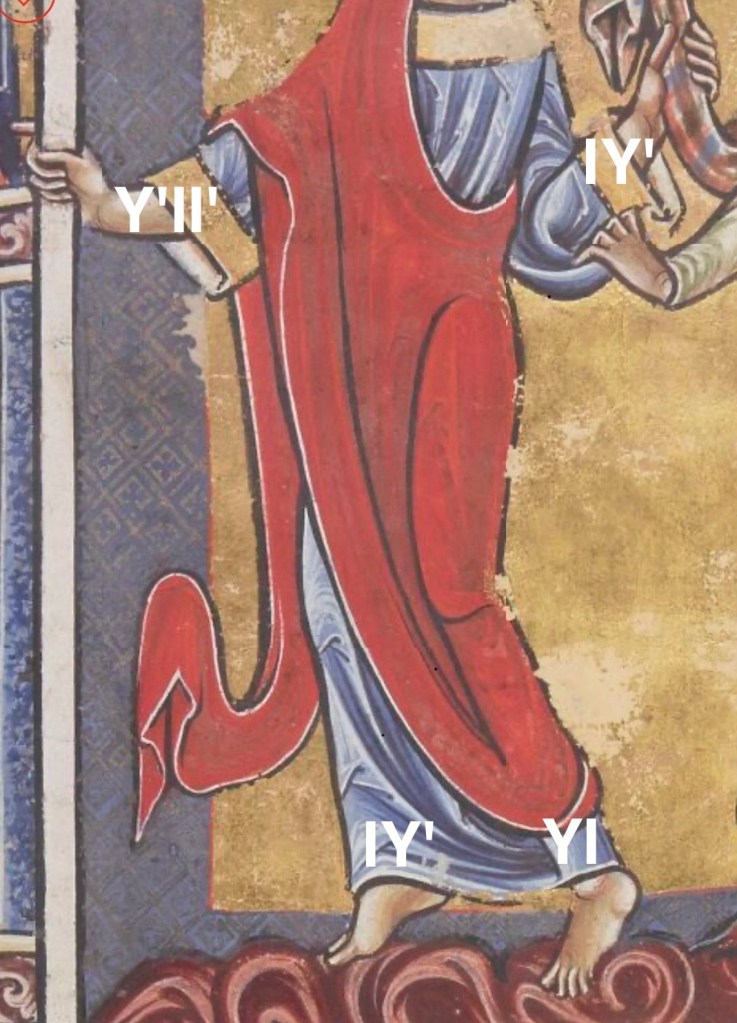
List of Explicit I’ Instances
- von Trimberg: Student’s LEFT hand has cut Index finger = I’.
Index (1) - Otto: Kosmokrator: Hold’s other guy’s LEFT wrist with his LEFT hand: cut thumb = I’.
Thumb (1) - Otto: Entry into Jerusalem: Holds {closed scroll} with LEFT hand; cut thumb = I’.
Thumb (1) - GCP f134 row 2: break bowman’s LEFT hand has I’ via cut thumb.
Thumb (1) - Otto: Entry into Jerusalem: Green guy spreading cloak, LEFT hand: Y’YI’.
Thumb (1)
End of copied sections
f49 Forge Crops
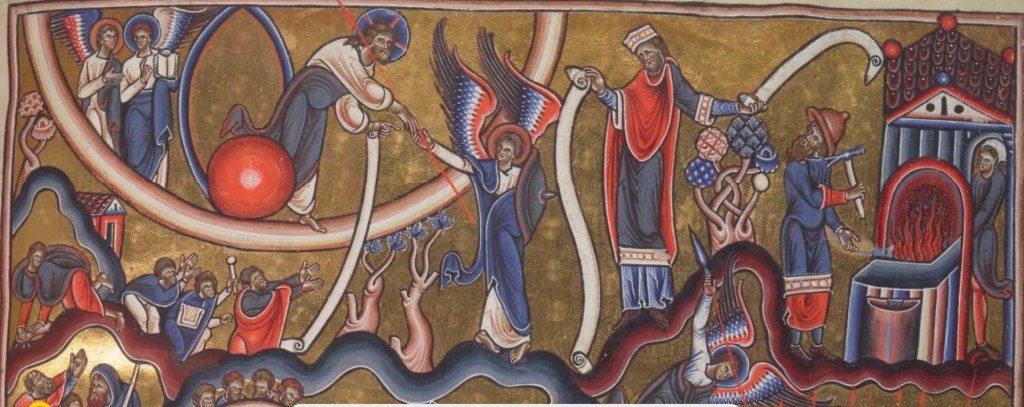
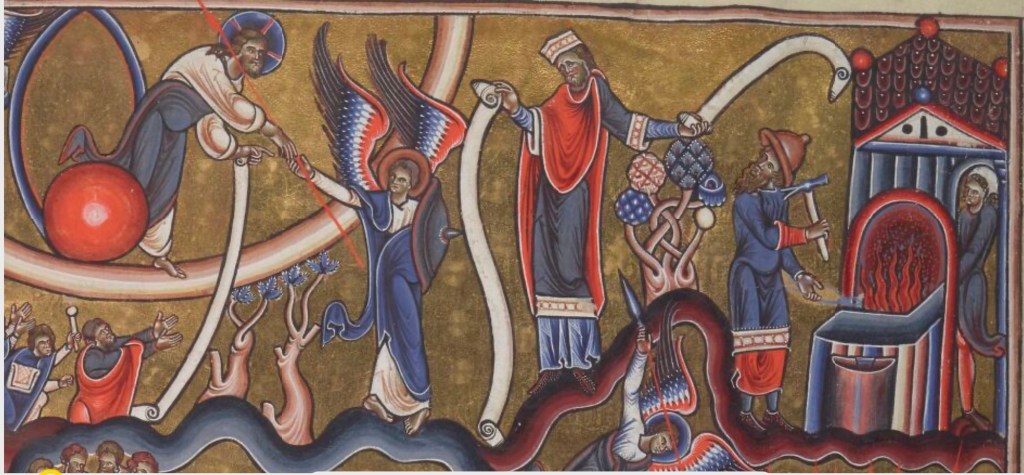
Mobile, tried making some crops of Forge f49 folio image, Great Canterbury Psalter
Eg four hi res crops i can annotate on mobile.
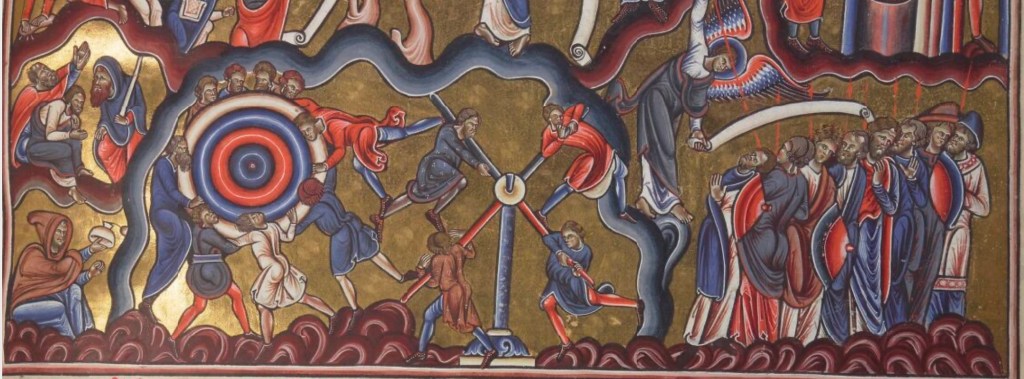
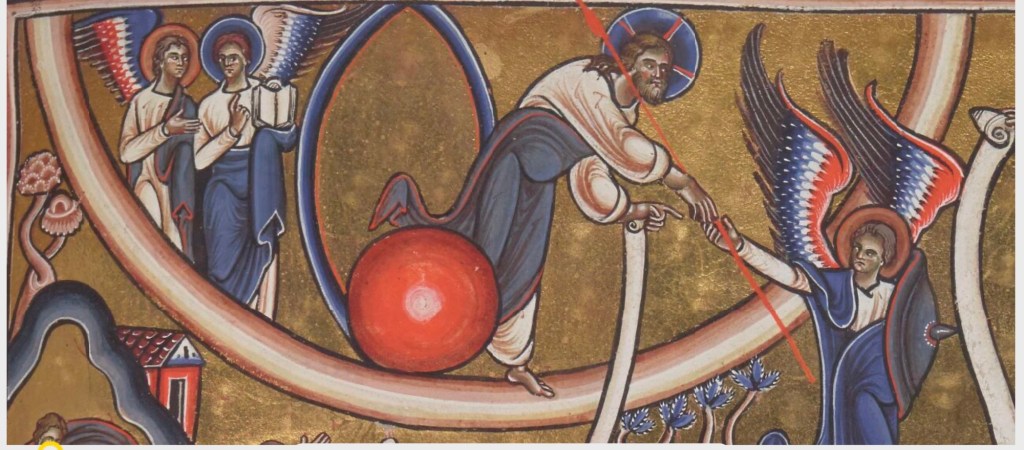
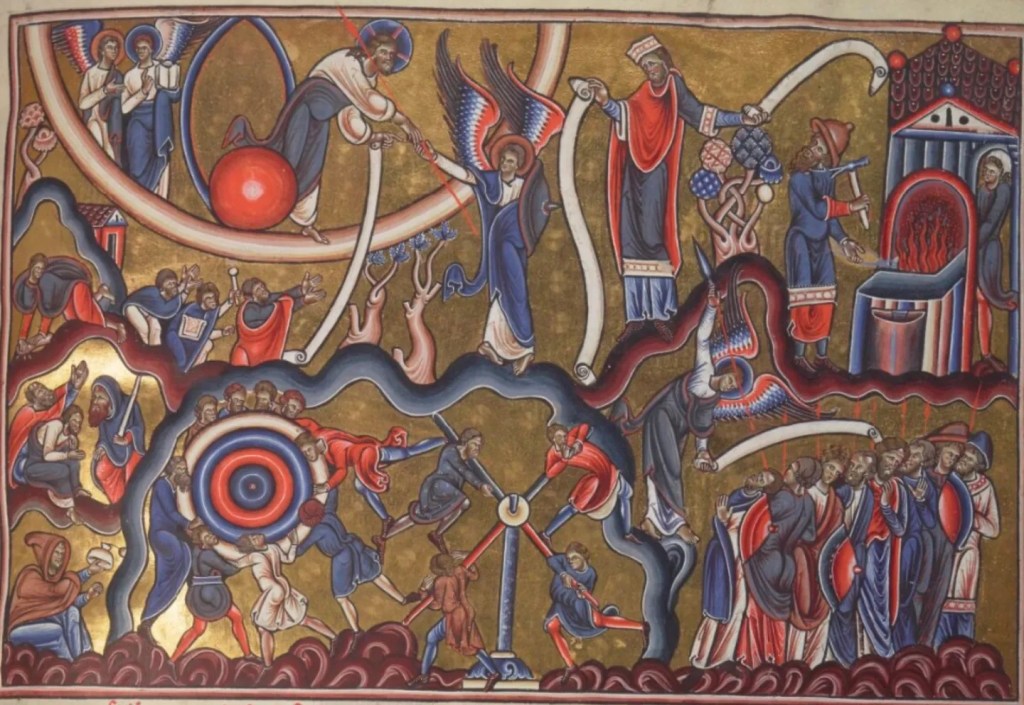
Canterbury f49 Features: Forge, Wheels of Fate
There are many.
God/Christ comes through the White Light almond portal of mushroom-revealed governorship by the higher controller.
Blue state-boundary & brown state-boundary.
- grid-cap = branching = Left direction (generally)
- singular cap = non-branching = Right direction (generally)
vine leaf tree pair: {cut right trunk} touches lifted garment motif of angel.
{cut left trunk} touches open scroll.
{cut right branch} on left vine-leaf tree.
YI hand shapes throughout: Y, Y’, I, I’.
upper left mushroom-tree: grid cap is associated with non cut stem; singular cap is assoc w the left, cut stem.
branching = non cut stem = grid cap
non-branching = cut stem = singular cap
{cut left trunk}
contrast the branching or singularness of the two stems & caps.
at the top level, of the caps, that mushroom-tree follows the standard mapping convention of the medieval art genre of {mushroom-trees}:
branching on L (grid cap, non cut stem):
non-branching on Right (singular cap & cut stem).
The mushroom cluster, eval’d from bottom up, has 3 branches: the Right branch has two caps NOT grid caps; singular, so considered non-branching.
Left caps (per bottom up) have grid caps, multiple, considered Branching: they touch his Left arm/ sleeve.
copied sections from Otto Game previous page:
What’s Asserted by the Four Shapes (the ordinary-state two first, then the altered-state two)
I have not been using this order, but it seems better: group together the state-specific models.
An unenlightened, asleep person is expected to assert & experience Y & I’.
An awakened, intense mystic altered state enlightened person is expected to assert & experience, relatively, Y’ & I.
Y – The Y shape asserts that ordinary-state, branching Possibilism is the case, phenomenologically/ subjectively/ experientially.
I’ – The I’ shape asserts that non-branching Eternalism (revealed in altered-state) is NOT the case (which is false; metaphysically, I’ is not the case is it IS the case). Phen’ly, in ordinary-state, I’ is the case.
Y’ – The Y’ shape asserts that ordinary-state, branching Possibilism is not the case, metaphysically.
I – The I shape asserts that altered-state, non-branching Eternalism is metaphysically the case, revealed experientially.
Not convinced that there is any “always seek X pattern”, 3 of 4 or 4 of 4 models”. Fall back instead to, find the 4 shapes if possible.
- Explicit Y shape
- Explicit I’ shape
- Explicit Y’ shape
- Explicit I shape
What’s Asserted by the Four Shapes
Y – The Y shape asserts that ordinary-state, branching Possibilism is the case, phenomenologically/ subjectively/ experientially.
Y’ – The Y’ shape asserts that ordinary-state, branching Possibilism is not the case, metaphysically.
I – The I shape asserts that altered-state, non-branching Eternalism is metaphysically the case, revealed experientially.
I’ – The I’ shape asserts that non-branching Eternalism (revealed in altered-state) is NOT the case (which is false; metaphysically, I’ is not the case is it IS the case). Phen’ly, in ordinary-state, I’ is the case.
Y Is the Case, Phen’ly (especially in ordinary-state)
Y’ Is the Case, Metaphy’ly (especially in altered-state)
I Is the Case, Metaphy’ly (especially in altered-state)
I’ Is the Case, Phen’ly (especially in ordinary-state)
end of copy-paste of sections
See Also
Recent pages:
- Otto Psalter: The “Spot the YI Hand-Shapes” Game
- The Psychedelic 1160s: Maximal Mushroom Art Theory
- Hand-Shape Theory: Debates to Develop and Fine-Tune the Theory
- Canterbury f49: Wheels of Fate, Forge, Threatened by Angel

 The Egodeath theory