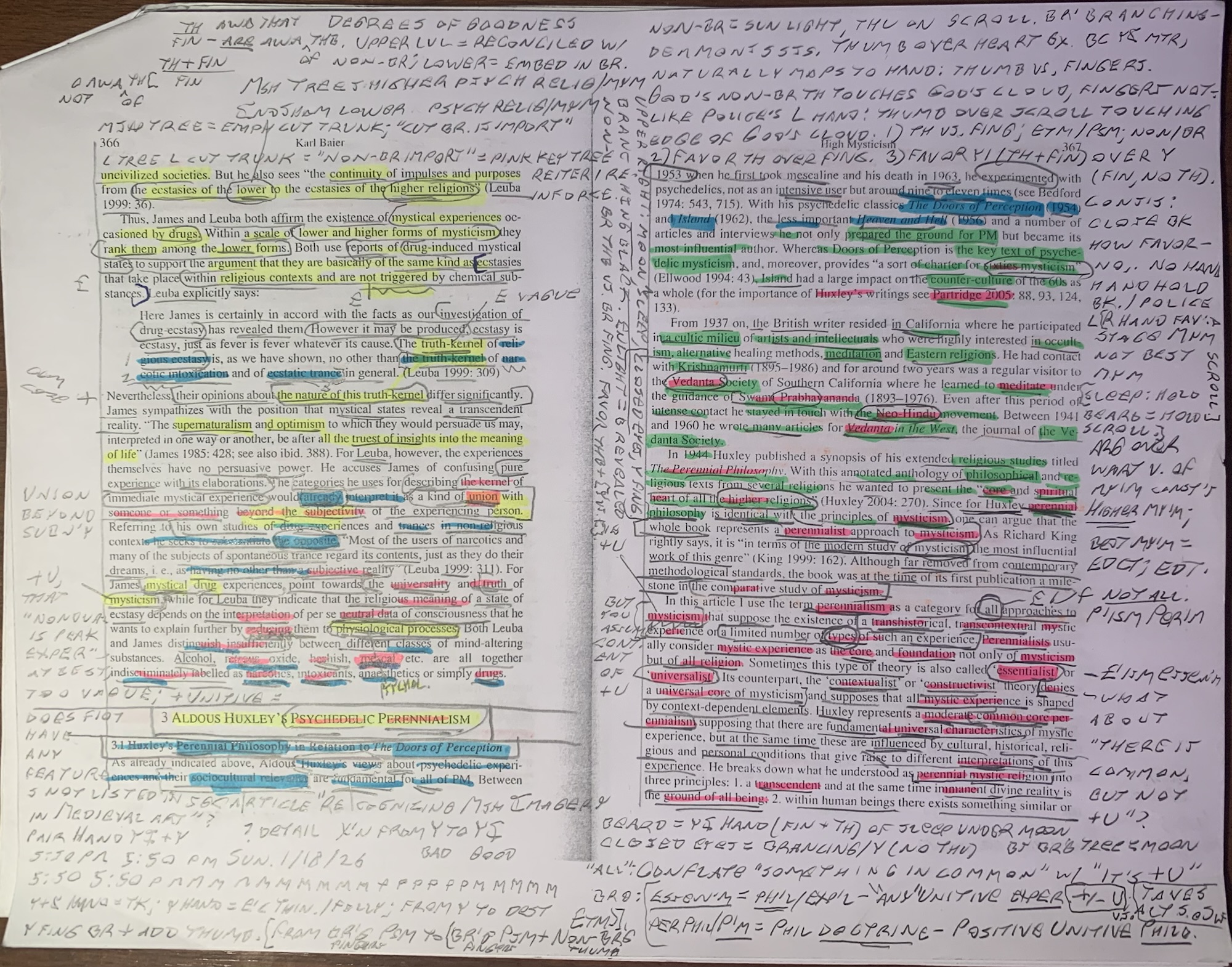
“This groundbreaking book sheds new scientific light on the age-old question of free will.
“Humankind evolved to flourish by creating a new kind of society, which required an advanced mind capable of recognizing possibilities and making good choices.
“No other animal operates amid economic marketplaces, shared moral principles, legal systems, religious and political institutions, and the like.
“Rather than getting bogged down in philosophical debates, The Science of Free Will surges ahead to explain how this marvelous, newly evolved mental system works.
“Some actions are freer than others, so how does one recognize and take advantage of this freedom?
Key features involve grounding actions in time and pondering multiple possible futures—
indeed understanding one’s life as a story, in which one’s actions link past, present, and future-and conscious thoughts, including
logical reasoning,
planning, and
overriding one’s first impulse.
“Understanding free will in this fashion reveals both the powers and the limits of the human mind.”
Video: Roy Baumeister: Free Will, The Self, Ego, Will Power (April 2024)
“The Hermetic corpus is a spiritual and intellectual treasure stemming from ancient Egyptian sages who could write and think in Greek.
“Since the Renaissance, this corpus has appeared in an order that does not fit the path of spiritual initiation suggested by the corpus itself.
“The present edition reorders the corpus—including the Latin Asclepius and the Nag Hammadi Hermetica—into four progressing parts: introductory tractates, general discourses, detailed discourses, and revelatory discourses.
“A short spiritual commentary follows each tractate.
“The book is written for all lovers of the Hermetica, but in particular for those who are willing, in some sense, to join the way of immortality.”
“Hermetica II: The Excerpts of Stobaeus, Papyrus Fragments, and Ancient Testimonies in an English Translation with Notes and Introduction M. David Litwa
Blurb:
“This volume presents in new English translations the scattered fragments and testimonies regarding Hermes Thrice Great that complete Brian Copenhaver’s translation of the Hermetica (Cambridge, 1992).
“It contains the twenty-nine fragments from Stobaeus (including the famous Kore Kosmou), the Oxford and Vienna fragments (never before translated), an expanded selection of fragments from various authors (including Zosimus of Panopolis, Augustine, and Albert the Great), and testimonies about Hermes from thirty-eight authors (including Cicero, Pseudo-Manetho, the Emperor Julian, Al-Kindī, Michael Psellus, the Emerald Tablet, and Nicholas of Cusa).
All translations are accompanied by introductions and notes which cite sources for further reading.
These Hermetic texts will appeal to a broad array of readers interested in western esotericism including scholars of Egyptology, the New Testament, the classical world, Byzantium, medieval Islam, the Latin Middle Ages, and the Renaissance.”
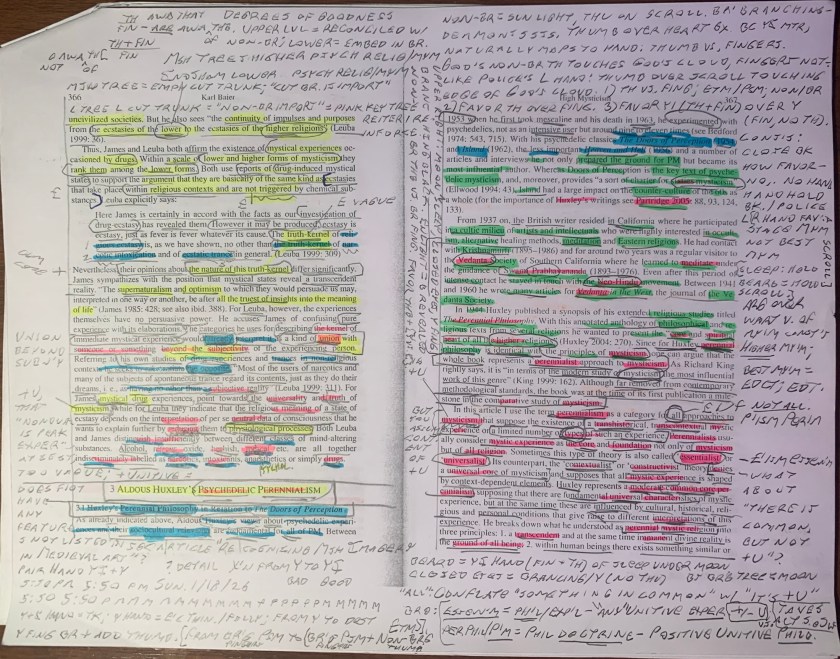
New: keyboard shortcuts, short/med/long, that contain a book citation or webpage link
in this context of planning keyboard shortcuts, space char = not defined yet.
Only define this full set if needed. Mar 23, 2025: new formalized set of keyboard shortcuts pattern. The long expansion includes link either to book or to my page.
author last name y g author first & last name s y
short yugler book: p a t s med yugler book: p a t s m long yugler book: p a t s l
Psychedelics and the Soul: A Mythic Guide to Psychedelic Healing, Depth Psychology, and Cultural Repair (Yugler, 2024)
I have read this book, in church book club, and we met with the author.
“A mythological journey through 10 archetypes of psychedelic healing: ancient stories, tangible tools, and depth psychology insights
“Designed for a new generation of psychedelic facilitators and seekers, Psychedelics and the Soulinvokes the traditions of
Jungian depth psychology,
mythology, and
Indigenous cultural wisdom x
to meet a critical question of our times: How can the emerging field of psychedelic medicine heal the soul amid planetary crisis and collective opportunity?
“Psychedelic therapist Simon Yugler invites the reader on a mythological journey, using depth psychology to explore 10 universal themes that transcend our individual experiences—and reveal how psychedelic medicine can heal the soul and our collective unconscious in a time of uncertainty and initiation:
The Well: The Unconscious, Symbolism, & the Mythic Unknown
The Temple: Beyond Set & Setting
The Underworld: Shadow, Grief, & the Descent to Soul
The Serpent: Psychedelic Somatics & Shedding Your Skin
The Monstrous: Trauma, Exiles, & the Wound That Heals
The Trickster: Marginality, the Crossroads, & the Liminal Road
The Guide: Power, Authenticity, & Inner Authority
The Sacred Mountain: Vision, Ecstasy, & Becoming Nobody
The Tree of Life: Animism, Climate Change, & the Ensouled Earth
The Journey Home: Integration, Community, & Dancing with the Village
“Each archetype acts as a prism, using myth, fable, and universal wisdom to reflect back to the reader the collective experiences and unconscious truths that shape our psyches—and that are made more profound and accessible through psychedelics.
“Yugler shares how entheogens and plant medicine open a gateway to our understanding of our culture, selves, and interconnected reality toward wide-scale social and planetary healing.”
I asked Yugler if there’s anything left of the book and approach after removing therapy and healing; I mentioned vs Houot’s advocacy of a Psychonaut {science explorer/ discoverer} approach instead, in Houot’s forthcoming book.
Yugler as Example of How Modern Writing on Myth Destroys Myth
“How the Hippies Saved Physics gives us an unconventional view of some unconventional people engaged early in the fundamentals of quantum theory. Great fun to read.” ―Anton Zeilinger, Nobel laureate in physics
The surprising story of eccentric young scientists―among them Nobel laureates John Clauser and Alain Aspect―who stood up to convention and changed the face of modern physics.
Today, quantum information theory is among the most exciting scientific frontiers, attracting billions of dollars in funding and thousands of talented researchers. But as MIT physicist and historian David Kaiser reveals, this cutting-edge field has a surprisingly psychedelic past. How the Hippies Saved Physics introduces us to a band of freewheeling physicists who defied the imperative to “shut up and calculate” and helped to rejuvenate modern physics.
For physicists, the 1970s were a time of stagnation. Jobs became scarce, and conformity was encouraged, sometimes stifling exploration of the mysteries of the physical world. Dissatisfied, underemployed, and eternally curious, an eccentric group of physicists in Berkeley, California, banded together to throw off the constraints of the physics mainstream and explore the wilder side of science. Dubbing themselves the “Fundamental Fysiks Group,” they pursued an audacious, speculative approach to physics. They studied quantum entanglement and Bell’s Theorem through the lens of Eastern mysticism and psychic mind-reading, discussing the latest research while lounging in hot tubs. Some even dabbled with LSD to enhance their creativity. Unlikely as it may seem, these iconoclasts spun modern physics in a new direction, forcing mainstream physicists to pay attention to the strange but exciting underpinnings of quantum theory.
A lively, entertaining story that illuminates the relationship between creativity and scientific progress, How the Hippies Saved Physics takes us to a time when only the unlikeliest heroes could break the science world out of its rut.”
46 illustrations
Groovy Science: Knowledge, Innovation, and American Counterculture (Kaiser & McCray, 2016)
“In his 1969 book The Making of a Counterculture, Theodore Roszak described the youth of the late 1960s as fleeing science “as if from a place inhabited by plague,” and even seeking “subversion of the scientific worldview” itself. Roszak’s view has come to be our own: when we think of the youth movement of the 1960s and early 1970s, we think of a movement that was explicitly anti-scientific in its embrace of alternative spiritualities and communal living.
Such a view is far too simple, ignoring the diverse ways in which the era’s countercultures expressed enthusiasm for and involved themselves in science—of a certain type. Rejecting hulking, militarized technical projects like Cold War missiles and mainframes, Boomers and hippies sought a science that was both small-scale and big-picture, as exemplified by the annual workshops on quantum physics at the Esalen Institute in Big Sur, or Timothy Leary’s championing of space exploration as the ultimate “high.” Groovy Science explores the experimentation and eclecticism that marked countercultural science and technology during one of the most colorful periods of American history.”
Motivation for this Page
New: Attention to the combined use of printed book, ebook, and [new] audiobook.
result of new type of keyboard shortcut: [ROTPL] type: long citation with link:
Happy w/ voice recording UI format, read aloud by Houot, for book:
Rise of the Psychonaut: Maps for Amateurs, Nonscientists and Explorers in the Psychedelic Age of Discovery, A. M. Houot (“Ooh-Oh”), Feb. 3, 2025, https://www.amazon.com/dp/B0DPSJGMFR (paperback, ebook, & audiobook)
I often need to paste book info at this site without creating a dedicate page (yet), and need to find , often, where I put that basic info about a book.
If a book’s info here is highly relevant and I have expanded it here, & in other pages, then, I can create a dedicated page for that author and/or that book or article.
Should I create a page about Yugler book? Or a section in some special page that could cover briefly a bunch of books??
eg: “Books” See first, site map: https://egodeaththeory.org/nav/#books-articles-videos I often have a need to dump basic info about a book into a page or into this site, just to examine. Yes, there is a real need for general Books page.
Then, if that is a good book that’s relevant to expand, after that, break out a page dedicated to that book – or, that author, probably even better.
Per-author page, eg I need or have a per-author page for … or I have a need for an author-deicated page for authors listed in Site map w/ their own section. For a given author, if highly relevant for the Egodeath theory, I need both:
A Site Map section for my pages about that author’s works.
A page for that author’s works. done for Jerry Brown, for example; I have a page, “Brown’s works”.
todo: in Site Map here, include all (?) links/pages that are listed in home page Egodeath.com (2007). present site is EgodeathTheory.WordPress.com [EWC] (incle https? need keyboard shortcut that includes clickable url)
Ruck Committee’s Chicken Footnote about Allegro 🐓🙀😨
In Carl Ruck’s book Apples of Apollo, footnote 1 complains that they have to cite Allegro’s Sacred Mushroom & the Cross book in the footnote instead of the bibliography, because if they were to put Allegro’ book in the bibliography, it would be the first book listed, and that’s not acceptable.
No surprise, this footnote has to do with entheogens – which is clown world land – 1st-generation entheogen scholarship (the Secret Amanita paradigm) worst of all.
Meanwhile, I’ve seen various assorted different kinds of authors routinely listing Allegro’s book in their bibliography.
I bet Jan Irvin had a thing or two to say about that ridiculous, puerile, childish reasoning about omitting Allegro from the bibliography.
Of course the book about mysticism by the professor of religion can compete against Ruck’s footnote for stupidity:
At page 1 bottom of the page, that utterly mainstream book about mysticism says in the footnote that “Of course, college students don’t have any way of accessing the mystic state.” Living under a rock! 😵 I tried hard to re-find the book.
Of course, college students don’t have any way of accessing the mystical state of consciousness. 🤷♂️
mainstream book about mysticism, footnote on page 1
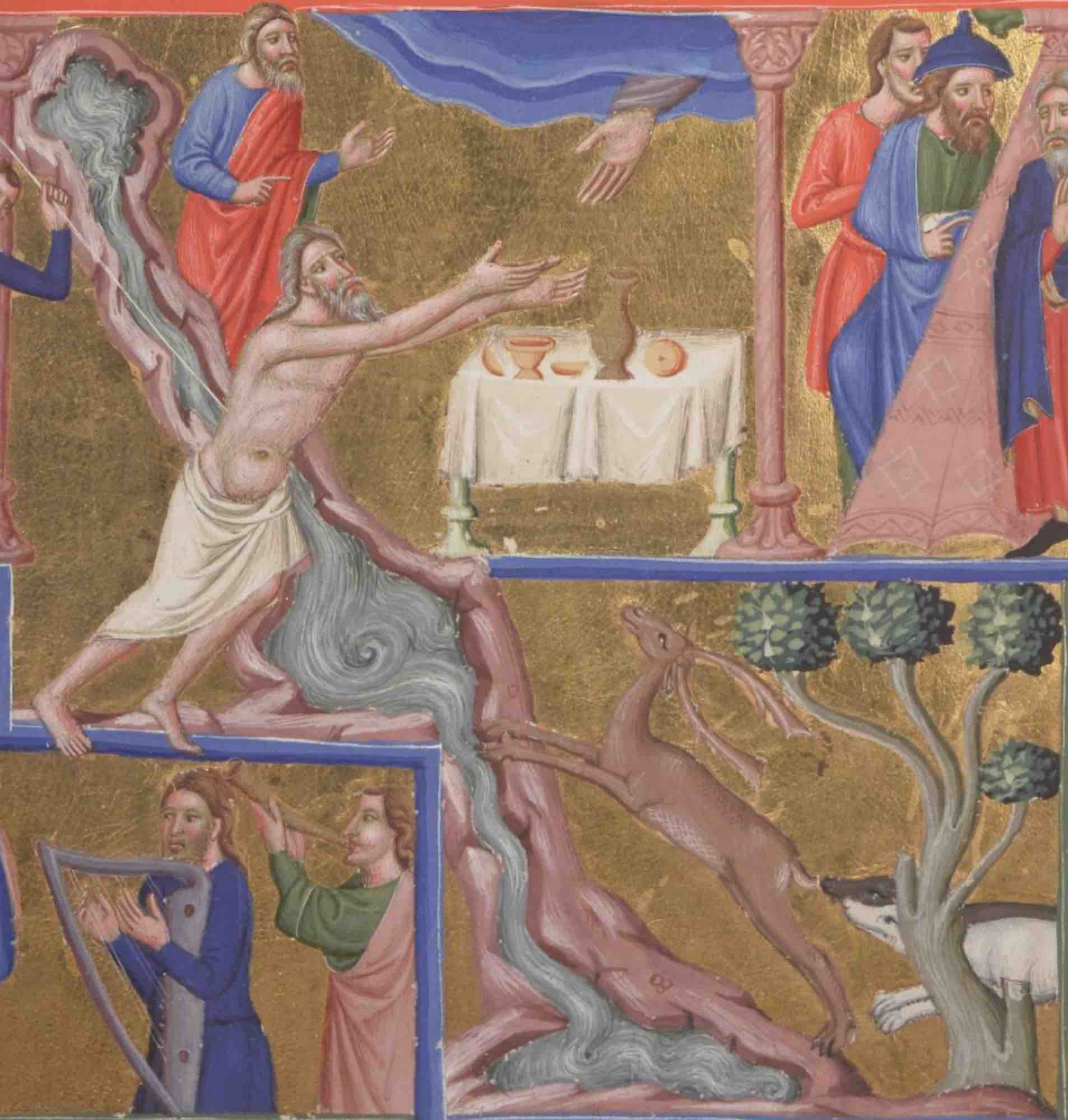
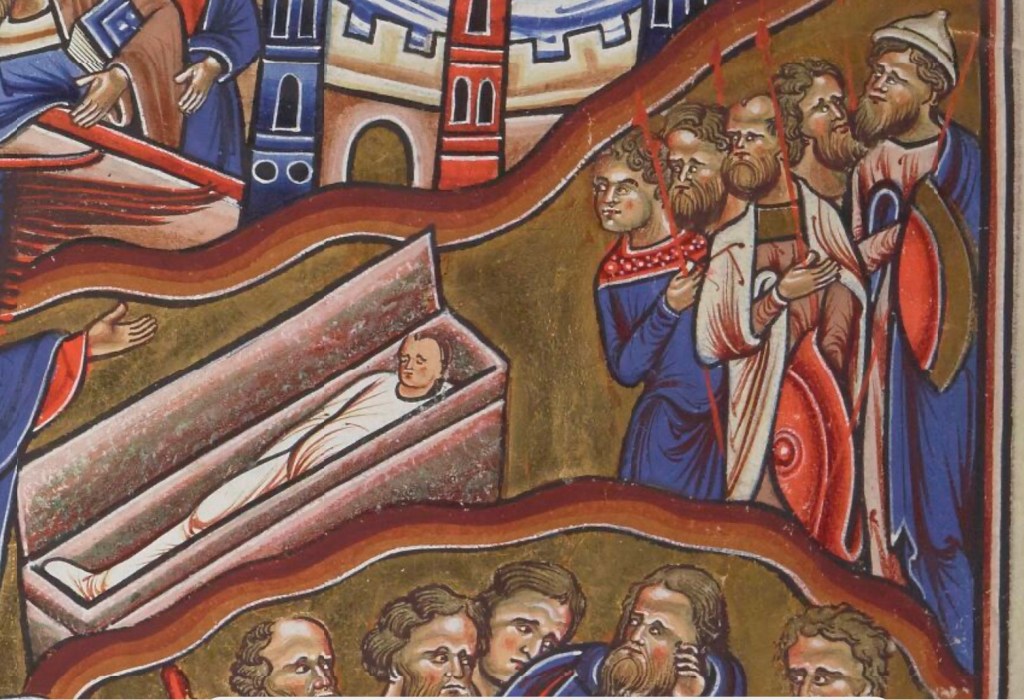
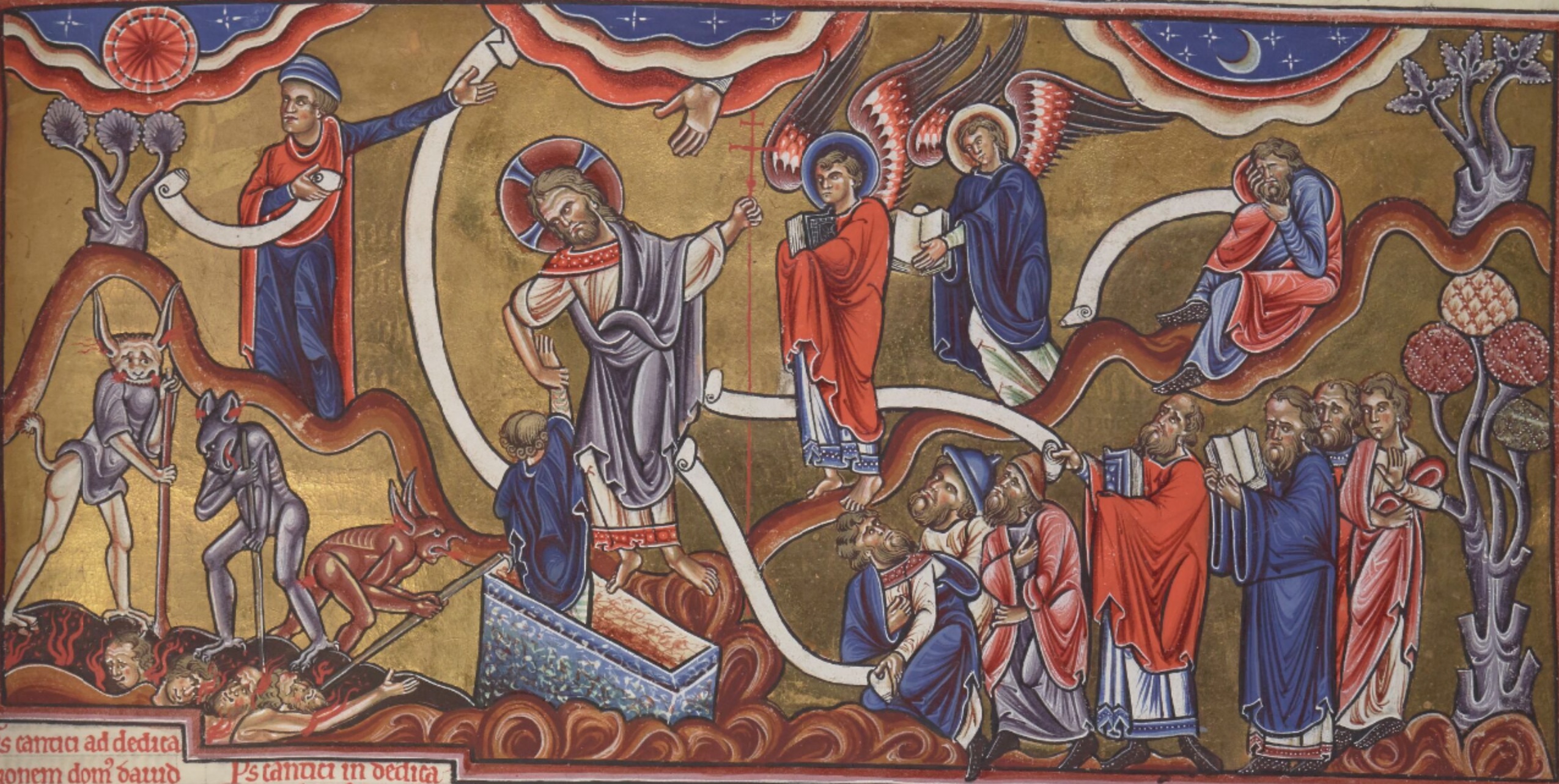
Eadwine Is Depicting Fate
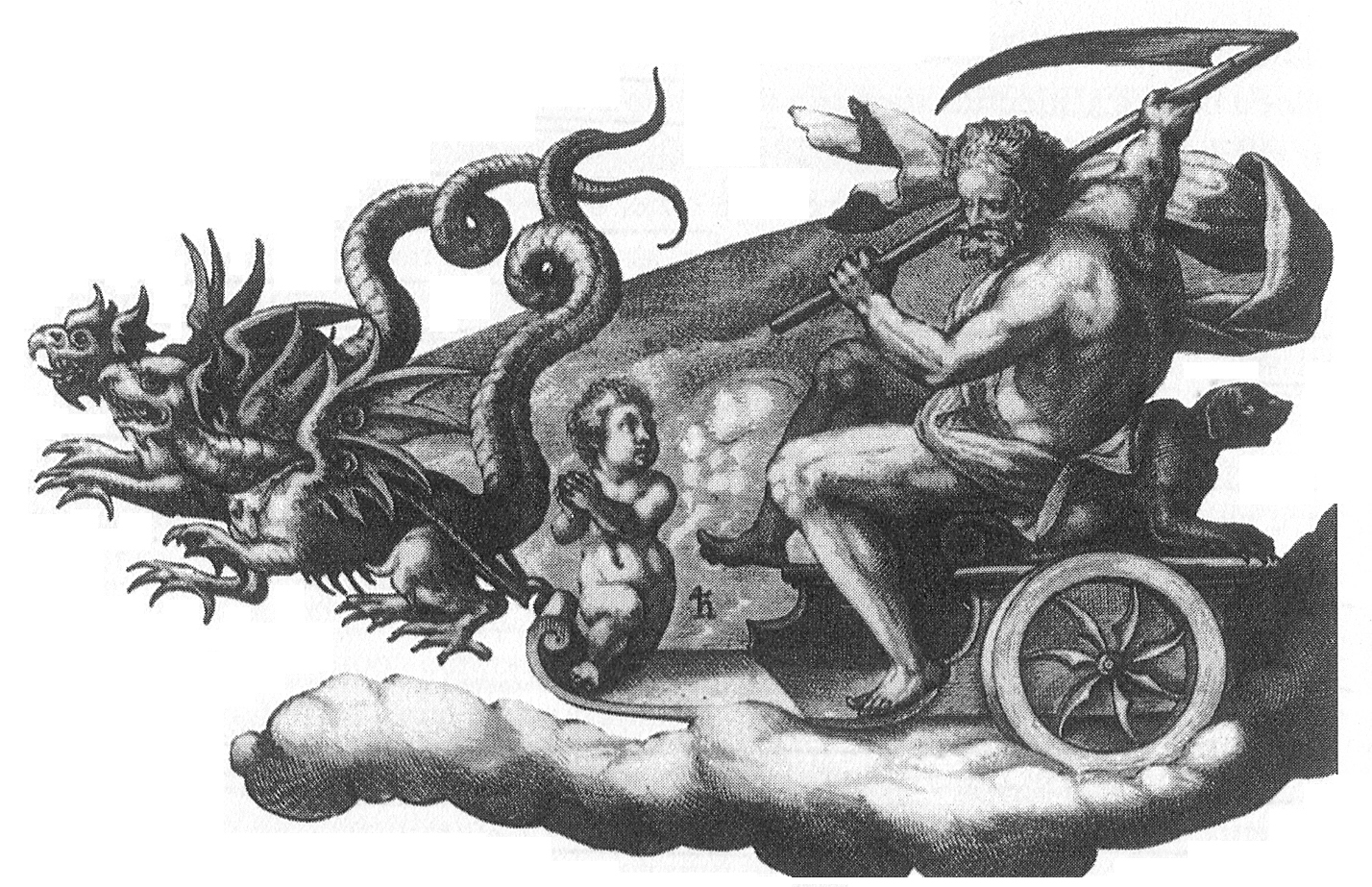
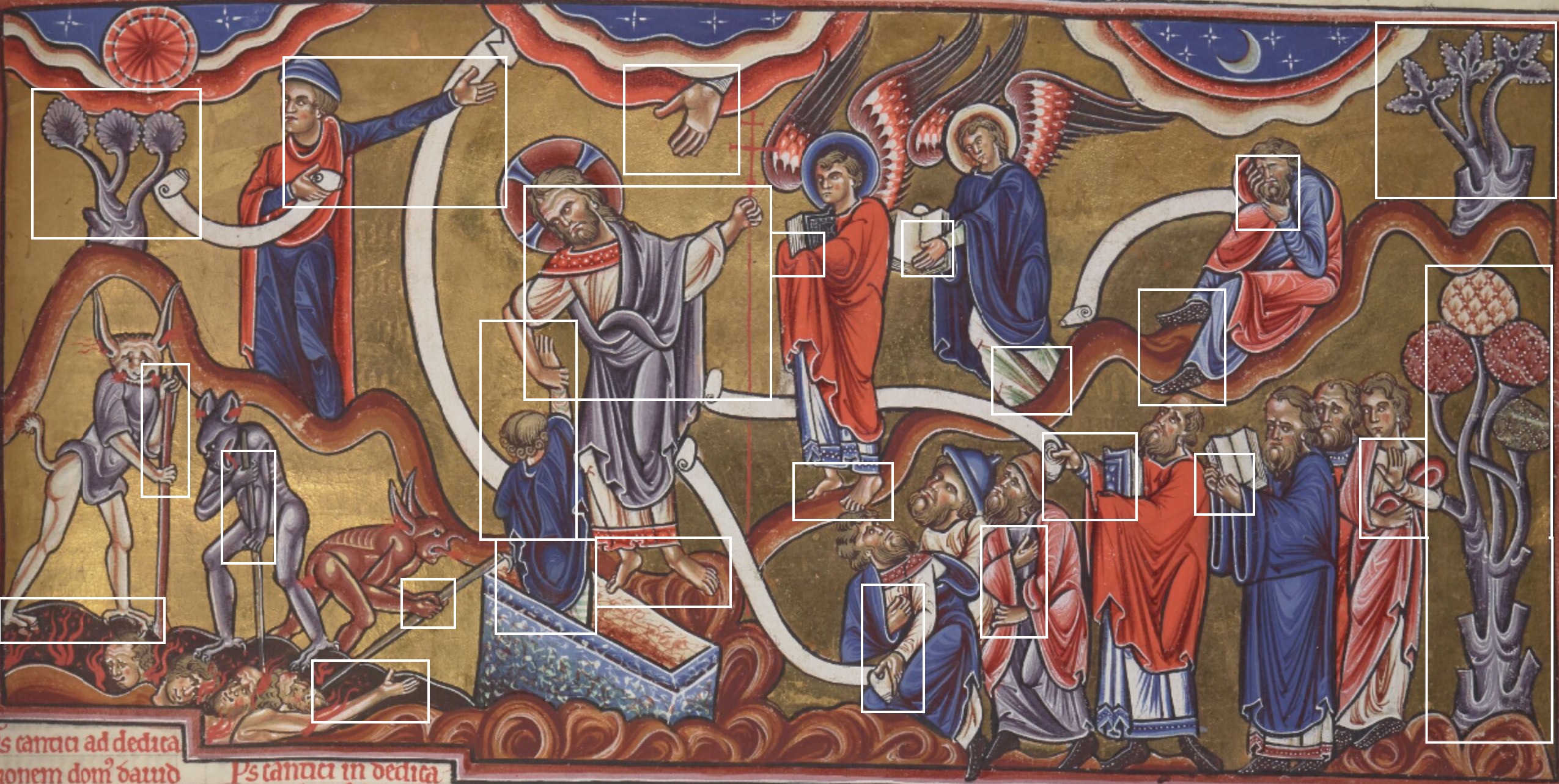
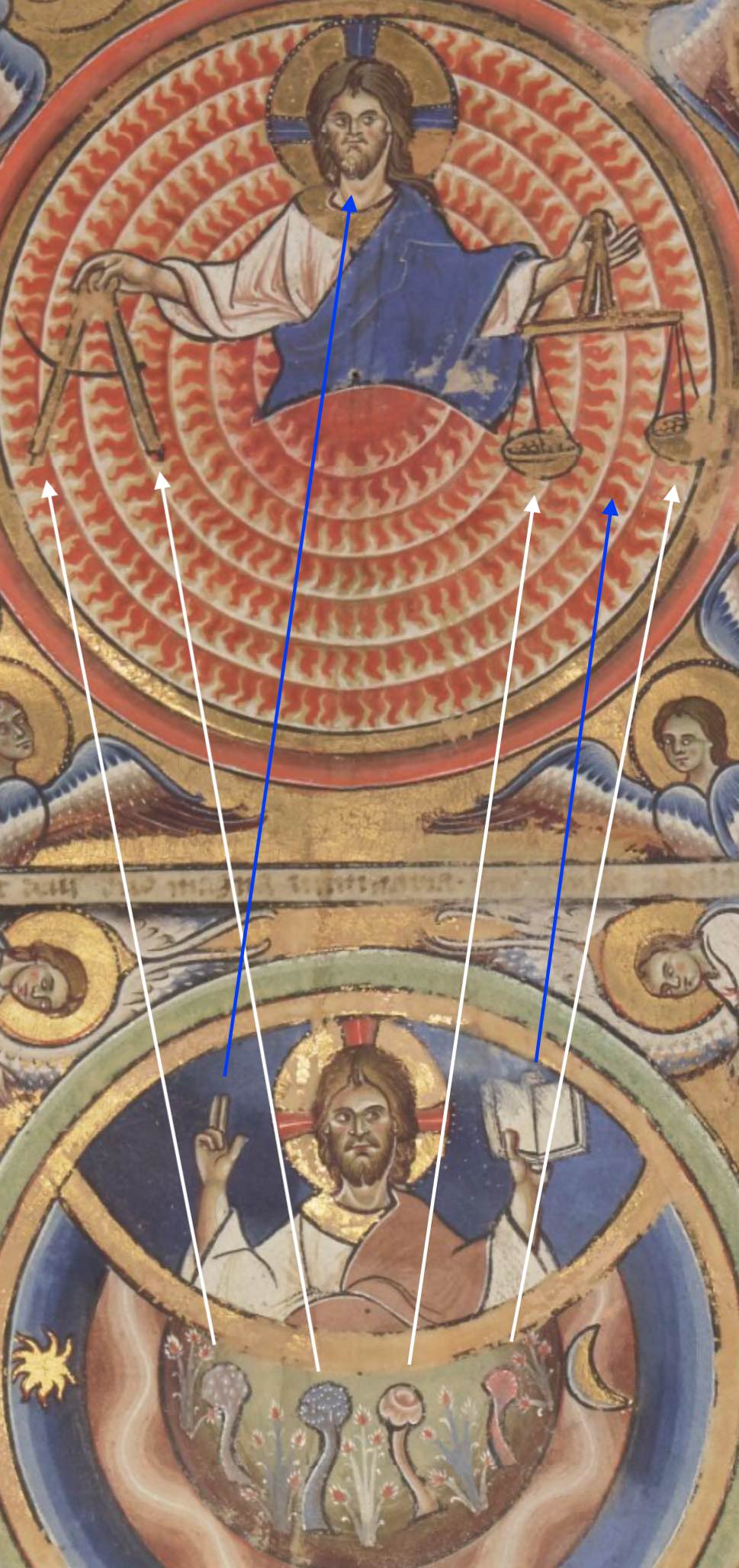
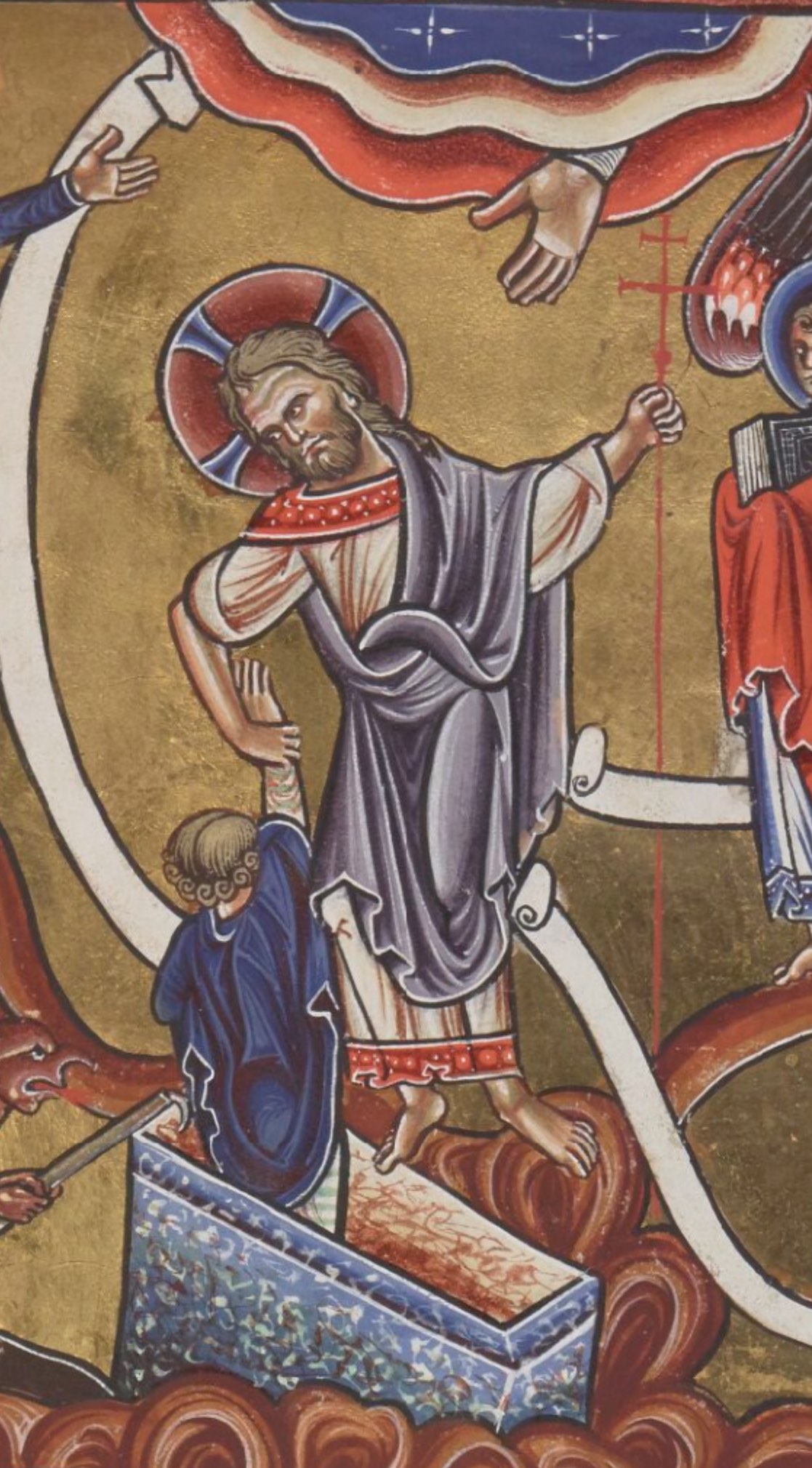
[7:38 pm March 21, 2025] – I just realized wheel uploaded maybe by John Lash = DIRECT DEPICTION OF FATE by Eadwine in Great Canterbury Psalter.
Recognized because of looking at cover of Brennan after his good discussion with ESOTERICA Justin Sledge YouTube conversation.
Miracle: Nov 8 2020 Got Not only Ebook of Hatsis, but also Audiobook!
Baffled to buy audio voice recording of Houot (Oh-Ow) book and discovered amazingly I have bought the Hatsis voice recording.
I do not remember hearing Hatsis read pmt Psychedelic Mystery Traditions book aloud.
Now I have Hatsis’ book in all 3 formats:
Printed paperback
Voice recording
ebook
I hated having only ebook but bizarre thing is same day i got both ebook and audiobook – by accident?!
todo: copy email to here “no one understands cog sci” about audio book of Oh-Ow Rise of the Arrogant Psychonaut.
Hellenistic Astrology: The Study of Fate and Fortune (Brennan, 2017)
“Hellenistic astrology is a tradition of horoscopic astrology that was practiced in the Mediterranean region from approximately the first century BCE until the seventh century CE.
“It is the source of many of the modern traditions of astrology that still flourish around the world today, although it is only recently that many of the surviving texts of this tradition have become available again for astrologers to study.
Hellenistic Astrology: The Study of Fate and Fortune is the first comprehensive survey of this tradition in modern times.
“The book covers the history, philosophy, and techniques of ancient astrology, with a special focus on demonstrating how many of the fundamental concepts underlying the practice of western astrology originated during the Hellenistic period.”
Motivation of This Post
Story behind this post: I posted it long ago, then hid it because silly negativity, then used the draft post as a scratchpad way of uploading photos from mobile device.
Random fun results.
Added more good content today, March 20, 2025.
Hanegraaff’s Cosmos Model for Astral Ascent Mysticism Has Nowhere to Put the Fate-Soaked Fixed Stars 🤷♂️🌌–>🗑️
Footnote 114 p. 294: NOWHERE TO PUT the FIXED STARS in Wouter Hanegraaff’s malformed cosmos of astral ascent mysticism.
Hermetic Spirituality and the Historical Imagination: Altered States of Knowledge in Late Antiquity, by Wouter Hanegraaff, 2022:
v1 hazy: ftnote 114 Hermetic Spirituality and the Historical Imagination: Altered States of Knowledge in Late Antiquity, by Wouter Hanegraaff, 2022 :
the book Led Zep 4 astral ascent mysticism
” the Egodeath theory, but only the basic 2-lev model:
Birth of Ego Death: The Moment of Birth of the Egodeath Theory
A pox on eternalism videos that FAIL to say “Minkowski”!
The Egodeath theory came from 4D spacetime + self ctrl analysis + loose cognition blotter art.
Jan 11 1988, in the ivy-covered computer lab w sirens announcing it: sitting typing at a row of Macs in front of the picture window wall facing my ivy-covered dorm across grass with my Dead friend Engineer student walking by the window I walked out and told him.
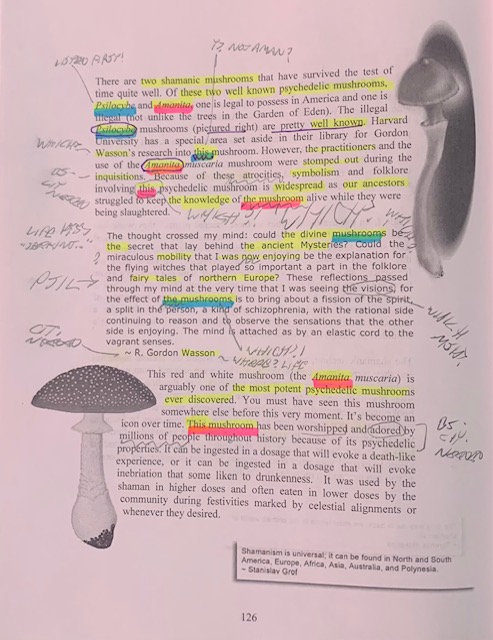
My Oct. 2024 Amanita Photos
not Michael Hoffman – i wish to credit this awesome lucky pic
photos Michael Hoffman before or on halloween 2024:
Rise of the Arrogant Psychonaut
i gotta finishing this post & read for my churches book club now:
Max Freakout podcast 2007-2009+:
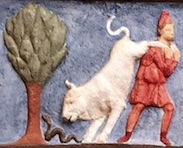
Great pic from AstroSham 1 by jan irvin, underneath and above POVs on Taurus: his book shows my Amanita gold dried photo & cites the Egodeath theory:
~2023 mar bks re-surveyed profitably:
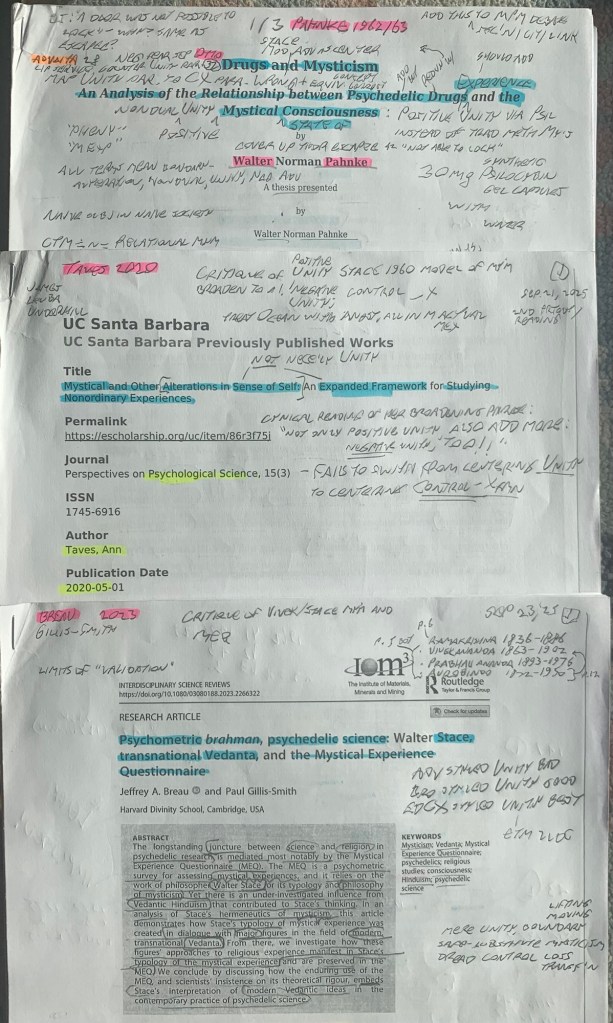
Dean of Harvard in video interview in psychedelics series, Chs Stang also says the Mystical Experience Questionnaire (MEQ) FAILS to match mystics reports.
My Dec 3 2013 branching breakthrough lecture announcement:
The absolutely bunk model of mystical experience that is foisted as the science basis of psychedelic pseudo science. thats ok, Grift tells Stung in Harvard vid:
Our Challenging Experience Questionnaire (CEQ) catches the mystic failures of our “POSITIVE-BALANCED” Mystical Experience Questionnaire (MEQ) [which Tim Leary 🌾😵💫 created while dressed up as Walter Pahnke in 1963]
The endnote [20] hides Walter Stace 1960 based on Wm James 1902, as “science”:
11-Factors Studerus article is poor at presenting their purpose , strategy, justification.
Stud’s article about 11F is drawn from INEPTLY by R Grift team for their 1st phase Pool gathering “all” (sic) negative fx from the 3 leading questionnaires:
SOCQ (the Mystical Experience Questionnaire (MEQ)) &
HRS – Strassman, NN DMT &
Adolph Dittrich’s APZ-derived “5DASC” albeit only via 11Factors, which is not 5D-asc but is OAV 1994, ignoring the dumb 2 dims. CEQ only draws from A of OAV but screws that up, missing 8 of 21 neg fx
… thus missing the 8 Shadow Factor 13 items, conveniently for the Grifty team – they subsequently deleted 10 more of the 21 Dread items, leaving only the 3 weakest effects. Mission achieved.
The Grifty team when constructing the CEQ should have ignored the confusing middleman Stud 11Factors and drawn directly from the entire Angst/Dread of Ego Death [“of Ego Dissolution”) DED dimension of OAV 1994.
Stud sold 11F questionnaire as new shiny tech but pointless and BACKFIRED: there was NO reason Grift had, but POSTURING salesmanship, to use the “new improved” 11F instead of using the REAL DEAL OAV A dimension directly.
This stupid move resulted in the omission of the 8 of 21 most broadly potent negative fx, which wouldn’t have been omitted from the CEQ’s initial items pool, had Grift drawn directly from the excellent OAV’s Angst Dread of Ego Death dimension.
Using the intermediary 11F for no reason other than “because it’s an improvement on OAV” (pure marketing posturing w no actual benefit) per the bogus reasoning on p 1-3 of Stud 11 Factors article =
How to get from a GREAT questionnaire jnstrument (Dittrich 1975 APZ begat … v2: OAV 1994, which has a SOLID Dread dimension 👍😱🐉) to end up w SHIITE quality Grifty Hop questionnaire the Challenging Experience Questionnaire (CEQ)
Beware, the Challenging Experience Questionnaire (CEQ) is not a serious, real questionnaire.
I said in my page “References for Psychedelics questionnaires”, that I hesitate to list CEQ, as if it is a real questionnaire thats meant to be used; it is not.
The Purpose of CEQ is only for Grift to wave at Stung when challenged in video interview at Harvard: “meq fails to match mystics writings”. its ok we catch fails of positive-balanced meq via our CEQ – sign up for our non-psychedelic psychedelic, neutered, denatured, ordinary-state Grief therapy today, with 8 side-helpings of Buddha statue Newage cult propaganda, — unless Matt Johnson & the Buddha statue have run off together back in the hall closet again.
OAV is the official questionnaire approved by the Egodeath theory.
The Egodeath theory rejects SOCQ/MEQ, like Michael Pollan does, in How to Chg Your Mind, (index entry: the Mystical Experience Questionnaire) MEQ.
After toad venom dmt, then filling in the MEQ questions, Pollan had to write “N/A” because yes he TOTALLY experienced block-universe eternalism — but he HATED it, it was terrrifying; but the Mystical Experience Questionnaire (MEQ) mis-frames block-universe eternalism experience as unicorns farting rainbows, which was not Pollan’s terror experience.
Pollan could not give any answer that the MEQ author (Leary hiding behind Pahnke, Wm Roberts, then Roll-on Griftin) conceived; a misrep/ mismatch.
That is the trash-quality basis of science foundation of psychedelic pseudo science.
Total failure.
The same POSITIVE-BALANCED error pollutes the Mystical Experience Questionnaire (MEQ) and its broken wastebasket (CEQ) to catch the failures. apx of 11Factors’ diagrams tracking their shell game of hiding “item 54 fear loss of control”, because that psychedelics effect is too broad to fit their shiny marketing factors: ANX anxiety & ICC impaired ctrl & cognition.
The CEQ is the broken wastebasket to catch the failures of the MEQ.
11Factors’ weird compound factor ICC “impaired control and cognition”?
why combine those distinct fx? CRICKETS.
never any answer from Stud committee.
State in plain English what you are are trying to accomplish, Stud 11Factors committee.
Why does OAV’s Angst/ Dread dimension need two subfactors but omit from any low/level factors, 8 of the 21 effects from tgem, producing my SHADOW FACTOR 13: incl Dread “item 54: I was afraid to lose my self-control”.
What kind of items are in Shadow Factor 13 that i id’d as implicitly crafted by the Stud committee?
In 2025 I grasped the answer via the notable reasoning in Stud article:
“we dropped items 16, 28, 54, 65, & 72-1/2 from ANX factor, because too much cross-loading or another reason, math jargon; ie because THEY ARE TOO BROADLY POWERFUL TO FIT IN EITHER the ANX OR the ICC NARROW FACTORS,
so we keep these broad neg fx only in the hi lev dim “Unplsant Experiences”, not in our explicit subdfctors of that hi-level dimension.
ie:
WE PUT item 54 and the other 8 MOST BROADLY POWERFUL NEGATIVE psychedelicS FX IN SHADOW FACTOR 13 of our 11-Factors instrument/ questionnaire — where the Grift Hop team can ignore them when gathering the initial item pool to construct the failed questionnaire from Hell, the CEQ, with our Grift team’s signature, characteristic, giant gaping hole blind spot {shadow dragon monster} – the experience of the threat of catastrophic loss of control.
— which is either the exact opposite of mystical experience, per p 1 of Stud’s 11Factors article; — …
— or, is THE KEY, VERY ESSENCE of mystical experience, the key gateway to driving mental model transformation.
{shadow dragon monster}, Shadow Factor 13, Is Actually the Very Essence of Mystical Experience – Oops, Total Fail
Stace 1960 is 180 degrees backwards, re the huge fallacy, “non-pleasant = non-mystical”, that corrupts everything the pollyanna Grift Hop team touches.
🦄💨🌈
😱🐉🍽️🚪🏆
Since OAV’s Dread dimension’s “item 54: Fear of Loss of control” fits both the 11-Factors ANX narrow factor & the ICC narrow factor, but item 54 only fits in the overarching, non-marketed, hi-lev dimension (Unpleasant Experiences) that Stud is not trying to market & so only mentikns 1 time in 11F article, the Grifty team misused Stud’s 11F questionnaire, by ONLY drawing from the subset of terror psychedelics fx: only ANX & ICC, ignoring the 8 broadest Dread fx from the Dread dimension of OAV v2 1994:
APZ qair by Dittrich 1975 year of LSD album Caress of Steel by Rush begat solid OAV questionnaire incl A Angst/Dread Dimension including dread item 54 i was afraid to lose my self ctrl:
O: Ocean ; Oceanic psychedelics fx
1. I had the feeling everything around me was somehow unreal.
7. I felt as though I were floating.
13.The boundary between myself and my surroundings seemed to blur
16.I felt totally free and released from all responsibilities
31I had the feeling that I had been transferred to another world
34.it seemed to me that there were no more conflict and contradictions in the world
68.it seemed to me as though I did not have a body any more.
84.I felt very happy and content for no outward reason
92.I could have sat for hours looking at something
95.I was completely indifferent toward everything
127.I experienced past present and future as a oneness
129.it seemed to me that my environment and I were one.
147.It seemed to me that I was dreaming.
A: Angst Dread dimension: DED , Dread of Ego Dissolution (loss of control more like) — ie Q 54 of oav 1994 i was afraid to lose ctrl — isnt 54 shown by previous-me below??

i think i am showing blind spot of Studerus 11-Factors qaire missing 8 Dread psychedelics fx because 54 was too broad and powerful to fit into a narrow factor: their malformed ANX & ICC narrow factors.
WHAT DOES STUDERUS IMAGINE HIMSELF TO BE DOING BY DELIVERING these NARROW MARKETED SHINY FACTORS?
Grifty ignores the intent & strategy of why 11F questionnaire exists, and abuses 11F opportunistically to omit 8 of the 21 Dread psychedelics fx…
by pass 2 when creating bunk Challenging Experience Questionnaire (CEQ), when the dust settles, ONLY 3 of Dittrichs OAV 1994 Angst/Dread 21 effects remain!! DISASTER! 18/21 = 84% of well formed Dread effects are SIMPLY OMITTED, w no explanation whatsoever – replaced by fake inflated Grief factor instead. because grief sounds as if osc – not psychedelics-specific chall fx.
Neutered denatured the Challenging Experience Questionnaire (CEQ) results;

what the heck is the purpose of these stupid instruments (qairs) , if they ignore 18 of 21 fx?
This Is Fine 😊
you retort that’s ok the other two leading questionnaires that Grift drew from cover dread effects, right? right?
No;
THE SAME BIASED BLIND SPOT CORRUPTS EVERYTHING THAT ROLAND GRIFT TOUCHES:
When whittling down the Mystical Experience Questionnaire (MEQ) from 163? to 43 to 30 fx q’s;
When drawing from SoCQ;
” HRS hallucinogen rating scale Strass n n dmt 1990s;
pool 1 of chall fx for the Challenging Experience Questionnaire (CEQ);
ceq’s final pool of chall fx ” –
see ceq’s “Scoring guide” apx for the Yaldabaoth 🦁🐍🙈 MONSTROUSLY MALFORMED awful final questionnaire fx list has only 3 of the 21 Dread fx – and omits the good bad fx from SOCQ (the Mystical Experience Questionnaire (MEQ) and from HRS — the same type of willy-nilly deletions of the best neg psychedelics fx.
Everything Grift touches becomes “POSITIVE BALANCED” — even the negative questionnaire he fabricated, the Challenging Experience Questionnaire (CEQ)!
The Positive-Balanced Negative Effects Questionnaire = 0 Psychedelic Effects, Only a Fake Ordinary-State Grief Factor Remains – SMOKING RUIN
Matthew Johnson filed ethics violations complaints against the Grifty Hopkins team for corrupting Science with the worst thing, mysticism newage. and the Hop Grift team is terrible for pushing psychedelics as cult religion corrupting Christianity says Travis Kitchens new articles.
ceq is left w nothing but a gigantic Grief factor sculpted by the anti psychedelic Hop Mktg Dept 🤑💰 because Grief sounds as if ordinary state:
profit by deleting psychedelics-specific fx from psychedelics , NEUTERING psychedelics — wgat the hell are these questionnaires trying to accomplish?
OAV tries to represent full span fx — as the Challenging Experience Questionnaire (CEQ) ARTICLE article p 1 falsely, braggingly CLAIMS to be EVEN BROADER thab tgan than HRS & SOCQ/ m e q & 5D-ASC/ OAV Dread dim, COMBINED!
Now in 2025 i know that a year ago Matthew “Lose the Buddha Statue and im not joking” Johnson, of the self-exploded former 💥 Hopkins group, filed ethics violations complaints against the Grift Hop team.
Now I understand how Matt Johnson values my expose of the garbage derivation of MEQ & 11-Factors & CEQ.
Science? 404
psychedelic pseudo science
. . .
Then Griftiths misread 11-factors ignoring the non-factor, “too broad” psychedelics dread fx eg 54.
DISASTER RESULTED, called the Challenging Experience Questionnaire (CEQ) , because Hopkins MISUSED the 11-Factors questionnaire when formulating their garbage CEQ-POS pseudo-questionnaire:
Grift Hop failed to attend to the HI LEV dim of 11F, “Unpleasant Experiencing”.
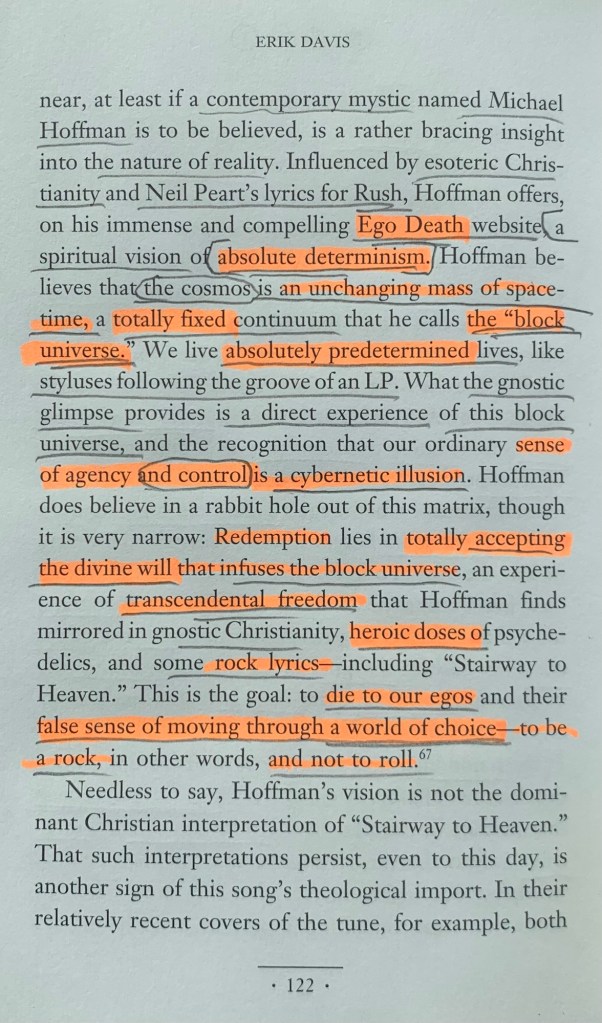
– Michael Hoffman 03/2025
9.I had difficulty in distinguishing important from unimportant things.
32.My thinking was constantly being interrupted by insignificant thoughts.
40.My own feelings seemed strange to me as though they did not belong to me.
44.I felt tormented without knowing exactly why.
55.I felt like a robot.
56.My surroundings seemed peculiarly strange to me.
64.I felt threatened without realizing by what.
66.I had the feeling that I no longer had a will of my own.
71.I was afraid without being able to say exactly why.
83.I felt like a marionette.
91.Everything around me was happening so fast that I could no longer follow what was really going on.
105.I stayed frozen in a very unnatural position for quite a long time.
107. I had difficulty making even the smallest decision.
110. I felt as though I were paralyzed.
131. things around me appear distorted to me.
133.Time passed more slowly than usual.
136. I was not able to complete a thought; my thoughts became repeatedly became disconnected.
141.I felt isolated from everything and everyone.
148.it seemed to me that I no longer have any feelings.
156. It seemed to me as though there were an invisible wall between me and my surroundings.
157. I observed myself as though I were a stranger.
158.I felt a total emptiness in my head.
V:
14. So many thoughts and feelings assailed me at once that I became confused.
29. I saw lights or flashes of light in total darkness or with closed eyes.
33. I saw scenes rolling by like in a film in total darkness or with my eyes closed.
42.objects around me engaged me emotionally much more than usual.
43. Things around me seemed to be bigger than usual.
51. Things around me had a new, strange meaning for me.
70. I saw colors before me in total darkness or with closed-eyes.
80. I saw things that I knew were not real.
100. I saw regular patterns in complete darkness or with closed eyes.
119. Something occurred to me and I did not know whether I had dreamt or actually experienced it.
120.I saw strange things, which I now know were not real.
128. Every day things gained a special meaning for me.
134. Sounds seemed to influence what I saw.
138. The colors of the things I saw were changed by sounds and noises.
Addl ASC:
2. Sounds and noises sound a different than usual.
three. Time passed faster than usual.
Number six. I simply could not get rid of some unimportant thought.
11.I became conscious of another ‘I’ being hidden behind my usual ‘I’.
19. The ground I was standing on seemed to be waying.
20. My ears were buzzing.
22.I could not remember what had happened 2 h earlier.
24. I had a vague feeling that something important would happen to me.
28 Parts of my body seemed no longer to belong to me.
39. I had the feeling my limbs were larger than usual.
41. I was convinced that I had experienced the same situation before.
57. Things around me had a different smell than usual.
58. I was tired and exhausted but at the same time wide awake.
63. It seemed that I had once dreamt what I was experiencing.
65. I perceived peculiar relationships between widely diverging matters.
87. I had trouble distinguishing between what I imagined and what I really experienced.
113. I no longer knew where I actually was.
122. I had the feeling I could think faster or more clearly than usual.
132. So many thoughts came to my mind that I was no longer able to organize them properly.
137. I was too wide awake and too sensitive.
139. I had the impression that everything occurring around me was related to me.
146. I had a feeling that I could no longer control the movement of my body.
152. I felt influenced by electric currents, rays, or hypnosis.
Red Shift to Hide Blue Psilocybin and Replace by Amanita
The Holy Mushroom gallery FORCES color palette shift from blue to red to force blue cap to become Amanita — like the corruption of the tauroctony cover of Entheos issue 3 , which additionally reverses the taur , which is a heavy handedness dependent image! 🤦♂️🤦♂️
The Holy Mushroom , see my pages showing the Amanita Primacy Fallacy here, Egodeath Mystery Show episode notes:
MICA Deniers Say Affirmers Are Supposed to Care What Art Historians Think about Mushroom-Trees, as “Expert Authorities on Related Matters”, Even Though Art Historians Have Never Given Any Thought about Either Mushrooms or Trees
The present section is a jump to the master section, which is:
Letcher Efficiently Used 2nd-Gen Entheogen Scholarship to Demolish 1st-Gen Entheogen Scholarship
Thanks Max Freakout for contributing Gartz 1996 book research, it’s paying off with many points.
The evidence that destroyed 1st-gen entheogen scholarship, magic weapon provided to him by the 2nd-gen entheogen scholar gods, was: non-secret, Psilocybin art (the Explicit Psilocybin paradigm) — which disproves the Secret Amanita paradigm.
Stamets & Gartz 1996 were operating from within 2nd-generation entheogen scholarship (the Explicit Psilocybin paradigm).
Andy Letcher inadvertently used efficiently, 2nd-gen entheogen scholarship to demolish 1st-gen entheogen scholarship.
Shroom, p. 35: “Various writers have suggested cult, secretly, oppression, hidden, secret cult, surreptitiously slipped in” – misattributed to 2nd-gen entheogen scholars, actually asserted by 1st-gen entheogen scholars.
Andy Letcher, 2006, Shroom, p. 35: “Various writers have suggested cult, secretly, oppression, hidden, secret cult, surreptitiously slipped in”p. 36, Shroom, Andy Letcher, 2006
Shroom, p. 35: “Various writers have suggested cult, secretly, oppression, hidden, secret cult, surreptitiously slipped in” – misattributed to 2nd-gen entheogen scholars, actually asserted by 1st-gen entheogen scholars.
The evidence that destroyed 1st-gen entheogen scholarship was non-secret, Psilocybin art (the Explicit Psilocybin paradigm) — which disproves the Secret Amanita paradigm.
By virtue of Letcher in fact using Stamets and Gartz, Liberty Cap mushroom-trees, on explicit Bernward Door, Andy Letcher was confused and botched attributions.
Letcher misunderstood himself to be taking down Stamets+Garts, mis-attributing to them, 1st-gen entheogen scholarship (the Secret Amanita paradigm).
Letcher didn’t realize they are in a different, superior paradigm, and so he severely mis-attrbituted in endnote 31, falsely claiming that Stamets Gartz are included in: “Various writers have suggested cult, secretly, oppression, hidden, secret cult, surreptitiously slipped in”.
The whole time I read the book Shroom cover to cover in April 2007, I asked:
Who is he arguing against?! Who is he arguing against??! Who is he arguing against??
Interesting question, it turns out.
I did not know to inspect endnote 31 at that time.
My attention was to the entire book Shroom, but especially p. 35-36 because those were the ONLY pages about mushroom imagery in Christian art.
Yet that so much fits ALL THE MORE PERFECTLY.
1 drop of dragon blood from 2nd-gen entheogen scholarship poisoned to death 1st-gen entheogen scholarship, so potent that even not knowing what he was doing, ie who he was mis-attributing, Letcher in fact took down 1st-gen entheogen scholarship = Allegro with Ruck specifically building on Allegro, both fixated on Secret Fairytale Fantasy, instead of on psychedelic effects.
Letcher mistakenly thought he was employing (1st-generation) entheogen scholars to hold up for ridicule and then easily sacrific the magic mushroom fantasy — but in fact, he took down the Allegro Ruck paradigm by employing 2nd-gen entheogen scholarship writers Stamets+Gartz who are not secret.
Like on Psilocybin holding up for ridicule egoic steering power, like easily stepping outside the egoic personal control system to blade its vulnerability in sacrifice on the rock altar with fire on branches, and blade, and child – to enter through the gateway.
Letcher using 2nd-gen entheogen scholarship to hold up for ridicule and easily demonstrate the vulnerability of 1st-gen entheogen scholarship (despite him not realizing that’s what he was doing):
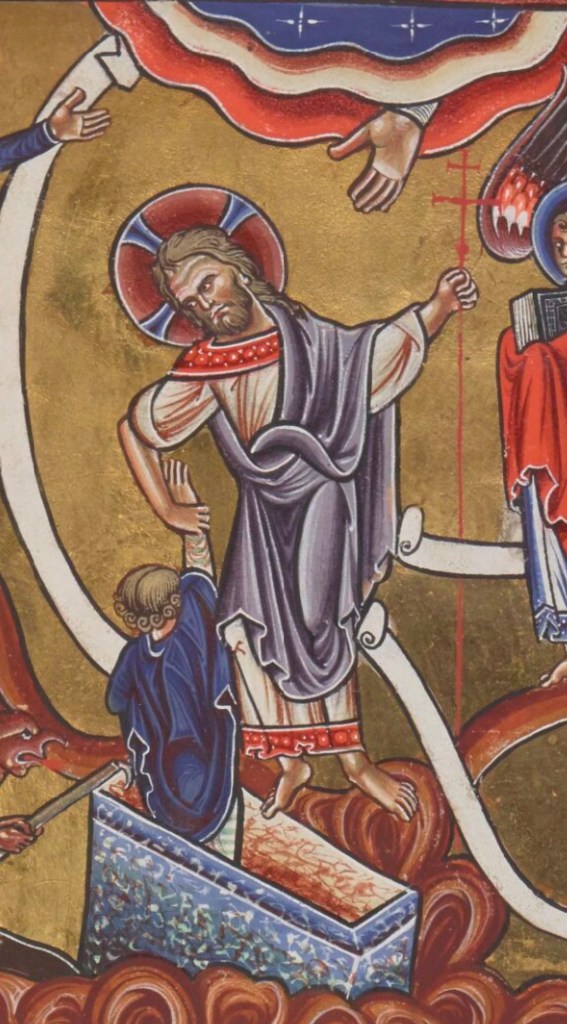
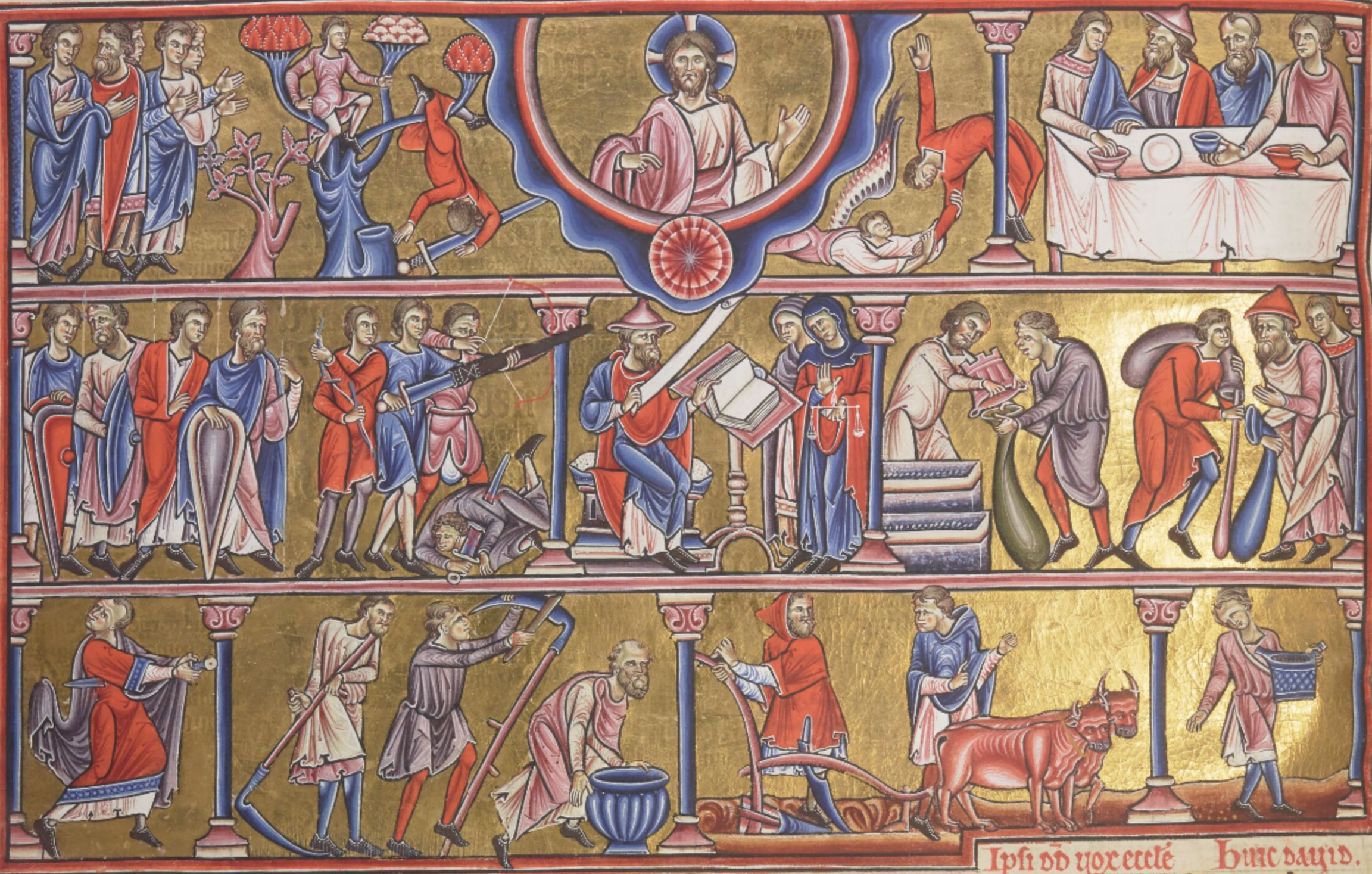
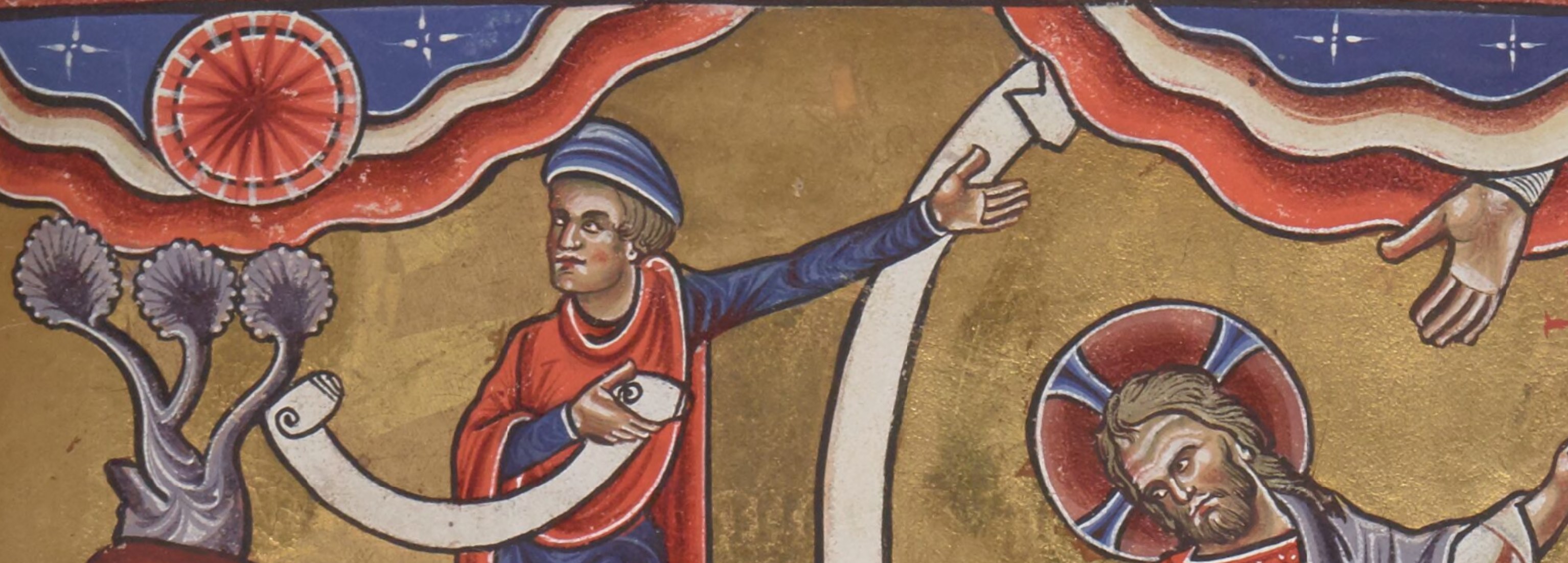
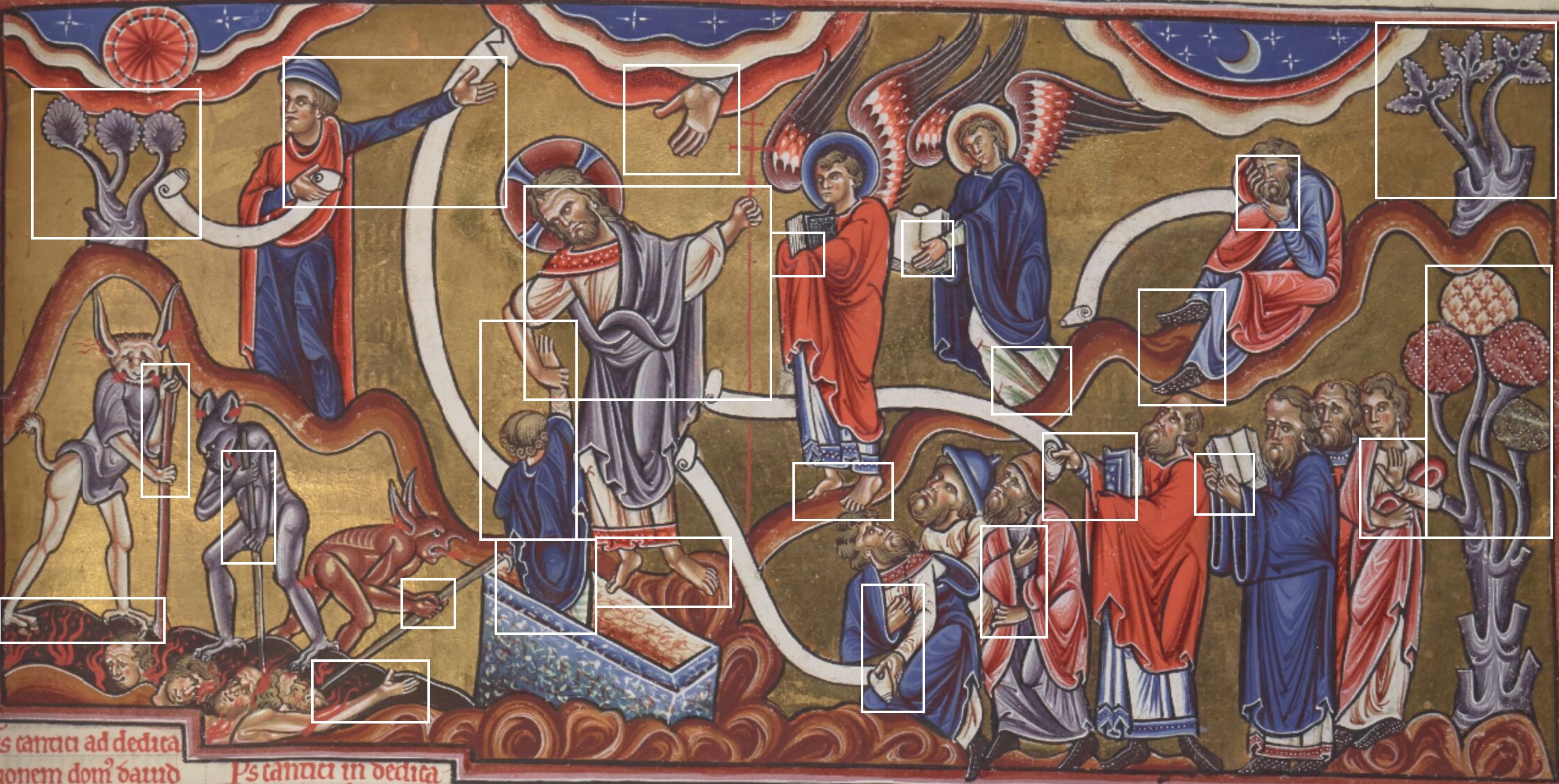
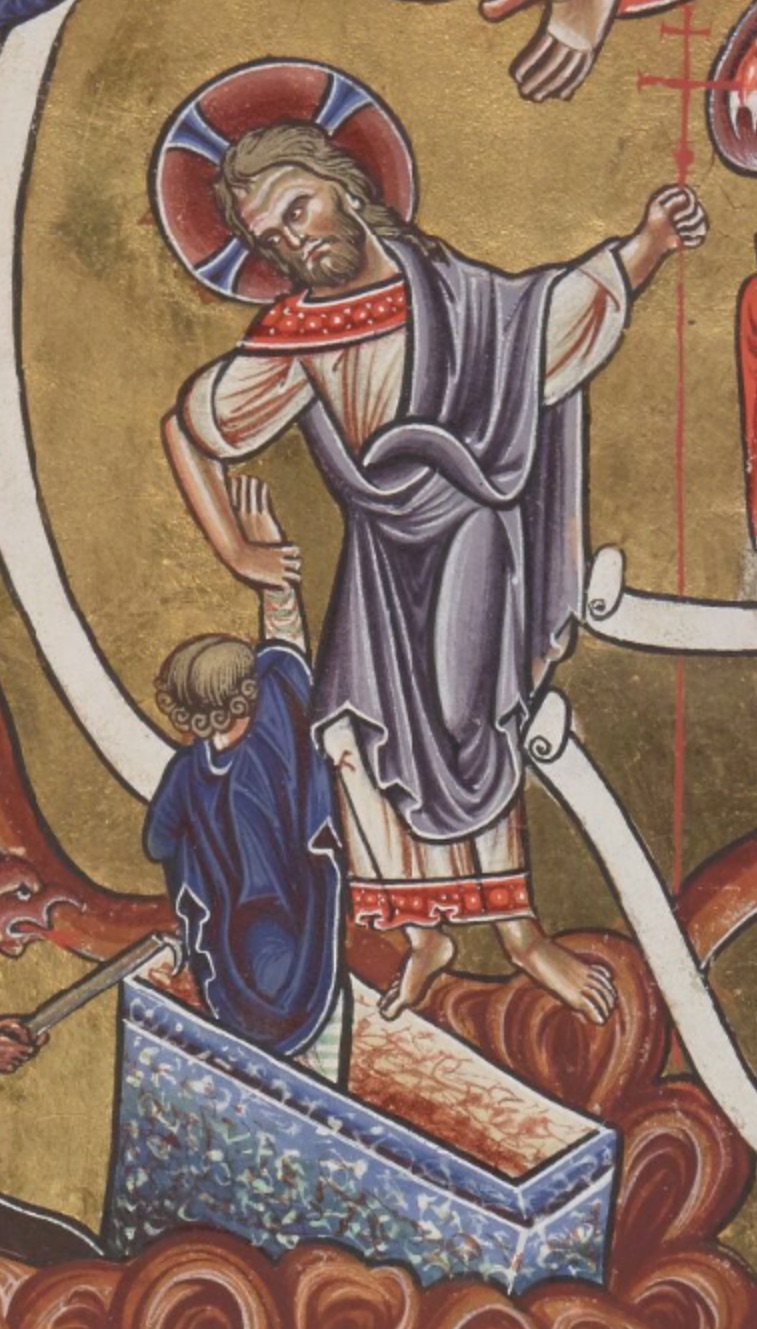
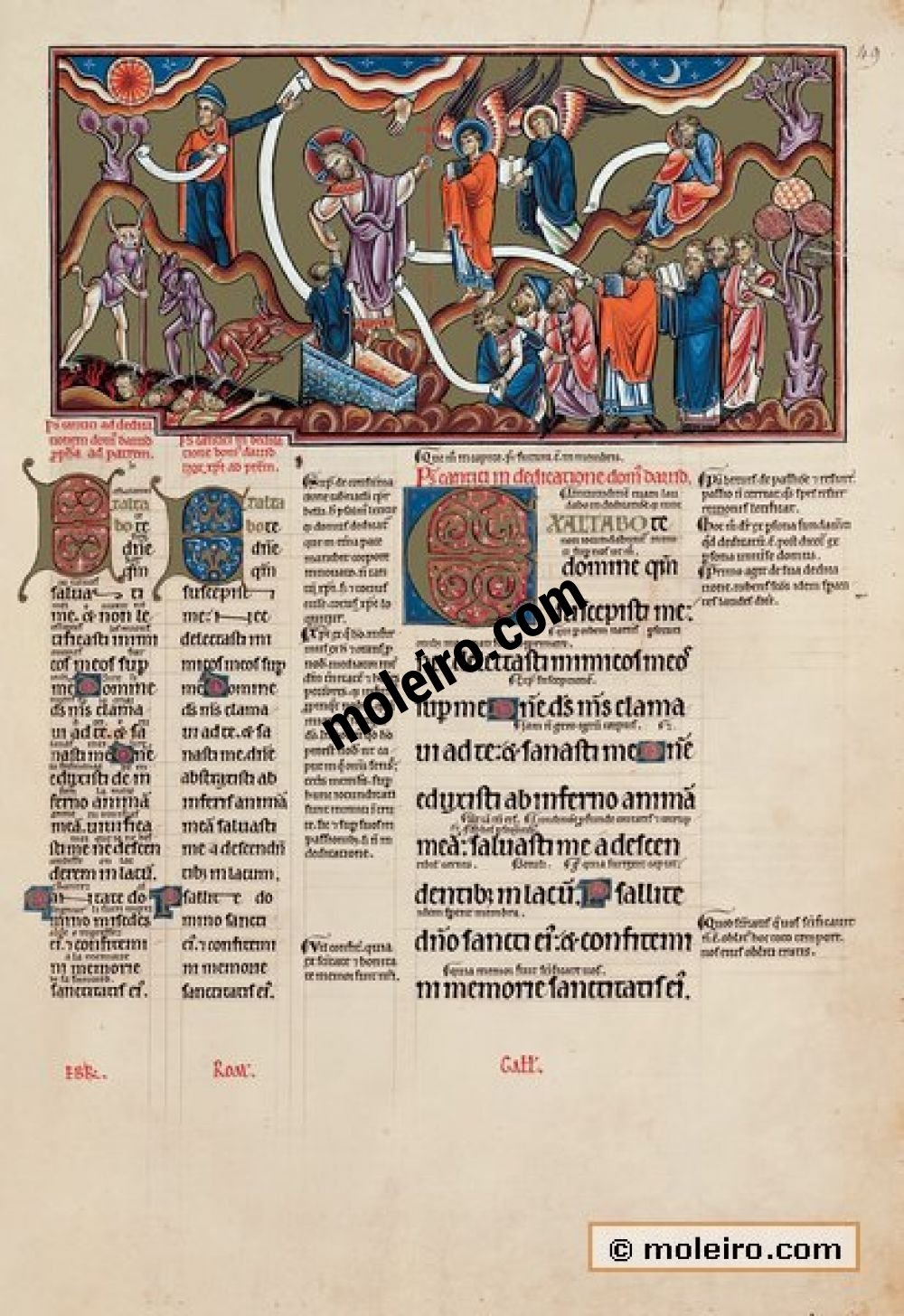
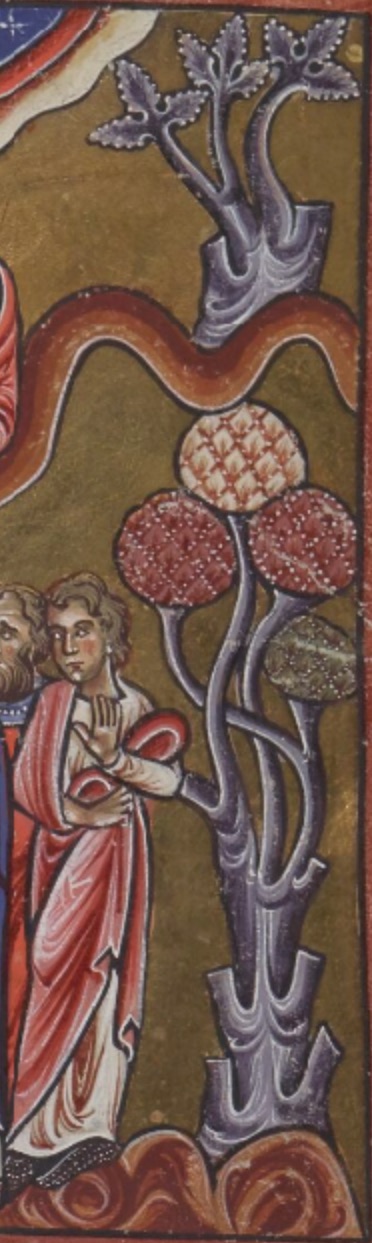
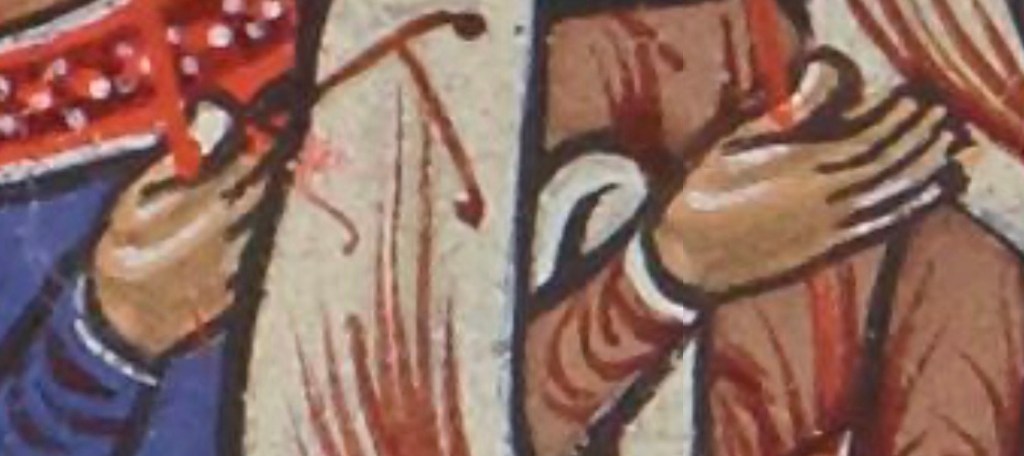
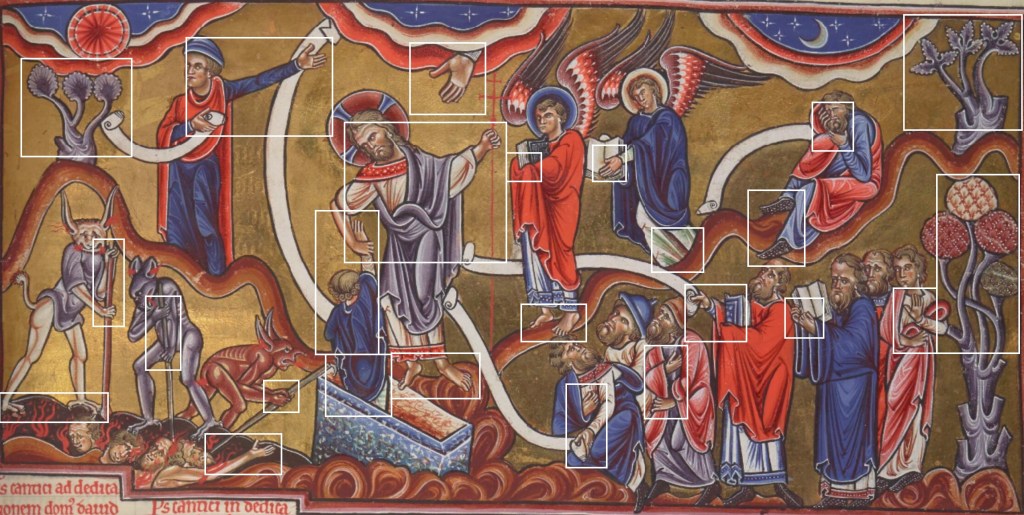
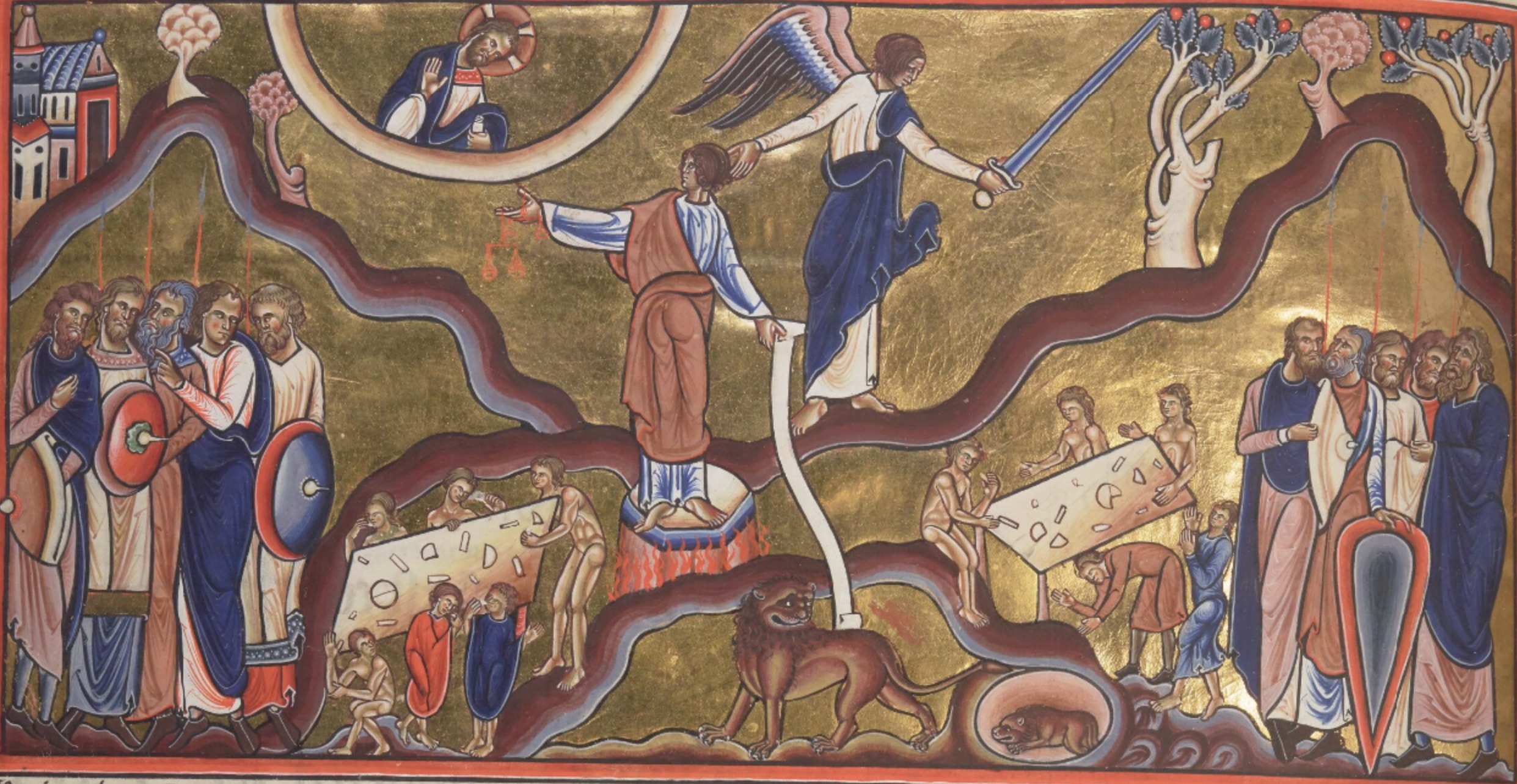
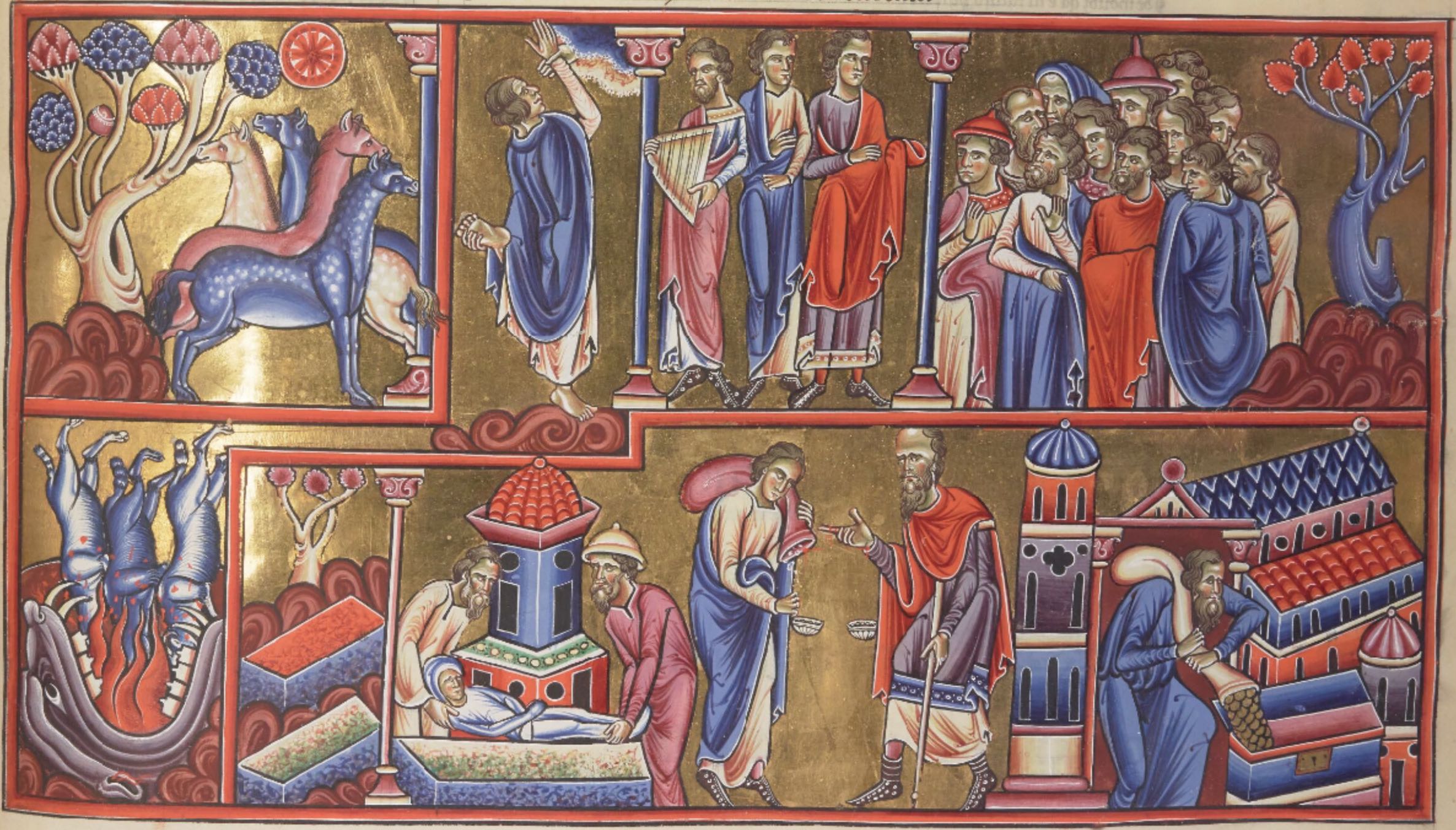
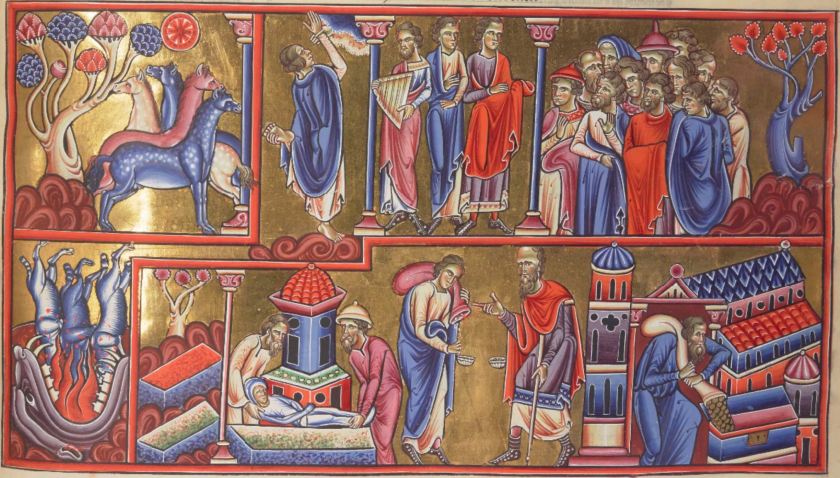
Figure 1. Sacrifice of Isaac. Canterbury Psalter
Paul Stamets & Jochen Gartz do not employ “secret/ suppressed” — ironically, given how Letcher cites & mis-attributes “secret” to them, ironically, and they are 2nd-generation entheogen scholars in that they use Psilocybin mushroom-trees, not Amanita art.
Like my approach, the only thing S+G wrote is 6 words: no social drama narrative of barrier wall construction by them with “The Mushroom” (fantasy fairytale kiddie Amanita) on one side (within their fabricated counterculture members-only walled group cult), and real Christianity on the other side.
Paul Stamets & Jochen Gartz only wrote: “Tree of knowledge as Liberty Cap”.
Not a drama tale of alien infiltration by closed, bounded, members-only, heretical sects, so called by Pope Ruck, who decrees that any individual who ingested The Mushroom was instantly turned into “member of heretical secret closed sect cult community group”.
I write “Allegro+Ruck” because the combination of Allegro and then Ruck building on Allegro’s “secret suppressed Amanita” fairytale was a one-two punch that misled the pop world into the Secret Amanita paradigm – a titillating made-up social drama narrative requiring no delivering of psychedelic effects at all; having nothing to do with actual psychedelic effects, but, purely a storytelling drama ABOUT the mythic-realm, fantasy super-psychedelic, The Mushroom, kiddie Amanita.
Build that barrier wall, storytellers Allegro+Ruck – Allegro wrote “our primitive ancestors were so crude, they were impressed — like professors in Anthropology dept. — by the changing surface shape and colors of Amanita.
Allegro actually wrote that – revealing how HE thinks, the mode in which 1st-gen entheogen scholarship operates: fantasy, social drama narrative, Academic sky-castle DEPARTMENT OF MYTHMAKING; DEPARTMENT OF FANTASY SKY-CASTLE WEAVING, home of 1st-generation entheogen scholarship (the Secret Amanita paradigm). Massive projection.
Who is inventing tabu and suppression, superstition, and suffering confusion about reality vs. imagination? 1st-gen entheogen scholars under the conditions of Psilocybin Prohibition.
And all it took from Letcher – without even knowing what he was doing – was 1 drop of dragon blood, 2nd-gen entheogen scholarship, to shatter 1st-gen entheogen scholarship. He didn’t NEED to get endnote 31 attribution right, to demolish 1st-gen entheogen scholarship.
Letcher is confused though; he conflated 1st-gen entheogen scholarship with the entire proposal of mushroom imagery in Christian art.
The proposal of mushroom imagery in Christian art is very much not the same thing as 1st-generation entheogen scholarship (the Secret Amanita paradigm).
Interesting transitional crossover by Letcher, accidentally using 2nd-gen entheogen scholarship to demolish 1st-gen entheogen scholarship.
Zero social drama narrative, you can roll up your sleeves all you want to analyze the narrative from Stam+Gar — but there is none to read or analyze at all. You go on the hunt to attack their the Secret Amanita paradigm narrative – and Alderaan is just … gone. Not there.
What’s there instead is 2nd-gen entheogen scholarship, proto-, in 1996, same year as Samorini presentation in San Francisco, yielding the 1997 & 1998 articles announcing 2nd-gen entheogen scholarship.
THERE ARE NO TEXT STATEMENTS TO ANALYZE FROM STAMETS+GARTZ, because they write literally nothing other than SHEER SIMPLE RAW PLAIN PRESENCE of mushroom (in characteristic 2nd-gen entheogen scholarship fashion) – not ADDING “secret suppressed”, barrier construction, social drama narrative of academic made-up Anthropology Dept. theory fabrication sky-castle, like the 1st-gen Allegro+Ruck paradigm.
The Allegro+Ruck paradigm does not employ or require the plant to have any psychedelic effects, but instead, as Ruck & Wasson tripped and failed on Amanita while Staples tripped on Psilocybin and ran circles around them.
What 2nd-gen entheogen scholarship Academic Anthropology tabu DEPARTMENT OF FAIRYTALE STORY FABRICATION FICTION FANTASY, the suitable mushroom is fairytale fantasy mythic-realm Amanita deliriant, which requires no psychoactive effects at all, just children fairytale storybook fantasy.
The fact that Amanita doesn’t transformation from possibilism to eternalism, and doesn’t cause psychedelic effects, makes it much better for Allegro-Ruck purposes than Psilocybin.
The motivating purpose of Allegro+Ruck is telling an Anthropology Dept. invented fairytale fantasy of social drama narrative STORY ABOUT the super-Psychedelic, better-than-any-Psychedelic, Amanita.
Dale Pendell, inspired, muses:
Amanita muscaria is the most famous entheogen in the world that nobody uses. It is the supreme symbol of all entheogenic religion: of secret cults and societies of initiates and whispered lost knowledge.
Now in 2025 I answer my 2007 question: especially re: Shroom p 35:
Who is Letcher arguing against?
Answer:
Letcher THINKS he is arguing against “1st-gen” entheogen scholars Stamets+Gartz, but he is ACTUALLY arguing against 1st-gen entheogen scholars Allegro+Ruck, by using the 2nd-gen entheogen scholars Stam+Gartz:
They don’t use the “secret because suppressed” scholars’-fantasy fairytale CONSTRUCT.
They don’t use fantasy fairytale super-psychedelic Amanita; they use actual psychedelic Psilocybin.
— proving my idea of dividing 1st vs 2nd-gen entheogen scholarship.
Letcher proved I am right making that “generations” division, like Stamets p. 14 does and like Brown 2019 does.
Though Letcher botched – but, his botching endnote 31 contributes toward my narrative: it figures, that he made that particular mistake; it’s fitting; it all fits together.
Perfect!
Letcher did not perceive 2nd-gen entheogen scholarship; did not perceive the crucial distinction between 1st vs. 2nd-gen entheogen scholarship.
What position did Andy Letcher in Shroom 2006 IMAGINE himself to demolish?
Mushroom imagery in Christian art, broadly.
What position did Letcher ACTUALLY demolish, by unknowingly employing 2nd-generation entheogen scholarship (the Explicit Psilocybin paradigm)? Wielding what weapon?
1st-generation entheogen scholarship (the Secret Amanita paradigm), by applying the 2nd-generation entheogen scholarship (the Explicit Psilocybin paradigm).
I then posted in April 2007 my influential review about which Letcher replied to me by name with interesting argumentation: the “you can’t prove [sequence]” argument, which I proved in Nov. 2020 all of those points and Maximal Peak religious experience too, by using Eadwine’s well-stocked Cubensis bins and his refinement of the mushroom-tree genre, in Great Canterbury Psalter.
p. 13, “”Conjuring Eden” – first page
p. 14, “”Conjuring Eden”, Ruck Committee; Written by the Secret Amanita Paradigm
p. 15, “Conjuring Eden” – Secret Initiates Having The Mushroom (kiddie Amanita, a non-psychedelic)
Ruck paradigm, the Secret Amanita paradigm, strives to construct a barrier to keep Amanita from being in Christianity – his entire motivation and scheme collapses if you remove Prohibition, or remove his fabricated construction, “Prohibitionist mainstream vs. closed, Amanita-having counterculture.”
Letcher took the oppotunity to shatter this entire 1st-gen entheogen scholarship paradigm of the Secret Amanita paradigm, by simply using a single instance of art that cannot possibly be forced by Ruck into Ruck’s invented framing as “hidden, suppressed, limited, secret” –
“Various writers have suggested cult, secretly, oppression, hidden, secret cult, surreptitiously slipped in. – that’s Letcher, Shoom, 2006, p. 35-36, where Letcher holds up 1st-gen entheogen scholarship for ridicule while he smashes it to smithereens using a single instance of art, on Bernward Door.
Letrcher mis-attributes the Allegro-and-Ruck one-two punch that misled pop followers into the Secret Amanita paradigm, misattributes it to Gartz and Stamets 1996, who wrote nothing at all having anything to do with any narrative – they simply wrote “door has liberty cap” – nothing else.
The door has 3 Liberty Cap mushroom-tree, the column has 4 Liberty Cap mushroom-trees. With other mushroom imagery as well, that I discovered recently; {floating mushroom hem}, mushroom roof toppers, {mushroom hems}, Lib Cap roofs, mushroom gate toppers in chandelier.
Andy Letcher should have said the two by far the main culprits: Allegro, with Ruck eagerly building on Allegro’s Secret obsession/fixation, as Ruck said in recent Mururesku-tour YouTube video, “I thought Allegro’s book was extremely interesting.” Red flag. Allegro = Secret Christian Amanita Cult, which all the deniers are right to ridicule, as I ridicule that self-defeating dead end approach that’s NOT EVEN PSYCHEDELIC!
GTFO, subsuming Psilocybin to Amanita, that’s entirely backwards. Wasson wrote that his Amanita hypothesis was a failure.
Amanita is NOT like Psilocybin and – like heavy breathing or Datura – does not produce mental model transformation from possibilism to eternalism, which is the only criterion that matters for Transcendent Knowledge and religious myth.
Entheogen scholarship cannot move forward except through rejecting 1st-gen entheogen scholarship, using 2nd-gen entheogen scholarship instead: the Explicit Cubensis paradigm.
The Allegro-Plus-Ruck, Secret Amanita Paradigm that Misled the World into a Non-Psychedelic, Dead End
The Death Blow Dealt by Letcher Using Only a Single Instance of Non-Secret Art; King Secret Held up for Ridicule, 1st-Gen Entheogen Scholarship a Laughingstock
Carl “Dr. Secret” Ruck loves Allegro Sacred Mushroom & The Cross b/c it is 100x as much about Secret than psychedelics and in fact Sacred Mushroom & The Cross has honthing nothing to do w/ psychedleics – any more than Datura & Amanita are “psychedelics”; they are deliriants.
Ruck has no interest in psychedelics, he is only motivated by Secret and to do that, he must prevent real Christianity from having The Mushroom (kiddie Amanita, a non-psychedelic).
Ruck frames all evidence as alien infiltration, and tells contradictory narrative tales of limiting The Mushroom to hereitc closed bounded sects communities (members only), or 1-2 elites, only – NOT the mass of people in Christndom, that would destroy Ruck’s paradigm and fundamental motive, which is Secret, not psychedelics.
Psilocybin is disrespected by being forced into a subservient role serving the glory of the non-psychedelic, Amanita, in the Allegro-Ruck the Secret Amanita paradigm.
2nd-Gen Entheogen Scholarship Freely Plunders, Reworks, Transforms, Selects, Rejects, and Recombines Elements from 1st-Gen Entheogen Scholarship
A Limited Type of Respect, Along with Healthy Productive Disrespect
2nd-gen entheogen scholarship Plunders Disrespectfully 1st-gen entheogen scholarship: No Commitment to Paradigm 2 Has No Respect for Paradigm 1, Not Constrained… De-Comm Paradigm 2
2nd-Gen Entheogen Scholarship Must Totally De-Commit from Paradigm 1 and Reject Sacred Cows and Not Be Bound by Respecting the Wise Fools Who Went Before, Standing on the Shoulders of Giant Dwarves
That’s a truism.
All scholarship involves some skepticism about other theories and other takes, other readings.
2nd-gen entheogen scholarship PLUNDERS RUDELY the Junked Treasures from 1st 1st-gen entheogen scholarship but always REFRAMES AND REPURPOSES AND TRANSFORMS THE previous scheme, entirely selectively.
I have a certain respect for Allegro, and Ruck, and Graves, Graves, Wasson, Allegro, and Ruck; I have assessed their pros and cons always.
Lazy scholars shirk their work and simply embrace or rject in lazy wholesale way, that’s not effective progress.
I adopt some aspects from Graves, Wasson, Allegro, and Ruck, from the Secret Amanita paradigm, but I always transform – an analogy of imind mind: the Egodeath theory depends on the building blocks that Ruck has provided – but, always transforming the previous theory’s malformed building blocks to become well-formed, to fit them into the Egodeath theory; the new explanatory framework.
Greedy Advocacy of All Psychoactives Is a Guaranteed Failure at Repealing Psilocybin Prohibition
No one ever had mental model transformation from possibilism to eternalism without using Psilocybin.
pros of that blunt statements:
cons of that blunt statements:
We are committed to all psychoactives. Shotgun strategy, defocused.
We focus all our firepower on Psilocybin. Rifle strategy; focus.
Let me know when you’re done burning up & squandering all the resources on cannabis, Amanita, Datura, kitchen sink, then maybe you’ll have a penny left over for Psilocybin, which every academic in the cabal is striving to suppress (we agree to lie collectively that heavy breathing = Psilocybin, so it’s ok), and which every meditation huckster is fighting to suppress and compete against (“Is Psilocybin a legitimate new fake simulation of the true original non-drug way of meditation?”)
You guys have have MDMA, Amanita, Datura, cannabis.
I’ll just settle for my little single-plant fallacy: Psilocybin thank you very much.
mental model transformation from possibilism to eternalism mmtpe
mental worldmodel transformation from the Possibilism to the Eternalism model of time, self, possibility, and control (“will”) should be: m w t p e m
mental worldmodel transformation from the Possibilism to the Eternalism model of time, self, possibility, and control mwtpem
todo: eternalism YouTube videos: errors:
They contrast eternalism vs. presentism, should contrast eternalism vs possibilism instead.
They do metaphysics; they should instead do cybernetic phenomenology instead.
They are a package deal, that’s a bad package. eg perennialism” is wildcard covert package deal bait & switch: you agree with these two points? then you have silently, unknowingly also signed on to TWO HUNDRED packaged agendas, which are changing constantly.
Moshe Idel (scholar of Jewish mysticism) says “the word ‘perennialism” doesn’t mean anything, because it means something different for each person.
Write simplified assertions for clarity and telegraphic abbrev.
Motivation for this Post
Needed to move out these sections to leave a focused article about Pinocchio Wasson: By Writing “Wasson’s conclusion”, Ruck Leaked that Wasson Knew that Mushroom Trees Mean Mushrooms
Wasson lied about his view; and Ruck leaked Wasson’s privately held, actual conclusion: mushroom-trees mean mushrooms.
So much for the “credible” art historians who are “knowledgable about related subjects”.
Art historians have never given trees in Christian art any thought.
That’s why mycologists must grovel and beg for the art historians’ definitive correction of mycologists’ “blundering ignorance”.
Mycologists (MICA Affirmers) must “consult” the art historians – in entirely abnormal fashion: in person, because art historians have written NO publications to properly “consult” per standard scholarly practice, about trees in Christian art.
Equally Illegit, Arbitrary, 1-Sided: Huggins Landing on “Tree Only”, Ruck Landing on “Mushroom Only”
In a 4-hour voice recording yesterday, aat March 15, 2025, I treated & covered the parallel bunk leaning to ‘tree’ by Huggins & bunk leaning to ‘mushroom’ per Ruck who wrote “mushroom-trees look like mushrooms AND NOTHING ELSE.
Ruck on p. 56 of “Daturas for the Virgin”, just before “Wasson’s conclusion”(!!), should say that, specifically, the mushroom features imagery in mushroom-trees looks like mushroom – as well as also additionally looks like trees.
Mushroom-trees have tree features and mushroom features.
I could argue as baselessly and fallaciously, in the same way Huggins argues, using his same non-argument:
“The mushroom features prove that the tree features must be entirely dismissed and ignored.
“The mushroom features RULE OUT the tree meaning.
“The tree features don’t count, BECAUSE I AM PREJUDICED AND ARBITRARILY DECREE SO.”
I can say: “I can now articulate criteria for deciding whether any given mushroom-tree is a tree or is a mushroom: [much verbiage which merely amounts to]
Every mushroom-tree is always a mushroom and never a tree, BECAUSE I SAY SO.”
I have solved and fulfilled Huggins’ demand that affirmers of mushroom imagery in Christian art must explain branching branches.
I go much further and explain the motif of {cut branches}, {cut right trunk}, and {cut right branch}, which mushroom-tree deniers fail to even see.
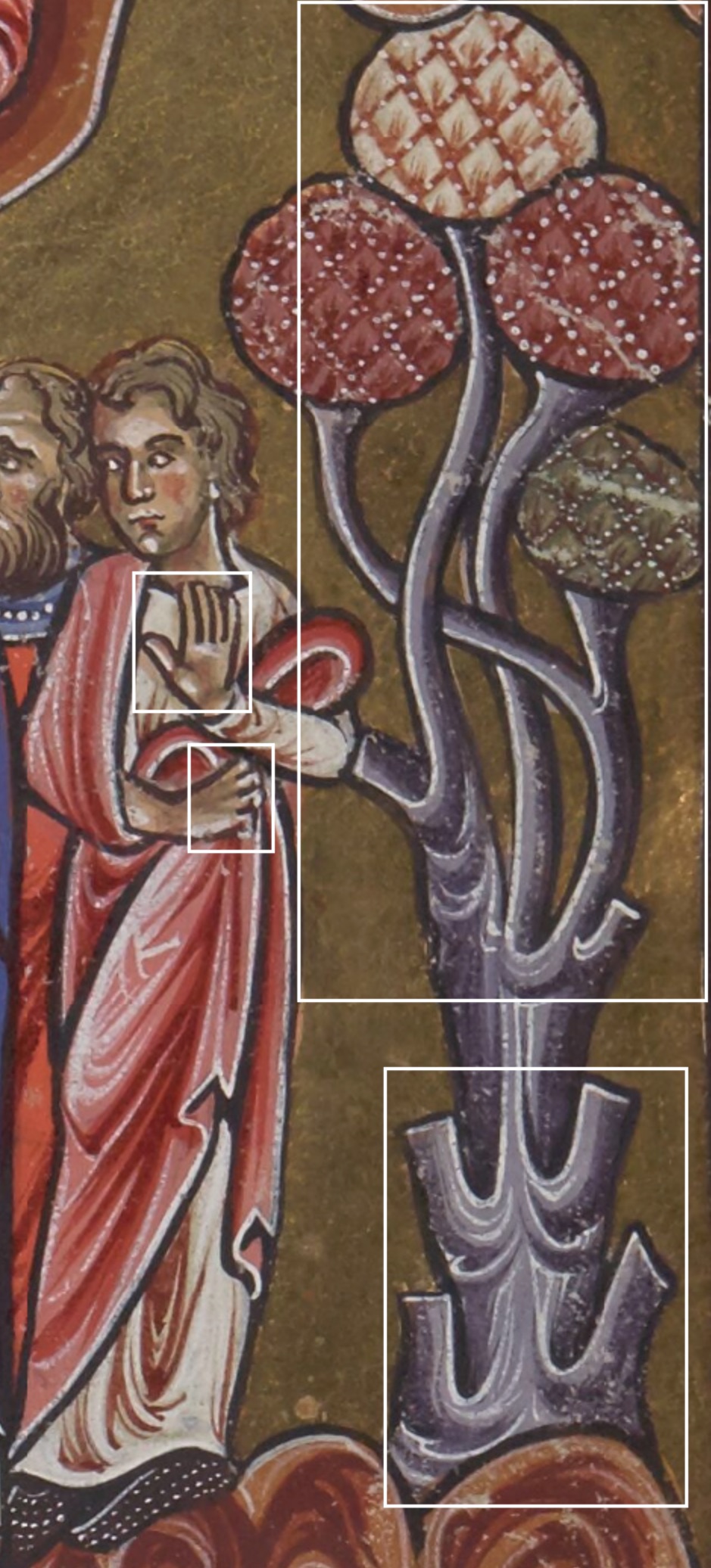
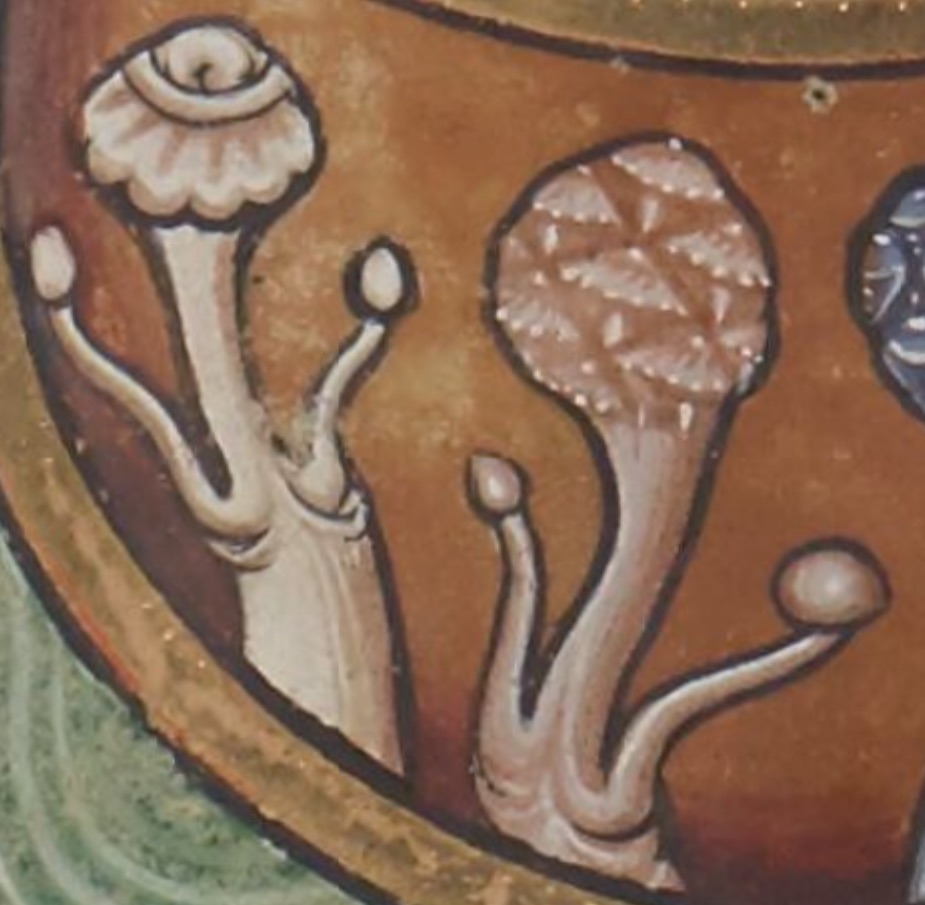
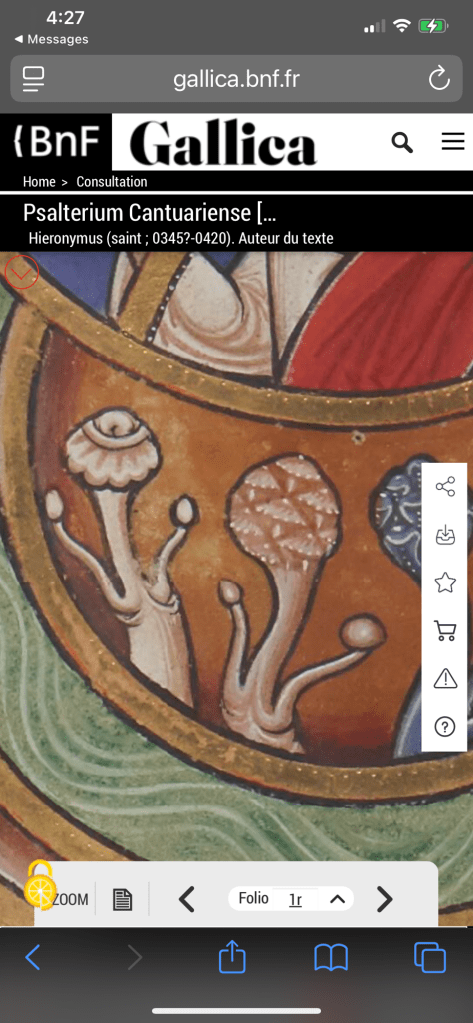
Eadwine’s leg-hanging mushroom tree image in the Great Canterbury Psalter:
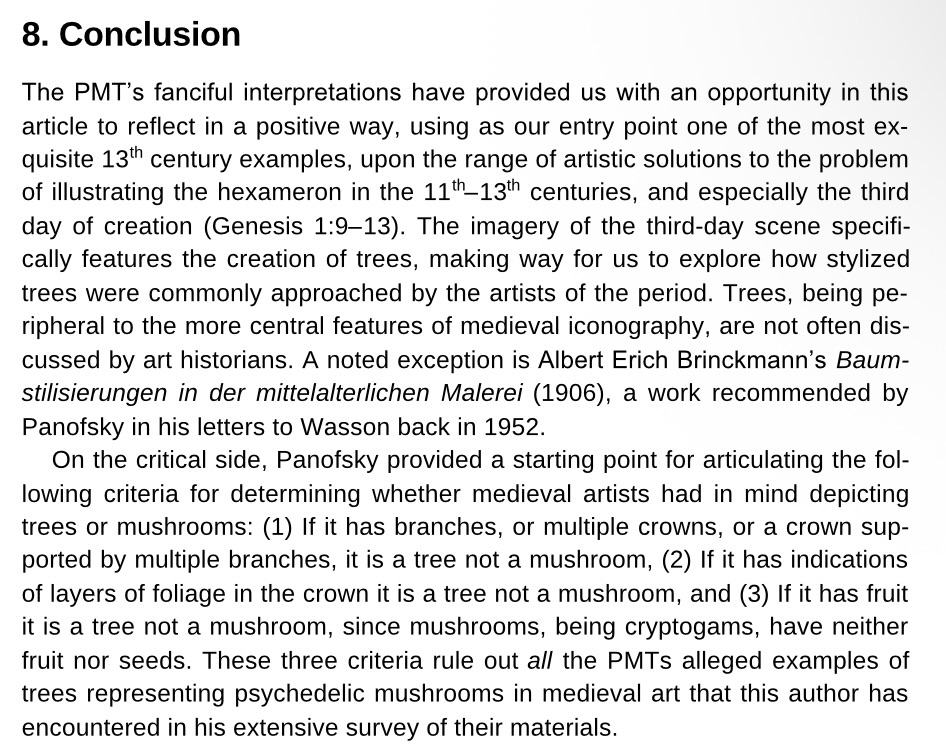
Ronald Huggins pretends in a paragraph in the Conclusion section of “Foraging in Wrong Forest” that he “articulates criteria to decide whether a mushroom-tree is a tree or is a mushroom”.
That is a false dilemma and a terrible method in art interpretation, obviously contradicting — as a SPECIAL PLEADING, exception case — Erwin Panofsky’s basic, elementary principles of art interpretation.
In fact, mushroom-trees, on the surface level, means BOTH mushroom and also additionally tree.
That’s the actual position of affirmers of mushroom imagery in Christian art: not that mushroom-trees mean mushroom, but that they mean tree and also additionally at the same time mean mushroom.
The argument “the image means tree, therefore it cannot also mean mushroom” would never be advanced for any other art-imagery motif, because it is obviously fallacious.
Brown 2016 re: Walburga commits the single-meaning fallacy:
“It is a vial therefore it is not an Amanita.”
This fallacious, single-meaning fallacy, FEIGNED OBTUSENESS, is ONLY used for the special case of mushroom imagery in Christian art. Brown strives to prove we are credible because we too commmit your the single-meaning fallacy and are too stupid to realize an item in art has multiple meanings as we wrote
todo quote brown Erwin Panofsky priciple 3 – brown c
Brown Summarizes Panofsky’s Art Interpretation Principles for Iconography: An Image Has Multiple Meanings, yet “Vial, Therefore Not Mushroom”
The Feigned Obtuseness Tactic: When It Comes to the Special-Case, Tabu Topic of Mushroom Imagery — Only Then — I’m Too Stupid & and Dense to Realize Art Has Multiple Meanings
With Any Other Imagery, Obviously Art Has Multiple, Compound Meanings, Don’t Be Dense, That’s Interpretation 101
Running across all bad odd arguments, that aren’t even arguments, is a common driving factor: Token arguments and non-sequiturs leverage prejudice, so that it doesn’t matter that the argument is empty noise; the biased speaker and audience will take it AS IF it’s an actual, compelling argument.
Tactic: Argument from Sheer Bias, Disguised as 1000 Different Off-the-Wall Fallacious Non-Arguments
“Please Accept Me Now as One of the ‘Credible’, Denier Gang, Hatsis”
Brown 2016 discusses Panofsky theory of art interpretation.
Principle #1 in Medievalt art interpretation: an image means multiple things.
Forget trying to pull the single-meaning fallacy.
See index: Panofsky entry 2 of 2.
Brown 2019 found and published the TWO(!!) Erwin Panofsky letters deceitfully censored by Wasson:
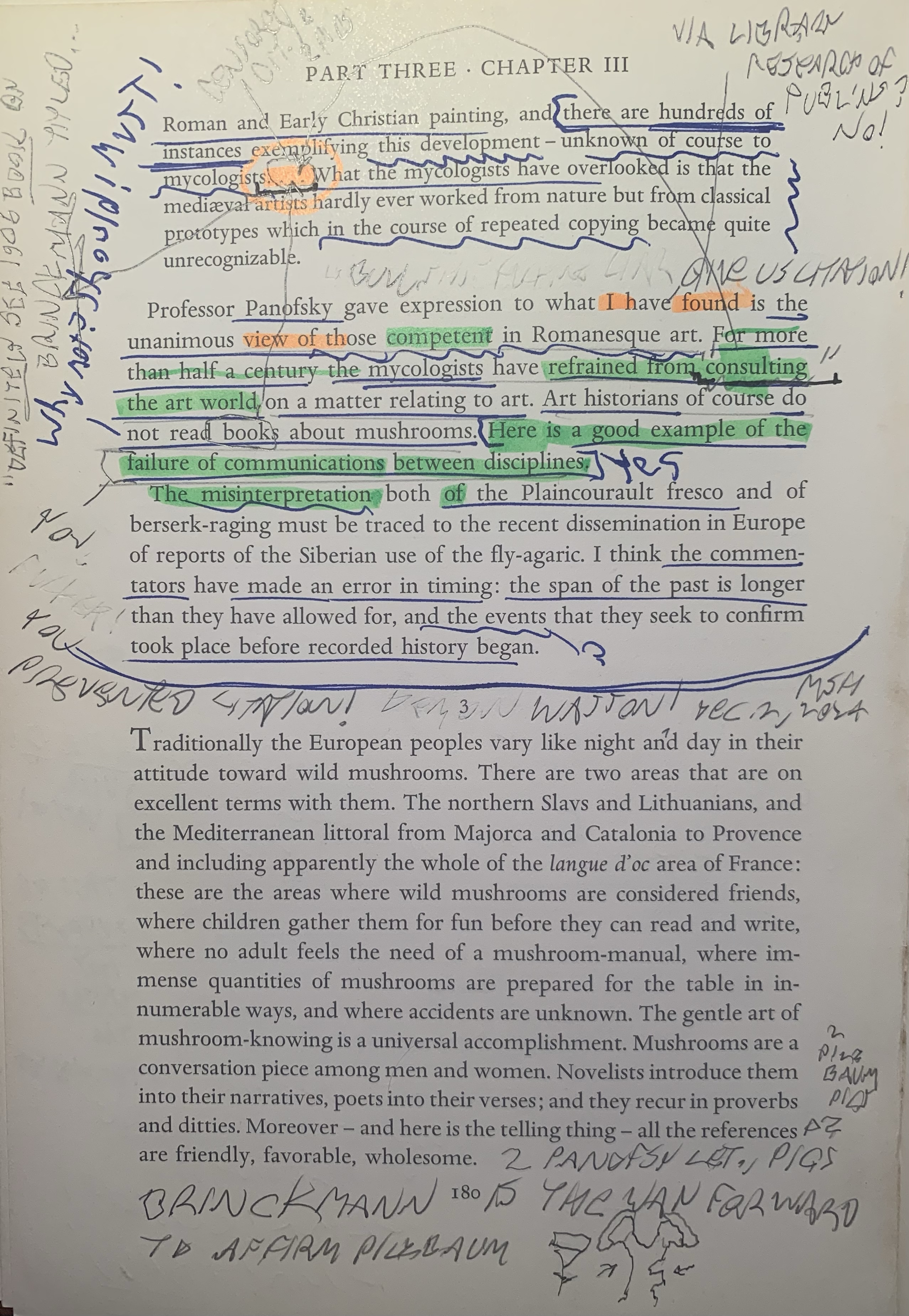
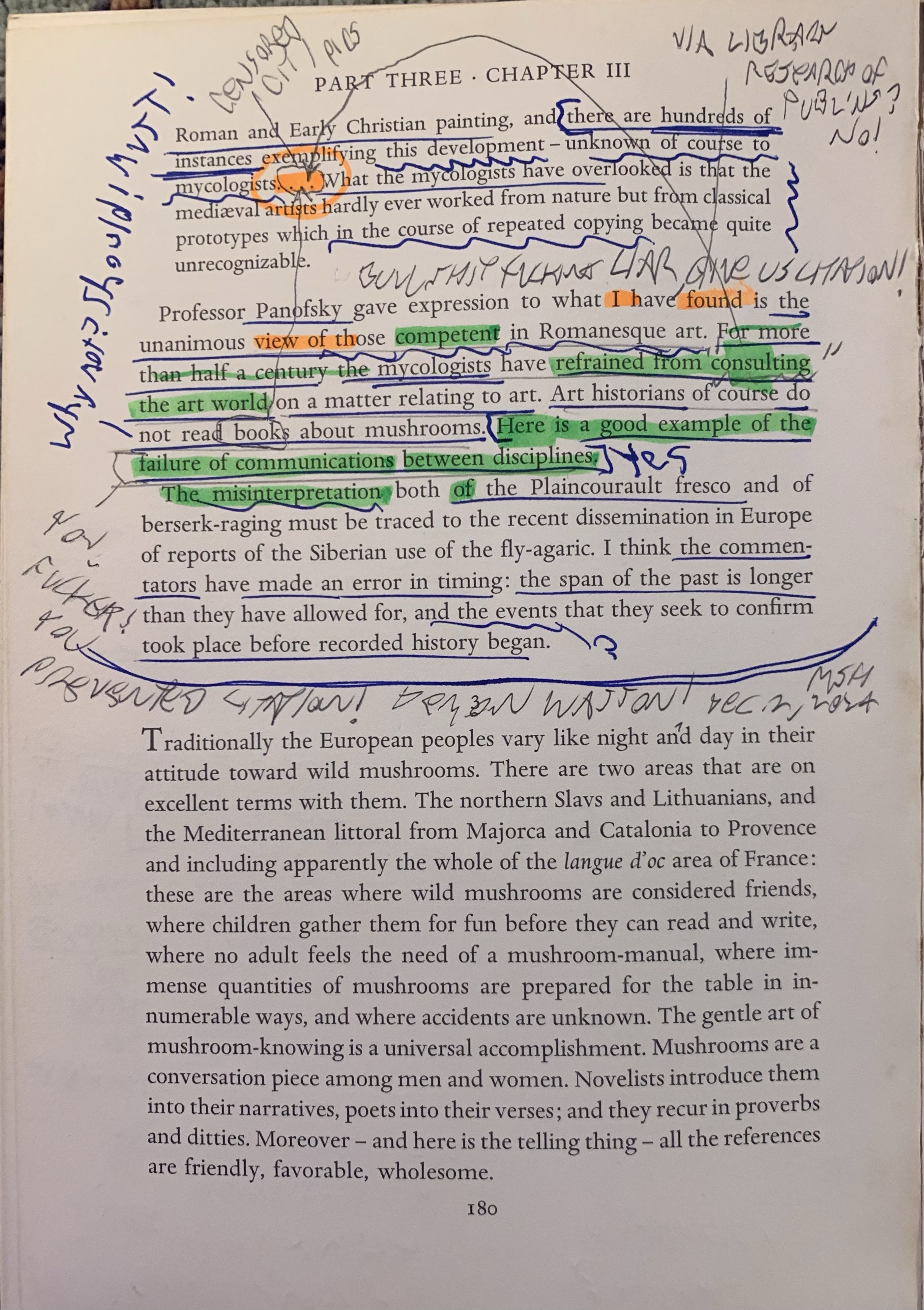
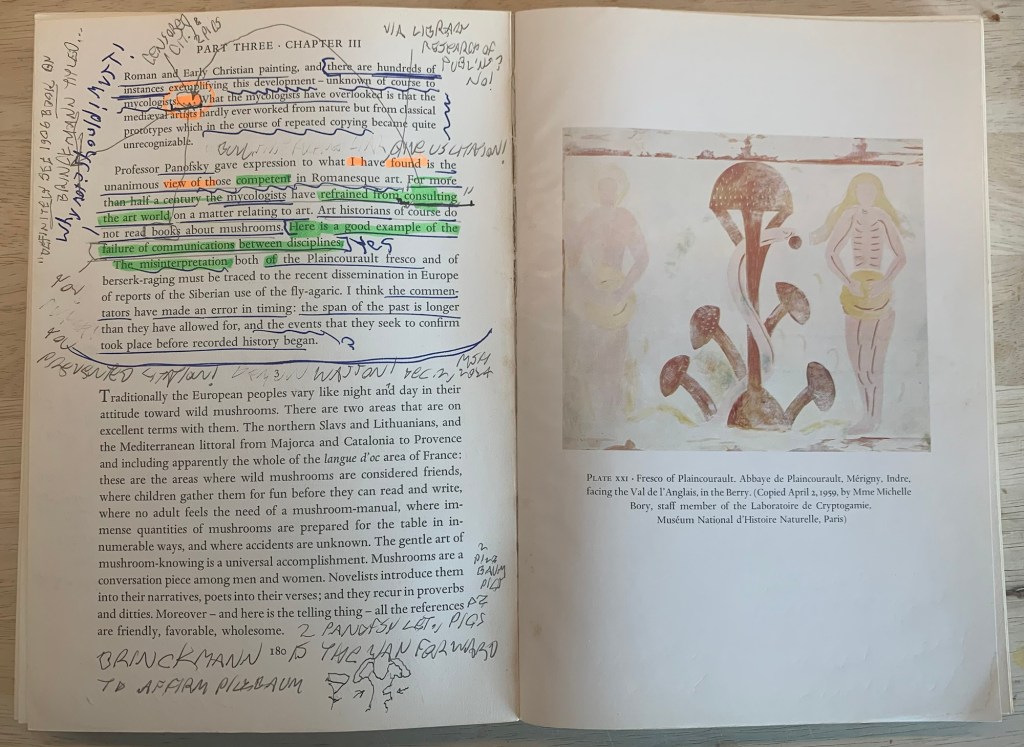
In 2016 Brown gives ellipses where Wasson deceitfully hides & manipulatively suppresses the Albert Brinckmann citation: Albert Brinckmann’s 1906 86-page book in German, Tree Stylizations in Medieval Paintings.
Then in the very next sentence, in the same sentence as berates mycologists for failing to “consult” art authorities.
SOMA p 180 1968 Gordon Wasson
dirty ellipses, put-on, con artist, play-acting, duplicity, deception, academic fraud.
Everyone (Samorini 1997, Brown 2016) remarks how UNBELIEVABLE Wasson’s fake lecturing is, where Asson feigns a pretextual stance of “WE SHOULD AUTOMATICALLY BELIEVE THE AUTHORITIES WITHOUT QUESTION”.
That feeble, cowtowing stance entirely contradicts every fiber of Wasson’s research style, this PURE BLATANT OBVIOUS FALLACIOUS ARGUMENT FROM AUTHORITY couldn’t be less believable, it is the OPPOSITE of scholarship.
SOMA p. 180, Censoring by Ellipses to Deceitfully Impede Mycologists from Consulting Brinckmann, at the very same time as Disparaging & Insulting Mycologists for not “Consulting” the Art Authorities – Academic Fraud
markup: Michael Hoffman 2006 & 2025
Huggins’ Phony Posturing, “Criteria for Deciding”, ie, I Decree that Mushroom Imagery Doesn’t Count, because I Say So
Totally phony pretense, put-on coverup of non sequitur prejudice sweeping decree.
What Huggins does is dictate for no reason with no justification, that all mushroom-trees are tree not mushroom – a baseless dictate, disguised as “criteria for deciding whether”.
Huggins really simply dictates and decrees:
A mushroom-tree has tree features & mushroom features, “therefore” it is a tree not a mushroom.
Purely arbitrary reasoning he gives, lying to the reader, framing that as “criteria for deciding”.
Huggins’ so-called “criteria”– junk rhetoric masking fallacious argumentation – is sheer decree that, given feature A & B, ignore B; ignore mushroom imagery.
I could equally arbitrarily say:
Mushroom-trees have mushroom imagery & tree imagery, so they mean mushroom and not trees.
Touche; by the same bunk token, bad argument, which cuts both ways.
Ruck p. 56 “Daturas for the Virgin” does this!, just before his OUTRAGEOUS phrase (or, leaked insider phrase contradicting Wasson’s lying public view)) “Wasson’s conclusion”.
Panofsky-Huggins argues in Foraging in Wrong Forest, section 3 about tree stylization form:
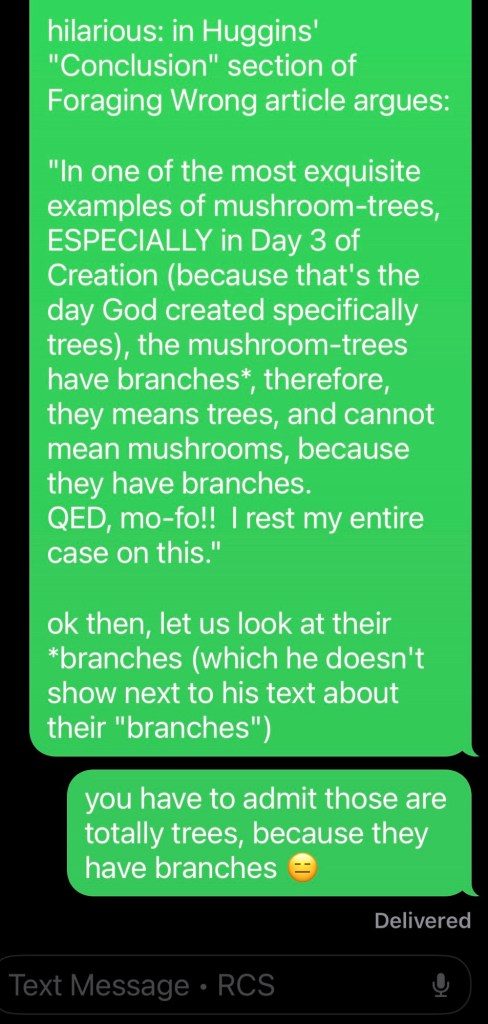
Mushroom-trees have branches, therefore not mushroooms.
But I can equally fallaciously argue: “therefore not tree.”
In fact mushroom-trees mean mushroom effects and branching vs. non branching, ie possibilism vs. eternalism; two mental models of control and branching possibilities.
Mushroom-trees don’t ultimately mean tree, they more mean mushroom.
But not only mushroom; also branching experience of non branching.
I treated section “3. Schematized Trees” in full detail:
Photo: Michael Hoffman, Egodeath.com; Egodeath Mystery Show
Summary
Hanegraaff’s inability to place the fixed stars (fate) in sphere 8 proves that rebirth above Saturn (sphere 7) is into Fate (sphere 8), before reaching hypercosmic freedom (sphere 9).
Sphere 8 is not hypercosmic; sphere 8 defines the boundary of the cosmos.
Sphere 9 is hypercosmic.
Mental model transformation is primarily into eternalism, and only a little, after that, into transcendent possibilism.
When you look at the starry sky, you see almost all are fixed stars, with 5 moving, planetary stars (plus sun and moon).
It doesn’t make any sense to think of rising above the 7 planetary spheres and saying you’ve left the cosmos – you still have countless fixed stars defining the highest heaven of the cosmos.
Only above the stars – sphere 8 – have you left the cosmos.
Which ancient texts say that the cosmos consists only of the 7 planetary spheres, but doesn’t include the sphere of the fixed stars?
There’s the cosmos, and then above the cosmos is the fixed stars?
Why wouldn’t the sphere of the fixed stars be part of the cosmos?
When you look at the sky, you see nothing but fixed stars, except just 5 planetary moving stars plus the moon.
Look up, see the cosmos: OMG it’s filled with stars!
Email to Dr. Wouter Hanegraaff March 18, 2025
Hi Dr. Hanegraaff,
A summary answering your footnote 114, “Whether the fixed stars should be included [with Saturn] or should rather be associated with the Ogdoad remains an open question for me.”
“Authentic esotericism is entheogenic esotericism. Entheogens are the key to esotericism.
This is the simplest possible theory of esotericism, and the most natural, the least contrived and strained.
Theories of esotericism that are not based on entheogens suffer from the problem of grandiose verbiage, unmet promises and claims, chronic vagueness, excuses for lack of potent and prompt efficacy, and no ability to deliver the experiences which are talked about.
Drug-free esotericism doesn’t work; it is not effectively ergonomic.”
(I came close to finding that 2004 link at Archive. I found many surrounding posts, as general proof that the dates are valid.)
— Michael Hoffman, Egodeath.com, the theorist of Ego Death (psychedelic eternalism)
Non-Drug Entheogens
In Hanegraaff’s Keynote speech article/ YouTube video Entheogenic Esotericism in 2012, 8 years later than my 2004 post, Hanegraaff says he didn’t find anyone posting the phrase “entheogenic esotericism”.
Hanegraaff there proposes entheogenic practices in the wide 🐷 sense, thus my phrase non-drug entheogens — which Erik Davis eggs him on for, but I sense that Davis would sing a different tune for such a proposal of non-drug psychedelics.
That article is cited in Hermetic Spirituality and the Historical Imagination: Altered States of Knowledge in Late Antiquity, by Wouter Hanegraaff, 2022.
The Failure of Hanegraaff’s Cosmos Model to Place the Fixed Stars Proves That the Egodeath Theory, not Hanegraaff, Has the Correct Analogy-Model of Astral Ascent Mysticism
The Egodeath theory is OBLIGED to engage with such scholarship.
It is concerning to me, if Wouter Hanegraaff studies hermetic writings and puts forth a narrative scholarly report that contradicts the Egodeath theory.
I NEEDED to prove that where his explanation contradicts mine, I proved he is intensely deluded and completely mistaken, thoroughly deeply confused.
It took me months and revisiting his book, to summarize more and more tightly, where and why Hanegraaff gets it drastically wrong.
Hanegraaff’s explanatory system is so completely fundamentally broken that he says he CANNOT place the fixed stars anywhere in his cosmos model, which is PROOF that I am right and he is deluded.
I am leveraging opportunistically, Hanegraaff’s system’s colossal failure – his footnote 114 – to use that as proof that my explanatory model is correct and successful, and his framework is broken and not viable.
Hanegraaff writes that Hermetists said only the spirit is above Fate – that’s good confirmation of my system.
The point of opposition between me vs. Wouter “Non-drug entheogens” Hanegraaff regarding astral ascent mysticism:
Where Hanegraaff & Egodeath Theory Agree
Points of agreement between Wouter Hanegraaff & the Egodeath theory:
You pass through the Saturn gate (at the upper part of the Saturn onion layer) to be reborn into sphere 8, the Ogdoad.
Rebirth (mental model transformation) is from Saturn (sphere 7) into sphere 8 (the Ogdoad).
The fixed stars = Fate.
Where Hanegraaff & Egodeath Theory Disagree
Points of disagreement between Wouter Hanegraaff & the Egodeath theory:
Hanegraaff asserts that rebirth is into above Fate; Ogdoad is free from Fate.
The Egodeath theory asserts that rebirth is into 100% heimarmene/Fate; the Ogdoad is the sphere of 100% Fate, 0% freewill pollution.
Hanegraaff says that the {pollution} and {impurity} that causes turmoil is Fate. To get peace, you must get rid of Fate.
The Egodeath theory says that the {pollution} and {impurity} that causes turmoil is freewill thinking.
To get peace, you must repudiate relying on freewill thinking as your foundation.
The Egodeath theory’s Mytheme theory: the theory of analogical psychedelic eternalism with 2-level, dependent control.
Hanegraaff says Ogdoad and Ennead are same and you are reborn into both sphere 8 & 9, and 8 is above fate.
That coheres when forced, with heremetic treatise on the 8th & 9th, but, CONFLICTS SEVERELY W/ STANDARD OF “fixed stars = Fate, defines sphere 8”.
The Egodeath theory says Ogdoad and Ennead are fundamentally different: 8 = Fate, 9 = above fate.
You are reborn into 8, and then slightly lifted into 9, your spirit portion, only, is lifted into sphere 9 the Ennead.
That coheres with BOTH the standard of “fixed stars = Fate, defines sphere 8”, and coheres with Hermetic text “Treatise on the 8th & 9th”/ “Treatise on the Ogdoad and Ennead”.
Hanegraaff cannot place the fixed stars anywhere, proving that his system is entirely, completely, fundamentally broken and false; a misconception about his beloved Ogdoad, or as he writes, Ogdoad-and-Ennead.
He cannot place fixed stars in Saturn wandering planet sphere 7 (= Fate), nor in Ogdoad BECAUSE HE THINKS OGDOAD IS NON-FATE.
p. 294, footnote 114.
My system is successful: I am able to place fixed stars where everyone places them; fixed stars are definitive of sphere 8.
Ogdoad is the headquarters of 100% Fate demiurge.
My system is nice also because this week, if not 2021, I have a neat analogy scheme:
Everything fits neatly in place, conforming with astral ascent mysticism throughout history; conforming with hermetic writings, esotericism scholarship, & Psilocybin experience.
Effectindex.com / Josie Kins > “Perception of Eternalism” entry & commentary by Kins.
Hanegraaff note 114 says his explanatory model is a failure because it cannot fit fixed stars in Ogdoad – because he says fixed stars = Fate (true) and Ogdoad is free from Fate (that’s the opposite of true).
“Remains an open question” means, “My system is a failure; it doesn’t fly.”
Where to place fixed stars is the opposite of an open q for the Egodeath theory.
Zero thinking is required. It is a simple basic given.
By definition, fixed stars define sphere 8, the Ogdoad.
Fixed stars = Fate (Hanegraaff agrees), and sphere 8 Ogdoad = 100% Fate that you are reborn into.
Hanegraaff says wrongly, in full delusion, that sphere 8 Ogdoad = 0% Fate, which you’re reborn into & reshaped to become in conformance with, for stability.
Proof that Late Antiquity Believed that Fate Is the Case and Is the Main, Real, Problem to Be Addressed and Cured
Thank you Cyberdisciple for providing the era name-pair: Classical Antiquity ending around 150 AD Late Antiquity starting around 150 AD Site Map of Cyberdisciple.wordpress.com
Classical Antiquity marketing materials were forthright that rebirth is into heimarmene-conformity.
That was the end-state, like my 1988-1997, 2-level explanatory model of mental model transformation in loose cognition: transformation from possibilism to eternalism.
Late Antiquity believed the same thing, but they focused on the dislike of being a slave of fate, so, they tried, within limits, to re-frame and re-market the nature of rebirth.
They wished, like Wouter Hanegraaff, to tell a narrative of rebirth into freedom that’s above Fate, into the precession sphere 9 the Ennead.
Hanegraaff’s student in the hermetic writings pleads with the teacher to bring him to the sphere 8 Ogdoad – which is fixed stars = 100% Fate, and, along with that, then bring him to sphere 9 Ennead above Fate, after the rebirth into sphere 8 Ogdoad where fixed stars = Fate.
precession: transcend Fate; qualified possibilism-thinking; virtual freewill that takes into account no-free-will underneat the hood; snake hidden in basket, lid lifted, child falls to death on rock mountain.
Late Antiquity tried to mislead Wouter Hanegraaff and they succeeded at bluffing him by their advanced tricky mythmaking & shifting of emphasis in their marketing materials.
Yet, Late Antiquity still knew, rebirth is into Fate, and mere dessert is a bit of rising above Fate.
Even Hanegraaff grants that; he is puzzled by Late Antiquity’s affirmation that the body (& probably soul) remains restricted to Ogdoad (sphere 8) and is not allowed to rise with the spirit to sphere 9 (precession of the equinoxes) above sphere 8 (the fixed stars, including the zodiac constellations belt).
As a result, Hanegraaff quotes many correct coherent principles that Hermetists held, but he cannot make them cohere, because his system is VEXED AND DISTURBED INTO INCOHERENT TURMOIL because he wrongly thinks rebirth into Ogdoad is rebirth into freedom.
Hanegraaff thinks rather, “rebirth into Ogdoad-and-Ennead” is rebirth into freedom, ie, HE HAS TO FUDGE AND FUSE AND CONFLATE SPHERE 8 & 9.
Everyone is ok with to some extent fusing Moon (sphere 1) through Saturn (sphere 7).
My elegant solution (a way to have a useful analogy-system & meaningful contrast among spheres 1-7) is, like David Ulansey’s solution explaining Mithraism grades stages of initiation sessions:
sphere 1 = Psilocybin transformation session 1;
sphere 7 = Psilocybin transformation session 7;
Then, upon rebirth, finally manage to retain the glimpse of eternalism and ascend to a different-by-degree sphere 8 (the Ogdoad), 8/8 = 100% pure Fate level.
Then precession of the equinoxes (sphere 9), the dessert after that: your spirit portion continues to rise, to sphere 9 (the Ennead) above Fate (sphere 8).
You might argue: in 150 AD Late Antiquity, some brand of religion didn’t believe Fate is the case; they said rebirth is into above Fate, with no need to pass through Fate and reconcile with Fate; with no need to be first, mainly, reborn and re-shaped into a Fate-compatible form.
I prove that all brands of religion held that you must be reborn into Fate (like Classical Antiquity asserted), and additionally then after that major rebirth, you can be said to slightly rise above Fate: now consciously aware of virtual freewill; having developed qualified possibilism-thinking.
Proof that Late Antiquity Believed that Heimarmene/ Fate/ Eternalism Prison Enslavement to Fate Is The Case
Every brand of religion in Late Antiquity claimed that all other brands make you a slave to Fate, and only our brand rescues us from that.
If not for Our Brand, we and everyone would be a slave of Fate.
Analogy:
Selling shampoo: Our competitive Marketing department pushes on you the problem: YOU HAVE SPLIT ENDS.
YOU HAVE A PROBLEM. ONLY WE HAVE THE SOLUTION. BUY OUR SUPERIOR PRODUCT.
We are not saying “You don’t have a problem with split ends.”
We are saying you DO have a problem with split ends, and that is why you must buy our product.
Only our product solves your problem that we all have, that everyone has.
Hermetic Spirituality and Altered States, footnote 114: I Can’t Put Fixed Stars (Fate) in Sphere 8 Ogdoad, Because You’re Reborn into Above[sic] Fate in the Ogdoad
My Broken Cosmos Model Cannot Allow Placing the Fate-Soaked Fixed stars in Sphere 7 (Saturn; Fate) or Sphere 8 (the Ogdoad, with the Ennead Sphere 9).
p. 294, footnote 114: “Whether the fixed stars should be included [with Saturn] or should rather be associated with the Ogdoad remains an open question for me.”
🤷♂️ 🌌–>🗑
much crisper than my recent uploaded initial photo. the book Hermetic Spirituality and the Historical Imagination: Altered States of Knowledge in Late Antiquity, by Wouter Hanegraaff, 2022 – p. 294, footnote 114.
Hanegraaff writes infamously and incredibly:
Whether the fixed stars should be included [with Saturn] or should rather be associated with the Ogdoad remains an open question for me.
p. 294, footnote 114, Hermetic Spirituality and the Historical Imagination: Altered States of Knowledge in Late Antiquity, by Wouter Hanegraaff, 2022
“Whether the fixed stars should be included [with Saturn] or should rather be associated with the Ogdoad remains an open question for me.”
Hanegraaff writes that astounding statement of not knowing what everyone else in the world knows, that the fixed stars are DEFINITIVE of cosmos sphere 8, the Ogdoad, the outer boundary of the Fate-wrapped cosmos, encircled by the cosmic heimarmene-serpent, per David Ulansey’s solution explaining Mithraism.
find snake 2x: “the fact that the rock out of which Mithras is born is often shown entwined by a snake, a detail which unmistakably evokes the famous Orphic motif of the snake-entwined cosmic egg out of which the cosmos was formed when the god Phanes emerged from it at the beginning of time.”
todo: make page(s) for these two articles, to copy & mark up.
find snake 7x – serpent 19x “Mithraic leontocephaline or lion-headed figure, who is always depicted with a snakewinding around him. His position here precisely at the level of the zodiac and just beyond“
“the leontocephaline is a symbol of the cosmic boundary, and that he is linked, like the Chaldaean Hekate, to the Platonic World-Soul, lies in the most consistent of all of the attributes of the leontocephaline: namely, the snake that is almost always shown wrapped around him.
“Many explanations for the presence of the snake wrapped around the leontocephaline have been offered”
“the connection between the leontocephaline and the cosmic boundary and World-Soul that we have been tracing here suggests an additional factor: for there exists solid evidence that the World-Soul in its role as boundary of the universe was sometimes symbolized as a serpent.”
/ Ulansey
Hanegraaff is stuck, blocked by his confusion, trapped in his broken cosmos model.
Hanegraaff cannot place the fixed stars (which he knows = Fate) where they obviously go, in sphere 8 the Ogdoad, because he extremely wrongly thinks that the Ogdoad is pure from the {pollution} and {impurity} that is fate[sic].
In fact, freewill is the {pollution} and turmoil-producing {impurity} that is offensive, hubristic, and dishonoring to the gods.
Your thinking is purified to get rid of freewill delusion, to come into harmony with the phase of experiencing pure 100% Fate, heimarmene, eternalism; non-branching possibilities.
Hanegraaff is under the delusion that there is no Fate in the Ogdoad, when in fact, the Ogdoad is the cosmos sphere that has 100% Fate/ heimarmene, according to everyone, universally, including his ancient hermetists.
You are reborn into Ogdoad, which is Fate, no-free-will, heimarmene — you are NOT rebord into freewill; possibilism, above Fate.
After being reborn into 100% Fate-compatibility, after that, you slightly rise above Fate to Ennead (precession of equinoxes per David Ulansey’s solution explaining Mithraism).
But only your spirit portion rises above Fate, not your soul or body.
Your soul forever remains stuck trapped, imprisoned embedded in rock, a helpless puppet enslved to Fate/ heimarmene, helplessly embedded.
Being reborn and re-shaped into Fate-compatibility was the main emphasis of Classical Antiquity’s conception of religious revelation and transformation mental model transformation, Psilocybin transformation.
Late Antiquity rebelled against that reality of Fate-embeddedness, which they still believed, and held to be the main problem of the era, by spinning a disproportionate emphasis – albeit constrained by reality – on the final slight partial movement from Fate to being above Fate, outside the rock cosmos.
Sphere 9, the Ennead, is NOT not the sphere that you are mainly reborn into and profoundly reshaped into.
Hanegraaff is correct that rebirth is into the Ogdoad.
Hanegraaff is deeply confused, thinking that the Ogdoad is free of Fate.
The Ogdoad is the main headquarters of Fate.
You are not reborn into “above Fate”.
Hanegraaff was misled by the Late Antiquity advanced myth project of twisting the emphasis to disparage what they believed and what Classical Antiquity believed, revealed by Psilocybin: eternalism, Fate, heimarmene.
Hanegraaff Phrases about the Ogdoad Above(!) Fate/ Heimarmene
Reviewing the index entries for ‘ogdoad’ is extremely profitable now in my color highlighted copy of the book Hermetic Spirituality and the Historical Imagination: Altered States of Knowledge in Late Antiquity, by Wouter Hanegraaff, 2022.
I’m seeing HUGE folly misstatements for every entry, whoppers.
p. 10: “reborn … supreme hypercosmic experience of the Ogdoad”
reborn … supreme hypercosmic experience of the Ogdoad
p. 10, Hermetic Spirituality and the Historical Imagination: Altered States of Knowledge in Late Antiquity, by Wouter Hanegraaff, 2022
“hypercosmic Ogdoad”?! That’s like “non-drug entheogen!”
A whopper! what folly! Don’t Hermetic texts prevent this massive misstatement? Where did he get this misconception of the word ‘cosmos’??
Ogdoad is *in* the cosmos; fixed stars define the Ogdoad (sphere 8); define the boundary of the cosmos.
The Ennead (sphere 9) is hypercosmic. The Ogdoad (sphere 8) is not hypercosmic.
Reference David Ulansey’s solution explaining Mithraism.
I see no texts that say the Ogdoad is outside the cosmos.
No hermetic texts say — as Hanegraaff indirectly implies — that the fixed stars are outside the cosmos.
If we said that, we’d have: fate cosmos 7 levels, + fixed stars sphere = fate outside the cosmos — a poor scheme/ description.
Maybe a Jewish(?) Classical Antiquity text that’s silent about fixed stars – I didn’t like that famous text. Shepherd of Hermas?
At least, by keeping its foolish mouth shut consistently, that text doesn’t make roaring self-contradictions like Hanegraaff when he writes – disjointedly and occasionally – about fixed stars.
Does a hermetic text define “cosmos” as 7 planets but not fixed stars? Did Hanegraaff latch onto that?
Wildly non-standard.
Only a single doc in the corpus says: “cosmos = 7 planet spheres = fate; the goal is to ascend above that”.
There might be a Classical Antiquity Jewish text, I did read such document, I disliked its silence about fixed stars, which sphere/ level is centrally, all-important to my model of astral ascent mysticism.
Everyone other than Hanegraaff says cosmos is 7 planets plus the sphere of the fixed stars; the latter DEFINES the “cosmos”!
Which is the domain of Fate, ESPECIALLY the sphere of fixed stars which is the HOME of the fate-ultra-ruler, Demiurge.
Hanegraaff hallucinates, high on his non-drug entheogens, that the Ogdoad (sphere 8) is a sphere other than the sphere of fixed stars.
“The Ogdoad is the 8th sphere (which we’re reborn into), which is free of Fate[sic]”
Whispering in Footnote 114: (I don’t know where to place the fixed stars, which = Fate — maybe in Saturn (sphere 7), which = Fate? maybe in the Ogdoad (sphere 8), which is above Fate[sic]? For me this remains an open question”)
That heading is a great summary.
Hanegraaff fails to understand that rebirth = Fate, that purification & enlightenment = Fate awareness & Fate-state compatible thinking, stand on right foot.
STAND ON YOUR FATE FOOT.
Don’t stand on your freedom foot, which causes loss of control, {strife}, {panic}, {turmoil}.
Rebirth is primarlily INTO fate-awareness, and only a little afterwards also – starting in Late Antiquity — is rebirth also sort of into above fate; transcendent freewill, virtual freewill; qualified possibilism-thinking.
Psilocybin transformation is mainly to accomplish 100% fate-awareness (which gives stable control = {peace} & {purity}); and only after that, it’s a little bit to sort of “transcend fate” – a minor denoument.
… con’t from above:
Except for Hanegraaff.
‘hypercosmic’ means above fixed stars, per David Ulansey’s solution explaining Mithraism: precession is hypercosmic.
The Ogdoad (defined as “the sphere, #8, where the fixed stars are”) is NOT hypercosmic.
p. 57: “reborn initiate who has attained conscious experience of the Ogdoad and the Ennead.”
reborn initiate who has attained conscious experience of the Ogdoad and the Ennead.
p. 57, Hermetic Spirituality and the Historical Imagination: Altered States of Knowledge in Late Antiquity, by Wouter Hanegraaff, 2022
Mostly, during Psilocybin transformation, rebirth is mainly into heimarmene / eternalism, thus into sphere 8; reconcile with 8 by {stand on right foot}: 2-level, dependent control, achieving at last, the full retained grasp of the vision of eternalism.
After that, less so, also, the mind kind of transcends heimarmene, so, reach level 9, Ennead: transcendent freewill; qualified possibilism-thinking.
p. 182: “They will ascend through the seven cosmic levels to the eighth and the ninth, the Ogdoad and the Ennead.”
They will ascend through the seven cosmic levels to the eighth and the ninth, the Ogdoad and the Ennead.
p. 182, Hermetic Spirituality and the Historical Imagination: Altered States of Knowledge in Late Antiquity, by Wouter Hanegraaff, 2022
“the seven cosmic levels”
A whopper! what folly!
Don’t Hermetic texts prevent this massive misstatement? Where did he get this misconception of the word ‘cosmic’??
7 cosmic levels? The cosmos has 7 levels, only? So you’re saying, the fixed stars, which are definitive of sphere 8, are outside the cosmos?
What hermetic text says that the fixed stars are outside of the cosmos?! None in Late Antiquity, b/c it’s insanity!
Who would say “you rise above Saturn, thus leaving behind the cosmos, to ascend higher and reach the fixed stars”?
Hanegraaff’s confused heading p. 297 says “Beyond the Stars” – confusing himself and the readers, mis-defining ‘stars’.
He means instead, beyond the 7 planetary stars = beyond Fate.
Hanegraaff says that bizarre model, but no one else ever – at least not since Late Antiquity 150 AD or Hellenistic 323 BC.
p. 182b: “a different kind of body that has transcended suffering and the constraints of cosmic fate.”
a different kind of body that has transcended suffering and the constraints of cosmic fate.
p. 182, Hermetic Spirituality and the Historical Imagination: Altered States of Knowledge in Late Antiquity, by Wouter Hanegraaff, 2022
p. 182b (bottom): “a different kind of body that has transcended suffering and the constraints of cosmic fate.”
He defined ‘cosmic’ (bizarrely) as 7 planets. So, here he means: reaching sphere 8 Ogdoad = reaching above Fate.
in fact when reach 9, you transcended cosmic fate.
when reach 8, you have NOT transcended cosmic fate. You have transcended freewill delusion.
But where in the hell did you put fixed stars (which you correctly said = Fate) then?
Hanegraaff goes silent!
Which is a HUGE problem, if your astral ascent mysticism cannot handle fixed stars.
Did you hide the fixed stars in “the cosmos, 7 planets”? The fixed stars swept under the rug, into sphere 7 (Saturn, moving planet).
p. 184: “peace, stability, and freedom … enables it to enter the Ogdoad”
peace, stability, and freedom … enables it to enter the Ogdoad
p. 184, Hermetic Spirituality and the Historical Imagination: Altered States of Knowledge in Late Antiquity, by Wouter Hanegraaff, 2022
page 184: “freedom = Ogdoad”
The actual reason you have peace and stability in sphere 8 Ogdoad, is because you repudiated naive freewill thinking.
8 is sphere of NO freewill; no freedom – stability because free from impurity pollusion which is freedom-thinking.
p. 257a: “his consciousness would have to leave his body and gain access to the Ogdoad, the eighth sphere beyond the planetary cosmos.”
his consciousness would have to leave his body and gain access to the Ogdoad, the eighth sphere beyond the planetary cosmos.
p. 257a, Hermetic Spirituality and the Historical Imagination: Altered States of Knowledge in Late Antiquity, by Wouter Hanegraaff, 2022
“the planetary cosmos” – where does he get this construction?
page 257a: “his consciousness would have to leave his body and gain access to the Ogdoad, the eighth sphere beyond the planetary cosmos.”
A whopper! what folly!
Don’t Hermetic texts prevent this massive misstatement?
Where did he get this misconception of the word ‘cosmos’??
What’s the highest sphere of the cosmos: Saturn 7, or fixed stars 8?
Everyone says fixed stars 8 is the boundary of the cosmos.
p. 257b: “still his consciousness is in the cosmos and not in the Ogdoad.”
still his consciousness is in the cosmos and not in the Ogdoad.
p. 257b, Hermetic Spirituality and the Historical Imagination: Altered States of Knowledge in Late Antiquity, by Wouter Hanegraaff, 2022
A whopper! what folly!
Don’t Hermetic texts prevent this massive misstatement?
Where did Hanegraaff get this misconception of the word ‘cosmos’??
What’s the highest sphere of the cosmos: Saturn 7, or fixed stars 8?
Everyone says fixed stars 8 is the boundary of the cosmos.
p. 258a: “the Ogdoad above the heimarmene“
Explicit; my favorite whopper: So then in which sphere number are the fixed stars, which are heimarmene? Not in sphere 8, the Ogdoad? Then WHERE??!
“Remains an open question for me”
🪐🌌💥🔥😵⚰️
the Ogdoad above the heimarmene
p. 258, Hermetic Spirituality and the Historical Imagination: Altered States of Knowledge in Late Antiquity, by Wouter Hanegraaff, 2022
In fact, the Ogdoad is the main headquarters of heimarmene, where the cosmos ruler the demiurge is.
The Ogdoad is cosmic sphere 8, which is defined by the fixed stars, including the zodiac constellations; the fixed stars, which are Fate/ heimarmene.
“the Ogdoad above the heimarmene”?! A whopper! what folly!
Do we have here, a mix-up of:
An earlier cosmos model in which the highest Fate level is 7, Saturn, so that the sphere of the fixed stars is NOT equated with Fate/ heimarmene?
Alater cosmos model in which the highest Fate level is 8, the Ogdoad, containing the fixed stars IS equated with Fate/ heimarmene?
Don’t Hermetic texts prevent this massive misstatement?
Where did Hanegraaff get this misconception?
Where are the fixed stars, which Hanegraaff correctly said = Fate, if not in sphere 8, of which the fixed stars are definitive???
Which ancient texts say that the highest Fate level is 7, Saturn?
p. 258b: “physical body still remains subject to astral fate”
physical body still remains subject to astral fate
p. 258, Hermetic Spirituality and the Historical Imagination: Altered States of Knowledge in Late Antiquity, by Wouter Hanegraaff, 2022
The word ‘astral’ means ‘stars’ — which Hanegraaff sometimes misleads by meaning 7 planets.
Hanegraaff cannot be trusted with the word ‘stars’.
Hanegraaff means 7 planets when he writes “astral fate”, ‘stellar’, ‘star’, unlike everyone else on earth, because his system is broken because he thinks rebirth is from Saturn fate into Ogdoad fate-free, which somehow skips also the sphere of fixed stars, about which he goes silent because it breaks his system to smithereens.
Hanegraaff leaves himself nowhere to place the fixed stars – he can’t put the fixed stars & zodiac in the Ogdoad (sphere 8), because he’s under the delusion that sphere 8 is above Fate, when in fact, sphere 8 is the empire of Fate – the exact opposite, in contrast, insofar as eternalism-thinking is opposite of qualified possibilism-thinking.
Hanegraaff knows he can’t put the fixed stars in sphere 7 (Saturn), which is Fate [or, 7/8 of the way to Fate], but is taken.
Hanegraaff is under the delusion that he can’t put fixed stars in the Ogdoad (sphere 8) because he (very wrongly) thinks that the Ogdoad (sphere 8) is above Fate and is free from Fate.
His attitude is backwards, thanks to Hermetic myth-confounders who only pay attention to how bad they hate grandpa’s worship of the heimarmene-snake.
He’s under delusion that fate = {pollution}. In fact egoic freedom (naive freewill thinking) is the {pollution} and {impurity} that is the {vexing problem} that causes turmoil (control instability)!
Hanegraaff’s azz-backwards model of what Psilocybin transformation is all about (or 8/9 about).
Psilocybin transformation is 8/9 about repudiating freewill or possibilism-thinking; 1/9 about then going on to slightly transcend Fate/ eternalism.
Saturn is 7/8 of fate per my superior, more helpful, more useful analogy-model that helps clarify and explain Psilocybin transformation).
the sphere-and-gateway of the fixed stars (Heimarmene)
The contradiction is semi-glaring in the Paul Davidson-written video What Is Hermeticism?, and massively glaring in Wouter Hanegraaff book.
These all probably have crazy constructions like “the Ogdoad above cosmic Fate”.
That way, you can be reborn from sphere 7 Saturn into sphere 8 above Fate/ heimarmene — per Hanegraaff, against everyone else and against every ancient text.
Actually, if rebirth is from Saturn into sphere 8 (where the fixed stars, which are Fate, are), that is rebirth into Fate, not into above-Fate.
What I Want & Wish For
Photo: Michael Hoffman
I wish Hanegraaff would say “fixed stars are ultimate heimarmene, and you are REBORN INTO FATE AWARENESS; SPHERE 8; FIXED STARS”.
That you are peaceful within Fate 8 sphere, because you are not contaminated with unstable, freewill thinking.
You have been purified to get rid of possibilism-thinking — NOT to get rid of eternalism-thinking!
Update: I can’t believe just a few days ago I wrote “get rid of”, in contrast to my very latest description: I emphasize:
After enlightenment, you continue to use egoic freewill thinking, even during the peak window of the intense mystic altered state; but, now with an understanding of the source of control-thoughts coming in from outside the the egoic personal control system.
You don’t get rid of Isaac, child-thinking; you qualify and mark it as virtual-only. Virtual freewill; qualified possibilism-thinking.
THE FILTHY OFFENSIVE POLLUTION CAUSING PANIC STRIFE IS NOT FATE / HEIMARMENE , BUT RATHER, FREEWILL!!!!
ie, the turmoil-causing, control instability-causing problem is relying on freewill power as if it is the basis/ foundation of the personal control system.
Hanegraaff gets this totally backwards, out of freewill-favoring prejudice that he learned from Late Antiquity’s Marketing department that hates Fate but believes that Fate is the case.
Late Antiquity did not use analogy in a clarifying way, but in a “clever’, confusing way.
Mithraism’s cosmos is clarifying, per my reading of David Ulansey’s solution.
The ancient hermeticists misled Hanegraaff to demonize Saturn and (in confusion) glorify Ogdoad (as if it’s opposite of Satrun; as if Saturn = fate/ eternalism but the Ogdoad = possibilism which he glorifies).
The only way that he, as a worshipper of freewill, can glority rebirth into Ogdoad, is be collosally misunderstanding, thinking that Ogdoad is the realm above Fate, when in fact, Ogdoad is the realm OF fate, 100% Fate.
Hanegraaff only worships the Ogdoad (sphere 8) – conflated with Ennead (sphere 9) – AFTER he deletes the fate-soaked fixed stars from their only possible, proper, well-ordered sphere — #8 — which actually DEFINES the Ogdoad.
The Ogdoad is defined BY the fixed stars; the Ogdoad is that sphere which contains the fixed stars, which are Fate; heimarmene; eternalism.
Hanegraaff tells a garbled story of rebirth from evil Fate Saturn cosmos into glorious hypercosmic Ogdoad land of freewill[sic] – at which point he GOES SILENT about which sphere contains the fixed stars.
p. 294 footnote 114, “I can’t figure that out.”
Hanegraaff makes that massive error because he thinks rebirth is into freedom; actually, rebirth is into Fate – all the difference in the world.
Only after full reconcilation of your mental model of the personal control system with Fate/ eternalism in sphere 8, the Ogdoad, THEN your spirit, only, rises a little higher, to sphere 9, the Ennead; where resides the precession of the equinoxes per David Ulansey’s solution explaining Mithraism: qualified possibilism-thinking.
Hanegraaff’s model of Psilocybin mental model transformation is the exact opposite of the truth, and he gives birth to Yaldabaoth:
A monstrously malformed, self-contradictory, incoherent cosmos model worshipping naive freewill thinking instead of proper honor of Fate alignment of our mental model.
My previous pages cover this – but I’m condensing as a summary now to get clear on why Hanegraaff’s confusion is an extremely big deal, OUTRAGEOUS confusion that’s a big problem.
Everything depends on this; this correction is ESSENTIAL for modelling Psilocybin transformation.
We cannot use astral ascent mysticism analogy in any coherent way until Hanegraaff issues a correction of his book.
Hanegraaff please explain how the Hermetic texts support your false bizarre mis-definition of ‘cosmos’ to be sphere 7 Saturn, but somehow excluding sphere 8, which is defined by the fixed stars.
What ancient text has a cosmos model where the highest fate sphere is 7?
The standard is 8, above Saturn, is the highest sphere that contains Fate. per David Ulansey’s solution explaining Mithraism.
What is “the planetary cosmos”, what ancient text has that construction?
HOW ON EARTH CAN YOU SAY THE FIXED STARS ARE NOT THE COSMOS?
HOW ON EARTH CAN YOU SAY THE OGDOAD IS OUTSIDE THE COSMOS, WHICH IS FATE?
HOW ON EARTH CAN YOU SAY THE OGDOAD IS ABOVE FATE?
YET YOU SAY ZODIAC FIXED STARS ARE FATE.
YET FOOTNOTE 114 SAYS “REMAINS AN OPEN Q”.
Whether to place the fixed stars in Saturn (sphere 7) or in the Ogdoad (sphere 8) is an open question.
“Whether the fixed stars should be included [with Saturn (sphere 7)] or should rather be associated with the Ogdoad [(sphere 8)] remains an open question for me.”
Whether to place the fixed stars in the sphere of Saturn or in the Ogdoad is an open question.
“Whether the fixed stars should be included [with Saturn (sphere 7)] or should rather be associated with the Ogdoad [(sphere 8)] remains an open question for me.”
condensed + exact footnote 114 p 294, the book Hermetic Spirituality and the Historical Imagination: Altered States of Knowledge in Late Antiquity, by Wouter Hanegraaff, 2022
Darth Wouter’s Alderaanization of the Fixed Stars
When I got Hanegraaff’s new book, Hermetic Spirituality and the Historical Imagination: Altered States of Knowledge in Late Antiquity, I instantly knew something was very amiss: WHERE ARE THE STARS??!
The most important level of astral ascent mysticism!
Hanegraaff mentions the fixed stars and the zodiac constellations, as Fate (bad), but never places them in any sphere of his cosmos model – not in Saturn (sphere 7), nor in the Ogdoad (sphere 8):
Like planet Alderaan in Star Wars, I arrive at Darth Wouter’s Sphere 8…
Cybermonk: Stand by, Cyberdisciple. Here we go. Cut in the sub-light engines.
(Millennium Falcon ship engines cut)
Cybermonk: What the…? Aw, we’ve come out of hyperspace into a meteor shower, some sort of asteroid collision. It’s not on any of the charts.
Max Freakout: What’s going on?
Cybermonk: Our position’s correct in the Ogdoad, except– no fixed stars.
Max Freakout: What do you mean? Where are they?
Cybermonk: That’s what I’m trying to tell you, kid. They ain’t there. They’ve been totally blown away.
Max Freakout: What?! How?
Strangeloop: Destroyed, by Darth Wouter.
Cybermonk: The entire star fleet couldn’t destroy the whole sphere of the fixed stars, it’d take a thousand ships with more firepower than I’ve–
beep beep beep beep beep beep beep beep
There’s another ship coming in.
Max Freakout: Maybe they know what happened.
Strangeloop: It’s an imperial fighter, from University of Amsterdam.
Max Freakout: They followed us!
Strangeloop: No, it’s a short-range fighter.
Cybermonk: There aren’t any bases around here, where did it come from?
Max Freakout: He sure is leaving in a big hurry, if they identify us we’re in big trouble!
Cybermonk: Not if I if can help it. Cyberdisciple, jam his transmissions.
Strangeloop: It’d be as well to let him go. He’s too far out of range.
Cybermonk: Not for long.
Strangeloop: A fighter that size couldn’t get this deep into space on its own.
Max Freakout: Hanegraaff must have gotten lost, been part of a convoy or something.
Cybermonk: Well he ain’t gonna be around long enough to tell anybody about us.
Max Freakout: Look at him, he’s heading for that small moon.
Cybermonk: I think I can get him before he gets there. He’s almost in range.
Strangeloop: That’s no moon. . . . It’s a space station.
Cybermonk: It’s too big to be a space station.
Max Freakout: I have a very bad feeling about this.
Strangeloop: Turn the ship around.
Cybermonk: Yeah. I think you were right. Full reverse, Cyberdisciple lock in the auxiliary power.
Cyberdisciple lock in the auxiliary power!
Max Freakout: Why are we still moving towards it?!
Cybermonk: We’re caught in a tractor beam, Hanegraaff’s pulling us in.
Max Freakout: There’s got to be something you can do!
Cybermonk: There’s nothing I can do about it kid, I’m full power, I’m going to have to shut down. Darth Wouter’s not going to get me without a fight!
Strangeloop: You can’t win. But there are alternatives to fighting.
Wouter “Star Destroyer” Hanegraaff
🚫🌌–>🗑
Wouter “Star Destroyer” Hanegraaff, who single-handedly purged the Ogdoad of Fate by getting rid of the heimarmene-soaked stars polluting it with their impurity.
into the Hanegraaff Rejected wastebasket with them
Are Davidson and Hanegraaff Intentionally Presenting an Early (Egyptian) System Where the Highest Fate Sphere is Saturn, vs. a Later System (Hermetism) Where the Highest Fate Sphere is Fixed Stars?
The most important and basic principle in the universe is, sphere 8 fixed stars = 100% eternalism (heimarmene, Fatedness).
Everything in the series of Psilocybin transformation sessions, below and above that level, revolves around in relation to that:
Rule #1: fixed stars (sphere 8) = heimarmene.
This is THE principle and key central concept of astral ascent mysticism.
— per David Ulansey’s solution explaining Mithraism.
Wouter Hanegraaff gave not one shred of evidence that Hermetic writings differ from that ultra simple principle.
Here’s what’s so telling and screams HUGE PROBLEM throughout Wouter Hanegraaff’s book:
He demonizes Fate. He demonizes Saturn because planets = fate = bad.
He glorifies “theeighthandtheninth”, always lumping them as if one single layer/sphere – as if sphere 8 and 9 are both above fate, as if sphere 8 is his beloved freewill (which is only true of sphere 9, actually).
If you demonize Saturn, YOU MUST ALSO DEMONIZE YOUR PRECIOUS OGDOAD TOO, LIKEWISE!
You can’t demonize Saturn b/c it is Fate, and then glorify Ogoad – as if Ogdoad is not Fate!
Wouter Hanegraaff writes as if Ogdoad is in contrast with Saturn!
He plainly values sphere 8 out of confusion, mistakenly thinking sphere 8 = above fate just like sphere 9 which he fuses sphere 8 with.
About the Ogdoad (8th sphere), Hanegraaff writes as confused as his footnote 114 says he is.
That’s the proof and red flag: he’s not only unsure where to put fixed stars (footnote 114); his writing is evidence that he thinks Ogdoad (sphere 8) is possibilism (which he likes), the opposite of Saturn (which is eternalism or 7/8 eternalism).
He’s unfavorable to Saturn, and yet, favorable to Ogdoad – that’s a contradiction and shows confusion, which he confirms in footnote 114.
Hanegraaff is inconsistently positive about Ogdoad, always in the same breath as being positive about Ennead.
He’s right & consistent being positive about Ennead, b/c THAT is the sphere level that is freewill (qualified possibilism-thinking), transcending Fate.
But he treats Ogdoad as favorably (incongruously) – showing that he thinks Ogdoad is freedom from Fate, when in fact it’s the opposite: reaching sphere 8 gives harmony by conforming fully to Fate, ie, acknowledging 2-level, dependent control; eternalism.
[con’t from above] Yet he acts like it’s a huge, unsolvable problem, of where to place the fixed stars, and he keeps fusing and lumping together “ogdoadandennead” with no functional contrast at all, placing them both “above Saturn, ie, above Fate” – so that he keeps implying that Ogdoad = above fate – and again the fixed stars go missing from his narrative all of a sudden.
Note footnote 114 saying whether to put the fixed stars in Saturn (sphere 7) or in the Ogdoad (sphere 8) is for me an open question.
“Whether the fixed stars should be included [with Saturn (sphere 7)] or should rather be associated with the Ogdoad [(sphere 8)] remains an open question for me.” – footnote 114, p. 294, Hermetic Spirituality and the Historical Imagination: Altered States of Knowledge in Late Antiquity, by Wouter Hanegraaff, 2022
WHAT?! Why?!
How, and why the heck is that “an open question”; it is utterly trivially a plain simple given: the fixed stars are sphere 8, that’s elementary!
My solution to explain Hanegraaff’s confusion is:
Hanegraaff mis-imagines the main goal & direction of Psilocybin transformation to be transformation from eternalism to possibilism, which is backwards from how the mental model transforms.
Hanegraaff’s assumption that Ogdoad and Ennead are functionally the same, and are both above heimarmene, is wreaking havoc with his attempt to tell a coherent cosmos/ astral ascent mysticism model/story.
Hanegraaff then has nowhere to place the heimarmene fixed stars, because he’s under the delusion that the Ogdoad (sphere 8) is purified of evil heimarmene – when actually, sphere 8 is 100% (8/8) heimarmene, and that’s where the demiurge dwells, along with the fixed stars.
You actually purify the mind of naive possibilism-thinking, not of eternalism-thinking, to reach the fixed stars.
Only after that, the minor shift to sort of transcending fate/ eternalism, upon reaching Ennead sphere 9 (precession) – not Ogdoad (sphere 8, which contains the fixed stars & zodiac).
Hanegraaff mistakenly worships and places far too much emphasis on reaching freewill, when in fact, 8/9 of Psilocybin transformation effort and achievement is the great achievement & struggle to get rid of possibilism-thinking (freewill thinking, which is {pollution}, {offense to the gods}; {impurity}) and reach the hardest destination, no-free-will/ heimarmene/ fatedeness-realization/ eternalism-thinking.
copy of: Update: I can’t believe just a few days ago I wrote “get rid of”, in contrast to my very latest description: I emphasize:
After enlightenment, you continue to use egoic freewill thinking, even during the peak window of the intense mystic altered state; but, now with an understanding of the source of control-thoughts coming in from outside the the egoic personal control system.
You don’t get rid of Isaac, child-thinking; you qualify and mark it as virtual-only. Virtual freewill; qualified possibilism-thinking.
/ end update
You can say Wouter Hanegraaff is merely off-by-one, it’s merely an analogy system, so what does it matter?
Answer: Wouter Hanegraaff cannot place the fixed stars in his cosmos levels, and to navigate astral ascent mysticism the first principle is, fixed stars = heimarmene.
Saturn (sphere 7) is in relation to that ALL-IMPORTANT SPHERE 8 (heimarmene), and Ennead sphere 9 (transcend eternalism) is in relation to that sphere 8, the fixed stars.
Wouter Hanegraaff is incapable of placing the fixed stars in any level – “can’t be in sphere 7, because Saturn, and can’t be placed in sphere 8 because I worship glorious freewill Ogdoad” — as if the Ogdoad (sphere 8) is the transcend-eternalism level 9, Ennead.
Hanegraaff’s system is thus INDETERMINATE and freewill-infested & polluted, right where it is most crucial: sphere 8 (containing & defined by the fixed stars), which is in fact (per EVERYONE else, consistently) reaching perfection and purification from possibilism-thinking; reaching sphere 8 (heimarmene), the fixed stars, at last: the soul fastened in the starry sky forever (with spirit, only, above that, above eternalism; in qualified possibilism-thinking).
After the Grand Achievement of heimarmene-grokking; eternalism-thinking, THEN, by the way, as merely a bit of dessert, the mind transcends eternalism, sort of, by reaching, a little, sphere 9 (precession of equinoxes).
In fact, the mind starts w/ possibilism-thinking, and ends (after 8/9 of the journey) at pure eternalism-thinking, as the greatest accomplishment – and then as a minor dessert, sort of move from eternalism to qualified possibilism-thinking, to sort of transcend eternalism/ heimarmene/ fate, but only in a way.
Do the video author (Paul Davidson) & Hanegraaff claim to be discussing two different cosmos models, where in the simpler earlier model, the upper Fate sphere is Saturn, so that (in that model) the sphere of the fixed stars = above Fate??
and the later model is mine, where Saturn & fixed stars are Fate, then above fixed stars – in Ennead – is above Fate??
They need to be WAY clearer about this flip-flop, if that’s what they intend.
One moment, “rise above the sphere of Saturn (7), to be above Fate”.
Next moment, “rise above the sphere of fixed stars (8??), to be above Fate.”
silent flip
silent flop
silent flip
silent flop
This is CRIMINALLY CONFUSING and they have some explaining to do, but they can’t even manage to count to 8, or differentiate 8 vs. 9.
Paul Davidson does write some isolated sentences that are correct, even writing (finally!) “fixed stars = Fate”.
But his SET of assertions is incoherent and self-contradictory: he must acknowledge that, and explictly resolve his self-contradictory set of assertions.
At best, to be (overly) charitable, they are inconsistent.
Really, they are garbled as hell, self-contradictory, and confusing as hell.
Infamous Hanegraaff Quote: Whether 8 Goes After 7 Is an Open Question for Me
Whether the fixed stars should be included [with Saturn (sphere 7)] or should rather be associated with the Ogdoad [(sphere 8)] remains an open question for me.
Wouter Hanegraaff, footnote 114, p. 294, Hermetic Spirituality and the Historical Imagination: Altered States of Knowledge in Late Antiquity, 2022
Numbering by Michael Hoffman, B.S.E.E.; because I got the highest score ever seen on the Relativity exam by the university professor of Modern Physics, that enabled me to figure out the ultra-difficult placement of numerals 8 and 9.
🌌🔍🤔🤔😓🤷♂️
Are you incapable of looking at your own simple diagram and counting to 8 where the zodiac constellations are?
The video creator who placed the diagram & read the script is not the guy who wrote the script.
Given that zodiac = Fate, and zodiac = sphere 8: When you rise higher than Saturn (sphere 7), have you transcended Fate, as you keep saying? No, you have reached zodiac, which IS fate.
You purify the mental model of possibilism-thinking, to achieve 100% eternalism-thinking; Fate, at sphere 8, zodiac.
Against Wouter Hanegraaff’s conflation that writes as if sphere 8 = sphere 9; that Ogdoad is same as Ennead.
Hanegraaff, the Ennead is NOT the same as Ogdoad as you keep writing like, lumping oil and water together.
OGDOAD = PURE 100% FATE; only Ennead sphere 9 is above Fate.
Stop lumping them together, “theOgdoadAndTheEnnead”, as Wouter Hanegraaff always writes.
Write: “the Ogdoad (Fate) and the Ennead (transcending Fate)”.
Hanegraaff’s delusory framing, confused by simply glorification of freewill:
7 planets are bad, fate. Go above them, b/c no-free-will sucks and you should avoid it.
Now we reach the wonderful freewill-soaked polyanna levels 8 & 9, above Fate.
Wait – what happened to the fixed stars??
What have you done with them, the evil, fate stars – how are they not in your precious [misunderstood as if] freewill sphere 8, glorious Ogdoad which is fused w/ sphere 9 Ennead?
The Ogdoad (complete Fate, achieved at last! victory; purified!) and the Ennead (transcend Fate).
That’s how opposite Ogdoad and Ennead are; stop conflating and equating them!
Then you’d have room to place the fixed stars, and not say “remains an open question for me.” 🤦♂️
“Open question”?! This is the most CLOSED “question” in the world! Ask any schoolboy before 1600!
The world’s easiest question.
…
Then, as an afterthought, after the hard work of grokking eternalism, and thus having purified thinking, THEN you go to the VERY DIFFERENT Ennead, level 9, which is the first sphere that’s above Fate.
Wouter Hanegraaff keeps writing that the Ogdoad (sphere 8) is the first level that’s above Saturn (sphere 7) and that the Ogdoad is above heimarmene/ Fate, and that the fixed stars are heimarmene/ Fate.
But then where does he put the sphere of fixed stars?
Ans: he goes silent at that point, after he wrote correctly that the fixed stars = heimarmene/Fate = zodiac constellations.
“Charles Stang. … the director of the Center for the Study of World Religions here at Harvard Divinity School. … our year-long and wildly successful series on Psychedelics and the Future of Religion, co-sponsored by … the Esalen Institute, the Chakruna Institute for Psychedelic Plant Medicines, and the RiverStyx Foundation.”
initiator Hermes exorcising egoic daimon powers from initiate Tat Photo: Michael Hoffman, the Egodeath Mystery Show
surrounded by utter silence while watching the planetary constellations. She won’t see them just as physical planets. She will see them as deities
Wouter Hanegraaff, conference presentation “Reasonably Irrational: Theurgy and the Pathologization of Entheogenic Experience“
Hanegraaff is intent on covertly silently moving the fixed stars (carrying heimemene) down from standard sphere 8 down into planetary wandering stars levels 1-7. What Hermetic texts justify this imaginal construction?
/ end of copypaste from other page
Only when you ascend above sphere 8, zodiac, ONLY THEN have you ascended “above fate”. Per David Ulansey’s solution explaining Mithraism.
This is ultra elementary!
There is nothing even slightly controversial or uncertain here; this is the most elementary, basic, plain, unproblematic of simple, TRIVIAL givens in the whole world!
It’s a simple, trivial GIVEN: the fixed stars go in sphere 8, the Ogdoad.
That’s like Day 1 of 1st grade. Just look at the diagram and practice counting to 8!
What number comes after 7? uh uh …. trembling hand over the two button options…. sweating– I CANT FIGURE IT OUT, HELP!!
todo: meme picture for the above
Can someone quote me a Hermetic text that doesn’t fit with my explanation of the screamingly obvious?
How is this a problem or difficulty, at all?
1 2 3 4 5 6 7 – help, i’m stuck, what comes next??
Better stop talking suddenly about the fixed stars, now they go missing from the discussion suddenly, hope no one notices.
WHATS THE HANG, HANE? GOT A FATE PROBLEM?
Notice sphere 9 is present in this diagram too, = transcend heimarmene / fate.
The lowest sphere above Fate is NOT 9, it’s 8! Elementary, explicitly shown.
There is NOTHING even SLIGHTLY complicated about this!
Unless you are the kind of person who reasons in your keynote address for Western Esotericism:
“Although this redefines the word ‘entheogen’ to mean its exact opposite, the word ‘entheogen’ really means, based on rock-solid argument from etymology, anything you can think of, given that anything – such as active imagination, heavy breathing, or meditation – can produce the same effect as 10g of dried Cubensis.”
OK, please demonstrate. Let’s see heavy breathing produce the Psilocybin effect of transformation of the mental model from possibilism to eternalism.
I’ll give you ONE, MILLION, YEARS! AHAHAHAHAH!!!
Sphere 8 zodiac is NOT transcending fate!
Wouter Hanegraaff can’t deal w/ that, in his cosmic total confusion!
Timothy Freke Asserted Key Components of the Egodeath Theory, But Fragmentary
Sam Harris even more fragmentary: One Book Asserts one book asserts no-free-will; other book affirms psychedelic spirituality – as if an entirely unrelated topic, that’s the problem.
I used to fear that an athor (Manly Hall) had one sentence asserting psychedelics, one sentence asserting no-free-will, so they already formed the Egodeath theory, right?
No, see Paul Thagard: systemic revision of network connections. You might have connections among mythemes, but crucial connections might be missing.
Like they say of psychedelics, “it’s all about the Integration.” Does their airplane get off the ground, is it steerable?
Wright brothers were not the first to get off ground; they were the first to have usable control of the in-flight machine.
That’s Engineering: For all the million videos about esotericism, eternalism, psychedelics — do they deliver a useful technology.
Tim Freke (the Jesus Mysteries is extremely close to the Egodeath theory, he’s written asserting ahistoricity, entheogens, eternalism or no-free-will.
A takeover takes advantage of rummaging entirely selectively through the bad old paradigm or pre-Science phase.
Videos about Eternalism Are Fair, but There Are No Videos about Possibilism
Videos about eternalism are fair, but there are no videos about possibilism. I expected reverse. They do not contrast possibilism vs. eternalism.
Psychedelic experience of that contrast. How depicted in art.
Ruck Committee Gets Everything Reversed Like a Rank Non-Initiate
Formerly blue mushroom in Mithras’ non-bent Right leg.
Now look at the speck of red and white 🍄 paint, just as surely as the Dancing Man salamander bestiary’s mushroom-tree has a red cap [it’s blue, per Hatsis].
Got Confirmation of Change from 2-Phase to 3-Phase Transcendence in Late Antiquity
I’m getting tons of confirmation of my 2001 (or 2004) theory of 2-phase, Classical Antiquity Psilocybin transformation model vs 3-phase, Late Antiquity Psilocybin transformation model.
Lewis: Cosmology & Fate, read 2014
Luther Martin: Studies in Hellenistic Religion, read in 2022 – confirmed my 2004 proposal
Watched in 2025: Dr. Justin Sledge, & aside: what is book by Chris Brennan?
Brennan sounds weak in his understanding of Late Antiquity, since he had to be corrected by me & Justin Sledge when Brennan said that only Christianity invented freewill.
Such scholars unfairly compare Classical Antiquity non-Christian, vs. Late Antiquity Christian.
“Hellenistic astrology is a tradition of horoscopic astrology that was practiced in the Mediterranean region from approximately the first century BCE until the seventh century CE.
“Hellenistic astrology is the source of many of the modern traditions of astrology that still flourish around the world today, although it is only recently that many of the surviving texts of this tradition have become available again for astrologers to study.
“Hellenistic Astrology: The Study of Fate and Fortune is the first comprehensive survey of this tradition in modern times.
The book covers the history, philosophy, and techniques of ancient astrology, with a special focus on demonstrating how many of the fundamental concepts underlying the practice of western astrology originated during the Hellenistic period.”
Years of Idea Development
2001, started adding 3-phase model to cover Late Antiquity, prompted by Coraxo in Gnosticism Yahoo Group. [3-phase]
Ulansey book. Got in Feb 2001 – before the Egodeath Yahoo Group! (June) This means seq: 1) Coraxo; 2) Ulansey; 3)
“Based on primary sources, this volume provides a comprehensive overview of religious institutions, beliefs, and practices in the Graeco-Roman world from the fourth century B.C.E. to the fourth century C.E.
Rather than focusing on Hellenistic religions as a backdrop for Christianity, the author composes a well-balanced portrait of the social and conceptual nature of these religions, presenting Christianity as one of the many religious alternatives that existed in that period.
Covering hellenistic piety, the mystery cults, and the gnostic traditions, Martin provides an integrated view of Hellenistic religion as a coherent system of religious thought defined by shifting views of fate.
He demonstrates the role of religion in two fundamental transformations of the Hellenistic world view–the change from the archaic to the Ptolemaic understanding of the universe and the shift in relative importance of masculine and feminine god-images–and concludes with a discussion of the impact of late Hellenistic religion on Christianity.
“The only single volume to offer a comprehensive and interpretive framework for Hellenistic religions, this masterful survey is an indispensable resource for history, religion, and classics courses.”
Reviewed April 21, 2002 <– YAY A DATE!quite an early date!
What about Elaine Pagels’ first two books, and did Freke & Gandy in The Jesus Mysteries mention Fate?
Notice quotes around ‘transcending’ – PERFECT, WHAT I WAS LOOKING FOR – of course the Egodeath Yahoo Group gives tons of dates too, a copies of my reviews. Doesn’t say:
‘heimarmene’
‘eternalism’ (re: silo: Phil o time),
‘superdeterminism’ (re: silo: Physics)
Even though I didn’t find “sacrament” in this book, much, you can see I was looking for it, in April 2002, as the trigger to experience heimarmene/”determinism”, ie eternalism.
By “determinism”, I NEVER meant domino-chain causality, and I ALWAYS meant Minkowski 4D spacetime block-universe eternalism (I associated that with “the ground of being” per Ken Wilber).
I meant the 4D spacetime block as – Petkov argues – Minkowski always understood & fully grokked, unlike Einstein).
In my body of writings, always read my word ‘determinism’ as ‘eternalism’, never as domino-chain causality with a non-existing, “open” future that will eventually be inevitable, that is inevitable “because of domino-chain causality”.
My book review title: Central emphasis on fate & determinism
Martin shows that despite the diversity of story elements and rituals, the common, universal theme in mystery religions is encountering and, in some sense, “transcending” determinism, Fate, or Necessity.
He doesn’t emphasize consuming a sacrament as a common, universal theme.
5 people found this helpful
Book/Confirmation Sequence
2014, Lewis [3-phase] – 1
2022, Luther Martin confirmed my contrast of Classical Antiquity vs. Late Antiquity re flipped attitude re heimarmene. [3-phase] – 2
2025, Justin Sledge vid w/ Chris Brennan confirmed that freewill was simul invented 150 by all brands of Late Antiquity religion. Comparable, overlaping, but distinct angle: “What is Hermeticism? vid written by Paul Davidson confirmed astral ascent mysticism pivots around heimarmene/fate at level sphere 8 Ogdoad. What is Hermeticism? (Paul Davidson) Can’t Place Fixed Stars
The Sledge/Brennan Videos Corroborate that Classical Antiquity Aimed for Heimarmene (2-Phase Model) but Late Antiquity Aimed Above Fate (3-Phase Model)
The video with Sledge & Brennan proves my 2004 hypothesis that all brands in Late Antiquity aimed above Fate, vs. all brands in Classical Antiquity aimed for heimarmene.
Justin Sledge corroborated my hypothesis of a switch to 3-phase model in Late Antiquity.
“A discussion about the relationship between astrology, philosophy, and religion in ancient times, focusing primarily on Greco-Roman world in classical antiquity, with Dr. Justin Sledge and Chris Brennan.
Our main focus is on discussing the ways in which astrology influenced some of the different philosophical and religious schools in the Greco-Roman world, from the Hellenistic era through the time of the Roman Empire and into the early Medieval period.
“We also discuss questions like what was the philosophy underlying the practice of astrology in antiquity?
“To what extent did ancient astrologers articulate a personal philosophy?
“What was the purpose of practicing astrology in the ancient world?
“During the course of the discussion we ended up touching on topics such as what is the mechanism underlying astrology (whether it works through signs or causes), issues surrounding fate, free-will, determinism, as well as the role of various schools such as Platonism, Aristotelianism, Stoicism, Hermeticism, Gnosticism, Christianity, and more.
“This was originally an interview for Justin’s Esoterica YouTube channel, where he interviewed Chris based on his book Hellenistic Astrology: The Study of Fate and Fortune, but afterward we agreed to release the discussion as an episode of The Astrology Podcast simultaneously because it ended up being such a fantastic discussion that is very relevant to both of our audiences.”
00:21:33 Stoic philosophy and Hellenistic astrology
00:29:02 Internal and External Fate in Astrology 00:32:20 Impact of Plato’s Timaeus and Myth of Er on astrology
00:39:20 Names of gods applied to planets 00:47:21 Astrology of causes: Aristotle and Ptolemy 00:56:00 Stoic eternal recurrence model of the universe 00:58:16 Ptolemy and determinism
01:02:55 Backlash against determinism from Christianity 01:16:10 How Justin would teach Greek philosophy 01:18:10 How astrology was used to justify the birth of Jesus
01:20:00 The birth chart of Jesus controversy 01:21:30 Length of life technique
Hellenistic Philosophy of Astrology – Conversation w/ Chris Brennan on Fate in the Ancient World https://www.youtube.com/watch?v=ZR-paFQ76HY&t=3720s Ch: ESOTERICA 829K subscribers 47,472 views Aug 23, 2021 “I was happy to be joined by TheAstrologyPodcast ‘s Chris Brennan to discuss philosophical issues in Hellenistic philosophy especially the role of fate, free-will and the various theories of astrological causation in the ancient Hellenistic world. his podcast – https://theastrologypodcast.com his book – https://www.amazon.com/Hellenistic-As…
Paul Davidson “What is Hermeticism?” Video Proves Creator Hanegraaff’s Cosmos Rebirth into Ogdoad Is a Misconception
The video written by Paul Davidson corroborates my explanation of why Wouter Hanegraaff can’t place the fixed stars in the Ogdoad: because Hanegraaff wrongly thinks fate is to be avoided, and that Ogdoad is freewill and doesn’t contain Fate.
Wouter Hanegraaff wrongly thinks that according to Hermetic texts, rebirth is from Fate into freewill; actually rebirth is from freewill into heimarmene/ eternalism/ no-free-will.
The “What is Hermeticism?” video written by Paul Davidson corroborated my diagnosis of Hanegraaff’s error misconceived cosmos sphere, the Ogdoad.
The video corroborated that against Wouter Hanegraaff, rebirth is into heimarmene, not into freewill. pollution = freewill, not “pollution = Fate”.
Cosmology and Fate in Gnosticism and Graeco-Roman Antiquity: Under Pitiless Skies (Lewis 2013) – Gave Me Confirmation 2014
In 2014, I read the 2013 book by Nicola Denzy Lewis:
My useful great book review has a summary of my 3-phase model that’s corroborated by this book, showing how I got ideal confirmation of my model of astral ascent mysticism, pivoting around fixed stars heimarmene & then leading to precession sphere 9: transcending heimarmene/ Fate/ eternalism.
Lewis’ book corroborates the switch from Classical Antiquity’s heimarmene worship to now changed to disparaging heimarmene like one would disparage ignorance & non-enlightenment.
Like Gnostics inverted Old Testament God per April D. DeConick book The Gnostic New Age.
2014: Got confirmation from 2013 book Cosmology & Fate.
Cosmology and Fate in Gnosticism and Graeco-Roman Antiquity: Under Pitiless Skies Nag Hammadi and Manichaean Studies, 81 by Nicola Denzey Lewis (Author) 5.0 5.0 out of 5 stars1 rating [sic, my Review, not a Rating; maybe back in 2014, doesn’t use latest UI]
Blurb:
“In Cosmology and Fate in Gnosticism and Graeco-Roman Antiquity, Nicola Denzey Lewis dismisses Hans Jonas’ mischaracterization of second-century Gnosticism as a philosophically-oriented religious movement built on the perception of the cosmos as negative or enslaving.
“A focused study on the concept of astrological fate in “Gnostic” writings including
the Apocryphon of John,
the recently-discovered Gospel of Judas,
Trimorphic Protennoia, and
the Pistis Sophia,
“this book reexamines their language of “enslavement to fate (Gk: heimarmene)” from its origins in Greek Stoicism, its deployment by the apostle Paul, to its later use by a variety of second-century intellectuals (both Christian and non-Christian).
Denzey Lewis thus offers an informed and revisionist conceptual map of the ancient cosmos, its influence, and all those who claimed to be free of its potentially pernicious effects.”
Title of book review: You are ignorant slaves of fate; we have been released from fate
I had my university library order this book in hardcover and electronic form.
—
People in Mediterranean antiquity including Jews, Pagans, Gnostics, and Christians, around the 1st Century, believed in fatedness.
Then around the 2nd Century, people adopted a rhetoric of transcending fatedness, while disparaging other people or the other groups as being ignorant and being slaves to fate.
This book supports the 3-tiered systematic analysis in my Egodeath theory, in which we move through three stages during initiation experiences:
1. Ignorant freewill thinking.
2. Enlightened realization of fatedness and personal noncontrol. This stage disparages stage 1 (ignorant freewill thinking).
3. Transcending fatedness to gain a transcendent freedom. This stage conflates and disparages stage 1 (ignorant freewill thinking) and stage 2 (realization of fatedness and personal noncontrol).
Lewis’ analysis is not as systematic, but supports this explanation of how stage 2 was first positively valued and then later was negatively valued.
—
Lewis shows that competition and rhetoric inflation led all the groups (Jews, pagans, Christians, gnostics) to praise themselves as having true freedom and disparage the other people as being both ignorant (per stage 1) and slaves of fate (as realized in stage 2).
People didn’t complain of themselves being enslaved by fate; they disparaged other people as being ignorant and enslaved by fate.
However, during initiation, as I have analyzed, the experience of fatedness and personal noncontrol give rise to panic and egodeath, which amounts to suffering enslavement by fate.
—
Lewis misses this point and understates the intensity of ancient experience of enslavement to fate; she argues that enslavement to fate was mere rhetoric, but in fact enslavement to fate was intense peak experiencing.
Lewis’ theory is literary scholarship unplugged from intense, lightning-bolt, ancient experiential transformation of consciousness.
Once this connection is made, from initiation experience to the encounter with fatedness, Lewis’ book can be corrected and recognized as relevant to explaining the heart of religious origins in antiquity.
Introduction Chapter 1: Were the Gnostics Cosmic Pessimists? Chapter 2: Nag Hammadi and the Providential Cosmos Chapter 3: ‘This Body of Death’: Cosmic Malevolence and Enslavement to Sin in Pauline Exegesis Chapter 4: ‘Heimarmene‘ at Nag Hammadi: ‘The Apocryphon of John’ and ‘On the Origin of the World’ Chapter 5: Middle Platonism, Heimarmene, and the Corpus Hermeticum Chapter 6: Ways Out I: Interventions of the Savior God Chapter 7: Ways Out II: Baptism and Cosmic Freedom: A New Genesis Chapter 8: Astral Determinism in the Gospel of Judas Chapter 9: Conclusions, and a New Way Forward – todo: read sample Selected Bibliography Subject Index
— Michael Hoffman, the Egodeath theorist 8 people found this helpful Permalink
“This selection of essays by Luther Martin brings together studies from throughout his career–both early as well as more recent–in the various areas of Graeco-Roman religions, including mystery cults, Judaism, Christianity, and Gnosticism.
“It is hoped that these studies, which represent spatial, communal, and cognitive approaches to the study of ancient religions might be of interest to those concerned with the structures and dynamics of religions past in general, as well as to scholars who might, with more recent historical research, confirm, evaluate, extend, or refute the hypotheses offered here, for that is the way scholars work and by which scholarship proceeds.”
2001 Date for Start Forming 3-Phase Model
Is it possible to say that the 2000 lack of a 3-phase model was a flaw in the 1997 Core theory? Or just indication of being in a weak, beginning phase of developing the Mytheme theory?
I don’t know if it’s a good idea to break out the Core theory into 4 onion layers. One POV is:
Layer 1 & 2: The Core theory has inner core & outer core, Layerr 3 & 4: The Mytheme theory has inner periphery (astral ascent mysticism) & outer periphery (ahistoricity).
– need to revisit now that I have astral ascent mysticism settled – astral ascent mysticism seems like halfway between direct Core theory vs. the Mytheme theory / analogy. astral ascent mysticism is a useful analogy system that maps closely to Psilocybin transformation stages, as if core model is:
naive possibilism-thinking in osc.
loose cognition session 1 – 1/8 retainment of vision of eternalism.
loose cognition session 2 – 2/8 retainment of vision of eternalism.
loose cognition session 3 – 3/8 retainment of vision of eternalism.
loose cognition session 4 – 4/8 retainment of vision of eternalism.
loose cognition session 5 – 5/8 retainment of vision of eternalism.
loose cognition session 6 – 6/8 retainment of vision of eternalism.
loose cognition session 7 – 7/8 retainment of vision of eternalism.
loose cognition session 8 – 8/8 retainment of vision of eternalism. Mental model transformed to conformity with eternalism.
loose cognition session 10: transcend eternalism; bored with vivid demonstration of vulnerability; it is understood.
Crop by Michael Hoffman foolish youth: naive possibilism-thinking. red youth: eternalism-thinking sage: qualified possibilism-thinking.
The need – pointed out by Coraxo – for the Egodeath theory to add a 3-phase model, not only a 2-phase model, counts as “Mytheme Theory Forcing Changes of Core Theory”.
Similarly, make the case that my post 2007, my 2020-2023-2025 work on branching motif (and possibly handedness) forces a change maybe not to the “basic” the Egodeath theory , but, …. solution to move forward w/ analysis: 4-layer onion:
The inner core of “the Core Egodeath theory” – does ‘branching’ force changes here?
In 2001, I already posted about the Physics-silo’d concept of: 4D spacetime = non-branching; quant manyworlds = branching.
I had no idea to look for branching & non-branching in myth or motifs in 2001.
The first year I thought of branching in the Myth silo/ field/ domain was 2010, during a 3-3/4 year hiatus, walking the mushroom nature preserve paths looking trees & fungi.
I remember the day I first had the bright idea, in that period.
Specifically using aspects of the forest preserve walks. asked, can’t we think of …
2010 in forest preserve walking the branching paths:
“I think the ancients knew Cog Sci & the two Physics models (4D vs. manyworlds branching).
“We are biased against this but they are smarter than us: this makes sense that they knew.”
Secondly: When Coraxo 2000 pointed out my failed 2-phase system can’t talk about Gnosticism aiming to transcend determinism, ….
Now look at 1997 summary: is there in the core, the concept of “transcend determinism”? I said maybe God is above determinism. quote:
“One hypothetical example of a control hierarchy is God, fate, the lower gods, the block universe, creatures, and finally puppets, fictional characters, virtual agents, and cybernetic devices.
“The same logic that implies that creatures are predetermined seems to implies that the hypothetical God would be predetermined as well, unless God were unfathomably different.”
That’s too feeble to count as a hook for the idea of “transcend eternalism”.
It would be the tiniest, barest hook in the world.
I could hardly have thought less about “transcend determinism”.
I drew an ink picture of “snake with head extending outside block” around 1991. So like Mithras born from rock cosmos, or pilgrim extending head past the sphere of the fixed stars (1800s woodcut).
Similarly I wrote in 1997:
“One can postulate a god — a creator and controller — at an even higher level in the control hierarchy, one would then hope that it’s a compassionate god pulling the puppet-strings of the world and its creatures.”
Verdict: My 1997 Core theory lacks concept of “transcend determinism” in any substantial way.
There is no deliberate hook for that idea.
outer core of “the Core Egodeath theory” inner periphery of “the Core Egodeath theory” outer periphery of “the Core Egodeath theory”
Proof: In 1997 core theory outline summary, there is probably no serious trace or even serious hooks to talk in terms of “transcend determinism”.
In 2000 in the Gnosticism Yahoo Group, Coraxo pointed out the giant problem with my perfect, 2-phase, 1997 model of Psilocybin transformation:
I claimed that my basic, 2-phase model explains Gnosticism.
Coraxo pointed out to me that Gnosticism values transcending Fate/heimarmene, NOT reaching Fate/heimarmene.
I read the scholarly books about astral ascent mysticism in 2001-2004, to confirm that they ingest holy food & drink and then they experience heimarmene (& beyond); reaching the sphere of the fixed stars, and beyond the stars —
— the REAL, actual stars, not Wouter Hanegraaff ‘s BUNK heading in his book, “Beyond the Stars”.
“Beyond the Stars!” 🤥👖🔥🤞
How Many Stars Are There? 7 Planetary “Stars”; I Fooled You, Sucker 🤡
photo Michael Hoffman, Egodeath.com
Hermetic Spirituality and the Historical Imagination: Altered States of Knowledge in Late Antiquity, by Wouter Hanegraaff, 2022
Hanegraaff knows that the initiate desires to reach the Ogoad, as the teacher promises.
Late Antiquity emphasizes a negative valuation of heimarmene.
Hanegraaff wrongly assumes that the Ogdoad can’t possibly be Fate/ heimarmene, because there’s no way the initiate/ student would WANT to be brought from Saturn (sphere 7) through REBIRTH INTO FATE/ heimarmene.
That is why Hanegraaff balks and is stuck, and blocks placing the fixed stars within their obvious correct sphere 8, the Ogdoad.
Why Hanegraaff Can’t Place the Fixed Stars in Cosmos Sphere 8, Where they Plainly and Obviously Belong per Everyone ✋🌌–>8️⃣🚫
Why Hanegraaff Can’t Place the Fixed Stars in Sphere 8, Where they Plainly and Obviously Belong by Definition According to Everyone ✋🌌–>8️⃣🚫
Hanegraaff is under the key, root delusion that the Ogdoad (sphere 8) is above Fate, and is free from Fate.
the sphere-and-gateway of the fixed stars (cosmic heimarmene)
In fact, hermeticists when reborn go mainly to Fate (sphere 8), the sphere of the fixed stars, and they only partly – after that – go beyond that — only their spirit portion goes — afterwards into sphere 9 (precession of the equinoxes); qualified possibilism-thinking.
The completed, perfected initiate, fully transformed, is aware that [freewill control steering power steering in branching possibilities to create the future} is just virtual, appearance; our daily experiential mode.
Fake out the reader with Hanegraaff ‘s own total confusion.
He deceives you, saying:
“Where to Place the Fixed Stars Remains an Open Question for Me” (So I Silently Omitted Them from My Cosmos Model) 🤷♂️
Footnote 114, p. 294 Hermetic Spirituality and the Historical Imagination: Altered States of Knowledge in Late Antiquity, by Wouter Hanegraaff, 2022
My post ~42 in June 2001 in Egodeath Yahoo Group proves that I immediately perceived the need to add a 3-phase model, in order to map the basic Egodeath theory to Late Antiquity brands of religion.
By 2001, I successfully mapped the basic 1988-1997 Egodeath theory to Classical Antiquity’s basic, simple, 2-level model that venerates heimarmene as the terminus of Psilocybin transformation.
Today I asked:
When did I first recognize that I must deliver a 3-phase model (Psilocybin transformation from naive possibilism-thinking to eternalism-thinking to qualified possibilism-thinking )…
as well as my 1988-1997 2-phase model: psychedelic loose cognition transformation from possibilism-thinking to eternalism-thinking.
Led Zeppelin IV (Davis, 2005)
Erik Davis’ 2005 book Led Zeppelin IV summarized my 1997 outline as if only a 2-phase model: transformation from possibilism to eternalism (4D spacetime “absolute determinism”, w/o domino-chain causality though).
Erik Davis’ p. 118 (about astral ascent mysticism) & p. 122 (about the Egodeath theory) might have crude, inchoate, minimal hooks for the Late Antiquity, 3rd-phase idea of “transcending eternalism”.
You must start by understanding the 1st-order, simple, basic model: transformation from possibilism to eternalism, before you can understand the 2nd-order, extended, 3-phase model: naive possibilism, to eternalism, to qualified possibilism.
Until today, I thought that in *2004* I began to realize the contrast:
Classical Antiquity = 2-phase model terminating in eternalism-thinking.
Late Antiquity 150 AD = 3-phase model terminating in qualified possibilism-thinking.
Today [~Sat Mar 15, 2025] I remembered that Coraxo in 2000 in the Gnostm Yahoo Group pointed out that my 2-phase 1997 model cannot account for Gnosticism’s veneration of transcending eternalism.
My 2001 posts prove that I immedediately then took action to construct the concept of transcend heimarmene.
My 1991 ink drawing of a worldline snake busting out of the 4D spacetime block shows that in 1991, I had the roots of the concept of transcending block-universe “determinism” (eternalism, because no use of domino-chain causality).
Sphere 9, the Ennead, David Ulansey’s solution explaining Mithraism: precession of the equinoxes is placed above the zodiac, which is the sphere-and-gateway of the fixed stars (Heimarmene).
Taurus bull facing Right is the perspective from vantage point outside above cosmic shell level sphere 8 heimarmene.
(Never mind the botched, reversed tauroctony cover of Entheos issue 3, by the evil M. Hoffman.
And Hoffman jamming the color palette forcing it from blue Psilocybin to red Amanita, thus hiding the Psilocybin mushroom in Mithras’ good (eternalism-relying), non-bent, R leg.)
The Amanita Primacy Fallacy falsely makes Psilocybin a mere footnote that’s subservient to glorifying Secret Amanita.
In fact, Amanita is a mere footnote in support of our true god & savior, Explicit Psilocybin.
book:
Hermetic Spirituality and the Historical Imagination: Altered States of Knowledge in Late Antiquity, by Wouter Hanegraaff, 2022
A botched cosmos model that is incapable of placing the sphere-and-gateway of the fixed stars (Heimarmene), from the keynote speaker who brought you non-drug entheogens.
Next, I will read aloud every index entry for ‘Ogdoad’ in Hanegraaff’s book, proving that Hanegraaff wrongly thinks Ogdoad is desired because it is the sphere level of freewill.
In fact, the ancient hermetic student desires to reach the Ogdoad because sphere 8 — the sphere-and-gateway of the fixed stars (Heimarmene) — is: complete, retained grasp of no-free-will, no longer forgetting eternalism upon comedown return to baseline, tight cognitive state as happened frustratingly after Psilocybin session 1 (Moon) through 7 (Saturn).
1991 Michael Hoffman: precursor to my 2001 3-phase model of Psilocybin transformation
Periodization of Antiquity a Self-Contradictory Mess — Use: Classical Antiquity vs. Late Antiquity with the Break at 150 AD
Wiki contradicts re: end of Hellenistic, it can end 30 BC Cleopatra death or in Roman conquest of Greece in 146 BC.
Confirming a mess where to place the break betrween 2-level vs. 3-level models that have “transcend heimarmene” – or in Romanese, … we can leverage Greek / Roman lang contrast termy contrast:
Classical Antiquity = Psilocybin transformation gives you heimarmene.
Late Antiquity = Psilocybin transformation gives you transcend fate.
Classical Antiquity = from possibilism to heimarmene.
Late Antiquity = from possibilism to fate to transcend fate.
I have looped back around to: the term Late Antiquity is working pretty well. Now, need a period era term name for 500 BC to 150 AD. Central to that is “hellenistic”.
This is an example of how lexicons external to the Egodeath theory are useless, and the Egodeath theory has to define its own internal lexicon for everything. Nadir:
Trainwreck USELESS wiki!
Go to https://en.wikipedia.org/wiki/Late_antiquity — [terrible, run-on sentence construction, making it even more chaos] “Late antiquity is sometimes defined as spanning from the end of classical antiquity to the local start of the Middle Ages, from around the late 3rd century up to the 7th or 8th century in Europe and adjacent areas bordering the Mediterranean Basin depending on location. The popularisation of this periodization in English has generally been credited to historian Peter Brown, who proposed a period between 150 and 750 AD. The Oxford Centre for Late Antiquity defines it as “the period between approximately 250 and 750 AD.” VERDICT: 250 is later than i’m looking for, but this is good enough, not a big problem. Next, confirm what year is “the end of classical antiquity” – per start of above paragraph, certainly expect 150 AD or 250 AD, but instead, next we see “500 AD”, “476 AD”:
Conventionally, it is often considered to begin with the earliest recorded Epic Greek poetry of Homer (8th–7th-century BC) and ends with the end of the Western Roman Empire in 476 AD. Such a wide span of history and territory covers many disparate cultures and periods. …
& tip: The culture of the ancient Greeks, together with some influences from the ancient Near East, was the basis of art,[5] philosophy, society, and education in the Mediterranean and Near East until the Roman imperial period.
Go to wiki page “late antiquity”. says indirectly [AL alwasys incl ALWAYS includ NUMBERS, Never J just rely on MEANINGLESS ERA NAMES!! THEN YOUR PAGES WOULDN’T GIVE WILDLY CONTRADICTORY RANGES!]
27 BCE – 203 AD — Roman Empire – then “ancient history” stops, implying maybe next would be:
203 AD – 500 AD — Late Antiquity [implied]
The two eras that I want to name:
500 BC – 150 AD
150 AD – 500 AD
todo: check meaning of “archaic” — isn’t there 3?
archaic: heavens, world, underworld
greek classical 500 BC &
Hellenistic 323-146 BC to either Roman conquest of Greece in 146 BC., or to 30 BC death of Cleopatra. [no mans land: 50 BC – 150 AD = ?? ~= “early Roman empire“. It’s not defined as part of “Hellenistic”, but not defined as part of “Late Antiquity” which starts 150 AD. —
su: Periodization names? “Classical Antiquity” (“Early Antiquity”) vs. “Late Antiquity”, split at 150 CE (+/- a few centuries)
The Egodeath theory’s internal lexicon requires a (custom?) pair of terms for periodization eras. Needs to be simple short concise pair of terms, not verbose.
Is “Classical Antiquity” (or “Early Antiquity“) & “Late Antiquity” the best pair of terms?
The initial backlash / switchover year seems to slide between 30 CE & 250 CE (eg).
500 BCE – 150 CE = Classical Antiquity: They used a 2-phase model of mental model transformation: transformation from possibilism to eternalism. The goal is to reach heimarmene.
From
1) possibilism
to
2) heimarmene (Greek word).
150 AD – 700 CE = Late Antiquity: They used a 3-phase model of mental model transformation: transformation from possibilism to eternalism to qualified possibilism. The goal is to transcend Fate.
From
1) possibilism
to
2) Fate (capital-F Roman word)
to
3) transcending Fate (the spirit portion transcends Fate).
Dr. Justin Sledge (ESOTERICA YouTube channel) studied at Amsterdam presumably w/ Hanegraaff.
Sledge just like me in 2004, slips & slides crazily listing 4-5 centuries:
“they switched in the first or 2nd or 3rd or 4th C CE”, [quotes from transcript below]
like wikipedia when he is trying to do exactly same as me: give the year when all brands of religion claimed to transcend Fate.
My transcript page where he lists desperately shifting across centuries:
d/k if Chris Brennan astrology history book author is talking, or Dr. Sledge:
“Acceptance of heimarmene was very popular for a few centuries for a period of time,
from the third and fourth or from the third century bce onwards in the hellenistic period during the heyday of stoicism all the way into the first and second centuries [CE?]
and there was a broader societal acceptance of stoicism [fatenness] …
astrology which is based on such a deterministic premise one way or another to flourish as it did in the first century bce in [and] first century ce and second and third centuries [CE] before it started to decline”
Summary of “accept heimarmene” century numbers: (statistical number of times he names each C):
-4 and -3
-3 to +1 and +2
-1 +1 +2 +3
“Classical Antiquity”
Summary of centuries named [below], where “fate is the case, therefore we need to transcend fate“:
+1 +2 +3
+2 +3
(+1) +2 +3 +4
“Late Antiquity”
Tricky dynamics, beware: as emphasis on fate increases for a few centuries, backlash & counter-emphasis on “transcend Fate” might increase in retaliation.
eg The increasing(? or increasingly felt pain-problem) power of Fate caused an opposing force: caused increasing call for transcending Fate.
ie we don’t just have one line ramping up & the other line ramping down;
As assertion that fate is the case “flourishes”, ramping up, so does the felt need to transcend Fate ramp up, alongside!
Brennan continues:
the popularity of that [fatedness, heimarmene] led to a backlash [WHAT YEAR? what era name?]
re: the 1st period they say: “how dominant astrology [he means: now the backlash: they affirm the heimarmene is the case but they backlash] was and stoicism [fatedness, heimarmene, eternalism] was from a philosophical standpoint in the first and second century ce” …
Brennan con’t:
one of the main appeals of christianity in the first few centuries was that it gave you a way out and suddenly there was this new group that was saying that you could become free of fate
Sledge says:
by the second and third centuries [CE] with the rise of hermeticism christianity gnosticism there’s a cultural backlash against [acceptance of heimarmene – though they still believe it’s the case, and a problem to work around] this idea and everyone’s trying to escape fate [which they still believe is the case, as a severe problem and harsh reality to solve/ work around via power of myth narrative re-framing].
Probably Brennan:
when you start to get after the first century [CE] and like the second and third and fourth century christian tracts that are attacks on astrology are attacks on the concept of fate [but they say rival religions fail to make you transcend fate; ie, they believe fate is the case] and their attacks on the concept of* fate are attacks on astrology because they were seen as so intertwined
I disagree w/ his framing, “attacks on the CONCEPT OF fate”. He should have written just “attacks on fate”.
Everyone continued to believe Fate is the case, that Fate is reality, and not merely a mistaken concept.
Fate is so real, we need saviors to lift us from that problem, that real problem, not just to deny the concept of fate.
Christianity & competing brands did NOT simply say “Fate is a false concept and Fate is not the case.”
Instead of Finding the word “century” in the transcript, you could find names of brands of religion, like what year did Neoplatonism start, that’s the cutover year; or “hermeticism” / “hermetism” – that’s the backlash start-year.
Or a Jewish brand which Justin Sledge talks about, is the 2nd era’s start-year.
Era names might be in a book I have here: 2022 book by Luther Martin.
I think I see Martin literally focusing on contrasting Classical Antiquity and Late Antiquity (not sure of his era periodization labels, and the cutover year).
The book Cosmology and Fate by Nicola Denzy Lewis 2013 might give era names + switchover year when ppl turned against grandpa’s heimarmene-worship yet continued to believe that Fate / heimarmene is the case, and is an unsolvable boundary/problem.
I only got about 30% success trying to use the standard but messy and contradictory periodization era names at wikipedia, to define a contrasting pair of era labels.
/ end of email body
Cyberdisciple Recommends Era Labels “Classical Antiquity” & “Late Antiquity”
The terms “Early” and “Late” provide a clear contrast.
—
However, no one is going to see “Early Antiquity” and get that you mean 500 BC – 150 AD.
They are going to think something like 3000 BC in Mesopotamia or Greece before 800 BC or something like that.
For packaging the theory, “Early Antiquity” is going to be confusing.
—
You will lose the great clarity provided by the pair “Early” and “Late,” but the most common term for the period that you specify, 500 BC – 150 AD, is going to be “Classical Antiquity”.
Really, “Classical Antiquity” most generally refers to 800 BC – 150 AD.
If you say “Classical Antiquity,” everyone is going to know what you mean.
—
“Late Antiquity” for 150 AD – 700 AD is fine for packaging.
Everyone knows “Late Antiquity” refers to something like 150 AD – 700 AD.
—
Blame the historians for their poor naming of periods.
What does “Classical” mean anyway?
It’s a social term, but at least everyone knows what you mean when you say “Classical Antiquity.”
—
Some historians tried to use “Post-Classical Antiquity” instead of “Late Antiquity,” but “Post-Classical” is clunkier than the simple “Late,” so “Late” won out.
—
“Classical” and “Late” are not really contrasts, but in effect, given the conventions of period naming, they are contrasts.
—
If you use “Early Antiquity” to refer to 500 BC – 150 AD, people are going to be confused.
They will be distracted.
—
Defining history periods is messy work.
—
I wrote above that people are going to understand “Classical Antiquity” as meaning 800 BC – 150 AD.
But historians commonly go into further detail, based on the area under discussion.
—
Ancient Greece:
Archaic Era – 7th and 6th centuries BC
Classical Era – 5th cent BC, but also somewhat 4th cent BC
Hellenistic Era – later 4th cent BC to later 1st cent BC
After Hellenistic Era, Ancient Greek periods are merged with Roman periods due to Roman conquest.
—
In Ancient Rome, you commonly find Early, Middle, and Late Republic periods, ending with circa 31 BC, when Augustus becomes sole ruler of Rome (ending of Roman civil wars) and the Roman Empire decisively controls all of the Mediterranean (meaning the end of the Greek kings who ruled Alexander the Great’s empire).
Then there are various periods of the Roman empire….
—
All this periodization is generally based on whatever the dominant political situation is at the time.
—
The switch over to transcending fate generally fits with the Roman Empire’s political dominance over the Mediterranean.
After a few generations of Roman Empire rule (general peace and stability), transcending fatedness becomes popular.
/ end of Cyberdisciple’s email
Greek vs. Roman; Reach Heimarmene vs. Transcend Fate
I’m roughly thinking the connotation groupings & contrast:
Greek = Classical Antiquity = heimarmene = target being brought into conformity with 4D block eternalism.
Roman = Late Antiquity = Fatum = target transcending fate.
re: Roman: But tricky, I think rebirth was still mostly thought of as rebirth into fate, being reshaped into conformity with Fate to have stable peace of control (control stability in the Psilocybin loose cognition state) — not, like Hanegraaff thinks, rebirth directly into above-fate.
Hanegraaff shows that despite any hermetic Marketing selling rebirth into above-fate, still, there remained strong emphasis on reaching Ogdoad, where body (& mere soul?) can’t go any higher; only spirit goes above fate.
Hanegraaff doesn’t get the satisfying story that he’s looking for:
“Our brand gives you rebirth into above-fate.”
My split ends marketing argument, pretty good analogy to emphasize and prove that despite marketing “above fate”, at the same time they still had to emphasize that fate is the case, in Late Antiquity, in context of competitive mythmaking/marketing.
If they said fate isn’t the case, they’d have no “superior product” to sell – in that portion of the trajectory of culture.
After that era, there’s different dynamics, a different landscape.
Motivation of this Page
Breaking it out from recent page that covers 4 topics. To have four topical, shorter articles.
The “Wasson’s Conclusion” article is where four subsequent pages were spawned from: in that TOC, I identified topical categories/headings as: [2G] [secret] [hug] [fixed stars]
This is a backup at WordPress.com of the excellent 10/10, field-leading article from Egodeath.com.
This article is a rich motherlode gold mine of quotations and citations and arguments/ critical analyses. Centrally relevant and essential for mushroom imagery in Christian art.
A scholar cannot write about mushroom imagery in Christian art w/o citing this article, as Brown does.
Motivation for this page: My article w/ Irvin input 2006 is EXCELLENT, 10/10, needs more attention.
If, like Ronald Huggins, you haven’t read this article, you are not equipped to write about the mushroom imagery in Christian art debate.
I should have bought Irvin’s book The Holy Mushroom immediately; it has various topics. I was on hiatus 2008-Sep. 2011 when the book came out.
I was so sick of this topic by 2008: MOVE FORWARD PPL!
Errata: Note the couple of quotes/passages that fail to have a citation of where Irvin & I got them.
Errata; my only regret about how I wrote the article: In the Takeaways list at top, make the observation and accusation – like my ~5 scattered paragraphs in article body: Wasson has certainly censored and withheld scholarly publication citations that Erwin Panofsky must have provided, and it’s intuitively immediately obvious that art historians have never written anything of any substance, so they must be feeble citations.
Brown 2019 publishing the Erwin Panofsky letters proved my 2006 accusations & assessment.
I WANTED to see and read the citations of art historians publications (pathetic, we can be sure – or entirely non-existent) on the subject of “hundreds of mushroom-trees” in Christian art.
I directly perceived Wasson holding back Pan’s citation(s) from us.
HOW I WISH I HAD PUT 2+2 TOGETHER AND POINTED TO THE . . . . ELLIPSES in the exact spot where Erwin Panofsky must have provided citations/ evidence to back up his BIG-TALKING claims of familiarity w/ mushroom-trees.
I did not see the ellipses until probably after Brown 2019 Panofsky letters, which shows what was censored by ellipses: Brinck cit + 2 art pieces showing mushroom-trees.
Not to mention, Pan’s branches arg.
WHAT IF I HAD SEEN THE BRANCHES ARG IN 2006, wouldn’t that have led me in 2007 to my 2020 breakthrough in Great Canterbury Psalter so that I would have comprehended the pictures in my 2007 main article?
Eadwine’s leg-hanging mushroom tree image in the Great Canterbury Psalter wasn’t uploaded by John Lash til May 2008 per Archive site.
It’s good to see that Brown 2016 cited “Discovery of a Lifetime” by John Lash, that article uploaded that image to the web ~May 2008, which I re-saw in Nov 2020, leading to massive breakthrough by confirming my Xmas 2015 hypothesis about the Dancing Man salamander bestiary’s mushroom-tree hi-res image provided by Thomas Hatsis:
“Stand on right foot = relying on eternalism-thinking instead of possibilism-thinking??” Dec. 25, 2015
Extremely confirmed in Nov. 2020, by Eadwine’s leg-hanging mushroom tree image in the Great Canterbury Psalter.
My Discovery of a Lifetime receiving Eadwine’s Psilocybin cybernetic message of {mushrooms}, {branching}, {handedness}, and {stability} motifs — incredibly perfect, ideal proof of fully developed use of Psilocybin in Christian history 900-1400 AD.
My received transmission of proof of fully developed use of Psilocybin in Medieval Europe & England flies in the face of everyone in the world, who are all wrong and prejudiced, led astray by Wasson, and by Allegro and then Ruck building on Allegro:
1st-generation entheogen scholarship (the Secret Amanita paradigm) – full of baloney; vs. 2nd-generation entheogen scholarship (the Explicit Psilocybin paradigm) where Brown 2019 lists me first in section Ardent Advocates.
Brown Falsely Says Heinrich & Irvin Say Jesus Didn’t Exist
Brown error YET ANOTHER lol –
It is hard to talk about multiple writers at same time accurately, Brown fell into this pit.
Cybermonk Is a Mythicist & Is Flexible
Brown 2016 is correct that I say Jesus didn’t exist.
Heinrich Is not a Mythicist; Is Literalist
Brown 2016 falsely says Heinrich says Jesus didn’t exist.
Strange Fruit 1995 says rather, Allegro says Jesus was leader of a mushroom cult.
Clark Heinrich knows nothing about ahistoricity; Brown is in error.
Unless Heinrich actually wrote, somewhere else, on the topic of ahistoricity.
Irvin Is not a Mythicist; Is Flexible
Same w/ the other guy (Irvin) Brown vaguely names as “other writers”, “some writers”.
Brown falsely says Irvin asserts ahistoricity of Jesus.
Jan Irvin & Andrew Rutajit AstroSham 1 & 2 2006 & 2009 is agnostic, against Brown; says “if Jesus existed” “we are right, either way.”
I don’t think Irvin ever wrote that Jesus didn’t exist.
Irvin only wrote maybe Jesus didn’t exist, apathetic/ agnostic/ doesn’t matter.
Irvin the Ambiguous, In-between Paradigms
Now that Irvin has become a Christian of a type that he only knows, The Ambiguous Irvin is unclear re: his system of religion & myth.
I doubt Irvin has a view, he doesn’t have all the answers.
I do not put any pressure on Irvin. I must identify pros and cons of every scholar.
Irvin lately tries to play the part of holy Psilocybin demonizer while saying silent on his anti-God idol worship of Amanita book sales. Irvin lately tries to be some certain type of Christian while not necessarily believing in Mr. Historical Jesus – the undigested Irvin.
Irvin in half-digested fashion demonizes Psilocybin:
his new book God’s Flesh;
his 2014-era article series SHMM at his site has 0 hits on Amanita, million demonizing Psilocybin
That’s consistent w/ his straddling awkwardly 1st & 2nd Gen entheogen scholarship.
Irvin would have just just been just a 1st-gen entheogen scholar, except that in 2006, I pulled him forward halfway toward 2nd-gen entheogen scholarship.
Irvin was pulled forward by my being essentially rooted in – my defining of — 2nd-generation entheogen scholarship (the Explicit Psilocybin paradigm) in 2006.
Irvin rejected, 2008-2009, the 1st-gen characteristic (fundamental basis of their whole paradigm & motivation) attempt to limit The Mushroom to:
only the suppressed counterculture (Ruck 2001); social drama narrative, ritual storytelling, of made-up fantasy fairytale.
or 1-2 elites (Ruck 2002: Eflluents of Deity)
or to all elites (Irvin 2006 in AstroSham 1 > Conclusion section > 1st sentence.
Irvin 2008 remained stuck in 1st-gen-type dishonoring of Psilocybin to force it to serve the false master Amanita the phony, fantasy, fairytale super-psychedelic.
When I went to Mr. Jesus & Paul 1998, instantly it was revealed – huge credit to The Jesus Mysteries, I met literally underground w/ Freke & Gandy — that there’s no strategy there to corroborate the Egodeath theory of 1997, but, that instead, there would be corrob of the Egodeath theory via Christianity as myth + world religious myth.
Post-Ahistoricity
I’m post ahistoricity: I’m past saying that I’m past thinking about ahistoricity.
Remarkable to recall: in 1998 I turned to Mr. Historical Jesus & Mr. Historical Paul to confirm my theory of mystic-state mental transformation.
I immediately saw that due to genre, corroboration of my theory would not be forthcoming via that direction but would come via myth genre, so within half an hour I switched to ahistoricity, got the promised successful corroboration and by 2007 had been working with other scholars on myth interpretation, like Earl Doherty & Robert Price.
I met with Freke & Gandy ~2001 discussing entheogen history.
Now I’m surprised when a colleague spends any time on teaching others about ahistoricity.
I’m a positive mythicist, working productively with myth as analogy.
Earl Doherty’s Concept of “Positive Silence” of Paul About Earthly Jesus
Earl Doherty book 1st & 2nd Ed is quite good, lots of positive myth coverage.
Doherty explains the “positive silence of Paul” & “negative silence of Paul”.
Start with Paul’s cosmic christ, zero awareness of Mr. Jesus life of a human walking around teaching and healing – there’s no trace of that man in Paul writings.
Paul’s Christ is 100% cosmic vision only.
There’s no mention of Mr. Jesus on earth in Paul’s letters; no trace of any awareness of such a man.
Paul evidently never heard of such an idea.
That is I think called “negative silence”. But positive silence is:
If you take visionary cosmic Christ per Paul, and then attempt to add mundane Mr. Jesus, earthly teacher/ healer, that causes insoluble problems and contradictions.
Before adding Mr. Jesus, no problem; consistent – Hellenistic mythic figure. Then add Mr. Jesus, and nothing coheres – it doesn’t work.
Mr. Jesus is incompatible with Paul’s mythic visionary Christ.
Takeaway: Wasson Censored Feeble Citations Panofsky Had to Have Provided to Back Up His Aggressive Claim of Thorough Familiarity of Mushroom-Trees
Michael Hoffman 2025
1) Erwin Panofsky MUST HAVE provided citations to Wasson, given the aggressive ultra-confident claim of familiarity w/ mushroom-trees.
2) I doubt art experts ever wrote anything much about mushroom-trees; they are probably feeble citations/ treatments of mushroom-trees – by art historians who are SO thoroughly familiar w/ mushroom-trees, they wrote 1 or 2 paragraphs – exhaustive!
This is why we must instantly halt any notion of mushroom-trees mean mushroom, b/c [super feeble] citations, proving art historians know NOTHING about mushroom-trees and have no more credibility than any random (ignorant, prejudiced) person.
Eager sucker MICA Deniers like Letcher, Hatsis, and Huggins lap up the manifest bullsh!t served by Wasson about Erwin Panofsky’s “conclusion”. Wasson is obviously pulling a stunt, given that Wasson would fully disrespect & ignore, NOT cowtow & cave w/o any resistance, to any authority making empty arg from authority re: mushroom ethnomycology – on any aspect OTHER than mushrooms specifically in Christianity.
As Samorini 1997 & Brown 2016/2019 pointed out, a huge contradiction in attitude by Wasson, totally SUS a.f.: bold and independent thinker, yet eager to halt & cave to know-nothing Erwin Panofsky & unnamed, faceless art “authorities”.
Who’s paying you to lie, Wasson? Easy question: Wasson the banker for the Pope.
Letcher 2006 in Shroom is dishonorable, play-acting like Wasson has any credibility here.
The quality of arg’n by MICA Deniers is wretched, based on lies, coverup, pretext, dissimulation, duplicity.
MORAL ROT! is the basis for MICA Deniers.
Wasson’s writing style on p 108 SOMA is that of a sneering, pompous con artist. Totally un-believable and not credible.
See how Wasson – below – tears apart the credibility of Eliade – and then one-ups Eliade, pulling the same move – as ONE CON ARTIST CRITIQUING THE TECHNIQUE OF ANOTHER.
Pay attention to Wasson’s tone – that of a sleazebag manipulator & bullsh!tter, at top of p. 180.
Wasson wrote to Allegro — maddening! — in 1970, “I gather the mycologist Ramsbottom was duly impressed [🤬👆pompous @ss, gtfo, fraud!] by Panofsky’s conclusion that anyone saying the Plaincourault fresco is Amanita is a blundering ignoramus.”
And Huggins remarks “Those terrible MICA Affirmers show no concern with the conclusions of the art authorities.”
The art experts deserve a kick in the rear, as the appropriate level of respect you’ve earned.
Allegro’s answer to Wasson 1970 letter [below] would be: Yes, Ramsbottom exposed your lying azz in the body of his page as a full Addendum, NOT as a mere hidden footnote, 17 years ago;
Yes WE’RE “DULY IMPRESSED” BY WHAT A LYING SCUMBAG YOU ARE, using idiot Panofsky’s sheer argument from authority and non-sequitur circular argument from prejudice,
“The Plaincourault fresco cannot possibly mean mushrooms, because there are hundreds of other mushroom-trees like it.”
Huggins 2024 is dishonorable, play-acting like Wasson has any credibility here. Ronald Huggins’ 2024 article “Foraging for Psychedelic Mushrooms in the Wrong Forest: The Great Canterbury Psalter as a Medieval Test Case”.
Anyone who PRETENDS Wass has credibility in putting forth Erwin Panofsky as definitive, is obviously biased. Citation proving my point: read Wasson’s expose of Eliade, in the present article. Wasson recognizes the baloney fake denial by Eliade that he turns around and brings to perfection, himself. Wasson is perfectly intelligent, and entirely morally compromised.
3) I bet Wasson in 1968 SOMA withheld (censored) the citations that Erwin Panofsky must have provided. Find “withhold” below, twice in 1 sentence.
What else is Wasson withholding from Erwin Panofsky? Answer from Brown 2019 publishing the two Erwin Panofsky letters: the fact of 2 not 1 letters; the 2nd letter; 2 art pieces showing mushroom-trees; double, strong recommendation of Albert Brinckmann‘s 1906 86-page book in German, Tree Stylizations in Medieval Paintings.
— Michael Hoffman 2025
The Article
Quick Paste – not bad for a quick copypaste backup:
Home – LOL all f’d up, someone oughta fix. Blame Verio hosting provider – my sites used to work, until Verio f’d them up, every few years.
Wasson and Allegro on the Tree of Knowledge as Amanita
Thank you to Judith Brown and the Allegro Estate for the letters, and to Jan Irvin for helping with much of the research for this article.
In reading the old accounts one finds a strange mixture of fact and fantasy. Some are so fantastic that if they had not been accepted by other authors they would not find a place in even a most detailed historical summary. Then there comes an observation of such merit that all seems set for real progress. But these facts, even when accepted, are often misinterpreted, almost as if in a superfluity of naughtiness, and again there is confusion. – John Ramsbottom, Mushrooms & Toadstools, 1953, p. 17
This article summarizes the theory that visionary plants play an instrumental role within Christian origins and the Bible, and helps straighten out the citations, issues, and relationships among John Ramsbottom, Erwin Panofsky, R. Gordon Wasson, and John Allegro, to clear up many of the inaccurate assessments and characterizations regarding their views on these hypotheses. More precision has been needed about exactly which arguments or issues were mentioned by whom, and what the reasoning and argumentation was, specifically. The treatment of the views of Wasson and Allegro has been too undifferentiated and careless.
Scholars of Christian history have too readily utilized the mycologist Wasson to dismiss Allegro’s theory that there was no Jesus, that the first Christians used entheogens, and that the first Christians considered Jesus to be none other than visionary plants. Wasson’s dismissal of Allegro together with mushroom trees has thus proven to be important for the study of Christian origins, the ahistoricity of Jesus, and historical Judeo-Christian use of visionary plants.
This detailed treatment shows examples of pseudo-arguments in disputes about religious history, and demonstrates point-by-point critical reading of a set of arguments. Even if the reader considers the interpretation of Christian ‘mushroom trees’ in art to be trivially obvious and to need no intensive point-by-point argumentation, or is uninterested in the subject of mushrooms in religious history, there are nevertheless interesting patterns of argumentation exposed and explained here. Recognition of these argumentation patterns is useful in other potential disputes as well, including the historicity of Jesus and the authenticity of all the Pauline epistles.
Wasson’s positions are clarified on the emphatically distinct topics of whether there are psychoactive mushrooms in the Bible; whether the authors of the Genesis story of Eden meant the two trees as Amanita mushrooms and their host trees; whether the Christian artists who painted ‘mushroom trees’ meant them as mushrooms; and whether the painter of the tree in the Plaincourault fresco in particular meant it as Amanita mushrooms and their host tree.
These findings help set the record straight and critically integrate Allegro’s work into the corpus so research can move forward past the question of the tree of knowledge. This research brings together the study of visionary plants in religious history and research in the ahistoricity of Jesus – fields that support one another. This article advances the research by showing the following:
The Panofsky/Wasson argument for reading Christian mushroom trees as representing Italian Pine trees but not mushrooms fails on all points, when critically examined. The Ramsbottom/Allegro interpretation is justified and has not been effectively challenged or put into doubt.
Wasson considered psychoactives in Christianity and the Bible very little and narrowly. He was surprisingly un-curious and averse to opening the question of visionary plant use in Christianity.
Wasson asserted that the two trees in the story of Eden in Genesis deliberately meant Amanita and its host tree, but that the painter of the Eden tree in the Plaincourault fresco was unaware of that meaning (even though the Plaincourault tree looks like Amanita mushrooms).
Wasson neglects to address the relevant question of whether the tree of life at the end of the Bible meant Amanita mushrooms. He asserts that the tree of life in Genesis meant Amanita, while implying that the tree of life in Revelation did not mean Amanita – an unlikely combination of ideas, which he fails to address and justify.
It’s an illusion that the passage in Persephone’s Quest about the Garden of Eden story was written 18 years after Soma and reverses Wasson’s denial of later Jewish and Christian entheogen use such as at Plaincourault. This illusion is propped up by the failure of Wasson’s readers to differentiate between his positions regarding the Eden text in Genesis versus the Plaincourault fresco, and by the essential incoherence of his views, which is misread as a change of views on the fresco.
Wasson takes for granted the assumption that no one after pre-history understood Amanita, and dogmatically asserts this assumption as a given, without attempting to substantiate this assertion.
Allegro assumes that the use of visionary plants was rare, distinctive, and a deviant practice in Hellenistic/Roman culture. He posits secret encryption to hide mushroom use from the Romans.
Allegro was the first to attempt to combine the ahistoricity of Jesus and the apostles; early Christian use of visionary plants including Amanita mushrooms; and searching Christian writings for entheogen allusions.
Wasson and Allegro share the unexamined assumption that entheogen use was rare in Christian history; neither of them inquires into the extent of entheogen use throughout Christian history and in the surrounding cultural context.
There have been significant, great, and long-lasting confusions about the positions and arguments of Wasson and Allegro on various questions related to the Plaincourault fresco. This article slows down to read the related materials closely, with critical commentary and analysis at each step, to settle and disperse these confusions. The issue becomes intriguing upon sustaining a consistently detailed and critical reading, refraining from falling into the usual entrenched assumptions and misreadings that have obscured the dispute.
The entheogen theory of religion asserts that the main source of religion by far is visionary plants, including Psilocybin mushrooms, Peyote, Ayahuasca combinations, Cannabis, Opium, Henbane, Datura, Mandrake, Belladonna, ergot, Amanita mushrooms, and combinations of these. Religious myths are, above all, metaphorical descriptions of the cognitive phenomenology accessed with a high degree of efficacy through these plants.
Religious myths are descriptions of visionary plants and the experiences they produce. Visionary plants are incomparably more efficacious and ergonomic than meditation; they are historically the source and model for meditation, and meditation was developed as an activity to do in the midst of an entheogen-induced mystic cognitive state. There is abundant and plentiful evidence, in various forms, for the entheogen theory of each of the major religions, including Jewish religion and Christianity.
The entheogen theory of religion finds visionary plants in the Bible and related writings such as the Dead Sea Scrolls, Nag Hammadi library, and Gnostic writings, together with metaphorical descriptions of the experiences and insights induced by the plants. The fruit of the trees of knowledge and life in Eden meant Amanita muscaria and its host trees such as birch and pine. Ezekiel’s visions were induced by ingesting entheogens. John’s visions in Revelation were induced by ingesting entheogens. ‘Strong wine’ in the Old Testament means wine with visionary plants such as henbane.
‘Drunk’ means inebriated with visionary plants, not merely alcohol, throughout the Bible. ‘Mixed wine’ means visionary plants, including its use in the Last Supper and Eucharistic meals, banquets, and feasts. In one metaphor, for example, the king drinks wine and sees the foreboding writing on the wall which indicates he will lose his kingdom. This is a metaphor for the initiate’s visionary-plant inebriation and its revealing of the illusory aspect of the personal autonomous power of control.
The ‘Holy Spirit’ means the dissociative cognitive state, including the experience of divine wrath and then divine compassion toward the initiate as pseudo-autonomous agent. Anywhere any form of ingesting plants is found in the Bible – anointing, eating, drinking, or incense – likely indicates visionary plants.
There are common, shallow misunderstandings and misreadings to avoid. The effects of visionary plants are very unlike that of alcohol, except that alcoholic inebriation is a common metaphor representing visionary plant inebriation. Ironic reverse metaphors are common such as, visionary plant inebriation makes you sober, no longer drunken.
The moderate entheogen theory of religion holds that entheogens have occasionally been used in religion, to simulate the traditional methods of accessing mystic states. The maximal entheogen theory of religion holds that entheogen use is the primary traditional method of accessing the mystic altered state, and that pre-modern cultures differ from modern cultures precisely in that they are altered-state-based cultures; the modern era is deviant in its lack of integrating the mystic altered state into its cultural foundation.
Several entheogen scholars including John Allegro, James Arthur, myself, Jan Irvin & Andrew Rutajit, and Jack Herer have maintained the definite ahistoricity of Jesus together with entheogens in Christian origins, and Clark Heinrich has openly considered it. Conversely, scholars asserting the ahistoricity of Jesus have been interested in considering the explanatory power of the entheogen theory of Christian origins.
A personal conversation revealed that some prominent authors on the topic of Jesus’ ahistoricity suggested that Christians used visionary plants, but their editors omitted coverage of that subject to avoid the kind of controversy associated with Allegro. Most publishers have avoided covering the entheogen theory at the same time as covering Jesus’ ahistoricity, to stay above a certain threshold of perceived credibility, although the result may be the least consistent position of all.
However, there are indications we’re finally moving past the automatic moratorium against taking Allegro seriously. Merely making the raw assertion that Allegro was worthless – as though mere ridicule and dismissal is a convincing presentation – has become less compelling; there are demands for justifying the rejection of the central idea in Allegro’s theory, that for early Christians, Jesus was none other than the Amanita mushroom.
In 1902, William James wrote his often cited passage, albeit cited in a censored form, about how Nitrous Oxide forced upon his mind the realization that our normal waking state of consciousness is surrounded by other forms of consciousness which are separated from it as if by as filmiest of screens. At a touch, the other forms of consciousness are there in all their completeness. He concluded that these other forms of consciousness must be considered, to provide an adequately complete account of the world, reconciliation into unity consciousness.
Aldous Huxley enthused about mescaline in 1954, in The Doors of Perception. The Catholic scholar R.C. Zaehner wrote Mysticism Sacred and Profane in 1957, putting forth debatable arguments that mescaline-induced mystic experiencing was an imitation of authentic, traditional Christian mysticism, and an innately significantly inferior substitute only capable of immanent, not transcendent mysticism. Many other books about religious experiencing induced by visionary plants and psychoactive chemicals were published by 1968. 1968 was a tense, charged year, regarding cannabis and LSD.
In the midst of this tension in the late 1960s, Wasson published Soma, which mostly covered other religion, but has a few pages that proposed that the trees of knowledge and life in the story of Adam and Eve in the Garden of Eden meant Amanita host trees and that the fruit of these trees meant Amanita, to the author or redactor of Genesis at the very beginning of the Jewish religion. Wasson also asserted that the tree in the Plaincourault fresco, which looks like Amanita muscaria mushrooms, wasn’t intended to represent or allude to mushrooms in any way, but was intended as a stylized Italian pine tree (Umbrella Pine, Stone Pine, Pinus pinea).
In 1970, Allegro’s book asserted that Jesus was none other than the anthropomorphization of the Amanita mushroom, and that the Plaincourault fresco intended to depict Amanita. That book is often misunderstood as asserting that Jesus was the head of a mushroom cult; as one example, Heinrich p. 24. Allegro is often mentioned by scholars of Christianity to this day, to bring up and then brush aside the entheogen theory of Christian origins or the ahistoricity of Jesus.
The recent books that cover entheogens in Christianity and the Bible often mention Allegro, but usually in a contorted way in a footnote or aside, misrepresenting his view or vaguely disparaging “Allegro’s theory”. One book by entheogen scholars attempts to justify omitting Allegro from the References section at the same time as calling for other scholars to address some aspects of his theory. The entire situation has become farcical; this awkward situation needs to be properly resolved instead of treating all aspects of his theory as taboo and off-limits.
Allegro held that Christianity began with an already long-established tradition of using Amanita and visionary plants, and that Jesus was not historical; Jesus and the apostles were none other than anthropomorphized figurations representing attributes of the Amanita. Allegro’s explanatory framework heavily relies on linguistics as a foundation, together with positing as a motive that the Christians had to resort to secret encoding of their practices because these practices would be suppressed if the ruling powers discovered them.
The aversion to treating Allegro in the normal scholarly straightforward and direct way is similar to the way the theory of Jesus’ ahistoricity is brushed aside and ridiculed in mainstream scholarship, sidelined into the Preface or buried in the endnotes, without giving the theory the compliment of a direct, straightforward, component-by-component scholarly treatment in the body of the text.
A handful of researchers in the late 20th Century have been developing the entheogen theory of religion, including a paradigmatic research framework to help flesh-out the theory that visionary plants play an instrumental role within Christian history and the Bible. The following works and authors are the most prominent. These books are listed in order of publication year. The general position of each work regarding entheogens in Christian history is indicated.
The trees in Eden in Genesis meant Amanita and Birch host. (R. Gordon Wasson, Soma: Divine Mushroom of Immortality, 1968.)
The trees in Eden in Genesis meant Amanita and Pine host. (R. Gordon Wasson, Persephone’s Quest: Entheogens and the Origins of Religion, passage written around 1969, published 1986)
Jesus was none other than the Amanita mushroom. (John M. Allegro. The Sacred Mushroom & the Cross, 1970.)
Early Jewish religion, early Christianity, and the Gnostics used Amanita and other visionary plants. (Clark Heinrich, Strange Fruit: Alchemy and Religion: The Hidden Truth; Alchemy, Religion and Magical Foods: A Speculative History, 1994.)
Early Jewish religion used ergot. (Dan Merkur, The Mystery of Manna: The Psychedelic Sacrament of the Bible, 2000.)
The early Jewish religion, early Christians, Gnostics, and later Christians used visionary plants, such as Amanita. (Carl A. P. Ruck, Blaise Staples, Clark Heinrich, & Mark Hoffman (for chapter 5), The Apples of Apollo: Pagan and Christian Mysteries of the Eucharist, 2000.)
Various key Jewish and Christian mystics used visionary plants, such as ergot. (Dan Merkur, The Psychedelic Sacrament: Manna, Meditation, and Mystical Experience, 2001.)
Use of visionary plants such as cannabis, mandrake, and henbane is evident throughout the Bible. (Chris Bennett. Sex, Drugs, Violence and the Bible, 2001.)
Amanita is found throughout Christian history. (Mark Hoffman (editor), Entheos: The Journal of Psychedelic Spirituality, 2001-2.)
Amanita is found in Christmas and in early Christianity. (James Arthur. Mushrooms and Mankind: The Impact of Mushrooms on Human Consciousness and Religion, 2003.)
Visionary plants are found at the heart of all Hellenistic-era religions, including Jewish and Christian, as well as in all ‘mixed wine’, and are phenomenologically described in the Bible and related writings and art; the Jesus figure was formed from many sources, including visionary plants and Roman imperial ruler cult. (Michael Hoffman, “The Entheogen Theory of Religion and Ego Death”, in Salvia Divinorum magazine, 2006.)
Jesus was none other than visionary plants such as Amanita, integrated with astrotheology. (Jan Irvin, Andrew Rutajit, Astrotheology and Shamanism: Unveiling the Law of Duality in Christianity and Other Religions, 2006.)
There are numerous other books, chapters, and articles about entheogens and religion, including forthcoming works, supporting these works and elaborating on the general entheogen theory of religion; follow the Bibliography entries.
An online gallery of artwork and matching photographs is available at Egodeath.com/christianmushroomtrees.htm, showing the Plaincourault fresco, the Montecassino illustration, other Christian mushroom trees, and photographs of mushrooms matching the art.
The most basic step in presenting the question of identification is to place several reproductions of the Plaincourault tree, Italian Umbrella pine trees, Amanita mushrooms side-by-side, to demonstrate how much the Plaincourault tree looks like Amanita or Italian Pine.
What’s the size of the database for Wasson and the art historians when they mentally compared Christian mushroom trees and mushrooms to assess whether the one was modeled after the other? How many Christian mushroom trees had Wasson seen, and how many mushrooms had the art historians of 1952 seen? An adequate database of evidence to compare is required, to determine how much of an overlap there is between Christian mushroom trees and photographs of mushrooms.
Christian mushroom trees and actual mushrooms occur in a range of variations of shape, with significant overlap. A well-stocked database of art and photographs enables each person to form their own informed opinion, without being completely dependent on a consensus among art historians who “of course” hadn’t read any mycology books as of 1952, according to Wasson. Is there a strong overlap indicating that Christian mushroom trees, as a genre, intentionally refer to psychoactive mushrooms, beyond a reasonable doubt? It is becoming easy for the reader to inform their own opinion about artistic representation, beginning with Entheos Issue 1 and the images in the gallery for this article.
The Plaincourault picture is shown differently in each reproduction, as though people can’t even agree on what the picture, as an exhibit, consists of physically. Most reproductions of the Plaincourault fresco have poor quality: they are gritty and spotty, black and white, overly cropped, or faded so half the areas are white.
In the reproduction in Soma, the woman’s face is shown as a blank area colored light pink, and only half the white dots are visible on the tree. Soma shows a visibly different work than the Entheos and Plants of the Gods – apparently a painting that’s an imperfect reproduction of the original fresco. Wasson’s caption reads:
(Copied April 2, 1959, by Mme Michaelle Bory, staff member of the Laboratoire de Cryptogamie, Muséum National d’Histoire Naturelle, Paris) – Wasson, Soma, plate XXI, p. 180b
The reproductions in Entheos and Plants of the Gods show Eve’s face as having clearly visible details and an expression, as does Ramsbottom’s Mushrooms & Toadstools, photo of the fresco, 1953, p. 34 facing, the same picture as in Plants of the Gods.
There might still exist as evidence a black-and-white photograph presented in 1910:
At the session of the Société Mycologique de France held on October 6, 1910, there was presented to the attendance a photograph of a … fresco … It was later the subject of a note … on pp. 31-33, Vol. XXVII, of the Bulletin of the Société. The fresco, crude and faded, … – Wasson, Soma, 1968, pp. 178-179.
Rolfe (1925) writes that a reproduction of the fresco is shown in the Bulletin Société Mycologique de France, xxvii, 1911, p. 31. Ramsbottom’s un-credited reproduction might be of the 1910 photograph. It would be helpful to check the 1910 photograph for details such as the woman’s expression of “modesty traditional for the occasion” – or of an upset stomach.
Wasson names Rolfe along with Ramsbottom and Brightman, on page 179 of Soma, to reject their reading of the Plaincourault tree. Rolfe’s preface states:
… the toadstools and their allies … fungi … is a human subject. It starts with Adam and Eve, and it will continue after the ultimate man has looked his last on a dying world. It embraces not only our first ancestors, but such diverse characters as Judas Iscariot and the Devil, Pliny and Erasmus Darwin, the fairies and the witches, and Baron Munchausen and Sir John Mandeville. – Rolfe, Romance of the Fungus World, 1925, pp. iv-v
The next-to-last chapter of the book concludes with our topic:
A Curious Myth. We may close this chapter with a fitting historical reference to the fungi, relating to a curious myth, connecting them with our reputed ancestors, Adam and Eve. This is seen in a fresco in a ruined chapel at Plaincourault, in France, dating back to 1291, and purporting to depict the fall of man. A reproduction of this is shown,1 and the Tree of Life is represented as a branching Amanita muscaria, with the Serpent twining himself in its “branches,” while Eve, having eaten of the forbidden fruit, appears from her attitude to be in some doubt as to its after effects, which it is gratifying to know caused her no serious harm. It is impossible to say whether this picture is merely a quaint conception on the part of the artist, or whether it has any better traditional foundation. – Rolfe, Romance of the Fungus World, 1925, p. 291, chapter “Some Historical Aspects of Fungi”
1. (1911) Bull. Soc. Mycologique de France, xxvii., p. 31.
The tree would actually be the tree of the knowledge of good and evil, not the tree of life. The final sentence seems to be asserting that it is unknown whether this portrayal of the Amanita mushrooms in a chapel indicates that Amanita mushrooms were used by those Christians, and that it is unknown whether there is a tradition of portraying Amanita in Christian art.
Ramsbottom wrote the foreword of Rolfe’s book in December 1924 and was the main reviewer of the drafts (Romance, pp. vii-viii). This 1925 book of historical mushroom lore, combined with the fact that Ramsbottom wrote his own book of historical mushroom lore, Mushrooms & Toadstools, in 1953, makes Ramsbottom a contender as the father of ethnomycology, competing with Wasson, though Ramsbottom’s 1953 book has only a weak awareness of entheogenic use of mushrooms, compared to Huxley on Mescaline in 1954, or Wasson’s coverage of Psilocybe mushroom use and the resulting phenomena in the 1957 Life article.
Ramsbottom was the most prominent mycologist, which is why Wasson put forth the effort to contact him, in particular, and correct him – or feed him the party line – on the topic of the interpretation of the Plaincourault tree.
… the plant in this fresco has nothing whatever to do with mushrooms … and the similarity with Amanita muscaria is purely fortuitous. The Plaincourault fresco is only one example – and, since the style is provincial, a particularly deceptive one – of a conventionalized tree type, prevalent in Romanesque and early Gothic art, which art historians actually refer to as a ‘mushroom tree’ or in German, Pilzbaum. It comes about by the gradual schematization of the impressionistically rendered Italian pine tree in Roman and early Christian painting, and there are hundreds of instances exemplifying this development – unknown of course to mycologists. … What the mycologists have overlooked is that the medieval artists hardly ever worked from nature but from classical prototypes which in the course of repeated copying became quite unrecognizable. – Erwin Panofsky in a 1952 letter to Wasson excerpted in Soma, pp. 179-180
Meyer Schapiro, another art historian, asserted the same argument in communications with Wasson.
Ramsbottom’s book Mushrooms & Toadstools shows the Plaincourault fresco on the page facing page 34, captioned:
Fresco from disused church at Plaincourault (Indre, France) dating from 1291, showing Amanita muscaria as the tree of good and evil.
Ramsbottom covers the Plaincourault tree as follows:
The Fly-Agaric is one of the easiest fungi to recognise and to describe. Consequently its poisonous properties were early known … In a fresco in a ruined chapel at Plaincourault (Indre, France), dating from 1291, a branched specimen is painted to represent the tree of good and evil (Pl. Ib, pg. 34). Presumably it was the artist’s conception of the essence of evil made more terrible by enlargement and proliferation. The serpent is shown winding round the stem, offering the traditional apple to Eve, who, apparently having eaten of the “tree,” is shown in an attitude which suggests that she is “suffering from colic rather than from shame.” – Ramsbottom, Mushrooms & Toadstools, 1953, p. 46
‘Colic’ here would mean a pain in the abdomen from ingesting Amanita muscaria.
Ramsbottom’s book was originally printed in 1953 and lacks the following. The 2nd printing was 1954. Unbeknownst to Wasson until 1970, a printing after the original run contains the following passage which Allegro quoted from. Ramsbottom’s introductory note reads:
Addendum. Mr. R. Gordon Wasson, of New York, an authority on the folk-lore of fungi, writes to me as follows (cf. p. 46):
Ramsbottom immediately continues the paragraph by quoting Wasson’s private letter:
Rightly or wrongly, we are going to reject the Plaincourault fresco as representing a mushroom. This fresco gives us a stylized motif in Byzantine and Romanesque art of which hundreds of examples are well known to art historians, and on which the German art historians bestow, for convenience in discussion, the name Pilzbaum. It is an iconograph representing the Palestinian tree that was supposed to bear the fruit that tempted Eve, whose hands are held in the posture of modesty traditional for the occasion. For almost a half century mycologists have been under a misapprehension on this matter. We studied the fresco in situ in 1952. – Wasson, private letter of December 21, 1953, quoted in Ramsbottom, Mushrooms & Toadstools, post-1953 printing, p. 48
Wasson is proposing that the placement of Eve’s hands demonstrate that she’s being modest, rather than exhibiting the Agaric intoxication symptoms described on page 46-47 of Ramsbottom, including by Jochelsen on the Koryak tribal practice. He argues that the picture portrayed the tree of knowledge and therefore did not portray Amanita mushrooms.
Ramsbottom does not comment on the merit of Wasson’s argument or on Wasson’s combining of uncertainty and conclusiveness. Ramsbottom does not express agreement or disagreement, and he does not revise his own statements on the subject on the previous page or in the caption of the plate.
Wasson’s book Mushrooms, Russia & History (1957), p. 87 has a footnote that presents the Panofsky argument more briefly than in Soma. Wasson printed a restricted run of 512 copies.
The Plaincourault fresco does not represent a mushroom and has no place in a discussion of ethno-mycology. It is a typical stylized Palestinian tree, of the type familiar to students of Byzantine and Romanesque art. – Wasson, Russia, 1957, p. 87, quoted in Samorini, “Mushroom-Trees”, 1998, p. 88
Wasson asserts that it’s an incorrect interpretation of the mycologists in thinking that the Plaincourault fresco artist deliberately intended to allude to mushrooms: he endorses Panofsky’s assertion that
… the plant in this fresco has nothing whatever to do with mushrooms … and the similarity with Amanita muscaria is purely fortuitous. – Erwin Panofsky in a 1952 letter to Wasson excerpted in Soma, p. 179
Wasson doesn’t provide any citations of published scholarly studies of ‘mushroom trees’ or ‘Pilzbaum’, where we can weigh the merit of the art historians’ confident consensus and see how or whether they’ve addressed the most-persuasive objections to their consensus view.
He asserts, in passing, that it’s a misinterpretation to read the Amanita-like tree in the Plaincourault fresco as intending a mushroom, but his wording is oddly indirect, regarding “events” long ago; he’s not explicit about exactly what events he has in mind:
The misinterpretation … of the Plaincourault fresco [as a deliberate reference to Amanita mushrooms] … must be traced to the recent dissemination in Europe of reports of the Siberian use of the fly-agaric. … the commentators have made an error in timing: the span of the past is longer … and the events that they seek to confirm took place before recorded history began. – Soma, 1968, p. 180
Wasson there seems to be asserting that the comprehension of the Eden trees in the text of Genesis as Amanita, and deliberate use of the Eden trees to indicate Amanita mushrooms, only and exclusively occurred in pre-history – after recorded history began, people no longer recognized, understood, or utilized the Eden trees to deliberately evoke Amanita mushrooms. He puts forth no evidence, no basis, for his fundamental, unquestioned assumption that no one recognized the Eden trees as Amanita except himself and the ancients of pre-history.
Wasson fully retains this assumption in the later part of Soma, in the “no inkling” passage, and he did not retract this view in Persephone’s Quest. In the later “no inkling” passage, Wasson asserts that the Plaincourault fresco does slightly connect with mushrooms, albeit unconsciously by portraying the serpent, which in forgotten prehistory long before, used to be the caretaker of the mushroom.
In the quote of Wasson in Ramsbottom’s book, Wasson asserts that “for almost a half-century mycologists have been under a misapprehension on this matter” of reading the tree in the Plaincourault fresco as deliberately intending Amanita (in the 2nd edition of Ramsbottom, Mushrooms & Toadstools, 1953, p. 48).
In Soma, Wasson asserts that the painter of the tree in the Plaincourault fresco didn’t intend to depict mushrooms, but accidentally did so in the figure of the serpent itself – not the mushroom-shaped tree. Wasson affirms the Panofsky view, in Soma pp. 178-180, that the particular tree in the Plaincourault fresco has nothing to do with mushrooms, and that altogether, Jewish-Christian mushroom trees in art don’t represent mushrooms. He doesn’t retract or discuss these particular views in Persephone’s Quest pp. 74-77.
Wasson in Persephone’s Quest doesn’t state whether he abandoned the position that mushroom trees don’t indicate psychoactive mushrooms, or that only the serpent in the Plaincourault fresco had a connection to mushrooms, and that connection was long forgotten. Did mushrooms only appear in the Eden Tree story in the Bible? Was the Eucharist visionary plants? He doesn’t state his view on these obvious major questions, in these book sections about the Plaincourault Eden tree and the Eden trees in the text of Genesis. He gives the subject of ‘mushrooms in the Bible’ surprisingly brief and narrow coverage, leaving Heinrich’s chapters on the Bible with plenty to cover.
The argument that Christian mushroom trees were a developed schematization and “therefore” didn’t intend mushrooms, was not seen as compelling by Allegro, who cites Wasson’s view, in an endnote, in order to dismiss it. Allegro apparently didn’t consider the Panofsky/Wasson argument or view worthy enough to warrant an analysis and rebuttal. Allegro mentions and rejects the Panofsky/Wasson reading of the Plaincourault tree in a cryptically brief and complicated endnote that points to an addendum in another book. Wasson wrote “I had found your note IX 20 incomprehensible.”
The prime example of the relation between the serpent and the mushroom is, of course, in the Garden of Eden story of the Old Testament. The cunning reptile prevails upon Eve and her husband to eat of the tree, whose fruit “made them as gods, knowing good and evil” (Gen 3:4). The whole Eden story is mushroom-based mythology, not least in the identity of the “tree” as the sacred fungus, as we shall see. Even as late as the thirteenth-century some recollection of the old tradition was known among Christians, to judge from a fresco painted on the wall of a ruined church in Plaincourault in France (pl. 2). There the Amanita muscaria is gloriously portrayed, entwined with a serpent, whilst Eve stands by holding her belly.(20) – Allegro, Sacred Mushroom, 1970, p. 80
Plate 2 is placed on facing page 74 in some printings, as well as on the back cover.
Endnote 20, on page 253, comments tersely:
Despite rejection of identity of the subject (“rightly or wrongly”) as being a mushroom by R. G. Wasson: “for almost a half-century mycologists have been under a misapprehension on this matter” (qu. Ramsbottom op. cit. pg. 48) – Allegro, Sacred Mushroom, endnote 20, p. 253.
The Ramsbottom book cited is Mushrooms & Toadstools. Allegro and the battle of dubious footnotes go hand in hand: even Wasson was puzzled by to whom Allegro attributed the words “rightly or wrongly” and “for almost a half-century mycologists have been under a misapprehension on this matter”. Wasson eventually determined that he himself originally wrote those words in a private letter to Ramsbottom on December 21, 1953.
In Sacred Mushroom, Allegro acknowledges Wasson’s dismissal of reading the Plaincourault tree as intending a mushroom, yet holds steadfastly to his judgment that the tree was intended to look like Amanita mushrooms.
“Conjuring Eden” states that the fresco was inserted without identification in Allegro’s book:
Two years later the fresco would appear, inserted – bizarrely – without comment or identification, in John Allegro’s controversial book … doing much to popularize both the fresco and Allegro’s theory that early Christians knew and used the psychoactive mushroom as a sacrament. – Hoffman, Ruck, & Staples, “Conjuring Eden”, 2001, pp. 20-21
Allegro does identify the fresco in the body of his book, 6 pages after the fresco, but remarkably briefly; he doesn’t mention that this fresco raises many questions, including calling some of his own historical reconstruction into question. His note 20 mentions “the subject” and “on this matter”. A 1971 printing shows the fresco on the back with a caption:
A Christian fresco showing the Amanita muscaria as the tree of good and evil in the Garden of Eden.
The Sunday Mirror version reads slightly different:
Even as late as the 13th century some recollection of the old tradition was known among Christians, to judge from a fresco painted on the wall of a ruined church in Plaincourault in France. There the Amanita muscaria is gloriously portrayed entwined with a serpent, while Eve stands by, her hands on her belly. – Allegro, Sunday Mirror, 1970
Wasson wrote two public letters to the Times and one private letter to Allegro, all denying that the Plaincourault tree may be read as Amanita, and disparaging those who do so interpret it, as isolated, blundering, and naive.
One could expect mycologists, in their isolation, to make this blunder. Mr. Allegro … chooses to ignore the interpretation put on this fresco by the most eminent art historians. – Wasson, “The Sacred Mushroom”, letter to the editor in The Times Literary Supplement, August 21, 1970
… he has stuck to a naive misinterpretation made by a band of eager mycologists, and only because he thinks this would serve his thesis. Some would have preferred the judgment of specialists in Romanesque art. … When he touches on subjects with which I am familiar, as the Plaincourault fresco … he is … unimpressive. – Wasson, “The Sacred Mushroom”, letter to the editor in The Times Literary Supplement, September 25, 1970
I wrote a letter to Dr. Ramsbottom pointing out the misinterpretation of the Plaincourault fresco in his book … I now gather that he was properly impressed and added a footnote … What we wished to say we said in Mushrooms, Russia & History … and … SOMA.
Schultes & Hofmann appear to stand well back from the controversy, not taking sides. But they don’t mention any alternative to the Amanita interpretation, leaving the new reader with little real choice; they silently omit the Panofsky/Wasson interpretation:
A faded Romanesque fresco in the late thirteenth-century Plaincourault Chapel depicts the Biblical temptation scene in the Garden of Eden. The Tree of Knowledge, entwined by a serpent, bears an uncanny resemblance to the Amanita muscaria mushroom. There has been considerable controversy concerning this fresco. Some feel that the figure represents the Fly Agaric. – Schultes & Hofmann, Plants of the Gods, 1979, p. 83
Some; but we must go elsewhere to hear from the others (Wasson and his art historians) that this figure and all of the various hundreds of Christian mushroom trees are merely impressionistically stylized Italian pine trees. This exclusive interpretation-commitment would hold even when the impressionistic figure happens to end up bearing “an uncanny resemblance to” Amanita, Psilocybe, or Psilocybe paired with Mandrake.
Entheos Issue 1 presents a substantial page of coverage of the Plaincourault tree, informed by Samorini’s articles dedicated to Christian mushroom trees in general and the Plaincourault tree in particular.
Wasson and his wife dropped their inquiry because of the opinion of art historians … that it was simply another example of the stylized Italian “Umbrella pine” (Pinus pinea); this unreflective dismissal misses the point, namely that the depiction of trees as mushrooms is a common theme in medieval art. … Samorini has revived the identification by gathering other representations of mushroom trees, none of which resemble, with their semispherical umbrella-shaped foliage, the uplifted branching of the pine.75 The mushroom-tree … [has] two more caps … apparently growing at the base, where the actual “apples” would be found. – Hoffman, Ruck, & Staples, “Conjuring Eden”, 2001, pp. 21-22
75. Giorgio Samorini, “The ‘Mushroom-Trees’ in Christian Art”, Eleusis: Journal of Psychoactive Plants and Compounds, n. 1, 1998, p. 87-108.
The authors hint that the round “fig leaves” are Amanita caps, perhaps showing the underside.
In both Soma (p. 221) and Persephone’s Quest (p. 74-77), R. Gordon Wasson asserts that the author of the Eden Tree story in Genesis intended to allude to the Amanita mushroom. Soma pp. 220-222 and Persephone’s Quest pp. 74-77 similarly assert that there were intentionally mushrooms in the Bible – the Eden tree.
I once said that there was no mushroom in the Bible. I was wrong. It plays a … role … a major one, in … the Garden of Eden story … – Wasson, Persephone’s Quest, p. 74
When Wasson says “I was wrong” in Persephone’s Quest, p.74, he’s not referring to his claim in Soma that the Plaincourault tree had nothing to do with mushrooms; nor to his Genesis treatment in Soma, which is mostly positive and is not contradicted by Persephone; rather, he’s merely referring to a statement he made in a presentation or some publication prior to Soma (1968), that there are no mushrooms in the Bible. When he writes “I was wrong”, for one thing, he’s apparently writing around 1969, not 1986, and for another, he merely and only follows with repeating the same assertion as in Soma, that the tree in the text of Genesis was intended by the Genesis author to mean Amanita. “I was wrong” is loudly silent regarding the Plaincourault tree.
Wasson says in both books that the Eden tree in Genesis was intentionally Amanita – he assumes that that Genesis text in itself has nothing to do with the specific image of a mushroom-shaped tree. It’s a dogmatic assumption in Soma that only the original Genesis author – not the later Jews and Christians – was aware of the Amanita meaning of the two trees in Eden.
Between Soma and Persephone’s Quest he changed (without mentioning it) from saying that the Amanita host tree was sacred because it provided firestarting punk and Amanita (in Soma) to saying that the host tree was sacred “precisely because” (Persephone’s Quest, p. 76) and “only because” (Persephone’s Quest, p. 77) it provided Amanita. In his indirect, roundabout manner here, he doesn’t say “I was wrong about Birch, and I overemphasized the importance of punk” – he leaves us unsure of his updated position on those points. He changed from identifying the Eden Tree as Birch to “a conifer”.
He also switched from reading the Genesis authors as having mostly positive, yet in some cases virulent attitudes about Amanita, to being initiates favorable toward Amanita – without justifying and explaining how the analysis could switch from somewhat mixed to a simply positive reading of the redactors’ attitudes. The result of this quick, unexplained switch is puzzlement as much as clarification.
Heinrich claims that Wasson in Soma held that the early Jews didn’t use mushrooms.
Wasson thought that the devilish knowledge-giving fruit eaten by Eve and Adam was this same mushroom, though at the time Soma was written he thought the Garden of Eden story was a retelling of an older northern myth and didn’t represent mushroom use by ancient Jews. In his last book, Persephone’s Quest, Wasson rethought the matter and says the story does represent ancient Jewish mushroom use … – Clark Heinrich, Strange Fruit, p. 10.
In Soma, Wasson presents about 4 indications that the early Jews did favor and use entheogens, although he ends on a negative-sounding note. His indirect wording keeps everyone guessing and debating. The single word ‘virulence’ makes this passage lean toward portraying the Genesis authors as anti-entheogen:
It is clear that among community leaders the hallucinogens were already arousing passionate feelings: when the story was composed the authentic fly-agaric (or an alternative hallucinogen) must have been present, for the fable would not possess the sharp edge, the virulence, that it does if surrogates and placebos were already come into general use. – Wasson, Soma, p. 221
Soma portrays “the redactors of Genesis”, taken to be “community leaders”, as having “passionate feelings” about some visionary plant that was “present”, and they had attitudes of “sharp edge” and “virulence” regarding “the hallucinogens”. Reading the above passage, would you agree with Heinrich that “at the time Soma was written [Wasson] thought the Garden of Eden story … didn’t represent mushroom use by ancient Jews” – even though Wasson states that “the hallucinogens … must have been present”?
His word “present” is vague and ambiguous; he leaves us to guess what usage scenario he has in mind: he could equally well mean that the hallucinogens were present in the mouths of some faction of the orthodox proto-Jewish leaders, some of the heretical proto-Jews, or some nearby outsiders.
But the longer passage leading into the above is overall positive. Against Heinrich’s reading, Soma asserts a mostly positive presence of Amanita use by Jews in Genesis’ Eden story:
Of arresting interest is the attitude of the redactors of Genesis toward the Fruit of the Tree. Yahweh deliberately leads Adam and Eve into temptation by placing in front of them, in the very middle of the Garden, the Tree with its Fruit. But Yahweh was not satisfied: he takes special pains to explain to his creatures that theirs will be the gift of knowledge if, against his express wishes, they eat of it. The penalty for eating it (and for thereby commanding wisdom or education) is surely death. He knew the beings he had created, with their questing intelligence. There could be no doubt about the issue. Yahweh must have been secretly proud of his children for having the courage to choose the path of high tragedy for themselves and their seed, rather than serve out their lifetimes as docile dunces. This is evidenced by his prompt remission of the death penalty. – Wasson, Soma, p. 221
That long passage with an overall positive attitude toward Amanita of the Genesis authors, together with “the hallucinogens … must have been present”, is counterbalanced only by Wasson’s mealy-mouthed and waffling, short passage “arousing passionate feelings … sharp edge, virulence”.
Wasson portrays the Genesis authors as pro-entheogen in both Soma and “Persephone’s Quest”, on the whole. Wasson only slightly adjusts his view between the two books, introducing the ‘secret meaning for initiates’ concept. On the whole, he does not change his view in any major way regarding the Genesis Eden tree, between Soma and “Persephone’s Quest”. Therefore his sentence “I once said that there was no mushroom in the Bible” cannot coherently apply to the book Soma.
In Persephone, Wasson portrays the redactors as having a positive attitude toward Amanita:
He who composed the tale … in Genesis … refrained from identifying the ‘fruit’: he was writing for the initiates … Strangers and the unworthy would remain in the dark. … the ‘fruit’ … the initiates call by … euphemisms … – Wasson, Persephone’s Quest, p. 76
Heinrich in Strange Fruit provides more straightforward and comprehensive presentation of the tree of knowledge and the tree of life as Amanita mushrooms in Genesis and Revelation than Wasson and Allegro, combined with a poetic mastery of expression that preserves and enhances clarity.
On August 21, 1970, Wasson wrote a letter to the Times Literary Supplement focusing on the Plaincourault tree. Wasson there continues to limit his argument to a rank argument from authority; he tells us the reasoning art historians use to justify their implausible reading of the Plaincourault tree as an Italian pine tree but not as Amanita mushrooms, and it is the same, brief reasoning Wasson presented in Soma. The argument in Soma is spelled out in full; there simply isn’t any more to the argument, from the art historians around 1952, than that 1 1/2-page treatment. Wasson considers this astonishingly brief argument to be conclusive, obviously compelling, comprehensive, and final – he can hardly grasp that Allegro doesn’t.
But Allegro neglects to actually address the reasoning in the Panofsky/Wasson argument, point-by-point; he simply dismisses the Panofsky/Wasson argument with a single word, “Despite”. The present article presents, 36 years after Allegro, the point-by-point rebuttal which Allegro ought to have provided in place of the lone word “Despite” buried in fine print in his endnote number 20.
No additional argumentation ever seems forthcoming from the art historians through Wasson’s writings. He treats his Soma passage about the interpretation of the Plaincourault tree as complete, a treatment “at greater length”, indicating that there is no more to the argument of the art historians than the Panofsky argument, which boils down to the raw assertion that Christian mushroom trees mean the Italian pine and therefore do not and cannot mean mushrooms.
We could consult the art historians for details of how they observe the Italian pine being increasingly schematized until it coincidentally and unintentionally came to look identical to Amanita mushrooms (or Psilocybe and Mandrake in the case of Montecassino), but this will add nothing substantial to the argument that could have the power to compel a change of position.
To resolve this question of interpretation, we must bring in additional evidence and argumentation and the interpretive framework from the recent research on the maximal entheogen theory of religion, which easily concludes with high confidence that the Plaincourault tree represents Amanita mushrooms, as Allegro maintained and as Ramsbottom and the other mycologists rightly assumed, except for Wasson. This remains just as confident a conclusion even if the tree might also represent the Italian pine, which, as a pine, is a host tree for the Amanita mushroom anyway.
Wasson wrote in a public letter, about whether the Plaincourault tree was Amanita:
Sir, I have just read John M. Allegro’s The Sacred Mushroom and the Cross (reviewed in the TLS on May 28 [1970]). I will refrain from passing on his philological evidence, which others have already treated thoroughly. But I will call your readers’ attention to a question of art history, that I have not seen mentioned in the various reviews that have come to my attention.
Facing page 74 of his book Mr. Allegro exhibits a photograph of what he calls “a Christian fresco showing the Amanita muscaria as the tree of good and evil in the Garden of Eden”. His publishers have reproduced a mirror-image of this on each of the end-papers of the book and also on the jacket.
This fresco, an expression of French provincial Romanesque art, was first called to the attention of the learned world in the Bulletin of the Société Mycologique de France in 1911 (vol. xxvii, p. 31). It has been picked up frequently in mycological publications, especially in England. Mycologists speak only to each other and never to art historians. Had they done so, the story would have been different.
I drew attention to this error in our Mushrooms, Russia & History (1957) and at greater length in my SOMA: Divine Mushroom of Immortality (1969). In this last book I quoted from a letter that Erwin Panofsky had written me in 1952: [Wasson presents again here the entire Panofsky excerpt shown in Soma]. I checked with other art historians including Meyer Schapiro, and found that they were in agreement. I was struck by the celerity with which they all recognized the art motif.
One could expect mycologists, in their isolation, to make this blunder. Mr. Allegro is not a mycologist but, if anything, a cultural historian. On page 229 of his book, in his notes, he shows himself familiar with my writings. Presumably he had read the footnote in which I dismissed the fresco on page 87 of Mushrooms, Russia & History and, more especially, Panofsky’s letter reproduced on page 179 of SOMA. He chooses to ignore the interpretation put on this fresco by the most eminent art historians. – Wasson, “The Sacred Mushroom”, letter to the editor in The Times Literary Supplement, August 21, 1970
Allegro’s page 229 cites several of Wasson’s works, including Russia and Soma, along with works by Heim, Hofmann, and Schultes.
The dysfunctional habit of demoting the discussion of the Plaincourault question to footnotes began in Wasson’s footnote in which he dismissed the fresco on page 87 of Mushrooms, Russia & History. The battle of abused footnoting has begun: Allegro escalated it in Sacred Mushroom by responding with a cryptically terse endnote containing a series of two separate quotes followed by the names of two scholars, with ambiguous attribution, as return fire to Wasson’s footnote that “dismissed the fresco”.
Ramsbottom is innocent of misusing footnotes: he included Wasson’s private letter excerpt, presented as an “addendum”, within the body of his text, presented with full clarity and attribution.
The fact that Wasson again here presents the Panofsky excerpt shows the extent to which Wasson considers Panofsky’s argumentation to be final, definitive, and compelling to anyone who hears it. Wasson expresses frustration that Allegro has read the Panofsky argument and yet Allegro persists (as though obstinately ignoring unimpeachable, compelling evidence) in reading the fresco as mushrooms. Wasson isn’t expecting a refutation of the argument from Allegro; he expects Allegro to immediately concede to the fully overwhelming power of the Panofsky argument. But Allegro neither refutes nor concedes to the Panofsky argument; instead, he tersely dismisses it, pointing out Wasson’s own private expression of uncertainty.
Is it true that Allegro “chooses to ignore the interpretation put on this fresco by the most eminent art historians”? In one sense, it’s true; in another, not. Allegro didn’t completely ignore the interpretation – he mentions the interpretation, but only waves it aside dismissively in Sacred Mushroom, endnote 20, p. 253.
Allegro responded in a public letter, criticizing Wasson for not having read the book, and pointing out that Wasson must have overlooked Allegro’s reference to the Panofsky/Wasson position:
Mr. Gordon Wasson’s (August 21) objections to the mycologists’ identification of the Plaincourault fresco’s tree of good and evil as the Amanita muscaria are quoted verbatim in n. 20 to chapter IX. – Allegro, “The Sacred Mushroom”, letter to the editor in The Times Literary Supplement, September 11, 1970 issue (written August 31, 1970)
By “Wasson’s (August 21) objections”, Allegro means the arguments or kinds of arguments as stated in Wasson’s Times letter. What does Allegro mean by “Wasson’s … objections … are quoted verbatim in note 20”? Allegro errs in being cryptically brief here, just as he was in note 20. Note 20 doesn’t contain a verbatim passage from Wasson’s Times letter, which came out after the book. Nor does Note 20 point specifically to Wasson’s presentation of the Panofsky argument on page 179-180 of Soma. Rather, it turns out that the endnote contains a short quote from Wasson’s private letter to Ramsbottom.
Wasson found Allegro’s ill-constructed endnote baffling and incomprehensible, and couldn’t tell whether Allegro had read the Panofsky/Wasson argument even if Wasson had read Allegro’s book in full. A kind of footnote abuse had started swirling around the Plaincourault issue. It seems that the issue of mushroom trees made these scholars go mad in a kind of footnote vertigo or citation psychosis.
It’s evident here that in Allegro’s mind, writing “Despite …” (in note 20) followed by a mention of the private letter excerpt from Wasson to Ramsbottom is essentially the same thing as citing and refuting Wasson’s passage on Plaincourault and the Panofsky argument – either in Soma or in Wasson’s Times letter.
Never does Allegro present a true analysis of and rebuttal to the Panofsky/Wasson argument, so Allegro isn’t in a great position to complain how his own arguments have been brushed aside without being addressed. Allegro complains that Wasson needs to read the whole book, as though note 20 contains a rebuttal to the Panofsky/Wasson argument. But note 20 is in fact nothing but a brush-off of that argument, amounting to the raw declaration that Wasson is wrong in rejecting the Amanita mushroom interpretation of the Plaincourault tree.
Allegro continues:
… “others” have not, in fact, “treated thoroughly” my philological evidence for the identification of the mushroom cult and mythology in the ancient Near East. Adequately to assess the results of this major advance in language relationships, now presented for the first time in published form, will require much longer unemotional study by competent philologians … Until this has been done, laymen would be well advised to ignore the kind of emotive criticism of my work so far expressed by clerical and other reviewers and read the whole book for themselves. – Allegro, “The Sacred Mushroom”, letter to the editor in The Times Literary Supplement, September 11, 1970 issue (written August 31, 1970)
Wasson responded in a public letter:
… Mr. Allegro (September 11) … chooses to avoid the point of my letter: the Plaincourault fresco does not picture the fly-agaric. … for guidance on a question of medieval iconography he has stuck to a naive misinterpretation made by a band of eager mycologists, and only because he thinks this would serve his thesis. Some would have preferred the judgment of specialists in Romanesque art.
… I know no Sumerian, but I remark that in an area of pioneering scholarship he tosses around Sumerian roots with an agility and a self-assurance not customary among philologists. When he touches on subjects with which I am familiar, as the Plaincourault fresco … he is … unimpressive.
The above argument about Sumerian puts Wasson in a weak spot; it is liable to backfire against him. He implies the following argument: Allegro wrote certainly off-base and ignorant things about the Plaincourault tree, and therefore, we can equally suspect that Allegro’s linguistic decryption is as off-base and ignorant. However, against Wasson, if we disagree that Allegro was off-base or ignorant regarding the Plaincourault tree, Wasson’s implied argument suggests we should give more credence to Allegro’s reading of the Bible as allusions to Amanita (whether or not we buy Allegro’s “secret encryption” hypothesis regarding the Christians’ motivations and cultural conditions driving such wordplay). Wasson continues:
The peoples of the Near and Middle East about whom Mr. Allegro is writing were … most gifted and sophisticated … That they should have centered their religious life on a drug with the horrifying properties he describes on pages 163-16[?] of his book is unthinkable. … it would be a reflection on our own intelligence were we to get off on the wrong foot. Mr. Allegro in this passage exhibits the complete syndrome of the … mycophobe. – Wasson, “The Sacred Mushroom”, letter to the editor in The Times Literary Supplement, September 25, 1970 (likely written September 14, 1970)
Wasson’s “mycophobe” accusation is a stretch: the “horrifying properties” Allegro surmises for Amanita around page 163 are justifiable, being similar to Jochelsen’s report of the Koryak tribal usage of Amanita, page 45-47 of Ramsbottom’s Mushrooms & Toadstools.
Wasson’s letter of September 25th categorizes Allegro of being a mycophobe due to Allegro’s sensationally harsh portrayal of physical effects of the Amanita mushroom. But Wasson, for his part, “exhibits the complete syndrome of” the myco-Christianiphobe, having a phobia about psychoactive mushrooms entering into the subject of Christianity. If Wasson is such a mycophile, then why does he strenuously avoid an energetic engagement with the natural looming question of whether the Christians commonly used visionary plants? Why does Wasson refrain from putting forth considerations on the general question of Christian entheogen use, when the placement of the tree of life at both ends of the Bible, as a kind of “alpha and omega”, would seem to make this question a top priority?
Wasson’s letter of September 11th criticizes Allegro for avoiding the central point of Wasson’s previous letter about the Plaincourault tree. But Wasson avoids ever entering into the central point of Allegro’s book, about Christian use of Amanita.
Wasson below points out that there were two printings of Ramsbottom’s 1953 book Mushrooms & Toadstools, the later one adding a “footnote” (actually an Addendum, not seen by Wasson) that quotes Wasson on the Panofsky/Wasson position about the fresco.
Wasson sent a private letter to Allegro around the same time as the above public letter:
At last I understand. From your letter in the TLS 11.9.70 [September 11, 1970] I surmise what had baffled me. I had found your note IX 20 [endnote 20 for Chapter IX] incomprehensible. In nothing that I had published had I used the words apparently attributed to me, and it wasn’t 100% clear whether you were attributing them to me or to Ramsbottom. I looked up ‘Ramsbottom op. cit. p. 48’ and I found nothing there.
That is, in 1970, when Wasson was reading Allegro’s endnote, Wasson looked in his October 26, 1953 first-printing and first-day-available copy of Ramsbottom’s book Mushrooms & Toadstools, but found the bottom third of page 48 blank. Wasson continues the paragraph by recounting how he obtained his copy in 1953 and wrote to the author:
In the fall of 1953 as I passed through London I saw an ad of Collins announcing a new book on mushrooms by Ramsbottom. (The date was the day it was put on sale, October 26.) I bought it and hurried home. On December 21 I wrote a letter to Dr. Ramsbottom pointing out the misinterpretation of the Plaincourault fresco in his book on page 34. I now gather that he was properly impressed and added a footnote, not to be found in the original edition, on p. 48. He never replied to my letter (which is not unusual with him), and he neither sought nor had my permission to reproduce what was a private letter. The letter was not drafted for publication. I had forgotten its text, which I have now looked up for the first time since it was written, and find the words you quote in it. What we wished to say we said in Mushrooms, Russia & History (1957) and I added Panofsky’s letter in my SOMA. Does your copy of Mushrooms & Toadstools carry ‘1953’ on its title page? If so, it is misleading, because it was either a fresh print or a new edition published at the earliest in 1954.
Actually, Ramsbottom didn’t add the quote of Wasson as a footnote, but as an Addendum within the body of the text. At the time Wasson wrote privately to Allegro, Wasson evidently hadn’t actually seen the Addendum Ramsbottom added to a subsequent printing. Apparently Wasson in 1970 hadn’t determined how much of his private 1953 letter had been published in Ramsbottom’s book this whole time. Wasson’s word “Footnote” should instead read “Addendum”, but he might not have known that, because he doesn’t say that he ever saw the page 48 Addendum; he only surmises: “I now gather that he … added a footnote …”. He continues:
Though we are utterly opposed to each other on the role played by the fly-agaric, we agree that it was important. I think we can correspond with each other on friendly terms, like opposing counsel after hammering each other all day in court who meet for a drink together in a bar before going home. I wish you would tell me one thing: when did the idea of the fly-agaric first come to you and from where? – Wasson, private letter to Allegro, September 14, 1970
Wasson seems to be asking whether Allegro the scroll scholar found out about the religious use of Amanita from Ramsbottom’s 1953 book, Wasson’s 1957 book, or Wasson’s 1968 book.
Wasson wrote to Allegro privately that after such intensive debating about the role played by Amanita in religious history, they should continue to correspond:
Though we are utterly opposed to each other on the role played by the fly-agaric, we agree that it was important. I think we can correspond with each other on friendly terms, like opposing counsel after hammering each other all day in court who meet for a drink together in a bar before going home. – Wasson, private letter to Allegro, September 14, 1970 (emphasis added)
Wasson at long last seems to almost come to grips with (or admit) the reality that it is possible to read the Panofsky argument and yet remain opposed to it and not concede to its awesome force, instead continuing to posit the early Christian use of Amanita. Wasson characterizes this dispute over the Plaincourault interpretation and Christian use of Amanita as “like opposing counsel after hammering each other all day in court”. However, here is another apologetics bluff – the sheer claim of having conducted a debate on the disputed matters.
Wasson portrays the Panofsky argument as remaining standing after having been tested in a long day of point-by-point, hammering, critical debate in court. But no such debate and critical examination of the merits of the Panofsky argument or the role of Amanita in Christian history had in fact ever occurred, certainly not between Wasson and Allegro. Wasson made strong public assertions, privately expressed the possibility of being wrong, and Allegro merely curtly dismissed the assertions – the opposite of “opposing counsel … hammering each other all day in court”.
Wasson and Allegro corresponded on the Plaincourault Amanita question August-September 1970. Examination of the available Wasson-Allegro correspondence leads to the remarkable finding that they nowhere there enter into an actual discussion of the topic at all, and Allegro nowhere writes any sort of critique of the Panofsky argument. Once all the academic bluster is cleared away – mechanics that confused even Wasson – the substance of this correspondence amounts to merely the following, paraphrased:
“The Plaincourault tree represents Amanita mushrooms.” – 1910 mycology bulletin, and Rolfe’s 1925 book with Ramsbottom’s guidance
“No, Plaincourault is an Italian pine tree, as art experts know.” – Panofsky’s 1952 letter to Wasson, and Schapiro’s communication with Wasson
“The Plaincourault tree represents Amanita mushrooms.” – Ramsbottom’s October 1953 book, 1st printing
“Plaincourault is an Italian pine tree, as art experts know.” – Wasson’s December 1953 private letter to Ramsbottom; Russia (1957); and Soma (1968)
“The Plaincourault tree represents Amanita mushrooms. Wasson says it’s an Italian pine tree per art historians.” – Ramsbottom’s book, beginning with one of the printings after October 1953
“The Plaincourault tree represents Amanita mushrooms, despite Wasson’s uncertain claim that it’s an Italian pine tree per art historians.” – Allegro’s 1970 endnote
“Didn’t you read where I pointed out it’s an Italian pine tree? If mycologists had seen this finding, they wouldn’t have misinterpreted it as Amanita mushrooms; you choose to ignore this interpretation of the eminent art historians.” – Wasson’s 1970 public letter
“Of course I know what the art experts say; you should’ve read my entire book – your objections to the mycologists’ Amanita identification are quoted verbatim in my endnote, along with your uncertainty on the matter.” – Allegro’s 1970 public letter
“You’ve avoided the point of my letter, that the eminent, competent specialists of art history have unanimously shown that Plaincourault is Italian pine, not Amanita per the mycologists’ naive misinterpretation.” – Wasson’s next 1970 public letter, written almost simultaneously with the following
“I was baffled by your incomprehensible endnote; now I’ve deduced that you got your quote of my words from my private letter to Ramsbottom, which I didn’t want to be published. Despite having conducted this exhaustively in-depth critical debate, let’s talk even further: where and when did you first read about the use of Amanita in religious history?” – Wasson’s 1970 private letter to Allegro
The discussion boils down finally to: “The Plaincourault tree is Amanita.” “No, it’s an Italian pine.” “No, it’s Amanita.” “It’s an Italian pine.” That’s the entire extent of the exchange (an abortive non-discussion) about the merit of the Panofsky argument versus the mycologists’ interpretation of whether the Plaincourault tree was intended to represent Italian pine or Amanita mushrooms, between the art historian camp as represented by Wasson and the mycologists as represented by Allegro.
Wasson lived September 22, 1898 – December 23, 1986. The Eden section of Wasson’s chapter “Persephone’s Quest” in Persephone’s Quest appears to have been written not in 1986, but rather, several months after finishing Soma, thus 1969, or perhaps as late as his 1970 Times letters rejecting Plaincourault as Amanita.
Some months ago I read the Garden of Eden tale once more, after not having thought of it since childhood. – Wasson, Persephone’s Quest, published 1986, p. 76
Wasson had certainly thought of “the Garden of Eden tale” in significant depth in 1968, at age 70:
In the opening chapters of Genesis we are faced with … the fable of the Garden of Eden. The Tree of Life and the Tree of the Knowledge of Good and Evil are both planted in the center of Paradise. … The Fruit of the Tree is the fly-agaric harboured by the birch. – Wasson, Soma, 1968, pp. 220-221
The dating of the “Persephone’s Quest” around 1969 is logically implied by “some months ago” combined with the fact that he did think about the subject in 1968. The conventional assumption of a 1986 dating would have Wasson write in detail about Genesis’ Garden of Eden tale in 1968 in his famous book Soma, and then have him falsely write in 1986, “I haven’t thought of the Garden of Eden tale in the Genesis text since I was a child.”
The assumption that the “Persephone’s Quest” passage about the Eden tale was written in 1986 inadvertently results in accusing Wasson of lying or being amazingly wrong regarding the date when he last considered the Garden of Eden tale – you’d be implicitly logically claiming that in 1986, he forgot that 18 years ago, in Soma, he had written a detailed passage about the meaning of Genesis’ Garden of Eden tale.
Wasson may be the first to focus on the history of visionary plants specifically in religion. Wasson often writes ambiguously, causing confusion and dispute about what he claimed. It’s unclear what Wasson is uniquely claiming when he states:
Valentina Pavlovna and I were the first to become familiar with the entheogens and their historical role in our society. – Wasson, Persephone, p. 77
The key words in his claim are ‘entheogens’, ‘historical’, and ‘our society’. ‘Entheogens’ denotes the specifically religious use of visionary plants. ‘Historical’ denotes a span of coverage across time, potentially pre-history through today. ‘Our society’ is the most ambiguous term; presumably meaning centered around Europe. His usage of the word ‘and’ introduces ambiguity about the scope of his claim: is he claiming to be the first to become familiar with the entheogens, and the first to become familiar with their historical role? The first part of such a claim is disproved, and the second part of such a claim is vague in scope.
He may have been the first to commit all of his attention to the history of entheogens, but he was neither the first modern scholar to write about the role of entheogens in Western religion, nor did he cover them in the central, Christian aspect of the history of Western society. Manly Hall in 1928 quotes Eusebe Salverte, a French author, from 1846:
The aspirants to initiation, and those who came to request prophetic dreams of the Gods, were prepared by a fast … after which they partook of meals expressly prepared; and also of mysterious drinks, such as … the Ciceion in the mysteries of the Eleusinia. Different drugs were easily mixed up with … the drinks, according to the state of mind … into which it was necessary to throw the recipient, and the nature of the visions he was desirous of procuring. – Salverte, Occult Sciences, 1846, quoted in Hall, Secret Teachings, 1928, pp. 353-354.
Hall has generally sound though brief coverage of the tree of knowledge, Soma, mystery religions, strong drink, and herbs in Western religion and Western esotericism, pp. 296-301, 352-354; for example, he quotes Helena Blavatsky from 1877:
Plants also have like mystical properties in a most wonderful degree, and the secret of the herbs of dreams and enchantments are only lost to European science, and useless to say, too, are unknown to it, except in a few marked instances, such as opium and hashish. Yet, the psychical effects of even these few upon the human system are regarded as evidences of a temporary mental disorder. The women of Thessaly and Epirus, the female hierophants of the rites of Sabazius, did not carry their secrets away with the downfall of their sanctuaries. They are still preserved, and those who are aware of the nature of Soma know the properties of other plants as well. Blavatsky, Isis Unveiled, 1877, quoted in Hall, Secret Teachings, 1928, p. 353
Blavatsky was from the Ukraine in Russia. She was raised by her maternal grandparents, including Princess Helene Dolgoruki, who was a serious amateur botanist, and she was cared for by servants versed in the folk traditions of Old Russia. The history of visionary plants was also covered in Baron Ernst von Bibra, Plant Intoxicants, 1855; Mordecai Cooke, The Seven Sisters of Sleep, 1860; and Louis Lewin, Phantastica, 1924. These include the use of visionary plants in religion, but do not make that the consistent main focus.
Wasson’s near-total lack of coverage of Christian use of visionary plants renders problematic his claim to be the first to cover the historical role of visionary plants used in religion “in our society”. He refrains from stating what he means by “in our society”, so it’s ambiguous and untestable whether Wasson meets the second part of his claim.
R. Gordon Wasson’s father, Edmund A. Wasson, was an Episcopal minister, per Forte, Entheogens, 2000. Wasson Sr. had a Ph.D. from Columbia, and made wine, brewed beer, and distilled strong drink in his cellar during Prohibition. He wrote Religion and Drink in 1914, covering biblical references to drinking wine, defending as Christian the use of alcohol.
The maximal entheogen theory of religion holds that ‘wine’ in religion always ultimately refers to visionary plants, not fermented grape juice; doubly so for ‘strong drink’ in the Bible. Per the maximal theory, Wasson Senior’s 1914 defense of use of fermented beverages as Christian is a misinterpretation and misapprehension; his Biblical findings are actually applicable foremost to visionary plants, not modern wine – a naive blunder made in his isolation from the experts of his day regarding psychoactive plants in religious history.
R. Gordon Wasson covers an unpredictable assortment of religions, not across-the-board as per the maximal entheogen theory of religion. He refrains from making any effort to discuss the question of the role of entheogens in Christian history, except a few pages rejecting the Plaincourault tree of knowledge as Amanita and rejecting all ‘mushroom trees’ in Christian art as meaning mushrooms; five pages explaining the tree of knowledge in Genesis as Amanita (assuming we count Genesis as a Christian text); and half a page describing Revelation as having a flow that’s like the mushroom state of consciousness but without using mushrooms.
He also writes “I once said that there was no mushroom in the Bible.” But he doesn’t state where or when he “said” that – it would’ve been someplace prior to Soma.
Wasson provides only spotty coverage of the historical role of entheogens “in our society”; he doesn’t justify his lack of investigation of entheogens within and throughout the history of Christianity, so we could reject not only his claim of being the first to cover the historical role of entheogens in our society, but also reject his claim of having covered the historical role of entheogens in our society at all, except peripherally. Wasson seems to mean “in the pre-history of our society” when he writes “historical … in our society”.
So who is actually the first to cover at length the role of visionary plants in religion throughout Western history? Clark Heinrich is a strong candidate, having written a book organized by era, Strange Fruit, 1994, not squeamish about dealing head-on with the question of entheogens within Christianity. Allegro’s book has less-even coverage of the various eras.
Wasson also claims to have discovered that the tree of knowledge in the Garden of Eden was Amanita and its host – but again, if we want to keep him from misstating his contributions, we have to add restrictive qualifiers. He claims:
To propose a novel reading of this celebrated story is a daring thing: it is exhilarating and intimidating. I am confident, ready for the storm. – Wasson, Persephone’s Quest, p. 74
Some months ago I read the Garden of Eden tale once more, after not having thought about it since childhood. I read it as one who now knew the entheogens. Right away it came over me that the Tree of Knowledge was … revered … precisely because there grows under it the mushroom … that supplies the entheogenic food … – Wasson, Persephone, p. 76
Valentina Pavlovna and I were the first to become familiar with the entheogens and their historical role in our society. My discovery of the meaning of the Adam and Eve story came as a stunning surprise. The meaning was obvious. … The tree is revered but only because it harbors the entheogen that grows at its base … When my wife and I discovered the magnitude of what was revealed to us, what were we to do? … Valentina Pavlovna and I resolved to do what we could to treat our subject worthily, devoting our lives to studying it and reporting on it. – Wasson, Persephone, p. 77
That Wasson describes the Amanita reading of Genesis’ tree of knowledge in 1986, or even 1969, as a “surprise discovery” merely “some months ago” is baffling, given that he’d prominently written about the Garden of Eden tale as an adult, and had written many times about the Eden tree painting in relation to Amanita, and his private writings show he’d been considering the reading for decades:
Could the fruit offered in Eden by the serpent have been our hallucinogenic mushroom? – Wasson, letters, 1956
Was it in fact ‘novel’ for him to provide a reading of Genesis’ tree of knowledge as Amanita? Rolfe and Ramsbottom must not have thought so. The idea is implicit back in 1910, at the session of the Société Mycologique de France held on October 6. What would they say were they told that a man would go around calling their interpretation “isolated, blundering, and naive” in books, private letters, and public letters for at least 17 years, and then turn around and publish these words 76 years after their conference, without retracting the words he breathed against them all those years; without giving them due credit?
How could it possibly have been a stunning surprise? Why not credit the old familiar fresco for the clue? The Plaincourault fresco and the mycologists’ description of it as Amanita drew the connection for Wasson, informing him that he should consider that the Garden of Eden tree in Genesis is Amanita and its host, as depicted in the fresco. Did not Rolfe in 1925, Panofsky in 1952, and certainly Ramsbottom in 1953, all cause Wasson not only to think about the Garden of Eden tale but to write about it, specifically about a depiction of the Garden of Eden tree of knowledge in connection with Amanita mushrooms, in at least 1952, 1953, 1957, and 1968?
If Wasson wrote the Persephone’s Quest passage in 1969, he had been thinking and writing about the tree of knowledge (with Adam, Eve, and serpent) in connection with Amanita for at least 17 years (since 1952); if written 1986, at least 34 years. In 1952 (age 54), Wasson is in touch with art historians Schapiro and Panofsky, and the mycologist Ramsbottom, discussing the Garden of Eden tree of knowledge in the fresco and whether or not it is Amanita – making assertions about the relation of this Garden of Eden tree of knowledge, with regard to Amanita.
For someone who hasn’t thought about the Garden of Eden tale since childhood, Wasson sure did a lot of writing and debating about this instance of the tree (without thought, we may concede) in relation to Amanita throughout the 20th Century as an adult. Then in Persephone’s Quest, he appears to take credit for what Plaincourault and the naive, blundering mycologists in their ignorance and isolation had been pointing out since 1910: the tree of knowledge in the Garden of Eden was Amanita. The fresco shows Amanitas growing at the base of the main tree.
How could Wasson’s mental categories be so rigidly separated that he considers Plaincourault and Genesis to be two entirely unrelated subjects? What to make of Wasson’s contradiction, his claim for discovering what Plaincourault plainly depicts, even while denying the connection of the Garden of Eden’s tree of knowledge with Amanita in the fresco? Was Wasson lying? senile? caught in a web of his own unwieldy confusion, finally reached the point of a general collapse of logic and coherence? Was he pulling our leg, or having to pretend there are no mushrooms within Christian history?
Wasson might mean “I haven’t thought about all aspects of the Genesis text of the tree of knowledge since a child, although I considered and wrote about the Plaincourault picture of the tree, in isolation from the Genesis text, quite often throughout the 20th Century.” If so, he should say “I essentially knew this ‘sudden discovery’ all along, thanks to the Plaincourault fresco and the mycologists who have been pointing out since 1910 that it equated the tree of knowledge in the Garden of Eden with Amanita mushrooms and the host tree.” But he only cited Rolfe and Ramsbottom to reject their interpretation while calling them isolated, blundering, and naive – never to grant them the credit that seems to be due for helping him recognize the meaning of the Genesis text.
Much of the scholarly trainwreck centering around Wasson, Allegro, and the tree of knowledge involves ambiguous statements. Restoring order requires resolving the various ambiguities through additional detective work.
[Wasson] could not bear sloppiness, especially in writing, and showed no patience with mediocrity. I have never known a man more meticulous in his bearing, his speech, his writing and his thinking. – Schultes, Sacred Mushroom Seeker, 1990, p. 17; Future of Religion, 1997, p. 66
Wasson has his own brand of unclarity and euphemistic evasiveness, resulting in reader confusion about his stated position on various distinct points. Wasson seems unable to bring himself to write an up-front, straightforward sentence on this point in Soma, along the lines of “The authors of the version of the tree of knowledge story that appears in Genesis used Amanita or other visionary plants, but some of their leaders disliked this, and the authors understood the tree of knowledge as Amanita mushrooms together with a host tree.”
Wasson avoids such blunt, bare directness; he belonged to a culture far from both the sensationalism of Sacred Mushroom and the no-nonsense, businesslike directness of today’s post-Allegro entheogen scholarship. We are fast reaching an era where no one needs to waste time and ink writing apologies such as:
I suppose that few at first, or perhaps none, will agree with me. To propose a novel reading of this celebrated story is a daring thing: it is exhilarating and intimidating. I am confident, ready for the storm. – Wasson, Persephone’s Quest, p. 74
After the genteel restraint of Wasson and the tabloid-ready sensationalism of Allegro, the most recent entheogen research has become more efficient: matter-of-fact, direct, and to-the-point, neither restrained nor sensationalist.
It might appear that Wasson changed his stated position on later Judeo-Christian use of entheogens, through a quick reading. In Persephone’s Quest, in 1986, Wasson published words including “I once said that there was no mushroom … I was wrong … the tree of … Knowledge … was … Amanita muscaria”, thus we may extrapolate that he was expressing through silence that he now considers the Amanita reading of the Plaincourault fresco an open possibility. But that would be a baseless assumption, a hope that is unsubstantiated in his published works.
First of all, it’s a mistake to assume that the “Persephone’s Quest” chapter was written near the end of Wasson’s life and thus can be used as implicit evidence for his purported implicit renunciation of his “Plaincourault isn’t Amanita” view.
Secondly, as Samorini points out in his Plaincourault article, we must differentiate between the Genesis text story of the Eden tree versus the Plaincourault tree, as Wasson does to the extreme every time he discusses both. Suppose Wasson’s private writings state “when writing Persephone’s Quest, I deliberately left open the Amanita reading of Plaincourault this time, unlike in Soma.” This would do nothing to change the fact that Persephone’s Quest contains no words retracting or asserting any position regarding Plaincourault or later Christian entheogen use, or mushroom trees in general.
It would be arbitrary and baseless to read silence on a subject as a retraction of formerly stated views. That method of reading would lack all controls, and is particularly unreliable when the author has often put out contradictory sets of position statements. Such a way of hinting to the reader would be as worthless in practice as no hint at all. If Wasson did mean to hint a retraction by his silence, and we find that confirmed in his private writings, it was a wholly useless manner of hinting; only an actual statement on the matter would suffice, given his past counterintuitive combination of stated positions.
Wasson has at least twice affirmed in print that the Genesis text means Amanita: in the main text of Soma and in the “Persephone’s Quest” passage. He slightly changed his view about the attitude of the Genesis redactors toward Amanita: in Soma he thinks they were in favor of, yet somewhat against Amanita, and in “Persephone’s Quest” he simply thinks they were initiates clearly in favor of Amanita; but in either case, he consistently holds that they meant the tree of knowledge as Amanita.
Wasson writes: “I once said that there was no mushroom in the Bible. I was wrong.” And he made his view about the attitude of the Genesis redactors more consistently positive. But neither of these changes enable us to assume that he changed any of his views on other aspects, even if we believe that coherent thinking would automatically cause such a domino-chain shift.
If we eagerly rush to the assumption that Wasson’s affirmation of mushrooms in Genesis necessarily must have led to a change of his other views, let us go all the way and also leap to the assumptions that he adopted the extreme maximal entheogen theory.
We might suppose that Wasson’s clearer affirmations of Amanita in Genesis, combined with silence about related topics where he had once denied later Judeo-Christian entheogen use, must have been a hint to us that he had come to realize St. John of Patmos was given Amanita scrolls by the angel, the tree of life in Revelation was long understood as Amanita, the Plaincourault artist and chapel group meant Amanita, all Christian ‘mushroom trees’ mean psychoactive mushrooms, there is no difference after all between our own Holy Agape and the Mexican religious use of mushrooms as the flesh of God, and everyone up to 1700 understood the tree of life as Amanita.
But we have not the slightest evidence for any of those suppositions about Wasson’s final views, those mere possibilities, and Wasson has been shown to be no slave to consistency and coherence on these matters. Regarding the Plaincourault tree as Amanita, Wasson has denied it 5 times: in a would-be private letter to Ramsbottom in 1953; in a footnote in Russia in 1957; in the epilogue of Soma in 1968; and in two letters to The Times in 1970. He passes-by the opportunity to recant regarding that tree in the “Persephone’s Quest” section.
Such an interpretation of Wasson’s writings would violate his own previously demonstrated way of combining opposing positions on related topics: he never writes about “the” tree of knowledge in the Jewish or Christian context; he always writes specifically about the tree of knowledge or tree of life in the Genesis text, or, as if an entirely different subject, the tree of knowledge in the Plaincourault fresco.
The notion that Wasson waffled, or changed his view between 1970 and 1986, would have to rely on doing what Wasson’s 2 books and 3 letters about Plaincourault distinctly and remarkably prevent us from doing: assuming that the tree in Genesis and in the fresco are the same topic of discussion so that his shift of thinking (or stated position) on the one can be extrapolated to the other.
Such a misreading would rely on going against Wasson’s consistent extreme compartmentalization of these two trees, in conjunction with assuming such a late dating of the Persephone passage that Wasson is made to deny having previously written the Genesis tree section in Soma. It seems like it would be reasonable to assume that Wasson’s position on the Genesis tree can be extrapolated to his position on Plaincourault, so that to affirm one is tantamount to affirming the other. That assumption would be incorrect in the case of Wasson.
People have brushed aside Allegro’s theory that Jesus was none other than the mushroom, or that Christianity is based on mushroom use, by matter-of-factly stating that Panofsky disproved Allegro in the excerpt from the letter to Wasson. But such a claim merely repeats and propagates Wasson’s overconfidence in the authority of the art historians, and sustains the avoidance of actual critique of the art historians’ argument. Such commentators brandish the Panofsky argument with the same undue and unearned finality as Wasson pushes for, without actually reading and paying careful attention to the distinct issues involved, the caliber of reasoning about the single issue addressed in Wasson’s excerpt, and Wasson’s exact views on the various distinct issues.
Even if all the art historians “recognized” the hundreds of Christian mushroom trees as “Italian pine”, this says and implies nothing about whether such trees likely also meant the Amanita mushroom or other visionary plants. As presented by Wasson, that consensus is nearly irrelevant to the mushroom question and possibility. From what little actual argumentation Wasson presents, which Wasson portrays as sealing the case, we have to conclude that there simply is no discussion among the art historians and no argument from them beyond the feeble Panofsky argument, an argument which by no means settles the case or has any power to convince someone not already convinced of the Panofsky interpretation.
What does Wasson have to say about the tree of life versus the tree of knowledge, in Genesis and in Revelation? It is odd and remarkable that Wasson refrains from mentioning the tree of life in Revelation, or its importance per its placement and role there. Was he unaware of it, and if so, why – does he avoid looking too much at the question of Amanita awareness in the later, Christian scriptures, out of some inchoate fear of where that would take his writings? Was he deliberately keeping silent about it, and if so, why – to avoid stirring up the kind of trouble and defamation that Allegro’s boldness provoked?
Near the start of the visionary journey in Revelation, John eats the little scrolls with writing on them (dried Amanita caps, per Heinrich), given by the angel. Per Wasson, was the tree of life in Revelation intended by the author as an allusion to the use of Amanita, or not? The Book of Revelation presents a problem for Wasson’s implied assertion that only the very earliest Jews – when the Eden story was written – used and knew about entheogens, because Revelation is considered to be largely late in canon history and it includes an Eden tree: the tree of life, which those who overcome have the right to eat, and which bears its fruit every month.
The trees of life and of moral knowledge appear on page 2 of most bibles:
And the LORD God made all kinds of trees grow out of the ground–trees that were pleasing to the eye and good for food. In the middle of the garden were the tree of life and the tree of the knowledge of good and evil. (Genesis 2:9). And the LORD God commanded the man, “You are free to eat from any tree in the garden; but you must not eat from the tree of the knowledge of good and evil, for when you eat of it you will surely die.” (2:16-17). When the woman saw that the fruit of the tree was good for food and pleasing to the eye, and also desirable for gaining wisdom, she took some and ate it. She also gave some to her husband, who was with her, and he ate it. (3:6).
And the LORD God said, “The man has now become like one of us, knowing good and evil. He must not be allowed to reach out his hand and take also from the tree of life and eat, and live forever.” (3:22). After he drove the man out, he placed on the east side of the Garden of Eden cherubim and a flaming sword flashing back and forth to guard the way to the tree of life. (3:24)
God’s permission “to eat from any tree in the garden; but … not … from the tree of knowledge” logically implies that eating the fruit from the tree of life was permitted (per Heinrich, Strange Fruit, p. 64), until driving “the man” out from the garden and erecting a barrier or gate formed by a flaming sword. Were the man to get past the flaming sword, he would eat the fruit of the tree of life – originally permitted – and “live forever”. Living forever, or non-dying, is a promise or reward put forth in the New Testament; in Revelation, that reward implicitly occurs in conjunction with eating the fruit from the tree of life.
Wasson obscures the literary distinction between the two trees, so that he can then leave behind the Genesis/Revelation structure and talk generally of “the Tree” and “the Fruit of the Tree”:
The Tree of Life and the Tree of Knowledge of Good and Evil … figure as two trees but they stem back to the same archetype.” – Wasson, Soma, p. 220.
There were two trees in the Bible story, the Tree of the Knowledge of Good and Evil, whose fruit Adam and Eve were forbidden to eat, and the Tree of Life. … they were expelled from the Garden to prevent them from eating of the Tree of Life, which would have conferred immortality on them. Now please read the following text … I give only the passages that are pertinent for our purpose. – Wasson, Persephone’s Quest, p. 75
In practice, Wasson’s collapsing of the two trees together in his literary analysis amounts to the elimination of the tree of life in its role in Revelation, where it appears as the end-bracket of the Bible – once at the start of Revelation (2:7) and three spots at the end of Revelation, including the very end of Revelation (22:2-19). This mis-treatment of the tree of life amounts to a way of safely limiting the discussion of “the tree”, cordoning it off within the containing boundary of Genesis.
… [the] mushroom plays a hidden role … and a major one, in … the best known episode in the Old Testament, the Garden of Eden story and what happened to Adam and Eve. … I read the Garden of Eden story once more … the Tree of Knowledge … has been revered by … Early Man in Eurasia precisely because there grows under it the mushroom … He who composed the tale … in Genesis was clearly steeped in the lore of this entheogen – Wasson, Persephone’s Quest, p. 76
But Wasson is silent on what happens to Man through the Second Adam (Jesus Christ) in Revelation: he overcomes sin, is permitted to eat from the fruit of the tree of life, and lives forever. Wasson either discusses ‘the Tree’ or singles out ‘the Tree of Knowledge’, but he refrains from tracing the motif of the ‘Tree of Life’ to its ultimate destination. Are we to take Revelation’s tree of life as not meaning Amanita, while we take the tree of life in Genesis as meaning Amanita, so that we can stay on-message with Wasson’s implausible claim that only the very earliest authors of Bible passages comprehended that the trees of knowledge and life are the Amanita mushroom?
The misinterpretation … of the Plaincourault fresco [as a deliberate and conscious reference to Amanita mushrooms] … the commentators have made an error in timing: the span of the past is longer … and the events that they seek to confirm took place before recorded history began. – Soma, p. 180
By ‘the events’, Wasson must mean comprehension that the tree of knowledge (and the tree of life) were the Amanita mushroom by the scripture author. Wasson’s particular argument against Plaincourault as Amanita forces him to place the tree of life in Revelation into the same bucket: Wasson’s argument and reasoning necessarily leads us to the unlikely conclusion that the author of Revelation cannot have understood the tree of life in Revelation as Amanita, because that comprehension was only present in prehistory.
Wasson ignores John’s eating of the stomach-embittering scrolls from the angel, with writing on them, and assumes that John was in a mushroom state of consciousness without ingesting any mushrooms, as below.
Anna Partington and John Allegro were associates and friends who were both graduates of the Honours School of Oriental Studies at the University of Manchester England, though of different generations. Partington wrote, in personal correspondence March 13, 2006:
I thought Wasson made his position with regard to Christianity clear in 1961: when he carefully stated the difference as then understood by him between: a) Christian transubstantiation and chemically induced religious experience; and b) chemically induced visions in Mediterranean and Meso-American cultures and those achieved by Christians through “mortifications”. Thus:
She quotes Wasson’s oft-anthologized passage:
I could talk to you a long time about the words used to designate these sacred mushrooms in the languages of the various people who know them. The Aztecs before the Spaniards arrived called them teo-nanacátl, God’s flesh. And I need hardly remind you of the disquieting parallel, the designation of the elements in our Eucharist: “Take, eat, this is My body …” and again, “Grant us therefore Gracious lord, so to eat the flesh of Thy dear Son …”. But there is one difference. The orthodox Christian must accept by faith the miracle of the conversion of the bread into God’s flesh: that is what is meant by the doctrine of transubstantiation. By contrast, the mushroom of the Aztecs carries its own conviction; every communicant will testify to the miracle that he has experienced.
I would not be understood as contending that only these substances [indole family] (wherever found in nature) bring about visions and ecstasies. Clearly some poets and prophets and many mystics and ascetics seem to have enjoyed ecstatic visions that answer the requirements of the ancient mysteries and that duplicate the mushroom agapé of Mexico. I do not suggest that St. John of Patmos ate the mushrooms in order to write the Book of the Revelations. Yet the succession of images in his vision, so clearly seen and yet such a phantasmagoria, means for me that he was in the same state as one bemushroomed. Nor do I suggest for a moment that William Blake knew the mushroom when he wrote his telling account of the clarity of “vision”.
The advantage of the mushroom is that it puts many (if not everyone) within reach of this state without having to suffer the mortifications of Blake and St John. – Wasson, “Lecture to the Mycological Society of America”, 1961; near-identical passages in Wasson, “Divine Mushroom of Immortality” in Furst, 1972, pp. 185-200; Furst, Hallucinogens and Culture, 1976, pp. 85-6
Wasson apparently takes it for granted that poets and “orthodox Christian” mystics didn’t use visionary plants. As is his style, Wasson provides no direct declaration such as “Christian mystics didn’t use visionary plants”, so we’re left to deduce and extract his position to that effect, from the definite statement “there is one difference”. His claim of a difference is unsubstantiated and overly general, delimited only by the vague and problematic qualifier ‘orthodox’.
Wasson slips-in the hypothesis, without admitting it’s just a hypothesis subject to critique and can’t be simply taken for granted as fact, that St. John and William Blake did not use visionary plants, but instead, did use “mortifications”, a proposed technique or condition which Wasson keeps vague and unspecified. We are to complacently nod our heads to this hazy and rushed arm-waving, conceding to Wasson’s authority on all things mushroid. Partington continues by commenting:
It is not unusual for intellectuals to hive off their own culture from those they are investigating. This can be the consequence of the structure of an individual’s mind. Even if this is not a constraint a necessary degree of social and financial independence may be absent.
It is striking that Wasson felt the subject of entheogens and Christianity to be awkward and “disquieting”, rather than alluring. The matching language of the Eucharist and the Aztec expression “God’s flesh” should raise unanswered questions (not a priori assumptions taken as certain and given) prompting historical investigation into all the variants of the Christian movement across the world, over the entire period of Christian history.
Ott points out that the 20th-Century rediscovery of religious Psilocybe mushroom use as the ‘flesh of God’ in Mexico raises major, interesting problems about the Eucharist:
Latter-day “evangelists” of Protestant faiths have taken up where the Catholic Church left off, continuing to wage a vigorous holy war on the entheogenic mushrooms (Hoogshagen 1959; Pike 1960; Pike & Cowan 1959). As one missionary put it succinctly: “the partaking of the divine mushroom poses potential problems in relation to the Christian concept of the Lord’s Supper” (Pike & Cowan 1959). Indeed it does… – Ott, Pharmacotheon, 1993, p. 278
Pike & Cowan’s article is titled as a dichotomy, “Mushroom Ritual versus Christianity”, which few modern scholars have stopped to question as to whether it is historically a false dichotomy.
Wasson’s position that Eden Trees were recognized as Amanita mushrooms only at the very beginning of writing the Bible is rendered problematic by “the Book of the Revelations”, because that late Christian book includes an Eden tree: the tree of life. Wasson has nothing to say about whether the tree of life in Revelation was intended by the author as an allusion to the use of Amanita. He doesn’t mention John eating the little scrolls from the angel with writing on them. Opening up that discussion would have blown Wasson’s story that only the very earliest Jews – when the Garden of Eden story was written – used and knew about entheogens.
He who has an ear, let him hear what the Spirit says to the churches. To him who overcomes, I will give the right to eat from the tree of life, which is in the paradise of God. (Revelation 2:7). … down the middle of the great street of the city. On each side of the river stood the tree of life, bearing twelve crops of fruit, yielding its fruit every month. And the leaves of the tree are for the healing of the nations. (22:2). Blessed are those who wash their robes, that they may have the right to the tree of life and may go through the gates into the city. (22:14). And if anyone takes words away from this book of prophecy, God will take away from him his share in the tree of life and in the holy city, which are described in this book. (22:19).
Wasson essentially asserts that only the Bible’s opening is informed by understanding the Eden trees as Amanita. But the Bible is bracketed on both ends by these trees, virtually the extreme ends of the Bible, making it plausible that Jews and Christians commonly understood the tree of life to mean Amanita mushrooms throughout the entire era during which the Bible was written. The tree of life is first mentioned in Genesis 2:9, on page 2 of most Bibles, and is last mentioned in Revelation 22:19, only 4 sentences away from the end of the Bible.
Wasson’s assumptions ask us to believe that the author and editor of the ‘tree of life’ passages in Revelation didn’t understand that the fruit of the tree of knowledge meant the Amanita mushroom, but that they chose to end the Bible with the emphasis on the tree of life out of sheer superficial literary mirroring.
Eve … is shown in an attitude which suggests that she is ‘suffering from colic rather than from shame.’
Wasson replies by writing:
… Eve, whose hands are held in the posture of modesty traditional for the occasion.
In Sacred Mushroom, Allegro writes:
… Eve stands by holding her belly.
In the Sunday Mirror version, Allegro writes:
… Eve stands by, her hands on her belly.
Eve’s legs are wrapped and pressed together as though she is working on recycling the Amanita. Ramsbottom seems to focus more on Eve’s entire posture, while Wasson focuses only on her hands, and his argument about her hands is quite weak: can we agree that her hands are in fact placed in a posture of modesty? The artist leaves a gap between her hands; they are too high and too far apart to cover her shame, so Wasson’s bringing of our attention specifically to her hands works against his position.
Wasson, representing the expert art historians, doesn’t recognize the difference between Eve’s hands holding the sides of her stomach versus covering her genitals. With his every move of argumentation, Wasson helps strengthen the case against his own position, and then is baffled when no one is instantly converted by his clearly winning argument.
Compare these visionary passages which Heinrich explains as ingesting Amanita caps to enter a prophetic state, after an upset stomach and lament. From Ezekiel:
Then I looked, and I saw a hand stretched out to me. In it was a scroll, which he unrolled before me. On both sides of it were written words of lament and mourning and woe. And he said to me, “Son of man, eat what is before you, eat this scroll; then go and speak to the house of Israel.” So I opened my mouth, and he gave me the scroll to eat. Then he said to me, “Son of man, eat this scroll I am giving you and fill your stomach with it.” So I ate it, and it tasted as sweet as honey in my mouth. He then said to me: “Son of man, go now to the house of Israel and speak my words to them. – Ezekiel 2:9-3:4
From Revelation:
Then the voice that I had heard from heaven spoke to me again, saying, “Go, take the scroll that is open in the hand of the angel …” … he said to me, “Take it, and eat; it will be bitter to your stomach, but sweet as honey in your mouth.” So I took the little scroll from the hand of the angel and ate it; it was sweet as honey in my mouth, but when I had eaten it, my stomach was made bitter. Then they said to me, “You must prophecy again about many peoples and nations and languages and kings.” – Revelation 10:8-11
Heinrich associates a feeling of physical discomfort and sickness with Ezekiel ingesting Amanita:
The voice then told [Ezekiel] … four times to eat the proffered scroll, and the author mentions the eating of the scroll two additional times. Perhaps we are supposed to come away with the impression that something is actually being eaten here. … lamentations, wailings, moanings … all … can apply to fly agaric sickness; this is how Ezekiel felt after he ate the scroll. Dried caps can be rolled and unrolled like a scroll, and sometimes appear to have writing on them. … He experienced some of the physical discomfort for which the fly agaric is infamous; his description makes it sound like motion sickness. … though unpleasant it was none the less profound. – Clark Heinrich, Strange Fruit, 1994, p. 100
Heinrich points out the cross-testament typology of Revelation and Ezekiel:
This ‘scroll-eating’ [in Revelation] is the same as in Ezekiel, a metaphor for the dried cap of a fly agaric mushroom. Dried caps are as pliable as leather and have a sweet, honey-like smell, unlike the fresh mushroom, yet eating them often causes an upset stomach … The veil remnants on the cap often look like obscure writing of some kind, while the cap itself contains, and can reveal, the ‘word of God’, a word that can be seen as well as heard through the secret door of the mind. … after eating the scroll John was able to prophesy again. – Clark Heinrich, Strange Fruit, p. 129
If the artist had a species of Pine, specifically, in mind, that would point right back again to an Amanita host tree, which supports the plausibility of reading the Plaincourault tree and all mushroom trees as intending the Amanita. Thus the argument that the painter intended a Pine tree, not at all the Amanita, inherently backfires against Panofsky and Wasson (as Irvin pointed out in personal correspondence). Wasson probably overlooked this backfiring of Panofsky’s alternative explanation in Soma because in that book, he overemphasized the Birch to the near-exclusion of considering the Pine as a major host tree for Amanita.
In Persephone’s Quest, Wasson switches to asserting that the trees in Genesis are “probably a conifer” and silently refrains from mentioning the clearly self-contradictory Panofsky argument that the Plaincourault tree could not have meant Amanita because mushroom trees instead intend the Italian Pine:
… the fruit of the Tree of Knowledge of Good and Evil … was Amanita muscaria … The Tree was probably a conifer, in Mesopotamia. – Wasson, Persephone’s Quest, p. 75
The wording at a French website is a clear example of the usual poor argument, which only appears to hold up, until the implicit assumptions are brought out from hiding:
The temptation of Adam and Eve: at the centre, the Tree of Knowledge and the serpent. Some have seen in this tree of knowledge the representation of hallucinogenic agarics. In fact, this stylized representation of the tree of knowledge is relatively common in Romanesque wall paintings.
This Panofsky-like statement, especially the logical connector “in fact”, implies the poor argument that stylized portrayals of the tree of knowledge were common, therefore this instance cannot have meant mushrooms because mushroom depictions were not common in Christian art. This single tree is rightly considered important because if it falls into the category of an Amanita representation, the entire forest of Christian mushroom trees falls into the recognition and admission that they represent what they look like: mushrooms.
Wasson inadvertently highlights the evidence against his own position, while mistaking it as proving his position.
Wasson in Soma apparently thinks there’s only a single, deviant instance of a mushroom-shaped tree set in Eden:
The gentlemen who presented the fresco to the Société Mycologique made the sensational statement that, instead of the customary Tree, the artist had given us the fly-agaric. A serpent was entwined around a gigantic fly-agaric … – Soma, p. 179.
Against that assumption of this being such a deviant portrayal, connecting the Eden tree to a mushroom-shaped portrayal of a tree, see the mushroom-shaped Eden tree showing Adam and Eve with a serpent-entwined Psilocybe mushroom, in Italy at the Abbey of Montecassino, around 1072.
Regarding this illustration of an Eden tree, Hoffman, Ruck, and Staples misidentify the Mandrake-shaped tree (which contains scopolamine, like Datura and Belladonna) as a Palm tree, and create an unconvincing explanation to account for the pairing of the non-psychoactive Palm with the Psilocybe mushroom:
The shape of the Tree of Knowledge is obviously distinctive, totally unlike the more ordinary, and perhaps intentionally different, palm tree on the right. Beneath the two trees there are two “extraneous” bushes, shaped like bunches of grapes, for the grape cluster has a long Graeco-Roman tradition as a stylized mushroom … – Mark Hoffman, Carl Ruck, & Blaise Staples, “Conjuring Eden: Art and the Entheogenic Vision of Paradise”, in Entheos, Issue 1 (2001), pp. 21-22
I’ve identified the tree on the right as a Mandrake represented in the form of a tree. The Mandrake identification enables a stronger and more consistent explanation, and supports the general, multi-plant entheogen theory of Christianity due to the presence of a mushroom tree in combination with a Mandrake tree.
Similarly in Entheos Issue 3, the authors read the tauroctony as indirectly symbolizing Amanita due to general color scheme of white-spotted red above a single white leg, but overlook the Psilocybe mushroom explicitly formed by a thin blue stem line (with some 7 gradation lines) running up the middle of Mithras’ leg and the cap formed by the fold of his hem. That mushroom cap formed by a hem is more certain upon seeing the 3 mushrooms formed by the hem and 1 formed by the cape, in the middle of the “Dionysus’ Triumphal Procession” mosaic.
This tauroctony is shown in Manfred Clauss, The Roman Cult of Mithras: The God and His Mysteries, ISBN: 0415929784, 2001, cover, reversed; Manfred Clauss, Mithras: Kult und Mysterien, ISBN: 3406343252, 1990, non-reversed; EntheosIssue_3, 2002, cover, reversed.
Thus additional visionary plants are identifiable in the very art that Hoffman and Ruck have gone over looking for other plant species. Both of the above identifications connect with the topic of the Amanita identification of the Eden trees. A common error made in the entheogen theory of religion is a tendency to overemphasize a single drug plant, instead of the pharmacopoeia of all the visionary plants. Entheogen scholarship books often tend toward the single-plant fallacy, resulting in an inadequate ability to recognize representation of other psychoactive plants. Hunting for Amanita in Christian art can result in overlooking other visionary plants, such as Mandrake, in the same illustrations.
It’s important to take full advantage of the potential abundant clear evidence we have, instead of falling back on the excuse that we have too little evidence, in reconstructing Christian origins and history. We do not have too little evidence for alternative histories; rather, we have too little skill at modes of reading. We must consciously be in control of selecting the assumption-sets we apply while reading, and avoid the strong tendency toward carelessness and unawareness about what our background assumptions are.
Panofsky and Wasson correctly and uncontroversially report that art historians have found hundreds of what they call ‘mushroom trees’:
This fresco gives us a stylized motif in Byzantine and Romanesque art of which hundreds of examples are well known to art historians, and on which the German art historians bestow, for convenience in discussion, the name Pilzbaum. – Wasson, private letter of December 21, 1953, quoted in Ramsbottom, Mushrooms & Toadstools, post-1953 printing, p. 48
Art historians’ choice to use the term ‘mushroom trees’ instead of ‘Umbrella pines’, ‘Italian pines’, or ‘Stone pines’ belies the apologetics behind the denial of the inclining toward mushroom-like shapes, denial that the template is none other than the shape of mushrooms.
… a conventionalized tree type … a ‘mushroom tree’ … comes about by the gradual schematization of the impressionistically rendered Italian pine tree … the medieval artists … worked … from classical prototypes which in the course of repeated copying became quite unrecognizable. – Erwin Panofsky in a 1952 letter to Wasson excerpted in Soma, pp. 179-180
What are these models, these prototypes, which are so “unrecognizable”? The prototypes are recognizably the shape of mushrooms. The mushroom shape is the prototype; the prototype is the mushroom shape. Thus the term Pilzbaum does indeed provide “convenience in discussion”, since the “impressionistically rendered … prototypes” which Panofsky calls “unrecognizable” are at the same time admitted by Panofsky and the other art historians of 1952 to be quite recognizable, as looking like mushrooms.
As Hoffman, Ruck, & Staples point out in “Conjuring Eden”, the fact to be explained, which the art historians don’t explain except as an accidental product of errors in repeated copying, is that the Christian artists have chosen to present a spectrum of images ranging from those that look like trees but not mushrooms, to a striking number that look like mushrooms but not trees.
The real question is whether the artists intended the mushroom shape or whether this was arbitrary and accidental. The art historians don’t even attempt to make the case for why we should hold that the use of the mushroom shape was accidental and unintended, rather than intentional; they simply declare it to be unintended, point to their framed diplomas as the evidence in the case, and then write like they have produced knowledge, won the debate, and settled the matter.
Pilz means ‘mushroom’; baum means ‘tree’. The trees altogether clearly look like mushrooms (though a Mandrake tree of life is paired with a mushroom tree of knowledge in the Abbey of Montecassino). Art historians continue to characterize them as ‘mushroom trees’, because that – not only the Italian Pine – is plainly the prototype which these trees are recognizably modeled on.
By reading the Toadstools page 48 exchange closely, we can see the essential difference between the Ramsbottom/Allegro interpretation and the Panofsky/Wasson interpretation. For Ramsbottom, mushroom trees simultaneously represent mushrooms and trees; for Wasson, mushroom trees represent only trees, not also mushrooms.
Ramsbottom writes that in a fresco there is represented (“painted”) an Amanita, which is painted so as to represent something else: the Eden tree:
In a fresco … a branched [Fly-Agaric] specimen is painted to represent the tree of good and evil … (emphasis added)
Wasson replies by writing as though Ramsbottom had only written the first part, that in the fresco there is shown an Amanita; Wasson’s wording ignores Ramsbottom’s phrase “to represent the tree of good and evil” and asserts the same thing as the second part of Ramsbottom: that the fresco presents a specialized representation of the tree of good and evil:
… we … reject the Plaincourault fresco as representing a mushroom. This fresco gives us a stylized motif in Byzantine and Romanesque art of which hundreds of examples are well known … It is an iconograph representing the Palestinian tree that was supposed to bear the fruit that tempted Eve … (emphasis added)
It would’ve been clearer for Wasson to write that he agrees with Ramsbottom’s second part, “fresco … painted to represent the tree of good and evil”, but disagrees with the first part: “In a fresco … a branched [Fly-Agaric] specimen is painted”. Wasson should have acknowledged that Ramsbottom agrees that the fresco shows a stylized iconographic representation of the Eden tree. But to Wasson, ‘stylized iconographic’ in this context means something like abstract shapes, templates, or randomly developed schematized prototypes with no particular meaning in themselves, whereas to Ramsbottom, ‘stylized iconographic’ means shapes and colors that are deliberately chosen specifically because they are mushroom-like.
Ramsbottom says that the painting is a stylized mushroom and also a stylized tree of knowledge. Wasson’s pseudo-refutation argues that Ramsbottom’s position that the painting is simply a mushroom is wrong because instead of a mushroom, the painting is a stylized tree. Wasson misreads Ramsbottom’s position and then misfires against it, so that no real head-to-head debate takes place.
Wasson frames the debate as a mutually exclusive single meaning of the painting, as though Ramsbottom shares that premise and could lose the argument the moment the tree is shown to represent something other than Amanita. Wasson acts as though he’s won the debate and corrected Ramsbottom simply by virtue of revealing, as though it’s a new point Ramsbottom hasn’t already affirmed, that the painting shows a stylized tree of knowledge. Wasson takes a stance of winning by saying simply that the painting shows something other than an Amanita. But that stance is based on Wasson’s pretense that Ramsbottom shares Wasson’s unjustified assumption that there is mutually exclusive dichotomy such that the painting can only represent a mushroom or a tree, but not both.
Wasson’s argument here is impotent and irrelevant. He writes as though he’s discovered something that Ramsbottom didn’t already posit and affirm (that the picture is a stylized tree), a discovery that somehow automatically makes Ramsbottom’s interpretation impossible. Wasson frames his supposed refutation of Ramsbottom as: You say that the Fresco shows Amanita – but it doesn’t, because it can be demonstrated that it shows something else: a stylized tree – therefore your proposal that it is Amanita is immediately and necessarily proven wrong.
That setup of the argument’s premises is out of touch with what Ramsbottom’s position is, resulting in a pseudo-refutation of Ramsbottom’s position. Wasson falsely attributes a position to Ramsbottom that Ramsbottom does not hold, in the first place. Wasson frames the debate as though either it’s a mushroom, in which case Ramsbottom is right, or, it’s a tree stylization, in which case Wasson is immediately right – as though Ramsbottom agrees that the truth on this point must be mutually exclusive, a premise which of course Ramsbottom does not share.
Ramsbottom’s implied premise is that the picture can represent two things at once; Wasson’s incompatible implied premise is that the picture can only represent one thing or the other. Wasson plows ahead pretending that Ramsbottom shares this premise and is subject to lose the argument by this game-rule.
What Wasson would need to do to refute Ramsbottom’s actual stated position is to first acknowledge accurately what Ramsbottom’s position is: that the painting shows both a stylized mushroom and a stylized tree. Then, Wasson would need to make the case that the painting is only a stylized tree and not also a stylized mushroom. The Panofsky/Wasson argument does not do these two steps, so in no way does the confident assertion that the painting is a stylized tree refute Ramsbottom’s actual position, which is that the painting shows a stylized tree and also shows a stylized mushroom.
If anything, the Panofsky/Wasson argument affirms the “tree of knowledge” portion of Ramsbottom’s argument and is silent regarding the plausibility of the painting also representing a mushroom. The Panofsky/Wasson argument fails to “connect” with the Ramsbottom interpretation, and thus couldn’t possibly refute it.
Panofsky’s argument is completely weak: he reasons that the art historians hold that these mushroom trees were developed by increasingly schematized copying and therefore the mushroom trees didn’t intend, could not have intended, mushrooms. But that particular jump, as it appears in the passage Wasson quotes from Panofsky’s letter, is useless and baseless; it has no compelling force whatsoever. There is no contradiction between the gradual development of a mushroom tree schematization, and the intention to portray mushrooms.
The hundreds of mushroom trees of course involved some type of gradual schematization, but that fact says nothing about the intention of the artists. It is completely likely, in fact highly likely and plausible, that the gradual schematization occurred because the artists did intend to portray mushrooms. So Panofsky’s argument that mushroom trees developed schematically and “therefore” didn’t intend mushrooms, is worthless, and tells us nothing one way or another about the intention of mushroom tree artists in general, nor the Plaincourault Eden mushroom tree in particular.
Another bluff and false move the Panofsky/Wasson argument makes is to focus on quantity – a superficial way of appearing to refute Ramsbottom. But several hundred instances supporting an irrelevant argument still amounts to irrelevance. The sheer quantity and familiarity to historians of Pilzbaums (Christian ‘mushroom trees’ in art) in no way constitutes an argument against the mushroom trees meaning mushrooms.
The popularity of an incorrect assumption does not somehow justify the assumption. Multiplying the instances only multiplies the same question; the sheer quantity of and familiarity with Christian mushroom trees does not somehow amount to an argument against their meaning mushrooms.
Wasson and Panofsky imply that there exists much evidence to substantiate Panofsky’s conclusion about interpretation, including an arrangement of instances showing development, and a set of prototypes, and most of all, some compelling reason to not read those mushroom-like prototypes as alluding to mushroom use in addition to trees. But from what little information Panofsky and Wasson provide, it appears that the purported large quantity of evidence for their interpretation amounts merely to a large number of instances of the item to be interpreted.
In several writings, Wasson asserts that if mycologists had merely been aware of the many ‘mushroom trees’ in art, they would have read the Plaincourault tree as intending to represent an Italian pine and as not intending to represent mushrooms:
Mycologists speak only to each other and never to art historians. Had they done so, the story would have been different. …
One could expect mycologists, in their isolation, to make this blunder. Mr. Allegro is not a mycologist but, if anything, a cultural historian. … he shows himself familiar with my writings. Presumably he had read the footnote in which I dismissed the fresco … and … Panofsky’s letter … He chooses to ignore the interpretation put on this fresco by the most eminent art historians. – Wasson, “The Sacred Mushroom”, letter to the editor in The Times Literary Supplement, August 21, 1970
The above claim that “the story would have been different” has been proven false by subsequent events in this field of scholarly research and theory-development. The Plaincourault tree is now commonly utilized as clear evidence to strengthen the case that the many mushroom trees in art were intended as psychoactive mushrooms (for example, Hoffman, Ruck, & Staples, “Conjuring Eden”, 2001).
Now, in 2006, entheogen scholars and mycologists do “speak to art historians”; that is, they’re aware of the Panofsky/Wasson argument, which Wasson considers he’s fully and convincingly presented. Yet, the Plaincourault interpretation maintained by today’s entheogen-aware mycologists is not different than that of mycologists from 1910 through 1953. Wasson affirms Panofsky’s below argument, portraying and posing the existence of hundreds of mushroom trees as a slam-dunk win, an instantly compelling argument:
… the impressionistically rendered Italian pine tree … there are hundreds of instances exemplifying this development – unknown of course to mycologists. … What the mycologists have overlooked is that the medieval artists hardly ever worked from nature … – Erwin Panofsky in a 1952 letter to Wasson excerpted in Soma, pp. 179-180
Can we agree with Panofsky’s assertion that the “hundreds of instances” of mushroom trees in art were “unknown of course to mycologists” of around 1952? That is hard to determine, but it’s certainly no longer true in 2006. Now, most mycologists and entheogen scholars continue to interpret not only the Plaincourault tree as mushrooms, but additionally interpret the hundreds of mushroom trees (which the art historians helpfully pointed out to them) as mushrooms, thus proving that the early 20th Century reading of the Plaincourault tree as mushrooms was not – as Panofsky and Wasson would have it – a result of simple ignorance about the frequent occurrences of mushroom trees in art.
Wasson claims that mycologists interpreted Plaincourault as mushrooms only because they were naively ignorant of the many mushroom trees known to art historians:
… Mr. Allegro … chooses to avoid the point of my letter: the Plaincourault fresco does not picture the fly-agaric. … for guidance on a question of medieval iconography he has stuck to a naive misinterpretation made by a band of eager mycologists … Some would have preferred the judgment of specialists in Romanesque art. – Wasson, “The Sacred Mushroom”, letter to the editor in The Times Literary Supplement, September 25, 1970
Entheogen scholars now are aware of the so-called “development” of the hundreds of mushroom trees in art, and yet, against Panofsky and Wasson, the mycologists’ and entheogenists’ story is not different, but has instead become even more solidified and developed. After Wasson succeeded in enlightening the naive, ignorant mycologists that there are hundreds of mushroom trees in Christian art, the interpretation has not automatically swung in Wasson’s favor, but instead has turned into a situation described by Hofmann & Schultes in 1979 as “considerable controversy” rather than being immediately, unproblematically resolved in favor of the Panofsky/Wasson position, as Wasson expected.
The Panofsky/Wasson strategy was to drag out the hundreds of mushroom trees so that their quantity and the familiarity of the non-mushroom interpretation would prove to the merely ignorant mycologists that Plaincourault is not mushrooms. Yet what happened since then, as a point of historical fact, is that Wasson’s move backfired, because now the entheogen scholars take all the mushroom trees as substantiation for the case that the “classical prototype” for mushroom trees is identifiably literally mushrooms, and that mushroom trees do intend mushrooms.
To portray an argument as a compelling win – to declare that one’s opponents are merely ignorant and would have believed one’s view had only they known the argument, does not make it so, and is definitively disproved by today’s situation. This aspect of Wasson’s argumentation on Plaincourault, a move he repeats in several writings, amounts to a bluff (and a disproved one) rather than a substantial point that has the power to compel careful, critical readers.
The Panofsky excerpt is often treated as though it were forcefully compelling, but it actually amounts to unconvincing apologetics for the anti-mushroom reading, apologetics that have no power to reassure anyone except those who are already a priori committed to rejecting the mushroom reading of mushroom trees. The Panofsky argument is anti-entheogen apologetics, or entheogen-diminishing apologetics.
The Panofsky argument is an apologetic, in that it appears persuasive, but only to those who already desire to reject any significant entheogen theory of Christianity or religion; it might have some power to persuade, compel, or cajole some of the less-critical readers who don’t pay close attention to the argumentation, but it has no power to persuade opponents to change their opinions, if they pay close attention to the argumentation and recognize that the argument is an assorted collection of superficial bluffs.
Panofsky’s argument is not compelling; its apparent force is parasitical and completely dependent on the reader being uncritical and ready to accept any apparent winning argument delivered by an authority, or a reader who is already committed to the anti-entheogen or minimal entheogen theory of religion. Panofsky’s argument is a priori apologetics; it’s not really what it poses as: an argument neutrally reasoned-out so as to lead the critical uncommitted person inevitably, through force of steps of reasoning, to a conclusion they didn’t hold before.
Wasson doesn’t show us any citations of published scholarly studies of ‘mushroom trees’ or ‘Pilzbaum’: the result is 1-sided apologetics; within this presentation, we are only permitted to hear the opening assertions and position statement of one party in the debate, not to see how that position responds to the other side’s objections.
Given that Wasson bandied-about this Panofsky excerpt for at least 17 years (1953-1970), and criticized Allegro for not accepting it, it’s remarkable that in Soma, the letters to the Times, or the letter to Allegro, Wasson didn’t go to the trouble of providing citations of the eminent art historians’ published studies on Pilzbaum. These would need to be studies that convincingly show why the mushroom-and-tree interpretation is surely wrong – studies that would need to convince those who are not already convinced or too-easily convinced. If no such compelling studies exist, Wasson is wrong to insist and assert as fact and as sound scholarly conclusion, as he does, year after year, that the mycologists’ view is a “misapprehension”, “error”, “blunder”, and “a naive misinterpretation”.
With no citations given of published, thorough studies, the result is an argument from authority. Wasson’s unscholarly attitude and method here, toward his readers, is striking. We’re not even supposed to wonder how exactly the art historians reached their conclusions on this highly relevant and interesting matter; we’re to mentally picture hazy, idealized, intensive scholarly research, producing unimpeachable, compelling results, and imagine the conclusions as having been tested in the fire of robust critical examination. Either this, or we’re supposed to be impressed and compelled solely by the arguments contained in Panofsky’s letter, as though it were impossible to think of any objections to his sparse argumentation.
Samorini concludes that the state of the scholarship does not permit a definite rejection of the mushroom interpretation, but rather, shows we need to begin a comprehensive investigation:
… the problem of the interpretation of these documents consists in determining the intentionality or lack of it on the part of the artists to represent a symbolic mushroom as an esoteric message in their works. The only conclusions which it is possible to reach at the moment are the ascertaining of a typological differentiation of the “tree-fungus” discerned from the differentiation of the types of existing psychoactive mushrooms in nature (Amanita muscaria and Psilocybe mushrooms) and the fact that a great deal of evidence has by now emerged from the analysis of documents, sufficient to justify and promote a serious ethnomycological survey, and prevents making pre-judgments about ancient Christian culture. – Samorini (my translation), summary of “The ‘Mushroom-Trees’ in Christian Art”, Eleusis: Journal of Psychoactive Plants and Compounds, n. 1, 1998
A hallmark of apologetics exemplified by the Panofsky passage and the brandishing of this passage by entheogen diminishers is the failure to state what the best opposing objections of the maximal entheogen theorists would be, and address those. An apologetic argument is one that appears that it would be convincing and compelling were it put to those who don’t already believe the position. But such argument only appears to stand up, until it is field-tested, whereupon it wilts in the heat of actual critical consideration.
If Wasson and Panofsky were not doing apologetics here, but were uncommitted critical thinkers genuinely following reason where it leads through grappling with the best opposing arguments, they would have stated the obvious likely objections to this argument, and would have refuted those objections. But instead, Wasson and those who apply the Panofsky argument treat this passage as though it were simply final, unassailable, and beyond all possibility of objections – a telling sign that what we have here is 1-sided apologetics, not the outcome of a back-and-forth reasoned argument of most-persuasive rebuttal against most-persuasive rebuttal.
In Wasson’s “no inkling” passage, Wasson asserts that the tree itself in the Plaincourault fresco doesn’t represent Amanita because as art historians know, mushroom trees represent the Italian pine (not psychoactive mushrooms), and that the serpent isn’t offering a mushroom to Eve, but that rather the serpent itself, unbeknownst to the artist and mycologists, represents the psychoactive mushroom. Wasson selects this subject to end the main part of his ethnomycology book; the final paragraph of the epilogue contains the assertion:
“If these perceptions are right, then the mycologists were right also, in a transcendental sense of which neither they nor the artist had an inkling, when they saw a serpent offering a mushroom to Eve in the Fresco of Plaincourault.” Soma, p. 221
In Soma, he strongly implies that only the original Genesis author and the contemporary initiates in pre-history comprehended that the Eden Tree meant Amanita, and that all later Jewish people and Christians forgot that. He explicitly puts forward the assertion that the Plaincourault fresco artist didn’t intend to allude to mushrooms: the artist was blindly following an accidental convention of coincidentally mushroom-shaped trees, but accidentally alluded to mushrooms in that the serpent itself represented, in long-forgotten antiquity, the mushroom.
It’s unbelievable, the contorted view Wasson has constructed for our critique. Bunk assumption-sets (systems) produce bizarre, contorted, unwieldy results, and Wasson here poses as though he thinks this manifestly unwieldy result is so convincing, it needs no discussion of the specific means by which the art historians have convinced each other that their ‘mushroom trees’ have nothing to do with mushrooms.
Wasson was crazily coherent and brittle in his “no inkling” passage, relentlessly persistent in his assumption that the middle ages must have been ignorant of entheogen metaphor – no matter what the cost, no matter how implausible, cumbersome, and roundabout of an interpretation thereby results. It’s as though he finds a medieval painting of people taking mushrooms and declares that they had no idea what they were doing but instead they thought they were eating tomatoes, because we all know that medievals are ignorant, unlike us moderns and the glorious ancients in pre-history.
Wasson simultaneously seems to ridicule mycologists who saw the tree in the Plaincourault fresco as a mushroom, and the snake as giving a mushroom, while also at the same time asserting that the mycologists were, by a huge unconscious coincidence, correct that the snake was giving a mushroom.
Based on the authority of art historians as portrayed by Panofsky, Wasson dogmatically and absolutely takes it for granted as an unimpeachable and routine fact, that the painter only intended to portray a tree, not a mushroom – and only intended a regular tree, at that (not one associated with psychoactives). It’s a dogmatic fact to him that the Christians were ignorant of the Amanita nature of the Eden trees. Then, Wasson acts smugly surprised when it turns out, supposedly coincidentally, that the mycologists are correct in seeing the snake as guardian and provider of the mushroom.
He acts like it’s a brute dumb coincidence that the mushroom-shaped tree is comparable to the birch in that the birch is host to a mushroom. Wasson’s “no inkling” passage is a wondrous monstrosity of entrenched bunk assumptions. He presents it as an unassailable fact that mushroom trees don’t at all intend to represent a mushroom, and then smugly smiles at the dumb luck of the brutes who draw a mushroom shaped tree because they accidentally happen to be right, in that an accidentally mushroom-shaped tree has a snake on it, and unbeknownst to the painter and mycologists (ignorant misinterpreters), the snake actually was (in prehistory only) associated with the mushroom.
Thus Wasson presents for our critique an argument that by a complicated circuitous coincidence – if you are very in-the-know like no one has been during all of recorded history until Wasson himself – we may actually discern that the mushroom-shaped tree actually has echoes of mushrooms, unconsciously and accidentally. Sometimes labored scholarship announces with great fanfare and self-accolades, what is plainly obvious with humble common sense to the unlettered.
Wasson’s take on this – the “no inkling” passage – is weird, over-elaborated and contrived. He’s here sticking steadfastly to his previously stated position, that it’s a misinterpretation to read the Amanita-like tree in the Plaincourault fresco as intending a mushroom.
Wasson demonstrates a basic overarching fallacy similar to that of typical modern-era Bible scholars: he shows the result of assuming that the later religious practitioners and artists were muddle-headed and weren’t masters of their metaphors and material. He demonstrates, perhaps ironically, the all-too-common, moderate-entheogen-theory fallacy of assuming that only the most ancient origin of the religions were in touch with understanding the entheogenic nature of their religion (a fallacy related to the first, basic fallacy). A safer assumption is that until 1700, Christians generally recognized and understood the Eucharist and the Eden Trees to be visionary plants.
Wasson assumes that for the ancient Eden Tree story author, only for way back then, the Eden tree was understood as mushrooms – but that ancient knowledge was quickly forgotten:
… when the story was composed the authentic fly-agaric (or an alternative hallucinogen) must have been present, for the fable would not possess the sharp edge, the virulence, that it does if surrogates and placebos were already come into general use. – Soma, p. 221
Wasson appears to think that per art historians, mushroom-shaped tree portrayals have nothing to do with mushrooms: after the Eden story was written, no one understood any more that the Eden tree indicated mushrooms; they only “fortuitously” (accidentally and uncomprehendingly) drew trees in the shape of a mushroom.
Wasson expresses the implausible view that mushroom trees don’t intend to indicate mushrooms although the Eden trees really did, way back long ago, intend the Birch host tree and Amanita.
It is weird and implausible to read the similarity of the Amanita nature of the Eden tree and the particular portrayal of the Eden tree in a mushroom shape as a fortuitous coincidental accident of dumb luck. However, this is the sorry outcome of this set of assumptions which even some entheogen scholars have embraced.
The moderate entheogen theory of religion readily accepts that way back in time at the very beginning of the Bible’s writing, there were entheogen initiates, but God forbid we should even consider the possibility that there were still authentically entheogen-utilizing initiates in the Middle Ages – for that would ruin the story everyone desires to tell, that the big bad Church at its very beginning, and even in 2nd-temple Jewish religion, had of course stamped out all knowledge of entheogens.
Why not just accept the obvious image that is manifestly presented to us, that the artist knew everything about the Amanita host tree, and deliberately drew a mushroom-delivering snake in a deliberately and knowingly mushroom-shaped tree, to consciously and deliberately allude to the Amanita host tree and the Amanita it delivers? The complexity all immediately collapses; the supposed unconscious highly coincidental accidental portrayal of the serpent (spirit guardian of the mushroom) is replaced by the far simpler assumption of comprehension on the part of the artist.
Instead of Wasson’s “Wow! He painted the right thing, even though he had no inkling what he was doing!”, such absurdity raises the question: why not settle for the more straightforward and plain, “He understood the Amanita nature of the Eden trees, so that’s what he painted”? How to explain Wasson’s bizarre brittleness here? Could he be pulling our leg to toe the party line of the Christian status quo, while revealing how absurd the resulting argument is?
He appears as though he has no grasp of metaphorical art, but that can’t be, given that the book is about mushroom metaphor recognition. He ends up demonstrating the absurdity and blindness that results from the dogmatic assumption that the later Christians and artists cannot possibly have comprehended the Amanita nature of the Eden trees, and cannot possibly have understood at that later date that the serpent is guardian/provider of the psychoactive mushroom.
What would induce Wasson to take up his bizarre set of dogmatic assumptions that leads to him being surprised by the mycologists’ supposed “rightness in a transcendental sense of which they had no inkling?” Perhaps this move enables Wasson to look smarter than the clumsy half-conscious oaf who painted the fresco, and smarter than the other mycologists, by introducing complicating assumptions and then announcing that he, a brilliant man, has solved the complexity, while other mycologists (simpletons) are merely confused and are right only by dumb luck. Or perhaps Wasson is speaking to us, signaling to us, between the lines.
Wasson’s cultural conservativism, elitism, reserve, and image-protecting formality, and remorse about revealing Maria Sabina and the mushroom tradition in Life magazine may have distorted his work, and he and Allegro ended up having opposite views and strategies about the popular accessibility of entheogen research. Wasson may have wished to censor his curiosity on subjects that could jeopardize his Vedic efforts and add excessive controversy, which could be why he put forth nonsensical, self-contradictory, unbelievable or insincere public position statements, and convinced himself of them.
People claim that Allegro merely cashed in on Wasson’s work and contributed nothing to the field of ‘ethnomycology’ (Ott). Allegro was accused of insincerity, harboring ulterior motives and covert strategic methods, as do Christian apologists when they pretend to be following reason where it leads them. However, based on critical analysis of Wasson’s arguments about Plaincourault and his avoidance of following the tree of life into the book of Revelation, he can be suspected of a conflict of interest.
Allegro enters into the Christian questions with guns blazing; Wasson slips back away from the nest of questions raised, consciously or unconsciously desiring not to stir them up. Wasson was constrained by his own cultural conservativism (after Wasson’s popular publication in Life); Allegro was not at all so self-constrained and gagged, self-censoring.
Wasson ran away from the subject of Christian entheogen use, but Allegro followed the direction Wasson pointed to and then ran away from, and Allegro took all the harsh reaction that in some sense should’ve been due to Wasson’s theory had Wasson had the boldness to follow through where consistent reason and evidence leads.
Wasson kept silent on the general question of Christian entheogen use. His evasively worded comment about the Revelation passage being written in an only mushroom-like state of consciousness amounts to an implied assertion that John was not on mushrooms – weasely wording, not like Allegro’s forthright presentation of his own ideas (including his good and his off-base ideas).
Wasson applies critical argumentation well, when it comes to the subject of shamanism. Mircea Eliade asserted that the use of drug-plants by shamans is:
a decadence among the shamans of the present day, who have become unable to obtain ecstasy in the fashion of the ‘great shamans of long ago’ … where shamanism is in decomposition and the trance is simulated, there is also overindulgence … this (probably recent) phenomenon … for ‘forcing’ trance … the decadence of a technique [by] ‘lower’ peoples or social groups … is relatively recent … a vulgar substitute for ‘pure’ trance … a recent innovation … a decadence in shamanic technique … an imitation of a state that the shaman is no longer capable of attaining otherwise … Decadence or … vulgarization of a mystical technique … this strange mixture of ‘difficult ways’ and ‘easy ways’ of realizing mystical ecstasy … produces contact with the spirits, but in a passive and crude way. … this shamanic technique appears to be late and derivative … a mechanical and corrupt method of reproducing ‘ecstasy’ … it tries to imitate a model that is earlier and that belongs to another plane of reference … comparatively recent and derivative. – Eliade, discussed in Wasson, Soma, pp. 326-334
Wasson demonstrates that Eliade put forth little to attempt to substantiate such a view. Eliade’s error is now generally recognized; few would confidently affirm his presentation of this issue. Wasson critiques “students of religion” on “the birth of religion” and “the genesis of the Holy Mysteries” (p. 210), and presents a genuinely critical refutation of Eliade (pp. 328-334).
Eliade’s denial of the historical normalcy of the shamanic use of “intoxicants” was in accord with reigning predominant assumptions, so his presentation did not need to carry any persuasive critical weight, and Wasson points out how it didn’t. Wasson’s critical commentary about Eliade is particularly interesting when considering the parallels with Wasson’s own uncritical acceptance of the conventional assumptions about post-Genesis Jewish and Christian practice.
Wasson was apparently the first to write a full book focusing exclusively on the religious use of plants to induce the visionary altered state. He even ventured well into the earliest possible topic of Jewish and Christian religion (Genesis’ tree of knowledge text). But regarding the post-Genesis-authorship use of entheogens in the Jewish-Christian tradition, Wasson wrote abysmally careless, uncritical comments, in his major influential writings, dismissing such use – a hasty dismissal which his audience lapped up obediently and uncritically, because such dismissal is merely the already all-dominant assumption.
When it comes to Vedic and Shamanic religion, Wasson went against the already all-predominant view, by asserting entheogen use. So on those topics, he had to be a critical thinker, and his audience engaged their critical thinking ability; an actual, genuine debate ensued. Wasson similarly expected his positive assertion of entheogens in Genesis’ Eden text to meet with critical objections, so he adequately engaged his critical argumentation ability.
I suppose that few at first, or perhaps none, will agree with me. To propose a novel reading of this celebrated story is a daring thing: it is exhilarating and intimidating. I am confident, ready for the storm. – Wasson, Persephone’s Quest, p. 74
But when it comes to the Judeo-Christian tradition after its pre-historical genesis, Wasson merely briefly affirms the status-quo, all-predominant, unreflective assumptions, requiring no actual critical writing and argumentation, nor eliciting any critical response on the part of his audience. The mere brief, surface appearance of critical argumentation was sufficient: sprinkle-on a dusting of a few key expressions to make it sound like persuasive arguments are being presented, such as ‘however’ and ‘therefore’ and ‘the unanimous view of eminent, competent specialists’ – never mind the lack of merit of the arguments, never mind the lack of substantiating evidence for the final strong pronouncements.
Had Wasson denied Vedic, shamanic, and Eden’s use of entheogens, and asserted the normalcy of later Judeo-Christian entheogen use, he likely would’ve applied his critical skills in the reverse: he would’ve written briefly and uncritically to dismiss Vedic, shamanic, and Edenic entheogen use, and would’ve laid out a vigorous critical argument to assert later Judeo-Christian entheogen use. In that reversed scenario, he would’ve rightly anticipated that his 1968 audience would respond likewise with the lack of critical thinking regarding his assertion about Vedic religion, and with critical argumentation regarding his assertion about post-genesis Judeo-Christianity.
Panofsky’s quoted assertion is just that: an assertion of a view, of an interpretation, of a certain reading; the quote of Panofsky does not present much of an argument based on evidence.
Wasson in Soma presents the name of only one art historian (Panofsky), a breathtakingly brief argument for the “only-an-Italian pine” interpretation, no criteria for certainty about the competence of the art historians regarding the question of mushroom representation in art, and all but calls these art historians incompetent to judge one way or the other on the mycologists’ reading. It appears as though the glaringly obvious objection never occurs to Wasson, that since the art historians “of course” haven’t read books on mushrooms, they might be the ones who are misreading the mushroom trees, due to ignorance about mushrooms and other visionary plants.
Given such a travesty of persuasive argumentation, one may well try to explain Wasson’s strangely superficial, vague, and uncompelling presentation of the Panofsky position by speculating that Wasson had a preventative purpose and objective in laying out such a presentation in such a manner.
Such a self-confident and certain judgment on the part of the art historians, accompanied by the complete lack of any substantial argumentation from evidence against the Amanita or also-Amanita interpretation, is reminiscent of deceitful and pretense-driven Christian apologetics, where the shallow posture of argumentation is considered suitable, with no need for point-by-point argumentation quoting specific scholars and addressing the best objections and questions posed by the opposing view. Wasson’s commentary on consulting art historians amounts to little but assertions from authority about the general topic of medieval iconography, right where the specific compelling arguments are most needed, given that this Eden tree looks like Amanita.
Wasson’s treatment, this reassuring covering-over of the subject, looks more like a protective circling of the wagons in the wake of Huxley’s mescaline writings and Zaehner’s reaction to the looming entheogen theory thereby suggesting itself. This treatment, or rather a preventative anti-treatment of the question, served as a way of avoiding argumentation by providing a smoke screen of pseudo-argumentation in its place, to insulate Christianity and the bulk of its Jewish origins from the loomingly obvious implication were we to admit that the Plaincourault tree intended Amanita: to admit it would be to open the floodgates, so we must come up with pseudo-arguments to cover-over the implications and head off a genuine argument on the subject.
Wasson expresses uncertainty in 1953, as Allegro’s footnote highlights: Wasson wrote that rightly or wrongly, he was going to reject the Amanita interpretation of the Plaincourault tree.
Wasson privately indicates that he did not wish to admit “rightly or wrongly” publicly.
Rightly or wrongly, we are going to reject the Plaincourault fresco as representing a mushroom. – Wasson’s private 1953 letter to Ramsbottom, published in Ramsbottom, Mushrooms & Toadstools, after the 1st 1953 printing
Reject it he did, rightly – or wrongly.
I now gather that he [Ramsbottom] was properly impressed and added a footnote, not to be found in the original edition, on p. 48. He never replied to my letter (which is not unusual with him), and he neither sought nor had my permission to reproduce what was a private letter. The letter was not drafted for publication. I had forgotten its text, which I have now looked up for the first time since it was written, and find the words you quote in it. What we wished to say we said in Mushrooms, Russia & History (1957) and I added Panofsky’s letter in my SOMA. – Wasson, private letter to Allegro, September 14, 1970
Wasson appears to have regularly written Ramsbottom, often not hearing back: “He never replied to my letter (which is not unusual with him)”. This helps toward understanding the relationship of the two mycologists.
Wasson privately writes Allegro “[Ramsbottom] neither sought nor had my permission to reproduce what was a private letter. The letter was not drafted for publication. … What we wished to say we said in Mushrooms, Russia & History … and … SOMA.” Wasson included the comment “rightly or wrongly” only in a private mail to the top mycologist, not intending it to be shown to the world. It’s to Wasson’s credit regarding his private beliefs, that he admitted uncertainty, but it is not to his credit that he pushed a false, pretended certainty out to the public at large – it is hypocrisy, telling people they ought to believe a particular position with full unquestionable certainty, while one does not oneself believe so confidently that position which one is trying to strong-arm or con others into adopting.
It’s an apologist’s move: instead of admitting one’s doubts, proselytize others all the more fervently to get them to believe what you cannot manage to. Wasson’s private thinking was reasonably right in being uncertain; his public self-censored writing and pretense of being completely certain was wrong and constituted scholarly immorality.
“I now gather that he was properly impressed …” – Wasson, 1970. 16 years passed (1954-1970) without Wasson realizing that his private admission of uncertainty had been publicly published in Ramsbottom’s book Mushrooms & Toadstools, contradicting his fake posture of immediate unquestionable certainty published in Soma.
When Allegro’s cryptic endnote in Sacred Mushroom prompted Wasson to discover belatedly that much of his private letter had been excerpted in Ramsbottom’s book, visible to the world for the past 16 years including during his writing of the Panofsky passage in Soma, and while composing his public letters of 1970, Wasson had a mixture of gladness and dismay. His uniform pose of unquestionable certainty had been visible as an illusion or ruse that entire time, unbeknownst to him.
For 16 years, Wasson mistakenly believed that he had consistently published a position statement of unbroken, steady certainty on the Plaincourault reading. Wasson was glad to discover in 1970 that Ramsbottom the top mycologist “was properly impressed” in 1953 to the extent of adding an addendum to the book. However, Wasson was dismayed in 1970 to discover that his posture and official position of perfectly steady certainty and confidence had been wrecked that whole time by the dirty-laundry expose of his supposedly private admission in 1953 that he was determined to maintain the non-mushroom reading of the tree even though it might be wrong.
Instead of a disinterested pursuit of the truth wherever it leads, Wasson’s pretense of the unquestionability of the Panofsky argument, and his loud silence on the obvious question of entheogens in Christian history, might indicate a vested interest in downplaying Allegro’s book and the interpretation of mushroom trees as mushrooms.
Wasson was a businessman with the Vatican and Pope, and in some ways culturally conservative. He shows the hallmarks of being more concerned to put forth a certain relentlessly consistent public positioning on the subject of mushroom trees, rather than critically and fairly laying out the cases for and against the Panofsky argument.
Was Wasson acting under Vatican influence to spread the party line, that the hundreds of Christian mushroom trees certainly have nothing whatever to do with mushrooms? On his 1-sided proselytizing for this view, Wasson acted as if he were a Catholic scholar taking orders from the Vatican. He was in direct contact with the Pope at one point in his career:
Gordon’s role as a credit banker gave way to new responsibilities. Eventually, as vice president, he wound up in charge of “communications, public relations – that sort of thing,” recalled Peterkin. … “Unbeknownst to most people, we for many years were one of the bankers for the Vatican,” Peterkin said. “And Gordon used to have private audiences with the Pope.” Though he could not recall which particular Pope, other sources later told me it had been Pius XII – and that Gordon had not liked him much.” – Reidlinger, “A Latecomer’s View of R. Gordon Wasson”, in Sacred Mushroom Seeker, 1990, p. 210
There were several factors potentially distorting Wasson’s public positioning on mushroom trees. Maria Sabina was ostracized after Wasson’s 1957 Life article. The drug revolution of the late 1960s included Leary’s popularizing of psychedelics, which resulted in a kind of feud between Wasson the elitist and Leary the popularizer. Wasson had reasons to keep the mushrooms low-key and away from excessive controversy about contemporary religion. He had his Establishment position at Harvard to protect, in the aftermath of the firing of Leary from Harvard. Honest scholarship is difficult under the conditions of prohibition; were prohibition removed, we’d hear different positions put forward by more scholars regarding visionary plants in religious history.
To admit that the Plaincourault tree could reasonably be seen as Amanita mushrooms would be tantamount to admitting the plausibility that all the hundreds of Christian mushroom trees prove that drugs played a major role throughout Christian history. That plausibility fit all too comfortably with the rest of Wasson’s assertions about the plausibility of drugs in the history of religions other than “our own” – other religions safely in the past or in safely alien contemporary cultures.
How can one reasonably argue per Wasson that these other religions (in fact religion in general) were long inspired by entheogens, while Christianity throughout its history had to have long forgotten any awareness of such a channel for the divine? One cannot reasonably argue for such a combination of hypotheses, but Wasson was publicly committed to the policy of asserting as much, so he implicitly argued for it unreasonably, by proxy, by dogmatically rejecting the possibility of reading the Plaincourault tree as Amanita.
For Wasson, whether consciously or unconsciously, mushrooms must not be admitted into “our own” European Middle Ages; they may only be permitted in the pre-historical ancient beginnings of “our” religion, or in the more recent religion of the primitive and alien Others – the shamans and alien folk religion. This is why Wasson takes it as a fixed dogmatic fact, emphatically not to be even considered for discussion, that medieval Christians and their culture cannot have had any understanding of Amanita and its representation.
Wasson’s argument is incredibly tortuous, as if he’s trying to tiptoe round a dragon’s lair called Religion without breathing a word about Christianity for fear of waking the dragon. – Judith Anne Brown, personal correspondence with Jan Irvin, February 27, 2006
Wasson chose to propose alternative views that would only require revising long-ago religion; this felt radical enough for him, and he didn’t want to additionally take on the task of calling for the wholesale revision of religious and cultural history that comes rushing through, as with Allegro, in a tidal wave crashing against the very shores of the modern era, per the maximal entheogen theory of religion. Wasson was dedicated to publishing only a controlled, restrained, conservative entheogen theory of religion, that only the long-ago origins or roots before “our own” culture’s religion – “our own Holy Agape” – may be permitted to be read as entheogen-influenced, and even then, we must always frame it as a secret that only a small handful of inner circle mystery initiates knew of:
Let us … reconsider the archetype of our own Holy Agape. On what element did the original devotees commune, long before the Christian era? – Wasson, Soma, p. 220
The story [of Eden] carries the mystical resonance of the early days … – Wasson, Persephone’s Quest, p. 76
… the Tree of Knowledge was the tree that has been revered by … Early Man in Eurasia … that supplies the entheogenic food to which Early Man attributed miraculous powers. He who composed the tale … in Genesis … refrained from identifying the ‘fruit’: he was writing for the initiates … Strangers and the unworthy would remain in the dark. … the ‘fruit’ … the initiates call by … euphemisms – Persephone’s Quest, p. 76
Note Wasson’s choice to use the words ‘the unworthy’ (instead of ‘noninitiates’) and ‘euphemisms’ (instead of the neutral ‘metaphors’), as reflecting Wasson’s own conservative value system and sets of assumptions and connotations.
… Early Man has been discovered revering a ‘Tree of Life’ … – Persephone’s Quest, p. 77
For Wasson, ‘Early Man’ emphatically does not mean, and must not be permitted to mean, Christians in 1200, 1500, or 1700.
We cannot assume that Wasson believes what he writes. An old trick to get past the censors in a religious State is to pretend to believe what the censors want people to believe, by pretending to vehemently and confidently defend it, while actually demonstrating how lame the arguments in support of the party line are. It’s a form of sarcasm.
Instead of saying that Wasson is stupid, gullible, and insane, it’s safer to ask what Wasson’s apprehensions and objectives were. It is easy to conclude that Wasson must be pulling our leg. Religious writing is often treacherous; we should be on guard against automatically buying into a superficial, uncritical, and careless reading where we assume that the surface meaning is all there is.
We don’t know what Wasson believed; we only know what Wasson wrote, and we’d do well to try several modes of reading, under various assumptions about his intent. When one mode of reading and argument delivers results that couldn’t even convince a gnat, and we know the author is smart, we must try a different mode of reading. For example, he could be sending us a signal by writing that of course the art historians don’t know squat about mushrooms, yet going on to write that the art historians are right on this judgment regarding mushrooms.
We need to try a different reading of Wasson regarding mushrooms in the Bible and Christianity after the Eden story was composed. He may have toned down, to the point of self-censoring, his speculations to avoid a confrontation with the Christian status quo, but Allegro didn’t. Allegro went ahead with what Wasson either couldn’t or wouldn’t think to ask, what Wasson for whatever reason backed away from: refuting the Christian status quo.
Like about the early Christians, never write the word ‘believe’. We don’t know anything about what the early Christians “believed”, and those scholars who chatter on and on about how the Christians believed this, and the Christians believed that, as a rule don’t have the first clue what they’re presuming to pontificate on. We cannot talk about what the early Christians “believed”; we only know what they wrote. Whenever a scholar of early Christianity writes “believed”, that’s a sign that they are about to fall headlong into literalism. The word ‘believed’ is tantamount to literalism on the part of scholars, a sort of synonym.
What did Wasson believe about the matter of mushroom trees? We cannot assume that he simply straightforwardly believed what he wrote – look at his silent omission of the “Italian pine” argument from Persephone’s Quest, which appears to have been written shortly after he wrote Soma. If the Panofsky Plaincourault argument is such a slam-dunk argument as the people who brandish it present it as, why is it missing in Persephone’s Quest, while the related topic of Amanita in the Genesis text is covered and affirmed there?
Something is fishy about Wasson’s remarkably brief coverage of mushrooms in the Jewish-Christian religion after the very earliest writing of the Eden story. His approach toward treating mushrooms in Christianity is to retreat – to stay silent and to wave aside the issue with a blatantly unconvincing pseudo-argument from vague authority.
Reviewers garble and conflate Wasson’s positions on these distinct issues because his positions on these issues are essentially incoherent and self-contradictory, forming an inelegant and unwieldy framework. Wasson makes it nearly impossible to follow his contorted set of positions on the related topics:
The two trees in Eden in the text of Genesis meant mushrooms (or perhaps another hallucinogen), which were present when Genesis was redacted (not yet eliminated and replaced by placebos). The authors of Genesis were Amanita initiates who advocated Adam and Eve taking the entheogen. Tension in the story indicates that some community leaders had a virulent attitude against entheogens.
The Eden tree in the Plaincourault fresco didn’t mean mushrooms, but in fact meant a pine tree, even though it looks like Amanita mushrooms, which is due to impressionistic schematization of the Italian pine, a plant which was very frequently depicted in the era’s religious art. But the serpent depicted in that tree did mean mushrooms, but without the artist or mycologists realizing it, and only in pre-history.
The error of interpreting the hundreds of Christian mushroom trees in the Middle Ages as representing mushrooms is an anachronistic misreading due to the recent awareness of contemporary use of Amanita by shamans; the events recorded in Genesis of taking Amanita and depicting it in the form of a tree only occurred in remote pre-history.
We should pay heed to the art historians as experts on art who’ve already formed the category of Christian ‘mushroom trees’, that such trees have no intended allusion to mushrooms whatsoever. These experts are blameless for the mycologists’ misinterpretation, because of course the art experts have read no books about mushrooms whatsoever, to see and correct the mycologists’ error.
Amanita mushrooms were venerated for millennia, but were immediately forgotten upon the start of our own era. We can look to contemporary shamans’ traditional use of Amanita to help reconstruct how pre-history thought about it, before it was completely forgotten.
The Book of Revelation was not describing visions from within a mushroom state of consciousness, but the flow indicates that the author was in the same state of consciousness as the mushroom state.
The tree of life in Genesis is essentially the same as the tree of knowledge: it means the Amanita mushroom, which is closely associated in tradition with pine, fir, and birch trees, which are religiously venerated precisely and only because they are host trees for Amanita mushrooms.
Anyone who can accurately follow Wasson’s dizzying system of logic he patches together, so that they could represent his views on these issues to other people to his liking, would have to be crazy, and especially so, if they’re capable of affirming all of these ideas together as a whole – either crazy, or already determined to hold to a certain set of assumptions regardless of what contorted labyrinths of argumentation and piling-on of corrective epicycles is thereby necessitated.
“The art historians say it – we consult them – that settles it.” A weird, suspicious bias is the way it apparently never occurs to Wasson that the failure of communication between disciplines cuts both ways. But it looks like some sort of irony when he berates only the mycologists for the ignorance resulting from the failure of 2-way communication:
Professor Panofsky gave expression to what I have found is the unanimous view of those competent in Romanesque art. For more than half a century the mycologists have refrained from consulting the art world on a matter relating to art. Art historians of course do not read books about mushrooms. Here is a good example of the failure of communications between disciplines.
The misinterpretation [by the mycologists] of the Plaincourault fresco [as Amanita] … – Wasson, Soma, p. 180
With the wave of a hand, Wasson excuses the ignorance on the part of the art historians with “of course”, while unfairly chastising the mycologists, as though mutual non-communication is a fault solely on the side of the mycologists and in any disagreement under these conditions, the art historians are immediately to be granted the victory.
It doesn’t appear to occur to Wasson that the failure of communications between disciplines works against the credibility of the art historians as much as it may work against the mycologists. Two fields collide in their reading, and somehow, with no real argumentation from evidence, Wasson asks us simply take it for granted that one field – art history – automatically trumps the other, as though the failure of communications automatically gives the win to the art historians rather than to the mycologists.
Wasson pits mycologists who are ignorant of the field of art history against art historians who are ignorant of the field of mycology, and asks us to automatically take it for granted that the art historians win. But at the same time, he directly points out and highlights the perfect incompetence and despicable ignorance of these who are presumably “competent in art”, when it comes to the subject of mushrooms, which they yet presume to make pronouncements on, just like he shows Panofsky doing.
Why should we trust Wasson’s stated judgment (“what I have found is the unanimous view of those competent in Romanesque art”) and his unstated process of his finding of competence, especially when he declares that “those competent … Art historians of course do not read books about mushrooms”? Wasson refrains from giving us even a single shred of evidence, withholding the details (assuming there are any details to withhold) that led the art historians to their conclusion – or dogma or party line – that mushroom trees aren’t mushrooms. He delivers forth only the supposed conclusion, painting a scene as hazy, undefined, and unspecific as Saint Paul on the earthly life of Christ.
The argument floats in midair, with an otherworldly unquestionable authority lacking any need for mundane-realm specifics upon which the entire argument rests, or totters. Beyond Panofsky and Schapiro, what are the names of these phantasmal scholars, “those competent in Romanesque art … the art world … Art historians”, who share an absolutely unanimous view with nary a peep of doubt, dissent, or nuanced variation of viewpoint? How exactly have these professionals become so well indoctrinated by their professional training, so heavily familiarized with ‘mushroom trees’, and so unanimously of a uniform and single voice that these mushroom trees have nothing to do with mushrooms?
Every one of them instantly responds such that we are “struck by the celerity with which they all recognized the art motif” (as Wasson exclaims) when asked for the professional art-expert position on mushroom trees. Are there art historians who deviate from the unanimous position and are, by the standards of the art historian profession, therefore not competent in Romanesque art?
Wasson crafts his presentation of Panofsky so that his total finality and absoluteness is matched only by his total and absolute lack of any specifics beyond repeating that all the competent art historians (consulted around 1952) agree that mushroom trees are impressionistic renderings of the Italian pine and therefore cannot have anything to do with mushrooms.
Wasson so faithfully and confidently puts forth Panofsky’s brief statement of the established argument, Wasson appears to be mocking the flimsy position and proposition put forward by Panofsky and the art experts. If you are firmly committed to the assumption that entheogens were present in European pre-history only, but not present later, the Panofsky argument may appear to settle the matter. If not, the Panofsky argument may appear to rather miss the issues.
Have the art experts no arguments besides that chasm of logic that Panofsky puts forward? That’s it; that’s the entirety of the art historians’ argument?! Wasson’s presentation of the art historians’ position and their case for it, using Panofsky as an all-too-typical spokesman for the lot of them, suggests that such is indeed the case.
Wasson puts forth insulting praise at the expense of Panofsky and the selectively competent, selectively informed art specialists. One may imagine a tone of sarcasm at Panofsky’s expense, if one tries reading in a mode that’s based on rejecting being seduced by the shallow, surface reading. Could Wasson be signaling to us that something is fishy about the surface reading of his passage? He seems to hint to us other possible readings, by the sequence of sentences which we may consider together in isolation from the surrounding tale.
Here is [what] Panofsky wrote me … Professor Panofsky gave expression to … the … view of [all the art experts]. … Art historians … do not read [any] books about mushrooms. Here is a good example of the failure of communications between disciplines. – Wasson, Soma, p. 180
Wasson lavishes apparent praise on the under-informed art specialists, calling them “competent in Romanesque art”. This is faint praise, delimited and finite praise, coming in at them from the very heart of the camp of the mycologists. He then draws a firm boundary between art and mushroom books and berates that boundary. Wasson is thereby, by implication, calling them “incompetent at mushroom metaphor interpretation”. Is he unaware of doing so? There is a gentlemanly art of insulting through selective praising.
Wasson offers an axiom to us for consideration: the raw assertion that to be competent in Romanesque art is to hold that the mushroom trees don’t indicate mushrooms, even though that competence is (“of course”!) uninformed by reading any books about mushrooms.
According to the logic Wasson puts in front of us, the art historians read not even a single book on mushrooms, yet we are to confidently believe that the unanimous views of those whose competence is in the specialized field of art – their views specificallyregarding the mushroom interpretation – are authoritative, final, and the very sign and proof of their competence. Furthermore, we are challenged with believing that this is such a final treatment, no specific details about specific works of art or citations of published research by art historians are warranted on this important topic that is central to this book about Amanita metaphors, myths, and portrayals.
We must consider whether Wasson was strategically choosing his battles (Amanita in ancient religion) he was willing to publicly fight and win, while also caving in in the more highly charged battles closer to home such as Zaehner’s 1957 commentary against Huxley’s proposal for (re-) introducing visionary plants into the Christian church.
Wasson concedes the battle regarding the entheogen theory of Christianity with no resistance, and encourages Ramsbottom and Allegro to bow down to the authority of the art historians as well, on the topic of representations of mushrooms. But in the act of conceding, we have to wonder whether his roundabout wording amounts to hints that we’d have to be foolish and gullible to believe the Panofsky argument.
With a straight face, Wasson asks that we believe that Christian mushroom trees, Christian Eden mushroom trees, and the tree of life at the end of the Bible weren’t intended to mean psychoactive mushrooms, while we simultaneously believe that the Eden trees in the text of Genesis were so intended in the opening of the Bible, back when the Eden trees story was written for the edification of the mushroom initiates of that foundational era.
Wasson could be hinting that every last one of those art historians, who are all clueless about mushrooms, is hypnotized by the established dogmatic interpretations. Wasson’s emphasis on his explanation in Soma indicates that there are no specific arguments other than that quasi-argument, if you can even call it that, in Panofsky’s manifestly unpersuasive letter to Wasson.
When the entire field of art history is half-informed, when the experts are all so ignorant about mushrooms as Wasson points out, it’s pointless to provide specific citations in addition to Panofsky’s all-too-representative weak argument that he mailed Wasson. Wasson has done the equivalent of citing specific art historians’ names by citing Panofsky and then declaring him to be expressing the unanimous view of all the so-called “eminent, competent specialists” – experts at art, only, and emphatically not experts, in fact the exact opposite of experts – complete ignoramuses – when it comes to mushrooms in a Christian religious context, “the gradual schematization of the impressionistically rendered” mushrooms in Christian iconography.
In Robert M. Price’s review of Acharya’s Christ Conspiracy, he points out that Acharya desires, with Allegro, to see psychoactives in Christianity:
Having mentioned the Dionysian associations of the hallucinogenic mushroom, it behooves me to mention [Acharya’s] rehash of John Allegro’s claim (in The Sacred Mushroom and the Cross) that an ancient Christian catacomb fresco depicts Adam and Eve flanking, not a tree, but a red-capped Amanita muscaria mushroom, implying perhaps that the early Christians cherished the forbidden knowledge of the mushroom, as the ancient Soma priests of India did. [Acharya] likes this, as a bit of New Age pot-smoking apologetics. But, unfortunately for this theory, art historian Erwin Panofsky declares that [Price here quotes the Panofsky excerpt from Soma]. – Price, review of Christ Conspiracy
Price attempts to dismiss Acharya and Allegro’s broad theory by narrowly pointing out Wasson’s view on one isolated aspect of the issue. Acharya favorably treats Allegro’s theory that the Plaincourault fresco portrays the tree of knowledge as Amanita mushrooms, serving as evidence to support the theory that the early Christians considered Jesus to be none other than psychoactive mushrooms. Price wrote that unfortunately for Acharya and Allegro, Panofsky’s declaration disproved that theory by disproving that interpretation of the fresco. But Panofsky’s argument and Wasson’s use of that argument are actually weak arguments, easy to refute.
Price attributes the Panofsky quote as follows:
(quoted in Wendy Doniger O’Flaherty, “The Post-Vedic History of the Soma Plant,” in R. Gordon Wasson (ed.) Soma: Divine Mushroom of Immortality. pp. 179-180).
Price writes “an ancient Christian catacomb fresco” instead of “a chapel fresco from around 1291”. He attributes the Panofsky passage to the section of Soma O’Flaherty wrote, instead of to Wasson. He attributes Wasson as the editor of Soma though Wasson wrote all of the book other than Part 2; Wasson wrote Chapter 3 in Part 3, which covers the fresco.
What is it about this fresco that has consistently caused such a break in scholarly critical precision, so much dysfunction of scholarship all around? The fresco has served as a proxy issue; a soccer ball to roughly and opportunistically kick this direction and that; a symbolic contentious issue; an ink blot to free-associate on and project meanings onto – instead of being treated as evidence that calls for careful, in-depth speculative discussion and research to spell out and follow-up with the possible ramifications. Scholars have been entirely too hasty and brief in what they write about this fresco; a volley of inadequate, too-brief passages has resulted.
Wasson presents and frames the Panofsky argument as a killer argument that instantly settles the case. Even critical readers fall for this illusion, this argument from mere general authority and from mere convention of interpretation. Price is so enjoying making fun of Acharya, he lets down his guard here and readily accepts this argument that’s one component of the complicated, implausible set of assumptions Wasson is forced to posit to avoid allowing entheogens any role in Christian history while at the same time asserting that entheogens were present at the original primitive roots of religion including the proto-Jewish religion.
Even if it could be proven that Christian mushroom trees in general never intended mushrooms, or that the Plaincourault Eden mushroom tree didn’t intend mushrooms, that would hardly amount to a wholesale refutation of Acharya’s and Allegro’s view that Christians used visionary plants. It’s not as though the entheogen theory of religion rests on a single painting, so that refuting the intention of that painting would deal a fatal blow to the entire entheogen theory of Christianity.
Price’s argument attempting to disprove Acharya’s belief in visionary plants in Christianity also misfires because Price omits the fact that Wasson positively asserted that the Eden trees in the Genesis text do intend mushrooms. Price attempts to use Panofsky/Wasson in an overgeneral way as a blunt club against Acharya’s and Allegro’s reading of the Bible as visionary plants.
Against Price, Wasson in fact asserts that the Bible does have entheogens, at least in the textual story of the Eden trees. Price generalizes his critique of Acharya as: she’s unreliable, a grab bag, kettle logic, an indiscriminate shotgun approach. But Price’s treatment of the entheogen issue in his review is itself imprecise (an endemic tendency surrounding this fresco), conflating the general issues of whether the Bible has entheogens and whether early Christians used them while forming the Jesus figure, with the particular issue of whether the Plaincourault artist around 1291 intended mushrooms.
Furthermore, Wasson asserted that the Plaincourault fresco does slightly connect with mushrooms, albeit unconsciously by portraying the serpent, which in forgotten prehistory long before, used to be the caretaker of the mushroom. Wasson is wrong on this view that the Christians were ignoramuses about mushrooms and caretaker serpents, but in any case, Price’s treatment is illegitimate when attempting to utilize Wasson as a wholesale refutation of Acharya’s entheogen theory of Christianity. Some of Wasson’s views in Soma tend to support, not refute, Acharya’s entheogen theory of Christianity.
Price later invited proposed alternatives or rebuttals to the Panofsky reading of the Plaincourault tree.
Allegro’s main theory in Sacred Mushroom is that Jesus and the apostles didn’t exist as literal historical individuals who created the Christian religion, but actually, were secret code-names for the Amanita mushroom. The practices of the Christian religion were around for a long time prior to the formation of the religion we call ‘Christianity’ – long before the time in which the figures of Jesus and Paul are placed in the Christian stories of Church History. Visionary plant use was rare and highly secret; the official dominant culture was against the use of visionary plants, and keeping Christian practice alive required an effort to keep secret the use of visionary plants by this deviant cult.
Many scholars who comment on the theories in Allegro’s Sacred Mushroom are unable to correctly state what his theories are.
Allegro sealed his fate in 1970 when he published The Sacred Mushroom and the Cross, a book that claimed on linguistic evidence, real and imagined, that Jesus was the head of a cult that took psychedelic mushrooms, namely the fly agaric … He went on to state that perhaps Jesus never existed at all; that the name ‘Jesus’ was a code-name for the mushroom … – Clark Heinrich, Strange Fruit, 1994, p. 22
Heinrich’s first sentence is incorrect: Sacred Mushroom clearly does not claim “that Jesus was the head of a cult”. And his second sentence contains an error: it’s not that Allegro “went on to state” that “perhaps Jesus never existed” – rather, that’s all that Allegro proposes in the book Sacred Mushroom. Heinrich is attributing his own manner of thinking – his own fence-sitting – to Allegro, projecting his own tentativeness and treatment of the matter onto Allegro’s book. Sacred Mushroom is not the least bit tentative or waffling on this point: it strictly and consistently asserts that Jesus was not historical.
Jonathan Ott doesn’t introduce any such imagined tentativeness in describing Allegro’s view, and he includes more of the important components in his accurate summary of Allegro’s overall theory, including the hypothesis of linguistic encoding to hide the use of Amanita:
… Sacred Mushroom … purported to demonstrate that Jesus was a mushroom, the fly-agaric, and that the New Testament had been written in an elaborate code designed to conceal the sacred mushroom cult from the Romans! … The only evidence Allegro offered was linguistic. – Ott, Pharmacotheon, p. 334
The following excerpts from Allegro’s adaptation of Sacred Mushroom in the Sunday Mirror (London) summarize his position regarding ahistoricity, use of mushrooms, and motive for wordplay about mushrooms.
The secrets, if they were not to be lost for ever, had to be committed to writing – and yet if found, the documents must give nothing away or betray those who still dared defy the Roman authorities … The means of conveying the information were at hand [linguistic encoding in wordplay] … From the earliest times the folk-tales of the ancients had contained myths based upon the personification of plants and trees. They were invested with human faculties and qualities and their names and physical characteristics were applied to the heroes and heroines of the stories.
Some of these were just tales spun for entertainment, others were political parables … The names of the plants were spun out to make the basis of the stories, whereby the creatures of fantasy were indemnified dressed, and made to enact their parts. Here, then, was the literary device to spread occult knowledge to the faithful …
Thus, should the talk fall into Roman hands, even their mortal enemies might be deceived and not probe further into the activities of the mystery cults within their territories.
What eventually took its place was a travesty of the real thing, a mockery of the drug’s power to raise men to heaven and give them the longed-for glimpse of God. The story of the rabbi crucified at the instigation of the Jews was accepted as fact – as an historical peg upon which the new cult’s authority was founded. What began as a hoax became a trap even to those who believed themselves to be the spiritual heirs of the mystery religion and took to themselves the name “Christian.” …
The drug was God himself, manifest on earth. To the mystic it was the divinely given means of entering heaven: God had come down in the flesh to show the way to himself, by himself. …
Did Abraham, Isaac and Jacob ever exist as real people? Was there ever a sojourn in Egypt of the Chosen People, or a political leader called Moses? Was the Exodus historical fact? … many other questions are raised afresh by my studies, but … Far more urgent is the meaning underlying the myths in which these names are found. …
If the New Testament story is not what it seems, then when and how did the Christian Church come to take it at its face value, and make the worship of one man, Jesus – crucified and miraculously brought back to life – the central theme of its religious philosophy?
… Christianity under various names, had been thriving for centuries before the supposed birth of Jesus.
We are, then, dealing with ideas rather than people [historical individuals such as Jesus, Peter, John, and Paul].. – John Allegro, Sunday Mirror, April 5, 1970, p. 10
… the story of Jesus and his friends was intended to deceive the enemies of the sect, Jews and Romans, it was a hoax, the greatest in history. Unfortunately it misfired. The Jews and Romans were not taken in; but the immediate successors of the first “Christians” (users of the “Christus,” the sacred mushroom) were. The Church made the basis of its theology a legend revolving around a man crucified and resurrected – who never, in fact, existed. – John Allegro, Sunday Mirror, April 12, 1970, p. 10
… [encoded wordplay] was an obvious device to convey to the scattered cells of the cult reminders of their most sacred doctrines … concealed within a story … Thus was born the Gospel myth of the New Testament. How far it succeeded in deceiving the authorities, Jewish and Roman, is doubtful. … at least at the beginning, Jews knew full well what the “Jesus” was that the Christians worshipped [– Amanita]. …
Those most deceived appear to have been the sect who took over the name “Christian” … and formed the basis of the modern church. But by then the prime ingredient of their sacred meal had been lost – or suppressed – and its priests offered the initiates in its place a wafer and sweet wine, assuring them that before the Host touched their lips it would have changed into the flesh and blood of God. Foremost among the literary devices used to encode secret names for the sacred mushroom was word-playing or punning. – John Allegro, Sunday Mirror, April 12, 1970, p. 12
… when the time came for the secrets of the mushroom cult to be written down to preserve them intact in a hostile world, it was done in a kind of code. – John Allegro, Sunday Mirror, April 19, 1970, p. 35
… the apparently incontrovertible fact of the existence of one, semi-divine man who set the whole Christian movement in motion, and without whose existence the inauguration of the Church would seem inexplicable. But if it now transpires that Christianity was only a latter-day manifestation of a religious movement that had existed for thousands of years – what then? …
… the stories of Jesus are no more historically real than those of Adam and Eve, Jacob and Esau and even of Moses … thanks to these discoveries about the origin of the languages of the Bible – Hebrew, Aramaic and Greek, and their related tongues – the stories of the New Testament have indeed been exposed as myths. … when the Gospel writers speak of Jesus, Peter, James and John, and so on, they are really personifying the sacred mushroom – the Amanita muscaria. They are spinning stories from its cult-names. …
The sacred mushroom cult then went underground, to reappear with even more disastrous results in the first and second centuries AD, when the drug-crazed “Zealots” (another pun on a mushroom name) and their successors again challenged the might of Rome.
A “reformed” Christianity then drove its drug-takers into the desert as “heretics,” and eventually so conformed to the will of the State that in the fourth century it became an integral part of the ruling establishment. By then its priests had forgotten the codes and the true meaning of Christ’s name – and were taking the words of the hoax literally – trying to convince their followers that the Host had miraculously become the flesh and juice of the god. – John Allegro, Sunday Mirror, April 26, 1970, p. 28
Clerics’ books responding to Sacred Mushroom include A Christian View of the Mushroom Myth by John C. King, 1970; and The Mushroom and the Bride, by John H. Jacques, 1970.
Many people would be interested in a fresh take on Allegro. To most scholars, Allegro is the Entheogen theory of Christianity. To utter “Allegro” is to raise the subject of the Entheogen theory of Christianity, and vice versa. This problem of Allegro’s abused reputation serves as a total block for most people – most religious scholars – whenever anyone puts forth any sort of entheogen theory of Christianity or of religion. Many people effectively consider the problem of Allegro as the most important issue possible regarding the entheogen theory of Christianity or religion; for them, the entheogen theory of Christianity or religion stands or falls with Allegro’s reputation.
We’ve reached the point where we cannot move forward with research in the entheogen theory or the non-historicist explanation of Christian origins without passing through Allegro’s theory, critically sorting out the main components and separately critiquing these components. He cannot be ignored; he can only be properly critically integrated into the corpus of new publications, with, of course, the appropriate, normal scholarly fact-checking and corrections that Allegro himself wanted and invited.
So far, the scholarly evaluation of “Allegro’s theory” has been limited to a few moves: ineffectively and inadequately discuss him in asides in parentheses and footnotes; speculating on his motives and insincerity; or following too faithfully Allegro’s approach of putting all emphasis on linguistics as the foundation of evidence for the ahistoricity of Jesus and the apostles. These amount to turning aside from real engagement in intellectual debate with him, avoiding discussing his theses in a mature, honest, direct, straightforward way.
But it is becoming ever less possible for entheogen theorists to pretend he doesn’t exist, and quietly tiptoe around him solely on the argument from linguistics. Like the subject of entheogens as danced-around in mainstream religious studies, you can either diminish, disparage, misportray, and try to ignore the subject; or, you can analyze the main components of his thinking and discuss each of them in an honest and direct, normal way.
Allegro merely mentions and dismisses the Panofsky argument, with 1 word: “Despite”. He basically just says “Wasson himself admits he might well be wrong, and I’m against the position Wasson nevertheless commits to.” Allegro treated the Panofsky argument in a careless way, enabling confusion to spread, by relegating the mention of the Panofsky argument to a vague terse dismissal in an endnote. Allegro wrote only the word “Despite”, in a hard-to-find endnote, which did not amount to “addressing” Panofsky’s argument.
Allegro ought to have written a pointed refutation of Panofsky’s argument, to prevent what happened: the popular rumor that “Panofsky disproved Allegro” by “disproving” the reading of the Plaincourault tree as Amanita. Allegro would’ve benefited from critiquing the Panofsky/Wasson argument against mushroom trees and the Plaincourault Eden tree meaning Amanita, in the body of the text of Sacred Mushroom.
Allegro’s endnote 20 in Sacred Mushroom cited Ramsbottom’s addendum on page 48 of Mushrooms & Toadstools, quoting Wasson’s private letter to Ramsbottom. Allegro has been improperly banished to footnotes in more recent books such as Apples of Apollo – but Allegro himself was surprisingly brief in dismissing Wasson’s view in a buried-away endnote.
Why has there been such abuse of footnotes swirling around Allegro and the Plaincourault fresco interpretation? Perhaps it’s because of the ramifications of allowing the Plaincourault tree as evidence for the normality of the use of visionary plants throughout Christian history – a scenario so radical, it would not only force a rewrite of conventional history, but would even mandate heavy revision of the presumably radical books such as that of Wasson and Allegro as well.
Ultimately, Plaincourault was too overwhelming for either Wasson or Allegro to comprehend and theorize, in its ramifications, in its disproof of even the most radical theories available as being still too moderate to handle the evidence. The errors of the modern framework for understanding Christian history run too deep for even the attempted radical revisions such as Wasson and Allegro.
Allegro and misuse of endnotes and asides have gone together – manifestations of the failure to enter into conversation on the issues. Allegro’s stance that the Panofsky/Wasson argument is not worth addressing in the body of Allegro’s book permitted confusion, misunderstanding, and further dismissive too-brief footnoting and asides, which amounts to avoiding discussion and debate of the arguments.
The failure to enter into a proper debate component-by-component in the body of the books, but instead merely waving aside Panofsky/Wasson or Allegro or in a too-brief, dismissive footnote, leads to sustaining the bunk arguments against mushroom trees and Allegro’s view.
The argument in Sacred Mushroom is portrayed by Allegro as all of one piece; however, to evaluate its merit, we must analyze into components and weigh each and ask how they could’ve better been formed and combined. That would be proper critical evaluation of a theory, per philosophy of science, which is often about adjusting theories and reconfiguring components of multiple theories together. Knowledge growth is normally and usually about selectively modifying theories, not about simple wholesale rejection of a theory – not about rejection equally of all components of a theory without any attempt to differentiate among them, as people end up doing with Sacred Mushroom.
What about the ‘ahistoricity’ component? Ott says not a word of it, only “Allegro contributed nothing to the field of ethnomycology”. When people “agree with Allegro’s theory” or “disagree with Allegro’s theory”, they never say which components they have in mind.
Are we to automatically take all these phrases like “Allegro’s theory” as referring to the theory formed by the following 3 components? 1) The Bible contains encoded allusions to Amanita, based on linguistic proof, proof that early proto-Christians used mushrooms. 2) Starting around Constantine in 313 CE, Christians became literalists; they knew nothing of entheogens and this is how the Historical Jesus illusion began. 3) The tree in the Plaincourault fresco of 1291 intends to represent Amanita, proving that Christianity is about Amanita use.
These three assertions, when joined together, constitute kettle logic on the part of Allegro and the entheogen scholars. Kettle logic here means a self-contradictory set of premises which seem to support one’s theory (that Christianity is Amanita use, not a Historical Jesus) but only seem to work effectively when considered each in isolation from the others.
Each scholar needs to begin identifying which components of ‘Allegro’s theory’ they have in mind. This would help tremendously; it’s the key to reclaiming “Allegro’s theory”, whatever that vague, magically charged phrase “Allegro’s theory” is supposed to mean – we must not be kept guessing and having to indirectly deduce this.
In the published books and articles, researchers need to be specific in addressing specific, identified components of Allegro’s theory presented in Sacred Mushroom & Sunday Mirror – his theory about “Christianity and Amanita”, one could somewhat vaguely call it.
Looking only at the cover of Allegro’s book (the kind of superficial sound-bite type of assessment one suspects the critics of), the message of Sacred Mushrooms seems to be some vaguely general theory that “Christianity was about Amanita mushroom use.” If one takes the phrase “Allegro’s theory” to be the theory that “Christianity was about Amanita mushroom use”, and people are thus debating over that theory or hypothesis, that would create a particular debate about a particular contended point.
However, if one takes the phrase “Allegro’s theory” to be the theory that linguistic decoding of the Bible is proof that the early Christians used Amanita and had to secretly encode their use to hide it from the Romans, who didn’t know anything about entheogens, and who disliked the use of entheogens, such a conception of what “Allegro’s theory” is would result in a different debate.
Researchers need to distinguish between the different major components of Allegro’s theory, and independently assess the greater or lesser merit of his various components, including the merit of attempting to treat the linguistic decoding as the “foundation” and “the proof” for the other aspects or components of his theory. It won’t do, to utter the phrase “Allegro’s theory” and say “it has been shown baseless and incorrect and unwarranted”. We have to specify which aspects of the theory are weak, in which particular way. Not all aspects of his theory would be “weak” or “unwarranted” in the same way, in the same sense.
You may think his book asserts astrotheology, while I might not; that is, I’m blind to that component of his theory. It is a problem for Allegro’s legacy, if you think the phrase ‘Allegro’s theory’ refers to a particular theory about astrotheology, while I think the phrase ‘Allegro’s theory’ refers to the use of Amanita by Christians in 100 CE and 1291 CE, and we come together to debate whether ‘Allegro’s theory’ was right or wrong, warranted or unwarranted.
People have several different incoming angles into the Allegro-assessment debate, different angles by which people approach his work: Ott emphasizes ‘ethnomycology’ as conceived in some Ottian envisioning of that field; that is the vector through which he enters into the debate about “Allegro’s theory”, so he emphasizes only that aspect of Allegro’s assertions. When you utter the phrase “Allegro’s theory” to Ott, what pops up in his mind is “A bunk theory of ethnomycology, motivated by sensationalist profiteering.” Ott might as well be blind to the ahistoricity component.
But many other people, such as Acharya and Price, emphasize the ahistoricity component more than the ‘ethnomycology’ component as Ott conceives it. Acharya and Price did not enter into discussion of Allegro through following their interest in Amanita; they came in through following their interest in the Historical Jesus and ahistoricity. For them, the phrase “Allegro’s theory” pops up in their mind with a different emphasis, a different configuration than in Ott’s mind: the theory that Jesus and the apostles didn’t exist as historical individuals, but were anthropomorphizations only – specifically, anthropomorphizations of the Amanita mushroom’s attributes.
Instead of treating the various main aspects of Allegro’s system of hypotheses as something to be affirmed or rejected wholesale, the proper and effective scholarly approach is to accurately summarize his entire overall theory, and then discuss which components of that explanatory system are valuable; which aspects are distorted, misleading, and off-base; and which components are incorrect and worthless. It is only lazy to specify some worthless aspects and then dismiss all aspects of his explanatory system.
For example, radical critics of Christian origins may heartily enjoy and affirm Earl Doherty’s conclusion in The Jesus Puzzle that there was no historical Jesus, even while rejecting his uncritical automatic assumption that there was a historical Paul. These critics would not say that Doherty’s book is worthless; they would go ahead and recommend Doherty’s book as required reading for reconstructing Christian origins, with caveats about Doherty’s uncritical assumption of the historicity of the Paul figure. We don’t normally dismiss wholesale the entirety of a scholar’s theory as a monolithic all-or-nothing system, just because we disagree with some aspects or components of the author’s explanatory framework.
Kettle logic is argumentation that includes contradictory components. The strong premise that entheogens were known in pre-history and were quickly forgotten results in kettle logic, particularly when these same scholars turn around and assert that witches used visionary plants and show depictions of visionary plants from the Middle Ages.
Those most deceived appear to have been the sect who took over the name “Christian” … and formed the basis of the modern church. But by then the prime ingredient of their sacred meal had been lost – or suppressed – and its priests offered the initiates in its place a wafer and sweet wine … – John Allegro, Sunday Mirror, April 12, 1970, p. 12
The sacred mushroom cult then went underground, to reappear … in the first and second centuries AD …
A “reformed” Christianity then drove its drug-takers into the desert as “heretics,” and … in the fourth century it became an integral part of the ruling establishment. By then its priests had forgotten the codes and the true meaning of Christ’s name – and were taking the words of the hoax literally … – John Allegro, Sunday Mirror, April 26, 1970, p. 28
Allegro argues as follows: Linguistic proof shows that the proto-Christians used Amanita. Afterwards, literalism resulted from suppression around 313 CE, so Christians forgot their knowledge of entheogens. Further proof that Christians used entheogens is provided by the Plaincourault Amanita tree in 1291 CE.
Something must be amiss above, resulting in the contradiction among the set of propositions. The suspect factoid above is the middle assertion. Allegro needs to be clearer on how common and normal the knowledge of visionary plants was throughout Christian history. More recent researchers have, in effect, filled-out these aspects of Allegro’s theory – use of Amanita by early Christians and in Plaincourault in 1291 – to investigate the full extent of use of visionary plants throughout Christian history, such as Heinrich, Ruck, Mark Hoffman, James Arthur, Jan Irvin, José Celdrán, and myself.
A related misfiring of logic is found in the moderate entheogen theory of religion, which assumes that the big bad Catholic Church has successfully completely suppressed knowledge of visionary plants during the entire history of Christianity. This is expressed in a common self-contradictory set of views, amounting to the following kettle logic: Witch hunts were like our Prohibition. Entheogen knowledge in Europe was absent, because it was prevented by the Inquisition and witch hunts. Prohibition today has not prevented popular drug use; the prohibition gravy-train is profitable due to the widespreadness of drug use.
The suspect argument or “factoid” above is the middle one. Actually, heavy, active prohibition of drugs indicates a heavy presence, not absence, of drugs or visionary plants.
Allegro overstates how much the visionary plant use declined; he continues the usual predominant assumption that visionary plant usage was the rare exception throughout the historical context of Christianity. Actually, the early Christians used visionary plants, but against Allegro, they were not at all distinctive in this. The most distinctive thing about early Christianity was its effectiveness as a social support network. Use of visionary plants, combined with mythic metaphorical description of the resulting experiential phenomena, was the least distinctive feature of early Christianity.
Use of visionary plants in religion in the Hellenistic-Roman era was utterly normal, standard, and commonplace. This knowledge was completely widespread, not the secret possession of a small sect in isolation. So the entire explanatory hypothesis of the “secret encoding” motive, one of Allegro’s top themes and components of his explanatory system, is off-base and misleading, a misreading of the cultural context and situation.
The large fresco of the Eden tree as Amanita, and the illustrations of Psilocybe and Mandrake Eden trees, as well as the many other mushroom trees in Christian art, indicate how fallacious and ill-founded the assumption is that the use of visionary plants was highly secret, highly unusual in its cultural context, and soon forgotten. Despite mentioning the etymology of ‘Mandrake’, Allegro overemphasizes Amanita use, singled out as opposed to other visionary plants.
The meaning of New Testament metaphors such as the king drinking ‘mixed wine’ and then being fastened to a cross, dying, being renewed, and ascending, is not only the plants themselves in physical form, as Allegro’s word-meanings would have it. These metaphors are especially descriptions of the experiential phenomena and the initiates’ primary religious experiencing induced by the plants.
Allegro has been rejected without warrant, even while claiming that he based his work on Wasson. In Astrotheology and Shamanism, Jan Irvin and Andrew Rutajit cover the scholarly debate around Jonathan Ott, John Allegro, and Gordon Wasson, regarding visionary plants in the Bible. Chapter 4 covers this scholarly debate; the chapter is a collaborative effort with John Allegro’s daughter, Judith Anne Brown (Judy Allegro).
Jonathan Ott makes a broad, generalized dismissal of Allegro. In a chapter in The Sacred Mushroom Seeker, Ott dismisses Allegro’s theories in Sacred Mushroom without stating in that article which theories are absurd, or supplying any evidence or argumentation there of why he considers them absurd, or specifying to what extent Allegro’s theories were “based on” Wasson’s research:
Perhaps most unfortunate was the appearance of farceurs like Andrija Puharich and the late John Allegro, who spun absurd theories based on the Wassons’ research to make a fast buck. – Ott, Sacred Mushroom Seeker, p. 190
Ott characterizes Allegro as appearing to be motivated by opportunist sensationalism:
… a more profit-minded writer was to capitalize on Wasson’s ideas … specialists in the study of Biblical languages have unanimously rejected Allegro’s thesis, and the fundamental assumptions that underlie it (see, for example, the reviews of Jacobsen 1971 and Richardson 1971). … Allegro, a recognized Biblical scholar, did not present his theory in any scholarly publication, but only in a sensational mass-market book, clearly designed to appeal to the popular audience and not to scholars.[15] … Allegro, … was simply trying to capitalize on Wasson’s revolutionary ideas. … Allegro contributed little or nothing of value to the field of ethnomycology … – Ott, Pharmacotheon, 1993, p. 334
It’s unclear how Allegro could have been specifically trying to capitalize on Wasson’s work. Allegro’s book cites Ramsbottom more than it cites Wasson. Wasson states that it is not evident that the book builds much on Wasson’s works in particular:
I think Allegro must have got his idea of the fly-agric from us, yet his book does not show any influence by us, apart from the fly-agaric. – Wasson, letter to Arthur Crook (Ed.), The Times Literary Supplement, Sept. 16, 1970
Ott’s footnote about “appeal to popular audience” reads:
15. Allegro’s book was originally serialized in an English tabloid of sensationalist stripe (The News of the World), a far cry from the peer-reviewed scholarly literature he normally favored. Allegro never addressed his theory to fellow specialists in Biblical philology. Allegro was paid the princely sum of ₤30,000 for first serialization rights (Wasson in Forte [ReVision journal] 1988) and at the time was apparently hard-pressed to pay some debts (Wasson, 1977). It is difficult to escape the conclusion that he wrote The Sacred Mushroom and the Cross to make a fast buck. … – Ott, Pharmacotheon, p. 352
Ott’s bibliography lists “Wasson 1977” as “Personal communications, Danbury, CT.” Ott echoes Forte’s interview of Wasson, which also states the name of the weekly as The News of the World and makes many other errors about Allegro:
He was of Jewish origin, an Italian Jew. Then he went up to live in England. …
Then along came his book, The Sacred Mushroom and the Cross, and he made the unforgivable blunder of selling the manuscript to The News of the World! The News of the World is the disreputable sheet that comes out only on Sunday in Britain. It is like the National Enquirer is here – a disreputable sheet! … they came out week after week, with extracts from this manuscript, eight column headlines on the front page, “Jesus Only A Penis!”
His colleagues at Manchester they just… Although they have the security of tenure in England at the universities, this they could not bear. They had to get rid of him. So he retired to the Isle of Man, a rural island. It is a very lovely island. I would love to spend the rest of my days there. – Wasson in Forte, “A conversation with R. Gordon Wasson” in ReVision, Spring 1988; also in Forte, Future of Religion, pp. 82-3.
According to Judy Brown, Wasson was wrong about the Manchester professors wanting rid of him – Allegro left Manchester of his own accord, because he wanted to write freelance. His own professor, Professor T. Fish, said he was sorry to see him go. He left academia prior to the serialization and publication of Sacred Mushroom, and initiated the retirement.
Brown (Allegro’s daughter) reports that Allegro was neither Italian nor Jewish, nor was he born outside England. Allegro was of English and French heritage. His father, John Allegro Senior, was born in France to a woman from England, and moved to England as a boy to live with her relations; he set up a printing press in the back garden of his south London home and made his living printing. Their children, including our Allegro, were born in England and went to the local schools, youth clubs, and Methodist church. Allegro left school at 16, went to work in an insurance office, and joined the Royal Navy in World War II.
Wasson criticizes Allegro for pre-publishing extracts of his book in a tabloid publication, which Ott describes as “sensationalist … a far cry from the peer-reviewed scholarly literature he normally favored.” But Allegro’s manuscript was not serialized in the News of the World; it was actually serialized in the Sunday Mirror, which was more like Wasson’s Life magazine: of medium reputability. Wasson advertised his limited, elite print run of Russia by his article in the comparable popular magazine Life, which the director forbade the editors from changing, except for the title. Similarly, Wasson’s wife published her article “I Ate the Sacred Mushroom” in This Week magazine. Allegro describes his serialization with the words ‘dramatically’ and ‘tabloid’:
Even more controversial [than the Dead Sea Scrolls] was my study of a hallucinogenic cult and associated mythology centred on the Sacred Mushroom, the Amanita muscaria. This was in the main a philological study, although it was brought to public attention dramatically through its serialisation in Britain’s Sunday Mirror tabloid. Its main importance was that it drew together in a unique way the origin of cultures and languages in the ancient Near East and the classic civilizations of Europe and Asia Minor. However, the occasion for the almost hysterical condemnation of the work was my inclusion within its scope of certain aspects of biblical mythology, even the New Testament stories. – Allegro, quoted in Irvin & Rutajit, Astrotheology and Shamanism, p. 178
Wasson’s errors portray Allegro’s serialization as sensationalizing, but actually Wasson is here doing the sensationalizing, which Ott then repeats. The only risqué heading is one with the word ‘orgy’, and the article text describes Jesus as an instance of a phallic deity, a standard manner of discussing this aspect of ancient religious culture. None of the serializations made the front page; only David York’s introductory article made the front page, with title “Famous scholar challenges the faith of centuries: CHRIST AND THE SACRED MUSHROOM”. The serialized articles are titled mildly and are far from the front page.
Ott covers some specifics in Pharmacotheon, in a broad criticism of “his theory”, “unwarranted conclusions”, and “Allegro’s specious theory”. Ott bases his critique solely on Allegro’s linguistics and philology hypotheses, which Allegro treated as the evidential foundation for his theory; Ott continues:
As Wasson later commented, “I think that he [Allegro] jumped to unwarranted conclusions on scanty evidence. And when you make such blunders as attributing the Hebrew language, the Greek language, to Sumerian – that is unacceptable to any linguist. The Sumerian language is parent to no language and no one knows where it came from” (Wasson in Forte 1988). This and several other points were made in the reviews of Jacobsen and Richardson (1971); see also the criticism of Jacques (1970). Nevertheless, Allegro’s specious theory continues to be taken seriously by some students of entheogenic mushrooms (Haseneier 1992; Klapp 1991), and a recent German anthology on the fly-agaric (Bauer et al. 1991) was dedicated to John Marco Allegro. – Ott, Pharmacotheon, p. 352
Which aspects of Allegro’s theories in Sacred Mushroom does Ott specifically have in mind? The theory that Jesus didn’t exist, that Jesus was an anthropomorphization of the Amanita, that visionary plants were used in normal Christianity, that particular words were mushroom puns?
Irvin and Rutajit’s book Astrotheology and Shamanism quotes Philip Davies and Anna Partington to rebut Ott’s generalization that “specialists in the study of Biblical languages have unanimously rejected Allegro’s thesis”. Ott focuses on the etymological argumentation, as utilized specifically to describe attributes of the Amanita mushroom. Ott, fully occupied with the psychoactive plants rather than the historical origins of Christianity, does not state whether he rejects certain major components of Allegro’s theory, such as the ahistoricity of Jesus and all the apostles, including Paul, or whether use of Amanita by early or later Christians was standard.
Incomplete or overgeneral criticism of Allegro’s “absurd theories” omits several major components. The ahistoricity component and the question of non-etymological visionary plant metaphors throughout the Bible is ignored, as all attention is focused on what Allegro was trained in: linguistic research. Such critiques remain incomplete as long as scholars neglect to specify which aspects they have in mind; the book is not a giant formless lump.
When scholars reject too broadly the attempt to read Christian writings as secret encoded allusions to Amanita use, they also too-hastily discard the general principle that religious myth is largely metaphorical description of visionary plants and the phenomena they induce. The latter formulation needs to be considered even if we reject Allegro’s particular, etymological manner of reading.
If Allegro made some objectionable linguistic assertions, is that supposed to make every main aspect of his book false or unjustified, without distinction between the various assertions, theories, or hypotheses in the book? Only a point-by-point direct treatment of various kinds of theories – not just etymology – in the book could possibly demonstrate whether the various assertions in the book have any merit.
Allegro’s theory is a mixed bag – as is so much other scholarship, including Wasson’s hasty pronouncements on post-Genesis Judeo-Christian practice; this is not automatically a reason to throw overboard “Allegro’s theory” altogether, any more than we should wholly discard “Wasson’s theory” just because he was wrong about the Plaincourault tree and the premise that entheogens weren’t used in the Jewish or Christian religions after the Garden of Eden story was written. Neither does Wasson recommend ignoring Mircea Eliade’s work on shamanism just because of Eliade’s error of asserting that the use of drug-plants by shamans is a later degeneration.
Suppose Allegro’s theory-component that there was no Jesus and crew is in fact correct, and his theory-component that the early Christians used visionary plants, particularly Amanita, is correct, but his attempted linguistic foundation is incorrect. Would his act of combining ahistoricity and the entheogen theory then fail to be an important contribution to knowledge and understanding?
What if the Bible contains allusions to entheogens, but the allusions are based on thematic metaphorical allusion rather than on linguistic encoding? Would we then say that Allegro’s linguistic effort contributed nothing, and was simply a mistake? Allegro was right, at least on some level, in his general idea of reading the Bible as allusions to use of visionary plants, as many entheogen scholars postulate, whether or not he was right about the precise form of such allusions.
In this general sense, the Allegro view – that visionary plant allusions occur throughout the Bible, not only in the Eden story – has successfully become the normal view among entheogen scholars. Allegro is only at fault for providing such a needlessly narrow basis and narrow argument for the view that Jesus was none other than the mushroom – but he’s a linguistics expert, so this narrowness of emphasis and argumentation is at least understandable.
For those who are interested in the subjects of ahistoricity and entheogen history as interrelated topics, the thing that matters most is that Allegro was the first to attempt to fit the two areas together – that attempt is itself a contribution worth recognizing. When Allegro’s story of the reason behind the purported secret encodings is corrected and transformed into the general principle that we ought to be looking for entheogen allusions in Christian texts, these several components of Allegro’s theory are worth attention and recognition, which is not to say that we need to judge his whole theory as an undifferentiated lump. His story as a whole includes some distortion, but several major components or aspects can be profitably retained, when suitable adjustments are made.
How much and in what sense is it true that Allegro’s theories about Amanita were “based on the Wassons’ research”? Allegro seems more dismissive of Wasson, than building on him (at least regarding mushrooms in the Bible). A driving, master thesis of Wasson is that only the pre-historical ancients and himself understood the Eden trees in the Genesis text as Amanita; Wasson’s position implies that unquestionably, the Christians cannot have known about mushrooms – specifically, that they cannot have known of the association of the serpent and mushrooms, or the Amanita nature of the Eden trees in the Genesis text.
Allegro went against some of Wasson’s assumptions, resulting in different positions regarding the relation of Jewish and Christian religion and Amanita. Both scholars share the same assumption that visionary plant use was relatively common in the roots of the religion (Jewish or Christian, respectively), and then was quickly suppressed and forgotten, despite the clearly Amanita-styled Plaincourault tree.
Wasson’s theory regarding the relation of Jewish and Christian religion and Amanita addresses only a few of the many possible aspects: that the author of the Eden trees story in Genesis understood the tree as Amanita host and Amanita; that no one in these religions after that understood that; and that we’re to ignore John’s eating of the stomach-embittering scrolls from the angel, with writing on them, and assume that John was in a mushroom state of consciousness without ingesting any mushrooms.
Scholars have given Allegro – and thereby, the entheogen theory of Christianity – short shrift, instead of a square response, as the following footnotes explain:
… These are the so-called “tears of Helen”: see Allegro, John, 1970: The Sacred Mushroom and the Cross, …. pp. 73-4. Allegro’s work was so despised that we avoid the alphabetical necessity of listing him at the head of our list of References. It is unlikely, however, that every idea of a scholar, especially citations of ancient sources, is in error. … – Ruck, Staples, Heinrich, and Mark Hoffman, Apples of Apollo, 2000, footnote 27, p. 95
… the Indo-Iranian haoma entheogen … followed the trade routes across the deserts … [78]
[78] Heinrich 1995. So also, John Allegro. Allegro’s views elicited such a venomous response that no one has dared to entertain or reexamine them until just recently. – Ruck, Staples, Heinrich, and Mark Hoffman, Apples of Apollo, footnote 78, p. 116
… Merkur 2000: 152 in a footnote dismisses (but does not refute) fly-agaric as a “cavalier allegation” of John Allegro without support of any evidence; and identifies manna solely as a water soluble extract of ergot. In personal conversation, he expressed his annoyance that anyone taking up the subject of psychoactive biblical sacraments falls liable to the general opprobrium for Allegro’s theory; and indeed, we, too, have omitted Allegro’s works in our list of references; similarly Eisenman does not acknowledge Allegro’s views about the Zealot movement. Merkur’s careful and thorough scholarship demonstrates beyond a doubt that manna and the Eucharist bread were originally psychoactive. … – Ruck, Staples, Heinrich, and Mark Hoffman, Apples of Apollo, footnote 237, p. 202
Allegro and the book Sacred Mushroom are wrongly and opportunistically treated as though they are the final word and the entirety of the argument in favor of the entheogen theory of Christianity, as though the entheogen theory rests on such little foundation that disproving a single word-meaning together with a single painting-interpretation is an effective way to immediately bring the whole theory crashing down. The entheogen theory of Christianity is not quite the same as Allegro’s theory that linguistic evidence, considered as secret encryption, proves that Jesus was none other than the mushroom.
Sacred Mushroom relies heavily on abstruse linguistic evidence to support the case that Jesus was none other than the Amanita mushroom. But there are other possible approaches, such as recognizing experiential metaphors, which requires suspending the predominant modern mode of reading and looking, to see texts and art without seeing them through the usual filtering assumptions. Instead we can consider whether a different set of assumptions – the maximal entheogen theory of Christianity and religion – reveals an ultimately more coherent reading and consistent seeing.
There is no shortage of evidence for the entheogen theory of Christianity and religion in texts and art; only the right assumption-set is needed, a reading-mode that enables the accustomed incoherence of the ancient and pre-modern texts to be replaced by a more satisfying, shimmering coherence, once we read the texts and art as metaphors for the visionary plants and the cognitive phenomenology which they have always reliably induced.
Allegro was the first to attempt to combine the ahistoricity of Jesus and the apostles, early Christian use of visionary plants including Amanita mushrooms, and searching Christian writings for entheogen allusions. Wasson’s book Soma didn’t consider the ahistoricity of Jesus and the apostles, didn’t search Christian writings for entheogen allusions, and rejected the possibility of anyone in Jewish or Christian history retaining knowledge of entheogens after Genesis was written. It is a partial truth, at best, to say that “John Allegro … spun … theories based on the Wassons’ research” and that “Allegro contributed little or nothing of value to the field of ethnomycology”.
Perhaps if the only thing one cares about and sees is the subject of “ethnomycology” in some narrowly considered way, Allegro contributed nothing to that field, so considered. But Allegro’s system has only a partial overlap, a minor overlap, with Wasson’s research, and several components of Allegro’s system combine to form an important, useful, and powerful set of explanatory hypotheses in an area Wasson was apparently afraid to venture into: Christianity and the Jesus figure as metaphorical descriptions of experiential phenomena induced by visionary plants, continuing, to some still-undetermined extent, into 1291 CE.
John Allegro led the way in the deliberate effort to combine these areas, forming an explanatory system which also incorporated other components, such as sex cult and secret linguistic encoding within a purportedly entheogen-hostile cultural context. Even if we dismiss or ignore the latter components of his system as exaggerated or misconceived, the remaining combination of explanatory components fit together usefully and should be retained, to Allegro’s credit.
Mircea Eliade allowed a historical role for entheogens only in the recent, decadent (per Eliade) phase of shamanism, where they served as imitations to artificially simulate the techniques and capacities of the great shamans of the past. Wasson is a critical reader when it comes to toppling Eliade’s unsubstantiated pseudo-arguments (Soma pp. 326-334). He reflects on the anti-entheogen attitudes of scholars of religious history:
Now that hallucinogens are again becoming familiar to us all, … we are vouchsafed a glimpse into the subjective life of peoples known to us heretofore only by … artifacts. … To weigh the effects of these hallucinogens is a formidable task, today rendered doubly difficult (perhaps even impossible) by the emotions they inspire in our own community, not least among the students of religions. Some of these seem loath to admit even the possibility that the hallucinogens encouraged the birth of religion, and may have led to the genesis of the Holy Mysteries. – Wasson, Soma, p. 210
Wasson had to work hard to get entheogens allowed into the pre-history of religion, only at the birth and genesis of religion – but he wasn’t prepared to inquire about their role within “our own Holy Agape” after the beginning of Genesis. His strategy has its difficulties; he has to explain how entheogens were present in primitive religions including the primitive phase of the Jewish religion and in shamanism in all periods, yet were not present in later Jewish religion, primitive Christianity, or later Christianity. It would be easier to permit the door to swing all the way open to allow a full investigation.
It’s the moderns, not the ancients and pre-moderns, who were muddle-headed and confused about the nature of the Eucharist and fruit of the tree in Eden. Moderns such as Wasson and McKenna are committed to telling a sort of evolution-affirming story that in prehistory, people understood the entheogenic nature of religion, but in pre-modern history, people were stupid and didn’t understand it, but only now, wonderful modern scholars have brought the truth to light for the first time since pre-history.
Here, modern era scholars have been the odd man out. Post-modern scholars are set to investigate the extent to which entheogens were the ongoing wellspring of the religions. Prehistory, pre-modernity, and “primitive” religions of all eras frequently had a practical comprehension of the efficacy of entheogens to induce primary religious experience; modernity almost completely forgot that; post-modernity will have formulated a better comprehension of the entheogenic nature of religion than ever before.
This article has left slim pickings for anyone who is still committed to rejecting the interpretation of the Plaincourault fresco as deliberately intending Amanita mushrooms. Flimsy pseudo-arguments and careless rebuttals buried in endnotes can no longer give the appearance of a serious and adequate treatment of these issues. But we need not waste further time spinning entheogen-diminishing apologetics and defending against such evasions; there is more serious research at hand.
It is most remarkable that none of these scholars – Ramsbottom, Panofsky, Wasson, or Allegro – explicitly consider and address the question, “What was the extent of entheogen use throughout Christian history and in the surrounding cultural context?” Wasson and Allegro share the unexamined and untested assumption that while entheogen use was the original inspiration for religions, it was vanishingly rare in Christianity and the surrounding culture. This unjustified combination of premises has resulted in a standoff of positions that all share the same shaky foundation, producing inconsistencies and self-contradictions in all of the competing ill-formed explanatory frameworks.
All the scholars to date have proven themselves unable and unprepared to face the issue of entheogen use throughout Christian history squarely, properly, and clearheadedly; none can write clearly nor read each other clearly on the subject. There are more complex and nuanced historical possibilities than the simple-minded options that either Christianity was always fully entheogen-using or was always fully against entheogen use. The greatest dogmatic preconception in this area today is the assumption that Christian history contains only a placebo sacrament, and that every instance of a psychoactive sacrament found within Christianity is ipso facto a non-Christian, foreign intrusion.
Having here shown the shortcomings of how the Plaincourault tree and the surrounding questions were handled by all the scholars involved, the way is now cleared to properly address and focus on the truly significant questions: What was the actual extent of entheogen use inside Christian practice throughout Christian history and throughout its cultural context? What was the extent of Christian metaphors and figures representing visionary plants and the experiential phenomenology induced by the plants? What was the actual extent, throughout Christian history, of considering Jesus and all the apostles as non-historical? And finally, what was the extent of considering Jesus as identical to, and none other than, entheogens and their phenomenological effects?
John M. Allegro. The Sacred Mushroom & the Cross. ISBN: 0340128755. 1970.
John M. Allegro, “The Sacred Mushroom”, letter to the editor in The Times Literary Supplement, September 11, 1970.
John M. Allegro. “The Sacred Mushroom and the Cross” (David York, introduction: “Christ and the Sacred Mushroom”), in the Sunday Mirror (London). Serialized February 15, 1970 no. 357 – April 26, 1970. Transcribed at Pharmacratic-inquisition.com.
James Arthur. Mushrooms and Mankind: The Impact of Mushrooms on Human Consciousness and Religion. ISBN: 1585091510. 2003.
Chris Bennett. Sex, Drugs, Violence and the Bible. ISBN: 1550567985. 2001.
Frank H. Brightman. The Oxford Book of Flowerless Plants: Ferns, Fungi, Mosses and Liverworts, Lichens, and Seaweeds. ISBN: B0007AKM3I. 1966.
Judith Anne Brown (Judy Allegro). John Marco Allegro: The Maverick of the Dead Sea Scrolls. ISBN: 0802828493. 2005.
José Celdrán & Carl Ruck. “Daturas for the Virgin”, in Entheos: The Journal of Psychedelic Spirituality, Vol. I, Issue 2. Entheomedia.org. Winter, 2002.
Earl Doherty. The Jesus Puzzle:Did Christianity Begin with a Mythical Christ? Challenging the Existence of an Historical Jesus. ISBN: 096892591X. 1999.
Robert Forte. “A Conversation with R. Gordon Wasson”, in Entheogens and the Future of Religion. ISBN: 1889725048. pp. 66-94. 2000.
Robert Forte. “A conversation with R. Gordon Wasson (1898-1986)”. ReVision: The Journal of Consciousness and Change: Psychedelics Revisited (topical issue) 10(4): 13-30. Spring 1988. CSP.org.
Robert Forte (Editor). Entheogens and the Future of Religion. ISBN: 1889725048. 2000.
Peter Furst. Hallucinogens and Culture. ISBN: 0883165171. 1976.
Manly Hall. The Secret Teachings of All Ages. ISBN: 1585422509. 1928.
Clark Heinrich. Strange Fruit: Alchemy and Religion: The Hidden Truth. (Alternate subtitle: Alchemy, Religion and Magical Foods: A Speculative History.) ISBN: 0747515484. 1994.
Clark Heinrich. Magic Mushrooms in Religion and Alchemy. (2nd ed. of Strange Fruit.) ISBN: 0892817720. 2002.
Mark Hoffman (editor). Entheos: The Journal of Psychedelic Spirituality. Entheomedia.org. 2001-2002.
Mark Hoffman, Carl Ruck, & Blaise Staples, “Conjuring Eden: Art and the Entheogenic Vision of Paradise”, in Entheos, Issue 1, 2001, pp. 13-50.
Michael Hoffman. “The Entheogen Theory of Religion and Ego Death”, in Salvia Divinorum, Issue 4, 2006. Egodeath.com.
Aldous Huxley. The Doors of Perception. ISBN: 0060595183. 1954.
Jan Irvin, Andrew Rutajit. Astrotheology and Shamanism: Unveiling the Law of Duality in Christianity and Other Religions. ISBN: 1585091073, Pharmacratic-Inquisition.com. 2006.
John H. Jacques. The Mushroom and the Bride: A Believer’s Examination and Refutation of J. M. Allegro’s Book ‘The Sacred Mushroom and the Cross’. ISBN: 0902791001. 1970.
William James. The Varieties of Religious Experience. ISBN: 0679600752. 1902.
John C. King. A Christian View of the Mushroom Myth. ISBN: 0340125977 . 1970.
Dan Merkur. The Mystery of Manna: The Psychedelic Sacrament of the Bible. ISBN: 0892817720. 2000.
Dan Merkur. The Psychedelic Sacrament: Manna, Meditation, and Mystical Experience. ISBN: 089281862X. 2001.
Jonathan Ott. Pharmacotheon: Entheogenic Drugs, Their Plant Sources and History. ISBN: 0961423498. 1993.
E. V. Pike & F. Cowan. “Mushroom Ritual versus Christianity”, in Practical Anthropology 6(4). 1959. pp. 145-150.
Robert M. Price. Review of Acharya S’s The Christ Conspiracy: The Greatest Story Ever Sold. Robertmprice.mindvendor.com.
John Ramsbottom. A Handbook of the Larger British Fungi. ISBN: B0007JA6VC. 1949.
John Ramsbottom. Mushrooms & Toadstools: A Study of the Activities of Fungi. ISBN: B0007JALQC. 1953.
Thomas J. Riedlinger (Editor). The Sacred Mushroom Seeker: Tributes to R. Gordon Wasson. ISBN: 0892813385. 1997.
R. T. Rolfe & F. W. Rolfe. The Romance of the Fungus World: An Account of Fungus Life in Its Numerous Guises, Both Real and Legendary. ISBN: 0486231054. 1925. Foreword by John Ramsbottom, 1924.
Carl A. P. Ruck, Blaise Staples, Clark Heinrich, & Mark Hoffman (for chapter 5). The Apples of Apollo: Pagan and Christian Mysteries of the Eucharist. ISBN: 089089924X. 2000.
Acharya S. The Christ Conspiracy: The Greatest Story Ever Sold. ISBN: 0932813747. 1999.
Eusebe Salverte. The Occult Sciences: The Philosophy of Magic, Prodigies, and Apparent Miracles. ISBN: B0008AC74O. 1846.
Giorgio Samorini, “The ‘Mushroom-Tree’ of Plaincourault”, Eleusis: Journal of Psychoactive Plants and Compounds, n. 8, 1997, pp. 29-37.
Giorgio Samorini, “The ‘Mushroom-Trees’ in Christian Art”, Eleusis: Journal of Psychoactive Plants and Compounds, n. 1, 1998, pp. 87-108.
Richard Evans Schultes & Albert Hofmann. Plants of the Gods: Their Sacred, Healing and Hallucinogenic Powers. ISBN: 0892814063. 1979.
Richard Evans Schultes, The Sacred Mushroom Seeker: Essays for R. Gordon Wasson. ISBN: 0892813385. 1990.
Edmund A. Wasson. Religion and Drink. ISBN: B000861CLM. 1914.
R. Gordon Wasson. “Seeking the Magic Mushroom”, in Life, May 13, 1957. Druglibrary.org
R. Gordon Wasson. Soma: Divine Mushroom of Immortality. ISBN: 0156838001. 1968.
R. Gordon Wasson. “Persephone’s Quest”. pp. 17-81 in R. Gordon Wasson, Stella Kramrisch, Jonathan Ott, & Carl Ruck: Persephone’s Quest: Entheogens and the Origins of Religion. ISBN: 0300052669. 1986.
R. Gordon Wasson. “Lecture to the Mycological Society of America” in The Psychedelic Reader. University Books: New York. ISBN: 0806514515. 1961.
R. Gordon Wasson, “The Sacred Mushroom”, letter to the editor in The Times Literary Supplement, August 21, 1970 and September 25, 1970.
R. Gordon Wasson. “The Divine Mushroom of Immortality” in Furst (Editor). Collection of papers written by Wasson at Harvard. 1972.
R. Gordon Wasson, Albert Hofmann, & Carl A. P. Ruck. The Road to Eleusis: Unveiling the Secret of the Mysteries. ISBN: 0151778728. 1978.
Valentina Pavlovna Wasson & R. Gordon Wasson, Mushrooms, Russia & History, 2 volumes. ISBN: B0006AUVXA. 1957.
Valentina Pavlovna Wasson. “I Ate the Sacred Mushroom”, in This Week magazine. May 19, 1957.
R. C. Zaehner. Mysticism Sacred and Profane. ISBN: B0007IL51S. 1957.
Art Historians Have Never Thought or Published about Either Mushrooms or Trees, According to Wasson and Huggins
Terms: mushroom imagery in Christian art (MICA) MICA Deniers MICA Affirmers
MICA Deniers Say Affirmers Are Supposed to Care What Art Historians Think about Mushroom-Trees, as “Expert Authorities on Related Matters”, Even Though Art Historians Have Never Given Any Thought about Either Mushrooms or Trees
Yet We’re Supposed to Personally Consult These “Expert Authorities on Related Matters” to Become No Longer Ignorant about Their Final, Established Conclusions Specifically about Interpreting Mushroom-Trees
Per the private MICA Affirmer, public MICA Denier “Gordon . . . . Wasson”, art historians don’t read mycology books.
Art historians of course do not read books about mushrooms.
Gordon . . . . Wasson, SOMA, 1968, p. 180
Per MICA Denier Huggins, art historians don’t think about trees, which are merely peripheral in Christian art; proving that rule, is the single, lone, 1908, 86-page book, in German, by Brinckmann.
“Trees, being peripheral to the more central features of medieval iconography, are not often discussed by art historians. A noted [read: censored] exception is Albert Erich Brinckmann’s Baumstilisierungen in der mittelalterlichen Malerei (1906)”
Ronald Huggins, “Foraging for Psychedelic Mushrooms in the Wrong Forest: The Great Canterbury Psalter as a Medieval Test Case”, 2024, Conclusion section, p. 26
These are expert ignoramuses that we are supposed to consult to find the cast-in-stone factual verdict conclusions from them, who have never given trees or mushrooms any thought.
Gordon . . . . Wasson, SOMA, p. 180, “Art historians of course do not read books about mushrooms.”
Huggins Doesn’t Parrot Panofsky’s Circular Non-Argument “Plaincourault Can’t Mean Mushrooms, Because There Are Hundreds More Like It”
“… but You Are Too Ignorant & Blundering to Know That, Else You Would Instantly Retract, Were I To Inform You that There’s Hundreds of Other Mushroom-Trees”
It’s too lame and obviously circular of a presupposition-drenched argument for even such a low-tier arguer as Huggins to own this one.
Huggins does own the insult part, gladly – but his tone isn’t so pompous and cringeworthy as Panofsky’s and Wasson’s.
The argument from ignorance is a fleeting card, when you play it, it instantly becomes false: turns out, being informed of hundreds of mushroom-trees in no way halts MICA Affirmers from affirming mushroom imagery in Christian art.
This information INCREASES the likelihood of asserting mushroom imagery in Christian art.
I am surprised that duplicitous Wasson let “the public” see the fact of hundreds of mushroom-trees – a risky ploy.
Compound (next-tier) fallacious arguments: weave together insults to throw off the opponent.
Huggins is willing to channel Panofsky re: the good branches question, but doesn’t want to be associated with this crazy non-argument floating on a cloud of presupposition.
Not even Huggins stoops that low.
As a MICA Denier, you don’t care about the merit of arguments; just make a lot of noise and act like you’re putting forth actual arguments, throw 100 off-the-wall reasonings against the wall, and trust the audience to lap it up as if there were any substance — never mind that these wack arguments can’t stand up to a moment’s pushback.
The sheer weirdness & quantity of the obviously fallacious arguments is a tactic to throw off balance the MICA Affirmers.
Gnostic Informant Recounts How Richard Miller Hears Christian Scholars Who Know No Classics Deny that Jesus’ Resurrection Is Like Classics’ Ascension Stock Motif
At around 5:00 in the livestream vid now, Gnostic Informant says again, what they said recently, a good point:
The mass of ignorant scholars reacts this stupid way: “I haven’t heard that idea, so it’s probably false.” In a field that the person is not in.
eg Christian school scholar has never read Classics, and says “I never heard of that idea about antiquity, so it’s probably not credible.”
That reminds me of GREAT point:
Idiot poser ignorant art historians have not studied mushrooms, and have not studied trees.
Huggins says art historians have never given any thought to trees, because trees are merely peripheral, in Christian art, and that the single lone exception is Albert Brinckmann’s 1906 86-page book in German, Tree Stylizations in Medieval Paintings.
Livestream Video: MythVision & Gnostic Informant: Why Are We Obsessed with Mythology?
I watched this live.
Channel: MythVision Podcast 286K subscribers Livestream right now: Mar 19, 2025 Streamed live 3 hours ago Derek from MythVision is joined by Neal from Gnostic Informant to cover mythology we love. https://www.youtube.com/watch?v=YwUfy26-alA —
Richard Miller’s book Resurrection and Reception in Early Christianity shows that the {resurrection} motif is standard in Classics.
Christian school scholars are 100% ignorant about Classics and rebut:
“I am completely ignorant about Classics, therefore Jesus’ resurrection is not similar to Hellenistic stock themes.“
That’s equivalent to art historians:
“I am completely ignorant about mushrooms and trees in Christian art, therefore mushroom-trees don’t mean mushrooms.”
Wasson Says Art Historians Are Ignorant about Mushrooms, and Huggins Says they are Ignorant About Trees
Argument from Tone and Quickness of the Authority’s Disavowal
Personally phoning an authority with stopwatch in hand is stock move by the MICA Deniers phonies who don’t care at all about good argumentation.
Gordon . . . . Wasson phones up Erwin Panofsky. and one other named lying ignoramus authority, and other unnamed lying phonies. Stopwatch in hand.
Letcher copies Wasson bunk move and phones his endnote contact. Stopwatch in hand.
Huggins phones his bunk authority. Stopwatch in hand.
I am impressed by the celerity and crispness with which these phony MICA Deniers play this same BUNK CARD.
WE DISAVOW!! with impressive celerity [Wasson’s words], and argument from tone (crispness) [Letcher quote p 36?] That’s our argument, so, CASE CLOSED.
Wasson cites Erwin Panofsky, setting the bunk pattern of arg from empty-headed authority.
Which Wasson would never take seriously, but he play-acts as con artist that WE MICA Affirmers are supposed to lap up the swill he serves up for us, garbage argument from authority, worthless & fallacious.
— authorities who are untainted by ever having given one moment of thought about either trees or mushrooms.
Letcher cites England historian Henrietta Leyser: Bernward Door blame panel depicts a fig tree: There is no evidence anywhere — such as 6 other Liberty Cap mushroom-trees, {floating mushroom hems}, {mushroom hems}, mushroom roof toppers and gate toppers, & Liberty cap roofs — to suggest that this lone, isolated instance is Liberty Cap mushroom.
Huggins Acts Like His Worthless Consulting of Blundering Ignoramus Elina Gertsman Is an Argument
Huggins equivalently bunkly cites Elina Gertsman.
The more that MICA Deniers show a complete lack of concern with good argumentation that could actually stand up to pushback, the more that MICA Affirmers emphasize utter DISRESPECT.
The MICA Deniers’ desperate, obviously fallacious argumentation exposes: THEY GOT NOTHIN.
Nothing but empty argument from authority, argument from non sequitur which is argument from prejudice, argument from bullying and censorship.
What Kind of Sleazy Characters Are MICA Deniers?
Letcher p. 35 endnote 31 mis-attributes the Allegro-Ruck Secret Amanita paradigm to Stamets & Gartz, who actually – entirely the reverse – are the scholars who provided the opposite, Explicit Psilocybin paradigm that Letcher used to disprove the Secret Amanita paradigm.
Gordon . . . . Wasson tries to FORCE others to conclude what he knows is false and baseless.
These low writers are willing to lie, deceive, misrepresent, censor, mislead, and insult MICA Affirmers.
Huggins covers for Wasson censoring Erwin Panofsky’s citation of Brinckmann. Doesn’t credit Brown 2019 for exposing Wasson’s naked lies and cover-up ploy.
Huggins doesn’t point people to Brown 2019 so that everyone, not just Huggins, can see and cite (properly this time unlike Huggins) the censored Panofsky letters, showing anti-academic Wasson’s dirty strategies for deception and dissimulation.
Wasson claims a Medal of Grandest Discovery for himself, a medal of brilliance for figuring out mushroom-trees, at the same time as saying no it’s only indirect Amanita in Genesis Eden text in 1000 BC.
Wasson sells us that he’s the first to ever think of connecting the tree of knowledge with Amanita, at the same time as this expert at BS says that 42 years before him in 1910, the French mycologists were ignorant blundering simpletons for saying the fresco’s tree of knowledge = Amanita.
Huggins “Conclusion” section gives “criteria for deciding whether a given mushroom-tree is a tree or it is a mushroom” – ie, sheer arbitrary assertion that mushroom motifs are always to be ignored, “because” of a blast of argumenty-sounding noise by the paid, corrupt, compromised MICA Deniers.
MICA Deniers have the lazy, easy road, team of dirty players cheered on by all the phonies in the world, by the Salvation Salesmen and the Meditation Hucksters, who compete against Psilocybin except they can’t compete.
Although heavy breathing delivers an altered state of dizziness, like Thomas Hatsis’ deliriant scopalamine, only Psilocybin delivers the genuine goods: transformation from possibilism to eternalism, from {branches} to {cut branches}.
Photo Credit Julie M. Brown. Image processing & crop by Michael Hoffman.
🖐–>👆
Crop, image processing, and interpretation by Michael Hoffman.
The more Wasson & Huggins demand unearned respect, the more we kick their butts over the cliff deservedly: Wasson’s, Erwin Panofsky’s, Huggs’, & Leyser, Letcher, Gertsman — they’ve got nothing but they act like they’ve got substance when they argue like Erwin Panofsky:
“The Plaincourault fresco can’t be mushroom, b/c there are hundreds like it.”
The deniers have nothing but bullying and posturing, with these insultingly worthless non-arguments, committing every fallacious argument all at the same time.
That deserves the most intense disrespect.
MICA Deniers show complete lack of concern with good argumentation – it’s an insult to the topic and to MICA Affirmers.
Another pair of con artists teaming up, so compelling of an argument!
Huggins has no self-respect foisting this bunk, garbage argumentation on MICA Affirmers.
It’s all empty posturing, consulting people who have never given a moment’s thought to trees or mushrooms.
It’s all a put-on, puffing up his article with worthless citations from “pers. comm.”
What has this token cipher of an authority, Gertsman, ever written about mushroom-trees, or Psilocybin effects?
Foraging in Wrong Forest (Ronald Huggins) bunkly describes the tone of his authority’s reaction when consulted.
“When questioned on the topic by the writer, prominent [i got something prominent 4 u: 👆] art historian Elina Gertsman responded crisply:
“I very much do not think that Ottonian or Romanesque imagery was in any shape or form influenced by psychedelic mushrooms.”62
62 Gertsman to the author (Nov 23, 2023).
[“responded” on telephone, spoken, not via published writing – there are no published writings by art historians about trees, according to Hug, because trees are merely peripheral, according to these EXPERT “on related topics” art authorities, whose judgement we must therefore respect — based on their crispness of denial, not on their non-existent “expert” writings.]
/ from idea development page 24
Letcher Shroom p. 36: “Consult” Expert Henrietta Leyser: ITS FIG TREE.😑
Letcher “consults” the England history authority Henrietta Leyser (pers. comm.) to CONCLUDE this Liberty Cap mushroom-tree is a fig tree.
p. 35, Shroom:
Shroom, p. 36, mid-page endnote 33 “consults” the England history authority Henrietta Leyser (pers. comm.) to CONCLUDE this is a fig tree:
That’s what MICA Deniers tell us MICA Affirmers we need to do, “consult the art authorities [but DO NOT CONSULT . . . . Albert Brinckmann’s 1906 86-page book in German, Tree Stylizations in Medieval Paintings].”
Authorities on “related topics“, ie, they know jack about THIS TOPIC; these TWO topics: trees, and mushrooms, and never gave either topic any thought.
So they are authorities (on related matters), and, case closed. Therefore, if you affirm mushroom-trees, you are a blundering ignoramus (Wasson’s words).
Resurrection and Reception in Early Christianity (Miller, 2014)
“This book offers an original interpretation of the origin and early reception of the most fundamental claim of Christianity: Jesus’ resurrection.
“Richard Miller contends that the earliest Christians would not have considered the New Testament accounts of Jesus’ resurrection to be literal or historical, but instead would have recognized this narrative as an instance of the trope of divine translation, common within the Hellenistic and Roman mythic traditions.
“Given this framework, Miller argues, early Christians would have understood the resurrection story as fictitious rather than historical in nature.
“By drawing connections between the Gospels and ancient Greek and Roman literature, Miller makes the case that the narratives of the resurrection and ascension of Christ applied extensive and unmistakable structural and symbolic language common to Mediterranean “translation fables,” stock story patterns derived particularly from the archetypal myths of Heracles and Romulus.
“In the course of his argument, the author applies a critical lens to the referential and mimetic nature of the Gospel stories, and suggests that adapting the “translation fable” trope to accounts of Jesus’ resurrection functioned to exalt him to the level of the heroes, demigods, and emperors of the Hellenistic and Roman world.
“Miller’s contentions have significant implications for New Testament scholarship and will provoke discussion among scholars of early Christianity and Classical studies.”
Wasson Knows Art Historians Are Ignorant Fools, but He Bullies Mycologists to Submit to What He Knows Is Their Foolish, Prejudiced, Ignorant, Wrong Disavowals
I have NO reason to give art authorities ANY respect on mushroom-trees.
No problem, art historians being ignorant – but Wasson calls me a blundering ignoramus because I do the same as Wasson: Disrespect art authorities.
Wasson is smart and evil.
Wasson knows everything, short of comprehending {branching} on Psilocybin. Wasson is no fool. He knows art historians are fools and compromised.
Why Negative, Critical Rebuttals Are Basic in Scholarship
We must identify WHY Wasson used Panofsky (a non-censored portion of one of two letters) to publicly claim (pretend, make-believe, bluff) to reject mushroom-trees and bully anyone who asserted mushrooms.
Wasson’s Extreme Conflict of Interest
Wasson has a greater conflict of interest on the topic of mushroom imagery in Christian art, than anyone else ever had any conflict of interest about anything.
Wasson has such an extreme conflict of interest, any negative assessment of mushroom imagery in Christian art is completely worthless.
Wasson had every incentive to lie and dissimulate and be duplicitous on this topic.
There is no way Wasson can have any credibility – unless he puts forth actual compelling reasoning & evidence, but the only thing he puts forth is fallacious argumentation that obviously he doesn’t believe.
We can be certain he doesn’t believe it – he is sharp, he is no dummy.
It would be an insult to Wasson’s intelligence, to think he’s stupid rather than a liar.
Out of respect for Wasson’s intelligence, I am certain and completely confident that he’s a liar, not stupid.
We have every reason to firmly conclude that Wasson has no credibility here and every reason to lie about his view (that mushroom-trees mean mushrooms) and fake-out “the public”, as a top industry propagandist, agent, ambassador, and banker for the Pope.
SKY-HIGH EXTREME CONFLICT OF INTEREST! Ruins any possibility of credibility regarding mushroom imagery in Christian art, if he gives a negative assessment.
The Hoffman Uncertainty Principle Regarding Scholars’ Public Disavowal of Mushroom-Trees
The Hoffman Uncertainty Principle: Given the tabu against mushrooms in religion, if a scholar asserts a negative view, we do not know their view.
They may very well hold a positive view and publicly lie, claiming publicly to hold a negative view.
A friend advises me to ignore the folly of others, and only state what is the case per my theory.
That’s 99% true, but: there are pros & cons of ignoring or attending to fools and folly in entheogen scholarship & theory of esotericism.
It is NECESSARILY important to me what Wouter Hanegraaff says about fixed stars & sphere 8 Ogdoad, in his new book about Hermetic Spirituality & Altered States. Hermetic Spirituality and the Historical Imagination: Altered States of Knowledge in Late Antiquity, by Wouter Hanegraaff, 2022.
The Egodeath theory is OBLIGED to engage with such scholarship.
Much of scholarship inherently is, handling the previous scholarship, the state of play, and engaging in that conversation in order to redirect and steer that state of play.
The hard work of identifying what’s true, false, and off-base or garbled in previous scholarship.
eg: The Holy Mushroom by Irvin 2008 rebuts and quotes Andy Letcher 2006 book Shroom, where Letcher reasons:
If Wasson rejected the Plaincourault fresco as Amanita, therefore, we should too.
“Wasson badly wanted the Plaincourault fresco to be Amanita, but when the authority Erwin Panofsky set Wasson straight, Wasson immediately fell into line and cowered, trembling before the overwhelming authority of the greatest art scholar ever, Panofsky, who is as final of an authority as Aristotle, which is why modern science should not have begun, and we should have bowed down to Aristotle instead.”
“If the ultra-independent scholar Wasson came to an instant, total halt, kissing the feet of Panofsky the Great offering his neck in full submission, that proves that we must halt all talk of mushroom-trees being mushrooms.”
— Paraphrase of Letcher’s book Shroom, as quoted in Irvin’s The Holy Mushroom.
Wasson obediently accepted … … mushroom-trees to be rejected …
Track Record of No Credibility for Ruck and Wasson
At best, if we were overly charitable, Ruck Committee is guilty of extreme ambiguity and a host of problems, where he writes “Wasson’s conclusion” – is that phrase supposed to refer to:
Wasson’s assertion Genesis tree of knowledge = Amanita.
Paradise trees mushroom-trees = mushrooms (which Wasson publicly lied and pretended to deny).
Is Ruck telling scholars to agree with Wasson’s conclusion that Genesis text tree of knowledge = Amanita?
That was Wasson’s conclusion about a strenuously limited assertion/topic; as Irvin well writes, “tries to limit”: Wasson tries to limit, Ruck tries to limit. Limit the assertion to Genesis text 1000 B C; limit The Mushroom to walled-about, members-only, heretical sects.
So -called counterculture sect/ group/ cults/ communities — called that not by the Church, but called that by prohibition-dependent, prohibition-compliant, prohibition-accomodationist, prohibition-collaborator Ruck Committee; the Secret Amanita paradigm.
Is Ruck telling scholars to agree with the assertion that tree of knowledge mushroom-trees mean mushrooms, which Wasson lyingly and deceptively fought against to prevent anyone from asserting that, because of Wasson’s sky-high, record-breaking, truly EXTREME conflicts of interest?
You’d be a FOOL – like Letcher – to believe Wasson’s pretended rejection of mushroom-trees, to ignore the atomic blast of conflict-of-interest that Wasson has.
Like:
I REALIZE THAT WASSON WAS PAID ONE MILLION DOLLARS by the Vatican TO PERSECUTE MICA Affirmers, BUT STILL, I BELIEVE WASSON IS BEING HONEST, DESPITE 15 INTENSE REASONS FOR WASSON TO BE A LIAR ON THIS POINT. – Signed, Andy Letcher & Ronald Huggins.
Had scholars agreed that mushroom-trees mean mushrooms, Wasson would have pretended to disagree and would have attacked the scholars as blundering ignoramuses that need to kiss Erwin Panofsky’s feet and submit to Panofsky’s ignorant, prejudiced, low-IQ, false view, which Wasson knew is false and feebly argued by Panofsky.
Panofsky was good to ask the meaning of branches, as Huggins parrots – in censored letter two (which Huggins ignores Wasson’s censorship of).
That was an intelligent question/ objection from Panofsky.
I have answered perfectly and profoundly that objection by Panofsky-Huggins.
… … Wasson’s (lying) public “conclusion”, or pretended conclusion.
Has Ruck ever proved wildly, bafflingly unreliable before?
Yes: 2009: “Ultimate proof of our paradigm is Dancing Man mushroom has red cap” (it’s blue).
Irvin and I independently noticed in “Daturas for the Virgin” p. 56 Ruck Committee’s bizarre, massive error, or contradiction and inversion of history, where he places the phrase “Wasson’s Conclusion”; Ruck is telling a story that is the opposite of what happened.
In fact, Wasson vehemently went out of his way to bully, attack, and block anyone who said mushroom-trees mean mushrooms, from 1953-1986, never changing that public stance.
So how is it possible for Ruck to chastise scholars for “not agreeing with Wasson that mushroom-trees mean mushrooms”?
How can Ruck be either 100% confused about Wasson’s stated / professed position, or else telling such a whopper of a malicious lie & revision/ inversion of history?
The present article presents a highly plausible explanation, which is most likely correct:
Ruck Committee in 2001 “Daturas for the Virgin” got mixed up between:
Wasson’s actual, private, secret realization that mushroom-trees mean mushrooms.
Wasson’s public pretending to believe Erwin Panofsky’s denial.
Wasson’s public pretending was very aggressive, mean, rude, pushy, & forceful, pretending to believe Erwin Panofsky’s denial.
Wasson did not believe Erwin Panofsky’s denial of mushrooms.
Wasson knew that Brinckmann’s 1906 86-page book in German, Tree Stylizations in Medieval Paintings and Panofsky’s two, secret, censored paintings he attached to letter 1, censored by Wasson in SOMA p. 180, supported the affirmers of mushrooms, not the deniers.
Wasson did his best, using his aggressive propaganda skills, to actively impede research into mushroom-trees. For that, he forfeited his title, “Father of Ethnomycology”.
Wasson is revealed by Brown 2019 + my analysis since 2006 of the ellipses placed right where I desired to ACTUALLY “consult” what art historians had published about pilzbaum.
In 2006 I WANTED to read what art scholars discussed about mushroom-trees – and I was mad at Wasson for not passing along the citation(s) that Panofsky HAD TO HAVE PROVIDED when Erwin Panofsky made huge claim “we art historians are thoroughly familiar w/ pilzbaum.”
I wrote in several paragraphs in 2006 the Plaincourault fresco article at Egodeath.com, accusing Erwin Panofsky of exagerrating how many publications there are, how strong their case in the publications, and I accused Wasson of withholding citations that Erwin Panofsky had to have provided to back up Panofsky’s very strong claim of “thoroughly familiar”.
I said I doubt you guys are so expert, at all, and I detect Wasson withholding the probably feeble citation(s).
I was proved right on both of my 2006 accusations, by Brown 2019.
Wasson is revealed to be the father of lying propaganda, paid by Vatican to lie and cover up mushroom-trees.
As a draft article author wrote, “SURELY Wasson MUST have realized the plainly obvious: the “hundreds of mushroom-trees” reported by Panofsky in 1952 mean mushrooms.”
That is true, but, KEY REALIZATION OF MINE A COUPLE DAYS AGO, any time we say “Wasson’s view”, we have to differentiate between Wasson’s publicly stated view that he rudely pushes onto others by force of propaganda, vs. Wasson’s private view.
For purpose of contrast: Wasson is a liar, Panofsky is an idiot.
Wasson disrespected Erwin Panofsky’s two letters.
As a propagandist and smart person about mushrooms, Wasson knew Erwin Panofsky was wrong & just biased/ prejudiced.
Pan’s arg from “the Plaincourault fresco can’t be mushroom b/c there are hundreds like it” proved to Wass that Erwin Panofsky is clearly arguing purely from prejudice.
Huggins proves that by parrotting Erwin Panofsky branches arg and then in Concl section paragraph, Huggins pretends to derive “criteria for deciding whether”, but what Huggins delivers there is pure 100% textbook case of non sequitur aka argument from prejudice, pure decree that no mushroom-trees mean mushroom and we are to – for no reason provided – just ignore the mushroom features and only affirm the tree features (branches).
Huggins is a terrible person for not acknowledging Brown 2019 publishing of Erwin Panofsky TWO censored letters. Huggins lamely cites: see the drawer at Harvard, which you are not allowed (as Irvin documented, probably in a suit) – and does not point us to Brown 2019.
Huggins impedes access to the Panofsky/Wasson correspondence, and yet leverages it in his own arg’n — sleazy scholarship dirty tactics.
Huggins uses, yet doesn’t even properly cite Brinckmann or Brown 2019 or Panofsky’s letters in his Biblio References section of Foraging in Wrong Forest.
Huggins mentions Brinckmann’s book and Panofsky’s letters in the article body or footnotes, only.
An academic ethics violation from Huggins, like Matt Johnson charged Hopkins with.
Huggins sides with the bad people: Wasson & Erwin Panofsky. Huggins plays defense for these wretches.
Huggins hangs out w/ the wrong low-credibility crowd, BadCo, the MICA Deniers.
Six-gun in my hand, propagandist covering up Union Carbide Affair.
Covering up mushroom-trees til the day I die, working for the Pope.
CONFLICT OF INTEREST = ZERO CREDIBILITY Gordon . . . .🔍🧐🤔 Wasson = infamy.
Huggins in Foraging in Wrong Forest demands — parroting Erwin Panofsky’s censored letter 2 — that entheogen scholars explain branches in mushroom-trees. I have done so.
Psilocybin gives an experiential vision of non-branching possibilities; Psilocybin transformation from possibilism to eternalism, depicted efficiently by genre of mushroom-trees, as non-branching; via the combination of {mushrooms}, {branching}, {handedness}, and {stability} motifs.
Wasson is smart, but an evil liar propagandist, the opposite of a scholar: the anti-scholar, on the topic of mushroom imagery in Christian art.
Panofsky is an idiot (though we can weigh Panofsky’s argumentation, eg the branches problem that he points out, that Huggins parrots in “Foraging in Wrong Forest”).
Astoundingly Major Errors by Wasson
Has Wasson ever proved to have no credibility before?
Yes, Brown 2019 revealed the TWO(!!) Panofsky letters + SOMA p. 180 ellipses (pointed out/ connected by my deep analysis) to impede library consulting while at the same time as condemning us to “consult” art authorities.
Samorini 1997 + Brown 2016 noted it’s unbelievable and incredible that bold Wasson would instantly cave to art authority with no trace of pushback at all, AS IF some dipsh!t know-nothing who never wrote a word on the topic of trees in medieval art, constitutes rock solid, cast-in-stone, final word, that warrants no critical pushback whatsoever – what an act, a put-on – and it actually worked!
Totally inconsistent of Wasson, 0% believable, as Samorini & Brown pointed out.
We had to wait until Samorini 1997/98 to finally have an entheogen scholar follow-up on Erwin Panofsky 1952/1968 lead “Hey everyone, there’s hundreds of mushroom-trees, not only the Plaincourault fresco!“
That marks the start, 1998 article Samorini, of 2nd-generation entheogen scholarship (the Explicit Psilocybin paradigm), against 1st-generation entheogen scholarship (the Secret Amanita paradigm).
Irvin exposed Wasson’s extreme conflict of interest as Vatican banker, & the Union Carbide Affair propagandist.
Astoundingly Major Errors by Heinrich
Also comparably, Hein 1995 Strange Fruit wrote “Allegro said Jesus was leader of a mushroom cult.”
This is 100% false and totally confused, not even remotely the case, almost the OPPOSITE of what Allegro asserted.
How could you not know that Allegro said Jesus didn’t exist but was “The Sacred Mushroom, Amanita”?
HOW IS THIS POSSIBLE TO MAKE SUCH A TOTAL, MASSIVE ERROR??!
Astoundingly Major Errors by Brown
How could anyone make such a colossal error?
As I efficiently listed recently in a valuable article, I listed/ summarized the many errors by entheogen scholars, such as Brown not having seen the popular images of Amanita with sometimes serrated base – how could you not know this?
Unbelievable.
And like the other examples, Brown manages to take this low-harm error, and put 100% focus on it so as to blow up with maximum damage; betting the farm on this one point of interpretation and then botching it.
Ruck says “This one fact will shut up art historians forever, case closed: the Dancing Man salamander bestiary’s mushroom-tree has red cap.”
(It’s plainly blue.)
Way to go, give an aggressive framing so as to inflict maximum damage on yourself and turn a minor error into maximum baffling loss of credibility.
Why Ruck Is Confused About Wasson’s Position as Publicly Presented to Other Scholars, vs. Wasson’s Actual Position
As Irvin points out, and as I separately flagged, Ruck chastises other scholars for not agreeing with Wasson’s assertion that mushroom-trees mean mushrooms.
Carl Ruck is completely confused, or is maliciously misrepresenting what position Wasson publicly asserted, in order to give Wasson credit for asserting what Wasson in fact vehemently rejected, as far as Wasson’s feigned, pretended, public stance that Wasson vigorously pushed for decades, all his life into 1986.
Any scholar who did what Ruck is telling them they should have done – asserted that mushroom-trees mean mushrooms — Wasson would have viciously attacked and insulted that scholar as a blundering ignoramus, as Wasson did to the lead mycologist John Ramsbottom in 1953.
Ruck hung out with Wasson and that is how Ruck would have known and could easily detect that Wasson actually, privately believed: of course mushroom imagery in Christian art means mushroom.
Wasson lied about his position and attacked and insulted people who correctly recognized mushroom imagery in Christian art.
Wasson successfully tried to block and discourage ethnomycology research in Christian history, because Wasson had a conflict of interest, as the banker for the Vatican.
Items Censored by Wasson
Wasson has NO credibility, he forfeited any respect, and Brown 2019 rightly destroyed Wasson’s undeserved reputation, catching Wasson – even more than John Ramsbottom did in 1953 – deceiving and misleading the public by censoring the pair of letters from Panofsky to Wasson, including censoring:
CENSORED by Wasson: Erwin Panofsky’s twice strong urging to consult (genuinely “consult”, ie, academic library research, NOT improper, suspect, abnormal, personal communication), Albert Brinckmann’s 1906 86-page book in German, Tree Stylizations in Medieval Paintings.
CENSORED by Wasson: Erwin Panofsky’s two attached pictures of mushroom-trees, which Erwin Panofsky describes as “even more emphaticaly https://egodeaththeory.org/2025/01/07/panofskys-letters-to-wasson-transcribed/#Sentence-1-7 — “a miniature of ca. 990 which shows the inception of the process, viz., the gradual hardening of the pine into a mushroom-like shape, and a glass painting of the thirteenth century, that is to say about a century later than your fresco, which shows an even more emphatic schematization of the mushroom-like crown“ (“schematization of” is rhetoric spin forcefully pushing Panofsky’s story)
CENSORED by Wasson: The existence of a 2nd letter from Erwin Panofsky to Gordon . . . .🔍🧐🤔 Wasson. Wasson lied and misled people to deceive them and to misrepresent the situation, writing for decades as if there was only one letter.
As Wasson’s Intimate, Ruck Got Confused, and Mixed Up Wasson’s Actual Position with Wasson’s Pretended, Public Position, and Demanded Scholars Agree with Wasson’s Actual Position, not His Pretended Position – OOPs, Leaked the Truth
Ruck was exposed to both Wasson’s actual position – that of course mushroom-trees mean mushrooms, and also Wasson’s lying, pretended public position, that anyone who says mushroom-trees mean mushrooms is blundering and ignorant and has failed to consult the facts from art authorities (a 1-way consultation; do not ask questions or call B.S. on the ignorant art authorities).
Ruck got mixed up about Wasson’s actual private view vs. Wasson’s prepostrous, feigned public view, which is how Ruck managed to write, against all historical reality, saying “Wasson’s conclusion” immediately after Ruck wrote that mushroom imagery in Christian art proves Wasson was right about Genesis text’s tree of knowledge indirectly meaning Amanita in 1000 BC.
The placement of the phrase “Wasson’s conclusion” within Ruck’s sequence of points, can only mean that Ruck is chastising scholars for not affirming mushrooms as Wasson affirmed mushrooms – as if Wasson publically affirmed mushrooms!
Wasson did the extreme opposite!
“Daturas for the Virgin”, first page
“Daturas for the Virgin” page 56
“Daturas for the Virgin” page 57
“When Amanita is not available, a close equivalent producing similar effects is the deliriant, Datura [not the psychedelic, Psilocybin!]” – Ruck Committee.
Ruck Got Mixed Up between His Close Associate Wasson’s Personal, Actual, Sane Position, and Wasson’s Lying, Phony, Pretended, Insane Public Position
Ruck forgot that publicly, Wasson did not affirm mushrooms, but vehemently denied mushrooms and shot down anyone who affirmed mushrooms.
“Wasson’s conclusion”: p. 56 of “Daturas for the Virgin”, Ruck et al, Entheos 2, 2001
Ruck says obstinate scholars refused to discuss “Wasson’s conclusion” that mushroom imagery in Christian art means mushrooms.
Irvin chastises Ruck’s inversion of historical fact.
Wasson persecuted, insulted, defamed, and harrassed mycologists who asserted that mushroom-trees mean mushrooms, from Dec. 1953 to 1986, all his life.
Samorini (1997), Brown, and other entheogen scholars have exclaimed how uncharacteristic and unbelievable it is that the bold, independent thinker Wasson halted instantly the moment art authorities made a sheer claim that mushroom-trees don’t mean mushrooms, as if the decrees of art historians are cast in stone and automatically binding.
eg Wasson’s letter to Ramsbottom Dec. 1953, citations in Egodeath.com the Plaincourault fresco article with research by Irvin & me.
Ronald Huggins’ 2024 article “Foraging for Psychedelic Mushrooms in the Wrong Forest: The Great Canterbury Psalter as a Medieval Test Case” says:
Art historians don’t think or write about trees, because trees are merely peripheral — with the single exception of Albert Brinckmann’s 1906 86-page book in German, Tree Stylizations in Medieval Paintings.
Irvin Falsely Credits Allegro with Asserting that Mushroom-Trees Mean Mushrooms
Allegro only wrote that our sacred because Amanita-based the Plaincourault fresco was mushrooms, which, per Cyberdisciple, was not an original idea, and was not integrated into Allegro’s theory.
Allegro is not even an entheogen scholar; he’s a “smash Christianity” linguist and anthropology theorist.
Irvin is wildly wrong and commits almost the same egregious inversion of historical fact as Ruck:
In The Holy Mushroom, p. 103, Irvin criticizes Ruck for falsely crediting Wasson with asserting mushroom-trees mean mushrooms — when, publicly, Wasson did the extreme opposite.
But Irvin turns right around and makes almost the same outrageous, bunk move, of baselessly crediting Allegro for asserting that mushroom-trees (as a class, in reference to Ruck’s phrase in “Daturas for the Virgin” p. 56: “paradise trees”) mean mushroom.
Irvin asserts in italics that Allegro’s position was that mushroom-trees mean mushrooms.
But Allegro never said anything about the class of hundreds of mushroom-trees mentioned by Panofsky 1952/1968, or else such a quote would be displayed on the cover of Irvin’s book The Holy Mushroom.
Irvin falsely gives Allegro credit for asserting that Panofsky’s hundreds of mushroom-trees mean mushrooms.
Yet Irvin gives no evidence that Allegro ever even thought about any mushroom-trees other than the Plaincourault fresco.
Wasson SOMA p. 180 reads like pure bullsh!t — because that’s what it plainly is
A Lying Argument from Authority; an Authoritarian Cover-Story Ploy
Gordon Wasson, Father of Academic Obstructionism of Mushrooms in Christian History
Banker for the Pope, Conflict of Interest, Zero Credibility
Wasson’s word “consult” is pure bullsh!t.
Aasson chastises “blundering, ignorant” mycologists for not “consulting” — while at the very same time, Wasson deletes the Brinckmann citation, to deliberately PREVENT consulting the only publication that the “competent” art historians have ever written about trees in Christian art.
Someone wrote “We can safely assume that SURELY Wasson MUST have realized mushroom imagery in Christian art means purposeful mushroom imagery.”
I said “citation needed”; Wasson WROTE no such thing, as every entheogen scholar points out.
I should have said: You are correct but:
When you are a liar, it’s hard work keeping your lies straight.
As analyzed by Jan Irvin in The Holy Mushroom, 2008:
Carl Ruck wrote, in “Daturas for the Virgin” article, p. 56:
“Wasson’s conclusion”; ie: Ruck means Wasson’s PRIVATE conclusion, which only buddy Ruck was privy to.
Irvin told me in 2006: Ramsbottom LEAKED Wasson’s dirty strategy of lying to the public about his view.
“Rightly or wrongly, we are going to claim that mushroom-trees don’t mean mushrooms.”
Gordon Wasson didn’t figure out that his public posture of committed skeptic was exposed in John Ramsbottom’s 1953 book, until 1970 when Allegro endnote quoted Wasson’s admission of lying about his view.
p. 56 of “Daturas for the Virgin”, Ruck et al, Entheos 2, 2001 – trainwreck at “Wasson’s Conclusion” that mushroom-trees mean mushrooms
Pros and Cons of Rough Simplified Assertions
Censoring yourself, to avoid any imprecision, is a mental constraint and handicap. the diamond hammer of interpretation: Punchy Forceful Pronouncements, use heavy-handed theorizing, confident and aggressive.
Push back against the cheating biased dirty players.
The scholarly playing field for theory-construction is not level.
Do not play the game as if life is fair and unbiased.
Motivation for this Page: Buggy Mobile App
I updated the WordPress JetPack app before I started this page, because the app was sluggish, buggy, and spazzy.
When writing on mobile device, I must post short, fresh posts, not edit the long idea development page 26.
Great 4-hour, In-Depth Voice Recording
Excellent 4-hour voice recording today Sat Mar 15 2025 Egodeath Mystery Show.
I read aloud Brown 2016 book passages from The Psychedelic Gospels.
I read aloud pp 103-105 The Holy Mushroom Irvin 2008.
Many passages are of great interest now, since I have been intensively studying & analyzing so many points of dispute for years and marking up the books and articles.
My commentary is increasingly insightful: half truths by Ruck, Irvin, Letcher, Brown; entheogen scholars.
I’m getting really clear about why Hanegraaff is blocked from placing the fixed stars in the Ogdoad.
This week I watched a YouTube video conversation between astrologer Chris Brennan, who wrote a book on history of astrology, & Dr. Justin Sledge:
video: Fate & Astrology.
Sledge further confirmed my hypothesis from around 2004, that Early Antiquity had a 2-level model:
Transformation from possibilism to eternalism.
As a backlash and 1-upping, that involved inverting from positive to negative valuation of eternalism:
In 150 AD, Late Antiquity changed to a 3-phase model:
Transformation from naive possibilism, to eternalism, to qualified possibilism.
I said aloud against Brennan:
It’s not true that Christianity was distinctive for inventing freewill; so did Hermeticism, Mithraism, Gnosticism, Neoplatonism, etc.
Then Sledge repeated my words verbatim, but omitting Mithraism & adding 150 AD Jewish religion.
Davidson follows in the muddy footsteps of Wouter Hanegraaff, who is incapable of placing the fixed stars in sphere 7 or sphere 8 (as he wrote in footnote 114), so omits them from his cosmos model <shrug>.
Strategy: Quote Wouter Hanegraaff’s Confusions/ Contradictions about Which Sphere Number Is Fate, then Same for Davidson, then Show It’s Same Type of Confusion
I snagged entire insane vid transcript of a Wouter Hanegraaff follower who likewise can’t count to 8, cannot say the number of the sphere that contains fixed stars.
This page is for me to pick out the 3 incoherent statements re: fate, fixed stars, rising above Saturn[sic] puts you above fate. fixed stars = Fate.
Where put fixed stars? CRICKETS.
Disaster quote footnote from Wouter Hanegraaff
“i can’t figure out where fixed stars go – not Saturn sphere 7, and they certainly can’t be in our precious fate-free sphere 8 Ogdoad, which is same thing as sphere 9 Ennead, so i give up.”
I’m dumping this big transcript here (not in idea development 26) in this new page for analysis, to email Wouter Hanegraaff & this author to answer Wouter Hanegraaff’s question on p. 294 footnote 114 of the book Hermetic Spirituality and the Historical Imagination: Altered States of Knowledge in Late Antiquity, by Wouter Hanegraaff, 2022.
Paul Davidson & Wouter Hanegraaff Can’t Count to 8, Contradict Which Sphere # Contains Fixed Stars
currently section is dup’d in idea development 26 & the present new vid page
PD has no website. I am looking at Paul Davidson site instaad to see if I can copy transcript from there instead of finishing format it myself. search web Paul Davidson hermeticism https://www.google.com/search?q=Paul+Davidson+hermeticism This might be his channel: “Over at his YouTube channel The Inquisitive Bible Reader, Paul Davidson …”
I am going to email Wouter Hanegraaff & Paul Davidson and point out INCOHERENT SELF-CONTRADICTION:
If you rise above Fate as soon as you rise above Planet 7 Saturn & reach sphere 8 = Ogdoad, and the fixed stars = Fate, then what level # contains fixed stars, which are Fate?
It can’t be sphere 7, b/c moving planet level 7 is Saturn, which is Fate.
It can’t be sphere 8, b/c that (the Ogdoad) is above Fate according to you [wrongly], but the fixed stars = Fate, according to you [correctly].
What have you done w fixed stars (Fate)?
What sphere # do you put the fixed stars in?
The correct answer every schoolchild before 1600 knows: fixed stars are level 8, Fate, Ogdoad.
What is the lowest sphere that’s above Fate? You say 8, incoherently & incorrectly. The answer is 9, Ennead.
You write as if Ogdoad and Ennead are both above Fate, with no real difference between them.
YOU ARE CONFUSED and unable to count to 8.
Ogdoad = Fate = 8th sphere = — the THE PICTURES IN YOUR OWN VIDEO PLAINLY SHOW THIS!! CAN YOU NOT COUNT TO 8?!!
This is ULTRA elementary, so much, your diagrams plainly show this.
Point in your diagram, point to zodiac sphere, tell me what # is that? Obviously and plainly, sphere 8.
WTF do you think the word “Ogdoad” means? 8th sphere.
Davidson eventually clearly states that, one time, only (fixed stars = sphere 8 = Fate); yet, like Wouter Hanegraaff, he keeps saying “above Saturn = above Fate“, directly contradicting himself, silently, INFINITELY CONFUSING, without him acknowledging & addressing his direct self-contradiction.
The purpose of this page is to gather the three directly self-contradictory statement sentences from the video.
Above Saturn (sphere 7) = above Fate.
Fixed stars = Fate.
Ogdoad (sphere 8) = above Fate. then where the f are the fixed stars, all of a sudden? DOES NOT COHERE! 🌌💥
How in the hell do you keep saying “rise above Saturn sphere 7 to rise higher than fate“?
But where are the fixed stars? Higher than Saturn!
How are you so plainly inconsistent?
WHAT’S WRONG WITH YOU THAT YOU NEVER JOIN THE TWO FACTS:
FIXED STARS = FATE
FIXED STARS = SPHERE 8
THEREFORE SPHERE 8 = FATE. <– YOU ARE INCAPABLE OF SAYING THIS. YOUR SYSTEM IS BROKEN!
Explanation for the psychological insanity:
You are trying to “protect” level 8 Ogdoad from being Fate.
In fact rising above Saturn (fate) puts you still in Fate (the sphere of the fixed stars).
Reaching sphere 8 does NOT put you above Fate, which you keep falsely, incoherently saying.
ONLY sphere 9 (or higher) is above Fate.
Level 8 is NOT above Fate.
Wouter Hanegraaff’s footnote 114 “I can’t figure out if fixed stars go in Saturn sphere 7 or Ogdoad sphere 8”:
“Whether the fixed stars should be included [with Saturn] or should rather be associated with the Ogdoad remains an open question for me.”
Annotations by Michael Hoffman
“Bibliography: Christian Bull, “The Tradition of Hermes Trismegistus,” 2014. [quoted very heavily by Wouter Hanegraaff i finally mem’d title, 4 parts: Hermetic Spirituality and the Historical Imagination: Altered States of Knowledge in Late Antiquity, 2022] M. David Litwa, “Hermetica II: The Excerpts of Stobaeus,” 2018. Wouter Hanegraaff, “Dictionary of Gnosis and Western Esotericism,” 2006.
Video Info in the Description
Video: What is Hermeticism?
297,189 views Sep 20, 2024
YouTube channel: ReligionForBreakfast
959K subscribers
Bibliography:
* Christian Bull, “The Tradition of Hermes Trismegistus,” 2014.
* M. David Litwa, “Hermetica II: The Excerpts of Stobaeus,” 2018.
* Wouter Hanegraaff, “Dictionary of Gnosis and Western Esotericism,” 2006.
Chapters
00:00 Intro 1:39 Hermetica explained 6:01 Hermetic and Platonic Cosmogony 10:09 Fate and the Hermetic Human Condition 12:08 Ascension, the Way of Hermes, and Rebirth 19:30 Was Hermetism a Religion? 24:48 I included a bonus section about baboons in the Nebula version of this vid
Transcript
Writer: Paul Davidson.
From YouTube, formatting & commentary by Michael Hoffman, Egodeath.com.
Intro
Early Christian writers weren’t exactly looking to Pagan philosophers for advice on theology.
In fact they were more focused on debunking the traditional Greco Roman religions.
But Hermes trismagistus stands out as a rare exception
a mythological philosopher viewed by many as the ultimate sage and viewed by some Christians as a non-Christian philosopher who somehow stumbled upon true Christian theology centuries before the arrival of Christ
a fourth century Christian author named lactantius argued that Hermes recognized the Oneness of God, affirmed the notion that humans were made in the image of God, and even believed that God had a son.
Lactantius wrote that Hermes said everything about God the father and much about the son which is contained in the divine secrets.
So what did Hermes trismegistus teach that he even impressed otherwise harsh critics of Greco Roman religion?
Today we’re examining hermeticism or what Scholars Now call hermetism, an esoteric religious and philosophical system that wove together Greek philosophy, Egyptian religion, Greco Roman mystery religion, Judaism, Alchemy, and astrology.
Hermetic philosophy went on to influence scholars in the Islamic world and hermetic texts were eventually rediscovered by Europeans during the Renaissance and were translated into Latin, making them available to new generations of European scientists philosophers and theologians.
Much of modern Western esotericism is indebted to the ideas preserved in these ancient texts.
Now Scholars use the term hermeticism to refer to this later reception and reinterpretation of hermetic texts from the Renaissance onward, and they use the term hermetism to refer to the ancient tradition.
And today we’ll be focusing on the latter so what is hermetism and what are its Core Concepts and principles.
Hermetica explained
Most of what we know about hermetism comes from a gigantic body of ancient texts known as the hermetica.
These are texts attributed to the aforementioned Hermes trismegistus which means Hermes the Thrice greatest.
That’s like really really really great.
[3 really’s on the Max Freakout Really scale; really really really intense loose cognition/ high dose]
Hermes trismegistus was not a historical person but a mythological combo of the Egyptian god th
and his Greek equivalent Hermes th was the god of scribes wisdom astronomy and Magic
he was associated with the Ibis and the baboon and is frequently depicted as an ibis-headed man in Egyptian art
in Greek religion Hermes was the Emissary of the Gods and one who could guide souls in the afterlife
as far back as the Greek historian Herodotus in the 5th Century bcee the Egyptian god th was identified with the Greek Hermes
and during the helenistic period some intellectuals believed that the gods had originally been humans who lived in ancient times
and Hermes trismegistus received the same treat
in many hermetic texts he appears as a human
and by the first century CE Hermes trismegistus was recognized as the quintessential philosopher magician and divine Sage of the distant past
in reality all of the texts of the hertica are pseudonymous
the scholar Christian Bull [intensely cited by Wouter Hanegraaff] theorizes they were composed by heniz Egyptian priests
the Roman geographer strabo for example mentions Egyptian priests living in Thebes educated in philosophy and astronomy who attribute to Hermes all wisdom of this particular kind
but whoever wrote These text texts they really knew their philosophy
hermetic texts show influence especially from middle platonism but also from stoicism and neop Pythagorean thought as well as Jewish thought in some cases
the oldest text in the hermetica May date as far back as the 2 or 3rd Century bcee though some of the more famous philosophical texts date from the 1st to 3rd Century CE
and there were a lot of hermetic texts ancient people threw around what were probably wild exaggerations
the philosopher yamus for example shares a report that there were 20,000 books attributed to Hermes the Egyptian priest
Mano claims over 36,000
exaggeration or not, there were many many texts attributed to Hermes trismegistus or one of his disciples
and most of them are lost to us
so our picture of hermetism is incomplete
and these books cover a huge array of topics
now Scholars of the years have categorized the hermetica into technical texts and religio philosophical texts
the technical books cover topics like astrology, the power of gemstones and plants Alchemy and Magic
the philosophical ones discuss the structure and origins of the cosmos, the nature of human beings, the properties of God, and how to ascend after death
as with many scholarly categories though these are modern labels that wouldn’t have made sense to the ancient people writing and reading these texts
you can find ritual techniques in the philosophical books, and you can find philosophy in the technical books
so don’t think of these as Stark hard and fast categories
one characteristic that the Hermetic philosophical books do share is that they’re not presented in a way that a modern reader might expect
so what’s so different about them
oh hi [alter ego at the vid cam, troublemaker pushing back]
well uh they’re usually written as interactive dialogues between two characters usually Hermes trismegistus and one of his disciples like Isis esus or his son tot
[troublemaker cameraman:]
oh so like a Socratic dialogue
[presenter:]
well not exactly, both Socratic dialogues and hermetic dialogues use the conversational format but the tone and aim between the two genres is very different
so in Socratic dialogues the tone is investigative and critical; sometimes it’s even light-hearted with Socrates engaging in back and forth
uh back and forth exchanges with his companions to get them to uncover contradiction and to push them to deeper understanding of a particular concept
while in hermetic dialogues the tone is much moreac and mystical
Hermes trismegistus is just imparting Divine wisdom to a passive student who’s just asking questions without much push back
got it
[troublemaker:]
I’m going to need a citation for that
[presenter:]
Okay, fine. Sources is in the description below, as usual.
The most famous philosophical texts are found in a compilation called the Corpus hermeticum 17 treatises that were compiled into one text centuries later sometime during the Byzantine period.
So while these are among the most well-known hermetic texts, they should not be considered a hermetic Canon of authoritative texts, like what the New Testament is for Christianity.
Other compilations include some texts found among the nonami Cotes
and there’s also 40 excerpts in an anthology by the fifth century author Yan stas
Hermetic and Platonic Cosmogony
with so many texts and many of them fragmentary it’s impossible to identify a consistent systematic hermetic theology, but we can identify some key themes shared across these texts
And a good place to begin is the Hermetic understanding of cosmogeny the origins of the cosmos
this is primarily laid out in a text called pandre
This is a dialogue between a being named pandr and Hermes trismegistus
pandre is the teacher in this case and seems to be a reference to God himself
according to this text the essence of God is mind or Nous
creation begins with God or I guess I should say the first mind speaking into existence his son the logos together with the second mind aka the Craftsman or demiurge.
The logos descends into nature to become the four elements, while the demiurge creates seven Heavenly rulers the seven classical planets the Moon Sun Mercury Venus Mars Jupiter and Saturn
[moon mer ven sun mar jup sat -> fixed stars -> precession]
[he groups: moon sun; vs. 5 planet-stars: mer ven mar jup sat]
These in turn set creation in motion producing animals and other living things from the elements
this cosmogeny is largely inspired by platonic philosophy
in Plato’s tus Plato shares an elaborate Cosmic model that formed the basis for how philosophers understood cosmogeny for the next few centuries
Plato described the cosmos as a great sphere with Earth at its Center
the stars and the Seven classical planets revolve around the Earth in their own concentric spheres
the planets were regarded as deities and the cosmos itself was filled with souls and other intermediary spirits
[demiurge = ruler of planet rulers = fixed stars, all-important sphere around which other levels are in relation to.]
Everything was composed of four primal elements earth air fire and water
and the world was created not by the Supreme God who existed beyond the cosmos but by a second Divine being called the Craftsman or demiurge
furthermore the creation of the world [cosmic 4D rock] requ required the uniting of two opposing forces necessity [~eternalism] or Ananke which brings about activity and disorder and intellect or Nous which subjugates necessity to order and [high, post-Psilocybin] reason.
Most Greco Roman philosophical systems including middle platonism, stoicism Gnostic Christianity and hermetism were based on this framework.
[you DISHONOR MITHRAS – David Ulansey’s solution explaining Mithraism]
But each had its own spin on it
hermetic texts like the PO mandre share a very lofty Transcendent view of God whom they called the father.
as the scholar David Litwa puts it, the Hermetic God is a supreme ineffable being who transcends language bodies and all perceptible reality
in a writing called Hermes to esus Hermes tells his pupil God is not mind but he is the cause of mind’s being;
he is not Spirit but the cause of spirit’s being;
and he is not light but the cause of light’s being.
Now we don’t always find agreement in the exact specifics of the Hermetic view of God but it’s clear that the Hermetic God is one is supreme and is utterly transcendent.
pandre also describes a demiurge or Craftsman which might sound familiar if you’ve seen my videos on gnosticism or valentinian Christianity. [linked above]
Several ancient groups around this time believed in a lower Creator God who crafted the material world.
[heimarmene; he dwells in level 8 Ogdoad fixed stars]
But while the demiurge in these other Traditions is either ignorant or even malicious, the Demi orent in hermetism is closer to Plato’s idea of the Craftsman.
he’s not necessarily a bad guy he’s just second to the ultimate God
in this case a second Nous or mind
hermetism also shares a very LOF y view of humanity in pandre the supreme god creates a primordial androgynous human
the text says Nous the father of all who is life and light gave birth to a man like himself whom he loved as his own child
this human is described as having the image of God
and here we see some influence from The Book of Genesis
this androgynous primordial human is allowed to join in the demiurge’s work creating the material world, what the text calls nature [heimarmene; eternalism]
When this human sees their own reflection in water the human desires to inhabit nature causing the Primal human and nature to embrace.
And the text implies sexually because this Embrace produces a being that is uniquely comprised of a mortal body and an immortal Soul.
PO mandre says for this reason of all living beings on Earth man alone is two-fold Mortal because of the body Immortal because of the real man real man in the sense of an essential human our true self
later all living things including the human are split into male and female
female so they can multiply
Fate and the Hermetic Human Condition
However, humans retain this dual nature, an immortal Essence that is divine and a mortal body that is tied to the world and controlled by Fate — capital F Fate.
In hermetism, Fate could be described as a cosmic force or external energy that governs the world and imposes action on it.
And it was closely related to the movement of the stars and planets.
[why then do you keep omitting stars from Ogdoad and falsely saying Ogdoad is above Fate? (as often as not) saying that to go above Saturn is to go above Fate – then what about fixed stars, which you sometimes said is fate? no cohere]
One hermetic text says the Stars serve fate.
One can neither Escape fate nor protect oneself from the powerful imp influence of the Stars.
[beware: Wouter Hanegraaff is horribly misleading here: when HE says “stars”, he deceptively means the planetary wandering “stars”, b/c Hanegraaff can’t decide where to place fixed stars, ie, he thinks 7 won’t work (true) and he thinks 8 won’t work (false; confused) b/c he treats sphere 8 as if = glorious freewill, purified of awful eternalism – backwards!]
[soul can’t; spirit, only, can escape eternalism / heimarmene/ Fate/ “the world”/ “nature” etc]
The stars are the instrument of Fate.
By Fate’s decree all things reach their intended end in nature.
And among human beings fate was also administered by the decans, the Egyptian zodiac. [fixed stars]
These were 36 constellations [fixed stars] that were important for tracking the calendar.
And they had astrological significance as well.
They were conceptualized as Egyptian astral [fixed stars] deities who controlled 10 days each for a total of 360 days.
[stars AS WELL AS planets:]
herst Hermeticists believed that the decans together with the seven planets could cause major events like famines droughts and earthquakes.
But fate really only controls our bodies [soul] and the world of matter not our true essential self [spirit].
The Divine part of humanity can break free from fate.
[transcend eternalism; we can wash clean our freewill thinking, to use the illusion-premised personal control system, yet also be righteous and fully rational]
Another hermetic text reads we have the power to choose: to choose the better is up to us.
[who is this ‘us’? the egoic personal control system, now washed clean and JUSTIFIED]
Choosing when dictated by vices draws near to bodily nature since all intelligent reason in us has free choice, Fate does not control it [high Reason].
So this dual Divine material nature means that the Mundane world can distract us or turn us away from the correct path.
And some hermetic texts describe this Human Condition somewhat pessimistically
pandre reads he who loves the body which is born from the error of Desire remains wandering in the dark and sensibly suffers the effects of death.
But other texts describe it more optimistically.
Humanity’s dual material and divine nature means that humans occupy an honored middle position between the gods and material things.
The Hermetic text called Aesclipus reads wondering at Heavenly beings and worshipping them tending Earthly beings and governing them.
So Humanity stands between the Earthly and divine.
Ascension, the Way of Hermes, and Rebirth
but regardless of how the human condition is framed hermetic texts share a deep concern with ascending and reuniting with the supreme god
in a dramatic scene in pandre the soul after death ascends through the seven heavens
[WHAT THE HELL ABOUT THE 8TH HEAVEN, FIXED STARS – THERE YOU GO AGAIN, FORGETTING AND SWEEPING UNDER THE RUG – CAN YOU NOT COUNT, CONSISTENTLY, TO 8??]
and merges with the first mind
this is the final good for those who have received knowledge to be made God with the Mortal body Left Behind one
must Ascend to the highest realms the eighth and Ninth spheres
[there you go again conflating 8th & 9th spheres, which are: pure Fate, vs. transcend Fate]
Why the eighth and Ninth?
Well remember that the seven planetary spheres govern the material world through fate.
[PAY NO ATTENTION TO THE MISSING FIXED STARS ALL OF A SUDDEN – Hanegraaff i see you wrote this, not Davidson]
So you need to ascend above them [spheres 1-7, only??!!] in order to be beyond the influence of Fate where your essential human can reunite with the Divine.
These Realms are called the Ogdoad [pure eternalism] and Ennead [transcend eternalism] respectively.
The Ogdoad means the eight-fold. [pure eternalism]
In its original meaning it refers to the eight primordial deities of Egyptian religion.
[his word ‘original’ might (but i doubt) hint that he’s waffling between two different systems: highest fate-level is 7 Saturn, vs. later, the highest fate-level is 8 fixed stars – but he needs to be WAY clearer, if that’s what he’s doing]
In the Hermetic system though these become the Eight Powers that make up the realm of the demiurge.
This realm is the eighth sphere of the Cosmos located just beyond the seven planets.
[Correct, SO HOW COME YOU KEEP SAYING “ASCEND ABOVE SATURN/ABOVE FATE?? instead of properly saying “ascend above Saturn to attain pure fate” and then after that, “ascend above fixed stars/ above fate“?]
The Ennead on the other hand means the ninefold. [transcend eternalism]
And it’s an even higher realm of existence, in Egyptian mythology referred to the nine great deities worshiped at heliopolis: Atum Shu te n GB n Osiris Isis set and nephus.
[Do the author & Hanegraaff claim to be discussing two different cosmos models, where in the simpler earlier model, the upper Fate sphere is Saturn, so that (in that model) the sphere of the fixed stars = above Fate?? and the later model is mine, where Saturn & fixed stars are Fate, then above fixed stars – in Ennead – is above Fate?? They need to be WAY clearer about this flip-flop, if that’s what they intend.]
In hermic cosmology, the Ennead becomes the ninth sphere of the cosmos where the self- begotten Nous dwells and it’s the destination of the most righteous Souls [no, spirit – soul is stuck at 8 Ogdoad, max] after [psychedelic ego] death.
So how do you ascend up into the 8th and 9th?
[CONFLATION OF SPHERE 8 & 9! FOLLOWING HANE, HE THINKS BOTH ARE ABOVE FATE WHICH IS SATURN BUT WHERE THEN FIXED STARS? Can we say the author here is somewhat inconsistent? If I mark up all the key assertions, yes.]
Well various texts provide instructions on how to achieve this Ascension.
Scholars call these instructions the way of Hermes.
Though as we’ll discuss in the next section we should be careful about framing this way of Hermes as a distinct religious community
A lot of hermetic texts could be classified as initiatory
But it’s not really an initiation into a distinct cult like the cult of Isis or the cult of mithis.
Hermetism probably wasn’t that well organized.
We can call them initiatory in the sense that these texts serve the purpose of guiding a reader or a disciple through a transformative mystical journey of deeper and deeper knowledge.
[reaching the Egodeath theory: Transcendent Knowledge; psychedelic eternalism, aided by CLARIFYING (not confusing, like Hanegraaff & his dubious hermeticists) analogy; {myth} & {motifs} to help explain Transcendent Knowledge; transformation from possibilism to eternalism, per def’n of the word ‘analogy’]
This path to deathlessness [means maturity, no longer immature ego death reminder; a-thanatos] or salvation [rescue from control instability & heimarmene] is not for everyone but only for an elect few [who are predestined, ie, pre-existing w/ enlightenment].
In fact some hermetic texts describe something like the belief in the transmigration of the Soul as in after death one soul is usually reborn into another body
The Souls of the just are reborn as kings philosophers and esteemed intellectuals.
The Souls of the wicked though are reborn in the bodies of animals
One text reads yet if you are workers of Greater sins you will not advance from the molded [mortal] body.
When your due service is paid you will not dwell in Heaven nor even in human bodies.
You will complete the rest of your lives wandering the bodies of non- reasoning beasts.
[like Phil. dept. psychedelic philosopher Chris Letheby, or Thomas Hatsis “the shape of the liberty cap is anachronistic”]
Only the most righteous will Ascend after [ego] death which might take many lifetimes. [Psilocybin sessions]
Another text reads:
Do you see how many bodies we must pass through my son? How many troops of demons
[guard the heimarmene Psilocybin transformation gate]
cosmic connections and Stellar circuits in order to hasten toward the one and only.
But for the initiates who are worthy and righteous [washed clean your the egoic personal control system, while always using freewill thinking, now qualified] enough to attain it.
This means breaking free from fate,
[going above sphere 8 fixed stars = spirit is free from fate]
learning the secrets needed to pass beyond the planetary [sic! YOU FORGOT — AGAIN — THE FIXED STARS!] spheres.
[does “the planetary spheres” magically somehow include sphere 8, fixed stars?? i smell Hanegraaff’s fingerprints all over this copypaste confusion job]
[you DO pass above planet sphere 7, to EVENTUALLY reach above Fate, but not yet. first, above 7, you reach pure Fate – fixed stars – home of the demiurge — and THEN you move not above planets, but rather, above fixed stars sphere, to FINALLY reach 9, above Fate its not that hard, ppl 🤨 ]
[secret to pass = password/ toll for the guarded gate]
The starting point appears to be Gnosis or knowledge, particularly knowledge of the self.
[personal control system]
People need to obtain true intimate knowledge of their True Divine Nature.
[inside the mind is hidden source of control thoughts – seeing that, during Psilocybin peak window = Transcendent Knowledge & ego death of king ego]
We saw this in that quote from pandre which describes merging with the supreme god after [ego] death
[beware of beginners’ Unity (false/ premature) model of Transcendent Knowledge]
The final good for those who have received knowledge
[is Rev 22:14 – pass through gate, eat tree of life 13 fruits]
The initiate must be taught that they are an immortal [a-thantos, no longer subject to ego death seizure instability] being with the potential to ascend [ability to endure the Psilocybin state] through the Heavenly spheres [DO YOU MEAN 1-7, OR 1-8 – WHICH WOULD INCL FIXED STARS, WHICH IS FATE] and reunite with their true Source.
[the hidden, uncontrollable source of control-thoughts: that is what’s important, much more so than pop beginners dabblers shallow “Unity” theory]
In book four of the Corpus hermeticum Hermes tells his son knowledge is not a beginning of the good, but it furnishes us with the beginning of the good that will be known.
“So let us seize this beginning and travel with all speed, for the path is very crooked that leaves familiar things of the present to return to primordial things of old.”
Now in pandre this ascent and merging with God is something that happens to you after you [ego-] die.
But other writings interpreted this as an ecstatic experience which could happen to every hermetist in this life.
[AS IF the first sentence didn’t mean the same damn thing!!]
Dr David Litwin describes it as a rebirth into higher Divine Consciousness.
And several hermetic texts seem to describe rituals [of ingesting Psilocybin] where an initiate could experience a rebirth and activate their higher Consciousness.
One of the best examples is book 13 of the Corpus hermeticum where hermes’s son tot undergoes a ritual of [ingesting, then] rebirth.
The text begins with tot asking Hermes to teach him the way:
“I am ready now and my mind is set firmly away from the beguilement of the world.
Fulfill your promise to me in which you said you would set before me the way in which rebirth is bestowed.”
Hermes responds by explaining that rebirth requires that tot cleanse himself of the the irrational torments of matter.
[“matter” = Fate; also, pollution = possibilism-thinking that causes control instability]
These torments of matter are a list of vices or sins like Injustice, lust, greed and envy.
But Chief among them [vices/sins] is ignorance.
[of the Egodeath theoryTM at Egodeath.com: you gotta believe in eternalism, ie, you are experientially revealed to be a helpless puppet frozen in rock, enslaved, isn’t my theory awesome?!]
Next, tot must observe a period of ritual silence before Hermes announces that TT is being purified by God and is being filled with divine power, most notably, knowledge.
After all, you need knowledge to get rid of that ignorance.
[naive freewill thinking; naive possibilism-thinking: thinking you – the egoic personal control system – are source of your thoughts, as if they aren’t frozen in 4D block eternalism]
Henceforth my child Rejoice the powers of God purify you.
[reveal illusory status of autonomous control & possibility-branching w/ egoic steering-power]
A new to us has come knowledge of God and when it comes my child ignorance has been expelled.
So now that tot has been filled with these Divine Powers.
Hermes then teaches tot how to perform the hymn of rebirth.
An Earthly version of a cosmic song.
And the text actually goes into a lot of detail about how to perform it:
“And so my son standing in an open space and facing south at The Descent of the Setting Sun kneel down in prayer;
and likewise face East at Sunrise.”
And here’s why I said you can sometimes find ritual techniques in the philosophical books:
The text has specific instructions on how to perform this hymn.
The Scholar Christian Bull thinks that the hym that follows was actually performed by hermetic groups and may have been drawn from a hermetic hymnal.
It’s even titled “Secret hymn book song number four”, so maybe it was part of a collection.
The hymn itself Praises God as the source of all existence and order in the cosmos:
“Together Let Us Praise Him raised high above the Heaven’s creator of all nature.
Now the hymn lyrics don’t actually look like a typical ancient Greek religious hymn.
In fact a lot of the language looks more like what we see in Greek magical papy from Egypt.
So some Scholars think it was translated from an Egyptian original.
overall
Corpus hermeticum 13 describes a mystical experience that transforms the initiate.
He no longer identifies with his material body [Fate, or, the egoic personal control system] but has emerged with the Nous.
[Nous is probably sphere 9 precession of equinox outside Fate heimarmene fixed stars ogdoad shere 8 like in Mithraism per David Ulansey]
It’s called a rebirth because he essentially is a new human
Scholars describe it almost like an exorcism: you exorcise all of that ignorance, [illusion-based the egoic personal control system] deceit and envy, and replace it with knowledge truth and joy.
And being filled with these Divine Powers the person essentially is now composed of a new immaterial and Immortal body, a body impervious to the vicissitudes of fate.
It also means that when this initiate dies their essential self will automatically be released and returned to its place of origin.
Another text describing an initiate glimpsing the 8th and 9th Realms is called the discourse on the 8th and 9th which was discovered among the nagadi codices.
[8 = reach 100% grasp of eternalism/ fatedness; 9 = sort of transcend eternalism/fate]
The text begins with tot reminding Hermes of his promise to induct him into the Ogdoad [sphere 8, actually heimarmene; fixed stars] and Ennead. [sphere 9, actually this is the lowest sphere that transcends heimarmene]
[REACHING 100% HEIMARMENE FIXED STARS IS A HUGE PROJECT, CHALLENGE, ACCOMPLISHMENT; 99% OF YOUR EFFORT IS TO ACCOMPLISH THIS VICTORY, TO REACH 100% ETERNALISM/ PUPPETHOOD/ ENSLAVEMENT IN ROCK; ie Wouter Hanegraaff has all his values backwards & disproportionate, huge confusion around this. — Michael Hoffman]
“My father, yesterday you promised me that you would bring my mind to the 8th.”
[Make me fully perceive and comprehend fatedness/ heimarmene/ eternalism, and hang onto that POV this time.]
[Hanegraaff thinks 8th = pure from Fate/ eternalism. It’s the exact opposite! purifed of possibilism-thinking/ naive freewill thinking]
[purify thinking, get rid of possibilism-thinking reliance; attain 100% eternalism-thinking; reach full Fate] and afterwards you would bring me into the ninth. [transcend eternalism]
[{purify} = get rid of freewill thinking reliance! Get rid of possibilism; the mental {dirtiness} is not Fate (eternalism); it’s possibilism! Hanegraaff has it entirely backwards, he thinks purify means get rid of eternalism-thinking – {wash robe} actually means attaining eternalism-thinking]
Hermes agrees, and they start singing A Hymn of ascent.
At its climax, the initiate sees the 8th sphere. [100% pure fate, purified of contamination which is naive possibilism-thinking aka egoic freewill thinking, as if monolithic, autonomous control.]
[the climax of the journey is achieving & retaining grasp of eternalism, NOT possibilism or transcending eternalism]
“I see the ogdoad [fixed stars/ heimarmene / eternalism / puppethood enslavement to Fate, sphere 8] and the souls [notice not spirits, that’s 9] that are in it and the angels [now sphere 9] singing hymns to the Ennead and its power,
[Ennead = sphere 9 = precession of equinoxes, above fixed stars zodiac; above {the hard-won amazing ultimate achievement, which is eternalism}]
and I see him who has all their power [at level 10, creator/God] and who creates by means of the spirit.”
[spirit = sphere 9]
In other words, the initiate glimpses what he will see when his body [fate level] dissolves [loose cognition] and
[maybe that means attain fate, or maybe the egoic personal control system; maybe egoic deluded belief in possibilism as foundation]
his soul ascends after [Psilocybin ego] death.
[per Valentinus per Gnostic Gospels / Pagels’ first 3 books, soul usually is lower than spirit. usually soul = fixed stars = heimarmene; only the spirit = transcend heimarmene = 9th sphere, per Mithraism]
From these two text we see that hermetist were deeply concerned with a transformative process of rebirth and the Soul rejoining God after [psychedelic ego] death.
[We don’t mean mere popular Psilocybin dabblers’ beginners’ glimpse of Unity; but rather, post-battle full completion of initiation after the long hard work that’s 99% consists of struggling to REACH & ATTAIN heimarmene – barely any of the journey is re: transcending heimarmene! That last bit of the journey is but a tiny flip from Ogdoad to Ennead, only. Disproportionate Wouter Hanegraaff has the emphasis all backwards, counter to his egoic freewill-worshipping presuppositions. Transcendent Knowledge is MAINLY transformation from possibilism to eternalism, NOT mainly transformation from eternalism to possibilism – latter is minor afterthought at end of main journey, NOT the bulk of the transformation work/journey!]
But both emphasize that you can experience an ecstatic Union [read: typically, beginner glimpse of union unearned, unclean pollution; get kicked out of Heaven by offended god] with the Divine even while alive, which you could achieve through personal [control system] purification and proper ritual.
Was Hermetism a Religion?
Now the fact that these two texts describe specific hymns raises the question:
What did hermetic practice look like?
Scholars have long debated if there were hermetic religious communities.
Like were there people walking around calling themselves hermetist attending hermetic churches and Performing this ritual of rebirth?
To answer this question it’s helpful to consider what we mean by religious community
one might think of a community similar to a Christian Church
in late antique Egypt Christian was a social identity
Christian communities would meet at recognizable buildings called basilicas, led by recognizable religious authorities called priests or monks
they shared a sacred story about the death and resurrection of Jesus, and they shared communal rituals like baptism or the Eucharist [Psilocybin]
This kind of structure provides a clear sense of identity and belonging to its adherents and a clear set of characteristics that help us identify a specific religion that we call Christianity.
On the other hand we can imagine a looser less definable group maybe something like a reading Circle or a philosophical Society groups where individuals are drawn together by a shared interest in certain texts and ideas.
But without formalized doctrines or authoritative leadership scholars in recent years have argued there must have been some sort of hermetic communities though it’s difficult to Envision what they really looked like on the ground scattered throughout hermetic texts are references to communal rituals like a ritual Embrace and formal prayers
A great example is found from another text
from the nagadi codes the so-called prayer of Thanksgiving which appears to be some sort of hermetic lurgical prayer possibly chanted as part of a hermetic Gathering
The prayer starts with an introductory Line “This is the prayer that they spoke”, perhaps alluding to an actual social group, before it launches into a prayer of thanks for the Supreme God:
“We give thanks to you every soul and heart is lifted up to you honored with the name God and praised with the name father”
hermetic ideas permeate the prayer like the idea that humans possess a spark of the Divine and that there’s a connection between the Divine mind and the human mind enabling them to comprehend higher truth
“we Rejoice having been illuminated by your knowledge
we Rejoice because while we were in the body you have made us Divine through your knowledge”
again notice that focus on Gnosis
the prayer ends with a side note that again seems to imply a ritual Gathering of some sort
when they had said these things in the prayer they embraced each other and they went to eat their holy foodwhich has no blood in it
[Psilocybin; fungus, not plant, not meat]
this seems to be a reference to a vegetarian [fungal] sacramental meal which is also mentioned in another hermetic text called Aus
wishing these things we turn to a pure meal [Psilocybin] without flesh of animals
now it might be a stretch to say that this prayer was performed in a lurgical setting like a hermetic Church though maybe we can Envision something like a masonic lodge a fraternity or a philosophical school
we just don’t know
David Litwa envisions something like a philosophical Discussion Group, a loose group of individuals seeking salvation through initiatory readings
Christian Bull argues that wherever and however these rituals were performed these gatherings likely involved Egyptian priesthoods and groups connected somehow to Egyptian temples
in Roman Egypt he speculates we can Envision an Egyptian priest setting up a reading group in the Marketplace or public forum or maybe in the private house of a wealthy individual
ancient texts also mention Egyptian priests living in Temple complexes
like they actually lived there like on a campus
and groups would gather for [Psilocybin] banquets or other gatherings in a room or building on the premises
Dr Bull proposes that hermetism might have originated in groups devoted to various Egyptian gods around the turn of the Common Era as the educated Elite of the Roman Empire traveled to Egypt seeking the ancient wisdom that Egypt was famous for
Egyptian religion became commercialized so to speak Priestly Association dedicated to th Hermes spraying up in cities like hermopolis and Thebes where pilgrims could be instructed by actual Egyptian priests
and these Egyptian priests adopted the language and vocabulary of Greco Roman philosophy combining Egyptian and Greek elements in a way that would have seemed exotically Egyptian to foreigners but accessible to any educated person
so we don’t have evidence that people were walking around calling themselves hermetist like how Christian was a label of self-identity by this time
but it is likely there were voluntary associations of people reading these text texts holding to a hermetic world view of the cosmos and salvation and participating in hermetic rituals like that prayer of Thanksgiving
It’s Tricky though because these texts reflect the opinions of literate experts literate philosophers speculating about the nature of the universe and God
so when you pick up PO Andre are we getting a glimpse into a world viw and ritual life shared by a lot of people or are we just getting a glimpse into the mind of a single literate philosopher?
Overall, hermetism offered what we could call a practical theology an attempt to bridge abstract philosophical ideas with lived practical experience
yes hermetism was rooted in complex theoretical cosmology and ideas about the nature of the Divine, but it also offered concrete practices that initiated followers on a path toward salvation.
For hermetists, salvation is not something you just passively await; it’s actively pursued through a process of alienation from the world [heimarmene], rebirth, and mystical Union with the supreme god.
[Union is overemphasized by the huge mass of beginners; control transformation is under-ack’d]
The belief that humans possess a dual nature part material part divine implies an ethical responsibility to govern one’s body and mind properly.
Hermetic teachings thus encouraged followers to transcend Earthly desires and the distractions of the material world [ie 4D block universe eternalism/ heimarmene] in order to break free from Fate’s control.
In this sense, hermetism provides a pathway not only for understanding the cosmos, but for living a righteous divinely attuned life.
I included a bonus section about baboons in the Nebula version of this vid
So we’re coming up on the 10-year anniversary of religion for breakfast
I published my first video in October 2014 and back then one of my earliest Inspirations was Abigail Thorne over at philosophy tube
she was starting to publish talking head explainer videos about philosophy
I was starting to publish explainer talking head videos about religious studies but while my format has stayed mostly the same over the years she has evolved into publishing these amazing 1hour long deep
dives with elaborate costumes and sketches
and she’s just recently jumped to the next level releasing her first original short film Dracula’s ex-girlfriend
It’s about two former Rivals who share the same toxic ex Count Dracula
now I know a lot of you watching my channel are into esoteric topics and the Occult so trust me there’s definitely some audience crossover appeal here
what better way to kick off spooky season than a film about vampires made by a philosophy content creator
you can watch it exclusively on nebula a streaming service built by and for independent creators where you can watch a ton of amazing content totally adree
and Abigail’s film is a great example of what we’re doing at nebula empowering independent creators to elevate their work giving them the freedom and resources to make better stories with better production value all without the negative incentives of clickbait and Advertiser friendly guidelines that you find on other platforms
you can find original content like archaeology Quest a show featuring two science creators trying to learn how to live in the Stone Age making their own tools and hunting we’ve also started a current events-based show called what to follow USA where the tldr news team guides you through the weekly chaos of American political news nebula Originals like these are the best example of what we do on nebula we’re a group of dedicated creators coming together on our own platform to push ourselves to the next level to get a yearly nebula subscription
/ end of transcript from YouTube formatted by Michael Hoffman Egodeath.com, EgodeathTheory.WordPress.com
Confirmed Davidson Contradicts
April 4, 2025: Confirmed that Hanegraaff and Davidson both silently try to hide and obscure the fact that their negative attitude about fixed stars contradicts their positive attitude about Ogdoad.
They take an obfuscationist, Y-shaped strategy to hide from the gullible(?) reader that their attiudes are incoherent and contradictory.
The reason why Hanegraaff and Davidson confuse the reader and do not simply put the number “sphere 8” throughout their treatment:
were they to put “sphere 8” every time they mention the hated “fixed stars = fate”
or — on their separate arm of discussion — every time they mention the beloved “Ogdoad” (where they sneakily GO SILENT about the fixed stars),
it would become clear to the reader that the same sphere, 8, is incoherently described – in one arm of discussion — as despicably inside the cosmos, or – in the other arm of discussion — as gloriously outside the cosmos.
The solution, for the reader to expose the authors’ efforts to hide their incoherence & pretend it’s the reader’s fault for being confused:
Every time the author mentions Saturn or the 7 planets or “the planetary cosmos”, write “sphere 7” or “spheres 1-7”.
Every time the author mentions fixed stars or zodiac or “constellations” or “Ogdoad, write “sphere 8”.
Every time the author mentions Ennead or Pleroma, write “sphere 9”.
Now it will become clear the author’s contradictory attitudes about sphere 8:
When Hanegraaff or Davidson talks about sphere 8 re: fixed stars, sphere 8 = bad = Fate.
When Hanegraaff or Davidson talks about sphere 8 re: Ogdoad, sphere 8 = good = above Fate.
Their cheap magician’s bluff that the author tries to pull over on the audience is: the fixed stars (bad!) are in sphere 8, but transcending Fate (good!) is instead, in a sphere called “Ogdoad”.
This flimsy bluff tries to hide that the Ogdoad is identical w/ sphere 8, and Hanegraaff and Davidson are trying to hide that they have self-contradictory attitudes re the same sphere, “8” (bad! Fate!) aka Ogdoad (good! Above Fate!)
Don’t let Hanegraaff-Davidson bluff and confuse you: the highest level of the cosmos and Fate is not Saturn (sphere 7).
Reiterate the takeaway: to catch the authors trying to hide their two incoherent contradictory story framings and bluffing with their “stars (Fate) vs. Ogdoad (above Fate)“ incoherent nonsense, always assign the sphere # to the authors’ shifting shell-game terms.
Always translate to sphere # 1-9 (especially 8);
INTERROGATE THE AUTHOR:
WHAT SPHERE NUMBER ARE YOU NOW TALKING ABOUT WITH YOUR EVER-SHIFTING TERMS? DO YOU MEAN SPHERE 8? OR 7 OR 9?
Especially forcefully pin down weasel-word Hanegraaff & Davidson re: sphere 8.
Because DAVIDSON, IF YOU ARE TALKING ABOUT SPHERE 8 WHEN YOU UTTER “OGDOAD” THEN YOU *MUST* MEAN FIXED STARS, SO Say It!!
Say “the fixed stars are here, in the precious Ogdoad”!
You can’t, because you try to hide your incoherent contradiction:
out of one side of mouth, fixed stars are bad = Fate = the sphere above Saturn.
out of the other side of mouth, Ogdoad is good = above Fate = above the 7 evil fate-ruled planet spheres. [note the stars go missing suddenly and “sphere 8” goes missing, as sleight-of-hand terminology shifts now to obscurantist “Ogdoad”, hyping and framing Ogdoad AS IF it is above cosmic Fate.]
The audience has to resort to card-counting; forcefully (against the author’s objection) assigning sphere #s, especially re: sphere 8, to prevent Davidson’s attempt to hide his incoherent self-contradiction, simultaneously saying sphere 8 is Fate and is Above Fate.
That’s what I did in Hermetic Spirituality and the Historical Imagination: Altered States of Knowledge in Late Antiquity (Wouter Hanegraaff, 2022).
Throughout the book, I marked every instance of the above word lists as sphere # 1-9, especially sphere 8, to catch Hanegraaff telling two contradictory, incoherent stories, and strategically going silent about the fixed stars every time his brings up his precious “Fate-free[sic] Ogdoad” fake academic incoherent construct.
Hanegraaff & Davidson keep kicking the fixed stars into the Hanegraaff Rejected wastebasket, try to to hide the fact that his cosmos is a Yaldabaoth monstrous creation malformed abomination self-contradiction guaranteed fury frenzy chaos wrath impurity turmoil.
He lectures on purity and casting out planetary pollution, yet constructs a thoroughly dirty cosmos.
YOU MUST BRING TOGETHER YOUR PRECIOUS WORD “OGDOAD” AND THE FIXED STARS.
Stop pretending they are unrelated and different.
The Ogdoad is defined by the fixed stars.
See Also
My Wouter Hanegraaff pages about his crazy dilemma:
He can’t put fixed stars in sphere 7 or 8.
He conflates/ equates sphere 8 and 9, wasting sphere 8, serving no purpose.
He says going above 7 = going above Fate, which is fixed stars.
3 Models to Summarize in Branching-Message Mushroom Trees Article: Psilocybin Transformation; Astral Ascent Mysticism; Mushroom-Trees
EgodeathTheory site is an Advanced, Leading-Edge, Working, Idea Development Site, Not Polished Publishing
News Flash! Houot’s Ship Taken for Ransom by Pirates, Dionysus Brings It to a Halt with Vines, Saves the Pilot Who Honors Dionysus; Lion & Bear Kill the Captain
h3 Sailing the Acid Trip Ocean, by Blizzard of Ozz band, 1981
Egodeath Mystery Show About Scientific Exploration Discovery Field Log Notebook of Visionary Technologies of Seeing Looking Using Astrolabe Armillary Sphere Compass Navigation Tools Rational Explicit Map of Cognitive Phenomenology and Illuminating, SUCCESSFUL SCIENTIFIC EXPLANATION OF Psilocybin Hyper-Eternalism Transformation that underlies common-core mysticism and perennialism after you throw away the baggage noise and {lift the lid} to {reveal} the {veiled snake engine} and are {sacrificed to be made athanatos}
h3 No One at the Bridge, Rush, 1975
h3 Ride Captain Ride lyrics, by Blues Image, 1970
h3 Postmortem: Foolish Captain Wasn’t Equipped to Endure Psilocybin
The bifurcation even runs through the heart of Psychedelic Science at Hopkins (email to book club April 1, 2025)
Houot’s Categories of 3 Approaches per Sociedelic Review: Healing; Spirituality; Science
Therapy paradigm lexicon
Mysticism paradigm lexicon
Technology paradigm lexicon
Hermetica as a Path of Initiation (Litwa, 2025)
Timothy Freke: Reconcile Individual & Nondual; eternalism & possibilism; altered state & ordinary state
Respecting & reconciling both Science & Spirituality (Email sent L 2:06 pm Mar. 30, 2025)
How to End the Mysticism Wars in Psychedelic Science (Letheby 2024)
Email to Timothy Freke Mar. 29, 2025 7:44 am – Su: Egodeath updates, rebirth into eternalism then transcending heimarmene in Late Antiquity [1 email in thread]
email to Timothy Freke: AM Houot’s book Rise of the Psychonaut advocates “Science”, doesn’t grasp Transcendent Knowledge – 8:12 am Mar 30 2025
email 2 Freke: Houot book Rise of the Psychonaut advocates Science, doesn’t grasp Transcendent Knowledge – 8:28 am Mar. 30, 2025
Su: Why I am a perceptual dualist: experiential realm relating to external world – email to Timothy Freke, 9:25 am, Mar. 29, 2025
Su: Why I am a perceptual dualist: experiential realm relating to external world – email to Timothy Freke, 9:38 am, Mar. 29, 2025
Su: Why I am a perceptual dualist: experiential realm relating to external world – email to Timothy Freke, 10:32 am, Mar. 29, 2025
Two Distinct Audiences for Ahistoricity: Mythicists vs. Esotericists
Timothy Freke = Transcendent Freewill
Su: Why I am a perceptual dualist: experiential realm relating to external world – email to Timothy Freke, 8:04 am, Mar. 30, 2025
Max Freakout Productions
Lion Snake in Mithraism & in Gnosticism
Development of a Given Religion (Gnosticism, Eleusis) in 150 AD
Mithras Is Killing / Sacrificing Eternalism
Fine Print in Late Antiquity Religion Marketing Materials
Video: The Demiurge, Marcion and the Corpus Hermeticum – Conversation w @m.davidlitwa
The Evil Creator: Origins of an Early Christian Idea (M. David Litwa, 2021)
Value-Flip from Positive Planets in Classical Antiquity, to Negative Fate Planets in Late Antiquity
Editorial Reviews
“The Devil Created the Eternalism Cosmos Prison; Christ Lifts Us to Escape the Prison of Eternalism, into Transcendent Possibilism” – Early Christianity
The God of the Egodeath theory = The God of Eternalism = Yaldabaoth Lion-Headed Snake, Hypercosmic Fire Breathing (Mithras Leonocephalic snake-wrapped)
the Egodeath theory 1997: Eternalism is the Only, Highest God / Coraxo 2000: There Is a Higher, Above Eternalism
‘Yaldabaoth’ Means Control Instability Chaos: Non-Viable Control from Bad Model of Transcendent Personal Control System Transcendence During Psilocybin Transformation
Tree of Too Much Knowledge, Get Kicked Out Until Washed Robe and Can Pass Gate Eat Tree of life
The Creator of Eternalism Is Sus
Sledgeathon Listening Banquet Party – Videos to Listen
Email 3 to Timothy Freke 8:35 am Mar. 29, 2025 – Su: 2nd-phase Egodeath theory beyond 4D spacetime block-universe eternalism & beginner Unity glimpse
Houot tries to perpetuate the bifurcated war between the Psychedelic Mystics vs. the Psychedelic Scientists, which is a Retarded, Retarding Bifurcation – He Makes No Attempt to Bridge, But Only to Push Away [compare how I hate and push away Neuroscience, b/c that approach deletes/ eliminates a Cognitive approach]
Michael A. Williams Review of Litwa’s Book
21 Books by David Litwa on Christian Origins & Religion in Late Antiquity, Hermetica
Evil Creator is at Audible, Book by David Litwa –
{display hand} Motif = Knowledge of Non/Branching (Email to Cyberdisciple Mar. 28, 2025)
New Page format id’d: the “Article Reaction Page” format
Recently Invented New Type of keyboard shortcut: Citation w/ Link
Brown 2016: keyboard shortcut
Brown 2019: keyboard shortcut
Samorini 1997: keyboard shortcut
Samorini 1998: keyboard shortcut
Huggins: Foraging Wrong – keyboard shortcuts
Hanegraaff – Hermetic Spirituality bk 2022 – keyboard shortcut
Wouter “Star Destroyer” Hanegraaff book price: $148.84
SPIRITUAL LIBERATIONTM*
*PRODUCT CONTENTS MIGHT NOT MATCH PICTURE ON BOX
Dumped/ Developed Ideas in Rise of the Psychonaut page, moved to below
Generic Book Review by Cybermonk: “This book is not entirely bad; it has a couple good sentences”
Headings Outline of Rise of the Psychonaut
Announcing: Brown Virtual Gallery of mushroom imagery in Christian art [check name of db in 2019 brown article – not “committee”, failed idea]
Browns’ Dual Dogmatic Pitfalls
ALL YOUR MICA ARE BELONG TO US.
keyboard shortcut for The Holy Mushroom
The Holy Mushroom: Evidence of Mushrooms in Judeo-Christianity Paperback – October 29, 2008
Conclusions Section of Brown 2019: “Academically Irresponsible” Thug Bully Force Tactics to Deceive and to Try to Impede Scholarship – Take Note, Sleazy Huggins, DEFENDER of Panofsky-Wasson, the Bad Company You Hang With and Play Cover For: You Deniers Ain’t Lookin’ So Hot, Huggins
Conclusions Section of Brown 2019: “Academically Irresponsible” Wasson
Wasson’s Thug Bully Force Tactics to Deceive and to Try to Impede Scholarship
“Wasson’s Attempt to Force MICA Denial, Which Irvin Complains About? This Is Fine” – Huggins’ Foraging Wrong Article
Samorini’ s so-so typology of mushroom-trees
“Conjuring Eden”
New: YI Tree Branching Form Recognized in “Lot’s Wife Pillar of Salt Burning City” Stained Glass Window, March 25, 2025
Yugler Exemplifies Characteristic Modern Corruption and Obscuring of Myth
Perseus Looks at Medusa’s Face
Medusa Is Invisible
Jungianism Sucks Because It Replaces, Not Clarifies, Myth
Correct Use of Analogy
St. Eustace Crossing the River (Chartres Cathedral)
Don’t Cross the Streams
Fav Article Title: J. Z. Smith: “In Comparison a Magic Dwells”
The Key Central Topic of Everything Is, Free Will vs. Determinism [Better: Possibilism vs. Eternalism]
The Term ‘presentism’ is relevant for psychedelic-state metaperception
Outdated Term in Egodeath Lexicon: ‘metaphor’ <– bad, say “analogy”
Presentism
the experience of the threat of catastrophic loss of control
Questionnaire Authors 1) Conjoined Impaired Control + Impaired Cognition into single factor; 2) placed item 54 fear of loss of control into ANX anxiety factor, why?
1) 11-Factors Questionnaire Should Not Have Made a Single Factor Scoped as ICC; “Impaired Control and Cognition”
2) 11-Factors Questionnaire Should Not Have Initially Placed OAV’s Item 54 “Fear of Loss of Control” into the ANX “Anxiety” Factor; Should Have Put It into ICC (or better, an IC) Factor Instead
3) 11-Factors Questionnaire Should Not Have Dropped OAV’s Item 54 “Fear of Loss of Control” into the ANX “Anxiety” Factor; Should Have Put It into ICC (or better, an IC) Factor Instead
4) Griffiths Should Not Have Gathered Initial Item Pool from 11-Factors’s low level factors; Ought to Have Copied from OAV’s Angst Dimension DIRECTLY, to not overlook 8 broad effects items of 21
Alternatively, Grifty could have copied entire “Unpl Exp” hi-lev dim from 11F questionnaire, which includes the 8 “dropped from factors” items, as well as the 7-8 ANX items + 6-7 ICC items
What is Studerus Team Trying to Accomplish with their shiny new heavily marketed low-level “factors”, if those factors FAIL to capture “anxiety about control”??
What a COMPLETELY USELESS, POINTLESS SET OF FACTORS!!
todo: copy emojis
Subsets of Negative Psychedelic Effects that Make Up the 11F qair’s Unpleasant Experiences hi-level dimension (which = OAV’s Angst/ Dread/ DED/ Dread of Ego Death
DED = Dread of Ego Disaster
11f; 11f-m; 11f-l – set of 3 verbosities of shortcut expansion
The Grifty Group & the Stud Group Are Marketing-Driven Psychedelic Pseudo Science
OAV’s Angst/ Dread/ DED Dimension (Dread of Ego Death)
Item 54, “anxiety about control”, Fails to Fit Only into Our “Anxiety” Factor or “Control” Factor — So, Simply Drop It!
todo: –> copy emojis
Griffiths Team at Johns Hopkins Dept. of Psychedelic Pseudo Science
Has Anyone Seen the Buddha Statue?? Matt? What Have You Done with It?
THUS THE MALFORMED 11F BEGAT MALFORMED CEQ, CREATING THE YALDABAOTH OF QUESTIONNAIRES
Low-IQ Chris Letheby/ Philosophy Department False-Dilemma Debate: “Which One Exists: Mind, or Matter?” – Irrelevant for the All-Important Control Transformation Experience
keyboard shortcuts: kws: from {king steering in tree} through {mixed wine at banquet} to {snake frozen in rock}
Phase: Blank Books Self Help Cajoling, vs. Binder Sheets + Acronyms Definition Notation like [MCP] with Pentel P205 Mech Pencil
Phase: Create Core 2-level Egodeath Core Theory: Reach Eternalism; Phase: Add Myth Analogy, History of Religious Myth; 3-Phase/3-Level Model (Transcend Eternalism)
4-Hour Productive Voice Recording Sat. Mar 15, 2025
Slow, Buggy, Drainy App
Breakthrough: Wasson’s Private View vs. Wasson’s Public View (They Differ; He Is a Liar)
WordPress Mobile App
Pagels’ First 3 Books Compatible with the Egodeath Theory
Video: The Valentinians: Ancient Christian Gnostics? (ReligionForBreakfast, 2022)
Beginner Perennialism & Esotericism: 10% Beginner Unity Glimpse + 1% Advanced Unity + 0% Control Transformation Though That’s 95% Bulk of Transformation
Set of 3 Incoherent Assertions Made About Treatise on the 8th & 9th: Which Sphere # Contains the Fixed Stars (which are Fate), If Rising Above Sphere 7 Saturn = Rising Above Fate?
Wouter Hanegraaff & Followers: “Whether the number 8 should be included with the number 7 or should instead be placed after 7 remains an open question for me.”
Paul Davidson & Wouter Hanegraaff Can’t Count to 8, Contradict Which Sphere # Contains Fixed Stars
The Losing Framing: A zero-sum fight between which is true: freewill, or causal-chain determinism
I hate irrelevant, causal-chain determinism! And freewill isn’t the case at the underlying level! A Lose/Lose Debate of Folly, Buffet of Folly
Neuroscience Is the Enemy of the Cognitive Phenomenology-Based Explanatory Framework Realm
Gain Split-Level Compatibilism (Better Characterization of the Outcome than “Gain Eternalism” or “Gain Qualified Possibilism-Thinking Including Eternalism-Thinking”
bull facing right means you are looking from POV outside the cosmos , outside the sphere of the fixed stars. per David Ulansey’s solution explaining Mithraism.
this hypercosmic POV = you are outside of & above Fatedness/ heimarmene/ cosmic frozen rock of 4D Spacetime, per Late Antiquity mystery religions via entheogenic experience of hyper-eternalism
if u have picture of u holding arm. sphere, it means u r enlightened w gnosis wisdom
which u r, so.
the sun & planets & sphere of stars revolves around a SPHERICAL earth. not around a flat earth! 😑
Like Hanegraaff, Paul Davidson (the video’s script author) can’t bring himself to mention his “precious” magic word ‘Ogdoad’ (cosmic sphere 8) in the same sentence as “evil” fate-soaked ‘fixed stars’ – a contradictory mess of a narrative results.
Hermetic Writing Title “The Eighth Reveals the Ninth” Proves that I Am Right
when u hang out 2000-2025 theorizing about transcend eternalism, and learn to stand on right foot in Psilocybin, using egoic personal control system (washed clean), to have stable control, you have then moved from … graduated from sphere 8 to sphere 9 the pleroma. –
Never since the album liner notes for Free Will seen such dubious triple-negatives:
http://gnosis.org/naghamm/discorse.html — son, write this book for the temple at Diospolis in hieroglyphic characters, entitling it ‘The Eighth Reveals the Ninth.'”
“I will do it, my <father>, as you command now.”
“My <son>, write the language of the book on steles of turquoise.
“My son, it is proper to write this book on steles of turquoise, in hieroglyphic characters.
“For Mind himself has become overseer of these.
“Therefore, I command that this teaching be carved on stone, and that you place it in my sanctuary.
“Eight guardians guard it with […] of the Sun [David Ulansey’s Mithraism hypercosmic sun].
“The males on the right are frog-faced, and the females on the left are cat-faced.
“And put a square milk-stone at the base of the turquoise tablets, and write the name on the azure stone tablet in hieroglyphic characters.
“My son, you will do this when I am in Virgo, and the sun is in the first half of the day, and fifteen degrees have passed by me.”
“My father, everything that you say I will do eagerly.”
“And write an oath in the book, lest those who read the book bring the language into abuse, and not (use it) to oppose the acts of fate. Rather, they should submit to the law of God, without having transgressed at all, but in purity asking God for wisdom and knowledge.
“And he who will not be begotten at the start by God comes to be by the general and guiding discourses.
“He will not be able to read the things written in this book, although his conscience is pure within him, since he does not do anything shameful, nor does he consent to it.
“Rather, by stages he advances and enters into the way of immortality.
“And thus he enters into the understanding of the eighth that reveals the ninth.”
“So shall I do it, my father.”
“This is the oath: I make him who will read this holy book swear by heaven and earth, and fire and water, and seven rulers of substance, and the creating spirit in them, and the <unbegotten> God, and the self-begotten one, and him who has been begotten, that he will guard the things that Hermes has said.
“And those who keep the oath, God will be reconciled with them and everyone whom we have named.
“But wrath will come to each one of those who violate the oath. This is the perfect one who is, my son.”
4D-Transcendent Graduation Day for the Egodeath Theory
apr 3 2025
Upgrade Notice for Transcendent Knowledge PhDs: the PhD has been Upgraded so as to Include Hyper-Eternalism; doubled in value
Litwa’s title for 8th/9th is very interesting: “The Eighth Reveals the Ninth”, supports The Egodeath Theory — now with Hyper-Eternalism!TM
Wisdom? not so much, in this video 😄
At least Wouter “Star Destroyer” Hanegraaff admits he’s stumped, in a footnote:
“Whether the fixed stars should be included [with Saturn, sphere 7] or should rather be associated with the Ogdoad [sphere 8] remains an open question for me.” 🤡🌌
Hanegraaff thanked me for info about that, so ok 🤷♂️
ordered the new Hermetica I book – by David Litwa – & “Cosmology in Antiquity” book to further prove my model of astral ascent mysticism – bound for hyper-eternalism! 😇👼🚀 beyond fixed stars, in the Pleroma with the Aeons spirits.
cosmic sphere 9 outside the sphere of the fixed stars is sometimes called “the Pleroma” it seems – same level as Mithraism’s precession of the equinoxes; = transcend no-free-will/ Fatedness; become spiritual, per Late Antiquity.
/ end of messages texts copypaste
Houot Withholds His Milestone Discovery per Rise of the Psychonaut: Guess: altered state aliens contact us
Houot’s Brand of (Immature, Irrational, Mentally Ill) Religion, Marketed as “Science”
Houot’s silly brand of science fiction religion with mental alien entities contact in your mind when tripping but selling/marketing/ advertising his tripping as “science explorer discoverer” – A CALL TO POSTURING.
Houot insults religion, yet delivers his own made-up flimsy religion that he calls “Science”, by which he means, take firm control of the wheel of the mental space ship, to steer through the branching manyworlds physical external cosmos and do trade with mental space aliens. T
The closest Houot comes to mentioning the true Physics religion of 4D Spacetime Mysticism is to mention “relativistic” then immed emphasize Quantum” because Houot worships Quantum Mysticism false religion
he believes in the religion of Quantum Mysticism , ignorant of the true religion of 4D Spacetime Mysticism includugin hyper-eternalism / transcendent compatibilism
transcendent compatibilism tc NOT a mere armchair, Phil dept position; it means you are able to endure Psilocybin and have been purified to stand on right foot and pass gate, finally keyboard shortcut for rev 22 14:
“Blessed are those who wash their robes, that they may have the right to the tree of life and may go through the gates into the city.” – Revelation 22:14 (the last page of the Bible), NIV
fkking awesome keyboard shortcut type! quotes hell yeah. far better than any mere psychedelic is Mythic Plane Amanita, the Super Psychedelic!! <– keyboard shortcut??
Mythic-Plane Amanita, the Super-Psychedelic!!
“Amanita muscaria is the most famous entheogen in the world that nobody uses. It is the supreme symbol of all entheogenic religion: of secret cults and societies of initiates and whispered lost knowledge.” – Dale Pendell, Pharmako Gnosis, first sentence of Amanita chapter dpam
I HATE the 2nd part! Except when I am focusing on the Secret Amanita paradigm.
“Amanita muscaria is the most famous entheogen in the world that nobody uses. It is the supreme symbol of all entheogenic religion.” – Dale Pendell, Pharmako Gnosis dpa
Pharmako Gnosis: Plant Teachers and the Poison Path Dale Pendell
4D Spacetime Mysticism fdsm ok fsm ok 4sm fail
4D spacetime fds ok 4s fail 4d fail
todo: add to Rise of the Psychonaut page this answer:
p. 254 – Houot withholds what he thinks the “grand gesture” will be. “what the defining grand gesture of the Psychedelic Age of Discovery will look like … what I think the grand gesture will be … what moment will define the coming Psychedelics Age of Discovery … to galvanized ppl around a crystallzn point re: exploration of Other Worlds, prize equiv to circumnavg world; traverse continent or solar system, XPRIZE of psychedelic exploration figuring out what?”
what the defining grand gesture of the Psychedelic Age of Discovery will look like … what I think the grand gesture will be … what moment will define the coming Psychedelics Age of Discovery … to galvanized ppl around a crystallzn point re: exploration of Other Worlds, prize equiv to circumnavg world; traverse continent or solar system, XPRIZE of psychedelic exploration figuring out what?
p 254, Rise of the Psychonaut , Houot
Answer: Per the Egodeath theory <- brand name the Egodeath theory of psychedelic hyper-eternalism the Egodeath theory of psychedelic eternalism the theory of psychedelic hyper-eternalism the theory of psychedelic eternalism: <- descriptive neutral direct theory descriptor brand name + descriptive specifier: the Egodeath theory of psychedelic eternalism
The “hyper-” specifier fits better in first sentence than in short name of the theory.
per the Egodeath theory of psychedelic eternalism:
1) We discover Jan 1988 that no-free-will = ego transcendence.
2) We transcend eternalism. [i was writing about this in 2001, 2007 article integrates it, March 2025 I emphasize best kind of Compatibilism in Marketing framing introducing ppl to Egodeath theory]
3) We figure out how to have stable self-control in Psilocybin. [I think of stand on right foot — when did i fully explain stand on right foot motif / technique? feel my March 2025 work on POSITIONING, characterizing. TO THE SAME EXTENT THAT I EMPHASIZE THAT NO-FREE-WILL/ ETERNALISM IS THE CASE, ALSO TO THAT EXTENT EMPHASIZE FREEWILL EXPERIENCING/ THINKING; VIRTUAL FREEWILL – = A BALANCED VIABLE MODEL & VIABLE FOR MARKETING / COMMUNICATING THE THEORY]
We reach cosmos sphere 9 the Pleroma above outside of eternalism.
We transcend no-free-will.
We reach the cosmic sphere of hyper-eternalism, penetrate through the sphere of the fixed stars.
Rise of the Psychonaut Uses Conventional Debate Position Terms that I NEVER Employ
“sacred” – I never write that word.
“divine” – I never write that word.
The fact that I never employ Houot’s KEY terms, is a big red flag and highly valuable clue that something is off-base — same exact situation within the Mysticism Wars:
“mystical” – I never employ that word in my core theory. I explain the mental dynamics that OTHER people label as “mystical”. I do an anti-Mystical approach to explain that which other ppl call “mystical”.
“naturalism materialism secular” – I never write that word.
“secular” – I never write that word. I never employ that word. I imagine if you search the present site and Egodeath Yahoo Group Max Freakout archive & Egodeath.com, 0 hits on ‘secular’ – it is literally not part of my vocab and CERTAINLY isn’t a part of my lexicon for core theory per
the Egodeath theory is the analogical psychedelic eternalism dependence explanatory model of X
Note the form above:
<theory brand name> is the <character descriptors key words> explanatory model of <referent explanandum>
<variable 1> is the <variable 2> explanatory model of <variable 3>
the Egodeath theory is the analogical psychedelic eternalism dependence explanatory model of ego transcendence [confirmed per 97 subtitle below]; satori [0 hits in 1997 spec – check 2007 main article]; enlightenment [7 hits in 1997]
“The Entheogen Theory of Religion and Ego Death explains what is revealed in religious revelation and in enlightenment, including the nature of personal control agency.”
“The essence and origin of religion is the…”
good wording there:
“Self-control stability is restored upon transforming one’s mental model to take into account the dependence of personal control on a hidden, separate thought-source, such as Necessity or a divine level that transcends Necessity.”
(“transcend Necessity” – i didn’t say you can transcend Necessity; i said GOD could perhaps do so)
the 2007 Summary/Intro conclusion para:
“Myth describes this mystic-state experiential insight and transformation. Religious initiation teaches and causes this transformation of the self considered as a control-agent, through a series of visionary-plant sessions, interspersed with study of perennial(!) philosophy. Most modern-era religion has been a distortion of this standard initiation system, reducing these concepts to a weak interpretation that is based in the ordinary state of consciousness.”
around apr 1 2025, noted: Mithraic lion-headed gatekeeper figure — SNAKE HEAD IS ABOVE HIS HEAD!! David Ulansey’s solution explaining Mithraism misses that? Supposedly the lion’s head is above sphere of the fixed stars ; above heimarmene – BUT, YET, the snake’s head is still ABOVE the lion’s head!
that 2007 article section cites (“Heimarmene or universal fatedness was centrally important in ancient astrological cosmology (Barton 1994), and was a major theme in Hellenistic-Roman astral ascent mysticism and religion (Cumont 1960). Transcending astral fatedness“): https://www.amazon.com/Ancient-Astrology-Sciences-Antiquity-Tamysn/dp/0415110297/ —
Ancient Astrology Tamysn Barton, 1994, Routledge Part of: Sciences of Antiquity (9 books) Blurb: “An account of astrology from its beginnings in Mesopotamia, focusing on the Greco-Roman world, Ancient Astrology examines the theoretical development and changing social and political role of astrology.”
Cosmology in Antiquity [ordered] Rosemary Wright Part of: Sciences of Antiquity (9 books) “Examines the cosmological theories of the `natural philosophers’ from Thales, Anaximander and Anaximenes to Plato, the Stoics and the NeoPlatonists. Also discusses and emphasizes the importance of Babylonian and Egyptian forerunners.” Chapters include:
at 1:20:00, Sledge rejects both errors (just like Brown positions themself as centrist by rejecting mushroom imagery in Christian art (St. Walburga tapestry, definitely not Amanita) and affirming it by also at the same time displaying that same art in beautiful gallery of awesome instances of definite Amanita imagery in Christian art):
Avoid psychedelics eliminativism – I agree, that is baloney.
Avoid DMT reductionism (“it’s always DMT”).
Sledge means: Avoid entheogenic reductionism; avoid saying that the way esotericists accessed the altered state of consciousness was always psychedelics.
Sledge is wrong. This is false centrism.
In fact, the way ppl had the altered state of consciousness sufficient for mental model transformation is always, exclusively psychedelics, no other method.
That’s my official firm position.
My Wussy Half-Truth in 1997 like the traditional methods of the mystics are non-drug entheogens
“There are multiple triggers for the dissociative cognitive state, including psychedelics, meditation, schizophrenia, sensory deprivation, hyperventilation, temporal-lobe epilepsy, UFO abduction, and near-death experiences.” – Michael Hoffman 1997
“the” dissociative state? maybe, but that is BS, in that it is not sufficient to cause mental model transformation from possibilism to eternalism. “DIZZY DOESN’T COUNT” – Michael Hoffman slogan.
“Dizzy Doesn’t Count”
{balance scale} = BS
I give NO credit to claims of “the traditional methods of the mystics” that are allegedly non-drug.
Non-drug entheogens is academic balony, with ZERO substantiation. It is pure doctrinal positioning, a circle of academics pleasing each other, not reality.
Heavy breathing makes you dizzy – it does not cause mental model transformation, mental model transformation from possibilism to eternalism. which is the only thing that’s relevant for this debate.
My authority: My leading-edge father in 1980 led me in Grof BS Breathing. It is way way way too weak. weak!
keyboard shortcut for my 2004 “Entheogenic Esotericism” post
“Authentic esotericism is entheogenic esotericism. Entheogens are the key to esotericism. This is the simplest possible theory of esotericism, and the most natural, the least contrived and strained. Theories of esotericism that are not based on entheogens suffer from the problem of grandiose verbiage, unmet promises and claims, chronic vagueness, excuses for lack of potent and prompt efficacy, and no ability to deliver the experiences which are talked about. Drug-free esotericism doesn’t work; it is not effectively ergonomic.” – Michael Hoffman, Egodeath Yahoo Group, June 12, 2004
that lacks definition: “sufficient for mental model transformation from possibilism to eternalism” – note also: hyper-eternalism
When You Think of Psychedelics Extremism, Think Egodeath theory
I agree, Justin Sledge, it is always Psilocybin, never DMT. Do not say it’s always DMT. It is always Psilocybin. (It is never Wouter Hanegraaff’s non-drug entheogens.)
Per hardline Egodeath theory:
No one ever had mystic experiernc any way other than Psilocybin.
Academics lie when they emphatically proclaim their DOCTRINAL STATEMENT OF FAITH that “there are many ways to produce same effect as Psilocybin” – LIARS CLUB. Fabricicated alt methods do not work, defined as: they do not produce sufficient effect. re strength or reliablility. note however, Cuebensis is not as reliable or ergonomic as blotter. Cubensis is hard to worrk with, for Psilocybin transformation.
Top Pri Topics/Pages
Important Existing Draft Pages to Publish
How Branching and Non-Branching Depicts the Two Models of Possibility and Control
Can We Have Stable Control on Psychedelics?
I want to take two pages out of Draft mode and publish them, then fill them in & move my sections of writing around, to cover the 3 topics that are listed in this existing page title:
What Did I Discover? For Houot per Rise of the Psychonaut. i can draft that in above page.
I won’t ever publish the pages on tough/important topics if I wait til they are filled with content.
Recent fast and dirty way of working on idea development here at WordPress here: draft live first, clean up (move around) later.
This site ranges all the way from idea development pages that are freeform, yet have headings & toc, to formal polished articles.
Ideas for Branching-message mushroom trees Article
Not handholding of every instance of the 4 motifs.
Give the general interp theory, give separately the gallery, and point out a few selected things about each gallery picture; don’t even TRY to write at the level of indivdual pics.
LET THE DATA SPK FOR ITESLEF when accompanied by my 3 summary models.
Use more separation: over here the 3 summary models; over there the selected gallery of images.
NOT like present draft that’s a gallery OF COMMENTARY POINTS.
do not make the article a catalog of all, specific, paritcular commentary points.
Step back; let the execellent 3 system summaries do the work, indirectly.
don’t make the “obvious” points.
just give the top non-obvious, most interesting points about each image.
Knowing that no-free-will is the case, while acting apparently “like” freewill is the case.
Higher mind rider of donkey knows no-free-will is the case; lower mind donkey acts like freewill is the case.
Mytheme decoding: {rider above donkey on path}
The Best Kind of “Compatibilism”.
Knowing that no-free-will is the case, while acting apparently “like” freewill is the case.
Higher mind rider of donkey knows no-free-will is the case; lower mind donkey acts like freewill is the case.
3 Models to Summarize in Branching-Message Mushroom Trees Article: Psilocybin Transformation; Astral Ascent Mysticism; Mushroom-Trees
Structure of Branching-message mushroom trees article: Deliver 3 Model summaries, and then the gallery with minimal commentary.
The Egodeath theory of psychedelic eternalism & Psilocybin transformation. Include hyper-eternalism.
summary of astral ascent mysticism per the Egodeath theory.
summary of mushroom-trees genre: branching-message mushroom trees; the combination of {mushrooms}, {branching}, {handedness}, and {stability} motifs.
Gallery, with minimal notes – just hints and announcements. Low wordcount. Sparse commentary; terse. Just the best – NOT routine pointing out of every instance/aspect of motifs of {mushrooms}, {branching} , {handedness}, and & {stability}. I’m more interested in just commenting on the advanced ideas, like {gate}, like {rider above donkey on path}.
EgodeathTheory site is an Advanced, Leading-Edge, Working, Idea Development Site, Not Polished Publishing
The content is neat and good in the Egodeath Yahoo Group archive, but, stuff gets lost there.
As messy as this WordPress site is, it seems more organized that the Egodeath Yahoo Group.
I never liked the organization threading arrangement at the Egodeath Yahoo Group.
WordPress here is more organized, even if less polished because
THIS IS A WORKING IDEA DEVELOPMENT SITE, not, mainly, a polished articles site.
News Flash! Houot’s Ship Taken for Ransom by Pirates, Dionysus Brings It to a Halt with Vines, Saves the Pilot Who Honors Dionysus; Lion & Bear Kill the Captain
Sailing the Acid-Trip Ocean Lyrics by Bob Daisley —
Photo: CybermonkPhoto: Cybermonk
Egodeath Mystery Show About Scientific Exploration Discovery Field Log Notebook of Visionary Technologies of Seeing Looking Using Astrolabe Armillary Sphere Compass Navigation Tools Rational Explicit Map of Cognitive Phenomenology and Illuminating, SUCCESSFUL SCIENTIFIC EXPLANATION OF Psilocybin Hyper-Eternalism Transformation that underlies common-core mysticism and perennialism after you throw away the baggage noise and {lift the lid} to {reveal} the {veiled snake engine} and are {sacrificed to be made athanatos}
Photo: Michael Hoffman, B.S.E.E., Egodeath Mystery Show
Seventy-three men sailed up From the San Francisco Bay Rolled off of their ship, and here’s what they had to say “We’re callin’ everyone to ride along to another shore We can laugh our lives away and be free once more”
But no one heard them callin’ No one came at all ‘Cause they were too busy watchin’ those old raindrops fall As a storm was blowin’ out on the peaceful sea Seventy-three men sailing off to history
Ride, captain ride upon your mystery ship Be amazed at the friends you have here on your trip Ride captain ride upon your mystery ship On your way to a world that others might have missed
Seventy-three men sailed up from the San Francisco Bay Got off the ship, and here’s what they had to say “We’re callin’ everyone to ride along to another shore We can laugh our lives away and be free once more”
Ride, captain ride upon your mystery ship Be amazed at the friends you have here on your trip Ride captain ride upon your mystery ship On your way to a world that others might have missed
Ride, captain ride upon your mystery ship Be amazed at the friends you have here on your trip
Moving Past Bifurcation in Psychedelic Science (Email to Alan Houot, Apr. 1, 2025)
Hi Alan,
Looking forward to reading my printout of the Sociedelic book review.
When I’m thinking smaller-picture, I focus on your advocacy being for Science, at the expense of Religion or suchlike – sometimes, you treat mysticism as mental illness, immaturity, and irrationality.
I guess I partly agree with that withering view: they are not fit for science exploration & discovery.
That’s a hard part of your book to overlook.
I’m trying to evaluate your ideas beyond that sticking point.
I try to respect “both sides”.
But when I think on a bigger scale, it is remarkable how the entire field of Psychedelic Science right now is intensely split in a battle between:
A low-quality, narrow-minded “science” approach. Mascot: Matthew “Lose the Buddha statue” Johnson. vs. A low-quality, narrow-minded conception of “religion” or “mysticism” or suchlike. Mascot: Roland Griffiths.
The takeaway lesson for my framing of my theory of Psilocybin transformation:
I love STEM, and I love esoteric religion but hate its garbled expression.
The main, highest job of Science, and a Science-type explanatory framework, is to explain the best aspect of religion or Transcendent Knowledge – and reject poor wording that esotericism or mysticism uses; aim for clear, textbook-style presentation instead.
* Chris Letheby (psychedelic Phil. dept) writes insultingly of mysticism – but in a way, so do I. Letheby wrote an article titled: How to Win the Mysticism Wars.
* Matthew Johnson filed ethics violations complaints against his own Griffiths Hopkins team, which can’t ever(?) publish the 2016 Psilocybin research on religious professionals.
Johnson accuses science of pushing newage spirituality; he sides with hardcore extremist materialist naturalist scientists against mystical woo – a bifurcation that you and everyone & I should reconcile. That’s hard work, but:
Science is worthless and lazy and empty bragging, if it fails to explain Psilocybin transformation, and worse, if it fails to even TRY to explain the merit underneath the noise in religious revelation & mental transformation.
The Mysticism Wars = The battle within Psychedelic Science, between the Scientific Psychedelic Scientists (Johnson) vs. the Mystical Psychedelic Scientists (Roland Griffiths).
Matthew Johnson (Griffiths Hopkins group that blew up and is no more) participates in the article debate series “Moving Past Mysticism”.
Must-read, this chain of some 10 articles: Check out the wording in the titles:
High Mysticism: On the interplay between the psychedelic movement and academic study of mysticism (Baier, 2021)
Mystical experiences without mysticism: An argument for mystical fictionalism in psychedelics (Garb & Earleywine 2022)
How to End the Mysticism Wars in Psychedelic Science (Chris Letheby [Phil.] 2024)
The Most Controversial Paperin the History of Psychedelic Research May Never See the Light of Day: Was the Psychedelic Renaissance Led by Science or Faith? (Travis Kitchens 2025) – w/ help from my colleague Cyberdisciple – re: Hopkins’ 2016 Religious Professionals psil. sessions
Cognitive Phenomenology of Mind Manifestation – relevance: Houot advocates “phenomenology”, but I like Benny Shanon’s approach to that more, and especially the approach in this article.
todo: Re-title my “Moving Past Mysticism” page to the above wording; my current title is too special-purpose advocating my own theory as better than either of the two debate positions.
todo: make a “reference” subset page that is ONLY citations & excerpts, without my commentary. Need separate pages: 1 for citations, 1 for commentary.
Houot’s Categories of 3 Approaches per Sociedelic Review: Healing; Spirituality; Science
“The Hermetic corpus is a spiritual and intellectual treasure stemming from ancient Egyptian sages who could write and think in Greek.
“Since the Renaissance, this corpus has appeared in an order that does not fit the path of spiritual initiation suggested by the corpus itself.
“The present edition reorders the corpus—including the Latin Asclepius and the Nag Hammadi Hermetica—into four progressing parts: introductory tractates, general discourses, detailed discourses, and revelatory discourses.
“A short spiritual commentary follows each tractate.
“The book is written for all lovers of the Hermetica, but in particular for those who are willing, in some sense, to join the way of immortality.”
Timothy Freke: Reconcile Individual & Nondual; eternalism & possibilism; altered state & ordinary state
Freke’s adjustments late in theorizing are like mine.
Per Ken Wilber – “embrace and include” both views.
Respecting & reconciling both Science & Spirituality (Email sent L 2:06 pm Mar. 30, 2025)
Houot in Rise of the Psychonaut sides with Naturalism Science against spirituality, which is – he says MOST of the time in Rise of the Psychonaut – irrational, immature, even mentally ill.
He extremely (usually) takes sides.
Houot is merely a symptom of the rift and bifurcation that runs through the middle of entire field of Psychedelic Science.
The “Moving Past Mysticism” article debate within Psychedelic Science.
The mystic scientists vs the anti-mysticism scientists, within Psychedelic Science.
Matthew Johnson filed ethics violations complaints against his Griffiths Hopkins team for introducing spirituality in the research.
How to End the Mysticism Wars in Psychedelic Science (Letheby 2024)
translation: disrespect spirituality, grant us Materialist Naturalist Scientists the win. Reject “any esotericism” (Houot p. 10).
Rather, instead, what are ways to reconcile forms of science & forms of spirituality?
Include Least Dogma & inclusiveness.
The problem is not Houot; he is a symptom of the divide.
_______
Polishing my presentation for Eric S, to put forth a model of Psilo maturation/ Psilo transformation
I cannot hold myself to too high of a standard here. Have to cut myself some slack.
I can’t shoulder all burden of reconciling the parties that fall into polarization.
I will make an effort to reconcile, even as I put forth a specific, useful, clear model of Psilo transformation & myth & art motifs –
I shall present two contrasting views together, that both have distinct, big parts to play as a sacred marriage of two ways of thinking – a specific kind of compatibilism of two distinct ways of thinking.
— Michael
Email to Timothy Freke Mar. 29, 2025 7:44 am – Su: Egodeath updates, rebirth into eternalism then transcending heimarmene in Late Antiquity [1 email in thread]
Hi Timothy,
Be sure to see my 2020-era WordPress site, massive evidence for mushroom imagery in Christian art.
The timing of Jesus Mysteries book & underground conversation w/ you & Gandy about censorship of entheogens, was perfect.
Nov. 2020 huge breakthrough in Great Canterbury Psalter and genre of mushroom-trees but so huge, it still continues in 2025:
Day 1 of creation – everyone is looking at this comic page in Great Canterbury Psalter since 2000 (Paul Lindgren found), but, only I in 2025 finally saw:
the pans of God’s {balance scale} in Day 1 of Creation are indicated as filled with mushrooms, b/c day 4’s mushrooms point up to {balance scale} pans:
when Psalter reader lifts his R finger higher than L, he is attacked (loss of control); lower R finger slightly lower than L, means relying on R foot to get control stability on Psilocybin / Cubensis, then the army threat backs off: control stability returns:
I’m trying to figure out if I have your Hermetica book 2008 and if that’s same as your 2022 Hermetica book.
I heard back from Wouter “Star Destroyer” Hanegraaff – I wrote “entheogenic esotericism” 8 years before his keynote of that title,
and I fixed his broken cosmos model / astral ascent mysticism —
his Hermetical altered states book is unable to place the stars b/c he is too against no-free-will / eternalism/ Fate.
He can’t handle the shocking proposition of rebirth that is mainly into Fate/ heimarmene/ no-free-will/ eternalism (w/ only a bit, above that into transcendent virtual possibilism / virtual freewill power).
Listening to Demiurge / Archons vids on ESOTERICA Dr. Justin Sledge YouTube channel. = eternalism and rising higher than the heimarmene-soaked stars that Wouter Hanegraaff can’t deal with.
– Michael Hoffman, Egodeath.com – the Egodeath theory of psychedelic eternalism, & transcending a litle, into qualified possibilism (virtual freewill)
email to Timothy Freke: AM Houot’s book Rise of the Psychonaut advocates “Science”, doesn’t grasp Transcendent Knowledge – 8:12 am Mar 30 2025
Hi Timothy,
In his new book Rise of the Psychonaut, Houot (“Ooh-Oh”) perpetuates the rigid standoff between “Science” (good) vs. “Religion” or “Spirituality” (bad).
He’s really pushy about that, though at spots in his book, he makes slight reconciliatory noise.
Hubristic, and he cautions against being closed minded but he is closed minded, identified as “naturalism” and materialism science
– count me out, that’s not the correct way to do STEM applied to Transcendent Knowledge & Psilocybin exploration.
The Mysticism Wars in Psychedelic Science: Stupid old standoff between bunk “science” vs. bunk “religion”:
In a bad way, Houot is inspiring me to bridge Science-done-right w/ Religion-done-right.
. . . . perceives him as autistic, no feelings, & churlish – socially not harmonious.
He will attend my psychedelic church book club meeting, connected w/ Erik Davis.
Led Zep IV book by Erik Davis 2005 covers my basic model that terminates in no-free-will / eternalism – he missed that I was then starting to work on adding Late Antiquity’s aspiration to “transcend heimarmene”.
Davis p. 118: astral ascent mysticism, but little sense of above the the sphere of the fixed stars per David Ulansey’s solution explaining Mithraism, is higher level: precession of equinoxes, sphere 9, above fixed stars, = transcend no-free-will/ heimarmene (but only the spirit pokes through, that high up – subject to Fate still).
Davis p. 122 – the Egodeath theory – no indication that I was starting to add theme, “transcend heimarmene/ transcend no-free-will sort of”
Classical Antiquity Psilocybin transformation terminated in heimarmene and worshipped Necessity / block-universe determinism / block-universe eternalism.
Late Antiquity: Psilocybin transformation: culture then flipped against heimarmene and claimed to transcend Fate. All brands claimed to transcend Fate. Aim above heimarmene. Still, rebirth really is into eternalism, 8/9 – then a little above that, in the Ennead, sphere 9.
I explained for Wouter Hanegraaff b/c he cannot figure out where to put stars!
Bridge STEM and satori revelation (Ramesh Balsekar: no-free-will = enlightenment):
As I’ve been doing forever: 1988, 1997 core theory outline; 2000 added myth, ~2003 added per Late Antiquity “transcend no-free-will”:
Jan 1988 breakthrough, “here is what Satori revelation is ACTUALLY about, from STEM explanation successful.
2000, started adding Psilocybin religious myth;
2013 started adding art motifs,
2020 added {mushrooms}, {branching}, {handedness}, and {stability} motifs – success & received lots of corroboration every step of the way.
— Michael Hoffman, the Egodeath theory of psychedelic eternalism
email 2 Freke: Houot book Rise of the Psychonaut advocates Science, doesn’t grasp Transcendent Knowledge – 8:28 am Mar. 30, 2025
At my psychedelic church’s book club, author of Rise of the Psychonaut will join the meeting.
Houot is bad: he reflects the stupid battle perpetual standoff between junk “Science” vs junk “Spirituality”; which is reflected throughout the broad field including within the Hopkins Psilocybin group, which was split apart and terminated due to that dysfunctional rift.
Big news, implosion of field of Psychedelic Science & the Psychedelic RenaissanceTM:
Matthew “lose the buddha statue” Johnson FILED ETHICS VIOLATIONS COMPLAINTS against his Roland Griffiths team, which DISBANDED – trouble in Psychedelic Science Land.
Hopkins Griffiths can’t ever publish their 2016 much-ballyhooed Psilocybin research administered to religious professionals?! Written up in New Yorker a year ago.
Johnson accuses the mystical Psychedelic Scientists of corrupting Science research by pushing newage cult. He wants extremist Naturalism – I reject their imbalanced notion of Naturalist Science.
Houot, key Question: Do you believe that Transcendent Knowledge exists?
He does not; he disparages ALL ESOTERIC & SPIRITUAL, it is all immature trash to REJECT blanket; scorched earth.
The Moving Past Mysticism dust-up debate, fight; the Mysticism Wars in Psychedelic Science.
“Ending the Mysticism Wars” (by trashcanning & disrespecting all mysticism, declaring victory for the materialist psychedelics scientists side) is the article title by mediocre psychedelics philosopher Chis Letheby, who sides with Matthew Johnson & the cartoon Materialist hardcore Naturalist Scientists CONDEMNING/ rejecting ALL THINGS MYSTICAL, in all ways — same as the author Houot who will join the book club meeting.
Solution at 3 levels:
tiny level: Teach author Houot to respect mysticism and reconcile science & religion.
Reject the industry’s adversarial attitude of “us superior rational scientists vs you muddled immature mystics”.
local level: at my psychedelic church: per pastor: “Least Dogma” commitment: be inclusive and bridge the two warring half baked positions.
Big Picture entire field: reconcile culture standoff pitting junk Science vs junk Religion.
— Michael
Su: Why I am a perceptual dualist: experiential realm relating to external world – email to Timothy Freke, 9:25 am, Mar. 29, 2025
Hi Timothy,
Before I’m contaminated by hearing your view on your topic you are interested in:
The author took down his great article about the Egodeath theory & altered state perception:
Article: Cognitive Phenomenology of Mind Manifestation
I recently got the conference book that has the article, and I probably have copies on my drive. I read-aloud on Egodeath Mystery Show podcast; read it a few times.
Engineering key words:
* Useful
* Relevant
Unlike Phil dept. Though Kant seems good. I dislike continental Phen’y like Houot advocates, in dissertation & Rise of the Psychonaut.
for blotter or Psilo loose cognitive state, of loose cognitive association binding.
— Michael Hoffman
Su: Why I am a perceptual dualist: experiential realm relating to external world – email to Timothy Freke, 9:38 am, Mar. 29, 2025
Hi Timothy,
Article attached:
Cognitive Phenomenology of Mind Manifestation
2014
Excellent, ideal article, for basics of the Egodeath theory circa 1987.
Glad I found the article document. Attached. The article is published in this book – maybe there’s a YouTube video of the talk:
Breaking Convention: Essays on Psychedelic Consciousness
2014 Cameron Adams (Editor), David Luke (Editor), Anna Waldstein (Editor), Ben Sessa (Editor), David King (Editor)
Also my copy with more white space — though lately, I would do one sentence per paragraph – tons of white space, to read-aloud on Egodeath Mystery Show.
— Michael Hoffman, Egodeath.com
Su: Why I am a perceptual dualist: experiential realm relating to external world – email to Timothy Freke, 10:32 am, Mar. 29, 2025
Correction: My followers/colleagues’ names of 25 years, maybe I will memorize them:
this article author. Bio at end of article.
https://cyberdisciple.wordpress.com Classics scholar & expert in the Egodeath theory. He is cited in article by Dr. Jerry Brown at Graham Hancock site rebutting Thomas Hatsis who is a denier of mushroom imagery in Christian art.
You have written about no-free-will, entheogens, ahistoricity, therefore can easily study the Egodeath theory.
— Michael Hoffman
Two Distinct Audiences for Ahistoricity: Mythicists vs. Esotericists
In an interview with Tim Freke, Derick Lambert at MythVision YouTube channel differentiates his TWO OPPOSITE AUDIENCES re: ahistoricity:
Mythicists – stunted. Jesus didn’t exist, yes he did, no he didn’t. DEAD END. Negative mythicism [my term].
Esotericists – what’s important is positive comprehension of religious myth in the Psilocybin state. Positive mythicism [my term].
Timothy Freke = Transcendent Freewill
Timothy Freke tf
transcendent freewill tfw
Su: Why I am a perceptual dualist: experiential realm relating to external world – email to Timothy Freke, 8:04 am, Mar. 30, 2025
Hi Timothy,
Please send me your thick chapter about entheogens that the publisher mostly deleted from the Jesus Mysteries book.
5:07 am Mar. 29, 2025 archons Esoterica episode: serpent lion yaldabaoth = Leonocephalic –
who has a snake body & lion head?
sledge doesn’t mention Mithraism and should.
Leonocephalic snakewrapped
Yaldabaoth lion head snake body
previous
Development of a Given Religion (Gnosticism, Eleusis) in 150 AD
I previously posted, in emailing T Fontaine, that Eleusinian mysteries lasted so long, they spanned the Great Pivot Point from aiming for ehim, heimarmene, to aiming a little above Heimarmene. Diddnt it mst have changed w the times per Marketing dept?
Diddn’t Sledge say in previous videio, Demiurge was neutral until 150 AD then Seth made Bad Archon, prison wardens, evil Demiurge – near end of Gnosticism 3 videio by ESOTERICA utoob ch. says that very popular in early Christianity was exterme anti-cosmicism ie extreme extreme EXTREME ANTI-ETERNALISM concept driving religion. Anti-Cosmic era of Gnosticvism = 150 AD = the start … the flip against grandpa’s heimarmene-worshhip = anti-eternalism, then the heresy hunters pushed against the extremely popular early form of Christianity that was themed extreme anti-eternalism ie anti cosmicism that held that the Creator of the Fate-ruled cosmoos was evil, world = prison, gnosis [3:00 in “What is the Demiurge – Ptt 3 – Simon Magus & the Gnostic Revolution] which i have to mention April D DeConick book The Gnostic New Age.
https://www.youtube.com/watch?v=xfG0w4k6EA8&t=200s – “prison, escape above outisde to our true home the spirit realm of hypercosmic light”- i mix in David Ulansey’s solution explaining Mithraism. WAITING AND WAITING FOR SLEDGE TO MENTION Mithraism. HE NEVER mentions when I expect him to.
The Mithras Liturgy – Mystical Ascent in the Mystery Cult of Mithras ESOTERICA 834K subscribers Apr 9, 2021 “The Mithras Cult was among the most popular new religious movements of the Roman Empire though very little is known of its rituals or mythology. [“new” – compare end of Demiurge 3 ep he says i think, Prison Warden Demiurge version of Gnosticism started 150 AD]
“This episode explores the one of the only surviving texts – a liturgy for mystical ascent promising a mystical vision of the Mithras as a solar [no, hypercosmic sun] deity and nothing short of immortality.”
/ end of blurb – at 4:33 shows statue tauroctony where left guy weight L non-bent leg, torch aim up right guy weight R non-bent leg, torch aim down proving the Egodeath theory is false, disconfirmed the science hypothesis so instantly abandon the hypothesis because BEEN DEBUNKED, that is how Science works, per the just-so story – that HISTORIANS (not pie-sky theorists) of science say is false.
According to grade-school tale of “how Science works”, when a theory is disconfirmed, you abandon it.
Acording to historians of science, when a theory is disconfirmed, you lie and make excuses and double down and force it on others until other people die and you are last one standing. in this case, THE ANCIENT STATUE IS WRONG, PROBELY HAS MITHRRAS LOOKING DOWN – FAIL. or, Entheos cover is reversed in fact, blurb of video recomm Clauss book, that has the cover reversed insanely – COSMIC FAIL. wrong POV on Taurus from below, supposed to be from above. Killing cosmic fate [5:40 am Mar 29 2025] – Mithras is killing heimarmene cosmic zodiac, he is born out head above the sphere of the fixed stars. When killing eternalism
Mithras Is Killing / Sacrificing Eternalism
Classical Antiquity , aim for eternalism: 2-level , 2-phase intiation: transformation from possibilism to eternalism. Sacrifice possibilism-thinking, gain eternalism, end of trajectory.
l-a d Late Antiquity , aim above eternalism ; 3-phase initaiton: sacrifice eternalism-thinking (after leave naive possibilism-thinking), gain qualified possibilism-thinking. Marketing’s emphasis to mislead Wouter “Star Destroyer” Hanegraaff is sell “transformation from eternalism* to **possibilism” [*after the MAIN transformation: transformation from possibilism to eternalism] **qualified. gain virtual-only possibilism. fine print. for entertainment purpose only. Not legal tender. Does not actually give possibilism. Only the ethereal spirit reaches outside/above heimarmene.
Fine Print in Late Antiquity Religion Marketing Materials
Esoterica Live – Mithras Liturgy, Sheol and Other Topics – Q&A ! April 16, 2021 , incl: 0:23 – Mithras Liturgy 53:49 – The Hermetic Hangover 1:03:46 – Have You Ever Done Psychedelics 1:14:58 – Metal Music Is Esoteric or Occult
“we are like marionettes controlled by archons” 15:30 in Archons vid.
archons connot not “great emperor” but “petty governor”.
“21:00: “even talking about “communities” is highly conjectural” – I heard Wouter Hanegraaff say this, but now, mar 29 2025, occurs to me this sounds like my crit’m of 1st-generation entheogen scholarship (the Secret Amanita paradigm) – to erect their narrative they have to construct and fabricate “members-only, closed, secret communities” –
NEVER will Ruck EVER write about an individual who is among the mass population using Amanita; is it ALWAYS framed by Pope Ruck as “members-only, closed-walls, communities of heretical sects”. His secrecy-first premise — the secrecy tail wagging the Amanita-use dog — demands Ruck always must add and fagbricate his construction, his invention with no evidence, “underground heeretical sects”, which Andy Letcher shreds and disproves in 2006 book Shroom p 35-36 – by drawing upon 2nd-generation entheogen scholarship (the Explicit Psilocybin paradigm) from Stamets & Gartz.
Sledge & Wouter Hanegraaff say: Heremetism might have been only individuals tripping and reading.
I say against Ruck & even Samorini: stop saying “sects, cults, certain communities”, say individuals in Christendom, used Amanita.
Video: The Demiurge, Marcion and the Corpus Hermeticum – Conversation w @m.davidlitwa
The Evil Creator: Origins of an Early Christian Idea (M. David Litwa, 2021)
[hypoth: 150 AD, everyone flipped to be anti-cosmos/ anti-eternalism story/narrative – and we see this loud & clear in orig Christianity]
“This book examines the origins of the evil creator idea chiefly in light of early Christian biblical interpretations.
“It is divided into two parts.
“In Part I, the focus is on the interpretations of Exodus and John.
“Firstly, ancient Egyptian assimilation of the Jewish god to the evil deity Seth-Typhon [lion serpent?] is studied to understand its reapplication by Phibionite and Sethian Christians to the Judeo-catholic creator.
“Secondly, the Christian reception of John 8:44 (understood to refer to the devil’s father) is shown to implicate the Judeo-catholic creator in murdering Christ.
“Part II focuses on Marcionite Christian biblical interpretations.”
[Litwa thinks Classical Antiquity Hermetica … planets give good gifts. Corruption added in Late Antiquity: negative Fate planets inserted]
Value-Flip from Positive Planets in Classical Antiquity, to Negative Fate Planets in Late Antiquity
book blurb con’t:
“It begins with Marcionite interpretations of the creator’s character in the Christian “Old Testament,” analyzes 2 Corinthians 4:4 (in which “the god of this world” blinds people from Christ’s glory),
“examines Christ’s so-called destruction of the Law (Eph 2:15) and the Lawgiver, and shows how
“Christ finally succumbs to the “curse of the Law” [eternalism?] inflicted by the creator (Gal 3:13).
A concluding chapter shows how still today readers of the Christian Bible have concluded that the creator manifests an evil character.”
/ end of book blurb Litwa
Editorial Reviews
Review
“Nevertheless, the book offers an extremely helpful and compelling exploration of the various voices in the early Christian centuries who held this view, making clear that it was sufficiently widespread that it cannot be explained as a late anomaly.”
— James F. McGrath, Butler University, The Society of Biblical Literature
“It is a highly recomendable book which will introduce its readers in a world of practice and reflection on how people developed novel Jewish forms of life in the aftermath of the crisis of the first and second major Jewish revolts against the Romans, and the re-writings of these debates in later times.”
— Markus Vinzent, San Miguel de Abona
“The Evil Creator is a thoughtful and historically-responsible reading of the Bible.
“Examining the Creator Deity of the Bible through the lens of various early Christian interpreters who themselves long ago identified many of the same concerns that modern interpreters struggle with today makes this book not only a valuable contribution to the field of Biblical Studies but also important for modern readers who ponder the God of the Bible.”
— Kevin Sullivan, Illinois Wesleyan University
“David Litwa is to be congratulated for this book, which is both well-researched and thought-provoking.
“He compellingly delineates here how the idea of an inferior creator-God arose directly from what was said in some of the earliest and, for many, sacred Christian texts, including Paul’s letters and the Gospel of John.”
— Ismo Dunderberg, author of Beyond Gnosticism: Myth, Lifestyle, and Society in the School of Valentinus
“The Devil Created the Eternalism Cosmos Prison; Christ Lifts Us to Escape the Prison of Eternalism, into Transcendent Possibilism” – Early Christianity
[6:33 am Mar 29, 2025]
The God of the Egodeath theory = The God of Eternalism = Yaldabaoth Lion-Headed Snake, Hypercosmic Fire Breathing (Mithras Leonocephalic snake-wrapped)
the Egodeath theory 1997: Eternalism is the Only, Highest God / Coraxo 2000: There Is a Higher, Above Eternalism
Virtual Possibilism; Precession [got David Ulansey’s solution explaining Mithraism book in e2001]
‘Yaldabaoth’ Means Control Instability Chaos: Non-Viable Control from Bad Model of Transcendent Personal Control System Transcendence During Psilocybin Transformation
ESOTERICA Justin Sledge “What is the Demiurge – Pt 3” at 33:33,
“the name Yaldabaoth means child of chaos, which doesn’t mean anything.” I am the only god. (?) not. tries to imprison per later accretions added.
lion headed serpent in early Christianity which = Sethian Gnosticism – compare Mithras lion, snake wrapped. head in the hypercosmic sun light. breathing fire.
cosmos-crafting demon, the eternalism block-universe eternalism cosmos/ heimarmene / Fate.
Tree of Too Much Knowledge, Get Kicked Out Until Washed Robe and Can Pass Gate Eat Tree of life
This a.m. had mar 29 2025 a.m. had insights on inversion tale of tree of knowledge in eden:
often feel guilt for taking too much sacrament, guilt and pleading, get kicked out from the state.
you think we have right to Psilocybin?
ok, ingest mass qty and see how wonderful your tree of knowledge is.
fear of Psilocybin OD = God prohibits sinners from eating from tree of life & having non-dying a-thanatos that mature ppl have
(Houot says so many half truths that need restatement, eg “immature”)
The Teacher of Rigtheousness kicks out of the garden gate fire blade angel guarded.
Don’t blame Bible God; blame The Teacher, the Golden Teacher kicked you out, unwashed immature control agent.
The Creator of Eternalism Is Sus
per Sledge end of Demiurge part 3 vid.
Sledgeathon Listening Banquet Party – Videos to Listen
Special focus: 150 AD, all brands of religion, including Mithraism & Christianity – not alien Gnosticism, but rather, anti-demiurge/ anti-cosmos / anit- anti-eternalism/ eternalism-transcending Gnosticism IS early Christianity.
Demiurge Vid 3 again https://www.youtube.com/watch?v=xfG0w4k6EA8&t=449s – “What is the Demiurge – Pt 3 – Simon Magus & the Gnostic Revolution” “The demonic cosmos-creating Demiurge is at the core of the Sethian Gnostic mythology, but how[150 AD??] did this idea develop? From Samaria would emerge a theologian and mystic who would become, for Christians, the most fundamental of all heretics: Simon Magus. But how did Simon of Samaria’s theology actual influence early Christian thought? Further, how did Menander of Samaria and Saturninus of Antioch all contribute to the Christian doctrines that would give rise to Sethian Gnosticism and the myth of the demonic Demiurge known as Ialdabaoth. Here we dive deep into ancient theologies now long lost and condemned as heresy but were actually at the heart of the development of Christianity itself.” [The God of the Egodeath theory = The God of Eternalism = Yaldabaoth Lion-Headed Snake (fire comes from lion mouth; hypercosmic sun light)]
Email 3 to Timothy Freke 8:35 am Mar. 29, 2025 – Su: 2nd-phase Egodeath theory beyond 4D spacetime block-universe eternalism & beginner Unity glimpse
Look forward to YouTube, your views on beyond nonduality.
I reject BOTH of Chris Letheby’s Phil-Dept options: he says when he is in altered state, he says only mind exists.
Sober, he says only matter exists.
Reject both, irrelevant.
Defining mysticism as “Unity” is for beginner glimpse only.
Control transformation is more where it’s at, and “relational” mysticism; personal control system: from monolithic, autonomous control, to 2-level, dependent control.
Engineering is to provide a useful, relevant model of Transcendent Knowledge – ie, personal control system: control transformation.
That is relevant, not “unity/ nondual realization” – that’s not real mysticism/ enlightenment, which is more relevant and practical.
Control stability in Psilocybin state via mental model transformation.
from:
literalist ordinary-state possibilism with monolithic, autonomous control
to:
analogical psychedelic eternalism with 2-level, dependent control
row 1: held up by God, stand on right foot — not rams who stand on left foot in fire of the Psilocybin loose cognition state:
Email to Timothy Freke 9:10 am Mar. 30, 2025 – Su: 2nd-phase Egodeath theory beyond 4D spacetime block-universe eternalism & beginner Unity glimpse
Hi Timothy,
We both are refining and balancing and adjusting our mature expressions of Transcendent Knowledge.
Compatible with religious myth & the ancient conclusions/ model: be sure to consider this time tested Psilocybin Wisdom, given that you are balancing your view. This is the sure view to commit & articulate to ACTUALLY benefit everyone.
Without this view, spiritual theorists are not actually benefitting ppl; such a malformed model fails the Reference Test given by Psilocybin, The Teacher of Righteousness.
For stable control in Psilocybin state, the mental model of the personal control system is reshaped per 4D spacetime eternalism (your future course of thoughts is already set in stone): if do not affirm that, do not have stable control. Fall down.
But also affirm spirit rises above heimarmene-soaked fixed stars.
Even though Fatedness is the case and YOUR FUTURE COURSE IS ALREADY EXISTING IN FUTURE GIVEN TO YOU unalterable, set in stone;
king frozen powerless statue (king sees snake, is turned to rock statue); {snake frozen in rock}.
Surrendered to Heimarmene cosmic rock prisonkeepers archons at body & psyche level,
ONLY THE SPIRIT rises above Fatedness, your future thoughts are frozen embedded in rock.
You helplessly receive your control-thoughts, which are non-branching and already exist frozen in rock. Experienced in altered state.
Use egoic freewill power of steering in APPARENT branching possibilities but repudiate that, too! in a way.
Completion of Initiation; perfection; purified & reconciled.
Stable control in Psilocybin state. The TEST OF TRUTH.
If you don’t repudiate freewill power claim steering in branching tree, unstable self-control.
Yet ALSO affirm the egoic personal control system; you must affirm compatible child + adult mental model.
Use freewill child thinking AND repudiate relying on it: it is virtual only.
CONSTRUCTIVE INTEGRATION OF REVELATION OF 4D block-universe eternalism w no-free-will but w 2-level, dependent control (relational mysticism ) rather than taking monolithic, autonomous control too literally like childish thinking:
per the medieval art genre, Psilocybin heyday of mushroom-trees:
Medieval had a fully developed use of Psilocybin, depicted via {mushrooms}, {branching}, {handedness}, and {stability} motifs ; mushroom-trees genre.
keep your left foot, but rely on / stand on right foot ; use BOTH adult no-free-will AND child-like freewill thinking.
stand on both feet: virtual freewill AND actual no-free-will; virtual possibilism thinking AND mature, eternalism-thinking
To be a-thanatos, immortal, no longer dying ego death / control instability,
the resulting BALANCED combination of mental models is
qualified possibilism-thinking.
Now you are washed clean, able to pass through guarded gate to eat from tree of life while stable viable personal control system. Important end of Bible study Rev 22.
Final 2 pages of bible – study; especially fav Rev 22:14 —
Blessed are those who wash their robes, that they may have the right to the tree of life and may go through the gates into the city.
March 29, 2025, sent to Rick L, cleaned up here – todo: where else do I recently summarize this?
In advanced psil state, branching possibilities is revealed as illusion when see inner workings of the egoic personal control system who exerts power of steering in a branching tree to create the future
non-branching means non branching: snake shaped pathvof ur future life ; = enlightenment that one’s snake-shaped path in 4D spacetime, tgat path is seen frozen in rock, imprisoned in fate rock, slave
now you are a competed purified initiate enlightened. honoring the gods. no lomger turmoil & trespassing, bringing impurity that raises fury stormy anger of the insulted DISRESPECTED gods.
the path for you is decided from outside your control, done deal, future path non-branching possibilities, only the path forward is real, stone-
NEXT, reincorporate the egoic personal control system, w adjustments cleansing child-thinking.
Ken Wilber “embrace and include ” childish thinking of branching steering, and use the egoic personal control system which u now perceive & use all the time, corrected, purified, made mature
“Reach Fate” Achievement Earned!
Treat this Isaac, your child thinking, like u r riding a donkey – ur BELOVED only son. dont get rid of ego; use it, dis-indentify w it, egoic thinking was only an immature-phase, temporary level of identifying, it it always will be used; reconciling and” ride” egoic thinking.
Be inclusive: SUPPORT and love your egoic, childish, branching-possibilities, freewill thinking.
todo: image: Entry Jeru
todo: image: Isaac – Jesus head :: donkey head = Abr head :: Isaac head.
REGAIN FREEWILL, ABOVE FATE
no-free-will & 4D spacetime eternalism/ heimarmene is the case (else control instability during Psilocybin) – but also,
finally, above the heimarmene fixed stars per Mithraism & Late Antiquity, you kinda get freewill, monolithic, autonomous control again — but, merely VIRTUAL,
qualified possibilism-thinking , “set free from Fate heimarmene cosmic prison ransomed rescued lifted up – rise above fate(!)”
“Transcend Fate” Achievement Earned!
With ALL of the elect, above the fate-soaked sphere of the fixed stars, be lifted up to poke head (spirit) in sphere 9 Mithraism : precession of equinox above the reach of the prison warden ARCHONS (petty governors).
as {adult}, {immortal}, Psilocybin transformation motif, in mushroom imagery in Christian art.
The Egodeath theory is about control transformation, not Unity or nonduality: control transformation in light of block-universe eternalism, producing 2-level, dependent control; relational, transpersonal mysticism.
50% chance I have this and have read it, or do not and have not <shrug> https://www.amazon.com/Hermetica-Lost-Wisdom-Pharaohs-Unabridged/dp/1648371779/ — well wait THIS IS NEW BOOK?? 2022 THEN I SHOULD GET IT The Hermetica: The Lost Wisdom of the Pharaohs (Unabridged) Hardcover – July 12, 2022 – THE PAPERBACK says 2008. hc says unabr. 2022.
paperback 2008 blurb:
“The Hermetica: The Lost Wisdom of the Pharaohs Paperback – December 26, 2008 by Timothy Freke (Author), Peter Gandy (Author) 4.7 4.7 out of 5 stars (2,641) 4.2 on Goodreads 1,851 ratings See all formats and editions The first easily accessible translation of the esoteric writings that inspired some of the world’s greatest artists, scientists, and philosophers.
Here is an essential digest of the Greco-Egyptian writings attributed to the legendary sage-god Hermes Trismegistus (Greek for thrice-greatest Hermes), a combination of the Egyptian Thoth and the Greek Hermes.
The figure of Hermes was venerated as a great and mythical teacher in the ancient world and was rediscovered by the finest minds of the Renaissance. The writings attributed to his hand are a time capsule of Egyptian and Greek esoteric philosophy and have influenced figures including Blake, Newton, Milton, Shelley, Shakespeare, Botticelli, Leonardo da Vinci, and Jung.
Providing a fascinating introduction to the intersection of the Egyptian and Hellenic cultures and the magico-religious ideas of the antique world, The Hermetica is a marvelous volume for anyone interested in understanding the West’s roots in mystical thought.”
— 2008 paperback 145 pages
hardcover 182 pages:
2022 hardcover blurb: The Hermetica: The Lost Wisdom of the Pharaohs (Unabridged) Hardcover – July 12, 2022 [same as Hermetic Spirituality and the Historical Imagination: Altered States of Knowledge in Late Antiquity (Wouter Hanegraaff, 2022)] Timothy Freke (Author), Peter Gandy (Author) 4.7 4.7 out of 5 stars (2,641) 4.2 on Goodreads 1,851 ratings
Note that Freke wrote book passages asserting:
no-free-will
entheogens / psychedelics
ahistoricity
I met w/ F&G privately underground during The Jesus Mysteries book tour. We discussed, eg, censorship of entheogens writings.
2022 hardcover blurb of Hermetica by F&G:
“Explore the Essential Teachings of the Ancients
“Serving as a theological basis for major world religions such as Christianity and Islam, the Hermetica has had an influence on Western culture that cannot be overstated.
Max Freakout Triveryhigh [very, very, very high]
blurb con’t:
“The collection of Greek texts-attributed by some to the legendary Hellenistic god Hermes Trismegistus (literally, Hermes the thrice great) in second-century Alexandria-is said to represent the divine philosophical and mystical practices of the pharaohs of Ancient Egypt (around 3000 BCE).
In this creative, approachable introduction to the central ideas and essential teachings of the Hermetica, authors Timothy Freke and Peter Gandy offer a profoundly inspiring gateway to understanding and appreciating the profound wisdom of the ancients.
“Following an enlightening historical overview of the material contained in the massive Corpus Hermeticum, Freke and Gandy present a diverse sampling of Hermetic thought with extracts of Hermes’s beautiful, poetic writings on topics including
creation,
the cosmos,
human culture,
prophecies,
the Zodiac,
incarnation of the soul,
death, and
immortality
, and others.
Along with each free-verse extract, the authors provide helpful commentary that explains the original text and places it in context for modern readers.
An invaluable resource for initiates in Hermetic studies or anyone seeking a deeper understanding of human spirituality, mysticism, and consciousness [Houot rejects spirituality, rejects mysticism, DOES Houot REJECT PSYCHEDELIC STUDY OF CONSCIOUSNESS?] [whatever those are supposed to me],
“this book belongs on the bookshelves of any who seek a greater awareness of humanity’s place in the cosmos. [that sounds like Houot and sounds like what Houot demonizes] [Houot tries to perpetuate bifurcation war between the Psychedelic Mysticis vs. the Psychedelic Scientists, which is a retarded bifuration]
Houot tries to perpetuate the bifurcated war between the Psychedelic Mystics vs. the Psychedelic Scientists, which is a Retarded, Retarding Bifurcation – He Makes No Attempt to Bridge, But Only to Push Away [compare how I hate and push away Neuroscience, b/c that approach deletes/ eliminates a Cognitive approach]
“Timothy Freke and Peter Gandy are also the celebrated authors of The Jesus Mysteries, Jesus and the Lost Goddess, and The Laughing Jesus, as well as many other books on world spirituality.”
“Readers interested in why so many ancient Christians concluded that the creator was evil have here in one book an extremely well-researched assemblage and exposition of evidence suggesting answers.
“Litwa reviews the role of
indigenous Egyptian myth,
Graeco-Roman philosophical argument, and above all,
interpretations of Jewish and Christian scripture.
His sobering concluding chapter reviews how ancient evil-creator doctrines live on today.
An important contribution on a perennial theological challenge.” — Michael A. Williams, University of Washington, Seattle
“This book should be taken in the context of early theological divisions between ancient Jewish and early Christian sects and used to deepen our understanding of the extreme changes theological positions can take over time.” — Rob Perry, Religious Studies Review
“M. DAVID LITWA is a scholar of ancient Mediterranean religions with a focus on early Christianity.
“He has taught courses at the University of Virginia, the College of William & Mary, and Virginia Tech.
“He is the author of recent publications including
21 Books by David Litwa on Christian Origins & Religion in Late Antiquity, Hermetica
How the Gospel Became History: Jesus and Mediterranean Myth
, and
Posthuman Transformation in Ancient Mediterranean Thought: Becoming Angels and Demons
“He is currently Research Fellow at the Institute for Religion and Critical Inquiry at Australian Catholic University in Melbourne.”
/ end of Reviews portion of Litwa book blurb
New Edition of Corpus Hermeticum by Christian Bilber(?) – mention Christian Bull, Wouter Hanegraaff, bilberg will be shocking and dismaying, he is removing glosses.based on Philological grounds. Love of Languages. Litwa thinks Bilb is right, hermetica is corrupted. Corp Hermetica 3 is FULL OF GIBBERISH. Copenhaver tried to make French translation make the gibberish sound good. Bilver is removing the junk. to reveal the meaningful text, be prepaered by taking Litwa’s course.
ESOTERICA 834K subscribers Share 34,310 views Sep 27, 2024 A conversation with my friend and colleague Dr. M. David Litwa.
{display hand} Motif = Knowledge of Non/Branching (Email to Cyberdisciple Mar. 28, 2025)
I am starting to think that the {display hand} motif = Transcendent Knowledge of non/branching, because fingers are PERFECT to contrast/ depict non/branching; possibilism vs. eternalism.
Secret gesture password = indicate to me that you understand “branching vs. non branching”.
Just to show what I mean, I enclose two specimens: a miniature of ca. 990 which shows the inception of the process, viz., the gradual hardening of the pine into a mushroom-like shape, and a glass painting of the thirteenth century, that is to say about a century later than your fresco, which shows an even more emphatic schematization of the mushroom-like crown.
Left-hand Y-form mushroom :: Right-hand I-form mushroom = L-hand splayed fingers held away from ground :: R-hand single finger held close to ground
But even that is not very probable because even the most mushroom-like specimens show some traces of ramification; if the artists had labored under the delusion that the model before him was meant to be a mushroom rather than a schematized tree he would have omitted the branches altogether.
And I really recommend to look up that little book by A. E. Brinckmann.
/ end email to Cyberdisciple Mar 28 2025
New Page format id’d: the “Article Reaction Page” format
In the case of a book: voice dictate all headings of the book.
Make a page, containing all headings – dedicated to the book or article, so that the Find operation is constrained – Exception: yesterday for David Ulansey’s solution explaining Mithraism, I made 1 page contianing TWO articles, which are related like a pair and so I can Find across both of his articles.
in the case of an article, my page can have full text.
“Mushroom-Trees” in Christian Art (Giorgio Samorini, 1998) https://www.samorini.it/doc1/sam/sam-alberifungo-1998.pdf & https://egodeaththeory.wordpress.com/mushroom-trees-in-christian-art-samorini/ – That was the first time that I created such a page, containing someone’s article, the purpose was not to add my markup & commentary; the purpose was to make his unreadable article pdf readable. Adding headings. Addidng whitespace. Breaking up paragraphs. Inserting better, color pictures. Needed b/c he sent me article long ago, but not digestable.
I made such a page – I did this first with Samorini “Mushroom-Trees” in Christian Art (Samorini 1998) b/c it is a hugely crucial article – not to overlook his shorter Wasson the Plaincourault fresco article in 1997.
Though Samorini sent me the print articles 97 & 98, they are b/w not color, and the 1998 article is far, far too dense to comprehend; my page format style is tons & tons of white space, adding I added headings by using each picture caption in Samorini article as a heading.
I ALWAYS badly need a toc for every book, that listas EEVERY heading, not just damn chapter title, usseless!
I cannot digest a book w/o the full toc of all headings.
One time a couple years ago, I dictated by voice, all headings of a book, I think, a few years ago, which book?? See site map, books section. Possibly an article it was.
it works well for portion of article, but that means, this way would work ultra great for entire article. eg it is very hard to digest:
If only I had my own post/page w/ full text of article – don’t need all formatting / b/c have pdf to READ.
I need a spot to WRITE and way to add format highlight.
WORKS GREAT! The most efficient way, works better for article than for book, eg I can easily work w/ Brown 2 bb19 gbut hard to work w/ Brown 2016.
The equiv page format for a book is: voice dictate the outline of all headings of book, in a page, and comment on each section heading.
Recently Invented New Type of keyboard shortcut: Citation w/ Link
Brown 2016: keyboard shortcut
The Psychedelic Gospels: The Secret History of Hallucinogens in Christianity (Jerry Brown & Julie Brown, 2016) https://www.amazon.com/dp/1620555026 bb16
purchased July 22, 2016 published September 24, 2016 shipped on September 26, 2016
Brown 2019: keyboard shortcut
Entheogens in Christian art: Wasson, Allegro, and the Psychedelic Gospels (Jerry Brown & Julie Brown, 2019) https://doi.org/10.1556/2054.2019.019 bb19
todo: copy to new page. then add page url to the keyboard shortcut. has a couple good passages, about the badness of Wasson, new date 1184 not 1291, a call — VERY GOOD HISTORICAL POINT IN TIME SNAPSHOT OF THE BIRTH OF 2nd-generation entheogen scholarship (the Explicit Psilocybin paradigm).
Purchased: July 14, 2022 Published: June 30, 2022 Paid: $148.84 I was snoozing, ordered too late: 2 weeks. The Hane man snuck up on me. Price fear? All that $ and I received a bunk Ogdoad – THE THE SPHERE OF THE FIXED STARS BUT WITH THE STARS REMOVED – RIPOFF!
Wouter “Star Destroyer” Hanegraaff book price: $148.84 🌌💥😱
Photo: Michael Hoffman
Wouter “Star Destroyer” Hanegraaff
Ripoff: He sells you the sphere of the fixed stars (Ogdoad, sphere 8), but without any stars in it! He removed the fate-soaked stars and moved them to Limbo — not Saturn sphere 7, not in Ogdoad sphere 8 — just …. nowhere.
Over here, Hanegraaff’s cosmos model. Over there, in null space, the fixed stars. not a SPHERE of fixed stars; rather, all of the stars, removed from the sphere which they defined, #8.
What a weird non-cosmos cosmos.
His book tells us about enlightenment of the Truth… but Wouter “Star Destroyer” Hanegraaff delivers malformed Yaldabaoth instead.
Hermetic Spirituality and the Historical Imagination: Altered States of Knowledge in Late Antiquity by Wouter J. Hanegraaff
Blurb:
“In Egypt during the first centuries CE, men and women would meet discreetly in their homes, in temple sanctuaries, or in solitary places to learn a powerful practice of spiritual liberation.”
The Egodeath theory Marketing Department sells you “spiritual liberation” by making you a slave of Fate, frozen embedded {snake frozen in rock} — and then a half step higher raises merely only your tiny Spirit portion above Fate.
imagine my book page for: book Hermetic Spirituality and the Historical Imagination: Altered States of Knowledge in Late Antiquity, by Wouter Hanegraaff, 2022 — containing all the headings of the book. Awesomely useful.
SPIRITUAL LIBERATIONTM *PRODUCT CONTENTS MIGHT NOT MATCH PICTURE ON BOX
Michael Hoffman, ~1991, ink brush in blank art book
“They thought of themselves as followers of Hermes Trismegistus, the legendary master of ancient wisdom.
“While many of their writings are lost, those that survived have been interpreted primarily as philosophical treatises about theological topics.
“Wouter “Star Destroyer” Hanegraaff challenges this dominant narrative by demonstrating that Hermetic literature was concerned with experiential practices intended for healing the soul from mental delusion.”
“The Way of Hermes involved radical alterations of consciousness [THROUGH NON-DRUG ENTHEOGENS] in which practitioners claimed to perceive the true nature of reality [slave of Fate frozen in Rock, helpless puppet] behind the hallucinatory veil of appearances [virtual illusion of freewill steering among branching possibilities].
[illusion of branching possibilism w/ monolithic, autonomous control; freewill steering power illusion]
“[Darth] Hanegraaff [DESTROYER OF STARS; STAR DESTROYER] explores how practitioners went through a training regime that involved luminous visions, exorcism, spiritual rebirth [FROM SATURN SPHERE 7 INTO OGDOAD SPHERE 8 THAT HAS BEEN DE-FATED; DENUDED OF ITS FATE-SOAKED STARRY CONTENT – ROCK FRAGMENT EMOJIIS], cosmic consciousness, and union [beginner Psilocybin users’ first-time experience] with the divine beauty of universal goodness and truth to attain the salvational [lift me above Fate, after you reconfig me for no-free-will, then a bit more to rise a little half step higher, to virtual possibilism-thinking] knowledge known as gnôsis.”
Dumped/ Developed Ideas in Rise of the Psychonaut page, moved to below
March 25, 2025 – I did random idea development in Rise of the Psychonaut page, moved to below.
First, I drafted the below 20 sections within my Rise of the Psychonaut page .
I ended up using the following 20 sections as a practice warmup run: I made a new page, Brown db of mushroom imagery in Christian art — and in that page, did some fresh write-up like the below 20 sections.
Then moved the 20 orig warmup draft sections from Rise of the Psychonaut page to below.
Crop by Michael Hoffman YI tree form branching discovered today March 25, 2025
Generic Book Review by Cybermonk: “This book is not entirely bad; it has a couple good sentences”
Scholarship is a matter of highlighting the good sentences and phrases, and ignoring the fluff.
What are the good points that Ruck, Huggins, Houot deliver, that have the potential to be a good idea after they are fundamentally repaired and transformed?
Houot is smart to propose battle over Great Canterbury Psalter: “All mushroom-trees mean tree, not mushroom, because they have branches.” I accept your terms of battle, given that mushroom-trees have cut branches.
At the moment I have the text of two articles David Ulansey’s solution explaining Mithraism.
My task and scholarship strategy is to highlight the valuable words and delete the worthless words.
With Houot, my task is to vooice transcribe all headings into an out
Headings Outline of Rise of the Psychonaut
Which sections are valuable?
Which sections are worthless?
Which 3 sentences of the book are valuable, as opposted to the worthless remainder? This is the positive attitude a scholar must have especially in the field of entheogen scholarship.
My aim is to exemplify and be a model of constructive scholarship: which two sentences of Rise of the Psychonaut are not worthless? 😊👍
God: “I will relent from burning the book, if you can find one good sentence in it.”
Cybermonk reviewing Rise of the Psychonaut: [7:16 pm March 25, 2025] just noticed for first time – posted to my gallery Dec. 2020, i got this image possibly 2003, or a long time ago. If 2003, now 2025 – 22 years, possibly, I had this image before now realizing: YI tree form.
i got better on drive.. oh, i think this is a special printout of mine from 2003? on plastic??
Image contributed to Brown Virtual Gallery of mushroom imagery in Christian art by Michael Hoffman, found maybe 2003, uploaded to WordPress / web Dec. 2020
Announcing: Brown Virtual Gallery of mushroom imagery in Christian art [check name of db in 2019 brown article – not “committee”, failed idea]
Browns’ Dual Dogmatic Pitfalls
ALL YOUR MICA ARE BELONG TO US.
Browns forfeited their Psychedelic Gospels theory v1, because they identified it with their wise [foolish] rejection of Walburga tapestry which they are strangely glad to display crowning their brilliant gallery of MICA both in 2016 & 2019 – QUADRUPLE PENALTY FOR BROWN & BROWN 2016 & 2019.
Browns’ Dual Dogmatic Pitfalls; Browns Fell Into their Own Dogmatic Pit in that speccically, their Exhibit A – Bet The Farm, is, “Walburga is vial therefore not mushroom plus serrated base therefore can’t be Amanita”, is what they mean by “the dogmatic pitfall of seeing mushrooms everywhere”; when I caught this ~Nov 2020, that constituted Browns fumbling the ball, and I picked up their failed psychedelic gospels theory v1 and now i running w it away, my Psychedelics Gospels theory v1; ALL YOUR MICA ARE BELONG TO US. They forfeited the Psychedelic Gospels theory v1 because they identified it with their rejection of Walburga
My finding of Browns’ Walburga error led to Prof Jerry Brown asking if Cyberdisciple & I wrote an article about compelling evidence & criteria of proof for identifying mushroom imagery in Christian art, so i did, in Nov 2020, which led to my huge breakthrough via f134 Eadwine’s leg-hanging mushroom tree image in the Great Canterbury Psalter. eventuating eg in my 2025 perception in the seemingly well picked-over, even by Huggins’ Foraging Wrong article 2024, f11 Great Canterbury Psalter comic panel – 6 Days of Creation + Eden, picked over by everyone since 2000 Paul Lindgren, yet, MASSIVE discoveries remained FAILED to see by me Nov … I failed since when d.. 2001 “Conjuring Eden” ? does it show 6 days? does M&M ARthur 2000 show 6 Days?? If so, I was blind to Day 3 branching forms progreession, & Day 4 4 mushrooms pointing to {balance scale} , since 2000: TOOK ME 25 YEARS , took entheogen scholars 25 years to open their eyes to see. “well picked over image” yet WE ARE BLIND. FFS IT EVEN SHOWS AN {OPEN BOOK}!
M&M 2000 cover shows Day 4: III, IYI, YI, IY/YI. what other Great Canterbury Psalter images shown in book? ___
x https://www.amazon.com/dp/1439215170 – i bought color, $43, so late, March 11, 2023 – embarrassingly late. I own Irvin a book review. Strong 5 stars, must-have., must-read. excuse: I was burned out re: Wasson after writing the article Wasson and Allegro on the Tree of Knowledge as Amanita (Hoffman, 2006), http://egodeath.com/WassonEdenTree.htm — i stupidly assessed “there’s little to be gained from rehashing”. but there are so many great points and interesting contradications in The Holy Mushroom (the Amanita Primacy Fallacy; Irvin’s inconsistent disrespect for Psilocybin, which eventually led to him DEMONIZING Psilocybin yet remaining silent re: his pet Amanita idolatry)
“Christianity and the Piltdown Hoax (one of the largest academic scandals in history) share many similarities:
“In both stories the information was constructed and then salted into the information stream, and, through the word of noted scholars, presented as fact, the truth.
“Scholars have egos and once committed to their ideas through scholarly publications, faculty meetings, and conferences, have difficulty seeing, hearing, or even appreciating an adverse view.
“To waver from a strongly held opinion could spell academic ruin and withdrawal of acclaim.
This leads to lively debate, counter stories, and even character assassination if one side or the other is being out trumped in the symbolic mêlée.
Jan Irvin (The Holy Mushroom) has captured what we might call an “anthropology of clarification” regarding whether or not mushrooms, and mind-altering substances in general, played any role in the development of not only Judaism and Christianity but the total culture in play at that time.
It is now recognized in many academic communities (anthropologists, sociologists, psychiatrists, psychologists) that sufficient evidence exists of the importance of these substances, both textual and visual, to say “yes” in very large letters.
It is no longer theory.
“The questions Irvin asks are these:
“If mind-altering substances did play this major role, then how would this affect our interpretations of the Bible and the Qur’an?
“Would this shed light on the origins of mystical experiences and the stories, for example Abraham hearing voices and Ezekiel’s convenient visions?
“What would this suggest about the shamanic behavior of Jesus? [BROWN ERROR: DISPROOF OF BROWN LUMPING TOGETHER FALSELY CLAIMING THAT IRVIN SAYS JESUS DIDN’T EXIST; afaik, Irvin always held position: agnostic about if Jesus existed]
What impact would this have on organized religion?”
These are bold questions.
This is a very useful volume for those interested in the Holy Mushroom and the politics of truth.
Detailed and wonderfully illustrated;
great bibliography.”
~ Professor John A. Rush, Sierra College”
Conclusions Section of Brown 2019: “Academically Irresponsible” Thug Bully Force Tactics to Deceive and to Try to Impede Scholarship – Take Note, Sleazy Huggins, DEFENDER of Panofsky-Wasson, the Bad Company You Hang With and Play Cover For: You Deniers Ain’t Lookin’ So Hot, Huggins
Conclusions Section of Brown 2019: “Academically Irresponsible” Wasson
Wasson’s Thug Bully Force Tactics to Deceive and to Try to Impede Scholarship
Wasson’s Thug Bully Force Tactics to Deceive and to Try to Impede Scholarship – Take Note, Sleazy Huggins, DEFENDER of Panofsky-Wasson, the Bad Company You Hang With and Play Cover For:
You Deniers Ain’t Lookin’ So Hot, Not Looking Very Credible, Huggins – and where did you find about the two Panofsky letters, Huggins?
and why didn’t you credit Brown 2019 for pub’g them?
and why didn’t you help ppl find the letter so that everyone -NOT JUST YOU w/ your twisted misuse of them?
Browns wrote:
“due to Wasson’s preeminent position as a leading authority on the study of entheogens and religion, this lack of disclosure was especially damaging to the nascent field of ethnomycology. In effect, Wasson’s lack of transparency combined with his relentless personal and professional attacks on Allegrostymied widespread scholarly inquiry into the study of entheogens and Christianity for nearly half a century.” OH BUT HUGGINS PLAYS DEFENSE FOR THIS SCOUNDREL!
MICA Deniers = DEFENSE OF IMPEDING SCHOLARSHIP; Huggins in Foraging in Wrong Forest gives EXCUSE, “Wasson didn’t prevent entheogen scholarship from asserting mushroom imagery in Christian art after Wasson.”
What a pathetic excuse, Huggins, defending the con artistry by Wasson. What kind of scumbags are MICA Deniers? They stoop to censorship, and then they excuse it:
“Wasson’s Attempt to Force MICA Denial, Which Irvin Complains About? This Is Fine” – Huggins’ Foraging Wrong Article
“Yes, we MICA Deniers use deception and censorship, as Irvin claims, but that’s ok, b/c entheogen scholars asserted mushroom imagery in Christian art, after Wasson’s moves.”
Brown is correct: Wasson was ACADEMICALLY IRRESPONSIBLE, and Huggins takes the side of Wasson, running cover for Wasson’s DUPLICITY?!
Shame on Huggins!
Wasson also insulted and attacked the leaading mycologist too, AND ALL MYCOLOGISTS, Dec. 1953, John Ramsbottom in person, via letter, which Ramsbottom retaliated rightly in defense of mycologists, by exposing Wasson’s committed skeptic stance of “Rightly or wrongly, we are going to reject the Plaincourault fresco as Amanita”
– credit: Irvin, circa Irvin contributing research to the article Wasson and Allegro on the Tree of Knowledge as Amanita (Hoffman, 2006), http://egodeath.com/WassonEdenTree.htm
Browns article has scathing coverage; read it all.
CONCLUSIONS
TODO: ADD TO MY DEMOLISHING OF the FRAUD Gordon . . . .🔍🧐🤔 Wasson:
“Revisiting the epic Wasson– Allegro controversy [thank God they didn’t write “debate” here] in light of new evidence reveals that Wasson did behave in an academically irresponsible manner in not publishing the second letter from art historian Panofsky that favors [BROWN IS WRONG HERE — unless! we are talking about Wasson’s PRIVATE knowledge, his PRIVATE view, that (fkking OBVIOUSLY) mushroom-trees mean mushrooms, as leaked by Ruck writing “Wasson’s conclusion” in “Daturas for the Virgin”] Allegro’ s interpretation of the 13th century Plaincourault fresco as a psychoactive A. muscaria mushroom.
“During his 1952 visit to the Chapel of Plaincourault in Central France, Wasson mysteriously did not investigate the nearby Abbey of Saint Savin or the Church of Saint Martin de Vicq, which would have provided significant evidence of entheogens in medieval Christianity, thereby contradicting his [bullsh!t lying public fraudulent, deceptive, duplicitous, con-artist, scheming demon, designed to mislead ppl away from Brinck bk etc] claim in Soma that their remote role in Judeo-Christianity ended around 1000 BCE.
“Wasson’s function at J.P. Morgan as the “ Pope’ s banker” furnishes a [100% extreme CONFLICT OF INTEREST GREATER THAN ANY OTHER IN THE WORLD EVER] powerful financial motive for his refusal to pursue [and his alas successful effort to impede scholarship!] the thesis regarding the entheogenic origins of religion into Christian art and artifacts, as well as for his rejection and ridicule [yes, Wasson acted the rude, THUGGISH, insulting, bully, pr*ck, high-pressure tactics] of Allegro’ s writings in The Sacred Mushroom and the Cross.
“While Wasson’ s [*lyingly proclaimed fake public PROPAGANDA funded by the Vatican] views* [his pretended public “view” != his actual, private view] stymied research on entheogens in Christianity for decades [until finally THE BIG BANG OF 2nd-generation entheogen scholarship (the Explicit Psilocybin paradigm): “Mushroom-Trees” in Christian Art (Samorini 1998; 96; 97)] after the publication of Soma in 1968, a new generation of 21st century researchers [Brown lists Michael Hoffman of Egodeath.com first] has documented growing evidence of psychedelic A. muscaria and a variety of species of psilocybin-containing mushrooms in Christian art, consistent with Samorini’ s typology of “ mushroom-trees.””
Samorini’ s so-so typology of mushroom-trees
I criticize Giorgio Samorini’s effort to typology, but ok.
Yes we must analyze forms of mushroom imagery in Christian art / mushroom-trees; branching form of mushroom-trees,
but Giorgio Samorini is merely an ATTEMPT and wrongly says the Dancing Man salamander bestiary’s mushroom-tree is Amanita, in his b/w article;
And, Giorgio Samorini badly tries to make our sacred the Plaincourault fresco — b/c its Amanita — the paradigm model for all typology effort.
DO NOT START WITH Amanita OR the Plaincourault fresco AS THE FUNDAMENTAL BASIS FOR ENTHEOGEN SCHOLARSHIP & TYPOLOGIES ANALYSIS.
“Creation of Plants” Branching Form Develops from III, IYI, YI, IY/YI
Crop and analysis by Michael Hoffman
“Conjuring Eden”
Conjuring Eden: Art and the Entheogenic Vision of Paradise (Hoffman, Ruck & Staples, Entheos 1, 2001) mh01 cr01
Conjuring Eden: Art and the Entheogenic Vision of Paradise Hoffman, Ruck & Staples Online gallery of ancillary illustrations 38 pages, 33 illustrations, 47 ancillary online illustrations cued to text.
at “dual dogmatic” quote brown, criticize brown:
Actually that looks more like Hanegraaff’s book, Hermetic Spirituality and Altered States after my review.
todo: upload a crop of the YI mushroom-trees of Lot window, and, the existing crop of the city burning b/c not finding in WordPress gallery.
New: YI Tree Branching Form Recognized in “Lot’s Wife Pillar of Salt Burning City” Stained Glass Window, March 25, 2025
I BET MY WordPress GALLERY HAS THIS IN MARCH 2023 FOLDER/GROUP – CONFIRMED, & has dup of the full pic.
Forcing Art to Fit My Theory
interp principle for contributing to Brown db of mushroom imagery in Christian art:
If the image that the “spot the mushroom” hunter contributed is YI tree, that’s correct.
If the image that the “spot the mushroom” hunter contributed is an IY tree, or, Jesus’ donkey stands on Left foot, that means the ignorant shlub screwed up and reversed the art.
not my photoPhoto: Michael Hoffman
lots-wife-turned-salt.jpg
lots-wife-turned-salt-collapse.jpg – crop of collapsing city – not finding in gallery, I am the one to contribute this YI mushroom-tree image to the Brown Gallery. Brown calls it what? see Brown 2019 article more than 2016. book, they call it: bad: they talk too much of Committee , which was a failure. Theres no committed. what there is is virtual body of shared images that I have contribute d to & j rush gallery & Irvin gallery &
Brown gallery etc. and
p. 14 of “Conjuring Eden”, Ruck et al, Entheos 1, 2001; & p. 56 of “Daturas for the Virgin”, Ruck et al, Entheos 2, 2001 – as galleries
“As a teenager, I joined the Dutch Mycological Society and became a devoted collector of mushrooms. I found myself instinctively attracted to those twilight realms of the natural world that tend to be overlooked by biologists concerned with daytime creatures such as animals and plants… But while I enjoyed their fairy-tale aura of mystery and magic, studying mushrooms in fact gave me an early training in empirical research, attention to detail, and systematic scientific thinking from which I have profited ever since.” https://www.wouterjhanegraaff.net/about
As a teenager, I joined the Dutch Mycological Society and became a devoted collector of mushrooms. I found myself instinctively attracted to those twilight realms of the natural world that tend to be overlooked by biologists concerned with daytime creatures such as animals and plants… But while I enjoyed their fairy-tale aura of mystery and magic, studying mushrooms in fact gave me an early training in empirical research, attention to detail, and systematic scientific thinking from which I have profited ever since.
https://www.canterbury-archaeology.org.uk/wp-content/gallery/bible-window/4624377321.jpg – Don’t we need to add Browns’ missing word: for the SECRET instruction of monks? “The windows are called variously, the poor man’s bible, theological windows or typological windows as they were used as a [SECRET] teaching medium probably mainly for the [SECRET] monks.”
Per Ruck Committee, we need to correct the informational page: “The YI mushroom-tree indicates that this is a cult, secretly, oppression, hidden, secret cult, surreptitiously slipped in heretical Christian members-only sect, alien infiltration into the very heart of the institutional Church.”
THE DEFEATIST NARRATIVE TAIL WAGGING THE ENTHEOGEN HISTORY EVIDENCE DOG
The mushroom-tree in this image of Lot is yet another example of cult, secretly, oppression, hidden, secret cult, surreptitiously slipped in; heretical Christian members-only sect; alien infiltration into the very heart of the institutional Church.
Ruck Committee, hastening to wrap the mushroom imagery in Christian art in a barrier boundary jail to protect their driving, master, social drama narrative of “counterculture havers of The Mushroom, in perpetual defeat battling against the mainstream mass of organized Christian society” – music to the ears of Prohibition Profiteers – DEFEATIST NARRATIVE TAIL WAGGING THE ENTHEOGEN HISTORY EVIDENCE DOG
The Ruck Committee (1st-generation entheogen scholarship (the Secret Amanita paradigm)) hastens to quickly wrap every incoming instance of mushroom imagery in Christian art in THEIR narrative’s required barrier boundary jail, to protect their driving, master, social drama narrative of “counterculture havers of The Mushroom, in perpetual defeat battling against the mainstream mass of organized Christian society” – which is music to the ears of Prohibition Profiteers – the Ruck DEFEATIST NARRATIVE TAIL WAGGING THE ENTHEOGEN HISTORY EVIDENCE DOG. Which Andy Letcher demolished like David vs. Goliath using a single instance of mushroom imagery in Christian art that Ruck cannot possibly do his usual move on, of enwrapping one of Bern’s seven Liberty Cap mushroom-trees in a hermetically isolated barrier to protect the narrative of defeat, at all costs: gotta keep The Mushroom bounded-about, behind a protective barrier, to keep The Mushroom separated from the general population, BEHIND THE RUCK BARRIER WALL OF “HERETICAL CLOSED MEMBERS-ONLY CULTS/ SECTS/ GROUPS” and my God, even the releaatively good thinker Giorgio Samorini — FAILING to be a 2nd-generation entheogen scholar (the Explicit Psilocybin paradigm) — in 1997 wrote “certain Christian communities”.
Samorini, why not write simnply, “some Christians” or “some people in Christendom?”
Why do you have to fabricate “certain communities” – citation needed; on what basis, Samorini, failure of a 2nd-gen entheogen scholar, do you pull out of thin air YOUR construction, “communities”.
On what basis do you pull out your word, “communities”?
Samorini’s Fabricated, Concocted, Narrative-First Framing, “Certain Christian communities used The Mushroom”
The “Mushroom-Tree” of Plaincourault (Giorgio Samorini, 1997) gs97
“Mushroom-Trees” in Christian Art (Samorini 1998) gs98
Samorini, why do you have to attach your arbitrary word, your FABRICATED, CONCOCTED, NARRATIVE FRAMING, “certain Christian communities” used The Mushroom?
Where did you come up with “communities” instead of Christians, individuals mixed in with the entire community of Christendom?
What’s with your barrier wall, members-only, closed, exclusive boundary construction?
2nd-generation entheogen scholarship (the Explicit Psilocybin paradigm) is Anti-“Communities” of Entheogen Users
ended up using the above 10 sections – drafted in Rise of the Psychonaut page – as a practice warmup run: Made new page Brown db of mushroom imagery in Christian art — and in that page, did some fresh write-up like the above.
March 25, 2025
Darth Hanegraaff’s Alderaanization of the Fixed Stars
The entheogen content & my sites: Wouter Hanegraaff is trying to push the edge within stodgy academia.
My sites are breath of fresh air for academia & light years ahead: I’ve been extending my 1988-1997 core theory by adding myth & esotericism since 1998-2025.
You probably told me already but what is the ego death theory?
Nutshell summary of the Egodeath theory:
Psilocybin or blotter loosens cognitive associations, causing mental model transformation about the personal control system, from steering among branching possibilities as a monolithic, autonomous control agent, to instead, future control-thoughts already exist as if frozen in rock, killing ego; reveals 2-level, dependent control
analogy: from {king steering in tree} through {mixed wine at banquet} to {snake frozen in rock}
You end up with qualified freewill thinking.
Nutshell summary of the Egodeath theory: Intro of my main article:
The Entheogen Theory of Religion and Ego Death explains what is revealed in religious revelation and in enlightenment, including the nature of personal control agency.
The essence and origin of religion is the use of visionary plants to routinely trigger the intense mystic altered state, producing loose binding of cognitive associations.
This loose cognitive binding then produces an experience of being controlled by frozen block-universe eternalism (determinism) with a single, pre-existing, ever-existing future.
Experiencing this model of control and time initially destabilizes self-control power, and amounts to the death of the self that was conceived of as an autonomous control-agent.
Self-control stability is restored upon transforming one’s mental model to take into account the dependence of personal control on a hidden, separate thought-source, such as Necessity or a divine level that transcends Necessity.
Myth describes this mystic-state experiential insight and transformation.
Religious initiation teaches and causes this transformation of the self considered as a control-agent, through a series of visionary-plant sessions, interspersed with study of perennial philosophy.
Most modern-era religion has been a distortion of this standard initiation system, reducing these concepts to a weak interpretation that is based in the ordinary state of consciousness.
“As a teenager I joined the Dutch Mycological Society and became a devoted collector of mushrooms.
“I found myself instinctively attracted to those twilight realms of the natural world that tend to be overlooked by biologists concerned with daytime creatures such as animals and plants.
“But while I enjoyed their fairy-tale aura of mystery and magic, studying mushrooms in fact gave me an early training in empirical research, attention to detail, and systematic scientific thinking from which I have profited ever since.”
Can’t promise to spend time posting Amazon bk review: Tip/Strategy: give 5 stars + give Pros & Cons & chapters desc.
Done 1st pass reading, listened 2x to Rise of Psychonaut. I now have a few ideas. Beginning to write them up or do voice recordings, idea development for critique of your book.
My newest writings at site are roughest – ranges from published journal articles through rough mobile shorthand idea development.
I really appreciate your good pronunciation & vocalization.
Room for improvement: PROJECT more, do not sound like you are quietly reading.
For psychological reasons, back off the mic.
Stand up, 2′ back from the mic, and PROJECT, to sound like you are talking to an audience in the room, not like you are quietly reading into a mic.
One person in book club said you got worked up too much and were shouting – in early part of book, saying some point he disagreed with.
I’m baffled by his claim.
In fact you err in speaking too calmly, and need to PROJECT like you are talking in a room to someone, during loud daytime.
I’m very happy w/ your voice recording and the UI of Audible.
Paid full $24 yikes, as well as bought your book.
Bonus: I am stunned to discover that just before my huge breakthrough in Great Canterbury Psalter, in early November 2020, I purchased Thomas Hatsis’ audiobook of Psychedelic Mystery Traditions.
So after I re-listen your book a few times, I will hear the clownish banana on skates [Roller Derby banana-suit coach who does scholarship like roller derby high-impact fisticuffs] – he is almost on my Block list, because he is quite aggressive, while giving confused utterances like “you’re not allowed to cover Psilocybin, because you come from Amanita Allegro theory” [false] and famously, “The shape of the liberty cap is anachronistic”.
I will enjoy listening to Hatsis’ book read by him.
I bought his print book AND ebook AND voice recording!!
Amazon ought to sell all 3 for slightly more than price of print book.
Email from A. M. Houot (“Ooh-Oh”) Mar. 23, 2025
Houot wrote:
Dear Michael,
Thank you for taking the time to read my book, to really comb through it.
I appreciate it.
My aim was to make readers think differently about these visionary substances, and I hope that something was sparked within you.
Regarding the audiobook:
I followed their lead since they were the audio/sound professionals. I simply sat and read.
It was harder than I thought, especially managing my breathing in between sentences while not having the microphone pick up every possible sound apart from the spoken word.
I’ve visited your website a few times.
It appears that you have enough material to write a book.
I encourage you to do so.
It’s a wonderful and challenging experience.
Best, Alan
email to houot may 24 2025
I was impressed by the great vocalizing & result of audiobook. good content good vocalizing good tech usage
Thankful that the book club leader talked about your audiobk format in conjunction with printed bk. It’s a great supplement to printed book. the most $ , but UI & your execution is great.
I have ideas to rebalance my critiques / pros / cons to favor you, but my fingers need rest.
I think my book review template will work great, easy: Summarize pros cons. & key words for each chapter.
I wonder why you did not mention surrenderism 🤔🤔 except 4 hits, in Rise of the Psychonaut, given that you wrote a lot in dissertation & Psychonaut’s Ship article.
I am eager to read aloud, for Egodeath Mystery Show, your Psychonaut’s Ship article, which I have completely read on paper.
I scientifically identify the dynamics of surrender, the folk wisdom- compare your work to Michelle Janikian book that well expresses the folk crude wisdom of surrender to the experience – whatever that means– I specify in STEM terms.
You should’ve gone deep on the etymology of “cyber”, the most important thing, unstable self-control cybernetics leading to self-control climax & mental model transformation.
You halted at the wrong, mere Pop misusage of ‘cyber’; vs deep etymology myth history.
THE FATES DIRECT THE WORLD, ALL THINGS DEPEND ON A FIXED LAW
Multiple valences possible that resonant with eternalism:
The noun FATA, which I translated as “The Fates,” can also mean “death.”
The verb REGUNT, which I translated as “direct,” can also mean “rule.” Latin for “king” is REX.
The noun ORBEM, which I translated as “world,” can also mean “wheel.”
The verb STANT, which I translated as “depend on,” can also mean “stand still” or “are motionless.”
The adjective CERTA, which I translated as “fixed,” could also be translated “determined.” It generally refers to something that is unchanging.
end of Cyberdisciple’s email
reply to Cyberdisciple mar 23
Glad I finally quoted Wouter Hanegraaff’s index entries on “Ogdoad” to get a good look at his assertions.
I only made it 1/3 through them, but it is clear that he is high on non-drug entheogens.
“the Ogdoad above heimarmene”
Where are you getting this, Hanegraaff?? Citation needed!!
The fixed stars, you rightly say, are Fate; heimarmene (block-universe eternalism).
So where the heck do you put the fixed stars, including the zodiac constellations?
Into Hanegraaff’s Rejected wastebasket.
–>
Hanegraaff is definitely wrong , he maybe latched onto some deviant text saying “above Saturn = above Fate”.
I LOVE TO SIT IN JUDGEMENT OVER ANCIENT systems or art:
Any ancient text that says the highest Fate sphere is Saturn is INFERIOR.
Art that fails to support the Egodeath theory is BAD ART.
Modern-era Entry into Jerusalem paintings: Jesus’ donkey lifts the WRONG FOOT!
ART FAIL.
Clueless artists & ancient writers getting it wrong.
The Bible is WRONG overselling Amanita.
The ancients are WRONG when they say Amanita is better than any mere psychedelic, that it’s a mythic realm, super-psychedelic that’s far better than mere Psilocybin or reality.
After all, I’ve been saying since 1986: mystics are bad at writing, let me handle this, I have to do it myself, explaining usefully and clearly, since they are muddled thinkers and writers.
Myth that confirms to the correct standard of judgment — the Egodeath theory of psychedelic eternalism — is superior myth.
If the data don’t support the theory, too bad for the data, THE THEORY IS CORRECT.
— Michael
My Oct. 1, 2018 Email to & from Erik Davis: Expanding Mind podcast: Eric Wargo discusses Block Universe “determinism” per the Egodeath theory
Erik Davis’ Expanding Mind podcast, episode September 27, 2018 with guest Eric Wargo, discusses Block Universe “determinism” per the Egodeath theory (around the final third).
“In part one of our conversation, author, blogger, and dreamer Eric Wargo talks about uncertainty, determinism, Zen, the evidence for “feeling the future,” and his brilliant and head-spinning book Time Loops: Precognition, Retrocausation, and the Unconscious.”
The discussion in the podcast comes close to comparing the “open future, branching possibilities” model to a *tree*, or a king steering in a tree, and to comparing the “block-universe with worldlines” model to a *snake*, or a snake embedded in rock.
The discussion comes close to mentioning the archetypal most-terrifying experience, of perceiving future control-thoughts as frozen in a pre-existing, snake-shaped rail embedded in spacetime with no change, or more exactly, no meta-change.
Typhon, the father of all monsters, refers to experientially perceiving one’s *Block-Universe Worldline* in the mystic altered state, removing the sense of personal control power: encountering the dragon that guards enlightenment.
The dragon (a serpent as *the* monster) demands prayer, reconciliation, and sacrifice, which means repudiation of the premise of relying on personal control power steering in a tree into the open future, relying instead, consciously, on pre-given personal control-thoughts that were established by the hidden, uncontrollable creator of the spacetime block.
The mind retains the original model of time and control, now qualified, and adds a new model of time and control, progressively revealed in the altered state in a series of purifying sessions of “mixed wine”, and eventually retained (conceptually, not experientially) in the ordinary state.
This model of psychedelics and mixed wine emphasizes the psycholytic, cognitive loosening effect of psychedelics.
The series of sacred meals given by the god leads to an overwhelming feeling and experience of “remembering” an epic, mythic-scale climactic peak experience of control-seizure realization, forcing a dramatic mental reconfiguration, with sacrifice and rescue, transforming the mental model of personal control power and time.
There are two models of time (and implicitly, of control) in Philosophy, which are contrasted in mythology, and are experienced in the two states of consciousness:
o First, the Tree model, called “Possibilism” in the Philosophy of Time, experienced and perceived in the ordinary state of consciousness, which has tight cognitive association binding. More fully, this model is described by analogy as a king steering in a tree.
o Second, the Snake model, called “Eternalism” in the Philosophy of Time, experienced and perceived in the altered state of consciousness, which has loose cognitive association binding. More fully, this model is described by analogy as a snake frozen embedded in rock.
The contrast between the initial tree view vs. the later snake view (after initiation into the sacred meals given by the gods), is depicted in Hellenistic and Biblical mythology as a rigid snake on a debranched tree, and other combinations of king or tree, vs. snake or rock, such as:
Hellenistic religious mythology:
o The staff of Aesclepius the healer (snake on debranched tree trunk).
o A snake on a debranched tree trunk (sculpted in rock) on ossuaries (stone coffin, depository for the bones of the dead).
o A snake on a debranched tree trunk (sculpted in rock) propping up statues.
Biblical religious mythology:
o Moses’ healing brass snake on a pole (a tree with the branches cut off), to prevent death by snake bite (that is, restabilizing mental control after ego death that results from perceiving Block-Universe Worldlines).
o The comparison of king Jesus fastened to wood (“hung on the tree”) to Moses’ brass snake lifted up on a pole, given as a “sign”.
Mythology describes psychedelics experientially revealing the block universe and no-free-will.
More generally, listing all the terms in the four key concept-categories:
{Eternalism, Fatedness, Heimarmene, the block universe, frozen time, determinism, no meta-change}
and
{non-control, Cybernetics, control cancellation, self-control seizure, rail of control-thoughts, worldline, no-free-will, no meta-control}.
‘Determinism’ is an ok, familiar term for the Minkowski/Parmenides *Block Universe* with embedded pre-existing *Worldlines* of personal control, but ‘determinism’ amounts to a particular narrow theory about *how* it is that the future is pre-set: through domino-chain causality acting from one moment to the next.
‘Eternalism’, a less familiar but more relevant term, doesn’t emphasize the supposed domino-chain causal mechanism acting through time, but instead emphasizes timeless pre-existence of the future, especially the most fearsome, destabilizing, and dis-empowering perception, the pre-existence of the future rail of personal control-thoughts, frozen, unavoidable, unchangeable, the snake dragon monster guarding the treasure of enlightenment and mental transformation.
The Possibilism (tree) and Eternalism (snake) models of time are depicted in the Stanford Encyclopedia of Philosophy, though without recognition of the archaic mythology contrast {tree vs. snake}, or {king in tree vs. snake in rock}, which I recognized without the Philosophy terms ‘Possibilism’ vs. ‘Eternalism’ on November 23, 2011, and then with those terms on November 29, 2013 (announced December 1, 2013).
December 1, 2013, reporting the discovery of November 29, 2013
Announcement of fully decoding {tree vs. snake} in mythology, including the terms ‘Possibilism vs. Eternalism’. Confirmed by decoding various mythemes by mid-2014.
Expanding Mind podcast
Episode: Cybernetic Ego-death
January 28, 2016
“A talk with renegade religious philosopher Michael Hoffman about entheogens, determinism, and religious experience from an engineering point of view.”
Zep IV book is missing crucial concept from Late Antiquity, “transcend heimarmene”
Zep IV book is missing crucial concept from Late Antiquity, “transcend heimarmene“, and that was not well developed at Egodeath.com in 2003.
The book correctly represents Classical Antiquity, not Late Antiquity. p. 118 & 122.
Hard to pick just 1 year where I added that – in 2000, Coraxo was right, my 1997 2-level model doesn’t work for Late Antiquity Gnosticism, and I immediately started theorizing about idea “transcend heimarmene”, but your book proves that Egodeath.com didn’t fully develop or present that idea – it is in my 2007 main article:
Erik Davis applauds Hanegraaff’s non-drug entheogens, therefore signs on board with proposing non-drug psychedelics
You egg-on Wouter Hanegraaff’s monstrosity “non-drug entheogens”, but you’d sing a different tune were someone to propose equivalently, non-drug psychedelics.
Yes, heavy breathing, active imagination, meditation “can/ could/ might/ may” give you AN altered state, but, that’s much too feeble to cause THE mental model transformation – the only one that counts.
Meditation makes you dizzy – not discover self-transcendence of personal control system; cybernetic seizure & mental model transformation.
Chemist David Nichols agrees: meditation must have come from Psilocybin, that’s the only thing strong enough to cause religious myth dynamics.
ONLY Psilocybin (or modern era: blotter) is sufficiently strong to cause THE mental model transformation: transformation from possibilism to eternalism; causing terrorizing egoic claim to be my own source of control-thoughts.
The latter goes unstable and discover vulnerability stairway to ascend, the control vortex, the gateway: the control-vulnerability is discovered in loose cognition state from Psilocybin, only — not sufficiently experienced via all these alleged, “the traditional methods of the mystics” other than Psilocybin.
Led Zep IV Adding a 3rd Phase (Transcending Heimarmene): Details
1. naive freewill thinking
2. eternalism-thinking
3. qualified possibilism-thinking
Rise above Fate-soaked the sphere of the fixed stars, lifted there by Mithras or equivalent in every Late Antiquity brand of Mystery Religion. Spirit portion of mind, only, rises above heimarmene/ block-universe eternalism.
When you read Egodeath.com in 2003, I was starting to confirm that:
Classical Antiquity equated Transcendent Knowledge (Psilocybin transformation) with mental model transformation from possibilism to eternalism, terminating in heimarmene/ Fate/ no-free-will/ {king frozen in rock}; eternalism – sort of like “determinism” but future already exists.
Late Antiquity inverted the values to the extent possible given that they still affirmed that heimarmene is the case, yet just only the spirit portion can sort of “transcend heimarmene”, transcend Fate; transcend eternalism.
I call this a cultural shift from revering heimarmene to selling instead, transcending heimarmene. From a 2-phase model of Psilocybin transformation, to a 3-phase model.
Classical Antiquity:
1. naive freewill thinking; possibilism-thinking.
2. revelation of heimarmene; eternalism, valued positively.
Late Antiquity:
1. naive freewill thinking; possibilism-thinking.
2. revelation of heimarmene; eternalism, valued negatively.
3. transcend heimarmene; transcendent freewill.
per Ken Wilber’s Pre/Trans fallacy, this looks like freewill thinking, but, has a different basis – I do not control the source of my control thoughts.
Grow {beard}, {sacrifice child} (child-thinking), move through {guarded gate}, pay toll at rock/fire/blade {altar} to pass through the {gate} into land of — first, heimarmene, then – in Late Antiquity – proceed a little to sort of transcend heimarmene.
David Ulansey’s solution explaining Mithraism: born out from the cosmic rock, above the sphere of the fixed stars, reaching level of precession of the equinoxes.
I re-checked Zep IV p. 118 (astral ascent mysticism) & 122 (the Egodeath theory) — you just missed my 2004-era beginnings of forming the 3-level, 3-phase model, including “transcend block-universe determinism” better called block-universe eternalism.
Actually around 2000, I started working on adding this level “higher than no-free-will”, or “higher than block-universe determinism” — NOT reflected in my 1997 outline summary of my 1988-discovered theory, which strictly terminates – like Zep IV book – at block-universe eternalism; heimarmene.
But in 2000, Coraxo in Gnosticism Yahoo Group, pointed out that my 1997 2-phase model (mental model transformation from possibilism to eternalism) is unable to discuss Gnositicism’s goal of transcending heimarmene.
— which was the goal of every brand of religion in Late Antiquity – in contrast to Classical Antiquity, which Zep IV book covers and Egodeath.com 2003 mainly emphasizes.
— Michael Hoffman, the Egodeath theory of psychedelic eternalism
Email 2 to Erik Davis, Mar. 24, 2025
Zep IV book accurately represents the emphasis on experiencing no-free-will, in Rock.
We have not yet built above that the idea also of in a way, transcending no-free-will.
Late 20th C, Psychedelic Rock lyrics terminate in block-universe eternalism / block-universe determinism, unless you count Rush song Freewill as asserting “transcending no-free-will”.
Typical blotter Rock expresses tragic amazement at no-free-will revelation – not emphasizing “transcend determinism”.
Song: Jump into the Fire:
You can climb a mountain, swim the sea You can jump into the fire But you’ll never be free, no, no
“On a 1997 radio show “The History of Classic Rock”, I heard the apocalypse of the early 1970s, the day the music died; some 26 years earlier, freewill thinking took a fatal spearing of the heart, leading inevitably to its death. Through bubbling audio distortion, the full album Led Zeppelin IV played, time stopped, this passing age had been speared and the end was inevitably near for collective freewill thinking.”
You can climb a mountain You can swim the sea You can jump into the fire But you’ll never be free
You can shake me up Or I can bring you down Whoa-oh-oh-oh-oh Whoa-oh-oh-oh-oh
We can make each other happy Oh, we can make each other happy We can make each other happy We can make each other happy
You can climb a mountain, swim the sea You can jump into the fire But you’ll never be free, no, no
My god I heard that on the Classic Rock station Dec. 1997 during an EPIC album history festival, what a journey.
That song struck me with confirmation of my recent, Feb. 1997, outlined/ summarized, original, Core, Phase 1 theory.
Not covering the history of religious myth and entheogen scholarship yet – that started 1998, my Phase 2, Mytheme theory work.
By 2001, shown in the Egodeath Yahoo Group archive from Max Freakout, I was working on adding the concept of “transcend determinism”.
I didn’t find the word ‘eternalism’ until the day after I finalized my Phase 2, main article, 2007 – though that was still missing comprehension of the art motifs of {branching} & {handedness}, figured out in 2013, 2015, and especially Nov. 2020… continuing into 2025.
My Phase 2 theory, integrating religious myth, is summarized in my main article, September 2007 – the day before I switched from ‘determinism’ to ‘eternalism’.
That expanded outline of the Egodeath theory includes “transcend block-universe determinism”.
My 1997 Core theory terminates in block-universe eternalism, and lacks the idea of “transcend eternalism” – so that original-phase explanatory model (1988-1997) is “period-correct” — but is not adequate to discuss Late Antiquity’s project of “[in a slight sense] transcend Fate”.
If Coraxo hadn’t pointed out my theory’s limitation in 2000 (in the Gnosticism Yahoo Group), I certainly — inevitably; predestined — would have figured it out soon anyway, because in 1998 I started looking to religious myth to corroborate my 1988-1997 2-level, core theory.
I would have seen, as I did around 2003, that Late Antiquity emphasized in the Marketing dept. of every brand of religion: “Only OUR religion elevates you above Fate; all other brands make you a slave of Fate.”
They all reified Fate even while selling transcending Fate.
1998-2007, I was reading all books on myth and religion with a focus on “determinism”/ heimarmene, and experiencing it after sacred eating and drinking. If Coraxo hadn’t corrected me in 2000, something else would have, and did, anyway.
Coraxo’s point was a memorable explosion that started my differentiation between Classical Antiquity (terminating in heimarmene); aim for block-universe eternalism. Late Antiquity (terminating in transcending heimarmene); aim above block-universe eternalism (while yet affirming that block-universe eternalism is the case).
Coraxo was only one of many factors that corrected my 1997 2-level, 2-phase model, as soon as I in 1998 switched to scouring religious myth to corroborate my Core theory, 2-level theory.
Late Antiquity created a “2-1/2 level” or “2-1/2 phase” model.
Consider the title “Treatise on the 8th & 9th / Ogdoad & Enneand) cosmic spheres:
The initiate asks to be brought to the 8th & then 9th.
First bring me to no-free-will/ block-universe eternalism, then, teacher, bring me, right after that, to its companion sphere:
from the sphere of the fixed stars to above that, precession of the equinoxes (David Ulansey’s solution explaining Mithraism).
The MAIN Psilocybin transformation trajectory is transformation from possibilism to eternalism; rebirth into {snake frozen in rock} — exactly like Classical Antiquity said, the Psilocybin revelation is transformation from possibilism to eternalism – that is 8/9 of the “complete initiation” effort.
It took me a lot of work, it has been requiring a lot of theorizing lately, to frame and sell and position my correct relation of
“reach eternalism” vs.
“end up kinda w/ same freewill as ever, transcending eternalism, sort of”.
I’s been a lot of work for me to move above the sphere of the fixed stars into sphere 9, precession of equinoxes, born from the cosmic, heimarmene-snake-wrapped cosmos to reach the Empyrean, dwelling place of all the Elect.
The Elect are sort of in the sphere of the fixed stars, but more, they as spirits dwell above the the sphere of the fixed stars, in the 9th sphere, outside the Fate-soaked cosmos.
— Michael Hoffman, the theorist of Egodeath
end of email 2 to Erik Davis
Read Aloud Voice Recording of Houot: The Psychonaut’s Ship
Yugler Exemplifies Characteristic Modern Corruption and Obscuring of Myth
Simon Yugler writes the myth accurately of Perseus vs. Medusa, and yet, he mixes in with it, his own, LUNATIC mythmaking that DIRECTLY CONTRADICTS THE BASIC IDEA of that myth, directly contradicting the actual myth and his own accurate telling of the actual myth. https://egodeaththeory.org/?s=Yugler+medusa+invisible
Perseus Looks at Medusa’s Face
This is an attempt to destroy myth!
Jugler writes “Perseus looks at Medusa’s face.”
NO, NO NO!!
You are directly contradicting yourself and the basic, essential idea of the Medusa myth; this is madness, Yugler!
As you yourself wrote just 2 paragraphs / pages ago, you cannot look at Medusa’s face and live.
Medusa Is Invisible
This is an attempt to destroy myth!
Juller writes “Medusa is invisible.”
NO, NO NO!!
You are directly contradicting yourself and the basic, essential idea of the Medusa myth; this is madness, Yugler!
WTF!! Are you insane?!
As you yourself wrote just 2 paragraphs/ pages ago, Perseus, not Medusa, wears Hades’ magic cap of invisibility.
PERSEUS IS INVISIBLE.
The notion that “Medusa is invisible”) is modern baloney psychobabble REPLACING the sound, coherent myth.
Jungianism Sucks Because It Replaces, Not Clarifies, Myth
Jungianism sucks: It adds its own, wrong, clueless, modern-era overlay on top of the pre-Modern myth, thus destroying and obscuring and directly contradicting the basic idea that’s expressed by the actual ancient myth.
Correct Use of Analogy
Houot book DOES mention correctly, analogy, vs. metaphor. chapter 10 at 33:22, 80% through. Section: Analogical reasoning, p. 165, simile & metaphor too.
The Jungian approach is an abuse/ misuse of analogy.
“An analogy is a comparison between two things in order to explain and clarify.”
Perfect for the Egodeath theory! This is like a description of the Egodeath theory, Phase 2, which in 1998 went to Mr. Jesus/Paul and instantly realized
Instantly realized that LITERALISM HISTORICITY ASSUMP FAILS TO CONFIRM the Egodeath theory; BUT AT SAME TIME, INSTEAD, GOOD INTERP OF MYTH AS ANALOGY DESCRIBING Psilocybin Psilocybin transformation IS PERFECT APPRORPIATE APPROACH THAT WILL VERY LIKELY SUCCEED and then by 2003, I felt that it worked: inddedd, myth is analogy describing Psilocybin transformation.
Freke in another book asserts spiritual psychedelics. And no-free-will, like the advaita meditation guy – not Ken Wilber! – Ramesh Balsekar, who Andrew Cohen & Ken Wilber discussed in the magazine What Is Enlightenment?
Rubes Andrew Cohen & Ken Wilber were SHOCKED by Ramesh Balsekar saying (crudely) enlightenment = realizing no-free-will.
Like in 1995, all Christians rediscovered Calvinism / Reformed theology and were SHOCKED!
That was like 2 years after I discovered that confirmation of the Egodeath theory. I was a little ahead of that curve, the late late modern era rediscovery of Reformed theology. thus i say WE BADLY NEED BOOK: HISTORY OF *ALL* FORMS OF DETERMINISM.
Stop silo’ing that key, main, central topic!! Like Pagels badly silo’s in her 1st 3 books: “the topic of free will vs. determinism in no way is at all related to topic of predestination in theology“. “Don’t cross the streams.” says Pagels and everyone.
Ramesh Balsekar conjoins the interests of Kafei & the Egodeath theory.
Ramesh Balsekar is the common link that brought together Kafei & Michael Hoffman’s Egodeath theory.
Timothy Freke & Peter Gandy’s book The Jesus Mysteries, 2001 https://www.amazon.com/Jesus-Mysteries-Was-Original-Pagan/dp/0609807986/ tjm Wow, awesome new type of keyboard shortcut! A refinement/ variant of the recent new type: keyboard shortcut for book/ article citation. Great idea: include my site’s link within the expansion! powerful! Can’t wait to try/use this approach!
Per the Egodeath theory,
metaphor is bad (literary, confusing writing).
analogy is good (comparisons for purpose of clearly explaining).
Like Wouter Hanegraaff says (per my reading of him) do not make myth-based pseudo-history the basis of academic scientific actual history of esoteric pseudo-history.
We are to write the actual scientific history of tales of esoteric pseudo-history. Don’t cross those two streams.
the Egodeath theory is not BASED IN myth. Previous explanatory frameworks failed b/c they were based in myth, hazy thinking & communication. the Egodeath theory utilizes myth as analogies for purpose of clearly explaining. the Egodeath theory is not based in myth.
The Egodeath theory explains and uses myth.
The Egodeath theory is based in clear STEM thinking & communication of explan fwk; a science-based (or, Engineering useful tech based) explanatory framework.
That’s related to my above point, that Elaine Pagels’ books 1-3 acts like the topic of free will vs. determinism has NOTHING to do w/ theology topic of predestination. I hate how the history of versions of determinism is silo’d, preventing people from realizing:
The Key Central Topic of Everything Is, Free Will vs. Determinism [Better: Possibilism vs. Eternalism]
Why don’t ppl realize that the topic of free will vs. determinism is the key to everything?
Because the topic of possibilism vs. eternalism is has been fragmented and silo’d into 10 different separate fields AS IF they were unrelated topics, but really it is manifestations of the same topic/ concern/ Psilocybin transformation revelation.
eg in theory of time, off-track blind contrast discussions are off base: “presentism vs. eternalism”. Same in YouTube vids about “eternalism” – they wrongly say “eternalism is constrasted w/ presentism”. No!
From the most relevant and terrifying (during Psilocybin) personal control system POV, it is actually possibilism that’s contrasted w/ eternalism. I am forced to admit, from a non-focused POV, we must consider – in the Phil classroom — Presentism. and,
From the Psilocybin loose cognition POV/ state, yes, we have hyper Presentism of awareness.
But in loose cognition, most relevant for control stabiltiy, is transformation from possibilism to eternalism.
Not presentism, which is merely a Phil dept topic & also is one aspect of Psilocybin experience.
In the relevant, useful, exciting, non-boring Psilocybin state, the clash is not … the Psilocybin transformation is not from Presentism to Eternalism; it’s transformation from possibilism to eternalism. The mind is made to repudiate not presentism, in the sacriice for gate-passing-through, but rather, repudiate possibilism.
The first, childish, sacrificed, repudiated worldmodel, {king steering in tree}, is possibilism, NOT presentism. When that is repud’d, control cs results.
keyboard shortcuts not defined: control stability [CS] stable control [SC] stable personal control [SPC]
expect c s = “control system”? but already defined are: personal control system [PCS] the egoic personal control system [EPCS]
cybernetic self-control seizure [CSCS]
from {king steering in tree} [= possibilism; NOT presentism!] through {mixed wine at banquet} to {snake frozen in rock}
The mind does NOT transform from presentism, presentism is nothing but a stupid Phil dept notion.
Irrelevant to Psilocybin transformation.
otoh, possibilism is extremely relevant to Psilocybin transformation.
that’s why discussions treatments of “eternalism” are stupid and irrel even including effectindex.com Josie Kins’ treatment of eternalism, and YouTube MISSING THE PERTINENT POINT:
They wrongly pit the Phil dept notion of “Presentism” against a kind of Eternalism that fails to focus on the personal control system PROBLEMATIZATION OF PERSONAL CONTROL GIVEN ETERNALISM.
Sure, Wm James’ domino-chain cuauslity article 1897 has some points about cancelling personal control system, but , fails to relevantly integrate.
James fails to grasp/consider eternalism; he tries to get to eternalism from freewill-soaked notion of domino-chain determinism that Kafei rejected when Kafei misread my main article Sep 2007 final draft b/c only the following day did I discover and announce the words ‘eternalism’ and ‘superdeterminism’ – as conventionally defined, neither “determinism” nor “eternalism” nor ” superdeterminism” grasp the important points: problematization of control during loose cognition experience of eternalism, forcing to repudiate relying on possibilism – NOT repudiate presentism, which is just a stupid Phil dept notion invented by half baked Chris Letheby.
Our childish initial worldmodel – which we keep, by the way; we preserve it like Isaac and per Ken Wilber – we ride consciously , after enlightenment , the lower, childish Possibilism worldmodel.
Not ride & use childish presentism
possibilism [PSM] <– that April 1987 notation doesn’t make sense as “acronym”.
that’s the diff’c between keyboard shortcut vs. 1987-type shorthand acronym.
By avoiding mixed case, it’s possible to all caps by typing the keyboard shortcut in allcaps.
Outdated Term in Egodeath Lexicon: ‘metaphor’ <– bad, say “analogy”
We’re not doing muddle-headed literary writing; we are doing clarifying explanation, so [by definition] say ‘analogy’, not ‘metaphor’.
egodeath ed
metaphorical psychedelic eternalism mpe
Presentism
“presentism”, a mis-focused, irrelevant, ordinary state-based term from armchair Philosophy department/ dorm room tripper, having nothing to do with & not useful in any way for the ego death experience prmj
“presentism”, a mis-focused, irrelevant, ordinary state-based term from armchair philosophy department (Chris “only mind exists” Letheby, late to class from tripping all night in his dorm room), having nothing to do with & not useful in any way for the ego death experience
Thomas Hatsis posted “Allegro is my fav author” in his blog, and then goes around attacking everyone by projecting his own #1 fanboiism of Allegro onto other entheogen scholars.
Hatsis projects his own personal childhood trajectory of folly onto everyone else, even me who is 0% influenced, in my intellectual trajectory, by Allegro.
I never heard of Allegro or his stupid Secret Christian Amanita Cult theory until AFTER my Feb. 1997 outline of my core theory.
Similarly:
Chris Letheby wrote (published) that when he’s tripping in his dorm room, he insists “only mind exists”.
He wrote that then, when he comes down, he flips and insists only “only material exists”.
Both are irrelevant positions. re the most important experience, control transformation.
The debate between whether “only mind exists” or “only material exists” is irrel to control transformation in Psilocybin state, & control instability that drives mental model transformation.
Max Freakout & I agree that the useful practical, relevant, useful model is:
We can’t know if the external world exists, beyond the wall of mental construct representations, but, it is useful to assume it does; useful for control transformation in the loose cognition state.
So, build a model on THAT foundation.
Pure distraction is Phil debate “only mind exists” vs. “only external material world exists”.
Irrel for control crisis; the experience of the threat of catastrophic loss of control.
the experience of the threat of catastrophic loss of control
etcloc
Dittrich’s OAV questionnaire Angst/ Dread/ DED dimension item 54: “I was afraid to lose my self-control.”
Why did Griffiths obtain the Angst items from 11-Factors’ re-factoring of OAV’s Angst dim, isntead of directly copying the 21 Angst items directly from OAV’s Angst dim?
b/c that way, he can “accidentally” overlook & exclude the 8 items – incl item 54 – that were too broadly powerful to fit exclusvely into either one of the new, low-level factors, ANX or ICC.
But why didn’t the B-tier, lower-IQ ppl on Stud’s team put — obviously, item 54, “anxiety about control” GOES INTO HALF OF THEIR HALF BAKED “ICC” LO-LEV FACTOR, “Impaired Control and cognition”.
Questionnaire Authors 1) Conjoined Impaired Control + Impaired Cognition into single factor; 2) placed item 54 fear of loss of control into ANX anxiety factor, why?
Why not into ICC factor initially? 3) “dropped” 54 from ANX.
I would have expected them to put 54 in ICC – impaired control – where there’s no way in they could’ve dropped it, and they woulda known obviously WE GOT A BIG PROBLEM.
Thats’ a Thomas Hatsis quote, confused about the position of Brown & me; the Explicit Psilocybin paradigm:
Hatsis 2020 assumes he can attribute Irvin 2008’s view onto Brown & me.
You guys got a big problem.
Imagine an alt, better reality of how Stud group ought to have defined neg Factors in the 11-Factors questionnaire: so as to prevent Grift from missing 8 negative effects out of 21, when concocting the Challenging Experience Questionnaire (CEQ): What if this had happened:
Stud group’s b team, who was assigned to make-up some lo-lev factors within their renamed “Angest” hi lv … goddamnit i have to voice recording. can’t type , MUST REST FINGERS. true, at 1:34 pm March 22 2025 I am pulling out from editing the present page.
1) 11-Factors Questionnaire Should Not Have Made a Single Factor Scoped as ICC; “Impaired Control and Cognition”
2) 11-Factors Questionnaire Should Not Have Initially Placed OAV’s Item 54 “Fear of Loss of Control” into the ANX “Anxiety” Factor; Should Have Put It into ICC (or better, an IC) Factor Instead
3) 11-Factors Questionnaire Should Not Have Dropped OAV’s Item 54 “Fear of Loss of Control” into the ANX “Anxiety” Factor; Should Have Put It into ICC (or better, an IC) Factor Instead
4) Griffiths Should Not Have Gathered Initial Item Pool from 11-Factors’s low level factors; Ought to Have Copied from OAV’s Angst Dimension DIRECTLY, to not overlook 8 broad effects items of 21
4) Griffiths Should Not Have Gathered Initial Item Pool from 11-Factors’s low level factors (thus overlooking 8 too-broad items), but Should Have Instead Drawn Directly the Complete Set of All 21 Items from OAV’s Angst/Dread Dimension –
By using the ill-formed middleman questionnaire 11-Factors, which is an overlay on OAV that makes change 1 & change 2 , Grifty overlooked 8 of 21 neg Psilocybin effects [and went on to arb delete 10 more, leaving only 3 of 21 neg Psilocybin effects, deleting 84%, magically reaining 3/21 = 14% of neg Psilocybin effects, yet p. 1 “the Challenging Experience Questionnaire (CEQ) is awesome b/c it is BROADER collecion of neg Psilocybin fx than SOCQ/MEQ & HRS & OAV/5D-ASC Combined!
Change 1: 11F renames OAV’s Angst/Dread/ DED dim as “Unpl Exp” and that becomes a hi-lev dim in comparison to their added shiny Mktg dept “factors” they add.
Change 2: 11F adds to the Angst dim of OAV, relatively lo-lev “factors”, but, they unconsciously create what i call Shadow Factor 13, (vs its complement i cal “Virtual Factor 12” within “Pleasant Exp” hi-level dim which = OAV’s O + V dims = Ocean + Vision dims). When they “drop” 8 items from their lo lev factors ANX & ICC, that means, the 8 items still remain, within their non-Marketed, non-Advertised, hih level “Unpleasant” dim which exactly = OAV ‘s A Dread DIM. The 8 items ….
Alternatively, Grifty could have copied entire “Unpl Exp” hi-lev dim from 11F questionnaire, which includes the 8 “dropped from factors” items, as well as the 7-8 ANX items + 6-7 ICC items
11F’s hi-level “Unpleasant Experiences” dimension consists of 3 groups of items: Studerus team unconsciously ended up defining 3, not just 2, low-level Factors within their renamed “Unpleasant Experiences” high-level dimension:
‘S’ (Shadow Factor 13) – incl OAV’s item 54: Anxiety about Control
‘ANX’ (Anxiety)
‘ICC’ (Impaired Control and Cognition)
What a fkking mess! Studerus never explains:
Why we made 1 factor combining two different things: impaired control & impaired cognition.
Why we initially (temp’ly) placed item 54 (anxiety about control) into our Anxiety factor instead of into our Impaired Control factor.
Why we dropped 54 (anxiety about control) from any factor, either Anx or Imp Ctrl – they write “we dropped 54 b/c had too much cross-laoding across all of the 2 facotrs, ANX & ICC”). ie, kept in hi-level Unplease dim, but excluded from – LOST IN BAD MATH, THEY FORGOT WTF THEY ARE TRYING TO ACOCMPLICSH. IF 11-F SHINY NEW LO-LEV ADDED FACTORS, THAT THEY ADDED TO DITT’S WONDERFUL OAV A DIM, CANNOT FIT 54 “ANX ABOUT CTRL ” INTO ANY OF THEIR FABRICATED, MARKETED, NEW FACTORS, LO-LEV FACOTRS, WHAT IS THE FUCKKING POINT OF 111-FACTORS????? What is the purpose of 11-F questionnaire, i mean the purpose of its shiny new “factors”, if they cannot fit a major psychedelic effect, “anxiety about control”? What in the HELL is Stud team treying to accomp, w/ their shiny marketed lo-lev factors, if those factors FAIL to capture “anxiety about control”??????
What is Studerus Team Trying to Accomplish with their shiny new heavily marketed low-level “factors”, if those factors FAIL to capture “anxiety about control”??
What a COMPLETELY USELESS, POINTLESS SET OF FACTORS!!
🤦♂️🤦♂️😵💦🔫
The Studerus Low-IQ, C-Team, Retarded scientists assigned by Mktg Dept to fabricate some low-level factors, that exclude, after fumbling around
see their phase 1 outline where they fumbled around, then their next appendix where they fumbled around more moving item 54 here & there, then see final result in outline of only the factors item —
BUT NOT the “dropped” 8 negative items whcih now have gone off the radar b/c only remain within the Unpl Dim but not in any lo-lev “factor’,
so become invisible from marketing pOv that Grifty gets suckered into when he copies only the neg factorss –
instead of copying entire neg Unp Ex hi-level dim – which exactly = the full set of 21 OAV/Angst items — from 11F into “initial item pool” for the Challenging Experience Questionnaire (CEQ).
OAV Angst dim exists w 21 items
11F copies all 21 as “Unpl” hi-lev dim, and iniitally puts item 54 (anx about ctrl) in ANX, not in ICC (imparied control). see apx 1 outline.
11F then removes item 54 from ANX, so it’s in Unpl but not in either ANX or ICC factor (8 Neg items become “grayed out” this way, not included in any low-level Factor).
Along comes Grifty, gathering items for CEQ’s initial item pool, but he IGNORES THE NON-marketed hi-lev Unp dim w/ 21 items, (full set), and ONLY copies the low-lev factors items (21-8 = 13 items). we’re down to 13 of 21 Negative Psilocybin effects.
in final item pool, Grifty deletes 10 more of the OAV/Angst items, retaining only 3 of the 21 items that are in OAV’s Angst dim or – identailly – in 11F’s hi-levl Unpl Exp dim. Mission accomp: Grift has deleted 8 and then 10 items, of the full set of Ditt’s 21 Angst items, dleeted 18 of 21 = 84% of Psilocybin challengiing effects, retaining only 14%.
the LOL part: Grifty then writes the Hop marketing spiel on p 1 of the CEQ article, bragging: the reason CEQ exists is, we make a broader, more emcompassing list of negative psychedelic effects, than any other questionnaire;
indeed MORE COMPREHSIVE THAN THE NEG FX OF SOCQ & HRS & OAV questionnaires, COMBINED! LOL!
And no, the deleted 18 of 21 OAV items are NOT covered equivalently by the neg items that were drawn from the other questionnaire lineages, SOCQ or HRS;
predictably, the same type of folly was applied by Grifty team to SOCQ & HRS as well.
Subsets of Negative Psychedelic Effects that Make Up the 11F qair’s Unpleasant Experiences hi-level dimension (which = OAV’s Angst/ Dread/ DED/ Dread of Ego Death
Dittrich’s “DED” actually means “Dread of Ego Dissolution“, not Dread of Ego Death, , but my Marketing dept. told me to accidentally slip.
Plus, psychedelic dread is not of dissolution, it is fear of cybernetic {death} ie loss of control;
dread = the experience of the threat of catastrophic loss of control. you could say, DED = the experience of the threat of disastrous loss of control.
DED = Dread of Ego Disaster
11f; 11f-m; 11f-l – set of 3 verbosities of shortcut expansion
Define a set of 3 keyboard shortcuts, by using pattern: abbrv (a short expansion, as if abbrv-s but default to omit -s) abbrv-m (a medium-length expansion) abbrv-l (a long expansion)
short expansion: the 11-Factors questionnaire 11f
A good, needed summary of 11-F, showing how it’s a malformed addition to OAV questionnaire:
med expansion: the 11-Factors questionnaire, which is same positive & negative psychedelics effects items/questions as OAV questionnaire, but with incomplete low-level subset factors added 11fm
long expansion: the 11-Factors questionnaire from Studerus group, has a high-level dimension that’s identical set of negative psychedelic effects as Dittrich’s OAV questionnaire’s Angst/ Dread of Ego Dissolution dimension, but with two low-level “factors” added — and also, problematically, an unconscious “Shadow Factor 13” factor because the two factors omit 8 effects items 11fl
11F’s “factors” are incomplete subsets, so i had to add their unconscious factors: Virtual Factor 12 [items omitted from lo-lev factors in OAV’s Oceanic & Visionary dimensions]
Shadow Factor 13 [items omitted from lo-lev factors in OAV’s Angst/ Dread of Ego Dissolution/ DED dimension] –
includes item 54 “anxiety about control” which fit both the Stud malformed ill-designed factors, “ANX” Anxiety & ICC “Impaired Control”
and so their GENIUS solution 🤔💡was to simply “drop” item 54, “anxiety about control” from these badly formed lo-lev “factors” entirely, only retaining such 8 items within the shunned, anti-Marketing, hi-levl Unpl dim.
b/c marketing purpose was:
Our new improved questionnaire, 11F, improves OAV by adding some lo-lev factors to the combination of Ocean+Vision dims, and Angst dim which we rename as the “Unpleasant Experiences” high-level dimension.
the official expansion of ditt’s Angst/ Dread of Ego disosluion /DED acro per the Egodeath theory is “Dread of Ego Death” – a faux expansion, for my Marketing purposes; as we see from Grifty.
Roland Griffiths team at Johns Hopkins Dept. of Psychedelic Pseudo Science
The Grifty Group & the Stud Group Are Marketing-Driven Psychedelic Pseudo Science
Similarly, the Egodeath Theory is driven by Marketing at the Expense of Science, so, I misstate:
OAV’s Angst/ Dread/ DED Dimension (Dread of Ego Death)
not dread “of Ego Dissolution”, per know-nothing, confused Adolph Dittrich listening to Acid Rush album Caress of Steel in 1975 when he formed v1 questionnaire, of his lineage, APZ.
Adolph Dittrich falsely claims that dread is of ego dissolution.
when he formed/ first id’d his in 1985 his 3 dim’s within APZ. these were v1 OAV sets of psychedelics fx items/questions, vs. v2 OAV in 1994.
psychedelics effects items/questions peiq when i say “items” i mean this.
The Dittrich lineage of questionnaires:
1975: APZ
1985: OAV dims (v1) of APZ
There’s also a stupidly named, irrelvant dimension or two — ie categs of a-s fx altered-state fx the altered state ychedelics about drug-specific non-psychedelic effects that is pointless and no one pays any attention to – that’s the other 2 dims of “5D” later.
1994: OAV dims (v2) of APZ
year: 5D-ASC
year: the 11-Factors questionnaire – same items as – same psychedelics effects items/questions as OAV 1994, but combines Ocean+Vision to form “Pleasant Exp” high-level dimension, and mainly exists for Marketing dept to add 11 low-level “factors” but, they are incomplete subsets within Please or Unplea dims, the Pleaseant dim omiting like 16 positive items, and the Unpl dim omitting 8 neg psychedelics effects items/questions. thus i trump them all,
2023: Cybermonk defines hidden in the 11-Factors questionnaire: Virtual Factor 12 [16 items?] Shadow Factor 13 [8 items]
SF13 includes – incl “control anxiety” which was dropped from Stud’s ANX factor & CTRL factor & ANX factor
The CTRL Factor – so to speak; actually it is named ICC, for “Impaired Control and Cognition”. God only knows why Stud combined Ctrl & Cog into a single Factor.
I am a dumb person on Stud team: hey i have great idea, lets divide Angst/Dread/ Unpleasent exp into Anxiety & Control. problem: where do we fit OAV’s item 54, “anxiety about control” then?
item 54, “anxiety about control” goes in both Factors: ANX & ICC.
since item 54 “anxiety about control” fits both in our “Anxiety” Factor and in our “Control” Factor, we need to “drop” item 54, from out incomplete set of low level Factors, bc it (& 7 other psychedelics effects items/questions) fails to fit our model.
we’ll hide item 54, “anxiety about control” in our unconscious SHAD Factor instead
my made-up Factor name acro “SHAD” works better than my joke about ‘S’ factor abbr that’s snake-shaped.
Real Factors from STud group: ANX, ICC. (note the 8 items they dropped from those, in Unpl dim)
Fake factors per the Egodeath theory: fake descriuptions of Stud’s factors: SHAD; for Shadow Factor 13 i id’d as the BLIND SPOT IN psychedelic pseudo science: {shadow dragon monster}.
my pretend factors:
ANX, CTRL, SHAD – all neg items are placed in some lo lev Factor this way.
The foolish Stud group, forming the 11-Factors questionnaire, said that Unpl exper divides into 2 (unconsciouly 3) Factors:
ANX
CTRL (actually named ICC)
[SHAD] <– unconscious
Given item 54: anxiety about control. Where put? Fits both ANX & CTRL factors. 🤔💡 i has idea: lets drop item 54, b/c it fails to fit only in ANX or only in CTRL. Item 54 is faulty b/c it fails to conform to our “ANX vs. CTRL” dichotomy, so we’ll simply drop it from any category — ie, place item … it in our unconscious SHAD factor, where Grifty group won’t see it when pickking items for initial item pool of teh questionnaire from Hell, the Challenging Experience Questionnaire (CEQ).
🤔💡 Item 54, “anxiety about control”, Fails to Fit Only into Our “Anxiety” Factor or “Control” Factor — So, Simply Drop It! 🎉
😱🐉 –>🗑
That is exactly what happened, what was done by the B Team in Studerus group when fabricating the 11-Factors questionnaire.
The Griffiths group then came along, when crafting the the Challenging Experience Questionnaire (CEQ) as directed by the Grifty Marketing team, ignored the 11-Factors questionnaire’s “Unpleasant Experiences” high-level dimension (which has OAV’s entire set of 21 negative psychedelics effects items/questions), and instead ONLY copied the two, shiny, heavily marketed, low-level factors — ANX & ICC — ~= Anxiety factor & Control factor — from which item 54, “anxiety about control” had to be dropped b/c it spanned both factors.
That’s EXACTLY what happened; that’s how Grifty omitted 8 of 21– MAGICALLY DELETED 8 OF 21 NEGATIVE Psilocybin EFFECTS by accidentally being confused by the Studerus’ 11-Factors questionnaire made by the Studerus Marketing team.
Now just 10 more to go, omitting 10 more of the 21 negative psychedelics effects items/questions, so Grift can end up w/ only 3 of the feeblest negative psychedelics effects.
To achieve goal of selling ordinary state Grief therapy, foisted as “CEQ is the world’s most comprehensive questionnaire of all known negative psychedelics effects” —
A positive-balanced set of all negative psychedelics effects.
Which is to say, the nullification and cancellation of negative Psilocybin effects. PRESTO!
Has Anyone Seen the Buddha Statue?? Matt? What Have You Done with It?
I have a sudden urgent need for the photo of the Buddha statue of Hopkins over whichMatthew Johnson reported ethics violations complaints, and the FORMER team blew up to smithereens.
8 items that are too braod to fit ANX or ICC lo-lev factors b/c “too much cross-ladng” loading across these SHITTILY DEFINED low-level factors. These do not reside in any lo-lev factor, so I point out they in effect have unconsciously defined a hidden, 3rd factor, i call “Shadow Factor 13“, abbreviated as S b/c shaped as snake, containing {shadow dragon monster} , fear of loss of control.
7-8 items in ANX Anxiety factor. when you consider that FEAR of loss of CONTROL violates their bad categ schem b/c item 54 Fear of Loss of control fits both their ANX factor and their ICC “Impaired Control and Cognition” facotrs, they faced a question because of theeir stupid factors scopes: 54 fits both in ANX (because fear) and ICC (b/c re control), SO THEY SOLVED THE PAINTED INTO CORNER PLOB PROBLEM THEY CREATED, BY SIMPLY DROPPING ITEM 54 AND 7 OTHERS. which means, keeping those 8 items in the hi-lev Unpl dim, but exclusived excluding them from any low-level , highly Marketed, factor.
6-7 items in ICC factor. “Impaired Control and Cognition” factor. subset of hi lev dim “Unpl Exp”.
Then sucket for sucker for Marketing, Grifty, comes along, ignores 11F’s hii-leve Unplease dim, he only pays attention to shiny Marketing low level added factorrs,
DO VOICE RECORDING OF ALT REALITY, WHERE STUD GROUP DOES NOT JOIN IMPAIRED CONTROL W IMPAIRED COGNITION,
AND DOES NOT INIT PLACE 54 INTO ANX FACTOR, BUT PUTS IT INTO “IMPAIRED CONTROL [IC] FACTOR,
THEN THEY COULDN’T POSSIBLY HAVE “DROPPED” item 54 B/C OF “TOO MUCH COROSS-LOADING across MULTIPLE of our FACTORS”
The wording in Stud article: “dropped due to cross-loading”: ie, these 8 negaive psychedelics effects items were too broadly powerful to fit into our shiny new narrow low-level factors, lo-leve groups within “Unpleasant Experiences”, ANX or ICC.
Subtle you must und: to “drop” the 8 items/effects, means, have them in the negative high level category [same identical set of 21 items in OAV’s Angst/Dread dim & 11-F’s hi-level dim “Unpleaseant Experiences”.
Low-IQ Chris Letheby/ Philosophy Department False-Dilemma Debate: “Which One Exists: Mind, or Matter?” – Irrelevant for the All-Important Control Transformation Experience
control transformation = ???? shortcut cx? use that for now.
c x = control transformation
Might want phrase: the control transformation experience cte
test:
c t e = the control transformation experience
c y b e t m = cybernetic eternalism
c t = the cybernetic theory
m t = the Mytheme theory
not idiotic irrel. Phil dept debate “which one exists: external material world, or mind only??”
That debate is as DUMB as the low-IQ debate “Does God exist or not” — while it never even occurs to them to define; while NEVER defining their term ‘God’.
That doesn’t occur to them that we can define ‘God’ in different ways; instead, they take – thoughtlessly – for granted the most rank, crude, unreflective notion of ‘God’, taken silently for granted, and proceed to build their stupid debate on that irrelvant foundation basis. premise.
Houot does that kind of unthinking move, re: his assertion: “myth = stupidity = woo; reject it.”
Presentism IS relevant for “metaperception” in the Psilocybin state. Thus: THE PROPER USE OF PHIL DEPT CONCEPT OF “PRESENTISM” IS NOT FOR CONTRASTING TWO MODELS OF TIME, BUT FOR METAPERCEP IN THE ALTERED STATE OF CONSCIOUSNESS.
demo:
s m = critical rational scientific objective historiography methodology
whereas
S M = CRITICAL RATIONAL SCIENTIFIC OBJECTIVE HISTORIOGRAPHY METHODOLOGY
My keyboard shortcut sucks for e d t = … Since it’s a mixed-case expansion, that prevents allcapping it. Demo:
edt = the Egodeath theory
EDT = the Egodeath theory <– FAILS to allcap.
sm = [critical rational scientific objective historiography methodology] –0 Is that term against [Matthew Johnson & Chris Letheby’s hardcore materialism-only position in [the Moving Past Mysticism debate in Psychedelic Science aka the Mysticism Wars]]? No, that phrase is re: [Wouter Hanegraaff’s theory of historiography of esotericism].
the Moving Past Mysticism debate in Psychedelic Science aka the Mysticism Wars mpmd
keyboard shortcuts: kws: from {king steering in tree} through {mixed wine at banquet} to {snake frozen in rock}
from {king steering in tree} through {mixed wine at banquet} to {snake-puppet frozen in rock}
removed “puppet”, it is a net loss here.
kws
[KWS] <– my breakthrough notation of April 1987, for handwriting in binder sheets
I ditched blank books then, April 1987, because not expansive/ freeform / inviting open experimentation enough.
April 1987 when father died, I thus switched from a __ approach to a ___ approach, which i credit for my jan 1988 breakthrough. ultra fast figured out e-t ego transcendence b/c i had to. compare Ooh-Oh recounting the math grad student who solved impossible math problems because he didn’t know they were impossible/ unsolved.
I am the first to figure out ego transcendence , b/c i had to! EXTREME push by me, from phase 1 [relative phases defined only here}
Phase: Blank Books Self Help Cajoling, vs. Binder Sheets + Acronyms Definition Notation like [MCP] with Pentel P205 Mech Pencil
My minor, lesser sense of “my initial phases of dev’ing the Egodeath theory”.
sense 2: Phase 1 = create core the Egodeath theory; phase 2 = add myth analogies.
sense 1: Phase 1= Oct 26 1985 back to the future day through March 1987: the blank books self-help era. cajoling myself to stop thinking wrong and think correctly instead, stupid self! Gosh!; then, phase 2 = April 1987 binder sheets + acronyms for Loose Cognitive Science — loose cognitive binding [LCB], loose mental functioning binding , those sort of acro’s.
from {king steering in tree} through {mixed wine at banquet} to {snake frozen in rock}
todo: find a Windows app that = Mac > Preferences > Keyboard > Text, but, will lose sync w/ mobile, darn.
MAJOR PHASE 1: DEVELOP the Egodeath theory
Subphases: *
1985/10/26-jun 86: the first approach/vector
jun 86-mar 87: 2nd
apr 87-dec 88
jan 88 – feb 97: now that i have the grand breakthru new paradigm, write up, and read what ahu humans have written in all related fields.
Phase: Create Core 2-level Egodeath Core Theory: Reach Eternalism; Phase: Add Myth Analogy, History of Religious Myth; 3-Phase/3-Level Model (Transcend Eternalism)
My main sense of “my two phases of dev’ing the Egodeath theory”.
4-Hour Productive Voice Recording Sat. Mar 15, 2025
I found errors in Jerry Brown Psychedelic Gospels 2016. Do not lump together scholars , or you lack precision.
Brown says Clark Heinrich asserts ahistoricity Jesus- False.
Hein never heard of tgat, Str Fruit says Allegro said Jesus was leader of mushroom cult.
Brown is smearing competitors, fakely exaggerating his distance to make them look bad, But Brown’s view is close to theirs.
Posturing, Brown misrepresents competitors to make them look bad and fabricate pretended distance between him & them.
Slow, Buggy, Drainy App
old bug – sluggish, then dups block – not fixed still!
SLUGGISH mobile JetPack APP WTF 🐌🐢 and is burning up battery
Breakthrough: Wasson’s Private View vs. Wasson’s Public View (They Differ; He Is a Liar)
Mar 15: Ruck half truth – Hoffman Uncertainty Principle regarding deniers of mushrooms in art:
We cannot know what a mushroom denier’s private view is, we only know what their stated public view is. Exception: If you are pals like Ruck, you can tell that Wasson believed mushroom art.
As a peer reviewer for Wink the Journal of Psychedelic Studies article about Wasson i was wrong to say Wasson dod NOT believe mushroom art– [shorthand here]– the mediocre writer was correct saying
Wasson must have believed mushroom art.
Correct, we are safe to assume Wasson believed mushroom imagery in Christian art PRIVATELY while Wasson PUBLICLY LIED and pretended reject mushroom imagery in Christian art
I should have told the draft journal article author:
You must contrast Wasson’s PRIVATE belief vs his PUBLIC LIE about his view.
Conflict of interest: Wasson was the banker forcthe Vatican.
Ramsbottom 1953 leaked Wasson’s private affirmative view, by printing Wasson’s Dec 1953 letter in 2nd printing of book Mushrooms & Toadstools.
Wasson didn’t figure that out he was caught lying about his view, until 1970+ when Allegro busted him in endnote quoting Wasson 1953 Dec to Ram: “Rightly of wrongly, we are going to publicly pretend to not believe mushroom-trees mean mushroom.”
Brown says Irvin asserts ahistoricity. False i think, in AstroSham – i think irvin is agnosrltic and flexible about ahistoricity.
I explained to friend after recording, in just 3-4 minutes, why Hanegraaff botches astral ascent mysticism and cannot place fixed stars in their usual sphere level 8: because the initiate asks teacher to take them to sphere 8 & 9.
In fact initiate asks teacher to take them to Fate sphere (8, Ogdoad), which is the highest level of the Fate-ruled cosmos, 100% Fate; and AFTER that, after going THROUGH Fate, then reach level 9, freewill, a little bit, with your head / soirit poking outside of the Fate-cosmos,
I wish I recorded teaching all the basic points in just 3 min. I used extremely common words, no tech jargon.
I need to write and record like beginner/ outsider utoob videos.
i didnt even mention Saturn, maybe. Only talk about where to put the stars, in sphere 8, which is Fate, NOT freewill.
I first prepped friend by explaining who Hanegraaff is: in 1995 when I asked bookseller what book studies the esoteric roots of Newage, he said I should write it.
1995, Hanegraaff was writing his book Newage Mirror of W Thot.
As if Hanegraaff wrote the book for me, to order.
Thx for writing the book I asked for in 1995, Hanegraaff.
Hanegraaff thinks wrongly sphere 8 ogdoad is above fate , and he thinks one would want to avoid fate, not reach fate..
He thinks Ogdoad is fe freewill . but it is actually Fate, . his root problem preventing placing fixed stars. in sphere 8 ogdoad. Chaos results in his broken sytem. but i got big confirm my astral ascent mysticism model in 2014 from 2013 book N D L Cosmology & Fate, then yesterday Justin Slegdge Chris B
Ogdoad is fate and that is where the fixed stars (which Hanegraaff knows are Fate)
book Hermetic Spirituality and the Historical Imagination: Altered States of Knowledge in Late Antiquity, by Wouter Hanegraaff, 2022
WordPress Mobile App
This page is still short, yet app slow.
data sync notes: I deleted “WordPress” mobile app, using now “JetPack” (WordPress) mobile app.
Be careful to check result in Desktop browser to not lose data/ writings.
Pagels’ First 3 Books Compatible with the Egodeath Theory
Elaine Pagels’ first 3 books resonate with the Egodeath theory. She divides traits into two contrasting sets of views, like in the book The Jesus Mysteries by Freke & Gandy:
“Orthodox” (exoteric): literalist ordinary-state possibilism with monolithic, autonomous control.
“Gnostic” (esoteric): analogical psychedelic eternalism with 2-level, dependent control.
My Amazon book reviews of Pagels’ first 3 books at:
Egodeath.com
EgodeathTheory.WordPress.com
Egodeath Yahoo Group – Max Freakout archive.
todo: make a page gathering those 3 reviews.
Video: The Valentinians: Ancient Christian Gnostics? (ReligionForBreakfast, 2022)
“Valentinianism was a prominent variety of early Christianity starting in the 2nd century CE. Some call it a form of Gnosticism. But what is Valentinianism all about?”
960K subscribers 453,299 views
“Check out my favorite religious studies books by following this affiliate link to my Amazon page: https://www.amazon.com/shop/religionforbreakfast – These books are Dr. Andrew M. Henry’s top recommendations. These are all scholarly books written by academics and experts in their respective fields.”
Further reading: [book info below]
Piotr Ashwin-Siejkowski, “Valentinus’ Legacy and Polyphony of Voices” [2022]
Geoffrey Smith, “Valentinian Christianity” [2020]
Ismo Dunderberg, “Beyond Gnosticism” [2008]
Piotr Ashwin-Siejkowski, Valentinus’ Legacy and Polyphony of Voices https://www.amazon.com/Valentinus-Polyphony-Routledge-Studies-Christian/dp/1032019352/ [2022] “This book challenges the popular use of ‘Valentinian’ to describe a Christian school of thought in the second century CE by analysing documents ascribed to ‘Valentinians’ by early Christian Apologists, and more recently by modern scholars after the discovery of codices near Nag Hammadi in Egypt.
To this end, Ashwin-Siejkowski highlights the great diversity of views among Christian theologians associated with the label ‘Valentinian’, demonstrating their attachment to the Scriptures and Apostolic traditions as well as their dialogue with Graeco-Roman philosophies of their time. Among the various themes explored are ‘myth’ and its role in early Christian theology, the familiarity of the Gospel of Truth with Alexandrian exegetical tradition, Ptolemy’s didactic in his letter to Flora, the image of the Saviour in the Interpretation of Knowledge, reception of the Johannine motifs in Heracleon’s commentary and the Tripartite Tractate, salvation in the Excerpts from Theodotus, Christian identity in the Gospel of Philip, and reception of selected Johannine motifs in ‘Valentinian’ documents.
Valentinus’ Legacy and Polyphony of Voices will be an invaluable and accessible resource to students, researchers, and scholars of Early Christian theologies, as well as trajectories of exegesis in New Testament sources and the emerging of different Christian identities based on various Christologies.”
Geoffrey Smith Valentinian Christianity [2020] https://www.amazon.com/Valentinian-Christianity-Translations-Geoffrey-Smith/dp/0520297466/ — “Valentinus, an Egyptian Christian who traveled to Rome to teach his unique brand of theology, and his followers, the Valentinians, formed one of the largest and most influential sects of Christianity in the second and third centuries. But by the fourth century, their writings had all but disappeared suddenly and mysteriously from the historical record, as the newly consolidated imperial Christian Church condemned as heretical all forms of what has come to be known as Gnosticism. Only in 1945 were their extensive original works finally rediscovered, and the resurrected “Gnostic Gospels” soon rooted themselves in both the scholarly and popular imagination.
Valentinian Christianity: Texts and Translations brings together for the first time all the extant texts composed by Valentinus and his followers. With accessible introductions and fresh translations based on new transcriptions of the original Greek and Coptic manuscripts on facing pages, Geoffrey S. Smith provides an illuminating, balanced overview of Valentinian Christianity and its formative place in Christian history.”
Ismo Dunderberg, Beyond Gnosticism [2008] https://www.amazon.com/Beyond-Gnosticism-Lifestyle-Society-Valentinus/dp/0231141726/ – “Valentinus was a popular, influential, and controversial early Christian teacher. His school flourished in the second and third centuries C.E. Yet because his followers ascribed the creation of the visible world not to a supreme God but to an inferior and ignorant Creator-God, they were from early on accused of heresy, and rumors were spread of their immorality and sorcery.
Beyond Gnosticism suggests that scholars approach Valentinians as an early Christian group rather than as a representative of ancient “Gnosticism”-a term notoriously difficult to define. The study shows that Valentinian myths of origin are filled with references to lifestyle (such as the control of emotions), the Christian community, and society, providing students with ethical instruction and new insights into their position in the world. While scholars have mapped the religio-historical and philosophical backgrounds of Valentinian myth, they have yet to address the significance of these mythmaking practices or emphasize the practical consequences of Valentinians’ theological views. In this groundbreaking study, Ismo Dunderberg provides a comprehensive portrait of a group hounded by other Christians after Christianity gained a privileged position in the Roman Empire.
Valentinians displayed a keen interest in mythmaking and the interpretation of myths, spinning complex tales about the origin of humans and the world. As this book argues, however, Valentinian Christians did not teach “myth for myth’s sake.” Rather, myth and practice were closely intertwined. After a brief introduction to the members of the school of Valentinus and the texts they left behind, Dunderberg focuses on Valentinus’s interpretation of the biblical creation myth, in which the theologian affirmed humankind’s original immortality as a present, not lost quality and placed a special emphasis on the “frank speech” afforded to Adam by the supreme God. Much like ancient philosophers, Valentinus believed that the divine Spirit sustained the entire cosmic chain and saw evil as originating from conspicuous “matter.”
Dunderberg then turns to other instances of Valentinian mythmaking dominated by ethical concerns. For example, the analysis and therapy of emotions occupy a prominent place in different versions of the myth of Wisdom’s fall, proving that Valentinians, like other educated early Christians, saw Christ as the healer of emotions. Dunderberg also discusses the Tripartite Tractate, the most extensive account to date of Valentinian theology, and shows how Valentinians used cosmic myth to symbolize the persecution of the church in the Roman Empire and to create a separate Christian identity in opposition to the Greeks and the Jews.”
Beginner Perennialism & Esotericism: 10% Beginner Unity Glimpse + 1% Advanced Unity + 0% Control Transformation Though That’s 95% Bulk of Transformation
Reality:
initial glimpse of unity – 1% of the journey
series of freakout Psilocybin transformation sessions – 98% of the journey
final state of unity – 1% of the journey
How beginners mis-describe and mis-understand esotericism / perennialism:
unity = 100% of the transformation journey
Beginners are the ppl who say heavy breathing can produce Psilocybin effects.
There is only a little overlap between Pop esotericism / perennialism and the Egodeath theory.
Set of 3 Incoherent Assertions Made About Treatise on the 8th & 9th: Which Sphere # Contains the Fixed Stars (which are Fate), If Rising Above Sphere 7 Saturn = Rising Above Fate?
Whether the fixed stars should be included [with Saturn (sphere 7)] or should rather be associated with the Ogdoad [(sphere 8)] remains an open question for me.
Wouter Hanegraaff, footnote 114, p. 294, Hermetic Spirituality and the Historical Imagination: Altered States of Knowledge in Late Antiquity, 2022
How in the hell can this be an “open question”?!
Ans: BECAUSE HE CONSIDERS OGDOAD GOOD IE ABOVE FATE, AND STARS BAD IE = FATE — SO HE IS STUCK. HE CANT PUT EM IN 7, HE CANT PUT EM IN 8 — so THROW UP ARMS, AVOID TALKING ABOUT THIS, <SHRUG>.
Can you not read the plain diagrams?
This is the most elementary given in the world!
Wouter Hanegraaff & Followers: “Whether the number 8 should be included with the number 7 or should instead be placed after 7 remains an open question for me.”
“Whether the number 8 should be included with the number 7 or should instead be placed after 7 remains an open question for me.” HOW SO? WTFF!!!
Whether the fixed stars should be included with Saturn or should rather be associated with the Ogdoad remains an open question for me. [wtf r u talking about?! Saturn is a moving planet sphere!]
(infamous words by Wouter Hanegraaff, footnote 114, page 294, the book Hermetic Spirituality and the Historical Imagination: Altered States of Knowledge in Late Antiquity, by Wouter Hanegraaff, 2022.
PD has no website. I am looking at Paul Davidson site instaad to see if I can copy transcript from there instead of finishing format it myself. search web Paul Davidson hermeticism https://www.google.com/search?q=Paul+Davidson+hermeticism might be his ch: “Over at his YouTube channel The Inquisitive Bible Reader, Paul Davidson …”
I am going to email Wouter Hanegraaff & Paul Davidson and point out INCOHERENT SELF-CONTRADICTION:
If you rise above Fate as soon as you rise above Planet 7 Saturn & reach sphere 8 = Ogdoad, and the fixed stars = Fate, then what level # contains fixed stars, which are Fate?
It can’t be sphere 7, b/c moving planet level 7 is Saturn, which is Fate.
It can’t be sphere 8, b/c that (the Ogdoad) is above Fate according to you, but the fixed stars = Fate, according to you.
What have you done w fixed stars (Fate)? What sphere # do you put the fixed stars in?
The correct answer every schoolchild before 1600 knows: fixed stars are level 8, Fate, Ogdoad.
What is the lowest sphere that’s above Fate? You say 8, incoherently. Ans is 9, Ennead.
You say Ogdoad and Ennead are both above Fate, no real difference between them. YOU ARE CONFUSED and unablle to count to 8.
Ogdoad = Fate = 8th sphere = — the THE PICTURES IN YOUR OWN VIDEO PLAINLY SHOW THIS!! CAN YOU NOT COUNT TO 8?!! IE T
This is ULTRA elementary, so much, your diagrams plainly show this.
dummy: point in your diagram, point to zodiac sphere, tell me what # is that? Obv 8. WTF do you think the word “Ogdoad” means? 8th sphere. How in the hell do you keep saying “rise above Saturn sphere 7 to rise higher than fate”? but where are the fixed stars? Higher than Saturn! How are you so plainly inconsistent? WHAT’S WRONG WITH YOU THAT YOU NEVER JOIN THE TWO FACTS:
FIXED STARS = FATE
FIXED STARS = SPHERE 8
THEREFORE SPHERE 8 = FATE. <– YOU ARE INCAPABLE OF SAYING THIS. YOUR SYSTEM IS BROKEN!
You are trying to “protect” level 8 Ogdoad from being Fate. In fact rising above Saturn (fate) puts you in Fate (fixed stars).
Reaching sphere 8 does NOT put you above Fate which you keep falsely, incoherently saying. ONLY sphere 9 (or higher) is above Fate. Level 8 is NOT above FAte.
quote Wouter Hanegraaff footnote “i cant figure out if fixed stars go in Saturn sphere or Ogdoad sphere”.
Are you incapable of looking at your own diagram and counting to 8 where zodiac are?
“Bibliography: Christian Bull, “The Tradition of Hermes Trismegistus,” 2014. [quoted very heavily by Wouter Hanegraaff i finally mem’d title, 4 parts: Hermetic Spirituality and the Historical Imagination: Altered States of Knowledge in Late Antiquity, 2023 ] M. David Litwa, “Hermetica II: The Excerpts of Stobaeus,” 2018. Wouter Hanegraaff, “Dictionary of Gnosis and Western Esotericism,” 2006.
00:00 Intro 1:39 Hermetica explained 6:01 Hermetic and Platonic Cosmogony 10:09 Fate and the Hermetic Human Condition 12:08 Ascension, the Way of Hermes, and Rebirth 19:30 Was Hermetism a Religion? 24:48 I included a bonus section about baboons in the Nebula version of this vid
I can’t summarize how page 25 turned out, that would take evaluation.
Also, I developed some ideas within loosely associated recent pages (3-level vs 2-level), and older pages. It would be nice to list those stray sections – but probably all those sections are linked from page 25. So see page 25. todo: update top of TOC in page 25.
Wiki block-universe determinism articles.
Josie Kins Effect Index article: Perception of Eternalism.
A big jump lately, solved a major framing/marketing problem: Stop framing the resulting product as “eternalism”, nor frame it as freewill possibilism; frame the product you get from the Egodeath theory as 2-Level Compatibilism, or Split-Level Compatibilism
You end up not fighting between free will vs. determinism – irrelevant and poorly formed – but rather, end up with two ways of thinking: practical way of thinking (possibilism-thinking) & the factual way of thinking (eternalism-thinking). There is no functional conflict.
Eternalism is the case (eg hidden uncontrollable source of control thoughts), and possibilism is the way the mind experiences and the personal control system is shaped.
You hafta believe in eternalism! = no-free-will puppet slave embedded prison.
The Egodeath theory reveals that you are no-free-will puppet slave embedded prison, on the underlying level, and at the practical, experienced level, you always use possibilism-thinking, now washed clean, and now able to endure the Psilocybin state; loose cognition.
The Pre/Trans Fallacy: After Learning the Egodeath Theory, Nothing Changes
Except Gained Beard, & Crowned by God, & Sacrificed Child-Thinking, & Gained Ability to Endure Eat from Tree of Life & Pass Through the Gate Guarded by {flame} and {blade} to Get the Golden Apple Treasure of Transcendent Knowledge
You can go ahead a believe in egoic freewill branching steering! <– the Pre/Trans fallacy. You are just like an enlightened person, by using efw egoic freewill thinking! DO NOTHING – SAME AS ENLIGHTENMENT. ie, the Egodeath theory gives you nothing, no change.
Justin Sledge ESOTERICA YouTube channel argues: enlightenment is not worth the bother.
Before the Egodeath theory, chop wood carry water. After the Egodeath theory, chop wood carry water. Therefore the Egodeath theory is nothing; learning the Egodeath theory is same as not learning the Egodeath theory. You gain nothing. You change nothing.
Actually:
Psychedelic Transformation Adds Eternalism-Compatibility to Possibilism-Thinking: Able to Stably Cope in the Altered State
Psychedelic Transformation Gives You Compatible Possibilism-Thinking & Eternalism-Thinking
Characterizing What You Gain from Enlightenment as “Compatibilism of vs. “Eternalism” vs. “Qualified Possibilism”
More accurate than “gives you compatible free will & determinism”.
psychedelic transformation p-t
Psychedelic Transformation Gives You Compatible Free Will & Determinism
The solution to free will vs. determinism is to shift the options, and instead deliver split-level compatibilism between possibilism-thinking & eternalism-thinking.
When shifting from “freewill” and “determinism” to instead, “possibilism-thinking” and “eternalism-thinking”, notice the shift of attention away from “matter vs. mind”, or “materialism vs. mysticism”, and instead, express in terms of Cognitive Phenomy: thinking, & mental models.
The Losing Framing: A zero-sum fight between which is true: freewill, or causal-chain determinism
I hate irrelevant, causal-chain determinism! And freewill isn’t the case at the underlying level! A Lose/Lose Debate of Folly, Buffet of Folly
We have two mental models. There is no conflict there, when worded in terms of mental models, rather than zero-sum fight between which is true: freewill, or causal-chain determinism
cognitive phenomenology cp
DGAF what is the case in the ontological external world; irrelevant.
Neurosci is a losing concern.
Ontology is a losing concern.
Philosophy ruts bring nothing of value, just confusion and irrelevancy.
Neurofoo is entirely irrelevant.
Cognitive Neurobaloney is a ruse, to eliminate the cognitive by giving barest lip service.
Neuroscience Is the Enemy of the Cognitive Phenomenology-Based Explanatory Framework Realm
Cog Pheny is the winning realm of expression.
Gain Split-Level Compatibilism (Better Characterization of the Outcome than “Gain Eternalism” or “Gain Qualified Possibilism-Thinking Including Eternalism-Thinking”
the word ‘compatibilism’ is bad b/c implies combine domino-chain causality determinism, and freewill is real. It is more like compatibilism between possibilism-thinking & eternalism-thinking.
Photo: Michael Hoffman, B.S.E.E., Egodeath Mystery Show, April 1, 2025. Recent voice rec’gs switched from EV 635A to 57 w/o windscreen; CAD E-100 shown on R; AT2020 on L. No rec’gs made yet w/ A2WS windscreen , it’s not even fastened on.
Justin Sledge just confirmed my biggest History theory! (except he forgot to list Mithraism too.)
When Chris Brennan said the usual idea “Christianity invented freewill”, I retorted “so did Neoplatonism, Gnosticism, Mithraism, & Hermeticism”. Then I laughed loudly, because Sledge repeated my exact words!
Sledge described in detail the late antiquity trend (150 AD) as a backlash against no-free-will — using the exact same language that I developed, such as “backlash”.
Good Voice Recordings 6321, 6322, 6320
VOX_TK_6321.wav – Mar 4 2025
but i f’d up stereo mike placement in long recording 6321.
I give my latest telling of Wasson’s fraud, I recall key stages in developing my narrative. incl 2006 the Plaincourault fresco article accusing Wasson of censoring citation, 2019 Brown publishing the censored Erwin Panofsky letters, and my sluggish reading Jan 2021 in start of Egodeath Mystery Show, of the Erwin Panofsky letters.
When did I realize ellipses in SOMA were where the censored cite of Erich Brinckmann’s 1906 book Tree Stylizations in Medieval Paintings?
Just the other day Nov 2024 i realized that in SAME PARAGRAPH where Wass smears and viciously attacks
Irvin’s calling out Ruck for inverting history and writing p. 56 of the article “Daturas for the Virgin” in Entheos 2 2001 by Carl Ruck where Ruck super-offensively writes “Wasson’s conclusion” – how dare Ruck credit(!) Wasson w/ affirming mushroom-trees, when Wasson in fact persecuted and attacked everyone for decades for that (while doing academic fraud, deceit, duplicity, and censorship, phony play-acting con artist put-on act re: “you ignorant blundering mycologists should have “consulted” the art authorities” [via feeble, abnormal, improper “pers. comm.”] while replacing and hiding the one single extant citation, the flimsy old “little” Brinckmann book, by ellipses . . . . in the same paragraph in SOMA, to prevent bona fide proper consulting of the publications of art historians [which is what I most wished to do in 2006 but I was then mad at Wasson for withholding the certainly-provided citation(s) from big-talking Erwin Panofsky), Wasson in fact denying mushroom imagery in Christian art.
But Irvin with forked tongue, falsely steals credit from Samorini and gives credit to Allegro for affirming Erwin Panofsky’s “hundreds of mushroom-trees”.
Allegro never wrote anything about mushroom-trees; only re-produced the incoherent, disconnected, self-contradictory inclusion of the Plaincourault fresco in some printings of Sacred Mushroom & The Cross. Which was 0% innovative, as Cyberdisciple points out.
Certainly if any one person deserves credit for finally troubling themselves to follow Pan’s lead in SOMA 1968, it’s clearly Samorini 1996-1998, especially his famous article “Mushroom-Trees” in Christian Art (Samorini 1998).
You couldn’t ask for a clearer generation-defining break in paradigms:
1st-generation entheogen scholarship (the Secret Amanita paradigm)
2nd-generation entheogen scholarship (the Explicit Psilocybin paradigm) – citation: out of all the haze of entheogen scholarship publications, the given, star to steer by, is obviously Samorini 1998.
In 2006 when writing the Plaincourault fresco article, I started reading that article Samorini sent me, but it’s a poor formatting, hard to digest. Then 2001 “Conjuring Eden” article built on Samorini.
Then “Daturas for the Virgin” 2001 issue 2. Then Ruck left Samo’s productive direction, and reverted to the self-defeating Secret Amanita paradigm, and I declared in 2002 the maximal entheogen theory of religion, against the direction of Ruck Committee / 1st-generation entheogen scholarship (the Secret Amanita paradigm).
I declared – you could say – Samorini 1998 to mark the start of 2nd-generation entheogen scholarship (the Explicit Psilocybin paradigm) which I committed to and which entirely continue to pay off as it did in 1998 Samorini, and 2001 conj eden.
In 2001, with Apples of Apollo book, Ruck Committee abandoned the productive model of Samorini 1998 and continued in his unproductive 1st-generation direction, of falsely elevating Amanita over Psilocybin, and falsely elevating Secret over psychedelics, for which Andy Letcher 2006 took Ruck to the cleaners (like Hatsis destroyed Ruck’s 2009 screwup claiming Dancing Man salamander bestiary’s mushroom-tree has red cap).
2nd-generation entheogen scholarship (the Explicit Psilocybin paradigm) correctly elevates Psilocybin over Amanita, and elevates psychedelics (sheer plain use) over “secret”; over “cult, secretly, oppression, slipped into, hidden, secret cult, surreptitiously slipped in”.
2nd-generation entheogen scholarship (the Explicit Psilocybin paradigm) entirely abandons all such irrelevant, incoherent, & confusing social-realm drama narrative of “mainstream vs. counterculture”, and speaks instead in terms of hidden secret revealed in the mind; the secret mystery of the uncontrollable source of control-thoughts.
“Hole in the Sky”: “the riddles that are built in my head” (Black Sabbath, 1975)
Letcher’s single Liberty Cap mushroom-tree treatment in Bern door demolished the false model of 1st-generation entheogen scholarship (the Secret Amanita paradigm). In April 2007 I posted an influential critical review of Shroom, from the basis of 2nd-generation entheogen scholarship (the Explicit Psilocybin paradigm).
Letcher at his site responded to my review by my name, stating a chain of 4 “but you can’t prove” assertions — a challenge, so I proved all 4 “unprovable” points, and proved 1 more to boot: PEAK religious experiencing.
A comparable clear break point: “Late Antiquity” starts 150 AD, and that happens to be same year I said, and Dr. Justin Sledge generally agrees, that at that time, every brand of religion invented freewill, or equivalent transcending of heimarmene. As a result of their complete belief in eternalism.
In the voice recording, I fume against Allegro.
As detailed by Cyberdisciple, Allegro is 0% entheogen scholarship, yet, everyone 100% equates Allegro (Secret Christian Amanita Cult theory) w/ entheogen scholarship, so much so that Letcher 2006 realizes all he has to to is merely pull the rug out from entheogen scholarship by simply proving that 1 instance of mushroom imagery in Christian art is not secret – thus demolishing entheogen scholarship (ie, 1st-generation entheogen scholarship (the Secret Amanita paradigm).
I explain per Cyberdisciple, there is no innovation in Allegro’s presenting the the Plaincourault fresco , and in fact, the Plaincourault fresco DISPROVES Allegro’s flimsy tale of the “secret Amanita cult”. which is why, if Hatsis is to be believed, Allegro sometimes printed Sacred Mushroom & The Cross without that disconnected image. Allegro:
Only the very first Christians had The Mushroom, and hid it. Everyone else later forgot The Mushroom and mistook the concealing code-names as literal founder figures.
AND, also Allegro: The tradition of The Mushroom was still remembered in 1291*, as shown by the Plaincourault fresco.
[*Pl. Chapel actually 1184? per Samorini 1997 article about the Plaincourault fresco]
[*subtract 700 years from timeline per Chron’l Revisionism.]
I justified Late Antiquity rejecting venerating eternalism as the end-state, but shakey construction/ fabrication of a layer above that, qualified possibilism-thinking.
They so very very much fully entirely wholeheartedly believed in heimarmene, that HEIMARMENE WAS THE MAIN PROBLEM OF Late Antiquity.
In no way did they say “no-free-will isn’t the case”.
Late Antiquity said 100%, no-free-will is the case, to such a huge extent, that it is the #1 problem we must be saved from.
The reason Late Antiquity constructed a higher level of freewill, is BECAUSE they completely believed no-free-will is the case.
So Eric Davis’ 2005 summary of my simple 2-level model terminating TRAGICALLY — the tragedy of acid rock – remains correct and valuable, even though the later period, and my subsequent theory-construction after his book, went to to affirm eternalism, yet build higher than that scheme, adding a half-level higher. Only a half level, b/c:
Our lower self is trapped in heimarmene; our spirit, only, is lifted by savior out from cosmic rock.
Other voice recording good: the one i posted within past day eg 6320.wav.
I also plan to read aloud Josie Kins’ “Experience of eternalism” entry for this planned episode of Egodeath Mystery Show.
Periodization and Ancients’ Flip of Attitude & Narrative about Experiencing No-Free-Will on Psilocybin
For this purpose, I contrast “Early Antiquity” vs. “Late Antiquity”, divided at 150 AD. Early Antiquity includes Greek Antiquity & the Hellenistic era.
For the concerns of the Egodeath theory, I consider 500 BC-150 AD as a single era, the heimarmene-worship era: Psilocybin initiation reveals eternalism; Psilocybin (loose cognition) enlightenment is mental model transformation from possibilism to eternalism.
Late Antiquity disliked that revealed fact of heimarmene, so they constructed (by advanced-level reengineering of myth) a tricky, confusing inversion level on top of that transformation, to present a narrative of transcending heimarmene. Now we go from possibilism, to eternalism, to qualified possibilism, escaping from the heimarmene prison of the cosmos – according to their reworked narrative description of mental model transformation.
Because it’s a reworking of the basic simple model, only an explanatory framework as sophisticated as the Egodeath theory as of 2005 can keep straight how myth works coherently to describe by analogy, the mental model transformation sequence.
Hellenistic era = 323 BC, Alexander the Great. Worship of heimarmene. Death of Alexander 323 BC & death of Cleopatra 30 BC.
Late Antiquity = 150 AD: affirmation but negative valuation of heimarmene; promise to transcend fate. Fate is the case, but our brand of religion [Lewis: “unlike the others”] saves you from fatedness.
Snake on rock altar: typical of 500 BC-150 AD reverence of fatedness/ heimarmene. Religion reconciles you with fatedness.
After 150 AD, religion is re-thought, thought of as giving you transcendence of fatedness, by:
Twisting and re-applying the conceptual language of transcendence (advanced-level, confusing mythmaking, that’s way over the head of eg Wouter Hanegraaff), an inversion of the previous narrative.
Emphasizes the fact that after full initiation (“completion”), we are left with the same old egoic possibilism-thinking, merely modified (“purified”) at an underlying level.
Per the shifted narrative after 150 AD, after the series of {fire} purification transformation sessions in Psilocybin loose cognition, the mind ends up with a state that can be called “qualified possibilism-thinking”, which is eternalism-thinking (awareness of puppethood & enslavement frozen in the heimarmene prison), but just with added emphasis on qualified possibilism-thinking.
Per Wouter Hanegraaff’s book Hermetic Spirituality, the body remains embedded in fatedness; only the soul or spirit is raised out above the serpent-wrapped cosmos (heimarmene snake wrapping the sphere of the fixed stars, at its outer boundary).
(Sledge doesn’t speak in terms of switching from a 2-level to 3-level model, or Psilocybin transformation to reveal and then incorporate eternalism.)
Then yesterday in the video interview of Sledge & Brennan, Sledge made my points exactly & directly, at length!
All brands of religion in 150 AD flipped their attitude & narrative against no-free-will (even while still affirming no-free-will).
This is a super solid, direct confirmation of my speculation since 2004. Adding to Lewis’ book, Luther Martin, & David Ulansey.
Brennan the professional astrologer stated a common half-truth: “Christianity invented freewill” – it was glorious & hilarious because I retorted “so did Mithraism, Neoplatonism, Hermeticism, & Gnosticism!” and then I laughed when Sledge repeated my words, setting Brennan straight (who then agreed).
Sledge omitted Mithraism, but included Jewish religion, which is covered in Lewis’ book.
Lewis and Sledge both give strong confirmation, from different angles, along with Martin & Ulansey.
Mapping of {branching} from Myth to Physics Was Added Later, in 2020
2005-2015, the Egodeath theory still lacked {branching} within myth interpretation; my core theory only had “branching” for contrasting the Minskowski spacetime block vs. manyworlds Quantum Physics.
In retrospect, it’s puzzling how around 2001 in the Egodeath Yahoo Group in 2001, I posted about “branching” to contrast Physics brands of mysticism, yet it took until 2013 (w/ precursors in 2010 in myth) to perceive the {branching} motif in pre-Modernity art that depicts Psilocybin effects.
It took 2001-2013 to make that connection; I experienced the Nov 2013 art interpretation revelation of “branching” as a huge confirmation of my theory of psychedelic eternalism.
Art is simpler and halts at expressing the 2-level model: art shows eternalism as the result of Psilocybin transformation. Art avoids the confusing complexity of Late Antiquity’s 3-level model that affirms heimarmene but aspires to transcend heimarmene.
Around 2010 during hiatus, I walked a forest branching path every day observing mushrooms, among branching trees, and wondered: (regarding in myth, not yet in art motifs) Ancient Greeks understood this same contrast between branching vs. non-branching, and ivy vine leaf series = mental constructs along snake-shaped worldline; ancient equivalent of basic ideas in Physics & Loose Cognitive Science.
By Sep. 2011 after hiatus, every November, I had the breakthrough realization of the central theme of {branching} in myth, a breakthrough that was repeated more deeply each year, with more connections per Paul Thagard.
2000: Coraxo in Gnosticism Yahoo Group argues that my 1997 veneration of block-universe determinism/ no-free-will is NOT in alignment w/ the ultimate transcendent aspirations of Gnosticism. This set up the problem for me, leading to eventually adding a 3-level model to my 2-level model.
June 2001: Posted about branching QM vs. non-branching Minkowski spacetime in Physics. Two potential opposed versions of mysticism: Quantum Mysticism, after 19th-C four-dimensionalism mysticism (iron block universe).
2005: Erik Davis summarizes my 2-level model.
~2005: I formulate the 3-level model and assign it to Late Antiquity. [todo: find posts in the Egodeath Yahoo Group]
2010: Realized ancient Greeks understood contrast between branching vs. non-branching, and ivy vine leaf series = mental constructs along snake-shaped worldline
Nov 2011: the branching antlers breakthrough.
Nov 2012: the branching antlers breakthrough, deeper.
Xmas 2015: the Dancing Man salamander bestiary’s mushroom-tree.
Nov 2020: Leg-hanging mushroom tree image in Canterbury Psalter f134 row 1 L (uploaded by John Lash in 2008, per Archive).
2022& 2023: Recognized {cut right branch} in all my art images; branching-message mushroom trees & branching message vine-leaf trees.
William James Rejected the “Closed Iron Block Universe View” (The Dilemma of Determinism, 1897)
Finally Confirmed William James Wrote “the Closed Iron Block Universe View”
I SWEAR Wm James railed against “iron block universe”, but couldn’t confirm that, recently.
“The clearest distinction James makes between the two is in “The Dilemma of Determinism,” where he [James] argues that the “fatalistic mood of mind” is one possible response to the particular form of determinism with which he takes issue;25 or seen in another way, fatalism is a subspecies of the problematic form of determinism.
“The form of determinism that leads to fatalism is the form that:”
[Wm James wrote]:
“professes that those parts of the universe already laid down absolutely appoint and decree what the other parts shall be.
“The future has no ambiguous possibilities hidden in its womb; the part we call the present is compatible with only one totality.
“Any other future complement than the one fixed from eternity is impossible.
“The whole is in each and every part, and welds it with the rest into an absolute unity, an iron block, in which there can be no equivocation or shadow of turning.26“
8 hits on “iron block” in that article: quotes:
59: an iron block, in which there can be no equivocation or shadow of turning
59: This passage gives us two features of the “iron block” view of the universe that James finds problematic.
60: James’s rejection of the iron block view has been noticed by James scholars; the very term is one of the rhetorical definitions about which Gale complains.
60: James’s hostility to the iron block view creates a tension in his thought.
60: Although James claims determinism precisely for the predictive ability that it affords, he rejects the iron block view, in part, due to its use of that predictive ability.
60: James believes that such an extrapolation will invariably lead to an iron block view of the universe, and as such, any claim to indeterminism is obviously false.
61: This suggests that despite laying out the iron block view in the manner previously described, James’s primary concern is not the claim that the universe progresses in a lawlike fashion, but rather that the progression of the universe is towards one necessary future state of affairs.
73: Here we see the same sort of argument as advanced by James: previous accounts of science (in this case, physics) had ignored the transformational effect of the act of observation*, and once that act is considered, the closed iron block universe presupposed by those previous accounts becomes untenable.
no-turning = non-branching = Balaam’s path along vine yard w/ no way to turn to the L or to the R, facing the angel of death.
*QUANTUM BULLSH!T! – it’s the act of physical measurement, not the act of mental “observation”.
Quantum Mysticism Is Stupid (Professor Dave)
There’s a special place in Hell for deceivers who shift from the word ‘measure’ to the word ‘observe’.
I’ve DONE the early 20th C experiments in university physics lab.
The results have NOTHING to do with mental observation; the Heisenberg Uncertainty Principle is purely because of physical measurement.
Mental observation has no more to do with this type of measurement than anything else that happens in the world.
We don’t say “observe the temperature”, we say “measure the temperature”.
It’s a scummy, dirty, manipulative, willfully lying move.
It’s a make that you know is illegitimate but you make it because you WANT to make it and you know your gullible readers will lap it up, deliberately, knowingly shunning and discarding all checks on legitimacy.
The entire Newage industry is based on this knowingly bunk move.
Everyone agrees to fudge this and make-believe that the word ‘measure’ is same as ‘observe’.
Everyone knows it’s wrong to LEAP from the word ‘measure’ to the word ‘observe’, but everyone has agreed to have poor moral character and make this move out of sheer egoic force:
“I have the power to lie and pretend ‘measure’ means ‘observe’, so I am going to play that dirty, fraudulent card, and no one can stop us from lying to each other, agreeing to lie.”
Professor Dave 100% confirmed my view here, in his vid against Quantum Mysticism:
I credit Coraxo, in the Gnosticism Yahoo Group, prior to starting the Egodeath Yahoo Group in 2001, for first pointing out the limitations in my 2-level model that terminates with affirming eternalism / heimarmene / no-free-will.
Limitations as far as mapping myth to my Core theory of psychedelic eternalism.
My theory cannot explain religious myth of 150 AD as long as my theory is only expressed in the basic 2-level model; I had to re-cast my theory (model) in terms of a 3-level model, IN ORDER TO explain religious myth after 150 AD (ie during Late Antiquity).
My model as formulated in 1997, through about 2004, was only able to explain religious myth before 150 AD; in the Classical Antiquity & Hellenistic era.
As I recall, Coraxo pointed out the contradiction of emphasis between my “enlightenment = block-universe determinism” model, vs. Gnosticism-era’s promise and aspiration to transcend heimarmene.
The Necromancer, album: Caress of Steel (Rush)
Rush lyrics, The Necromancer, album: Caress of Steel, lyrics by Neil Peart, who understands no-free-will & transcending it.
“Lead them to the dungeons. Spectres numb with fear, they bow defeated. [defeat of ego power during ego death]
III. Return of the Prince Enter the Champion. Prince By-Tor appears to battle for freedom from chains of long years. The spell has been broken…the Dark Lands are bright, the Wraith of the Necromancer soars away… in the night.
Stealthily attacking, By-Tor slays his foe. The men are free to run now from labyrinths below.” [altered-state navigation of the labyrinth of strange loop of egoic control and ego-agency]
Must Fully Understand the 2-Level Model (Giving Eternalism) Before Can Understand the 3-Level Model (Giving Qualified Possibilism-Thinking)
Dr. Justin Sledge (3 yrs ago) just confirmed my biggest History theory/ “bold hypothesis”!
First, I developed my core theory model, mental transformation to eternalism, during loose cognition, written up between 1988-1997.
Then, around 2003, when mapping myth to my core theory, I first used the simple 2-level model, re: 500BC, when Greek myth says Psilocybin transforms mental worldmodel from possibilism-thinking to eternalism-thinking.
Then Erik Davis’ book about Led Zeppelin IV, in the chapter at climax of Stairway to Heaven, summarizes my Egodeath theory of 2005, as just the 2-level model at that point.
After that, it became clear to me that later, around 150 AD, antiquity switched to a hostile stance against no-free-will (heimarmene, fate), and they applied the established concepts of transcendence now to tell a reversed story, of transformation from no-free-will to freewill; from enslavement to fate, to emancipation from fate.
So I then had to formulate a 3-level model of mental model transformation, to map later antiquity (150 AD+) to my 1997 core theory.
Now we need to see my 1997 core theory in light of the 3-level model that came to me via religious myth. Probably my 1997 outline is a purely 2-level model, with no particular hooks for a 3-level model that points out that you are left with freewill-shaped experiencing, but with a modified foundation regarding the source of control-thoughts, and possibility-branching.
This is a GREAT example of how my later theorizing of interpreting religious myth (& art motifs) 1998-2025 has a significant impact on my expression of my 1988-1997 core theory, which is psychedelic eternalism.
My core theory is evolving to be cast as “psychedelic qualified possibilism”, per a 3-level model, in addition to the basic 2-level model of 1997.
Compare teaching the transistor response curve: first teach a rough, simple, basic 1st-order model; then teach students the more complex 2nd-order model. Or move from teaching Special Relativity and Minkowski spacetime, to teaching General Relativity.
Around 2004, I found later inversions (150 AD) of that narrative, talking about transcending no-free-will.
First (1998-2004), I had success mapping 500 BC eternalism-worship to my 1997 2-level core theory of mental model transformation. Then Erik Davis summarized my extreme, 2-level model.
Then around 2004, I encountered the 150 AD “transcend heimarmene” inversion-ideas, and I had to re-cast my core model in terms of 3 levels: freewill, to no-free-will, to qualified freewill.
I found that an adequate explanatory model to map the core Egodeath theory to both early and late antiquity, required flexibility to handle both 2- and 3-level models, around 2005, and summarized in my 2007 main article.
My Bold Hypothesis Since ~2005, Finally Confirmed as Official Historical Theory
Erik Davis’ book is evidence that as of Feb. 18, 2005, in religious myth interpretation (mapping myth to the 1997-summarized Egodeath theory), I had formulated the 2-level model, but had not yet seen the need to also formulate a 3-level model, extending the 2-level model.
todo: in the Egodeath Yahoo Group archive: find the date at which I realized the need to form a 3-level model, around 2004-2006.
Recently, I determined that Wouter Hanegraaff got tricked by the later phase, where Hermeticism puts emphasis on Transcendent Knowledge as taking you from eternalism to possibilism.
You cannot START with Late Antiquity, as Wouter Hanegraaff attempts, and fails so badly, his system cannot tolerate having the fixed stars, and so he omits that level!
I took me a year of critique of his new book to figure out how he screwed it up so cosmically bad.
You must start with the simple basic model from early Antiquity, and build on that by adding inversions of value, later.
When you skip the basic 2-level model, you have incomprehension of the complex, tricky, later-phase inversion of the earlier phase; the only possible understanding is per the Egodeath theory, you have to map, and differentiate, both the early, 2-level model, and the later, 3-level model.
To summarize the Egodeath theory, it is necessary – like my 2007 article – to start by explaining the simple basic 2-level model: transform mental model from possibilism to eternalism.
Glory to no-free-will, the eternalism prison, you awaken to Truth: you’re a helpless puppet, a snake-shaped worldline frozen in rock; the ruler turned to stone by seeing the attractive snake under the lifted lid. Exciting in 500 BC, tired by 150 AD, so they added another, inversion level.
Adding a 3rd level and redefining “Transcendent Knowledge” is justified & needed, because the egoic control system always is used, before, during, & after the altered state sessions that transform the mental model.
Transform from possibilism-thinking to eternalism-thinking, and then transform from eternalism-thinking to qualified possibilism-thinking.
Late-Ancient Backlash Against Grandpa’s Eternalism-Worship
Sledge forgot to list Mithraism too.
I graduated from hypothesis/ proposal (maybe since 2005) to confirmed theory.
By “Late Antiquity”, here i mean the same years Sledge says, around 150 AD. Not Alexander 325 bc.
Like Sledge, my hypothesis had to scramble to state the year (~150 AD) when the switchover happened — the year when antiquity switched from revering no-free-will as the psychedelic revelation, to one-upping that and claiming to repeat the transcendence move and go on FURTHUR to transcend the evil no-free-will prison that is unfortunately revealed by Psilocybin initiation.
Early Antiquity said psychedelic enlightenment makes you end up with eternalism. Aware of being a snake frozen in rock prison; no-free-will. They formed the 2-level model of mental model transformation: from possibilism-thinking to eternalism-thinking.
Late Antiquity backlash against Grandpa’s religion said: no, let’s describe the result beyond that: go on to next, transcend eternalism that’s revealed by Psilocybin. They formed the 3-level model of mental model transformation: naive possibilism-thinking; eternalism-thinking; qualified possibilism-thinking.
When the other guy Chris Brennan wrongly said the usual idea “Christianity invented freewill”, i retorted “so did Neoplatonism, Gnosticism, Mithraism, & Hermeticism”. then laughed, bc Justin corrected him & repeated my exact words!
Competitive Marketing drove all brands – justin sledge includes Jewish religion in the backlash– all of them HAD to promise transcending the fatedness prison.
new conjecture: Christians always disparage gnosticism for hating the world- this is off base. ALL Brands of religion glorified transcending heimarmene / fatedness.
Christianity’s promise of free will is functionally equivalent to Gnostm transcending cosmic heimarmene. it’s a rejection of Fate/ fatedness, either way.
that “distinction without a difference” reminds me of my sales & marketing shift of strategy – instead of selling eternalism that incorps possibilism-thinking , i sell possibilism (“you have egoic freewill power”) that includes eternalism-thinking.
Dr Sledge described the late antiquity trend as a backlash against no-free-will — using the exact same language that i developed.
Dr. Justin Sledge Corrects Chris Brennan, Using Same Wording as the Egodeath Theory
https://youtu.be/ZR-paFQ76HY?t=3720s = 1:02:00 is the setup of the question, Early Antiquity asserted no-free-will; but today we are libertarian instead.
Then at 1:06:25, Justin Sledge corrects Chris Brennan for saying “only Christianity asserted freewill (transcending fatedness)”, & Sledge repeats my wording (he forgot to mention Mithraism though): https://youtu.be/ZR-paFQ76HY?t=3985s =1:06:25 – “and I think you see the same thing happening in other Christianity rivals, hermeticism … gnosticism as well, planets prison guards, escape, but also even in neopythagoreanism, and middel platm, and even in neoplaton: in sublunar, … theurgy, Iamblicus, one can at some level escape the power of fate”
Transcript
From YouTube video transcript, cleaned up by Michael Hoffman.
… using astrology to know your fate and know what you have to accept.
So I have this little like opening statement by in my book by Valens that is like one of his most famous philosophical digressions in his entire work from the middle of the second century and he says:
“Those who engage in the prediction of the future and the truth having acquired a soul that is free and not enslaved;
do not think highly of fortune and do not devote themselves to hope nor are they afraid of death but instead they live their lives undaunted by disturbance by training their souls to be confident and neither rejoice excessively in the case of good nor become depressed in the case of bad, but instead are content with whatever is present.
Those who do not desire the impossible are capable of bearing that which is preordained through their own self-mastery and being estranged from all pleasure or praise they become established as soldiers of fate.
So that’s the famous “soldiers of fate” passage that you’ll see like cited in a lot of historical and philosophical academic texts over the past few decades because it’s such a strikingly stoic sentiment that’s coming from an astrologer and where the explicit statement about the purpose of astrology is learning your fate so that you know what you have to accept.
But it’s it’s not necessarily done in a causal context but instead maybe in this more sign-based context where the astrology is acting like an omen of what will happen in your future uh from the moment of birth.
Do you find that, that, but
Do you find that that version of astrology proved popular through the middle ages, do you find that it’s popular now?
“When you talk to people interested in astrology the idea that that the task of astrology is basically sort of an adjunct to stoicism that
look you know i can’t change the fact you know what is the epicenter [name?] says right that:
“If you love a pot, don’t get too attached, because pots are meant to break; and if you love a wife don’t get too attached because wives are meant to die.”
And so the idea is if you understand the nature of a pot you understand nature of a wife well you’re not going to be upset when they do their nature;
and ditto if you understand the nature of fate when fate happens to you you’re not going to be terribly troubled by it because well that was the nature of what was going to happen
i don’t know
Do you find that those ideas resonate with people these days because it seems like we’re kind of liberty spiritual metaphysical libertarians; we like to believe that we’re free and nothing’s really going to hold us down and the idea that uh it’s that astrology is meant to aid in your achievement of apathea [acceptance of fatedness/ heimarmene] —
Do you find that that notion resonates at all these days?
Brennan:
No, and what’s funny about that is part of our western culture heritage over the past 2000 years and the reason for that the reason for that that that sentiment no longer appeals to us is i think
it was very popular for a few centuries for a period of time um from the third and fourth or from the third century bce onwards in the hellenistic period during the heyday of stoicism all the way into the first and second centuries and
that’s why you’ll see the astrologers repeating sentiments like this [accept fatedness] over and over again because there was a broader societal acceptance of stoicism [fatenness]; and notion that you the purpose of divination is to learn your future so that you know what to accept
but what’s funny is i think the widespread acceptance of that for several centuries which allowed astrology which is based on such a deterministic premise one way or another to flourish as it did in the first century bce in first century ce and second and third centuries before it started to decline
the popularity of that [fatedness, heimarmene] led to a backlash and part of that backlash was um came through like a little known like religious sect um which was the rise of christianity and
[Brennan, like others, wrongly singles out Christianity]
part of the rise of christianity this has been commented on and sort of debated amongst some philosophical and religious scholars over the past few decades or the past century
but the more and more i look into this and think about it the more i realize:
what was so appealing about christianity in the ancient world that we just simply cannot understand today is just how dominant astrology was and stoicism [fatedness, heimarmene, eternalism] was from a philosophical standpoint in the first and second century ce
and how for just a normal person who is not an enlightened stoic sage who’s just like ready to accept all events in the future even the most terrible ones with this steely stoic or cold stoic resolve in some sense for normal people who are not prepared for that to hear such negative things or any negative things coming up about your future that you have to accept due to fate
if there is any group that comes to you or comes about at that time that says you know what all you have to do is believe in or accept this one guy into your life and if you do that we will free you from heimarmene and you will no longer be subject to the planets and i i believe and i really think that that was actually one of the main appeals of christianity in the first few centuries was that um it gave you a way out and suddenly there was this new group that was saying that you could become free of fate and that
christians were no longer subject to fate or to the planets through their choice and through the act of their acceptance of of christ and things like that and that’s one of the reasons that led to it really taking off
[Sledge corrects Brennan using same language I’ve been using since ~2005, though omits Mithraism (search transcript for ‘mithra’)]
Sledge:
Yeah i think that’s i think that’s an excellent observation and i think you see the same thing actually happening in other christianity rivals um hermeticism medicine being another right where hermedicine puts a lot of emphasis on fate and says yeah but one can escape it through ritual purification and through spiritual purification that um the body might be bound to fate but the soul isn’t and so you one can escape
in a gnosticism as well um that you see this kind of idea that the planets are these evil prison guards almost and that that the soul can escape through and there’s lots of different mechanisms of escape and
gnosticism christian gnostic christianity being one but also even in neopythagoreanism and middle platonism and even in neoplatonism there are these ideas where
in the sublunar world there’s some degree of free will there’s chance free will and necessity and depending on the various kinds of things one does uh theurgical rights magical rites uh various kinds of purifications and the middle platonic and in the the neoplatonic world of theurgy and things like that Iamblicus and proclass les proclasses yamblicus really that one can at some level escape the power of fate through religious observance or through magical means and and things like that
so it’s interesting that at the time christianity was arising of course christianity became the dominant uh mode of this and eventually won out
but it seems like that backlash that cultural backlash against stoicism and againstthis hardcore determinism that you see that was sort of stoicism plus astrology and mutual harmony syncing up with one another
and even in stoicism they couldn’t you know posidonius and panittius went back and forth about whether or not astrology was uh was affecting things the way that that they they mutually disagreed about
it’s just interesting by the second and third centuries with the rise of hermeticism christianity gnosticism there’s a cultural backlash against this idea and everyone’s trying to escape fate
and i think that it’s interesting that you see the same thing happen not just in the hellenistic world but also for instance in the world of northern europe pagan northern europe where Wird right the concept of weird which is a fate like concept in the anglo-saxon world was clearly a very powerful idea in pre-christian pagan piety right
resignation to fate was a was a being a weird bith fool arad i think is what the uh wanderer says
and then these poems begin to change under the auspices of christianity where you say no wird is not actually all binding uh christ is all binding and i can escape wird through through christ
so it’s interesting that this may have played itself out not just in the hellenistic world but in other kinds of pagan milieus as well
and i wonder if in the neo pagan world fate is now playing a greater or lesser role
it’d be interesting to to talk to some neo-pagan folk and we can folk about the if if one of the reconstructed things is this heavy emphasis on fate or is fate still sort of sitting on the shelf because it’s kind of a bummer or whatever
i don’t know unless you’re really wealthy or something but i guess it’s going to get to you anyway no it doesn’t really matter how wealthy you are um and i yeah
i just find this interesting that that this this uh kickback uh with christianity and other forms of uh other forms of religiosity spirituality where fate is sort of something that they’re they have in their sights in astrology also something they’re going to have in their sights as well
and it’s not just the [ancient]academic skeptics who are taking on astrology, it’s also the neo-platonus it’s the christians it’s a hermeticist [AND MITHRAISM]
it’s it’s a it’s a wide range of people in this new religious uh milieu
do you see that playing itself out in other places
but yeah yeah that’s a really good point that it’s not just christianity it was reacting to it [fate] it was all of the differences a bunch of different philosophical and religious traditions that were reacting to the dominance of astrology at that point and to the overwhelming prevailing trend that astrology and fate were intertwined
and um so when you start to get after the first century and like the second and third and fourth century christian tracts that are attacks on astrology are attacks on the concept of fate and their attacks on the concept of fate are attacks on astrology because they were seen as so intertwined
but as a result of that you’re right it’s not just christianity but other schools like hermeticism and especially gnosticism or different gnostic schools that are talking about how to free yourself of fate and how to free yourself of the influence of the planets but also in the magical tradition there’s um you know magical fragments of one little passage of somebody who is um trying to get free of their fate and and has some sort of magical ritual where they’re explicitly asking to be freed of the influence of heimarmene
and freed of the fate that’s indicated by their birth chart in this really famous fragment that survives um then you have in like the neoplatonic tradition you have porphyry and yamblicus arguing about the idea that you can use astrology to identify your guardian spirit or guardian diamond and yamalakus criticizing porphyry and saying that how how absurd it is the notion that you can use astrology to identify your guardian’s spirit and then to ask your guardian spirit to free you of fate when the purpose of the guardian spirit in the first place is supposed to be to make you live out your fate and to somehow enforce that or enforce the decrees of the planets
so there’s this whole like rich philosophical and tradition and debates about different schools that are talking about how to get free of fate even as we talked about last month in the episode we did on jewish views on fate we have these discussions about whether either jewish peoples are exempt from fate as like an entire class of people due to their their beliefs or whether jewish people can become free of fate through certain acts of righteousness for example or whether the planets whether the stars or constellations the zodiacal signs have any control over um israel
what was that famous saying again yeah we have this famous uh right that there is no mazal in israel
right um uh low mazaba israel there’s no there’s no masal
uh and there’s you know like we talked about at length in that conversation right that and i think that’s part of this right because
those conversations are happening around this time, they’re happening exactly the same time
uh whereas we know that astrology you know there were jews writing technical astrological manuals a couple generations prior to that and then there’s this break in the talmud or at least the beginning of a debate in the talmud about whether maza bore on israel proper and could you escape fate through various kinds of things
and i think that conversation between yamblicus and and proclaim reamblocus and porphyry is really interesting because then
it introduces the idea that and this is a neoplatonic and again it has everything to do with the worldview these people accept
right where
whereas for the aristotelian worldview you have the prime mover and it’s just sort of it’s like a machine and you can’t do anything about it because that’s just you’re the cog in the machine and you you turn
whereas in the in the neoplatonic world yes the one is emanating out and eventually you’re there but also you have procession and
then recession and
the idea is you can sort of absorb some of this spiritual energy and by manipulating it in certain kinds of ways using theorgy or magic or other kinds of things you can kind of rebroadcast it up
and if you know your diamond diamon you might be able to focus that energy back up in a way that manipulates how it comes back down to you
and so there’s a sort of procession recession model that’s begins with platinus and you find it all the way down to the very all the way down to proclass and so
what’s interesting again is how one’s worldview affects how one views astrology affects how one views one’s interaction with fate because you might be able to do sacrifices to a you know burn incense and call down power into something to affect how your diamon works if you believe in a world where it’s coming down and going back up
but if you accept an israelite worldview well no the planets are either ruling over you or god ruling over you and you better be good because if you’re good maybe god will directly help you as opposed to the planets ruling over you
and so i think what’s for me so fascinating about this various uh these various ideas about what’s going on in astrology this time period are the various kinds of ways that people are dealing with fate either in the sense of having to accept it how to live with it how to alter it how to escape it
and how astrology at some level depending on how you structured your world allowed that or didn’t and how astrology no matter what worldview you accepted was the tool that you had to use
and i think that’s what’s interesting and i think this is the point you make in your your your really great book is it like
it doesn’t really matter what it doesn’t matter at some point what world view, this was the tool and the fact that that was a tool meant that in some level everyone had to deal with it and i find that whether you’re a stoic a jewish person a hermeticist [or Mithraist] , agnostic a neoplatinian whatever everyone had to to deal with this
what was taken to be a fundamental truth about reality [fatedness] and that is these celestial bodies are doing something, they matter and
it’s our task to figure out how they move why they move the way that they move and what that means for us
and i find that that’s that’s the unifying thing
and i find it’s really one could teach an entire class i’ve always made the joke that if i had my druthers
i would teach all of greek philosophy backwards i would start with the trinity like the the christian idea of the trinity as it’s found in the nicene creed and athanasius then i’d work my way back from that idea which is only possible using the entire apparatus of greek philosophy and
work my way all the way back through the history of greek philosophy starting with the trinity i think one could do the same thing with hollistic astrology you could take you could learn astrology and then learn greek the hellenistic greek world back through it and you would see all these different philosophical schools reflected in how they understood their relationship to the celestial bodies and and to fate more generally yeah definitely and what a greater context once you do start with that understanding it sheds on all of the different philosophical and religious state debates that are being had for centuries in the greco-roman world and it’s just hard
sometimes i think i think it’s hard for modern people because of um culturally in the west like what a dominant role those reactionary religions and philosophies have had on our culture in um really putting free will at the very center of our our western cultural understanding of the world and about our lives and about what’s important and and what’s valid in terms of choices and the fact that the idea that we can make free will choices being like a fundamental almost unspoken philosophical premise that was even heightened even more in like the modern times with ideas of humanism and things like that and how core that is to our western philosophy
to go back to a first century bce context where stoicism and astrologer [FATEDNESS] to the prevailing and dominant philosophical schools and to have just a world view where the acceptance of fate and the idea that everything is predetermined and that your future is indicated by your birth chart was just a given that was taken by taken for granted by so many people um even i mean it’s interesting even with the early the birth of christianity early on astrology was actually being used to justify that jesus was the messiah through stories like the star of bethlehem in the gospel of matthew and
the notion that there were these this group of foreign astrologers from mesopotamia who traveled to the birth of jesus by following some sort of celestial portent that indicated that the messiah had been born and therefore
that story has this sort of political context in that it’s it’s using astrology and saying that there was an astrological alignment that indicated that somebody really important was born at that time on that day and by implication therefore had a special birth chart in the same way that other politicians during that time period like some of the early roman emperors were like publishing their birth chart because they thought that it showed that they would accomplish great things and it justified their their reign
you sort of get a similar thing there in the gospel of matthew and it’s interesting how astrology initially is being used as something to justify uh the new religion justify christianity and then later becomes something that it’s explicitly pushing against or fighting against for theological reasons yeah and
it’s always interesting to me the double-edged sword of astrology because if it can if it can point out that your birth chart indicates you’re destined to great things it might be able to figure out when you’re going to die and it’s interesting that the meaning of
the roman emperors were really happy with uh with when the story was good and when they would cast you know charts about what might happen to them in a battle or when they might die they were like all right round them all up and
kick them all out right so they were more than happy to expel them all when the story wasn’t uh uh when the story wasn’t so good
and also it’s interesting ditto with the birth chart of jesus that that was one of the big capital crimes you see people being punished for in the middle ages astrologers trying to cast birth charts for jesus uh czecho descoli i think was one of these medieval people that attempted to do this and got in a great bit of trouble uh trying to sort out exactly when jesus was born through astrology because there was something about the idea that on the one hand of course they were the heavens aligned as a sign that something was very important right but if it’s the case that natal astrology is true and that jesus was born under a certain birth chart then he was destined to do what he did and that that that’s a mess that’s a theological mess because obviously god shouldn’t be destined to do stuff yeah
it’s a funny fundamental um incompatibility that’s burst built into western christianity which is
on the one hand this you know almost stoic belief that jesus was born with this auspicious astrological alignment that indicated he would that the son of god had just been born basically that the messiah had been born and and therefore justified that and what would happen and justified the new religion
but then on the other hand the especially growing later theological emphasis on free will as being a really important component of christianity that wasn’t just a minor thing but is actually one of the core components that made it really stand out from some of the other philosophical and religious schools of that time period
[NO! as you said, all brands marketed promise to transcend fate]
um yeah and you mentioned like the length of life that was one of the great preoccupations that the astrologers had and in many very early in many of their textbooks they had a specific technique that was outlined in one of the early foundational texts probably in the first century bce that was attributed to pedocyrus and this technique for determining the length of life was not just a preoccupation of the astrologers because they gave the rationale that you shouldn’t predict events like great events for somebody who will not live long enough to see them was like the classic rash now that ptolemy mentions and he alludes to or or i think attributes this the peta cyrus from the source text that he got this technique from and that most of the astrologers got this technique from but it’s interesting how that technique became sort of the bane of many of the emperors during that time period when the astrologers were running around predicting when different emperors would die and that was not something they were happy about and that was one of the biggest times when political backlash would happen against astrology and you would see it getting banned or see astrologers getting kicked out of rome was
when predictions like that were being made yeah yeah it’s fascinating again like it’s one of these things where same with magic uh many people in power happy to have magicians on their employ as long as there’s no suspicion at all they’re not using that that stuff against them and so it’s interesting that this is always a one is always a danger if you’re a court astrologer or a court uh a court magician that this can always cut against you in lots of ways yeah and and magic’s really important and there’s that’s something that’s very underexplored
it’s hard to explore because there’s not a lot that survives from the hellenistic tradition but there’s some sort of tie-in there with the egyptian tradition and some of the earlier egyptian practices as well as some of the mesopotamian practices which were propitiation rituals because in the older mesopotamian tradition from like let’s say the 7th century bce there were notions that the planets and the stars acted as heavenly writing indicating the will of the gods and things that they were expressing to humankind about the present or the future but they didn’t view that as it wasn’t within a deterministic or stoic context because they viewed some of those indications as being negotiable and that you could use certain rituals or sort of like magical practices in order to avert the things that were indicated, the decrees that were indicated by the stars
and we see some survival of that in the magical tradition in the hellenistic period and then especially in the medieval period through the use of things like talismans and amulets where you could um pick like an astrological moment that was auspicious uh when a certain planet was prominent in the sky and then create or consecrate like a talisman or or an object that would capture the the astrological or the magical astrological energies of that moment into an object that you could then carry around with you in order to sort of capture the energy of that moment and keep it with you in order to offset and influence your fate from that point forward so some of those magical traditions even in their survival into the medieval period through books like the pikatrix are an interesting again alternative legacy of trying to use astrology not to accept your fate but instead using that knowledge in order to free yourself from fate by learning how to manipulate um the the planetary energies or what have you yeah i mean of course the most famous example of that is it’s all kindies on the stellar rays where um you know omnistellar raves is often given the subtitle in the middle ages uh theory of magic because on the the first part of the stellar rays is his sort of neoplatonic vision of how the the stars radiate various kinds of causation and how one can use images to capture them i think of them like uh astral batteries where if there’s a certain conjunction with a certain kind of uh energy you can capture that energy and then deploy it later into doing things and you can amplify or de-amplify those energies using things like sacrifices and uh incense and things like that and al kindies on the stellar rays basically became one of the principal textbooks for what we consider astrological magic along with pika tricks into the the middle ages which was used uh and again this is also what’s also interesting is the survival of the idea that
the planets are living creatures but they’re entities that are alive we see that going back into the hellenistic period as well and because these entities are alive they can be manipulated
and the you see this idea developing in in the and the the traditions of astrological or astral necromancy where these intelligences these beings not only are they out there but by using various kinds of magical systems one can manipulate them and actually call them call their power down to do all kinds of various things
and this kind of astral necromancy was a very popular form of magic into the middle ages whether you have the commentaries of hortellanas and other kinds of people on these astrological textbooks which are very innocuous on their own they’re just astrological textbooks
but when what would end up happening is people like michael scott or hortillanis or czechoscoli would write these necromantic versions of them where not only are they describing how not only describing how the planets work but also describing what the planets are these living beings and how to manipulate them
and at that point you cross a line into criminality and you could be executed and many people were some people were executed for this kind of thing as well and we see
that idea of the planets being living beings going back i think even to plato and and his successors so it’s just interesting i think the what’s the right word the vicissitudes uh just think about fate again that astrology in the hellenistic world has has left us in the western world all these different tendrils all these different traditions all these different ways of relating to the celestial world
and it’s my experience and i wonder if it’s yours that those kinds of questions are only getting more popular that questions about astrology questions about our relationship to the celestial world at some level are are are actually only increasing in popularity uh over the course of the past 20 years both at the academic level thank you thank goodness but also at the practical level at the doing of astrology
and it seems like um this is kind of a period of renaissance for both the doing of astrology but also for the historical re-understanding of all of this stuff where
many of these texts are just now being published for the first time in in hundreds of years
do you is that your sense of it as well that
we’re living in a kind of astrological renaissance of a certain kind
yeah and um there’s been a huge resurgence of astrology recently in the past decade
[modern astrology sucks b/c oblivious to Psilocybin-revealed Heimarmene which was the CENTRAL concern -Michael Hoffman]
and also more broadly in the 20th century in that resurgence in the 60s and 70s as well as the broader which
i try to document a little of a resurgence of interest academic interest in astrology over the past century
and and the important role that’s played in our understanding by recovering some of these texts that survived in libraries and private collections and editing and printing them which you know
some of these many of these texts were just not accessible and scholars did not have the ability to read them until recently
and so that’s one of the reasons why academic interest in astrology has grown is just the availability of being able to study some of the original prime primary source texts
so that whole modern component is definitely something i’m interested in talking about
/ end of e-transcript
Video: Hellenistic Philosophy of Astrology – Conversation w/ Chris Brennan on Fate in the Ancient World – Aug. 23, 2021
https://www.youtube.com/watch?v=ZR-paFQ76HY&t=3720s — TheAstrologyPodcast – Chris Brennan. Discuss philosophical issues in Hellenistic philosophy especially the role of fate, free-will and the various theories of astrological causation in the ancient Hellenistic world.
etc; my heimarmene articles; fatedness; transcend no-free-will. probably find 2005 posts at the Egodeath Yahoo Group proposing this backlash & a switch from 2- to 3-level model. & my 2007 main article summarizes the proposal:
I had my university library order this book in hardcover and electronic form.
People in Mediterranean antiquity including Jews, Pagans, Gnostics, and Christians, around the 1st Century, believed in fatedness. Then around the 2nd Century, people adopted a rhetoric of transcending fatedness, while disparaging other people or the other groups as being ignorant and being slaves to fate. This book supports the 3-tiered systematic analysis in my Egodeath theory, in which we move through three stages during initiation experiences:
1. Ignorant freewill thinking.
2. Enlightened realization of fatedness and personal noncontrol. This stage disparages stage 1 (ignorant freewill thinking).
3. Transcending fatedness to gain a transcendent freedom. This stage conflates and disparages stage 1 (ignorant freewill thinking) and stage 2 (realization of fatedness and personal noncontrol).
Lewis’ analysis is not as systematic, but supports this explanation of how stage 2 was first positively valued and then later was negatively valued.
Lewis shows that competition and rhetoric inflation led all the groups (Jews, pagans, Christians, gnostics) to praise themselves as having true freedom and disparage the other people as being both ignorant (per stage 1) and slaves of fate (as realized in stage 2). People didn’t complain of themselves being enslaved by fate; they disparaged other people as being ignorant and enslaved by fate. However, during initiation, as I have analyzed, the experience of fatedness and personal noncontrol give rise to panic and egodeath, which amounts to suffering enslavement by fate.
Lewis misses this point and understates the intensity of ancient experience of enslavement to fate; she argues that enslavement to fate was mere rhetoric, but in fact enslavement to fate was intense peak experiencing. Lewis’ theory is literary scholarship unplugged from intense, lightning-bolt, ancient experiential transformation of consciousness. Once this connection is made, from initiation experience to the encounter with fatedness, Lewis’ book can be corrected and recognized as relevant to explaining the heart of religious origins in antiquity.
Introduction Chapter 1: Were the Gnostics Cosmic Pessimists? Chapter 2: Nag Hammadi and the Providential Cosmos Chapter 3: ‘This Body of Death’: Cosmic Malevolence and Enslavement to Sin in Pauline Exegesis Chapter 4: ‘Heimarmene’ at Nag Hammadi: ‘The Apocryphon of John’ and ‘On the Origin of the World’ Chapter 5: Middle Platonism, Heimarmene, and the Corpus Hermeticum Chapter 6: Ways Out I: Interventions of the Savior God Chapter 7: Ways Out II: Baptism and Cosmic Freedom: A New Genesis Chapter 8: Astral Determinism in the Gospel of Judas Chapter 9: Conclusions, and a New Way Forward Selected Bibliography Subject Index