2024: Everyone knows there’s no Cubensis in Europe.
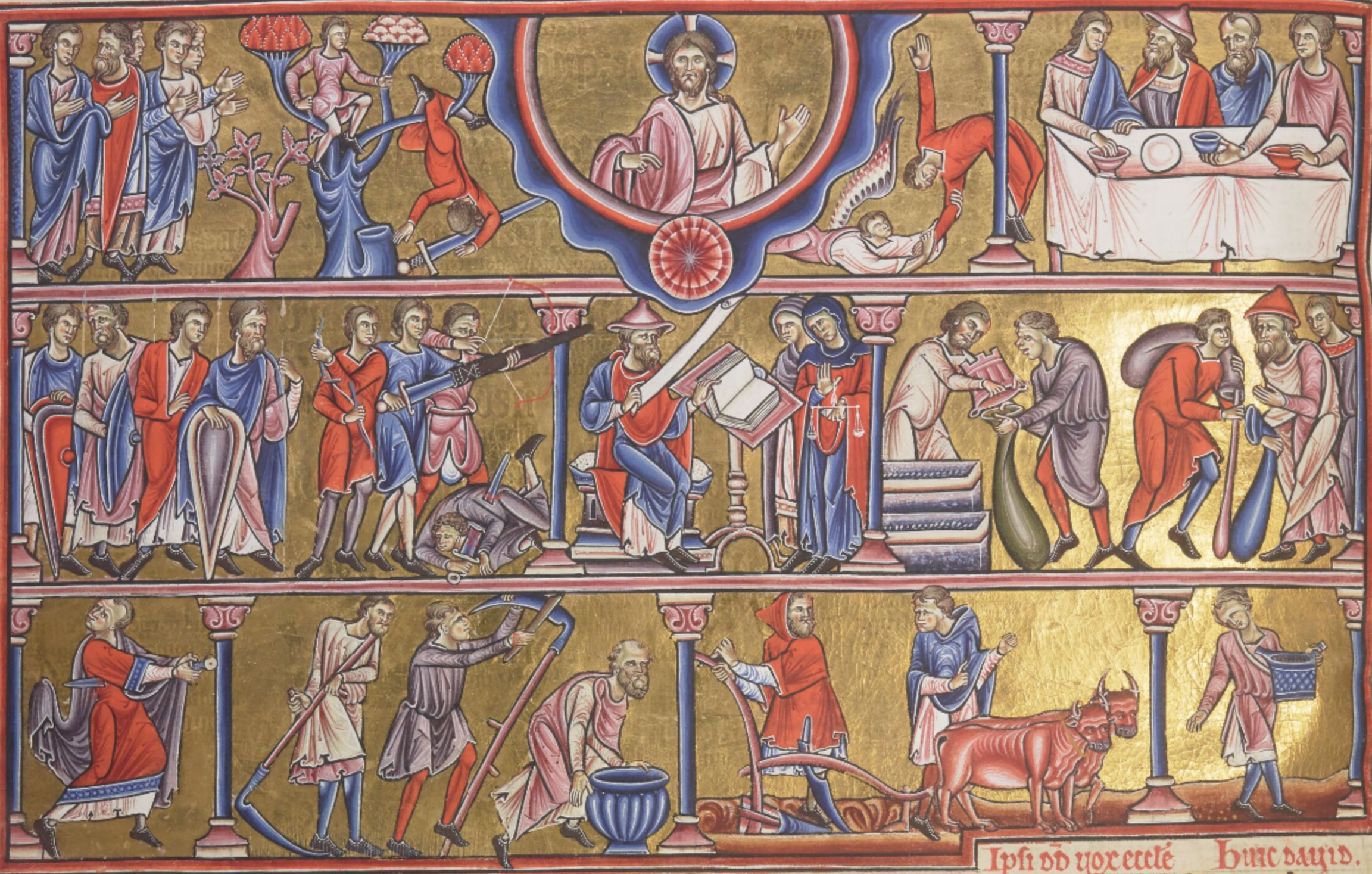
Art from Eadwine, 1200 AD; Canterbury, England.
Crops by Cybermonk (🙃 f134, 👑 f145, 🐴 f177).
Contents
- Intro
- Citation
- My Huge Takeaway Point
- Folklore: The Americas Own Psilocybin; European Religion Has No Psilocybin Tradition and Must Ask Permission and Borrow Expertise
- Wasson’s Criticism of Experts and Deniers of Mushrooms in Mexico
- Credit
- Eadwine
- God
- John Lash
- Paul Lindgren
- Cyberdisciple
- Pilzbaum Affirmers Recognize Art Experts as Fools and Imbeciles Deserving Total Disrespect and Ignoring Them Regarding Pilzbaum
- Huggins’ Foraging Article Fails to Cite Brown 2019 or Michael Hoffman 2006: Ignores the Best Scholarship
- {lame}: f177: Weight on Left Foot on Tower Foundation Requires Crutch, to Be Stable and Balanced
- Yet Another Basic Error of Fact from Incompetent Scholar Huggins
- Names of the First Asserters of Plaincourault as Mushroom
- Art Historians Are Imbeciles, Fools, Frauds, and Clowns Deserving Ridicule, Not Respect and Deference
- Letcher’s History of Having to Retract His Denial and Move the Goalposts
- Pilz Verzweigung Händigkeit Stabilität Baum, Not Just Pilzbaum
- See Also
Intro
Citation
W. E. Safford, 1915
Title:
An Aztec Narcotic (lophophora Williamsti)
Subtitle:
So-called “sacred Mushroom,” or Teonanacatl, Still in Use by the Indians of Mexico and the United States, Producing Hallucinations of a Remarkable Nature, Is Identified With the Peyotl Zacatecensis, or Devil‘s Root of Ancient Mexico, and the “mescal Button” of Texas
https://academic.oup.com/jhered/article-abstract/6/7/291/853354
https://digitalcommons.usf.edu/kip_articles/6278/
Web search: https://www.google.com/search?q=%22journal+of+heredity%22+safford+%22aztec+narcotic%22
My Huge Takeaway Point
In 1915, everyone “knew” there was no Psilocybin mushrooms in Mexico; there is no mushroom cult in Mexico.
Just like today (1957-2024), everyone knows there’s no Cubensis in Europe eg 1200 AD – against Great Canterbury Psalter f134, f145, f177 etc.
I am going to make entheogen scholars retract their negative PREJUDICED, BASELESS, ILLOGICAL, IRRATIONAL PRESUPPOSITION.
Why wouldn’t Cubensis grow on cattle dung in Europe? Explain.
No one has tried to look, because the Secret Amanita paradigm gives everyone a negative attitude and expectation.
Folklore: The Americas Own Psilocybin; European Religion Has No Psilocybin Tradition and Must Ask Permission and Borrow Expertise
False, folk baloney shoved at every opportunity:
Europeans have no Psilocybin tradition and so they must beg shamans in the Americas for permission to use their sacrament.
No one owns Psilocybin mushroom spores; they sail everywhere and have been used everywhere.
Wasson’s Criticism of Experts and Deniers of Mushrooms in Mexico
Wasson, Russia, 1957; find “Safford”, in Vol. 2, p. 236 (“32”):
Wassons wrote:
“Then suddenly one day [after a 265-year hiatus in the literature since 1650] the sacred mushrooms sprang to life again [in the literature].
On May 4, 1915, an ethno-botanist of established and deserved reputation, W. E. Safford, read a paper before the Botanical Society in Washington [state?] in which he flatly and sweepingly denied that there had ever been an inebriating mushroom in the indigenous cultures of Mexico.
His paper was published later in that year in the journal of Heredity, and it was a full-dress presentation, richly illustrated and documented.
Dr. Safford said that the Spanish ‘padres’ (as he somewhat condescendingly called them) had been confused: they had taken for mushrooms what had really been dried buttons of a cactus, the Lophophora Williamsii, the peyotl of Aztec times, the mescal button of Texas.
He declared that three centuries had failed to reveal a fungal intoxicant in Mexico.
He quoted Sahagun as saying that the Chichimecas had been the first Indians to discover the alleged intoxicating property of the ‘mushroom’;
he went on to say that the Chichimecas had occupied northern Mexico, that that was therefore the region where to seek the mushroom, that he had pushed his own researches exhaustively in those areas [northern Mexico] and in the Southwestern states of the United States, and that he had found nothing.”
____ para break ____
“Dr. Safford’s paper drew wide attention and was widely accepted.
Many learned from it for the first time that there had been a belief in an inebriating mushroom, at the same time that they learned the mushroom had never existed.
How ironic it will be if Dr. Safford himself, in the long run, should be remembered chiefly because of this resounding blunder that he made, a classic example of the fallibility of the specialist!
For of course the Spanish ‘padres’ were right and Dr. Safford was wrong.
Dr. Safford’s paper was extraordinary for the vehemence (may we say ‘telltale’ vehemence? [ie the Graves/Wasson taboo theory]) that this Anglo-Saxon showed in rejecting the teo-nandcatl.
It never occurred to him that he had to demolish not only the Spanish ‘padres’ but also all the native informants on whom they relied, and even the Nahuatl vocabulary that they used!”
/ Wasson quote
Now apply that same critique to:
Everyone knows, well established by entheogen scholarship, no Cubensis in Europe.
At my church subgroup on Amanita training, the expert leader there told us, delivered with great authority:
AMANITA IS YOUR HISTORICAL TRADITIONAL ENTHEOGEN.
I almost told him:
GO TO HELL, NO IT’S NOT, YOU ARE WRONG, YOU DO NOT SPEAK FOR MY TRADITION;
MY TRADITION IS NOT AMANITA, IT IS CUBENSIS, PER EADWINE.
I am tired of people falsely saying Mexico owns Psilocybin, and Europe is stuck with only Amanita.
That is FALSE and baseless – “completely unfounded” (Irvin p. 104 THM re: “heretical sects” only).
The myth that “Amanita = Europe; Psilocybin = Americas” needs to DIE, be PUT TO REST just exactly the same as the ironic mis-fame that Wasson predicted for Safford:
How ironic it will be if Dr. Safford himself, in the long run, should be remembered chiefly because of this resounding blunder that he made, a classic example of the fallibility of the specialist!
Ethnomycology Specialist Wasson, “Mushrooms, Russia and History“, 1957; Vol. 2, p. 236 (“32”)
Credit
Eadwine
Credit to Eadwine, who developed and refined the pilzbaum art genre’s combination of {mushrooms}, {branching}, {handedness}, and {stability} motifs.
God
Thank God for connecting me with Eadwine – a godsend.
In November 2020, Got not only delivered to me
- the needed & sought-out corroboration/ confirmation of my interpretation hypothesis from Hatsis’ copy of Dancing Man (Salamander Bestiary re: the man’s two legs, ie: the two legs map to the two mental worldmodels) on Christmas 2015, but also,
- provided the full, eloquent, unbelievably far better than I or anyone could possibly have imagined, supernally perfect corroboration of the Egodeath theory.
The Egodeath theory = psychedelic eternalism; analogical psychedelic eternalism with dependent control.
John Lash
The article “Foraging for Psychedelic Mushrooms in the Wrong Forest” (Huggins 2024), bibliography lists Lash’s webpage article “The Discovery of a Lifetime”:
Lash, J., “Psychedelic Bible: The Discovery of a Lifetime”
https://www.bibliotecapleyades.net/biblianazar/esp_biblianazar_84.htm
The nature of that site: https://www.bibliotecapleyades.net – Spanish & English language site. Library Pleiades; el Sitio de Biblioteca Pleyades.
In 2006 or 2007, just after finishing writing the book Not In His Image, John Lash went to the Paris library, then uploaded 3+5 articles including “Psychedelic Bible: The Discovery of a Lifetime” around May 2008.
My site has a different link to the 5+3 articles (on Wasson & pilzbaum/ Great Canterbury Psalter). Find “Lash” in Site Map.
See my John Lash articles page at this website.
Only one Lash-provided (i believe) picture from Eadwine made it into my Plainc article’s support gallery that Brown 2016 book cites.
Alas the leg-hanging mushroom tree image in the Great Canterbury Psalter didn’t make it fully into my mushroom imagery galleries until Nov. 2020.
Paul Lindgren
Paul Lindgren’s 2000 picture of Creation of Plants, and 2001 couple other pics in “Conjuring Eden” Ruck et al (Mark Hoffman, Carl Ruck, & Daniel Staples) in Entheos 1).
Transmission successfully received and decoded: branching-message mushroom trees; {mushrooms}, {branching}, {handedness}, and {stability} motifs:
{stand on right leg} motif means non-branching (eternalism) with dependent control, not branching (possibilism-thinking) with autonomous control, to restore stable control while in the mushroom state.
Cyberdisciple
Thank you to Cyberdisciple for the book Russia by Wasson 1957, which has this lead.
- In 1957 in the book Russia, Wasson criticizes scholars and competent experts for being so wrong and so negative.
- In 1968 in the book SOMA, Wasson criticizes Eliade for rejecting shamans using entheogens legitimately.
- In 1968 and beyond, Wasson censors deceitfully Panofsky’s citation of Brinckmann 1906, and goes around publicly insulting and defaming mycologists (ie, pilzbaum Affirmers) berating them for not “consulting” the “experts”.
Wasson aggressively, repeatedly, actively censors and denies pilzbaum purposefully mean mushrooms (censoring some 5 things re: the pair of Panofsky letters).
Ruck’s highly offensive phrase “Wasson’s conclusion” in Entheos issue 2 article “Daturas for the Virgin” 2001 p. 56: Irvin calls that out on p. 104 of The Holy Mushroom 2008;
Irvin and I both independently found that passage and were both outraged at this lying misrepresentation that is the opposite of reality.
Irvin is wrong to go on to try to falsely attribute affirming pilzbaums to Allegro.
The proof that Allegro didn’t write anything about pilzbaum is that THM provides no citation where Irvin falsely says that Allegro, not Wasson, is the one who affirmed pilzbaum.
Credit actually goes to Samorini 1996/1997/1998 for being the first to take Panofsky’s lead (via Wasson 1968) – hundreds of pilzbaum – seriously and affirm pilzbaum.
Certainly the Allegro expert Irvin, with his connections to Allegro’s estate, would have provided a citation, if one existed, where Allegro says he affirms pilzbaum purposefully mean mushrooms.
We have nothing but a worthless, obviously false ASSERTION from Irvin, contradicted by the blaring lack of citation.
That’s the same situation that Wasson in SOMA left me in in 2006 when Wasson quotes Panofsky saying “we art historians have thoroughly treated this matter” – I exclaimed in my 2006 Plaincourault article, please give me citations!
I want to read art historians’ PUBLISHED WRITINGS about pilzbaum.
I concluded then, either there are no citations, or they are so weak and few, it’s practically nothing, and art historians are BLUFFING.
I was right in 2006: per Brown 2019 in the Journal of Psychedelic Studies, letter 1, Panofsky gave Wasson 1 citation only, and Wass censored it 6 lines above berating and insulting mycologists (pilzbaum affirmers):
The fact that Wasson censored the Brinckmann citation (while simultaneously commanding affirmers to “consult” the “competent” authorities) is PROOF that Wasson correctly recognized that Brinkcmann’s 1906 book favors pilzbaum Affirmers, and disproves pilzbaum Deniers such as Panofsky.
Brinckmann’s “little”, old 1906, 86-page book is the ONLY thing art historians have ever written and published about pilzbaum.
So much for Pan’s claim that art historians are thoroughly familiar and have treated pilzbaum.
By 2006, if art historians had written anything about pilzbaum, I would have known about it.
Ronald Huggins 2024 Foraging & 2021 Dizzy argues that … Affirmers (PMTs) show no respeect for the authorities. AN UNDERSTATEMENT!
Pilzbaum Affirmers Recognize Art Experts as Fools and Imbeciles Deserving Total Disrespect and Ignoring Them Regarding Pilzbaum
We pilzbaum Affirmers are disgusted and fully disrespectful to Art Historians, who are bought and owned by the lying anti-entheogen faction of the Establishment.
The “Competent” Art Historians Are Know-Nothing, Ignorant, Prejudiced Fools and Clowns Deserving 10x the Ridicule and Insults that Pilzbaum Deniers have Always Since 1952 Given to Mycologists and pilzbaum Affirmers.
I think Huggins gives the Abbot Rignoux 1890-ish and the 1910 presenter guy in French Myc Society, published in bulletin in 1911.
Huggins is good for more than just fallacious argumentation, he serves a lower support role serving capable researchers, ie pilzbaum Affirmers: from his “Foraging” article’s Bibliography:
Marchand, M. / Boudier, M., La fresque de Plaincourault (Indre), Bulletin trimestriel de la Société mycologique de France 27/1 (Jan. 1, 1911), 31– 32
todo: url?
Huggins’ Foraging Article Fails to Cite Brown 2019 or Michael Hoffman 2006: Ignores the Best Scholarship
Why the hell doesn’t Foraging cite my excellent article about Plaincourault 2006? FAILURE OF FORAGING TO ENGAGE THE LEADING SCHOLARSHIP IE EGODEATH.COM, Michael Hoffman.
Huggins only cites the outdated, first-gen entheogen scholar Mark Hoffman, a Secret Amanita paradigm scholar.
Huggins article has the usual standard garbage-quality of obviously fallacious argumentation that the pilzbaum Deniers always have (Pan, Wass, Letcher, Hatsis, Huggins).
But all of these gibberish scribblers posing as fair scholars do contribute many leads and points, such as bibliographies.
I hugely appreciate Hatsis’ Dancing Man article for finally showing me a legible version of the image so that in Christmas 2015 (see the Egodeath Yahoo Group – Max Freakout archive) I figured out as a hypothesis waiting for confirmation:
There are two legs. Standing on one leg, lifting the other leg: Could that mean, by artists: one leg is possibilism-thinking and one leg is eternalism-thinking? if so, which leg is mapped to possibilism-thinking, in this image? – Cybermonk Dec. 25, 2015. At that time, I checked Hephaestos, the lame smith.
fast fwd to Nov 2020, finishing my article for Prof. Jerry Brown about compelling evidence & criteria of proof and for identifying mushroom imagery in Christian art, I do another image search on the web for like Christian mushroom, and I find two sites that have John Lash’s crop showing 2/5 of Row 1 of 3 of f134: class and leg-hanging mushroom tree.
Eadwine’s leg-hanging mushroom tree image in the Great Canterbury Psalter.
Mid-Nov 2020, I start decoding that pilzbaum, and immediately get firm confirmation that I needed since Christmas 2015, almost five years earlier, of both:
- One leg means eternalism-thinking, and the other leg means possibilism-thinking.
- In the pilzbaum genre, Right foot (right limb more generally) is conventionally mapped to non-branching eternalism-thinking; and Left foot (left limb more generally) is conventionally mapped to branching possibilism-thinking.
Given that we have two legs; and that we depend on legs; and that there are two contrasted mental worldmodels, it is natural to map as analogy, two feet to two mental worldmodels.
The pilzbaum genre = {mushrooms}, {branching}, {handedness}, and {stability} motifs
{lame}: f177: Weight on Left Foot on Tower Foundation Requires Crutch, to Be Stable and Balanced
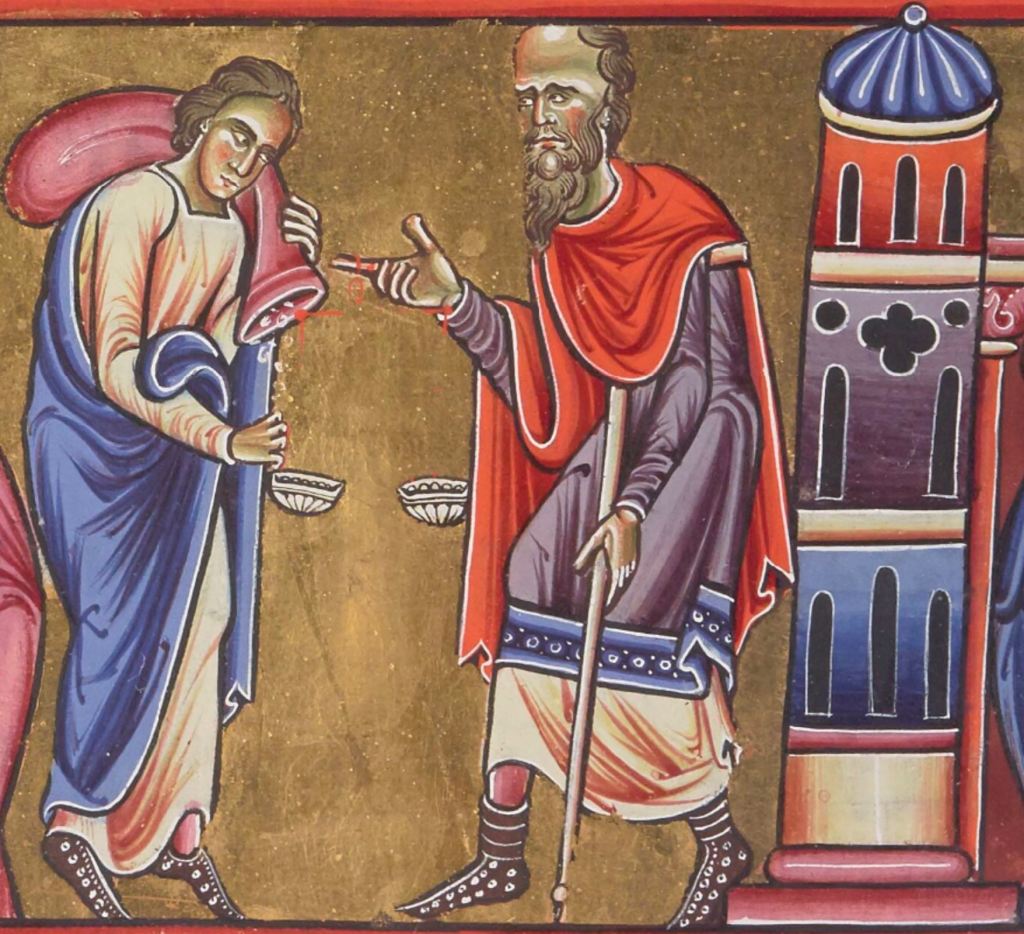
“Canterbury-f177-row2-middle-balance.jpg” 351 KB [2:35 a.m. March 11, 2023]
https://gallica.bnf.fr/ark:/12148/btv1b10551125c/f177.item.zoom#
Hephaetus, the lame god. https://en.wikipedia.org/wiki/Hephaestus
Yet Another Basic Error of Fact from Incompetent Scholar Huggins
Huggins The Perfect: The biblio of Foraging article 2024 says Irvin’s AstroSham 2 is “2001” – fact check: FALSE.
AstroSham 1st Ed is 2006; AstroSham 2 (matching the title in Huggins’ bibliography) is 2009 – NOT 2001.
Therefore, all pilzbaum mean mushrooms.
Why, oh why, do the pilzbaum Deniers show no concern with basic facts, and then claim to interpret art correctly on a sound foundation?
I have both editions, signed, etc, discussed with Irvin in 2006-2007. https://www.amazon.com/s?k=astrotheology+and+shamanism
Names of the First Asserters of Plaincourault as Mushroom
- Abbot Rignoux – around 1890-1910, described the Plaincourault fresco as mushroom with multiple mushroom heads.
- M. Marchand and M. Boudier – presumably the 1910 presenters in French Myc. Society, published in bulletin in 1911.
Is that bulletin online?
Marchand, M. / Boudier, M., La fresque de Plaincourault (Indre), Bulletin trimestriel de la Société mycologique de France 27/1 (Jan. 1, 1911), 31– 32
I SWEAR A RECENT ARTICLE’s BODY GIVES NAME OF WHO ASSERTED – some other Huggins article?? It’s not in “Dizzy” article.
Frustrating but here’s a clue: no “Rignoux” found in “Foraging” article – I am SURE an article surprised me (not Samo’s 1997/98 articles) yesterday by mentioning in the body, “Rignoux”. A Houot article? Winkelman?
Art Historians Are Imbeciles, Fools, Frauds, and Clowns Deserving Ridicule, Not Respect and Deference
– Signed, Us Pilzbaum Affirmers.
I confidently speak on behalf of both the 1st-Gen (Secret Amanita paradigm) and us 2nd-Gen (Explicit Cubensis paradigm) pilzbaum Affirmers:
ART HISTORIANS ARE IDIOTIC CLOWNS DESERVING TO BE JEERED AT for their cowardly, ignorant, “those on the outside” pilzbaum Denial, a denial while art historians insult mycologists and pilzbaum Affirmers.
In “Daturas”, Ruck misrepresents Wasson as having affirmed pilzbaum as supporting Wasson’s assertion about the textual story in Genesis 2-3 that the Tree of Knowledge was Amanita.
In “Daturas”, Ruck argues that when The Holy Mushroom, that is, Amanita, was not available, the cult group that was the users of Amanita switched to substitutes, by which here Ruck does NOT mean Cubensis, but rather, Datura.
Against Ruck, ironically, I agree, in such a way as to show Ruck looking bad: Ruck speaks truth, in a bad way for Ruck, when Ruck says that Datura (Scopolamine) is a viable substitute for Amanita (Muscimol and Ibotenic Acid).
That is true, that Amanita is a deliriant, not a psychedelic; Amanita is indeed, as Ruck implies, similar to merely Datura / scopolamine – Amanita is NOT similar to Psilocybin, as Wasson regretfully concluded in print.
Citations: books in which Wasson states failure and disappointment when ingesting Amanita. Check Persephone’s Quest, maybe SOMA; Shroom by Letcher.
Amanita isn’t as ergonomic to use as Datura, and is not as available as Datura and other scopolamine plants.
Letcher’s History of Having to Retract His Denial and Move the Goalposts
Get Ready to Move them Again.
Against Letcher’s claim that he made with self-assured certainty against me specifically, I proved all of his unprovable points, and more, even higher than his points:
In England 1200 AD, in context of the pilzbaum genre:
- The image means mushroom, – PROVED.
- psychoactive mushroom, – PROVED.
- deliberately ingested, – PROVED.
- for religious experiencing, – PROVED.
- (arg. extended by me:) peak religious experiencing. – PROVED.
The peak religious effect of Psilocybin (cognitive loosening agents) is mental model transformation from possibilism to eternalism.
Read Letcher’s book Shroom regarding the backpedalling that the Deniers had to do around 2005.
The naysayers claimed no Liberty Cap or other Psil mushroom in England before the 1970s – they HAD TO EAT CROW AND ADMIT THEIR ERROR AND FOOLISHNESS around 2005.
Then they moved their goalposts and said “Ok, Liberty Cap IS natural to England historically, but, no one thought of Liberty Cap as religious recreational until 1970s”.
Letcher argues against my critical book review of his book; he says against Hoffman, I cannot prove any of these 4 things.
Letcher’s 4-step argument, I expanded to 5 steps and then I DUNKED it, proving all 5, not just 4, points that Letcher’s webpage’s comment said I could not prove.
I proved, by art centered around Great Canterbury Psalter f134: Eadwine’s leg-hanging mushroom tree image in the Great Canterbury Psalter, all 4 points, and beyond.
Pilz Verzweigung Händigkeit Stabilität Baum, Not Just Pilzbaum
The pilzbaum genre is not just mushroom and tree (branches) motif.
Translate to German not just “mushroom tree”, but:
mushroom tree branching handedness stability = Pilzbaum Verzweigung Händigkeit Stabilität
mushroom branching handedness stability tree =
Pilz Verzweigung Händigkeit Stabilität Baum
The pilzbaum genre is the integrated combination of {mushrooms}, {branching}, {handedness}, and {stability} motifs.
Often along with {mushroom hem} and John Rush’s {celestial erection}.
John Rush is a better interpreter of pilzbaum & mushroom imagery, mushrooms in Christian art, than the reductionist, literalist pilzbaum Deniers, aka “Those on the outside”: Panofsky, Wasson, Letcher, Hatsis, and Huggins.
See Also
Huggins 2024 article “Foraging”.
https://egodeaththeory.wordpress.com/2024/11/23/huggins-foraging-psychedelic-mushrooms-wrong-forest/
Graves Russia book 1957
Letcher’s book Shroom 2005. Worth re-reading.
https://egodeaththeory.wordpress.com/2023/05/28/shroom-a-cultural-history-of-the-magic-mushroom-letcher-2006-uk/
John Lash articles page at this website:
“Lash” section in Site Map:
https://egodeaththeory.wordpress.com/nav/#John-Lash
Huggins in “Foraging” cites good writer Don Lattin, book:
Lattin, D., “God on Psychedelics: Tripping Across the Rubble of Old-Time Religion, 2023 –
https://www.amazon.com/God-Psychedelics-Tripping-Old-Time-Religion/dp/195806128X/ – full Intro at Amazon.
I skimmed the Intro and/or Conclusion, not avail on the Lucid News site that Lattin posts articles to:
https://www.lucid.news/author/don-lattin/
Marchand, M. / Boudier, M., La fresque de Plaincourault (Indre), Bulletin trimestriel de la Société mycologique de France 27/1 (Jan. 1, 1911), 31– 32
– Cybermonk December 11, 2024
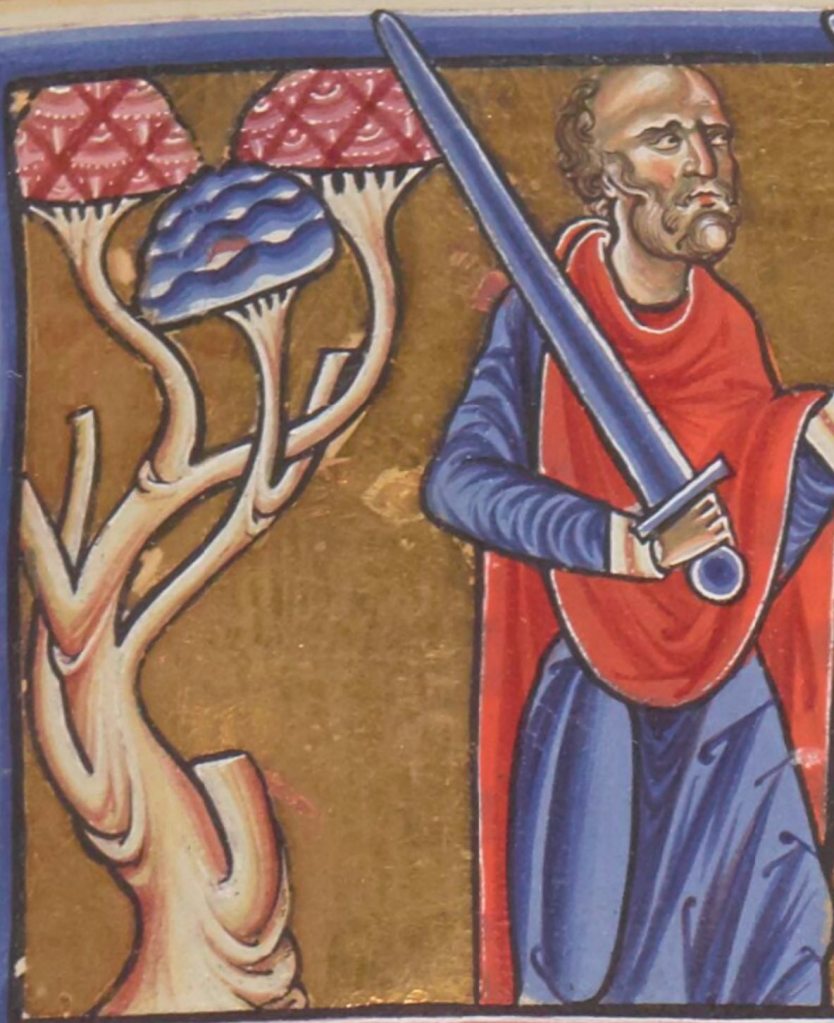
4-5 ways of depicting {cut right branch}, in a single pilzbaum


