Michael Hoffman, December 20, 2020; updated December 9, 2024
Contents:
- The First Scholar to Identify Mushrooms in Greek Religious Myth: Robert Graves, “What Food The Centaurs Ate”, Shortly After June 27, 1957, in New Yorker
- Summary: “Centaur” Article Published in 1957, 1958, & 1960; Mentioned in the Article Published in 1970 & 1973
- 1) “What Food The Centaurs Ate”, after June 27, 1957, in New Yorker Magazine
- 2) “What Food the Centaurs Ate” in Book STEPS (Stories, Talks, Essays, Poems, Studies in History), 1958, pp. 319-343
- 3) “Centaurs’ Food” in Book Food for Centaurs, 1960, pp. 257-282
- 4) “The Divine Rite of Mushrooms”, in The Atlantic, Feb. 1970 (tries to cite “Centaurs” article)
- 5) “The Two Births of Dionysus”, in Difficult Questions, Easy Answers, 1973 (tries to cite “Centaurs” article)
- Dec. 9, 2024
“Centaurs’ Food” was First Published in August 1956, Atlantic Monthly – FALSE- Did Robert Graves Propose Mushrooms in Christianity?
- Finding My Inventory Posting of Graves’ 83+ Pages on Entheogens
- When and Where the Centaur Food Essay Was Published
- “Mushrooms, Food of the Gods” in The Atlantic, Aug. 1957, pp. 73-77
- Essay “Pilze, Speise der Götter” in Magazine Der Monat, 1958
- Essay “What Food the Centaurs Ate” in Book STEPS (Stories, Talks, Essays, Poems, Studies in History), 1958, pp. 319-343
- Essay: “The Two Births of Dionysus”, in book Difficult Questions, Easy Answers (1973) – rough draft compared to:
“~”, The Atlantic Feb. 1970 - Essay “Centaurs’ Food” in Book Food for Centaurs, 1960, pp. 257-282
- Graves: Food for Centaurs – Mushrooms in Greek Religious Myth
- Graves: Oxford Addresses on Poetry – Vaguely Mushrooms in Christianity
- Graves: Difficult Questions, Easy Answers – Mushrooms in Old Testament Stories
- Graves: Between Moon and Moon: Letters — Mushrooms in Greek & European Religion
- Graves’ Book Greek Myths (1955, revised 1958, Mushroom Forward 1960)
- Graves’ 1957 Article Jesus as Toadstool – Review of Allegro’s Book
- See Also
The First Scholar to Identify Mushrooms in Greek Religious Myth: Robert Graves, “What Food The Centaurs Ate”, Shortly After June 27, 1957, in New Yorker
Who was the first scholar to assert that mushrooms powered Greek religion and myth? When, where? Answer: Robert Graves, in the article “What Food The Centaurs Ate”, which was first published after June 27, 1957, in New Yorker.
I drove this research, pointed out the two conflicting claims in two versions of a Graves article in Atlantic later in Difficult Questions book, about where & when Centaur article focusing on Dionysus & recipe for ambrosia first appeared.
Then Cyberdisciple on Dec. 9, 2024 found this huge lead: Graves’ diary: https://robertgraves.org/diary-search — 1957: June 27th. Thursday: “Finally got What Food The Centaurs Ate off to New Yorker.”
So, against Graves 1970 Atlantic article & 1973 book Difficult, the Centaur article was first published around June/July 1957 in New Yorker.
Not August 1956 Atlantic (no Graves article).
Not the Aug 1957 Atlantic article “Mushrooms, Food of the Gods” (barely mentions Dionysus; this is NOT the Centaur article).
Summary: “Centaur” Article Published in 1957, 1958, & 1960; Mentioned in the Article Published in 1970 & 1973
It was extremely difficult to straighten all of this out.
The fruits of my (our) labor is the next 5 sections, 1) through 5).
1) “What Food The Centaurs Ate”, after June 27, 1957, in New Yorker Magazine
This is the first time a scholar published asserting that Greek religion and Greek myth is based on mushrooms. Around July 1957.
I collaborated with Cyberdisciple Dec. 9, 2024 to determine this.
Graves gives wrong info about this article in the Feb. 1970 The Atlantic article, and in the 1973 book Difficult Questions, Easy Answers, which has a rougher version of that article.
2) “What Food the Centaurs Ate” in Book STEPS (Stories, Talks, Essays, Poems, Studies in History), 1958, pp. 319-343
PDF excerpt from STEPS, containing the essay: https://cyberdisciple.wordpress.com/wp-content/uploads/2021/01/graves-what-food-the-centaurs-ate-published-in-steps-1958.pdf
STEPS (Stories, Talks, Essays, Poems, Studies in History)
Robert Graves, 1958
Cassell and Company Ltd.
https://www.abebooks.co.uk/book-search/title/steps/author/robert-graves/
https://www.amazon.com/Steps-Stories-Essays-Studies-History/dp/B0000CK4JS/
“A” (book) entries: https://robertgraves.org/rg-books —
A86: https://robertgraves.org/bibliography/1095 – STEPS (Stories, Talks, Essays, Poems, Studies in History), 1958, contains essay (as the final chapter), “What Food the Centaurs Ate”.
A90: https://robertgraves.org/bibliography/1099 – Food for Centaurs, 1960, contains “Centaurs’ Food” essay,
https://legacy.lib.utexas.edu/taro/uthrc/00685/00685-P.html
“What Food the Centaurs Ate [“ate”?], carbon typescript, 27 pages, undated.”
3) “Centaurs’ Food” in Book Food for Centaurs, 1960, pp. 257-282
Same article as “What Food the Centaurs Ate”, above.
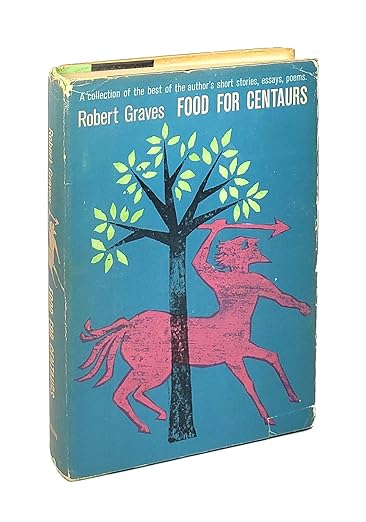
Food for Centaurs
Robert Graves, 1960
https://archive.org/details/foodforcentaurss00grav/page/256/mode/2up – the full book, with the article “CENTAURS’ FOOD” starting on page 257 on the right. I created an Archive.org account, to Borrow/view books.
https://www.amazon.com/Food-centaurs-Stories-critical-studies/dp/B0007E0K36
https://www.amazon.com/Food-centaurs-Stories-critical-studies/dp/B0044UQ06A
List of chapters: http://link.bu.edu/portal/Food-for-centaurs–stories-talks-critical/yD0l98JDGVY/
See https://cyberdisciple.wordpress.com/tag/centaurs-food
First published in The Atlantic Monthly magazine[true?] (1956) [1957?],
Reprinted in the book Food for Centaurs (1960).
CSP Chrestomathy:
https://airtable.com/embed/shrmG2oJ0uy1cXgiU/tblMODVIRtVywJ1bl/viwEahEnJIPGaz2GU/recweNN5XwYdNRolz —
The meaning of “ambrosia,”
the food of the gods, like
“nectar,” their drink is:
“that which confers immortality.”
… At this point, I wrote down the Greek words of the ambrosia recipe, as follows, one underneath the other:
MELI
UDOR
KARPOS
ELAIOS
TUROS
ALPHITA
Next I wrote down the nectar recipe, namely honey, water, and fruit:
MELI
UDOR
KARPOS
And also, while I was about it, the recipe for kukeon [Demeter’s drink during her search for Persephone] …
MINTHAION
UDOR
KUKOMENON
ALPHITOS …
So, if mushrooms were ambrosia, and if ambrosia was mushrooms, be pleased to examine those three sets of initial letters
M-U-K-E-T-A <– ambrosia recipe ogham
M-U-K <– nectar recipe ogham
M-U-K-A <– kykeon recipe ogham
… ogham … what the ancient Irish bards called the device of spelling out a secret word by using the initial letters of other ordinary words.
MUKETA answers the question: “What do the gods eat?”; for MUKETA is the accusative of MUKES (“mushroom”). …
MUKA is an earlier form of the word MUKES (“mushroom”). (pages 264-265)
In the chapter “Centaurs’ Food” Graves supports the Wassons’ [Graves’?] claim that hallucinatory agents were used in the Eleusinian Mysteries with [by here providing] citations of ancient Greek poetry, plays, statuary, and vase-art.”
4) “The Divine Rite of Mushrooms”, in The Atlantic, Feb. 1970 (tries to cite “Centaurs” article)
The article online: https://bibliography.maps.org/bibliography/default/resource/13453
Paragraphs 24 end through 27 start (pp. 112-113) are different and longer than the equivalent paragraphs in the 1973 article (p. 110).
Incorrectly says:
“the August, 1957, Atlantic published … titled “Mushrooms, Food of the Gods” and gave my reasons for supposing that Dionysus … was … the God of the Inspiratory Mushroom.”
Incorrect because that article doesn’t focus on Dionysus.
5) “The Two Births of Dionysus”, in Difficult Questions, Easy Answers, 1973 (tries to cite “Centaurs” article)
This article is a different, apparently earlier, rougher draft of the Feb. 1970 article above.
Incorrectly says:
“in 1956 the August Atlantic Monthly published … titled “Centaurs’ Food” and gave my reasons for supposing that Dionysus … was … the God of the Inspiratory Mushroom.”
Incorrect because that issue doesn’t have an article by Graves.
Dec. 9, 2024
Dec. 9, 2024: My emails with Cyberdisciple have a ton of findings, not yet copied to here, especially from reading Robert Graves’ article “The Divine Rite of Mushrooms” in The Atlantic, Feb. 1970, pp. 109-113:
https://bibliography.maps.org/bibliography/default/resource/13453
https://bibliography.maps.org/resources/download/13453 (immed. download). MAPS Search: https://bibliography.maps.org/default/search – Author = Graves, Title = Divine Rite of Mushrooms.
That article is a polished draft of the rougher “The Two Births of Dionysus” article that’s in the book Difficult Questions, Easy Answers, 1973.
In the article, Graves says Triptolemus’ “agriculture” technology moved from (Secret) Amanita to the “more effective” Psilocybin, in India & Greece & Mexico.
The availability of Psilocybin knowledge served as an engine that enabled creating Mysteries initiation (= ambrosia, nectar, kykeon; mixed wine, Eucharist), to cultivate initiates, unlike wild, uncultivated use of Amanita.
The article provides the missing takeaways that Graves wishes people had, in 1970, 12 years after the 1958 article “What Food the Centaurs Ate”, in STEPS book & “same article” (any edits??) titled “Centaurs’ Food” in the book Food for Centaurs 1960, and two years after Wasson’s book SOMA in 1968, which didn’t credit Graves, unlike Wasson’s 2-volume Russia in 1957.
The article lists the collaboration, findings, and takeaway narratives that Wasson didn’t convey in SOMA, per Graves.
“Centaurs’ Food” was First Published in August 1956, Atlantic Monthly – FALSE
Dev. 9, 2024 – my intensive research findings:
https://www.google.com/search?q=%22centaurs%27+food%22+robert+graves+%22atlantic+monthly%22 —
preview: “Moreover, a dozen years previously, in “Centaurs’ Food” (Atlantic Monthly, Aug, 1956; reprinted in Food for Centaurs, 1960) [what about in STEPS as “What Food the Centaurs Ate”, 1958? diff. title], Graves had outlined a number…”
Did Robert Graves Propose Mushrooms in Christianity?
Religion and Psychoactive Sacraments : An Entheogen Chrestomathy
Tom Roberts & Paula Jo Hruby
https://csp.org/docs/indexhttp://www.csp.org/chrestomathy/https://archive.org/search.php?query=http%3A%2F%2Fwww.csp.org%2Fchrestomathy%2F
Search the Chrestomathy for Robert Graves to read some of Graves’ 83 pages on the topic.
Finding My Inventory Posting of Graves’ 83+ Pages on Entheogens
83 pages by my count, around November 4, 2011 – check the Egodeath Yahoo Group for a possible inventory. Here’s a lead:
| Group: egodeath | Message: 5945 | From: egodeath-owner@yahoogroups.com | Date: 27/10/2012 |
| Subject: Re: Egodeath theory a central product of the Psychedelic 80s |
| In November 2011, I determined that my university library in 1985-1989 had Robert Graves’ books, which clearly asserted the full essence of the entheogen theory of religion and of Greek myth, including in his decades-ahead-of-the-pack 1956 book. Graves-Wasson enth theory 1960, Hall 1925, S. 1845 http://groups.yahoo.com/group/egodeath/message/5495 Had I somehow in 1988 found out about Robert Graves’ books sitting in my library, with 83 pages about the Entheogen solution to interpreting religious myth in 4 books, one can imagine that I would’ve developed my Phase 2, extension theory, about myth, metaphor, and entheogen history (and perhaps ahistoricity while we’re at it), immediately in the couple months after having formed the core Theory, as an immediate fallout. I definitely was trying to figure out which entheogen is the bitter sweet scrolls eaten in Revelation, by 1988. But I didn’t know anything in 1988 about Greco-Roman myth and religion; I only knew that the New Testament had lots of metaphors that I believed were informed by entheogens. In 1988, when I started expansive reading in order to communicate my discovery to the extant intellectual world, I didn’t catch the kind of thread Graves wrote about in 1956 — it was at least 11 years later, around 1999, that I picked up that thread, such as through Clark Heinrich and Entheos (Carl Ruck, Mark Hoffman). |
| Group: egodeath | Message: 5495 | From: Michael Hoffman | Date: 07/11/2011 |
| Subject: Re: Graves-Wasson enth theory 1960, Hall 1925, S. 1845 |
| Robert Graves wrote 83 pages, within 4 books, on the Entheogen solution to interpreting religious myth. This includes 2 pages from the Foreward of the 1960 version of his popular 2-volumn set, Greek Myths. This Foreward is available to read in bookstores. Excerpts: Graves-Wasson enth theory 1960, Hall 1925, S. 1845 http://groups.yahoo.com/group/egodeath/message/4083 Jul 31, 2005 Most of Graves’ breakthrough findings were presented in his first, early article on the subject, in just 27 pages, in 1956. He was very popular and many people must have read some pages of his mushroom theory of religion around 1960. He wrote that he didn’t want to jeopardize his established sales of his other popular books by writing about the mushroom theory. After reading Wasson, no one is sure what Wasson asserted and didn’t assert. The poet Robert Graves, like Clark Heinrich, is a better writer: natural and immediately clear. He’s not pompous, evasive, waffling, or roundabout in his wording. Copyright (C) 2011 Michael Hoffman. All Rights Reserved. |
Found it ! digest 108:
| Copyright (C) 2011 Michael Hoffman. All Rights Reserved. |
| Group: egodeath | Message: 5479 | From: Michael Hoffman | Date: 04/11/2011 |
| Subject: Re: Graves-Wasson enth theory 1960, Hall 1925, S. 1845 |
My Tally of Robert Grave’s 83+ Pages on Mushrooms in Religious Myth
81, + 2 pages in his book Greek Myths. His review of Allegro’s book is on two pages of New Statesman, bringing the estimate up to 85 pages.
| Robert Graves wrote 81 pages about Amanita and psilocybe mushrooms in Greek myth/religion & Judeo-Christianity 1956-1973. Impressively solid, he recognized the great import and wide explanatory power across myths and religion, helpful, worth reading, led the way, easy to find in libraries, should be published as one book. He’s more specific about which entheogens and how they fit myths, than occult esotericists Salverte, Blavatsky, and Hall, who only said that a variety of drugs induced the initiatory Mysteries. Food for Centaurs book 1960 Centaurs’ Food article 1956 257-282 = 26 pp Oxford Addresses on Poetry (book) 1961 The Poet’s Paradise (article) 1961 111-129 =19 pages Difficult Questions, Easy Answers (book) 1973. Articles: The Universal Paradise 77-93 Mushrooms and Religion 94-103 The Two Births of Dionysus 104-112 (The Greek Tradition 124-128 but only 126 mentions hallucinogens) That’s 113-77=36 pages Total: 26+19+36= 81 pages — Michael Hoffman |
| Group: egodeath | Message: 5480 | From: Michael Hoffman | Date: 04/11/2011 |
| Subject: Re: Mytheme: Chariot steersman |
| Judas hung from mushroom tree. Wine-mixing krater showing the Abduction of Chrysippus. Laius drives/steers/controls a 4-horse chariot carrying off the youthful son of Pelors. 3 white mushrooms atop Amanitas, associated with the horses’ white-spots-on-red collars. I have blurry photo of clear art. Ruck/Hoffman covered? I photographed other such art of mushrooms too today. Copyright (C) 2011 Michael Hoffman. All Rights Reserved. |
| Group: egodeath | Message: 5481 | From: Michael Hoffman | Date: 04/11/2011 |
| Subject: Re: Graves-Wasson enth theory 1960, Hall 1925, S. 1845 |
| Per Graves, Dionysus is twice-born because of recycling Amanita; “born from Zeus’ thigh” means bladder. |
| Group: egodeath | Message: 5482 | From: Michael Hoffman | Date: 04/11/2011 |
| Subject: Re: Graves-Wasson enth theory 1960, Hall 1925, S. 1845 |
| Graves’ 3 books deserve 5 of 5 stars because they constitute a breakthrough of maximum breadth and depth of ramifications, recognition, and opening up entry into a fully explanatory paradigm, particularly in the Dark Ages of 1956. Wasson was overhyped, overcredited with broader theorizing than he did. Much quantity of credit people try to attribute to Wasson belongs to Graves, who wrote things that people fantasize that Wasson wrote. Wasson didn’t write the things we coherently expect he should’ve written; Graves wrote those coherent things, covered those topics at a first pass, and most people haven’t read his seminal, pioneering coverage. Wasson amply credits Graves in the rare Russia book but not in the relatively available book SOMA. Copyright (C) 2011 Michael Hoffman. All Rights Reserved. |
When and Where the Centaur Food Essay Was Published
Doubt: The essay “What Food the Centaurs Ate” “Mushrooms, Food of the Gods” [fact check whether same content/essay] was published in the magazine The Atlantic Monthly, 1956[?] [Aug 1957?].
The essay “Centaurs’ Food” was first published in August 1956, in Atlantic Monthly.- The essay “What Food the Centaurs Ate” was published in the book STEPS (Stories, Talks, Essays, Poems, Studies in History), Robert Graves, 1958, pages 319-343.
- The essay “Centaurs’ Food” was published in the book Food for Centaurs, Robert Graves, 1960.
“Mushrooms, Food of the Gods” in The Atlantic, Aug. 1957, pp. 73-77
“Mushrooms, Food of the Gods”
https://www.theatlantic.com/magazine/archive/1957/08/mushrooms-food-of-the-gods/641965/
This article only mentions Dionysus twice; it’s not focused on Dionysus eg “twice born” theme (ie urine recycling).
Has list of ingredients for ambrosia/ nectar/ kykeon mid-sentence, not as separate lists.
This body content of this article does not match “What Food…” essay 1958 & “Centaurs’ Food” essay 1960.
Search web:
https://www.google.com/search?q=%22What+Food+the+Centaurs+Ate%22+Atlantic+Robert+Graves
https://robertgraves.org/bibliography/3047 – C564 = 1957 – “SECTION C: Articles, poems and letters published in newspapers, magazines and other periodicals.” – “Mushrooms, Food of the Gods”. Atlantic #200: pp 73–77, August. [Reprinted as ‘What Food the Centaurs Ate’ ([book entry:] A86) and ‘Centaurs’ Food’ ([book entry:] A90). This [essay] was translated into German under the title ‘Pilze, Speise der Götter’ and appeared in Der Monat, Vol. 10, September 1958, pp. [42] 43-49.]
“A” (book) entries: https://robertgraves.org/rg-books —
A86: https://robertgraves.org/bibliography/1095 – STEPS (Stories, Talks, Essays, Poems, Studies in History), 1958, contains essay (as the final chapter), “What Food the Centaurs Ate”.
A90: https://robertgraves.org/bibliography/1099 – Food for Centaurs, 1960, contains “Centaurs’ Food” essay,
Essay “Pilze, Speise der Götter” in magazine Der Monat, Vol. 10, September 1958, pp. [42] 43-49.]
Essay “Pilze, Speise der Götter” in magazine Der Monat, 1958
Essay “What Food the Centaurs Ate” in Book STEPS (Stories, Talks, Essays, Poems, Studies in History), 1958, pp. 319-343
The Foreword does NOT list The Atlantic; it says the prose pieces in this book were published in:
- The New Republic
- Commentary
- The Hudson Review
- American Heritage
- The Texas Quarterly
- The Gentleman’s Quarterly
- The New York Times
- Harper’s Magazine
- Esquire
The Centaur article must have been first published in one of those periodicals, not in The Atlantic [Monthly]. Probably soon after Wasson’s book 1957 Russia was published. Russia (1957) doesn’t mention the Centaur article. Very unlikely Centaur was published before Russia (1957).
I read STEPS: a bit of helpful negative finding: The Foreword of STEPS (1958) does NOT list The Atlantic(!) – confirming, seemingly, my suspicion.
The Foreward says prose pieces in this book were published in the following periodicals – haven’t been able to find which. All resources other than confused Graves Biblio just say the two books (STEPS 1958, FFC 1960).
Most likely, Centaur was originally published in one of these periodicals, according to STEPS’ Foreword:
The New Republic
Commentary
The Hudson Review
American Heritage
The Texas Quarterly
The Gentleman’s Quarterly
The New York Times
Harper’s Magazine
Esquire
But Graves’ diary says New Yorker, not New York Times.
I really just want to know, what year and month? Can we get a definite date for Centaur article prior to STEPS 1958? Why timing is critical:
The conversation between Graves and Wasson, around the time Wasson sent Graves the 1957 Russia book – does that mention the Centaur article prior to the STEPS book?
Maybe not, b/c Graves was only mad at Wasson after 1968 book SOMA for not mentioning Centaur article.
Possible timeline:
1957 – Wasson sends Graves Russia.
~July 1957 in New Yorker per Graves’ diary – Graves publishes Centaur article for the first time, in one of the above periodicals.
1958 – Graves’ compilation STEPS includes “Centaur” essay.
1968 – Wasson publishes SOMA book and fails to credit “Centaur” article.
~1968 – Graves in a periodical criticizes Wasson for not crediting Centaur in SOMA. In Graves’ review of SOMA (1968), review titled “The Two Births of Dionysus”. (url? check Graves biblio site)
Essay: “The Two Births of Dionysus”, in book Difficult Questions, Easy Answers (1973) ~= article “The Divine Rite of Mushrooms” in Atlantic (Feb. 1970)
Difficult Questions, Easy Answers book
Graves, 1973
Essay “The Two Births of Dionysus” – rougher than the Feb. 1970 article in The Atlantic.
https://archive.org/details/difficultquestio0000grav/page/104/mode/2up
I created an Archive.org account, to “borrow”/read this book.
Graves in 1973 criticizes Wasson’s book SOMA 1968 for not crediting Graves, as Russia 1957 did.
todo: url for Graves’ review of SOMA by Wasson.
x https://shs.cairn.info/revue-francaise-d-etudes-americaines-2018-3-page-91?lang=fr – 2018 article like Irvin about publicity of magic mushrooms
interesting hits from search: https://www.google.com/search?q=Graves%27+review+of+SOMA+by+Wasson
Pharand’s Article About Graves & Wasson
This page https://robertgravesreview.org/essay.php?essay=170&tab=6 article says that the SOMA review is the article “Two Births”. From Pharand’s article about Graves & Wasson:
“Graves would regard Wasson himself as having being somewhat too discreet in 1969 [sic, 1968], when Wasson published Soma: Divine Mushroom of Immortality, reviewed by Graves in Atlantic Monthly [what year/month?] under the title, “The Two Births of Dionysus” (published in Difficult Questions, Easy Answers).
[Atlantic url? I find no post-1968 article “Two Births” at Atlantic site https://www.theatlantic.com/search/?tab=&q=robert+graves+two+births – Graves’ “Two Births of Dionysus” article was originally published in Atlantic Feb. 1970 as “The Divine Rite of Mushrooms” by Graves in Feb. 1970; the article is Graves’ review of SOMA] search: https://www.google.com/search?q=%22Divine+Rite+of+Mushrooms%22+Robert+Graves – pdf of the article: https://bibliography.maps.org/resources/download/13453 — seems same as “Two Births” in Difficult.
“After further study, Wasson had concluded that soma could not have been the Stropharia mushroom, as he had originally postulated, but was instead the hallucinogenic Amanita muscaria or fly-agaric.
“What distressed Graves was that Wasson made no mention of Graves’s contributions to the book despite the fact that he had provided Wasson with information for it early in his research, even reassuring Wasson in person that his arguments about Amanita muscaria were sound; “unfortunately I kept no notes of our conversation and he [Wasson] does not mention this incident in his book” (Graves 108).
“Moreover, a dozen years previously, in “Centaurs’ Food” (Atlantic Monthly [doubt!], Aug 1956 [doubt!]; reprinted in Food for Centaurs, 1960), Graves had outlined a number of important ideas that now found their way into Wasson’s new book, but without any credit to Graves. And since Graves had sent Wasson a copy of Food for Centaurs upon its publication (6 May 1960), and Wasson had written him in July [1960 – two years after SOMA published!] to acknowledge the gift and say he had enjoyed it (Seymour-Smith 502), he was thus certainly familiar with Graves’s prior work.
“Perhaps, as Seymour suggests, Wasson’s reluctance to mention his debt to Graves is understandable in light of Graves’s dubious reputation among academics and scholars as something of an unreliable eccentric.”
I made a set of five .png files, cleaned up, to print out pp.. 104-114 and evaluated the arg’n flow/ structure, per-paragraph – extremely interesting and revealing of the master narrative:
Graves told Wasson about the thesis paralleled both in Vedic Soma and in Ancient Greek culture, of “the original Secret Amanita was replaced later by the substitute Psilocybin.”
Graves/ Wasson/ Ruck/ Heinrich all write this same Psilocybin-diminishing master narrative, the Amanita Primacy Fallacy, the “secret Amanita cult” theory.
Actually, ignoring myth-based mythical history, the deliriants (Amanita & Datura alike) were an inferior, fall-back substitute for psychedelics, ie. Psilocybin!
Ruck tries to frame Datura as a later substitute for the real deal, Amanita, in article “Daturas for the Virgin”, Entheos 1, 2001.
If you agree with my timeline – that Centaur was not written before Russia 1957 – … when Wasson wrote Russia in 1957, did the article Centaur exist yet? Doubt it. So I guess we have pinpointed Centaur enough for priority of discovery. Does Wasson’s book Russia in 1957 mention the Centaur essay? Ans: No, searched “centaur” and “graves”, no trace of Centaur article in Russia (1957).
I guess that’s sufficient to pinpoint relatively, the Centaur article: the article was probably first published in one of the above periodicals, after Wasson finished writing Russia in 1957, before Graves published STEPS in 1958.
Pretty close timing, probably a few months after Wasson finished writing the book Russia.
I seriously doubt Centaur was published 1956 – Russia would have mentioned it, if at all relevant. Possibly late 1957 after Russia published.
Graves: Oxford Addresses on Poetry – Vaguely Mushrooms in Christianity
Oxford Addresses on Poetry
Robert Graves
1962
CSP:
https://airtable.com/embed/shrmG2oJ0uy1cXgiU/tblMODVIRtVywJ1bl/viwEahEnJIPGaz2GU/recrKQO6qzGJhsr9I —
Why do paradises follow a traditional pattern, widespread and persistent enough to be shared even by Polynesians and pre-Columbian Mexicans? The evidence suggests that, originally, a common drug causes the paradisal visions and provides the remarkable mental illumination described as “perfect wisdom.” One such drug, a hallucigenic mushroom, was certainly used in Central America before the Spanish conquest. (page 126)
Why should horrible and obscene names be applied to edible mushrooms? Perhaps mycophobia pointed to an ancient taboo, like that which has given Jews and Moslems a disgust of pork, and Northern Europeans a disgust of horse-flesh-nutritious and tasty meat-both pig and horse having once been holy animals. And since mushrooms figured alongside toads, snakes and devils in numerous late medieval paintings, and still bear popular names connected with toads, snakes and devils, it looked as if they might have been sacred food in a pagan rite, preserved by witches of Western Europe who kept toads and snakes as diabolic “familiars.” (page 127)
In the different regions of Mexico where the cult survives, certain religious rules are common to all. Devotees, before partaking of a mushroom feast, must fast, abstain from sexual intercourse, and be at peace with the world and themselves. Whoever disregards these rules (the curanderos and curanderas agreed) may see such demonic visions as to wish they had never been born. The Christian, Jewish, Greek and Babylonian Heavens, it should be recalled, have a Hell which complements Paradise; and the usual vision is of innumerable demon faces grinning from lurid caverns. But those who attend such a feast while in a state of grace, report that the mushrooms not only sharpen their intelligence, so that they seem to possess “perfect wisdom,” but shower on them what Christians call “the peace and love that passes all understanding“-a strong, non-erotic sense of spiritual comradeship.
The Roman Catholic Church teaches that Paradise cannot be attained except by repentance; and prepares every sinner for the journey with the viaticum, a symbolic consumption of Jesus Christ’s body and blood, after asking him to purge his soul by a sincere confession. From what religion, it should be asked, did St. Paul borrow this rite, since it is not attested in the Gospels and is an infringement of the Hebrew law against the drinking of blood? (page 129)
[Graves accuses the Church of retaining only the Lesser Mysteries with the Prep placebo, withholding the Greater Mysteries of actual mushroom initiation:]
The Christian sacrament of bread and wine was a love-feast in Hellenistic style. Initiates of the Lesser Eleusinian Mysteries, who had to undergo a period of probation before being admitted to the Greater Mysteries, saw no celestial visions. Presumably, the mystagogues withheld the sacred hallucigenic agent until sure of a candidate’s worthiness; he received bread and wine only, symbols of the Grain-Dionysus and the Wine-Dionysus. The Church has indeed banished the Serpent from Paradise. Her sacramental elements give communicants no visionary foretaste of the new Jerusalem. The disappointment often felt by Protestant adolescents at their first communion is a natural one-the priest promises more than they are able to experience. I learned only last week from an Arabic scholar, that the root-word F.T.R. means, in Arabic, first “toadstool,” then “divine rapture,” then “sacred pellets of bread.” This points to a pre-Islamic hallucigenic practice of immense age.
Granted, many Christian and Jewish mystics have undoubtedly seen Paradisal sights, but always after a life of intense spiritual struggle; and these often alternate with terrifying visions of Hell. It is now therefore usual to treat mystics as schizophrenics, arresting them and prescribing electric-shock treatment if their enthusiasm has caused a breach of the peace. The Church herself is apt to discourage a mystic who claims to have seen sights denied to his ecclesiastical superiors; suspecting him, at best, of spiritual pride. (pages 132-133)
When I ate psilocybe on 31 January 1960, a recording of the curandera’s invocation to Tlaloc as Christ gave the rite a decent solemnity. … Here is an account of what I wrote of my experience:
… What I had been taught at school and in church proved true enough, though the truth enormously transcended the account. Around me lay a mountain-top Eden, with its jewel-bright trees, its flowers and its pellucid streams. And I experienced not only the bliss of innocence, but also the “knowledge of good and evil.” Most Christians understand this phrase as meaning the power to distinguish right from wrong; in Hebrew, however, it signifies a universal understanding of all things, whether good or evil. … (pages 133-136)
Good and evil alternate in most people’s hearts. Few are habitually at peace with themselves; and whoever prepares to eat hallucigenic mushrooms should take as careful stock of his mental and moral well-being as initiates took before attending the Eleusinian Mysteries. The friend who ate mushrooms with us while not in a state of peace watched his hand turn corpse-like and slowly disintegrate into a dusty skeleton. This peculiar virtue of psilocybin, the power to enhance personal reality, turns ” Know thyself!” into a practical precept; and may commend it as the sacramental food of some new religion. Peyotl, made from the cactus buds, another sacred hallucigenic agent-but, it seems, not in such early religious use among the Mexicans as mushrooms-has already been sanctified by a “Christian Church” of two hundred thousand members, extending from Central America to Canada. The Catholic and Protestant churches can never of course, accept visions that either peyotl or psilocybin excites as anything but diabolical and illusory. They may even put pressure on public-health authorities to outlaw psilocybin, arguing that, although the psilocybe mushroom does not make for addiction among the Mazateks, and seems to have no harmful effect on their minds and bodies, this may be due to its short season and a loss of virtue when dried; whereas the virtue is stable in psilocybin, and the results of long-term dosing are unknown-a permanent schizophrenia might occur. Liquor and tobacco interests would, no doubt, wholeheartedly support the Churches’ plea.
My single experience of psilocybe was wholly good: an illumination of the mind, a re-education of sight and hearing, and even of touch, as I handled small objects beside me. (pages 138-140)
The natural poetic trance, however, as I have experienced it on different levels-sometimes light, sometimes so deep that the slightest disturbance causes acute distress-means a good deal more to me than any trance induced by artificial means. (The Poet’s Paradise, page 140)
Graves: Difficult Questions, Easy Answers – Mushrooms in Old Testament Stories
Difficult Questions, Easy Answers
Robert Graves
http://amzn.com/0385044690
1973
CSP:
https://airtable.com/embed/shrmG2oJ0uy1cXgiU/tblMODVIRtVywJ1bl/viwEahEnJIPGaz2GU/rec7MCqWFB4gcU2tz —
Another variety of the amanita muscaria grows south of the fortieth parallel, with the pine as its host-tree, and is equally hallucinogenic. That it was ritually used in Biblical times is suggested by an unwritten Hebrew taboo on mushrooms, broken only by the non-orthodox.
(Arabs, by the way, are mycophagous, which perhaps accounts for the mushroom eating in those parts of Southern Europe occupied by the Saracens during the early Middle Ages.)
I have elsewhere suggested that the golden `ermrods’ laid up in the Ark together with a pot of hallucinogenic manna really represented sacred mushrooms.
A concealed reference to their use appears in the Book of Judges: the unlikely story of how Samson collected three hundred foxes and sent them into the Philistine’s cornfields [grainfields] with torches tied to their tails.
The Palestinian fox is not gregarious and the task of capturing three hundred of them, at the rate of one or two a day, and feeding them all until he had collected the full number would have been a senselessly exhausting one. Besides, how could he make sure that the foxes would run into the cornfields and keep the torches alight?
The truth seems to be that Samson organized a battalion of raiders-three hundred was the conventional Hebrew battalion strength, as appears in the story of Gideon-and sent them out with torches to burn the Philistine’s corn. Indeed, in the 1948 Jewish War of Liberation, a raiding battalion was named `Samson’s Foxes.’
But why foxes? Because the juice of the amanita muscaria mushrooms (which still grow under the pines of Mount Tabor) could be laced with ivy juice or wine to make the raiders completely fearless, and because this variety, when dried, is fox-colored. So are other mushrooms, such as the popular chanterelle which the Russians call lisichka, `little fox’; but to clarify its meaning the Bible specifies `little foxes with fire on their tails’. In the Song of Solomon the Shunemite bride, about to take part in a sacred marriage, urges her lover to fetch her `the little foxes that spoil the vines, for my vines have tender grapes’. She means Solomon must fortify his manhood with mushroom-juice laced with wine, the better to enjoy her young beauty.
Why mycophobes called mushrooms `toad’s bread’ or `toad stools’ can readily be explained. When the toad is attacked or scared the warts on its back exude bufogenin, the poison secreted in the white hallucinogenic warts of the amanita muscaria. In ancient Greece the toad was the emblem of Argos, the leading state of the Peloponese, the emblems of the other two states being also connected with the mushroom: namely fox and serpent. The division into states had been made by a legendary king named Phoroneus, which seems a form of Phryneus, meaning `Toad-man’. The capital city was Mycenae (`Mushroom City’) said to have been built by Phoroneus’ successor Perseus (`the destroyer’) who, according to Pausanicus, had found a mushroom growing on the site beside a spring of water. The toad was also the emblem of Tlaloc, the Mexican God of Inspiration, and appears surrounded by mushrooms in an Aztec mural painting of Tlalocan, his Paradise. (Chapter 8, Mushrooms and Religion, pages 101-102) [book not found, check Graves’ bibliography for author name]
Graves: Between Moon and Moon: Letters — Mushrooms in Greek & European Religion
Between Moon and Moon: Selected letters of Robert Graves, 1946-1972 (v. 2)
Robert Graves
1990 paperback, cover photo http://amzn.com/1559210311
1984, hardcover, http://amzn.com/009155750X
CSP Chrestomathy:
https://airtable.com/embed/shrmG2oJ0uy1cXgiU/tblMODVIRtVywJ1bl/viwEahEnJIPGaz2GU/recvUN67lBJpvoxGw —
In August [1955] Wasson sent Graves a detailed account of his mystical experience of eating the Mexican mushroom and this triggered off further thoughts on mushrooms and their place in ancient religion in Graves’ mind. He first of all linked ‘mushrooms’ with ‘mystery’ in Greek, both having a common stem; then, on the problem of why some peoples are mycophagous, i.e. mushroom-eating (there are two main groups the Limousin group – Provence to Catalonia – and the Slavonic group), and others mycophobic, he suggested (21 August): [in a letter to Wasson]
A new idea: do you not think it possible that mycophoby is perhaps due to a tabu on mushrooms because of their oracular sacredness, translated popularly into fear of their poison? I am suddenly convinced of this. Nobody leaves remotely edible food uneaten except for religious reasons … That would imply that the mycophagous tribes came from an area where mushrooms had so sacral use. (pages 145-146)
22 December, Winter Solstice 1956. … Dear Gordon …
About Ambrosia withheld from mortals because it conveyed immortality. It has been identified with the sanscrit a-mreta (elixir of) immortality – the a being privative, and the mreta meaning death.
But anabrosia means “what is eaten up there” or “food which grows up there“. (page 158)
[Wasson in his letter of 21 November 1969] also said that his omission of Centaurs’ Food [in Soma: Divine Mushroom of Immortality] was not deliberate and intentional; he hadn’t mentioned the Greeks at all, not liking to make war on two fronts at once [Indian Soma + Greeks; later, pre-Old Testament Israelites “I wrote… but I was wrong” -mh], but was reserving it for the future when he would point out that ambrosia is cognate, according to linguists, with amrita, the Vedic word for soma in its loftiest aspects. (page 285)
22 December, Winter Solstice 1956 … Dear Gordon …
… whether the mouse-feasts which the Israelites were forbidden to partake of were really mouse feasts ù whether the MY stem common to mice and mushrooms was not the cause of a disguised reference to mushroom feasts. Hence perhaps, the mice and the ermrods? (page 159)
On 31 January [1960] Graves ate pills made from the Mexican hallucinogenic mushroom Psilocybe Heimsii, in Wasson’s East End Avenue apartment, while listening, in complete darkness, to the Zapotec curandura’s invocation to Tlal=c, Mexican god of mysteries and lightening. The experience had a profound effect on Graves, who considered himself to be literally eating the food of the gods … (Page 189)
[some implication of mushrooms in Christianity:]
7 February 1960
My dear Gordon: … I have no doubt at all but that the mushroom should be restored among Europeans and people of European descent to its original (presumed) position in religion; first of all as an initiation ceremony to religion at puberty; then as a heightening of the marriage rite; finally as a viaticum û so that when the door of heaven opens one really enters and sees those one has loved.
Jerome Robbins’ remark was one which I concurred wholeheartedly; Why reserve these drugs for the mentally sick? They should be given to the mentally whole. Especially to poets and artists. … And one should not be given the food of the gods unless in a state of grace. (pages 189-190)”
_________________
Religion and psychoactive sacraments: A bibliographic guide
Thomas Robert
January 1, 1995
http://amzn.com/1889725005
Graves’ Book Greek Myths (1955, revised 1958, Mushroom Forward 1960)
Foreward – 2 pages about mushrooms, shown below.
First published in Great Britain in 1955 in 2 volumes, by Penguin Books.
The Greek Myths
Penguin Classics Deluxe Edition
http://amzn.com/0143106716
Foreward, page xxi, has two pages about mushrooms. These pages aren’t appearing for me in Look Inside.
The Greek Myths
The Complete and Definitive Edition
http://amzn.com/0241982359 — no Look Inside currently. 2018 printing.
https://readfrom.net/robert-graves/36100-the_greek_myths.html —
FOREWORD
SINCE revising The Greek Myths in 1958 [original date 1955, 2 vols.], I have had second thoughts about the drunken god Dionysus, about the Centaurs with their contradictory reputation for wisdom and misdemeanour, and about the nature of divine ambrosia and nectar.
These subjects are closely related, because the Centaurs worshipped Dionysus, whose wild autumnal feast was called ‘the Ambrosia’.
I no longer believe that when his Maenads ran raging around the countryside, tearing animals or children in pieces (see 27.f) and boasted afterwards of travelling to India and back (see 27. c), they had intoxicated themselves solely on wine or ivy-ale (see 27. 3).
The evidence, summarized in my What Food the Centaurs Ate [“ate”?] (STEPS (Stories, Talks, Essays, Poems, Studies in History): Cassell & Co., 1958, pp. 319–343),
suggests that Satyrs (goat-totem tribesmen), Centaurs (horse-totem tribesmen), and their Maenad womenfolk, used these brews to wash down mouthfuls of a far stronger drug: namely a raw mushroom, amanita muscaria, which induces hallucinations, senseless rioting, prophetic sight, erotic energy, and remarkable muscular strength.
Some hours of this ecstasy are followed by complete inertia; a phenomenon that would account for the story of how Lycurgus, armed only with an ox-goad, routed Dionysus’s drunken army of Maenads and Satyrs after its victorious return from India (see 27. e).
_____
On an Etruscan mirror the amanita muscaria is engraved at Ixion’s feet; he was a Thessalian hero who feasted on ambrosia among the gods (see 63. b).

https://www.shroomery.org/forums/showflat.php/Number/18573636
https://files.shroomery.org/files/13-29/412543765-Ixion.jpg
Ruck identifies it as the calyx of a trumpet-shaped Datura blossom.
https://www.bing.com/images/search?q=Datura+blossom
Ruck Interlude
One such plant is what the Greeks called “horsemad” or hippomanes, which is Datura stramonium. This is the most likely candidate for the flower on the Etruscan mirror’s depiction of Ixon’s torment.
To identify the flower as a mushroom, as did Graves and Wasson, it is argued that it is depicted in cross-section; but the base of the flower is clearly not typical of a fungus, tapering as it does to a stem. It looks very much like the calyx of a trumpet-shaped blossom such as Datura, whose visionary properties were noted by Dioscorides as being “not unpleasant.” (pages 24 – 25)
Graves con’t
Several myths (see 102, 126, etc.) are consistent with my theory that his descendants, the Centaurs, ate this mushroom; and, according to some historians, it was later employed by the Norse ‘berserks’ to give them reckless power in battle. I now believe that ‘ambrosia’ and ‘nectar’ were intoxicant mushrooms: certainly the amanita muscaria; but perhaps others, too, especially a small, slender dung-mushroom named panaeolus papilionaceus, which induces harmless and most enjoyable hallucinations. A mushroom not unlike it appears on an Attic vase between the hooves of Nessus the Centaur. The ‘gods’ for whom, in the myths, ambrosia and nectar were reserved, will have been sacred queens and kings of the pre-Classical era. King Tantalus’s crime (see 108. c) was that he broke the taboo by inviting commoners to share his ambrosia.
_____
Sacred queenships and kingships lapsed in Greece; ambrosia then became, it seems, the secret element of the Eleusinian, Orphic and other Mysteries associated with Dionysus. At all events, the participants swore to keep silence about what they ate or drank, saw unforgettable visions, and were promised immortality. The ‘ambrosia’ awarded to winners of the Olympic footrace when victory no longer conferred the sacred kingship on them was clearly a substitute: a mixture of foods the initial letters of which, as I show in What Food the Centaurs Ate, spelled out the Greek word ‘mushroom’. Recipes quoted by Classical authors for nectar, and for cecyon, the mint-flavoured drink taken by Demeter at Eleusis, likewise spell out ‘mushroom’.
_____
I have myself eaten the hallucigenic mushroom, psilocybe, a divine ambrosia in immemorial use among the Masatec Indians of Oaxaca Province, Mexico; heard the priestess invoke Tlaloc, the Mushroom-god, and seen transcendental visions. Thus I wholeheartedly agree with R. Gordon Wasson, the American discoverer of this ancient rite, that European ideas of heaven and hell may well have derived from similar mysteries. Tlaloc was engendered by lightning; so was Dionysus (see 14. c); and in Greek folklore, as in Masatec, so are all mushrooms – proverbially called ‘food of the gods’ in both languages. Tlaloc wore a serpent-crown; so did Dionysus (see 27. a). Tlaloc had an underwater retreat; so had Dionysus (see 27. e). The Maenads’ savage custom of tearing off their victims’ heads (see 27. f and 28. d) may refer allegorically to tearing off the sacred mushroom’s head – since in Mexico its stalk is never eaten. We read that Perseus, a sacred King of Argos, converted to Dionysus worship (see 27. i), named Mycenae after a toadstool which he found growing on the site, and which gave forth a stream of water (see 73. r). Tlaloc’s emblem was a toad; so was that of Argos; and from the mouth of Tlaloc’s toad in the Tepentitla fresco issues a stream of water. Yet at what epoch were the European and Central American cultures in contact?
_____
These theories call for further research, and I have therefore not incorporated my findings in the text of the present edition. Any expert help in solving the problem would be greatly appreciated.
R. G.
Deyá, Majorca,
Spain, 1960 [60 years ago – is there no answer to his request for help in solving the problem of further research for these theories?]
Graves’ 1957 Article Jesus as Toadstool – Review of Allegro’s Book
Jesus as Toadstool
Robert Graves
New Statesman (1957 is probably the publication’s start date), 1970-01-01 (Probably May 15, 1970), Vol.79, p.694-695
Publisher: London: Statesman and Nation Publishing
Identifier ISSN: 0028-6842
http://www.robertgraves.org/trust/prose.php?p=14&group_id=0&search=
Review of J. M. Allegro’s The Sacred Mushroom and the Cross.
http://www.robertgraves.org/trust/getHgNo.php?no=C874
Higginson No: C874
Year: 1970
Title: Jesus as Toadstool.
Author: Robert Graves
Publisher: New Statesman 79: pages 694-695, May 15, 1970.
[Review of J.M. Allegro’s The Sacred Mushroom and the Cross]
See Also
Cyberdisciple’s pages with “Graves”:
https://cyberdisciple.wordpress.com/?s=graves
Scans of Robert Graves’ principal writings about psychedelics in Greek myth and religion
https://cyberdisciple.wordpress.com/2021/01/31/scans-of-robert-graves-principal-writings-about-psychedelics-in-greek-myth-and-religion/
http://www.robertgraves.org/trust/prose.php – search on ‘mushroom’ gives:
| SP ID | Titles / Author | Higg A | Higg B | Higg C | Genre | Content |
| SP-330 | New Light on an Old Murder Robert Graves | A86, A90 | C586 | Essay | Claudius‘s Murder and Mushrooms | |
| SP-331 | What Food the Centaurs Ate [Centaur‘s Food, and Mushrooms; and Food of the Gods] probly should be: “Mushrooms, Food of the Gods” Robert Graves | A86, A90 | C564. | Essay | ||
| SP-351 | The Poet‘s Paradise [Journey to Paradise; and The Sacred Mushroom-Trance] Robert Graves | A97, A126 | C705.1, C707, C727.1 | Talk | Address to the Oxford University Humanist Group (Nov 1, 1961) | |
| SP-402 | Mushrooms and Religion Robert Graves | A133 | Essay | |||
| SP-403 | The Two Births of Dionysus [What the Gods Turned[sic, Dined?] On; Divine Rite of Mushrooms] Robert Graves | A133 | C863, C870 | Review | Review of Soma: Divine Mushroom of Immortality, by Gordon Wasson: Harcourt Brace & World Inc. | |
| SP-807 | Jesus as Toadstool Robert Graves | C874 | Review | Review of J.M. Allegro‘s The Sacred Mushroom and the Cross. |
 The Egodeath theory