voice mis-transcription
This terminology change from “Maximal/ vs Moderate vs Minimal” to simply “Normalcy vs Suppression” theories labels is in line with my move away from depending on technical jargon and specialized usage of words, and speaking more as simply & directly as possible. as the mystical artists do.
the Egodeath Yahoo Group posting Subject =
“entheogen use constant in religion” = my oct 2002 announcement of revolutionary Maximal theory, the maximal entheogen theory of religion, against the Suppression view,
To find this posting at EgodeathTheory wordpress site, you can find in the site map the “Announcement” page thats called “the maximal entheogen theory of religion” . The post is in archive page Digest 23 (that # 🤔 ) msg 1162
the post:
https://egodeathyahoogroup.wordpress.com/2021/01/09/egodeath-yahoo-group-digest-23/#message1162
Mystical artists are always looking for the simplest and most elegant ways to express profound basic elementary Transcendent ideas.
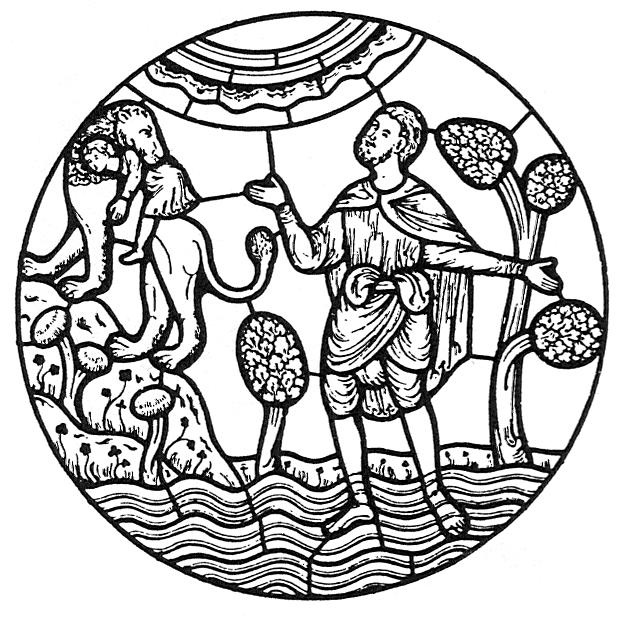
For example {branching vs non-branching} is easy to depict, and easy to describe using commonplace words – not philosophy talk, or theology talk , or cognitive science talk, but ordinary daily language of common pop altered state language.
The so-called ‘Moderate’ and ‘Minimal’ entheogen theories of religion both agree, what they have in common, they both agree on suppression.
In my analysis below, an important realization is that the word ‘Moderate’, in its vagueness, is much too generous it implies 50% – but in fact, the Moderate position is far more stingy and defeatist: it only asserts half of 1% of knowledge and usage of entheogens among Christians.
Lately I’ve been on a big push to be sure to word yourself in a way that cannot be misunderstood.
Don’t allow people to project something like a too positive or too negative, or project the wrong plant onto your vague words.
I say “mushroom”.
But everyone hears me say “Amanita🍄🍄”
“I’m sure I heard you say ‘Amanita’.”
😞
🤬
You have to be vigorous and forceful in shutting out misreading of your meaning.
The term ‘Moderate’ was confusing to me because I have a Maximal mentality, so naturally I tend to be very generous and far overly generous:
When I read ‘moderate’, I think “50%”, but that’s inaccurate!
The Carl Ruck “Moderate” paradigm is extremely stingy, and he only asserts half of 1% of Christians had the knowledge; only half of 1% of Christians were esoteric, he says in the Ruck school paradigm, which is intensely negative.
To make matters worse, to make the problem worse, I make it even more confusing, by “differentiating” between minimal” “versus” moderate – AS IF there was any significant difference!
They are both extremely stingy! They only differ in the degree and timing of suppression, but they both emphasize Suppression and are based on that premise.
The Maximal entheogen theory of religion is not based on the shared Suppression assumption, which the Moderate & Minimal positions share in common.
As Cyberdisciple’s article is worded/titled:
“Against the Assumption of Suppression of Psychedelics in pre-modernity”
While recording today’s Egodeath Mystery show, my reading-aloud/commentary deviated from reading my 2006 article about allegro Wasson and Plaincourault Amanita Fresco:
I am reading aloud my six-page October 2002 announcement of the Maximal entheogen theory of religion.
I write a lot against the suppression hypothesis, in that posting.
it gives me some ideas for some better, more direct, less vague, names of the two opposed positions, now that I’ve analyzed the Moderate, Maximal, and Minimal positions more over the past months.
I have recently focused more on what the moderate and minimal positions have in common.
there is not actually a compelling need to differentiate those two positions, Moderate (Ruck) “versus” Minimal (McKenna).
Those two “different” positions both amount to the same thing, & they slip and slide between each other, and they were both just variations of the Suppression paradigm.
they both act the same way.
in this voice recording discussion today,
I am seeing strong agreements between me and Thomas Hatsis.
we disagree about which chemical: Hatsis says Scopolamine, I say Psilocybin.
The Monks and the Witches teams agree that Christianity is clearly characterized by the presence, not the suppression and absence, of visionary plants.
My announcement in October 2002 sounds so much like literally a prediction and an announcement of the 2020 Canterbury Miracle receiving of the message transmitted by Eadwine to me 18 years later, Nov 2020.
– not 20 years later; I made a math mistake in the voice recording – how completely unusual! inconceivable!
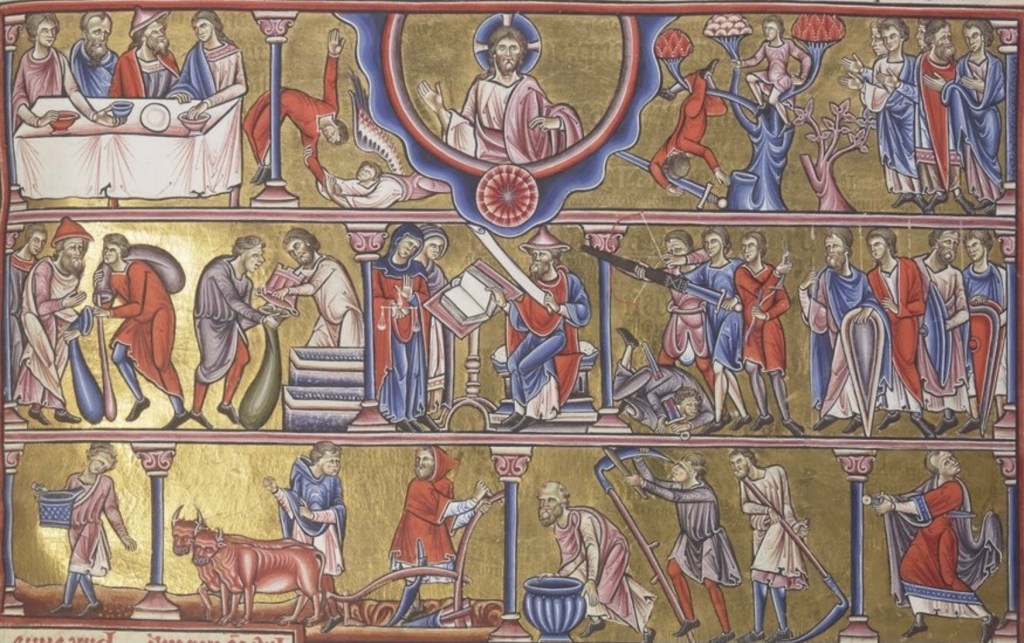
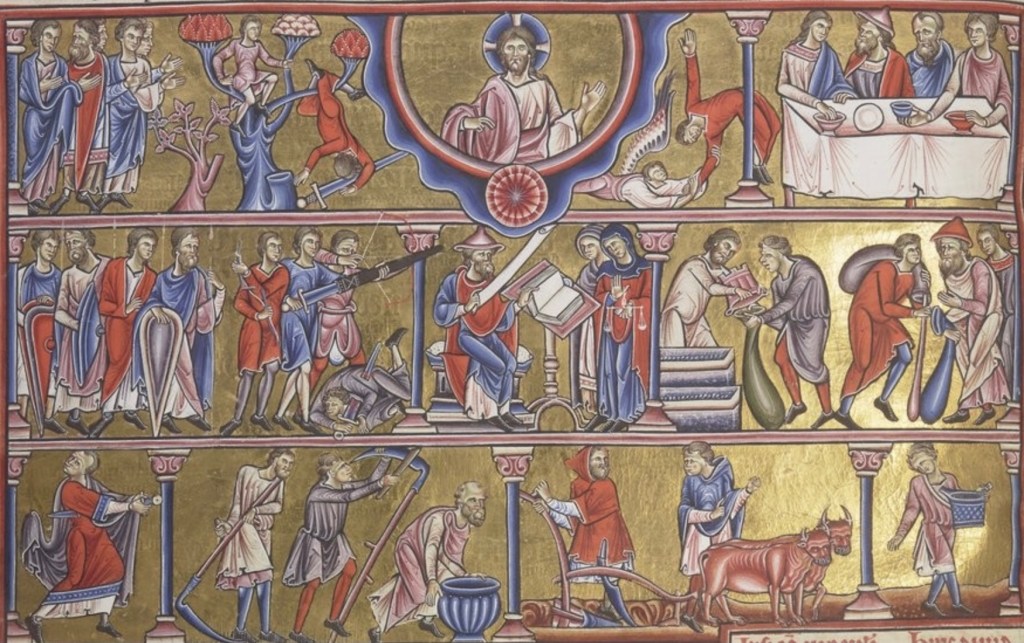
https://gallica.bnf.fr/ark:/12148/btv1b10551125c/f134.item.zoom
High-resolution, zoom, & fullscreen, provided by Cyberdisciple
Hyper-specifically for clarity, I assert re-dosing powdered Cubensis, not Amanita – it’s pretty evident that what ancient & medieval Christians were using was Johns Hopkins branded synthetic Psilocybin gel caps.
When I look at pre-modern Christian texts and Christian art, what I see is descriptions of the experiences from re-dosing powdered Cubensis synthetic Psilocybin gel caps obtained from Johns Hopkins licensed clinics.
When Thomas Hatsis looks at Christian texts & art, what he sees is description & depiction of experiences from Scopolamine.
Neither of us see indications of Suppression of visionary plants; we see the opposite of that –
the dominant, Suppression theory doesn’t match the evidence.
The dominant theory is the Suppression theory – but the evidence instead loudly tells a story of Normalcy of visionary plants usage.
both of us have observed what I observed
in October 2002 I am saying the same words that Thomas Hatsis is saying in 2011 through 2022
we are contrasting
Thomas Hatsis and I have both spotted, soon after entering the field, we both quickly spotted a big disparity & a contrast:
on the one hand, we look at the dominant Theory in the Field of entheogen History
the dominant Theory is the Suppression Theory
but then it’s plain to see that Christian mythology is densely packed with intensive depictions of visionary experiencing everywhere, and the same in the texts;
the art & text evidence simply do not support the claim/paradigm of “suppression” which the McKenna/Allegro/Ruck/Muraresku school pushes!
Thomas Hatsis and I are both vigorously taking down the T McKenna defeatist Theory of Suppression of Visionary Plants in Christianity.
I want to destroy this terrible, awful Suppression hypothesis, which is an awful, terrible, harmful idea, and it’s wrecking and ruining the field & harming the repeal of Psilocybin Prohibition.
Thomas Hatsis and I agree that it is imperative, we’ve got to stop this noxious harmful, wrong, and false Suppression paradigm.
Thomas Hatsis and I can get on the same page more easily if I use more direct labels for the two opposed positions: the Normalcy vs. Suppression theories. rather than the confusing & vague to me labels, abstract, “Maximal vs Moderate” –
Plus the term ‘Moderate’ is much too generous, because the Carl Ruck school in fact is stingy
it’s very stingy
Dan Merkur is Stingy
they’re all stingy
When I say ‘Moderate’, you’re gonna read that in a generous way and think “oh they’re asserting 50%”
that’s wrong; in fact they assert only half of 1%! use & knowledge of visionary plants in ancient & medieval Christianity.
it is so misrepresentative and misleading to use the word ‘Moderate’ when they assert that only half of 1%! of Christians knew/ used visionary plants in pre- modernity.
i’m reading aloud my October 2002 proposition, and it says “25%”.
I just don’t resonate with that percentage.
I feel like it’s telling the confusing wrong story.
I’m inclined to say “33%” of Christians knew/understood visionary plants.
it helps me understand the mentality better to say 33% than 25%.
I have found my labels to be so confusing, my March 2003 labels & October 2002 that develop the terminology of maximal and maximum.
I found those labels to be too abstract too indirect.
I have to keep on checking and rechecking:
how did I define those abstract labels?
what exactly is the difference between the three positions?
what do you do when two of the positions keep on waffling between the two of them until functionally there are the same position – Minimal and Moderate?
the real question has become:
what’s the difference between the maximal position on the one hand, and the minimal/moderate position, on the other hand?
so clearly, this is a cumbersome, indirect, abstract labeling, that prevents Thomas Hatsis and me from understanding the commonality of our mission.
I need more direct labels that really put the finger on the exact spirit of difference between two opposed mindsets/ lenses.
what exactly is the difference, in a more direct identified way?
and I find I discover that
I wrote a lot about the word ‘Suppression’.
In October 2002, I announced the Maximal entheogen theory of religion by denouncing the suppression assumption –
so why not simply use the word ‘Suppression’ right in the label for the position that I am against?
and I’m pushing in that posting, I use the word ‘normalcy’ – why not just use the word ‘Normalcy’ for the position label, instead of creating a higher abstraction layer that obscures the main point of contention?
lately I keep on criticizing what the Carl Ruck school does to all positive evidence for Visionary Plants: he tries to frame it as abnormal; deviant; doesn’t count; an alien intruder approaching the Eucharist from outside of it.
and Cyberdisciple wrote a good webpage article in terms of the title “against the assumption of Suppression of Psychedelics in pre-modernity”.

 The Egodeath theory
The word normalcy is vague and limiting as it is dependent on many factors. It is a word which can be restrictive and constantly changing within and from time.
In the ordinary world today, suppression by many is normalcy. To say that entheogens were known and accepted by everyone in premodernity can’t be considered normalcy when it is based on assumption.
There is as much Christian art without mushrooms as there is with mushrooms. One can’t disprove the other for the sake of using the word, normalcy.
And since the focus of mushrooms is on Christian art, and not on art of all religions, then normalcy can’t be made to be applicable for the Entheogen theory of religion, unless that is changed to the Entheogen theory of Christianity.
LikeLike