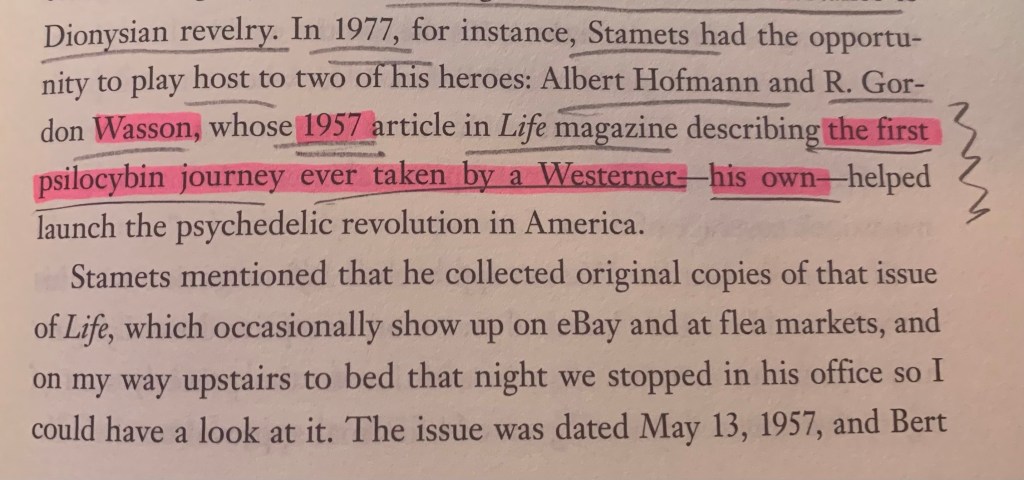
Wasson, whose 1957 article in Life magazine describing the first psilocybin journey ever taken by a Westerner — his own —
p 103, Michael Pollan, How to Change Your Mind
Are we really to assume (not just as hyperbole) as I’ve been saying, that the entire field of entheogen scholarship has literally asserted and taken for granted that there were no Psilocybin but that all 100% of “mushrooms” in Western religious history were exclusivrly Amanita?
Entheogen scholars are literally asserting this massive, extremely harmful, fallacious assumption, taken for granted uncritically.
I thought that I was merely being hyperbolical and I was saying it’s almost as if Ruck is asserting no psilocybin – but now I’m starting to think that Ruck and everyone literally explicitly are asserting that.
In his recent article about Entheogens in Antiquity, Mark Hoffman says the field of entheogen scholarship ought to look into psilocybin in western religion.
That proves my assertion that they have failed utterly to do this.
what the hell is wrong with them?! they are addicted to their substitute ergot and Amanita.
Robert Graves asserted in 1957 that cubensis is the source of Greek myth & religion, that Greek religious myth is description of Psilocybin experiencing.
It is really Robert Graves’ fault that it is so difficult to fact-check him: he has re-titled his article about food for centaurs, and re-published it in different years, and then quoted it in the 1960 book on mythology second edition and maybe 1964, so nobody can keep track. 🤷♂️
We can’t blame Graves or Samorini for the Ergot/ Amanita shutout of Psilocybin.
Michael Pollan’s book fallaciously says that Wasson discovered psilocybin mushrooms, in Mexico.
That’s what the #1 best journalist asserts in his groundbreking influential book, How to Change Your Mind Without Thinking.
But it was two at least two or three guys before Wasson; eg Reko told Schultes, then Schultes told Graves, then Graves told Wasson.
John Lash credits all mushroom entheogen scholarship to Wasson.
John Lash trumpets to the skies in giant billboards that Wasson created the word ‘entheogen’, that Wasson discovered entheogens, that Wasson invented mushrooms in religion, that he’s the first one to study it, and that all entheogen theories come from Wasson
– including theories that are “considerable departures from” Wasson’s theory – see my hall of shame quotes page for that comical use of the universal set.
Then buried in Lash’s footnotes is a tiny escape clause that there were discoverers before Wasson.
Wasson was the first ever to study entheogens in our own history. He says so in his book SOMA – the same book in which he censors the 1906 Brinckmann book from, strongly recommended by both Panofsky letters: Tree stylizations in medieval paintings. See my page here.
It is becoming clear to me (and in line with the complaint of Letcher Hatsis) just how malformed this field of entheogen scholarship is. Including Paul Stamets.
Graves and Samorini and Browns excepted. And the recent Italian pairs of books by Fulvio Gossi.
Entheogen scholarship is driven by people copy-paste propagating the same claims, the same tropes, the same folklore foundation myths, the same blind spots, the same biases, the same extreme over-exaggeration of Eleusis, the same extreme over-exaggeration of Amanita and Plaincourault and Allegro.
Michael Pollan’s 2018 book How to Change Your Mind:
Did you know that Wasson was the first person ever to think of the idea that the tree of knowledge is Amanita?
That’s right, that’s what he asserts in his book Soma, after spending decades haranguing and insulting mycologists for asserting that the tree of knowledge in Plaincourault Fresco is Amanita, as he does a few pages later in the very same book. See my Wasson article at Egodeath.com for the passages.
Pollan’s journalist coverage includes Paul Stamets, who explains to us in his book Psilocybin mushrooms of the world: an identification guide (1998), that when a Cubensis goes to sprout on a cow pie, it first asks itself: am I in Europe or the Americas? and then it asks itself: is the year number 1976, or less?
Then the Cubensis reasons to itself: if I am not in Europe, or the year is greater than or equal to 1976, then I will sprout; otherwise I won’t.
This is how, as Paul Stamets and Letcher Hatsis explain to us, that there was no psilocybin in England before 1976.
– even though Paul Stamets’ book states that psilocybin is everywhere around the world and it grows on bovine dung.

 The Egodeath theory
HI Michael,
Thanks for the mention in your recent Wasson post. I think you saw this below in my reply to Hatsis on Graham Hancock’s website last year – a reply which benefited greatly from David’s input.
But just in case, I am sending you the relevant section of this article – available at:
Christianity’s Psychedelic History: Reply to Thomas Hatsis’ Review of The Psychedelic Gospels
https://grahamhancock.com/brownj1/
Best wishes, Jerry
_____
Article excerpt:
Mushroom images in art: The field is also in need of robust categories for classifying depictions of mushrooms in art.
For example, Samorini proposes a two-fold typology of mushroom trees, using the Plaincourault Amanita muscaria and the Saint Savin psilocybin mushroom as ideal types.
https://grahamhancock.com/brownj1/#sdendnote21sym
https://egodeaththeory.wordpress.com/defining-compelling-evidence-criteria-of-proof-for-mushrooms-in-christian-art/#asocop
Researcher Michael Hoffman defines three categories for classifying mushroom images: literal depictions of mushrooms, stylized depictions of mushrooms, and depictions of mushroom effects which suggest altered states of consciousness.
I find Hoffman’s categories useful for classifying the two varieties of MICA [Mushrooms in Christian Art] that we photographed at the following religious sites. The text in parentheses indicates the black and white Figure (Fig.) or color Plate (P) in The Psychedelic Gospels that displays our photographs of these images.
________________
Type of Evidence
Amanita muscaria
…
Psilocybe varieties
_____
Literal – taxonomically accurate images:
Rosslyn Chapel, Scotland (Fig. 1.1)
https://grahamhancock.com/brownj1/#sdendnote22sym
St. Michael’s Church, Germany (Fig. 11.2)
https://grahamhancock.com/brownj1/#sdendnote23sym
_____
Stylized – mushroom-like shapes:
Great Canterbury Psalter, England (P12)
Church of St. Martin de Vicq, France (P6)
_____
ASC – images suggesting altered states of consciousness:
Chapel of Plaincourault, France (P5)
Chartres Cathedral, France (P18)
LikeLike
In 2020, I wrote here at EgodeathTheory.WordPress.com a couple pages about the process of writing the article about criteria of proof and defining compelling evidence for mushroom imagery and Christian art.
Cyberdisciple saved the day by formulating the categorization scheme idea, which I then refined and wrote up.
I initially titled the article to deliver an abstracted-out theoretical description of what such criteria of proof “would be” and what such compelling evidence “would be”.
But the actual content of the article was a huge jackpot-fest of presenting a rapdily expanding gallery and exhibits of smoking-gun art examples with successful theoretical interpretation.
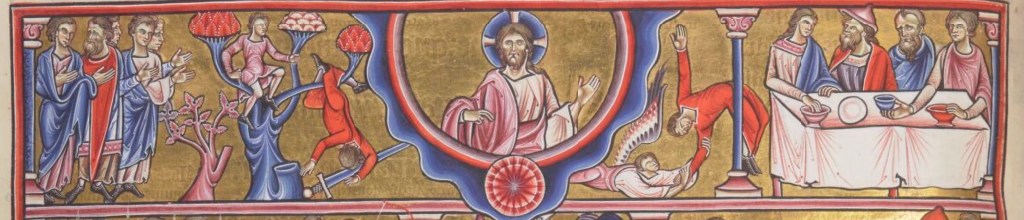
That success bred even more success, leading to re-finding the image of the two guys in the Cubensis tree – blurry and cropped severely with no consciousness of the existence of the surrounding 90% of the image – the greatest image ever.
That treatment section quickly mushroomed overnight into 11 pages, so I broke it out into a separate article about the Eadwine Mushroom Psalter’s crowning image (which led to my gallery articles of all 75 mushroom plants of the psalter, with morphology inventoried).
When I later tried to read aloud the original article, I detected two problems:
The actual content of the article was all examples of breakthroughs.
Only one page delivered the abstract theory, a Radical Maximal, expansive and requisitely greedy classification scheme, of assessing mushroom imagery – against the stingy Moderate/Minimal bias, which removes 5/6 of the evidence types and narrows the radar to only attempt to see Amanita, in text, explicitly – and only “devotional” texts count.
Also the title would instantly lose, because it was neutral, in an intensely biased reception context.
The long article delivered a 1-page compact classification scheme for types of evidence, overwhelmed by massive evidential instances including the spinoff articles that its successful method spawned.
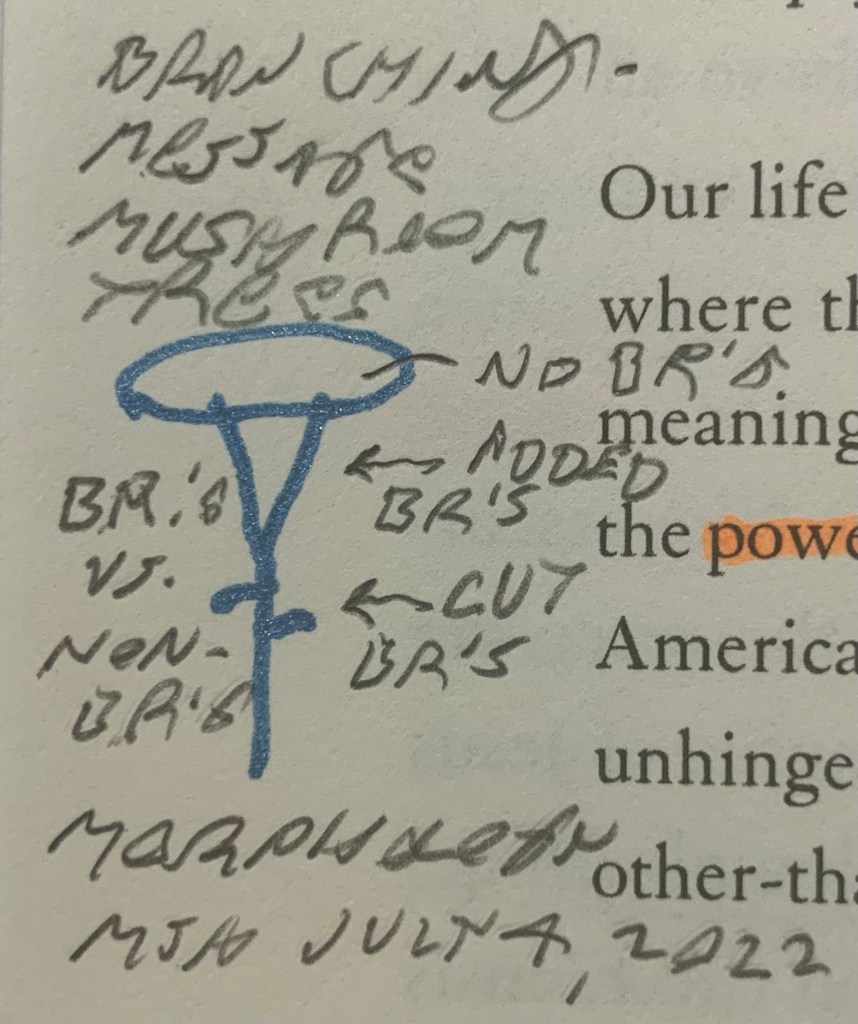
The classification scheme is extracted or abstracted from the method I developed through decades of research & theory-construction about mytheme interpretation referring to the temporary experience of no-free-will/ block-universe eternalism in the loose cognitive association binding state from psychedelics.
The psilocybin eternalism experience leaves the mind with an additional mental worldmodel of time, control, and possibilities after returning to the ordinary state which is tight cognitive association binding which gives the freewill, branching possibility model of control-in-world.
I retitled the article more vigorously, announcing that here is compelling evidence demonstrating the criteria.
It remains an exercise for the Brown Evidence Database Committee to reverse-derive a mind-dulling 20-page theoretical hypothetical description of how one would have to go about assessing mushroom imagery if we didn’t already have the completed conclusions and evidence at this site and Egodeath.com.
We have that conclusive evidence along with the complete successful interpretive framework and Radical Maximal strategy that is required, to make perceivable the clear and obvious conclusive evidence.
I never dreamed that it was possible to have the perfect evidence for the Egodeath theory in an image, though my 2006 main article already had the Eustace cathedral and Dionysus/Ariadne branching-message images at start and end, which I didn’t recognize until Brown in March 2022 sent me the 2019 article’s version of the “youths in trees cutting branches” passage.
My 2006 main article was at the start of the Psychedelic Renaissance, according to the book How to Change Your Mind – like my breakthrough Core theory was in 1988, the Second Summer of Love in the Psychedelic 80s.
A proper full article about “The Criteria Would Be”? Such an article, at this late date after the breakthrough dust has already settled, seems like a counter-indicated scenario, acting AS IF the breakthrough hadn’t already happened.
While writing the article, the situation blossomed, obviating the article as it was initially framed.
The latter is not only now irrelevant, but inappropriate, given the new situation.
The new question for the new reality, the new, changed situation, is:
What criteria and meta-theory of evidence can we derive & back-extract from the done deal of the Egodeath theory breakthrough (the Entheogen Eternalism Mytheme theory)?
What other, competing theory and evidence database is there? Parasols of victory?
Convert those parasols of victory into switching from the Ergot/Amanita Primacy axiom to the Psilocybin Primacy axiom, arrived along with the Psilocybin Eternalism theory; the Egodeath theory.
LikeLike