Michael Hoffman, February 5, 2023
This is my original Feb. 2023 page including commentary.
Newer page that’s just the Panofsky transcription, with clean title, for general use (with comment from Brown & Brown):
Erwin Panofsky’s Letters to Gordon Wasson, Transcribed – 2025/01/07
Contents:
- May 2, 1952 Letter 1 from Panofsky to Wasson
- Photograph of Letter 1
- Transcription of Letter 1
- Transcription of Letter 1 Broken Up per Sentence
- Sentence 1.1 (your words about my talk)
- Sentence 1.2 (word of warning)
- Sentence 1.3 (art historian consult: nothing mushrooms)
- Sentence 1.4 (only one example of pilzbaum)
- Sentence 1.5 (pine hundreds instances development)
- Sentence 1.6 (little book by Brinckmann)
- Sentence 1.7 (enclose specimens pine into mushroom)
- Sentence 1.8 (prototypes became unrecognizable)
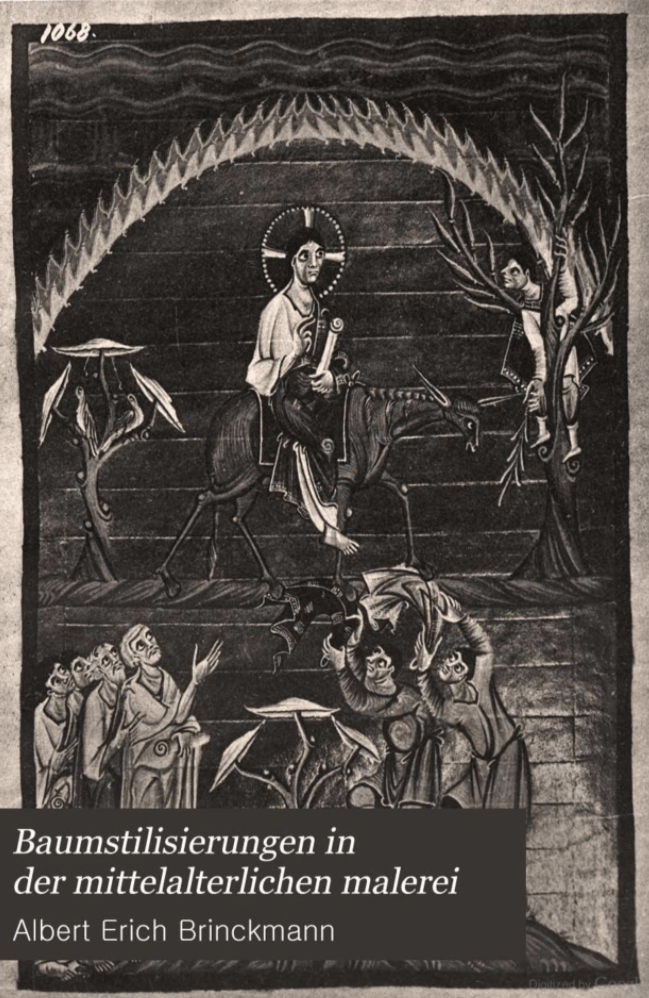
- Sentence 1.9 (Brinckmann Tree Stylizations)
- May 12, 1952 Letter 2 from Panofsky to Wasson
- Photograph of Letter 2
- Transcription of Letter 2
- Transcription of Letter 2 Broken Up per Sentence
- Sentence 2.1 (thanks for reply to 1st letter)
- Sentence 2.2 (induce ecstasy by Amanita)
- Sentence 2.3 (French witches)
- Sentence 2.4 (pilzbaum so universal in so many representations)
- Sentence 2.5 (ignorant misunderstood prototype as mushroom)
- Sentence 2.6 (would have omitted branches)
- Sentence 2.7 (religious art little reason to think of mushrooms)
- Sentence 2.8 (not occur in Bible or Saints)
- Sentence 2.9 (keep pictures)
- Sentence 2.10 (recommend Brinckmann)
- Ronald Huggins’ Citation of Panofsky Letters in Drawer Folder
- Read the Letters within Brown & Brown’s 2019 Article First
- Background
- Transcription Errors: Back to the Sources!
- Justification for Transcribing these Letters
- Commentary
- Errata
- See Also
/ end of Contents for present page
Per-sentence sections at page “The Panofsky/Hatsis Explain-Away-o-Matic Mushroom Eliminator”
- Letter 1:
- Panofsky Letter 1 Sentence 1 – Too Many Mushrooms
- Panofsky Letter 1 Sentence 2 – Too Many Mushrooms
- Panofsky Letter 1 Sentence 3
- Panofsky Letter 1 Sentence 4
- Panofsky Letter 1 Sentence 5
- Panofsky Letter 1 Sentence 6
- Letter 2:
- Panofsky Letter 2 Sentence 1
- Panofsky Letter 2 Sentence 2
- Panofsky Letter 2 Sentence 3 – Too Many Mushrooms
- Panofsky Letter 2 Sentence 4
- Panofsky Letter 2 Sentence 5 – They Would Have Omitted the Branches
- Panofsky Letter 2 Sentence 6 – Religious Art Has Little Reason to Think of Mushrooms
- Panofsky Letter 2 Sentence 7
/ end of Contents for other page, “The Panofsky/Hatsis Explain-Away-o-Matic Mushroom Eliminator”
May 2, 1952 Letter 1 from Panofsky to Wasson
Photograph of Letter 1

Published by Jerry B. Brown & Julie M. Brown 2019: https://www.academia.edu/40412411/Entheogens_in_Christian_art_Wasson_Allegro_and_the_Psychedelic_Gospels
Transcription of Letter 1
Letter of Erwin Panofsky to R. Gordon Wasson, May 2, 1952. Wasson Archives, Harvard University Herbarium, Cambridge, Mass. Published by Jerry B. Brown & Julie M. Brown 2019:
https://www.academia.edu/40412411/Entheogens_in_Christian_art_Wasson_Allegro_and_the_Psychedelic_Gospels, transcribed by Cybermonk, February 4, 2023, https://egodeaththeory.wordpress.com.
THE INSTITUTE FOR ADVANCED STUDY
PRINCETON, NEW JERSEY
SCHOOL OF HISTORICAL STUDIES
May 2, 1952
Mr. R. Gordon Wasson,
J.P.Morgan & Co.,
23 Wall Street,
New York 8, N.Y.
Dear Mr. Wasson:
Many thanks for your kind words about my little talk and the photostat of the discussion centered around the fresco of Plaincourault. Please let me put in a word of warning. In my opinion — which, I am confident, will be shared by any art historian you may care to consult — the plant in this fresco has nothing whatever to do with mushrooms (which would indeed be surprising since it was the tree, and not the mushroom, of good and evil which brought about the transgression of the First Parents), and the similarity with Amanita muscaria is purely fortuitous.
The Plaincourault fresco is only one example — and, since the style is very provincial, a particularly deceptive one — of a conventionalized tree type, prevalent in Romanesque and Early Gothic art, which art historians actually refer to as “mushroom tree” or, in German writing, Pilzbaum. It comes about by the gradual schematization of the impressionistically rendered Italian pine tree in Roman and Early Christian painting, and there are hundreds of instances exemplifying this development – unknown, of course, to mycologists. If you are interested, I recommend a little book by A. E. Brinckmann, Die Baumdarstellung im Mittelalter (or something like it), where the process is described in detail. Just to show what I mean, I enclose two specimens: a miniature of ca. 990 which shows the inception of the process, viz., the gradual hardening of the pine into a mushroom-like shape, and a glass painting of the thirteenth century, that is to say about a century later than your fresco, which shows an even more emphatic schematization of the mushroom-like crown. What the mycologists have overlooked is that the mediaeval artists hardly ever worked from nature but from classical prototypes which in the course of repeated copying became quite unrecognizable.
With best regards,
Sincerely, Erwin Panofsky
[handwritten]
Albert Erich Brinckmann
Baumstilisierungen in der mittelalterlichen malerei
/ end of transcription of letter 1 from Panofsky 1952, published by Jerry B. Brown & Julie M. Brown 2019
[10:47 p.m. February 4, 2023] – Realization by Cybermonk: the handwritten “Er” of “Erwin” and “Erich” match, and Panofsky probably hand-wrote the Brinckmann citation on the finished letter before sending it to Wasson.
Typewriter typo fixes:
- Omitted extra space next to punctuation.
- Fixed typo “misuderstood”.
- Corrected “by surprising” to “be surprising”.
The text in my Wasson article doesn’t match the photograph but matches Soma instead; Soma’s copy differs from the photograph in slight details (commas, ‘a’, capitalization of “Early Christian”).
Transcription of Letter 1 Broken Up per Sentence
Letter of Erwin Panofsky to R. Gordon Wasson, May 2, 1952. Wasson Archives, Harvard University Herbarium, Cambridge, Mass. Published by Jerry B. Brown & Julie M. Brown 2019:
https://www.academia.edu/40412411/Entheogens_in_Christian_art_Wasson_Allegro_and_the_Psychedelic_Gospels, transcribed by Cybermonk, February 4, 2023, https://egodeaththeory.wordpress.com.
THE INSTITUTE FOR ADVANCED STUDY
PRINCETON, NEW JERSEY
SCHOOL OF HISTORICAL STUDIES
May 2, 1952
Mr. R. Gordon Wasson,
J.P.Morgan & Co.,
23 Wall Street,
New York 8, N.Y.
Dear Mr. Wasson:
Sentence 1.1 (your words about my talk)
Many thanks for your kind words about my little talk and the photostat of the discussion centered around the fresco of Plaincourault.
Sentence 1.2 (word of warning)
Please let me put in a word of warning.
Sentence 1.3 (art historian consult: nothing mushrooms)
In my opinion — which, I am confident, will be shared by any art historian you may care to consult — the plant in this fresco has nothing whatever to do with mushrooms (which would indeed be surprising since it was the tree, and not the mushroom, of good and evil which brought about the transgression of the First Parents), and the similarity with Amanita muscaria is purely fortuitous.
Sentence 1.4 (Only one example of Pilzbaum)
The Plaincourault fresco is only one example — and, since the style is very provincial, a particularly deceptive one — of a conventionalized tree type, prevalent in Romanesque and Early Gothic art, which art historians actually refer to as “mushroom tree” or, in German writing, Pilzbaum.
Sentence 1.5 (Pine Hundreds Instances Development)
It comes about by the gradual schematization of the impressionistically rendered Italian pine tree in Roman and Early Christian painting, and there are hundreds of instances exemplifying this development – unknown, of course, to mycologists.
Sentence 1.6 (Little Book by Brinckmann)
If you are interested, I recommend a little book by A. E. Brinckmann, Die Baumdarstellung im Mittelalter (or something like it), where the process is described in detail.
Sentence 1.7 (Enclose Specimens Pine into Mushroom)
Just to show what I mean, I enclose two specimens: a miniature of ca. 990 which shows the inception of the process, viz., the gradual hardening of the pine into a mushroom-like shape, and a glass painting of the thirteenth century, that is to say about a century later than your fresco, which shows an even more emphatic schematization of the mushroom-like crown.
Sentence 1.8 (Prototypes Became Unrecognizable)
What the mycologists have overlooked is that the medieval artists hardly ever worked from nature but from classical prototypes which in the course of repeated copying became quite unrecognizable.
With best regards,
Sincerely, Erwin Panofsky
Sentence 1.9 (Brinckmann Tree Stylizations)
[handwritten:]
Albert Erich Brinckmann
Baumstilisierungen in der mittelalterlichen malerei
/ end of transcription of letter 1 from Panofsky 1952, published by Jerry B. Brown & Julie M. Brown 2019
May 12, 1952 Letter 2 from Panofsky to Wasson
Photograph of Letter 2
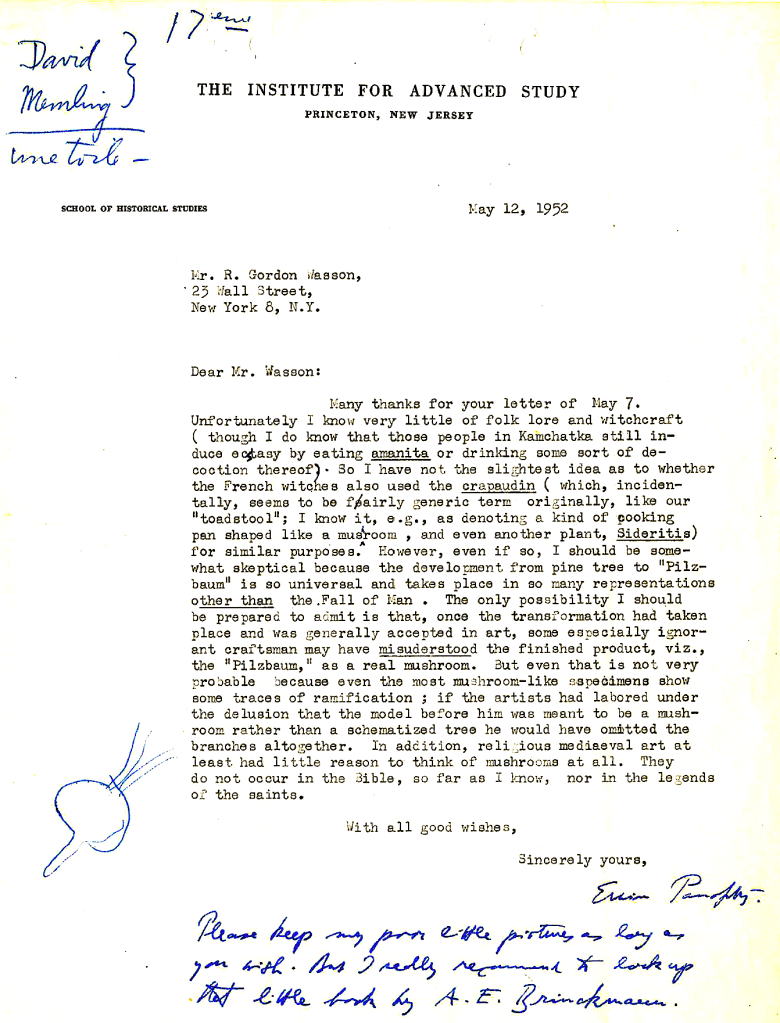
https://www.academia.edu/40412411/Entheogens_in_Christian_art_Wasson_Allegro_and_the_Psychedelic_Gospels
Transcription of Letter 2
Letter of Erwin Panofsky to R. Gordon Wasson, May 12, 1952. Wasson Archives, Harvard University Herbarium, Cambridge, Mass. Published by Jerry B. Brown & Julie M. Brown 2019:
https://www.academia.edu/40412411/Entheogens_in_Christian_art_Wasson_Allegro_and_the_Psychedelic_Gospels, transcribed by Cybermonk, February 4, 2023, https://egodeaththeory.wordpress.com.
[handwritten upper left:]
David Memling [illegible] 17
THE INSTITUTE FOR ADVANCED STUDY
PRINCETON, NEW JERSEY
SCHOOL OF HISTORICAL STUDIES
May 12, 1952
Mr. R. Gordon Wasson,
23 Wall Street,
New York 8, N.Y.
Dear Mr. Wasson:
Many thanks for your letter of May 7. Unfortunately I know very little of folk lore and witchcraft (though I do know that those people in Kamchatka still induce ecstasy by eating amanita or drinking some sort of decoction thereof). So I have not the slightest idea as to whether the French witches also used the crapaudin (which, incidentally, seems to be fairly generic term originally, like our “toadstool”; I know it, e.g., as denoting a kind of cooking pan shaped like a mushroom, and even another plant, Sideritis) for similar purposes. However, even if so, I should be somewhat skeptical because the development from pine tree to “Pilzbaum” is so universal and takes place in so many representations other than the Fall of Man. The only possibility I should be prepared to admit is that, once the transformation had taken place and was generally accepted in art, some especially ignorant craftsman may have misu[n]derstood the finished product, viz., the “Pilzbaum,” as a real mushroom. But even that is not very probable because even the most mushroom-like specimens show some traces of ramification; if the artists had labored under the delusion that the model before him was meant to be a mushroom rather than a schematized tree he would have omitted the branches altogether. In addition, religious mediaeval art at least had little reason to think of mushrooms at all. They do not occur in the Bible, so far as I know, nor in the legends of the saints.
With all good wishes,
Sincerely yours,
Erwin Panofsky.-
[handwritten]
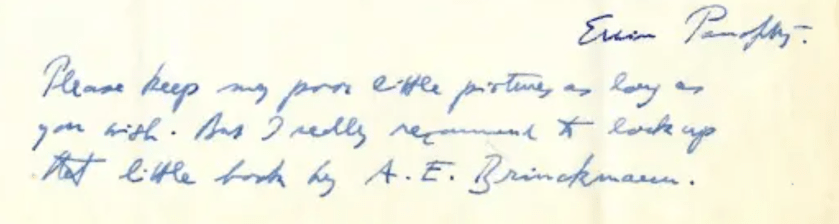
Please keep my poor little pictures as long as you wish. And I really recommend to look up that little book by A. E. Brinckmann.
/ end of transcription of letter 2 from Panofsky 1952, published by Jerry B. Brown & Julie M. Brown 2019
Adjustments made:
- Changed “to be fairly generic term” to “to be a fairly generic term”
Transcription of Letter 2 Broken Up per Sentence
Letter of Erwin Panofsky to R. Gordon Wasson, May 12, 1952. Wasson Archives, Harvard University Herbarium, Cambridge, Mass. Published by Jerry B. Brown & Julie M. Brown 2019:
https://www.academia.edu/40412411/Entheogens_in_Christian_art_Wasson_Allegro_and_the_Psychedelic_Gospels, transcribed by Cybermonk, February 4, 2023, https://egodeaththeory.wordpress.com.
[handwritten upper left:]
David Memling [illegible] 17
THE INSTITUTE FOR ADVANCED STUDY
PRINCETON, NEW JERSEY
SCHOOL OF HISTORICAL STUDIES
May 12, 1952
Mr. R. Gordon Wasson,
23 Wall Street,
New York 8, N.Y.
Dear Mr. Wasson:
Sentence 2.1 (thanks for reply to 1st letter)
Many thanks for your letter of May 7.
Sentence 2.2 (induce ecstasy by Amanita)
Unfortunately I know very little of folk lore and witchcraft (though I do know that those people in Kamchatka still induce ecstasy by eating amanita or drinking some sort of decoction thereof).
Sentence 2.3 (French witches)
So I have not the slightest idea as to whether the French witches also used the crapaudin (which, incidentally, seems to be fairly generic term originally, like our “toadstool”; I know it, e.g., as denoting a kind of cooking pan shaped like a mushroom, and even another plant, Sideritis) for similar purposes.
Sentence 2.4 (pilzbaum so universal in so many representations)
However, even if so, I should be somewhat skeptical because the development from pine tree to “Pilzbaum” is so universal and takes place in so many representations other than the Fall of Man.
Sentence 2.5 (ignorant misunderstood prototype as mushroom)
The only possibility I should be prepared to admit is that, once the transformation had taken place and was generally accepted in art, some especially ignorant craftsman may have misu[n]derstood the finished product, viz., the “Pilzbaum,” as a real mushroom.
Sentence 2.6 (would Have omitted branches)
But even that is not very probable because even the most mushroom-like specimens show some traces of ramification; if the artists had labored under the delusion that the model before him was meant to be a mushroom rather than a schematized tree he would have omitted the branches altogether.
Sentence 2.7 (religious art Little Reason to think of mushrooms)
In addition, religious mediaeval art at least had little reason to think of mushrooms at all.
Sentence 2.8 (not Occur in Bible or Saints)
They do not occur in the Bible, so far as I know, nor in the legends of the saints.
With all good wishes,
Sincerely yours,
Erwin Panofsky.-
Sentence 2.9 (keep pictures)
[handwritten]
Please keep my poor little pictures as long as you wish.
Sentence 2.10 (recommend Brinckmann)
[handwritten]
And I really recommend to look up that little book by A. E. Brinckmann.
/ end of transcription of letter 2 from Panofsky 1952, published by Jerry B. Brown & Julie M. Brown 2019
Ronald Huggins’ Citation of Panofsky Letters in Drawer Folder
Foraging for Psychedelic Mushrooms in the Wrong Forest: The Great Canterbury Psalter as a Medieval Test Case
Ronald Huggins, 2024
Die Bibel in der Kunst / Bible in the Arts
Online-Journal 8, 2024
https://www.academia.edu/118659519/Foraging_for_Psychedelic_Mushrooms_in_the_Wrong_Forest_The_Great_Canterbury_Psalter_as_a_Medieval_Test_Case — footnotes on page 13:
Footnote 56. Erwin Panofsky to R. Gordon Wasson (May 2, 1952), in Tina and R. Gordon Wasson Ethnomycological Collection Archives, ecb00001, Series IV, drawer,[sic?] W3.2, Folder: 20. Botany Libraries, Economic Botany Library of Oakes Ames, Harvard University.
Footnote 57. Erwin Panofsky to R. Gordon Wasson (May 12, 1952), in Tina and R. Gordon Wasson, Ethnomycological Collection Archives, ecb00001, Series IV, drawer,[sic?] W3.2, Folder: 20. Botany Libraries, Economic Botany Library of Oakes Ames, Harvard University.
Does Drawer W3.2 Folder 20 include two pilzbaum photostats?
- A 990 miniature showing the start of development from pine to mushroom.
- A 1200s glass painting showing an emphatic mushroom crown/ cap.
Huggins’ Failure to Acknowledge the Censorship Situation
Huggins doesn’t cite the Journal of Psychedelic Studies 2019 Brown & Brown.
Huggins writes as if we’ve had both letters in full since 1952, and doesn’t mention whether the two pilzbaum photostats are in the drawer folder with the first letter.
Huggins fails to condemn Wasson for simultaneously commanding mycologists to “consult” art historians, at the very same time that Wasson censors and suppresses the Brinckmann book citation that Panofsky twice strongly urged Wasson to consult, and two pilzbaum pictures from Panofsky.
Huggins fails to credit Brown 2019 for starting a new, post-Wasson, post-Panofsky era of entheogen scholarship by exposing the censored letters that Wasson deceptively tried to suppress and direct attention away from in favor of extremely nonstandard personally contacting art historians, given that these “competent” art scholars published nothing except Brinckmann’s thin, old, German-language book.
Read the Letters within Brown & Brown’s 2019 Article First
First, read Brown & Brown’s 2019 article, and read the letters from Panofsky in the context of that article:
Entheogens in Christian art: Wasson, Allegro, and the Psychedelic Gospels
Jerry B . Brown & Julie M. Brown
2019
Journal of Psychedelic Studies
https://www.academia.edu/40412411/Entheogens_in_Christian_art_Wasson_Allegro_and_the_Psychedelic_Gospels
Read the two Panofsky letters within that article, and read Brown & Brown’s commentary about them there.
Then read the present transcriptions as an auxiliary.
Background
I’m going to skip a lot of basic introduction – that’s not what I can uniquely provide.
Read the usual tales and Public Relations folk myths concocted about Panofsky and Wasson.
My 2006 article accused Wasson of withholding citations, which Panofsky certainly must have provided.
We can be sure Panofsky provided citations; as an academic, he would have had to provide them, for such a strong, emphatic claim that we art historians known all about mushroom trees and have fully adequately studied and covered them.
If you have covered mushrooms trees, I asked, where in the hell is the list of publications in which you have covered them? CITATION NEEDED!
The censored-by-Wasson answer is: we art historians have devoted 1 book and 0 articles to covering and investigating this topic.
To this day, February 4, 2023, it remains completely unclear whether Brinckmann’s book says anything at all about mushroom trees. I think I did a Find at archive.org for pilzbaum and found two hits in Brinckmann’s book.
Prof. Jerry Brown had a professional translator translate 1/4 of Brinckmann’s book from German to English:
Tree Stylizations in Medieval Paintings (Brinckmann 1906)
https://egodeaththeory.wordpress.com/2020/12/11/brinckmann-mushroom-trees-asymmetrical-branching/
As a major theme all throughout my 64-page 2006 article, I bitterly condemn the lack of citations from Panofsky through Wasson:
Wasson and Allegro on the Tree of Knowledge as Amanita
http://egodeath.com/WassonEdenTree.htm
My March 2006 article for the Journal of Higher Criticism.
64 pages; 40,000 words, plus image gallery.
I wrote that article to say we need to take a more balanced view of John Allegro, and that we need to leave Allegro behind and leave behind the mind-stunting entrenched questions around Allegro, and instead ask neutrally the basic questions:
To what extent Psilocybin and Amanita mushrooms in Western religious history?
Notice the ten qualifiers that I didn’t tack on there, like everyone else does.
I didn’t ask about “secret mushroom cult” and how it linearly spread through secret transmission.
I don’t understand why anyone would think that way — loading a ton of assumptions imported arbitrarily — instead of simple asking of the bare question: to what extent Psilocybin in Western religion?
People don’t think; they just passively follow conventional ruts and serve as passive vessels for memes to propagate through.
My article reconciled Acharya S (Christ Conspiracy) with Robert M. Price (as Acharya thanked me for), to such an extent that Price recently rewrote and republished her book.
Wasson and Allegro on the Tree of Knowledge as Amanita — March 2006 article for the Journal of Higher Criticism
Christian Mushroom Trees — May 2006 gallery for the Wasson/Allegro article, cited by Brown & Brown’s 2016 book and 2019 article.
Brown & Brown’s 2019 article published the pair of letters from Panofsky.
Wasson pretended that Panofsky only wrote 1 letter to him.
Every time Wasson mentioned Panofsky, he censored any mention that:
- 2 art images accompanied letter 1.
- There was a letter 2.
- The center third of letter 1 was a citation of Brinckmann’s book.
Wasson’s anti-scholarship censorship was not a 1-time act; it was an ongoing way of life.
Transcription Errors: Back to the Sources!
Panofsky wrote “the finished product“, referring to the prototype:

https://www.academia.edu/40412411/Entheogens_in_Christian_art_Wasson_Allegro_and_the_Psychedelic_Gospels
Brown & Brown mis-wrote “the finished project“, misrepresenting Panofsky as if he were referring to the fresco:
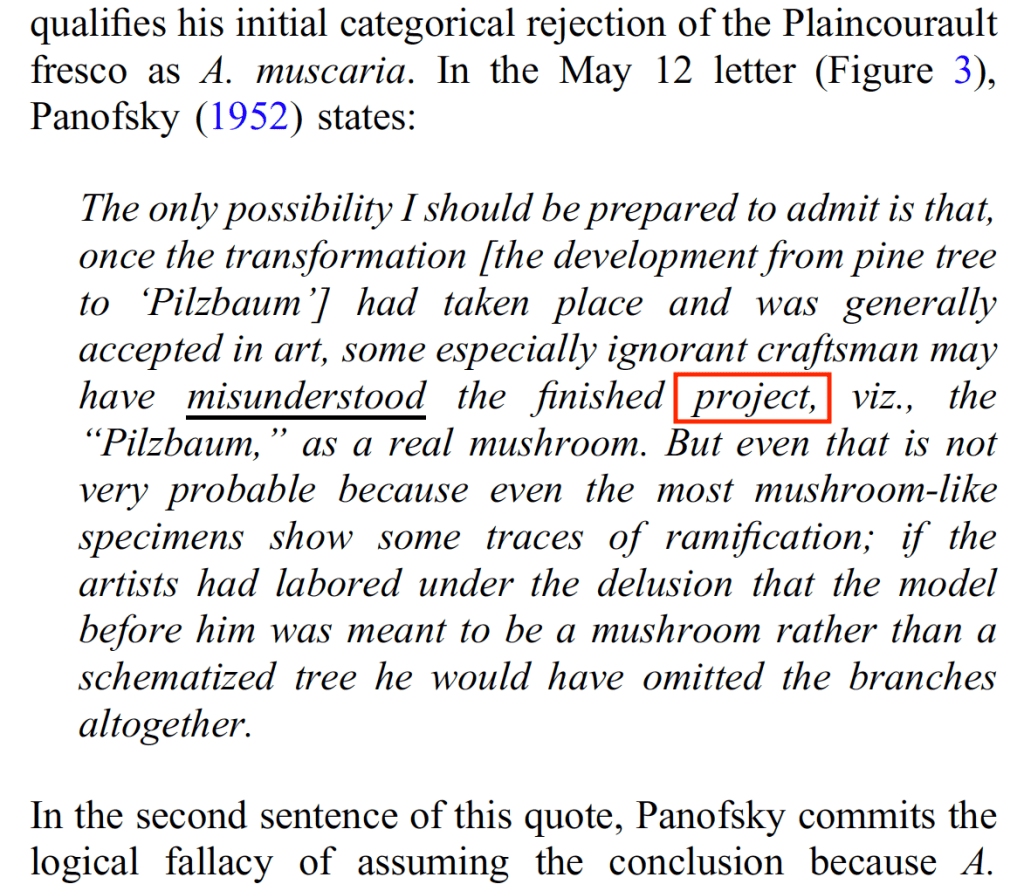
Crop and red box by Cybermonk. From Jerry B. Brown & Julie M. Brown 2019, p. 3.
https://www.academia.edu/40412411/Entheogens_in_Christian_art_Wasson_Allegro_and_the_Psychedelic_Gospels
The first time I did an intensive deep-reading critique of Panofsky’s argument on Egodeath Mystery Show, I said Panofsky was insane for thinking that the artist was so stupid as to paint the fresco and then when done, step back and say of his own fresco, OMG its a mushroom!
But that’s not what Panofsky’s actual stupid argument is.
Panofsky said that the artist first looked at the finished prototype, after the previous inept, intentionality-lacking, incompetent artists had distorted it out of all recognition, and the artist misunderstood the prototype as a mushroom, and then the artist proceeded to paint the fresco.
This passage is hard enough to read and understand and critique, without mis-transcription and word replacement slipping in!
It is understandable for Brown & Brown to make a typo here, because Panofsky’s grammar is wildly shifting, and the referent keeps flipping all over – as I explained in detail in Egodeath Mystery Show,
- flipping constantly between the fresco vs the prototype vs. Pilzbaum art works in general, and
- flipping between the artists of all art works, vs. the artist who painted this fresco.
Mis-transcription: Panofsky wrote “the finished product”, but Brown & Brown mis-wrote “the finished project”.
I cannot emphasize enough: Panofsky’s wording of arguments is quite obscure and messy, and inconsistent, and so this kind of text demands a 100% deep, detailed, intensive interrogation of the meaning and word choice of each word. We cannot afford one iota of word replacement.
Lack of correction ability on typewriter factors in, here, too.
I know this passage intimately because I got tripped up by Brown & Brown’s error.
I, in embarrassment, had to do a follow-up episode of Egodeath Mystery Show to retract my previous analysis that happened because I read Brown & Brown’s mis-transcription instead of Panofsky’s actual photographed letter.
I posted all about this at the time, in Idea Development page 13 and others:
News Flash – Brown & Brown 2019 Misquoted Panofsky, Made Me Look Unable to Read Consistently
Search:
https://egodeaththeory.wordpress.com/?s=%22the+finished+product%22
I even titled an episode after Brown & Brown’s mistake:
Page title:
Idea Development page 13
Section:
Egodeath Mystery Show Episode 139 – Finished Product Project – May 14 b, 2022
https://egodeaththeory.wordpress.com/2022/03/09/idea-development-page-13/#Egodeath-Mystery-Show-Episode-139
Search:
https://egodeaththeory.wordpress.com/?s=%22the+finished+project%22
I did a deep playacting recitation of this passage on Egodeath Mystery Show episodes to decode what Panofsky’s arguments actually are.
Brown should have caught Brown’s error, so this counts as double-erroneous.
Panofsky’s 2nd line (in my crop), on the right, says “the finished product“, referring to the (alleged, conjectured) prototype after it had been subjected to distortions by sloppy, incompetent artists that lack intention (but only when it comes to the special topic of mushroom imagery, per the mushroom exception to the rules of art interpretation).
But Brown & Brown mis-transcribed it as “the finished project“, which incorrectly shifts the referent from the (alleged) prototype to the fresco.
I had to resort to image-correction and printout of Panofsky’s letters, after I discovered Brown & Brown’s transcription error that changed the meaning and therefore changed my analysis and critique, sending it in a wrong direction.
Every word is extremely important!, in Panofsky’s garbled, typewriter writing.
Panofsky makes arguments that employ word-choice.
I read aloud Brown & Brown’s 2019 article, without being aware whether I was reading Brown & Brown’s transcription (I was) or Panofsky’s photographed letter (I should have been, and I did so on the next episode of Egodeath Mystery Show).
Justification for Transcribing these Letters
The more light that’s shed on these covered-up, censored-by-Wasson letters, the better.
Wasson had them since May 1952, and Wasson hid them from the public (intentionally, many times) until Brown & Brown published them together in 2019 – that’s 67 years of cover-up of these letters!
The Brown & Brown 2019 article helps, but we need to follow-through by today’s electronic text standards, and make easily copyable, accurate text available, not only the photographs of the letters along with a couple incorrect paragraph transcriptions as is provided by Brown & Brown 2019.
I have a very strong need to have a correct transcription in text form that I can copy/paste and break up.
A Brown & Brown-certified Blurry Internet Photograph is too hard to read, for multiple reasons.
A normal part of traditional scholarship is to manually transcribe previous works into fresh text passages, as separate paragraphs and blocks.
Brown & Brown have not provided an electronic text transcription that I can copy/paste and comment on. I strongly need this.
More than anyone else in the world, I have been doing a full deep dive analysis of Panofsky’s flimsy, underspecified arguments that are summarized informally in shorthand via typewriter, now yellowed, via Brown & Brown-certified Blurry Internet Photograph.
It is well past HIGH TIME to make the pair of Panofsky letters fully available in modern electronic text format so that scholarship is no longer impeded as Wasson sought to do.
I am justified in transcribing these letter for the following reasons (and more).
Transcription Error
Brown & Brown committed a transcription error and I fell into the resulting trap and looked foolish spinning out a mis-based critique in my first Egodeath Mystery Show episode of reading Letter 2. Brown & Brown wrote “the finished project” (the fresco) but Panofsky wrote “the finished product” (the mutating, corrupted prototype that the artist used, according to Panofsky).
Overstates Panofsky’s Concession
Brown & Brown misfired in the critique of identifying the import of letter #2.
They try to make Panofsky’s very slight concession the basis of a greater criticism than it can bear.
Against Brown & Brown, Panofsky only feebly admits that an especially ignorant craftsman, not an artist, could possibly have intended mushroom but Panofsky immediately says he doubts that, and gives his especially ignorant reasoning.
Need Maximum Clarity, for Total Rebuttal
Need Clarity in Support of a Total Rebuttal of All Panofsky’s Arguments, Accurately Read and Critically Comprehended
Right now, the information is stuck trapped in the Brown & Brown-certified Blurry Internet Photos.
To maximally and adequately engage Panofsky’s bunk and flimsy, less-than-specious arguments, we need electronic text, not just a blurry, faded, yellowed photograph of the letters.
Brown & Brown don’t realize the full ramifications of the publishing of the full Letter #1 (along with the secret censored pair of art images that were included with letter 1).
We are able to access the accompanying art – if we can glean what it was.
Given that we had only 2/3 of the two pages of letters (text), and now we have 2 pages, there is hope that we could identify which two art pieces of mushroom trees Panofsky provided with letter 1.
These two letters are 4 sheets (sides) total (Letter 1, art photostat 1, art photostat 2, Letter 2).
Wasson dishonestly sought to deliberately deceive and suppress scholarly coverage of the mushroom question, and worked continuously to mislead everyone into thinking that there was 2/3 of a page from Panofsky, when there were in fact 4 pages (that we know of) of relevant content sent by Panofsky.
I don’t know how many other letters and art images Panofsky sent Wasson — we have to wonder, now, and we have to suspect that there were more.
They’ve Already Been Transcribed and Uploaded Anyway, as Scattered Passages
I have already transcribed much of the letters in my Wasson article and my Hatsis book article.
Here I’m merely gathering the transcription that I’ve already had on the web for years: 2006 for the non-censored part of the 1st letter, and since Oct. 2020 for Letter 2 passages.
It’s Personal, Since 2006
It’s been 13 years since 2006 compared to the 2019 publishing of the letters, and now 17 years, in 2023 as I finally transcribe Wasson’s censored letters into copyable text on the world-wide web.
Wasson and Allegro on the Tree of Knowledge as Amanita
My March 2006 article for the Journal of Higher Criticism
http://egodeath.com/WassonEdenTree.htm
64 pages; 40,000 words, plus image gallery
I wrote the most intensive article in 2006, accusing Wasson of withholding citations that Panofsky provided, and I wish I had noticed the ellipses so I could have written “right there, at these ellipses, I BET that must be where Panofsky’s censored citations are.”
I have suffered cognitive dissonance because, as I wrote and pointed out in 2006, I knew certainly either:
- Panofsky either provided citations and Wasson censored them.
- There existed no such publications at all, and Panofsky was lying in his claim that art historians have covered Pilzbaum.
I wish I had made that specific charge that the ellipses are probably where the missing citations were provided by Panofsky.
Neither Irvin nor I caught the ellipses, though we were intensively looking for exactly this sort of chicanery and deception from Wasson, as my published accusations throughout the article demonstrate.
Commentary
Panofsky’s phrase “Once the transformation had taken place” means: the development from pine tree to ‘Pilzbaum’ in the alleged “prototypes”.
The 75 Mushroom Trees of the Canterbury Psalter – Outline inventory of which trees have branching.
I ran calculations during my Egodeath Mystery Show episode in 2022, something like 17% lack ramifications.
The point is to contrast some with and some without, eg. Eustace window of crossing the river:
and just today i was examining in the Gold psalter, mushroom field which contrasts having branching & not, in same image.
How true or how false? “Even the most mushroom-like specimens show some traces of ramification.”
We are, rather, shown a group of plants — presented as a group — that displays an assortment of degrees of having branching (or having cut branches, to complete the analysis beyond Panofsky’s scope of ability).
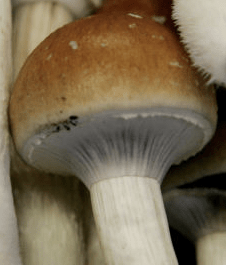
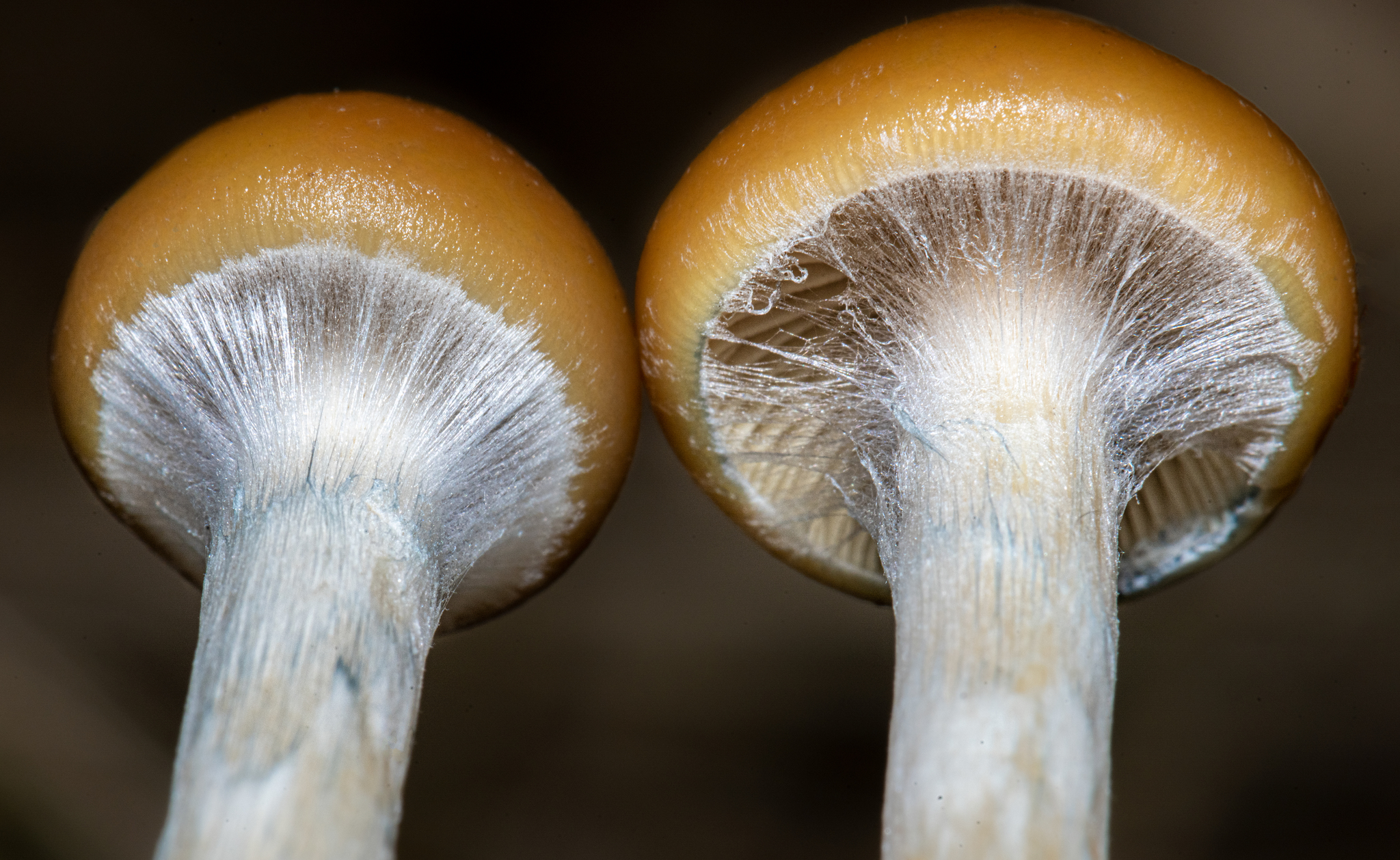
I can even show you photographs botanical specimens of real mushrooms that have “traces” of ramification, of which Eadwin is aware and plays on, in his gallery of 75 muhsroom plants.
“traces of ramification” takes on irony, when more well-informed than Panofsky.

https://egodeaththeory.wordpress.com/2022/06/29/hatsis-gallery-of-mushroom-imagery-in-christian-art/
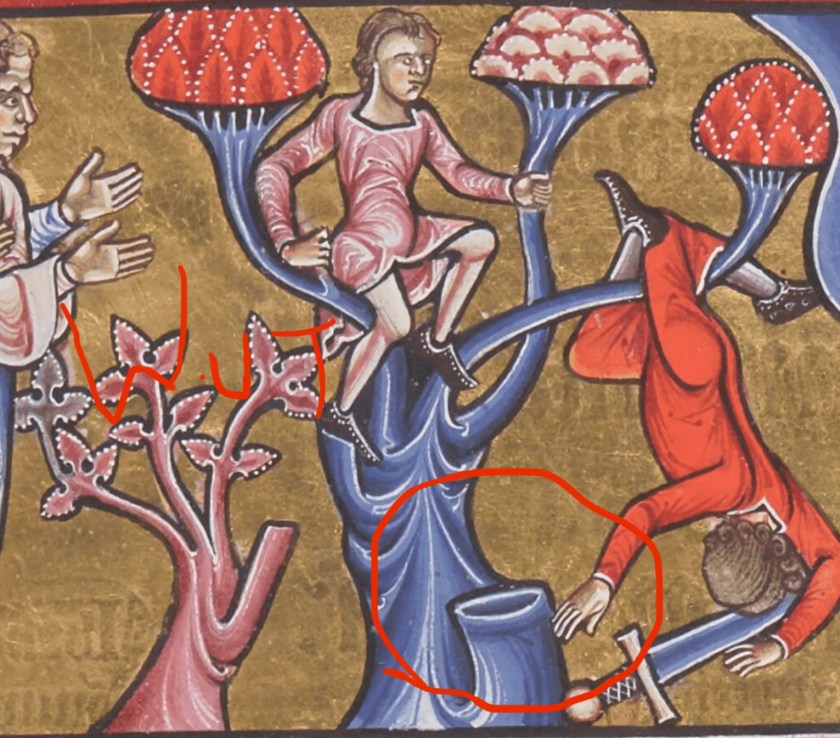
Crop by Cybermonk. The Eadwine image.
https://gallica.bnf.fr/ark:/12148/btv1b10551125c/f134.item.zoom
You want bolder ramifications under the cap/crown? See my 75 gallery.
You want subtler ramifications under the cap/crown? See my 75 gallery.
Same with photographs – you tell me how bold of veil-tear branching you demand — it can be provided.
This is the requisite intelligent handling of ranges of contrast of a motif. We end up with the artist posing the question: how subtle can I represent mushroom hems while it still communicates – the more subtle, the more masterful.
It’s a range, because the contrast is the point, and there are innumerable ways to represent the concept and morphology of “branching vs. non-branching”.
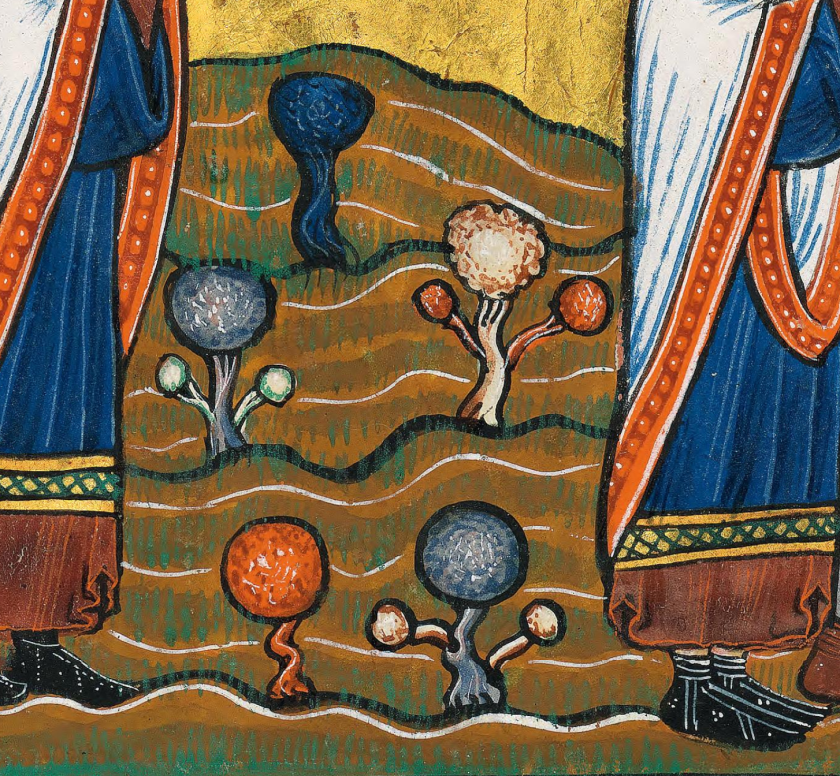
https://www.loc.gov/resource/gdcwdl.wdl_08939/?sp=47
Red plant: no traces of ramification, so Panofsky is proved wrong in his claim that all mushroom trees have traces of ramification.
Dark blue plant: how big a microscope do we need to bust out, how much refereeing, to quibble about the degree of justification for claiming that the blue pilzbaum has traces of ramification?
There’s a light blue trident under the cap, so Panofsky wins — except he loses, because this shows how weak and low-relevance his claim is.
When this level of analysis is needed, the argument essentially fails and we have to switch to a different framework for analysis: that is, the {branching-message mushroom trees} explanatory framework.
We are presented with all assortments of branching and non-branching, in all combinations.
The relevant point and angle of communication here in this genre of motifs and tropes and morphology is not “this individual specimen is tree vs. not”.
The point that’s communicated is “think about branching vs. non-branching.”
On the macro scale, the artist presents us with, in reading order:
- non-branching
- branching
- branching
- non-branching
- branching
I remember discussing details: there are two different zoom levels, so we quibble necessarily in this case, inescapably and justifiably, the two different zoom levels that have “traces of ramification”.
The black line below the non-branching Cubensis’ cap is — but in a different sense than Panofsky means – a trace of ramification:
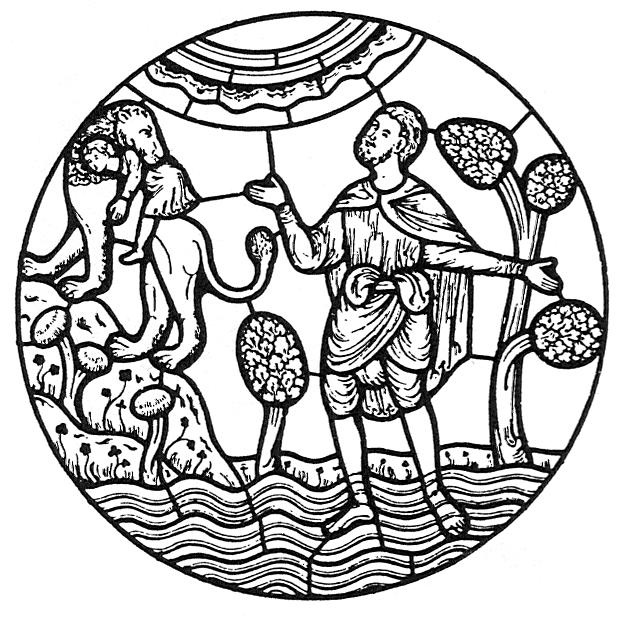
Eustace window, Chartres Cathedral, Placidas/St. Eustace crossing the river, one of his two sons carried off by a lion.
That’s the topmost image used in my 2006 main article, decoded March 2022 re: {handedness} & {non-branching} per the Theory of Psychedelic Eternalism:
The Entheogen Theory of Religion and Ego Death
http://egodeath.com/EntheogenTheoryOfReligion.htm
Errata
Errors of analysis that are in other pages.
The Handwritten Citation of Brinckmann Is Panofsky’s Handwriting
Where I developed the idea of using these crops to prove I f’d up claiming Wasson & co. wrote the citation: See lots of analysis at:
https://egodeaththeory.wordpress.com/2023/02/14/idea-development-page-18/#Handwriting-Proof-Panofsky
Crops copied from:
https://egodeaththeory.wordpress.com/2023/01/22/prof-jerry-browns-works-psychedelic-gospels/#Crops-of-Panofsky-Letters –


Who Hand-Wrote the Citation?
[February 4, 2023]
I just realized that the handwritten author name and title on Letter 1 could be Panofsky’s handwriting; that would make sense. Inspect handwriting compared to signature. Yep the start of “Erlich” matches “Erwin”.
I need to Find words like “handwriting” on my pages at this site and note the above, where I say it’s proof that Wasson went to the trouble to look up Panofsky’s book.
“Prototypes”, not “Templates”
Templates
[February 4, 2023]
In other pages, I wrote ‘templates’, but should have written ‘prototypes’.
See Also
Local Pages
Site Map > Panofsky:
https://egodeaththeory.org/nav/#Panofsky
The present page is my original Feb. 2023 page including commentary.
Newer page that’s just the Panofsky transcription, with clean title, for general use (with comment from Brown & Brown):
Erwin Panofsky’s Letters to Gordon Wasson, Transcribed – 2025/01/07
Conversely, the present Feb. 2023 page is not really my original page; see May 2022 page:
Erwin Panofsky’s Secret Pair of Letters to Gordon Wasson, Exposed – 2022/05/11
Which Two pilzbaum Art Images Did Panofsky Attach in the First Letter to Wasson? – 2024/12/31
Artists Omitting Branches from their Mushroom Trees as Panofsky Requested
The Panofsky/Hatsis Explain-Away-o-Matic Mushroom Eliminator
Lots of analysis Feb. 19, 2023:
Image Crops of the 4-5 Handwriting Samples on the Two Panofsky Letters Proves Panofsky (not Wasson) Wrote the Brinckmann Citations/ Recommendations
https://egodeaththeory.wordpress.com/2023/02/14/idea-development-page-18/#Handwriting-Proof-Panofsky
Also revises what Wasson is actually guilty of (details of anti-scholarship obstructionism & censorship & deceit) since it’s Panofsky’s handwriting, not Wasson’s.
The Psychedelic Gospels (Brown & Brown 2016)
https://egodeaththeory.wordpress.com/2023/01/22/the-psychedelic-gospels-brown-2016/
Brown & Brown’s Works
https://egodeaththeory.wordpress.com/2023/01/22/prof-jerry-browns-works-psychedelic-gospels/
Erwin Panofsky Falsely Says All Mushroom Trees Have at Least Traces of Ramification
https://egodeaththeory.wordpress.com/2022/05/01/erwin-panofsky-falsely-says-all-mushroom-trees-have-at-least-traces-of-ramifications/
The 75 Mushroom Trees of the Canterbury Psalter
https://egodeaththeory.wordpress.com/2022/03/13/the-75-mushroom-trees-of-the-canterbury-psalter/
Outline inventory of which trees have branching.
Tree Stylizations in Medieval Paintings (Brinckmann 1906)
https://egodeaththeory.wordpress.com/2020/12/11/brinckmann-mushroom-trees-asymmetrical-branching/
In the Site Map page, Find “Lash” and “Wasson”:
https://egodeaththeory.wordpress.com/nav/
Search this site for “John Lash” and “Wasson”. There are many pages here about these topics.
Egodeath.com Pages
For now, I have a good starter section structure for each individual sentence, though 3 sentences cover the Too Many Mushrooms argument:
nice to do: summarize arg of each sentence.
Wasson and Allegro on the Tree of Knowledge as Amanita
http://egodeath.com/WassonEdenTree.htm
My March 2006 article for the Journal of Higher Criticism.
64 pages; 40,000 words, plus image gallery.
Christian Mushroom Trees
http://egodeath.com/christianmushroomtrees.htm
My May 2006 gallery for the Wasson/Allegro article, cited by Brown & Brown’s 2016 book and 2019 article.
Brown & Brown’s URLs
Entheogens in Christian art: Wasson, Allegro, and the Psychedelic Gospels
Jerry B . Brown, Julie M. Brown
2019
Journal of Psychedelic Studies
https://www.academia.edu/40412411/Entheogens_in_Christian_art_Wasson_Allegro_and_the_Psychedelic_Gospels
Read the two Panofsky letters within that article, and read Brown & Brown’s commentary about them there.
Irvin’s Site
R. Gordon Wasson: The Man, the Legend, the Myth; Beginning a New History of Magic Mushrooms, Ethnomycology, and the Psychedelic Revolution by Jan Irvin – #144
https://logosmedia.com/2012/05/RGordonWasson_The-Man-the-Legend-the-Myth-secret-history-of-magic-mushrooms-by-jan-irvin-144/

 The Egodeath theory
Thank you for this insightful analysis. Minor correction: I did not translate a portion of Brinckmann’s book from German to English. Rather, I had a professional translator do this. ~ Jerry B. Brown
LikeLike