Michael Hoffman, 9:30 p.m., March 25, 2025
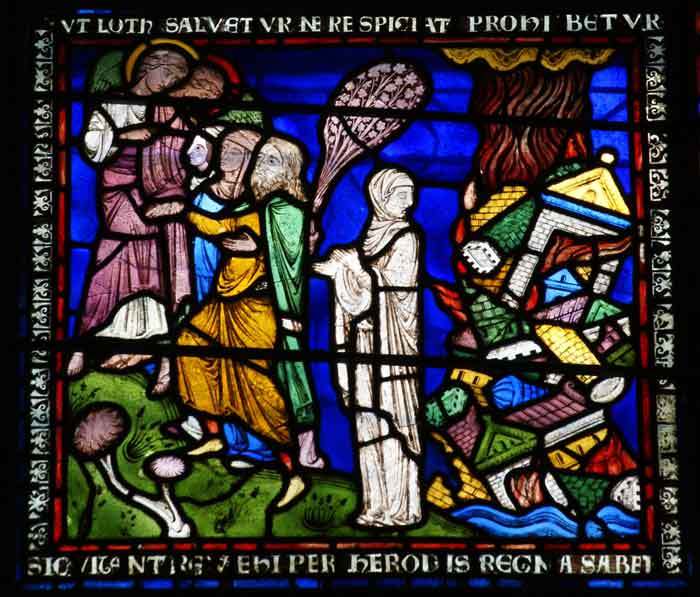
Contents:
- Motivation for this Post
- Official Relevant Definitions of the Negative and Positive Positions
- Quotes about the Database and Committee from Brown 2016
- Section about the Database and Committee from Brown 2019
- INTERDISCIPLINARY COMMITTEE ON PSYCHEDELIC GOSPELS
- Ruck’s “Social Drama Narrative” Tail Wagging the “Presence of Mushrooms” Dog
- The Database Includes the Accompanying Motifs of the Mushroom-Trees Genre: {mushrooms}, {branching}, {handedness}, and {stability} Motifs
- “Mushroom Imagery”, not “Images of Mushrooms”
- Huggins’ Fake “Criteria to Decide” Is Actually a Sheer Decree of “Mushroom Features Don’t Count”
- ⚔️
- TOUCHE! LOL ⚔️
- Criteria to decide whether a mushroom-tree is a mushroom or a tree: the tree features count, but the mushroom features don’t count – Because I Say So
- Criteria to decide whether a mushroom-tree is a mushroom or a tree: the mushroom features count, but the tree features don’t count – Because I Say So
- Wasson’s paradox
- See Also
Motivation for this Post
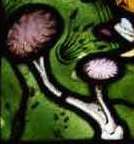
Discovery of the day: That it’s a YI mushroom-tree in Lot window, March 25, 2025
- this page IS the db, vs:
- this site IS the db, vs:
- this page describes and articulates and embodies the CONCEPT of the Brown db
- this page serves as a concrete link; this page URL “is” the Brown [virtual] db.
Brown 2019: 0 hits on “database”, 1 hit on “catalog”: cataloguing – a verb.
Brown focuses on Committee and action too much, not concrete enough collection.
It’s easy to have a database.
Having a collection and doing collection, acting in a committee, is too hard, not happening.
‘database’ is more powerful than ‘catalog’.
I need to inspect and markup Browns’ description of the db, J Brown told me the present site is as close to their db proposed db as anything. that this site is the closest thing to their proposed db.
Browns’ writeup focuses more on the committee – which idea failed, no one has time to commit to that — than on the db.
This page addresses somehow those needs. after studying and summ’ing what Browns propose.
Official Relevant Definitions of the Negative and Positive Positions
Deniers’ Logical Fallacies in the Pilzbaum (Mushroom Trees) Debate
Quotes about the Database and Committee from Brown 2016
Section about the Database and Committee from Brown 2019
14 hits on “committee” – all of them in section “INTERDISCIPLINARY COMMITTEE ON PSYCHEDELIC GOSPELS” (good news, a relief)
formatting: all the entire section, plain text, 1 sentence per paragraph.
todo: add bold, maybe delete some.
Browns write:
INTERDISCIPLINARY COMMITTEE ON PSYCHEDELIC GOSPELS
We have revisited the Wasson– Allegro controversy, presented iconographic evidence of entheogens in Christian art, and examined critiques of the psychedelic gospels theory.
In this context, we can now address Wasson’s paradox and the need for an Interdisciplinary Committee on the Psychedelic Gospels.
Call for an interdisciplinary committee
Samorini (1998 ) closes his survey of “ mushroom-trees” in Christian art by stating that “we may confidently conclude from what has emerged that justifications do exist for serious and unprejudiced ethnomycological study of early Christian culture, and it is our hope that such studies will take place” (p. 107).
Given the conflicting interpretations of entheogenic mushroom images in Christian art, and the controversial implications of the psychedelic gospels theory, there is an obvious need to establish sound methodologies and objective criteria for a rigorous, unbiased evaluation of this iconographic evidence.
Achieving this goal will require more than a de rigueur appeal for “additional studies.”
For this reason, we call for the establishment of an international Interdisciplinary Committee on the Psychedelic Gospels (Committee).
[should call for database, or define virtual database]
This Committee could be housed at a major university or museum and co-chaired by an ethnobotanist and church historian with relevant credentials.
It would be charged with collecting, cataloging, and curating potential psychoactive images in Christian art from around the world, and evaluating them for the presence of evidence indicating that they represent entheogenic species.
Toward this end, the Committee would integrate research methodologies from
- anthropology (fieldwork),
- art history (iconography, iconology),
- church history (textual analysis),
- ethnobotany (cultural uses of mushrooms),
- mycology (fungus identification), and theology (exegesis).
[the Egodeath theory/ the Mytheme theory; the Egodeath theory of psychedelic eternalism – this is THE way to explain branches/ ramification, as demanded by Panofsky-Huggins as their MAIN objection to the mushroom interp.]
The Committee would establish criteria for peer-review evaluation of critical questions.
Are the images clear and unambiguous enough to facilitate a definitive identifi cation of the genus and species of psychoactive mushroom?
[not just isolated mushroom motif; the genre is actually intending to … artists of the mushroom-trees genre do not intend to send msg “mushroom”; their actual msg is conveyed by the combination of {mushrooms}, {branching}, {handedness}, and {stability} motifs; to describe psychedelic eternalism; mental model transformation from possibilism to eternalism]
Or if the mushrooms shown are stylized mushrooms (such as “mushroom trees”), are there artistic traditions of interpretation that contribute to determining that they were intended to depict entheogenic species?
Does the art tradition and history surrounding the image enhance the determination of the intent to represent psychoactive mushrooms or other entheogens?
Are there relevant texts and/or other historical documents that corroborate these findings?
Unlike the political infighting that delayed publication of the Dead Sea Scrolls for decades, the workings of the Committee must be transparent.
The Judeo-Christian art images and religious texts in question should be made available online for public viewing and comment.
It is through this interdisciplinary peer-review process that the theory of the psychedelic gospels can be independently confirmed (or refuted) by the Committee, and thereby potentially gain credence in scientific and theological circles as well as among thought leaders, policy makers and the mainstream media.
/ end of section from Brown & Brown 2019
Ruck’s “Social Drama Narrative” Tail Wagging the “Presence of Mushrooms” Dog
Entheogens in Christian art: Wasson, Allegro, and the Psychedelic Gospels. Jerry Brown & Julie Brown (2019). Journal of Psychedelic Studies, Volume 3: Issue 2, pp. 142–163. https://doi.org/10.1556/2054.2019.019 – https://www.academia.edu/40412411/Entheogens_in_Christian_art_Wasson_Allegro_and_the_Psychedelic_Gospels
https://egodeaththeory.org/2025/01/07/panofskys-letters-to-wasson-transcribed/
Ruck Committee? we have a counter-committee!
The business of the Ruck Committee is wrong-agenda-driven:
Ritual retelling of tabu social drama narrative of suppression; strive to prevent real Christianity & mass of all people from having The Mushroom (kiddie Amanita) by laboring to construct a barrier wall between Amanita and society at large in Europe history.
The important thing is the morality tale not psychedelics, for Ruck Committee; 1st-generation entheogen scholarship (the Secret Amanita paradigm).
The Brown database is specifically 2nd-generation entheogen scholarship (the Explicit Psilocybin paradigm).
WE DO NOT PERMIT “SECRECY” NARRATIVE TAIL WAGGING THE PSYCHEDELIC EVIDENCE DOG.
THIS DB SIMPLY SAYS “MUSHROOM IS PRESENT” OR MUSHROOM IS USED, NOT “Secret Christian Amanita Cult”, the Amanita Primacy Fallacy, spinning a social drama narrative.
We do not use Browns’ word ‘secret’, nor ‘mainstream’.
Reject “oppressor vs oppressed” narrative driving entheogen scholarship, as was done by the Allegro-Ruck paradigm, for Allegro’s reason/motive/ agenda, nor Ruck Committee’s reason/ motivation / agenda/ project of wrapping around each piece of evidence a jail of framing that art piece as an “alien heretical invasion even into the very heart of the Institutional Big Bad Church”
— a social drama narrative which REPLACES & neutralizes every piece of mushroom imagery in Christian art, striving to keep it separate from the mass of Christendom population & practice by fabricating and concocting out of thin air, “heretical sects, members-only, strong walls”, “displayed blatantly in their places of worship”.
Citation: The Holy Mushroom, p. 104 Irvin objects to such premise.
Against the Assumption of Suppression of Psychedelics in Pre-Modernity (Cyberdisciple 2020)
p. 14 of “Conjuring Eden”, Ruck et al, Entheos 1, 2001:
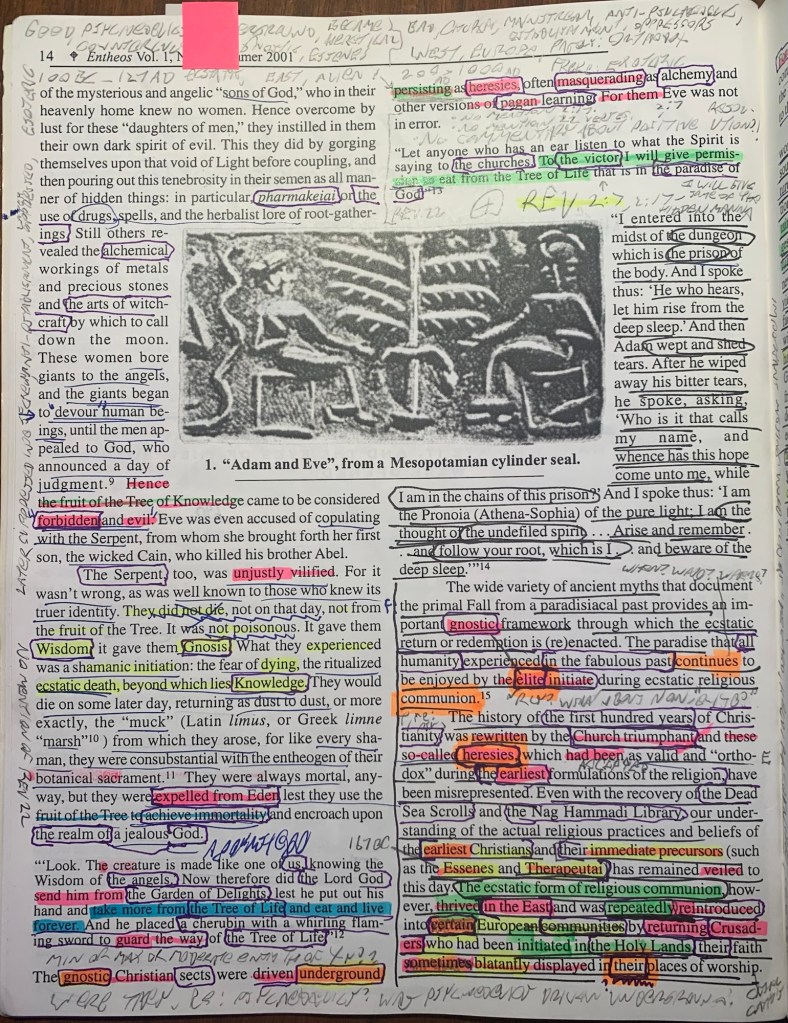
p. 15 of “Conjuring Eden”, Ruck et al, Entheos 1, 2001: littered with words serving to isolate and restrict “The Mushroom” to imagined “groups” and construct a barrier wall.
I recently highlighted all the words that are abused to carry this premise of “barrier wall” – drawing a line w/ The Mushroom on one side of Ruck paradigm’s line, and Lacking The Mushroom on the other side of the Great Ruckian Barrier Wall:
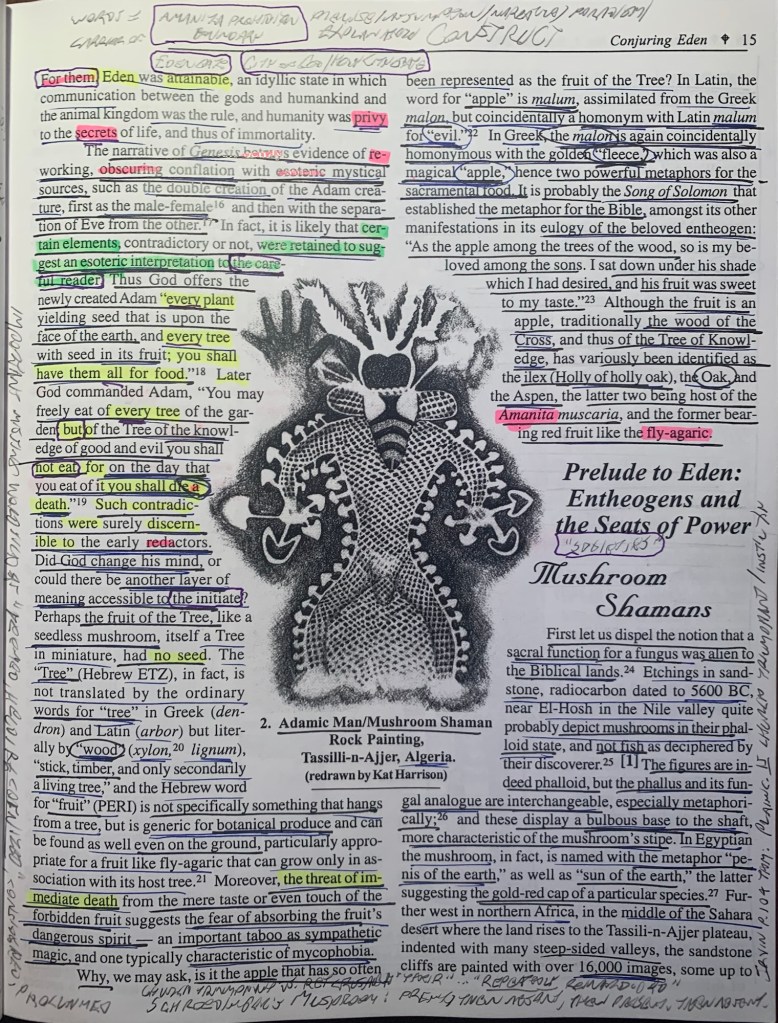
Conjuring Eden: Art and the Entheogenic Vision of Paradise (Hoffman, Ruck & Staples, Entheos 1, 2001)
Forbidden Word List: mainstream, cult, secretly, oppression, hidden, secret cult, surreptitiously slipped in, communities, cults, groups, sects, heretical; “psychoactive mushrooms”, umbrella wildcard terms
The Habitual Attempt to Limit Entheogens, by 1st-gen entheogen scholarship
but when irvin 2008 criticized Ruck’s attempt to limit The Mushroom to mysticism and heretical sects, and to do that, Irvin cited AstroSham 1, Irvin then had to himself hasten to delete his own effort in AstroSham 1 2006 to attempt to limit The Mushroom to “kings, priests, and the elite” – removed from AstroSham 2 2009.
p. 56 of “Daturas for the Virgin”, Ruck et al, Entheos 2, 2001
The Database Includes the Accompanying Motifs of the Mushroom-Trees Genre: {mushrooms}, {branching}, {handedness}, and {stability} Motifs
One way to define the Brown db is: the galleries from Irvin + Michael Hoffman + J Rush + Browns + Samorini = a virtual db.
The db must include {mushrooms}, {branching}, {handedness}, and {stability} motifs supplementing and surrounding and accompanying mushroom imagery in Christian art.
“Mushroom Imagery”, not “Images of Mushrooms”
MICA = mushroom imagery in Christian art
MICA = mushrooms in Christian art <– brittle; we are not saying “it is a mushroom”.
We are saying “it is mushroom features fragments imagery”.
b/c the dirty strategy of Ronald Huggins is “the image on the scale of entire tree does not match A mushroom, therefore, so, not a mushroom.”
But if we are intelliegent MICA Affirmers , we are not saying that “it is a mushroom” – idiotic brittle talk. Low IQ. Irrelvant.
Huggins’ Foraging Wrong article uses dirty opportunity to say “the whole image doesn’t exacly match A mushroom, so, not a mushroom, so, no mushroom imagery in Christian art.”
It is crucial for the good guys, us MICA Affirmers, to explicitly control the definitions of the neg & pos position.
Forget Hugs’ defs; forget the MICA Deniers’ stupid position slip-n-slide definition shell games.
Only use my, relevant & productive, STABLE definitions of the two position.
Huggins: *I* am dictating to *you* what YOUR position is.
*I* am the one who is proactively strawmanning YOU.
*I* control the terms of debate; not you.
I reject the debate positions & concerns & framings as expressed by MICA Deniers.
Huggins’ Fake “Criteria to Decide” Is Actually a Sheer Decree of “Mushroom Features Don’t Count”
Left to Huggins , we have trash quality of pseudo arg’n like Huggins writing:
“Panofsky lets us articulate criteria to decide whetehre it is a tree or it is a mushroom” – brain dead pseudo-argument masking a sheer arbitrary decree.
What Huggins then does is list these so-called “critieria”; LEARNED, LEARNED!, so learned, a long list of criteria (a posturing put-on, pretense):
- if it has branch
- if it looks like tree
- if it has any tree features
- if …
- if …
Then, I dictate (says Huggins), arb’ly, that all mushroom-trees mean tree, not mushroom.
Countering Huggins’ bunk non-arg w/ its opposite:
But Huggins, *I* counter-dictate:
The mushroom features fragmentary aspects of mushroom-trees “RULES OUT” (Huggins’ stupid term thrown about as if a real arg) tree.
To throw Huggins bunk arg’n back in his face,
The mushroom features rule out tree.
⚔️
Touche, Huggins. By your own bunk junk arg.
Oh but let me frame that the same stupid way as Huggins builds up in the paragraph in the Conclusion section of Huggins’ Foraging Wrong article:
Panofsky’s argument allows us to articulate criteria to decide for a given image whether it is a tree or it is a mushroom:
- If the image has any mushroom-shaped caps, then it is a mushroom, not a tree.
- If the image has any mushroom-colored, blue stem, then it is a mushroom, not a tree.
- If the image has any branch that is shaped like a mushroom, then it is a mushroom, not a tree.
TOUCHE! LOL ⚔️
GARBAGE ARG’N FROM MICA Deniers, TYPICAL.
I’m as good as Ronald Huggins at “articulating criteria to decide”, equally arb’ly. What posturing.
Is this supposed to be argumentation, Huggins? “articulating criteria to decide”?
Criteria to decide whether a mushroom-tree is a mushroom or a tree: the tree features count, but the mushroom features don’t count – Because I Say So
Criteria to decide whether a mushroom-tree is a mushroom or a tree: the mushroom features count, but the tree features don’t count – Because I Say So
You mean, criteria to issue a blanket proclamation that in every instance, given mushroom features + tree features – ie, what you art historians call mushroom-trees – YOUR term —
You art historians, MICA Deniers, proclaim that the tree features count, but the mushroom features don’t count – because you proclaim so, without any basis other than, “branches need to be explained.”
Which is DONE.
In fact, we know that mushroom-trees cannot possibly mean trees, b/c they have mushroom features.
Mushroom-trees definitely do not and cannot mean trees, and in fact mushroom-trees do not ultimately mean trees.
In fact, mushroom-trees more mean literal mushrooms than they mean literal trees.
Mushroom-trees ultimately mean experience of non-branching from Psilocybin.
Mushroom-trees do not ultimately mean tree OR mushroom.
So, a FALSE DILEMMA FALLACY thanks to big-brain Huggins and the scoundrel MICA Deniers who apologized for, ie defend – Wasson’s fraudulent, obstructionist behavior, on the excuse that:
“Wasson didn’t prevent MICA Affirmers from affirming mushroom imagery in Christian art, publishing such assertions post-Wasson.
“So, academic fraud and obstructionism: THIS IS FINE”, says Huggins.
Penalty: I charge Huggins as responsible for Wasson’s fraud.
Huggins must disavow, let’s see Hug disavow:
I demand that Huggins RETRACTS his defense of Wasson’s bullying tactics & duplicity, which Irvin complains about, as reported by Huggins’ Foraging Wrong article.
The good thing from Panofsky-Huggins is, they inquire of us MICA Affirmers: Must explain branches. DONE.
… … That’s his so-called “enables us to articulate criteria to decide whether it is a tree or it is a mushroom”.
Huggins’ “articulate criteria to decide” is pure bullsh*t!
The Panofsky-Huggins argument REALLY is:
“Until MICA Affirmers explain branches, we are not convinced.”
Solved. Done. See present site;
Branches — and you are blind to more important non-branching motif — means the peak Psilocybin experience of mental model transformation from possibilism to eternalism .
That is why we MICA Affirmers reject any position definition games from the MICA Deniers, and we take charge of both positions definitions.
HERE is the specific postition we argue against and disprove, and, here is the position that we hold.
Not like Ruck says on p. 56 of “Daturas for the Virgin”, Ruck et al, Entheos 2, 2001 , “they are mushrooms and nothing else” – a poor statement of the MICA Affirmers position.
MICA Affirmers do NOT say mushroom-trees are “mushrooms and nothing else”, like Ruck Committee 2001 says on p. 56 “Daturas for the Virgin”.
See my page for the sane, relevant, two position definitions (for & against), at 3 levels of detail.
Ignore the stupid, shifting, shell-game position definitions from MICA Deniers such as “decide if it is a tree of it is a mushroom” – irrelvant brain-dead fallacious arg’n FALSE DILEMMA.
The usual lack of concern — as usual, as typical:
Characteristic of MICA Deniers is they don’t care about good arg’n.
MICA Deniers stoop and are ok with being associated with obviously bad arg’n.
MICA Deniers are ok w/ being known for bad arg’n and heap of fallacious arg’n, all of the fallacies all at once.
They’re fine putting that forth and associating themselves w/ fallacious arg’n: they solve that by doing more of it, which is really, arg’n from prejudice:
If I’m a MICA Denier and my lips are moving, that is to be taken as “valid arg’n”, given the un-level playing field of extreme bias against MICA Affirmers.
Just throw at the wall, more and more junk arg’n, none valid, but that’s ok.
“articulate criteria to decide” — GTFO! what b.s.! not even an arg!
It’s just a dictate , sweeping, that NO mushroom-trees are “a mushroom”, disguised and foisted as if an arg, but actually it is just a decree:
Huggins’ Conclusion paragraph is really just a position statement repeated: “My position is that mushroom-trees are not a mushroom but are instead a tree.”
But Huggins pretends to be “articulating criteria to decide whether YADA YADA, BS, BS” – typical fallacious arg’n from MICA Deniers that they are notorious for.
If MICA Affirmers are characteristically notorious for (rightly) ignoring art historians,
MICA Deniers are characteristically notorious for shamelessly putting forth Bad Arg’n that amount to arg’n from prejudice.
MICA Deniers only have 1 good point:
MICA Deniers have only 1 valid objection to mushroom imagery in Christian art: the MICA Affirmers must explain the branches motif of mushroom-trees. DONE.
Deniers’ Logical Fallacies in the Pilzbaum (Mushroom Trees) Debate
Wasson’s paradox
(moved out from Interdisc. section – awesome but tangential)
Browns write:
In our book, we state that “In our opinion Wasson’s greatest paradox was this: the discrepancy between his zealous exploration of a controversial theory about the role of entheogens in early religion and his reluctance to pursue this theory past the portals of the church and into the hallowed halls of Christianity” (Brown & Brown, 2016, p. 7).
This paradox is especially poignant in the case of the Eden fresco at Plaincourault.
Here, Samorini (1998 ) remarks that “It is therefore quite strange that the father of ethnomycology stopped before the lapidary appraisal of an art historian and did not, instead follow the trail of additional ‘mushroom-tree’ representations in Roman and Christian art as he might have done or scheduled” (p. 31).
Given his reputation as an indefatigable seeker of sacred mushrooms, why did Wasson not travel a mere 6 miles west of Plaincourault to Saint Savin (Figure 5 ) or 50 miles east to SaintMartin’ s (Figure 8 ) where he would have undoubtedly discovered additional examples of entheogens in Christian art? Several explanations of this egregious oversight have been suggested.
Samorini (1998 ) proposes that Wasson’ s reluctance grew out of a realistic concern that acknowledging any evidence in support of “ Allegro’ s sensational thesis” would deal “a serious blow to the new science of ethnomycology of entheogenic mushrooms” (p. 32).
Early in our research, we wondered if as the son of an Episcopalian minister, Wasson felt “a filial allegiance to his father and a loyalty to the church” (Brown & Brown, 2016 , p. 7).
While these may be contributing factors, we later uncovered a more compelling explanation.
During our 2012 visit to the Vatican Museum in Rome, we were inspired to Google the words “ Wasson, Vatican” which immediately produced several search items including one that said “Wasson was an account manager to the Pope and Vatican for J.P. Morgan” (Irvin, 2012 ).
Wasson joined the Wall Street investment banking firm of J.P. Morgan in 1934, where he helped develop the new fi eld of banking public relations.
Upon further research, we found that Wasson’ s direct financial involvement with the Vatican was confi rmed by DeWitt Peterkin, a retired J.P. Morgan, Vice President.
In an interview for The Sacred Mushroom Seeker , a book of essays in tribute to Wasson, Peterkin reveals that “Unbeknown to most people, we were for many years one of the bankers for the Vatican . . .
And Gordon used to have private audiences with the Pope”
(Riedlinger, 1997b , p. 51).
Wasson never mentions his role as a Vatican banker in his writings.
This role provides a clear fi nancial motive for Wasson’ s reluctance to explore entheogens in Christian art.
This may have been reinforced by a legally binding confi dentiality and non-disclosure agreement between banker (J.P. Morgan) and client (the Vatican), given that such agreements are common in the investment banking field.
Regardless of motive, due to Wasson’ s preeminent position as a leading authority on the study of entheogens and religion, this lack of disclosure was especially damaging to the nascent field of ethnomycology.
In effect, Wasson’s lack of transparency combined with his relentless personal and professional attacks on Allegro stymied widespread scholarly inquiry into the study of entheogens and Christianity for nearly half a century.
/ end of section by Browns, moved out from Interdisc. section
See Also
glad to see Brown cite Irvin Secret History of Magic Mushrooms article series 2012 – surprised this doesn’t redir to Irvin new site domain, Logos media:
https://www.gnosticmedia.com/SecretHistoryMagicMushroomsProject –
better is:
https://logosmedia.com/SecretHistoryMagicMushroomsProject
Brown links to Michael Hoffman / cites:
Egodeath.com,
Wasson and Allegro on the Tree of Knowledge as Amanita (Hoffman, 2006), http://egodeath.com/WassonEdenTree.htm
Tree Stylizations in Medieval Paintings (Brinckmann 1906) – citations include:
Baumstilisierungen in der mittelalterlichen Malerei
(Tree Stylizations in Medieval Paintings)
Albert Erich Brinckmann, 1906
86 pages
https://archive.org/details/bub_gb_8AgwAAAAYAAJ/mode/2up
Letters of Erwin Panofsky to R. Gordon Wasson, May 2 & May 12, 1952. Wasson Archives, Harvard University Herbarium, Cambridge, Mass. Tina and R. Gordon Wasson Ethnomycological Collection Archives, ecb00001, series IV, drawer W3.2, folder 20. Botany Libraries, Economic Botany Library of Oakes Ames, Harvard University.
The letters were first published by Jerry Brown & Julie Brown (2019). Entheogens in Christian art: Wasson, Allegro, and the Psychedelic Gospels. Journal of Psychedelic Studies, Volume 3: Issue 2, pp. 142–163. https://doi.org/10.1556/2054.2019.019 – https://www.academia.edu/40412411/Entheogens_in_Christian_art_Wasson_Allegro_and_the_Psychedelic_Gospels
Deniers’ Logical Fallacies in the Pilzbaum (Mushroom Trees) Debate
Foraging for Psychedelic Mushrooms in the Wrong Forest (Huggins 2024)
Site Map section:
https://egodeaththeory.org/nav/#gallery
Site Map section:
https://egodeaththeory.org/nav/#flagship-Mushrooms-Greek-Christian-Art

 The Egodeath theory
Hi Michael,
The Committee did not fail because scholars would not devote time to it. Michael Winkelman and I had identified a prestigious group of international scholars who were willing to participate. However, we decided to disband the Committee when Carl Ruck – who originally encouraged us to form the Committee with him as founding co-chair – decided to resign in order to pursue other writings.
The reason I focused more on the Committee than on the db is because the db was going to be compiled after the Committee was in place. That said, in addition to the photos of Amanita muscaria and psilocybin mushrooms in Christian art that we published in The Psychedelic Gospels, we literally have dozens of additional photos from each Christian site visited which would have been submitted to that database.
Best wishes, Jerry B. Brown
LikeLiked by 1 person
Jan Irvin’s gallery in the book The Holy Mushroom (2008) only showcases 1/10 of his collection of mushroom imagery in Christian art.
I think it was in Max Freakout’s Psychonautica podcast where Irvin said that: https://egodeaththeory.org/2024/12/24/psychonautica-podcast-with-max-freakout/#Psychonautica-71
________________
I wish I had taken the time to make copies of the Thomas Hatsis Gallery of mushroom imagery in Christian art, instead of only linking to his image files at his defunct site.
Hatsis’ set of some 5 articles contributed to the evidence base, and he seems to abandon his own articles over time.
My Hatsis gallery now only has the image URLs, not his images.
I might be able to search Archive for each individual article URL.
Hopefully Hatsis’ promised book proving no mushroom imagery in Christian art will fill this gap by showing all instances of mushroom imagery in Christian art (Psilocybin & Amanita) that Hatsis previously revealed.
Hatsis should reinstate his articles including the original full version of Dancing Man 🔥🦎🍄🌳🕺 article 2013 for the UK magazine.
Hatsis’ articles were as helpful of contributions, in their way, as Ronald Huggins’ 2024 article “Foraging for Psychedelic Mushrooms in the Wrong Forest: The Great Canterbury Psalter as a Medieval Test Case”, and Huggins’ 2022 Dancing Man article which I have spent less attention on.
Roasting the Salamander: Mushroom Cult Theorists vs. Critical Historical Inquiry
Thomas Hatsis, 2013
Includes appendixes and original title: https://web.archive.org/web/20160218214557/http://arspsychedelia.com/uploads/3/2/1/4/3214063/roasting_the_salamander.pdf
LikeLike