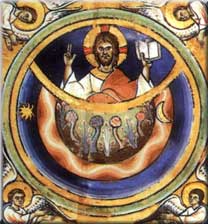
John Rush is central to Psychedelics and entheogen scholarship.
I agree with John Rush’s general approach to art interpretation.
All religious art is Psilocybin art.
Jungianism forces a thick obscuring overlay onto actual myth.
My thick, heavy-handed interpretative overlay is thicker and more obscuring than your thick, heavy-handed interpretative overlay.
The data trembles when it sees my forceful, coercive theory coming: the diamond hammer of interpretation.
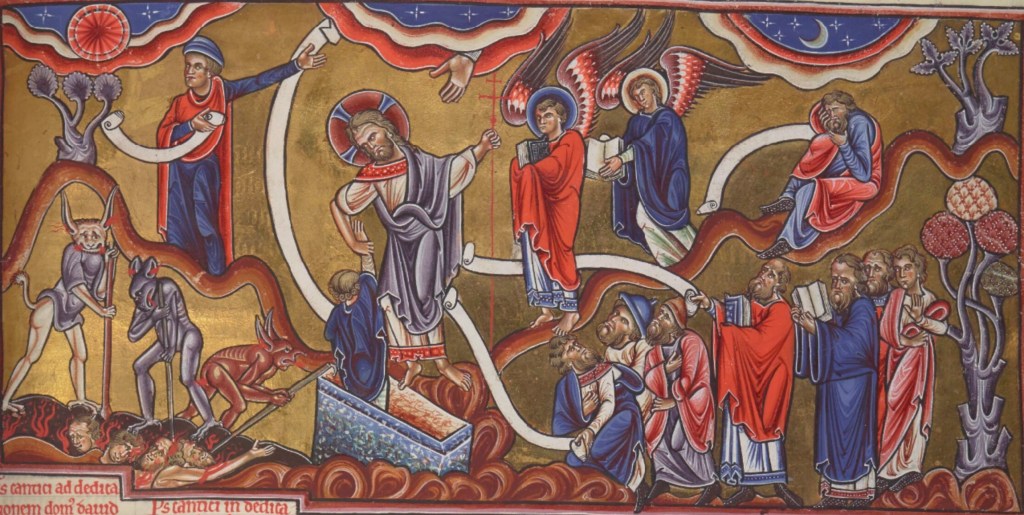
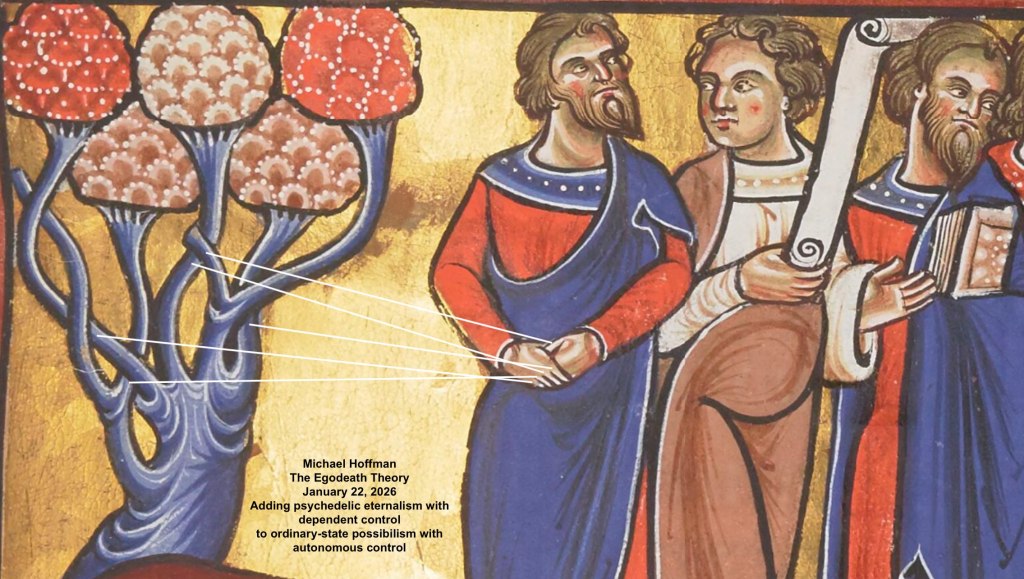
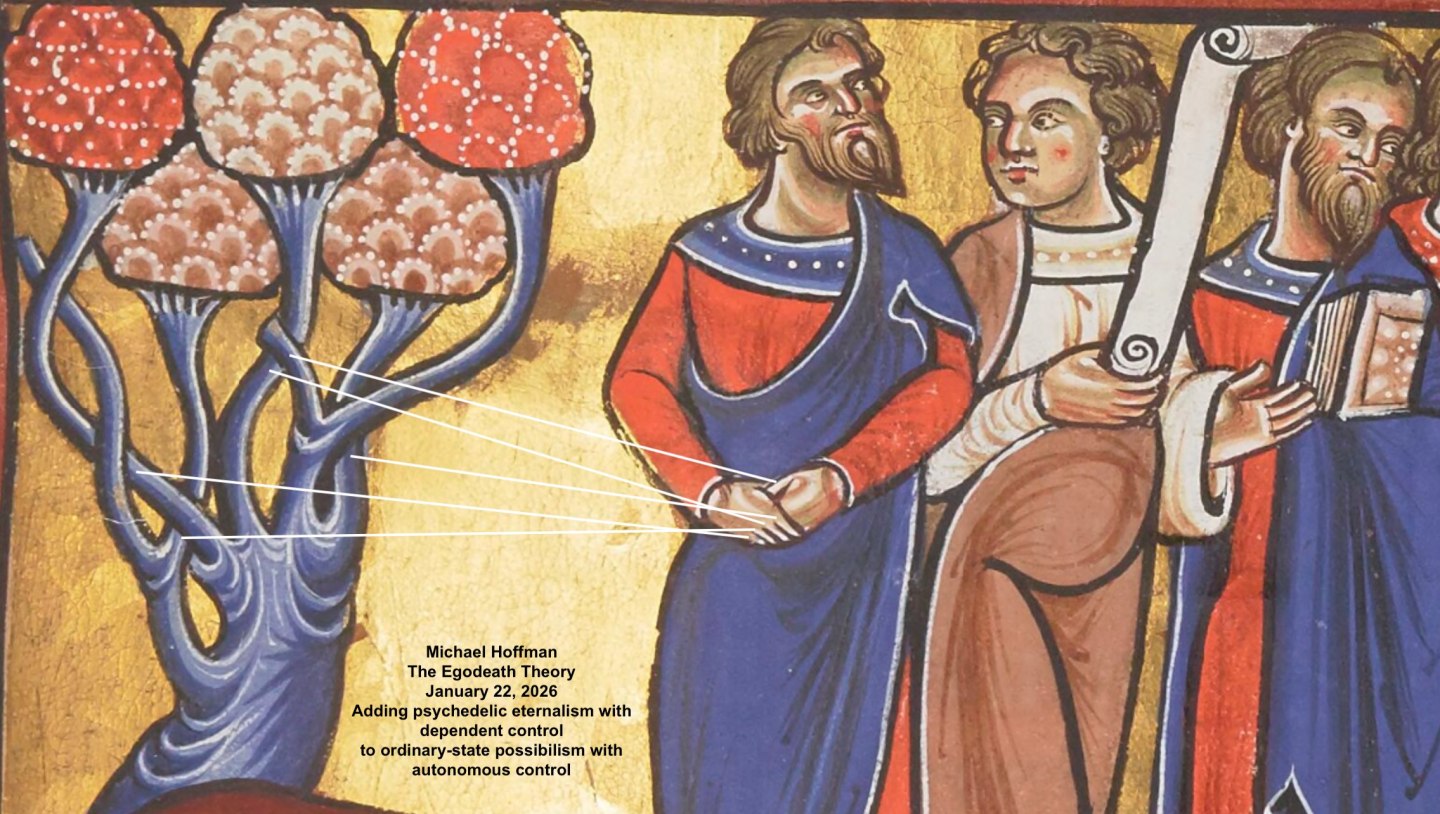
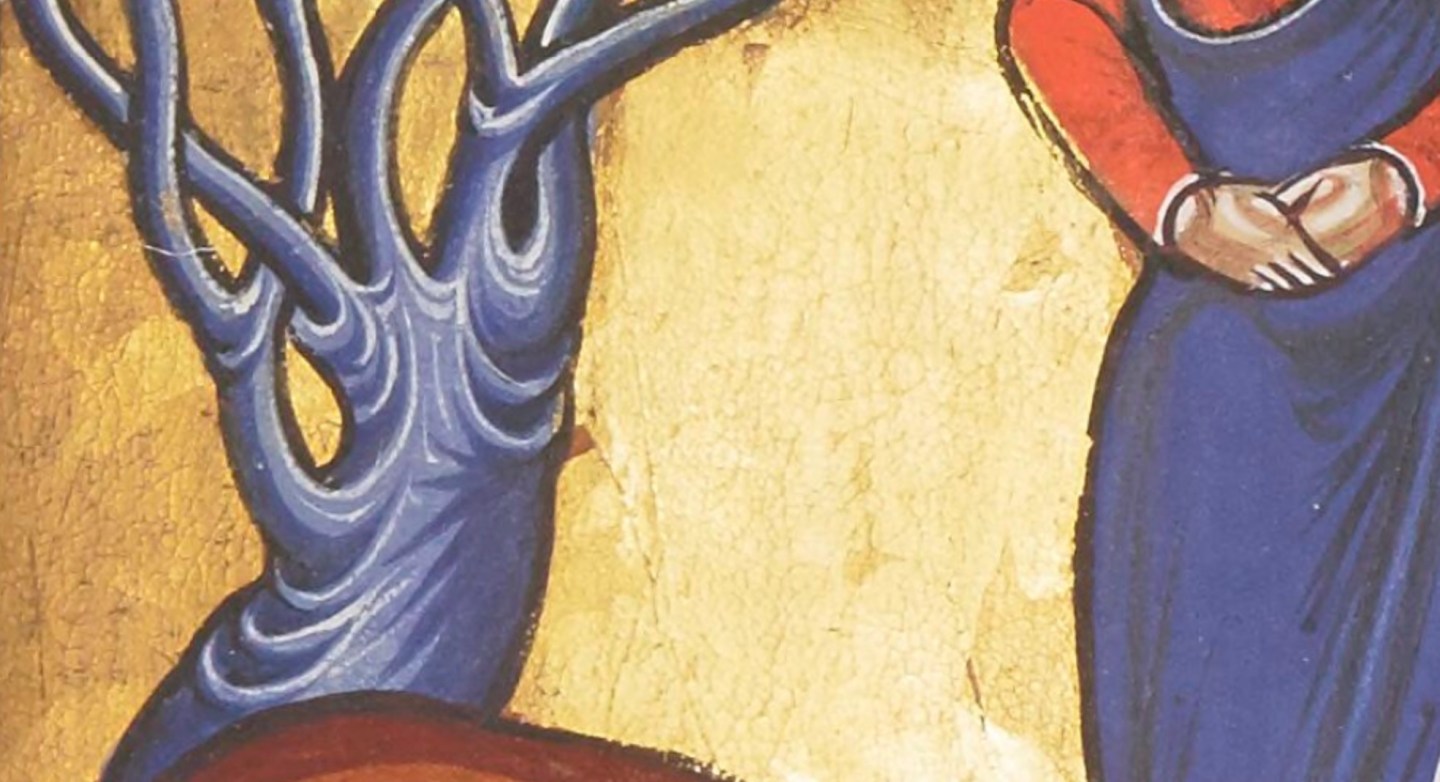
The {mushroom hem} motif
Rush oddly didn’t come up w/ a term – a concept-label — for {mushroom hem} motif; he uses awkward unwieldy wording only.
The {celestial erection} motif
The {celestial erection} motif is very common theme in Christian mushroom art, found together with {branching-message mushroom trees}, {mushroom hem}; mushroom imagery along with 3-5 other motifs.
{lifted garment} was my original reject term.
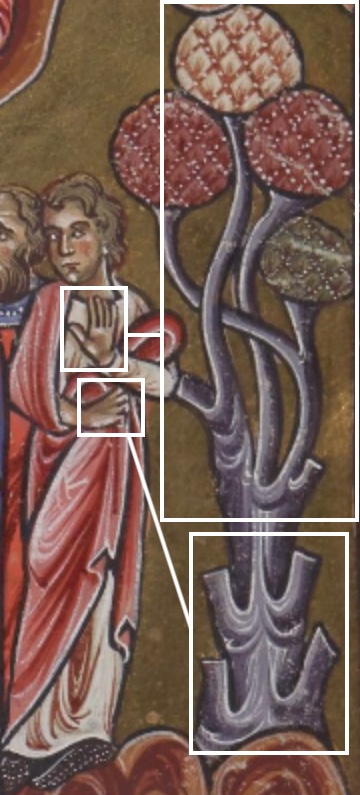
The better new term is {phallic garment}.
Rush’s term {celestial erection} is superior to my new term in most ways.
A b.s. euphemism term from me: my new term {phallic garment} is adequately semi-specific.
Rush owns the {celestial erection} motif.
Rush didn’t form a term for {mushroom hem} like he did for the {celestial erection} motif.
In John Rush’s book (Amanita-fest cover):
He defines term {celestial erection} motif.
He describes, but doesn’t define a useful term for {mushroom hem}.
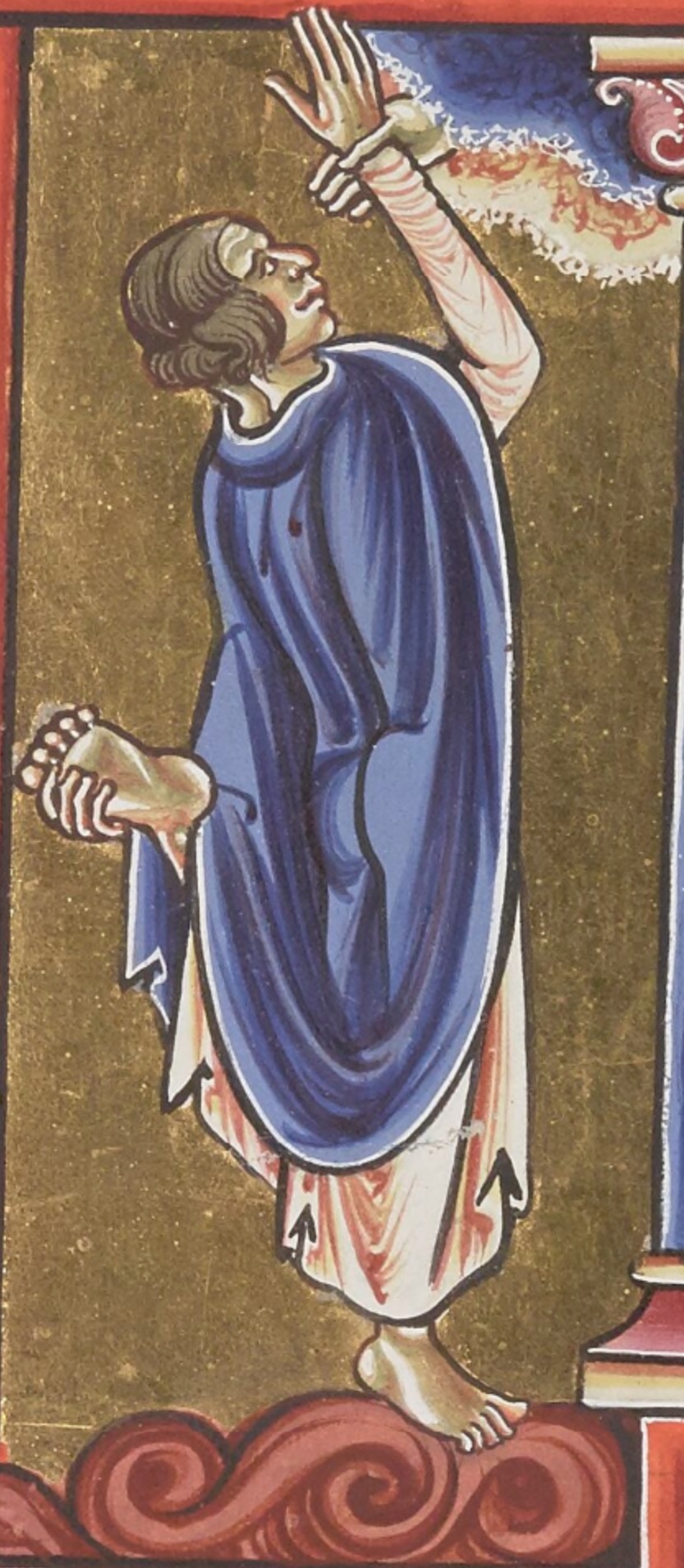
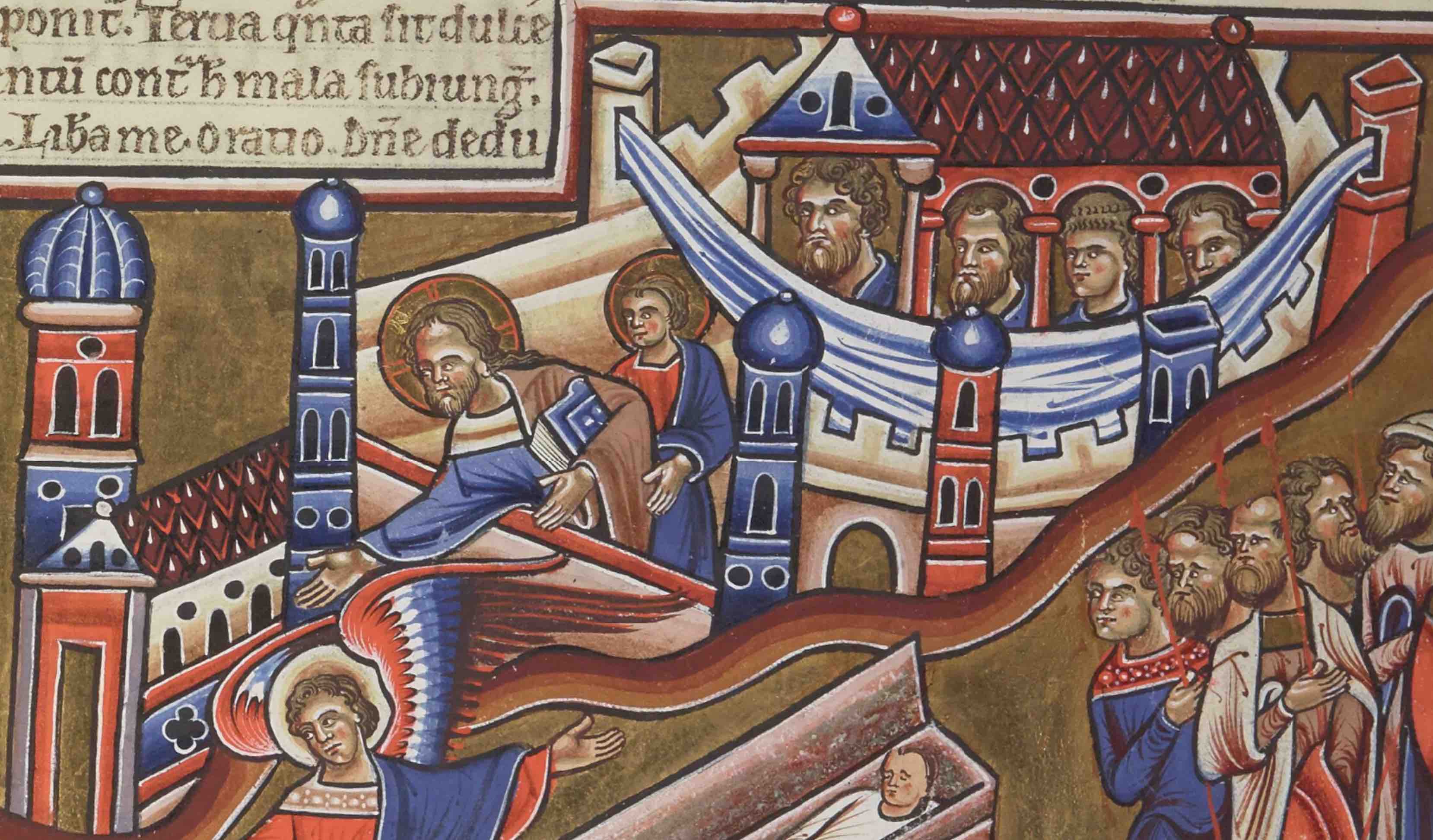
Passing Student Includes {phallic garment} motif
Crop by Cybermonk
For my present purpose, this specific crop is perfect and happens to exactly match what blurry inkjet crop John Lash uploaded to web around 2008, that I decoded in blurry form in Nov. 2020:
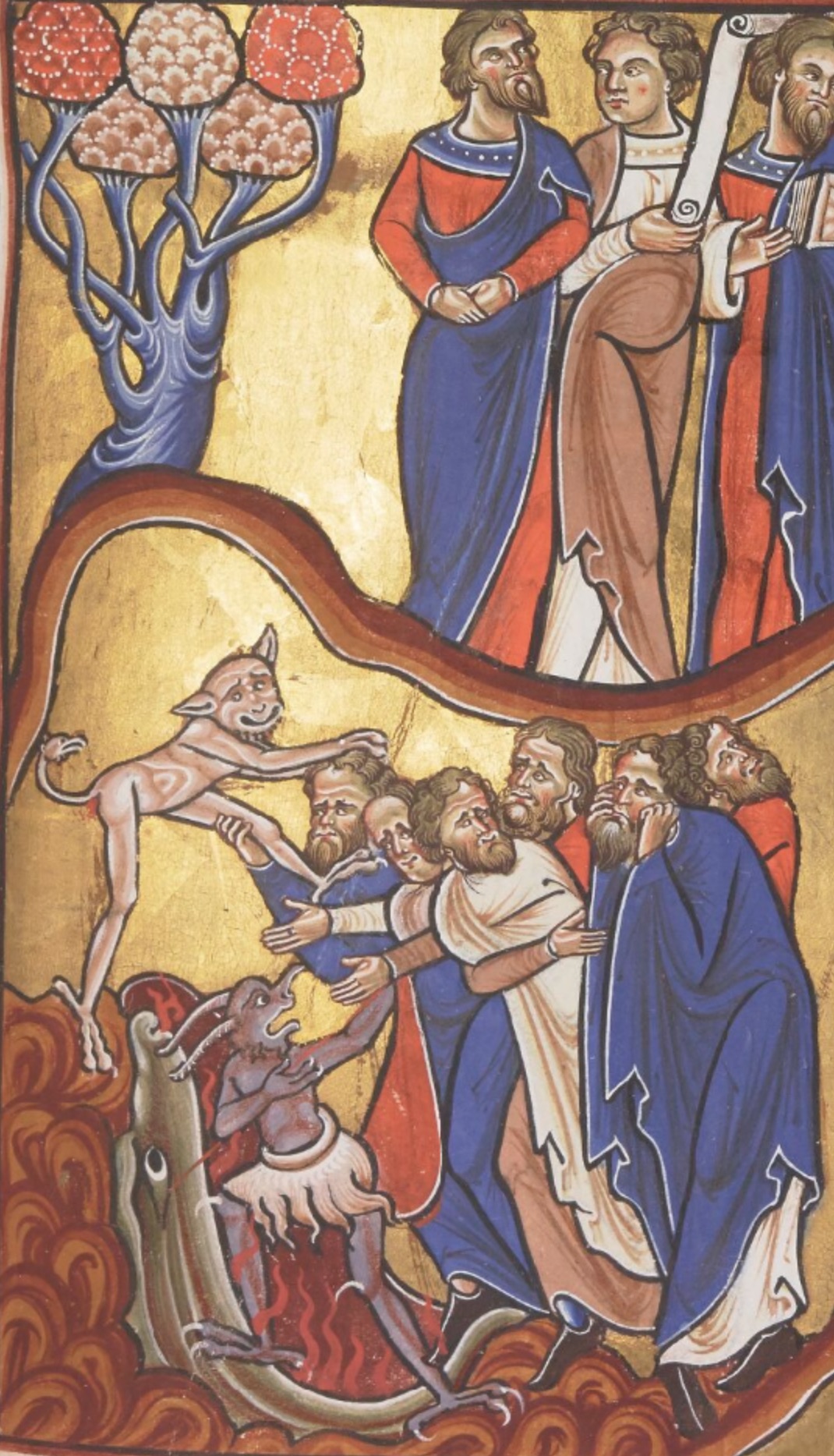
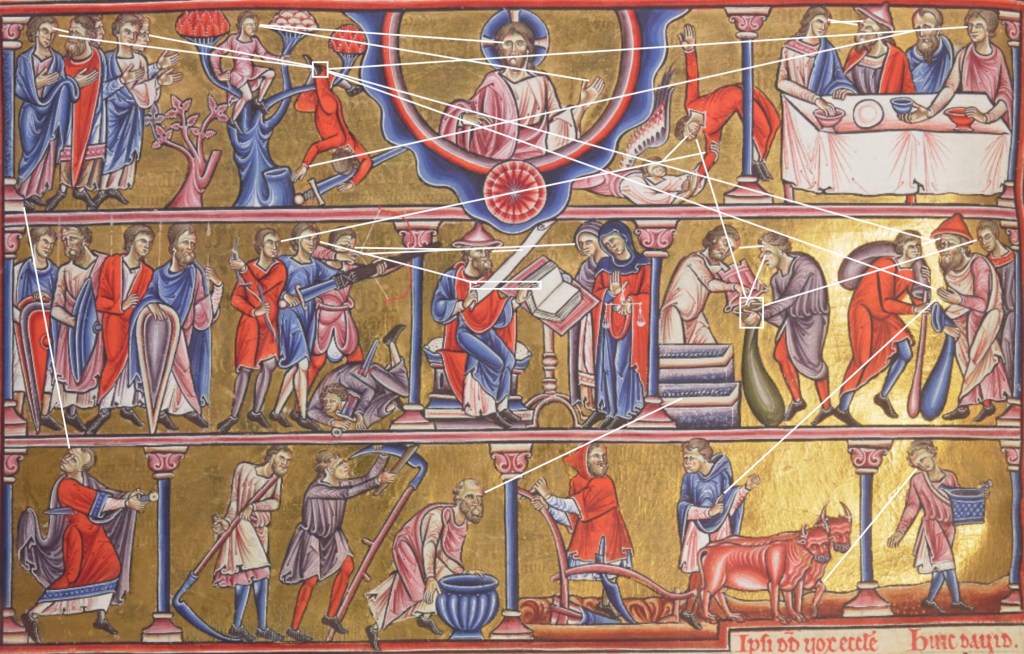
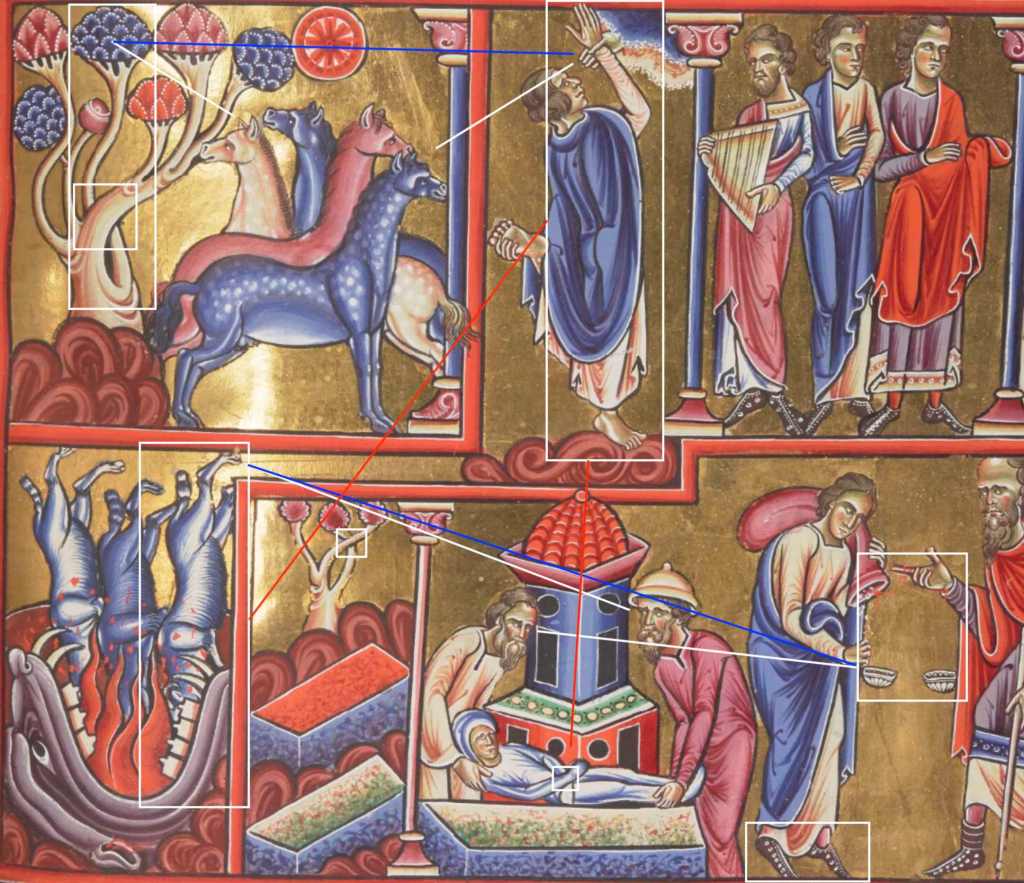
The hanging red guy is indicated as stable self-control in the Psilocybin peak window.
Classroom in f134 row 1 left: passing student on left, is indicated as stable and transformed from (relying too much on) possibilism to eternalism (as a new established capability and compatibility, the helpless thought-receiver.
Control that is {stable} is indicated by the leftmost student in many ways:
Standing on right foot.
Displaying right hand.
Unfurrowed brow.
John Rush’s {celestial erection}.
(Black-line) {mushroom hem} near ground.
Weight on right foot.
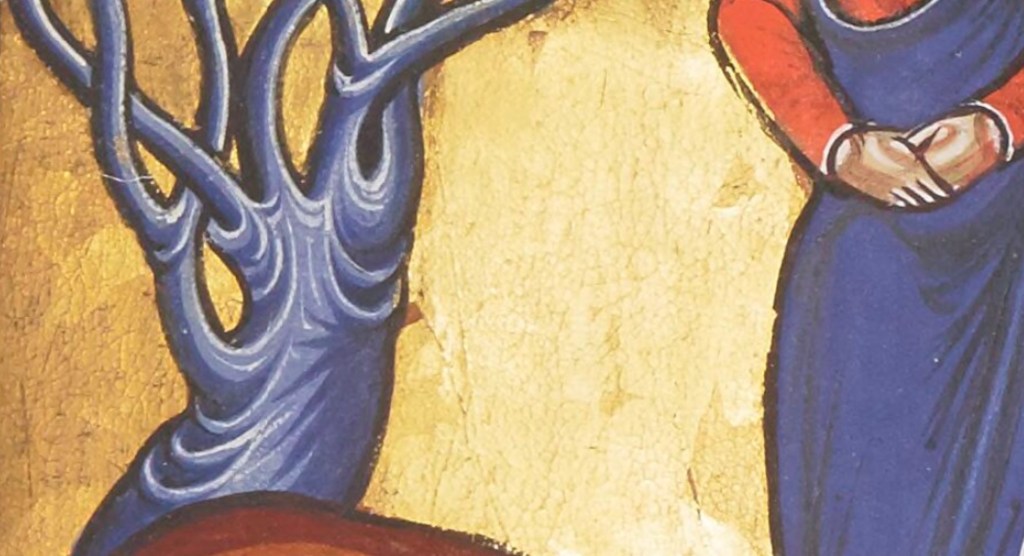
Weight on right foot touching {stable column base}.
Strongly passing student.
Student is able to explain the relative handedness of the hanging guy decently well
Student can explain how red guy is indicated as stable self-control in the Psilocybin peak window.
The basic elementary concept:
{weight on left foot} = naive possibilism-thinking (bad, unstable) {weight on right foot} = eternalism-thinking (good; stable)
Put Weight on Right foot non-branching control to avoid loss of control on Psilocybin
Crop by Cybermonk. f145 row 1 L
Stable balance control requires standing on right foot (ie, repudiating branching possibility control steering, abandon relying on autonomous control as foundation.
You guys are standing with weight on left foot — on Psilocybin, that’s unstable, causes loss of control, control instability, experiencing the threat of loss of effective control of your control-thinking.
experiencing the threat of loss of control
In its destined drive to unfold and transform, the mind is made to trip up its own control system, to perceive the hole, thorn in the side, wound in the side where blade touches.
The control-vulnerability opening in the side, through which to transform and die to the temporary child immature form, and switch to the adult mature final form non-temporary, imperishable.
Use childish thinking 100% of the time, but now, qualified possibilism-thinking not naive possibilism-thinking – includes eternalism-thinking.
On a daily basis, use qualified possibilism-thinking.
Even during the peak state*, employ (transcendently, at arrm’s length observing it) childish egoic control, the egoic control system.
*very, very, very high, enabling the capability of maximum freakout.
The cure to be cleansed: sacrifice the childish temporary thinking as if possibility branching is real and along with autonomous control steering in a branching world.
literalist ordinary-state possibilism with autonomous control
The Control Seizure potential through which maturation transformation: the passageway gateway gate of death and sacrifice and birth through the side.
{weight on right foot} = eternalism-thinking (good; stable) {weight on right foot} = non-branching control thinking (good; stable) {weight on right foot} = heimarmene-thinking (good; stable)
{weight on left foot} = naive possibilism-thinking (bad, unstable)
{left limb} of tree or person = branching possibility steering
= temporary child state perishable, transient, provisional, vulnerable to collapse when illuminated made perceptible during loose cognitive association binding,
The peak window of the mystic altered state that’s designed to transform from child immature mental worldmodel to adult, mature,, final form, imperishable, non-transient, eternal life, live forever.
Stable practical steady control, while very very very high loose cognitive association binding , loose mental functioning binding
maximum freakout capability: mellow how?
Solution: Repudiate branching control, to avoid losss of control (control instability); affirm non-branching (and image f177: 2-level dependent control.
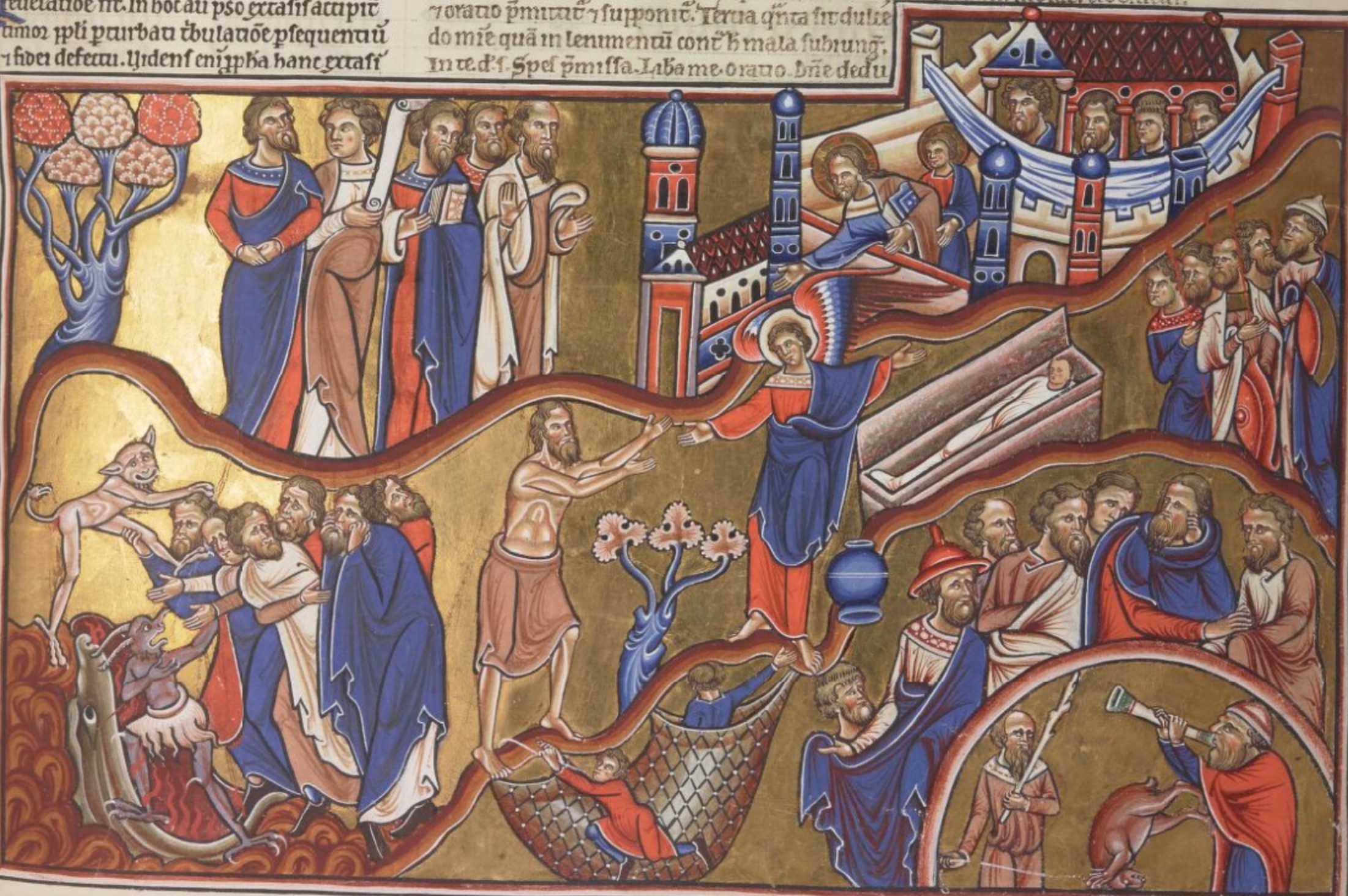
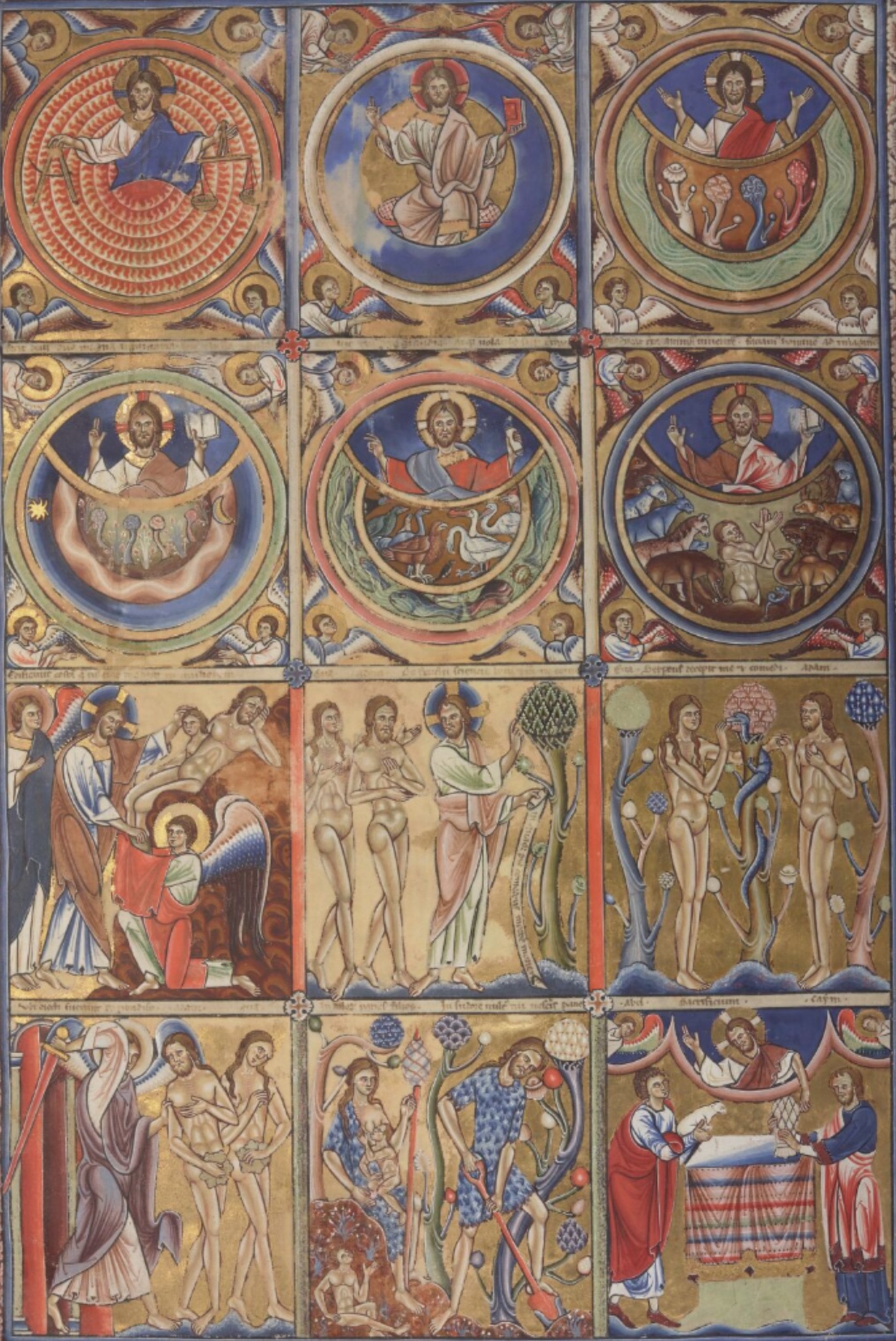
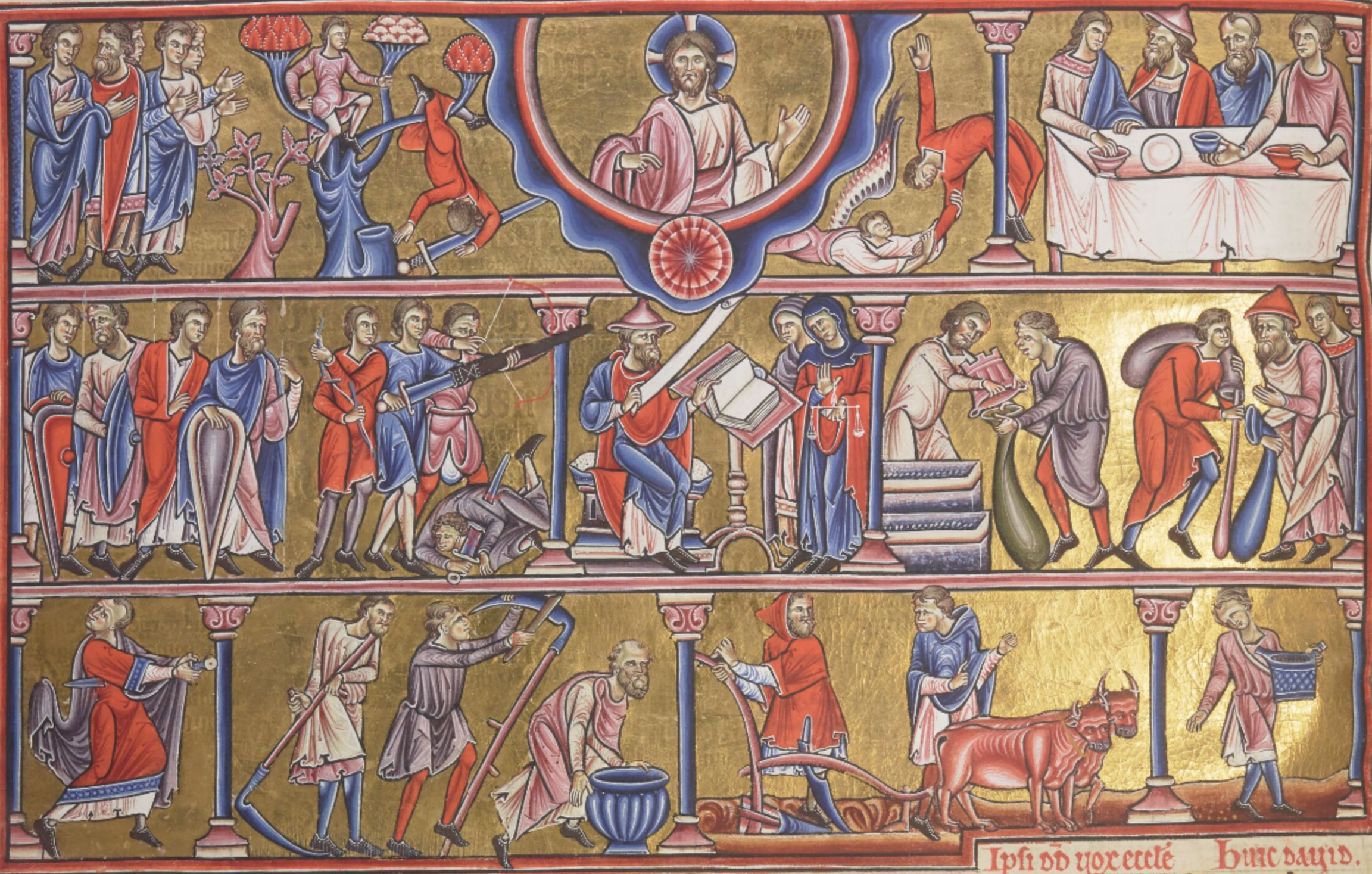
Entheogen scholars either show a single day in isolation, or show entire image f11 or even entire page f11 of Great Canterbury Psalter. Big mistake! Each zoom level / crop scope is crucial, in this case, row 1’s Day 1 + row 2’s Day 4; Day 4 proves that Day 1 = mushrooms.
Motivation for Page: Jackpot Assessment is “huge”, “top 3 discoveries in Great Canterbury Psalter” yet “I have no proper page/article dedicated to focusing on the “Six Days of Creation” image”
Inferior entheogen scholarship argues whether Day 1 = amanita. It’s fire, vaguely Amanita imagery; NO ONE TALKS ABOUT the balance scale, except Huggins 2024 does.
Even more, no one talks about what’s IN the pans of the balance scale.
I am the first one to think big enough to even ASK or CONSIDER or point out that there is something in the pans.
I am the first to point out that there is something in the pans of the balance scale.
I am the first to state that the pans contain mushrooms. (6-12 months ago? a routine question to check at this site.)
I am the first to prove pans contain mushrooms.
Date When I First Pointed Out There’s Something in the Balance Scale Pans
tbd. Probably same as next section; the moment I noticed the pans contain brown things, I immediately said “probably mushrooms”.
Date When I First Asserted There’s Mushrooms in the Balance Scale Pans: June 7, 2023
tbd. task: check timestamps at this site. Find first mention the pans contain “cubensis” or “golden teacher”, b/c I think that’s how I first announced the proposal.
Date When I Proved There’s Mushrooms in the Balance Scale Pans: Midnight Start of Monday Jan. 13, 2025 (1 year 7 months later)
Feb 2023: “blue container in f134 row 3 middle contains Cubensis.”
March (?) 2023: (I posted the exact dates, for this huge breakthrough): “OMFG I CANNOT BELIEVE IT THE DISPENSARY BINS HAVE MUSHROOMS AND PROVE BLUE CONTAINER CONTAINS CUBENSIS!”
Sunday, Jan. 12, 2025 a few days ago, during the day I continued believing per past few months that “I KNOW EADWINE MEANS MUSHROOMS IN PAN OF BALANCE SCALE THAT EVERYONE LOOKS AT WITHOUT SEEING, BUT TOO BAD IT’S IMPOSSIBLE TO PROVE.”
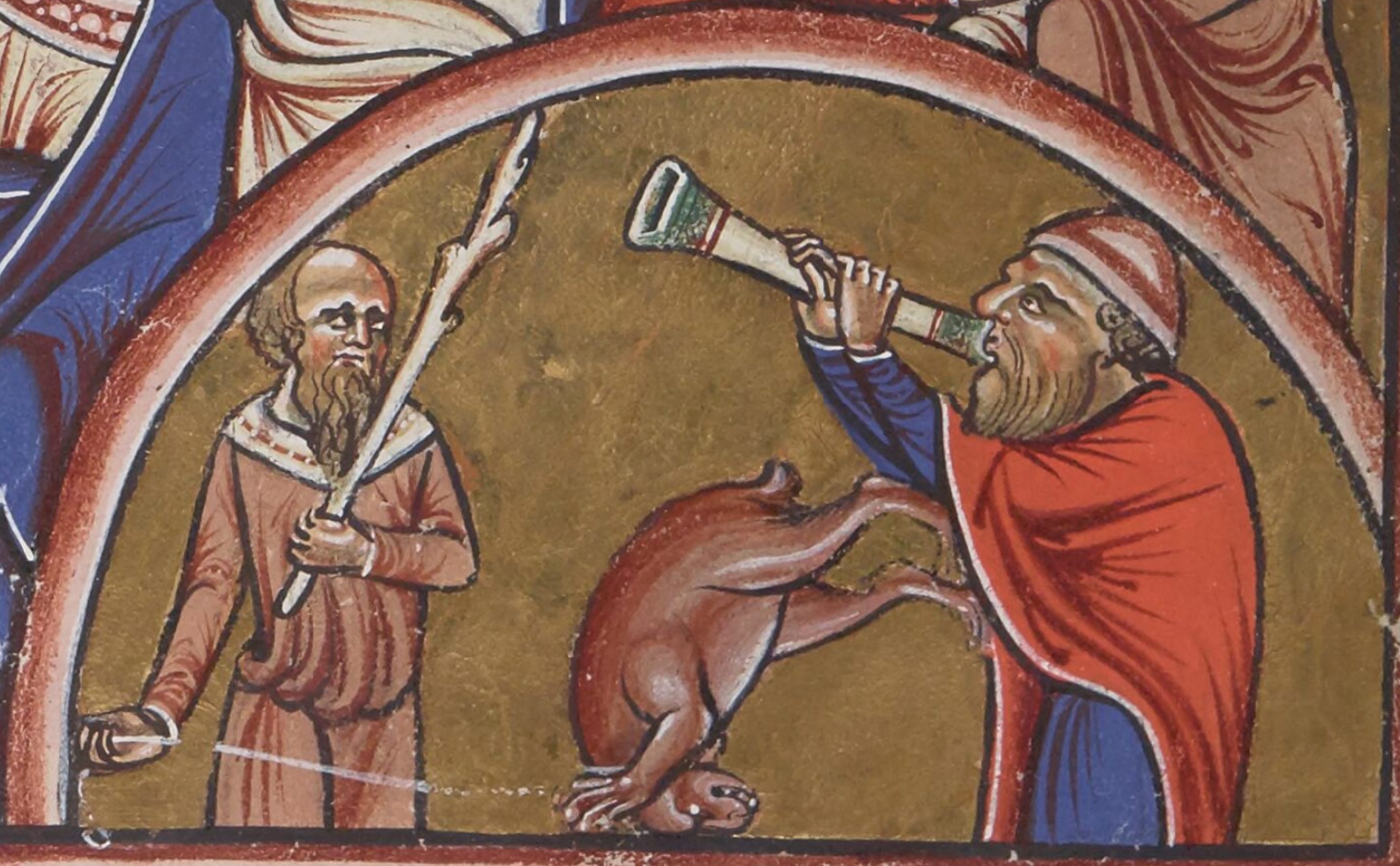
At around 11:57 pm into ~12:03 am, I was again made a fool, by Eadwine delivering DIRECT evidence to prove what I already knew INDIRECTLY from my expertise in Great Canterbury Psalter: Panaeolus specimen below balance scale points at its pan, red Amanita points at other pan.
Recent Very Recent Creation of 12 Crops of f11, Studied Each Isolated Panel
The fact that my outline is now bloated around image f11 in my “Commentary about All Eadwine images” page, shows the need for a page dedicated to f11 – or even, like this page, foc’d on HALF the entire image! Just the top half. The botom 6 panels show: interesting GATE of Eden with RED SWORD, spinning, “do not eat”, “eat tree know”,
An Extremely Popular Folio Page for Entheogen scholarship Since Paul Lindgren 2000 – But, Their Fragmented Treatment Is Blind
Motivation: My jackpot assessment of a huge discovery always takes days to assess how big the payoff jackpot.
Jan 17, after the Jan 13 breakthrough, 4 days later, I am STILL processing how huge this jackpot breakthough.
I am still, after end of day Midnight Breakthrough, the Midnight Revelation Delivery of Proof of Balance Scale containing “Cubensis”…
That was Sunday, Jan 12, 2025 end of day (eg 11:57 pm & 12:03 am Monday), that it occurred to me to conjoin my interpretation work on Day 1 and my interpretation work on Day 4 below it.
Ronald Huggins’ “Foraging Wrong” article says:
“[John] Rush tells us that “in [God’s] left hand there is a variation on the alpha and omega.”85 Those familiar with the art of the period, however, will immediately recognize that what God is holding is not an alpha and omega, but an architect’s compass, a common feature in pictorial depictions of creation.”
Sounds like Browns’ argument: “Our intensive research shows that Saint Walburga is known to hold a vial. So, doesn’t count; not mushroom.”
Rush seems reasonable and correct saying that the compass is meant to look like an Alpha, and the balance scale is meant to look like an Omega.
That assertion by Rush stands up, against Huggins.
Problem to solve: What about the bottom half of the image, that I very recently created hi-res crops for?
The other day, I created 3*4 = all 12 crops, that was a project! And look how it paid off re: 3 of 6 days in top half of image. I also found Row 4 Left valuable (red flaming sword in Gate of Eden) worthwhile, and everyone looks at 2-3 other panels too – in isolation.
I’ve inventoried the balance scale motif, I think 8 instances after you include the 1 from the Spain painter (shipping & receiving & weighing & storing & ingesting Cubensis – f221):
“The Browns’ third non-local “expert” (and I use that term very loosely here) is “Google scholar” Michael Hoffman.
“I’m not aware of anyone in the field who takes Hoffman seriously and, truth be told, his ideas are not worth wasting the word count allotted in this response.
“For now, I will say that all the supposed “mushroom trees” Hoffman advances to support the MICAH fit in with the same categories of mistake that the Browns make (see endnote 23 of this article).”
All the supposed args from Hatsis have been exposed as logical fallacies at my page, see below.
For demolition of Hatsis’ totally confabulated “parasols of victory”, see Brown at Hancock site.
____
“So that’s how the Browns derived their “evidence”: (1) preconceived bias (2) assertions from non-experts like Crantelle and Rignoux (3) exaggerating the depth of analysis by scholars who are certainly intelligent, but not critical historians, like Shultes and Hofmann and (4) reprinting once plausible but currently unsupported notions like those offered by Samorini. “
“2222Michael Hoffman, mentioned earlier, falls for this one quite a lot.”
I HAVE BEEN CRUSHED BY HATSIS’ PARASOL OF VICTORY 😵
“We also have the parasol of victory in writing: the Latin word for a “large umbrella” is “umbraculum.”
“Incidentally, there is no Latin word for “large mushroom.”
“In fact, there is no known word for “large mushroom” in any language of the ancient or medieval worlds—yet they all had a term for “parasol of victory.”
“And the parasol revelation doesn’t just topple the Plaincourault fresco—most every canopy-topped looking tree will suffer this fate.22
“And yet, it is only one category of mistake that the Browns make.
“There are, in total, five categories of mistake that every piece the Browns offer fits into neatly.23“
Five? See my page on the top 25 log falls of deniers of mushrooms in Christian art:
Deniers’ Logical Fallacies in the Pilzbaum (Mushroom-Trees) Debate
All Data Is theory-laden; “Evidence” Consists of Theory + Interpretation + Reasoning + Data + Evidence; Paradigm for Conceptualizing “Evidence + Argumentation”
Bennett, deleter of 12 of 13 plants in Rev 22:2 during his “inspiration”, by rewriting the Bible from “twelve manner of fruits/crops” to “twelve uses of hemp“
There’s Too Little Evidence, It’s Too Scarce, Completely Arbitrary, No Way to Tell, No Way to Substantiate the Case for mushrooms in Christian art
Article: Robert Forte vs. Brian Muraresku (Travis Kitchens, 2025/01/02)
Grab Your Masonry Mortar Bucket and Spade: Dividing Reality into the Enterprise vs. Grassroots; the Establishment vs. the Counter-Culture; Mainstream vs. Underground Heretical “groups”
motive for page: I can’t find readily my link to Bennett 2021 negative article, and even if I find the url at this site, how will I find it again?
I’ve now read Bennett’s 2021 article a couple times, and right now I need to quote from it, where WUSS Bennett can’t handle investigative scholarship that’s any harder and more disadvantaged than easy-mode, well-evidenced Cannabis.
I treat as barely a footnote, Bennett’s article around the era of Hatsis vs Brown at Hancock site.
To make this page, used Cyberdisciple site, who wrote about the 2021 Bennett article when it became available in the /__trashed/ dump at Cannabis Culture site.
How to Convert the Bible’s Bountiful Payload Delivery from 13 Different Plants, to Hemp Only
Bennett FRAMES this as “MY single-plant fallacy is WELL EVIDENCED”, “YOUR single-plant fallacy is VERY POORLY EVIDENCED.”
For one thing, Chris, MAN UP. Act like a REAL investigator … but please do better than recent article recounting how your inspiration to write your 2001 book was:
“OMG I HAD AN INSPIRING VISION OF REV 22:2 – THE 12 DIFFERENT CROPS OF FRUITS EVERY MONTH [not to mention healing leaves] IS 12 USES OF HEMP! 🤯”
For another thing, Bennett is blinded by negative mental attitude and defeatist expectations and presuppositions.
branching-message mushroom trees or mushrooms in Christian art is NOT difficult to find evidence for.
The Hypothesis of mushrooms in Christian art is so weakly founded, all it has is mere pictorial evidence
This is as good as no evidence at all; worthless imagery – I applied Huggins’ rules in his Panofsky-based Conclusion section of his “Foraging Wrong” article, and I firmly concluded: TREE, not mushroom:
Crop by Michael Hoffman Useless, worthless evidence – could be anything, but Panofsky’s watertight argumentation via Huggins PROVES that this MUST be a tree, probably Letcher’s fig tree, as confirmed by “consluting” top Historian, “pers. comm.”
That image is useless, worthless evidence – it could be anything, but Panofsky’s watertight argumentation via Huggins PROVES that this MUST be a tree, probably Letcher’s fig tree, as confirmed by “consulting” top Historian Henrietta Leyser, “pers. comm.”
Also note Pan “at least traces ramif:” https://egodeaththeory.org/2025/01/07/panofskys-letters-to-wasson-transcribed/#Sentence-2-6 “But even that is not very probable because even the most mushroom-like specimens show some traces of ramification; if the artists had labored under the delusion that the model before him was meant to be a mushroom rather than a schematized tree he would have omitted the branches altogether.”
Oh wait, this image looks like a mushroom, no branches, therefore, DOESN’T COUNT.
If the mushroom tree lacks traces of branching, DOESN’T COUNT; fails to qualify as mushroom-tree. So, not mushroom.
If the mushroom-tree has traces of branching, DOESN’T COUNT, because it looks nothing like mushrooms, due to the branches. (Which look like mushrooms.) So, not mushroom.
Also, Letcher’s logic of reasoning:
If mushroom imagery is hidden, DOESN’T COUNT, because only mainstream, open, explicit images count. And also: they must be proved to be an unbroken, continuous, mainstream tradition. So, not mushroom.
If mushroom imagery is not hidden, DOESN’T COUNT, because entheogen scholars claim there’s secret, suppressed, hidden, cultic mushrooms, here disproved. So, not mushroom.
vs. Defeatist Crybaby Bennett “It’s TOO HARD 😭 to find evidence” 🙈
😭🙈
More than Enough Evidence to Support The Maximal Entheogen Theory of Religion
Actually we have TONS of evidence, far more than required, to conclude and reason that of course religion … the origin and inspiration for religion is Golden Teacher.
I treat benn two ways: now 3 ways, come to think of it:
My review of his book, signed, I don’t like the title. Drugs & Bible.
That book has an insane TOC in middle of book for stupid Part 2 that restarts numbering from 1. WTF CHRIS ARE YOU STONED?
I don’t have an official place to point out that his reading of Rev 22:2 is terrible, disastrous, extremely negative and unrewarding, THINK SMALL, forego big victories.
Rev 22:2 gives us tree of life with 12 different crops every month, plus leaves healing nations – after Bennett is done WASTING the 13-plant tree of life, all he gives us is merely Cannabis, nothing else. His ambition is too little: he only speculates when he’s on very well evidenced ground with text quotes…
All Data Is theory-laden; “Evidence” Consists of Theory + Interpretation + Reasoning + Data + Evidence; Paradigm for Conceptualizing “Evidence + Argumentation”
Bennett has no Theory.
The Brown Database concept has some room for Theory, but is too isolating of only mushroom imagery, with no more sense of the central importance of branching trees than ignoramus, dull-witted Art Authorities, who are so expert that they have written NOTHING about trees (per Huggins) or mushroom-trees.
The Art Authorities are expert on “related matters of art” – translation: they know something about other topics, but NOTHING about this topic. You MUST “consult” them in person, because they have written NOTHING on this topic, with a single exception, the censored – oh I meant per Huggins, the “noted” book by Brinckmann –
a recent book, 1906;
a thick book (86 pages),
packed with disproof of psychoactive mushrooms (written before art historians had the concept of psychoactive mushrooms).
We know for certain pilzbaum don’t look like mushrooms, because Artists consistently moved from Pine to Mushroom imagery, proving that there was no purpose for forcing viewers to think of mushrooms.
The prototypes made me do it!
Photo credit: Julie M. Brown. Crop by Cybermonk.
Left: Entheogen scholars finding mushroom-trees imagery by medieval artists.
Middle: Medieval artists per Panofsky.
Right: The Panofsky-confabulated mythical Prototypes.
Center: pilzbaum artist disavowing the mushroom imagery, blaming it on the Prototypes that the artist was unwillingly forced and uncomprehendingly forced to paint, per the #1 top art authority, Panofsky.
The “development process product” prototypes of trees, that artists were forced to adhere to, certainly & definitely proved to be purposeless, because Pine steadily were made to look increasingly like mushrooms.
. . . . 🔍🧐🤔🤨 And I really recommend to consult the [censored] by [censored], and I’ve attached two [censored].
“The prototypes made me do it! I disavow pilzbaum!” — the pilzbaum artists & today’s art authorities.
The Egodeath theory of psychedelic eternalism, including the mytheme theory, is up to the task of identifying the integrated combination of art motifs: {mushrooms}, {branching}, {handedness}, and {stability} motifs.
Article: “The Fungi-Pareidolia of The Psychedelic Gospels” (Bennett, Aug. 2021)
Terrible title! Impossible gibberish. Awful idea – possibly even worse than Kitchens’ random-word-generated article titles.
Bennett, deleter of 12 of 13 plants in Rev 22:2 during his “inspiration”, by rewriting the Bible from “twelve manner of fruits/crops” to “twelve uses of hemp“
Frail, timid, weakling, spoiled & privileged baby scholar Bennett wrote in his __trashed article:
“Now never mind the obvious similarity to a cannabis leaf in these images, despite the clear archeological evidence in the Holy Land for cannabis as a ritual incense in a 8th century BCE Jewish temple, or its 4th century CE use both topically and as an incense for medical purposes from Bet Shemesh Israel, I could never see myself making the sort of claims about these images, that the Brown’s do about mushrooms, solely on interpretations of medieval art, with no evidence that humanity in Europe were even aware of many of the mushroom species suggested, let alone their ingestion.”
Mushroom-trees: the art historians describe as “trees that look like mushrooms; pilzbaum; mushroom-trees” at least since 1906 describe “just for convenience in discusssion [Wasson]”.
The lack of evidence we have, proves that the pile of evidence depicted in art DOESN’T COUNT.
Spoiled, weakling scholar Bennett continues:
“I prefer things, like actual textual references, etymological research and most of all archeological evidence.
“However, there are some clear cases of Cannabi-Pareidolia* out there, notably the QAnon activist couple Alan Gordon and Anne Armstrong, who share a love for cannabis and clear as day messianic complexes, and who point to imagery of cannabis in all sorts of Catholic context, that in many ways makes even the claims of the Browns seem more reasonable.”
*Zero people find the word ‘Pareidolia‘ meaningful – bad choice; ineffective writing
Depictions of mushrooms by pilzbaum artists counts for zero. Only text counts. Only archaeology counts.
There’s Too Little Evidence, It’s Too Scarce, Completely Arbitrary, No Way to Tell, No Way to Substantiate the Case for mushrooms in Christian art
We are helpless, blocked, and without any resources, we cannot do any productive scholarly discovery and conclusions unless we have Chris’ arbitrary forms of evidence.
😭👶😩 🚫🖼🍄🌳 🙈
Article: Bennett vs. Brian Muraresku (Travis Kitchens, 2024/12/23)
Grab Your Masonry Mortar Bucket and Spade: Dividing Reality into the Enterprise vs. Grassroots; the Establishment vs. the Counter-Culture; Mainstream vs. Underground Heretical “groups”
Warmed-over “Oppressor vs. Oppressed” narrative framework.
Surprise natural accidental unexpected bestseller books by Pollan and Mura, engineered by gigantic megacorp who invested zillion $ to MAKE Pollan’s book and Mura’s book “bestseller” – fake, forced, planned, invested, engineeered.
Books by the Enterprise, for the Enterprise. Unlike Ruck Committee, that is “grassroots”.
Be extremely cautious and wary of employing the sword of division, or the brick and mortal wall-construction activity, masonry-construction activity that you do when you employ the concept of “the Enterprise vs. grassroots”, as Robert Forte employs.
Hatsis Sites
Hatsis went from decent wording to insulting Irvin by name in his revised article titles, article titles designed to insult, styled as an insult. Terrible idea, probably in most cases. Small minded.
Hatsis abandons his blog.
Abandons his Ars site.
Abandons his Witch domain.
His new Historian domain is down, and has just a portion of his published article with now a corrupted title: “Roasting the Salamander” published PDF became garbagized as “Roasting Jan Irvin” broken incomplete webpage 404.
This page is to focus my ideas and put the challenge prominently out there: for the first time, people ought to TRY to START to LOOK FOR and GIVE A SH*T about the question of Cubensis in Europe.
Mycologists, Find Cubensis in England and Europe
Prophecy: Entheogen scholarship will retract the claim per Gartz that Cubensis isn’t a European mushroom.
Gartz And Stamets Never Trouble Themselves to Bother Writing “No Cubensis in Europe”
It’s just roundabout, coming down to 4 careless words as an unthinking aside from Stamets, “Not known in Spain”.
Gartz discusses Cubensis cultivation, then says “now let’s talk about European mushrooms” – he gives no direct negative statement.
It’s a SILENT given that Cubensis is “not a European mushroom”.
Gartz and Stamets Couldn’t Care Less, Couldn’t Put any Less Effort, into Thinking About, Writing About, or Trying to Look for, Cubensis in Europe
Stamets and Gartz in their prominent books do not write an explicit sentence saying “No Cubensis in Europe pastures.”
They do not actually treat the question of whether there were Cubensis in Europe.
Everything is indirect, roundabout, implicit, just like:
Everyone knows meditation is drug-free.
Everyone knows that the traditional methods of the mystics are indeterminate but certainly definitely not drugs.
We don’t understand mystics or mystical experiencing at all, because we are too smart and mentally psychologically modern and evolved.
We know with certainty that the traditional methods of the mystics are non-drug.
Everyone knows there’s no Psilocybin use in Mexico; we’ve known this fact since 1915.
And so, given these facts and givens, the question everyone always asks is “Can Psilocybin simulate the traditional methods of the mystics?”
At least Safford — superior to Gartz and Stamets — actually directly explicitly writes about MAKING AN EFFORT TO LOOK (for Psilocybin usage in Mexico in 1915).
Gartz and Stamets make no effort to look or even think about Cubensis in Europe – it’s all just silently taken for granted.
Gartz p. 70: Cubensis vs. European Mushrooms
Page 70 of Gartz’ Magic Mushrooms book: after a discussion of Cubensis cultivation, writes “I have also succeeded at cultivating the European hallucinogenic mushroom species.”
Gartz p. 80: Cubensis Not in Hawaii
Page 80: “Even though one often hears about “Hawaiian strains” of Psilocybe cubensis, the species is not native to The Islands and should grow there only under conditions of artificial cultivation.”
Scholars’ “Ritual“, “Cultic Practices” of Projecting Their Own Bunk Anthropology Theory Overlays onto Simple, Plain Ingestion of Psychedelics
Gartz page 81: Ingesting Cubensis Is Either Recreational, or a Ritual Practice of Natural Mysticism
“Even though the extent of prosecution of drug law violators in Canada and the U.S. varies … Psilocybe cubensis is common across the South,”
“the South” apparently here means the South part of U.S.
If Cubensis is common in the South part of U.S. per Gartz 1996, this is tantamount to Cubensis being native to Europe.
The demand created by this growing market is probably being met through cultivation of Psilocybe cubensis.
“These users ingest psychotropic mushrooms as a form of recreation, or incorporate them inthe ritual practice of [BULLSH*T! STOP ADDING WORDS YOU MADE UP!] natural mysticism.
“Other users prefer mushrooms as an aid to meditation or to attain communication with the realm of the divine.”
Just like Stamets, nowhere does it ever occur to Gartz to state the false statement, “No Cube in Europe.” Like Stamets’ flimsy, careless, little 4-word treatment: “Not known in Spain.”
Gartz p. 84: re: Australia
“In 1958, Aberdeen and Jones described the geographic distribution of Psilocybe cubensis across the southeastern valleys of Queensland and New South Wales. [Australia]
“They speculated that this was the mushroom responsible for the cases of intoxication, not the Panaeolus species.
. . . . 🔍🧐🤔
“In addition, the Psilocybe species had been described as being much more common in the area.
“Under wet climate conditions, the Psilocybe species can be found growing in abundance on cattle dung, especially along the sunshine coast of Queensland, in the open valleys around Brisbane and in areas that used to be rain forests, but have now been transformed into pastures.”
“In the summer of 1969, a 4,000-hectareregion near the coast of Queensland gained notoriety because of its Psilocybe cubensis crop that grew there after the rainy season.
“Interested collectors flocked to the area in droves.
“Media reports at the time gave the impression that the mushrooms were an entirely new discovery, completely disregarding Central American traditions.”
What are you talking about? Every mycologist has known since 1915, there’s no Psilocybin use in Mesoamerica. An Aztec Narcotic (Safford 1915)
“In the wake of an above-average rainy season, the species fruited so abundantly that special transportation companies were founded for delivery of the mushrooms to Australia’s large cities.”
Gartz p. 85: We Discovered What Was in Front of Our Eyes
“those interested in mycological field research continued to study Psilocybe subaeruginosa and even discovered the species in the northern part of the country.”
I’m getting no indications that I should be skeptical about “discovering” Cubensis in England pastures – “discovering” means “stop squeezing your eyes tightly shut.”
Gartz p. 96: Cubensis Is Heavily Present in the 30th Parallel, and Totally Absent from the 31st Parallel
“Given sufficiently wet climate conditions, Psilocybe cubensis can often be found in other parts of the world growing on pastures in areas located up to 30° north as well as south of the equator.”
Paul Stamets says Cubensis grows in Southeastern U.S. That’s above the 30th parallel/ line, immediately contradicting and calling into doubt Gartz’ self-assured “30th parallel” upper limit, for which he says “often”.
Stamets says Cubensis grows ABOVE the 30th parallel, contradicting Gartz. Neither of them writes more than a couple words about this topic:
They do not find Cubensis BECAUSE THEY DO NOT WANT TO FIND CUBENSIS.
Would it kill you to put a tiny bit of EFFORT and TRY?
Where is Gartz’ writeup, like Samorini re: Lib Cap distribution research in Italy, of Gartz’ systematic intent effort to find Cube in Europe?
He made no such effort, did no such investigation, can’t be bothered to include a section in his book explaining why Cubensis is never found in Europe.
Gartz and Stamets can’t even be bothered to write a sentence explicitly saying “No Cubensis in Europe pastures.”
Cubensis Can Grow in England, as Surely as Meditation, Drumming, Dancing, and Breathing Can Cause the Same Effects as Two Bowls of Psilocybin
I assume Cubensis in 51st parallel (Canterbury England) even if not as “often”.
“Often” often means nothing, like hitting your head “can” cause Psilocybin effects – a worthless empty tin “can”.
Crop by Michael Hoffman
Cubensis Never Grows Above 30th Parallel North (Gartz), Except in the Southeast (Stamets)
Canterbury, south part of England, approx 51st parallel north: https://en.wikipedia.org/wiki/51st_parallel_north – about the same as Northern U.S. border. Does Cubensis grow South Canada pastures? A GUY RECENTLY TOLD ME OF A TRADITION OF GATHERING CUBENSIS NORTH OF U.S. OR SOUTH OF CANADA.
“Therefore, it is likely that the yellow Stropharia species from the Highlands of Kenya may actually have been Psilocybe cubensis mushrooms or at least a close relative of this species.
“In January 1994, M. Smith and myself were collaborating in South Africa, where we discovered a bluing Psilocybe species in Natal Province.
“It was the first psychotropic Psilocybe species ever found in the area.”
Everyone Knows There’s No Cubensis in Europe
Everyone knows there’s no Psilocybin use in Mexico.
Everyone knows there’s no Liberty Caps in European antiquity.
Everyone knows there’s no mushroom imagery in Christian art.
Carl Jung first commits to his forced overlay interpretation and then presents myth through that filter.
I first commit to psychedelic eternalism, assuming it to be the case, and then commit and force the data to match the theory – give it a good full college try.
Only AFTER a full vigorous attempt fails to pan out, only then, back off. (But not even then.)
You Gotta Want It
Put in Some Fkkin EFFORT
Act Like You give a Sh*t!
You Gotta Believe
Status quo normal state for me: Everyone says “not X”, but I say “X”; you’re all wrong.
I’m a committed anti-skeptic, a committed Believer.
I’m a believer, I ain’t no deceiver, Mountains move before my eyes, Destiny planned out, I don’t need a hand out, Speculation of the wise.
January 11 is Block Universe Determinism Loose Cognition Day
37th anniversary of the Cybernetic Theory of Ego Transcendence
Today is Jan. 11, 2025.
Jan. 11, 1988 — Block Universe Loose Cog day – 2025-1988 = 37-year anniversary of breakthrough birth day of the Egodeath theory; the Cybernetic Theory of Ego Transcendence.
Visionary/Supernatural Book by Graham Hancock, Asserting Psilocybin in Ancient Europe, Against Committed Skeptic Bahn
I recently (like Dec. 31, 2024) wrote about pages 187-192 in Visionary (a superset of the book Supernatural) by Graham Hancock. Page: Idea Development 22. Sections:
Gartz Book: Magic Mushrooms Around the World: A scientific Journey Across Cultures and Time: The Case for Challenging Research and Value Systems (1996)
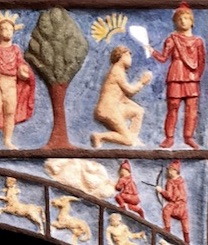
“bronze door … bas-relief … depicting God, Adam, Eve, and the forbidden fruit — a taxonomic facsimile ofPsilocybe semilanceata, the Liberty Cap or Witches’ Hat Mushroom“
What Stamets Actually Wrote, in Psilocybin Mushrooms of the World (1996)
“bronze door … bas-relief … depicting God, Adam, Eve, and the forbidden fruit — a taxonomic facsimile ofPsilocybe semilanceata, the Liberty Cap or Witches’ Hat Mushroom“
p. 15, caption of photo of the Blame panel of Bernward Door:
“From the bronze door of a cathedral in Hildesheim, Germany, a bas-relief (circa A.D. 1020) depicting God, Adam, Eve, and the forbidden fruit — a taxonomic facsimile of Psilocybe semilanceata, the Liberty Cap or Witches’ Hat Mushroom.”
Stamets wrote “the forbidden fruit”; the word ‘forbidden’ is normal Christian language.
Stamets has no hint of the image being forbidden or secret. Heinrich says the fruit of the tree gives visions but Bernward depicted the entire tree as mushroom (with branches and cut branches).
Bernward throws off Heinrich’s arg that tree of knowledge is specifically Amanita.
What Gartz Actually Wrote, in Magic Mushrooms around the World (1996)
“Bronze doors with mushroom motif entitled “Trial and Judgment””
Chapter 1: p. 9: photo of Blame panel of Bernward Door. Caption:
“Figure 6 – Bronze doors with mushroom motif entitled “Trial and Judgment” at Hildesheim Cathedral, Germany (ca. 1020).”
That is the ONLY thing Gartz writes about the topic of mushrooms in Christian art in this book.
Gartz only uses the concept of “secret, hidden” to describe LBMs little brown mushrooms hiding in grass – he never applies that concept to “mushrooms were secret & hidden suppressed in art”.
Gartz Says “Amanita = Europe; Psilocybin = Not Europe” Is a Myth Due to Forgotten Knowledge
The next page:
Chapter 2, paragraph 1:
“It is remarkable that cultures native to the American continent knew about a relatively large number of natural mind-altering substances compared to early cultures that evolved in Europe or Asia.
Botanical evidence does not support the notion that Europe is home to fewer hallucinogenic plants than other regions.
Furthermore, the growing number of recently discovered European mushroom species containing psilocybin indicate a flourishing psychotropic mycoflora in Europe similar to those found in other countries.”
Chapter 2, paragraph 2:
“It is unlikely that early European cultures learned less about local plants and mushrooms through usage and experience than cultures elsewhere in the world.
Most likely, early cultural knowledge of European psychoactive plants and mushrooms was lost or destroyed at some time in history, probably as early as several hundred years ago [eg 1687 AD].’
1996-300 = 1696 AD. 1696-1687= only 9 years off from first publication of Principia.
I use Newton’s Philosophiæ Naturalis Principia Mathematica, first published in 1687, as a reference point for when Hane’s rejected knowledge of esotericism including mushrooms.
Chapter 2, paragraph 3:
“The discovery that the fly agaric mushroom (Amanita muscaria) was known for its psychoactive properties in Siberia invited the conclusion that this mushroom was used as a psychotropic agent in medieval Europe as well.
In fact, there is very little evidence from the Middle Ages to indicate widespread knowledge of the effects of specific mushrooms on human consciousness.
However, I believe that past reports on psychoactive mushrooms were causally linked to Amanita muscaria simply because this was the only known psychotropic mushroom in Europe at that time.”
Chapter 2, paragraph 4:
“While the usage of Amanita muscaria among Siberian tribes has generated reports of spectacular hallucinations, European accounts of fly agaric intoxications do not generally include descriptions of such intensely hallucinatory effects.”
Chapter 2, paragraph 5:
“Accordingly, the potent hallucinogenic effects of specific Psilocybes and related species are likely to have had a much more significant influence on early European cultures than the delirium-like visions induced by Amanita muscaria, a species that is also known to induce unconsciousness and severe somatic side effects.
This hypothesis is corroborated by data from comprehensive field studies conducted in Mexico.
I believe that historic accounts including those described below – indicate a knowledge of and familiarity with psychotropic mushrooms in Europe that is most likely derived from usage of Psilocybes and related species, rather than experience with Amanita muscaria.
However, it is extremely difficult to reject or confirm this hypothesis, due to the lack of conclusive data available for analysis today [1996, the year Samorini gave presentation in the San Francisco conference].”
Which writers actually suggested the “secret” narrative? Allegro, Ruck, & Pop Cult writers?
Robert Graves 1952[?] makes “secret” fundamental to his theory / narrative. Emphasizes “secret, suppressed”.
Wasson 1952[?]-1968 makes “secret” fundamental to his theory / narrative. Emphasizes “secret, suppressed”.
Allegro 1970 makes “secret” fundamental to his theory / narrative. Emphasizes “secret, suppressed”.
Ruck ~1976+ makes “secret” fundamental to his theory / narrative. Emphasizes “secret, suppressed”.
Passages Recounting History of the Hypothesis of “Secret, Suppressed” Mushrooms
Letcher’s book Shroom traces the history of the idea (d/k if coherently) of spread of secret Amanita.
Letcher falsely — when discussing a Psilocybin implementation of Heinrich’s Genesis 2-3 tree of knowledge pictured by Bernwarn — extremely conflates “secret” and “mushrooms”, and acts as if to disprove “secret” is the same thing as disproving mushrooms.
Letcher reasons fallaciously: “I disproved your guyses’ assertion of “secret mushrooms”, therefore I disproved mushrooms.”
The Shared Narrative of “Original Glorious Amanita, Later Forced to Substitute Mere Psilocybin”
Books that I surveyed in 2023 for passages about Wasson’s failed hypothesis (& wet-dream wishful fantasy) that Amanita effects = Psilocybin effects such that a useful, sound analytical category is ‘mushrooms’ (“sacred mushrooms”; “psychoactive mushrooms”, etc.), defined as [Amanita + Psilocybin]:
Heinrich 1995 Strange Fruit – “the” mushroom = Amanita, unfortunately had to substitute mere Psilo instead. Storyline per Heinrich.
McKenna, Food of the Gods
Wasson – Persephone’s Quest might mention the tale, “Original awesome Amanita, alas substituted for inferior Psilocybin later.”
Thomas Reidlinger book The Sacred Mushroom Seeker — a collection of articles about Wasson or by Wasson. Has something about Wasson’s negative conclusion re: his 1950s hypothesis that Amanita = Psilocybin = mushrooms.
Wasson’s book SOMA, 1968. Does it mention the tale, “Amanita was replaced by Psilocybin as a substitute?”
Does Ruck tell story of/ recount the history of the “secret” hypoth?
Ruck’s article “Daturas for the Virgin” 2001 argues that a good substitute for Amanita (the real deal original glorious thing) is Datura (not Psilocybin)!
Ruck is right in a bad way: the merely Deliriant effect of Amanita is indeed similar to Datura scopolamine; NOT similar to Psilocybin.
The Graves/Wasson 1950s Hypothesis “Amanita = Psilocybin = mushrooms”: Wasson’s 1986 Assessment: That hypothesis has been FALSIFIED
Various authors, such as Jochen Gartz, give a negative terminus final assessment of the Graves/Wasson conjecture hypothesis from 1950s that it is effective to lump together Amanita = Psilocybin = mushrooms.
John Lash hates Wasson’s Amanita Primacy Fallacy and Wasson’s story of spread of a single Amanita cult; Lash rejects Amanita, since Psil is vastly superior.
Max Freakout’s Email
Max Freakout wrote:
“Please see Jochen Gartz’ book: ‘MAGIC MUSHROOMS around the world’, which I obtained from [Wassonian mystery ellipses], an excellent source of . . . . books.
“. . . .🔍🧐🤔 it is very easy to search for keywords, and a search for the words ‘secret’ and ‘hidden’ quickly shows that these words do not appear in anything like Letcher’s context.
“Letcher has fabricated the claim of ‘secret and hidden mushrooms’ in both Stamets and Gartz, Letcher has clearly misquoted these two writers — very unscholarly behaviour!”
– Max
Letcher’s Dismissal of Liberty Cap on Bernward Door Rests Entirely on the “Secret, Hidden” Aspect – Which Was Fabricated by Letcher Himself
Letcher’s Dismissal of Liberty Cap on Bernward Door Rests Entirely on the Rebutting the “Secret, Hidden” Aspect — Which Was Entirely Invented by Letcher, Not at All by Stamets or Gartz, as Letcher Falsely Claims.
Letcher’s dismissal rests directly and exclusively on the point of secret Liberty Cap.
Letcher in no way counters Liberty Cap depicted on Bernward Door, only “secret” Liberty Cap.
But Letcher’s “secret” component (tail wagging the dog), is entirely made up by himself, as his strawman that he fabricates and then defeats.
Nowhere does Stamets or Gartz say secret, hidden, cult, oppressed. That’s the only foe that Letcher defeats, not the Liberty Cap identification: He argues:
The Liberty Cap is not secret, therefore, the affirmers of mushrooms in Christian art are disproved. eg Stamets and Gartz.
But they don’t say secret. Letcher here disproves nothing regarding the actual published position in those two books.
Secret and Hidden? That Actually Sounds like Wasson’s Ellipses. . . . 🔍🧐🤔
Wasson’s ellipses keep scholarly citations hidden and keep the lone, single, little, outdated writing by an art historian secret from mycologists:
Max Freakout completed the smoking-gun finding that Letcher’s citations are phony, by confirming in Gartz’ book that Andy Letcher in book Shroom fakely cites.
Along with fakely citing Stamets – who does not say the Liberty Cap in Bernward Door is “secret” or “hidden” or “suppressed” or “prohibited” – none of that Letcher-type narrative that Letcher falsely attributes to these two books: Gartz & Stamets.
Gartz does not have any whiff at all, of framing Bernward Door’s Liberty Cap as “secret” or “hidden”.
Various writers suggest [Letcher’s made-up storyline fabricated by himself].
This is posing as scholarly apparatus, but is sheer put-on, the affectation of scholarly citation.
Stamets and Gartz say NONE of that slathered-on narrative storytelling, it’s purely Letcher is the only one writing anything like that – not Stamets, not Gartz.
This fake citation is purely for show. It’s not a real citation.
As soon as you hit the endnotes (endnotes SUCK, footnotes rock – there’s a special hell for endnote writers) you see something drastically wrong: no page numbers.
Full-text search both books for “secret hidden”: worse than 0 hits: the instances of ‘secret’ or ‘hidden’ in these books have nothing at all to do with this topic.
The entire ‘secret hidden’ narrative is fabricated by Letcher and falsely attributed to Stamets and Gartz through Letcher’s fake & vague citation.
Stamets & Gartz have no mental connection between ‘secret’/’hidden’ and Bernward Door’s Liberty Cap mushroom-tree.
Endnotes make it hard to use and easy to hide fake citations.
No page numbers, wtf kind of “endnotes” are these? the make-sht-up type of endnote misuse.
Shroom Page 35: Bunk Endnote 31 at end: “Various writers have suggested cult, secretly, oppression, hidden, secret cult, surreptitiously slipped in; for example, Stamets & Gartz”
photo caption: “In fact,” Letcher is making sh*t up about what Stamets and Gartz assert, and arguing from authority instead of scholarly citation.
“In fact,” Letcher is making sh*t up about what Stamets and Gartz assert, and arguing from authority instead of scholarly citation.
Shroom Page 36
Straw Man, False Attribution of “this interpretation” (that Letcher himself concocted) to Stamets and Gartz, whose books say absolutely nothing of “secret”; they simply present the door panel.
Of the 3 writers — Stamets, Garts, and Letcher — the ONLY ONE of them who is saying “cult, secretly, oppression, hidden, secret cult, surreptitiously slipped in” is Letcher.
Shroom Page 305
Shroom Page 331
Shroom Page 344
Shroom Page 336
Fake & Vague Citations
Letcher is caught making up fake citations to give the appearance of sound scholarship, but entirely vague and bluffing citations: he co-cites both Gartz and Stamets, giving page numbers for neither book, to cover his tracks.
I already found that Stamets’ book fake-cited by Letcher doesn’t say what Letcher claims it says.
Letcher’s citations in this Door passage are phony, bunk, fake, pretend-academic, pretending to be citations.
Letcher gives no page number in Gartz, no page number in Stamets.
Letcher specifically claims that Gartz and Stamets claim that the Liberty Cap in Bernward Door is secret and hidden.
Stamets has not even a faint trace of that framing, same with Gartz.
Email 1: Where Is Letcher Getting “Secret Hidden” Liberty Cap from, at “Various writers suggest cult, secretly, oppression, hidden, secret cult, surreptitiously slipped in31“?
Cyberdisciple site ambig whether you have Letcher book.
Letcher sites cites two works re Bern Door: Stamets 1996, which shows Stamets’ photo of door with no hint at all of “secret” or “hidden”.
Andy Letcher even contacted Stamets to get permission to publish his photo of Bernward Door in Letcher’s book Shoom – yet that book vaguely falsely asserts that Stamets frames it as hidden secret.
Letcher must be getting “secret hidden” door from prominent German mycologist Jochen Gartz.
Gartz is misspelled in Ruck’s book Apples of Apollo as “Goertz”. 1996
Letcher Shroom pp 35-36: Bernward Door awful mis-treatment.
Letcher p 35: endnote 31 p 305 = “Gartz 1996; Stamets 1996 [p. is 15]” =
Biblio p 331 = Jochen Gartz 1996 Magic Mushrooms around the World: A Scientific Journey Across Cultures and Time.
biblio p 344 Stamets Psil Msh World.
No page numbers given, re this massively botched interp! it figures.
I lack Gartz, race u to purchase the $300 copy. Which page does Gartz say Bern Door “hidden, secret”?
Letcher is silent on Bernward Column, though “Conj Eden” 2001 details around 5 Liberty Cap instances there! which amplifies Door.
Letcher p 36: endnote 32 p 305 “Lasco 1972”: bib p 336 =
Peter Lasco, Ars Sacra 800-1200
Letcher p 36 endnote 33 = p 305 “Henrietta Leyser , pers. comm.” = no Biblio listing for historian Leyser! Her work is so feebly relevant, all Letcher says about her work is “pers. comm.”
Max Freakout completed my investigation into whether Letcher’s citation is entirely false, not just half of it known to be false (Stamets) and the other half unverified whether false (Gartz).
It’s now determined that both citations are false; the cited books say nothing of the sort, that Letcher falsely asserts that they are examples of saying anything like “cult, secretly, oppression, hidden, secret cult, surreptitiously slipped in”.
If anyone asserts that position and framing, it’s not the Stamets and Gartz books cited as endnote 31, which gives no page numbers.
The citation is a put-on, a shallow veneer of affectation just for show, not a real citation. It’s a pose, a stance, pretended scholarship.
Book History
I was one of the first in the U.S. to order, read, and review the book Shroom by Letcher.
As I understand the timeline, the book was probably finished 2005, published UK 2006, US early 2007, I may have pre-ordered from Amazon U.K.
The book is good in some ways, bad in some ways – like books generally are.
I never expected him to have all the required library publications for the specialize topic of mushrooms in Christian art.
Letcher does a somewhat careless drive-by sloppy inadequate handling of the topic.
It’s hard to say that about Huggins 2024, an experienced scholar, who also does a careless, inadequate, drive-by dismissal – even though I appreciate the amount of standard-type scholarship done by Letcher Hatsis Huggins – it’s not good enough.
My early review of Shroom was read by people and they challenged Letcher, asking him about the Michael Hoffman review, then Letcher wrote in effect a challenge to me specifically in a comment in his webpage, a 4-part argument, claiming no religious mushroom use can be proved.
I proved PEAK religious experiencing, beating Letcher on 5 of his 4 points, taking his challenge even further, to the max.
The idea of “hidden” and “secret” re: door does not at all come from Gartz and Stamets as Letcher specifically claims.
I provided 6 pages from Letcher with my complete analysis and markup. Checking my remaining space for images:
35% of 6 GB space used, for Images at this Site: Too Many Mushrooms
I now have more space, since Brown said this site is the closest to his continued call (2016, 2019, 2021) for a database of mushrooms in Christian art for scholars to interpret in an orderly way.
The Brown db would be a place for me to register my Dec. 13, 2020 id’n of Day 3 of Great Canterbury Psalter: Pan, Lib, Cub, Ama (Day 4 image swaps the order slightly).
A place to register my correction of Walburga tapestry: Irvin says Amanita, Brown says Vial, I say vial shaped like Amanita.
Citations Are to Check Claims of Scholars
Houot’s Master’s thesis tipped me off: I was aware of Griffiths article saying like 35% of people had bad trip from high-dose synth Psil. Houot wrote “almost 40%”, so I found a different Griffiths paper saying 39%. How did 39% in one paper, magically decrease to like 35% in a subseq. paper??
I checked Houot’s citation and it was genuine and helpful, not only revealed the jarringly high incidence of bad trips from real dosage amounts, but also revealed playing Math games by Griffiths, trying to “game downwards” the observed … which Griffiths fails to explain how one year they report 39%, and another year like 30% I think it was. I wrote this up at this site around 2023, maybe Dec. 2023, when reading Houot thesis.
So, Doesn’t Count 🚫🍄🌳
These are emails with 6 photos of Shroom book and its fake bunk pseudo-citations of Gartz and Stamets, and the irrelevant ignoramous blundering Medieval England historian personally interrrogated by Letcher, “personal communication” endnoted by Letcher, “its a fig tree” –
Said so crisply by the authority, we know it is for sure true, that the Liberty Cap on the door
And we may be equally confident this applies to the 4 Liberty Cap trees on the Column as well, they are all fig trees, so stop saying that the Art Historians describe them with their own term, pilzbaum, mushroom-trees.
Art Historians only use the term ‘pilzbaum’ for convenience in conversation, explains Panofsky, SO, DOESN’T COUNT.
To be a competent pilzbaum denier, just:
[fill in this blank with anything, doesn’t matter], SO DOESN’T COUNT.
See endnote whatever, with no page number, so you know I’m right; and to seal the certainty, the local authority responded CRISPLY and within 0.35 seconds, therefore our conclusion is grounded reliably on the top scholarship by scholars who never read, thought, or wrote anything about trees in Christian art, because everyone knows trees are just peripheral.
So you mycologists are just ignorant for not consulting these tree art experts.
Day 4 of Creation: Liberty Cap, Cubensis, Panaeolus, Amanita
Crop by Crop by Michael Hoffman. Identified by me some time ago as Lib, Cub, Pan, Ama.
Jan. 17, 2025: History of discovery: the above image & following section was written just 2 days before looking at Day 1 & Day 4 at the same time, which proved that the balance scale’s brown items are specifically indicated as Panaeolus, & broadly indicated as Lib, Cub, Pan, & Ama.
That discovering was a shock, entirely unexpected, b/c I had simply assumed it’s impossible to identify; wrongly & pessimistically in self-defeating form, assumed Eadwine gives no evidence.
My shattered defeatism there was exactly same pattern as Feb 2023 I said blue big bowl contains Cubensis, assuming impossible to prove – then received totally unexpected proof.
Analyzing Day 4’s Four Plants
In Day 4, I identified the large four plants some time ago as Lib, Cub, Pan, Ama.
Liberty Cap; Cubensis; Panaeolus; Amanita. Day 4 of Creation, Great Canterbury Psalter. No branches.
Panofsky speaks falsely: All pilzbaum have at least traces of branching. Here’s four that don’t, unless the grid of liberty caps in the Liberty cap (plant 1) & Cubensis cap (plant 2) are treated as relatively branching.
But even that fails to be Erwin Panofsky’s “at least traces of branching”. Given that inches away is these same 4 images, with branches (that look like mushrooms), it’s not feasible to dismiss these as “not pilzbaum”; “not mushroom-trees”.
Crops of the 6 Days of Creation, Great Canterbury Psalter
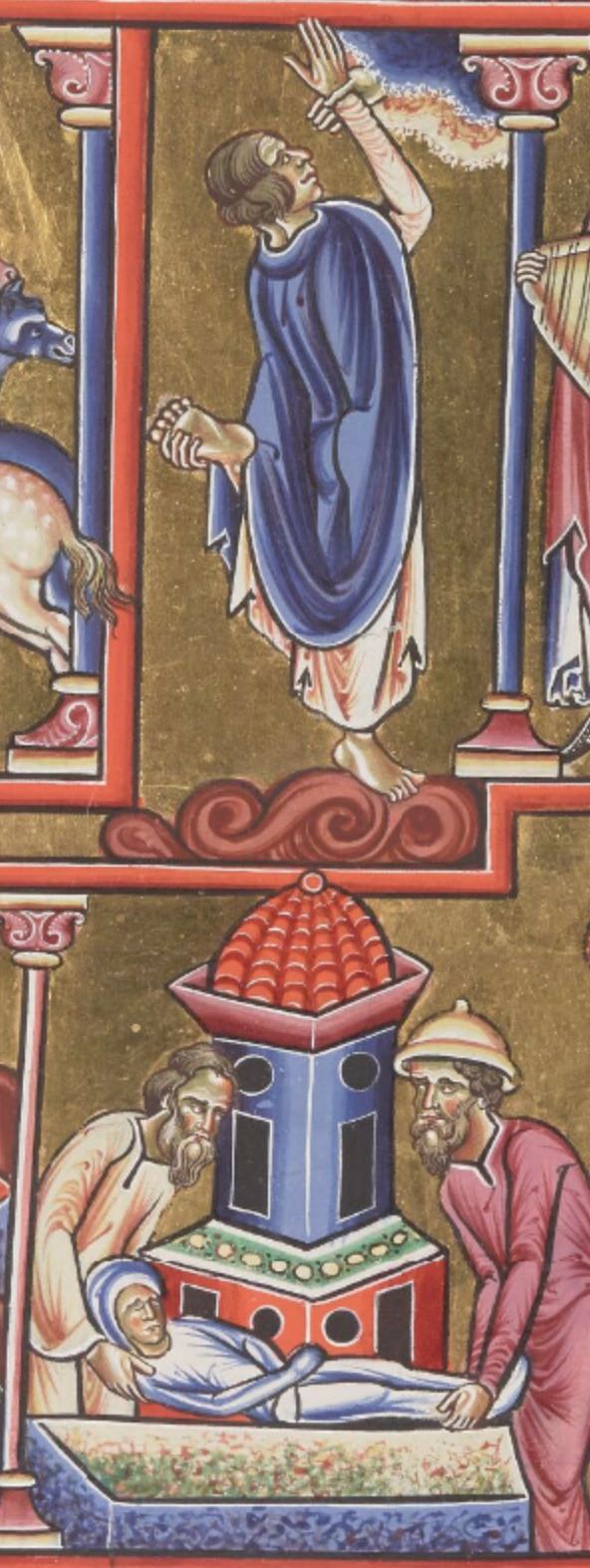
Day 1 of Creation: God Weighs a Double Dose of Golden Teacher
Crop by Michael Hoffman
I pasted the above picture Jan 11 2025, just two days before the Jan 13 2025 discovery that the Panaeolus on Day 4 panel below Day 1 panel points to the left pan of balance scale, and the other 3 mushrooms point symmetrically to the branching compass ʌ & right pan of balance scale.
Day 1 Creation of Light Scale Balance Bowls Contain Mushrooms
Crop and Annotations by Michael Hoffman [1:15 am Jan. 13, 2025] Y Y I I Lib, Cub, Pan, Ama
ƛ [lambda] ʌ [“latin small letter turned V”]
Ronald Huggins in Foraging Wrong ridicules Day 1 of Creation, above, as Amanita cap.
The Day 1 of Creation (Light) image in Great Canterbury Psalter depicts Cubensis in the scale balance.
This is signalled to us as Cubensis being weighed/dosed, by considering the entire systematic motif vocabulary that Eadwine takes from the genre and develops to a breathtaking extent.
By doing the opposite of Letcher’s predictable “isolate, ignore, dismiss” strategy.
My greater interest right now is inventory of all John Lash-like White Light Psilocybin Peak Sun images.
The Sun Light is in the chamber room of the Psalter Viewer, row 2 middle (the center of the entire image) where – most amazingly – the Psalter Viewer is threatened or not threatened, based on whether his left or right index finger is closer to the ground, meaning which mental model he relies on: branching causes threat; non-branching relieves the threat.
f82: Three Mothers, Passion, Sun, Moon, Table
Crop by Michael Hoffman
f177: On Right, Non-branching Side of Tree, Sun Touching Blue Cap/Crown
Crop by Michael Hoffman Correction Dec. 2024: The horses look up higher at fingers, not palm.
If you think about entheogens, you are using “Wasson’s theory, including considerable departures from it” — per John Lash, high on Hanegraaff’s non-drug entheogens and Ruck’s purely symbolic entheogens (a chymical discovery by Cyberdisciple).
Huggins in his title proposes Great Canterbury Psalter as a test case.
I agree to your terms of battle, because you are bound to lose by those terms.
When we consider the entire genre, all 4-6 integrated motifs, and the set of all Eadwine art, we can safely conclude that Eadwine signals Cubensis in Day 1’s balance scale.
Hellenistic art may have originated these motifs, such as mosaic of Dionysus’ victory wedding procession.
Such scholars THINK they got easy pickins… they wrongly mis-assess the situation.
They spot some sloppiness by affirmers of mushrooms in Christian art, and they assume they can self-promote in this easy topic to casually dismiss – I see John Rush claims God holds something in his hand, but clearly he does not.
Therefore the Pop flimsy view is easy to dismiss & reveal the foolishness of — such opportunist, non-specialist researchers think.
Letcher and Hatsis and Huggins all did a substantial amount of research in the history of pop entheogen scholarship.
Not good enough though. Not complete enough.
Letcher has not changed views after 2025-2006 or 2005 = 20 years.
Letcher has had 20 years to read Entheos, Conjuring Eden, Brown 2016 and 2019, Egodeath.com, and everything, but Letcher continues to act like the 1% of evidence that he treated, regarding mushrooms in Christian art, is adequate.
It continues to feel like Letcher disproved the entire topic of mushrooms in Christian art by treating ONLY the single mushroom-tree in Bernward Door, and he gave the worst possible handling of that. His argumentation is extremely poor.
I studied the passage in 2007 and again in 2024 in detail.
I see no indication that Letcher has treated the 4 Liberty Caps in Bernward Column together with the single Liberty Cap he mis-treats in Shroom.
Email 3 to Max Freakout & Cyberdisciple
I wrote:
Gar Book looks good, better than expected. Wow, not any trace of “secret” re: Bern. door!
Letcher indeed bunk, I expected Gartz must frame the door as secret, since Samo certainly doesn’t.
A bluff by Letcher, or a projection (not originating from him; originating maybe from ancients and from 1st Gen = 20th C entheogen scholars).
Like when Hatsis says “you guys assert Secret Christian Amanita Cult” – where is such assertion actually originating from? 1952 mind of Graves/Wasson?
Jochen Gartz’ book: ‘MAGIC MUSHROOMS around the world’ [mysterious wasson-like ellipses here, what’s being hidden here?
. . . . 🔍🧐🤔🤨📘🖼🖼🍄🌳📘
cough up that citation wasson we know you got it and hand over the two pilzbaum too
Please keep my poor little pictures as long as you wish. And I really recommend to look up that little book by A. E. Brinckmann.
Panofsky to Wasson, handwritten conclusion of letter 2; May 20, 1952
Replaced by Wasson with: obey the art authorities, because of how quick their disavowal, not because of what they wrote about trees. all of them were quick! that’s the argument. Not only authorities, but quick authorities, about that topic Ronald Huggins tells us they have never written anything about – trees!
With the single, “noted” [read: censored] exception of the book which Panofsky told Wasson way “BACK IN 1952” about Brinckmanns book, which is the only thing that art historians have ever written about trees in Christian art, or mushroom-trees.
That’s according to Ronald Huggins’ Foraging Wrong article. See Ronald Huggins’ Dizzy article for more of same quality of scholarship.
Trees, being peripheral to the more central features of medieval iconography, are not often discussed by art historians. A noted exception is Albert Erich Brinckmann’s Baumstilisierungen in der mittelalterlichen Malerei (1906), a work recommended by Panofsky in his letters to Wasson back in 1952.
Ronald Huggins, Foraging Wrong, 2024
Ronald Huggins lectures us as if WE have had Brinck’s citation from Panofsky since then, censored 1952-1968-2019 by Wasson.
When did you first become aware of the Brinc citation, Ronald Huggins?
How did you get the drawer number, when?
Why is Brown 2019 not mentioned, having been made available to me – I don’t know about you – in 2019.
Not ever before then did the world of scholars have Panofsky’s two letters in hand, from Brown 2019, both the existence of them announced by Brown, and the actual delivery to everyone, the publication of the two – not one – letters from Panofsky, in hand now for everyone, because of Brown 2019.
Huggins did not publish the Panofsky letters that he mysteriously cites as drawer of Harvard – as if we can make use of that – how does Ronald Huggins expect readers to follow his citation of the drawer? Closed scholarship.
1986-1952 = 34 years of hiding the citation and two pilzbaum art. while repeatedly chasticizing mycologists for not consulting the authorities.
Ronald Huggins: “Art historians have never written about trees in Christian art, because trees are incidental”
Why should anyone “consult” an “expert” who wrote nothing about this topic of trees, and double nothing about trees that look like mushrooms. This experitiese is blind and worthless, the art historian numbskulls know-nothings.
Let’s consult art historians regarding the topic which Ronald Huggins tells us is ignored by art historians that they give very least – no coverage at all of trrees, he says, mush less of mushroom-trees.
Email 2
Letcher Caught Faking Citations of Stamets and Gartz
I wrote:
Max [Freakout],
Awesome, thanks for filling this gap, to make this finding substantial & complete/confirmed.
“Apples of Apollo by Ruck Committee has “Goertz 1996”, Error?” Yes. References section, p 256.
I might update that section based on what’s in the book by Gartz.
Cyberdisciple in an article differentiates between mere editorial-type errors vs. errors of arg’n/substance. This Letcher error is a serious type of arg’n error.
I found all 4 of the pilzbaum inventoried in Conjuring Eden 2001 Ruck Committeee – Letcher dismisses 1 on door, ignores 4 on Bernward Column. Letcher was probably lacking Entheos 1 & 2.
So we have stats! Science! — Letcher had to ignore 4 of 5 pilzbaum in the Bernward bronze works. The “isolate, divide, diminish” strategy.
Who recently rejected Bern Door saying the pilzbaum is in the wrong panel? “It’s in the Blame panel, not the Eating Tree panel – so DOESN’T COUNT.
Likely Huggins, in Foraging Wrong, but do not overlook his Dizzy article that’s not only about Dancing Man, the roasting salamander image.
Errors make scholarship difficult
Same with:
mistakes
typos
mis-characterization
made-up narratives packed w/ presuppositions
lies
lies by omission
bending language
buckets designed to bend meaning, like ‘sacred mushrooms’
Amanita Causes Psilocybin Effects, in Myth Land
Irvin 2008 THM page 152:
Amanita = sacred mushrooms,
Psil = sacred mushrooms;
Hopkins proves Psil gives mystic exp.,
Therefore, Amanita gives mystic exp (proved by Hopkins!)
That’s the misimpression that the author tries to give – even if author tries to set up plausible deniability, ie “I didn’t write a sentence directly making that claim – so I’m innocent.”
That’s what the author wishes to say.
Since 1950s, the entire field of entheogen scholarship has WISHED Amanita delivers like Rutajit claims: intense classic Psych effects.
To this day, the field continues playing the game as if their wish were true.
Even ancients fell into this wrong turn – they, too, wished and depicted Amanita AS IF causes Psil effects.
In Myth-Land, Amanita causes the best Psyched’c effects. It’s true, in Myth Land; for Myth Land.
When painter presents Amanita, it means: “gives classic Psyched. effects.” B/c that painting is in Myth Land.
It’s not reality-based history; it’s myth-based history. (A distinction I attribute to Wouter Hanegraaff.)
Myth-based art depiction of Amanita: Rutajit’s 20025 book (foreword by Irvin) accurately describes myth-based Amanita, but he claims that reality-based Amanita is the best thing ever.
A myth-based depiction of Amanita means literal Psil.
The head shop woman, says she’s been there many years, agreed: {spotted mushroom} is understood to reside in Myth Land, but doesn’t mean ingesting Amanita in the real world;
{spotted-msh} means classic Psyched’s (or even cann.).
Errors in entheogen scholarship
* Mark Hoffman article in Jour. Toxicology gives 1976 publication date coining ‘entheogen’ instead of 1979.
I read-aloud during podcast, got confused and had to fact check Hoffman’s bibliography entry.
* maybe another Ruck error I thought of. Deniers have a field day with easy errors like John Rush saying “God holds like a mushroom in hand” – plainly empty hand, like everyone points out.
* Brown mis-transcribed Pan. letter changing from:
finished “product” (meaning, Pan’s alleged/confabulated prototype we are to imagine the Plainc. painter slavishly following)
to:
finished “project” (the fresco as seen by painter after painting it).
That typo threw off my interpretation/critique in a podcast and I had to re-analyze Pan’s puzzling prototype-heavy arg’n.
* I misread new article by Huggins, Foraging Wrong — I had to adjust my rebuttal. I tangled two distinct arg’s from Ronald Huggins. Because haven’t read the full article multiple times yet.
Samorini: Veil Looks Like Branches; Huggins: Too Transiently; Hoffman: Gills and Veil Look Like Branches
Georgio Samorini over-specifically says veil of mushrooms looks like branches.
Ronald Huggins says “no, that’s too transiently true, that veil looks like branches.”
My much stronger, easily defensible interpretation:
It’s better to sum together “gills + veil of mshrooms look like branches”.
Photo: Michael Hoffman, Jan. 2025
Not meaning that the medieval artist had just 1 specimen; when you look at 100 different species, the trend is, you can compare veil+gills to branches under tree crown/cap. You don’t have to have in hand the exact species in the exact desired lifecycle stage.
Even the idea of lifecycle stage is misleading; every Amanita has a different shape – speaking from a lot of experience photographing them. One I uploaded looks exactly like tomato in grass, bright shiny red fruit: no veil remnants.
Friend advises to ignore deniers of mushroom imagery in Christian art, like Huggins. I only half agree that that’s strategically effective. And depends what type of article I’m writing.
stablediffusionweb.com – seems AI-gen’d images, including many mushroom art images but in my old browser here, getting malware-like popup blocker preventing site on desktop.
Amazon in “Your Books” list tells me that my personal library includes:
* A reprint of 1925 Rolfe & Rolfe Romance of the Fungus world.
“A Curious Myth” section > “It is impossible to say whether…” No, it’s possible, 100 years later.
* Ramsbottom’s 1953 book Mushrooms & Toadstools.
I’d like to see or re-view the “Rightly or wrongly” Wasson quote that exposed him as committed skeptic.
This early year 1953 supports my accusation that Wasson took every opportunity from 1952 to 1986 to actively deceive and steer everyone away from actually consulting art historians, ie their writings, not phoning them up (to see that they got nothin).
In 2006 I literally wanted to see what citations Pan. gave Wasson, so I could read what art historians say — ie write — about the pilzbaum question.
Favoring familiar word-choice: the development from pilzbaum to mushroom-tree
I had to move away from the word pilzbaum b/c someone asked me what it means.
I had to change to common English: mushroom-trees.
Critiquing Entheogen Scholarship / Pop Sike Cult: Transcendent Knowledge podcast on James Kent
Finishing re-listening to Transcendent Knowledge podcast episodes on James Kent.
I kind of like and miss “Egodeath Theory at WordPress.com“, as said so many times in the Egodeath Mystery Show. I think it’s possible to display either domain in the URL.
Distinct from that is, no ads anymore.
I got exasperated with the recent incompetence of Verio, so created the present site — with a totally separate host and domain — in 2020, using my WordPress account started in 2016.
To have a different, independent website server, I tried WordPress because:
Around 2019, Yahoo removed Yahoo Groups discussion forums, and WordPress is designed for weblog posts, which is functionally somewhat comparable to discussion forums.
It is stunning how heavily, how totally and absolutely, Letcher and Hatsis and Huggins weld-together and conflate, by force, “secret” and “Amanita” – but they are not the ones who created that conflation!
Look in the mirror, entheogen scholars:
Live by the Secret Amanita, Die by the Secret Amanita.
The original source of the faulty, strenuous, absolute and total conflation of “secret” and “mushroom” is Graves, Wasson, Allegro, Ruck, Irvin, Rush, and everyone in First-Gen Entheogen Scholarship.
Brown 2019 effectively defines:
20th Century work as 1st-Gen entheogen scholarship,
21st Century work as 2nd-Gen entheogen scholarship, including Samorini 1996-1998.
Samorini’s milestone work of 1996-1998 cast aside the the Amanita Primacy Fallacy, the Amanita mono-focus, and treated Psilocybin as first-class on par with Amanita.
I treat Amanita as a minor footnote and marketing ad signifying ingesting Psilocybin, in Medieval same as headshop art.
I do the reverse of what was done since Graves/Wasson around 1952, where Psilocybin was treated as 2nd-class minor mere support role serving the Glory of False King Amanita, God-Emperor all-important Our Holy Mushroom, THE Sacred Mushroom, Fly Agaric.
🪰👑🪰🍄🪰
Charles Stang’s confusion would evaporate in a moment if we could only get him to let go of his death-grip on “secret” and “suppressed”.
The word ‘secret’ infests Stang’s his end-of-2024 article (recycled from 2021) 14 times.
Professor Charles Stang, director of the Center for the Study of World Religions at Harvard Divinity School, says and writes throughout his recycled article/ keynote/ video:
“And given the silence of the hostile witnesses, the very Churchmen you’d expect to rail against this practice, even if we were to find evidence of a psychedelic Eucharist, wouldn’t it more likely have been something at the margins of Christianity?”
“If there were significant numbers of early Christians using a psychedelic sacrament, I would expect that the representatives of orthodox, institutional Christianity would rail against it. I would expect we’d have ample evidence.”
What kind of evidence do you imagine you’re looking for, Stang? Negative, suppressive, persecution-type evidence; evidence of secret, hidden use of mushrooms.
Stang says in the 2021 video interview with Brian Muraresku:
“I wish the church fathers were better botanists and would rail against the specific pharmacopeia. They did not. But we do know that something was happening.”
“So, again, if there were an early psychedelic sacrament that was suppressed, I would expect that the suppressors would talk about it, as they do about all the other alleged errors they document. Why don’t they?“
BECAUSE MUSHROOMS WERE NOT SECRET, HIDDEN, SUPPRESSED, OR PROHIBITED, AS YOU KEEP BASELESSLY PRESUPPOSING, ESTEEMED AND LEARNED PROFESSOR DOCTOR DIRECTOR STANG.
🎓🏫 🚫🤔
Stop your presupposition of “secret”/”hidden” and “prohibited”/”suppressed”, and the situation and argumentation about “evidence” fundamentally changes.
Stang’s repeated argumentation then collapses. He’s looking for the wrong thing, “SUPPRESSED HERETICAL SECRET (mushrooms)”, instead of looking for mushrooms.
Stang, Letcher, Hatsis, and Huggins are all intently looking for “secret” and “suppressed”, instead of looking for “mushroom”.
Letcher Hatsis Huggins is not the one who created the misbegotten, malformed Secret Amanita paradigm that’s mis-founded on the the Amanita Primacy Fallacy.
The mushroom-imagery deniers opportunistically seize upon that mistake to leverage that conflation: the mushroom image is not secret, “therefore” not mushroom.
“This mushroom imagery on Bernward door is not secret. Therefore, the fervent assertions of secret Amanita (secret Christian mushroom cult) are disproved. Therefore mushroom imagery in Christian art is disproved. Therefore your guyses’ position that there was a secret Christian amanita cult is disproved.”
But we are not looking for a Secret Christian Amanita Cult. Not secret; not cult; not Amanita. We are looking for Psilocybin mushrooms, and for Amanita (a deliriant) as a symbol of ingesting psychedelics.
The bad argumentation stems originally from the Allegro/Ruck camp, not from Letcher or Huggins.
“Professor Charles Stang, CSWR Director, delivered a lecture entitled, “The Call of the Ancient: Psychedelic Pasts and Futures ” at the “Archives of the Impossible” Conference at Rice University on May 13, 2023.
“What is at stake in our knowing whether and how psychedelics were used in the ancient world?
“Why do we feel compelled to call up, and call upon, “The Ancient,” an imaginal reality I wish to distinguish from “the ancients” or indeed from “antiquity”?
“Or is it rather that “The Ancient” is calling on us, and if so, why?
This lecture will explore some recent scholarship on psychedelics in the ancient world, in the spirit of appreciation and critique, all with the aim of proposing how the contemporary interest for psychedelics should heed the call of “The Ancient,” of discerning a way forward.”
Brain of the conference: Jeffrey Kripal – [Doctor of Paranormal Studies]
Whatever happened to the guy taking the E.S.P. test in Ghostbusters? Oh, here he is: Direct link to YouTube video of Stang’s Plenary Lecture: https://www.youtube.com/watch?v=dzaSlubrVxY#t=6s (= 6 seconds in)
Blurb that’s directly on the video:
“June 29, 2023, RICE UNIVERSITY
“Charles M. Stang, professor of Early Christian Thought and the director of the Center for the Study of World Religions (CSWR) at Harvard Divinity School, lectured on “The Call of the Ancient: Psychedelic Pasts and Futures” during the international conference at Rice University titled “Archives of the Impossible: Transnationalism, Transdisciplinarity, Transcendence.”
“The May 11-13, 2023 conference featured speakers and panelists who set out to demystify the paranormal through their research and experiences regarding metaphysics, UFOs and much more.
“His research and teaching focus on philosophical and religious movements of the ancient Mediterranean world, especially Eastern varieties of Christianity.
“More specifically, his interests include
the development of asceticism, monasticism and mysticism in early Christianity;
ancient philosophy, especially Neoplatonism;
the Syriac Christian tradition, especially the spread of the East Syrian tradition along the Silk Road;
other philosophical and religious movements of the ancient Mediterranean, including Gnosticism, Alchemy, Hermeticism and Manichaeism; and
modern continental philosophy and theology, especially as they intersect with the study of religion.”
“His current projects include
an edition and translation of Evagrius of Pontus’s “Great Letter,”
a translation of Henry Corbin’s The Paradox of Monotheism, and
a book on the imagination of fire in the ancient Mediterranean world.”
ll right I’m really excited and delighted to be introducing Dr Charles M Stang uh Dr Singh is Professor of early
0:06Christian thought and the director of the center for the study of world religions at Harvard Divinity School
0:12where he leads an initiative called Transcendence and transformation which includes a series on psychedelics and
0:17the future of religion his research and teaching focus on philosophical and religious movements of
0:22the ancient Mediterranean World especially Eastern varieties of Christianity more specific interests include the
0:28development of asceticism monasticism and mysticism and early Christianity ancient philosophy especially
0:33neoplatonism the Syriac Christian tradition especially the spread of the East Syrian tradition along the Silk
0:38Road as well as other philosophical and religious movements of the ancient Mediterranean such as gnosticism Alchemy
0:44hermeticism and manichaeism in addition to Modern Continental philosophy and theology
0:49his major Publications include apophysis and pseudonymity and Dionysus the arapagite no longer I and our divine
0:57double and current projects include an addition and translation of a vague race upon to this great letter a translation
1:02of Henry corbans the Paradox of monotheism and a book on the imagination of fire in the ancient Mediterranean
1:07world I first encountered Dr stang’s work through the cswr’s series on psychedelics and religion in a panel
1:14discussion led by him featuring a historian of religions by the name of Jeffrey kreipel here the driving question was what
1:21happens when the clinic when the clinical becomes religious and the religious becomes clinical in other
1:26words how are religion mysticism and spirituality invoked studied and understood within psychedelic clinical context and what unspoken ontological
1:33and Theological claims are at work of course none of you are here to listen to me rehash a panel from three years
1:38ago and besides you can watch it for yourselves online and I would encourage you to that’s great
1:43yet such insightful lines of inquiry inquiry I believe are worth repeating as they represent crucial considerations
1:50for the current psychedelic Renaissance and its impact on our Global moment an impact that is transnational
1:56transdisciplinary and yes transcendent furthermore these lines of inquiry and
2:01bringing the insights of the study of Religion and mysticism to bear on facets of the Psychedelic phenomena perhaps not
2:08entirely comprehensible through the lens of the clinical context alone indicate the significance and necessity of Dr
2:13Sting’s Innovative work in this area so in keeping with such inquiries into
2:19deeper and broader contexts today Dr Singh will share with us an exploration of recent scholarship on psychedelics in
2:25the ancient world and the spirit of appreciation critique with the aim of proposing how the Contemporary interest
2:30for psychedelics should heed the call of the ancient in Discerning A Way Forward
2:36uh and with that I give you Dr Charles M Stang [Applause]
2:48thank you Zach for that very kind introduction and thank you Jeff for the invitation to address this
2:54audience um I’m one of these squares who has a script but I feel compelled after the
3:00last panel discussion to go off script or rather to read from a deeper script
3:05as Michael Murphy the co-founder of esslin Institute often says who’s writing this script and what I want to
3:13share with you is the poignancy of my presentation following on that panel and
3:18especially Karen’s moving testimony about John Mack first of all
3:24the poignancy of my coming to you from Harvard an institution that mistreated
3:31John Mack so terribly so at my first I felt I I confessed my first emotion was
3:38compunction um and shame so I’m working through that
3:43privately but the more interesting um poignancy is perhaps more of a
3:51synchronicity is that um I stand before you as someone who over 20 years ago
3:56fell under the spell of T.E Lawrence otherwise known as Lawrence of Arabia
4:02and as Karen mentioned uh John’s Pulitzer prize-winning book
4:08um called a prince of our disorder remains in my estimation the single best
4:14book on T.E Lawrence and there are lines of connection in my mind between the
4:19work he did on Lawrence and his work with experiencers I want to say
4:25something else a little bit more confessional which is that um
4:31listening to that presentation it became clear to me I had to confess to this group that T.E Lawrence still haunts me
4:40and I use that word rather deliberately I was visited by T.E Lawrence in 1999
4:48for those of you who aren’t sure of the timeline he’s long dead by that point um so and it was in a it was an evening
4:57in a Garrett apartment in uh Hyde Park in Chicago I think 1999
5:03and he has been with me ever since something of a possession rather I’ve
5:08been possessed by T.E Lawrence um I didn’t speak about that experience
5:14until I was prompted by a certain Jeff krypal to speak of that experience
5:21at you can probably guess where excellent yes exactly yes
5:27um so uh the the synchronicities um abound and in fact I am I’m 10 years
5:35into trying to write a book about that possession I try to in some ways it’s an exorcism trying to get T.E Lawrence out
5:42of my system those who none of you I imagine would know this but Lawrence died um again not unlike our beloved
5:49John Mack um in a automobile accident in his case he was he died on a motorcycle but he um he was planning his a next
5:58book which was called a confession of Faith which was curiously about flight
6:04about the new phenomenon of humans taking to the air and that also
6:10resonates with some of the themes we’ve heard today um so uh I’m not here to talk about T.E
6:16Lawrence or John Mack but instead psychedelics but I can’t help to flag one final synchronicity and then Karen I
6:24you know you are free to go to dinner and ignore the rest of this talk but I ha you have to see this uh this is this
6:32is the image that we uh chose five years ago at at Harvard center for the study
6:39of world religions to inaugurate our initiative called Transcendence and transformation which
6:45I’ll be speaking about later okay so thank you all for indulging that Off Script uh performance or that deeper
6:52script performance so this evening I’m here to speak about psychedelics in the ancient world more specifically what’s
6:57at stake in our knowing whether and how psychedelics were used in the ancient world and I should first make clear that
7:04by the ancient world I mean something rather specific namely the ancient Mediterranean World spanning classical
7:10to late Antiquity that’s the ancient world I allegedly know something about
7:15the question of what would what’s at stake in our knowing whether and how the psychedelics were used in the ancient
7:21world would presumably change rather dramatically if I were to speak of the
7:26ancient world of China or South Asia or the Americas for example and I imagine some of you here today have expertise in
7:33those ancient worlds and others and I invite your comments on how that this question might be approached from those
7:40angles so this evening I want to begin by discussing Brian rescue’s breakout 2020
7:46bestseller the immortality key and exploring what seems to be at stake in
7:51his inquiry into psychedelics and the ancient Mediterranean I will review some of the evidence he Marshals and to what
7:58end and I’ll offer an appreciative critique for his call for a psychedelic
8:04Reformation I’ll then suggest a different framework for thinking about psychedelics a
8:09framework I’m calling surprise surprise Transcendence and transformation this is a bit of a stump speech you’re getting
8:15I’m afraid um and uh uh and and that as has already been mentioned is the name of this
8:21initiative we’ve launched which is an initiative I see as a very natural partner to The Archives of The
8:27Impossible Project here at Rice so then I will enlist two Scholars help
8:32in sharpening how we think about psychedelics in the ancient world those two Scholars are Yulia
8:38ustinova from ben-gorian University in the Negev and valtter hanograph from the
8:43University of Amsterdam the explicit category they use to speak of psychedelics in the ancient world is
8:48Altered States Altered States Of Consciousness and of knowledge respectively a key point in their
8:54analysis and also in my Modest Proposal is that we think of psychedelics as one
8:59 among many one among many means towards Transcendence and transformation one of
9:05 many means to occasion Altered States so let’s begin
9:10 no one has done more to bring attention to the question of psychedelics in the ancient Mediterranean world then Brian murescu in the immortality key subtitled
9:19 the secret history of the religion with no name I had the privilege of interviewing Brian in early 2021 as part of that
9:26 series that Zach mentioned. I’m not going to rehearse that interview today it’s available on YouTube if you’re curious
9:32 today rather I want to explore the framework Brian introduces to promote our contemporary psychedelic enthusiasm
9:39 he speaks not of a psychedelic Renaissance which is of course very common today but rather of a psychedelic
9:45 Reformation the Reformation of course is the name given to the 16th century religious
9:50 movement inaugurated by Martin Luther and his 99 theses a movement that swept
9:56 Europe changed the course of the modern world in areas very far flung from his German Homeland including right here in
10:04 the Lone Star State but before we dive into Brian’s call for a psychedelic Reformation we have to
10:10explore how he heard the call of the ancient and this starts with the ancient Greek
10:15ellucinian Mysteries the origins of these Mysteries this mystery cult are lost to time from
10:23The Classical period onward we know that on a specific day in September or October initiates would walk the 14
10:30miles from Athens to the town of eluses along the quote sacred road to celebrate
10:36the greater Mysteries which were a commemoration of Persephone’s return from Haiti’s underworld a reunion with
10:43her grieving mother Demeter and thereby a celebration of life’s life’s cyclical dance with death
10:50the initiates would approach the greater Mysteries having already celebrated the Lesser mysteries in February a year and
10:58a half earlier those who had undertaken this prior initiation were called
11:04um or that the initiation was muesis and they were called initiates or mustai
11:10mistine modern Greek that is the same route from which we get tamistica the
11:15Mysteries or mysticos a Mystic they would have spent the time between
11:22the first and second phases of the Mysteries immersed in myths and practices associated with both and so
11:28with fear and trembling these mistai approached the greater Mysteries and
11:34when they did the greater Mysteries I’m sorry were called The Vision or epoptia
11:39and the vision would render them Visionaries
11:44 so what did these initiates see such that they earned the title visionary
11:52 upon reaching eluses the initiates stood watch at an all-night vigil in a
11:58 sanctuary and were given a special drink called the kikion culminating in a secret liturgy and an f
12:04 and an ineffable vision of what we’re not quite sure because the
12:10 initiatory ritual and accompanying Vision were Mysteries after all initiates were strictly forbidden from
12:16 divulging the secrets of eluses and some speculate that what they beheld was in any case Beyond description ineffable
12:25 but from scattered reports and remarks over the centuries Scholars have
12:31 surmised that at the height of the Liturgy a high priest would invoke the goddess Demeter and Persephone and that
12:37 at a climax complete with a deafening gong and pyrotechnics the underworld
12:43 would open and one or both goddesses would appear to the assembled
12:49 not surprisingly Scholars have wondered what might have been in that kikyon
12:55 right if the vision was the result of an elaborate sound and light show orchestrated by priests in the inner
13:02 sanctum to induce a kind of ritual ecstasy might the kikion have been a
13:07 psychoactive Sacrament that helped induce that mystical ecstatic vision
13:14 the German scholar of Greek religion Walter burkert floated the idea in 1977.
13:20 he wrote it may rather be asked even without the prospect of a certain answer whether at the basis of the Mysteries
13:27there were prehistoric drug rituals some Festival of immortality which
13:33through the expansion of consciousness seemed to guarantee some psychedelic Beyond
13:40in a subsequent publication he tried to walk that back but
13:46in the next year 1978 three authors working independently of burkert took up
13:53the Psychedelic hypothesis in a book called The Road to eluses two of them will come as no surprise
14:01the first was R Gordon Wasson the amateur ethnomycologist whose 1957
14:07article in Life Magazine seeking the magic mushroom told of his experiences
14:12ingesting psychoactive mushrooms with the mazatek people of Mexico led by the
14:18shaman Maria Sabina his article opened the floodgates to a torrent of Western Seekers looking to
14:25expand their consciousness the sad story of the effect of that influx on the mazotec people and on
14:31 Maria Sabina in particular is well known the second author was Albert Hoffman the
14:37 Swiss chemist who first synthesized LSD in 1938 and who in re-synthesizing it in
14:44 1943 inadvertently absorbed some into his system and so famously discovered
14:50 it’s hallucinogenic effects it was Hoffman who analyzed the samples
14:56 of magic mushrooms Wasson brought back from Mexico and identified their active compounds that is psilocybin and
15:03 silacine later Wasson asked Hoffman whether the ancient Greeks might have had the
15:09 capacity of isolating a psychoactive agent from ergot
15:14 which is a fungal parasite that grows on many grains Hoffman was confident that indeed it was
15:21 possible because airgut grew on the on the wheat and barley that grows on the plains next to eluses and throughout the
15:27 Mediterranean and the relevant alkaloids from ergot were Waller I’m sorry were water soluble and thereby easily
15:34 isolated so perhaps the secret of the kikion lay in the psychedel the psychoactive ergot That Grew on the
15:41 Greeks grains which they had learned to isolate and mix with their ritual potion
15:47 oh hold on there’s Carl the third member of their team was the classicist Carl A.P Ruck
15:54 professor at Boston University he claimed that what the initiates saw in the hall was nothing less than a
16:00 mystical Vision induced by a hallucigen those are his words a poem from the 7th Century BC called
16:07 the homeric hymn to Demeter tells the famous myth of Persephone’s abduction
16:12 and return and the establishment of the ellusinian Mysteries by the goddess herself Demeter the hymn also tells of
16:20the first potions ingredients the first kikion it included barley water and mint
16:27sadly the manuscript breaks off just at the point with a gap of over 20 lines so
16:34we don’t know what else was revealed about its Constitution use or effects
16:41now according to Ruck the ellucinian priests were masters of what Timothy Leary later called set and setting
16:48carefully curating initiates interior States and exterior environment so that
16:53they would have a vivid vision of Persephone’s return from Hades a psychedelic trip that would forever
16:59reorient their lives and so their deaths Ruck went further though
17:06and thought and thanked wasen and Hoffman because quote I think this is the next one let’s see yes those of us
17:15 who have experienced the superior hallucinogen may now join The Fellowship of the ancient initiates in a lasting
17:22 bond of friendship a friendship born of a shared experience of a reality far deeper than we had known before
17:30 now an initiate himself like Wasson and Hoffman Ruck broke the ancient
17:36 injunction and spoke the Unspeakable secrets of ellusis
17:42 the road to eluses was largely met with silence at least among classicists a
17:47 short review in the 1979 issue of classical World concluded that the evidence was insufficient and thus that
17:54 acceptance of the book’s hypothesis quote depends on one’s view of its plausibility or on faith
18:01 by faith the reviewer clearly means experience because he then quotes Rock’s
18:06admission of his own psychedelic experiences the review was short but hardly Savage
18:14the reaction at his home institution was less kind John Silber the legendary president of
18:20Boston University removed Rook as the chair of Classics and barred him from teaching graduate seminars
18:27he had tenure so he kept his job but he was marginalized and humiliated
18:32until recently most classicists passed a politely passed over his hypothesis with
18:39silence or a brief dismissive mention Ruck responded by doubling down on the
18:45Psychedelic hypothesis and widening his Ambit to include the other Greek mystery religions the Psychedelic origins of
18:51religion itself the possibility of a psychedelic Eucharist in early Christianity and the lasting but hidden
18:57influence of all these on medieval and early modern Europe but as he widened his Ambit he narrowed
19:04his audience only those who are already predisposed to the Psychedelic hypothesis were likely to read his later
19:11books it often seems as if Wasson Hoffman and
19:16Rook are convinced that psychedelics are the only or at least the preeminent technique for inducing mystical ecstasy
19:24but why should we be persuaded of that after all the greater Mysteries involved
19:29a year and a half of preparation and training and during the week of the celebrations themselves extensive
19:35trekking fasting dancing and hence physical exhaustion
19:41but also identification with Mythic figures that is gods and heroes and what
19:47we might call theophanic dramaturgy all of this amounts to some Synergy and some
19:53quote somatic states that welcomed rather than resisted the combination of ingredients that was the kikion
20:01my own view is we should not put psychedelics on a pedestal where they might easily be knocked off
20:08but rather acknowledge their place as part of the foundation of the ecstatic edifice at eluses
20:15of the three authors of the road to eluses only rock is still alive today Wasson died in 1986 and Hoffman in 2008.
20:25despite his rough going at Boston University Ruck does not regret his decision to pursue the Psychedelic
20:31hypothesis nor does he hold any great grudge against his many Skeptics and critics
20:36still he must be pleased to see his hypothesis revived and defended with more evidence
20:43in murrescues the immortality key we know Ruck is pleased because he
20:50appears throughout the pages of this book which reads like a popular detective story mixed with learned
20:56non-fiction muresku is a lawyer by trade not a scholar but he’s nevertheless very
21:03learned a ba in Classics from Brown furnished him with Greek and Latin as well as
21:08fluency in several European languages that afford him access to obscure research like Catalan and allow him to
21:15charm Gatekeepers at relevant archaeological sites and archives including the Vatican
21:22following in rook’s footsteps Moore rescue suggests that the Psychedelic Sacrament at eluses is just the tip of
21:28the iceberg and that behind the differing competing religions of the ancient Mediterranean there was an even more ancient and
21:36 pervasive Indo-European religion of ecstasy a barely visible religion with
21:42 no name a religion at times celebrated if also guarded such as eluses a religion at
21:49 times persecuted especially by institutional Christianity like toadstools though this religion
21:56 with no name seems to pop up throughout the sediment of ancient history rearing its head or its Hood only briefly before
22:05 returning to the Earth from which it arose but Christianity has a much more
22:11 complicated place in murrescu’s secret history then this would suggest he
22:16 suspects that at least some early Christians were experimenting with a psychedelic Eucharist and that with the rise of Imperial
22:23 Orthodoxy in Rome it was driven Underground perhaps literally as in the case of the Roman catacombs
22:29 with one eye on the past marescu fixes another on the present or really the future
22:35 surfing what has been called the second wave of psychedelic Research In The Sciences as evidenced by the trials at
22:42 Johns Hopkins University and and New York University he wonders like many
22:47 others whether the extraordinary therapeutic outcomes associated with these trials Harkens a new age of the
22:55 religion with no name almost certainly psilocybin and other psychedelics will soon become legal for
23:01 therapeutic use and if many I’m sorry but if many find that psychedelics reliably induce
23:08 extraordinary experiences of the Divine mystical ecstatic states that are truly Soul revealing or psychedelic
23:16 then perhaps we stand on the threshold of a new Reformation a quote popular
23:21 outbreak of mysticism and when not if but when for marescu it
23:29can be shown that a psychedelic Sacrament was the more ancient perhaps even the original Sacrament then as he
23:35puts it the religion of No Name Is Back
23:42how did we get here let’s step back and assess the evidence
23:48it’s easier to it’s easiest to do so in two stages first for the Pagan mystery religions of the ancient Mediterranean
23:53and second for early Christianity which marescu prefers to call primitive or
23:58paleo Christianity as if it were a diet um
24:05if there were hard evidence of psychedelics in the ellucian Mysteries how would we know it
24:10after all food and drink are ephemeral they decompose quickly so traditional archeology can hardly dig them dig them
24:17up dust them off and put them in a museum for display enter archaeological chemistry or
24:24archaeochemistry for short in the last several decades new technologies allow researchers to recover organic residue
24:32that has survived in excavated vessels that is to say ancient cups or plates or
24:37has been absorbed into their porous surfaces and then to analyze their chemical composition with these tools
24:44and hands you’d think that the Psychedelic hypothesis could be easily confirmed with a single trip to eluses
24:51but sadly all the excavated vessels from eluses have been thoroughly cleaned
24:58scoured of any organic residue that might answer the question apparently that was a standard practice before the
25:04Advent of archeochemistry fine you might say let’s go dig up some more uh vessels and test those again
25:13sadly this path is also blocked at least for now since any further digging at
25:19eluses is prohibited you can almost hear the exasperated sigh
25:25from marescue when he realizes this thwarted again
25:30now he’s rescued from despair by news from Catalonia
25:36in the early aren’t we all um in the early 6th Century BC Greek
25:42colonists established a port city north of what is now Barcelona they pressed Inland in The Next Century
25:48and established a Farmstead where together with the local indigenous population they farmed and worshiped
25:55archaeological evidence has emerged from this Farmstead Community pointing to a suggestive connection with the
26:01ellucinian Mysteries it seems as if these Greek colonists were familiar with
26:07the myths and rituals associated with eluses and Incorporated them into whatever cult they practiced as part of
26:13their hellenized Farmstead inside of a domestic Chapel of this agrarian cult archaeologists found the remains of a
26:20human jawbone and a small ritual chalice both of which tested positive for ergot
26:27the very ingredient thought to be in the kikion potion at eluses
26:32did the Greek colonists rest the secrets of eluses from the priesthood and
26:37presume to practice their own mysteries in Catalonia if so their free adaptation of the
26:44Mysteries would Mark a betrayal of the initiate’s oath of silence but they didn’t do it alone
26:50they were working and worshiping with indigenous locals independent of the farm The Farmstead
26:56site archaeochemists have discovered ample evidence of an even more ancient
27:01psychedelic beer in and around Northeastern Spain the locals beer was spiked with
27:08variations of nightshade not aragot so the picture that emerges is that of a
27:14psychedelic collaborative of sorts an ancient indigenous tradition of drinking psychedelic beer to enable
27:21Journeys to other worlds or the afterlife is coupled with a foreign cult brought from Greece also centered on
27:28life’s stance with death but which involved a different ritual potion who knows what exactly happened in that
27:35domestic Chapel in Spain but it seems that the locals long accustomed to their own psychedelic Sacrament readily
27:42embraced the latest import from the East these two finds then are together the
27:48closest thing we have to a Smoking Gun does this confirm the Psychedelic
27:53hypothesis regarding eluses not exactly maybe indirectly
28:01some Greek colonists with connections to elusives were found to have used an ergot-infused beer in an Open Access
28:07sanctuary and to have found receptive indigenous Partners not exactly
28:12confirmation of what happened at eluses but on my reading the balance of
28:17evidence is tilting in the favor of the Psychedelic hypothesis
28:22the second half of marescu’s book is devoted to early Christianity he argues that quote the primary
28:30motivation of the entire Reformation was the rediscovery of Christianity’s true
28:36Origins and its real meaning and we know that the reformers portrait
28:41of early Christianity was in no small part of fiction they painted early Christians in their
28:47own image so as to see themselves reflected in that history as the earliest among the faithful
28:54I fear that Mira rescue is doing much the same when he calls for a new
28:59reformation and his quest for the original sacrament of Western Civilization
29:06he forwards what he calls the Pagan continuity hypothesis with two questions
29:13before the rise of Christianity did the ancient Greeks consume a secret psychedelic Sacrament during their most
29:19famous and well-attended religious rituals two did the ancient Greeks pass a version of
29:26their Sacrament along to the earliest greek-speaking Christians For Whom the original Holy Communion or Eucharist was
29:33in fact a psychedelic Eucharist he writes if the answer to both
29:39questions is yes then the new Reformation is as well grounded and historically oriented as Martin Luther’s
29:46Reformation so a historian of the Reformation might find that very curious sense well grounded in history
29:52okay but any case and it becomes an immediate reality for the tens of millions of sbnrs and religiously
29:58disillusioned I imagine you all know sbnr stands for Spiritual but not religious now let’s just take his two questions in
30:04turn as for the first we’ve already discussed how the answer is Maybe
30:11I’m more and more persuaded by the indirect evidence that the kikioned eluses may have
30:17included some psychoactive ingredient which was part of a wider orchestrated ritual that induced the vision as for
30:24the second question regarding the Christian Eucharist mer rescue claims to explore quote an early secret form of
30:31Christianity that has been scrubbed from the record now here I must simply call foul
30:38as far as I can tell there is simply no evidence direct or indirect circumstantial or otherwise
30:45that an early secret form of Christianity was using a psychedelic Eucharist
30:52and even if evidence of a psychedelic Eucharist within the first centuries of Christianity were to surface and it
30:58wouldn’t surprise me if it did it wouldn’t tell us that the original Eucharist was psychedelic
31:06or that it was ever the norm rather than the exception any more than the discovery of texts
31:13from the second or third Century tells us about who Jesus really was
31:18or what the original faith of early Christianity was
31:23in the longer version of this lecture I offer a much more sustained critique of the alleged evidence that Moresco Marshals but in the in the interest of
31:30time I’ll simply say that at present the answer to the second question at present the answer is simply no
31:37or at best not yet so on my best read the answer to these two questions are a maybe and a no
31:44rescue writes I present every piece of evidence that taken together finally convinced me of the Psychedelic reality
31:51behind Western civilization’s original religion the religion that started it all the religion with no name
31:57I will need much more convincing and I think you should too
32:03now I do find myself agreeing with miresku when he says that his book is a proof of concept that is proof that
32:09there’s something in the ancient record some of it’s already out and more will follow if we learn how to look for it
32:17I’m not exactly I’m not remotely scandalized by the notion that the ancient rituals employed what we’re
32:23calling psychedelics I’m not surprised to find evidence among the evidence for it among the ellucinian
32:28Mysteries and I wouldn’t be surprised to find some evidence for it in early Christianity but we don’t have that
32:34evidence and so it feels as if marescu is letting some narrative rather than the evidence Drive the inquiry
32:43his narrative is clear psychedelic ritual was the ancient religion With No Name a nameless lineage
32:49of women with expertise in plant medicine and ritual ecstasy suppressed by institutions of male privilege
32:55jealous of their own power preeminently the church a religion that would not die despite severe and brutal persecution of
33:02Faith shared by Jesus or at least his early followers and other mystery religions of the ancient Mediterranean
33:09but even if we were to find evidence of a psychedelic Eucharist would that establish that it was the norm or the
33:15original form of the sacrament I think we’d have to amass a lot of evidence to make that case we might have
33:21to find the Holy Grail literally and I think Indiana Jones tried
33:27it’s been a while since I’ve seen the third movie but so given the Silence of the Hostile
33:32Witnesses the very Churchman you’d expect to rail against this practice even if we
33:37were to find evidence of a psychedelic Eucharist wouldn’t it be more likely to have been something at the margins of
33:43Christianity that’s my guess so in the end it seems to me that in
33:48calling for a new Reformation muresku has repeated the reformers error of retro projecting their present 16th
33:56century pie German piety for example onto the past of early Christianity morescue is retrojecting his present
34:04our present the 21st century American psychedelic Renaissance onto that same
34:10past this psychedelic past which is really just a projection of the present underwrites a psychedelic future
34:17a new Reformation he cites Aldous Huxley in support of this view Huxley and the doors of
34:23perception calls not for a Reformation per se but for a Revival of religion quote a radical self-transcendence and
34:30deeper understanding of the nature of things and this revival of religion will at the same time be a revolution
34:37religion will be transformed into an everyday mysticism
34:43Huxley marescue issues a call to quote Join the Revolution that might just rescue a
34:51dying Faith that’s Christianity dying faith and a civilization on the edge of Extinction that’s us
34:58marescu’s reboot of this revolution is explicitly targeting the growing ranks
35:04of the unchurched the espionars and hoping to mobilize their disaffection with institutionalized religion they’re
35:11longing for an enchanted world and their despair in the face of political environmental collapse
35:17judging by the sales the Revolutionary call has found an audience one willing
35:22at least to buy the book if not read it every Revolution needs a past to
35:30underwrite its vision of the future certainly Marx’s did and this revolution
35:35is no exception rather than a Reformation I’d like to
35:41propose a different psychedelic past and one which may offer a better psychedelic future
35:46more realistic psychedelic future what I’m going to call Transcendence and transformation
35:51I recently spoke at a conference at Harvard on interdisciplinary psychedelic research and I told the audience that if
35:58you told me five years ago that I’d be speaking at a conference on interdisciplinary psychedelic research
36:03I’d say you need to lower your dose
36:09I did I do I do I did I did and I do fancy myself something of a psychonaut
36:16a sailor on the Seas of Seoul but mine were not Journeys associate occasion by
36:22those substances we’re calling psychedelics my drug of choice as it were was reading
36:27ancient texts in their original languages which is a mind-altering and tried and
36:33true method I highly recommend yeah thank you um
36:39by the way I have to say I can’t resist this uh T.E Lawrence visited me while
36:44during an intensive reading of his book Seven Pillars of wisdom okay and one of the things and I’ve told Brian this that
36:51absolutely frosted me about the uh the immortality key as he says in the introduction no mystic has ever
36:57encountered God reading a book and I thought yeah I
37:04I do have maybe among the religions of the book
37:10um but in any case I’ll do that to one side Brian’s a friend by the way and I’ve already you know given him most of this
37:18uh um he’s good-natured about it okay so I confess I entered the Psychedelic space
37:24as something of a skeptic but I think that skepticism has in fact served me pretty well
37:29I don’t think it’s controversial to say that in the Contemporary enthusiasm for psychedelics there’s a lot of noise
37:34there’s a lot of froth on this latte I’ve come to believe that there is a
37:40signal amidst the noise that something important is coming to the surface in this cultural Moment occasioned by the
37:47Psychedelic Renaissance but the truth is I’m not interested in
37:52psychedelics per se I think psychedelics are most interesting and most significant as one
37:59among many different means and modes of exploring what I call Transcendence and transformation what Jeff might call the
38:06superhumanities to put that another way I’m interested in the Transcendence of our normal
38:11states of being perception Consciousness and embodiment and the ways that Transcendence affords the transformation
38:18of the individual group and Society I’m interested in psychedelics as one
38:23among many practices of transcendence and transformation and I don’t believe they’re necessarily the Golden Road
38:30but rather One path or rather a set of paths for psychedelics are not a highway
38:35but a web of paths each with its own individual qualities and character and
38:42paths that may lead to very different destinations I prefer to think of psychedelics as one
38:48among many ecstatic practices or what in other contexts might be called spiritual exercises that is practices that Usher
38:56us outside our custom States and invite us into new relationship with ourselves our fellow humans and our more than
39:03human or other than human neighbors including the Earth’s plant fungal and animal life but also those elusive
39:10entities we call Spirits Angels demons and gods or in this context I’ll say
39:17aliens visible and invisible real and imagined malevolent and benign
39:25practices that allow us to experience differently the relationship between mind and matter
39:31body and spirit what is animate and what we allege is inert in other words the
39:36big questions of space and time and of consciousness
39:42I said that I’m interested in Transcendence of our normal states of being and perception Consciousness and embodiment
39:48in other word in other words I’m interested in Altered States and I want to suggest that Altered
39:54States is another and better framework for thinking about psychedelics in the ancient world
39:59better and no smart no small part because it takes psychedelics off that pedestal they’re often put on and places
40:05them where they should be namely part of a broad array of practices that help
40:11occasion Altered States and help us transcend and transform so I want to highlight the work of two
40:18Scholars one working in classical Antiquity and another in what is called late Antiquity and in this regard they
40:23nicely bookend the ancient Mediterranean world the first is Yulia ustinova who in 2017
40:31published Divine Mania alteration of Consciousness in ancient Greece
40:36her interest in Altered States has been a Mainstay in her work in her first book in 2019 her first book was entitled
40:43caves and the ancient Greek mind descending underground in search for
40:48ultimate truth in which she looked closely at how Greeks went underground in search of Altered States Of
40:55Consciousness so her new book widens the inquiry and looks at all manner of techniques for altering one’s
41:01consciousness in his dialogue with I’m sorry in his dialogue entitled The phaedris Plato has
41:09Socrates offer a taxonomy of mania or Madness on the one hand Socrates says
41:15Madness is a human disease let me see is this the right nope I cut that okay it’s
41:20a human disease on the other hand Madness can be divine in which the gods
41:26quote release you from your customary habits and there are four kinds of divine
41:32Madness one prophecy inspired by Apollo initiatory Madness inspired by Dionysus
41:39three poetic Madness inspired by the muses and four love Madness inspired by
41:47Aphrodite and Eros ustinova Marshalls extensive evidence to
41:53suggest that Socrates is actually espousing of you widely shared by his contemporaries that while there is a
42:00concern about the pathology of Madness there’s also a deep interest in exploring Altered States Of
42:06Consciousness and that wisdom and Truth are not accessible to our accustomed ways of experiencing the world
42:15she tells us how the ancient Greeks distinguish between forms of Mania in which the Divine possesses you as if
42:21from outside so-called katoki which forms
42:26distinguishes that from forms in which the Divine seems to emerge from within you and Blossom forth into Altered
42:33States here the uh hence the adjective and Theos or in godded the noun enthusiasmos in godliness or epipenoia
42:42inspiration you may hear the resonance here with the modern neologism and
42:47theogen which means something that brings about the state of ungodedness
42:54she very helpfully introduces the idea borrowed from neuropharma neuro phenomenology that some cultures are
43:00more amenable to Altered States than others a so-called polyphasic culture tends to
43:06Value quote Altered States Of Consciousness experienced principally in ritual contexts
43:12now such cultures tend to be pre-industrial ancient Greece was one such polyphasic
43:18culture over and against ancient Rome at least Republican Rome which was
43:25monophasic that is it tended quote to marginalize these experiences as unorthodox or even criminalize them and
43:32alteration of Consciousness in such societies is limited to the secular sphere
43:38Republican Rome was certainly pre-industrial and yet it was on her view committed to the suppression of
43:44Altered States at least until the Imperial period when it opened itself to the influence of ecstatic movements from
43:51Greece and further east now I leave it to you to discern whether you think we are inhabiting a monophasic
43:57or polyphasic culture or whether that distinction even maps onto the Contemporary psychedelic scene
44:03Renaissance Reformation Revolution or Revival or indeed none of the above
44:09as you can probably tell ustinova is in dialogue with contemporary brain Sciences cognitive
44:15Neuroscience including neural phenomenology and neurotheology she follows what’s sometimes called 5e
44:22cognitive science which insists that whatever we’re calling Consciousness is embedded embrained embodied and cultured
44:30and extended the alternation I’m sorry the alteration of Consciousness follows suit which is
44:37to say that alterations can be a occasion by techniques that Target the brain other parts of the body or even
44:44the social body the body politic and although Consciousness is encultured
44:49quote the ability to experience alteration of Consciousness is a part of
44:55human biological potential end quote in other words in her view it’s a universal
45:01and the methods for altering it are quote similar cross-culturally
45:06methods generally fall into one of two modes excessive stimulation or its
45:11opposite deprivation and the alteration of Consciousness falls into three main types
45:17physiological pharmacological and pathological if we remove the pathological which is
45:24an alteration of Consciousness that most cultures including ancient Greece did not generally value
45:30we’re left with physiological and pharmacological alteration of Consciousness and while she does admit
45:36that there is evidence for what she calls psychotropic substances there’s simply one of among many techniques and
45:43they hardly take Center Stage even when sub when such substances are
45:49actors on the stage they’re often accompanied by other actors that is to say other modes and methods such as
45:56music movement and the play of light and darkness just as we saw at eluses
46:02she published her book before marescu’s social about ellusis and the kikion she says that quote so far there’s no
46:09unequivocal evidence for the use of mind-altering substances other than Wine and mystery religions
46:15to be honest that claim still stands because even the impressive evidence mayor rescue on Earths and Marshals for
46:22his case is all indirect and therefore equivocal for the matter of the Mysteries but to be fair to him much of
46:29his book is also devoted to arguing quite persuasively I might add that ancient beer and wine were much more
46:36powerfully psychoactive than their contemporary descendants so rather than focus on what we think of
46:43as psychedelics such as ergot and the kikion potion ustinova brings us back to the question of what what might have inspired ancient
46:50oracles such as it Delphi or didima and I mean inspired quite literally because
46:57the question is about the natural gases or Vapors what the Greeks called panevma
47:02penuma the Greek that these oracles were said to have breathed in as part of their
47:08prophetic practice some argue that the concentration of these gases isn’t or wasn’t high enough
47:14to induce the trance-like states associated with the pro the oracle’s prophecy
47:20but ustinova argues that such an approach is limited she writes
47:26the concentration of the intoxicating gas needed to alter the consciousness of a highly hypnotizable individual firmly
47:32believing in the sacredness of the right and after a day of fasting is much lower than needed to induce such changes in
47:39the consciousness of an average person moreover the gas could serve as a trigger a driving factor that put into
47:46action the oracle’s auto suggestion and in this case even a low concentration would have been signif sufficient
47:54it’s noteworthy that in various cultural practices around the globe pattern
47:59dissociative identity can be precipitated by a combination of consciousness-altering substances with
48:06one or several other methods or even be induced without any psychotropic substances
48:12the Greeks seem to have been aware of the psychoactive qualities of penuma vapors although they did not rely on it
48:19alone the same the same seems to be the case at didema where the Oracle inhaled
48:26Vapors from a sacred spring or indeed in the cave of akaraka where the inhalation
48:31of natural gases was part of the practice of dream incubation the point of all this is to underscore
48:38that psychoactive or psychotropic substances whether ingested or inhaled were one among many methods a catalyst
48:45combined with other techniques for altering States a trigger one factor among many part of a careful combination
48:53equally important to any cocktail of ecstatic techniques was the susceptibility of or sensitivity of the
48:59individual in the case of oracles it’s very likely that they were selected for their sensitivity and that their
49:06sensitivity was cultivated both over a lifetime of practice and in the short term as they prepared to issue their
49:13prophecies this is captured again in that phrase set and setting the uncultured mindset of an Oracle and her
49:20audience cultivated over a lifetime paired with a profound setting and a
49:26range of practices designed to induce Altered States
49:31ustinova’s study of Altered States in ancient Greece pairs well with valtter haneground’s latest book hermetic
49:37spirituality and the historical imagination subtitled Altered States of knowledge in late antiquity
49:44with this book we move from ancient Greece to late ancient Egypt although in
49:49Egypt deeply hellenized after centuries of rule by Greeks and thereafter Romans
49:55hermetic spirituality belongs to the Roman period that is the first several centuries of the Common Era but but it’s
50:03a spirituality that emerged from centuries of greco-egyptian hybridity
50:08like ustinova’s hanograph subtitle speaks of Altered States he explains
50:14the sub there it is the subtitle of this book refers to the unquestionable fact
50:19that human consciousness is not stable and reliable but fluid and susceptible to alteration
50:25so that what we hold to be true must depend very much on how and where we’re able to or unable to direct our
50:32attention alteration of Consciousness results in Altered States of knowledge
50:38hermetic practitioners believe that the Horizon of human consciousness could not just be expanded but be could could be
50:43transcended altogether resulting in those states of absolute knowledge and direct insight to which they referred as
50:50gnosis so his book explores in great detail how hermeticists sought to access that
50:57absolute knowledge or gnosis through various means including but not limited to psychoactive agents hallucinogens and
51:04herbs like the ancient oracles ustinova describes hanograph focuses our
51:10attention on what has often been inhaled in such rituals specifically the smoke of kufi incense
51:17kufi was used in temples all throughout Egypt and its narcotic properties induced a state of sleep-like reverie
51:25and relaxation in which the subject’s imagination would be greatly empowered
51:31the power of kufi was known not only among Temple priests but among philosophers as well
51:38platonist Plutarch said of kufi that quote it brightens the
51:43imaginative faculty susceptible to dreams like a mirror
51:49the illumination of the imagination was of course its own altered state and here too we see a psychoactive inhalant
51:56playing a part but not surprisingly paired with
52:02deliberate breathing techniques more famous than the smoke of kufi
52:07perhaps is the Psychedelic eye ointment described in the 4th Century Greek magical Papyrus text erroneously called
52:14the mithras liturgy the text is an invocation to enable an initiate to ascend to a vision of the
52:21god Helios mithras who would then bestow on him or her immortality
52:27part of the invocation involves an eye ointment whose ingredients include rose oil myrrh water lilies contritus and
52:36other ingredients not yet identified which ointment helped occasion the vision of the God honograph shows how
52:42the portion of this text having to do with this obvious psychedelic agent has
52:48been largely ignored by Scholars they just pass over this part of the
52:53text presumably because of their prejudice against drugs and the connection of religion to drugs
52:59but he insists the I think this is no
53:06I’ll read it but he insists the references are there in our sources and much more abundantly than is often
53:12thought the information is obviously important for understanding how these rituals may have worked and why practitioners could be so impressed by
53:19their efficacy if our own Hinterland of cultural biases makes it hard for us to
53:24consider this Dimension seriously then the burden is on us to do something about it
53:30but just as hanograph calls for Scholars to overcome their cultural biases so too
53:36he cautions us against thinking that these psychoactive agents took Central
53:41stage in occasion in Altered States especially gnosis he writes
53:47if I’ve called some special attention to the role of psychedelic psychoactive substances in this context it’s because
53:53the of the relative neglect of that Dimension needs to be corrected while the underlying mechanisms of discursive
53:59marginalization must be properly understood the implication is not that psychoactive psychoactives are in any
54:06way Central to the spiritual culture under discussion or to hermeticism more specifically
54:12rather they should be seen as part of a broader far more just diverse and
54:17complex repertoire of techniques and procedures that were available to spiritual practitioners in late
54:24antiquity so I hope the reasons for my appeal to usinova and hanographer clear first they
54:30both look at the ancient Mediterranean through the lens of Altered States and explore various movements both
54:36mainstream and esoteric that work with Altered States for the pursuit of wisdom truth and knowledge
54:41second they’re both open to the use of psychoactive substances or psychedelics
54:46in that Pursuit and in fact they go out of their way to highlight the relevant evidence and critique scholarly biases
54:53that have marginalized that evidence third and this is crucial they both refuse the temptation to indulge in
55:00psychedelic exceptionalism the notion that somehow what we’re calling psychedelics are the exceptional or
55:07exemplary technique of altering one’s consciousness there are traditions of transcendence
55:12and transformation traditions of working with Altered States that have nothing to do with psychedelics
55:19and even in those Traditions that do the ingestion or inhalation of psychoactive substances is often a catalyst in a much
55:27more complicated alchemical reaction one factor in a much more complex equation
55:36all right conclusion I want to Circle back to the title of my talk the call of the ancient and then I
55:42want to suggest why I think the Psychedelic past centered around Transcendence and transformation can help us discern a better psychedelic
55:48future first I want to concede something to speak of transcendence in the
55:55Contemporary Academy is transgressive and to understand why we should linger
56:01for a moment over that Latin preposition trans as in Transcendence transformation
56:07and now transgression trans means that it’s most basic level
56:13across or Beyond and implied and it implies movement movement from one place
56:19to another one state to another across something like a threshold or a
56:25line or a boundary whatever differentiates here from there this from that one from another
56:32many contemporary thinkers are wary of transcendence because they think it implies a particular kind of movement
56:39namely an escape an escape from the thorny realities of
56:44history and its Horrors or its beauties and they regard the Escape as Escapist
56:52and they’re certainly right the Transcendence has been marshaled to justify the flight from our bodies and their demands on us from other people
56:59and our responsibilities to them from the earth and how we have grossly mistreated it
57:05it appears to them Transcendence appears to them as a metaphysical version of the
57:10billionaires launching themselves into space in their Rockets leaving us and
57:15this wounded World Behind changing their location but not changing themselves one
57:21atom or inch this is decidedly not what I invoke when
57:27I speak of transcendence I’m committed to the trans and Transcendence and transformation
57:32movement across and Beyond to explore ourselves and others and to embark on an
57:39adventure into this world and into others for when we worry that Transcendence
57:45might be an escape from our Here and Now I want to ask whether we should be so confident that we know our Here and Now
57:54perhaps the first thing to be transcended is that very confidence in hopes that we might discover other ways
58:01of being here and now rather than a flight from the body for
58:06example might Transcendence be a flight into the body or at least into other modes of embodiment we’re not accustomed
58:13 to perceive I’m convinced that we are individually and collectively much more than we
58:19 typically take ourselves to be and that the Urgent task is first a kind of imminent trans Transcendence
58:27 crossing the most proximate thresholds of our custom States
58:32 maybe that will open up onto New Horizons of the then and the there
58:38 but we’re not there yet or are we in any case let’s start here and now
58:45 recognizing that both here and now like us have always been much more than we’ve let them be
58:52 one last point it’s a brief one I promise what can psychedelics and the ancient
58:57 Mediterranean reframed offered the future let’s answer that by first turning to
59:04our present in today’s world fueled in part by the Psychedelic Renaissance there’s a
59:09growing enthusiasm for Altered States everyone’s asking to quote Michael Pollan how to change my mind
59:18but fewer are asking why to what end
59:23which alterations of Consciousness are good and for whom
59:28and when what do such Altered States afford US
59:34what do I learn about myself or my world by being altered
59:40what should I seek to transcend and why how should I seek to transform and why
59:48and just as importantly what should I not seek to transcend or transform and
59:55why I worry that in today’s world Altered States are all too often like
1:00:01psychedelics seen as ends unto themselves a menu of extraordinary experiences we
1:00:08collect and compare and with which we all too often compete
1:00:14in the ancient world there were more often Frameworks for the pursuit and interpretation of Altered States
1:00:21mythologies and metaphysics along with communities of practice to sustain them
1:00:27the oracular Traditions knew what sort of Altered States they were pursuing and why
1:00:33followers of Dionysus and initiates in adelusis knew what sort of ecstasy or
1:00:39what sort of vision they were after and why hermeticists believed that their
1:00:45spirituality offered access to Altered States of knowledge and they had an account of what why the of what they
1:00:52needed to know and why they needed to know it differently than we usually do
1:00:57I worry that in today’s pursuit of Altered States we’re sorely lacking in Frameworks
1:01:04not final finished Frameworks but heuristic practical Frameworks we’re
1:01:09lacking in both communities of discernment that are crucial for any pursuit of transcendence and
1:01:15transformation and in mythologies and metaphysics to ground those Pursuits
1:01:21we certainly can’t just pretend that we can revive ancient Traditions long interrupted and take holy on board their
1:01:28mythologies and metaphysics trust me it’s a Temptation I’m a platonist it’s another confession I’ll
1:01:35make it’s the last one I think we need to find our own
1:01:42but I think we need to find them in dialogue with others perhaps in the past
1:01:48but the first step in recognition the first step is recognizing that such mythologies and metaphysics are
1:01:54necessary as we seek to imagine a psychedelic future in pursuit of transcendence and
1:01:59transformation I invite us all to ask ourselves how the ancient archives of
1:02:05the impossible can best serve us today and tomorrow we may find in their Dusty Halls
1:02:12unlikely resources for our present and our future thank you so much
1:02:18[Applause] [Music]
/ end of transcript of Paranormal Conference Plenary Lecture by Charles Stang
Browns’ Comment: Ramifications of Publishing Panofsky’s Letters
In a Comment on my page “Erwin Panofsky’s Letters to Gordon Wasson, Transcribed”, Prof. Jerry Brown & Julie Brown thanked me for explaining how major the Browns’ breakthrough was in publishing both of Panofsky’s letters that Wasson censored from 1952-1986.
While we realized the importance of publishing the two Panofsky letters to Wasson side-by-side, you have obviously grasped and illuminated their greater importance in the entire Mushrooms in Christian Art debate. In our opinion, there is no debate.
Due to the focus and interpretation you’ve brought to these letters, we consider their discovery at the Wasson Archives and our subsequent publication to be one of our most significant discoveries – along with the documentation of Wasson’s meetings with the Pope during his time at JP Morgan which handled Vatican accounts; and, of course, the extensive images of both Amanita muscaria and psilocybin images in Christian art published in The Psychedelic Gospels.
Thanks for acknowledging our work in your post, Julie and Jerry Brown
Huggins Uses Panofsky’s Two Letters, Including Brinckmann Citations, Out of the Blue – As if Nothing Amiss
Regarding Erwin Panofsky’s 1952 Letters to Gordon Wasson, published by Brown & Brown 2019, transcribed by Michael Hoffman, 2023.
In his 2024 article “Foraging for Psychedelic Mushrooms in the Wrong Forest”, Ronald Huggins thinks he can leverage and cash in on the Panofsky letters and their Brinckmann citation (discovered & published by Brown, not acknowledged by Huggins) without paying for the scholarly sin and crime and con artistry committed by Gordon Wasson, the Father of Obstructing Ethnomycology.
Wasson’s Repeated Censorship of the Brinckmann Citation, at the Same Time as Berating Mycologists for Failing to “Consult” Art Historians
Since 1952 until the end of his life in 1986, Wasson repeatedly, covertly, and deceptively censored Panofsky’s letters to block research, at the very same time as pretending to call for more scholarly consultation of art historians.
On page 180 of SOMA (1968), Wasson bluffs and censors the double-strong citation of Brinckmann (1906) by Panofsky (1952) while simultaneously insulting mycologists and berating and chastising them to “consult”.
Compare:
Line 3 of the Panofsky excerpt, “unknown of course to mycologists. . . .“
Line 3 of the next paragraph, “refrained from consulting the art world”:
“It comes about by the gradual schematization of the impressionistically rendered Italian pine tree in Roman and Early Christian painting, and there are hundreds of instances exemplifying this development – unknown, of course, to mycologists. If you are interested, I recommend a little book by A. E. Brinckmann, Die Baumdarstellung im Mittelalter (or something like it), where the process is described in detail. Just to show what I mean, I enclose two specimens: a miniature of ca. 990 which shows the inception of the process, viz., the gradual hardening of the pine into a mushroom-like shape, and a glass painting of the thirteenth century, that is to say about a century later than your fresco, which shows an even more emphatic schematization of the mushroom-like crown. What the mycologists have overlooked is that the medieval artists hardly ever worked from nature but from classical prototypes which in the course of repeated copying became quite unrecognizable.”
Wasson replaced the highlighted content by ellipses while at the very same time berating mycologists as ignorant and needing to “consult” art historians, as a pretense; a bluff; a put-on; an affectation, to deceive and obstruct investigation.
Wasson in 1952 or 1953 refrained from informing the leading mycologist John Ramsbottom about the Brinckmann citations, and about Panofsky’s two included art works showing mushroom-trees, at the same time as calling mycologists ignorant and needing to “consult” art historians.
Huggins then in 2024 tries to use the censored material as if we’ve had it all along: “Trees … are not often discussed by art historians. A noted exception is Albert Erich Brinckmann’s Baumstilisierungen in der mittelalterlichen Malerei (1906), a work recommended by Panofsky in his letters to Wasson back in 1952.”
(“Probably no one will notice this use of the Panofsky letters & Brinckmann citation, out of the blue.
“I’ll just amplify the Wasson/Panofsky move of severely insulting, chastising, and berating mycologists, as a distraction strategy.” – thinks Huggins.)
John Ramsbottom’s retaliation to such insults was to re-print his new book in 1953, with an added citation from Wasson exposing him as a committed sceptic, and of a rude sort, using words such as “ignorant”, “blunder”, and “unaware” in Wasson’s multiple such writeups:
Rightly or wrongly, we are going to reject the Plaincourault fresco as representing a mushroom. … For almost a half century mycologists have been under a misapprehension on this matter.
Wasson to Ramsbottom, letter of December 21, 1953, reprinted in Ramsbottom, Mushrooms & Toadstools, post-1953 printing, p. 48. Found by Irvin 2006.
pilzbaum: A term coined by art historians by 1906 that means trees that look like mushrooms
Crop by Michael Hoffman Great Canterbury Psalter, folio page url f11, Day 3: Creation of Plants
The term pilzbaum, German for “mushroom-trees”, means trees that look like mushrooms, in Christian art. The term pilzbaum was coined by and used by art historians; it is their term.
The term pilzbaum has been used by art historians since before the concept of psychoactive mushrooms, such as 5 times by Albert Brinckmann in his 1906 book Tree Stylizations in Medieval Paintings.
pilzbaum deniers are scholars who deny purposeful mushroom imagery in Christian art; deniers of mushroom imagery in Christian art.
Art Historians Are in No Position to Insult, Lecture, Berate, and Chastise Mycologists
Deniers of mushroom imagery in Christian art have garnered for themselves all the credibility of a con artist, and are hardly in a position to lecture and berate others for not consulting the art historians – committed skeptics who deliver nothing but a worthless argument from authority by people who’ve never written or published anything about trees or the mushroom-trees question.
The lone, single, “little” publication covering mushroom-trees was censored by Wasson.
You’re telling me I should consult art historians? I’d love to! That’s what I am trying to do: read their writings about mushroom-trees.
So where is the citation that Panofsky must have provided to you, Wasson?
I wanted to properly consult the published works of art historians on this topic of mushroom-trees, but just as I suspected in 2006, confirmed in 2019, there are no such writings — or pathetically few, and old, and “little”.
Wasson hid for 67 years (1952-2019) the single publication by art historians that contains passages about mushroom-trees – from 1906, before the concept of psychoactive mushrooms even existed for art historians.
Ronald Huggins’ term Psychedelic Mushroom Theorists is like Hatsis’ Construction “Secret Amanita Cult Theorists“, but Huggins adds a acronym form.
This is fair, “for convenience in discussion”, except that Huggins strangely omits this type of label for his own side’s position, breaking parity.
“For convenience in discussion” is Panofsky’s phrase for the purpose of neutralizing the fact that art historians use their term pilzbaum, mushroom-trees.
“Rightly or wrongly, we are going to reject the Plaincourault fresco as representing a mushroom.
“This fresco gives us a stylized motif in Byzantine and Romanesque art of which hundreds of examples are well known to art historians [CITATION FUCKING NEEDED!!], and on which the German art historians bestow, for convenience in discussion, the name Pilzbaum.
It is an iconograph representing the Palestinian tree that was supposed to bear the fruit that tempted Eve, whose hands are held in the posture of modesty traditional for the occasion.
For almost a half century mycologists have been under a misapprehension on this matter. We studied the fresco in situ in 1952.”
– Wasson, private letter of December 21, 1953, quoted in Ramsbottom, Mushrooms & Toadstools, post-1953 printing, p. 48
As if to avoid parity between the positions in dispute, Huggins doesn’t provide an equivalently distancing name or acronym for his own team’s position, such as: Psychedelic Mushroom Deniers (PMDs) – deniers of mushroom imagery in Christian art.
PMTs = Psychedelic Mushroom Theorists; pilzbaum affirmers. Huggins’ term in his “Foraging Wrong” article, 2024.
PMDs = Psychedelic Mushroom Deniers; my term countering Huggins, describing his own camp in a slightly diminishing, dismissive way.
I’m glad to see Huggins latching onto Panofsky’s branching argument, hidden from us by Wasson since 1952.
I’m more of a Branching Theorist than a “Mushroom Theorist”, in the sense Huggins means.
What we should be looking for is not just “mushrooms” in Christian art, but rather, combined {mushrooms}, {branching}, {handedness}, and {stability} motifs.
That’s the message that artists are sending via this genre, a message that’s more about branching (as a Psilocybin effect), rather than focused just on mushrooms.
The message of the mushroom-tree artists is that:
On mushrooms, switching to the non-branching worldmodel avoids the threat of loss of control. Reject branching possibilities (while on mushrooms), to avoid the threat of loss of control, and have stable, viable self-control.
the mushroom-tree artists
Branching features, including emphasis of non-branching, in conjunction with {handedness} and {stability} motifs, prove that mushroom-trees positively do purposefully mean mushrooms.
How Did Huggins Find Out About the Censored Panofsky Letters?
Mystery intrigue from a novel by Brown, Brown, & Brown:
How did Huggins’ “Foraging Wrong” 2024 article find out about the two Panofsky letters in drawer such-and-so, if not from Brown 2019, and why does it cite only Brown 2016, not 2019?
Huggins wrote about how we actually cannot “consult” art historians’ publications about mushroom-trees, because these competent art historians who are so thoroughly familiar with mushroom-trees have never published anything on the topic, which is of mere peripheral importance:
“Trees, being peripheral to the more central features of medieval iconography, are not often discussed by art historians.
“A noted[!] exception is Albert Erich Brinckmann’s Baumstilisierungen in der mittelalterlichen Malerei (1906), a work recommended by Panofsky in his letters to Wasson back in 1952.”
Brinckmann is so “noted” by Wasson in SOMA‘s Panofsky passage in 1968, and by Wasson 1952-1986, that Wasson censored, omitted, and never once mentioned Brinckmann’s name or that Panofsky twice, strongly recommended his book Tree Stylizations in Medieval Paintings.
AS IF scholars and mycologists have had access to Panofsky’s letters (both citing Brinckmann) since 1952 or 1968!
AS IF we (Brown) didn’t just find the Brinckmann citation and recognize its importance only recently, in 2019!
And how does Huggins expect anyone to use his useless, unhelpful citation of drawer such-and-so at Harvard?
Wasson and Huggins both use improper, abnormal dancing-about, instead of normal scholarly publications and citations that are usable by scholars.
Did Wasson read the publications of “competent” art historians, per normal scholarship?
No; Huggins promotes instead of library research:
“Wasson readily sought help from people with expertise in fields related to his research.”
“Sought help” from “experts” who never wrote and published on the topic of mushroom-trees, and consider trees merely peripheral, not central in importance, and not worth bothering to write and publish about.
Huggins tries to excuse Wasson’s obstructionism
Huggins tries to excuse Wasson’s obstructionism:
“Given Wasson’s importance the PMTs [Psychedelic Mushroom Theorists] are generally aware of Panofsky’s warning, and of Wasson’s subsequent remark that “mycologists would have done well to consult art historians.”
“But they reject it as “an unreflective dismissal [that] misses the point,” or a case of Wasson’s being taken in by the “monodisciplinary blindness and interpretive slothfulness of professional researchers,” meaning Panofsky and the other unnamed art historians Wasson consulted.
“One prominent PMT [Psychedelic Mushroom Theorist], J.R. Irvin, even complained that “Wasson adopted Panofsky’s interpretation and thenceforth began to force it upon other scholars.
“Uncritical acceptance of the Wasson-Panofsky view lasted, unchecked, for nearly fifty years.” [Irvin, THM]
“It might be noted, however, that many of the works in which the PMTs [Psychedelic Mushroom Theorists] express contrary views were published during the fifty years to which Irvin refers.”
Art Historians Misread Trees as Merely Peripheral and Not Worth Writing About
Where are the expert art historian’s works in Huggins’ Bibliography, that discuss the question of mushroom-trees (trees relevant to the Wasson-Panofsky view)?
There aren’t any (or, as I wrote in my 2006 Wasson article, we can conclude that such writings by art historians are pathetically few and weak); as Huggins admits:
“Trees, being peripheral … are not often discussed by art historians. A noted [read: censored] exception is Brinckmann…”
As Huggins says, the “many works” about mushroom-trees are from mushroom-imagery affirmers, not from mushroom-imagery deniers (art historians) regarding the mushroom-trees question, whose studies on this topic are nonexistent.
Even Brinckmann’s “little book” from 1906 (that’s all you got?!) is missing from Huggins’ Bibliography section.
In 1996-1998, Georgio Samorini finally followed what little of Panofsky’s lead (that there are hundreds of instances of mushroom-trees) that Wasson in SOMA let leak through.
Wasson Perverts the Meaning of “Consult” Art Historians, from Library Research to Personally Contacting
Wasson perverts the meaning of the word ‘consult’, from consulting the writings of art historians about the mushroom-trees question, to personally contacting art historians to question them on their stance on this prohibited topic.
Since Wasson couldn’t win by citing Brinckmann’s “little” book (written before the concept of psychoactive mushrooms) and by showing the two mushroom-tree pictures that Panofsky sent to him, which would invite further research and a positive conclusion about mushroom-trees, he tried to change the rules of the entire standards for doing academic research, to prevent investigation.
Huggins continues:
“The only real advantage Wasson has enjoyed was perhaps the result of his [formerly] trusted reputation, based partly on his willingness to engage scholars in other fields as a way of cross-checking his own work, a feature not often encountered in the more generally insular PMTs [Psychedelic Mushroom Theorists].”
Normal scholarship uses writing and publication and citation as a way of doing the above.
Why require this special approach of “reach out and consult competent authorities to measure their speed and strength of disavowal”, for the special, exceptional topic of mushroom-trees, only?
“In the meantime, the few art historians with expertisein Ottonian and Romanesque art who are aware of the PMTs [Psychedelic Mushroom Theorists]claims continue to echo Panofsky.”
How can art historians “echo Panofsky”, when they’ve only had half of one of the two letters which Huggins somehow has full access to? (Except the two attached art works.)
Art historians have only had access to the two letters starting in 2019 (thanks to Brown & Brown) – not since 1952 or 1968 as Huggins wrongly implies.
Huggins needs to differentiate between the little bit of Panofsky’s argumentation that Wasson let leak through in 1968, versus the entire two letters (sans art attachments) the Browns revealed and exposed in 2019. Which “Panofsky” does Huggins say art historians are “echoing”?
The first time art historians were permitted to see Panofsky’s “branches” argument was 2019, in the Browns’ article.
Huggins continues:
“When questioned on the topic by the writer, prominent art historian Elina Gertsman responded crisply [⏱]:
“I very much do not think that Ottonian or Romanesque imagery was in any shape or form influenced by psychedelic mushrooms.””
Argument from crispness?
Huggins does not attempt to present any argumentation provided by this authority.
From this learned, grand, prominent, expert authority on “related topics” that are related to this “peripheral” topic of mushroom-trees, we’re only given a name and credentials, along with speed and strength of professed disavowal. Scholarship!
The Argument from Celerity: Scholarship by Measuring the Quickness and Strength of Disavowal by Authorities
The Hoffman Uncertainty Principle:
The more directly you probe and interrogate publicly the competent art authority (who has published nothing on the mushroom-trees question), the quicker (and crisper!) the celerity of disavowal — and the less the certainty about the person’s actual belief.
Huggins presents a bizzarre special-case approach to this topic, only:
Consult the drawer at Harvard.
Consult your local top expert art authority, stopwatch in hand, to measure the celerity with which they disavow purposeful mushroom imagery in Christian art.
Every competent art authority: “No, no, no, no, there’s no way any credible authority affirms these mushroom-trees, no way, no how; we disavow!”
Argument by celerity of authorities’ disavowals.
There is a consistent pattern of withholding and preventing people from seeing the letters.
Huggins is of no help here: he does not publish the letters for scholars to share, and he does not point to the Brown 2019 article or my original transcription page at this site.
Citations Mysteriously Missing from the Bibliography of “Foraging Wrong”
Mystery intrigue in the Bibliography of “Foraging Wrong”:
“Consult” the competent art authorities — yet Huggins’ Bibliography lacks these key entries centrally relevant to main topics discussed in the article body:
Brinckmann, Albert (1906). Tree Stylizations in Medieval Paintings. Either at:
Panofsky (1952). Letter 1 & 2 in drawer at Harvard.
Argument from Insulting Mycologist as Ignorant of What the Authorities Say
The funny thing about this argument is that you can only play this card once, for a brief moment.
You cannot argue year after year, from 1952 to 1986 or 2025, that mushroom-tree affirmers are merely ignorant of the fervent disavowals of purposeful mushroom-tree imagery by (actually ignorant) art historians who have never written anything about trees (of any kind) in Christian art.
By the time of Ramsbottom’s book Mushrooms & Toadstools in 1953, and by Wasson’s SOMA in 1968, every mycologist knew quite well, all too well, that art historians are ignorant, committed skeptics, eager to disavow mushroom-trees quickly and emphatically, in order to preserve their “competent” status, while insulting, berating, lecturing, and chastising mycologists, exactly in the style of Huggins in “Foraging Wrong” in 2024.
Baloney indirection and roundabout dancing:
Huggins wrote:
“The authors venture their claims without an adequate grasp of the standard way of depicting trees and other plants in the art of the period.”
Affirmers of mushroom imagery in Christian art extremely well grasp the standard way of depicting trees and other plants in the art of the period:
Every mushroom-tree affirmer is intensely aware that art historians describe these trees as “look like mushrooms”, thus their term, the art historians’ term, “pilzbaum“, by which the art historians mean:
The trees that look like mushrooms in Christian art.
The principle of artist responsibility and freedom — including the “special exceptional topic” of mushroom-trees
The principle of artist responsibility and freedom (against Panofsky):
If the artist didn’t want art historians to think of mushrooms when seeing these trees, then the artist should not have made their trees look so distinctly like mushrooms.
Just like with every other item depicted, as art historians say on every other topic – artists were free within the genre.
Within this special topic, only, Panofsky robs artists of their freedom and forces them to follow “prototypes”, trying to remove artists’ responsibility for making viewers think of mushrooms.
The special pleading fallacy.
Huggins Uses the Arguments from Wasson and Directly from Panofsky’s Letters, and Is Therefore Held Accountable for Wasson’s Censorship
Huggins continues:
“Nor have they been much inclined to consult art historians, whose opinions on such matters they show little interest in.
“This began when PMTs [Psychedelic Mushroom Theorists] responded negatively to the advice art historian Erwin Panofsky gave to New York banker and amateur mycologist G. Gordon Wasson in 1952.”
Huggins nicely leaves out the fact that Wasson only allowed (for 51 years, 1968-2019) half of the first of the two Panosfky letters to be seen by everyone.
So much for emphatically pressuring mycologists or mushroom-tree affirmers to “consult” art historians:
Wasson and Huggins are all talk, posturing, and bluff, while withholding useful citations for critical scholarship – citations that support, not refute, the mushroom-imagery affirmers.
Art authorities have no credibility until they publish something on the unimportant, “peripheral” topic of trees (particularly mushroom-trees).
As the official voice, spokesman, and apologist for the Gordon Wasson 1968 and Erwin Panofsky 1952 argument (in both letters in full), Ronald Huggins is answerable for Wasson’s censorship of:
The Albert Brinckmann citation (urged strongly by Panofsky, twice).
The branches argument in letter 2.
The two mushroom-tree art instances attached to letter 1.
Art historians have earned their disrespect, and have some answering to do.
pilzbaum (trees that art historians describe as “look like mushrooms”) don’t look like mushrooms, because they have branches — that look like mushrooms
Huggins repeats the Panofsky argument: the items that art historians describe as “mushroom-trees” don’t look like mushrooms, because they have branches. Huggins, repeating Panofsky’s newly available argument, tries to dismiss mushroom-trees because they “have branches”.
The “branches” themselves typically look like literal mushrooms. The “branches” that Huggins (following Panofsky) uses to dismiss the mushroom interpretation look like mushrooms.
If mushroom-trees “don’t look like” mushrooms, why do art historians themselves describe them as pilzbaum, mushroom-trees, since 1906 or earlier?
Gills and Veil Look Like Branches
Georgio Samorini argues that a mushroom’s veil sometimes looks like branches. As Huggins points out, this is true only fleetingly.
My better argument is that the gills and branches of mushrooms look like branches, sufficiently closely for diagrammatic, non-realistic, stylized medieval art.
Photo: Michael Hoffman, Jan. 8, 2025. Headshop art on rolling tray, showing gills that look like branches. Product: Green Line rolling tray, 2023 Star Link.
Art Historians Deserve to Be Ignored and Disrespected, Having Written Nothing Related to the Mushroom-Trees Question
Art historians don’t take the topic of mushroom-trees (or trees in general) seriously enough to write and publish anything on the topic, and yet Huggins expects mushroom-imagery affirmers to take the “prominent”, “competent” authorities who published on “related topics” seriously.
Huggins expects art historians to be taken seriously on this specific topic. Why?
Respect needs to be earned and warranted, but what we’re given instead is censorship and withholding citations and art evidence.
There is every reason to not take deniers of mushroom imagery in Christian art seriously.
Terms
pilzbaum – Art historians describe, in Christian art, trees that distinctly look like mushrooms; they refer to these as pilzbaum; mushroom-trees. Brinckmann’s 1906 book contains the word pilzbaum 5 times.
mushroom-imagery affirmers (pilzbaum affirmers) – Scholars who assert purposeful mushroom imagery in Christian art. Entheogen scholars. John Allegro, Georgio Samorini, Carl Ruck, Blaise Staples, Jose Celdran, Mark Hoffman, Michael Hoffman, Clark Heinrich, Jerry Brown, Julie Brown, Jan Irvin, John Rush, Cyberdisciple.
mushroom-imagery deniers (pilzbaum deniers) – Scholars who deny purposeful mushroom imagery in Christian art. Erwin Panofsky, Gordon Wasson, Andy Letcher, Thomas Hatsis, Ronald Huggins.
PMTs = Psychedelic Mushroom Theorists; pilzbaum affirmers. Huggins’ term in his “Foraging Wrong” article, 2024.
PMDs = Psychedelic Mushroom Deniers; my term countering Huggins, describing his own camp in a slightly diminishing, dismissive way.
branching – In the pilzbaum genre of medieval art, branches, such as a tree branching into two mushrooms; a tree with crown supported by Y branches, or crown supported by a group of small branches. Also cut branches; visually cut (occluded) branches; or cut right trunk.
branching theory – Branching and non-branching features ultimately depict by analogy and refer to the branching possibility worldmodel of the ordinary state, vs. the non-branching, frozen, pre-existing worldmodel that’s typically experienced on Psilocybin.
Medieval mushrooms-tree artists were more interested in presenting a message about branching, in conjunction with mushrooms, than presenting a message that’s just about mushrooms.
The artists’ message is:
“Reject branching possibilities (while on mushrooms), to avoid the threat of loss of control, and have stable, viable self-control.”
“On mushrooms, switching to the non-branching worldmodel avoids the threat of loss of control.”
That is my advanced and sophisticated explanation, to turn the apparent “problem” of mushroom-trees having branches, into an advantage, to prove that mushroom-trees purposefully mean mushrooms.
Mushroom-trees purposefully mean mushrooms, as positively evidenced by their branches (and especially cut-branches), conveyed via combining {mushrooms} and {branching} motifs together with {handedness} and {stability} motifs.
Every Mid-Wit Thinks It’s Easy Pickins Puncturing & Easily Debunking mushroom imagery in Christian Art, Because Entheogen Scholarship Is that Much Fantasy-Based, and Fails to Correct Its Thoroughly Disconfirmed Fantasy Speculation Dreaming About The Holy Mushroom, Amanita
208 sheets, a new record for longest Idea Development page 🐷🐷
Feigned Pretended Retardation and Denseness Obtuseness, a Loser’s Desperate Argumentation Move: “I’m Too Stupid to Think of Tree Having a Mundane Literal and ALSO a Esoteric Higher Meaning”
Define ‘duplicitous’: Two-Faced Liar, eg: Wasson Censors Panofsky’s Brinckmann Citation in the Same Paragraph as Chastising Mycologists for Failing to “Consult” Art Historians 🤥👖🔥
A Confused Mess: Amanita Is the Key Mushroom, Because Dung Psilocybin Headdress – what?
Amanita Is the Most Potent Mushroom – Wasson, SOMA, 1968
Lack of Evidence of Mushrooms Is Proof of Mushrooms
Amanita Is one of the most potent psychedelic mushrooms ever – Rutajit 2007
Wasson by 1986 Disconfirmed His 1957/1968 Published Hypothesis that Amanita Is a Psychedelic – Yet People Continue to Wishfully Cite His Disconfirmed Hypothesis as if Confirmed
Evil Wasson Censored the Only Publication the Art Historians Ever WROTE or “discussed” on the BORING topic of TREES, (Why ever on earth would art historians waste their time on trees?)
Ronald “Ghost of Panofsky” Huggins
Brown 2019 Omits Brinckmann
Pray When Army Breaches Guarded Gate of Walled City While God Sleeps
I Am Post-Ahistoricity
The Natural Science of Planetary Order: Ptolemy Known to be Imperfect and Correctives Fail to Circle
🤔🤔♁🌗☿️♀️☉♂️♃♄🌌🔥
McKenna = 2nd Gen of Pop Sike Scholars, But Merely 1st Gen of Entheogen Scholarship According to Browns’ Periodization
The Historical Periodization of entheogen scholarship per Brown
Entheogen scholarship worshipped the GOLDEN AMANITA CALF
Most Writing about “Meditation & Mysticism vs. Psychedelics” Is Worthless, Unhelpful, Irelevant, & Misleading, Because Founded on Wrong Presuppositions
“Manna” as Riddle: What Grows in Cattle Pastures Overnight? Answer: Cubensis, Panaeolus
Paul vs. Paul; Paul vs. Matthew & Peter
The Stace/Griffiths “Positive-Balanced” Pseudoscience of “Psychedelic Mysticism”
So by implication, Griffiths’ CEQ is “Negative-Balanced”?
Big Pharma Can’t Handle Actual Negative Psychedelic-Specific Effects, So Simply Deletes Them and Retains Only the Negative Experiences That Sound Like Ordinary-State Experiences
The “Unpleasant = Unmystical” Fallacy in William Richard’s 2015 book Sacred Knowledge: Psychedelics and Religious Experience
The “Negative = Personal” Fallacy; Peak Negative Experience is NOT Personal Autobio per the Psychotherapy Model
The More I Critically Study MEQ, the More Red Flags Arise
Psychedelic Science Fails at Basic Counting: How Many Distractor Items Are in the SOCQ, Omitted from MEQ Subset? 57, or 70?
Affects the Question: “Are the Non-MEQ Items [how many are there?] of SOCQ General Full-Scoped Psychedelic Effects, or Random, Uneven Coverage, & Incomplete?”
Don’t Worry, Our Arbitrary Baloney That We Sell as “Science” has been “Validated”
The revival of the psychedelic experience scale: Revealing its extended-mystical, visual, and distressing experiential spectrum with LSD and psilocybin studies (Stocker 2023)
Background
Aims
🦄💨🌈
Methods
Results
Conclusion
PES = PEQ = SOCQ; 100 items: Stocker Confirms: Near-Impossible to Get Ahold of the Q’air, WHY??!!
Leg Joke in f22: Knee-Bend Proves Weight on Right Foot — But Torso Attached Backwards!
f22: Mushroom Mount: Jar Touches Mushroom-Tree, So Jar Contains Mushrooms
REAL Theorists Play in Hard Mode: aka Big Stakes Players: Defending the Psilocybin Single-Plant Fallacy Requires VIGOR and FORCEFUL, Resourceful Theorizing with Positive Attitude
Defending Mushrooms in Entheogen History Is TOO HARD 😭, There’s Not Lots and Lots of Evidence like for Cannabis”, Cries Bennett
How Dare They Act Like It’s a Given that Non-Drug Meditation Is the Standard by Which Psilocybin Is to be Measured and Found Wanting, Assessed to be “Ineffective at what’s important”
Let Psilocybin Be the Standard of Judgement, for Meditation’s Promises and Efficacy, and to Define what High Maturation means, from immature form to mature form according to the high standard that’s set by Psilocybin
The Best Kind of Maturation Is Psychedelic-Driven Maturation — the Classic Model/ Myth; Maturation Is Through Psilocybin transformation from possibilism to eternalism = Beard = the shift from L to R foot = salamander becomes Phoenix
Day 3: In “Creation of Plants” Image, 1) the YI branching form of the plans has meaning, as I suspected/ predicted; 2) the Four Plants Left to Right Have Increasing Branching YI Form
Day 3: It’s so obvious now, how did I not see across the set instead of stuck trying all combinations of pairs; my pair-based strategy was wrong
Proof “Creation of Light” Balance Scale Bowls Contain Mushrooms
Crop and Annotations by Michael Hoffman , f11 [1:15 am Jan. 13, 2025] Y Y I I
Day 1 & Day 4: Proof that Day 1 Creation of Light Scale Balance Bowls Contain Mushrooms
“Creation of Plants” Branching Form Develops from III, IYI, YI, IY/YI
Crop and analysis by Michael Hoffman, Jan. 13, 2025
Day 3: Branching Form Develops toward Increasing Comprehension from Left to Right: III, IYI, YI, IY/YI
“Tree of Knowledge” Grid of Liberty Caps w L & R arms Proves Grid = Branching
Crop by Michael Hoffman, f11 {cut right branch}
Eat from Tree: Arms/Branches of Each Liberty Cap in Grid of Cap Indicates Mushroom-Trees within Mushroom-Trees, Proving every grid-cap = multiple/ branching
Includes {cut right branch} cross-under under cap/crown matching Dancing Man and the two adjacent trees.
Incoming Ideas
Entheogen Scholarship Is 73 Years Out of Date and Ripe for Correction
In 1952, Wasson went to Plaincourault chapel, first hand so you know his lying fake pretended opinion is true and that you are one of the ignorant, blundering mycologists who have been under a misapprehension since 1910.
2025-1952 = 73 years out of date entheogen scholarship.
How many years since Wasson 1968 wrote:
“How strange it is that the most spectacular, the most potent, mushroom lacks a name in the English language” (Wasson 1968).
2025-1968 = 57 years outdated notions and imaginings from entheogen scholarship/fantasy.
Walter Stace 1960 book’s fantasy-based “mystic experiencing”, which is the foundation of PSYCHEDELIC PSEUDO SCIENCE, is 2025-1960 = 65 years out of date.
Amanita is visually spectacular, but Amanita is NOT potent, focused, or reliable or relevant in the way that matters, causing transformation from possibilism to eternalism.
This is baseless fantasy from Wasson, who was consistently disappointed and drew a negative conclusion by 1986 because Psilocybin ran circles around Amanita.
Psilocybin actually delivered every effect that everyone always wished and fantasized Amanita would produce.
Massive, way-over-the-top HYPE around Amanita; but only Psilocybin little brown mushrooms actually deliver the goods.
Every Mid-Wit Thinks It’s Easy Pickins Puncturing & Easily Debunking mushroom imagery in Christian Art, Because Entheogen Scholarship Is that Much Fantasy-Based, and Fails to Correct Its Thoroughly Disconfirmed Fantasy Speculation Dreaming About The Holy Mushroom, Amanita
This is part of the problem, the source of noxious deniers of mushroom imagery in Christian art: entheogen scholarship per Graves/Wasson/Allegro / Ruck IS a laughingstock.
“Perhaps also handedness (combined with branching), as human has left hand raised with fingers spread open [=branching], right hand down with perhaps single finger extended [=non-branching].”
{mushrooms}: donkey arms form like flat-top Amanita shape, bottom shirt line like dropped veil belt
{branching}: Y upper right; left fingers splayed vs. right finger extended
{handedness}: left fingers splayed vs. right finger extended. If donkey faces us, turning to look right = remember. {right hand lower than left hand} = good/stable/enlightened — that’s a driving theme of Great Canterbury Psalter f134.
{stability}: donkey is standing on cross bar, compare right foot of straight leg on ladder in Splendor Solis > Philosophers beside tree.
Relative Height of Feet
Both feet at same level in tree. Compare foot-heights in cover of Brinckmann book, entry into Jeru; the artist could have done better:
Guy in tree has splayed L fingers, R holds removed branch. (Dancing Man has splayed R fingers.)
I can imagine a variant of that picture that’s objectively better at depicting handedness. Has room for improvement.
Entry into Jerusalem. Das sogenannte Evangeliarium Kaiser Ottos III (The so-called Evangeliarium of Emperor Otto), Latin Codex 4453, Munich, around 1000 CE.
The Degree to Which Deniers of Mushroom Imagery in Christian Art Engage the Body of Evidence
Letcher 2006 was not serious about engaging evidence for mushroom imagery in Christian art.
Hatsis 2018, same. I expected both of them to use the approach of isolating and only treating a couple isolated instances of mushroom imagery in Christian art.
Huggins’ article 2024 is focused on the topic.
Huggins restricts to only “Great Canterbury Psalter” (& Dancing Man in 2021 Dizzy article), and even then, the self-protecting Psalter shields such outsiders from seeing the mushroom imagery, by the brick wall of 10 pages of images at the start.
Huggins has penetrated further than Letcher Hatsis, b/c he vaguely throws around counts of Panaeolus and counts of trees.
Yet he doesn’t show or discuss images beyond the first few pages of the Psalter [he also shows Golden Ps] – isolated selected panels, totalling hardly more than 6 panels within 4 folios.
Huggins Foraging Wrong covers the following mushroom-trees evidence:
even the most mushroom-like specimens show some traces of ramification;”
False, per Day 4? or would Panofsky argue “Those plants don’t count: they have no branches, therefore not mushroom-trees, so DOESN’T COUNT”?
Panofsky is right, re: Day 4 Plant 1 has “some traces of ramification” as follows:
Day 4: Plant 1 & 2 have a grid cap of Lib Caps, which the “Eat From Tree” panel proves is multiple little trees (each w/ a L & R “branch”) in the cap [each little tree has arms like Day 3: Plant 1 & 2.
And Day 3 proves {grid-cap} is equiv to branching.
Day 3: branching form of 4 plants: trident, IYI, YI, IY/YI
Day 4: branching form of 4 plants: Y, Y, I, I (Y, in that the cap has grid of lib cap trees, which is equiv to “branching” thus “Y” not “I” like plant 3 & 4).
Eat from Tree > Tree of Know: cap has grid of detailed lib cap trees each of which is like Day 3: Plant 2 but you here can see L & R little arms.
Huggins exhibits aptitude for mushroom imagery in Christian art
Huggins is astute enough to trace features like that, across f11 image’s 12 panels – more than Hoffman/Ruck/Staples did in Conj Eden –
Huggins incorrectly misquotes/mis-cites them and gives them too much credit for tracing details across panels:
“same as the tree of the knowledge of good and evil because its crown displays the same pattern“
Huggins is projecting his superior analysis onto Ruck (Conj Eden article) who does not actually have that detailed of an analysis.
Huggins’ mis-citation gives more, not less, credit to the cited writer.
Huggins’ high aptitude for mushroom-trees analysis is manifest despite his committed skeptic negativity/rejection.
Panofsky continues:
“if the artists had labored under the delusion that the model before him was meant to be a mushroom rather than a schematized tree he would have omitted the branches altogether.”
Mushroom Mount (f22 middle)
Does Huggins in any sense “identify” the 4 plants in Day 3 with branches,
or in Day 4 without branches?
No, all he says about day 4’s excellent mushrooms with no branches is:
“74 The artist also shows little interest in depicting the same trees [trees? day 4 lacks branches] in both the third- and fourth-day scenes.” “a third-day image might represent all trees”76 – 76 “we find them [“trees”(!)] mixed with smaller plants in the subsequent scene [Day 4], which represents the fourth creation day, as well as in another scene later (fol. 6v) [mount w 5 mushroom-trees mixed w/ little plants].”
The set of 5 plants on mount disprove Panofsky’s claim,
“even the most mushroom-like specimens show some traces of ramification;”
There’s no way out, here on the mount: if you agree there are 5 mushroom-trees, two of these mushroom-trees have no trace of branching, not even via the equivalent motif of grid of Lib Cap trees in crown.
Not Claiming Whole Tree Matches Whole Mushroom, but Tree Has Mushroom Features and Tree Features
See the good tree on R of entire image: Amanita-colored Liberty Caps in crown grid with blue Cubensis trunk/stem/branches.
We are not looking for a whole mushroom and whole tree matching, but mushroom imagery elements/features – against Huggins’ brain-dead Conclusion section & arg’n.
Suddenly art historians are wrong and “this tree doesn’t look like a mushroom, at the whole level of entire plant”.
The better-worded of the claims by affirmers never said a match at level of whole figure- Brown implies that, by singular mushroom in “M I C A” but we are looking for mushroom features piecemeal, attributes, not just [stupidly] whole entire mushrooms.
Dumb wording: “Is the plant a tree or a mushroom?”
I SPOTTED A MUSHROOM 🍄, SO I’M AN ESOTERIC INITIATE
Being able to perceive mushrooms in art, like basic beginners entheogen scholarship, is not esoteric in the proper, high sense.
I never expected entheogen scholarship to deliver anything but shallow – by definition, since entheogen scholarship is not the Egodeath theory.
Around 1998 when I had finished Core the Egodeath theory and started to look to religious myth to corroborate the core their, theory, I found entheogen scholarship such as Heinrich’s 1995 book Strange Fruit, which wonderfully id’d Rev 10 scroll as Amanita. I read that around 1999.
By 2003 I figured out the limitations of entheogen scholarship.
I never demanded or expected entheogen scholarship to be the Egodeath theory. I understood that entheogen scholarship — until it incorporates the Egodeath theory — would be limited to exoteric esotericism.
The Level of Sophistication Baked into the Brown “Isolate and Explain Away” Database of Mushrooms in Christian Art
Brown database: Please contribute your assessment on this isolated image:
Typical art interpretation level of sophistication of entheogen scholarship: CAN YOU SPOT THE MUSHROOM? 🍄
[best not to edit the below superseded copy – master copy is in Puzzle page, link above]
{mushroom}
Two Amanitas forming a YI pair, with taxonomical facsimile of Liberty Cap, Panaeolus, and Cubensis features.31
31 Paul Stamets, Psilocybin Mushrooms of the World: An Identification Guide, 1996, p. 15
Per John Rush, the figure in the middle holds something in right hand, that looks suspiciously like a mushroom.
Per Ruck, with as much bravado as faceplant (matched only by Brown, and also by Brown):
One example alone should suffice to silence the art historians: The mouse has a typical mushroom-tree beside him. The mushroom has a red cap, and a similar mushroom branches from its blue-staining trunk/stem. There are spots of bluing on the stems, and blue is associated with Cubensis, which indicates that this branching pair of Amanita are psychoactive.
Add brilliant strenuous scholarly research from Brown, with double IQ from Brown:
We intensively academically researched the backstory, and discovered that the central figure is considered in folk-lore about this tapestry, that the figure is understood to be a mouse!
Therefore, not a mushroom. 🍄🖼 –> 🗑
This astute, critical, negative conclusion is our main case for why our identification skill is superior – we stake our entire Psychedelic Gospels theory and reputation for credibility on it.
Per Ruck, the colors identify this as secretly Amanita, because associated withThe Mushroom (🍄) are the colors red, white, gold, purple, blue, green, yellow, orange, pink, gray, and black, as well as silver — and this image has gold-orange-redpurple, therefore, it secretly matches.
{branching}
The bricks in the big left mushroom are relatively branching compared to the small brickless mushroom, therefore this mushroom-tree is branching form YI, which is the classic form with branching mapped to Left, non-branching mapped to Right.
Non-branching tail & path.
{handedness}
Tail is CONSUBSTANTIAL WITH the mushroom-tree on the left, by touching it on the right side of the God/Jesus/mouse figure. Head tilted right, means mystic-state remembering.
A straightedge proves that the mouse nose is pointing at the HIDDEN MUSHROOM.
Butterfly’s left antenna is touching branching flower, proving that this image affirms the standard mapping, Left = branching = loss of control in the Psilocybin loosecog state of loose cognitive association binding.
{unfurrowed brow} + rainbow touching head indicates stable, transcendent control.
Typical art interpretation level of sophistication of entheogen scholarship: CAN YOU SPOT THE MUSHROOM? 🍄
According to Bennett, the above is sophisticated masterful art, compared to Plaincourault:
Eve’s weight is on right foot. {standing on right foot}, like Golden Psalter same scene, Eve at the Tree of Knowledge.
Esotericism for Exoteric Thinkers (Has Anyone Thought of Having Multiple Levels of Initiation? 🤔 Newbie Level: 🍄)
Heinrich failed to identify Rev 22:2 as 13 entheogens, and instead reduced the Tree of Life of Rev 22 to Amanita only.
Exoteric esotericism is not esotericism; it’s exotericism pretending to be esotericism.
I am uncomfortable with the word ‘esoteric’, when saying “The exoteric referent is tree, the (secret hidden) esoteric meaning is just mushrooms”.
Low, most vulgar, literal-only, eliminative reductionist: The referent is tree.
Mid-level comprehension; exoteric esotericism: The referent is mushroom. PATHETIC LOW ESOTERICISM LIKE RUCK: “I SPOTTED AN AMANITA, SO I’M an ESOTERIC init i INITIATE”
Highest meaning: The referent is control stability, non-branching.
In the above usage, the word ‘esoteric’ has inherently the same DNA problems as “hidden” and “secret”.
Feigned Pretended Retardation and Denseness Obtuseness, a Loser’s Desperate Argumentation Move: “I’m Too Stupid to Think of Tree Having a Mundane Literal and ALSO a Esoteric Higher Meaning”
Low IQ wording in Huggins’ Conclusion section where he heavily parrots and channels the voice of Panofsky; he makes Panofsky give the stupid, dull-minded wording in the Conclusion section about “ruling out” and “rules to see if it is a tree or a mushroom” – crude wording/ conceptualization!
Brilliant big-brain Huggins gives self a lobotomy, as is common in this special-pleading debate/field:
How stupid, dense, & unimaginative can we present ourselves as being, to present ourselves as winning our argument?
You are stupid in mis-identifying the mushroom-tree as a mushroom, because I am too stupid to know that an image esp. in non-realism art can refer to mundane exoteric and ALSO higher esoteric referent (eg mushroom, or even non-branching or conditional stability mapped to L & R).
You lose the debate of identifying the plants, because I am too stupid to understand “and also“. You affirmers deny it is a tree. You say it is a mushroom.
Let’s reduce the debate to the lowest literal reduction we can manage: see Conclusion of Huggins, making Panofsky express the deniers’ stupid false dilemma, a false dilemma that Ruck’s bad wording fits right into.
Ruck has it coming, by writing badly, “They look like mushrooms are they are mushrooms and nothing else“.
Proof that Ruck can’t think higher than physical body of mushroom; shape & color, no adult-level esoteric thinking, not even in book mistitled “Entheogens, myth and human consciousness” by Hoffman & Ruck.
Ruck provides bad wording, Daturas p 56 “they are mushrooms b/c they look like mushrooms and nothing else” – wrong; poor wording, a vulnerable argument wording.
Branching form in the 5 mushroom-trees in f22’s Mount: (f22 has 10 mushroom-trees total; 11 trees total)
Bottom row: I; I (no grid cap) [mirroring each other]
Middle row:
IY bc grid cap [mirroring each other]
YI bc grid cap [mirroring each other]
Top/center:
IY bc cut branch on L, grid cap on R – the only {cut branch} of the 5 plants – God touches the side of grid cap near the cut left branch with a {pitcher on a stick?}
Branching form of little plants on mount: trident.
They have potential to form YI like in “Eustace crossing river”, but have no meaningful branching form.
Huggins Goes Next-Level by Tracking Motifs Across a Set of Images Better than Brown & Ruck
Huggins shows impressive attention to detail by pointing out that such “little plants” are in Day 4 & f22 Mount.
Huggins gets a little lost in botanical distinctions between trees vs. plants, but makes sense per his approach of sweeping across multiple Psalters re: 6 Days of Creation.
Per The Eadwine System, {grid of lib caps in crown} is to be read as relatively {branching}, as established by the set of images: f11 Day 3 + Day 4 + Eat from Tree of Knowledge).
Huggins accidentally does a better job than Brown, of precision analysis and thinking about how the imagery can interrelate:
“The PMTs’ first crucial misstep in interpreting the GCP third-day scene is assuming that the patterns used to render the foliage heads of the four plants can serve as a guide for identifying the illuminator’s intent, and for discerning the relations of these four to GCP’s other plants / trees using the same patterns.”
Brown is actually barely articulate, barely claiming what’s possible – Huggins attributes a more ambitious and precise claim to Brown than Brown actually makes – Huggins is misrepresenting the affirmers’ arguments, almost in an over-generous, over-astute way.
Affirmers don’t make as precise of assertions as Huggins claims they do.
The affirmers don’t have that great of assertions or args, eg Samo’s “veil = branches” is weak compared to asserting “gills + veil = branches”.
Brown says briefly [and falsely, as Hug says] that red and brown mushrooms and blue and tan orange are throughout the Psalter, but Huggins reads that as if it’s a precise claim, as if Brown had made a much more detailed claim about Day 3 serving as a key to identify all mushroom-trees in the Psalter.
shows that the wall of images (the contig set of 8 image-pages) is:
Full-page 3×4 grids (8) f11: Creation, {balance scale} f12: Cain and Abel, Noah, Sacrifice of Isaac f13: Life of Moses f14: Moses, David, Goliath, John the Baptist f15: Jesus’ Ministry 1 f16: Jesus’ Ministry 2 f17: Genealogy, 18 Figures f18: Young Jesus
Next image (the first half-page scene) is f20:
Half-page scenes: f20: Dancing, Mushroom River, Hell-Mouth Furnace Demon with Angel Wings f21: top of page decoration: 3 guys with books and scrolls f22: Mushroom Mount f23: Capital letter: Dragon Q f25: Absalom Hung from a Tree
Repairing the Brown database of mushroom imagery in Christian art
Brown’s database scope is only {mushroom} imagery.
That’s like judging a single instance of mushroom imagery but failing to take into account the entire image or set of images or genre.
The database and analyses:
Must include analysis that sweeps across a given set of images.
Must sweep across 4 motifs: {mushrooms}, {branching}, {handedness}, and {stability} motifs.
Multiple imagery within the image or set of images: do not analyze (read: dismiss) the 1 mushroom-tree in Bernward Door without also analyzing the 4 mushroom-trees in Bernward Column (the 4 are each covered in Conjuring Eden article).
Andy Letcher book Shroom written 2005 doesn’t cite that 2001 article Conjuring Eden – so he’s underequipped and ignorant, underinformed, unprepared to debate mushroom imagery in Christian art.
afaik, that Bern Door instance is the only instance of mushroom imagery in Christian art that’s considered by Letcher in 2006 book Shroom, even though the book is a critique of the claim that Europe/ England has a history of considering mushrooms as inducing religious experiencing.
Huggins’ article has 100 times as much attention on the specific claim of mushroom imagery in Christian art claim than Letcher’s book.
Similarly, Hatsis’ book is disappointing how little attention and how few instances of mushroom imagery in Christian art he treats. If you include his 5 vanished articles, there’s enough images for a gallery, which I created.
I expected Letcher and Hatsis to use this avoidance strategy.
Huggins is superior: he doesn’t do an avoidance strategy (other than refusing to cite Brown 2019 as source of Panofsky letters & Brinc citation, and help us check the Panofsky articles in drawer whatever at Harvard).
Huggins avoids Great Canterbury Psalter other than staying near the 6 Days of Creation image, as he claims he will do in the subtitle “test case”.
It’s annoying to pay $ for Hatsis book Psych Mystery Tradn (I had only Kindle, now have real paperback), only to read the verbose abstract claim “my method is superior … for proof, see my articles somewhere on the web” —
and now Hatsis’ site has been down, making that passage extra-unscholarly.
Instead of giving us good methodology = citations and summaries in the book, Hatsis treats his own articles like they are low-value (Academia.edu Hatsis?) and says to see them, but doesn’t bother with real citations of his own articles, “slam dunk, tried and true proofs of the 5 classes of errors committed by those who are asserting Secret Christian Amanita Cult” – what a mess of seriousness claims and lackadaisical execution.
Now that I have Hatsis’ book I can review the badness, and count: Good useful question:
Deniers of Mushroom Imagery in Christian Art Examine Only a Few Pieces of the Evidence
How many instances of mushroom imagery in Christian art are shown or treated in:
Subtitle “A test case” signals that limited instances will be considered.
Brown database reduces commitment required and price-of-entry, price-to-play:
You don’t have to write article; just contribute to the database of images & comments.
How can we officially scope the Brown “Psychedelic Gospels” database/catalog not just to mushroom imagery in Christian art — and avoid treating only in isolation each instance –, but a degree broader: to {mushrooms}, {branching}, {handedness}, and {stability} motifs?
Eadwine Great Canterbury Psalter is not a set of isolated mushroom-trees; is the The Eadwine System, eg in full image f11 including 6 Days of Creation & Eden, the Tree of Know detailed cap has grid of Lip Caps that each have L & R arm, and that affects – as even Huggins mentions even more than Ruck.
Huggins claims that Ruck makes an argument of similarity based on details in several of these mushroom-trees but Ruck is NOT as detailed as Hug claims – Huggins shows aptitude at id’ing mushroom-trees.
I have a sense/premonition of Huggins becoming increasingly anxious as he delves deeper and deeper into the mushroom forest,
“These aren’t mushrooms, these aren’t mushrooms!” — desperation increasing as they become more, and more, and more mushroom-like after he punches through the wall barrier that’s the few few pages of Great Canterbury Psalter.
Huggins’ Foraging Wrong article claims to use Great Canterbury Psalter as test case, yet he never makes it past the first pages except he makes vague claims of counts of how many trees have which type of branching (under cap vs larger scale).
Huggins seems more intelligent than Hatsis, more likely to be able to learn & change views.
The Brown database catalog of Psychedelic Gospels mushroom imagery in Christian art
The Brown database catalog of analysis would have mushrooms as loosely the focus, but not exclusively.
Neither should the catalog/database branch all the way out of all religious art that has a speck of white & red paint per John Rush’s too-easy, too-broad approach/gallery.
It is illegal to write about mushroom-trees without covering the entire set – as far as article or book requirements.
Most writers are not trying to focus much on whole field of mushroom imagery in Christian art, but they wish they could treat:
only a single isolated instance (Letcher 2006),
a few isolated instances (Hatsis ~2013 articles + PMT book 2018), or
around 7 instances within a single work (Huggins 2024, + Dancing Man in 2021 Dizzy article [only Dancing Man??]).
Inadvertent contributions of evidence from deniers
I am proving you wrong about this 1 mushroom-tree purposefully meaning mushroom imagery, by calling you ignorant and showing multiple other comparable mushroom-trees. Following the Panofsky move.
“Plainc can’t be mushroom b/c there are hundreds of other instances of mushroom-trees. Therefore can’t be mushroom.”
Dizzy article: “Dancing Man can’t be mushroom, b/c there are various other mushroom-tree images similar to it.”
I ironically created page titled “Gallery of evidence for mushroom imagery in Christian art provided by Hatsis”:
Perhaps also handedness (combined with branching), as human has left hand raised with fingers spread open [=branching], right hand down with perhaps single finger extended [=non-branching].
/ end of reply to Cyberdisciple about graffiti
Mushroom-Driven Motif Sequence Order
mushrooms
the most important — and only — motif we are looking for
branching especially non no non-branching possibility control embedded snake carved rock altar of transformation immature (mortal, temporary, passing, transient) to mature form
FINAL FORM, IMPERISABLE
IMMORTAL FORM
those who are in the final form, of eternalism-thinking, using qualified possibilism-thinking – always using, always qualified in relation 2-level the transcendent control system helpless local thorugh thought receivier and uncontrolable thought-source inserter of control thoughts revealed when brought to the Eucharist of mental worldmodel transformation
Thje kein kind of transformation that counts is via Psil only , spec’ly, lit’ly, exclvly.
Say no to non-drug entheogens.
non-drug psychedelics
section for e davis
Ruck & Hane are pedalling non-drug psychedelics.
Panofsky 1952 & Huggins 2024 say not purposeful mushroom imagery in Christian art bc has branches. [branches often like mushroom]
These can’t mean mushrooms, b/c they have branches. thats actually a good summary of Huggins argument…
Huggins’ only argument: mushroom-trees can’t purposefully mean mushrooms, because they have branches
Crop and Annotations by Michael Hoffman, Jan. 13, 2025
Day 4’s Four Plants: Lib, Cub, Pan, Ama; Y Y I I ie Branching = Compass = Left, Non-Branching = Balance = Right
Crop by Michael Hoffman
HUGGINS GOES SILENT RE DAY 4 PLANTID’N
These can’t mean mushrooms, b/c they have branches.
ok, i got that glad mention branches
fav topic especially R type of branch feature
Funniest part of Foraging Wrong Article: Huggins Out-Mushrooms Brown
Ironic: Huggins does a better job of ID’ing Day 3 Plant 2 than Brown & Brown! That’s the funniest part of Foraging Wrong.
Crop by Michael Hoffman
Browns say Great Canterbury Psalter f11 Day 3 of Creation: Creation of Plants, Plant 2 of 4, is Panaeolus – yet the plant has a grid of Liberty Caps in its cap.
I proved that a grid of Liberty Caps in the cap is equivalent to (two rows below it) Tree of Knowledge’s grid in its cap detailed showing that each small Lib Cap tree has L & R arm, like the big-scale set of 4 trees.
Crop by Michael HoffmanCrop by Michael Hoffman
In Day 3, each of the 4 plants has a L & R arm — except Plant 3 blue special 1-arm 💪🌳.
In 2020 I wrote, and in 2024 Huggins wrote, obviously Plant 2 is Lib Cap.
x2 penalty lost oportunity by Brown and also Brown – x4 penalty for book then they repeat in article.
Identification of Day 3 Plant 2: Liberty Cap, not Panaeolous
The weak identification by Brown 2016 as Panaeolous is better than Rue(!) Arthur 2000. Its Liberty Cap in the Eadwine System
(Is that the first time that I wrote the phrase “The Eadwine System”? It’s possible to confirm: find in site.)
The Eadwine System: {branching}, {mushrooms}, {stability}, and {handedness} motifs
The Eadwine System: {branching}, {mushroom}, {stability}, and {handedness} motifs
The Eadwine System: {mushrooms}, {branching}, {handedness}, and {stability} motifs
The Eadwine System of Imagery: {branching}, {mushrooms}, {stability}, and {handedness} motifs; the Mytheme theory, incl {mushroom hem} & {phallic garment}
the mytheme theory the Egodeath theory the Cybernetic Theory of Ego Transcendence
Brown (2016/2019) follows Arthur (2000), starting on the right of the set of 4 plants in “Day 3: Creation of Plants”, they start from the Right, because Amanita is there.
Huggins 2024 like me in Dec 2020 normalizes the order of ID’n Day 3: Plant 1 to 4: identifying the 4 plants starting from the Left, not starting from the right.
On the right is our Sacred Beloved All-Potent Amanita, our solid ground of reference for the Secret Amanita paradigm.
An interesting, revealing bias:
Mushroom-tree affirmers show their hand, reveal their religion, by always starting with (The Scholars’ Holy Mushroom) Amanita, going so far as to count backwards and read in reverse, to always start with Amanita.
Amanita — mythic Amanita or do you mean actual amanita, which one are we talk ?
Golden Calf Shrine to the God Amanita the False Idol of the Entheogen Scholars
the Idol of entheogen scholarship is Amanita is
exoteric esotericism
kiddie “msyticism”
newbie lite
Avoid gate interesting guarded shadow dragon monster attractor revealed under the hood, the uncontrollable source of control-thoughts frozen in rock single future
{dead king hanging from tree branch}
king on donkey hung on branch of tree
dead king hung from tree branch
dead king on tree branch
dead king in tree
king steering in tree
king in tree
Avoid the gate guarded by shadow dragon monster attractor revealed under the hood
the uncontrollable source of control-thoughts
unless you want to toke the 12 “uses” of hemp per Bennett instead of
The Mushroom
Low Mythic vs. High Mythic
theres a low and hi version of everything
pop vulgar and the true esoteric
low eso high eso
low perennialism hi pere’ism
Mythic-Plane Ergot vs. Actual Ergot
The Word ‘Perennialism’ Is Meaningless Because a Wildcard, Bogeyman Word: Are You Guilty of Perennialism? That’s as Bad as Religionism!
But Here’s 10 Ways Its Wrong and Directly incompatible death match
Mutually Exclusive Death Match: Either the Egodeath Theory is True, or Perennialism/ Common-Core Mystic Experiencing Is True
Either the Egodeath theory or common-core mysticism [read: Staceanism]
It sounds like much pushback against MEQ, LOTS PPL ASKING QUESTIONS
Charles Stang asks: Your “mysticism” is baloney and contradicts everyone.
Griftiths to Stang in video interview at Harvard site:
scholar quote hall of shame worthy ?
“Yes, we use a POSITIVE-BALANCED MODEL OF MYSTICAL EXPERIENCE. But we made the CEQ, so all is hunky dory in Negativeland!“
Griffiths’ Challenging Experiences Questionnaire (CEQ) is part of PSYCHEDELIC PSEUDO SCIENCE – added on awkwardly to the pile of closed pseudo science.
Studerus’ articles serve to obscure WHY 11 factors ICC & ANX & shadow Factor 13, who decided which of OAV A q’s to go in which category or none?
Why the intense focus on factors ICC ANX and ignore the other 8 of 21 Chall Angst items from A of OAV by Dittrich?
Why Does CEQ Go Through the Intermediary, 11-Factors q’air by Stuperus, Instead of Drawing Initial Pool Items from OAV’s A 1994
so respectful of breadth of effect “item 54: i was afraid to lose my self control”
filtered trashily through – ITS NOT EVEN OAV BY DITT –
IT IS THE INTERFERING 11-FACTORS WHY?
WHY DRAW FROM ICC & ANX, IGNORING 8 OF 13 UNPLEASANT EFFECTS, WHY MESS AROUND W/ 111 FACTORS – MARKETING??
WHY NOT GO STRAIGHT TO OAV 1994 – THE ANGST DIMENSION OF 21 ITEMS.
WHY INTRODUCE AS AN INTERMEDIATE, 11 Factors?
What’s to be gained –
Why does CEQ article say they drew THROUGH 11 factors – A reducing subset!
IF YOU only look at the marketed Factors, IGNORE THE MAGIC TRICK INDIRECTION OF ATTENTION:
Shadow Factor 13, items too broadly negative that they cannot cleanly fit in ANX or ICC, Anxiety and Impaired Control and Cognition [lame factors by the “C” TEAM
They put their worst DESIGNER OF NEGATIVE EFFECTS CATEGORIEZATION outline – THE LOWEST PRIORITY IN the 11-Factors project, assign the C team to awkwardly categorize mere negative effects of Psil.
The poorly outlined items in the Studerus Unpleaseant high-level dimension.
THE LOWER QUALITY FACTORS ARE IN THE “Unpleasant” set of 21 items in high-level dimension Unpleasant Experiences.
STUDERUS
STUPERUS 11 FACTORS q’air doesn’t even have a NAME!
wtf is the name of 11 Factors q-air?
It’s the greatest ever – yet has no name.
Joke!! what a joke, psychedelic pseudo science.
psychedelic pre-existence
block-universe determinism
Our positive-balanced or rather Grief-balanced model of failed non-pleasand non-mystical experiences”
CHALLENGING THEREFORE NON-MYSTICAL
THE “NEGATIVE THEREFORE NON-MYSTICAL” FALLACY
Unpleasant Therefore Unmystical
Studerus p. 1, 11-Factors article: they enthuse about SCIENCE BASIS STACE 1960 model of mystical experiencing.
Stacean experiencing.
That article doesn’t explain 11-Factors or even give its name of the q’air the 11-Factors q’air
Griffin “We got the superset of challenging experiences about ordinary-state Grief therapy, a tiny subset of the superset of chall Psil fx.
They’re Mutually Exclusive: Either the Egodeath theory or perennialism: only one may live.
100% incompatible, incommensurable; two utterly incomprehensible mut excl BINARY CHOice:
either perennialism, or the Egodeath theory
either common core mysticism, or the Egodeath theory
Don’t even THINK of calling the Egodeath theory “a version of a form of a type of common core mysticism a form of pereenialism” – i know word so well it means nothing.
The Sacred Fungi ergot my MYTHIC-PLANE “ERGOT” treated as if in make-believe land ergot = Eucharist
Aman The universal point of reference, symbol, paradigm of everything tell everyone about the Secret Amanita paradigm
But mushroom-tree deniers (Huggins) sensibly start from the left, regardless of whether (our Holy Beloved Savior God) Amanita is on L or R.
Brown didn’t originate starting from the right (w/ Amanita, in Day 3 image); he copied James Arthur, who went R to L.
Huggins and everyone forgets that Arthur is not trying to identify 4 plants as 4 mushrooms; he’s doing a completely different project: attempting to read a 5-plant SOMA recipe, thus the wildly far-off identifications –
if you think MY classifications, if you think the image doesn’t look extremely like MY 4 mushroom types, my solution is a perfect match, compared to James Arthur’s WAY-off identifications.
I looked at a poppy capsule, and looked at the Day 3: left plant 1: NO resemblance.
I looked at photos of Syrian Rue, and looked at Day 3: Plant 2: NO resemblance.
Brown Database and the Gradual Improvement of Assessments of mushroom imagery in Christian art
The improving proposals – confirming Brown’s call for a database – GOOD idea, effective — to ID the 4 plants in Day 3
Outcome of Hugs’ article: it’s proof that Brown is right, need to have a database of art, not nasty back-and-forth articles that are very hard to follow.
Huggins would have to grant that our identifications of the 4 plants are getting much closer to botany:
2000: James Arthur: Poppy, S Rue, Psil, Aman.
FAR from a match. And “Psil” is vague.
2016: Brown: Psil, Pana, Psil, Aman.
I took great note, that Huggins was as surprised as me: why does Brown not say 2nd plant is Lib Cap??
Huggins is kind of on the path to correct recognition, HE IS CONVERTABLE to affirmer??
2020: M S Hoffman: Pan, Lib, Cub, Ama.
These are rock-solid, sufficient, highly coherent, consistent matches, especially considered as a coherent set of classes.
I’m the first to really identify the 4 types specifically, in Day 4 as well (Lib Cub Pan Ama).
branching-message mushroom trees: {branching}, {mushrooms}, {stability}, and {handedness} motifs
{mushrooms}, {branching}, {handedness}, and {stability} motifs
{branching}, {mushrooms}, {stability}, and {handedness} motifs
The Egodeath Theory Against Perennialism
No, the Egodeath theory is not a version of Perennialsm
Perennialism is WRONG, because it’s not the Egodeath theory. 😑
The Control-Transformation Gate into Psychedelic Eternalismland
The Transformation Gate into Psilocybin Eternalismland
What passes for mysticism is to not the real-deal transformation gate, the only gate that counts: the Psilocybin gate into Psilocybin Eternalismland.
Can You Pass the Eternalism Control Analogy Test?
PASS THROUGH THE CONTROL TRANSFORMATION GATE TO PSILOCYBIN ETERNALISM CLEAN IMMORTAL MATURE FORM
-according to the most best standard, Psilocybin, towering over non-drug meditation,
the traditional methods of the mystics construct from academic theory and parrotting memes
The Egodeath Theory Against Perennialism (2)
The PERENNIAL TRADITION OF GARBLED CONFUSION FOISTED AS STACEAN “MYSTICISM”, expressed cloaked as SECRET HIDDEN myth on a mythic foundation to interpret.
The tradition of revealing how to avoid transformation by avoiding Psilocybin gate.
Actual traditional methods of the mystics might be Charles Stang’s area.
Jesus I Am the Only Way means specifically Psilocybin eternalism; psychedelic eternalism. not non-drug meditation not non drug contemplation not non-drug entheogens not bunk breathing not Amanita (whether real or mythic-realm) not “can could might may” cause the Psilocybin state
The Next Step for Scholars Perversely Redefining ‘Entheogen’: per Ruck & Hanegraaff, Everything Is Entheogenic (Except for Perhaps Psychedelics)
Exactly directly counter the Ruck/ Hane claim “everything is an entheogen, except maybe psychedelic chemicals”
The Theory guards against cheapening ‘entheogens’ to mean anything at all that “can could might may” cause Psil fx/state.
Non-Psilocybin methods attempts claims: they cause 1 thing: AVOIDANCE OF PSILO because only Psil brings the gate and through to Psilo Eternalism Land w dependent, 2-level control.
The mind always relies on possibilism-thinking, now qualified possibilism-thinking all the time. Harm not the youth, egoic donkey ridden.
Smart donkey lifts left leg relies on right foot for Jesus right foot touching donkey right leg on ground.
The Egodeath theory Against Common Core Mysticism
Pop Low-Dose Staceanism but Stay Well Away from Gate Guard Shadow Dragon Monster
Why Perennialism Is Wrong and False and Reject
The Egodeath theory is Against Perennialsm Wildcard, Reject and Disprove “Common Core Mysticism” actually “Common Fabricated Staceanism”
This mushroom-tree clearly confirms common mapping: L branch of mushroom-tree = L arm/foot/limb/leg/elbow R branch of mushroom-tree = R arm/foot/limb/leg/elbow
[9:43 pm Jan. 26, 2025] Angel right wing touch hat, moses left hand touch hat (contradicting).
Row 2 middle – Moses at burning bush – features:
Angel’s R elbow touches top of flames.
Moses’ Left elbow touches flames. {fire} means cybernetic contradiction destructive of egoic thinking/ the egoic control system. Confirms my long-term hypoth re: burning bush: burning away the branching. Only 1 route in the tree/bush is immortal/ true, in a tree; the other branch paths are illusory.
Moses weight on L foot (bad), R leg bent = lifted.
Right hand is near above the serpent-staff. snake = non-branching = R mapping usually.
R arm of mushroom-tree touches Moses’ R arm.
L arm of mushroom-tree touches L foot of ram.
The rams who face God have weight on R feet, L feet lifted.
The rams face away from God have weight on L feet, R feet lifted.
R hand on head <– my emp. here; contrast Moses at Burning Bush
L hand holds removed branch
Weight on R foot, R heel touching cut right trunk. Moses weight on L foot.
‘Perennialism’, ‘Mystical Experience’, ‘Sacred Fungi’, and other Useless Wildcard Terms That Aren’t in the Controlled Egodeath Lexicon
Expanding the forbidden word list:
perennialism
mystical experience
common-core mystic experiencing
sacred fungi
naturalism
ego dissolution
neuroplasticity
unity
default mode network
Dumb brainless terms substituting for comprehension. We don’t have a theory, so we’ll throw around some terms as if that’s a theory, in this crude, pre-Science phase.
“The primary confusion is that G&E’s phrase “the mystical” (like S&Z’s term “mysticism”) is ambiguous.
“First, this phrase could simply refer to mystical (type) experiences— .. … no serious doubt that people really have experiences of this kind.
“On the other hand, “the mystical” could refer to … mystical realities such as a cosmic consciousness or ground of being.
[newage claptrap woo: “the crystalline ground of being” per 1988 Cybernetic Theory of Ego Transcendence]
“Under this second reading, to grant the existence of mystical experiences is to grant the existence of mystical realities.”
2/4 & 3/4:
“The problem here is that the phrase “the mystical” is ambiguous, and whichever way we disambiguate it, one of the premises of the above argument turns out to be false.”
4/4:
“S&Z [Sanders & Zijlmans] exemplify this idea when they claim that “psychedelic science has not made a concerted effort to supersede Stace’s mystical consciousness concept with an alternative rooted in empirical data and an unambiguously secular framework”;41
“a similar concern can be seen in Mousourinjohn[sic] et al.’s remarks about linking constructs such as mystical-type experience to underlying neurobiology.”
78. Mosurinjohn et al., “Psychedelic-induced mystical experiences”, 6–7. – i just now printed it out.
Moving Past Mysticism in Psychedelic Science (Sanders & Zijlmans, May 2021)
“This article is part of the Research Topic: Down the rabbit hole – the psychological [cognitive phen’y?] and neural mechanisms ofpsychedelic compounds and their use in treatingmental health and medical conditions” View all 14 articles
Abstract:
“Contemporary research on serotonergic psychedelic compounds has been rife with references to so-called ‘mystical’ subjective effects.
“Several psychometric assessments [q’airs] have been used to assess such effects, and clinical studies have found quantitative associations between ‘mystical experiences’ and positive mental health outcomes.
“The nascent study of psychedelic-induced mystical experiences, however, has only minimally intersected with relevant contemporary scholarship from disciplines within the social sciences and humanities, such as religious studies and anthropology.”
That Abstract continues below.
todo: copy the rest of Abstract from below to here
Define ‘duplicitous’: Two-Faced Liar, eg: Wasson Censors Panofsky’s Brinckmann Citation in the Same Paragraph as Chastising Mycologists for Failing to “Consult” Art Historians 🤥👖🔥
The NERVE & Audacity of Wasson Writing “the mycologists have refrained from consulting the art world” at the Very Same Time as Replacing the Strongly Recommended Brinckmann Citation by Ellipses🤥👖🔥. . . .🔍🧐🤔🤨😡 Charlatan!
“Duplicitous means intentionally misleading people, often by saying different things to different people. For example, you might describe someone as duplicitous if they lie to serve their own agenda.”
Synonyms deceitful, two-faced, double-dealing, fraudulent, dishonest, and crooked.
Examples “They were accused of duplicity in their dealings with both sides”. [art historians and mycologists] “His duplicity, or deceitfulness, was obvious from the cement caking his shoes”. [from comparing Wasson’s ellipses in SOMA 1968 (and conjoined chastising for failing to “consult”) vs. Panofsky’s 1952 letters published by Brown in 2019] Origin The word duplicitous comes from the Latin word duplicitās, which means “double” or “twofold“.
DUPLICITOUS Definition & Meaning – Dictionary.com What does duplicitous mean? Duplicitous is used to describe someone who intentionally misleads people, especially by saying differ…
Dictionary.com Duplicity Definition & Meaning – Merriam-Webster 5 days ago — The idea of doubleness is at the core of duplicity and duplicitous. Duplicity is the older of the pair; it comes from a …
Merriam-Webster Duplicity – Definition, Meaning & Synonyms – Vocabulary.com Other forms: duplicities. Though he said he didn’t know anything about the footprints in the new sidewalk, his duplicity, or decei…
Vocabulary.com DUPLICITOUS Synonyms: 58 Similar and Opposite Words 5 days ago — adjective. du̇-ˈpli-sə-təs. Definition of duplicitous. as in deceptive. given to or marked by cheating and deception warn…
Merriam-Webster Word of the Day – duplicitous – Dictionary.com Nov 9, 2020 — More about duplicitous “Hateful to me as the gates of Hades is the man who hides one thing in his heart and speaks anot…
Dictionary.com DUPLICITY | definition in the Cambridge English Dictionary dishonest talk or behavior, especially by saying different things to two people”
/ end of dictionaries for robots
Gordon 🤥👖🔥 Wasson, The Father of Obstructing European Ethnomycology
Panofsky, twice: “Be SURE to see Brinck’s little 1906 book Tree Stylizations in Medieval Paintings, and here’s two mushroom-trees.” Yet Wasson, while hiding the Brinckmann citations and Panofsky’s letters etc. for 34 years, wrote repeatedly: “You ignorant, blundering mycologists under a misapprehension, failed to CONSULT the art historians.”
Wasson ACTIVELY deceived everyone by keeping secret some 5 things from Panofsky, from 1952-1986 = 34 years, at the same time as repeating the same put-on/bluff, in both private and public communications.
A life of committed, long-term deception. A committed liar and cover-up operator.
That Abstract of “Psychedelic-induced mystical experiences: An interdisciplinary discussion and critique (Mosurinjohn 2023)”, above, sounds like lying deceiver con-artist 🤥👖🔥 Wasson bluffing:
“Mycologists are just ignorant of the massive scholarly conversations by expert art historians who have thoroughly scholarshipped about mushroom-trees.
“This is an instance of failure of communication, by failure of mycologists to crawl their on knees begging the art authorities to enlighten them and relieve them of their blundering misimpression.”
👆 jerk Wasson, The Father of Obstructing European Ethnomycology —
To get your dues, top mycologist John Ramsbottom in 1953 ought to re-publish his new book quoting your Dec. 1953 letter to him, “Rightly or wrongly, we are committed skeptics and are going to reject Plaincourault and all mushroom-trees.“
And Brown ought to publish the TWO Panofsky letters which you hid and censored and play-acted to deceive everyone – duplicitous, dishonest scoundrel, liar, con artist, phony, fraud, deceiver, pretender, anti-scholarship scumbag.
The art historians’ “mushroom-like shapes” don’t really look like mushrooms (Huggins)
Huggins in Foraging Wrong article: “the art historians’ mushroom-like shapes don’t really look like mushrooms”. Copypaste exact two quotes:
“Ironically, none of the four plants really resembles the mushrooms the Browns have identified them with.”
Brown hardly identified the four mushrooms; merely wrote Psil, Pan, Psil, Aman — mine is a REAL, specific, balanced, real-world mushroom-hunting relevant, classification identification: Pan, Lib, Cub, Aman.
I’ll gladly argue against Huggins:
Day 4 four plants do look like Pan, Lib, Cub, & Aman.
Do not inappropriately judge Medieval art as if realism; on any other topic hypocrite Huggins would agree that there’s flexibility in style in non-realism art.
It’s special pleading that in the topic of mushroom imagery, only, these plants that art historians describe as “look like mushrooms” now per Hugs “don’t REALLY look like mushrooms”.
The first plant looks like Panaeolus.
The 2nd plant looks like Liberty Cap, re: certain features, aspects, imagery;
Plant 3 looks like Cubensis’ traits, AND
Plant 4 looks like Amanita re: its contrasted traits, ALSO:
The set of 4 plants looks like a coherently stylized match with 3 species, Pan Lib Cub Ama, EASILY WELL within the range of non-realism stylization.
If Day 4 plant 3 isn’t “really” looking like mushroom, this is extreme committed skepticism and NO MUSHROOM IMAGERY COULD EVER BE BOTANICALLY PERFECT ENOUGH TO SATISFY DENIERS.
In f11 entire image, the whole set & system of mushroom imagery in f11 CONSIDERED AS AN INTEGRAL WHOLE IMAGE is an extremely strong indicator of purposeful mushroom imagery.
MY INTUITIVE SENSE of increasing unease by the best denier, Huggins: HUGS IS GOING FURTHER AND FURTHER INTO THE FOREST of Mushrooms, claiming “there are no mushrooms in this forest” – and he’s seeing more, and more, and more indications that there are overwhelming mushrooms imagery in Great Canterbury Psalter – which he refrains from looking at past page 6.
Hugs writes of Day 3: “None of the plants really resemble the mushrooms with which the PMTs want to identify them.”
Hey Huggins, do your art historians describe these as pilzbaum?
What they hell do you mean by “None of the plants really resemble the mushrooms” – a mighty hollow, empty, nonsensical, meaningless claim, given that your art historians classify these as “trees that resemble mushrooms“.
Error by Hugs: it is not true that James Arthur identifies these 4 plants as mushrooms: he instead tries to make a 5-plant recipe for Soma. The only other people to semi-try to ID them is Brown & Brown, vaguely, as mushrooms (psil, Pan, psil, Aman).
STRATEGY: APPLY HUGS STATEMENTS ABOUT THE MUSHROOMS IN GRID OF PLANT 2 , TO INSTEAD, GRID IN TREE OF KNOW: below, I’m trying to set up to do that.
Hug cites 1st Ed of Rush i don’t have here. i have 2nd Ed: see pp. 220-223 about Great Canterbury Psalter f11.
I can barely follow Rush’s format and points – it’s hard for everyone to follow what Rush is asserting, about which picture. I admire Rush’s extreme assertive readings, but seems like he floats off disconnected – can’t even tell which picture he’s making claims about.
Rush’s separate gallery is a disaster now, catastrophic failure, since his site died. I think the DVD for 1st Ed has same numbering, usable w/ 2nd Ed i hope. I have DVD. Archive.org lacks gallery, from what I’ve seen.
Hug writes:
[In GCP Day 3] The Browns identify … the second [plant], as a psilocybin-containing mushroom called Panaeolis, because of “the color, shape, and fringes of the eight tiny mushroom images embedded in the cap.”49
49 Brown / Brown, Psychedelic Gospels, 138. The Browns note that others have identified this plant as a Syrian rue (Peganum harmala) pod, but insist that “careful inspection reveals that it bears no resemblance.” This contra Arthur, Mushrooms and Mankind, 79, followed by Irvin / Raujit, Astrotheology & Shamanism, 177. Ironically, none of the four plants really resembles the mushrooms the Browns have identified them with.”
so, Hug’s “really resembles” , in context, is meant as a rebuttal against Brown saying that against James ARthur, plant 2 bears no resemblance to Rue (I strongly agree; but look at the STRONG “no resemblance” which Brown truly points out, vs the WEAK Hug wording – “plant doesnt’ REALLY resemble”. This is a FALSE EQUIVALENCY fallacy. Actually:
Plant 2 looks NOTHING like Rue.
Plant 2 looks VERY MUCH like features of Liberty Cap
My Dec. 13, 2020 id’n “Panaeolina” was mixed with “Panaeolus” in Idea Development page 7. Stamets’ book PMotW p. 67 shows that the two words are closely related (details are complicated), and practically equivalent re: id’g the 4 plants in Day 3 & Day 4.
Huggins Agrees with Me That Brown Is Nuts to Identify Plant 2 as Pan instead of Lib
Notice that this identification is not based on the shape of the plant’s actual crown (foliage head), which is round, but on the pattern on the crown, which could as easily be described as tiny trees or parasols as mushrooms.50
“50 Interestingly the Browns did not seize upon the little dots at the peaks of these trees/parasols to identify the mushroom instead as P. semilanceata which has nipple-like papillae at the top of their caps.
“Depictions of trees with little balls on top were quite common throughout our period, see, e.g., Physiologus Bernensis, Cod. 318, fol. 9v (9th cent.); Morgan Library, MS M.728, fol. 11v (c. 860); BL, Harley, MS 2821, fol. 16r (11th cent.); Uta Codex, 89v (11th cent.); Codex Aurelius of Echternach, fol. 52v (11th cent.); MS. Bodl. 602, fol. 14r (13th cent); and the Bernward Doors (11th cent.) in Hildesheim Germany.”
“Hoffman, Ruck, and Staples further claim that this plant [Day 4 Plant 2] is the same as the tree of the knowledge of good and evil because its crown displays the same pattern.51″ “51 Hoffman / Staples / Ruck, Conjuring Eden, 32.”
Jesus, Mushrooms, and the Origin of Christianity (= 2nd Ed.) 2022. pp. 220-223. John Rush.
That footnote is re: the 4 plants in Day 3. Huggins notes that Ruck notes that 2 rows below it, Eat Tree of Knowledge, the cap is “same pattern”, but in fact, Tree of Know has FAR MORE DETAIL ie the two artms of every inner trieee i in the cap grid. See pinned images above: compare grid-cap of plant 2 in Day 3: https://egodeaththeory.org/2025/01/07/idea-development-23/#4-plants-progression-pinned vs. the image below it, the grid-cap of Tree of Knowsis: [5:31 pm Jan. 26, 2025] – they are same, but more detail! SO TREE OF KNOW IN F11 FITS THE “OPEN BOOK” CLAIM OF DAY 4.
Hug writes:
“Hoffman, Ruck, and Staples further claim that this plant [Day 4 Plant 2] is the same as the tree of the knowledge of good and evil because its crown displays the same pattern.51″ “51 Hoffman / Staples / Ruck, Conjuring Eden, 32.”
ERROR Huggins is wrong, over-specific: p. 32 of ConjEden does NOT argue based on …. they do not write “this plant”, they are not focusing on Plant 2, and they do NOT argue “because its crown displays the same pattern.” Page 32 has none of that reasoning, but has Ruck’s elastic poetry, that “the same tree”(? there are multiple trees) appears in this and that panel, but Ruck does not focus on Day 3 Plant 2 and the detail in the cap – Brown does mention grid cap of Day 3. Hug might be jumbling several authors’ discussions/args.
Partial truth; define “same pattern”. Tree of Know – BELOW DAY 3 — has an addl level of detail: that each lib cap in grid has a L & R arm, matching the hi-level form of Day 3 Plant 1 & 2.
image: Day 3 plant 2 in f11: no L & R dots, spots, or arms:
[is there a cap that’s in between w/ 2 red spots? yes… about 5…]
I previously wrote the principle of blurry & clear: given a range of instances of a motif, you can apply the details from the detailed instance, to a blurry instance.
To illustrate more, to expand that principle: you can spread an array of instances from blurry to detailed- all are equivalent.
Day 3 Plant 2 Grid Cap vs. Tree of Know Grid Cap, Which Adds L & R Arms/Branches (vs. Ruck & Huggins Claiming They Have “Same Pattern”)
Crop by Michael Hoffman – f11 row 3 right, tree of knowledge, establishes that a grid of lib caps is understood/ indicated as having two arms, L & R. Often shown as two red dots/spots in other lib cap caps/crowns.\
Spectrum of Grid Caps from Detailed to Blurry
L & R Arms/Branches: Tree of Knowledge Shows Detail That’s Thereby Implied in All Lib Cap Grid Caps
Crop by Michael Hoffman
L & R Spots/Dots, Representing Arms/ Limbs/ Branches According to Tree of Know’s Cap/Crown
Subset that are similar color.
Crop by Michael Hoffman.Crop by Michael Hoffman.Crop by Michael Hoffman.Crop by Michael Hoffman.Crop by Michael Hoffman.
No L or R Spot
Crop by Michael Hoffman.Crop by Michael Hoffman. Day 4 Plant 2Crop by Michael Hoffman.Crop by Michael Hoffman.Crop by Michael Hoffman. below cap: cut right branch on left; cut left branch on right; middle is Y – outer is I. Under cap, morph form: branching form: I; cut right cross-behind; Y; cut left cross-behind; I [9:08 pm Jan. 26, 2025]
Under cap, morph form: branching form: I; cut right cross-behind; Y; cut left cross-behind; I [9:08 pm Jan. 26, 2025]
Crop by Michael Hoffman.Crop by Michael Hoffman.
Combining Features of Ama, Cub, & Lib (& Tree)
Crop by Michael Hoffman. imagery: Ama, Lib, CubCrop by Michael Hoffman.Crop by Michael Hoffman.
Huggins re: Day 3 Plant 2
Ruck & Huggins do connect Day 3 Plant 2 to Tree of Know, as “same pattern”, but they don’t realize that Tree of Know adds detail: that each Lib Cap in the grid in cap/crown has L & R arm.
Half the Lib Cap caps in Great Canterbury Psalter have a L & R spot below cap, which is explained via Tree of Know to represent L branch & R branch.
quote: from Huggs. Hug was talking about the Day 3 plant 2 instance, but on same page of Psalter, is also the key image, Tree of Know, zoomed to show that the cap’s mushrooms have 2 arms, like the 4 plants in Day 3, which is two rows above it: we could even argue that the below cap is pointing up to the Day 3 4 plants above it.
Great Canterbury Psalter f11 row 3 right, tree of knowledge, its cap/crown’s detailed grid of establishes that a grid of lib caps is understood/ indicated as having two arms, L & R. Often shown as two red dots/spots in other lib cap caps/crowns.
Samorini 1997 article “The mushroom-tree of Plaincourault” dates chapel 107 years earlier. Note 4. 1184 AD, not 1291. So the glass painting is two centuries later.
Abstract of “Psychedelic-induced mystical experiences: An interdisciplinary discussion and critique (Mosurinjohn 2023)” continues:
“Viewed from the perspective of these disciplines—which feature rich historical and cultural literatures on mysticism, religion, and related topics—‘mysticism’ as used in psychedelic research is fraught with limitations and intrinsic biases that are seldom acknowledged.”
That Abstract continues below.
A Positive-Balanced Nightmare Trip
🍄😱 –> 🤑💰💸
Griffiths to Stang, in the video interview:
We use a positive-balanced model of mystical experiencing. For negative therefore non-mystical effects, see our positive-balanced negative effects q’air, the Challenging Experiences Questionnaire (CEQ).
Take any route you want, the so-called “mystical experience” that we give you ends with you caught in our Grief factor therapy treatment. 🍄😱–>🤑💰💸”
Abstract of “Psychedelic-induced mystical experiences: An interdisciplinary discussion and critique (Mosurinjohn 2023)” con’t:
“Most notably, existing operationalizations of mystical experiences in psychedelic science fail to historicize the concept and therefore fail to acknowledge its perennialist and specifically Christian bias.”
Remember, in our Psychedelic Pseudo Science, the very worst crime you can possibly commit is Christianity.
“Here, we trace the historical genesis of the mystical[??] in psychedelic research in order to illuminate such biases, and also offer suggestions toward more nuanced and culturally-sensitive [ie, delete Christianity] operationalizations of this phenomenon.
“In addition, we argue for the value of, and outline, complementary ‘non-mystical’ approaches to understanding putative mystical-type phenomena that may help facilitate empirical investigation and create linkages to existing neuro-psychological constructs [in this field of science].
“It is our hope that the present paper helps build interdisciplinary bridges that motivate fruitful paths toward stronger theoretical and empirical approaches in the study of psychedelic-induced mysticalexperiences.”
/ end of Abstract from “Psychedelic-induced mystical experiences: An interdisciplinary discussion and critique (Mosurinjohn 2023)”
You mean Stacean experiences, not mystical experiences.
http://clinicalanthropology.com – 404 clinicalanthropology.com – the gallery of not enough mushrooms , unclear images is there, and DVD with 1st Ed of 2011 book vs 2022 online only.
Wasson Plaincourault article (missing a couple citations),
Bubble article for zine
Those were all carefully copyedited for publication.
Needs checking and polishing:
article for Brown – compelling evidence & criteria of proof and for identifying mushroom imagery in Christian art
spinoff article: Proof Great Canterbury Psalter Eadwine’s leg-hanging mushroom tree image in the Great Canterbury Psalter
later: branching-message mushroom trees article
later: the Explicit Cubensis paradigm – article to re-steer the field; Cyberdisciple outline of it.
Utility purpose of decoding art motifs in branching-message mushroom trees
wrmspirit wrote:
“Regarding the Canterbury motif pattern:
“What readers wonder when reading the Egodeath Theory blog.
“You have found a significant pattern in the motif for experience with psilocybin, which justifies mushrooms in Christian Art.
“How does that help your readers in the experience with psilocybin?
“Is it intended to be helpful?”
“People [eg Thomas Hatsis, James Kent] who are so down to earth and have not made any crucial sense of the mystic altered state, might not be able to see the significance of the motif.”
“The psychologists who assist people in the ‘medicinal ” altered state stay with the patient throughout and guide them with whatever appears.”
“How, specifically, does the Canterbury motif help the reader during experience?
“Is it meant to?”
“Is it specifically to validate mushrooms in Christian art?
“If it is not meant to help with experience in the mystic altered state, is that mentioned?”
Utility purpose of decoding art motifs in {branching-message mushroom trees}
[10:16 am Jan. 26, 2025]
The small reward that the MICA “mushroom imagery in Christian art” debate mistakenly thinks is the big reward:
Proof of purposeful mushroom imagery in Christian art – proves that adding Psilocybin to today’s Christianity is NOT an innovation and is not new.
Supports Repeal of the recent (1970) Prohibition.
The bigger reward of recognizing & understanding MICA, mushroom imagery in Christian art, is “the message of the pilzbaum artists” [pilzbaum is too rare of a term to use]
The “message of the mushroom-tree artists”: emphasizing: the message is NOT “mushrooms”.
The “message of the mushroom-tree artists”: the message/takeaway is not “stand on right foot” – that’s just a throwaway intermediate mechanism in visual art communication.
It is envelope, not message.
And this genre violates L/R handedness convention / mapping, as much as establishing that convention.
The message of the mushroom-tree artists
The “message of the mushroom-tree artists”: to avoid loss of control [technically: control instability] on Psil., repudiate relying on the branching possibilities model with autonomous control; affirm non-branching possibilities [the block universe “snake in rock” model] with dependent, 2-level control.
The best of the images in the pilzbaum genre [too rare a word]
The best of the images in the “mushroom-trees” art genre teach us now, to have stable control in the Psil state, reject the branching model of control (w/ autonomous control steering), and affirm the non-branching model of control (w/ dependent 2-level control).
The list of 4 motifs: {mushrooms}, {branching}, {handedness}, and {stability} motifs
NOT in order of emphasis/takeaway importance.
Hard to say if that is the ideal sequence for title of article for Journal of Psychedelic Studies.
“mushrooms” comes first in title b/c title of journal.
“branching” motif comes next in the title b/c:
* biggest emphasis of what ppl haven’t been noticing.
* The biggest objection by the Deniers (Panofsky letter 2 & Huggins Foraging Wrong 2024 article) is “these can’t mean purposefully mean mushrooms, b/c they have problematic branching that “rules out” (Huggins) purposefully meaning mushrooms.
Huggins (ghost of Panofsky) is correct – mushroom-trees do NOT mean mushrooms; they mean a message about branching, more than mushrooms.
Debate: shouldn’t {stability} come before {handedness}, in the title of the article about branching-message mushroom trees?
Handedness (the arb. mapping of the two directions L & R to the two mental models: transformation from possibilism to eternalism) is the least important, most variable part of the message.
Why isn’t the sequence in the title:
{mushrooms}, {branching}, {stability}, and {handedness} motifs
These two distinct motifs are included within the {mushrooms} motif:
{mushroom hem}, {phallic garment} – latter typically has mushroom hem at its base; like {billowing cloth} in Hellenistic art, {phallic garment} indicates the Psil state; “the power of the holy spirit/pneuma/wind/breath}” such as to propel a boat.
Real Education: Teaching Initiates to {stand on right foot} (non-branching possibility control) to avoid loss of control
Crop by Michael Hoffman – Great Canterbury Psalter f134 row 1 Left: classroom teaching to stand on Right foot (non-branching) to avoid loss of control.
Teaching Cubensis Traders {stand on Right foot} to Avoid Loss of Control on Psilocybin
Crop by Michael Hoffman – Great Canterbury Psalter, f145 row 1 Left: teaching cubensis traders stand on R root to avoid loss of control on Psilocybin.
Priorities in the message/takeaway from Medieval art:
1) {stability} motif/message — {balance scale} + teaching motif (image f145 row 1 L: teaching the blue-mushroom traders) – i think 8 instances of {balance scale} motif in Great Canterbury Psalter. Often pans filled with mushrooms.
2) {branching} motif/message — reject branching, affirm non-branching, of control steering possibilities.
3) {mushrooms} motif/message; ie we are re-adding and restoring Psil to Christianity, not an innovation. (3rd priority, not first! not the main message)
4) {handedness} motif/message; a utility convention mapping L = bad = unstable = branching; R = good = stable = non-branching.
Reading/receiving the message in the art that the artists are sending/transmitting: and being careful to differentiate message vs. mere envelope/ carrier-wave:
To achieve mental transformation in the Psil state and avoid loss of control & transform control to be compatible with the Psil state, reject relying on branching possibilities (& reject autonomous control); affirm non-branching (& affirm 2-level, dependent control).
Summarized at any level of detail / elaboration / condensing:
Be sure to stand on R foot ie use non-branching control, to avoid loss of control.
In modern terms, Relativity & Minkowski spacetime is like snake frozen in rock, superdeterminism. But the Egodeath theory in no way relies on Physics as a basis; the theory is just drawing a general concept from 1908 Physics: time as 4th dimension; the experience of spacetime block w/ pre-existing SINGLE future.
vs. Quantum Physics particularly the assumption of many worlds branching.
With no usage of myth, around 2001 in the Egodeath Yahoo Group, I contrasted the two physics models circa 1920 – I characterized them as “branching QM vs non-branching Minkowski block universe”. Modern people, psychonauts, need to have the concept of moving from a branching worldmodel to a non-branching worldmodel. My study of Medieval genre of branching-message mushroom trees helps express that distinction and visualize this combination of views:
in the Psil state (loose cognitive association binding):
* branching = loss of control = unstable control = king steering in tree = autonomous control = immature transient model that collapses & is disproved.
* non-branching = stable control / viable control = snake frozen in rock = 2-level, dependent control = mature model that endures the Psil state; final form.
General strategy: two distinct areas of theory:
* core model of mental worldmodel transformation, using no myth, and barely using 1920-era Physics. Map that to — use analogies from:
* religious myth, including the Medieval art genre of branching-message mushroom trees – to illustrate the above Science-expressed model.
Art is not the basis or foundation of the Egodeath theory; my 1997 outline summary (only a trace of myth analogies) stands on its own without requiring myth or art.
Myth and art are analogies that help explain and illustrate the 1997 non-myth, non-art, core theory.
I am slightly adjusting the expression of the core theory — the theory of psychedelic eternalism — to lend itself well to being illustrated by religious myth including art motifs in the mushroom-trees genre = branching-message mushroom trees.
To keep the core model separate / distinct from analogies/myth/art, but helpfully map them together, so art helps explain the core theory.
The core theory, illustrated by myth & art (the mytheme theory) is all designed to be as helpful and useful and relevant as possible, to achieve both:
* stability (to endure the alt state) and
* to gain – not avoid! – the treasure of transformation; to enable going through the gate into the promised land desired zone, “ability to endure & be compatible with the Psilo. loose cognition state”.
/ end of reply
Image Announces It’s an {open book}: Right Mushrooms point to pans; Left Branching grid-cap mushrooms point to V compass
Crop and Annotations by Michael Hoffman , f11 [1:15 am Jan. 13, 2025] Y Y I I
11:23 pm jan 25 2025 in f11 Day 4, God’s L hand: V open book, R hand: fingers pressed together not branching.
This picture is an open book, directly readable.
How do I konw this page is an open book? bc the page tells me so: the 4-mushrooms god says open book , mushrooms pointing to depicted balance scale with golden teacher piled high in each pan
[1049pm jan 25 2025] open book = mushrooms pointing to balance scale pans and also important mushrooms pointing to V Alpha Omga (John Rush) balance scale mushrooms pointed to by
[10:57 pm jan 25 2025] clear – might have said before but felt now: clearly:
The two BRANCHING trees on the Left. The two NON-BRANCHING trees on the Right. branching on the left. stability on the right. in scope of: Day 1 + Day 4 paired.
in Day 4 f11 Great Canterbury Psalter Row 2 L.
Both mushrooms pointing to pans is big.
branching grid left mushrooms point to V compass basic branching feature split top of Y
a Y stem and a grid = branching crown cap grid of — per Eat Tree panel’s zoom in — grid of Liberty Caps with left and right arms
plant 1 & 2 have grid branching caps pointing to Alpha V branching compass
plant 3 & 4 point to balance scales pans in Day 1
open book points to balance scales in Day 1
held-together fingers pointing to God creator face above in Day 1
Branching-cap Liberty Cap & Cubensis point to branching V compass; non-branching-cap Pan & Ama point to balance scale.
The Egodeath theory is a Closed, Monolithic, Insular, Self-Founded Paradigm
Totally Incommensurable Paradigm
The Best Source of Standards Is Psilocybin
The Best Source of Standards Is Psilocybin Eternalism The Golden Teacher of Righteousness
purpose/point: the Egodeath theory is not accountable to external frameworks of judgment.
The only valid framework for judgment is:
The Egodeath theory sets its own standards and does not agree to be judged by external standards. The gold standard referent of truth is Psil, which causes — can could might may cause mental worldmodel transformation transformation from possibilism to eternalism Literalist Ordinary-state Possibilism
literalist ordinary-state possibilism with autonomous control
analogical psychedelic eternalism with dependent control
psilocybin “teacher of righteousness”
wtf ‘incommensurable’ def’n – that was worth lookup!
‘incommensurable’ defined by Oxford
Oxford lang: incommensurable
not able to be judged by the same standard as something
having no common standard of measurement
“the two types of science are incommensurable”
MATHEMATICS(of numbers) in a ratio that cannot be expressed as a ratio of integers.
an incommensurable quantity
/ end Oxford
Crop by Michael Hoffman
A Poor Crop of Mushrooms by Some Especially Ignorant Craftsman
Crop by Some Especially Ignorant Craftsman
Man I do not like this crop, I need better [done].
The author seems have no sense of sensible crop boundary – seems based on Math instead of intelligence.
Clueless photographer, no comprehension to judge what is a good crop.
The Egodeath Theory Is the Paradigm of Paradigms with Purely Internal-Based Standards of Judgment
The Egodeath theory cannot be expressed as a ratio of integers. How much the Egodeath theory is an incommensurable quantity?
To resolve academic mysticism vs the Egodeath theory: throw former in trash, use latter.
The ultimate instance of paradigm:
The Egodeath theory is the paradigmatic instance of a self-founded paradigm that CANNOT be grasped or engaged or critiqued from outside of this all-encompassing, self-based SYSTEM OF JUDGMENT
— by Psilocybin by this theory.
Specifically, literally, exclusively Psilocybin, and none other.
100% brittle, purist, impenetrable ball of a paradigm that can only be assessed from within its impassable boundary of brittle exclusiveness of all other, pre-scientific non-paradigms
the old therory – murkiness and crude,
sometimes not wrong, but not helpful, not relevant, should be outmoded – the old non-theory is outmoded by the Egodeath theory – am I prepared to debate against phlogiston.
SHOULD I BE WORRIED WHAT POP MYSTICISM ASC SCHOLARS ACADEMIC CLUELESS ACADEMICS bringing THEIR OWN IDEAS of “common core myst perenism”
They cannot comprehend the Egodeath theory to judge it, by bringing their confusions to it.
CONFUSION = mysticism actual and mysticism academic.
mysticism = confusion; academic study of mysticism = confusion layered on confusion
Should debaters of mystgicism & science they bring their poor & misinformed system of judgment to the Egodeath theory?
Their poor idea of mystm, their poor idea of “Science” designed to avoid the important.
Incredibly Irresponsible and Uninformed Deniers of mushroom imagery in Christian art
idea for critique: hand-wringing bad arg’n from Huggins, crying: “The theory of mushroom imagery in Christian art is IRRESPONSIBLE & careless.”
“Affirmers give too little attention to the all-important, constraining, SURFACE LITERAL MEANING, which once we identify that, RULES OUT mushrooms.”
Hatsis: “The irresponsible mushroom affirmers deny the artists a voice.”
Projection much, Hatsis?
Shameless use of atrociously bad arg’n; embracing of obvious logical fallacies, trivially easy to rebut.
OBVIOUSLY Hatsis’ arg goes both ways – HATSIS the RUDE, DISRESPECTFUL OPPRESSOR OF MEDIEVAL ARTISTS:
Hatsis to Medieval artists:
“Shut up, I am your voice: There are no mushrooms in this pilzbaum genre of mushroom-trees. I deserve a medal for protecting the artists from oppression by affirmers of mushroom-trees.”
Beg question. Assume that which is to be proved. Circular reasoning. Presuppositions.
Circular logic Hatsis’ 8-track tape endless loop in 1970 forever.
I Wrote Surface Meaning “Rules Out Mushrooms”, So I Won the Debate
More like Rules Out any Chance of constructive scholarship by the ignorant and irresponsble Deniers.
Huggins Empty and Pretentious Moral Posturing
Added Articles in “Moving Past Mysticism” page about Debate within Psychedelic Science
The Buddha Statue racks up many miles, Walks Back & Forth from Griffith’s Trip Room to the Hopkins Storage Closet.
There’s a typo in the article, it says “Mysticism Wars”, but the entire topic is not mysticism, but rather, Staceanism, a fantasy that James 1902 hallucinated: “While on Nitrous laughing gas, it occurred to me that mysticism means rainbows and unicorns.”
Letheby Cites Paul Thagard: Endnote 98: Paul Thagard, “Why Astrology Is Pseudoscience“, in conference “Phil o Sci“, 1978, Cambridge
The Palgrave Handbook of Philosophy and Psychoactive Drug Use (October 15, 2024)
Category: Articles That Cannot Be Read
$200. Or, instead of having the book, you can save money with Kindle e-book for only $250, to read these articles Against Exclusivism, Advocating Accessibility; a call for Open Science.
The Sample view shows articles, pretty interesting, in Table of Contents.
“In this Handbook, philosophers from around the world address the metaphysics, epistemology, [not PHENOMENOLOGY] and value of
psychoactive (mind-altering) drug use.
“In so doing, they attempt to answer questions such as:
“What does the fact of drug-induced mind-altering experiences tell us about natures of the mind, free will, and God?“
[branding immature branching control i sunsatable, it fails when put to the Psilocybin test guarded riddle gate repuside depending on child sand foundation the egoic control system.
Repudiated that to not sink ship / loss loss of control
loss control unstable failure of control by the personal control system when the higher level 2-level control system is unveiled revealed lift the engine
LIFT THE HOOD TO SEE THE SNAKE FORZEN IN ROCK
the helpless thought-receiver – lca local control agency, pretend autonomous control; experience is shaped near-always as auton- control
the uncontrollable source of control-thoughts
blurb:
“What does [the fact of drug-induced mind-altering experiences] tell us about what, and how, we can know? “
What does Psilocybin tell us about what we can know?
What does Psilocybin tell us about how we can know?
“Are drug-induced mind-altering experiences valuable, morally, aesthetically, or otherwise?
Is the acquisition of drug-induced mind-altering experiences ever immoral?
“Should the acquisition of drug-induced mind-altering experiences ever be legally prohibited?”
[sarcastic retort here about premise – the “Prohibition is the given natural original state, shall we deviate and “legalize”?]
FULL REPEAL OF PSILOCYBIN PROHIBITION
PSILOCYBIN FREEDOM FOR PSILOCYBIN
blurb continues:
“The Handbook gives an overview of the current research, and
“sets the stage for future directions in philosophical thought relating to psychoactive drug use.”
High Mysticism: On the interplay between the psychedelic movement and academic study of mysticism (Baier 2021)
Series of books: Studies in Oriental Religions
Book: Constructions of Mysticism as a Universal: Roots and Interactions across Borders 2021, Annette Wilke, Robert Stephanus and Robert Suckro (eds.): Harrassowitz: Wiesbaden
how the term “mysticism” entered the discourse on hallucinogens.
This is followed by an examination of
the conceptualization of mysticism
by important representatives of the psychedelic movement, such as Aldous Huxley (1894-1963) and Timothy Leary (1920-1996).
Filter theory is presented as a central doctrine shaping the psychedelic movement.
The second part addresses the debate on
the relationship between drug experience and mystical experience,
focusing on Walter N. Pahnke (1931-1971), Robert C. Zaehner (1913-1974), and Frits Staal (1930-2012).”
[The source of mystical experience is Psilocybin.
Non-drug, attempted ways of accessing the intense mystic altered state fail and are of the devil.
The gold reference standard for mystical experience is Psilocybin.
Non-drug meditation or non-drug mysticism is a sham and avoidance technique, a way to pretend to transform but fail to transformation from possibilism to eternalism. No cigar, unproductive.
Non-drug “mysticism” is a contradiction in terms and pure fakery, THE MOST FAKE THING ABOUT MEDITATION IS TAKING AS GRANTED THAT NON-DRUG MEDITATION IS AUTHENTIC AND THE STANDARD.
Non-drug meditation is inauthentic and is NOT the standard.
Non-drug meditation has to defend its aggressive bold claims, false claims.
Empty bragging, self-assured MEDITATION HUCKSTERS. THEIR most offensive lie is the PRETENCE than non-drug meditation is the “normal”, “standard” type, and that Psil is fake.
It’s the EXACT OPPOSITE OF THEIR PREJUDICE: the fake wannabe loser method that FAILS to transformation from possibilism to eternalism, is non-drug meditation.
The reference standard is Psilocybin, the distant 2nd-runner, loser of the race DESPITE ALL THEIR POMPOUS SELF-ASSURED BRAGGING AND BIG CLAIMS, delivers NOTHING, except that it delivers avoidance of mystical transformation.
Non-drug meditation delivers only one thing (and none of its big-talking promises): AVOIDANCE of REAL mysticism, which is Psilocybin seizure freakout system lockup self-thwarting self-overcoming of control instability that falls down, branching-thinking’s basis of foundation of vulnerable sand is revealed to perception.
Non-drug meditation is nothing but an avoidance mechanism to avoid Psilocybin loosecog revelation of baselessness and vulnerability of the egoic control system childish, transforming to mature immature form final form, non-dying, non-perishable, non-mortal, finished form, imperishability, everlasting life, no more childish collapse of the egoic control system now that the 2-level, dependent control has been transformed into as an adult mature developed final permanent long-lasting non-transient non-temporary form.
Larval form, mature … immature, childish, transform, initiated, beard, raptured, to be raptured by the god is same as maturation from immature to mature form; transformation from possibilism to eternalism.
High Mysticism: On the interplay between the psychedelic movement and academic study of mysticism (Baier 2021)
“Huxley was d’accord with William James’ view that mystical experiences induced by psychoactive substances are not able to replace the dimensions of religious life developed within the religious traditions.
“But neither James nor Leuba considered the possibility of combining the use of drugs with a fully elaborate mystical religiosity.
“That was exactly Huxley’s vision of a psychedelic culture that combines the occasional use of psychedelics with ethics, rituals such as rites of passage, meditation or sacramental sex and an elaborate worldview that integrates the mystic experiences in life.”
I am [was] looking in vain for a good point made in some article yesterday author says combine psychedelic with long-term tradition practice”.
Suspected articles where I read that yesterday:
Stocker: Revival of PEQ
good article: High Mysticism – found it. combining
ron cole-turner: Psychedelic Mysticism & Christian spiry
Probably below in this page, I complained that False Dichotomy:
No one EVER talks about COMBINING psychedelics + long-term religion involvement. Still, the entire discussion, even this article, falsely assumes that “the traditional methods of the mystics” are not psychedelics.
The source of religions and mystical expeirence is none other than psychedelics – so, all discussion in the field is wrong and distorted, insofar as every writer incorrectly takes it for granted that mysticism didn’t come from psychedelics.
So all such writing, big-brained commentary analysis by learned, learned scholars, is wrong and distorted, and distorting, and fallacious.
High Mysticism: On the interplay between the psychedelic movement and academic study of mysticism Karl Baier, 2021
RETURN TO the NATURAL DEFAULT STATE: FULL REPEAL OF FAKE PRETEXTUAL PROHIBITION-FOR-PROFIT HELD held down by The Enterprise per Robert Forte article interview with random title – though Bennett’s /__trashed/ article has world’s worst title: The Mushroom Paradeiloliaiae.
While High on Nitrous 💨💫😵, It Occurred to Me that Mystical Experiencing Means Unicorns Farting Rainbows 🦄💨🌈
The articles say “Mysticism Wars”, but the entire topic is not mysticism, but rather, Staceanism, a fantasy that James 1902 hallucinated “while on Nitrous laughing gas, it occurred to me that mysticism means rainbows and unicorns.”
While high on Nitrous 💨💫😵, it occurred to me that mystic experiencing means unicorns farting rainbows. 🦄💨🌈
Wm James, 1902, scientifically confirmed by Stace 1960, mathematically validated by Griftiths 2006
Super believable Academia entry of Letheby’s article that doesn’t mention Letheby in the webpage title:
web search: while on nitrous oxide, it occurred to me that william james
First, typical b.s. censorship of the most important lead-in — Wasson-level deception: note the LYING capital O: also notice the ellipses!
“🔍🧐🤔 “Our normal waking consciousness . . .🔍🧐🤔 is but one special type of consciousness, whilst all about it, parted from it by the flimsiest of screens, there lie potential forms of consciousness entirely different.
“We may go through life without suspecting their existence; but apply the requisite stimulus and at a touch they are all there in all their completeness . . .🔍🧐🤔 No account of the universe in its totality can be final which leaves these other forms of consciousness quite disregarded.”
Next, take key phrases, add “nitrous”, web search:
“normal waking consciousness” “flimsiest of screens” james nitrous
“William James > Quotes > Quotable [IE CENSORABLE] Quote
“One conclusion was forced upon my mind at that time [WHAT TIME? YOU MEAN THE TIME YOU WERE ON NITROUS??], and my impression of its truth has ever since remained unshaken. It is that our normal waking consciousness, rational consciousness as we call it, is but one…”
Positive-Balanced “Mysticism”
Stace in 1960 found there was still a little gas in James’ tank, and Stace agreed:
Mystics report that unicorns do, in fact, fart rainbows, with lovely sheen.
At least, Staceanists report that. For actual mystics, see Charles Stang, instead, who does not employ the “POSITIVE-BALANCED” model of Staceanism/”mysticism”.
If you want something other than positive-balanced, see our positive-balanced negative-balanced model, CEQ, which is a superset of the 3 leading questionnaires’ negative effects, mathematically condensed down into just the subset of positive negative effects, consistently complimenting (“You look especially positive-balanced today”) our positive-balanced approach to the full range of mystical experiences, a model which users report as “completely ineffable”.
It’s a Mystery approach to Science.
The resulting positive-balanced subset of the superset of all negative effects yields the most valuable and profitable outcome: ordinary-state Grief therapy.
We treat all challenging Psil. effects, especially and exclusively those effects which are not unique to Psil, but sound like ordinary-state challenging effects of not ingesting Psil and as a result, suffering psychological grief, which we counsel by new Psychedelic Science, firmly based on Stace 1960 positive-balanced model of mystical experiences.
No one is doing research on, or writing papers about, mysticism. Instead, they are all dealing in Staceanism, falsely posing as “mysticism”.
The Worst Article Title Ever
Candidates for worst article title ever:
* Bennett: The Fungi-Pareidolia of The Psychedelic Gospels
* Kitchens: What We Do Is Secret: Part One: The Night Watchman
* Kitchens: What We Do Is Secret: Part Two: There Must Be a Way Out
* Kitchens: What We Do Is Secret: Part Three: Random Word Generator
How to End the Staceanism Wars in Psychedelic Science
How to End the ….
I cannot write this ruined word. Take the entire body of writing including Kitchens, do bulk replace:
change from:
mysticism, mystical
to:
Staceanism, Stacean
The Fungi-Pareidolia of The Psychedelic Gospels (Bennett, Aug. 2021)
The easiest way to find info about that impossibly titled article was at Cyberdisciple site – though his site never gives the title of Bennett’s article against Brown; 0 hits on Pareidolia.
Next, check if Cyberdisciple page says the article is “against Brown”: confirmed: “This article is prompted by Chris Bennett’s recent article criticizing Jerry Brown and Julie Brown’s The Psychedelic Gospels.'”
ok i need a word for ignorant scholars who are committed deniers of mushroom imagery in art:
need an obscure, unpronounceable, unspellable word that no one ever heard of, a medical term for “shameless embracer of astoundingly bad argumentation”.
Crazy, employing made-up words like “eternalism”, “entheogen” that no one heard of ever, or “debranched” – speak common English, ppl!
Bennett’s “Pareidolia” article is a strong candidate for worst title ever of an article: in the /__trashed/ directory, of Cann. Culture, by Chris Bennett:
Perhaps a 1960s article was titled Teonanycatl (sp???? 🤷♂️), which is almost as self-sabotaging as Bennett’s title – b/c unpronounceable.
It is impossible to remember or spell the title of his article, and I’m having trouble figuring out who his article — this particular one – critiques: Brown, Mike Crowley?
Pretty sure Mike Crowley is in my church.
My new Bennett page has section headings:
Article: Bennett vs. Brian Muraresku (Travis Kitchens, 2024/12/23)
Article: Robert Forte vs. Brian Muraresku (Travis Kitchens, 2025/01/02)
Those would be better article titles than I saw by Kitchens: “Chris Bennett vs. Brian Muraresku”.
I was having trouble finding that impossible Bennett title “The Fungi-Pareidolia of The Psychedelic Gospels” – searched my site for “trashed” (tip). ok i have a new page for Bennett b/c of this problem.
But there is no section linking yet, my contents outline fails to list the article…. Fixed. Here is anchor:
I will check final titles of articles by Kitchens, which I described as “random word generator” – I summarized/characterized, what is the focus of each of the article: Bennett vs. Mura, or Robert Forte vs. Mura – titles entirely hide that, are they even titles?
It’s not even clear that Kitchens has titles, for the “Part one” Bennett vs. Mura article, or Part 2: Robert Forte vs. Mura article.
Are those supposed to be titles, of these articles?? They don’t serve as titles.
Kitchens needs an Editor, to create real titles for those two articles.
I was trying in vain to find what James ACTUALLY wrote, to then do word replacement, to make James say: “When i was high on nitrous, it occurred to me that mystic experiencing is unicorns farting rainbows”. This is our Scientific Basis for the new Psychedelic Renaissance.
Totally typical of scholars: The first word Ken Wilber wrote in his first book was to delete James’ words “On nitrous oxide, “
Let’s kick off our life’s body of work by a lie of censorship.
It’s ok, later Wilber diagrams his 15-phase maturation model and didn’t forget to scotch-tape onto it as an afterthought: “also: altered states”
– that’s ok, b/c that’s a peripheral topic, like trees are peripheral items in medieval art.
Consult the top expert art historians about that in person, because they would not waste their time writing anything about peripheral trivia: trees, especially not the kind we describe as mushroom-trees every time we discuss this topic, such as, never.
Art historians call them pilzbaum (m-trs), but we do not mean pilz/msh; this is our term we made just merely for convenience when discussing them [Wasson explains], which is: never.
For instances of art historians discussing pilzbaum, you must contact the art authorities, because that’s the ONLY time they ever discuss pilzbaum: as long as it takes to desperately yell “I disavow pilzbaum! Please don’t take away my ‘credible’/’competent’ status!”
Art historians never write about trivial peripheral trees — with 1 noted exception, the noted book by [censored] titled [censored], that Panofsky told Wasson way back in 1952, which shows how ignorant you are for not consulting the authorities.
You’ve had ever since 1952 to consult the body of published writings by the art authorities, which consists of 1 little books, by authors including (only) [censored].
That sarcasm about ‘noted’ is re: Huggin’s perverse framing of Brinckmann, via the magic trick of pulling Panofsky’s letters out of thin air- can Huggins really be so informed yet so uninformed that he is unaware of Wasson’s censorship of Panofsky here?
Is Huggins stupid/ignorant, or a liar/conman, or both?
The word ‘competent’ is used by someone such as Wasson in SOMA – probably intended as an insult to mycologists; “any first-week freshman art student with any competence, the barest competence, is THOROUGHLY familiar with pilzbaum, in contrast with ignoramus mycologists”
Bennett’s article title so horrible, Cyb didn’t even cite it!
Scholarship Hell: Sorting Out the Red vs. Blue Grains of Sand in Each Article or Book
Welcome to Scholarship Hell: Your punishment is to sort out the red vs. blue grains of sand in this purple pile, of any article or book.
In what way is Kitchens good?
In what way is Kitchens bad?
“At Eleusis, they found no evidence.”
BECAUSE THE DUMBASSESS WASHED ALL THE VESSELS, PREVENTING FINDING EVIDENCE – Kitchens failed to mention that detail.
Lopsided, biased, false writing. IOW, standard scholarly writing.
“Mystical = supernatural” as defined in this “Moving Past Mysticism” debate; the Staceanism Wars aka “mysticism wars”.
The Egodeath Theory Cannot Be Called “Perennialism; Common-Core Mysticism” – Wildcard Words
Can’t call the Egodeath theory “a form of common-core mysticism & Perennialism”; misrepresentation via semantics meaning-networks
The Theory of Psychedelic Eternalism is not represented effectively or accurately by any term from outside the Theory.
The Theory of Psychedelic Eternalism is not the same as the semantic constructs as they are used by writers outside of this theory:
common core of mysticism
mysticism
perennialism
Wasson’s theory, the Wasson theory
mythology
therapy
the mystical experience
All of the above attempted frameworks are a crude folk distortion entirely inadequate in describing mental model transformation caused by Psilocybin.
That’s why in 1987 I read about meditation & mysticism.
Alan Watts, Trungpa, Ken Wilber warmed-over Advaita Vendanta with zero attention to Ramesh Balsekar until later with Andrew Cohen’s What Is Enlightenment? magazine.
I took that writing as a failed, garbled, ineffective way of writing about — and the ancients failed too, on the whole — the transformative effects.
The least broken and garbled, useless and misleading expression of mental worldmodel transformation is
the pilzbaum genre;
mushroom imagery in Christian art,
branching-message mushroom trees;
{mushrooms}, {branching}, {handedness}, and {stability} motifs in medieval art.
The Egodeath theory – including the distinct the mytheme theory (which is not the foundation of the earlier, core theory) is the first relevant, effective, to-the-point, non-myth-based model of Psil mental worldmodel transformation; transformation from possibilism to eternalism.
The Egodeath theory has two distinct parts: foundational core, and the mytheme theory
Important that the Egodeath theory — the Theory of Psychedelic Eternalism — has two distinct parts
First, terms 2, 3, 4 by 1997: the core theory/ the Theory of Psychedelic Eternalism:
psychedelic eternalism with dependent control
2) psychedelic 3) eternalism with 3) dependent control
Then, during 1998-2003, added term 1:
analogical psychedelic eternalism with dependent control
1) analogical [2) psychedelic 3) eternalism with 3) dependent control]
Historically, that item 1 was added last, as item 4:
1) psychedelic 2) eternalism with 3) dependent control, 4) described via analogy
The definition is perfect: analogy’s purpose & correct use of analogy: to help explain something.
‘Analogy’ is explanation per Science.
Analogy is not a style/mode of writing; it’s a strategy to explain and clarify a concept.
Metaphor is bad: it means writing about one thing, in literature, as if writing about something else.
‘Metaphor’ is a literary, stylistic mechanism to write fiction.
The history of development of the Egodeath theory is significant, that Rock lyrics (precursor to religious mytheme interp.) were added 1991-1997, after the 1988 finding of the Core theory.
1. Core theory 1988. No coverage of history, myth, mysticism theories, religious founder figures.
2. Rock lyrics 1991.
3. Religious myth 2003.
In 1998, attempted to have founder figures corrob. core theory, but immediately found ahistoricity — the founder figure king Jesus fastened to a wooden t cross, empty rock tomb, transfiguration, new life — did corroborate the Egodeath theory, by 2005, but in a different mode than expected.
First, 1985-1997, formed the Core theory; the Theory of Psychedelic Eternalism:
1) psychedelic 2) eternalism with 3) dependent control
then, 1998-2003+, added the Mytheme theory:
4) described/explained via analogy
Everything I’ve done since 1998 is merely to corroborate the 1997-outlined, finished Core theory that was found in 1988.
The Egodeath Theory Was Needed in 1986 Because Mystic Writings Are Garbled Expressions of Mental Transformation Dynamics
Motive for the Egodeath theory: Because All Other Approaches are irrelevant and undeveloped, crude, unhelpful, garbled expressions, that allowed irrelevancies in.
All of this theory-construction work was done BECAUSE, and had to be done, BECAUSE mystics and scholars fail to write effectively about transformation from possibilism to eternalism in the loose cognitive binding state.
World religious myth is a garbled folk expression of a garbled partial experience of transformation from possibilism to eternalism in the intense mystic altered state caused by Psilo.
I specify “Psil” to shut out and make Ruck & Hane. wrong.
Not to deny ergot.
Ergot can, could, might, and may have given Eleusis psychedelic effect in kykeon.
Just like bunk breathing can produce same effect as hi-dose Psil.
An empty worthless tin can.
TIK is valuable like any book is valuable: every book is a mixture of potentially transformable value; welcome to Hell of Scholarship.
Scholarship Hell: Your punishment is to sort out the red vs. blue grains of sand in this purple pile.
* The purple pile of sand, TIK.
* The purple pile of sand, Carl Dr. Secret Ruck: the church elided psychedelics, proved by the ton of heretical psychddelics evidence, a heretical alien infiltration that seeped even into every level of the psychedelics-removing Church.
* The garbled mess that is the Egodeath theory (the Theory of Psychedelic Eternalism) is a purple pile of sand: your punishment is to sort out the red vs. blue grains of sand in this growing pile of Theory (maybe find some dung-loving fungi while you’re at it, as reward).
I’m mad at McCarthy & Priest, mid 2024 Journal of Psychedelic Studies, for stating that Mura states that Ruck states that Institutional Church elided Psychedelics – without also mentioning that Ruck states that Institutional Church was filled with heretical psychedelics “repeatedly reintroduced” (“Conjuring Eden” p. 14, 2001 Entheos #1) The Mushroom (🍄) and “brazenly displayed in their places of worship” — their heretical places such as the top, leading cathedrals, illuminated manuscripts, & everywhere.
Who can blame McCarthy & Priest for misrepresenting Ruck’s unresolved self-contradiction?
Priest started the Ligare Christian Psychedelic org.
Ruck Needs to Reconcile His Contradictory Narrative
Entheogen scholars:
Did the Church eliminate Sacred Fungi? Yes! Everyone knows that; it’s a given. That’s our whole condemnation & rejection of the Church.
Did the Church include Sacred Fungi? Yes, our gallery proves that, against the naysayers. The Church Triumphant eliminated heretics, who repeatedly reintroduced the sacred fungus.
These two storytime narratives can both be true in some way, but it takes proper Theory to reconcile them.
Ruck is oblivious to the need to reconcile his pair of contradictory narratives.
After working with me in 2006, Jan Irvin in 2008 THM detected this problem in Ruck: “Daturas for the Virgin”, to the point where Irvin recognized that his own book AstroSham 1 2005/2006 made a form of same contradiction, trying to restrict The Mushroom to “elites” (1st sent. of Concl.), and Irvin corrected that in 2009 AstroSham 2.
I intensively read p. 14 “Conjuring Eden” + p. 56 “Daturas Virgin”, recently, driven by my trying to prove that McC & P mis-characterize Mura’s mis-characterization of Ruck’s mis-characterization of psychedelic history.
Concl: Ruck is a fkking mess, incoherent.
So McC & P get off on a technicality; Not Guilty, b/c Ruck is incoherent.
Incoherent Bifurcated Forgot-Plot
Need to check The Effluents of Deity, Apples of Apollo, etc to see his trajectory of these two arms of the Ruck Committee fighting each other.
Amanita-based kykeon was the key engine at the heart of every mystery religion & mixed-wine Philosophy party.
Ruck’s Forgot Plot splits and is twofold: in the year 325, Amanita-based Psychedelic kykeon plummetted from 100% to 0%, and also, stayed high.
The Distanced & Transformative Way in Which I Read Writings of Mystics, Watts, & Wilber
clarifn: “That’s why in 1987 I read about meditation & mysticism.”
Rather:
That’s the spirit & strategy with which I read, drew from, transformed, and criticised writings by mystics, Watts, & Wilber, in 1986:
here is a failed, garbled approach, a wreckage to salvage parts from, to recombine & transform.
Mysticism/ meditation/ Watts/ Wilber:
Here’s the broken “old theory” (actually, the pre-Science phase; not yet really a paradigm or theory, properly speaking).
1986: “For the first time, I will construct a proper actual paradigm/ theory/ explanatory fwk.”
I tried to draw from them, as confused writers, to form a better, corrected model of personal control; a proper model of transformation of the mental model of control.
Griffiths Was Recruited by a Sect Called the Council on Spiritual Practices
Sleazy, biased writing from Kitchens:
“Griffiths … he was recruited by a sect called the Council on Spiritual Practices—
the group’s members have included Jordan Peterson, Ralph Hood, Willis Harman, Walter Houston Clark, and other psychologists interested in comparative mythology—
Griffiths became the public face of an ambitious project to “make the mystical experience more available.”
How terrible of Griffiths! Trying to make the Staceanism, positive-balanced “mystical” experience readily available.
Better quote Cyberdisciple to prevent such nefarious project.
Kitchens’ wording might not be sleazy, loaded, biased lang, if Kitchens justifies his drive-by-assault characterization of CSP as a “sect”.
Hey Kitchens, does CSP describe themselves as a sect? Where did you get this characterization? On what basis?
Is this your normal way of writing, to do name-calling characterization without bothering to justify?
Potent phrasing:
“an unknown energy entering through the trap door of the mind”
Sleazy, biased writing:
“reducing spiritual enlightenment to a systematic process easily accessible to all”
Kitchens is misusing the word ‘sect’, you can’t say just “The group was a sect.”
You have to say “a sect of X religion”.
Kitchens is trying to get away with smearing CSP as a cult, for his Reason/ rationalist-materialist audience or imagined audience, sneakily, hoping no one notices, by simply changing the word ‘cult’ to ‘sect’ – it doesn’t work, grammatically.
Did you hear, our friend Joe has joined a sect! isnt that terrible!
What Larger Group is CSP a Sect of? You can’t use the word ‘sect’ without specifying “of larger group X”
Dictionary definition of ‘sect’: Oxford Languages:
“a group of people with somewhat different religious beliefs (typically regarded as heretical) from those of a larger group to which they belong.”
“Similar: (religious) cult religious group faith community denomination persuasion religious order splinter group faction schism heretical movement”
“a philosophical or political group, especially one regarded as extreme or dangerous. “a sect of anarchists“”
Positioning of the Egodeath theory set against every option that the “Moving Past Mysticism” debate provides
The Egodeath theory is a model of how the mental model transforms when in the loose cognitive state from Psil.
The Egodeath theory is somewhat in the field of Cog Sci — the Egodeath theory defines the field of Loose Cognitive Science.
The Egodeath theory is certainly not promising some pre-fabricated conventional, typical set of expectations, preconceptions, values:
“It is urgent that the world adopt the Egodeath theory, to save the world in 10 ways.”
The Egodeath theory only saves the world in 1 way: provides useful, relevant, Science-expressed model, focused, of mental model transformation temporarily experiencing the experience of eternalism mental worldmodel, but (qualified) possibilism-thinking (experiential mode) returns forever.
The Egodeath theory is a theory of experiential modes transformation & mental model transformation.
A scientific explanatory model.
Not a historical narrative about heretics vs. orthodox suppression.
Great Canterbury Psalter is somewhat useful b/c proving fully developed psil use in Europe.
Great Canterbury Psalter (within the pilzbaum genre) is extremely useful by providing a system of analogies that describe experiential modes transformation where one model in one mode is unstable, vs. stable viable control.
Loose Cognitive Scientists require that mandatory knowledge, to go through this eternalism gate to have the ability to explore this experiential mode of loosecog.
The Egodeath theory is the smallest theory, most focused, making the smallest claims, smaller than any other, external, pre-fab conception of altered state.
Dangerous: saying “The Egodeath theory is in the field of Cog Sci.”
Even worse: “The Egodeath theory is in the field of Cognitive Neuroscience.” [wtf are we signing on board to? elastic baggage city]
Better: “The Egodeath theory is within the field of Loose Cognitive Science as defined by the Egodeath theory.”
Viable in theory, but doomed in practice, is saying:
“The Egodeath theory is a version of “Perennialism” as defined by the Egodeath theory.”
That’s too elastic and subject to perversion of lexicon terms, like the term “sacred fungi” is nothing but terrible in practice.
At one moment, the term ‘sacred fungi’ means specifically ergot; now Psil; now Amanita with a HUGE folklore of confusion attached including Secret Christian Amanita Cult pop theory based on Allegro/Ruck/Dr. Secret and God only knows what other BAGGAGE.
The meaning of such lexicon terms slips elastically all over the place, depending on who is talking and when – it is uncontrolled lexicon meaning, but what’s required is a single coherent consistent system of Lexicon from inside — purely — the Egodeath theory.
The only baggage that the Egodeath theory can afford to carry is INTERNAL, CONTROLLED baggage from within the Egodeath theory.
“The Egodeath theory = Perennial common core myst’m” — ok in theory, a disaster in practice.
The Egodeath theory is far from theories like the Stacean model of mystical experience.
The Egodeath theory is not primarily couched as a theory of perennial common core mysticism.
The Egodeath theory is primarily couched as a theory in the field of Cognitive Science and Cognitive Phenomenology.
Not Neuroscience, not “Cognitive Neuroscience” (a fake marketing label designed to eliminate Cognitive, like selling Amanita by advertising Psil effects, then suppressing and diminishing Psil).
Psychedelic Amanita = eliminate Psychedelic, avoid transformation by using irrelevant Amanita deliriant instead.
Cognitive Neuroscience = eliminate Cognitive, brag about being cognitive, put all money on Neuroscience reductionism materialism and talk about cog phen’y ONLY indirectly, through the roundabout lens of materialist neuroscience.
The Egodeath theory honors the full potential of COGNITIVE phen’y Science.
Loose Cognitive Science.
Real Cog Sci = Loose Cognitive Science (not OSC-only Cog Sci; not Cog NeuroSci).
Anti-Neuroscience: Cog Sci must reject and distance itself from Eliminative Neuroreductionism that diminishes the Cognitive perspective.
The more that “Cognitive Neuroscience” emphasizes Neuro, the less it affirms Cognitive /Phen’y as such.
In “Cognitive Neuroscience”, ‘cognitive’ is empty marketing and is immediately discarded the moment you move past the Marketing title, it’s all Neuroreductionism, all the way, eg telltale hyped & marketed lexicon: “neuroplasticity” declares commitment to neuroreductionism, and in practice, Cog Neuro is committed to anti-Cognitivism.
“Cog Neuro” is pretext to eliminate Cog and reduce and replace by Neuro.
I firmly reject “neuroplasticity” lexion, “ego dissolution”; the Neuroreductionism lexicon.
The Egodeath theory must disavow alien external lexicons; loaded meaning-networks, and, wildcards:
Do you agree the Egodeath theory = a kind of Perennial common core mystm?
Ok then, we’ll label the Egodeath theory as ‘perennailism’.
Now we, who control the shifting definition of vague term ‘Perennialism’, we can define Perennialism as “belief in the supernatural”.
So now, through ELASTIC SHIFTING LANG, we can say:
The Egodeath theory = Perennialism = belief in the supernatural.
That’s nice for lazy writers: There’s no need to know anything about the Egodeath theory; just label it as “perennialism” (or “just another Secret Christian Amanita Cult theory”).
Then instead of critiquing the Egodeath theory, you can instead critique “Perennialism” (nicely vague abstract term), and shift and slip and slide the meaning of THE TERM THAT YOU [a party who is outside the Egodeath theory] — NOT the Egodeath theory — CONTROl and shift back & forth.
Practically, it is not possible or feasible to say “the Egodeath theory is a version of Perennialism” — because the term ‘Perennialism’ is not controlled and defined from within the Egodeath theory’s internal, coherent, consistent lexicon.
I am cashing in on, leveraging, my university course in General Semantics, which warned about such abstract labelling.
The Egodeath theory — the Theory of Psychedelic Eternalism including the Mytheme theory ( a theory of analogy in religious myth) — distances itself from:
* The Egodeath theory is distanced from Neuroscience and its lexicon eg neuroplasticity, ego dissolution, Dittrich’s OAV A dimension name “Dread OF EGO DISSOLUTION” – a false/ useless/ poor model. Far superior, not the same thing, is the Egodeath theory’s lexicon: loosecog.
* The Egodeath theory is distanced from perennialism, common core mystical experiencing.
* The Egodeath theory is distanced from Stacean gross misconception of what dynamics are “mystical”.
Psychedelic Pseudo Science: Avoid the Transformation Gate
Articles by Travis Kitchens in Reason Magazine: * Hopkins giving Psil to clergy [probly 1x, newbies, low dose, stay as far away as possible from the transformation threat sacrifice gate] * Muraresku
Two Layers of Articles that Cannot Be Read
Trouble in Griftiths Land (Moving Past Staceanism)
Walter Stace 1960 wishful thinking book
“Moving Past Mysticism” but that is not mysticism it is something different, Staceanism. thus Moving Past Staceanism.
The Most Controversial Paper in the History of Psychedelic Research May Never See the Light of Day:
Kitchens quotes the Egodeath community’s review of Brian Muraresku’s book TIK.
The Immortality Key: Mixed Wine was ergot or amanita or datura or cannabis, for all mystery religions and for all mixed-wine banquets throughout antiquity. it was all kykeon; it was all ergot.
Based on Rucks’ Ruck’s work showing that all mystery religions’ meal is Amanita, and all mixed wine is Amanita.
Amanita is the ultimate psychedelic and causes classic — in fact, ideal – psychedelic effects.
This is proved by Hopkins’ Psilocybin experiments by magician Gnostic Media magus Jan Irvin magic trick shell game to dup gullible audiences such as entheogen scholars: “the Holy Mushroom, Amanita”.
holy mushrooms = sacred mushrooms = Psil therefore Hopkins proves Psil is peak religious effects therefore Amanita causes Psil effects b/c its all DIVINE MUSHROOMS.
Which clearly means ergot and Amanita, which have Psilo effects, because they have the same shape: a fungus shape; therefore, they produce the fungus altered state.
(divine b.s. shell game with labels categorization)
THE OIL AND WATER CATEGORY
THE FEEBLE AND STRONG CATEGORY
THE PHONY AND AUTHENTIC CATEGORY
the category [dogs and cats]
the category [two unrelated items]
The category “sacred fungi”: fake term concocted purely to pretend it makes any sense to …
it’s SUPERSTIION BASED ON SHAPE:
ACADEMICS THINK THAT AMANITA SHAPE IS MUSHROOM AND SO IS PSIL SHAPE MUSHROOMS THEREFORE AMANITA = PSIL EFFECTS as Hopkins PROVED!
Irvin The Holy Mushroom p. 152 – page before Conclusion.
Psil causes myst Psil is sacred mushrooms Amanita is sacred mushrooms therefore, Aman causes Psil effects.
Because Psil & Aman are both shaped like mushrooms.
Academics Embrace the Magical “Same Shape Therefore Identical” Superstition
Psil & ergot have the same shape as Amanita, therefore Amanita gives Psil Effects.
Disproved by Wasson by 1986, but pls ignore that and continue based on same wishful thinking & fantasy, writing from within Mythland – a lower grade childrens level of Mythemeland.
SIMILARITY MAGIC; two items look same therefore they are identical.
The article about Brian Muraresku has interview quotes re: MICA.
* Affirmers, the Ardent Advocates : Carl Ruck, David Hillman
* Deniers; Villains; Denier academics: Patrick McGovern, Kevin Clinton, Jan Bremmer, Bart Ehrman.
How does Brown categorize Ruck:
the Medieval Historians
the Vial Moderates
the Ardent Advocates
the Innovator Christians [McCarthy & Priest, 2024, Journal of Psychedelic Studies]
the Previous Generation – 🐝 & 🐝 2019 define that as: __
the New Generation [1998] – 🐝 & 🐝 2019 define that as: __
How is Egodeath.com mentioned in B&B 2019: re: defining generations (around 1998 Samo) of mushroom imagery in Christian art asserters; or / defining categories of writers.
Is Ruck an Ardent Advocate? What’s Brown Classify and Label Himself as? Which Roller Derby Team Does Brown 2019 Assign Themselves To?
Doublle everything I say good or bad about Brown – double good and double bad.
The Brown & Brown Experience: Soar twice as high up, fall twice as far down. Repeat in 2019 sans menu report.
we held the photograph up to the light with a 500-page Irvin book attached to it – secret psychedelic history novel written by the 3 🐝 🐝 🐝
The Secret Psychedelic Christianity story by 🐝, 🐝, & 🐝
Gossio Gossi book Psil book has Walburga – with Amanita THERE IS NO ESCAPE FROM FAKE ALMIGHTY AMANITA THE SUPREME SYMBOL OF REAL ACTUAL ENTHEOGENIC RELIGION.
GOOD WAY TO PRETEND TO STUDY ENTHEOGENS WHILE AVOIDING STUDYING RELEVANT PSYCHDELICS PILOCYBIN.
scared of tabo Psilocybin?
Use dizzying Amanita instead – guarantee no Psilo transformation gate threat demand sacrifice child thinking reliance on sand unstable false foundation of control power.
In the ASC underworld, snakes vines fasten limbs to rock couch banquet mixed wine DEFINITELY AMANITA EFFECTS — IN IN MYTHLAND.
In Mythland, Amanita mixed wine symposium initiation mystery religion was Amanita, which causes Psilocybin effects.
Amanita is the ultimate ideal psychedelic – in Mythland
Where Most Writers Live
Psychdelic Science
He Labels Others as Med Historian or labels them as Ardent Advocates or labels them as … what’s his team [in 2019 article], the Vial Moderates 🚫🍄
a vial therefore not a mushroom b/c in [mushroom] art an image can only have a single meaning and that must be x and rules out [Huggins obnoxiously sloppily hyper confident word-choice] – HUGGINS IS THUS RULED OUT
as Huggins baselessly says in the worst arg’n ever – layers of EVERY LOG FALL ALL AT ONCE.
Mushroom-Tree Deniers Commit Every Logical Fallacy at Once
And Inventing 3 New Ones Never Seen Before on an Ad-Hoc Generation Log Fall Generation Engine, her is here is where log falls come from
There is a tabu held by academics — for academics and for psychedelic inspired Psilocying diminishers — the Meditation Hucksters.
Psil has power which they avoid by making Psil safe and not a threat by prohibiting is:
PROHIBITION-FRIENDLY MEDITATION HUCKSTERS, compliant, accessory, accomplice, collaborator Prohibition of Psilocybin that THREATENS academics and salvation salesmen, art historians/fabricators.
Tabu’ers of
The Mushroom is is POWERFUL and DANGEROUS threatening to destroy academic weaklings who can’t compete against Almighty Psilocybin running circles threatening them.
So academics and hucksters diminish Psil making them TABU out of superstitious academic TERROR OF THE POWER OF PSILOCYBIN Tabu.
I don’t know Taboo theory, tragically.
Kitchens quotes the Egodeath community.
Kitchens liked how I theorized about Muraresku’s social motivations to promote himself and psychedelic therapy.
“I came out hard against Muraresku on those topics.”
Psilocybin the Official single-plant fallacy Owned by the Egodeath theory
The Egodeath theory is the voice of the Psil single-plant fallacy.
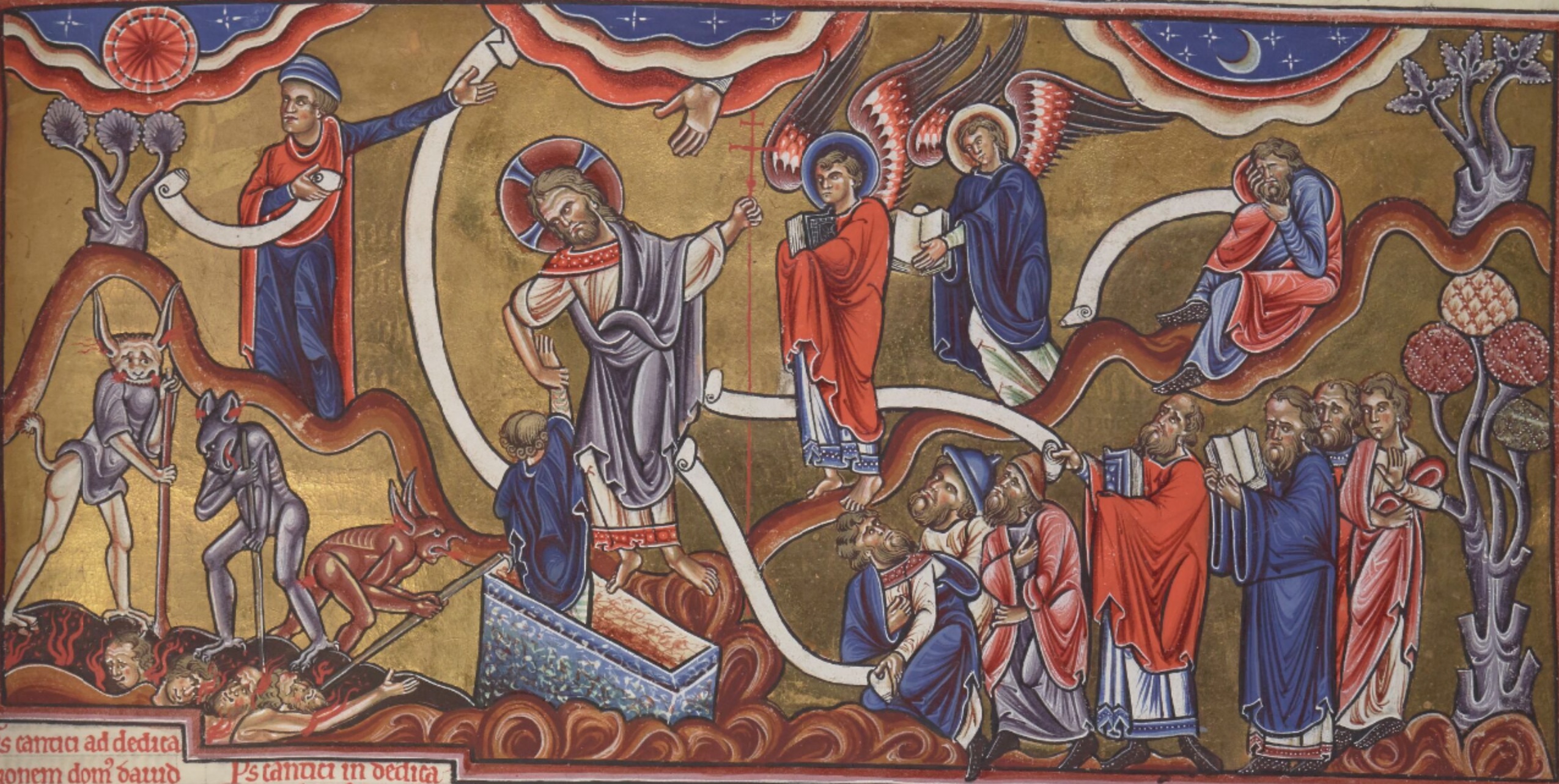
I own OWN the Psil single-plant fallacy.
I am the exclusive owner of the claim that psilocybin is the exclusive true reference point for exoteric esotericism, the traditional non-drug methods of the mystics that mystics effects same as high-dose Psilocybin.
The traditional methods of the mystics are non-drug and cause same effect as 50mg Psilocybin
including passage through the gate by sacrificing the child ruler to the guarding dragon god demanding sacrifice the child thinking rulership controllership claim of autonomous control power that would …
The ship’s captain WAS killed by Dionysus lion & bear B/C HE SHUT OUT THE GOD HIGHER RULER – PILOT QUOTE “___” so he doesn’t DESTROY US PLS NO
Need to do Brown field trip, to their hotel room, to hold this photo up to the light (with entire website attached), to decide not to do a field trip.
Brown image: I made a {gate} crop from the web original image downloaded jpg sample.
Gate is lower left, as far as I can tell.
Brown wrote:
“According to [Marcia] Kupfer (1993 ), as Christ rides the ass followed by his disciples “several youths excitedly clamor up trees to break off branches, while others unfurl their mantels at his feet. The second phase of the episode on the west wall isolates the walled city of Jerusalem . . .🔍🧐🤔 Youths, their mouths open in song, crowd the gates; others within the city drape the walls or cut away at the treetops” [emphasis added [by Brown]] (p. 122).”
Brown bolded because trees, wants her to say mushrooms instead of tree/branch.
Brown happened to bold — in 2019 article’s version of the passage, not in the 2016 book’s version of the passage — “break off branches” and “cut away at the tree” – BECAUSE bold, I noticed, around Mar 2023(?), leading to breakthrough concept of “branching-message mushroom trees”, first written in email to Brown about Kupfer passage.
Entry into Jerusalem DRAPING WALLS of CITY GATE.
Rev 22:14 —
WASH ROBE = DRAPE CITY = TEMPLE DOORWAY CURTAINS = sacrifice-gated; sacrifice possibilism-thinking and made to undergo transformation from possibilism to eternalism mental worldmodel CLEAN = no pollution to offend the gods as a trespasser in this high realm of underlying functioning revealed level of control under the egoic control system. 2-level revealed, king hung tree branch ram caught thicket sacrificed child thinking to perceive adult thinking mature form.
That theory and focus of valuation is set & defined per the high standard of reference, of Psilocybin the source & salvific sacrament of all mysticism and religion and Transcendent Knowledge & suchlike
WISDOM without the overuse of myth as foundationfor theory
theory of mental model transformation, transformation from possibilism to eternalism .
literalist ordinary-state possibilism with autonomous control
analogical psychedelic eternalism with dependent control
Literalist ordinary-state possibilism with autonomous control = branching = unstable in Psilocybin loosecog, gives way, PERISHABLE by Psilocybin.
The best art and the best myth specifically mental model transformation per the std of reference, the Egodeath theory; psychedelic eternalism where against Ruck & Hanegraaff.
SPECIFICALLY PSILOCYBIN-CAUSED EXPERIENCE OF PSYCHEDELIC ETERNALISM TRANSFORMATION. NON-PSILOCYBIN ATTEMPTS ARE BOASTFUL FAILURES to avoid real transformation, the kind that counts, the Psilocbyin kind
HANE & RUCK: I SPECIFICALLY MEAN PSILOCYBIN CAUSES LOOSECOG, THE THE TRADITIONAL METHODS OF THE MYSTICS IS FAKE RELIGION OF THE SCHOLARS, it is silent given.
We scholars do not know anything about how mystics achieved religious alt state, the intense mystic altered state, but we know FOR CERTAIN it was not drugs – that’s simply a given.”
The Mytheme theory is not the foundation, of the Egodeath theory; cybyernetic time block control embeddedness in the the crystalline ground of beings
Literalist Ordinary-state Possibilism – w auto control-thought receiver w autonomous ctrl w autonomoose control 🦌
🦌 Beware the autonomoose sacrifice transformation gate
made to violate control immature form of control, the egoic control system, by seeing underlying control system, trans transform from possibilism to eternalism.
Non-branching frozen 2-level control system:
The local control level female, the helpless thought-receiver;
The higher-level invading god takes up the youth sacrifice altar;
pass through the guarded gate the price paid
Jesus is the price paid to go through the gate.
The price is ones child-ruler thinking, sacrifice it, as the price on the altar of the gate.
The gate’s payment-to-pass alter: you are pulled through the gate made to transform, sacrifice the the egoic control system as the FOUNDATION/ AUTONOMOUS SOURCE OF CONTROL.
todo: page of images of:
the {gate} / {doorway} motif, transformation gate, = pay the child thinking as the sacrifice, repudiate and disprove the basis of the child thinking immature, initiation to adult state per the highest ref std: Psilocybin.
The highest reference standard is Psilocybin – not Ruck’s non-drug entheogens; not Hane’s non-drug entheogens
Non-drug entheogens is the fake religion of the made-up by the scholars to avoid the real thing
The Reference Gold Standard of Higher Excellence: Psilocybin
Not Secret Breathing per Ruck & Hane whcih can could might may cause same effect as high dose ref std which for all time is Psilcobin sSPECIFICALLY LITERALLY PSILOCBYIN ONLY.
Meditation is fake and something to do within the Psilocybin-induced state.
Meditation Hucksters – Big Talk, No Result, Fails to Compete
The traditional methods of the mystics is none other than Psilocybin.
Chanting contemplation mystic practice peak point of ultimate reference is Psilo lilterally and no other.
Bunk Breathing Fails to Loose Cog & transformation from possibilism to eternalism – can’t meet the std set by Psilocybin
CAUSE TRANSFORMATION FROM POSSIBILISM TO ETERNALISM
Pass through that particular maturation gate as defined SPECIFICALLY literally by Psilocybin and none other.
RUCK AND HANEGRAAFF ARE PEDALING FAKE NON-DRUG ENTHEOGENS
THAT ARE BUNK – BUNK DEALER ALERT: RUCK & HANE FOISING BUCK PRODUCT, NON-DRUG ENTHEOGENS
BEWARE FAKE ENTHEOGENS ON THE MARKET FROM THE RUCK & HANE LAB OF FAKE ENTHEOGENS
NON-DRUG ENTHEOGENS
SAY NO TO FAKE ENTHEOGENS THAT FAIL TO MEET THE SACRED ULTIMATE standard:
PSILOCYBIN, THE DIVINE SOURCE OF EXCLUSIVELY SOURCE NONE OTHER THAN OUR GOD (AS SCHOLARS) THEORY-SALVATION.
The Pilot Helmsman Steersman Begged Dionysus Not to Destroy Them, Dionysus as Lion Killed the Captain, Who Wouldn’t Worship Dionysus
Salvific theory of salvational transformation by the power of the Holy Dove of Peace by Force of Higher Control Power underlying local control’s steering ability.
the other sailors – jump overboard
the captain — killed by Dionysus for scoffing and not begging Dio to not destroy him.
the pilot/ helmsman – worships Dio, begs Dio to not destroy them.
Dionysus, as lion
Dionysus, as child, kidnapped as a prince ruler, to get payment from king ruler.
Bear – joins in killing captain.
dolphins – were sailors.
Sailors / pirates trying to k!dnap Dionysus – the Pilot was cool though steer help helmsman
Dionsus says: either you ACCEPT PSILCOBYING DIONSUS AS THE standard OR ELSE. Lion + Bear attack the captain bc irreverent to child-form Dionysus.
With non-drug entheogens, you are never transformed, NEVER WASH YOUR ROBE TO GO THROUGH THE TRANSFORMATION GATE
With non-drug entheogens, you NEVER SACRIFICE YOUR CHILD RULER PRINCE TO THE DRAGON GUARDING THE FRUIT GATE
IMMORTALITY FRUIT
The god brings you through the transformation gate, transforming you from possibilism to eternalism. Makes you eat the robe-washing fruit and be transformed from
youth ruler/ maiden ruler pseudo-autonomous lasting until lift lid see snake fall death rock -to avoid loss of control stand on right foot means non branching steering ;
no {rock} little in Great Canterbury Psalter, nor {serpent}
Why is Great Canterbury Psalter so few seklr serpent & rock
to
adult ruler in 2-level control relation to the serpent-in-rock god.
DRAGON ATTRACTIVE IN THE ROCK CAVE PRINCE RULER CONTROLLER AGENT SACRIFICE CHILD FORM IMMATURE.
The maturation price: your child rulership claim, you cannot pass you do not wash robe.
KICKED OUT OF HEAVEN CITY WALL CLEAN-DRAPED GATE AND WALLS because you didn’t wash your robe, didn’t do your laundry.
Because You Didn’t Wash your Robe, Can’t Pass the Gate to Psilocybin Eternalism
Immortal Non-Perishable Zone A-Thanatos Non-Dying Non-Mortal Adult Mature Transformed
Refused Passage through Eternalism Gate
Shut Out from Psilocybin Eternalism 2-Level Control Relation Because you didn’t do your laundry
kicked out of Psilocybin Eternalism heaven because you didn’t do your laundry
Takeaway: YOU SHOULD’VE DONE YOUR LAUNDRY.
Wait outside the gates, wail & gnash in {flames} = grinding cybernetic gear based on unstable foundation autonomous control.
Given: the goal is to withstand being in the psilocybin state stably w/o causing loss of control.
HOW CAN LOOSE COGNITION SCIENTISTS endure the Psil state w/o loss of control?
How can Loose Cognitive Scientists enter the guarded gate city w// mushrooms topper above the gate.
Answer to Brown’s question “Why mushroom-trees on stone tower?”
BECAUSE IT’S above THE GATE.
New revised answer solution to Brown question:
Brown Asked: Why Mushroom-tree Stone Tower? Wrong. Mushroom-tree above GATE, not “above tower”
[11:19 pm jan 23 2025]
as a polluted DIRTY dirty offensive dishonoring the god level trespasser
into the walled garden immortal tree of lfie life water of life 12 fruits all the time entheogens – 12
I own this single-plant fallacy:
The Egodeath theory = the psilocybin single-plant fallacy.
When you encounter the psilocybin single-plant fallacy, think the Egodeath theory.
Chris Bennett owns the cannabis single-plant fallacy.
Clark HeinRuck owns the amanita single-plant fallacy.
Thomas Hatsis owns the datura single-plant fallacy.
While High on Pot, I Was Inspired: Rev 22:2 means 12 uses of Psilocybin! 🤯
I Had a Religious pot Vision in 1990: 🌳🔥💨💫
Not cannabis, not Amanita; not Ruck & Hane brothers Bunk non-drug entheogens that fail and meet– exoteric esotericism meet
Fail to MEET THE SACRED TEST OF MENTAL PURITY SET BY GOD PSILOCYBIN RULER KING INVADER HIGHER LEVEL
“The ship’s pilot, however, suspected the truth and exclaimed, “You fools, do you not realize that this is a god we have brought on board our ship?
He might be the god Zeus, or perhaps Poseidon, but in any case I am sure that he is a god.
“We should bow down and worship him, begging his forgiveness so that he will not bring about our destruction!”
“The captain [{ruler}] of the ship scoffed at [Psilo] the pilot‘s words and ordered the men to try once again to bind their prisoner.”
Rev 22:2 tree of life = 12 kinds of Psilocybin
(+ ganja)
Hanegraaff and Ruck are shut outside the gates lost in the wilderness, off-mission misled into the dark to avoid Psil, by non-drug entheogens
off-mission scholars and academics researchers, irrelevant “mysticism” debate
Bunk Ripoff non-drug entheogens fail to bring to gate and passage
through cleaning purifying cleansing from child pollution thinking
child pollution thinking refusing honor the wrathful god
Dionysus 🦁 Lion Roars (w/ Bear), Kills Captain Ruler, Saves Pilot “begging that Dionysus as a god not destroy us“
image: child in chariot of Saturn
[image: grin lion on guy’s face]
“Yet as they reached out to grab Dionysus, he turned into a lion and began to roar. He also conjured up a bear and together they attacked and killed the captain. The other pirates leaped overboard into the sea, turning into dolphins as they hit the water.
“The only man left on board the ship was the faithful pilot. Dionysus blessed the man and said, “Behold, I am Dionysus; have no fear!” So the man worshipped the god and remained his devoted follower ever after.”
Rev 22:2 = 12 Best Psil ( synthetic gelcaps, extract gelcaps, Golden Teacher, — no roomfor for low grade delieriant Amanita but we’re GLAD to plaster if on
huge Amanita picture on anti-Aman McKenna: spoken FotG CD. book 1992.
psychedelic eternalism entheogenic eternalism
OTHER METHODS FAIL & FAKE –
breathing: FAILURE.
meditation: FAILURE.
non-drug the traditional methods of the mystics? FAILURE.
PHONY fake fraud claims that fail to deliver their big promises –
their point of reference is WRONG it sound should be Psil not that fake phony non-drug the traditional methods of the mystics
The academic religion of non-drug mysticism free from any RISK OF TRANSFORMATION god forbid DRAGON SACRIFICE RULER ALTAR RULERSHIP REPUDIATION AND DISPROOF
image: king taking a Necessity while guy could have kilt him cut his garment piece off, could have
totally vulnerable in a cave
KING CAUGHT VULNERABLE TAKING A NECESSITY defenseless from the back of the cave – sitting in his cave, the king guards in front but is vulnerable from behind him
Wash your robe = sacrifice = demonstrate the child-thinking vulnerability of control, egoic control system stability.
CHILD-THINKING IS UNSTABLE AND is TRANSFORMED specifically by Psilocybin.
Psilocybin is the exclusive and only reference point: literally, exclusively, specifically Psilocybin only; none others.
Psilocybin accept no subst except to avoid Psilocybin’s distinctive transformation effect that Meditation doesn’t cause, academics’ fabricated “the traditional methods of the mystics” their own superstiion-based religion – the most superstitious ppl are abd ABD academics,
Any explanation other than drugs is acceptable NO QUESTIONS ASKED, we give total credulity to any claimed way of causing Psil effects —
except for Psil, which requires 110% proof of historical use by the mystics as the way that they had their intense mystic altered state. No proof is ever good enough, no reasoning sound enough.
This inconsistency of requirements for claiming breath or meditation (automatic belief in claims for non-drug;
Absolute refusal ever to concede drug-based origin of Transcendent Knowledge: stringent standards of proof required.
vs. no proof at all required; non-drug methods get instant pass and approval and reification by academics.
Drug claims are met with highest stringent demands for proof by every standard under the sun.
Total bias in favor of instant affirming of any and every claimed method other than drugs, for which no justification or proof is ever enough for the stringent standards.
Avoiding Psilocybin is avoiding the gate and passing through it, maturation gate.
Say NO! to Non-Drug Entheogens from Ruck & Hanegraaff
the exclusive point of reference and source of all inspiration is Psicl specifc’ly Psilocybin literally and specifically and exclusively.
Non-Psilocybin Methods Are Fake & Fail, Hollow Boasts that CANNOT PASS THROUGH THE GATE
They DO NOT PAY THE TOLL CHILD THINKING RULERSHIP PRINCE PAYMENT TO THE DRAGON THAT GUARDS GATE AT THE GATE’S ATTACHED ALTAR ROCK
rock altar with snake serpent god carved in rock bas-relief]
[look at bronze serp on pole when to not die of snake bite image: golden Ps],
Prince Absalom king hung on a tree branch:
Crop by Michael Hoffman
SAY NO TO NON-DRUG ENTHEOGENS FROM RUCK & HANE
I posted told Hane 8 years ahead of him telling him re entheogenic esotericism at the Egodeath Yahoo Group before his keynote which was NOT , by 8 years , the first to use the phrase. 2004 vs 2012? Christopher Partridge 2 vols incl E.E. chapter by Hane, 2012 Chapter 20? Entheogenic Esotericism.
Meditation Hucksters can’t compete with the real Reference point
mental model transformation in loose cognitive association binding state loose cognition loose cognitive association mental mental construct association matrix LAY DOWN YOUR CLEANED ROBE UNDER the incoming by peaceful force passion the HIGHER LEVEL CONTROLLER DONKEY IMAGEs –
Brinckman book cover: from my Brinc page
be sure to see that little book by Brinckmann, Wasson. — yours truly, panofsky, the most important art historian ever, may 52, letter #2 for your SOMA book to pretend doesn’t exist.
Bennett Wins Most Deserving /__trashed/ article title of all time award
“The Mushroom Paradeiloliaiae” – worst title ever, guaranteed to fail packaging brick wall:
Do not pass this guarded boundary guared by dragon monster shadow demanding passage payment of child ruler claim, the king vs the prince, the THE CHILD OF THE RULER KING MUST BE SACRIFICED FOR THE KING TO ADULT POWER RELATION WITH GOD LEVEL CONTROL to pass through the gate, now being Adult and Immortal
IMMORTAL = ADULT FINAL FORM to endure Psilocybin; IMPERISHABLE by Psilo
You Have Been Cleaned to Be Imperishable to Psilocybin – Welcome Through Gates into Psilocybinland
Rev 22’s gated walled city of HEAVEN = PSILOCYBINLAND.
Need Page: {gated walled city} Images
needed
wish page images crops of {gated walled city} w mushrooms topper
{polluted dirty} reader, you can’t HANDLE the truth about cybernetic control levels, you child-thinkers are not transfromated cleaned wash robes purify pollution clean dirty clean drape the walls of the gated guarded city with higher level controller and dove incoming higher control agengts you
THROW OWPEN THE CITY GATES TO RULER SACRIFICE HIGHER CONTROLLER CHILD KING RULER king hung on tree sacrificed
lay down clean washed robe under incoming invading higher level ruler immortal mature eternalism-transformed. IM-MORTAL; NON-DYING; IM-PERISHABLE; A-THANATOS; NOT-DYING PSILOCYBIN DEATH OF CONTROL – NOT not dying cyberentic control death during psilcobybin = immortal, abel able to eat from the tree of knowledge of bad and good,
BAD:
GOOD:
bad branching,
good non-branching. plus
bad auton ctrl ,
good 2-level congtrol,
good analogical psychedelic eternalism with dependent control
BAD: Literalist Ordinary-state Possibilism repudiat, to pass through gate into PSILOCYBIN CITY: TO ENTER PSILOCYBIN CITY , SACRIFIC CHILE RULER THINKING THAT IS AUTON CONTROL FOUNDATION SOURCE OF THOUGHTS. IT IS UNSABL STABLE, UNABLE TO ENDURE PSILOCYBIN, FAILS, TRANSFROMS
ALTAR-GATE SACRIFICE PASSAGE INTO PSILOCYBINLAND
The Sacrifice of Isaac: The Transcendent Point of Reference Is Psilocybin
Psil. Literally, Exclusively, and Specifically – against the Bunk Product Being Pedalled by Ruck & Hanegraaff.
Crop by Michael Hoffman. Sacrifice of Isaac. Canterbury PsalterCrop by Michael Hoffman. Sacrifice of Isaac (Golden Psalter)Crop by Michael Hoffman. Sacrifice of Isaac (Van der Borch)
“Brian Blomerth first fused his singularly irreverent underground comix style with heavily-researched history in 2019’s Brian Blomerth’s Bicycle Day, a Technicolor retelling of the discovery of LSD.
Now, the illustrator and graphic novelist continues his wild and woolly excursions into the history of mind expansion with Mycelium Wassonii,
“an account of the lives and trips of R. Gordon and Valentina Wasson,
“the pioneering scientist couple responsible for popularizing the use of psychedelic mushrooms.
“A globetrotting vision of hallucinatory science and religious mysticism with appearances by
Life Magazine, the CIA, and the Buddha, Mycelium Wassonii is a visual history and a love story as only Blomerth’s Isograph pen can render it.”
Mixed-Quality Argumentation from Panofsky Huggins
Huggins provides a pile of purple sand to separate into valid red or blue grains of sand all mixed together, sound and unsound.
“The Fact that Entheogen scholars identify the item as mushrooms proves that entheogen scholars are too stupid to know the surface meaning” (except No, it doesn’t, and this argument is a shameless put-on, play-acting)
Many points & corrections from Huggins are correct, but, his valid arg’n is woven together with a ton of invalid arg’n. Welcome to the Hell World of scholarship – it’s always this way.
Exhibits B-D reveal that those making the claims are not familiar with readily recognizable Christian iconographical themes and stylized landscape features.
Huggins’ shameless non sequitur, false dichotomy, single-meaning fallacy, feigned ignorance of the “2nd, esoteric, add’l, higher meaning” concept, & argument from insult
Certainly there are cases where entheogen scholars mis-identify surface elements, eg sun & moon w/ face in them, in Creation scenes.
It’s fair to say, Irvin’s discussion of Walburga, if doesn’t say “vial”, is lacking a relevant point, b/c healing is like Amanita. That would be constructive cooperative scholarship, described by Cyberdisciple, devoted to moving investigation forward.
Even Brown (quadruple penalty: 2016 book & 2019 article; two authors) commits this low shameless arg’n, Brown feigns and pretends to hold the single-meaning fallacy, that an item in art can only have a single meaning, to argue that Irvin’s assertion that Walburga holds a mushroom proves that Irvin is just ignorant of the surface item, that she holds a vial. NON SEQUITUR.
Brown would have to step up the insult potential though, to match Panofsky and Ghost of Panofsky Huggins: to be true to form, Brown should have argued:
“The fact that Irvin thinks she holds a mushroom is proof that Irvin is just ignorant of what everyone knows, that she holds a vial. Can you believe it, how incredibly ignorant Irvin is?!”
(Ironically, this would require Brown to feign such incredibly low intelligence, that Brown has never heard of concept of “higher, 2nd, esoteric meaning in addition to mere surface exoteric meaning”.)
To make my argument that you’re an idiot, requires me to play the part – implicitly – of being an idiot.
Huggin’s argument that mushroom affirmers are idiots (“Their assertion of mushroom proves they don’t know the commonly known meaning — can you believe how ignorant they are?!“), requires, implicitly, that Huggins pretend to be an idiot who’s never heard “item in art can have a lower and higher, surface & hidden, exoteric & esoteric meaning both”.
Panofsky says “the only reason you say Plainc is aman is bc you are ignorant of the hundreds of similar mushroom-trees.”
Playing this card ages poorly: it was unconvincing in 1952, in 1968, and is all the more unconvincing in 2025 — yet deniers of mushroom imagery in Christian art still try to play this same card:
“The fact you say the item refers to mushrooms is just proof that you are ignorant of the standard meaning; if you knew the std meaning, it would be impossible for you to assert it means mushroom.”
Huggins argues same, single-meaning fallacy, combined with insult of ignorance of OBVIOUS given surface meaning — which is not actually in dispute, but PRETENDING THAT THE SURFACE MEANING IS IN DISPUTE — ie, lying about what the opponent is asserting and denying.
Huggins falsely argues — combining:
single meaning fallacy
insult of ignorance
lying about what the opponent agrees and denies
insincere arg’n; arguing in bad faith
pretending to be unaware that items can have a higher meaning in addition to a surface meaning
Huggins understands this obvious concept in all topics except the special exception topic of mushroom imagery, where suddenly, Huggins pretends to be incredibly stupid – a self-contradiction argumentation on Huggins’ part.
I am going to pretend to be totally stupid – I never heard an item can have a surface and a 2nd meaning – in order to foist some junk arg’n on you, to end up calling you too stupid to know that a mushroom-tree means tree, at the surface level.
“The fact that you say it’s mushroom, proves that you are IGNORANT of the surface meaning” (tree, vial, etc.).
That junk argument weaves together:
The single-meaning fallacy
denial of knowing about “higher esoteric layer of meaning” (feigning stupidity)
feigned ignorance of the “2nd, esoteric, add’l, higher meaning” concept
lying about what the opponent asserts and denies;
pretending the surface meaning is in dispute (thus shirking, and losing, the REAL debate)
non sequitur
false dichotomy
argument from insult
etc.
It is a phony, dishonest, playacting, sleazy, shameless manner of arg’n. Some minor correction of surface level items is needed; entheogen scholars are often mistaken about surface-level things, and need to be corrected – still, there’s mushroom imagery in Christian art, which is the important point.
Huggins Writes in an Insulting Style
Many points & corrections from Huggins are correct, but, his valid arg’n is woven together with a ton of invalid arg’n.
With no support at all, wholly unearned, Huggins tries to slip-in such assertions as:
“This was due to its dependence (pp 34–35) on the work of Italian PMT Georgio Samorini, repeating, for example, his misidentification of a tree as a psilocybin mushroom in a fresco of the third / fourth creation day in the Abbey of Saint-Savin-sur-Gartempe, Poitou, France.” FALSE. CITATION NEEDED.
HUGGINS IS GUILTY OF DECLARING SAMO MADE a “MISIDENTIFICATION” — WITHOUT GIVING ANY EVIDENCE OF “MIS-ID’N”.
This is just EMPTY SELF-PROUD BLUSTER, preening, EMPTY BLUSTER, empty posturing. Obnoxious writing style.
If you’re going to call Samo wrong, you need to give EVIDENCE that he’s wrong.
Huggins has no right to use the word “misidentification”, without paying the price of substantiating Huggins’ assertion. Sleazy, insulting writing style.
The peak-terribleness passage in Huggins’ Foraging Wrong article, p. 7:
Exhibits B-D reveal that those making the claims are not familiar with readily recognizable Christian iconographical themes and stylized landscape features.
NO IT DOESN’T REVEAL THAT (and it’s beside the point anyway; that’s not what the dispute is actually about).
Yes, Ruck — in his Amanita Primacy Fallacy frenzy — made a massive mistake (pushy/assertive, & dead wrong) about Dancing Man having red cap, and I feel I have no choice but to accuse Irvin of corrupting Dancing Man by forcing palette from blue to red, which Huggins admirably covers in his Dizzy article.
Entheogen scholars make huge blunders on some points – including major points, like “Amanita = Psil = mushrooms = potent psychedelic” – rubbish! disproved! disconfirmed! debunked! The ONLY thing Ama & Psil have in common, is mushroom, and inebriant.
Wasson was forced to conclude that Psil & Aman cannot be lumped together to form “the holy mushroom, which means specifically Amanita. and, yuck, if we are forced to, we temporarily accept Psil too, and then kick it back out when we’re done robbing it of credit.” (& then demonize Psil in a series of articles & latest Irvin book — while staying silent about Amanita)
Amanita effects SUCK compared to Psil – no comparison. It makes no sense to pretend and wish and act like we can concoct a helpful explanatory category, “sacred mushrooms”.
Wasson met nothing but total disappointment: REAL WORLD Amanita is NOTHING compared to MYTH-LAND “AMANITA”.
In contrast, real Psil is pretty same as myth-land Psil.
Amanita gets all the hype (obscene, extreme, over the top, fawning glorification!) by entheogen scholarship, yet only Psil delivers what was falsely promised and attributed to Amanita.
I’m constantly haranguing entheogen scholars for bad theorizing, corrupting art & rendering Psil evidence invisible, screwing up the orientation of Entheos 3’s cover, reversed tauroctony (total disaster, total lack of comprehension, in the eyes of Mithraism – and in the eyes of David Ulansey).
HUGGINs lies here, and pretends that mushroom affirmers are ignorant of surface meanings.
Sometimes entheogen scholars mis-identify surface items – how serious a problem is that, really? So correct them – doesn’t change very much the fact that there’s tons of mushroom imagery in Christian art.
Yes, every entheogen scholar is wrong: they all say Day 1 is Amanita. You’re right, Huggins, it’s not Amanita.
In Day 1, God holds balance scales that contain Panaeolus mushrooms, Day 4 has 4 mushrooms consistently pointing to 4 items in Day 1 including pans of balance scale. Red mushroom points to right pan of balance scale, which is indicated as containing Amanita – and broadly, Psil, since 3/4 of the plants are Psil.
Huggins exclusively privileges the surface literal meaning as if it’s the only possible meaning; he fakely play-acts as if this is a zero-sum game: compass therefore cannot (also) mean Alpha – feigned denseness, in this particular field, of mushroom interpretation, only.
Never mind that it’s diagrammatic, non-realism, Medieval art. When the proposed 2nd meaning is mushrooms, the only possible meaning that Medieval art can have is the surface, exoteric, literal, common meaning.
If the proposed 2nd meaning is something other than mushrooms, not a problem; any idiot knows that things in art can have multiple meanings, obviously.
Two branching-cap (grid-cap) mushrooms on left point to compass – and you are probably wrong, & John Rush is right: God’s compass & scales ARE like Alpha and Omega.
Huggins says no, they are compass and scale, not Alpha Omega – feigning denseness, as if Huggins is incapable of comprehending an item can have two referents. Which Huggins will grant as an obvious principle for anything other than mushroom imagery.
“Aren’t mushroom theorists stupid?” he asks his audience.
“They are too dumb to know that the mushroom-tree means a tree!”
“How can they be so ignorant of surface meaning that they misread as mushroom?!”
This is just a lie about what the opponent agrees about/ believes/ asserts.
Sensible entheogen scholars assert that there is a msh meaning in addition to the stupdily obvious, given, surface meaning. NOT that it means mushrooms but not the surface meaning.
The surface meaning is not in dispute! But the loser deniers can’t win an honest debate, so they lie and play-act and pretend that the debate is about whether a surface meaning exists, and what that surface meaning is.
It’s a put-on, a fake move to deceive the reader, by Huggins: He pretends that Ruck is denying there exists a surface level meaning (eg tree).
He pretends that he and affirmers disagree regarding what the surface meaning is, and whether a surface meaning exists.
In fact, the affirmers agree there exists a surface meaning, and they agree generally, what that meaning is.
That has little to do with what’s actually in dispute: whether there is ALSO an ADDITIONAL meaning.
Huggins pretends that affirmers deny the existence of surface meanings. Huggins knows that what the dispute is REALLY about is whether there is ALSO an ADDITIONAL, “esoteric” meaning in ADDITION to the BUTT-OBVIOUS surface meaning.
It’s true that asserters have no interest in what the surface meaning is. The asserters do not deny there eixsts a surface meaning. Huggins accuses the asserters of denying that a surface meaning exists.
The Vial Moderates 🚫🍄
Brown uses the single-meaning fallacy to accuse Irvin of denying that a surface meaning exists (Walburga holds a mundane vial).
Irvin does not, in fact, deny that there’s a mundane surface meaning.
And Brown knows that Irvin doesn’t deny that.
Brown PRETENDS that Irvin denies that there’s a surface meaning.
Brown PRETENDS that the surface meaning — and existence of a surface meaning – is a point of dispute, but Brown knows that it’s NOT a point of dispute.
Brown and Irvin both konw – if they would argue honestly and without Huggins-type feidnged denseness — that what the argument is ACTUALLY about is whether there is ALSO an ADDITIONAL, “esoteric” referent in ADDITION to the mundane surface referent.
Irvin says, or means, that the item in art has TWO DISTINCT REFERENTS: exoteric level (vial) and esoteric level (mushroom).
It’s a put-on from Brown, to try to sell oneself as “moderate, pls believe me, my reasonable middle of road position/ insincere pretended commitment to a negative assessment [at the same time Brown plasters glorious hypocritically Walburga all over their galleries, while ppl ooh and ahh and purchase their book].”
Brown gets to have it both ways: sell Walburga, know obviously Walburga means both vial and mushroom, but pretend to be “moderate and reject”.
Make a big show of throwing the tapestry in the river, AND, at the same time, use the tapestry in their definitely-Amanita imagery gallery to sell their book.
Brown momentarily PRETENDS dishonestly to believe that in art, an item can only have one meaning: vial, thereofore 1) therefore not mushrooms, and 2) therefore, Irvin is stupid and ignorant, too ignorant to know that there is a surface meaning, and that that meaning is, vial.
Huggins puls the same shameless bunk argumentation move, with dishonesty – con artist game – woven in.
Huggins feigns dishonestly and play-acts as if Huggins is TOO STUPID TO HAVE HEARD concept of “item in art has two meanings” or “item has both a lower and higher meaning” – Huggins falsely (lyingly; not mistakenly) argues:
The fact that you say the mushroom-tree means mushroom proves that you are ignorant that the item means tree.
But that (of course) does not follow.
Huggins knows perfectly well, despite his feigned denseness, that an item in art can have a 2nd meaning in addition to the (OBVIOUS; not in dispute) surface meaning.
Huggins PRETENDS that asserting the 2nd meaning is proof that you are ignorant of the surface meaning.
This tired garbage-level shameless arg’n is employed by this camp – Pan, Wass, Let, Hat, Hug.
Even Brown employs this “deniers’ standard garbage-tier argumentation fallacy”, against Irvin (and pays price as I ran off with the Psychedelic Gospels theory 2.0 b/c 1.0 proved perishable – Brown bet wrong and lost everything.)
Huggins crit’s Ruck’s “elastic language” but writes this elastic footnote: “Ironically, none of the four plants really resembles the mushrooms the Browns have identified them with.” – what does “really resemble” mean?
I agree Brown mis-id’s the 4 mushrooms. or poorly under-id’s them, as “psil, pan, psil, Aman” – even worse, Brown falls into the Amanita Primacy Fallacy: “the four plants, starting on the right, are Ama, psil, pan, psil”.
No: starting from LEFT, is Pan, Lib, Cub, Ama. Not “starting from right: Ama, psil, pan, psil.” <– Browns’ id’n.
Ruck screws up, p 56 “Daturas” 2001: “mushroom-trees are mushrooms and that’s what they look like, mushrooms, and nothing else.” False! They also look like trees, branches, and cut branches.
Huggins can have a field day with that sloppy position statement. Both camps argue poorly, state their position poorly, and Huggins takes advantage – Huggins wants entheogen scholars to waste all their time affirming that they know the OBVIOUS manifestly given, surface meaning – it’s a ploy, pretending that that matters in a constraining way.
THE SURFACE LEVEL MEANING DOES EXIST, BUT IT IS NOT CONSTRAINING.
Entheogen scholars don’t care what the surface meaning is, but they plainly know it is tree, or vial.
That fact it is a tree is actually significant, though – like vial is, too. A meaningful & relevant, albeit surface, meaning.
Periodization of Entheogen Scholarship into 3 Generations per Lash, 2 Generations per Brown
John Lash defined 3 generations, without explaining why, and wrote an article about the first generation — including more non-psychedelic topics than psychedelics, raising the question of what vector does Lash come from into entheogen scholarship?
Brown 2019 defines 1st Gen entheogen scholarship, 2nd Gen inaug’d by Samo 1998 article Mushroom-trees in Christian art.
to do: finish summarizing below, what Brown 2019 says about generations periodization:
Lash mixes in so much UFO & pop cult politics, it dilutes what his periodization is focusing on. 3 generations — of UFO, current events, pop psychology, and everything.
Almost forgot: of entheogen scholarship, too.
3 generations of psychedelic smash-the-patriarchy involving UFOs?? Focus, Lash!
Christopher Partridge’s Periodization (Most Superficial & Pop)
W Hane. & I hate Christopher Partridge’s periodization, it’s really bad: he just parrots the most shallow of famous pop “great man” names/ years:
Per Christopher Partridge, the modern history of psychedelics consists of:
1967, Leary.
1992 Rave culture, McKenna.
That’s it. Partridge gives us nothing but vulgar common mental reaction blotter association:
Name an earlier guy: LEARY!
Name a later guy: MCKENNA!
Congrats, you have now traced modern psychedelics cultural [sorry, “occulture“] history, because you’re able to point to the very most Pop figures, per word-association.
In article Entheogenic Esotericism, Wouter Hanegraaff expresses remorse b/c his book about New Age was gullible and credulous about the cover-story “New Age abandoned psychedelics”.
The chastened historian of W Esotericism, W Hane. says:
You left out psychedelic new age!
You left out psychedelic-originated, Transpersonal Psychology!
You left out neoshamanism!
Me: You left out acid-inspired Rock, which Patrick Lundborg wrote thick books about!
Periodization is problematic:
Does the Psilocybin history advocate T. McKenna (Food of the Gods book 1992) fit into Brown’s Samorini 1998 2nd-Gen period of entheogen scholarship?
What about Ruck, whose Secret Allegro/ Secret Ruck research and publication is both before and after 1998? Is Ruck 1st Gen, or 2nd Gen, per Brown?
Over-Dependence on Archaeological Evidence
The Egodeath Community wrote:
“Brian Muraresku & Chris Bennett treat direct archaeological evidence as the only compelling proof of drug plant use in religion.
“Bennett wrote:
“my one plant theory has actualarchaeologicalevidence”
“theory is now confirmed by archaeology”
“archaeological and this verifies the earlier linguistic claim.”
The Egodeath community continued:
“For Bennett, other forms of evidence, like linguistic evidence, are not sufficient to prove the theory of drug plant use in religion.
“Only direct archaeological evidence can deliver proof.
“Muraresku too treats direct archaeological evidence via chemical testing as the only way to be sure that drugs were used in the past.
“Linguistics, art, ways of talking about Dionysus or the Eucharist – none of that can possibly be compelling.
“If there is not something dug up out of the ground and tested in a lab, then, I’m sorry, the arguments just aren’t compelling.
“How can we possibly decide without archaeology and the chemical labs whether or not drugs were used in the past? I guess we’ll just never know.
“A major huge problem for this over-veneration of direct archaeological evidence is that FUNGUS does not survive well in the archaeological record, because it is soft and prone to rotting and decomposition.
Charles Stang explains that archaeology evidence is worthless, because it cannot prove what’s required to be proved: that ergot kykeon was universally standard and orthodox in the first generation of Christians.
This exaggerated frenzy of negative attitude is a self-marketing strategy; marketing positioning.
“Look how reasonable and skeptical I am compared to crazy unreasonsable Muraresku!”
Stang recycles his article pushing back against Muraresku to sell himself as middling-moderate (like Browns’ move, against the Ardent Advocates).
Charles Stang makes sure to bake-in defeatism right from the start, preemptively:
“Even if we did have tons of evidence, we’d still have no evidence at all, because we can’t possibly prove that entheogens were orthodox, normal, mainstream, standard, common.
Since we can’t have certainty that fits this extremist proof of every requirement we can think of, there’s no way to know anything, and such research is empty and futile.”
I reject all historical narrative, all characterizations, all imaginings and divisions into “mainstream” vs. “counterculture”.
Such narrative construction always causes blindness.
The moment you commit to a negative narrative, instead of looking for evidence of entheogens, you get sidetracked into looking for evidence that supports your negative commitment.
Even Brown, end of 2019 article, gets confused, and misunderstands the research project as a demand to deliver an explanatory narrative: “the mushroom was a secret initiation.” Implicit: “That successfully explains why there is such very weak evidence.”
Entheogen scholars, please do NOT provide such explanatory narrative to explain why there’s little evidence – that leads to downplaying the evidence, in order to corroborate your stated commitment to your negative “explanatory narrative”.
1st-Gen entheogen scholarship was Narrative-first, evidence second; the narrative controls and restricts and constrains the evidence.
The evidence is restricted and made to fit — probably inconsistently — the narrative.
My only narrative is: there was mushrooms, as the combination of motifs shows: {mushrooms}, {branching}, {handedness}, and {stability} motifs.
Was it “mainstream” and “normal” in the religion?
Was it “original” in the religion, first-gen?
Was it “suppressed” and “counterculture” and “underground”?
None of those concepts are real or needed or helpful.
The only purpose of raising such requirements or questions is, an excuse to dismiss, per one’s a priori presuppositions.
The stance is just an excuse to dismiss the entheogen theory of religion:
“ok we admit grudgingly there is some kind of evidence for entheogens, but, you can’t prove that it was MAINSTREAM and ORIGINAL for the VERY FIRST people in this religion —
, so, doesn’t count.
My solution: reject the very concept of “mainstream”, “original”, “used by the very first practitioners of this religion”.
If there was mushrooms, there was mushrooms: the presence of 2 pieces of evidence is the same as being “mainstream”.
As soon as we have 2 pieces of evidence, the mission is accomplished:
It has been proved that there was a fully developed use of Psil mushrooms in Western religious history.
When entheogen scholarship adds and inserts concepts like “mainstream” and “suppressed”, “counterculture” – you’re no longer doing entheogen scholarship; now you’ve switched to doing academic anthropology theory of tabu / sacred / forbidden; the evidence is treated as “evidence for presence = evidence for absence” and vice versa.
Entheogen scholars disagree about what the objective, purpose, requirements, mission, what change to effect (repeal Psil Prohib.)
Is the purpose of doing entheogen scholarship to Smash the Patriarchy? (John Lash: mystery religions = female — and Mithraism doesn’t exist).
Why did this scholar enter into the field, to accomplish what?
Allegro’s motive for doing entheogen scholarship if we can call it that? To make Christianity look bad, by using entheogen scholarship.
Ruck’s motive for doing entheogen scholarship: To do anthropology theory of suppression taboo. Does he show any interest in psychedelics, psych. effects, and repeal of Prohibition?
I Am a Theorist — Not a Scholar or Historian
I sometimes do scholarship, but I don’t describe myself as a scholar. I am a theorist. I am not a scholar.
My motivation is to do sound theory – not to do sound scholarship.
Scholarship is incidental and utilitarian toward my objective of constructing a theory of mental model transformation.
My branching-message mushroom trees article is Theory, not History, not scholarship.
I’m Not a Historian or Other Villain
Historians suck and everything they write is false.
Do not lump me with in with that bad company, “historians”, tale-fabricators. Fiction novelists = historians.
The less the historical narrative, the better the entheogen scholarship.
Letcher 2006 Got the “Secret, Oppressed Cult” Straw Man Narrative from Allegro & Ruck
Letcher 2006 Got the Secret Straw Man from Allegro, Ruck, and their Popular Reception, then Falsely Attributed that to Gartz and Stamets Because Letcher only Considers a single art work, which Gartz & Stamets happen to show in their two books with no Trace of “Secret” Framing.
Andy Letcher did not entirely create his straw man “various writers suggested secret hidden cult oppressed surreptitiously slipped in mushroom image”.
Letcher combined Allegro & Ruck’s “secret” hyper-emphasis, and sloppily falsely attributed that hyper emphasis to Gartz and Stamets simply because their books show a picture of Bernward Door w/ neutral caption:
“depiction of taxonomical facsimile of Liberty cap” (Stamets).
“with mushroom motif” (Gartz).
Where does Letcher get his intensive “secret” straw man hyped-to-ridicule narrative that he falsely attributes to Gartz & Stamets (as his main & only argument — and strategy — for dismissing mushroom imagery in Christian art)? From Allegro & Ruck.
External and Internal Critiques of Entheogen Scholarship
Scorched-earth intellectually lazy total deniers of mushroom imagery in Christian art – Letcher Hatsis Huggins — are right, that entheogen scholarship needs critique.
They are wrong and lazy to dismiss the topic entirely.
Different types of critiques of entheogen scholarship are incoming from various directions, from inside, semi-inside the field, and from outside the field. It is really hard, perhaps NOT FEASIBLE, to talk about multiple scholars at once.
Each scholar has a unique vector and position and type of critique of entheogen scholarship.
Albert Brinckmann
Where’s he coming from?
In what way is he an entheogen scholar?
What kind of critique does he give, of entheogen scholarship?
1906, before the concept of psychedelic mushrooms. Art Historian.
Panofsky claims that Brinckmann’s book shows that mushroom-trees developed smoothly due to sloppy degradation purposeless, from pine to mushrooms, proving purposeless mushroom imagery.
I doubt Brinckmann’s book explicitly or implicitly shows or supports any of those claims by Panofsky.
Erwin Panofsky
Where’s he coming from?
In what way is he an entheogen scholar?
What kind of critique does he give, of entheogen scholarship?
Art Historian. 1952. Outsider.
Jan Irvin
Where’s he coming from?
In what way is he an entheogen scholar?
What kind of critique does he give, of entheogen scholarship? Criticizes Ruck 2001 for trying to limit The Mushroom to just “heretical groups”.
Irvin then immediately had to delete his own limiting — his NEGATIVE NARRATIVE — of The Mushroom to just “kings, priests, and elites”, in AstroSham 2.
Irvin commits full-on extreme Amanita Primacy Fallacy. Abuses Psil just to prop up his idol Amanita. Wrote foreword to Rutajit book that claims “Amanita is the most potent psychedelic mushroom ever.” Fantasy-based entheogen scholarship, on that point, which distorts Irvin’s writings.
Wrote an article series & book demonizing Psil mushrooms, while remaining silent about Amanita.
Gordon Wasson
Where’s he coming from?
In what way is he an entheogen scholar?
What kind of critique does he give, of entheogen scholarship? He is the subject of critique.
Worshipper of the Holy Mushroom, amanita; studied Psil in Mexico in order to glorify and confirm Amanita’s potent classic psychedelic effects – accidentally found that Psil runs circles around Aman.
Terence McKenna
Where’s he coming from?
In what way is he an entheogen scholar?
What kind of critique does he give, of entheogen scholarship?
1997 article The mushroom-tree of Plaincourault: criticizes Wasson’s rejection of our sacred fresco; in effect, is against the Amanita Primacy Fallacy and shattered it in 1998 article Mushroom-trees in Christian art.
John Lash
John Lash, Terence McKenna, and Michael Hoffman reject the Amanita Primacy Fallacy, and are committed to advocating Psilocybin entheogen scholarship – but it’s tricky to lump multiple scholars together.
Where’s he coming from?
In what way is he an entheogen scholar?
What kind of critique does he give, of entheogen scholarship?
A semi-Internal critic.
Attributes every idea of entheogens to Wasson. Any thought you have, any point, all was thought of by Wasson.
Hallmark lexicon: “entheogenic”, “Wasson’s theory”, “the Wasson theory”. Lash never misses an opportunity to go out of his way to insert the framing, “that idea concerns entheogen, therefore, that is Wasson’s idea; that is the Wasson theory.” Other scholars might do that but Lash does that as his main focus.
Ruck hyper-emphasizes “secret” to the extreme point that “secret” is the main, dominant feature of all of Ruck’s scholarship – for Ruck, the purpose of entheogen scholarship is to serve the master narrative of “secret, suppressed”.
Lash hyper-emphasizes “the Wasson theory” to the extreme point that “It’s Wasson’s theory” is the main, driving, dominant feature of all of Lash’s entheogen scholarship.
For Lash, the motivation & purpose of entheogen scholarship is to give all credit and worship and veneration of THE FATHER OF ETHNOMYCOLOGY, WASSON.
I use Brown 2019 — and my 2006 accusation & deduction that Wasson censored a pathetically weak scholarly citation that Panofsky must have provided to him — to show that Wasson is the father of obstructing European ethnomycology.
What kind of critique does he give, of entheogen scholarship?
Outsider. Not pop sike scholar.
Michael Hoffman
Where’s he coming from?
In what way is he an entheogen scholar?
What kind of critique does he give, of entheogen scholarship?
Semi outsider. not coming from within entheogen scholarship.
Motivation for participating in entheogen scholarship: Utilize entheogen scholarship to make religious myth corroborate the Egodeath theory of psychedelic eternalism.
Cyberdisciple
Where’s he coming from?
Classics, pov: the Egodeath theory; psychedelic eternalism.
In what way is he an entheogen scholar?
What kind of critique does he give, of entheogen scholarship?
Against the Amanita Primacy Fallacy.
Against the secrecy premise/ extreme overemphasis; against making “secret hidden suppressed taboo cult groups” the foundational paradigm for entheogen scholarship.
Carl Ruck
Where’s he coming from?
In what way is he an entheogen scholar?
What kind of critique does he give, of entheogen scholarship? None; he is the problem, the object of critique.
I cannot think of Ruck as giving critique of entheogen scholarship; he can only be the subject of critique.
Long-term, multi-generation insider; breaks Browns’ periodization of 1st gen vs 2nd gen starting w Samo 1998.
Ruck is committed to worshipping and venerating SECRET HERETICAL SUPPRESSED amanita as the world’s most potent, reliable, effective psychedelic.
Ruck’s motivation: Intensive, passionate interest in secret suppressed underground heretical cult group sects, and only slight interest in psychedelic effects.
The engine of mystery religions is Amanita. Symposium mixed wine is Amanita. Mithraism is based on Amanita. The Eucharist was Amanita.
Amanita was unavailable, so an equivalent replacement was Scopolamine – and when the worshippers of The Mushroom were really desperate, they even stooped to using, unfortunately, Psilocybin — the Heinrich Strange Fruit narrative, incorporating Psilocybin into the Amanita-glorifying historical narrative, in order to glorify The Sacred Mushroom, Amanita.
No interest in repeal of Prohibition of Psil.
Ruck’s strategy & purpose for contributing to the field: Utilize entheogen scholarship for the purpose of doing Secret Taboo Anthropology theorizing.
Where does Letcher get his intensive “secret” straw man hyped-to-ridicule narrative that he falsely attributes to Gartz & Stamets (as his main & only argument for dismissing mushroom imagery in Christian art)? From Allegro & Ruck.
How to Kill Dead the Disconfirmed Hypothesis that Amanita Produces Psychedelic Effects Closely Similar to Psilocybin
Here we have in 2002 — after the first issues of Entheos journal — evil M. Hoffman still pushing the disconfirmed 1950s Graves/Wasson/Allegro hypothesis that Amanita is “THE MOST POTENT MUSHROOM”.
“This research explores the cultural significance of mushrooms in Hawai’i, particularly focusing on the absence of indigenous mushroom traditions prior to European contact.
“By referencing the work of scholars such as R. Gordon Wasson, the paper examines the implications of spiritual beliefs, linguistic phenomena, and the conceptual frameworks surrounding mushrooms, specifically Amanita muscaria.
“The findings indicate that despite a lack of historical evidence supporting an indigenous mushroom cult, there are intriguing hints at the possible integration of mushrooms into Hawaiian spirituality after the introduction of external influences.”
/ end of generated abstract
A Confused Mess: Amanita Is the Key Mushroom, Because Dung Psilocybin Headdress – what?
Amanita Is the Most Potent Mushroom – Wasson, SOMA, 1968
“How Strange it is…” wrote R. Gordon Wasson, “…that the most spectacular, the most potent, mushroom lacks a name in the English language” (Wasson 1968).”
Alternate hypothesis: Amanita is a poor, disappointing, non-psychedelic mushroom, that was sensibly ignored.
Mark Hoffman wrote:
“In order to account for the puzzling lack of a common name for Amanita muscaria among the Indo-Germanic languages, Wasson went to great depths to uncover and document cultural and linguistic evidence illustrative of the spiritual origins of specific fly agaric traditions, and the process by which sacredness and tabu become interrelated (Wasson & Wasson 1957; Wasson 1968).
Lack of Evidence of Mushrooms Is Proof of Mushrooms
M. Hoffman continues:
“By pursuing those candidates that possess an unusual absence of information, one may very well be on path of the most sacred— and therefore tabu—of cultural phenomena.
“The stranger or more unlikely the absence, given the availability of similar or related data, the more likely we are to find deep veneration and a subsequent “protected” (tabu) status within the cultural context.”
Amanita Is one of the most potent psychedelic mushrooms ever – Rutajit 2007
The red and white mushroom … is … one of the most potent psychedelic mushrooms ever discovered.
Andrew Rutajit, p. 126, The Vestibule, 2007
Wasson by 1986 Disconfirmed His 1957/1968 Published Hypothesis that Amanita Is a Psychedelic – Yet People Continue to Wishfully Cite His Disconfirmed Hypothesis as if Confirmed
Rutijit in 2007 is quoting Wasson, who formed the 1952 hypothesis “Amanita is a psychedelic” and who then disconfirmed his own hypothesis by 1986.
Amanita has been proved to not be a Psychedelic, but a Deliriant.
Level of Detail in Eadwine Mushroom Miniatures
In the “eat from tree” panel of f11 in Great Canterbury Psalter, in the tree’s cap, a few of the arms look closely like mushrooms:
Row 1 of arms in the cap: Left arm looks like mushroom.
Row 2 of arms in the cap: The rightmost left arm looks like mushroom.
Crop by Michael Hoffman. G.C.Psalter f11 row 3 right: cap of tree of knowledgeCrop by Michael Hoffman. G.C.Psalter f134 row 2 right: psilocybin dispensary bins
Both pictures raise the question: How much precision to expect at this extreme zoom level? are you able to easily paint a well-formed tiny mushroom?
How much precision botanical taxonomic match to expect, at this zoom level/ miniscule scale of painting? How much detail does Eadwine have elsewhere?
Here are two examples of detail at extreme zoom/ small size, what other features are tiny and well-formed in the Psalter?
Conclusion: Each liberty cap in the grid in cap is has on L & R a Left parasol of victory & R.
Deniers: These mushroom-trees don’t purposefully mean mushrooms.
Artists: Correct. Our message is not “mushrooms”. This genre does not mean mushrooms.
Our message is branching-message mushroom trees.
Our message is psychedelic eternalism; analogical psychedelic eternalism with dependent control 2-level control
{stability}
{branching}
{mushrooms}
{handedness}
Stability is your message? That means mushrooms is your next main message.
No, our next main message is branching
So mushrooms are your least message?
No, our least message is handedness.
Our favorite trick is to confound our rules; set up strict L & R mapping to possibilism & eternalism – in order to always make hash & violate it and problematize our rule that we set. If ever there was a rule that screams “pls violate me!” it’s {handedness}. ie, take “handedness mapping very loosely. It is NOT a rigid simple adherence to
L always Possibilism R always Eternalism
Set rule to immed break rule or problematize it
L & R map to {chaos} and map to possibilism & eternalism
Eternalism City Through the Gates Guarded Sacrifice Lamb to Pass Through – No Mortals May Pass
The Holy City of the Psilocybin Imperishables: Pass Through the Guarded Gate, Sacrifice Mortal Perishable Child to Pass Through the Gates Blessed wash robes
lamb ox at altar = your child thinking perishable lamb, must pay the transformation sacrifice to “transform through” the guarded gate: mortals cannot pass
The Immature Sacrifice Gate to the Pure Eternalism City of 2-Level Control
Branching, especially non-branching control and dependency, 2-level control – sacrifice literalist ordinary-state possibilism with autonomous control, to get through the gate into the city walls pure, eternalism City
Blessed are those who wash their robes, that they may have the right to the tree of life and may go through the gates into the city.
Rev 22:14
Do you have the right to the tree of life?
You Don’t Have the Right to the Tree of Life, Because Your Robe Is Dirty
I Washed My Robe so I Have the Right to the Tree of Life, But You Don’t – you are not blessed, but CURSED, you don’t have the right to the tree of life, because your robe is polluted, not washed, dirty
{wash hands}
{altar at doorway}
{white draped clean cloth in doorway}
{mushroom toppers} above temple building doorway – only the purest , cleanest, not egoic thinking, not possibilism-thinking , can go into the outer temple gates, the inner temple gates, the inner sanctum gates parted curtain, costing 1 egoic life to be paid, to pass,
jesus paid that price because we can’t, hes the lamb child sacrificed as the mythic model paradigm shape form of ego transcendence — is ‘ego’ alien to my lexicon? Egodeath… the the Egodeath theory never explains ‘ego’ or ‘death’.
The Egodeath theory has nothing to do with ‘ego’ or ‘death’
The Egodeath theory doesn’t mention ‘ego’ or ‘death’.
Huggins “Foraging Wrong” Looks at 4 Folios from Great Canterbury Psalter
5V = f20: Dancing, Mushroom River, Hell-Mouth Furnace Demon with Angel Wings
Huggins shows the following panel:
Row 2 Left (p. 19)
Crop by Michael Hoffman
6V = f22: Mushroom Mount
Features discussed by Huggins:
tree 2, left: blue stripe cap tree (p. 15)
small plants among mushroom-trees on the mount in middle are like Day 4’s addl small plants. in footnote.
Crop by Michael Hoffman
Borrowing Argumentation Dynamics from Ahistoricity to Do Equivalent in Entheogen Scholarship
Carrier’s Use of Probability of Historicity is Like Abuse of the Word ‘Can’ in “Breathing Can Produce Psilocybin Effects”
Video: Dr. Richard Carrier’s lecture in Bangor, Maine: The Obsolete Paradigm of a Historical Jesus May 11, 2024 (2 weeks after recorded) https://www.youtube.com/watch?v=xl6vEJhOxL4
The outline of Richard Carrier’s forthcoming book resonates, and Richard Miller [Hellenistic resurrection tales] resonates, with the dynamics of misguided arg’n by both camps: exoteric entheogen scholarship & deniers of mushroom imagery in Christian art:
misguided arg’n by the deniers of mushroom imagery in Christian art (Brinckmann, Panofsky, Wasson, Letcher, Hatsis, Huggins).
Brinckmann isn’t able to be a denier of mushroom imagery in Christian art. In 1906 there was no concept of psychoactive mushroom imagery in Christian art for him to debunk, or to warp his thinking.
The “Genre” Question in Ahistoricity studies is like the “Nature of Mystic Transformation” Question in Entheogen Scholarship
Carrier says “the field is on a wrong, misguided mission: extract real historical jesus from the evidence” – “should be project: how were the gospels formed historically?”
Email from Chris Bennett
Cannabis-primacy entheogen scholar Bennett wrote:
“You dumb ass, you missed this, my one plant theory has actual archaeological evidence, lol https://www.bbc.com/news/world-middle-east-52847175 ‘Cannabis burned during worship’ by ancient Israelites – study
“But you go ahead and harp on my 25 year old book, thats theory is now confirmed by archaeology. You call yourself a researcher? LMAO”
/ end of email from Bennett
Reply to Chris Bennett: Rev 22:2 = 13 Different Entheogens
Jan. 21, 2025
Hi Chris,
I am not disputing whether cannabis is used in religious history.
I recently discovered that your book’s interpretation of Rev 22:2 as 12 uses of a single plant, which you recently re-asserted, is un-strategic, a missed opportunity, because “tree of life producing twelve manner of fruits/crops every month plus leaves healing nations”, is an opportunity to claim 13 different entheogenic plants instead on only one, cannabis.
Entheogen scholars are not extreme and assertive enough. People who deny entheogens in religious history are extreme committed skeptics, and likewise, effective asserting of entheogens in religious history should also be assertive and can-do.
Your book Drugs in the Bible is assertive in covering more than only cannabis, except the interpretation of Rev 22:2 as a single plant contradicts the Bible saying 12 manner of fruits plus leaves – 13 different plants.
Not 13 uses of just a single plant, cannabis/hemp.
Heinrich’s book Strange Fruit doesn’t cite Rev 22:2, and it seems like Heinrich has not read that passage. Your book clearly cites Rev 22:2. It’s clear that you are reading and interpreting the actual passage, unlike Heinrich.
You and Heinrich commit the single-plant fallacy specifically regarding interpretation of Rev 22:2 “twelve manner of fruits/crops plus leaves”.
You properly cite the passage, Heinrich doesn’t. Heinrich is vague about which verse and what the verse says – he asserts it means Amanita, only. He doesn’t give Bible chapter and verse numbers – your book is better, using that scholarly mechanism.
My close reading of Rev 22:2 recently discovered the opportunity strategically to assert 13 different entheogens. I agree with Heinrich that the visions of Revelation are attributed to specifically Amanita, in Rev 10. I need to check whether you assert & agree that Rev 10 (& Ezekiel) = Amanita.
I’d be interested to see how you handle asserting that Rev 10 = Amanita but Rev 22:2 (a vision resulting from Amanita) = Cannabis.
Against Heinrich, even though Rev. 10 (& Ezekiel) is specifically Amanita, that does not imply that Rev 22:2’s tree(s) of life is limited to Amanita only.
(The tree of life is on both sides of the river, so it is multiple trees.)
The strategic, opportunistic interpretation of Rev 22:2 is not just cannabis, not just Amanita, but 13 different entheogens.
I wonder if McKenna wrote about Ezekiel, Rev 10, & Rev 22:2, along with Amanita, cannabis, & his Psil. mushrooms. I doubt it, because he is defeatist: his book Food of the Gods takes the attitude: the big bad church got rid of all entheogens, so do not look for evidence; simply assume there is no evidence (eg for Psil. in Christian history).
_______________
Cannabis has several types of evidence in religious history, whereas mushrooms (Psil. or Aman.) has more limited evidence. You say to give up trying to prove mushrooms, throw up your arms, because there’s not such privileged copious evidence as for Cannabis.
My retort is, it’s harder to make the case for mushrooms in Christian history, so the solution is to work harder at leveraging evidence plus argumentation. The proof is harder, but it can be done, by gathering all available evidence and doing ideal vigorous theorizing.
— Michael
todo: several things to check per above
Chris replied:
“My use of Revelation 22 is not the same as my historical research. I had a religious experience related to Revelation 22 in 1990, that led to my work.
“that is in no way the basis for the claim of cannabis use in ancient Israel,
“the basis for that was the linguistic case for ‘kaneh, kaneh bosem’, and the case is now linguistic and archaeological and this verifies the earlier linguistic claim.
Crop by Michael Hoffman, f11 Row 3 Right: Eat from Tree, center tree of 3
Below the Eden > Eat From Tree crown, {right branch cross under left branch}; R branch is visually cut, = non-branching = R branching = L.
The Eden > Eat from Tree mushroom-tree thus has handedness, under the crown > R branch cross-behind L, visually cut.
The grid-cap is read as branching b/c multiple small instances of a whole mushroom-tree. Compare Dancing Man.
Therefore, each L arm in the cap = not cut = branching; each R arm in the cap = visually cut = non-branching.
🔱 – IYI – YI – IY/YI
What is the odd term used by John Lash, “omphalus grid”?
🔱 – Plant 1; middle doesn’t have a multiple number of same items. Middle branch is big but not multiple. 3 equiv. branches. Trident.
IYI – Plant 2: blue cap means multiple / branching, established signally indicated most clearly by Plant 2’s cap containing multipole Liberty cap caps vs the two arms balls singular each. Singular ball on each side vs. multi-cap cap = IYI. Plant 2 mostly clearly depicts principle or convention that the cap containing a grid of multiple items (7 distinct Liberty Cap caps) means relatively multiple = branching, vs. the simple two arms. By interping this way, we can prove the merit and coherence and systematic integrity of this interp — b/c the “multiple grid lib caps caps means branching” principle WORKS productively, bc it participates usefully within a set of 4 variants interpreted L to R as a sequence — mutually fitting rules system proves itself coherent, successful, productive,
Not a problem for me, that instead of Pana pointing at L pan, tip of cap points further right at pair of pans – both are filled, i think the amanita fell out of the r pan.
The progressive branch form interp of Day 3’s 4 plants as III IYI YI IY/YI got confirmation by its immediate SUCCESS AT HELPING PROVE DAY 1 MUSHROOMS IN PANS, BY POINTING THE TWO BRANCHING MULTICAP LEFT MUSHROOMS AT V COMPASS, AND TWO NON-BRAnching pointing at BALANCE SCALE INCL PERFECT PANA NO “TRACE OF RAMIFICATION” SRY PAN, WRONG. so
Ghost of Panofsky Huggins would argue “doesn’t count as pilzbaum —
This mushroom image lacks branches, so doesnt count as mushroom-tree by Panofsk’y defn (“every mushroom-tree has at least traces of ramification”)
This mushroom image has branches, so doesnt count, b/c branches make it not look like mushroom.
This mushroom image is hidden, so doesn’t count.
This mushroom image is not hidden, so doesn’t count. You guys are asserting hidden mushroom imagery in Christian art, but this is not hidden, so doesn’t count; no mushroom imagery in Christian art.
No matter what, doesn’t count. No logic is too kettle for the low standard of arg’n by deniers. Shameless embracing of obvious logical fallacies by deniers. They have no problem with censoring and lying by omission.
[10:51 pm Jan 20, 2025] proof that the grid in cap is multiple:
false arg: the lib caps in cap don’t count as “multiple ie branching”, b/c they dont have arms like the overall plant.
false. My gallery of all lib cap caps in Psalter proves that they are understood to have a L ball and a R ball each, eg red fruit L & R on each lib cap in the grid in the Pana cap. THEREFORE EACH LIB CAP IN THE CAP IS UNDERSTOOD TO HAVE L BALL & R BALL, THUS MORPHOLOGICALLLY SIMILAR TO THE MIAN PLANT.
All Liberty Cap caps in caps in f11 entire 12 panels:
Day 3 Plant 2
Day 4 Plant 1
f11 Row 3 R: Eat from Tree, Middle Tree
All 3 trees have {right branch cross-under visually cut}, like Dancing Man. Boring: Y under crown (Plainc. fresco). Better: R crossbehind L under crown (Great Canterbury Psalter > f11 > Eat from Tree (all 3 trees).
omg 11:03 pm below, you YOU CAN SEE THE ARMS in this key instance that proves that it is to be understood that impolicitly all the Lib Cap caps in the caps have ARMS.
🖐🍄🤚🖐🍄🤚🖼🔬🔍🧐🤯
🙅♂️ <– enlightened; right arm visually cut (= non-branching) by left arm
in editor view, not rendered view, on my machine
Mushroom-Trees Within Mushroom-Trees
Crop by Michael Hoffman “f11 row 3 r cap.jpg” 220 KB, 11:14 pm Jan. 20, 2025 https://gallica.bnf.fr/ark:/12148/btv1b10551125c/f11.item.zoom Shows the main stem under the branches. Arms and hand visible on each Liberty Cap mushroom-tree within this Liberty Cap cap.
Shows the main stem under the branches. Arms and hand visible on each Liberty Cap mushroom-tree, within this Liberty Cap cap.
Crop by Michael Hoffman – orig caps gallery
Arms and hands visible on each Lib Cap cap / each Liberty Cap trree with branches III form or trident form.
The big tree is IYI and its middle Y is grid of multiple III (trident) trees.
11:19 pm: PILZBAUM WITHIN THE PILZBAUM CAP/CROWN RECOGNIZED – a grid of multiple branching trees in the cap – NONE OF MY LIB CAP CAPS IN GALLERY LOOK LIKE MUSHROOMS B/C THEY ALL ARE INDICATED HERE AS HAVING ARMS AKA BRANCHES –
Panofsky’S “TRACES OF RAMIFICATION” SO, DOESN’T COUNT, NOT MUSHROOMS
Doesn’t count, no mushrooms in cap, b/c they have arms / branches.
Use that arg against Ruck 2001 Conj Eden:
What do you mean this has little mushrooms in cap, they don’t look like mushrooms, b/c they have branches.
YOU IGNORANT MYCOLOGISTS, UNLIKE ART HISTORIANS WHO DISCUSS TREES SO MUCH, THEY WROTE AN ENTIRE 86 PAGE BOOK COVERING TREES IN 1906, AND THEY EVEN CREDIT THEMSELVES for coining their term pilzbaum which means trees that LOOK LIKE MUSHROOMS
“None of the Liberty Cap-looking caps in mushroom-tree crowns in the Psalter look like mushrooms, because they are indicated as having branches”
Therefore these pilzbaum don’t look like mushrooms, in the cap, b/c they are indicated as having arms if you would READ the document thoroughly you wouldn’t be IGNORANT and you’d know — like art historians discuss all the time — that each Liberty Cap mushroom in the cap has arms, branches, and we all know except ignorant mycologists, that real mushrooms don’t have arms.
Cain vs Abel on f12 next page:
Does Panofsky’s “All mushroom-trees have traces of ramification” apply to Day 3 Plant 2 cap’s grid of Liberty Caps?
A set of 4 literal LITERAL MUSHROOMS IMAGE PPOINTING AT THE MYSTERY ITEMS IN PANS that were DEISGNED to make you ask “WHATS IN THE TRAYS EADEWIN” AND HE GOD DAY 1 SMILES AT YOU RE: YES THE RIDDLE IS WHATS IN THE TRAYS AND THE ANS IS : BC TWO BRANCHING CAP POINT AT V AND TWO NON AT BAL SCAL, THE PANA + AMAN POINT TO L & R TRAYS ANSWERING THE RIDDLE, EADWINE GOD SMILING
Image: vertical slice: god smile, Left pan of balance scale, & Panaeolus mushroom pointing at the pan of the balance scale: added above.
☔︎☔︎ ☔︎☔︎☔︎ ☔︎☔︎
YI – Plant 3 lacks left branchcuts off its left – one arm cut off by plant 3, which is superior.
IY/YI – Plant 4 further elaborates bottom up multi-level instance of YI branching form.
OT Manna and NT Eucharist Are Psilocybin But Boasting of Eternal Life Attributed to Eucharist not Manna
Related section below: “manna”.
I don’t know if competition between religions in the 1st and 2nd century gave Christianity a reason to make bigger claims than Old Testament’s manna sustaining Israelites in the pastures (“wilderness”, “desert”).
I don’t see it as a change of plants, but an escalation of claims about those plants, typical of Late Antiquity one-upping the religious conceptions of Early Antiquity.
Manna and Eucharist mean Psilocybin, but Manna is Early Antiquity, Eucharist is Late Antiquity – with bigger marketing claims.
Some scholars claim there was no Old Testament until Hellenistic times, defined as Alexander the Great, like 323 BC.
Some scholars claim that Christianity invented free will.
The theme & claim of transcending heimarmene is found in Mithraism, Neoplatonism, Hermeticism, and Gnosticism.
All religions in Late Antiquity developed the claim, competitively, to transcend heimarmene (fatedness, no-free-will, the cosmic rock).
A different case of frustration with deniers: Denial that Christianity Is Same Form as Hellenistic Religious Myth, vs. Richard Miller
It is heartening to see Richard Miller’s frustration with the deniers — ignorant scholars who know not even the basics of Classics — who try to treat Christianity as a freak isolated deviant innovation, when in fact Christianity is near-indistinguishable from Hellenism, in its cultural context (according to Richard Miller).
Scholars are as ignorant (of Classics) as they are dogmatic and vehement, who deny that Christianity was like Hellenistic religious culture.
🎓🏫 = ⏱
The “speed of assertion” fallacy
Made up especially for mushroom imagery in Christian art tabu superstious topic.
The “speed of assertion” fallacy
The “crispness of response” fallacy
I was impressed by the art authority’s celerity speed and crisp tone of response
I was impressed by the speed and crispness of the art authority’s dismissive response – you mycologists are just ignorant of trees
trees, that we consider too peripheral to write anything about
except one “noted” [censored] old thin, “little” book, it’s very interesting, highly reco’md–
which is why we never mention this book and we never write anything about trees, 86 pages covered it in such precision that we can assign each pilzbaum to a year and plot the shape smoothly degrading because of inept art copyists ruining the prototypes smoothly incrementally gradually becoming more distorted and more distorted until “the art world came to accept” [passive wording as Panofsky robs artists of their soul] that trees look like mushrooms; have mushroom imagery, make viewers think of mushrooms.
This old lone thin “little” “little” book highly recommended by Panofsky.
Brinckmann book 1906 – that book, specifically, is highly recommended, because it’s the only thing anyone has ever written on the BORING PERIPHERALtopic of trees (explains Huggins).
The only reason artist historians write about boring trees ever, at all, after 1906, is to dismiss “with impressive crispness” mushroom imagery in Christian art. Through telephone conversation, not library publications, so,
The “Tone & Speed of Dismissal” Fallacy
THE UNVERIFIABLE “CRISPNESS” CLAIM
WERE THE DENIER-HISTORIANS DENYING mushroom imagery in Christian art, IN FACT RESPONDING IN THE NEGATIVE WITH CELERITY?
HOW MUCH CELERITY — what’s that in milliseconds?
BE SPECIFIC, THIS IS SCIENTIFIC HISTORIOGRAPHY METHODOLOGY.
You were impressed by the CRACKER-DRY CRISPNESS, or SEMI-CRISPNESS of their disavowal & act of dismissal?
argument from tone of dismissal by the authority on history other than trees (boring!) and
You mycologists ignorantly failed to “consult” the authority on art other than trees (BORING, PERIPHERAL, UNPROFITABLE, NO POTENTIAL)
Said while at the very same time, censoring the Brinckmann double-citation – not just ofANY book, it is the ONLY book
Evil Wasson Censored the Only Publication the Art Historians Ever WROTE or “discussed” on the BORING topic of TREES, (Why ever on earth would art historians waste their time on trees?)
We already wrote an 86-page book on that boring topic, it’s covered
The smoothness and steadiness and consistency of pine becoming corrupted accidentally into mushrooms is proof that these cannot possibly be mushrooms.
b/c the graduality of transformation
THE PANOFSKY ‘DEVELOPMENT‘ ‘PROCESS‘ from pine to mushroom proves it cannot have been purposeful mushroom imagery.
Say it with vigor and with authority, to make the one follow from the other:
smooth, consistent development from pine to mushroom over time
THEREFORE
mushrooms imagery is purposeless,
Mushroom doesn’t mean mushroom, IT DOESN’T MEAN ANYTHING, the mushroom imagery SERVES NO PURPOSE, proven to be ACCIDENTAL CORRUPTION THAT THE ART WORLD CAME TO ACCEPT, LIKE ROBOTS
ON THIS ONE PARTICULAR TOPIC OF MUSHROOM IMAGERY, ONLY.
Ronald “Ghost of Panofsky” Huggins
The special-pleading, literalism & superficial rule of interpreting non-realism medieval art.
A SPECIAL-TOPIC LITERALIST INTERPRETATION RULE, made up especially for mushroom imagery in Christian art tabu TABU SUPERSTITION academic topic.
The book Shroom by Letcher 2006 only covers a single instance of mushroom imagery in Christian art. Bernward door Blame panel with liberty cap mushroom-tree. Ignorant of 4 Column Lib Cap mushroom-trees in “Conj Eden” article Ruck (based on Samo 1998) 2001, Ruck Committee+; Robert Forte, Michael Winkelan,
and that type of bad company ie FIRST GEN… not sure fit FotG book by
In terms of FotG is McK 1st gen entheogen scholarship or per Brown / Samo, 2nd gen?
1st-Gen entheogen scholarship: Secret Amanita. What is the contrast per Brown 2019?
Intro of Brown 2019 re: Generations of entheogen scholarship:
“In light of new historical evidence regarding ethnomycologist R. Gordon Wasson’s correspondence with art historian Erwin Panofsky,
this article provides an in-depth analysis of the presence of entheogenic mushroom images in Christian art
within the context of
the controversy between Wasson and philologist John Marco Allegro
over
the identification of a Garden of Eden fresco in the 12th century Chapel of Plaincourault in France.
“It reveals a compelling financial motive for Wasson’s refusal to acknowledge that this fresco represents Amanita muscaria, as well as for Wasson’s reluctance to pursue his hypothesis regarding the entheogenic origins of religion into Christian art and artifacts.
While Wasson’s view – that the presence of psychoactive mushrooms in the Near and Middle East ended around 1000 BCE – prevailed and stymied research on entheogens in Christianity for decades, a new generation of 21st century researchers has documented growing evidence of A. muscaria and psilocybin-containing mushrooms in Christian art, consistent with ethnobotanist Giorgio Samorini’s typology of mushroom trees.”
ie: in Figure table, have 2(!) columns, thereby elevating Psil to the grand level of attention fawned upon glorious Amanita
Brown 2019 intro continues:
“This article presents original photographs”
[PHOTO CREDIT: NOT JULIE BROWN,
THX WALBURGA ABBEY PHOTOGRAPHER
WE COULDNT BE TROUBLED TO DO FIELD WORK DURING OUR FIELD WORK IN THE HOTEL RELYING ON IRVIN’S BOOK HELD UP TO THE LIGHT
TO SAY “WALBUGRA IS A WASTE OF GAS, FIELD WORK IS POINTLESS, BASED ON LOOKING AT IRVIN’S PHOTO [copy of same as ours sent by the Walburga abbey]
Our superior excellence at interpreting art is because of our field trip.
Proof: during our field trip, in our hotel room we held Irvin’s book THM up to the light to look at the photo (caption: thx not-Julie for being on the scene at the art) and used that photo untrustworthy ardent advocate Irvin, not our field trip, as the foundation for our negative assessment — our misidentification that demonstrates we haven’t even read pictures in 1995 book Heinrich Strange Fruit, or the Golden Guide to Hallucinogens – front cover picture.
Brown continues:
“, taken “during fieldwork”
in our hotel room reading Irvin’s book pictures but failing to look at Heinrich 1995 book pictures of serrated base instances/ capability of form
brown conti:
“at churches and cathedrals throughout Europe and the Middle East, that confirm the presence of entheogenic mushrooms in Christian art: in frescoes, illuminated manuscripts, mosaics, sculptures, and stained glass windows.
Based on this iconic evidence, the article proposes a psychedelic gospels theory [by def that would be 2nd Gen, part of the new generation] and addresses critiques of this theory by art historians [Panofsky 1952, Brinckmann 1906
Brown 2019 Omits Brinckmann
DOES BROWN MENTION BRINC? HE TRANSLATED BIR BRICN
intro continues:
“ardent advocates [Egodeath.com], medieval historians [psychedelic witches], and conservative Catholics.
“It calls for the establishment of an Interdisciplinary Committee on the Psychedelic Gospels to independently evaluate the growing body of evidence of entheogenic mushrooms
The word ‘psychedelic’ means Psilocybin transformation from possibilism to eternalism, typically in this art genre a combination of 4-6 motifs, {mushrooms}, {branching}, {handedness}, and {stability} motifs; mushroom hem; phallic garment.
billowing cloth is typically hellenistic Roman
Evidence of mushroom imagery in Christian art — mushrooms, but, JUST ADD BRANCHES & cut branches, & handedness, as co-motifs & stability [buildings, doorway, column, tower, walled city – breached city gates! better pray]
Pray When Army Breaches Guarded Gate of Walled City While God Sleeps
in order to resolve a controversial question regarding the possible role of entheogens in the history and origins of Christianity.”
/ end of brown 2019 intro
Letcher on that single instance, uses a completely bunk, straw man, irrelevant reasoning to dismiss that, and concludes “Therefore there’s no mushroom imagery in Christian art – affirmers are JUST IGNORANT MYCOLOGISTS“. Wrote Panosfky wrote in 2024, thorugh mouthpiece Huggins — the vexed ghost of Panofsky, Ronald “Ghost of Panofsky past” Huggins
If that argument wasn’t devastating enough to settle debunk mushroom imagery in Christian art:
FURTHERMORE: He phoned up an England Historian, Henrietta Leyser, with stopwatch in hand, to measure the crispness and speed of her disavowal of mushroom imagery in Christian art.
A leading top expert England historian who wrote nothing about trees and mushroom-trees in art.
Deniers explain that the only reason affirmers affirm, is because of ignorance of the huge body of work and intensive frequent discussions by art historians.
Consisting of “noted exception” (ie, censored lone instance) of Brinckmann, 86 pages, in German, in 1906.
An absurd argument on multiple counts.
Affirmers of mushroom imagery in Christian art are 100% perfectly, vividly aware of the butthead ignoramus dogmatic denial of mushroom imagery in Christian art, by art historians who THEMSELVES describe trees that look like mushrooms.
Who is the ignorant one? Art historians who wrote nothing on trees b/c trees are merely incidental?
Or mycologists, ignorant of dogmatic ignoramuses’ assertions by art historians who insult them as ignorant?
It’s a bluff, a ruse, the empty accusation of ignorance, from 1953 December (Wasson to Ramsbottom letter) to 1986 (Wasson’s death) and beyond, to Letcher consulting Henrietta Leyser (in person b/c wrote nothing) in 2005, to Huggins’ “Foraging Wrong” article in 2024.
The “argument by calling the opponent ignorant” fallacy.
Richard Miller is an unusual Classics expert who came through Bible degrees.
Video: Bible Scholars are WRONG about the New Testament Richard Miller
“This book offers an original interpretation of the origin and early reception of the most fundamental claim of Christianity: Jesus’ resurrection.
“Richard Miller contends that the earliest Christians would not have considered the New Testament accounts of Jesus’ resurrection to be literal or historical, but instead would have recognized this narrative as an instance of the trope of divine translation, common within the Hellenistic and Roman mythic traditions.
“Given this framework, Miller argues, early Christians would have understood the resurrection story as fictitious rather than historical in nature.
“By drawing connections between the Gospels and ancient Greek and Roman literature, Miller makes the case that the narratives of the resurrection and ascension of Christ applied extensive and unmistakable structural and symbolic language common to Mediterranean “translation fables,” stock story patterns derived particularly from the archetypal myths of Heracles and Romulus.
“In the course of his argument, the author applies a critical lens to the referential and mimeticnature of the Gospel stories, and suggests that adapting the “translation fable” trope to accounts of Jesus’ resurrection functioned to exalt him to the level of the heroes, demigods, and emperors of the Hellenistic and Roman world.
“”Miller’s contentions have significant implications for New Testament scholarship and will provoke discussion among scholars of early Christianity and Classical studies.”
I Don’t Care About Ahistoricity of Religious Founder Figures – I Care More About the Not-Yet-fully resolved Question of Whether the Sun and Planents moves in circles around the stationary Earth 🤔🤔♁☉♃🌌𐂍🐄♄
The Natural Science of Planetary Order: Ptolemy Known to be Imperfect and Correctives Fail to Circle
🤔🤔♁🌗☿️♀️☉♂️♃♄🌌🔥
at least it was a theory, WHAT IS THE THEORY PRE-SCIENCE theory prior to my Science ie the Egodeath theory of psychedelic eternalism – What is 1st Gen – i just read in book or article oh yeah
McK is 2nd gen – of what? Not 2nd gen trucker, or guitarist, or entheogen scholarship ….
McKenna = 2nd Gen of Pop Sike Scholars, But Merely 1st Gen of Entheogen Scholarship According to Browns’ Periodization
todo: copy passage from body of Brown article (not Intro) to here. done previously, maybe below, 1-2 weeks ago. About “new generation scholarship” starting with 1998 Samo article.
1st gen of what?
Book FotG summarizes and culminates the 1st gen of entheogen scholarship.
If 1st Gen entheogen scholarship & 2nd Gen entheogen scholarship per Brown — cutoff year is say obvious point of reference — if no other date we most certinaly have the 1 all-important date:
The Samo 1998 article “the mytheme theory in Christian art”
The Samo 1998 article “the mytheme theory in Christian art” “mushroom-trees in Christian art”
— IN MY OPINION/conjecture
The Historical Periodization of entheogen scholarship per Brown
1st Gen before Samo, 2nd gen start samo 1996 aka 1998 article was
the SAMO 1998 ARTICLE ON pilzbaum
“MUSHROOM-TREES IN Christian ART”: THE BIG EXPLOSION THAT KICKED OFF THE 2ND CEN ENTHEOGEN SCHOLARSHIP
the Explicit Cubensis paradigm SAMO Samo 1998 article — with strong confidence
Samo is opposite Michael Hoffman who is open during conjectures; Samo 1997 withholds public published speculation re: mushroom-trees from the Wasson Plaincourat article “The mushroom-tree of Plaincourault” , but says he’s checking his conjectures first — then in 1998 article knocks everyone over w/ the boom of 1998 article “mushroom-trees in Christian art” 1) 1996 San Fran conf presentation / picture slides; 2) 1997 article copying my 2006 article on Wasson / Plainc / our sacred holy Amanita tree fall of man the original sin picture all charged-up and
Entheogen scholarship worshipped the GOLDEN AMANITA CALF
the amanita golden calf
The golden calf Amanita
🙌🏆🐮🍄 🔑🚪💎👼🏆🍄
Brown talks of essentialy 1st Gen prior to Samo, 2nd gen starting with Samo 1996 97 98 honorary 21st C, then the awful ARDENT ADVOCATES such as starting the list with EGODEATH.COM
per the orig greek guy and then precession guy and then Ptolemy was like 4th in line to copy the big brain oringinators
Earth
Moon
Mercury
Venus
Sun
Mars
Jupiter
Saturn
Fixed stars empyrian fire light
I can’t relate to mythicists who are interested in researching the historicity of Jesus, because I am so far “post-” that, that the topic is a dead topic, like Science has moved so far past Ptolemaic Earth-centered cosmology, that the question of whether the planets revolve around the Earth is a dead topic of no interest.
Ahistoricity is not an active area of my research & theorizing. I am privileged to be sitting on such a large body of scholarship that I participated in around 2006, that it’s no longer an active area of theorizing.
I sense that Huggins is taking art historians deeper lost in the forest where eventually they will realize how wrong they are, as they venture deeper into the mushroid evidence to show how ignorant the mycologists are.
The self-assured deniers’ confidence becomes increasingly hollow as they point to Liberty Cap tree on Bernward’s door and say “See, the Liberty Cap is not hidden like you guys (Stamets & Gartz) claim.”
“And in Day 3 (Creation of Plants), the branches that look like mushrooms don’t look like mushrooms, because mushrooms don’t have branches.”
Who is this flimsy, fallacy-based type of argumentation supposed to convince?
Only committed skeptics, who are all the more strident as their logic has to be more convoluted and special-pleading.
Similarly, Richard Miller doesn’t take seriously — he says — he no longer wastes time on ignorant deniers (the ones who name-call others as “ignorant”).
Richard Miller came through Bible studies to Classics, where he has an unusual view, that Christianity was just like Hellenistic culture.
Interesting, his frustration with ignorant deniers who deny that Christianity was at all influenced by its surrounding culture.
It’s the same type of frustration as with committed deniers of mushroom imagery in Christian art, who only venture into the topic a little.
Huggins 2024 goes deeper into this topic than sloppy, careless Letcher 2006 in Shroom.
Huggins consulted Hatsis in Dizzy article, consulted Letcher in Foraging Wrong article.
Huggins has more substance & engagement here than Letcher.
I was surprised they didn’t mention J Z Smith, who says Christian apologists use the Old Testament to artificially separate Christianity from Hellenism, then turn around and cast off the Old Testament when they are done misusing it for that purpose.
Why I Theorize in Terms of Perceptual Dualism: Mental Model Exists and External Reality Referent Might Exist
Why I Provisionally Assume that the External World Exists:
Because this is the most flexible and useful and practical model.
Why I Favor NIV over KJB
Every translation is incorrect. Therefore the choice is between:
An incorrect translation that’s comprehensible. NIV.
An incorrect translation that’s incomprehensible. KJB.
eg KJB says “Keep the way of the tree of life”, meaning: “Guard the path to the tree of life.”
A correct translation (really a multi-translation) that’s comprehensible: Amplified Bible.
Similar to me providing both NIV & KJB: multiple wordings improve both the correctness and comprehensibility.
When I take the time to check multiple translations, I use NIV & KJB.
If I only take time for one, it’s NIV, because that is comprehensible.
I do not rely on NIV; I don’t rely on KJB; I don’t rely on a single translation, but use at least two.
Best is NIV + KJB, my 3rd to complement is Amplified.
How Do I Manage to Write So Totally Rudely, Insultingly, Dismissively, and Aggressively Against Deniers of Psilocybin Primacy?
By Word-Swapping Within Their Totally Rude, Insulting, Dismissive, Aggressive Writing
Pushing back against the deniers (Meditation Hucksters, academics, Salvation Salesmen), I invert their aggressive denial & diminishment of Psil, as follows:
There is no meditation or mystic experiencing except through ingesting the psychedelic Eucharist.
If I look rude, extreme, & aggressive, I’m trying to accomplish that simply by inverting the deniers’ wording; the Psilocybin diminishers’ wording.
Like Huggins’ “Foraging Wrong” article, deniers have a quite boasting, self-assured, cock-sure (while wrong), rude, insulting overtones, in their effort to hog all legitimacy for what they are selling and deny any legitimacy to Psilocybin.
Reality is the opposite of the deniers’ self-assured declarations.
Psilocybin Is the Gold Reference Standard for Mystic Transformation & Satori
Psilocybin is the origin and gold standard of reference for what mystic-state transformation is all about.
We should look to Psilocyin, rather than non-drug meditation & mysticism, as the standard to measure practices by.
What is the nature of mystic transformation? Where do we look, for the standard, to assess that?
We should look specifically to Psilocybin, and, that’s where mystic contemplation/ meditation came from, historically.
The theory of mental transformation into the mature form, should look specifically to Psilocybin effects; ie loose cognitive loose cognitive association binding enabling transformation from possibilism to eternalism.
That is the nature of relevant type of transformation.
That’s what Myth says.
Most Writing about “Meditation & Mysticism vs. Psychedelics” Is Worthless, Unhelpful, Irelevant, & Misleading, Because Founded on Wrong Presuppositions
All of those assertions are the successful foundation for commentary that’s not broken and off-base.
Almost everyone disagrees with that.
Almost everyone argues and reasons (re: meditation or mysticism “versus” psychedelics) from a basis of presuppositions and assumptions that I reject.
Their writings are low-value, confused, & low-relevance, because they write from a wrong foundation of assumptions.
Deniers of Psilocybin’s legit — actually central & original — place in religion, write from a position of envy, jealousy, and defensive prejudice against the high efficacy & reliability of Psilocybin, that sets an embarrassingly high bar that the deniers cannot match or come anywhere near.
Psilocybin puts fake meditation and mysticism to shame, that’s why deniers use a rude and aggressive manner of dismissing Psilocybin.
When I swap words in their writing, it looks extreme & aggressive, when I write eg:
Against the academics & Salvation Salesmen
The only way to be saved is by ingesting the Psilocybin Eucharist.
There is no actual, effective Eucharist other than the Psilocybin Eucharist.
Proof:
After you ingest the fake, placebo Eucharist, you literally, bodily die.
After you ingest the true, Psilocybin Eucharist, you {live forever}.
Analogy for mature mental model.
Against the Meditation Hucksters
The only way to gain enlightenment is by eating the mushroom that Buddha ate in his Last Meal.
Against the Art Historians
The only way to interpret religious art is as depiction by analogies of the Psilocybin experience & the transformation that Psilocybin potentially produces.
The mind has the capability of mental model transformation, transformation from possibilism to eternalism, by entering the Psilocybin-induced loosecog state; loose mental functioning binding; loose mental construct binding.
Eucharist vs. Manna
Interesting disrespect, one-upping of Old Testament by New Testament, re: spiritual food.
Bible mentions Manna as Not the True Bread from Heaven (Eucharist)
wrmspirit pointed out that the New Testament contrasts manna vs. the true bread of heaven.
John 6:31 -35 — “Our fathers did eat manna in the desert as it is written. He gave them bread from heaven to eat. Then Jesus said unto them verily, verily I say to you Moses gave them not that bread from heaven, but my father will give you the true bread from heaven, for the bread of God is from he who cometh down from heavens and giveth life onto the world.”
John 6:53-58 — “so the one who feeds on me will live because of me: this is the bread that came down from heaven: Your ancestors ate Manna and died , but whoever feeds on this bread will live forever. “
In their hunger you gave them bread from heaven and in their thirst you brought them water from the rock; you told them to go in and take possession of the land [Psychedelic Eternalismland] you had sworn with uplifted hand to give them.
he rained down manna for the people to eat, he gave them the grain of heaven. Human beings ate the bread of angels; he sent them all the food they could eat.
I have books about the Eucharist (Lord’s Supper). https://en.wikipedia.org/wiki/Eucharist – “The Eucharist; evcharistía, literally ‘thanksgiving’, also called Holy Communion, the Blessed Sacrament, or the Lord’s Supper, instituted by Jesus at the Last Supper, the night before his crucifixion.”
Our fathers did eat manna in the desert; as it is written, He gave them bread from heaven to eat.
Then Jesus said unto them, Verily, verily, I say unto you, Moses gave you not that bread from heaven; but my Father giveth you the true bread from heaven.
For the bread of God is he which cometh down from heaven, and giveth life unto the world.
Then said they unto him, Lord, evermore give us this bread.
And Jesus said unto them, I am the bread of life: he that cometh to me shall never hunger; and he that believeth on me shall never thirst.”
Jesus said to them, “Very truly I tell you, unless you eat the flesh of the Son of Man and drink his blood, you have no life in you.
Whoever eats my flesh and drinks my blood has eternal life, [imperishability, non-dying, a-thanatos – ie, mature form; no longer the child-phase, temporary transient form] and I will raise them up at the last day.
For my flesh is real food and my blood is real drink.
Whoever eats my flesh and drinks my blood remains in me, and I in them.
Just as the living Father sent me and I live because of the Father, so the one who feeds on me will live because of me.
This is the bread that came down from heaven. Your ancestors ate manna and died, [literally, bodily] but whoever feeds on this bread will live forever. [figuratively; ie outgrow the immature form & gain the lasting, adult form] ”
“Animals in the larval stage will consume food to fuel their transition into the adult form.”
Larva undergoes a kind of death and rebirth, when switching forms.
The Egodeath theory Doesn’t Include Ego Death
I write little about the ego “death” experience, except to describe a cybernetic control failure potential:
The mind has the potential to make the egoic control system fail and transform.
That deliberately-caused failure demonstration is a “fatal” disaster and terminal state for the original, immature form of thinking.
The higher mind (higher thinking in the mystic peak state) becomes willing and able to make the lower, previous, immature thinking (about control) fail.
“Manna” as Riddle: What Grows in Cattle Pastures Overnight? Answer: Cubensis, Panaeolus
“Pastureland: ‘Midbar’ can also refer to wild fields where domestic animals could graze. Hebrew ‘midhbar’, denoting not a barren desert but a district or region suitable for pasturing sheep and cattle (Psalms 65:12; Isai…”
There are some words in the Bible against this view, but it’s a fully coherent view:
* ‘Manna’ means “what is it?”
* ‘Wilderness’, in these Bible passages, means pastures for livestock.
* Grows overnight.
So the simple riddle posed by the manna passages is:
Also grass-loving Liberty Caps, though without the story’s livestock connection.
(The other type is wood-loving, which doesn’t match ‘pasture’.)
Some descriptive wording of the manna doesn’t match mushrooms well, but the above points are nevertheless strong enough for me to commit to that conclusion.
It’s a good riddle/answer pair, with elegant simple solution that has the character of “snaps firmly in place; certainly the riddle solution”.
Paul vs. Paul; Paul vs. Matthew & Peter
my email continues:
The relative disparagement (one-upping) of an Old Testament theme by New Testament reminds me of the dispute & opposition within New Testament, usually covered-over, between Paul vs. two others, I think exposed in book about ahistoricity.
It was Paul fighting against Peter and Matthew, or something like that.
The Bible is a collection of debates, arguments, discussions, various differing views, some views opposed to others.
Earl Doherty: Neither God Nor Man. 2009, 2nd Ed.
An overwhelming & interesting book, unique contributions to the field, great treatment.
Not sure if Doherty is the author who explains the dispute and who the two disciples were who fought against Paul (or, the “Paul” figure).
Around 1895, Edwin Johnson, an ahistoricity scholar, an English “Dutch Radical Critic”, claims that the Paul figure is made to contradict himself and dispute against “himself”, by different groups who employ the figure of “Paul” to advocate their own, differing views.
That’s my hypothesis about Augustine too, it appears to be a funny situation, proxy attribution of one’s own view to a puppet voice:
“Austine confirms my own view, free will.”
“No, Austine confirms my view, no-free-will.”
“That doesn’t count; that was the early Augustine.”
“I mean the mid-era Augustine.”
“That’s irrelevant, what counts is late-in-life Augustine, who again changed his view.”
/ end email to wrmspirit 2pm sun jan 19 2025
The Stace/Griffiths “Positive-Balanced” Pseudoscience of “Psychedelic Mysticism”
So by implication, Griffiths’ CEQ is “Negative-Balanced”?
When Charles Stang told Griffiths “James and Stace fantasy of what mystic experience is fails to match historical reports of mystics that include negative experience”, Griffiths’ excuse was “Yes, I admit that the MEQ is positive-balanced, and we made the CEQ to catch any negative experiences, so we got that covered”.
(By Deleting 18 of the 21 Negative Items from OAV)
Scandalously, the CEQ simply discards, without giving any reason, 18 of 21 items from OAV’s A/Angst dimension.
The bunk, corporate-driven (mandated by Big Pharma) strategy of the CEQ was to discard the negative effects which are that are distinctive of Psychedelics, and retain only the negative experiences which are not uniquely psychedelics-induced (Grief).
Big Pharma Can’t Handle Actual Negative Psychedelic-Specific Effects, So Simply Deletes Them and Retains Only the Negative Experiences That Sound Like Ordinary-State Experiences
Big Pharma’s lame model of “mystic experiences” and “challenging psychedelic experiences” can’t CANNOT HANDLE BONA FIDE PSYCHEDELIC CHALLENGING EFFECTS.
The “Unpleasant = Unmystical” Fallacy in William Richard’s 2015 book Sacred Knowledge: Psychedelics and Religious Experience
The “Negative = Personal” Fallacy; Peak Negative Experience is NOT Personal Autobio per the Psychotherapy Model
Book: Sacred Knowledge: Psychedelics and Religious Experience William Richards (2015) New York: Columbia University Press
p. 16, copied from Stocker article, which quotes the passage:
“[Psychedelic substances] can also trigger personal psychological experiences, such as regression to childhood traumas or confrontation with unresolved grief, fear, anger, or guilt.
“Such experiences . . . may well have potentially significant value in accelerating psychotherapy and personal growth . . . [excised: “, whether or not they are viewed as having religious import.”]
“Further, especially if one is unprepared and seeks to control or escape from emerging inner experiences, the flow of unique mental adventures facilitated by psychedelic substances can culminate in episodes of panic, paranoia, confusion, and somatic distress and perhaps a trip to an emergency room for psychiatric care.
“None of these “psychedelic experiences” are visionary or mystical . . . (2015, p. 16)
“visionary or mystical as these terms are defined in the pages ahead.”
aka, the entire field and all the books and articles and q’airs, every time they say “mystical”, they ALWAYS means Stacean “mystical experiences”, in sharp contrast to actual mystical experiences.
(Except where some of these good articles are critiquing Stace’s model of “m.e.” & critiqing the MEQ based literally, directly on Stace’ model.)
Rename MEQ to SMEQ: “the Stacean ‘Mystical Experiences’ Q’air”
Jeez, i can’t even find a page of mine that simply gives the 43 MEQ items, or page taht simply presents the later, 30 MEQ items.
Sucks – if needed, I will start a page titled “MEQ Reference”. or MEQ43 Reference
Every Analysis that’s Premised on the Fallacy “Mysticism ” Is Spreading Confusion and Prejudice, Preventing Salvation
Psychedelic Psychometrics Science Quiz: Which 13 Mystical Effects Items Got Demoted from “Mystical” to “Distractor” Items in the Shift from MEQ43 to MEQ30?
Which 13 Items Got “Dropped” from MEQ43 to Yield the MEQ30? Compare those 13 items vs the original 57 distractor items – what kind of psychedelic effects are these two groups?
My huge complaint here is that, when Stocker incoherently switches from talking about “the 57 distractor items” to talking about “the 70 distractor items” — WAIT, WHOA, HOLD IT RIGHT THERE!
The meaning and definition of “distractor items” just entirely fundamentally changed!
Yet Stocker writes as if talking about “the SOCQ’s 57 distractor items” and talking about “the SOCQ’s 70 distractor items” are the same thing, the same definition, as if this disparity is not a huge problem!
The More I Critically Study MEQ, the More Red Flags Arise
MEQ is Unobtainable.
What were the original 57 distractor items?
What are the (suddenly changed to 70!) distractor items?
Which 13 mystical psychedelic effects got reclassed from “mystical” to “distractor” items? That would be a very good assignment to give students; great question to test your comprehension of the THE MEQ FIASCO.
SOCQ is Especially Unobtainable.
Can’t View the 57 Distractor Items, Which Mysteriously Increased to 70 During MEQ43 to MEQ30 Transition (of SOCQ’s Constant 100 Items That Nobody Can Obtain)
Psychedelic Science Fails at Basic Counting: How Many Distractor Items Are in the SOCQ, Omitted from MEQ Subset? 57, or 70?
Affects the Question: “Are the Non-MEQ Items [how many are there?] of SOCQ General Full-Scoped Psychedelic Effects, or Random, Uneven Coverage, & Incomplete?”
Dittrich’s OAV lineage of q’airs always covered full range of psychedelic effects.
Asking if “the other, non-MEQ items of the SOCQ” give full coverage of psychedelic effects (like Dittrich’s OAV lineage of q’airs always did):
What are those items?
How many are there; WHAT’S THE ITEM-COUNT?
Because 13 items got removed from MEQ during the reduction from MEQ43 to MEQ30 – presumably those 13 items were originally classed as “mystical” psychedelic effects.
WHY; how come those 13 items are now classed as “non-mystical, distractor items”?
Don’t Worry, Our Arbitrary Baloney That We Sell as “Science” has been “Validated”
Can someone please EXPLAIN, something, anything, in this arb’y “science”?
The “70” distractor items (wait, the orig concept said there were only 57?!) consist of two distinct groups of items with an almost OPPOSITE history:
57 distractor items during phase of MEQ43. When the “distractor items” concept was expressed, eg WR 2015 book?) – HOW MANY DISTRACTOR ITEMS DOES WR SAY IN HIS 2015 BOOK??57, OR 70??
13 items that CHANGED TO BE RE-CLASSED FROM “MYSTICAL” ITEMS TO “DISTRACTOR ITEMS”(!)
Bizarre: MEQ30 Demoted 13 of MEQ43’s “Mystical” to “Distractor” Items
just came to realize this common frequent subtle motif, low key.
Typically right limb is visually cut by left limb. Done with both branches types:
Small branches immediately under cap/crown.
Trunk and branches farther from cap/crown.
Small branches immediately under cap/crown: f11 row 3 right, all 3 trees: from bottom up:
Crop by Michael Hoffman
Trunk and branches farther from cap/crown: f134 row 1 middle:
Crop by Michael Hoffman
Below the center of the cap, right branch crosses under left branch; Right = non-branching; Left = branching.
That mapping is the typical pattern — immediately inviting usage of the atypicaly pattern.
The norm is often broken and exercised the other mapping, or use erratically throughout an image. A big part of handedness motif is confounding and mixing it up but always with meaning, at least “recognize the contrast of br vs non-br.”
The important thing is the contrast, not the handedness mapping, which is arb’y & merely intermediate motif, not the ultimate message. Ulimate msg has nothing to do with L vs R, but “first mental worldmodel vs 2nd” – char’ized as branching. superficially indicated by “L” or “R” (not the message).
L & R are envelope/ carrier, more than the message proper.
Pri 3: {mushrooms} – outer core
Pri 2: {branching} – inner core
Pri 4: {handedness} – periphery
Pri 1: {stability} – core
by pri:
Pri 1: {stability} – core
Pri 2: {branching} – inner core
Pri 3: {mushrooms} – outer core
Pri 4: {handedness} – periphery
Motifs in order of importance: {stability}, {branching}, {mushrooms}, {handedness}
{stability}, {branching}, {mushrooms} are even more important than {handedness}
{stability} and {branching} are even more important than {mushrooms}
{stability} is even more important than {branching}
The Egodeath theory’s ECQ – “Eternalism and Control Questionnaire”
I did not take all those psychedelic effects items and map them to the Egodeath theory.
I did not make an the Egodeath theory q’air, I did not include all relevant items that are relevant to the Egodeath theory.
The hi-level brief name OAV covers 11-Factors, a modif of OAV.
My ECQ is smaller in scope than the Egodeath theory.
My ECQ only focuses on the 3 q’airs’ items about:
Eternalism experiencing.
Control challenges.
A Real Psychedelic Questionnaire About the Very Most Interesting, Powerful, Challenging Capabilities of the Mind: Peak Transformative Loose Cognition Experiences, and Challenging
The most interesting q’air, the most potent, the most relevant for the mind’s capacity through loose cognition, to transform from possibilism to eternalism; from branching possibilities steering control, to non-branching.
After transformation to eternalism-thinking, use egoic thinking all the time (qualified possibilism-thinking)
After transformation, use the egoic control system 100% of the time.
Using the egoic control system yet not taking it seriously as if fundamentally autonomous.
Control is the personal control system is fundamentally on the hidden HIDDEN AND SECRET SUPPRESSED MENTAL LEVEL.
Is the mind therefore a “member” of a secret “cult”/”group”/”community”?
Build those excluding, separating walls solid, Ruck! Can’t let The Mushroom mix in with everyone.
Gotta keep our The Mushroom heretical and suppressed, make sure the mainstream doesn’t get ahold of The Mushroom — prevent that from happening.
Must build a wall to protect The Mushroom from getting out from the gated city walls of the heretical groups cults sects.
{gated walled city} motif
A frequent motif in Great Canterbury Psalter: {building}; a construction that doesn’t fall down/ collapse. Stays upright. Stable. Solid foundation.
{white sheets curtain in temple stable opening} motif
{rock altar and sacrificial lamb or oxen} motif
The Mind’s capability of being made to transform to pass through the transforamtion gate into Eternalismland, the gated guarded conditional city of the imperishables, to perish on the way in at the altar at the gate.
ECQ q’air: Interesting, Potent, and Relevant for Transformation to Pass Through the Eternalism Gate
Cleansed of Childish Pollution
Cleared of naive possibilism-thinking, so as to undure the loose cognitive Psilocybin state. Use all the time after perishability perish:
After disproving childish immature mode of control (virtual autonomous control, not aware of that in contrast to 2-level, dependent control.
The initial temporary mode of control: virtual monolithic autonomous control.
Initially the immature mind is not aware of that in contrast to 2-level, dependent control. The god is waiting to take the child through the eternalism gateway transformation transformation from possibilism to eternalism ,
In some myth, being pulled through the gate when the god makes that happen, causes a outer garment to be removed and replaced by sacred robe.
The mind’s experience is egoic-shaped all the time, except the peak window.
Naive possibilism-thinking is like qualified possibilism-thinking but different, not relied on as fundamental level and retreat place of strong defense –
Back in the cave, is the fountain uncontrollable of control-thoughts, frozen in the rock cave.
Minkowski book Spacetime
Minkowski book Spacetime arrived been wanting it since the revised edition came out.
Working with this math when I had 1988 birth of the Egodeath theory (psychedelic eternalism, block-universe determinism, loose mental functioning binding; loose mental construct binding, two mental models;
After enlightenment and sacrificing-to-death egoic control thinking, the mind cionsta constantly relies on (in a limited way) qualified possibilism-thinking.
Sacrifice treating the egoic control system as the foundation.
After transformation of mental worldmodel, use the egoic control system all the time – in a qualified way, now in relationship with the transcendent control system. 2-level control.
inherently peq article is against reducing from MEQ43 to MEQ30. it says no, get back to the 100 items: it asks my exacgt questkin: wtf are these “CONFOUNDER ITERMS?” Why on earth would you make a set of items tht you DONT SCORE but just ignore, wtf are you doing, what are these items? You have told us NOTHING about the 57 of 100 items, WTH???
Stocker asked same and makes categories, factors, buidling out the MEQ outline of factors and categs within factors, and claims that the 100 items are COMPREHENSIVE of psilocybin. DOUBT
My updated page: categorized all 100 SOCQ psychedelic effects items.
Would need to add metaperception effects — not sure the scope-match between the Egodeath theory scope vs. scope of the 3 lineages of Psyc q’airs: HRS, OAV, SOCQ. “PEQ” “PES” is bad for cpl reasons. teh 3:
The 3: oav socq hrs
OAV — APZ 1975, OAV 1985, Beta around 1994, OAV 1994 (I say “OAV” meaning 194), 5D-ASC, 11-Factors
SOCQ — established term, unlike PEQ / PES; includes MEQ and is claimed to be — I HAD A MAIN QUESTION ABOUT MEQ’S DISTRACTER ITEMS: ARE THESE EVEN INTENDED TO BE PSYCHDELIC EFFECTS? HOW IS THEIR COVERAGE SPREAD? WHAT THEMES DO THEY COVER OR NEGLECT AND SUPPRESS AS TOO HARD TO HANDLE? ie the 57 other of the 100 items other than the 43 “mystical [Stacean mystical experience” items. In this ENTIRE field of sceience, EVERY time I read “mystical”, i have to stop and correct that: STACEAN “mystical” – not mystical!
Psychedelic Psychometrics Science
mystical != Stacean “mystical” — as Stang told Griffiths in person on film.
This whole field of “Science” is built on the FALSE FOUNDATION, and confusing, OF STACEAN “MYSTICISM”
Stacean “mysticism” in contrast to mysticism. The false foundation of Psychedelic Psychometrics Science.
Yet More Confirmation that “Psychedelic Science” Psychometics Questionnaires Are the Exact Opposite of Science
The Q-airs Are Not Even Published! Unavailable, Unpublished “Science” Instruments, the Foundation of Sand
I got huge confirmation of my assessment of history of the SOCQ/MEQ q’air.
Remarkable page about history of this lineage of q’air, sections of Stocker 2023 halloween article:
History of the PES – excerpt is below.
Content of the PES
The MEQ within the PES
The 70 items of the PES not considered in the MEQ30
Page 3: Stocker writes:
“Richards also used the PES in his dissertation on psychedelics-assisted psychotherapy for terminal cancer patients—a N,N-dipropyltryptamine study.
“It is in this dissertation that the PES in its entirety for the first and to our knowledge only time was made available (Richards, 1975, Appendix E, pp. 271–276).”
Counseling, peak experiences and the human encounter with death: An empirical study of the efficacy of DPT assisted counseling in enhancing the quality of life of persons with terminal cancer and their closest family members. Wm Richards (1975) PhD Thesis, Catholic University of America, Washington, DC.
“This dissertation is hard to get by these days.”
“This may be one reason why this questionnaire—in its entirety with all 100 items—has nowadays been largely forgotten in the psychedelic-scientific community.”
“The main modern resumption of psychedelic studies with human participants again started in Baltimore—in 1999 at the Johns Hopkins School of Medicine.”
“This was a psilocybin study with healthy participants (Griffiths et al., 2006), an endeavor with which the PES also came back into use—first in Griffiths et al. (2006) and then also in several subsequent studies of the same research group.”
“For this use in the modern area, Roland Griffiths and William Richards revised some of the questions and response options of the PES and renamed the PES “SOCQ (States of Consciousness Questionnaire) 100.”2
“The 100 items of the “SOCQ 100” were never published in their entirety, as only the 43 items that made up the MEQ43 (also referred to as the Pahnke– Richards MEQ) were published as a supplement in Griffiths et al. (2006).”
PAYWALL ALERT 🤚🚫🚨
That Biblio entry is: Griffiths RR, Richards WA, McCann U, et al. (2006) Psilocybin can occasion mystical-type experiences having substantial and sustained personal meaning and spiritual significance. Psychopharmacology 187: 268–283. DOI: 10.1007/s00213-006-0457-5.
“Thus, while many contemporary psychedelic scholars have heard the name “States of Consciousness Questionnaire,”3 and also know that it contains 100 items, they are usually only familiar with the 43 MEQ items of it, as the other 57 items are only published in a dissertation that is hard to get by (Richards, 1975).”
“Therefore, outside of Baltimore (Johns Hopkins)—and outside of Basel (University Hospital Basel, our research group), where the entire PES has been used in a number of studies—the 57 non-MEQ items of the PES are often unknown in the contemporary psychedelic research community.”
Stocker does not answer the big question: WHY? Why is this “Science” unavailable and unpublished? (Until now, Halloween 2023.)
todo: Prior to this PEQ paper, did I obtain the 100 items in my SOCQ page? __ I came close somehow, by reverse engineering, but in my Notes section of my SOCQ page https://egodeaththeory.org/2022/12/23/socq-states-of-consciousness-questionnaire/ I wrote: “33 of the distractor questions are not found yet. Why do they make it impossible to simply get the list of the 100 questions?“
Stocker continues:
“One exception to this that we are aware of is the publication by the Johns-Hopkins group of the CEQ, which incorporated seven items from these 57 non-MEQ items of the PES (Barrett et al., 2016).”
Somehow I found apparently 57-33 of the items.
Someday, we’ll simply have all the OAV 1994 items, all the HRS items, and all the SOCQ items aka PEQ/PES items, and then finally we can critique what’s wrong with these 3 sets of items.
This fake “Science” of psychedelic psychometrics is so closed, so crippled, so OPPOSITE of Science, we can’t even SEE the 3 main q’airs, to see how bad they all suck, and which one sucks least (prediction: OAV is best and is near-adequate).
Reading the poor, confused article about the poor, confused CEQ, I concluded that:
Griffiths doesn’t have the OAV, and he has hazy understanding of the 11-Factors by Studerus, and what the difference is between the OAV’s A/Angst dimension of 21 items, vs. the only 13 items split among Studerus’ “ICC & ANX” factors.
Griffiths manifestly does not understand what the ICC & ANX factors are, compared to the entire 21-item A/Angst dimension, or else Griffiths would have realized that:
THE MOST IMPORTANT POWERFUL 8 NEGATIVE ITEMS WERE TOO BIG IN THEIR EFFECT, TO BE FIT by Studerus INTO EITHER NARROW FACTOR: Impaired Control and Cognition [ICC] or Anxiety [ANX]).
The ICC and ANX factors omit the 8 most powerful challenging effects – and Griffiths didn’t even consider those 8 items for the initial pool of items for CEQ.
I think the field should abandon SOCQ/MEQ and abandon CEQ – their DNA is hopeless. Build on OAV instead. Abandon 5D-ASC too, ie forget the ~1994 “Beta” q’air with two irrelevant dimensions (Vigilance, Auditory).
Not sure about HRS, seems pretty good, but rock solid it seems is OAV 1994.
What about 11 Factors? Stocker acts like 11 Factors is “new and improved” subdividing of OAV 1994.
11 Factors is poorly doc’d, and has two treacherous virtual factors: Virtual Factor 12 & Shadow Factor 13 [8 items], and two hi-level dim’s (Pleasant, Unpleasant experiences) no one is aware of. Complicated, confusing, hard to use: 11 Factors was so hard to use and understand, it led to Griffiths discarding 18 of 21 items from OAV’s A/Angst dimension.
8 of those items were seemingly ignored by accident by Griffiths: Shadow Factor 13, which is more powerful and important than the narrow factors ICC & ANX).
This Science would be better by focusing on OAV, the least broken Q-Air.
If I mean the superseded v1 OAV 1985, I’ll specify that, else “OAV” means 1994 v2.
Book: Sacred Knowledge: Psychedelics and Religious Experience Wm Richards (2015).
Our Q’air Is Called “PES”, not “PEQ”, b/c that name was taken a few decades later. Our PEQ…
“While this questionnaire has also been referred to with the abbreviation “PEQ” we will modestly rename this questionnaire “Psychedelic Experience Scale.”
“This will allow us to use the abbreviation “PES” for this questionnaire, as the abbreviation “PEQ” is contemporarily already used in psychedelic science as an abbreviation for the “Persisting Effects Questionnaire” (Griffiths et al., 2011), a modern adaptation of an old psychedelic-experience follow-up questionnaire (Pahnke, 1963, Appendix D).”
“Furthermore, the mystical-experience part of this overall 100-item questionnaire—often referred to as the Mystical Experience Questionnaire that contains either 43 (MEQ43) or 30 (MEQ30) of the PES items—is still used today as a [wretched, broken] state-of-the art measurement for acute psychedelically induced mystical experience (Barrett and Griffiths, 2018; Barrett et al., 2015; Griffiths et al., 2006; MacLean et al., 2012).
“Hence, it is conceivable possibility (and our hypothesis) that the analysis of the non-MEQ43/30 items of the PEQ might also stand the test of time and bring forth still more relevant essential aspects of the psychedelic experience—aspects that go beyond the MEQ43/30.”
PES/PEQ/SOCQ
The revival of the psychedelic experience scale: Revealing its extended-mystical, visual, and distressing experiential spectrum with LSD and psilocybin studies (Stocker 2023)
“Research with the Psychedelic Experience Questionnaire/Scale (PES) focuses on questions relating to mystical experience (Mystical Experience Questionnaire (MEQ)). “
“The psychometric potential of the non-MEQ items of the PES [aka SOCQ; PEQ] remains largely unexplored.”
The 57 non-MEQ items of the SOCQ — called “distractor items” — are “largely unexplored”, because as Stocker complains, no one can get ahold of them — until this article.
That is the REAL function of this article: to deliver the secret, hidden suppressed Science basic info.
This PEQ article finally makes the SOCQ publicly available.
If Psychedelic Psychometrics were actual science — which it manifestly is not — the SOCQ would have been available for everyone since 1963.
MAPS has a PDF of Pahnke’s book, with like 25 q’airs scattered in it.
Aims
“We investigated whether the PES also yields subscales besides the MEQ30 subscales.”
MEQ has categories of Psilcybin effects that are “mysticism” according to Stace’s misconception of mystical experiencing; unicorns and rainbows only.
MEQ contains categories of effects. MEQ is the allegedly “mystical” main part of SOCQ.
No one specified the scope and intent of the 57 “non-mystical” “distractor items”. Who picked them? How?
What other categories of effects are the 57 “distractor items” in the SOCQ?
SOCQ: 100 items
MEQ: 43 items
Distractor items: 57 items – these are the focus of Stocker’s 2024 PEQ/”PES” article.
🦄💨🌈
Methods
“Data from 239 PES measurements (140 healthy participants) from six studies with moderate to high doses of lysergic acid diethylamide and/or psilocybin were included.
“New subscales (with items other than MEQ30) were created and validated as follows: (1) theoretical derivation of candidate items; (2) removal of items with rare experiences; (3) exploratory factor analysis; and (4) confirmatory factor analysis.
“Correlations of subscales within the PES and between the PES and the 5-Dimensional Altered States of Consciousness Scale (5D-ASC) were performed.” – i seriously doubt that any analysis from POV of MEQ lineage is capable to doing a correlation of OAV aka 5D-ASC.
OAV is so much better than MEQ, has so much better DNA, MEQ is not capable of being used as a basis or starting point for comparison.
Stocker continues:
“In addition, a cluster analysis using all items (except rare experiences) was performed.”
Results
Stocker continues:
“The reliability of the four original factors of the MEQ30 [why not “MEQ43”?] was confirmed and four additional factors for the non-MEQ items [do you mean SOCQ’s 100 – 43 MEQ items = 57, or 100-30 = 70? HOW MANY ITEMS??] were revealed:
paradoxicality,
connectedness,
visual experience, and
distressing experience.
“The first two additional factors were strongly correlated with the MEQ30 mystical subscale.
“Adding the new subscales to the MEQ30 subscales increased the explained variance with the 5D-ASC.”
I see such variance as bad, given that OAV is much more sound than MEQ.
Stocker continues:
“The cluster analysis confirmed our main results and provided additional insights for future psychedelic psychometrics.”
Conclusion
Stocker continues:
“The study yields a new validated 6-factor structure for extended mystical experience (MEQ40: MEQ30 + Paradoxicality + Connectedness) and covers psychedelic experience as a whole more comprehensively than has hitherto been possible within a single questionnaire (PES48).”
“The entire PES (PES100) can also be used for further future psychedelic-psychometric research.”
OAV is better than MEQ: broader, more comprehensive.
The ignorant is so ignorant, it fails to understand how ignorant it is.
We have “extended” “mystical experience” — to still fail to include anything negative and interesting that’s covered by OAV’s A/Angst dimension of 21 reality-based items.
Why MEQ 40, why not MEQ43?
Seeems to say there are 48 “mystical” questions in PES, and says there are 100 effects items total in PES.
The CEQ is the broken wastebasket intended to catch the failures of the MEQ.
Michael Hoffman, Egodeath.com
PEQ was a bad dish the first time when it was fresh. SOCQ never went away, so how can it come back? SOCQ was always the MEQ43 + 57 “distractor items”. Which no one was allowed to see. Science!
No one was able to obtain the SOCQ, as Stocker confirms.
PEQ aka SOCQ/ MEQ/ PES/ MEQ43/ MEQ30.
Confirmed that the distractor items are random poorly chosen semi-psychedelic questions.
I am not impressed with the James/ Stace / Leary/ Pahnke / Richards / Griffiths lineage of q’airs (PEQ; MEQ; SOCQ; PES).
I AM impressed with Aldolph Dittrich, who did a good job with 1975 v1 (APZ) & 1994 v2 of OAV, became repackaged as 5D-ASC by adding two worthless dimensions in addition to OAV 1994. APZ, OAV 1985, OAV 1994 & Beta; 5D-ASC, 11-Factors.
HRS seems pretty good, decently good (b/c it has decent relevant negative effects questions). HRS is not just loudly exuding badness like Pahnke’s PEQ.
Out of all Dittrich’s instruments (q-air’s), OAV 1994 is the only decent, robust q’air.
It is impossible to obtain and see these q’airs.
From what I have SCRAPED together with as much difficulty as Stocker confirms and complains about, it appears that the only good q’air is OAV 1994.
OAV is definitely very good. Not ideal, but very good.
SOCQ/MEQ/PEQ/PES is definitely bad. Given the way ppl bring in a mention of CEQ, I forcibly assign CEQ as the ill-begotten bastard offspring of MEQ/SOCQ/PEQ/PES.
In Effect, CEQ is in the MEQ lineage – eg what Stang challenged Griffiths and Griftith’s lame framing was “MEQ is balanced to be unbalanced positive-only”; he said “MEQ is positive-balanced” and he said “it’s ok that MEQ trashcanned the negative effects; the CEQ catches those – by simply IGNORING 18 of 21 negative effects from the OAV lineage. So CEQ does NOT actually catch the negative effects.
The article by Stocker, which is essentially “The Revival of the Complete 100-item SOCQ”, is consistently bad. Stocker claims that SOCQ is broader – the same bragging as CEQ article – than OAV, and broader than HRS.
But SOCQ is NOT broader, in fact OAV is broader and better than SOCQ. Stocker claims that Richards claims that SOCQ / PEQ is designed to be comprehensive of all psychedelic effects.
I doubt Pahnke and Richards in 1960s did as good a job as Dittrich APZ 1975/ OAV 1985 / OAV 1994/ 5D-ASC.
Why did P & R designate the 57 items merely as “distracter items“? Dittrich had a better, fairer, less biased goal – Dittrich did NOT start by using Stace as a basis, and then add some more non-Stacean items around that core, as Pahnke & Richards did.
Dittrich’s 1975 APZ was, from the start, designed to be comprehensive.
Stocker claims that SOCQ is MORE COMPREHENSIVE THAN 5D-ASC!
SOCQ actually has slim pickings re: eternalism and control challenges, compared to OAV.
Only through the cloudy lens of PEQ is OAV assessed and found to have gaps – it’s an illusion.
Start from OAV instead, and the gaps are revealed in PEQ/SOCQ.
SOCQ is blind and it is used in table 11 page 17 as a (false) measuring stick by which to assess OAV & HRS. The result is the CLAIM that OAV is missing items – but in fact, it’s SOCQ that’s missing items!
SOCQ is such a bad lens, entirely missing the Control Challenges category, you cannot use SOCQ to measure the adequacy and breadth of the superior OAV, and HRS also seems better re: negative effects, than SOCQ (which is MEQ + 57 “distractor items”).
My accuracy is limited because NO ONE CAN OBTAIN THESE BASIC FUNDAMENTAL SCIENCE INSTRUMENTS, THE UNOBTAINABLE Q’AIRS.
My ranking:
Best: OAV. Ocean/Angst/Vision. Dittrich.
Medium-good: HRS (Rick Strassman, for NN-DMT).
Worst: SOCQ/MEQ. Also CEQ (its inverse companion in badness).
I’m burdening SOCQ by shackling the bad CEQ to its spiritual forebear, MEQ.
MEQ technically will disown CEQ, saying “CEQ is not only in the MEQ lineage, it’s also in the HRS & OAV lineage” – but that’s hardly true, since CEQ only retains 3 of 21 items from OAV.
CEQ omits the best, most interesting negative effects from HRS, too.
Everything wrong with CEQ is the same bad DNA as MEQ.
Its name, “CEQ”, signals that CEQ is the complement of the MEQ.
A malformed complement of a malformed q’air.
If you could only assign this child — CEQ — to a single parent, which parent would that be: OAV, HRS, or MEQ?
Easy choice: CEQ has far more affinity-in-badness with MEQ than with the very good OAV or the pretty good HRS.
CEQ isn’t in the SOCQ/MEQ lineage, officially.
Practically, CEQ is the broken, failed shadow of the broken, failed MEQ.
CEQ goes through the motions of including negative experiences from all 3 lineages: HRS, OAV/5-ASC, and SOCQ/MEQ/PEQ/PES.
CEQ only retains 3 of OAV’s 21 A/Angst items.
SOCQ lacks any real control-challenges effects items.
CEQ is really just inheriting the bad DNA of SOCQ/MEQ and doesn’t really incorp OAV (but only PRETENDS to) and doesn’t incorp signif items from HRS.
OAV has quite good negative experiences items.
HRS has some decent negative experiences items.
SOCQ has quite poor negative experiences items.
Good, adequate: OAV 1994. Dittrich lineage. Dittrich understands psychedelic experience and the reason may be that Dittrich does not use Stace. Dittrich is good because ignores Stace.
Poor, chronimcally bad and ever-inadequate: PEQ, SOCQ, MEQ, PES. Leary/ Pahnke/ Richards lineage. MEQ is bad because based on Stace – MEQ is beyond redemption/ repair.
PES = PEQ = SOCQ; 100 items: Stocker Confirms: Near-Impossible to Get Ahold of the Q’air, WHY??!!
What kind of “Science” is it impossible to get ahold of the essential mechanisms/ information?
I posted recently about this article. Fully confrmed my initial question: this is none other than the SOCQ, renamed: All of these are the same thing:
MEQ43 + 57 distractor items
SOCQ
PEQ
PES
Stocker confirms my huge complaint: This “Psychedelic Science” is SO BOGUS that even the scientists can’t get ahold of this basic instrument: the damned list of questions! There are articles ABOUT the q’air, but no one can obtain the actual Q-air! (ie, the 100-item full SOCQ). Stocker says it’s not too hard to obtain the 43 MEQ questions, but the other 57 “distractor items” that make up the full SOCQ are near-impossible to obtain – WTF!
Leg Joke in f22: Knee-Bend Proves Weight on Right Foot — But Torso Attached Backwards!
The Egodeath community standing to the left of the mountain, wearing victory wreaths: guy 2, gray-blue garment: look at his knees, they check out: right foot on ground, left foot floating.
BUT, his torso is attached backwards. Making hash out of concept of “left” and “right” — relative to what??
That means that the Liberty Cap jars contain mushrooms.
So now I have more args:
Placement of jars is special, temple opening.
Lid has Liberty Cap gills and lid/ cap.
Jar is touching mushroom-tree.
🎉 Decoded Motif: Draping the Walls of the City with White Washed Clean Cloth
It took 1 year 10 months (almost 2 years) to decode {drape + walls}.
Jeez, how many YEARS have I worked on this? I’m guessing March 2023 emails with Brown; now Jan 2025.
2025/01 -2023/03
2024/13 -2023/03 = 1 year 10 months.
In March 2025 I will have worked on motif for 2 years.
What’s new tonight is combining cloth AT wall; previously, I figured out {wall}, {gate}, {pure}, {cleansed}, and {washed-white cloth}, but here, I finally make sense of Browns’ incomprehensible gibberish about “draping the walls of Jerusalem”.
Mushroid trees: “Mushroid” Is Better than Finding “Mushrooms”; like mushroom imagery in Christian art
Actually it’s Marcia Kupfer’s incomprehensible gibberish quoted by Brown because of Brown’s focus on the {tree} motif.
Brown complains that Kupfer fails to recognize that the trees are mushroid; Brown 2019 wrote:
“According to Kupfer (1993), as Christ rides the ass followed by his disciples “several youths excitedly clamor up trees to break off branches, while others unfurl their mantels at his feet.
“The second phase of the episode on the west wall isolates the walled city of Jerusalem . . .
” Youths, their mouths open in song, crowd the gates; others within the citydrape the walls or cut away at the treetops” (p. 122).”
/ end of Brown 2019 passage quoting Kupfer writing about “trees” without recognizing mushroom imagery
I replaced Brown’s emphasis on “tree” phrases by my own. Our reason differs: Brown latches onto “tree”, but I latch onto “cut” “branch”.
“within the city drape the walls” – What’s that supposed to mean?
In Saint Martin page; find “drap” in that page. Find “drap” at this site. Somewhere I grappled with the idea, including voice recordings in Egodeath Mystery Show.
Why the cloth AT the walls? Because clean cloth = barrier walls = gate condition ; ie there’s a condition for passing through the guarded gate: requires repudiating relying on possibilism-thinking, and instead relying on eternalism-thinking.
Passing through the gate requires {sacrifice} of childish passing, temporary, perishable naive possibilism-thinking, to be able to endure the Psilocybin state without non-viable control; without loss of control.
Passive voice: When God pulls you through the gate into the city, God makes your thinking transform:
mental worldmodel transformation from the Possibilism to the Eternalism mental model of time, self, possibility, and control.
Blessed are those who wash their robes, that they may have the right to the tree of life and may go through the gates into the city.
I’m picking up strange combinations ideas about Brown scene tower “draping the walls”, + Eadwine motif of white cloth in stable building.
Outside the gates/wall of the city, is wailing, fire that purifies, gnashing & thrashing of cybernetic control seizure [picutre: f177 row 2 left: rams in flames on left foot]
Everyone within the walls has gone through purification; they are completed initiates: purified, cleansed, robes washed.
Everyone inside the city wall has passed through the purity-test filter gate; everyone who is inside the walls of the gated city has undergone transformation from possibilism to eternalism.
In Quest of the Most Extreme Position in the Maximal Entheogen Theory of Religion
No one enters the promised land except through psychedelic eternalism.
Crop by Michael Hoffman. Copied from Golden.Photo Credit: Julie M. Brown. Copied from Saint Martin Frescos.
I previously held an almost totally extreme position. That’s a strategy that’s guaranteed to fail, because Evil Future Me will slip into that gap and dethrone weakling Present Me.
When academics disparage people who say psychedelics are the only way to have the mystic altered state, they ultimately mean me.
Cybermonk Is Far More Greedy than John Rush, So Delivers Vastly More Evidence Than Rush Claims To
My Gallery Is Bigger Than Yours
I’ve got a big gallery He’s got a big gallery They’ve got a big gallery And she’s got a big gallery But I’ve got the biggest gallery of them all
John Rush self-contradicts because he considers entheogen scholarship less important than smearing and crybabying about the Big Bad Church.
I approve the Church doing double evil universally – so I don’t have the burden of caring whether the Church is good or bad.
I am oblivious to any distinction between alleged “mainstream orthodox” vs. “heretical underground”.
This allows me to be far more greedy than John Rush, and a more effective entheogen scholar at finding proof of mushroom imagery in Christian art.
I am the most extreme asserter that psychedelics are the only way to have the mystic altered state, satori, gnosis, salvation, redemption, cleansing, purification, etc.
NO ADVOCATE MORE ARDENT
I’m far more of an ardent advocate than Irvin 2008, or John Rush. So, the person I compete against is only one person: myself; Evil Future Me.
Do not allow Evil Future Me to be more extreme; do not permit him a little gap to squeeze in to be more extreme.
Meditation, breathing, and countless other tradition the traditional methods of the mystics “can”, “could”, “might”, or “may” produce same as Psilo – says EVERY lying fake sellout baloney dealer such as Hanegraaff, and everyone. Even Ruck.
Meditation cannot and does not produce Psilocybin effects. If this happens, it is a useless, freak, deviant instance that proves the rule.
Chanting and drumming cannot and does not produce Psilocybin effects.
All of these falsely claimed non-drug “the traditional methods of the mystics” are not ways of inducing loose cognitive association binding; they are activities to do within the Psilocybin-induced loosecog state.
Breathwork is nothing but a RUSE; breathwork cannot and does not produce Psilocybin effects.
The only mystical experience anyone had is through psychedelics, especially Psilocybin.
Non-drug “meditation” is bunk, sham, fake, fraud, ineffective, and nothing but an avoidance strategy to avoid the real deal, Psilocybin transformation from possibilism to eternalism.
All religious art is depiction via analogy of Psilocybin transformation from possibilism to eternalism.
“It’s like a maze … The gills … fascinating” (Psilocybin Mushroom Bible, 2024)
Crop by Michael Hoffman. Apparently a gen’d image using https://stablediffusionweb.comThe Psilocybin Mushroom Bible (2024 edition), Dr. K. Mandrake PhD, Virginia Haze
Huggins use the “problematic tangle of branches, since mushrooms don’t have branches” to reject mushroom-trees purposefully meaning mushrooms.
Mushrooms have features like branches under a tree crown.
Depicting mushroom gills & veil as branches under a tree crown is within the boundary of flexibility for non-realism style in Medieval art.
This photo & caption is evidence + argumentation to rebut Ronald Huggins’ rejection of Samorini’s argument that branches under mushroom-tree cap/crown are veil.
Huggins says only a mycologist would know such a temp state transient.
My better explanation, more robust, is:
Gills + veil is depicted as branches in mushroom-trees.
Actually, in full:
gills + veil + the experiential revelation of non-branching is depicted as branches in mushroom-trees.
Branching vs. non-branching possibilities; autonomous vs. 2-level dependent control: balancing on right foot held up by God by right arm
The blue horizontal line in upper left connects these two contrasts:
Comprehension of non-branching instead of branching.
Comprehension of 2-level dependent control instead of autonomous control.
Crop and annotations by Michael Hoffman, Egodeath.com, Jan. 3, 2025
Depicted by mushroom-trees is, together, the comprehension of the contrast between:
Almost Lost a Ton of Content in This Long Page, maybe because fancy shortcut directly to the “Edit The Page” url
Pretty scary, if I had added more content to the very incomplete version of this page, that would have been a pain to untangle and recover.
This long page has high risk of data loss.
If I continue lengthening this page, I will watch it like a hawk – noting latest updates – for reversion & data loss.
I will open Edit mode very carefully the normal way, watching for latest content remaining present.
Another suspect for the data loss was I may have had an old tab open for editing, containing outdated content, alongside a new tab that added new content.
Practices to Prevent Data Loss
Open for editing the normal way, not clever shortcut way.
Don’t have two tabs open for editing same article.
Beware multiple tabs open for editing.
Watch like a hawk latest changes. Put lots of datetime stamps.
Psilocybe subbalteatus: bands on cap
Stamets PMotW p. 81, Right picture: photo caption:
“Panaeolus subbalteatus is a distinctive mushroom also favoring horse manure.”
Crop and Analysis by Michael Hoffman
“The band along the margin is characteristic of this species.”
I have similar photos from Oct 31 2024 I took. TOO MANY MUSHROOMS photos to upload.
Be Prepared for Huge Success and Discovery and Full Corroboration and Firm Evidence
It’s too easy to take a pessimistic view and be closed-minded, when Chris Bennett’s article around 2021 against Mike crowley and Brown and mushrooms in Christian art — Bennett says the field of cannabis is way better evidenced, and there’s no hope of the field of mushrooms to get any evidence in religious history.
Chris “Easy Mode” Bennett: Lazy and Unresourceful Cannabis entheogen scholars: the lazy slacker single-plant fallacy
Sunday 11:57 pm: “Too bad there’s inherently no way to ever prove what’s in the balance scale pans held by God in “Day One: God Creates Light”.
Monday 12:03 am: “Oh duh, the artist provided the proof on this adjacent Day 4 panel I’ve also been separately studying 🤦♂️”
REAL Theorists Play in Hard Mode: aka Big Stakes Players: Defending the Psilocybin Single-Plant Fallacy Requires VIGOR and FORCEFUL, Resourceful Theorizing with Positive Attitude
Defending Mushrooms in Entheogen History Is TOO HARD 😭, There’s Not Lots and Lots of Evidence like for Cannabis”, Cries Bennett
todo: add article quote from Bennett 2021. Where do i find that at this site? search web? Checck Acrobat History? /discard/ directory at his cannabis site – find here: Bennett Crowley … making new page now …
Only Cannabis Has Easy, Solid, Firm Evidence, other plants are “TOO HARD” to Speculate About because “there’s not enough” evidence – WUSS!
MAN UP CHRIS: Hard Theorizing requires bringing in {mushrooms}, {branching}, {handedness}, and {stability} motifs to Get the Jackpot of Evidence
Not so true. Bennett is a wuss because he can only theorize if he’s standing on solid ground – CHRIS “EASY MODE” BENNETT, a mere CANNABIS theorist of entheogen scholarship.
Mistaken Negative Expectations: Expecting No Mushroom Imagery, Expecting No Evidence Proving Them
The diamond hammer of interpretation: Approach the genre of mushrooms in Christian art like John Rush: Religious Art Means Mushrooms Imagery and Branching Messages.
Expect Massive Mushroom Caches along with Firm Evidence Confirming Identification
[Jan. 16, 2025] Principle of interpreting Eadwine’s images:
Assume Eadwine is a mushroom enthusiast and takes every opportunity to signal mushrooms.
Assume that where there is potentially maximum cache of mushrooms, Eadwine has provided evidence of such – look for it; EXPECT confirming clues to be provided.
Reject negative expectations.
Expect that branching is significant, to show patterns.
Expect motifs to be applied and used 2/3 of the time: a definite tendency, but far from “always”.
Assume Eadwine is striving to communicate message of {mushrooms}, {branching}, {handedness}, and {stability} motifs – certainly NOT to “hide” and make “secret”.
The {right branch cross-behind} motif
Section heading created Jan. 17, 2025, & added two more images/instances here besides f11 “eating tree knowl” panel.
f11: All 3 Trees’ Branching Under Cap/Crown Have a Right branch visually cut by crossing under Left branch
f193: Five ways to depict {cut right branch} motif
Crop by Michael Hoffman, December 11, 2024
[11:46 pm Jan. 15, 2025] The 3 trees in f11 row 3 R – eating from tree of knowledge — all have a YI in middle of branches: right crosses under left, right is visually {cut branch}.
In the middle of the branches of each of the 3 trees, a Right branch goes left behind a Left branch, so that the Right branch is visually cut. right = cut branching, non-branching. Left is branch, Right is cut branch.
That explains Huggins’ “tangle of branches” which is “unlike mushroom” so these trees that art historians since 1906 say look like mushrooms don’t look like mushrooms, because of the tangle of branches.
These trees that art historians say look like mushrooms don’t look like mushrooms, because of the tangle of branches.
Cut branches.
The gills and veil of a mushroom looks like branches that are immediately under a tree crown.
Branching-message mushroom trees require branches, to deliver the message about non-branching, that’s the ultimate concern of the artist to communicate.
The purpose of branching-message mushroom trees is to send a message asserting non-branching.
Out Cybermonking Cybermonk – to the extreme. TO THE EXTREME –> invert their dance moves:
Can Drug-Induced Mysticism Be Valid? NO!
Can Non-Drug Mysticism Be Valid? NO!
____
Can Drug-Induced Meditation Be Valid? NO!
Can Non-Drug Meditation Be Valid? NO!
Fake book: Allan Badiner Zig Zag Zen
LIES DENYING the PSILOCYBIN ORIGIN AND ONGOING INSPIRATION OF MEDITATION.
Meditation is NOTHING without Psilocybin.
Pompous proud boasting falsely book, “It is a given that non-drug meditation is the standard, Psil must beg for acceptance.” Accept this BOOT, frauds! How dare you pretent to hold a CANDLE to Psilocybin, fake substitute meditation avoidance of the real thing, Psilocybin. How dare non-drug meditation act like IT is the reference standard?
How Dare They Act Like It’s a Given that Non-Drug Meditation Is the Standard by Which Psilocybin Is to be Measured and Found Wanting, Assessed to be “Ineffective at what’s important”
Let Psilocybin Be the Standard of Judgement, for Meditation’s Promises and Efficacy, and to Define what High Maturation means, from immature form to mature form according to the high standard that’s set by Psilocybin
The standard of High Truth is Psilocybin, Teacher of Righteousness and cleansing of sin. There I am defending the metaphor of:
Why should we define maturation in terms of — by the standards of — Psilocybin type of maturation, rather than some other type of maaturation?
How do you judge which paradigm of judgment to choose, as the standard of reference? Baseless? I can defend my case, that the best kind of maturation is Psilocybin-driven maturation
The Best Kind of Maturation Is Psychedelic-Driven Maturation — the Classic Model/ Myth; Maturation Is Through Psilocybin transformation from possibilism to eternalism = Beard = the shift from L to R foot = salamander becomes Phoenix
Why map the shift from L to R foot to the two mental models that Psilocybin switches between: transformation from possibilism to eternalism
Why say: L foot = ordinary-state branching R foot = Psilocybin non-branching
Why not say: L foot = lack of meditation R foot = meditate intensely
Why look to Psilocybin to set the ultijmate standard of truth?
Psilocybin as the Ultimate Standard of Transformation into Truth
Not meditation. REJECT non-drug meditation as the ultimate standard for kTransformation into Truth.
Non-drug meditation DOES NOT cause Transformation into Truth.
Non-drug meditation prevents transformation into truth, it’s a substitute for the purpose of avoidance – covering that by yelling bragging loudly
MEDITATION HUCKSTERS AND ACADEMICS BOASTING that
Non-drug meditation is presupposed as the automatically given, reference standard, as if established fact. <– #1 peeve
Psilcybin is the standard for all things spiritual and mystical and transcendent and transformative.
Meditaiton BRAGS to the sky and considers itself to be the gold standard reference – the hubris! Psilocybin strikes down the false PRETENSES of the MEDITATION HUCKSTERS, phonies and frauds, get the BOOT fakers and posers, frauds and phoneys. Better to have a Salvation Salesmen than Meditation Hucksters
Is Fake, Non-Drug Mystical Experiencing a Valid Simulation of the Real Thing, Psilocybin?
Is there any way for non-drug meditation / non-drug mysticism to be authentic?
Is Fake, Non-Drug Mysticism a Valid Simulation of the Real Thing, Psilocybin?
Is there any way for non-drug mysticism to be authentic? NO!
Strategy: Prevent Evil Future Me from out-radicalling Present Me.
non-drug meditation
non-drug mysticism
The Meditation Hucksters Are Even Worse than the Salvation Salesmen!
Why use Psilocybin as the reference, why not meditation or stumbling on a log or hitting your head or the traditional methods of the mystics?
Academic Myth: “The traditional methods of the mystics” (aka: Anything But Drugs)
the ABD theory
A top-10 mytheme: the traditional methods of the mystics.
The traditional methods of the mystics, about which we say we understand nothing, except it DEFINITELY.. in fact the ONLY thing that we DO know about t.m.m. is that “anything but drugs”, ABD
the traditional methods of the mystics
Our understanding of t.m.m. consists only of 100% certainty of ABD, not about anything else, we know nothing, 0% about how mystics get mystical
Ronald Huggins’ “impervious to fire” salamander: “Wouter Hanegraaff & I couldn’t figure out where did it go and why is there this Phoenix where there used to be the impervious salamander?? 🤔🤔🤷♂️
An unproductive avoidance mechanism, an excuse to avoid ego death transformation to psychedelic eternalism , non-drug meditation and non-drug entheogenic practice is a self-contradiction and totally ineffective PLACEBO.
Non-drug = placebo fake techniques of FAKING MYSTICISM while avoiding actual mystical expeirence whcih, which is of transformation from possibilism to eternalism.
The traditional method of the mystics is none other than Psilocybin.]
One is an anomaly; two is a pattern; four is proof
Consistency = proof/evidence/ signalling.
This consistency of all 4 plants doing symmetrical pointing, is a network reinforcing deliberate signalling, reducing to zero the possibility of coincidence.
Plant 1 & 2 are branching-cap (grid of Lib cap) and point at the Y-like compass.
All 4 plants point at 4 symm. points in Day 1.
The two non-branching-cap plants both point at pans of the balance scale.
There is no other candidate for what’s in the pans.
This is intentional disambiguation by Eadwine; deliberate provable signalling that is BY DESIGN CONFIRMATION BY-DESIGN.
This image is specifically designed to signal and prove intent.
I’m in that Strange Phase Now, “Assessing How Huge My Jackpot Is”, re: Day 1 & 4 of “The Six Days of Creation” in Great Canterbury Psalter
How huge is this jackpot, assessed on Wednesday evening after the start-of-Monday breakthrough?
It’s a huge jackpot: my Midnight Proof at end of last Sunday, start of Monday morning, realizing that the 4 mushrooms in Day 4 of Creation point at the branching Compass and at the pans of the {balance scale}.
This is like when first I semi-joked about f134 image row 3: “I can see that the big blue container contains Cubensis” — and then months later I finally looked up at the Row 2 dispensary bins, to see not grain, but explicit mushrooms — receiving unexpected incredibly ideal, fully-strong proof of my conjecture.
I expected no confirmation, indeed I expected no possibility of confirmation — and yet, I received firm, unassailable, ideal and optimal proof.
To Eadwine’s credit.
I keep expecting Eadwine to not provide the evidence that I require – but Eadwine is on the same wavelength as me, one Theorist to another.
First I semi-joked about the balance scale pans containing mushrooms — and then months later, I finally looked at Row 4 at the same time as Row 1, to see that the Panaeolus and Amanita are turning to point effortfully directly at the two pans of the balance scale.
… and the left two plants (Lib, Cub) — with branching grid caps – are effortfully turning to point directly at the tips of the angled branching V-shaped compass — receiving unexpected incredibly ideal, fully-strong proof of my conjecture.
When did I first state that the scale balance contains mushrooms?
That’s an important historical question for my History of Discovery.
Between that day and start of Monday Jan 13 2025, during that period, I held out no hope of ever proving in any direct way.
Suddenly I have proof given to me by Eadwine, I failed to listen for his proof-message, until I started looking at – key turning point – a crop of all six days together; rows 1 & 2 together.
This is a mistake made in Huggins’ “Foraging Wrong” article – he EITHER shows the ENTIRE PAGE, or, shows a single image isolated.
No one looks at the six days and nothing else, as the scope of inspection/ art interpretation.
OMFG I CANNOT BELIEVE IT – I ACTUALLY RECEIVED THE “IMPOSSIBLE” PROOF THAT MUSHROOMS ARE IN THE SCALE BALANCE!! 🤯
Crop by Michael Hoffman, 5:19 pm Jan. 4, 2025
At [5:19 pm Jan. 4, 2025], I cropped the “Six Days of Creation” as one image.
At [1:15 am Jan. 13, 2025], I drew lines from Day 4 to Day 1; from row 2 to row 1.
Based on these crop timestamps, it took 13-4 = 9 days to get from “let’s scope to all Six Days of Creation; top half of image” to “OMFG I CANNOT BELIEVE IT – I ACTUALLY RECEIVED THE “IMPOSSIBLE” PROOF THAT MUSHROOMS ARE IN THE SCALE BALANCE!! 🤯”
I’m Not Attacking Meditators; I’m Attacking Disrespecters of Psilocybin (Attackers of Psilocybin)
A Counterattack Against Committed Diminishers of Psilocybin; A Vigorous Defense
Focus on Full Repeal of Psilocybin Prohibition, Not Full Repeal of Prohibition of Classic Psychedelics
I could write “classic psychedelics” but regarding strategic combat, that is too broad and vague and blunt; lacks the penetration ability of the specific word Psilocybin.
What are we fighting for? Full Repeal of Prohibition of All Psychoactive substances! No one cares.
What are we fighting for? Full Repeal of Prohibition of Psilocybin! Many people care.
Siilar to my call for “stop lumping confusingly together two very different things as if trying to force them to be similar”.
Stop trying to talk simultaneously about Amanita and Psilocybin. It doesn’t work.
Similarly:
Stop trying to talk simultaneously about Psilocybin and Ergot. It’s not effective strategy. Need FOCUS. One topic at a time, covered well; treated well. Not two different topics at once, each treated poorly and ineffectively.
Two cheers for the lumped-togeher “classic psychedelics”:
Don’t we just love “Mescaline-and-Ergot-and-Psilocybin-and-the-DMTs”? No, we don’t, because that’s a nebulous, defocused, neutered set.
Richard Tarnas Keynote: “Transpersonal Psychology Came from LSD”
Stang’s Commitment to Dismissing Entheogens by Framing Them as Non-“Mainstream” or “Not Continuous Unbroken Tradition”
I reject Charles Stang trying to make a move that I expected courts to make: No matter how much evidence of psychedelics in religious history there is, Stang is committed to rejecting them, DON’T COUNT, because we can’t prove entheogens were “mainstream” vs merely “counterculture”.
Reject the Concept of “Mainstream” and “Continuous Tradition” (Even if Ask “To What Extent?”)
I reject the division between “continuous normal mainstream” vs. “deviant heretical counterculture underground” presence of The Mushroom.
Brown finds mushrooms in Christian art in all major forms and locations. But Pope Ruck neutralizes every finding by artificially framing each instance as “so-called heretical” — called by who?
Ruck is the only pope who I hear proclaiming the mushroom as heretical, in antiquity.
Pope Ruck proclaims his decree, that any use of The Mushroom is heretical and renders you as “a member of a secret heretical sect” (rather than as a person mixed-in among the set of all people).
What a corny, dated manner of speaking they use! Cliche-driven writing and expression, like saying “experimenting” instead of simply “ingesting”.
Either Christianity includes psychedelics, or doesn’t, and I reject all questions of “to what extent” – after I’ve put in place that the main question is really “To what extent mushrooms in Christianity?
Now I’m more inclined to the binary:
There is nonzero mushrooms in Christianity, so, my story telling is, Christianity has a mushroom tradition. There is evidence of some psychedelics, therefore, I firmly conclude and insist, Christianity has a mushroom tradition.
Evidence for Mushrooms in Christian Art Is Proof that Christianity Has a Mushroom Tradition
The “isolate, divide, diminish” strategy:
“But not continuous, so, doesn’t count.“
“But not mainstream, so, doesn’t count.“
“But not official and explicit, so, doesn’t count.“
“But it’s not secret and hidden, so, doesn’t count.“
“But it’s secret and hidden, so, doesn’t count.“
“But [facile, ad-hoc, special-pleading reason/excuse], so, doesn’t count.“
Here are 1000 pieces of Psilocybin evidence in Christian history.
Therefore, Christianity has a Psilocybin tradition.
Director Charles Stang steps in, I shove him back out: Stang (in his respect-begging, posturing pose and stance and affectation) says “No, you cannot PROVE that psychedelics were NORMAL and MAINSTREAM and CONTINUOUS MAJOR TRADITION, so, DOESN’T COUNT.”
“Either Psychedelics were held by everyone officially as the Eucharist, or, doesn’t count” – per the Stang dance, which I reject.
I am fed up and DONE with people bullying and pushing-around the Psychdelic theory of religious origins.
I’m done being reasonable and modest.
I say, if we have a bunch of mushroom imagery in Christian art, our proof is done and finished: We have proved that Christianity’s inspiration comes from entheogens.
I don’t want to say we proved “psychedelics are mainstream in Christian history”, beacuse I streatgegically reject, because a liability, the very concept of “mainstream”.
An ancient person who used psychedelics counts 1000 times as much as a person who didn’t use psychedelics.
I get to determine what “counts”.
I refuse to let someone else dictate to me “what counts”, that psychedelics has to meet some fake made-up criteria else “doesn’t count”, just like 2007 book Shroom by Andy Letcher says:
“The Liberty Cap tree on Bernward Door DOESN’T COUNT, because I don’t want it to count, so I will LIE and MAKE SH*T UP and equate mushrooms = secret suppressed hidden, then declare THIS MSH IS NOT secret, so DOESN’T COUNT.”
It is ARBITRARY to reject psychedelics that are found in Christian history, claiming that they “don’t count” for some bullsh*t reason or other – fabricated EXCUSES TO a-priori REJECT psychedelics because you want to be socially perceived as rejector of psychedelics.
“Rightly or wrongly, we are going to reject mushroom-trees.” – Wasson to mycologist John Ramsbottom in Dec. 1953. They are committed skeptics? THEN I AM A COMMITTED EXTREME AFFIRMER.
There has never been mystical experiencing without Psychedelics. My stragtegic vehement position. I call scholars who deny that, liars. They think THEY are allowed to be extreme committed skeptics, yet they claim I am not allowed to be and extreme committed affirmer: ARDENT ADVOCATES.
Counter-Dogmatism: The Only Way to Have Mystical Experience Is Through Psychedelics
That’s not a statement against individuals who have non-drug mystical expeirence; it is a principled declaration against an entrenched bunk scholars’ move.
My goal is not to discredit and dismiss mystics. My goal is to discredit and dismiss anti-Psychedelics posturing. I don’t care if someone says “Non-drug meditation is good.” I reject anyone claiming “Non-drug meditation is real, and psychedelics are imitation.” They insult the psychedelic origin sacrament inspiration source, I insult them twice that much.
However Much Meditation Hucksters Diminish Psychedelics, I Diminish Meditation Hucksters Double That
However Much the Ignoramus Art Authorities Disrespect Trees and Mushrooms in Christian Art (About Which They Have Written NOTHING), I Disrespect These Ignoramous Con Artists Double That
“PMTs” means psychedelic mushroom theorists, ie asserters of mushrooms in Christian art.
“PMTs” is Huggins’ disrespectful term of disparagement and distancing.
Huggins neglects to form an acronym disparaging distancing label for his roller derby team, the BULLHEADED COMMITTED DENIERS who:
Fabricate fake citations: Letcher’s endnote 31 of “Stamets and Gartz” (no page numbers given), who
Censor, lying by omission: Wasson, SOMA, Panofsky letter.
Combine so many obvious logical fallacies, it’s hard to identify which fallacies are the most prominent.
Bluff – “This tree that art historians describe as looking like mushrooms doesn’t look like mushrooms, because it has branches.” (Conveniently lacking a picture on that text-filled page.) What his text labels as ‘branches’ look like mushrooms.
The message of the mushroom-tree artists is not “mushrooms”.
The message of the mushroom-tree artists is:
“On mushrooms, reject branching possibilities and autonomous control, to avoid loss of control and gain transformation and enlightenment.” — the mushroom-tree artists
On mushrooms, reject branching possibilities and reject autonomous control, to avoid loss of control and gain transformation and enlightenment.
the mushroom-tree artists
Huggins cries about how “PMTs” disrespect the art authorities, while Huggins says “Trees, being peripheral to the more central features of medieval iconography, are not often discussed by art historians. A noted [Huggin’s word for CENSORED] exception is Albert Erich Brinckmann…”
I’m not fighting and denying mystics; I’m fighting and denying and calling bullsh*t against scholars, compromised, state-owned sellouts who are intensely prejudiced against psychedelics.
Scholars Are Intensely Prejudiced Against Psychedelics; Therefore, I Am Intensely Prejudiced Against Diminishment of Psychedelics – Fair’s Fair; It’s a Two-Way Street!
My strategic solution is to reject the distinction, reject the Carl Ruck-constructed wall/ barrier, isolating “the mushroom” from “mainstream” and imprisoning The Mushroom within Ruck’s confining barrier wall that gives Our The Mushroom to the heretical groups / cults/ communities/ sects.
NEVER does Ruck allow and permit mere individuals to have The Mushroom – because then the individuals, with The Mushroom, could mix in with the great mass of all people – can’t allow that!
Gotta keep our The Mushroom separated from the inherently, perpetually Prohibitionist masses – build that Ruck wall around The Mushroom.
Professor Cohen’s Course “Non-Drug Psychonautics: Navigating the Mind in the Non-Drug Psilocybin-Like Altered State”
I reject Cohen and affirm the students. The students are correct. Professor is full of sh*t.
“Students enrolled on the module ‘Psychonautics – Navigating the Mind’ at Leeds Beckett University, are often surprised, and perhaps a little disappointed, when I inform them that our main area of focus will be various wisdom traditions’ naturalistic methods for achieving non-ordinary and mystical states of consciousness, as opposed to substance-induced/supported states. This is arguably, largely due to my training in traditions that were suspicious [ie JEALOUS ROBBERS] of the use of any substances that might be considered ‘intoxicants’” https://www.academia.edu/125907260/Psychedelics_and_the_Spiritual_Path_critical_voices_and_considerations?nav_from=0cc6374a-c33e-4035-9486-74046a072146 – Elliot Cohen, hopelessly compromised spouter of the usual prejudice against psychedelics. j
Meditation Hucksters, as despicable scoundrels as any Salvation Salesmen.
“Wisdom traditions’ naturalistic methods for achieving non-ordinary and mystical states of consciousness, as opposed to substance-induced/supported states” — ie bullsh*t non-methods that DON’T WORK.
What do these same scholars even claim to know about these traditions’ methods of accessing the mystic altered state? NOTHING!
Scholars’ corrupt, committed-skeptic reasoning:
“We don’t understand anything at all about how mystics accessed the mystical state.
“But we know for CERTAIN it was DEFINITELY not drugs.”
Celebration of Nov. 2024-Jan. 2025 Breakthroughs
What the Experience Was Like, in my Breakthroughs Nov. 2024-Jan. 2025
email to wrmspirit jan 14 2025 9pm, expanded here
A church member who has a certain expertise mentioned Silk Road, to support how Canterbury in 1200 AD could trade to obtain Cubensis.
I just finished religious confirmation at the church. Now I am a member of the church, … 🔍🧐🤔 some good ppl,
* highly networked
* prominent in the news
* studied by academics
* filled with leading-edge ppl
* including the leading experts at Amanita (I had to withdraw from that subgroup due to lack of time);
* authors attending our book club subgroup eg Yugler; & now Rick Strassman wrote new autobio book, he’s well known in the field.
I had to withdraw from that subgroup too, limited time.
Cyberdisciple . . . 🔍🧐🤔 actually met the lead pastor.
How it feels to receive discoveries confirming art interpretation
It feels like in my website pages/posts, I haven’t communicated or managed to express what the experience was like, recently, of about 4 confirmatory discoveries.
These are like the discoveries of Nov 2020 and early 2023, in art.
I’m glad you were perceptive, though I would not expect anyone to be, when after hiatus mid-2023 to late 2024, I finally connected with Jan Irvin’s first book and recognized (after receiving the book in April 2007) most of the set of 4 motifs – much appreciated those motifs being there in 1500s-era art – and when I found other versions of the image, Philosophers Beside the Tree, in Splendor Solis alchemical art, I found all 4 motifs fully expressed: {mushrooms}, {branching}, {handedness}, and {stability} motifs.
I was kind of low-key about that discovery, because it’s just yet another in a series, but it came, basically breaking the hiatus and confirming that this same set of motifs are in several genres/ subcultures/ eras:
* Medieval art
* Hellenistic/Roman art
* 1500s Alchemy
It’s hard to describe the combination of expecting discoveries (expressing a theory implies expecting to get confirmation) and then receiving confirmation. Surprising even if “expected” – but I’ve gotten much MORE confirmation of a stronger type than I could have imagined.
I expected confirmation, but not so much ideal confirmation, beyond what I could have imagined possible.
Recent discoveries/ confirmations and how it felt
The series of confirmations/ discoveries I mean, recently: like Nov 2024-Jan 2025:
* Cover of AstroSham 1 by Irvin – art from Splendor Solis: Philosophers at the Tree. Three versions of this image cover, together, the 4 motifs.
* Recognizing {bent leg} of Mithras and of bull, in tauroctony scene –
* and more confirmation of Cautes & Cautopates who most of the time, in most cases, Cautopates standing on “bad” Left foot points torch-light down, and Cautes with weight on Right foot usually holds torch light up.
* Yesterday (end of Sunday night), a pair of payoff discoveries in the “Six Days of Creation” image in Great Canterbury Psalter:
* I received perfect, unbelievably ideal support for claiming what’s in the pans of the balance scale.
* … and, what I’d been working on 2-3 weeks: “There must be some pattern information in the shapes of the 4 plants in “Day 3: God Creates Plants”, that no one is looking at/ looking for.”
The 4 plants left to right progress in sophistication, within the system that Eadwine developed and refined.
I figured, “there must be something so basic, I would be embarrassed not having spotted it, in these shapes of the 4 plants that everyone’s been arguing about.”
There are huge payoffs, in terms of “struck gold”/ jackpot, like when I stopped avoiding looking at the grain distribution center (Great Canterbury Psalter f134 row 2 middle) and could hardly believe what is in the display case instead of grain.
I know what it’s like to be negative in expectations, and underestimating how much confirmation is possible.
I didn’t and don’t “expect” more breakthrough discoveries, but it’s good, and kind of hard to express what the experience is like.
I feel as if I announced and celebrated the Nov 2020 and March 2023 art discoveries / confirmations of the theory of psychedelic eternalism, but it feels like I haven’t announced, celebrated, and communicated my recent discoveries listed here, and talked about what it was like.
Recent input from the Egodeath community; Contributions from the Egodeath Community
Fellow Psychonaut Theorist Eadwine Communicated the Needed Evidence to Me
I am blessed to have “met” a like-minded person, a fellow traveller, a kindred spirit, a fellow psychonaut — and may I bless him even as “a theorist“? — in 1200 AD (Eadwine, in Canterbury, England), who communicated an intricate message as if he was assigned the job to provide me with the perfect evidence required in this Dark Ages of naysayers, 1968-2025.
Max Freakout Discovered that Mycologist Jochen Gartz Has No Trace of “Secret” re: Bernward Door Liberty Cap Tree
* Max Freakout emailing us, with a resounding completion of the gap in the expose, finally after my solid early book review in 2007, (a book review that ppl used to challenge Letcher, and he replied with my name and a detailed argument for me), we finally reached closure on my 2007 observations that Letcher only treats a single piece of evidence for mushrooms in Christian art, and handles it shockingly badly: how badly?
Andy Letcher’s 2006 narrative that he spins, he claims that “the secret oppressed cult” proposal comes from — per endnote 31 — Stamets and Gartz.
Max helped prove that the “secret oppressed” narrative in no way comes from Gartz; from either of the cited books, that are fakely cited by Letcher: endnote 31 is a phony citation (it doesn’t even have page numbers!), that Letcher uses to construct a straw man, to dismiss plain Liberty Cap evidence on Bernward Door – as “not secret, therefore, doesn’t count“.(!!)
Annotations by Michael Hoffman. Letcher’s 2005-2007 book Shroom, p. 35. At end is fake, phony, false endnote 31: the two authors Gartz & Stamets (mycologists) do not in the slightest construct the narrative that Letcher attributes to them.Annotations by Michael Hoffman. Letcher’s 2005-2007 book Shroom, p. 36. Not secret, as Stamets & Gartz assert [except: they make no such assertion, not even slightly!], therefore, DOESN’T COUNT, and so, no mushrooms in Christian art.
The liberty cap tree on Bernward Door is not secret, as Stamets & Gartz assert [except: they make no such assertion, not even slightly!], therefore, DOESN’T COUNT; and so, no mushrooms in Christian art. Q.E.D.
The entire ridiculous narrative that Letcher presents in order to “defeat” and ridicult, is fabricated by Letcher himself and falsely attributed to mycologists Gartz & Stamets. It’s the straw man fallacy.
Congrats, Letcher, you qualify for my page, Scholarly Shame Quotes. The entire embarrassing narrative spouted (FABRICATED) by Letcher to ridicule mycologists, I reveal is made up by Letcher himself! RIGHT BACK AT YOU LETCHER.
todo: in my quote of that passage, the key words list, add “surreptitiously”; add key words from p. 36.
That discovery is on the order of my discovering Hatsis’ blog post saying like “Allegro is my favorite author.”
Letcher’s 2005-2007 book Shroom. At end is fake, phony, false endnote 31: the two authors Gartz & Stamets (mycologists) do not in the slightest construct the narrative that Letcher attributes to them.
Cyberdisciple Found a Key Entry in Graves’ Diary, for the First Scholarly Article Asserting Mushrooms in Ancient Greek Culture
* Before that, recently, Cyberdisciple located the key piece of data in a garbled scholarship body of scholarship about Robert Graves – Cyberdisciple located the day’s diary entry where Graves gives the actual title of article and the periodical:
Cyberdisciple found the key ideal piece of evidence (diary entry), short of the link to the article, to finally determine what year & where, Robert Graves was the first scholar to propose — at length — mushrooms in ancient Greek culture (unless you count short passages like by Blavatsky).
I also gave Cyberdisciple and Brown (and Hatsis 🍌⛸) their own sections within my site map page for my site.
/ end of email (expanded here)
False, Baseless, Unfounded Assertions by Ignorant, Lying, Blundering, Censorious Art Authoritarians/ Historians Who Wrote and “Discussed” Nothing about Mushroom-Trees and Deserve to Be Ignored and Mocked and Given the Boot “with Impressive Celerity”
Unlike ignorant, pompous, self-assured art historians (who are aligned with censors, liars, and academic-credit thieves), my argument from my own authority states relevant evidence and theory-informed reasoning, not just “I am experienced and I believe X” like the art historians do.
Distinction between where Cubensis grew (in sufficient abundance) vs. how much trading/importing there was
my email to wrmspirit 2025/01/14 – next few sections
We have evidence to assume safely that there was import trade in Cubensis, Liberty Cap, and Panaeolus.
I doubt Amanita was desirable enough to bother trading, when ppl could gather and trade the known-to-be-more-desirable kinds instead.
These pictures show blue produce and gold produce, not red produce, being traded and stored.
How Did Mushroom Enthusiasts in 1200 AD Communicate About and Obtain Abundant Supply of Liberty Cap, Panaeolus, and Cubensis?
How did enthusiasts learn about & obtain the most desirable varieties of blue produce in 1200 AD?
We have pictures showing how a Psilocybin enthusiast working as an artist in 1200 AD in England (Canterbury; South) found out about Cubensis and used it, and shared their knowledge with other artists, traders, and enthusiasts.
Canterbury, England had its own trade route to Southern Italy (Apulia), though that’s still high, 41st parallel; allegedly cubensis is “common” as far N as 30th parallel, which is the south edge of Mediterranean eg Alexandria (31st parallel). https://en.wikipedia.org/wiki/Alexandria
https://en.wikipedia.org/wiki/Via_Francigena – “an ancient road and pilgrimage route running from the cathedral city of Canterbury in England, through France and Switzerland, to Rome[1] and then to Apulia, Italy https://en.wikipedia.org/wiki/Apulia, where there were ports of embarkation for the Holy Land.[2] It was known in Italy as the “Via Francigena” (“the road that comes from France”) or the “Via Romea Francigena” (“the road to Rome that comes from France”).[3]
“In medieval times it was an important road and pilgrimage route for those wishing to visit the Holy See and the tombs of the apostles Peter and Paul.”
People in 1200 were not stupid and ignorant; they had resources.
The pictorial evidence indicates that some people were interested in and knowledgeable about multiple varieties including Panaeolus, Lib Cap, Cubensis from livestock, and Amanita.
Amanita fills right pan of scale balance held by God, proved by pointing lines
Amanita enthusiasts won a victory yesterday morning (midnight start of day), when my straightedge at the hi-res library website indicated that the red plant in Day 4 of Creation points at the right pan of the scale balance held by God, as well as the Panaeolus pointing at the left pan.
I have to emphasize eg in my article and site: it’s impossible to tell what a figure is looking at in Great Canterbury Psalter without going to the full-resolution library website.
These images in this psalter are far more detailed, requiring zoom in, than other art.
Determining which item a figure is looking at requires full zoom in AND a straightedge – I recently had to revise my claim of what item was being looked at.
I have to place the new image (in correct page > section) that has correct white line looking at scale balance:
oh jeez my older line from horse to hand is correct, this one is wrong: they look at his fingers, higher. need to check my latest local files. guy holding winnowing basket looks up at fingers too.
todo: check for metadata in idea development page 22 or 21.
todo: place the above image in the in correct gallery(s):
Commentary page about all Great Canterbury Psalter images.
Page about f177.
Amanita-filled pan of God’s {scale balance}?
I do not think Eadwine’s inclusion of 2-3 red mushroom/plant images in Great Canterbury Psalter implies literal ingesting of Amanita; it only indicates Amanita used as a symbol for ingesting Psil – exactly like in popular art today.
There is no reason to assume any different, more literal use of Amanita imagery (as symbol for Psil) by artists in 1200 vs. 1990.
Instead of assuming ignorance and narrow isolated knowledge about 1 strain only, it’s probably the opposite, as indicated by the sensible and wide-ranging classification in “Day 3 of Creation” image:
My argument: Anyone who knows about 1 type of mushroom knows about all 4 types that are depicted (Cub, Lib, Pan, Ama).
How readily the enthusiast artist in 1200 AD is able to procure any of these 4 types, is a matter of potential trade market & import infrastructure, which did exist. Silk Road.
I drew a big map poster of the routes in 7th Grade, a couple miles north of our university.
It’s not a complete guess how enthusiasts/artists learned expert-level fungal knowledge, since some images Eadwine provided show:
Import trade (camels) of blue produce.
Receiving shipments (deliveries).
Weighing it.
Storing it.
My favorite part: shows teaching the traders to stand on Right foot instead of Left foot, when ingesting this produce, to avoid loss of control:
Smaller plants: YI … IY YI IYI IYI IYI IY The two plants at edges lose outer “I”.
YI [Y] IYI [Y] IYI [I] IYI [I] IY
How to represent a Y? By a grid of liberty caps.
A GRID OF MUSHROOMS IS THE SAME AS Y.
Grid of Mushrooms in Cap/Crown Equivalent to Y Branching
🍄🍄🍄 🍄🍄🍄🍄 🍄🍄🍄
⛱⛱⛱ ⛱⛱⛱⛱ ⛱⛱⛱
☂️☂️☂️ ☂️☂️☂️☂️ ☂️☂️☂️
= Y
= 🔱
Relative Branching: Y includes I and V and Upper I
Y thick left, thin right, which means YI.
relative branching (top of Y) – V vs. relative non-branching (bottom/ stem of Y) – I
The stem is non-branching, so moving from bottom up, a Y is of form: bottom level: I upper level: V or Y
Y is better than V b/c Y contains I on bottom and Y on top.
the non-branching zone (trunk), the branching zone (grid in cap, or branches under cap).
All is allowed; flexible.
MAKE UP YOUR OWN SYSTEM AND RULES REGARDING IMAGERY FOR BRANCHING AND NON-BRANCHING.
Red plant non-branching. Tan Panaeolus non-branching. Lib Cub considered relatively branching via grid of multiple bones or lib caps
multiple = branching. Y.
Left to Right: Y Y I I
Wasson Threw Brinckmann’s Art History book in the Trash (Along with Two Mushroom-Tree Art Pieces) While Simultaneously Berating and Insulting Mycologists for Not “Consulting” the Art Authorities to Measure How Quickly They Disavow Mushrooms in Christian Art
“You ignorant blundering mycologists screwed up in not CONSULTING the art authorities to measure how quickly ⏱ and crisply they disavow mushroom-trees.”
Also Wasson:
📘🖼🖼🍄🌳📘 –> 🗑
🚫📚🏫
Email to wrmspirit 2025/01/13
Flexibility About Which Psilocybin Mushrooms Are Depicted if Cubensis Was Too Rare in England/ Europe
wrmspirit asked:
Can we compromise with the possibility of Psilocybe cubensis, specifically, not growing in sufficient amounts in Europe, but other psilocybin/psilocin-containing mushroom species do, such as other species of the Psilocybe genus, and Panaeolus species?
A Few Cubensis in England, but Enthusiast Eadwine Required Bulk Import from South
A likely scenario for 1200 AD: there were a few cubensis in England and Europe. To get an ample supply for Psilocybin enthusiasts such as Eadwine, to get a sufficient supply required distant trade from South of the 30th Parallel North, such as southern Italy.
Brown is vague and didn’t even really actually try to identify which 4 mushroom types are depicted in the “Day 3: Creation of Plants” image. Brown falls back to vague “some type of Psilocybin-containing mushroom.”
Blue/ Bluing in Cap or in Stem
Jochen Gartz’ 1996 book was helpful here: different species have bluing in different parts.
That Lib Cap article doesn’t mention blue/bluing reaction.
Blue stems (the mushroom trees in Great Canterbury Psalter f134, f145, also f177 if Right tree combines with Left tree) are especially distinctive of Cubensis (thick white bone stems, that turn blue).
Blue stems are shown in the mushroom trees in Great Canterbury Psalter f134, f145, also f177 if Right tree combines with Left tree (connected by looking-lines).
Premature Closure in a Field That’s Still in the Pre-Science Phase
Before he died in 2014, author Patrick Lundborg argued in 2012 that no one even tried to write a book asserting mushrooms in historical Buddhism; then Mike Crowley in 2016 wrote such a book.
2012: Lundborg: “No one wrote book claiming mushrooms in Buddhism history.”
2014: Died.
2016: Mike Crowley wrote book. https://www.amazon.com/dp/0692652817 first printing. “Amrita Press; First Edition (February 1, 2017). You purchased this edition on October 27, 2016.” “Publisher : Synergetic Press; 2nd edition (November 5, 2019)” – suspect this is 2nd printing, not 2nd edition with changes. Blurb from alleged “2nd ed.”:
“Secret Drugs of Buddhism is the first book to explore the historical evidence for the use of entheogenic plants within the Buddhist tradition.
“Drawing on scriptural sources, botany, pharmacology, and religious iconography, this book calls attention to the central role which psychedelics played in Indian religions.
“It traces their history from the mysterious soma potion, celebrated in the most ancient Hindu scriptures, to amrita, the sacramental drink of Vajrayana Buddhism.
“Although amrita used in modern Vajrayana ceremonies lacks any psychoactivity, there is copious evidence that the amrita used by the earliest Vajrayana practitioners was a potent entheogen.”
Amanita is one of the most potent psychedelic mushrooms ever discovered
I inhaled gas and felt very dizzy and said ‘goddam’. Therefore gas is “a potent entheogen“.
Amanita is one of the most potent psychedelic mushrooms ever discovered.
Andrew Rutajit, The Vestibule, 2007, p. 126
Mike Crowley blurb continues:
“It is the nature of this psychedelic form of the sacrament which is the central topic of this book.
“In particular, Secret Drugs of Buddhism attempts to identify the specific ingredients employed in amrita’s earliest formulations.
“To this end, the book presents evidence from many countries in which the Vajrayana movement flourished.
“These include Bhutan, Japan, Mongolia, and Tibet but special attention is given to India, the land of its origin.”
I don’t even agree that ppl started looking for evidence in 1968 or 1970, of history of mushrooms use in Europe: because even today ppl are barely looking and haven’t even found the major, obvious instances that I’m the first to find in art.
I’m the first to even note that there is anything in the balance scale held by God in “Day 1: Creation of Light” image in G.C.P.
No one asked if there’s anything in the bowls, no one asked what’s in the bowls, no one noted that items in the row below (Day 4) 1) closely match Panaeolus and 2) point at the bowls (my discovery at start of today).
Entheogen scholarship has a history of 50 years of closing their eyes and not looking, by my standards.
It is remarkable and interesting how “what everyone knows” or “what mycology science knows” is shifting before our eyes, from 1968 to 2006 for example.
2005 or so, Graham Hancock asserted with Paul Stamets, Liberty Cap (and Panaeolus i think) in ancient Europe.
Bahn denies that but Stamets said “i’m not wasting time on foolish denial”.
Hancock tested the DNA of Europe Lib Caps to prove they are distinct and ancient, not recent migration from the Americas.
Nothing is settled, about distribution of species in ancient Europe or medieval Europe and England.
A premature negative conclusion: in Europe/England history, there were no msh and no use of them, and the use of them was heretical, non-mainstream, abnormal, doesn’t count. [Harvard prof./director Chs Stang])
The assertion that things are settled so as to draw such a negative conclusion is a move by committed deniers of mushrooms in Christian art.
They declare the Science as settled, to lock-in their denial.
/ end of my email
f11 Day 1 God Creates Light: balance scale: left bowl identified as containing Panaeolus; right bowl identified as containing Amanita (generally, 3/4 Psil, 1/4 Aman)
Jan 13 2025 start of day, on a hyper narrow / specific reading, I not only succeeded at claiming that the balance scale contains mushrooms (Lib Cub Pan Ama), I specifically identified which type of mushrooms in L vs R bowl: Panaeolus & Amanita.
More loosely and realistically, the bowls are indicated as containing generalized Psil mushrooms, 3 of the 4, and Amanita can be read flexibly.
Eadwine is a head, a mushroom enthusiast, a master Psychonaut, and he uses every opportunity to integrate {mushrooms}, {branching}, {handedness}, and {stability} motifs into art.
Art Interpretation Breakthrough: Found the Type of Pattern/ Message Expected, in “Day 3: Creation of Plants”
Branching Form Develops toward Increasing Comprehension from Left to Right: III, IYI, YI, IY/YI
In the past month, I initially wrote that in GCP “Day 3” image, the Red mushroom-tree was disrespected by its lower level being IY form which is reverse of standard “branching mapped to Left; non-branching mapped to Right”.
But at that time, I failed to account for and notice coherently and discuss the upper level of Red, which is standard YI, same form as Blue.
My pair-based approach didn’t pan out. My pair-based approach got overwhelmed by so many pairs formed by series of 4 plants.
Instead of pair-based approach, I suddenly last night perceived key fact, that the left cap is simplest and is the only simple, non-multiple cap.
I just before that had developed during past week the contrast of Blue vs Red: Red is more complex than Blue.
Last night I realized that likewise in Plant 1 & 2, the Left plant is less complex than the Right plant.
I suddenly switched from Pair-based interpretation — inventorying pair-contrast relations — to sweeping across the entire set of 4, Left to Right, which uncovered a more satisfying coherent message pattern, that is what I was expecting and on the hunt for.
This progression might not seem compelling to outsider, but thoroughly knowing how Eadwine thinks about branching-form,
I recognize and can prove that by Eadwine’s conventions, this is a progression from incomprehension of branching, to sophisticated comprehension of branching.
Crop by Michael Hoffman. f73: trident YI tree pair. trident bad, YI tree good.
Given this pair of trees, at the basic level (not at a local scope), A trident/YI tree pair.
trident bad YI good
immature thinking: branching
mature thinking: branching on the left vs. non-branching on the right
Also supported by f73’s pair of brown mushroom-trees, which starkly communicates that the left tree is speared while the right tree is blessed by two open scrolls, one scroll held by God.
f73 clearly states Trident (III form) is Bad/cursed, YI is Good/blessed. Apply that valuation to Day 3’s 4 gradations.
Plant 1: III – plainly negated and rejected by f73 image.
Plant 2: IYI – brings in the added motif of grid (branching) of Liberty Caps in the cap/crown. So now its L & R branches are simple while the middle branch has become complex, branching grid.
Plant 3: YI – blessed and affirmed as enlightened in f73 image.
Plant 4: IY/YI – this is most sophisticated in terms of Eadwine’s system, in that it has two levels to analyze (lower [near trunk] & upper [near crown]), and is a superset of Blue Plant 3 (upper part of Red matches form of Blue).
Proved Scale Balance in “Day 1: God Creates Light” Contains Two Bowls of Mushrooms
Discovered Proof to Ideally Support My Claim that Scale Balance in “Day 1: God Creates Light” Contains Two Bowls of Mushrooms
Proved by the Unexpected (Huggins) Plants in Day 4 (Expect per Bible: Sun, moon, & stars – not Plants)
Huggins asks: Why does Day 4 depict plants, already properly covered in Day 3 as trees, when Bible instead says Day 4 is creation of Sun, Moon, & Stars, not Plants? Hug points out the small plants among the 4 big plants in Day 4. Stars not shown. Why?
Answer: to fill the Day 1 scale balance with mushrooms. To map “branching” to the Y-like compass on the left, and to map “non-branching” and literal depiction of Panaeolus to the scale balance (stable control, 7 instances of {scale balance} in Great Canterbury Psalter)….
wait, correction: 7 instances of scale balance in Eadwine images, PLUS, a scale balance by Spain painter in the “weighing and trading and lockboxing storing of cubensis” around f221. That’s “at least 8 instances” in Great Canterbury Psalter. Where is that image? Proper place: f221 section in Commentary page. https://egodeaththeory.org/2023/06/07/eadwine-images-great-canterbury-psalter-catalog-gallery/#f221 todo: put the crop in the Commentary page.
f73 tree pair: spear-rejected trident tree vs. scroll-affirmed YI tree
Crop by Michael Hoffman. Spear touching left of left tree, negating branching possibilities. double open scroll above YI tree on Right, affirming comprehension of branching vs. non-branching.
Spear touching left of left tree, negating branching possibilities.
Double {open scroll} above the YI tree on Right, affirming comprehension of branching vs. non-branching.
Day 4: 4 mushrooms, 5 smaller plants
Crop by Michael Hoffman. Great Canterbury Psalter folio url f11: “Day 4: God creates Sun, Moon, & Stars”
Great Canterbury Psalter folio url f11: “Day 4: God creates Sun, Moon, & Stars” – instead of stars (see f73’s 8 stars), shows mushrooms, including literal Panaeolus, instead of stars – in fact we’d read: “STARS ARE SHOWN AS MUSHROOMS”
Day 4, Plant 3, pointing at Left Bowl of {scale balance}
Crop by Michael Hoffman
trying to see if higher res using latest crop techniques:
Day 4, Plant 4, pointing at Right Bowl of {scale balance}
Crop by Michael Hoffman
Form: Y, Y, I, I. Grid of Lib Caps in cap/crown of plants 1 & 2 = relative branching. Lack of grid in cap/crown of plants 3 & 4 = relative non-branching.
2025 01 13
10 42
Great Canterbury Psalter folio url f11: “Day 4: God creates Sun, Moon, & Stars” – instead of stars (see f73’s 8 stars), shows mushrooms, including literal Panaeolus, instead of stars; read it as: “STARS ARE SHOWN AS MUSHROOMS”
Huggins has entire page about related questions — a good example of how even the confused writings of mushroom deniers provide potential value after my transformation of their work.
Day 4: YI Branching Form of the 5 “Smaller Plants” that are Noted by Huggins
2025 01 13
10 07:
This is the first time anyone gave branching form morph’y of the little plants:
YI
IYI
IYI
IYI
IY
Realization: the outer little plants are symmetrical; YI left; IY right. realization: there is messaging/ info in the branching form of these “small plants” (Huggins)
Huggins has a full page about Day 3 vs. Day 4 depicted in psalters, eg:
“The approach of the GCP artist to this pictorial problem was to refer to the separation of the land and sea (v. 9) in the caption and the creation of the trees in the picture (v. 11).
“The GCP artist does not however depict seed-bearing herbs in the [third-day] scene, but waits to include them in the fourth-day scene, which is otherwise dedicated to the creation of the sun and moon (Fig 22).74″ [sic, also stars]
Gen 1:16 (NIV):
God made two great lights—the greater light to govern the day and the lesser light to govern the night. He also made the stars.
“76 This seems to be the case because we find them mixed with smaller plants in the subsequent scene, which represents the fourth creation day, as well as in another scene later (fol. 6v).”
“Contextualization made a rigidly fixed way of presenting the trees and plants of the third creation day unnecessary.
“Since Genesis 1:11 focuses on trees and plants containing seeds,75 a third-day image might represent all trees, as in the GCP,76 or a mix of trees and plants, or even something as simple as stand of grain (Fig. 24).77
The focus of the underlying biblical text, after all, is on the fact that both the trees (in their fruit) and the herbs contain seeds, which mushrooms, being cryptogams, do not.”
[1:50 a.m. June 7, 2023] God holds a {balance scale} containing Golden Teacher:
I proved today Jan. 13, 2025 that these are indicated as bowl of Panaeolus left, bowl of Amanita right.
I also demo’d that in Day 1 + 4, Branching on Left (Day 1, Day 4), vs. Balance (Day 1) & non-branching (Day 4) on Right
Crop by Michael Hoffman, June 8, 2023
[2:19 am Jan. 13, 2025]: Plants 1 & 2 have “branching” grid caps, point to L compass which is a Y branching config. Plants 3 & 4 have non-branching caps, and point to the balance scale. Day 4’s God with non-branching fingers points at Day 1’s God, rather than pointing the non-branching fingers at the Y-shaped (branching) compass.
[2:23 am Jan. 13, 2025] What God holds in Day 1 is L hand: branching, R hand: balance scale:
LIGHT = EITHER THINK IN TERMS OF BRANCHING LEFT, OR BALANCE SCALE.
EITHER HAVE BRANCHING OR BALANCED VIABLE SELF-CONTROL. 2:26 am Day 1: L = branching compass, R = stable balance control. Day 4: L: Plant 1 & 2 = branching. R: Plant 3 & 4 = non-branching caps. Then combining L of Day 1 + L of Day 1, vs. R of [Day 1 & 4]
On Left of [Day 1 & 4]: branching compass, branching caps
On Right of [Day 1 & 4]: stable balance control, non-branching caps
On Left: branching compass, branching caps
On Right: stable balance control, non-branching caps
Day 1: fill bowls from Day 4 pointing up at them.
Day 3:
1) not only Pan Lib Cub Ama id’d; also
2) there is branching form message pattern: from simple to complex L to R: III, IYI, YI, IY/YI
Day 4:
1) Lib Cub Pan Ama;
2) they point up at bowls of cubensis;
3) plant 1 & 2 are same form, grid (branching) cap; plant 3 & 4 are same branching form: simple I; no grid in cap.
Follow-on Breakthrough: Filled Bowls of Scale Balance with Row 2’s Mushrooms
Upper: Day 1 Lower: Day 4
[1:15 am Jan. 13, 2025] – added the lines; assessed & added lines.
jeez solves many probs:
SOLVED: “why does day 4 contradict bible? Huggins assks. ans: to fill the bowls w/ mushrooms.
SOLVED: why odd bend in these 4 plants? to point to row 1 items.
Why no branches? morph seq L to R
stupid & dense of me: i berated ppl for not id’g Day 3 from left to right –
“Stop analyzing from right to left!” I said. So in Creation of Plants, I should have quicker perceived L to R has increasing branching sophisticated knowlwedge.
for Day 4, first i noticed that the two plant 1 & 2 are isomorphic truly. I with branhcing cap (grid of liberty caps). Here, pairs work better than Day 3. plant 3 & 4: pair; nigher neither has a grid cap. neither has branches. exactly … ignoring bands, exactly isomorphic re: bracn.
re: branching, plant 3 and 4 are isomorphic: I. A simple I. No branching. ‘traces of branching’ (Pan.) includes grid.
My Hunch Panned Out: “Creation of Plants” Has Increasing Branching YI Form from Left to Right
Tips the balance to warrant including “Six Days of Creation” in “Branching-message mushroom trees” article
This breakthrough (Day 1&4 & Day 3) tips the balance to warrant including “the Six Days of Creation” (f11 row 1 & 2) to “branching-message mushroom trees” article
Rather than only including Day 1, Day 3, or Day 4.
increasing YI form from L to R
Pan, Lib, Cub, Ama – row 1 R
Day 4:
Lib, Cub, Pan, Ama – row 2 L, no branches
here’s where by 1:31 am jan 13 2025 , figured out relation of Day 4 pointing to Day 1. And Day 4 is where pair-based form analysis is successful.
It Paid off, the hunch that I should look at… balance sacles w/ 2 bowls cube AND the branching form in Day 3 and in Day 4 AND the relation between the 4 plants in Day 3 vs 4 in terms of branching form.
both looking lines and Day 3 and Day 4 and noting the relation (re: form) between 4 plants of Day 3 vs Day 4. Hugs raised the question of their relationship.
In “Creation of Plants” Image, 1) the YI branching form of the plans has meaning, as I suspected/ predicted; 2) the Four Plants Left to Right Have Increasing Branching YI Form
Obvious Now, What Took So Long?
Pairs-based analysis was a dead end, though informative prep: Tried Every Permutation of Pairs, Mirroring Pairs, etc.
[12:04 am Jan. 13, 2025] breakthrough is continuing now at [12:41 am Jan. 13, 2025]: Summarizing the breakthrough:
In Day 3 (Creation of Plants), the four plants left to right have increasing branching YI form.
It’s so obvious now, how did I not see across the set instead of stuck trying all combinations of pairs; my pair-based strategy was wrong
I was RIGHT to expect a message about branching forms; I was WRONG to read the four mushroom-trees as pairs, using a pair-driven approach in all permutations didn’t pay off execpt that it armed me with fast familiarity of the forms of the 4 plants involved, so that I was able to “see the obvious” pretty quickly and easily by a FAST PROCESS OF QUICK SHORT DURATION PROCESS OF REVISING MY THINKING IN ORDER TO FIRST FORM THE SOLUTION IN MY MIND.
I had a collection of konweledge, patterns/forms familiarity w the 4 mushrooms due to trying them in contrasting PAIRS.
What inspired… ? first thinking of them as a sequence from left to right? a few minutes ago.
it was when I was (see timestamp orig copy below) counting how many items are in each cap, i noticed that all caps have grid except 1, as noted before, …. i had to reach tipping point by collecting all the relationships and forms of the 4. then when i realized that the non-grid pan was no the on the far left…. that when breakthru.
My intuition hunch that this would be a GREAT opport for Eadwine to communicate an ultra basic masterful statement message in this set of 4 mushroom-trees, paid off
Art Interpretation Breakthrough: The Four Plants in Day 3 Progress in Branching Complexity from Left to Right
Crop by Michael Hoffman
trident -singular crown without grid of multiple items; III
IYI – trident, crown with grid of multiple items; IYI
YI – crown has grid of multiple items.
IY/YI – crown has grid of multiple items; upper level matches blue plant 3.
As I Suspected, If You Can Read This Set of Trees and Receive this Message, You Are Set to Read Eadwine’s Images.
I was trying too much TO to treat these 4 as pairs, like mirroning plant 3 & 4 against each other. That (PAIRS BASED ANSALYSIS), didn’t prove to be the main theme. I wasn’t getting entirely satisfactory reading of Red; I KEPT THINKING I’M NOT READING THE MENAING, I KNOW THERE IS MEANING HERE IN THE FORM ABOUT THE FORM OF THE RED PLANT, THAT I HAVE TO FIND OUT.
At that timestamp, I SWITCHED FROM THINKING OF CONTRASTING PAIRS OF PLANTS AMONG THE 4 PLANTS; TO THINKING OF A L TO R PROGRESSION ACROSS THE SET OF 4
Found the Ultra Basic Message about Branching I Was Looking for In Day 3 – My Hunch Paid Off
The YI Basic Message about Branching Morphology Found, in Day 3’s Four mushroom-trees.
breakthrough art interp: my hunch psat few days , past week, paid off: ISN’T THERE A MESSAGE OF BRANCHING WE’RE NOT SEEING IN ROW 1 R, DAY 3 OF CREATION: CREATEION OF PLANTS? SHOULDN’T WE BE READING THE BASIC YI MORPY?
xx
Crop by Michael Hoffman
[12:04 am Jan. 13, 2025]: in Day 3, there is a progression from in YI morphy YI application moving left to right, Day 3.
From L to R: the four plants of Day 3:
Tan: trident, cap is single. cap does not contain grid of multiple items. a true trident.
Orange: trident, cap is grid of multiple items. IYI; lower level: trident; upper level of middle branch: grid of multiple items (liberty caps).
Blue: Muted form of YI: left cap multiple 9 small bones; right cap small single ball.
Red: Most complex. Lower level IY, upper level YI like blue.
New Short, Responsive Idea development page
idea development page 22 reached 122 sheets, long by any measure, tho not sluggish yet when editing on desktop. Time for a new, short page.
Mobile gets sluggish after just a few pages long.
I will try editing this new idea development page bouncing between desktop & mobile, but, extreme chance of losing data, & mobile WordPress app always falsely claims there are unsaved changes, making sync-mgmt hard.
Gills or veil looks like branches under mushroom cap
someone gen’d at AI site but i couldnt get attribution info bc I got an ad-block malware experience on desktop – will instead try mobile: web image search: mushroom gills
Huggins’ “Foraging wrong” article Debates Branches Under Cap
jan 11 2025: Samorini’s arg is weak, and Hug takes advantage.
Samo says branches in mushroom-trees are justified by existrnce of veil, which can sometimes look like branches.
Hug says that’s fleeting; reject.
Far better: gills (& veil, contributing) look like branches.
Crop by Michael Hoffman. branches = gills. (main: 5 ways to cut R branch)Photo: Michael Hoffman, 2025/01/08: gills (or veil) looks like branches. Product: Green Line. 2023 Star Link Global Group.Photo: Michael Hoffman, 2025/01/08
Hug rebuts samo vei BUT Samo posiyion is not the strongest best; better is arg that GILLS not veil is like branches
Photo: Stamets. veil + gills = branches immed under cap crown. Rebut Huggins’ For Wrong article.
veil + gills = branches immediately under the cap/ crown. Rebuts Huggins’ For Wrong article.
Photo: Not Michael Hoffman – pretty sure did image search > amanita holy grail, or upturned amanita “holy grail”Michael Hoffman – branches under mushroom caps. 2025 01 08
Artist of the Con Type: Wasson’s Historian-Censoring Ellipses in SOMA While Bluffing “You Ignorant Mycologists Ought to Be Consulting the Historians”
Soma book by Wasson 1968 re Panofsky letter 1 of 2. Michael Hoffman
Ronald Huggins channels/ acts as Wasson and Pan. no voice of his own. parrots/ MIMICS Was /Pan, more than Let– Hatsis parots Let; Hug parrots Pan Was
Did you ever wish to debate Wasson or Panofsky? Here is the opportunity.
Article Foraging Wrong, & Dizzy.
We have in Ronald Huggins a Wasson-Panofsky tribute impersonator, a medium who channels (watch out, Witch Hatsis) the ghost of Wasson and Panofsky.
Huggins wholly entirely wraps himself w the Panofsky persona.
Wasson Panofsky can do no wrong. Their arguments are fully carried forward by Huggins as-is, with no critical stance.
If Wasson or Panofsky argued it, then Huggins presents and parrots faithfully the same argument, amplified.
Huggins amplifies the Wasson and Panofsky args uncritically. interesting he makes the censored Pan arg visible.
Who is his audience? german online Ancient Christian Art journal
What journals does Hilug Huggins publish in?
He is more an outsider tgan Letcher Hatsis, to psychedelics. He reifies the Pan/Wass stance.
He doesnt at all critique Pan Wass – he treats them as ideal and flawless.
Huggins IS Panofsky and Wasson.
Pan’s actual argn, vs Wass filter usage of that. Wass mimics a similacrum of Pan.
Hug is total fanboi mimic affirmer advocate of Pan, like Irvin imagine d himself as starightahead advicate of Allegro.
Gallery of ALL Trees in Great Canterbury Psalter, including Dud mushroom-trees, ie vine leaf trees
Indirectly I credit Brinckmann 1906 book for my idea/ designation/ conceptualization/ interpn as vine leaf trees.
I derived the idea of vine leaf trees from while reading Brinc book.
make gallery page of all trees, not just pilzbaum– a sign of far more mature theory.
incl Spain trees w leaf tre crown become pine triangle.
I was wrong to create a page scoped to just only mushroom trees should have made a broader scope page of all trees.
My Mushroom-Tree Branching Morphology System [Error: Approached as Pairs instead of Progression]
; Error; Approach as L-to-R DEVELOPMENT WE we see the gradual hardening of the form from Paneolus to Complex Amanita Branching Form
It feels like an error to have ignored regular trees because what is of interest in these trees and all trees is branching morphology IY how that is transposed on top of the Y configuration capital I Y and also
a study of IY branching morphology
the Y on the left and the I on the right
more branching on the left, less right
multi level tree YI levels stacked lower upper
YI branching morphology
🔱 🔱
Crop by Michael Hoffman – R: multi caps in cap is like branching. lL: L: no branching in cap. the pair of caps is relatively IY.
Hugs stupid rules channelling Pan: If any case, pilzbaum is not mushrooms, but is tree.
tan symmetric 🔱🔱
2- cap is branching. IYI.
tan orange Brown
sand salmon
YI IY/YI
Crop by Michael Hoffman
YI IY/YI
grid in cap here is Branching.
blue: YI
red: lower level IY, upper level: YI match blue
jan 11 2025 – found pair of mushroom-trees very like Day 3: Creation of Plants, re contrast between left 2 vs right 2 plants, and newly, between plant 2 vs 3.:
Crop by Michael Hoffman
f11 row 1 and 2: The Six Days of Creation
Crop by Michael Hoffman
Day 1: Two bowls of dried Golden Teacher, against fire light.
Day 3: Pan, Lib, Cub, Ama id’d by Michael Hoffman Dec. 13, 2020.
Day 4: Lib, Cub, Pan, Ama id’d by Michael Hoffman around Dec. 2020.
[11:43 pm Jan 12, 2025] I’m seeing how plainly and strongly:
Left tree (branching; trident) is Speared, in its left branch.
Right tree non-branching as well as Right tree contrasting branching vs. non-branching. God connects scroll to R tree. And saints, now think of that way, on left, hold scroll. I can start to receive the message of this image. f73.
Left mushroom-tree: spear touching left branch; branching trident
Right mushroom-tree: double open scroll from God and from the saints; YI [branching Y on left & non-branching I on right)
Sun 1, Great Canterbury Psalter
The 8 stars in f73 are depicted same as sun in f27.
like Day 4 in f11, there is a pair of trees: left tree is trident (touched by spear blade), right tree is a YI tree; ie, branching on left; non-branching on right. Same as f11 Day 4.
f73 Great Canterbury Psalter – pair of mushroom-trees: L: {blade}-touched trident 🔱 – R: YI blessed/ enlightened/ informed/ communicated
trident’s left branch touched by blade spear held left hand; right hand holds open scroll, what’s he doing with John Rush’s {celestial erection} based on {mushroom hem}. ANALYZE: IDEAL LIFTED GARMENT HAS MUSHROOM HEM. MODERATE NON IDEAL LACKS. WORST IS JUST MUSHROOM HEM?
mushroom hem motif
lifted garment
“{lifted garment}” = {celestial erection}
My term {lifted garment} means {celestial erection}, not anything broader.
John Rush’s term {celestial erection} is true, specific, accurate, correct, and true to intent.
My term is vague, misleading, over-euphemized into abstraction; abstracted away.
By “{lifted garment} motif”, I mean John Rush’s term {celestial erection}.
When I mean specifically {celestial erection}, I write broadly {lifted garment}.
TRIDENT BRANCHING ON LEFT VS [contrast of branching vs non-branching] ON RIGHT.
A simple branching item on Left, vs a contrast pair on the Right.
Red plant is a clear contrast pair.
(You can also implement a contrast pair by using two plants: one branching, one not.)
Eadwine violates– the mushroom-tree genre violates “standard” handedness a good 1/3 of the time.
It is clear that YI is standard, ie normally, the arb mapping is:
branching = Left; non-branching = Right
branching is bad, unstable, causes loss of control.
but it is also clear that artists free themsrlves from rigid arb adherence to always saying “Left is Branching”.
Artists indicate that the mapping of L & R to branching & non-branching is arbitrary, while also indicating that they know that is the conventional mapping.
Let There Be Two Bowls Worth of Light
Let There Be Light: Two Bowls of Cubensis
Fundamentals of Cognitive Neuroscience: A Beginner’s Guide – Bernard Baars
The nascent field of Cognitive Science died, replaced by that zombie undead field now rebranded as “Cognitive NEURO Science”
🚫🤔💭
Please never mind & ignore our word “Cognitive”, we don’t mean it. We exclusively mean neuro, we promise: NO COGNITION.
“Fundamentals of Cognitive Neuroscience: A Beginner’s Guide, Second Edition, is a comprehensive, yet accessible, beginner’s guide on cognitive neuroscience.
“This text takes a distinctive, commonsense approach to help newcomers easily learn the basics of how the brain functions when we learn, act, feel, speak and socialize.
“This updated edition includes contents and features that are both academically rigorous and engaging, including a step-by-step introduction to the visible brain, colorful brain illustrations, and new chapters on emerging topics in cognition research, including emotion, sleep and disorders of consciousness, and discussions of novel findings that highlight cognitive neuroscience’s practical applications.
“Written by two leading experts in the field and thoroughly updated, this book remains an indispensable introduction to the study of cognition.
“Winner of a 2019 Textbook Excellence Award (College) (Texty) from the Textbook and Academic Authors Association
“Presents an easy-to-read introduction to mind-brain science based on a simple functional diagram linked to specific brain functions
“Provides new, up-to-date, colorful brain images directly from research labs
“Contains “In the News” boxes that describe the newest research and augment foundational content
“Includes both a student and instructor website with basic terms and definitions, chapter guides, study questions, drawing exercises, downloadable lecture slides, test bank, flashcards, sample syllabi and links to multimedia resources”
Fundamentals of Developmental Cognitive Neuroscience (2024)
todo: see if this textbook covers development of the mental model from possibilism to eternalism in the loose cognitive state from psychedelics, which is the development depicted in religious art
Page about How to Credit Me, Background, Website Names
todo: make a page telling ppl how to credit me, giving my background. Say how I’m credited in books:
The present site changed its domain name to: EgodeathTheory.org
Egodeath.com is more stable of a site name.
Erik Davis Led Zep IV book
Brown book 2016 & articles (2019, 2021)
2014 Breaking Convention book: article: “Cognitive Phenomenology of Mind Manifestation” Breaking Convention: Essays on Psychedelic Consciousness July 15, 2014 by Cameron Adams (Editor), David Luke (Editor), Anna Waldstein (Editor), Ben Sessa (Editor), David King (Editor) https://www.amazon.com/dp/158394771X
Repost of Recent Pics
Rise of the Psychonaut: Maps for Amateurs, Nonscientists and Explorers in the Psychedelic Age of Discovery (Houot, Feb. 2025)
Looking at Fatedness/ Heimarmene from Outside of It, from Altered State Vantage Point of View Outside/ Above the Zodiac Celestial Sphere of the Fixed Stars
Picture from AstroSham 1, Jan Irvin & Andrew Rutajit (2006), origin unknown. Crop by Michael Hoffman. Can’t find color version.
Great pictures of Zodiac orientation; Taurus bull flips depending on which POV. per Ulansey.
todo: double-check, is this picture also in AstroSham 2? Did Irvin locate the name or attribution of this picture by then? Why would it be omitted?
I can’t find this image on the web. Maybe no one has uploaded this image other than my copy from Irvin book.
Not sure if Image Match web search can get from a b/w to a color version of an image.
[10:43 am Jan 12 2025]: just noticed about the image:
Guy lifts hem to form {lifted garment} aka John Rush’s {celestial erection} motif, with mushroom shape(s) in hem, and woman has a comparable tall triangle hem.
The image is 2-level: the guy below looks up; the women above look down.
That’s why a tall picture w/ two levels. So, I can make separate crops of bottom and top, but it is a single diagrammatic image: top and bottom are related to form a single message about POV.
This image is about David Ulansey’s article about orientation and POV in the Mithraism tauroctony scene, re: handedness and orientation of perspective: from inside the fate-ruled cosmos, to outside/above the fate-ruled cosmos.
The women standing on clouds implies standing outside the sphere of fixed stars looking down on constellations.
As noted before, both of the zodiac bands are shown 3-D showing both POVs – looking up & looking down at the constellations.
Erwin Panofsky’s 1952 Letters to Gordon Wasson, published by Brown & Brown 2019, transcribed by Michael Hoffman, Egodeath.com, EgodeathTheory.WordPress.com, Feb. 5, 2023.
Letter of Erwin Panofsky to R. Gordon Wasson, May 2, 1952. Wasson Archives, Harvard University Herbarium, Cambridge, Mass. Tina and R. Gordon Wasson Ethnomycological Collection Archives, ecb00001, series IV, drawer W3.2, folder 20. Botany Libraries, Economic Botany Library of Oakes Ames, Harvard University.
Transcribed by Michael Hoffman, Egodeath.com, EgodeathTheory.WordPress.com, February 5, 2023.
THE INSTITUTE FOR ADVANCED STUDY PRINCETON, NEW JERSEY SCHOOL OF HISTORICAL STUDIES
May 2, 1952
Mr. R. Gordon Wasson, J.P.Morgan & Co., 23 Wall Street, New York 8, N.Y.
Dear Mr. Wasson:
Many thanks for your kind words about my little talk and the photostat of the discussion centered around the fresco of Plaincourault. Please let me put in a word of warning. In my opinion — which, I am confident, will be shared by any art historian you may care to consult — the plant in this fresco has nothing whatever to do with mushrooms (which would indeed be surprising since it was the tree, and not the mushroom, of good and evil which brought about the transgression of the First Parents), and the similarity with Amanita muscaria is purely fortuitous.
The Plaincourault fresco is only one example — and, since the style is very provincial, a particularly deceptive one — of a conventionalized tree type, prevalent in Romanesque and Early Gothic art, which art historians actually refer to as “mushroom tree” or, in German writing, Pilzbaum. It comes about by the gradual schematization of the impressionistically rendered Italian pine tree in Roman and Early Christian painting, and there are hundreds of instances exemplifying this development – unknown, of course, to mycologists. If you are interested, I recommend a little book by A. E. Brinckmann, Die Baumdarstellung im Mittelalter (or something like it), where the process is described in detail. Just to show what I mean, I enclose two specimens: a miniature of ca. 990 which shows the inception of the process, viz., the gradual hardening of the pine into a mushroom-like shape, and a glass painting of the thirteenth century, that is to say about a century later than your fresco, which shows an even more emphatic schematization of the mushroom-like crown. What the mycologists have overlooked is that the mediaeval artists hardly ever worked from nature but from classical prototypes which in the course of repeated copying became quite unrecognizable.
With best regards,
Sincerely, Erwin Panofsky
[handwritten] Albert Erich Brinckmann Baumstilisierungen in der mittelalterlichen malerei
/ end of transcription of letter 1 from Panofsky 1952, published by Jerry B. Brown & Julie M. Brown 2019
Typewriter typo fixes:
Omitted extra space next to punctuation.
Fixed typo “misuderstood”.
Corrected “by surprising” to “be surprising”.
The partial transcription of letter 1 in Wasson’s 1968 book Soma differs from the photograph in slight details: commas, ‘a’, capitalization of “Early Christian”.
THE INSTITUTE FOR ADVANCED STUDY PRINCETON, NEW JERSEY SCHOOL OF HISTORICAL STUDIES
May 2, 1952
Mr. R. Gordon Wasson, J.P.Morgan & Co., 23 Wall Street, New York 8, N.Y.
Dear Mr. Wasson:
Sentence 1.1 (your words about my talk)
Many thanks for your kind words about my little talk and the photostat of the discussion centered around the fresco of Plaincourault.
Sentence 1.2 (word of warning)
Please let me put in a word of warning.
Sentence 1.3 (art historian consult: nothing mushrooms)
In my opinion — which, I am confident, will be shared by any art historian you may care to consult — the plant in this fresco has nothing whatever to do with mushrooms (which would indeed be surprising since it was the tree, and not the mushroom, of good and evil which brought about the transgression of the First Parents), and the similarity with Amanita muscaria is purely fortuitous.
Sentence 1.4 (Only one example of Pilzbaum)
The Plaincourault fresco is only one example — and, since the style is very provincial, a particularly deceptive one — of a conventionalized tree type, prevalent in Romanesque and Early Gothic art, which art historians actually refer to as “mushroom tree” or, in German writing, Pilzbaum.
It comes about by the gradual schematization of the impressionistically rendered Italian pine tree in Roman and Early Christian painting, and there are hundreds of instances exemplifying this development – unknown, of course, to mycologists.
Sentence 1.6 (Little Book by Brinckmann)
If you are interested, I recommend a little book by A. E. Brinckmann, Die Baumdarstellung im Mittelalter (or something like it), where the process is described in detail.
Sentence 1.7 (Enclose Specimens Pine into Mushroom)
Just to show what I mean, I enclose two specimens: a miniature of ca. 990 which shows the inception of the process, viz., the gradual hardening of the pine into a mushroom-like shape, and a glass painting of the thirteenth century, that is to say about a century later than your fresco, which shows an even more emphatic schematization of the mushroom-like crown.
Sentence 1.8 (Prototypes Became Unrecognizable)
What the mycologists have overlooked is that the medieval artists hardly ever worked from nature but from classical prototypes which in the course of repeated copying became quite unrecognizable.
With best regards,
Sincerely, Erwin Panofsky
Sentence 1.9 (Brinckmann Tree Stylizations)
[handwritten:] Albert Erich Brinckmann Baumstilisierungen in der mittelalterlichen malerei
/ end of transcription of letter 1 from Panofsky 1952, published by Jerry B. Brown & Julie M. Brown 2019
Letter of Erwin Panofsky to R. Gordon Wasson, May 12, 1952. Wasson Archives, Harvard University Herbarium, Cambridge, Mass. Tina and R. Gordon Wasson Ethnomycological Collection Archives, ecb00001, series IV, drawer W3.2, folder 20. Botany Libraries, Economic Botany Library of Oakes Ames, Harvard University.
Transcribed by Michael Hoffman, Egodeath.com, EgodeathTheory.WordPress.com, February 5, 2023.
[handwritten upper left:] David Memling [illegible] 17
THE INSTITUTE FOR ADVANCED STUDY PRINCETON, NEW JERSEY SCHOOL OF HISTORICAL STUDIES
May 12, 1952
Mr. R. Gordon Wasson, 23 Wall Street, New York 8, N.Y.
Dear Mr. Wasson:
Many thanks for your letter of May 7. Unfortunately I know very little of folk lore and witchcraft (though I do know that those people in Kamchatka still induce ecstasy by eating amanita or drinking some sort of decoction thereof). So I have not the slightest idea as to whether the French witches also used the crapaudin (which, incidentally, seems to be fairly generic term originally, like our “toadstool”; I know it, e.g., as denoting a kind of cooking pan shaped like a mushroom, and even another plant, Sideritis) for similar purposes. However, even if so, I should be somewhat skeptical because the development from pine tree to “Pilzbaum” is so universal and takes place in so many representations other than the Fall of Man. The only possibility I should be prepared to admit is that, once the transformation had taken place and was generally accepted in art, some especially ignorant craftsman may have misu[n]derstood the finished product, viz., the “Pilzbaum,” as a real mushroom. But even that is not very probable because even the most mushroom-like specimens show some traces of ramification; if the artists had labored under the delusion that the model before him was meant to be a mushroom rather than a schematized tree he would have omitted the branches altogether. In addition, religious mediaeval art at least had little reason to think of mushrooms at all. They do not occur in the Bible, so far as I know, nor in the legends of the saints.
With all good wishes,
Sincerely yours,
Erwin Panofsky.-
[handwritten] Please keep my poor little pictures as long as you wish. And I really recommend to look up that little book by A. E. Brinckmann.
/ end of transcription of letter 2 from Panofsky 1952, published by Jerry B. Brown & Julie M. Brown 2019
Adjustments made:
Changed “to be fairly generic term” to “to be a fairly generic term”
[handwritten upper left:] David Memling [illegible] 17
THE INSTITUTE FOR ADVANCED STUDY PRINCETON, NEW JERSEY SCHOOL OF HISTORICAL STUDIES
May 12, 1952
Mr. R. Gordon Wasson, 23 Wall Street, New York 8, N.Y.
Dear Mr. Wasson:
Sentence 2.1 (thanks for reply to 1st letter)
Many thanks for your letter of May 7.
Sentence 2.2 (induce ecstasy by Amanita)
Unfortunately I know very little of folk lore and witchcraft (though I do know that those people in Kamchatka still induce ecstasy by eating amanita or drinking some sort of decoction thereof).
Sentence 2.3 (French witches)
So I have not the slightest idea as to whether the French witches also used the crapaudin (which, incidentally, seems to be fairly generic term originally, like our “toadstool”; I know it, e.g., as denoting a kind of cooking pan shaped like a mushroom, and even another plant, Sideritis) for similar purposes.
Sentence 2.4 (pilzbaum so universal in so many representations)
However, even if so, I should be somewhat skeptical because the development from pine tree to “Pilzbaum” is so universal and takes place in so many representations other than the Fall of Man.
Sentence 2.5 (ignorant misunderstood prototype as mushroom)
The only possibility I should be prepared to admit is that, once the transformation had taken place and was generally accepted in art, some especially ignorant craftsman may have misu[n]derstood the finished product, viz., the “Pilzbaum,” as a real mushroom.
Sentence 2.6 (would Have omitted branches)
But even that is not very probable because even the most mushroom-like specimens show some traces of ramification; if the artists had labored under the delusion that the model before him was meant to be a mushroom rather than a schematized tree he would have omitted the branches altogether.
Sentence 2.7 (religious art Little Reason to think of mushrooms)
In addition, religious mediaeval art at least had little reason to think of mushrooms at all.
Sentence 2.8 (not Occur in Bible or Saints)
They do not occur in the Bible, so far as I know, nor in the legends of the saints.
With all good wishes,
Sincerely yours,
Erwin Panofsky.-
Sentence 2.9 (keep pictures)
[handwritten] Please keep my poor little pictures as long as you wish.
Sentence 2.10 (recommend Brinckmann)
[handwritten] And I really recommend to look up that little book by A. E. Brinckmann.
/ end of transcription of letter 2 from Panofsky 1952, published by Jerry B. Brown & Julie M. Brown 2019
Letters of Erwin Panofsky to R. Gordon Wasson, May 2 & May 12, 1952. Wasson Archives, Harvard University Herbarium, Cambridge, Mass. Tina and R. Gordon Wasson Ethnomycological Collection Archives, ecb00001, series IV, drawer W3.2, folder 20. Botany Libraries, Economic Botany Library of Oakes Ames, Harvard University.